EP3570488A1 - Online/offline signature system and method based on multivariate cryptography - Google Patents
Online/offline signature system and method based on multivariate cryptography Download PDFInfo
- Publication number
- EP3570488A1 EP3570488A1 EP15904665.5A EP15904665A EP3570488A1 EP 3570488 A1 EP3570488 A1 EP 3570488A1 EP 15904665 A EP15904665 A EP 15904665A EP 3570488 A1 EP3570488 A1 EP 3570488A1
- Authority
- EP
- European Patent Office
- Prior art keywords
- signature
- cert
- message
- component
- public key
- Prior art date
- Legal status (The legal status is an assumption and is not a legal conclusion. Google has not performed a legal analysis and makes no representation as to the accuracy of the status listed.)
- Withdrawn
Links
Images
Classifications
-
- H—ELECTRICITY
- H04—ELECTRIC COMMUNICATION TECHNIQUE
- H04L—TRANSMISSION OF DIGITAL INFORMATION, e.g. TELEGRAPHIC COMMUNICATION
- H04L9/00—Cryptographic mechanisms or cryptographic arrangements for secret or secure communications; Network security protocols
- H04L9/32—Cryptographic mechanisms or cryptographic arrangements for secret or secure communications; Network security protocols including means for verifying the identity or authority of a user of the system or for message authentication, e.g. authorization, entity authentication, data integrity or data verification, non-repudiation, key authentication or verification of credentials
- H04L9/3247—Cryptographic mechanisms or cryptographic arrangements for secret or secure communications; Network security protocols including means for verifying the identity or authority of a user of the system or for message authentication, e.g. authorization, entity authentication, data integrity or data verification, non-repudiation, key authentication or verification of credentials involving digital signatures
-
- H—ELECTRICITY
- H04—ELECTRIC COMMUNICATION TECHNIQUE
- H04L—TRANSMISSION OF DIGITAL INFORMATION, e.g. TELEGRAPHIC COMMUNICATION
- H04L9/00—Cryptographic mechanisms or cryptographic arrangements for secret or secure communications; Network security protocols
- H04L9/32—Cryptographic mechanisms or cryptographic arrangements for secret or secure communications; Network security protocols including means for verifying the identity or authority of a user of the system or for message authentication, e.g. authorization, entity authentication, data integrity or data verification, non-repudiation, key authentication or verification of credentials
- H04L9/3247—Cryptographic mechanisms or cryptographic arrangements for secret or secure communications; Network security protocols including means for verifying the identity or authority of a user of the system or for message authentication, e.g. authorization, entity authentication, data integrity or data verification, non-repudiation, key authentication or verification of credentials involving digital signatures
- H04L9/3249—Cryptographic mechanisms or cryptographic arrangements for secret or secure communications; Network security protocols including means for verifying the identity or authority of a user of the system or for message authentication, e.g. authorization, entity authentication, data integrity or data verification, non-repudiation, key authentication or verification of credentials involving digital signatures using RSA or related signature schemes, e.g. Rabin scheme
-
- H—ELECTRICITY
- H04—ELECTRIC COMMUNICATION TECHNIQUE
- H04L—TRANSMISSION OF DIGITAL INFORMATION, e.g. TELEGRAPHIC COMMUNICATION
- H04L9/00—Cryptographic mechanisms or cryptographic arrangements for secret or secure communications; Network security protocols
- H04L9/08—Key distribution or management, e.g. generation, sharing or updating, of cryptographic keys or passwords
- H04L9/0816—Key establishment, i.e. cryptographic processes or cryptographic protocols whereby a shared secret becomes available to two or more parties, for subsequent use
- H04L9/0819—Key transport or distribution, i.e. key establishment techniques where one party creates or otherwise obtains a secret value, and securely transfers it to the other(s)
- H04L9/083—Key transport or distribution, i.e. key establishment techniques where one party creates or otherwise obtains a secret value, and securely transfers it to the other(s) involving central third party, e.g. key distribution center [KDC] or trusted third party [TTP]
-
- H—ELECTRICITY
- H04—ELECTRIC COMMUNICATION TECHNIQUE
- H04L—TRANSMISSION OF DIGITAL INFORMATION, e.g. TELEGRAPHIC COMMUNICATION
- H04L9/00—Cryptographic mechanisms or cryptographic arrangements for secret or secure communications; Network security protocols
- H04L9/08—Key distribution or management, e.g. generation, sharing or updating, of cryptographic keys or passwords
- H04L9/0861—Generation of secret information including derivation or calculation of cryptographic keys or passwords
-
- H—ELECTRICITY
- H04—ELECTRIC COMMUNICATION TECHNIQUE
- H04L—TRANSMISSION OF DIGITAL INFORMATION, e.g. TELEGRAPHIC COMMUNICATION
- H04L9/00—Cryptographic mechanisms or cryptographic arrangements for secret or secure communications; Network security protocols
- H04L9/30—Public key, i.e. encryption algorithm being computationally infeasible to invert or user's encryption keys not requiring secrecy
Definitions
- the present invention relates to the field of information security, and in particular to an online/offline signature system and method based on multivariate cryptography.
- cryptography is the core and basis of information security, and is widely applied to the fields of network communications, e-commerce, banks, national defense and military, etc.
- Cryptography comprises symmetrical cryptography and asymmetrical cryptography, and the asymmetrical cryptography is also referred to as public key cryptography.
- the security of public key cryptography primarily relies on difficult problems such as big integer decomposition and discrete logarithm solving, such as RSA and ECC.
- big integer decomposition and discrete logarithm solving such as RSA and ECC.
- RSA and ECC RSA and ECC
- a wireless system is formed by a plurality of message signature ends deployed in a monitoring region, and communicates in a wireless manner.
- the biggest characteristics of the network comprise: self-organizing, relatively low costs of nodes, low power consumption of nodes, dynamic network topology changes, etc.
- a huge security loophole exists in the nodes deployed in the wireless system, and would be easily manipulated physically by an attacker.
- a digital signature scheme may be used to solve this problem. Then, what kind of digital signature scheme may be applicable to the wireless system? What comes first is definitely security.
- an online/offline signature scheme is a better choice. This scheme may put more computing and storage in the offline stage, and is executed by a KDC end in the wireless system, with the actual signature process being placed in the online stage and being operated by a sensor. So that the signature scheme is enabled to conform to the characteristics of the system to a greater extent.
- the objective of the present invention is to overcome the disadvantages and shortcomings of the prior art, and provide an online/offline signature system based on multivariate cryptography.
- the other objective of the present invention is to provide an online/offline signature method based on multivariate cryptography.
- the verification module of the KDC end and the verification module of the message signature end share the same verification module.
- the key generating module comprises a UOV parameter generating component, and a public key length reducing and key computing component connected sequentially, wherein the UOV parameter generating component is from a basic UOV signature scheme, and when the component requires to be called, a generating algorithm nested in the component is called to generate a UOV system parameter; and the public key length reducing and key computing component comprises a UOV public key reducing algorithm and a key computing algorithm, and when the component is called, a system parameter is input at the KDC end and a corresponding UOV public-private key pair is output.
- the online/offline signature system based on multivariate cryptography further comprises a selector, wherein when the selector is in an on state, the signature module of the system works, and when the selector is in an off state, the verification module of the system works.
- a general signature/verification system user I performs signature processing on a message to be signed using a signature module; after a signature is formed, the signature and the original message are transmitted to user II; and user II uses a verification module to verify whether the signature is valid, and the two form an integral signature/verification system, or vice versa: user II signs using the signature module; after a signature is formed, the signature and the original message are transmitted to user I; and user I uses the verification module to verify whether the signature is valid.
- the multivariate public key signature/verification system uses a scheme comprising a selector, and one and the same user only requires one and the same apparatus. The user chooses the apparatus to perform signature or verification according to his/her requirements, which is very convenient.
- the online/offline signature system based on multivariate cryptography further comprises a scheduler connected to the selector, wherein the on state and off state of the selector are recognized and processed by the scheduler, and stored data is controlled and scheduled by the scheduler to various corresponding components for corresponding operations.
- step (2) the offline signature process comprises the following steps:
- step (2) the online signature process comprises the following steps:
- Step S3 specifically comprises the following steps:
- the present invention has the following advantages and beneficial effects:
- the signature process reduces one Gaussian elimination arithmetic operation compared to the traditional multivariate signature scheme UOV in terms of computing efficiency, that is, the computing overhead of O(n 3 ) is approximately reduced.
- the signature scheme of the present invention reduces 88.6% compared to the UOV scheme with regard to the key size required for signature, and with regard to the storage space required by the entire scheme, the signature scheme of the present invention also reduces 85.8% compared to UOV.
- the present invention has been greatly improved both in terms of computing efficiency and storage efficiency.
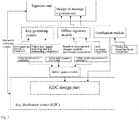
- Fig. 1 is a schematic structural diagram of an online/offline signature system based on multivariate cryptography of the present invention.
- an online/offline signature system based on multivariate cryptography comprising:
Landscapes
- Engineering & Computer Science (AREA)
- Computer Security & Cryptography (AREA)
- Computer Networks & Wireless Communication (AREA)
- Signal Processing (AREA)
- Computing Systems (AREA)
- Theoretical Computer Science (AREA)
- Storage Device Security (AREA)
- Computer And Data Communications (AREA)
Abstract
Description
- The present invention relates to the field of information security, and in particular to an online/offline signature system and method based on multivariate cryptography.
- On one hand, cryptography is the core and basis of information security, and is widely applied to the fields of network communications, e-commerce, banks, national defense and military, etc. Cryptography comprises symmetrical cryptography and asymmetrical cryptography, and the asymmetrical cryptography is also referred to as public key cryptography. At present, the security of public key cryptography primarily relies on difficult problems such as big integer decomposition and discrete logarithm solving, such as RSA and ECC. However, since it is proposed that the method of big integer decomposition and discrete logarithm solving can be implemented on quantum computers, such traditional public key cryptography has been significantly threatened, having influence on various industries. Therefore, efforts have been made to find a cryptography system capable of resisting quantum computer attacks to satisfy the requirements of information security, such system being referred to as a post-quantum cryptography, with multivariate public key cryptography being one of it.
- On the other hand, a wireless system is formed by a plurality of message signature ends deployed in a monitoring region, and communicates in a wireless manner. The biggest characteristics of the network comprise: self-organizing, relatively low costs of nodes, low power consumption of nodes, dynamic network topology changes, etc. A huge security loophole exists in the nodes deployed in the wireless system, and would be easily manipulated physically by an attacker. With regard to a security loophole at a message signature end, one can use some reasonable technical solutions for compensation, for example, a digital signature scheme may be used to solve this problem. Then, what kind of digital signature scheme may be applicable to the wireless system? What comes first is definitely security. If the signature is easy to be counterfeited, then the entire scheme would be meaningless; and then, we should take the computing capacity, energy consumption and storage space of the message signature end into consideration, and choose a signature scheme which will not cause a very great influence on the performance of the message signature end as much as possible. Comprehensively considering security, energy consumption and storage space, a multivariate public key cryptosystem (MPKC) is a good choice. In addition, in order to further reduce the computing overhead and storage overhead of a signature process on a wireless message signature end, an online/offline signature scheme is a better choice. This scheme may put more computing and storage in the offline stage, and is executed by a KDC end in the wireless system, with the actual signature process being placed in the online stage and being operated by a sensor. So that the signature scheme is enabled to conform to the characteristics of the system to a greater extent.
- However, at present, the online/offline signature scheme for multivariate public key cryptography has not been proposed yet, and a multivariate signature system used on the wireless system has not been implemented yet either.
- The objective of the present invention is to overcome the disadvantages and shortcomings of the prior art, and provide an online/offline signature system based on multivariate cryptography.
- The other objective of the present invention is to provide an online/offline signature method based on multivariate cryptography.
- The objectives of the present invention are implemented through the following technical solutions:
- an online/offline signature system based on multivariate cryptography, comprising
- a KDC end (the KDC being a key distribution center) for enabling building of a KDC end, which comprises a key generating module, an offline signature module, and a verification module connected sequentially, wherein the key generating module generates a public-private key pair with a reduced public key length; the offline signature module comprises a random message and vinegar variable generating component and a UOV signature component, the random message and vinegar variable generating component generating and transferring a random message and a value of a vinegar variable to the UOV signature component for signature, and the UOV signature component returning a message and a corresponding signature, while transmitting the result to a message signature end for storage; and the verification module comprises a public key transformation component, the signature being transmitted to the public key transformation component, and the signature being substituted into various multivariate polynomials in public key mapping for determining whether obtained data is equal to a message in a memory, and if so, then the signature being valid, and if not, then the signature being invalid;
- and the message signature end for building the KDC end of the system, which comprises an online signature module and a verification module, wherein the online signature module comprises an affine transformation component, a linear conversion component, and an affine transformation inversion component connected sequentially, a message to be signed being subjected to affine transformation, linear conversion and affine transformation inversion computing successively, then a generated signature being transmitted to the verification module together with the message; and the verification module comprises a public key transformation component, the signature being transmitted to the public key transformation component, and the signature being substituted into various multivariate polynomials in public key mapping for determining whether obtained data is equal to a message in a memory, and if so, then the signature being valid, and if not, then the signature being invalid.
- In the design, since the function and design components are identical, the verification module of the KDC end and the verification module of the message signature end share the same verification module.
- The key generating module comprises a UOV parameter generating component, and a public key length reducing and key computing component connected sequentially, wherein the UOV parameter generating component is from a basic UOV signature scheme, and when the component requires to be called, a generating algorithm nested in the component is called to generate a UOV system parameter; and the public key length reducing and key computing component comprises a UOV public key reducing algorithm and a key computing algorithm, and when the component is called, a system parameter is input at the KDC end and a corresponding UOV public-private key pair is output.
- The online/offline signature system based on multivariate cryptography further comprises a selector, wherein when the selector is in an on state, the signature module of the system works, and when the selector is in an off state, the verification module of the system works. In a general signature/verification system, user I performs signature processing on a message to be signed using a signature module; after a signature is formed, the signature and the original message are transmitted to user II; and user II uses a verification module to verify whether the signature is valid, and the two form an integral signature/verification system, or vice versa: user II signs using the signature module; after a signature is formed, the signature and the original message are transmitted to user I; and user I uses the verification module to verify whether the signature is valid. Therefore, one and the same user requires to have two different and independent apparatuses at the same time, i.e., the signature module and the verification module, to satisfy the requirements, which brings about inconvenience to the user. Nevertheless, the multivariate public key signature/verification system uses a scheme comprising a selector, and one and the same user only requires one and the same apparatus. The user chooses the apparatus to perform signature or verification according to his/her requirements, which is very convenient.
- The online/offline signature system based on multivariate cryptography further comprises a scheduler connected to the selector, wherein the on state and off state of the selector are recognized and processed by the scheduler, and stored data is controlled and scheduled by the scheduler to various corresponding components for corresponding operations.
- The other objective of the present invention is implemented through the following technical solution:
an online/offline signature method based on multivariate cryptography, comprising the following sequential steps: - (1) a KDC end performing a key generation process:
- a. after receiving a security parameter, a KDC end generating keys used by an entire system;
- b. in the process of key generation, the system requiring to use a public key reducing algorithm by means of which the design of a public key P with a reduced length is achievable;
- c. according to the above designed public key, randomly generating an affine transformation T, and then computing a corresponding Q; and
- d. the result finally obtained serving as public and private keys required to be used by the system, and a processor transmitting the message and a signature thereof together to a terminal user;
- (2) a signature process:
- a. performing an offline signature process in the KDC end first, and storing the result generated by the offline signature process in a message signature end requiring online signature in the next step; and
- b. after receiving a message to be signed, the message signature end taking the message as an input and performing an online signature process, and finally generating a corresponding signature; and
- (3) a verification process:
- a. the verification process being capable of running on the KDC end or the message signature end, the message and the signature thereof being transmitted to a corresponding processor, and the processor storing the message and the signature thereof and then transmitting the signature to a public key transformation component; and
- b. the public key transformation component substituting the signature into various multivariate polynomials of public key mapping, returning obtained data to the processor, and the processor determining whether the data is equal to a stored message: if so, the processor outputting "1" to the terminal user, indicating that the signature is valid; and if not, the processor outputting "0" to the terminal user, indicating that the signature is invalid.
- In step (2), the offline signature process comprises the following steps:
- a. given corresponding keys Q and T, in the offline signature process, the processor first randomly generating o+1 messages (m 1,m 2,...,m o+1), with a message length being o, then the processor randomly selecting a vinegar variable vector value xv ∈ kv , and then utilizing this vinegar variable vector to run an original UOV signature algorithm to sign the o+1 messages, and the obtained result being (cert 1,cert 2,..,cert o+1); and
- b. then transmitting (m 1,m 2,...,m o+1) and (cert 1,cert 2,...,cert o+1) to the message signature end for storage, and the parameter being input as a part of an online signature of a sensor.
- In step (2), the online signature process comprises the following steps:
- a. given a message m ∈ ko to be signed, in the online signature process, the message signature end first performing T affine transformation for (cert 1,cert 2,...,cert o+1), i.e., computing certT
i = T(certi ), i = {1,...,o+1}; - b. with regard to messages (m 1,m 2,...,m o+1) and (cert T
1 ,cert T2 ,...,cert To+1 ), subtracting a (o+1)th item from the first o items thereof respectively, i.e.:

- c. letting m' = m - m o+1, and constructing an arbitrary linear combination with a base of (m 1',m 2',...,mo ') for m', denoted as m 1' = α 1 m 1'+α 2 m 2'+...+αomo ';
- d. computing cert = cert T
o+1 +α 1 cert 1'+α 2 cert 2'+...+αocerto '; and - e. finally, performing affine inversion for T on cert, i.e., computing X = T -1(cert).
- Step S3 specifically comprises the following steps:
- a. a message (y 1',...,yn ') and a signature X = (x 1',...,xn ') thereof being transmitted to the processor, and the processor storing same and then transmitting the signature (x 1',...,xn ') to the public key transformation component; and
- b. the public key transformation component substituting the signature (x 1',...,xn ') into various multivariate polynomials of public key mapping P(x 1,...,xn ), i.e., computing p 1(x 1',...,xn '),...,pn (x 1',...,xn '), and denoting values thereof as y 1",...,yn " respectively, the public key transformation component transmitting y 1",...,yn " to the processor, and the processor determining whether y 1",...,yn " is equal to the originally stored message (y 1',...,yn '): if so, the processor outputting "1" to the terminal user, indicating that the signature is valid; and if not, the processor outputting "0" to the terminal user, indicating that the signature is invalid.
- Compared to the prior art, the present invention has the following advantages and beneficial effects:
- Firstly, with appropriate parameter selection, algebraic attacks of multivariate public key cryptography currently known can be resisted, and the security is high. The security of the present scheme is consistent with the security of the traditional multivariate public key signature algorithm.
- Secondly, the signature scheme used in the present invention is an online/offline signature scheme. The scheme effectively puts operations with a large amount of computing and storage in the offline stage, which are executed by a KDC end of a wireless system, while the actual signature process is therefore significantly optimized, and is executed by a wireless message signature end.
- Thirdly, by comparing the present scheme with a currently popular multivariate public key signature algorithm UOV, the optimized results are as shown in Table 1 (assuming that parameter selection is (q = 256, m = o = 26, v = 52, n = 78)).
- It can be seen from Table 1 that, in the signature scheme of the present invention, the signature process reduces one Gaussian elimination arithmetic operation compared to the traditional multivariate signature scheme UOV in terms of computing efficiency, that is, the computing overhead of O(n3) is approximately reduced. On the other hand, in terms of storage efficiency, the signature scheme of the present invention reduces 88.6% compared to the UOV scheme with regard to the key size required for signature, and with regard to the storage space required by the entire scheme, the signature scheme of the present invention also reduces 85.8% compared to UOV. The present invention has been greatly improved both in terms of computing efficiency and storage efficiency.
-
Fig. 1 is a schematic structural diagram of an online/offline signature system based on multivariate cryptography of the present invention. - The present invention will be further described in detail below in conjunction with embodiments and accompanying drawings, but this does not limit the implementation of the present invention.
- As shown in
Fig. 1 , an online/offline signature system based on multivariate cryptography, comprising: - A. A KDC end part for enabling building of a KDC end part of the system, which comprises a key generating module, an offline signature module, and a verification module. The key generating module comprises a UOV parameter generating component, and a public key length reducing and key computing component. By sequentially executing a security parameter by various components, finally the module generates a public-private key pair with a reduced public key length; the offline signature module comprises a random message and vinegar variable generating component and a UOV signature component, in the module, using the above components, the system generating and transferring a random message and a value of a vinegar variable to the UOV signature component for signature, and finally the signature component returning a message and a corresponding signature, and transmitting the result to a message signature end for storage; and the verification module comprises a public key transformation component, a processor transmitting the signature to the public key transformation component, and substituting the signature into various multivariate polynomials in public key mapping, and the processor determining whether obtained data is equal to a message in a memory, and if so, then the signature being valid, and if not, then the signature being invalid; and
- B. A message signature end part for building the KDC end part of the system, which comprises an online signature module and a verification module. The online signature module comprises an affine transformation component, a linear conversion component, and an affine transformation inversion component, in the module, after corresponding operations are executed on a message to be signed by various components sequentially, a generated signature being transmitted to the processor together with the message; and the verification module comprises a public key transformation component, a processor transmitting the signature to the public key transformation component, and substituting the signature into various multivariate polynomials in public key mapping, and the processor determining whether obtained data is equal to a message in a memory, and if so, then the signature being valid, and if not, then the signature being invalid.
- Before the multivariate public key signature/verification system is used for the first time, initialization requires to be performed, and the initialization process is as shown below:
- (1) firstly determining system parameters of the entire system, comprising: all the arithmetic operations of the system are based on a finite field k of order q, where n is the number of variables of multivariate polynomials, m is the number of multivariate polynomials, and o and v are respectively the numbers of oil and vinegar variables;
- (2) the KDC end using the following key generating algorithm (algorithm 1) to generate public-private keys required by the scheme for the system, wherein the public key is one that uses a cyclic matrix form, which can thus reduce the length of the public key;


- (3) A signature process:
- a. performing an offline signature process in the KDC end first, and storing the result generated by the offline signature process in a message signature end requiring online signature in the next step; and
- b. after receiving a message to be signed, the message signature end taking the message as an input and performing an online signature process, and finally generating a corresponding signature.
- (4) A verification process:
- a. the verification process being capable of running on the KDC end or the message signature end, the message and the signature thereof being transmitted to a corresponding processor, and the processor storing the message and the signature thereof and then transmitting the signature to a public key transformation component; and
- b. the public key transformation component substituting the signature into various multivariate polynomials of public key mapping, returning obtained data to the processor, and the processor determining whether the data is equal to a stored message: if so, the processor outputting "1" to the terminal user, indicating that the signature is valid; and if not, the processor outputting "0" to the terminal user, indicating that the signature is invalid.
- a. given corresponding keys Q and T, in the offline signature process, the processor first randomly generating o+1 messages (m 1,m 2,...,m o+1), with a message length being o, then the processor randomly selecting a vinegar variable vector value xv ∈ kv , and then utilizing this vinegar variable vector to run an original UOV signature algorithm to sign the o+1 messages, and the obtained result being (cert 1,cert 2,...,cert o+1); and
- b. then transmitting (m 1,m 2,...,m o+1) and (cert 1,cert 2,...,cert o+1) to the message signature end for storage, and the parameter being input as a part of an online signature of a sensor;
- a. given a message m ∈ ko to be signed, in the online signature process, the message signature end first performing T affine transformation for (cert 1,cert 2,...,cert o+1), i.e., computing certT
i = T(certi ), i = {1,...,o+1}; - b. with regard to messages (m 1,m 2,...,m o+1) and (cert T
1 ,cert T2 ,...,cert To+1 ), subtracting (o+1)th item from the first o items thereof respectively, i.e., (m 1' = m 1 - m o+1,...,mo ' = mo - m o+1) and (cert 1' = cert T1 - cert To+1 ,...,certo ' = certTo - cert To+1 ); - c. letting m' = m - m o+1, and constructing an arbitrary linear combination with a base of (m 1',m 2',...,mo ') for m', denoted as m 1' = α 1 m 1'+α 2 m 2'+...+αomo ';
- d. computing cert = cert T
o+1 +α 1 cert 1'+α 2 cert 2'+...+αocerto '; and - e. finally, performing affine inversion for T on cert, i.e., computing X = T -1(cert); and
- a. a message (y 1',...,yn ') and a signature X = (x 1',...,xn ') thereof being transmitted to the processor, and the processor storing same and then transmitting the signature (x 1',...,xn ') to the public key transformation component; and
- b. the public key transformation component substituting the signature (x 1',...,xn ') into various multivariate polynomials of public key mapping P(x 1,...,xn ), i.e., computing p 1(x 1',...,xn '),...,pn (x 1',...,xn '), and denoting values thereof as y 1",...,yn " respectively, the public key transformation component transmitting y 1",...,yn " to the processor, and the processor determining whether y 1",...,yn " is equal to the originally stored message (y 1',...,yn '): if so, the processor outputting "1" to the terminal user, indicating that the signature is valid; and if not, the processor outputting "0" to the terminal user, indicating that the signature is invalid.
- The recommended system parameters of the present invention are: q = 256, n = 78, v = 52 and m = o = 26, and the security level thereof can reach 280.
- The above embodiments are preferred implementations of the present invention. However, the implementation of the present invention is not limited by the above embodiments, and any alternation, modification, substitution, combination and simplification without departing from the spiritual essence and principles of the present invention should all be equivalent replacement methods, and all fall within the scope of protection of the present invention.
| UOV (multivariate public key signature) | Signature scheme of the present patent | |
| Overhead of signature process | Gaussian elimination + multiplication (over field) | Multiplication (over field) |
| Overhead of verification process | Multiplication (over field) | Multiplication (over field) |
| Key size required for signature | mov + mv(v + 1)/2 + (m + n)(n + 1) = 77.3 KB | (o + 1)(|message| + |cert|) + n(n + 1) = 8.8 KB |
| Signature size | n = 624 bits | n = 624 bits |
| Storage space required for public-private keys | mov + mv(v + 1)/2 + (m + n)(n + 1) + m(n + 1)(n + 2)/2 = 157.5 KB | (o + 1)(|message| + |cert|) + n(n + 1) + m((n + 1)(n + 2) - 2D)/2 + D = 22.4 KB |
Claims (8)
- An online/offline signature system based on multivariate cryptography, comprising:a KDC end for enabling building of a KDC end, which comprises a key generating module, an offline signature module, and a verification module connected sequentially, wherein the key generating module generates a public-private key pair with a reduced public key length; the offline signature module comprises a random message and vinegar variable generating component and a UOV signature component, the random message and vinegar variable generating component generating and transferring a random message and a value of a vinegar variable to the UOV signature component for signature, and the UOV signature component returning a message and a corresponding signature, while transmitting the result to a message signature end for storage; and the verification module comprises a public key transformation component, the signature being transmitted to the public key transformation component, and the signature being substituted into various multivariate polynomials in public key mapping for determining whether obtained data is equal to a message in a memory, and if so, then the signature being valid, and if not, then the signature being invalid;and the message signature end for building the KDC end of the system, which comprises an online signature module and a verification module, wherein the online signature module comprises an affine transformation component, a linear conversion component, and an affine transformation inversion component connected sequentially, a message to be signed being subjected to affine transformation, linear conversion and affine transformation inversion computing successively, then a generated signature being transmitted to the verification module together with the message; and the verification module comprises a public key transformation component, the signature being transmitted to the public key transformation component, and the signature being substituted into various multivariate polynomials in public key mapping for determining whether obtained data is equal to a message in a memory, and if so, then the signature being valid, and if not, then the signature being invalid.
- The online/offline signature system based on multivariate cryptography according to claim 1, wherein the key generating module comprises a UOV parameter generating component, and a public key length reducing and key computing component connected sequentially, wherein the UOV parameter generating component is from a basic UOV signature scheme, and when the component requires to be called, a generating algorithm nested in the component is called to generate a UOV system parameter; and the public key length reducing and key computing component comprises a UOV public key reducing algorithm and a key computing algorithm, and when the component is called, a system parameter is input at the KDC end and a corresponding UOV public-private key pair is output.
- The online/offline signature system based on multivariate cryptography according to claim 1, further comprising a selector, wherein when the selector is in an on state, the signature module of the system works, and when the selector is in an off state, the verification module of the system works.
- The online/offline signature system based on multivariate cryptography according to claim 3, further comprising a scheduler connected to the selector, wherein the on state and off state of the selector are recognized and processed by the scheduler, and stored data is controlled and scheduled by the scheduler to various corresponding components for corresponding operations.
- An online/offline signature method based on multivariate cryptography, comprising the following sequential steps:(1) a KDC end performing a key generation process:a. after receiving a security parameter, a KDC end generating keys used by an entire system;b. in the process of key generation, the system requiring to use a public key reducing algorithm by means of which the design of a public key P with a reduced length is achievable;c. according to the above designed public key, randomly generating an affine transformation T, and then computing a corresponding Q; andd. the result finally obtained serving as public and private keys required to be used by the system, and a processor transmitting the message and a signature thereof together to a terminal user;(2) a signature process:a. performing an offline signature process in the KDC end first, and storing the result generated by the offline signature process in a message signature end requiring online signature in the next step; andb. after receiving a message to be signed, the message signature end taking the message as an input and performing an online signature process, and finally generating a corresponding signature; and(3) a verification process:a. the verification process being capable of running on the KDC end or the message signature end, the message and the signature thereof being transmitted to a corresponding processor, and the processor storing the message and the signature thereof and then transmitting the signature to a public key transformation component; andb. the public key transformation component substituting the signature into various multivariate polynomials of public key mapping, returning obtained data to the processor, and the processor determining whether the data is equal to a stored message: if so, the processor outputting "1" to the terminal user, indicating that the signature is valid; and if not, the processor outputting "0" to the terminal user, indicating that the signature is invalid.
- The online/offline signature method based on multivariate cryptography according to claim 5, wherein, in step (2), the offline signature process comprises the following steps:a. given corresponding keys Q and T, in the offline signature process, the processor first randomly generating o+1 messages (m 1,m 2,...,m o+1), with a message length being o, then the processor randomly selecting a vinegar variable vector value xv ∈ kv , and then utilizing this vinegar variable vector to run an original UOV signature algorithm to sign the o+1 messages, and the obtained result being (cert 1,cert 2,...,cert o+1); andb. then transmitting (m 1,m 2,...,m o+1) and (cert 1,cert 2,...,cert o+1) to the message signature end for storage, and the parameter being input as a part of an online signature of a sensor.
- The online/offline signature method based on multivariate cryptography according to claim 5, wherein, in step (2), the online signature process comprises the following steps:a. given a message m ∈ ko to be signed, in the online signature process, the message signature end first performing T affine transformation for (cert 1,cert 2,...,cert o+1), i.e., computing certT
i = T(certi ), i = {1,...,o+1};b. with regard to messages (m 1,m 2,...,m o+1) and (cert T1 ,cert T2 ,...,cert To+1 ), subtracting a (o+1)th item from the first o items thereof respectively, i.e.:
 c. letting m' = m - m o+1, and constructing an arbitrary linear combination with a base of (m 1',m 2,...,mo ') for m', denoted as m 1' = α 1 m 1'+α 2 m 2'+...+αomo ';d. computing cert = cert T
o+1 +α 1 cert 1'+α 2 cert 2'+...+αocerto '; ande. finally, performing affine inversion for T on cert, i.e., computing X = T -1(cert). - The online/offline signature method based on multivariate cryptography according to claim 5, wherein the step specifically comprises the following steps:a. a message (y 1',...,yn ') and a signature X = (x 1',...,xn ') thereof being transmitted to the processor, and the processor storing same and then transmitting the signature (x 1',...,xn ') to the public key transformation component; andb. the public key transformation component substituting the signature (x 1',...,xn ') into various multivariate polynomials of public key mapping P(x 1,...,xn ), i.e., computing p 1(x 1',...,xn '),...,pn (x 1',...,xn '), and denoting values thereof as y 1",...,yn " respectively, the public key transformation component transmitting y 1",...,yn " to the processor, and the processor determining whether y 1",...,yn " is equal to the originally stored message (y 1',...,yn '): if so, the processor outputting "1" to the terminal user, indicating that the signature is valid; and if not, the processor outputting "0" to the terminal user, indicating that the signature is invalid.
Applications Claiming Priority (2)
| Application Number | Priority Date | Filing Date | Title |
|---|---|---|---|
| CN201510607733.6A CN105245343B (en) | 2015-09-22 | 2015-09-22 | A kind of online static signature system and method based on multivariable cryptographic technique |
| PCT/CN2015/098524 WO2017049790A1 (en) | 2015-09-22 | 2015-12-23 | Online/offline signature system and method based on multivariate cryptography |
Publications (2)
| Publication Number | Publication Date |
|---|---|
| EP3570488A1 true EP3570488A1 (en) | 2019-11-20 |
| EP3570488A4 EP3570488A4 (en) | 2021-01-20 |
Family
ID=55042855
Family Applications (1)
| Application Number | Title | Priority Date | Filing Date |
|---|---|---|---|
| EP15904665.5A Withdrawn EP3570488A4 (en) | 2015-09-22 | 2015-12-23 | ONLINE / OFFLINE SIGNATURE SYSTEM AND METHOD BASED ON MULTIPLE VARIABLE CRYPTOGRAPHY |
Country Status (4)
| Country | Link |
|---|---|
| US (1) | US10623189B2 (en) |
| EP (1) | EP3570488A4 (en) |
| CN (1) | CN105245343B (en) |
| WO (1) | WO2017049790A1 (en) |
Families Citing this family (9)
| Publication number | Priority date | Publication date | Assignee | Title |
|---|---|---|---|---|
| CN106027262B (en) * | 2016-07-01 | 2017-02-22 | 陕西科技大学 | Multi-variable signing method resisting key recovery attack |
| CN107171788B (en) * | 2017-04-08 | 2020-06-30 | 西安邮电大学 | An online and offline aggregation signature method based on identity and constant signature length |
| US11469903B2 (en) * | 2019-02-28 | 2022-10-11 | Microsoft Technology Licensing, Llc | Autonomous signing management operations for a key distribution service |
| CN114422158B (en) * | 2020-10-12 | 2024-04-09 | 如般量子科技有限公司 | Anti-quantum computing digital currency communication method and system based on ID cryptography |
| CN114362952B (en) * | 2020-10-13 | 2024-05-14 | 如般量子科技有限公司 | Anti-quantum computing transaction method and system for digital currency of sender offline |
| US12192318B2 (en) | 2021-03-10 | 2025-01-07 | Quantropi Inc. | Quantum-safe cryptographic method and system |
| WO2022187959A1 (en) * | 2021-03-10 | 2022-09-15 | Quantropi Inc. | Quantum-safe cryptographic methods and systems |
| KR102568418B1 (en) * | 2021-08-26 | 2023-08-18 | 하이파이브랩 주식회사 | Electronic authentication system and method supporting multi-signature |
| CN114257377A (en) * | 2021-11-30 | 2022-03-29 | 南方电网科学研究院有限责任公司 | Multivariate aggregation signature method, system, equipment and medium |
Family Cites Families (7)
| Publication number | Priority date | Publication date | Assignee | Title |
|---|---|---|---|---|
| ES2230814T3 (en) * | 1999-04-29 | 2005-05-01 | Cp8 Technologies | METHODS AND SYSTEMS OF PUBLIC KEY SIGNATURE. |
| US7602910B2 (en) | 2004-11-17 | 2009-10-13 | Microsoft Corporation | Password protection |
| CN1870499B (en) | 2005-01-11 | 2012-01-04 | 丁津泰 | Method for generating multiple variable commom key password system |
| IL207918A0 (en) * | 2010-09-01 | 2011-01-31 | Aviad Kipnis | Attack-resistant multivariate signature scheme |
| CN102013983B (en) * | 2010-11-26 | 2012-08-22 | 中国科学院软件研究所 | Digital signature method based on strong rivest-shamir-adleman (RSA) hypothesis |
| JP5790291B2 (en) * | 2011-08-12 | 2015-10-07 | ソニー株式会社 | Information processing apparatus, signature providing method, signature verification method, program, and recording medium |
| CN103780383B (en) * | 2014-01-13 | 2017-05-31 | 华南理工大学 | One kind is based on hyperspherical multivariable public key signature/checking system and method |
-
2015
- 2015-09-22 CN CN201510607733.6A patent/CN105245343B/en not_active Expired - Fee Related
- 2015-12-23 EP EP15904665.5A patent/EP3570488A4/en not_active Withdrawn
- 2015-12-23 WO PCT/CN2015/098524 patent/WO2017049790A1/en not_active Ceased
- 2015-12-23 US US15/761,838 patent/US10623189B2/en not_active Expired - Fee Related
Also Published As
| Publication number | Publication date |
|---|---|
| WO2017049790A1 (en) | 2017-03-30 |
| CN105245343B (en) | 2018-09-14 |
| US10623189B2 (en) | 2020-04-14 |
| EP3570488A4 (en) | 2021-01-20 |
| CN105245343A (en) | 2016-01-13 |
| US20180278426A1 (en) | 2018-09-27 |
Similar Documents
| Publication | Publication Date | Title |
|---|---|---|
| US10623189B2 (en) | Online/offline signature system and method based on multivariate cryptography | |
| Kahrobaei et al. | Public key exchange using matrices over group rings | |
| CN106936569B (en) | Method for realizing SM4 algorithm mask S box for resisting power consumption attack | |
| US9948462B2 (en) | Hypersphere-based multivariable public key signature/verification system and method | |
| US10142105B2 (en) | Hypersphere-based multivariable public key encryption/decryption system and method | |
| KR20200087252A (en) | Method and system for key agreement using semi-group | |
| US11902432B2 (en) | System and method to optimize generation of coprime numbers in cryptographic applications | |
| US9948463B2 (en) | Multivariate public key signature/verification system and signature/verification method | |
| CN114911455A (en) | High-speed pseudo-random number generation method based on FPGA and high-speed pseudo-random number generator | |
| Wang et al. | The design of keyed hash function based on CNN-MD structure | |
| CN114337995A (en) | Quantum computation resistant digital signature scheme based on identity | |
| CN113010142B (en) | Novel pulse node type scalar dot multiplication double-domain implementation system and method | |
| CN107947943B (en) | An online-offline cycle non-equilibrium oil and vinegar signature method | |
| Kahrobaei et al. | Public key exchange using extensions by endomorphisms and matrices over a Galois field | |
| Peng et al. | Circulant UOV: a new UOV variant with shorter private key and faster signature generation. | |
| Ramasamy et al. | Knapsack based ECC encryption and decryption | |
| Deb et al. | Elliptic curve and pseudo-inverse matrix based cryptosystem for wireless sensor networks | |
| Hoshino et al. | Cheating detectable secret sharing scheme suitable for implementation | |
| Sahu et al. | BDD‐based cryptanalysis of stream cipher: a practical approach | |
| CN120498659B (en) | Edge-assisted lightweight deduplication encryption method | |
| Davletova et al. | Encryption method based on codes | |
| Tian et al. | (m, N) Threshold Multi-signature Scheme Based on ECC Over Finite Field GF (q) | |
| Aglawe et al. | Software implementation of cyclic abelian elliptic curve using matlab | |
| Lin | Research on information encryption and authentication in big data environment | |
| Rahmawati et al. | Systematic Analysis of Mathematical Fundamentals in Elliptic Curve Cryptography: Concepts, Applications, and Challenges |
Legal Events
| Date | Code | Title | Description |
|---|---|---|---|
| STAA | Information on the status of an ep patent application or granted ep patent |
Free format text: STATUS: THE INTERNATIONAL PUBLICATION HAS BEEN MADE |
|
| PUAI | Public reference made under article 153(3) epc to a published international application that has entered the european phase |
Free format text: ORIGINAL CODE: 0009012 |
|
| STAA | Information on the status of an ep patent application or granted ep patent |
Free format text: STATUS: REQUEST FOR EXAMINATION WAS MADE |
|
| 17P | Request for examination filed |
Effective date: 20180525 |
|
| AK | Designated contracting states |
Kind code of ref document: A1 Designated state(s): AL AT BE BG CH CY CZ DE DK EE ES FI FR GB GR HR HU IE IS IT LI LT LU LV MC MK MT NL NO PL PT RO RS SE SI SK SM TR |
|
| A4 | Supplementary search report drawn up and despatched |
Effective date: 20201217 |
|
| RIC1 | Information provided on ipc code assigned before grant |
Ipc: H04L 9/32 20060101AFI20201211BHEP Ipc: H04L 9/08 20060101ALI20201211BHEP |
|
| STAA | Information on the status of an ep patent application or granted ep patent |
Free format text: STATUS: EXAMINATION IS IN PROGRESS |
|
| 17Q | First examination report despatched |
Effective date: 20220711 |
|
| STAA | Information on the status of an ep patent application or granted ep patent |
Free format text: STATUS: THE APPLICATION IS DEEMED TO BE WITHDRAWN |
|
| 18D | Application deemed to be withdrawn |
Effective date: 20240702 |