EP3570208A1 - Two-dimensional document processing - Google Patents
Two-dimensional document processing Download PDFInfo
- Publication number
- EP3570208A1 EP3570208A1 EP18204940.3A EP18204940A EP3570208A1 EP 3570208 A1 EP3570208 A1 EP 3570208A1 EP 18204940 A EP18204940 A EP 18204940A EP 3570208 A1 EP3570208 A1 EP 3570208A1
- Authority
- EP
- European Patent Office
- Prior art keywords
- document
- character
- processing system
- implemented method
- grid
- Prior art date
- Legal status (The legal status is an assumption and is not a legal conclusion. Google has not performed a legal analysis and makes no representation as to the accuracy of the status listed.)
- Granted
Links
Images



Classifications
-
- G—PHYSICS
- G06—COMPUTING OR CALCULATING; COUNTING
- G06V—IMAGE OR VIDEO RECOGNITION OR UNDERSTANDING
- G06V10/00—Arrangements for image or video recognition or understanding
- G06V10/70—Arrangements for image or video recognition or understanding using pattern recognition or machine learning
- G06V10/82—Arrangements for image or video recognition or understanding using pattern recognition or machine learning using neural networks
-
- G—PHYSICS
- G06—COMPUTING OR CALCULATING; COUNTING
- G06F—ELECTRIC DIGITAL DATA PROCESSING
- G06F18/00—Pattern recognition
- G06F18/20—Analysing
- G06F18/24—Classification techniques
- G06F18/241—Classification techniques relating to the classification model, e.g. parametric or non-parametric approaches
- G06F18/2413—Classification techniques relating to the classification model, e.g. parametric or non-parametric approaches based on distances to training or reference patterns
- G06F18/24133—Distances to prototypes
-
- G—PHYSICS
- G06—COMPUTING OR CALCULATING; COUNTING
- G06N—COMPUTING ARRANGEMENTS BASED ON SPECIFIC COMPUTATIONAL MODELS
- G06N3/00—Computing arrangements based on biological models
- G06N3/02—Neural networks
- G06N3/04—Architecture, e.g. interconnection topology
- G06N3/045—Combinations of networks
- G06N3/0455—Auto-encoder networks; Encoder-decoder networks
-
- G—PHYSICS
- G06—COMPUTING OR CALCULATING; COUNTING
- G06N—COMPUTING ARRANGEMENTS BASED ON SPECIFIC COMPUTATIONAL MODELS
- G06N3/00—Computing arrangements based on biological models
- G06N3/02—Neural networks
- G06N3/04—Architecture, e.g. interconnection topology
- G06N3/0464—Convolutional networks [CNN, ConvNet]
-
- G—PHYSICS
- G06—COMPUTING OR CALCULATING; COUNTING
- G06V—IMAGE OR VIDEO RECOGNITION OR UNDERSTANDING
- G06V30/00—Character recognition; Recognising digital ink; Document-oriented image-based pattern recognition
- G06V30/10—Character recognition
- G06V30/18—Extraction of features or characteristics of the image
- G06V30/1801—Detecting partial patterns, e.g. edges or contours, or configurations, e.g. loops, corners, strokes or intersections
- G06V30/18019—Detecting partial patterns, e.g. edges or contours, or configurations, e.g. loops, corners, strokes or intersections by matching or filtering
- G06V30/18038—Biologically-inspired filters, e.g. difference of Gaussians [DoG], Gabor filters
- G06V30/18048—Biologically-inspired filters, e.g. difference of Gaussians [DoG], Gabor filters with interaction between the responses of different filters, e.g. cortical complex cells
- G06V30/18057—Integrating the filters into a hierarchical structure, e.g. convolutional neural networks [CNN]
-
- G—PHYSICS
- G06—COMPUTING OR CALCULATING; COUNTING
- G06V—IMAGE OR VIDEO RECOGNITION OR UNDERSTANDING
- G06V30/00—Character recognition; Recognising digital ink; Document-oriented image-based pattern recognition
- G06V30/10—Character recognition
- G06V30/19—Recognition using electronic means
- G06V30/191—Design or setup of recognition systems or techniques; Extraction of features in feature space; Clustering techniques; Blind source separation
- G06V30/19173—Classification techniques
-
- G—PHYSICS
- G06—COMPUTING OR CALCULATING; COUNTING
- G06V—IMAGE OR VIDEO RECOGNITION OR UNDERSTANDING
- G06V30/00—Character recognition; Recognising digital ink; Document-oriented image-based pattern recognition
- G06V30/10—Character recognition
- G06V30/26—Techniques for post-processing, e.g. correcting the recognition result
- G06V30/262—Techniques for post-processing, e.g. correcting the recognition result using context analysis, e.g. lexical, syntactic or semantic context
- G06V30/274—Syntactic or semantic context, e.g. balancing
-
- G—PHYSICS
- G06—COMPUTING OR CALCULATING; COUNTING
- G06V—IMAGE OR VIDEO RECOGNITION OR UNDERSTANDING
- G06V30/00—Character recognition; Recognising digital ink; Document-oriented image-based pattern recognition
- G06V30/40—Document-oriented image-based pattern recognition
- G06V30/41—Analysis of document content
- G06V30/412—Layout analysis of documents structured with printed lines or input boxes, e.g. business forms or tables
-
- G—PHYSICS
- G06—COMPUTING OR CALCULATING; COUNTING
- G06V—IMAGE OR VIDEO RECOGNITION OR UNDERSTANDING
- G06V30/00—Character recognition; Recognising digital ink; Document-oriented image-based pattern recognition
- G06V30/40—Document-oriented image-based pattern recognition
- G06V30/41—Analysis of document content
- G06V30/413—Classification of content, e.g. text, photographs or tables
-
- G—PHYSICS
- G06—COMPUTING OR CALCULATING; COUNTING
- G06V—IMAGE OR VIDEO RECOGNITION OR UNDERSTANDING
- G06V30/00—Character recognition; Recognising digital ink; Document-oriented image-based pattern recognition
- G06V30/40—Document-oriented image-based pattern recognition
- G06V30/41—Analysis of document content
- G06V30/414—Extracting the geometrical structure, e.g. layout tree; Block segmentation, e.g. bounding boxes for graphics or text
-
- G—PHYSICS
- G06—COMPUTING OR CALCULATING; COUNTING
- G06V—IMAGE OR VIDEO RECOGNITION OR UNDERSTANDING
- G06V30/00—Character recognition; Recognising digital ink; Document-oriented image-based pattern recognition
- G06V30/10—Character recognition
Definitions
- semantic class can be a postal address semantic class including words used for formulation of postal addresses.
- words and/or characters agglomerated in a particular area of the document can have/share the same semantic class related to the particular are and/or the same semantic feature related to the particular area.
- the present invention relates to a computer program comprising instructions to execute the aforementioned computer-implemented method.
- the second neural network can be trained to detect different instances by applying box regression; and/or wherein the first and the second neural network can have the same encoder.
- the first and the second neural networks can have the same parts of the decoder, wherein the first and the second neural network can branch near the last network layers.
- system, apparatus, device, method and/or computer program product embodiments for two-dimensional document processing.
- the embodiments disclosed herein may process and/or extract semantic information from structured documents.
- Key-values may be values identified as relevant with respect to the document or the purpose of the document. For example, if the document is an invoice, a key-value may be a total sales price of a line item description. While embodiments are described herein as operating on documents, this disclosure is not so limited. Instead, this disclosure is generally applicable to operation on any multidimensional data object.
- the document processing system may represent the text of a document using pixels.
- the document processing system may represent characters or words using index values.
- a "character” may refer to letters, numbers, symbols, words, a collection or combination of letters, numbers, and/or symbols, symbolic mark, an image, and/or other visual indicator on a document.
- the document processing system may convert an identified character to an index value.
- the index value may correspond, for example, to a ASCII value or a dictionary of words.
- the conversion may use a mapping function to assign the index value.
- Document processing system may mask the character using the index value. Because a character may occupy a size measured by [width of pixels X height of pixels], masking the character may include representing the area with the index value while reducing the number of pixels used to represent the character. Document processing system may apply this process to each character of the document to generate a character grid.
- a character grid may be an image that represents a down-sampled version of the original document.
- the character grid may be two-dimensional.
- FIG. 4 which is also further described below, depicts an example of this pixel processing.
- the down-sampling may be by a factor of [width of pixels X height of pixels]. This may occur when [width of pixels X height of pixels] is the smallest character in the document. This down-sampling may occur by a factor equal to the pixel area covering a character of the document.
- the character grid may represent down-sampling without the loss of information on the character level because each character is represented by an index value.
- Each cell of the character grid may be down-sampled using nearest neighbor interpolation.
- Down-sampling may yield the advantage that the resulting character grid is simpler and smaller in size relative to the original document image.
- a machine learning algorithm or other artificial intelligence may analyze the character grid more quickly and with fewer processing steps relative to the original document.
- the machine learning algorithms may also more easily determine patterns from the document.
- the document processing system may also preserve the spatial relationship between the characters. Characters that occupy more space (e.g., if the character has larger font size) may also occupy more space (e.g., grid cells) in the character grid. In this manner, the character grid may reflect the font size formatting of the document. Further detail regarding embodiments of the generation of the character grid will be discussed below and throughout this disclosure.
- the document processing system may utilize the character grid as an input to a machine learning model, such as, for example, a convolutional neural network (CNN).
- the CNN may process the document to extract relevant information, such as, for example, key-values or table information. Because the document has been converted from an image to a character grid, the CNN need not newly learn the characters. In this manner, the document processing system may extract key-values in a faster manner and with increased accuracy compared to a raw pixel approach or a sequence tagging approach.
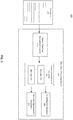
- FIG. 1 depicts a block diagram depicting a document processing environment 100.
- Document processing environment 100 includes document processing system 110.
- Document processing system 110 may be implemented using one or more processors and/or may include hardware and/or software and may be configured to process documents.
- Document processing system 110 may include optical character recognition (OCR) scanner 130, convolutional neural network (CNN) 140, bounding box detector 150, and/or semantic segmentation generator 160.
- OCR optical character recognition
- CNN convolutional neural network
- Document processing system 110 may receive a document 120 for processing.
- Document 120 may be an image, PDF, word processing document, and/or other visual representation or manifestation of data. Examples of document 120 may include an invoice, an instruction manual, and/or a slideshow presentation.
- Document processing system 110 may be a standalone system configured to receive document 120 and determine semantic information and/or data from document 120. Document processing system 110 may store this semantic data in a memory device and/or a database. Document processing system 110 may communicate with a separate system. Document processing system 110 may transmit the semantic data to the separate system. Document processing system 110 may be integrated with another system. For example, document processing system 110 may serve as a component of a larger system. Document processing system 110 may receive the document 120 from a location directed by the larger system. The larger system may direct document processing system 110 to direct identified semantic information to a particular location.
- Document processing system 110 may be configured to identify relevant information from the received document 120. Depending on the application and/or parameters established by CNN 140, document processing system 110 may be configured to extract key-values or desired information from document 120, classify the document, and/or classify portions of the document. For example, document processing system 110 may recognize an entity name, extract key-values, extract a table, classify the document, identify document duplication, and/or retrieve information.
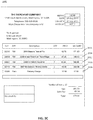
- FIG. 2A depicts a block diagram depicting a document 200A.
- Document 200A may be analogous to document 120.
- the document 200A may be an invoice and may be analyzed by document processing system 110.
- Document processing system 110 may retrieve the document as a file or as a depicted image.
- a separate system that controls document processing system 110 may choose to apply document processing system 110 to the document 120.
- document processing system 110 may identify desired portions of document 200A. For example, document processing system 110 may determine that the document 200A is an invoice based on the content and semantic relationships.
- Document processing system 110 may further extract invoice information such as product descriptions, the quantity of a purchase, the price of a purchase, or the amount of a purchase.
- document processing system 110 may identify summary sale information and/or named entity information. In this manner, document processing system 110 may semantically analyze document 200A even if document 200A includes a 2D format. Document processing system 110 is able to preserve the semantic elements of the document to apply machine learning algorithms to process document 200A.
- OCR scanner 130 may be a module executed by one or more processors of document processing system 110. OCR scanner 130 may analyze the document to extract, for example, a 1D sequence of characters from document 120. OCR scanner 130 may extract string information and/or position information related to the characters of document 120. Document 120 may include 2D layout information and/or metadata. OCR scanner 130 may identify this metadata when scanning document 120.
- OCR scanner 130 may determine word bounding boxes in document 120.
- a word bounding box may represent a pixel area (e.g., width x height) occupied by the word. For example, referring to FIG. 4 , OCR scanner 130 may identify string 410 in document 120. OCR scanner 130 may identify three separate words in this string as "THE", "MERCHANT", and "COMPANY". OCR scanner 130 may recognize these words and associate each word with a word bounding box. OCR scanner 130 may also identify the location of the word bounding boxes in document 120. For example, OCR scanner 130 may utilize a coordinate system or a relative pixel location.
- OCR scanner 130 may divide word boxes into character boxes and convert string 410 intro string 420. For example, OCR scanner 130 may identify the pixels within a word bounding box include distinct characters. In this manner, OCR scanner 130 may convert the word box into character boxes. This division may maintain positioning information related to the characters.
- document processing system 110 may replace characters of document 120 with an index value.
- the index value may be assigned according to a mapping function. An index value may be assigned via down-sampling using nearest neighbor interpolation.
- Document processing system 110 may utilize a dictionary to map a character to an index value.
- the index value may be a vector.
- Document processing system 110 may generate the vector using model techniques such as, for example, Word2vec. Generating index values for the characters allows document processing system 110 to compile the character grid having index values for the characters contained within.
- FIG. 4 depicts a rectangular representation for a character document processing system 110 may additionally or alternatively utilize other forms for representation.
- document processing system 110 may represent a character using a continuous distribution in a 1-hot encoded space rather than a 2D rectangular window function.
- the pixel area occupied by the character in the channel corresponding to the character could smoothly fall off from a value of "one" at the center location of the character to "zero" towards the edge of the area that the character occupies.
- this representation may appear similar to a Gaussian distribution. The distribution may be truncated at the character boundary.
- the character grid may be further down-sampled in the 1-hot encoded space. Characters that previously occupied one grid cell may now be represented on the sub-cell level by a value that is less than "one.” This representation may result from a bilinear interpolation of the grid cells.
- document processing system 110 may input the character grid in convolutional neural network (CNN) 140 (or apply the CNN to the character grid).
- CNN 140 may include an encoder 142 and/or a decoder 144.
- CNN 140 may be an artificial intelligence network and/or may apply machine learning algorithms to identify desired characters and/or aspects of document 120.
- encoder 142 may aid in (or used for) determining semantic meaning.
- Encoder 142 may aid, for example, in (or used for) extracting key-values or table information. Because the character grid utilizes index values, CNN 140 is able to quickly process the character grid relative to processing document 120. For example, CNN 140 may more quickly employ computer vision techniques or natural language processing techniques because document 120 has already been converted into a simpler form.
- CNN 140 may extract desired or relevant information from the character grid depending on the application of the resulting information. For example, if document 120 is an invoice and document processing system 110 has been configured to classify different semantic classes of information within document 120, CNN 140 may be trained to identify the different semantic classes. For example, a class may be the named entity receiving the invoice. CNN 140 may be trained to identify the named entity when analyzing the character grid and/or other subsequent character grids. By associating characters from document 120 with a corresponding class (e.g., named entity), document processing system 110 may provide semantic meaning to document 120. When analyzing an invoice, for example, document processing system 110 may further extract invoice information such as product descriptions, the quantity of a purchase, the price of a purchase, or the amount of a purchase. Similarly, document processing system 110 may identify summary sale information and/or named entity information.
- invoice information such as product descriptions, the quantity of a purchase, the price of a purchase, or the amount of a purchase.
- encoder 142 By utilizing the character grid, encoder 142 is able to more quickly identify the information relative to directly examining document 120. Further, encoder 142 may utilize the location information related to the grid cells and index values to extract further semantic meaning relative to a 1D analysis. In this manner, encoder 142 may assign semantic meaning to the characters and words of document 120 and/or return records in the form of text strings.
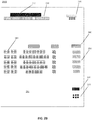
- Segmentation mask 200B may further identify multiple instances of a class, such as for line items 250. Regarding line items 250, segmentation mask 200B may generate a sub class, such as, for example a description 280. The pattern corresponding to description 280 may be applied to the characters and/or words falling into this description 280 class.
- distinguishing between the instances of line item class 250 may aid in (or used for) more accurately analyzing the content of the document 120.
- bounding box detector 150 may identify five line items 250 listed on document 200A.
- Bounding box mask 200C may be stored and/or used with segmentation mask 200B to provide a semantic representation of document 120.
- a word box obtained via OCR scanner 130 may appear on a boundary of a bounding box 255. That is, a word box obtained via OCR scanner 130 may overlap into two bounding boxes 255.
- document processing system 110 may compute the overlap of word boxes and identify potential candidate words.
- Document processing system 110 may assign words to the bounding boxes 255 based on the most overlap.
- bounding box detector 150 may classify the words according to the overlap using segmentation mask 200B. Document processing system 110 may then concatenate the words of a class.
- Document processing system 110 may process multiple predictions for a field. For example, document processing system 110 may sense an overlap in a "Price" field and an "Amount" field within a bounding box 225. In this case, for each word, document processing system 110 may compute a weighted mean confidence value. This calculation may be the word area divided by the (semantic) class area multiplied by the mean confidence value. Document processing system 110 may select an anchor word using the word with the largest weighted mean confidence. Document processing system 110 may then collect the neighboring words based on a confidence threshold to determine the correct classification.
- document processing system 110 may generate both segmentation mask 200B and bounding box mask 200C quickly relative to applying conventional computer vision techniques to a document.
- Document processing system 110 may store segmentation mask 200B and/or bounding box mask 200C, along with document 120 and/or an OCR version of document 120.
- Document processing system 110 may make this information available to other systems to perform further analysis related to the document.
- Document processing system 110 may utilize this information in a software application and/or may display segmentation mask 200B and/or bounding box mask 200C on a display screen for user manipulation. Utilizing document processing system 110, computer systems may easily recognize the content of a document 120 as well as extract semantic meaning from the document 120.
- Document processing system 110 may be a standalone system configured to receive document 120 and determine semantic information from document 120. Document processing system 110 may store this semantic information in a memory device and/or a database. Document processing system 110 may communicate with a separate system. Document processing system 110 may transmit the semantic information to the separate system. Document processing system 110 may be integrated with another system. For example, document processing system 110 may serve as a component of a larger system. Document processing system 110 may receive the document 120 from a location directed by the larger system. The larger system may direct document processing system 110 to direct identified semantic information to a particular location.
- document processing system 110 may perform optical character recognition on document 120 to obtain character and position information.
- the character information may relate to letters, numbers, symbols, words, a collection or combination of letters, numbers, and/or symbols, symbolic mark, an image, and/or other visual indicators on a document.
- Document processing system 110 may utilize OCR scanner 130 to perform the character recognition.
- OCR scanner 130 may identify word and/or character strings.
- OCR scanner 130 may identify the location of the characters within document 120.
- OCR scanner 130 may perform a pixel based analysis to identify the characters and position information.
- document processing system 110 may generate a character grid for the document 120 using the character and position information. Generating the character grid may include replacing characters of document 120 with an index value.
- the index value may be assigned according to a mapping function. An index value may be assigned via down-sampling using nearest neighbor interpolation.
- Document processing system 110 may utilize a dictionary to map a character to an index value.
- the index value may be a vector.
- Document processing system 110 may generate the vector using model techniques such as, for example, Word2vec. Generating index values for the characters allows document processing system 110 to compile the character grid having index values for the characters contained within.
- document processing system 110 may apply convolutional neural network (CNN) 140 to the character grid.
- CNN 140 may extract desired or relevant information from the character grid depending on the application of the resulting information. For example, CNN 140 may be trained to identify classes of information within a document and/or identify the class of the document. CNN 140 may apply machine learning and convolution techniques to determine the semantic meaning. CNN 140 may produce this information as a character string and/or as a 2D representation of semantic meaning.
- document processing system 110 may produce bounding boxes or a bounding box mask.
- An example of bounding box mask 200C is depicted in FIG. 2C .
- Document processing system 110 may aid in (or used for) identifying different instances of a class.
- bounding box mask 200C includes bounding boxes 255A-255E. These bounding boxes 255A-255E may identify different instances of the line item class 250. Based on the application, distinguishing between the instances of line item class 250 may aid in (or used for) more accurately analyzing the content of the document 120.
- bounding box detector 150 may identify five line items 250 listed on document 200A.
- Bounding box mask 200C may be stored and/or used with segmentation mask 200B to provide a semantic representation of document 120.
- document processing system 110 may store the segmentation mask and/or bounding box along with document 120 and/or an OCR version of document 120. Document processing system 110 may make this information available to other systems to perform further analysis related to the document. Document processing system 110 may utilize this information in a software application and/or may display segmentation mask 200B and/or bounding box mask 200C on a display screen for user manipulation. Document processing system 110 may output segmentation mask 200B and/or bounding box mask 200C via a JSON formatted file.
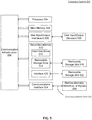
- FIG. 5 Various embodiments may be implemented, for example, using one or more well-known computer systems, such as computer system 500 shown in FIG. 5 .
- One or more computer systems 500 may be used, for example, to implement any of the embodiments discussed herein, as well as combinations and sub-combinations thereof.
- Computer system 500 may include one or more processors (also called central processing units, or CPUs), such as a processor 504.
- processors also called central processing units, or CPUs
- Processor 504 may be connected to a communication infrastructure or bus 506.
- Computer system 500 may also include user input/output device(s) 503, such as monitors, keyboards, pointing devices, etc., which may communicate with communication infrastructure 506 through user input/output interface(s) 502.
- user input/output device(s) 503 such as monitors, keyboards, pointing devices, etc.
- communication infrastructure 506 may communicate with user input/output interface(s) 502.
- processors 504 may be a graphics processing unit (GPU).
- a GPU may be a processor that is a specialized electronic circuit designed to process mathematically intensive applications.
- the GPU may have a parallel structure that is efficient for parallel processing of large blocks of data, such as mathematically intensive data common to computer graphics applications, images, videos, etc.
- Computer system 500 may also include a main or primary memory 508, such as random access memory (RAM).
- Main memory 508 may include one or more levels of cache.
- Main memory 508 may have stored therein control logic (i.e., computer software) and/or data.
- Computer system 500 may also include one or more secondary storage devices or memory 510.
- Secondary memory 510 may include, for example, a hard disk drive 512 and/or a removable storage device or drive 514.
- Removable storage drive 514 may be a floppy disk drive, a magnetic tape drive, a compact disk drive, an optical storage device, tape backup device, and/or any other storage device/drive.
- Secondary memory 510 may include other means, devices, components, instrumentalities or other approaches for allowing computer programs and/or other instructions and/or data to be accessed by computer system 500.
- Such means, devices, components, instrumentalities or other approaches may include, for example, a removable storage unit 522 and an interface 520.
- Examples of the removable storage unit 522 and the interface 520 may include a program cartridge and cartridge interface (such as that found in video game devices), a removable memory chip (such as an EPROM or PROM) and associated socket, a memory stick and USB port, a memory card and associated memory card slot, and/or any other removable storage unit and associated interface.
- Computer system 500 may be a client or server, accessing or hosting any applications and/or data through any delivery paradigm, including but not limited to remote or distributed cloud computing solutions; local or on-premises software ("on-premise” cloud-based solutions); "as a service” models (e.g., content as a service (CaaS), digital content as a service (DCaaS), software as a service (SaaS), managed software as a service (MSaaS), platform as a service (PaaS), desktop as a service (DaaS), framework as a service (FaaS), backend as a service (BaaS), mobile backend as a service (MBaaS), infrastructure as a service (laaS), etc.); and/or a hybrid model including any combination of the foregoing examples or other services or delivery paradigms.
- as a service” models e.g., content as a service (CaaS), digital content as a service (DCaaS), software as a service
- a tangible, non-transitory apparatus or article of manufacture comprising a tangible, non-transitory computer useable or readable medium having control logic (software) stored thereon may also be referred to herein as a computer program product or program storage device.
- control logic when executed by one or more data processing devices (such as computer system 500), may cause such data processing devices to operate as described herein.
- references herein to "one embodiment,” “an embodiment,” “an example embodiment,” or similar phrases, indicate that the embodiment described can include a particular feature, structure, or characteristic, but every embodiment can not necessarily include the particular feature, structure, or characteristic. Moreover, such phrases are not necessarily referring to the same embodiment. Further, when a particular feature, structure, or characteristic is described in connection with an embodiment, it would be within the knowledge of persons skilled in the relevant art(s) to incorporate such feature, structure, or characteristic into other embodiments whether or not explicitly mentioned or described herein. Additionally, some embodiments can be described using the expression “coupled” and “connected” along with their derivatives. These terms are not necessarily intended as synonyms for each other.
Landscapes
- Engineering & Computer Science (AREA)
- Theoretical Computer Science (AREA)
- Physics & Mathematics (AREA)
- General Physics & Mathematics (AREA)
- Computer Vision & Pattern Recognition (AREA)
- Artificial Intelligence (AREA)
- Evolutionary Computation (AREA)
- Multimedia (AREA)
- General Health & Medical Sciences (AREA)
- Health & Medical Sciences (AREA)
- Life Sciences & Earth Sciences (AREA)
- Computing Systems (AREA)
- Molecular Biology (AREA)
- Biomedical Technology (AREA)
- Software Systems (AREA)
- Computational Linguistics (AREA)
- Data Mining & Analysis (AREA)
- General Engineering & Computer Science (AREA)
- Mathematical Physics (AREA)
- Biophysics (AREA)
- Medical Informatics (AREA)
- Databases & Information Systems (AREA)
- Biodiversity & Conservation Biology (AREA)
- Bioinformatics & Computational Biology (AREA)
- Evolutionary Biology (AREA)
- Bioinformatics & Cheminformatics (AREA)
- Computer Graphics (AREA)
- Geometry (AREA)
- Character Input (AREA)
Abstract
Description
- This disclosure generally relates to systems and methods for computer system environments. More specifically, this document relates to a computer-implemented methods and systems for two-dimensional document processing.
- Many documents are structured using a two-dimensional (2D) layout. Some example documents may be invoices, resumes, presentations, reports, and blogs. These documents may include tables, lists, or other visual elements. Current document recognition methods typically operate on serialized text, which may be a one-dimensional (1D) sequence of characters and words. While these methods have been successful documents having unformatted text (e.g., books, short text snippets), these methods have failed to capture the spatial and visual structure of the raw document. This failure to capture the spatial and visual structure has also become more apparent with the advent of new types of media and communication (e.g., websites, blogs, tables, presentations, and other formatted documents). The layout, positioning, and/or sizing of the content of a document may be crucial to understanding its semantic content. While human perception may be driven by the layout of a structured document, computer algorithms that rely on serialized text fail to adequately process structured documents when the relationship between words is impacted not only be the sequential order of the words but also by the document layout..
- The following definitions are provided to determine how terms used in this application, and in particular, how the claims, are to be construed. The organization of the definitions is for convenience only and is not intended to limit any of the definitions to any particular category.
- Semantic data and/or semantic information are, as understood here, data and/or information that enables computer systems (in particular artificial intelligence computer systems, e.g. neural network systems) to generate/determine semantic meaning (i.e. understand the meaning) of information and/or data, thereby making the information and/or the data, for which the semantic meaning is determined, computer parsable.
- Instances belonging to the same semantic class are, as understood here, instances which have/share the same semantic meaning and/or which have the same semantic feature. The instances of the same semantic class may have other different semantic meanings and/or other different semantic features. The same semantic feature of the instances of the same semantic class may characterize their different semantic meanings. In other words the same semantic feature may be a "common denominator" or a set intersection of the different semantic meanings of the instances. The instance can be a character, a word, a phrase, a group of words. For example within nouns there are two semantic classes, concrete nouns and abstract nouns. The concrete nouns include people, plants, animals, materials and objects while the abstract nouns refer to concepts such as qualities, actions, and processes. Another example of a semantic class can be a postal address semantic class including words used for formulation of postal addresses. In yet another example, words and/or characters agglomerated in a particular area of the document can have/share the same semantic class related to the particular are and/or the same semantic feature related to the particular area.
- The disclosure generally relates to a computer-implemented method for two-dimensional document processing, a computer-readable media storing computer executable instructions for executing the computer-implemented method, a computer program comprising instructions to execute the computer-implemented method, and a computer system for machine learned image recognition.
- It is an objective of embodiments of the invention to provide for a computer-implemented method, a computer-readable media storing computer executable instructions for executing the computer-implemented method, a computer program comprising instructions to execute the computer-implemented method, and a computer system for an effective two-dimensional document processing. The objective is addressed in the independent claims, whereas the preferred embodiments are given in the dependent claims.
- According to one aspect, the present invention relates to a computer implemented method. The method comprises: performing optical character recognition on a document; generating a character grid using character information obtained from the optical character recognition, wherein the character grid is a two-dimensional down-sampled version of the document; applying a machine learning algorithm to the character grid; and in response to the applying, generating a segmentation mask depicting semantic data of the document.
- According to another aspect, the present invention relates to a system. The system comprises a memory and at least one processor coupled to the memory and configured to: perform optical character recognition on a document; generate a character grid using character information obtained from the optical character recognition, wherein the character grid is a two-dimensional down-sampled version of the document; apply a machine learning algorithm to the character grid; and in response to the applying, generate a segmentation mask depicting semantic data of the document..
- According to another aspect, the present invention relates to a computer readable medium having stored thereon, a computer executable code for execution by a computer hardware processor controlling a computer system, wherein execution of the instructions of the executable code causes the computer hardware processor to control the computer system to execute the aforementioned computer-implemented method.
- According to another aspect, the present invention relates to a computer program comprising instructions to execute the aforementioned computer-implemented method.
- The aforementioned implementations can comprise one or more of the following features. The character information can comprise character positioning information indicating positioning of characters in the document. The computer implemented method can further comprise: generating one or more bounding boxes indicating a presence of different instances of a semantic class in the document. The generating of the segmentation mask can further comprise: determining a class corresponding to a word of the document, wherein the class corresponding to the word of the document can be a semantic class. The computer implemented method can further comprise: classifying the document using positioning of the semantic data in the segmentation mask. The generating the character grid can further comprise: identifying a character of the document; determining a pixel area for the character; and assigning an index value to represent the pixel area in the character grid. The generating of the character grid can further comprise: down-sampling the document by a factor equal to a pixel area covering a character of the document. The applying of the machine learning algorithm to the character grid can comprise: applying a convolutional neural network to the character grid. The convolutional neural network can comprise an encoder configured to determine semantic meaning of determined semantic classes of words. The convolutional neural network can comprise a decoder configured to generate a 2D representation of the determined semantic meaning. The convolutional neural network can comprise a first and a second neural network, wherein the method can further comprise: determining a semantic class of each character in the document using the first neural network; and determining different instances of the same semantic class using the second neural network. The second neural network can be trained to detect different instances by applying box regression; and/or wherein the first and the second neural network can have the same encoder. The first and the second neural networks can have the same parts of the decoder, wherein the first and the second neural network can branch near the last network layers.
- The accompanying drawings are incorporated herein and form a part of the specification.
-
FIG. 1 depicts a block diagram of an example document processing environment. -
FIG. 2A depicts a block diagram of an example document. -
FIG. 2B depicts a block diagram of an example segmentation mask. -
FIG. 2C depicts a block diagram of an example bounding box mask. -
FIG. 3 depicts a flowchart illustrating a method for processing a document. -
FIG. 4 depicts a block diagram of an example character processing flow. -
FIG. 5 depicts an example computer system. - In the drawings, like reference numbers generally indicate identical or similar elements. Additionally, generally, the left-most digit(s) of a reference number identifies the drawing in which the reference number first appears.
- Provided herein are system, apparatus, device, method and/or computer program product embodiments, and/or combinations and sub-combinations thereof, for two-dimensional document processing. In an embodiment, the embodiments disclosed herein may process and/or extract semantic information from structured documents.
- A document processing system may utilize text-based techniques as well as vision-based techniques to process a document. The document processing system may extract key-values, relationships, spatial information, and/or other information related to the 2D structure of a document. Utilizing the text-based and/or vision-based techniques, the document processing system may more quickly process a document relative to using only a vision-based approach. Instead of serializing into 1 D text, a character grid may be utilized to preserve the spatial structure of the document by representing the document as a sparse 2D grid of characters. The character grid paradigm may be applied to various tasks such as information extraction from documents such as, for example, invoices. The document processing system disclosed herein may yield a more accurate extraction of key-values and characters from tables. Key-values may be values identified as relevant with respect to the document or the purpose of the document. For example, if the document is an invoice, a key-value may be a total sales price of a line item description. While embodiments are described herein as operating on documents, this disclosure is not so limited. Instead, this disclosure is generally applicable to operation on any multidimensional data object.
- The document processing system may represent the text of a document using pixels. The document processing system may represent characters or words using index values. A "character" may refer to letters, numbers, symbols, words, a collection or combination of letters, numbers, and/or symbols, symbolic mark, an image, and/or other visual indicator on a document. The document processing system may convert an identified character to an index value. The index value may correspond, for example, to a ASCII value or a dictionary of words. The conversion may use a mapping function to assign the index value. Document processing system may mask the character using the index value. Because a character may occupy a size measured by [width of pixels X height of pixels], masking the character may include representing the area with the index value while reducing the number of pixels used to represent the character. Document processing system may apply this process to each character of the document to generate a character grid.
- A character grid may be an image that represents a down-sampled version of the original document. The character grid may be two-dimensional.
FIG. 4 , which is also further described below, depicts an example of this pixel processing. The down-sampling may be by a factor of [width of pixels X height of pixels]. This may occur when [width of pixels X height of pixels] is the smallest character in the document. This down-sampling may occur by a factor equal to the pixel area covering a character of the document. The character grid may represent down-sampling without the loss of information on the character level because each character is represented by an index value. Each cell of the character grid may be down-sampled using nearest neighbor interpolation. Down-sampling may yield the advantage that the resulting character grid is simpler and smaller in size relative to the original document image. When processing the document, a machine learning algorithm or other artificial intelligence may analyze the character grid more quickly and with fewer processing steps relative to the original document. The machine learning algorithms may also more easily determine patterns from the document. - The document processing system may also preserve the spatial relationship between the characters. Characters that occupy more space (e.g., if the character has larger font size) may also occupy more space (e.g., grid cells) in the character grid. In this manner, the character grid may reflect the font size formatting of the document. Further detail regarding embodiments of the generation of the character grid will be discussed below and throughout this disclosure.
- After generating the character grid, the document processing system may utilize the character grid as an input to a machine learning model, such as, for example, a convolutional neural network (CNN). The CNN may process the document to extract relevant information, such as, for example, key-values or table information. Because the document has been converted from an image to a character grid, the CNN need not newly learn the characters. In this manner, the document processing system may extract key-values in a faster manner and with increased accuracy compared to a raw pixel approach or a sequence tagging approach.
- Various embodiments of these features will now be discussed with respect to the corresponding figures.
-
FIG. 1 depicts a block diagram depicting adocument processing environment 100.Document processing environment 100 includesdocument processing system 110.Document processing system 110 may be implemented using one or more processors and/or may include hardware and/or software and may be configured to process documents.Document processing system 110 may include optical character recognition (OCR)scanner 130, convolutional neural network (CNN) 140, boundingbox detector 150, and/orsemantic segmentation generator 160.Document processing system 110 may receive adocument 120 for processing.Document 120 may be an image, PDF, word processing document, and/or other visual representation or manifestation of data. Examples ofdocument 120 may include an invoice, an instruction manual, and/or a slideshow presentation. -
Document processing system 110 may be a standalone system configured to receivedocument 120 and determine semantic information and/or data fromdocument 120.Document processing system 110 may store this semantic data in a memory device and/or a database.Document processing system 110 may communicate with a separate system.Document processing system 110 may transmit the semantic data to the separate system.Document processing system 110 may be integrated with another system. For example,document processing system 110 may serve as a component of a larger system.Document processing system 110 may receive thedocument 120 from a location directed by the larger system. The larger system may directdocument processing system 110 to direct identified semantic information to a particular location. -
Document processing system 110 may be configured to identify relevant information from the receiveddocument 120. Depending on the application and/or parameters established byCNN 140,document processing system 110 may be configured to extract key-values or desired information fromdocument 120, classify the document, and/or classify portions of the document. For example,document processing system 110 may recognize an entity name, extract key-values, extract a table, classify the document, identify document duplication, and/or retrieve information. - For example,
FIG. 2A depicts a block diagram depicting adocument 200A.Document 200A may be analogous to document 120. Thedocument 200A may be an invoice and may be analyzed bydocument processing system 110.Document processing system 110 may retrieve the document as a file or as a depicted image. A separate system that controlsdocument processing system 110 may choose to applydocument processing system 110 to thedocument 120. Based on parameters set withindocument processing system 110 and/or based on new parameters established by the separate system,document processing system 110 may identify desired portions ofdocument 200A. For example,document processing system 110 may determine that thedocument 200A is an invoice based on the content and semantic relationships.Document processing system 110 may further extract invoice information such as product descriptions, the quantity of a purchase, the price of a purchase, or the amount of a purchase. Similarly,document processing system 110 may identify summary sale information and/or named entity information. In this manner,document processing system 110 may semantically analyzedocument 200A even ifdocument 200A includes a 2D format.Document processing system 110 is able to preserve the semantic elements of the document to apply machine learning algorithms to processdocument 200A. - Returning to
FIG. 1 , to processdocument 120,document processing system 110 may applyOCR scanner 130.OCR scanner 130 may be a module executed by one or more processors ofdocument processing system 110.OCR scanner 130 may analyze the document to extract, for example, a 1D sequence of characters fromdocument 120.OCR scanner 130 may extract string information and/or position information related to the characters ofdocument 120.Document 120 may include 2D layout information and/or metadata.OCR scanner 130 may identify this metadata when scanningdocument 120. -
OCR scanner 130 may determine word bounding boxes indocument 120. A word bounding box may represent a pixel area (e.g., width x height) occupied by the word. For example, referring toFIG. 4 ,OCR scanner 130 may identifystring 410 indocument 120.OCR scanner 130 may identify three separate words in this string as "THE", "MERCHANT", and "COMPANY".OCR scanner 130 may recognize these words and associate each word with a word bounding box.OCR scanner 130 may also identify the location of the word bounding boxes indocument 120. For example,OCR scanner 130 may utilize a coordinate system or a relative pixel location. -
OCR scanner 130 may divide word boxes into character boxes and convertstring 410intro string 420. For example,OCR scanner 130 may identify the pixels within a word bounding box include distinct characters. In this manner,OCR scanner 130 may convert the word box into character boxes. This division may maintain positioning information related to the characters. -
OCR scanner 130 may directly identify character boxes. For example,OCR scanner 130 may extract characters and pixel dimensions fromdocument 120 without first identifying word boxes.OCR scanner 130 may utilize metadata associated withdocument 120 to identify the character boxes and/or the word boxes. Based on the analysis performed byOCR scanner 130,document processing system 110 may recognize particular characters ofdocument 120, the area occupied by the characters, and/or the location of the characters. - Using the information derived by
OCR scanner 130,document processing system 110 may generate a character grid.OCR scanner 130 and/or one or more processors ofdocument processing system 110 may generate the character grid. The character grid may represent a down-sampled version ofdocument 120. The character grid may comprise grid cells corresponding to the characters ofdocument 120. As previously explained, the character grid representation ofdocument 120 may allow a machine learning algorithm or neural network to more quickly analyzedocument 120. - To generate the character grid,
document processing system 110 may replace characters ofdocument 120 with an index value. The index value may be assigned according to a mapping function. An index value may be assigned via down-sampling using nearest neighbor interpolation.Document processing system 110 may utilize a dictionary to map a character to an index value. The index value may be a vector.Document processing system 110 may generate the vector using model techniques such as, for example, Word2vec. Generating index values for the characters allowsdocument processing system 110 to compile the character grid having index values for the characters contained within. -
FIG. 4 depicts an example demonstrating the conversion ofstring 420 with character bounding boxes intostring 430 having an index value corresponding to the characters. The index values may replace the pixel area occupied by the characters. Using the index value representation, the character grid may utilize significantly less space compared to the pixels ofdocument 120. Using this conversion,document processing system 110 is able to down-sample document 120 into a character grid having multiple index values. These index values may be lossless and may yield a character grid that has not lost character information while being smaller in size thandocument 120. While maintaining this lossless conversion,document processing system 110 is able to generate a 2D character grid that may be more easily processed by a machine learning algorithm. -
Document processing system 110 may assign index values for each character ofdocument 120. The collective index values along with the positioning information for the index values may comprise the character grid. The character grid may be 1-hot encoded to yield an N-channel input image, where N corresponds to the number of indexed characters including a possible "background" class (or "background" semantic class). The background class may, for example, refer to the background or "white space" ofdocument 120. To decrease the number of channels for computational reasons,document processing system 110 may apply index hashing. - While
FIG. 4 depicts a rectangular representation for a characterdocument processing system 110 may additionally or alternatively utilize other forms for representation. For example,document processing system 110 may represent a character using a continuous distribution in a 1-hot encoded space rather than a 2D rectangular window function. In this case, the pixel area occupied by the character in the channel corresponding to the character could smoothly fall off from a value of "one" at the center location of the character to "zero" towards the edge of the area that the character occupies. For example, this representation may appear similar to a Gaussian distribution. The distribution may be truncated at the character boundary. - The Gaussian distribution may cover neighboring grid cells. In this case, characters may overlap with neighboring characters. If this occurs, the conversion may change from a 1-hot encoding to a multiple-hot encoding. By using this non-rectangular representation model,
document processing system 110 may potentially learn better local dependencies when applying the machine learning algorithms. - The character grid may be further down-sampled in the 1-hot encoded space. Characters that previously occupied one grid cell may now be represented on the sub-cell level by a value that is less than "one." This representation may result from a bilinear interpolation of the grid cells.
- After generating the character grid representation of
document 120,document processing system 110 may input the character grid in convolutional neural network (CNN) 140 (or apply the CNN to the character grid).CNN 140 may include anencoder 142 and/or adecoder 144.CNN 140 may be an artificial intelligence network and/or may apply machine learning algorithms to identify desired characters and/or aspects ofdocument 120. For example,encoder 142 may aid in (or used for) determining semantic meaning.Encoder 142 may aid, for example, in (or used for) extracting key-values or table information. Because the character grid utilizes index values,CNN 140 is able to quickly process the character grid relative toprocessing document 120. For example,CNN 140 may more quickly employ computer vision techniques or natural language processing techniques becausedocument 120 has already been converted into a simpler form. -
CNN 140 may extract desired or relevant information from the character grid depending on the application of the resulting information. For example, ifdocument 120 is an invoice anddocument processing system 110 has been configured to classify different semantic classes of information withindocument 120,CNN 140 may be trained to identify the different semantic classes. For example, a class may be the named entity receiving the invoice.CNN 140 may be trained to identify the named entity when analyzing the character grid and/or other subsequent character grids. By associating characters fromdocument 120 with a corresponding class (e.g., named entity),document processing system 110 may provide semantic meaning todocument 120. When analyzing an invoice, for example,document processing system 110 may further extract invoice information such as product descriptions, the quantity of a purchase, the price of a purchase, or the amount of a purchase. Similarly,document processing system 110 may identify summary sale information and/or named entity information. -
FIG. 2A provides an example ofdocument 200A.Document 200A may be analogous to document 120.Document 200A may include information such as, aname 210, anaddress 220, adocument identifier 230, aheader 240,line items 250, afirst summary 260, and asecond summary 270. These items may represent classes (or semantic classes). An administrator ofdocument processing system 110 may have defined these classes as the classes of interest. In this manner, trainingCNN 140 may allow for improved accuracy in determining values corresponding to these classes whendocument processing system 110 analyzes adocument 120. - For example,
document processing system 110 may be utilized to (1) determine whether adocument 120 is an invoice, (2) identify the invoice number, and (3) identify the total cost of the invoice.Document processing system 110 may utilizedocument identifier 230 as a category to determine the invoice number and usesecond summary 270 as the total cost of the invoice. To determine whether thedocument 120 is an invoice,document processing system 110 may analyze the particular arrangement of classes 210-270 (or semantic classes 210-270). For example, identifying the presence ofline items 250 in the middle portion ofdocument 200A may indicate a greater likelihood that document 120 is an invoice.CNN 140 may be trained to identify these patterns to processdocument 120 to suit the desired application. BecauseCNN 140 receives the character grid representation ofdocument 120,CNN 140 may be trained to analyze character grids. - After receiving a character grid,
CNN 140 may utilizeencoder 142 to determine semantic meanings associated with relevant identified classes (or with relevant identified semantic classes).Encoder 142 may utilize neural network techniques and/or convolution techniques to identify the desired information relateddocument 120.CNN 140 may utilize two neural networks. The first neural network may classify each character using semantic segmentation. The first neural network may be useful for (or used for determination of) classes or field types (or semantic classes) that appear as a single instance on a document 120 (e.g., the document date). The second neural network may be used to distinguish multiple instances of the same class or field type (or semantic class). The second neural network may be trained to detect different instances by applying bounding box regression. For example, the second neural network may be trained to detect multiple rows of a table. Both neural networks may shareencoder 142 and/or parts ofdecoder 144. The neural networks may branch near the last few network layers. - By utilizing the character grid,
encoder 142 is able to more quickly identify the information relative to directly examiningdocument 120. Further,encoder 142 may utilize the location information related to the grid cells and index values to extract further semantic meaning relative to a 1D analysis. In this manner,encoder 142 may assign semantic meaning to the characters and words ofdocument 120 and/or return records in the form of text strings. - Depending on the application of
document processing system 110,CNN 140 may includedecoder 144. After an encoding process performed on a character grid,document processing system 110 may be configured to produce a 2D representation of the determined semantic meanings.Decoder 144 may aid in (or used for) producing this 2D representation.Decoder 144 may perform transposed convolution, deconvolution, or fractionally strided convolution to up-sample the results of the encoding. In this manner,decoder 144 may up-sample newly determined index values into a pixel location representation. In this manner,decoder 144 may aid in (or used for) applying semantic meaning to a 2D pixel representation ofdocument 120. Up-sampling may allow a user to view the output ofdocument processing system 110 as amask covering document 120. This mask may be an overlay overdocument 120 or may exist separately. Using the pixel representation, a user may view the semantic information via a display screen. - After a character grid is applied to
CNN 140,CNN 140 may utilize boundingbox detector 150 and/orsemantic segmentation generator 160 to generate a 2D representation of the semantic meaning determined byCNN 140.Semantic segmentation generator 160 may produce a segmentation mask, displaying the class assigned to each character or word.FIG. 2B depicts an example of asegmentation mask 200B fordocument 200A depicted inFIG. 2A .Segmentation mask 200B may include semantic information related todocument 200A. For example,segmentation mask 200B may use patterns and/or colors to characterize the portions ofdocument 200A with their corresponding class (or with their corresponding semantic class).Segmentation mask 200B may be visible to a user ofdocument processing system 110 and/or may be a formatted file.Segmentation mask 200B may utilize a different pattern for each (semantic) class of aname 210, anaddress 220, adocument identifier 230, aheader 240,line items 250, afirst summary 260, and asecond summary 270. -
Segmentation mask 200B may further identify multiple instances of a class, such as forline items 250. Regardingline items 250,segmentation mask 200B may generate a sub class, such as, for example adescription 280. The pattern corresponding todescription 280 may be applied to the characters and/or words falling into thisdescription 280 class. -
Segmentation mask 200B may identify abackground 290.Background 290 may aid in (or used for) the distinction between different (semantic) classes 210-280.Background 290 may identify "white space" in adocument 200A.Segmentation mask 200B allows for characterizing of relevant (semantic) classes while also minimizing non-relevant (semantic) classes. For example,document 200A may include a signature block. If a signature block is not relevant based on the parameters set byCNN 140,segmentation mask 200B may display the signature block asbackground 290. Combining the relevant (semantic) class information into asegmentation mask 200B allowsdocument processing system 110 to produce a 2D object that displays relevant semantic information. - In addition to producing
segmentation mask 200B,document processing system 110 may generate abounding box mask 200C. An example of boundingbox mask 200C is depicted inFIG. 2C . To generate boundingbox mask 200C,document processing system 110 may utilize boundingbox detector 150. Boundingbox detector 150 may aid in (or used for) identifying different instances of a (semantic) class. Boundingbox detector 150 may produce abounding box mask 200C to aid in (or used for) this process. For example, boundingbox mask 200C includes boundingboxes 255A-255E. These boundingboxes 255A-255E may identify different instances of theline item class 250. Based on the application, distinguishing between the instances ofline item class 250 may aid in (or used for) more accurately analyzing the content of thedocument 120. For example, boundingbox detector 150 may identify fiveline items 250 listed ondocument 200A. Boundingbox mask 200C may be stored and/or used withsegmentation mask 200B to provide a semantic representation ofdocument 120. - A word box obtained via
OCR scanner 130 may appear on a boundary of a bounding box 255. That is, a word box obtained viaOCR scanner 130 may overlap into two bounding boxes 255. In this scenario,document processing system 110 may compute the overlap of word boxes and identify potential candidate words.Document processing system 110 may assign words to the bounding boxes 255 based on the most overlap. For each bounding box 255, boundingbox detector 150 may classify the words according to the overlap usingsegmentation mask 200B.Document processing system 110 may then concatenate the words of a class. -
Document processing system 110 may process multiple predictions for a field. For example,document processing system 110 may sense an overlap in a "Price" field and an "Amount" field within a bounding box 225. In this case, for each word,document processing system 110 may compute a weighted mean confidence value. This calculation may be the word area divided by the (semantic) class area multiplied by the mean confidence value.Document processing system 110 may select an anchor word using the word with the largest weighted mean confidence.Document processing system 110 may then collect the neighboring words based on a confidence threshold to determine the correct classification. - Via the use of the character grid,
document processing system 110 may generate bothsegmentation mask 200B and boundingbox mask 200C quickly relative to applying conventional computer vision techniques to a document.Document processing system 110 may storesegmentation mask 200B and/or boundingbox mask 200C, along withdocument 120 and/or an OCR version ofdocument 120.Document processing system 110 may make this information available to other systems to perform further analysis related to the document.Document processing system 110 may utilize this information in a software application and/or may displaysegmentation mask 200B and/or boundingbox mask 200C on a display screen for user manipulation. Utilizingdocument processing system 110, computer systems may easily recognize the content of adocument 120 as well as extract semantic meaning from thedocument 120. -
FIG. 3 depicts a flowchart illustrating amethod 300 for processing a document.Method 300 shall be described with reference toFIG. 1 ; however,method 300 is not limited to that example. -
Document processing system 110 may utilizemethod 300 to processdocument 120.Method 300 may generate a semantic representation ofdocument 120. The foregoing description will describe an example of the execution ofmethod 300 with respect todocument processing system 110. Whilemethod 300 is described with reference todocument processing system 110,method 300 may be executed on any computing device, such as, for example, the computer system described with reference toFIG. 5 and/or processing logic that may comprise hardware (e.g., circuitry, dedicated logic, programmable logic, microcode, etc.), software (e.g., instructions executing on a processing device), or a combination thereof. - It is to be appreciated that not all steps may be needed to perform the disclosure provided herein. Further, some of the steps may be performed simultaneously, or in a different order than shown in
FIG. 3 , as will be understood by a person of ordinary skill in the art. - At 305,
document processing system 110 may receive adocument 120.Document 120 may be a file including text. For example,document 120 may be an image, word processing document, PDF file, screenshot, and/or a combination of text and images.Document 120 may be a scanned document and/or may contain multiple pages and/or slides. -
Document processing system 110 may be a standalone system configured to receivedocument 120 and determine semantic information fromdocument 120.Document processing system 110 may store this semantic information in a memory device and/or a database.Document processing system 110 may communicate with a separate system.Document processing system 110 may transmit the semantic information to the separate system.Document processing system 110 may be integrated with another system. For example,document processing system 110 may serve as a component of a larger system.Document processing system 110 may receive thedocument 120 from a location directed by the larger system. The larger system may directdocument processing system 110 to direct identified semantic information to a particular location. - At 310,
document processing system 110 may perform optical character recognition ondocument 120 to obtain character and position information. The character information may relate to letters, numbers, symbols, words, a collection or combination of letters, numbers, and/or symbols, symbolic mark, an image, and/or other visual indicators on a document.Document processing system 110 may utilizeOCR scanner 130 to perform the character recognition.OCR scanner 130 may identify word and/or character strings.OCR scanner 130 may identify the location of the characters withindocument 120.OCR scanner 130 may perform a pixel based analysis to identify the characters and position information. - At 315,
document processing system 110 may generate a character grid for thedocument 120 using the character and position information. Generating the character grid may include replacing characters ofdocument 120 with an index value. The index value may be assigned according to a mapping function. An index value may be assigned via down-sampling using nearest neighbor interpolation.Document processing system 110 may utilize a dictionary to map a character to an index value. The index value may be a vector.Document processing system 110 may generate the vector using model techniques such as, for example, Word2vec. Generating index values for the characters allowsdocument processing system 110 to compile the character grid having index values for the characters contained within. - Generating the character grid may result in a down-sampled version of
document 120. The down-sampled version may result in faster processing ofdocument 120. - At 320,
document processing system 110 may apply convolutional neural network (CNN) 140 to the character grid.CNN 140 may extract desired or relevant information from the character grid depending on the application of the resulting information. For example,CNN 140 may be trained to identify classes of information within a document and/or identify the class of the document.CNN 140 may apply machine learning and convolution techniques to determine the semantic meaning.CNN 140 may produce this information as a character string and/or as a 2D representation of semantic meaning. - At 325,
document processing system 110 may produce a segmentation mask, displaying the class assigned to each character or word.FIG. 2B depicts an example of asegmentation mask 200B fordocument 200A depicted inFIG. 2A .Segmentation mask 200B may include semantic information related todocument 200A. For example,segmentation mask 200B may use patterns and/or colors to characterize the portions ofdocument 200A with their corresponding class. The segmentation mask may be a result of a deconvolution process. This deconvolution process may include up-sampling of a determined result so that the segmentation may be displayed in a 2D pixel representation. - At 330,
document processing system 110 may produce bounding boxes or a bounding box mask. An example of boundingbox mask 200C is depicted inFIG. 2C .Document processing system 110 may aid in (or used for) identifying different instances of a class. For example, boundingbox mask 200C includes boundingboxes 255A-255E. These boundingboxes 255A-255E may identify different instances of theline item class 250. Based on the application, distinguishing between the instances ofline item class 250 may aid in (or used for) more accurately analyzing the content of thedocument 120. For example, boundingbox detector 150 may identify fiveline items 250 listed ondocument 200A. Boundingbox mask 200C may be stored and/or used withsegmentation mask 200B to provide a semantic representation ofdocument 120. - After the generation of a segmentation mask and bounding boxes,
document processing system 110 may store the segmentation mask and/or bounding box along withdocument 120 and/or an OCR version ofdocument 120.Document processing system 110 may make this information available to other systems to perform further analysis related to the document.Document processing system 110 may utilize this information in a software application and/or may displaysegmentation mask 200B and/or boundingbox mask 200C on a display screen for user manipulation.Document processing system 110 mayoutput segmentation mask 200B and/or boundingbox mask 200C via a JSON formatted file. - Various embodiments may be implemented, for example, using one or more well-known computer systems, such as
computer system 500 shown inFIG. 5 . One ormore computer systems 500 may be used, for example, to implement any of the embodiments discussed herein, as well as combinations and sub-combinations thereof. -
Computer system 500 may include one or more processors (also called central processing units, or CPUs), such as aprocessor 504.Processor 504 may be connected to a communication infrastructure orbus 506. -
Computer system 500 may also include user input/output device(s) 503, such as monitors, keyboards, pointing devices, etc., which may communicate withcommunication infrastructure 506 through user input/output interface(s) 502. - One or more of
processors 504 may be a graphics processing unit (GPU). A GPU may be a processor that is a specialized electronic circuit designed to process mathematically intensive applications. The GPU may have a parallel structure that is efficient for parallel processing of large blocks of data, such as mathematically intensive data common to computer graphics applications, images, videos, etc. -
Computer system 500 may also include a main orprimary memory 508, such as random access memory (RAM).Main memory 508 may include one or more levels of cache.Main memory 508 may have stored therein control logic (i.e., computer software) and/or data. -
Computer system 500 may also include one or more secondary storage devices ormemory 510.Secondary memory 510 may include, for example, a hard disk drive 512 and/or a removable storage device or drive 514.Removable storage drive 514 may be a floppy disk drive, a magnetic tape drive, a compact disk drive, an optical storage device, tape backup device, and/or any other storage device/drive. -
Removable storage drive 514 may interact with aremovable storage unit 518.Removable storage unit 518 may include a computer usable or readable storage device having stored thereon computer software (control logic) and/or data.Removable storage unit 518 may be a floppy disk, magnetic tape, compact disk, DVD, optical storage disk, and/ any other computer data storage device.Removable storage drive 514 may read from and/or write toremovable storage unit 518. -
Secondary memory 510 may include other means, devices, components, instrumentalities or other approaches for allowing computer programs and/or other instructions and/or data to be accessed bycomputer system 500. Such means, devices, components, instrumentalities or other approaches may include, for example, aremovable storage unit 522 and aninterface 520. Examples of theremovable storage unit 522 and theinterface 520 may include a program cartridge and cartridge interface (such as that found in video game devices), a removable memory chip (such as an EPROM or PROM) and associated socket, a memory stick and USB port, a memory card and associated memory card slot, and/or any other removable storage unit and associated interface. -
Computer system 500 may further include a communication or network interface 524. Communication interface 524 may enablecomputer system 500 to communicate and interact with any combination of external devices, external networks, external entities, etc. (individually and collectively referenced by reference number 528). For example, communication interface 524 may allowcomputer system 500 to communicate with external orremote devices 528 overcommunications path 526, which may be wired and/or wireless (or a combination thereof), and which may include any combination of LANs, WANs, the Internet, etc. Control logic and/or data may be transmitted to and fromcomputer system 500 viacommunication path 526. -
Computer system 500 may also be any of a personal digital assistant (PDA), desktop workstation, laptop or notebook computer, netbook, tablet, smart phone, smart watch or other wearable, appliance, part of the Internet-of-Things, and/or embedded system, to name a few non-limiting examples, or any combination thereof. -
Computer system 500 may be a client or server, accessing or hosting any applications and/or data through any delivery paradigm, including but not limited to remote or distributed cloud computing solutions; local or on-premises software ("on-premise" cloud-based solutions); "as a service" models (e.g., content as a service (CaaS), digital content as a service (DCaaS), software as a service (SaaS), managed software as a service (MSaaS), platform as a service (PaaS), desktop as a service (DaaS), framework as a service (FaaS), backend as a service (BaaS), mobile backend as a service (MBaaS), infrastructure as a service (laaS), etc.); and/or a hybrid model including any combination of the foregoing examples or other services or delivery paradigms. - Any applicable data structures, file formats, and schemas in computer system 400 may be derived from standards including but not limited to JavaScript Object Notation (JSON), Extensible Markup Language (XML), Yet Another Markup Language (YAML), Extensible Hypertext Markup Language (XHTML), Wireless Markup Language (WML), MessagePack, XML User Interface Language (XUL), or any other functionally similar representations alone or in combination. Alternatively, proprietary data structures, formats or schemas may be used, either exclusively or in combination with known or open standards.
- A tangible, non-transitory apparatus or article of manufacture comprising a tangible, non-transitory computer useable or readable medium having control logic (software) stored thereon may also be referred to herein as a computer program product or program storage device. This includes, but is not limited to,
computer system 500,main memory 508,secondary memory 510, andremovable storage units - Based on the teachings contained in this disclosure, it will be apparent to persons skilled in the relevant art(s) how to make and use embodiments of this disclosure using data processing devices, computer systems and/or computer architectures other than that shown in
FIG. 5 . In particular, embodiments can operate with software, hardware, and/or operating system implementations other than those described herein. - It is to be appreciated that the Detailed Description section, and not any other section, is intended to be used to interpret the claims. Other sections can set forth one or more but not all exemplary embodiments as contemplated by the inventor(s), and thus, are not intended to limit this disclosure or the appended claims in any way.
- While this disclosure describes exemplary embodiments for exemplary fields and applications, it should be understood that the disclosure is not limited thereto. Other embodiments and modifications thereto are possible, and are within the scope and spirit of this disclosure. For example, and without limiting the generality of this paragraph, embodiments are not limited to the software, hardware, firmware, and/or entities illustrated in the figures and/or described herein. Further, embodiments (whether or not explicitly described herein) have significant utility to fields and applications beyond the examples described herein.
- Embodiments have been described herein with the aid of functional building blocks illustrating the implementation of specified functions and relationships thereof. The boundaries of these functional building blocks have been arbitrarily defined herein for the convenience of the description. Alternate boundaries can be defined as long as the specified functions and relationships (or equivalents thereof) are appropriately performed. Also, alternative embodiments can perform functional blocks, steps, operations, methods, etc. using orderings different than those described herein.
- References herein to "one embodiment," "an embodiment," "an example embodiment," or similar phrases, indicate that the embodiment described can include a particular feature, structure, or characteristic, but every embodiment can not necessarily include the particular feature, structure, or characteristic. Moreover, such phrases are not necessarily referring to the same embodiment. Further, when a particular feature, structure, or characteristic is described in connection with an embodiment, it would be within the knowledge of persons skilled in the relevant art(s) to incorporate such feature, structure, or characteristic into other embodiments whether or not explicitly mentioned or described herein. Additionally, some embodiments can be described using the expression "coupled" and "connected" along with their derivatives. These terms are not necessarily intended as synonyms for each other. For example, some embodiments can be described using the terms "connected" and/or "coupled" to indicate that two or more elements are in direct physical or electrical contact with each other. The term "coupled," however, can also mean that two or more elements are not in direct contact with each other, but yet still co-operate or interact with each other.
- The breadth and scope of this disclosure should not be limited by any of the above-described exemplary embodiments, but should be defined only in accordance with the following claims and their equivalents.
Claims (15)
- A computer implemented method, comprising:• performing (310) optical character recognition on a document (120: 200A);• generating (315) a character grid using character information obtained from the optical character recognition, wherein the character grid is a two-dimensional down-sampled version of the document;• applying (320) a machine learning algorithm to the character grid; and• in response to the applying, generating (325) a segmentation mask (200B) depicting semantic data of the document.
- The computer implemented method of claim 2, wherein the character information comprises character positioning information indicating positioning of characters in the document.
- The computer implemented method of claim 1 or 2, further comprising:generating one or more bounding boxes (255A-E) indicating a presence of different instances of a semantic class in the document.
- The computer implemented method of any of the preceding claims, wherein the generating of the segmentation mask further comprises:• determining a class corresponding to a word of the document.
- The computer implemented method of any of the preceding claims, further comprising:• classifying the document using positioning of the semantic data in the segmentation mask.
- The computer implemented method of any of the preceding claims, wherein the generating the character grid further comprises:• identifying a character of the document;• determining a pixel area for the character; and• assigning an index value to represent the pixel area in the character grid.
- The computer implemented method of any one of the preceding claims, wherein generating the character grid further comprises:• down-sampling the document by a factor equal to a pixel area covering a character of the document.
- The computer implemented method of any one of the preceding claim s, wherein the applying of the machine learning algorithm to the character grid comprises:• applying a convolutional neural network (140) to the character grid.
- The computer implemented method of claim 8 and 4, wherein the convolutional neural network comprises an encoder (142) configured to determine semantic meaning of determined classes of words.
- The computer implemented method of claim 9, wherein the convolutional neural network comprises a decoder (144) configured to generate a 2D representation of the determined semantic meaning.
- The computer implemented method of claim 8, wherein the convolutional neural network comprises a first and a second neural network, wherein the method comprises:• determining a class of each character in the document using the first neural network; and• determining different instances of the same class using the second neural network.
- The computer implemented method of claim 11, wherein the second neural network is trained to detect different instances by applying box regression; and/or wherein the first and the second neural network have the same encoder.
- The computer implemented method of any one of claims 9 through 11, wherein the first and the second neural networks have the same parts of the decoder, wherein the first and the second neural network branch near the last network layers.
- A computer program comprising instructions to execute the computer method of any one of the preceding claims.
- A system (110; 500), comprising:a memory (508); andat least one processor (504) coupled to the memory and configured to:• perform (310) optical character recognition on a document (120; 200A);• generate (315) a character grid using character information obtained from the optical character recognition, wherein the character grid is a two-dimensional down-sampled version of the document;• apply (320) a machine learning algorithm to the character grid; and• in response to the applying, generate (325) a segmentation mask (200B) depicting semantic data of the document.
Applications Claiming Priority (1)
| Application Number | Priority Date | Filing Date | Title |
|---|---|---|---|
| US15/983,489 US10540579B2 (en) | 2018-05-18 | 2018-05-18 | Two-dimensional document processing |
Publications (2)
| Publication Number | Publication Date |
|---|---|
| EP3570208A1 true EP3570208A1 (en) | 2019-11-20 |
| EP3570208B1 EP3570208B1 (en) | 2026-04-29 |
Family
ID=64183974
Family Applications (1)
| Application Number | Title | Priority Date | Filing Date |
|---|---|---|---|
| EP18204940.3A Active EP3570208B1 (en) | 2018-05-18 | 2018-11-07 | Two-dimensional document processing |
Country Status (2)
| Country | Link |
|---|---|
| US (2) | US10540579B2 (en) |
| EP (1) | EP3570208B1 (en) |
Cited By (7)
| Publication number | Priority date | Publication date | Assignee | Title |
|---|---|---|---|---|
| EP4027267A4 (en) * | 2019-12-30 | 2022-11-02 | Huawei Technologies Co., Ltd. | Method, apparatus and system for identifying text in image |
| WO2022221079A3 (en) * | 2021-04-15 | 2022-11-24 | Microsoft Technology Licensing, Llc | Inferring structure information from table images |
| US20230101426A1 (en) * | 2020-06-18 | 2023-03-30 | Boe Technology Group Co., Ltd. | Method and apparatus for recognizing text, storage medium, and electronic device |
| CN115917613A (en) * | 2020-06-12 | 2023-04-04 | 微软技术许可有限责任公司 | Semantic representation of text in a document |
| US11687700B1 (en) * | 2022-02-01 | 2023-06-27 | International Business Machines Corporation | Generating a structure of a PDF-document |
| EP4220574A1 (en) * | 2022-01-31 | 2023-08-02 | Intuit Inc. | End to end trainable document extraction |
| US12260662B2 (en) | 2021-04-15 | 2025-03-25 | Microsoft Technology Licensing, Llc | Inferring structure information from table images |
Families Citing this family (43)
| Publication number | Priority date | Publication date | Assignee | Title |
|---|---|---|---|---|
| US10540579B2 (en) * | 2018-05-18 | 2020-01-21 | Sap Se | Two-dimensional document processing |
| US10997402B2 (en) * | 2018-07-03 | 2021-05-04 | Fuji Xerox Co., Ltd. | Systems and methods for real-time end-to-end capturing of ink strokes from video |
| GB2595412B8 (en) | 2019-03-28 | 2023-10-11 | Nielsen Consumer Llc | Methods and apparatus to detect a text region of interest in a digital image using machine-based analysis |
| US11087448B2 (en) * | 2019-05-30 | 2021-08-10 | Kyocera Document Solutions Inc. | Apparatus, method, and non-transitory recording medium for a document fold determination based on the change point block detection |
| US11003937B2 (en) * | 2019-06-26 | 2021-05-11 | Infrrd Inc | System for extracting text from images |
| US11710302B2 (en) * | 2019-11-08 | 2023-07-25 | Tricentis Gmbh | Method and system for single pass optical character recognition |
| US11275934B2 (en) * | 2019-11-20 | 2022-03-15 | Sap Se | Positional embeddings for document processing |
| US11373106B2 (en) * | 2019-11-21 | 2022-06-28 | Fractal Analytics Private Limited | System and method for detecting friction in websites |
| US11410446B2 (en) | 2019-11-22 | 2022-08-09 | Nielsen Consumer Llc | Methods, systems, apparatus and articles of manufacture for receipt decoding |
| US11514702B2 (en) | 2020-01-31 | 2022-11-29 | Servicenow Canada Inc. | Systems and methods for processing images |
| US11495038B2 (en) * | 2020-03-06 | 2022-11-08 | International Business Machines Corporation | Digital image processing |
| CN111492370B (en) * | 2020-03-19 | 2023-05-26 | 香港应用科技研究院有限公司 | Apparatus and method for recognizing text image of structured layout |
| CN111598122B (en) * | 2020-04-01 | 2022-02-08 | 深圳壹账通智能科技有限公司 | Data verification method and device, electronic equipment and storage medium |
| US11455713B2 (en) * | 2020-05-08 | 2022-09-27 | Paypal, Inc. | Automatic document processing |
| US11556573B2 (en) * | 2020-05-29 | 2023-01-17 | Adobe Inc. | Semantic cluster formation in deep learning intelligent assistants |
| US11615246B2 (en) | 2020-06-03 | 2023-03-28 | Sap Se | Data-driven structure extraction from text documents |
| EP3923154A1 (en) * | 2020-06-11 | 2021-12-15 | Ivalua Sas | Identifying and generating links between data |
| US11810380B2 (en) | 2020-06-30 | 2023-11-07 | Nielsen Consumer Llc | Methods and apparatus to decode documents based on images using artificial intelligence |
| CN111783760B (en) * | 2020-06-30 | 2023-08-08 | 北京百度网讯科技有限公司 | Character recognition method, device, electronic equipment and computer readable storage medium |
| CA3124868A1 (en) * | 2020-07-17 | 2022-01-17 | Nielsen Consumer Llc | Methods, systems, articles of manufacture and apparatus to categorize image text |
| CN111738251B (en) * | 2020-08-26 | 2020-12-04 | 北京智源人工智能研究院 | Optical character recognition method, device and electronic device fused with language model |
| US11281928B1 (en) * | 2020-09-23 | 2022-03-22 | Sap Se | Querying semantic data from unstructured documents |
| US11557140B2 (en) | 2020-11-30 | 2023-01-17 | Sap Se | Model-independent confidence values for extracted document information using a convolutional neural network |
| CN114694160A (en) * | 2020-12-29 | 2022-07-01 | 航天信息股份有限公司 | Bill identification method and bill identification device |
| US11514489B2 (en) * | 2021-01-06 | 2022-11-29 | Sap Se | Targeted document information extraction |
| EP4033402A1 (en) * | 2021-01-26 | 2022-07-27 | Continental Automotive GmbH | Method for determining the encoder architecture of a neural network |
| US20240126979A1 (en) * | 2021-02-24 | 2024-04-18 | Nippon Telegraph And Telephone Corporation | Information acquisition apparatus, information acquisition method, and information acquisition program |
| US11763094B2 (en) | 2021-05-13 | 2023-09-19 | Sap Se | Cascade pooling for natural language processing |
| US11822216B2 (en) | 2021-06-11 | 2023-11-21 | Nielsen Consumer Llc | Methods, systems, apparatus, and articles of manufacture for document scanning |
| US12229741B2 (en) | 2021-06-24 | 2025-02-18 | Nielsen Consumer Llc | Methods, systems, articles of manufacture, and apparatus for decoding purchase data using an image |
| US12327425B2 (en) | 2021-06-24 | 2025-06-10 | Nielsen Consumer Llc | Methods, systems, articles of manufacture, and apparatus for decoding purchase data using an image |
| US11625930B2 (en) | 2021-06-30 | 2023-04-11 | Nielsen Consumer Llc | Methods, systems, articles of manufacture and apparatus to decode receipts based on neural graph architecture |
| US12175782B2 (en) | 2021-07-12 | 2024-12-24 | Nielsen Consumer Llc | Methods, systems, articles of manufacture and apparatus to label text on images |
| US12288405B2 (en) | 2021-12-22 | 2025-04-29 | Nielsen Consumer Llc | Methods, systems, articles of manufacture and apparatus to extract region of interest text from receipts |
| US12229805B2 (en) | 2021-12-30 | 2025-02-18 | Nielsen Consumer Llc | Methods, systems, articles of manufacture, and apparatus for processing an image using visual and textual information |
| US12315283B2 (en) | 2022-01-14 | 2025-05-27 | Nielsen Consumer Llc | Methods, systems, articles of manufacture, and apparatus for decoding images |
| US12620249B2 (en) | 2022-01-31 | 2026-05-05 | Nielsen Consumer Llc | Methods, systems, articles of manufacture and apparatus to improve tagging accuracy |
| AU2022287590B2 (en) * | 2022-06-09 | 2024-02-15 | DataInfoCom USA, Inc. | Systems and methods for information retrieval and extraction |
| US12322195B2 (en) | 2022-07-06 | 2025-06-03 | Nielsen Consumer Llc | Methods, systems, articles of manufacture, and apparatus to determine related content in a document |
| US12548360B2 (en) | 2022-09-15 | 2026-02-10 | Nielsen Consumer Llc | Methods, systems, articles of manufacture, and apparatus to tag segments in a document |
| US12293598B2 (en) * | 2022-11-16 | 2025-05-06 | Accenture Global Solutions Limited | Entity extraction via document image processing |
| US12494076B2 (en) | 2022-11-28 | 2025-12-09 | Sap Se | Efficient document information extraction system using optical character recognition (OCR) information |
| US12567276B2 (en) | 2023-09-01 | 2026-03-03 | Hong Kong Applied Science and Technology Research Institute Company Limited | Method and apparatus for document analysis through layer separation by machine learning with cross-layer reasoning |
Family Cites Families (5)
| Publication number | Priority date | Publication date | Assignee | Title |
|---|---|---|---|---|
| JP2004533641A (en) * | 2001-05-02 | 2004-11-04 | ビットストリーム インコーポレーティッド | Method, system, and program for generating and displaying sub-pixel optimized font bitmaps using non-linear color balance |
| US8392816B2 (en) * | 2007-12-03 | 2013-03-05 | Microsoft Corporation | Page classifier engine |
| EP3223272B1 (en) * | 2014-11-21 | 2020-06-24 | Rakuten, Inc. | Information processing device, information processing method, and information processing program |
| US10467464B2 (en) * | 2016-06-07 | 2019-11-05 | The Neat Company, Inc. | Document field detection and parsing |
| US10540579B2 (en) * | 2018-05-18 | 2020-01-21 | Sap Se | Two-dimensional document processing |
-
2018
- 2018-05-18 US US15/983,489 patent/US10540579B2/en active Active
- 2018-11-07 EP EP18204940.3A patent/EP3570208B1/en active Active
-
2019
- 2019-12-12 US US16/711,978 patent/US11244208B2/en active Active
Non-Patent Citations (5)
| Title |
|---|
| CHRISTIAN BARTZ ET AL: "STN-OCR: A single Neural Network for Text Detection and Text Recognition", ARXIV.ORG, CORNELL UNIVERSITY LIBRARY, 201 OLIN LIBRARY CORNELL UNIVERSITY ITHACA, NY 14853, 27 July 2017 (2017-07-27), XP080779970 * |
| MAX JADERBERG ET AL: "Reading Text in the Wild with Convolutional Neural Networks", INTERNATIONAL JOURNAL OF COMPUTER VISION., vol. 116, no. 1, 7 May 2015 (2015-05-07), US, pages 1 - 20, XP055568909, ISSN: 0920-5691, DOI: 10.1007/s11263-015-0823-z * |
| PALM RASMUS BERG ET AL: "CloudScan - A Configuration-Free Invoice Analysis System Using Recurrent Neural Networks", 2017 14TH IAPR INTERNATIONAL CONFERENCE ON DOCUMENT ANALYSIS AND RECOGNITION (ICDAR), IEEE, vol. 1, 9 November 2017 (2017-11-09), pages 406 - 413, XP033307843, DOI: 10.1109/ICDAR.2017.74 * |
| SETH STEWART ET AL: "Document Image Page Segmentation and Character Recognition as Semantic Segmentation", HISTORICAL DOCUMENT IMAGING AND PROCESSING, ACM, 2 PENN PLAZA, SUITE 701NEW YORKNY10121-0701USA, 10 November 2017 (2017-11-10), pages 101 - 106, XP058380981, ISBN: 978-1-4503-5390-8, DOI: 10.1145/3151509.3151518 * |
| XIAO YANG ET AL: "Learning to Extract Semantic Structure from Documents Using Multimodal Fully Convolutional Neural Network", ARXIV.ORG, CORNELL UNIVERSITY LIBRARY, 201 OLIN LIBRARY CORNELL UNIVERSITY ITHACA, NY 14853, 7 June 2017 (2017-06-07), XP080768306, DOI: 10.1109/CVPR.2017.462 * |
Cited By (12)
| Publication number | Priority date | Publication date | Assignee | Title |
|---|---|---|---|---|
| EP4027267A4 (en) * | 2019-12-30 | 2022-11-02 | Huawei Technologies Co., Ltd. | Method, apparatus and system for identifying text in image |
| US12299399B2 (en) | 2019-12-30 | 2025-05-13 | Huawei Technologies Co., Ltd. | Method, apparatus, and system for recognizing text in image |
| CN115917613A (en) * | 2020-06-12 | 2023-04-04 | 微软技术许可有限责任公司 | Semantic representation of text in a document |
| US20230206670A1 (en) * | 2020-06-12 | 2023-06-29 | Microsoft Technology Licensing, Llc | Semantic representation of text in document |
| EP4165554A4 (en) * | 2020-06-12 | 2024-01-17 | Microsoft Technology Licensing, LLC | Semantic representation of text in document |
| US12374141B2 (en) * | 2020-06-12 | 2025-07-29 | Microsoft Technology Licensing, Llc | Semantic representation of text in document |
| US20230101426A1 (en) * | 2020-06-18 | 2023-03-30 | Boe Technology Group Co., Ltd. | Method and apparatus for recognizing text, storage medium, and electronic device |
| US12340604B2 (en) * | 2020-06-18 | 2025-06-24 | Boe Technology Group Co., Ltd. | Method and apparatus for recognizing text, storage medium, and electronic device |
| WO2022221079A3 (en) * | 2021-04-15 | 2022-11-24 | Microsoft Technology Licensing, Llc | Inferring structure information from table images |
| US12260662B2 (en) | 2021-04-15 | 2025-03-25 | Microsoft Technology Licensing, Llc | Inferring structure information from table images |
| EP4220574A1 (en) * | 2022-01-31 | 2023-08-02 | Intuit Inc. | End to end trainable document extraction |
| US11687700B1 (en) * | 2022-02-01 | 2023-06-27 | International Business Machines Corporation | Generating a structure of a PDF-document |
Also Published As
| Publication number | Publication date |
|---|---|
| EP3570208B1 (en) | 2026-04-29 |
| US20190354818A1 (en) | 2019-11-21 |
| US11244208B2 (en) | 2022-02-08 |
| US10540579B2 (en) | 2020-01-21 |
| US20200117961A1 (en) | 2020-04-16 |
Similar Documents
| Publication | Publication Date | Title |
|---|---|---|
| US11244208B2 (en) | Two-dimensional document processing | |
| CN109960734B (en) | Question Answering for Data Visualization | |
| US11281928B1 (en) | Querying semantic data from unstructured documents | |
| US10915788B2 (en) | Optical character recognition using end-to-end deep learning | |
| US20230177821A1 (en) | Document image understanding | |
| EP3712812B1 (en) | Recognizing typewritten and handwritten characters using end-to-end deep learning | |
| US12267305B2 (en) | Privacy preserving document analysis | |
| US11557140B2 (en) | Model-independent confidence values for extracted document information using a convolutional neural network | |
| Zheng et al. | Stripe segmentation of oceanic internal waves in SAR images based on SegNet | |
| US20210279411A1 (en) | Visual data mapping | |
| CN115130989A (en) | Method, device and equipment for auditing service document and storage medium | |
| Zhang et al. | A multi-model ensemble method based on convolutional neural networks for aircraft detection in large remote sensing images | |
| US11341760B2 (en) | Form processing and analysis system | |
| US20250111128A1 (en) | Portable document format (pdf) document processing method, electronic device, and storage medium | |
| US20250037494A1 (en) | Framework for document layout and information extraction | |
| CN114331932A (en) | Target image generation method and device, computing equipment and computer storage medium | |
| CN115116080A (en) | Table analysis method and device, electronic equipment and storage medium | |
| US20260119809A1 (en) | Generating multimodal attribution of artificial intelligence responses | |
| CN114898388B (en) | Document image classification method, device, storage medium and electronic device | |
| Hong et al. | VertexNet: a table structure recognition model based on key points for complex scenes: T. Hong, Y. Yang | |
| CN119621019A (en) | Artificial intelligence-based page development method, device, equipment and storage medium | |
| CN120220170A (en) | Image table restoration method and device, electronic device and storage medium |
Legal Events
| Date | Code | Title | Description |
|---|---|---|---|
| PUAI | Public reference made under article 153(3) epc to a published international application that has entered the european phase |
Free format text: ORIGINAL CODE: 0009012 |
|
| STAA | Information on the status of an ep patent application or granted ep patent |
Free format text: STATUS: REQUEST FOR EXAMINATION WAS MADE |
|
| 17P | Request for examination filed |
Effective date: 20190716 |
|
| AK | Designated contracting states |
Kind code of ref document: A1 Designated state(s): AL AT BE BG CH CY CZ DE DK EE ES FI FR GB GR HR HU IE IS IT LI LT LU LV MC MK MT NL NO PL PT RO RS SE SI SK SM TR |
|
| AX | Request for extension of the european patent |
Extension state: BA ME |
|
| STAA | Information on the status of an ep patent application or granted ep patent |
Free format text: STATUS: EXAMINATION IS IN PROGRESS |
|
| 17Q | First examination report despatched |
Effective date: 20201123 |
|
| REG | Reference to a national code |
Ref country code: DE Ref legal event code: R079 Free format text: PREVIOUS MAIN CLASS: G06K0009000000 Ipc: G06V0010820000 Ref document number: 602018090925 Country of ref document: DE |
|
| RIC1 | Information provided on ipc code assigned before grant |
Ipc: G06V 10/82 20220101AFI20250918BHEP Ipc: G06V 30/18 20220101ALI20250918BHEP Ipc: G06V 30/19 20220101ALI20250918BHEP Ipc: G06V 30/412 20220101ALI20250918BHEP Ipc: G06N 3/0455 20230101ALI20250918BHEP Ipc: G06N 3/0464 20230101ALI20250918BHEP |
|
| GRAP | Despatch of communication of intention to grant a patent |
Free format text: ORIGINAL CODE: EPIDOSNIGR1 |
|
| STAA | Information on the status of an ep patent application or granted ep patent |
Free format text: STATUS: GRANT OF PATENT IS INTENDED |
|
| RIN1 | Information on inventor provided before grant (corrected) |
Inventor name: REISSWIG, CHRISTIAN Inventor name: KATTI, ANOOP RAVEENDRA Inventor name: BICKEL, STEFFEN Inventor name: HOEHNE, JOHANNES Inventor name: FADDOUL, JEAN BAPTISTE |
|
| INTG | Intention to grant announced |
Effective date: 20251210 |
|
| GRAS | Grant fee paid |
Free format text: ORIGINAL CODE: EPIDOSNIGR3 |
|
| GRAA | (expected) grant |
Free format text: ORIGINAL CODE: 0009210 |
|
| STAA | Information on the status of an ep patent application or granted ep patent |
Free format text: STATUS: THE PATENT HAS BEEN GRANTED |
|
| AK | Designated contracting states |
Kind code of ref document: B1 Designated state(s): AL AT BE BG CH CY CZ DE DK EE ES FI FR GB GR HR HU IE IS IT LI LT LU LV MC MK MT NL NO PL PT RO RS SE SI SK SM TR |
|
| REG | Reference to a national code |
Ref country code: CH Ref legal event code: F10 Free format text: ST27 STATUS EVENT CODE: U-0-0-F10-F00 (AS PROVIDED BY THE NATIONAL OFFICE) Effective date: 20260429 Ref country code: GB Ref legal event code: FG4D |