EP3570071A1 - Fish species estimating system, and method of estimating fish species - Google Patents
Fish species estimating system, and method of estimating fish species Download PDFInfo
- Publication number
- EP3570071A1 EP3570071A1 EP19174516.5A EP19174516A EP3570071A1 EP 3570071 A1 EP3570071 A1 EP 3570071A1 EP 19174516 A EP19174516 A EP 19174516A EP 3570071 A1 EP3570071 A1 EP 3570071A1
- Authority
- EP
- European Patent Office
- Prior art keywords
- data
- fish
- fish species
- image
- module
- Prior art date
- Legal status (The legal status is an assumption and is not a legal conclusion. Google has not performed a legal analysis and makes no representation as to the accuracy of the status listed.)
- Granted
Links
Images




Classifications
-
- G—PHYSICS
- G01—MEASURING; TESTING
- G01S—RADIO DIRECTION-FINDING; RADIO NAVIGATION; DETERMINING DISTANCE OR VELOCITY BY USE OF RADIO WAVES; LOCATING OR PRESENCE-DETECTING BY USE OF THE REFLECTION OR RERADIATION OF RADIO WAVES; ANALOGOUS ARRANGEMENTS USING OTHER WAVES
- G01S7/00—Details of systems according to groups G01S13/00, G01S15/00, G01S17/00
- G01S7/52—Details of systems according to groups G01S13/00, G01S15/00, G01S17/00 of systems according to group G01S15/00
- G01S7/539—Details of systems according to groups G01S13/00, G01S15/00, G01S17/00 of systems according to group G01S15/00 using analysis of echo signal for target characterisation; Target signature; Target cross-section
-
- G—PHYSICS
- G01—MEASURING; TESTING
- G01S—RADIO DIRECTION-FINDING; RADIO NAVIGATION; DETERMINING DISTANCE OR VELOCITY BY USE OF RADIO WAVES; LOCATING OR PRESENCE-DETECTING BY USE OF THE REFLECTION OR RERADIATION OF RADIO WAVES; ANALOGOUS ARRANGEMENTS USING OTHER WAVES
- G01S15/00—Systems using the reflection or reradiation of acoustic waves, e.g. sonar systems
- G01S15/86—Combinations of sonar systems with lidar systems; Combinations of sonar systems with systems not using wave reflection
-
- G—PHYSICS
- G01—MEASURING; TESTING
- G01S—RADIO DIRECTION-FINDING; RADIO NAVIGATION; DETERMINING DISTANCE OR VELOCITY BY USE OF RADIO WAVES; LOCATING OR PRESENCE-DETECTING BY USE OF THE REFLECTION OR RERADIATION OF RADIO WAVES; ANALOGOUS ARRANGEMENTS USING OTHER WAVES
- G01S15/00—Systems using the reflection or reradiation of acoustic waves, e.g. sonar systems
- G01S15/88—Sonar systems specially adapted for specific applications
- G01S15/96—Sonar systems specially adapted for specific applications for locating fish
-
- G—PHYSICS
- G01—MEASURING; TESTING
- G01S—RADIO DIRECTION-FINDING; RADIO NAVIGATION; DETERMINING DISTANCE OR VELOCITY BY USE OF RADIO WAVES; LOCATING OR PRESENCE-DETECTING BY USE OF THE REFLECTION OR RERADIATION OF RADIO WAVES; ANALOGOUS ARRANGEMENTS USING OTHER WAVES
- G01S7/00—Details of systems according to groups G01S13/00, G01S15/00, G01S17/00
- G01S7/52—Details of systems according to groups G01S13/00, G01S15/00, G01S17/00 of systems according to group G01S15/00
- G01S7/56—Display arrangements
-
- G—PHYSICS
- G06—COMPUTING OR CALCULATING; COUNTING
- G06N—COMPUTING ARRANGEMENTS BASED ON SPECIFIC COMPUTATIONAL MODELS
- G06N20/00—Machine learning
Definitions
- the present disclosure relates to fish species estimating system, a method of estimating fish species, and a program.
- JP2014-077703A discloses a method of distinguishing fish species using an echo signal of an ultrasonic wave transmitted underwater.
- the purpose of the present disclosure is to provide a fish species estimating system, a method of estimating fish species, and a program, which can improve accuracy of a fish species estimation.
- a fish species estimating system may include an acquiring module and a reasoning module.
- the acquiring module may acquire a data set at least including echo data generated from a reflected wave of an ultrasonic wave emitted underwater.
- the reasoning module may estimate a fish species of a fish image included in the echo data of the data set acquired by the acquiring module, by using a learned model created by machine learning where the data set is used as input data and the fish species is used as teacher data.
- a method of estimating a fish species may include acquiring a data set at least including echo data generated from a reflected wave of an ultrasonic wave emitted underwater, and estimating a fish species of a fish image included in the echo data of the acquired data set, by using a learned model created by machine learning where the data set is used as input data and the fish species is used as teacher data.
- a program may cause a computer to acquire a data set at least including echo data generated from a reflected wave of an ultrasonic wave emitted underwater, and estimate a fish species of a fish image included in the echo data of the acquired data set, by using a learned model created by machine learning where the data set is used as input data and the fish species is used as teacher data.
- Fig. 1 is a block diagram illustrating one example of a configuration of a fish species estimating system 1 according to one embodiment.
- the fish species estimating system 1 may include a fish species estimation device 10, a camera 2, a GPS plotter 3, a fish finder 4, and a database 19.
- the fish species estimation device 10, the camera 2, the GPS plotter 3, the fish finder 4, and the database 19 included in the fish species estimating system 1 are mounted, for example, on a ship, such as a fishing boat. Without limiting to this configuration a part or all of functions of the fish species estimation device 10 may be realized by a server device installed on the land, for example.
- the fish species estimation device 10 may be a computer provided with a processing circuitry 17 including a CPU, a RAM, a ROM, a nonvolatile memory, and an input/output interface.
- the processing circuitry 17 may include an image-fish species distinguishing module 11, a fish species learning/reasoning module 13, and a data acquiring module 15. These functional modules may be realized by the CPU of the processing circuitry 17 executing information processing according to a program loaded to the RAM from the ROM or the nonvolatile memory.
- the program may be provided, for example, through an information storage medium, such as an optical disc or a memory card, or may be provided, for example, through a communication network, such as the Internet.
- the fish species estimation device 10 may be accessible to the database 19.
- the database 19 may be realized in the fish species estimation device 10, or may be realized in the GPS plotter 3 or the fish finder 4, or may be realized in the server device installed on the land, etc.
- the camera 2 may image fish when or after it is caught to generate image data.
- the camera 2 may image fish caught in a net when the net is raised, or may image fish raised on the deck, or may image fish put in a fish tank, or may image fish which is landed.
- the image data generated by the camera 2 may be outputted to the fish species estimation device 10, and it may be used for a learning phase of the fish species learning/reasoning module 13 via the image-fish species distinguishing module 11, as will be described later.
- the GPS plotter 3 may generate position data indicative of the current position of the ship based on electric waves received from the GPS (Global Positioning System) and plots the current position of the ship on a nautical chart image displayed on a display unit (not illustrated).
- the position data generated by the GPS plotter 3 may be outputted to the fish species estimation device 10, and it may be used for the learning phase and a reasoning phase of the fish species learning/reasoning module 13, as will be described later.
- the fish finder 4 may generate echo data from a reflected wave of an ultrasonic wave emitted underwater, and display an echo image based on the echo data on a display unit 47 (refer to Fig. 8 ).
- the concrete configuration of the fish finder 4 will be described later.
- the echo image may include a fish image F indicative of a component reflected on underwater fish, and a waterbed or seabed image G indicative of a component reflected on the waterbed or seabed.
- the fish finder 4 may detect water depth data based on the echo data and detects water temperature data by a temperature sensor.
- the echo data, the water depth data, and the water temperature data which are generated by the fish finder 4 may be outputted to the fish species estimation device 10, and they may be used for the learning phase and the reasoning phase of the fish species learning/reasoning module 13, as will be described later.
- the image data from the camera 2, the position data from the GPS plotter 3, the echo data, the water depth data, the water temperature data from the fish finder 4, etc. may be acquired by the data acquiring module 15, and they may be stored in the database 19.
- a data set including the echo data, the position data, the water depth data, and the water temperature data may be used as input data of the fish species learning/reasoning module 13.
- the data set may be stored at every given time.
- the data set may at least include the echo data, and one or more of the position data, the water depth data and the water temperature data may be omitted, or the data set may further include other data, such as time and/or day data, and tidal current data.
- the image data may be used as input data of the image-fish species distinguishing module 11.
- the image data may be stored so as to be associated with the data set acquired before catching fish.
- the image data may be associated with the data set so that fish imaged by the camera 2 matches with fish detected by the echo data. For example, they may be associated with each other automatically in consideration of the time required for catching the fish, or may be associated with each other, or manually by a user.
- the position when the fish finder 4 detects a school of fish may be stored, and the image data and the data set may be associated with each other, when satisfying a condition that a distance between the position when the school of fish (signs of fish) is detected and the position when the school of fish is caught (i.e., the position where the image data is generated) is below a threshold.
- a condition that a difference between the time at which the school of fish is detected and the time at which the school of fish is caught is below a threshold may be further combined with the condition described above.
- the position at which the school of fish is caught is, for example, the position of the ship when the fish is caught if it is fishing with a fishing pole, and the starting position of hauling a net or the center position of the net, if it is fishing with a round haul net.
- the image-fish species distinguishing module 11 is one example of a distinguishing module.
- the image-fish species distinguishing module 11 may distinguish a fish species of a fish image included in the image data, and output it.
- the fish species outputted from the image-fish species distinguishing module 11 may be used as a teacher data in the learning phase of the fish species learning/reasoning module 13, as will be described later.
- the fish species may be distinguished beforehand and stored in the database 19 so as to be associated with the data set as well as the image data, or may be distinguished during the learning phase of the fish species learning/reasoning module 13 and directly inputted into the fish species learning/reasoning module 13.
- the image-fish species distinguishing module 11 may be a learning/reasoning module which realizes a learning phase and a reasoning phase by machine learning, similar to the fish species learning/reasoning module 13. Specifically, the image-fish species distinguishing module 11 may create a learned model by the machine learning in the learning phase, using the image data as input data and the fish species as the teacher data. The fish species as the teacher data is inputted, for example, by the user. Moreover, the image-fish species distinguishing module 11 may use the learned model created in the learning phase, estimate in a reasoning phase the fish species of the fish image included in the image data by using the image data as the input data, and output the fish species.
- the image-fish species distinguishing module 11 may omit the part which realizes the learning phase and may only be comprised of the part which realizes the reasoning phase.
- the image-fish species distinguishing module 11 may distinguish the fish species of the fish image included in the image data by an image recognition technology which extracts feature(s) from the image data to identify an object without using the learned model created by the machine learning.
- the fish species learning/reasoning module 13 is one example of the learning module and the reasoning module, and may realize the learning phase and the reasoning phase by the machine learning. Specifically, the fish species learning/reasoning module 13 may create in the learning phase the learned model by the machine learning by using the data set including the echo data etc. as the input data, and the fish species distinguished by the image-fish species distinguishing module 11 as the teacher data. Moreover, the fish species learning/reasoning module 13 may use the learned model created in the learning phase, estimate in the reasoning phase the fish species of the fish image included in the echo data by using the data set including the echo data etc. as the input data, and output the fish species.
- the machine learning may use, for example, a neural network. Particularly, deep learning using a deep neural network where multiple layers of neurons are combined may be suitable. Without limiting to the configuration described above, machine learning other than the neural network, such as a support vector machine, a decision tree, etc. may be used.
- the part which realizes the learning phase in the image-fish species distinguishing module 11 and the fish species learning/reasoning module 13 requires a high calculation throughput, it may be realized by a server device installed on the land, etc.
- data may be communicated sequentially using satellite communication etc., or data may be stored while the ship is traveling and the data may be communicated all at once when the ship returns to a port.
- Fig. 3 is a block diagram illustrating the learning phase of the fish species learning/reasoning module 13.
- Fig. 4 is a flowchart illustrating one example of a procedure of the learning phase of the fish species learning/reasoning module 13.
- the fish species learning/reasoning module 13 may acquire the data set and the fish species (S11).
- the data set and the fish species associated with the data set may be read from the database 19.
- the data set may include the position data from the GPS plotter 3, and the echo data, the water depth data, and the water temperature data from the fish finder 4, etc.
- the fish species may be distinguished by the image-fish species distinguishing module 11 based on the image data from the camera 2.
- the fish species may be read from the database 19 or may be directly inputted from the image-fish species distinguishing module 11.
- each data may be, in fact, stored in the database 19 and read from the database 19. Without limiting to this configuration, each data may be directly inputted and outputted, without the intervening database 19.
- the fish species learning/reasoning module 13 may extract a part of a plurality of groups of data sets and fish species, as training data for the machine learning (S12), and execute the machine learning using the extracted training data (S13).
- the machine learning may be performed using the data set as the input data and the fish species as the teacher data.
- the learned model for estimating the fish species of the fish image included in the echo data may be created.
- the fish species learning/reasoning module 13 may extract a part different from the training data from the plurality of groups of the data set and the fish species, as test data (S14), and evaluate the learned model using the extracted test data (S15). Then, the fish species learning/reasoning module 13 may store in the database 19 the learned model(s) for which the evaluation is satisfactory (S16), and then end the learning phase.
- Fig. 5 is a block diagram illustrating the reasoning phase of the fish species learning/reasoning module 13.
- Fig. 6 is a flowchart illustrating one example of a procedure of the reasoning phase of the fish species learning/reasoning module 13.
- the fish species learning/reasoning module 13 may acquire a data set (S21, processing as an acquiring module).
- the echo data, the position data, the water depth data, the water temperature data, etc. which are included in the data set may be directly inputted into the fish species learning/reasoning module 13 from the GPS plotter 3 and the fish finder 4.
- the data set may once be stored in the database 19, and may be read from the database 19.
- the fish species learning/reasoning module 13 may use the data set including the acquired echo data as the input data, compare the input data with the learned model created in the learning phase (S22), and estimate and output the fish species of the fish image included in the echo data (S23).
- the comparison with the learned model may be, for example, pattern matching of the echo image based on the echo data with the learned model image.
- the fish species estimated by the fish species learning/reasoning module 13 may be outputted to the database 19, the GPS plotter 3, and the fish finder 4, etc.
- the fish species outputted from the fish species learning/reasoning module 13 is, for example, stored in a detected fish species database included in the database 19 so as to be associated with the time and/or day data, the position data, etc. Further, the fish species may be, for example, associated with the data, such as the water depth data, the water temperature data, the current data, etc.
- the fish species distinguished by the image-fish species distinguishing module 11 based on the image data is used as the teacher data in the learning phase of the fish species learning/reasoning module 13, it becomes possible to omit the user's burden for inputting the fish species, thereby improving the accuracy of the fish species estimation, while reducing the user's burden.
- the fish species and fish quantity may be used as the properties to be distinguished by the image-fish species distinguishing module 11, as the teacher data in the learning phase of the fish species learning/reasoning module 13, and as the property to be estimated in the reasoning phase of the fish species learning/reasoning module 13. According to this configuration, since the fish quantity is estimated as well as the fish species, these are further useful for determination of the fish catch.
- Fig. 8 is a block diagram illustrating one example of a configuration of the fish finder 4.
- the fish finder 4 may include a transducer 41, a transmission-and-reception switch 42, a transmitting circuit 43, a receiving circuit 44, an A/D converter 45, a processing circuitry 46, a display unit 47, a user interface 48, and a notifier 49 (notifying module).
- the processing circuitry 46 may include a display controlling module 461 and a matching determining module 463.
- the transducer 41 may include an ultrasonic transducer and may be installed in the bottom of the ship.
- the transducer 41 may convert an electrical signal from the transmitting circuit 43 into an ultrasonic wave and transmit the ultrasonic wave underwater, and convert a received reflected wave into an electrical signal and output the electrical signal to the receiving circuit 44.
- the transmission-and-reception switch 42 may connect the transmitting circuit 43 to the transducer 41 upon the transmission, and connect the receiving circuit 44 to the transducer 41 upon reception.
- the receiving circuit 44 may amplify the electrical signal from the transducer 41, and output it to the A/D converter 45.
- the A/D converter 45 may convert the electrical signal from the receiving circuit 44 into digital data (i.e., echo data), and output it to the processing circuitry 46.
- the processing circuitry 46 may be a computer including a CPU, a RAM, a ROM, a nonvolatile memory, and an input/output interface.
- the functional parts included in the processing circuitry 46 may be realized by the CPU executing information processing according to a program loaded to the RAM from the ROM or the nonvolatile memory.
- the program may be provided, for example, through information storage medium, such as an optical disc or a memory card, or may be provided, for example, through a communication network, such as the Internet.
- the display unit 47 is, for example, a liquid crystal display.
- the user interface 48 is, for example, a button switch or a touch panel.
- the notifier 49 is, for example, a speaker or a buzzer.
- Fig. 9 is a flowchart illustrating one example of a procedure of a display control executed by the processing circuitry 46, in order to realize the display controlling module 461.
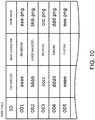
- Fig. 10 is a view illustrating one example of a mark table which is referred when executing the display control.
- the processing circuitry 46 may first acquire the echo data from the A/D converter 45 (S31), and then generate the echo image based on the acquired echo data (S32). As illustrated in the example of Fig. 2 , the echo image may include the fish image F and the waterbed image G.
- the processing circuitry 46 may acquire the estimated fish species from the fish species estimation device 10 (S33).
- the processing circuitry 46 may refer to the mark table and read out a mark corresponding to the acquired fish species (S34). As illustrated in the example of Fig. 10 , in the mark table, mark characters and a mark image which constitute each mark may be associated with the corresponding fish species. A character string indicative of a fish species is included in a column of the mark characters, and a file name of an image may be included in a column of the mark image.
- the mark table may be stored in the memory of the processing circuitry 46, or may be stored in the database 19.
- the processing circuitry 46 may add the read-out mark to the echo image (S35), and output the echo image attached with the mark to the display unit 47 (S36).
- the echo image with the mark may be displayed on the display unit 47.
- the mark image M and the mark characters L may be added so as to be associated with the fish image F.
- the mark image M may be an image of an enclosing line, and it may be disposed so that the enclosing line encloses the fish image F.
- the mark characters L may be disposed near the mark image M.
- the example of Fig. 12 is an echo image illustrating a larger area than that of Fig. 11 .
- the mark image M and the mark characters L may be added to each fish image F.
- the mark image M may be desirable to be in a different color and have a different shape for every fish species in order to facilitate the discrimination.
- the user since the echo image to which the marks are added is displayed on the display unit 47, the user is able to recognize the fish species of the fish image included in the echo image.
- the fish species estimated by the fish species estimation device 10 is used, the fish species distinguished by the conventional technique disclosed in JP2014-077703A etc. may be used for the addition of marks.
- the addition of the mark may be performed only for the fish species specified by the user operating the user interface 48. Therefore, it may become easier for the user to recognize a desired fish species.
- the registration to the detected fish species database (refer to Fig. 7 ) described above may also be performed only when the user operates the user interface 48. Therefore, the user can save the detected fish species after checking the mark displayed on the display unit 47.
- the adding of the mark is not limited to on the display unit 47.
- the mark of the mark image M and the mark character L may be added to the nautical chart image displayed on the display unit (not illustrated) of the GPS plotter 3, based on the fish species and the position data which are registered to the detected fish species database (refer to Fig. 7 ).
- Fig. 14 is a flowchart illustrating one example of a procedure of a fish species notification executed by the processing circuitry 46, in order to realize the matching determining module 463.
- the processing circuitry 46 may first receive a specification of a fish species from the user (S41). The specification of the fish species is performed by the user operating the user interface 48. Next, the processing circuitry 46 may acquire the fish species estimated from the fish species estimation device 10 (S42).
- the processing circuitry 46 may determine whether the estimated fish species matches with the fish species specified by the user (S43). If matched (S43: YES), the processing circuitry 46 may drive the notifier 49 to notify the user that the specified fish species has appeared (S44). The notification may be performed by, for example, voice from the speaker or buzzer.
Landscapes
- Engineering & Computer Science (AREA)
- Radar, Positioning & Navigation (AREA)
- Remote Sensing (AREA)
- Physics & Mathematics (AREA)
- General Physics & Mathematics (AREA)
- Computer Networks & Wireless Communication (AREA)
- Software Systems (AREA)
- Theoretical Computer Science (AREA)
- Acoustics & Sound (AREA)
- Data Mining & Analysis (AREA)
- Medical Informatics (AREA)
- Evolutionary Computation (AREA)
- Computing Systems (AREA)
- General Engineering & Computer Science (AREA)
- Mathematical Physics (AREA)
- Computer Vision & Pattern Recognition (AREA)
- Artificial Intelligence (AREA)
- Measurement Of Velocity Or Position Using Acoustic Or Ultrasonic Waves (AREA)
Abstract
Description
- The present disclosure relates to fish species estimating system, a method of estimating fish species, and a program.
-
JP2014-077703A - Since the management of a fish catch has been increasingly strict in the field of fishing every year, a further improvement in accuracy of the technology of estimating the fish species before catching is demanded.
- The purpose of the present disclosure is to provide a fish species estimating system, a method of estimating fish species, and a program, which can improve accuracy of a fish species estimation.
- According to one aspect of the present disclosure, a fish species estimating system may include an acquiring module and a reasoning module. The acquiring module may acquire a data set at least including echo data generated from a reflected wave of an ultrasonic wave emitted underwater. The reasoning module may estimate a fish species of a fish image included in the echo data of the data set acquired by the acquiring module, by using a learned model created by machine learning where the data set is used as input data and the fish species is used as teacher data.
- According to another aspect of the present disclosure, a method of estimating a fish species may include acquiring a data set at least including echo data generated from a reflected wave of an ultrasonic wave emitted underwater, and estimating a fish species of a fish image included in the echo data of the acquired data set, by using a learned model created by machine learning where the data set is used as input data and the fish species is used as teacher data.
- According to still another aspect of the present disclosure, a program may cause a computer to acquire a data set at least including echo data generated from a reflected wave of an ultrasonic wave emitted underwater, and estimate a fish species of a fish image included in the echo data of the acquired data set, by using a learned model created by machine learning where the data set is used as input data and the fish species is used as teacher data.
- According to the present disclosure, it is possible to improve accuracy of a fish species estimation.
- The present disclosure is illustrated by way of example and not by way of limitation in the figures of the accompanying drawings, in which like reference numerals indicate like elements and in which:
-
Fig. 1 is a block diagram illustrating one example of a configuration of a fish species estimating system according to one embodiment; -
Fig. 2 is a view illustrating one example of an echo image; -
Fig. 3 is a block diagram illustrating a learning phase of a school-of-fish learning/reasoning module; -
Fig. 4 is a flowchart illustrating one example of a procedure of the learning phase of the school-of-fish learning/reasoning module; -
Fig. 5 is a block diagram illustrating a reasoning phase of the school-of-fish learning/reasoning module; -
Fig. 6 is a flowchart illustrating one example of a procedure of the reasoning phase of the school-of-fish learning/reasoning module; -
Fig. 7 is a view illustrating one example of a detected fish species database; -
Fig. 8 is a block diagram illustrating one example of a configuration of a fish finder; -
Fig. 9 is a flowchart illustrating one example of a procedure of a display control; -
Fig. 10 is a view illustrating one example of a mark table; -
Fig. 11 is a view illustrating one example of an echo image to which a mark is added; -
Fig. 12 is a view illustrating another example of the echo image to which the mark is added; -
Fig. 13 is a view illustrating one example of a nautical chart image to which the mark is added; and -
Fig. 14 is a flowchart illustrating one example of a procedure of a fish species notification. - Hereinafter, one embodiment of the present disclosure will be described with reference to the accompanying drawings. Note that the following embodiment illustrates a method and device for implementing the technical idea of the present disclosure, and the technical idea of the present disclosure is not intended to be limited to the following method and device. The technical idea of the present disclosure may be variously changed or modified within the technical scope of the present disclosure which is defined in the appended claims.
-
Fig. 1 is a block diagram illustrating one example of a configuration of a fishspecies estimating system 1 according to one embodiment. The fishspecies estimating system 1 may include a fishspecies estimation device 10, acamera 2, aGPS plotter 3, afish finder 4, and adatabase 19. - The fish
species estimation device 10, thecamera 2, theGPS plotter 3, thefish finder 4, and thedatabase 19 included in the fishspecies estimating system 1 are mounted, for example, on a ship, such as a fishing boat. Without limiting to this configuration a part or all of functions of the fishspecies estimation device 10 may be realized by a server device installed on the land, for example. - The fish
species estimation device 10 may be a computer provided with aprocessing circuitry 17 including a CPU, a RAM, a ROM, a nonvolatile memory, and an input/output interface. Theprocessing circuitry 17 may include an image-fishspecies distinguishing module 11, a fish species learning/reasoning module 13, and adata acquiring module 15. These functional modules may be realized by the CPU of theprocessing circuitry 17 executing information processing according to a program loaded to the RAM from the ROM or the nonvolatile memory. The program may be provided, for example, through an information storage medium, such as an optical disc or a memory card, or may be provided, for example, through a communication network, such as the Internet. - The fish
species estimation device 10 may be accessible to thedatabase 19. Thedatabase 19 may be realized in the fishspecies estimation device 10, or may be realized in theGPS plotter 3 or thefish finder 4, or may be realized in the server device installed on the land, etc. - The
camera 2 may image fish when or after it is caught to generate image data. For example, thecamera 2 may image fish caught in a net when the net is raised, or may image fish raised on the deck, or may image fish put in a fish tank, or may image fish which is landed. The image data generated by thecamera 2 may be outputted to the fishspecies estimation device 10, and it may be used for a learning phase of the fish species learning/reasoning module 13 via the image-fishspecies distinguishing module 11, as will be described later. - The
GPS plotter 3 may generate position data indicative of the current position of the ship based on electric waves received from the GPS (Global Positioning System) and plots the current position of the ship on a nautical chart image displayed on a display unit (not illustrated). The position data generated by theGPS plotter 3 may be outputted to the fishspecies estimation device 10, and it may be used for the learning phase and a reasoning phase of the fish species learning/reasoning module 13, as will be described later. - The
fish finder 4 may generate echo data from a reflected wave of an ultrasonic wave emitted underwater, and display an echo image based on the echo data on a display unit 47 (refer toFig. 8 ). The concrete configuration of thefish finder 4 will be described later. As illustrated in the example ofFig. 2 , the echo image may include a fish image F indicative of a component reflected on underwater fish, and a waterbed or seabed image G indicative of a component reflected on the waterbed or seabed. - Further, the
fish finder 4 may detect water depth data based on the echo data and detects water temperature data by a temperature sensor. The echo data, the water depth data, and the water temperature data which are generated by thefish finder 4 may be outputted to the fishspecies estimation device 10, and they may be used for the learning phase and the reasoning phase of the fish species learning/reasoning module 13, as will be described later. - The image data from the
camera 2, the position data from theGPS plotter 3, the echo data, the water depth data, the water temperature data from thefish finder 4, etc. may be acquired by thedata acquiring module 15, and they may be stored in thedatabase 19. - Among these, a data set including the echo data, the position data, the water depth data, and the water temperature data may be used as input data of the fish species learning/
reasoning module 13. The data set may be stored at every given time. The data set may at least include the echo data, and one or more of the position data, the water depth data and the water temperature data may be omitted, or the data set may further include other data, such as time and/or day data, and tidal current data. - The image data may be used as input data of the image-fish
species distinguishing module 11. The image data may be stored so as to be associated with the data set acquired before catching fish. Specifically, the image data may be associated with the data set so that fish imaged by thecamera 2 matches with fish detected by the echo data. For example, they may be associated with each other automatically in consideration of the time required for catching the fish, or may be associated with each other, or manually by a user. - For example, the position when the fish finder 4 detects a school of fish may be stored, and the image data and the data set may be associated with each other, when satisfying a condition that a distance between the position when the school of fish (signs of fish) is detected and the position when the school of fish is caught (i.e., the position where the image data is generated) is below a threshold. A condition that a difference between the time at which the school of fish is detected and the time at which the school of fish is caught is below a threshold may be further combined with the condition described above. The position at which the school of fish is caught is, for example, the position of the ship when the fish is caught if it is fishing with a fishing pole, and the starting position of hauling a net or the center position of the net, if it is fishing with a round haul net.
- The image-fish
species distinguishing module 11 is one example of a distinguishing module. When the image data is inputted, the image-fishspecies distinguishing module 11 may distinguish a fish species of a fish image included in the image data, and output it. The fish species outputted from the image-fishspecies distinguishing module 11 may be used as a teacher data in the learning phase of the fish species learning/reasoning module 13, as will be described later. The fish species may be distinguished beforehand and stored in thedatabase 19 so as to be associated with the data set as well as the image data, or may be distinguished during the learning phase of the fish species learning/reasoning module 13 and directly inputted into the fish species learning/reasoning module 13. - In this embodiment, the image-fish
species distinguishing module 11 may be a learning/reasoning module which realizes a learning phase and a reasoning phase by machine learning, similar to the fish species learning/reasoning module 13. Specifically, the image-fishspecies distinguishing module 11 may create a learned model by the machine learning in the learning phase, using the image data as input data and the fish species as the teacher data. The fish species as the teacher data is inputted, for example, by the user. Moreover, the image-fishspecies distinguishing module 11 may use the learned model created in the learning phase, estimate in a reasoning phase the fish species of the fish image included in the image data by using the image data as the input data, and output the fish species. - Without limiting to the configuration described above, the image-fish
species distinguishing module 11 may omit the part which realizes the learning phase and may only be comprised of the part which realizes the reasoning phase. Alternatively, the image-fishspecies distinguishing module 11 may distinguish the fish species of the fish image included in the image data by an image recognition technology which extracts feature(s) from the image data to identify an object without using the learned model created by the machine learning. - The fish species learning/
reasoning module 13 is one example of the learning module and the reasoning module, and may realize the learning phase and the reasoning phase by the machine learning. Specifically, the fish species learning/reasoning module 13 may create in the learning phase the learned model by the machine learning by using the data set including the echo data etc. as the input data, and the fish species distinguished by the image-fishspecies distinguishing module 11 as the teacher data. Moreover, the fish species learning/reasoning module 13 may use the learned model created in the learning phase, estimate in the reasoning phase the fish species of the fish image included in the echo data by using the data set including the echo data etc. as the input data, and output the fish species. - The machine learning may use, for example, a neural network. Particularly, deep learning using a deep neural network where multiple layers of neurons are combined may be suitable. Without limiting to the configuration described above, machine learning other than the neural network, such as a support vector machine, a decision tree, etc. may be used.
- Note that, since the part which realizes the learning phase in the image-fish
species distinguishing module 11 and the fish species learning/reasoning module 13 requires a high calculation throughput, it may be realized by a server device installed on the land, etc. In such a case, data may be communicated sequentially using satellite communication etc., or data may be stored while the ship is traveling and the data may be communicated all at once when the ship returns to a port. -
Fig. 3 is a block diagram illustrating the learning phase of the fish species learning/reasoning module 13.Fig. 4 is a flowchart illustrating one example of a procedure of the learning phase of the fish species learning/reasoning module 13. - First, the fish species learning/
reasoning module 13 may acquire the data set and the fish species (S11). In the learning phase, the data set and the fish species associated with the data set may be read from thedatabase 19. The data set may include the position data from theGPS plotter 3, and the echo data, the water depth data, and the water temperature data from thefish finder 4, etc. The fish species may be distinguished by the image-fishspecies distinguishing module 11 based on the image data from thecamera 2. The fish species may be read from thedatabase 19 or may be directly inputted from the image-fishspecies distinguishing module 11. - Note that, although arrows indicate a flow of the data in
Fig. 3 for convenience of explanation, each data may be, in fact, stored in thedatabase 19 and read from thedatabase 19. Without limiting to this configuration, each data may be directly inputted and outputted, without the interveningdatabase 19. - Next, the fish species learning/
reasoning module 13 may extract a part of a plurality of groups of data sets and fish species, as training data for the machine learning (S12), and execute the machine learning using the extracted training data (S13). The machine learning may be performed using the data set as the input data and the fish species as the teacher data. Thus, the learned model for estimating the fish species of the fish image included in the echo data may be created. - Next, the fish species learning/
reasoning module 13 may extract a part different from the training data from the plurality of groups of the data set and the fish species, as test data (S14), and evaluate the learned model using the extracted test data (S15). Then, the fish species learning/reasoning module 13 may store in thedatabase 19 the learned model(s) for which the evaluation is satisfactory (S16), and then end the learning phase. -
Fig. 5 is a block diagram illustrating the reasoning phase of the fish species learning/reasoning module 13.Fig. 6 is a flowchart illustrating one example of a procedure of the reasoning phase of the fish species learning/reasoning module 13. - First, the fish species learning/
reasoning module 13 may acquire a data set (S21, processing as an acquiring module). In the reasoning phase, the echo data, the position data, the water depth data, the water temperature data, etc. which are included in the data set may be directly inputted into the fish species learning/reasoning module 13 from theGPS plotter 3 and thefish finder 4. Without limiting to this configuration, the data set may once be stored in thedatabase 19, and may be read from thedatabase 19. - Next, the fish species learning/
reasoning module 13 may use the data set including the acquired echo data as the input data, compare the input data with the learned model created in the learning phase (S22), and estimate and output the fish species of the fish image included in the echo data (S23). The comparison with the learned model may be, for example, pattern matching of the echo image based on the echo data with the learned model image. The fish species estimated by the fish species learning/reasoning module 13 may be outputted to thedatabase 19, theGPS plotter 3, and thefish finder 4, etc. - As illustrated in
Fig. 7 , the fish species outputted from the fish species learning/reasoning module 13 is, for example, stored in a detected fish species database included in thedatabase 19 so as to be associated with the time and/or day data, the position data, etc. Further, the fish species may be, for example, associated with the data, such as the water depth data, the water temperature data, the current data, etc. - According to the above embodiment, it is possible to improve the accuracy of the fish species estimation by using the learned model created by the machine learning and estimating the fish species of the fish image included in the echo data. Moreover, it is possible to further improve the accuracy of the fish species estimation by repeating the machine learning using the data set and the fish species which are acquired each time fish is caught.
- Moreover, according to the above embodiment, since the fish species distinguished by the image-fish
species distinguishing module 11 based on the image data is used as the teacher data in the learning phase of the fish species learning/reasoning module 13, it becomes possible to omit the user's burden for inputting the fish species, thereby improving the accuracy of the fish species estimation, while reducing the user's burden. - Note that, although in the above embodiment only the fish species is treated as the property to be distinguished and estimated, the fish species and fish quantity may be used as the properties to be distinguished by the image-fish
species distinguishing module 11, as the teacher data in the learning phase of the fish species learning/reasoning module 13, and as the property to be estimated in the reasoning phase of the fish species learning/reasoning module 13. According to this configuration, since the fish quantity is estimated as well as the fish species, these are further useful for determination of the fish catch. -
Fig. 8 is a block diagram illustrating one example of a configuration of thefish finder 4. Thefish finder 4 may include atransducer 41, a transmission-and-reception switch 42, a transmittingcircuit 43, a receivingcircuit 44, an A/D converter 45, aprocessing circuitry 46, adisplay unit 47, auser interface 48, and a notifier 49 (notifying module). Theprocessing circuitry 46 may include adisplay controlling module 461 and amatching determining module 463. - The
transducer 41 may include an ultrasonic transducer and may be installed in the bottom of the ship. Thetransducer 41 may convert an electrical signal from the transmittingcircuit 43 into an ultrasonic wave and transmit the ultrasonic wave underwater, and convert a received reflected wave into an electrical signal and output the electrical signal to the receivingcircuit 44. The transmission-and-reception switch 42 may connect the transmittingcircuit 43 to thetransducer 41 upon the transmission, and connect the receivingcircuit 44 to thetransducer 41 upon reception. - The receiving
circuit 44 may amplify the electrical signal from thetransducer 41, and output it to the A/D converter 45. The A/D converter 45 may convert the electrical signal from the receivingcircuit 44 into digital data (i.e., echo data), and output it to theprocessing circuitry 46. - The
processing circuitry 46 may be a computer including a CPU, a RAM, a ROM, a nonvolatile memory, and an input/output interface. The functional parts included in theprocessing circuitry 46 may be realized by the CPU executing information processing according to a program loaded to the RAM from the ROM or the nonvolatile memory. The program may be provided, for example, through information storage medium, such as an optical disc or a memory card, or may be provided, for example, through a communication network, such as the Internet. - The
display unit 47 is, for example, a liquid crystal display. Theuser interface 48 is, for example, a button switch or a touch panel. Thenotifier 49 is, for example, a speaker or a buzzer. -
Fig. 9 is a flowchart illustrating one example of a procedure of a display control executed by theprocessing circuitry 46, in order to realize thedisplay controlling module 461.Fig. 10 is a view illustrating one example of a mark table which is referred when executing the display control. - The
processing circuitry 46 may first acquire the echo data from the A/D converter 45 (S31), and then generate the echo image based on the acquired echo data (S32). As illustrated in the example ofFig. 2 , the echo image may include the fish image F and the waterbed image G. - Next, the
processing circuitry 46 may acquire the estimated fish species from the fish species estimation device 10 (S33). - Next, the
processing circuitry 46 may refer to the mark table and read out a mark corresponding to the acquired fish species (S34). As illustrated in the example ofFig. 10 , in the mark table, mark characters and a mark image which constitute each mark may be associated with the corresponding fish species. A character string indicative of a fish species is included in a column of the mark characters, and a file name of an image may be included in a column of the mark image. The mark table may be stored in the memory of theprocessing circuitry 46, or may be stored in thedatabase 19. - Next, the
processing circuitry 46 may add the read-out mark to the echo image (S35), and output the echo image attached with the mark to the display unit 47 (S36). Thus, the echo image with the mark may be displayed on thedisplay unit 47. - As illustrated in the example of
Fig. 11 , over the echo image, the mark image M and the mark characters L may be added so as to be associated with the fish image F. In the illustrated example, the mark image M may be an image of an enclosing line, and it may be disposed so that the enclosing line encloses the fish image F. The mark characters L may be disposed near the mark image M. The example ofFig. 12 is an echo image illustrating a larger area than that ofFig. 11 . Like this case, when the echo image includes a plurality of fish images F, the mark image M and the mark characters L may be added to each fish image F. The mark image M may be desirable to be in a different color and have a different shape for every fish species in order to facilitate the discrimination. - As described above, since the echo image to which the marks are added is displayed on the
display unit 47, the user is able to recognize the fish species of the fish image included in the echo image. Note that, although in this embodiment the fish species estimated by the fishspecies estimation device 10 is used, the fish species distinguished by the conventional technique disclosed inJP2014-077703A - Moreover, the addition of the mark may be performed only for the fish species specified by the user operating the
user interface 48. Therefore, it may become easier for the user to recognize a desired fish species. Similarly, the registration to the detected fish species database (refer toFig. 7 ) described above may also be performed only when the user operates theuser interface 48. Therefore, the user can save the detected fish species after checking the mark displayed on thedisplay unit 47. - Note that, although in this embodiment one example in which the mark is added to the echo image displayed on the
display unit 47 of thefish finder 4 is described, the adding of the mark is not limited to on thedisplay unit 47. For example, as illustrated in the example ofFig. 13 , the mark of the mark image M and the mark character L may be added to the nautical chart image displayed on the display unit (not illustrated) of theGPS plotter 3, based on the fish species and the position data which are registered to the detected fish species database (refer toFig. 7 ). -
Fig. 14 is a flowchart illustrating one example of a procedure of a fish species notification executed by theprocessing circuitry 46, in order to realize thematching determining module 463. Theprocessing circuitry 46 may first receive a specification of a fish species from the user (S41). The specification of the fish species is performed by the user operating theuser interface 48. Next, theprocessing circuitry 46 may acquire the fish species estimated from the fish species estimation device 10 (S42). - Next, the
processing circuitry 46 may determine whether the estimated fish species matches with the fish species specified by the user (S43). If matched (S43: YES), theprocessing circuitry 46 may drive thenotifier 49 to notify the user that the specified fish species has appeared (S44). The notification may be performed by, for example, voice from the speaker or buzzer. - By performing the notification, it becomes possible for the user to recognize that the specified fish species has appeared.
Claims (9)
- A fish species estimating system (1), comprising:an acquiring module (13) configured to acquire a data set at least including echo data generated from a reflected wave of an ultrasonic wave emitted underwater; anda reasoning module (13) configured to estimate a fish species of a fish image included in the echo data of the data set acquired by the acquiring module (13), by using a learned model created by machine learning where the data set is used as input data and the fish species is used as teacher data.
- The fish species estimating system (1) of claim 1, further comprising:a distinguishing module (11) configured to distinguish the fish species of the fish image included in image data generated by a camera configured to image fish caught; anda learning module (13) configured to create the learned model by using the fish species distinguished by the distinguishing module (11) as teacher data.
- The fish species estimating system (1) of claim 2, wherein the distinguishing module (11) distinguishes the fish species of the fish image included in the image data by using a learned model created by machine learning where the image data is used as input data and the fish species is used as teacher data.
- The fish species estimating system (1) of claim 2 or 3, wherein the acquiring module (13) associates the image data with the data set, when a distance between a position when signs of fish are detected based on the echo data and a position where the image data is generated is below a threshold.
- The fish species estimating system (1) of any one of claim 1 to 4, wherein the data set further includes one or more data selected from position data, water temperature data, and water depth data.
- The fish species estimating system (1) of any one of claim 1 to 5, wherein the learned model is created using the fish species and a fish quantity as teacher data, and
wherein the reasoning module (13) estimates the fish species and the fish quantity of the fish image included in the echo data. - The fish species estimating system (1) of any one of claim 1 to 6, further comprising a display controlling module (461) configured to display an echo image based on the echo data,
wherein the display controlling module (461) adds a mark indicative of the fish species estimated by the reasoning module (13) to the echo image, so as to be associated with the fish image included in the echo image. - The fish species estimating system (1) of any one of claim 1 to 7, further comprising a notifying module (49) configured to, when the fish species estimated by the reasoning module (13) matches with a prespecified fish species, notify a user about the fish species.
- A method of estimating a fish species, comprising:acquiring a data set at least including echo data generated from a reflected wave of an ultrasonic wave emitted underwater; andestimating a fish species of a fish image included in the echo data of the acquired data set, by using a learned model created by machine learning where the data set is used as input data and the fish species is used as teacher data.
Applications Claiming Priority (1)
| Application Number | Priority Date | Filing Date | Title |
|---|---|---|---|
| JP2018096081A JP7126858B2 (en) | 2018-05-18 | 2018-05-18 | Fish species estimation system, fish species estimation method, and program |
Publications (2)
| Publication Number | Publication Date |
|---|---|
| EP3570071A1 true EP3570071A1 (en) | 2019-11-20 |
| EP3570071B1 EP3570071B1 (en) | 2024-10-02 |
Family
ID=66589208
Family Applications (1)
| Application Number | Title | Priority Date | Filing Date |
|---|---|---|---|
| EP19174516.5A Active EP3570071B1 (en) | 2018-05-18 | 2019-05-14 | Fish species estimating system, and method of estimating fish species |
Country Status (3)
| Country | Link |
|---|---|
| US (1) | US20190353765A1 (en) |
| EP (1) | EP3570071B1 (en) |
| JP (1) | JP7126858B2 (en) |
Families Citing this family (14)
| Publication number | Priority date | Publication date | Assignee | Title |
|---|---|---|---|---|
| JP2021103092A (en) * | 2019-12-24 | 2021-07-15 | 株式会社アイシン | Seat posture detection device |
| CN111406693A (en) * | 2020-04-23 | 2020-07-14 | 上海海洋大学 | Marine ranch fishery resource maintenance effect evaluation method based on bionic sea eels |
| CN111348161B (en) * | 2020-04-23 | 2024-02-09 | 上海海洋大学 | Resource environment monitoring system applied to ocean pasture and operation method thereof |
| JP7579068B2 (en) * | 2020-06-05 | 2024-11-07 | 株式会社日立製作所 | Learning device for detecting underwater targets and device for detecting underwater targets |
| CN111965654A (en) * | 2020-08-03 | 2020-11-20 | 安庆师范大学 | A kind of finless porpoise wireless positioning tracking system and tracking method |
| KR102424081B1 (en) * | 2020-10-12 | 2022-07-25 | 박교열 | Object image classification method based on machine learning and position/environment information |
| US12532872B2 (en) | 2020-10-14 | 2026-01-27 | Japan Agency For Marine-Earth Science And Technology | Fish count calculation method, fish count calculation program, and fish count calculation device |
| US11516997B2 (en) * | 2020-11-24 | 2022-12-06 | X Development Llc | Escape detection and mitigation for aquaculture |
| KR102604114B1 (en) * | 2022-01-17 | 2023-11-22 | 전남대학교산학협력단 | Method for Detecting Fish in Sonar Video using Deep Learning |
| NO347510B1 (en) * | 2022-02-08 | 2023-12-04 | Scantrol Deep Vision As | Underwater sensor for use in a trawl |
| JP2024005623A (en) * | 2022-06-30 | 2024-01-17 | 古野電気株式会社 | Server, fish species discrimination system, fish species discrimination method and program |
| JP2024013658A (en) * | 2022-07-20 | 2024-02-01 | 古野電気株式会社 | Fish species identification system, server, fish species identification method and program |
| US20240103163A1 (en) * | 2022-09-22 | 2024-03-28 | Furuno Electric Co., Ltd. | Fish species discrimination system and method |
| KR102675081B1 (en) * | 2023-09-27 | 2024-06-14 | 주식회사 해랑기술정책연구소 | Apparatus and method for monitoring and reporting bycatch of porpoise during fishing activities |
Citations (2)
| Publication number | Priority date | Publication date | Assignee | Title |
|---|---|---|---|---|
| JP2014077703A (en) | 2012-10-10 | 2014-05-01 | Furuno Electric Co Ltd | Fish species discrimination device, signal processing device, underwater detector, fish species discrimination method and program |
| GB2522302A (en) * | 2013-10-31 | 2015-07-22 | Furuno Electric Co | Size-and-type determining device, underwater detecting apparatus and method of determining size and type |
Family Cites Families (10)
| Publication number | Priority date | Publication date | Assignee | Title |
|---|---|---|---|---|
| JPS475811Y1 (en) * | 1968-12-18 | 1972-02-29 | ||
| JPS56154681A (en) * | 1980-05-01 | 1981-11-30 | Honda Keisuke | Fish detector discriminating kind of fish |
| JPH05312947A (en) * | 1992-05-13 | 1993-11-26 | Furuno Electric Co Ltd | Fish type decision system |
| JP3483039B2 (en) * | 1993-09-30 | 2004-01-06 | 博文 松尾 | Identification device based on image signals |
| JP3377697B2 (en) * | 1996-10-08 | 2003-02-17 | 三菱重工業株式会社 | Fish type discriminator |
| JP2004271338A (en) | 2003-03-07 | 2004-09-30 | Seiko Epson Corp | Fish school information sharing system, fish school information terminal device, fish school information sharing method, fish school information terminal device control method, fish school information sharing program, fish school information terminal device control program, computer readable recording medium recording fish school information sharing program, Computer-readable recording medium recording a control program for a school of fish information terminal device |
| JP6059867B2 (en) | 2011-09-09 | 2017-01-11 | 古野電気株式会社 | Ultrasonic detection device, ultrasonic detection method, ultrasonic detection program |
| JP6116486B2 (en) | 2011-12-28 | 2017-04-19 | 山田電器工業株式会社 | Dimension measurement method |
| JP6014382B2 (en) | 2012-06-20 | 2016-10-25 | 古野電気株式会社 | Underwater detection device, underwater display system, program, and underwater display method |
| JP5713376B1 (en) | 2014-12-10 | 2015-05-07 | 株式会社ニレコ | Fish species discrimination device and fish species discrimination method |
-
2018
- 2018-05-18 JP JP2018096081A patent/JP7126858B2/en active Active
-
2019
- 2019-05-14 EP EP19174516.5A patent/EP3570071B1/en active Active
- 2019-05-16 US US16/414,458 patent/US20190353765A1/en not_active Abandoned
Patent Citations (2)
| Publication number | Priority date | Publication date | Assignee | Title |
|---|---|---|---|---|
| JP2014077703A (en) | 2012-10-10 | 2014-05-01 | Furuno Electric Co Ltd | Fish species discrimination device, signal processing device, underwater detector, fish species discrimination method and program |
| GB2522302A (en) * | 2013-10-31 | 2015-07-22 | Furuno Electric Co | Size-and-type determining device, underwater detecting apparatus and method of determining size and type |
Non-Patent Citations (4)
| Title |
|---|
| HIRAMA YUDAI ET AL: "Discriminating fish species by an Echo sounder in a set-net using a CNN", 2017 21ST ASIA PACIFIC SYMPOSIUM ON INTELLIGENT AND EVOLUTIONARY SYSTEMS (IES), IEEE, 15 November 2017 (2017-11-15), pages 112 - 115, XP033282156, DOI: 10.1109/IESYS.2017.8233571 * |
| PATRICK P H ET AL: "The potential of a neural network based sonar system in classifying fish", NEURAL NETWORKS FOR OCEAN ENGINEERING, 1991., IEEE CONFERENCE ON WASHINGTON, DC, USA 15-17 AUG. 1991, NEW YORK, NY, USA,IEEE, US, 15 August 1991 (1991-08-15), pages 207 - 213, XP010053583, ISBN: 978-0-7803-0205-1, DOI: 10.1109/ICNN.1991.163352 * |
| QIN HONGWEI ET AL: "DeepFish: Accurate underwater live fish recognition with a deep architecture", NEUROCOMPUTING, ELSEVIER, AMSTERDAM, NL, vol. 187, 2 December 2015 (2015-12-02), pages 49 - 58, XP029484730, ISSN: 0925-2312, DOI: 10.1016/J.NEUCOM.2015.10.122 * |
| ROBERTS P L D ET AL: "Multiview, Broadband Acoustic Classification of Marine Fish: A Machine Learning Framework and Comparative Analysis", IEEE JOURNAL OF OCEANIC ENGINEERING, IEEE SERVICE CENTER, PISCATAWAY, NJ, US, vol. 36, no. 1, 1 January 2011 (2011-01-01), pages 90 - 104, XP011479046, ISSN: 0364-9059, DOI: 10.1109/JOE.2010.2101235 * |
Also Published As
| Publication number | Publication date |
|---|---|
| JP2019200175A (en) | 2019-11-21 |
| EP3570071B1 (en) | 2024-10-02 |
| JP7126858B2 (en) | 2022-08-29 |
| US20190353765A1 (en) | 2019-11-21 |
Similar Documents
| Publication | Publication Date | Title |
|---|---|---|
| EP3570071B1 (en) | Fish species estimating system, and method of estimating fish species | |
| Gilman et al. | Increasing the functionalities and accuracy of fisheries electronic monitoring systems | |
| JP6783006B1 (en) | Communication terminals, programs and methods | |
| Lennox et al. | Envisioning the future of aquatic animal tracking: technology, science, and application | |
| US20190204416A1 (en) | Target object detecting device, method of detecting a target object and computer readable medium | |
| US8553501B1 (en) | Tracking system for underwater equipment | |
| US12084150B2 (en) | System and method for measuring and sharing marine activity information | |
| US10551498B2 (en) | Wireless sonar device | |
| WO2024005070A1 (en) | Fish species discrimination method, server, program and fish species discrimination system | |
| US20210088656A1 (en) | Fish finder | |
| Ridgway et al. | Side‐scan sonar as a tool for measuring fish populations: current state of the science and future directions | |
| CN117572438A (en) | A traveling fish detection method and system | |
| CN116596163A (en) | Image detection-based white croaker resource distribution prediction system and method | |
| Signaroli et al. | Novel computer vision tools applied to marine recreational fisheries spatial planning | |
| Morris et al. | Over 10 million seawater temperature records for the United Kingdom Continental Shelf between 1880 and 2014 from 17 Cefas (United Kingdom government) marine data systems | |
| Trobbiani et al. | A low-cost towed video camera system for underwater surveys: comparative performance with standard methodology | |
| Karp | Collection of acoustic data from fishing vessels | |
| Yoklavich et al. | A comparative assessment of underwater visual survey tools: results of a workshop and user questionnaire | |
| JP2024097856A (en) | Information processor and program and method | |
| Demer et al. | Two-million-liter tank expands the boundaries of marine technology innovation: national resource available for advancing marine science | |
| JP2023092428A (en) | Program, information processing device, information processing system and information processing method | |
| Melnychuk et al. | Methods for estimating detection efficiency and tracking acoustic tags with mobile transect surveys | |
| US20260045155A1 (en) | System and method for measuring and sharing marine activity information | |
| TWI658789B (en) | Automatic fishery and preys identification and recording system | |
| WO2021132713A1 (en) | Information processing device, program, and method |
Legal Events
| Date | Code | Title | Description |
|---|---|---|---|
| PUAI | Public reference made under article 153(3) epc to a published international application that has entered the european phase |
Free format text: ORIGINAL CODE: 0009012 |
|
| STAA | Information on the status of an ep patent application or granted ep patent |
Free format text: STATUS: THE APPLICATION HAS BEEN PUBLISHED |
|
| AK | Designated contracting states |
Kind code of ref document: A1 Designated state(s): AL AT BE BG CH CY CZ DE DK EE ES FI FR GB GR HR HU IE IS IT LI LT LU LV MC MK MT NL NO PL PT RO RS SE SI SK SM TR |
|
| AX | Request for extension of the european patent |
Extension state: BA ME |
|
| STAA | Information on the status of an ep patent application or granted ep patent |
Free format text: STATUS: REQUEST FOR EXAMINATION WAS MADE |
|
| 17P | Request for examination filed |
Effective date: 20200513 |
|
| RBV | Designated contracting states (corrected) |
Designated state(s): AL AT BE BG CH CY CZ DE DK EE ES FI FR GB GR HR HU IE IS IT LI LT LU LV MC MK MT NL NO PL PT RO RS SE SI SK SM TR |
|
| STAA | Information on the status of an ep patent application or granted ep patent |
Free format text: STATUS: EXAMINATION IS IN PROGRESS |
|
| 17Q | First examination report despatched |
Effective date: 20211117 |
|
| GRAP | Despatch of communication of intention to grant a patent |
Free format text: ORIGINAL CODE: EPIDOSNIGR1 |
|
| STAA | Information on the status of an ep patent application or granted ep patent |
Free format text: STATUS: GRANT OF PATENT IS INTENDED |
|
| RIC1 | Information provided on ipc code assigned before grant |
Ipc: A01K 61/95 20170101ALI20240506BHEP Ipc: G01S 15/96 20060101AFI20240506BHEP Ipc: G01S 15/86 20200101ALI20240506BHEP Ipc: G01S 7/539 20060101ALI20240506BHEP |
|
| INTG | Intention to grant announced |
Effective date: 20240524 |
|
| GRAS | Grant fee paid |
Free format text: ORIGINAL CODE: EPIDOSNIGR3 |
|
| GRAA | (expected) grant |
Free format text: ORIGINAL CODE: 0009210 |
|
| STAA | Information on the status of an ep patent application or granted ep patent |
Free format text: STATUS: THE PATENT HAS BEEN GRANTED |
|
| AK | Designated contracting states |
Kind code of ref document: B1 Designated state(s): AL AT BE BG CH CY CZ DE DK EE ES FI FR GB GR HR HU IE IS IT LI LT LU LV MC MK MT NL NO PL PT RO RS SE SI SK SM TR |
|
| REG | Reference to a national code |
Ref country code: GB Ref legal event code: FG4D |
|
| REG | Reference to a national code |
Ref country code: CH Ref legal event code: EP |
|
| REG | Reference to a national code |
Ref country code: DE Ref legal event code: R096 Ref document number: 602019059653 Country of ref document: DE |
|
| REG | Reference to a national code |
Ref country code: IE Ref legal event code: FG4D |
|
| REG | Reference to a national code |
Ref country code: LT Ref legal event code: MG9D |
|
| REG | Reference to a national code |
Ref country code: NL Ref legal event code: MP Effective date: 20241002 |
|
| REG | Reference to a national code |
Ref country code: AT Ref legal event code: MK05 Ref document number: 1728884 Country of ref document: AT Kind code of ref document: T Effective date: 20241002 |
|
| PG25 | Lapsed in a contracting state [announced via postgrant information from national office to epo] |
Ref country code: NL Free format text: LAPSE BECAUSE OF FAILURE TO SUBMIT A TRANSLATION OF THE DESCRIPTION OR TO PAY THE FEE WITHIN THE PRESCRIBED TIME-LIMIT Effective date: 20241002 |
|
| PG25 | Lapsed in a contracting state [announced via postgrant information from national office to epo] |
Ref country code: NL Free format text: LAPSE BECAUSE OF FAILURE TO SUBMIT A TRANSLATION OF THE DESCRIPTION OR TO PAY THE FEE WITHIN THE PRESCRIBED TIME-LIMIT Effective date: 20241002 |
|
| PG25 | Lapsed in a contracting state [announced via postgrant information from national office to epo] |
Ref country code: HR Free format text: LAPSE BECAUSE OF FAILURE TO SUBMIT A TRANSLATION OF THE DESCRIPTION OR TO PAY THE FEE WITHIN THE PRESCRIBED TIME-LIMIT Effective date: 20241002 Ref country code: IS Free format text: LAPSE BECAUSE OF FAILURE TO SUBMIT A TRANSLATION OF THE DESCRIPTION OR TO PAY THE FEE WITHIN THE PRESCRIBED TIME-LIMIT Effective date: 20250202 Ref country code: PT Free format text: LAPSE BECAUSE OF FAILURE TO SUBMIT A TRANSLATION OF THE DESCRIPTION OR TO PAY THE FEE WITHIN THE PRESCRIBED TIME-LIMIT Effective date: 20250203 |
|
| PG25 | Lapsed in a contracting state [announced via postgrant information from national office to epo] |
Ref country code: FI Free format text: LAPSE BECAUSE OF FAILURE TO SUBMIT A TRANSLATION OF THE DESCRIPTION OR TO PAY THE FEE WITHIN THE PRESCRIBED TIME-LIMIT Effective date: 20241002 |
|
| PG25 | Lapsed in a contracting state [announced via postgrant information from national office to epo] |
Ref country code: BG Free format text: LAPSE BECAUSE OF FAILURE TO SUBMIT A TRANSLATION OF THE DESCRIPTION OR TO PAY THE FEE WITHIN THE PRESCRIBED TIME-LIMIT Effective date: 20241002 |
|
| PG25 | Lapsed in a contracting state [announced via postgrant information from national office to epo] |
Ref country code: ES Free format text: LAPSE BECAUSE OF FAILURE TO SUBMIT A TRANSLATION OF THE DESCRIPTION OR TO PAY THE FEE WITHIN THE PRESCRIBED TIME-LIMIT Effective date: 20241002 |
|
| PG25 | Lapsed in a contracting state [announced via postgrant information from national office to epo] |
Ref country code: NO Free format text: LAPSE BECAUSE OF FAILURE TO SUBMIT A TRANSLATION OF THE DESCRIPTION OR TO PAY THE FEE WITHIN THE PRESCRIBED TIME-LIMIT Effective date: 20250102 |
|
| PG25 | Lapsed in a contracting state [announced via postgrant information from national office to epo] |
Ref country code: LV Free format text: LAPSE BECAUSE OF FAILURE TO SUBMIT A TRANSLATION OF THE DESCRIPTION OR TO PAY THE FEE WITHIN THE PRESCRIBED TIME-LIMIT Effective date: 20241002 Ref country code: AT Free format text: LAPSE BECAUSE OF FAILURE TO SUBMIT A TRANSLATION OF THE DESCRIPTION OR TO PAY THE FEE WITHIN THE PRESCRIBED TIME-LIMIT Effective date: 20241002 Ref country code: GR Free format text: LAPSE BECAUSE OF FAILURE TO SUBMIT A TRANSLATION OF THE DESCRIPTION OR TO PAY THE FEE WITHIN THE PRESCRIBED TIME-LIMIT Effective date: 20250103 |
|
| PG25 | Lapsed in a contracting state [announced via postgrant information from national office to epo] |
Ref country code: PL Free format text: LAPSE BECAUSE OF FAILURE TO SUBMIT A TRANSLATION OF THE DESCRIPTION OR TO PAY THE FEE WITHIN THE PRESCRIBED TIME-LIMIT Effective date: 20241002 Ref country code: CZ Free format text: LAPSE BECAUSE OF FAILURE TO SUBMIT A TRANSLATION OF THE DESCRIPTION OR TO PAY THE FEE WITHIN THE PRESCRIBED TIME-LIMIT Effective date: 20241002 |
|
| PG25 | Lapsed in a contracting state [announced via postgrant information from national office to epo] |
Ref country code: RS Free format text: LAPSE BECAUSE OF FAILURE TO SUBMIT A TRANSLATION OF THE DESCRIPTION OR TO PAY THE FEE WITHIN THE PRESCRIBED TIME-LIMIT Effective date: 20250102 |
|
| PG25 | Lapsed in a contracting state [announced via postgrant information from national office to epo] |
Ref country code: SM Free format text: LAPSE BECAUSE OF FAILURE TO SUBMIT A TRANSLATION OF THE DESCRIPTION OR TO PAY THE FEE WITHIN THE PRESCRIBED TIME-LIMIT Effective date: 20241002 |
|
| REG | Reference to a national code |
Ref country code: DE Ref legal event code: R097 Ref document number: 602019059653 Country of ref document: DE |
|
| PG25 | Lapsed in a contracting state [announced via postgrant information from national office to epo] |
Ref country code: DK Free format text: LAPSE BECAUSE OF FAILURE TO SUBMIT A TRANSLATION OF THE DESCRIPTION OR TO PAY THE FEE WITHIN THE PRESCRIBED TIME-LIMIT Effective date: 20241002 |
|
| PG25 | Lapsed in a contracting state [announced via postgrant information from national office to epo] |
Ref country code: EE Free format text: LAPSE BECAUSE OF FAILURE TO SUBMIT A TRANSLATION OF THE DESCRIPTION OR TO PAY THE FEE WITHIN THE PRESCRIBED TIME-LIMIT Effective date: 20241002 |
|
| PG25 | Lapsed in a contracting state [announced via postgrant information from national office to epo] |
Ref country code: RO Free format text: LAPSE BECAUSE OF FAILURE TO SUBMIT A TRANSLATION OF THE DESCRIPTION OR TO PAY THE FEE WITHIN THE PRESCRIBED TIME-LIMIT Effective date: 20241002 |
|
| PG25 | Lapsed in a contracting state [announced via postgrant information from national office to epo] |
Ref country code: SK Free format text: LAPSE BECAUSE OF FAILURE TO SUBMIT A TRANSLATION OF THE DESCRIPTION OR TO PAY THE FEE WITHIN THE PRESCRIBED TIME-LIMIT Effective date: 20241002 |
|
| PG25 | Lapsed in a contracting state [announced via postgrant information from national office to epo] |
Ref country code: IT Free format text: LAPSE BECAUSE OF FAILURE TO SUBMIT A TRANSLATION OF THE DESCRIPTION OR TO PAY THE FEE WITHIN THE PRESCRIBED TIME-LIMIT Effective date: 20241002 |
|
| PLBE | No opposition filed within time limit |
Free format text: ORIGINAL CODE: 0009261 |
|
| STAA | Information on the status of an ep patent application or granted ep patent |
Free format text: STATUS: NO OPPOSITION FILED WITHIN TIME LIMIT |
|
| PG25 | Lapsed in a contracting state [announced via postgrant information from national office to epo] |
Ref country code: SE Free format text: LAPSE BECAUSE OF FAILURE TO SUBMIT A TRANSLATION OF THE DESCRIPTION OR TO PAY THE FEE WITHIN THE PRESCRIBED TIME-LIMIT Effective date: 20241002 |
|
| 26N | No opposition filed |
Effective date: 20250703 |
|
| REG | Reference to a national code |
Ref country code: DE Ref legal event code: R119 Ref document number: 602019059653 Country of ref document: DE |
|
| REG | Reference to a national code |
Ref country code: CH Ref legal event code: H13 Free format text: ST27 STATUS EVENT CODE: U-0-0-H10-H13 (AS PROVIDED BY THE NATIONAL OFFICE) Effective date: 20251223 |
|
| PG25 | Lapsed in a contracting state [announced via postgrant information from national office to epo] |
Ref country code: LU Free format text: LAPSE BECAUSE OF NON-PAYMENT OF DUE FEES Effective date: 20250514 |
|
| PG25 | Lapsed in a contracting state [announced via postgrant information from national office to epo] |
Ref country code: CH Free format text: LAPSE BECAUSE OF NON-PAYMENT OF DUE FEES Effective date: 20250531 |
|
| REG | Reference to a national code |
Ref country code: BE Ref legal event code: MM Effective date: 20250531 |
|
| PG25 | Lapsed in a contracting state [announced via postgrant information from national office to epo] |
Ref country code: MC Free format text: LAPSE BECAUSE OF FAILURE TO SUBMIT A TRANSLATION OF THE DESCRIPTION OR TO PAY THE FEE WITHIN THE PRESCRIBED TIME-LIMIT Effective date: 20241002 |
|
| PGFP | Annual fee paid to national office [announced via postgrant information from national office to epo] |
Ref country code: GB Payment date: 20260317 Year of fee payment: 8 |
|
| PG25 | Lapsed in a contracting state [announced via postgrant information from national office to epo] |
Ref country code: DE Free format text: LAPSE BECAUSE OF NON-PAYMENT OF DUE FEES Effective date: 20251202 Ref country code: IE Free format text: LAPSE BECAUSE OF NON-PAYMENT OF DUE FEES Effective date: 20250514 |
|
| PG25 | Lapsed in a contracting state [announced via postgrant information from national office to epo] |
Ref country code: BE Free format text: LAPSE BECAUSE OF NON-PAYMENT OF DUE FEES Effective date: 20250531 |
|
| PG25 | Lapsed in a contracting state [announced via postgrant information from national office to epo] |
Ref country code: FR Free format text: LAPSE BECAUSE OF NON-PAYMENT OF DUE FEES Effective date: 20250531 |