EP3569596A1 - 1,2,4-triazine-3-amine derivative, preparation method therefor, and use thereof in medicine - Google Patents
1,2,4-triazine-3-amine derivative, preparation method therefor, and use thereof in medicine Download PDFInfo
- Publication number
- EP3569596A1 EP3569596A1 EP18739200.6A EP18739200A EP3569596A1 EP 3569596 A1 EP3569596 A1 EP 3569596A1 EP 18739200 A EP18739200 A EP 18739200A EP 3569596 A1 EP3569596 A1 EP 3569596A1
- Authority
- EP
- European Patent Office
- Prior art keywords
- compound
- formula
- mmol
- cancer
- heterocyclyl
- Prior art date
- Legal status (The legal status is an assumption and is not a legal conclusion. Google has not performed a legal analysis and makes no representation as to the accuracy of the status listed.)
- Withdrawn
Links
- 238000002360 preparation method Methods 0.000 title claims abstract description 100
- 239000003814 drug Substances 0.000 title claims abstract description 23
- MJIWQHRXSLOUJN-UHFFFAOYSA-N 1,2,4-triazin-3-amine Chemical class NC1=NC=CN=N1 MJIWQHRXSLOUJN-UHFFFAOYSA-N 0.000 title abstract description 4
- 239000008194 pharmaceutical composition Substances 0.000 claims abstract description 36
- 230000005764 inhibitory process Effects 0.000 claims abstract description 34
- 230000001668 ameliorated effect Effects 0.000 claims abstract description 12
- 150000001875 compounds Chemical class 0.000 claims description 199
- -1 cyano, amino Chemical group 0.000 claims description 81
- 125000000217 alkyl group Chemical group 0.000 claims description 79
- 125000000623 heterocyclic group Chemical group 0.000 claims description 69
- 125000000753 cycloalkyl group Chemical group 0.000 claims description 60
- 125000003118 aryl group Chemical group 0.000 claims description 56
- 239000000203 mixture Substances 0.000 claims description 55
- 125000001072 heteroaryl group Chemical group 0.000 claims description 54
- 238000000034 method Methods 0.000 claims description 53
- 229910052736 halogen Inorganic materials 0.000 claims description 52
- 150000002367 halogens Chemical group 0.000 claims description 52
- 125000003545 alkoxy group Chemical group 0.000 claims description 49
- 150000003839 salts Chemical class 0.000 claims description 45
- 125000001188 haloalkyl group Chemical group 0.000 claims description 42
- 125000002768 hydroxyalkyl group Chemical group 0.000 claims description 38
- 206010028980 Neoplasm Diseases 0.000 claims description 31
- 208000037265 diseases, disorders, signs and symptoms Diseases 0.000 claims description 30
- 229910052739 hydrogen Inorganic materials 0.000 claims description 29
- 239000001257 hydrogen Substances 0.000 claims description 29
- 125000002887 hydroxy group Chemical group [H]O* 0.000 claims description 29
- 125000000449 nitro group Chemical group [O-][N+](*)=O 0.000 claims description 29
- 125000001424 substituent group Chemical group 0.000 claims description 28
- 201000011510 cancer Diseases 0.000 claims description 20
- 206010039491 Sarcoma Diseases 0.000 claims description 17
- 208000035475 disorder Diseases 0.000 claims description 16
- 201000010099 disease Diseases 0.000 claims description 14
- 206010009944 Colon cancer Diseases 0.000 claims description 11
- 206010016654 Fibrosis Diseases 0.000 claims description 10
- 208000019425 cirrhosis of liver Diseases 0.000 claims description 10
- 125000004093 cyano group Chemical group *C#N 0.000 claims description 10
- 229910052757 nitrogen Inorganic materials 0.000 claims description 10
- 206010029260 Neuroblastoma Diseases 0.000 claims description 9
- 208000024313 Testicular Neoplasms Diseases 0.000 claims description 9
- 201000003120 testicular cancer Diseases 0.000 claims description 9
- 206010058467 Lung neoplasm malignant Diseases 0.000 claims description 8
- 229910052805 deuterium Inorganic materials 0.000 claims description 8
- 201000005202 lung cancer Diseases 0.000 claims description 8
- 208000020816 lung neoplasm Diseases 0.000 claims description 8
- 230000006399 behavior Effects 0.000 claims description 7
- 125000005842 heteroatom Chemical group 0.000 claims description 7
- 239000000546 pharmaceutical excipient Substances 0.000 claims description 7
- 238000005859 coupling reaction Methods 0.000 claims description 6
- 230000002401 inhibitory effect Effects 0.000 claims description 6
- 201000001441 melanoma Diseases 0.000 claims description 6
- 208000015122 neurodegenerative disease Diseases 0.000 claims description 6
- 125000002924 primary amino group Chemical group [H]N([H])* 0.000 claims description 6
- 208000019116 sleep disease Diseases 0.000 claims description 6
- 208000003174 Brain Neoplasms Diseases 0.000 claims description 5
- 206010006187 Breast cancer Diseases 0.000 claims description 5
- 208000026310 Breast neoplasm Diseases 0.000 claims description 5
- 201000009030 Carcinoma Diseases 0.000 claims description 5
- 208000001333 Colorectal Neoplasms Diseases 0.000 claims description 5
- YZCKVEUIGOORGS-OUBTZVSYSA-N Deuterium Chemical group [2H] YZCKVEUIGOORGS-OUBTZVSYSA-N 0.000 claims description 5
- 208000012661 Dyskinesia Diseases 0.000 claims description 5
- 208000000461 Esophageal Neoplasms Diseases 0.000 claims description 5
- 208000027776 Extrapyramidal disease Diseases 0.000 claims description 5
- 208000004930 Fatty Liver Diseases 0.000 claims description 5
- 208000022072 Gallbladder Neoplasms Diseases 0.000 claims description 5
- 206010019708 Hepatic steatosis Diseases 0.000 claims description 5
- 208000008839 Kidney Neoplasms Diseases 0.000 claims description 5
- 206010025323 Lymphomas Diseases 0.000 claims description 5
- 208000034578 Multiple myelomas Diseases 0.000 claims description 5
- 208000036110 Neuroinflammatory disease Diseases 0.000 claims description 5
- 206010030155 Oesophageal carcinoma Diseases 0.000 claims description 5
- 208000000035 Osteochondroma Diseases 0.000 claims description 5
- 206010033128 Ovarian cancer Diseases 0.000 claims description 5
- 206010061535 Ovarian neoplasm Diseases 0.000 claims description 5
- 206010061902 Pancreatic neoplasm Diseases 0.000 claims description 5
- 206010035226 Plasma cell myeloma Diseases 0.000 claims description 5
- 206010060862 Prostate cancer Diseases 0.000 claims description 5
- 208000000236 Prostatic Neoplasms Diseases 0.000 claims description 5
- 206010038389 Renal cancer Diseases 0.000 claims description 5
- 201000010208 Seminoma Diseases 0.000 claims description 5
- 208000000453 Skin Neoplasms Diseases 0.000 claims description 5
- 208000005718 Stomach Neoplasms Diseases 0.000 claims description 5
- 208000006011 Stroke Diseases 0.000 claims description 5
- 208000024770 Thyroid neoplasm Diseases 0.000 claims description 5
- 208000007097 Urinary Bladder Neoplasms Diseases 0.000 claims description 5
- 208000002495 Uterine Neoplasms Diseases 0.000 claims description 5
- 208000017733 acquired polycythemia vera Diseases 0.000 claims description 5
- 208000029028 brain injury Diseases 0.000 claims description 5
- 208000012191 childhood neoplasm Diseases 0.000 claims description 5
- 208000006990 cholangiocarcinoma Diseases 0.000 claims description 5
- 230000007882 cirrhosis Effects 0.000 claims description 5
- 230000003920 cognitive function Effects 0.000 claims description 5
- 230000002500 effect on skin Effects 0.000 claims description 5
- 208000010932 epithelial neoplasm Diseases 0.000 claims description 5
- 201000004101 esophageal cancer Diseases 0.000 claims description 5
- 208000010706 fatty liver disease Diseases 0.000 claims description 5
- 230000004761 fibrosis Effects 0.000 claims description 5
- 201000010175 gallbladder cancer Diseases 0.000 claims description 5
- 206010017758 gastric cancer Diseases 0.000 claims description 5
- 201000010536 head and neck cancer Diseases 0.000 claims description 5
- 208000014829 head and neck neoplasm Diseases 0.000 claims description 5
- 201000010982 kidney cancer Diseases 0.000 claims description 5
- 208000032839 leukemia Diseases 0.000 claims description 5
- 201000007270 liver cancer Diseases 0.000 claims description 5
- 208000014018 liver neoplasm Diseases 0.000 claims description 5
- 208000015486 malignant pancreatic neoplasm Diseases 0.000 claims description 5
- 208000025189 neoplasm of testis Diseases 0.000 claims description 5
- 230000003959 neuroinflammation Effects 0.000 claims description 5
- 125000004433 nitrogen atom Chemical group N* 0.000 claims description 5
- 208000008798 osteoma Diseases 0.000 claims description 5
- 201000008968 osteosarcoma Diseases 0.000 claims description 5
- 201000002528 pancreatic cancer Diseases 0.000 claims description 5
- 208000008443 pancreatic carcinoma Diseases 0.000 claims description 5
- 208000037244 polycythemia vera Diseases 0.000 claims description 5
- 201000000849 skin cancer Diseases 0.000 claims description 5
- 208000020685 sleep-wake disease Diseases 0.000 claims description 5
- 231100000240 steatosis hepatitis Toxicity 0.000 claims description 5
- 201000011549 stomach cancer Diseases 0.000 claims description 5
- 208000013076 thyroid tumor Diseases 0.000 claims description 5
- 208000026517 ureter neoplasm Diseases 0.000 claims description 5
- 201000011476 ureteral benign neoplasm Diseases 0.000 claims description 5
- 206010046766 uterine cancer Diseases 0.000 claims description 5
- 229910052799 carbon Inorganic materials 0.000 claims description 4
- 229910052760 oxygen Inorganic materials 0.000 claims description 4
- 229910052717 sulfur Inorganic materials 0.000 claims description 4
- 239000003085 diluting agent Substances 0.000 claims description 3
- 239000003937 drug carrier Substances 0.000 claims description 3
- 125000002541 furyl group Chemical group 0.000 claims description 3
- 125000001997 phenyl group Chemical group [H]C1=C([H])C([H])=C(*)C([H])=C1[H] 0.000 claims description 3
- 125000004076 pyridyl group Chemical group 0.000 claims description 3
- 125000001544 thienyl group Chemical group 0.000 claims description 3
- 150000002431 hydrogen Chemical group 0.000 claims 9
- 239000002464 receptor antagonist Substances 0.000 abstract description 6
- 229940044551 receptor antagonist Drugs 0.000 abstract description 6
- 229940124597 therapeutic agent Drugs 0.000 abstract description 2
- 238000006243 chemical reaction Methods 0.000 description 281
- 239000000243 solution Substances 0.000 description 239
- XEKOWRVHYACXOJ-UHFFFAOYSA-N Ethyl acetate Chemical compound CCOC(C)=O XEKOWRVHYACXOJ-UHFFFAOYSA-N 0.000 description 126
- 239000000047 product Substances 0.000 description 99
- 238000004949 mass spectrometry Methods 0.000 description 97
- 230000002829 reductive effect Effects 0.000 description 94
- 238000010828 elution Methods 0.000 description 82
- BWHMMNNQKKPAPP-UHFFFAOYSA-L potassium carbonate Chemical compound [K+].[K+].[O-]C([O-])=O BWHMMNNQKKPAPP-UHFFFAOYSA-L 0.000 description 82
- OIRDTQYFTABQOQ-KQYNXXCUSA-N adenosine Chemical compound C1=NC=2C(N)=NC=NC=2N1[C@@H]1O[C@H](CO)[C@@H](O)[C@H]1O OIRDTQYFTABQOQ-KQYNXXCUSA-N 0.000 description 74
- 239000000706 filtrate Substances 0.000 description 73
- XLYOFNOQVPJJNP-UHFFFAOYSA-N water Substances O XLYOFNOQVPJJNP-UHFFFAOYSA-N 0.000 description 70
- 102000005962 receptors Human genes 0.000 description 68
- 108020003175 receptors Proteins 0.000 description 68
- YMWUJEATGCHHMB-UHFFFAOYSA-N Dichloromethane Chemical compound ClCCl YMWUJEATGCHHMB-UHFFFAOYSA-N 0.000 description 66
- SCVFZCLFOSHCOH-UHFFFAOYSA-M potassium acetate Chemical compound [K+].CC([O-])=O SCVFZCLFOSHCOH-UHFFFAOYSA-M 0.000 description 64
- NXQGGXCHGDYOHB-UHFFFAOYSA-L cyclopenta-1,4-dien-1-yl(diphenyl)phosphane;dichloropalladium;iron(2+) Chemical compound [Fe+2].Cl[Pd]Cl.[CH-]1C=CC(P(C=2C=CC=CC=2)C=2C=CC=CC=2)=C1.[CH-]1C=CC(P(C=2C=CC=CC=2)C=2C=CC=CC=2)=C1 NXQGGXCHGDYOHB-UHFFFAOYSA-L 0.000 description 63
- 239000012300 argon atmosphere Substances 0.000 description 58
- 238000005160 1H NMR spectroscopy Methods 0.000 description 55
- RYHBNJHYFVUHQT-UHFFFAOYSA-N 1,4-Dioxane Chemical compound C1COCCO1 RYHBNJHYFVUHQT-UHFFFAOYSA-N 0.000 description 48
- 229910000027 potassium carbonate Inorganic materials 0.000 description 41
- FAPWRFPIFSIZLT-UHFFFAOYSA-M Sodium chloride Chemical compound [Na+].[Cl-] FAPWRFPIFSIZLT-UHFFFAOYSA-M 0.000 description 39
- 210000004027 cell Anatomy 0.000 description 38
- 239000002126 C01EB10 - Adenosine Substances 0.000 description 37
- 229960005305 adenosine Drugs 0.000 description 37
- 239000011259 mixed solution Substances 0.000 description 35
- 239000012074 organic phase Substances 0.000 description 33
- 235000011056 potassium acetate Nutrition 0.000 description 32
- PMZURENOXWZQFD-UHFFFAOYSA-L Sodium Sulfate Chemical compound [Na+].[Na+].[O-]S([O-])(=O)=O PMZURENOXWZQFD-UHFFFAOYSA-L 0.000 description 31
- OKKJLVBELUTLKV-UHFFFAOYSA-N Methanol Chemical compound OC OKKJLVBELUTLKV-UHFFFAOYSA-N 0.000 description 30
- 230000000694 effects Effects 0.000 description 29
- 239000007858 starting material Substances 0.000 description 26
- WYURNTSHIVDZCO-UHFFFAOYSA-N Tetrahydrofuran Chemical compound C1CCOC1 WYURNTSHIVDZCO-UHFFFAOYSA-N 0.000 description 24
- ZMANZCXQSJIPKH-UHFFFAOYSA-N Triethylamine Chemical compound CCN(CC)CC ZMANZCXQSJIPKH-UHFFFAOYSA-N 0.000 description 24
- 239000002904 solvent Substances 0.000 description 24
- HDABPGYKVQWCNG-UHFFFAOYSA-N 6-bromo-5-phenyl-1,2,4-triazin-3-amine Chemical compound NC1=NN=C(Br)C(C=2C=CC=CC=2)=N1 HDABPGYKVQWCNG-UHFFFAOYSA-N 0.000 description 21
- YXFVVABEGXRONW-UHFFFAOYSA-N Toluene Chemical compound CC1=CC=CC=C1 YXFVVABEGXRONW-UHFFFAOYSA-N 0.000 description 21
- 125000004435 hydrogen atom Chemical group [H]* 0.000 description 21
- KDLHZDBZIXYQEI-UHFFFAOYSA-N Palladium Chemical compound [Pd] KDLHZDBZIXYQEI-UHFFFAOYSA-N 0.000 description 20
- QTBSBXVTEAMEQO-UHFFFAOYSA-N Acetic acid Chemical compound CC(O)=O QTBSBXVTEAMEQO-UHFFFAOYSA-N 0.000 description 18
- 108091003079 Bovine Serum Albumin Proteins 0.000 description 18
- LFQSCWFLJHTTHZ-UHFFFAOYSA-N Ethanol Chemical compound CCO LFQSCWFLJHTTHZ-UHFFFAOYSA-N 0.000 description 18
- HEMHJVSKTPXQMS-UHFFFAOYSA-M Sodium hydroxide Chemical compound [OH-].[Na+] HEMHJVSKTPXQMS-UHFFFAOYSA-M 0.000 description 18
- 239000000872 buffer Substances 0.000 description 18
- IPWKHHSGDUIRAH-UHFFFAOYSA-N bis(pinacolato)diboron Chemical compound O1C(C)(C)C(C)(C)OB1B1OC(C)(C)C(C)(C)O1 IPWKHHSGDUIRAH-UHFFFAOYSA-N 0.000 description 17
- 238000012360 testing method Methods 0.000 description 16
- WEVYAHXRMPXWCK-UHFFFAOYSA-N Acetonitrile Chemical compound CC#N WEVYAHXRMPXWCK-UHFFFAOYSA-N 0.000 description 15
- IAZDPXIOMUYVGZ-UHFFFAOYSA-N Dimethylsulphoxide Chemical compound CS(C)=O IAZDPXIOMUYVGZ-UHFFFAOYSA-N 0.000 description 15
- WMFOQBRAJBCJND-UHFFFAOYSA-M Lithium hydroxide Chemical compound [Li+].[OH-] WMFOQBRAJBCJND-UHFFFAOYSA-M 0.000 description 15
- ZMXDDKWLCZADIW-UHFFFAOYSA-N N,N-Dimethylformamide Chemical compound CN(C)C=O ZMXDDKWLCZADIW-UHFFFAOYSA-N 0.000 description 15
- 239000003054 catalyst Substances 0.000 description 15
- PHDIJLFSKNMCMI-ITGJKDDRSA-N (3R,4S,5R,6R)-6-(hydroxymethyl)-4-(8-quinolin-6-yloxyoctoxy)oxane-2,3,5-triol Chemical compound OC[C@@H]1[C@H]([C@@H]([C@H](C(O1)O)O)OCCCCCCCCOC=1C=C2C=CC=NC2=CC=1)O PHDIJLFSKNMCMI-ITGJKDDRSA-N 0.000 description 14
- LCGLNKUTAGEVQW-UHFFFAOYSA-N Dimethyl ether Chemical compound COC LCGLNKUTAGEVQW-UHFFFAOYSA-N 0.000 description 14
- YLQBMQCUIZJEEH-UHFFFAOYSA-N tetrahydrofuran Natural products C=1C=COC=1 YLQBMQCUIZJEEH-UHFFFAOYSA-N 0.000 description 14
- JKMHFZQWWAIEOD-UHFFFAOYSA-N 2-[4-(2-hydroxyethyl)piperazin-1-yl]ethanesulfonic acid Chemical compound OCC[NH+]1CCN(CCS([O-])(=O)=O)CC1 JKMHFZQWWAIEOD-UHFFFAOYSA-N 0.000 description 13
- XTHFKEDIFFGKHM-UHFFFAOYSA-N Dimethoxyethane Chemical compound COCCOC XTHFKEDIFFGKHM-UHFFFAOYSA-N 0.000 description 13
- PEDCQBHIVMGVHV-UHFFFAOYSA-N Glycerine Chemical compound OCC(O)CO PEDCQBHIVMGVHV-UHFFFAOYSA-N 0.000 description 13
- 239000007995 HEPES buffer Substances 0.000 description 13
- UIIMBOGNXHQVGW-UHFFFAOYSA-M Sodium bicarbonate Chemical class [Na+].OC([O-])=O UIIMBOGNXHQVGW-UHFFFAOYSA-M 0.000 description 13
- 229940098773 bovine serum albumin Drugs 0.000 description 13
- LJIOTBMDLVHTBO-CUYJMHBOSA-N (2s)-2-amino-n-[(1r,2r)-1-cyano-2-[4-[4-(4-methylpiperazin-1-yl)sulfonylphenyl]phenyl]cyclopropyl]butanamide Chemical compound CC[C@H](N)C(=O)N[C@]1(C#N)C[C@@H]1C1=CC=C(C=2C=CC(=CC=2)S(=O)(=O)N2CCN(C)CC2)C=C1 LJIOTBMDLVHTBO-CUYJMHBOSA-N 0.000 description 12
- RTZKZFJDLAIYFH-UHFFFAOYSA-N Diethyl ether Chemical compound CCOCC RTZKZFJDLAIYFH-UHFFFAOYSA-N 0.000 description 12
- 241000699670 Mus sp. Species 0.000 description 12
- CDBYLPFSWZWCQE-UHFFFAOYSA-L Sodium Carbonate Chemical compound [Na+].[Na+].[O-]C([O-])=O CDBYLPFSWZWCQE-UHFFFAOYSA-L 0.000 description 12
- QAOWNCQODCNURD-UHFFFAOYSA-N Sulfuric acid Chemical compound OS(O)(=O)=O QAOWNCQODCNURD-UHFFFAOYSA-N 0.000 description 12
- 230000011496 cAMP-mediated signaling Effects 0.000 description 12
- 125000004432 carbon atom Chemical group C* 0.000 description 12
- ZCSHNCUQKCANBX-UHFFFAOYSA-N lithium diisopropylamide Chemical compound [Li+].CC(C)[N-]C(C)C ZCSHNCUQKCANBX-UHFFFAOYSA-N 0.000 description 12
- VLKZOEOYAKHREP-UHFFFAOYSA-N n-Hexane Chemical compound CCCCCC VLKZOEOYAKHREP-UHFFFAOYSA-N 0.000 description 12
- 230000037361 pathway Effects 0.000 description 12
- VYEYKFSIPCLGLR-UHFFFAOYSA-N 6-(8-methylquinolin-6-yl)-5-phenyl-1,2,4-triazin-3-amine Chemical compound Cc1cc(cc2cccnc12)-c1nnc(N)nc1-c1ccccc1 VYEYKFSIPCLGLR-UHFFFAOYSA-N 0.000 description 11
- 238000004809 thin layer chromatography Methods 0.000 description 11
- VRFCLZAHKHLWSF-UHFFFAOYSA-N 6-(8-fluoroquinolin-6-yl)-5-phenyl-1,2,4-triazin-3-amine Chemical compound Nc1nnc(-c2cc(F)c3ncccc3c2)c(n1)-c1ccccc1 VRFCLZAHKHLWSF-UHFFFAOYSA-N 0.000 description 10
- OHCQJHSOBUTRHG-KGGHGJDLSA-N FORSKOLIN Chemical compound O=C([C@@]12O)C[C@](C)(C=C)O[C@]1(C)[C@@H](OC(=O)C)[C@@H](O)[C@@H]1[C@]2(C)[C@@H](O)CCC1(C)C OHCQJHSOBUTRHG-KGGHGJDLSA-N 0.000 description 10
- JGFZNNIVVJXRND-UHFFFAOYSA-N N,N-Diisopropylethylamine (DIPEA) Chemical compound CCN(C(C)C)C(C)C JGFZNNIVVJXRND-UHFFFAOYSA-N 0.000 description 10
- LRHPLDYGYMQRHN-UHFFFAOYSA-N N-Butanol Chemical compound CCCCO LRHPLDYGYMQRHN-UHFFFAOYSA-N 0.000 description 10
- MZRVEZGGRBJDDB-UHFFFAOYSA-N N-Butyllithium Chemical compound [Li]CCCC MZRVEZGGRBJDDB-UHFFFAOYSA-N 0.000 description 10
- VYPSYNLAJGMNEJ-UHFFFAOYSA-N Silicium dioxide Chemical compound O=[Si]=O VYPSYNLAJGMNEJ-UHFFFAOYSA-N 0.000 description 10
- DTQVDTLACAAQTR-UHFFFAOYSA-N Trifluoroacetic acid Chemical compound OC(=O)C(F)(F)F DTQVDTLACAAQTR-UHFFFAOYSA-N 0.000 description 10
- 150000007529 inorganic bases Chemical class 0.000 description 10
- 150000007530 organic bases Chemical class 0.000 description 10
- PIBWKRNGBLPSSY-UHFFFAOYSA-L palladium(II) chloride Chemical compound Cl[Pd]Cl PIBWKRNGBLPSSY-UHFFFAOYSA-L 0.000 description 10
- MFRIHAYPQRLWNB-UHFFFAOYSA-N sodium tert-butoxide Chemical compound [Na+].CC(C)(C)[O-] MFRIHAYPQRLWNB-UHFFFAOYSA-N 0.000 description 10
- LWIHDJKSTIGBAC-UHFFFAOYSA-K tripotassium phosphate Chemical compound [K+].[K+].[K+].[O-]P([O-])([O-])=O LWIHDJKSTIGBAC-UHFFFAOYSA-K 0.000 description 10
- 101710169336 5'-deoxyadenosine deaminase Proteins 0.000 description 9
- SBSMYEXICJYZAF-UHFFFAOYSA-N 5-(2-methylpyridin-4-yl)-6-(4-methylquinolin-6-yl)-1,2,4-triazin-3-amine Chemical compound Cc1cc(ccn1)-c1nc(N)nnc1-c1ccc2nccc(C)c2c1 SBSMYEXICJYZAF-UHFFFAOYSA-N 0.000 description 9
- ZAZPYLPVELPSJX-UHFFFAOYSA-N 6-(3-amino-5-phenyl-1,2,4-triazin-6-yl)quinoline-8-carboxamide Chemical compound NC(=O)c1cc(cc2cccnc12)-c1nnc(N)nc1-c1ccccc1 ZAZPYLPVELPSJX-UHFFFAOYSA-N 0.000 description 9
- BWFHTSMGRROMTR-UHFFFAOYSA-N 6-(3-methylquinolin-6-yl)-5-phenyl-1,2,4-triazin-3-amine Chemical compound Cc1cnc2ccc(cc2c1)-c1nnc(N)nc1-c1ccccc1 BWFHTSMGRROMTR-UHFFFAOYSA-N 0.000 description 9
- 102000055025 Adenosine deaminases Human genes 0.000 description 9
- KWYUFKZDYYNOTN-UHFFFAOYSA-M Potassium hydroxide Chemical compound [OH-].[K+] KWYUFKZDYYNOTN-UHFFFAOYSA-M 0.000 description 9
- HJORMJIFDVBMOB-UHFFFAOYSA-N rolipram Chemical compound COC1=CC=C(C2CC(=O)NC2)C=C1OC1CCCC1 HJORMJIFDVBMOB-UHFFFAOYSA-N 0.000 description 9
- 229950005741 rolipram Drugs 0.000 description 9
- NCLSPJAZRBHHEE-UHFFFAOYSA-N 5-(4-fluorophenyl)-6-(4-methylquinolin-6-yl)-1,2,4-triazin-3-amine Chemical compound Cc1ccnc2ccc(cc12)-c1nnc(N)nc1-c1ccc(F)cc1 NCLSPJAZRBHHEE-UHFFFAOYSA-N 0.000 description 8
- NCLSPJAZRBHHEE-FIBGUPNXSA-N 5-(4-fluorophenyl)-6-[4-(trideuteriomethyl)quinolin-6-yl]-1,2,4-triazin-3-amine Chemical compound FC1=CC=C(C=C1)C=1N=C(N=NC=1C=1C=C2C(=CC=NC2=CC=1)C([2H])([2H])[2H])N NCLSPJAZRBHHEE-FIBGUPNXSA-N 0.000 description 8
- MIQKDDLTNDTBSG-UHFFFAOYSA-N 5-phenyl-6-(8-propan-2-ylquinolin-6-yl)-1,2,4-triazin-3-amine Chemical compound CC(C)c1cc(cc2cccnc12)-c1nnc(N)nc1-c1ccccc1 MIQKDDLTNDTBSG-UHFFFAOYSA-N 0.000 description 8
- WPCPQYJKFQYCHO-UHFFFAOYSA-N 5-phenyl-6-[8-(trifluoromethyl)quinolin-6-yl]-1,2,4-triazin-3-amine Chemical compound Nc1nnc(-c2cc(c3ncccc3c2)C(F)(F)F)c(n1)-c1ccccc1 WPCPQYJKFQYCHO-UHFFFAOYSA-N 0.000 description 8
- QKXZMZUXBUMOAL-UHFFFAOYSA-N 5-phenyl-6-quinazolin-6-yl-1,2,4-triazin-3-amine Chemical compound Nc1nnc(-c2ccc3ncncc3c2)c(n1)-c1ccccc1 QKXZMZUXBUMOAL-UHFFFAOYSA-N 0.000 description 8
- FZOOUEPMZSIZEE-UHFFFAOYSA-N 5-phenyl-6-quinolin-6-yl-1,2,4-triazin-3-amine Chemical compound Nc1nnc(-c2ccc3ncccc3c2)c(n1)-c1ccccc1 FZOOUEPMZSIZEE-UHFFFAOYSA-N 0.000 description 8
- YYEOPGMLIMEQQG-UHFFFAOYSA-N 6-(3-fluoroquinolin-6-yl)-5-phenyl-1,2,4-triazin-3-amine Chemical compound Nc1nnc(-c2ccc3ncc(F)cc3c2)c(n1)-c1ccccc1 YYEOPGMLIMEQQG-UHFFFAOYSA-N 0.000 description 8
- VRYAIWKBEKZKKB-UHFFFAOYSA-N 6-(3-methoxyquinolin-6-yl)-5-phenyl-1,2,4-triazin-3-amine Chemical compound COc1cnc2ccc(cc2c1)-c1nnc(N)nc1-c1ccccc1 VRYAIWKBEKZKKB-UHFFFAOYSA-N 0.000 description 8
- OBRJNTJMAATSMO-UHFFFAOYSA-N 6-(4-methoxyquinolin-6-yl)-5-phenyl-1,2,4-triazin-3-amine Chemical compound COc1ccnc2ccc(cc12)-c1nnc(N)nc1-c1ccccc1 OBRJNTJMAATSMO-UHFFFAOYSA-N 0.000 description 8
- ICIPSQUUXWJHKX-UHFFFAOYSA-N 6-(4-methylquinazolin-6-yl)-5-phenyl-1,2,4-triazin-3-amine Chemical compound Cc1ncnc2ccc(cc12)-c1nnc(N)nc1-c1ccccc1 ICIPSQUUXWJHKX-UHFFFAOYSA-N 0.000 description 8
- PIODDSLZWWBPEG-UHFFFAOYSA-N 6-(4-methylquinolin-6-yl)-5-phenyl-1,2,4-triazin-3-amine Chemical compound Cc1ccnc2ccc(cc12)-c1nnc(N)nc1-c1ccccc1 PIODDSLZWWBPEG-UHFFFAOYSA-N 0.000 description 8
- KYPJTIWPXCRYOC-UHFFFAOYSA-N 6-(4-morpholin-4-ylquinolin-6-yl)-5-phenyl-1,2,4-triazin-3-amine Chemical compound Nc1nnc(-c2ccc3nccc(N4CCOCC4)c3c2)c(n1)-c1ccccc1 KYPJTIWPXCRYOC-UHFFFAOYSA-N 0.000 description 8
- BWDQQQJINCNDHC-UHFFFAOYSA-N 6-(8-cyclopropylquinolin-6-yl)-5-phenyl-1,2,4-triazin-3-amine Chemical compound Nc1nnc(-c2cc(C3CC3)c3ncccc3c2)c(n1)-c1ccccc1 BWDQQQJINCNDHC-UHFFFAOYSA-N 0.000 description 8
- CKIPQNXECRTONN-UHFFFAOYSA-N 6-(8-ethylquinolin-6-yl)-5-phenyl-1,2,4-triazin-3-amine Chemical compound CCc1cc(cc2cccnc12)-c1nnc(N)nc1-c1ccccc1 CKIPQNXECRTONN-UHFFFAOYSA-N 0.000 description 8
- SUDDIAMFMCPDOV-UHFFFAOYSA-N 6-(8-fluoro-4-methylquinolin-6-yl)-5-(4-fluorophenyl)-1,2,4-triazin-3-amine Chemical compound Cc1ccnc2c(F)cc(cc12)-c1nnc(N)nc1-c1ccc(F)cc1 SUDDIAMFMCPDOV-UHFFFAOYSA-N 0.000 description 8
- NTUGFYJCBBSBQY-UHFFFAOYSA-N 6-(8-fluoro-4-methylquinolin-6-yl)-5-phenyl-1,2,4-triazin-3-amine Chemical compound Cc1ccnc2c(F)cc(cc12)-c1nnc(N)nc1-c1ccccc1 NTUGFYJCBBSBQY-UHFFFAOYSA-N 0.000 description 8
- CYBVHWBGHVDFSV-UHFFFAOYSA-N 6-(8-methoxyquinolin-6-yl)-5-phenyl-1,2,4-triazin-3-amine Chemical compound COc1cc(cc2cccnc12)-c1nnc(N)nc1-c1ccccc1 CYBVHWBGHVDFSV-UHFFFAOYSA-N 0.000 description 8
- DOZXGOHJDMYWNE-UHFFFAOYSA-N 6-bromo-5-(5-methylfuran-2-yl)-1,2,4-triazin-3-amine Chemical compound Cc1ccc(o1)-c1nc(N)nnc1Br DOZXGOHJDMYWNE-UHFFFAOYSA-N 0.000 description 8
- VLXPAMIMEMIGCZ-UHFFFAOYSA-N CC=1C=C(C=C2C=CC=NC=12)B1OC(C(O1)(C)C)(C)C Chemical compound CC=1C=C(C=C2C=CC=NC=12)B1OC(C(O1)(C)C)(C)C VLXPAMIMEMIGCZ-UHFFFAOYSA-N 0.000 description 8
- 239000004480 active ingredient Substances 0.000 description 8
- 239000000126 substance Substances 0.000 description 8
- CYZRTBLYMZZYHZ-UHFFFAOYSA-N 5-(2-fluorophenyl)-6-(4-methylquinolin-6-yl)-1,2,4-triazin-3-amine Chemical compound Cc1ccnc2ccc(cc12)-c1nnc(N)nc1-c1ccccc1F CYZRTBLYMZZYHZ-UHFFFAOYSA-N 0.000 description 7
- UQOMFUFJBGNXHW-UHFFFAOYSA-N 5-(4-fluorophenyl)-6-(4-methoxyquinazolin-6-yl)-1,2,4-triazin-3-amine Chemical compound COc1ncnc2ccc(cc12)-c1nnc(N)nc1-c1ccc(F)cc1 UQOMFUFJBGNXHW-UHFFFAOYSA-N 0.000 description 7
- HAXXEDBKKHFKQU-UHFFFAOYSA-N 5-(4-fluorophenyl)-6-(4-methylquinazolin-6-yl)-1,2,4-triazin-3-amine Chemical compound Cc1ncnc2ccc(cc12)-c1nnc(N)nc1-c1ccc(F)cc1 HAXXEDBKKHFKQU-UHFFFAOYSA-N 0.000 description 7
- RWUAFDFHNNEOKZ-UHFFFAOYSA-N 5-(4-fluorophenyl)-6-(8-methylquinolin-6-yl)-1,2,4-triazin-3-amine Chemical compound Cc1cc(cc2cccnc12)-c1nnc(N)nc1-c1ccc(F)cc1 RWUAFDFHNNEOKZ-UHFFFAOYSA-N 0.000 description 7
- OYBCTINSGMQTBO-UHFFFAOYSA-N 5-(5-methylfuran-2-yl)-6-(8-methylquinolin-6-yl)-1,2,4-triazin-3-amine Chemical compound Cc1ccc(o1)-c1nc(N)nnc1-c1cc(C)c2ncccc2c1 OYBCTINSGMQTBO-UHFFFAOYSA-N 0.000 description 7
- ULOLQZGGLLMKQZ-UHFFFAOYSA-N 5-(furan-2-yl)-6-(8-methylquinolin-6-yl)-1,2,4-triazin-3-amine Chemical compound Cc1cc(cc2cccnc12)-c1nnc(N)nc1-c1ccco1 ULOLQZGGLLMKQZ-UHFFFAOYSA-N 0.000 description 7
- HSIGBLKEWJIHDP-UHFFFAOYSA-N 6-(3-amino-5-phenyl-1,2,4-triazin-6-yl)quinoline-8-carbonitrile Chemical compound Nc1nnc(-c2cc(C#N)c3ncccc3c2)c(n1)-c1ccccc1 HSIGBLKEWJIHDP-UHFFFAOYSA-N 0.000 description 7
- VFZXFLYFOZZQIH-UHFFFAOYSA-N 6-(4-ethylquinolin-6-yl)-5-(4-fluorophenyl)-1,2,4-triazin-3-amine Chemical compound CCc1ccnc2ccc(cc12)-c1nnc(N)nc1-c1ccc(F)cc1 VFZXFLYFOZZQIH-UHFFFAOYSA-N 0.000 description 7
- UMDSYRPTQNQSLA-UHFFFAOYSA-N 6-(8-chloroquinolin-6-yl)-5-phenyl-1,2,4-triazin-3-amine Chemical compound Nc1nnc(-c2cc(Cl)c3ncccc3c2)c(n1)-c1ccccc1 UMDSYRPTQNQSLA-UHFFFAOYSA-N 0.000 description 7
- ISASXQSEXSBFFX-UHFFFAOYSA-N 6-(8-fluoro-4-methylquinazolin-6-yl)-5-phenyl-1,2,4-triazin-3-amine Chemical compound Cc1ncnc2c(F)cc(cc12)-c1nnc(N)nc1-c1ccccc1 ISASXQSEXSBFFX-UHFFFAOYSA-N 0.000 description 7
- TZZSDAMMSICKFT-UHFFFAOYSA-N 6-(8-fluoro-4-methylquinolin-6-yl)-5-(2-fluorophenyl)-1,2,4-triazin-3-amine Chemical compound Cc1ccnc2c(F)cc(cc12)-c1nnc(N)nc1-c1ccccc1F TZZSDAMMSICKFT-UHFFFAOYSA-N 0.000 description 7
- MJXLPTIEBFAJOX-UHFFFAOYSA-N 6-(8-methylquinolin-6-yl)-5-thiophen-2-yl-1,2,4-triazin-3-amine Chemical compound Cc1cc(cc2cccnc12)-c1nnc(N)nc1-c1cccs1 MJXLPTIEBFAJOX-UHFFFAOYSA-N 0.000 description 7
- XBZQSJLYRMZRSZ-FIBGUPNXSA-N 6-bromo-4-(trideuteriomethyl)quinoline Chemical compound BrC=1C=C2C(=CC=NC2=CC=1)C([2H])([2H])[2H] XBZQSJLYRMZRSZ-FIBGUPNXSA-N 0.000 description 7
- QORLVZVXTMAYJJ-UHFFFAOYSA-N 6-naphthalen-2-yl-5-phenyl-1,2,4-triazin-3-amine Chemical compound N=1C(N)=NN=C(C=2C=C3C=CC=CC3=CC=2)C=1C1=CC=CC=C1 QORLVZVXTMAYJJ-UHFFFAOYSA-N 0.000 description 7
- 0 Cc1ncnc(c(F)c2)c1cc2-c1nnc(N*)nc1-c1ccccc1 Chemical compound Cc1ncnc(c(F)c2)c1cc2-c1nnc(N*)nc1-c1ccccc1 0.000 description 7
- 239000003153 chemical reaction reagent Substances 0.000 description 7
- 238000002474 experimental method Methods 0.000 description 7
- 239000000741 silica gel Substances 0.000 description 7
- 229910002027 silica gel Inorganic materials 0.000 description 7
- MTBZKDYVIJZEFK-UHFFFAOYSA-N 5-(2,4-difluorophenyl)-6-(4-methylquinolin-6-yl)-1,2,4-triazin-3-amine Chemical compound Cc1ccnc2ccc(cc12)-c1nnc(N)nc1-c1ccc(F)cc1F MTBZKDYVIJZEFK-UHFFFAOYSA-N 0.000 description 6
- TZQHIMFBVLUHLE-UHFFFAOYSA-N 5-(2-fluorophenyl)-6-(8-fluoroquinolin-6-yl)-1,2,4-triazin-3-amine Chemical compound Nc1nnc(-c2cc(F)c3ncccc3c2)c(n1)-c1ccccc1F TZQHIMFBVLUHLE-UHFFFAOYSA-N 0.000 description 6
- ISYDTIHINVMGRM-UHFFFAOYSA-N 5-(3-fluorophenyl)-6-(8-fluoroquinolin-6-yl)-1,2,4-triazin-3-amine Chemical compound Nc1nnc(-c2cc(F)c3ncccc3c2)c(n1)-c1cccc(F)c1 ISYDTIHINVMGRM-UHFFFAOYSA-N 0.000 description 6
- XCPZYJKMLZZHPB-UHFFFAOYSA-N 5-(4-chlorophenyl)-6-(4-methylquinazolin-6-yl)-1,2,4-triazin-3-amine Chemical compound Cc1ncnc2ccc(cc12)-c1nnc(N)nc1-c1ccc(Cl)cc1 XCPZYJKMLZZHPB-UHFFFAOYSA-N 0.000 description 6
- BTXQKCLVLQOGND-UHFFFAOYSA-N 5-(4-fluorophenyl)-6-(8-fluoroquinolin-6-yl)-1,2,4-triazin-3-amine Chemical compound Nc1nnc(-c2cc(F)c3ncccc3c2)c(n1)-c1ccc(F)cc1 BTXQKCLVLQOGND-UHFFFAOYSA-N 0.000 description 6
- HAXXEDBKKHFKQU-FIBGUPNXSA-N 5-(4-fluorophenyl)-6-[4-(trideuteriomethyl)quinazolin-6-yl]-1,2,4-triazin-3-amine Chemical compound FC1=CC=C(C=C1)C=1N=C(N=NC=1C=1C=C2C(=NC=NC2=CC=1)C([2H])([2H])[2H])N HAXXEDBKKHFKQU-FIBGUPNXSA-N 0.000 description 6
- INGUFXMVKZFZNP-UHFFFAOYSA-N 5-(4-fluorophenyl)-6-[4-(trifluoromethyl)quinolin-6-yl]-1,2,4-triazin-3-amine Chemical compound Nc1nnc(-c2ccc3nccc(c3c2)C(F)(F)F)c(n1)-c1ccc(F)cc1 INGUFXMVKZFZNP-UHFFFAOYSA-N 0.000 description 6
- HSVFIZHWDNJQDN-UHFFFAOYSA-N 5-(4-fluorophenyl)-6-quinolin-6-yl-1,2,4-triazin-3-amine Chemical compound Nc1nnc(-c2ccc3ncccc3c2)c(n1)-c1ccc(F)cc1 HSVFIZHWDNJQDN-UHFFFAOYSA-N 0.000 description 6
- OYYBXJTWGWGFNC-UHFFFAOYSA-N 5-phenyl-6-quinoxalin-6-yl-1,2,4-triazin-3-amine Chemical compound Nc1nnc(-c2ccc3nccnc3c2)c(n1)-c1ccccc1 OYYBXJTWGWGFNC-UHFFFAOYSA-N 0.000 description 6
- PLFBEPXLHXQWNF-UHFFFAOYSA-N 6-(2-methylquinolin-6-yl)-5-phenyl-1,2,4-triazin-3-amine Chemical compound Cc1ccc2cc(ccc2n1)-c1nnc(N)nc1-c1ccccc1 PLFBEPXLHXQWNF-UHFFFAOYSA-N 0.000 description 6
- DIPXPUDTRSSCMQ-UHFFFAOYSA-N 6-(3-morpholin-4-ylquinolin-6-yl)-5-phenyl-1,2,4-triazin-3-amine Chemical compound Nc1nnc(-c2ccc3ncc(cc3c2)N2CCOCC2)c(n1)-c1ccccc1 DIPXPUDTRSSCMQ-UHFFFAOYSA-N 0.000 description 6
- REOXKEBHFLCYSK-UHFFFAOYSA-N 6-(4-chloroquinolin-6-yl)-5-(4-fluorophenyl)-1,2,4-triazin-3-amine Chemical compound Nc1nnc(-c2ccc3nccc(Cl)c3c2)c(n1)-c1ccc(F)cc1 REOXKEBHFLCYSK-UHFFFAOYSA-N 0.000 description 6
- VIMQNSKLXPIWFB-UHFFFAOYSA-N 6-(4-cyclopropylquinolin-6-yl)-5-(4-fluorophenyl)-1,2,4-triazin-3-amine Chemical compound Nc1nnc(-c2ccc3nccc(C4CC4)c3c2)c(n1)-c1ccc(F)cc1 VIMQNSKLXPIWFB-UHFFFAOYSA-N 0.000 description 6
- ABXSSSXGDVLBJI-UHFFFAOYSA-N 6-(4-ethyl-8-fluoroquinolin-6-yl)-5-phenyl-1,2,4-triazin-3-amine Chemical compound CCc1ccnc2c(F)cc(cc12)-c1nnc(N)nc1-c1ccccc1 ABXSSSXGDVLBJI-UHFFFAOYSA-N 0.000 description 6
- CMMNYLMAQKRLRB-UHFFFAOYSA-N 6-(4-ethylquinazolin-6-yl)-5-(4-fluorophenyl)-1,2,4-triazin-3-amine Chemical compound CCc1ncnc2ccc(cc12)-c1nnc(N)nc1-c1ccc(F)cc1 CMMNYLMAQKRLRB-UHFFFAOYSA-N 0.000 description 6
- IYTUQFZLTMKPPS-UHFFFAOYSA-N 6-(8-fluoro-4-methylquinazolin-6-yl)-5-(4-fluorophenyl)-1,2,4-triazin-3-amine Chemical compound Cc1ncnc2c(F)cc(cc12)-c1nnc(N)nc1-c1ccc(F)cc1 IYTUQFZLTMKPPS-UHFFFAOYSA-N 0.000 description 6
- BMIUGNBRZQUQEZ-UHFFFAOYSA-N 6-bromo-8-ethylquinoline Chemical compound C1=CN=C2C(CC)=CC(Br)=CC2=C1 BMIUGNBRZQUQEZ-UHFFFAOYSA-N 0.000 description 6
- JXXVYYHNERBSBL-UHFFFAOYSA-N 6-bromo-8-methoxyquinoline Chemical compound C1=CN=C2C(OC)=CC(Br)=CC2=C1 JXXVYYHNERBSBL-UHFFFAOYSA-N 0.000 description 6
- 206010021143 Hypoxia Diseases 0.000 description 6
- PCLIMKBDDGJMGD-UHFFFAOYSA-N N-bromosuccinimide Chemical compound BrN1C(=O)CCC1=O PCLIMKBDDGJMGD-UHFFFAOYSA-N 0.000 description 6
- WPYMKLBDIGXBTP-UHFFFAOYSA-N benzoic acid Chemical compound OC(=O)C1=CC=CC=C1 WPYMKLBDIGXBTP-UHFFFAOYSA-N 0.000 description 6
- FJDQFPXHSGXQBY-UHFFFAOYSA-L caesium carbonate Chemical compound [Cs+].[Cs+].[O-]C([O-])=O FJDQFPXHSGXQBY-UHFFFAOYSA-L 0.000 description 6
- 229910000024 caesium carbonate Inorganic materials 0.000 description 6
- 208000029742 colonic neoplasm Diseases 0.000 description 6
- 235000011187 glycerol Nutrition 0.000 description 6
- 239000002609 medium Substances 0.000 description 6
- YJVFFLUZDVXJQI-UHFFFAOYSA-L palladium(ii) acetate Chemical compound [Pd+2].CC([O-])=O.CC([O-])=O YJVFFLUZDVXJQI-UHFFFAOYSA-L 0.000 description 6
- 239000003208 petroleum Substances 0.000 description 6
- 210000002381 plasma Anatomy 0.000 description 6
- 238000010898 silica gel chromatography Methods 0.000 description 6
- 238000011282 treatment Methods 0.000 description 6
- CYPYTURSJDMMMP-WVCUSYJESA-N (1e,4e)-1,5-diphenylpenta-1,4-dien-3-one;palladium Chemical compound [Pd].[Pd].C=1C=CC=CC=1\C=C\C(=O)\C=C\C1=CC=CC=C1.C=1C=CC=CC=1\C=C\C(=O)\C=C\C1=CC=CC=C1.C=1C=CC=CC=1\C=C\C(=O)\C=C\C1=CC=CC=C1 CYPYTURSJDMMMP-WVCUSYJESA-N 0.000 description 5
- UKSZBOKPHAQOMP-SVLSSHOZSA-N (1e,4e)-1,5-diphenylpenta-1,4-dien-3-one;palladium Chemical compound [Pd].C=1C=CC=CC=1\C=C\C(=O)\C=C\C1=CC=CC=C1.C=1C=CC=CC=1\C=C\C(=O)\C=C\C1=CC=CC=C1 UKSZBOKPHAQOMP-SVLSSHOZSA-N 0.000 description 5
- HPCNTVIQSSATEU-UHFFFAOYSA-N (6-bromoquinolin-4-yl)methanol Chemical compound OCc1ccnc2ccc(Br)cc12 HPCNTVIQSSATEU-UHFFFAOYSA-N 0.000 description 5
- HOQAPVYOGBLGOC-UHFFFAOYSA-N 1-ethyl-9h-carbazole Chemical compound C12=CC=CC=C2NC2=C1C=CC=C2CC HOQAPVYOGBLGOC-UHFFFAOYSA-N 0.000 description 5
- TXEBWPPWSVMYOA-UHFFFAOYSA-N 4-[3-[(1-amino-2-chloroethyl)amino]propyl]-1-[[3-(2-chlorophenyl)phenyl]methyl]-5-hydroxyimidazolidin-2-one Chemical compound NC(CCl)NCCCC1NC(=O)N(Cc2cccc(c2)-c2ccccc2Cl)C1O TXEBWPPWSVMYOA-UHFFFAOYSA-N 0.000 description 5
- WOYNFOKMYDIBGP-UHFFFAOYSA-N 5-(2,4-difluorophenyl)-6-(4-methylquinazolin-6-yl)-1,2,4-triazin-3-amine Chemical compound Cc1ncnc2ccc(cc12)-c1nnc(N)nc1-c1ccc(F)cc1F WOYNFOKMYDIBGP-UHFFFAOYSA-N 0.000 description 5
- FUJZRHSNIFZRHW-UHFFFAOYSA-N 6-[3-(morpholin-4-ylmethyl)quinolin-6-yl]-5-phenyl-1,2,4-triazin-3-amine Chemical compound Nc1nnc(-c2ccc3ncc(CN4CCOCC4)cc3c2)c(n1)-c1ccccc1 FUJZRHSNIFZRHW-UHFFFAOYSA-N 0.000 description 5
- DYVJCQUZRSTWHM-UHFFFAOYSA-N 6-[4-(difluoromethyl)quinolin-6-yl]-5-(4-fluorophenyl)-1,2,4-triazin-3-amine Chemical compound Nc1nnc(-c2ccc3nccc(C(F)F)c3c2)c(n1)-c1ccc(F)cc1 DYVJCQUZRSTWHM-UHFFFAOYSA-N 0.000 description 5
- JJMOFLSUCGCSJY-UHFFFAOYSA-N 6-[4-(morpholin-4-ylmethyl)quinolin-6-yl]-5-phenyl-1,2,4-triazin-3-amine Chemical compound Nc1nnc(-c2ccc3nccc(CN4CCOCC4)c3c2)c(n1)-c1ccccc1 JJMOFLSUCGCSJY-UHFFFAOYSA-N 0.000 description 5
- SQYHBTXGFFPQNP-UHFFFAOYSA-N 6-bromo-8-fluoro-4-methylquinoline Chemical compound C1=C(Br)C=C2C(C)=CC=NC2=C1F SQYHBTXGFFPQNP-UHFFFAOYSA-N 0.000 description 5
- 208000024827 Alzheimer disease Diseases 0.000 description 5
- QCMHGCDOZLWPOT-FMNCTDSISA-N COC1=C(CC[C@@H]2CCC3=C(C2)C=CC(=C3)[C@H]2CC[C@](N)(CO)C2)C=CC=C1 Chemical compound COC1=C(CC[C@@H]2CCC3=C(C2)C=CC(=C3)[C@H]2CC[C@](N)(CO)C2)C=CC=C1 QCMHGCDOZLWPOT-FMNCTDSISA-N 0.000 description 5
- SUZLHDUTVMZSEV-UHFFFAOYSA-N Deoxycoleonol Natural products C12C(=O)CC(C)(C=C)OC2(C)C(OC(=O)C)C(O)C2C1(C)C(O)CCC2(C)C SUZLHDUTVMZSEV-UHFFFAOYSA-N 0.000 description 5
- 239000006144 Dulbecco’s modified Eagle's medium Substances 0.000 description 5
- DGPKJUJYASGYRN-UHFFFAOYSA-N FC=1C=C(C=C2C=CC=NC=12)B1OC(C(O1)(C)C)(C)C Chemical compound FC=1C=C(C=C2C=CC=NC=12)B1OC(C(O1)(C)C)(C)C DGPKJUJYASGYRN-UHFFFAOYSA-N 0.000 description 5
- 208000023105 Huntington disease Diseases 0.000 description 5
- 208000018737 Parkinson disease Diseases 0.000 description 5
- KEAYESYHFKHZAL-UHFFFAOYSA-N Sodium Chemical compound [Na] KEAYESYHFKHZAL-UHFFFAOYSA-N 0.000 description 5
- NPUXORBZRBIOMQ-RUZDIDTESA-N [(2R)-1-[[4-[[3-(benzenesulfonylmethyl)-5-methylphenoxy]methyl]phenyl]methyl]-2-pyrrolidinyl]methanol Chemical compound C=1C(OCC=2C=CC(CN3[C@H](CCC3)CO)=CC=2)=CC(C)=CC=1CS(=O)(=O)C1=CC=CC=C1 NPUXORBZRBIOMQ-RUZDIDTESA-N 0.000 description 5
- UJQAHAANAPEYLR-UHFFFAOYSA-N [2-chloro-6-[2,4,6-tri(propan-2-yl)phenyl]phenyl]-dicyclohexylphosphane Chemical group CC(C)C1=CC(C(C)C)=CC(C(C)C)=C1C1=CC=CC(Cl)=C1P(C1CCCCC1)C1CCCCC1 UJQAHAANAPEYLR-UHFFFAOYSA-N 0.000 description 5
- ARQKDJKCLWCSGH-UHFFFAOYSA-N [benzyl(cyclopenta-2,4-dien-1-yl)phosphoryl]methylbenzene iron(2+) Chemical compound C1=CC=C(C=C1)CP(=O)(CC2=CC=CC=C2)[C-]3C=CC=C3.C1=CC=C(C=C1)CP(=O)(CC2=CC=CC=C2)[C-]3C=CC=C3.[Fe+2] ARQKDJKCLWCSGH-UHFFFAOYSA-N 0.000 description 5
- 230000004913 activation Effects 0.000 description 5
- 239000007864 aqueous solution Substances 0.000 description 5
- 125000004429 atom Chemical group 0.000 description 5
- KGBXLFKZBHKPEV-UHFFFAOYSA-N boric acid Chemical compound OB(O)O KGBXLFKZBHKPEV-UHFFFAOYSA-N 0.000 description 5
- 239000004327 boric acid Substances 0.000 description 5
- OHCQJHSOBUTRHG-UHFFFAOYSA-N colforsin Natural products OC12C(=O)CC(C)(C=C)OC1(C)C(OC(=O)C)C(O)C1C2(C)C(O)CCC1(C)C OHCQJHSOBUTRHG-UHFFFAOYSA-N 0.000 description 5
- 230000000052 comparative effect Effects 0.000 description 5
- 239000012091 fetal bovine serum Substances 0.000 description 5
- 238000004128 high performance liquid chromatography Methods 0.000 description 5
- 239000007788 liquid Substances 0.000 description 5
- YNESATAKKCNGOF-UHFFFAOYSA-N lithium bis(trimethylsilyl)amide Chemical compound [Li+].C[Si](C)(C)[N-][Si](C)(C)C YNESATAKKCNGOF-UHFFFAOYSA-N 0.000 description 5
- 208000002154 non-small cell lung carcinoma Diseases 0.000 description 5
- 229910052763 palladium Inorganic materials 0.000 description 5
- 235000011181 potassium carbonates Nutrition 0.000 description 5
- 229910000160 potassium phosphate Inorganic materials 0.000 description 5
- 235000011009 potassium phosphates Nutrition 0.000 description 5
- LPNYRYFBWFDTMA-UHFFFAOYSA-N potassium tert-butoxide Chemical compound [K+].CC(C)(C)[O-] LPNYRYFBWFDTMA-UHFFFAOYSA-N 0.000 description 5
- 125000006413 ring segment Chemical group 0.000 description 5
- 238000000926 separation method Methods 0.000 description 5
- 229910000029 sodium carbonate Inorganic materials 0.000 description 5
- 235000017550 sodium carbonate Nutrition 0.000 description 5
- 239000012312 sodium hydride Substances 0.000 description 5
- 229910000104 sodium hydride Inorganic materials 0.000 description 5
- 229910052938 sodium sulfate Inorganic materials 0.000 description 5
- 235000011152 sodium sulphate Nutrition 0.000 description 5
- SYXYWTXQFUUWLP-UHFFFAOYSA-N sodium;butan-1-olate Chemical compound [Na+].CCCC[O-] SYXYWTXQFUUWLP-UHFFFAOYSA-N 0.000 description 5
- 210000004881 tumor cell Anatomy 0.000 description 5
- 208000029729 tumor suppressor gene on chromosome 11 Diseases 0.000 description 5
- ADEPJYGTZCMXHW-UHFFFAOYSA-N (3-fluoroquinolin-6-yl) trifluoromethanesulfonate Chemical compound Fc1cnc2ccc(OS(=O)(=O)C(F)(F)F)cc2c1 ADEPJYGTZCMXHW-UHFFFAOYSA-N 0.000 description 4
- TXOZZNLKKMYXRU-UHFFFAOYSA-N 1-(2-amino-5-bromo-3-fluorophenyl)ethanone Chemical compound CC(=O)C1=CC(Br)=CC(F)=C1N TXOZZNLKKMYXRU-UHFFFAOYSA-N 0.000 description 4
- QGGYMYVVGFZOCT-UHFFFAOYSA-N 1-(2-amino-5-bromophenyl)propan-1-one Chemical compound CCC(=O)C1=CC(Br)=CC=C1N QGGYMYVVGFZOCT-UHFFFAOYSA-N 0.000 description 4
- SRNMCPRKRDYFPG-UHFFFAOYSA-N 2-amino-5-bromo-3-fluorobenzonitrile Chemical compound NC1=C(F)C=C(Br)C=C1C#N SRNMCPRKRDYFPG-UHFFFAOYSA-N 0.000 description 4
- VIPZVVMRXUNRAT-UHFFFAOYSA-N 3-bromo-6-chloroquinoline Chemical compound N1=CC(Br)=CC2=CC(Cl)=CC=C21 VIPZVVMRXUNRAT-UHFFFAOYSA-N 0.000 description 4
- CNERALDPSJTLGU-UHFFFAOYSA-N 3-methoxy-6-(4,4,5,5-tetramethyl-1,3,2-dioxaborolan-2-yl)quinoline Chemical compound COc1cnc2ccc(cc2c1)B1OC(C)(C)C(C)(C)O1 CNERALDPSJTLGU-UHFFFAOYSA-N 0.000 description 4
- JANHLQKEEXWSCG-UHFFFAOYSA-N 4-bromo-2-cyclopropylaniline Chemical compound NC1=CC=C(Br)C=C1C1CC1 JANHLQKEEXWSCG-UHFFFAOYSA-N 0.000 description 4
- DCXYAELFGQSLOD-UHFFFAOYSA-N 4-methoxy-6-(4,4,5,5-tetramethyl-1,3,2-dioxaborolan-2-yl)quinoline Chemical compound C1=C2C(OC)=CC=NC2=CC=C1B1OC(C)(C)C(C)(C)O1 DCXYAELFGQSLOD-UHFFFAOYSA-N 0.000 description 4
- PGBNUWIFSJLHIN-UHFFFAOYSA-N 5-(2-methylpyridin-4-yl)-1,2,4-triazin-3-amine Chemical compound Cc1cc(ccn1)-c1cnnc(N)n1 PGBNUWIFSJLHIN-UHFFFAOYSA-N 0.000 description 4
- PENKUXNVCAOQDT-UHFFFAOYSA-N 5-(2-methylpyridin-4-yl)-3-methylsulfanyl-1,2,4-triazine Chemical compound CSc1nncc(n1)-c1ccnc(C)c1 PENKUXNVCAOQDT-UHFFFAOYSA-N 0.000 description 4
- AWAAGLWZMRHPAW-UHFFFAOYSA-N 5-(2-methylpyridin-4-yl)-3-methylsulfonyl-1,2,4-triazine Chemical compound Cc1cc(ccn1)-c1cnnc(n1)S(C)(=O)=O AWAAGLWZMRHPAW-UHFFFAOYSA-N 0.000 description 4
- JTKBPPHPZCREHQ-UHFFFAOYSA-N 6-(4,4,5,5-tetramethyl-1,3,2-dioxaborolan-2-yl)-8-(trifluoromethyl)quinoline Chemical compound O1C(C)(C)C(C)(C)OB1C1=CC(C(F)(F)F)=C(N=CC=C2)C2=C1 JTKBPPHPZCREHQ-UHFFFAOYSA-N 0.000 description 4
- VMFALDWCEQUFSX-UHFFFAOYSA-N 6-(4,4,5,5-tetramethyl-1,3,2-dioxaborolan-2-yl)quinoline Chemical compound O1C(C)(C)C(C)(C)OB1C1=CC=C(N=CC=C2)C2=C1 VMFALDWCEQUFSX-UHFFFAOYSA-N 0.000 description 4
- WIBIPFPOGMLYJQ-UHFFFAOYSA-N 6-bromo-1,2,4-triazin-3-amine Chemical compound NC1=NC=C(Br)N=N1 WIBIPFPOGMLYJQ-UHFFFAOYSA-N 0.000 description 4
- ADHTUPXAZQRIKI-UHFFFAOYSA-N 6-bromo-4-(trifluoromethyl)-1h-quinolin-2-one Chemical compound C1=C(Br)C=C2C(C(F)(F)F)=CC(=O)NC2=C1 ADHTUPXAZQRIKI-UHFFFAOYSA-N 0.000 description 4
- KJILYZMXTLCPDQ-UHFFFAOYSA-N 6-bromo-4-chloroquinoline Chemical group C1=C(Br)C=C2C(Cl)=CC=NC2=C1 KJILYZMXTLCPDQ-UHFFFAOYSA-N 0.000 description 4
- BWFLFNVNIISPPK-UHFFFAOYSA-N 6-bromo-4-iodoquinoline Chemical compound N1=CC=C(I)C2=CC(Br)=CC=C21 BWFLFNVNIISPPK-UHFFFAOYSA-N 0.000 description 4
- XBZQSJLYRMZRSZ-UHFFFAOYSA-N 6-bromo-4-methylquinoline Chemical compound C1=C(Br)C=C2C(C)=CC=NC2=C1 XBZQSJLYRMZRSZ-UHFFFAOYSA-N 0.000 description 4
- QJGABLNFYSWIKC-UHFFFAOYSA-N 6-bromo-5-(2-methylpyridin-4-yl)-1,2,4-triazin-3-amine Chemical compound Cc1cc(ccn1)-c1nc(N)nnc1Br QJGABLNFYSWIKC-UHFFFAOYSA-N 0.000 description 4
- ZTPBIOADADAVJA-UHFFFAOYSA-N 6-bromo-5-thiophen-2-yl-1,2,4-triazin-3-amine Chemical compound Nc1nnc(Br)c(n1)-c1cccs1 ZTPBIOADADAVJA-UHFFFAOYSA-N 0.000 description 4
- NUCWPZYQCHRZDQ-UHFFFAOYSA-N 6-bromo-8-(trifluoromethyl)quinoline Chemical compound C1=CN=C2C(C(F)(F)F)=CC(Br)=CC2=C1 NUCWPZYQCHRZDQ-UHFFFAOYSA-N 0.000 description 4
- KYXGUCGOMXVJOX-UHFFFAOYSA-N 6-bromo-8-cyclopropylquinoline Chemical compound Brc1cc(C2CC2)c2ncccc2c1 KYXGUCGOMXVJOX-UHFFFAOYSA-N 0.000 description 4
- DNTPTKHRZQDXPT-UHFFFAOYSA-N 6-bromo-8-propan-2-ylquinoline Chemical compound CC(C)C1=C2N=CC=CC2=CC(Br)=C1 DNTPTKHRZQDXPT-UHFFFAOYSA-N 0.000 description 4
- HXUKIEBEEIAVFD-UHFFFAOYSA-N 6-bromoquinoline-4-carbaldehyde Chemical compound N1=CC=C(C=O)C2=CC(Br)=CC=C21 HXUKIEBEEIAVFD-UHFFFAOYSA-N 0.000 description 4
- MEPQDMPPWYVWBJ-UHFFFAOYSA-N 6-bromoquinoline-8-carboxamide Chemical compound C1=CN=C2C(C(=O)N)=CC(Br)=CC2=C1 MEPQDMPPWYVWBJ-UHFFFAOYSA-N 0.000 description 4
- QWKQLDKUKVBFFN-UHFFFAOYSA-N 8-chloro-6-(4,4,5,5-tetramethyl-1,3,2-dioxaborolan-2-yl)quinoline Chemical compound ClC=1C=C(C=C2C=CC=NC=12)B1OC(C(O1)(C)C)(C)C QWKQLDKUKVBFFN-UHFFFAOYSA-N 0.000 description 4
- JUJYGUTUBLTSMO-UHFFFAOYSA-N 8-cyclopropyl-6-(4,4,5,5-tetramethyl-1,3,2-dioxaborolan-2-yl)quinoline Chemical compound C1(CC1)C=1C=C(C=C2C=CC=NC=12)B1OC(C(O1)(C)C)(C)C JUJYGUTUBLTSMO-UHFFFAOYSA-N 0.000 description 4
- MTEAWRQQRWBTQU-UHFFFAOYSA-N 8-ethyl-6-(4,4,5,5-tetramethyl-1,3,2-dioxaborolan-2-yl)quinoline Chemical compound C(C)C=1C=C(C=C2C=CC=NC=12)B1OC(C(O1)(C)C)(C)C MTEAWRQQRWBTQU-UHFFFAOYSA-N 0.000 description 4
- NOUKZIVKMSQSCF-UHFFFAOYSA-N 8-propan-2-yl-6-(4,4,5,5-tetramethyl-1,3,2-dioxaborolan-2-yl)quinoline Chemical compound C(C)(C)C=1C=C(C=C2C=CC=NC=12)B1OC(C(O1)(C)C)(C)C NOUKZIVKMSQSCF-UHFFFAOYSA-N 0.000 description 4
- 208000024893 Acute lymphoblastic leukemia Diseases 0.000 description 4
- 208000014697 Acute lymphocytic leukaemia Diseases 0.000 description 4
- 208000031261 Acute myeloid leukaemia Diseases 0.000 description 4
- USFZMSVCRYTOJT-UHFFFAOYSA-N Ammonium acetate Chemical compound N.CC(O)=O USFZMSVCRYTOJT-UHFFFAOYSA-N 0.000 description 4
- 239000005695 Ammonium acetate Substances 0.000 description 4
- 201000003076 Angiosarcoma Diseases 0.000 description 4
- 208000010839 B-cell chronic lymphocytic leukemia Diseases 0.000 description 4
- 208000032791 BCR-ABL1 positive chronic myelogenous leukemia Diseases 0.000 description 4
- 206010008342 Cervix carcinoma Diseases 0.000 description 4
- 208000010833 Chronic myeloid leukaemia Diseases 0.000 description 4
- OKKJLVBELUTLKV-MZCSYVLQSA-N Deuterated methanol Chemical compound [2H]OC([2H])([2H])[2H] OKKJLVBELUTLKV-MZCSYVLQSA-N 0.000 description 4
- 206010014733 Endometrial cancer Diseases 0.000 description 4
- 206010014759 Endometrial neoplasm Diseases 0.000 description 4
- 208000032612 Glial tumor Diseases 0.000 description 4
- 206010018338 Glioma Diseases 0.000 description 4
- 208000001258 Hemangiosarcoma Diseases 0.000 description 4
- 208000017604 Hodgkin disease Diseases 0.000 description 4
- 208000021519 Hodgkin lymphoma Diseases 0.000 description 4
- 208000010747 Hodgkins lymphoma Diseases 0.000 description 4
- UFHFLCQGNIYNRP-UHFFFAOYSA-N Hydrogen Chemical compound [H][H] UFHFLCQGNIYNRP-UHFFFAOYSA-N 0.000 description 4
- 206010023825 Laryngeal cancer Diseases 0.000 description 4
- 208000031422 Lymphocytic Chronic B-Cell Leukemia Diseases 0.000 description 4
- 208000033761 Myelogenous Chronic BCR-ABL Positive Leukemia Diseases 0.000 description 4
- 208000033776 Myeloid Acute Leukemia Diseases 0.000 description 4
- 238000005481 NMR spectroscopy Methods 0.000 description 4
- 208000015914 Non-Hodgkin lymphomas Diseases 0.000 description 4
- 201000010133 Oligodendroglioma Diseases 0.000 description 4
- 208000009565 Pharyngeal Neoplasms Diseases 0.000 description 4
- 206010034811 Pharyngeal cancer Diseases 0.000 description 4
- 208000006664 Precursor Cell Lymphoblastic Leukemia-Lymphoma Diseases 0.000 description 4
- 208000015634 Rectal Neoplasms Diseases 0.000 description 4
- 201000000582 Retinoblastoma Diseases 0.000 description 4
- 206010041067 Small cell lung cancer Diseases 0.000 description 4
- 206010057644 Testis cancer Diseases 0.000 description 4
- 206010062129 Tongue neoplasm Diseases 0.000 description 4
- 208000006105 Uterine Cervical Neoplasms Diseases 0.000 description 4
- 208000008383 Wilms tumor Diseases 0.000 description 4
- 239000002467 adenosine A2a receptor antagonist Substances 0.000 description 4
- 235000019257 ammonium acetate Nutrition 0.000 description 4
- 229940043376 ammonium acetate Drugs 0.000 description 4
- 206010002026 amyotrophic lateral sclerosis Diseases 0.000 description 4
- 239000007900 aqueous suspension Substances 0.000 description 4
- 210000001130 astrocyte Anatomy 0.000 description 4
- 239000006285 cell suspension Substances 0.000 description 4
- 210000003169 central nervous system Anatomy 0.000 description 4
- 201000010881 cervical cancer Diseases 0.000 description 4
- 208000032852 chronic lymphocytic leukemia Diseases 0.000 description 4
- 229940079593 drug Drugs 0.000 description 4
- 125000001495 ethyl group Chemical group [H]C([H])([H])C([H])([H])* 0.000 description 4
- 239000012065 filter cake Substances 0.000 description 4
- 239000000796 flavoring agent Substances 0.000 description 4
- 235000013355 food flavoring agent Nutrition 0.000 description 4
- 235000003599 food sweetener Nutrition 0.000 description 4
- 208000006359 hepatoblastoma Diseases 0.000 description 4
- 238000002868 homogeneous time resolved fluorescence Methods 0.000 description 4
- 238000005984 hydrogenation reaction Methods 0.000 description 4
- 230000003834 intracellular effect Effects 0.000 description 4
- SURQXAFEQWPFPV-UHFFFAOYSA-L iron(2+) sulfate heptahydrate Chemical compound O.O.O.O.O.O.O.[Fe+2].[O-]S([O-])(=O)=O SURQXAFEQWPFPV-UHFFFAOYSA-L 0.000 description 4
- 125000001449 isopropyl group Chemical group [H]C([H])([H])C([H])(*)C([H])([H])[H] 0.000 description 4
- 208000022013 kidney Wilms tumor Diseases 0.000 description 4
- 206010023841 laryngeal neoplasm Diseases 0.000 description 4
- 208000025036 lymphosarcoma Diseases 0.000 description 4
- 239000012139 lysis buffer Substances 0.000 description 4
- 230000003211 malignant effect Effects 0.000 description 4
- 201000009023 maxillary cancer Diseases 0.000 description 4
- 230000001394 metastastic effect Effects 0.000 description 4
- 206010061289 metastatic neoplasm Diseases 0.000 description 4
- 125000002496 methyl group Chemical group [H]C([H])([H])* 0.000 description 4
- 239000004530 micro-emulsion Substances 0.000 description 4
- 125000004108 n-butyl group Chemical group [H]C([H])([H])C([H])([H])C([H])([H])C([H])([H])* 0.000 description 4
- 125000001624 naphthyl group Chemical group 0.000 description 4
- 201000008026 nephroblastoma Diseases 0.000 description 4
- RXWNCPJZOCPEPQ-NVWDDTSBSA-N puromycin Chemical compound C1=CC(OC)=CC=C1C[C@H](N)C(=O)N[C@H]1[C@@H](O)[C@H](N2C3=NC=NC(=C3N=C2)N(C)C)O[C@@H]1CO RXWNCPJZOCPEPQ-NVWDDTSBSA-N 0.000 description 4
- 206010038038 rectal cancer Diseases 0.000 description 4
- 201000001275 rectum cancer Diseases 0.000 description 4
- 238000010992 reflux Methods 0.000 description 4
- 201000009410 rhabdomyosarcoma Diseases 0.000 description 4
- 208000000587 small cell lung carcinoma Diseases 0.000 description 4
- 206010041823 squamous cell carcinoma Diseases 0.000 description 4
- 239000000725 suspension Substances 0.000 description 4
- 239000003765 sweetening agent Substances 0.000 description 4
- 201000006134 tongue cancer Diseases 0.000 description 4
- 239000003643 water by type Substances 0.000 description 4
- LVOBFIMHVOGGBR-UHFFFAOYSA-N 2-(2-methylpyridin-4-yl)-2-oxoacetaldehyde Chemical compound Cc1cc(ccn1)C(=O)C=O LVOBFIMHVOGGBR-UHFFFAOYSA-N 0.000 description 3
- VQKFNUFAXTZWDK-UHFFFAOYSA-N 2-Methylfuran Chemical compound CC1=CC=CO1 VQKFNUFAXTZWDK-UHFFFAOYSA-N 0.000 description 3
- ROVQMSRRKYEQOI-UHFFFAOYSA-N 3-fluoro-6-(4,4,5,5-tetramethyl-1,3,2-dioxaborolan-2-yl)quinoline Chemical compound FC=1C=NC2=CC=C(C=C2C=1)B1OC(C(O1)(C)C)(C)C ROVQMSRRKYEQOI-UHFFFAOYSA-N 0.000 description 3
- OHRYKJXFCOZIEG-UHFFFAOYSA-N 3-methyl-6-(4,4,5,5-tetramethyl-1,3,2-dioxaborolan-2-yl)quinoline Chemical compound CC=1C=NC2=CC=C(C=C2C=1)B1OC(C(O1)(C)C)(C)C OHRYKJXFCOZIEG-UHFFFAOYSA-N 0.000 description 3
- XLZWOKDYOGYHIO-UHFFFAOYSA-N 4-(6-chloroquinolin-3-yl)morpholine Chemical compound Clc1ccc2ncc(cc2c1)N1CCOCC1 XLZWOKDYOGYHIO-UHFFFAOYSA-N 0.000 description 3
- LGOZNQPHTIGMQJ-UHFFFAOYSA-N 4-bromo-2-ethylaniline Chemical compound CCC1=CC(Br)=CC=C1N LGOZNQPHTIGMQJ-UHFFFAOYSA-N 0.000 description 3
- TVEOGCZJUBLBQX-UHFFFAOYSA-N 4-methyl-6-(4,4,5,5-tetramethyl-1,3,2-dioxaborolan-2-yl)quinazoline Chemical compound C1=C2C(C)=NC=NC2=CC=C1B1OC(C)(C)C(C)(C)O1 TVEOGCZJUBLBQX-UHFFFAOYSA-N 0.000 description 3
- GUIGAQOADQFRFR-UHFFFAOYSA-N 4-methyl-6-(4,4,5,5-tetramethyl-1,3,2-dioxaborolan-2-yl)quinoline Chemical compound C1=C2C(C)=CC=NC2=CC=C1B1OC(C)(C)C(C)(C)O1 GUIGAQOADQFRFR-UHFFFAOYSA-N 0.000 description 3
- GUIGAQOADQFRFR-FIBGUPNXSA-N 6-(4,4,5,5-tetramethyl-1,3,2-dioxaborolan-2-yl)-4-(trideuteriomethyl)quinoline Chemical compound CC1(OB(OC1(C)C)C=1C=C2C(=CC=NC2=CC=1)C([2H])([2H])[2H])C GUIGAQOADQFRFR-FIBGUPNXSA-N 0.000 description 3
- DDCOGIMXXHFKGC-UHFFFAOYSA-N 6-(4,4,5,5-tetramethyl-1,3,2-dioxaborolan-2-yl)quinazoline Chemical compound O1C(C)(C)C(C)(C)OB1C1=CC=C(N=CN=C2)C2=C1 DDCOGIMXXHFKGC-UHFFFAOYSA-N 0.000 description 3
- XMPKCJUBCOOCAX-UHFFFAOYSA-N 6-bromo-2-chloro-4-(trifluoromethyl)quinoline Chemical compound C1=C(Br)C=C2C(C(F)(F)F)=CC(Cl)=NC2=C1 XMPKCJUBCOOCAX-UHFFFAOYSA-N 0.000 description 3
- CZBFNDVOWSXIFQ-UHFFFAOYSA-N 6-bromo-3-methoxyquinoline Chemical compound C1=CC(Br)=CC2=CC(OC)=CN=C21 CZBFNDVOWSXIFQ-UHFFFAOYSA-N 0.000 description 3
- KHRMDUTWNHNETP-UHFFFAOYSA-N 6-bromo-4-(chloromethyl)quinoline Chemical compound ClCc1ccnc2ccc(Br)cc12 KHRMDUTWNHNETP-UHFFFAOYSA-N 0.000 description 3
- DXXRJFJJYWDOOZ-UHFFFAOYSA-N 6-bromo-4-(difluoromethyl)quinoline Chemical compound FC(F)c1ccnc2ccc(Br)cc12 DXXRJFJJYWDOOZ-UHFFFAOYSA-N 0.000 description 3
- AQONPSNFIBNMQX-FIBGUPNXSA-N 6-bromo-4-(trideuteriomethyl)quinazoline Chemical compound BrC=1C=C2C(=NC=NC2=CC=1)C([2H])([2H])[2H] AQONPSNFIBNMQX-FIBGUPNXSA-N 0.000 description 3
- AVPXSEIGXGSXBI-UHFFFAOYSA-N 6-bromo-4-(trifluoromethyl)quinoline Chemical compound BrC=1C=C2C(=CC=NC2=CC=1)C(F)(F)F AVPXSEIGXGSXBI-UHFFFAOYSA-N 0.000 description 3
- YATAQLJZOKLJLT-UHFFFAOYSA-N 6-bromo-4-cyclopropylquinoline Chemical compound Brc1ccc2nccc(C3CC3)c2c1 YATAQLJZOKLJLT-UHFFFAOYSA-N 0.000 description 3
- KZAJFFVXXFYUGA-UHFFFAOYSA-N 6-bromo-4-ethyl-8-fluoroquinoline Chemical compound CCc1ccnc2c(F)cc(Br)cc12 KZAJFFVXXFYUGA-UHFFFAOYSA-N 0.000 description 3
- AIMIGFJHYPDTEN-UHFFFAOYSA-N 6-bromo-4-ethylquinazoline Chemical compound C1=C(Br)C=C2C(CC)=NC=NC2=C1 AIMIGFJHYPDTEN-UHFFFAOYSA-N 0.000 description 3
- CCBXLOSQMZVTHO-UHFFFAOYSA-N 6-bromo-4-ethylquinoline Chemical compound CCc1ccnc2ccc(Br)cc12 CCBXLOSQMZVTHO-UHFFFAOYSA-N 0.000 description 3
- SCWYBXFJOPLSQA-UHFFFAOYSA-N 6-bromo-4-methoxyquinazoline Chemical compound C1=C(Br)C=C2C(OC)=NC=NC2=C1 SCWYBXFJOPLSQA-UHFFFAOYSA-N 0.000 description 3
- AQONPSNFIBNMQX-UHFFFAOYSA-N 6-bromo-4-methylquinazoline Chemical compound C1=C(Br)C=C2C(C)=NC=NC2=C1 AQONPSNFIBNMQX-UHFFFAOYSA-N 0.000 description 3
- MCPCKCYTZUJYKK-UHFFFAOYSA-N 6-bromo-5-(4-fluorophenyl)-1,2,4-triazin-3-amine Chemical compound NC1=NN=C(Br)C(C=2C=CC(F)=CC=2)=N1 MCPCKCYTZUJYKK-UHFFFAOYSA-N 0.000 description 3
- GUTKKCRWBWXURS-UHFFFAOYSA-N 6-bromo-8-fluoro-4-methylquinazoline Chemical compound Cc1ncnc2c(F)cc(Br)cc12 GUTKKCRWBWXURS-UHFFFAOYSA-N 0.000 description 3
- DDCOYWOYIUEOHQ-UHFFFAOYSA-N 6-bromo-8-fluoroquinoline Chemical compound C1=CN=C2C(F)=CC(Br)=CC2=C1 DDCOYWOYIUEOHQ-UHFFFAOYSA-N 0.000 description 3
- BNRVVMDJQWDVDI-UHFFFAOYSA-N 8-methoxy-6-(4,4,5,5-tetramethyl-1,3,2-dioxaborolan-2-yl)quinoline Chemical compound COC=1C=C(C=C2C=CC=NC=12)B1OC(C(O1)(C)C)(C)C BNRVVMDJQWDVDI-UHFFFAOYSA-N 0.000 description 3
- VWVKUNOPTJGDOB-BDHVOXNPSA-N Anhydrous tofogliflozin Chemical compound C1=CC(CC)=CC=C1CC1=CC=C(CO[C@@]23[C@@H]([C@@H](O)[C@H](O)[C@@H](CO)O3)O)C2=C1 VWVKUNOPTJGDOB-BDHVOXNPSA-N 0.000 description 3
- 239000005711 Benzoic acid Substances 0.000 description 3
- WKBOTKDWSSQWDR-UHFFFAOYSA-N Bromine atom Chemical compound [Br] WKBOTKDWSSQWDR-UHFFFAOYSA-N 0.000 description 3
- ZAMOUSCENKQFHK-UHFFFAOYSA-N Chlorine atom Chemical compound [Cl] ZAMOUSCENKQFHK-UHFFFAOYSA-N 0.000 description 3
- IAZDPXIOMUYVGZ-WFGJKAKNSA-N Dimethyl sulfoxide Chemical compound [2H]C([2H])([2H])S(=O)C([2H])([2H])[2H] IAZDPXIOMUYVGZ-WFGJKAKNSA-N 0.000 description 3
- PXGOKWXKJXAPGV-UHFFFAOYSA-N Fluorine Chemical compound FF PXGOKWXKJXAPGV-UHFFFAOYSA-N 0.000 description 3
- VEXZGXHMUGYJMC-UHFFFAOYSA-N Hydrochloric acid Chemical compound Cl VEXZGXHMUGYJMC-UHFFFAOYSA-N 0.000 description 3
- 206010027476 Metastases Diseases 0.000 description 3
- HEDRZPFGACZZDS-MICDWDOJSA-N Trichloro(2H)methane Chemical compound [2H]C(Cl)(Cl)Cl HEDRZPFGACZZDS-MICDWDOJSA-N 0.000 description 3
- 235000010233 benzoic acid Nutrition 0.000 description 3
- 230000004071 biological effect Effects 0.000 description 3
- 230000015572 biosynthetic process Effects 0.000 description 3
- 230000000903 blocking effect Effects 0.000 description 3
- GDTBXPJZTBHREO-UHFFFAOYSA-N bromine Substances BrBr GDTBXPJZTBHREO-UHFFFAOYSA-N 0.000 description 3
- 229910052794 bromium Inorganic materials 0.000 description 3
- 239000000460 chlorine Substances 0.000 description 3
- 229910052801 chlorine Inorganic materials 0.000 description 3
- 239000003086 colorant Substances 0.000 description 3
- 239000002270 dispersing agent Substances 0.000 description 3
- 229910052731 fluorine Inorganic materials 0.000 description 3
- 239000011737 fluorine Substances 0.000 description 3
- 230000007954 hypoxia Effects 0.000 description 3
- 230000009401 metastasis Effects 0.000 description 3
- 125000003367 polycyclic group Chemical group 0.000 description 3
- 239000003755 preservative agent Substances 0.000 description 3
- 230000035755 proliferation Effects 0.000 description 3
- 238000000746 purification Methods 0.000 description 3
- 229920006395 saturated elastomer Polymers 0.000 description 3
- DVWOYOSIEJRHKW-UIRZNSHLSA-M sodium (2S)-2-[[(2S)-2-[[(4,4-difluorocyclohexyl)-phenylmethoxy]carbonylamino]-4-methylpentanoyl]amino]-1-hydroxy-3-[(3S)-2-oxopyrrolidin-3-yl]propane-1-sulfonate Chemical compound FC1(CCC(CC1)C(OC(=O)N[C@H](C(=O)N[C@H](C(S(=O)(=O)[O-])O)C[C@H]1C(NCC1)=O)CC(C)C)C1=CC=CC=C1)F.[Na+] DVWOYOSIEJRHKW-UIRZNSHLSA-M 0.000 description 3
- FVAUCKIRQBBSSJ-UHFFFAOYSA-M sodium iodide Chemical compound [Na+].[I-] FVAUCKIRQBBSSJ-UHFFFAOYSA-M 0.000 description 3
- 239000000375 suspending agent Substances 0.000 description 3
- 239000003826 tablet Substances 0.000 description 3
- AWDBHOZBRXWRKS-UHFFFAOYSA-N tetrapotassium;iron(6+);hexacyanide Chemical compound [K+].[K+].[K+].[K+].[Fe+6].N#[C-].N#[C-].N#[C-].N#[C-].N#[C-].N#[C-] AWDBHOZBRXWRKS-UHFFFAOYSA-N 0.000 description 3
- 230000001225 therapeutic effect Effects 0.000 description 3
- 210000001519 tissue Anatomy 0.000 description 3
- GKASDNZWUGIAMG-UHFFFAOYSA-N triethyl orthoformate Chemical compound CCOC(OCC)OCC GKASDNZWUGIAMG-UHFFFAOYSA-N 0.000 description 3
- 239000000080 wetting agent Substances 0.000 description 3
- DAAXYQZSKBPJOX-FQEVSTJZSA-N (2S)-2-amino-3-[4-[5-[3-(4-hydroxyphenyl)-4-methoxyphenyl]-1,2,4-oxadiazol-3-yl]phenyl]propanoic acid Chemical compound COC1=C(C=C(C=C1)C2=NC(=NO2)C3=CC=C(C=C3)C[C@@H](C(=O)O)N)C4=CC=C(C=C4)O DAAXYQZSKBPJOX-FQEVSTJZSA-N 0.000 description 2
- LENAVORGWBTPJR-UHFFFAOYSA-N (5-pyridin-3-ylfuran-2-yl)methanamine Chemical compound O1C(CN)=CC=C1C1=CC=CN=C1 LENAVORGWBTPJR-UHFFFAOYSA-N 0.000 description 2
- 125000005918 1,2-dimethylbutyl group Chemical group 0.000 description 2
- JCGVHKOIDFMQER-UHFFFAOYSA-N 1-(2-amino-5-bromophenyl)ethanone Chemical compound CC(=O)C1=CC(Br)=CC=C1N JCGVHKOIDFMQER-UHFFFAOYSA-N 0.000 description 2
- WGABOZPQOOZAOI-UHFFFAOYSA-N 2-[4-[[(3,5-dimethoxy-4-methylbenzoyl)-(3-phenylpropyl)amino]methyl]phenyl]acetic acid Chemical compound COC1=C(C)C(OC)=CC(C(=O)N(CCCC=2C=CC=CC=2)CC=2C=CC(CC(O)=O)=CC=2)=C1 WGABOZPQOOZAOI-UHFFFAOYSA-N 0.000 description 2
- UNISSOLHERSZOW-UHFFFAOYSA-N 2-amino-3-fluorobenzonitrile Chemical compound NC1=C(F)C=CC=C1C#N UNISSOLHERSZOW-UHFFFAOYSA-N 0.000 description 2
- OATYCBHROMXWJO-UHFFFAOYSA-N 2-amino-5-bromobenzonitrile Chemical compound NC1=CC=C(Br)C=C1C#N OATYCBHROMXWJO-UHFFFAOYSA-N 0.000 description 2
- JSKOLQWFMXYJAF-UHFFFAOYSA-N 2-cyclopropylaniline Chemical compound NC1=CC=CC=C1C1CC1 JSKOLQWFMXYJAF-UHFFFAOYSA-N 0.000 description 2
- 125000006176 2-ethylbutyl group Chemical group [H]C([H])([H])C([H])([H])C([H])(C([H])([H])*)C([H])([H])C([H])([H])[H] 0.000 description 2
- 125000004493 2-methylbut-1-yl group Chemical group CC(C*)CC 0.000 description 2
- 125000005916 2-methylpentyl group Chemical group 0.000 description 2
- WUAYWIYDQAWNFI-UHFFFAOYSA-N 3-fluoroquinolin-6-ol Chemical compound N1=CC(F)=CC2=CC(O)=CC=C21 WUAYWIYDQAWNFI-UHFFFAOYSA-N 0.000 description 2
- 125000003542 3-methylbutan-2-yl group Chemical group [H]C([H])([H])C([H])(*)C([H])(C([H])([H])[H])C([H])([H])[H] 0.000 description 2
- 125000005917 3-methylpentyl group Chemical group 0.000 description 2
- NIGBUKPEJHINOG-UHFFFAOYSA-N 4-Acetyl-2-methylpyridine Chemical compound CC(=O)C1=CC=NC(C)=C1 NIGBUKPEJHINOG-UHFFFAOYSA-N 0.000 description 2
- PHXGKHTWEOPCEW-UHFFFAOYSA-N 4-bromo-2-(trifluoromethyl)aniline Chemical compound NC1=CC=C(Br)C=C1C(F)(F)F PHXGKHTWEOPCEW-UHFFFAOYSA-N 0.000 description 2
- GZRMNMGWNKSANY-UHFFFAOYSA-N 4-bromo-2-fluoroaniline Chemical compound NC1=CC=C(Br)C=C1F GZRMNMGWNKSANY-UHFFFAOYSA-N 0.000 description 2
- PDLOJYJGXWKSQW-UHFFFAOYSA-N 4-bromo-2-propan-2-ylaniline Chemical compound CC(C)C1=CC(Br)=CC=C1N PDLOJYJGXWKSQW-UHFFFAOYSA-N 0.000 description 2
- RKZBRHGWTYOOTQ-UHFFFAOYSA-N 4-chloro-6-(4,4,5,5-tetramethyl-1,3,2-dioxaborolan-2-yl)-1H-quinolin-2-one Chemical compound ClC1=CC(NC2=CC=C(C=C12)B1OC(C(O1)(C)C)(C)C)=O RKZBRHGWTYOOTQ-UHFFFAOYSA-N 0.000 description 2
- VLKIHAKQTRBPLC-UHFFFAOYSA-N 6-bromo-3-methylquinoline Chemical compound C1=CC(Br)=CC2=CC(C)=CN=C21 VLKIHAKQTRBPLC-UHFFFAOYSA-N 0.000 description 2
- JFJNDMNYNYLFLJ-UHFFFAOYSA-N 6-bromo-4-chloroquinazoline Chemical compound C1=C(Br)C=C2C(Cl)=NC=NC2=C1 JFJNDMNYNYLFLJ-UHFFFAOYSA-N 0.000 description 2
- RGMDNGHODQXTSQ-UHFFFAOYSA-N 6-bromo-5-(2,4-difluorophenyl)-1,2,4-triazin-3-amine Chemical compound NC1=NN=C(Br)C(C=2C(=CC(F)=CC=2)F)=N1 RGMDNGHODQXTSQ-UHFFFAOYSA-N 0.000 description 2
- GOTWNMZJLCRQGM-UHFFFAOYSA-N 6-bromo-5-(2-fluorophenyl)-1,2,4-triazin-3-amine Chemical compound BrC1=C(N=C(N=N1)N)C1=C(C=CC=C1)F GOTWNMZJLCRQGM-UHFFFAOYSA-N 0.000 description 2
- BWCQOBWJFFLOIH-UHFFFAOYSA-N 6-bromo-5-(3-fluorophenyl)-1,2,4-triazin-3-amine Chemical compound NC1=NN=C(Br)C(C=2C=C(F)C=CC=2)=N1 BWCQOBWJFFLOIH-UHFFFAOYSA-N 0.000 description 2
- BDEUOIMCEVFYET-UHFFFAOYSA-N 6-bromo-8-chloroquinoline Chemical compound C1=CN=C2C(Cl)=CC(Br)=CC2=C1 BDEUOIMCEVFYET-UHFFFAOYSA-N 0.000 description 2
- RYYKJLRAFMKRSC-UHFFFAOYSA-N 6-bromo-8-methylquinoline Chemical compound C1=CN=C2C(C)=CC(Br)=CC2=C1 RYYKJLRAFMKRSC-UHFFFAOYSA-N 0.000 description 2
- FLQBSQZDZFVMTO-UHFFFAOYSA-N 6-bromoquinazoline Chemical compound N1=CN=CC2=CC(Br)=CC=C21 FLQBSQZDZFVMTO-UHFFFAOYSA-N 0.000 description 2
- IFIHYLCUKYCKRH-UHFFFAOYSA-N 6-bromoquinoline Chemical compound N1=CC=CC2=CC(Br)=CC=C21 IFIHYLCUKYCKRH-UHFFFAOYSA-N 0.000 description 2
- QKZZTVSKZXPJAC-UHFFFAOYSA-N 6-bromoquinoline-4-carboxylic acid Chemical compound C1=C(Br)C=C2C(C(=O)O)=CC=NC2=C1 QKZZTVSKZXPJAC-UHFFFAOYSA-N 0.000 description 2
- TZRKTJCKHMMRLR-UHFFFAOYSA-N 6-bromoquinoline-8-carbonitrile Chemical compound N1=CC=CC2=CC(Br)=CC(C#N)=C21 TZRKTJCKHMMRLR-UHFFFAOYSA-N 0.000 description 2
- 102000009346 Adenosine receptors Human genes 0.000 description 2
- 108050000203 Adenosine receptors Proteins 0.000 description 2
- NLXLAEXVIDQMFP-UHFFFAOYSA-N Ammonia chloride Chemical compound [NH4+].[Cl-] NLXLAEXVIDQMFP-UHFFFAOYSA-N 0.000 description 2
- VHUUQVKOLVNVRT-UHFFFAOYSA-N Ammonium hydroxide Chemical compound [NH4+].[OH-] VHUUQVKOLVNVRT-UHFFFAOYSA-N 0.000 description 2
- 208000019901 Anxiety disease Diseases 0.000 description 2
- XKRFYHLGVUSROY-UHFFFAOYSA-N Argon Chemical compound [Ar] XKRFYHLGVUSROY-UHFFFAOYSA-N 0.000 description 2
- CIWBSHSKHKDKBQ-JLAZNSOCSA-N Ascorbic acid Chemical compound OC[C@H](O)[C@H]1OC(=O)C(O)=C1O CIWBSHSKHKDKBQ-JLAZNSOCSA-N 0.000 description 2
- IJGRMHOSHXDMSA-UHFFFAOYSA-N Atomic nitrogen Chemical compound N#N IJGRMHOSHXDMSA-UHFFFAOYSA-N 0.000 description 2
- 108010006654 Bleomycin Proteins 0.000 description 2
- 241001465754 Metazoa Species 0.000 description 2
- YNAVUWVOSKDBBP-UHFFFAOYSA-N Morpholine Chemical compound C1COCCN1 YNAVUWVOSKDBBP-UHFFFAOYSA-N 0.000 description 2
- JUJWROOIHBZHMG-UHFFFAOYSA-N Pyridine Chemical compound C1=CC=NC=C1 JUJWROOIHBZHMG-UHFFFAOYSA-N 0.000 description 2
- WQDUMFSSJAZKTM-UHFFFAOYSA-N Sodium methoxide Chemical compound [Na+].[O-]C WQDUMFSSJAZKTM-UHFFFAOYSA-N 0.000 description 2
- 210000001744 T-lymphocyte Anatomy 0.000 description 2
- YTPLMLYBLZKORZ-UHFFFAOYSA-N Thiophene Chemical compound C=1C=CSC=1 YTPLMLYBLZKORZ-UHFFFAOYSA-N 0.000 description 2
- 208000003721 Triple Negative Breast Neoplasms Diseases 0.000 description 2
- 230000003213 activating effect Effects 0.000 description 2
- 230000002411 adverse Effects 0.000 description 2
- SRVFFFJZQVENJC-IHRRRGAJSA-N aloxistatin Chemical compound CCOC(=O)[C@H]1O[C@@H]1C(=O)N[C@@H](CC(C)C)C(=O)NCCC(C)C SRVFFFJZQVENJC-IHRRRGAJSA-N 0.000 description 2
- QGZKDVFQNNGYKY-UHFFFAOYSA-N ammonia Natural products N QGZKDVFQNNGYKY-UHFFFAOYSA-N 0.000 description 2
- 238000003556 assay Methods 0.000 description 2
- 230000008901 benefit Effects 0.000 description 2
- 229960001561 bleomycin Drugs 0.000 description 2
- OYVAGSVQBOHSSS-UAPAGMARSA-O bleomycin A2 Chemical compound N([C@H](C(=O)N[C@H](C)[C@@H](O)[C@H](C)C(=O)N[C@@H]([C@H](O)C)C(=O)NCCC=1SC=C(N=1)C=1SC=C(N=1)C(=O)NCCC[S+](C)C)[C@@H](O[C@H]1[C@H]([C@@H](O)[C@H](O)[C@H](CO)O1)O[C@@H]1[C@H]([C@@H](OC(N)=O)[C@H](O)[C@@H](CO)O1)O)C=1N=CNC=1)C(=O)C1=NC([C@H](CC(N)=O)NC[C@H](N)C(N)=O)=NC(N)=C1C OYVAGSVQBOHSSS-UAPAGMARSA-O 0.000 description 2
- 210000004369 blood Anatomy 0.000 description 2
- 239000008280 blood Substances 0.000 description 2
- UORVGPXVDQYIDP-BJUDXGSMSA-N borane Chemical class [10BH3] UORVGPXVDQYIDP-BJUDXGSMSA-N 0.000 description 2
- FUSUHKVFWTUUBE-UHFFFAOYSA-N buten-2-one Chemical compound CC(=O)C=C FUSUHKVFWTUUBE-UHFFFAOYSA-N 0.000 description 2
- AEULIVPVIDOLIN-UHFFFAOYSA-N cep-11981 Chemical compound C1=C2C3=C4CNC(=O)C4=C4C5=CN(C)N=C5CCC4=C3N(CC(C)C)C2=CC=C1NC1=NC=CC=N1 AEULIVPVIDOLIN-UHFFFAOYSA-N 0.000 description 2
- 229940126212 compound 17a Drugs 0.000 description 2
- 239000012043 crude product Substances 0.000 description 2
- 125000000113 cyclohexyl group Chemical group [H]C1([H])C([H])([H])C([H])([H])C([H])(*)C([H])([H])C1([H])[H] 0.000 description 2
- 125000001511 cyclopentyl group Chemical group [H]C1([H])C([H])([H])C([H])([H])C([H])(*)C1([H])[H] 0.000 description 2
- 125000001559 cyclopropyl group Chemical group [H]C1([H])C([H])([H])C1([H])* 0.000 description 2
- 238000011161 development Methods 0.000 description 2
- CSJLBAMHHLJAAS-UHFFFAOYSA-N diethylaminosulfur trifluoride Chemical compound CCN(CC)S(F)(F)F CSJLBAMHHLJAAS-UHFFFAOYSA-N 0.000 description 2
- 125000001301 ethoxy group Chemical group [H]C([H])([H])C([H])([H])O* 0.000 description 2
- 239000008187 granular material Substances 0.000 description 2
- 210000002216 heart Anatomy 0.000 description 2
- 150000002430 hydrocarbons Chemical group 0.000 description 2
- 230000001146 hypoxic effect Effects 0.000 description 2
- 210000002865 immune cell Anatomy 0.000 description 2
- 239000007972 injectable composition Substances 0.000 description 2
- 229940102223 injectable solution Drugs 0.000 description 2
- INQOMBQAUSQDDS-UHFFFAOYSA-N iodomethane Chemical compound IC INQOMBQAUSQDDS-UHFFFAOYSA-N 0.000 description 2
- 208000028867 ischemia Diseases 0.000 description 2
- 125000000959 isobutyl group Chemical group [H]C([H])([H])C([H])(C([H])([H])[H])C([H])([H])* 0.000 description 2
- 125000004491 isohexyl group Chemical group C(CCC(C)C)* 0.000 description 2
- 125000001972 isopentyl group Chemical group [H]C([H])([H])C([H])(C([H])([H])[H])C([H])([H])C([H])([H])* 0.000 description 2
- 210000003734 kidney Anatomy 0.000 description 2
- 230000000670 limiting effect Effects 0.000 description 2
- 238000001294 liquid chromatography-tandem mass spectrometry Methods 0.000 description 2
- 238000004519 manufacturing process Methods 0.000 description 2
- 239000000463 material Substances 0.000 description 2
- 125000000956 methoxy group Chemical group [H]C([H])([H])O* 0.000 description 2
- NZRRZMBXOBYOAD-UHFFFAOYSA-N methyl 6-bromoquinoline-8-carboxylate Chemical compound C1=CN=C2C(C(=O)OC)=CC(Br)=CC2=C1 NZRRZMBXOBYOAD-UHFFFAOYSA-N 0.000 description 2
- 125000002950 monocyclic group Chemical group 0.000 description 2
- 125000002757 morpholinyl group Chemical group 0.000 description 2
- 208000031225 myocardial ischemia Diseases 0.000 description 2
- 125000001280 n-hexyl group Chemical group C(CCCCC)* 0.000 description 2
- 125000000740 n-pentyl group Chemical group [H]C([H])([H])C([H])([H])C([H])([H])C([H])([H])C([H])([H])* 0.000 description 2
- 125000004123 n-propyl group Chemical group [H]C([H])([H])C([H])([H])C([H])([H])* 0.000 description 2
- SQMWSBKSHWARHU-SDBHATRESA-N n6-cyclopentyladenosine Chemical compound O[C@@H]1[C@H](O)[C@@H](CO)O[C@H]1N1C2=NC=NC(NC3CCCC3)=C2N=C1 SQMWSBKSHWARHU-SDBHATRESA-N 0.000 description 2
- KPTRDYONBVUWPD-UHFFFAOYSA-N naphthalen-2-ylboronic acid Chemical compound C1=CC=CC2=CC(B(O)O)=CC=C21 KPTRDYONBVUWPD-UHFFFAOYSA-N 0.000 description 2
- 210000000822 natural killer cell Anatomy 0.000 description 2
- 125000001971 neopentyl group Chemical group [H]C([*])([H])C(C([H])([H])[H])(C([H])([H])[H])C([H])([H])[H] 0.000 description 2
- 239000012299 nitrogen atmosphere Substances 0.000 description 2
- 231100000252 nontoxic Toxicity 0.000 description 2
- 230000003000 nontoxic effect Effects 0.000 description 2
- 239000003921 oil Substances 0.000 description 2
- 239000012053 oil suspension Substances 0.000 description 2
- 235000019198 oils Nutrition 0.000 description 2
- 125000003538 pentan-3-yl group Chemical group [H]C([H])([H])C([H])([H])C([H])(*)C([H])([H])C([H])([H])[H] 0.000 description 2
- XHXFXVLFKHQFAL-UHFFFAOYSA-N phosphoryl trichloride Chemical compound ClP(Cl)(Cl)=O XHXFXVLFKHQFAL-UHFFFAOYSA-N 0.000 description 2
- 230000035790 physiological processes and functions Effects 0.000 description 2
- 125000004193 piperazinyl group Chemical group 0.000 description 2
- 125000003386 piperidinyl group Chemical group 0.000 description 2
- 229920001223 polyethylene glycol Polymers 0.000 description 2
- 239000000843 powder Substances 0.000 description 2
- 229950010131 puromycin Drugs 0.000 description 2
- 210000000664 rectum Anatomy 0.000 description 2
- TZSZZENYCISATO-WIOPSUGQSA-N rodatristat Chemical compound CCOC(=O)[C@@H]1CC2(CN1)CCN(CC2)c1cc(O[C@H](c2ccc(Cl)cc2-c2ccccc2)C(F)(F)F)nc(N)n1 TZSZZENYCISATO-WIOPSUGQSA-N 0.000 description 2
- 125000002914 sec-butyl group Chemical group [H]C([H])([H])C([H])([H])C([H])(*)C([H])([H])[H] 0.000 description 2
- JPJALAQPGMAKDF-UHFFFAOYSA-N selenium dioxide Chemical compound O=[Se]=O JPJALAQPGMAKDF-UHFFFAOYSA-N 0.000 description 2
- 125000003003 spiro group Chemical group 0.000 description 2
- 238000003786 synthesis reaction Methods 0.000 description 2
- 125000000999 tert-butyl group Chemical group [H]C([H])([H])C(*)(C([H])([H])[H])C([H])([H])[H] 0.000 description 2
- 125000001973 tert-pentyl group Chemical group [H]C([H])([H])C([H])([H])C(*)(C([H])([H])[H])C([H])([H])[H] 0.000 description 2
- 125000001412 tetrahydropyranyl group Chemical group 0.000 description 2
- FYSNRJHAOHDILO-UHFFFAOYSA-N thionyl chloride Chemical compound ClS(Cl)=O FYSNRJHAOHDILO-UHFFFAOYSA-N 0.000 description 2
- WJKHJLXJJJATHN-UHFFFAOYSA-N triflic anhydride Chemical compound FC(F)(F)S(=O)(=O)OS(=O)(=O)C(F)(F)F WJKHJLXJJJATHN-UHFFFAOYSA-N 0.000 description 2
- QAEDZJGFFMLHHQ-UHFFFAOYSA-N trifluoroacetic anhydride Chemical compound FC(F)(F)C(=O)OC(=O)C(F)(F)F QAEDZJGFFMLHHQ-UHFFFAOYSA-N 0.000 description 2
- 208000022679 triple-negative breast carcinoma Diseases 0.000 description 2
- LAJAFFLJAJMYLK-CVOKMOJFSA-N (1s,2s,3r,4r)-3-[[5-chloro-2-[[(7s)-4-methoxy-7-morpholin-4-yl-6,7,8,9-tetrahydro-5h-benzo[7]annulen-3-yl]amino]pyrimidin-4-yl]amino]bicyclo[2.2.1]hept-5-ene-2-carboxamide Chemical compound N1([C@H]2CCC3=CC=C(C(=C3CC2)OC)NC=2N=C(C(=CN=2)Cl)N[C@H]2[C@H]([C@@]3([H])C[C@@]2(C=C3)[H])C(N)=O)CCOCC1 LAJAFFLJAJMYLK-CVOKMOJFSA-N 0.000 description 1
- VIJSPAIQWVPKQZ-BLECARSGSA-N (2s)-2-[[(2s)-2-[[(2s)-2-[[(2s)-2-[[(2s)-2-[[(2s)-2-acetamido-5-(diaminomethylideneamino)pentanoyl]amino]-4-methylpentanoyl]amino]-4,4-dimethylpentanoyl]amino]-4-methylpentanoyl]amino]propanoyl]amino]-5-(diaminomethylideneamino)pentanoic acid Chemical compound NC(=N)NCCC[C@@H](C(O)=O)NC(=O)[C@H](C)NC(=O)[C@H](CC(C)C)NC(=O)[C@H](CC(C)(C)C)NC(=O)[C@H](CC(C)C)NC(=O)[C@H](CCCNC(N)=N)NC(C)=O VIJSPAIQWVPKQZ-BLECARSGSA-N 0.000 description 1
- RXNPEQZHMGFNAY-GEALJGNFSA-N (5R)-4-[(1S,6R)-5-[(2S)-2-(4-chlorophenyl)-3-(propan-2-ylamino)propanoyl]-2,5-diazabicyclo[4.1.0]heptan-2-yl]-5-methyl-6,8-dihydro-5H-pyrido[2,3-d]pyrimidin-7-one Chemical compound C[C@@H]1CC(=O)NC2=C1C(=NC=N2)N3CCN([C@H]4[C@@H]3C4)C(=O)[C@H](CNC(C)C)C5=CC=C(C=C5)Cl RXNPEQZHMGFNAY-GEALJGNFSA-N 0.000 description 1
- 125000006570 (C5-C6) heteroaryl group Chemical group 0.000 description 1
- 125000005943 1,2,3,6-tetrahydropyridyl group Chemical group 0.000 description 1
- YFVKHKCZBSGZPE-UHFFFAOYSA-N 1-(1,3-benzodioxol-5-yl)-2-(propylamino)propan-1-one Chemical compound CCCNC(C)C(=O)C1=CC=C2OCOC2=C1 YFVKHKCZBSGZPE-UHFFFAOYSA-N 0.000 description 1
- IIZPXYDJLKNOIY-JXPKJXOSSA-N 1-palmitoyl-2-arachidonoyl-sn-glycero-3-phosphocholine Chemical compound CCCCCCCCCCCCCCCC(=O)OC[C@H](COP([O-])(=O)OCC[N+](C)(C)C)OC(=O)CCC\C=C/C\C=C/C\C=C/C\C=C/CCCCC IIZPXYDJLKNOIY-JXPKJXOSSA-N 0.000 description 1
- 125000003562 2,2-dimethylpentyl group Chemical group [H]C([H])([H])C([H])([H])C([H])([H])C(C([H])([H])[H])(C([H])([H])[H])C([H])([H])* 0.000 description 1
- 125000003660 2,3-dimethylpentyl group Chemical group [H]C([H])([H])C([H])([H])C([H])(C([H])([H])[H])C([H])(C([H])([H])[H])C([H])([H])* 0.000 description 1
- 125000003764 2,4-dimethylpentyl group Chemical group [H]C([H])([H])C([H])(C([H])([H])[H])C([H])([H])C([H])(C([H])([H])[H])C([H])([H])* 0.000 description 1
- PYRKKGOKRMZEIT-UHFFFAOYSA-N 2-[6-(2-cyclopropylethoxy)-9-(2-hydroxy-2-methylpropyl)-1h-phenanthro[9,10-d]imidazol-2-yl]-5-fluorobenzene-1,3-dicarbonitrile Chemical compound C1=C2C3=CC(CC(C)(O)C)=CC=C3C=3NC(C=4C(=CC(F)=CC=4C#N)C#N)=NC=3C2=CC=C1OCCC1CC1 PYRKKGOKRMZEIT-UHFFFAOYSA-N 0.000 description 1
- MYFCHWHWPZSMRP-UHFFFAOYSA-N 2-methyl-6-(4,4,5,5-tetramethyl-1,3,2-dioxaborolan-2-yl)quinoline Chemical group C1=CC2=NC(C)=CC=C2C=C1B1OC(C)(C)C(C)(C)O1 MYFCHWHWPZSMRP-UHFFFAOYSA-N 0.000 description 1
- 125000003229 2-methylhexyl group Chemical group [H]C([H])([H])C([H])([H])C([H])([H])C([H])([H])C([H])(C([H])([H])[H])C([H])([H])* 0.000 description 1
- 125000004336 3,3-dimethylpentyl group Chemical group [H]C([H])([H])C([H])([H])C(C([H])([H])[H])(C([H])([H])[H])C([H])([H])C([H])([H])* 0.000 description 1
- BGAJNPLDJJBRHK-UHFFFAOYSA-N 3-[2-[5-(3-chloro-4-propan-2-yloxyphenyl)-1,3,4-thiadiazol-2-yl]-3-methyl-6,7-dihydro-4h-pyrazolo[4,3-c]pyridin-5-yl]propanoic acid Chemical compound C1=C(Cl)C(OC(C)C)=CC=C1C1=NN=C(N2C(=C3CN(CCC(O)=O)CCC3=N2)C)S1 BGAJNPLDJJBRHK-UHFFFAOYSA-N 0.000 description 1
- HNFMVVHMKGFCMB-UHFFFAOYSA-N 3-[3-[4-(1-aminocyclobutyl)phenyl]-5-phenylimidazo[4,5-b]pyridin-2-yl]pyridin-2-amine Chemical compound NC1=NC=CC=C1C1=NC2=CC=C(C=3C=CC=CC=3)N=C2N1C1=CC=C(C2(N)CCC2)C=C1 HNFMVVHMKGFCMB-UHFFFAOYSA-N 0.000 description 1
- BMYNFMYTOJXKLE-UHFFFAOYSA-N 3-azaniumyl-2-hydroxypropanoate Chemical compound NCC(O)C(O)=O BMYNFMYTOJXKLE-UHFFFAOYSA-N 0.000 description 1
- NHQDETIJWKXCTC-UHFFFAOYSA-N 3-chloroperbenzoic acid Chemical compound OOC(=O)C1=CC=CC(Cl)=C1 NHQDETIJWKXCTC-UHFFFAOYSA-N 0.000 description 1
- 125000004337 3-ethylpentyl group Chemical group [H]C([H])([H])C([H])([H])C([H])(C([H])([H])C([H])([H])[H])C([H])([H])C([H])([H])* 0.000 description 1
- 125000003469 3-methylhexyl group Chemical group [H]C([H])([H])C([H])([H])C([H])([H])C([H])(C([H])([H])[H])C([H])([H])C([H])([H])* 0.000 description 1
- BOUIZPWBFIVJPD-UHFFFAOYSA-N 3h-1,2,4-triazin-4-amine Chemical class NN1CN=NC=C1 BOUIZPWBFIVJPD-UHFFFAOYSA-N 0.000 description 1
- WDFQBORIUYODSI-UHFFFAOYSA-N 4-bromoaniline Chemical compound NC1=CC=C(Br)C=C1 WDFQBORIUYODSI-UHFFFAOYSA-N 0.000 description 1
- MVXAKOGJWVQPKC-UHFFFAOYSA-N 5-(3-ethynyl-5-fluorophenyl)-2-pyridin-2-yl-4,6,7,8-tetrahydro-[1,3]oxazolo[4,5-c]azepine Chemical compound FC1=CC(C#C)=CC(N2CC=3N=C(OC=3CCC2)C=2N=CC=CC=2)=C1 MVXAKOGJWVQPKC-UHFFFAOYSA-N 0.000 description 1
- ZYWICCYXTGRUNM-UHFFFAOYSA-N 6-(4,4,5,5-tetramethyl-1,3,2-dioxaborolan-2-yl)quinoxaline Chemical group O1C(C)(C)C(C)(C)OB1C1=CC=C(N=CC=N2)C2=C1 ZYWICCYXTGRUNM-UHFFFAOYSA-N 0.000 description 1
- BZPKLTQAPWSYBQ-UHFFFAOYSA-N 6-bromo-5-(4-chlorophenyl)-1,2,4-triazin-3-amine Chemical group BrC1=C(N=C(N=N1)N)C1=CC=C(C=C1)Cl BZPKLTQAPWSYBQ-UHFFFAOYSA-N 0.000 description 1
- HCCNBKFJYUWLEX-UHFFFAOYSA-N 7-(6-methoxypyridin-3-yl)-1-(2-propoxyethyl)-3-(pyrazin-2-ylmethylamino)pyrido[3,4-b]pyrazin-2-one Chemical compound O=C1N(CCOCCC)C2=CC(C=3C=NC(OC)=CC=3)=NC=C2N=C1NCC1=CN=CC=N1 HCCNBKFJYUWLEX-UHFFFAOYSA-N 0.000 description 1
- ZCYVEMRRCGMTRW-UHFFFAOYSA-N 7553-56-2 Chemical compound [I] ZCYVEMRRCGMTRW-UHFFFAOYSA-N 0.000 description 1
- LPWKFUVWWQYLOD-UHFFFAOYSA-N 9-(dimethylamino)-3-(4-methylphenyl)pyrido[2,3]thieno[2,4-d]pyrimidin-4-one Chemical compound C1=2C(N(C)C)=CN=CC=2SC(C2=O)=C1N=CN2C1=CC=C(C)C=C1 LPWKFUVWWQYLOD-UHFFFAOYSA-N 0.000 description 1
- ATRRKUHOCOJYRX-UHFFFAOYSA-N Ammonium bicarbonate Chemical compound [NH4+].OC([O-])=O ATRRKUHOCOJYRX-UHFFFAOYSA-N 0.000 description 1
- 229910000013 Ammonium bicarbonate Inorganic materials 0.000 description 1
- 206010002383 Angina Pectoris Diseases 0.000 description 1
- 206010002660 Anoxia Diseases 0.000 description 1
- 241000976983 Anoxia Species 0.000 description 1
- 125000001313 C5-C10 heteroaryl group Chemical group 0.000 description 1
- MLMLUGVHVFVTSK-UHFFFAOYSA-N CC(C)(C(C)(C)O1)OB1SC Chemical compound CC(C)(C(C)(C)O1)OB1SC MLMLUGVHVFVTSK-UHFFFAOYSA-N 0.000 description 1
- PPUDRLOMXGOVNA-UHFFFAOYSA-N CC(C)(C=C1)C=C[n]2c1nnc2 Chemical compound CC(C)(C=C1)C=C[n]2c1nnc2 PPUDRLOMXGOVNA-UHFFFAOYSA-N 0.000 description 1
- ASCMJXAYCYYIPQ-UHFFFAOYSA-N CC1C[B]11OC(C)(C)C(C)(C)O1 Chemical compound CC1C[B]11OC(C)(C)C(C)(C)O1 ASCMJXAYCYYIPQ-UHFFFAOYSA-N 0.000 description 1
- KLWPJMFMVPTNCC-UHFFFAOYSA-N Camptothecin Natural products CCC1(O)C(=O)OCC2=C1C=C3C4Nc5ccccc5C=C4CN3C2=O KLWPJMFMVPTNCC-UHFFFAOYSA-N 0.000 description 1
- IVOMOUWHDPKRLL-KQYNXXCUSA-N Cyclic adenosine monophosphate Chemical compound C([C@H]1O2)OP(O)(=O)O[C@H]1[C@@H](O)[C@@H]2N1C(N=CN=C2N)=C2N=C1 IVOMOUWHDPKRLL-KQYNXXCUSA-N 0.000 description 1
- 238000002965 ELISA Methods 0.000 description 1
- 102000004190 Enzymes Human genes 0.000 description 1
- 108090000790 Enzymes Proteins 0.000 description 1
- 102000003688 G-Protein-Coupled Receptors Human genes 0.000 description 1
- 108090000045 G-Protein-Coupled Receptors Proteins 0.000 description 1
- 108010010803 Gelatin Proteins 0.000 description 1
- WQZGKKKJIJFFOK-GASJEMHNSA-N Glucose Natural products OC[C@H]1OC(O)[C@H](O)[C@@H](O)[C@@H]1O WQZGKKKJIJFFOK-GASJEMHNSA-N 0.000 description 1
- 206010019280 Heart failures Diseases 0.000 description 1
- 101000801643 Homo sapiens Retinal-specific phospholipid-transporting ATPase ABCA4 Proteins 0.000 description 1
- 229940076838 Immune checkpoint inhibitor Drugs 0.000 description 1
- 206010062016 Immunosuppression Diseases 0.000 description 1
- 206010061218 Inflammation Diseases 0.000 description 1
- 241000124008 Mammalia Species 0.000 description 1
- 241000699666 Mus <mouse, genus> Species 0.000 description 1
- XNLHKANPOVEYAM-UHFFFAOYSA-N Nc1nnc(-c2cc([nH]cc3)c3cc2)c(-c2ccccc2)n1 Chemical compound Nc1nnc(-c2cc([nH]cc3)c3cc2)c(-c2ccccc2)n1 XNLHKANPOVEYAM-UHFFFAOYSA-N 0.000 description 1
- 206010061309 Neoplasm progression Diseases 0.000 description 1
- 208000037273 Pathologic Processes Diseases 0.000 description 1
- 108091000080 Phosphotransferase Proteins 0.000 description 1
- 206010034972 Photosensitivity reaction Diseases 0.000 description 1
- 206010038743 Restlessness Diseases 0.000 description 1
- 102100033617 Retinal-specific phospholipid-transporting ATPase ABCA4 Human genes 0.000 description 1
- 230000006044 T cell activation Effects 0.000 description 1
- 230000024932 T cell mediated immunity Effects 0.000 description 1
- KZVWEOXAPZXAFB-BQFCYCMXSA-N Temocaprilat Chemical compound C([C@H](N[C@H]1CS[C@@H](CN(C1=O)CC(=O)O)C=1SC=CC=1)C(O)=O)CC1=CC=CC=C1 KZVWEOXAPZXAFB-BQFCYCMXSA-N 0.000 description 1
- IVOMOUWHDPKRLL-UHFFFAOYSA-N UNPD107823 Natural products O1C2COP(O)(=O)OC2C(O)C1N1C(N=CN=C2N)=C2N=C1 IVOMOUWHDPKRLL-UHFFFAOYSA-N 0.000 description 1
- HCHKCACWOHOZIP-UHFFFAOYSA-N Zinc Chemical compound [Zn] HCHKCACWOHOZIP-UHFFFAOYSA-N 0.000 description 1
- NYMQJWVULPQXBK-UHFFFAOYSA-N [[amino(methylsulfanyl)methylidene]amino]azanium;iodide Chemical compound [I-].CSC(N)=[NH+]N NYMQJWVULPQXBK-UHFFFAOYSA-N 0.000 description 1
- 238000010521 absorption reaction Methods 0.000 description 1
- 239000012445 acidic reagent Substances 0.000 description 1
- 230000009471 action Effects 0.000 description 1
- 150000001266 acyl halides Chemical class 0.000 description 1
- 102000030621 adenylate cyclase Human genes 0.000 description 1
- 108060000200 adenylate cyclase Proteins 0.000 description 1
- 125000001931 aliphatic group Chemical group 0.000 description 1
- 235000012538 ammonium bicarbonate Nutrition 0.000 description 1
- 239000001099 ammonium carbonate Substances 0.000 description 1
- 235000019270 ammonium chloride Nutrition 0.000 description 1
- 238000004458 analytical method Methods 0.000 description 1
- 238000010171 animal model Methods 0.000 description 1
- 230000007953 anoxia Effects 0.000 description 1
- 230000000259 anti-tumor effect Effects 0.000 description 1
- 230000005809 anti-tumor immunity Effects 0.000 description 1
- 239000002246 antineoplastic agent Substances 0.000 description 1
- 239000003963 antioxidant agent Substances 0.000 description 1
- 230000003078 antioxidant effect Effects 0.000 description 1
- 235000006708 antioxidants Nutrition 0.000 description 1
- 230000036506 anxiety Effects 0.000 description 1
- 239000008346 aqueous phase Substances 0.000 description 1
- 229910052786 argon Inorganic materials 0.000 description 1
- 235000010323 ascorbic acid Nutrition 0.000 description 1
- 229960005070 ascorbic acid Drugs 0.000 description 1
- 239000011668 ascorbic acid Substances 0.000 description 1
- 239000012298 atmosphere Substances 0.000 description 1
- 210000003719 b-lymphocyte Anatomy 0.000 description 1
- MUALRAIOVNYAIW-UHFFFAOYSA-N binap Chemical compound C1=CC=CC=C1P(C=1C(=C2C=CC=CC2=CC=1)C=1C2=CC=CC=C2C=CC=1P(C=1C=CC=CC=1)C=1C=CC=CC=1)C1=CC=CC=C1 MUALRAIOVNYAIW-UHFFFAOYSA-N 0.000 description 1
- 238000004166 bioassay Methods 0.000 description 1
- 230000033228 biological regulation Effects 0.000 description 1
- 230000006931 brain damage Effects 0.000 description 1
- 231100000874 brain damage Toxicity 0.000 description 1
- OSVHLUXLWQLPIY-KBAYOESNSA-N butyl 2-[(6aR,9R,10aR)-1-hydroxy-9-(hydroxymethyl)-6,6-dimethyl-6a,7,8,9,10,10a-hexahydrobenzo[c]chromen-3-yl]-2-methylpropanoate Chemical compound C(CCC)OC(C(C)(C)C1=CC(=C2[C@H]3[C@H](C(OC2=C1)(C)C)CC[C@H](C3)CO)O)=O OSVHLUXLWQLPIY-KBAYOESNSA-N 0.000 description 1
- VSJKWCGYPAHWDS-FQEVSTJZSA-N camptothecin Chemical compound C1=CC=C2C=C(CN3C4=CC5=C(C3=O)COC(=O)[C@]5(O)CC)C4=NC2=C1 VSJKWCGYPAHWDS-FQEVSTJZSA-N 0.000 description 1
- 229940127093 camptothecin Drugs 0.000 description 1
- 125000002915 carbonyl group Chemical group [*:2]C([*:1])=O 0.000 description 1
- 125000003178 carboxy group Chemical group [H]OC(*)=O 0.000 description 1
- 150000007942 carboxylates Chemical group 0.000 description 1
- 210000000748 cardiovascular system Anatomy 0.000 description 1
- 210000000170 cell membrane Anatomy 0.000 description 1
- PBAYDYUZOSNJGU-UHFFFAOYSA-N chelidonic acid Natural products OC(=O)C1=CC(=O)C=C(C(O)=O)O1 PBAYDYUZOSNJGU-UHFFFAOYSA-N 0.000 description 1
- 229940044683 chemotherapy drug Drugs 0.000 description 1
- 238000004296 chiral HPLC Methods 0.000 description 1
- 235000019868 cocoa butter Nutrition 0.000 description 1
- 229940110456 cocoa butter Drugs 0.000 description 1
- 238000004440 column chromatography Methods 0.000 description 1
- 229940125904 compound 1 Drugs 0.000 description 1
- 229940126545 compound 53 Drugs 0.000 description 1
- 229940126211 compound 54c Drugs 0.000 description 1
- 238000007796 conventional method Methods 0.000 description 1
- 229940095074 cyclic amp Drugs 0.000 description 1
- 125000001995 cyclobutyl group Chemical group [H]C1([H])C([H])([H])C([H])(*)C1([H])[H] 0.000 description 1
- 125000002188 cycloheptatrienyl group Chemical group C1(=CC=CC=CC1)* 0.000 description 1
- 125000000582 cycloheptyl group Chemical group [H]C1([H])C([H])([H])C([H])([H])C([H])([H])C([H])(*)C([H])([H])C1([H])[H] 0.000 description 1
- 125000003678 cyclohexadienyl group Chemical group C1(=CC=CCC1)* 0.000 description 1
- 125000000596 cyclohexenyl group Chemical group C1(=CCCCC1)* 0.000 description 1
- 125000000640 cyclooctyl group Chemical group [H]C1([H])C([H])([H])C([H])([H])C([H])([H])C([H])(*)C([H])([H])C([H])([H])C1([H])[H] 0.000 description 1
- 125000002433 cyclopentenyl group Chemical group C1(=CCCC1)* 0.000 description 1
- WLVKDFJTYKELLQ-UHFFFAOYSA-N cyclopropylboronic acid Chemical compound OB(O)C1CC1 WLVKDFJTYKELLQ-UHFFFAOYSA-N 0.000 description 1
- 231100000433 cytotoxic Toxicity 0.000 description 1
- 230000001472 cytotoxic effect Effects 0.000 description 1
- 150000001975 deuterium Chemical group 0.000 description 1
- 125000004431 deuterium atom Chemical group 0.000 description 1
- 235000005911 diet Nutrition 0.000 description 1
- 230000037213 diet Effects 0.000 description 1
- 235000014113 dietary fatty acids Nutrition 0.000 description 1
- 210000002249 digestive system Anatomy 0.000 description 1
- 238000009826 distribution Methods 0.000 description 1
- VSJKWCGYPAHWDS-UHFFFAOYSA-N dl-camptothecin Natural products C1=CC=C2C=C(CN3C4=CC5=C(C3=O)COC(=O)C5(O)CC)C4=NC2=C1 VSJKWCGYPAHWDS-UHFFFAOYSA-N 0.000 description 1
- 239000000890 drug combination Substances 0.000 description 1
- 230000009977 dual effect Effects 0.000 description 1
- 239000003480 eluent Substances 0.000 description 1
- 239000000839 emulsion Substances 0.000 description 1
- OCJKUQIPRNZDTK-UHFFFAOYSA-N ethyl 4,4,4-trifluoro-3-oxobutanoate Chemical compound CCOC(=O)CC(=O)C(F)(F)F OCJKUQIPRNZDTK-UHFFFAOYSA-N 0.000 description 1
- 229960001617 ethyl hydroxybenzoate Drugs 0.000 description 1
- 239000004403 ethyl p-hydroxybenzoate Substances 0.000 description 1
- 235000010228 ethyl p-hydroxybenzoate Nutrition 0.000 description 1
- NUVBSKCKDOMJSU-UHFFFAOYSA-N ethylparaben Chemical compound CCOC(=O)C1=CC=C(O)C=C1 NUVBSKCKDOMJSU-UHFFFAOYSA-N 0.000 description 1
- 238000011156 evaluation Methods 0.000 description 1
- 230000017188 evasion or tolerance of host immune response Effects 0.000 description 1
- 230000029142 excretion Effects 0.000 description 1
- 230000001747 exhibiting effect Effects 0.000 description 1
- 235000019197 fats Nutrition 0.000 description 1
- 239000000194 fatty acid Substances 0.000 description 1
- 229930195729 fatty acid Natural products 0.000 description 1
- 230000002349 favourable effect Effects 0.000 description 1
- 210000002950 fibroblast Anatomy 0.000 description 1
- 238000009472 formulation Methods 0.000 description 1
- 235000021588 free fatty acids Nutrition 0.000 description 1
- 239000008273 gelatin Substances 0.000 description 1
- 229920000159 gelatin Polymers 0.000 description 1
- 235000019322 gelatine Nutrition 0.000 description 1
- 235000011852 gelatine desserts Nutrition 0.000 description 1
- 239000008103 glucose Substances 0.000 description 1
- 239000007902 hard capsule Substances 0.000 description 1
- 230000036541 health Effects 0.000 description 1
- IXCSERBJSXMMFS-UHFFFAOYSA-N hydrogen chloride Substances Cl.Cl IXCSERBJSXMMFS-UHFFFAOYSA-N 0.000 description 1
- 229910000041 hydrogen chloride Inorganic materials 0.000 description 1
- 239000008172 hydrogenated vegetable oil Substances 0.000 description 1
- 239000005457 ice water Substances 0.000 description 1
- 125000002883 imidazolyl group Chemical group 0.000 description 1
- 230000002519 immonomodulatory effect Effects 0.000 description 1
- 230000001900 immune effect Effects 0.000 description 1
- 230000006058 immune tolerance Effects 0.000 description 1
- 239000012274 immune-checkpoint protein inhibitor Substances 0.000 description 1
- 230000001506 immunosuppresive effect Effects 0.000 description 1
- 230000004054 inflammatory process Effects 0.000 description 1
- 239000004615 ingredient Substances 0.000 description 1
- 239000003112 inhibitor Substances 0.000 description 1
- 229940102213 injectable suspension Drugs 0.000 description 1
- 238000002347 injection Methods 0.000 description 1
- 239000007924 injection Substances 0.000 description 1
- 208000014674 injury Diseases 0.000 description 1
- 238000007918 intramuscular administration Methods 0.000 description 1
- 238000001990 intravenous administration Methods 0.000 description 1
- 238000010253 intravenous injection Methods 0.000 description 1
- 239000011630 iodine Substances 0.000 description 1
- 229910052740 iodine Inorganic materials 0.000 description 1
- HVTICUPFWKNHNG-BJUDXGSMSA-N iodoethane Chemical class [11CH3]CI HVTICUPFWKNHNG-BJUDXGSMSA-N 0.000 description 1
- INQOMBQAUSQDDS-BJUDXGSMSA-N iodomethane Chemical class I[11CH3] INQOMBQAUSQDDS-BJUDXGSMSA-N 0.000 description 1
- 238000011813 knockout mouse model Methods 0.000 description 1
- 239000000787 lecithin Substances 0.000 description 1
- 235000010445 lecithin Nutrition 0.000 description 1
- 229940067606 lecithin Drugs 0.000 description 1
- 239000012280 lithium aluminium hydride Substances 0.000 description 1
- 210000004185 liver Anatomy 0.000 description 1
- 239000007937 lozenge Substances 0.000 description 1
- 210000004072 lung Anatomy 0.000 description 1
- 210000002540 macrophage Anatomy 0.000 description 1
- NXPHGHWWQRMDIA-UHFFFAOYSA-M magnesium;carbanide;bromide Chemical compound [CH3-].[Mg+2].[Br-] NXPHGHWWQRMDIA-UHFFFAOYSA-M 0.000 description 1
- FRIJBUGBVQZNTB-UHFFFAOYSA-M magnesium;ethane;bromide Chemical compound [Mg+2].[Br-].[CH2-]C FRIJBUGBVQZNTB-UHFFFAOYSA-M 0.000 description 1
- 230000001404 mediated effect Effects 0.000 description 1
- 238000002844 melting Methods 0.000 description 1
- 230000008018 melting Effects 0.000 description 1
- 238000002156 mixing Methods 0.000 description 1
- 210000001616 monocyte Anatomy 0.000 description 1
- NCNJHAHPOUUEQX-LDVROUIZSA-N n-[(2s,3r)-3-hydroxy-1-phenyl-4-[[(1r)-1-phenylethyl]amino]butan-2-yl]-4-(4-methylpiperazine-1-carbonyl)benzamide Chemical group C([C@@H]([C@H](O)CN[C@H](C)C=1C=CC=CC=1)NC(=O)C=1C=CC(=CC=1)C(=O)N1CCN(C)CC1)C1=CC=CC=C1 NCNJHAHPOUUEQX-LDVROUIZSA-N 0.000 description 1
- 125000003136 n-heptyl group Chemical group [H]C([H])([H])C([H])([H])C([H])([H])C([H])([H])C([H])([H])C([H])([H])C([H])([H])* 0.000 description 1
- MRWXACSTFXYYMV-FDDDBJFASA-N nebularine Chemical compound O[C@@H]1[C@H](O)[C@@H](CO)O[C@H]1N1C2=NC=NC=C2N=C1 MRWXACSTFXYYMV-FDDDBJFASA-N 0.000 description 1
- 210000001577 neostriatum Anatomy 0.000 description 1
- 230000004770 neurodegeneration Effects 0.000 description 1
- 239000004090 neuroprotective agent Substances 0.000 description 1
- 210000000440 neutrophil Anatomy 0.000 description 1
- 231100000344 non-irritating Toxicity 0.000 description 1
- 239000000346 nonvolatile oil Substances 0.000 description 1
- 239000007764 o/w emulsion Substances 0.000 description 1
- 238000011369 optimal treatment Methods 0.000 description 1
- 230000009054 pathological process Effects 0.000 description 1
- 239000000825 pharmaceutical preparation Substances 0.000 description 1
- 230000000144 pharmacologic effect Effects 0.000 description 1
- 239000012071 phase Substances 0.000 description 1
- 208000028591 pheochromocytoma Diseases 0.000 description 1
- 102000020233 phosphotransferase Human genes 0.000 description 1
- 230000036211 photosensitivity Effects 0.000 description 1
- 230000036470 plasma concentration Effects 0.000 description 1
- 235000010482 polyoxyethylene sorbitan monooleate Nutrition 0.000 description 1
- 229920000053 polysorbate 80 Polymers 0.000 description 1
- 238000000039 preparative column chromatography Methods 0.000 description 1
- 230000008569 process Effects 0.000 description 1
- 239000000651 prodrug Substances 0.000 description 1
- 229940002612 prodrug Drugs 0.000 description 1
- QELSKZZBTMNZEB-UHFFFAOYSA-N propylparaben Chemical compound CCCOC(=O)C1=CC=C(O)C=C1 QELSKZZBTMNZEB-UHFFFAOYSA-N 0.000 description 1
- 230000001681 protective effect Effects 0.000 description 1
- 230000009979 protective mechanism Effects 0.000 description 1
- 239000002212 purine nucleoside Substances 0.000 description 1
- 125000003373 pyrazinyl group Chemical group 0.000 description 1
- 125000003226 pyrazolyl group Chemical group 0.000 description 1
- 125000002098 pyridazinyl group Chemical group 0.000 description 1
- UMJSCPRVCHMLSP-UHFFFAOYSA-N pyridine Natural products COC1=CC=CN=C1 UMJSCPRVCHMLSP-UHFFFAOYSA-N 0.000 description 1
- JUJWROOIHBZHMG-RALIUCGRSA-N pyridine-d5 Chemical compound [2H]C1=NC([2H])=C([2H])C([2H])=C1[2H] JUJWROOIHBZHMG-RALIUCGRSA-N 0.000 description 1
- 125000000714 pyrimidinyl group Chemical group 0.000 description 1
- 125000000719 pyrrolidinyl group Chemical group 0.000 description 1
- 125000000168 pyrrolyl group Chemical group 0.000 description 1
- 239000011541 reaction mixture Substances 0.000 description 1
- 108091006082 receptor inhibitors Proteins 0.000 description 1
- 230000001105 regulatory effect Effects 0.000 description 1
- 210000002345 respiratory system Anatomy 0.000 description 1
- 210000002027 skeletal muscle Anatomy 0.000 description 1
- 229910000030 sodium bicarbonate Inorganic materials 0.000 description 1
- 235000017557 sodium bicarbonate Nutrition 0.000 description 1
- 235000009518 sodium iodide Nutrition 0.000 description 1
- 239000007901 soft capsule Substances 0.000 description 1
- 239000007787 solid Substances 0.000 description 1
- 239000011973 solid acid Substances 0.000 description 1
- 235000012424 soybean oil Nutrition 0.000 description 1
- 239000003549 soybean oil Substances 0.000 description 1
- 239000012086 standard solution Substances 0.000 description 1
- 238000007920 subcutaneous administration Methods 0.000 description 1
- 238000006467 substitution reaction Methods 0.000 description 1
- 239000006228 supernatant Substances 0.000 description 1
- 239000000829 suppository Substances 0.000 description 1
- 208000011580 syndromic disease Diseases 0.000 description 1
- 238000001308 synthesis method Methods 0.000 description 1
- 239000006188 syrup Substances 0.000 description 1
- 235000020357 syrup Nutrition 0.000 description 1
- CZDYPVPMEAXLPK-UHFFFAOYSA-N tetramethylsilane Chemical compound C[Si](C)(C)C CZDYPVPMEAXLPK-UHFFFAOYSA-N 0.000 description 1
- 125000003831 tetrazolyl group Chemical group 0.000 description 1
- 238000011285 therapeutic regimen Methods 0.000 description 1
- 239000002562 thickening agent Substances 0.000 description 1
- 125000004568 thiomorpholinyl group Chemical group 0.000 description 1
- 229930192474 thiophene Natural products 0.000 description 1
- 231100000027 toxicology Toxicity 0.000 description 1
- 238000002054 transplantation Methods 0.000 description 1
- 230000008733 trauma Effects 0.000 description 1
- 150000003626 triacylglycerols Chemical class 0.000 description 1
- 230000005909 tumor killing Effects 0.000 description 1
- 230000005751 tumor progression Effects 0.000 description 1
- 235000015112 vegetable and seed oil Nutrition 0.000 description 1
- 239000008158 vegetable oil Substances 0.000 description 1
- 239000003981 vehicle Substances 0.000 description 1
Classifications
-
- C—CHEMISTRY; METALLURGY
- C07—ORGANIC CHEMISTRY
- C07D—HETEROCYCLIC COMPOUNDS
- C07D407/00—Heterocyclic compounds containing two or more hetero rings, at least one ring having oxygen atoms as the only ring hetero atoms, not provided for by group C07D405/00
- C07D407/14—Heterocyclic compounds containing two or more hetero rings, at least one ring having oxygen atoms as the only ring hetero atoms, not provided for by group C07D405/00 containing three or more hetero rings
-
- C—CHEMISTRY; METALLURGY
- C07—ORGANIC CHEMISTRY
- C07D—HETEROCYCLIC COMPOUNDS
- C07D401/00—Heterocyclic compounds containing two or more hetero rings, having nitrogen atoms as the only ring hetero atoms, at least one ring being a six-membered ring with only one nitrogen atom
- C07D401/02—Heterocyclic compounds containing two or more hetero rings, having nitrogen atoms as the only ring hetero atoms, at least one ring being a six-membered ring with only one nitrogen atom containing two hetero rings
- C07D401/04—Heterocyclic compounds containing two or more hetero rings, having nitrogen atoms as the only ring hetero atoms, at least one ring being a six-membered ring with only one nitrogen atom containing two hetero rings directly linked by a ring-member-to-ring-member bond
-
- A—HUMAN NECESSITIES
- A61—MEDICAL OR VETERINARY SCIENCE; HYGIENE
- A61K—PREPARATIONS FOR MEDICAL, DENTAL OR TOILETRY PURPOSES
- A61K31/00—Medicinal preparations containing organic active ingredients
- A61K31/33—Heterocyclic compounds
- A61K31/395—Heterocyclic compounds having nitrogen as a ring hetero atom, e.g. guanethidine or rifamycins
- A61K31/53—Heterocyclic compounds having nitrogen as a ring hetero atom, e.g. guanethidine or rifamycins having six-membered rings with three nitrogens as the only ring hetero atoms, e.g. chlorazanil, melamine
-
- A—HUMAN NECESSITIES
- A61—MEDICAL OR VETERINARY SCIENCE; HYGIENE
- A61P—SPECIFIC THERAPEUTIC ACTIVITY OF CHEMICAL COMPOUNDS OR MEDICINAL PREPARATIONS
- A61P35/00—Antineoplastic agents
-
- C—CHEMISTRY; METALLURGY
- C07—ORGANIC CHEMISTRY
- C07D—HETEROCYCLIC COMPOUNDS
- C07D401/00—Heterocyclic compounds containing two or more hetero rings, having nitrogen atoms as the only ring hetero atoms, at least one ring being a six-membered ring with only one nitrogen atom
- C07D401/14—Heterocyclic compounds containing two or more hetero rings, having nitrogen atoms as the only ring hetero atoms, at least one ring being a six-membered ring with only one nitrogen atom containing three or more hetero rings
-
- C—CHEMISTRY; METALLURGY
- C07—ORGANIC CHEMISTRY
- C07D—HETEROCYCLIC COMPOUNDS
- C07D403/00—Heterocyclic compounds containing two or more hetero rings, having nitrogen atoms as the only ring hetero atoms, not provided for by group C07D401/00
- C07D403/02—Heterocyclic compounds containing two or more hetero rings, having nitrogen atoms as the only ring hetero atoms, not provided for by group C07D401/00 containing two hetero rings
- C07D403/04—Heterocyclic compounds containing two or more hetero rings, having nitrogen atoms as the only ring hetero atoms, not provided for by group C07D401/00 containing two hetero rings directly linked by a ring-member-to-ring-member bond
-
- C—CHEMISTRY; METALLURGY
- C07—ORGANIC CHEMISTRY
- C07D—HETEROCYCLIC COMPOUNDS
- C07D403/00—Heterocyclic compounds containing two or more hetero rings, having nitrogen atoms as the only ring hetero atoms, not provided for by group C07D401/00
- C07D403/14—Heterocyclic compounds containing two or more hetero rings, having nitrogen atoms as the only ring hetero atoms, not provided for by group C07D401/00 containing three or more hetero rings
-
- C—CHEMISTRY; METALLURGY
- C07—ORGANIC CHEMISTRY
- C07D—HETEROCYCLIC COMPOUNDS
- C07D405/00—Heterocyclic compounds containing both one or more hetero rings having oxygen atoms as the only ring hetero atoms, and one or more rings having nitrogen as the only ring hetero atom
- C07D405/14—Heterocyclic compounds containing both one or more hetero rings having oxygen atoms as the only ring hetero atoms, and one or more rings having nitrogen as the only ring hetero atom containing three or more hetero rings
-
- C—CHEMISTRY; METALLURGY
- C07—ORGANIC CHEMISTRY
- C07D—HETEROCYCLIC COMPOUNDS
- C07D409/00—Heterocyclic compounds containing two or more hetero rings, at least one ring having sulfur atoms as the only ring hetero atoms
- C07D409/14—Heterocyclic compounds containing two or more hetero rings, at least one ring having sulfur atoms as the only ring hetero atoms containing three or more hetero rings
-
- C—CHEMISTRY; METALLURGY
- C07—ORGANIC CHEMISTRY
- C07D—HETEROCYCLIC COMPOUNDS
- C07D413/00—Heterocyclic compounds containing two or more hetero rings, at least one ring having nitrogen and oxygen atoms as the only ring hetero atoms
- C07D413/14—Heterocyclic compounds containing two or more hetero rings, at least one ring having nitrogen and oxygen atoms as the only ring hetero atoms containing three or more hetero rings
-
- C—CHEMISTRY; METALLURGY
- C07—ORGANIC CHEMISTRY
- C07D—HETEROCYCLIC COMPOUNDS
- C07D487/00—Heterocyclic compounds containing nitrogen atoms as the only ring hetero atoms in the condensed system, not provided for by groups C07D451/00 - C07D477/00
- C07D487/02—Heterocyclic compounds containing nitrogen atoms as the only ring hetero atoms in the condensed system, not provided for by groups C07D451/00 - C07D477/00 in which the condensed system contains two hetero rings
- C07D487/04—Ortho-condensed systems
Definitions
- the present invention belongs to the field of medicine, and relates to a 1,2,4-triazin-3-amine derivative of formula (I), a method for preparing the same, a pharmaceutical composition comprising the same, a use thereof as a therapeutic agent, in particular as an A 2a receptor antagonist, and a use thereof in the preparation of a medicament for treating a disease or condition ameliorated by the inhibition of the A 2a receptor.
- Adenosine is a naturally occurring purine nucleoside, and is an endogenous regulator of many physiological functions. It plays an important role in the regulation of the cardiovascular system, central nervous system, respiratory system, kidney, fat and platelets.
- adenosine The action of adenosine is mediated by a family of G-protein coupled receptors. It is known currently that there are at least four subtypes of adenosine receptors, which are classified into A 1 , A 2a , A 2b and A 3 . Among them, the A 1 and A 3 receptors inhibit the activity of the enzyme adenylate cyclase, whereas the A 2a and A 2b receptors stimulate the activity of the same enzyme, thereby modulating the level of cyclic AMP in cells. Adenosine regulates a wide range of physiological functions through these receptors.
- the A 2a receptor (A 2a R) is widely distributed in the body, and is mainly expressed in the striatum in the central nervous system, and is also expressed in tissues such as the periphery, heart, liver, lung and kidney.
- adenosine A 2a receptor antagonists have surprising efficacy in the treatment of neurodegenerative diseases, primarily Parkinson's disease, Huntington's disease or Alzheimer's disease ( Trends in Neurosci. 2006, 29(11), 647-654 ; Expert Opinion on Therapeutic Patents, 2007, 17, 979-991 and the like).
- adenosine A 2a receptor antagonists can also be used to treat other central nervous system (CNS) related diseases such as depression, restless syndrome, sleep disorders and anxiety disorders ( Clin. Neuropharmacol. 2010, 33, 55-60 ; J. Neurosci. 2010, 30 (48), 16284-16292 ; Parkinsonisn Relat. Disord. 2010, 16 (6), 423-426 ; and references therein: Mov. Disorders, 2010, 25(2), S305 ).
- adenosine A 2a receptor antagonists also have therapeutic potential as neuroprotective agents (see Jenner P. J Neuro 1. 2000;24 7Supp12: 1143-50 ).
- the activation of the adenosine A 2a receptor can exert an important immunomodulatory effect in many pathological processes such as ischemia, hypoxia, inflammation, trauma, transplantation and the like, which may be related to the higher expression level of the A 2a receptor in various immune cells such as T cells, B cells, monocyte macrophages, neutrophils and the like.
- the activation of the A 2a receptor can promote the body to generate immune tolerance, and closely participate in the formation of "immune escape” or "immunosuppression” of tumor cells, thereby creating a favorable condition for the occurrence and development of tumors.
- a 2a receptor antagonists can be used in the treatment of tumor.
- Deepak Mittal et al. find that the combination adminstration of A 2b receptor inhibitors with chemotherapeutic drugs or immunological checkpoint inhibitors can significantly reduce tumor metastasis in a mice triple negative breast cancer model; the knockout of the A 2b receptor in mice or human colon cancer cell line significantly reduces colon cancer metastasis and cell tumorigenicity; meanwhile, the study finds that the A 2b receptor is highly expressed in human triple negative breast cancer cell line, and the expression level of the A 2b receptor is closely related to tumor progression.
- adenosine receptors Although compounds having significant biological activity on a variety of subtypes of adenosine receptors can have a therapeutic effect, they can cause undesired side effects. For example, during tissue ischemia/hypoxia, when cells of central system, circulatory system, digestive system, and skeletal muscle are in an anoxic and hypoxic stress environment, extracellular aggregated adenosine initiates a corresponding protective mechanism by activating the adenosine A 1 receptor on the cell membrane, thereby increasing the tolerance of the cells to anoxia and hypoxia.
- the A 1 receptor located on immune cells can promote cellular immune responses in a hypoxic environment. Moreover, the A 1 receptor can also reduce free fatty acids and triglycerides, and is involved in regulating blood glucose.
- the continued blocking of the A 1 receptor can cause various adverse effects in the body tissues ( Chinese Pharmacological Bulletin, 2008, 24(5), 573-576 ). For example, it is reported that the blocking of the A 1 receptor will cause adverse effects such as anxiety, awakening and the like in animal models ( Basic & Clinical Pharmacology & Toxicology, 2011, 109(3), 203-7 ).
- the adenosine released by the adenosine A 3 receptor during myocardial ischemia exerts a strong protective effect in heart (as described by Gessi S et al, Pharmacol. Ther. 117 (1), 2008, 123-140 ).
- the continued blocking of the A 3 receptor can increase the likelihood of complications caused by any pre-existing or developing ischemic heart disease such as angina or heart failure.
- WO2011095625 discloses a 1,2,4-triazin-4-amine derivative of formula (A1) and use thereof in the treatment of a disease or condition ameliorated by the inhibition of the A 1 receptor or the A 2a receptor.
- ring A of Example 1(1xxii) is naphthyl.
- a derivative in which a nitrogen atom is introduced at the 5-position of the naphthyl shows a surprising activity, and the inhibition activity on the A 2a R is 30 to 1500 times or more than that of Example 1 (lxxii).
- Such a strong inhibition activity cannot be expected when reading WO2011095625 .
- the present invention provides a novel structure of an adenosine A 2a receptor antagonist with a strong inhibition activity, and the compounds having such a structure also have a good inhibition effect on the adenosine A 2b receptor and a weak inhibition effect on the adenosine A 1 receptor and the adenosine A 3 receptor, exhibiting a good selectivity for the adenosine A 2a receptor. Meanwhile, the compounds having such a structure exhibit an excellent anti-tumor effect and pharmacokinetics activity.
- the object of the present invention is to provide a compound of formula (I): or a tautomer, mesomer, racemate, enantiomer, diastereomer thereof, or mixture thereof, or a pharmaceutically acceptable salt thereof, wherein:
- the compound of formula (I) is a compound of formula (Iaa): or a tautomer, mesomer, racemate, enantiomer, diastereomer thereof, or mixture thereof, or a pharmaceutically acceptable salt thereof, wherein ring A, G 1 , G 2 , R 1 , R 3 , R 4 , r and n are as defined in formula (I).
- the compound of formula (I) is a compound of formula (Ibb): or a tautomer, mesomer, racemate, enantiomer, diastereomer thereof, or mixture thereof, or a pharmaceutically acceptable salt thereof, wherein
- the compound of formula (I) is a compound of formula (II): or a tautomer, mesomer, racemate, enantiomer, diastereomer thereof, or mixture thereof, or a pharmaceutically acceptable salt thereof, wherein ring A, R 1 , R 3 , R 4 , r and n are as defined in formula (I).
- ring A is selected from the group consisting of phenyl, pyridyl, thienyl and furanyl.
- the compound of formula (I) is a compound of formula (III): or a tautomer, mesomer, racemate, enantiomer, diastereomer thereof, or mixture thereof, or a pharmaceutically acceptable salt thereof, wherein R 1 , R 3 , R 4 , r and n are as defined in formula (I).
- R 1 is selected from the group consisting of hydrogen, halogen, alkyl, alkoxy, cyano, cycloalkyl, haloalkyl, heterocyclyl and -C(O)NR 6 R 7 ;
- R 6 and R 7 are as defined in formula (I);
- the halogen is preferably fluorine, chlorine or bromine
- the alkyl is preferably methyl, ethyl, isopropyl or n-butyl
- the alkoxy is preferably methoxy or ethoxy
- the cycloalkyl is preferably cyclopropyl, cyclopentyl or cyclohexyl.
- each R 3 is identical or different and each is independently selected from the group consisting of hydrogen, halogen, alkyl, haloalkyl, deuterated alkyl, alkoxy, cyano, cycloalkyl and heterocyclyl, wherein the alkyl and alkoxy are each independently optionally substituted by one or more substituents selected from the group consisting of halogen, deuterium, hydroxy, cyano, amino, nitro, cycloalkyl and heterocyclyl; the halogen is preferably fluorine, chlorine or bromine, the alkyl is preferably methyl, ethyl, isopropyl or n -butyl, the alkoxy is preferably methoxy or ethoxy, the heterocyclyl is preferably piperidinyl, piperazinyl, morpholinyl or tetrahydropyranyl.
- each R 4 is identical or different and each is independently selected from the group consisting of hydrogen, alkyl and halogen.
- Typical compounds of the present invention include, but are not limited to: Example No. Structure and name of the compound 1 6-(8-Methylquinolin-6-yl)-5-phenyl-1,2,4-triazin-3-amine 1 2 6-(8-Fluoroquinolin-6-yl)-5-phenyl-1,2,4-triazin-3-amine 2 3 5-Phenyl-6-(quinolin-6-yl)-1,2,4-triazin-3-amine 3 4 6-(8-Chloroquinolin-6-yl)-5-phenyl-1,2,4-triazin-3-amine 4 5 5-(5-Methylfuran-2-yl)-6-(8-methylquinolin-6-yl)-1,2,4-triazin-3-amine 5 6 5-(Furan-2-yl)-6-(8-methylquinolin-6-yl)-1,2,4-triazin-3-amine 6 7 6-(8-Methylquinolin-6-yl)-5-(
- the present invention relates to a method for preparing the compound of formula (I), comprising a step of: subjecting a compound of formula (I-A) and a compound of formula (I-B) to a coupling reaction to obtain the compound of formula (I), wherein:
- the present invention relates to a method for preparing the compound of formula (Iaa), comprising a step of: subjecting a compound of formula (Iaa-1) and a compound of formula (I-B) to a coupling reaction to obtain the compound of formula (Iaa), wherein:
- the present invention relates to a method for preparing the compound of formula (II), comprising a step of: subjecting a compound of formula (II-A) and a compound of formula (I-B) to a coupling reaction to obtain the compound of formula (II), wherein:
- the present invention relates to a method for preparing the compound of formula (III), comprising a step of: subjecting a compound of formula (II-A) and a compound of formula (III-B) to a coupling reaction to obtain the compound of formula (III), wherein:
- the present invention relates to a pharmaceutical composition
- a pharmaceutical composition comprising a therapeutically effective amount of the compound of formula (I), or a tautomer, mesomer, racemate, enantiomer, diastereomer thereof, or mixture thereof, or a pharmaceutically acceptable salt thereof, and one or more pharmaceutically acceptable carriers, diluents or excipients.
- the present invention further relates to a use of the compound of formula (I), or a tautomer, mesomer, racemate, enantiomer, diastereomer thereof, or mixture thereof, or a pharmaceutically acceptable salt thereof, or the pharmaceutical composition comprising the same in the preparation of a medicament for treating a disease or condition ameliorated by the inhibition of the A 2a receptor.
- the present invention further relates to a use of the compound of formula (I), or a tautomer, mesomer, racemate, enantiomer, diastereomer thereof, or mixture thereof, or a pharmaceutically acceptable salt thereof, or the pharmaceutical composition comprising the same in the preparation of a medicament for treating a disease or condition ameliorated by the inhibition of the A 2b receptor.
- the disease or condition ameliorated by the inhibition of the A 2a receptor or the A 2b receptor is selected from the group consisting of cancer, depression, cognitive function disorder, neurodegenerative disorder (Parkinson's disease, Huntington's disease, Alzheimer's disease or amyotrophic lateral sclerosis and the like), attention-related disorder, extrapyramidal syndrome, abnormal movement disorder, cirrhosis, liver fibrosis, fatty liver, dermal fibrosis, sleep disorder, stroke, brain injury, neuroinflammation and addictive behavior; preferably cancer selected from the group consisting of melanoma, brain tumor (glioma with malignant astroglia and oligodendroglioma and the like), esophageal cancer, stomach cancer, liver cancer, pancreatic cancer, colorectal cancer (colon cancer, rectal cancer and the like), lung cancer (non-small cell lung cancer, small cell lung cancer, primary or metastatic squamous carcinoma and the like), kidney cancer, breast cancer,
- the present invention further relates to a use of the compound of formula (I), or a tautomer, mesomer, racemate, enantiomer, diastereomer thereof, or mixture thereof, or a pharmaceutically acceptable salt thereof, or the pharmaceutical composition comprising the same in the preparation of a medicament for treating cancer, depression, cognitive function disorder, neurodegenerative disorder (Parkinson's disease, Huntington's disease, Alzheimer's disease or amyotrophic lateral sclerosis and the like), attention-related disorder, extrapyramidal syndrome, abnormal movement disorder, cirrhosis, liver fibrosis, fatty liver, dermal fibrosis, sleep disorder, stroke, brain damage, neuroinflammation and addictive behavior, and preferably cancer.
- a medicament for treating cancer depression, cognitive function disorder, neurodegenerative disorder (Parkinson's disease, Huntington's disease, Alzheimer's disease or amyotrophic lateral sclerosis and the like), attention-related disorder, extrapyramidal syndrome, abnormal movement disorder, cirrhosis,
- the present invention further relates to a use of the compound of formula (I), or a tautomer, mesomer, racemate, enantiomer, diastereomer thereof, or mixture thereof, or a pharmaceutically acceptable salt thereof, or the pharmaceutical composition comprising the same in the preparation of a medicament for treating cancer selected from the group consisting of melanoma, brain tumor (glioma with malignant astroglia and oligodendroglioma and the like), esophageal cancer, stomach cancer, liver cancer, pancreatic cancer, colorectal cancer (colon cancer, rectal cancer and the like), lung cancer (non-small cell lung cancer, small cell lung cancer, primary or metastatic squamous carcinoma and the like), kidney cancer, breast cancer, ovarian cancer, prostate cancer, skin cancer, neuroblastoma, sarcoma, osteochondroma, osteoma, osteosarcoma, seminoma, testicular tumor, uterine cancer (cervical cancer, endometrial cancer
- the present invention further relates to a use of the compound of formula (I), or a tautomer, mesomer, racemate, enantiomer, diastereomer thereof, or mixture thereof, or a pharmaceutically acceptable salt thereof, or the pharmaceutical composition comprising the same in the preparation of a medicament for treating lung cancer, and preferably non-small cell lung cancer.
- the present invention further relates to a use of the compound of formula (I), or a tautomer, mesomer, racemate, enantiomer, diastereomer thereof, or mixture thereof, or a pharmaceutically acceptable salt thereof, or the pharmaceutical composition comprising the same in the preparation of a medicament for inhibiting the A 2a receptor.
- the present invention further relates to a use of the compound of formula (I), or a tautomer, mesomer, racemate, enantiomer, diastereomer thereof, or mixture thereof, or a pharmaceutically acceptable salt thereof, or the pharmaceutical composition comprising the same in the preparation of a medicament for inhibiting the A 2b receptor.
- the present invention also relates to a method for inhibiting the A 2a receptor, comprising a step of administrating to a patient in need thereof a therapeutically effective amount of the compound of formula (I), or a tautomer, mesomer, racemate, enantiomer, diastereomer thereof, or mixture thereof, or a pharmaceutically acceptable salt thereof, or the pharmaceutical composition comprising the same.
- the present invention also relates to a method for inhibiting the A 2b receptor, comprising a step of administrating to a patient in need thereof a therapeutically effective amount of the compound of formula (I), or a tautomer, mesomer, racemate, enantiomer, diastereomer thereof, or mixture thereof, or a pharmaceutically acceptable salt thereof, or the pharmaceutical composition comprising the same.
- the present invention also relates to a method for treating a disease or condition ameliorated by the inhibition of the A 2a receptor, comprising a step of administrating to a patient in need thereof a therapeutically effective amount of the compound of formula (I), or a tautomer, mesomer, racemate, enantiomer, diastereomer thereof, or mixture thereof, or a pharmaceutically acceptable salt thereof, or the pharmaceutical composition comprising the same.
- the present invention also relates to a method for treating a disease or condition ameliorated by the inhibition of the A 2b receptor, comprising a step of administrating to a patient in need thereof a therapeutically effective amount of the compound of formula (I), or a tautomer, mesomer, racemate, enantiomer, diastereomer thereof, or mixture thereof, or a pharmaceutically acceptable salt thereof, or the pharmaceutical composition comprising the same.
- the present invention relates to a method for treating cancer, depression, cognitive function disorder, neurodegenerative disorder (Parkinson's disease, Huntington's disease, Alzheimer's disease or amyotrophic lateral sclerosis and the like), attention-related disorder, extrapyramidal syndrome, abnormal movement disorder, cirrhosis, liver fibrosis, fatty liver, dermal fibrosis, sleep disorder, stroke, brain injury, neuroinflammation and addictive behavior, and preferably cancer, comprising a step of administrating to a patient in need thereof a therapeutically effective amount of the compound of formula (I), or a tautomer, mesomer, racemate, enantiomer, diastereomer thereof, or mixture thereof, or a pharmaceutically acceptable salt thereof, or the pharmaceutical composition comprising the same.
- neurodegenerative disorder Parkinson's disease, Huntington's disease, Alzheimer's disease or amyotrophic lateral sclerosis and the like
- attention-related disorder e.g., attention-related disorder, extrapyramidal
- the present invention further relates to a method for treating cancer selected from the group consisting of melanoma, brain tumor (glioma with malignant astroglia and oligodendroglioma and the like), esophageal cancer, stomach cancer, liver cancer, pancreatic cancer, colorectal cancer (colon cancer, rectal cancer and the like), lung cancer (non-small cell lung cancer, small cell lung cancer, primary or metastatic squamous carcinoma and the like), kidney cancer, breast cancer, ovarian cancer, prostate cancer, skin cancer, neuroblastoma, sarcoma, osteochondroma, osteoma, osteosarcoma, seminoma, testicular tumor, uterine cancer (cervical cancer, endometrial cancer and the like), head and neck cancer (maxillary cancer, laryngeal cancer, pharyngeal cancer, tongue cancer, intraoral cancer and the like), multiple myeloma, malignant lymphoma (reticular sarcoma, lympho
- the present invention further relates to the compound of formula (I), or a tautomer, mesomer, racemate, enantiomer, diastereomer thereof, or mixture thereof, or a pharmaceutically acceptable salt thereof, or the pharmaceutical composition comprising the same, for use as a medicament.
- the present invention also relates to the compound of formula (I), or a tautomer, mesomer, racemate, enantiomer, diastereomer thereof, or mixture thereof, or a pharmaceutically acceptable salt thereof, or the pharmaceutical composition comprising the same, for use as an A 2a receptor antagonist.
- the present invention also relates to the compound of formula (I), or a tautomer, mesomer, racemate, enantiomer, diastereomer thereof, or mixture thereof, or a pharmaceutically acceptable salt thereof, or the pharmaceutical composition comprising the same, for use as an A 2b receptor antagonist.
- the present invention also relates to the compound of formula (I), or a tautomer, mesomer, racemate, enantiomer, diastereomer thereof, or mixture thereof, or a pharmaceutically acceptable salt thereof, or the pharmaceutical composition comprising the same, for use in treating a disease or condition ameliorated by the inhibition of the A 2a receptor.
- the present invention also relates to the compound of formula (I), or a tautomer, mesomer, racemate, enantiomer, diastereomer thereof, or mixture thereof, or a pharmaceutically acceptable salt thereof, or the pharmaceutical composition comprising the same, for use in treating a disease or condition ameliorated by the inhibition of the A 2b receptor.
- the present invention also relates to the compound of formula (I), or a tautomer, mesomer, racemate, enantiomer, diastereomer thereof, or mixture thereof, or a pharmaceutically acceptable salt thereof, or the pharmaceutical composition comprising the same, for use in treating cancer, depression, cognitive function disorder, neurodegenerative disorder (Parkinson's disease, Huntington's disease, Alzheimer's disease or amyotrophic lateral sclerosis and the like), attention-related disorder, extrapyramidal syndrome, abnormal movement disorder, cirrhosis, liver fibrosis, fatty liver, dermal fibrosis, sleep disorder, stroke, brain injury, neuroinflammation and addictive behavior, and preferably cancer.
- neurodegenerative disorder Parkinson's disease, Huntington's disease, Alzheimer's disease or amyotrophic lateral sclerosis and the like
- attention-related disorder extrapyramidal syndrome
- abnormal movement disorder cirrhosis
- liver fibrosis fatty liver
- dermal fibrosis sleep disorder
- the present invention further relates to the compound of formula (I), or a tautomer, mesomer, racemate, enantiomer, diastereomer thereof, or mixture thereof, or a pharmaceutically acceptable salt thereof, or the pharmaceutical composition comprising the same, for use in treating cancer selected from the group consisting of melanoma, brain tumor (glioma with malignant astroglia and oligodendroglioma and the like), esophageal cancer, stomach cancer, liver cancer, pancreatic cancer, colorectal cancer (colon cancer, rectal cancer and the like), lung cancer (non-small cell lung cancer, small cell lung cancer, primary or metastatic squamous carcinoma and the like), kidney cancer, breast cancer, ovarian cancer, prostate cancer, skin cancer, neuroblastoma, sarcoma, osteochondroma, osteoma, osteosarcoma, seminoma, testicular tumor, uterine cancer (cervical cancer, endometrial cancer and the like), head and neck cancer
- compositions containing the active ingredient can be in a form suitable for oral administration, for example, a tablet, troche, lozenge, aqueous or oily suspension, dispersible powder or granule, emulsion, hard or soft capsule, syrup or elixir.
- Oral compositions can be prepared according to any known method in the art for the preparation of pharmaceutical composition.
- Such composition can contain one or more ingredients selected from the group consisting of sweeteners, flavoring agents, colorants and preservatives, in order to provide a pleasing and palatable pharmaceutical preparation.
- Tablets contain the active ingredient in admixture with nontoxic pharmaceutically acceptable excipients suitable for the manufacture of tablets.
- An aqueous suspension contains the active ingredient in admixture with excipients suitable for the manufacture of an aqueous suspension.
- the aqueous suspension can also contain one or more preservatives such as ethyl paraben or n -propyl paraben, one or more colorants, one or more flavoring agents, and one or more sweeteners.
- An oil suspension can be formulated by suspending the active ingredient in a vegetable oil.
- the oil suspension can contain a thickener.
- the aforementioned sweeteners and flavoring agents can be added to provide a palatable formulation.
- the active ingredient in admixture with the dispersants or wetting agents, suspending agent or one or more preservatives can be prepared as a dispersible powder or granule suitable for the preparation of an aqueous suspension by adding water.
- Suitable dispersants or wetting agents and suspending agents are exemplified by those already mentioned above. Additional excipients, such as sweeteners, flavoring agents and colorants, can also be added. These compositions can be preserved by adding an antioxidant, such as ascorbic acid.
- the pharmaceutical composition of the present invention can also be in the form of an oil-in-water emulsion.
- the pharmaceutical composition can be in the form of a sterile injectable aqueous solution.
- Acceptable vehicles or solvents that can be used are water, Ringer's solution or isotonic sodium chloride solution.
- the sterile injectable formulation can be a sterile injectable oil-in-water micro-emulsion in which the active ingredient is dissolved in the oil phase.
- the active ingredient is dissolved in a mixture of soybean oil and lecithin.
- the oil solution is then added into a mixture of water and glycerol, and processed to form a micro-emulsion.
- the injectable solution or micro-emulsion can be introduced into a patient's bloodstream by local bolus injection.
- the solution and micro-emulsion are preferably administrated in a manner that maintains a constant circulating concentration of the compound of the present invention.
- a continuous intravenous delivery device can be used.
- An example of such a device is Deltec CADD-PLUS. TM. 5400 intravenous injection pump.
- the pharmaceutical composition can be in the form of a sterile injectable aqueous or oily suspension for intramuscular and subcutaneous administration.
- a suspension can be formulated with suitable dispersants or wetting agents and suspending agents as described above according to known techniques.
- the sterile injectable formulation can also be a sterile injectable solution or suspension prepared in a nontoxic parenterally acceptable diluent or solvent.
- sterile fixed oils can easily be used as a solvent or suspending medium.
- the compound of the present invention can be administrated in the form of a suppository for rectal administration.
- These pharmaceutical compositions can be prepared by mixing the drug with a suitable non-irritating excipient that is solid at ordinary temperatures, but liquid in the rectum, thereby melting in the rectum to release the drug.
- suitable non-irritating excipient include cocoa butter, glycerin gelatin, hydrogenated vegetable oils, mixtures of polyethylene glycols with various molecular weights and fatty acid esters of polyethylene glycols.
- the dosage of a drug depends on a variety of factors including but not limited to, the following factors: activity of a specific compound, age of the patient, weight of the patient, general health of the patient, behavior of the patient, diet of the patient, administration time, administration route, excretion rate, drug combination and the like.
- the optimal treatment such as treatment mode, daily dose of the compound of formula (I) or the type of pharmaceutically acceptable salt thereof can be verified by traditional therapeutic regimens.
- alkyl refers to a saturated aliphatic hydrocarbon group, which is a straight or branched chain group comprising 1 to 20 carbon atoms, preferably an alkyl having 1 to 12 carbon atoms, and more preferably an alkyl having 1 to 6 carbon atoms.
- Non-limiting examples include methyl, ethyl, n-propyl, isopropyl, n-butyl, isobutyl, tert- butyl , sec -butyl, n -pentyl, 1,1-dimethylpropyl, 1,2-dimethylpropyl, 2,2-dimethylpropyl, 1-ethylpropyl, 2-methylbutyl, 3-methylbutyl, n-hexyl, 1-ethyl-2-methylpropyl, 1,1,2-trimethylpropyl, 1,1-dimethylbutyl, 1,2-dimethylbutyl, 2,2-dimethylbutyl, 1,3-dimethylbutyl, 2-ethylbutyl, 2-methylpentyl, 3-methylpentyl, 4-methylpentyl, 2,3-dimethylbutyl, n-heptyl, 2-methylhexyl, 3-methylhexyl, 4-methylhexyl, 5-methylhex
- an alkyl group is a lower alkyl having 1 to 6 carbon atoms, and non-limiting examples include methyl, ethyl, n -propyl, isopropyl, n -butyl, isobutyl, tert -butyl, sec -butyl, n -pentyl, 1,1-dimethylpropyl, 1,2-dimethylpropyl, 2,2-dimethylpropyl, 1-ethylpropyl, 2-methylbutyl, 3-methylbutyl, n-hexyl, 1-ethyl-2-methylpropyl, 1,1,2-trimethylpropyl, 1,1-dimethylbutyl, 1,2-dimethylbutyl, 2,2-dimethylbutyl, 1,3-dimethylbutyl, 2-ethylbutyl, 2-methylpentyl, 3-methylpentyl, 4-methylpentyl, 2,3-dimethylbutyl, and the like.
- the alkyl group can be substituted or unsubstituted. When substituted, the substituent group(s) can be substituted at any available connection point.
- the substituent group(s) is preferably one or more groups independently optionally selected from the group consisting of H atom, D atom, halogen, alkyl, alkoxy, haloalkyl, hydroxy, hydroxyalkyl, cyano, amino, nitro, cycloalkyl, heterocyclyl, aryl and heteroaryl.
- alkoxy refers to an -O-(alkyl) or an -O-(unsubstituted cycloalkyl) group, wherein the alkyl is as defined above.
- alkoxy include methoxy, ethoxy, propoxy, butoxy, cyclopropyloxy, cyclobutyloxy, cyclopentyloxy, cyclohexyloxy.
- the alkoxy can be optionally substituted or unsubstituted.
- the substituent group(s) is preferably one or more group(s) independently selected from the group consisting of H atom, D atom, halogen, alkyl, alkoxy, haloalkyl, hydroxy, hydroxyalkyl, cyano, amino, nitro, cycloalkyl, heterocyclyl, aryl and heteroaryl.
- cycloalkyl refers to a saturated or partially unsaturated monocyclic or polycyclic hydrocarbon substituent group having 3 to 20 carbon atoms, preferably 3 to 12 carbon atoms, more preferably 3 to 10 carbon atoms, and most preferably 3 to 6 carbon atoms.
- monocyclic cycloalkyl include cyclopropyl, cyclobutyl, cyclopentyl, cyclopentenyl, cyclohexyl, cyclohexenyl, cyclohexadienyl, cycloheptyl, cycloheptatrienyl, cyclooctyl and the like.
- Polycyclic cycloalkyl includes a cycloalkyl having a spiro ring, fused ring or bridged ring.
- the cycloalkyl can be substituted or unsubstituted. When substituted, the substituent group(s) can be substituted at any available connection point.
- the substituent group(s) is preferably one or more group(s) independently optionally selected from the group consisting of hydrogen, halogen, alkyl, alkoxy, haloalkyl, hydroxy, hydroxyalkyl, cyano, amino, nitro, cycloalkyl, heterocyclyl, aryl and heteroaryl.
- heterocyclyl refers to a 3 to 20 membered saturated or partially unsaturated monocyclic or polycyclic hydrocarbon group, wherein one or more ring atoms are heteroatoms selected from the group consisting of N, O and S(O) m (wherein m is an integer of 0 to 2), but excluding -O-O-, -O-S- or -S-S- in the ring, with the remaining ring atoms being carbon atoms.
- the heterocyclyl has 3 to 12 ring atoms wherein 1 to 4 atoms are heteroatoms, more preferably, 3 to 10 ring atoms wherein 1 to 4 atoms are heteroatoms, and more preferably 5 to 6 ring atoms wherein 1 to 3 atoms are heteroatoms.
- monocyclic heterocyclyl include pyrrolidinyl, tetrahydropyranyl, 1,2,3,6-tetrahydropyridyl, piperidinyl, piperazinyl, morpholinyl, thiomorpholinyl, homopiperazinyl and the like.
- Polycyclic heterocyclyl includes a heterocyclyl having a spiro ring, fused ring or bridged ring.
- the ring of heterocyclyl can be fused to the ring of aryl, heteroaryl or cycloalkyl, wherein the ring bound to the parent structure is heterocyclyl.
- Non-limiting examples thereof include:
- the heterocyclyl can be substituted or unsubstituted. When substituted, the substituent group(s) can be substituted at any available connection point.
- the substituent group(s) is preferably one or more group(s) independently optionally selected from the group consisting of hydrogen, halogen, alkyl, alkoxy, haloalkyl, hydroxy, hydroxyalkyl, cyano, amino, nitro, cycloalkyl, heterocyclyl, aryl and heteroaryl.
- aryl refers to a 6 to 14 membered all-carbon monocyclic ring or polycyclic fused ring (i.e., each ring in the system shares an adjacent pair of carbon atoms with another ring in the system) having a conjugated ⁇ -electron system, preferably 6 to 10 membered aryl, for example, phenyl and naphthyl.
- the ring of aryl can be fused to the ring of heteroaryl, heterocyclyl or cycloalkyl, wherein the ring bound to the parent structure is aryl ring.
- Non-limiting examples thereof include: and
- the aryl can be substituted or unsubstituted. When substituted, the substituent group(s) can be substituted at any available connection point.
- the substituent group(s) is preferably one or more group(s) independently optionally selected from the group consisting of hydrogen, halogen, alkyl, alkoxy, haloalkyl, hydroxy, hydroxyalkyl, cyano, amino, nitro, cycloalkyl, heterocyclyl, aryl and heteroaryl.
- heteroaryl refers to a 5 to 14 membered heteroaromatic system having 1 to 4 heteroatoms selected from the group consisting of O, S and N.
- the heteroaryl is preferably 5 to 10 membered heteroaryl, more preferably 5 or 6 membered heteroaryl, for example, furanyl, thienyl, pyridyl, pyrrolyl, N-alkylpyrrolyl, pyrimidinyl, pyrazinyl, pyridazinyl, imidazolyl, pyrazolyl, tetrazolyl and the like.
- the ring of heteroaryl can be fused to the ring of aryl, heterocyclyl or cycloalkyl, wherein the ring bound to the parent structure is heteroaryl ring. Non-limiting examples thereof include:
- the heteroaryl can be substituted or unsubstituted.
- the substituent group(s) can be substituted at any available connection point.
- the substituent group(s) is preferably one or more group(s) independently optionally selected from the group consisting of hydrogen, halogen, alkyl, alkoxy, haloalkyl, hydroxy, hydroxyalkyl, cyano, amino, nitro, cycloalkyl, heterocyclyl, aryl and heteroaryl.
- haloalkyl refers to an alkyl group substituted by one or more halogens, wherein the alkyl is as defined above.
- deuterated alkyl refers to an alkyl group substituted by one or more deuterium atoms, wherein the alkyl is as defined above.
- hydroxy refers to an -OH group.
- hydroxyalkyl refers to an alkyl group substituted by hydroxy(s), wherein the alkyl is as defined above.
- halogen refers to fluorine, chlorine, bromine or iodine.
- hydroxy refers to an -OH group.
- amino refers to a -NH 2 group.
- cyano refers to a -CN group.
- nitro refers to a -NO 2 group.
- carboxylate group refers to a -C(O)O(alkyl) group or a -C(O)O(cycloalkyl) group, wherein the alkyl and cycloalkyl are as defined above.
- acyl halide refers to a compound containing a -C(O)-halogen group.
- the present invention also comprises the compounds of formula (I) in various deuterated forms.
- Each of the available hydrogen atoms attached to the carbon atom can be independently replaced by a deuterium atom.
- Those skilled in the art can synthesize a compound of formula (I) in a deuterated form with reference to the relevant literature.
- Commercially available deuterated starting materials can be employed in the preparation of the compound of formula (I) in deuterated form, or they can be synthesized by conventional techniques with deuterated reagents including, but not limited to, deuterated borane, trideuterated borane in tetrahydrofuran, deuterated lithium aluminum hydride, deuterated iodoethane, deuterated iodomethane and the like.
- Optional or “optionally” means that the event or circumstance described subsequently can, but need not, occur, and such a description includes the situation in which the event or circumstance does or does not occur.
- the heterocyclyl optionally substituted by an alkyl means that an alkyl group can be, but need not be, present, and such a description includes the situation of the heterocyclyl being substituted by an alkyl and the heterocyclyl being not substituted by an alkyl.
- Substituted refers to one or more hydrogen atoms in a group, preferably up to 5, more preferably 1 to 3 hydrogen atoms, independently substituted by a corresponding number of substituents. It goes without saying that the substituents only exist in their possible chemical position. The person skilled in the art is able to determine whether the substitution is possible or impossible by experiments or theory without paying excessive efforts. For example, the combination of amino or hydroxy having free hydrogen and carbon atoms having unsaturated bonds (such as olefinic) may be unstable.
- a “pharmaceutical composition” refers to a mixture of one or more of the compounds according to the present invention or physiologically/pharmaceutically acceptable salts or prodrugs thereof with other chemical components, and other components such as physiologically/pharmaceutically acceptable carriers and excipients.
- the purpose of the pharmaceutical composition is to facilitate administration of a compound to an organism, which is conducive to the absorption of the active ingredient so as to show biological activity.
- a “pharmaceutically acceptable salt” refers to a salt of the compound of the present invention, which is safe and effective in mammals and has the desired biological activity.
- a method for preparing the compound of formula (I) of the present invention or a tautomer, mesomer, racemate, enantiomer, diastereomer thereof, or mixture thereof, or a pharmaceutically acceptable salt thereof comprises the following steps of: in Step 1, a compound of formula (A) is reacted with boric acid or a borate compound in the presence of a catalyst under an alkaline condition to obtain a compound of formula (I-A); in Step 2, the compound of formula (I-A) is reacted with a compound of formula (I-B) in the presence of a catalyst under an alkaline condition to obtain the compound of formula (I).
- the reagent that provides an alkaline condition includes organic bases and inorganic bases.
- the organic bases include, but are not limited to, triethylamine, N,N -diisopropylethylamine, n -butyllithium, lithium diisopropylamide, lithium bis(trimethylsilyl)amine, potassium acetate, potassium acetate, sodium tert -butoxide, potassium tert -butoxide and sodium n -butoxide.
- the inorganic bases include, but are not limited to, sodium hydride, potassium phosphate, sodium carbonate, potassium carbonate, potassium acetate, cesium carbonate, sodium hydroxide and lithium hydroxide.
- the catalyst includes, but is not limited to, Pd/C, tetra-triphenylphosphine palladium, palladium dichloride, palladium acetate, bis(dibenzylideneacetone)palladium, chloro(2-dicyclohexylphosphino-2',4',6'-triisopropyl-1,1'-biphenyl)[2-(2'-amino-1,1'-bip henyl)]palladium, [1,1'-bis(diphenylphosphino)ferrocene]dichloropalladium, 1,1'-bis(dibenzylphosphoryl)ferrocene palladium dichloride or tris(dibenzylideneacetone)dipalladium, and preferably [1,1'-bis(diphenylphosphino)ferrocene]dichloropalladium.
- the above reactions are preferably carried out in a solvent.
- the solvent used includes, but is not limited to, acetic acid, methanol, ethanol, n -butanol, toluene, tetrahydrofuran, dichloromethane, petroleum ether, ethyl acetate, n -hexane, dimethyl sulfoxide, 1,4-dioxane, glycol dimethyl ether, water, N,N- dimethylformamide, and mixtures thereof.
- a method for preparing the compound of formula (Iaa) of the present invention or a tautomer, mesomer, racemate, enantiomer, diastereomer thereof, or mixture thereof, or a pharmaceutically acceptable salt thereof comprises the following steps of: in Step 1, a compound of formula (Iaa-2) is reacted with boric acid or a borate compound in the presence of a catalyst under an alkaline condition to obtain a compound of formula (Iaa-1); in Step 2, the compound of formula (Iaa-1) is reacted with a compound of formula (I-B) in the presence of a catalyst under an alkaline condition to obtain the compound of formula (Iaa).
- the reagent that provides an alkaline condition includes organic bases and inorganic bases.
- the organic bases include, but are not limited to, triethylamine, N,N -diisopropylethylamine, n-butyllithium, lithium diisopropylamide, lithium bis(trimethylsilyl)amine, potassium acetate, potassium acetate, sodium tert -butoxide, potassium tert -butoxide and sodium n -butoxide.
- the inorganic bases include, but are not limited to, sodium hydride, potassium phosphate, sodium carbonate, potassium carbonate, potassium acetate, cesium carbonate, sodium hydroxide and lithium hydroxide.
- the catalyst includes, but is not limited to, Pd/C, tetra-triphenylphosphine palladium, palladium dichloride, palladium acetate, bis(dibenzylideneacetone)palladium, chloro(2-dicyclohexylphosphino-2',4',6'-triisopropyl-1,1'-biphenyl)[2-(2'-amino-1,1'-bip henyl)]palladium, [1,1'-bis(diphenylphosphino)ferrocene]dichloropalladium, 1,1'-bis(dibenzylphosphoryl)ferrocene palladium dichloride or tris(dibenzylideneacetone)dipalladium, and preferably [1,1'-bis(diphenylphosphino)ferrocene]dichloropalladium.
- the above reactions are preferably carried out in a solvent.
- the solvent used includes, but is not limited to, acetic acid, methanol, ethanol, n-butanol, toluene, tetrahydrofuran, dichloromethane, petroleum ether, ethyl acetate, n-hexane, dimethyl sulfoxide, 1,4-dioxane, glycol dimethyl ether, water, N,N- dimethylformamide, and mixtures thereof.
- a method for preparing the compound of formula (Ibb) of the present invention or a tautomer, mesomer, racemate, enantiomer, diastereomer thereof, or mixture thereof, or a pharmaceutically acceptable salt thereof comprises the following steps of: in Step 1, a compound of formula (Ibb-2) is reacted with boric acid or a borate compound in the presence of a catalyst under an alkaline condition to obtain a compound of formula (Ibb-1); in Step 2, the compound of formula (Ibb-1) is reacted with a compound of formula (I-B) in the presence of a catalyst under an alkaline condition to obtain the compound of formula (Ibb).
- the reagent that provides an alkaline condition includes organic bases and inorganic bases.
- the organic bases include, but are not limited to, triethylamine, N,N -diisopropylethylamine, n -butyllithium, lithium diisopropylamide, lithium bis(trimethylsilyl)amine, potassium acetate, potassium acetate, sodium tert -butoxide, potassium tert -butoxide and sodium n -butoxide.
- the inorganic bases include, but are not limited to, sodium hydride, potassium phosphate, sodium carbonate, potassium carbonate, potassium acetate, cesium carbonate, sodium hydroxide and lithium hydroxide.
- the catalyst includes, but is not limited to, Pd/C, tetra-triphenylphosphine palladium, palladium dichloride, palladium acetate, bis(dibenzylideneacetone)palladium, chloro(2-dicyclohexylphosphino-2',4',6'-triisopropyl-1,1'-biphenyl)[2-(2'-amino-1,1'-bip henyl)]palladium, [1,1'-bis(diphenylphosphino)ferrocene]dichloropalladium, 1,1'-bis(dibenzylphosphoryl)ferrocene palladium dichloride or tris(dibenzylideneacetone)dipalladium, and preferably [1,1'-bis(diphenylphosphino)ferrocene]dichloropalladium.
- the above reactions are preferably carried out in a solvent.
- the solvent used includes, but is not limited to, acetic acid, methanol, ethanol, n-butanol, toluene, tetrahydrofuran, dichloromethane, petroleum ether, ethyl acetate, n-hexane, dimethyl sulfoxide, 1,4-dioxane, glycol dimethyl ether, water, N,N- dimethylformamide, and mixtures thereof.
- a method for preparing the compound of formula (II) of the present invention or a tautomer, mesomer, racemate, enantiomer, diastereomer thereof, or mixture thereof, or a pharmaceutically acceptable salt thereof comprises the following steps of: in Step 1, a compound of formula (B) is reacted with boric acid or a borate compound in the presence of a catalyst under an alkaline condition to obtain a compound of formula (II-A); in Step 2, the compound of formula (II-A) is reacted with a compound of formula (I-B) in the presence of a catalyst under an alkaline condition to obtain the compound of formula (II).
- the reagent that provides an alkaline condition includes organic bases and inorganic bases.
- the organic bases include, but are not limited to, triethylamine, N,N -diisopropylethylamine, n -butyllithium, lithium diisopropylamide, lithium bis(trimethylsilyl)amine, potassium acetate, potassium acetate, sodium tert -butoxide, potassium tert -butoxide and sodium n -butoxide.
- the inorganic bases include, but are not limited to, sodium hydride, potassium phosphate, sodium carbonate, potassium carbonate, potassium acetate, cesium carbonate, sodium hydroxide and lithium hydroxide.
- the catalyst includes, but is not limited to, Pd/C, tetra-triphenylphosphine palladium, palladium dichloride, palladium acetate, bis(dibenzylideneacetone)palladium, chloro(2-dicyclohexylphosphino-2',4',6'-triisopropyl-1,1'-biphenyl)[2-(2'-amino-1,1'-bip henyl)]palladium, [1,1'-bis(diphenylphosphino)ferrocene]dichloropalladium, 1,1'-bis(dibenzylphosphoryl)ferrocene palladium dichloride or tris(dibenzylideneacetone)dipalladium, and preferably [1,1'-bis(diphenylphosphino)ferrocene]dichloropalladium.
- the above reactions are preferably carried out in a solvent.
- the solvent used includes, but is not limited to, acetic acid, methanol, ethanol, n -butanol, toluene, tetrahydrofuran, dichloromethane, petroleum ether, ethyl acetate, n -hexane, dimethyl sulfoxide, 1,4-dioxane, glycol dimethyl ether, water, N,N- dimethylformamide, and mixtures thereof.
- a method for preparing the compound of formula (III) of the present invention or a tautomer, mesomer, racemate, enantiomer, diastereomer thereof, or mixture thereof, or a pharmaceutically acceptable salt thereof comprises the following steps of: in Step 1, a compound of formula (B) is reacted with boric acid or a borate compound in the presence of a catalyst under an alkaline condition to obtain a compound of formula (II-A); in Step 2, the compound of formula (II-A) is reacted with a compound of formula (III-B) in the presence of a catalyst under an alkaline condition to obtain the compound of formula (III).
- the reagent that provides an alkaline condition includes organic bases and inorganic bases.
- the organic bases include, but are not limited to, triethylamine, N,N -diisopropylethylamine, n -butyllithium, lithium diisopropylamide, lithium bis(trimethylsilyl)amine, potassium acetate, potassium acetate, sodium tert -butoxide, potassium tert -butoxide and sodium n -butoxide.
- the inorganic bases include, but are not limited to, sodium hydride, potassium phosphate, sodium carbonate, potassium carbonate, potassium acetate, cesium carbonate, sodium hydroxide and lithium hydroxide.
- the catalyst includes, but is not limited to, Pd/C, tetra-triphenylphosphine palladium, palladium dichloride, palladium acetate, bis(dibenzylideneacetone)palladium, chloro(2-dicyclohexylphosphino-2',4',6'-triisopropyl-1,1'-biphenyl)[2-(2'-amino-1,1'-bip henyl)]palladium, [1,1'-bis(diphenylphosphino)ferrocene]dichloropalladium, 1,1'-bis(dibenzylphosphoryl)ferrocene palladium dichloride or tris(dibenzylideneacetone)dipalladium, and preferably [1,1'-bis(diphenylphosphino)ferrocene]dichloropalladium.
- the above reactions are preferably carried out in a solvent.
- the solvent used includes, but is not limited to, acetic acid, methanol, ethanol, n -butanol, toluene, tetrahydrofuran, dichloromethane, petroleum ether, ethyl acetate, n -hexane, dimethyl sulfoxide, 1,4-dioxane, glycol dimethyl ether, water, N,N- dimethylformamide, and mixtures thereof.
- NMR nuclear magnetic resonance
- MS mass spectrometry
- MS was determined by a FINNIGAN LCQAd (ESI) mass spectrometer (manufacturer: Thermo, type: Finnigan LCQ advantage MAX).
- HPLC High performance liquid chromatography
- Chiral HPLC was determined on an Agilent 1260 DAD high performance liquid chromatograph.
- Yantai Huanghai HSGF254 or Qingdao GF254 silica gel plate was used as the thin-layer silica gel chromatography (TLC) plate.
- TLC thin-layer silica gel chromatography
- the dimension of the silica gel plate used in TLC was 0.15 mm to 0.2 mm, and the dimension of the silica gel plate used in product purification was 0.4 mm to 0.5 mm.
- Yantai Huanghai 200 to 300 mesh silica gel was generally used as a carrier for silica gel column chromatography.
- Prep Star SD-1 (Varian Instruments Inc.) or SFC-multigram (Berger Instruments Inc.) was used for chiral preparative column chromatography.
- the average kinase inhibition rates and IC 50 values were determined by a NovoStar ELISA (BMG Co., Germany).
- the known starting materials of the present invention can be prepared by the known methods in the art, or can be purchased from ABCR GmbH & Co. KG, Acros Organnics, Aldrich Chemical Company, Accela ChemBio Inc., or Dari chemical Company, etc.
- argon atmosphere or "nitrogen atmosphere” means that a reaction flask is equipped with an argon or nitrogen balloon (about1 L).
- Hydrogen atmosphere means that a reaction flask is equipped with a hydrogen balloon (about 1 L).
- the solution refers to an aqueous solution.
- reaction temperature is room temperature from 20°C to 30°C.
- the reaction process in the examples was monitored by thin layer chromatography (TLC).
- TLC thin layer chromatography
- the developing solvent used in the reactions, the eluent system in column chromatography and the developing solvent system in thin layer chromatography for purification of the compounds included: A: dichloromethane/methanol system, B: n-hexane/ethyl acetate system, C: petroleum ether/ethyl acetate system, and D: dichloromethane/ethyl acetate/methanol system.
- the ratio of the volume of the solvent was adjusted according to the polarity of the compounds, and a small quantity of alkaline reagent such as triethylamine or acidic reagent such as acetic acid can also be added for adjustment.
- 6-Bromo-8-methylquinoline 1a (444 mg, 2.00 mmol, prepared according to the known method disclosed in " Journal of Organic Chemistry, 2014, 79(11), 5379-5385 "), bis(pinacolato)diboron (508 mg, 2.00 mmol), [1,1'-bis(diphenylphosphino)ferrocene]dichloropalladium (292 mg, 0.40 mmol) and potassium acetate (588 mg, 6.00 mmol) were dissolved successively in 10 mL of glycol dimethyl ether under an argon atmosphere. The reaction solution was heated to 80°C, and stirred for 12 hours. The reaction was stopped, and the reaction solution was cooled to room temperature and filtrated.
- 6-Bromo-8-fluoroquinoline 2a (226 mg, 1.00 mmol), bis(pinacolato)diboron (305 mg, 1.20 mmol), [1,1'-bis(diphenylphosphino)ferrocene]dichloropalladium (146 mg, 0.20 mmol) and potassium acetate (294 mg, 3.00 mmol) were dissolved successively in 10 mL of glycol dimethyl ether under an argon atmosphere. The reaction solution was heated to 80°C, and stirred for 12 hours. The reaction was stopped, and the reaction solution was cooled to room temperature and filtrated. The filtrate was concentrated under reduced pressure, and the residue was purified by CombiFlash rapid preparation instrument with elution system B to obtain the title product 2b (220 mg), yield: 80.1%. MS m/z (ESI): 274.1 [M+1].
- 6-Bromoquinoline 3a (1.0 g, 4.80 mmol, Accela ChemBio Inc.), bis(pinacolato)diboron (1.46 g, 5.76 mmol), [1,1'-bis(diphenylphosphino)ferrocene]dichloropalladium (0.7 g, 0.96 mmol) and potassium acetate (1.4 g, 14.40 mmol) were dissolved successively in 20 mL of glycol dimethyl ether under an argon atmosphere. The reaction solution was heated to 80°C, and stirred for 12 hours. The reaction was stopped, and the reaction solution was cooled to room temperature and filtrated.
- 6-Bromo-8-chloroquinoline 4a 300 mg, 1.24 mmol
- bis(pinacolato)diboron 378 mg, 1.49 mmol
- [1,1'-bis(diphenylphosphino)ferrocene]dichloropalladium 181 mg, 0.25 mmol
- potassium acetate 364 mg, 3.72 mmol
- the reaction solution was heated to 80°C, and stirred for 12 hours.
- the reaction was stopped, and the reaction solution was cooled to room temperature and filtrated.
- the filtrate was concentrated under reduced pressure, and the residue was purified by CombiFlash rapid preparation instrument with elution system B to obtain the title product 4b (260 mg), yield: 72.6%.
- 6-Bromo-1,2,4-triazin-3-amine 5a (1.0 g, 5.72 mmol, prepared according to the known method disclosed in " Journal of the American Chemical Society, 2015, 137(26), 8388-8391 "), 6 mL of trifluoroacetic acid and 6 mL of dichloromethane were added to a reaction flask.
- the reaction solution was added with 2-methylfuran 5b (567 ⁇ L, 6.29 mmol), and stirred at room temperature for 17 hours. The reaction was stopped, and the reaction solution was added dropwise with saturated sodium bicarbonate solution to adjust the pH>7.
- reaction solution was added with 30 mL of a pre-prepared aqueous solution of potassium hydroxide (962 mg, 17.14 mmol) and potassium hexacyanoferrate (5.65 g, 17.14 mmol), and stirred at room temperature for 1 hour.
- the reaction was stopped, and the reaction solution was extracted with ethyl acetate (150 mL ⁇ 3).
- the organic phases were combined, added with silica gel, and concentrated under reduced pressure.
- the residue was purified by CombiFlash rapid preparation instrument with elution system C to obtain the title product 5c (450 mg), yield: 30.9%.
- 2-Cyclopropylaniline 12a (1.0 g, 7.52 mmol, prepared according to the method disclosed in the patent application " WO201314997 ”) was added to 100 mL of acetonitrile, followed by addition of N -bromosuccinimide (1.4 g, 7.89 mmol) and ammonium acetate (58 mg, 0.075 mmol). The reaction solution was stirred for 2 hours before the reaction was stopped. The reaction solution was added with 60 mL of water, and extracted with ethyl acetate (100 mL ⁇ 3). The organic phases were combined, washed with saturated sodium chloride solution (50 mL), dried over anhydrous sodium sulfate, and filtrated.
- 2-Naphthylboronic acid 13a 55 mg, 0.32 mmol
- 6-bromo-5-phenyl-1,2,4-triazin-3-amine 1c 80 mg, 0.32 mmol
- [1,1'-bis(diphenylphosphino)ferrocene]dichloropalladium 47 mg, 0.064 mmol
- potassium carbonate 132 mg, 0.96 mmol
- the reaction solution was heated to 80°C, and stirred for 2 hours. The reaction was stopped, and the reaction solution was cooled to room temperature and filtrated.
- 6-Bromo-4-methylquinoline 14a (444 mg, 2 mmol, prepared according to the known method disclosed in " Tetrahedron, 2003, 59(6), 813-819 "), bis(pinacolato)diboron (762 mg, 3 mmol), [1,1'-bis(diphenylphosphino)ferrocene]dichloropalladium (292 mg, 0.40 mmol) and potassium acetate (588 mg, 6.00 mmol) were dissolved successively in 20 mL of dimethyl ether under an argon atmosphere. The reaction solution was heated to 80°C, and stirred for 12 hours. The reaction was stopped, and the reaction solution was cooled to room temperature and filtrated. The filtrate was concentrated under reduced pressure, and the residue was purified by CombiFlash rapid preparation instrument with elution system B to obtain the title product 14b (460 mg), yield: 85.5%. MS m/z (ESI): 270.4 [M+1].
- 3-Fluoroquinolin-6-ol 24a (489 mg, 3 mmol, prepared according to the known method disclosed in " Synlett, 2014, 25(6), 858-862 ") and pyridine (474 mg, 6 mmol) were dissolved in 10 mL of dichloromethane.
- the reaction solution was added dropwise with trifluoromethanesulfonic anhydride (0.55 mL, 3.3 mmol) at 0°C, and stirred for 2 hours.
- the reaction solution was added with water, and extracted with dichloromethane (20 mL ⁇ 3). The organic phases were combined, washed with saturated sodium chloride solution (20 mL), dried over anhydrous sodium sulfate, and filtrated.
- 6-Bromo-8-methoxyquinoline 25a (530 mg, 2.2 mmol, prepared according to the known method disclosed in " Journal of the American Chemical Society, 2005, 127(1), 74-75 "), bis(pinacolato)diboron (845 mg, 3.3 mmol), [1,1'-bis(diphenylphosphino)ferrocene]dichloropalladium (162 mg, 0.22 mmol) and potassium acetate (652 mg, 6.65 mmol) were dissolved successively in 10 mL of 1,4-dioxane under an argon atmosphere. The reaction solution was heated to 80°C, and stirred for 3 hours. The reaction was stopped, and the reaction solution was cooled to room temperature and filtrated through celite.
- 6-Bromo-3-methylquinoline 28a 250 mg, 1.13 mmol, prepared according to the method disclosed in the patent application " WO2006132739A2 "), bis(pinacolato)diboron (429 mg, 1.69 mmol), [1,1'-bis(diphenylphosphino)ferrocene]dichloropalladium (165 mg, 0.225 mmol) and potassium acetate (331 mg, 3.38 mmol) were dissolved successively in 20 mL of dimethyl ether under an argon atmosphere. The reaction solution was heated to 80°C, and stirred for 2 hours. The reaction was stopped, and the reaction solution was cooled to room temperature and filtrated.
- 6-Bromoquinazoline 29a (418 mg, 2 mmol, prepared according to the known method disclosed in " Science of Synthesis, 2004, 16, 573-749 "), bis(pinacolato)diboron (609 mg, 7.4 mmol), [1,1'-bis(diphenylphosphino)ferrocene]dichloropalladium (292 mg, 0.40 mmol) and potassium acetate (588 mg, 6.00 mmol) were dissolved successively in 20 mL of dimethyl ether under an argon atmosphere. The reaction solution was heated to 80°C, and stirred for 4 hours. The reaction was stopped, and the reaction solution was cooled to room temperature and filtrated.
- 6-Bromo-3-methoxyquinoline 34a 120 mg, 0.5 mmol, prepared according to the method disclosed in the patent application " WO2012009194A1 "), bis(pinacolato)diboron (192 mg, 0.76 mmol), [1,1'-bis(diphenylphosphino)ferrocene]dichloropalladium (74 mg, 0.1 mmol) and potassium acetate (148 mg, 1.5 mmol) were dissolved successively in 15 mL of dimethyl ether under an argon atmosphere. The reaction solution was heated to 80°C, and stirred for 4 hours. The reaction was stopped, and the reaction solution was cooled to room temperature and filtrated.
- Methyl 6-bromoquinoline-8-carboxylate 38a (400 mg, 1.5 mmol, prepared according to the method disclosed in the patent application " WO2011020193A1 ”) was dissolved in 15 mL of methanol. The reaction solution was added dropwise with 5 mL of 40% aqueous ammonia, and stirred overnight. The reaction solution was added with water, and extracted with ethyl acetate three times. The organic phases were combined, washed with saturated sodium chloride solution, dried over anhydrous sodium sulfate, and filtrated. The filtrate was concentrated under reduced pressure, and the residue was purified by silica gel column chromatography with elution system B to obtain the title product 38b (280 mg), yield: 74%. MS m/z (ESI): 251.0 [M+1].
- 3-Bromo-6-chloroquinoline 39a (266 mg, 1.1 mmol, prepared according to the known method disclosed in " Journal of Heterocyclic Chemistry, 2015, 52(4), 1019-1025 "), morpholine (87 mg, 1 mmol), palladium acetate (12 mg, 0.05 mmol), ( ⁇ )-2,2'-bis-(diphenylphosphino)-1,1'-binaphthalene (31 mg, 0.05 mmol) and cesium carbonate (652 mg, 2 mmol) were dissolved in 10 mL of tetrahydrofuran under an argon atmosphere. The reaction solution was heated to 70°C, and stirred overnight. The reaction was stopped, and the reaction solution was cooled to room temperature and filtrated.
- Lithium aluminum hydride (150.76 mg, 3.97 mmol) was added to 50 mL of tetrahydrofuran.
- the reaction solution was added with 6-bromoquinoline-4-carboxylic acid 40a (1.0 g, 3.97 mmol, prepared according to the known method disclosed in " Chinese Chemical Letters, 2010, 21(1), 35-38 ") in batches at 0°C, and stirred for 2 hours.
- the reaction solution was added with 5 mL of water, and filtrated through celite. The filter cake was washed with ethyl acetate, and the filtrate was concentrated under reduced pressure. The residue was purified by CombiFlash rapid preparation instrument with elution system A to obtain the title product 40b (250 mg), yield: 26.5%.
- 1-(2-Methylpyridin-4-yl)ethan-1-one 48a (4.29 g, 31.74 mmol, prepared according to the known method disclosed in " Journal of Medicinal Chemistry, 2015, 58(12), 5028-5037 ") was dissolved in 35 mL of dimethyl sulfoxide. The reaction solution was then added with 35 mL of hydrobromic acid, and stirred at 55°C overnight. The reaction solution was used directly in the next step.
- the crude compound 48d (8.5 g, 33.96 mmol) was dissolved in 80 mL of dioxane. The reaction solution was added with 20 mL of aqueous ammonia, and stirred for 1 hour. The reaction solution was concentrated under reduced pressure, and the residue was purified by CombiFlash rapid preparation instrument with elution system A to obtain the title product 48e (1.6 g), yield: 25.17%. MS m/z (ESI): 188.1[M+1].
- 2-Amino-5-bromobenzonitrile 53a (500 mg, 2.54 mmol, prepared according to the known method disclosed in " European Journal of Medicinal Chemistry, 2014, 76, 341-343 ") was dissolved in 10 mL of tetrahydrofuran. The reaction solution was cooled in an ice bath, added dropwise with 12.69 mL of 1.0 M ethyl magnesium bromide under an argon atmosphere, and stirred for 2 hours. The reaction solution was added with 6 M hydrochloric acid, and stirred for 2 hours. The reaction solution was added with saturated sodium carbonate solution, and extracted with ethyl acetate (50 mL ⁇ 3).
- the resulting intermediate was added with 6 mL of sulfuric acid, and stirred at 100°C for 4 hours.
- the reaction solution was cooled to room temperature, added dropwise with saturated sodium bicarbonate solution to adjust the pH to greater than 10, and extracted with ethyl acetate (30 mL ⁇ 3).
- the organic phases were combined, dried over anhydrous sodium sulfate, and filtrated.
- the filtrate was concentrated under reduced pressure, and the residue was purified by CombiFlash rapid preparation instrument with elution system B to obtain the title product 54b (1.5 g), yield: 63.70%.
- 6-Bromo-4-chloroquinazoline 55a (1.0 g, 4.10 mmol) was dissolved in 80 mL of methanol. The reaction solution was added with sodium methoxide (2.21 g, 41.05 mmol), and stirred for 3 hours. The reaction solution was concentrated to dryness, added with water, and filtrated. The filter cake was dried to obtain the product 55b (0.55 g), yield: 56.01%. MS m/z (ESI): 239.1[M+1].
- Test Example 1 Determination of the inhibition activity of the compounds of the present invention on the adenosine A 2a receptor (A 2a R) cAMP signaling pathway, the adenosine A 2b receptor (A 2b R) cAMP signaling pathway, the adenosine A 1 receptor (A 1 R) cAMP signaling pathway and the adenosine A 3 receptor (A 3 R) cAMP signaling pathway.
- the inhibition activity of the compounds of the present invention on the adenosine A 2a receptor (A 2a R) cAMP signaling pathway, the adenosine A 2b receptor cAMP signaling pathway, the adenosine A 1 receptor cAMP signaling pathway and the adenosine A 3 receptor cAMP signaling pathway was determined by the following method. The experimental method is briefly described as follows:
- CHO-K1/A 2a R cells were cultured in DMEM/F12 medium containing 10% fetal bovine serum and 800 ⁇ g/ml bleomycin. The cells were digested with the cell separation buffer during the experiment. The cells were resuspended in the balanced salt buffer containing 20 mM HEPES and 0.1% bovine serum albumin and counted, the cell density was adjusted to 10 6 cells/ml.
- each well was added with 5 ⁇ l of cell suspension, and 2.5 ⁇ l of test compound (4 ⁇ concentration) formulated with the balanced salt buffer containing 20 mM HEPES, 0.1% bovine serum albumin, 54 ⁇ M rolipram and 2.7 U/ml adenosine deaminase, and the plate was incubated at room temperature for 30 minutes.
- test compound 4 ⁇ concentration
- the balanced salt buffer containing 20 mM HEPES, 0.1% bovine serum albumin, 54 ⁇ M rolipram and 2.7 U/ml adenosine deaminase
- the final concentrations of the compounds were: 10000, 2000, 400, 80, 16, 3.2, 0.64, 0.128, 0.0256, 0.00512, and 0.001024 nM.
- the final concentration of ethyl carbazole was 20 nM.
- Intracellular cAMP concentration was detected with the cAMP dynamic 2 kit.
- cAMP-d2 and Anti-cAMP-Eu-Cryptate were diluted respectively with the cAMP lysis buffer at a ratio of 1:4. Each well was added with 5 ⁇ l of diluted cAMP-d2, followed by addition of 5 ⁇ l of diluted Anti-cAMP-Eu-Cryptate, and the plate was incubated at room temperature in the dark for 1 hour.
- the HTRF signal values were read by the PHERAstar multi-function microplate reader.
- IC 50 values of inhibition activity of the compounds were calculated by Graphpad Prism software, and are shown in Table 1.
- CHO-K1/A 2b R cells were cultured in DMEM/F12 medium containing 10% fetal bovine serum and 1mg/ml G418. The cells were digested with the cell separation buffer during the experiment. The cells were resuspended in the balanced salt buffer containing 20 mM HEPES and 0.1% bovine serum albumin and counted, the cell density was adjusted to 10 6 cells/ml.
- each well was added with 5 ⁇ l of cell suspension, and 2.5 ⁇ l of test compound (4 ⁇ concentration) formulated with the balanced salt buffer containing 20 mM HEPES, 0.1% bovine serum albumin, 54 ⁇ M rolipram and 2.7 U/ml adenosine deaminase, and the plate was incubated at room temperature for 30 minutes.
- ethyl carbazole 4 ⁇ concentration
- the final concentrations of the compounds were: 100000, 10000, 1000, 100, 10, 1, 0.1 and 0 nM.
- the final concentration of ethyl carbazole was 1 ⁇ M. Intracellular cAMP concentration was detected with the cAMP dynamic 2 kit.
- cAMP-d2 and Anti-cAMP-Eu-Cryptate were diluted respectively with the cAMP lysis buffer at a ratio of 1:4. Each well was added with 5 ⁇ l of diluted cAMP-d2, followed by addition of 5 ⁇ l of diluted Anti-cAMP-Eu-Cryptate, and the plate was incubated at room temperature in the dark for 1 hour.
- the HTRF signal values were read by the PHERAstar multi-function microplate reader.
- IC 50 values of inhibition activity of the compounds were calculated by Graphpad Prism software, and are shown in Table 2.
- CHO-K1/A 1 R cells were cultured in DMEM/F12 medium containing 10% fetal bovine serum and 1mg/ml G418. The cells were digested with the cell separation buffer during the experiment. The cells were then resuspended in the balanced salt buffer containing 20 mM HEPES and 0.1% bovine serum albumin and counted, the cell density was adjusted to 5 ⁇ 10 5 cells/ml.
- each well was added with 12.5 ⁇ l of cell suspension, and 6.25 ⁇ l of test compound (4 ⁇ concentration) formulated with the balanced salt buffer containing 20 mM HEPES, 0.1% bovine serum albumin, 54 ⁇ M rolipram and 2.7 U/ml adenosine deaminase, and the plate was incubated at room temperature for 30 minutes.
- cAMP-d2 and Anti-cAMP-Eu-Cryptate were diluted respectively with the cAMP lysis buffer at a ratio of 1:4. Each well was added with 12.5 ⁇ l of diluted cAMP-d2, followed by addition of 12.5 ⁇ l of diluted Anti-cAMP-Eu-Cryptate, and the plate was incubated at room temperature in the dark for 1 hour.
- the HTRF signal values were read by the PHERAstar multi-function microplate reader.
- IC 50 values of inhibition activity of the compounds were calculated by Graphpad Prism software, and are shown in Table 3.
- CHO-K1/A 3 R cells were cultured in DMEM/F12 medium containing 10% fetal bovine serum and 10 ⁇ g/ml puromycin. The cells were digested with the cell separation buffer during the experiment. The cells were resuspended in the balanced salt buffer containing 20 mM HEPES and 0.1% bovine serum albumin and counted, the cell density was adjusted to 5 ⁇ 10 5 cells/ml.
- each well was added with 12.5 ⁇ l of cell suspension, and 6.25 ⁇ l of test compound (4 ⁇ concentration) formulated with the balanced salt buffer containing 20 mM HEPES, 0.1% bovine serum albumin, 54 ⁇ M rolipram and 2.7 U/ml adenosine deaminase, and the plate was incubated at room temperature for 30 minutes.
- each well was then added with 6.25 ⁇ l of forskolin and 2C1-IB-MECA (4 ⁇ concentration) formulated with the balanced salt buffer containing 20 mM HEPES, 0.1% bovine serum albumin, 54 ⁇ M rolipram and 2.7 U/ml adenosine deaminase, and the plate was incubated at room temperature for 30 minutes.
- the final concentrations of the compounds were: 100000, 10000, 1000, 100, 10, 1, 0.1 and 0 nM.
- the final concentrations of forskolin was 10 ⁇ M.
- the final concentrations of 2C1-IB-MECA was 5 nM. Intracellular cAMP concentration was detected with the cAMP dynamic 2 kit.
- cAMP-d2 and Anti-cAMP-Eu-Cryptate were diluted respectively with the cAMP lysis buffer at a ratio of 1:4. Each well was added with 12.5 ⁇ l of diluted cAMP-d2, followed by addition of 12.5 ⁇ l of diluted Anti-cAMP-Eu-Cryptate, and the plate was incubated at room temperature in the dark for 1 hour.
- the HTRF signal values were read by the PHERAstar multi-function microplate reader.
- IC 50 values of inhibition activity of the compounds were calculated by Graphpad Prism software, and are shown in Table 3. Table 1 IC 50 values of the inhibition activity of the compounds of the present invention on the adenosine A 2a receptor (A 2a R) cAMP signaling pathway.
- the compounds of the present invention have a significant inhibition activity on the adenosine A 2a receptor.
- the introduction of a nitrogen atom into the fused aryl moiety of the mother nucleus results in an unexpected inhibition activity of the compounds of the present invention on the adenosine A 2a receptor.
- the structural difference between the compound of Comparative Example 1 and the compound of Example 3 is merely that the compound of Example 3 corresponds to the introduction of a nitrogen atom into the 5-position of the naphthyl of the compound of Comparative Example 1, but the inhibition activity on the adenosine A 2a receptor differs by 225 times.
- IC 50 values of the inhibition activity of the compounds of the present invention on the adenosine A 2b receptor (A 2b R) cAMP signaling pathway Example No. IC 50 /nM (A 2b R) 3 47 4 4 5 46 14 3 15 7 16 18 17 22 19 25 22 7 23 17 25 4 45 25 46 18 52 14
- the compounds of the present invention have a good inhibition activity on the adenosine A 2b receptor.
- Table 3 IC 50 values of the inhibition activity of the compounds of the present invention on the adenosine A 1 receptor (A 1 R) cAMP signaling pathway and the adenosine A 3 receptor cAMP signaling pathway.
- the compounds of the present invention have a weak inhibition activity on the adenosine A 1 receptor and the adenosine A 3 receptor, indicating that the compounds of the present invention are selective for the adenosine A 2a receptor and the adenosine A 2b receptor, particularly for the adenosine A 2a receptor.
- Test Example 2 Pharmacokinetics assay of the compounds of the present invention in mice
- mice were used as test animals.
- the drug concentration in plasma at different time points was determined by LC/MS/MS method after intragastrical administration of the compounds of Examples 2, 3, 17, 18, 19, 20, 31 and 44 to mice.
- the pharmacokinetic behavior of the compounds of the present invention was studied and evaluated in mice.
- mice Seventy-two C57 mice (female) were purchased from Shanghai Jiesijie Laboratory Animal Co., LTD, with Certificate No.: SCXK (Shanghai) 2013-0006, and equally divided into 8 groups (9 mice per group).
- test compound was weighed, and added with 5% by volume of DMSO, 5% by volume of tween 80 and 90% by volume of normal saline to prepare a 0.1 mg/mL colorless, clear and transparent solution.
- mice were administered intragastrically the test compounds at an administration dosage of 2.0 mg/kg and an administration volume of 0.2 mL/10 g.
- mice were intragastrically administered the compounds of Examples 2, 3, 17, 18, 19, 20, 31 and 44.
- 0.1 ml of blood was taken before administration and at 0.5, 1.0, 2.0, 4.0, 6.0, 8.0, 11.0 and 24.0 hours after administration.
- the samples were stored in heparinized tubes, and centrifuged for 10 minutes at 3,500 rpm to separate the blood plasma.
- the plasma samples were stored at -20°C.
- the content of the test compounds in the plasma of mice after intragastrical administration of the test compounds at different concentrations was determined: 25 ⁇ L of mouse plasma at each time after administration was taken, added with 50 ⁇ L of the internal standard solution of camptothecin (100 ng/mL) and 200 ⁇ L of acetonitrile, vortex-mixed for 5 minutes, and centrifuged for 10 minutes (4000 rpm). 5 ⁇ L of the supernatant was taken from the plasma samples for LC/MS/MS analysis.
- the compounds of the present invention are well absorbed, and have a pharmacokinetic advantage.
Landscapes
- Chemical & Material Sciences (AREA)
- Organic Chemistry (AREA)
- Health & Medical Sciences (AREA)
- General Health & Medical Sciences (AREA)
- Pharmacology & Pharmacy (AREA)
- Life Sciences & Earth Sciences (AREA)
- Animal Behavior & Ethology (AREA)
- Medicinal Chemistry (AREA)
- Public Health (AREA)
- Veterinary Medicine (AREA)
- Epidemiology (AREA)
- Chemical Kinetics & Catalysis (AREA)
- General Chemical & Material Sciences (AREA)
- Nuclear Medicine, Radiotherapy & Molecular Imaging (AREA)
- Pharmaceuticals Containing Other Organic And Inorganic Compounds (AREA)
- Plural Heterocyclic Compounds (AREA)
Abstract
Description
- The present invention belongs to the field of medicine, and relates to a 1,2,4-triazin-3-amine derivative of formula (I), a method for preparing the same, a pharmaceutical composition comprising the same, a use thereof as a therapeutic agent, in particular as an A2a receptor antagonist, and a use thereof in the preparation of a medicament for treating a disease or condition ameliorated by the inhibition of the A2a receptor.
- Adenosine is a naturally occurring purine nucleoside, and is an endogenous regulator of many physiological functions. It plays an important role in the regulation of the cardiovascular system, central nervous system, respiratory system, kidney, fat and platelets.
- The action of adenosine is mediated by a family of G-protein coupled receptors. It is known currently that there are at least four subtypes of adenosine receptors, which are classified into A1, A2a, A2b and A3. Among them, the A1 and A3 receptors inhibit the activity of the enzyme adenylate cyclase, whereas the A2a and A2b receptors stimulate the activity of the same enzyme, thereby modulating the level of cyclic AMP in cells. Adenosine regulates a wide range of physiological functions through these receptors.
- The A2a receptor (A2aR) is widely distributed in the body, and is mainly expressed in the striatum in the central nervous system, and is also expressed in tissues such as the periphery, heart, liver, lung and kidney. Several preclinical studies show that adenosine A2a receptor antagonists have surprising efficacy in the treatment of neurodegenerative diseases, primarily Parkinson's disease, Huntington's disease or Alzheimer's disease (Trends in Neurosci. 2006, 29(11), 647-654; Expert Opinion on Therapeutic Patents, 2007, 17, 979-991 and the like). Moreover, adenosine A2a receptor antagonists can also be used to treat other central nervous system (CNS) related diseases such as depression, restless syndrome, sleep disorders and anxiety disorders (Clin. Neuropharmacol. 2010, 33, 55-60; J. Neurosci. 2010, 30 (48), 16284-16292; Parkinsonisn Relat. Disord. 2010, 16 (6), 423-426; and references therein: Mov. Disorders, 2010, 25(2), S305). In addition, adenosine A2a receptor antagonists also have therapeutic potential as neuroprotective agents (see Jenner P. J Neuro 1. 2000;24 7Supp12: 1143-50).
- Recent studies indicate that the activation of the adenosine A2a receptor can exert an important immunomodulatory effect in many pathological processes such as ischemia, hypoxia, inflammation, trauma, transplantation and the like, which may be related to the higher expression level of the A2a receptor in various immune cells such as T cells, B cells, monocyte macrophages, neutrophils and the like. Moreover, the activation of the A2a receptor can promote the body to generate immune tolerance, and closely participate in the formation of "immune escape" or "immunosuppression" of tumor cells, thereby creating a favorable condition for the occurrence and development of tumors. Lokshin and his colleagues (Cancer Res.2006Aug1;66(15):7758-65) demonstrate that the activation of A2aR in natural killer cells can inhibit the killing of tumor cells by natural killer cells through increasing cAMP and activating PKA. Studies also show that the activation of the A2a receptor can promote the proliferation of tumor cells such as melanoma A375 cells, fibroblast NIH3T3 cells, pheochromocytoma PC12 cells and the like, which may be related to the fact that the activation of the A2a receptor in T cells can inhibit T cell activation, proliferation, adhesion to tumor cells, and produce cytotoxic effect on tumor cells. However, in the A2a receptor knockout mice, the anti-tumor immunity of CD8+T cellsis enhanced, and the tumor proliferation is significantly inhibited. Therefore, A2a receptor antagonists can be used in the treatment of tumor. Deepak Mittal et al. find that the combination adminstration of A2b receptor inhibitors with chemotherapeutic drugs or immunological checkpoint inhibitors can significantly reduce tumor metastasis in a mice triple negative breast cancer model; the knockout of the A2b receptor in mice or human colon cancer cell line significantly reduces colon cancer metastasis and cell tumorigenicity; meanwhile, the study finds that the A2b receptor is highly expressed in human triple negative breast cancer cell line, and the expression level of the A2b receptor is closely related to tumor progression. These results show that inhibition of the A2b receptor can inhibit tumor metastasis, the A2b receptor is thus expected to be an ideal target for the treatment of tumors (Cancer Res. 2016 Aug 1;76(15):4372-82). The development of dual inhibitors of the A2a receptor and the A2b receptor has also become a direction worth exploring.
- Although compounds having significant biological activity on a variety of subtypes of adenosine receptors can have a therapeutic effect, they can cause undesired side effects. For example, during tissue ischemia/hypoxia, when cells of central system, circulatory system, digestive system, and skeletal muscle are in an anoxic and hypoxic stress environment, extracellular aggregated adenosine initiates a corresponding protective mechanism by activating the adenosine A1 receptor on the cell membrane, thereby increasing the tolerance of the cells to anoxia and hypoxia. The A1 receptor located on immune cells can promote cellular immune responses in a hypoxic environment. Moreover, the A1 receptor can also reduce free fatty acids and triglycerides, and is involved in regulating blood glucose. Therefore, the continued blocking of the A1 receptor can cause various adverse effects in the body tissues (Chinese Pharmacological Bulletin, 2008, 24(5), 573-576). For example, it is reported that the blocking of the A1 receptor will cause adverse effects such as anxiety, awakening and the like in animal models (Basic & Clinical Pharmacology & Toxicology, 2011, 109(3), 203-7). The adenosine released by the adenosine A3 receptor during myocardial ischemia exerts a strong protective effect in heart (as described by Gessi S et al, Pharmacol. Ther. 117 (1), 2008, 123-140). The continued blocking of the A3 receptor can increase the likelihood of complications caused by any pre-existing or developing ischemic heart disease such as angina or heart failure.
- Currently, many compounds have been developed as A2a receptor antagonists for the treatment of various diseases, as described in
WO2007116106 ,WO2009080197 ,WO2011159302 ,WO2011095625 ,WO2014101373 andWO2015031221 . However, there still exist problems such as low solubility, photosensitivity, low activity, low selectivity and low bioavailability. -
WO2011095625 discloses a 1,2,4-triazin-4-amine derivative of formula (A1) and use thereof in the treatment of a disease or condition ameliorated by the inhibition of the A1 receptor or the A2a receptor.
- This patent application discloses a total of more than 200 examples, among them, there are only five examples in which the ring A is a fused aromatic ring. The data in this patent application shows that whenring A is a fused aromatic ring, the inhibition activity on the A2aR is weak (see Table 1).
Table 1 Examples in the patent application WO2011095625 Example No. Structure pKi / A2aR (determined in this patent application) 1(lxxii) i.e., Example 13 of the present invention 
6.99 1(xviii) 
6.75 1(xxii) 
No data provided 1(xxxv) 
7.19 1(cxlii) 
No data provided - Among them, ring A of Example 1(1xxii) is naphthyl. We have now found that a derivative in which a nitrogen atom is introduced at the 5-position of the naphthyl shows a surprising activity, and the inhibition activity on the A2aR is 30 to 1500 times or more than that of Example 1 (lxxii). Such a strong inhibition activity cannot be expected when reading
WO2011095625 . - Therefore, the present invention provides a novel structure of an adenosine A2a receptor antagonist with a strong inhibition activity, and the compounds having such a structure also have a good inhibition effect on the adenosine A2b receptor and a weak inhibition effect on the adenosine A1 receptor and the adenosine A3 receptor, exhibiting a good selectivity for the adenosine A2a receptor. Meanwhile, the compounds having such a structure exhibit an excellent anti-tumor effect and pharmacokinetics activity.
- The object of the present invention is to provide a compound of formula (I):

- ring A is aryl or heteroaryl;
- G1, G2, G3 and G4 are identical or different and are each independently selected from the group consisting of C, CH and N;
- R1 is selected from the group consisting of hydrogen, halogen, alkyl, alkoxy, haloalkyl, hydroxy, hydroxyalkyl, cyano, amino, nitro, cycloalkyl, heterocyclyl, aryl, heteroaryl, -OR5, -C(O)R5, -S(O)mR5, NH2S(O)mR5, -NR6R7, S(O)mNR6R7 and -C(O)NR6R7, wherein the alkyl, alkoxy, haloalkyl, hydroxyalkyl, cycloalkyl, heterocyclyl, aryl and heteroaryl are each independently optionally substituted by one or more substituents selected from the group consisting of halogen, alkyl, alkoxy, haloalkyl, hydroxy, hydroxyalkyl, cyano, amino, nitro, cycloalkyl, heterocyclyl, aryl and heteroaryl;
- each R2 is identical or different and each is independently selected from the group consisting of hydrogen, halogen, alkyl, alkoxy, haloalkyl, hydroxy, hydroxyalkyl, cyano, amino, nitro, cycloalkyl, heterocyclyl, aryl, heteroaryl, -OR5, -C(O)R5, -S(O)mR5, NH2S(O)mR5, -NR6R7, S(O)mNR6R7 and -C(O)NR6R7, wherein the alkyl, alkoxy, haloalkyl, hydroxyalkyl, cycloalkyl, heterocyclyl, aryl and heteroaryl are each independently optionally substituted by one or more substituents selected from the group consisting of halogen, alkyl, alkoxy, haloalkyl, hydroxy, hydroxyalkyl, cyano, amino, nitro, cycloalkyl, heterocyclyl, aryl and heteroaryl;
- each R3 is identical or different and each is independently selected from the group consisting of hydrogen, halogen, alkyl, alkoxy, haloalkyl, deuterated alkyl, hydroxy, hydroxyalkyl, cyano, amino, nitro, cycloalkyl, heterocyclyl, aryl, heteroaryl, -OR5, -C(O)R5, -S(O)mR5, NH2S(O)mR5, -NR6R7, S(O)mNR6R7 and -C(O)NR6R7, wherein the alkyl, alkoxy, haloalkyl, hydroxyalkyl, cycloalkyl, heterocyclyl, aryl and heteroaryl are each independently optionally substituted by one or more substituents selected from the group consisting of halogen, deuterium, alkyl, alkoxy, haloalkyl, hydroxy, hydroxyalkyl, cyano, amino, nitro, cycloalkyl, heterocyclyl, aryl and heteroaryl;
- each R4 is identical or different and each is independently selected from the group consisting of hydrogen, halogen, alkyl, alkoxy, haloalkyl, hydroxy, hydroxyalkyl, cyano, amino, nitro, cycloalkyl, heterocyclyl, aryl, heteroaryl, -OR5, -C(O)R5, -S(O)mR5, NH2S(O)mR5, -NR6R7, S(O)mNR6R7 and -C(O)NR6R7, wherein the alkyl, alkoxy, haloalkyl, hydroxyalkyl, cycloalkyl, heterocyclyl, aryl and heteroaryl are each independently optionally substituted by one or more substituents selected from the group consisting of halogen, alkyl, alkoxy, haloalkyl, hydroxy, hydroxyalkyl, cyano, amino, nitro, cycloalkyl, heterocyclyl, aryl and heteroaryl;
- R5 is selected from the group consisting of hydrogen, alkyl, haloalkyl, amino, hydroxy, cycloalkyl, heterocyclyl, aryl and heteroaryl;
- R6 and R7 are each independently selected from the group consisting of hydrogen, alkyl, haloalkyl, cycloalkyl, heterocyclyl, aryl and heteroaryl, wherein the alkyl, cycloalkyl, heterocyclyl, aryl and heteroaryl are each independently optionally substituted by one or more substituents selected from the group consisting of alkyl, alkoxy, halogen, amino, cyano, nitro, hydroxy, hydroxyalkyl, cycloalkyl, heterocyclyl, aryl and heteroaryl;
- or, R6 and R7 together with the nitrogen atom to which they are attached form a heterocyclyl, wherein the heterocyclyl contains one or two identical or different heteroatoms selected from the group consisting of N, O and S, and the heterocyclyl is optionally substituted by one or more substituents selected from the group consisting of alkyl, alkoxy, halogen, amino, cyano, nitro, hydroxy, hydroxyalkyl, cycloalkyl, heterocyclyl, aryl and heteroaryl;
- m is 0, 1 or 2;
- r is 0, 1, 2 or 3;
- q is 0, 1 or 2; and
- n is 0, 1, 2, 3, 4 or 5.
- In a preferred embodiment of the present invention, the compound of formula (I) is a compound of formula (Iaa):

wherein
ring A, G1, G2, R1, R3, R4, r and n are as defined in formula (I). - In a preferred embodiment of the present invention, the compound of formula (I) is a compound of formula (Ibb):

wherein - G1 and G2 are identical or different and are each independently CRa or N;
- Ra is selected from the group consisting of hydrogen, halogen, alkyl, alkoxy, haloalkyl, deuterated alkyl, hydroxy, hydroxyalkyl, cyano, amino, nitro, cycloalkyl, heterocyclyl, aryl and heteroaryl, wherein the alkyl, alkoxy, cycloalkyl, heterocyclyl, aryl and heteroaryl are each independently optionally substituted by one or more substituents selected from the group consisting of halogen, deuterium, alkyl, alkoxy, haloalkyl, hydroxy, hydroxyalkyl, cyano, amino, nitro, cycloalkyl, heterocyclyl, aryl and heteroaryl;
- Rc is selected from the group consisting of hydrogen, halogen, alkyl, alkoxy, haloalkyl, hydroxy, hydroxyalkyl, cyano, amino, nitro, cycloalkyl, heterocyclyl, aryl and heteroaryl;
- ring A, R1, R4 and n are as defined in formula (I).
- In a preferred embodiment of the present invention, the compound of formula (I) is a compound of formula (II):

wherein ring A, R1, R3, R4, r and n are as defined in formula (I). - In a preferred embodiment of the present invention, in the compound of formula (I), ring A is selected from the group consisting of phenyl, pyridyl, thienyl and furanyl.
- In a preferred embodiment of the present invention, the compound of formula (I) is a compound of formula (III):

wherein R1, R3, R4, r and n are as defined in formula (I). - In a preferred embodiment of the present invention, in the compound of formula (I), R1 is selected from the group consisting of hydrogen, halogen, alkyl, alkoxy, cyano, cycloalkyl, haloalkyl, heterocyclyl and -C(O)NR6R7; R6 and R7 are as defined in formula (I); the halogen is preferably fluorine, chlorine or bromine, the alkyl is preferably methyl, ethyl, isopropyl or n-butyl, the alkoxy is preferably methoxy or ethoxy, the cycloalkyl is preferably cyclopropyl, cyclopentyl or cyclohexyl.
- In a preferred embodiment of the present invention, in the compound of formula (I), each R3 is identical or different and each is independently selected from the group consisting of hydrogen, halogen, alkyl, haloalkyl, deuterated alkyl, alkoxy, cyano, cycloalkyl and heterocyclyl, wherein the alkyl and alkoxy are each independently optionally substituted by one or more substituents selected from the group consisting of halogen, deuterium, hydroxy, cyano, amino, nitro, cycloalkyl and heterocyclyl; the halogen is preferably fluorine, chlorine or bromine, the alkyl is preferably methyl, ethyl, isopropyl or n-butyl, the alkoxy is preferably methoxy or ethoxy, the heterocyclyl is preferably piperidinyl, piperazinyl, morpholinyl or tetrahydropyranyl.
- In a preferred embodiment of the present invention, in the compound of formula (I), each R4 is identical or different and each is independently selected from the group consisting of hydrogen, alkyl and halogen.
- Typical compounds of the present invention include, but are not limited to:
Example No. Structure and name of the compound 1 
6-(8-Methylquinolin-6-yl)-5-phenyl-1,2,4-triazin-3-amine 1 2 
6-(8-Fluoroquinolin-6-yl)-5-phenyl-1,2,4-triazin-3-amine 2 3 
5-Phenyl-6-(quinolin-6-yl)-1,2,4-triazin-3-amine 3 4 
6-(8-Chloroquinolin-6-yl)-5-phenyl-1,2,4-triazin-3-amine 4 5 
5-(5-Methylfuran-2-yl)-6-(8-methylquinolin-6-yl)-1,2,4-triazin-3-amine 5 6 
5-(Furan-2-yl)-6-(8-methylquinolin-6-yl)-1,2,4-triazin-3-amine 6 7 
6-(8-Methylquinolin-6-yl)-5-(thiophen-2-yl)-1,2,4-triazin-3-amine 7 8 
5-(4-Fluorophenyl)-6-(8-methylquinolin-6-yl)-1,2,4-triazin-3-amine 8 9 
5-Phenyl-6-(8-(trifluoromethyl)quinolin-6-yl)-1,2,4-triazin-3-amine 9 10 
6-(8-Isopropylquinolin-6-yl)-5-phenyl-1,2,4-triazin-3-amine 10 11 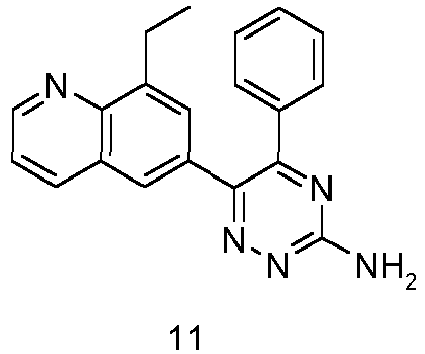
6-(8-Ethylquinolin-6-yl)-5-phenyl-1,2,4-triazin-3-amine 11 12 
6-(8-Cyclopropylquinolin-6-yl)-5-phenyl-1,2,4-triazin-3-amine 12 13 (Comparative example 1) 
6-(Naphthalen-2-yl)-5-phenyl-1,2,4-triazin-3-amine 13 14 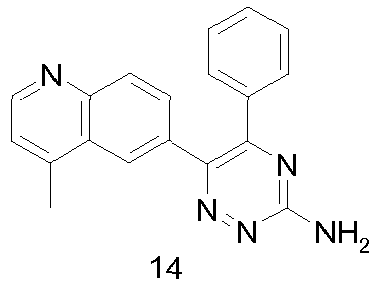
6-(4-Methylquinolin-6-yl)-5-phenyl-1,2,4-triazin-3-amine 14 15 
6-(4-Methylquinazolin-6-yl)-5-phenyl-1,2,4-triazin-3-amine 15 16 
6-(8-Fluoro-4-methylquinolin-6-yl)-5-phenyl-1,2,4-triazin-3-amine 16 17 
5-(2-Fluorophenyl)-6-(4-methylquinolin-6-yl)-1,2,4-triazin-3-amine 17 18 
5-(4-Fluorophenyl)-6-(4-methylquinolin-6-yl)-1,2,4-triazin-3-amine 18 19 
5-(4-Fluorophenyl)-6-(4-methylquinazolin-6-yl)-1,2,4-triazin-3-amine 19 20 
6-(8-Fluoro-4-methylquinolin-6-yl)-5-(4-fluorophenyl)-1,2,4-triazin-3-amine 20 21 
5-(2,4-Difluorophenyl)-6-(4-methylquinolin-6-yl)-1,2,4-triazin-3-amine 21 22 
5-(4-Fluorophenyl)-6-[4-(trideuteromethyl)-6-quinolinyl]-1,2,4-triazin-3-amine 22 23 
6-(4-Methoxyquinolin-6-yl)-5-phenyl-1,2,4-triazin-3-amine 23 24 
6-(3-Fluoroquinolin-6-yl)-5-phenyl-1,2,4-triazin-3-amine 24 25 
6-(8-Methoxyquinolin-6-yl)-5-phenyl-1,2,4-triazin-3-amine 25 26 
5-(3-Fluorophenyl)-6-(8-fluoroquinolin-6-yl)-1,2,4-triazin-3-amine 26 27 
6-(4-Chloroquinolin-6-yl)-5-(4-fluorophenyl)-1,2,4-triazin-3-amine 27 28 
6-(3-Methylquinolin-6-yl)-5-phenyl-1,2,4-triazin-3-amine 28 29 
5-Phenyl-6-(quinazolin-6-yl)-1,2,4-triazin-3-amine 29 30 
5-(4-Fluorophenyl)-6-(quinolin-6-yl)-1,2,4-triazin-3-amine 30 31 
6-(8-Fluoro-4-methylquinolin-6-yl)-5-(2-fluorophenyl)-1,2,4-triazin-3-amine 31 32 
5-(4-Fluorophenyl)-6-(8-fluoroquinolin-6-yl)-1,2,4-triazin-3-amine 32 33 
5-(2,4-Difluorophenyl)-6-(4-methylquinazolin-6-yl)-l,2,4-triazin-3-amine 33 34 
6-(3-Methoxyquinolin-6-yl)-5-phenyl-1,2,4-triazin-3-amine 34 35 
5-(2-Fluorophenyl)-6-(8-fluoroquinolin-6-yl)-1,2,4-triazin-3-amine 35 36 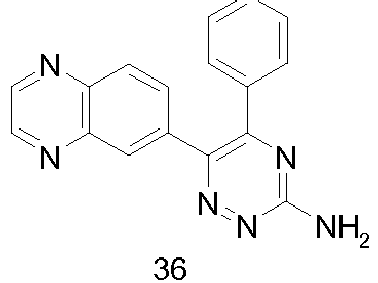
5-Phenyl-6-(quinoxalin-6-yl)-1,2,4-triazin-3-amine 36 37 
6-(2-Methylquinolin-6-yl)-5-phenyl-1,2,4-triazin-3-amine 37 38 
6-(3-Amino-5-phenyl-1,2,4-triazin-6-yl)quinoline-8-carbonitrile 38 39 
6-(3-Morpholinoquinolin-6-yl)-5-phenyl-1,2,4-triazin-3-amine 39 40 
6-(4-(Morpholinomethyl)quino lin-6-yl)-5-phenyl-1,2,4-triazin-3-amine 40 41 
6-(3-(Morpholinomethyl)quino lin-6-yl)-5-phenyl-1,2,4-triazin-3-amine 41 42 
6-(3-Amino-5-phenyl-1,2,4-triazin-6-yl)quinoline-8-carboxamide 42 43 
6-(4-Morpholinoquinolin-6-yl)-5-phenyl-1,2,4-triazin-3-amine 43 44 
6-(4-Ethylquinolin-6-yl)-5-(4-fluorophenyl)-1,2,4-triazin-3-amine 44 45 
6-(8-Fluoro-4-methylquinazolin-6-yl)-5-phenyl-1,2,4-triazin-3-amine 45 46 
5-(4-Chlorophenyl)-6-(4-methylquinazolin-6-yl)-1,2,4-triazin-3-amine 46 47 
6-(4-Ethyl-8-fluoroquinolin-6-yl)-5-phenyl-1,2,4-triazin-3-amine 47 48 
5-(2-Methylpyridin-4-yl)-6-(4-methylquinolin-6-yl)-1,2,4-triazin-3-amine 48 49 
6-(4-Cyclopropylquinolin-6-yl)-5-(4-fluorophenyl)-1,2,4-triazin-3-amine 49 50 
6-(8-Fluoro-4-methylquinazolin-6-yl)-5-(4-fluorophenyl)-1,2,4-triazin-3-amine 50 51 
6-(4-(Difluoromethyl)quinolin-6-yl)-5-(4-fluorophenyl)-1,2,4-triazin-3-amine 51 52 
5-(4-Fluorophenyl)-6-(4-(methyl-d3)quinazolin-6-yl)-1,2,4-triazin-3-amine 52 53 
6-(4-Ethylquinazolin-6-yl)-5-(4-fluorophenyl)-1,2,4-triazin-3-amine 53 54 
5-(4-Fluorophenyl)-6-(4-(trifluoromethyl)quinolin-6-yl)-1,2,4-triazin-3-amine 54 55 
5-(4-Fluorophenyl)-6-(4-methoxyquinazolin-6-yl)-1,2,4-triazin-3-amin e 55 - In another aspect, the present invention relates to a method for preparing the compound of formula (I), comprising a step of:

wherein: - X is halogen;
- M is

- ring A, G1-G4, R1-R4, r, q and n are as defined in formula (I).
- In another aspect, the present invention relates to a method for preparing the compound of formula (Iaa), comprising a step of:

wherein: - X is halogen;
- M is

- ring A, G1, G2, R1, R3, R4, r and n are as defined in formula (I).
- In another aspect, the present invention relates to a method for preparing the compound of formula (II), comprising a step of:

- X is halogen;
- M is

- ring A, R1, R3, R4, r and n are as defined in formula (I).
- In another aspect, the present invention relates to a method for preparing the compound of formula (III), comprising a step of:

wherein: - X is halogen;
- M is

- R1, R3, R4, r and n are as defined in formula (I).
- In another aspect, the present invention relates to a pharmaceutical composition comprising a therapeutically effective amount of the compound of formula (I), or a tautomer, mesomer, racemate, enantiomer, diastereomer thereof, or mixture thereof, or a pharmaceutically acceptable salt thereof, and one or more pharmaceutically acceptable carriers, diluents or excipients.
- The present invention further relates to a use of the compound of formula (I), or a tautomer, mesomer, racemate, enantiomer, diastereomer thereof, or mixture thereof, or a pharmaceutically acceptable salt thereof, or the pharmaceutical composition comprising the same in the preparation of a medicament for treating a disease or condition ameliorated by the inhibition of the A2a receptor.
- The present invention further relates to a use of the compound of formula (I), or a tautomer, mesomer, racemate, enantiomer, diastereomer thereof, or mixture thereof, or a pharmaceutically acceptable salt thereof, or the pharmaceutical composition comprising the same in the preparation of a medicament for treating a disease or condition ameliorated by the inhibition of the A2b receptor.
- In the context of the present invention, the disease or condition ameliorated by the inhibition of the A2a receptor or the A2b receptor is selected from the group consisting of cancer, depression, cognitive function disorder, neurodegenerative disorder (Parkinson's disease, Huntington's disease, Alzheimer's disease or amyotrophic lateral sclerosis and the like), attention-related disorder, extrapyramidal syndrome, abnormal movement disorder, cirrhosis, liver fibrosis, fatty liver, dermal fibrosis, sleep disorder, stroke, brain injury, neuroinflammation and addictive behavior; preferably cancer selected from the group consisting of melanoma, brain tumor (glioma with malignant astroglia and oligodendroglioma and the like), esophageal cancer, stomach cancer, liver cancer, pancreatic cancer, colorectal cancer (colon cancer, rectal cancer and the like), lung cancer (non-small cell lung cancer, small cell lung cancer, primary or metastatic squamous carcinoma and the like), kidney cancer, breast cancer, ovarian cancer, prostate cancer, skin cancer, neuroblastoma, sarcoma, osteochondroma, osteoma, osteosarcoma, seminoma, testicular tumor, uterine cancer (cervical cancer, endometrial cancer and the like), head and neck cancer (maxillary cancer, laryngeal cancer, pharyngeal cancer, tongue cancer, intraoral cancer and the like), multiple myeloma, malignant lymphoma (reticular sarcoma, lymphosarcoma, Hodgkin's lymphoma and the like), polycythemia vera, leukemia (acute myeloid leukemia, chronic myeloid leukemia, acute lymphocytic leukemia, chronic lymphocytic leukemia and the like), thyroid tumor, ureteral tumor, bladder tumor, gallbladder cancer, cholangiocarcinoma, chorionic epithelioma, pediatric tumor (Ewing's familial sarcoma, Wilms' sarcoma, rhabdomyosarcoma, angiosarcoma, embryonic testicular cancer, neuroblastoma, retinoblastoma, hepatoblastoma, nephroblastoma and the like) and the like; and more preferably lung cancer.
- The present invention further relates to a use of the compound of formula (I), or a tautomer, mesomer, racemate, enantiomer, diastereomer thereof, or mixture thereof, or a pharmaceutically acceptable salt thereof, or the pharmaceutical composition comprising the same in the preparation of a medicament for treating cancer, depression, cognitive function disorder, neurodegenerative disorder (Parkinson's disease, Huntington's disease, Alzheimer's disease or amyotrophic lateral sclerosis and the like), attention-related disorder, extrapyramidal syndrome, abnormal movement disorder, cirrhosis, liver fibrosis, fatty liver, dermal fibrosis, sleep disorder, stroke, brain damage, neuroinflammation and addictive behavior, and preferably cancer.
- The present invention further relates to a use of the compound of formula (I), or a tautomer, mesomer, racemate, enantiomer, diastereomer thereof, or mixture thereof, or a pharmaceutically acceptable salt thereof, or the pharmaceutical composition comprising the same in the preparation of a medicament for treating cancer selected from the group consisting of melanoma, brain tumor (glioma with malignant astroglia and oligodendroglioma and the like), esophageal cancer, stomach cancer, liver cancer, pancreatic cancer, colorectal cancer (colon cancer, rectal cancer and the like), lung cancer (non-small cell lung cancer, small cell lung cancer, primary or metastatic squamous carcinoma and the like), kidney cancer, breast cancer, ovarian cancer, prostate cancer, skin cancer, neuroblastoma, sarcoma, osteochondroma, osteoma, osteosarcoma, seminoma, testicular tumor, uterine cancer (cervical cancer, endometrial cancer and the like), head and neck cancer (maxillary cancer, laryngeal cancer, pharyngeal cancer, tongue cancer, intraoral cancer and the like), multiple myeloma, malignant lymphoma (reticular sarcoma, lymphosarcoma, Hodgkin's lymphoma and the like), polycythemia vera, leukemia (acute myeloid leukemia, chronic myeloid leukemia, acute lymphocytic leukemia, chronic lymphocytic leukemia and the like), thyroid tumor, ureteral tumor, bladder tumor, gallbladder cancer, cholangiocarcinoma, chorionic epithelioma, pediatric tumor (Ewing's familial sarcoma, Wilms' sarcoma, rhabdomyosarcoma, angiosarcoma, embryonic testicular cancer, neuroblastoma, retinoblastoma, hepatoblastoma, nephroblastoma and the like) and the like.
- The present invention further relates to a use of the compound of formula (I), or a tautomer, mesomer, racemate, enantiomer, diastereomer thereof, or mixture thereof, or a pharmaceutically acceptable salt thereof, or the pharmaceutical composition comprising the same in the preparation of a medicament for treating lung cancer, and preferably non-small cell lung cancer.
- The present invention further relates to a use of the compound of formula (I), or a tautomer, mesomer, racemate, enantiomer, diastereomer thereof, or mixture thereof, or a pharmaceutically acceptable salt thereof, or the pharmaceutical composition comprising the same in the preparation of a medicament for inhibiting the A2a receptor.
- The present invention further relates to a use of the compound of formula (I), or a tautomer, mesomer, racemate, enantiomer, diastereomer thereof, or mixture thereof, or a pharmaceutically acceptable salt thereof, or the pharmaceutical composition comprising the same in the preparation of a medicament for inhibiting the A2b receptor.
- The present invention also relates to a method for inhibiting the A2a receptor, comprising a step of administrating to a patient in need thereof a therapeutically effective amount of the compound of formula (I), or a tautomer, mesomer, racemate, enantiomer, diastereomer thereof, or mixture thereof, or a pharmaceutically acceptable salt thereof, or the pharmaceutical composition comprising the same.
- The present invention also relates to a method for inhibiting the A2b receptor, comprising a step of administrating to a patient in need thereof a therapeutically effective amount of the compound of formula (I), or a tautomer, mesomer, racemate, enantiomer, diastereomer thereof, or mixture thereof, or a pharmaceutically acceptable salt thereof, or the pharmaceutical composition comprising the same.
- The present invention also relates to a method for treating a disease or condition ameliorated by the inhibition of the A2a receptor, comprising a step of administrating to a patient in need thereof a therapeutically effective amount of the compound of formula (I), or a tautomer, mesomer, racemate, enantiomer, diastereomer thereof, or mixture thereof, or a pharmaceutically acceptable salt thereof, or the pharmaceutical composition comprising the same.
- The present invention also relates to a method for treating a disease or condition ameliorated by the inhibition of the A2b receptor, comprising a step of administrating to a patient in need thereof a therapeutically effective amount of the compound of formula (I), or a tautomer, mesomer, racemate, enantiomer, diastereomer thereof, or mixture thereof, or a pharmaceutically acceptable salt thereof, or the pharmaceutical composition comprising the same.
- The present invention relates to a method for treating cancer, depression, cognitive function disorder, neurodegenerative disorder (Parkinson's disease, Huntington's disease, Alzheimer's disease or amyotrophic lateral sclerosis and the like), attention-related disorder, extrapyramidal syndrome, abnormal movement disorder, cirrhosis, liver fibrosis, fatty liver, dermal fibrosis, sleep disorder, stroke, brain injury, neuroinflammation and addictive behavior, and preferably cancer, comprising a step of administrating to a patient in need thereof a therapeutically effective amount of the compound of formula (I), or a tautomer, mesomer, racemate, enantiomer, diastereomer thereof, or mixture thereof, or a pharmaceutically acceptable salt thereof, or the pharmaceutical composition comprising the same.
- The present invention further relates to a method for treating cancer selected from the group consisting of melanoma, brain tumor (glioma with malignant astroglia and oligodendroglioma and the like), esophageal cancer, stomach cancer, liver cancer, pancreatic cancer, colorectal cancer (colon cancer, rectal cancer and the like), lung cancer (non-small cell lung cancer, small cell lung cancer, primary or metastatic squamous carcinoma and the like), kidney cancer, breast cancer, ovarian cancer, prostate cancer, skin cancer, neuroblastoma, sarcoma, osteochondroma, osteoma, osteosarcoma, seminoma, testicular tumor, uterine cancer (cervical cancer, endometrial cancer and the like), head and neck cancer (maxillary cancer, laryngeal cancer, pharyngeal cancer, tongue cancer, intraoral cancer and the like), multiple myeloma, malignant lymphoma (reticular sarcoma, lymphosarcoma, Hodgkin's lymphoma and the like), polycythemia vera, leukemia (acute myeloid leukemia, chronic myeloid leukemia, acute lymphocytic leukemia, chronic lymphocytic leukemia and the like), thyroid tumor, ureteral tumor, bladder tumor, gallbladder cancer, cholangiocarcinoma, chorionic epithelioma, pediatric tumor (Ewing's familial sarcoma, Wilms' sarcoma, rhabdomyosarcoma, angiosarcoma, embryonic testicular cancer, neuroblastoma, retinoblastoma, hepatoblastoma, nephroblastoma and the like) and the like, comprising a step of administrating to a patient in need thereof a therapeutically effective amount of the compound of formula (I), or a tautomer, mesomer, racemate, enantiomer, diastereomer thereof, or mixture thereof, or a pharmaceutically acceptable salt thereof, or the pharmaceutical composition comprising the same.
- The present invention further relates to the compound of formula (I), or a tautomer, mesomer, racemate, enantiomer, diastereomer thereof, or mixture thereof, or a pharmaceutically acceptable salt thereof, or the pharmaceutical composition comprising the same, for use as a medicament.
- The present invention also relates to the compound of formula (I), or a tautomer, mesomer, racemate, enantiomer, diastereomer thereof, or mixture thereof, or a pharmaceutically acceptable salt thereof, or the pharmaceutical composition comprising the same, for use as an A2a receptor antagonist.
- The present invention also relates to the compound of formula (I), or a tautomer, mesomer, racemate, enantiomer, diastereomer thereof, or mixture thereof, or a pharmaceutically acceptable salt thereof, or the pharmaceutical composition comprising the same, for use as an A2b receptor antagonist.
- The present invention also relates to the compound of formula (I), or a tautomer, mesomer, racemate, enantiomer, diastereomer thereof, or mixture thereof, or a pharmaceutically acceptable salt thereof, or the pharmaceutical composition comprising the same, for use in treating a disease or condition ameliorated by the inhibition of the A2a receptor.
- The present invention also relates to the compound of formula (I), or a tautomer, mesomer, racemate, enantiomer, diastereomer thereof, or mixture thereof, or a pharmaceutically acceptable salt thereof, or the pharmaceutical composition comprising the same, for use in treating a disease or condition ameliorated by the inhibition of the A2b receptor.
- The present invention also relates to the compound of formula (I), or a tautomer, mesomer, racemate, enantiomer, diastereomer thereof, or mixture thereof, or a pharmaceutically acceptable salt thereof, or the pharmaceutical composition comprising the same, for use in treating cancer, depression, cognitive function disorder, neurodegenerative disorder (Parkinson's disease, Huntington's disease, Alzheimer's disease or amyotrophic lateral sclerosis and the like), attention-related disorder, extrapyramidal syndrome, abnormal movement disorder, cirrhosis, liver fibrosis, fatty liver, dermal fibrosis, sleep disorder, stroke, brain injury, neuroinflammation and addictive behavior, and preferably cancer.
- The present invention further relates to the compound of formula (I), or a tautomer, mesomer, racemate, enantiomer, diastereomer thereof, or mixture thereof, or a pharmaceutically acceptable salt thereof, or the pharmaceutical composition comprising the same, for use in treating cancer selected from the group consisting of melanoma, brain tumor (glioma with malignant astroglia and oligodendroglioma and the like), esophageal cancer, stomach cancer, liver cancer, pancreatic cancer, colorectal cancer (colon cancer, rectal cancer and the like), lung cancer (non-small cell lung cancer, small cell lung cancer, primary or metastatic squamous carcinoma and the like), kidney cancer, breast cancer, ovarian cancer, prostate cancer, skin cancer, neuroblastoma, sarcoma, osteochondroma, osteoma, osteosarcoma, seminoma, testicular tumor, uterine cancer (cervical cancer, endometrial cancer and the like), head and neck cancer (maxillary cancer, laryngeal cancer, pharyngeal cancer, tongue cancer, intraoral cancer and the like), multiple myeloma, malignant lymphoma (reticular sarcoma, lymphosarcoma, Hodgkin's lymphoma and the like), polycythemia vera, leukemia (acute myeloid leukemia, chronic myeloid leukemia, acute lymphocytic leukemia, chronic lymphocytic leukemia and the like), thyroid tumor, ureteral tumor, bladder tumor, gallbladder cancer, cholangiocarcinoma, chorionic epithelioma, pediatric tumor (Ewing's familial sarcoma, Wilms' sarcoma, rhabdomyosarcoma, angiosarcoma, embryonic testicular cancer, neuroblastoma, retinoblastoma, hepatoblastoma, nephroblastoma and the like) and the like.
- Pharmaceutical compositions containing the active ingredient can be in a form suitable for oral administration, for example, a tablet, troche, lozenge, aqueous or oily suspension, dispersible powder or granule, emulsion, hard or soft capsule, syrup or elixir. Oral compositions can be prepared according to any known method in the art for the preparation of pharmaceutical composition. Such composition can contain one or more ingredients selected from the group consisting of sweeteners, flavoring agents, colorants and preservatives, in order to provide a pleasing and palatable pharmaceutical preparation. Tablets contain the active ingredient in admixture with nontoxic pharmaceutically acceptable excipients suitable for the manufacture of tablets.
- An aqueous suspension contains the active ingredient in admixture with excipients suitable for the manufacture of an aqueous suspension. The aqueous suspension can also contain one or more preservatives such as ethyl paraben or n-propyl paraben, one or more colorants, one or more flavoring agents, and one or more sweeteners.
- An oil suspension can be formulated by suspending the active ingredient in a vegetable oil. The oil suspension can contain a thickener. The aforementioned sweeteners and flavoring agents can be added to provide a palatable formulation.
- The active ingredient in admixture with the dispersants or wetting agents, suspending agent or one or more preservatives can be prepared as a dispersible powder or granule suitable for the preparation of an aqueous suspension by adding water. Suitable dispersants or wetting agents and suspending agents are exemplified by those already mentioned above. Additional excipients, such as sweeteners, flavoring agents and colorants, can also be added. These compositions can be preserved by adding an antioxidant, such as ascorbic acid.
- The pharmaceutical composition of the present invention can also be in the form of an oil-in-water emulsion.
- The pharmaceutical composition can be in the form of a sterile injectable aqueous solution. Acceptable vehicles or solvents that can be used are water, Ringer's solution or isotonic sodium chloride solution. The sterile injectable formulation can be a sterile injectable oil-in-water micro-emulsion in which the active ingredient is dissolved in the oil phase. For example, the active ingredient is dissolved in a mixture of soybean oil and lecithin. The oil solution is then added into a mixture of water and glycerol, and processed to form a micro-emulsion. The injectable solution or micro-emulsion can be introduced into a patient's bloodstream by local bolus injection. Alternatively, the solution and micro-emulsion are preferably administrated in a manner that maintains a constant circulating concentration of the compound of the present invention. In order to maintain this constant concentration, a continuous intravenous delivery device can be used. An example of such a device is Deltec CADD-PLUS. TM. 5400 intravenous injection pump.
- The pharmaceutical composition can be in the form of a sterile injectable aqueous or oily suspension for intramuscular and subcutaneous administration. Such a suspension can be formulated with suitable dispersants or wetting agents and suspending agents as described above according to known techniques. The sterile injectable formulation can also be a sterile injectable solution or suspension prepared in a nontoxic parenterally acceptable diluent or solvent. Moreover, sterile fixed oils can easily be used as a solvent or suspending medium.
- The compound of the present invention can be administrated in the form of a suppository for rectal administration. These pharmaceutical compositions can be prepared by mixing the drug with a suitable non-irritating excipient that is solid at ordinary temperatures, but liquid in the rectum, thereby melting in the rectum to release the drug. Such materials include cocoa butter, glycerin gelatin, hydrogenated vegetable oils, mixtures of polyethylene glycols with various molecular weights and fatty acid esters of polyethylene glycols.
- It is well known to those skilled in the art that the dosage of a drug depends on a variety of factors including but not limited to, the following factors: activity of a specific compound, age of the patient, weight of the patient, general health of the patient, behavior of the patient, diet of the patient, administration time, administration route, excretion rate, drug combination and the like. In addition, the optimal treatment, such as treatment mode, daily dose of the compound of formula (I) or the type of pharmaceutically acceptable salt thereof can be verified by traditional therapeutic regimens.
- Unless otherwise stated, the terms used in the specification and claims have the meanings described below.
- The term "alkyl" refers to a saturated aliphatic hydrocarbon group, which is a straight or branched chain group comprising 1 to 20 carbon atoms, preferably an alkyl having 1 to 12 carbon atoms, and more preferably an alkyl having 1 to 6 carbon atoms. Non-limiting examples include methyl, ethyl, n-propyl, isopropyl, n-butyl, isobutyl, tert-butyl, sec-butyl, n-pentyl, 1,1-dimethylpropyl, 1,2-dimethylpropyl, 2,2-dimethylpropyl, 1-ethylpropyl, 2-methylbutyl, 3-methylbutyl, n-hexyl, 1-ethyl-2-methylpropyl, 1,1,2-trimethylpropyl, 1,1-dimethylbutyl, 1,2-dimethylbutyl, 2,2-dimethylbutyl, 1,3-dimethylbutyl, 2-ethylbutyl, 2-methylpentyl, 3-methylpentyl, 4-methylpentyl, 2,3-dimethylbutyl, n-heptyl, 2-methylhexyl, 3-methylhexyl, 4-methylhexyl, 5-methylhexyl, 2,3-dimethylpentyl, 2,4-dimethylpentyl, 2,2-dimethylpentyl, 3,3-dimethylpentyl, 2-ethylpentyl, 3-ethylpentyl, n-octyl, 2,3-dimethylhexyl, 2,4-dimethylhexyl, 2,5-dimethylhexyl, 2,2-dimethylhexyl, 3,3-dimethylhexyl, 4,4-dimethylhexyl, 2-ethylhexyl, 3-ethylhexyl, 4-ethylhexyl, 2-methyl-2-ethylpentyl, 2-methyl-3-ethylpentyl, n-nonyl, 2-methyl-2-ethylhexyl, 2-methyl-3-ethylhexyl, 2,2-diethylpentyl, n-decyl, 3,3-diethylhexyl, 2,2-diethylhexyl, and various branched isomers thereof. More preferably, an alkyl group is a lower alkyl having 1 to 6 carbon atoms, and non-limiting examples include methyl, ethyl, n-propyl, isopropyl, n-butyl, isobutyl, tert-butyl, sec-butyl, n-pentyl, 1,1-dimethylpropyl, 1,2-dimethylpropyl, 2,2-dimethylpropyl, 1-ethylpropyl, 2-methylbutyl, 3-methylbutyl, n-hexyl, 1-ethyl-2-methylpropyl, 1,1,2-trimethylpropyl, 1,1-dimethylbutyl, 1,2-dimethylbutyl, 2,2-dimethylbutyl, 1,3-dimethylbutyl, 2-ethylbutyl, 2-methylpentyl, 3-methylpentyl, 4-methylpentyl, 2,3-dimethylbutyl, and the like. The alkyl group can be substituted or unsubstituted. When substituted, the substituent group(s) can be substituted at any available connection point. The substituent group(s) is preferably one or more groups independently optionally selected from the group consisting of H atom, D atom, halogen, alkyl, alkoxy, haloalkyl, hydroxy, hydroxyalkyl, cyano, amino, nitro, cycloalkyl, heterocyclyl, aryl and heteroaryl.
- The term "alkoxy" refers to an -O-(alkyl) or an -O-(unsubstituted cycloalkyl) group, wherein the alkyl is as defined above. Non-limiting examples of alkoxy include methoxy, ethoxy, propoxy, butoxy, cyclopropyloxy, cyclobutyloxy, cyclopentyloxy, cyclohexyloxy. The alkoxy can be optionally substituted or unsubstituted. When substituted, the substituent group(s) is preferably one or more group(s) independently selected from the group consisting of H atom, D atom, halogen, alkyl, alkoxy, haloalkyl, hydroxy, hydroxyalkyl, cyano, amino, nitro, cycloalkyl, heterocyclyl, aryl and heteroaryl.
- The term "cycloalkyl" refers to a saturated or partially unsaturated monocyclic or polycyclic hydrocarbon substituent group having 3 to 20 carbon atoms, preferably 3 to 12 carbon atoms, more preferably 3 to 10 carbon atoms, and most preferably 3 to 6 carbon atoms. Non-limiting examples of monocyclic cycloalkyl include cyclopropyl, cyclobutyl, cyclopentyl, cyclopentenyl, cyclohexyl, cyclohexenyl, cyclohexadienyl, cycloheptyl, cycloheptatrienyl, cyclooctyl and the like. Polycyclic cycloalkyl includes a cycloalkyl having a spiro ring, fused ring or bridged ring. The cycloalkyl can be substituted or unsubstituted. When substituted, the substituent group(s) can be substituted at any available connection point. The substituent group(s) is preferably one or more group(s) independently optionally selected from the group consisting of hydrogen, halogen, alkyl, alkoxy, haloalkyl, hydroxy, hydroxyalkyl, cyano, amino, nitro, cycloalkyl, heterocyclyl, aryl and heteroaryl.
- The term "heterocyclyl" refers to a 3 to 20 membered saturated or partially unsaturated monocyclic or polycyclic hydrocarbon group, wherein one or more ring atoms are heteroatoms selected from the group consisting of N, O and S(O)m (wherein m is an integer of 0 to 2), but excluding -O-O-, -O-S- or -S-S- in the ring, with the remaining ring atoms being carbon atoms. Preferably, the heterocyclyl has 3 to 12 ring atoms wherein 1 to 4 atoms are heteroatoms, more preferably, 3 to 10 ring atoms wherein 1 to 4 atoms are heteroatoms, and more preferably 5 to 6 ring atoms wherein 1 to 3 atoms are heteroatoms. Non-limiting examples of monocyclic heterocyclyl include pyrrolidinyl, tetrahydropyranyl, 1,2,3,6-tetrahydropyridyl, piperidinyl, piperazinyl, morpholinyl, thiomorpholinyl, homopiperazinyl and the like. Polycyclic heterocyclyl includes a heterocyclyl having a spiro ring, fused ring or bridged ring.
- The ring of heterocyclyl can be fused to the ring of aryl, heteroaryl or cycloalkyl, wherein the ring bound to the parent structure is heterocyclyl. Non-limiting examples thereof include:

- The heterocyclyl can be substituted or unsubstituted. When substituted, the substituent group(s) can be substituted at any available connection point. The substituent group(s) is preferably one or more group(s) independently optionally selected from the group consisting of hydrogen, halogen, alkyl, alkoxy, haloalkyl, hydroxy, hydroxyalkyl, cyano, amino, nitro, cycloalkyl, heterocyclyl, aryl and heteroaryl.
- The term "aryl" refers to a 6 to 14 membered all-carbon monocyclic ring or polycyclic fused ring (i.e., each ring in the system shares an adjacent pair of carbon atoms with another ring in the system) having a conjugated π-electron system, preferably 6 to 10 membered aryl, for example, phenyl and naphthyl. The ring of aryl can be fused to the ring of heteroaryl, heterocyclyl or cycloalkyl, wherein the ring bound to the parent structure is aryl ring. Non-limiting examples thereof include:


- The aryl can be substituted or unsubstituted. When substituted, the substituent group(s) can be substituted at any available connection point. The substituent group(s) is preferably one or more group(s) independently optionally selected from the group consisting of hydrogen, halogen, alkyl, alkoxy, haloalkyl, hydroxy, hydroxyalkyl, cyano, amino, nitro, cycloalkyl, heterocyclyl, aryl and heteroaryl.
- The term "heteroaryl" refers to a 5 to 14 membered heteroaromatic system having 1 to 4 heteroatoms selected from the group consisting of O, S and N. The heteroaryl is preferably 5 to 10 membered heteroaryl, more preferably 5 or 6 membered heteroaryl, for example, furanyl, thienyl, pyridyl, pyrrolyl, N-alkylpyrrolyl, pyrimidinyl, pyrazinyl, pyridazinyl, imidazolyl, pyrazolyl, tetrazolyl and the like. The ring of heteroaryl can be fused to the ring of aryl, heterocyclyl or cycloalkyl, wherein the ring bound to the parent structure is heteroaryl ring. Non-limiting examples thereof include:


- The heteroaryl can be substituted or unsubstituted. When substituted, the substituent group(s) can be substituted at any available connection point. The substituent group(s) is preferably one or more group(s) independently optionally selected from the group consisting of hydrogen, halogen, alkyl, alkoxy, haloalkyl, hydroxy, hydroxyalkyl, cyano, amino, nitro, cycloalkyl, heterocyclyl, aryl and heteroaryl.
- The term "haloalkyl" refers to an alkyl group substituted by one or more halogens, wherein the alkyl is as defined above.
- The term "deuterated alkyl" refers to an alkyl group substituted by one or more deuterium atoms, wherein the alkyl is as defined above.
- The term "hydroxy" refers to an -OH group.
- The term "hydroxyalkyl" refers to an alkyl group substituted by hydroxy(s), wherein the alkyl is as defined above.
- The term "halogen" refers to fluorine, chlorine, bromine or iodine.
- The term "hydroxy" refers to an -OH group.
- The term "amino" refers to a -NH2 group.
- The term "cyano" refers to a -CN group.
- The term "nitro" refers to a -NO2 group.
- The term "carbonyl" refers to a C=O group.
- The term "carboxy" refers to a -C(O)OH group.
- The term "carboxylate group" refers to a -C(O)O(alkyl) group or a -C(O)O(cycloalkyl) group, wherein the alkyl and cycloalkyl are as defined above.
- The term "acyl halide" refers to a compound containing a -C(O)-halogen group.
- The present invention also comprises the compounds of formula (I) in various deuterated forms. Each of the available hydrogen atoms attached to the carbon atom can be independently replaced by a deuterium atom. Those skilled in the art can synthesize a compound of formula (I) in a deuterated form with reference to the relevant literature. Commercially available deuterated starting materials can be employed in the preparation of the compound of formula (I) in deuterated form, or they can be synthesized by conventional techniques with deuterated reagents including, but not limited to, deuterated borane, trideuterated borane in tetrahydrofuran, deuterated lithium aluminum hydride, deuterated iodoethane, deuterated iodomethane and the like.
- "Optional" or "optionally" means that the event or circumstance described subsequently can, but need not, occur, and such a description includes the situation in which the event or circumstance does or does not occur. For example, "the heterocyclyl optionally substituted by an alkyl" means that an alkyl group can be, but need not be, present, and such a description includes the situation of the heterocyclyl being substituted by an alkyl and the heterocyclyl being not substituted by an alkyl.
- "Substituted" refers to one or more hydrogen atoms in a group, preferably up to 5, more preferably 1 to 3 hydrogen atoms, independently substituted by a corresponding number of substituents. It goes without saying that the substituents only exist in their possible chemical position. The person skilled in the art is able to determine whether the substitution is possible or impossible by experiments or theory without paying excessive efforts. For example, the combination of amino or hydroxy having free hydrogen and carbon atoms having unsaturated bonds (such as olefinic) may be unstable.
- A "pharmaceutical composition" refers to a mixture of one or more of the compounds according to the present invention or physiologically/pharmaceutically acceptable salts or prodrugs thereof with other chemical components, and other components such as physiologically/pharmaceutically acceptable carriers and excipients. The purpose of the pharmaceutical composition is to facilitate administration of a compound to an organism, which is conducive to the absorption of the active ingredient so as to show biological activity.
- A "pharmaceutically acceptable salt" refers to a salt of the compound of the present invention, which is safe and effective in mammals and has the desired biological activity.
- In order to achieve the object of the present invention, the present invention applies the following technical solutions:
- A method for preparing the compound of formula (I) of the present invention or a tautomer, mesomer, racemate, enantiomer, diastereomer thereof, or mixture thereof, or a pharmaceutically acceptable salt thereof, comprises the following steps of:

in Step 2, the compound of formula (I-A) is reacted with a compound of formula (I-B) in the presence of a catalyst under an alkaline condition to obtain the compound of formula (I). - The reagent that provides an alkaline condition includes organic bases and inorganic bases. The organic bases include, but are not limited to, triethylamine, N,N-diisopropylethylamine, n-butyllithium, lithium diisopropylamide, lithium bis(trimethylsilyl)amine, potassium acetate, potassium acetate, sodium tert-butoxide, potassium tert-butoxide and sodium n-butoxide. The inorganic bases include, but are not limited to, sodium hydride, potassium phosphate, sodium carbonate, potassium carbonate, potassium acetate, cesium carbonate, sodium hydroxide and lithium hydroxide.
- The catalyst includes, but is not limited to, Pd/C, tetra-triphenylphosphine palladium, palladium dichloride, palladium acetate, bis(dibenzylideneacetone)palladium, chloro(2-dicyclohexylphosphino-2',4',6'-triisopropyl-1,1'-biphenyl)[2-(2'-amino-1,1'-bip henyl)]palladium, [1,1'-bis(diphenylphosphino)ferrocene]dichloropalladium, 1,1'-bis(dibenzylphosphoryl)ferrocene palladium dichloride or tris(dibenzylideneacetone)dipalladium, and preferably [1,1'-bis(diphenylphosphino)ferrocene]dichloropalladium.
- The above reactions are preferably carried out in a solvent. The solvent used includes, but is not limited to, acetic acid, methanol, ethanol, n-butanol, toluene, tetrahydrofuran, dichloromethane, petroleum ether, ethyl acetate, n-hexane, dimethyl sulfoxide, 1,4-dioxane, glycol dimethyl ether, water, N,N-dimethylformamide, and mixtures thereof.
- Wherein:
- X is halogen;
- M is

- ring A, G1-G4, R1-R4, r, q and n are as defined in formula (I).
- A method for preparing the compound of formula (Iaa) of the present invention or a tautomer, mesomer, racemate, enantiomer, diastereomer thereof, or mixture thereof, or a pharmaceutically acceptable salt thereof, comprises the following steps of:
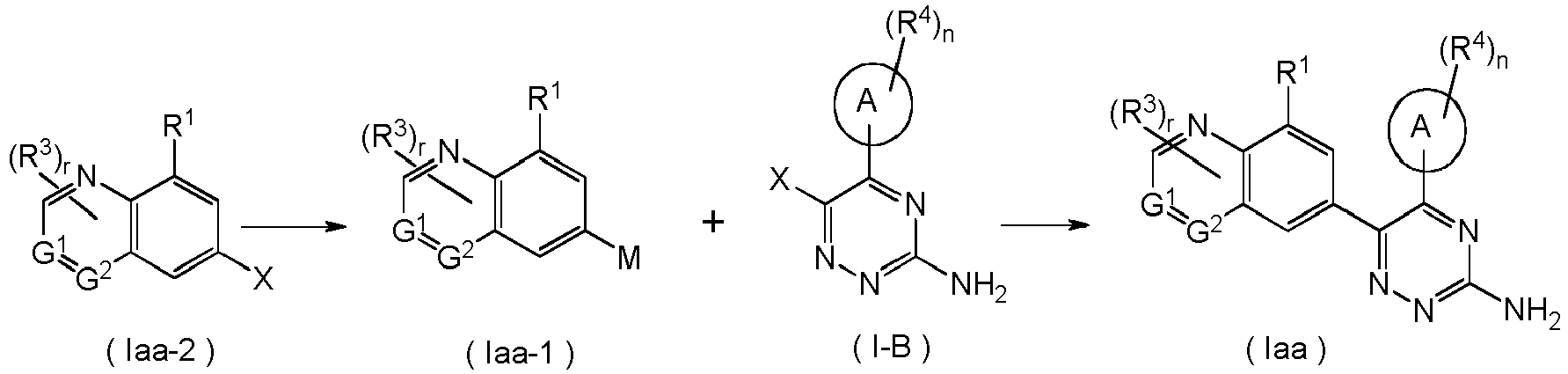
in Step 2, the compound of formula (Iaa-1) is reacted with a compound of formula (I-B) in the presence of a catalyst under an alkaline condition to obtain the compound of formula (Iaa). - Wherein:
- X is halogen;
- M is

- ring A, G1, G2, R1, R3, R4, r and n are as defined in formula (I).
- The reagent that provides an alkaline condition includes organic bases and inorganic bases. The organic bases include, but are not limited to, triethylamine, N,N-diisopropylethylamine, n-butyllithium, lithium diisopropylamide, lithium bis(trimethylsilyl)amine, potassium acetate, potassium acetate, sodium tert-butoxide, potassium tert-butoxide and sodium n-butoxide. The inorganic bases include, but are not limited to, sodium hydride, potassium phosphate, sodium carbonate, potassium carbonate, potassium acetate, cesium carbonate, sodium hydroxide and lithium hydroxide.
- The catalyst includes, but is not limited to, Pd/C, tetra-triphenylphosphine palladium, palladium dichloride, palladium acetate, bis(dibenzylideneacetone)palladium, chloro(2-dicyclohexylphosphino-2',4',6'-triisopropyl-1,1'-biphenyl)[2-(2'-amino-1,1'-bip henyl)]palladium, [1,1'-bis(diphenylphosphino)ferrocene]dichloropalladium, 1,1'-bis(dibenzylphosphoryl)ferrocene palladium dichloride or tris(dibenzylideneacetone)dipalladium, and preferably [1,1'-bis(diphenylphosphino)ferrocene]dichloropalladium.
- The above reactions are preferably carried out in a solvent. The solvent used includes, but is not limited to, acetic acid, methanol, ethanol, n-butanol, toluene, tetrahydrofuran, dichloromethane, petroleum ether, ethyl acetate, n-hexane, dimethyl sulfoxide, 1,4-dioxane, glycol dimethyl ether, water, N,N-dimethylformamide, and mixtures thereof.
- A method for preparing the compound of formula (Ibb) of the present invention or a tautomer, mesomer, racemate, enantiomer, diastereomer thereof, or mixture thereof, or a pharmaceutically acceptable salt thereof, comprises the following steps of:

in Step 2, the compound of formula (Ibb-1) is reacted with a compound of formula (I-B) in the presence of a catalyst under an alkaline condition to obtain the compound of formula (Ibb). - Wherein:
- X is halogen;
- M is

- ring A, G1, G2, R1, R3, R4, r and n are as defined in formula (I).
- The reagent that provides an alkaline condition includes organic bases and inorganic bases. The organic bases include, but are not limited to, triethylamine, N,N-diisopropylethylamine, n-butyllithium, lithium diisopropylamide, lithium bis(trimethylsilyl)amine, potassium acetate, potassium acetate, sodium tert-butoxide, potassium tert-butoxide and sodium n-butoxide. The inorganic bases include, but are not limited to, sodium hydride, potassium phosphate, sodium carbonate, potassium carbonate, potassium acetate, cesium carbonate, sodium hydroxide and lithium hydroxide.
- The catalyst includes, but is not limited to, Pd/C, tetra-triphenylphosphine palladium, palladium dichloride, palladium acetate, bis(dibenzylideneacetone)palladium, chloro(2-dicyclohexylphosphino-2',4',6'-triisopropyl-1,1'-biphenyl)[2-(2'-amino-1,1'-bip henyl)]palladium, [1,1'-bis(diphenylphosphino)ferrocene]dichloropalladium, 1,1'-bis(dibenzylphosphoryl)ferrocene palladium dichloride or tris(dibenzylideneacetone)dipalladium, and preferably [1,1'-bis(diphenylphosphino)ferrocene]dichloropalladium.
- The above reactions are preferably carried out in a solvent. The solvent used includes, but is not limited to, acetic acid, methanol, ethanol, n-butanol, toluene, tetrahydrofuran, dichloromethane, petroleum ether, ethyl acetate, n-hexane, dimethyl sulfoxide, 1,4-dioxane, glycol dimethyl ether, water, N,N-dimethylformamide, and mixtures thereof.
- A method for preparing the compound of formula (II) of the present invention or a tautomer, mesomer, racemate, enantiomer, diastereomer thereof, or mixture thereof, or a pharmaceutically acceptable salt thereof, comprises the following steps of:

in Step 2, the compound of formula (II-A) is reacted with a compound of formula (I-B) in the presence of a catalyst under an alkaline condition to obtain the compound of formula (II). - The reagent that provides an alkaline condition includes organic bases and inorganic bases. The organic bases include, but are not limited to, triethylamine, N,N-diisopropylethylamine, n-butyllithium, lithium diisopropylamide, lithium bis(trimethylsilyl)amine, potassium acetate, potassium acetate, sodium tert-butoxide, potassium tert-butoxide and sodium n-butoxide. The inorganic bases include, but are not limited to, sodium hydride, potassium phosphate, sodium carbonate, potassium carbonate, potassium acetate, cesium carbonate, sodium hydroxide and lithium hydroxide.
- The catalyst includes, but is not limited to, Pd/C, tetra-triphenylphosphine palladium, palladium dichloride, palladium acetate, bis(dibenzylideneacetone)palladium, chloro(2-dicyclohexylphosphino-2',4',6'-triisopropyl-1,1'-biphenyl)[2-(2'-amino-1,1'-bip henyl)]palladium, [1,1'-bis(diphenylphosphino)ferrocene]dichloropalladium, 1,1'-bis(dibenzylphosphoryl)ferrocene palladium dichloride or tris(dibenzylideneacetone)dipalladium, and preferably [1,1'-bis(diphenylphosphino)ferrocene]dichloropalladium.
- The above reactions are preferably carried out in a solvent. The solvent used includes, but is not limited to, acetic acid, methanol, ethanol, n-butanol, toluene, tetrahydrofuran, dichloromethane, petroleum ether, ethyl acetate, n-hexane, dimethyl sulfoxide, 1,4-dioxane, glycol dimethyl ether, water, N,N-dimethylformamide, and mixtures thereof.
- Wherein:
- X is halogen;
- M is
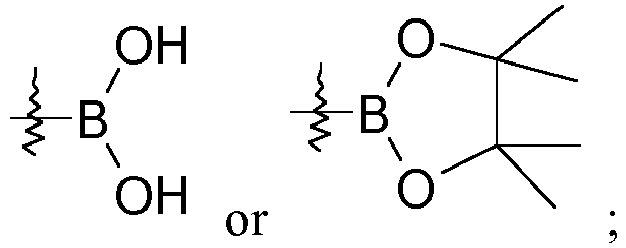
- ring A, R1, R3, R4, r and n are as defined in formula (I).
- A method for preparing the compound of formula (III) of the present invention or a tautomer, mesomer, racemate, enantiomer, diastereomer thereof, or mixture thereof, or a pharmaceutically acceptable salt thereof, comprises the following steps of:

in Step 2, the compound of formula (II-A) is reacted with a compound of formula (III-B) in the presence of a catalyst under an alkaline condition to obtain the compound of formula (III). - The reagent that provides an alkaline condition includes organic bases and inorganic bases. The organic bases include, but are not limited to, triethylamine, N,N-diisopropylethylamine, n-butyllithium, lithium diisopropylamide, lithium bis(trimethylsilyl)amine, potassium acetate, potassium acetate, sodium tert-butoxide, potassium tert-butoxide and sodium n-butoxide. The inorganic bases include, but are not limited to, sodium hydride, potassium phosphate, sodium carbonate, potassium carbonate, potassium acetate, cesium carbonate, sodium hydroxide and lithium hydroxide.
- The catalyst includes, but is not limited to, Pd/C, tetra-triphenylphosphine palladium, palladium dichloride, palladium acetate, bis(dibenzylideneacetone)palladium, chloro(2-dicyclohexylphosphino-2',4',6'-triisopropyl-1,1'-biphenyl)[2-(2'-amino-1,1'-bip henyl)]palladium, [1,1'-bis(diphenylphosphino)ferrocene]dichloropalladium, 1,1'-bis(dibenzylphosphoryl)ferrocene palladium dichloride or tris(dibenzylideneacetone)dipalladium, and preferably [1,1'-bis(diphenylphosphino)ferrocene]dichloropalladium.
- The above reactions are preferably carried out in a solvent. The solvent used includes, but is not limited to, acetic acid, methanol, ethanol, n-butanol, toluene, tetrahydrofuran, dichloromethane, petroleum ether, ethyl acetate, n-hexane, dimethyl sulfoxide, 1,4-dioxane, glycol dimethyl ether, water, N,N-dimethylformamide, and mixtures thereof.
- Wherein:
- X is halogen;
- M is

- R1, R3, R4, r and n are as defined in formula (I).
- The present invention will be further described with reference to the following examples, but the examples should not be considered as limiting the scope of the present invention.
- The structures of the compounds were identified by nuclear magnetic resonance (NMR) and/or mass spectrometry (MS). NMR shifts (δ) are given in 10-6 (ppm). NMR was determined by a Bruker AVANCE-400 machine. The solvents for determination were deuterated-dimethyl sulfoxide (DMSO-d6 ), deuterated-chloroform (CDCl3) and deuterated-methanol (CD3OD), and the internal standard was tetramethylsilane (TMS).
- MS was determined by a FINNIGAN LCQAd (ESI) mass spectrometer (manufacturer: Thermo, type: Finnigan LCQ advantage MAX).
- High performance liquid chromatography (HPLC) was determined on an Agilent HPLC 1200DAD, Agilent HPLC 1200VWD and Waters HPLC e2695-2489 high pressure liquid chromatographs.
- Chiral HPLC was determined on an Agilent 1260 DAD high performance liquid chromatograph.
- High performance liquid preparation was carried out on Waters 2767, Waters 2767-SQ Detecor2, Shimadzu LC-20AP and Gilson-281 preparative chromatographs.
- Chiral preparation was carried out on a Shimadzu LC-20AP preparative chromatograph.
- CombiFlash rapid preparation instrument used was Combiflash Rf200 (TELEDYNE ISCO).
- Yantai Huanghai HSGF254 or Qingdao GF254 silica gel plate was used as the thin-layer silica gel chromatography (TLC) plate. The dimension of the silica gel plate used in TLC was 0.15 mm to 0.2 mm, and the dimension of the silica gel plate used in product purification was 0.4 mm to 0.5 mm.
- Yantai Huanghai 200 to 300 mesh silica gel was generally used as a carrier for silica gel column chromatography.
- Prep Star SD-1 (Varian Instruments Inc.) or SFC-multigram (Berger Instruments Inc.) was used for chiral preparative column chromatography.
- The average kinase inhibition rates and IC50 values were determined by a NovoStar ELISA (BMG Co., Germany).
- The known starting materials of the present invention can be prepared by the known methods in the art, or can be purchased from ABCR GmbH & Co. KG, Acros Organnics, Aldrich Chemical Company, Accela ChemBio Inc., or Dari chemical Company, etc.
- Unless otherwise stated, the reactions were carried out under argon atmosphere or nitrogen atmosphere.
- "Argon atmosphere" or "nitrogen atmosphere" means that a reaction flask is equipped with an argon or nitrogen balloon (about1 L).
- "Hydrogen atmosphere" means that a reaction flask is equipped with a hydrogen balloon (about 1 L).
- Pressurized hydrogenation reactions were performed on a Parr 3916EKX hydrogenation instrument and a Qinglan QL-500 hydrogen generator or HC2-SS hydrogenation instrument.
- In hydrogenation reactions, the reaction system was generally vacuumed and filled with hydrogen, with the above operation was repeated three times.
- CEM Discover-S 908860 type microwave reactor was used in microwave reactions.
- Unless otherwise stated, the solution refers to an aqueous solution.
- Unless otherwise stated, the reaction temperature is room temperature from 20°C to 30°C.
- The reaction process in the examples was monitored by thin layer chromatography (TLC). The developing solvent used in the reactions, the eluent system in column chromatography and the developing solvent system in thin layer chromatography for purification of the compounds included: A: dichloromethane/methanol system, B: n-hexane/ethyl acetate system, C: petroleum ether/ethyl acetate system, and D: dichloromethane/ethyl acetate/methanol system. The ratio of the volume of the solvent was adjusted according to the polarity of the compounds, and a small quantity of alkaline reagent such as triethylamine or acidic reagent such as acetic acid can also be added for adjustment.
-


- 6-Bromo-8-methylquinoline 1a (444 mg, 2.00 mmol, prepared according to the known method disclosed in " Journal of Organic Chemistry, 2014, 79(11), 5379-5385"), bis(pinacolato)diboron (508 mg, 2.00 mmol), [1,1'-bis(diphenylphosphino)ferrocene]dichloropalladium (292 mg, 0.40 mmol) and potassium acetate (588 mg, 6.00 mmol) were dissolved successively in 10 mL of glycol dimethyl ether under an argon atmosphere. The reaction solution was heated to 80°C, and stirred for 12 hours. The reaction was stopped, and the reaction solution was cooled to room temperature and filtrated. The filtrate was added with 20 mL of ethyl acetate, washed with water (10 mL) and saturated sodium chloride solution (10 mL) successively, dried over anhydrous sodium sulfate, and filtrated. The filtrate was concentrated under reduced pressure, and the residue was purified by thin layer chromatography with developing solvent system B to obtain the title product 1b (320 mg), yield: 59.5%.
MS m/z (ESI): 270.1 [M+1]. - 1b (54 mg, 0.20 mmol), 6-bromo-5-phenyl-1,2,4-triazin-3-amine 1c (50 mg, 0.20 mmol, prepared according to the known method disclosed in " Journal of Medicinal Chemistry, 2012, 55(5), 1898-1903"), [1,1'-bis(diphenylphosphino)ferrocene]dichloropalladium (29 mg, 0.04 mmol) and potassium carbonate (82 mg, 0.60 mmol) were dissolved successively in 12 mL of a mixed solution of 1,4-dioxane and water (V/V = 5:1) under an argon atmosphere. The reaction solution was heated to 80°C, and stirred for 2 hours. The reaction was stopped, and the reaction solution was cooled to room temperature and filtrated. The filtrate was concentrated under reduced pressure, and the residue was added with 20 mL of ethyl acetate, washed with water (10 mL) and saturated sodium chloride solution (10 mL) successively, dried over anhydrous sodium sulfate, and filtrated. The filtrate was concentrated under reduced pressure, and the residue was purified by high performance liquid chromatography with developing solvent system A to obtain the title product 1 (20 mg), yield: 32.2%.
MS m/z (ESI): 314.4 [M+1].
1H NMR (400 MHz, DMSO-d 6) δ 8.92 (m, 1H), 8.22-8.24 (d, 1H), 7.80 (s, 1H), 7.57 (s, 1H), 7.50-7.51 (m, 3H), 7.43-7.45 (m, 3H), 7.33-7.35 (m, 2H), 2.62 (s, 3H). -


- 6-Bromo-8-fluoroquinoline 2a (226 mg, 1.00 mmol), bis(pinacolato)diboron (305 mg, 1.20 mmol), [1,1'-bis(diphenylphosphino)ferrocene]dichloropalladium (146 mg, 0.20 mmol) and potassium acetate (294 mg, 3.00 mmol) were dissolved successively in 10 mL of glycol dimethyl ether under an argon atmosphere. The reaction solution was heated to 80°C, and stirred for 12 hours. The reaction was stopped, and the reaction solution was cooled to room temperature and filtrated. The filtrate was concentrated under reduced pressure, and the residue was purified by CombiFlash rapid preparation instrument with elution system B to obtain the title product 2b (220 mg), yield: 80.1%.
MS m/z (ESI): 274.1 [M+1]. - 2b (109 mg, 0.40 mmol), 1c (100 mg, 0.40 mmol), [1,1'-bis(diphenylphosphino)ferrocene]dichloropalladium (58 mg, 0.08 mmol) and potassium carbonate (156 mg, 1.20 mmol) were dissolved successively in 12 mL of a mixed solution of 1,4-dioxane and water (V/V = 5:1) under an argon atmosphere. The reaction solution was heated to 80°C, and stirred for 2 hours. The reaction was stopped, and the reaction solution was cooled to room temperature and filtrated. The filtrate was concentrated under reduced pressure, and the residue was purified by CombiFlash rapid preparation instrument with elution system A to obtain the title product 2 (20 mg), yield: 15.9%.
MS m/z (ESI): 318.4 [M+1].
1H NMR (400 MHz, DMSO-d 6) δ 8.95 (m, 1H), 8.38-8.40 (d, 1H), 7.91 (s, 1H), 7.58-7.62 (m, 3H), 7.41-7.46 (m, 4H), 7.35-7.37 (m, 2H). -


- 6-Bromoquinoline 3a (1.0 g, 4.80 mmol, Accela ChemBio Inc.), bis(pinacolato)diboron (1.46 g, 5.76 mmol), [1,1'-bis(diphenylphosphino)ferrocene]dichloropalladium (0.7 g, 0.96 mmol) and potassium acetate (1.4 g, 14.40 mmol) were dissolved successively in 20 mL of glycol dimethyl ether under an argon atmosphere. The reaction solution was heated to 80°C, and stirred for 12 hours. The reaction was stopped, and the reaction solution was cooled to room temperature and filtrated. The filtrate was concentrated under reduced pressure, and the residue was purified by CombiFlash rapid preparation instrument with elution system B to obtain the title product 3b (1.2 g), yield: 98.4%.
MS m/z (ESI): 256.1 [M+1]. - 3b (203 mg, 0.80 mmol), 1c (200 mg, 0.80 mmol), [1,1'-bis(diphenylphosphino)ferrocene]dichloropalladium (116 mg, 0.16 mmol) and potassium carbonate (330 mg, 2.40 mmol) were dissolved successively in 24 mL of a mixed solution of 1,4-dioxane and water (V/V = 5:1) under an argon atmosphere. The reaction solution was heated to 80°C, and stirred for 2 hours. The reaction was stopped, and the reaction solution was cooled to room temperature and filtrated. The filtrate was concentrated under reduced pressure, and the residue was purified by CombiFlash rapid preparation instrument with elution system A to obtain the title product 3 (100 mg), yield: 42.0%.
MS m/z (ESI): 300.4 [M+1].
1H NMR (400 MHz, DMSO-d 6) δ 8.90-8.91 (m, 1H), 8.32-8.34 (d, 1H), 8.10 (s, 1H), 7.89-7.91 (d, 1H), 7.52-7.59 (m, 4H), 7.43-7.44 (m, 3H), 7.33-7.35 (m, 2H). -
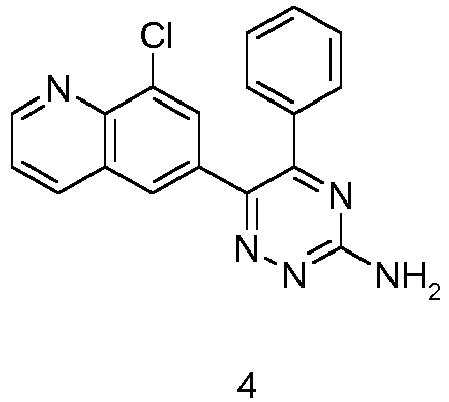

- 6-Bromo-8-chloroquinoline 4a (300 mg, 1.24 mmol), bis(pinacolato)diboron (378 mg, 1.49 mmol), [1,1'-bis(diphenylphosphino)ferrocene]dichloropalladium (181 mg, 0.25 mmol) and potassium acetate (364 mg, 3.72 mmol) were dissolved successively in 50 mL of glycol dimethyl ether under an argon atmosphere. The reaction solution was heated to 80°C, and stirred for 12 hours. The reaction was stopped, and the reaction solution was cooled to room temperature and filtrated. The filtrate was concentrated under reduced pressure, and the residue was purified by CombiFlash rapid preparation instrument with elution system B to obtain the title product 4b (260 mg), yield: 72.6%.
MS m/z (ESI): 290.5 [M+1]. - 4b (127 mg, 0.44 mmol), 1c (100 mg, 0.40 mmol), [1,1'-bis(diphenylphosphino)ferrocene]dichloropalladium (58 mg, 0.08 mmol) and potassium carbonate (165 mg, 1.20 mmol) were dissolved successively in 12 mL of a mixed solution of 1,4-dioxane and water (V/V = 5:1) under an argon atmosphere. The reaction solution was heated to 80°C, and stirred for 2 hours. The reaction was stopped, and the reaction solution was cooled to room temperature, added with 20 mL of ethyl acetate, washed with saturated sodium chloride solution (10 mL), dried over anhydrous sodium sulfate, and filtrated. The filtrate was concentrated under reduced pressure, and the residue was purified by CombiFlash rapid preparation instrument with elution system A to obtain the title product 4 (30 mg), yield: 20.5%.
MS m/z (ESI): 334.4 [M+1].
1H NMR (400 MHz, DMSO-d 6) δ 9.01-9.02 (m, 1H), 8.39-8.41 (d, 1H), 8.05 (s, 1H), 7.80 (s, 1H), 7.59-7.66 (m, 3H), 7.44-7.47 (m, 3H), 7.36-7.38 (m, 2H). -


- 6-Bromo-1,2,4-triazin-3-amine 5a (1.0 g, 5.72 mmol, prepared according to the known method disclosed in " Journal of the American Chemical Society, 2015, 137(26), 8388-8391"), 6 mL of trifluoroacetic acid and 6 mL of dichloromethane were added to a reaction flask. The reaction solution was added with 2-methylfuran 5b (567 µL, 6.29 mmol), and stirred at room temperature for 17 hours. The reaction was stopped, and the reaction solution was added dropwise with saturated sodium bicarbonate solution to adjust the pH>7. The reaction solution was added with 30 mL of a pre-prepared aqueous solution of potassium hydroxide (962 mg, 17.14 mmol) and potassium hexacyanoferrate (5.65 g, 17.14 mmol), and stirred at room temperature for 1 hour. The reaction was stopped, and the reaction solution was extracted with ethyl acetate (150 mL×3). The organic phases were combined, added with silica gel, and concentrated under reduced pressure. The residue was purified by CombiFlash rapid preparation instrument with elution system C to obtain the title product 5c (450 mg), yield: 30.9%.
MS m/z (ESI): 257.3 [M+1]. - 5c (80 mg, 0.31 mmol), 1b (127 mg, 0.47 mmol), [1,1'-bis(diphenylphosphino)ferrocene]dichloropalladium (23 mg, 0.031 mmol) and potassium carbonate (173 mg, 1.25 mmol) were dissolved successively in 12 mL of a mixed solution of 1,4-dioxane and water (V/V = 5:1) under an argon atmosphere. The reaction solution was heated to 90°C, and stirred for 2 hours. The reaction was stopped, and the reaction solution was cooled to room temperature, added with 50 mL of water, and extracted with ethyl acetate (30 mL×3). The organic phases were combined, and concentrated under reduced pressure. The residue was purified by thin layer chromatography with developing solvent system B to obtain the title product 5 (33 mg), yield: 33.0%.
MS m/z (ESI): 318.4 [M+1].
1H NMR (400 MHz, DMSO-d 6) δ 8.99-8.98 (m, 1H), 8.41-8.39 (m, 1H), 7.97 (s, 1H), 7.69 (s, 1H), 7.61-7.58 (m, 1H), 7.39 (s, 2H), 6.19-6.14 (m, 2H), 2.75 (s, 3H), 2.21 (s, 3H). -


- 5a (1.0 g, 5.72 mmol), 6 mL of trifluoroacetic acid and 6 mL of dichloromethane were added to a reaction flask. The reaction solution was added with furan (457 µL, 6.29 mmol), and stirred at room temperature for 17 hours. The reaction was stopped, and the reaction solution was added dropwise with saturated sodium bicarbonate solution to adjust the pH>7. The reaction solution was added with 20 mL of a pre-prepared aqueous solution of potassium hydroxide (962 mg, 17.14 mmol) and potassium hexacyanoferrate (5.65 g, 17.14 mmol), and stirred at room temperature for 1 hour. The reaction was stopped, and the reaction solution was extracted with dichloromethane (100 mL×4). The organic phases were combined, added with silica gel, and concentrated under reduced pressure. The residue was purified by CombiFlash rapid preparation instrument with elution system C to obtain the title product 6a (222 mg), yield: 16.1%.
MS m/z (ESI): 243.3 [M+1]. - 6a (70 mg, 0.29 mmol), 1b (86 mg, 0.32 mmol), [1,1'-bis(diphenylphosphino)ferrocene]dichloropalladium (21 mg, 0.029 mmol) and potassium carbonate (160 mg, 1.16 mmol) were dissolved successively in 12 mL of a mixed solution of 1,4-dioxane and water (V/V = 5:1) under an argon atmosphere. The reaction solution was heated to 90°C, and stirred for 2 hours. The reaction was stopped, and the reaction solution was cooled to room temperature, added with 50 mL of water, and extracted with ethyl acetate (30 mL×3). The organic phases were combined, and concentrated under reduced pressure. The residue was purified by thin layer chromatography with developing solvent system B to obtain the title product 6 (35 mg), yield: 39.8%.
MS m/z (ESI): 304.4 [M+1].
1H NMR (400 MHz, DMSO-d 6) δ 9.04-9.02 (m, 1H), 8.21-8.19 (m, 1H), 7.91 (s, 1H), 7.68 (s, 1H), 7.56 (s, 1H), 7.50-7.47 (m, 1H), 6.44-6.43 (m, 1H), 6.38-6.36 (m, 1H), 5.50 (s, 2H), 2.86 (s, 3H). -


- 5a (1.0 g, 5.72 mmol), 6 mL of trifluoroacetic acid and 6 mL of dichloromethane were added to a reaction flask. The reaction solution was added with thiophene (503 µL, 6.29 mmol), and stirred at room temperature for 17 hours. The reaction was stopped, and the reaction solution was added dropwise with saturated sodium bicarbonate solution to adjust the pH>7. The reaction solution was added with 30 mL of a pre-prepared aqueous solution of potassium hydroxide (962 mg, 17.14 mmol) and potassium hexacyanoferrate (5.65 g, 17.14 mmol), and stirred at room temperature for 2 hours. The reaction was stopped, and the reaction solution was extracted with ethyl acetate (50 mL×3). The organic phases were combined, added with silica gel, and concentrated under reduced pressure. The residue was purified by CombiFlash rapid preparation instrument with elution system C to obtain the title product 7a (400 mg), yield: 27.2%.
MS m/z (ESI): 259.2 [M+1]. - 7a (70 mg, 0.27 mmol), 1b (81 mg, 0.30 mmol), [1,1'-bis(diphenylphosphino)ferrocene]dichloropalladium (20 mg, 0.027 mmol) and potassium carbonate (150 mg, 1.09 mmol) were dissolved successively in 12 mL of a mixed solution of 1,4-dioxane and water (V/V = 5:1) under an argon atmosphere. The reaction solution was heated to 90°C, and stirred for 2 hours. The reaction was stopped, and the reaction solution was cooled to room temperature, added with 50 mL of water, and extracted with ethyl acetate (50 mL×3). The organic phases were combined, and concentrated under reduced pressure. The residue was purified by thin layer chromatography with developing solvent system B to obtain the title product 7 (40 mg), yield: 46.0%.
MS m/z (ESI): 320.4 [M+1].
1H NMR (400 MHz, DMSO-d 6) δ 9.00-8.99 (m, 1H), 8.42-8.40 (m, 1H), 8.02 (s, 1H), 7.77-7.76 (m, 1H), 7.72 (s, 1H), 7.62-7.59 (m, 1H), 7.41 (s, 2H), 6.94-6.92 (m, 1H), 6.82-6.81 (m, 1H), 2.75 (s, 3H). -


- 1b (100 mg, 0.37 mmol), 6-bromo-5-(4-fluorophenyl)-1,2,4-triazin-3-amine 8a (100 mg, 0.37 mmol, prepared according to the known method disclosed in " Journal of Medicinal Chemistry, 2012, 55(5), 1898-1903"), [1,1'-bis(diphenylphosphino)ferrocene]dichloropalladium (54 mg, 0.074 mmol) and potassium carbonate (154 mg, 1.12 mmol) were dissolved successively in 12 mL of a mixed solution of 1,4-dioxane and water (V/V = 5:1) under an argon atmosphere. The reaction solution was heated to 80°C, and stirred for 2 hours. The reaction was stopped, and the reaction solution was cooled to room temperature and filtrated. The filtrate was concentrated under reduced pressure, and the residue was purified by CombiFlash rapid preparation instrument with elution system A to obtain the title product 8 (15 mg), yield: 12.2%.
MS m/z (ESI): 332.4 [M+1].
1H NMR (400 MHz, DMSO-d 6) δ 8.92-8.93 (m, 1H), 8.25-8.27 (d, 1H), 7.80 (s, 1H), 7.59 (s, 1H), 7.48-7.55 (m, 5H), 7.17-7.21 (m, 2H), 2.64 (s, 3H). -


- 2-Amino-5-bromobenzotrifluoride 9a (1.1 g, 4.58 mmol), 1,2,3-propanetriol (1.69 g, 18.3 mmol) and iron (II) sulfate heptahydrate (204 mg, 0.73 mmol) were added to a reaction flask. The reaction solution was cooled to 0°C, and added dropwise with 0.8 mL of sulfuric acid. After completion of the addition, the reaction solution was heated to 120°C, and stirred for 4 hours. The reaction was stopped, and the reaction solution was cooled to room temperature, added with 20 mL of water, and extracted with ethyl acetate (30 mL×3). The organic phases were combined, and concentrated under reduced pressure. The residue was purified by CombiFlash rapid preparation instrument with elution system B to obtain the title product 9b (0.9 g), yield: 71.4%.
MS m/z (ESI): 210.6 [M+1]. - 9b (276 mg, 1.00 mmol), bis(pinacolato)diboron (381 mg, 1.50 mmol), [1,1'-bis(diphenylphosphino)ferrocene]dichloropalladium (146 mg, 0.20 mmol) and potassium acetate (294 mg, 3.00 mmol) were dissolved successively in 15 mL of glycol dimethyl ether under an argon atmosphere. The reaction solution was heated to 80°C, and stirred for 12 hours. The reaction was stopped, and the reaction solution was cooled to room temperature and filtrated. The filtrate was concentrated under reduced pressure, and the residue was purified by CombiFlash rapid preparation instrument with elution system B to obtain the title product 9c (250 mg), yield: 77.4%.
MS m/z (ESI): 324.1 [M+1]. - 9c (129 mg, 0.40 mmol), 6-bromo-5-phenyl-1,2,4-triazin-3-amine 1c (100 mg, 0.40 mmol), [1,1'-bis(diphenylphosphino)ferrocene]dichloropalladium (58 mg, 0.08 mmol) and potassium carbonate (156 mg, 1.20 mmol) were dissolved successively in 12 mL of a mixed solution of 1,4-dioxane and water (V/V = 5:1) under an argon atmosphere. The reaction solution was heated to 80°C, and stirred for 2 hours. The reaction was stopped, and the reaction solution was cooled to room temperature, and filtrated. The filtrate was concentrated under reduced pressure, and the residue was added with 20 mL of ethyl acetate, washed with saturated sodium chloride solution (10 mL), dried over anhydrous sodium sulfate, and filtrated. The filtrate was concentrated under reduced pressure, and the residue was purified by CombiFlash rapid preparation instrument with elution system A to obtain the title product 9 (50 mg), yield: 34.2%.
MS m/z (ESI): 368.4 [M+1].
1H NMR (400 MHz, DMSO-d 6) δ 9.04-9.05 (m, 1H), 8.47-8.49 (d, 1H), 8.39(s, 1H), 7.97 (s, 1H), 7.63-7.71 (m, 3H), 7.44-7.45 (m, 3H), 7.34-7.38 (m, 2H). -


- 4-Bromo-2-isopropylaniline 10a (1.0 g, 4.70 mmol, prepared according to the known method disclosed in " Synthesis, 2013, 45(17), 2474-2480"), 1,2,3-propanetriol (2.1 g, 23.40 mmol) and iron (II) sulfate heptahydrate (0.2 g, 0.75 mmol) were added to a reaction flask. The reaction solution was cooled to 0°C, and added dropwise with 0.9 mL of sulfuric acid. After completion of the addition, the reaction solution was heated to 120°C, and stirred for 3 hours. The reaction was stopped, and the reaction solution was cooled to room temperature, added with 20 mL of water, and extracted with ethyl acetate (30 mL×3). The organic phases were combined, washed with saturated sodium chloride solution (20 mL), dried over anhydrous sodium sulfate, and filtrated. The filtrate was concentrated under reduced pressure, and the residue was purified by CombiFlash rapid preparation instrument with elution system B to obtain the title product 10b (0.6 g), yield: 51.7%.
MS m/z (ESI): 251.1 [M+1]. - 10b (600 mg, 2.40 mmol), bis(pinacolato)diboron (731 mg, 2.88 mmol), [1,1'-bis(diphenylphosphino)ferrocene]dichloropalladium (350 mg, 0.48 mmol) and potassium acetate (705 mg, 7.20 mmol) were dissolved successively in 40 mL of glycol dimethyl ether under an argon atmosphere. The reaction solution was heated to 80°C, and stirred for 4 hours. The reaction was stopped, and the reaction solution was cooled to room temperature and filtrated. The filtrate was concentrated under reduced pressure, and the residue was purified by CombiFlash rapid preparation instrument with elution system B to obtain the title product 10c (450 mg), yield: 63.1%.
MS m/z (ESI): 298.2 [M+1]. - 10c (118 mg, 0.40 mmol), 6-bromo-5-phenyl-1,2,4-triazin-3-amine 1c (100 mg, 0.40 mmol), [1,1'-bis(diphenylphosphino)ferrocene]dichloropalladium (58 mg, 0.08 mmol) and potassium carbonate (165 mg, 1.20 mmol) were dissolved successively in 24 mL of a mixed solution of 1,4-dioxane and water (V/V = 5:1) under an argon atmosphere. The reaction solution was heated to 80°C, and stirred for 2 hours. The reaction was stopped, and the reaction solution was cooled to room temperature and filtrated. The filtrate was concentrated under reduced pressure, and the residue was purified by CombiFlash rapid preparation instrument with elution system A to obtain the title product 10 (40 mg), yield: 29.3%.
MS m/z (ESI): 342.4 [M+1].
1H NMR (400 MHz, DMSO-d 6) δ 8.90-8.92 (m, 1H), 8.36-8.38 (d, 1H), 8.11 (s, 1H), 7.51-7.53 (m, 3H), 7.40-7.41 (m, 3H), 7.33-7.35 (m, 2H), 7.25 (m, 1H), 4.10-4.12 (m, 1H), 0.99-1.01 (s, 6H). -


- 4-Bromo-2-ethylaniline 11a (1.0 g, 5.00 mmol, Alfa), 1,2,3-propanetriol (2.3 g, 25.00 mmol) and iron (II) sulfate heptahydrate (0.22 g, 0.80 mmol) were added to a reaction flask. The reaction solution was cooled to 0°C, and added dropwise with 0.9 mL of sulfuric acid. After completion of the addition, the reaction solution was heated to 120°C, and stirred for 2 hours. The reaction was stopped, and the reaction solution was cooled to room temperature, added with 20 mL of water, and extracted with ethyl acetate (30 mL×3). The organic phases were combined, washed with saturated sodium chloride solution (20 mL), dried over anhydrous sodium sulfate, and filtrated. The filtrate was concentrated under reduced pressure, and the residue was purified by CombiFlash rapid preparation instrument with elution system B to obtain the title product 11b (0.9 g), yield: 76.3%.
MS m/z (ESI): 237.1 [M+1]. - 11b (472 mg, 2.00 mmol), bis(pinacolato)diboron (610 mg, 2.40 mmol), [1,1'-bis(diphenylphosphino)ferrocene]dichloropalladium (292 mg, 0.40 mmol) and potassium acetate (588 mg, 6.00 mmol) were dissolved successively in 30 mL of glycol dimethyl ether under an argon atmosphere. The reaction solution was heated to 80°C, and stirred for 3 hours. The reaction was stopped, and the reaction solution was cooled to room temperature and filtrated. The filtrate was concentrated under reduced pressure, and the residue was purified by silica gel column chromatography with elution system B to obtain the title product 11c (400 mg), yield: 70.7%.
MS m/z (ESI): 284.1 [M+1]. - 11c (113 mg, 0.40 mmol), 6-bromo-5-phenyl-1,2,4-triazin-3-amine 1c (100 mg, 0.40 mmol), [1,1'-bis(diphenylphosphino)ferrocene]dichloropalladium (58 mg, 0.08 mmol) and potassium carbonate (165 mg, 1.20 mmol) were dissolved successively in 24 mL of a mixed solution of 1,4-dioxane and water (V/V = 5:1) under an argon atmosphere. The reaction solution was heated to 80°C, and stirred for 2 hours. The reaction was stopped, and the reaction solution was cooled to room temperature and filtrated. The filtrate was concentrated under reduced pressure, and the residue was purified by CombiFlash rapid preparation instrument with elution system A to obtain the title product 11 (20 mg), yield: 15.3%.
MS m/z (ESI): 328.4 [M+1].
1H NMR (400 MHz, Pyridine-d 5) δ 8.93-8.95 (m, 1H), 8.52 (br, 2H), 8.10 (s, 1H), 8.06-8.10 (m, 1H), 7.72 (s, 1H), 7.65-7.67 (m, 2H), 7.32-7.35 (m, 1H), 7.26-7.28 (m, 3H), 3.30-3.32 (m, 2H), 1.22-1.25 (t, 3H). -


- 2-Cyclopropylaniline 12a (1.0 g, 7.52 mmol, prepared according to the method disclosed in the patent application "
WO201314997
MS m/z (ESI): 213.1 [M+1]. - 4-Bromo-2-ethylaniline 12b (500 mg, 2.36 mmol), 1,2,3-propanetriol (1.08 g, 11.80 mmol) and iron (II) sulfate heptahydrate (105 mg, 0.38 mmol) were added to a reaction flask. The reaction solution was cooled to 0°C, and added dropwise with 0.5 mL of sulfuric acid. After completion of the addition, the reaction solution was heated to 120°C, and stirred for 2 hours. The reaction was stopped, and the reaction solution was cooled to room temperature, added with 50 mL of water, and extracted with ethyl acetate (50 mL×3). The organic phases were combined, washed with saturated sodium chloride solution (50 mL), dried over anhydrous sodium sulfate, and filtrated. The filtrate was concentrated under reduced pressure, and the residue was purified by CombiFlash rapid preparation instrument with elution system B to obtain the title product 12c (0.4 g), yield: 68.5%.
MS m/z (ESI): 249.1 [M+1]. - 12c (100 mg, 0.40 mmol), bis(pinacolato)diboron (123 mg, 0.48 mmol), [1,1'-bis(diphenylphosphino)ferrocene]dichloropalladium (59 mg, 0.08 mmol) and potassium acetate (118 mg, 1.20 mmol) were dissolved successively in 10 mL of glycol dimethyl ether under an argon atmosphere. The reaction solution was heated to 80°C, and stirred for 4 hours. The reaction was stopped, and the reaction solution was cooled to room temperature and filtrated. The filtrate was concentrated under reduced pressure, and the residue was purified by CombiFlash rapid preparation instrument with elution system B to obtain the title product 12d (94 mg), yield: 79.0%.
MS m/z (ESI): 296.2 [M+1]. - 12d (94 mg, 0.32 mmol), 6-bromo-5-phenyl-1,2,4-triazin-3-amine 1c (80 mg, 0.32 mmol), [1,1'-bis(diphenylphosphino)ferrocene]dichloropalladium (47 mg, 0.064 mmol) and potassium carbonate (132 mg, 0.96 mmol) were dissolved successively in 12 mL of a mixed solution of 1,4-dioxane and water (V/V = 5:1) under an argon atmosphere. The reaction solution was heated to 80°C, and stirred for 2 hours. The reaction was stopped, and the reaction solution was cooled to room temperature and filtrated. The filtrate was concentrated under reduced pressure, and the residue was purified by CombiFlash rapid preparation instrument with elution system A to obtain the title product 12 (10 mg), yield: 9.2%.
MS m/z (ESI): 340.1 [M+1].
1H NMR (400 MHz, DMSO-d 6) δ 8.92-8.94 (m, 1H), 8.35-8.38 (dd, 1H), 8.02 (s, 1H), 7.43-7.57 (m, 3H), 7.37-7.39 (m, 1H), 7.34-7.36 (m, 4H), 6.79-6.80 (m, 1H), 3.06-3.08 (m, 1H), 0.91-0.93 (m, 2H), 0.29-0.30 (m, 2H). -


- 2-Naphthylboronic acid 13a (55 mg, 0.32 mmol), 6-bromo-5-phenyl-1,2,4-triazin-3-amine 1c (80 mg, 0.32 mmol), [1,1'-bis(diphenylphosphino)ferrocene]dichloropalladium (47 mg, 0.064 mmol) and potassium carbonate (132 mg, 0.96 mmol) were dissolved successively in 12 mL of a mixed solution of 1,4-dioxane and water (V/V = 5:1) under an argon atmosphere. The reaction solution was heated to 80°C, and stirred for 2 hours. The reaction was stopped, and the reaction solution was cooled to room temperature and filtrated. The filtrate was concentrated under reduced pressure, and the residue was purified by CombiFlash rapid preparation instrument with elution system A to obtain the title product 13 (20 mg), yield: 21.3%.
MS m/z (ESI): 299.1 [M+1].
1H NMR (400 MHz, DMSO-d 6) δ 8.02 (s, 1H), 7.80-7.87 (m, 3H), 7.31-7.52 (m, 10H). -


- 6-Bromo-4-methylquinoline 14a (444 mg, 2 mmol, prepared according to the known method disclosed in " Tetrahedron, 2003, 59(6), 813-819"), bis(pinacolato)diboron (762 mg, 3 mmol), [1,1'-bis(diphenylphosphino)ferrocene]dichloropalladium (292 mg, 0.40 mmol) and potassium acetate (588 mg, 6.00 mmol) were dissolved successively in 20 mL of dimethyl ether under an argon atmosphere. The reaction solution was heated to 80°C, and stirred for 12 hours. The reaction was stopped, and the reaction solution was cooled to room temperature and filtrated. The filtrate was concentrated under reduced pressure, and the residue was purified by CombiFlash rapid preparation instrument with elution system B to obtain the title product 14b (460 mg), yield: 85.5%.
MS m/z (ESI): 270.4 [M+1]. - Compound 14b (107 mg, 0.4 mmol), compound 1c (100 mg, 0.4 mmol), [1,1'-bis(diphenylphosphino)ferrocene]dichloropalladium (58 mg, 0.08 mmol) and potassium carbonate (165 mg, 1.20 mmol) were dissolved successively in 12 mL of a mixed solution of 1,4-dioxane and water (V/V = 5:1) under an argon atmosphere. The reaction solution was heated to 80°C, and stirred for 2 hours. The reaction was stopped, and the reaction solution was cooled to room temperature and filtrated. The filtrate was concentrated under reduced pressure, and the residue was purified by CombiFlash rapid preparation instrument with elution system A to obtain the title product 14 (15 mg), yield: 12%.
MS m/z (ESI): 314.4 [M+1].
1H NMR (400 MHz, DMSO-d 6) δ 8.74-8.75 (d, 1H), 8.02 (m, 1H), 7.90-7.93 (d, 1H), 7.71-7.73 (d, 1H), 7.63 (m, 2H), 7.42-7.44 (m, 3H), 7.34-7.36 (m, 3H), 2.46 (s, 3H). -


- 1-(2-Amino-5-bromophenyl)ethanone 15a (1 g, 4.67 mmol, prepared according to the known method disclosed in " Journal of Medicinal Chemistry, 2015, 58(14), 5522-5537"), triethyl orthoformate (1.04 g, 7.01 mmol) and ammonium acetate (540.15 mg, 7.01 mmol) were added to a reaction flask. The reaction solution was stirred at 110°C for 2 hours. The reaction was stopped, and the reaction solution was cooled to room temperature. The reaction solution was purified by CombiFlash rapid preparation instrument with elution system B to obtain the title product 15b (500 mg), yield: 47.98%.
- Compound 15b (360 mg, 1.61 mmol), bis(pinacolato)diboron (409.82 mg, 1.61 mmol), [1,1'-bis(diphenylphosphino)ferrocene]dichloropalladium (236.17 mg, 322.77 µmol) and potassium acetate (475.16 mg, 4.84 mmol) were dissolved successively in 20 mL of dimethyl ether under an argon atmosphere. The reaction solution was heated to 80°C, and stirred for 4 hours. The reaction was stopped, and the reaction solution was cooled to room temperature and filtrated. The filtrate was concentrated under reduced pressure, and the residue was purified by CombiFlash rapid preparation instrument with elution system B to obtain the title product 15c (330 mg), yield: 75.7%.
MS m/z (ESI): 271.1[M+1]. - Compound 15c (108 mg, 399.80 µmol), compound 1c (100.38 mg, 399.80 µmmol), [1,1'-bis(diphenylphosphino)ferrocene]dichloropalladium (58.51 mg, 79.96 µmol) and potassium carbonate (165 mg, 1.2 mmol) were dissolved successively in 12 mL of a mixed solution of 1,4-dioxane and water (V/V = 4:1) under an argon atmosphere. The reaction solution was heated to 80°C, and stirred for 2 hours. The reaction was stopped, and the reaction solution was cooled to room temperature and filtrated. The filtrate was concentrated under reduced pressure, and the residue was purified by CombiFlash rapid preparation instrument with elution system A to obtain the title product 15 (52 mg), yield: 41.38%.
MS m/z (ESI): 315.2 [M+1].
1H NMR (400 MHz, DMSO-d 6) δ 9.11 (s, 1H), 8.22 (s, 1H), 7.89-7.90 (m, 2H), 7.59 (m, 2H), 7.43-7.45 (m, 3H), 7.34-7.38 (m, 2H), 2.73 (s, 3H). -


- 4-Bromo-2-fluoro-aniline 16b (9.99 g, 52.58 mmol, prepared according to the known method disclosed in " Tetrahedron Letters, 2015, 56(41), 5646-5650") was dissolved in 300 mL of 1,4-dioxane, followed by dropwise addition of 5 mL of sulfuric acid. The reaction solution was heated to reflux, then slowly added dropwise with 20 mL of but-3-en-2-one 16a (7.37 g, 105.15 mmol, prepared according to the known method disclosed in " Tetrahedron Letters, 2006, 47(37), 6635-6636") in 1,4-dioxane over 1.5 hours. After completion of the addition, the reaction solution was heated to reflux for 2 hours. The reaction solution was cooled to room temperature, and concentrated under reduced pressure. The residue was added with water, added dropwise with saturated sodium bicarbonate solution until the pH of the mixture was 10, and extracted with ethyl acetate three times. The organic phases were combined, washed once with saturated sodium chloride solution, dried over anhydrous sodium sulfate, and filtrated. The filtrate was concentrated under reduced pressure, and the residue was purified by CombiFlash rapid preparation instrument with elution system B to obtain the title product 16c (3.5 g), yield: 27.73%.
MS m/z (ESI):240.0 [M+1]. - Compound 16c (480 mg, 2.00 mmol), bis(pinacolato)diboron (761.59 mg, 3.00 mmol), [1,1'-bis(diphenylphosphino)ferrocene]dichloropalladium (292.60 mg, 399.88 µmol) and potassium acetate (588.68 mg, 6.00 mmol) were added to 20 mL of dimethyl ether under an argon atmosphere. The reaction solution was heated to 80°C, and stirred for 3 hours. The reaction was stopped, and the reaction solution was cooled to room temperature and filtrated. The filtrate was concentrated under reduced pressure, and the residue was purified by CombiFlash rapid preparation instrument with elution system B to obtain the title product 16d (460 mg), yield: 80.12%.
MS m/z (ESI): 288.1 [M+1]. - Compound 16d (110 mg, 383.09 µmol), compound 1c (96 mg, 383.09 µmol), [1,1'-bis(diphenylphosphino)ferrocene]dichloropalladium (56 mg, 76.62 µmol) and potassium carbonate (158.60 mg, 1.15 mmol) were dissolved successively in 12 mL of a mixed solution of 1,4-dioxane and water (V/V = 5:1) under an argon atmosphere. The reaction solution was heated to 80°C, and stirred for 2 hours. The reaction was stopped, and the reaction solution was cooled to room temperature and filtrated. The filtrate was concentrated under reduced pressure, and the residue was purified by CombiFlash rapid preparation instrument with elution system A to obtain the title product 16 (18 mg), yield: 14.2%.
MS m/z (ESI): 332.4 [M+1].
1H NMR (400 MHz, DMSO-d 6) δ 8.75-8.76 (m, 1H), 7.78 (s, 1H), 7.52-7.55 (m, 3H), 7.41-7.43 (m, 4H), 7.34-7.36 (m, 2H), 2.42 (s, 3H). -


- Compound 14b (100 mg, 371.55 µmol), 6-bromo-5-(2-fluorophenyl)-1,2,4-triazin-3-amine 17a (99.97 mg, 371.55 µmol, prepared according to the method disclosed in the patent application "
WO2016102672A2 "), [1,1'-bis(diphenylphosphino)ferrocene]dichloropalladium (54 mg, 74.35 µmol) and potassium carbonate (153.82 mg, 1.11 mmol) were dissolved successively in 12 mL of a mixed solution of 1,4-dioxane and water (V/V = 5:1) under an argon atmosphere. The reaction solution was heated to 80°C, and stirred for 2 hours. The reaction was stopped, and the reaction solution was cooled to room temperature and filtrated. The filtrate was concentrated under reduced pressure, and the residue was purified by CombiFlash rapid preparation instrument with elution system A to obtain the title product 17 (50 mg), yield: 40.6%.
MS m/z (ESI): 332.4 [M+1].
1H NMR (400 MHz, DMSO-d 6) δ 8.70-8.71 (m, 1H), 7.92-7.94 (m, 1H), 7.84-7.87 (m, 1H), 7.80 (s, 1H), 7.60-7.67 (m, 3H), 7.48-7.50 (m, 1H), 7.09-7.36 (m, 2H), 7.04-7.09 (m, 1H), 2.32 (s, 3H). -


- Compound 14b (100 mg, 371.55 µmol), compound 8a (99.97 mg, 371.55 µmol), [1,1'-bis(diphenylphosphino)ferrocene]dichloropalladium (54.37 mg, 74.31 µmol) and potassium carbonate (153.82 mg, 1.11 mmol) were dissolved successively in 12 mL of a mixed solution of 1,4-dioxane and water (V/V = 5:1) under an argon atmosphere. The reaction solution was heated to 80°C, and stirred for 2 hours. The reaction was stopped, and the reaction solution was cooled to room temperature and filtrated. The filtrate was concentrated under reduced pressure, and the residue was purified by CombiFlash rapid preparation instrument with elution system A to obtain the title product 18 (15 mg), yield: 12.18%.
MS m/z (ESI): 332.1 [M+1].
1H NMR (400 MHz, DMSO-d 6) δ 8.76-8.77 (m, 1H), 8.09 (m, 1H), 7.92-7.95 (d, 1H), 7.70-7.71 (m, 1H), 7.53 (m, 2H), 7.47-7.50 (m, 2H), 7.39-7.40 (m, 1H), 7.18-7.22 (m, 2H), 2.52 (s, 3H). -


- Compound 15c (100 mg, 370.19 µmol), compound 8a (99.61 mg, 370.19 µmol), [1,1'-bis(diphenylphosphino)ferrocene]dichloropalladium (54.17 mg, 74.04 µmol) and potassium carbonate (153.26 mg, 1.11 mmol) were dissolved in 12 mL of a mixed solution of 1,4-dioxane and water (V/V = 5:1) under an argon atmosphere. The reaction solution was heated to 80°C, and stirred for 2 hours. The reaction was stopped, and the reaction solution was cooled to room temperature and filtrated. The filtrate was concentrated under reduced pressure, and the residue was purified by CombiFlash rapid preparation instrument with elution system A to obtain the title product 19 (50 mg), yield: 40.64%.
MS m/z (ESI): 333.2 [M+1].
1H NMR (400 MHz, DMSO-d 6) δ 9.12 (s, 1H), 8.29 (s, 1H), 7.88-7.90 (m, 2H), 7.59 (m, 2H), 7.47-7.51 (m, 2H), 7.19-7.23 (m, 2H), 2.78 (s, 3H). -


- Compound 8a (100 mg, 371.65 µmol), compound 16d (106.71 mg, 371.65 µmol), [1,1'-bis(diphenylphosphino)ferrocene]dichloropalladium (54.39 mg, 74.33 µmol) and potassium carbonate (153.86 mg, 1.11 mmol) were dissolved in 12 mL of a mixed solution of 1,4-dioxane and water (V/V = 5:1) under an argon atmosphere. The reaction solution was heated to 80°C, and stirred for 2 hours. The reaction was stopped, and the reaction solution was cooled to room temperature and filtrated. The filtrate was concentrated under reduced pressure, and the residue was purified by CombiFlash rapid preparation instrument with elution system A to obtain the title product 20 (50 mg), yield: 38.51%.
MS m/z (ESI): 350.4 [M+1].
1H NMR (400 MHz, DMSO-d 6) δ 8.77-8.78 (m, 1H), 7.83 (s, 1H), 7.46-7.55 (m, 6H), 7.19-7.21 (m, 2H), 2.50 (s, 3H). -


- Compound 14b (68 mg, 252.65 µmol), 6-bromo-5-(2,4-difluorophenyl)-1,2,4-triazin-3-amine 21a (72.53 mg, 252.65 µmol, prepared according to the method disclosed in the patent application "
WO2011095625A1 "), [1,1'-bis(diphenylphosphino)ferrocene]dichloropalladium (36.97 mg, 50.53 µmol) and potassium carbonate (104.60 mg, 757.95 µmol) were dissolved in 12 mL of a mixed solution of 1,4-dioxane and water (V/V = 5:1) under an argon atmosphere. The reaction solution was heated to 80°C, and stirred for 2 hours. The reaction was stopped, and the reaction solution was cooled to room temperature and filtrated. The filtrate was concentrated under reduced pressure, and the residue was purified by CombiFlash rapid preparation instrument with elution system A to obtain the title product 21 (40 mg), yield: 50.99%.
MS m/z (ESI): 350.2 [M+1].
1H NMR (400 MHz, DMSO-d 6) δ 8.74-8.75 (m, 1H), 7.96-7.98 (d, 1H), 7.85-7.89 (m, 2H), 7.75-7.78 (m, 1H), 7.65 (m, 2H), 7.35-7.37 (m, 1H), 7.28-7.30 (m, 1H), 7.19-7.25 (m, 1 H), 2.42 (s, 3H). -


- Compound 14a (222 mg, 999.64 µmol) and benzoic acid (12.21 mg, 99.96 µmol) were dissolved in 1 mL of deuteroxide. The reaction solution was stirred at 100°C overnight, and then added with saturated sodium bicarbonate solution, and extracted with ethyl acetate three times. The organic phases were combined, and dried over anhydrous sodium sulfate. The residue was purified by CombiFlash rapid preparation instrument with elution system B. The purified solid and benzoic acid (12.21 mg, 99.96 µmol) were added successively to 1 mL of deuteroxide. The reaction solution was , stirred at 100°C overnight, and then added with saturated sodium bicarbonate solution, and extracted with ethyl acetate three times. The organic phases were combined, and dried over anhydrous sodium sulfate. The residue was purified by CombiFlash rapid preparation instrument with elution system B to obtain the title product 22a (100 mg), yield: 44.44%.
MS m/z (ESI): 225.0 [M+1]. - Compound 22a (100 mg, 444.25 µmol), bis(pinacolato)diboron (169.22 mg, 666.37 µmol), [1,1'-bis(diphenylphosphino)ferrocene]dichloropalladium (65.01 mg, 88.85 µmol) and potassium acetate (130.80 mg, 1.33 mmol) were added to 10 mL of 1,4-dioxane under an argon atmosphere. The reaction solution was heated to 80°C, and stirred for 4 hours. The reaction was stopped, and the reaction solution was cooled to room temperature and filtrated. The filtrate was concentrated under reduced pressure, and the residue was purified by CombiFlash rapid preparation instrument with elution system B to obtain the title product 22b (70 mg), yield: 57.9%.
MS m/z (ESI): 273.1 [M+1]. - Compound 22b (70 mg, 257.20 µmol), compound 8a (69.20 mg, 257.20 µmol), [1,1'-bis(diphenylphosphino)ferrocene]dichloropalladium (37.64 mg, 51.44 µmol) and potassium carbonate (106.48 mg, 771.59 µmol) were dissolved in 12 mL of a mixed solution of 1,4-dioxane and water (V/V = 5:1) under an argon atmosphere. The reaction solution was heated to 80°C, and stirred for 2 hours. The reaction was stopped, and the reaction solution was cooled to room temperature and filtrated. The filtrate was concentrated under reduced pressure, cooled and filtrated. The residue was purified by CombiFlash rapid preparation instrument with elution system A, and the resulting crude product was purified by thin layer chromatography with developing solvent system A to obtain the title product 22 (29 mg), yield: 29.07%.
MS m/z (ESI): 335.5 [M+1].
1H NMR (400 MHz, DMSO-d 6) δ 8.75-8.76 (m, 1H), 8.08 (s, 1H), 7.92-7.95 (d, 1H), 7.68-7.70 (d, 1H), 7.47-7.50 (m, 4H), 7.38-7.39 (m, 1H), 7.20-7.22 (m, 2H). -


- 4-Methoxy-6-(4,4,5,5-tetramethyl-1,3,2-dioxaborolan-2-yl)quinoline 23a (114 mg, 0.4 mmol, prepared according to the method disclosed in the patent application "
WO2011084402A1 "), compound 1c (100 mg, 0.4 mmol), [1,1'-bis(diphenylphosphino)ferrocene]dichloropalladium (58 mg, 0.08 mmol) and potassium carbonate (165 mg, 1.2 mmol) were dissolved in 12 mL of a mixed solution of 1,4-dioxane and water (V/V = 5:1) under an argon atmosphere. The reaction solution was heated to 80°C, and stirred for 2 hours. The reaction was stopped, and the reaction solution was cooled to room temperature and filtrated. The filtrate was concentrated under reduced pressure, and the residue was purified by CombiFlash rapid preparation instrument with elution system A to obtain the title product 23 (20 mg), yield: 15.3%.
MS m/z (ESI): 330.1 [M+1].
1H NMR (400 MHz, DMSO-d 6) δ 8.74-8.75 (m, 1H), 8.30 (m, 1H), 7.79-7.81 (d, 1H), 7.48-7.51 (m, 3H), 7.40-7.44 (m, 3H), 7.33-7.35 (m, 2H), 7.03-7.05 (m, 1H), 4.02 (s, 3H). -


- 3-Fluoroquinolin-6-ol 24a (489 mg, 3 mmol, prepared according to the known method disclosed in " Synlett, 2014, 25(6), 858-862") and pyridine (474 mg, 6 mmol) were dissolved in 10 mL of dichloromethane. The reaction solution was added dropwise with trifluoromethanesulfonic anhydride (0.55 mL, 3.3 mmol) at 0°C, and stirred for 2 hours. The reaction solution was added with water, and extracted with dichloromethane (20 mL×3). The organic phases were combined, washed with saturated sodium chloride solution (20 mL), dried over anhydrous sodium sulfate, and filtrated. The filtrate was concentrated under reduced pressure, and the residue was purified by CombiFlash rapid preparation instrument with elution system B to obtain the title product 24b (520 mg), yield: 58.7%.
MS m/z (ESI): 296.4 [M+1]. - Compound 24b (100 mg, 0.34 mmol), bis(pinacolato)diboron (103 mg, 0.4 mmol), [1,1'-bis(diphenylphosphino)ferrocene]dichloropalladium (50 mg, 0.068 mmol) and potassium acetate (100 mg, 1 mmol) were dissolved successively in 20 mL of dimethyl ether under an argon atmosphere. The reaction solution was heated to 80°C, and stirred for 4 hours. The reaction was stopped, and the reaction solution was cooled to room temperature and filtrated. The filtrate was concentrated under reduced pressure, and the residue was purified by CombiFlash rapid preparation instrument with elution system B to obtain the title product 24c (70 mg), yield: 76%.
MS m/z (ESI): 274.4 [M+1]. - Compound 24c (70 mg, 0.26 mmol), compound 1c (64 mg, 0.26 mmol), [1,1'-bis(diphenylphosphino)ferrocene]dichloropalladium (37 mg, 0.05 mmol) and potassium carbonate (106 mg, 0.77 mmol) were dissolved successively in 12 mL of a mixed solution of 1,4-dioxane and water (V/V = 5:1) under an argon atmosphere. The reaction solution was heated to 80°C, and stirred for 2 hours. The reaction was stopped, and the reaction solution was cooled to room temperature and filtrated. The filtrate was concentrated under reduced pressure, and the residue was purified by CombiFlash rapid preparation instrument with elution system A to obtain the title product 24 (20 mg), yield: 25%.
MS m/z (ESI): 318.4 [M+1].
1H NMR (400 MHz, DMSO-d 6) δ 8.94-8.95 (m, 1H), 8.26-8.29 (m, 1H), 8.17 (m, 1H), 7.92-7.95 (d, 1H), 7.51-7.55 (m, 3H), 7.41-7.44 (m, 3H), 7.34-7.36 (m, 2H). -

- 6-Bromo-8-methoxyquinoline 25a (530 mg, 2.2 mmol, prepared according to the known method disclosed in " Journal of the American Chemical Society, 2005, 127(1), 74-75"), bis(pinacolato)diboron (845 mg, 3.3 mmol), [1,1'-bis(diphenylphosphino)ferrocene]dichloropalladium (162 mg, 0.22 mmol) and potassium acetate (652 mg, 6.65 mmol) were dissolved successively in 10 mL of 1,4-dioxane under an argon atmosphere. The reaction solution was heated to 80°C, and stirred for 3 hours. The reaction was stopped, and the reaction solution was cooled to room temperature and filtrated through celite. The filter cake was washed with ethyl acetate, and the filtrate was concentrated under reduced pressure. The residue was purified by CombiFlash rapid preparation instrument with elution system B to obtain the title product 25b (410 mg), yield: 65%.
MS m/z (ESI): 286.1 [M+1]. - Compound 25b (100 mg, 0.37 mmol), compound 1c (93 mg, 0.37 mmol), [1,1'-bis(diphenylphosphino)ferrocene]dichloropalladium (27 mg, 0.037 mmol) and potassium carbonate (10 mg, 0.074 mmol) were dissolved successively in 12 mL of a mixed solution of 1,4-dioxane and water (V/V = 5:1) under an argon atmosphere. The reaction solution was heated to 80°C, and stirred for 2 hours. The reaction was stopped, and the reaction solution was cooled to room temperature, added with water, and extracted with ethyl acetate three times. The organic phases were combined, washed with saturated sodium chloride solution, dried over anhydrous sodium sulfate, and filtrated. The filtrate was concentrated under reduced pressure, and the residue was purified by preparative high performance liquid chromatograph (Waters 2767-SQ Detecor2, elution system: ammonium bicarbonate, water, acetonitrile) to obtain the title product 25 (25 mg), yield: 21%.
MS m/z (ESI): 330.4 [M+1].
1H NMR (400 MHz, DMSO-d 6) δ 8.82 (d, 1H), 8.25 (d, 1H), 7.62 (s, 1H), 7.51-7.53 (m, 3H), 7.42-7.44 (m, 3H), 7.34-7.36 (m, 2H), 7.98 (s, 1H), 3.65 (s, 3H). -


- Compound 2b (101.50 mg, 371.65 µmol), 6-bromo-5-(3-fluorophenyl)-1,2,4-triazin-3-amine 26a (100 mg, 71.65 µmol, prepared according to the known method disclosed in " Journal of Medicinal Chemistry, 2012, 55(5), 1898-1903"), [1,1'-bis(diphenylphosphino)ferrocene]dichloropalladium (54.39 mg, 74.33 µmol) and potassium carbonate (153.86 mg, 1.11 mmol) were dissolved successively in 12 mL of a mixed solution of 1,4-dioxane and water (V/V = 5:1) under an argon atmosphere. The reaction solution was heated to 80°C, and stirred for 2 hours. The reaction was stopped, and the reaction solution was cooled to room temperature and filtrated. The filtrate was concentrated under reduced pressure, and the residue was purified by CombiFlash rapid preparation instrument with elution system A to obtain the title product 26 (45 mg), yield: 36.11%.
MS m/z (ESI): 336.4 [M+1].
1H NMR (400 MHz, DMSO-d 6) δ 8.94 (m, 1H), 8.37-8.39 (m, 1H), 7.88 (s, 1H), 7.53-7.61 (m, 3H), 7.44-7.47 (m, 1H), 7.26-7.35 (m, 3H), 7.15-7.17 (m, 1H). -


- 4-Chloro-6-(4,4,5,5-tetramethyl-1,3,2-dioxaborolan-2-yl)quinolone 27a (200 mg, 690.69 µmol, prepared according to the known method disclosed in " Journal of Medicinal Chemistry, 2011, 54(13), 4735-4751"), compound 8a (123.90 mg, 460.46 µmol), [1,1'-bis(diphenylphosphino)ferrocene]dichloropalladium (67.38 mg, 92.09 µmol) and potassium carbonate (190.63 mg, 1.38 mmol) were dissolved successively in 12 mL of a mixed solution of 1,4-dioxane and water (V/V = 5:1) under an argon atmosphere. The reaction solution was heated to 80°C, and stirred for 2 hours. The reaction was stopped, and the reaction solution was cooled to room temperature and filtrated. The filtrate was concentrated under reduced pressure, and the residue was purified by CombiFlash rapid preparation instrument with elution system A to obtain the title product 27 (25 mg), yield: 15.43%.
MS m/z (ESI): 352.4 [M+1].
1H NMR (400 MHz, DMSO-d 6) δ 8.85-8.86 (m, 1H), 8.26 (m, 1H), 8.02-8.04 (d, 1H), 7.76-7.79 (m, 2H), 7.60 (m, 2H), 7.48-7.52 (m, 2H), 7.19-7.23 (m, 2H). -


- 6-Bromo-3-methylquinoline 28a (250 mg, 1.13 mmol, prepared according to the method disclosed in the patent application "
WO2006132739A2 "), bis(pinacolato)diboron (429 mg, 1.69 mmol), [1,1'-bis(diphenylphosphino)ferrocene]dichloropalladium (165 mg, 0.225 mmol) and potassium acetate (331 mg, 3.38 mmol) were dissolved successively in 20 mL of dimethyl ether under an argon atmosphere. The reaction solution was heated to 80°C, and stirred for 2 hours. The reaction was stopped, and the reaction solution was cooled to room temperature and filtrated. The filtrate was concentrated under reduced pressure, and the residue was purified by CombiFlash rapid preparation instrument with elution system B to obtain the title product 28b (240 mg), yield: 79.2%.
MS m/z (ESI): 270.1 [M+1]. - Compound 28b (107 mg, 0.4 mmol), compound 1c (100 mg, 0.4 mmol), [1,1'-bis(diphenylphosphino)ferrocene]dichloropalladium (58 mg, 0.08 mmol) and potassium carbonate (165 mg, 1.20 mmol) were dissolved successively in 12 mL of a mixed solution of 1,4-dioxane and water (V/V = 5:1) under an argon atmosphere. The reaction solution was heated to 80°C, and stirred for 2 hours. The reaction was stopped, and the reaction solution was cooled to room temperature and filtrated. The filtrate was concentrated under reduced pressure, and the residue was purified by CombiFlash rapid preparation instrument with elution system A to obtain the title product 28 (50 mg), yield: 40%.
MS m/z (ESI): 314.1 [M+1].
1H NMR (400 MHz, DMSO-d 6) δ 8.76-8.77 (m, 1H), 7.06 (s, 1H), 7.95-7.96 (m, 1H), 7.85-7.87 (d, 1H), 7.51-7.55 (m, 3H), 7.41-7.43 (m, 3H), 7.32-7.34 (m, 2H), 2.47 (s, 3H). -

- 6-Bromoquinazoline 29a (418 mg, 2 mmol, prepared according to the known method disclosed in " Science of Synthesis, 2004, 16, 573-749"), bis(pinacolato)diboron (609 mg, 7.4 mmol), [1,1'-bis(diphenylphosphino)ferrocene]dichloropalladium (292 mg, 0.40 mmol) and potassium acetate (588 mg, 6.00 mmol) were dissolved successively in 20 mL of dimethyl ether under an argon atmosphere. The reaction solution was heated to 80°C, and stirred for 4 hours. The reaction was stopped, and the reaction solution was cooled to room temperature and filtrated. The filtrate was concentrated under reduced pressure, and the residue was purified by CombiFlash rapid preparation instrument with elution system B to obtain the title product 29b (450 mg), yield: 87.9%.
MS m/z (ESI): 257.1 [M+1]. - Compound 29b (81 mg, 0.32 mmol), compound 1c (80 mg, 0.32 mmol), [1,1'-bis(diphenylphosphino)ferrocene]dichloropalladium (47 mg, 0.064 mmol) and potassium carbonate (132 mg, 0.96 mmol) were dissolved successively in 12 mL of a mixed solution of 1,4-dioxane and water (V/V = 5:1) under an argon atmosphere. The reaction solution was heated to 80°C, and stirred for 2 hours. The reaction was stopped, and the reaction solution was cooled to room temperature and filtrated. The filtrate was concentrated under reduced pressure, and the residue was purified by CombiFlash rapid preparation instrument with elution system A to obtain the title product 29 (10 mg), yield: 5.1%.
MS m/z (ESI): 301.4 [M+1].
1H NMR (400 MHz, DMSO-d 6) δ 9.60 (s, 1H), 9.30 (s, 1H), 8.31 (s, 1H), 7.89-7.91 (d, 1H), 7.80-7.82 (m, 1H), 7.60 (m, 2H), 7.42-7.44 (m, 3H), 7.34-7.36 (m, 2H). -


- Compound 3b (94.81 mg, 371.65 µmol), compound 8a (100 mg, 371.65 µmol), [1,1'-bis(diphenylphosphino)ferrocene]dichloropalladium (54.39 mg, 74.33 µmol) and potassium carbonate (153.86 mg, 1.11 mmol) were dissolved in 12 mL of a mixed solution of 1,4-dioxane and water (V/V = 5:1) under an argon atmosphere. The reaction solution was heated to 80°C, and stirred for 2 hours. The reaction was stopped, and the reaction solution was cooled to room temperature and filtrated. The filtrate was concentrated under reduced pressure, and the residue was purified by CombiFlash rapid preparation instrument with elution system A to obtain the title product 30 (5 mg), yield: 4.24%.
MS m/z (ESI): 318.1 [M+1].
1H NMR (400 MHz, DMSO-d 6) δ 8.91-8.92 (m, 1H), 8.36-8.38 (d, 1H), 8.11-8.12 (m, 1H), 7.92-7.94 (d, 1H), 7.47-7.59 (m, 6H), 7.17-7.21 (m, 2H). -


- Compound 17a (100 mg, 371.65 µmol), compound 16d (106.71 mg, 371.65 µmol), [1,1'-bis(diphenylphosphino)ferrocene]dichloropalladium (54.39 mg, 74.33 µmol) and potassium carbonate (153.86 mg, 1.11 mmol) were dissolved in 12 mL of a mixed solution of 1,4-dioxane and water (V/V = 5:1) under an argon atmosphere. The reaction solution was heated to 80°C, and stirred for 2 hours. The reaction was stopped, and the reaction solution was cooled to room temperature and filtrated. The filtrate was concentrated under reduced pressure, and the residue was purified by CombiFlash rapid preparation instrument with elution system A to obtain the title product 31 (50 mg), yield: 38.51%.
MS m/z (ESI): 350.4 [M+1].
1H NMR (400 MHz, DMSO-d 6) δ 8.74-8.75 (m, 1H), 7.67-7.69 (m, 4H), 7.59 (s, 1H), 7.50-7.52 (m, 1H), 7.36-7.41 (m, 2H), 7.09-7.11 (m, 1H), 2.31 (s, 3H). -


- Compound 8a (100 mg, 371.65 µmol), compound 2b (101.50 mg, 371.65 µmol), [1,1'-bis(diphenylphosphino)ferrocene]dichloropalladium (54.39 mg, 74.33 µmol) and potassium carbonate (153.86 mg, 1.11 mmol) were dissolved in 12 mL of a mixed solution of 1,4-dioxane and water (V/V = 5:1) under an argon atmosphere. The reaction solution was heated to 80°C, and stirred for 2 hours. The reaction was stopped, and the reaction solution was cooled to room temperature and filtrated. The filtrate was concentrated under reduced pressure, and the residue was purified by CombiFlash rapid preparation instrument with elution system A. The resulting crude product was purified by thin layer chromatography with developing solvent system D to obtain the title product 32 (20 mg), yield: 16.05%.
MS m/z (ESI): 336.1 [M+1].
1H NMR (400 MHz, DMSO-d 6) δ 8.96-8.97 (m, 1H), 8.41-8.43 (d, 1H), 7.91 (s, 1H), 7.64-7.66 (m, 1H), 7.63 (m, 2H), 7.46-7.52 (m, 3H), 7.19-7.24 (m, 2H). -


- Compound 21a (100 mg, 349.56 µmol), compound 15c (94.43 mg, 349.56 µmol), [1,1'-bis(diphenylphosphino)ferrocene]dichloropalladium (51.16 mg, 69.91 µmol) and potassium carbonate (144.72 mg, 1.05 mmol) were dissolved in 12 mL of a mixed solution of 1,4-dioxane and water (V/V = 5:1) under an argon atmosphere. The reaction solution was heated to 80°C, and stirred for 2 hours. The reaction was stopped, and the reaction solution was cooled to room temperature and filtrated. The filtrate was concentrated under reduced pressure, and the residue was purified by CombiFlash rapid preparation instrument with elution system A to obtain the title product 33 (55 mg), yield: 44.91%.
MS m/z (ESI): 351.4 [M+1].
1H NMR (400 MHz, DMSO-d 6) δ 9.11 (s, 1H), 8.10 (s, 1H), 8.02-8.04 (d, 1H), 7.94-7.96 (d, 1H), 7.72-7.79 (m, 3H), 7.25-7.35 (m, 1H), 7.15-7.25 (m, 1H), 2.68 (s, 3H). -


- 6-Bromo-3-methoxyquinoline 34a (120 mg, 0.5 mmol, prepared according to the method disclosed in the patent application "
WO2012009194A1 "), bis(pinacolato)diboron (192 mg, 0.76 mmol), [1,1'-bis(diphenylphosphino)ferrocene]dichloropalladium (74 mg, 0.1 mmol) and potassium acetate (148 mg, 1.5 mmol) were dissolved successively in 15 mL of dimethyl ether under an argon atmosphere. The reaction solution was heated to 80°C, and stirred for 4 hours. The reaction was stopped, and the reaction solution was cooled to room temperature and filtrated. The filtrate was concentrated under reduced pressure, and the residue was purified by CombiFlash rapid preparation instrument with elution system B to obtain the title product 34b (90 mg), yield: 62.9%.
MS m/z (ESI): 286.1 [M+1]. - Compound 34b (79 mg, 0.279 mmol), compound 1c (70 mg, 0.279 mmol), [1,1'-bis(diphenylphosphino)ferrocene]dichloropalladium (41 mg, 0.056 mmol) and potassium carbonate (115 mg, 0.84 mmol) were dissolved successively in 12 mL of a mixed solution of 1,4-dioxane and water (V/V = 5:1) under an argon atmosphere. The reaction solution was heated to 80°C, and stirred for 2 hours. The reaction was stopped, and the reaction solution was cooled to room temperature and filtrated. The filtrate was concentrated under reduced pressure, and the residue was purified by CombiFlash rapid preparation instrument with elution system A to obtain the title product 34 (30 mg), yield: 33%.
MS m/z (ESI): 330.4 [M+1].
1H NMR (400 MHz, DMSO-d 6) δ 8.64-8.65 (m, 1H), 8.03-8.04 (m, 1H), 7.81-7.83 (d, 1H), 7.75-7.76 (m, 1H), 7.51 (m, 2H), 7.42-7.45 (m, 3H), 7.33-7.35 (m, 3H), 3.91 (s, 3H). -

- In accordance with the synthetic route of Example 32, the starting compound 8a in Step 1 was replaced with compound 17a, accordingly, the title product 35 (61 mg) was prepared.
MS m/z (ESI): 336.4 [M+1].
1H NMR (400 MHz, DMSO-d 6) δ 8.90-8.91 (m, 1H), 8.29-8.31 (d, 1H), 7.77 (s, 1H), 7.60-7.66 (m, 3H), 7.58-7.59 (m, 1H), 7.42-7.49 (m, 2H), 7.11-7.34 (m, 1H), 7.08-7.11 (m, 1H). -
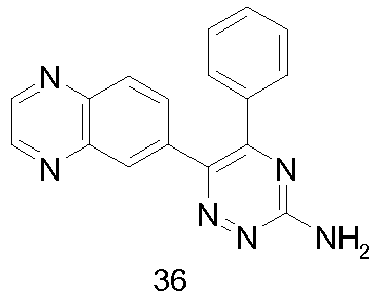
- In accordance with the synthetic route of Example 23, the starting compound 23a in Step 1 was replaced with 6-(4,4,5,5-tetramethyl-1,3,2-dioxaborolan-2-yl)quinoxaline 36a (prepared according to the known method disclosed in " Organic Letters, 2009, 11(13), 2860-2863"), accordingly, the title product 36 (20 mg) was prepared.
MS m/z (ESI): 301.4 [M+1].
1H NMR (400 MHz, DMSO-d 6) δ 8.92-8.94 (m, 2H), 8.03-8.05 (m, 2H), 7.82-7.85 (m, 1H), 7.60 (m, 2H), 7.43-7.46 (m, 3H), 7.34-7.36 (m, 2H). -

- In accordance with the synthetic route of Example 23, the starting compound 23a in Step 1 was replaced with 2-methyl-6-(4,4,5,5-tetramethyl-1,3,2-dioxaborolan-2-yl)quinoline 37a (prepared according to the known method disclosed in " Journal of the American Chemical Society, 2015, 137(4), 1593-1600"), accordingly, the title product 37 (20 mg) was prepared.
MS m/z (ESI): 314.4 [M+1].
1H NMR (400 MHz, DMSO-d 6) δ 8.19-8.21 (d, 1H), 8.02 (s, 1H), 7.78-7.80 (d, 1H), 7.50-7.53 (m, 3H), 7.40-7.43 (m, 4H), 7.32-7.34 (m, 2H), 2.65 (s, 3H). -


- Methyl 6-bromoquinoline-8-carboxylate 38a (400 mg, 1.5 mmol, prepared according to the method disclosed in the patent application "
WO2011020193A1 ") was dissolved in 15 mL of methanol. The reaction solution was added dropwise with 5 mL of 40% aqueous ammonia, and stirred overnight. The reaction solution was added with water, and extracted with ethyl acetate three times. The organic phases were combined, washed with saturated sodium chloride solution, dried over anhydrous sodium sulfate, and filtrated. The filtrate was concentrated under reduced pressure, and the residue was purified by silica gel column chromatography with elution system B to obtain the title product 38b (280 mg), yield: 74%.
MS m/z (ESI): 251.0 [M+1]. - Compound 38b (190 mg, 0.76 mmol) was dissolved in 20 mL of dichloromethane. The reaction solution was added successively with triethylamine (115 mg, 1.14 mmol) and trifluoroacetic anhydride (238 mg, 1.14 mmol), and stirred for 2 hours. The reaction solution was added with water, and extracted with dichloromethane three times. The organic phases were combined, washed with saturated sodium chloride solution, dried over anhydrous sodium sulfate, and filtrated. The filtrate was concentrated under reduced pressure, and the residue was pulped in methanol and filtrated. The filter cake was collected to obtain the title compound (180 mg), yield: 100%.
MS m/z (ESI): 232.9 [M+1]. - In accordance with the similar synthetic route of Example 11, the starting compound 11b in Step 2 was replaced with 38c, accordingly, the title product 38 (25 mg) was prepared.
MS m/z (ESI): 325.4 [M+1].
1H NMR (400MHz, DMSO-d 6) δ 9.08 (d, 1H), 8.51 (d, 1H), 8.45 (s, 1H), 8.13(s, 1H), 7.73(d, 1H), 7.71 (brs, 2H), 7.43-7.45 (m, 3H), 7.36-7.38 (m, 2H). -


- 3-Bromo-6-chloroquinoline 39a (266 mg, 1.1 mmol, prepared according to the known method disclosed in " Journal of Heterocyclic Chemistry, 2015, 52(4), 1019-1025"), morpholine (87 mg, 1 mmol), palladium acetate (12 mg, 0.05 mmol), (±)-2,2'-bis-(diphenylphosphino)-1,1'-binaphthalene (31 mg, 0.05 mmol) and cesium carbonate (652 mg, 2 mmol) were dissolved in 10 mL of tetrahydrofuran under an argon atmosphere. The reaction solution was heated to 70°C, and stirred overnight. The reaction was stopped, and the reaction solution was cooled to room temperature and filtrated. The filtrate was concentrated under reduced pressure, and the residue was purified by CombiFlash rapid preparation instrument with elution system A to obtain the title product 39b (180 mg), yield: 66.2%.
MS m/z (ESI): 249.7 [M+1]. - In accordance with the similar synthetic route of Example 11, the starting compound 11b in Step 2 was replaced with 39b, accordingly, the title product 39 (25 mg) was prepared.
MS m/z (ESI): 385.2 [M+1].
1H NMR (400 MHz, DMSO-d 6) δ 8.88 (s, 1H), 7.93 (s, 1H), 7.73-7.76 (d, 1H), 7.40-7.52 (m, 6H), 7.26-7.33 (m, 3H), 3.80 (m, 4H), 3.28 (m, 4H). -


- Lithium aluminum hydride (150.76 mg, 3.97 mmol) was added to 50 mL of tetrahydrofuran. The reaction solution was added with 6-bromoquinoline-4-carboxylic acid 40a (1.0 g, 3.97 mmol, prepared according to the known method disclosed in " Chinese Chemical Letters, 2010, 21(1), 35-38") in batches at 0°C, and stirred for 2 hours. The reaction solution was added with 5 mL of water, and filtrated through celite. The filter cake was washed with ethyl acetate, and the filtrate was concentrated under reduced pressure. The residue was purified by CombiFlash rapid preparation instrument with elution system A to obtain the title product 40b (250 mg), yield: 26.5%.
- Compound 40b (250 mg, 1.05 mmol) was added to 10 mL dichloromethane. The reaction solution was added with 2 mL of thionyl chloride, and stirred for 3 hours. The reaction solution was concentrated to dryness under reduced pressure, and the residue was purified by CombiFlash rapid preparation instrument with elution system A to obtain the title product 40c (180 mg), yield: 66.8%.
- In accordance with the similar synthetic route of Example 39, the starting compound 39a in Step 1 was replaced with compound 40c, accordingly, the title product 40 (5 mg) was prepared.
MS m/z (ESI): 399.1 [M+1].
1H NMR (400 MHz, DMSO-d 6) δ 8.82-8.83 (m, 1H), 8.16 (s, 1H), 7.98-8.00 (d, 1H), 7.86-7.88 (d, 1H), 7.53 (m, 2H), 7.42-7.47 (m, 4H), 7.35-7.37 (m, 2H), 3.61 (s, 2H), 3.49 (m, 4H), 2.30 (m, 4H). -


- In accordance with the similar synthetic route of Example 40, the starting compound 40b in Step 2 was replaced with compound 28a, accordingly, the title product 41 (5 mg) was prepared.
MS m/z (ESI): 399.5 [M+1].
1H NMR (400 MHz, DMSO-d 6) δ 8.82-8.83 (m, 1H), 8.16 (s, 1H), 8.01-8.06 (m, 1H), 7.84-7.86 (d, 1H), 7.48-7.50 (m, 3H), 7.37-7.41 (m, 3H), 7.30-7.32 (m, 2H), 3.64 (s, 2H), 3.56 (m, 4H), 2.39 (m, 4H). -

- In accordance with the synthetic route of Example 14, the starting compound 14a in Step 1 was replaced with compound 38b, accordingly, the title product 42 (14 mg) was prepared.
MS m/z (ESI): 343.3 [M+1].
1H NMR (400MHz, DMSO- d 6) δ 10.16 (s, 1H), 9.01 (s, 1H), 8.55 (s, 1H), 8.45 (d, 1H), 8.19 (s, 1H), 7.90 (s, 1H), 7.64 (d, 1H), 7.58 (brs, 2H), 7.41-7.44 (m, 3H), 7.33-7.35 (m, 2H). -


- In accordance with the similar synthetic route of Example 39, the starting compound 39a in Step 1 was replaced with 6-bromo-4-chloroquinoline 43a (prepared according to the known method disclosed in " Journal of Medicinal Chemistry, 2015, 58(14), 5522-5537"), accordingly, the title compound 43 (50 mg) was prepared.
MS m/z (ESI): 385.2 [M+1].
1H NMR (400 MHz, DMSO-d 6) δ 8.66-8.68 (m, 1H), 8.01-8.02 (m, 2H), 7.71 (s, 1H), 7.46-7.48 (m, 4H), 7.35-7.38 (m, 3H), 6.92-6.93 (m, 1H), 3.56-3.58 (m, 4H), 2.71-2.73 (m, 4H). -


- Compound 14a (500 mg, 2.25 mmol) was dissolved in 50 mL of tetrahydrofuran. The reaction solution was added dropwise with diisopropylamino lithium (723.54 mg, 6.75 mmol) at -78°C, and stirred for 1 hour. The reaction solution was added with methyl iodide (3.20 g, 22.51 mmol), gradually warmed up to room temperature, and stirred overnight. The reaction solution was added with saturated aqueous ammonium chloride solution, and extracted with ethyl acetate three times. The organic phases were combined, washed with saturated sodium chloride solution once, dried over anhydrous sodium sulfate, and filtrated. The filtrate was concentrated under reduced pressure, and the residue was purified by CombiFlash rapid preparation instrument with elution system B to obtain the title product 44a (480 mg), yield: 90.3%.
- In accordance with the similar synthetic route of Example 25, the starting compound 25a in Step 1 was replaced with compound 44a, and the starting compound 1c in Step 2 was replaced with compound 8a, accordingly, the title compound 44 (40 mg) was prepared.
MS m/z (ESI): 346.5 [M+1].
1H NMR (400 MHz, DMSO-d 6) δ 8.78-8.79 (m, 1H), 7.98-8.03 (m, 2H), 7.81-7.83 (d, 1H), 7.47-7.51 (m, 4H), 7.36-7.37 (m, 1H), 7.17-7.22 (m, 2H), 2.88-2.90 (m, 2H), 1.05-1.09 (t, 3H). -


- 2-Amino-3-fluorobenzonitrile 45a (1 g, 7.35 mmol, purchased from Shanghai Bide Pharmatech Ltd.) was dissolved in 50 mL of dichloromethane. The reaction solution was added with N-bromosuccinimide (1.37 g, 7.71 mmol), and stirred for 16 hours. The reaction solution was added with water, and extracted with dichloromethane (50 mL×3). The organic phases were combined, washed with saturated sodium chloride solution (20 mL), dried over anhydrous sodium sulfate, and concentrated under reduced pressure. The residue was purified by CombiFlash rapid preparation instrument with elution system B to obtain the title product 45b (1.25 g), yield: 79.13%.
MS m/z (ESI):215.0 [M+1]. - Compound 45b (1 g, 4.65 mmol) was dissolved in 60 mL of tetrahydrofuran. The reaction solution was added dropwise with methylmagnesium bromide (2.77 g, 23.25 mmol) at -10°C, and stirred for 4 hours. The reaction solution was added with water, and extracted with ethyl acetate (20 mL×3). The organic phases were combined, washed with saturated sodium chloride solution (20 mL), dried over anhydrous sodium sulfate, and concentrated under reduced pressure. The residue was purified by CombiFlash rapid preparation instrument with elution system B to obtain the title product 45c (900 mg), yield: 83.41%.
- Compound 45c (0.9 g, 3.88 mmol), triethyl orthoformate (862 mg, 5.82 mmol) and ammonium acetate (448 mg, 5.82 mmol) were added to a 250 mL reaction flask. The reaction mixture was stirred at 110°C for 2 hours, and then cooled. The residue was purified by CombiFlash rapid preparation instrument with elution system B to obtain the title product 45d (300 mg), yield: 32.09%.
MS m/z (ESI):241.0 [M+1]. - In accordance with the synthetic route of Example 34, the starting compound 34a in Step 1 was replaced with compound 45d, accordingly, the title product 45 (40 mg, yield: 30.16%) was prepared.
MS m/z (ESI): 333.4 [M+1].
1H NMR (400 MHz, DMSO-d 6) δ 9.16 (s, 1H), 8.03 (s, 1H), 7.76-7.79 (m, 1H), 7.65 (br, 2H), 7.44-7.46 (m, 3H), 7.38-7.40 (m, 2H), 2.72 (s, 3H). -


- In accordance with the synthetic route of Example 15, the starting compound 1c in Step 3 was replaced with 6-bromo-5-(4-chlorophenyl)-1,2,4-triazin-3-amine 46a (prepared according to the method disclosed in the patent application "
WO201195625A1
MS m/z (ESI): 348.8 [M+1].
1H NMR (400 MHz, DMSO-d 6) δ 9.12 (s, 1H), 8.30 (s, 1H), 7.87-7.90 (m, 2H), 7.62 (br, 2H), 7.45(m, 4H), 2.79 (s, 3H). -


- Compound 16c (480 mg, 2.00 mmol) was dissolved in 10 mL of tetrahydrofuran under an argon atmosphere. The reaction solution was added dropwise with diisopropylamino lithium (257.02 mg, 2.40 mmol) at -78°C, and stirred for 1 hour. The reaction solution was then added with methyl iodide (297.98 mg, 2.10 mmol), and stirred for 2 hours. The reaction solution was added with water, and extracted with ethyl acetate (30 mL×3). The organic phases were combined, washed with saturated sodium chloride solution (20 mL), and dried over anhydrous sodium sulfate. The residue was purified by CombiFlash rapid preparation instrument with elution system B to obtain the title product 47a (120 mg), yield: 23.6%.
- In accordance with the synthetic route of Example 14, the starting compound 14a in Step 1 was replaced with compound 47a, accordingly, the title product 47 (30 mg, yield: 37.37%) was prepared.
MS m/z (ESI): 346.5[M+1].
1H NMR (400 MHz, DMSO-d 6) δ 8.81-8.82 (m, 1H), 7.79 (s, 1H), 7.58-7.66 (m, 1H), 7.47 (br, 2H), 7.36-7.45 (m, 6H), 2.81-2.82 (m, 2H), 0.99-1.03 (t, 3H). -

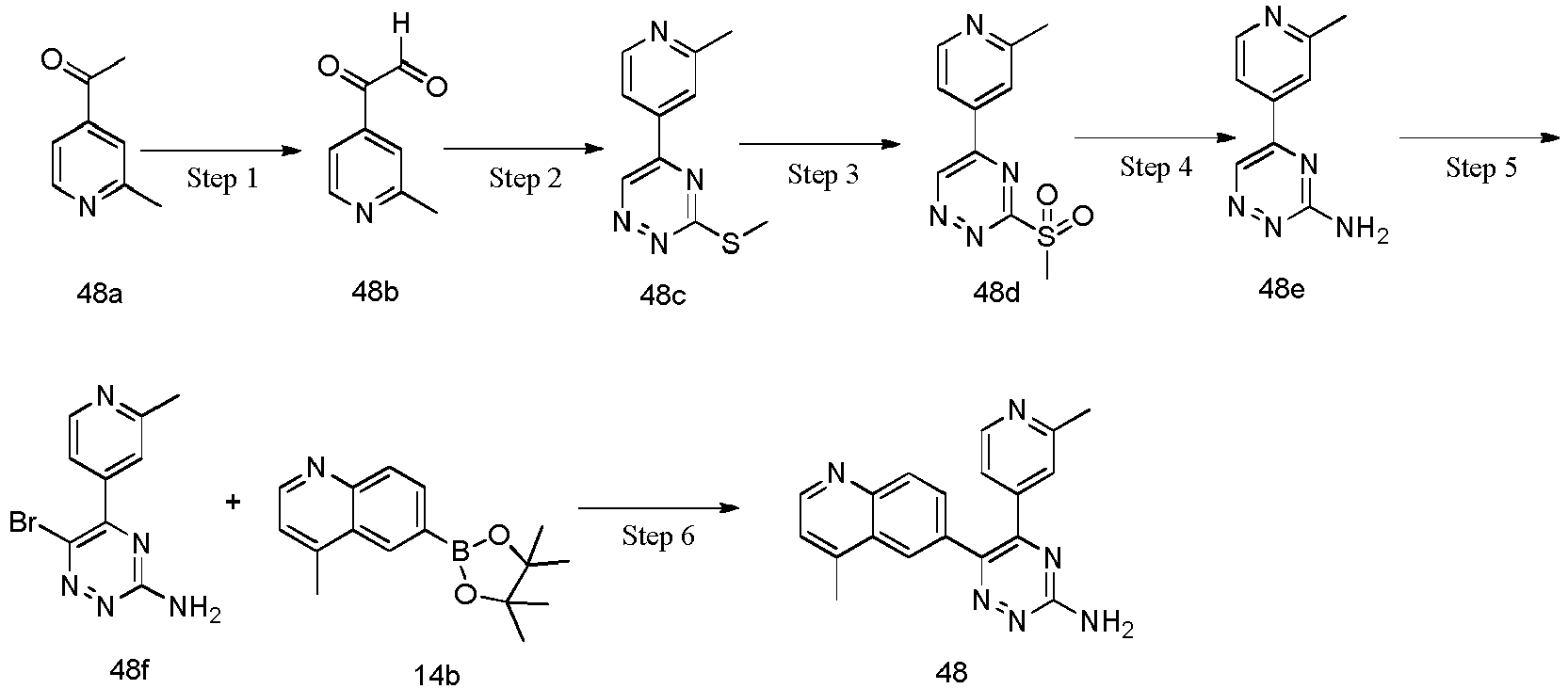
- 1-(2-Methylpyridin-4-yl)ethan-1-one 48a (4.29 g, 31.74 mmol, prepared according to the known method disclosed in " Journal of Medicinal Chemistry, 2015, 58(12), 5028-5037") was dissolved in 35 mL of dimethyl sulfoxide. The reaction solution was then added with 35 mL of hydrobromic acid, and stirred at 55°C overnight. The reaction solution was used directly in the next step.
- S-Methylisothiosemicarbazide hydroiodide (8.87 g, 38.06 mmol) and sodium bicarbonate (28 g, 333.31 mmol) were added to 300 mL of ethanol, followed by slow addition of the reaction solution containing the crude comound 48b (4.73 g, 31.71 mmol). After completion of the addition, the reaction solution was stirred at 80°C for 1 hour. The reaction solution was concentrated under reduced pressure, added with water, and extracted with ethyl acetate (100 mL×2). The organic phases were combined, washed with water (80 mL×3) and saturated sodium chloride solution (80 mL), dried over anhydrous sodium sulfate, and concentrated under reduced pressure. The residue was purified by CombiFlash rapid preparation instrument with elution system A to obtain the title product 48c (5.6 g), yield: 80.90%.
MS m/z (ESI): 219.4[M+1]. - Compound 48c (5.4 g, 24.74 mmol) was dissolved in 180 mL of dichloromethane, followed by addition of m-chloroperoxybenzoic acid (8 g, 46.36 mmol). The reaction solution was stirred for 3 hours. The reaction solution was filtrated, and the filtrate was concentrated under reduced pressure to obtain the crude title product 48d (8.5 g), which was used directly in the next step without purification.
- The crude compound 48d (8.5 g, 33.96 mmol) was dissolved in 80 mL of dioxane. The reaction solution was added with 20 mL of aqueous ammonia, and stirred for 1 hour. The reaction solution was concentrated under reduced pressure, and the residue was purified by CombiFlash rapid preparation instrument with elution system A to obtain the title product 48e (1.6 g), yield: 25.17%.
MS m/z (ESI): 188.1[M+1]. - Compound 48e (1.6 g, 8.55 mmol) was added to 200 mL of acetonitrile. The reaction solution was then added with N-bromosuccinimide (3.80 g, 21.37 mmol) and trifluoroacetic acid (1.95 g, 17.09 mmol), and stirred for 64 hours. The reaction solution was concentrated under reduced pressure, and added with water. The aqueous phase was extracted with ethyl acetate (100 mL×3). The organic phases were combined, dried over anhydrous sodium sulfate, and filtrated. The filtrate was concentrated under reduced pressure, and the residue was purified by CombiFlash rapid preparation instrument with elution system A to obtain the title product 48f (1.87 g), yield: 82.22%.
- Compound 14b (100 mg, 375 µmol), compound 48f (101 mg, 375 µmol), [1,1'-bis(diphenylphosphino)ferrocene]dichloropalladium (55 mg, 75 µmol) and potassium carbonate (155 mg, 1.13 mmol) were dissolved in 12 mL of a mixed solution of 1,4-dioxane and water (V/V = 5:1) under an argon atmosphere. The reaction solution was stirred at 80°C for 2 hours. The reaction solution was cooled, and filtrated through celite. The filtrate was concentrated under reduced pressure, and the residue was purified by CombiFlash rapid preparation instrument with elution system A to obtain the title product 48 (30 mg), yield: 24.31%.
MS m/z (ESI): 329.5[M+1].
1H NMR (400 MHz, DMSO-d 6) δ 8.75-8.77 (m, 1H), 8.37-8.38 (m, 1H), 8.07 (s, 1H), 7.93-7.95 (m, 1H), 7.70-7.72 (m, 1H), 7.65 (br, 2H), 7.38-7.40 (m, 2H), 7.06-7.07 (m, 1H), 2.50 (s, 3H), 2.42 (s, 3H). -


- 5 mL of 4M hydrogen chloride in 1,4-dioxane were added to 6-bromo-4-chloroquinoline 49a (1 g, 4.12 mmol). The reaction solution was stirred for 10 minutes, and concentrated under reduced pressure for following use. The above concentrated residue was added with 60 mL of acetonitrile, followed by addition of sodium iodide (6.18 g, 41.24 mmol). The reaction solution was stirred under reflux for 16 hours. The reaction solution was cooled to room temperature, concentrated under reduced pressure, added with saturated sodium bicarbonate solution, and extracted with ethyl acetate (20 mL×3). The organic phases were combined, dried over anhydrous sodium sulfate, and concentrated under reduced pressure. The residue was purified by CombiFlash rapid preparation instrument with elution system B to obtain the title product 49b (850 mg), yield: 61.72%.
MS m/z (ESI): 333.9[M+1]. - Compound 49b (350 mg, 1.05 mmol), cyclopropylboronic acid (99 mg, 1.15 mmol), [1,1'-bis(diphenylphosphino)ferrocene]dichloropalladium (153 mg, 209 µmol) and potassium carbonate (433 mg, 3.14 mmol) were added to 30 mL of 1,4-dioxane under an argon atmosphere. The reaction solution was stirred at 80°C for 16 hours. The reaction solution was cooled and filtrated. The filtrate was concentrated under reduced pressure, and the residue was purified by CombiFlash rapid preparation instrument with elution system B to obtain the title product 49c (110 mg), yield: 42.30%.
MS m/z (ESI): 250.1[M+1]. - In accordance with the synthetic route of Example 22, the starting compound 22a in Step 2 was replaced with compound 49c, accordingly, the title product 49 (40 mg, yield: 27.53%) was prepared.
MS m/z (ESI): 358.5[M+1].
1H NMR (400 MHz, DMSO-d 6) δ 8.74-8.75 (m, 1H), 8.34(s, 1H), 7.96-7.98 (m, 1H), 7.78-7.80 (m, 1H), 7.48-7.52 (m, 4H), 7.18-7.22 (m, 2H), 7.14-7.15 (m, 1H), 2.27-2.28 (m, 1H), 0.97-0.99 (m, 2H), 0.71-0.73 (m, 2 H). -

- In accordance with the synthetic route of Example 22, the starting compound 22a in Step 2 was replaced with compound 45d, accordingly, the title product 50 (54 mg, yield: 41.48%) was prepared.
MS m/z (ESI): 351.0 [M+1].
1H NMR (400 MHz, DMSO-d 6) δ 9.18 (s, 1H), 8.08 (s, 1H), 7.76-7.79 (m, 1H), 7.66 (br, 2H), 7.49-7.53 (m, 2H), 7.20-7.25 (m, 2H), 2.77 (s, 3H). -


- Compound 14a (1.0 g, 4.50 mmol) was dissolved in 20 mL of 1,4-dioxane. The reaction solution was added with 2 mL of water, followed by addition of selenium dioxide (1.5 g, 13.51 mmol). The reaction solution was stirred at 80°C for 16 hours, and then cooled to room temperature, added with saturated sodium bicarbonate solution, and extracted with ethyl acetate (30 mL×3). The organic phases were combined, washed with saturated sodium chloride solution, dried over sodium sulfate, and filtrated. The filtrate was concentrated under reduced pressure, and the residue was purified by silica gel column chromatography with elution system B to obtain the title compound 51a (670 mg), yield: 63.0%.
- Compound 51a (670 mg, 2.84 mmol) was dissolved in 20 mL of dichloromethane. The reaction solution was added dropwise with diethylaminosulfur trifluoride (915 mg, 5.68 mmol), and stirred for 16 hours. The reaction solution was added with saturated sodium bicarbonate solution, and stirred for 30 minutes. The reaction solution was extracted with dichloromethane (20 mL×3). The organic phases were combined, washed with saturated sodium chloride solution, dried over sodium sulfate, and filtrated. The filtrate was concentrated under reduced pressure, and the residue was purified by silica gel column chromatography with elution system B to obtain the title compound 51b (630 mg), yield: 86.0%.
- In accordance with the similar synthetic route of Example 25, the starting compound 25a in Step 1 was replaced with compound 51b, and the starting compound 1c in Step 2 was replaced with compound 8a, accordingly, the title compound 51 (55 mg) was prepared.
MS m/z (ESI): 368.5 [M+1].
1H NMR (400 MHz, DMSO-d 6) δ 9.05 (d, 1H), 8.21 (s, 1H), 8.08 (d, 1H), 7.80(d, 1H), 7.75 (d, 1H), 7.53 (brs, 2H), 7.48 (t, 1H), 7.47 (q, 2H), 7.19 (t, 2H). -


- Compound 15b (200 mg, 0.90 mmol) was suspended in 4 mL of deuteroxide. The reaction solution was added with benzoic acid (10.95 mg, 0.09 mmol), and stirred at 100°C for 48 hours. The reaction solution was added with saturated sodium bicarbonate solution, and extracted with ethyl acetate (20 mL×3). The organic phases were combined, washed with saturated sodium chloride solution, dried over sodium sulfate, and filtrated. The filtrate was concentrated under reduced pressure, and the residue was purified by CombiFlash rapid preparation instrument with elution system B to obtain the title compound 52a (150 mg), yield: 74.0%.
- In accordance with the similar synthetic route of Example 25, the starting compound 25a in Step 1 was replaced with compound 52a, and the starting compound 1c in Step 2 was replaced with compound 8a, accordingly, the title compound 52 (18 mg) was prepared.
MS m/z (ESI): 336.5 [M+1].
1H NMR (400 MHz, DMSO-d 6) δ 9.11 (s, 1H), 8.28 (s, 1H), 7.85-8.28 (m, 2H), 7.59 (brs, 2H), 7.46-7.50 (m, 2H), 7.20 (t, 2H). -


- 2-Amino-5-bromobenzonitrile 53a (500 mg, 2.54 mmol, prepared according to the known method disclosed in " European Journal of Medicinal Chemistry, 2014, 76, 341-343") was dissolved in 10 mL of tetrahydrofuran. The reaction solution was cooled in an ice bath, added dropwise with 12.69 mL of 1.0 M ethyl magnesium bromide under an argon atmosphere, and stirred for 2 hours. The reaction solution was added with 6 M hydrochloric acid, and stirred for 2 hours. The reaction solution was added with saturated sodium carbonate solution, and extracted with ethyl acetate (50 mL×3). The organic phases were combined, washed with saturated sodium chloride solution, dried over sodium sulfate, and filtrated. The filtrate was concentrated under reduced pressure, and the residue was purified by CombiFlash rapid preparation instrument with elution system B to obtain the title compound 53b (440 mg), yield: 76.02%.
- Compound 53b (440 mg, 1.93 mmol), triethyl orthoformate (857.68 mg, 5.79 mmol) and ammonium acetate (451.14 mg, 5.79 mmol) were mixed, heated to 110°C and stirred for 16 hours. The reaction solution was added with saturated sodium carbonate solution, and extracted with ethyl acetate (20 mL×3). The organic phases were combined, washed with saturated sodium chloride solution, dried over sodium sulfate, and filtrated. The filtrate was concentrated under reduced pressure, and the residue was purified by CombiFlash rapid preparation instrument with elution system B to obtain the title compound 53c (280 mg), yield: 61.22%.
- In accordance with the similar synthetic route of Example 25, the starting compound 25a in Step 1 was replaced with compound 53c, and the starting compound 1c in Step 2 was replaced with compound 8a, accordingly, the title compound 53 (45 mg) was prepared.
MS m/z (ESI): 347.5 [M+1].
1H NMR (400 MHz, DMSO-d 6) δ 9.15 (s, 1H), 8.21 (s, 1H), 7.94-8.01 (m, 2H), 7.57 (brs, 2H), 7.47-7.50 (m, 2H), 7.20 (t, 2H), 3.10 (q, 2H), 1.16 (t, 3H). -


- Ethyl trifluoroacetoacetate (1.24 g, 6.75 mmol) and triethylamine (1.65 g, 16.28 mmol) were added to 20 mL of toluene. The reaction solution was then added dropwise with 3 mL of 2.7 M 4-bromoaniline 54a in toluene, and stirred under reflux for 16 hours. The reaction solution was concentrated under reduced pressure. The residue was added with 30 mL of dichloromethane, washed with water (20 mL×2) and saturated sodium chloride solution (20 mL), dried over anhydrous sodium sulfate, and filtered. The filtrate was concentrated under reduced pressure. The resulting intermediate was added with 6 mL of sulfuric acid, and stirred at 100°C for 4 hours. The reaction solution was cooled to room temperature, added dropwise with saturated sodium bicarbonate solution to adjust the pH to greater than 10, and extracted with ethyl acetate (30 mL×3). The organic phases were combined, dried over anhydrous sodium sulfate, and filtrated. The filtrate was concentrated under reduced pressure, and the residue was purified by CombiFlash rapid preparation instrument with elution system B to obtain the title product 54b (1.5 g), yield: 63.70%.
MS m/z (ESI): 291.9[M+1]. - Compound 54b (1.5 g, 5.14 mmol) was added with phosphorus oxychloride (4.73 g, 30.82 mmol), and stirred at 100°C for 5 hours. The reaction solution was cooled, added to ice water, stirred for 30 minutes, and extracted with ethyl acetate (50 mL×3). The organic phases were combined, dried over anhydrous sodium sulfate, and concentrated under reduced pressure. The residue was purified by CombiFlash rapid preparation instrument with elution system B to obtain the title product 54c (1.3 g), yield: 81.52%.
- Compound 54c (500 mg, 1.61 mmol) was dissolved in 8 mL of trifluoroacetic acid. The reaction solution was then added with zinc powder (842 mg, 12.88 mmol), and stirred for 16 hours. The reaction solution was filtrated and concentrated under reduced pressure. The residue was added dropwise with 1 M sodium hydroxide until the pH was greater than 10, and extracted with ethyl acetate (30 mL×3). The organic phases were combined, dried over anhydrous sodium sulfate, and concentrated under reduced pressure. The residue was purified by CombiFlash rapid preparation instrument with elution system B to obtain the title product 54d (200 mg), yield: 44.99%.
MS m/z (ESI): 275.8 [M+1]. - In accordance with the synthetic route of Example 22, the starting compound 22a in Step 2 was replaced with compound 54d, accordingly, the title product 54 (30 mg) was prepared.
MS m/z (ESI): 386.4[M+1].
1H NMR (400 MHz, DMSO-d 6) δ 9.11-9.12 (m, 1H), 8.19-8.21 (m, 1H), 7.99-8.03 (m, 2H), 7.93-7.94 (m, 1H), 7.62 (br, 2H), 7.47-7.50 (m, 2H), 7.18-7.23 (m, 2H). -


- 6-Bromo-4-chloroquinazoline 55a (1.0 g, 4.10 mmol) was dissolved in 80 mL of methanol. The reaction solution was added with sodium methoxide (2.21 g, 41.05 mmol), and stirred for 3 hours. The reaction solution was concentrated to dryness, added with water, and filtrated. The filter cake was dried to obtain the product 55b (0.55 g), yield: 56.01%.
MS m/z (ESI): 239.1[M+1]. - In accordance with the synthetic route of Example 22, the starting compound 22a in Step 2 was replaced with compound 55b, accordingly, the title product 55 (40 mg) was prepared. Yield: 31.29%.
MS m/z (ESI): 349.2 [M+1].
1H NMR (400 MHz, DMSO-d 6) δ 8.82 (s, 1H), 8.28 (s, 1H), 7.81-7.83 (m, 1H), 7.72-7.74 (m, 1H), 7.56 (br, 2H), 7.47-7.50 (m, 2H), 7.18-7.22 (m, 2H), 4.12 (s, 3H). - Test Example 1. Determination of the inhibition activity of the compounds of the present invention on the adenosine A2a receptor (A2aR) cAMP signaling pathway, the adenosine A2b receptor (A2bR) cAMP signaling pathway, the adenosine A1 receptor (A1R) cAMP signaling pathway and the adenosine A3 receptor (A3R) cAMP signaling pathway.
- The inhibition activity of the compounds of the present invention on the adenosine A2a receptor (A2aR) cAMP signaling pathway, the adenosine A2b receptor cAMP signaling pathway, the adenosine A1 receptor cAMP signaling pathway and the adenosine A3 receptor cAMP signaling pathway was determined by the following method. The experimental method is briefly described as follows:
- I. Experimental materials and instruments
- 1. CHO-K1/A2aR cells (NM_000675.5) or CHO-K1/A2bR cells (NM_000676.2) or CHO-K1/A1R cells (NM_000674.2) or CHO-K1/A3R cells (NM_000677.3)
- 2. Fetal bovine serum (Gibco, 10099-141)
- 3. Bleomycin (Thermo, R25001) or G418 (ENZO, ALX-380-013-G005) or puromycin (Thermo, 10687-010)
- 4. DMEM/F12 medium (GE, SH30023.01)
- 5. Cell separation buffer (Thermo Fisher, 13151014)
- 6. HEPES (Gibco, 42360-099)
- 7. Bovine serum albumin (MP Biomedicals, 219989725)
- 8. Rolipram (sigma, R6520-10MG)
- 9. Adenosine deaminase (sigma, 10102105001)
- 10. Forskolin (sigma, F6886)
- 11. 2C1-IB-MECA(Tocrics, 1104/10)
- 12. N6-cyclopentyladenosine (Tocris, 1702/50)
- 13. Balanced salt buffer (Thermo, 14025-092)
- 14. cAMP dynamic 2 kit (Cisbio, 62AM4PEB)
- 15. 384-well plate (Corning, 4514) or (Nunc, 267462#)
- 16. Ethyl carbazole (Torcis, 1691/10)
- 17. PHERAstar multi-function microplate reader (Cisbio, 62AM4PEB)
- II. Experimental procedures
- CHO-K1/A2aR cells were cultured in DMEM/F12 medium containing 10% fetal bovine serum and 800 µg/ml bleomycin. The cells were digested with the cell separation buffer during the experiment. The cells were resuspended in the balanced salt buffer containing 20 mM HEPES and 0.1% bovine serum albumin and counted, the cell density was adjusted to 106 cells/ml. In the 384-well plate, each well was added with 5 µl of cell suspension, and 2.5 µl of test compound (4× concentration) formulated with the balanced salt buffer containing 20 mM HEPES, 0.1% bovine serum albumin, 54 µM rolipram and 2.7 U/ml adenosine deaminase, and the plate was incubated at room temperature for 30 minutes. Each well was then added with 2.5 µl of ethyl carbazole (4× concentration) formulated with the balanced salt buffer containing 20 mM HEPES, 0.1% bovine serum albumin, 54 µM rolipram and 2.7 U/ml adenosine deaminase, and the plate was incubated at room temperature for 30 minutes. The final concentrations of the compounds were: 10000, 2000, 400, 80, 16, 3.2, 0.64, 0.128, 0.0256, 0.00512, and 0.001024 nM. The final concentration of ethyl carbazole was 20 nM. Intracellular cAMP concentration was detected with the cAMP dynamic 2 kit. cAMP-d2 and Anti-cAMP-Eu-Cryptate were diluted respectively with the cAMP lysis buffer at a ratio of 1:4. Each well was added with 5 µl of diluted cAMP-d2, followed by addition of 5 µl of diluted Anti-cAMP-Eu-Cryptate, and the plate was incubated at room temperature in the dark for 1 hour. The HTRF signal values were read by the PHERAstar multi-function microplate reader. IC50 values of inhibition activity of the compounds were calculated by Graphpad Prism software, and are shown in Table 1.
- CHO-K1/A2bR cells were cultured in DMEM/F12 medium containing 10% fetal bovine serum and 1mg/ml G418. The cells were digested with the cell separation buffer during the experiment. The cells were resuspended in the balanced salt buffer containing 20 mM HEPES and 0.1% bovine serum albumin and counted, the cell density was adjusted to 106 cells/ml. In the 384-well plate, each well was added with 5 µl of cell suspension, and 2.5 µl of test compound (4× concentration) formulated with the balanced salt buffer containing 20 mM HEPES, 0.1% bovine serum albumin, 54 µM rolipram and 2.7 U/ml adenosine deaminase, and the plate was incubated at room temperature for 30 minutes. Each well was then added with 2.5 µl of ethyl carbazole (4× concentration) (Torcis, 1691/10) formulated with the balanced salt buffer containing 20 mM HEPES, 0.1% bovine serum albumin, 54 µM rolipram and 2.7 U/ml adenosine deaminase, and the plate was incubated at room temperature for 30 minutes. The final concentrations of the compounds were: 100000, 10000, 1000, 100, 10, 1, 0.1 and 0 nM. The final concentration of ethyl carbazole was 1 µM. Intracellular cAMP concentration was detected with the cAMP dynamic 2 kit. cAMP-d2 and Anti-cAMP-Eu-Cryptate were diluted respectively with the cAMP lysis buffer at a ratio of 1:4. Each well was added with 5 µl of diluted cAMP-d2, followed by addition of 5 µl of diluted Anti-cAMP-Eu-Cryptate, and the plate was incubated at room temperature in the dark for 1 hour. The HTRF signal values were read by the PHERAstar multi-function microplate reader. IC50 values of inhibition activity of the compounds were calculated by Graphpad Prism software, and are shown in Table 2.
- CHO-K1/A1R cells were cultured in DMEM/F12 medium containing 10% fetal bovine serum and 1mg/ml G418. The cells were digested with the cell separation buffer during the experiment. The cells were then resuspended in the balanced salt buffer containing 20 mM HEPES and 0.1% bovine serum albumin and counted, the cell density was adjusted to 5×10⁵ cells/ml. In the 384-well plate, each well was added with 12.5 µl of cell suspension, and 6.25 µl of test compound (4× concentration) formulated with the balanced salt buffer containing 20 mM HEPES, 0.1% bovine serum albumin, 54 µM rolipram and 2.7 U/ml adenosine deaminase, and the plate was incubated at room temperature for 30 minutes. Each well was then added with 6.25 µl of forskolin and N6-cyclopentyladenosine (4× concentration) formulated with the balanced salt buffer containing 20 mM HEPES, 0.1% bovine serum albumin, 54 µM rolipram and 2.7 U/ml adenosine deaminase, and the plate was incubated at room temperature for 30 minutes. The final concentrations of the compounds were: 100000, 10000, 1000, 100, 10, 1, 0.1 and 0 nM. The final concentrations of forskolin was 10 µM. The final concentrations of CPA was 10 nM. Intracellular cAMP concentration was detected with the cAMP dynamic 2 kit. cAMP-d2 and Anti-cAMP-Eu-Cryptate were diluted respectively with the cAMP lysis buffer at a ratio of 1:4. Each well was added with 12.5 µl of diluted cAMP-d2, followed by addition of 12.5 µl of diluted Anti-cAMP-Eu-Cryptate, and the plate was incubated at room temperature in the dark for 1 hour. The HTRF signal values were read by the PHERAstar multi-function microplate reader. IC50 values of inhibition activity of the compounds were calculated by Graphpad Prism software, and are shown in Table 3.
- CHO-K1/A3R cells were cultured in DMEM/F12 medium containing 10% fetal bovine serum and 10 µg/ml puromycin. The cells were digested with the cell separation buffer during the experiment. The cells were resuspended in the balanced salt buffer containing 20 mM HEPES and 0.1% bovine serum albumin and counted, the cell density was adjusted to 5×10⁵ cells/ml. In the 384-well plate, each well was added with 12.5 µl of cell suspension, and 6.25 µl of test compound (4× concentration) formulated with the balanced salt buffer containing 20 mM HEPES, 0.1% bovine serum albumin, 54 µM rolipram and 2.7 U/ml adenosine deaminase, and the plate was incubated at room temperature for 30 minutes. Each well was then added with 6.25 µl of forskolin and 2C1-IB-MECA (4× concentration) formulated with the balanced salt buffer containing 20 mM HEPES, 0.1% bovine serum albumin, 54 µM rolipram and 2.7 U/ml adenosine deaminase, and the plate was incubated at room temperature for 30 minutes. The final concentrations of the compounds were: 100000, 10000, 1000, 100, 10, 1, 0.1 and 0 nM. The final concentrations of forskolin was 10 µM. The final concentrations of 2C1-IB-MECA was 5 nM. Intracellular cAMP concentration was detected with the cAMP dynamic 2 kit. cAMP-d2 and Anti-cAMP-Eu-Cryptate were diluted respectively with the cAMP lysis buffer at a ratio of 1:4. Each well was added with 12.5 µl of diluted cAMP-d2, followed by addition of 12.5 µl of diluted Anti-cAMP-Eu-Cryptate, and the plate was incubated at room temperature in the dark for 1 hour. The HTRF signal values were read by the PHERAstar multi-function microplate reader. IC50 values of inhibition activity of the compounds were calculated by Graphpad Prism software, and are shown in Table 3.
Table 1 IC50 values of the inhibition activity of the compounds of the present invention on the adenosine A2a receptor (A2aR) cAMP signaling pathway. Example No. IC50 /nM (A2aR) 1 0.5 2 0.6 3 0.7 4 0.7 5 0.4 6 1.3 7 3.1 8 3.6 14 0.1 15 0.1 16 0.2 17 0.5 18 0.2 19 0.4 20 1.5 22 0.3 23 0.4 24 0.9 25 1.5 26 1.8 27 2.2 28 3.0 29 3.5 30 3.7 31 3.8 44 0.8 45 1.2 46 1.6 47 1.6 48 2.4 49 2.5 50 3.2 51 3.5 52 0.9 13 (Example 1 (lxxii) of WO2011095625 )158.3 - Conclusion: The compounds of the present invention have a significant inhibition activity on the adenosine A2a receptor. Compared with Comparative Example 1, the introduction of a nitrogen atom into the fused aryl moiety of the mother nucleus results in an unexpected inhibition activity of the compounds of the present invention on the adenosine A2a receptor. The structural difference between the compound of Comparative Example 1 and the compound of Example 3 is merely that the compound of Example 3 corresponds to the introduction of a nitrogen atom into the 5-position of the naphthyl of the compound of Comparative Example 1, but the inhibition activity on the adenosine A2a receptor differs by 225 times.
Table 2 IC50 values of the inhibition activity of the compounds of the present invention on the adenosine A2b receptor (A2bR) cAMP signaling pathway. Example No. IC50 /nM (A2bR) 3 47 4 4 5 46 14 3 15 7 16 18 17 22 19 25 22 7 23 17 25 4 45 25 46 18 52 14 - Conclusion: The compounds of the present invention have a good inhibition activity on the adenosine A2b receptor.
Table 3 IC50 values of the inhibition activity of the compounds of the present invention on the adenosine A1 receptor (A1R) cAMP signaling pathway and the adenosine A3 receptor cAMP signaling pathway. Example No. IC50/nM (A2aR) IC50/nM (A1R) IC50 ratio (A1R/A2aR) IC50/nM (A3R) IC50 ratio (A3R/A2aR) 1 0.5 121 242 >104 >104 2 0.6 133 221 >104 >104 3 0.7 97 139 >104 >104 15 0.1 248 2484 >104 >104 16 0.2 161 803 >104 >104 17 0.5 1349 2698 >104 >104 18 0.2 190 948 >104 >104 19 0.4 1423 3557 >104 >104 20 1.5 617 411 >104 >103 22 0.3 100 334 >104 >104 31 3.8 1639 431 >104 >103 44 0.8 646 807 >104 >104 45 1.2 930 775 >104 >103 48 2.4 3276 1365 >104 >103 50 3.2 3257 1018 >104 >103 52 0.9 876 973 >104 >104 - Conclusion: The compounds of the present invention have a weak inhibition activity on the adenosine A1 receptor and the adenosine A3 receptor, indicating that the compounds of the present invention are selective for the adenosine A2a receptor and the adenosine A2b receptor, particularly for the adenosine A2a receptor.
- Test Example 2. Pharmacokinetics assay of the compounds of the present invention in mice
- Mice were used as test animals. The drug concentration in plasma at different time points was determined by LC/MS/MS method after intragastrical administration of the compounds of Examples 2, 3, 17, 18, 19, 20, 31 and 44 to mice. The pharmacokinetic behavior of the compounds of the present invention was studied and evaluated in mice.
- Compounds of Examples 2, 3, 17, 18, 19, 20, 31 and 44.
- Seventy-two C57 mice (female) were purchased from Shanghai Jiesijie Laboratory Animal Co., LTD, with Certificate No.: SCXK (Shanghai) 2013-0006, and equally divided into 8 groups (9 mice per group).
- A certain amount of the test compound was weighed, and added with 5% by volume of DMSO, 5% by volume of tween 80 and 90% by volume of normal saline to prepare a 0.1 mg/mL colorless, clear and transparent solution.
- After an overnight fast, C57 mice were administered intragastrically the test compounds at an administration dosage of 2.0 mg/kg and an administration volume of 0.2 mL/10 g.
- The mice were intragastrically administered the compounds of Examples 2, 3, 17, 18, 19, 20, 31 and 44. 0.1 ml of blood was taken before administration and at 0.5, 1.0, 2.0, 4.0, 6.0, 8.0, 11.0 and 24.0 hours after administration. The samples were stored in heparinized tubes, and centrifuged for 10 minutes at 3,500 rpm to separate the blood plasma. The plasma samples were stored at -20°C.
- The content of the test compounds in the plasma of mice after intragastrical administration of the test compounds at different concentrations was determined: 25 µL of mouse plasma at each time after administration was taken, added with 50 µL of the internal standard solution of camptothecin (100 ng/mL) and 200 µL of acetonitrile, vortex-mixed for 5 minutes, and centrifuged for 10 minutes (4000 rpm). 5 µL of the supernatant was taken from the plasma samples for LC/MS/MS analysis.
- Pharmacokinetic parameters of the compounds of the present invention are shown below:
No. Pharmacokinetics assay in mice (2mg/kg) Plasma concentration Area under curve Half-life Residence time Clearance Apparent distribution volume Cmax (ng /mL) AUC (ng /mL*h) T1/2 (h) MRT (h) CLz/F (ml/min/kg) Vz/F (ml/kg) Example 2 441 412 2.17 1.79 78.3 14736 Example 3 395 419 2.3 1.61 78.6 15676 Example 17 265 204 1.09 1.17 162 15329 Example 18 402 495 1.59 1.43 65 9012 Example 19 1960 5030 2.74 3.13 6.61 1567 Example 20 866 1173 1.24 1.41 28 3047 Example 31 302 339 2.02 2.02 95 16716 Example 44 720 501 0.85 0.85 65 4794 - Conclusion: The compounds of the present invention are well absorbed, and have a pharmacokinetic advantage.
Claims (18)
- A compound of formula (I):

wherein:ring A is aryl or heteroaryl;G1, G2, G3 and G4 are identical or different and are each independently selected from the group consisting of C, CH and N;R1 is selected from the group consisting of hydrogen, halogen, alkyl, alkoxy, haloalkyl, hydroxy, hydroxyalkyl, cyano, amino, nitro, cycloalkyl, heterocyclyl, aryl, heteroaryl, -OR5, -C(O)R5, -S(O)mR5, NH2S(O)mR5, -NR6R7, S(O)mNR6R7 and -C(O)NR6R7, wherein the alkyl, alkoxy, haloalkyl, hydroxyalkyl, cycloalkyl, heterocyclyl, aryl and heteroaryl are each independently optionally substituted by one or more substituents selected from the group consisting of halogen, alkyl, alkoxy, haloalkyl, hydroxy, hydroxyalkyl, cyano, amino, nitro, cycloalkyl, heterocyclyl, aryl and heteroaryl;each R2 is identical or different and each is independently selected from the group consisting of hydrogen, halogen, alkyl, alkoxy, haloalkyl, hydroxy, hydroxyalkyl, cyano, amino, nitro, cycloalkyl, heterocyclyl, aryl, heteroaryl, -OR5, -C(O)R5, -S(O)mR5, NH2S(O)mR5, -NR6R7, S(O)mNR6R7 and -C(O)NR6R7, wherein the alkyl, alkoxy, haloalkyl, hydroxyalkyl, cycloalkyl, heterocyclyl, aryl and heteroaryl are each independently optionally substituted by one or more substituents selected from the group consisting of halogen, alkyl, alkoxy, haloalkyl, hydroxy, hydroxyalkyl, cyano, amino, nitro, cycloalkyl, heterocyclyl, aryl and heteroaryl;each R3 is identical or different and each is independently selected from the group consisting of hydrogen, halogen, alkyl, alkoxy, haloalkyl, deuterated alkyl, hydroxy, hydroxyalkyl, cyano, amino, nitro, cycloalkyl, heterocyclyl, aryl, heteroaryl, -OR5, -C(O)R5, -S(O)mR5, NH2S(O)mR5, -NR6R7, S(O)mNR6R7 and -C(O)NR6R7, wherein the alkyl, alkoxy, haloalkyl, hydroxyalkyl, cycloalkyl, heterocyclyl, aryl and heteroaryl are each independently optionally substituted by one or more substituents selected from the group consisting of halogen, deuterium, alkyl, alkoxy, haloalkyl, hydroxy, hydroxyalkyl, cyano, amino, nitro, cycloalkyl, heterocyclyl, aryl and heteroaryl;each R4 is identical or different and each is independently selected from the group consisting of hydrogen, halogen, alkyl, alkoxy, haloalkyl, hydroxy, hydroxyalkyl, cyano, amino, nitro, cycloalkyl, heterocyclyl, aryl, heteroaryl, -OR5, -C(O)R5, -S(O)mR5, NH2S(O)mR5, -NR6R7, S(O)mNR6R7 and -C(O)NR6R7, wherein the alkyl, alkoxy, haloalkyl, hydroxyalkyl, cycloalkyl, heterocyclyl, aryl and heteroaryl are each independently optionally substituted by one or more substituents selected from the group consisting of halogen, alkyl, alkoxy, haloalkyl, hydroxy, hydroxyalkyl, cyano, amino, nitro, cycloalkyl, heterocyclyl, aryl and heteroaryl;R5 is selected from the group consisting of hydrogen, alkyl, haloalkyl, amino, hydroxy, cycloalkyl, heterocyclyl, aryl and heteroaryl;R6 and R7 are each independently selected from the group consisting of hydrogen, alkyl, haloalkyl, cycloalkyl, heterocyclyl, aryl and heteroaryl, wherein the alkyl, cycloalkyl, heterocyclyl, aryl and heteroaryl are each independently optionally substituted by one or more substituents selected from the group consisting of alkyl, alkoxy, halogen, amino, cyano, nitro, hydroxy, hydroxyalkyl, cycloalkyl, heterocyclyl, aryl and heteroaryl;or, R6 and R7 together with the nitrogen atom to which they are attached form a heterocyclyl, wherein the heterocyclyl contains one or two identical or different heteroatoms selected from the group consisting of N, O and S, and the heterocyclyl is optionally substituted by one or more substituents selected from the group consisting of alkyl, alkoxy, halogen, amino, cyano, nitro, hydroxy, hydroxyalkyl, cycloalkyl, heterocyclyl, aryl and heteroaryl;m is 0, 1 or 2;r is 0, 1, 2 or 3;q is 0, 1 or 2; andn is 0, 1, 2, 3, 4 or 5. - The compound of formula (I) according to claim 1, being a compound of formula (Iaa):

wherein
ring A, G1, G2, R1, R3, R4, r and n are as defined in claim 1. - The compound of formula (I) according to claim 1 or 2, being a compound of formula (II):

wherein ring A, R1, R3, R4, r and n are as defined in claim 1. - The compound of formula (I) according to any one of claims 1 to 3, wherein ring A is selected from the group consisting of phenyl, pyridyl, thienyl and furanyl.
- The compound of formula (I) according to any one of claims 1 to 4, being a compound of formula (III):

wherein R1, R3, R4, r and n are as defined in claim 1. - The compound of formula (I) according to any one of claims 1 to 5, wherein R1 is selected from the group consisting of hydrogen, halogen, alkyl, alkoxy, cyano, cycloalkyl, haloalkyl, heterocyclyl and -C(O)NR6R7; R6 and R7 are as defined in claim 1.
- The compound of formula (I) according to any one of claims 1 to 6, wherein each R3 is identical or different and each is independently selected from the group consisting of hydrogen, halogen, alkyl, haloalkyl, deuterated alkyl, alkoxy, cyano, cycloalkyl and heterocyclyl, wherein the alkyl and alkoxy are each independently optionally substituted by one or more substituents selected from the group consisting of halogen, deuterium, hydroxy, cyano, amino, nitro, cycloalkyl and heterocyclyl.
- The compound of formula (I) according to any one of claims 1 to 7, wherein each R4 is identical or different and each is independently selected from the group consisting of hydrogen, alkyl and halogen.
- The compound of formula (I) according to any one of claims 1 to 8, selected from the group consisting of:


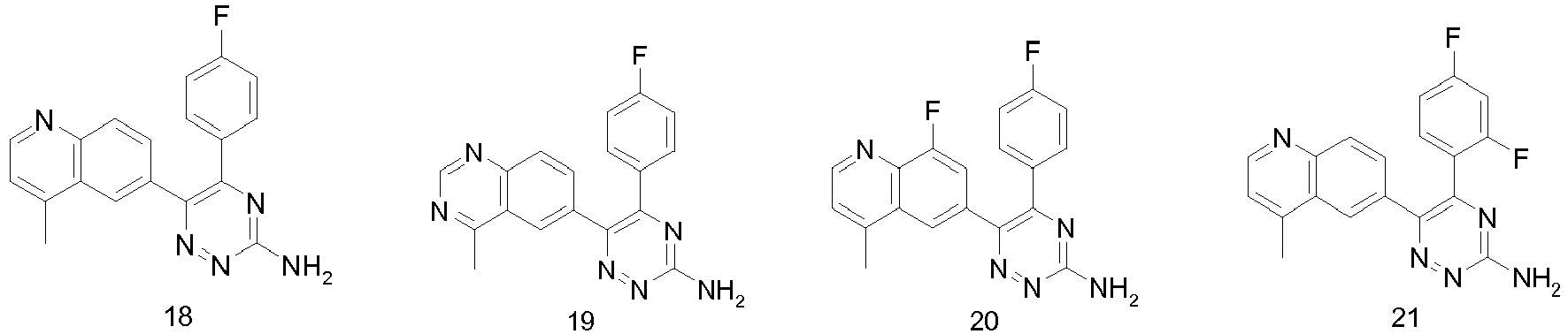


- A method for preparing the compound of formula (I) according to claim 1, comprising a step of:

wherein:X is halogen;M is ring A, G1-G4, R1-R4, r, q and n are as defined in claim 1.
 - A method for preparing the compound of formula (Iaa) according to claim 2, comprising a step of:

wherein:X is halogen;M is ring A, G1, G2, R1, R3, R4, r and n are as defined in claim 1.
 - A pharmaceutical composition, comprising a therapeutically effective amount of the compound of formula (I), or a tautomer, mesomer, racemate, enantiomer, diastereomer thereof, or mixture thereof, or a pharmaceutically acceptable salt thereof according to any one of claims 1 to 9, and one or more pharmaceutically acceptable carriers, diluents or excipients.
- Use of the compound of formula (I), or a tautomer, mesomer, racemate, enantiomer, diastereomer thereof, or mixture thereof, or a pharmaceutically acceptable salt thereof according to any one of claims 1 to 9 or the pharmaceutical composition according to claim 12 in the preparation of a medicament for treating a disease or condition ameliorated by the inhibition of the A2a receptor.
- Use of the compound of formula (I), or a tautomer, mesomer, racemate, enantiomer, diastereomer thereof, or mixture thereof, or a pharmaceutically acceptable salt thereof according to any one of claims 1 to 9 or the pharmaceutical composition according to claim 12 in the preparation of a medicament for treating a disease or condition ameliorated by the inhibition of the A2b receptor.
- The use according to claim 13 or 14, wherein the disease or condition is selected from the group consisting of cancer, depression, cognitive function disorder, neurodegenerative disorder, attention-related disorder, extrapyramidal syndrome, abnormal movement disorder, cirrhosis, liver fibrosis, fatty liver, dermal fibrosis, sleep disorder, stroke, brain injury, neuroinflammation and addictive behavior, and preferably cancer.
- The use according to claim 15, wherein the cancer is selected from the group consisting of melanoma, brain tumor, esophageal cancer, stomach cancer, liver cancer, pancreatic cancer, colorectal cancer, lung cancer, kidney cancer, breast cancer, ovarian cancer, prostate cancer, skin cancer, neuroblastoma, sarcoma, osteochondroma, osteoma, osteosarcoma, seminoma, testicular tumor, uterine cancer, head and neck cancer, multiple myeloma, malignant lymphoma, polycythemia vera, leukemia, thyroid tumor, ureteral tumor, bladder tumor, gallbladder cancer, cholangiocarcinoma, chorionic epithelioma and pediatric tumor, and preferably lung cancer.
- Use of the compound of formula (I), or a tautomer, mesomer, racemate, enantiomer, diastereomer thereof, or mixture thereof, or a pharmaceutically acceptable salt thereof according to any one of claims 1 to 9 or the pharmaceutical composition according to claim 12 in the preparation of a medicament for inhibiting the A2a receptor.
- Use of the compound of formula (I), or a tautomer, mesomer, racemate, enantiomer, diastereomer thereof, or mixture thereof, or a pharmaceutically acceptable salt thereof according to any one of claims 1 to 9 or the pharmaceutical composition according to claim 12 in the preparation of a medicament for inhibiting the A2b receptor.
Applications Claiming Priority (3)
| Application Number | Priority Date | Filing Date | Title |
|---|---|---|---|
| CN201710023970 | 2017-01-13 | ||
| CN201710874488 | 2017-09-25 | ||
| PCT/CN2018/072308 WO2018130184A1 (en) | 2017-01-13 | 2018-01-12 | 1,2,4-triazine-3-amine derivative, preparation method therefor, and use thereof in medicine |
Publications (2)
| Publication Number | Publication Date |
|---|---|
| EP3569596A1 true EP3569596A1 (en) | 2019-11-20 |
| EP3569596A4 EP3569596A4 (en) | 2020-08-26 |
Family
ID=62839274
Family Applications (1)
| Application Number | Title | Priority Date | Filing Date |
|---|---|---|---|
| EP18739200.6A Withdrawn EP3569596A4 (en) | 2017-01-13 | 2018-01-12 | 1,2,4-triazine-3-amine derivative, preparation method therefor, and use thereof in medicine |
Country Status (6)
| Country | Link |
|---|---|
| US (2) | US11014904B2 (en) |
| EP (1) | EP3569596A4 (en) |
| JP (1) | JP2020506885A (en) |
| CN (1) | CN108884061B (en) |
| TW (1) | TW201827422A (en) |
| WO (1) | WO2018130184A1 (en) |
Families Citing this family (14)
| Publication number | Priority date | Publication date | Assignee | Title |
|---|---|---|---|---|
| CN110655509B (en) * | 2018-06-29 | 2023-01-24 | 江苏恒瑞医药股份有限公司 | 2-aminopyrimidine derivatives, preparation method and medical application thereof |
| CN110684020B (en) * | 2018-07-05 | 2023-01-20 | 江苏恒瑞医药股份有限公司 | 2-aminopyrimidine derivatives, preparation method and medical application thereof |
| CN111094254B (en) * | 2018-07-12 | 2022-07-26 | 江苏恒瑞医药股份有限公司 | Heteroaryl derivatives, their preparation method and their application in medicine |
| CN112154144B (en) * | 2018-07-13 | 2022-05-27 | 江苏恒瑞医药股份有限公司 | Crystal form of 1,2, 4-triazine-3-amine derivative and preparation method thereof |
| CN112955441B (en) * | 2018-10-24 | 2024-06-18 | 里德埃克斯普洛股份公司 | Functionalized aminotriazine |
| CN111377873B (en) * | 2018-12-28 | 2023-03-28 | 四川科伦博泰生物医药股份有限公司 | Aminopyrimidine compounds, their preparation and use |
| CN111377906B (en) * | 2018-12-28 | 2022-09-02 | 四川科伦博泰生物医药股份有限公司 | Substituted pyrazine compounds, their preparation and use |
| EP3904348A4 (en) * | 2018-12-28 | 2022-10-19 | Sichuan Kelun-Biotech Biopharmaceutical Co., Ltd. | AMINOPYRIDINE COMPOUND, METHOD FOR PREPARATION AND USE |
| WO2020146795A1 (en) | 2019-01-11 | 2020-07-16 | Omeros Corporation | Methods and compositions for treating cancer |
| KR102747104B1 (en) * | 2019-02-18 | 2024-12-27 | 한국과학기술연구원 | NOVEL PYRIDO[3,4-d]PYRIMIDIN-8-ONE DERIVATIVES AS PROTEIN KINASE INHIBITORS AND COMPOSITIONS FOR PREVENTING, IMPROVING OR TREATING CANCER CONTAINING THE SAME |
| US12590298B2 (en) | 2019-10-18 | 2026-03-31 | The Regents Of The University Of California | Ex vivo tumor angiogenesis model |
| US11884647B2 (en) | 2019-10-18 | 2024-01-30 | The Regents Of The University Of California | Compounds and methods for targeting pathogenic blood vessels |
| CN115697994B (en) * | 2020-06-10 | 2024-08-13 | 江苏恒瑞医药股份有限公司 | Fused quinazoline derivative, preparation method thereof and application thereof in medicine |
| GB2615307A (en) | 2022-01-28 | 2023-08-09 | Adorx Therapeutics Ltd | Antagonist compounds |
Family Cites Families (12)
| Publication number | Priority date | Publication date | Assignee | Title |
|---|---|---|---|---|
| TW200716132A (en) | 2005-05-03 | 2007-05-01 | Smithkline Beecham Corp | Novel chemical compounds |
| WO2007116106A1 (en) | 2006-04-12 | 2007-10-18 | Palobiofarma, S.L. | Novel compounds as antagonists of adenosine a1 receptors |
| DE102007061763A1 (en) | 2007-12-20 | 2009-06-25 | Bayer Healthcare Ag | Substituted azabicyclic compounds and their use |
| US20120190701A1 (en) | 2009-08-18 | 2012-07-26 | Merck Sharp & Dohme Corp. | Renin inhibitors |
| WO2011084402A1 (en) | 2009-12-21 | 2011-07-14 | Merck Sharp & Dohme Corp. | Tyrosine kinase inhibitors |
| ES2579949T3 (en) * | 2010-02-05 | 2016-08-17 | Heptares Therapeutics Limited | 1,2,4-triazin-4-amine derivatives |
| WO2011159302A1 (en) | 2010-06-17 | 2011-12-22 | Janssen Pharmaceutica Nv | Arylindenopyrimidines for treating neurodegenerative and movement disorders while minimizing cardiac toxicity |
| EP2593107A1 (en) | 2010-07-12 | 2013-05-22 | Merck Sharp & Dohme Corp. | Tyrosine kinase inhibitors |
| JP6017766B2 (en) | 2011-07-26 | 2016-11-02 | 株式会社Ihi | Novel anticancer agent of metal salen complex compound |
| WO2014101120A1 (en) | 2012-12-28 | 2014-07-03 | Merck Sharp & Dohme Corp. | Heterobicyclo-substituted-7-methoxy-[1,2,4]triazolo[1,5-c]quinazolin-5-amine compounds with a2a antagonist properties |
| WO2015027431A1 (en) | 2013-08-29 | 2015-03-05 | Merck Sharp & Dohme Corp. | 2,2-difluorodioxolo a2a receptor antagonists |
| AU2015370911B2 (en) | 2014-12-23 | 2020-07-09 | Bergenbio Asa | Inhibitors of Akt kinase |
-
2018
- 2018-01-12 CN CN201880001471.0A patent/CN108884061B/en active Active
- 2018-01-12 JP JP2019534645A patent/JP2020506885A/en not_active Withdrawn
- 2018-01-12 US US16/477,011 patent/US11014904B2/en not_active Expired - Fee Related
- 2018-01-12 TW TW107101263A patent/TW201827422A/en unknown
- 2018-01-12 EP EP18739200.6A patent/EP3569596A4/en not_active Withdrawn
- 2018-01-12 WO PCT/CN2018/072308 patent/WO2018130184A1/en not_active Ceased
-
2021
- 2021-04-06 US US17/223,736 patent/US20210230138A1/en not_active Abandoned
Also Published As
| Publication number | Publication date |
|---|---|
| CN108884061A (en) | 2018-11-23 |
| TW201827422A (en) | 2018-08-01 |
| WO2018130184A1 (en) | 2018-07-19 |
| EP3569596A4 (en) | 2020-08-26 |
| US11014904B2 (en) | 2021-05-25 |
| US20190352278A1 (en) | 2019-11-21 |
| CN108884061B (en) | 2021-11-16 |
| US20210230138A1 (en) | 2021-07-29 |
| JP2020506885A (en) | 2020-03-05 |
Similar Documents
| Publication | Publication Date | Title |
|---|---|---|
| US11014904B2 (en) | 1,2,4-triazine-3-amine derivative, preparation method therefor, and use thereof in medicine | |
| CN109963854B (en) | Heteroaryl[4,3-c]pyrimidin-5-amine derivatives, their preparation method and their application in medicine | |
| CN102131801B (en) | 1, 2 disubstituted heterocyclic compounds | |
| EP3290407B1 (en) | Bromodomain inhibitors | |
| CN109535161B (en) | Triazolopyrimidine derivative, preparation method and medical application thereof | |
| JP5474153B2 (en) | Substituted cinnoline derivatives as GABAA receptor modulators | |
| EP3831383A1 (en) | Bromodomain inhibitors | |
| EP3004057B1 (en) | Heterocyclic derivatives and their use as stat 3 inhibitors | |
| CN102131798A (en) | Di-substituted phenyl compounds used as inhibitors of phosphodiesterase 10 | |
| AU2016228634A1 (en) | Substituted pyrimidine compounds as phosphatidylinositol 3-kinase delta inhibitor and use thereof | |
| EP4289847A1 (en) | Pim kinase inhibitor | |
| TW201934554A (en) | Pyrazolo[1,5-a][1,3,5]triazin-2-amine derivatives, preparation method thereof and application thereof in medicine | |
| CN111094254B (en) | Heteroaryl derivatives, their preparation method and their application in medicine | |
| CN115340559A (en) | Preparation and application of SHP2 phosphatase heterocyclic inhibitor | |
| JPWO2005087749A1 (en) | 2-Aminoquinazoline derivatives | |
| WO2020156505A1 (en) | 2-amionpyrimidine derivative, preparation method therefor and application thereof in medicines | |
| CN108467386B (en) | Fused heteroaryl substituted 1,2, 4-triazine-3-amine derivatives, preparation method and medical application thereof | |
| CN110684020B (en) | 2-aminopyrimidine derivatives, preparation method and medical application thereof | |
| JP2000154139A (en) | Fused pyrazine derivative | |
| CN110655509B (en) | 2-aminopyrimidine derivatives, preparation method and medical application thereof | |
| HK1261711A1 (en) | 1,2,4-triazine-3-amine derivative, preparation method therefor, and use thereof in medicine | |
| HK40009320A (en) | Heteroaryl[4,3-c]pyrimidine-5-amine derivative, preparation method therefor, and medical uses thereof | |
| HK1185345B (en) | Compounds for the prevention and treatment of cardiovascular diseases | |
| HK1185345A1 (en) | Compounds for the prevention and treatment of cardiovascular diseases |
Legal Events
| Date | Code | Title | Description |
|---|---|---|---|
| STAA | Information on the status of an ep patent application or granted ep patent |
Free format text: STATUS: THE INTERNATIONAL PUBLICATION HAS BEEN MADE |
|
| PUAI | Public reference made under article 153(3) epc to a published international application that has entered the european phase |
Free format text: ORIGINAL CODE: 0009012 |
|
| STAA | Information on the status of an ep patent application or granted ep patent |
Free format text: STATUS: REQUEST FOR EXAMINATION WAS MADE |
|
| 17P | Request for examination filed |
Effective date: 20190725 |
|
| AK | Designated contracting states |
Kind code of ref document: A1 Designated state(s): AL AT BE BG CH CY CZ DE DK EE ES FI FR GB GR HR HU IE IS IT LI LT LU LV MC MK MT NL NO PL PT RO RS SE SI SK SM TR |
|
| AX | Request for extension of the european patent |
Extension state: BA ME |
|
| DAV | Request for validation of the european patent (deleted) | ||
| DAX | Request for extension of the european patent (deleted) | ||
| A4 | Supplementary search report drawn up and despatched |
Effective date: 20200727 |
|
| RIC1 | Information provided on ipc code assigned before grant |
Ipc: C07D 487/04 20060101ALI20200721BHEP Ipc: C07D 407/14 20060101ALI20200721BHEP Ipc: C07D 401/14 20060101ALI20200721BHEP Ipc: C07D 409/14 20060101ALI20200721BHEP Ipc: A61P 35/00 20060101ALI20200721BHEP Ipc: C07D 253/06 20060101AFI20200721BHEP Ipc: A61K 31/53 20060101ALI20200721BHEP Ipc: C07D 403/14 20060101ALI20200721BHEP Ipc: C07D 403/04 20060101ALI20200721BHEP Ipc: C07D 405/14 20060101ALI20200721BHEP Ipc: C07D 401/04 20060101ALI20200721BHEP |
|
| GRAP | Despatch of communication of intention to grant a patent |
Free format text: ORIGINAL CODE: EPIDOSNIGR1 |
|
| STAA | Information on the status of an ep patent application or granted ep patent |
Free format text: STATUS: GRANT OF PATENT IS INTENDED |
|
| INTG | Intention to grant announced |
Effective date: 20210617 |
|
| STAA | Information on the status of an ep patent application or granted ep patent |
Free format text: STATUS: THE APPLICATION IS DEEMED TO BE WITHDRAWN |
|
| 18D | Application deemed to be withdrawn |
Effective date: 20211028 |