EP3569504A1 - Aircraft air pads having restricted deployment volumes - Google Patents
Aircraft air pads having restricted deployment volumes Download PDFInfo
- Publication number
- EP3569504A1 EP3569504A1 EP19174766.6A EP19174766A EP3569504A1 EP 3569504 A1 EP3569504 A1 EP 3569504A1 EP 19174766 A EP19174766 A EP 19174766A EP 3569504 A1 EP3569504 A1 EP 3569504A1
- Authority
- EP
- European Patent Office
- Prior art keywords
- air pad
- bladder
- aircraft
- front face
- deceleration
- Prior art date
- Legal status (The legal status is an assumption and is not a legal conclusion. Google has not performed a legal analysis and makes no representation as to the accuracy of the status listed.)
- Granted
Links
Images





Classifications
-
- B—PERFORMING OPERATIONS; TRANSPORTING
- B64—AIRCRAFT; AVIATION; COSMONAUTICS
- B64D—EQUIPMENT FOR FITTING IN OR TO AIRCRAFT; FLIGHT SUITS; PARACHUTES; ARRANGEMENT OR MOUNTING OF POWER PLANTS OR PROPULSION TRANSMISSIONS IN AIRCRAFT
- B64D11/00—Passenger or crew accommodation; Flight-deck installations not otherwise provided for
- B64D11/0015—Arrangements for entertainment or communications, e.g. radio, television
- B64D11/00151—Permanently mounted seat back monitors
-
- B—PERFORMING OPERATIONS; TRANSPORTING
- B64—AIRCRAFT; AVIATION; COSMONAUTICS
- B64D—EQUIPMENT FOR FITTING IN OR TO AIRCRAFT; FLIGHT SUITS; PARACHUTES; ARRANGEMENT OR MOUNTING OF POWER PLANTS OR PROPULSION TRANSMISSIONS IN AIRCRAFT
- B64D11/00—Passenger or crew accommodation; Flight-deck installations not otherwise provided for
- B64D11/06—Arrangements of seats, or adaptations or details specially adapted for aircraft seats
- B64D11/062—Belts or other passenger restraint means for passenger seats
- B64D11/06205—Arrangements of airbags
-
- B—PERFORMING OPERATIONS; TRANSPORTING
- B64—AIRCRAFT; AVIATION; COSMONAUTICS
- B64D—EQUIPMENT FOR FITTING IN OR TO AIRCRAFT; FLIGHT SUITS; PARACHUTES; ARRANGEMENT OR MOUNTING OF POWER PLANTS OR PROPULSION TRANSMISSIONS IN AIRCRAFT
- B64D11/00—Passenger or crew accommodation; Flight-deck installations not otherwise provided for
- B64D11/06—Arrangements of seats, or adaptations or details specially adapted for aircraft seats
- B64D11/062—Belts or other passenger restraint means for passenger seats
- B64D11/06205—Arrangements of airbags
- B64D11/0621—Airbag initiation or activation means
-
- B—PERFORMING OPERATIONS; TRANSPORTING
- B64—AIRCRAFT; AVIATION; COSMONAUTICS
- B64D—EQUIPMENT FOR FITTING IN OR TO AIRCRAFT; FLIGHT SUITS; PARACHUTES; ARRANGEMENT OR MOUNTING OF POWER PLANTS OR PROPULSION TRANSMISSIONS IN AIRCRAFT
- B64D25/00—Emergency apparatus or devices, not otherwise provided for
-
- B—PERFORMING OPERATIONS; TRANSPORTING
- B60—VEHICLES IN GENERAL
- B60R—VEHICLES, VEHICLE FITTINGS, OR VEHICLE PARTS, NOT OTHERWISE PROVIDED FOR
- B60R21/00—Arrangements or fittings on vehicles for protecting or preventing injuries to occupants or pedestrians in case of accidents or other traffic risks
- B60R2021/0065—Type of vehicles
- B60R2021/0093—Aircraft
-
- B—PERFORMING OPERATIONS; TRANSPORTING
- B60—VEHICLES IN GENERAL
- B60R—VEHICLES, VEHICLE FITTINGS, OR VEHICLE PARTS, NOT OTHERWISE PROVIDED FOR
- B60R21/00—Arrangements or fittings on vehicles for protecting or preventing injuries to occupants or pedestrians in case of accidents or other traffic risks
- B60R21/02—Occupant safety arrangements or fittings, e.g. crash pads
- B60R21/16—Inflatable occupant restraints or confinements designed to inflate upon impact or impending impact, e.g. air bags
- B60R21/20—Arrangements for storing inflatable members in their non-use or deflated condition; Arrangement or mounting of air bag modules or components
- B60R21/207—Arrangements for storing inflatable members in their non-use or deflated condition; Arrangement or mounting of air bag modules or components in vehicle seats
-
- B—PERFORMING OPERATIONS; TRANSPORTING
- B64—AIRCRAFT; AVIATION; COSMONAUTICS
- B64D—EQUIPMENT FOR FITTING IN OR TO AIRCRAFT; FLIGHT SUITS; PARACHUTES; ARRANGEMENT OR MOUNTING OF POWER PLANTS OR PROPULSION TRANSMISSIONS IN AIRCRAFT
- B64D2201/00—Airbags mounted in aircraft for any use
Definitions
- the disclosure relates to the field of aircraft, and in particular, to passenger safety systems for aircraft.
- Aircraft utilize a wide variety of systems and devices to provide comfort and safety for passengers.
- passive safety systems such as seatbelts retain passengers in their seats during a rapid deceleration event.
- Embodiments described herein provide air pads that inflate by limited amounts during deployment, and may have shapes that are constrained during and after deployment in order to facilitate passenger egress.
- some air pads described herein may increase to no more than ten times their undeployed volume after they have been deployed, or may extend no more than a few inches outward during deployment. This allows the air pads to enhance passenger safety during a rapid deceleration event (e.g., by reducing a magnitude of deceleration experienced by passengers during a period of time), while still enabling passenger egress from a seat after the rapid deceleration event has occurred.
- an apparatus as defined in claim 1.
- a system as defined in claim 10.
- a method as defined in claim 11.
- One embodiment is an apparatus that includes an air pad affixed to a mount within an interior of an aircraft.
- the air pad includes a front face, a bladder that is inflatable within the air pad, and sides that constrain the front face of the air pad to extend a uniform distance outward from the mount when the bladder is inflated.
- the apparatus also includes an inflator that is coupled with the air pad and is configured to inflate the bladder from an undeployed volume to a deployed volume.
- a further embodiment is a system that includes an air pad affixed to a mount within an interior of an aircraft.
- the air pad includes a front face, a bladder that is inflatable within the air pad, and sides that constrain the front face of the air pad to extend a uniform distance outward from the mount when the bladder is inflated.
- the system also includes an inflator that is coupled with the air pad and is configured to inflate the bladder from an undeployed volume to a deployed volume, a sensor that determines a deceleration of the aircraft, and a controller that receives input from the sensor indicating the deceleration of the aircraft, determines that the deceleration of the aircraft has exceeded a threshold value for longer than a period of time, and triggers the inflator for the air pad to deploy the air pad.
- an inflator that is coupled with the air pad and is configured to inflate the bladder from an undeployed volume to a deployed volume
- a sensor that determines a deceleration of the aircraft
- a controller that receives input from the sensor indicating the deceleration of the aircraft, determines that the deceleration of the aircraft has exceeded a threshold value for longer than a period of time, and triggers the inflator for the air pad to deploy the air pad.
- a further embodiment is a method that includes receiving input from a sensor indicating a deceleration of an aircraft, determining that the deceleration of the aircraft has exceeded a threshold value for longer than a period of time, triggering an inflator for an air pad that is mounted within an interior of the aircraft and includes a bladder as well as sides of flexible material that constrain a front face of the air pad to extend a uniform distance outward when the bladder is inflated, and deploying the bladder by inflating the bladder.
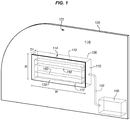
- FIGS. 1-2 are perspective views of an air pad 100 mounted within an aircraft in an illustrative embodiment.
- Air pad 100 comprises any system or device within an aircraft that is configured to deploy via inflation to enhance safety during a rapid deceleration event.
- air pad 100 is affixed to a mount 120 of an aircraft.
- Air pad 100 may be affixed such that a front of the air pad 100 (e.g., front face 130 of air pad 100) that will extend outward from mount 120 during deployment is flush or substantially flush with surface 122 of mount 120 before deployment. This means that air pad 100 does not noticeably protrude from surface 122 prior to deployment.
- a mount is any suitable surface or component to which an air pad 100 may be affixed or housed within.
- an air pad may cover any dimensions in a bulkhead (or seat back), including the entire width and/or height of such elements. There may even be multiple air pads within each bulkhead (e.g., three air pads across the width of a bulkhead) having either a shared or independent sensor and inflator.
- Air pad 100 includes bladder 112 as well as sides 110 of fabric 114. Front face 130 of air pad 100 is supported by sides 110 of fabric 114. Sides 110 also surround bladder 112. When bladder 112 is inflated, it increases the volume of air pad 100 and causes air pad 100 to expand outward. During and after inflation of bladder 112, sides 110 and/or tethers 150 cause the air pad 100 to be constrained into a desired shape. This is because sides 110 and tethers 150 are secured to both mount 120 and front face 130.
- Bladder 112 is made from any suitable type of material, such as a fabric that is impermeable to gas on a time scale of deployment (e.g., over a period of ten milliseconds). Hence, even though the fabric may leak gas over a period of seconds, minutes, hours, or days, it may remain effectively impermeable to gas during a rapid deceleration event.
- bladder 112 is made from a gas impermeable material (e.g., polyester fabric, nylon, etc.) having a thickness between one quarter and one half of an inch.
- Bladder 112 is inflated via pressurized gas provided by inflator 140 via tubing 142.
- bladder 112 is uninflated and air pad 100 has a height H, a width W, and extends a depth D1 into mount 120. These dimensions define the "undeployed volume" of air pad 100.
- This undeployed volume includes space occupied by fabric that defines boundaries/sides of bladder 112.
- bladder 112 has been inflated.
- the increase in volume of bladder 112 causes air pad 100 to expand.
- a distance of projection of front face 130 is "uniform" if a majority of locations on front face 130 (e.g., eighty percent) have distances of projection from surface 122 that vary by less than a threshold amount (e.g., twenty percent). This characteristic causes the front face 130 to remain substantially planar during and/or after deployment, even though a slight curvature may be exhibited at the edges of air pad 100.
- tethers 150 constrain the shape of bladder 112 during deployment and keep front face 130 substantially planar.
- Tethers 150 may be made from the same fabric as sides 110 or bladder 112, or may be made from a different material.
- tethers 150 may be made from a non-stretch, non-flexible material that is permeable to gas, or may include gaps or holes that enable gas to pass through them and provide even inflation of bladder 112.
- Inflator 140 is configured to deploy the air pad 100 in a suitable time period (e.g., less than ten milliseconds, such as less than one or two milliseconds), and may comprise a chemical inflator loaded with propellant, or other suitable device that inflates air pad 100 to a deployed volume that is between two and ten times its undeployed volume.
- inflator 140 may inflate air pad 100 to a thickness of one to two inches outwards from a seat when air pad 100 is mounted to a seat, or may inflate air pad 100 to a thickness of two to four inches outward when air pad 100 is placed at a monument of an aircraft.
- Inflator 140 may further inflate air pad 100 to a total volume of several hundred cubic inches (e.g., two hundred cubic inches) when used for a seat, or several thousand cubic inches when used at a monument to protect an entire row of passengers.
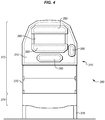
- FIGS. 3-4 provide details of an air pad deployment system 300 housed at a seat 370 for a passenger in an illustrative embodiment.
- Seat 370 includes seat back 372 and base 374, which are structurally united and secured to the aircraft via frame 376.
- air pad deployment system 300 includes air pad 310.
- Air pad 310 is configured to mount at seat back 372 and includes bladder 312, which inflates during deployment to enhance passenger safety.
- Air pad 310 is positioned at a location where a head of a passenger is expected to contact a portion of the aircraft during a rapid deceleration event. The location of air pad 310 may be chosen based on known statistical and/or biometric data indicating the range of locations that a large percentage of passengers' heads would be likely to contact.
- Bladder 312 has been enhanced to inflate a limited amount to displace front face 314 a uniform distance outward during deployment (e.g., one to four inches). This limited degree of inflation for bladder 312 deploys the air pad 310 in a manner that provides protection without interfering with passenger egress.
- Air pad 310 is shaped in the form of seat back 172. This conformity of shape between air pad 310 and seat 370 preserves the aesthetics or seat 370.
- Seat back 372 includes a number of components such as display 360, a charging port, and a credit card terminal. It is desirable for these components to remain accessible to passengers during flight so that the passengers may view content on display 360 or otherwise enjoy the in-flight experience.
- Air pad 310 has been designed with a shape that does not interfere with a passenger's use of these features, because air pad 310 includes gaps 320 (e.g., cut-outs or holes) that are positioned at the locations of components within the seat 370. The gaps 320 enable a passenger to access the components of seat back 372 during flight.
- Additional bladders 350 may be located at the edges of gaps 320. These additional bladders 350 may cover or fill gaps 320 during deployment. One of gaps 320 in air pad 310 is located at a display 360 mounted in seat 370, and two of the additional bladders 350 are located proximate to display 360, such as underneath a plastic shroud. These additional bladders 350 may eject the plastic shroud and inflate around display 360 in order to cover display 360 during a rapid deceleration event. In this manner, additional bladders 350 prevent a passenger from directly contacting display 360 during the rapid deceleration event.
- Inflator 340 activates in response to input from controller 330, which utilizes input from sensor 332 (e.g., an accelerometer located within or below a floor panel 380 of the aircraft) in order to determine whether a rapid deceleration event is occurring. For example, controller 330 may determine that a rapid deceleration event is occurring if sensor 332 reports a deceleration of greater than sixteen gravities (G's) over a period of less than one millisecond (e.g., half of a millisecond). Controller 330 may be implemented as a hardware processor implementing instructions stored in a memory, as specialized circuitry, etc.
- G's sixteen gravities
- air pad 310 has been deployed, which means that bladders within air pad 310 have been inflated to cover previously exposed portions of seat 370.
- Air pad 310 and/or additional bladders 350 may be specifically designed to cover or inflate around the seat 370 and/or the display 360 (e.g., around edges or corners of display 360) in order to cushion a passenger that will contact seat back 372 during a rapid deceleration event.
- the perspective view provided in FIG. 5 illustrates that after deployment, air pad 310 has expanded outward to exhibit a thickness T (e.g., one to several inches, as discussed above).
- air pad deployment system 300 Illustrative details of the operation of air pad deployment system 300 will be discussed with regard to FIG. 6 . Assume, for this embodiment, that an aircraft has initiated a rapid deceleration event that will result in deployment of air pads 310 at seats 370 in order to enhance passenger safety. Thus, while method 600 is described with regard to air pad 310, a person of ordinary skill in the art will appreciate that method 600 may be performed at each air pad deployment system 300 within the aircraft at the same time.
- FIG. 6 is a flowchart illustrating a method 600 for operating an air pad deployment system in an illustrative embodiment.
- the steps of method 600 are described with reference to air pad deployment system 300 of FIG. 3 , but those skilled in the art will appreciate that method 600 may be performed in other systems as desired.
- the steps of the flowcharts described herein are not all inclusive and may include other steps not shown. The steps described herein may also be performed in an alternative order.
- method 600 includes receiving input from sensor 332 indicating deceleration of the aircraft (step 602).
- this sensor input may comprise a stream of deceleration values which are received and processed by controller 330 over time (e.g., at a rate of thousands or tens of thousands of times per second).
- Controller 330 may store these deceleration values in memory and average them via a moving window or other suitable process in order to determine the average deceleration encountered over a period of time (e.g., less than ten milliseconds, such as a period of one millisecond).
- acceleration refers to changes in speed in any suitable direction, including forwards and/or backwards.
- input from sensor 332 may be more generally referred to as measuring "acceleration.”
- controller 330 determines that the deceleration of the aircraft has exceeded a threshold value for longer than a period of time (step 604). For example, controller 330 may determine that each value of sensor input over the period of time (e.g., the last millisecond) has exceeded the threshold value, or may determine that the average value (e.g., arithmetic mean) of sensor input over the period of time has exceeded the threshold value.
- the threshold value may be measured in G's, and may for example by sixteen G's, or nine G's.
- the period of time may be a period of time immediately prior to the current time, such as the prior ten milliseconds, the prior millisecond, the prior half-millisecond, etc.
- controller 330 concludes that a rapid deceleration event is occurring.
- controller 330 takes steps to initiate deployment of its air pad 310.
- controller 330 triggers the inflator 340 for bladder 312 (step 606).
- Controller 330 may trigger inflator 340 by triggering a component within inflator 340 that will cause rapid expansion of gas into bladder 312 and/or additional bladders 350.
- inflator 340 forces gas via tubing 342 into air pad 310 to fill bladder 312 and/or any additional bladders 350.
- This action deploys the bladder 312 of air pad 310 by inflating bladder 312 (step 608).
- Bladder 312 is surrounded by sides of flexible material (e.g., fabric 314) that constrain the front face 130 of air pad 310 to extend a uniform distance outward when bladder 312 is inflated. This means that during inflation, bladder 312 expands into a shape defined by the sides.
- Bladder 312 may inflate to a deployed volume that is between two and ten times the size of the undeployed volume in less than ten milliseconds (e.g., less than two milliseconds), may inflate to a consistent maximum thickness of one to four inches, etc.
- the rapid deployment of the air pad 310 makes it so that that air pad 310 is fully inflated before a passenger will contact seat 370.
- This increases the amount of time during which the passenger decelerates, which reduces the peak G's experienced by the passenger during deceleration. In short, the duration of deceleration is increased while the amount of deceleration remains the same, which reduces the peak G's.
- FIGS. 7-9 are views of an air pad 700 mounted at a monument 740 in an illustrative embodiment.
- FIG. 7 is a front view of air pad 700 mounted at monument 740.
- bladder 760 of air pad 700 is positioned behind a cover (e.g., a break-away panel, fabric cover, etc.) 750 at surface 770 of monument 740.
- cover e.g., a break-away panel, fabric cover, etc.
- flaps 720 of air pad 700 fold outward, exposing front face 710 of air pad 700.
- FIG. 8 is a perspective view of air pad 700 wherein bladder 760 within air pad 700 is partially inflated. According to FIG. 8 , flaps 720 of air pad 700 have folded outward to expose the front face 710. Air pad 700 will continue to expand outward from monument 740 as gas continues to flow into bladder 760 within air pad 700. In FIG. 9 , air pad 700 is fully inflated. FIG. 9 illustrates air pad 700 in a fully inflated state. FIG. 9 shows sides 920 which surround bladder 760, and tethers 910 within the bladder 760 which support the sides 920 and maintain a uniform projection distance of front face 710 from surface 770. That is, tethers 910 constrain the shape of bladder 760 during deployment and may keep a face of air pad 700 substantially planar, such that the face of air pad 700 extends a uniform distance out from monument 740.
- Tethers 910 may be made from the same fabric as sides 920, or may be made from a different material.
- tethers 910 may be made from a non-stretch, non-flexible material that is permeable to gas, or may include gaps or holes that enable gas to pass through them and provide even inflation of air pad 700.
- Vent holes 930 are also depicted which enable gas to exit the air pad 700 after the rapid deceleration event has concluded. For example, air may exit the vent holes 930 after a passenger contacts the air pad 700.
- FIG. 10 illustrates a further embodiment wherein tethers 1010 are implemented as discrete linear elements within air pad 700 that extend outward from surface 770 towards front face 710.
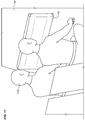
- FIGS. 11-12 are perspective views of an air pad 700 absorbing kinetic energy from passengers 1100 in an illustrative embodiment. As shown in FIG. 11 , air pad 700 is positioned on monument 740 in a location where a passenger 1100 may be expected to contact monument 740 during a rapid deceleration event. Air pad 700 may deform upon contact with a passenger 1100 in order to absorb kinetic energy and reduce the intensity of deceleration experienced by the passenger 1100.
- control elements e.g., electrical or electronic components
- a processor implementing software
- a processor implementing firmware or some combination of these.
- an element may be implemented as dedicated hardware.
- Dedicated hardware elements may be referred to as "processors", “controllers”, or some similar terminology.
- the functions may be provided by a single dedicated processor, by a single shared processor, or by a plurality of individual processors, some of which may be shared.
- processor or “controller” should not be construed to refer exclusively to hardware capable of executing software, and may implicitly include, without limitation, digital signal processor (DSP) hardware, a network processor, application specific integrated circuit (ASIC) or other circuitry, field programmable gate array (FPGA), read only memory (ROM) for storing software, random access memory (RAM), non-volatile storage, logic, or some other physical hardware component or module.
- DSP digital signal processor
- ASIC application specific integrated circuit
- FPGA field programmable gate array
- ROM read only memory
- RAM random access memory
- non-volatile storage logic, or some other physical hardware component or module.
- a control element may be implemented as instructions executable by a processor or a computer to perform the functions of the element.
- instructions are software, program code, and firmware.
- the instructions are operational when executed by the processor to direct the processor to perform the functions of the element.
- the instructions may be stored on storage devices that are readable by the processor. Some examples of the storage devices are digital or solid-state memories, magnetic storage media such as a magnetic disks and magnetic tapes, hard drives, or optically readable digital data storage media.
Landscapes
- Engineering & Computer Science (AREA)
- Aviation & Aerospace Engineering (AREA)
- Business, Economics & Management (AREA)
- Emergency Management (AREA)
- Air Bags (AREA)
- Mattresses And Other Support Structures For Chairs And Beds (AREA)
Abstract
Description
- The disclosure relates to the field of aircraft, and in particular, to passenger safety systems for aircraft.
- Aircraft utilize a wide variety of systems and devices to provide comfort and safety for passengers. For example, passive safety systems such as seatbelts retain passengers in their seats during a rapid deceleration event.
- Even though many safety systems used on passenger aircraft are viable, certain types of safety systems remain untenable. For example, safety devices that are provided to individual passengers may need to fit within the amount of space reserved for each passenger. Hence, bulky or unwieldy safety systems may not be feasible. Furthermore, even systems which would be compact when installed may cause problems after they have been deployed during a rapid deceleration event. For example, air bags may increase in volume by a factor of hundreds or thousands of times during deployment, and air bags therefore leave large hanging swaths of fabric after deployment. These swaths of fabric may interfere with the degree of passenger egress required by Federal Aviation Administration (FAA) standards. Thus, while air bags remain common in automotive transportation, they are infeasible for aircraft.
- Therefore, it would be desirable to have a method and apparatus that take into account at least some of the issues discussed above, as well as other possible issues.
- Embodiments described herein provide air pads that inflate by limited amounts during deployment, and may have shapes that are constrained during and after deployment in order to facilitate passenger egress. For example, some air pads described herein may increase to no more than ten times their undeployed volume after they have been deployed, or may extend no more than a few inches outward during deployment. This allows the air pads to enhance passenger safety during a rapid deceleration event (e.g., by reducing a magnitude of deceleration experienced by passengers during a period of time), while still enabling passenger egress from a seat after the rapid deceleration event has occurred.
- In an aspect, there is provided an apparatus as defined in claim 1. In another aspect, there is provided a system as defined in claim 10. In another aspect, there is provided a method as defined in claim 11. Optional features of aspects are set out in the dependent claims.
- One embodiment is an apparatus that includes an air pad affixed to a mount within an interior of an aircraft. The air pad includes a front face, a bladder that is inflatable within the air pad, and sides that constrain the front face of the air pad to extend a uniform distance outward from the mount when the bladder is inflated. The apparatus also includes an inflator that is coupled with the air pad and is configured to inflate the bladder from an undeployed volume to a deployed volume.
- A further embodiment is a system that includes an air pad affixed to a mount within an interior of an aircraft. The air pad includes a front face, a bladder that is inflatable within the air pad, and sides that constrain the front face of the air pad to extend a uniform distance outward from the mount when the bladder is inflated. The system also includes an inflator that is coupled with the air pad and is configured to inflate the bladder from an undeployed volume to a deployed volume, a sensor that determines a deceleration of the aircraft, and a controller that receives input from the sensor indicating the deceleration of the aircraft, determines that the deceleration of the aircraft has exceeded a threshold value for longer than a period of time, and triggers the inflator for the air pad to deploy the air pad.
- A further embodiment is a method that includes receiving input from a sensor indicating a deceleration of an aircraft, determining that the deceleration of the aircraft has exceeded a threshold value for longer than a period of time, triggering an inflator for an air pad that is mounted within an interior of the aircraft and includes a bladder as well as sides of flexible material that constrain a front face of the air pad to extend a uniform distance outward when the bladder is inflated, and deploying the bladder by inflating the bladder.
- Other illustrative embodiments (e.g., methods and computer-readable media relating to the foregoing embodiments) may be described below. The features, functions, and advantages that have been discussed can be achieved independently in various embodiments or may be combined in yet other embodiments further details of which can be seen with reference to the following description and drawings.
- Some embodiments of the present disclosure are now described, by way of example only, and with reference to the accompanying drawings. The same reference number represents the same element or the same type of element on all drawings.
-
FIGS. 1-2 are perspective views of an air pad mounted within an aircraft in an illustrative embodiment. -
FIGS. 3-4 are front views of an air pad deployment system housed at a passenger seat in an illustrative embodiment. -
FIG. 5 is a perspective view of a deployed air pad housed in a passenger seat in an illustrative embodiment. -
FIG. 6 is a flowchart illustrating a method for operating an air pad deployment system in an illustrative embodiment. -
FIGS. 7-10 are perspective views of air pads mounted at a monument in an illustrative embodiment. -
FIGS. 11-12 are perspective views of an air pad absorbing kinetic energy from passengers in an illustrative embodiment. - The figures and the following description illustrate specific illustrative embodiments of the disclosure. It will thus be appreciated that those skilled in the art will be able to devise various arrangements that, although not explicitly described or shown herein, embody the principles of the disclosure and are included within the scope of the disclosure. Furthermore, any examples described herein are intended to aid in understanding the principles of the disclosure, and are to be construed as being without limitation to such specifically recited examples and conditions. As a result, the disclosure is not limited to the specific embodiments or examples described below, but by the claims and their equivalents.
-
FIGS. 1-2 are perspective views of anair pad 100 mounted within an aircraft in an illustrative embodiment.Air pad 100 comprises any system or device within an aircraft that is configured to deploy via inflation to enhance safety during a rapid deceleration event. In this embodiment,air pad 100 is affixed to amount 120 of an aircraft.Air pad 100 may be affixed such that a front of the air pad 100 (e.g.,front face 130 of air pad 100) that will extend outward frommount 120 during deployment is flush or substantially flush withsurface 122 ofmount 120 before deployment. This means thatair pad 100 does not noticeably protrude fromsurface 122 prior to deployment. As used herein, a mount is any suitable surface or component to which anair pad 100 may be affixed or housed within. While only oneair pad 100 is illustrated inFIGS. 1-2 , in further embodiments an air pad may cover any dimensions in a bulkhead (or seat back), including the entire width and/or height of such elements. There may even be multiple air pads within each bulkhead (e.g., three air pads across the width of a bulkhead) having either a shared or independent sensor and inflator. -
Air pad 100 includesbladder 112 as well assides 110 offabric 114.Front face 130 ofair pad 100 is supported bysides 110 offabric 114.Sides 110 alsosurround bladder 112. Whenbladder 112 is inflated, it increases the volume ofair pad 100 and causesair pad 100 to expand outward. During and after inflation ofbladder 112,sides 110 and/or tethers 150 cause theair pad 100 to be constrained into a desired shape. This is becausesides 110 andtethers 150 are secured to bothmount 120 andfront face 130. - Bladder 112 is made from any suitable type of material, such as a fabric that is impermeable to gas on a time scale of deployment (e.g., over a period of ten milliseconds). Hence, even though the fabric may leak gas over a period of seconds, minutes, hours, or days, it may remain effectively impermeable to gas during a rapid deceleration event. In one embodiment,
bladder 112 is made from a gas impermeable material (e.g., polyester fabric, nylon, etc.) having a thickness between one quarter and one half of an inch. - Bladder 112 is inflated via pressurized gas provided by
inflator 140 viatubing 142. In the undeployed state shown inFIG. 1 ,bladder 112 is uninflated andair pad 100 has a height H, a width W, and extends a depth D1 intomount 120. These dimensions define the "undeployed volume" ofair pad 100. This undeployed volume includes space occupied by fabric that defines boundaries/sides ofbladder 112. - In
FIG. 2 ,bladder 112 has been inflated. The increase in volume ofbladder 112 causesair pad 100 to expand. This pushesfront face 130 ofair pad 100 outward to project a uniform distance D2 fromsurface 122 ofmount 120. As used herein, a distance of projection offront face 130 is "uniform" if a majority of locations on front face 130 (e.g., eighty percent) have distances of projection fromsurface 122 that vary by less than a threshold amount (e.g., twenty percent). This characteristic causes thefront face 130 to remain substantially planar during and/or after deployment, even though a slight curvature may be exhibited at the edges ofair pad 100. - As shown in
FIG. 2 , tethers 150 constrain the shape ofbladder 112 during deployment and keepfront face 130 substantially planar.Tethers 150 may be made from the same fabric assides 110 orbladder 112, or may be made from a different material. For example, tethers 150 may be made from a non-stretch, non-flexible material that is permeable to gas, or may include gaps or holes that enable gas to pass through them and provide even inflation ofbladder 112. -
Inflator 140 is configured to deploy theair pad 100 in a suitable time period (e.g., less than ten milliseconds, such as less than one or two milliseconds), and may comprise a chemical inflator loaded with propellant, or other suitable device that inflatesair pad 100 to a deployed volume that is between two and ten times its undeployed volume. For example,inflator 140 may inflateair pad 100 to a thickness of one to two inches outwards from a seat whenair pad 100 is mounted to a seat, or may inflateair pad 100 to a thickness of two to four inches outward whenair pad 100 is placed at a monument of an aircraft.Inflator 140 may further inflateair pad 100 to a total volume of several hundred cubic inches (e.g., two hundred cubic inches) when used for a seat, or several thousand cubic inches when used at a monument to protect an entire row of passengers. -
FIGS. 3-4 provide details of an airpad deployment system 300 housed at aseat 370 for a passenger in an illustrative embodiment.Seat 370 includes seat back 372 andbase 374, which are structurally united and secured to the aircraft viaframe 376. According toFIG. 3 , airpad deployment system 300 includesair pad 310.Air pad 310 is configured to mount at seat back 372 and includesbladder 312, which inflates during deployment to enhance passenger safety.Air pad 310 is positioned at a location where a head of a passenger is expected to contact a portion of the aircraft during a rapid deceleration event. The location ofair pad 310 may be chosen based on known statistical and/or biometric data indicating the range of locations that a large percentage of passengers' heads would be likely to contact. -
Bladder 312 has been enhanced to inflate a limited amount to displace front face 314 a uniform distance outward during deployment (e.g., one to four inches). This limited degree of inflation forbladder 312 deploys theair pad 310 in a manner that provides protection without interfering with passenger egress. -
Air pad 310 is shaped in the form of seat back 172. This conformity of shape betweenair pad 310 andseat 370 preserves the aesthetics orseat 370. Seat back 372 includes a number of components such asdisplay 360, a charging port, and a credit card terminal. It is desirable for these components to remain accessible to passengers during flight so that the passengers may view content ondisplay 360 or otherwise enjoy the in-flight experience.Air pad 310 has been designed with a shape that does not interfere with a passenger's use of these features, becauseair pad 310 includes gaps 320 (e.g., cut-outs or holes) that are positioned at the locations of components within theseat 370. Thegaps 320 enable a passenger to access the components of seat back 372 during flight. -
Additional bladders 350 may be located at the edges ofgaps 320. Theseadditional bladders 350 may cover or fillgaps 320 during deployment. One ofgaps 320 inair pad 310 is located at adisplay 360 mounted inseat 370, and two of theadditional bladders 350 are located proximate to display 360, such as underneath a plastic shroud. Theseadditional bladders 350 may eject the plastic shroud and inflate arounddisplay 360 in order to coverdisplay 360 during a rapid deceleration event. In this manner,additional bladders 350 prevent a passenger from directly contactingdisplay 360 during the rapid deceleration event. - Bladders within
air pad 310 are coupled withinflator 340 viatubing 342.Inflator 340 activates in response to input fromcontroller 330, which utilizes input from sensor 332 (e.g., an accelerometer located within or below afloor panel 380 of the aircraft) in order to determine whether a rapid deceleration event is occurring. For example,controller 330 may determine that a rapid deceleration event is occurring ifsensor 332 reports a deceleration of greater than sixteen gravities (G's) over a period of less than one millisecond (e.g., half of a millisecond).Controller 330 may be implemented as a hardware processor implementing instructions stored in a memory, as specialized circuitry, etc. - In
FIG. 4 ,air pad 310 has been deployed, which means that bladders withinair pad 310 have been inflated to cover previously exposed portions ofseat 370.Air pad 310 and/oradditional bladders 350 may be specifically designed to cover or inflate around theseat 370 and/or the display 360 (e.g., around edges or corners of display 360) in order to cushion a passenger that will contact seat back 372 during a rapid deceleration event. The perspective view provided inFIG. 5 illustrates that after deployment,air pad 310 has expanded outward to exhibit a thickness T (e.g., one to several inches, as discussed above). - Illustrative details of the operation of air
pad deployment system 300 will be discussed with regard toFIG. 6 . Assume, for this embodiment, that an aircraft has initiated a rapid deceleration event that will result in deployment ofair pads 310 atseats 370 in order to enhance passenger safety. Thus, whilemethod 600 is described with regard toair pad 310, a person of ordinary skill in the art will appreciate thatmethod 600 may be performed at each airpad deployment system 300 within the aircraft at the same time. -
FIG. 6 is a flowchart illustrating amethod 600 for operating an air pad deployment system in an illustrative embodiment. The steps ofmethod 600 are described with reference to airpad deployment system 300 ofFIG. 3 , but those skilled in the art will appreciate thatmethod 600 may be performed in other systems as desired. The steps of the flowcharts described herein are not all inclusive and may include other steps not shown. The steps described herein may also be performed in an alternative order. - According to
FIG. 6 ,method 600 includes receiving input fromsensor 332 indicating deceleration of the aircraft (step 602). For example, this sensor input may comprise a stream of deceleration values which are received and processed bycontroller 330 over time (e.g., at a rate of thousands or tens of thousands of times per second).Controller 330 may store these deceleration values in memory and average them via a moving window or other suitable process in order to determine the average deceleration encountered over a period of time (e.g., less than ten milliseconds, such as a period of one millisecond). As used herein, "acceleration" refers to changes in speed in any suitable direction, including forwards and/or backwards. Hence, while deceleration of the aircraft is tracked viasensor 332, input fromsensor 332 may be more generally referred to as measuring "acceleration." - Based on the incoming sensor input,
controller 330 determines that the deceleration of the aircraft has exceeded a threshold value for longer than a period of time (step 604). For example,controller 330 may determine that each value of sensor input over the period of time (e.g., the last millisecond) has exceeded the threshold value, or may determine that the average value (e.g., arithmetic mean) of sensor input over the period of time has exceeded the threshold value. The threshold value may be measured in G's, and may for example by sixteen G's, or nine G's. The period of time may be a period of time immediately prior to the current time, such as the prior ten milliseconds, the prior millisecond, the prior half-millisecond, etc. - Having determined that the aircraft has exceeded the threshold value of deceleration for the period of time,
controller 330 concludes that a rapid deceleration event is occurring. In order to enhance passenger safety during the rapid deceleration event,controller 330 takes steps to initiate deployment of itsair pad 310. To this end,controller 330 triggers theinflator 340 for bladder 312 (step 606).Controller 330 may triggerinflator 340 by triggering a component withininflator 340 that will cause rapid expansion of gas intobladder 312 and/oradditional bladders 350. - In response to being triggered,
inflator 340 forces gas viatubing 342 intoair pad 310 to fillbladder 312 and/or anyadditional bladders 350. This action deploys thebladder 312 ofair pad 310 by inflating bladder 312 (step 608).Bladder 312 is surrounded by sides of flexible material (e.g., fabric 314) that constrain thefront face 130 ofair pad 310 to extend a uniform distance outward whenbladder 312 is inflated. This means that during inflation,bladder 312 expands into a shape defined by the sides.Bladder 312 may inflate to a deployed volume that is between two and ten times the size of the undeployed volume in less than ten milliseconds (e.g., less than two milliseconds), may inflate to a consistent maximum thickness of one to four inches, etc. - The rapid deployment of the
air pad 310 makes it so that thatair pad 310 is fully inflated before a passenger will contactseat 370. This means that air pad 310 (instead ofseat 370, or display 360) receives kinetic energy from the passenger. Kinetic energy from the passenger is therefore transferred to theair pad 310 to result in deformation of theair pad 310. This increases the amount of time during which the passenger decelerates, which reduces the peak G's experienced by the passenger during deceleration. In short, the duration of deceleration is increased while the amount of deceleration remains the same, which reduces the peak G's. -
FIGS. 7-9 are views of anair pad 700 mounted at amonument 740 in an illustrative embodiment.FIG. 7 is a front view ofair pad 700 mounted atmonument 740. According toFIG. 7 ,bladder 760 ofair pad 700 is positioned behind a cover (e.g., a break-away panel, fabric cover, etc.) 750 atsurface 770 ofmonument 740. During inflation ofbladder 760 withinair pad 700, flaps 720 ofair pad 700 fold outward, exposingfront face 710 ofair pad 700. -
FIG. 8 is a perspective view ofair pad 700 whereinbladder 760 withinair pad 700 is partially inflated. According toFIG. 8 , flaps 720 ofair pad 700 have folded outward to expose thefront face 710.Air pad 700 will continue to expand outward frommonument 740 as gas continues to flow intobladder 760 withinair pad 700. InFIG. 9 ,air pad 700 is fully inflated.FIG. 9 illustratesair pad 700 in a fully inflated state.FIG. 9 showssides 920 which surroundbladder 760, and tethers 910 within thebladder 760 which support thesides 920 and maintain a uniform projection distance offront face 710 fromsurface 770. That is, tethers 910 constrain the shape ofbladder 760 during deployment and may keep a face ofair pad 700 substantially planar, such that the face ofair pad 700 extends a uniform distance out frommonument 740. -
Tethers 910 may be made from the same fabric assides 920, or may be made from a different material. For example, tethers 910 may be made from a non-stretch, non-flexible material that is permeable to gas, or may include gaps or holes that enable gas to pass through them and provide even inflation ofair pad 700. Vent holes 930 are also depicted which enable gas to exit theair pad 700 after the rapid deceleration event has concluded. For example, air may exit the vent holes 930 after a passenger contacts theair pad 700.FIG. 10 illustrates a further embodiment whereintethers 1010 are implemented as discrete linear elements withinair pad 700 that extend outward fromsurface 770 towardsfront face 710. -
FIGS. 11-12 are perspective views of anair pad 700 absorbing kinetic energy frompassengers 1100 in an illustrative embodiment. As shown inFIG. 11 ,air pad 700 is positioned onmonument 740 in a location where apassenger 1100 may be expected to contactmonument 740 during a rapid deceleration event.Air pad 700 may deform upon contact with apassenger 1100 in order to absorb kinetic energy and reduce the intensity of deceleration experienced by thepassenger 1100. - Any of the various control elements (e.g., electrical or electronic components) shown in the figures or described herein may be implemented as hardware, a processor implementing software, a processor implementing firmware, or some combination of these. For example, an element may be implemented as dedicated hardware. Dedicated hardware elements may be referred to as "processors", "controllers", or some similar terminology. When provided by a processor, the functions may be provided by a single dedicated processor, by a single shared processor, or by a plurality of individual processors, some of which may be shared. Moreover, explicit use of the term "processor" or "controller" should not be construed to refer exclusively to hardware capable of executing software, and may implicitly include, without limitation, digital signal processor (DSP) hardware, a network processor, application specific integrated circuit (ASIC) or other circuitry, field programmable gate array (FPGA), read only memory (ROM) for storing software, random access memory (RAM), non-volatile storage, logic, or some other physical hardware component or module.
- Also, a control element may be implemented as instructions executable by a processor or a computer to perform the functions of the element. Some examples of instructions are software, program code, and firmware. The instructions are operational when executed by the processor to direct the processor to perform the functions of the element. The instructions may be stored on storage devices that are readable by the processor. Some examples of the storage devices are digital or solid-state memories, magnetic storage media such as a magnetic disks and magnetic tapes, hard drives, or optically readable digital data storage media.
- Although specific embodiments are described herein, the scope of the disclosure is not limited to those specific embodiments. The scope of the disclosure is defined by the following claims and any equivalents thereof.
- The disclosure comprises the subject matter described in the following clauses:
- Clause 1. An apparatus comprising: an air pad affixed to a mount within an interior of an aircraft, the air pad comprising a front face; a bladder that is inflatable within the air pad; and sides that constrain the front face of the air pad to extend a uniform distance outward from the mount when the bladder is inflated; and an inflator that is coupled with the air pad and is configured to inflate the bladder from an undeployed volume to a deployed volume.
- Clause 2. The apparatus of clause 1, wherein a maximum amount of the uniform distance during inflation of the bladder is between one and four inches.
- Clause 3. The apparatus of clause 1 or clause 2, further comprising tethers within the air pad disposed between the front face and the mount that constrain the front face to extend the uniform distance.
- Clause 4. The apparatus of any preceding clause, wherein the air pad is shaped in a form of a seat back of the aircraft.
- Clause 5. The apparatus of any preceding clause, wherein the air pad is mounted to a seat back of the aircraft.
- Clause 6. The apparatus of any preceding clause, wherein the air pad includes a gap at a location of a component installed in a seat back of the aircraft; and the air pad further comprises an additional bladder at an edge of the gap which is inflated by the inflator and expands into the gap during deployment.
- Clause 6a. The apparatus of clause 6, wherein the gap is at a location of a display installed in the seat back, and wherein the additional bladder covers the display during deployment of the air pad.
- Clause 7. The apparatus of any preceding clause, comprising a or the gap at a location of a display installed in the seat back, wherein the air pad further comprises an or the additional bladder that covers the display during deployment of the air pad.
- Clause 8. The apparatus of any preceding clause, wherein the air pad is mounted to a monument in the aircraft.
- Clause 9. The apparatus of any preceding clause, wherein the air pad further comprises vent holes that enable gas to exit the air pad after the air pad has been deployed.
- Clause 10. A system comprising: an air pad affixed to a mount within an interior of an aircraft, the air pad comprising: a front face; a bladder that is inflatable within the air pad; and sides that constrain the front face of the air pad to extend a uniform distance outward from the mount when the bladder is inflated; an inflator that is coupled with the air pad and is configured to inflate the bladder from an undeployed volume to a deployed volume; a sensor that determines a deceleration of the aircraft; and a controller that receives input from the sensor indicating the deceleration of the aircraft, determines that the deceleration of the aircraft has exceeded a threshold value for longer than a period of time, and triggers the inflator for the air pad to deploy the air pad.
- Clause 11. The system of clause 10, wherein a maximum amount of the uniform distance during inflation of the bladder is between one and four inches.
- Clause 12. The system of clause 10 or clause 11, comprising tethers within the air pad disposed between the front face and the mount that constrain the front face to extend the uniform distance.
- Clause 13. The system of any of clauses 10 to 12, wherein the air pad is shaped in a form of a seat back of the aircraft.
- Clause 14. The system of any of clauses 10 to 13, wherein the air pad is mounted to a seat back of an aircraft.
- Clause 15. The system of any of clauses 10 to 14, wherein the air pad includes a gap at a location of a component installed in a seat back of the aircraft; and the air pad further comprises an additional bladder at an edge of the gap which is inflated by the inflator and that covers the gap during deployment.
- Clause 15a. The system of clause 15, wherein the gap is at a location of a display installed in the seat back, and wherein the additional bladder covers the display during deployment of the air pad.
- Clause 16. The system of any of clauses 10 to 15, comprising a or the gap at a location of a display installed in the seat back, wherein the air pad further comprises an or the additional bladder that covers the display during deployment of the air pad.
- Clause 17. The system of any of clauses 10 to 16, wherein the air pad is mounted to a monument in the aircraft.
- Clause 18. The system of any of clauses 10 to 17, wherein the air pad further comprises vent holes that enable gas to exit the air pad after the air pad has been deployed.
- Clause 19. A method comprising: receiving input from a sensor indicating a deceleration of an aircraft; determining that the deceleration of the aircraft has exceeded a threshold value for longer than a period of time; triggering an inflator for an air pad that is mounted within an interior of the aircraft and includes a bladder as well as sides of flexible material that constrain a front face of the air pad to extend a uniform distance outward when the bladder is inflated; and deploying the bladder by inflating the bladder.
- Clause 20. The method of clause 19, wherein the threshold value is sixteen Gravities (G's), and the period of time is two milliseconds.
- Clause 21. A method comprising, using the apparatus of any of clauses 1 to 9:
- receiving input from a sensor indicating a deceleration of the aircraft;
- determining that the deceleration of the aircraft has exceeded a threshold value for longer than a period of time;
- triggering the inflator for the air pad that is mounted within the interior of the aircraft and includes the bladder as well as sides of flexible material that constrain the front face of the air pad to extend the uniform distance outward when the bladder is inflated; and
- deploying the bladder by inflating the bladder.
- Clause 22. The method of clause 21, wherein the threshold value is sixteen Gravities (G's), and the period of time is two milliseconds.
- Clause 23. A method comprising, using the system of any of clauses 10 to 18:
- receiving input from the sensor indicating a deceleration of the aircraft;
- determining that the deceleration of the aircraft has exceeded a threshold value for longer than a period of time;
- triggering the inflator for the air pad that is mounted within the interior of the aircraft and includes the bladder as well as sides of flexible material that constrain the front face of the air pad to extend the uniform distance outward when the bladder is inflated; and
- deploying the bladder by inflating the bladder.
- Clause 24. The method of clause 23, wherein the threshold value is sixteen Gravities (G's), and the period of time is two milliseconds.
Claims (12)
- An apparatus comprising:
an air pad affixed to a mount within an interior of an aircraft, the air pad comprising:a front face;a bladder that is inflatable within the air pad; andsides that constrain the front face of the air pad to extend a uniform distance outward from the mount when the bladder is inflated; andan inflator that is coupled with the air pad and is configured to inflate the bladder from an undeployed volume to a deployed volume. - The apparatus of claim 1 wherein:
a maximum amount of the uniform distance during inflation of the bladder is between one and four inches. - The apparatus of claim 1 or claim 2, further comprising:
tethers within the air pad disposed between the front face and the mount that constrain the front face to extend the uniform distance. - The apparatus of any preceding claim, wherein:
the air pad is shaped in a form of a seat back of the aircraft. - The apparatus of any preceding claim, wherein:
the air pad is mounted to a seat back of the aircraft. - The apparatus of any preceding claim, wherein:the air pad includes a gap at a location of a component installed in a seat back of the aircraft; andthe air pad further comprises an additional bladder at an edge of the gap which is inflated by the inflator and expands into the gap during deployment.
- The apparatus of any preceding claim, further comprising:
a or the gap at a location of a display installed in the seat back, wherein the air pad further comprises an or the additional bladder that covers the display during deployment of the air pad. - The apparatus of any preceding claim, wherein:
the air pad is mounted to a monument in the aircraft. - The apparatus of any preceding claim, wherein:
the air pad further comprises vent holes that enable gas to exit the air pad after the air pad has been deployed. - A system comprising:the apparatus of any preceding claim;a sensor that determines a deceleration of the aircraft; anda controller that receives input from the sensor indicating the deceleration of the aircraft, determines that the deceleration of the aircraft has exceeded a threshold value for longer than a period of time, and triggers the inflator for the air pad to deploy the air pad.
- A method comprising:receiving input from a sensor indicating a deceleration of an aircraft;determining that the deceleration of the aircraft has exceeded a threshold value for longer than a period of time;triggering an inflator for an air pad that is mounted within an interior of the aircraft and includes a bladder as well as sides of flexible material that constrain a front face of the air pad to extend a uniform distance outward when the bladder is inflated; anddeploying the bladder by inflating the bladder.
- The method of claim 11, wherein:
the threshold value is sixteen Gravities (G's), and the period of time is two milliseconds.
Applications Claiming Priority (1)
| Application Number | Priority Date | Filing Date | Title |
|---|---|---|---|
| US15/980,227 US10696406B2 (en) | 2018-05-15 | 2018-05-15 | Aircraft air pads having restricted deployment volumes |
Publications (3)
| Publication Number | Publication Date |
|---|---|
| EP3569504A1 true EP3569504A1 (en) | 2019-11-20 |
| EP3569504B1 EP3569504B1 (en) | 2023-03-08 |
| EP3569504B8 EP3569504B8 (en) | 2023-05-24 |
Family
ID=66589245
Family Applications (1)
| Application Number | Title | Priority Date | Filing Date |
|---|---|---|---|
| EP19174766.6A Active EP3569504B8 (en) | 2018-05-15 | 2019-05-15 | Aircraft air pads having restricted deployment volumes |
Country Status (3)
| Country | Link |
|---|---|
| US (1) | US10696406B2 (en) |
| EP (1) | EP3569504B8 (en) |
| CN (1) | CN110481789B (en) |
Families Citing this family (1)
| Publication number | Priority date | Publication date | Assignee | Title |
|---|---|---|---|---|
| DE102022120148A1 (en) * | 2022-08-10 | 2024-02-15 | Zim Aircraft Seating Gmbh | Airplane cabin divider |
Citations (4)
| Publication number | Priority date | Publication date | Assignee | Title |
|---|---|---|---|---|
| US20130009430A1 (en) * | 2011-07-07 | 2013-01-10 | Zodiac Aerospace | Energy absorber |
| US20160096627A1 (en) * | 2014-10-02 | 2016-04-07 | Amsafe, Inc. | Active positioning airbag assembly and associated systems and methods |
| US9428132B2 (en) * | 2012-06-07 | 2016-08-30 | Zodiac Seats France | Aircraft airbag system |
| US20170225788A1 (en) * | 2016-02-08 | 2017-08-10 | Amsafe, Inc. | Multi-chamber airbags and associated methods of manufacture and use |
Family Cites Families (21)
| Publication number | Priority date | Publication date | Assignee | Title |
|---|---|---|---|---|
| US2418798A (en) * | 1944-06-23 | 1947-04-08 | Arthur G Evans | Inflatable crash landing device for airplanes |
| US3370886A (en) * | 1966-03-04 | 1968-02-27 | Frost James Dahle | Energy absorbing cushion |
| US3603535A (en) * | 1968-11-13 | 1971-09-07 | Maurice Depolo | Lifesaving support system |
| JPS5758533A (en) * | 1980-09-27 | 1982-04-08 | Ebisu Shoten:Kk | Passenger protecting apparatus for car |
| EP0291554A1 (en) * | 1987-05-21 | 1988-11-23 | Ignaz Vogel GmbH & Co KG, Fahrzeugsitze | Safety device for passengers |
| US5649721A (en) * | 1995-01-20 | 1997-07-22 | The Boeing Co. | Impact protection apparatus |
| SE9701288L (en) * | 1997-04-09 | 1998-10-10 | Lear Corp | Protective device for occupants in motor vehicles |
| JPH11180398A (en) * | 1997-12-24 | 1999-07-06 | Nakai Meihan Kk | Air bag device |
| US5902010A (en) * | 1998-06-22 | 1999-05-11 | Trw Inc. | Vehicle occupant restraint apparatus |
| US6460882B1 (en) * | 1999-01-07 | 2002-10-08 | Siemens Vdo Automotive Corporation | Airbag actuation event discrimination system and method |
| DE10047808B4 (en) * | 2000-09-27 | 2017-02-16 | Volkswagen Ag | Safety device on a seat back of a vehicle seat, in particular a motor vehicle seat |
| CN102933431B (en) * | 2010-05-28 | 2016-03-16 | 京洛株式会社 | Absorbing body |
| US9272680B1 (en) * | 2010-06-15 | 2016-03-01 | The Boeing Company | Airbag for protection of multiple body regions |
| US8523220B1 (en) * | 2012-03-19 | 2013-09-03 | Amsafe, Inc. | Structure mounted airbag assemblies and associated systems and methods |
| US20130341975A1 (en) * | 2012-06-26 | 2013-12-26 | David W. Schneider | Airbag arrangement for seats arranged in tandem |
| US8702120B2 (en) * | 2012-06-27 | 2014-04-22 | Ford Global Technologies, Llc | Active bolster deployed from vehicle seat |
| DE202013004447U1 (en) * | 2013-05-14 | 2013-06-13 | Anatoly Paley | Preventive inflatable damper |
| JP5879319B2 (en) * | 2013-10-01 | 2016-03-08 | 富士重工業株式会社 | Vehicle seat |
| US9527468B2 (en) * | 2014-02-04 | 2016-12-27 | Zodiac Seats France | Airbag door assembly |
| US9944245B2 (en) * | 2015-03-28 | 2018-04-17 | Amsafe, Inc. | Extending pass-through airbag occupant restraint systems, and associated systems and methods |
| US9586552B1 (en) * | 2015-10-29 | 2017-03-07 | Ford Global Technologies, Llc | Vehicle seat back including a deployable device |
-
2018
- 2018-05-15 US US15/980,227 patent/US10696406B2/en active Active
-
2019
- 2019-05-13 CN CN201910392029.1A patent/CN110481789B/en active Active
- 2019-05-15 EP EP19174766.6A patent/EP3569504B8/en active Active
Patent Citations (4)
| Publication number | Priority date | Publication date | Assignee | Title |
|---|---|---|---|---|
| US20130009430A1 (en) * | 2011-07-07 | 2013-01-10 | Zodiac Aerospace | Energy absorber |
| US9428132B2 (en) * | 2012-06-07 | 2016-08-30 | Zodiac Seats France | Aircraft airbag system |
| US20160096627A1 (en) * | 2014-10-02 | 2016-04-07 | Amsafe, Inc. | Active positioning airbag assembly and associated systems and methods |
| US20170225788A1 (en) * | 2016-02-08 | 2017-08-10 | Amsafe, Inc. | Multi-chamber airbags and associated methods of manufacture and use |
Also Published As
| Publication number | Publication date |
|---|---|
| CN110481789A (en) | 2019-11-22 |
| CN110481789B (en) | 2024-07-09 |
| US20190352010A1 (en) | 2019-11-21 |
| US10696406B2 (en) | 2020-06-30 |
| EP3569504B1 (en) | 2023-03-08 |
| EP3569504B8 (en) | 2023-05-24 |
| BR102019009093A2 (en) | 2020-05-05 |
Similar Documents
| Publication | Publication Date | Title |
|---|---|---|
| JP5853306B2 (en) | Structure-attached airbag assembly and related systems and methods | |
| US9428138B2 (en) | Rollover passenger protection | |
| US10569890B2 (en) | Airbag assembly for leg flail protection and associated systems and methods | |
| US7882921B2 (en) | Collision air bag and flotation system | |
| US10336284B2 (en) | Airbag tether release | |
| US5902010A (en) | Vehicle occupant restraint apparatus | |
| US9511866B2 (en) | Structure mounted airbag assemblies and associated systems and methods | |
| CN107054278A (en) | It is installed to the airbag module of car door | |
| US7975963B2 (en) | Safety system for reducing the impact energy of a container | |
| EP3569504B1 (en) | Aircraft air pads having restricted deployment volumes | |
| EP2311730B1 (en) | Impact absorbing device for aircraft seat | |
| US20210107422A1 (en) | Seat location identification system for vehicles with removable seats | |
| CN109398486A (en) | For mitigating the deployable metal bag of vehicle frame mount type of side collision intrusion | |
| CN114174129A (en) | Airbag protection cover and vehicle airbag device | |
| CN113581451A (en) | Buffer device, safety control method and device and aircraft | |
| BR102019009093B1 (en) | APPARATUS FOR USE WITHIN AN AIRCRAFT INTERIOR, AND METHOD | |
| CN115959077A (en) | Seat-mounted airbag device | |
| JP2008126857A (en) | Vehicle occupant protection device | |
| US20210114733A1 (en) | Adaptive Force Vehicle Airbag System | |
| US12202613B2 (en) | External airbag for an aircraft and aircraft having an external airbag system | |
| CN118457492A (en) | Airbag control method, airbag module, airbag folding method, and vehicle | |
| Tilloy | Aviation inflatable restraints from Amsafe | |
| HK1193381A (en) | Structure mounted airbag assemblies and associated systems and methods |
Legal Events
| Date | Code | Title | Description |
|---|---|---|---|
| PUAI | Public reference made under article 153(3) epc to a published international application that has entered the european phase |
Free format text: ORIGINAL CODE: 0009012 |
|
| STAA | Information on the status of an ep patent application or granted ep patent |
Free format text: STATUS: REQUEST FOR EXAMINATION WAS MADE |
|
| 17P | Request for examination filed |
Effective date: 20190515 |
|
| AK | Designated contracting states |
Kind code of ref document: A1 Designated state(s): AL AT BE BG CH CY CZ DE DK EE ES FI FR GB GR HR HU IE IS IT LI LT LU LV MC MK MT NL NO PL PT RO RS SE SI SK SM TR |
|
| AX | Request for extension of the european patent |
Extension state: BA ME |
|
| STAA | Information on the status of an ep patent application or granted ep patent |
Free format text: STATUS: EXAMINATION IS IN PROGRESS |
|
| 17Q | First examination report despatched |
Effective date: 20201030 |
|
| GRAP | Despatch of communication of intention to grant a patent |
Free format text: ORIGINAL CODE: EPIDOSNIGR1 |
|
| STAA | Information on the status of an ep patent application or granted ep patent |
Free format text: STATUS: GRANT OF PATENT IS INTENDED |
|
| INTG | Intention to grant announced |
Effective date: 20220808 |
|
| GRAJ | Information related to disapproval of communication of intention to grant by the applicant or resumption of examination proceedings by the epo deleted |
Free format text: ORIGINAL CODE: EPIDOSDIGR1 |
|
| STAA | Information on the status of an ep patent application or granted ep patent |
Free format text: STATUS: EXAMINATION IS IN PROGRESS |
|
| GRAP | Despatch of communication of intention to grant a patent |
Free format text: ORIGINAL CODE: EPIDOSNIGR1 |
|
| STAA | Information on the status of an ep patent application or granted ep patent |
Free format text: STATUS: GRANT OF PATENT IS INTENDED |
|
| INTC | Intention to grant announced (deleted) | ||
| INTG | Intention to grant announced |
Effective date: 20221019 |
|
| GRAS | Grant fee paid |
Free format text: ORIGINAL CODE: EPIDOSNIGR3 |
|
| GRAA | (expected) grant |
Free format text: ORIGINAL CODE: 0009210 |
|
| STAA | Information on the status of an ep patent application or granted ep patent |
Free format text: STATUS: THE PATENT HAS BEEN GRANTED |
|
| REG | Reference to a national code |
Ref country code: DE Ref legal event code: R081 Ref document number: 602019026054 Country of ref document: DE Owner name: THE BOEING COMPANY, ARLINGTON, US Free format text: FORMER OWNER: THE BOEING COMPANY, CHICAGO, IL, US |
|
| AK | Designated contracting states |
Kind code of ref document: B1 Designated state(s): AL AT BE BG CH CY CZ DE DK EE ES FI FR GB GR HR HU IE IS IT LI LT LU LV MC MK MT NL NO PL PT RO RS SE SI SK SM TR |
|
| REG | Reference to a national code |
Ref country code: CH Ref legal event code: EP Ref country code: AT Ref legal event code: REF Ref document number: 1552439 Country of ref document: AT Kind code of ref document: T Effective date: 20230315 |
|
| RAP4 | Party data changed (patent owner data changed or rights of a patent transferred) |
Owner name: THE BOEING COMPANY |
|
| REG | Reference to a national code |
Ref country code: DE Ref legal event code: R096 Ref document number: 602019026054 Country of ref document: DE |
|
| REG | Reference to a national code |
Ref country code: IE Ref legal event code: FG4D |
|
| REG | Reference to a national code |
Ref country code: CH Ref legal event code: PK Free format text: BERICHTIGUNG B8 |
|
| P01 | Opt-out of the competence of the unified patent court (upc) registered |
Effective date: 20230516 |
|
| REG | Reference to a national code |
Ref country code: LT Ref legal event code: MG9D |
|
| REG | Reference to a national code |
Ref country code: NL Ref legal event code: MP Effective date: 20230308 |
|
| PG25 | Lapsed in a contracting state [announced via postgrant information from national office to epo] |
Ref country code: RS Free format text: LAPSE BECAUSE OF FAILURE TO SUBMIT A TRANSLATION OF THE DESCRIPTION OR TO PAY THE FEE WITHIN THE PRESCRIBED TIME-LIMIT Effective date: 20230308 Ref country code: NO Free format text: LAPSE BECAUSE OF FAILURE TO SUBMIT A TRANSLATION OF THE DESCRIPTION OR TO PAY THE FEE WITHIN THE PRESCRIBED TIME-LIMIT Effective date: 20230608 Ref country code: LV Free format text: LAPSE BECAUSE OF FAILURE TO SUBMIT A TRANSLATION OF THE DESCRIPTION OR TO PAY THE FEE WITHIN THE PRESCRIBED TIME-LIMIT Effective date: 20230308 Ref country code: LT Free format text: LAPSE BECAUSE OF FAILURE TO SUBMIT A TRANSLATION OF THE DESCRIPTION OR TO PAY THE FEE WITHIN THE PRESCRIBED TIME-LIMIT Effective date: 20230308 Ref country code: HR Free format text: LAPSE BECAUSE OF FAILURE TO SUBMIT A TRANSLATION OF THE DESCRIPTION OR TO PAY THE FEE WITHIN THE PRESCRIBED TIME-LIMIT Effective date: 20230308 Ref country code: ES Free format text: LAPSE BECAUSE OF FAILURE TO SUBMIT A TRANSLATION OF THE DESCRIPTION OR TO PAY THE FEE WITHIN THE PRESCRIBED TIME-LIMIT Effective date: 20230308 |
|
| REG | Reference to a national code |
Ref country code: AT Ref legal event code: MK05 Ref document number: 1552439 Country of ref document: AT Kind code of ref document: T Effective date: 20230308 |
|
| PG25 | Lapsed in a contracting state [announced via postgrant information from national office to epo] |
Ref country code: SE Free format text: LAPSE BECAUSE OF FAILURE TO SUBMIT A TRANSLATION OF THE DESCRIPTION OR TO PAY THE FEE WITHIN THE PRESCRIBED TIME-LIMIT Effective date: 20230308 Ref country code: NL Free format text: LAPSE BECAUSE OF FAILURE TO SUBMIT A TRANSLATION OF THE DESCRIPTION OR TO PAY THE FEE WITHIN THE PRESCRIBED TIME-LIMIT Effective date: 20230308 Ref country code: GR Free format text: LAPSE BECAUSE OF FAILURE TO SUBMIT A TRANSLATION OF THE DESCRIPTION OR TO PAY THE FEE WITHIN THE PRESCRIBED TIME-LIMIT Effective date: 20230609 Ref country code: FI Free format text: LAPSE BECAUSE OF FAILURE TO SUBMIT A TRANSLATION OF THE DESCRIPTION OR TO PAY THE FEE WITHIN THE PRESCRIBED TIME-LIMIT Effective date: 20230308 |
|
| PG25 | Lapsed in a contracting state [announced via postgrant information from national office to epo] |
Ref country code: SM Free format text: LAPSE BECAUSE OF FAILURE TO SUBMIT A TRANSLATION OF THE DESCRIPTION OR TO PAY THE FEE WITHIN THE PRESCRIBED TIME-LIMIT Effective date: 20230308 Ref country code: RO Free format text: LAPSE BECAUSE OF FAILURE TO SUBMIT A TRANSLATION OF THE DESCRIPTION OR TO PAY THE FEE WITHIN THE PRESCRIBED TIME-LIMIT Effective date: 20230308 Ref country code: PT Free format text: LAPSE BECAUSE OF FAILURE TO SUBMIT A TRANSLATION OF THE DESCRIPTION OR TO PAY THE FEE WITHIN THE PRESCRIBED TIME-LIMIT Effective date: 20230710 Ref country code: EE Free format text: LAPSE BECAUSE OF FAILURE TO SUBMIT A TRANSLATION OF THE DESCRIPTION OR TO PAY THE FEE WITHIN THE PRESCRIBED TIME-LIMIT Effective date: 20230308 Ref country code: CZ Free format text: LAPSE BECAUSE OF FAILURE TO SUBMIT A TRANSLATION OF THE DESCRIPTION OR TO PAY THE FEE WITHIN THE PRESCRIBED TIME-LIMIT Effective date: 20230308 Ref country code: AT Free format text: LAPSE BECAUSE OF FAILURE TO SUBMIT A TRANSLATION OF THE DESCRIPTION OR TO PAY THE FEE WITHIN THE PRESCRIBED TIME-LIMIT Effective date: 20230308 |
|
| PG25 | Lapsed in a contracting state [announced via postgrant information from national office to epo] |
Ref country code: SK Free format text: LAPSE BECAUSE OF FAILURE TO SUBMIT A TRANSLATION OF THE DESCRIPTION OR TO PAY THE FEE WITHIN THE PRESCRIBED TIME-LIMIT Effective date: 20230308 Ref country code: PL Free format text: LAPSE BECAUSE OF FAILURE TO SUBMIT A TRANSLATION OF THE DESCRIPTION OR TO PAY THE FEE WITHIN THE PRESCRIBED TIME-LIMIT Effective date: 20230308 Ref country code: IS Free format text: LAPSE BECAUSE OF FAILURE TO SUBMIT A TRANSLATION OF THE DESCRIPTION OR TO PAY THE FEE WITHIN THE PRESCRIBED TIME-LIMIT Effective date: 20230708 |
|
| REG | Reference to a national code |
Ref country code: DE Ref legal event code: R097 Ref document number: 602019026054 Country of ref document: DE |
|
| REG | Reference to a national code |
Ref country code: CH Ref legal event code: PL |
|
| PLBE | No opposition filed within time limit |
Free format text: ORIGINAL CODE: 0009261 |
|
| STAA | Information on the status of an ep patent application or granted ep patent |
Free format text: STATUS: NO OPPOSITION FILED WITHIN TIME LIMIT |
|
| PG25 | Lapsed in a contracting state [announced via postgrant information from national office to epo] |
Ref country code: MC Free format text: LAPSE BECAUSE OF FAILURE TO SUBMIT A TRANSLATION OF THE DESCRIPTION OR TO PAY THE FEE WITHIN THE PRESCRIBED TIME-LIMIT Effective date: 20230308 |
|
| REG | Reference to a national code |
Ref country code: BE Ref legal event code: MM Effective date: 20230531 |
|
| PG25 | Lapsed in a contracting state [announced via postgrant information from national office to epo] |
Ref country code: SI Free format text: LAPSE BECAUSE OF FAILURE TO SUBMIT A TRANSLATION OF THE DESCRIPTION OR TO PAY THE FEE WITHIN THE PRESCRIBED TIME-LIMIT Effective date: 20230308 Ref country code: MC Free format text: LAPSE BECAUSE OF FAILURE TO SUBMIT A TRANSLATION OF THE DESCRIPTION OR TO PAY THE FEE WITHIN THE PRESCRIBED TIME-LIMIT Effective date: 20230308 Ref country code: LU Free format text: LAPSE BECAUSE OF NON-PAYMENT OF DUE FEES Effective date: 20230515 Ref country code: LI Free format text: LAPSE BECAUSE OF NON-PAYMENT OF DUE FEES Effective date: 20230531 Ref country code: DK Free format text: LAPSE BECAUSE OF FAILURE TO SUBMIT A TRANSLATION OF THE DESCRIPTION OR TO PAY THE FEE WITHIN THE PRESCRIBED TIME-LIMIT Effective date: 20230308 Ref country code: CH Free format text: LAPSE BECAUSE OF NON-PAYMENT OF DUE FEES Effective date: 20230531 |
|
| 26N | No opposition filed |
Effective date: 20231211 |
|
| REG | Reference to a national code |
Ref country code: IE Ref legal event code: MM4A |
|
| PG25 | Lapsed in a contracting state [announced via postgrant information from national office to epo] |
Ref country code: IE Free format text: LAPSE BECAUSE OF NON-PAYMENT OF DUE FEES Effective date: 20230515 |
|
| PG25 | Lapsed in a contracting state [announced via postgrant information from national office to epo] |
Ref country code: IE Free format text: LAPSE BECAUSE OF NON-PAYMENT OF DUE FEES Effective date: 20230515 |
|
| PG25 | Lapsed in a contracting state [announced via postgrant information from national office to epo] |
Ref country code: IT Free format text: LAPSE BECAUSE OF FAILURE TO SUBMIT A TRANSLATION OF THE DESCRIPTION OR TO PAY THE FEE WITHIN THE PRESCRIBED TIME-LIMIT Effective date: 20230308 Ref country code: BE Free format text: LAPSE BECAUSE OF NON-PAYMENT OF DUE FEES Effective date: 20230531 |
|
| PG25 | Lapsed in a contracting state [announced via postgrant information from national office to epo] |
Ref country code: BG Free format text: LAPSE BECAUSE OF FAILURE TO SUBMIT A TRANSLATION OF THE DESCRIPTION OR TO PAY THE FEE WITHIN THE PRESCRIBED TIME-LIMIT Effective date: 20230308 |
|
| PG25 | Lapsed in a contracting state [announced via postgrant information from national office to epo] |
Ref country code: BG Free format text: LAPSE BECAUSE OF FAILURE TO SUBMIT A TRANSLATION OF THE DESCRIPTION OR TO PAY THE FEE WITHIN THE PRESCRIBED TIME-LIMIT Effective date: 20230308 |
|
| PGFP | Annual fee paid to national office [announced via postgrant information from national office to epo] |
Ref country code: DE Payment date: 20250529 Year of fee payment: 7 |
|
| PGFP | Annual fee paid to national office [announced via postgrant information from national office to epo] |
Ref country code: GB Payment date: 20250527 Year of fee payment: 7 |
|
| PGFP | Annual fee paid to national office [announced via postgrant information from national office to epo] |
Ref country code: FR Payment date: 20250526 Year of fee payment: 7 |
|
| PG25 | Lapsed in a contracting state [announced via postgrant information from national office to epo] |
Ref country code: CY Free format text: LAPSE BECAUSE OF FAILURE TO SUBMIT A TRANSLATION OF THE DESCRIPTION OR TO PAY THE FEE WITHIN THE PRESCRIBED TIME-LIMIT; INVALID AB INITIO Effective date: 20190515 |
|
| PG25 | Lapsed in a contracting state [announced via postgrant information from national office to epo] |
Ref country code: HU Free format text: LAPSE BECAUSE OF FAILURE TO SUBMIT A TRANSLATION OF THE DESCRIPTION OR TO PAY THE FEE WITHIN THE PRESCRIBED TIME-LIMIT; INVALID AB INITIO Effective date: 20190515 |
|
| PG25 | Lapsed in a contracting state [announced via postgrant information from national office to epo] |
Ref country code: TR Free format text: LAPSE BECAUSE OF FAILURE TO SUBMIT A TRANSLATION OF THE DESCRIPTION OR TO PAY THE FEE WITHIN THE PRESCRIBED TIME-LIMIT Effective date: 20230308 |