EP3568023B1 - Sterile filtered lactase preparation comprising salt with monovalent cation and preparation thereof - Google Patents
Sterile filtered lactase preparation comprising salt with monovalent cation and preparation thereof Download PDFInfo
- Publication number
- EP3568023B1 EP3568023B1 EP18702108.4A EP18702108A EP3568023B1 EP 3568023 B1 EP3568023 B1 EP 3568023B1 EP 18702108 A EP18702108 A EP 18702108A EP 3568023 B1 EP3568023 B1 EP 3568023B1
- Authority
- EP
- European Patent Office
- Prior art keywords
- lactase
- salt
- preparation
- liquid
- lau
- Prior art date
- Legal status (The legal status is an assumption and is not a legal conclusion. Google has not performed a legal analysis and makes no representation as to the accuracy of the status listed.)
- Active
Links
Classifications
-
- A—HUMAN NECESSITIES
- A23—FOODS OR FOODSTUFFS; TREATMENT THEREOF, NOT COVERED BY OTHER CLASSES
- A23C—DAIRY PRODUCTS, e.g. MILK, BUTTER OR CHEESE; MILK OR CHEESE SUBSTITUTES; PREPARATION THEREOF
- A23C9/00—Milk preparations; Milk powder or milk powder preparations
- A23C9/12—Fermented milk preparations; Treatment using microorganisms or enzymes
- A23C9/1203—Addition of, or treatment with, enzymes or microorganisms other than lactobacteriaceae
- A23C9/1206—Lactose hydrolysing enzymes, e.g. lactase, beta-galactosidase
-
- A—HUMAN NECESSITIES
- A23—FOODS OR FOODSTUFFS; TREATMENT THEREOF, NOT COVERED BY OTHER CLASSES
- A23C—DAIRY PRODUCTS, e.g. MILK, BUTTER OR CHEESE; MILK OR CHEESE SUBSTITUTES; PREPARATION THEREOF
- A23C9/00—Milk preparations; Milk powder or milk powder preparations
- A23C9/12—Fermented milk preparations; Treatment using microorganisms or enzymes
- A23C9/13—Fermented milk preparations; Treatment using microorganisms or enzymes using additives
- A23C9/1322—Inorganic compounds; Minerals, including organic salts thereof, oligo-elements; Amino-acids, peptides, protein-hydrolysates or derivatives; Nucleic acids or derivatives; Yeast extract or autolysate; Vitamins; Antibiotics; Bacteriocins
-
- C—CHEMISTRY; METALLURGY
- C12—BIOCHEMISTRY; BEER; SPIRITS; WINE; VINEGAR; MICROBIOLOGY; ENZYMOLOGY; MUTATION OR GENETIC ENGINEERING
- C12N—MICROORGANISMS OR ENZYMES; COMPOSITIONS THEREOF; PROPAGATING, PRESERVING, OR MAINTAINING MICROORGANISMS; MUTATION OR GENETIC ENGINEERING; CULTURE MEDIA
- C12N9/00—Enzymes; Proenzymes; Compositions thereof; Processes for preparing, activating, inhibiting, separating or purifying enzymes
- C12N9/14—Hydrolases (3)
- C12N9/24—Hydrolases (3) acting on glycosyl compounds (3.2)
- C12N9/2402—Hydrolases (3) acting on glycosyl compounds (3.2) hydrolysing O- and S- glycosyl compounds (3.2.1)
-
- C—CHEMISTRY; METALLURGY
- C12—BIOCHEMISTRY; BEER; SPIRITS; WINE; VINEGAR; MICROBIOLOGY; ENZYMOLOGY; MUTATION OR GENETIC ENGINEERING
- C12N—MICROORGANISMS OR ENZYMES; COMPOSITIONS THEREOF; PROPAGATING, PRESERVING, OR MAINTAINING MICROORGANISMS; MUTATION OR GENETIC ENGINEERING; CULTURE MEDIA
- C12N9/00—Enzymes; Proenzymes; Compositions thereof; Processes for preparing, activating, inhibiting, separating or purifying enzymes
- C12N9/14—Hydrolases (3)
- C12N9/24—Hydrolases (3) acting on glycosyl compounds (3.2)
- C12N9/2402—Hydrolases (3) acting on glycosyl compounds (3.2) hydrolysing O- and S- glycosyl compounds (3.2.1)
- C12N9/2468—Hydrolases (3) acting on glycosyl compounds (3.2) hydrolysing O- and S- glycosyl compounds (3.2.1) acting on beta-galactose-glycoside bonds, e.g. carrageenases (3.2.1.83; 3.2.1.157); beta-agarase (3.2.1.81)
-
- C—CHEMISTRY; METALLURGY
- C12—BIOCHEMISTRY; BEER; SPIRITS; WINE; VINEGAR; MICROBIOLOGY; ENZYMOLOGY; MUTATION OR GENETIC ENGINEERING
- C12N—MICROORGANISMS OR ENZYMES; COMPOSITIONS THEREOF; PROPAGATING, PRESERVING, OR MAINTAINING MICROORGANISMS; MUTATION OR GENETIC ENGINEERING; CULTURE MEDIA
- C12N9/00—Enzymes; Proenzymes; Compositions thereof; Processes for preparing, activating, inhibiting, separating or purifying enzymes
- C12N9/14—Hydrolases (3)
- C12N9/24—Hydrolases (3) acting on glycosyl compounds (3.2)
- C12N9/2402—Hydrolases (3) acting on glycosyl compounds (3.2) hydrolysing O- and S- glycosyl compounds (3.2.1)
- C12N9/2468—Hydrolases (3) acting on glycosyl compounds (3.2) hydrolysing O- and S- glycosyl compounds (3.2.1) acting on beta-galactose-glycoside bonds, e.g. carrageenases (3.2.1.83; 3.2.1.157); beta-agarase (3.2.1.81)
- C12N9/2471—Beta-galactosidase (3.2.1.23), i.e. exo-(1-->4)-beta-D-galactanase
-
- C—CHEMISTRY; METALLURGY
- C12—BIOCHEMISTRY; BEER; SPIRITS; WINE; VINEGAR; MICROBIOLOGY; ENZYMOLOGY; MUTATION OR GENETIC ENGINEERING
- C12Y—ENZYMES
- C12Y302/00—Hydrolases acting on glycosyl compounds, i.e. glycosylases (3.2)
- C12Y302/01—Glycosidases, i.e. enzymes hydrolysing O- and S-glycosyl compounds (3.2.1)
- C12Y302/01023—Beta-galactosidase (3.2.1.23), i.e. exo-(1-->4)-beta-D-galactanase
-
- C—CHEMISTRY; METALLURGY
- C12—BIOCHEMISTRY; BEER; SPIRITS; WINE; VINEGAR; MICROBIOLOGY; ENZYMOLOGY; MUTATION OR GENETIC ENGINEERING
- C12Y—ENZYMES
- C12Y302/00—Hydrolases acting on glycosyl compounds, i.e. glycosylases (3.2)
- C12Y302/01—Glycosidases, i.e. enzymes hydrolysing O- and S-glycosyl compounds (3.2.1)
- C12Y302/01108—Lactase (3.2.1.108)
Definitions
- the present invention relates to sterile filtration of a liquid lactase preparation.
- Lactase enzymes which are also sometimes referred to as beta-galactosidase enzymes, are used commercially to break down lactose in milk to produce dairy products which are suitable for people with lactose intolerance and/or have a sweeter taste. Lactases have been isolated from a large variety of organisms, including microorganisms, such as yeast and bacteria.
- WO 2009/071539 discloses use of a C-terminally truncated fragment of the extracellular lactase from Bifidobacterium bifidum in the production of low-lactose dairy products.
- Lactase may be added to milk either before or after pasteurisation or sterilization. In general lactase will be inactivated during pasteurisation or sterilization treatment. When lactase is added before sterilization, a large amount of lactase may be required in order to reduce the storage time between addition and pasteurisation/sterilization. Alternatively, lactase may be added after pasteurisation/sterilization of the milk. In this case, lactase may be added in a lower amount, as the enzyme can digest lactose during transport and storage in the factory, shop and/or in the refrigerator of the consumer. Lactase to be added after pasteurisation/sterilization of the milk has to be sterile.
- lactase is by sterile filtration.
- Sterile filtration of the lactase may be performed in-line within the production process of the lactose-free milk, for example using the Aldose® system (Tetrapak International S.A., Pully, Switzerland), or it may be performed at the production site of the lactase manufacturer.
- the sterile lactase solution is then dosed aseptically into the milk, for instance by means of the Flexdos® system (Tetrapak International S.A., Pully, Switzerland).
- Sterile filtration of the lactase solution is achieved by pumping the enzyme concentrate through a at least one filter with an absolute pore size of 0.22 ⁇ m, and that will retain particles such as fungi, bacteria, spores still present in the solution.
- the solution Prior to passing through the sterile filters, the solution may be pumped through one or several prefilters with a larger pore size than 0.22 ⁇ m and that will retain large particle but will not contribute to sterility of the lactase solution.
- lactase preparations used by the dairy processing industry are often aqueous solution to which one or more stabilizing agents have been added, such as glycerol.
- Glycerol promotes microbial as well as enzymatic stabilization.
- Lactase preparations comprising, e.g., 50% glycerol are somewhat viscous and may not be treated easily through sterile filters.
- WO2015/132349 discloses use of e.g. sodium chloride in an aqueous liquid lactase formulation.
- WO 2016/071500 discloses use of e.g. sodium chloride in a spray-dried composition of a beta-galactosidase enzyme. Possible ultrafiltration of the enzyme-containing fermentation broth is suggested as a possible means for concentrating the enzyme prior to its formulation. Sterile filtration is not mentioned in any of these disclosures.
- US2011/212221 and EP0145092 both disclose sterile filtration of lactase enzyme present in 50wt% glycerol and ways to improve sterile filtration by means of chromatographic purification of the enzyme.
- the present inventors have surprisingly found that addition of salt to a liquid lactase preparation improves its ability to be passed through a sterile filter.
- addition of monovalent cation to a liquid lactase preparation improves its ability to be passed through a sterile filter.
- the invention therefore provides a sterile-filtered liquid lactase preparation comprising at least one salt having a monovalent cation, wherein the total concentration of said at least one salt is 0.01-5% w/w, and further comprising a polyol selected among glycerol, sorbitol, monopropylene glycol, sucrose, glucose, galactose or lactose, or combinations thereof, at a concentration of 10-70% w/w, preferably 30-60% w/w, wherein the concentration of lactase in the lactase preparation is between 10 and 5000 LAU-B/g and wherein the activity of the lactase (LAU-B) is determined as set forth in the description.
- a polyol selected among glycerol, sorbitol, monopropylene glycol, sucrose, glucose, galactose or lactose, or combinations thereof, at a concentration of 10-70% w/w, preferably 30-60% w/w
- the invention further provides a method of sterile filtering a liquid lactase preparation, which comprises the steps of:
- the present invention provides a sterile-filtered liquid lactase preparation according to claim 1 comprising at least one salt having a monovalent cation, wherein the total concentration of said at least one salt is 0.01-5% w/w.
- the salt may be any salt having a monovalent cation.
- the lactase preparation may comprise more than one salt having a monovalent cation. In that case, the feature of 0.01-5% w/w refers to the combined concentrations of the individual salts.
- each salt having a monovalent cation may be determined, e.g., by inductive coupled plasma optical emission spectrometry (ICP-OES).
- ICP-OES inductive coupled plasma optical emission spectrometry
- the associated anions may be determined by e.g. DionexTM ion chromatography (DionexTM-IC; Thermo ScientificTM, Waltham, MA, USA).
- the liquid lactase preparation of the invention as set forth in claim 1 is an aqueous liquid lactase preparation and may comprise, e.g., at least 20% w/w of water, such as at least 30% w/w, at least 40% w/w or at least 50% w/w of water.
- Step-filtered in the context of the present invention means that the liquid lactase preparation has been passed through a sterile filter, preferably a sterile filter with an absolute pore size of about 0.22 ⁇ m. More preferably, the sterile filter is membrane-based and is manufactured using either hydrophilic polyvinylidene fluoride (PVDF) or hydrophilic polyethersulfone (PES).
- PVDF polyvinylidene fluoride
- PES hydrophilic polyethersulfone
- the at least one salt may be a salt of Na + , K + or NH 4 + , preferably Na + or K + , more preferably Na + .
- the at least one salt may be selected among NaCl, KCl, NH 4 Cl, Na 2 SO 4 , K 2 SO 4 , (NH 4 ) 2 SO 4 , or a combination thereof, preferably, NaCl, KCl, (NH 4 ) 2 SO 4 , Na 2 SO 4 or a combination thereof, more preferably NaCl.
- the at least one salt having a monovalent cation may be a salt which is approved for use in food in at least EU.
- the total final concentration of the at least one salt is at least 0.01% w/w, preferably at least 0.015% w/w, more preferably at least 0.02% w/w such as at least 0.1% w/w.
- the total final concentration of the at least one salt is 0.01-5% w/w, preferably 0.015-4% w/w, more preferably 0.02-3% w/w or 0.1-2% w/w.
- the total final concentration of the at least one salt is in the range from 0.01 - 5%, such as 0.01 -4.5%, for example 0.01 - 4.2%, such as 0.01 -3.5%, or for example 0.01 - 1.5 %; or is in the range from 0.01- 5%, such as 0.05- 5%, 0.1-5%, 0.5- 5%, 0.8- 5%, 1.2- 5%, 2- 5% or for example in the range from 0.5 -5%, such as 0.5 - 4%, or 0.6 - 3.8%, such as 0.7 -3.5%, for example 0.7- 3%, such as 0.7- 2.5% or for example 0.8 -2%, or 0.8 - 1.5% or for example 1.2- 3%, such as 1.3 - 3% or 1.3 to 2%, in particular 0.8 - 1.5% or 1.3 to 2%, all percentages being w/w.
- the present invention further provides a sterile-filtered liquid lactase preparation as set forth in claim 1.
- the salt is any salt having a monovalent cation.
- the lactase preparation may comprise more than one salt having a monovalent cation. Also in this case, the feature of 0.01-5% w/w refers to the combined concentrations of the individual salts.
- the at least one salt having a monovalent cation may be a salt of Na+, K+ or NH4+ .
- the at least one salt having a monovalent cation may be selected among NaCl, KCI, NH 4 Cl, Na 2 SO 4 , K 2 SO 4 , (NH 4 ) 2 SO 4 , or a combination thereof, preferably, NaCl, KCI, (NH 4 ) 2 SO 4 , Na 2 SO 4 or a combination thereof, more preferably NaCl.
- the liquid lactase preparation according to the invention as set forth in claim 1 comprises at least one salt having a monovalent cation, and may further comprise at least one salt having a divalent cation.
- a particular embodiment relates to a liquid lactase preparation according to the invention as set forth in claim 1 comprising at least one salt having a monovalent cation, and further comprising at least one salt having a divalent cation, preferably at least one salt of Mg ++ .
- the concentration of lactase in the lactase preparation of the invention is anywhere between 10 and 5000 LAU-B/g, such as 20-2600 LAU-B/g, 30-2000 LAU-B/g, 50-1300 LAU-B/g or 200-1300 LAU-B/g.
- the activity in LAU-B/g of a specific lactase may be determined by direct measurement of o-nitrophenyl (ONP) released from o-nitrophenyl ⁇ -D-galactopyranoside (ONPG) in a buffer containing 1.46 mg/ml substrate in 0.05 M MES, 1 mM MgSO 4 7H 2 O, 450 mg/L Brij 35 at pH6.5 and 30°C. After 600 seconds incubation, the reaction is stopped by adding 0.2 M Na 2 CO 3 and the released ONP is measured at 405 nm after 126 seconds incubation. The skilled person will know how to execute this assay and determine such activity.
- ONP o-nitrophenyl
- ONPG o-nitrophenyl ⁇ -D-galactopyranoside
- the activity is obtained by comparing to a standard curve run with a lactase of known activity, and the activity of the unknown sample calculated from this.
- the lactase of known activity may, e.g., be Saphera® obtained from Novozymes A/S, Denmark.
- a lactase in the context of the present invention is any glycoside hydrolase having the ability to hydrolyse the disaccharide lactose into constituent galactose and glucose monomers.
- the group of lactases comprises but is not limited to enzymes assigned to subclass EC 3.2.1.108. Enzymes assigned to other subclasses, such as, e.g., EC 3.2.1.23, may also be lactases in the context of the present invention.
- a lactase in the context of the invention may have other activities than the lactose hydrolysing activity, such as for example a transgalactosylating activity.
- the lactose hydrolysing activity of the lactase may be referred to as its lactase activity or its beta-galactosidase activity.
- the lactase may be of animal, of plant or of microbial origin.
- Preferred enzymes are obtained from microbial sources, in particular from a filamentous fungus or yeast, or from a bacterium.
- the lactase is obtained from a bacterium, e.g. from the family Bifidobacteriaceae, such as from the genus Bifidobacterium, such as from a strain of B . bifidum, B. animalis or B . longum. In a more preferred embodiment, the lactase is obtained from Bifidobacterium bifidum.
- the lactase is a C-terminally truncated form of a lactase obtained from the family Bifidobacteriaceae, such as from the genus Bifidobacterium, such as from a strain of B . bifidum, B. animalis or B. longum.
- the lactase is a C-terminally truncated form of a lactase obtained from Bifidobacterium bifidum.
- a preferred enzyme is a lactase having a sequence which is at least 50%, such as at least 60%, at least 70%, at least 75%, at least 80%, at least 85%, at least 90%, at least 95%, at least 96%, at least 97%, at least 98%, at least 99% or 100% identical to SEQ ID NO: 1 or to a lactase active fragment thereof.
- lactase active fragment of SEQ ID NO: 1 may be any fragment of SEQ ID NO: 1 having lactase activity.
- the degree of identity between two amino acid sequences is determined using the Needleman-Wunsch algorithm ( Needleman and Wunsch (1970) J. Mol. Biol. 48: 443-453 ) as implemented in the Needle program of the EMBOSS package ( EMBOSS: The European Molecular Biology Open Software Suite, Rice et al. (2000) Trends in Genetics 16: 276-277 ), preferably version 3.0.0 or later.
- the optional parameters used are gap open penalty of 10, gap extension penalty of 0.5, and the EBLOSUM62 (EMBOSS version of BLOSUM62) substitution matrix.
- the lactase may have a C-terminal end corresponding to amino acid 1304 of SEQ ID NO: 1.
- the lactase may be a fragment which is at least 50%, such as at least 60%, at least 70%, at least 75%, at least 80%, at least 85%, at least 90%, at least 95%, at least 96%, at least 97%, at least 98%, at least 99% or 100% identical to a lactase active fragment of SEQ ID NO: 1. It may be a fragment having a C-terminal end corresponding to amino acid 887 of SEQ ID NO: 1. Or it may be a fragment having a C-terminal end corresponding to amino acid 965 of SEQ ID NO: 1. Or it may be a fragment having a C-terminal end corresponding to amino acid 1038 of SEQ ID NO: 1. Or it may be a fragment having a C-terminal end corresponding to amino acid 1142, 1211 or 1296 of SEQ ID NO: 1.
- the lactase may be extracellular. It may have a signal sequence at its N-terminus, which is cleaved off during secretion.
- the lactase may be obtained from any organism.
- the term "obtained from” means in this context that the enzyme may have been isolated from an organism where it is present natively, i.e. the identity of the amino acid sequence of the enzyme are identical to a native enzyme.
- the term “obtained” also means that the enzymes may have been produced recombinantly in a host organism, the recombinantly produced enzyme having either an identity identical to a native enzyme or having a modified amino acid sequence, e.g. having one or more amino acids which are deleted, inserted and/or substituted, i.e. a recombinantly produced enzyme which is a mutant and/or a fragment of a native amino acid sequence.
- the term “obtained from” includes enzymes produced synthetically by, e.g., peptide synthesis.
- the term “obtained from” also encompasses enzymes which have been modified e.g. by glycosylation, phosphorylation etc., whether in vivo or in vitro.
- the term “obtained from” refers to the identity of the enzyme and not the identity of the host organism in which it is produced recombinantly.
- the lactase may be produced from a microorganism by use of any suitable technique.
- a lactase enzyme preparation may be produced by fermentation of a suitable microorganism and subsequent isolation of a lactase preparation from the resulting fermented broth or microorganism by methods known in the art.
- the lactase may also be produced by use of recombinant DNA techniques. Such method normally comprises cultivation of a host cell transformed with a recombinant DNA vector comprising a DNA sequence encoding the lactase in question and the DNA sequence being operationally linked with an appropriate expression signal such that it is capable of expressing the lactase in a culture medium under conditions permitting the expression of the enzyme and recovering the enzyme from the culture.
- the DNA sequence may also be incorporated into the genome of the host cell.
- the DNA sequence may be of genomic, cDNA or synthetic origin or any combinations of these, and may be isolated or synthesized in accordance with methods known in the art.
- the lactase may be purified.
- purified covers lactase enzyme protein essentially free from insoluble components from the production organism.
- purified also covers lactase enzyme protein essentially free from insoluble components from the native organism from which it is obtained.
- it is also separated from some of the soluble components of the organism and culture medium from which it is derived. More preferably, it is separated by one or more of the unit operations: filtration, precipitation, or chromatography.
- the lactase may be purified, viz. only minor amounts of other proteins being present.
- the expression "other proteins” relate in particular to other enzymes.
- the term “purified” as used herein also refers to removal of other components, particularly other proteins and most particularly other enzymes present in the cell of origin of the lactase.
- the lactase may be "substantially pure", i.e. substantially free from other components from the organism in which it is produced, i.e., e.g., a host organism for recombinantly produced lactase.
- the lactase in the preparation is preferably a neutral lactase.
- the neutral lactase preferably is active, or has its optimal activity, at a pH between pH 4 and pH 8, preferably between pH 5 and pH 7.
- the lactase is preferably an extracellular produced neutral lactase.
- the lactase in the preparation of the invention may be obtained as an optionally concentrated extract e.g. from a fungal, a yeast or a bacterial production strain.
- a solid-liquid separation step by e.g. centrifugation or filtration, to remove the solids.
- Such extract may contain natural components from the production cells as well as remainders of the fermentation media. Examples of such components are nucleic acid, protein, residual sugars, oligosaccharides, intrinsic enzymes, salts, minerals, intracellular components, ions, and nucleotides or other components. These components may end up, to some extent, in the lactase preparation of the invention.
- the lactase in the preparation of the invention may be a concentrated non-purified lactase or it may have been purified.
- a concentrated non-purified lactase may have been obtained by releasing the enzyme from the host cells, removing the solids for instance by means of filtration or centrifugation and by concentrating the liquid phase comprising the lactase by means of for instance ultrafiltration.
- the lactase may have been purified, for example by using chromatography.
- the pH of a lactase preparation of the invention may be in the range of pH 4-9, such as pH 5-8 or pH 5.5-7.5.
- the lactase preparation of the invention is preferably enzymatically stable, more preferably microbially and enzymatically stable.
- the lactase preparation of the invention further comprises a polyol at a concentration of 10-70% w/w, preferably 30-60% w/w, wherein the polyol is selected among glycerol, sorbitol, monopropylene glycol, sucrose, glucose, galactose or lactose, or combinations thereof, more preferably glycerol.
- the lactase preparation to be used in a method of the invention as set forth in claim 9 may comprise more than one salt having a monovalent cation.
- the feature of at least 0.01-5% w/w refers to the combined concentrations of the individual salts.
- a particular embodiment relates to a liquid lactase to be used in the method of the invention, said lactase comprising at least one salt having a monovalent cation, and further comprising at least one salt having a divalent cation, preferably at least one salt of Mg ++ .
- a particular embodiment relates to a liquid lactase to be used in the method of the invention as set forth in claim 9, said lactase comprising at least one salt having a monovalent cation, and at least one salt having a divalent cation, preferably at least one salt of Mg ++ , and further comprising at least one stabilizing formulation as set forth in claim 9.
- the concentration of lactase in the lactase preparation to be used in a method of the invention is anywhere between 10 and 5000 LAU-B/g, such as 20-2600 LAU-B/g, 30-2000 LAU-B/g, 50-1300 LAU-B/g or 200-1300 LAU-B/g.
- the lactase to be used in a method of the invention is obtained from a bacterium, e.g. from the family Bifidobacteriaceae, such as from the genus Bifidobacterium, such as from a strain of B . bifidum, B. animalis or B . longum.
- the lactase is obtained from Bifidobacterium bifidum.
- the lactase is a C-terminally truncated form of a lactase obtained from the family Bifidobacteriaceae, such as from the genus Bifidobacterium, such as from a strain of B. bifidum, B. animalis or B. longum.
- the lactase is a C-terminally truncated form of a lactase obtained from Bifidobacterium bifidum.
- a preferred enzyme is a lactase having a sequence which is at least 50%, such as at least 60%, at least 70%, at least 75%, at least 80%, at least 85%, at least 90%, at least 95%, at least 96%, at least 97%, at least 98%, at least 99% or 100% identical to SEQ ID NO: 1 or to a lactase active fragment thereof.
- lactase active fragment of SEQ ID NO: 1 may be any fragment of SEQ ID NO: 1 having lactase activity.
- the lactase may have a C-terminal end corresponding to amino acid 1304 of SEQ ID NO: 1.
- the lactase may be extracellular. It may have a signal sequence at its N-terminus, which is cleaved off during secretion.
- the lactase in the preparation to be used in a method of the invention is preferably a neutral lactase.
- the neutral lactase preferably is active, or has its optimal activity, at a pH between pH 4 and pH 8, preferably between pH 5 and pH 7.
- the lactase to be used in a method of the invention is preferably an extracellular produced neutral lactase.
- the lactase preparation to be used in a method of the invention comprises 10-70% w/w, preferably 30-60% w/w polyol selected among glycerol, sorbitol, monopropylene glycol, sucrose, glucose, galactose or lactose, more preferably glycerol.
- Sterile filtering of the lactase preparation may be performed according to standard operational procedures known to the skilled person either by keeping the feed flow of the lactase solution to the sterile filter constant, or by keeping the transmembrane pressure (TMP) in the filter system constant; the filtration regime with a constant TMP should be preferred, following general recommendations from filter manufacturers.
- TMP transmembrane pressure
- Sterile filtration may be performed in-line within a production process of a dairy product.
- sterile filtration may be performed prior to addition of the lactase preparation to the dairy product, in which case the sterile lactase solution is dosed aseptically into the milk.
- the lactase preparation obtained from the enzyme supplier may be diluted with, e.g., water prior to its addition to the dairy product. If sterile filtration is performed in-line within a production process of a dairy product, the lactase preparation obtained from the enzyme supplier may be diluted prior to the sterile filtration. If the salt concentration in the lactase preparation obtained from the enzyme supplier is sufficiently high, even after dilution enough salt will be present to improve the sterile filterability.
- a lactase preparation to be used in a method of the invention has an improved filterability compared to a second liquid lactase preparation having the same composition except that it does not comprise the at least one salt.
- Improved filterability may be determined as described in Example 1 of the present application.
- "improved filterability” means that the amount of sterile lactase obtained per a defined unit of time, under constant TMP filtration regime or constant feed flow filtration regime, is relatively larger than for a standard liquid lactase preparation.
- the lactase preparation to be used in a method of the invention has an improved filterability compared to a second liquid lactase preparation having the same composition except that it does not comprise the at least one salt, where improved filterability is defined as a larger amount of filtrate obtained per a defined unit of time, e.g. 600 seconds, and under either constant TMP or constant feed flow filtration regime compared to the second liquid lactase preparation.
- the lactase preparation to be used in a method of the invention has an improved filterability compared to a second liquid lactase preparation having the same composition except that it does not comprise the at least one salt, where improved filterability is defined as a larger amount of filtrate obtained per a defined unit of time, e.g. 600 seconds, and under constant TMP filtration regime compared to the second liquid lactase preparation.
- the lactase preparation to be used in a method of the invention has an improved filterability compared to a second liquid lactase preparation having the same composition except that it does not comprise the at least one salt, where improved filterability is defined as a larger amount of filtrate obtained per a defined unit of time, e.g. 600 seconds, and under constant feed flow filtration regime compared to the second liquid lactase preparation.
- step b at least one salt is added to the lactase preparation at a concentration of at least 0.01% w/w of the lactase preparation which is to be sterile filtered, the at least 0.01% w/w refers to the amount of added salt and is not including any possible carry-over from production of the lactase.
- a method (not according to the claims, present for illustrative purposes only) of improving the filterability of a liquid lactase preparation, which comprises addition to the lactase preparation of at least one salt selected among NaCl, KCI, NH 4 Cl, MgCl 2 , Na 2 SO 4 , K 2 SO 4 , (NH 4 ) 2 SO 4 , MgSO 4 or a combination thereof, preferably, NaCl, KCI, MgCl 2 , (NH 4 ) 2 SO 4 , Na 2 SO 4 or a combination thereof, wherein the salt is added at a concentration of at least 0.01% w/w of the lactase preparation.
- at least one salt selected among NaCl, KCI, NH 4 Cl, MgCl 2 , Na 2 SO 4 , K 2 SO 4 , (NH 4 ) 2 SO 4 , MgSO 4 or a combination thereof, preferably, NaCl, KCI, MgCl 2 , (NH 4 ) 2 SO
- at least one salt selected among NaCl, KCl, NH 4 Cl, MgCl 2 , Na 2 SO 4 , K 2 SO 4 , (NH 4 ) 2 SO 4 , MgSO 4 or a combination thereof, preferably, NaCl, KCI, MgCl 2 , (NH 4 ) 2 SO 4 , Na 2 SO 4 or a combination thereof, for improving the filterability of a liquid lactase preparation.
- step b at least one salt is added to the lactase preparation at a concentration of at least 0.01% w/w of the lactase preparation which is to be sterile filtered, the at least 0.01% w/w refers to the amount of added salt and is not including any possible carry-over from production of the lactase.
- B. bifidum lactase SEQ ID NO: 1
- the unstandardized concentrate had been originally formulated in large scale with 66% w/w glycerol at pH 5.7.
- the total sodium, potassium, magnesium, chloride and sulphate ions were measured in the unstandardized concentrate by means of ICP-OES and DionexTM IC, respectively.
- Method Total on concentration in the unstandardized concentrate [mg/kg] DionexTM IC for total chloride 123 DionexTM IC for total sulphate Below detection limit of 100 ICP-OES for total magnesium 17 ICP-OES for total potassium 50 ICP-OES for total sodium 42
- the concentrate was then diluted with glycerol and water in absence or presence of different salts down to an enzyme concentration equivalent to 900 LAU-B/g lactase units: the unstandardized lactase concentrate was first pre-diluted with pure glycerol prior to adding salt as powder; a control sample did not contain added salt. Water was eventually added to a final volume of 1L, as described in the table here below. The final glycerol concentration was 50% w/w in all samples. Upon dilution of the unstandardized lactase concentrate the cations and anions present in the concentrate were diluted so extensively that the total amount of ions leftover in the diluted samples was very low to negligible compared to the different salt added voluntarily in this experiment.
- the table here below lists the volume V max of the different solutions that were needed to reach an arbitrary, maximum pressure set point of 1.8 bar in the filtration system.
- the volume V max of the "control" sample was set to 100%; the volumes for the other solutions are therefore proportional to the base 100.
- B. bifidum lactase SEQ ID NO: 1 expressed in Bacillus licheniformis and that had been produced in large scale was chosen as start material.
- the unstandardized concentrate had been originally formulated in large scale with 66 % w/w glycerol at pH 5.7.
- the concentrate was then diluted with glycerol and water in absence or presence of sodium chloride down to an enzyme concentration equivalent to 900 LAU-B/g lactase units per gram: the unstandardized lactase concentrate was first pre-diluted with pure glycerol prior to adding salt as powder; a control sample did not contain added salt. Water was eventually added to a final volume of 1L, as described in the table here below. The final glycerol concentration was 50% w/w in all samples. Upon dilution of the unstandardized lactase concentrate the cations and anions present were diluted so extensively that the total amount of ions leftover in the samples were very low to negligible compared to the different salt added voluntarily during this experiment.
- the unstandardized lactase concentrate and the pure glycerol solution were both kept at temperatures around 10 °C to 15 °C prior to start. All salts tested here were food grade quality and supplied by Sigma Aldrich Corp. (St. Louis, MO, USA). Thorough mixing was achieved with a magnetic stir bar under midly cold conditions (15 °C) in a water bath.
- the table here below lists the volume V max of the different solutions that was needed to reach an arbitrary, maximum pressure set point of 1.8 bar in the filtration system.
- the volume V max of the "control" sample was set to 100%; the volumes for the other solutions are therefore proportional to the base 100.
Landscapes
- Life Sciences & Earth Sciences (AREA)
- Chemical & Material Sciences (AREA)
- Health & Medical Sciences (AREA)
- Engineering & Computer Science (AREA)
- Organic Chemistry (AREA)
- Zoology (AREA)
- Wood Science & Technology (AREA)
- Bioinformatics & Cheminformatics (AREA)
- Genetics & Genomics (AREA)
- Microbiology (AREA)
- Biochemistry (AREA)
- General Engineering & Computer Science (AREA)
- General Health & Medical Sciences (AREA)
- Molecular Biology (AREA)
- Biotechnology (AREA)
- Biomedical Technology (AREA)
- Medicinal Chemistry (AREA)
- Polymers & Plastics (AREA)
- Food Science & Technology (AREA)
- Nutrition Science (AREA)
- Proteomics, Peptides & Aminoacids (AREA)
- Enzymes And Modification Thereof (AREA)
- Dairy Products (AREA)
- Micro-Organisms Or Cultivation Processes Thereof (AREA)
- Medicines That Contain Protein Lipid Enzymes And Other Medicines (AREA)
Description
- This application contains a Sequence Listing in computer readable form.
- The present invention relates to sterile filtration of a liquid lactase preparation.
- Lactase enzymes, which are also sometimes referred to as beta-galactosidase enzymes, are used commercially to break down lactose in milk to produce dairy products which are suitable for people with lactose intolerance and/or have a sweeter taste. Lactases have been isolated from a large variety of organisms, including microorganisms, such as yeast and bacteria.
-
WO 2009/071539 discloses use of a C-terminally truncated fragment of the extracellular lactase from Bifidobacterium bifidum in the production of low-lactose dairy products. - Lactase may be added to milk either before or after pasteurisation or sterilization. In general lactase will be inactivated during pasteurisation or sterilization treatment. When lactase is added before sterilization, a large amount of lactase may be required in order to reduce the storage time between addition and pasteurisation/sterilization. Alternatively, lactase may be added after pasteurisation/sterilization of the milk. In this case, lactase may be added in a lower amount, as the enzyme can digest lactose during transport and storage in the factory, shop and/or in the refrigerator of the consumer. Lactase to be added after pasteurisation/sterilization of the milk has to be sterile. One preferred way of sterilizing lactase is by sterile filtration. Sterile filtration of the lactase may be performed in-line within the production process of the lactose-free milk, for example using the Aldose® system (Tetrapak International S.A., Pully, Switzerland), or it may be performed at the production site of the lactase manufacturer. The sterile lactase solution is then dosed aseptically into the milk, for instance by means of the Flexdos® system (Tetrapak International S.A., Pully, Switzerland). Sterile filtration of the lactase solution is achieved by pumping the enzyme concentrate through a at least one filter with an absolute pore size of 0.22 µm, and that will retain particles such as fungi, bacteria, spores still present in the solution. Prior to passing through the sterile filters, the solution may be pumped through one or several prefilters with a larger pore size than 0.22 µm and that will retain large particle but will not contribute to sterility of the lactase solution.
- Commercial lactase preparations used by the dairy processing industry are often aqueous solution to which one or more stabilizing agents have been added, such as glycerol. Glycerol promotes microbial as well as enzymatic stabilization. Lactase preparations comprising, e.g., 50% glycerol are somewhat viscous and may not be treated easily through sterile filters.
- Improved formulations of sterile lactase are still needed, e.g., liquid formulations which can be more easily processed through sterile filters.
-
WO2015/132349 discloses use of e.g. sodium chloride in an aqueous liquid lactase formulation.WO 2016/071500 discloses use of e.g. sodium chloride in a spray-dried composition of a beta-galactosidase enzyme. Possible ultrafiltration of the enzyme-containing fermentation broth is suggested as a possible means for concentrating the enzyme prior to its formulation. Sterile filtration is not mentioned in any of these disclosures. -
US2011/212221 andEP0145092 both disclose sterile filtration of lactase enzyme present in 50wt% glycerol and ways to improve sterile filtration by means of chromatographic purification of the enzyme. - The present inventors have surprisingly found that addition of salt to a liquid lactase preparation improves its ability to be passed through a sterile filter. In particular, it is surprising that addition of monovalent cation to a liquid lactase preparation improves its ability to be passed through a sterile filter.
- The invention therefore provides a sterile-filtered liquid lactase preparation comprising at least one salt having a monovalent cation, wherein the total concentration of said at least one salt is 0.01-5% w/w, and further comprising a polyol selected among glycerol, sorbitol, monopropylene glycol, sucrose, glucose, galactose or lactose, or combinations thereof, at a concentration of 10-70% w/w, preferably 30-60% w/w, wherein the concentration of lactase in the lactase preparation is between 10 and 5000 LAU-B/g and wherein the activity of the lactase (LAU-B) is determined as set forth in the description.
- The invention further provides a method of sterile filtering a liquid lactase preparation, which comprises the steps of:
- a. providing a liquid lactase preparation comprising at least one salt having a monovalent cation, wherein the total concentration of said at least one salt is 0.01-5% w/w, and further comprising a polyol selected among glycerol, sorbitol, monopropylene glycol, sucrose, glucose, galactose or lactose, or combinations thereof, at a concentration of 10-70% w/w, preferably 30-60% w/w, wherein the concentration of lactase in the lactase preparation is between 10 and 5000 LAU-B/g; and
- b. sterile filtering said lactase preparation;
- The present invention provides a sterile-filtered liquid lactase preparation according to claim 1 comprising at least one salt having a monovalent cation, wherein the total concentration of said at least one salt is 0.01-5% w/w.
- The salt may be any salt having a monovalent cation. The lactase preparation may comprise more than one salt having a monovalent cation. In that case, the feature of 0.01-5% w/w refers to the combined concentrations of the individual salts.
- The skilled person will know how to determine the individual concentrations of each salt having a monovalent cation. It may be determined, e.g., by inductive coupled plasma optical emission spectrometry (ICP-OES). The associated anions may be determined by e.g. Dionex™ ion chromatography (Dionex™-IC; Thermo Scientific™, Waltham, MA, USA).
- The liquid lactase preparation of the invention as set forth in claim 1 is an aqueous liquid lactase preparation and may comprise, e.g., at least 20% w/w of water, such as at least 30% w/w, at least 40% w/w or at least 50% w/w of water. "Sterile-filtered" in the context of the present invention means that the liquid lactase preparation has been passed through a sterile filter, preferably a sterile filter with an absolute pore size of about 0.22 µm. More preferably, the sterile filter is membrane-based and is manufactured using either hydrophilic polyvinylidene fluoride (PVDF) or hydrophilic polyethersulfone (PES).
- The at least one salt may be a salt of Na+, K+ or NH4 +, preferably Na+ or K+, more preferably Na+. The at least one salt may be selected among NaCl, KCl, NH4Cl, Na2SO4, K2SO4, (NH4)2SO4, or a combination thereof, preferably, NaCl, KCl, (NH4)2SO4, Na2SO4 or a combination thereof, more preferably NaCl.
- The at least one salt having a monovalent cation may be a salt which is approved for use in food in at least EU.
- The total final concentration of the at least one salt is at least 0.01% w/w, preferably at least 0.015% w/w, more preferably at least 0.02% w/w such as at least 0.1% w/w.
- The total final concentration of the at least one salt is 0.01-5% w/w, preferably 0.015-4% w/w, more preferably 0.02-3% w/w or 0.1-2% w/w.
- In further embodiments, the total final concentration of the at least one salt is in the range from 0.01 - 5%, such as 0.01 -4.5%, for example 0.01 - 4.2%, such as 0.01 -3.5%, or for example 0.01 - 1.5 %; or is in the range from 0.01- 5%, such as 0.05- 5%, 0.1-5%, 0.5- 5%, 0.8- 5%, 1.2- 5%, 2- 5% or for example in the range from 0.5 -5%, such as 0.5 - 4%, or 0.6 - 3.8%, such as 0.7 -3.5%, for example 0.7- 3%, such as 0.7- 2.5% or for example 0.8 -2%, or 0.8 - 1.5% or for example 1.2- 3%, such as 1.3 - 3% or 1.3 to 2%, in particular 0.8 - 1.5% or 1.3 to 2%, all percentages being w/w.
- The present invention further provides a sterile-filtered liquid lactase preparation as set forth in claim 1.
- The salt is any salt having a monovalent cation. The lactase preparation may comprise more than one salt having a monovalent cation. Also in this case, the feature of 0.01-5% w/w refers to the combined concentrations of the individual salts.
- The at least one salt having a monovalent cation may be a salt of Na+, K+ or NH4+ .
- The at least one salt having a monovalent cation may be selected among NaCl, KCI, NH4Cl, Na2SO4, K2SO4, (NH4)2SO4, or a combination thereof, preferably, NaCl, KCI, (NH4)2SO4, Na2SO4 or a combination thereof, more preferably NaCl.
- The liquid lactase preparation according to the invention as set forth in claim 1 comprises at least one salt having a monovalent cation, and may further comprise at least one salt having a divalent cation.
- A particular embodiment relates to a liquid lactase preparation according to the invention as set forth in claim 1 comprising at least one salt having a monovalent cation, and further comprising at least one salt having a divalent cation, preferably at least one salt of Mg++.
- The concentration of lactase in the lactase preparation of the invention is anywhere between 10 and 5000 LAU-B/g, such as 20-2600 LAU-B/g, 30-2000 LAU-B/g, 50-1300 LAU-B/g or 200-1300 LAU-B/g.
- In the context of the present invention, the activity in LAU-B/g of a specific lactase may be determined by direct measurement of o-nitrophenyl (ONP) released from o-nitrophenyl β-D-galactopyranoside (ONPG) in a buffer containing 1.46 mg/ml substrate in 0.05 M MES, 1 mM MgSO4 7H2O, 450 mg/L Brij 35 at pH6.5 and 30°C. After 600 seconds incubation, the reaction is stopped by adding 0.2 M Na2CO3 and the released ONP is measured at 405 nm after 126 seconds incubation. The skilled person will know how to execute this assay and determine such activity. Here, the activity is obtained by comparing to a standard curve run with a lactase of known activity, and the activity of the unknown sample calculated from this. The lactase of known activity may, e.g., be Saphera® obtained from Novozymes A/S, Denmark.
- A lactase in the context of the present invention is any glycoside hydrolase having the ability to hydrolyse the disaccharide lactose into constituent galactose and glucose monomers. The group of lactases comprises but is not limited to enzymes assigned to subclass EC 3.2.1.108. Enzymes assigned to other subclasses, such as, e.g., EC 3.2.1.23, may also be lactases in the context of the present invention. A lactase in the context of the invention may have other activities than the lactose hydrolysing activity, such as for example a transgalactosylating activity. In the context of the invention, the lactose hydrolysing activity of the lactase may be referred to as its lactase activity or its beta-galactosidase activity.
- The lactase may be of animal, of plant or of microbial origin. Preferred enzymes are obtained from microbial sources, in particular from a filamentous fungus or yeast, or from a bacterium.
- In a preferred embodiment, the lactase is obtained from a bacterium, e.g. from the family Bifidobacteriaceae, such as from the genus Bifidobacterium, such as from a strain of B. bifidum, B. animalis or B. longum. In a more preferred embodiment, the lactase is obtained from Bifidobacterium bifidum.
- In another preferred embodiment, the lactase is a C-terminally truncated form of a lactase obtained from the family Bifidobacteriaceae, such as from the genus Bifidobacterium, such as from a strain of B. bifidum, B. animalis or B. longum. In a more preferred embodiment, the lactase is a C-terminally truncated form of a lactase obtained from Bifidobacterium bifidum.
- A preferred enzyme is a lactase having a sequence which is at least 50%, such as at least 60%, at least 70%, at least 75%, at least 80%, at least 85%, at least 90%, at least 95%, at least 96%, at least 97%, at least 98%, at least 99% or 100% identical to SEQ ID NO: 1 or to a lactase active fragment thereof. Such lactase active fragment of SEQ ID NO: 1 may be any fragment of SEQ ID NO: 1 having lactase activity.
- For purposes of the present invention, the degree of identity between two amino acid sequences is determined using the Needleman-Wunsch algorithm (Needleman and Wunsch (1970) J. Mol. Biol. 48: 443-453) as implemented in the Needle program of the EMBOSS package (EMBOSS: The European Molecular Biology Open Software Suite, Rice et al. (2000) Trends in Genetics 16: 276-277), preferably version 3.0.0 or later. The optional parameters used are gap open penalty of 10, gap extension penalty of 0.5, and the EBLOSUM62 (EMBOSS version of BLOSUM62) substitution matrix. The output of Needle labelled "longest identity" (obtained using the -no brief option) is used as the percent identity and is calculated as follows:

- The lactase may have a C-terminal end corresponding to amino acid 1304 of SEQ ID NO: 1.
- Alternatively, the lactase may be a fragment which is at least 50%, such as at least 60%, at least 70%, at least 75%, at least 80%, at least 85%, at least 90%, at least 95%, at least 96%, at least 97%, at least 98%, at least 99% or 100% identical to a lactase active fragment of SEQ ID NO: 1. It may be a fragment having a C-terminal end corresponding to amino acid 887 of SEQ ID NO: 1. Or it may be a fragment having a C-terminal end corresponding to amino acid 965 of SEQ ID NO: 1. Or it may be a fragment having a C-terminal end corresponding to amino acid 1038 of SEQ ID NO: 1. Or it may be a fragment having a C-terminal end corresponding to amino acid 1142, 1211 or 1296 of SEQ ID NO: 1.
- The lactase may be extracellular. It may have a signal sequence at its N-terminus, which is cleaved off during secretion.
- The lactase may be obtained from any organism. The term "obtained from" means in this context that the enzyme may have been isolated from an organism where it is present natively, i.e. the identity of the amino acid sequence of the enzyme are identical to a native enzyme. The term "obtained" also means that the enzymes may have been produced recombinantly in a host organism, the recombinantly produced enzyme having either an identity identical to a native enzyme or having a modified amino acid sequence, e.g. having one or more amino acids which are deleted, inserted and/or substituted, i.e. a recombinantly produced enzyme which is a mutant and/or a fragment of a native amino acid sequence. Within the meaning of a native enzyme are included natural variants. Furthermore, the term "obtained from" includes enzymes produced synthetically by, e.g., peptide synthesis. The term "obtained from" also encompasses enzymes which have been modified e.g. by glycosylation, phosphorylation etc., whether in vivo or in vitro. With respect to recombinantly produced enzyme the term "obtained from" refers to the identity of the enzyme and not the identity of the host organism in which it is produced recombinantly.
- The lactase may be produced from a microorganism by use of any suitable technique. For instance, a lactase enzyme preparation may be produced by fermentation of a suitable microorganism and subsequent isolation of a lactase preparation from the resulting fermented broth or microorganism by methods known in the art. The lactase may also be produced by use of recombinant DNA techniques. Such method normally comprises cultivation of a host cell transformed with a recombinant DNA vector comprising a DNA sequence encoding the lactase in question and the DNA sequence being operationally linked with an appropriate expression signal such that it is capable of expressing the lactase in a culture medium under conditions permitting the expression of the enzyme and recovering the enzyme from the culture. The DNA sequence may also be incorporated into the genome of the host cell. The DNA sequence may be of genomic, cDNA or synthetic origin or any combinations of these, and may be isolated or synthesized in accordance with methods known in the art.
- The lactase may be purified. The term "purified" as used herein covers lactase enzyme protein essentially free from insoluble components from the production organism. The term "purified" also covers lactase enzyme protein essentially free from insoluble components from the native organism from which it is obtained. Preferably, it is also separated from some of the soluble components of the organism and culture medium from which it is derived. More preferably, it is separated by one or more of the unit operations: filtration, precipitation, or chromatography.
- Accordingly, the lactase may be purified, viz. only minor amounts of other proteins being present. The expression "other proteins" relate in particular to other enzymes. The term "purified" as used herein also refers to removal of other components, particularly other proteins and most particularly other enzymes present in the cell of origin of the lactase. The lactase may be "substantially pure", i.e. substantially free from other components from the organism in which it is produced, i.e., e.g., a host organism for recombinantly produced lactase.
- The lactase in the preparation is preferably a neutral lactase. The neutral lactase preferably is active, or has its optimal activity, at a pH between pH 4 and pH 8, preferably between pH 5 and pH 7.
- The lactase is preferably an extracellular produced neutral lactase.
- The lactase in the preparation of the invention may be obtained as an optionally concentrated extract e.g. from a fungal, a yeast or a bacterial production strain. Preferably such extract has undergone a solid-liquid separation step, by e.g. centrifugation or filtration, to remove the solids. Such extract may contain natural components from the production cells as well as remainders of the fermentation media. Examples of such components are nucleic acid, protein, residual sugars, oligosaccharides, intrinsic enzymes, salts, minerals, intracellular components, ions, and nucleotides or other components. These components may end up, to some extent, in the lactase preparation of the invention.
- The lactase in the preparation of the invention may be a concentrated non-purified lactase or it may have been purified. A concentrated non-purified lactase may have been obtained by releasing the enzyme from the host cells, removing the solids for instance by means of filtration or centrifugation and by concentrating the liquid phase comprising the lactase by means of for instance ultrafiltration. Alternatively, the lactase may have been purified, for example by using chromatography.
- The pH of a lactase preparation of the invention may be in the range of pH 4-9, such as pH 5-8 or pH 5.5-7.5.
- The lactase preparation of the invention is preferably enzymatically stable, more preferably microbially and enzymatically stable.
- The lactase preparation of the invention further comprises a polyol at a concentration of 10-70% w/w, preferably 30-60% w/w, wherein the polyol is selected among glycerol, sorbitol, monopropylene glycol, sucrose, glucose, galactose or lactose, or combinations thereof, more preferably glycerol.
- The lactase preparation to be used in a method of the invention as set forth in claim 9 may comprise more than one salt having a monovalent cation. In that case, the feature of at least 0.01-5% w/w refers to the combined concentrations of the individual salts.
- A particular embodiment relates to a liquid lactase to be used in the method of the invention, said lactase comprising at least one salt having a monovalent cation, and further comprising at least one salt having a divalent cation, preferably at least one salt of Mg++.
- A particular embodiment relates to a liquid lactase to be used in the method of the invention as set forth in claim 9, said lactase comprising at least one salt having a monovalent cation, and at least one salt having a divalent cation, preferably at least one salt of Mg++, and further comprising at least one stabilizing formulation as set forth in claim 9.
- The concentration of lactase in the lactase preparation to be used in a method of the invention is anywhere between 10 and 5000 LAU-B/g, such as 20-2600 LAU-B/g, 30-2000 LAU-B/g, 50-1300 LAU-B/g or 200-1300 LAU-B/g.
- In a preferred embodiment, the lactase to be used in a method of the invention is obtained from a bacterium, e.g. from the family Bifidobacteriaceae, such as from the genus Bifidobacterium, such as from a strain of B. bifidum, B. animalis or B. longum. In a more preferred embodiment, the lactase is obtained from Bifidobacterium bifidum.
- In another preferred embodiment, the lactase is a C-terminally truncated form of a lactase obtained from the family Bifidobacteriaceae, such as from the genus Bifidobacterium, such as from a strain of B. bifidum, B. animalis or B. longum. In a more preferred embodiment, the lactase is a C-terminally truncated form of a lactase obtained from Bifidobacterium bifidum.
- A preferred enzyme is a lactase having a sequence which is at least 50%, such as at least 60%, at least 70%, at least 75%, at least 80%, at least 85%, at least 90%, at least 95%, at least 96%, at least 97%, at least 98%, at least 99% or 100% identical to SEQ ID NO: 1 or to a lactase active fragment thereof. Such lactase active fragment of SEQ ID NO: 1 may be any fragment of SEQ ID NO: 1 having lactase activity.
- The lactase may have a C-terminal end corresponding to amino acid 1304 of SEQ ID NO: 1. The lactase may be extracellular. It may have a signal sequence at its N-terminus, which is cleaved off during secretion.
- The lactase in the preparation to be used in a method of the invention is preferably a neutral lactase. The neutral lactase preferably is active, or has its optimal activity, at a pH between pH 4 and pH 8, preferably between pH 5 and pH 7.
- The lactase to be used in a method of the invention is preferably an extracellular produced neutral lactase.
- The lactase preparation to be used in a method of the invention comprises 10-70% w/w, preferably 30-60% w/w polyol selected among glycerol, sorbitol, monopropylene glycol, sucrose, glucose, galactose or lactose, more preferably glycerol.
- Sterile filtering of the lactase preparation may be performed according to standard operational procedures known to the skilled person either by keeping the feed flow of the lactase solution to the sterile filter constant, or by keeping the transmembrane pressure (TMP) in the filter system constant; the filtration regime with a constant TMP should be preferred, following general recommendations from filter manufacturers. When performing a sterile filtration under constant TMP regime and as the filter accumulates unwanted particles larger than the filter cut-off, the feed flow of enzyme solution to the filter will have to be gradually decreased according to procedures known to the skilled person.
- Sterile filtration may be performed in-line within a production process of a dairy product. Alternatively, sterile filtration may be performed prior to addition of the lactase preparation to the dairy product, in which case the sterile lactase solution is dosed aseptically into the milk.
- The lactase preparation obtained from the enzyme supplier may be diluted with, e.g., water prior to its addition to the dairy product. If sterile filtration is performed in-line within a production process of a dairy product, the lactase preparation obtained from the enzyme supplier may be diluted prior to the sterile filtration. If the salt concentration in the lactase preparation obtained from the enzyme supplier is sufficiently high, even after dilution enough salt will be present to improve the sterile filterability.
- A lactase preparation to be used in a method of the invention has an improved filterability compared to a second liquid lactase preparation having the same composition except that it does not comprise the at least one salt.
- Improved filterability may be determined as described in Example 1 of the present application. In one embodiment, "improved filterability" means that the amount of sterile lactase obtained per a defined unit of time, under constant TMP filtration regime or constant feed flow filtration regime, is relatively larger than for a standard liquid lactase preparation.
- In one embodiment, the lactase preparation to be used in a method of the invention has an improved filterability compared to a second liquid lactase preparation having the same composition except that it does not comprise the at least one salt, where improved filterability is defined as a larger amount of filtrate obtained per a defined unit of time, e.g. 600 seconds, and under either constant TMP or constant feed flow filtration regime compared to the second liquid lactase preparation.
- In another embodiment, the lactase preparation to be used in a method of the invention has an improved filterability compared to a second liquid lactase preparation having the same composition except that it does not comprise the at least one salt, where improved filterability is defined as a larger amount of filtrate obtained per a defined unit of time, e.g. 600 seconds, and under constant TMP filtration regime compared to the second liquid lactase preparation.
- In another embodiment, the lactase preparation to be used in a method of the invention has an improved filterability compared to a second liquid lactase preparation having the same composition except that it does not comprise the at least one salt, where improved filterability is defined as a larger amount of filtrate obtained per a defined unit of time, e.g. 600 seconds, and under constant feed flow filtration regime compared to the second liquid lactase preparation.
- Also disclosed is a method (not according to the claims, present for illustrative purposes only) of sterile filtering a liquid lactase preparation, which comprises the steps of:
- a. providing a liquid lactase preparation,
- b. adding to said liquid lactase preparation at least one salt having a monovalent or divalent cation, wherein the at least one salt is added at a concentration of at least 0.01% w/w of the lactase preparation which is to be sterile filtered, and
- c. sterile filtering the lactase preparation obtained in step b.
- In said step b. at least one salt is added to the lactase preparation at a concentration of at least 0.01% w/w of the lactase preparation which is to be sterile filtered, the at least 0.01% w/w refers to the amount of added salt and is not including any possible carry-over from production of the lactase.
- Also disclosed is a method (not according to the claims, present for illustrative purposes only) of improving the filterability of a liquid lactase preparation, which comprises addition to the lactase preparation of at least one salt selected among NaCl, KCI, NH4Cl, MgCl2, Na2SO4, K2SO4, (NH4)2SO4, MgSO4 or a combination thereof, preferably, NaCl, KCI, MgCl2, (NH4)2SO4, Na2SO4 or a combination thereof, wherein the salt is added at a concentration of at least 0.01% w/w of the lactase preparation.
- Also disclosed is a use (not according to the claims, present for illustrative purposes only) of at least one salt selected among NaCl, KCl, NH4Cl, MgCl2, Na2SO4, K2SO4, (NH4)2SO4, MgSO4 or a combination thereof, preferably, NaCl, KCI, MgCl2, (NH4)2SO4, Na2SO4 or a combination thereof, for improving the filterability of a liquid lactase preparation.
- Also disclosed is a method (not according to the claims, present for illustrative purposes only) of sterile filtering a liquid lactase preparation, which comprises the steps of:
- a. providing a liquid lactase preparation,
- b. adding to said liquid lactase preparation at least one salt having a monovalent cation, wherein the at least one salt is added at a concentration of at least 0.01% w/w of the lactase preparation which is to be sterile filtered, and
- c. sterile filtering the lactase preparation obtained in step b.
- In said step b. at least one salt is added to the lactase preparation at a concentration of at least 0.01% w/w of the lactase preparation which is to be sterile filtered, the at least 0.01% w/w refers to the amount of added salt and is not including any possible carry-over from production of the lactase.
- An unstandardized enzyme concentrate of B. bifidum lactase (SEQ ID NO: 1) expressed in Bacillus licheniformis and that had been produced in large scale was chosen as start material. The unstandardized concentrate had been originally formulated in large scale with 66% w/w glycerol at pH 5.7. The total sodium, potassium, magnesium, chloride and sulphate ions were measured in the unstandardized concentrate by means of ICP-OES and Dionex™ IC, respectively.
Method Total on concentration in the unstandardized concentrate [mg/kg] Dionex™ IC for total chloride 123 Dionex™ IC for total sulphate Below detection limit of 100 ICP-OES for total magnesium 17 ICP-OES for total potassium 50 ICP-OES for total sodium 42 - The concentrate was then diluted with glycerol and water in absence or presence of different salts down to an enzyme concentration equivalent to 900 LAU-B/g lactase units: the unstandardized lactase concentrate was first pre-diluted with pure glycerol prior to adding salt as powder; a control sample did not contain added salt. Water was eventually added to a final volume of 1L, as described in the table here below. The final glycerol concentration was 50% w/w in all samples. Upon dilution of the unstandardized lactase concentrate the cations and anions present in the concentrate were diluted so extensively that the total amount of ions leftover in the diluted samples was very low to negligible compared to the different salt added voluntarily in this experiment.
Samples Unstandardized lactase concentrate + glycerol [g] Salt [g] Cold tap water [g] 900 LAU-B/g (control) 575 0 425 900 LAU-B/g + 0.1 % w/w NaCl 575 1 424 900 LAU-B/g + 1 % w/w NaCl 575 10 415 900 LAU-B/g + 2 % w/w NaCl 575 20 405 900 LAU-B/g + 1 % w/w Na2SO4 575 10 415 900 LAU-B/g + 1 % w/w (NH4)2SO4 575 10 415 900 LAU-B/g + 1 % w/w MgCl2, 6 H2O 575 10 415 900 LAU-B/g + 1 % w/w KCl 575 10 415 - The unstandardized lactase concentrate and the pure glycerol solution were both kept at temperatures between 5°C and 10°C prior to start. All salts tested here were food grade quality and supplied by Sigma Aldrich Corp. (St. Louis, MO, USA). Thorough mixing was achieved with a magnetic stir bar under cold conditions (5-10°C).
- All diluted enzyme solutions were then sterile filtered on 47 mm Fluorodyne® II DFL membrane filter discs (Pall, Port Washington, NY, USA) with a cutoff of 0.2 µm. The filter discs were maintained in a 47 mm inline stainless steel filter holder (Sartorius, Göttingen, Germany) and the diluted enzyme solutions were pumped through the filters by means of a FilterTec normal flow filtration system (Parker Hannifin Corp., Oxnard, CA, USA) under constant flow regime of 10 ml/min and until the system pressure reached a maximum of 1.8 bar. The filtrations were carried out at room temperature, within 30-60 min after diluting the unstandardized enzyme concentrate.
- The table here below lists the volume Vmax of the different solutions that were needed to reach an arbitrary, maximum pressure set point of 1.8 bar in the filtration system. The volume Vmax of the "control" sample was set to 100%; the volumes for the other solutions are therefore proportional to the base 100.
Samples Vmax of filtrate to reach a system pressure of 1.8 bar [%] 900 LAU-B/g (control) 100 900 LAU-B/g + 0.1 % w/w NaCl 127 900 LAU-B/g + 1 % w/w NaCl 122 900 LAU-B/g + 2 % w/w NaCl 116 900 LAU-B/g + 1% w/w Na2SO4 115 900 LAU-B/g + 1 % w/w (NH4)2SO4 132 900 LAU-B/g + 1% w/w MgCl2, 6 H2O 135 900 LAU-B/g + 1 % w/w KCl 148 - All 900 LAU-B/g lactase solutions containing salt tested here showed a measurable improvement in filterability through a sterile filter compared to the control sample: the volume Vmax of lactase solution needed to reach the maximum pressure set point was higher in all accounts.
- An unstandardized enzyme concentrate of B. bifidum lactase (SEQ ID NO: 1) expressed in Bacillus licheniformis and that had been produced in large scale was chosen as start material. The unstandardized concentrate had been originally formulated in large scale with 66 % w/w glycerol at pH 5.7.
- The concentrate was then diluted with glycerol and water in absence or presence of sodium chloride down to an enzyme concentration equivalent to 900 LAU-B/g lactase units per gram: the unstandardized lactase concentrate was first pre-diluted with pure glycerol prior to adding salt as powder; a control sample did not contain added salt. Water was eventually added to a final volume of 1L, as described in the table here below. The final glycerol concentration was 50% w/w in all samples. Upon dilution of the unstandardized lactase concentrate the cations and anions present were diluted so extensively that the total amount of ions leftover in the samples were very low to negligible compared to the different salt added voluntarily during this experiment.
Samples Unstandardized lactase concentrate + glycerol [g] Salt [g] Cold tap water [g] 900 LAU-B/g (control) 575 0 425 900 LAU-B/g + 0.01 % w/w NaCl 575 0.1 424.9 900 LAU-B/g + 0.1 % w/w NaCl 575 1 424 - The unstandardized lactase concentrate and the pure glycerol solution were both kept at temperatures around 10 °C to 15 °C prior to start. All salts tested here were food grade quality and supplied by Sigma Aldrich Corp. (St. Louis, MO, USA). Thorough mixing was achieved with a magnetic stir bar under midly cold conditions (15 °C) in a water bath.
- All diluted enzyme solutions were then sterile filtered on 47 mm Fluorodyne® II DFL membrane filter discs (Pall, Port Washington, NY, USA) with a cutoff of 0.2 µm. The filter discs were maintained in a 47 mm inline stainless steel filter holder (Sartorius, Göttingen, Germany) and the diluted enzyme solutions were pumped through the filters by means of a FilterTec normal flow filtration system (Parker Hannifin Corp., Oxnard, CA, USA) under constant flow regime of 10 ml/min and until the system pressure reached a maximum of 1.8 bar. The filtrations were carried out at room temperature, within 30-60 min after diluting the unstandardized enzyme concentrate.
- The table here below lists the volume Vmax of the different solutions that was needed to reach an arbitrary, maximum pressure set point of 1.8 bar in the filtration system. The volume Vmax of the "control" sample was set to 100%; the volumes for the other solutions are therefore proportional to the base 100.
Samples Vmax of filtrate to reach a system pressure of 1.8 bar [%] 900 LAU-B/g (control) 100 900 LAU-B/g + 0.01 % w/w NaCl 105 900 LAU-B/g + 0.1 % w/w NaCl 120 - The addition of a very low sodium chloride amount (0.01% w/w) to the lactase concentrate showed already a measurable improvement in filterability through a sterile filter compared to the control sample. The Vmax % for the sample containing 0.1% w/w NaCl is very close to the one observed in Example 1.
-
- <110> Novozymes A/S
- <120> Lactase preparation
- <130> 14400-WO-PCT
- <160> 1
- <170> PatentIn version 3.5
- <210> 1
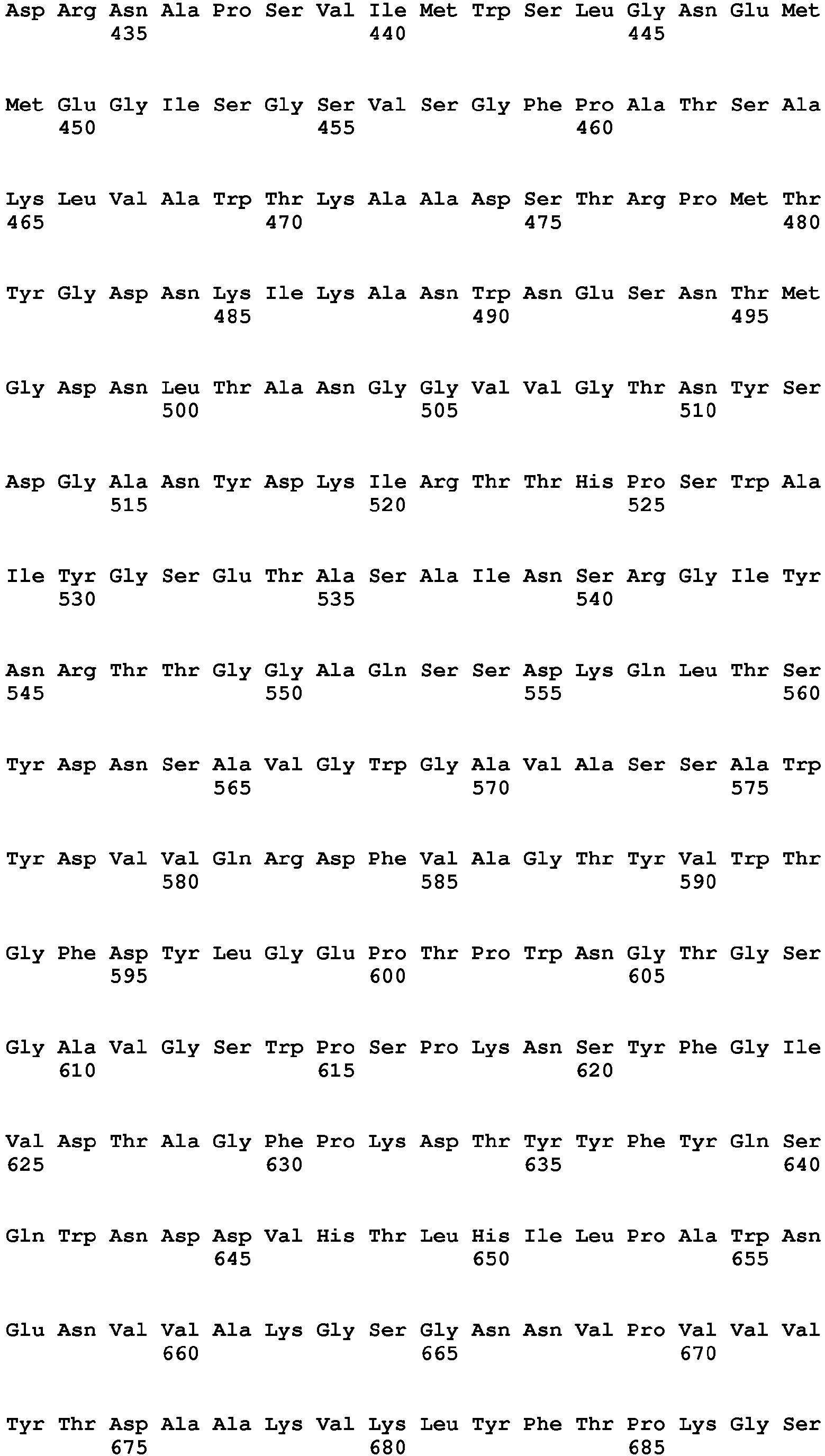
<211> 1304
<212> PRT
<213> Bifidobacterium bifidum - <400> 1




Claims (15)
- A sterile-filtered liquid lactase preparation comprising at least one salt having a monovalent cation, wherein the total concentration of said at least one salt is 0.01-5% w/w, and further comprising a polyol selected among glycerol, sorbitol, monopropylene glycol, sucrose, glucose, galactose or lactose, or combinations thereof, at a concentration of 10-70% w/w, preferably 30-60% w/w, wherein the concentration of lactase in the lactase preparation is between 10 and 5000 LAU-B/g and wherein the activity of the lactase (LAU-B) is determined as set forth in the description.
- The liquid lactase preparation of claim 1, wherein the salt is a salt of Na+, K+ or NH4 +.
- The liquid lactase preparation of claim 1, wherein the salt is selected among NaCl, KCI, NH4Cl, Na2SO4, K2SO4, (NH4)2SO4, or a combination thereof, preferably, NaCl, KCI, (NH4)2SO4, Na2SO4 or a combination thereof, more preferably NaCl.
- The liquid lactase preparation of any of the preceding claims, wherein the total concentration of the at least one salt is 0.015-4% w/w, preferably 0.02-3% w/w or 0.1-2% w/w.
- The liquid lactase preparation of any of the preceding claims wherein the polyol is glycerol.
- The liquid lactase preparation of any of the preceding claims, wherein the lactase has an amino acid sequence which is at least 50% identical to SEQ ID NO: 1.
- The liquid lactase preparation of any of the preceding claims, wherein the lactase has a C-terminal end corresponding to amino acid 1304 of SEQ ID NO: 1.
- The liquid lactase preparation of any of claims 1 to 7, further comprising at least one salt having a divalent cation, preferably at least one salt of Mg++.
- A method of sterile filtering a liquid lactase preparation, which comprises the steps of:a. providing a liquid lactase preparation comprising at least one salt having a monovalent cation, wherein the total concentration of said at least one salt is 0.01-5% w/w, and further comprising a polyol selected among glycerol, sorbitol, monopropylene glycol, sucrose, glucose, galactose or lactose, or combinations thereof, at a concentration of 10-70% w/w, preferably 30-60% w/w, wherein the concentration of lactase in the lactase preparation is between 10 and 5000 LAU-B/g; andb. sterile filtering said lactase preparation;and wherein the activity of the lactase (LAU-B) is determined as set forth in the description.
- The method of claim 9, wherein the at least one salt is selected from a salt of Na+, K+ or NH4 +.
- The method of any of claims 9-10, wherein the at least one salt is selected among NaCl, KCI, NH4Cl, Na2SO4, K2SO4, (NH4)2SO4 or a combination thereof, preferably, NaCl, KCI, (NH4)2SO4, Na2SO4 or a combination thereof, more preferably NaCl.
- The method of any of claims 9-11, wherein the total concentration of the at least one salt is 0.015-4% w/w, preferably 0.02-3% w/w or 0.1-2% w/w.
- The method of any of claims 9-12, wherein the lactase has an amino acid sequence which is at least 50% identical to SEQ ID NO: 1.
- The method of any of claims 9-13, wherein the lactase preparation has an improved filterability compared to a second liquid lactase preparation having the same composition except that it does not comprise said at least one salt having a monovalent cation.
- The method of any of claims 9-14, wherein said sterile filtering is performed in-line within a production process of a dairy product.
Priority Applications (1)
| Application Number | Priority Date | Filing Date | Title |
|---|---|---|---|
| PL18702108T PL3568023T3 (en) | 2017-01-13 | 2018-01-12 | Sterile filtered lactase preparation containing monovalent cation salt and its production |
Applications Claiming Priority (3)
| Application Number | Priority Date | Filing Date | Title |
|---|---|---|---|
| EP17151473 | 2017-01-13 | ||
| EP17173248 | 2017-05-29 | ||
| PCT/EP2018/050758 WO2018130654A1 (en) | 2017-01-13 | 2018-01-12 | Sterile filtered lactase preparation comprising salt with monovalent cation |
Publications (2)
| Publication Number | Publication Date |
|---|---|
| EP3568023A1 EP3568023A1 (en) | 2019-11-20 |
| EP3568023B1 true EP3568023B1 (en) | 2021-07-07 |
Family
ID=61094425
Family Applications (1)
| Application Number | Title | Priority Date | Filing Date |
|---|---|---|---|
| EP18702108.4A Active EP3568023B1 (en) | 2017-01-13 | 2018-01-12 | Sterile filtered lactase preparation comprising salt with monovalent cation and preparation thereof |
Country Status (7)
| Country | Link |
|---|---|
| US (2) | US11576393B2 (en) |
| EP (1) | EP3568023B1 (en) |
| CN (1) | CN110167352A (en) |
| BR (1) | BR112019014432B1 (en) |
| DK (1) | DK3568023T3 (en) |
| PL (1) | PL3568023T3 (en) |
| WO (1) | WO2018130654A1 (en) |
Families Citing this family (8)
| Publication number | Priority date | Publication date | Assignee | Title |
|---|---|---|---|---|
| PL3568023T3 (en) | 2017-01-13 | 2021-12-27 | Novozymes A/S | Sterile filtered lactase preparation containing monovalent cation salt and its production |
| BR112022012392A2 (en) | 2019-12-26 | 2022-08-30 | Pharmunion Llc | STABLE LACTASE PRODUCT |
| WO2023288294A1 (en) | 2021-07-16 | 2023-01-19 | Novozymes A/S | Compositions and methods for improving the rainfastness of proteins on plant surfaces |
| CN112707940B (en) * | 2020-12-28 | 2022-07-01 | 中国科学院青岛生物能源与过程研究所 | Sterilization method of glycerol glucoside |
| IT202100019244A1 (en) * | 2021-07-20 | 2023-01-20 | Mauro Marchetti | METHOD OF PRODUCTION OF A DAIRY PRODUCT |
| EP4525615A2 (en) | 2022-05-14 | 2025-03-26 | Novozymes A/S | Compositions and methods for preventing, treating, supressing and/or eliminating phytopathogenic infestations and infections |
| WO2023237360A1 (en) | 2022-06-07 | 2023-12-14 | Chr. Hansen A/S | Improving filterability of lactase by adding anions selected from malate, tartrate, citrate, gluconate, edta or combinations thereof and sterile filtered lactase product obtained |
| WO2025217017A1 (en) | 2024-04-08 | 2025-10-16 | Novozymes A/S | Compositions and methods for increasing phosphorous availability |
Citations (13)
| Publication number | Priority date | Publication date | Assignee | Title |
|---|---|---|---|---|
| GB1477087A (en) | 1974-11-13 | 1977-06-22 | Tetra Pak Int | Treatment of dairy products |
| US4237230A (en) | 1977-05-31 | 1980-12-02 | Daiwa Kasei Kabushiki Kaisha | Novel lactase |
| FR2500269A1 (en) | 1981-02-20 | 1982-08-27 | Tetra Pak Int | Removing lactose from milk - by treating with lactase after heat sterilisation |
| US4464469A (en) | 1981-09-01 | 1984-08-07 | John & E. Sturge Limited | Stabilized lactase solutions and processes for stabilization |
| EP0145092A2 (en) | 1983-12-02 | 1985-06-19 | Gist-Brocades N.V. | Process for the preparation of a germ-free solution of a lactose-splitting enzyme and its use |
| US5357852A (en) | 1992-06-02 | 1994-10-25 | Kohler Mix Specialties | Method and apparatus for producing reduced lactose milk |
| WO2002081673A1 (en) | 2001-04-04 | 2002-10-17 | Dsm Ip Assets B.V. | Purified lactase |
| WO2009071539A1 (en) | 2007-12-03 | 2009-06-11 | Novozymes A/S | Method for producing a dairy product |
| WO2013084244A1 (en) | 2011-12-05 | 2013-06-13 | Medreich Limited | Stable lactase drops |
| WO2014148189A1 (en) | 2013-03-19 | 2014-09-25 | 住友金属鉱山株式会社 | Zinc oxide-based sintered object, process for producing same, sputtering target, and transparent conductive film |
| WO2014184189A2 (en) | 2013-05-14 | 2014-11-20 | Novozymes A/S | Process for simultaneous saccharfication and fermentation of whey permeate |
| WO2015132349A1 (en) | 2014-03-05 | 2015-09-11 | Dsm Ip Assets B.V. | Liquid lactase compositions |
| WO2016031885A1 (en) | 2014-08-27 | 2016-03-03 | 合同酒精株式会社 | Lactase solution and milk using same |
Family Cites Families (4)
| Publication number | Priority date | Publication date | Assignee | Title |
|---|---|---|---|---|
| CN100497613C (en) | 2006-09-08 | 2009-06-10 | 哈尔滨美华生物技术股份有限公司 | Method for producing lactase of neutral liquid |
| SG10201704771TA (en) | 2008-10-23 | 2017-07-28 | Meiji Co Ltd | Fermented whey preparation and method for producing the same |
| GB201419900D0 (en) | 2014-11-07 | 2014-12-24 | Dupont Nutrition Biosci Aps | Method |
| PL3568023T3 (en) | 2017-01-13 | 2021-12-27 | Novozymes A/S | Sterile filtered lactase preparation containing monovalent cation salt and its production |
-
2018
- 2018-01-12 PL PL18702108T patent/PL3568023T3/en unknown
- 2018-01-12 BR BR112019014432-3A patent/BR112019014432B1/en active IP Right Grant
- 2018-01-12 US US16/473,118 patent/US11576393B2/en active Active
- 2018-01-12 DK DK18702108.4T patent/DK3568023T3/en active
- 2018-01-12 CN CN201880006161.8A patent/CN110167352A/en active Pending
- 2018-01-12 EP EP18702108.4A patent/EP3568023B1/en active Active
- 2018-01-12 WO PCT/EP2018/050758 patent/WO2018130654A1/en not_active Ceased
-
2023
- 2023-01-06 US US18/151,319 patent/US12419318B2/en active Active
Patent Citations (14)
| Publication number | Priority date | Publication date | Assignee | Title |
|---|---|---|---|---|
| GB1477087A (en) | 1974-11-13 | 1977-06-22 | Tetra Pak Int | Treatment of dairy products |
| US4237230A (en) | 1977-05-31 | 1980-12-02 | Daiwa Kasei Kabushiki Kaisha | Novel lactase |
| FR2500269A1 (en) | 1981-02-20 | 1982-08-27 | Tetra Pak Int | Removing lactose from milk - by treating with lactase after heat sterilisation |
| US4464469A (en) | 1981-09-01 | 1984-08-07 | John & E. Sturge Limited | Stabilized lactase solutions and processes for stabilization |
| EP0145092A2 (en) | 1983-12-02 | 1985-06-19 | Gist-Brocades N.V. | Process for the preparation of a germ-free solution of a lactose-splitting enzyme and its use |
| US5357852A (en) | 1992-06-02 | 1994-10-25 | Kohler Mix Specialties | Method and apparatus for producing reduced lactose milk |
| WO2002081673A1 (en) | 2001-04-04 | 2002-10-17 | Dsm Ip Assets B.V. | Purified lactase |
| WO2009071539A1 (en) | 2007-12-03 | 2009-06-11 | Novozymes A/S | Method for producing a dairy product |
| WO2013084244A1 (en) | 2011-12-05 | 2013-06-13 | Medreich Limited | Stable lactase drops |
| WO2014148189A1 (en) | 2013-03-19 | 2014-09-25 | 住友金属鉱山株式会社 | Zinc oxide-based sintered object, process for producing same, sputtering target, and transparent conductive film |
| WO2014184189A2 (en) | 2013-05-14 | 2014-11-20 | Novozymes A/S | Process for simultaneous saccharfication and fermentation of whey permeate |
| WO2015132349A1 (en) | 2014-03-05 | 2015-09-11 | Dsm Ip Assets B.V. | Liquid lactase compositions |
| WO2016031885A1 (en) | 2014-08-27 | 2016-03-03 | 合同酒精株式会社 | Lactase solution and milk using same |
| EP3187582A1 (en) | 2014-08-27 | 2017-07-05 | Godo Shusei Co., Ltd. | Lactase solution and milk using same |
Non-Patent Citations (48)
| Title |
|---|
| "Advanced Dairy Chemistry. 2nd ed.", 1 January 1997, CHAPMAN & HALL, article MAHONEY R. R.: "Lactose: Enzymatic modification", pages: 77 - 125, XP055914340 |
| "Lactase (neutral)(beta-galactosidase) acivity", FOOD CHEMICAL CODEX, XX, XX, 1 July 1996 (1996-07-01), XX , pages 801 - 802, XP008085975 |
| 30 June 2008 (2008-06-30) |
| ABDELRAHIM KHALID ALI: "Production and characterization of beta-galactosidase from psychotropic B. subtilis", THESIS, MCGILL UNIVERSITY, 1 November 1989 (1989-11-01), McGill University, XP055914271, Retrieved from the Internet <URL:https://escholarship.mcgill.ca/concern/theses/j96022023> [retrieved on 20220421] |
| ANONYMOUS: "Aseptic dosing of heat-sensitive ingredients", TETRAPAK, 2015, XP055914371, Retrieved from the Internet <URL:www.tetrapak.com/en-gb/solutions/processing/main-technology-area/dosing> |
| ANONYMOUS: "Beta1,4-Galactosidase, Streptococcus pneumoniae, Recombinant E. coli", MERCK MILLIPORE, 2021, XP055914381, Retrieved from the Internet <URL:https://www.merckmillipore.com/NL/en/product/14-Galactosidase-Streptococcus-pneumoniae-Recombinant-E.-coli,EMD_BIO-345806?ReferrerURL=https%3A%2F%2Fwww.google.com%2F> |
| ANONYMOUS: "Chr. Hansen announces NOLA Fit", INGREDIENTS NETWORK, 30 June 2016 (2016-06-30), XP055913975, Retrieved from the Internet <URL:https://www.ingredientsnetwork.com/chr-hansen-announces-nola-fit-news041484.html#:~:text=30%20Jun%202016-,Chr.,yogurts%20%2D%20without%20compromising%20on%20taste.> [retrieved on 20220420] |
| ANONYMOUS: "GODO-YNL2", DANISCO - PRODUCT DESCRIPTION, 10 January 2017 (2017-01-10), pages 1 - 3, XP055913965, [retrieved on 20220420] |
| ANONYMOUS: "Lactose reduction in milk with Novozymes Saphera 2600L & 900 L S", NOVOZYMES - DAIRY APPLICATION SHEET, 12 July 2016 (2016-07-12), pages 1 - 5, XP055913961, [retrieved on 20220420] |
| ANONYMOUS: "Melk met gereduceerd lactose gehalte", VOEDINGSMIDDELENTECHNOLOGIE, ZUIVEL, vol. 13, no. 6, 6 March 1980 (1980-03-06), pages 23, XP055313331 |
| ANONYMOUS: "NOLA Fit 5500", CHR HANSEN - PRODUCT INFORMATION, 13 January 2017 (2017-01-13), pages 1 - 5, XP055913971, [retrieved on 20220420] |
| ANONYMOUS: "Saphera 2600L ", NOVOZYMES - PRODUCT DATA SHEET, 31 March 2016 (2016-03-31), XP055913953, [retrieved on 20220420] |
| ANONYMOUS: "Tetra Aldose - Aseptic in-line dosing", TETRAPAK, 1 September 2011 (2011-09-01), pages 1 - 2, XP055914366, [retrieved on 20220421] |
| ATHES, V ET AL., J MOL CATAL B: ENZYMATIC, vol. 7, 1999, pages 1 - 9 |
| BOSSO ALESSANDRA, MORIOKA LUIZ RODRIGO ITO, SANTOS LEANDRO FREIRE DOS, SUGUIMOTO HÉLIO HIROSHI: "Lactose hydrolysis potential and thermal stability of commercial β-galactosidase in UHT and skimmed milk", CIêNCIA E TECNOLOGIA DE ALIMENTOS, SOCIEDADE BRASILEIRA DE CIêNCIA E TECNOLOGIA DE ALIMENTOS, BR, vol. 36, no. 1, 1 January 2016 (2016-01-01), BR , pages 159 - 165, XP055914328, ISSN: 0101-2061, DOI: 10.1590/1678-457X.0085 |
| CAVAILLE ET AL.: "Characterization of beta-galactosidase from Kluyveromyces lactis", BIOTECHNOL. APPL. BIOCHEM., vol. 22, 1995, pages 55 - 64, XP008063505 |
| CHANG BYEONG-SEON, MAHONEY RAYMOND R.: "Factors affecting the thermostability of β-galactosidase ( Streptococcus salivarius subsp. thermophilus ) in milk: a quantitative study", JOURNAL OF DAIRY RESEARCH, CAMBRIDGE UNIVERSITY PRESS, CAMBRIDGE, GB, vol. 56, no. 5, 1 November 1989 (1989-11-01), GB , pages 785 - 792, XP055914043, ISSN: 0022-0299, DOI: 10.1017/S0022029900029368 |
| CHANG BYEONG-SEON, MAHONEY RAYMOND R.: "Purification and thermostability of β-galactosidase (lactase) from an autolytic strain of Streptococcus salivarius subsp. thermophilus", JOURNAL OF DAIRY RESEARCH, CAMBRIDGE UNIVERSITY PRESS, CAMBRIDGE, GB, vol. 56, no. 1, 1 February 1989 (1989-02-01), GB , pages 117 - 127, XP055914046, ISSN: 0022-0299, DOI: 10.1017/S0022029900026285 |
| DAHLQVIST A; ASP N-G; BURVALL A; RAUSING H: "HYDROLYSIS OF LACTOSE IN MILK AND WHEY WITH MINUTE AMOUNTS OF LACTASE", JOURNAL OF DAIRY RESEARCH, CAMBRIDGE UNIVERSITY PRESS, CAMBRIDGE, GB, vol. 44, no. 3, 1 January 1977 (1977-01-01), GB , pages 541 - 548, XP009157855, ISSN: 0022-0299, DOI: 10.1017/S0022029900020495 |
| DANISCO: "Godo YNL2 Yeast Neutral Lactase. Product description PD 234964.3.0EN", 19 April 2011 (2011-04-19), pages 1 - 2, XP055912288 |
| DICKSON R C, DICKSON L R, MARKIN J S: "Purification and properties on an inducible beta-galactosidase isolated from the yeast Kluyveromyces lactis", JOURNAL OF BACTERIOLOGY (PRINT), AMERICAN SOCIETY FOR MICROBIOLOGY, US, vol. 137, no. 1, 1 January 1979 (1979-01-01), US , pages 51 - 61, XP003028171, ISSN: 0021-9193 |
| FDA: "GRAS Notification for Beta-galactosidase Enzyme Preparation derived from Bacillus circulans expressed in Bacillus subtilis", GRAS NOTICE (GRN) NO. 649, 26 April 2016 (2016-04-26), XP055914375, Retrieved from the Internet <URL:https://www.fda.gov/media/99115/download> |
| FLORES ET AL.: "Effect of monovalent cations on the stability and activity of Kluyveromyces lactis beta-galactosidase", FOOD SCIENCE AND TECHNOLOGY, vol. 29, no. 5, 1996, pages 503 - 506, XP055457043, DOI: 10.1006/fstl.1996.0077 |
| GIRISHCHANDRA B. PATEL; C. ROGER MACKENZIE; BRIAN J. AGNEW: "Properties and potential advantages of β-galactosidase ", APPLIED MICROBIOLOGY AND BIOTECHNOLOGY, SPRINGER, BERLIN, DE, vol. 22, no. 2, 1 June 1985 (1985-06-01), Berlin, DE , pages 114 - 120, XP035168540, ISSN: 1432-0614, DOI: 10.1007/BF00250030 |
| GLYCERINE PRODUCERS ASSOCIATION, PHYSICAL PROPERTIES OF GLYCERINE AND ITS SOLUTIONS, pages 1 - 27 |
| GRAS NOTICE (GRN, 30 April 2015 (2015-04-30) |
| GUO JIEYAN: "Lactose hydrolysis of milks by Klyveromyces lactis lactase", FOOD & FERMENTATION INDUSTRIES, 1 January 1991 (1991-01-01), XP055316113 |
| GUY EUGENE J., BINGHAM ELIZABETH W.: "Properties of β-Galactosidase of Saccharomyces Lactis in Milk and Milk Products", JOURNAL OF DAIRY SCIENCE, AMERICAN DAIRY SCIENCE ASSOCIATION, US, vol. 61, no. 2, 1 February 1978 (1978-02-01), US , pages 147 - 151, XP055914257, ISSN: 0022-0302, DOI: 10.3168/jds.S0022-0302(78)83570-X |
| HUSSEIN L, ELSAYED S, FODA S: "Reduction of lactose in milk by purified lactase produced by Kluyveromyces lactis", JOURNAL OF FOOD PROTECTION, INTERNATIONAL ASSOCIATION FOR FOOD PROTECTION, US, vol. 52, no. 1, 1 January 1988 (1988-01-01), US , pages 30 - 34, XP003028138, ISSN: 0362-028X |
| JACOBER-PIVARNIK L F, RAND JR. A. G.: "Use of milk assay to evaluate the effects of potassium on commercial yeast lactases", JOURNAL OF FOOD SCIENCE, vol. 49, 1 January 1984 (1984-01-01), pages 435 - 445, XP055912278 |
| JASEWICZ LENORE, WASSERMAN AARON E.: "Quantitative Determination of Lactase", JOURNAL OF DAIRY SCIENCE, AMERICAN DAIRY SCIENCE ASSOCIATION, US, vol. 44, no. 3, 1 March 1961 (1961-03-01), US , pages 393 - 400, XP055914255, ISSN: 0022-0302, DOI: 10.3168/jds.S0022-0302(61)89755-5 |
| KOLLMAN, ET AL: "The NH2 substituent effect on the properties of ionic compounds", JOURNAL OF THE AMERICAN CHEMICAL SOCIETY, vol. 97, no. 7, 1 January 1975 (1975-01-01), pages 1640 - 1644, XP055912285 |
| LACTOZYME PRODUCT DATA SHEET, 28 March 2012 (2012-03-28), XP055763058 |
| LIAO ABRAHAM, HORVÁTH CSABA: "Purification of β-Galactosidase by Combined Frontal and Displacement Chromatography", ANNALS OF THE NEW YORK ACADEMY OF SCIENCES, NEW YORK ACADEMY OF SCIENCES., US, vol. 589, no. 1 Biochemical E, 1 May 1990 (1990-05-01), US , pages 182 - 191, XP055914300, ISSN: 0077-8923, DOI: 10.1111/j.1749-6632.1990.tb24244.x |
| M.V FLORES, ERTOLA R.J, VOGET C.E: "Effect of Monovalent Cations on the Stability and Activity of Kluyveromyces lactis β-Galactosidase", LWT- FOOD SCIENCE AND TECHNOLOGY, ACADEMIC PRESS, UNITED KINGDOM, vol. 29, no. 5, 10 May 2002 (2002-05-10), United Kingdom , pages 503 - 506, XP055457043, ISSN: 0023-6438, DOI: 10.1006/fstl.1996.0077 |
| MAHONEY R R; WILDER T: "THERMOSTABILITY OF YEAST LACTASE KLUYVEROMYCES-MARXIANUS IN MILK", JOURNAL OF DAIRY RESEARCH, CAMBRIDGE UNIVERSITY PRESS, CAMBRIDGE, GB, vol. 55, no. 3, 1 August 1988 (1988-08-01), GB , pages 423 - 433, XP008169824, ISSN: 0022-0299, DOI: 10.1017/S0022029900028673 |
| MAHONEY R. R., ADAMCHUK C.: "EFFECT OF MILK CONSTITUENTS ON THE HYDROLYSIS OF LACTOSE BY LACTASE FROM Kluyveromyces fragilis", JOURNAL OF FOOD SCIENCE, WILEY-BLACKWELL PUBLISHING, INC, US, vol. 45, no. 4, 1 July 1980 (1980-07-01), US , pages 962 - 964, XP055890281, ISSN: 0022-1147, DOI: 10.1111/j.1365-2621.1980.tb07487.x |
| MODLER H., GELDA A., YAGUCHI M., GELDA S.: "Production of fluid milk with a high degree of lactose hydrolysis", BULLETIN OF THE IDF 289, vol. 12, 1 January 1993 (1993-01-01), pages 57 - 61, XP055914051 |
| NEUHAUS WINFRIED; NOVALIN SENAD; KLIMACEK MARIO; SPLECHTNA BARBARA; PETZELBAUER INGE; SZIVAK ALEXANDER; KULBE KLAUS D.: "Optimization of an innovative hollow-fiber process to produce lactose-reduced skim milk", APPLIED BIOCHEMISTRY AND BIOTECHNOLOGY, HUMANA PRESS INC, NEW YORK, vol. 134, no. 1, 10 January 2018 (2018-01-10), New York , pages 1 - 14, XP036410355, ISSN: 0273-2289, DOI: 10.1385/ABAB:134:1:1 |
| NGUYEN THU-HA, SPLECHTNA BARBARA, STEINBÖCK MARLENE, KNEIFEL WOLFGANG, LETTNER HANS PETER, KULBE KLAUS D., HALTRICH DIETMAR: "Purification and Characterization of Two Novel β-Galactosidases from Lactobacillus reuteri", JOURNAL OF AGRICULTURAL AND FOOD CHEMISTRY, AMERICAN CHEMICAL SOCIETY, US, vol. 54, no. 14, 1 July 2006 (2006-07-01), US , pages 4989 - 4998, XP055913981, ISSN: 0021-8561, DOI: 10.1021/jf053126u |
| NOVOZYMES: "Lactose-free dairy products. The next generation of lactase. Novozymes Saphera", 1 March 2016 (2016-03-01), pages 1 - 2, XP055912280 |
| NOVOZYMES: "Saphera 2600 L Product Data Sheet", 16 June 2016 (2016-06-16), pages 1 - 2, XP055912283 |
| NOVOZYMES: "Saphera 900 LS Product Data Sheet", 11 April 2016 (2016-04-11), pages 1 - 2, XP055912284 |
| RATHORE: "Filter Clogging Issues in Sterile Filtration", BIOPHARM INTERNATIONAL, vol. 21, no. 4, 1 April 2008 (2008-04-01), pages 1 - 5, XP055912277 |
| TANAKA YUJI, KAGAMIISHI AKIHIRO, KIUCHI AKIRA, HORIUCHI TADAO: "Purification and Properties of Beta-Galactosidase from Aspergillus oryzae", J. BIOCHEM, vol. 77, 1 January 1975 (1975-01-01), pages 241 - 247, XP055914361 |
| WEIQUN S, ET AL: "Purification and Characterization of Beta-galactosidase from Kluyveromyces lactis (Official English translation enclosed)", CHINESE JOURNAL OF BIOTECHNOLOGY, ALLERTON PRESS, NEW YORK, NY, US, vol. 90, no. 4, 1 January 1993 (1993-01-01), US , pages 348 - 354, XP003031057, ISSN: 1042-749X |
| WIDMER FRANCOIS, LEUBA JEAN-LOUIS: "beta-Galactosidase from Aspergillus niger. Separation and Characterization of Three Multiple Forms", EUROPEAN JOURNAL OF BIOCHEMISTRY, PUBLISHED BY SPRINGER-VERLAG ON BEHALF OF THE FEDERATION OF EUROPEAN BIOCHEMICAL SOCIETIES, vol. 100, no. 2, 1 October 1979 (1979-10-01), pages 559 - 567, XP055914299, ISSN: 0014-2956, DOI: 10.1111/j.1432-1033.1979.tb04202.x |
| WONG DANA E., GODDARD JULIE M.: "Short communication: Effect of active food packaging materials on fluid milk quality and shelf life", JOURNAL OF DAIRY SCIENCE, AMERICAN DAIRY SCIENCE ASSOCIATION, US, vol. 97, no. 1, 1 January 2014 (2014-01-01), US , pages 166 - 172, XP055914012, ISSN: 0022-0302, DOI: 10.3168/jds.2013-7214 |
Also Published As
| Publication number | Publication date |
|---|---|
| US12419318B2 (en) | 2025-09-23 |
| DK3568023T3 (en) | 2021-10-04 |
| US11576393B2 (en) | 2023-02-14 |
| CN110167352A (en) | 2019-08-23 |
| PL3568023T3 (en) | 2021-12-27 |
| BR112019014432B1 (en) | 2023-10-24 |
| WO2018130654A1 (en) | 2018-07-19 |
| US20230225345A1 (en) | 2023-07-20 |
| EP3568023A1 (en) | 2019-11-20 |
| US20200221721A1 (en) | 2020-07-16 |
| BR112019014432A2 (en) | 2020-04-14 |
Similar Documents
| Publication | Publication Date | Title |
|---|---|---|
| US12419318B2 (en) | Sterile filtered lactase preparation comprising salt with monovalent cation | |
| JP6726152B2 (en) | Enzyme preparation that produces a clean taste | |
| KR101819129B1 (en) | Methods and systems for purifying non-complexed botulinum neurotoxin | |
| EP2687598B1 (en) | Method for assaying arylsulfatase activity | |
| CN108699549B (en) | Beta-galactosidase enzyme | |
| JP2010524446A (en) | Mannoprotein liquid formulation | |
| US11718841B2 (en) | Method for producing galactooligosaccharide | |
| WO2012127005A1 (en) | Chymosin formulation | |
| US10368558B2 (en) | Lactase solution and dairy product using same | |
| US20120045542A1 (en) | Process to produce a wine or fruit juice stabliser | |
| EP4495233A1 (en) | Enzyme-containing solution and method for producing dairy products | |
| CN115397247A (en) | Fermented milk, process for producing the same, and dephosphorized yogurt | |
| Yoshikawa et al. | One-step removal of proteases in a commercial lactase preparation from Kluyveromyces lactis using an anion-exchange membrane | |
| EP4446409A1 (en) | Lactase solution |
Legal Events
| Date | Code | Title | Description |
|---|---|---|---|
| STAA | Information on the status of an ep patent application or granted ep patent |
Free format text: STATUS: UNKNOWN |
|
| STAA | Information on the status of an ep patent application or granted ep patent |
Free format text: STATUS: THE INTERNATIONAL PUBLICATION HAS BEEN MADE |
|
| PUAI | Public reference made under article 153(3) epc to a published international application that has entered the european phase |
Free format text: ORIGINAL CODE: 0009012 |
|
| STAA | Information on the status of an ep patent application or granted ep patent |
Free format text: STATUS: REQUEST FOR EXAMINATION WAS MADE |
|
| 17P | Request for examination filed |
Effective date: 20190813 |
|
| AK | Designated contracting states |
Kind code of ref document: A1 Designated state(s): AL AT BE BG CH CY CZ DE DK EE ES FI FR GB GR HR HU IE IS IT LI LT LU LV MC MK MT NL NO PL PT RO RS SE SI SK SM TR |
|
| AX | Request for extension of the european patent |
Extension state: BA ME |
|
| DAV | Request for validation of the european patent (deleted) | ||
| DAX | Request for extension of the european patent (deleted) | ||
| GRAP | Despatch of communication of intention to grant a patent |
Free format text: ORIGINAL CODE: EPIDOSNIGR1 |
|
| STAA | Information on the status of an ep patent application or granted ep patent |
Free format text: STATUS: GRANT OF PATENT IS INTENDED |
|
| RIC1 | Information provided on ipc code assigned before grant |
Ipc: C12N 9/38 20060101ALI20210126BHEP Ipc: C12N 9/24 20060101ALI20210126BHEP Ipc: A23C 9/12 20060101AFI20210126BHEP |
|
| INTG | Intention to grant announced |
Effective date: 20210218 |
|
| GRAS | Grant fee paid |
Free format text: ORIGINAL CODE: EPIDOSNIGR3 |
|
| GRAA | (expected) grant |
Free format text: ORIGINAL CODE: 0009210 |
|
| STAA | Information on the status of an ep patent application or granted ep patent |
Free format text: STATUS: THE PATENT HAS BEEN GRANTED |
|
| AK | Designated contracting states |
Kind code of ref document: B1 Designated state(s): AL AT BE BG CH CY CZ DE DK EE ES FI FR GB GR HR HU IE IS IT LI LT LU LV MC MK MT NL NO PL PT RO RS SE SI SK SM TR |
|
| REG | Reference to a national code |
Ref country code: GB Ref legal event code: FG4D |
|
| REG | Reference to a national code |
Ref country code: AT Ref legal event code: REF Ref document number: 1407676 Country of ref document: AT Kind code of ref document: T Effective date: 20210715 |
|
| REG | Reference to a national code |
Ref country code: DE Ref legal event code: R096 Ref document number: 602018019666 Country of ref document: DE |
|
| REG | Reference to a national code |
Ref country code: IE Ref legal event code: FG4D |
|
| REG | Reference to a national code |
Ref country code: DK Ref legal event code: T3 Effective date: 20210929 |
|
| REG | Reference to a national code |
Ref country code: LT Ref legal event code: MG9D |
|
| REG | Reference to a national code |
Ref country code: AT Ref legal event code: MK05 Ref document number: 1407676 Country of ref document: AT Kind code of ref document: T Effective date: 20210707 |
|
| REG | Reference to a national code |
Ref country code: NL Ref legal event code: FP |
|
| PG25 | Lapsed in a contracting state [announced via postgrant information from national office to epo] |
Ref country code: SE Free format text: LAPSE BECAUSE OF FAILURE TO SUBMIT A TRANSLATION OF THE DESCRIPTION OR TO PAY THE FEE WITHIN THE PRESCRIBED TIME-LIMIT Effective date: 20210707 Ref country code: RS Free format text: LAPSE BECAUSE OF FAILURE TO SUBMIT A TRANSLATION OF THE DESCRIPTION OR TO PAY THE FEE WITHIN THE PRESCRIBED TIME-LIMIT Effective date: 20210707 Ref country code: HR Free format text: LAPSE BECAUSE OF FAILURE TO SUBMIT A TRANSLATION OF THE DESCRIPTION OR TO PAY THE FEE WITHIN THE PRESCRIBED TIME-LIMIT Effective date: 20210707 Ref country code: FI Free format text: LAPSE BECAUSE OF FAILURE TO SUBMIT A TRANSLATION OF THE DESCRIPTION OR TO PAY THE FEE WITHIN THE PRESCRIBED TIME-LIMIT Effective date: 20210707 Ref country code: ES Free format text: LAPSE BECAUSE OF FAILURE TO SUBMIT A TRANSLATION OF THE DESCRIPTION OR TO PAY THE FEE WITHIN THE PRESCRIBED TIME-LIMIT Effective date: 20210707 Ref country code: NO Free format text: LAPSE BECAUSE OF FAILURE TO SUBMIT A TRANSLATION OF THE DESCRIPTION OR TO PAY THE FEE WITHIN THE PRESCRIBED TIME-LIMIT Effective date: 20211007 Ref country code: PT Free format text: LAPSE BECAUSE OF FAILURE TO SUBMIT A TRANSLATION OF THE DESCRIPTION OR TO PAY THE FEE WITHIN THE PRESCRIBED TIME-LIMIT Effective date: 20211108 Ref country code: LT Free format text: LAPSE BECAUSE OF FAILURE TO SUBMIT A TRANSLATION OF THE DESCRIPTION OR TO PAY THE FEE WITHIN THE PRESCRIBED TIME-LIMIT Effective date: 20210707 Ref country code: BG Free format text: LAPSE BECAUSE OF FAILURE TO SUBMIT A TRANSLATION OF THE DESCRIPTION OR TO PAY THE FEE WITHIN THE PRESCRIBED TIME-LIMIT Effective date: 20211007 Ref country code: AT Free format text: LAPSE BECAUSE OF FAILURE TO SUBMIT A TRANSLATION OF THE DESCRIPTION OR TO PAY THE FEE WITHIN THE PRESCRIBED TIME-LIMIT Effective date: 20210707 |
|
| PG25 | Lapsed in a contracting state [announced via postgrant information from national office to epo] |
Ref country code: LV Free format text: LAPSE BECAUSE OF FAILURE TO SUBMIT A TRANSLATION OF THE DESCRIPTION OR TO PAY THE FEE WITHIN THE PRESCRIBED TIME-LIMIT Effective date: 20210707 Ref country code: GR Free format text: LAPSE BECAUSE OF FAILURE TO SUBMIT A TRANSLATION OF THE DESCRIPTION OR TO PAY THE FEE WITHIN THE PRESCRIBED TIME-LIMIT Effective date: 20211008 |
|
| REG | Reference to a national code |
Ref country code: DE Ref legal event code: R026 Ref document number: 602018019666 Country of ref document: DE |
|
| PLBI | Opposition filed |
Free format text: ORIGINAL CODE: 0009260 |
|
| PLBI | Opposition filed |
Free format text: ORIGINAL CODE: 0009260 |
|
| PLAX | Notice of opposition and request to file observation + time limit sent |
Free format text: ORIGINAL CODE: EPIDOSNOBS2 |
|
| 26 | Opposition filed |
Opponent name: DSM IP ASSETS B.V. Effective date: 20220404 |
|
| 26 | Opposition filed |
Opponent name: GODO SHUSEI CO., LTD. Effective date: 20220407 Opponent name: DUPONT NUTRITION BIOSCIENCES APS Effective date: 20220406 |
|
| PG25 | Lapsed in a contracting state [announced via postgrant information from national office to epo] |
Ref country code: SM Free format text: LAPSE BECAUSE OF FAILURE TO SUBMIT A TRANSLATION OF THE DESCRIPTION OR TO PAY THE FEE WITHIN THE PRESCRIBED TIME-LIMIT Effective date: 20210707 Ref country code: SK Free format text: LAPSE BECAUSE OF FAILURE TO SUBMIT A TRANSLATION OF THE DESCRIPTION OR TO PAY THE FEE WITHIN THE PRESCRIBED TIME-LIMIT Effective date: 20210707 Ref country code: RO Free format text: LAPSE BECAUSE OF FAILURE TO SUBMIT A TRANSLATION OF THE DESCRIPTION OR TO PAY THE FEE WITHIN THE PRESCRIBED TIME-LIMIT Effective date: 20210707 Ref country code: EE Free format text: LAPSE BECAUSE OF FAILURE TO SUBMIT A TRANSLATION OF THE DESCRIPTION OR TO PAY THE FEE WITHIN THE PRESCRIBED TIME-LIMIT Effective date: 20210707 Ref country code: CZ Free format text: LAPSE BECAUSE OF FAILURE TO SUBMIT A TRANSLATION OF THE DESCRIPTION OR TO PAY THE FEE WITHIN THE PRESCRIBED TIME-LIMIT Effective date: 20210707 Ref country code: AL Free format text: LAPSE BECAUSE OF FAILURE TO SUBMIT A TRANSLATION OF THE DESCRIPTION OR TO PAY THE FEE WITHIN THE PRESCRIBED TIME-LIMIT Effective date: 20210707 |
|
| PG25 | Lapsed in a contracting state [announced via postgrant information from national office to epo] |
Ref country code: MC Free format text: LAPSE BECAUSE OF FAILURE TO SUBMIT A TRANSLATION OF THE DESCRIPTION OR TO PAY THE FEE WITHIN THE PRESCRIBED TIME-LIMIT Effective date: 20210707 |
|
| PLBB | Reply of patent proprietor to notice(s) of opposition received |
Free format text: ORIGINAL CODE: EPIDOSNOBS3 |
|
| REG | Reference to a national code |
Ref country code: CH Ref legal event code: PL |
|
| REG | Reference to a national code |
Ref country code: BE Ref legal event code: MM Effective date: 20220131 |
|
| PG25 | Lapsed in a contracting state [announced via postgrant information from national office to epo] |
Ref country code: LU Free format text: LAPSE BECAUSE OF NON-PAYMENT OF DUE FEES Effective date: 20220112 |
|
| PG25 | Lapsed in a contracting state [announced via postgrant information from national office to epo] |
Ref country code: BE Free format text: LAPSE BECAUSE OF NON-PAYMENT OF DUE FEES Effective date: 20220131 |
|
| PG25 | Lapsed in a contracting state [announced via postgrant information from national office to epo] |
Ref country code: LI Free format text: LAPSE BECAUSE OF NON-PAYMENT OF DUE FEES Effective date: 20220131 Ref country code: CH Free format text: LAPSE BECAUSE OF NON-PAYMENT OF DUE FEES Effective date: 20220131 |
|
| P01 | Opt-out of the competence of the unified patent court (upc) registered |
Effective date: 20230517 |
|
| PLBP | Opposition withdrawn |
Free format text: ORIGINAL CODE: 0009264 |
|
| RDAF | Communication despatched that patent is revoked |
Free format text: ORIGINAL CODE: EPIDOSNREV1 |
|
| APAH | Appeal reference modified |
Free format text: ORIGINAL CODE: EPIDOSCREFNO |
|
| APBM | Appeal reference recorded |
Free format text: ORIGINAL CODE: EPIDOSNREFNO |
|
| APBP | Date of receipt of notice of appeal recorded |
Free format text: ORIGINAL CODE: EPIDOSNNOA2O |
|
| APBQ | Date of receipt of statement of grounds of appeal recorded |
Free format text: ORIGINAL CODE: EPIDOSNNOA3O |
|
| PG25 | Lapsed in a contracting state [announced via postgrant information from national office to epo] |
Ref country code: MK Free format text: LAPSE BECAUSE OF FAILURE TO SUBMIT A TRANSLATION OF THE DESCRIPTION OR TO PAY THE FEE WITHIN THE PRESCRIBED TIME-LIMIT Effective date: 20210707 Ref country code: CY Free format text: LAPSE BECAUSE OF FAILURE TO SUBMIT A TRANSLATION OF THE DESCRIPTION OR TO PAY THE FEE WITHIN THE PRESCRIBED TIME-LIMIT Effective date: 20210707 |
|
| PG25 | Lapsed in a contracting state [announced via postgrant information from national office to epo] |
Ref country code: HU Free format text: LAPSE BECAUSE OF FAILURE TO SUBMIT A TRANSLATION OF THE DESCRIPTION OR TO PAY THE FEE WITHIN THE PRESCRIBED TIME-LIMIT; INVALID AB INITIO Effective date: 20180112 |
|
| REG | Reference to a national code |
Ref country code: DE Ref legal event code: R081 Ref document number: 602018019666 Country of ref document: DE Owner name: KERRY GROUP SERVICES INTERNATIONAL LTD., TRALE, IE Free format text: FORMER OWNER: NOVOZYMES A/S, BAGSVAERD, DK |
|
| RAP2 | Party data changed (patent owner data changed or rights of a patent transferred) |
Owner name: KERRY GROUP SERVICES INTERNATIONAL LTD |
|
| REG | Reference to a national code |
Ref country code: GB Ref legal event code: 732E Free format text: REGISTERED BETWEEN 20240704 AND 20240710 |
|
| PLBP | Opposition withdrawn |
Free format text: ORIGINAL CODE: 0009264 |
|
| REG | Reference to a national code |
Ref country code: NL Ref legal event code: PD Owner name: KERRY GROUP SERVICES INTERNATIONAL LTD; IE Free format text: DETAILS ASSIGNMENT: CHANGE OF OWNER(S), ASSIGNMENT; FORMER OWNER NAME: NOVOZYMES A/S Effective date: 20240731 |
|
| PLAB | Opposition data, opponent's data or that of the opponent's representative modified |
Free format text: ORIGINAL CODE: 0009299OPPO |
|
| PG25 | Lapsed in a contracting state [announced via postgrant information from national office to epo] |
Ref country code: MT Free format text: LAPSE BECAUSE OF FAILURE TO SUBMIT A TRANSLATION OF THE DESCRIPTION OR TO PAY THE FEE WITHIN THE PRESCRIBED TIME-LIMIT Effective date: 20210707 |
|
| R26 | Opposition filed (corrected) |
Opponent name: DSM IP ASSETS B.V. Effective date: 20220404 |
|
| PG25 | Lapsed in a contracting state [announced via postgrant information from national office to epo] |
Ref country code: TR Free format text: LAPSE BECAUSE OF FAILURE TO SUBMIT A TRANSLATION OF THE DESCRIPTION OR TO PAY THE FEE WITHIN THE PRESCRIBED TIME-LIMIT Effective date: 20210707 |
|
| PGFP | Annual fee paid to national office [announced via postgrant information from national office to epo] |
Ref country code: NL Payment date: 20260126 Year of fee payment: 9 |
|
| APBU | Appeal procedure closed |
Free format text: ORIGINAL CODE: EPIDOSNNOA9O |
|
| PGFP | Annual fee paid to national office [announced via postgrant information from national office to epo] |
Ref country code: GB Payment date: 20260127 Year of fee payment: 9 |
|
| PGFP | Annual fee paid to national office [announced via postgrant information from national office to epo] |
Ref country code: DE Payment date: 20260128 Year of fee payment: 9 Ref country code: DK Payment date: 20260126 Year of fee payment: 9 Ref country code: IE Payment date: 20260127 Year of fee payment: 9 |
|
| PGFP | Annual fee paid to national office [announced via postgrant information from national office to epo] |
Ref country code: IT Payment date: 20260121 Year of fee payment: 9 |
|
| PGFP | Annual fee paid to national office [announced via postgrant information from national office to epo] |
Ref country code: FR Payment date: 20260126 Year of fee payment: 9 |
|
| PGFP | Annual fee paid to national office [announced via postgrant information from national office to epo] |
Ref country code: PL Payment date: 20260112 Year of fee payment: 9 |
|
| RDAG | Patent revoked |
Free format text: ORIGINAL CODE: 0009271 |
|
| STAA | Information on the status of an ep patent application or granted ep patent |
Free format text: STATUS: PATENT REVOKED |