EP3567917A1 - Candidate cell determination method, user equipment and base station - Google Patents
Candidate cell determination method, user equipment and base station Download PDFInfo
- Publication number
- EP3567917A1 EP3567917A1 EP17890404.1A EP17890404A EP3567917A1 EP 3567917 A1 EP3567917 A1 EP 3567917A1 EP 17890404 A EP17890404 A EP 17890404A EP 3567917 A1 EP3567917 A1 EP 3567917A1
- Authority
- EP
- European Patent Office
- Prior art keywords
- cell
- system information
- state indication
- function
- type
- Prior art date
- Legal status (The legal status is an assumption and is not a legal conclusion. Google has not performed a legal analysis and makes no representation as to the accuracy of the status listed.)
- Granted
Links
Images



Classifications
-
- H—ELECTRICITY
- H04—ELECTRIC COMMUNICATION TECHNIQUE
- H04W—WIRELESS COMMUNICATION NETWORKS
- H04W36/00—Hand-off or reselection arrangements
- H04W36/0005—Control or signalling for completing the hand-off
- H04W36/0011—Control or signalling for completing the hand-off for data sessions of end-to-end connection
- H04W36/0016—Hand-off preparation specially adapted for end-to-end data sessions
-
- H—ELECTRICITY
- H04—ELECTRIC COMMUNICATION TECHNIQUE
- H04W—WIRELESS COMMUNICATION NETWORKS
- H04W36/00—Hand-off or reselection arrangements
- H04W36/0005—Control or signalling for completing the hand-off
- H04W36/0055—Transmission or use of information for re-establishing the radio link
- H04W36/0061—Transmission or use of information for re-establishing the radio link of neighbour cell information
-
- H—ELECTRICITY
- H04—ELECTRIC COMMUNICATION TECHNIQUE
- H04W—WIRELESS COMMUNICATION NETWORKS
- H04W36/00—Hand-off or reselection arrangements
-
- H—ELECTRICITY
- H04—ELECTRIC COMMUNICATION TECHNIQUE
- H04W—WIRELESS COMMUNICATION NETWORKS
- H04W48/00—Access restriction; Network selection; Access point selection
- H04W48/18—Selecting a network or a communication service
-
- H—ELECTRICITY
- H04—ELECTRIC COMMUNICATION TECHNIQUE
- H04W—WIRELESS COMMUNICATION NETWORKS
- H04W48/00—Access restriction; Network selection; Access point selection
- H04W48/08—Access restriction or access information delivery, e.g. discovery data delivery
Definitions
- the present disclosure relates to the field of wireless communications technologies. More specifically, the present disclosure relates to a cell selection/reselection method, a corresponding base station, and corresponding user equipment.
- the operating frequency band of future new communication RATs can be expanded to 100 GHz, which will satisfy at least service requirements for enhanced mobile broadband, the demand for communication between a large number of Internet of Things terminals, service requirements of high reliability requirements, and so on.
- the research work of the item is expected to end in 2018.
- This core network may be referred to as a next generation core.
- a core network to which an existing Long Term Evolution (LTE for short) system is connected is referred to as an evolved packet core (EPC for short).
- EPC evolved packet core
- the next generation core under discussion will be based on a different quality of service (Qos) architecture, and thus may be regarded as a new core network type different from the EPC.
- Qos quality of service
- next generation core may be logically divided into different network slices according to service types or service features, each network slice supporting its own core network function and providing a service to a specific user group.
- an eLTE base station can support connection to an EPC and connection to a next generation core.
- an eLTE base station connected to the EPC may be regarded as belonging to an evolved universal terrestrial radio access network (E-UTRAN) access network, while an eLTE eNB connected to the next generation core may be regarded as belonging to a 5G-RAN access network.
- E-UTRAN evolved universal terrestrial radio access network
- 5G-RAN 5G-RAN access network
- both an E-UTRAN cell and a 5G-RAN cell exist in an area covered by the eLTE base station.
- the next generation core further includes more than one network slice, cells supporting different core network functions may also exist in the area covered by the eLTE base station.
- UE user equipment
- a new mechanism is needed to implement cell selection/reselection within such a coverage area.
- the present disclosure is intended to provide a method for determining a candidate cell.
- a method performed by a base station comprising: generating system information, wherein the system information comprises at least a first network type cell state indication and a second network type cell state indication; and broadcasting the generated system information.
- a method performed by user equipment comprising: receiving system information of a cell, wherein the system information comprises at least a first network type cell state indication and a second network type cell state indication; and determining, according to a network type cell state indication in the received system information, whether to use the cell as a candidate cell for cell selection/reselection.
- a first network type cell state and/or second network type cell state comprises "Allowed” or “Prohibited.”
- a first network type cell state and/or second network type cell state comprises "Allowed,” “Prohibited,” and “Not Supported.”
- the cell is excluded from being used as a candidate cell for cell selection/reselection when a network type cell state indication in the received system information corresponding to a network type selected by the UE indicates "Prohibited.”
- the cell is excluded from being used as a candidate cell for cell selection/reselection, and the cell is set to a low priority when a network type cell state indication in the received system information corresponding to a network type selected by the UE indicates "Not Supported.”
- the cell is excluded from being used as a candidate cell for cell selection/reselection only when both the first network type cell state indication and the second network type cell state indication in the received system information indicate "Prohibited.”
- the cell is used as a candidate cell for cell selection/reselection only when both the first network type cell state indication and the second network type cell state indication in the received system information indicate "Allowed.”
- a method performed by a base station comprising: generating system information, wherein the system information comprises at least a first function state indication corresponding to a first core network function type and a second function state indication corresponding to a second core network function type; and broadcasting the generated system information.
- a method performed by user equipment comprising: receiving system information of a cell, wherein the system information comprises at least a first function state indication corresponding to a first core network function type and a second function state indication corresponding to a second core network function type; and determining, according to a core network function selected by the UE and a corresponding function state indication in the received system information, whether to use the cell as a candidate cell for cell selection/reselection.
- a first function state corresponding to the first core network function type and/or a second function state corresponding to the second core network function type comprises "Allowed” and “Prohibited.”
- a first function state corresponding to the first core network function type and/or a second function state corresponding to the second core network function type comprises "Allowed,” “Prohibited,” and “Not Supported.”
- a base station comprising: a processor; and a memory, configured to store instructions.
- the instructions when executed on the processor, cause the processor to be configured to: generate system information, wherein the system information comprises at least a first network type cell state indication and a second network type cell state indication; and broadcast the generated system information.
- UE user equipment
- the instructions when executed on the processor, cause the processor to be configured to: receive system information of a cell, wherein the system information comprises at least a first network type cell state indication and a second network type cell state indication; and determine, according to a network type cell state indication in the received system information, whether to use the cell as a candidate cell for cell selection/reselection.
- a base station comprising: a processor; and a memory, configured to store instructions.
- the instructions when executed on the processor, cause the processor to be configured to: generate system information, wherein the system information comprises at least a first function state indication corresponding to a first core network function type and a second function state indication corresponding to a second core network function type; and broadcast the generated system information.
- UE user equipment
- the instructions when executed on the processor, cause the processor to be configured to: receive system information of a cell, wherein the system information comprises at least a first function state indication corresponding to a first core network function type and a second function state indication corresponding to a second core network function type; and determine, according to a core network function selected by the UE and a corresponding function state indication in the received system information, whether to use the cell as a candidate cell for cell selection/reselection.
- a base station comprising:
- UE user equipment
- a base station comprising:
- UE user equipment
- a base station may be connected to different types of core networks, such as an existing EPC or a next generation core that supports more than one network slice.
- core networks such as an existing EPC or a next generation core that supports more than one network slice.
- the base station corresponds to different access networks.
- a cell covered by the base station may be referred to as a cell of a different access network type/core network type.
- the access network type/core network type is collectively referred to as a "network type," and an access network type cell, a core network type cell, and an access network type/core network type cell can be used interchangeably hereinafter.
- a cell of an eLTE base station connected to an EPC may be referred to as an EPC type cell/E-UTRAN cell.
- a cell of an eLTE base station connected to a next generation core may be referred to as a next generation core type cell/5G-RAN cell.
- the EPC type cell/E-UTRAN cell can provide an EPC core network function to user equipment within its coverage.
- the next generation core type cell/5G-RAN cell can provide a next generation core function to user equipment within its coverage.
- the next generation core may be logically divided into different network slices according to service types or service features, each network slice supporting its own core network function.
- the next generation core type cell/5G-RAN cell can provide different core network functions to user equipment within its coverage according to network slices to which the cell is connected.
- the base station refers to an eLTE base station.
- the present disclosure is not limited to the aforementioned examples of base stations, UE, access networks, and core networks, and may also be applied to other base stations supporting access of multiple network types, or base stations supporting multiple core network functions, and UE within the coverage of the base stations.
- the present disclosure is not limited to the following embodiments, but is applicable to more other wireless communications systems, for example, a mobile communications system later than 5G.
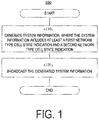
- FIG. 1 schematically shows a flowchart of a method 100 performed in an eLTE base station according to the first embodiment of the present disclosure.
- the base station in step s110, the base station generates system information (for example, a system information block (SIB)).
- system information includes at least a first network type (access network type/core network type) cell state indication and a second network type (access network type/core network type) cell state indication.
- step s120 the base station broadcasts the generated system information in a cell thereof.
- FIG. 2 schematically shows a flowchart of a method 200 performed in user equipment (UE) according to the first embodiment of the present disclosure.
- the user equipment may receive the system information of the cell.
- the system information includes at least the first network type cell state indication and the second network type cell state indication.
- the user equipment may determine, according to a corresponding network type cell state indication in the received system information, whether to use the cell as a candidate cell for cell selection/reselection.
- the system information broadcast by the cell simultaneously broadcasts cell state indications corresponding to different network types, namely, the first network type cell state indication (State Indication 1 for short) and the second network type cell state indication (State Indication 1 for short).
- State Indication 1 may indicate the state of an E-UTRAN cell
- State Indication 2 may indicate the state of a 5G-RAN cell.
- the state indication may be represented by, for example, a 1-bit symbol to indicate two states, such as "Not Barred” or "Barred,” of the corresponding network type cell (E-UTRAN cell or 5G-RAN cell). For example, when State Indication 1 is “0,” it indicates that the E-UTRAN cell is barred to use; when State Indication 1 is “1,” it indicates that the E-UTRAN cell is not barred to use. Similarly, State Indication 2 may also be represented by this method. When State Indication 2 is “0,” it indicates that the 5G-RAN cell is barred to use; when State Indication 2 is "1,” it indicates that the 5G-RAN cell is not barred to use. It should be understood that the foregoing implementation is merely an example, and the state indication may also indicate "Not barred” with a value "1” and indicate “Barred” with a value “0.” The present disclosure is not limited in this regard.
- the state indication may also be represented by a 2-bit symbol to indicate more than two states of a corresponding network type cell (E-UTRAN cell or 5G-RAN cell).
- the cell states may include three states: “Allowed,” “Prohibited,” and “Not Supported.” Accordingly, when State Indication 2 is "00,” it indicates that 5G-RAN is not supported; when State Indication 2 is "10,” it indicates that 5G-RAN is supported but the current 5G-RAN cell is prohibited from use; when State Indication 2 is "11,” it indicates that 5G-RAN is supported and the current 5G-RAN cell is allowed for use.
- State Indication 1 may also be represented by this method. It should be understood that the foregoing implementation is merely an example, and the state indication may indicate different states with different values of two bits. The present disclosure is not limited in this regard.
- State Indication 1 and State Indication 2 may occupy the same number or different numbers of bits and may even be represented by more than two bits.
- the present disclosure is not limited in this regard.
- State Indication 1 and State Indication 2 may be respectively represented by one bit; or State Indication 1 and State Indication 2 may be respectively represented by two bits; or State Indication 1 and State Indication 2 may be respectively represented by more than two bits; or State Indication 1 may be represented by one bit and State Indication 2 may be represented by two bits, and vice versa.
- State Indication 1 and State Indication 2 may be broadcast in the same system information (for example, a SIB).
- SIB system information
- State Indication 1 and State Indication 2 may be broadcast in different system information.
- the user equipment may receive, by receiving the system information broadcast by the cell in step s210, the aforementioned two cell state indications (State Indication 1 and State Indication 2) of the cell. Then, in step s220, the UE may determine, according to a network type selected by the UE and State Indication 1 and State Indication 2 in the received system information, whether to use the cell as a candidate for cell selection/reselection.
- the UE may determine, according to a network type selected by the UE and State Indication 1 and State Indication 2 in the received system information, whether to use the cell as a candidate for cell selection/reselection.
- step s220 Implementation manners of step s220 are described in detail below using several examples.
- the UE may determine, according to a network type cell state indication in the received system information corresponding to a network type (access network type/core network type) selected by the UE, whether to use the current cell (namely, the cell corresponding to the received system information) as a candidate cell for cell selection/reselection.
- a network type cell state indication in the received system information corresponding to a network type (access network type/core network type) selected by the UE, whether to use the current cell (namely, the cell corresponding to the received system information) as a candidate cell for cell selection/reselection.
- the UE may select a network type (access network type/core network type) in many manners, and several exemplary manners are listed below:
- the UE will check a corresponding state indication in the received system information based on the selected type of access network/core network, and accordingly determine whether to use the current cell (namely, the cell corresponding to the received system information) as a candidate cell for cell selection/reselection.
- the UE selects a 5G-RAN type/next generation core (NextGen Core) type according to any of the aforementioned methods; then the UE detects the received State Indication 2 corresponding to the 5G-RAN type/next generation core (NextGen Core) type.
- NextGen Core 5G-RAN type/next generation core
- State Indication 2 is represented by one bit, and "0" and “1" are respectively used to indicate that 5G-RAN is "Barred” and “Not Barred.”
- the UE may take the current cell as one of candidate cells for 5G-RAN cell selection/reselection; if the value of the received State Indication 2 is "0,” the UE may not take the current cell as one of candidate cells for 5G-RAN cell selection/reselection within a period of time, or exclude the current cell from candidate cells for 5G-RAN cell selection/reselection within a period of time.
- State Indication 2 is represented by two bits, and "00,” “10,” and “11” are respectively used to indicate that 5G-RAN is "Not Supported,” “Barred,” and “Not Barred.”
- the UE may take the current cell as one of candidate cells for 5G-RAN cell selection/reselection; when the value of the received State Indication 2 is "10,” the UE may not use the current cell as one of candidate cells for 5G-RAN cell selection/reselection within a period of time, or exclude the current cell from candidate cells for 5G-RAN within a period of time; when the value of the received State Indication 2 is "00,” the UE considers that the current cell does not support the working mode of 5G-RAN, and then the UE may exclude the current cell from being used as a candidate cell for cell selection/reselection, and set the current 5G-RAN cell as a low-priority cell, and optionally, trigger priority-
- the UE selects an E-UTRAN type/EPC type according to any of the aforementioned methods; then the UE detects the received State Indication 1 corresponding to the E-UTRAN type/EPC type.
- State Indication 1 is represented by one bit, and "0" and “1" are respectively used to indicate that E-UTRAN is "Barred” and “Not Barred.”
- the UE may take the current cell as one of candidate cells for E-UTRAN cell selection/reselection; if the value of the received State Indication 1 is "0,” the UE may not take the current cell as one of candidate cells for E-UTRAN cell selection/reselection within a period of time, or exclude the current cell from candidate cells for E-UTRAN cell selection/reselection within a period of time.
- State Indication 1 is represented by two bits, and "00,” “10,” and “11” are respectively used to indicate that E-UTRAN is "Not Supported,” “Barred,” and “Not Barred.”
- the UE may take the current cell as one of candidate cells for E-UTRAN cell selection/reselection; when the value of the received State Indication 1 is "10,” the UE may not take the current cell as one of candidate cells for E-UTRAN cell selection/reselection within a period of time, or exclude the current cell from candidate cells for E-UTRAN within a period of time; when the value of the received State Indication 1 is "00,” the UE considers that the current cell does not support the working mode of E-UTRAN, and then the UE may exclude the current cell from being used as a candidate cell for cell selection/reselection, and set the current E-UTRAN cell as a low-priority cell, and optionally, trigger priority-
- step s220 the UE may check the received State Indication 1 and State Indication 2 and determine whether to use the current cell as a candidate cell for cell selection/reselection.
- the UE checks both of the received State Indication 1 and State Indication 2, and the UE can use the current cell as one of candidate cells for cell selection/reselection when, and only when, State Indication 1 and State Indication 2 both indicate allowance for use; otherwise, the UE excludes the cell from candidate cells for cell selection/reselection as long as one of the state indications indicates that the current cell is prohibited from use.
- the UE checks both of the received State Indication 1 and State Indication 2, and the UE excludes the cell from candidate cells for cell selection/reselection when, and only when, State Indication 1 and State Indication 2 both indicate prohibition from use; otherwise, the UE uses the current cell as one of candidate cells for cell selection/reselection as long as one state indication indicates that the current cell is not barred to use.
- the UE may further report, to the upper layer, the access network type/network type not barred to use that is indicated in the state indications.
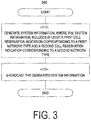
- FIG. 3 schematically shows a flowchart of a method 300 performed in an eLTE base station according to the second embodiment of the present disclosure.
- the base station in step s310, the base station generates a system information block (SIB).
- the system information includes at least a first cell reservation indication corresponding to a first network type (access network type/core network type) and a second cell reservation indication corresponding to a second network type (access network type/core network type).
- step s320 the base station broadcasts the generated system information in a cell thereof.
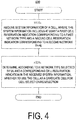
- FIG. 4 schematically shows a flowchart of a method 400 performed in user equipment (UE) according to the second embodiment of the present disclosure.
- the user equipment may receive the system information of the cell.
- the system information includes at least the first cell reservation indication corresponding to the first access network type/core network type and the second cell reservation indication corresponding to the second access network type/core network type.
- the user equipment may determine, according to a network type (access network type/core network type) selected by the user equipment and a corresponding cell reservation indication in the received system information, whether to use the cell as a candidate cell for cell selection/reselection.
- a network type access network type/core network type
- the system information broadcast by the cell simultaneously broadcasts cell reservation indications corresponding to different network types (access network types/core network types), namely, the first cell reservation indication (Reservation Indication 1 for short) corresponding to the first network type (access network type/core network type) and the second cell reservation indication (Reservation Indication 2 for short) corresponding to the second network type (access network type/core network type).
- Reservation Indication 1 may indicate whether an E-UTRAN cell is reserved; Reservation Indication 2 may indicate whether a 5G-RAN cell is reserved.
- the reservation indication may be represented by, for example, a 1-bit symbol to indicate whether the corresponding access network type/network type cell (E-UTRAN cell or 5G-RAN cell) is reserved for use. For example, when Reservation Indication 1 is “0,” it indicates that the E-UTRAN cell is reserved for use; when Reservation Indication 1 is "1,” it indicates that the E-UTRAN cell is non-reserved for use. Similarly, Reservation Indication 2 may also be represented by this method. When Reservation Indication 2 is "0,” it indicates that the 5G-RAN cell is reserved for use; when Reservation Indication 2 is "1,” it indicates that the 5G-RAN cell is non-reserved for use.
- reservation indication may also indicate “Reserved for Use” with a value "1” and indicate “Non-reserved for Use” with a value "0.”
- the present disclosure is not limited in this regard.
- the two reservation indications may be broadcast in the same system information (for example, a SIB).
- the two reservation indications may also be broadcast in different system information.
- the UE may judge, according to the content of the reservation indications, whether the current cell can be taken as a candidate cell for cell selection/reselection in step s420. Implementation manners of step s420 are described in detail below using several examples.
- the UE may determine, according to a reservation indication in the received system information corresponding to an access network type/core network type selected by the UE, whether to use the current cell as a candidate cell for cell selection/reselection.
- the manner in which the UE selects an access network type/core network type has been described in detail in the first embodiment, and will not be described herein again.
- the UE may select an access network type/core network type in any of the manners described in the first embodiment.
- the UE checks, according to the selected access network/core network type, the received reservation indication corresponding to the selected access network/core network type, and accordingly determines whether to use the current cell as a candidate cell for cell selection/reselection.
- the UE selects a 5G-RAN type/next generation core (NextGen Core) type according to any of the aforementioned methods; then the UE checks the received Reservation Indication 2 corresponding to the 5G-RAN type/next generation core (NextGen Core) type.
- NextGen Core 5G-RAN type/next generation core
- Reservation Indication 2 is represented by one bit, and "0" and “1" are respectively used to indicate that 5G-RAN is “Reserved for Use” and “Non-reserved for Use.”
- Reservation Indication 2 is “1,” the UE may use the current cell as one of candidate cells for 5G-RAN cell selection/reselection.
- Reservation Indication 2 is "0,” it indicates that the current cell is reserved for use, and then the UE may perform the following judgment according to an access class thereof:
- the UE selects an E-UTRAN type/EPC type according to any of the aforementioned methods; then the UE detects the received Reservation Indication 1 corresponding to the E-UTRAN type/EPC type.
- Reservation Indication 1 is represented by one bit, and "0" and “1" are respectively used to indicate that E-UTRAN is "Reserved for Use” and “Non-reserved for Use.”
- Reservation Indication 1 When the value of Reservation Indication 1 is "1,” the UE may use the current cell as one of candidate cells for E-UTRAN cell selection/reselection.
- Reservation Indication 1 When the value of Reservation Indication 1 is "0,” it indicates that the current cell is reserved for use, and then the UE may perform the following judgment according to an access class thereof:
- the UE may have different access classes for different access network types/core network types; accordingly, the UE needs to first determine an access class thereof according to an access network type/core network type selected by the UE, and then judge, according to the access class thereof and using the aforementioned method, whether to use the current cell as a candidate cell for cell selection/reselection.
- the UE may exclude the current cell from candidate cells for 5G-RAN within a period of time according to the value of Reservation Indication 2, but this does not prevent the cell from being possibly used as a candidate cell for E-UTRAN cells within this period of time.
- the UE then reselects E-UTRAN as the access network type (or selects ECP as the core network type); then, the cell can still be one of candidate cells for E-UTRAN cell selection/reselection by checking the value, for example, "1," of Reservation Indication 1 corresponding to E-UTRAN.
- FIG. 5 schematically shows a flowchart of a method 500 performed in an eLTE base station according to the third embodiment of the present disclosure.
- the base station in step s510, the base station generates system information (for example, a system information block (SIB)).
- system information for example, a system information block (SIB)
- the system information includes at least a first function state indication corresponding to a first core network function type and a second function state indication corresponding to a second core network function type.
- step s520 the base station broadcasts the generated system information in a cell thereof.
- FIG. 6 schematically shows a flowchart of a method 600 performed in user equipment (UE) according to the third embodiment of the present disclosure.
- the user equipment may receive the system information of the cell.
- the system information includes at least the first function state indication corresponding to the first core network function type and the second function state indication corresponding to the second core network function type.
- the user equipment may determine, according to a core network function selected by the user equipment and a corresponding function state indication in the received system information, whether to use the cell as a candidate cell for cell selection/reselection.
- next generation core may be logically divided into different network slices according to service types or service features, each network slice supporting its own core network function and providing a service to a specific user group. Therefore, depending on different network slices to which the base station is connected, the cell of the base station may support different core network functions.
- the system information broadcast by the cell broadcasts function state indications of multiple different core network function types, such as the first function state indication (NS1 for short) corresponding to the first core network function type and the second function state indication (NS2 for short) corresponding to the second core network function type.
- NS1 indicates the state of a first core network function
- NS2 indicates the state of a second core network function.
- NS2 may also be represented by this method. For example, when NS2 is "0,” it indicates that the second core network function is prohibited from use; when Function State Indication 2 is "1,” it indicates that the second core network function is allowed for use.
- NS2 may also be represented by this method. For example, when NS2 is "0,” it indicates that the second core network function is not supported; when NS2 is "1,” it indicates that the second core network function is supported.
- Function State Indication 2 may also be represented by this method.
- the UE may select a corresponding core network function according to a service type or subscription information thereof or a high-layer instruction, and check a function state indication corresponding to the core network function to determine whether to use the current cell (namely, the cell corresponding to the received system information) as a candidate cell for cell selection/reselection.
- the UE may select a core network function in many manners, and several exemplary manners are listed below:
- the UE selects the first core network function, and then the UE checks the function state indication NS1 corresponding to the first core network function, and accordingly determines whether to use the current cell as a candidate cell for cell selection/reselection.
- Function State Indication 1 is represented by one bit, and "0" and “1" are respectively used to indicate that the first core network function is "Prohibited” and “Allowed.”
- NS1 when the value of NS1 is "1,” it indicates that the first core network function is allowed for use, and then the UE may use the current cell as one of candidate cells for cell selection/reselection; when the value of NS1 is "0,” it indicates that the first core network function is prohibited from use, and then the UE may not use the current cell as one of candidate cells for cell selection/reselection within a period of time, or exclude the current cell from candidate cells for cell selection/reselection within a period of time.
- Function State Indication 1 is represented by one bit, and "0" and “1" are respectively used to indicate that the first core network function is "Not supported” and “Supported.”
- NS1 when the value of NS1 is "1,” it indicates that the first core network function is supported, and then the UE may use the current cell as one of candidate cells for cell selection/reselection; when the value of NS1 is "0,” it indicates that the first core network function is not supported, and then the UE may not use the current cell as one of candidate cells for cell selection/reselection within a period of time, or exclude the current cell from candidate cells for cell selection/reselection within a period of time, or the UE adds the cell into a blacklist to treat the cell not as a neighboring cell, or sets the cell to a low priority.
- State Indication 1 is represented by two bits, and "00,” “10,” and “11” are respectively used to indicate that the first core network function is "Not Supported,” “Prohibited,” and “Allowed.”
- NS1 when the value of NS1 is "11,” it indicates that the first core network function is supported and allowed for use, and then the UE may use the current cell as one of candidate cells for cell selection/reselection; when the value of NS1 is "10,” it indicates that the first core network function is supported but prohibited from use, and the UE may not use the current cell as one of candidate cells for cell selection/reselection within a period of time, or exclude the current cell from candidate cells for cell selection/reselection within a period of time; when the value of NS 1 is "00,” it indicates that the first core network function is not supported, and then the UE may set the current cell as a low-priority cell and trigger priority-based cell reselection.
- FIG. 7 schematically shows a structural block diagram of an eLTE base station 700 according to an embodiment of the present disclosure.
- the base station 700 includes a processor 706 (for example, a microprocessor ( ⁇ P) or a digital signal processor (DSP)).
- the processor 706 may be a single processing unit or multiple processing units for performing the method (for example, the method 100, 300, or 500) performed by a base station described herein.
- the base station 700 may further include an input unit 702 for receiving signals from other entities, and an output unit 704 for providing signals to other entities.
- the input unit 702 and the output unit 704 may be arranged as a single entity or separate entities.
- the base station 700 may include a memory 708, which may be a non-volatile memory or a volatile memory.
- the memory 708 is, for example, an electrically erasable programmable read-only memory (EEPROM), a flash memory, and/or a hard disk drive.
- the memory 708 stores a computer program 710.
- the computer program 710 includes code/computer readable instructions that, when executed by the processor 706 in the base station 700, cause the base station 700 to perform the processes described above with reference to FIGs. 1 , 3 , and 5 and any variants thereof.
- the computer program 710 may be configured as computer program code having an architecture of, for example, one or more computer program modules, where the computer program modules substantially can perform the corresponding steps in the processes shown in FIGs. 1 , 3 , and 5 .
- code means in the embodiment disclosed above with reference to FIG. 7 is implemented as computer program modules that, when executed in the processor 706, cause the base station 700 to perform the actions described above with reference to FIGs. 1 , 3 , and 5
- at least one item of the code means can be implemented, at least in part, as a hardware circuit in an alternative embodiment.
- the base station 700 may be used for performing the method 100, 300, or 500 described above.
- For specific operations of the base station 700 reference may be made to the above description about the method 100, 300, or 500, which will not be described herein again.
- FIG. 8 schematically shows a structural block diagram of user equipment 800 according to an embodiment of the present disclosure.
- the user equipment 800 includes a processor 806 (for example, a microprocessor ( ⁇ P) or a digital signal processor (DSP)).
- the processor 806 may be a single processing unit or multiple processing units for performing the method (for example, the method 200, 400, or 600) performed by user equipment described herein.
- the user equipment 800 may further include an input unit 802 for receiving signals from other entities, and an output unit 804 for providing signals to other entities.
- the input unit 802 and the output unit 804 may be arranged as a single entity or separate entities.
- the user equipment 800 may include a memory 808, which may be a non-volatile memory or a volatile memory.
- the memory 808 is, for example, an electrically erasable programmable read-only memory (EEPROM), a flash memory, and/or a hard disk drive.
- the memory 808 stores a computer program 810.
- the computer program 810 includes code/computer readable instructions that, when executed by the processor 806 in the user equipment 800, cause the user equipment 800 to perform the processes described above with reference to FIGs. 2 , 4 , and 6 and any variants thereof.
- the computer program 810 may be configured as computer program code having an architecture of, for example, one or more computer program modules, where the computer program modules virtually can perform the corresponding steps in the processes shown in FIGs. 2 , 4 , and 6 .
- code means in the embodiment disclosed above with reference to FIG. 8 is implemented as computer program modules that, when executed in the processor 806, cause the user equipment 800 to perform the actions described above with reference to FIGs. 2 , 4 , and 6
- at least one item of the code means can be implemented, at least in part, as a hardware circuit in an alternative embodiment.
- the user equipment 800 may be used for performing the method 200, 400, or 600 described above.
- For specific operations of the user equipment 800 reference may be made to the above description about the method 200, 400, or 600, which will not be described herein again.
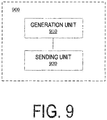
- FIG. 9 schematically shows a structural block diagram of an eLTE base station 900 according to another embodiment of the present disclosure.
- the base station 900 includes a generation unit 910 and a sending unit 920.
- the generation unit 910 may be configured to generate system information (for example, a SIB).
- the sending unit 620 may be configured to broadcast the generated system information.
- the base station 900 may be used for performing the method 100, 300, or 500 described above.
- the base station 900 reference may be made to the above description about the method 100, 300, or 500, which will not be described herein again.
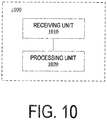
- FIG. 10 schematically shows a structural block diagram of user equipment 100 according to another embodiment of the present disclosure.
- the user equipment 1000 may include a receiving unit 1010 and a processing unit 1020.
- the receiving unit 1010 may be configured to receive system information (for example, a SIB) of a cell.
- the processing unit 1020 may be configured to determine, according to the received system information, whether to use the cell as a candidate cell for cell selection/reselection.
- the user equipment 1000 may be used for performing the method 200, 400, or 600 described above.
- For specific operations of the user equipment 1000 reference may be made to the above description about the method 200, 400, or 600, which will not be described herein again.
- the base station and/or user equipment may further include other basic units that make up the base station and/or user equipment.
- the methods and related devices according to the present application have been described above in conjunction with the preferred embodiments. It should be understood by those skilled in the art that the methods shown above are only exemplary. The method according to the present application is not limited to steps or sequences shown above.
- the base station and user equipment shown above may include more modules.
- the base station and user equipment may further include modules that can be developed or developed in the future to be applied to a base station or UE, and the like.
- Various identifiers shown above are only exemplary, not for limitation.
- the present application is not limited to specific information elements serving as examples of these identifiers. Those skilled in the art can make various alterations and modifications according to the teachings of the illustrated embodiments.
- ASIC application-specific integrated circuit
- FPGA field programmable gate array
- DSP digital signal processor
- the mechanisms of the subject matter described in the present disclosure are capable of being distributed as a program product in a variety of forms, and that an exemplary embodiment of the subject matter described in the present disclosure applies regardless of the particular type of signal bearing medium used to actually carry out the distribution.
- the signal bearing medium include, but are not limited to, a recordable type medium such as a floppy disk, a hard disk drive, a compact disc (CD), a digital versatile disc (DVD), a digital tape, or a computer memory; and a transmission type medium such as a digital and/or analog communication medium (for example, a fiber optic cable, a waveguide, a wired communication link, or a wireless communication link).
Landscapes
- Engineering & Computer Science (AREA)
- Computer Networks & Wireless Communication (AREA)
- Signal Processing (AREA)
- Computer Security & Cryptography (AREA)
- Mobile Radio Communication Systems (AREA)
Abstract
Description
- The present disclosure relates to the field of wireless communications technologies. More specifically, the present disclosure relates to a cell selection/reselection method, a corresponding base station, and corresponding user equipment.
- With the rapid growth of mobile communications and great progress of technology, the world will move toward a fully interconnected network society where anyone or anything can acquire information and share data anytime and anywhere. It is estimated that there will be 50 billion interconnected devices by 2020, of which only about 10 billion may be mobile phones and tablet computers. The rest are not machines communicating with human beings but machines communicating with one another. Therefore, how to design a system to better support the Internet of Everything is a subject needing further and intensive study.
- For this purpose, at the 3rd Generation Partnership Project (3GPP) RAN#64 plenary meeting held in March 2016, a research subject on new 5G radio access technology was proposed (see non-patent literature: RP-160671 New SID Proposal: Study on New Radio Access Technology). In the description of the work item, the operating frequency band of future new communication RATs can be expanded to 100 GHz, which will satisfy at least service requirements for enhanced mobile broadband, the demand for communication between a large number of Internet of Things terminals, service requirements of high reliability requirements, and so on. The research work of the item is expected to end in 2018.
- While studying the 5th Generation (5G) radio access technology, the research on core network technology supporting 5G access is also carried out. This core network may be referred to as a next generation core. A core network to which an existing Long Term Evolution (LTE for short) system is connected is referred to as an evolved packet core (EPC for short). Unlike the existing EPC, the next generation core under discussion will be based on a different quality of service (Qos) architecture, and thus may be regarded as a new core network type different from the EPC.
- The concept of network slice (NS for short) is also introduced in the next generation core. That is, the next generation core may be logically divided into different network slices according to service types or service features, each network slice supporting its own core network function and providing a service to a specific user group.
- In the research of the 5G access network technology, in order to avoid repeated investment of operators, the operators are allowed to upgrade deployed LTE base stations so that they can be connected to the next generation core. This new type of base station is referred to as an evolved LTE base station (evolution of LTE eNB, eLTE eNB for short, hereinafter also referred to as an eLTE base station). According to the definition of TR 38.804, an eLTE base station can support connection to an EPC and connection to a next generation core.
- From the side of an access network, an eLTE base station connected to the EPC may be regarded as belonging to an evolved universal terrestrial radio access network (E-UTRAN) access network, while an eLTE eNB connected to the next generation core may be regarded as belonging to a 5G-RAN access network. In other words, depending on the type of a core network to which an eLTE base station is connected, a cell covered by the eLTE base station may be an E-UTRAN cell, or may be a 5G-RAN cell, or may be both an E-UTRAN cell and a 5G-RAN cell.
- When the eLTE base station is connected to both the EPC and the next generation core, both an E-UTRAN cell and a 5G-RAN cell exist in an area covered by the eLTE base station. Furthermore, since the next generation core further includes more than one network slice, cells supporting different core network functions may also exist in the area covered by the eLTE base station.
- For user equipment (UE), a new mechanism is needed to implement cell selection/reselection within such a coverage area.
- The present disclosure is intended to provide a method for determining a candidate cell.
- According to a first aspect of the present disclosure, a method performed by a base station is provided, comprising: generating system information, wherein the system information comprises at least a first network type cell state indication and a second network type cell state indication; and broadcasting the generated system information.
- According to a second aspect of the present aspect, a method performed by user equipment (UE) is provided, comprising: receiving system information of a cell, wherein the system information comprises at least a first network type cell state indication and a second network type cell state indication; and determining, according to a network type cell state indication in the received system information, whether to use the cell as a candidate cell for cell selection/reselection.
- According to some embodiments, a first network type cell state and/or second network type cell state comprises "Allowed" or "Prohibited."
- According to some other embodiments, a first network type cell state and/or second network type cell state comprises "Allowed," "Prohibited," and "Not Supported."
- According to some embodiments, the cell is excluded from being used as a candidate cell for cell selection/reselection when a network type cell state indication in the received system information corresponding to a network type selected by the UE indicates "Prohibited."
- According to some other embodiments, the cell is excluded from being used as a candidate cell for cell selection/reselection, and the cell is set to a low priority when a network type cell state indication in the received system information corresponding to a network type selected by the UE indicates "Not Supported."
- According to some other embodiments, the cell is excluded from being used as a candidate cell for cell selection/reselection only when both the first network type cell state indication and the second network type cell state indication in the received system information indicate "Prohibited."
- According to some other embodiments, the cell is used as a candidate cell for cell selection/reselection only when both the first network type cell state indication and the second network type cell state indication in the received system information indicate "Allowed."
- According to a third aspect of the present disclosure, a method performed by a base station is provided, comprising: generating system information, wherein the system information comprises at least a first function state indication corresponding to a first core network function type and a second function state indication corresponding to a second core network function type; and broadcasting the generated system information.
- According to a fourth aspect of the present disclosure, a method performed by user equipment (UE) is provided, comprising: receiving system information of a cell, wherein the system information comprises at least a first function state indication corresponding to a first core network function type and a second function state indication corresponding to a second core network function type; and determining, according to a core network function selected by the UE and a corresponding function state indication in the received system information, whether to use the cell as a candidate cell for cell selection/reselection.
- According to some embodiments, a first function state corresponding to the first core network function type and/or a second function state corresponding to the second core network function type comprises "Allowed" and "Prohibited."
- According to some other embodiments, a first function state corresponding to the first core network function type and/or a second function state corresponding to the second core network function type comprises "Allowed," "Prohibited," and "Not Supported."
- According to a fifth aspect of the present disclosure, a base station is provided, comprising: a processor; and a memory, configured to store instructions. The instructions, when executed on the processor, cause the processor to be configured to: generate system information, wherein the system information comprises at least a first network type cell state indication and a second network type cell state indication; and broadcast the generated system information.
- According to a sixth aspect of the present disclosure, user equipment (UE) is provided, comprising: a processor; and a memory, configured to store instructions. The instructions, when executed on the processor, cause the processor to be configured to: receive system information of a cell, wherein the system information comprises at least a first network type cell state indication and a second network type cell state indication; and determine, according to a network type cell state indication in the received system information, whether to use the cell as a candidate cell for cell selection/reselection.
- According to a seventh aspect of the present disclosure, a base station is provided, comprising: a processor; and a memory, configured to store instructions. The instructions, when executed on the processor, cause the processor to be configured to: generate system information, wherein the system information comprises at least a first function state indication corresponding to a first core network function type and a second function state indication corresponding to a second core network function type; and broadcast the generated system information.
- According to an eighth aspect of the present disclosure, user equipment (UE) is provided, comprising: a processor; and a memory, configured to store instructions. The instructions, when executed on the processor, cause the processor to be configured to: receive system information of a cell, wherein the system information comprises at least a first function state indication corresponding to a first core network function type and a second function state indication corresponding to a second core network function type; and determine, according to a core network function selected by the UE and a corresponding function state indication in the received system information, whether to use the cell as a candidate cell for cell selection/reselection.
- According to a ninth aspect of the present disclosure, a base station is provided, comprising:
- a generation unit, configured to generate system information, wherein the system information comprises at least a first network type cell state indication and a second network type cell state indication; and
- a sending unit, configured to broadcast the generated system information.
- According to a tenth aspect of the present disclosure, user equipment "UE" is provided, comprising:
- a receiving unit, configured to receive system information of a cell, wherein the system information comprises at least a first network type cell state indication and a second network type cell state indication; and
- a processing unit, configured to determine, according to a network type cell state indication in the received system information, whether to use the cell as a candidate cell for cell selection/reselection.
- According to an eleventh aspect of the present disclosure, a base station is provided, comprising:
- a generation unit, configured to generate system information, wherein the system information comprises at least a first function state indication corresponding to a first core network function type and a second function state indication corresponding to a second core network function type; and
- a sending unit, configured to broadcast the generated system information.
- According to a twelfth aspect of the present disclosure, user equipment (UE) is provided, comprising:
- a receiving unit, configured to receive system information of a cell, wherein the system information comprises at least a first function state indication corresponding to a first core network function type and a second function state indication corresponding to a second core network function type; and
- a processing unit, configured to determine, according to a core network function selected by the UE and a corresponding function state indication in the received system information, whether to use the cell as a candidate cell for cell selection/reselection.
- The above and other features of the present disclosure will become more apparent with the following detailed description in conjunction with the accompanying drawings.
-
FIG. 1 schematically shows a flowchart of a method performed in an eLTE base station according to a first embodiment of the present disclosure. -
FIG. 2 schematically shows a flowchart of a method performed in user equipment according to the first embodiment of the present disclosure. -
FIG. 3 schematically shows a flowchart of a method performed in an eLTE base station according to a second embodiment of the present disclosure. -
FIG. 4 schematically shows a flowchart of a method performed in user equipment according to the second embodiment of the present disclosure. -
FIG. 5 schematically shows a flowchart of a method performed in an eLTE base station according to a third embodiment of the present disclosure. -
FIG. 6 schematically shows a flowchart of a method performed in user equipment according to the third embodiment of the present disclosure. -
FIG. 7 schematically shows a structural block diagram of an eLTE base station according to an embodiment of the present disclosure. -
FIG. 8 schematically shows a structural block diagram of user equipment according to an embodiment of the present disclosure. -
FIG. 9 schematically shows a structural block diagram of an eLTE base station according to another embodiment of the present disclosure. -
FIG. 10 schematically shows a structural block diagram of user equipment according to another embodiment of the present disclosure. - In the accompanying drawings, similar reference numerals indicate same or similar elements.
- The following describes the present disclosure in detail with reference to the accompanying drawings and specific embodiments. It should be noted that the present disclosure should not be limited to the specific embodiments described below. In addition, for simplicity, detailed description of the known art not directly related to the present disclosure is omitted to prevent confusion in understanding the present disclosure.
- As described earlier, in a next generation mobile communications system, for example, a 5G or later communications system, a base station may be connected to different types of core networks, such as an existing EPC or a next generation core that supports more than one network slice. When a base station is connected to different core network types, the base station corresponds to different access networks. Thus, depending on the type of a core network to which a base station is connected, a cell covered by the base station may be referred to as a cell of a different access network type/core network type. Because of the correspondence between the type of the core network to which the base station is connected and the access network to which the base station belongs, for convenience, the access network type/core network type is collectively referred to as a "network type," and an access network type cell, a core network type cell, and an access network type/core network type cell can be used interchangeably hereinafter. For example, a cell of an eLTE base station connected to an EPC may be referred to as an EPC type cell/E-UTRAN cell. A cell of an eLTE base station connected to a next generation core may be referred to as a next generation core type cell/5G-RAN cell. The EPC type cell/E-UTRAN cell can provide an EPC core network function to user equipment within its coverage. The next generation core type cell/5G-RAN cell can provide a next generation core function to user equipment within its coverage. Particularly, the next generation core may be logically divided into different network slices according to service types or service features, each network slice supporting its own core network function. Accordingly, the next generation core type cell/5G-RAN cell can provide different core network functions to user equipment within its coverage according to network slices to which the cell is connected.
- Multiple embodiments according to the present disclosure are specifically described below by using a 5G mobile communications system as an exemplary application environment. Hereinafter, unless otherwise expressly stated, the base station refers to an eLTE base station. However, it should be noted that those skilled in the art may understand that the present disclosure is not limited to the aforementioned examples of base stations, UE, access networks, and core networks, and may also be applied to other base stations supporting access of multiple network types, or base stations supporting multiple core network functions, and UE within the coverage of the base stations. The present disclosure is not limited to the following embodiments, but is applicable to more other wireless communications systems, for example, a mobile communications system later than 5G.
-
FIG. 1 schematically shows a flowchart of amethod 100 performed in an eLTE base station according to the first embodiment of the present disclosure. - As shown in the figure, in step s110, the base station generates system information (for example, a system information block (SIB)). The system information includes at least a first network type (access network type/core network type) cell state indication and a second network type (access network type/core network type) cell state indication.
- In step s120, the base station broadcasts the generated system information in a cell thereof.
-
FIG. 2 schematically shows a flowchart of amethod 200 performed in user equipment (UE) according to the first embodiment of the present disclosure. - As shown in the figure, in step s210, the user equipment may receive the system information of the cell. The system information includes at least the first network type cell state indication and the second network type cell state indication.
- In step s220, the user equipment may determine, according to a corresponding network type cell state indication in the received system information, whether to use the cell as a candidate cell for cell selection/reselection.
- In the first embodiment, the system information broadcast by the cell simultaneously broadcasts cell state indications corresponding to different network types, namely, the first network type cell state indication (
State Indication 1 for short) and the second network type cell state indication (State Indication 1 for short). - For example,
State Indication 1 may indicate the state of an E-UTRAN cell; State Indication 2 may indicate the state of a 5G-RAN cell. - The state indication may be represented by, for example, a 1-bit symbol to indicate two states, such as "Not Barred" or "Barred," of the corresponding network type cell (E-UTRAN cell or 5G-RAN cell). For example, when
State Indication 1 is "0," it indicates that the E-UTRAN cell is barred to use; whenState Indication 1 is "1," it indicates that the E-UTRAN cell is not barred to use. Similarly, State Indication 2 may also be represented by this method. When State Indication 2 is "0," it indicates that the 5G-RAN cell is barred to use; when State Indication 2 is "1," it indicates that the 5G-RAN cell is not barred to use. It should be understood that the foregoing implementation is merely an example, and the state indication may also indicate "Not barred" with a value "1" and indicate "Barred" with a value "0." The present disclosure is not limited in this regard. - Optionally, the state indication may also be represented by a 2-bit symbol to indicate more than two states of a corresponding network type cell (E-UTRAN cell or 5G-RAN cell). As an example, the cell states may include three states: "Allowed," "Prohibited," and "Not Supported." Accordingly, when State Indication 2 is "00," it indicates that 5G-RAN is not supported; when State Indication 2 is "10," it indicates that 5G-RAN is supported but the current 5G-RAN cell is prohibited from use; when State Indication 2 is "11," it indicates that 5G-RAN is supported and the current 5G-RAN cell is allowed for use. Similarly,
State Indication 1 may also be represented by this method. It should be understood that the foregoing implementation is merely an example, and the state indication may indicate different states with different values of two bits. The present disclosure is not limited in this regard. - In addition,
State Indication 1 and State Indication 2 may occupy the same number or different numbers of bits and may even be represented by more than two bits. The present disclosure is not limited in this regard. For example,State Indication 1 and State Indication 2 may be respectively represented by one bit; orState Indication 1 and State Indication 2 may be respectively represented by two bits; orState Indication 1 and State Indication 2 may be respectively represented by more than two bits; orState Indication 1 may be represented by one bit and State Indication 2 may be represented by two bits, and vice versa. -
State Indication 1 and State Indication 2 may be broadcast in the same system information (for example, a SIB). Optionally,State Indication 1 and State Indication 2 may be broadcast in different system information. - The user equipment may receive, by receiving the system information broadcast by the cell in step s210, the aforementioned two cell state indications (
State Indication 1 and State Indication 2) of the cell. Then, in step s220, the UE may determine, according to a network type selected by the UE andState Indication 1 and State Indication 2 in the received system information, whether to use the cell as a candidate for cell selection/reselection. - Implementation manners of step s220 are described in detail below using several examples.
- Manner 1: In step s220, the UE may determine, according to a network type cell state indication in the received system information corresponding to a network type (access network type/core network type) selected by the UE, whether to use the current cell (namely, the cell corresponding to the received system information) as a candidate cell for cell selection/reselection.
- The UE may select a network type (access network type/core network type) in many manners, and several exemplary manners are listed below:
- 1. The UE receives, from an upper layer thereof (a Non-Access Stratum or high layer), an instruction on a selected access network type/core network type. The selected access network type/core network type is usually stipulated when the UE signs an Internet access agreement with an operator.
- 2. Optionally, the UE may acquire information about priorities of access network types/core network types from system information broadcast by a serving cell or dedicated signaling sent from a network side, and select an access network type/core network type according to the information about the priorities.
- 3. Optionally, the UE may select an access network type/core network type according to the type of a core network that the UE has registered with.
- Once the UE selects the type of access network/core network, the UE will check a corresponding state indication in the received system information based on the selected type of access network/core network, and accordingly determine whether to use the current cell (namely, the cell corresponding to the received system information) as a candidate cell for cell selection/reselection.
- As one example, the UE selects a 5G-RAN type/next generation core (NextGen Core) type according to any of the aforementioned methods; then the UE detects the received State Indication 2 corresponding to the 5G-RAN type/next generation core (NextGen Core) type.
- Consider an example in which State Indication 2 is represented by one bit, and "0" and "1" are respectively used to indicate that 5G-RAN is "Barred" and "Not Barred." In this example, if the value of the received State Indication 2 is "1," the UE may take the current cell as one of candidate cells for 5G-RAN cell selection/reselection; if the value of the received State Indication 2 is "0," the UE may not take the current cell as one of candidate cells for 5G-RAN cell selection/reselection within a period of time, or exclude the current cell from candidate cells for 5G-RAN cell selection/reselection within a period of time.
- Optionally, consider an example in which State Indication 2 is represented by two bits, and "00," "10," and "11" are respectively used to indicate that 5G-RAN is "Not Supported," "Barred," and "Not Barred." In this example, when the value of the received State Indication 2 is "11," the UE may take the current cell as one of candidate cells for 5G-RAN cell selection/reselection; when the value of the received State Indication 2 is "10," the UE may not use the current cell as one of candidate cells for 5G-RAN cell selection/reselection within a period of time, or exclude the current cell from candidate cells for 5G-RAN within a period of time; when the value of the received State Indication 2 is "00," the UE considers that the current cell does not support the working mode of 5G-RAN, and then the UE may exclude the current cell from being used as a candidate cell for cell selection/reselection, and set the current 5G-RAN cell as a low-priority cell, and optionally, trigger priority-based cell reselection.
- As another example, the UE selects an E-UTRAN type/EPC type according to any of the aforementioned methods; then the UE detects the received
State Indication 1 corresponding to the E-UTRAN type/EPC type. - Consider an example in which
State Indication 1 is represented by one bit, and "0" and "1" are respectively used to indicate that E-UTRAN is "Barred" and "Not Barred." In this example, if the value of the receivedState Indication 1 is "1," the UE may take the current cell as one of candidate cells for E-UTRAN cell selection/reselection; if the value of the receivedState Indication 1 is "0," the UE may not take the current cell as one of candidate cells for E-UTRAN cell selection/reselection within a period of time, or exclude the current cell from candidate cells for E-UTRAN cell selection/reselection within a period of time. - Optionally, consider the example in which
State Indication 1 is represented by two bits, and "00," "10," and "11" are respectively used to indicate that E-UTRAN is "Not Supported," "Barred," and "Not Barred." In this example, when the value of the receivedState Indication 1 is "11," the UE may take the current cell as one of candidate cells for E-UTRAN cell selection/reselection; when the value of the receivedState Indication 1 is "10," the UE may not take the current cell as one of candidate cells for E-UTRAN cell selection/reselection within a period of time, or exclude the current cell from candidate cells for E-UTRAN within a period of time; when the value of the receivedState Indication 1 is "00," the UE considers that the current cell does not support the working mode of E-UTRAN, and then the UE may exclude the current cell from being used as a candidate cell for cell selection/reselection, and set the current E-UTRAN cell as a low-priority cell, and optionally, trigger priority-based cell reselection. - Manner 2: In step s220, the UE may check the received
State Indication 1 and State Indication 2 and determine whether to use the current cell as a candidate cell for cell selection/reselection. - As one example, the UE checks both of the received
State Indication 1 and State Indication 2, and the UE can use the current cell as one of candidate cells for cell selection/reselection when, and only when,State Indication 1 and State Indication 2 both indicate allowance for use; otherwise, the UE excludes the cell from candidate cells for cell selection/reselection as long as one of the state indications indicates that the current cell is prohibited from use. - As another example, the UE checks both of the received
State Indication 1 and State Indication 2, and the UE excludes the cell from candidate cells for cell selection/reselection when, and only when,State Indication 1 and State Indication 2 both indicate prohibition from use; otherwise, the UE uses the current cell as one of candidate cells for cell selection/reselection as long as one state indication indicates that the current cell is not barred to use. In this case, optionally, the UE may further report, to the upper layer, the access network type/network type not barred to use that is indicated in the state indications. -
FIG. 3 schematically shows a flowchart of amethod 300 performed in an eLTE base station according to the second embodiment of the present disclosure. - As shown in the figure, in step s310, the base station generates a system information block (SIB). The system information includes at least a first cell reservation indication corresponding to a first network type (access network type/core network type) and a second cell reservation indication corresponding to a second network type (access network type/core network type).
- In step s320, the base station broadcasts the generated system information in a cell thereof.
-
FIG. 4 schematically shows a flowchart of amethod 400 performed in user equipment (UE) according to the second embodiment of the present disclosure. - As shown in the figure, in step s410, the user equipment may receive the system information of the cell. The system information includes at least the first cell reservation indication corresponding to the first access network type/core network type and the second cell reservation indication corresponding to the second access network type/core network type.
- In step s420, the user equipment may determine, according to a network type (access network type/core network type) selected by the user equipment and a corresponding cell reservation indication in the received system information, whether to use the cell as a candidate cell for cell selection/reselection.
- In the second embodiment, the system information broadcast by the cell simultaneously broadcasts cell reservation indications corresponding to different network types (access network types/core network types), namely, the first cell reservation indication (
Reservation Indication 1 for short) corresponding to the first network type (access network type/core network type) and the second cell reservation indication (Reservation Indication 2 for short) corresponding to the second network type (access network type/core network type). - For example,
Reservation Indication 1 may indicate whether an E-UTRAN cell is reserved; Reservation Indication 2 may indicate whether a 5G-RAN cell is reserved. - The reservation indication may be represented by, for example, a 1-bit symbol to indicate whether the corresponding access network type/network type cell (E-UTRAN cell or 5G-RAN cell) is reserved for use. For example, when
Reservation Indication 1 is "0," it indicates that the E-UTRAN cell is reserved for use; whenReservation Indication 1 is "1," it indicates that the E-UTRAN cell is non-reserved for use. Similarly, Reservation Indication 2 may also be represented by this method. When Reservation Indication 2 is "0," it indicates that the 5G-RAN cell is reserved for use; when Reservation Indication 2 is "1," it indicates that the 5G-RAN cell is non-reserved for use. It should be understood that the foregoing implementation is merely an example, and the reservation indication may also indicate "Reserved for Use" with a value "1" and indicate "Non-reserved for Use" with a value "0." The present disclosure is not limited in this regard. - The two reservation indications may be broadcast in the same system information (for example, a SIB). Optionally, the two reservation indications may also be broadcast in different system information.
- After receiving the aforementioned reservation indications in step s410, the UE may judge, according to the content of the reservation indications, whether the current cell can be taken as a candidate cell for cell selection/reselection in step s420. Implementation manners of step s420 are described in detail below using several examples.
- Manner 1: In step s420, the UE may determine, according to a reservation indication in the received system information corresponding to an access network type/core network type selected by the UE, whether to use the current cell as a candidate cell for cell selection/reselection.
- The manner in which the UE selects an access network type/core network type has been described in detail in the first embodiment, and will not be described herein again. The UE may select an access network type/core network type in any of the manners described in the first embodiment.
- Then the UE checks, according to the selected access network/core network type, the received reservation indication corresponding to the selected access network/core network type, and accordingly determines whether to use the current cell as a candidate cell for cell selection/reselection.
- As one example, the UE selects a 5G-RAN type/next generation core (NextGen Core) type according to any of the aforementioned methods; then the UE checks the received Reservation Indication 2 corresponding to the 5G-RAN type/next generation core (NextGen Core) type.
- Consider an example in which Reservation Indication 2 is represented by one bit, and "0" and "1" are respectively used to indicate that 5G-RAN is "Reserved for Use" and "Non-reserved for Use." When the value of Reservation Indication 2 is "1," the UE may use the current cell as one of candidate cells for 5G-RAN cell selection/reselection. When the value of Reservation Indication 2 is "0," it indicates that the current cell is reserved for use, and then the UE may perform the following judgment according to an access class thereof:
- when the corresponding access class is an access class at which a cell set to be reserved for use is allowed for use, the UE may use the current cell as one of candidate cells for 5G-RAN cell selection/reselection;
- when the corresponding access class is not an access class at which a cell set to be reserved for use is allowed for use, the UE may not use the current cell as one of candidate cells for 5G-RAN cell selection/reselection within a period of time, or exclude the current cell from candidate cells for 5G-RAN cell selection/reselection within a period of time.
- As another example, the UE selects an E-UTRAN type/EPC type according to any of the aforementioned methods; then the UE detects the received
Reservation Indication 1 corresponding to the E-UTRAN type/EPC type. - Consider an example in which
Reservation Indication 1 is represented by one bit, and "0" and "1" are respectively used to indicate that E-UTRAN is "Reserved for Use" and "Non-reserved for Use." When the value ofReservation Indication 1 is "1," the UE may use the current cell as one of candidate cells for E-UTRAN cell selection/reselection. When the value ofReservation Indication 1 is "0," it indicates that the current cell is reserved for use, and then the UE may perform the following judgment according to an access class thereof: - when the corresponding access class is an access class at which a cell set to be reserved for use is allowed for use, the UE may use the current cell as one of candidate cells for E-UTRAN cell selection/reselection;
- when the corresponding access class is not an access class at which a cell set to be reserved for use is allowed for use, the UE may not use the current cell as one of candidate cells for E-UTRAN cell selection/reselection within a period of time, or exclude the current cell from candidate cells for E-UTRAN cell selection/reselection within a period of time.
- Optionally, the UE may have different access classes for different access network types/core network types; accordingly, the UE needs to first determine an access class thereof according to an access network type/core network type selected by the UE, and then judge, according to the access class thereof and using the aforementioned method, whether to use the current cell as a candidate cell for cell selection/reselection.
- Optionally, the UE may exclude the current cell from candidate cells for 5G-RAN within a period of time according to the value of Reservation Indication 2, but this does not prevent the cell from being possibly used as a candidate cell for E-UTRAN cells within this period of time. For example, the UE then reselects E-UTRAN as the access network type (or selects ECP as the core network type); then, the cell can still be one of candidate cells for E-UTRAN cell selection/reselection by checking the value, for example, "1," of
Reservation Indication 1 corresponding to E-UTRAN. -
FIG. 5 schematically shows a flowchart of amethod 500 performed in an eLTE base station according to the third embodiment of the present disclosure. - As shown in the figure, in step s510, the base station generates system information (for example, a system information block (SIB)). The system information includes at least a first function state indication corresponding to a first core network function type and a second function state indication corresponding to a second core network function type.
- In step s520, the base station broadcasts the generated system information in a cell thereof.
-
FIG. 6 schematically shows a flowchart of amethod 600 performed in user equipment (UE) according to the third embodiment of the present disclosure. - As shown in the figure, in step s610, the user equipment may receive the system information of the cell. The system information includes at least the first function state indication corresponding to the first core network function type and the second function state indication corresponding to the second core network function type.
- In step s620, the user equipment may determine, according to a core network function selected by the user equipment and a corresponding function state indication in the received system information, whether to use the cell as a candidate cell for cell selection/reselection.
- As described earlier, the concept of network slice (NS) is also introduced in the next generation core. That is, the next generation core may be logically divided into different network slices according to service types or service features, each network slice supporting its own core network function and providing a service to a specific user group. Therefore, depending on different network slices to which the base station is connected, the cell of the base station may support different core network functions.
- In the third embodiment, the system information broadcast by the cell broadcasts function state indications of multiple different core network function types, such as the first function state indication (NS1 for short) corresponding to the first core network function type and the second function state indication (NS2 for short) corresponding to the second core network function type.
- NS1 indicates the state of a first core network function; NS2 indicates the state of a second core network function.
- The function state indication NSn (where n=1, 2) may be represented by a 1-bit symbol to indicate two states of the corresponding core network function. For example, when NS1 is "0," it indicates that the first core network function is prohibited from use; when
Function State Indication 1 is "1," it indicates that the first core network function is allowed for use. Similarly, NS2 may also be represented by this method. For example, when NS2 is "0," it indicates that the second core network function is prohibited from use; when Function State Indication 2 is "1," it indicates that the second core network function is allowed for use. - Optionally, the function state indication NSn (where n=1, 2) may be represented by a 1-bit symbol to indicate two states of the corresponding core network function. For example, when NS1 is "0," it indicates that the first core network function is not supported; when NS1 is "1," it indicates that the first core network function is supported. Similarly, NS2 may also be represented by this method. For example, when NS2 is "0," it indicates that the second core network function is not supported; when NS2 is "1," it indicates that the second core network function is supported.
- Optionally, the function state indication NSn (where n=1, 2) may also be represented by a 2-bit symbol to indicate more than two states of the corresponding core network function. For example, when NS1 is "00," it indicates that the first core network function is not supported and prohibited from use; when NS1 is "10," it indicates that the first core network function is supported but prohibited from use; when NS1 is "11," it indicates that the first core network function is supported and allowed for use. Similarly, Function State Indication 2 may also be represented by this method.
- The UE may select a corresponding core network function according to a service type or subscription information thereof or a high-layer instruction, and check a function state indication corresponding to the core network function to determine whether to use the current cell (namely, the cell corresponding to the received system information) as a candidate cell for cell selection/reselection.
- The UE may select a core network function in many manners, and several exemplary manners are listed below:
- 1. the UE receives an instruction on a service type from an upper layer, the instruction indicating a core network function to be selected;
- 2. the UE performs selection according to information of a core network function included in subscription information of the UE;
- 3. the UE selects a core network function authorized after negotiation with the core network or a core network function requested from the core network and accepted in a process of registration with a core network.
- As one example, the UE selects the first core network function, and then the UE checks the function state indication NS1 corresponding to the first core network function, and accordingly determines whether to use the current cell as a candidate cell for cell selection/reselection.
- Consider an example in which
Function State Indication 1 is represented by one bit, and "0" and "1" are respectively used to indicate that the first core network function is "Prohibited" and "Allowed." In this example, when the value of NS1 is "1," it indicates that the first core network function is allowed for use, and then the UE may use the current cell as one of candidate cells for cell selection/reselection; when the value of NS1 is "0," it indicates that the first core network function is prohibited from use, and then the UE may not use the current cell as one of candidate cells for cell selection/reselection within a period of time, or exclude the current cell from candidate cells for cell selection/reselection within a period of time. - Optionally, consider an example in which
Function State Indication 1 is represented by one bit, and "0" and "1" are respectively used to indicate that the first core network function is "Not supported" and "Supported." In this example, when the value of NS1 is "1," it indicates that the first core network function is supported, and then the UE may use the current cell as one of candidate cells for cell selection/reselection; when the value of NS1 is "0," it indicates that the first core network function is not supported, and then the UE may not use the current cell as one of candidate cells for cell selection/reselection within a period of time, or exclude the current cell from candidate cells for cell selection/reselection within a period of time, or the UE adds the cell into a blacklist to treat the cell not as a neighboring cell, or sets the cell to a low priority. - Optionally, consider an example in which
State Indication 1 is represented by two bits, and "00," "10," and "11" are respectively used to indicate that the first core network function is "Not Supported," "Prohibited," and "Allowed." In this example, when the value of NS1 is "11," it indicates that the first core network function is supported and allowed for use, and then the UE may use the current cell as one of candidate cells for cell selection/reselection; when the value of NS1 is "10," it indicates that the first core network function is supported but prohibited from use, and the UE may not use the current cell as one of candidate cells for cell selection/reselection within a period of time, or exclude the current cell from candidate cells for cell selection/reselection within a period of time; when the value ofNS 1 is "00," it indicates that the first core network function is not supported, and then the UE may set the current cell as a low-priority cell and trigger priority-based cell reselection. -
FIG. 7 schematically shows a structural block diagram of aneLTE base station 700 according to an embodiment of the present disclosure. - The
base station 700 includes a processor 706 (for example, a microprocessor (µP) or a digital signal processor (DSP)). Theprocessor 706 may be a single processing unit or multiple processing units for performing the method (for example, themethod base station 700 may further include an input unit 702 for receiving signals from other entities, and anoutput unit 704 for providing signals to other entities. The input unit 702 and theoutput unit 704 may be arranged as a single entity or separate entities. - In addition, the
base station 700 may include amemory 708, which may be a non-volatile memory or a volatile memory. Thememory 708 is, for example, an electrically erasable programmable read-only memory (EEPROM), a flash memory, and/or a hard disk drive. Thememory 708 stores acomputer program 710. Thecomputer program 710 includes code/computer readable instructions that, when executed by theprocessor 706 in thebase station 700, cause thebase station 700 to perform the processes described above with reference toFIGs. 1 ,3 , and5 and any variants thereof. - The
computer program 710 may be configured as computer program code having an architecture of, for example, one or more computer program modules, where the computer program modules substantially can perform the corresponding steps in the processes shown inFIGs. 1 ,3 , and5 . - Although the code means in the embodiment disclosed above with reference to
FIG. 7 is implemented as computer program modules that, when executed in theprocessor 706, cause thebase station 700 to perform the actions described above with reference toFIGs. 1 ,3 , and5 , at least one item of the code means can be implemented, at least in part, as a hardware circuit in an alternative embodiment. - The
base station 700 may be used for performing themethod base station 700, reference may be made to the above description about themethod -
FIG. 8 schematically shows a structural block diagram ofuser equipment 800 according to an embodiment of the present disclosure. - The
user equipment 800 includes a processor 806 (for example, a microprocessor (µP) or a digital signal processor (DSP)). Theprocessor 806 may be a single processing unit or multiple processing units for performing the method (for example, themethod user equipment 800 may further include aninput unit 802 for receiving signals from other entities, and anoutput unit 804 for providing signals to other entities. Theinput unit 802 and theoutput unit 804 may be arranged as a single entity or separate entities. - In addition, the
user equipment 800 may include amemory 808, which may be a non-volatile memory or a volatile memory. Thememory 808 is, for example, an electrically erasable programmable read-only memory (EEPROM), a flash memory, and/or a hard disk drive. Thememory 808 stores acomputer program 810. Thecomputer program 810 includes code/computer readable instructions that, when executed by theprocessor 806 in theuser equipment 800, cause theuser equipment 800 to perform the processes described above with reference toFIGs. 2 ,4 , and6 and any variants thereof. - The
computer program 810 may be configured as computer program code having an architecture of, for example, one or more computer program modules, where the computer program modules virtually can perform the corresponding steps in the processes shown inFIGs. 2 ,4 , and6 . - Although the code means in the embodiment disclosed above with reference to
FIG. 8 is implemented as computer program modules that, when executed in theprocessor 806, cause theuser equipment 800 to perform the actions described above with reference toFIGs. 2 ,4 , and6 , at least one item of the code means can be implemented, at least in part, as a hardware circuit in an alternative embodiment. - The
user equipment 800 may be used for performing themethod user equipment 800, reference may be made to the above description about themethod -
FIG. 9 schematically shows a structural block diagram of an eLTE base station 900 according to another embodiment of the present disclosure. - As shown in the figure, the base station 900 includes a
generation unit 910 and a sendingunit 920. Thegeneration unit 910 may be configured to generate system information (for example, a SIB). The sending unit 620 may be configured to broadcast the generated system information. - The base station 900 may be used for performing the
method method -
FIG. 10 schematically shows a structural block diagram ofuser equipment 100 according to another embodiment of the present disclosure. - As shown in the figure, the
user equipment 1000 may include areceiving unit 1010 and aprocessing unit 1020. The receivingunit 1010 may be configured to receive system information (for example, a SIB) of a cell. Theprocessing unit 1020 may be configured to determine, according to the received system information, whether to use the cell as a candidate cell for cell selection/reselection. - The
user equipment 1000 may be used for performing themethod user equipment 1000, reference may be made to the above description about themethod - Those skilled in the art should understand that only the components related to the present disclosure are shown in the base station and/or user equipment in
FIGs. 7-10 to avoid confusion of the present disclosure. However, those skilled in the art should understand that although not shown in the figures, the base station and/or user equipment according to the embodiments of the present disclosure may further include other basic units that make up the base station and/or user equipment. - The methods and related devices according to the present application have been described above in conjunction with the preferred embodiments. It should be understood by those skilled in the art that the methods shown above are only exemplary. The method according to the present application is not limited to steps or sequences shown above. The base station and user equipment shown above may include more modules. For example, the base station and user equipment may further include modules that can be developed or developed in the future to be applied to a base station or UE, and the like. Various identifiers shown above are only exemplary, not for limitation. The present application is not limited to specific information elements serving as examples of these identifiers. Those skilled in the art can make various alterations and modifications according to the teachings of the illustrated embodiments.
- Numerous embodiments of the method for performing cell selection/reselection in the area covered by an eLTE base station, and the corresponding user equipment and base station have been set forth through the schematic diagrams, flowcharts and/or examples in the above detailed description. In the case that such schematic diagrams, flowcharts and/or examples include one or more functions and/or operations, those skilled in the art should understand that each function and/or operation in the schematic diagrams, flowcharts or examples can be implemented separately and/or in combination through various structures, hardware, software, firmware or virtually any combination thereof. In one embodiment, several parts of the subject matter according to the embodiment of the present disclosure may be implemented by an application-specific integrated circuit (ASIC), a field programmable gate array (FPGA), a digital signal processor (DSP), or other integrated formats. However, those skilled in the art will recognize that some aspects of the embodiments disclosed herein, in whole or in part, can be equivalently implemented in integrated circuits, as one or more computer programs running on one or more computers (for example, as one or more programs running on one or more computer systems), as one or more programs running on one or more processors (for example, as one or more programs running on one or more microprocessors), as firmware, or as virtually any combination thereof, and that designing the circuitry and/or writing the code for the software and/or firmware would be well within the skill of those skilled in the art in light of the present disclosure. In addition, those skilled in the art will appreciate that the mechanisms of the subject matter described in the present disclosure are capable of being distributed as a program product in a variety of forms, and that an exemplary embodiment of the subject matter described in the present disclosure applies regardless of the particular type of signal bearing medium used to actually carry out the distribution. Examples of the signal bearing medium include, but are not limited to, a recordable type medium such as a floppy disk, a hard disk drive, a compact disc (CD), a digital versatile disc (DVD), a digital tape, or a computer memory; and a transmission type medium such as a digital and/or analog communication medium (for example, a fiber optic cable, a waveguide, a wired communication link, or a wireless communication link).
- Although the present disclosure has been shown above in connection with the preferred embodiments of the present disclosure, it is understood by those skilled in the art that various modifications, substitutions and alterations may be made to the present disclosure without departing from the spirit and scope of the present disclosure. Accordingly, the present disclosure should not be defined by the above-described embodiments, but should be defined by the appended claims and their equivalents.
Claims (32)
- A method performed by user equipment "UE," comprising:receiving system information of a cell, wherein the system information comprises at least a first network type cell state indication and a second network type cell state indication; anddetermining, according to a network type cell state indication in the received system information, whether to use the cell as a candidate cell for cell selection/reselection.
- The method according to claim 1, wherein a first network type cell state and/or second network type cell state comprises "Allowed" or "Prohibited."
- The method according to claim 1, wherein a first network type cell state and/or second network type cell state comprises "Allowed," "Prohibited," and "Not Supported."
- The method according to claim 2 or 3, wherein the cell is excluded from being used as a candidate cell for cell selection/reselection when a network type cell state indication in the received system information corresponding to a network type selected by the UE indicates "Prohibited."
- The method according to claim 3, wherein the cell is excluded from being used as a candidate cell for cell selection/reselection, and the cell is set to a low priority when a network type cell state indication in the received system information corresponding to a network type selected by the UE indicates "Not Supported."
- The method according to claim 2 or 3, wherein the cell is excluded from being used as a candidate cell for cell selection/reselection only when both the first network type cell state indication and the second network type cell state indication in the received system information indicate "Prohibited."
- The method according to claim 2 or 3, wherein the cell is used as a candidate cell for cell selection/reselection only when both the first network type cell state indication and the second network type cell state indication in the received system information indicate "Allowed."
- A method performed by a base station, comprising:generating system information, wherein the system information comprises at least a first network type cell state indication and a second network type cell state indication; andbroadcasting the generated system information.
- A method performed by user equipment "UE," comprising:receiving system information of a cell, wherein the system information comprises at least a first function state indication corresponding to a first core network function type and a second function state indication corresponding to a second core network function type; anddetermining, according to a core network function selected by the UE and a corresponding function state indication in the received system information, whether to use the cell as a candidate cell for cell selection/reselection.
- The method according to claim 9, wherein a first function state corresponding to the first core network function type and/or a second function state corresponding to the second core network function type comprises "Allowed" and "Prohibited."
- The method according to claim 9, wherein a first function state corresponding to the first core network function type and/or a second function state corresponding to the second core network function type comprises "Allowed," "Prohibited," and "Not Supported."
- The method according to claim 10 or 11, wherein the cell is excluded from being used as a candidate cell for cell selection/reselection when the function state indication in the received system information corresponding to the core network function selected by the UE indicates "Prohibited."
- The method according to claim 11, wherein the cell is excluded from being used as a candidate cell for cell selection/reselection, and the cell is set to a low priority when the function state indication in the received system information corresponding to the core network function selected by the UE indicates "Not Supported."
- A method performed by a base station, comprising:generating system information, wherein the system information comprises at least a first function state indication corresponding to a first core network function type and a second function state indication corresponding to a second core network function type; andbroadcasting the generated system information.
- User equipment "UE," comprising:a processor; anda memory, configured to store instructions that, when executed on the processor, cause the processor to be configured to:receive system information of a cell, wherein the system information comprises at least a first network type cell state indication and a second network type cell state indication; anddetermine, according to a network type cell state indication in the received system information, whether to use the cell as a candidate cell for cell selection/reselection.
- The UE according to claim 15, wherein a first network type cell state and/or second network type cell state comprises "Allowed" or "Prohibited."
- The UE according to claim 15, wherein a first network type cell state and/or second network type cell state comprises "Allowed," "Prohibited," and "Not Supported."
- The UE according to claim 15 or 16, wherein the processor is further configured to exclude the cell from being used as a candidate cell for cell selection/reselection when a network type cell state indication in the received system information corresponding to a network type selected by the UE indicates "Prohibited."
- The UE according to claim 17, wherein the processor is further configured to exclude the cell from being used as a candidate cell for cell selection/reselection, and set the cell to a low priority when a network type cell state indication in the received system information corresponding to a network type selected by the UE indicates "Not Supported."
- The UE according to claim 16 or 17, wherein the processor is further configured to exclude the cell from being used as a candidate cell for cell selection/reselection only when both the first network type cell state indication and the second network type cell state indication in the received system information indicate "Prohibited."
- The UE according to claim 16 or 17, wherein the processor is further configured to use the cell as a candidate cell for cell selection/reselection only when both the first network type cell state indication and the second network type cell state indication in the received system information indicate "Allowed."
- A base station, comprising:a processor; anda memory, configured to store instructions that, when executed on the processor, cause the processor to be configured to:generate system information, wherein the system information comprises at least a first network type cell state indication and a second network type cell state indication; andbroadcast the generated system information.
- User equipment "UE," comprising:a processor; anda memory, configured to store instructions that, when executed on the processor, cause the processor to be configured to:receive system information of a cell, wherein the system information comprises at least a first function state indication corresponding to a first core network function type and a second function state indication corresponding to a second core network function type; anddetermine, according to a core network function selected by the UE and a corresponding function state indication in the received system information, whether to use the cell as a candidate cell for cell selection/reselection.
- The UE according to claim 23, wherein a first function state corresponding to the first core network function type and/or a second function state corresponding to the second core network function type comprises "Allowed" and "Prohibited."
- The UE according to claim 23, wherein a first function state corresponding to the first core network function type and/or a second function state corresponding to the second core network function type comprises "Allowed," "Prohibited," and "Not Supported."
- The UE according to claim 24 or 25, wherein the processor is further configured to exclude the cell from being used as a candidate cell for cell selection/reselection when the function state indication in the received system information corresponding to the core network function selected by the UE indicates "Prohibited."
- The UE according to claim 25, wherein the processor is further configured to exclude the cell from being used as a candidate cell for cell selection/reselection, and set the cell to a low priority when the function state indication in the received system information corresponding to the core network function selected by the UE indicates "Not Supported."
- A base station, comprising:a processor; anda memory, configured to store instructions that, when executed on the processor, cause the processor to be configured to:generate system information, wherein the system information comprises at least a first function state indication corresponding to a first core network function type and a second function state indication corresponding to a second core network function type; andbroadcast the generated system information.
- User equipment "UE," comprising:a receiving unit, configured to receive system information of a cell, wherein the system information comprises at least a first network type cell state indication and a second network type cell state indication; anda processing unit, configured to determine, according to a network type cell state indication in the received system information, whether to use the cell as a candidate cell for cell selection/reselection.
- A base station, comprising:a generation unit, configured to generate system information, wherein the system information comprises at least a first network type cell state indication and a second network type cell state indication; anda sending unit, configured to broadcast the generated system information.
- User equipment "UE," comprising:a receiving unit, configured to receive system information of a cell, wherein the system information comprises at least a first function state indication corresponding to a first core network function type and a second function state indication corresponding to a second core network function type; anda processing unit, configured to determine, according to a core network function selected by the UE and a corresponding function state indication in the received system information, whether to use the cell as a candidate cell for cell selection/reselection.
- A base station, comprising:a generation unit, configured to generate system information, wherein the system information comprises at least a first function state indication corresponding to a first core network function type and a second function state indication corresponding to a second core network function type; anda sending unit, configured to broadcast the generated system information.
Applications Claiming Priority (2)
| Application Number | Priority Date | Filing Date | Title |
|---|---|---|---|
| CN201710012218.2A CN108282831B (en) | 2017-01-06 | 2017-01-06 | Method, user equipment and base station for determining candidate cell |
| PCT/CN2017/117969 WO2018126907A1 (en) | 2017-01-06 | 2017-12-22 | Candidate cell determination method, user equipment and base station |
Publications (3)
| Publication Number | Publication Date |
|---|---|
| EP3567917A1 true EP3567917A1 (en) | 2019-11-13 |
| EP3567917A4 EP3567917A4 (en) | 2020-07-22 |
| EP3567917B1 EP3567917B1 (en) | 2023-05-03 |
Family
ID=62791332
Family Applications (1)
| Application Number | Title | Priority Date | Filing Date |
|---|---|---|---|
| EP17890404.1A Active EP3567917B1 (en) | 2017-01-06 | 2017-12-22 | Candidate cell determination based on core network type |
Country Status (7)
| Country | Link |
|---|---|
| US (1) | US11129066B2 (en) |
| EP (1) | EP3567917B1 (en) |
| CN (1) | CN108282831B (en) |
| AU (1) | AU2017391402B2 (en) |
| MX (1) | MX2019008034A (en) |
| RU (1) | RU2756302C2 (en) |
| WO (1) | WO2018126907A1 (en) |
Cited By (1)
| Publication number | Priority date | Publication date | Assignee | Title |
|---|---|---|---|---|
| US12477408B2 (en) | 2021-05-13 | 2025-11-18 | Samsung Electronics Co., Ltd. | Method and system for managing cell selection in a cellular network based on early-measurement feature |
Families Citing this family (10)
| Publication number | Priority date | Publication date | Assignee | Title |
|---|---|---|---|---|
| CN109891924B (en) * | 2018-01-19 | 2020-09-15 | Oppo广东移动通信有限公司 | A method, device and computer storage medium for configuring network slice identifiers |
| US11419022B2 (en) * | 2018-05-11 | 2022-08-16 | FG Innovation Company Limited | Cell prioritization for cell (re)selection in wireless communication systems |
| WO2020104194A1 (en) * | 2018-11-23 | 2020-05-28 | Sony Mobile Communications Inc. | Efficient idle mode cell reselection |
| CN113630840B (en) * | 2020-05-06 | 2023-04-18 | 大唐移动通信设备有限公司 | SNPN cell access method, device and storage medium |
| CN115552967B (en) * | 2020-06-01 | 2024-10-29 | Oppo广东移动通信有限公司 | Method for avoiding problem cell and related product |
| EP4184986A4 (en) * | 2020-08-07 | 2023-09-06 | Huawei Technologies Co., Ltd. | RESOURCE INFORMATION INDICATION METHOD AND APPARATUS |
| CN115942436A (en) * | 2021-08-13 | 2023-04-07 | 华为技术有限公司 | Communication method and communication device |
| CN116456407A (en) * | 2022-01-05 | 2023-07-18 | 中国移动通信有限公司研究院 | Communication method, device, equipment and computer storage medium |
| CN121532979A (en) * | 2024-02-07 | 2026-02-13 | 北京小米移动软件有限公司 | Communication method, terminal, first network function, communication system and storage medium |
| WO2025212193A1 (en) * | 2024-04-04 | 2025-10-09 | Qualcomm Incorporated | Dual steering device connection information |
Family Cites Families (17)
| Publication number | Priority date | Publication date | Assignee | Title |
|---|---|---|---|---|
| US8576795B2 (en) * | 2007-03-16 | 2013-11-05 | Qualcomm Incorporated | Method and apparatus for handoff between source and target access systems |
| US8838089B2 (en) * | 2008-10-20 | 2014-09-16 | Htc Corporation | Method of improving radio resource control connenction establishment in a wireless communication system and related communication device |
| US20110143755A1 (en) * | 2009-12-16 | 2011-06-16 | Research In Motion Limited | System and method for identifying a telecommunication cell based on broadcast cell parameters |
| JP5918490B2 (en) * | 2011-08-11 | 2016-05-18 | 株式会社Nttドコモ | Base station and system information notification method |
| WO2013028559A1 (en) * | 2011-08-19 | 2013-02-28 | Interdigital Patent Holdings, Inc. | Method and apparatus for using non-access stratum procedures in a mobile station to access resources of component carriers belonging to different radio access technologies |
| US9456337B2 (en) * | 2012-03-30 | 2016-09-27 | Qualcomm Incorporated | Apparatus and method for signaling network capabilities for a wireless device |
| CN104662988B (en) * | 2013-01-30 | 2019-04-19 | 华为技术有限公司 | Network function notification processing method, device and system |
| EP3065480B1 (en) * | 2013-10-31 | 2018-07-04 | LG Electronics Inc. | Method for d2d operation performed by terminal in wireless communication system and terminal using the method |
| CN104717632A (en) * | 2013-12-11 | 2015-06-17 | 中兴通讯股份有限公司 | Support ability information processing method, support ability information processing device, base station, and terminal |
| US10264514B2 (en) * | 2014-07-28 | 2019-04-16 | Lg Electronics Inc. | Method for access control in wireless communication system and apparatus supporting same |
| WO2017114575A1 (en) * | 2015-12-30 | 2017-07-06 | Telecom Italia S.P.A. | Method and system for dynamic cell barring in a mobile cellular network |
| WO2017171427A1 (en) * | 2016-03-30 | 2017-10-05 | 엘지전자 주식회사 | System information transmission method and base station, and system information reception method and user equipment |
| US10171138B2 (en) * | 2016-09-30 | 2019-01-01 | Nokia Technologies Oy | Indicating optional parameter groups |
| CN108024314B (en) * | 2016-11-03 | 2021-07-16 | 华为技术有限公司 | A method and device for selecting a network |
| WO2018082673A1 (en) * | 2016-11-03 | 2018-05-11 | 华为技术有限公司 | Network selection method and apparatus |
| JP6915069B2 (en) * | 2017-02-03 | 2021-08-04 | テレフオンアクチーボラゲット エルエム エリクソン(パブル) | Resolving system information between EPS and 5GS |
| TW201921959A (en) * | 2017-08-16 | 2019-06-01 | 聯發科技股份有限公司 | Methods for enhancement of voice domain selection and fast return and user equipment thereof |
-
2017
- 2017-01-06 CN CN201710012218.2A patent/CN108282831B/en active Active
- 2017-12-22 AU AU2017391402A patent/AU2017391402B2/en active Active
- 2017-12-22 EP EP17890404.1A patent/EP3567917B1/en active Active
- 2017-12-22 US US16/476,017 patent/US11129066B2/en active Active
- 2017-12-22 MX MX2019008034A patent/MX2019008034A/en unknown
- 2017-12-22 RU RU2019124514A patent/RU2756302C2/en active
- 2017-12-22 WO PCT/CN2017/117969 patent/WO2018126907A1/en not_active Ceased
Cited By (1)
| Publication number | Priority date | Publication date | Assignee | Title |
|---|---|---|---|---|
| US12477408B2 (en) | 2021-05-13 | 2025-11-18 | Samsung Electronics Co., Ltd. | Method and system for managing cell selection in a cellular network based on early-measurement feature |
Also Published As
| Publication number | Publication date |
|---|---|
| AU2017391402A1 (en) | 2019-08-22 |
| RU2019124514A3 (en) | 2021-02-26 |
| US20190349820A1 (en) | 2019-11-14 |
| MX2019008034A (en) | 2019-09-06 |
| EP3567917A4 (en) | 2020-07-22 |
| CN108282831B (en) | 2022-03-15 |
| WO2018126907A1 (en) | 2018-07-12 |
| RU2756302C2 (en) | 2021-09-29 |
| RU2019124514A (en) | 2021-02-08 |
| CN108282831A (en) | 2018-07-13 |
| AU2017391402B2 (en) | 2022-03-24 |
| WO2018126907A8 (en) | 2019-07-18 |
| EP3567917B1 (en) | 2023-05-03 |
| US11129066B2 (en) | 2021-09-21 |
Similar Documents
| Publication | Publication Date | Title |
|---|---|---|
| AU2017391402B2 (en) | Candidate cell determination method, user equipment and base station | |
| CN101959171B (en) | Neighboring cell configuration information updating method and system | |
| CN105580399B (en) | Transmits an indicator that extends the regional scope of system information | |
| CN111132344A (en) | Cross-carrier scheduling method, device and storage medium | |
| EP2222128A1 (en) | Method for sending, transmitting and scheduling system message in long term evolution system | |
| US20120094706A1 (en) | Wireless communication system, wireless communication method, terminal apparatus, and communication apparatus | |
| EP3911022A1 (en) | Network node, and user device | |
| CN102960024A (en) | Network selection | |
| US11399333B2 (en) | Apparatus and method for a mobile telecommunications system | |
| CN108337716A (en) | cell selecting method, user equipment and base station | |
| EP3131355B1 (en) | Device-to-device resource configuration information processing method, apparatus and system | |
| WO2020202481A1 (en) | User device and communication method | |
| EP3133867A1 (en) | Base station, wireless communication system, and communication method | |
| JP2022523593A (en) | Information and communication methods and their systems and equipment | |
| EP3613239B1 (en) | Technique for indicating multiple core networks in a message transmission | |
| CN104244194A (en) | Transmitting and receiving method and device for cluster public land mobile network information | |
| EP2779755B1 (en) | Mobile station configured to determine access control for radio base station connected to two mobile communication networks | |
| US10531271B2 (en) | Improving device to device communication | |
| JP5442735B2 (en) | Cell identification information transmission method | |
| CN101552949B (en) | Method and device for transmitting broadcast data during overlapping and coverage of multicast broadcast single frequency network (MBSFN) areas | |
| CN108476126A (en) | Base station, user apparatus, signaling method and signal acceptance method | |
| US20240349207A1 (en) | Sidelink synchronization | |
| US10057871B2 (en) | Data transmission method and base station | |
| CN114980180A (en) | Method and device for determining target operator network | |
| WO2020100541A1 (en) | User device |
Legal Events
| Date | Code | Title | Description |
|---|---|---|---|
| STAA | Information on the status of an ep patent application or granted ep patent |
Free format text: STATUS: THE INTERNATIONAL PUBLICATION HAS BEEN MADE |
|
| PUAI | Public reference made under article 153(3) epc to a published international application that has entered the european phase |
Free format text: ORIGINAL CODE: 0009012 |
|
| STAA | Information on the status of an ep patent application or granted ep patent |
Free format text: STATUS: REQUEST FOR EXAMINATION WAS MADE |
|
| 17P | Request for examination filed |
Effective date: 20190801 |
|
| AK | Designated contracting states |
Kind code of ref document: A1 Designated state(s): AL AT BE BG CH CY CZ DE DK EE ES FI FR GB GR HR HU IE IS IT LI LT LU LV MC MK MT NL NO PL PT RO RS SE SI SK SM TR |
|
| AX | Request for extension of the european patent |
Extension state: BA ME |
|
| DAV | Request for validation of the european patent (deleted) | ||
| DAX | Request for extension of the european patent (deleted) | ||
| A4 | Supplementary search report drawn up and despatched |
Effective date: 20200619 |
|
| RIC1 | Information provided on ipc code assigned before grant |
Ipc: H04W 48/18 20090101AFI20200615BHEP Ipc: H04W 48/08 20090101ALN20200615BHEP |
|
| STAA | Information on the status of an ep patent application or granted ep patent |
Free format text: STATUS: EXAMINATION IS IN PROGRESS |
|
| 17Q | First examination report despatched |
Effective date: 20210715 |
|
| REG | Reference to a national code |
Ref country code: DE Ref legal event code: R079 Ref document number: 602017068444 Country of ref document: DE Free format text: PREVIOUS MAIN CLASS: H04W0036000000 Ipc: H04W0048180000 |
|
| GRAP | Despatch of communication of intention to grant a patent |
Free format text: ORIGINAL CODE: EPIDOSNIGR1 |
|
| STAA | Information on the status of an ep patent application or granted ep patent |
Free format text: STATUS: GRANT OF PATENT IS INTENDED |
|
| RIC1 | Information provided on ipc code assigned before grant |
Ipc: H04W 48/08 20090101ALN20221110BHEP Ipc: H04W 48/18 20090101AFI20221110BHEP |
|
| INTG | Intention to grant announced |
Effective date: 20221209 |
|
| GRAS | Grant fee paid |
Free format text: ORIGINAL CODE: EPIDOSNIGR3 |
|
| GRAA | (expected) grant |
Free format text: ORIGINAL CODE: 0009210 |
|
| STAA | Information on the status of an ep patent application or granted ep patent |
Free format text: STATUS: THE PATENT HAS BEEN GRANTED |
|
| AK | Designated contracting states |
Kind code of ref document: B1 Designated state(s): AL AT BE BG CH CY CZ DE DK EE ES FI FR GB GR HR HU IE IS IT LI LT LU LV MC MK MT NL NO PL PT RO RS SE SI SK SM TR |
|
| REG | Reference to a national code |
Ref country code: GB Ref legal event code: FG4D |
|
| REG | Reference to a national code |
Ref country code: AT Ref legal event code: REF Ref document number: 1565723 Country of ref document: AT Kind code of ref document: T Effective date: 20230515 Ref country code: CH Ref legal event code: EP |
|
| REG | Reference to a national code |
Ref country code: DE Ref legal event code: R096 Ref document number: 602017068444 Country of ref document: DE |
|
| REG | Reference to a national code |
Ref country code: IE Ref legal event code: FG4D |
|
| REG | Reference to a national code |
Ref country code: LT Ref legal event code: MG9D |
|
| REG | Reference to a national code |
Ref country code: NL Ref legal event code: MP Effective date: 20230503 |
|
| REG | Reference to a national code |
Ref country code: AT Ref legal event code: MK05 Ref document number: 1565723 Country of ref document: AT Kind code of ref document: T Effective date: 20230503 |
|
| PG25 | Lapsed in a contracting state [announced via postgrant information from national office to epo] |
Ref country code: SE Free format text: LAPSE BECAUSE OF FAILURE TO SUBMIT A TRANSLATION OF THE DESCRIPTION OR TO PAY THE FEE WITHIN THE PRESCRIBED TIME-LIMIT Effective date: 20230503 Ref country code: PT Free format text: LAPSE BECAUSE OF FAILURE TO SUBMIT A TRANSLATION OF THE DESCRIPTION OR TO PAY THE FEE WITHIN THE PRESCRIBED TIME-LIMIT Effective date: 20230904 Ref country code: NO Free format text: LAPSE BECAUSE OF FAILURE TO SUBMIT A TRANSLATION OF THE DESCRIPTION OR TO PAY THE FEE WITHIN THE PRESCRIBED TIME-LIMIT Effective date: 20230803 Ref country code: NL Free format text: LAPSE BECAUSE OF FAILURE TO SUBMIT A TRANSLATION OF THE DESCRIPTION OR TO PAY THE FEE WITHIN THE PRESCRIBED TIME-LIMIT Effective date: 20230503 Ref country code: ES Free format text: LAPSE BECAUSE OF FAILURE TO SUBMIT A TRANSLATION OF THE DESCRIPTION OR TO PAY THE FEE WITHIN THE PRESCRIBED TIME-LIMIT Effective date: 20230503 Ref country code: AT Free format text: LAPSE BECAUSE OF FAILURE TO SUBMIT A TRANSLATION OF THE DESCRIPTION OR TO PAY THE FEE WITHIN THE PRESCRIBED TIME-LIMIT Effective date: 20230503 |
|
| PG25 | Lapsed in a contracting state [announced via postgrant information from national office to epo] |
Ref country code: RS Free format text: LAPSE BECAUSE OF FAILURE TO SUBMIT A TRANSLATION OF THE DESCRIPTION OR TO PAY THE FEE WITHIN THE PRESCRIBED TIME-LIMIT Effective date: 20230503 Ref country code: PL Free format text: LAPSE BECAUSE OF FAILURE TO SUBMIT A TRANSLATION OF THE DESCRIPTION OR TO PAY THE FEE WITHIN THE PRESCRIBED TIME-LIMIT Effective date: 20230503 Ref country code: LV Free format text: LAPSE BECAUSE OF FAILURE TO SUBMIT A TRANSLATION OF THE DESCRIPTION OR TO PAY THE FEE WITHIN THE PRESCRIBED TIME-LIMIT Effective date: 20230503 Ref country code: LT Free format text: LAPSE BECAUSE OF FAILURE TO SUBMIT A TRANSLATION OF THE DESCRIPTION OR TO PAY THE FEE WITHIN THE PRESCRIBED TIME-LIMIT Effective date: 20230503 Ref country code: IS Free format text: LAPSE BECAUSE OF FAILURE TO SUBMIT A TRANSLATION OF THE DESCRIPTION OR TO PAY THE FEE WITHIN THE PRESCRIBED TIME-LIMIT Effective date: 20230903 Ref country code: HR Free format text: LAPSE BECAUSE OF FAILURE TO SUBMIT A TRANSLATION OF THE DESCRIPTION OR TO PAY THE FEE WITHIN THE PRESCRIBED TIME-LIMIT Effective date: 20230503 Ref country code: GR Free format text: LAPSE BECAUSE OF FAILURE TO SUBMIT A TRANSLATION OF THE DESCRIPTION OR TO PAY THE FEE WITHIN THE PRESCRIBED TIME-LIMIT Effective date: 20230804 |
|
| PG25 | Lapsed in a contracting state [announced via postgrant information from national office to epo] |
Ref country code: FI Free format text: LAPSE BECAUSE OF FAILURE TO SUBMIT A TRANSLATION OF THE DESCRIPTION OR TO PAY THE FEE WITHIN THE PRESCRIBED TIME-LIMIT Effective date: 20230503 |
|
| PG25 | Lapsed in a contracting state [announced via postgrant information from national office to epo] |
Ref country code: SK Free format text: LAPSE BECAUSE OF FAILURE TO SUBMIT A TRANSLATION OF THE DESCRIPTION OR TO PAY THE FEE WITHIN THE PRESCRIBED TIME-LIMIT Effective date: 20230503 |
|
| PG25 | Lapsed in a contracting state [announced via postgrant information from national office to epo] |
Ref country code: SM Free format text: LAPSE BECAUSE OF FAILURE TO SUBMIT A TRANSLATION OF THE DESCRIPTION OR TO PAY THE FEE WITHIN THE PRESCRIBED TIME-LIMIT Effective date: 20230503 Ref country code: SK Free format text: LAPSE BECAUSE OF FAILURE TO SUBMIT A TRANSLATION OF THE DESCRIPTION OR TO PAY THE FEE WITHIN THE PRESCRIBED TIME-LIMIT Effective date: 20230503 Ref country code: RO Free format text: LAPSE BECAUSE OF FAILURE TO SUBMIT A TRANSLATION OF THE DESCRIPTION OR TO PAY THE FEE WITHIN THE PRESCRIBED TIME-LIMIT Effective date: 20230503 Ref country code: EE Free format text: LAPSE BECAUSE OF FAILURE TO SUBMIT A TRANSLATION OF THE DESCRIPTION OR TO PAY THE FEE WITHIN THE PRESCRIBED TIME-LIMIT Effective date: 20230503 Ref country code: DK Free format text: LAPSE BECAUSE OF FAILURE TO SUBMIT A TRANSLATION OF THE DESCRIPTION OR TO PAY THE FEE WITHIN THE PRESCRIBED TIME-LIMIT Effective date: 20230503 Ref country code: CZ Free format text: LAPSE BECAUSE OF FAILURE TO SUBMIT A TRANSLATION OF THE DESCRIPTION OR TO PAY THE FEE WITHIN THE PRESCRIBED TIME-LIMIT Effective date: 20230503 |
|
| REG | Reference to a national code |
Ref country code: DE Ref legal event code: R097 Ref document number: 602017068444 Country of ref document: DE |
|
| PLBE | No opposition filed within time limit |
Free format text: ORIGINAL CODE: 0009261 |
|
| STAA | Information on the status of an ep patent application or granted ep patent |
Free format text: STATUS: NO OPPOSITION FILED WITHIN TIME LIMIT |
|
| 26N | No opposition filed |
Effective date: 20240206 |
|
| PG25 | Lapsed in a contracting state [announced via postgrant information from national office to epo] |
Ref country code: SI Free format text: LAPSE BECAUSE OF FAILURE TO SUBMIT A TRANSLATION OF THE DESCRIPTION OR TO PAY THE FEE WITHIN THE PRESCRIBED TIME-LIMIT Effective date: 20230503 |
|
| PG25 | Lapsed in a contracting state [announced via postgrant information from national office to epo] |
Ref country code: SI Free format text: LAPSE BECAUSE OF FAILURE TO SUBMIT A TRANSLATION OF THE DESCRIPTION OR TO PAY THE FEE WITHIN THE PRESCRIBED TIME-LIMIT Effective date: 20230503 Ref country code: IT Free format text: LAPSE BECAUSE OF FAILURE TO SUBMIT A TRANSLATION OF THE DESCRIPTION OR TO PAY THE FEE WITHIN THE PRESCRIBED TIME-LIMIT Effective date: 20230503 |
|
| REG | Reference to a national code |
Ref country code: CH Ref legal event code: PL |
|
| PG25 | Lapsed in a contracting state [announced via postgrant information from national office to epo] |
Ref country code: LU Free format text: LAPSE BECAUSE OF NON-PAYMENT OF DUE FEES Effective date: 20231222 |
|
| PG25 | Lapsed in a contracting state [announced via postgrant information from national office to epo] |
Ref country code: MC Free format text: LAPSE BECAUSE OF FAILURE TO SUBMIT A TRANSLATION OF THE DESCRIPTION OR TO PAY THE FEE WITHIN THE PRESCRIBED TIME-LIMIT Effective date: 20230503 |
|
| REG | Reference to a national code |
Ref country code: BE Ref legal event code: MM Effective date: 20231231 |
|
| PG25 | Lapsed in a contracting state [announced via postgrant information from national office to epo] |
Ref country code: MC Free format text: LAPSE BECAUSE OF FAILURE TO SUBMIT A TRANSLATION OF THE DESCRIPTION OR TO PAY THE FEE WITHIN THE PRESCRIBED TIME-LIMIT Effective date: 20230503 Ref country code: LU Free format text: LAPSE BECAUSE OF NON-PAYMENT OF DUE FEES Effective date: 20231222 |
|
| REG | Reference to a national code |
Ref country code: IE Ref legal event code: MM4A |
|
| PG25 | Lapsed in a contracting state [announced via postgrant information from national office to epo] |
Ref country code: IE Free format text: LAPSE BECAUSE OF NON-PAYMENT OF DUE FEES Effective date: 20231222 |
|
| PG25 | Lapsed in a contracting state [announced via postgrant information from national office to epo] |
Ref country code: BE Free format text: LAPSE BECAUSE OF NON-PAYMENT OF DUE FEES Effective date: 20231231 |
|
| PG25 | Lapsed in a contracting state [announced via postgrant information from national office to epo] |
Ref country code: CH Free format text: LAPSE BECAUSE OF NON-PAYMENT OF DUE FEES Effective date: 20231231 |
|
| PG25 | Lapsed in a contracting state [announced via postgrant information from national office to epo] |
Ref country code: IE Free format text: LAPSE BECAUSE OF NON-PAYMENT OF DUE FEES Effective date: 20231222 Ref country code: CH Free format text: LAPSE BECAUSE OF NON-PAYMENT OF DUE FEES Effective date: 20231231 Ref country code: BE Free format text: LAPSE BECAUSE OF NON-PAYMENT OF DUE FEES Effective date: 20231231 |
|
| PG25 | Lapsed in a contracting state [announced via postgrant information from national office to epo] |
Ref country code: BG Free format text: LAPSE BECAUSE OF FAILURE TO SUBMIT A TRANSLATION OF THE DESCRIPTION OR TO PAY THE FEE WITHIN THE PRESCRIBED TIME-LIMIT Effective date: 20230503 |
|
| PG25 | Lapsed in a contracting state [announced via postgrant information from national office to epo] |
Ref country code: BG Free format text: LAPSE BECAUSE OF FAILURE TO SUBMIT A TRANSLATION OF THE DESCRIPTION OR TO PAY THE FEE WITHIN THE PRESCRIBED TIME-LIMIT Effective date: 20230503 |
|
| PG25 | Lapsed in a contracting state [announced via postgrant information from national office to epo] |
Ref country code: CY Free format text: LAPSE BECAUSE OF FAILURE TO SUBMIT A TRANSLATION OF THE DESCRIPTION OR TO PAY THE FEE WITHIN THE PRESCRIBED TIME-LIMIT; INVALID AB INITIO Effective date: 20171222 |
|
| PG25 | Lapsed in a contracting state [announced via postgrant information from national office to epo] |
Ref country code: HU Free format text: LAPSE BECAUSE OF FAILURE TO SUBMIT A TRANSLATION OF THE DESCRIPTION OR TO PAY THE FEE WITHIN THE PRESCRIBED TIME-LIMIT; INVALID AB INITIO Effective date: 20171222 |
|
| PG25 | Lapsed in a contracting state [announced via postgrant information from national office to epo] |
Ref country code: TR Free format text: LAPSE BECAUSE OF FAILURE TO SUBMIT A TRANSLATION OF THE DESCRIPTION OR TO PAY THE FEE WITHIN THE PRESCRIBED TIME-LIMIT Effective date: 20230503 |
|
| PGFP | Annual fee paid to national office [announced via postgrant information from national office to epo] |
Ref country code: DE Payment date: 20251211 Year of fee payment: 9 |
|
| PGFP | Annual fee paid to national office [announced via postgrant information from national office to epo] |
Ref country code: GB Payment date: 20251219 Year of fee payment: 9 |
|
| PGFP | Annual fee paid to national office [announced via postgrant information from national office to epo] |
Ref country code: FR Payment date: 20251229 Year of fee payment: 9 |