EP3567545A1 - Distance-weighted sparse representation priori-based image restoration and matching integration method - Google Patents
Distance-weighted sparse representation priori-based image restoration and matching integration method Download PDFInfo
- Publication number
- EP3567545A1 EP3567545A1 EP18865347.1A EP18865347A EP3567545A1 EP 3567545 A1 EP3567545 A1 EP 3567545A1 EP 18865347 A EP18865347 A EP 18865347A EP 3567545 A1 EP3567545 A1 EP 3567545A1
- Authority
- EP
- European Patent Office
- Prior art keywords
- image
- sparse representation
- estimation
- initial
- dictionary
- Prior art date
- Legal status (The legal status is an assumption and is not a legal conclusion. Google has not performed a legal analysis and makes no representation as to the accuracy of the status listed.)
- Withdrawn
Links
Images


Classifications
-
- G—PHYSICS
- G06—COMPUTING OR CALCULATING; COUNTING
- G06T—IMAGE DATA PROCESSING OR GENERATION, IN GENERAL
- G06T5/00—Image enhancement or restoration
-
- G—PHYSICS
- G06—COMPUTING OR CALCULATING; COUNTING
- G06T—IMAGE DATA PROCESSING OR GENERATION, IN GENERAL
- G06T7/00—Image analysis
- G06T7/70—Determining position or orientation of objects or cameras
- G06T7/73—Determining position or orientation of objects or cameras using feature-based methods
- G06T7/74—Determining position or orientation of objects or cameras using feature-based methods involving reference images or patches
-
- G—PHYSICS
- G06—COMPUTING OR CALCULATING; COUNTING
- G06F—ELECTRIC DIGITAL DATA PROCESSING
- G06F18/00—Pattern recognition
- G06F18/20—Analysing
- G06F18/21—Design or setup of recognition systems or techniques; Extraction of features in feature space; Blind source separation
- G06F18/214—Generating training patterns; Bootstrap methods, e.g. bagging or boosting
-
- G—PHYSICS
- G06—COMPUTING OR CALCULATING; COUNTING
- G06F—ELECTRIC DIGITAL DATA PROCESSING
- G06F18/00—Pattern recognition
- G06F18/20—Analysing
- G06F18/28—Determining representative reference patterns, e.g. by averaging or distorting; Generating dictionaries
-
- G—PHYSICS
- G06—COMPUTING OR CALCULATING; COUNTING
- G06T—IMAGE DATA PROCESSING OR GENERATION, IN GENERAL
- G06T5/00—Image enhancement or restoration
- G06T5/73—Deblurring; Sharpening
-
- G—PHYSICS
- G06—COMPUTING OR CALCULATING; COUNTING
- G06V—IMAGE OR VIDEO RECOGNITION OR UNDERSTANDING
- G06V10/00—Arrangements for image or video recognition or understanding
- G06V10/70—Arrangements for image or video recognition or understanding using pattern recognition or machine learning
- G06V10/74—Image or video pattern matching; Proximity measures in feature spaces
- G06V10/75—Organisation of the matching processes, e.g. simultaneous or sequential comparisons of image or video features; Coarse-fine approaches, e.g. multi-scale approaches; using context analysis; Selection of dictionaries
- G06V10/757—Matching configurations of points or features
-
- G—PHYSICS
- G06—COMPUTING OR CALCULATING; COUNTING
- G06V—IMAGE OR VIDEO RECOGNITION OR UNDERSTANDING
- G06V10/00—Arrangements for image or video recognition or understanding
- G06V10/70—Arrangements for image or video recognition or understanding using pattern recognition or machine learning
- G06V10/77—Processing image or video features in feature spaces; using data integration or data reduction, e.g. principal component analysis [PCA] or independent component analysis [ICA] or self-organising maps [SOM]; Blind source separation
- G06V10/7715—Feature extraction, e.g. by transforming the feature space, e.g. multi-dimensional scaling [MDS]; Mappings, e.g. subspace methods
-
- G—PHYSICS
- G06—COMPUTING OR CALCULATING; COUNTING
- G06V—IMAGE OR VIDEO RECOGNITION OR UNDERSTANDING
- G06V10/00—Arrangements for image or video recognition or understanding
- G06V10/70—Arrangements for image or video recognition or understanding using pattern recognition or machine learning
- G06V10/77—Processing image or video features in feature spaces; using data integration or data reduction, e.g. principal component analysis [PCA] or independent component analysis [ICA] or self-organising maps [SOM]; Blind source separation
- G06V10/772—Determining representative reference patterns, e.g. averaging or distorting patterns; Generating dictionaries
-
- G—PHYSICS
- G06—COMPUTING OR CALCULATING; COUNTING
- G06T—IMAGE DATA PROCESSING OR GENERATION, IN GENERAL
- G06T2207/00—Indexing scheme for image analysis or image enhancement
- G06T2207/20—Special algorithmic details
- G06T2207/20021—Dividing image into blocks, subimages or windows
Definitions
- the disclosure belongs to the technical field of pattern matching, and more particularly relates to a joint image restoration and matching method based on distance weighted sparse representation prior.
- the existing matching and positioning methods for blur images mainly include two types: (1) for images with low degree of degradation, methods of matching or sparse representation are directly used for positioning; (2) first, image restoration is performed to obtain better image quality, and then the restored image is used for positioning.
- these methods have many drawbacks.
- For the first type of methods if the image quality deteriorates seriously, the accuracy of matching and positioning will be seriously reduced; for the second type of methods, many image restoration methods are designed only to improve human visual perception rather than machine perception. Therefore, the positioning accuracy cannot be improved. What's worse, when the degradation model is unknown, general restoration algorithms, such as deblurring, do not perform well on real images.
- the present disclosure provides a joint image restoration and matching method based on distance weighted sparse representation prior, thereby solving the technical problem of low positioning accuracy due to low image quality in the prior art.
- the disclosure provides a joint image restoration and matching method based on distance weighted sparse representation prior, comprising:
- step (1) includes:
- k ⁇ arg min k ⁇ k ⁇ x ⁇ y ⁇ 2 2 + ⁇ ⁇ k ⁇ 2 2 + ⁇ ⁇ ⁇ k ⁇ 2 2
- x represents a matrix describing the initial clear image
- k ⁇ represents the blur kernel estimation
- y represents a matrix describing the degraded image
- ⁇ represents a weight of the regularization term of k
- Vk represents a gradient of k
- ⁇ represents a weight of the regularization term ⁇ ⁇ k ⁇ 2 2
- k represents the blur kernel.
- x ⁇ represents a matrix describing the clear image estimation
- k ⁇ represents the blur kernel estimation
- y represents a matrix describing the degraded image
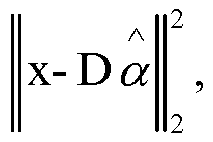
- ⁇ represents a weight of the term ⁇ x ⁇ D ⁇ ⁇ ⁇ 2 2
- D represents a dictionary
- ⁇ represents a sparse representation coefficient vector estimation
- ⁇ represents a weight of the sparse prior constraint term of the reference image
- e l represents first-order filters
- s represents a sparse exponent
- x represents a matrix describing the initial clear image.
- step (3) further includes:
- E (x, u) represents an energy equation
- x represents a matrix describing the initial clear image
- k ⁇ represents the blur kernel estimation
- y represents a matrix describing the degraded image
- ⁇ represents a weight of the term ⁇ x ⁇ D ⁇ ⁇ ⁇ 2 2
- D represents the dictionary
- ⁇ represents the sparse representation coefficient vector estimation
- s represents a sparse exponent
- e l represents first-order filters.
- x represents a matrix describing the initial clear image
- u represents an auxiliary variable
- k ⁇ represents the blur kernel estimation
- y represents a matrix describing the degraded image
- ⁇ represents a weight of the term ⁇ x ⁇ D ⁇ ⁇ ⁇ 2 2
- D represents a dictionary
- ⁇ represents a sparse representation coefficient vector estimation
- e l represents first-order filters.
- u ⁇ l arg min ⁇ u l s + ⁇ ⁇ u l ⁇ e l ⁇ x ⁇ 2 2
- s represents a sparse exponent
- e l represents first-order filters.
- a dictionary is cropped from the new reference image at a step size of b (b ⁇ a).
- a joint image restoration and matching method based on distance weighted sparse representation prior comprising:
- the initial positioning accuracy of the target image in the reference image is measured.
- the positioning accuracy rate is statistically calculated.
- the initial positioning accuracy is measured by using the position deviation, that is, the pixel difference between the actual position and the initial location of the target image in the reference image.
- the positioning accuracy rate is statistically calculated, especially by a ratio of the number of successful locations to the number of all initial locations of all target images to be positioned, in which it is considered that a target image with an initial positioning accuracy of less than or equal to 5 is successfully positioned, and a target image with an initial positioning accuracy of greater than 5 is unsuccessfully positioned.
- the positioning accuracy rate is greater than or equal to 85%, it is considered that A is the optimal number of iterations for the current reference image scale, and then the iterations for the next fine reference image scale can be performed.
- the step (1) includes:
- x represents a matrix describing the initial clear image
- k ⁇ represents the blur kernel estimation
- y represents a matrix describing the degraded image
- ⁇ represents a weight of the regularization term of k
- ⁇ k represents a gradient of k
- ⁇ represents a weight of the regularization term ⁇ ⁇ k ⁇ 2 2
- k represents the blur kernel.
- x ⁇ represents a matrix describing the clear image estimation
- k ⁇ represents the blur kernel estimation
- y represents a matrix describing the degraded image
- ⁇ represents a weight of the term ⁇ x ⁇ D ⁇ ⁇ ⁇ 2 2
- D represents a dictionary
- ⁇ represents a sparse representation coefficient vector estimation
- ⁇ represents a weight of the sparse prior constraint term of the reference image
- e l represents first-order filters
- s represents a sparse exponent
- x represents a matrix describing the initial clear image.
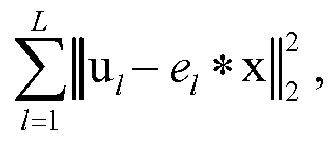
- the step (3) further includes: Establishing an energy equation by introducing new variables u l ( l ⁇ 1,2,..., L ), where L represents the total number of the variables, decomposing the energy equation into a x-subproblem and a u-subproblem, and getting optimal solutions for the x-subproblem and the u-subproblem to obtain a clear image estimation.
- E (x,u) represents an energy equation
- x represents a matrix describing the initial clear image
- k ⁇ represents the blur kernel estimation
- y represents a matrix describing the degraded image
- ⁇ represents a weight of the term ⁇ x ⁇ D ⁇ ⁇ ⁇ 2 2
- D represents a dictionary
- ⁇ represents a sparse representation coefficient vector estimation
- s represents a sparse exponent
- e l represents first-order filters.
- x represents a matrix describing the initial clear image
- u represents an auxiliary variable
- k ⁇ represents the blur kernel estimation
- y represents a matrix describing the degraded image
- ⁇ represents a weight of the term ⁇ x ⁇ D ⁇ ⁇ ⁇ 2 2
- D represents a dictionary
- ⁇ represents a sparse representation coefficient vector estimation
- e l represents first-order filters.
- u ⁇ l arg min ⁇ u l s + ⁇ ⁇ u l ⁇ e l ⁇ x ⁇ 2 2
- s represents a sparse exponent
- e l represents first-order filters.
- FIGS. 3(a) to 3(h) show location effect comparisons of the algorithm of the present disclosure with other algorithms on a partial test image, in which FIG. 3 (a) shows a reference image, FIG. 3(b) shows a blur real-time image to be positioned, FIG. 3(c) shows a positioning result of the direct matching algorithm, FIG. 3(d) shows a positioning result of the DSRC algorithm, FIG. 3(e) shows a positioning result of the SRC algorithm, FIG. 3(f) shows a positioning result of the JRL-SR algorithm, FIG. 3(g) shows a positioning result (initial location) of the JRL-DSR1 algorithm according to the present disclosure, and FIG.
- FIGS. 3(a) to 3(h) shows a positioning result (precise location after the initial location) of the JRL-DSR2 algorithm according to the present disclosure. It can be seen from FIGS. 3(a) to 3(h) that in a case where the target image is severely blurred, through combining restoration and matching tasks, the algorithm according to the present disclosure can correct initial error location, and continuously increase the confidence of correct location. The experimental results also showed that this integration method is better than the methods that perform separate processing of deblurring and location.
Landscapes
- Engineering & Computer Science (AREA)
- Theoretical Computer Science (AREA)
- Computer Vision & Pattern Recognition (AREA)
- General Physics & Mathematics (AREA)
- Physics & Mathematics (AREA)
- Artificial Intelligence (AREA)
- Evolutionary Computation (AREA)
- Databases & Information Systems (AREA)
- Medical Informatics (AREA)
- Software Systems (AREA)
- General Health & Medical Sciences (AREA)
- Health & Medical Sciences (AREA)
- Computing Systems (AREA)
- Multimedia (AREA)
- Data Mining & Analysis (AREA)
- Life Sciences & Earth Sciences (AREA)
- Bioinformatics & Cheminformatics (AREA)
- Bioinformatics & Computational Biology (AREA)
- Evolutionary Biology (AREA)
- General Engineering & Computer Science (AREA)
- Image Analysis (AREA)
- Studio Devices (AREA)
- Image Processing (AREA)
Abstract
Description
- The disclosure belongs to the technical field of pattern matching, and more particularly relates to a joint image restoration and matching method based on distance weighted sparse representation prior.
- In a visual navigation system, it is necessary to compare the ground scene image acquired in real time with a reference image stored on an onboard computer to determine the position of the high speed aircraft. Due to the high accuracy of image matching, this precise position information can be utilized to improve the positioning accuracy of the navigation system. However, the acquired images are usually degraded, for example, are low-resolution and blurred. This will pose a big challenge for image matching and positioning. Therefore, the blur image matching and positioning technology has become a key in high-speed aircraft navigation systems.
- The existing matching and positioning methods for blur images mainly include two types: (1) for images with low degree of degradation, methods of matching or sparse representation are directly used for positioning; (2) first, image restoration is performed to obtain better image quality, and then the restored image is used for positioning. However, these methods have many drawbacks. For the first type of methods, if the image quality deteriorates seriously, the accuracy of matching and positioning will be seriously reduced; for the second type of methods, many image restoration methods are designed only to improve human visual perception rather than machine perception. Therefore, the positioning accuracy cannot be improved. What's worse, when the degradation model is unknown, general restoration algorithms, such as deblurring, do not perform well on real images.
- It can be seen that the prior art has a technical problem of low positioning accuracy due to low image quality.
- In view of the above-described defects or improvement requirements in the prior art, the present disclosure provides a joint image restoration and matching method based on distance weighted sparse representation prior, thereby solving the technical problem of low positioning accuracy due to low image quality in the prior art.
- In order to achieve the above objective, the disclosure provides a joint image restoration and matching method based on distance weighted sparse representation prior, comprising:
- (1) Cropping, at a step size of a, a dictionary from a reference image, acquiring an initial sparse representation coefficient vector of a degraded image in the dictionary by using a distance-weighted sparse representation algorithm, restoring the degraded image by using the initial sparse representation coefficient vector and the dictionary to obtain an initial clear image of the degraded image.
- (2) Estimating a blur kernel by using constraints of the degraded image and the initial clear image on the blur kernel and regularization of a gradient operator to obtain a blur kernel estimation.
- (3) Estimating an initial clear image by using constraints of the blur kernel estimation and the dictionary D on the initial clear image to obtain a clear image estimation.
- (4) Acquiring a sparse representation coefficient vector estimation of the clear image estimation in the dictionary by using the distance-weighted sparse representation algorithm.
- (5) Updating the degraded image in the step (2) with the clear image estimation obtained in the step (3), then performing A iterations of the steps (2) to (4) to obtain a target image and a target sparse representation coefficient vector, and determining an initial location of the target image in the reference image according to a maximum value in the target sparse representation coefficient vector.
- (6) Cropping a new reference image from the reference image, a center of the new reference image being the initial location, and a length and width of the new reference image being equal to the length and width of the target image plus the step size of a, replacing the reference image in the step (1) with the new reference image, and repeating the steps (1) to (5) to obtain a restored image of the target image and a location of the target image in the reference image.
- Further, the step (1) includes:
- (1-1) Cropping, at a step size of a, a dictionary D from a reference image, D = [i 1 ,i 2,...,im ], where im represents a m-th image block cropped from the reference image at the step size of s;
- (1-2) Acquiring an initial sparse representation coefficient vector α of a degraded image in the dictionary by using a distance-weighted sparse representation algorithm,

- (1-3) Restoring the degraded image by using the initial sparse representation coefficient vector and the dictionary to obtain an initial clear image of the degraded image, x = D α, where x represents a matrix describing an initial clear image.
- Further, the blur kernel estimation is expressed as:

- Where x represents a matrix describing the initial clear image, k̂ represents the blur kernel estimation, y represents a matrix describing the degraded image, γ represents a weight of the regularization term of k, Vk represents a gradient of k, ν represents a weight of the regularization term

- Further, the clear image estimation is expressed as:

- Where x̂ represents a matrix describing the clear image estimation, k̂ represents the blur kernel estimation, y represents a matrix describing the degraded image, η represents a weight of the term

- Further, the step (3) further includes:
- Establishing an energy equation by introducing new variables u l (l ∈ 1,2,...,L), where L represents the total number of the variables, decomposing the energy equation into a x-subproblem and a u-subproblem, and getting optimal solutions for the x-subproblem and the u-subproblem to obtain a clear image estimation.
- Further, the energy equation is expressed as:

- Where E(x, u) represents an energy equation, x represents a matrix describing the initial clear image, k̂ represents the blur kernel estimation, y represents a matrix describing the degraded image, η represents a weight of the term


- Further, the x-subproblem is:

- Where x represents a matrix describing the initial clear image, u represents an auxiliary variable, k̂ represents the blur kernel estimation, y represents a matrix describing the degraded image, η represents a weight of the term


- Further, the u-subproblem is:

- Where x represents a matrix describing the initial clear image, τ represents a weight of the term


- Further, in the step (6) of replacing the reference image in the step (1) with the new reference image and repeating the steps (1) to (5), a dictionary is cropped from the new reference image at a step size of b (b<a).
- In general, by comparing the above technical solution of the present inventive concept with the prior art, the present disclosure has the following beneficial effects:
- 1. In the present disclosure, A iterations are performed to obtain a target image and a target sparse representation coefficient vector, in which the target image is already a relatively clear image restored from the degraded image, and meanwhile an initial location of the target image in the reference image is obtained according to a maximum value in the target sparse representation coefficient vector. At this time, the search range of the target image is reduced to a smaller range relative to the reference image, and the above algorithm is used again to perform accurate matching of the target image in this range, thereby obtaining a final restored image and a positioning result. The method of the present disclosure effectively solves the problem that the noise-sensitive and poor restoration effect has a serious influence on the matching task in the existing blur image restoration and matching methods, and is suitable for the visual navigation system.
- 2. The present disclosure provides a method jointing image restoration and matching. During the iterative process, the image restoration and matching tasks can be mutually promoted, which can correct initial error location, and continuously increase the confidence of correct location. The distance weighted information is incorporated into the sparse representation model, so that weights of different types of data become smaller, which increases the discriminability of the image. In the present disclosure, through establishing an energy equation by introducing new variables, decomposing the energy equation into a x-subproblem and a u-subproblem, and getting optimal solutions for the x-subproblem and the u-subproblem to obtain a clear image estimation, the convergence speed of the algorithm is further improved, and the algorithm becomes more concise and clear. Therefore, the present disclosure is particularly suitable for the field of blur image matching and positioning.
-
-
FIG. 1 is a flowchart of a joint image restoration and matching method according to an embodiment of the present disclosure; -
FIG. 2 is a schematic diagram of the joint image restoration and matching method based on distance weighted sparse representation prior according to the embodiment of the present disclosure; -
FIG. 3 (a) is a reference image according to the embodiment of the present disclosure; -
FIG. 3(b) is a blur real-time image to be positioned according to the embodiment of the present disclosure; -
FIG. 3(c) is a diagram showing a positioning result of a direct matching algorithm according to the embodiment of the present disclosure; -
FIG. 3(d) is a diagram showing a positioning result of a DSRC algorithm according to the embodiment of the present disclosure; -
FIG. 3(e) is a diagram showing a positioning result of a SRC algorithm according to the embodiment of the present disclosure; -
FIG. 3(f) is a diagram showing a positioning result of a JRL-SR algorithm according to the embodiment of the present disclosure; -
FIG. 3(g) is a diagram showing an initial positioning result of the joint image restoration and matching method according to the embodiment of the present disclosure; -
FIG. 3(h) is a diagram showing a positioning result of the joint image restoration and matching method according to the embodiment of the present disclosure. - For clear understanding of the objectives, features and advantages of the present disclosure, detailed description of the present disclosure will be given below in conjunction with accompanying drawings and specific embodiments. It should be noted that the embodiments described herein are only meant to explain the present disclosure, and not to limit the scope of the present disclosure. Furthermore, the technical features related to the embodiments of the disclosure described below can be mutually combined if they are not found to be mutually exclusive.
- As shown in
FIG. 1 , there is provided a joint image restoration and matching method based on distance weighted sparse representation prior, comprising: - (1) Cropping, at a step size of a, a dictionary from a reference image, acquiring an initial sparse representation coefficient vector of a degraded image in the dictionary by using a distance-weighted sparse representation algorithm, restoring the degraded image by using the initial sparse representation coefficient vector and the dictionary to obtain an initial clear image of the degraded image.
- (2) Estimating a blur kernel by using constraints of the degraded image and the initial clear image on the blur kernel and regularization of a gradient operator to obtain a blur kernel estimation.
- (3) Estimating an initial clear image by using constraints of the blur kernel estimation and the dictionary D on the initial clear image to obtain a clear image estimation.
- (4) Acquiring a sparse representation coefficient vector estimation of the clear image estimation in the dictionary by using the distance-weighted sparse representation algorithm.
- (5) Updating the degraded image in the step (2) with the clear image estimation obtained in the step (3), then performing A iterations of the steps (2) to (4) to obtain a target image and a target sparse representation coefficient vector, and determining an initial location of the target image in the reference image according to a maximum value in the target sparse representation coefficient vector.
- (6) Cropping a new reference image from the reference image, a center of the new reference image being the initial location, and a length and width of the new reference image being equal to the length and width of the target image plus the step size of a, replacing the reference image in the step (1) with the new reference image, cropping, at a step size of b (b<a), a dictionary from the new reference image, and repeating the steps (1) to (5), so as to obtain a restored image of the target image and a positioning result of the target image in the reference image.
- After A iterations, the initial positioning accuracy of the target image in the reference image is measured. The positioning accuracy rate is statistically calculated. The initial positioning accuracy is measured by using the position deviation, that is, the pixel difference between the actual position and the initial location of the target image in the reference image. The positioning accuracy rate is statistically calculated, especially by a ratio of the number of successful locations to the number of all initial locations of all target images to be positioned, in which it is considered that a target image with an initial positioning accuracy of less than or equal to 5 is successfully positioned, and a target image with an initial positioning accuracy of greater than 5 is unsuccessfully positioned.
- If after A iterations, the positioning accuracy rate is greater than or equal to 85%, it is considered that A is the optimal number of iterations for the current reference image scale, and then the iterations for the next fine reference image scale can be performed.
- As shown in
FIG. (2 ), the step (1) includes: - (1-1) Cropping, at a step size of a, a dictionary D from a reference image, D = [i 1,i 2,...,im ], where im represents a mth picture cropped from the reference image at the step size of s;
- (1-2) Acquiring an initial sparse representation coefficient vector α of a degraded image in the dictionary by using a distance-weighted sparse representation algorithm,

- (1-3) Restoring the degraded image by using the initial sparse representation coefficient vector and the dictionary to obtain an initial clear image of the degraded image, x = Dα, where x represents a matrix describing the initial clear image.
- In the embodiments of the present disclosure, the blur kernel estimation is preferably expressed as:

- Where x represents a matrix describing the initial clear image, k̂ represents the blur kernel estimation, y represents a matrix describing the degraded image, γ represents a weight of the regularization term of k, ∇k represents a gradient of k, ν represents a weight of the regularization term

- In the embodiment of the present disclosure, the clear image estimation is preferably expressed as:

- Where x̂ represents a matrix describing the clear image estimation, k̂ represents the blur kernel estimation, y represents a matrix describing the degraded image, η represents a weight of the term

- In the embodiments of the present disclosure, the step (3) further includes:
Establishing an energy equation by introducing new variables u l (l ∈ 1,2,...,L), where L represents the total number of the variables, decomposing the energy equation into a x-subproblem and a u-subproblem, and getting optimal solutions for the x-subproblem and the u-subproblem to obtain a clear image estimation. The energy equation is expressed as:
- Where E(x,u) represents an energy equation, x represents a matrix describing the initial clear image, k̂ represents the blur kernel estimation, y represents a matrix describing the degraded image, η represents a weight of the term


- The x-subproblem is:

- Where x represents a matrix describing the initial clear image, u represents an auxiliary variable, k̂ represents the blur kernel estimation, y represents a matrix describing the degraded image, η represents a weight of the term


- The u-subproblem is:

- Where x represents a matrix describing the initial clear image, τ represents a weight of the term


- In the embodiments of the present disclosure, a is 5, and b is 2.
FIGS. 3(a) to 3(h) show location effect comparisons of the algorithm of the present disclosure with other algorithms on a partial test image, in whichFIG. 3 (a) shows a reference image,FIG. 3(b) shows a blur real-time image to be positioned,FIG. 3(c) shows a positioning result of the direct matching algorithm,FIG. 3(d) shows a positioning result of the DSRC algorithm,FIG. 3(e) shows a positioning result of the SRC algorithm,FIG. 3(f) shows a positioning result of the JRL-SR algorithm,FIG. 3(g) shows a positioning result (initial location) of the JRL-DSR1 algorithm according to the present disclosure, andFIG. 3(h) shows a positioning result (precise location after the initial location) of the JRL-DSR2 algorithm according to the present disclosure. It can be seen fromFIGS. 3(a) to 3(h) that in a case where the target image is severely blurred, through combining restoration and matching tasks, the algorithm according to the present disclosure can correct initial error location, and continuously increase the confidence of correct location. The experimental results also showed that this integration method is better than the methods that perform separate processing of deblurring and location. - It should be readily understood to those skilled in the art that the above description is only preferred embodiments of the present disclosure, and does not limit the scope of the present disclosure. Any change, equivalent substitution and modification made without departing from the spirit and scope of the present disclosure should be included within the scope of the protection of the present disclosure.
Claims (9)
- A joint image restoration and matching method based on distance weighted sparse representation prior, comprising:(1) cropping, at a step size of a, a dictionary from a reference image, acquiring an initial sparse representation coefficient vector of a degraded image in the dictionary by using a distance-weighted sparse representation algorithm, restoring the degraded image by using the initial sparse representation coefficient vector and the dictionary to obtain an initial clear image of the degraded image;(2) estimating a blur kernel by using constraints of the degraded image and the initial clear image on the blur kernel and regularization of a gradient operator to obtain a blur kernel estimation;(3) estimating an initial clear image by using constraints of the blur kernel estimation and the dictionary D on the initial clear image to obtain a clear image estimation;(4) acquiring a sparse representation coefficient vector estimation of the clear image estimation in the dictionary by using the distance-weighted sparse representation algorithm;(5) updating the degraded image in the step (2) with the clear image estimation obtained in the step (3), then performing A iterations of the steps (2) to (4) to obtain a target image and a target sparse representation coefficient vector, and determining an initial location of the target image in the reference image according to a maximum value in the target sparse representation coefficient vector;(6) cropping a new reference image from the reference image, a center of the new reference image being the initial location, and a length and width of the new reference image being equal to the length and width of the target image plus the step size of a, replacing the reference image in the step (1) with the new reference image, and repeating the steps (1) to (5) to obtain a restored image of the target image and a location of the target image in the reference image.
- The joint image restoration and matching method based on distance weighted sparse representation prior according to claim 1, characterized in that the step (1) includes:(1-1) cropping, at a step size of a, a dictionary D from a reference image, D = [i 1,i 2,...,im ], where im represents a m-th image block cropped from the reference image at the step size of s;(1-2) acquiring an initial sparse representation coefficient vector α of a degraded image in the dictionary by using a distance-weighted sparse representation algorithm,
 (1-3) restoring the degraded image by using the initial sparse representation coefficient vector and the dictionary to obtain an initial clear image of the degraded image, x = Dα, where x represents a matrix describing an initial clear image.
 - The joint image restoration and matching method based on distance weighted sparse representation prior according to claim 1 or 2, characterized in that the blur kernel estimation is expressed as:


- The joint image restoration and matching method based on distance weighted sparse representation prior according to claim 1 or 2, characterized in that the clear image estimation is expressed as:

- The joint image restoration and matching method based on distance weighted sparse representation prior according to claim 1 or 2, characterized in that the step (3) further includes:
establishing an energy equation by introducing new variables u l (l ∈ 1,2,...,L), where L represents the total number of the variables, decomposing the energy equation into a x-subproblem and a u-subproblem, and getting optimal solutions for the x-subproblem and the u-subproblem to obtain a clear image estimation. - The joint image restoration and matching method based on distance weighted sparse representation prior according to claim 5, characterized in that the energy equation is expressed as:



- The joint image restoration and matching method based on distance weighted sparse representation prior according to claim 5, characterized in that the x-subproblem is:


- The joint image restoration and matching method based on distance weighted sparse representation prior according to claim 5, characterized in that the u-subproblem is:


- The joint image restoration and matching method based on distance weighted sparse representation prior according to claim 1 or 2, characterized in that in the step (6) of replacing the reference image in the step (1) with the new reference image and repeating the steps (1) to (5), a dictionary is cropped from the new reference image at a step size of b (b<a).
Applications Claiming Priority (2)
| Application Number | Priority Date | Filing Date | Title |
|---|---|---|---|
| CN201810217553.0A CN108520497B (en) | 2018-03-15 | 2018-03-15 | Image restoration and matching integrated method based on distance weighted sparse expression prior |
| PCT/CN2018/080754 WO2019174068A1 (en) | 2018-03-15 | 2018-03-28 | Distance-weighted sparse representation priori-based image restoration and matching integration method |
Publications (2)
| Publication Number | Publication Date |
|---|---|
| EP3567545A1 true EP3567545A1 (en) | 2019-11-13 |
| EP3567545A4 EP3567545A4 (en) | 2019-12-18 |
Family
ID=63433960
Family Applications (1)
| Application Number | Title | Priority Date | Filing Date |
|---|---|---|---|
| EP18865347.1A Withdrawn EP3567545A4 (en) | 2018-03-15 | 2018-03-28 | IMAGE RESTORATION AND MATCHING INTEGRATION METHOD BASED ON DISTANCE-WEIGHTED PRIMARY PARCIMONIOUS PRIORITY REPRESENTATION |
Country Status (3)
| Country | Link |
|---|---|
| EP (1) | EP3567545A4 (en) |
| CN (1) | CN108520497B (en) |
| WO (1) | WO2019174068A1 (en) |
Families Citing this family (14)
| Publication number | Priority date | Publication date | Assignee | Title |
|---|---|---|---|---|
| CN109903233B (en) * | 2019-01-10 | 2021-08-03 | 华中科技大学 | A method and system for joint image restoration and matching based on linear features |
| CN109949234B (en) * | 2019-02-25 | 2020-10-02 | 华中科技大学 | Video restoration model training method and video restoration method based on deep network |
| CN110176029B (en) * | 2019-04-29 | 2021-03-26 | 华中科技大学 | An integrated method and system for image restoration and matching based on hierarchical sparse representation |
| CN110689503A (en) * | 2019-10-09 | 2020-01-14 | 深圳大学 | Method, system and storage medium for mural image restoration |
| CN111027567A (en) * | 2019-10-30 | 2020-04-17 | 四川轻化工大学 | Edge extraction method based on algorithm learning |
| CN113487491B (en) * | 2021-05-26 | 2024-04-26 | 辽宁工程技术大学 | An image restoration method based on sparsity and non-local mean self-similarity |
| CN117501304A (en) * | 2021-09-28 | 2024-02-02 | 华为技术有限公司 | Image processing method and related equipment |
| CN114071353B (en) * | 2021-11-04 | 2024-02-09 | 中国人民解放军陆军工程大学 | Compressed sensing passive target positioning method combined with clustering algorithm |
| CN114037636B (en) * | 2021-11-29 | 2024-12-17 | 无锡学院 | Multi-frame blind restoration method for correcting image by self-adaptive optical system |
| CN114897734B (en) * | 2022-05-18 | 2024-05-28 | 北京化工大学 | A method for restoring the image of the measured target based on the gradient direction prior |
| CN115619659B (en) * | 2022-09-22 | 2024-01-23 | 北方夜视科技(南京)研究院有限公司 | Low-light image enhancement method and system based on regularized Gaussian field model |
| CN115587940B (en) * | 2022-09-29 | 2025-10-21 | 中国人民解放军战略支援部队航天工程大学 | An image restoration method based on quarter-reordering scheme |
| CN116167948B (en) * | 2023-04-21 | 2023-07-18 | 合肥综合性国家科学中心人工智能研究院(安徽省人工智能实验室) | A Photoacoustic Image Restoration Method and System Based on Space-Varying Point Spread Function |
| CN118645148A (en) * | 2024-06-18 | 2024-09-13 | 中山大学·深圳 | Disease key factor mining method combining multi-omics data, computer device and storage medium |
Family Cites Families (12)
| Publication number | Priority date | Publication date | Assignee | Title |
|---|---|---|---|---|
| US7359576B1 (en) * | 2004-02-27 | 2008-04-15 | Adobe Systems Incorporated | Using difference kernels for image filtering |
| CN101046387A (en) * | 2006-08-07 | 2007-10-03 | 南京航空航天大学 | Scene matching method for raising navigation precision and simulating combined navigation system |
| US8274552B2 (en) * | 2010-12-27 | 2012-09-25 | 3Dmedia Corporation | Primary and auxiliary image capture devices for image processing and related methods |
| US8699790B2 (en) * | 2011-11-18 | 2014-04-15 | Mitsubishi Electric Research Laboratories, Inc. | Method for pan-sharpening panchromatic and multispectral images using wavelet dictionaries |
| CN103607558A (en) * | 2013-11-04 | 2014-02-26 | 深圳市中瀛鑫科技股份有限公司 | Video monitoring system, target matching method and apparatus thereof |
| CN103761710B (en) * | 2014-01-08 | 2016-07-06 | 西安电子科技大学 | The blind deblurring method of efficient image based on edge self-adaption |
| CN104091350B (en) * | 2014-06-20 | 2017-08-25 | 华南理工大学 | A kind of object tracking methods of utilization motion blur information |
| CN104751420B (en) * | 2015-03-06 | 2017-12-26 | 湖南大学 | A kind of blind restoration method based on rarefaction representation and multiple-objection optimization |
| CN105957024B (en) * | 2016-04-20 | 2019-06-18 | 西安电子科技大学 | Blind deblurring method based on image block prior and sparse norm |
| CN106791273B (en) * | 2016-12-07 | 2019-08-20 | 重庆大学 | A kind of video blind restoration method of combination inter-frame information |
| CN107451961B (en) * | 2017-06-27 | 2020-11-17 | 重庆邮电大学 | Method for recovering sharp image under multiple fuzzy noise images |
| CN107341479A (en) * | 2017-07-11 | 2017-11-10 | 安徽大学 | Target tracking method based on weighted sparse cooperation model |
-
2018
- 2018-03-15 CN CN201810217553.0A patent/CN108520497B/en not_active Expired - Fee Related
- 2018-03-28 WO PCT/CN2018/080754 patent/WO2019174068A1/en not_active Ceased
- 2018-03-28 EP EP18865347.1A patent/EP3567545A4/en not_active Withdrawn
Also Published As
| Publication number | Publication date |
|---|---|
| CN108520497B (en) | 2020-08-04 |
| CN108520497A (en) | 2018-09-11 |
| EP3567545A4 (en) | 2019-12-18 |
| WO2019174068A1 (en) | 2019-09-19 |
Similar Documents
| Publication | Publication Date | Title |
|---|---|---|
| CN108520497B (en) | Image restoration and matching integrated method based on distance weighted sparse expression prior | |
| CN110827397B (en) | A texture fusion method for real-time 3D reconstruction of RGB-D cameras | |
| US11488308B2 (en) | Three-dimensional object detection method and system based on weighted channel features of a point cloud | |
| CN111340749B (en) | Image quality detection method, device, equipment and storage medium | |
| US12272027B2 (en) | Image restoration method and apparatus | |
| CN113223074A (en) | Underwater laser stripe center extraction method | |
| CN106886748B (en) | TLD-based variable-scale target tracking method applicable to unmanned aerial vehicle | |
| EP2916537B1 (en) | Image processing device | |
| CN103942758A (en) | Dark channel prior image dehazing method based on multiscale fusion | |
| CN106251365A (en) | Many exposure video fusion method and device | |
| CN106127688A (en) | A kind of super-resolution image reconstruction method and system thereof | |
| CN108765327B (en) | Image rain removing method based on depth of field and sparse coding | |
| CN102567970B (en) | Image restoring method and device | |
| CN109035167B (en) | Method, device, equipment and medium for processing multiple faces in image | |
| CN113592738B (en) | A method for restoring underwater distorted images | |
| CN105913390A (en) | Image defogging method and system | |
| CN109767407B (en) | Secondary estimation method for atmospheric transmissivity image in defogging process | |
| CN110473222A (en) | Image element extraction method and device | |
| JP7294275B2 (en) | Image processing device, image processing program and image processing method | |
| CN114092695B (en) | ROI extraction method and device based on segmentation model | |
| CN104966274A (en) | Local fuzzy recovery method employing image detection and area extraction | |
| Hill et al. | MAMAT: 3D mamba-based atmospheric turbulence removal and its object detection capability | |
| CN104966269A (en) | Multi-frame super-resolution imaging device and method | |
| CN115409718B (en) | Image blind enhancement method and device, electronic device, and storage medium | |
| Cui et al. | Joint face super-resolution and deblurring using multi-task feature fusion network |
Legal Events
| Date | Code | Title | Description |
|---|---|---|---|
| STAA | Information on the status of an ep patent application or granted ep patent |
Free format text: STATUS: UNKNOWN |
|
| STAA | Information on the status of an ep patent application or granted ep patent |
Free format text: STATUS: THE INTERNATIONAL PUBLICATION HAS BEEN MADE |
|
| PUAI | Public reference made under article 153(3) epc to a published international application that has entered the european phase |
Free format text: ORIGINAL CODE: 0009012 |
|
| STAA | Information on the status of an ep patent application or granted ep patent |
Free format text: STATUS: REQUEST FOR EXAMINATION WAS MADE |
|
| 17P | Request for examination filed |
Effective date: 20190417 |
|
| AK | Designated contracting states |
Kind code of ref document: A1 Designated state(s): AL AT BE BG CH CY CZ DE DK EE ES FI FR GB GR HR HU IE IS IT LI LT LU LV MC MK MT NL NO PL PT RO RS SE SI SK SM TR |
|
| AX | Request for extension of the european patent |
Extension state: BA ME |
|
| A4 | Supplementary search report drawn up and despatched |
Effective date: 20191120 |
|
| RIC1 | Information provided on ipc code assigned before grant |
Ipc: G06T 7/73 20170101AFI20191114BHEP Ipc: G06T 5/00 20060101ALI20191114BHEP |
|
| DAV | Request for validation of the european patent (deleted) | ||
| DAX | Request for extension of the european patent (deleted) | ||
| STAA | Information on the status of an ep patent application or granted ep patent |
Free format text: STATUS: THE APPLICATION IS DEEMED TO BE WITHDRAWN |
|
| 18D | Application deemed to be withdrawn |
Effective date: 20211001 |