EP3564291A1 - Copolymer fiber and associated method and article - Google Patents
Copolymer fiber and associated method and article Download PDFInfo
- Publication number
- EP3564291A1 EP3564291A1 EP18197296.9A EP18197296A EP3564291A1 EP 3564291 A1 EP3564291 A1 EP 3564291A1 EP 18197296 A EP18197296 A EP 18197296A EP 3564291 A1 EP3564291 A1 EP 3564291A1
- Authority
- EP
- European Patent Office
- Prior art keywords
- fiber
- units
- polysiloxane
- block
- weight
- Prior art date
- Legal status (The legal status is an assumption and is not a legal conclusion. Google has not performed a legal analysis and makes no representation as to the accuracy of the status listed.)
- Withdrawn
Links
Images

Classifications
-
- C—CHEMISTRY; METALLURGY
- C08—ORGANIC MACROMOLECULAR COMPOUNDS; THEIR PREPARATION OR CHEMICAL WORKING-UP; COMPOSITIONS BASED THEREON
- C08G—MACROMOLECULAR COMPOUNDS OBTAINED OTHERWISE THAN BY REACTIONS ONLY INVOLVING UNSATURATED CARBON-TO-CARBON BONDS
- C08G63/00—Macromolecular compounds obtained by reactions forming a carboxylic ester link in the main chain of the macromolecule
- C08G63/64—Polyesters containing both carboxylic ester groups and carbonate groups
-
- C—CHEMISTRY; METALLURGY
- C08—ORGANIC MACROMOLECULAR COMPOUNDS; THEIR PREPARATION OR CHEMICAL WORKING-UP; COMPOSITIONS BASED THEREON
- C08G—MACROMOLECULAR COMPOUNDS OBTAINED OTHERWISE THAN BY REACTIONS ONLY INVOLVING UNSATURATED CARBON-TO-CARBON BONDS
- C08G63/00—Macromolecular compounds obtained by reactions forming a carboxylic ester link in the main chain of the macromolecule
- C08G63/02—Polyesters derived from hydroxycarboxylic acids or from polycarboxylic acids and polyhydroxy compounds
- C08G63/12—Polyesters derived from hydroxycarboxylic acids or from polycarboxylic acids and polyhydroxy compounds derived from polycarboxylic acids and polyhydroxy compounds
- C08G63/16—Dicarboxylic acids and dihydroxy compounds
- C08G63/18—Dicarboxylic acids and dihydroxy compounds the acids or hydroxy compounds containing carbocyclic rings
- C08G63/181—Acids containing aromatic rings
- C08G63/185—Acids containing aromatic rings containing two or more aromatic rings
-
- C—CHEMISTRY; METALLURGY
- C08—ORGANIC MACROMOLECULAR COMPOUNDS; THEIR PREPARATION OR CHEMICAL WORKING-UP; COMPOSITIONS BASED THEREON
- C08G—MACROMOLECULAR COMPOUNDS OBTAINED OTHERWISE THAN BY REACTIONS ONLY INVOLVING UNSATURATED CARBON-TO-CARBON BONDS
- C08G64/00—Macromolecular compounds obtained by reactions forming a carbonic ester link in the main chain of the macromolecule
- C08G64/04—Aromatic polycarbonates
-
- C—CHEMISTRY; METALLURGY
- C08—ORGANIC MACROMOLECULAR COMPOUNDS; THEIR PREPARATION OR CHEMICAL WORKING-UP; COMPOSITIONS BASED THEREON
- C08G—MACROMOLECULAR COMPOUNDS OBTAINED OTHERWISE THAN BY REACTIONS ONLY INVOLVING UNSATURATED CARBON-TO-CARBON BONDS
- C08G64/00—Macromolecular compounds obtained by reactions forming a carbonic ester link in the main chain of the macromolecule
- C08G64/18—Block or graft polymers
- C08G64/186—Block or graft polymers containing polysiloxane sequences
-
- C—CHEMISTRY; METALLURGY
- C08—ORGANIC MACROMOLECULAR COMPOUNDS; THEIR PREPARATION OR CHEMICAL WORKING-UP; COMPOSITIONS BASED THEREON
- C08G—MACROMOLECULAR COMPOUNDS OBTAINED OTHERWISE THAN BY REACTIONS ONLY INVOLVING UNSATURATED CARBON-TO-CARBON BONDS
- C08G77/00—Macromolecular compounds obtained by reactions forming a linkage containing silicon with or without sulfur, nitrogen, oxygen or carbon in the main chain of the macromolecule
- C08G77/04—Polysiloxanes
-
- C—CHEMISTRY; METALLURGY
- C08—ORGANIC MACROMOLECULAR COMPOUNDS; THEIR PREPARATION OR CHEMICAL WORKING-UP; COMPOSITIONS BASED THEREON
- C08G—MACROMOLECULAR COMPOUNDS OBTAINED OTHERWISE THAN BY REACTIONS ONLY INVOLVING UNSATURATED CARBON-TO-CARBON BONDS
- C08G77/00—Macromolecular compounds obtained by reactions forming a linkage containing silicon with or without sulfur, nitrogen, oxygen or carbon in the main chain of the macromolecule
- C08G77/04—Polysiloxanes
- C08G77/14—Polysiloxanes containing silicon bound to oxygen-containing groups
-
- C—CHEMISTRY; METALLURGY
- C08—ORGANIC MACROMOLECULAR COMPOUNDS; THEIR PREPARATION OR CHEMICAL WORKING-UP; COMPOSITIONS BASED THEREON
- C08G—MACROMOLECULAR COMPOUNDS OBTAINED OTHERWISE THAN BY REACTIONS ONLY INVOLVING UNSATURATED CARBON-TO-CARBON BONDS
- C08G77/00—Macromolecular compounds obtained by reactions forming a linkage containing silicon with or without sulfur, nitrogen, oxygen or carbon in the main chain of the macromolecule
- C08G77/04—Polysiloxanes
- C08G77/38—Polysiloxanes modified by chemical after-treatment
-
- C—CHEMISTRY; METALLURGY
- C08—ORGANIC MACROMOLECULAR COMPOUNDS; THEIR PREPARATION OR CHEMICAL WORKING-UP; COMPOSITIONS BASED THEREON
- C08G—MACROMOLECULAR COMPOUNDS OBTAINED OTHERWISE THAN BY REACTIONS ONLY INVOLVING UNSATURATED CARBON-TO-CARBON BONDS
- C08G77/00—Macromolecular compounds obtained by reactions forming a linkage containing silicon with or without sulfur, nitrogen, oxygen or carbon in the main chain of the macromolecule
- C08G77/42—Block-or graft-polymers containing polysiloxane sequences
- C08G77/448—Block-or graft-polymers containing polysiloxane sequences containing polycarbonate sequences
-
- C—CHEMISTRY; METALLURGY
- C08—ORGANIC MACROMOLECULAR COMPOUNDS; THEIR PREPARATION OR CHEMICAL WORKING-UP; COMPOSITIONS BASED THEREON
- C08K—Use of inorganic or non-macromolecular organic substances as compounding ingredients
- C08K5/00—Use of organic ingredients
- C08K5/0008—Organic ingredients according to more than one of the "one dot" groups of C08K5/01 - C08K5/59
- C08K5/0066—Flame-proofing or flame-retarding additives
-
- C—CHEMISTRY; METALLURGY
- C08—ORGANIC MACROMOLECULAR COMPOUNDS; THEIR PREPARATION OR CHEMICAL WORKING-UP; COMPOSITIONS BASED THEREON
- C08K—Use of inorganic or non-macromolecular organic substances as compounding ingredients
- C08K5/00—Use of organic ingredients
- C08K5/49—Phosphorus-containing compounds
- C08K5/51—Phosphorus bound to oxygen
- C08K5/52—Phosphorus bound to oxygen only
- C08K5/521—Esters of phosphoric acids, e.g. of H3PO4
-
- C—CHEMISTRY; METALLURGY
- C08—ORGANIC MACROMOLECULAR COMPOUNDS; THEIR PREPARATION OR CHEMICAL WORKING-UP; COMPOSITIONS BASED THEREON
- C08K—Use of inorganic or non-macromolecular organic substances as compounding ingredients
- C08K5/00—Use of organic ingredients
- C08K5/49—Phosphorus-containing compounds
- C08K5/51—Phosphorus bound to oxygen
- C08K5/52—Phosphorus bound to oxygen only
- C08K5/521—Esters of phosphoric acids, e.g. of H3PO4
- C08K5/523—Esters of phosphoric acids, e.g. of H3PO4 with hydroxyaryl compounds
-
- C—CHEMISTRY; METALLURGY
- C08—ORGANIC MACROMOLECULAR COMPOUNDS; THEIR PREPARATION OR CHEMICAL WORKING-UP; COMPOSITIONS BASED THEREON
- C08K—Use of inorganic or non-macromolecular organic substances as compounding ingredients
- C08K7/00—Use of ingredients characterised by shape
- C08K7/02—Fibres or whiskers
-
- D—TEXTILES; PAPER
- D01—NATURAL OR MAN-MADE THREADS OR FIBRES; SPINNING
- D01F—CHEMICAL FEATURES IN THE MANUFACTURE OF ARTIFICIAL FILAMENTS, THREADS, FIBRES, BRISTLES OR RIBBONS; APPARATUS SPECIALLY ADAPTED FOR THE MANUFACTURE OF CARBON FILAMENTS
- D01F1/00—General methods for the manufacture of artificial filaments or the like
- D01F1/02—Addition of substances to the spinning solution or to the melt
- D01F1/07—Addition of substances to the spinning solution or to the melt for making fire- or flame-proof filaments
-
- D—TEXTILES; PAPER
- D01—NATURAL OR MAN-MADE THREADS OR FIBRES; SPINNING
- D01F—CHEMICAL FEATURES IN THE MANUFACTURE OF ARTIFICIAL FILAMENTS, THREADS, FIBRES, BRISTLES OR RIBBONS; APPARATUS SPECIALLY ADAPTED FOR THE MANUFACTURE OF CARBON FILAMENTS
- D01F6/00—Monocomponent artificial filaments or the like of synthetic polymers; Manufacture thereof
- D01F6/78—Monocomponent artificial filaments or the like of synthetic polymers; Manufacture thereof from copolycondensation products
-
- D—TEXTILES; PAPER
- D01—NATURAL OR MAN-MADE THREADS OR FIBRES; SPINNING
- D01F—CHEMICAL FEATURES IN THE MANUFACTURE OF ARTIFICIAL FILAMENTS, THREADS, FIBRES, BRISTLES OR RIBBONS; APPARATUS SPECIALLY ADAPTED FOR THE MANUFACTURE OF CARBON FILAMENTS
- D01F6/00—Monocomponent artificial filaments or the like of synthetic polymers; Manufacture thereof
- D01F6/78—Monocomponent artificial filaments or the like of synthetic polymers; Manufacture thereof from copolycondensation products
- D01F6/84—Monocomponent artificial filaments or the like of synthetic polymers; Manufacture thereof from copolycondensation products from copolyesters
-
- D—TEXTILES; PAPER
- D01—NATURAL OR MAN-MADE THREADS OR FIBRES; SPINNING
- D01F—CHEMICAL FEATURES IN THE MANUFACTURE OF ARTIFICIAL FILAMENTS, THREADS, FIBRES, BRISTLES OR RIBBONS; APPARATUS SPECIALLY ADAPTED FOR THE MANUFACTURE OF CARBON FILAMENTS
- D01F6/00—Monocomponent artificial filaments or the like of synthetic polymers; Manufacture thereof
- D01F6/96—Monocomponent artificial filaments or the like of synthetic polymers; Manufacture thereof from other synthetic polymers
Definitions
- Polyestercarbonate-polysiloxanes are copolymers exhibiting a desirable balance of flame retardancy and ductility. To date, such copolymers and their compositions have been used primarily in injection molding, sheet extrusion, and additive manufacturing applications. Polyestercarbonate-polysiloxanes have been used for the production of fibers. See, for example, U.S. Patent Application Publication No. US 2013/0260088 A1 of David et al. However, there is a need for polyestercarbonate-polysiloxane compositions that exhibit more robust process characteristics for melt spinning of fibers.
- One embodiment is a copolymer fiber: wherein the copolymer fiber comprises a composition comprising, based on the total weight of the composition, 90 to 98 weight percent of a block polyestercarbonate-polysiloxane comprising a polyester block comprising resorcinol ester units having the structure a polycarbonate block comprising carbonate units having the structure wherein at least 60 percent of the total number of R 1 groups are aromatic divalent groups, and a polysiloxane block comprising dimethylsiloxane units; wherein the block polyestercarbonate-polysiloxane comprises, based on total moles of carbonate and ester units, 30 to 90 mole percent of the resorcinol ester units, 5 to 35 mole percent of carbonate units wherein R 1 is 1,3-phenylene, and 5 to 35 mole percent of carbonate units wherein R 1 is and further comprises, based on the weight of the block polyestercarbonate-polysiloxane, 0.2 to 4 weight percent dimethylsilox
- Another embodiment is a method of forming a fiber, the method comprising: melt spinning a composition to form a fiber; wherein the composition comprises, based on the total weight of the composition, 90 to 98 weight percent of a block polyestercarbonate-polysiloxane comprising a polyester block comprising resorcinol ester units having the structure a polycarbonate block comprising carbonate units having the structure wherein at least 60 percent of the total number of R 1 groups are aromatic divalent groups, and a polysiloxane block comprising dimethylsiloxane units; wherein the block polyestercarbonate-polysiloxane comprises, based on total moles of carbonate and ester units, 30 to 90 mole percent of the resorcinol ester units, 5 to 35 mole percent of carbonate units wherein R 1 is 1,3-phenylene, and 5 to 35 mole percent of carbonate units wherein R 1 is and further comprises, based on the weight of the block polyestercarbonate-polysiloxane, 0.2
- Another embodiment is an article comprising the fiber.
- the Figure is a schematic illustration of a melt spinning apparatus.
- melt-spun fibers prepared from a composition comprises specific amounts of a block polyestercarbonate-polysiloxane and a flame retardant.
- one embodiment is a copolymer fiber, wherein the copolymer fiber comprises a composition comprising, based on the total weight of the composition, 90 to 98 weight percent of a block polyestercarbonate-polysiloxane comprising a polyester block comprising resorcinol ester units having the structure a polycarbonate block comprising carbonate units having the structure wherein at least 60 percent of the total number of R 1 groups are aromatic divalent groups, and a polysiloxane block comprising dimethylsiloxane units; wherein the block polyestercarbonate-polysiloxane comprises, based on total moles of carbonate and ester units, 30 to 90 mole percent of the resorcinol ester units, 5 to 35 mole percent of carbonate units wherein R 1 is 1,3-phenylene, and 5 to 35 mole percent of carbonate units wherein R 1 is and further comprises, based on the weight of the block polyestercarbonate-polysiloxane, 0.2 to 4 weight percent dimethylsi
- the copolymer fiber is prepared from a composition comprising a block polyestercarbonate-polysiloxane.
- a block polyestercarbonate-polysiloxane is a copolymer comprising at least one polyester block, at least one polycarbonate block, and at least one polysiloxane block.
- the at least one polyester block comprises resorcinol ester units, each resorcinol ester unit having the structure the at least one polycarbonate block comprises carbonate units, each carbonate unit having the structure wherein at least 60 percent of the total number of R 1 groups are aromatic divalent groups, and the at least one polysiloxane block comprises dimethylsiloxane units.
- the aromatic divalent groups are C 6 -C 24 aromatic divalent groups. When not all R 1 groups are aromatic, the remainder are C 2 -C 24 aliphatic divalent groups.
- each R 1 is a radical of the formula wherein each of A 1 and A 2 is independently a monocyclic divalent aryl radical, and Y 1 is a bridging radical having one or two atoms that separate A 1 from A 2 . Examples of A 1 and A 2 include 1,3-phenylene and 1,4-phenylene, each optionally substituted with one, two, or three C 1 -C 6 alkyl groups.
- the bridging radical Y 1 can be a C 1 -C 12 (divalent) hydrocarbylene group.
- hydrocarbyl refers to a residue that contains only carbon and hydrogen unless it is specifically identified as “substituted hydrocarbyl".
- the hydrocarbyl residue can be aliphatic or aromatic, straight-chain, cyclic, branched, saturated, or unsaturated. It can also contain combinations of aliphatic, aromatic, straight chain, cyclic, bicyclic, branched, saturated, and unsaturated hydrocarbon moieties.
- the hydrocarbyl residue When the hydrocarbyl residue is described as substituted, it can contain heteroatoms in addition to carbon and hydrogen. In some embodiments, one atom separates A 1 from A 2 .
- Y 1 radicals are -O-, -S-, -S(O)-, -S(O) 2 -, -C(O)-, methylene (-CH 2 -; also known as methylidene), ethylidene (-CH(CH 3 )-), isopropylidene (-C(CH 3 ) 2 -), neopentylidene, cyclohexylidene, cyclopentadecylidene, cyclododecylidene, adamantylidene, cyclohexylidene methylene, cyclohexylmethylene, and 2-[2.2.1]-bicycloheptylidene.
- the resorcinol ester units comprise resorcinol isophthalate/terephthalate units
- the carbonate units comprise resorcinol carbonate units and bisphenol A carbonate units.
- the block polyestercarbonate-polysiloxane comprises, based on total moles of carbonate and ester units, 30 to 90 mole percent of the resorcinol ester units, 5 to 35 mole percent of carbonate units wherein R 1 is 1,3-phenylene (i.e., the carbonate units are resorcinol carbonate units), and 5 to 35 mole percent of carbonate units wherein R 1 is (i.e., the carbonate units are bisphenol A carbonate units).
- the amount of resorcinol ester units can be 50 to 90 mole percent, or 70 to 90 mole percent.
- the amount of resorcinol carbonate units can be 5 to 25 mole percent, or 5 to 15 mole percent.
- the amount of bisphenol A carbonate units can be 5 to 25 mole percent, or 5 to 15 mole percent.
- the block polyestercarbonate-polysiloxane further comprises, based on the weight of the block polyestercarbonate-polysiloxane, 0.2 to 4 weight percent dimethylsiloxane units. Within this range, the amount of dimethylsiloxane units can be 0.4 to 2 weight percent, or 0.5 to 2 weight percent.
- the block polyestercarbonate-polysiloxane comprises, based on total moles of carbonate and ester units, 70 to 90 mole percent of resorcinol isophthalate/terephthalate units, 5 to 15 mole percent of resorcinol carbonate units, and 5 to 15 mole percent of bisphenol A carbonate units, and further comprises dimethylsiloxane units in an amount, based on the total weight of the block polyestercarbonate-polysiloxane, of 0.5 to 2 weight percent.
- end-capping agent also referred to as a chain stopping agent or chain terminating agent
- examples of end-capping agents include monocyclic phenols such as phenol, p-cyanophenol, and C 1 -C 22 alkyl-substituted phenols such as p-cumylphenol, resorcinol monobenzoate, and p-tertiary-butyl phenol; monoethers of diphenols, such as p-methoxyphenol; monoesters of diphenols such as resorcinol monobenzoate; functionalized chlorides of aliphatic monocarboxylic acids such as acryloyl chloride and methacryoyl chloride; and mono-chloroformates such as phenyl chloroformate, alkyl-substituted phenyl chloroformates,
- the block polyestercarbonate-polysiloxane has a weight average molecular weight of 15,000 to 55,000 grams/mole, as determined by gel permeation chromatography using polycarbonate standards. Within this range, the weight average molecular weight can be 18,000 to 50,000 grams/mole.
- the composition comprises the block polyestercarbonate-polysiloxane in an amount of 90 to 98 weight percent, based on the total weight of the composition. Within this range, the amount of block polyestercarbonate-polysiloxane can be 90 to 97 weight percent, or 91 to 96 weight percent.
- the composition comprises a flame retardant.
- a flame retardant is a chemical compound or mixture of chemical compounds capable of improving the flame retardancy of the thermoplastic composition. Suitable flame retardants include organophosphate esters, metal dialkylphosphinates, melamine-containing flame retardants, and combinations thereof.
- the flame retardant comprises an organophosphate ester.
- organophosphate ester flame retardants include phosphate esters comprising phenyl groups, substituted phenyl groups, or a combination of phenyl groups and substituted phenyl groups, bis-aryl phosphate esters based upon resorcinol such as, for example, resorcinol bis(diphenyl phosphate), as well as those based upon bisphenols such as, for example, bisphenol A bis(diphenyl phosphate).
- the organophosphate ester is selected from tris(alkylphenyl) phosphates (for example, CAS Reg. No. 89492-23-9 or CAS Reg. No.
- resorcinol bis(diphenyl phosphate) (CAS Reg. No. 57583-54-7 ), bisphenol A bis(diphenyl phosphate) ( CAS Reg. No. 181028-79-5 ), triphenyl phosphate ( CAS Reg. No. 115-86-6 ), tris(isopropylphenyl) phosphates (for example, CAS Reg. No. 68937-41-7 ), t-butylphenyl diphenyl phosphates ( CAS Reg. No. 56803-37-3 ), bis(t-butylphenyl) phenyl phosphates ( CAS Reg. No.
- the flame retardant excludes brominated polycarbonate. In some embodiments, the flame retardant is halogen-free. In some embodiments, the organophosphate ester comprises an oligomeric phosphate ester, which can be a halogen-free oligomeric phosphate ester.
- the flame retardant comprises a metal dialkylphosphinate.
- metal dialkylphosphinate refers to a salt comprising at least one metal cation and at least one dialkylphosphinate anion.
- the metal dialkylphosphinate has the formula wherein R a and R b are each independently C 1 -C 6 alkyl; M is calcium, magnesium, aluminum, or zinc; and d is 2 or 3. Examples of R a and R b include methyl, ethyl, n-propyl, isopropyl, n-butyl, tert-butyl, and n-pentyl. In some embodiments, R a and R b are ethyl, M is aluminum, and d is 3 (that is, the metal dialkylphosphinate is aluminum tris(diethylphosphinate)).
- the flame retardant comprises a melamine-containing flame retardant.
- Melamine-containing flame retardants include those comprising a melamine-containing base and a phosphate or pyrophosphate or polyphosphate or cyanurate acid.
- the melamine-containing flame retardant has the formula wherein g is 1 to 10,000, and the ratio of f to g is 0.5:1 to 1.7:1, specifically 0.7:1 to 1.3:1, more specifically 0.9:1 to 1.1:1. It will be understood that this formula includes species in which one or more protons are transferred from the phosphate group(s) to the melamine group(s).
- the melamine-containing flame retardant is melamine phosphate ( CAS Reg.
- the melamine-containing flame retardant is melamine pyrophosphate ( CAS Reg. No. 15541 60-3 ).
- the melamine-containing flame retardant is a melamine polyphosphate ( CAS Reg. No. 56386-64-2 ).
- the melamine-containing flame retardant is melamine pyrophosphate, melamine polyphosphate, or a mixture thereof.
- g has an average value of greater than 2 to 10,000, specifically 5 to 1,000, more specifically 10 to 500.
- g has an average value of greater than 2 to 500.
- Methods for preparing melamine phosphate, melamine pyrophosphate, and melamine polyphosphate are known in the art, and all are commercially available.
- melamine polyphosphates may be prepared by reacting polyphosphoric acid and melamine, as described, for example, in U.S. Pat. No. 6,025,419 to Kasowski et al. , or by heating melamine pyrophosphate under nitrogen at 290°C to constant weight, as described in U.S. Patent No. 6,015,510 to Jacobson et al.
- the melamine-containing flame retardant comprises melamine cyanurate.
- the composition comprises the flame retardant in an amount of 2 to 10 weight percent of, based on the total weight of the composition. Within this range, the flame retardant amount can be about 3 to 10 weight percent, or 4 to 9 weight percent.
- the composition can, optionally, further comprise one or more additives known in the thermoplastics art.
- Suitable additives include, for example, stabilizers, mold release agents, lubricants, processing aids, drip retardants, nucleating agents, UV blockers, dyes, pigments, antioxidants, anti-static agents, blowing agents, mineral oil, metal deactivators, antiblocking agents, and combinations thereof.
- additives are typically used in a total amount of less than or equal to 2 weight percent, based on the total weight of the composition.
- additives are used in an amount less than or equal to 1 weight percent, or less than or equal to 0.5 weight percent.
- the composition comprises 0 to 1 part per million by weight of colorants.
- the composition excludes colorants.
- the composition comprises, based on the total weight of the composition, 91 to 96 weight percent of the block polyestercarbonate-polysiloxane, and 4 to 9 weight percent of the flame retardant.
- the total amount of the block polyestercarbonate-polysiloxane and the flame retardant is 98 to 100 weight percent, or 99 to 100 weight percent.
- the block polyestercarbonate-polysiloxane comprises, based on total moles of carbonate and ester units, 70 to 90 mole percent of the resorcinol ester units, 5 to 15 mole percent of carbonate units wherein R 1 is 1,3-phenylene, and 5 to 15 mole percent of carbonate units wherein R 1 is and further comprises, based on the weight of the block polyestercarbonate-polysiloxane, 0.5 to 2 weight percent dimethylsiloxane units.
- the composition excludes polycarbonates. In some embodiments, the composition excludes polyesters. In some embodiments, the composition excludes polyestercarbonates. In some embodiments, the composition excludes impact modifiers. In some embodiments, the composition excludes polycarbonates and polyesters and polyestercarbonates and impact modifiers.
- the fiber has an equivalent circular diameter of 10 to 60 micrometers.
- the equivalent circular diameter of a fiber is the diameter of circle having the same area as the cross-section of the fiber under consideration. For example, if the fiber under consideration has a square cross section with an area of 400 micrometer 2 , that fiber has an equivalent circular diameter of 22.57 micrometers. Within the range of 10 to 60 micrometers, the equivalent circular diameter can be 15 to 50 micrometers.
- the shape of the fiber cross-section which can be, for example, circular or oval or triangular or square or rectangular. In some embodiments, the fiber cross-section is circular.
- Another embodiment is a method of forming a fiber, the method comprising: melt spinning a composition to form a fiber; wherein the composition comprises, based on the total weight of the composition, 90 to 98 weight percent of a block polyestercarbonate-polysiloxane comprising a polyester block comprising resorcinol ester units having the structure a polycarbonate block comprising carbonate units having the structure wherein at least 60 percent of the total number of R 1 groups are aromatic divalent groups, and a polysiloxane block comprising dimethylsiloxane units; wherein the block polyestercarbonate-polysiloxane comprises, based on total moles of carbonate and ester units, 30 to 90 mole percent of the resorcinol ester units, 5 to 35 mole percent of carbonate units wherein R 1 is 1,3-phenylene, and 5 to 35 mole percent of carbonate units wherein R 1 is and further comprises, based on the weight of the block polyestercarbonate-polysiloxane, 0.2
- compositional variations described above in the context of the fiber apply as well to the method of forming a fiber.
- the melt spinning is characterized by a draw down ratio of 280 to 550, an apparent shear rate of 170 to 1700 second -1 , and a mechanical draw ratio of 0.95 to 1.2.
- Draw down ratio which is unitless, is defined as the ratio of speed (in meters/minute) at which the melt exits the spinneret nozzles to the speed (in meters/minute) of the fiber at the first godet. Within the range of 280 to 550, the draw down ratio can be 350 to 450.
- Mechanical draw ratio which is unitless, is defined as the ratio of the first godet speed (in meters/minute) to the winder speed (in meters/minute). Within the range of 0.95 to 1.2, the mechanical draw ratio can be 0.98 to 1.1.
- the article comprises a woven fabric comprising the fiber.
- the article comprises a knit fabric comprising the fiber.
- the article comprises a nonwoven fabric comprising the fiber.
- Nonwoven fabrics can be prepared by methods including, for example, wet-laid, dry-laid, air-laid, melt-blown, spunbond, and spunlace.
- the invention includes at least the following aspects.
- Table 1 Component Description PEC-Si para-Cumylphenol endcapped block polyestercarbonate-polysiloxane with about 99 weight percent total of polyester blocks and polycarbonate blocks, and about 1 weight percent polysiloxane blocks; the polyestercarbonate portion contains about 80 mole percent 1,3-phenylene isophthalate-co-terephthalate units, about 9 mole percent resorcinol carbonate units, and about 11 mole percent bisphenol A carbonate units; the polysiloxane blocks have, on average, about 10 dimethylsiloxane units per block; the polyestercarbonate-polysiloxane has a weight average molecular weight of about 24,500 grams/mole and is preparable by the procedure of Example 2-14 of Method 2 as described in US Patent No.
- Patent No. 7,790,292 B2 to Colborn OPE Oligomeric phosphate ester flame retardant containing 10.7% phosphorus and having a melting range of 101-108 °C; obtained in pastille form as FYROLFLEXTM SOL-DP flame retardant from ICL Industrial Products.
- BrPC Brominated polycarbonate prepared by copolymerization of phosgene and a 50:50 weight/weight mixture of 2,2',6,6'-tetrabromo-4,4'-isopropylidenediphenol and bisphenol A, and having a weight average molecular weight of about 22,500 grams/mole; preparable according to the method for forming "TBBPA-BPA Copolymer" in columns 26-27 of U.S.
- Patent No. 9,006,324 to Sybert et al. TBPDP Tetrakis(2,4-di-tert-butylphenyl)4,4'-biphenyldiphosphonite, CAS Reg. No. 119345-01-6 ; obtained as IRGAFOSTM P-EPQ from BASF. SV36 Solvent Violet 36, CAS Reg. No. 61951-89-1 . PB60 Pigment Blue 60, CAS Reg. No. 81-77-6 .
- compositions are summarized in Table 2, where component amounts are expressed in weight percent based on the total weight of the composition. Compositions were prepared by dry blending all components, and the resulting mixture was added to the feed throat of a twin-screw extruder operating with zone temperatures ranging from 230 to 300 °C. The extrudate was cooled in water before being pelletized. Table 2 Ex. 1 Ex. 2 C. Ex. 1 C. Ex.
- melt spinning apparatus 1 comprises extruder 5 , in which dried pellets are converted to a melt, melt pump 10 , which conveys the melt to spin pack 15 , where it is filtered, then to spinneret 20 , where multiple fibers are formed from the filtered melt.
- the fibers are immediately conveyed to quench section 30 , where the fibers are air-cooled and solidified.
- the cooled fibers then enter spin finish section 40 , where a spin finish can be applied to the surface of the fibers.
- the fibers then traverse a sequence of godet pairs comprising first godets 50 , second godets 60 , and third godets 70 , where the fibers are drawn (stretched).
- the fibers then enter winder section 80 , where contact roller 90 facilitates formation of wound fiber 100 about one of two winding cores 110 .
- melt pump was operated at 10 centimeter 3 /revolution.
- Extruder and melt pump temperatures were 280 to 330 °C.
- a 144-hole, single-position spinneret was used.
- Spinneret holes (nozzles) were all circular with a diameter varying, depending on the experiment, from 0.4 to 0.8 millimeters.
- the length-to-diameter ratio of each spinneret was 4:1.
- a 325 U.S. mesh (44 micrometer opening) screen filter was used in the spinpack for filtration of the composition melt. After fibers exited the nozzles, they were solidified by quenching with air at ambient temperature (about 23 °C).
- a spin finish an acrylamide copolymer in an oil-in-water emulsion, obtained as LUROLTM PS-11744 from Goulston
- the draw down ratio ranged from 140 for a 16 denier per fiber (dpf) experiment to 2200 for a 2 dpf experiment.
- the apparent shear rate ranged from 43 for a 2 dpf experiment to 3420 for a 16 dpf experiment.
- the mechanical draw ratio ranged from 0.95 to 1.2.
- the best fiber production was associated with a draw down ratio of 280 to 550 (with 350 to 450 being preferred), an apparent shear rate of 170 to 1700 second -1 (with 275 to 990 second -1 preferred), and a mechanical draw ratio of 0.95 to 1.2 (with 0.98 to 1.1 preferred).
- draw down ratios substantially less than 280 the fiber produced did not exhibit a uniform diameter and the productivity of the process was too low to be commercially practical.
- draw down ratios substantially greater than 550 mechanical breakage of fibers from some of the 144 nozzles was observed, leading to thread breaks.
- apparent shear rates substantially less than 170 second -1 the fiber produced did not exhibit a uniform diameter.
- melt fracture leading to a thread break was observed.
- mechanical draw ratios substantially less than 0.95 frequent thread breakage on the godets was observed.
- mechanical draw ratios substantially greater than 1.2 thread on the godets generated fluffs due to filament breakage.
- Example 2 the melt spinning process was acceptable, but not as favorable as for the Example 1 composition. Specifically, relative to the Example 1 composition, the Example 2 composition was associated with about three times more thread breaks per unit time. And for the Example 2 composition, most of those thread breaks occurred between the spinneret and the first godets.
- the melt spinning process had low fiber yields. Fiber breakage occurred within three to ten minutes, on average. Fibers could be created and drawn, but the rate of fiber breakage was unacceptable.
- Hot Air Shrinkage was determined as follows. A length of fibers (90 meters in total length, 1 meter per turn) was collected. This collection, called a skein, was prepared using a denier wheel. The skein was held on a hook, and its length, L 0 , with a base weight of each individual fiber being less than 0.1 gram/denier, was measured in millimeters. The skein was kept for twenty minutes in a convection oven set at a temperature 20 °C less than the glass transition temperature (T g ) of the composition. The skein was removed from the convection oven and cooled to ambient temperature. Its length, L 1 , was measured in millimeters. The Hot Air Shrinkage, expressed in units of percent, was calculated as 100 ⁇ (L 0 -L 1 )/L 0 . For the Example 1 composition, the Hot Air Shrinkage was 1.5%.
Landscapes
- Chemical & Material Sciences (AREA)
- Chemical Kinetics & Catalysis (AREA)
- Health & Medical Sciences (AREA)
- Medicinal Chemistry (AREA)
- Polymers & Plastics (AREA)
- Organic Chemistry (AREA)
- Engineering & Computer Science (AREA)
- General Chemical & Material Sciences (AREA)
- Textile Engineering (AREA)
- Manufacturing & Machinery (AREA)
- Artificial Filaments (AREA)
- Compositions Of Macromolecular Compounds (AREA)
Abstract
Description
- Polyestercarbonate-polysiloxanes are copolymers exhibiting a desirable balance of flame retardancy and ductility. To date, such copolymers and their compositions have been used primarily in injection molding, sheet extrusion, and additive manufacturing applications. Polyestercarbonate-polysiloxanes have been used for the production of fibers. See, for example, U.S. Patent Application Publication No.
US 2013/0260088 A1 of David et al. However, there is a need for polyestercarbonate-polysiloxane compositions that exhibit more robust process characteristics for melt spinning of fibers. - One embodiment is a copolymer fiber: wherein the copolymer fiber comprises a composition comprising, based on the total weight of the composition, 90 to 98 weight percent of a block polyestercarbonate-polysiloxane comprising a polyester block comprising resorcinol ester units having the structure


- Another embodiment is a method of forming a fiber, the method comprising: melt spinning a composition to form a fiber; wherein the composition comprises, based on the total weight of the composition, 90 to 98 weight percent of a block polyestercarbonate-polysiloxane comprising a polyester block comprising resorcinol ester units having the structure


further comprises, based on the weight of the block polyestercarbonate-polysiloxane, 0.2 to 4 weight percent dimethylsiloxane units; and 2 to 10 weight percent of a flame retardant; and wherein the fiber has an equivalent circular diameter of 10 to 60 micrometers. - Another embodiment is an article comprising the fiber.
- These and other embodiments are described in detail below.
- The Figure is a schematic illustration of a melt spinning apparatus.
- The present inventors have determined that more robust process characteristics for melt spinning of fibers, reduced hot air shrinkage, and reduced heat release rates are exhibited by melt-spun fibers prepared from a composition comprises specific amounts of a block polyestercarbonate-polysiloxane and a flame retardant.
- Thus, one embodiment is a copolymer fiber, wherein the copolymer fiber comprises a composition comprising, based on the total weight of the composition, 90 to 98 weight percent of a block polyestercarbonate-polysiloxane comprising a polyester block comprising resorcinol ester units having the structure


further comprises, based on the weight of the block polyestercarbonate-polysiloxane, 0.2 to 4 weight percent dimethylsiloxane units; and 2 to 10 weight percent of a flame retardant; wherein the fiber has an equivalent circular diameter of 10 to 60 micrometers. - The copolymer fiber is prepared from a composition comprising a block polyestercarbonate-polysiloxane. A block polyestercarbonate-polysiloxane is a copolymer comprising at least one polyester block, at least one polycarbonate block, and at least one polysiloxane block. Specifically, the at least one polyester block comprises resorcinol ester units, each resorcinol ester unit having the structure


- In some embodiments, the aromatic divalent groups are C6-C24 aromatic divalent groups. When not all R1 groups are aromatic, the remainder are C2-C24 aliphatic divalent groups. In some embodiments, each R1 is a radical of the formula

- In some embodiments, the resorcinol ester units comprise resorcinol isophthalate/terephthalate units, and the carbonate units comprise resorcinol carbonate units and bisphenol A carbonate units.
- The block polyestercarbonate-polysiloxane comprises, based on total moles of carbonate and ester units, 30 to 90 mole percent of the resorcinol ester units, 5 to 35 mole percent of carbonate units wherein R1 is 1,3-phenylene (i.e., the carbonate units are resorcinol carbonate units), and 5 to 35 mole percent of carbonate units wherein R1 is

- In a very specific embodiment, the block polyestercarbonate-polysiloxane comprises, based on total moles of carbonate and ester units, 70 to 90 mole percent of resorcinol isophthalate/terephthalate units, 5 to 15 mole percent of resorcinol carbonate units, and 5 to 15 mole percent of bisphenol A carbonate units, and further comprises dimethylsiloxane units in an amount, based on the total weight of the block polyestercarbonate-polysiloxane, of 0.5 to 2 weight percent.
- There is no particular limit on the structure of end groups on the block polyestercarbonate-polysiloxane. An end-capping agent (also referred to as a chain stopping agent or chain terminating agent) can be included during polymerization to provide end groups. Examples of end-capping agents include monocyclic phenols such as phenol, p-cyanophenol, and C1-C22 alkyl-substituted phenols such as p-cumylphenol, resorcinol monobenzoate, and p-tertiary-butyl phenol; monoethers of diphenols, such as p-methoxyphenol; monoesters of diphenols such as resorcinol monobenzoate; functionalized chlorides of aliphatic monocarboxylic acids such as acryloyl chloride and methacryoyl chloride; and mono-chloroformates such as phenyl chloroformate, alkyl-substituted phenyl chloroformates, p-cumyl phenyl chloroformate, and toluene chloroformate. Combinations of different end groups can be used. In some embodiments, the block polyestercarbonate-polysiloxane has a weight average molecular weight of 15,000 to 55,000 grams/mole, as determined by gel permeation chromatography using polycarbonate standards. Within this range, the weight average molecular weight can be 18,000 to 50,000 grams/mole.
- Methods for the preparation of block polyestercarbonate-polysiloxanes are known and described, for example, in
U.S. Patent No. 7,790,292 B2 to Colborn et al. - The composition comprises the block polyestercarbonate-polysiloxane in an amount of 90 to 98 weight percent, based on the total weight of the composition. Within this range, the amount of block polyestercarbonate-polysiloxane can be 90 to 97 weight percent, or 91 to 96 weight percent.
- In addition to the block polyestercarbonate-polysiloxane, the composition comprises a flame retardant. A flame retardant is a chemical compound or mixture of chemical compounds capable of improving the flame retardancy of the thermoplastic composition. Suitable flame retardants include organophosphate esters, metal dialkylphosphinates, melamine-containing flame retardants, and combinations thereof.
- In some embodiments, the flame retardant comprises an organophosphate ester. Exemplary organophosphate ester flame retardants include phosphate esters comprising phenyl groups, substituted phenyl groups, or a combination of phenyl groups and substituted phenyl groups, bis-aryl phosphate esters based upon resorcinol such as, for example, resorcinol bis(diphenyl phosphate), as well as those based upon bisphenols such as, for example, bisphenol A bis(diphenyl phosphate). In some embodiments, the organophosphate ester is selected from tris(alkylphenyl) phosphates (for example, CAS Reg. No. 89492-23-9 or CAS Reg. No. 78-33-1), resorcinol bis(diphenyl phosphate) (CAS Reg. No. 57583-54-7), bisphenol A bis(diphenyl phosphate) (CAS Reg. No. 181028-79-5), triphenyl phosphate (CAS Reg. No. 115-86-6), tris(isopropylphenyl) phosphates (for example, CAS Reg. No. 68937-41-7), t-butylphenyl diphenyl phosphates (CAS Reg. No. 56803-37-3), bis(t-butylphenyl) phenyl phosphates (CAS Reg. No. 65652-41-7), tris(t-butylphenyl) phosphates (CAS Reg. No. 78-33-1), and combinations thereof. In some embodiments, the flame retardant excludes brominated polycarbonate. In some embodiments, the flame retardant is halogen-free. In some embodiments, the organophosphate ester comprises an oligomeric phosphate ester, which can be a halogen-free oligomeric phosphate ester.
- In some embodiments, the flame retardant comprises a metal dialkylphosphinate. As used herein, the term "metal dialkylphosphinate" refers to a salt comprising at least one metal cation and at least one dialkylphosphinate anion. In some embodiments, the metal dialkylphosphinate has the formula

- In some embodiments, the flame retardant comprises a melamine-containing flame retardant. Melamine-containing flame retardants include those comprising a melamine-containing base and a phosphate or pyrophosphate or polyphosphate or cyanurate acid. In some embodiments, the melamine-containing flame retardant has the formula

U.S. Pat. No. 6,025,419 to Kasowski et al. , or by heating melamine pyrophosphate under nitrogen at 290°C to constant weight, as described inU.S. Patent No. 6,015,510 to Jacobson et al. In some embodiments, the melamine-containing flame retardant comprises melamine cyanurate. - The composition comprises the flame retardant in an amount of 2 to 10 weight percent of, based on the total weight of the composition. Within this range, the flame retardant amount can be about 3 to 10 weight percent, or 4 to 9 weight percent.
- The composition can, optionally, further comprise one or more additives known in the thermoplastics art. Suitable additives include, for example, stabilizers, mold release agents, lubricants, processing aids, drip retardants, nucleating agents, UV blockers, dyes, pigments, antioxidants, anti-static agents, blowing agents, mineral oil, metal deactivators, antiblocking agents, and combinations thereof. When present, such additives are typically used in a total amount of less than or equal to 2 weight percent, based on the total weight of the composition. In some embodiments, additives are used in an amount less than or equal to 1 weight percent, or less than or equal to 0.5 weight percent. In some embodiments, the composition comprises 0 to 1 part per million by weight of colorants. In some embodiments, the composition excludes colorants.
- In some embodiments of the fiber, the composition comprises, based on the total weight of the composition, 91 to 96 weight percent of the block polyestercarbonate-polysiloxane, and 4 to 9 weight percent of the flame retardant.
- In some embodiments of the fiber, the total amount of the block polyestercarbonate-polysiloxane and the flame retardant is 98 to 100 weight percent, or 99 to 100 weight percent.
- In some embodiment of the fiber, the block polyestercarbonate-polysiloxane comprises, based on total moles of carbonate and ester units, 70 to 90 mole percent of the resorcinol ester units, 5 to 15 mole percent of carbonate units wherein R1 is 1,3-phenylene, and 5 to 15 mole percent of carbonate units wherein R1 is

further comprises, based on the weight of the block polyestercarbonate-polysiloxane, 0.5 to 2 weight percent dimethylsiloxane units. - In some embodiments, the composition excludes polycarbonates. In some embodiments, the composition excludes polyesters. In some embodiments, the composition excludes polyestercarbonates. In some embodiments, the composition excludes impact modifiers. In some embodiments, the composition excludes polycarbonates and polyesters and polyestercarbonates and impact modifiers.
- The fiber has an equivalent circular diameter of 10 to 60 micrometers. The equivalent circular diameter of a fiber is the diameter of circle having the same area as the cross-section of the fiber under consideration. For example, if the fiber under consideration has a square cross section with an area of 400 micrometer2, that fiber has an equivalent circular diameter of 22.57 micrometers. Within the range of 10 to 60 micrometers, the equivalent circular diameter can be 15 to 50 micrometers. There is no particular limitation on the shape of the fiber cross-section, which can be, for example, circular or oval or triangular or square or rectangular. In some embodiments, the fiber cross-section is circular.
- Another embodiment is a method of forming a fiber, the method comprising: melt spinning a composition to form a fiber; wherein the composition comprises, based on the total weight of the composition, 90 to 98 weight percent of a block polyestercarbonate-polysiloxane comprising a polyester block comprising resorcinol ester units having the structure


further comprises, based on the weight of the block polyestercarbonate-polysiloxane, 0.2 to 4 weight percent dimethylsiloxane units; and 2 to 10 weight percent of a flame retardant; and wherein the fiber has an equivalent circular diameter of 10 to 60 micrometers. - All of the compositional variations described above in the context of the fiber apply as well to the method of forming a fiber.
- In some embodiments, the melt spinning is characterized by a draw down ratio of 280 to 550, an apparent shear rate of 170 to 1700 second-1, and a mechanical draw ratio of 0.95 to 1.2. Draw down ratio, which is unitless, is defined as the ratio of speed (in meters/minute) at which the melt exits the spinneret nozzles to the speed (in meters/minute) of the fiber at the first godet. Within the range of 280 to 550, the draw down ratio can be 350 to 450. Apparent shear rate (in units of second-1) is defined according to the equation

- Another embodiment is an article comprising the fiber in any of its above-described variations. In some embodiments, the article comprises a woven fabric comprising the fiber. In other embodiments, the article comprises a knit fabric comprising the fiber. In still other embodiments, the article comprises a nonwoven fabric comprising the fiber. Nonwoven fabrics can be prepared by methods including, for example, wet-laid, dry-laid, air-laid, melt-blown, spunbond, and spunlace.
- The invention includes at least the following aspects.
- Aspect 1: A copolymer fiber, wherein the copolymer fiber comprises a composition comprising, based on the total weight of the composition, 90 to 98 weight percent of a block polyestercarbonate-polysiloxane comprising a polyester block comprising resorcinol ester units having the structure


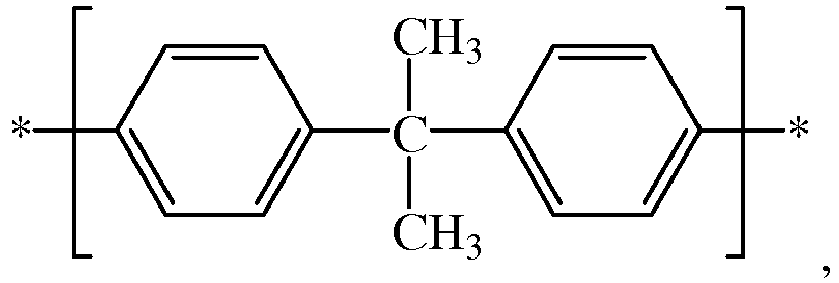
further comprises, based on the weight of the block polyestercarbonate-polysiloxane, 0.2 to 4 weight percent dimethylsiloxane units; and 2 to 10 weight percent of a flame retardant; wherein the fiber has an equivalent circular diameter of 10 to 60 micrometers. - Aspect 2: The fiber of
aspect 1, wherein the block polyestercarbonate-polysiloxane comprises 0.5 to 2 weight percent dimethylsiloxane units. - Aspect 3: The fiber of
aspect 1 or 2, wherein the flame retardant comprises an organophosphate ester. - Aspect 4: The fiber of aspect 3, wherein the organophosphate ester comprises an oligomeric phosphate ester.
- Aspect 5: The fiber of any one of aspects 1-4, wherein the composition comprises, based on the total weight of the composition, 91 to 96 weight percent of the block polyestercarbonate-polysiloxane, and 4 to 9 weight percent of the flame retardant.
- Aspect 6: The fiber of any one of aspects 1-5, wherein the total amount of the block polyestercarbonate-polysiloxane and the flame retardant is 98 to 100 weight percent.
- Aspect 7: The fiber of any one of aspects 1-6, wherein the block polyestercarbonate-polysiloxane comprises, based on total moles of carbonate and ester units, 70 to 90 mole percent of the resorcinol ester units, 5 to 15 mole percent of carbonate units wherein R1 is 1,3-phenylene, and 5 to 15 mole percent of carbonate units wherein R1 is

further comprises, based on the weight of the block polyestercarbonate-polysiloxane, 0.5 to 2 weight percent dimethylsiloxane units. - Aspect 8: The fiber of any one of aspects 1-7, wherein the composition comprises 0 to 1 part per million by weight of colorants.
- Aspect 9: A method of forming a fiber, the method comprising: melt spinning a composition to form a fiber; wherein the composition comprises, based on the total weight of the composition, 90 to 98 weight percent of a block polyestercarbonate-polysiloxane comprising a polyester block comprising resorcinol ester units having the structure


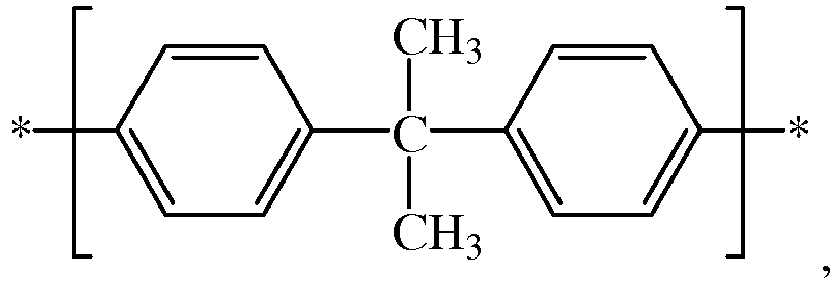
further comprises, based on the weight of the block polyestercarbonate-polysiloxane, 0.2 to 4 weight percent dimethylsiloxane units; and 2 to 10 weight percent of a flame retardant; and wherein the fiber has an equivalent circular diameter of 10 to 60 micrometers. - Aspect 10: The method of aspect 9, wherein the melt spinning is characterized by a draw down ratio of 280 to 550, an apparent shear rate of 170 to 1700 second-1, and a mechanical draw ratio of 0.95 to 1.2.
- Aspect 11: An article comprising the fiber of any one of aspects 1-8.
- Aspect 12: The article of aspect 11, wherein the article comprises a woven fabric comprising the fiber.
- Aspect 13: The article of aspect 11, wherein the article comprises a knit fabric comprising the fiber.
- Aspect 14: The article of aspect 11, wherein the article comprises a nonwoven fabric comprising the fiber.
- All ranges disclosed herein are inclusive of the endpoints, and the endpoints are independently combinable with each other. Each range disclosed herein constitutes a disclosure of any point or sub-range lying within the disclosed range.
- The invention is further illustrated by the following non-limiting examples.
- Materials used in these examples are summarized in Table 1.
Table 1 Component Description PEC-Si para-Cumylphenol endcapped block polyestercarbonate-polysiloxane with about 99 weight percent total of polyester blocks and polycarbonate blocks, and about 1 weight percent polysiloxane blocks; the polyestercarbonate portion contains about 80 mole percent 1,3-phenylene isophthalate-co-terephthalate units, about 9 mole percent resorcinol carbonate units, and about 11 mole percent bisphenol A carbonate units; the polysiloxane blocks have, on average, about 10 dimethylsiloxane units per block; the polyestercarbonate-polysiloxane has a weight average molecular weight of about 24,500 grams/mole and is preparable by the procedure of Example 2-14 of Method 2 as described inUS Patent No. 7,790,292 B2 to Colburn et al. , except that the p-cumylphenol level was adjusted to achieve a weight average molecular weight of about 24,500 grams/mole.PEC para-Cumylphenol endcapped block polyestercarbonate with polyester blocks containing 1,3-phenylene isophthalate-co-terephthalate units, and carbonate blocks containing bisphenol A carbonate and resorcinol carbonate units; the copolymer has about 82 mole percent resorcinol ester (50:50 isophthalate/terephthalate) units, about 9 mole percent resorcinol carbonate units, and about 9 mole percent bisphenol A carbonate units; it has a weight average molecular weight of about 20,000 grams/mole, and is preparable by the procedure of Comparative Example 2-4 of U.S. Patent No. 7,790,292 B2 to Colborn .OPE Oligomeric phosphate ester flame retardant containing 10.7% phosphorus and having a melting range of 101-108 °C; obtained in pastille form as FYROLFLEX™ SOL-DP flame retardant from ICL Industrial Products. BrPC Brominated polycarbonate, prepared by copolymerization of phosgene and a 50:50 weight/weight mixture of 2,2',6,6'-tetrabromo-4,4'-isopropylidenediphenol and bisphenol A, and having a weight average molecular weight of about 22,500 grams/mole; preparable according to the method for forming "TBBPA-BPA Copolymer" in columns 26-27 of U.S. Patent No. 9,006,324 to Sybert et al. TBPDP Tetrakis(2,4-di-tert-butylphenyl)4,4'-biphenyldiphosphonite, CAS Reg. No. 119345-01-6; obtained as IRGAFOS™ P-EPQ from BASF. SV36 Solvent Violet 36, CAS Reg. No. 61951-89-1. PB60 Pigment Blue 60, CAS Reg. No. 81-77-6. - Compositions are summarized in Table 2, where component amounts are expressed in weight percent based on the total weight of the composition. Compositions were prepared by dry blending all components, and the resulting mixture was added to the feed throat of a twin-screw extruder operating with zone temperatures ranging from 230 to 300 °C. The extrudate was cooled in water before being pelletized.
Table 2 Ex. 1 Ex. 2 C. Ex. 1 C. Ex. 2 PEC-Si 93.44 93.44 49.97 87.95 PEC 0.00 0.00 49.97 0.00 OPE 6.50 6.50 0.00 0.00 BrPC 0.00 0.00 0.00 11.99 TBPDP 0.06 0.06 0.06 0.06 SV36 0.00 0.00035 0.00 0.00 PB60 0.00 0.00044 0.00 0.00 - Pellets were dried at 80 to 120 °C for 6 to 12 hours before being fed to the hopper of the melt spinning apparatus. Melt spinning was carried out on a melt spinning apparatus that is schematically illustrated in the Figure. In the Figure,
melt spinning apparatus 1 comprisesextruder 5, in which dried pellets are converted to a melt, meltpump 10, which conveys the melt to spinpack 15, where it is filtered, then to spinneret 20, where multiple fibers are formed from the filtered melt. The fibers are immediately conveyed to quenchsection 30, where the fibers are air-cooled and solidified. The cooled fibers then enterspin finish section 40, where a spin finish can be applied to the surface of the fibers. The fibers then traverse a sequence of godet pairs comprisingfirst godets 50,second godets 60, andthird godets 70, where the fibers are drawn (stretched). The fibers then enterwinder section 80, wherecontact roller 90 facilitates formation ofwound fiber 100 about one of two windingcores 110. - In these experiments, the melt pump was operated at 10 centimeter3/revolution. Extruder and melt pump temperatures were 280 to 330 °C. A 144-hole, single-position spinneret was used. Spinneret holes (nozzles) were all circular with a diameter varying, depending on the experiment, from 0.4 to 0.8 millimeters. The length-to-diameter ratio of each spinneret was 4:1. A 325 U.S. mesh (44 micrometer opening) screen filter was used in the spinpack for filtration of the composition melt. After fibers exited the nozzles, they were solidified by quenching with air at ambient temperature (about 23 °C). Individual filaments were combined to form multi-filament threads, then a spin finish (an acrylamide copolymer in an oil-in-water emulsion, obtained as LUROL™ PS-11744 from Goulston) was applied to the multi-filament threads before they contacted the first godet. The draw down ratio ranged from 140 for a 16 denier per fiber (dpf) experiment to 2200 for a 2 dpf experiment. The apparent shear rate ranged from 43 for a 2 dpf experiment to 3420 for a 16 dpf experiment. The mechanical draw ratio ranged from 0.95 to 1.2.
- For the Example 1 composition, the best fiber production was associated with a draw down ratio of 280 to 550 (with 350 to 450 being preferred), an apparent shear rate of 170 to 1700 second-1 (with 275 to 990 second-1 preferred), and a mechanical draw ratio of 0.95 to 1.2 (with 0.98 to 1.1 preferred). At draw down ratios substantially less than 280, the fiber produced did not exhibit a uniform diameter and the productivity of the process was too low to be commercially practical. At draw down ratios substantially greater than 550, mechanical breakage of fibers from some of the 144 nozzles was observed, leading to thread breaks. At apparent shear rates substantially less than 170 second-1, the fiber produced did not exhibit a uniform diameter. At apparent shear rates substantially greater than 1700 second-1, melt fracture leading to a thread break was observed. At mechanical draw ratios substantially less than 0.95, frequent thread breakage on the godets was observed. At mechanical draw ratios substantially greater than 1.2, thread on the godets generated fluffs due to filament breakage.
- For the Example 2 composition, the melt spinning process was acceptable, but not as favorable as for the Example 1 composition. Specifically, relative to the Example 1 composition, the Example 2 composition was associated with about three times more thread breaks per unit time. And for the Example 2 composition, most of those thread breaks occurred between the spinneret and the first godets.
- For the Comparative Example 1 composition, the melt spinning process was not stable over the entire process space studied. In particular, while fibers could be extruded, they could not be drawn without unacceptable fiber breakage.
- For the Comparative Example 2 composition, the melt spinning process had low fiber yields. Fiber breakage occurred within three to ten minutes, on average. Fibers could be created and drawn, but the rate of fiber breakage was unacceptable.
- Hot Air Shrinkage was determined as follows. A length of fibers (90 meters in total length, 1 meter per turn) was collected. This collection, called a skein, was prepared using a denier wheel. The skein was held on a hook, and its length, L0, with a base weight of each individual fiber being less than 0.1 gram/denier, was measured in millimeters. The skein was kept for twenty minutes in a convection oven set at a
temperature 20 °C less than the glass transition temperature (Tg) of the composition. The skein was removed from the convection oven and cooled to ambient temperature. Its length, L1, was measured in millimeters. The Hot Air Shrinkage, expressed in units of percent, was calculated as 100×(L0-L1)/L0. For the Example 1 composition, the Hot Air Shrinkage was 1.5%.
Claims (14)
- A copolymer fiber:wherein the copolymer fiber comprises a composition comprising, based on the total weight of the composition,90 to 98 weight percent of a block polyestercarbonate-polysiloxane comprising a polyester block comprising resorcinol ester units having the structure
 a polycarbonate block comprising carbonate units having the structure
 wherein at least 60 percent of the total number of R1 groups are aromatic divalent groups, and a polysiloxane block comprising dimethylsiloxane units; wherein the block polyestercarbonate-polysiloxane comprises, based on total moles of carbonate and ester units, 30 to 90 mole percent of the resorcinol ester units, 5 to 35 mole percent of carbonate units wherein R1 is 1,3-phenylene, and 5 to 35 mole percent of carbonate units wherein R1 is
 further comprises, based on the weight of the block polyestercarbonate-polysiloxane, 0.2 to 4 weight percent dimethylsiloxane units; and
2 to 10 weight percent of a flame retardant;wherein the fiber has an equivalent circular diameter of 10 to 60 micrometers. - The fiber of claim 1, wherein the block polyestercarbonate-polysiloxane comprises 0.5 to 2 weight percent dimethylsiloxane units.
- The fiber of claim 1 or 2, wherein the flame retardant comprises an organophosphate ester.
- The fiber of claim 3, wherein the organophosphate ester comprises an oligomeric phosphate ester.
- The fiber of any one of claims 1-4, wherein the composition comprises, based on the total weight of the composition, 91 to 96 weight percent of the block polyestercarbonate-polysiloxane, and 4 to 9 weight percent of the flame retardant.
- The fiber of any one of claims 1-5, wherein the total amount of the block polyestercarbonate-polysiloxane and the flame retardant is 98 to 100 weight percent.
- The fiber of any one of claims 1-6, wherein the block polyestercarbonate-polysiloxane comprises, based on total moles of carbonate and ester units, 70 to 90 mole percent of the resorcinol ester units, 5 to 15 mole percent of carbonate units wherein R1 is 1,3-phenylene, and 5 to 15 mole percent of carbonate units wherein R1 is

further comprises, based on the weight of the block polyestercarbonate-polysiloxane, 0.5 to 2 weight percent dimethylsiloxane units. - The fiber of any one of claims 1-6, wherein the composition comprises 0 to 1 part per million by weight of colorants.
- A method of forming a fiber, the method comprising:melt spinning a composition to form a fiber;wherein the composition comprises, based on the total weight of the composition,
90 to 98 weight percent of a block polyestercarbonate-polysiloxane comprising a polyester block comprising resorcinol ester units having the structure


further comprises, based on the weight of the block polyestercarbonate-polysiloxane, 0.2 to 4 weight percent dimethylsiloxane units; and
2 to 10 weight percent of a flame retardant; andwherein the fiber has an equivalent circular diameter of 10 to 60 micrometers. - The method of claim 9, wherein the melt spinning is characterized by a draw down ratio of 280 to 550, an apparent shear rate of 170 to 1700 second-1, and a mechanical draw ratio of 0.95 to 1.2.
- An article comprising the fiber of any one of claims 1-8.
- The article of claim 11, wherein the article comprises a woven fabric comprising the fiber.
- The article of claim 11, wherein the article comprises a knit fabric comprising the fiber.
- The article of claim 11, wherein the article comprises a nonwoven fabric comprising the fiber.
Priority Applications (3)
| Application Number | Priority Date | Filing Date | Title |
|---|---|---|---|
| US16/977,605 US20210054144A1 (en) | 2018-04-30 | 2019-04-22 | Copolymer fiber and associated method and article |
| CN201980018520.6A CN111836844A (en) | 2018-04-30 | 2019-04-22 | Copolymer fibers and related methods and articles |
| PCT/US2019/028458 WO2019212783A1 (en) | 2018-04-30 | 2019-04-22 | Copolymer fiber and associated method and article |
Applications Claiming Priority (1)
| Application Number | Priority Date | Filing Date | Title |
|---|---|---|---|
| US201862664419P | 2018-04-30 | 2018-04-30 |
Publications (1)
| Publication Number | Publication Date |
|---|---|
| EP3564291A1 true EP3564291A1 (en) | 2019-11-06 |
Family
ID=63720502
Family Applications (1)
| Application Number | Title | Priority Date | Filing Date |
|---|---|---|---|
| EP18197296.9A Withdrawn EP3564291A1 (en) | 2018-04-30 | 2018-09-27 | Copolymer fiber and associated method and article |
Country Status (4)
| Country | Link |
|---|---|
| US (1) | US20210054144A1 (en) |
| EP (1) | EP3564291A1 (en) |
| CN (1) | CN111836844A (en) |
| WO (1) | WO2019212783A1 (en) |
Citations (6)
| Publication number | Priority date | Publication date | Assignee | Title |
|---|---|---|---|---|
| US6015510A (en) | 1996-08-29 | 2000-01-18 | E. I. Du Pont De Nemours And Company | Polymer flame retardant |
| US6025419A (en) | 1997-04-07 | 2000-02-15 | E. I. Du Pont De Nemours And Company | Flame retardant resin compositions |
| US20070129492A1 (en) * | 1999-05-18 | 2007-06-07 | General Electric Company | Polysiloxane copolymers, thermoplastic composition, and articles formed therefrom |
| US20130260088A1 (en) | 2012-03-30 | 2013-10-03 | Sabic Innovative Plastics Ip B.V. | Honeycomb paper |
| US20160221298A1 (en) * | 2015-02-04 | 2016-08-04 | Sabic Global Technologies B.V. | Reinforced thermoplastic articles, compositions for the manufacture of the articles, methods of manufacture, and articles formed therefrom |
| WO2016154519A1 (en) * | 2015-03-25 | 2016-09-29 | Sabic Global Technologies B.V. | Poly(arylene sulfide) blend and articles made therefrom |
Family Cites Families (4)
| Publication number | Priority date | Publication date | Assignee | Title |
|---|---|---|---|---|
| US7780903B2 (en) * | 2005-06-01 | 2010-08-24 | Kimberly-Clark Worldwide, Inc. | Method of making fibers and nonwovens with improved properties |
| US20090029615A1 (en) * | 2007-07-26 | 2009-01-29 | Sabic Innovative Plastics Ip B.V. | Crystallizable Polyetherimides, Method of Manufacture, and Articles Derived Therefrom |
| WO2016196427A1 (en) * | 2015-05-29 | 2016-12-08 | Sabic Global Technologies B.V. | Method of making a curvilinear multilayer article and the articles made therefrom |
| US20180371655A1 (en) * | 2015-12-21 | 2018-12-27 | Sabic Global Technologies B.V. | Flame resistant polycarbonate composites for semi-structural panels |
-
2018
- 2018-09-27 EP EP18197296.9A patent/EP3564291A1/en not_active Withdrawn
-
2019
- 2019-04-22 CN CN201980018520.6A patent/CN111836844A/en active Pending
- 2019-04-22 WO PCT/US2019/028458 patent/WO2019212783A1/en not_active Ceased
- 2019-04-22 US US16/977,605 patent/US20210054144A1/en not_active Abandoned
Patent Citations (7)
| Publication number | Priority date | Publication date | Assignee | Title |
|---|---|---|---|---|
| US6015510A (en) | 1996-08-29 | 2000-01-18 | E. I. Du Pont De Nemours And Company | Polymer flame retardant |
| US6025419A (en) | 1997-04-07 | 2000-02-15 | E. I. Du Pont De Nemours And Company | Flame retardant resin compositions |
| US20070129492A1 (en) * | 1999-05-18 | 2007-06-07 | General Electric Company | Polysiloxane copolymers, thermoplastic composition, and articles formed therefrom |
| US7790292B2 (en) | 1999-05-18 | 2010-09-07 | Sabic Innovative Plastics Ip B.V. | Polysiloxane copolymers, thermoplastic composition, and articles formed therefrom |
| US20130260088A1 (en) | 2012-03-30 | 2013-10-03 | Sabic Innovative Plastics Ip B.V. | Honeycomb paper |
| US20160221298A1 (en) * | 2015-02-04 | 2016-08-04 | Sabic Global Technologies B.V. | Reinforced thermoplastic articles, compositions for the manufacture of the articles, methods of manufacture, and articles formed therefrom |
| WO2016154519A1 (en) * | 2015-03-25 | 2016-09-29 | Sabic Global Technologies B.V. | Poly(arylene sulfide) blend and articles made therefrom |
Non-Patent Citations (11)
| Title |
|---|
| CHEMICAL ABSTRACTS, Columbus, Ohio, US; abstract no. 115-86-6 |
| CHEMICAL ABSTRACTS, Columbus, Ohio, US; abstract no. 15541 60-3 |
| CHEMICAL ABSTRACTS, Columbus, Ohio, US; abstract no. 181028-79-5 |
| CHEMICAL ABSTRACTS, Columbus, Ohio, US; abstract no. 20208-95-1 |
| CHEMICAL ABSTRACTS, Columbus, Ohio, US; abstract no. 56386-64-2 |
| CHEMICAL ABSTRACTS, Columbus, Ohio, US; abstract no. 56803-37-3 |
| CHEMICAL ABSTRACTS, Columbus, Ohio, US; abstract no. 57583-54-7 |
| CHEMICAL ABSTRACTS, Columbus, Ohio, US; abstract no. 65652-41-7 |
| CHEMICAL ABSTRACTS, Columbus, Ohio, US; abstract no. 68937-41-7 |
| CHEMICAL ABSTRACTS, Columbus, Ohio, US; abstract no. 78-33-1 |
| CHEMICAL ABSTRACTS, Columbus, Ohio, US; abstract no. 89492-23-9 |
Also Published As
| Publication number | Publication date |
|---|---|
| WO2019212783A1 (en) | 2019-11-07 |
| CN111836844A (en) | 2020-10-27 |
| US20210054144A1 (en) | 2021-02-25 |
Similar Documents
| Publication | Publication Date | Title |
|---|---|---|
| TWI447142B (en) | Halogen-free flame retardant | |
| US8299148B2 (en) | Polylactic acid fiber and manufacturing method thereof | |
| CN102517684A (en) | Production process for flame retardant polyester staple fibre | |
| US5382474A (en) | Method for producing polyethylene terephthalate fibers with reduced flammability | |
| KR101646563B1 (en) | Core-sheath type polyester composite fiber having good flame-retardance and Manufacturing method thereof | |
| KR101865394B1 (en) | A manufacturing method of polyester yarn | |
| KR101717985B1 (en) | Flame-retardant polyester resin for Flame-retardant fiber having good dyeing property, Preparing method thereof and Flame-retardant fiber of good color depth containing the same | |
| US20210054144A1 (en) | Copolymer fiber and associated method and article | |
| JP6283352B2 (en) | Polyphenylene sulfide monofilament and method for producing the same | |
| KR102163330B1 (en) | Polysester resin for flame retardant fiber, Flame retardant fiber with excellent dyeing properties using the same and Manufacturing methof thereof | |
| JP7335118B2 (en) | Method for producing polylactic acid long fiber | |
| EP2890839B1 (en) | Polyamide-poly(phenylene ether) fiber, article, composition, and method | |
| CN106702525B (en) | Material for producing fibers and fibers produced therefrom | |
| CN101187091B (en) | Copolymerized polyphenylene sulfide composite fiber manufacture method | |
| EP0905299A2 (en) | Method for producing spun-bonded materials | |
| KR100987494B1 (en) | Process for producing flame retardant polyester yarn and flame retardant polyester yarn manufactured therefrom | |
| KR102183240B1 (en) | High Strength Flame Retardant Composite Yarn | |
| JP5463921B2 (en) | Polytrimethylene terephthalate polyester composite fiber | |
| KR20150069483A (en) | Composition of Flame retardant polyester resin, Flame retardant polyester resin having high limiting oxygen index and Polyester yarn of that | |
| US20070035057A1 (en) | Poly(trimethylene terephthalate) bicomponent fiber process | |
| KR20180124315A (en) | Eco-friendly flame retardant polyethylene multi-filament fiber and manufacturing method thereof | |
| KR20150069481A (en) | Polyester resin improving flame retardant, preparing method thereof and polyester yarn of that | |
| JP6483424B2 (en) | Flame retardant polyester fiber | |
| CN112543790A (en) | Polyester composition | |
| JP2018172828A (en) | High-strength polyester long fiber nonwoven fabric with excellent heat resistance and flame resistance |
Legal Events
| Date | Code | Title | Description |
|---|---|---|---|
| PUAI | Public reference made under article 153(3) epc to a published international application that has entered the european phase |
Free format text: ORIGINAL CODE: 0009012 |
|
| STAA | Information on the status of an ep patent application or granted ep patent |
Free format text: STATUS: THE APPLICATION HAS BEEN PUBLISHED |
|
| AK | Designated contracting states |
Kind code of ref document: A1 Designated state(s): AL AT BE BG CH CY CZ DE DK EE ES FI FR GB GR HR HU IE IS IT LI LT LU LV MC MK MT NL NO PL PT RO RS SE SI SK SM TR |
|
| AX | Request for extension of the european patent |
Extension state: BA ME |
|
| STAA | Information on the status of an ep patent application or granted ep patent |
Free format text: STATUS: REQUEST FOR EXAMINATION WAS MADE |
|
| 17P | Request for examination filed |
Effective date: 20200505 |
|
| RBV | Designated contracting states (corrected) |
Designated state(s): AL AT BE BG CH CY CZ DE DK EE ES FI FR GB GR HR HU IE IS IT LI LT LU LV MC MK MT NL NO PL PT RO RS SE SI SK SM TR |
|
| RAP1 | Party data changed (applicant data changed or rights of an application transferred) |
Owner name: SHPP GLOBAL TECHNOLOGIES B.V. |
|
| STAA | Information on the status of an ep patent application or granted ep patent |
Free format text: STATUS: THE APPLICATION IS DEEMED TO BE WITHDRAWN |
|
| 18D | Application deemed to be withdrawn |
Effective date: 20220401 |