EP3564243B1 - Production intermediate of eribulin mesylate, and method for producing same - Google Patents
Production intermediate of eribulin mesylate, and method for producing same Download PDFInfo
- Publication number
- EP3564243B1 EP3564243B1 EP18734042.7A EP18734042A EP3564243B1 EP 3564243 B1 EP3564243 B1 EP 3564243B1 EP 18734042 A EP18734042 A EP 18734042A EP 3564243 B1 EP3564243 B1 EP 3564243B1
- Authority
- EP
- European Patent Office
- Prior art keywords
- compound
- following formula
- process according
- formula
- carried out
- Prior art date
- Legal status (The legal status is an assumption and is not a legal conclusion. Google has not performed a legal analysis and makes no representation as to the accuracy of the status listed.)
- Active
Links
Classifications
-
- A—HUMAN NECESSITIES
- A61—MEDICAL OR VETERINARY SCIENCE; HYGIENE
- A61P—SPECIFIC THERAPEUTIC ACTIVITY OF CHEMICAL COMPOUNDS OR MEDICINAL PREPARATIONS
- A61P35/00—Antineoplastic agents
-
- C—CHEMISTRY; METALLURGY
- C07—ORGANIC CHEMISTRY
- C07D—HETEROCYCLIC COMPOUNDS
- C07D309/00—Heterocyclic compounds containing six-membered rings having one oxygen atom as the only ring hetero atom, not condensed with other rings
- C07D309/02—Heterocyclic compounds containing six-membered rings having one oxygen atom as the only ring hetero atom, not condensed with other rings having no double bonds between ring members or between ring members and non-ring members
- C07D309/08—Heterocyclic compounds containing six-membered rings having one oxygen atom as the only ring hetero atom, not condensed with other rings having no double bonds between ring members or between ring members and non-ring members with hetero atoms or with carbon atoms having three bonds to hetero atoms with at the most one bond to halogen, e.g. ester or nitrile radicals, directly attached to ring carbon atoms
- C07D309/10—Oxygen atoms
-
- C—CHEMISTRY; METALLURGY
- C07—ORGANIC CHEMISTRY
- C07D—HETEROCYCLIC COMPOUNDS
- C07D493/00—Heterocyclic compounds containing oxygen atoms as the only ring hetero atoms in the condensed system
- C07D493/02—Heterocyclic compounds containing oxygen atoms as the only ring hetero atoms in the condensed system in which the condensed system contains two hetero rings
- C07D493/04—Ortho-condensed systems
-
- Y—GENERAL TAGGING OF NEW TECHNOLOGICAL DEVELOPMENTS; GENERAL TAGGING OF CROSS-SECTIONAL TECHNOLOGIES SPANNING OVER SEVERAL SECTIONS OF THE IPC; TECHNICAL SUBJECTS COVERED BY FORMER USPC CROSS-REFERENCE ART COLLECTIONS [XRACs] AND DIGESTS
- Y02—TECHNOLOGIES OR APPLICATIONS FOR MITIGATION OR ADAPTATION AGAINST CLIMATE CHANGE
- Y02P—CLIMATE CHANGE MITIGATION TECHNOLOGIES IN THE PRODUCTION OR PROCESSING OF GOODS
- Y02P20/00—Technologies relating to chemical industry
- Y02P20/50—Improvements relating to the production of bulk chemicals
- Y02P20/55—Design of synthesis routes, e.g. reducing the use of auxiliary or protecting groups
Definitions
- the present invention relates to an intermediate for the preparation of eribulin mesylate and a process for preparing the same.
- Eribulin mesylate represented by the following formula (1) is an active pharmaceutical ingredient (API) of Halaven which is a medicine for breast cancer.
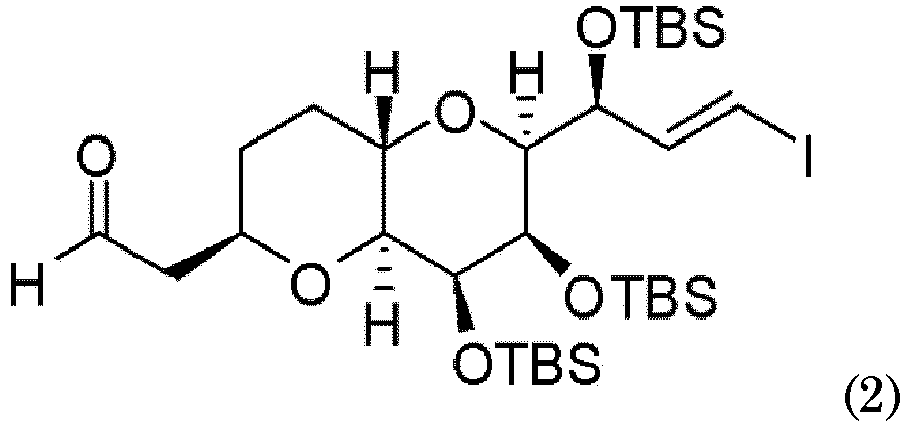
- U.S. Patent No. 6,214,865 discloses a process for preparing eribulin mesylate of formula (1) using the compound of the following formula (2) as a key intermediate, as shown in the following reaction scheme 1.
- Tetrahedron Letter 1996, 37, 8643-8646 describes a process for preparing the compound of formula (2) using deacetylation, olefin conjugation and oxy-Michael addition using L-mannonic acid ⁇ -lactone as a starting material, as shown in the following reaction scheme 2.
- An object of the present invention is to provide an intermediate for preparing the compound of formula (2) with high yields, which is a key intermediate for the preparation of eribulin mesylate.
- Another object of the present invention is to provide a process for preparing the above intermediate.
- Still another object of the present invention is to provide an intermediate used in the above preparation process.
- One embodiment of the present invention relates to a compound of the following formula (3) which is an intermediate for preparing the compound of formula (2) which is a key intermediate for the preparation of eribulin mesylate: wherein, PG 1 represents a diol protecting group forming a 5-membered heterocycle by combining each other, wherein the diol protecting group is derived from cyclopentanone, cyclohexanone, cycloheptanone, 1,1-dimethoxycyclopentane, 1,1-dimethoxycyclohexane or 1,1-dimethoxycycloheptane.
- One embodiment of the present invention relates to a process for preparing the compound of formula (3), which comprises the steps of:
- diol protecting group may be a diol protecting group derived from a cycloketone such as cyclopentanone, cyclohexanone and cycloheptanone; or a cycloketal such as 1,1-dimethoxycyclopentane, 1,1-dimethoxycyclohexane.
- a cycloketone such as cyclopentanone, cyclohexanone and cycloheptanone
- a cycloketal such as 1,1-dimethoxycyclopentane, 1,1-dimethoxycyclohexane.
- C 1 -C 6 alkyl group as used herein means a linear or branched hydrocarbon having 1 to 6 carbon atoms, which includes methyl, ethyl, n-propyl, i-propyl, n-butyl, i-butyl, t-butyl, n-pentyl, or n-hexyl.
- sil protecting group includes trimethylsilyl (TMS), triethylsilyl (TES), t-butyldimethylsilyl (TBS), t-butyldiphenylsilyl (TBDPS).
- reaction scheme 3 represents merely a typical example, and various changes may be made to reagents and reaction conditions without limitation.
- Step 1 Synthesis of Compound of Formula (5)
- the compound of formula (5) can be obtained by subjecting the compound of formula (4) to Wittig reaction.
- the Wittig reaction may be carried out using (methoxycarbonylmethylene)triphenylphosphorane, (ethoxycarbonylmethylene)triphenylphosphorane and the like.
- methylenechloride tetrahydrofuran, toluene
- methylenechloride is preferred.
- the reaction is preferably performed at room temperature.
- the compound of formula (6) can be obtained by selectively deprotecting the PG 2 group of the compound of formula (5).
- the deprotection may be carried out using a mixture of a fluoride (F-) compound and a buffer.
- the fluoride compound may be preferably tetra-n-butylammonium fluoride (TBAF), and the buffer may be preferably imidazole hydrochloride.
- TBAF tetra-n-butylammonium fluoride
- reaction solvent tetrahydrofuran, ether, acetone
- tetrahydrofuran is preferred.
- the reaction is preferably performed at room temperature.
- Step 3 Synthesis of Compound of Formula (7)
- the compound of formula (7) can be obtained by subjecting the compound of formula (6) to cyclization.
- the cyclization may be carried out in the presence of a catalyst such as pyridinium paratoluenesulfonate (PPTS), camphorsulfonic acid (CSA) and di- ⁇ -chloro-tetracarbonyldirhodium(I). Particularly, di- ⁇ -chloro-tetracarbonyldirhodium(I) is preferred.
- a catalyst such as pyridinium paratoluenesulfonate (PPTS), camphorsulfonic acid (CSA) and di- ⁇ -chloro-tetracarbonyldirhodium(I).
- PPTS pyridinium paratoluenesulfonate
- CSA camphorsulfonic acid
- di- ⁇ -chloro-tetracarbonyldirhodium(I) is preferred.
- reaction solvent methylenechloride, chloroform, tetrahydrofuran, may be used. Particularly, tetrahydrofuran is preferred.
- the reaction is preferably performed at room temperature.
- Step 4 Synthesis of Compound of Formula (8)
- the compound of formula (8) can be obtained by subjecting the C-C double bond of the compound of formula (7) to hydrogenation.
- the hydrogenation may be carried out in the presence of Pd/C.
- reaction solvent methanol, ethanol, ethylacetate, may be used. Particularly, ethylacetate is preferred.
- the reaction is preferably performed at room temperature.
- the compound of formula (3) can be obtained by reducing the ester group of the compound of formula (8).
- the reduction may be carried out using lithium aluminum tetrahydride, sodium bis(2-methoxyethoxy)aluminum dihydride, diisobutylaluminum hydride (DIBAL-H) .
- DIBAL-H diisobutylaluminum hydride
- diisobutylaluminum hydride is preferred.
- reaction solvent methylenechloride, toluene, tetrahydrofuran, may be used. Particularly, toluene is preferred.
- reaction is preferably performed at the temperature of -65°C or lower.
- One embodiment of the present invention relates to a compound of the following formula (7) which is an intermediate for preparing the compound of formula (3): wherein,
- One embodiment of the present disclosure relates to a process for preparing the compound of formula (7), which comprises the steps of:
- the process for preparing the compound of formula (7) includes the same steps 1 to 3 as in the above process for preparing the compound of formula (3), and thus a detailed description thereof will be omitted.
- One embodiment of the present invention relates to a process for preparing a compound of the following formula (2) which is a key intermediate for the preparation of eribulin mesylate, which comprises the steps of:
- reaction scheme 4 represents merely a typical example, and various changes may be made to reagents and reaction conditions without limitation.
- the compound of formula (9) can be obtained by subjecting the compound of formula (3) to Horner-Wadsworth-Emmons (HWE) reaction.
- HWE Horner-Wadsworth-Emmons
- the Horner-Wadsworth-Emmons reaction may be carried out using triethyl phosphonoacetate, trimethyl phosphonoacetate and the like in the presence of a base.
- lithium bis(trimethylsilyl)amide LiHMDS
- sodium bis(trimethylsilyl)amide NaHMDS
- potassium tert-butoxide t-BuOK
- potassium tert-butoxide may be used.
- reaction solvent methylene chloride, toluene, tetrahydrofuran, may be used. Particularly, tetrahydrofuran is preferred.
- the reaction is preferably performed at room temperature.
- the compound of formula (10) can be obtained by selectively deprotecting the primary hydroxyl protecting group of the compound of formula (9).
- the deprotection may be carried out in the presence of an acid.
- hydrochloric acid hydrosulfuric acid
- acetic acid may be used.
- the reaction is preferably performed at the temperature of about 30 to 35°C.
- the compound of formula (11) can be obtained by oxidizing the compound of formula (10).
- the oxidation may be carried out using sodium periodate (NaIO 4 ), lead tetraacetate (Pb (C2H3O2) 4) . etc. Particularly, sodium periodate is preferred.
- reaction solvent a mixture of a polar solvent and water is preferred.
- polar solvent may include ethylacetate, tetrahydrofuran, toluene. Particularly, ethylacetate is preferred.
- the reaction is preferably performed at room temperature.
- the compound of formula (12) can be obtained by subjecting the compound of formula (11) to Nozaki-Hiyama-Kishi (NHK) reaction with (2-bromovinyl)trimethylsilane.
- the Nozaki-Hiyama-Kishi reaction may be carried out in the presence of chromium(II) chloride and nickel(II) chloride.
- reaction solvent acetonitrile, methylenechloride, dimethyl sulfoxide
- acetonitrile methylenechloride, dimethyl sulfoxide
- a mixture of acetonitrile and dimethyl sulfoxide is preferred.
- the reaction is preferably performed at room temperature.
- the compound of formula (13) can be obtained by deprotecting the secondary hydroxyl protecting group of the compound of formula (12).
- the deprotection may be carried out in the presence of an acid.
- hydrochloric acid hydrosulfuric acid
- acetic acid may be used.
- the reaction is preferably performed at the temperature of about 90 to 100°C.
- the compound of formula (14) can be obtained by protecting the hydroxyl groups of the compound of formula (13).
- the protection may be carried out by reacting the compound of formula (13) with t-butyldimethylsilyl trifluoromethanesulfonate under a basic condition.
- a basic condition t-butyldimethylsilyl trifluoromethanesulfonate
- the base triethylamine, 4-dimethylaminopyridine, imidazole, 2,6-lutidine, may be used. Particularly, 2,6-lutidine is preferred.
- reaction solvent methylene chloride, chloroform, methyl t-butyl ether (MTBE), may be used. Particularly, methyl t-butyl ether is preferred.
- the reaction is preferably performed at room temperature.
- the compound of formula (15) can be obtained by subjecting the trimethylsilyl group of the compound of formula (14) to substitution with an iodide.
- N-iodosuccinimide N-iodosuccinimide
- iodine iodine
- substitution may be carried out in the presence of t-butyldimethylsilyl chloride (TBSCl).
- TBSCl t-butyldimethylsilyl chloride
- reaction solvent a mixture of acetonitrile and toluene is preferred.
- the reaction is preferably performed at the temperature of about 30°C.
- the compound of formula (2) can be obtained by reducing the ester group of the compound of formula (15).
- the reduction may be carried out using lithium aluminum tetrahydride, sodium bis(2-methoxyethoxy)aluminum dihydride, diisobutylaluminum hydride (DIBAL-H) .
- diisobutylaluminum hydride is preferred.
- reaction solvent methylene chloride, toluene, tetrahydrofuran, may be used. Particularly, toluene is preferred.
- the reaction is preferably performed at the temperature of -65°C or lower.
- the compound of formula (2) which is a key intermediate for the preparation of eribulin mesylate can be prepared with high yields.
- the compound of formula (7a) (22.8 g) was dissolved in ethyl acetate (114 mL), and 10% Pd/C (2.3 g) was added thereto, followed by substitution with hydrogen gas and stirring for about 6 hours. After the completion of the reaction was confirmed, the resulting solution was filtered through cellite. The filtrate was concentrated under reduced pressure, and the obtained compound of formula (8a) (23.5 g, 100%) was used for the following reaction without additional purification.
- the compound of formula (8a) (23 g) was dissolved in toluene (0.23 L), and cooled to -65°C or lower.
- 1.2 M DIBAL-H (105.5 mL) was added dropwise thereto with maintaining the temperature of -60°C or lower, followed by stirring for 30 minutes and confirming the completion of the reaction.
- 20% Potassium sodium tartrate tetrahydrate aqueous solution (0.5 L) was added thereto, with maintaining the temperature of 10°C or lower, followed by stirring for about 3 hours at room temperature.
- the aqueous layer was extracted with ethyl acetate.
- Sodium sulfate was added to the combined organic layer, followed by filtration and concentration under reduced pressure, to give the compound of formula (3a) (19.6 g, 94.3%).
- Triethyl phosphonoacetate (19 mL) was added to tetrahydrofuran (16 mL) and cooled to 0°C or lower. Potassium tert-butoxide (10.3 g) was added thereto, followed by stirring for about 30 minutes.
- the compound of formula (3a) (15.7 g) dissolved in tetrahydrofuran (16 mL) was added thereto, followed by stirring for 15 hours at room temperature. After the completion of the reaction was confirmed, saturated ammonium chloride aqueous solution (200 mL) was added thereto, and the resulting solution was strongly stirred. After the organic layer was separated, the aqueous layer was extracted with ethyl acetate.
- the compound of formula (10a) (23 g) was dissolved in ethyl acetate (230 mL) and water (230 mL), and cooled to 0°C.
- Sodium periodate (12.9 g) was added thereto with maintaining the temperature of 10°C or lower, followed by stirring for about 2 hours at room temperature.
- sodium chloride 23 g was added thereto, followed by stirring for 30 minutes.
- the organic layer was separated and the aqueous layer was extracted three times with ethyl acetate (115 mL).
- the combined organic layer was washed with 20% sodium chloride aqueous solution (115 mL).
- Sodium sulfate was added to the organic layer, followed by filtration and concentration, and the obtained compound of formula (11a) (20 g, 94.5%) was used for the following reaction without additional purification.
- Chromium(II) chloride (100 g) and nickel(II) chloride (1.06 g) were added to dimethylsulfoxide (210 mL) and acetonitrile (210 mL), and cooled to 0 - 5 °C.
- the compound of formula (11a) (30 g) and (2-bromovinyl)trimethylsilane (73 mL) were dissolved in acetonitrile (210 mL) and added dropwise. The resulting solution was stirred for 24 hours at room temperature and the completion of the reaction was confirmed.
- Methanol (200 mL), water (200 mL), MTBE (200 mL) were added thereto, followed by stirring for 1 hour.
- the compound of formula (14) (7.1 g) was dissolved in toluene (18.5 mL), and acetonitrile (33.4 mL) was added thereto.
- t-Butyldimethylsilyl chloride (73 mg) was added thereto, followed by warming to 30°C.
- N-Iodosuccinimide (8.74 g) was added thereto, and stirred for about 24 hours.
- the resulting solution was cooled to 25°C or lower, and a mixture of 5% sodium hydrogen carbonate aqueous solution (35.5 mL) and 5% sodium thiosulfate aqueous solution (35.5 L) was added thereto, followed by stirring for 30 minutes.
- the compound of formula (15) (1 g) was dissolved in toluene (14 mL), and cooled to -65 °C or lower. 1.2 M DIBAL-H (1.4 mL) was added dropwise thereto with maintaining the temperature of -60°C or lower, and stirred for 30 minutes, followed by confirming the completion of the reaction. Methanol (0.15 mL) was added dropwise thereto, and 1N hydrochloric acid (10 mL) and MTBE (4 mL) were added thereto, followed by stirring for 30 minutes. The organic layer was separated, and washed with 1 N hydrochloric acid (10 mL), water (10 mL), saturated sodium bicarbonate (10 mL), and saturated sodium chloride (10 mL).
Landscapes
- Organic Chemistry (AREA)
- Chemical & Material Sciences (AREA)
- Health & Medical Sciences (AREA)
- Life Sciences & Earth Sciences (AREA)
- Medicinal Chemistry (AREA)
- Nuclear Medicine, Radiotherapy & Molecular Imaging (AREA)
- General Chemical & Material Sciences (AREA)
- Pharmacology & Pharmacy (AREA)
- Chemical Kinetics & Catalysis (AREA)
- Animal Behavior & Ethology (AREA)
- General Health & Medical Sciences (AREA)
- Public Health (AREA)
- Veterinary Medicine (AREA)
- Organic Low-Molecular-Weight Compounds And Preparation Thereof (AREA)
- Plural Heterocyclic Compounds (AREA)
- Heterocyclic Carbon Compounds Containing A Hetero Ring Having Oxygen Or Sulfur (AREA)
Description
- The present invention relates to an intermediate for the preparation of eribulin mesylate and a process for preparing the same.
- Eribulin mesylate represented by the following formula (1) is an active pharmaceutical ingredient (API) of Halaven which is a medicine for breast cancer.

-
U.S. Patent No. 6,214,865 discloses a process for preparing eribulin mesylate of formula (1) using the compound of the following formula (2) as a key intermediate, as shown in the following reaction scheme 1.

- Also, Tetrahedron Letter 1996, 37, 8643-8646 describes a process for preparing the compound of formula (2) using deacetylation, olefin conjugation and oxy-Michael addition using L-mannonic acid γ-lactone as a starting material, as shown in the following reaction scheme 2.

- An alternative process is also disclosed in Tetrahedron Letters 1993, 34(47), 7541-7544.
- However, the prior processes are sensitive to reaction conditions and comprise long pathway, and thus they have problems that the yield of the compound of formula (2) is lowered.
- An object of the present invention is to provide an intermediate for preparing the compound of formula (2) with high yields, which is a key intermediate for the preparation of eribulin mesylate.
- Another object of the present invention is to provide a process for preparing the above intermediate.
- Still another object of the present invention is to provide an intermediate used in the above preparation process.
- One embodiment of the present invention relates to a compound of the following formula (3) which is an intermediate for preparing the compound of formula (2) which is a key intermediate for the preparation of eribulin mesylate:

PG1 represents a diol protecting group forming a 5-membered heterocycle by combining each other, wherein the diol protecting group is derived from cyclopentanone, cyclohexanone, cycloheptanone, 1,1-dimethoxycyclopentane, 1,1-dimethoxycyclohexane or 1,1-dimethoxycycloheptane. - One embodiment of the present invention relates to a process for preparing the compound of formula (3), which comprises the steps of:
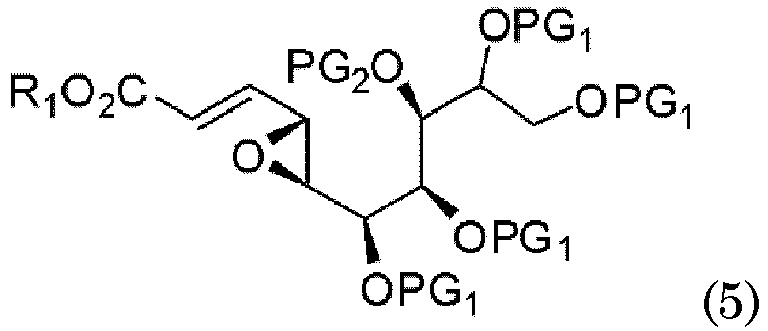
- (i) subjecting a compound of the following formula (4) to Wittig reaction to obtain a compound of the following formula (5);
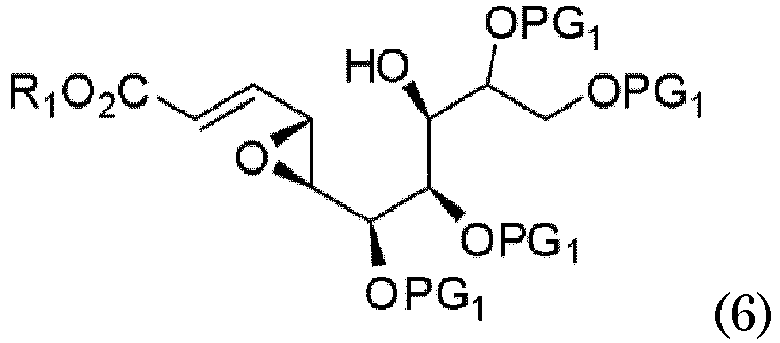
- (ii) selectively deprotecting a PG2 group of the compound of the following formula (5) to obtain a compound of the following formula (6);
- (iii) subjecting the compound of the following formula (6) to cyclization to obtain a compound of the following formula (7);
- (iv) subjecting the compound of the following formula (7) to hydrogenation to obtain a compound of the following formula (8); and
- (v) reducing an ester group of the compound of the following formula (8):


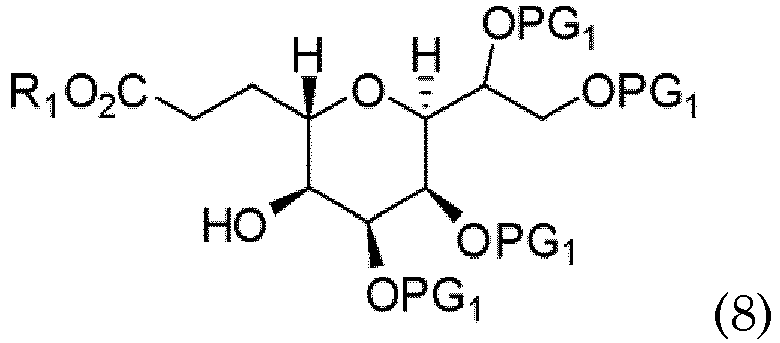
- PG1 represents a diol protecting group forming a 5-membered heterocycle by combining each other,
- PG2 represents a silyl protecting group, and
- R1 represents hydrogen or a C1-C6 alkyl group.
- The term "diol protecting group" as used herein may be a diol protecting group derived from a cycloketone such as cyclopentanone, cyclohexanone and cycloheptanone; or a cycloketal such as 1,1-dimethoxycyclopentane, 1,1-dimethoxycyclohexane. For the intermediate (3), the diol protecting group is limited to the previous definition.
- The term "C1-C6 alkyl group" as used herein means a linear or branched hydrocarbon having 1 to 6 carbon atoms, which includes methyl, ethyl, n-propyl, i-propyl, n-butyl, i-butyl, t-butyl, n-pentyl, or n-hexyl.
- The term "silyl protecting group" as used herein includes trimethylsilyl (TMS), triethylsilyl (TES), t-butyldimethylsilyl (TBS), t-butyldiphenylsilyl (TBDPS).
- Hereinafter, the preparation process according to one embodiment of the present invention is described in more detail referring to the following reaction scheme 3. The process depicted in the following reaction scheme 3 represents merely a typical example, and various changes may be made to reagents and reaction conditions without limitation.

- The compound of formula (5) can be obtained by subjecting the compound of formula (4) to Wittig reaction.
- The Wittig reaction may be carried out using (methoxycarbonylmethylene)triphenylphosphorane, (ethoxycarbonylmethylene)triphenylphosphorane and the like.
- As a reaction solvent, methylenechloride, tetrahydrofuran, toluene, may be used. Particularly, methylenechloride is preferred.
- The reaction is preferably performed at room temperature.
- The compound of formula (6) can be obtained by selectively deprotecting the PG2 group of the compound of formula (5).
- The deprotection may be carried out using a mixture of a fluoride (F-) compound and a buffer.
- The fluoride compound may be preferably tetra-n-butylammonium fluoride (TBAF), and the buffer may be preferably imidazole hydrochloride.
- As the reaction solvent, tetrahydrofuran, ether, acetone, may be used. Particularly, tetrahydrofuran is preferred.
- The reaction is preferably performed at room temperature.
- The compound of formula (7) can be obtained by subjecting the compound of formula (6) to cyclization.
- The cyclization may be carried out in the presence of a catalyst such as pyridinium paratoluenesulfonate (PPTS), camphorsulfonic acid (CSA) and di-µ-chloro-tetracarbonyldirhodium(I). Particularly, di-µ-chloro-tetracarbonyldirhodium(I) is preferred.
- As a reaction solvent, methylenechloride, chloroform, tetrahydrofuran, may be used. Particularly, tetrahydrofuran is preferred.
- The reaction is preferably performed at room temperature.
- The compound of formula (8) can be obtained by subjecting the C-C double bond of the compound of formula (7) to hydrogenation.
- The hydrogenation may be carried out in the presence of Pd/C.
- As a reaction solvent, methanol, ethanol, ethylacetate, may be used. Particularly, ethylacetate is preferred.
- The reaction is preferably performed at room temperature.
- The compound of formula (3) can be obtained by reducing the ester group of the compound of formula (8).
- The reduction may be carried out using lithium aluminum tetrahydride, sodium bis(2-methoxyethoxy)aluminum dihydride, diisobutylaluminum hydride (DIBAL-H) . Particularly, diisobutylaluminum hydride is preferred.
- As a reaction solvent, methylenechloride, toluene, tetrahydrofuran, may be used. Particularly, toluene is preferred.
- The reaction is preferably performed at the temperature of -65°C or lower. One embodiment of the present invention relates to a compound of the following formula (7) which is an intermediate for preparing the compound of formula (3):

- PG1 represents a diol protecting group forming a 5-membered heterocycle by combining each other, and
- R1 represents hydrogen or a C1-C6 alkyl group.
- One embodiment of the present disclosure relates to a process for preparing the compound of formula (7), which comprises the steps of:
- (i) subjecting a compound of the following formula (4) to Wittig reaction to obtain a compound of the following formula (5);
- (ii) selectively deprotecting a PG2 group of the compound of the following formula (5) to obtain a compound of the following formula (6); and
- (iii) subjecting the compound of the following formula (6) to cyclization:


- PG1 represents a diol protecting group forming a 5-membered heterocycle by combining each other,
- PG2 represents a silyl protecting group, and
- R1 represents hydrogen or a C1-C6 alkyl group.
- The process for preparing the compound of formula (7) includes the same steps 1 to 3 as in the above process for preparing the compound of formula (3), and thus a detailed description thereof will be omitted.
- One embodiment of the present invention relates to a process for preparing a compound of the following formula (2) which is a key intermediate for the preparation of eribulin mesylate, which comprises the steps of:
- (vi) subjecting a compound of the following formula (3) to Horner-Wadsworth-Emmons reaction to obtain a compound of the following formula (9);
- (vii) selectively deprotecting a primary hydroxyl protecting group of the compound of the following formula (9) to obtain a compound of the following formula (10);
- (viii) oxidizing the compound of the following formula (10) to obtain a compound of the following formula (11);
- (ix) subjecting the compound of the following formula (11) to Nozaki-Hiyama-Kishi reaction with (2-bromovinyl)trimethylsilane to obtain a compound of the following formula (12);
- (x) deprotecting a secondary hydroxyl protecting group of the compound of the following formula (12) to obtain a compound of the following formula (13);
- (xi) protecting a hydroxyl group of the compound of the following formula (13) to obtain a compound of the following formula (14);
- (xii) subjecting a trimethylsilyl group of the compound of the following formula (14) to substitution with an iodide to obtain a compound of the following formula (15); and
- (xiii) reducing an ester group of the compound of the following formula (15):


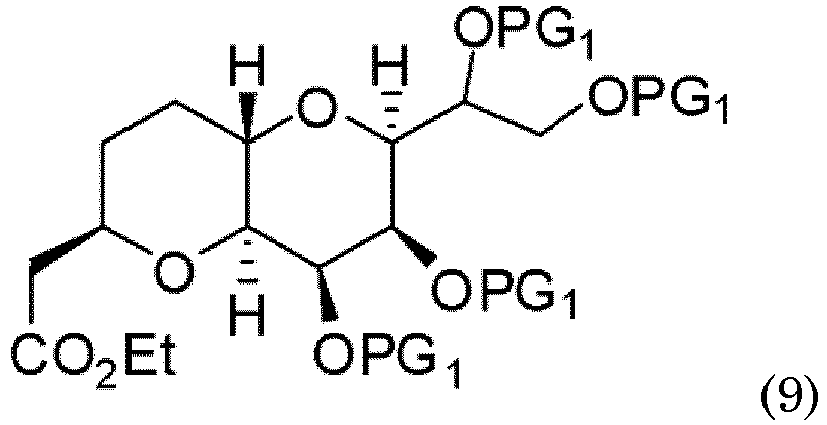


- PG1 represents a diol protecting group forming a 5-membered heterocycle by combining each other,
- TMS represents trimethylsilyl, and
- TBS represents t-butyldimethylsilyl.
- Hereinafter, the preparation process according to one embodiment of the present invention is described in more detail referring to the following reaction scheme 4. The process depicted in the following reaction scheme 4 represents merely a typical example, and various changes may be made to reagents and reaction conditions without limitation.


- The compound of formula (9) can be obtained by subjecting the compound of formula (3) to Horner-Wadsworth-Emmons (HWE) reaction.
- The Horner-Wadsworth-Emmons reaction may be carried out using triethyl phosphonoacetate, trimethyl phosphonoacetate and the like in the presence of a base.
- As the base, lithium bis(trimethylsilyl)amide (LiHMDS), sodium bis(trimethylsilyl)amide (NaHMDS), potassium tert-butoxide (t-BuOK), may be used. Particularly, potassium tert-butoxide may be used.
- As the reaction solvent, methylene chloride, toluene, tetrahydrofuran, may be used. Particularly, tetrahydrofuran is preferred.
- The reaction is preferably performed at room temperature.
- The compound of formula (10) can be obtained by selectively deprotecting the primary hydroxyl protecting group of the compound of formula (9).
- The deprotection may be carried out in the presence of an acid.
- As the acid, hydrochloric acid, hydrosulfuric acid, acetic acid, may be used. Particularly, acetic acid may be used.
- The reaction is preferably performed at the temperature of about 30 to 35°C.
- The compound of formula (11) can be obtained by oxidizing the compound of formula (10).
- The oxidation may be carried out using sodium periodate (NaIO4), lead tetraacetate (Pb (C2H3O2) 4) . etc. Particularly, sodium periodate is preferred.
- As the reaction solvent, a mixture of a polar solvent and water is preferred. Specific examples of the polar solvent may include ethylacetate, tetrahydrofuran, toluene. Particularly, ethylacetate is preferred.
- The reaction is preferably performed at room temperature.
- The compound of formula (12) can be obtained by subjecting the compound of formula (11) to Nozaki-Hiyama-Kishi (NHK) reaction with (2-bromovinyl)trimethylsilane.
- The Nozaki-Hiyama-Kishi reaction may be carried out in the presence of chromium(II) chloride and nickel(II) chloride.
- As the reaction solvent, acetonitrile, methylenechloride, dimethyl sulfoxide, may be used. Particularly, a mixture of acetonitrile and dimethyl sulfoxide is preferred.
- The reaction is preferably performed at room temperature.
- The compound of formula (13) can be obtained by deprotecting the secondary hydroxyl protecting group of the compound of formula (12).
- The deprotection may be carried out in the presence of an acid.
- As the acid, hydrochloric acid, hydrosulfuric acid, acetic acid, may be used. Particularly, acetic acid may be used.
- The reaction is preferably performed at the temperature of about 90 to 100°C.
- The compound of formula (14) can be obtained by protecting the hydroxyl groups of the compound of formula (13).
- The protection may be carried out by reacting the compound of formula (13) with t-butyldimethylsilyl trifluoromethanesulfonate under a basic condition. As the base, triethylamine, 4-dimethylaminopyridine, imidazole, 2,6-lutidine, may be used. Particularly, 2,6-lutidine is preferred.
- As the reaction solvent, methylene chloride, chloroform, methyl t-butyl ether (MTBE), may be used. Particularly, methyl t-butyl ether is preferred.
- The reaction is preferably performed at room temperature.
- The compound of formula (15) can be obtained by subjecting the trimethylsilyl group of the compound of formula (14) to substitution with an iodide.
- The substitution may be carried out using N-iodosuccinimide (NIS), or iodine for instance.
- Also, the substitution may be carried out in the presence of t-butyldimethylsilyl chloride (TBSCl).
- As the reaction solvent, a mixture of acetonitrile and toluene is preferred. The reaction is preferably performed at the temperature of about 30°C.
- The compound of formula (2) can be obtained by reducing the ester group of the compound of formula (15).
- The reduction may be carried out using lithium aluminum tetrahydride, sodium bis(2-methoxyethoxy)aluminum dihydride, diisobutylaluminum hydride (DIBAL-H) .
- Particularly, diisobutylaluminum hydride is preferred.
- As the reaction solvent, methylene chloride, toluene, tetrahydrofuran, may be used. Particularly, toluene is preferred.
- The reaction is preferably performed at the temperature of -65°C or lower.
- In accordance with the preparation process of the present invention, the compound of formula (2) which is a key intermediate for the preparation of eribulin mesylate can be prepared with high yields.
- The present invention will be described below in more detail by following examples. It will be obvious to those skilled in the art that these examples are merely described for illustration of the present invention and the scope of the present invention is not limited thereto.
-

- (Ethoxycarbonylmethylene)triphenylphosphorane (52.39 g) was added to the compound of formula (4a) (52g) dissolved in methylene chloride (0.5 L), followed by stirring for about 2 hours. After the completion of the reaction was confirmed, the resulting solution was concentrated. The resulting residue was subjected to chromatography (ethyl acetate:n-hexane = 1:5) to give the compound of formula (5a) (46.6 g, 82%).
- 1H NMR (300 MHz, CDCl3, δ ppm): 6.66 (dd, J = 15.7, 7.2 Hz, 1H), 6.17 (dd, J = 15.7, 0.5 Hz, 1H), 4.17-4.30 (m, 2H), 3.99-4.04 (m, 2H), 3.88-3.93 (m, 1H), 3.79 (dd, J = 7.7, 5.5 Hz, 1H), 3.43 (dd, J = 7.1, 1.5 Hz, 1H), 3.10 (dd, J = 7.7, 2.0 Hz, 1H), 1.37-1.67 (m, 23H), 0.93-1.00 (m, 9H), 0.61-0.77 (m, 6H).
-

- The compound of formula (5a) (44.6 g) was dissolved in tetrahydrofuran (446 mL). A mixture of 1M tetrabutylammonium fluoride (94.5 mL) and imidazole hydrochloride (4.94 g) was added thereto, followed by stirring for about 1.5 hours at the room temperature. After the completion of the reaction was confirmed, water (0.4 L) and ethyl acetate (0.4 L) were added thereto, followed by stirring for 10 minutes. Then, the organic layer was separated, and sodium sulfate was added, followed by filtration and concentration. The resulting residue was subjected to chromatography (ethyl acetate:n-hexane = 1:2) to give the compound of formula (6a) (32.5 g, 91%).
- 1H NMR (300 MHz, CDCl3, δ ppm): 6.68 (dd, J = 15.7, 7.1 Hz, 1H), 6.17 (dd, J = 15.7, 0.6 Hz, 1H), 4.06-4.29 (m, 5H), 3.78-3.94 (m, 3H), 3.43 (dd, J = 7.0, 1.4 Hz, 1H), 3.27 (dd, J = 7.8, 1.9 Hz, 1H), 2.49 (d, J = 7.6 Hz, 1 H), 1.24-1.73 (m, 23H).
-

- The compound of formula (6a) (23 g) was dissolved in tetrahydrofuran (230 mL), and di-µ-chloro-tetracarbonyldirhodium(I) (0.99 g) was added thereto, followed by strring for about 15 hours at room temperature. After the completion of the reaction was confirmed, the resulting solution was concentrated under reduced pressure. The resulting residue was subjected to chromatography (ethyl acetate :n-hexane = 1:1) to give the compound of formula (7a) (22.8 g, 78.6%).
- 1H NMR (300 MHz, CDCl3, δ ppm): 7.12 (dd, J = 15.7, 3.2 Hz, 1H), 6.42 (dd, J = 15.7, 2.0 Hz, 1H), 4.54-4.58 (m, 1H), 4.41-4.45 (m, 1H), 4.31-4.37 (m, 1H), 4.10-4.26 (m, 4H), 3.77-3.82 (m, 1H), 3.58-3.66 (m, 1H), 3.44 (dd, J = 7.9, 1.4 Hz, 1H), 2.20 (d, J = 10.3 Hz, 1 H), 1.41-1.78 (m, 20H), 1.28 (t, J = 7.1 Hz, 3H).
-

- The compound of formula (7a) (22.8 g) was dissolved in ethyl acetate (114 mL), and 10% Pd/C (2.3 g) was added thereto, followed by substitution with hydrogen gas and stirring for about 6 hours. After the completion of the reaction was confirmed, the resulting solution was filtered through cellite. The filtrate was concentrated under reduced pressure, and the obtained compound of formula (8a) (23.5 g, 100%) was used for the following reaction without additional purification.
- 1H NMR (300 MHz, CDCl3, δ ppm): 4.47-4.50 (m, 1H), 4.23-4.32 (m, 2H), 4.05-4.17 (m, 3H), 3.77-3.86 (m, 2H), 3.49-3.57 (m, 2H), 2.43-2.65 (m, 2H), 2.21-2.25 (m, 1H), 2.02-2.13 (m, 1H), 1.23-1.91 (m, 23H).
-

- The compound of formula (8a) (23 g) was dissolved in toluene (0.23 L), and cooled to -65°C or lower. 1.2 M DIBAL-H (105.5 mL) was added dropwise thereto with maintaining the temperature of -60°C or lower, followed by stirring for 30 minutes and confirming the completion of the reaction. 20% Potassium sodium tartrate tetrahydrate aqueous solution (0.5 L) was added thereto, with maintaining the temperature of 10°C or lower, followed by stirring for about 3 hours at room temperature. After the organic layer was separated, the aqueous layer was extracted with ethyl acetate. Sodium sulfate was added to the combined organic layer, followed by filtration and concentration under reduced pressure, to give the compound of formula (3a) (19.6 g, 94.3%).
- 1H NMR (300 MHz, CDCl3, δ ppm): 5.35 (bs, 1H), 4.45 (dd, J = 8.3, 3.2 Hz, 1H), 4.24-4.37 (m, 2H), 4.06-4.13 (m, 2H), 3.72-3.98 (m, 3H), 2.46-2.47 (m, 1H), 1.23-2.04 (m, 24H).
-

- Triethyl phosphonoacetate (19 mL) was added to tetrahydrofuran (16 mL) and cooled to 0°C or lower. Potassium tert-butoxide (10.3 g) was added thereto, followed by stirring for about 30 minutes. The compound of formula (3a) (15.7 g) dissolved in tetrahydrofuran (16 mL) was added thereto, followed by stirring for 15 hours at room temperature. After the completion of the reaction was confirmed, saturated ammonium chloride aqueous solution (200 mL) was added thereto, and the resulting solution was strongly stirred. After the organic layer was separated, the aqueous layer was extracted with ethyl acetate. Sodium sulfate was added to the combined organic layer, followed by filtration and concentration. The resulting residue was subjected to chromatography (ethyl acetate:n-hexane = 1:3) to give the compound of formula (9a) (14.6 g, 79.4%).
- 1H NMR (300 MHz, CDCl3, δ ppm): 4.52 (dd, J = 8.3, 2.9 Hz, 1H), 4.22-4.34 (m, 2H), 4.06-4.17 (m, 3H), 3.76-3.95 (m, 3H), 3.72 (dd, J = 7.1, 1.5 Hz, 1H), 3.49 (dd, J = 10.2, 3.0 Hz, 1H), 2.70 (dd, J = 16.0, 6.8 Hz, 1H), 2.41 (dd, J = 16.0, 6.2 Hz, 1H), 2.13-2.20 (m, 1H), 1.22-1.84 (m, 26H).
-

- To the compound of formula (9a) (32 g) was added acetic acid:water = 4:1 (640 mL), followed by stirring for about 7 hours at the temperature of 30-35°C. After the completion of the reaction was confirmed, toluene (640 mL) was added, followed by concentration under reduced pressure. The resulting residue was subjected to chromatography (methylene chloride:methanol = 10:1) to give the compound of formula (10a) (23 g, 86.3%).
- 1H NMR (300 MHz, CDCl3, δ ppm): 4.56 (dd, J = 8.4, 2.9 Hz, 1H), 4.45 (dd, J = 8.4, 1.4 Hz, 1H), 4.13 (q, J = 7.1 Hz, 2H), 3.82-3.95 (m, 3H), 3.75-3.81 (m, 3H), 3.51 (dd, J = 10.2, 2.9 Hz, 1H), 3.15 (bs, 1H), 2.70 (dd, J = 16.0, 6.8 Hz, 1H), 2.38-2.45 (m, 2H), 2.08-2.14 (m, 1H), 1.22-1.84 (m, 16H).
-

- The compound of formula (10a) (23 g) was dissolved in ethyl acetate (230 mL) and water (230 mL), and cooled to 0°C. Sodium periodate (12.9 g) was added thereto with maintaining the temperature of 10°C or lower, followed by stirring for about 2 hours at room temperature. After the completion of the reaction was confirmed, sodium chloride (23 g) was added thereto, followed by stirring for 30 minutes. After the resulting by-products were filtered, the organic layer was separated and the aqueous layer was extracted three times with ethyl acetate (115 mL). The combined organic layer was washed with 20% sodium chloride aqueous solution (115 mL). Sodium sulfate was added to the organic layer, followed by filtration and concentration, and the obtained compound of formula (11a) (20 g, 94.5%) was used for the following reaction without additional purification.
- 1H NMR (300 MHz, CDCl3, δ ppm): 9.62 (d, J = 0.6 Hz, 1H), 4.70 (dd, J = 8.2, 2.2 Hz, 1H), 4.58 (dd, J = 8.2, 3.0 Hz, 1H), 4.10-4.17 (m, 3H), 3.96-4.05 (m, 1H), 3.82-3.90 (m, 1H), 3.43 (dd, J = 7.1 Hz, 2H), 3.82-3.90 (m, 1H), 3.43 (dd, J = 10.2, 3.0 Hz, 1H), 2.71 (dd, J = 16.1, 6.9 Hz, 1H), 2.42 (dd, J = 16.1, 6.1 Hz, 1H), 2.18-2.25 (m, 1H), 1.23-1.83 (m, 16H).
-

- Chromium(II) chloride (100 g) and nickel(II) chloride (1.06 g) were added to dimethylsulfoxide (210 mL) and acetonitrile (210 mL), and cooled to 0 - 5 °C. The compound of formula (11a) (30 g) and (2-bromovinyl)trimethylsilane (73 mL) were dissolved in acetonitrile (210 mL) and added dropwise. The resulting solution was stirred for 24 hours at room temperature and the completion of the reaction was confirmed. Methanol (200 mL), water (200 mL), MTBE (200 mL) were added thereto, followed by stirring for 1 hour. The organic layer was separated, and the aqueous layer was extracted twice with MTBE (100 mL). The combined organic layer was washed with saturated sodium chloride (200 mL), and sodium sulfate was added to the organic layer, followed by filtration and concentration. The resulting residue was subjected to chromatography (ethyl acetate:n-hexane = 1:2) to give a compound of formula (12a) (18.2 g, 48%).
- 1H NMR (300 MHz, CDCl3, δ ppm): 6.06-6.19 (m, 2H), 4.47-4.55 (m, 2H), 4.32-4.38 (m, 1H), 4.14 (q, J = 7.1 Hz, 2H), 3.80-3.98 (m, 2H), 3.63 (dd, J = 5.2, 1.1 Hz, 1H), 3.49 (dd, J = 1.02, 2.7 Hz, 1H), 3.02 (d, J = 7.7 Hz, 1H), 2.70 (dd, J = 16.0, 6.8 Hz, 1H), 2.41 (dd, J = 16.0, 6.2 Hz, 1H), 2.08-2.18 (m, 1H), 1.17-1.81 (m, 16H), 0.08 (s, 9H).
-

- To the compound of formula (12a) (18.2 g) was added acetic acid:water = 1:1 (149 mL), followed by stirring for about 3 hours at the temperature of 90 - 95°C. After the completion of the reaction was confirmed, the resulting solution was cooled to 15°C or lower, and washed twice with heptane (73 mL). 20% Potassium hydrogen carbonate (700 mL) and MTBE (146 mL) were added to the aqueous layer. The organic layer was separated, and washed with 5% potassium hydrogen carbonate (75 mL) and 5% sodium chloride (75 mL). The organic layer was concentrated, and MTBE (60 mL) was added thereto, followed by warming to 55°C for dissolution. Heptane (145 mL) was added dropwise thereto, with maintaining the temperature exceeding 40°C. The resulting solution was cooled to 5 - 15°C, and stirred for 15 hours. The resulting solution was filtered with heptane to give a compound of formula (13) (10.1 g, 67%).
- 1H NMR (300 MHz, CDCl3, δ ppm): 6.14 (dd, J = 18.7, 5.9 Hz, 1H), 5.97 (dd, J = 18.7, 0.9 Hz, 1H), 5.04-5.10 (m, 1H), 4.11-4.27 (m, 4H), 3.98-4.03 (m, 1H), 3.87-3.91 (m, 1H), 3.76 (dd, J = 8.8, 6.2 Hz, 1H), 3.54-3.57 (m, 1H), 3.22 (d, J = 3.2 Hz, 1H), 2.94 (bs, 1H), 2.59 (dd, J = 15.4, 7.4 Hz, 1H), 2.42 (dd, J = 15.4, 5.5 Hz, 1H), 1.90-1.93 (m, 1H), 1.80-1.82 (m, 1H), 1.39-1.46 (m, 2H), 1.26 (t, J = 7.1 Hz, 3H), 0.07 (s, 9H).
-

- To the compound of formula (13) (5 g) was added MTBE (37.4 mL), and 2,6-lutidine (11.1 mL) was added thereto for dissolution, followed by cooling to 0°C. t-Butyldimethylsilyl trifluoromethanesulfonate (10.3 mL) was added thereto, followed by stirring for about 24 hours at room temperature. After the completion of the reaction was confirmed, methanol (1.3 mL) and water (74.7 mL) were added dropwise thereto. The organic layer was separated and washed twice with IN hydrochloric acid (80 mL), 5% sodium chloride (75 mL), 5% sodium bicarbonate (75 mL), and 5% sodium chloride (75 mL). The organic layer was concentrated under reduced pressure, and the resulting residue was subjected to chromatography (ethyl acetate:n-hexane = 1:10) to give a compound of formula (14) (7.2 g, 76.5%).
- 1H NMR (300 MHz, CDCl3, δ ppm): 6.13 (dd, J = 18.9, 8.0 Hz, 1H), 5.81 (dd, J = 18.9, 0.5 Hz, 1H), 4.92-4.96 (m, 1H), 4.02-4.11 (m, 3H), 3.69-3.84 (m, 3H), 3.39-3.47 (m, 1H), 3.85 (dd, J = 9.6, 2.3 Hz, 1H), 2.45 (dd, J = 15.3, 8.0 Hz, 1H), 2.27 (dd, J = 15.3, 5.3 Hz, 1H), 1.64-1.71 (m, 2H), 1.16-1.21 (m, 5H), 0.90 (s, 9H), 0.86 (s, 9H), 0.78 (s, 9H), -0.09-0.05 (s, 27H).
-

- The compound of formula (14) (7.1 g) was dissolved in toluene (18.5 mL), and acetonitrile (33.4 mL) was added thereto. t-Butyldimethylsilyl chloride (73 mg) was added thereto, followed by warming to 30°C. N-Iodosuccinimide (8.74 g) was added thereto, and stirred for about 24 hours. After the completion of the reaction was confirmed, the resulting solution was cooled to 25°C or lower, and a mixture of 5% sodium hydrogen carbonate aqueous solution (35.5 mL) and 5% sodium thiosulfate aqueous solution (35.5 L) was added thereto, followed by stirring for 30 minutes. The organic layer was separated, and the aqueous layer was extracted with ethyl acetate. The combined organic layer washed twice with 10% sodium chloride (70 mL), and sodium sulfate was added to the organic layer, followed by filtration and concentration. The resulting residue was subjected to chromatography (ethyl acetate:n-hexane = 1:10) to give a compound of formula (15) (6.7 g, 87.2%).
- 1H NMR (300 MHz, CDCl3, δ ppm): 6.86 (dd, J = 14.6, 7.8 Hz, 1H), 6.28 (dd, J = 14.6, 0.7 Hz, 1H), 4.88-4.92 (m, 1H), 4.07-4.21 (m, 3H), 3.77-3.90 (m, 3H), 3.42-3.51 (m, 1H), 2.93 (dd, J = 9.6, 2.2 Hz, 1H), 2.53 (dd, J = 15.4, 8.1 Hz, 1H), 2.36 (dd, J = 15.4, 5.1 Hz, 1H), 1.92-1.97 (m, 1H), 1.70-1.82 (m, 1H), 1.23-1.28 (m, 3H), 0.94 (s, 9H), 0.92 (s, 9H), 0.86 (s, 9H), 0.02-0.11 (s, 18H).
-

- The compound of formula (15) (1 g) was dissolved in toluene (14 mL), and cooled to -65 °C or lower. 1.2 M DIBAL-H (1.4 mL) was added dropwise thereto with maintaining the temperature of -60°C or lower, and stirred for 30 minutes, followed by confirming the completion of the reaction. Methanol (0.15 mL) was added dropwise thereto, and 1N hydrochloric acid (10 mL) and MTBE (4 mL) were added thereto, followed by stirring for 30 minutes. The organic layer was separated, and washed with 1 N hydrochloric acid (10 mL), water (10 mL), saturated sodium bicarbonate (10 mL), and saturated sodium chloride (10 mL). Sodium sulfate was added to the organic layer, followed by filtration and concentration under reduced pressure. The resulting residue was subjected to chromatography (ethyl acetate:n-hexane = 1:8) to give a compound of formula (2) (890 mg, 94.6 %). 1H NMR (300 MHz, CDCl3, δ ppm): 9.78-9.79 (m, 1H), 6.85 (dd, J = 14.6, 7.9 Hz, 1H), 6.29 (dd, J = 14.6, 0.7 Hz, 1H), 4.88-4.92 (m, 1H), 4.08-4.11 (m, 1H), 3.81-3.93 (m, 3H), 3.45-3.53 (m, 1H), 2.95 (dd, J = 9.6, 2.3 Hz, 1H), 2.63 (ddd, J = 16.5, 8.5, 2.6 Hz, 1H), 2.44 (ddd, J = 16.4, 4.4, 1.7 Hz, 1H), 1.95-1.98 (m, 1H), 1.74-1.79 (m, 1H), 1.32-1.46 (m, 2H), 0.94 (s, 9H), 0.93 (s, 9H), 0.86 (s, 9H), 0.02-0.11 (s, 18H).
Claims (18)
- A process for preparing a compound of the following formula (3), which comprises the steps of:(i) subjecting a compound of the following formula (4) to Wittig reaction to obtain a compound of the following formula (5);(ii) selectively deprotecting a PG2 group of the compound of the following formula (5) to obtain a compound of the following formula (6);(iii) subjecting the compound of the following formula (6) to cyclization to obtain a compound of the following formula (7);(iv) subjecting the compound of the following formula (7) to hydrogenation to obtain a compound of the following formula (8); and(v) reducing an ester group of the compound of the following formula (8):



 PG1 represents a diol protecting group forming a 5-membered heterocycle by combining each other,PG2 represents a silyl protecting group, andR1 represents hydrogen or a C1-C6 alkyl group.
 - The process according to claim 1, wherein the Wittig reaction of step (i) is carried out using (methoxycarbonylmethylene)triphenylphosphorane or (ethoxycarbonylmethylene)triphenylphosphorane.
- The process according to claim 1, wherein the deprotection of step (ii) is carried out using a mixture of a fluoride compound and a buffer.
- The process according to claim 3, wherein the buffer is imidazole hydrochloride.
- The process according to claim 1, wherein the cyclization of step (iii) is carried out in the presence of a catalyst.
- The process according to claim 5, wherein the catalyst is di-µ-chlorotetracarbonyldirhodium(I).
- The process according to claim 1, wherein the hydrogenation of step (iv) is carried out in the presence of Pd/C.
- The process according to claim 1, wherein the reduction of step (v) is carried out using diisobutylaluminum hydride.
- A compound of the following formula (3):
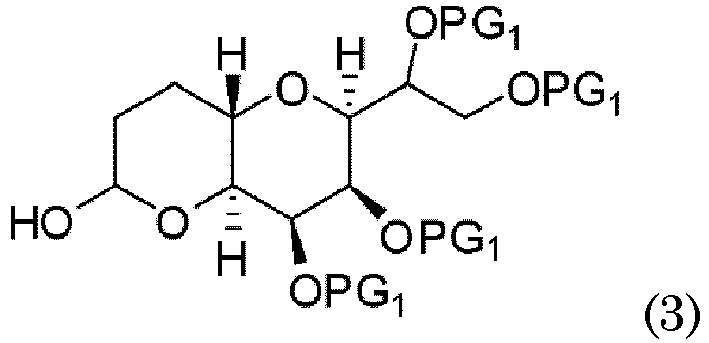
PG1 represents a diol protecting group forming a 5-membered heterocycle by combining each other, wherein the diol protecting group is derived from cyclopentanone, cyclohexanone, cycloheptanone, 1,1-dimethoxycyclopentane, 1,1-dimethoxycyclohexane or 1,1-dimethoxycycloheptane. - A process for preparing a compound of the following formula (2), which comprises the steps of:(vi) subjecting a compound of the following formula (3) prepared by the process according to any one of claims 1 to 8 to Horner-Wadsworth-Emmons reaction to obtain a compound of the following formula (9);(vii) selectively deprotecting a primary hydroxyl protecting group of the compound of the following formula (9) to obtain a compound of the following formula (10);(viii) oxidizing the compound of the following formula (10) to obtain a compound of the following formula (11);(ix) subjecting the compound of the following formula (11) to Nozaki-Hiyama-Kishi reaction with (2-bromovinyl)trimethylsilane to obtain a compound of the following formula (12);(x) deprotecting a secondary hydroxyl protecting group of the compound of the following formula (12) to obtain a compound of the following formula (13);(xi) protecting a hydroxyl group of the compound of the following formula (13) to obtain a compound of the following formula (14);(xii) subjecting a trimethylsilyl group of the compound of the following formula (14) to substitution with an iodide to obtain a compound of the following formula (15); and(xiii) reducing an ester group of the compound of the following formula (15):


 PG1 represents a diol protecting group forming a 5-membered heterocycle by combining each other,TMS represents trimethylsilyl, andTBS represents t-butyldimethylsilyl.
 - The process according to claim 10, wherein the Horner-Wadsworth-Emmons reaction of step (vi) is carried out using triethyl phosphonoacetate or trimethyl phosphonoacetate in the presence of a base.
- The process according to claim 10, wherein the deprotection of step (vii) is carried out in the presence of an acid.
- The process according to claim 10, wherein the oxidation of step (viii) is carried out using sodium periodate.
- The process according to claim 10, wherein the Nozaki-Hiyama-Kishi reaction of step (ix) is carried out in the presence of chromium(II) chloride and nickel(II) chloride.
- The process according to claim 10, wherein the deprotection of step (x) is carried out in the presence of an acid.
- The process according to claim 10, wherein the protection of step (xi) is carried out by reacting the compound of formula (13) with t-butyldimethylsilyl trifluoromethanesulfonate under a basic condition.
- The process according to claim 10, wherein the substitution of step (xii) is carried out using N-iodosuccinimide.
- The process according to claim 10, wherein the reduction of step (xiii) is carried out using diisobutylaluminum hydride.
Applications Claiming Priority (3)
| Application Number | Priority Date | Filing Date | Title |
|---|---|---|---|
| KR1020170000380A KR101880939B1 (en) | 2017-01-02 | 2017-01-02 | Intermediate for Preparing Eribulin Mesylate and Process for Preapring the Same |
| KR1020170172077A KR101991710B1 (en) | 2017-12-14 | 2017-12-14 | Intermediate for Preparing Eribulin Mesylate and Process for Preparing the Same |
| PCT/KR2018/000043 WO2018124847A1 (en) | 2017-01-02 | 2018-01-02 | Production intermediate of eribulin mesylate, and method for producing same |
Publications (3)
| Publication Number | Publication Date |
|---|---|
| EP3564243A1 EP3564243A1 (en) | 2019-11-06 |
| EP3564243A4 EP3564243A4 (en) | 2020-09-30 |
| EP3564243B1 true EP3564243B1 (en) | 2022-11-09 |
Family
ID=62710318
Family Applications (1)
| Application Number | Title | Priority Date | Filing Date |
|---|---|---|---|
| EP18734042.7A Active EP3564243B1 (en) | 2017-01-02 | 2018-01-02 | Production intermediate of eribulin mesylate, and method for producing same |
Country Status (6)
| Country | Link |
|---|---|
| US (1) | US10865212B2 (en) |
| EP (1) | EP3564243B1 (en) |
| JP (1) | JP6920699B2 (en) |
| CN (1) | CN110139866B (en) |
| ES (1) | ES2932832T3 (en) |
| WO (1) | WO2018124847A1 (en) |
Families Citing this family (1)
| Publication number | Priority date | Publication date | Assignee | Title |
|---|---|---|---|---|
| CN116159601B (en) * | 2019-03-15 | 2024-07-23 | 博瑞生物医药(苏州)股份有限公司 | Eribulin intermediate and preparation method thereof |
Family Cites Families (8)
| Publication number | Priority date | Publication date | Assignee | Title |
|---|---|---|---|---|
| HU227912B1 (en) | 1998-06-17 | 2012-05-29 | Eisai R & D Man Co | Halichondrin analogs and methods of their use and preparation |
| PL2522663T3 (en) | 2004-06-03 | 2015-08-31 | Eisai R&D Man Co Ltd | Intermediates for the preparation of halichondrin B |
| KR20070003026A (en) * | 2005-06-30 | 2007-01-05 | 현대자동차주식회사 | Tie-rod assembly of double nut type for wheel alignment of vehicle |
| WO2012118978A1 (en) * | 2011-03-03 | 2012-09-07 | The Regents Of The University Of Colorado, A Body Corporate | Methods for treating oncovirus positive cancers |
| WO2012147900A1 (en) * | 2011-04-28 | 2012-11-01 | Eisai R&D Management Co., Ltd. | Microreactor process for halichondrin b analog synthesis |
| AU2014299699B2 (en) | 2013-06-26 | 2019-10-10 | Eisai R&D Management Co., Ltd. | Use of eribulin and lenvatinib as combination therapy for treatment of cancer |
| CN105330686A (en) | 2014-07-10 | 2016-02-17 | 上海源力生物技术有限公司 | Preparation method of eribulin intermediate |
| KR101880939B1 (en) | 2017-01-02 | 2018-08-17 | 연성정밀화학(주) | Intermediate for Preparing Eribulin Mesylate and Process for Preapring the Same |
-
2018
- 2018-01-02 JP JP2019555551A patent/JP6920699B2/en active Active
- 2018-01-02 CN CN201880005581.4A patent/CN110139866B/en active Active
- 2018-01-02 WO PCT/KR2018/000043 patent/WO2018124847A1/en not_active Ceased
- 2018-01-02 ES ES18734042T patent/ES2932832T3/en active Active
- 2018-01-02 EP EP18734042.7A patent/EP3564243B1/en active Active
- 2018-01-02 US US16/475,171 patent/US10865212B2/en active Active
Also Published As
| Publication number | Publication date |
|---|---|
| WO2018124847A1 (en) | 2018-07-05 |
| ES2932832T3 (en) | 2023-01-26 |
| US20190337964A1 (en) | 2019-11-07 |
| CN110139866A (en) | 2019-08-16 |
| US10865212B2 (en) | 2020-12-15 |
| EP3564243A4 (en) | 2020-09-30 |
| EP3564243A1 (en) | 2019-11-06 |
| JP6920699B2 (en) | 2021-08-18 |
| JP2020503386A (en) | 2020-01-30 |
| CN110139866B (en) | 2022-05-17 |
Similar Documents
| Publication | Publication Date | Title |
|---|---|---|
| JP7248209B2 (en) | Synthesis of 3'-deoxyadenosine-5'-O-[phenyl(benzyloxy-L-alaninyl)]phosphate (NUC-7738) | |
| EP3016957A1 (en) | Synthetic process for preparation of macrocyclic c1-keto analogs of halichondrin b and intermediates useful therein including intermediates containing -so2-(p-tolyl) groups | |
| KR20040062418A (en) | Compounds Which Mimic the Chemical and Biological Properties of Discodermolide | |
| JP2003531110A (en) | Compounds that mimic the chemical and biological properties of discodermolide | |
| KR101880939B1 (en) | Intermediate for Preparing Eribulin Mesylate and Process for Preapring the Same | |
| EP3564243A1 (en) | Production intermediate of eribulin mesylate, and method for producing same | |
| EP3854800B1 (en) | High-yield preparation method for novel vascular leakage blocker | |
| JP6388065B2 (en) | Method for producing difluoroester compound | |
| US6620947B2 (en) | Compounds for use in 11-oxa prostaglandin synthesis | |
| KR101991710B1 (en) | Intermediate for Preparing Eribulin Mesylate and Process for Preparing the Same | |
| JP5960130B2 (en) | Preparation of tesetaxel and related compounds and corresponding synthetic intermediates | |
| JP7678243B2 (en) | Lithocholic acid derivatives with vitamin D activity | |
| AU2011321624B2 (en) | 23-yne-vitamin D3 derivative | |
| KR102436114B1 (en) | Novel preparing method of inotodiol | |
| EP4130020A1 (en) | Novel method for preparing inotodiol | |
| US20100093997A1 (en) | Fluorinated catharanthine derivatives, their preparation and their utilisation as vinca dimeric alkaloid precursors | |
| US20090227781A1 (en) | Glycolipid Derivative and Drug Containing the Same as Active Component | |
| US20180016230A1 (en) | Salts of Prostaglandin Analog Intermediates | |
| WO2005079378A2 (en) | Synthetic techniques and intermediates for polyhydroxy dienyl lactones and mimics thereof | |
| JP3715673B2 (en) | Method for producing vitamin D synthetic intermediate | |
| WO2023275324A1 (en) | Process for the biobased synthesis of schweinfurthins g, k and r | |
| JP2022115349A (en) | Method for producing iridoid glycoside and novel iridoid glycoside | |
| KR100772426B1 (en) | Oxazolidinone derivatives, preparation method thereof, and composition comprising the same | |
| JP2007204384A (en) | Optically active phosphoric acid derivative and method for producing optically active sphingosine 1-phosphate derivative using the same | |
| WO1997041109A1 (en) | Synthesis of (±) - calicheamicinone, precursors, intermediates and derivatives |
Legal Events
| Date | Code | Title | Description |
|---|---|---|---|
| STAA | Information on the status of an ep patent application or granted ep patent |
Free format text: STATUS: THE INTERNATIONAL PUBLICATION HAS BEEN MADE |
|
| PUAI | Public reference made under article 153(3) epc to a published international application that has entered the european phase |
Free format text: ORIGINAL CODE: 0009012 |
|
| STAA | Information on the status of an ep patent application or granted ep patent |
Free format text: STATUS: REQUEST FOR EXAMINATION WAS MADE |
|
| 17P | Request for examination filed |
Effective date: 20190719 |
|
| AK | Designated contracting states |
Kind code of ref document: A1 Designated state(s): AL AT BE BG CH CY CZ DE DK EE ES FI FR GB GR HR HU IE IS IT LI LT LU LV MC MK MT NL NO PL PT RO RS SE SI SK SM TR |
|
| AX | Request for extension of the european patent |
Extension state: BA ME |
|
| RAP1 | Party data changed (applicant data changed or rights of an application transferred) |
Owner name: YONSUNG FINE CHEMICAL CO., LTD. |
|
| DAV | Request for validation of the european patent (deleted) | ||
| DAX | Request for extension of the european patent (deleted) | ||
| RIC1 | Information provided on ipc code assigned before grant |
Ipc: A61K 31/357 20060101ALI20200511BHEP Ipc: C07D 493/04 20060101AFI20200511BHEP Ipc: A61K 31/35 20060101ALI20200511BHEP Ipc: A61P 35/00 20060101ALI20200511BHEP |
|
| A4 | Supplementary search report drawn up and despatched |
Effective date: 20200828 |
|
| RIC1 | Information provided on ipc code assigned before grant |
Ipc: C07D 493/04 20060101AFI20200824BHEP Ipc: A61K 31/357 20060101ALI20200824BHEP Ipc: A61K 31/35 20060101ALI20200824BHEP Ipc: A61P 35/00 20060101ALI20200824BHEP |
|
| STAA | Information on the status of an ep patent application or granted ep patent |
Free format text: STATUS: EXAMINATION IS IN PROGRESS |
|
| 17Q | First examination report despatched |
Effective date: 20210721 |
|
| GRAP | Despatch of communication of intention to grant a patent |
Free format text: ORIGINAL CODE: EPIDOSNIGR1 |
|
| STAA | Information on the status of an ep patent application or granted ep patent |
Free format text: STATUS: GRANT OF PATENT IS INTENDED |
|
| INTG | Intention to grant announced |
Effective date: 20220419 |
|
| GRAJ | Information related to disapproval of communication of intention to grant by the applicant or resumption of examination proceedings by the epo deleted |
Free format text: ORIGINAL CODE: EPIDOSDIGR1 |
|
| STAA | Information on the status of an ep patent application or granted ep patent |
Free format text: STATUS: EXAMINATION IS IN PROGRESS |
|
| INTC | Intention to grant announced (deleted) | ||
| GRAP | Despatch of communication of intention to grant a patent |
Free format text: ORIGINAL CODE: EPIDOSNIGR1 |
|
| STAA | Information on the status of an ep patent application or granted ep patent |
Free format text: STATUS: GRANT OF PATENT IS INTENDED |
|
| INTG | Intention to grant announced |
Effective date: 20220826 |
|
| GRAS | Grant fee paid |
Free format text: ORIGINAL CODE: EPIDOSNIGR3 |
|
| GRAA | (expected) grant |
Free format text: ORIGINAL CODE: 0009210 |
|
| STAA | Information on the status of an ep patent application or granted ep patent |
Free format text: STATUS: THE PATENT HAS BEEN GRANTED |
|
| AK | Designated contracting states |
Kind code of ref document: B1 Designated state(s): AL AT BE BG CH CY CZ DE DK EE ES FI FR GB GR HR HU IE IS IT LI LT LU LV MC MK MT NL NO PL PT RO RS SE SI SK SM TR |
|
| REG | Reference to a national code |
Ref country code: GB Ref legal event code: FG4D |
|
| REG | Reference to a national code |
Ref country code: CH Ref legal event code: EP Ref country code: AT Ref legal event code: REF Ref document number: 1530299 Country of ref document: AT Kind code of ref document: T Effective date: 20221115 |
|
| REG | Reference to a national code |
Ref country code: DE Ref legal event code: R096 Ref document number: 602018042844 Country of ref document: DE |
|
| REG | Reference to a national code |
Ref country code: IE Ref legal event code: FG4D |
|
| REG | Reference to a national code |
Ref country code: ES Ref legal event code: FG2A Ref document number: 2932832 Country of ref document: ES Kind code of ref document: T3 Effective date: 20230126 |
|
| REG | Reference to a national code |
Ref country code: LT Ref legal event code: MG9D |
|
| REG | Reference to a national code |
Ref country code: NL Ref legal event code: MP Effective date: 20221109 |
|
| REG | Reference to a national code |
Ref country code: AT Ref legal event code: MK05 Ref document number: 1530299 Country of ref document: AT Kind code of ref document: T Effective date: 20221109 |
|
| PG25 | Lapsed in a contracting state [announced via postgrant information from national office to epo] |
Ref country code: SE Free format text: LAPSE BECAUSE OF FAILURE TO SUBMIT A TRANSLATION OF THE DESCRIPTION OR TO PAY THE FEE WITHIN THE PRESCRIBED TIME-LIMIT Effective date: 20221109 Ref country code: PT Free format text: LAPSE BECAUSE OF FAILURE TO SUBMIT A TRANSLATION OF THE DESCRIPTION OR TO PAY THE FEE WITHIN THE PRESCRIBED TIME-LIMIT Effective date: 20230309 Ref country code: NO Free format text: LAPSE BECAUSE OF FAILURE TO SUBMIT A TRANSLATION OF THE DESCRIPTION OR TO PAY THE FEE WITHIN THE PRESCRIBED TIME-LIMIT Effective date: 20230209 Ref country code: LT Free format text: LAPSE BECAUSE OF FAILURE TO SUBMIT A TRANSLATION OF THE DESCRIPTION OR TO PAY THE FEE WITHIN THE PRESCRIBED TIME-LIMIT Effective date: 20221109 Ref country code: FI Free format text: LAPSE BECAUSE OF FAILURE TO SUBMIT A TRANSLATION OF THE DESCRIPTION OR TO PAY THE FEE WITHIN THE PRESCRIBED TIME-LIMIT Effective date: 20221109 Ref country code: AT Free format text: LAPSE BECAUSE OF FAILURE TO SUBMIT A TRANSLATION OF THE DESCRIPTION OR TO PAY THE FEE WITHIN THE PRESCRIBED TIME-LIMIT Effective date: 20221109 |
|
| PG25 | Lapsed in a contracting state [announced via postgrant information from national office to epo] |
Ref country code: RS Free format text: LAPSE BECAUSE OF FAILURE TO SUBMIT A TRANSLATION OF THE DESCRIPTION OR TO PAY THE FEE WITHIN THE PRESCRIBED TIME-LIMIT Effective date: 20221109 Ref country code: PL Free format text: LAPSE BECAUSE OF FAILURE TO SUBMIT A TRANSLATION OF THE DESCRIPTION OR TO PAY THE FEE WITHIN THE PRESCRIBED TIME-LIMIT Effective date: 20221109 Ref country code: LV Free format text: LAPSE BECAUSE OF FAILURE TO SUBMIT A TRANSLATION OF THE DESCRIPTION OR TO PAY THE FEE WITHIN THE PRESCRIBED TIME-LIMIT Effective date: 20221109 Ref country code: IS Free format text: LAPSE BECAUSE OF FAILURE TO SUBMIT A TRANSLATION OF THE DESCRIPTION OR TO PAY THE FEE WITHIN THE PRESCRIBED TIME-LIMIT Effective date: 20230309 Ref country code: HR Free format text: LAPSE BECAUSE OF FAILURE TO SUBMIT A TRANSLATION OF THE DESCRIPTION OR TO PAY THE FEE WITHIN THE PRESCRIBED TIME-LIMIT Effective date: 20221109 Ref country code: GR Free format text: LAPSE BECAUSE OF FAILURE TO SUBMIT A TRANSLATION OF THE DESCRIPTION OR TO PAY THE FEE WITHIN THE PRESCRIBED TIME-LIMIT Effective date: 20230210 |
|
| P01 | Opt-out of the competence of the unified patent court (upc) registered |
Effective date: 20230508 |
|
| PG25 | Lapsed in a contracting state [announced via postgrant information from national office to epo] |
Ref country code: NL Free format text: LAPSE BECAUSE OF FAILURE TO SUBMIT A TRANSLATION OF THE DESCRIPTION OR TO PAY THE FEE WITHIN THE PRESCRIBED TIME-LIMIT Effective date: 20221109 |
|
| PG25 | Lapsed in a contracting state [announced via postgrant information from national office to epo] |
Ref country code: SM Free format text: LAPSE BECAUSE OF FAILURE TO SUBMIT A TRANSLATION OF THE DESCRIPTION OR TO PAY THE FEE WITHIN THE PRESCRIBED TIME-LIMIT Effective date: 20221109 Ref country code: RO Free format text: LAPSE BECAUSE OF FAILURE TO SUBMIT A TRANSLATION OF THE DESCRIPTION OR TO PAY THE FEE WITHIN THE PRESCRIBED TIME-LIMIT Effective date: 20221109 Ref country code: EE Free format text: LAPSE BECAUSE OF FAILURE TO SUBMIT A TRANSLATION OF THE DESCRIPTION OR TO PAY THE FEE WITHIN THE PRESCRIBED TIME-LIMIT Effective date: 20221109 Ref country code: DK Free format text: LAPSE BECAUSE OF FAILURE TO SUBMIT A TRANSLATION OF THE DESCRIPTION OR TO PAY THE FEE WITHIN THE PRESCRIBED TIME-LIMIT Effective date: 20221109 Ref country code: CZ Free format text: LAPSE BECAUSE OF FAILURE TO SUBMIT A TRANSLATION OF THE DESCRIPTION OR TO PAY THE FEE WITHIN THE PRESCRIBED TIME-LIMIT Effective date: 20221109 |
|
| REG | Reference to a national code |
Ref country code: DE Ref legal event code: R097 Ref document number: 602018042844 Country of ref document: DE |
|
| PG25 | Lapsed in a contracting state [announced via postgrant information from national office to epo] |
Ref country code: SK Free format text: LAPSE BECAUSE OF FAILURE TO SUBMIT A TRANSLATION OF THE DESCRIPTION OR TO PAY THE FEE WITHIN THE PRESCRIBED TIME-LIMIT Effective date: 20221109 Ref country code: AL Free format text: LAPSE BECAUSE OF FAILURE TO SUBMIT A TRANSLATION OF THE DESCRIPTION OR TO PAY THE FEE WITHIN THE PRESCRIBED TIME-LIMIT Effective date: 20221109 |
|
| REG | Reference to a national code |
Ref country code: CH Ref legal event code: PL |
|
| PLBE | No opposition filed within time limit |
Free format text: ORIGINAL CODE: 0009261 |
|
| STAA | Information on the status of an ep patent application or granted ep patent |
Free format text: STATUS: NO OPPOSITION FILED WITHIN TIME LIMIT |
|
| PG25 | Lapsed in a contracting state [announced via postgrant information from national office to epo] |
Ref country code: LU Free format text: LAPSE BECAUSE OF NON-PAYMENT OF DUE FEES Effective date: 20230102 |
|
| REG | Reference to a national code |
Ref country code: BE Ref legal event code: MM Effective date: 20230131 |
|
| 26N | No opposition filed |
Effective date: 20230810 |
|
| GBPC | Gb: european patent ceased through non-payment of renewal fee |
Effective date: 20230209 |
|
| PG25 | Lapsed in a contracting state [announced via postgrant information from national office to epo] |
Ref country code: LI Free format text: LAPSE BECAUSE OF NON-PAYMENT OF DUE FEES Effective date: 20230131 Ref country code: CH Free format text: LAPSE BECAUSE OF NON-PAYMENT OF DUE FEES Effective date: 20230131 |
|
| PG25 | Lapsed in a contracting state [announced via postgrant information from national office to epo] |
Ref country code: SI Free format text: LAPSE BECAUSE OF FAILURE TO SUBMIT A TRANSLATION OF THE DESCRIPTION OR TO PAY THE FEE WITHIN THE PRESCRIBED TIME-LIMIT Effective date: 20221109 Ref country code: BE Free format text: LAPSE BECAUSE OF NON-PAYMENT OF DUE FEES Effective date: 20230131 |
|
| PG25 | Lapsed in a contracting state [announced via postgrant information from national office to epo] |
Ref country code: GB Free format text: LAPSE BECAUSE OF NON-PAYMENT OF DUE FEES Effective date: 20230209 |
|
| PG25 | Lapsed in a contracting state [announced via postgrant information from national office to epo] |
Ref country code: IE Free format text: LAPSE BECAUSE OF NON-PAYMENT OF DUE FEES Effective date: 20230102 Ref country code: GB Free format text: LAPSE BECAUSE OF NON-PAYMENT OF DUE FEES Effective date: 20230209 |
|
| PG25 | Lapsed in a contracting state [announced via postgrant information from national office to epo] |
Ref country code: MC Free format text: LAPSE BECAUSE OF FAILURE TO SUBMIT A TRANSLATION OF THE DESCRIPTION OR TO PAY THE FEE WITHIN THE PRESCRIBED TIME-LIMIT Effective date: 20221109 |
|
| PG25 | Lapsed in a contracting state [announced via postgrant information from national office to epo] |
Ref country code: MC Free format text: LAPSE BECAUSE OF FAILURE TO SUBMIT A TRANSLATION OF THE DESCRIPTION OR TO PAY THE FEE WITHIN THE PRESCRIBED TIME-LIMIT Effective date: 20221109 |
|
| PG25 | Lapsed in a contracting state [announced via postgrant information from national office to epo] |
Ref country code: BG Free format text: LAPSE BECAUSE OF FAILURE TO SUBMIT A TRANSLATION OF THE DESCRIPTION OR TO PAY THE FEE WITHIN THE PRESCRIBED TIME-LIMIT Effective date: 20221109 |
|
| PG25 | Lapsed in a contracting state [announced via postgrant information from national office to epo] |
Ref country code: BG Free format text: LAPSE BECAUSE OF FAILURE TO SUBMIT A TRANSLATION OF THE DESCRIPTION OR TO PAY THE FEE WITHIN THE PRESCRIBED TIME-LIMIT Effective date: 20221109 |
|
| PG25 | Lapsed in a contracting state [announced via postgrant information from national office to epo] |
Ref country code: CY Free format text: LAPSE BECAUSE OF FAILURE TO SUBMIT A TRANSLATION OF THE DESCRIPTION OR TO PAY THE FEE WITHIN THE PRESCRIBED TIME-LIMIT; INVALID AB INITIO Effective date: 20180102 |
|
| PG25 | Lapsed in a contracting state [announced via postgrant information from national office to epo] |
Ref country code: HU Free format text: LAPSE BECAUSE OF FAILURE TO SUBMIT A TRANSLATION OF THE DESCRIPTION OR TO PAY THE FEE WITHIN THE PRESCRIBED TIME-LIMIT; INVALID AB INITIO Effective date: 20180102 |
|
| PG25 | Lapsed in a contracting state [announced via postgrant information from national office to epo] |
Ref country code: TR Free format text: LAPSE BECAUSE OF FAILURE TO SUBMIT A TRANSLATION OF THE DESCRIPTION OR TO PAY THE FEE WITHIN THE PRESCRIBED TIME-LIMIT Effective date: 20221109 |
|
| PGFP | Annual fee paid to national office [announced via postgrant information from national office to epo] |
Ref country code: FR Payment date: 20251231 Year of fee payment: 9 |
|
| PGFP | Annual fee paid to national office [announced via postgrant information from national office to epo] |
Ref country code: ES Payment date: 20260209 Year of fee payment: 9 |
|
| PGFP | Annual fee paid to national office [announced via postgrant information from national office to epo] |
Ref country code: DE Payment date: 20260102 Year of fee payment: 9 |
|
| PGFP | Annual fee paid to national office [announced via postgrant information from national office to epo] |
Ref country code: IT Payment date: 20260122 Year of fee payment: 9 |