EP3564235A1 - Substituted aromatic n-heterocyclic compounds as inhibitors of mitogen-activated protein kinase interacting kinase 1 (mnk1) and 2 (mnk2) - Google Patents
Substituted aromatic n-heterocyclic compounds as inhibitors of mitogen-activated protein kinase interacting kinase 1 (mnk1) and 2 (mnk2) Download PDFInfo
- Publication number
- EP3564235A1 EP3564235A1 EP19172664.5A EP19172664A EP3564235A1 EP 3564235 A1 EP3564235 A1 EP 3564235A1 EP 19172664 A EP19172664 A EP 19172664A EP 3564235 A1 EP3564235 A1 EP 3564235A1
- Authority
- EP
- European Patent Office
- Prior art keywords
- nucc
- alkyl
- optionally
- rings
- ring
- Prior art date
- Legal status (The legal status is an assumption and is not a legal conclusion. Google has not performed a legal analysis and makes no representation as to the accuracy of the status listed.)
- Withdrawn
Links
- 125000003118 aryl group Chemical group 0.000 title abstract description 33
- 108091000080 Phosphotransferase Proteins 0.000 title abstract description 19
- 102000020233 phosphotransferase Human genes 0.000 title abstract description 19
- 239000003112 inhibitor Substances 0.000 title description 13
- 102000043136 MAP kinase family Human genes 0.000 title description 6
- 108091054455 MAP kinase family Proteins 0.000 title description 6
- 101100184273 Caenorhabditis elegans mnk-1 gene Proteins 0.000 title 1
- 150000001875 compounds Chemical class 0.000 claims abstract description 124
- 230000000694 effects Effects 0.000 claims abstract description 65
- 208000037265 diseases, disorders, signs and symptoms Diseases 0.000 claims abstract description 53
- 102100026299 MAP kinase-interacting serine/threonine-protein kinase 1 Human genes 0.000 claims abstract description 50
- 101710139011 MAP kinase-interacting serine/threonine-protein kinase 1 Proteins 0.000 claims abstract description 50
- 102100033610 MAP kinase-interacting serine/threonine-protein kinase 2 Human genes 0.000 claims abstract description 41
- 101710138999 MAP kinase-interacting serine/threonine-protein kinase 2 Proteins 0.000 claims abstract description 41
- 239000008194 pharmaceutical composition Substances 0.000 claims abstract description 34
- 208000035475 disorder Diseases 0.000 claims abstract description 29
- 206010028980 Neoplasm Diseases 0.000 claims abstract description 25
- 201000010099 disease Diseases 0.000 claims abstract description 24
- 206010003805 Autism Diseases 0.000 claims abstract description 10
- 208000020706 Autistic disease Diseases 0.000 claims abstract description 10
- 206010012601 diabetes mellitus Diseases 0.000 claims abstract description 10
- 208000001914 Fragile X syndrome Diseases 0.000 claims abstract description 9
- -1 carboxyalkyl ester Chemical class 0.000 claims description 145
- 125000000217 alkyl group Chemical group 0.000 claims description 90
- 125000004435 hydrogen atom Chemical group [H]* 0.000 claims description 61
- 125000005843 halogen group Chemical group 0.000 claims description 54
- 125000001997 phenyl group Chemical group [H]C1=C([H])C([H])=C(*)C([H])=C1[H] 0.000 claims description 54
- 125000001188 haloalkyl group Chemical group 0.000 claims description 39
- 239000001257 hydrogen Substances 0.000 claims description 39
- 229910052739 hydrogen Inorganic materials 0.000 claims description 39
- 125000000623 heterocyclic group Chemical group 0.000 claims description 36
- 125000002887 hydroxy group Chemical group [H]O* 0.000 claims description 33
- 125000000753 cycloalkyl group Chemical group 0.000 claims description 32
- 229920006395 saturated elastomer Polymers 0.000 claims description 32
- 125000003545 alkoxy group Chemical group 0.000 claims description 31
- 229910052757 nitrogen Inorganic materials 0.000 claims description 31
- 208000031261 Acute myeloid leukaemia Diseases 0.000 claims description 24
- 125000005842 heteroatom Chemical group 0.000 claims description 21
- 125000003178 carboxy group Chemical group [H]OC(*)=O 0.000 claims description 20
- 125000004093 cyano group Chemical group *C#N 0.000 claims description 20
- 125000002924 primary amino group Chemical group [H]N([H])* 0.000 claims description 20
- 238000011282 treatment Methods 0.000 claims description 19
- 229910052760 oxygen Inorganic materials 0.000 claims description 18
- 201000011510 cancer Diseases 0.000 claims description 14
- 229910052799 carbon Inorganic materials 0.000 claims description 13
- 125000004076 pyridyl group Chemical group 0.000 claims description 13
- 150000003839 salts Chemical class 0.000 claims description 13
- JBKVHLHDHHXQEQ-UHFFFAOYSA-N epsilon-caprolactam Chemical compound O=C1CCCCCN1 JBKVHLHDHHXQEQ-UHFFFAOYSA-N 0.000 claims description 12
- 125000004929 pyrrolidonyl group Chemical group N1(C(CCC1)=O)* 0.000 claims description 10
- 125000000449 nitro group Chemical group [O-][N+](*)=O 0.000 claims description 9
- 230000002062 proliferating effect Effects 0.000 claims description 9
- 125000002915 carbonyl group Chemical group [*:2]C([*:1])=O 0.000 claims description 8
- 125000004181 carboxyalkyl group Chemical group 0.000 claims description 8
- 239000003085 diluting agent Substances 0.000 claims description 8
- 239000000546 pharmaceutical excipient Substances 0.000 claims description 8
- 125000004432 carbon atom Chemical group C* 0.000 claims description 7
- 208000002250 Hematologic Neoplasms Diseases 0.000 claims description 6
- 125000001995 cyclobutyl group Chemical group [H]C1([H])C([H])([H])C([H])(*)C1([H])[H] 0.000 claims description 6
- 125000001041 indolyl group Chemical group 0.000 claims description 6
- 206010066476 Haematological malignancy Diseases 0.000 claims description 4
- 125000003282 alkyl amino group Chemical group 0.000 claims description 4
- 125000000043 benzamido group Chemical group [H]N([*])C(=O)C1=C([H])C([H])=C([H])C([H])=C1[H] 0.000 claims description 4
- 125000001797 benzyl group Chemical group [H]C1=C([H])C([H])=C(C([H])=C1[H])C([H])([H])* 0.000 claims description 4
- MKCBRYIXFFGIKN-UHFFFAOYSA-N bicyclo[1.1.1]pentane Chemical group C1C2CC1C2 MKCBRYIXFFGIKN-UHFFFAOYSA-N 0.000 claims description 4
- 150000001602 bicycloalkyls Chemical group 0.000 claims description 4
- 125000004438 haloalkoxy group Chemical group 0.000 claims description 4
- 125000002768 hydroxyalkyl group Chemical group 0.000 claims description 4
- 238000000034 method Methods 0.000 abstract description 140
- 230000005764 inhibitory process Effects 0.000 abstract description 19
- 238000005160 1H NMR spectroscopy Methods 0.000 description 122
- 238000004895 liquid chromatography mass spectrometry Methods 0.000 description 115
- HEDRZPFGACZZDS-MICDWDOJSA-N Trichloro(2H)methane Chemical compound [2H]C(Cl)(Cl)Cl HEDRZPFGACZZDS-MICDWDOJSA-N 0.000 description 77
- XLYOFNOQVPJJNP-UHFFFAOYSA-N water Substances O XLYOFNOQVPJJNP-UHFFFAOYSA-N 0.000 description 48
- OKKJLVBELUTLKV-MZCSYVLQSA-N Deuterated methanol Chemical compound [2H]OC([2H])([2H])[2H] OKKJLVBELUTLKV-MZCSYVLQSA-N 0.000 description 43
- XEKOWRVHYACXOJ-UHFFFAOYSA-N Ethyl acetate Chemical compound CCOC(C)=O XEKOWRVHYACXOJ-UHFFFAOYSA-N 0.000 description 38
- 229910001868 water Inorganic materials 0.000 description 35
- BDAGIHXWWSANSR-UHFFFAOYSA-N methanoic acid Natural products OC=O BDAGIHXWWSANSR-UHFFFAOYSA-N 0.000 description 34
- 210000004027 cell Anatomy 0.000 description 32
- 238000006243 chemical reaction Methods 0.000 description 32
- OKKJLVBELUTLKV-UHFFFAOYSA-N Methanol Chemical compound OC OKKJLVBELUTLKV-UHFFFAOYSA-N 0.000 description 30
- IJGRMHOSHXDMSA-UHFFFAOYSA-N Atomic nitrogen Chemical compound N#N IJGRMHOSHXDMSA-UHFFFAOYSA-N 0.000 description 25
- WEVYAHXRMPXWCK-UHFFFAOYSA-N Acetonitrile Chemical compound CC#N WEVYAHXRMPXWCK-UHFFFAOYSA-N 0.000 description 24
- YMWUJEATGCHHMB-UHFFFAOYSA-N Dichloromethane Chemical compound ClCCl YMWUJEATGCHHMB-UHFFFAOYSA-N 0.000 description 22
- 239000007787 solid Substances 0.000 description 22
- 239000000243 solution Substances 0.000 description 22
- 239000000203 mixture Substances 0.000 description 21
- RTZKZFJDLAIYFH-UHFFFAOYSA-N Diethyl ether Chemical compound CCOCC RTZKZFJDLAIYFH-UHFFFAOYSA-N 0.000 description 19
- 230000015572 biosynthetic process Effects 0.000 description 19
- 125000001072 heteroaryl group Chemical group 0.000 description 19
- 238000003786 synthesis reaction Methods 0.000 description 19
- 235000019439 ethyl acetate Nutrition 0.000 description 18
- OSWFIVFLDKOXQC-UHFFFAOYSA-N 4-(3-methoxyphenyl)aniline Chemical compound COC1=CC=CC(C=2C=CC(N)=CC=2)=C1 OSWFIVFLDKOXQC-UHFFFAOYSA-N 0.000 description 17
- 0 CC(C)=C(*)NN=C Chemical compound CC(C)=C(*)NN=C 0.000 description 17
- 208000033776 Myeloid Acute Leukemia Diseases 0.000 description 17
- 235000019253 formic acid Nutrition 0.000 description 17
- VYPSYNLAJGMNEJ-UHFFFAOYSA-N Silicium dioxide Chemical compound O=[Si]=O VYPSYNLAJGMNEJ-UHFFFAOYSA-N 0.000 description 15
- 208000005017 glioblastoma Diseases 0.000 description 14
- 125000002496 methyl group Chemical group [H]C([H])([H])* 0.000 description 14
- 125000003342 alkenyl group Chemical group 0.000 description 12
- 150000002148 esters Chemical class 0.000 description 12
- LFQSCWFLJHTTHZ-UHFFFAOYSA-N Ethanol Natural products CCO LFQSCWFLJHTTHZ-UHFFFAOYSA-N 0.000 description 11
- 229910052736 halogen Inorganic materials 0.000 description 11
- 150000002367 halogens Chemical class 0.000 description 11
- 238000010898 silica gel chromatography Methods 0.000 description 11
- NLXLAEXVIDQMFP-UHFFFAOYSA-N Ammonia chloride Chemical compound [NH4+].[Cl-] NLXLAEXVIDQMFP-UHFFFAOYSA-N 0.000 description 10
- 125000000304 alkynyl group Chemical group 0.000 description 10
- 125000003710 aryl alkyl group Chemical group 0.000 description 10
- 125000004452 carbocyclyl group Chemical group 0.000 description 10
- 125000004433 nitrogen atom Chemical group N* 0.000 description 10
- 238000004007 reversed phase HPLC Methods 0.000 description 10
- 125000002023 trifluoromethyl group Chemical group FC(F)(F)* 0.000 description 10
- IAZDPXIOMUYVGZ-UHFFFAOYSA-N Dimethylsulphoxide Chemical compound CS(C)=O IAZDPXIOMUYVGZ-UHFFFAOYSA-N 0.000 description 9
- YXFVVABEGXRONW-UHFFFAOYSA-N Toluene Chemical compound CC1=CC=CC=C1 YXFVVABEGXRONW-UHFFFAOYSA-N 0.000 description 9
- 238000003556 assay Methods 0.000 description 9
- 239000002552 dosage form Substances 0.000 description 9
- 239000003921 oil Substances 0.000 description 9
- 125000004430 oxygen atom Chemical group O* 0.000 description 9
- 239000000725 suspension Substances 0.000 description 9
- 125000003349 3-pyridyl group Chemical group N1=C([H])C([*])=C([H])C([H])=C1[H] 0.000 description 8
- IAZDPXIOMUYVGZ-WFGJKAKNSA-N Dimethyl sulfoxide Chemical compound [2H]C([2H])([2H])S(=O)C([2H])([2H])[2H] IAZDPXIOMUYVGZ-WFGJKAKNSA-N 0.000 description 8
- CDBYLPFSWZWCQE-UHFFFAOYSA-L Sodium Carbonate Chemical compound [Na+].[Na+].[O-]C([O-])=O CDBYLPFSWZWCQE-UHFFFAOYSA-L 0.000 description 8
- 125000000392 cycloalkenyl group Chemical group 0.000 description 8
- 125000001153 fluoro group Chemical group F* 0.000 description 8
- 239000010410 layer Substances 0.000 description 8
- 239000001301 oxygen Substances 0.000 description 8
- 239000000843 powder Substances 0.000 description 8
- 229910000104 sodium hydride Inorganic materials 0.000 description 8
- 125000004105 2-pyridyl group Chemical group N1=C([*])C([H])=C([H])C([H])=C1[H] 0.000 description 7
- PMZURENOXWZQFD-UHFFFAOYSA-L Sodium Sulfate Chemical compound [Na+].[Na+].[O-]S([O-])(=O)=O PMZURENOXWZQFD-UHFFFAOYSA-L 0.000 description 7
- 125000003368 amide group Chemical group 0.000 description 7
- 150000001408 amides Chemical class 0.000 description 7
- QVGXLLKOCUKJST-UHFFFAOYSA-N atomic oxygen Chemical compound [O] QVGXLLKOCUKJST-UHFFFAOYSA-N 0.000 description 7
- 125000004122 cyclic group Chemical group 0.000 description 7
- 125000001495 ethyl group Chemical group [H]C([H])([H])C([H])([H])* 0.000 description 7
- 239000000706 filtrate Substances 0.000 description 7
- 125000002485 formyl group Chemical group [H]C(*)=O 0.000 description 7
- 125000004404 heteroalkyl group Chemical group 0.000 description 7
- 239000007788 liquid Substances 0.000 description 7
- 235000019198 oils Nutrition 0.000 description 7
- 125000006413 ring segment Chemical group 0.000 description 7
- 229910052938 sodium sulfate Inorganic materials 0.000 description 7
- 239000002904 solvent Substances 0.000 description 7
- 230000035899 viability Effects 0.000 description 7
- 125000000339 4-pyridyl group Chemical group N1=C([H])C([H])=C([*])C([H])=C1[H] 0.000 description 6
- 101001082110 Acanthamoeba polyphaga mimivirus Eukaryotic translation initiation factor 4E homolog Proteins 0.000 description 6
- CSCPPACGZOOCGX-UHFFFAOYSA-N Acetone Chemical compound CC(C)=O CSCPPACGZOOCGX-UHFFFAOYSA-N 0.000 description 6
- BVKZGUZCCUSVTD-UHFFFAOYSA-L Carbonate Chemical compound [O-]C([O-])=O BVKZGUZCCUSVTD-UHFFFAOYSA-L 0.000 description 6
- 239000007832 Na2SO4 Substances 0.000 description 6
- 238000009472 formulation Methods 0.000 description 6
- 229910052740 iodine Inorganic materials 0.000 description 6
- HQKMJHAJHXVSDF-UHFFFAOYSA-L magnesium stearate Chemical compound [Mg+2].CCCCCCCCCCCCCCCCCC([O-])=O.CCCCCCCCCCCCCCCCCC([O-])=O HQKMJHAJHXVSDF-UHFFFAOYSA-L 0.000 description 6
- 239000000047 product Substances 0.000 description 6
- 125000000714 pyrimidinyl group Chemical group 0.000 description 6
- IXRXAUUILFDWTP-UHFFFAOYSA-N 1-(2,5-dichloropyrimidin-4-yl)benzimidazole Chemical compound ClC1=CN=C(Cl)N=C1N1C2=CC=CC=C2N=C1 IXRXAUUILFDWTP-UHFFFAOYSA-N 0.000 description 5
- KEAYESYHFKHZAL-UHFFFAOYSA-N Sodium Chemical compound [Na] KEAYESYHFKHZAL-UHFFFAOYSA-N 0.000 description 5
- NINIDFKCEFEMDL-UHFFFAOYSA-N Sulfur Chemical compound [S] NINIDFKCEFEMDL-UHFFFAOYSA-N 0.000 description 5
- ZMANZCXQSJIPKH-UHFFFAOYSA-N Triethylamine Chemical compound CCN(CC)CC ZMANZCXQSJIPKH-UHFFFAOYSA-N 0.000 description 5
- 239000004480 active ingredient Substances 0.000 description 5
- 125000002619 bicyclic group Chemical group 0.000 description 5
- 239000012267 brine Substances 0.000 description 5
- 230000001413 cellular effect Effects 0.000 description 5
- 239000006071 cream Substances 0.000 description 5
- 208000037765 diseases and disorders Diseases 0.000 description 5
- 239000003814 drug Substances 0.000 description 5
- 235000019441 ethanol Nutrition 0.000 description 5
- 150000002430 hydrocarbons Chemical class 0.000 description 5
- 208000032839 leukemia Diseases 0.000 description 5
- 125000000956 methoxy group Chemical group [H]C([H])([H])O* 0.000 description 5
- 238000000746 purification Methods 0.000 description 5
- 150000003254 radicals Chemical class 0.000 description 5
- 239000011541 reaction mixture Substances 0.000 description 5
- 239000012312 sodium hydride Substances 0.000 description 5
- HPALAKNZSZLMCH-UHFFFAOYSA-M sodium;chloride;hydrate Chemical compound O.[Na+].[Cl-] HPALAKNZSZLMCH-UHFFFAOYSA-M 0.000 description 5
- 229910052717 sulfur Inorganic materials 0.000 description 5
- 239000011593 sulfur Substances 0.000 description 5
- 239000003826 tablet Substances 0.000 description 5
- KFCWCWGHRRZDOH-UHFFFAOYSA-N 1-[2-chloro-5-(trifluoromethyl)pyrimidin-4-yl]benzimidazole Chemical compound ClC1=NC=C(C(=N1)N1C=NC2=C1C=CC=C2)C(F)(F)F KFCWCWGHRRZDOH-UHFFFAOYSA-N 0.000 description 4
- 238000001644 13C nuclear magnetic resonance spectroscopy Methods 0.000 description 4
- OKTJSMMVPCPJKN-UHFFFAOYSA-N Carbon Chemical compound [C] OKTJSMMVPCPJKN-UHFFFAOYSA-N 0.000 description 4
- FBPFZTCFMRRESA-FSIIMWSLSA-N D-Glucitol Natural products OC[C@H](O)[C@H](O)[C@@H](O)[C@H](O)CO FBPFZTCFMRRESA-FSIIMWSLSA-N 0.000 description 4
- YNQLUTRBYVCPMQ-UHFFFAOYSA-N Ethylbenzene Chemical compound CCC1=CC=CC=C1 YNQLUTRBYVCPMQ-UHFFFAOYSA-N 0.000 description 4
- OWIKHYCFFJSOEH-UHFFFAOYSA-N Isocyanic acid Chemical compound N=C=O OWIKHYCFFJSOEH-UHFFFAOYSA-N 0.000 description 4
- 229920000168 Microcrystalline cellulose Polymers 0.000 description 4
- IMNFDUFMRHMDMM-UHFFFAOYSA-N N-Heptane Chemical compound CCCCCCC IMNFDUFMRHMDMM-UHFFFAOYSA-N 0.000 description 4
- 229910019142 PO4 Inorganic materials 0.000 description 4
- 206010061902 Pancreatic neoplasm Diseases 0.000 description 4
- QAOWNCQODCNURD-UHFFFAOYSA-L Sulfate Chemical compound [O-]S([O-])(=O)=O QAOWNCQODCNURD-UHFFFAOYSA-L 0.000 description 4
- UCKMPCXJQFINFW-UHFFFAOYSA-N Sulphide Chemical compound [S-2] UCKMPCXJQFINFW-UHFFFAOYSA-N 0.000 description 4
- MEPJLBXTZZGXOV-UHFFFAOYSA-N azidocarbamic acid Chemical compound OC(=O)NN=[N+]=[N-] MEPJLBXTZZGXOV-UHFFFAOYSA-N 0.000 description 4
- 239000002775 capsule Substances 0.000 description 4
- 125000001589 carboacyl group Chemical group 0.000 description 4
- 230000004663 cell proliferation Effects 0.000 description 4
- 239000003153 chemical reaction reagent Substances 0.000 description 4
- 125000001309 chloro group Chemical group Cl* 0.000 description 4
- 125000001559 cyclopropyl group Chemical group [H]C1([H])C([H])([H])C1([H])* 0.000 description 4
- 125000002147 dimethylamino group Chemical group [H]C([H])([H])N(*)C([H])([H])[H] 0.000 description 4
- 229940079593 drug Drugs 0.000 description 4
- 239000000284 extract Substances 0.000 description 4
- 239000000945 filler Substances 0.000 description 4
- 238000000684 flow cytometry Methods 0.000 description 4
- 239000008187 granular material Substances 0.000 description 4
- 150000002576 ketones Chemical group 0.000 description 4
- 208000015486 malignant pancreatic neoplasm Diseases 0.000 description 4
- 125000000250 methylamino group Chemical group [H]N(*)C([H])([H])[H] 0.000 description 4
- 239000008108 microcrystalline cellulose Substances 0.000 description 4
- 229940016286 microcrystalline cellulose Drugs 0.000 description 4
- 235000019813 microcrystalline cellulose Nutrition 0.000 description 4
- 230000004048 modification Effects 0.000 description 4
- 238000012986 modification Methods 0.000 description 4
- 238000012544 monitoring process Methods 0.000 description 4
- 239000012044 organic layer Substances 0.000 description 4
- 201000002528 pancreatic cancer Diseases 0.000 description 4
- 208000008443 pancreatic carcinoma Diseases 0.000 description 4
- NBIIXXVUZAFLBC-UHFFFAOYSA-K phosphate Chemical compound [O-]P([O-])([O-])=O NBIIXXVUZAFLBC-UHFFFAOYSA-K 0.000 description 4
- 239000010452 phosphate Substances 0.000 description 4
- 229920000036 polyvinylpyrrolidone Polymers 0.000 description 4
- BWHMMNNQKKPAPP-UHFFFAOYSA-L potassium carbonate Chemical compound [K+].[K+].[O-]C([O-])=O BWHMMNNQKKPAPP-UHFFFAOYSA-L 0.000 description 4
- 230000003389 potentiating effect Effects 0.000 description 4
- 239000003755 preservative agent Substances 0.000 description 4
- 239000000377 silicon dioxide Substances 0.000 description 4
- 229910000029 sodium carbonate Inorganic materials 0.000 description 4
- 235000017550 sodium carbonate Nutrition 0.000 description 4
- 235000011152 sodium sulphate Nutrition 0.000 description 4
- 239000000600 sorbitol Substances 0.000 description 4
- 235000010356 sorbitol Nutrition 0.000 description 4
- 239000000126 substance Substances 0.000 description 4
- 229940124530 sulfonamide Drugs 0.000 description 4
- 235000020357 syrup Nutrition 0.000 description 4
- 239000006188 syrup Substances 0.000 description 4
- 238000004809 thin layer chromatography Methods 0.000 description 4
- 125000002813 thiocarbonyl group Chemical group *C(*)=S 0.000 description 4
- HDCXKSCMQYNKTL-UHFFFAOYSA-N 1-(2,5-dichloro-6-cyclopropylpyrimidin-4-yl)benzimidazole Chemical compound ClC1=NC(=C(C(=N1)N1C=NC2=C1C=CC=C2)Cl)C1CC1 HDCXKSCMQYNKTL-UHFFFAOYSA-N 0.000 description 3
- RLJJODCNVLRLMH-UHFFFAOYSA-N 1-[5-chloro-2-(2-methyl-2-pyridin-4-ylpropoxy)pyrimidin-4-yl]benzimidazole Chemical compound ClC=1C(=NC(=NC=1)OCC(C)(C1=CC=NC=C1)C)N1C=NC2=C1C=CC=C2 RLJJODCNVLRLMH-UHFFFAOYSA-N 0.000 description 3
- ZGWJLBCIFQKEAN-UHFFFAOYSA-N 1-[5-chloro-2-(2-pyridin-2-ylethyl)pyrimidin-4-yl]benzimidazole Chemical compound ClC=1C(=NC(=NC=1)CCC1=NC=CC=C1)N1C=NC2=C1C=CC=C2 ZGWJLBCIFQKEAN-UHFFFAOYSA-N 0.000 description 3
- FEXKGLURLMTMGV-UHFFFAOYSA-N 2,4,5-trichloro-6-cyclopropylpyrimidine Chemical compound ClC1=NC(=C(C(=N1)Cl)Cl)C1CC1 FEXKGLURLMTMGV-UHFFFAOYSA-N 0.000 description 3
- XVXMTFJSNNJJOL-UHFFFAOYSA-N 2,5,6-trichloro-4-cyclopropyl-1,4-dihydropyrimidine Chemical compound ClC=1NC(C(=C(N=1)Cl)Cl)C1CC1 XVXMTFJSNNJJOL-UHFFFAOYSA-N 0.000 description 3
- HWAMLDKFDNXTKL-UHFFFAOYSA-N 2-(2-fluoropyridin-4-yl)ethanol Chemical compound OCCC1=CC=NC(F)=C1 HWAMLDKFDNXTKL-UHFFFAOYSA-N 0.000 description 3
- LSKUSAMDMHCHSY-UHFFFAOYSA-N 2-(3-aminocyclobutyl)oxy-4-(benzimidazol-1-yl)pyrimidine-5-carbonitrile Chemical compound NC1CC(C1)OC1=NC=C(C(=N1)N1C=NC2=C1C=CC=C2)C#N LSKUSAMDMHCHSY-UHFFFAOYSA-N 0.000 description 3
- NNHHDNWAQPDOHZ-UHFFFAOYSA-N 2-methyl-2-pyridin-4-ylpropan-1-ol Chemical compound OCC(C)(C)C1=CC=NC=C1 NNHHDNWAQPDOHZ-UHFFFAOYSA-N 0.000 description 3
- BLIWVURRGWZAAM-UHFFFAOYSA-N 3-[4-(benzimidazol-1-yl)-5-[2-(trifluoromethoxy)phenyl]pyrimidin-2-yl]oxycyclobutan-1-amine Chemical compound N1(C=NC2=C1C=CC=C2)C1=NC(=NC=C1C1=C(C=CC=C1)OC(F)(F)F)OC1CC(C1)N BLIWVURRGWZAAM-UHFFFAOYSA-N 0.000 description 3
- 125000004575 3-pyrrolidinyl group Chemical group [H]N1C([H])([H])C([H])([H])C([H])(*)C1([H])[H] 0.000 description 3
- GUBGYTABKSRVRQ-XLOQQCSPSA-N Alpha-Lactose Chemical compound O[C@@H]1[C@@H](O)[C@@H](O)[C@@H](CO)O[C@H]1O[C@@H]1[C@@H](CO)O[C@H](O)[C@H](O)[C@H]1O GUBGYTABKSRVRQ-XLOQQCSPSA-N 0.000 description 3
- WSVLPVUVIUVCRA-KPKNDVKVSA-N Alpha-lactose monohydrate Chemical compound O.O[C@@H]1[C@@H](O)[C@@H](O)[C@@H](CO)O[C@H]1O[C@@H]1[C@@H](CO)O[C@H](O)[C@H](O)[C@H]1O WSVLPVUVIUVCRA-KPKNDVKVSA-N 0.000 description 3
- 206010006187 Breast cancer Diseases 0.000 description 3
- 208000026310 Breast neoplasm Diseases 0.000 description 3
- 206010009944 Colon cancer Diseases 0.000 description 3
- 229920002261 Corn starch Polymers 0.000 description 3
- 208000008839 Kidney Neoplasms Diseases 0.000 description 3
- GUBGYTABKSRVRQ-QKKXKWKRSA-N Lactose Natural products OC[C@H]1O[C@@H](O[C@H]2[C@H](O)[C@@H](O)C(O)O[C@@H]2CO)[C@H](O)[C@@H](O)[C@H]1O GUBGYTABKSRVRQ-QKKXKWKRSA-N 0.000 description 3
- 208000034578 Multiple myelomas Diseases 0.000 description 3
- JGFZNNIVVJXRND-UHFFFAOYSA-N N,N-Diisopropylethylamine (DIPEA) Chemical compound CCN(C(C)C)C(C)C JGFZNNIVVJXRND-UHFFFAOYSA-N 0.000 description 3
- 206010033128 Ovarian cancer Diseases 0.000 description 3
- 206010061535 Ovarian neoplasm Diseases 0.000 description 3
- 206010035226 Plasma cell myeloma Diseases 0.000 description 3
- DNIAPMSPPWPWGF-UHFFFAOYSA-N Propylene glycol Chemical compound CC(O)CO DNIAPMSPPWPWGF-UHFFFAOYSA-N 0.000 description 3
- 206010060862 Prostate cancer Diseases 0.000 description 3
- 208000000236 Prostatic Neoplasms Diseases 0.000 description 3
- 206010038389 Renal cancer Diseases 0.000 description 3
- HEMHJVSKTPXQMS-UHFFFAOYSA-M Sodium hydroxide Chemical compound [OH-].[Na+] HEMHJVSKTPXQMS-UHFFFAOYSA-M 0.000 description 3
- 230000006907 apoptotic process Effects 0.000 description 3
- 239000011230 binding agent Substances 0.000 description 3
- 230000037396 body weight Effects 0.000 description 3
- 239000011203 carbon fibre reinforced carbon Substances 0.000 description 3
- 230000003833 cell viability Effects 0.000 description 3
- 238000003570 cell viability assay Methods 0.000 description 3
- 239000003795 chemical substances by application Substances 0.000 description 3
- KRKNYBCHXYNGOX-UHFFFAOYSA-N citric acid Chemical compound OC(=O)CC(O)(C(O)=O)CC(O)=O KRKNYBCHXYNGOX-UHFFFAOYSA-N 0.000 description 3
- 208000029742 colonic neoplasm Diseases 0.000 description 3
- 125000000113 cyclohexyl group Chemical group [H]C1([H])C([H])([H])C([H])([H])C([H])(*)C([H])([H])C1([H])[H] 0.000 description 3
- 125000001511 cyclopentyl group Chemical group [H]C1([H])C([H])([H])C([H])([H])C([H])(*)C1([H])[H] 0.000 description 3
- FHTZIYVDURUYJA-UHFFFAOYSA-N diethyl 2-[4-(benzimidazol-1-yl)-5-chloropyrimidin-2-yl]-2-(pyridin-2-ylmethyl)propanedioate Chemical compound N1(C=NC2=C1C=CC=C2)C1=NC(=NC=C1Cl)C(C(=O)OCC)(C(=O)OCC)CC1=NC=CC=C1 FHTZIYVDURUYJA-UHFFFAOYSA-N 0.000 description 3
- JYFQUZGXPDGLID-UHFFFAOYSA-N diethyl 2-[4-(benzimidazol-1-yl)-5-chloropyrimidin-2-yl]propanedioate Chemical compound N1(C=NC2=C1C=CC=C2)C1=NC(=NC=C1Cl)C(C(=O)OCC)C(=O)OCC JYFQUZGXPDGLID-UHFFFAOYSA-N 0.000 description 3
- 239000007884 disintegrant Substances 0.000 description 3
- 239000000839 emulsion Substances 0.000 description 3
- GNBAQYKNPPDXNO-UHFFFAOYSA-N ethyl 2-methyl-2-pyridin-4-ylpropanoate Chemical compound CCOC(=O)C(C)(C)C1=CC=NC=C1 GNBAQYKNPPDXNO-UHFFFAOYSA-N 0.000 description 3
- QVLJLWHOILVHJJ-UHFFFAOYSA-N ethyl 2-pyridin-4-ylacetate Chemical compound CCOC(=O)CC1=CC=NC=C1 QVLJLWHOILVHJJ-UHFFFAOYSA-N 0.000 description 3
- 238000003818 flash chromatography Methods 0.000 description 3
- 239000000796 flavoring agent Substances 0.000 description 3
- 239000000499 gel Substances 0.000 description 3
- 239000008273 gelatin Substances 0.000 description 3
- 229920000159 gelatin Polymers 0.000 description 3
- 201000005787 hematologic cancer Diseases 0.000 description 3
- 208000024200 hematopoietic and lymphoid system neoplasm Diseases 0.000 description 3
- 229930195733 hydrocarbon Natural products 0.000 description 3
- 230000002401 inhibitory effect Effects 0.000 description 3
- 201000010982 kidney cancer Diseases 0.000 description 3
- 239000008101 lactose Substances 0.000 description 3
- 229960001375 lactose Drugs 0.000 description 3
- 150000002611 lead compounds Chemical class 0.000 description 3
- 238000007477 logistic regression Methods 0.000 description 3
- 235000019359 magnesium stearate Nutrition 0.000 description 3
- 201000001441 melanoma Diseases 0.000 description 3
- 239000002674 ointment Substances 0.000 description 3
- 239000006072 paste Substances 0.000 description 3
- 239000001267 polyvinylpyrrolidone Substances 0.000 description 3
- 235000013855 polyvinylpyrrolidone Nutrition 0.000 description 3
- 238000002360 preparation method Methods 0.000 description 3
- 125000001436 propyl group Chemical group [H]C([*])([H])C([H])([H])C([H])([H])[H] 0.000 description 3
- QELSKZZBTMNZEB-UHFFFAOYSA-N propylparaben Chemical compound CCCOC(=O)C1=CC=C(O)C=C1 QELSKZZBTMNZEB-UHFFFAOYSA-N 0.000 description 3
- 239000000741 silica gel Substances 0.000 description 3
- 229910002027 silica gel Inorganic materials 0.000 description 3
- 229960001866 silicon dioxide Drugs 0.000 description 3
- 239000007909 solid dosage form Substances 0.000 description 3
- 125000001424 substituent group Chemical group 0.000 description 3
- 150000003456 sulfonamides Chemical group 0.000 description 3
- 125000000472 sulfonyl group Chemical group *S(*)(=O)=O 0.000 description 3
- 239000000375 suspending agent Substances 0.000 description 3
- 239000000454 talc Substances 0.000 description 3
- 229910052623 talc Inorganic materials 0.000 description 3
- 235000012222 talc Nutrition 0.000 description 3
- 230000008685 targeting Effects 0.000 description 3
- 238000012360 testing method Methods 0.000 description 3
- 238000011200 topical administration Methods 0.000 description 3
- 239000003981 vehicle Substances 0.000 description 3
- 238000005406 washing Methods 0.000 description 3
- KZPYGQFFRCFCPP-UHFFFAOYSA-N 1,1'-bis(diphenylphosphino)ferrocene Chemical compound [Fe+2].C1=CC=C[C-]1P(C=1C=CC=CC=1)C1=CC=CC=C1.C1=CC=C[C-]1P(C=1C=CC=CC=1)C1=CC=CC=C1 KZPYGQFFRCFCPP-UHFFFAOYSA-N 0.000 description 2
- RYHBNJHYFVUHQT-UHFFFAOYSA-N 1,4-Dioxane Chemical compound C1COCCO1 RYHBNJHYFVUHQT-UHFFFAOYSA-N 0.000 description 2
- GESQZCVOBZFPEV-UHFFFAOYSA-N 1-(5-chloro-2-pyridin-3-yloxypyrimidin-4-yl)benzimidazole Chemical compound ClC=1C(=NC(=NC=1)OC=1C=NC=CC=1)N1C=NC2=C1C=CC=C2 GESQZCVOBZFPEV-UHFFFAOYSA-N 0.000 description 2
- VFWWHCOMWRSXME-UHFFFAOYSA-N 1-[5-chloro-2-(2-pyridin-4-ylethoxy)pyrimidin-4-yl]benzimidazole Chemical compound ClC1=CN=C(OCCC2=CC=NC=C2)N=C1N1C=NC2=C1C=CC=C2 VFWWHCOMWRSXME-UHFFFAOYSA-N 0.000 description 2
- JIOFDDJFJRUOAH-UHFFFAOYSA-N 1-[5-chloro-2-[2-(2-fluoropyridin-4-yl)ethoxy]pyrimidin-4-yl]benzimidazole Chemical compound ClC=1C(=NC(=NC=1)OCCC1=CC(=NC=C1)F)N1C=NC2=C1C=CC=C2 JIOFDDJFJRUOAH-UHFFFAOYSA-N 0.000 description 2
- HYZJCKYKOHLVJF-UHFFFAOYSA-N 1H-benzimidazole Chemical compound C1=CC=C2NC=NC2=C1 HYZJCKYKOHLVJF-UHFFFAOYSA-N 0.000 description 2
- KJXINORZWMEQNH-UHFFFAOYSA-N 2-chloro-4-[1-(3-methoxyphenyl)pyrazol-4-yl]pyrimidine Chemical compound ClC1=NC=CC(=N1)C=1C=NN(C=1)C1=CC(=CC=C1)OC KJXINORZWMEQNH-UHFFFAOYSA-N 0.000 description 2
- XFCPYCWLXBKUIK-UHFFFAOYSA-N 3-[4-(benzimidazol-1-yl)-5-chloro-6-cyclopropylpyrimidin-2-yl]oxycyclobutan-1-amine Chemical compound N1(C=NC2=C1C=CC=C2)C1=NC(=NC(=C1Cl)C1CC1)OC1CC(C1)N XFCPYCWLXBKUIK-UHFFFAOYSA-N 0.000 description 2
- TXCRAAUMZASHJO-UHFFFAOYSA-N 3-[5-chloro-4-(2-methylbenzimidazol-1-yl)pyrimidin-2-yl]oxy-N,N-dimethylcyclobutan-1-amine Chemical compound ClC=1C(=NC(=NC=1)OC1CC(C1)N(C)C)N1C(=NC2=C1C=CC=C2)C TXCRAAUMZASHJO-UHFFFAOYSA-N 0.000 description 2
- GRFNBEZIAWKNCO-UHFFFAOYSA-N 3-pyridinol Chemical compound OC1=CC=CN=C1 GRFNBEZIAWKNCO-UHFFFAOYSA-N 0.000 description 2
- FDXTYEPTUGGULC-UHFFFAOYSA-N 4-(benzimidazol-1-yl)-2-(2-bicyclo[1.1.1]pentanylamino)pyrimidine-5-carbonitrile Chemical compound N1(C=NC2=C1C=CC=C2)C1=NC(=NC=C1C#N)NC1C2CC1C2 FDXTYEPTUGGULC-UHFFFAOYSA-N 0.000 description 2
- NUEBLDJNUTYSMO-UHFFFAOYSA-N 4-(benzimidazol-1-yl)-2-chloropyrimidine-5-carbonitrile Chemical compound N1(C=NC2=C1C=CC=C2)C1=NC(=NC=C1C#N)Cl NUEBLDJNUTYSMO-UHFFFAOYSA-N 0.000 description 2
- FJKROLUGYXJWQN-UHFFFAOYSA-N 4-hydroxybenzoic acid Chemical compound OC(=O)C1=CC=C(O)C=C1 FJKROLUGYXJWQN-UHFFFAOYSA-N 0.000 description 2
- FKNQCJSGGFJEIZ-UHFFFAOYSA-N 4-methylpyridine Chemical compound CC1=CC=NC=C1 FKNQCJSGGFJEIZ-UHFFFAOYSA-N 0.000 description 2
- ZCYVEMRRCGMTRW-UHFFFAOYSA-N 7553-56-2 Chemical compound [I] ZCYVEMRRCGMTRW-UHFFFAOYSA-N 0.000 description 2
- 206010000830 Acute leukaemia Diseases 0.000 description 2
- 229920003084 Avicel® PH-102 Polymers 0.000 description 2
- GUBGYTABKSRVRQ-DCSYEGIMSA-N Beta-Lactose Chemical compound OC[C@H]1O[C@@H](O[C@H]2[C@H](O)[C@@H](O)[C@H](O)O[C@@H]2CO)[C@H](O)[C@@H](O)[C@H]1O GUBGYTABKSRVRQ-DCSYEGIMSA-N 0.000 description 2
- BVKZGUZCCUSVTD-UHFFFAOYSA-M Bicarbonate Chemical compound OC([O-])=O BVKZGUZCCUSVTD-UHFFFAOYSA-M 0.000 description 2
- QFOHBWFCKVYLES-UHFFFAOYSA-N Butylparaben Chemical compound CCCCOC(=O)C1=CC=C(O)C=C1 QFOHBWFCKVYLES-UHFFFAOYSA-N 0.000 description 2
- VTYYLEPIZMXCLO-UHFFFAOYSA-L Calcium carbonate Chemical compound [Ca+2].[O-]C([O-])=O VTYYLEPIZMXCLO-UHFFFAOYSA-L 0.000 description 2
- KXDHJXZQYSOELW-UHFFFAOYSA-M Carbamate Chemical compound NC([O-])=O KXDHJXZQYSOELW-UHFFFAOYSA-M 0.000 description 2
- 239000004215 Carbon black (E152) Substances 0.000 description 2
- CURLTUGMZLYLDI-UHFFFAOYSA-N Carbon dioxide Chemical compound O=C=O CURLTUGMZLYLDI-UHFFFAOYSA-N 0.000 description 2
- CKSHFCZOPJQZTA-UHFFFAOYSA-N ClC=1C(=NC(=NC=1)OC1CC(C1)NC(OC(C)(C)C)=O)N1C=NC(=C1)C1=CC(=C(C=C1)Cl)C(F)(F)F Chemical compound ClC=1C(=NC(=NC=1)OC1CC(C1)NC(OC(C)(C)C)=O)N1C=NC(=C1)C1=CC(=C(C=C1)Cl)C(F)(F)F CKSHFCZOPJQZTA-UHFFFAOYSA-N 0.000 description 2
- UHDGCWIWMRVCDJ-CCXZUQQUSA-N Cytarabine Chemical compound O=C1N=C(N)C=CN1[C@H]1[C@@H](O)[C@H](O)[C@@H](CO)O1 UHDGCWIWMRVCDJ-CCXZUQQUSA-N 0.000 description 2
- FBPFZTCFMRRESA-JGWLITMVSA-N D-glucitol Chemical compound OC[C@H](O)[C@@H](O)[C@H](O)[C@H](O)CO FBPFZTCFMRRESA-JGWLITMVSA-N 0.000 description 2
- 101001082109 Danio rerio Eukaryotic translation initiation factor 4E-1B Proteins 0.000 description 2
- 102000004190 Enzymes Human genes 0.000 description 2
- 108090000790 Enzymes Proteins 0.000 description 2
- 108010010803 Gelatin Proteins 0.000 description 2
- WQZGKKKJIJFFOK-GASJEMHNSA-N Glucose Natural products OC[C@H]1OC(O)[C@H](O)[C@@H](O)[C@@H]1O WQZGKKKJIJFFOK-GASJEMHNSA-N 0.000 description 2
- PEDCQBHIVMGVHV-UHFFFAOYSA-N Glycerine Chemical compound OCC(O)CO PEDCQBHIVMGVHV-UHFFFAOYSA-N 0.000 description 2
- 235000010643 Leucaena leucocephala Nutrition 0.000 description 2
- 240000007472 Leucaena leucocephala Species 0.000 description 2
- 235000019759 Maize starch Nutrition 0.000 description 2
- UFLLSCVJCYIEDG-UHFFFAOYSA-N N1(C=NC2=C1C=CC=C2)C1=NC(=NC(=C1Cl)C1CC1)OC1CC(C1)NC(OC(C)(C)C)=O Chemical compound N1(C=NC2=C1C=CC=C2)C1=NC(=NC(=C1Cl)C1CC1)OC1CC(C1)NC(OC(C)(C)C)=O UFLLSCVJCYIEDG-UHFFFAOYSA-N 0.000 description 2
- ISWSIDIOOBJBQZ-UHFFFAOYSA-N Phenol Chemical compound OC1=CC=CC=C1 ISWSIDIOOBJBQZ-UHFFFAOYSA-N 0.000 description 2
- JUJWROOIHBZHMG-UHFFFAOYSA-N Pyridine Chemical compound C1=CC=NC=C1 JUJWROOIHBZHMG-UHFFFAOYSA-N 0.000 description 2
- UIIMBOGNXHQVGW-UHFFFAOYSA-M Sodium bicarbonate Chemical compound [Na+].OC([O-])=O UIIMBOGNXHQVGW-UHFFFAOYSA-M 0.000 description 2
- 229920002472 Starch Polymers 0.000 description 2
- 229930006000 Sucrose Natural products 0.000 description 2
- CZMRCDWAGMRECN-UGDNZRGBSA-N Sucrose Chemical compound O[C@H]1[C@H](O)[C@@H](CO)O[C@@]1(CO)O[C@@H]1[C@H](O)[C@@H](O)[C@H](O)[C@@H](CO)O1 CZMRCDWAGMRECN-UGDNZRGBSA-N 0.000 description 2
- BPEGJWRSRHCHSN-UHFFFAOYSA-N Temozolomide Chemical compound O=C1N(C)N=NC2=C(C(N)=O)N=CN21 BPEGJWRSRHCHSN-UHFFFAOYSA-N 0.000 description 2
- XHKNQBNGLMOTDB-UHFFFAOYSA-N [4-chloro-3-(trifluoromethyl)phenyl]boronic acid Chemical compound OB(O)C1=CC=C(Cl)C(C(F)(F)F)=C1 XHKNQBNGLMOTDB-UHFFFAOYSA-N 0.000 description 2
- 230000004913 activation Effects 0.000 description 2
- 125000005073 adamantyl group Chemical group C12(CC3CC(CC(C1)C3)C2)* 0.000 description 2
- 239000000654 additive Substances 0.000 description 2
- 239000000443 aerosol Substances 0.000 description 2
- 150000001299 aldehydes Chemical group 0.000 description 2
- 125000004414 alkyl thio group Chemical group 0.000 description 2
- PNEYBMLMFCGWSK-UHFFFAOYSA-N aluminium oxide Inorganic materials [O-2].[O-2].[O-2].[Al+3].[Al+3] PNEYBMLMFCGWSK-UHFFFAOYSA-N 0.000 description 2
- 150000001412 amines Chemical class 0.000 description 2
- 230000000719 anti-leukaemic effect Effects 0.000 description 2
- 238000011948 assay development Methods 0.000 description 2
- 125000004429 atom Chemical group 0.000 description 2
- 150000001540 azides Chemical class 0.000 description 2
- WPYMKLBDIGXBTP-UHFFFAOYSA-N benzoic acid Chemical compound OC(=O)C1=CC=CC=C1 WPYMKLBDIGXBTP-UHFFFAOYSA-N 0.000 description 2
- WQZGKKKJIJFFOK-VFUOTHLCSA-N beta-D-glucose Chemical compound OC[C@H]1O[C@@H](O)[C@H](O)[C@@H](O)[C@@H]1O WQZGKKKJIJFFOK-VFUOTHLCSA-N 0.000 description 2
- 125000002527 bicyclic carbocyclic group Chemical group 0.000 description 2
- 125000002618 bicyclic heterocycle group Chemical group 0.000 description 2
- 210000004369 blood Anatomy 0.000 description 2
- 239000008280 blood Substances 0.000 description 2
- 210000000601 blood cell Anatomy 0.000 description 2
- 210000001185 bone marrow Anatomy 0.000 description 2
- 125000001246 bromo group Chemical group Br* 0.000 description 2
- 239000000872 buffer Substances 0.000 description 2
- FUFJGUQYACFECW-UHFFFAOYSA-L calcium hydrogenphosphate Chemical compound [Ca+2].OP([O-])([O-])=O FUFJGUQYACFECW-UHFFFAOYSA-L 0.000 description 2
- 125000002837 carbocyclic group Chemical group 0.000 description 2
- 150000001720 carbohydrates Chemical class 0.000 description 2
- 235000011089 carbon dioxide Nutrition 0.000 description 2
- 238000001460 carbon-13 nuclear magnetic resonance spectrum Methods 0.000 description 2
- 150000001732 carboxylic acid derivatives Chemical class 0.000 description 2
- 239000013592 cell lysate Substances 0.000 description 2
- 235000010980 cellulose Nutrition 0.000 description 2
- 229920002678 cellulose Polymers 0.000 description 2
- 201000007455 central nervous system cancer Diseases 0.000 description 2
- 235000015165 citric acid Nutrition 0.000 description 2
- 239000012230 colorless oil Substances 0.000 description 2
- 238000013270 controlled release Methods 0.000 description 2
- 230000008878 coupling Effects 0.000 description 2
- 238000010168 coupling process Methods 0.000 description 2
- 238000005859 coupling reaction Methods 0.000 description 2
- 239000013058 crude material Substances 0.000 description 2
- 150000001924 cycloalkanes Chemical class 0.000 description 2
- YECAJNWCKIRMJU-UHFFFAOYSA-N cyclobutanamine Chemical compound NC1C[CH]C1 YECAJNWCKIRMJU-UHFFFAOYSA-N 0.000 description 2
- 229960000684 cytarabine Drugs 0.000 description 2
- 230000034994 death Effects 0.000 description 2
- 231100000517 death Toxicity 0.000 description 2
- 239000011903 deuterated solvents Substances 0.000 description 2
- 235000019700 dicalcium phosphate Nutrition 0.000 description 2
- 229940095079 dicalcium phosphate anhydrous Drugs 0.000 description 2
- IJKVHSBPTUYDLN-UHFFFAOYSA-N dihydroxy(oxo)silane Chemical compound O[Si](O)=O IJKVHSBPTUYDLN-UHFFFAOYSA-N 0.000 description 2
- 239000003937 drug carrier Substances 0.000 description 2
- 238000009509 drug development Methods 0.000 description 2
- 239000003480 eluent Substances 0.000 description 2
- 238000010828 elution Methods 0.000 description 2
- 238000005516 engineering process Methods 0.000 description 2
- 239000006260 foam Substances 0.000 description 2
- 235000013355 food flavoring agent Nutrition 0.000 description 2
- 235000003599 food sweetener Nutrition 0.000 description 2
- 235000019322 gelatine Nutrition 0.000 description 2
- 235000011852 gelatine desserts Nutrition 0.000 description 2
- 230000014509 gene expression Effects 0.000 description 2
- 239000008103 glucose Substances 0.000 description 2
- RAXXELZNTBOGNW-UHFFFAOYSA-N imidazole Natural products C1=CNC=N1 RAXXELZNTBOGNW-UHFFFAOYSA-N 0.000 description 2
- 125000002883 imidazolyl group Chemical group 0.000 description 2
- 125000001841 imino group Chemical group [H]N=* 0.000 description 2
- 238000000338 in vitro Methods 0.000 description 2
- 239000007924 injection Substances 0.000 description 2
- 238000002347 injection Methods 0.000 description 2
- 238000007918 intramuscular administration Methods 0.000 description 2
- 238000001990 intravenous administration Methods 0.000 description 2
- 239000011630 iodine Substances 0.000 description 2
- INQOMBQAUSQDDS-UHFFFAOYSA-N iodomethane Chemical compound IC INQOMBQAUSQDDS-UHFFFAOYSA-N 0.000 description 2
- 150000002500 ions Chemical class 0.000 description 2
- 125000000959 isobutyl group Chemical group [H]C([H])([H])C([H])(C([H])([H])[H])C([H])([H])* 0.000 description 2
- 125000001972 isopentyl group Chemical group [H]C([H])([H])C([H])(C([H])([H])[H])C([H])([H])C([H])([H])* 0.000 description 2
- 229960001021 lactose monohydrate Drugs 0.000 description 2
- 238000004811 liquid chromatography Methods 0.000 description 2
- 239000007937 lozenge Substances 0.000 description 2
- 239000000314 lubricant Substances 0.000 description 2
- 238000004949 mass spectrometry Methods 0.000 description 2
- 239000000463 material Substances 0.000 description 2
- 235000010270 methyl p-hydroxybenzoate Nutrition 0.000 description 2
- 239000004292 methyl p-hydroxybenzoate Substances 0.000 description 2
- LXCFILQKKLGQFO-UHFFFAOYSA-N methylparaben Chemical compound COC(=O)C1=CC=C(O)C=C1 LXCFILQKKLGQFO-UHFFFAOYSA-N 0.000 description 2
- 238000000302 molecular modelling Methods 0.000 description 2
- 239000002808 molecular sieve Substances 0.000 description 2
- 125000002757 morpholinyl group Chemical group 0.000 description 2
- AWQVKAURKXXOCG-UHFFFAOYSA-N n-cyclopropylformamide Chemical compound O=CNC1CC1 AWQVKAURKXXOCG-UHFFFAOYSA-N 0.000 description 2
- 208000002154 non-small cell lung carcinoma Diseases 0.000 description 2
- 238000000655 nuclear magnetic resonance spectrum Methods 0.000 description 2
- 150000007524 organic acids Chemical class 0.000 description 2
- VUNXBQRNMNVUMV-UHFFFAOYSA-N phenyl(piperazin-1-yl)methanone Chemical compound C=1C=CC=CC=1C(=O)N1CCNCC1 VUNXBQRNMNVUMV-UHFFFAOYSA-N 0.000 description 2
- 125000004193 piperazinyl group Chemical group 0.000 description 2
- 125000003386 piperidinyl group Chemical group 0.000 description 2
- 229910000027 potassium carbonate Inorganic materials 0.000 description 2
- 229920001592 potato starch Polymers 0.000 description 2
- 235000010232 propyl p-hydroxybenzoate Nutrition 0.000 description 2
- 239000004405 propyl p-hydroxybenzoate Substances 0.000 description 2
- 238000000425 proton nuclear magnetic resonance spectrum Methods 0.000 description 2
- 125000003226 pyrazolyl group Chemical group 0.000 description 2
- 150000003230 pyrimidines Chemical class 0.000 description 2
- 125000000719 pyrrolidinyl group Chemical group 0.000 description 2
- 210000002966 serum Anatomy 0.000 description 2
- URGAHOPLAPQHLN-UHFFFAOYSA-N sodium aluminosilicate Chemical compound [Na+].[Al+3].[O-][Si]([O-])=O.[O-][Si]([O-])=O URGAHOPLAPQHLN-UHFFFAOYSA-N 0.000 description 2
- 239000012453 solvate Substances 0.000 description 2
- 239000007921 spray Substances 0.000 description 2
- 235000019698 starch Nutrition 0.000 description 2
- 238000007920 subcutaneous administration Methods 0.000 description 2
- 239000005720 sucrose Substances 0.000 description 2
- 235000000346 sugar Nutrition 0.000 description 2
- 125000005420 sulfonamido group Chemical group S(=O)(=O)(N*)* 0.000 description 2
- 239000003765 sweetening agent Substances 0.000 description 2
- 229960004964 temozolomide Drugs 0.000 description 2
- 125000000999 tert-butyl group Chemical group [H]C([H])([H])C(*)(C([H])([H])[H])C([H])([H])[H] 0.000 description 2
- WSUMHFNEPOYLJM-UHFFFAOYSA-N tert-butyl n-(3-hydroxycyclobutyl)carbamate Chemical compound CC(C)(C)OC(=O)NC1CC(O)C1 WSUMHFNEPOYLJM-UHFFFAOYSA-N 0.000 description 2
- 125000003718 tetrahydrofuranyl group Chemical group 0.000 description 2
- 125000001412 tetrahydropyranyl group Chemical group 0.000 description 2
- 230000000699 topical effect Effects 0.000 description 2
- 208000029729 tumor suppressor gene on chromosome 11 Diseases 0.000 description 2
- 238000004704 ultra performance liquid chromatography Methods 0.000 description 2
- 239000003643 water by type Substances 0.000 description 2
- 239000000080 wetting agent Substances 0.000 description 2
- LNAZSHAWQACDHT-XIYTZBAFSA-N (2r,3r,4s,5r,6s)-4,5-dimethoxy-2-(methoxymethyl)-3-[(2s,3r,4s,5r,6r)-3,4,5-trimethoxy-6-(methoxymethyl)oxan-2-yl]oxy-6-[(2r,3r,4s,5r,6r)-4,5,6-trimethoxy-2-(methoxymethyl)oxan-3-yl]oxyoxane Chemical compound CO[C@@H]1[C@@H](OC)[C@H](OC)[C@@H](COC)O[C@H]1O[C@H]1[C@H](OC)[C@@H](OC)[C@H](O[C@H]2[C@@H]([C@@H](OC)[C@H](OC)O[C@@H]2COC)OC)O[C@@H]1COC LNAZSHAWQACDHT-XIYTZBAFSA-N 0.000 description 1
- 125000006710 (C2-C12) alkenyl group Chemical group 0.000 description 1
- 125000006711 (C2-C12) alkynyl group Chemical group 0.000 description 1
- 125000006564 (C4-C8) cycloalkyl group Chemical group 0.000 description 1
- ZORQXIQZAOLNGE-UHFFFAOYSA-N 1,1-difluorocyclohexane Chemical compound FC1(F)CCCCC1 ZORQXIQZAOLNGE-UHFFFAOYSA-N 0.000 description 1
- HPYIGBCNFQCSKM-UHFFFAOYSA-N 1-(3-methoxyphenyl)-4-(4,4,5,5-tetramethyl-1,3,2-dioxaborolan-2-yl)pyrazole Chemical compound COC1=CC=CC(N2N=CC(=C2)B2OC(C)(C)C(C)(C)O2)=C1 HPYIGBCNFQCSKM-UHFFFAOYSA-N 0.000 description 1
- 125000004972 1-butynyl group Chemical group [H]C([H])([H])C([H])([H])C#C* 0.000 description 1
- IWDFHWZHHOSSGR-UHFFFAOYSA-N 1-ethylimidazole Chemical compound CCN1C=CN=C1 IWDFHWZHHOSSGR-UHFFFAOYSA-N 0.000 description 1
- MCTWTZJPVLRJOU-UHFFFAOYSA-N 1-methyl-1H-imidazole Chemical compound CN1C=CN=C1 MCTWTZJPVLRJOU-UHFFFAOYSA-N 0.000 description 1
- IIZPXYDJLKNOIY-JXPKJXOSSA-N 1-palmitoyl-2-arachidonoyl-sn-glycero-3-phosphocholine Chemical compound CCCCCCCCCCCCCCCC(=O)OC[C@H](COP([O-])(=O)OCC[N+](C)(C)C)OC(=O)CCC\C=C/C\C=C/C\C=C/C\C=C/CCCCC IIZPXYDJLKNOIY-JXPKJXOSSA-N 0.000 description 1
- LTMRRSWNXVJMBA-UHFFFAOYSA-L 2,2-diethylpropanedioate Chemical compound CCC(CC)(C([O-])=O)C([O-])=O LTMRRSWNXVJMBA-UHFFFAOYSA-L 0.000 description 1
- GIKMWFAAEIACRF-UHFFFAOYSA-N 2,4,5-trichloropyrimidine Chemical compound ClC1=NC=C(Cl)C(Cl)=N1 GIKMWFAAEIACRF-UHFFFAOYSA-N 0.000 description 1
- CHHHXKFHOYLYRE-UHFFFAOYSA-M 2,4-Hexadienoic acid, potassium salt (1:1), (2E,4E)- Chemical compound [K+].CC=CC=CC([O-])=O CHHHXKFHOYLYRE-UHFFFAOYSA-M 0.000 description 1
- IDRUEHMBFUJKAK-UHFFFAOYSA-N 2,4-dichloro-5-(trifluoromethyl)pyrimidine Chemical compound FC(F)(F)C1=CN=C(Cl)N=C1Cl IDRUEHMBFUJKAK-UHFFFAOYSA-N 0.000 description 1
- BTTNYQZNBZNDOR-UHFFFAOYSA-N 2,4-dichloropyrimidine Chemical compound ClC1=CC=NC(Cl)=N1 BTTNYQZNBZNDOR-UHFFFAOYSA-N 0.000 description 1
- OFPWMRMIFDHXFE-UHFFFAOYSA-N 2-(bromomethyl)pyridine Chemical compound BrCC1=CC=CC=N1 OFPWMRMIFDHXFE-UHFFFAOYSA-N 0.000 description 1
- GUBGYTABKSRVRQ-UHFFFAOYSA-N 2-(hydroxymethyl)-6-[4,5,6-trihydroxy-2-(hydroxymethyl)oxan-3-yl]oxyoxane-3,4,5-triol Chemical compound OCC1OC(OC2C(O)C(O)C(O)OC2CO)C(O)C(O)C1O GUBGYTABKSRVRQ-UHFFFAOYSA-N 0.000 description 1
- ZBFAXMKJADVOGH-UHFFFAOYSA-N 2-fluoro-4-methylpyridine Chemical compound CC1=CC=NC(F)=C1 ZBFAXMKJADVOGH-UHFFFAOYSA-N 0.000 description 1
- 125000004918 2-methyl-2-pentyl group Chemical group CC(C)(CCC)* 0.000 description 1
- 125000004493 2-methylbut-1-yl group Chemical group CC(C*)CC 0.000 description 1
- JWUJQDFVADABEY-UHFFFAOYSA-N 2-methyltetrahydrofuran Chemical compound CC1CCCO1 JWUJQDFVADABEY-UHFFFAOYSA-N 0.000 description 1
- 125000003903 2-propenyl group Chemical group [H]C([*])([H])C([H])=C([H])[H] 0.000 description 1
- IDLHTECVNDEOIY-UHFFFAOYSA-N 2-pyridin-4-ylethanamine Chemical compound NCCC1=CC=NC=C1 IDLHTECVNDEOIY-UHFFFAOYSA-N 0.000 description 1
- DWPYQDGDWBKJQL-UHFFFAOYSA-N 2-pyridin-4-ylethanol Chemical compound OCCC1=CC=NC=C1 DWPYQDGDWBKJQL-UHFFFAOYSA-N 0.000 description 1
- 125000004485 2-pyrrolidinyl group Chemical group [H]N1C([H])([H])C([H])([H])C([H])([H])C1([H])* 0.000 description 1
- INYSUQDSNKGEDB-UHFFFAOYSA-N 3-[4-(benzimidazol-1-yl)-5-chloropyrimidin-2-yl]oxycyclobutan-1-amine Chemical compound N1(C=NC2=C1C=CC=C2)C1=NC(=NC=C1Cl)OC1CC(C1)N INYSUQDSNKGEDB-UHFFFAOYSA-N 0.000 description 1
- HDPYQVWNYUKTIS-UHFFFAOYSA-N 3-[5-chloro-4-[4-[4-chloro-3-(trifluoromethyl)phenyl]imidazol-1-yl]pyrimidin-2-yl]oxycyclobutan-1-amine Chemical compound ClC=1C(=NC(=NC=1)OC1CC(C1)N)N1C=NC(=C1)C1=CC(=C(C=C1)Cl)C(F)(F)F HDPYQVWNYUKTIS-UHFFFAOYSA-N 0.000 description 1
- 125000004919 3-methyl-2-pentyl group Chemical group CC(C(C)*)CC 0.000 description 1
- UIKUBYKUYUSRSM-UHFFFAOYSA-N 3-morpholinopropylamine Chemical compound NCCCN1CCOCC1 UIKUBYKUYUSRSM-UHFFFAOYSA-N 0.000 description 1
- ILYKJXYOFZKJGR-UHFFFAOYSA-N 4-(benzimidazol-1-yl)-N-(2-pyridin-4-ylethyl)-5-(trifluoromethyl)pyrimidin-2-amine Chemical compound N1(C=NC2=C1C=CC=C2)C1=NC(=NC=C1C(F)(F)F)NCCC1=CC=NC=C1 ILYKJXYOFZKJGR-UHFFFAOYSA-N 0.000 description 1
- 229940090248 4-hydroxybenzoic acid Drugs 0.000 description 1
- 125000004920 4-methyl-2-pentyl group Chemical group CC(CC(C)*)C 0.000 description 1
- HBAQYPYDRFILMT-UHFFFAOYSA-N 8-[3-(1-cyclopropylpyrazol-4-yl)-1H-pyrazolo[4,3-d]pyrimidin-5-yl]-3-methyl-3,8-diazabicyclo[3.2.1]octan-2-one Chemical class C1(CC1)N1N=CC(=C1)C1=NNC2=C1N=C(N=C2)N1C2C(N(CC1CC2)C)=O HBAQYPYDRFILMT-UHFFFAOYSA-N 0.000 description 1
- 229910002016 Aerosil® 200 Inorganic materials 0.000 description 1
- 235000019489 Almond oil Nutrition 0.000 description 1
- 102000004121 Annexin A5 Human genes 0.000 description 1
- 108090000672 Annexin A5 Proteins 0.000 description 1
- 239000004475 Arginine Substances 0.000 description 1
- 108010011485 Aspartame Proteins 0.000 description 1
- 241000416162 Astragalus gummifer Species 0.000 description 1
- 239000005711 Benzoic acid Substances 0.000 description 1
- 208000003174 Brain Neoplasms Diseases 0.000 description 1
- CPELXLSAUQHCOX-UHFFFAOYSA-M Bromide Chemical compound [Br-] CPELXLSAUQHCOX-UHFFFAOYSA-M 0.000 description 1
- KJTWPHLPBTWDHT-UHFFFAOYSA-N C(CNC1)C1Oc(nc1)nc(-[n]2c(cccc3)c3nc2)c1C1=CSCC1 Chemical compound C(CNC1)C1Oc(nc1)nc(-[n]2c(cccc3)c3nc2)c1C1=CSCC1 KJTWPHLPBTWDHT-UHFFFAOYSA-N 0.000 description 1
- DPJUIEHWJHCQNU-LCHOGURTSA-N C/C=N\c1c(Cc(nc(nc2)OCCc3cnccc3)c2C#N)cccc1 Chemical compound C/C=N\c1c(Cc(nc(nc2)OCCc3cnccc3)c2C#N)cccc1 DPJUIEHWJHCQNU-LCHOGURTSA-N 0.000 description 1
- 125000006374 C2-C10 alkenyl group Chemical group 0.000 description 1
- 125000005865 C2-C10alkynyl group Chemical group 0.000 description 1
- 125000000882 C2-C6 alkenyl group Chemical group 0.000 description 1
- 125000003601 C2-C6 alkynyl group Chemical group 0.000 description 1
- NKAUEKSEFMZGAN-UHFFFAOYSA-N C=C[n]1cnc(CCCNc2nccc(-c3c[n](-c4cccc(Cl)c4)nc3)n2)c1 Chemical compound C=C[n]1cnc(CCCNc2nccc(-c3c[n](-c4cccc(Cl)c4)nc3)n2)c1 NKAUEKSEFMZGAN-UHFFFAOYSA-N 0.000 description 1
- RHGNNMUVGFQWPG-UHFFFAOYSA-N CC(C)(COc(nc(nc1)OCC(C)(C)c2ccnc(F)c2)c1Cl)c1cc(F)ncc1 Chemical compound CC(C)(COc(nc(nc1)OCC(C)(C)c2ccnc(F)c2)c1Cl)c1cc(F)ncc1 RHGNNMUVGFQWPG-UHFFFAOYSA-N 0.000 description 1
- RPLFIOOYCGUEFD-UHFFFAOYSA-N CC(C)(COc(nc1)nc(-[n]2c(cccc3)c3nc2)c1C#N)c1cc(F)ncc1 Chemical compound CC(C)(COc(nc1)nc(-[n]2c(cccc3)c3nc2)c1C#N)c1cc(F)ncc1 RPLFIOOYCGUEFD-UHFFFAOYSA-N 0.000 description 1
- UVMIHSNBATWFRO-UHFFFAOYSA-N CC(C=C1)(NCCNC)NC=C1[N+]([O-])=O Chemical compound CC(C=C1)(NCCNC)NC=C1[N+]([O-])=O UVMIHSNBATWFRO-UHFFFAOYSA-N 0.000 description 1
- 101150041968 CDC13 gene Proteins 0.000 description 1
- AWYYIEDKRNRPPC-UHFFFAOYSA-N CN(C(C=CCC1)=C1O1)C1=S Chemical compound CN(C(C=CCC1)=C1O1)C1=S AWYYIEDKRNRPPC-UHFFFAOYSA-N 0.000 description 1
- FFHYKSGPBSGTDD-FQEVSTJZSA-N CN([C@@H](NCCCc1ccncc1)N=C1[n]2c3ccccc3nc2)C=C1Cl Chemical compound CN([C@@H](NCCCc1ccncc1)N=C1[n]2c3ccccc3nc2)C=C1Cl FFHYKSGPBSGTDD-FQEVSTJZSA-N 0.000 description 1
- IPUJZZCFFQOIDC-WCDMRLRCSA-N COc1cccc(N/C=C(\C=N)/c2nc(NCCCN3CCOCC3)ncc2)c1 Chemical compound COc1cccc(N/C=C(\C=N)/c2nc(NCCCN3CCOCC3)ncc2)c1 IPUJZZCFFQOIDC-WCDMRLRCSA-N 0.000 description 1
- 229920002134 Carboxymethyl cellulose Polymers 0.000 description 1
- YCNOQBQPYSGZCS-UHFFFAOYSA-N Cc(c(Cl)c1)c(CCOC(C(C=C2C(C3)C=Cc4c3cccc4)=C)=NC=C2Cl)cc1Cl Chemical compound Cc(c(Cl)c1)c(CCOC(C(C=C2C(C3)C=Cc4c3cccc4)=C)=NC=C2Cl)cc1Cl YCNOQBQPYSGZCS-UHFFFAOYSA-N 0.000 description 1
- JQFTXPMPIWOLRW-UHFFFAOYSA-N Cc(cc1nc2)ccc1[n]2-c(nc1NCCc2ccncc2)ncc1Cl Chemical compound Cc(cc1nc2)ccc1[n]2-c(nc1NCCc2ccncc2)ncc1Cl JQFTXPMPIWOLRW-UHFFFAOYSA-N 0.000 description 1
- NAXQJSZVPFKVFI-UHFFFAOYSA-N Cc(nc1)c[n]1-c(nc(nc1)OC(C2)CC2N)c1Cl Chemical compound Cc(nc1)c[n]1-c(nc(nc1)OC(C2)CC2N)c1Cl NAXQJSZVPFKVFI-UHFFFAOYSA-N 0.000 description 1
- RDRBEVCBRNLCMG-UHFFFAOYSA-N Clc1cc(Cl)nc(CCOc(nc2-[n]3c4ccccc4nc3)ncc2Cl)c1 Chemical compound Clc1cc(Cl)nc(CCOc(nc2-[n]3c4ccccc4nc3)ncc2Cl)c1 RDRBEVCBRNLCMG-UHFFFAOYSA-N 0.000 description 1
- BPRLGKNFWYBQDA-UHFFFAOYSA-N Clc1cnc(NC2CCC2)nc1-[n]1c2ccccc2nc1 Chemical compound Clc1cnc(NC2CCC2)nc1-[n]1c2ccccc2nc1 BPRLGKNFWYBQDA-UHFFFAOYSA-N 0.000 description 1
- 229910021595 Copper(I) iodide Inorganic materials 0.000 description 1
- 229920002785 Croscarmellose sodium Polymers 0.000 description 1
- FBPFZTCFMRRESA-KVTDHHQDSA-N D-Mannitol Chemical compound OC[C@@H](O)[C@@H](O)[C@H](O)[C@H](O)CO FBPFZTCFMRRESA-KVTDHHQDSA-N 0.000 description 1
- OIFBSDVPJOWBCH-UHFFFAOYSA-N Diethyl carbonate Chemical compound CCOC(=O)OCC OIFBSDVPJOWBCH-UHFFFAOYSA-N 0.000 description 1
- MYMOFIZGZYHOMD-UHFFFAOYSA-N Dioxygen Chemical compound O=O MYMOFIZGZYHOMD-UHFFFAOYSA-N 0.000 description 1
- 241000792859 Enema Species 0.000 description 1
- WVVHBZJMWMRKLA-UHFFFAOYSA-N FC(c1cnc(NC2(C3)CC3C2)nc1-[n]1c2ccccc2nc1)(F)F Chemical compound FC(c1cnc(NC2(C3)CC3C2)nc1-[n]1c2ccccc2nc1)(F)F WVVHBZJMWMRKLA-UHFFFAOYSA-N 0.000 description 1
- DHMQDGOQFOQNFH-UHFFFAOYSA-N Glycine Chemical compound NCC(O)=O DHMQDGOQFOQNFH-UHFFFAOYSA-N 0.000 description 1
- CPELXLSAUQHCOX-UHFFFAOYSA-N Hydrogen bromide Chemical compound Br CPELXLSAUQHCOX-UHFFFAOYSA-N 0.000 description 1
- 239000004354 Hydroxyethyl cellulose Substances 0.000 description 1
- 229920000663 Hydroxyethyl cellulose Polymers 0.000 description 1
- ODKSFYDXXFIFQN-BYPYZUCNSA-P L-argininium(2+) Chemical compound NC(=[NH2+])NCCC[C@H]([NH3+])C(O)=O ODKSFYDXXFIFQN-BYPYZUCNSA-P 0.000 description 1
- 102100020870 La-related protein 6 Human genes 0.000 description 1
- 108050008265 La-related protein 6 Proteins 0.000 description 1
- 206010058467 Lung neoplasm malignant Diseases 0.000 description 1
- 229930195725 Mannitol Natural products 0.000 description 1
- 241001465754 Metazoa Species 0.000 description 1
- 229920000881 Modified starch Polymers 0.000 description 1
- ILRKKHJEINIICQ-OOFFSTKBSA-N Monoammonium glycyrrhizinate Chemical compound N.O([C@@H]1[C@@H](O)[C@H](O)[C@H](O[C@@H]1O[C@H]1CC[C@]2(C)[C@H]3C(=O)C=C4[C@@H]5C[C@](C)(CC[C@@]5(CC[C@@]4(C)[C@]3(C)CC[C@H]2C1(C)C)C)C(O)=O)C(O)=O)[C@@H]1O[C@H](C(O)=O)[C@@H](O)[C@H](O)[C@H]1O ILRKKHJEINIICQ-OOFFSTKBSA-N 0.000 description 1
- AFTIFQJJNSAAFZ-UHFFFAOYSA-N N#CC1=CN=C(NCCCc2ccncc2)NC1[n]1c2ccccc2nc1 Chemical compound N#CC1=CN=C(NCCCc2ccncc2)NC1[n]1c2ccccc2nc1 AFTIFQJJNSAAFZ-UHFFFAOYSA-N 0.000 description 1
- JPJDJTRWKPITQN-UHFFFAOYSA-N N#Cc(c(-[n]1c(cccc2)c2nc1)n1)cnc1Oc(cc1)ccc1Cl Chemical compound N#Cc(c(-[n]1c(cccc2)c2nc1)n1)cnc1Oc(cc1)ccc1Cl JPJDJTRWKPITQN-UHFFFAOYSA-N 0.000 description 1
- MJFGQGCVCFKTAV-UHFFFAOYSA-N N#Cc(cn1)c(-[n]2c(cccc3)c3nc2)nc1OC1COCCC1 Chemical compound N#Cc(cn1)c(-[n]2c(cccc3)c3nc2)nc1OC1COCCC1 MJFGQGCVCFKTAV-UHFFFAOYSA-N 0.000 description 1
- MJZIZLPUUBQYOG-UHFFFAOYSA-N N#Cc1cnc(-[n](cc2)c3c2cccc3)nc1OC1c2ccccc2CC1 Chemical compound N#Cc1cnc(-[n](cc2)c3c2cccc3)nc1OC1c2ccccc2CC1 MJZIZLPUUBQYOG-UHFFFAOYSA-N 0.000 description 1
- BZNFBTDIJYWFLE-UHFFFAOYSA-N N1(C=NC2=C1C=CC=C2)C1=NC(=NC=C1Br)OC1CC(C1)NC(OC(C)(C)C)=O Chemical compound N1(C=NC2=C1C=CC=C2)C1=NC(=NC=C1Br)OC1CC(C1)NC(OC(C)(C)C)=O BZNFBTDIJYWFLE-UHFFFAOYSA-N 0.000 description 1
- YGIODBIUQYYGKD-UHFFFAOYSA-N N1(C=NC2=C1C=CC=C2)C1=NC(=NC=C1C1=C(C=CC=C1)OC(F)(F)F)OC1CC(C1)NC(OC(C)(C)C)=O Chemical compound N1(C=NC2=C1C=CC=C2)C1=NC(=NC=C1C1=C(C=CC=C1)OC(F)(F)F)OC1CC(C1)NC(OC(C)(C)C)=O YGIODBIUQYYGKD-UHFFFAOYSA-N 0.000 description 1
- JSIDVBNUQGLESL-UHFFFAOYSA-N NN1c(cccc2)c2NCC1 Chemical compound NN1c(cccc2)c2NCC1 JSIDVBNUQGLESL-UHFFFAOYSA-N 0.000 description 1
- NZYXMYZEQMXRSF-UHFFFAOYSA-N NN1c(cccc2)c2OCC1 Chemical compound NN1c(cccc2)c2OCC1 NZYXMYZEQMXRSF-UHFFFAOYSA-N 0.000 description 1
- DXCZHDBQSGWTHN-UHFFFAOYSA-N NNC(CCCCN1)C1=O Chemical compound NNC(CCCCN1)C1=O DXCZHDBQSGWTHN-UHFFFAOYSA-N 0.000 description 1
- SVMOXUXTKVJSPB-UHFFFAOYSA-N O=C1C(CCOc(nc2)nc(-[n]3c(cccc4)c4nc3)c2Cl)CCCC1 Chemical compound O=C1C(CCOc(nc2)nc(-[n]3c(cccc4)c4nc3)c2Cl)CCCC1 SVMOXUXTKVJSPB-UHFFFAOYSA-N 0.000 description 1
- 235000019502 Orange oil Nutrition 0.000 description 1
- 229930040373 Paraformaldehyde Natural products 0.000 description 1
- 239000002202 Polyethylene glycol Substances 0.000 description 1
- 208000035977 Rare disease Diseases 0.000 description 1
- UIIMBOGNXHQVGW-DEQYMQKBSA-M Sodium bicarbonate-14C Chemical compound [Na+].O[14C]([O-])=O UIIMBOGNXHQVGW-DEQYMQKBSA-M 0.000 description 1
- DBMJMQXJHONAFJ-UHFFFAOYSA-M Sodium laurylsulphate Chemical compound [Na+].CCCCCCCCCCCCOS([O-])(=O)=O DBMJMQXJHONAFJ-UHFFFAOYSA-M 0.000 description 1
- 239000004141 Sodium laurylsulphate Substances 0.000 description 1
- 235000021355 Stearic acid Nutrition 0.000 description 1
- 229920001615 Tragacanth Polymers 0.000 description 1
- TVXBFESIOXBWNM-UHFFFAOYSA-N Xylitol Natural products OCCC(O)C(O)C(O)CCO TVXBFESIOXBWNM-UHFFFAOYSA-N 0.000 description 1
- AIJCNTOYZPKURP-UHFFFAOYSA-N [2-(trifluoromethoxy)phenyl]boronic acid Chemical compound OB(O)C1=CC=CC=C1OC(F)(F)F AIJCNTOYZPKURP-UHFFFAOYSA-N 0.000 description 1
- YNDUPGQMECPWKD-UHFFFAOYSA-N [O-][N+](=O)S[N+]([O-])=O Chemical group [O-][N+](=O)S[N+]([O-])=O YNDUPGQMECPWKD-UHFFFAOYSA-N 0.000 description 1
- KYIKRXIYLAGAKQ-UHFFFAOYSA-N abcn Chemical compound C1CCCCC1(C#N)N=NC1(C#N)CCCCC1 KYIKRXIYLAGAKQ-UHFFFAOYSA-N 0.000 description 1
- 230000002159 abnormal effect Effects 0.000 description 1
- DPXJVFZANSGRMM-UHFFFAOYSA-N acetic acid;2,3,4,5,6-pentahydroxyhexanal;sodium Chemical compound [Na].CC(O)=O.OCC(O)C(O)C(O)C(O)C=O DPXJVFZANSGRMM-UHFFFAOYSA-N 0.000 description 1
- 239000002253 acid Chemical class 0.000 description 1
- 230000009471 action Effects 0.000 description 1
- 235000011037 adipic acid Nutrition 0.000 description 1
- 150000001279 adipic acids Chemical class 0.000 description 1
- 150000001298 alcohols Chemical class 0.000 description 1
- 235000010443 alginic acid Nutrition 0.000 description 1
- 229920000615 alginic acid Chemical class 0.000 description 1
- 150000004781 alginic acids Chemical class 0.000 description 1
- 239000008168 almond oil Substances 0.000 description 1
- HSFWRNGVRCDJHI-UHFFFAOYSA-N alpha-acetylene Natural products C#C HSFWRNGVRCDJHI-UHFFFAOYSA-N 0.000 description 1
- CEGOLXSVJUTHNZ-UHFFFAOYSA-K aluminium tristearate Chemical compound [Al+3].CCCCCCCCCCCCCCCCCC([O-])=O.CCCCCCCCCCCCCCCCCC([O-])=O.CCCCCCCCCCCCCCCCCC([O-])=O CEGOLXSVJUTHNZ-UHFFFAOYSA-K 0.000 description 1
- 235000019270 ammonium chloride Nutrition 0.000 description 1
- 150000008064 anhydrides Chemical class 0.000 description 1
- 125000002178 anthracenyl group Chemical group C1(=CC=CC2=CC3=CC=CC=C3C=C12)* 0.000 description 1
- 239000002246 antineoplastic agent Substances 0.000 description 1
- 239000003963 antioxidant agent Substances 0.000 description 1
- 235000006708 antioxidants Nutrition 0.000 description 1
- 238000013459 approach Methods 0.000 description 1
- 239000003125 aqueous solvent Substances 0.000 description 1
- ODKSFYDXXFIFQN-UHFFFAOYSA-N arginine Natural products OC(=O)C(N)CCCNC(N)=N ODKSFYDXXFIFQN-UHFFFAOYSA-N 0.000 description 1
- 239000008122 artificial sweetener Substances 0.000 description 1
- 235000021311 artificial sweeteners Nutrition 0.000 description 1
- 125000004104 aryloxy group Chemical group 0.000 description 1
- 239000000605 aspartame Substances 0.000 description 1
- IAOZJIPTCAWIRG-QWRGUYRKSA-N aspartame Chemical compound OC(=O)C[C@H](N)C(=O)N[C@H](C(=O)OC)CC1=CC=CC=C1 IAOZJIPTCAWIRG-QWRGUYRKSA-N 0.000 description 1
- 235000010357 aspartame Nutrition 0.000 description 1
- 229960003438 aspartame Drugs 0.000 description 1
- 239000012298 atmosphere Substances 0.000 description 1
- MNFORVFSTILPAW-UHFFFAOYSA-N azetidin-2-one Chemical class O=C1CCN1 MNFORVFSTILPAW-UHFFFAOYSA-N 0.000 description 1
- 125000004069 aziridinyl group Chemical group 0.000 description 1
- 229960000686 benzalkonium chloride Drugs 0.000 description 1
- 235000010233 benzoic acid Nutrition 0.000 description 1
- 229960004365 benzoic acid Drugs 0.000 description 1
- 125000003236 benzoyl group Chemical group [H]C1=C([H])C([H])=C(C([H])=C1[H])C(*)=O 0.000 description 1
- CADWTSSKOVRVJC-UHFFFAOYSA-N benzyl(dimethyl)azanium;chloride Chemical compound [Cl-].C[NH+](C)CC1=CC=CC=C1 CADWTSSKOVRVJC-UHFFFAOYSA-N 0.000 description 1
- TWFDMMFLHVFKHH-UHFFFAOYSA-N bicyclo[1.1.1]pentan-2-amine Chemical compound C1C2C(N)C1C2 TWFDMMFLHVFKHH-UHFFFAOYSA-N 0.000 description 1
- 125000004057 biotinyl group Chemical group [H]N1C(=O)N([H])[C@]2([H])[C@@]([H])(SC([H])([H])[C@]12[H])C([H])([H])C([H])([H])C([H])([H])C([H])([H])C(*)=O 0.000 description 1
- 230000000903 blocking effect Effects 0.000 description 1
- 239000008372 bubblegum flavor Substances 0.000 description 1
- 125000004369 butenyl group Chemical group C(=CCC)* 0.000 description 1
- 125000000484 butyl group Chemical group [H]C([*])([H])C([H])([H])C([H])([H])C([H])([H])[H] 0.000 description 1
- 229940067596 butylparaben Drugs 0.000 description 1
- FJDQFPXHSGXQBY-UHFFFAOYSA-L caesium carbonate Chemical compound [Cs+].[Cs+].[O-]C([O-])=O FJDQFPXHSGXQBY-UHFFFAOYSA-L 0.000 description 1
- 229910000024 caesium carbonate Inorganic materials 0.000 description 1
- 229910000019 calcium carbonate Inorganic materials 0.000 description 1
- 235000010216 calcium carbonate Nutrition 0.000 description 1
- 239000001506 calcium phosphate Substances 0.000 description 1
- 229910000389 calcium phosphate Inorganic materials 0.000 description 1
- 235000011010 calcium phosphates Nutrition 0.000 description 1
- CJZGTCYPCWQAJB-UHFFFAOYSA-L calcium stearate Chemical compound [Ca+2].CCCCCCCCCCCCCCCCCC([O-])=O.CCCCCCCCCCCCCCCCCC([O-])=O CJZGTCYPCWQAJB-UHFFFAOYSA-L 0.000 description 1
- 239000008116 calcium stearate Substances 0.000 description 1
- 235000013539 calcium stearate Nutrition 0.000 description 1
- 150000004657 carbamic acid derivatives Chemical class 0.000 description 1
- 235000014633 carbohydrates Nutrition 0.000 description 1
- 150000001721 carbon Chemical group 0.000 description 1
- 150000004649 carbonic acid derivatives Chemical class 0.000 description 1
- OCHFNTLZOZPXFE-JEDNCBNOSA-N carbonic acid;(2s)-2,6-diaminohexanoic acid Chemical compound OC(O)=O.NCCCC[C@H](N)C(O)=O OCHFNTLZOZPXFE-JEDNCBNOSA-N 0.000 description 1
- 125000005518 carboxamido group Chemical group 0.000 description 1
- 239000001768 carboxy methyl cellulose Substances 0.000 description 1
- 235000010948 carboxy methyl cellulose Nutrition 0.000 description 1
- 239000008112 carboxymethyl-cellulose Substances 0.000 description 1
- 238000012054 celltiter-glo Methods 0.000 description 1
- 239000001913 cellulose Substances 0.000 description 1
- 210000003169 central nervous system Anatomy 0.000 description 1
- NEHMKBQYUWJMIP-UHFFFAOYSA-N chloromethane Chemical compound ClC NEHMKBQYUWJMIP-UHFFFAOYSA-N 0.000 description 1
- 125000004230 chromenyl group Chemical group O1C(C=CC2=CC=CC=C12)* 0.000 description 1
- 229910052681 coesite Inorganic materials 0.000 description 1
- 229940075614 colloidal silicon dioxide Drugs 0.000 description 1
- 239000003086 colorant Substances 0.000 description 1
- 238000007398 colorimetric assay Methods 0.000 description 1
- 235000008504 concentrate Nutrition 0.000 description 1
- 239000012141 concentrate Substances 0.000 description 1
- LSXDOTMGLUJQCM-UHFFFAOYSA-M copper(i) iodide Chemical compound I[Cu] LSXDOTMGLUJQCM-UHFFFAOYSA-M 0.000 description 1
- 239000008120 corn starch Substances 0.000 description 1
- 229910052906 cristobalite Inorganic materials 0.000 description 1
- 229960001681 croscarmellose sodium Drugs 0.000 description 1
- 235000010947 crosslinked sodium carboxy methyl cellulose Nutrition 0.000 description 1
- 229940109275 cyclamate Drugs 0.000 description 1
- 150000001930 cyclobutanes Chemical class 0.000 description 1
- 150000001931 cyclobutenes Chemical class 0.000 description 1
- 150000001935 cyclohexenes Chemical group 0.000 description 1
- HCAJEUSONLESMK-UHFFFAOYSA-N cyclohexylsulfamic acid Chemical compound OS(=O)(=O)NC1CCCCC1 HCAJEUSONLESMK-UHFFFAOYSA-N 0.000 description 1
- 150000001941 cyclopentenes Chemical class 0.000 description 1
- 150000001942 cyclopropanes Chemical class 0.000 description 1
- 229940127089 cytotoxic agent Drugs 0.000 description 1
- 230000003013 cytotoxicity Effects 0.000 description 1
- 231100000135 cytotoxicity Toxicity 0.000 description 1
- 230000003247 decreasing effect Effects 0.000 description 1
- 239000008367 deionised water Substances 0.000 description 1
- 229910021641 deionized water Inorganic materials 0.000 description 1
- 230000003111 delayed effect Effects 0.000 description 1
- 238000011161 development Methods 0.000 description 1
- 125000004852 dihydrofuranyl group Chemical group O1C(CC=C1)* 0.000 description 1
- 125000001070 dihydroindolyl group Chemical group N1(CCC2=CC=CC=C12)* 0.000 description 1
- 125000005043 dihydropyranyl group Chemical group O1C(CCC=C1)* 0.000 description 1
- 125000005057 dihydrothienyl group Chemical group S1C(CC=C1)* 0.000 description 1
- RRPFCKLVOUENJB-UHFFFAOYSA-L disodium;2-aminoacetic acid;carbonate Chemical compound [Na+].[Na+].[O-]C([O-])=O.NCC(O)=O RRPFCKLVOUENJB-UHFFFAOYSA-L 0.000 description 1
- 125000005303 dithiazolyl group Chemical group S1SNC(=C1)* 0.000 description 1
- 239000000975 dye Substances 0.000 description 1
- 239000008157 edible vegetable oil Substances 0.000 description 1
- 239000003974 emollient agent Substances 0.000 description 1
- 239000003995 emulsifying agent Substances 0.000 description 1
- 239000007920 enema Substances 0.000 description 1
- 229940079360 enema for constipation Drugs 0.000 description 1
- 210000002615 epidermis Anatomy 0.000 description 1
- BEFDCLMNVWHSGT-UHFFFAOYSA-N ethenylcyclopentane Chemical compound C=CC1CCCC1 BEFDCLMNVWHSGT-UHFFFAOYSA-N 0.000 description 1
- 125000002534 ethynyl group Chemical group [H]C#C* 0.000 description 1
- 238000013265 extended release Methods 0.000 description 1
- 239000003889 eye drop Substances 0.000 description 1
- 229940012356 eye drops Drugs 0.000 description 1
- 239000003925 fat Substances 0.000 description 1
- 239000010419 fine particle Substances 0.000 description 1
- 239000008369 fruit flavor Substances 0.000 description 1
- 235000011087 fumaric acid Nutrition 0.000 description 1
- 150000002238 fumaric acids Chemical class 0.000 description 1
- 125000002541 furyl group Chemical group 0.000 description 1
- 235000011187 glycerol Nutrition 0.000 description 1
- 125000003187 heptyl group Chemical group [H]C([*])([H])C([H])([H])C([H])([H])C([H])([H])C([H])([H])C([H])([H])C([H])([H])[H] 0.000 description 1
- 125000006038 hexenyl group Chemical group 0.000 description 1
- 125000004051 hexyl group Chemical group [H]C([H])([H])C([H])([H])C([H])([H])C([H])([H])C([H])([H])C([H])([H])* 0.000 description 1
- 239000008309 hydrophilic cream Substances 0.000 description 1
- 235000019447 hydroxyethyl cellulose Nutrition 0.000 description 1
- 125000002962 imidazol-1-yl group Chemical group [*]N1C([H])=NC([H])=C1[H] 0.000 description 1
- 125000003037 imidazol-2-yl group Chemical group [H]N1C([*])=NC([H])=C1[H] 0.000 description 1
- 125000002140 imidazol-4-yl group Chemical group [H]N1C([H])=NC([*])=C1[H] 0.000 description 1
- 150000002460 imidazoles Chemical class 0.000 description 1
- 125000002632 imidazolidinyl group Chemical group 0.000 description 1
- 239000012729 immediate-release (IR) formulation Substances 0.000 description 1
- 125000000593 indol-1-yl group Chemical group [H]C1=C([H])C([H])=C2N([*])C([H])=C([H])C2=C1[H] 0.000 description 1
- 125000002249 indol-2-yl group Chemical group [H]C1=C([H])C([H])=C2N([H])C([*])=C([H])C2=C1[H] 0.000 description 1
- 125000000814 indol-3-yl group Chemical group [H]C1=C([H])C([H])=C2N([H])C([H])=C([*])C2=C1[H] 0.000 description 1
- 239000004615 ingredient Substances 0.000 description 1
- 125000001449 isopropyl group Chemical group [H]C([H])([H])C([H])(*)C([H])([H])[H] 0.000 description 1
- 125000005956 isoquinolyl group Chemical group 0.000 description 1
- 125000004628 isothiazolidinyl group Chemical group S1N(CCC1)* 0.000 description 1
- 150000003951 lactams Chemical class 0.000 description 1
- 150000002596 lactones Chemical class 0.000 description 1
- 239000000787 lecithin Substances 0.000 description 1
- 235000010445 lecithin Nutrition 0.000 description 1
- 229940067606 lecithin Drugs 0.000 description 1
- 210000000265 leukocyte Anatomy 0.000 description 1
- 239000012280 lithium aluminium hydride Substances 0.000 description 1
- 230000007774 longterm Effects 0.000 description 1
- 239000006210 lotion Substances 0.000 description 1
- 201000005202 lung cancer Diseases 0.000 description 1
- 208000020816 lung neoplasm Diseases 0.000 description 1
- ZLNQQNXFFQJAID-UHFFFAOYSA-L magnesium carbonate Chemical compound [Mg+2].[O-]C([O-])=O ZLNQQNXFFQJAID-UHFFFAOYSA-L 0.000 description 1
- 239000001095 magnesium carbonate Substances 0.000 description 1
- 229910000021 magnesium carbonate Inorganic materials 0.000 description 1
- 235000014380 magnesium carbonate Nutrition 0.000 description 1
- 235000011090 malic acid Nutrition 0.000 description 1
- 239000000594 mannitol Substances 0.000 description 1
- 235000010355 mannitol Nutrition 0.000 description 1
- 238000004519 manufacturing process Methods 0.000 description 1
- HEBKCHPVOIAQTA-UHFFFAOYSA-N meso ribitol Natural products OCC(O)C(O)C(O)CO HEBKCHPVOIAQTA-UHFFFAOYSA-N 0.000 description 1
- 229920000609 methyl cellulose Polymers 0.000 description 1
- 239000001923 methylcellulose Substances 0.000 description 1
- 235000010981 methylcellulose Nutrition 0.000 description 1
- 229960002216 methylparaben Drugs 0.000 description 1
- 238000002156 mixing Methods 0.000 description 1
- 235000019426 modified starch Nutrition 0.000 description 1
- 125000001620 monocyclic carbocycle group Chemical class 0.000 description 1
- 238000010172 mouse model Methods 0.000 description 1
- 239000002324 mouth wash Substances 0.000 description 1
- 125000001624 naphthyl group Chemical group 0.000 description 1
- 239000007923 nasal drop Substances 0.000 description 1
- 229940100662 nasal drops Drugs 0.000 description 1
- 229940097496 nasal spray Drugs 0.000 description 1
- 239000007922 nasal spray Substances 0.000 description 1
- 235000021096 natural sweeteners Nutrition 0.000 description 1
- 125000001971 neopentyl group Chemical group [H]C([*])([H])C(C([H])([H])[H])(C([H])([H])[H])C([H])([H])[H] 0.000 description 1
- QJGQUHMNIGDVPM-UHFFFAOYSA-N nitrogen group Chemical group [N] QJGQUHMNIGDVPM-UHFFFAOYSA-N 0.000 description 1
- 239000002687 nonaqueous vehicle Substances 0.000 description 1
- QIQXTHQIDYTFRH-UHFFFAOYSA-N octadecanoic acid Chemical compound CCCCCCCCCCCCCCCCCC(O)=O QIQXTHQIDYTFRH-UHFFFAOYSA-N 0.000 description 1
- OQCDKBAXFALNLD-UHFFFAOYSA-N octadecanoic acid Natural products CCCCCCCC(C)CCCCCCCCC(O)=O OQCDKBAXFALNLD-UHFFFAOYSA-N 0.000 description 1
- 125000002347 octyl group Chemical group [H]C([*])([H])C([H])([H])C([H])([H])C([H])([H])C([H])([H])C([H])([H])C([H])([H])C([H])([H])[H] 0.000 description 1
- 239000003883 ointment base Substances 0.000 description 1
- 239000010502 orange oil Substances 0.000 description 1
- 235000005985 organic acids Nutrition 0.000 description 1
- 125000000160 oxazolidinyl group Chemical group 0.000 description 1
- 125000002971 oxazolyl group Chemical group 0.000 description 1
- 125000004274 oxetan-2-yl group Chemical group [H]C1([H])OC([H])(*)C1([H])[H] 0.000 description 1
- 125000006299 oxetan-3-yl group Chemical group [H]C1([H])OC([H])([H])C1([H])* 0.000 description 1
- 125000003566 oxetanyl group Chemical group 0.000 description 1
- 125000004043 oxo group Chemical group O=* 0.000 description 1
- 125000005475 oxolanyl group Chemical group 0.000 description 1
- NFHFRUOZVGFOOS-UHFFFAOYSA-N palladium;triphenylphosphane Chemical compound [Pd].C1=CC=CC=C1P(C=1C=CC=CC=1)C1=CC=CC=C1.C1=CC=CC=C1P(C=1C=CC=CC=1)C1=CC=CC=C1.C1=CC=CC=C1P(C=1C=CC=CC=1)C1=CC=CC=C1.C1=CC=CC=C1P(C=1C=CC=CC=1)C1=CC=CC=C1 NFHFRUOZVGFOOS-UHFFFAOYSA-N 0.000 description 1
- 229920002866 paraformaldehyde Polymers 0.000 description 1
- 238000007911 parenteral administration Methods 0.000 description 1
- 239000002245 particle Substances 0.000 description 1
- 235000010603 pastilles Nutrition 0.000 description 1
- 230000035515 penetration Effects 0.000 description 1
- 125000006340 pentafluoro ethyl group Chemical group FC(F)(F)C(F)(F)* 0.000 description 1
- 125000002255 pentenyl group Chemical group C(=CCCC)* 0.000 description 1
- 125000001147 pentyl group Chemical group C(CCCC)* 0.000 description 1
- 239000008024 pharmaceutical diluent Substances 0.000 description 1
- 230000000144 pharmacologic effect Effects 0.000 description 1
- 239000006187 pill Substances 0.000 description 1
- 125000004574 piperidin-2-yl group Chemical group N1C(CCCC1)* 0.000 description 1
- 125000004483 piperidin-3-yl group Chemical group N1CC(CCC1)* 0.000 description 1
- 125000004482 piperidin-4-yl group Chemical group N1CCC(CC1)* 0.000 description 1
- 229920001223 polyethylene glycol Polymers 0.000 description 1
- 239000011736 potassium bicarbonate Substances 0.000 description 1
- 229910000028 potassium bicarbonate Inorganic materials 0.000 description 1
- 235000015497 potassium bicarbonate Nutrition 0.000 description 1
- 235000011181 potassium carbonates Nutrition 0.000 description 1
- TYJJADVDDVDEDZ-UHFFFAOYSA-M potassium hydrogencarbonate Chemical compound [K+].OC([O-])=O TYJJADVDDVDEDZ-UHFFFAOYSA-M 0.000 description 1
- 235000010241 potassium sorbate Nutrition 0.000 description 1
- 239000004302 potassium sorbate Substances 0.000 description 1
- 229940069338 potassium sorbate Drugs 0.000 description 1
- 229940069328 povidone Drugs 0.000 description 1
- 239000002243 precursor Substances 0.000 description 1
- 230000002035 prolonged effect Effects 0.000 description 1
- 235000013772 propylene glycol Nutrition 0.000 description 1
- 229960003415 propylparaben Drugs 0.000 description 1
- 235000018102 proteins Nutrition 0.000 description 1
- 102000004169 proteins and genes Human genes 0.000 description 1
- 108090000623 proteins and genes Proteins 0.000 description 1
- 230000002685 pulmonary effect Effects 0.000 description 1
- 230000000541 pulsatile effect Effects 0.000 description 1
- 125000004309 pyranyl group Chemical group O1C(C=CC=C1)* 0.000 description 1
- 125000003373 pyrazinyl group Chemical group 0.000 description 1
- 125000003072 pyrazolidinyl group Chemical group 0.000 description 1
- 125000002755 pyrazolinyl group Chemical group 0.000 description 1
- 125000002098 pyridazinyl group Chemical group 0.000 description 1
- UMJSCPRVCHMLSP-UHFFFAOYSA-N pyridine Natural products COC1=CC=CN=C1 UMJSCPRVCHMLSP-UHFFFAOYSA-N 0.000 description 1
- GQIXFHWAAHPMSO-UHFFFAOYSA-N pyrimidin-2-amine Chemical compound NC1=NC=C=C[N]1 GQIXFHWAAHPMSO-UHFFFAOYSA-N 0.000 description 1
- 150000004040 pyrrolidinones Chemical class 0.000 description 1
- 125000001422 pyrrolinyl group Chemical group 0.000 description 1
- 125000000168 pyrrolyl group Chemical group 0.000 description 1
- 230000004044 response Effects 0.000 description 1
- CVHZOJJKTDOEJC-UHFFFAOYSA-N saccharin Chemical compound C1=CC=C2C(=O)NS(=O)(=O)C2=C1 CVHZOJJKTDOEJC-UHFFFAOYSA-N 0.000 description 1
- 210000003491 skin Anatomy 0.000 description 1
- 150000003384 small molecules Chemical class 0.000 description 1
- 229910000030 sodium bicarbonate Inorganic materials 0.000 description 1
- 235000017557 sodium bicarbonate Nutrition 0.000 description 1
- 235000019333 sodium laurylsulphate Nutrition 0.000 description 1
- 229920003109 sodium starch glycolate Polymers 0.000 description 1
- 239000008109 sodium starch glycolate Substances 0.000 description 1
- 229940079832 sodium starch glycolate Drugs 0.000 description 1
- RSIJVJUOQBWMIM-UHFFFAOYSA-L sodium sulfate decahydrate Chemical compound O.O.O.O.O.O.O.O.O.O.[Na+].[Na+].[O-]S([O-])(=O)=O RSIJVJUOQBWMIM-UHFFFAOYSA-L 0.000 description 1
- 239000008279 sol Substances 0.000 description 1
- 235000010199 sorbic acid Nutrition 0.000 description 1
- 239000004334 sorbic acid Substances 0.000 description 1
- 229940075582 sorbic acid Drugs 0.000 description 1
- 239000001593 sorbitan monooleate Substances 0.000 description 1
- 235000011069 sorbitan monooleate Nutrition 0.000 description 1
- 229940035049 sorbitan monooleate Drugs 0.000 description 1
- 102000009076 src-Family Kinases Human genes 0.000 description 1
- 108010087686 src-Family Kinases Proteins 0.000 description 1
- 238000010186 staining Methods 0.000 description 1
- 239000008107 starch Substances 0.000 description 1
- 229940032147 starch Drugs 0.000 description 1
- 239000008117 stearic acid Substances 0.000 description 1
- 238000003756 stirring Methods 0.000 description 1
- 229910052682 stishovite Inorganic materials 0.000 description 1
- 238000005556 structure-activity relationship Methods 0.000 description 1
- 238000006467 substitution reaction Methods 0.000 description 1
- 235000011044 succinic acid Nutrition 0.000 description 1
- 150000003444 succinic acids Chemical class 0.000 description 1
- 125000004434 sulfur atom Chemical group 0.000 description 1
- 150000008053 sultones Chemical class 0.000 description 1
- 239000000829 suppository Substances 0.000 description 1
- 238000010189 synthetic method Methods 0.000 description 1
- 239000002278 tabletting lubricant Substances 0.000 description 1
- 235000002906 tartaric acid Nutrition 0.000 description 1
- 125000004192 tetrahydrofuran-2-yl group Chemical group [H]C1([H])OC([H])(*)C([H])([H])C1([H])[H] 0.000 description 1
- 125000004187 tetrahydropyran-2-yl group Chemical group [H]C1([H])OC([H])(*)C([H])([H])C([H])([H])C1([H])[H] 0.000 description 1
- 238000002560 therapeutic procedure Methods 0.000 description 1
- 125000001984 thiazolidinyl group Chemical group 0.000 description 1
- 125000000335 thiazolyl group Chemical group 0.000 description 1
- 239000002562 thickening agent Substances 0.000 description 1
- 125000001544 thienyl group Chemical group 0.000 description 1
- 125000001166 thiolanyl group Chemical group 0.000 description 1
- 125000004568 thiomorpholinyl group Chemical group 0.000 description 1
- 210000001519 tissue Anatomy 0.000 description 1
- 229940100611 topical cream Drugs 0.000 description 1
- 229940100615 topical ointment Drugs 0.000 description 1
- 235000010487 tragacanth Nutrition 0.000 description 1
- 239000000196 tragacanth Substances 0.000 description 1
- 229940116362 tragacanth Drugs 0.000 description 1
- 125000001425 triazolyl group Chemical group 0.000 description 1
- QORWJWZARLRLPR-UHFFFAOYSA-H tricalcium bis(phosphate) Chemical compound [Ca+2].[Ca+2].[Ca+2].[O-]P([O-])([O-])=O.[O-]P([O-])([O-])=O QORWJWZARLRLPR-UHFFFAOYSA-H 0.000 description 1
- 125000000165 tricyclic carbocycle group Chemical group 0.000 description 1
- 229910052905 tridymite Inorganic materials 0.000 description 1
- 125000000391 vinyl group Chemical group [H]C([*])=C([H])[H] 0.000 description 1
- 229920002554 vinyl polymer Polymers 0.000 description 1
- 239000008215 water for injection Substances 0.000 description 1
- 125000001834 xanthenyl group Chemical group C1=CC=CC=2OC3=CC=CC=C3C(C12)* 0.000 description 1
- 239000000811 xylitol Substances 0.000 description 1
- 235000010447 xylitol Nutrition 0.000 description 1
- HEBKCHPVOIAQTA-SCDXWVJYSA-N xylitol Chemical compound OC[C@H](O)[C@@H](O)[C@H](O)CO HEBKCHPVOIAQTA-SCDXWVJYSA-N 0.000 description 1
- 229960002675 xylitol Drugs 0.000 description 1
Classifications
-
- C—CHEMISTRY; METALLURGY
- C07—ORGANIC CHEMISTRY
- C07D—HETEROCYCLIC COMPOUNDS
- C07D401/00—Heterocyclic compounds containing two or more hetero rings, having nitrogen atoms as the only ring hetero atoms, at least one ring being a six-membered ring with only one nitrogen atom
- C07D401/14—Heterocyclic compounds containing two or more hetero rings, having nitrogen atoms as the only ring hetero atoms, at least one ring being a six-membered ring with only one nitrogen atom containing three or more hetero rings
-
- A—HUMAN NECESSITIES
- A61—MEDICAL OR VETERINARY SCIENCE; HYGIENE
- A61P—SPECIFIC THERAPEUTIC ACTIVITY OF CHEMICAL COMPOUNDS OR MEDICINAL PREPARATIONS
- A61P3/00—Drugs for disorders of the metabolism
- A61P3/08—Drugs for disorders of the metabolism for glucose homeostasis
- A61P3/10—Drugs for disorders of the metabolism for glucose homeostasis for hyperglycaemia, e.g. antidiabetics
-
- A—HUMAN NECESSITIES
- A61—MEDICAL OR VETERINARY SCIENCE; HYGIENE
- A61P—SPECIFIC THERAPEUTIC ACTIVITY OF CHEMICAL COMPOUNDS OR MEDICINAL PREPARATIONS
- A61P35/00—Antineoplastic agents
-
- C—CHEMISTRY; METALLURGY
- C07—ORGANIC CHEMISTRY
- C07D—HETEROCYCLIC COMPOUNDS
- C07D403/00—Heterocyclic compounds containing two or more hetero rings, having nitrogen atoms as the only ring hetero atoms, not provided for by group C07D401/00
- C07D403/02—Heterocyclic compounds containing two or more hetero rings, having nitrogen atoms as the only ring hetero atoms, not provided for by group C07D401/00 containing two hetero rings
- C07D403/04—Heterocyclic compounds containing two or more hetero rings, having nitrogen atoms as the only ring hetero atoms, not provided for by group C07D401/00 containing two hetero rings directly linked by a ring-member-to-ring-member bond
-
- C—CHEMISTRY; METALLURGY
- C07—ORGANIC CHEMISTRY
- C07D—HETEROCYCLIC COMPOUNDS
- C07D403/00—Heterocyclic compounds containing two or more hetero rings, having nitrogen atoms as the only ring hetero atoms, not provided for by group C07D401/00
- C07D403/14—Heterocyclic compounds containing two or more hetero rings, having nitrogen atoms as the only ring hetero atoms, not provided for by group C07D401/00 containing three or more hetero rings
-
- C—CHEMISTRY; METALLURGY
- C07—ORGANIC CHEMISTRY
- C07D—HETEROCYCLIC COMPOUNDS
- C07D405/00—Heterocyclic compounds containing both one or more hetero rings having oxygen atoms as the only ring hetero atoms, and one or more rings having nitrogen as the only ring hetero atom
- C07D405/14—Heterocyclic compounds containing both one or more hetero rings having oxygen atoms as the only ring hetero atoms, and one or more rings having nitrogen as the only ring hetero atom containing three or more hetero rings
-
- C—CHEMISTRY; METALLURGY
- C07—ORGANIC CHEMISTRY
- C07D—HETEROCYCLIC COMPOUNDS
- C07D409/00—Heterocyclic compounds containing two or more hetero rings, at least one ring having sulfur atoms as the only ring hetero atoms
- C07D409/14—Heterocyclic compounds containing two or more hetero rings, at least one ring having sulfur atoms as the only ring hetero atoms containing three or more hetero rings
-
- C—CHEMISTRY; METALLURGY
- C07—ORGANIC CHEMISTRY
- C07D—HETEROCYCLIC COMPOUNDS
- C07D413/00—Heterocyclic compounds containing two or more hetero rings, at least one ring having nitrogen and oxygen atoms as the only ring hetero atoms
- C07D413/14—Heterocyclic compounds containing two or more hetero rings, at least one ring having nitrogen and oxygen atoms as the only ring hetero atoms containing three or more hetero rings
-
- C—CHEMISTRY; METALLURGY
- C07—ORGANIC CHEMISTRY
- C07D—HETEROCYCLIC COMPOUNDS
- C07D471/00—Heterocyclic compounds containing nitrogen atoms as the only ring hetero atoms in the condensed system, at least one ring being a six-membered ring with one nitrogen atom, not provided for by groups C07D451/00 - C07D463/00
- C07D471/02—Heterocyclic compounds containing nitrogen atoms as the only ring hetero atoms in the condensed system, at least one ring being a six-membered ring with one nitrogen atom, not provided for by groups C07D451/00 - C07D463/00 in which the condensed system contains two hetero rings
- C07D471/04—Ortho-condensed systems
-
- C—CHEMISTRY; METALLURGY
- C07—ORGANIC CHEMISTRY
- C07D—HETEROCYCLIC COMPOUNDS
- C07D487/00—Heterocyclic compounds containing nitrogen atoms as the only ring hetero atoms in the condensed system, not provided for by groups C07D451/00 - C07D477/00
- C07D487/02—Heterocyclic compounds containing nitrogen atoms as the only ring hetero atoms in the condensed system, not provided for by groups C07D451/00 - C07D477/00 in which the condensed system contains two hetero rings
- C07D487/04—Ortho-condensed systems
Definitions
- the field of the invention relates to compounds that inhibit mitogen-activated protein kinase interacting kinases 1 and/or 2 (Mnk1 and/or Mnk2).
- the field of the invention relates to substituted N-heterocyclic aromatic-based compounds as inhibitors of Mnk1 and/or Mnk2 for the treatment for the treatment of diseases and disorders associated with Mnk1 and/or Mnk2, including cell proliferative diseases or disorders (e . g ., blood cancers such as AML and/or solid tumor cancers such as glioblastoma (GBM) and pancreatic cancer), diabetes, autism, and fragile X syndrome.
- GBM glioblastoma
- AML acute myeloid leukemia
- AML is a cancer of the myeloid line of blood cells, characterized by the rapid growth of abnormal white blood cells that accumulate in the bone marrow and interfere with the production of normal blood cells.
- AML is the most common acute leukemia affecting adults, and its incidence increases with age.
- AML is a relatively rare disease, accounting for only ⁇ 1% of cancer deaths in the United States, the incidence of AML is expected to increase as the U.S. population ages.
- AML progresses rapidly and is typically fatal within weeks or months if left untreated.
- Mnk kinase phosphorylates eIF4E, whose activity has been implicated in disorders such as diabetes ( U.S. Published Application No. 20090170095 A1 ), autism ( Nature 493, 371-377 ), and fragile X syndrome ( Nature Neuroscience 16, 1530-1536 (2013 )).
- the disclosed compounds typically exhibit kinase inhibition activity, for example, of Mnk1 kinase and/or Mnk2 kinase.
- the disclosed compounds may be used in pharmaceutical compositions and methods for treating diseases or disorders associated with Mnk1 kinase activity and/or Mnk2 kinase activity.
- the disclosed compounds may have a formula selected from:
- Z is a nitrogen atom or oxygen atom and/or R 3 may be attached to the pyrimidine/pyridine/pyridazine core via a nitrogen atom or oxygen atom present in R 3 .
- the compounds have a Formula la, Ic, or Ie ( i.e ., substituted pyrimidine compounds) and either Z is a nitrogen atom or oxygen atom and/or R 3 is attached to the pyrimidine core via a nitrogen atom or oxygen atom present in R 3
- the disclosed compounds may be referred to as "amino-substituted pyrimidine-based compounds" or ether-substituted pyrimidine-based compounds," respectively.
- compositions that comprise the disclosed compounds together with a carrier, diluent, or excipient.
- the pharmaceutical compositions may comprise an effective amount of the compounds (or salts, esters, amides, or solvates thereof) for treating and/or preventing a disease, disorder, or condition associated with Mnk1 and/or Mnk2 activity.
- Diseases, disorders, and conditions associated with Mnk1 and/or Mnk2 activity may include but are not limited to cell proliferation diseases disorders (e . g ., blood cancers such as AML and/or solid tumor cancers such as glioblastoma (GBM) and pancreatic cancer), diabetes, autism, and fragile X syndrome.
- the methods typically include administering the disclosed compounds to a subject in need thereof, for example, where the compounds are formulated as a pharmaceutical composition and administered to a subject having a disease or disorder associated with Mnk1 and/or Mnk2 activity or suspected of having a disease or disorder associated with Mnk1 and/or Mnk2 activity.
- Diseases and disorders associated with Mnk1 and/or Mnk2 activity may include cell proliferative diseases or disorders (e . g ., blood cancers such as AML and/or solid tumor cancers such as glioblastoma (GBM) and pancreatic cancer), diabetes, autism, and/or fragile X syndrome.
- GBM glioblastoma
- Cancers treated by the disclosed methods may include, but are not limited to leukemia (e . g ., acute myeloid leukemia), multiple myeloma, non-small cell lung cancer, colon cancer, cancer of the central nervous system, melanoma, ovarian cancer, renal cancer, prostate cancer, and breast cancer.
- leukemia e . g ., acute myeloid leukemia
- multiple myeloma non-small cell lung cancer
- colon cancer cancer of the central nervous system
- melanoma cancer of the central nervous system
- melanoma ovarian cancer
- renal cancer renal cancer
- prostate cancer and breast cancer.
- the terms “include” and “including” have the same meaning as the terms “comprise” and “comprising” in that these latter terms are “open” transitional terms that do not limit claims only to the recited elements succeeding these transitional terms.
- the term “consisting of,” while encompassed by the term “comprising,” should be interpreted as a “closed” transitional term that limits claims only to the recited elements succeeding this transitional term.
- the term “consisting essentially of,” while encompassed by the term “comprising,” should be interpreted as a “partially closed” transitional term which permits additional elements succeeding this transitional term, but only if those additional elements do not materially affect the basic and novel characteristics of the claim.
- alkyl as contemplated herein includes a straight-chain or branched alkyl radical in all of its isomeric forms.
- Alkyl groups may include, but are not limited to, methyl, ethyl, propyl, isopropyl, 2-methyl-1-propyl, 2-methyl-2-propyl, 2-methyl-1-butyl, 3 methyl-1-butyl, 2-methyl-3-butyl, 2,2-dimethyl-1-propyl, 2-methyl-1-pentyl, 3-methyl-1-pentyl, 4-methyl-1-pentyl, 2-methyl-2-pentyl, 3-methyl-2-pentyl, 4-methyl-2-pentyl, 2,2-dimethyl-1-butyl, 3,3-dimethyl-1-butyl, 2-ethyl-1-butyl, butyl, isobutyl, t-butyl, pentyl, isopentyl, neopentyl, hexyl, heptyl
- alkenyl refers to an unsaturated straight or branched hydrocarbon having at least one carbon-carbon double bond, such as a straight or branched group of 2-12, 2-10, or 2-6 carbon atoms, referred to herein as C 2 -C 12 alkenyl, C 2 -C 10 alkenyl, and C 2 -C 6 alkenyl, respectively.
- alkenyl groups include vinyl, allyl, butenyl, pentenyl, hexenyl, butadienyl, pentadienyl, hexadienyl, and the like.
- alkynyl refers to an unsaturated straight or branched hydrocarbon having at least one carbon-carbon triple bond, such as a straight or branched group of 2-12, 2-10, or 2-6 carbon atoms, referred to herein as C 2 -C 12 alkynyl, C 2 -C 10 alkynyl, and C 2 -C 6 alkynyl, respectively.
- exemplary alkynyl groups include ethynyl, prop-1-yn-1-yl, and but-1-yn-1-yl.
- cycloalkyl refers to a monovalent saturated cyclic, bicyclic, or bridged cyclic (e . g ., adamantyl) hydrocarbon group of 3-12, 3-8, 4-8, or 4-6 carbons, referred to herein, ( e.g ., as "C 4 - 8 cycloalkyl”) derived from a cycloalkane.
- exemplary cycloalkyl groups include, but are not limited to, cyclohexanes, cyclopentanes, cyclobutanes and cyclopropanes.
- Cycloalkyl groups may be optionally substituted at one or more ring positions with, for example, alkanoyl, alkoxy, alkyl, haloalkyl, alkenyl, alkynyl, amido, amidino, amino, aryl, arylalkyl, azido, carbamate, carbonate, carboxy, cyano, cycloalkyl, ester, ether, formyl, halogen, haloalkyl, heteroaryl, heterocyclyl, hydroxyl, imino, ketone, nitro, phosphate, phosphonato, phosphinato, sulfate, sulfide, sulfonamido, sulfonyl or thiocarbonyl. Cycloalkyl groups can be fused to other cycloalkyl, aryl, or heterocyclyl groups. In certain embodiments, the cycloalkyl group is not substituted ( i.e .,
- haloalkyl refers to an alkyl group that is substituted at one or more positions with at least one halogen.
- Haloalkyls may include, -CH 2 F, -CHF 2 , -CF 3 , - CH 2 CF 3 , -CF 2 CF 3 , CH 3 Cl, CH 2 Cl 2 , and the like.
- heteroalkyl refers to an "alkyl” group in which at least one carbon atom has been replaced with a heteroatom (e.g., an O, N, or S atom).
- the "heteroalkyl” may be 2-8 membered heteroalkyl, indicating that the heteroalkyl contains from 2 to 8 atoms selected from the group consisting of carbon, oxygen, nitrogen, and sulfur.
- the heteroalkyl may be a 2-6 membered, 4-8 membered, or a 5-8 membered heteroalkyl group (which may contain for example 1 or 2 heteroatoms selected from the group oxygen and nitrogen).
- One type of heteroalkyl group is an "alkoxyl" group.
- partially unsaturated carbocyclyl refers to a monovalent cyclic hydrocarbon that contains at least one double bond between ring atoms where at least one ring of the carbocyclyl is not aromatic.
- the partially unsaturated carbocyclyl may be characterized according to the number of ring carbon atoms.
- the partially unsaturated carbocyclyl may contain 5-14, 5-12, 5-8, or 5-6 ring carbon atoms, and accordingly be referred to as a 5-14, 5-12, 5-8, or 5-6 membered partially unsaturated carbocyclyl, respectively.
- the partially unsaturated carbocyclyl may be in the form of a monocyclic carbocycle, bicyclic carbocycle, tricyclic carbocycle, bridged carbocycle, spirocyclic carbocycle, or other carbocyclic ring system.
- exemplary partially unsaturated carbocyclyl groups include cycloalkenyl groups and bicyclic carbocyclyl groups that are partially unsaturated.
- partially unsaturated carbocyclyl groups are optionally substituted at one or more ring positions with, for example, alkanoyl, alkoxy, alkyl, haloalkyl, alkenyl, alkynyl, amido, amidino, amino, aryl, arylalkyl, azido, carbamate, carbonate, carboxy, cyano, cycloalkyl, ester, ether, formyl, halogen, haloalkyl, heteroaryl, heterocyclyl, hydroxyl, imino, ketone, nitro, phosphate, phosphonato, phosphinato, sulfate, sulfide, sulfonamido, sulfonyl or thiocarbonyl.
- the partially unsaturated carbocyclyl is not substituted ( i.e ., unsubstituted).
- cycloalkenyl refers to a monovalent unsaturated cyclic, bicyclic, or bridged cyclic (e.g., adamantyl) hydrocarbon group of 3-12, 3-8, 4-8, or 4-6 carbons containing one carbon-carbon double bond, referred to herein, e.g., as "C 4-8 cycloalkenyl,” derived from a cycloalkane.
- exemplary cycloalkenyl groups include, but are not limited to, cyclohexenes, cyclopentenes, and cyclobutenes.
- cycloalkenyl groups are optionally substituted at one or more ring positions with, for example, alkanoyl, alkoxy, alkyl, alkenyl, alkynyl, amido, amidino, amino, aryl, arylalkyl, azido, carbamate, carbonate, carboxy, cyano, cycloalkyl, ester, ether, formyl, halogen, haloalkyl, heteroaryl, heterocyclyl, hydroxyl, imino, ketone, nitro, phosphate, phosphonato, phosphinato, sulfate, sulfide, sulfonamido, sulfonyl or thiocarbonyl.
- the cycloalkenyl group is not substituted ( i.e ., unsubstituted).
- aryl is art-recognized and refers to a carbocyclic aromatic group. Representative aryl groups include phenyl, naphthyl, anthracenyl, and the like.
- aryl includes polycyclic ring systems having two or more carbocyclic rings in which two or more carbons are common to two adjoining rings (the rings are "fused rings") wherein at least one of the rings is aromatic and, e.g., the other ring(s) may be cycloalkyls, cycloalkenyls, cycloalkynyls, and/or aryls.
- the aromatic ring may be substituted at one or more ring positions with, for example, halogen, azide, alkyl, aralkyl, alkenyl, alkynyl, cycloalkyl, hydroxyl, alkoxyl, amino, nitro, sulfhydryl, imino, amido, carboxylic acid, -C(O)alkyl, -CO 2 alkyl, carbonyl, carboxyl, alkylthio, sulfonyl, sulfonamido, sulfonamide, ketone, aldehyde, ester, heterocyclyl, aryl or heteroaryl moieties, -CF 3 , -CN, or the like.
- the aromatic ring is substituted at one or more ring positions with halogen, alkyl, hydroxyl, or alkoxyl. In certain other embodiments, the aromatic ring is not substituted, i.e., it is unsubstituted. In certain embodiments, the aryl group is a 6-10 membered ring structure.
- bicyclic carbocyclyl that is partially unsaturated refers to a bicyclic carbocyclic group containing at least one double bond between ring atoms and at least one ring in the bicyclic carbocyclic group is not aromatic.
- heterocyclyl and “heterocyclic group” are art-recognized and refer to saturated, partially unsaturated, or aromatic 3-membered ring structures to 10-membered ring structures, alternatively 3-membered ring structures to 7-membered ring structures, whose ring structures include one to four heteroatoms, such as nitrogen, oxygen, and sulfur.
- the number of ring atoms in the heterocyclyl group can be specified using C x -C x nomenclature where x is an integer specifying the number of ring atoms.
- a C 3 -C 7 heterocyclyl group refers to a saturated or partially unsaturated 3-membered ring structure to a 7-membered ring structure containing one to four heteroatoms, such as nitrogen, oxygen, and sulfur.
- the designation "C 3 -C 7 " indicates that the heterocyclic ring contains a total of from 3 to 7 ring atoms, inclusive of any heteroatoms that occupy a ring atom position.
- One example of a Csheterocyclyl is aziridinyl.
- Heterocycles may also be mono-, bi-, or other multi-cyclic ring systems including a spirocyclic ring system where at least one ring contains a ring heteroatom.
- a heterocycle may be fused to one or more aryl, partially unsaturated, or saturated rings.
- Heterocyclyl groups include, for example, biotinyl, chromenyl, dihydrofuryl, dihydroindolyl, dihydropyranyl, dihydrothienyl, dithiazolyl, homopiperidinyl, imidazolidinyl, isoquinolyl, isothiazolidinyl, isooxazolidinyl, morpholinyl, oxolanyl, oxazolidinyl, phenoxanthenyl, piperazinyl, piperidinyl, pyranyl, pyrazolidinyl, pyrazolinyl, pyridyl, pyrimidinyl, pyrrolidinyl, pyrrolidin-2-onyl, pyrrolinyl, tetrahydrofuryl, tetrahydroisoquinolyl, te
- the heterocyclic ring is optionally substituted at one or more positions with substituents such as alkanoyl, alkoxy, alkyl, alkenyl, alkynyl, amido, amidino, amino, aryl, arylalkyl, azido, carbamate, carbonate, carboxy, cyano, cycloalkyl, ester, ether, formyl, halogen, haloalkyl, heteroaryl, heterocyclyl, hydroxyl, imino, ketone, nitro, oxo, phosphate, phosphonato, phosphinato, sulfate, sulfide, sulfonamido, sulfonyl and thiocarbonyl.
- the heterocyclyl group is not substituted, i.e., it is unsubstituted.
- bicyclic heterocyclyl refers to a heterocyclyl group that contains two rings that are fused together.
- the bicyclic heterocyclyl is an carbocyclic ring fused to partially unsaturated heterocyclic ring, that together form a bicyclic ring structure having 8-10 ring atoms ( e . g ., where there are 1, 2, 3, or 4 heteroatoms selected from the group consisting of nitrogen, oxygen, and sulfur).
- heteroaryl is art-recognized and refers to aromatic groups that include at least one ring heteroatom. In certain instances, a heteroaryl group contains 1, 2, 3, or 4 ring heteroatoms. Representative examples of heteroaryl groups include pyrrolyl, furanyl, thiophenyl, imidazolyl, oxazolyl, thiazolyl, triazolyl, pyrazolyl, pyridinyl, pyrazinyl, pyridazinyl and pyrimidinyl, and the like.
- the heteroaryl ring may be substituted at one or more ring positions with, for example, halogen, azide, alkyl, aralkyl, alkenyl, alkynyl, cycloalkyl, hydroxyl, alkoxyl, amino, nitro, sulfhydryl, imino, amido, carboxylic acid, -C(O)alkyl, -CO 2 alkyl, carbonyl, carboxyl, alkylthio, sulfonyl, sulfonamido, sulfonamide, ketone, aldehyde, ester, heterocyclyl, aryl or heteroaryl moieties, -CF 3 , -CN, or the like.
- heteroaryl also includes polycyclic ring systems having two or more rings in which two or more carbons are common to two adjoining rings (the rings are "fused rings") wherein at least one of the rings is heteroaromatic, e.g., the other cyclic rings may be cycloalkyls, cycloalkenyls, cycloalkynyls, and/or aryls.
- the heteroaryl ring is substituted at one or more ring positions with halogen, alkyl, hydroxyl, or alkoxyl.
- the heteroaryl ring is not substituted, i.e., it is unsubstituted.
- the heteroaryl group is a 5- to 10-membered ring structure, alternatively a 5-to 6-membered ring structure, whose ring structure includes 1, 2, 3, or 4 heteroatoms, such as nitrogen, oxygen, and sulfur.
- amine and “amino” are art-recognized and refer to both unsubstituted and substituted amines, e.g., a moiety represented by the general formula - N(R 1 )(R 2 ), wherein R 1 and R 2 each independently represent hydrogen, alkyl, cycloalkyl, heterocyclyl, alkenyl, aryl, aralkyl, or -(CH 2 ) m -R 3 ; or R 1 and R 2 , taken together with the N atom to which they are attached complete a heterocycle having from 4 to 8 atoms in the ring structure; R 3 represents an aryl, a cycloalkyl, a cycloalkenyl, a heterocycle or a poly cycle; and m is zero or an integer in the range of 1 to 8.
- R 1 and R 2 each independently represent hydrogen, alkyl, alkenyl, or -(CH 2 ) m -R 3 .
- alkoxyl or "alkoxy” are art-recognized and refer to an alkyl group, as defined above, having an oxygen radical attached thereto.
- Representative alkoxyl groups include methoxy, ethoxy, propyloxy, tert-butoxy and the like.
- An "ether” is two hydrocarbons covalently linked by an oxygen. Accordingly, the substituent of an alkyl that renders that alkyl an ether is or resembles an alkoxyl, such as may be represented by one of -O-alkyl, -O-alkenyl, -O-alkynyl, -O-(CH 2 ) m -R 3 , where m and R 3 are described above.
- carboxy refers to a radical of the form - R 1 OC(O)N(R 2 )-, -R 1 OC(O)N(R 2 )R 3 -, or -OC(O)NR 2 R 3 , wherein R 1 , R 2 and R 3 are each independently alkoxy, aryloxy, alkyl, alkenyl, alkynyl, amide, amino, aryl, arylalkyl, carboxy, cyano, cycloalkyl, ester, ether, formyl, halogen, haloalkyl, heteroaryl, heterocyclyl, hydroxyl, ketone, nitro, sulfide, sulfonyl, or sulfonamide.
- Exemplary carbamates include arylcarbamates and heteroaryl carbamates, e.g., wherein at least one of R 1 , R 2 , and R 3 are independently aryl or heteroaryl, such as phenyl and pyridinyl.
- carbonyl refers to the radical -C(O)-.
- Carboxamido refers to the radical -C(O)NRR', where R and R' may be the same or different. R and R' may be independently alkyl, aryl, arylalkyl, cycloalkyl, formyl, haloalkyl, heteroaryl, or heterocyclyl.
- carboxy refers to the radical -COOH or its corresponding salts, e.g. -COONa, etc.
- amide or “amido” as used herein refers to a radical of the form -R 1 C(O)N(R 2 )-, -R 1 C(O)N(R 2 )R 3 -, -C(O)NR 2 R 3 , or -C(O)NH 2 , wherein R 1 , R 2 and R 3 are each independently alkoxy, alkyl, alkenyl, alkynyl, amide, amino, aryl, arylalkyl, carbamate, cycloalkyl, ester, ether, formyl, halogen, haloalkyl, heteroaryl, heterocyclyl, hydrogen, hydroxyl, ketone, or nitro.
- the amide can be attached to another group through the carbon, the nitrogen, R 1 , R 2 , or R 3 .
- the amide also may be cyclic, for example R 1 and R 2 , R 2 and R 3 , or R 1 and R 3 may be joined to form a 3- to 12-membered ring, such as a 3-to 10-membered ring or a 5- to 6-membered ring.
- an asterisk "*" is used to designate the point of attachment for any radical group or substituent group.
- a "subject” may be interchangeable with “patient” or “individual” and means an animal, which may be a human or non-human animal, in need of treatment.
- a “subject” in need of treatment” may include a subject having a disease, disorder, or condition that is responsive to therapy with an inhibitor of Mnk1 kinase and/or Mnk2 kinase.
- a “subject in need of treatment” may include a subject having a cell proliferative disease, disorder, or condition such as cancer (e . g ., cancers such as multiple myeloma, leukemia, non-small cell lung cancer, colon cancer, cancer of the central nervous system, melanoma, ovarian cancer, renal cancer, prostate cancer, pancreatic cancer, brain cancer ( e . g ., glioblastoma (GBM) and breast cancer).
- a “subject in need of treatment” also may include a subject having diabetes, autism, and/or fragile X syndrome.
- the phrase "effective amount” shall mean that drug dosage that provides the specific pharmacological response for which the drug is administered in a significant number of subjects in need of such treatment.
- An effective amount of a drug that is administered to a particular subject in a particular instance will not always be effective in treating the conditions/diseases described herein, even though such dosage is deemed to be a therapeutically effective amount by those of skill in the art.
- the formulae of the compounds disclosed herein should be interpreted as encompassing all possible stereoisomers, enantiomers, or epimers of the disclosed compounds unless the formulae indicates a specific stereoisomer, enantiomer, or epimer.
- the formulae of the compounds disclosed herein should be interpreted as encompassing salts, esters, amides, or solvates thereof of the compounds.
- the disclosed compounds may be effective in inhibiting cell proliferation of cancer cells.
- the disclosed compound may be effective in inhibiting cell proliferation of one or more types of cancer cells including: leukemia cells, such as CCRF-CEM, HL-60(TB), MOLT-4, RPMI-8226 and SR; multiple myeloma cells, such as MM.1S cells; non-small lung cancer cells, such as A549/ATCC, EKVX, HOP-62, HOP-92, NCI-H226, NCI-H23, NCI-H322M, NCI-H460 and NCI-H522; colon cancer cells, such as COLO 205, HCC-2998, HCT-116, HCT-15, HT29, KM12 and SW-620; CNS: SF-268, SF-295, SF-539, SNB-19, SNB-75 and U251; melanoma cancer cells, such as LOX IMVI, MALME-3M, M14, MDA-MB-4
- Cell proliferation and inhibition thereof by the presently disclosed compounds may be assessed by cell viability methods disclosed in the art including colorimetric assays that utilize dyes such as MTT, XTT, and MTS to assess cell viability.
- the disclosed compounds Preferably, have an IC 50 of less than about 10 ⁇ M, 5 ⁇ M, 1 ⁇ M, or 0.5 ⁇ M in the selected assay.
- the compounds utilized in the methods disclosed herein may be formulated as pharmaceutical compositions that include: (a) a therapeutically effective amount of one or more compounds as disclosed herein; and (b) one or more pharmaceutically acceptable carriers, excipients, or diluents.
- the pharmaceutical composition may include the compound in a range of about 0.1 to 2000 mg (preferably about 0.5 to 500 mg, and more preferably about 1 to 100 mg).
- the pharmaceutical composition may be administered to provide the compound at a daily dose of about 0.1 to 100 mg/kg body weight (preferably about 0.5 to 20 mg/kg body weight, more preferably about 0.1 to 10 mg/kg body weight).
- the concentration of the compound at the site of action is about 2 to 10 ⁇ M.
- Pyridine-based compounds have been disclosed as inhibitors of Src kinase.
- the disclosed compounds preferably inhibit the kinase activity of Mnkl, otherwise referred to as mitogen-activated protein kinase interacting kinase 1.
- Mnkl otherwise referred to as mitogen-activated protein kinase interacting kinase 1.
- Mnk kinase also phosphorylates eIF4E, which has also been implicated in disorders such as diabetes ( U.S. Patent No. 20090170095 A1 ), autism ( Nature 493, 371-377 ), and fragile X ( Nature Neuroscience 16, 1530-1536 (2013 )).
- the disclosed compounds inhibit the kinase activity of Mnk1 and/or Mnk2 and have an IC 50 of less than about 100 ⁇ M, 10 ⁇ M, 1 ⁇ M, 0.5 ⁇ M, 0.1 ⁇ M, 0.05 ⁇ M, 0.01 ⁇ M, 0.005 or 0.001 ⁇ M.
- MNK1 and MNK2 mitogen-activated protein kinase interacting kinases 1 and 2
- the disclosed compounds may be described as having a Formula I or I': wherein:
- the disclosed compounds may have a formula selected from:
- Z is a nitrogen atom or oxygen atom and/or R 3 may be attached to the pyrimidine/pyridine/pyridazine core via a nitrogen atom or oxygen atom present in R 3 .
- the compounds have a Formula la, Ic, or Ie ( i.e ., substituted pyrimidine compounds) and either Z is a nitrogen atom or oxygen atom and/or R 3 is attached to the pyrimidine core via a nitrogen atom or oxygen atom present in R 3
- the disclosed compounds may be referred to as "amino-substituted pyrimidine-based compounds" or ether-substituted pyrimidine-based compounds," respectively
- the disclosed compounds may have a formula selected from selected from Formula II and III:
- the compounds disclosed herein may have Formula IIa or IIb as follows: wherein optionally R 1 is phenyl, pyridin-2-yl, pyridin-3-yl, pyridin-4-yl which optionally is substituted at one or more positions with halo ( e.g. fluoro), optionally R 1 is cyclobutyl optionally substituted with amino, optionally R 1 is bicyclo[1.1.1]pentane, optionally R 1 is pyrollidinyl ( e . g ., N-pyrrolidinyl, pyrolidin-2-yl, or pyrrolidin-3-yl), optionally R 1 is pyrrolidonyl ( e . g ., N-pyrrolidonyl, pyrrolidon-3-yl, pyrrolidon-4-yl, or pyrrolidon-5-yl) and/or optionally R 4 is halo or cyano.
- R 1 is phenyl, pyr
- the compounds disclosed herein may have Formula IIIa as follows: wherein optionally R 1 is phenyl, pyridin-2-yl, pyridin-3-yl, pyridin-4-yl which optionally is substituted at one or more positions with halo ( e.g. fluoro), optionally R 1 is cyclobutyl optionally substituted with amino, optionally R 1 is bicyclo[1.1.1]pentane, optionally R 1 is pyrollidinyl ( e . g ., N-pyrrolidinyl, pyrolidin-2-yl, or pyrrolidin-3-yl), optionally R 1 is pyrrolidonyl ( e . g ., N-pyrrolidonyl, pyrrolidon-3-yl, pyrrolidon-4-yl, or pyrrolidon-5-yl) and/or optionally R 4 is halo or cyano.
- R 1 is phenyl, pyridin-2
- the disclosed compounds may have a Formula IV:
- R 3 may have a formula -W-(CH 2 ) p -R 3' , where W is N or O, p is 0-6, and R 3' is one 3-membered, one 4-membered ring, 5-membered ring, one 6-membered ring, or one 7-membered ring which ring is optionally saturated or unsaturated, or R 3' is two fused rings which may be 5-membered rings or 6-membered rings which rings are optionally saturated or unsaturated, which one ring or rings optionally are carbocycles or heterocycles including one or more heteroatoms ( e .
- R 3' may include phenyl, pyridinyl (e.g ., pyridin-2-yl, pyridin-3-yl, or pyridin-4-yl), indolyl (e.g.
- pyrrolidonyl e.g ., N-pyrrolidonyl
- halo e.g ., 2- fluoropyridin-4-yl
- R 4 may be halo or cyano.
- the compounds disclosed herein may have Formula IVa or Formula IVb as follows: wherein optionally the alkyl group includes 1-6 carbon atoms and is straight-chain or branched alkyl ( e . g ., 2,2-dimethylethyl), optionally R 3' is phenyl, pyridin-2-yl, pyridin-3-yl or pyridin-4-yl which optionally is substituted at one or more positions with halo ( e.g ., fluoro) and/or optionally R 4 is halo or cyano.
- the alkyl group includes 1-6 carbon atoms and is straight-chain or branched alkyl ( e . g ., 2,2-dimethylethyl)
- R 3' is phenyl, pyridin-2-yl, pyridin-3-yl or pyridin-4-yl which optionally is substituted at one or more positions with halo ( e.g ., fluoro
- the disclosed compounds may be utilized to prepare pharmaceutical compositions.
- the disclosed pharmaceutical compositions may include an effective amount of any of the disclosed compounds together with a carrier, excipient, or diluent.
- the disclosed pharmaceutical compositions may include a combination of an effective amount of any of the disclosed compounds as a Mnk1 and/or Mnk2 inhibitor, another compound (e . g ., another compound such as cytarabine or temozolomide which may be utilized in particular for treating a leukemia such as acute myeloid leukemia (AML) or glioblastoma (GBM)), together with a carrier, excipient, or diluent.
- AML acute myeloid leukemia
- GBM glioblastoma
- the disclosed compounds and pharmaceutical compositions may be administered in methods of treatment.
- the disclosed methods include methods of treating a disease or disorder associated with Mnk1 activity and/or Mnk2 activity in a subject in need thereof, the method comprising administering an effective amount of any of the disclosed compounds or a pharmaceutical composition comprising an effective amount of any of the disclosed compounds.
- the methods may comprise administering to the subject, in addition to the Mnk1 inhibitor and/or Mnk2 inhibitor, another compound (e . g ., another compound such as cytarabine or temozolomide, which may be utilized in particular for treating a leukemia such as acute myeloid leukemia (AML) or glioblastoma (GBM)).
- AML acute myeloid leukemia
- GBM glioblastoma
- the disclosed compounds preferably inhibit the activity of Mnk1 and/or Mnk2.
- the disclosed methods of treatment including methods of treating a disease or disorder that is associated with Mnk1 activity and/or Mnk2 activity.
- Suitable diseases and disorders for the disclosed methods of treatment may include cancer or a cell proliferative disorder, including hematological malignancies such as acute myeloid leukemia (AML) and glioblastoma (GBM).
- Other suitable diseases and disorders for the disclosed methods of treatment may include diabetes, autism, and fragile X syndrome.
- the compounds utilized in the methods disclosed herein may be formulated as a pharmaceutical composition in solid dosage form, although any pharmaceutically acceptable dosage form can be utilized.
- Exemplary solid dosage forms include, but are not limited to, tablets, capsules, sachets, lozenges, powders, pills, or granules, and the solid dosage form can be, for example, a fast melt dosage form, controlled release dosage form, lyophilized dosage form, delayed release dosage form, extended release dosage form, pulsatile release dosage form, mixed immediate release and controlled release dosage form, or a combination thereof.
- the compounds utilized in the methods disclosed herein may be formulated as a pharmaceutical composition that includes a carrier.
- the carrier may be selected from the group consisting of proteins, carbohydrates, sugar, talc, magnesium stearate, cellulose, calcium carbonate, and starch-gelatin paste.
- the compounds utilized in the methods disclosed herein may be formulated as a pharmaceutical composition that includes one or more binding agents, filling agents, lubricating agents, suspending agents, sweeteners, flavoring agents, preservatives, buffers, wetting agents, disintegrants, and effervescent agents.
- Filling agents may include lactose monohydrate, lactose anhydrous, and various starches;
- binding agents are various celluloses and cross-linked polyvinylpyrrolidone, microcrystalline cellulose, such as Avicel® PH101 and Avicel® PH102, microcrystalline cellulose, and silicified microcrystalline cellulose (ProSolv SMCCTM).
- Suitable lubricants may include colloidal silicon dioxide, such as Aerosil®200, talc, stearic acid, magnesium stearate, calcium stearate, and silica gel.
- colloidal silicon dioxide such as Aerosil®200, talc, stearic acid, magnesium stearate, calcium stearate, and silica gel.
- sweeteners may include any natural or artificial sweetener, such as sucrose, xylitol, sodium saccharin, cyclamate, aspartame, and acsulfame.
- sweeteners may include any natural or artificial sweetener, such as sucrose, xylitol, sodium saccharin, cyclamate, aspartame, and acsulfame.
- flavoring agents are Magnasweet® (trademark of MAFCO), bubble gum flavor, and fruit flavors, and the like.
- preservatives may include potassium sorbate, methylparaben, propylparaben, benzoic acid and its salts, other esters of parahydroxybenzoic acid such as butylparaben, alcohols such as ethyl or benzyl alcohol, phenolic compounds such as phenol, or quaternary compounds such as benzalkonium chloride.
- Suitable diluents may include pharmaceutically acceptable inert fillers, such as microcrystalline cellulose, lactose, dibasic calcium phosphate, saccharides, and mixtures of any of the foregoing.
- examples of diluents include microcrystalline cellulose, such as Avicel® PH101 and Avicel® PH102; lactose such as lactose monohydrate, lactose anhydrous, and Pharmatose® DCL21; dibasic calcium phosphate such as Emcompress®; mannitol; starch; sorbitol; sucrose; and glucose.
- Suitable disintegrants include lightly crosslinked polyvinyl pyrrolidone, corn starch, potato starch, maize starch, and modified starches, croscarmellose sodium, cross-povidone, sodium starch glycolate, and mixtures thereof.
- effervescent agents are effervescent couples such as an organic acid and a carbonate or bicarbonate.
- Suitable organic acids include, for example, citric, tartaric, malic, fumaric, adipic, succinic, and alginic acids and anhydrides and acid salts.
- Suitable carbonates and bicarbonates include, for example, sodium carbonate, sodium bicarbonate, potassium carbonate, potassium bicarbonate, magnesium carbonate, sodium glycine carbonate, L-lysine carbonate, and arginine carbonate.
- sodium bicarbonate component of the effervescent couple may be present.
- the compounds utilized in the methods disclosed herein may be formulated as a pharmaceutical composition for delivery via any suitable route.
- the pharmaceutical composition may be administered via oral, intravenous, intramuscular, subcutaneous, topical, and pulmonary route.
- Examples of pharmaceutical compositions for oral administration include capsules, syrups, concentrates, powders and granules.
- the compounds utilized in the methods disclosed herein may be administered in conventional dosage forms prepared by combining the active ingredient with standard pharmaceutical carriers or diluents according to conventional procedures well known in the art. These procedures may involve mixing, granulating and compressing or dissolving the ingredients as appropriate to the desired preparation.
- compositions comprising the compounds may be adapted for administration by any appropriate route, for example by the oral (including buccal or sublingual), rectal, nasal, topical (including buccal, sublingual or transdermal), vaginal or parenteral (including subcutaneous, intramuscular, intravenous or intradermal) route.
- Such formulations may be prepared by any method known in the art of pharmacy, for example by bringing into association the active ingredient with the carrier(s) or excipient(s).
- compositions adapted for oral administration may be presented as discrete units such as capsules or tablets; powders or granules; solutions or suspensions in aqueous or non-aqueous liquids; edible foams or whips; or oil-in-water liquid emulsions or water-in-oil liquid emulsions.
- compositions adapted for transdermal administration may be presented as discrete patches intended to remain in intimate contact with the epidermis of the recipient for a prolonged period of time.
- the active ingredient may be delivered from the patch by iontophoresis.
- compositions adapted for topical administration may be formulated as ointments, creams, suspensions, lotions, powders, solutions, pastes, gels, impregnated dressings, sprays, aerosols or oils and may contain appropriate conventional additives such as preservatives, solvents to assist drug penetration and emollients in ointments and creams.
- the pharmaceutical compositions are preferably applied as a topical ointment or cream.
- the compound When formulated in an ointment, the compound may be employed with either a paraffinic or a water-miscible ointment base. Alternatively, the compound may be formulated in a cream with an oil-in-water cream base or a water-in-oil base.
- Pharmaceutical compositions adapted for topical administration to the eye include eye drops where the active ingredient is dissolved or suspended in a suitable carrier, especially an aqueous solvent.
- compositions adapted for topical administration in the mouth include lozenges, pastilles and mouth washes.
- compositions adapted for rectal administration may be presented as suppositories or enemas.
- compositions adapted for nasal administration where the carrier is a solid include a coarse powder having a particle size (e.g ., in the range 20 to 500 microns) which is administered in the manner in which snuff is taken ( i . e ., by rapid inhalation through the nasal passage from a container of the powder held close up to the nose).
- Suitable formulations where the carrier is a liquid, for administration as a nasal spray or as nasal drops include aqueous or oil solutions of the active ingredient.
- compositions adapted for administration by inhalation include fine particle dusts or mists which may be generated by means of various types of metered dose pressurized aerosols, nebulizers or insufflators.
- compositions adapted for vaginal administration may be presented as pessaries, tampons, creams, gels, pastes, foams or spray formulations.
- compositions adapted for parenteral administration include aqueous and non-aqueous sterile injection solutions which may contain anti-oxidants, buffers, bacteriostats and solutes which render the formulation isotonic with the blood of the intended recipient; and aqueous and non-aqueous sterile suspensions which may include suspending agents and thickening agents.
- the formulations may be presented in unit-dose or multi-dose containers, for example sealed ampoules and vials, and may be stored in a freeze-dried (lyophilized) condition requiring only the addition of the sterile liquid carrier, for example water for injections, immediately prior to use.
- Extemporaneous injection solutions and suspensions may be prepared from sterile powders, granules and tablets.
- Tablets and capsules for oral administration may be in unit dose presentation form, and may contain conventional excipients such as binding agents, for example syrup, acacia, gelatin, sorbitol, tragacanth, or polyvinylpyrrolidone; fillers, for example lactose, sugar, maize-starch, calcium phosphate, sorbitol or glycine; tabletting lubricants, for example magnesium stearate, talc, polyethylene glycol or silica; disintegrants, for example potato starch; or acceptable wetting agents such as sodium lauryl sulphate.
- the tablets may be coated according to methods well known in normal pharmaceutical practice.
- Oral liquid preparations may be in the form of, for example, aqueous or oily suspensions, solutions, emulsions, syrups or elixirs, or may be presented as a dry product for reconstitution with water or other suitable vehicle before use.
- Such liquid preparations may contain conventional additives, such as suspending agents, for example sorbitol, methyl cellulose, glucose syrup, gelatin, hydroxyethyl cellulose, carboxymethyl cellulose, aluminium stearate gel or hydrogenated edible fats, emulsifying agents, for example lecithin, sorbitan monooleate, or acacia; non-aqueous vehicles (which may include edible oils), for example almond oil, oily esters such as glycerine, propylene glycol, or ethyl alcohol; preservatives, for example methyl or propyl p-hydroxybenzoate or sorbic acid, and, if desired, conventional flavoring or coloring agents.
- suspending agents for example sorbitol, methyl cellulose, glucose syrup, gelatin, hydroxyethyl cellulose, carboxymethyl cellulose, aluminium stearate gel or hydrogenated edible fats, emulsifying agents, for example lecithin, sorbitan monooleate, or
- AML acute myeloid leukemia
- LCMS Liquid chromatography/mass spectrometry
- the synthesized compounds then were tested for inhibition of the kinase activity (IC 50 ) of Mnk1 and/or Mnk2 using the ADP monitoring assay for kinases described in Zegzouti, H.; Zdanovskaia, M.; Hsiao, K.; Goueli, S. A., ADP-Glo: A Bioluminescent and homogeneous ADP monitoring assay for kinases. Assay and drug development technologies 2009, 7 (6), 560-72 , the content of which is incorporated herein by reference. Results are presented in Tables 1 and 2.
- eIF-4E the downstream target of Mnk1.
- the assay utilizes flow cytometry to quantitatively measure the amount of eIF-4E that is phosphorylated at residue Ser209 in cell lysate from U937 or MV4-11 cell lines. Cells grown in the presence of serum were treated with vehicle or test compounds across a range of concentrations. Levels of phospho-eIF-4E were measured and IC 50 values were determined by logistic regression to quantify the potency of each compound. Results are presented in Tables 3 and 4.
- Mnk1 and Mnk2 Inhibition Structure Molecule Name Mnk1 IC 50 Mnk2 IC 50 Synthetic Route NUCC-0176230 5.1 ⁇ M 3.5 ⁇ M B NUCC-0176231 1.1 ⁇ M 0.38 ⁇ M B NUCC-0176232 4.6 ⁇ M 2.3 ⁇ M B NUCC-0176233 8.5 ⁇ M 4.7 ⁇ M B NUCC-0176281 0.33 ⁇ M 0.049 ⁇ M B NUCC-0176282 0.093 ⁇ M 0.028 ⁇ M B NUCC-0176283 8.7 ⁇ M 10 ⁇ M B NUCC-0176284 2.6 ⁇ M 1.2 ⁇ M B NUCC-0176285 4.7 6.0 ⁇ M B NUCC-0176338 no activity no activity B NUCC-0176339 11 ⁇ M 10 ⁇ M B NUCC-0176340 0.55 ⁇ M 0.069 ⁇ M B NUCC-0176341 0.21 ⁇ M 0.026 ⁇ M B NUCC-0176342
- Example 2 Substituted aromatic heterocycles and uses thereof for inhibiting mitogen-activated protein kinase interacting kinase 1 (Mnk1) and 2 (Mnk2)
- LCMS Liquid chromatography/mass spectrometry
- Step 2 Synthesis of 1-(5-chloro-2-(2-(2-fluoropyridin-4-yl)ethoxy)pyrimidin-4-yl)-1H-benzo[d]imidazole (NUCC-0201046)
- Step 1 Synthesis of ethyl 2-(pyridin-4-yl)acetate
- Step 2 Synthesis of ethyl 2-methyl-2-(pyridin-4-yl)propanoate
- Step 4 Synthesis of 1-(5-chloro-2-(2-methyl-2-(pyridin-4-yl)propoxy)pyrimidin-4-yl)-1H-benzo[d]imidazole
- Step 1 diethyl 2-(4-(1H-benzo[d]imidazol-1-yl)-5-chloropyrimidin-2-yl)malonate
- Step 2 diethyl 2-(4-(1H-benzo[d]imidazol-1-yl)-5-chloropyrimidin-2-yl)-2-(pyridin-2-ylmethyl)malonate
- Step 3 & 4 1-(5-chloro-2-(2-(pyridin-2-yl)ethyl)pyrimidin-4-yl)-1H- benzo [ d]imidazole
- Step 1 Synthesis of tert-butyl (3-((5-chloro-4-(4-(4-chloro-3-(trifluoromethyl)phenyl)-1H-imidazol-1-yl)pyrimidin-2-yl)oxy)cyclobutyl)carbamate
- Step 2 Synthesis of 3-((5-chloro-4-(4-(4-chloro-3-(trifluoromethyl)phenyl)-1H-imidazol-1-yl)pyrimidin-2-yl)oxy)cyclobutanamine
- the suspension was filtered and the collected solid was purified by RP HPLC using a gradient of 10 to 75 % (ACN/water; 0.1 % formic acid). Relevant fractions were lyophilized.
- the material was repurified by silica gel chromatography (0-50 % EtOAc/Hex) to give 4-(1H-benzo[d]imidazol-1-yl)-2-(bicyclo[1.1.1]pentan-2-ylamino)pyrimidine-5-carbonitrile as a white solid (40 mg, 0.132 mmol, 34 %).
- Step 3 Synthesis of 1-(2,5-dichloro-6-cyclopropylpyrimidin-4-yl)-1H-benzo [ d]imidazole
- Step 4 Synthesis of 3-((4-(1H-benzo[d]imidazol-1-yl)-5-chloro-6-cyclopropylpyrimidin-2-yl)oxy)cyclobutanamine
- Step 1 Synthesis of tert-butyl (3-((4-(1H-benzo[d]imidazol-1-yl)-5-(2-(trifluoromethoxy)phenyl)pyrimidin-2-yl)oxy)cyclobutyl)carbamate
- reaction was degassed with N 2 for 1 min then heated at 100 °C for 30 min after which the reaction mixture was filtered through a pad of silica, washing with DCM:MeOH (5:95). The filtrate was concentrated and the crude material was taken on to the next step.
- Step 2 Synthesis of 3-((4-(1H-benzo[d]imidazol-1-yl)-5-(2-(trifluoromethoxy)phenyl)pyrimidin-2-yl)oxy)cyclobutan-1-amine
- the synthesized compounds then were tested for inhibition of the kinase activity (IC 50 ) of Mnk1 and/or Mnk2 using the ADP monitoring assay for kinases described in Zegzouti, H.; Zdanovskaia, M.; Hsiao, K.; Goueli, S. A., ADP-Glo: A Bioluminescent and homogeneous ADP monitoring assay for kinases.
- ADP-Glo A Bioluminescent and homogeneous ADP monitoring assay for kinases.
- eIF-4E the downstream target of Mnk1.
- the assay utilizes flow cytometry to quantitatively measure the amount of eIF-4E that is phosphorylated at residue Ser209 in cell lysate from U937 or MV4-11 cell lines. Cells grown in the presence of serum were treated with vehicle or test compounds across a range of concentrations. Levels of phospho-eIF-4E were measured and IC 50 values were determined by logistic regression to quantify the potency of each compound. Table 5.
- Mnk1 and Mnk2 IC 50 for Inhibition Structure Molecule Name Mnk1 inhibition IC 50 (+, ++, +++) Mnk2 inhibition IC 50 (+, ++, +++) NUCC-0196254 +++ +++ NUCC-0200781 N/A +++ NUCC-0200782 N/A N/A NUCC-0200783 + +++ NUCC-0200784 + ++ NUCC-0200785 + +++ NUCC-0200786 +++ +++ NUCC-0200787 +++ +++ NUCC-0200788 +++ +++ NUCC-0200789 +++ +++ NUCC-0200790 +++ +++ NUCC-0200791 ++ +++ NUCC-0200792 +++ +++ NUCC-0200793 +++ +++ NUCC-0200794 ++ +++ NUCC-0200795 + ++ NUCC-0200796 + +++ NUCC-0200797 + +++ NUCC-0200798 + ++ NUCC-0200799 ++ +++ NUCC-0
Landscapes
- Chemical & Material Sciences (AREA)
- Organic Chemistry (AREA)
- Health & Medical Sciences (AREA)
- Diabetes (AREA)
- Life Sciences & Earth Sciences (AREA)
- General Health & Medical Sciences (AREA)
- Veterinary Medicine (AREA)
- Public Health (AREA)
- Animal Behavior & Ethology (AREA)
- Pharmacology & Pharmacy (AREA)
- Chemical Kinetics & Catalysis (AREA)
- General Chemical & Material Sciences (AREA)
- Medicinal Chemistry (AREA)
- Nuclear Medicine, Radiotherapy & Molecular Imaging (AREA)
- Obesity (AREA)
- Emergency Medicine (AREA)
- Hematology (AREA)
- Endocrinology (AREA)
- Bioinformatics & Cheminformatics (AREA)
- Engineering & Computer Science (AREA)
- Pharmaceuticals Containing Other Organic And Inorganic Compounds (AREA)
Abstract
Description
- The field of the invention relates to compounds that inhibit mitogen-activated protein kinase interacting kinases 1 and/or 2 (Mnk1 and/or Mnk2). In particular, the field of the invention relates to substituted N-heterocyclic aromatic-based compounds as inhibitors of Mnk1 and/or Mnk2 for the treatment for the treatment of diseases and disorders associated with Mnk1 and/or Mnk2, including cell proliferative diseases or disorders (e.g., blood cancers such as AML and/or solid tumor cancers such as glioblastoma (GBM) and pancreatic cancer), diabetes, autism, and fragile X syndrome.
- While treatment options have improved in recent years, cancer remains the second leading cause of death in the United States. Many cancers lack effective treatments and have poor long-term prognoses. In particular, acute myeloid leukemia (AML) is a cancer of the myeloid line of blood cells, characterized by the rapid growth of abnormal white blood cells that accumulate in the bone marrow and interfere with the production of normal blood cells. AML is the most common acute leukemia affecting adults, and its incidence increases with age. Although AML is a relatively rare disease, accounting for only ∼1% of cancer deaths in the United States, the incidence of AML is expected to increase as the U.S. population ages. As an acute leukemia, AML progresses rapidly and is typically fatal within weeks or months if left untreated.
- Here, as part of an effort to discover and evaluate new small molecules that have the potential for treating human cancer, in particular hematological malignancies such as AML, we have identified a series of so-called substituted N-heterocyclic aromatic-based compounds that display potent in vitro cytotoxicity against AML cells, involving targeting an enzyme in the cell called Mnk. Compound analogs have been synthesized and tested to generate robust structure-activity relationships based on multiple sites of diversification. Lead compounds possess excellent profiles as potential therapeutics based on a variety of physiochemical properties. These new compounds therefore hold promise as new potential treatments for cancers such as AML and other proliferative diseases.
- Because the compounds disclosed herein are shown to be inhibitors of Mnk, these compounds may be useful for treating other diseases and disorders associated with Mnk-activity. Mnk kinase phosphorylates eIF4E, whose activity has been implicated in disorders such as diabetes (
U.S. Published Application No. 20090170095 A1 ), autism (Nature 493, 371-377), and fragile X syndrome (Nature Neuroscience 16, 1530-1536 (2013)). - Disclosed are substituted aromatic N-heterocyclic compounds. The disclosed compounds typically exhibit kinase inhibition activity, for example, of Mnk1 kinase and/or Mnk2 kinase. The disclosed compounds may be used in pharmaceutical compositions and methods for treating diseases or disorders associated with Mnk1 kinase activity and/or Mnk2 kinase activity.
- The disclosed compounds may be described as having a Formula I or I':

- X1, X2, X3, and X4 are the same or different and are C or N, at least one of X1, X2, X3, and X4 is N and preferably no more than two of X1, X2, X3, and X4 is N;
- Z is O, N, or CH;
- n is 0-6 and optionally, (CH2)n is substituted with alkyl and forms a branched alkyl substituent;
- R1 is hydrogen; alkyl; alkyoxy; hydroxyl; hydroxyalkyl; carboxyl; carboxyalkylester; cycloalkyl (e.g., cyclobutyl, cyclopentyl, and cyclohexyl) optionally substituted at one or more positions with hydroxyl, alkyl, alkoxyl, amino, alkylamino (e.g., methylamino or dimethylamino), or carboxyl; bicycloalkyl (e.g., bicyclo[1.1.1]pentan-1-yl or bicyclo[1.1.1]pentan-2-yl); amino optionally substituted with alkyl (e.g., methylamino or dimethylamino); carboxy amido optionally substituted with phenyl or substituted phenyl; thioamido; or
- R1 is one 3-membered, one 4-membered ring, 5-membered ring, one 6-membered ring, or one 7-membered ring which ring is optionally saturated or unsaturated, or R1 is two fused rings which may be 5-membered rings or 6-membered rings which rings are optionally saturated or unsaturated, which one ring or rings are carbocycles or heterocycles including one or more heteroatoms (e.g., N, O, or S, e.g., N-benzimidazole, or 1H-indazo-1-yl), which one ring or rings optionally are substituted to include one or more non-hydrogen substituents, which non-hydrogen substituents optionally are selected from alkyl, halo, haloalkyl, hydroxyl, phenyl, amino, carbonyl, N-pyrrolidinyl, or caprolactam; or
- R1 has a structure selected from


- R2 is hydrogen, alkyl, or R2 and R1 together form one 5-membered ring, one 6-membered ring, or one 7-membered ring which ring is optionally saturated or unsaturated, or R2 and R1 together form two fused rings which may be 5-membered rings or 6-membered rings which rings are optionally saturated or unsaturated, which ring or rings are carbocycles or heterocycles including one or more heteroatoms (e.g., N, O, or S, e.g., N-benzimidazole, or 1H-indazo-1-yl), which ring or rings optionally are substituted to include one or more non-hydrogen substituents, which non-hydrogen substituents optionally are selected from alkyl, halo, haloalkyl, hydroxyl, phenyl, amino, carbonyl, N-pyrrolidinyl, or caprolactam;
- R3 has a structure selected from


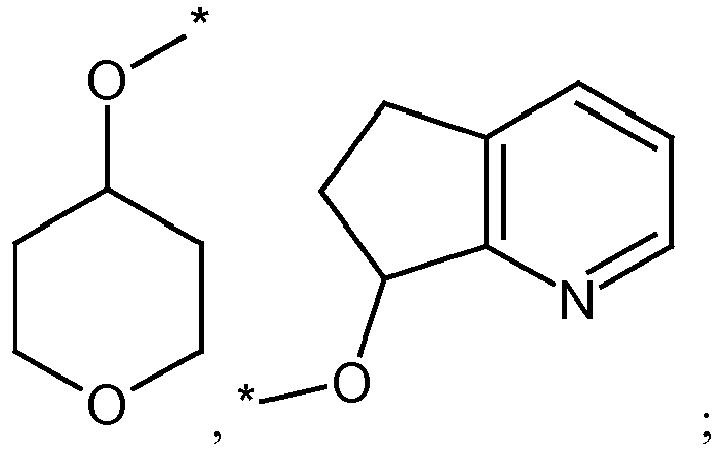
- R3 is *-O-alkyl -R3' or *-NH-alkyl-R3', wherein R3' is hydroxyl, phenyl, pyridinyl (e.g., pyridin-2-yl, pyridin-3-yl, or pyridin-4-yl), indolyl (e.g. indo-3-yl), or pyrrolidonyl (e.g., N-pyrrolidonyl) optionally substituted at one or more positions with halo (e.g., 2-fluoropyridin-4-yl);
- R4 and R4' are selected from hydrogen, alkyl (e.g., methyl), cycloalkyl (e.g., cyclopropyl); haloalkyl (e.g., trifluoromethyl), halo, (e.g., fluoro, chloro, or bromo), alkoxy (e.g., methoxy), cyano, amino, hydroxyl, carboxyl, carboxy alkyl ester (e.g., carboxyethyl ester), phenyl optionally substituted with alkoxy, haloalkoxy (e.g., 2-trifluoromethyoxy-phenyl), and benzamido (e.g., 3-benzamido);
- R5 is hydrogen, alkyl (e.g., ethyl), cycloalkyl (e.g., cyclopropyl), amino, carboxyl, carboxy alkyl ester, carboxy amido, carboxy alkyl amido (e.g., N-cyclopropylformamide), or N-benzimidazole;
- R6 is hydrogen, alkyl (e.g., methyl, ethyl, or propyl), phenyl optionally substituted at one or more positions with alkyoxy (e.g., 2-methoxy or 3-methoxy) or halo (e.g., 2-chloro or 3-chloro), tetrahydropuranyl (e.g., tetrahydropuran-4-yl), alkylmorpholinyl (e.g., ethyl-N-morpholinyl), and benzyl;
- R7 is hydrogen, or alkyl (e.g., methyl);
- R8 is hydrogen or phenyl optionally substituted at one or more positions with alkyoxy (e.g., 2-methoxy or 3-methyoxy); and
- Y1, Y2, Y3, and Y4 are the same or different and are selected from C or N and preferably no more than two or three of Y1, Y2, Y3, and Y4 are N;
- R9, R10, R11, R12, and R13 are the same or different and are hydrogen, alkyl (e.g., methyl), alkoxy (e.g., methoxy), halo (e.g., fluoro or chloro), haloalkyl, (e.g., trifluoromethyl), nitro, carboxylalkyl ester (e.g. carboxylmethyl ester), or phenyl;
- R14, R15, and R16 are the same or different and are hydrogen, alkyl (e.g., methyl), halo, haloalkyl (e.g., trifluoromethyl), cyano, or phenyl optionally substituted with halo or haloalkyl (e.g., 1-chloro-2-trifluoromethyl-phen-4-yl or 1, 2-dichlorophen-4-yl).
- In particular, the disclosed compounds may have a formula selected from:
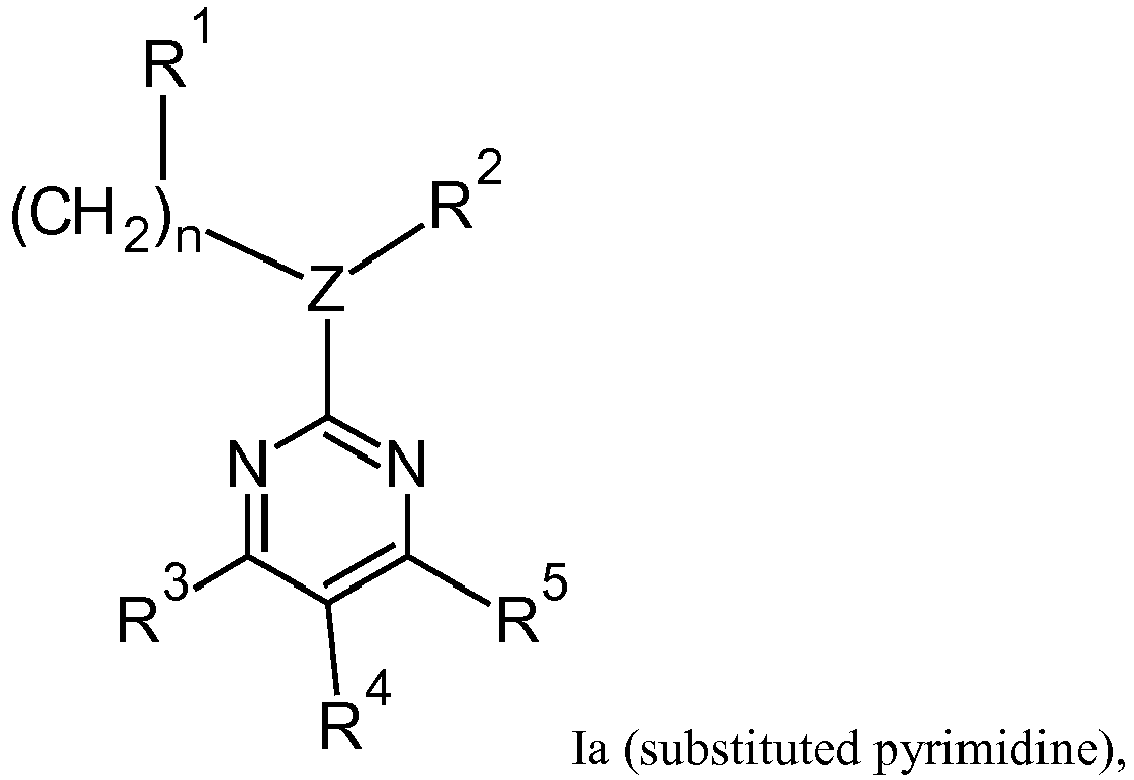


- In the disclosed compounds, Z is a nitrogen atom or oxygen atom and/or R3 may be attached to the pyrimidine/pyridine/pyridazine core via a nitrogen atom or oxygen atom present in R3. In embodiments in which the compounds have a Formula la, Ic, or Ie (i.e., substituted pyrimidine compounds) and either Z is a nitrogen atom or oxygen atom and/or R3 is attached to the pyrimidine core via a nitrogen atom or oxygen atom present in R3, the disclosed compounds may be referred to as "amino-substituted pyrimidine-based compounds" or ether-substituted pyrimidine-based compounds," respectively.
- Also disclosed are pharmaceutical compositions that comprise the disclosed compounds together with a carrier, diluent, or excipient. The pharmaceutical compositions may comprise an effective amount of the compounds (or salts, esters, amides, or solvates thereof) for treating and/or preventing a disease, disorder, or condition associated with Mnk1 and/or Mnk2 activity. Diseases, disorders, and conditions associated with Mnk1 and/or Mnk2 activity may include but are not limited to cell proliferation diseases disorders (e.g., blood cancers such as AML and/or solid tumor cancers such as glioblastoma (GBM) and pancreatic cancer), diabetes, autism, and fragile X syndrome.
- Also disclosed are methods of treating diseases or disorders associated with Mnk1 and/or Mnk2 activity. The methods typically include administering the disclosed compounds to a subject in need thereof, for example, where the compounds are formulated as a pharmaceutical composition and administered to a subject having a disease or disorder associated with Mnk1 and/or Mnk2 activity or suspected of having a disease or disorder associated with Mnk1 and/or Mnk2 activity. Diseases and disorders associated with Mnk1 and/or Mnk2 activity may include cell proliferative diseases or disorders (e.g., blood cancers such as AML and/or solid tumor cancers such as glioblastoma (GBM) and pancreatic cancer), diabetes, autism, and/or fragile X syndrome. Cancers treated by the disclosed methods may include, but are not limited to leukemia (e.g., acute myeloid leukemia), multiple myeloma, non-small cell lung cancer, colon cancer, cancer of the central nervous system, melanoma, ovarian cancer, renal cancer, prostate cancer, and breast cancer.
- The present invention is described herein using several definitions, as set forth below and throughout the application.
- Unless otherwise specified or indicated by context, the terms "a", "an", and "the" mean "one or more." For example, "a compound" should be interpreted to mean "one or more compounds."
- As used herein, "about," "approximately," "substantially," and "significantly" will be understood by persons of ordinary skill in the art and will vary to some extent on the context in which they are used. If there are uses of these terms which are not clear to persons of ordinary skill in the art given the context in which they are used, "about" and "approximately" will mean plus or minus ≤10% of the particular term and "substantially" and "significantly" will mean plus or minus >10% of the particular term.
- As used herein, the terms "include" and "including" have the same meaning as the terms "comprise" and "comprising" in that these latter terms are "open" transitional terms that do not limit claims only to the recited elements succeeding these transitional terms. The term "consisting of," while encompassed by the term "comprising," should be interpreted as a "closed" transitional term that limits claims only to the recited elements succeeding this transitional term. The term "consisting essentially of," while encompassed by the term "comprising," should be interpreted as a "partially closed" transitional term which permits additional elements succeeding this transitional term, but only if those additional elements do not materially affect the basic and novel characteristics of the claim.
- The term "alkyl" as contemplated herein includes a straight-chain or branched alkyl radical in all of its isomeric forms. Alkyl groups may include, but are not limited to, methyl, ethyl, propyl, isopropyl, 2-methyl-1-propyl, 2-methyl-2-propyl, 2-methyl-1-butyl, 3 methyl-1-butyl, 2-methyl-3-butyl, 2,2-dimethyl-1-propyl, 2-methyl-1-pentyl, 3-methyl-1-pentyl, 4-methyl-1-pentyl, 2-methyl-2-pentyl, 3-methyl-2-pentyl, 4-methyl-2-pentyl, 2,2-dimethyl-1-butyl, 3,3-dimethyl-1-butyl, 2-ethyl-1-butyl, butyl, isobutyl, t-butyl, pentyl, isopentyl, neopentyl, hexyl, heptyl, octyl, and the like.
- The term "alkenyl" as used herein refers to an unsaturated straight or branched hydrocarbon having at least one carbon-carbon double bond, such as a straight or branched group of 2-12, 2-10, or 2-6 carbon atoms, referred to herein as C2-C12 alkenyl, C2-C10 alkenyl, and C2-C6 alkenyl, respectively. Exemplary alkenyl groups include vinyl, allyl, butenyl, pentenyl, hexenyl, butadienyl, pentadienyl, hexadienyl, and the like.
- The term "alkynyl" as used herein refers to an unsaturated straight or branched hydrocarbon having at least one carbon-carbon triple bond, such as a straight or branched group of 2-12, 2-10, or 2-6 carbon atoms, referred to herein as C2-C12 alkynyl, C2-C10 alkynyl, and C2-C6 alkynyl, respectively. Exemplary alkynyl groups include ethynyl, prop-1-yn-1-yl, and but-1-yn-1-yl.
- The term "cycloalkyl" refers to a monovalent saturated cyclic, bicyclic, or bridged cyclic (e.g., adamantyl) hydrocarbon group of 3-12, 3-8, 4-8, or 4-6 carbons, referred to herein, (e.g., as "C4-8cycloalkyl") derived from a cycloalkane. Exemplary cycloalkyl groups include, but are not limited to, cyclohexanes, cyclopentanes, cyclobutanes and cyclopropanes. Cycloalkyl groups may be optionally substituted at one or more ring positions with, for example, alkanoyl, alkoxy, alkyl, haloalkyl, alkenyl, alkynyl, amido, amidino, amino, aryl, arylalkyl, azido, carbamate, carbonate, carboxy, cyano, cycloalkyl, ester, ether, formyl, halogen, haloalkyl, heteroaryl, heterocyclyl, hydroxyl, imino, ketone, nitro, phosphate, phosphonato, phosphinato, sulfate, sulfide, sulfonamido, sulfonyl or thiocarbonyl. Cycloalkyl groups can be fused to other cycloalkyl, aryl, or heterocyclyl groups. In certain embodiments, the cycloalkyl group is not substituted (i.e., unsubstituted).
- The term "haloalkyl" refers to an alkyl group that is substituted at one or more positions with at least one halogen. Haloalkyls may include, -CH2F, -CHF2, -CF3, - CH2CF3, -CF2CF3, CH3Cl, CH2Cl2, and the like.
- The term "heteroalkyl" as used herein refers to an "alkyl" group in which at least one carbon atom has been replaced with a heteroatom (e.g., an O, N, or S atom). In certain embodiments, the "heteroalkyl" may be 2-8 membered heteroalkyl, indicating that the heteroalkyl contains from 2 to 8 atoms selected from the group consisting of carbon, oxygen, nitrogen, and sulfur. In yet other embodiments, the heteroalkyl may be a 2-6 membered, 4-8 membered, or a 5-8 membered heteroalkyl group (which may contain for example 1 or 2 heteroatoms selected from the group oxygen and nitrogen). One type of heteroalkyl group is an "alkoxyl" group.
- The term "partially unsaturated carbocyclyl" refers to a monovalent cyclic hydrocarbon that contains at least one double bond between ring atoms where at least one ring of the carbocyclyl is not aromatic. The partially unsaturated carbocyclyl may be characterized according to the number of ring carbon atoms. For example, the partially unsaturated carbocyclyl may contain 5-14, 5-12, 5-8, or 5-6 ring carbon atoms, and accordingly be referred to as a 5-14, 5-12, 5-8, or 5-6 membered partially unsaturated carbocyclyl, respectively. The partially unsaturated carbocyclyl may be in the form of a monocyclic carbocycle, bicyclic carbocycle, tricyclic carbocycle, bridged carbocycle, spirocyclic carbocycle, or other carbocyclic ring system. Exemplary partially unsaturated carbocyclyl groups include cycloalkenyl groups and bicyclic carbocyclyl groups that are partially unsaturated. Unless specified otherwise, partially unsaturated carbocyclyl groups are optionally substituted at one or more ring positions with, for example, alkanoyl, alkoxy, alkyl, haloalkyl, alkenyl, alkynyl, amido, amidino, amino, aryl, arylalkyl, azido, carbamate, carbonate, carboxy, cyano, cycloalkyl, ester, ether, formyl, halogen, haloalkyl, heteroaryl, heterocyclyl, hydroxyl, imino, ketone, nitro, phosphate, phosphonato, phosphinato, sulfate, sulfide, sulfonamido, sulfonyl or thiocarbonyl. In certain embodiments, the partially unsaturated carbocyclyl is not substituted (i.e., unsubstituted).
- The term "cycloalkenyl" as used herein refers to a monovalent unsaturated cyclic, bicyclic, or bridged cyclic (e.g., adamantyl) hydrocarbon group of 3-12, 3-8, 4-8, or 4-6 carbons containing one carbon-carbon double bond, referred to herein, e.g., as "C4-8cycloalkenyl," derived from a cycloalkane. Exemplary cycloalkenyl groups include, but are not limited to, cyclohexenes, cyclopentenes, and cyclobutenes. Unless specified otherwise, cycloalkenyl groups are optionally substituted at one or more ring positions with, for example, alkanoyl, alkoxy, alkyl, alkenyl, alkynyl, amido, amidino, amino, aryl, arylalkyl, azido, carbamate, carbonate, carboxy, cyano, cycloalkyl, ester, ether, formyl, halogen, haloalkyl, heteroaryl, heterocyclyl, hydroxyl, imino, ketone, nitro, phosphate, phosphonato, phosphinato, sulfate, sulfide, sulfonamido, sulfonyl or thiocarbonyl. In certain embodiments, the cycloalkenyl group is not substituted (i.e., unsubstituted).
- The term "aryl" is art-recognized and refers to a carbocyclic aromatic group. Representative aryl groups include phenyl, naphthyl, anthracenyl, and the like. The term "aryl" includes polycyclic ring systems having two or more carbocyclic rings in which two or more carbons are common to two adjoining rings (the rings are "fused rings") wherein at least one of the rings is aromatic and, e.g., the other ring(s) may be cycloalkyls, cycloalkenyls, cycloalkynyls, and/or aryls. Unless specified otherwise, the aromatic ring may be substituted at one or more ring positions with, for example, halogen, azide, alkyl, aralkyl, alkenyl, alkynyl, cycloalkyl, hydroxyl, alkoxyl, amino, nitro, sulfhydryl, imino, amido, carboxylic acid, -C(O)alkyl, -CO2alkyl, carbonyl, carboxyl, alkylthio, sulfonyl, sulfonamido, sulfonamide, ketone, aldehyde, ester, heterocyclyl, aryl or heteroaryl moieties, -CF3, -CN, or the like. In certain embodiments, the aromatic ring is substituted at one or more ring positions with halogen, alkyl, hydroxyl, or alkoxyl. In certain other embodiments, the aromatic ring is not substituted, i.e., it is unsubstituted. In certain embodiments, the aryl group is a 6-10 membered ring structure.
- The term "bicyclic carbocyclyl that is partially unsaturated" refers to a bicyclic carbocyclic group containing at least one double bond between ring atoms and at least one ring in the bicyclic carbocyclic group is not aromatic.
- The terms "heterocyclyl" and "heterocyclic group" are art-recognized and refer to saturated, partially unsaturated, or aromatic 3-membered ring structures to 10-membered ring structures, alternatively 3-membered ring structures to 7-membered ring structures, whose ring structures include one to four heteroatoms, such as nitrogen, oxygen, and sulfur. The number of ring atoms in the heterocyclyl group can be specified using Cx-Cx nomenclature where x is an integer specifying the number of ring atoms. For example, a C3-C7 heterocyclyl group refers to a saturated or partially unsaturated 3-membered ring structure to a 7-membered ring structure containing one to four heteroatoms, such as nitrogen, oxygen, and sulfur. The designation "C3-C7" indicates that the heterocyclic ring contains a total of from 3 to 7 ring atoms, inclusive of any heteroatoms that occupy a ring atom position. One example of a Csheterocyclyl is aziridinyl. Heterocycles may also be mono-, bi-, or other multi-cyclic ring systems including a spirocyclic ring system where at least one ring contains a ring heteroatom. A heterocycle may be fused to one or more aryl, partially unsaturated, or saturated rings. Heterocyclyl groups include, for example, biotinyl, chromenyl, dihydrofuryl, dihydroindolyl, dihydropyranyl, dihydrothienyl, dithiazolyl, homopiperidinyl, imidazolidinyl, isoquinolyl, isothiazolidinyl, isooxazolidinyl, morpholinyl, oxolanyl, oxazolidinyl, phenoxanthenyl, piperazinyl, piperidinyl, pyranyl, pyrazolidinyl, pyrazolinyl, pyridyl, pyrimidinyl, pyrrolidinyl, pyrrolidin-2-onyl, pyrrolinyl, tetrahydrofuryl, tetrahydroisoquinolyl, tetrahydropyranyl, tetrahydroquinolyl, thiazolidinyl, thiolanyl, thiomorpholinyl, thiopyranyl, xanthenyl, lactones, lactams such as azetidinones and pyrrolidinones, sultams, sultones, and the like. Unless specified otherwise, the heterocyclic ring is optionally substituted at one or more positions with substituents such as alkanoyl, alkoxy, alkyl, alkenyl, alkynyl, amido, amidino, amino, aryl, arylalkyl, azido, carbamate, carbonate, carboxy, cyano, cycloalkyl, ester, ether, formyl, halogen, haloalkyl, heteroaryl, heterocyclyl, hydroxyl, imino, ketone, nitro, oxo, phosphate, phosphonato, phosphinato, sulfate, sulfide, sulfonamido, sulfonyl and thiocarbonyl. In certain embodiments, the heterocyclyl group is not substituted, i.e., it is unsubstituted.
- The term "bicyclic heterocyclyl" refers to a heterocyclyl group that contains two rings that are fused together. In certain embodiments, the bicyclic heterocyclyl is an carbocyclic ring fused to partially unsaturated heterocyclic ring, that together form a bicyclic ring structure having 8-10 ring atoms (e.g., where there are 1, 2, 3, or 4 heteroatoms selected from the group consisting of nitrogen, oxygen, and sulfur).
- The term "heteroaryl" is art-recognized and refers to aromatic groups that include at least one ring heteroatom. In certain instances, a heteroaryl group contains 1, 2, 3, or 4 ring heteroatoms. Representative examples of heteroaryl groups include pyrrolyl, furanyl, thiophenyl, imidazolyl, oxazolyl, thiazolyl, triazolyl, pyrazolyl, pyridinyl, pyrazinyl, pyridazinyl and pyrimidinyl, and the like. Unless specified otherwise, the heteroaryl ring may be substituted at one or more ring positions with, for example, halogen, azide, alkyl, aralkyl, alkenyl, alkynyl, cycloalkyl, hydroxyl, alkoxyl, amino, nitro, sulfhydryl, imino, amido, carboxylic acid, -C(O)alkyl, -CO2alkyl, carbonyl, carboxyl, alkylthio, sulfonyl, sulfonamido, sulfonamide, ketone, aldehyde, ester, heterocyclyl, aryl or heteroaryl moieties, -CF3, -CN, or the like. The term "heteroaryl" also includes polycyclic ring systems having two or more rings in which two or more carbons are common to two adjoining rings (the rings are "fused rings") wherein at least one of the rings is heteroaromatic, e.g., the other cyclic rings may be cycloalkyls, cycloalkenyls, cycloalkynyls, and/or aryls. In certain embodiments, the heteroaryl ring is substituted at one or more ring positions with halogen, alkyl, hydroxyl, or alkoxyl. In certain other embodiments, the heteroaryl ring is not substituted, i.e., it is unsubstituted. In certain embodiments, the heteroaryl group is a 5- to 10-membered ring structure, alternatively a 5-to 6-membered ring structure, whose ring structure includes 1, 2, 3, or 4 heteroatoms, such as nitrogen, oxygen, and sulfur.
- The terms "amine" and "amino" are art-recognized and refer to both unsubstituted and substituted amines, e.g., a moiety represented by the general formula - N(R1)(R2), wherein R1 and R2 each independently represent hydrogen, alkyl, cycloalkyl, heterocyclyl, alkenyl, aryl, aralkyl, or -(CH2)m-R3; or R1 and R2, taken together with the N atom to which they are attached complete a heterocycle having from 4 to 8 atoms in the ring structure; R3 represents an aryl, a cycloalkyl, a cycloalkenyl, a heterocycle or a poly cycle; and m is zero or an integer in the range of 1 to 8. In certain embodiments, R1 and R2 each independently represent hydrogen, alkyl, alkenyl, or -(CH2)m-R3.
- The terms "alkoxyl" or "alkoxy" are art-recognized and refer to an alkyl group, as defined above, having an oxygen radical attached thereto. Representative alkoxyl groups include methoxy, ethoxy, propyloxy, tert-butoxy and the like. An "ether" is two hydrocarbons covalently linked by an oxygen. Accordingly, the substituent of an alkyl that renders that alkyl an ether is or resembles an alkoxyl, such as may be represented by one of -O-alkyl, -O-alkenyl, -O-alkynyl, -O-(CH2)m-R3, where m and R3 are described above.
- The term "carbamate" as used herein refers to a radical of the form - R1OC(O)N(R2)-, -R1OC(O)N(R2)R3-, or -OC(O)NR2R3, wherein R1, R2 and R3 are each independently alkoxy, aryloxy, alkyl, alkenyl, alkynyl, amide, amino, aryl, arylalkyl, carboxy, cyano, cycloalkyl, ester, ether, formyl, halogen, haloalkyl, heteroaryl, heterocyclyl, hydroxyl, ketone, nitro, sulfide, sulfonyl, or sulfonamide. Exemplary carbamates include arylcarbamates and heteroaryl carbamates, e.g., wherein at least one of R1, R2, and R3 are independently aryl or heteroaryl, such as phenyl and pyridinyl.
- The term "carbonyl" as used herein refers to the radical -C(O)-.
- The term "carboxamido" as used herein refers to the radical -C(O)NRR', where R and R' may be the same or different. R and R' may be independently alkyl, aryl, arylalkyl, cycloalkyl, formyl, haloalkyl, heteroaryl, or heterocyclyl.
- The term "carboxy" as used herein refers to the radical -COOH or its corresponding salts, e.g. -COONa, etc.
- The term "amide" or "amido" as used herein refers to a radical of the form -R1C(O)N(R2)-, -R1C(O)N(R2)R3-, -C(O)NR2R3, or -C(O)NH2, wherein R1, R2 and R3 are each independently alkoxy, alkyl, alkenyl, alkynyl, amide, amino, aryl, arylalkyl, carbamate, cycloalkyl, ester, ether, formyl, halogen, haloalkyl, heteroaryl, heterocyclyl, hydrogen, hydroxyl, ketone, or nitro. The amide can be attached to another group through the carbon, the nitrogen, R1, R2, or R3. The amide also may be cyclic, for example R1 and R2, R2 and R3, or R1 and R3 may be joined to form a 3- to 12-membered ring, such as a 3-to 10-membered ring or a 5- to 6-membered ring.
- As used herein, an asterisk "*" is used to designate the point of attachment for any radical group or substituent group.
- As used herein, a "subject" may be interchangeable with "patient" or "individual" and means an animal, which may be a human or non-human animal, in need of treatment.
- A "subject" in need of treatment" may include a subject having a disease, disorder, or condition that is responsive to therapy with an inhibitor of Mnk1 kinase and/or Mnk2 kinase. For example, a "subject in need of treatment" may include a subject having a cell proliferative disease, disorder, or condition such as cancer (e.g., cancers such as multiple myeloma, leukemia, non-small cell lung cancer, colon cancer, cancer of the central nervous system, melanoma, ovarian cancer, renal cancer, prostate cancer, pancreatic cancer, brain cancer (e.g., glioblastoma (GBM) and breast cancer). A "subject in need of treatment" also may include a subject having diabetes, autism, and/or fragile X syndrome.
- As used herein, the phrase "effective amount" shall mean that drug dosage that provides the specific pharmacological response for which the drug is administered in a significant number of subjects in need of such treatment. An effective amount of a drug that is administered to a particular subject in a particular instance will not always be effective in treating the conditions/diseases described herein, even though such dosage is deemed to be a therapeutically effective amount by those of skill in the art.
- The formulae of the compounds disclosed herein should be interpreted as encompassing all possible stereoisomers, enantiomers, or epimers of the disclosed compounds unless the formulae indicates a specific stereoisomer, enantiomer, or epimer. The formulae of the compounds disclosed herein should be interpreted as encompassing salts, esters, amides, or solvates thereof of the compounds.
- The disclosed compounds may be effective in inhibiting cell proliferation of cancer cells. For example, the disclosed compound may be effective in inhibiting cell proliferation of one or more types of cancer cells including: leukemia cells, such as CCRF-CEM, HL-60(TB), MOLT-4, RPMI-8226 and SR; multiple myeloma cells, such as MM.1S cells; non-small lung cancer cells, such as A549/ATCC, EKVX, HOP-62, HOP-92, NCI-H226, NCI-H23, NCI-H322M, NCI-H460 and NCI-H522; colon cancer cells, such as COLO 205, HCC-2998, HCT-116, HCT-15, HT29, KM12 and SW-620; CNS: SF-268, SF-295, SF-539, SNB-19, SNB-75 and U251; melanoma cancer cells, such as LOX IMVI, MALME-3M, M14, MDA-MB-435, SK-MEL-2, SK-MEL-28, SK-MEL-5, UACC-257 and UACC-62; ovarian cancer cells, such as IGR-OV1, OVCAR-3, OVCAR-4, OVCAR-5, OVCAR-8, NCI/ADR-RES and SK-OV-3; renal cancer cells, such as 786-0, A498, ACHN, CAKI-1, RXF 393, SN12C, TK-10 and UO-31; prostate cancer cells, such as DU-145 and PC-3; and breast cancer cells, such as MCF7, MDA-MB-231/ATCC, MDA-MB-468, HS 578T, BT-549 and T-47D.
- Cell proliferation and inhibition thereof by the presently disclosed compounds may be assessed by cell viability methods disclosed in the art including colorimetric assays that utilize dyes such as MTT, XTT, and MTS to assess cell viability. Preferably, the disclosed compounds have an IC50 of less than about 10 µM, 5 µM, 1 µM, or 0.5 µM in the selected assay.
- The compounds utilized in the methods disclosed herein may be formulated as pharmaceutical compositions that include: (a) a therapeutically effective amount of one or more compounds as disclosed herein; and (b) one or more pharmaceutically acceptable carriers, excipients, or diluents. The pharmaceutical composition may include the compound in a range of about 0.1 to 2000 mg (preferably about 0.5 to 500 mg, and more preferably about 1 to 100 mg). The pharmaceutical composition may be administered to provide the compound at a daily dose of about 0.1 to 100 mg/kg body weight (preferably about 0.5 to 20 mg/kg body weight, more preferably about 0.1 to 10 mg/kg body weight). In some embodiments, after the pharmaceutical composition is administered to a subject (e.g., after about 1, 2, 3, 4, 5, or 6 hours post-administration), the concentration of the compound at the site of action is about 2 to 10 µM.
- Pyridine-based compounds have been disclosed as inhibitors of Src kinase. (See
U.S. Patent No. 6,498,165 , the content of which is incorporated herein by reference in its entirety). The disclosed compounds preferably inhibit the kinase activity of Mnkl, otherwise referred to as mitogen-activated protein kinase interacting kinase 1. (See Oyarzabal et al., J. Med. Chem. 2010 Sep 23;53(18):6618-28, the content of which is incorporated herein by reference in its entirety). Inhibition of Mnk kinase activity results in suppressive effects on acute myeloid leukemia. (See Altman et al., Blood 2013 May 2;121(18):3675-81, the content of which is incorporated herein by reference in its entirety). Mnk kinase also phosphorylates eIF4E, which has also been implicated in disorders such as diabetes (U.S. Patent No. 20090170095 A1 ), autism (Nature 493, 371-377), and fragile X (Nature Neuroscience 16, 1530-1536 (2013)). In some embodiments, the disclosed compounds inhibit the kinase activity of Mnk1 and/or Mnk2 and have an IC50 of less than about 100 µM, 10 µM, 1 µM, 0.5 µM, 0.1 µM, 0.05 µM, 0.01 µM, 0.005 or 0.001 µM. - Disclosed are substituted aromatic N-heterocyclic compounds which have been shown to inhibit mitogen-activated protein kinase interacting kinases 1 and 2 (MNK1 and MNK2). The disclosed compounds may be described as having a Formula I or I':

- X1, X2, X3, and X4 are the same or different and are C or N, at least one of X1, X2, X3, and X4 is N and preferably no more than two of X1, X2, X3, and X4 is N;
- Z is N or O;
- n is 0-6 and optionally, (CH2)n is substituted with alkyl and forms a branched alkyl substituent;
- R1 is hydrogen; alkyl; alkyoxy; hydroxyl; hydroxyalkyl; carboxyl; carboxyalkylester; cycloalkyl (e.g., cyclobutyl, cyclopentyl, and cyclohexyl) optionally substituted at one or more positions with hydroxyl, alkyl, alkoxyl, amino, alkylamino (e.g., methylamino or dimethylamino), or carboxyl; bicycloalkyl (e.g., bicyclo[1.1.1]pentan-1-yl or bicyclo[1.1.1]pentan-2-yl); amino optionally substituted with alkyl (e.g., methylamino or dimethylamino); carboxy amido optionally substituted with phenyl or substituted phenyl; thioamido; or
- R1 is one 3-membered, one 4-membered ring, 5-membered ring, one 6-membered ring, or one 7-membered ring which ring is optionally saturated or unsaturated, or R1 is two fused rings which may be 5-membered rings or 6-membered rings which rings are optionally saturated or unsaturated, which one ring or rings are carbocycles or heterocycles including one or more heteroatoms (e.g., N, O, or S, e.g., N-benzimidazole, or 1H-indazo-1-yl), which one ring or rings optionally are substituted to include one or more non-hydrogen substituents, which non-hydrogen substituents optionally are selected from alkyl, halo, haloalkyl, hydroxyl, phenyl, amino, carbonyl, N-pyrrolidinyl, or caprolactam;
- R1 optionally is phenyl optionally substituted at one or more positions with alkyl (e.g., methyl), halo (e.g., fluoro), haloalkyl (e.g., trifluoromethyl), alkyoxy (e.g., methoxy), cyano, amino, or carboxy amido; pyridinyl (e.g., N-pyridinyl, pyridin-2-yl, pyridin-3-yl, or pyridin-3-yl) optionally substituted at one or more positions with halo (e.g., 6-chloropyridin-2-yl, 4,6-dichloropyrindin-2-yl, of 2-fluoropyridin-4-yl); pyrrolidinyl (e.g., N-pyrrolidinyl, pyrrolidin-2-yl, or pyrrolidin-3-yl); tetrahydropyranyl (e.g., tetrahydropyran-2-yl, tetrahydropyran-3-yl, or tetrahydropyran-4-yl); tetrahydrofuranyl (e.g., tetrahydrofuran-2-yl or tetrahydrofuran-3-yl); oxetanyl (e.g., oxetan-2-yl or oxetan-3-yl); pyrrolidonyl (e.g., N-2-pyrrolidonyl, 2-pyrrolidon-4-yl); piperidinyl (e.g., N-piperidinyl, piperidin-2-yl, piperidin-3-yl, or piperidin-4yl); piperazinyl optionally substituted with alkyl (e.g., N-piperazinyl, N-(1-methylpiperazinyl, or piperazin-2-yl); morpholinyl (e.g., N-morpholinyl); imidazolyl (e.g., 1H-imidazol-1-yl, 1H-imidazol-2-yl, or 1H-imidazol-4-yl) optionally substituted at one or more positions with alkyl (e.g., methyl or ethyl such as N-methylimidazole or N-ethylimidazole); pyrazolyl (e.g., 1H-pyrazol-1-yl, 1H-pyrazol-3-yl, or 1H-pyrazol-4-yl); benzyamidyl (e.g., 4-benzamidyl); N-methylbenzamid-4-yl; benzoyl (e.g., benzo-4-yl); benzoylpiperazine (e.g., 4-benzoylpiperazine); N-phenylformamidyl; or indolyl (e.g., N-indolyl, 1H-indol-2-yl, or 1H-indol-3-yl); or
- R1 has a structure selected from
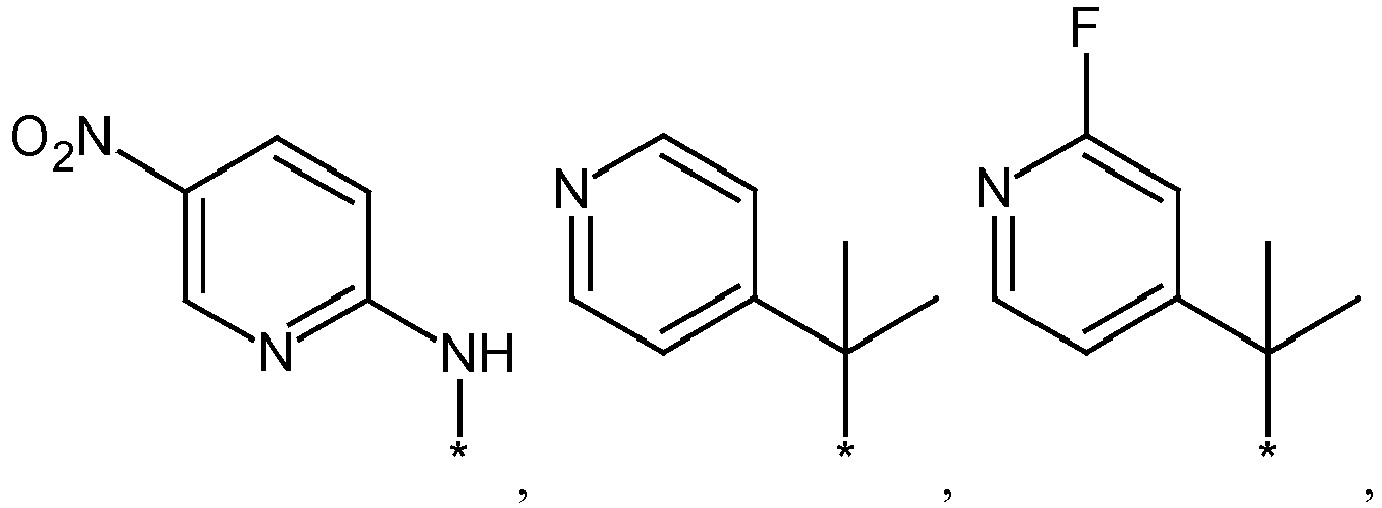


- R2 is hydrogen, alkyl, or R2 and R1 together form one 5-membered ring, one 6-membered ring, or one 7-membered ring which ring is optionally saturated or unsaturated, or R2 and R1 together form two fused rings which may be 5-membered rings or 6-membered rings which rings are optionally saturated or unsaturated, which ring or rings are carbocycles or heterocycles including one or more heteroatoms (e.g., N, O, or S, e.g., N-benzimidazole, or 1H-indazo-1-yl), which ring or rings optionally are substituted to include one or more non-hydrogen substituents, which non-hydrogen substituents optionally are selected from alkyl, halo, haloalkyl, hydroxyl, phenyl, amino, carbonyl, N-pyrrolidinyl, or caprolactam;
- R3 has a structure selected from
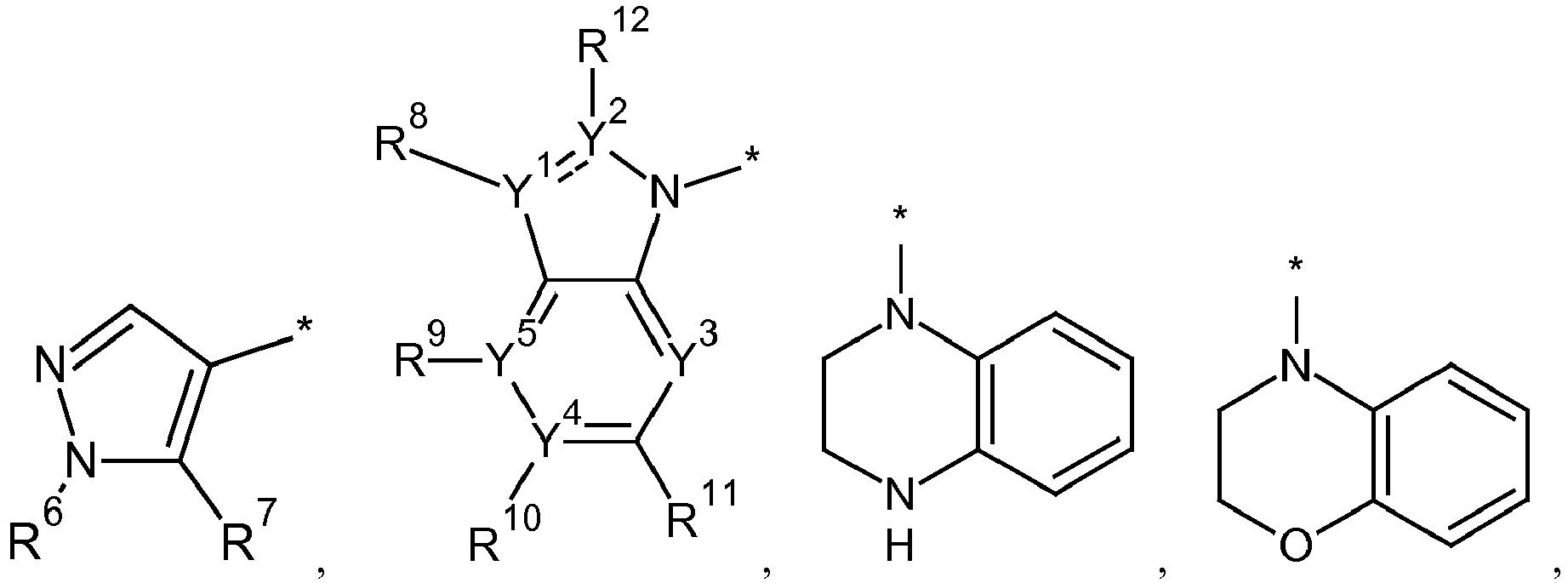


- R3 is *-O-alkyl-R3' or *-NH-alkyl-R3', wherein R3' is hydroxyl, phenyl, pyridinyl (e.g., pyridin-2-yl, pyridin-3-yl, or pyridin-4-yl), indolyl (e.g. indo-3-yl), or pyrrolidonyl (e.g., N-pyrrolidonyl) optionally substituted at one or more positions with halo (e.g., 2-fluoropyridin-4-yl);
- R4 and R4' are selected from hydrogen, alkyl (e.g., methyl), cycloalkyl (e.g., cyclopropyl); haloalkyl (e.g., trifluoromethyl), halo, (e.g., fluoro, chloro, or bromo), alkoxy (e.g., methoxy), cyano, amino, hydroxyl, carboxyl, carboxy alkyl ester (e.g., carboxyethyl ester), phenyl optionally substituted with alkoxy, haloalkoxy (e.g., 2-trifluoromethyoxy-phenyl), and benzamido (e.g., 3-benzamido);
- R5 is hydrogen, alkyl (e.g., ethyl), cycloalkyl (e.g., cyclopropyl), amino, carboxyl, carboxy alkyl ester, carboxy amido, carboxy alkyl amido (e.g., N-cyclopropylformamide), or N-benzimidazole;
- R6 is hydrogen, alkyl (e.g., methyl, ethyl, or propyl), phenyl optionally substituted at one or more positions with alkyoxy (e.g., 2-methoxy or 3-methoxy) or halo (e.g., 2-chloro or 3-chloro), tetrahydropuranyl (e.g., tetrahydropuran-4-yl), alkylmorpholinyl (e.g., ethyl-N-morpholinyl), and benzyl;
- R7 is hydrogen, or alkyl (e.g., methyl);
- R8 is hydrogen or phenyl optionally substituted at one or more positions with alkyoxy (e.g., 2-methoxy or 3-methyoxy); and
- Y1, Y2, Y3, and Y4 are the same or different and are selected from C or N and preferably no more than two or three of Y1, Y2, Y3, and Y4 are N;
- R9, R10, R11, R12, and R13 are the same or different and are hydrogen, alkyl (e.g., methyl), alkoxy (e.g., methoxy), halo (e.g., fluoro or chloro), haloalkyl, (e.g., trifluoromethyl), nitro, carboxylalkyl ester (e.g. carboxylmethyl ester), or phenyl;
- R14, R15, and R16 are the same or different and are hydrogen, alkyl (e.g., methyl), halo, haloalkyl (e.g., trifluoromethyl), cyano, or phenyl optionally substituted with halo or haloalkyl (e.g., 1-chloro-2-trifluoromethyl-phen-4-yl or 1, 2-dichlorophen-4-yl)..
- In particular, the disclosed compounds may have a formula selected from:


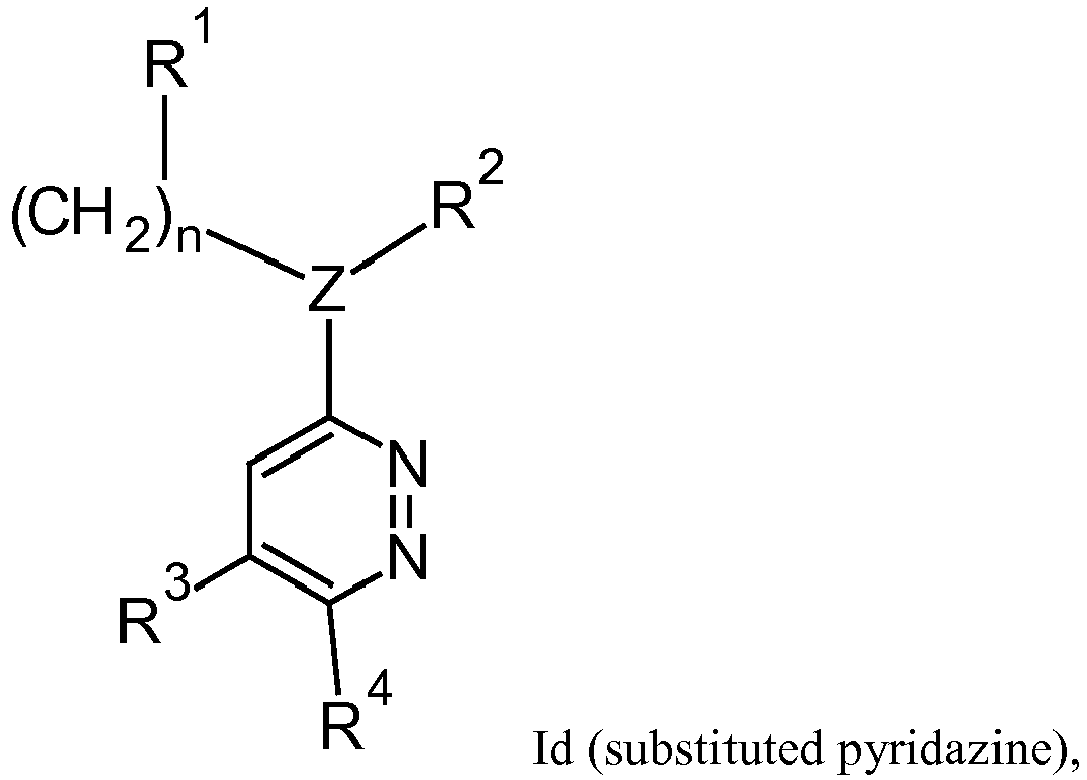

- In some embodiments of the disclosed compounds, Z is a nitrogen atom or oxygen atom and/or R3 may be attached to the pyrimidine/pyridine/pyridazine core via a nitrogen atom or oxygen atom present in R3. In embodiments in which the compounds have a Formula la, Ic, or Ie (i.e., substituted pyrimidine compounds) and either Z is a nitrogen atom or oxygen atom and/or R3 is attached to the pyrimidine core via a nitrogen atom or oxygen atom present in R3, the disclosed compounds may be referred to as "amino-substituted pyrimidine-based compounds" or ether-substituted pyrimidine-based compounds," respectively
- In some embodiments, the disclosed compounds may have a formula selected from selected from Formula II and III:

- In further embodiments of compounds having Formula II, the compounds disclosed herein may have Formula IIa or IIb as follows:

- In further embodiments of compounds having Formula III, the compounds disclosed herein may have Formula IIIa as follows:

- In some embodiments, the disclosed compounds may have a Formula IV:

- In particular, in some compounds having a Formula IV, R3 may have a formula -W-(CH2)p-R3', where W is N or O, p is 0-6, and R3' is one 3-membered, one 4-membered ring, 5-membered ring, one 6-membered ring, or one 7-membered ring which ring is optionally saturated or unsaturated, or R3' is two fused rings which may be 5-membered rings or 6-membered rings which rings are optionally saturated or unsaturated, which one ring or rings optionally are carbocycles or heterocycles including one or more heteroatoms (e.g., N, O, or S, e.g., N-benzimidazole, or 1H-indazo-1-yl), which one ring or rings optionally are substituted to include one or more non-hydrogen substituents, which non-hydrogen substituents optionally are selected from alkyl, halo, haloalkyl, hydroxyl, phenyl, amino, and carbonyl. For example, R3' may include phenyl, pyridinyl (e.g., pyridin-2-yl, pyridin-3-yl, or pyridin-4-yl), indolyl (e.g. indo-3-yl), or pyrrolidonyl (e.g., N-pyrrolidonyl) optionally substituted at one or more positions with halo (e.g., 2-fluoropyridin-4-yl).
- In particular, in some compounds having a Formula IV, R4 may be halo or cyano.
- In further embodiments of compounds having Formula III, the compounds disclosed herein may have Formula IVa or Formula IVb as follows:


- The disclosed compounds may be utilized to prepare pharmaceutical compositions. The disclosed pharmaceutical compositions may include an effective amount of any of the disclosed compounds together with a carrier, excipient, or diluent. In some embodiments, the disclosed pharmaceutical compositions may include a combination of an effective amount of any of the disclosed compounds as a Mnk1 and/or Mnk2 inhibitor, another compound (e.g., another compound such as cytarabine or temozolomide which may be utilized in particular for treating a leukemia such as acute myeloid leukemia (AML) or glioblastoma (GBM)), together with a carrier, excipient, or diluent.
- The disclosed compounds and pharmaceutical compositions may be administered in methods of treatment. In some embodiments, the disclosed methods include methods of treating a disease or disorder associated with Mnk1 activity and/or Mnk2 activity in a subject in need thereof, the method comprising administering an effective amount of any of the disclosed compounds or a pharmaceutical composition comprising an effective amount of any of the disclosed compounds. In some embodiment, the methods may comprise administering to the subject, in addition to the Mnk1 inhibitor and/or Mnk2 inhibitor, another compound (e.g., another compound such as cytarabine or temozolomide, which may be utilized in particular for treating a leukemia such as acute myeloid leukemia (AML) or glioblastoma (GBM)).
- The disclosed compounds preferably inhibit the activity of Mnk1 and/or Mnk2. As such, the disclosed methods of treatment including methods of treating a disease or disorder that is associated with Mnk1 activity and/or Mnk2 activity. Suitable diseases and disorders for the disclosed methods of treatment may include cancer or a cell proliferative disorder, including hematological malignancies such as acute myeloid leukemia (AML) and glioblastoma (GBM). Other suitable diseases and disorders for the disclosed methods of treatment may include diabetes, autism, and fragile X syndrome.
- The compounds utilized in the methods disclosed herein may be formulated as a pharmaceutical composition in solid dosage form, although any pharmaceutically acceptable dosage form can be utilized. Exemplary solid dosage forms include, but are not limited to, tablets, capsules, sachets, lozenges, powders, pills, or granules, and the solid dosage form can be, for example, a fast melt dosage form, controlled release dosage form, lyophilized dosage form, delayed release dosage form, extended release dosage form, pulsatile release dosage form, mixed immediate release and controlled release dosage form, or a combination thereof.
- The compounds utilized in the methods disclosed herein may be formulated as a pharmaceutical composition that includes a carrier. For example, the carrier may be selected from the group consisting of proteins, carbohydrates, sugar, talc, magnesium stearate, cellulose, calcium carbonate, and starch-gelatin paste.
- The compounds utilized in the methods disclosed herein may be formulated as a pharmaceutical composition that includes one or more binding agents, filling agents, lubricating agents, suspending agents, sweeteners, flavoring agents, preservatives, buffers, wetting agents, disintegrants, and effervescent agents. Filling agents may include lactose monohydrate, lactose anhydrous, and various starches; examples of binding agents are various celluloses and cross-linked polyvinylpyrrolidone, microcrystalline cellulose, such as Avicel® PH101 and Avicel® PH102, microcrystalline cellulose, and silicified microcrystalline cellulose (ProSolv SMCC™). Suitable lubricants, including agents that act on the flowability of the powder to be compressed, may include colloidal silicon dioxide, such as Aerosil®200, talc, stearic acid, magnesium stearate, calcium stearate, and silica gel. Examples of sweeteners may include any natural or artificial sweetener, such as sucrose, xylitol, sodium saccharin, cyclamate, aspartame, and acsulfame. Examples of flavoring agents are Magnasweet® (trademark of MAFCO), bubble gum flavor, and fruit flavors, and the like. Examples of preservatives may include potassium sorbate, methylparaben, propylparaben, benzoic acid and its salts, other esters of parahydroxybenzoic acid such as butylparaben, alcohols such as ethyl or benzyl alcohol, phenolic compounds such as phenol, or quaternary compounds such as benzalkonium chloride.
- Suitable diluents may include pharmaceutically acceptable inert fillers, such as microcrystalline cellulose, lactose, dibasic calcium phosphate, saccharides, and mixtures of any of the foregoing. Examples of diluents include microcrystalline cellulose, such as Avicel® PH101 and Avicel® PH102; lactose such as lactose monohydrate, lactose anhydrous, and Pharmatose® DCL21; dibasic calcium phosphate such as Emcompress®; mannitol; starch; sorbitol; sucrose; and glucose.
- Suitable disintegrants include lightly crosslinked polyvinyl pyrrolidone, corn starch, potato starch, maize starch, and modified starches, croscarmellose sodium, cross-povidone, sodium starch glycolate, and mixtures thereof.
- Examples of effervescent agents are effervescent couples such as an organic acid and a carbonate or bicarbonate. Suitable organic acids include, for example, citric, tartaric, malic, fumaric, adipic, succinic, and alginic acids and anhydrides and acid salts. Suitable carbonates and bicarbonates include, for example, sodium carbonate, sodium bicarbonate, potassium carbonate, potassium bicarbonate, magnesium carbonate, sodium glycine carbonate, L-lysine carbonate, and arginine carbonate. Alternatively, only the sodium bicarbonate component of the effervescent couple may be present.
- The compounds utilized in the methods disclosed herein may be formulated as a pharmaceutical composition for delivery via any suitable route. For example, the pharmaceutical composition may be administered via oral, intravenous, intramuscular, subcutaneous, topical, and pulmonary route. Examples of pharmaceutical compositions for oral administration include capsules, syrups, concentrates, powders and granules.
- The compounds utilized in the methods disclosed herein may be administered in conventional dosage forms prepared by combining the active ingredient with standard pharmaceutical carriers or diluents according to conventional procedures well known in the art. These procedures may involve mixing, granulating and compressing or dissolving the ingredients as appropriate to the desired preparation.
- Pharmaceutical compositions comprising the compounds may be adapted for administration by any appropriate route, for example by the oral (including buccal or sublingual), rectal, nasal, topical (including buccal, sublingual or transdermal), vaginal or parenteral (including subcutaneous, intramuscular, intravenous or intradermal) route. Such formulations may be prepared by any method known in the art of pharmacy, for example by bringing into association the active ingredient with the carrier(s) or excipient(s).
- Pharmaceutical compositions adapted for oral administration may be presented as discrete units such as capsules or tablets; powders or granules; solutions or suspensions in aqueous or non-aqueous liquids; edible foams or whips; or oil-in-water liquid emulsions or water-in-oil liquid emulsions.
- Pharmaceutical compositions adapted for transdermal administration may be presented as discrete patches intended to remain in intimate contact with the epidermis of the recipient for a prolonged period of time. For example, the active ingredient may be delivered from the patch by iontophoresis.
- Pharmaceutical compositions adapted for topical administration may be formulated as ointments, creams, suspensions, lotions, powders, solutions, pastes, gels, impregnated dressings, sprays, aerosols or oils and may contain appropriate conventional additives such as preservatives, solvents to assist drug penetration and emollients in ointments and creams.
- For applications to the eye or other external tissues, for example the mouth and skin, the pharmaceutical compositions are preferably applied as a topical ointment or cream. When formulated in an ointment, the compound may be employed with either a paraffinic or a water-miscible ointment base. Alternatively, the compound may be formulated in a cream with an oil-in-water cream base or a water-in-oil base. Pharmaceutical compositions adapted for topical administration to the eye include eye drops where the active ingredient is dissolved or suspended in a suitable carrier, especially an aqueous solvent.
- Pharmaceutical compositions adapted for topical administration in the mouth include lozenges, pastilles and mouth washes.
- Pharmaceutical compositions adapted for rectal administration may be presented as suppositories or enemas.
- Pharmaceutical compositions adapted for nasal administration where the carrier is a solid include a coarse powder having a particle size (e.g., in the range 20 to 500 microns) which is administered in the manner in which snuff is taken (i.e., by rapid inhalation through the nasal passage from a container of the powder held close up to the nose). Suitable formulations where the carrier is a liquid, for administration as a nasal spray or as nasal drops, include aqueous or oil solutions of the active ingredient.
- Pharmaceutical compositions adapted for administration by inhalation include fine particle dusts or mists which may be generated by means of various types of metered dose pressurized aerosols, nebulizers or insufflators.
- Pharmaceutical compositions adapted for vaginal administration may be presented as pessaries, tampons, creams, gels, pastes, foams or spray formulations.
- Pharmaceutical compositions adapted for parenteral administration include aqueous and non-aqueous sterile injection solutions which may contain anti-oxidants, buffers, bacteriostats and solutes which render the formulation isotonic with the blood of the intended recipient; and aqueous and non-aqueous sterile suspensions which may include suspending agents and thickening agents. The formulations may be presented in unit-dose or multi-dose containers, for example sealed ampoules and vials, and may be stored in a freeze-dried (lyophilized) condition requiring only the addition of the sterile liquid carrier, for example water for injections, immediately prior to use. Extemporaneous injection solutions and suspensions may be prepared from sterile powders, granules and tablets.
- Tablets and capsules for oral administration may be in unit dose presentation form, and may contain conventional excipients such as binding agents, for example syrup, acacia, gelatin, sorbitol, tragacanth, or polyvinylpyrrolidone; fillers, for example lactose, sugar, maize-starch, calcium phosphate, sorbitol or glycine; tabletting lubricants, for example magnesium stearate, talc, polyethylene glycol or silica; disintegrants, for example potato starch; or acceptable wetting agents such as sodium lauryl sulphate. The tablets may be coated according to methods well known in normal pharmaceutical practice. Oral liquid preparations may be in the form of, for example, aqueous or oily suspensions, solutions, emulsions, syrups or elixirs, or may be presented as a dry product for reconstitution with water or other suitable vehicle before use. Such liquid preparations may contain conventional additives, such as suspending agents, for example sorbitol, methyl cellulose, glucose syrup, gelatin, hydroxyethyl cellulose, carboxymethyl cellulose, aluminium stearate gel or hydrogenated edible fats, emulsifying agents, for example lecithin, sorbitan monooleate, or acacia; non-aqueous vehicles (which may include edible oils), for example almond oil, oily esters such as glycerine, propylene glycol, or ethyl alcohol; preservatives, for example methyl or propyl p-hydroxybenzoate or sorbic acid, and, if desired, conventional flavoring or coloring agents.
- The following Examples are illustrative and are not intended to limit the scope of the claimed subject matter.
- There is an urgent need for the development of innovative new approaches for the treatment of acute myeloid leukemia (AML). We have identified a unique methodology to kill AML cells, involving targeting of an enzyme in the cells called Mnk. We previously have shown that blocking Mnk results in potent antileukemic effects against AML precursors in bone marrow from subjects with AML and in AML mouse models. We also were able to demonstrate that targeting Mnk potentiates the antileukemic effects of chemotherapeutic agents used in the treatment of AML. Using a molecular modeling based high-throughput screen, we have identified a new series of compounds that act as Mnk inhibitors. We have optimized this series into a set of potent, novel lead compounds that inhibit Mnk activity.
- All chemical reagents were obtained from commercial suppliers and used without further purification unless otherwise stated. Anhydrous solvents were purchased from Sigma-Aldrich, and dried over 3 Å molecular sieves when necessary. DCM and THF were purified by passage through a bed of activated alumina. Normal-phase flash column chromatography was performed using Biotage KP-Sil 50µm silica gel columns and ACS grade solvents on a Biotage Isolera flash purification system. Analytical thin layer chromatography (TLC) was performed on EM Reagent 0.25 mm silica gel 60 F254 plates and visualized by UV light or iodine vapor. Liquid chromatography/mass spectrometry (LCMS) was performed on a Waters Acquity-H UPLC system with a 2.1 mm × 50 mm, 1.7 µm, reversed phase BEH C18 column and LCMS grade solvents. A gradient elution from 95% water + 0.1% formic acid/5% acetonitrile + 0.1% formic acid to 95% acetonitrile + 0.1% formic acid/ 5% water + 0.1% formic acid over 2 min plus a further minute continuing this mixture at a flow rate of 0.85 mL/min was used as the eluent. Total ion current traces were obtained for electrospray positive and negative ionization (ESI+/ESI-). Proton (1H) and carbon (13C) NMR spectra were recorded on a Bruker Avance III w/ direct cryoprobe spectrometer. Chemical shifts were reported in ppm (δ) and were referenced using residual non-deuterated solvent as an internal standard. The chemical shifts for 1H NMR and 13C NMR are reported to the second decimal plaace. Proton coupling constants are expressed in hertz (Hz). The following abbreviations were used to denote spin multiplicity for proton NMR: s = singlet, d = doublet, t = triplet, q = quartet, m = multiplet, brs = broad singlet, dd = doublet of doublets, dt= doublet of triplets, quin = quintet, tt = triplet of triplets. In some cases, overlapping signals occurred in the 13C NMR spectra.
- As described below, the compounds of Table 1-4 were synthesized per one of synthetic routes A, B, C, D, or E.

-


- A mixture of 2,4-dichloropyrimidine (0.133 g, 0.893 mmol), 1-(3-methoxyphenyl)-4-(4,4,5,5-tetramethyl-1,3,2-dioxaborolan-2-yl)-1H-pyrazole (0.268 g, 0.893 mmol), Pd(Ph3P)4 (0.103 g, 0.089 mmol) and Na2CO3 (1.339 ml, 2.68 mmol) in EtOH (0.9 ml) and toluene (2.7 ml) was heated at 150C using a microwave reactor for 15 min. H2O and EtOAc were added and layers separated. The organic layer was dried over anhydrous Na2SO4 and evaporated to give a crude residue which was purified by silica-gel chromatography (0-50 % EtOAc in Hex) to yield the product as a yellow solid. MS (ESI): mass calcd. for C14H11ClN4O, 286.72; m/z found, 287.1 [M+H]+.
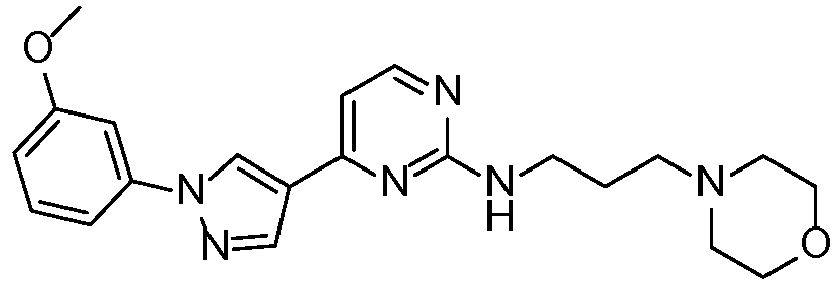
- A mixture of 2-chloro-4-(1-(3-methoxyphenyl)-1H-pyrazol-4-yl)pyrimidine (12 mg, 0.042 mmol), 3-morpholinopropan-1-amine (0.031 ml, 0.209 mmol) and TEA (0.020 ml, 0.146 mmol) in Acetonitrile (0.25 ml) and DMSO (0.25 ml) was heated at 150C using a microwave reactor for 30 min. H2O and EtOAc were added and layers separated. The organic layer was dried over anhydrous Na2SO4 and evaporated to give a crude residue which was purified by silica-gel chromatography (0-10 % MeOH in DCM) to yield the product as a semi-solid. MS (ESI): mass calcd. for C21H26N6O2, 394.47; m/z found, 395.35 [M+H]+; 1H NMR (500 MHz, CDCl3) δ 1.86 (t, J=6.41 Hz, 2 H) 2.52 (br. s., 5 H) 3.57 (q, J=6.21 Hz, 2 H) 3.77 (br. s., 4 H) 3.90 (s, 3 H) 5.72 (br. s., 1 H) 6.75 (d, J=5.19 Hz, 1 H) 6.86 - 6.93 (m, 1 H) 7.30 (dd, J=7.93, 1.22 Hz, 1 H) 7.34 - 7.41 (m, 2 H) 8.17 (s, 1 H) 8.27 (d, J=5.19 Hz, 1 H) 8.46 (s, 1 H); 13C NMR (126 MHz, CDC13) δ 25.87, 29.72, 40.37, 53.73, 55.59, 57.12, 66.91, 105.31, 105.99, 111.34, 113.03, 126.44, 130.32, 139.85, 140.88, 158.26, 158.96, 160.61, 162.65.
-


- Into a 4 mL-vial 1H-benzo[d]imidazole (96 mg, 0.816 mmol) was introduced and dissolved in DMF (1.5 ml). Then, sodium hydride (34.1 mg, 0.853 mmol) was added in one portion. The flask was capped, shaken, connected to a N2 stream and stirred 10 min. After that, this was added to a solution of 2,4-dichloro-5-(trifluoromethyl)pyrimidine (100 µl, 0.742 mmol) in DMF (1 mL) dropwise. Then, the pale yellow solution stirred was stirred at RT for 18 hrs. lit was quenched by adding 5 mL of NH4Cl aq. sat. sol. and the product was extracted with EtOAc (3x5mL). The combined organic layers were washed with 5 ml of deionized water, 5 ml of brine, dried over Na2SO4, filtrated and concentrated under low pressure. The residue was purified by SiO2 flash chromatography eluting with EtOAc/Hex and MeOH/EtOAc to afford a fraction which was observed to be approximately 75% pure. The material was used as is for the next reaction.

- Into a 0.5-2 mL microwave vial with a stirrer, 1-(2-chloro-5-(trifluoromethyl)pyrimidin-4-yl)-1H-benzo[d]imidazole (55 mg, 0.184 mmol), acetonitrile (0.4 ml), DMSO (0.2 ml), Et3N (0.051 ml, 0.368 mmol), and 2-(pyridin-4-yl)ethanamine (0.077 µl, 0.645 mmol) were added. Then, the vial was sealed heated in the microwave for 35 min at 150 C. Then, the greenish suspension was diluted with DCM introduced and concentrated under reduced pressure overnight. The crude was crystallized with AcOEt:DCM and a small amount of MeOH. The product that precipitated was recrystallized again to afford NUCC-176282. MS (ESI): mass calcd. for C19H15F3N6, 384.36; m/z found, 385.34 [M+H]+; 1H NMR (500 MHz, CDCl3) δ 3.14 (t, J=7.1 Hz, 2H), 4.03 (m, 2H), 5.53 - 5.62 (m, 1H), 7.28 (m, 2H), 7.37 - 7.44 (m, 2H), 7.84 - 7.90 (m, 1H), 8.51 (m, 2H), 8.58 - 8.63 (m, 2H), 9.05 (s, 1H).

- MS (ESI): mass calcd. for C19H15N7, 341.37; m/z found, 342.24 [M+H]+; 3.10 (t, J=7.3 Hz, 2H), 3.96 - 4.05 (m, 2H), 5.88 (br. s.), 7.21 - 7.24 (m, 2H), 7.39 - 7.43 (m, 2H), 7.84 - 7.89 (m, 1H), 8.46 - 8.49 (m, 1H), 8.54 (s, 1H), 8.59 - 8.62 (m, 2H), 9.02 (s).
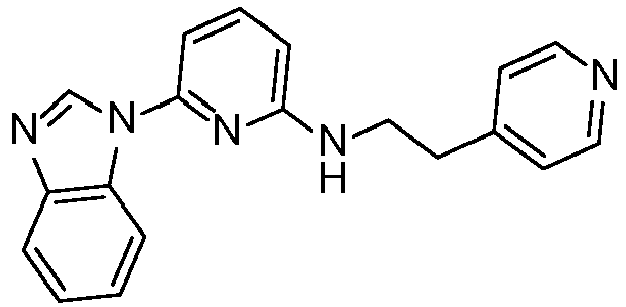
- MS (ESI): mass calcd. for C19H17N5, 315.37; m/z found, 316.2 [M+H]+; 1H NMR (500 MHz, CHLOROFORM-d) δ 8.52 - 8.60 (m, 3H), 8.03 - 8.11 (m, 1H), 7.85 - 7.92 (m, 1H), 7.62 (t, J = 7.63 Hz, 1H), 7.38 (td, J = 1.34, 4.96 Hz, 2H), 7.16 - 7.23 (m, 2H), 6.87 (d, J = 7.63 Hz, 1H), 6.38 (d, J = 7.93 Hz, 1H), 4.69 - 4.76 (m, 1H), 3.72 - 3.83 (m, 2H), 3.03 (t, J=7.0 Hz, 2H).

- MS (ESI): mass calcd. for C18H14ClN5O, 351.79; m/z found, 352.1 [M+H]+; 1H NMR (500 MHz, CHLOROFORM-d) δ 8.97 (s, 1H), 8.61 (d, J = 5.80 Hz, 2H), 8.50 (s, 1H), 8.45 - 8.48 (m, 1H), 7.84 - 7.89 (m, 1H), 7.42 (dquin, J = 1.37, 7.29 Hz, 2H), 7.31 - 7.35 (m, 2H), 4.85 (t, J = 6.41 Hz, 2H), 3.27 (t, J = 6.56 Hz, 2H).
-

- MS (ESI): mass calcd. for C19H19N5O, 333.39; m/z found, 334.4 [M+H]+; 1H NMR (500 MHz, Methanol-d4) δ 8.40 (d, J = 5.19 Hz, 2H), 7.83 (d, J = 6.10 Hz, 1H), 7.41 (dd, J = 1.37, 8.09 Hz, 1H), 7.32 (d, J = 5.49 Hz, 2H), 7.05 (dd, J = 1.37, 7.17 Hz, 1H), 6.84 - 6.96 (m, 2H), 6.49 (d, J = 6.10 Hz, 1H), 4.20 - 4.29 (m, 2H), 4.11 - 4.16 (m, 2H), 3.68 (t, J = 7.02 Hz, 2H), 2.96 (t, J = 7.02 Hz, 2H). 13C NMR (126 MHz, Methanol-d4) δ 161.08, 150.36, 148.40, 147.62, 125.66, 124.82, 123.21, 119.55, 117.33, 65.89, 41.66, 41.12, 34.81.
- The synthesized compounds then were tested for inhibition of the kinase activity (IC50) of Mnk1 and/or Mnk2 using the ADP monitoring assay for kinases described in Zegzouti, H.; Zdanovskaia, M.; Hsiao, K.; Goueli, S. A., ADP-Glo: A Bioluminescent and homogeneous ADP monitoring assay for kinases. Assay and drug development technologies 2009, 7 (6), 560-72, the content of which is incorporated herein by reference. Results are presented in Tables 1 and 2.
- To evaluate inhibition of Mnk1 in cells, we utilized a flow cytometry-based assay based on activation of eIF-4E, the downstream target of Mnk1. The assay utilizes flow cytometry to quantitatively measure the amount of eIF-4E that is phosphorylated at residue Ser209 in cell lysate from U937 or MV4-11 cell lines. Cells grown in the presence of serum were treated with vehicle or test compounds across a range of concentrations. Levels of phospho-eIF-4E were measured and IC50 values were determined by logistic regression to quantify the potency of each compound. Results are presented in Tables 3 and 4.
- To measure the ability of the new Mnk1/2 inhibitors to kill cancer cells in vitro, U937 or MV4-11 cells were incubated with different concentrations of test compounds and analyzed for apoptosis and cell viability at 5 and 24 hours post-treatment. Viability (assessed by ATP levels with CellTiter-Glo, Promega) and apoptosis (assessed by Annexin V staining) were graphed and logistic regression was used to determine inhibitor concentration that induced 50% of the maximal effect (EC50). Decreased viability was always accompanied by a commensurate increase in apoptosis, thus confirming the viability results. Results are presented in Tables 3 and 4.
Table 1. Mnk1 and Mnk2 Inhibition. Structure Molecule Name Mnk1 IC 50 Mnk2 IC 50 Synthetic Route 
NUCC-0054131 6 µM 2.1 µM A 
NUCC-0054132 9 µM A 
NUCC-0054133 7 µM 1.8 µM A 
NUCC-0054134 6 µM A 
NUCC-0054135 6 µM A 
NUCC-0054136 10 µM A 
NUCC-0054138 12 µM A 
NUCC-0054147 6 µM 16 µM A 
NUCC-0060894 4 µM A 
NUCC-0060895 5 µM A 
NUCC-0060896 3 µM 3.4 µM A 
NUCC-0060897 9 µM A 
NUCC-0060898 5 µM A 
NUCC-0060953 9 µM B 
NUCC-0060954 4 µM 4.0 µM B 
NUCC-0060955 16 µM 5.0 µM B 
NUCC-0060956 1 µM B 
NUCC-0060957 0.16 µM 0.045 µM B 
NUCC-0060958 0.9 µM 0.095 µM B 
NUCC-0060959 90 µM A 
NUCC-0060965 30 µM A 
NUCC-0060970 70 µM A 
NUCC-0060971 19 µM A 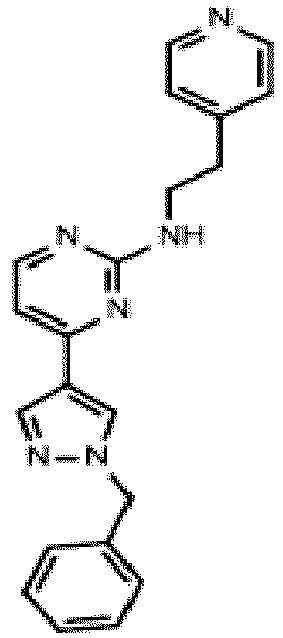
NUCC-0060972 19 µM 2.5 µM A 
NUCC-0077154 28 µM A 
NUCC-0077155 21 µM A 
NUCC-0077163 8 µM A 
NUCC-0077164 6 µM A 
NUCC-0077165 6 µM A 
NUCC-0077166 4 µM A 
NUCC-0077167 8 µM 7.6 µM C 
NUCC-0077168 19 µM A 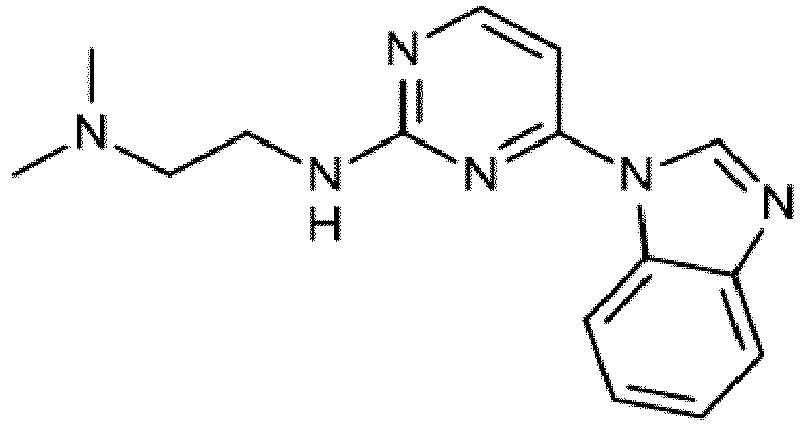
NUCC-0125582 0.5 µM 0.048 µM B 
NUCC-0125583 0.04 µM 0.0095 µM B 
NUCC-0125584 1.4 µM B 
NUCC-0125585 0.14 µM B 
NUCC-0125586 0.5 µM B 
NUCC-0125587 0.5 µM B 
NUCC-0125588 0.2 µM B 
NUCC-0125589 13 µM A 
NUCC-0125590 6 µM 0.78 µM A 
NUCC-0125591 21 µM A 
NUCC-0125592 0.15 µM 0.040 µM B 
NUCC-0125593 0.65 µM 0.039 µM B 
NUCC-0125594 0.7 µM 0.030 µM B 
NUCC-0125595 0.5 µM 0.083 µM B 
NUCC-0125596 0.2 µM 0.034 µM B 
NUCC-0125597 6 µM B 
NUCC-0125599 29 µM 6.2 µM D 
NUCC-0125601 5 µM 1.7 µM D 
NUCC-0175695 0.53 µM 0.072 µM B 
NUCC-0175697 0.02 µM 0.0023 µM B 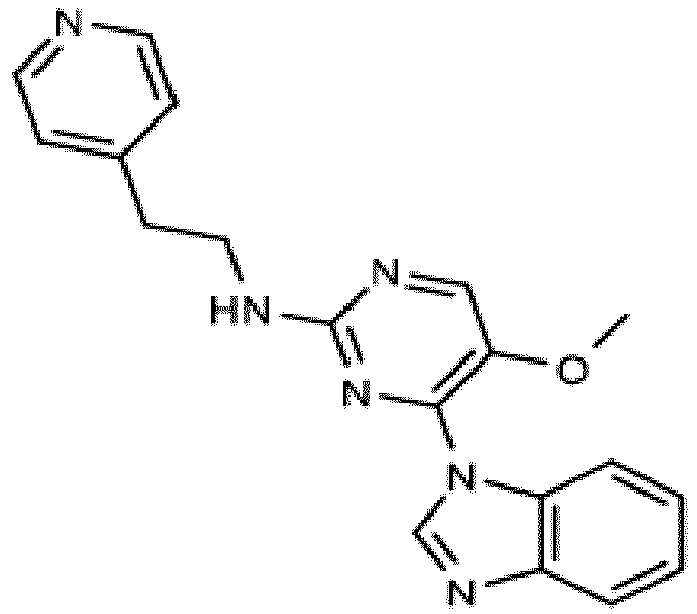
NUCC-0175698 5.0 µM 1.8 µM B 
NUCC-0175722 1.2 µM 0.25 µM E 
NUCC-0176138 8.5 µM 6.0 µM B 
NUCC-0176142 13 µM 5.3 µM B 
NUCC-0176143 4.3 µM 1.1 µM B 
NUCC-0176144 0.15 µM 0.028 µM B 
NUCC-0176145 0.40 µM 0.052 µM B 
NUCC-0176146 12 µM 1.0 µM B 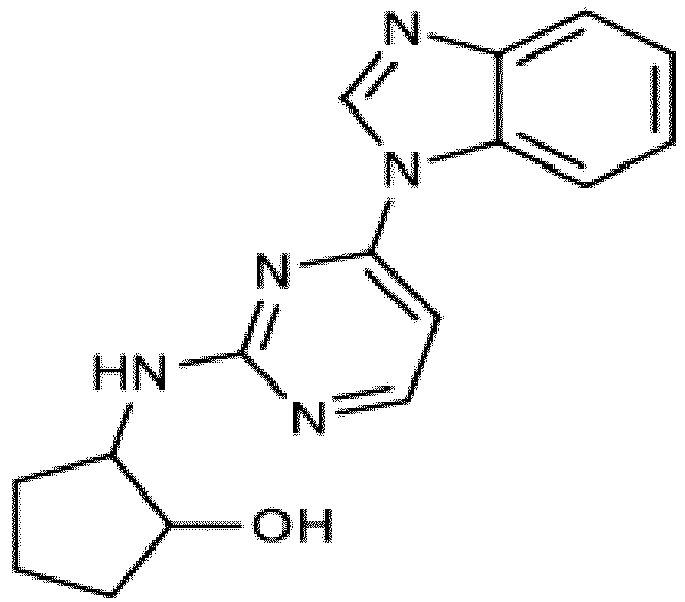
NUCC-0176147 0.45 µM 0.082 µM B 
NUCC-0176148 0.19 µM 0.046 µM B 
NUCC-0176149 0.54 µM 0.094 µM B 
NUCC-0176150 0.42 µM 0.090 µM B 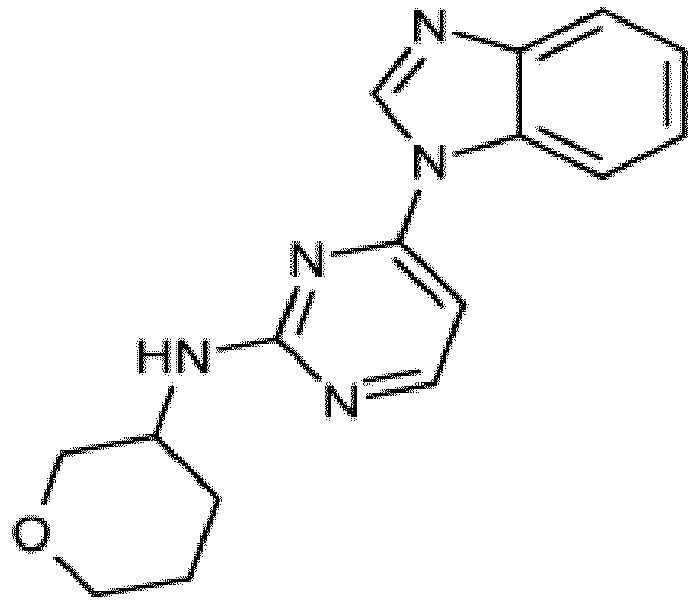
NUCC-0176151 0.39 µM 0.044 µM B 
NUCC-0176152 1.6 µM 1.3 µM B 
NUCC-0176153 0.48 µM 0.081 µM B 
NUCC-0176163 0.20 µM 0.041 µM B 
NUCC-0176164 0.10 µM 0.026 µM B 
NUCC-0176165 0.34 µM 0.061 µM B 
NUCC-0176166 0.39 µM 0.063 µM B 
NUCC-0176167 0.30 µM 0.060 µM B Table 2. Mnk1 and Mnk2 Inhibition. Structure Molecule Name Mnk1 IC 50 Mnk2 IC 50 Synthetic Route 
NUCC-0176230 5.1 µM 3.5 µM B 
NUCC-0176231 1.1 µM 0.38 µM B 
NUCC-0176232 4.6 µM 2.3 µM B 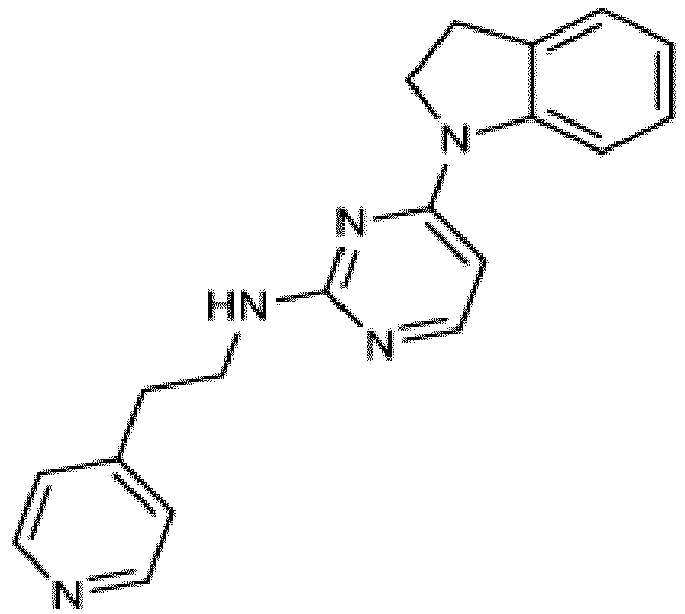
NUCC-0176233 8.5 µM 4.7 µM B 
NUCC-0176281 0.33 µM 0.049 µM B 
NUCC-0176282 0.093 µM 0.028 µM B 
NUCC-0176283 8.7 µM 10 µM B 
NUCC-0176284 2.6 µM 1.2 µM B 
NUCC-0176285 4.7 µM 6.0 µM B 
NUCC-0176338 no activity no activity B 
NUCC-0176339 11 µM 10 µM B 
NUCC-0176340 0.55 µM 0.069 µM B 
NUCC-0176341 0.21 µM 0.026 µM B 
NUCC-0176342 1.6 µM 0.20 µM B 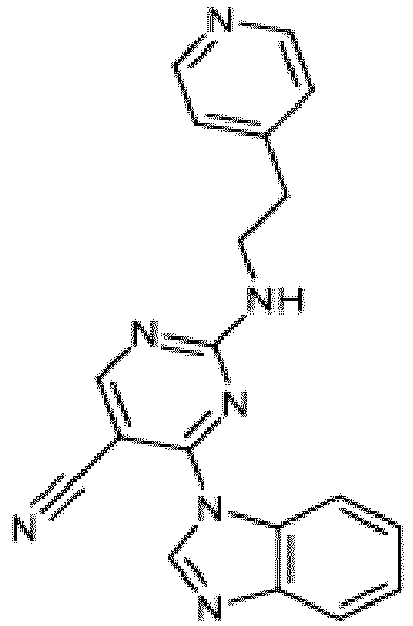
NUCC-0176343 0.0065 µM 0.0032 µM B 
NUCC-0176344 7.2 µM 0.78 µM B 
NUCC-0176345 10 µM 2.6 µM B 
NUCC-0176346 5.4 µM 4.7 µM B 
NUCC-0176347 8.1 µM 5.6 µM B 
NUCC-0176348 0.71 µM 0.13 µM B 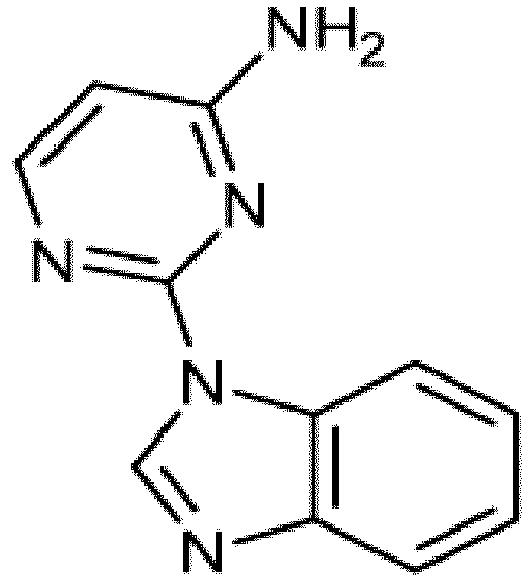
NUCC-0176349 4.1 µM 1.4 µM B 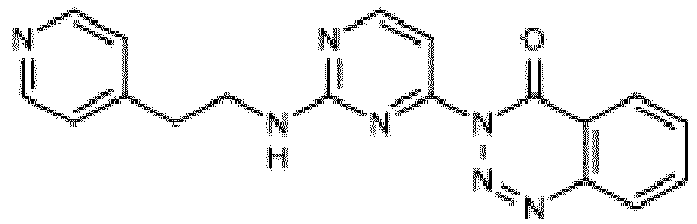
NUCC-0176350 no activity no activity B 
NUCC-0176351 no activity no activity B 
NUCC-0176352 0.65 µM 0.17 µM B 
NUCC-0176353 9.5 µM 6.8 µM B 
NUCC-0176354 10 µM 4.9 µM B 
NUCC-0176355 13 µM 2.4 µM B 
NUCC-0176356 11 µM 1.4 µM B 
NUCC-0176357 2.3 µM 0.25 µM B 
NUCC-0176358 0.45 µM 0.13 µM B 
NUCC-0176359 1.5 µM 0.32 µM B 
NUCC-0176360 4.5 µM 1.0 µM B 
NUCC-0176361 no activity no activity B 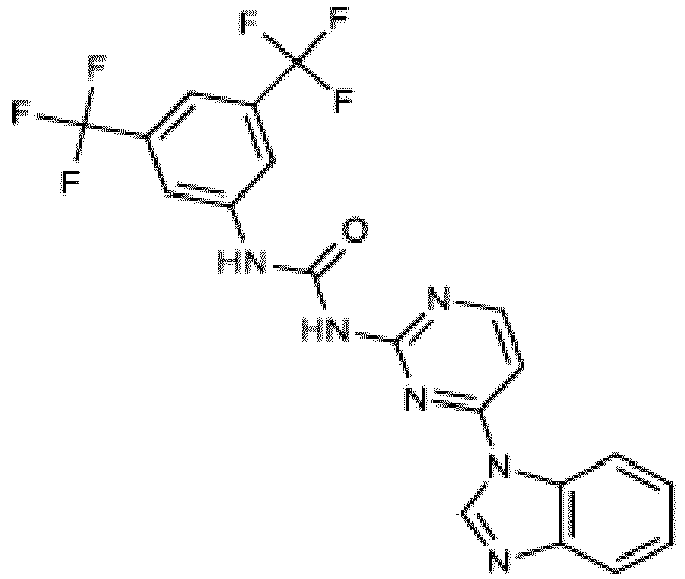
NUCC-0176362 no activity no activity B 
NUCC-0176363 no activity no activity B 
NUCC-0176365 7.4 µM 2.1 µM B 
NUCC-0176366 8.5 µM 2.5 µM B 
NUCC-0176367 2.6 µM 0.5 µM B 
NUCC-0176368 11 µM 5.2 µM B 
NUCC-0176369 no activity no activity B 
NUCC-0 196222 > 10 2.2 B 
NUCC-0196223 > 10 1.8 B 
NUCC-0196228 0.55 0.069 B 
NUCC-0196229 0.48 1.2 B 
NUCC-0196230 >10 >10 B 
NUCC-0196231 > 10 > 10 B 
NUCC-0196234 > 10 5.4 B 
NUCC-0196235 0.1 0.01 B 
NUCC-0196239 > 10 6.9 B 
NUCC-0196250 >10 >10 B 
NUCC-0196254 0.054 0.0096 B 
NUCC-0196255 >10 0.92 B 
NUCC-0196256 7.3 3.8 B 
NUCC-0196257 1.3 0.31 B 
NUCC-0196258 > 10 7 B 
NUCC-0196259 5.6 0.32 B 
NUCC-0196260 0.5 0.09 B 
NUCC-0196261 0.92 0.11 B 
NUCC-0196262 1.3 1.2 B 
NUCC-0196263 > 10 > 10 B 
NUCC-0196264 0.096 0.057 B 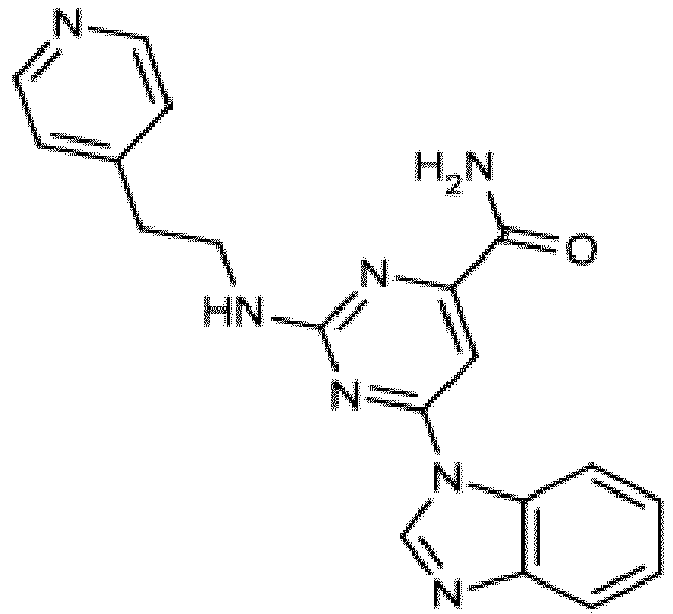
NUCC-0196265 1.6 0.89 B 
NUCC-0196307 0.87 0.17 B 
NUCC-0196308 2.1 6.9 B 
NUCC-0196309 > 10 > 10 B 
NUCC-0196310 2.1 5.4 B Table 3. Cell Inhibition of Mnk1 and Cell Viability Assays. Structure U937 pEIF4E IC 50 MV4-11 pEIF4E IC 50 U937 viability EC 50 MV4-11 viability EC 50 
4.2 µM 0.80 µM 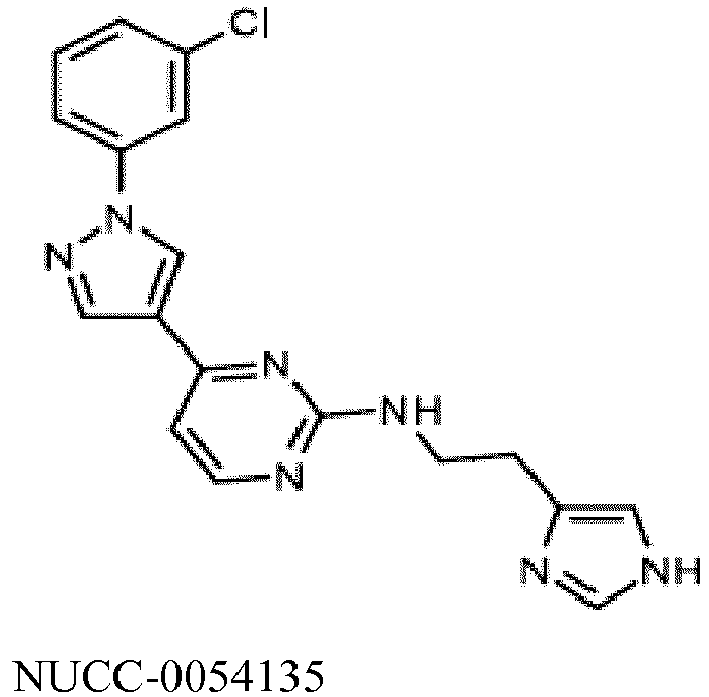
0.081 µM 0.066 µM 3.4 µM 0.24 µM 
0.14 µM 0.10 µM 10 µM 4.5 µM 
0.042 µM 0.035 µM 13 µM 0.19 µM 
0.014 µM 0.010 µM 2.6 µM 0.41 µM 
0.062 µM 0.020 µM 5.3 µM 0.12 µM 
0.23 µM 0.047 µM 
0.0055 µM 0.007 µM > 10 µM 0.62 µM 
0.051 µM 0.040 µM 10 µM 0.31 µM 
1.1 µM 0.069 µM > 10 µM 0.08 µM 
0.63 µM 0.37 µM > 10 µM 1.0 µM 
0.052 µM 0.039 µM 7 µM 0.35 µM 
0.078 µM 0.078 µM 5.7 µM 0.17 µM 
0.10 µM 0.037 µM > 10 µM 0.44 µM 
0.075 µM 0.074 µM 8.1 µM 0.22 µM 
0.062 µM 0.036 µM > 10 µM 0.18 µM Table 4. Cell Inhibition of Mnk1 and Cell Viability Assays. Structure U937 pEIF4E IC 50 MV4-11 pEIF4E IC 50 U937 viability EC 50 MV4-11 viability EC 50 
0.081 µM 0.066 µM 3.4 µM 0.24 µM 
0.14 µM 0.10 µM 10 µM 4.5 µM 
0.042 µM 0.035 µM 13 µM 0.19 µM 
0.014 µM 0.010 µM 2.6 µM 0.41 µM 
- Using a molecular modeling-based high-throughput screen, we have identified further compounds that act as Mnk inhibitors. We have optimized this series into a set of potent, novel lead compounds that inhibit Mnk activity.
- All chemical reagents were obtained from commercial suppliers and used without further purification unless otherwise stated. Anhydrous solvents were purchased from Sigma-Aldrich, and dried over 3 Å molecular sieves when necessary. DCM and THF were purified by passage through a bed of activated alumina. Normal-phase flash column chromatography was performed using Biotage KP-Sil 50µm silica gel columns and ACS grade solvents on a Biotage Isolera flash purification system. Analytical thin layer chromatography (TLC) was performed on EM Reagent 0.25 mm silica gel 60 F254 plates and visualized by UV light or iodine vapor. Liquid chromatography/mass spectrometry (LCMS) was performed on a Waters Acquity-H UPLC system with a 2.1 mm × 50 mm, 1.7 µm, reversed phase BEH C18 column and LCMS grade solvents. A gradient elution from 95% water + 0.1% formic acid/5% acetonitrile + 0.1% formic acid to 95% acetonitrile + 0.1% formic acid/ 5% water + 0.1% formic acid over 2 min plus a further minute continuing this mixture at a flow rate of 0.85 mL/min was used as the eluent. Total ion current traces were obtained for electrospray positive and negative ionization (ESI+/ESI-). Proton (1H) and carbon (13C) NMR spectra were recorded on a Bruker Avance III w/ direct cryoprobe spectrometer. Chemical shifts were reported in ppm (δ) and were referenced using residual non-deuterated solvent as an internal standard. The chemical shifts for 1H NMR and 13C NMR are reported to the second decimal plaace. Proton coupling constants are expressed in hertz (Hz). The following abbreviations were used to denote spin multiplicity for proton NMR: s = singlet, d = doublet, t = triplet, q = quartet, m = multiplet, brs = broad singlet, dd = doublet of doublets, dt= doublet of triplets, quin = quintet, tt = triplet of triplets. In some cases, overlapping signals occurred in the 13C NMR spectra.
-


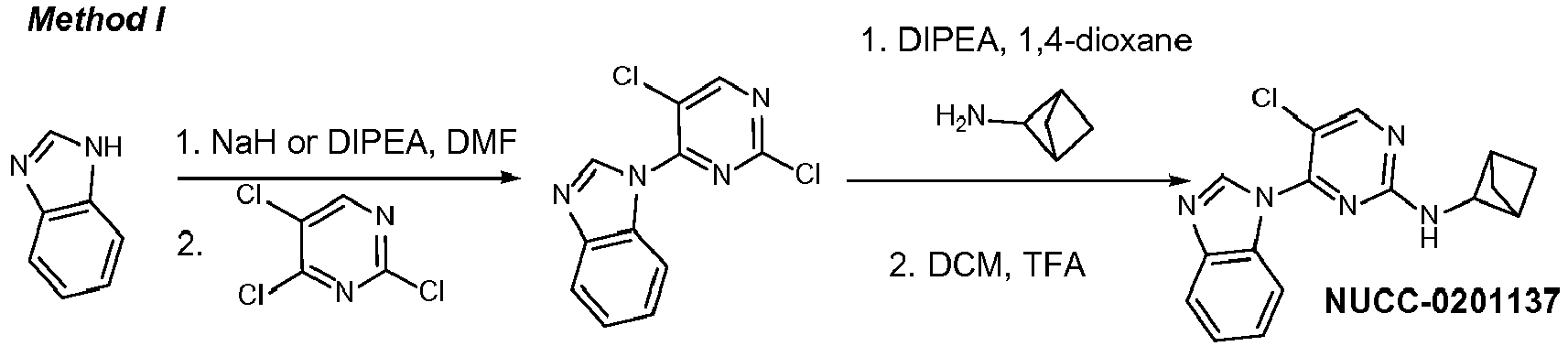


-

- To a vial was added 1-(2,5-dichloropyrimidin-4-yl)-1H-benzo[d]imidazole (0.1 g, 0.377 mmol) and 2-(pyridin-4-yl)ethanol (0.043 ml, 0.377 mmol) in DMF (2 ml) and the mixture was cooled in an ice bath. Sodium hydride (0.018 g, 0.453 mmol) was added and the green reaction was stirred. After 15 min, the reaction was quenched with water. The mixture was filtered and the filtered solid was dried. The solid was crystallized from MeOH, then purified via silica gel chromatography (biotage; 0-10 % MeOH/DCM) to give 1-(5-chloro-2-(2-(pyridin-4-yl)ethoxy)pyrimidin-4-yl)-1H-benzo[d]imidazole (47 mg, 0.134 mmol, 35.4 % yield) as a white solid.
LC/MS [M+1]+ m/z 352.11
1H NMR (500 MHz, Chloroform-d) δ 8.89 (d, J = 2.2 Hz, 1H), 8.52 (d, J = 4.7 Hz, 2H), 8.46 - 8.33 (m, 2H), 7.78 (d, J = 7.5 Hz, 1H), 7.33 (t, J = 7.3 Hz, 2H), 7.24 (d, J = 4.9 Hz, 2H), 4.91 - 4.46 (m, 2H), 3.18 (t, J = 6.4 Hz, 2H). -

- To a cooled (ice/water bath) solution of 4-(1H-benzo[d]imidazol-1-yl)-2-chloropyrimidine-5-carbonitrile (62 mg, 0.146 mmol, 1.0 equiv) and tert-butyl (3-hydroxycyclobutyl)carbamate (27.2 mg, 0.146 mmol, 1.0 equiv) in DMF (0.7 mL) was added sodium hydride (6.40 mg, 0.160 mmol, 1.1 equiv, 60 %/wt). The reaction was stirred for 1 h after which it was quenched with saturated aqueous NH4Cl solution (3 mL). The mixture was extracted with ethyl acetate (3 x 20 mL), dried (Na2SO4), filtered and concentrated. The solid was dissolved in DCM (0.7 mL) then TFA (0.1 mL, 1.31 mmol) was added and the reaction was stirred at room temperature for 72 h after which it was concentrated and purified by RP HPLC (5-60 % ACN/water; 0.1 % formic acid) to give 2-(3-aminocyclobutoxy)-4-(1H-benzo[d]imidazol-1-yl)pyrimidine-5-carbonitrile (21 mg, 0.068 mmol, 47 %) as a white solid.
LC/MS [M+1]+ m/z 307.3
1H NMR (500 MHz, DMSO-d6) δ 9.24 (s, 1H), 9.20 (s, 1H), 8.50 (d, J = 8.3 Hz, 1H), 7.84 (d, J = 8.0 Hz, 1H), 7.51 (t, J = 7.8 Hz, 1H), 7.44 (t, J = 7.5 Hz, 1H), 5.43 (p, J = 7.3 Hz, 1H), 3.62 - 3.45 (m, 1H), 3.05 - 2.91 (m, 2H), 2.47 - 2.30 (m, 2H). -

- To a vial was added 3-((4-(1H-benzo[d]imidazol-1-yl)-5-chloropyrimidin-2-yl)oxy)cyclobutanamine (22 mg, 0.042 mmol) in DMF (1 mL) and the mixture was cooled in an ice/water bath. Sodium hydride (2.207 mg, 0.092 mmol; 60 %) was added followed by methyl iodide (6.27 µl, 0.100 mmol). The reaction was stirred overnight as the ice bath expired. The reaction was quenched by adding saturated aqueous ammonium chloride solution (0.5 mL) after which it was concentrated and purified by RP HPLC (5-70 % ACN/water; 0.1 % formic acid conditions) to give 3-((5-chloro-4-(2-methyl-1H-benzo[d]imidazol-1-yl)pyrimidin-2-yl)oxy)-N,N-dimethylcyclobutanamine (10 mg, 0.028 mmol, 67 %).
LC/MS [M+1]+ m/z 358.3
1H NMR (500 MHz, Methanol-d 4) δ 9.06 (d, J = 1.5 Hz, 1H), 8.62 (t, J = 2.5 Hz, 1H), 8.51 (d, J = 8.4 Hz, 1H), 8.30 (s, 1H), 7.75 (d, J = 8.0 Hz, 1H), 7.49 (t, J = 7.8 Hz, 1H), 7.40 (t, J = 7.6 Hz, 1H), 5.35 (t, J = 6.7 Hz, 1H), 4.83 (d, J = 1.5 Hz, 3H), 4.25 - 4.06 (m, 1H), 3.37 - 3.27 (m, 2H), 3.19 (s, 6H), 2.82 - 2.67 (m, 2H). -
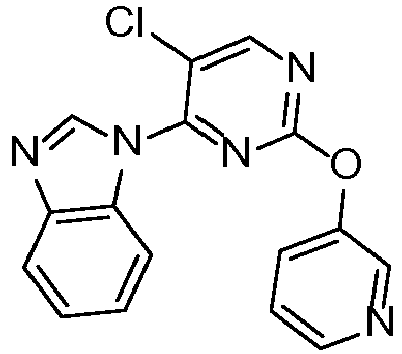
- To a vial was added 1-(2,5-dichloropyrimidin-4-yl)-1H-benzo[d]imidazole (0.1 g, 0.377 mmol) and pyridin-3-ol (0.036 g, 0.377 mmol) followed by DMF/Acetonitrile (1:1; 4 mL). DIEA (0.659 ml, 3.77 mmol) was added and the reaction was heated in the microwave at 100 °C for 10 min. The suspension was filtered and the crude collected solid was purified by RP HPLC (5-70 % ACN/water; 0.1 % formic acid) to give 1-(5-chloro-2-(pyridin-3-yloxy)pyrimidin-4-yl)-IH-benzo[d]imidazole (10 mg , 0.031 mmol, 8.19 % yield) as a brown solid.
LC/MS [M+1]+ m/z 324.1
1H NMR (500 MHz, Chloroform-d) δ 8.78 (s, 1H), 8.71 (s, 1H), 8.66 - 8.52 (m, 2H), 7.81 (d, J = 8.1 Hz, 1H), 7.69 - 7.55 (m, 2H), 7.40 (dd, J = 8.3, 4.8 Hz, 1H), 7.35 (td, J = 8.5, 4.4 Hz, 1H). -

- To a vial under nitrogen cooled in a dry ice/acetone bath was added THF (2 mL) then LDA (2M in THF/heptane/ethyl benzene) (0.877 ml, 1.755 mmol, 1.3 equiv). A solution of 2-fluoro-4-methylpyridine (0.139 ml, 1.350 mmol, 1.0 equiv) in THF (2 mL) was added dropwise. The reaction was stirred for 1 h after which paraformaldehyde (0.057 g, 1.890 mmol, 1.4 equiv) was added.
- After 16 h, the reaction was quenched with saturated aqueous NH4Cl solution (5 mL). THF was removed on the rotary evaporator. The aqueous layer was extracted with DCM (2 x 20 mL). The organics were washed with water (5 mL), brine (5 mL), and filtered through an isolute phase separator. The filtrate was concentrated and purified by silica gel chromatography (0 to 5 % MeOH/DCM) to give 2-(2-fluoropyridin-4-yl)ethanol (85 mg, 0.602 mmol, 44.6 % yield) as a red/orange oil.
- To a vial was added 2-(2-fluoropyridin-4-yl)ethanol (53.2 mg, 0.377 mmol, 1.0 equiv) and DMF (2 mL) followed by 1-(2,5-dichloropyrimidin-4-yl)-1H-benzo[d]imidazole (100 mg, 0.377 mmol, 1.0 equiv, synthesis reported in literature). The reaction was cooled in an ice/water bath and sodium hydride (18.10 mg, 0.453 mmol, 1.2 equiv, 60 %/wt) was added. After 40 min, the reaction was quenched with water until a white solid came out of solution. The mixture was filtered and the solid was purified by RP-HPLC (10-90 % ACN/water; 0.1 % Formic acid) to give 1-(5-chloro-2-(2-(2-fluoropyridin-4-yl)ethoxy)pyrimidin-4-yl)-1H-benzo[d]imidazole (40 mg, 0.108 mmol, 28.7 % yield) as a white solid.
LC/MS [M+1]+ m/z 370.2
1H NMR (500 MHz, Chloroform-d) δ 8.92 (s, 1H), 8.46 (s, 1H), 8.41 (dd, J = 7.4, 1.8 Hz, 1H), 8.18 (d, J = 5.1 Hz, 1H), 7.85 - 7.78 (m, 1H), 7.38 (pd, J = 7.4, 1.5 Hz, 2H), 7.17 (dd, J = 5.1, 1.9 Hz, 1H), 6.94 (s, 1H), 4.81 (t, J = 6.3 Hz, 2H), 3.26 (t, J = 6.2 Hz, 2H) -

- To a stirred solution of 4-methylpyridine (1 ml, 10.28 mmol, 1.0 equiv) and diethyl carbonate (3.74 ml, 30.8 mmol, 3.0 equiv) in THF (Volume: 29.4 ml) at -78 °C (dry ice/acetone) under nitrogen was added LDA (2M in THF/heptane/ethyl benzene) (10.28 ml, 20.55 mmol, 2.0 equiv) dropwise. The reaction was stirred at -78 °C for 1 h after which it was stirred at room temperature for 30 min. The reaction was quenched with saturated NH4Cl solution (5 mL) and water (10 mL). The aqueous layer was extracted with diethyl ether (25 mL). Combined organic extracts were dried (Na2SO4) and filtered. The filtrate was concentrated and purified by silica gel chromatography (0 to 50 % EtOAc/Hex) to give ethyl 2-(pyridin-4-yl)acetate (0.961 g, 5.82 mmol, 56.6 % yield) as a yellow oil.
- To a vial containing ethyl 2-(pyridin-4-yl)acetate (0.432 g, 2.62 mmol, 1.0 equiv) in THF (13 mL) under nitrogen and cooled in an ice bath was added NaH (0.282 g, 7.06 mmol, 2.7 equiv, 60 %/wt). The reaction was stirred in the ice bath for 25 min after which methyl iodide (0.409 ml, 6.54 mmol, 2.5 equiv) was added and the reaction was stirred as the ice bath expired for 2 h. The reaction was quenched by addition of saturated aqueous NH4Cl solution (5 mL). The mixture was diluted with water (5 mL) and EtOAc (40 mL). The aqueous layer was extracted once with EtOAc (20 mL). Combined organic extracts were washed with brine (5 mL), dried (Na2SO4), and filtered. The filtrate was concentrated and the crude was purified by silica gel chromatography (0 % to 50 % EtOAc/Hex) to give ethyl 2-methyl-2-(pyridin-4-yl)propanoate (0.23 g, 1.190 mmol, 45.5 % yield) as a colorless oil.
- To a vial was added ethyl 2-methyl-2-(pyridin-4-yl)propanoate (0.1 g, 0.517 mmol, 1.0 equiv) followed by THF (2.5 mL) and the mixture was cooled to 0 °C and placed under an atmosphere of nitrogen. Lithium aluminum hydride (0.029 g, 0.776 mmol, 1.5 equiv) was and the reaction was stirred for 1 h after which it was quenched with sodium sulfate decahydrate, then filtered through a pad of celite, washing with DCM. The filtrate was concentrated to give 2-methyl-2-(pyridin-4-yl)propan-1-ol (71 mg, 0.470 mmol, 91 % yield) as a light yellow/colorless oil which was used without further purification.
- To a vial containing 1-(2,5-dichloropyrimidin-4-yl)-1H-benzo[d]imidazole (90 mg, 0.339 mmol, 1.0 equiv) in DMF (Volume: 1697 µl), which was cooled in an ice/water bath, was added 2-methyl-2-(pyridin-4-yl)propan-1-ol (51.3 mg, 0.339 mmol, 1.0 equiv) followed by NaH (16.29 mg, 0.407 mmol, 1.2 equiv, 60 %/wt). The reaction mixture was stirred for 30 after which it was quenched by adding water until a solid precipitated. The mixture was filtered and the collected solid was purified by RP HPLC (30- 100 % ACN/water; 0.1 % formic acid) to give 1-(5-chloro-2-(2-methyl-2-(pyridin-4-yl)propoxy)pyrimidin-4-yl)-1H-benzo[d]imidazole (71 mg, 0.187 mmol, 55.1 % yield) as a white solid.
LC/MS [M+1]+ m/z 380.3
1H NMR (500 MHz, Chloroform-d) δ 8.78 (s, 1H), 8.48 - 8.35 (m, 2H), 8.28 (d, J = 7.4 Hz, 2H), 7.69 (dd, J = 7.3, 1.5 Hz, 1H), 7.32 - 7.16 (m, 4H), 4.40 (s, 2H), 1.40 (s, 6H). -

- To a vial was added 1-(2,5-dichloropyrimidin-4-yl)-1H-benzo[d]imidazole (0.3 g, 1.132 mmol, 1.0 eqiuv), copper(I) iodide (10.78 mg, 0.057 mmol, 0.05 equiv), diethyl malonate (0.345 ml, 2.263 mmol, 2.0 equiv), cesium carbonate (1.106 g, 3.39 mmol, 3.0 equiv) and 1,4-dioxane (3 mL). The vial was purged with nitrogen then stirred at 40 °C overnight for 16 h after which it was diluted with DCM (30 mL) and saturated aqueous NH4Cl solution (5 mL). The organic layer was washed with water (5 mL), brine (5 mL) and filtered through an isolute phase separator. The filtrate was concentrated and the residue purified by silica gel chromatography (0-50 % EtOAc/Hex) to give diethyl 2-(4-(1H-benzo[d]imidazol-1-yl)-5-chloropyrimidin-2-yl)malonate (118 mg, 0.303 mmol, 27 % yield) as a yellow solid.
- To a vial containing diethyl 2-(4-(1H-benzo[d]imidazol-1-yl)-5-chloropyrimidin-2-yl)malonate (74 mg, 0.190 mmol, 1.0 equiv) was added anhydrous DMF (1 mL), K2CO3 (52.6 mg, 0.381 mmol, 2 equiv) and 2-(bromomethyl)pyridine, HBr (96 mg, 0.381 mmol, 2 equiv). The reaction was stirred overnight for 16 h after which it was diluted with DCM (10 mL) and water (3 mL). The aqueous layer was extracted with DCM (5 mL). Combined organic extracts were filtered through an isolute phase separator, concentrated and purified using silica gel chromatography (0-100 % EtOAc/Hex) to give diethyl 2-(4-(1H-benzo[d]imidazol-1-yl)-5-chloropyrimidin-2-yl)-2-(pyridin-2-ylmethyl)malonate (66 mg, 0.138 mmol, 72.3 % yield) as a yellow oil.
- To a vial containing diethyl 2-(4-(1H-benzo[d]imidazol-1-yl)-5-chloropyrimidin-2-yl)-2-(pyridin-2-ylmethyl)malonate (66 mg, 0.138 mmol, 1.0 equiv) was added MeOH (0.7 mL). NaOH (1 M) (688 µl, 0.688 mmol, 5.0 equiv) was added and the reaction was allowed to stir overnight for 16 h after which LC/MS indicated the desired monodecarboxylation product.
- Citric acid (1 M) was added until pH=5 and the reaction was heated to 60 °C for 90 min after which the mixture was directly purified by RP HPLC (20-70 % ACN/water; 0.1 % formic acid) to give 1-(5-chloro-2-(2-(pyridin-2-yl)ethyl)pyrimidin-4-yl)-1H-benzo[d]imidazole (5 mg, 0.015 mmol, 11 % yield) as a white solid.
LC/MS [M+1]+ m/z 336.2
1H NMR (500 MHz, Chloroform-d) δ 8.92 (d, J = 3.1 Hz, 1H), 8.58 (s, 1H), 8.54 (ddd, J = 5.0, 1.9, 1.0 Hz, 1H), 8.46 - 8.40 (m, 1H), 7.85 - 7.76 (m, 1H), 7.60 (tt, J = 7.9, 2.3 Hz, 1H), 7.36 (pt, J = 7.2, 1.7 Hz, 2H), 7.23 - 7.20 (m, 1H), 7.12 (ddt, J = 7.7, 4.0, 2.0 Hz, 1H), 3.49 (ddt, J = 9.6, 8.2, 2.2 Hz, 2H), 3.39 (t, J = 7.7 Hz, 2H). -

- To a vial was added (4-chloro-3-(trifluoromethyl)phenyl)boronic acid (13.69 mg, 0.061 mmol), sodium carbonate (12.93 mg, 0.122 mmol), Pd(dppf)Cl2 (3.35 mg, 4.58 umol), and (4-chloro-3-(trifluoromethyl)phenyl)boronic acid. Then, toluene/ethanol/water (5:1:2; 0.5:0.1:0.2 mL) were added. The reaction was degassed with N2 for 1 min then heated at 100 °C for 30 min after which the reaction mixture was filtered through a pad of silica, washing with DCM:MeOH (5:95). The filtrate was concentrated and the crude material was taken on to the next step.
- To a solution of tert-butyl (3-((5-chloro-4-(4-(4-chloro-3-(trifluoromethyl)phenyl)-1H-imidazol-1-yl)pyrimidin-2-yl)oxy)cyclobutyl)carbamate (10 mg, 0.018 mmol) in DCM (0.5 mL) was added TFA (0.1 mL) and the reaction was stirred at room temperature for 3 days after which it was concentrated and purified by RP-HPLC (5 to 60 % ACN/water; 0.1 % formic acid) to give 3-((5-chloro-4-(4-(4-chloro-3-(trifluoromethyl)phenyl)-1H-imidazol-1-yl)pyrimidin-2-yl)oxy)cyclobutanamine(5 mg, 0.01 mmol, 63 %).
LC/MS [M+1]+ m/z 444.3
1H NMR (500 MHz, Methanol-d 4) δ 8.70 (d, J = 1.1 Hz, 1H), 8.63 (s, 1H), 8.53 (s, 1H), 8.45 (d, J = 1.2 Hz, 1H), 8.28 (d, J = 2.2 Hz, 1H), 8.08 (dd, J = 8.4, 2.1 Hz, 1H), 7.67 (d, J = 8.3 Hz, 1H), 5.39 (t, J = 7.2 Hz, 1H), 3.66 (q, J = 8.0 Hz, 1H), 3.22 - 3.05 (m, 2H), 2.82 (t, J = 6.4 Hz, 1H), 2.52 - 2.38 (m, 2H). -

- To a vial was added 4-(1H-benzo[d]imidazol-1-yl)-2-chloropyrimidine-5-carbonitrile (100 mg, 0.391 mmol, 1.0 equiv) after which acetonitrile (2 mL) and bicyclo[1.1.1]pentan-2-amine, HCl (46.8 mg, 0.391 mmol, 1.0 equiv) were added. Then, DIEA (171 µl, 0.978 mmol, 2.5 equiv) was added. DMF (1 mL) was added for solubility (but reaction remained a suspension) and the reaction was stirred at room temperature overnight for 16 h. The suspension was filtered and the collected solid was purified by RP HPLC using a gradient of 10 to 75 % (ACN/water; 0.1 % formic acid). Relevant fractions were lyophilized. The material was repurified by silica gel chromatography (0-50 % EtOAc/Hex) to give 4-(1H-benzo[d]imidazol-1-yl)-2-(bicyclo[1.1.1]pentan-2-ylamino)pyrimidine-5-carbonitrile as a white solid (40 mg, 0.132 mmol, 34 %).
LC/MS [M+1]+ m/z 303.5
1H NMR (500 MHz, Chloroform-d) δ 8.92 (s, 1H), 8.57 - 8.46 (m, 2H), 7.86 - 7.76 (m, 1H), 7.46 - 7.32 (m, 2H), 6.11 (s, 1H), 2.65 (s, 1H), 2.31 (s, 6H) -

- To a vial containing 2,4,5-trichloropyrimidine (0.188 ml, 1.636 mmol) in THF (8 ml) under nitrogen and cooled in an ice bath was added cyclopropylmagenesium bromide (1 M in 2-MeTHF) (1.799 ml, 1.799 mmol) dropwise. The reaction was stirred for 1 h after which saturated aqueous NH4Cl solution (4 mL) was added, followed by DCM (20 mL). The aqueous layer was extracted with DCM (5 mL), filtered through an isolute phase separator, and concentrated to give crude 2,4,5-trichloro-6-cyclopropyl-1,6-dihydropyrimidine (0.3 g, 1.330 mmol, 81 % yield) as a yellow oil.
- To a vial containing 2,4,5-trichloro-6-cyclopropyl-1,6-dihydropyrimidine (0.3 g, 1.330 mmol) was added THF (8 mL) and DDQ (0.371 g, 1.636 mmol) after which it was stirred at room temperature for 72 h after which the reaction mixture was concentrated and purified by silica gel chromatography (0-100 % EtOAc/Hex) to give give 2,4,5-trichloro-6-cyclopropylpyrimidine (0.157 g, 0.703 mmol, 43.0 % yield) as a yellow oil.
1H NMR (500 MHz, Chloroform-d) δ 2.51 (tt, J = 7.9, 4.7 Hz, 1H), 1.37 - 1.19 (m, 4H). - To a vial was added 2,4,5-trichloro-6-cyclopropylpyrimidine (0.158 g, 0.707 mmol) followed by DMF (3 mL). Then, 1H-benzo[d]imidazole (0.125 g, 1.060 mmol) and DIEA (0.247 ml, 1.414 mmol) were added and the reaction was stirred overnight at room temperature for 16 h. The temperature was increased to 60 °C and left overnight for 16 h.
- Water (10 mL) and EtOAc (20 mL) were added to the reaction mixture. The aqueous layer was extracted with EtOAc (15 mL). Combined organic extracts were washed with saturated aqueous NH4Cl solution (10 mL), brine (5 mL), dried (sodium sulfate), filtered and concentrated. The crude was purified by silica gel chromatography (0 to 50 % EtOAc/Hex) to give 1-(2,5-dichloro-6-cyclopropylpyrimidin-4-yl)-1H-benzo[d]imidazole (95 mg, 0.311 mmol, 44.0 % yield) as a yellow oil.
- To a vial was added 1-(2,5-dichloro-6-cyclopropylpyrimidin-4-yl)-1H-benzo[d]imidazole (40 mg, 0.131 mmol), tert-butyl (3-hydroxycyclobutyl)carbamate (24.54 mg, 0.131 mmol) and DMF (1.3 mL). The reaction was cooled in an ice/water bath and NaH (6.29 mg, 0.157 mmol) was added. The reaction was stirred for 1 h after after which it was quenched with water and concentrated. The crude was dissolved in DMF/MeOH/DMSO and purified by RP-HPLC using a gradient of 30 to 90 % ACN/water (0.1 % FA conditions) to give tert-butyl (3-((4-(1H-benzo[d]imidazol-1-yl)-5-chloro-6-cyclopropylpyrimidin-2-yl)oxy)cyclobutyl)carbamate (14 mg, 0.031 mmol, 23.43 % yield) as a white solid.
- To tert-butyl (3-((4-(1H-benzo[d]imidazol-1-yl)-5-chloro-6-cyclopropylpyrimidin-2-yl)oxy)cyclobutyl)carbamate (14 mg, 0.031 mmol) in DCM (1 mL) was added HCl (4 M in dioxane) (98 µl, 0.393 mmol). The reaction was stirred for 2 h after which it was concentrated to give 3-((4-(1H-benzo[d]imidazol-1-yl)-5-chloro-6-cyclopropylpyrimidin-2-yl)oxy)cyclobutanamine (15 mg, 0.042 mmol, 32.2 % yield) as a white solid.
LC/MS [M+1]+ m/z 356.2
1H NMR (500 MHz, Methanol-d4) δ 9.88 (s, 1H), 8.61 (d, J = 8.3 Hz, 1H), 7.90 (d, J = 8.1 Hz, 1H), 7.76 - 7.58 (m, 2H), 5.46 (p, J = 7.2 Hz, 1H), 3.80 - 3.52 (m, 2H), 3.19 (dtd, J = 13.4, 7.2, 3.8 Hz, 2H), 2.74 (tt, J = 7.9, 4.6 Hz, 1H), 2.61 - 2.45 (m, 2H), 1.40 (ddt, J = 25.3, 8.1, 2.9 Hz, 4H). -

- To a vial was added tert-butyl (3-((4-(1H-benzo[d]imidazol-1-yl)-5-bromopyrimidin-2-yl)oxy)cyclobutyl)carbamate (50 mg, 0.109 mmol), sodium carbonate (23.00 mg, 0.217 mmol), Pd(dppf)Cl2 (5.98 mg, 10.9 umol), and (2-(trifluoromethoxy)phenyl)boronic acid. Then, toluene/ethanol/water (5:1:2; 1:0.2:0.4 mL) were added. The reaction was degassed with N2 for 1 min then heated at 100 °C for 30 min after which the reaction mixture was filtered through a pad of silica, washing with DCM:MeOH (5:95). The filtrate was concentrated and the crude material was taken on to the next step.
- To a solution of tert-butyl tert-butyl (3-((4-(1H-benzo[d]imidazol-1-yl)-5-(2-(trifluoromethoxy)phenyl)pyrimidin-2-yl)oxy)cyclobutyl)carbamate (40 mg, 0.074 mmol) in DCM (0.5 mL) was added TFA (0.1 mL) and the reaction was stirred at room temperature for 3 days after which it was concentrated and purified by RP-HPLC (5 to 60 % ACN/water; 0.1 % formic acid) to give 3-((4-(1H-benzo[d]imidazol-1-yl)-5-(2-(trifluoromethoxy)phenyl)pyrimidin-2-yl)oxy)cyclobutan-1-amine (26 mg, 0.059 mmol, 78 %).
LC/MS [M+1]+ m/z 442.3
1H NMR (500 MHz, Methanol-d 4) δ 9.21 (s, 1H), 8.68 (d, J = 8.2 Hz, 1H), 8.61 (d, J = 2.0 Hz, 1H), 8.54 (s, 1H), 7.64 - 7.57 (m, 2H), 7.56 - 7.48 (m, 3H), 7.45 (td, J = 7.7, 1.3 Hz, 1H), 5.45 (p, J = 7.3 Hz, 1H), 3.72 - 3.53 (m, 1H), 3.16 - 3.03 (m, 2H), 2.37-2.15 (m, 2H). -

- LC/MS [M+1]+ m/z 369.2
1H NMR (500 MHz, Chloroform-d) δ 8.95 (s, 0H), 8.47 (s, 0H), 7.88 - 7.80 (m, 0H), 7.44 - 7.36 (m, 1H), 7.31 (td, J = 7.9, 6.0 Hz, 0H), 7.13 (dt, J = 7.7, 1.2 Hz, 0H), 7.10 - 7.04 (m, 1H), 7.00 - 6.95 (m, 1H), 4.80 (t, J = 6.7 Hz, 1H), 3.23 (t, J = 6.7 Hz, 1H). -

- LC/MS [M+1]+ m/z 320.3
1H NMR (500 MHz, Methanol-d4) δ 8.93 (s, 1H), 8.49 (s, 1H), 8.40 - 8.31 (m, 1H), 7.79 - 7.64 (m, 1H), 7.42 - 7.29 (m, 2H), 5.03 (ddt, J = 12.4, 8.6, 4.7 Hz, 1H), 3.88 (dd, J = 10.6, 7.1 Hz, 1H), 3.41 (dd, J = 10.7, 4.1 Hz, 2H), 2.82 (dd, J = 17.4, 8.5 Hz, 1H), 2.50 (dd, J = 17.4, 5.0 Hz, 1H). -

- LC/MS [M+1]+ m/z 349.8
1H NMR (500 MHz, Chloroform-d) δ 8.87 (s, 1H), 8.81 (s, 1H), 7.82 - 7.69 (m, 1H), 7.57 - 7.49 (m, 2H), 7.36 - 7.28 (m, 1H), 7.23 - 7.14 (m, 3H). -

- LC/MS [M+1]+ m/z 349.1
1H NMR (500 MHz, Chloroform-d) δ 9.01 (s, 0H), 8.78 (s, 0H), 8.49 - 8.38 (m, 0H), 7.91 - 7.80 (m, 0H), 7.45 (dtd, J = 19.5, 7.5, 1.4 Hz, 1H), 4.81 (t, J = 5.1 Hz, 1H), 3.84 (t, J = 5.0 Hz, 1H), 3.69 (t, J = 7.1 Hz, 1H), 2.43 (t, J = 8.1 Hz, 1H), 2.16 - 2.02 (m, 1H). -

- LC/MS [M+1]+ m/z 351.2
1H NMR (500 MHz, Chloroform-d) δ 9.00 (s, 0H), 8.78 (s, 0H), 8.46 (dd, J = 6.9, 2.0 Hz, 0H), 7.86 (dd, J = 7.3, 1.8 Hz, 0H), 7.50 - 7.36 (m, 1H), 4.80 (t, J = 5.7 Hz, 1H), 3.72 (t, J = 4.7 Hz, 2H), 2.94 (t, J = 5.7 Hz, 1H), 2.64 (t, J = 4.7 Hz, 2H). -

- LC/MS [M+1]+ m/z 307.8
1H NMR (500 MHz, Chloroform-d) δ 8.97 (s, 1H), 8.77 (s, 1H), 8.41 (dd, J = 7.2, 1.9 Hz, 1H), 7.85 (dd, J = 6.9, 1.8 Hz, 1H), 7.42 (td, J = 7.0, 1.7 Hz, 2H), 5.84 (dd, J = 6.2, 4.3 Hz, 1H), 4.21 (dd, J = 11.0, 4.8 Hz, 1H), 4.13 - 4.05 (m, 2H), 4.00 (td, J = 8.4, 4.3 Hz, 1H), 2.51 - 2.39 (m, 1H), 2.35 (q, J = 7.4, 6.2 Hz, 1H). -

- LC/MS [M+1]+ m/z 408.1
1H NMR (500 MHz, Chloroform-d) δ 9.00 - 8.91 (m, 0H), 8.83 - 8.76 (m, 0H), 8.37 - 8.31 (m, 0H), 7.82 (t, J = 7.0 Hz, 0H), 7.46 - 7.38 (m, 1H), 6.00 (d, J = 5.1 Hz, 1H), 3.87 (dd, J = 13.7, 4.9 Hz, 0H), 3.60 (d, J = 12.9 Hz, 1H), 3.53 - 3.25 (m, 0H), 2.52 (d, J = 45.2 Hz, 1H). -

- LC/MS [M+1]+ m/z 315.1
1H NMR (500 MHz, Methanol-d4) δ 9.17 (s, 1H), 8.97 (s, 1H), 8.76 - 8.71 (m, 2H), 8.04 - 7.97 (m, 1H), 7.79 - 7.70 (m, 2H), 7.68 (d, J = 8.4 Hz, 1H), 7.37 (t, J = 7.6 Hz, 1H), 7.21 (t, J = 7.8 Hz, 1H). -

- LC/MS [M+1]+ m/z 322.1
1H NMR (500 MHz, Methanol-d4) δ 9.13 (s, 1H), 9.05 (s, 1H), 8.24 - 8.19 (m, 1H), 7.86 - 7.80 (m, 1H), 7.50 (ddd, J = 9.1, 7.5, 1.6 Hz, 2H), 5.28 (d, J = 5.5 Hz, 1H), 3.99 (dd, J = 12.0, 2.9 Hz, 1H), 3.85 (dd, J = 12.0, 5.6 Hz, 1H), 3.75 (dd, J = 6.4, 4.1 Hz, 2H), 2.19 (dd, J = 9.1, 4.3 Hz, 1H), 2.04 (dq, J = 12.2, 7.3, 6.7 Hz, 2H), 1.67 (d, J = 5.1 Hz, 0H). -

- LC/MS [M+1]+ m/z 322.1
1H NMR (500 MHz, Chloroform-d) δ 8.94 (s, 2H), 8.90 (s, 2H), 8.23 - 8.16 (m, 2H), 7.90 - 7.85 (m, 2H), 7.48 - 7.39 (m, 4H),5.38 (tt, J = 8.4, 4.2 Hz, 1H), 4.04 (dt, J = 12.1, 4.7 Hz, 2H), 3.66 - 3.58 (m, 2H), 2.09 - 2.01 (m, 1H), 1.95 (dtd, J = 13.0, 8.7, 4.0 Hz, 2H), 1.87 (dq, J = 13.1, 4.3 Hz, 1H). -

- LC/MS [M+1]+ m/z 329.1
1H NMR (500 MHz, Chloroform-d) δ 8.96 (s, 1H), 8.80 (s, 1H), 8.64 (dt, J = 4.8, 1.4 Hz, 1H), 8.39 (dd, J = 7.4, 1.9 Hz, 1H), 7.82 (dd, J = 7.4, 1.8 Hz, 1H), 7.77 (td, J = 7.7, 1.8 Hz, 1H), 7.54 (d, J = 7.8 Hz, 1H), 7.40 (pd, J = 7.4, 1.5 Hz, 2H), 7.28 (dd, J = 7.6, 5.0 Hz, 1H), 5.81 (s, 2H). -

- LC/MS [M+1]+ m/z 329.1
1H NMR (500 MHz, Methanol-d4) δ 9.25 (d, J = 2.3 Hz, 1H), 9.05 (d, J = 2.3 Hz, 1H), 8.82 (s, 1H), 8.60 (d, J = 8.0 Hz, 2H), 8.11 (d, J = 7.8 Hz, 1H), 7.80 (d, J = 8.0 Hz, 1H), 7.56 (dd, J = 8.0, 5.0 Hz, 1H), 7.49 (dd, J = 20.1, 7.8 Hz, 2H), 5.88 (s, 2H). -

- LC/MS [M+1]+ m/z 329.3
1H NMR (500 MHz, Chloroform-d) δ 8.93 (s, 0H), 8.82 (s, 0H), 8.73 - 8.63 (m, 0H), 8.41 - 8.29 (m, 0H), 7.87 - 7.77 (m, 0H), 7.45 - 7.36 (m, 1H), 5.70 (s, 2H). -

- LC/MS [M+1]+ m/z 355.4
1H NMR (500 MHz, Chloroform-d) δ 8.94 (d, J = 3.3 Hz, 1H), 8.52 (dd, J = 4.9, 1.5 Hz, 1H), 8.37 - 8.28 (m, 1H), 7.92 - 7.80 (m, 1H), 7.68 (dd, J = 7.7, 1.4 Hz, 1H), 7.39 (ddd, J = 7.2, 4.8, 1.7 Hz, 1H), 7.33 - 7.24 (m, 2H), 6.73 (dd, J = 7.4, 4.1 Hz, 1H), 3.23 (ddd, J = 16.5, 8.8, 5.7 Hz, 1H), 3.00 (ddd, J = 16.5, 8.7, 5.0 Hz, 1H), 2.74 (dddd, J = 14.3, 8.7, 7.3, 5.6 Hz, 1H), 2.45 - 2.29 (m, 1H). -

- LC/MS [M+1]+ m/z 355.4
1H NMR (500 MHz, Chloroform-d) δ 9.04 (s, 1H), 8.76 (s, 1H), 8.56 - 8.52 (m, 1H), 8.52 - 8.47 (m, 1H), 7.88 - 7.78 (m, 1H), 7.69 (d, J = 8.0 Hz, 1H), 7.43 - 7.36 (m, 2H), 7.27 (dd, J = 7.9, 5.0 Hz, 2H), 6.85 (dd, J = 7.4, 3.9 Hz, 1H), 3.33 - 3.21 (m, 1H), 3.09 - 2.99 (m, 1H), 2.79 (dq, J = 14.6, 7.5 Hz, 1H), 2.42 (ddt, J = 13.4, 8.7, 4.4 Hz, 1H). -

- LC/MS [M+1]+ m/z 407.3
1H NMR (500 MHz, DMSO-d6) δ 9.24 (d, J = 1.2 Hz, 1H), 9.20 (d, J = 1.1 Hz, 1H), 8.50 (d, J = 8.3 Hz, 1H), 7.84 (d, J = 8.0 Hz, 1H), 7.51 (t, J = 7.8 Hz, 1H), 7.44 (t, J = 7.5 Hz, 1H), 5.43 (p, J = 7.3 Hz, 1H), 3.06 - 2.91 (m, 2H), 2.47 - 2.30 (m, 3H). -

- LC/MS [M+1]+ m/z 358.1
1H NMR (500 MHz, Methanol-d4) δ 9.07 (s, 1H), 8.59 (s, 1H), 8.50 (dd, J = 7.8, 1.4 Hz, 1H), 8.41 (s, 1H), 7.75 (dd, J = 7.6, 1.3 Hz, 1H), 7.43 (dtd, J = 21.7, 7.5, 1.3 Hz, 2H), 4.72 (t, J = 5.9 Hz, 2H), 3.44 (dt, J = 13.0, 3.5 Hz, 2H), 3.33 (p, J = 1.6 Hz, 2H), 3.04 (td, J = 12.9, 3.1 Hz, 2H), 2.16 - 2.05 (m, 2H), 1.97 (dq, J = 4.7, 2.6 Hz, 3H), 1.67 - 1.45 (m, 2H). -

- LC/MS [M+1]+ m/z 316.2
1H NMR (500 MHz, DMSO-d6) δ 9.12 (s, 1H), 8.84 (s, 1H), 8.49 (d, J = 8.1 Hz, 1H), 7.81 (d, J = 8.0 Hz, 1H), 7.47 (t, J = 7.7 Hz, 1H), 7.44 - 7.37 (m, 1H), 5.36 (p, J = 7.2 Hz, 1H), 3.60-3.47 (m, 1H), 3.06 - 2.91 (m, 2H), 2.44 - 2.31 (m, 3H). -

- LC/MS [M+1]+ m/z 343.3
1H NMR (500 MHz, Methanol-d4) δ 9.12 (s, 1H), 9.03 (s, 1H), 8.56 (s, 1H), 8.43 (d, J = 4.9 Hz, 1H), 8.25 - 8.17 (m, 3H), 7.89 (dt, J = 7.9, 1.9 Hz, 1H), 7.84 - 7.80 (m, 1H), 7.49 (tt, J = 7.5, 5.6 Hz, 3H), 7.41 (dd, J = 8.0, 4.9 Hz, 1H), 4.88 (m, 2H), 3.27 (t, J = 6.4 Hz, 2H). -

- LC/MS [M+1]+ m/z 358.3
1H NMR (500 MHz, Methanol-d4) δ 9.06 (d, J = 1.5 Hz, 1H), 8.62 (t, J = 2.5 Hz, 1H), 8.51 (d, J = 8.4 Hz, 1H), 8.30 (s, 1H), 7.75 (d, J = 8.0 Hz, 1H), 7.49 (t, J = 7.8 Hz, 1H), 7.40 (t, J = 7.6 Hz, 1H), 5.35 (t, J = 6.7 Hz, 1H), 4.83 (d, J = 1.5 Hz, 3H), 4.25 - 4.06 (m, 1H), 3.37 - 3.27 (m, 2H), 3.19 (s, 6H), 2.82 - 2.67 (m, 2H). -

- LC/MS [M+1]+ m/z 359.3
1H NMR (500 MHz, Chloroform-d) δ 8.86 (s, 0H), 8.56 (s, 0H), 8.39 (d, J = 8.0 Hz, 0H), 7.83 (d, J = 7.8 Hz, 0H), 7.39 (dt, J = 20.2, 7.4 Hz, 1H), 5.83 (s, 0H), 4.20 (s, 1H), 1.33 (d, J = 5.5 Hz, 6H). -

- LC/MS [M+1]+ m/z 357.2
1H NMR (500 MHz, Methanol-d4) δ 8.93 (s, 0H), 8.85 (s, 0H), 8.21 (s, 0H), 7.87 - 7.76 (m, 1H), 7.47 - 7.38 (m, 1H), 4.79 (d, J = 7.1 Hz, 1H), 3.41 - 3.20 (m, 6H), 2.32 (d, J = 4.9 Hz, 3H), 1.47 (t, J = 6.2 Hz, 3H). -

- LC/MS [M+1]+ m/z 343.2
1H NMR (500 MHz, Chloroform-d) δ 8.55 (dd, J = 7.6, 1.7 Hz, 2H), 7.79 - 7.66 (m, 2H), 7.28 - 7.18 (m, 2H), 4.50 (s, 3H), 2.13 (s, 3H). -

- LC/MS [M+1]+ m/z 456.1
1H NMR (500 MHz, Chloroform-d) δ 9.11 (s, 0H), 8.74 (s, 1H), 8.58 (d, J = 5.0 Hz, 1H), 8.47 (d, J = 4.2 Hz, 1H), 7.66 (d, J = 12.4 Hz, 2H), 7.31 (d, J = 7.7 Hz, 1H), 7.20 (t, J = 6.4 Hz, 1H), 4.98 (t, J = 6.6 Hz, 2H), 3.41 (t, J = 6.6 Hz, 2H). -

- LC/MS [M+1]+ m/z 386.2
1H NMR (500 MHz, Chloroform-d) δ 8.96 (d, J = 4.6 Hz, 0H), 8.47 (d, J = 8.0 Hz, 0H), 8.43 (d, J = 4.6 Hz, 0H), 7.83 (d, J = 7.8 Hz, 0H), 7.60 (t, J = 7.7 Hz, 0H), 7.39 (dt, J = 25.6, 7.4 Hz, 1H), 4.97 (t, J = 6.3 Hz, 2H), 3.36 (t, J = 6.3 Hz, 2H). -

- LC/MS [M+1]+ m/z 422.1
1H NMR (500 MHz, Chloroform-d) δ 9.02 (s, 1H), 8.50 (t, J = 4.2 Hz, 2H), 7.84 (d, J = 7.7 Hz, 1H), 7.40 (dt, J = 23.7, 7.4 Hz, 2H), 7.25 (d, J = 7.9 Hz, 2H), 5.83 (d, J = 5.8 Hz, 2H), 2.55 (d, J = 5.7 Hz, 2H). -

- LC/MS [M+1]+ m/z 334.2
1H NMR (500 MHz, Chloroform-d) δ 7.82 (s, 1H), 7.71 (d, J = 13.6 Hz, 2H), 7.42 (s, 1H), 4.52 - 4.39 (m, 1H), 2.76 (q, J = 7.9 Hz, 1H), 2.40 - 2.21 (m, 2H), 1.68 (q, J = 9.4 Hz, 3H). -

- LC/MS [M+1]+ m/z 350.3
1H NMR (500 MHz, Chloroform-d) δ 8.92 (s, 1H), 8.68 (s, 1H), 8.41 (d, J = 8.1 Hz, 2H), 8.28 (s, 1H), 7.75 (d, J = 7.9 Hz, 2H), 7.37 (dt, J = 24.6, 7.7 Hz, 1H), 5.25 (p, J = 7.3 Hz, 1H), 3.51 (p, J = 8.0 Hz, 1H), 3.10 - 2.94 (m, 2H), 2.47 - 2.36 (m, 2H). -

- LC/MS [M+1]+ m/z 388.2
1H NMR (500 MHz, Chloroform-d) δ 8.96 (s, 1H), 8.60 - 8.52 (m, 1H), 8.42 (s, 1H), 8.21 (ddd, J = 9.1, 3.9, 1.5 Hz, 1H), 7.64 (td, J = 7.7, 1.9 Hz, 1H), 7.28 (d, J = 7.8 Hz, 1H), 7.23 - 7.11 (m, 2H), 4.98 (t, J = 6.7 Hz, 2H), 3.38 (t, J = 6.6 Hz, 2H). -

- LC/MS [M+1]+ m/z 444.3
1H NMR (500 MHz, Methanol-d4) δ 8.70 (d, J = 1.1 Hz, 1H), 8.63 (s, 1H), 8.53 (s, 1H), 8.45 (d, J = 1.2 Hz, 1H), 8.28 (d, J = 2.2 Hz, 1H), 8.08 (dd, J = 8.4, 2.1 Hz, 1H), 7.67 (d, J = 8.3 Hz, 1H), 5.39 (t, J = 7.2 Hz, 1H), 3.66 (q, J = 8.0 Hz, 1H), 3.22 - 3.05 (m, 2H), 2.82 (t, J = 6.4 Hz, 1H), 2.52 - 2.38 (m, 2H). -

- LC/MS [M+1]+ m/z 291.2
1H NMR (500 MHz, Methanol-d4) δ 7.21 (d, J = 1.3 Hz, 1H), 7.16 (d, J = 1.3 Hz, 1H), 7.13 (d, J = 2.1 Hz, 1H), 6.95 (d, J = 1.4 Hz, 1H), 3.83 (p, J = 7.2 Hz, 1H), 2.12 (p, J = 8.0 Hz, 1H), 1.62 (dddt, J = 9.2, 7.2, 5.1, 2.6 Hz, 2H), 1.01 - 0.90 (m, 2H). -

- LC/MS [M+1]+ m/z 432.3
1H NMR (500 MHz, Chloroform-d) δ 8.62 (s, 1H), 8.44 (s, 1H), 8.10 (d, J = 3.5 Hz, 2H), 7.89 - 7.80 (m, 3H), 7.55 (d, J = 4.9 Hz, 1H), 7.47 (d, J = 4.9 Hz, 1H), 7.42 - 7.29 (m, 6H), 7.24 (d, J = 1.6 Hz, 2H), 4.67 (s, 2H), 4.42 (d, J = 7.2 Hz, 1H), 4.20 (t, J = 15.2 Hz, 4H), 2.40 (dt, J = 13.5, 6.6 Hz, 1H), 2.14 (dt, J = 12.7, 6.0 Hz, 1H). -

- LC/MS [M+1]+ m/z 315.2
1H NMR (500 MHz, Methanol-d4) δ 9.03 (s, 0H), 8.54 - 8.48 (m, 0H), 8.47 (s, 1H), 8.31 (s, 0H), 7.79 - 7.71 (m, 0H), 7.49 - 7.34 (m, 1H), 4.25 (ddd, J = 23.8, 13.9, 6.9 Hz, 2H), 4.20 - 4.01 (m, 2H), 2.48 (dtd, J = 13.9, 8.1, 6.1 Hz, 1H), 2.23 (dt, J = 13.5, 6.7 Hz, 1H). -

- LC/MS [M+1]+ m/z 315.2
1H NMR (500 MHz, Methanol-d4) δ 8.77 (s, 1H), 8.61 (s, 1H), 8.42 (s, 1H), 7.97 - 7.88 (m, 0H), 7.81 - 7.74 (m, 0H), 7.41 (qd, J = 7.7, 7.3, 3.6 Hz, 1H), 4.14 - 4.05 (m, 1H), 3.98 (dd, J = 12.6, 6.2 Hz, 1H), 3.92 - 3.73 (m, 2H), 2.52 (dq, J = 14.5, 7.5 Hz, 1H), 2.25 (ddt, J = 12.9, 8.4, 4.8 Hz, 1H). -

- LC/MS [M+1]+ m/z 307.2
1H NMR (500 MHz, DMSO-d6) δ 8.73 (s, 1H), 8.61 (s, 1H), 8.15 (t, J = 16.2 Hz, 1H), 7.79 (q, J = 11.1 Hz, 2H), 7.36 (q, J = 8.4, 7.2 Hz, 2H), 5.10 (d, J = 5.8 Hz, 1H), 3.90 - 3.77 (m, 2H), 2.59 (s, 2H), 1.87 (tt, J = 11.2, 5.6 Hz, 2H). -

- LC/MS [M+1]+ m/z 356.3
1H NMR (500 MHz, Chloroform-d) δ 9.00 (d, J = 1.6 Hz, 1H), 8.57 - 8.49 (m, 1H), 8.43 (dt, J = 5.6, 2.4 Hz, 2H), 8.15 (d, J = 4.5 Hz, 1H), 7.85 (dt, J = 5.9, 2.0 Hz, 1H), 7.40 (ddt, J = 5.7, 4.0, 2.0 Hz, 2H), 7.21 (q, J = 1.8 Hz, 2H), 5.86 (s, 1H), 3.77 (q, J = 7.5, 7.0 Hz, 2H), 2.83 (t, J = 7.8 Hz, 2H), 2.15 (qd, J = 8.0, 4.1 Hz, 2H). -

- LC/MS [M+1]+ m/z 356.3
1H NMR (500 MHz, Chloroform-d) δ 8.84 (d, J = 26.0 Hz, 0H), 8.63 (d, J = 47.5 Hz, 0H), 8.49 (ddd, J = 26.3, 4.5, 1.7 Hz, 1H), 8.08 - 8.02 (m, 0H), 7.91 - 7.84 (m, 0H), 7.45 - 7.30 (m, 1H), 7.16 (ddd, J = 26.3, 4.5, 1.6 Hz, 1H), 3.61 (p, J = 7.1 Hz, 2H), 2.80 - 2.71 (m, 2H), 2.04 (td, J = 7.4, 3.9 Hz, 2H). -

- LC/MS [M+1]+ m/z 365.3
1H NMR (500 MHz, Chloroform-d) δ 9.04 (s, 1H), 8.64 (s, 1H), 8.52 - 8.45 (m, 1H), 8.42 (s, 1H), 8.23 (s, 1H), 7.93 - 7.75 (m, 1H), 7.44 - 7.30 (m, 2H), 7.21 (d, J = 5.0 Hz, 2H), 3.50 (q, J = 6.7 Hz, 2H), 2.76 (t, J = 7.7 Hz, 2H), 2.01 (p, J = 7.3 Hz, 2H). -

- LC/MS [M+1]+ m/z 386.2
1H NMR (500 MHz, Chloroform-d) δ 8.72 (s, 1H), 8.52 (d, J = 5.2 Hz, 1H), 8.19 (s, 1H), 7.56 (d, J = 3.8 Hz, 1H), 7.26 (t, J = 3.3 Hz, 2H), 6.82 (d, J = 3.8 Hz, 1H), 3.77 - 3.66 (m, 2H), 3.00 (t, J = 7.0 Hz, 2H). -

- LC/MS [M+1]+ m/z 381.2
1H NMR (500 MHz, Chloroform-d) δ 8.53 (d, J = 4.8 Hz, 2H), 8.44 (s, 1H), 8.18 - 8.01 (m, 1H), 7.75 (d, J = 8.8 Hz, 1H), 7.34 (d, J = 2.5 Hz, 1H), 7.21 (s, 2H), 7.01 (td, J = 9.5, 8.9, 2.4 Hz, 1H), 3.90 (s, 3H), 3.77 (d, J = 6.9 Hz, 2H), 2.98 (td, J = 7.7, 7.3, 2.7 Hz, 2H). -

- LC/MS [M+1]+ m/z 365.2
1H NMR (500 MHz, Chloroform-d) δ 8.98 (d, J = 14.5 Hz, 1H), 8.58 (td, J = 4.8, 1.7 Hz, 2H), 8.38 - 8.25 (m, 1H), 8.20 (d, J = 10.4 Hz, 2H), 7.71 - 7.59 (m, 1H), 7.29 - 7.23 (m, 2H), 7.20 - 7.13 (m, 1H), 3.93 (p, J = 6.5 Hz, 2H), 3.08 (td, J = 7.1, 2.0 Hz, 2H), 2.49 (t, J = 4.3 Hz, 3H). -

- LC/MS [M+1]+ m/z 365.2
1H NMR (500 MHz, Chloroform-d) δ 9.37 (s, 1H), 8.60 (d, J = 32.9 Hz, 1H), 8.51 (d, J = 5.6 Hz, 2H), 8.44 - 8.36 (m, 1H), 8.21 (s, 1H), 7.82 - 7.60 (m, 2H), 7.30 - 7.15 (m, 21H), 3.75 (q, J = 6.9 Hz, 2H), 2.99 (q, J = 7.0 Hz, 2H), 2.48 (d, J = 21.8 Hz, 3H). -

- LC/MS [M+1]+ m/z 343.1
1H NMR (500 MHz, Chloroform-d) δ 8.59 - 8.50 (m, 2H), 8.31 (dd, J = 16.2, 8.3 Hz, 1H), 8.19 (dd, J = 20.8, 8.2 Hz, 1H), 7.61 (t, J = 7.9 Hz, 1H), 7.52 (dt, J = 18.5, 7.7 Hz, 1H), 7.19 (dd, J = 9.7, 5.1 Hz, 2H), 3.90 (dq, J = 13.0, 6.8 Hz, 2H), 3.03 (dt, J = 18.0, 7.1 Hz, 2H). -

- LC/MS [M+1]+ m/z 352.1
1H NMR (500 MHz, Chloroform-d) δ 8.51 (d, J = 5.4 Hz, 3H), 8.20 (s, 1H), 8.16 (d, J = 8.3 Hz, 1H), 7.97 (d, J = 7.6 Hz, 1H), 7.57 (t, J = 7.7 Hz, 1H), 7.48 (t, J = 7.7 Hz, 1H), 7.25 (t, J = 6.9 Hz, 2H), 3.77 (q, J = 6.8 Hz, 2H), 3.00 (t, J = 7.1 Hz, 2H). -

- LC/MS [M+1]+ m/z 387.0
1H NMR (500 MHz, Chloroform-d) δ 8.58 (s, 1H), 8.50 (d, J = 5.0 Hz, 2H), 8.44 (s, 1H), 7.56 - 7.44 (m, 1H), 7.23 - 7.11 (m, 3H), 5.85 (t, J = 6.1 Hz, 1H), 3.75 (s, 2H), 2.96 (t, J = 7.3 Hz, 2H). -

- LC/MS [M+1]+ m/z 409.1
1H NMR (500 MHz, Chloroform-d) δ 8.67 (s, 1H), 8.58 (s, 1H), 8.56 - 8.48 (m, 1H), 8.46 (s, 1H), 8.12 - 8.08 (m, 1H), 7.87 (dd, J = 37.4, 8.5 Hz, 1H), 7.25 (s, 1H), 3.98 (s, 3H), 3.85 - 3.71 (m, 2H), 3.05 - 2.92 (m, 2H). -

- LC/MS [M+1]+ m/z 396.1
1H NMR (500 MHz, Chloroform-d) δ 8.68 (s, 1H), 8.52 - 8.36 (m, 3H), 8.17 (s, 1H), 7.90 - 7.77 (m, 1H), 7.22 (d, J = 24.3 Hz, 1H), 6.34 - 6.04 (m, 1H), 3.76 (dd, J = 14.7, 8.0 Hz, 2H), 2.98 (dd, J = 15.7, 8.8 Hz, 2H). -

- LC/MS [M+1]+ m/z 379.1
1H NMR (500 MHz, Chloroform-d) δ 8.58 (s, 1H), 8.56 - 8.47 (m, 2H), 8.41 (s, 1H), 8.21 (s, 2H), 7.63 (s, 2H), 7.26 (d, J = 4.7 Hz, 2H), 3.76 (q, J = 6.9 Hz, 2H), 3.00 (t, J = 7.1 Hz, 2H), 2.37 (d, J = 22.0 Hz, 3H). -

- LC/MS [M+1]+ m/z 375.4
1H NMR (500 MHz, Chloroform-d) δ 8.60 (s, 1H), 8.45 (s, 1H), 7.88 (d, J = 7.7 Hz, 1H), 7.83 (s, 1H), 7.59 (d, J = 7.7 Hz, 2H), 7.43 - 7.35 (m, 2H), 7.32 (s, 1H), 5.39 (s, 1H), 3.75 (d, J = 7.0 Hz, 2H), 3.01 (t, J = 7.1 Hz, 2H). -

- LC/MS [M+1]+ m/z 418.4
1H NMR (500 MHz, Chloroform-d) δ 8.58 (s, 1H), 8.46 - 8.37 (m, 1H), 7.85 (d, J = 7.1 Hz, 2H), 7.54 (d, J = 7.8 Hz, 2H), 7.42 - 7.33 (m, 2H), 7.31 (d, J = 7.7 Hz, 2H), 5.39 (s, 1H), 3.73 (q, J = 6.8 Hz, 2H), 2.99 (t, J = 7.1 Hz, 2H). -

- LC/MS [M+1]+ m/z 368.4
1H NMR (500 MHz, Chloroform-d) δ 8.59 (s, 1H), 8.42 (s, 1H), 7.91 - 7.79 (m, 2H), 7.37 (td, J = 8.3, 7.3, 4.6 Hz, 2H), 7.16 (t, J = 6.8 Hz, 2H), 6.98 (t, J = 8.4 Hz, 2H), 5.47 (s, 1H), 3.70 (q, J = 6.8 Hz, 2H), 2.91 (t, J = 7.1 Hz, 2H). -

- LC/MS [M+1]+ m/z 406.5
1H NMR (500 MHz, Chloroform-d) δ 8.59 (s, 1H), 8.46 (s, 1H), 7.86 (td, J = 5.5, 2.1 Hz, 2H), 7.50 (dd, J = 8.3, 1.4 Hz, 2H), 7.42 - 7.35 (m, 4H), 7.32 - 7.27 (m, 1H), 4.69 (d, J = 13.1 Hz, 2H), 3.54 (td, J = 13.0, 2.7 Hz, 2H), 2.10 (td, J = 13.3, 4.8 Hz, 2H), 1.94 - 1.82 (m, 2H). -

- LC/MS [M+1]+ m/z 330.4
1H NMR (500 MHz, Chloroform-d) δ 8.58 (s, 1H), 8.44 (s, 1H), 7.90 - 7.79 (m, 2H), 7.42 - 7.33 (m, 2H), 4.35 (dt, J = 14.1, 4.9 Hz, 2H), 4.01 (dq, J = 8.5, 4.1 Hz, 1H), 3.47 (ddd, J = 13.2, 9.3, 3.4 Hz, 2H), 1.98 (ddt, J = 13.4, 6.7, 3.6 Hz, 2H), 1.59 (ddt, J = 13.0, 8.9, 4.5 Hz, 2H). -

- LC/MS [M+1]+ m/z 352.1
1H NMR (500 MHz, Chloroform-d) δ 8.89 (d, J = 2.2 Hz, 1H), 8.52 (d, J = 4.7 Hz, 2H), 8.46 - 8.33 (m, 2H), 7.78 (d, J = 7.5 Hz, 1H), 7.33 (t, J = 7.3 Hz, 2H), 7.24 (d, J = 4.9 Hz, 2H), 4.91 - 4.46 (m, 2H), 3.18 (t, J = 6.4 Hz, 2H). -

- LC/MS [M+3]+ m/z 333
- 1H NMR (500 MHz, Chloroform-d) δ 8.92 (s, 1H), 8.57 - 8.30 (m, 2H), 7.90 - 7.75 (m, 1H), 7.38 (dtd, J = 20.9, 7.4, 1.4 Hz, 2H), 5.32 (tt, J = 6.8, 3.4 Hz, 1H), 4.14 - 3.62 (m, 4H), 2.28 - 2.19 (m, 1H), 2.00 (tdd, J = 11.0, 7.2, 4.0 Hz, 2H), 1.73 (ddddd, J = 14.1, 10.1, 7.9, 4.4, 2.5 Hz, 1H).
-

- LC/MS [M+3]+ m/z 333
1H NMR (500 MHz, Chloroform-d) δ 8.92 (s, 1H), 8.56 - 8.34 (m, 2H), 7.83 (dd, J = 7.5, 1.5 Hz, 1H), 7.38 (dtd, J = 16.7, 7.3, 1.4 Hz, 2H), 5.51 (tt, J = 7.8, 3.9 Hz, 1H), 4.04 (ddd, J = 11.8, 6.4, 3.8 Hz, 2H), 3.71 (ddd, J = 11.5, 7.9, 3.4 Hz, 2H), 2.36 - 1.82 (m, 4H). -

- LC/MS [M+3]+ m/z 319.5
1H NMR (500 MHz, Chloroform-d) δ 8.92 (s, 1H), 8.58 - 8.29 (m, 2H), 7.93 - 7.69 (m, 1H), 7.38 (dtd, J = 18.7, 7.3, 1.4 Hz, 2H), 5.77 (ddt, J = 6.7, 4.4, 2.0 Hz, 1H), 4.35 - 3.85 (m, 4H), 2.59 - 2.22 (m, 2H). -

- LC/MS [M+1]+ m/z 360.1
1H NMR (500 MHz, Chloroform-d) δ 8.94 (s, 1H), 8.45 (d, J = 7.6 Hz, 2H), 7.95 - 7.73 (m, 1H), 7.38 (dtd, J = 16.8, 7.4, 1.5 Hz, 2H), 4.73 (t, J = 5.7 Hz, 2H), 3.80 - 3.61 (m, 4H), 2.92 (t, J = 5.7 Hz, 2H), 2.74 - 2.56 (m, 4H). -

- LC/MS [M+1]+ m/z 352.1
1H NMR (500 MHz, Chloroform-d) δ 8.95 (s, 1H), 8.63 - 8.32 (m, 3H), 7.81 (dd, J = 7.3, 1.7 Hz, 1H), 7.63 (td, J = 7.6, 1.9 Hz, 1H), 7.36 (pd, J = 7.3, 1.5 Hz, 2H), 7.29 (d, J = 7.7 Hz, 1H), 7.16 (dd, J = 7.6, 4.9 Hz, 1H), 4.99 (t, J = 6.6 Hz, 2H), 3.39 (t, J = 6.6 Hz, 2H). -

- LC/MS [M]+ m/z 315.8
1H NMR (500 MHz, Methanol-d4) δ 10.50 (s, 1H), 9.10 - 8.79 (m, 2H), 7.99 (d, J = 7.7 Hz, 1H), 7.91 - 7.73 (m, 2H), 6.33 - 6.11 (m, 1H), 4.10 - 3.45 (m, 6H), 2.75 - 2.49 (m, 2H). -

- LC/MS [M+1]+ m/z 353.2
1H NMR (500 MHz, Chloroform-d) δ 8.81 (s, 1H), 8.68 (s, 1H), 7.80 (d, J = 8.0 Hz, 1H), 7.62 (d, J = 8.2 Hz, 1H), 7.33 (ddd, J = 8.2, 7.3, 1.2 Hz, 1H), 7.20 (ddd, J = 8.3, 7.2, 1.2 Hz, 1H), 7.17 - 7.11 (m, 2H), 7.00 - 6.92 (m, 2H), 3.83 (s, 3H). -

- LC/MS [M+1]+ m/z 324.1
1H NMR (500 MHz, Chloroform-d) δ 8.78 (s, 1H), 8.71 (s, 1H), 8.66 - 8.52 (m, 2H), 7.81 (d, J = 8.1 Hz, 1H), 7.69 - 7.55 (m, 2H), 7.40 (dd, J = 8.3, 4.8 Hz, 1H), 7.35 (td, J = 8.5, 4.4 Hz, 1H). -

- LC/MS [M+1]+ m/z 358.3
1H NMR (500 MHz, Chloroform-d) δ 8.94 (s, 1H), 8.61 - 8.29 (m, 2H), 7.82 (d, J = 7.8 Hz, 1H), 7.49 - 7.29 (m, 2H), 4.72 (t, J = 5.1 Hz, 2H), 3.81 (t, J = 5.1 Hz, 2H), 3.64 (t, J = 7.1 Hz, 2H), 2.40 (t, J = 8.1 Hz, 2H), 2.06 (p, J = 7.6 Hz, 2H). -

- LC/MS [M+1]+ m/z 370.2
1H NMR (500 MHz, Chloroform-d) δ 8.92 (s, 1H), 8.46 (s, 1H), 8.41 (dd, J = 7.4, 1.8 Hz, 1H), 8.18 (d, J = 5.1 Hz, 1H), 7.85 - 7.78 (m, 1H), 7.38 (pd, J = 7.4, 1.5 Hz, 2H), 7.17 (dd, J = 5.1, 1.9 Hz, 1H), 6.94 (s, 1H), 4.81 (t, J = 6.3 Hz, 2H), 3.26 (t, J = 6.2 Hz, 2H). -

- LC/MS [M+1]+ m/z 316.2
1H NMR (500 MHz, Methanol-d4) δ 9.10 (d, J = 2.4 Hz, 1H), 8.69 (d, J = 2.4 Hz, 1H), 8.62 - 8.41 (m, 2H), 7.78 (d, J = 7.9 Hz, 1H), 7.57 - 7.34 (m, 2H), 5.44 (p, J = 7.2 Hz, 1H), 3.70 (p, J = 8.0 Hz, 1H), 3.17 (dddt, J = 9.6, 7.4, 5.4, 2.2 Hz, 2H), 2.49 (dddd, J = 12.9, 9.9, 6.5, 2.6 Hz, 2H). -

- LC/MS [M+1]+ m/z 301.2
1H NMR (500 MHz, Chloroform-d) δ 8.92 (d, J = 4.7 Hz, 1H), 8.53 - 8.33 (m, 2H), 7.97 - 7.66 (m, 1H), 7.38 (dtd, J = 24.1, 7.4, 1.3 Hz, 2H), 5.42 (p, J = 7.3 Hz, 1H), 2.65 - 2.54 (m, 3H), 2.33 (dddd, J = 12.9, 10.1, 6.5, 4.2 Hz, 2H), 2.03 - 1.89 (m, 1H), 1.81 (dtt, J = 11.3, 10.1, 8.1 Hz, 1H). -

- LC/MS [M+1]+ m/z 316.2
1H NMR (500 MHz, Methanol-d4) δ 9.07 (s, 1H), 8.63 (s, 1H), 8.46 (d, J = 8.1 Hz, 1H), 8.36 (s, 1H), 7.74 (d, J = 7.9 Hz, 1H), 7.53 - 7.32 (m, 2H), 6.00 (td, J = 5.5, 4.7, 1.9 Hz, 1H), 3.89 - 3.69 (m, 2H), 3.67 - 3.48 (m, 2H), 2.64 - 2.47 (m, 2H). -

- LC/MS [M+1]+ m/z 316.2
1H NMR (500 MHz, Methanol-d4) δ 9.07 (s, 1H), 8.67 (s, 1H), 8.55 (d, J = 8.2 Hz, 1H), 7.78 (d, J = 7.9 Hz, 1H), 7.46 (dt, J = 30.5, 7.6 Hz, 2H), 5.73 (td, J = 7.0, 3.5 Hz, 1H), 3.98 (t, J = 7.4 Hz, 1H), 2.93 - 2.47 (m, 3H). -

- LC/MS [M+1]+ m/z 336.2
1H NMR (500 MHz, Chloroform-d) δ 8.92 (d, J = 3.1 Hz, 1H), 8.58 (s, 1H), 8.54 (ddd, J = 5.0, 1.9, 1.0 Hz, 1H), 8.46 - 8.40 (m, 1H), 7.85 - 7.76 (m, 1H), 7.60 (tt, J = 7.9, 2.3 Hz, 1H), 7.36 (pt, J = 7.2, 1.7 Hz, 2H), 7.23 - 7.20 (m, 1H), 7.12 (ddt, J = 7.7, 4.0, 2.0 Hz, 1H), 3.49 (ddt, J = 9.6, 8.2, 2.2 Hz, 2H), 3.39 (t, J = 7.7 Hz, 2H). -

- LC/MS [M+1]+ m/z 380.3
1H NMR (500 MHz, Chloroform-d) δ 8.78 (s, 1H), 8.48 - 8.35 (m, 2H), 8.28 (d, J = 7.4 Hz, 2H), 7.69 (dd, J = 7.3, 1.5 Hz, 1H), 7.32 - 7.16 (m, 4H), 4.40 (s, 2H), 1.40 (s, 6H). -

- LC/MS [M+1]+ m/z 303.5
1H NMR (500 MHz, Chloroform-d) δ 8.92 (s, 1H), 8.57 - 8.46 (m, 2H), 7.86 - 7.76 (m, 1H), 7.46 - 7.32 (m, 2H), 6.11 (s, 1H), 2.65 (s, 1H), 2.31 (s, 6H). -

- LC/MS [M+1]+ m/z 312.2
1H NMR (500 MHz, Chloroform-d) δ 8.50 (s, 1H), 8.42 (s, 1H), 7.87 - 7.82 (m, 1H), 7.81 - 7.75 (m, 1H), 7.39 - 7.32 (m, 2H), 5.89 (s, 1H), 2.45 (s, 1H), 2.12 (s, 7H). -

- LC/MS [M+1]+ m/z 314.2
1H NMR (500 MHz, Chloroform-d) δ 8.64 (s, 1H), 8.52 (s, 1H), 7.93 - 7.79 (m, 2H), 7.37 (dt, J = 6.1, 3.5 Hz, 2H), 4.18 - 3.92 (m, 4H), 2.77 (t, J = 7.8 Hz, 2H). -

- LC/MS [M+1]+ m/z 300.2
1H NMR (500 MHz, Chloroform-d) δ 8.56 (s, 1H), 8.40 (s, 1H), 7.93 - 7.70 (m, 2H), 7.46 - 7.31 (m, 2H), 5.52 (s, 1H), 4.41 (s, 1H), 2.52 - 2.33 (m, 2H), 1.94 (pd, J = 9.1, 2.6 Hz, 2H), 1.84 - 1.67 (m, 2H). -

- LC/MS [M+1]+ m/z 352.9
1H NMR (500 MHz, Chloroform-d) δ 9.87 (s, 2H), 8.50 (s, 1H), 8.43 - 8.24 (m, 3H), 8.09 (s, 1H), 7.71 (dd, J = 21.7, 7.8 Hz, 2H), 7.23 (q, J = 7.1 Hz, 2H), 7.08 (s, 2H), 5.87 (d, J = 141.8 Hz, 1H), 3.61 (q, J = 6.8 Hz, 2H), 2.84 (t, J = 7.0 Hz, 2H). -

- LC/MS [M+1]+ m/z 296.2
1H NMR (500 MHz, Methanol-d4) δ 8.70 (d, J = 2.1 Hz, 0H), 8.49 (d, J = 3.5 Hz, 1H), 8.26 (d, J = 7.6 Hz, 1H), 7.83 - 7.75 (m, 1H), 7.44 (ddd, J = 7.2, 5.5, 1.7 Hz, 1H), 2.47 (s, 1H), 2.19 (s, 6H), 1.30 (d, J = 1.9 Hz, 1H). -

- LC/MS [M+1]+ m/z 346.3
1H NMR (500 MHz, Methanol-d4) δ 8.97 (s, 1H), 8.58 (dd, J = 7.7, 1.6 Hz, 1H), 8.54 (s, 1H), 7.76 - 7.70 (m, 1H), 7.40 (dtd, J = 18.1, 7.3, 1.3 Hz, 2H), 3.33 (p, J = 1.7 Hz, 1H), 2.61 (s, 1H), 2.35 (s, 6H). -

- LC/MS [M+1]+ m/z 367.3
1H NMR (500 MHz, Methanol-d4) δ 9.19 (s, 1H), 8.99 (s, 1H), 8.62 (d, J = 8.1 Hz, 1H), 7.77 (d, J = 8.0 Hz, 1H), 7.51 - 7.46 (m, 1H), 7.42 (td, J = 7.7, 1.2 Hz, 1H), 5.24 - 5.12 (m, 1H), 4.00 (dd, J = 10.6, 7.0 Hz, 1H), 3.56 - 3.38 (m, 1H), 3.06 - 2.93 (m, 1H), 2.52 (dd, J = 17.2, 4.9 Hz, 1H). -

- LC/MS [M+1]+ m/z 363.2
1H NMR (500 MHz, Methanol-d4) δ 9.13 (s, 1H), 8.59 (s, 1H), 8.56 (d, J = 8.2 Hz, 1H), 7.81 - 7.70 (m, 1H), 7.49 - 7.42 (m, 1H), 7.40 (td, J = 7.6, 1.3 Hz, 1H), 5.34 - 5.15 (m, 1H), 3.96 (dd, J = 10.5, 7.8 Hz, 1H), 3.54 - 3.41 (m, 2H), 2.87 (ddd, J = 20.1, 17.5, 8.7 Hz, 1H), 2.65 (dd, J = 17.3, 6.0 Hz, 1H). -

- LC/MS [M+1]+ m/z 345.2
1H NMR (500 MHz, Methanol-d4) δ 9.11 (s, 1H), 8.66 (s, 1H), 8.59 (d, J = 8.2 Hz, 1H), 7.78 (d, J = 8.0 Hz, 1H), 7.50 (ddd, J = 8.3, 7.2, 1.2 Hz, 1H), 7.43 (td, J = 7.7, 7.3, 1.2 Hz, 1H), 5.58 - 5.43 (m, 1H), 4.60 (s, 1H), 3.02 - 2.86 (m, 2H), 2.53 (qd, J = 8.6, 3.0 Hz, 2H). -

- LC/MS [M+1]+ m/z 366.3
1H NMR (500 MHz, Methanol-d4) δ 9.05 (d, J = 4.7 Hz, 1H), 8.58 (d, J = 4.8 Hz, 1H), 8.54 - 8.48 (m, 1H), 7.79 - 7.69 (m, 1H), 7.46 - 7.35 (m, 1H), 7.17 - 7.09 (m, 1H), 6.74 - 6.66 (m, 1H), 4.85 - 4.76 (m, 2H), 3.10 (t, J = 6.8 Hz, 2H). -

- LC/MS [M+1]+ m/z 362.1
1H NMR (500 MHz, Methanol-d4) δ 9.12 (s, 1H), 8.81 (s, 1H), 8.62 - 8.56 (m, 1H), 8.53 (s, 1H), 7.83 - 7.72 (m, 1H), 7.50 (d, J = 7.4 Hz, 1H), 7.44 (td, J = 7.7, 1.3 Hz, 1H), 5.50 - 5.30 (m, 1H), 3.77 - 3.58 (m, 1H), 3.17 (dtd, J = 13.2, 7.2, 3.7 Hz, 2H), 2.46 (ddt, J = 13.1, 10.4, 5.3 Hz, 2H). -

- LC/MS [M+1]+ m/z 332.2
1H NMR (500 MHz, Methanol-d4) δ 9.10 (s, 1H), 8.61 - 8.56 (m, 2H), 8.54 (s, 1H), 7.76 (d, J = 7.9 Hz, 1H), 7.51 - 7.44 (m, 1H), 7.41 (td, J = 7.6, 1.3 Hz, 1H), 6.81 (d, J = 5.7 Hz, 1H), 5.33 (p, J = 7.1 Hz, 1H), 3.76 - 3.62 (m, 1H), 3.33 (p, J = 1.7 Hz, 2H), 3.13 (dtd, J = 10.2, 7.2, 3.0 Hz, 2H), 2.42 (dtd, J = 8.6, 7.3, 3.0 Hz, 2H). -

- LC/MS [M+1]+ m/z 360.2
1H NMR (500 MHz, Methanol-d4) δ 9.14 (s, 1H), 8.81 (s, 1H), 8.57 - 8.52 (m, 2H), 7.78 (dt, J = 7.9, 1.0 Hz, 1H), 7.47 (s, 0H), 7.43 (td, J = 7.6, 1.3 Hz, 1H), 6.03 (ddd, J = 5.0, 3.1, 1.9 Hz, 1H), 3.84 - 3.64 (m, 2H), 3.58 - 3.47 (m, 2H), 2.62 - 2.47 (m, 2H). -

- LC/MS [M+1]+ m/z 282.2
1H NMR (500 MHz, Methanol-d4) δ 9.18 (s, 1H), 8.65 (d, J = 5.7 Hz, 1H), 8.62 (dt, J = 8.3, 1.0 Hz, 1H), 8.54 (s, 1H), 7.79 (dt, J = 7.9, 0.9 Hz, 1H), 7.49 (ddd, J = 8.4, 7.3, 1.3 Hz, 1H), 7.43 (td, J = 7.6, 1.2 Hz, 1H), 6.87 (d, J = 5.7 Hz, 1H), 6.05 - 5.98 (m, 1H), 3.76 - 3.63 (m, 2H), 3.57 - 3.43 (m, 2H), 2.62 - 2.35 (m, 2H). -

- LC/MS [M+1]+ m/z 350.2
1H NMR (500 MHz, Methanol-d4) δ 9.20 (s, 1H), 8.96 (d, J = 1.0 Hz, 1H), 8.58 (dd, J = 7.9, 1.2 Hz, 1H), 7.79 (dd, J = 7.8, 1.2 Hz, 1H), 7.51 (td, J = 8.2, 7.8, 1.3 Hz, 1H), 7.45 (td, J = 7.6, 1.2 Hz, 1H), 6.14 (td, J = 4.9, 2.2 Hz, 1H), 3.86 (dd, J = 13.7, 5.0 Hz, 1H), 3.78 - 3.69 (m, 1H), 3.61 (ddd, J = 11.7, 7.2, 4.6 Hz, 1H), 3.49 (ddd, J = 11.7, 9.7, 7.8 Hz, 1H), 2.55 (ddd, J = 9.4, 7.3, 4.3 Hz, 2H). -

- LC/MS [M+1]+ m/z 401.2
1H NMR (500 MHz, Methanol-d4) δ 9.19 (s, 1H), 8.77 (s, 1H), 8.67 (d, J = 8.2 Hz, 1H), 8.24 (d, J = 1.9 Hz, 1H), 7.97 (dt, J = 7.9, 1.4 Hz, 1H), 7.89 (dt, J = 7.7, 1.5 Hz, 1H), 7.80 (d, J = 8.0 Hz, 1H), 7.63 (t, J = 7.8 Hz, 1H), 7.51 (t, J = 7.9 Hz, 1H), 5.57 - 5.46 (m, 1H), 3.70 (t, J = 7.9 Hz, 1H), 3.16 (tdd, J = 8.9, 6.0, 2.5 Hz, 2H), 2.82 (td, J = 8.5, 5.5 Hz, 1H), 2.42 (dtd, J = 13.9, 7.6, 3.1 Hz, 2H). -

- LC/MS [M+1]+ m/z 322.3
1H NMR (500 MHz, Methanol-d4) δ 9.09 (s, 1H), 8.64 - 8.56 (m, 1H), 8.54 (s, 2H), 8.29 (s, 2H), 7.77 (d, J = 8.0 Hz, 2H), 7.51 - 7.44 (m, 1H), 7.41 (td, J = 7.7, 1.3 Hz, 2H), 5.38 (p, J = 7.2 Hz, 1H), 3.83 - 3.54 (m, 1H), 3.16 (dtt, J = 9.2, 7.1, 2.4 Hz, 2H), 2.83 (dd, J = 7.8, 5.0 Hz, 1H), 2.51 - 2.32 (m, 2H), 2.02 (tq, J = 8.5, 5.7 Hz, 1H). -

- LC/MS [M+1]+ m/z 401.3
1H NMR (500 MHz, Methanol-d4) δ 9.23 (s, 1H), 8.81 (s, 1H), 8.67 (d, J = 8.2 Hz, 1H), 8.48 (s, 1H), 8.25 (t, J = 1.8 Hz, 1H), 7.96 (dt, J = 7.8, 1.4 Hz, 1H), 7.88 (dt, J = 7.8, 1.5 Hz, 1H), 7.81 (d, J = 8.0 Hz, 1H), 7.64 (t, J = 7.7 Hz, 1H), 7.55 - 7.47 (m, 1H), 7.45 (td, J = 7.8, 7.3, 1.3 Hz, 1H), 6.19 - 6.08 (m, 1H), 3.82 (dd, J = 13.5, 4.8 Hz, 1H), 3.75 (d, J = 13.8 Hz, 1H), 3.61 - 3.43 (m, 2H), 2.54 (ddd, J = 9.6, 8.0, 4.8 Hz, 2H). -

- LC/MS [M+1]+ m/z 364.2
1H NMR (500 MHz, Methanol-d4) δ 9.16 (s, 1H), 8.91 (s, 1H), 8.60 (d, J = 8.1 Hz, 1H), 8.53 (s, 1H), 7.95 (dd, J = 2.9, 1.4 Hz, 1H), 7.77 (d, J = 8.0 Hz, 1H), 7.60 (qd, J = 5.1, 2.2 Hz, 2H), 7.48 (ddd, J = 8.3, 7.3, 1.3 Hz, 1H), 7.41 (td, J = 7.7, 7.3, 1.2 Hz, 1H), 6.10 - 6.05 (m, 1H), 3.83 (dd, J = 13.5, 4.9 Hz, 1H), 3.75 (d, J = 13.6 Hz, 1H), 3.62 - 3.48 (m, 2H), 2.60 - 2.51 (m, 2H). -
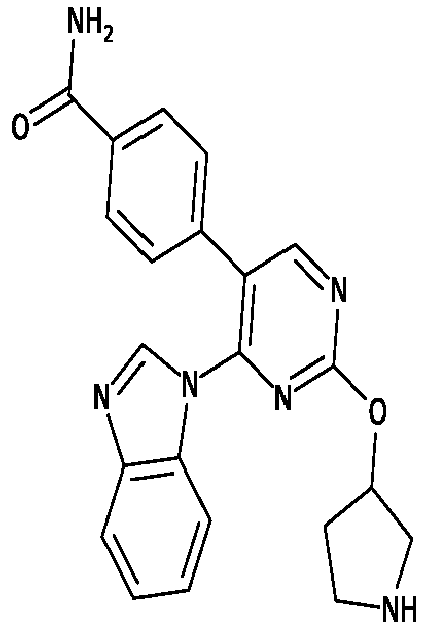
- LC/MS [M+1]+ m/z 401.3
1H NMR (500 MHz, Methanol-d4) δ 9.23 (s, 1H), 8.80 (s, 1H), 8.72 - 8.62 (m, 1H), 8.52 (s, 1H), 8.09 - 7.99 (m, 2H), 7.81 (dd, J = 8.1, 4.2 Hz, 3H), 7.52 (ddd, J = 8.3, 7.2, 1.3 Hz, 1H), 7.45 (td, J = 7.7, 7.2, 1.2 Hz, 1H), 6.11 (td, J = 5.0, 4.1, 2.4 Hz, 1H), 3.80 (dd, J = 13.5, 5.0 Hz, 1H), 3.74 - 3.66 (m, 1H), 3.52 (ddd, J = 12.1, 8.3, 4.1 Hz, 1H), 3.42 (ddd, J = 11.7, 9.8, 7.3 Hz, 1H), 2.52 (dddd, J = 13.2, 11.2, 9.3, 6.0 Hz, 2H). -

- LC/MS [M+1]+ m/z 320.2
1H NMR (500 MHz, Methanol-d4) δ 5.01 (s, 1H), 4.57 (s, 1H), 4.48 - 4.40 (m, 1H), 3.86 - 3.75 (m, 1H), 3.50 - 3.38 (m, 2H), 3.34 (s, 1H), 1.11 (ddt, J = 12.4, 8.5, 4.7 Hz, 1H), -0.04 (dd, J = 10.6, 7.1 Hz, 1H), -0.51 (dd, J = 10.7, 4.1 Hz, 1H), -1.10 (dd, J = 17.4, 8.5 Hz, 1H), -1.41 (dd, J = 17.4, 5.0 Hz, 1H). -

- LC/MS [M+1]+ m/z 369.2
1H NMR (500 MHz, Chloroform-d) δ 8.93 (s, 1H), 8.45 (s, 1H), 7.87 - 7.77 (m, 1H), 7.38 (ddd, J = 9.0, 7.5, 1.5 Hz, 2H), 7.32 - 7.26 (m, 1H), 7.14 - 7.01 (m, 3H), 6.95 (tdd, J = 8.4, 2.7, 1.0 Hz, 1H), 4.78 (t, J = 6.7 Hz, 2H), 3.21 (t, J = 6.7 Hz, 2H). -

- LC/MS [M+1]+ m/z 361.2
1H NMR (500 MHz, Methanol-d4) δ 9.19 (s, 1H), 8.98 (s, 1H), 8.58 (d, J = 8.1 Hz, 1H), 8.17 (d, J = 5.2 Hz, 1H), 7.83 - 7.75 (m, 1H), 7.53 - 7.43 (m, 2H), 7.18 (s, 1H), 5.02 (t, J = 6.2 Hz, 2H), 3.36 (d, J = 21.8 Hz, 2H). -

- LC/MS [M+1]+ m/z 440.3
1H NMR (500 MHz, Methanol-d4) δ 8.62 (s, 1H), 8.15 (dd, J = 5.5, 1.4 Hz, 1H), 7.44 (ddt, J = 7.2, 5.8, 1.8 Hz, 1H), 7.19 (dd, J = 5.8, 1.6 Hz, 1H), 4.56 (d, J = 11.1 Hz, 2H), 3.33 (p, J = 1.6 Hz, 2H), 1.52 (s, 3H), 1.49 (s, 3H). -

- LC/MS [M+1]+ m/z 342.2
1H NMR (500 MHz, Chloroform-d) δ 8.96 - 8.42 (m, 4H), 8.19 - 7.75 (m, 3H), 7.50 - 7.28 (m, 2H), 7.19 (d, J = 5.2 Hz, 1H), 6.30 (dt, J = 149.2, 6.1 Hz, 1H), 3.87 (p, J = 6.9 Hz, 2H), 3.01 (td, J = 7.1, 2.9 Hz, 2H). -

- LC/MS [M+1]+ m/z 398.3
1H NMR (500 MHz, Chloroform-d) δ 8.92 (s, 1H), 8.44 (s, 1H), 8.45 - 8.39 (m, 1H), 8.18 (d, J = 5.4 Hz, 1H), 7.86 - 7.79 (m, 1H), 7.45 - 7.32 (m, 2H), 7.28 (dt, J = 5.4, 1.8 Hz, 1H), 7.04 - 7.00 (m, 1H), 4.53 (s, 2H), 1.55 (s, 6H). -

- LC/MS [M+1]+ m/z 356.2
1H NMR (500 MHz, Methanol-d4) δ 9.88 (s, 1H), 8.61 (d, J = 8.3 Hz, 1H), 7.90 (d, J = 8.1 Hz, 1H), 7.76 - 7.58 (m, 2H), 5.46 (p, J = 7.2 Hz, 1H), 3.80 - 3.52 (m, 2H), 3.19 (dtd, J = 13.4, 7.2, 3.8 Hz, 2H), 2.74 (tt, J = 7.9, 4.6 Hz, 1H), 2.61 - 2.45 (m, 2H), 1.40 (ddt, J = 25.3, 8.1, 2.9 Hz, 4H) -

- LC/MS [M+1]+ m/z 344.2
1H NMR (500 MHz, Methanol-d4) δ 9.82 (s, 1H), 8.78 (d, J = 8.3 Hz, 1H), 7.90 (d, J = 8.1 Hz, 1H), 7.80 - 7.58 (m, 2H), 5.47 (p, J = 7.2 Hz, 1H), 3.87 - 3.60 (m, 2H), 3.20 (tdt, J = 9.4, 7.2, 2.2 Hz, 2H), 3.10 (q, J = 7.5 Hz, 2H), 2.52 (ddt, J = 13.5, 10.4, 5.2 Hz, 2H), 1.46 (t, J = 7.5 Hz, 3H) -

- LC/MS [M+1]+ m/z 389.1
1H NMR (500 MHz, Chloroform-d) δ 8.95 (s, 1H), 8.73 (s, 1H), 8.49 - 8.35 (m, 1H), 8.20 (d, J = 5.4 Hz, 1H), 7.90 - 7.79 (m, 1H), 7.46 - 7.38 (m, 2H), 7.30 (dt, J = 5.5, 1.8 Hz, 1H), 7.00 (t, J = 1.3 Hz, 1H), 4.58 (s, 2H), 1.57 (s, 6H). -

- LC/MS [M+1]+ m/z 360.8
1H NMR (500 MHz, Chloroform-d) δ 8.96 (s, 1H), 8.76 (s, 1H), 8.44 - 8.35 (m, 1H), 8.20 (d, J = 5.1 Hz, 1H), 7.89 - 7.77 (m, 1H), 7.42 (ddd, J = 6.1, 3.3, 1.9 Hz, 2H), 7.19 (dt, J = 5.2, 1.6 Hz, 1H), 6.92 (s, 1H), 4.86 (t, J = 6.3 Hz, 2H), 3.28 (t, J = 6.3 Hz, 2H). -

- LC/MS [M+1]+ m/z 449.3
\1H NMR (500 MHz, Chloroform-d) δ 8.13 (dd, J = 5.4, 2.0 Hz, 2H), 8.10 (s, 1H), 7.20 (ddt, J = 11.6, 5.4, 1.8 Hz, 2H), 6.95 (dt, J = 11.7, 1.0 Hz, 2H), 4.32 (d, J = 4.0 Hz, 4H), 1.45 (s, 6H), 1.43 (s, 6H). -

- LC/MS [M+1]+ m/z 398.3
1H NMR (500 MHz, Chloroform-d) δ 8.92 (s, 1H), 8.49 - 8.35 (m, 2H), 8.18 (d, J = 5.4 Hz, 1H), 7.86 - 7.80 (m, 1H), 7.47 - 7.33 (m, 2H), 7.28 (dt, J = 5.4, 1.8 Hz, 1H), 7.03 (dd, J = 2.0, 1.1 Hz, 1H), 4.53 (s, 2H), 1.55 (s, 5H). - The synthesized compounds then were tested for inhibition of the kinase activity (IC50) of Mnk1 and/or Mnk2 using the ADP monitoring assay for kinases described in Zegzouti, H.; Zdanovskaia, M.; Hsiao, K.; Goueli, S. A., ADP-Glo: A Bioluminescent and homogeneous ADP monitoring assay for kinases. "Assay and drug development technologies 2009," 7 (6), 560-72, the content of which is incorporated herein by reference.
- To evaluate inhibition of Mnk1 in cells, we utilized a flow cytometry-based assay based on activation of eIF-4E, the downstream target of Mnk1. The assay utilizes flow cytometry to quantitatively measure the amount of eIF-4E that is phosphorylated at residue Ser209 in cell lysate from U937 or MV4-11 cell lines. Cells grown in the presence of serum were treated with vehicle or test compounds across a range of concentrations. Levels of phospho-eIF-4E were measured and IC50 values were determined by logistic regression to quantify the potency of each compound.
Table 5. Mnk1 and Mnk2 IC50 for Inhibition Structure Molecule Name Mnk1 inhibition IC50 (+, ++, +++) Mnk2 inhibition IC50 (+, ++, +++) 
NUCC-0196254 +++ +++ 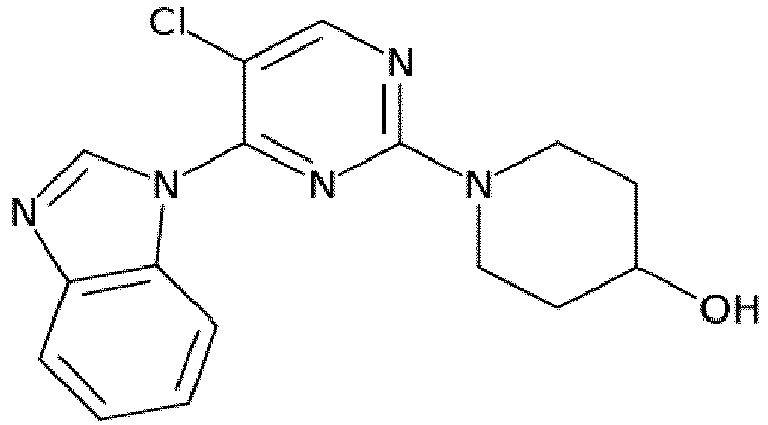
NUCC-0200781 N/A +++ 
NUCC-0200782 N/A N/A 
NUCC-0200783 + +++ 
NUCC-0200784 + ++ 
NUCC-0200785 + +++ 
NUCC-0200786 +++ +++ 
NUCC-0200787 +++ +++ 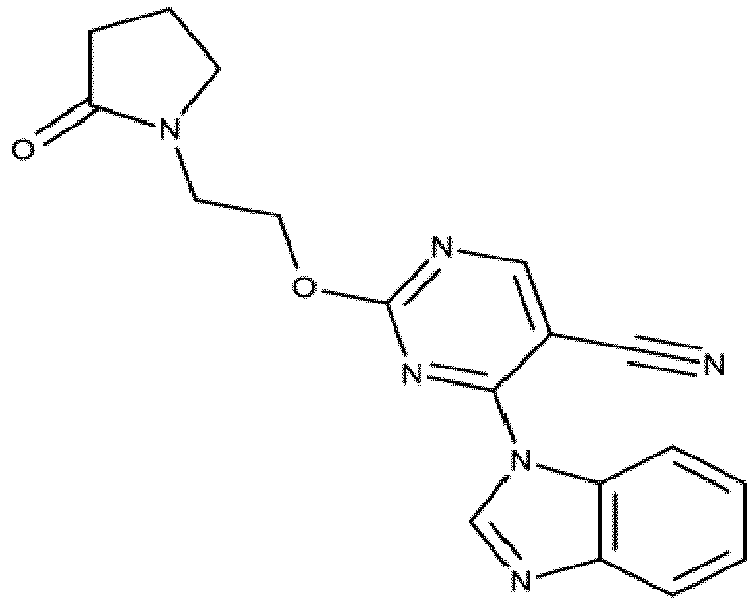
NUCC-0200788 +++ +++ 
NUCC-0200789 +++ +++ 
NUCC-0200790 +++ +++ 
NUCC-0200791 ++ +++ 
NUCC-0200792 +++ +++ 
NUCC-0200793 +++ +++ 
NUCC-0200794 ++ +++ 
NUCC-0200795 + ++ 
NUCC-0200796 + +++ 
NUCC-0200797 + +++ 
NUCC-0200798 + ++ 
NUCC-0200799 ++ +++ 
NUCC-0200800 no activity no activity 
NUCC-0200801 + ++ 
NUCC-0200802 + + 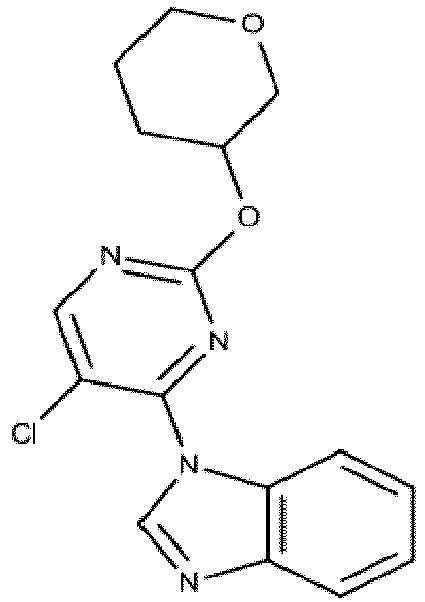
NUCC-0200803 +++ +++ 
NUCC-0200804 +++ +++ 
NUCC-0200805 +++ +++ 
NUCC-0200806 ++ +++ 
NUCC-0200807 +++ +++ 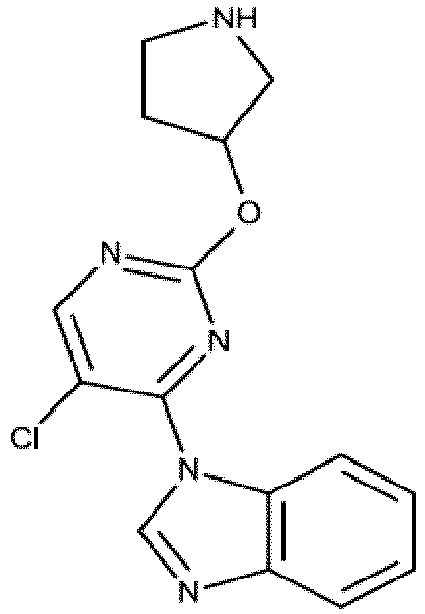
NUCC-0200808 +++ +++ 
NUCC-0200809 no activity no activity 
NUCC-0200810 no activity no activity 
NUCC-0200811 +++ +++ 
NUCC-0200901 N/A N/A 
NUCC-0200902 +++ +++ 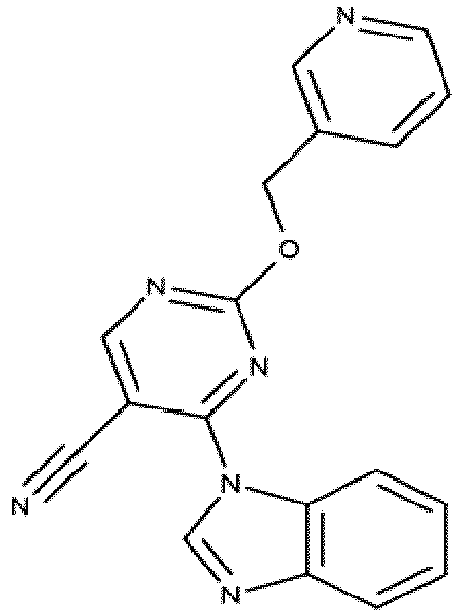
NUCC-0200903 +++ +++ 
NUCC-0200904 ++ ++ 
NUCC-0200905 + ++ 
NUCC-0200906 ++ +++ 
NUCC-0200907 +++ +++ 
NUCC-0200908 + ++ 
NUCC-0200909 +++ +++ 
NUCC-0200910 + +++ 
NUCC-0200911 + + 
NUCC-0200912 + ++ 
NUCC-0200913 + + 
NUCC-0200914 +++ +++ 
NUCC-0200953 ++ ++ 
NUCC-0200980 ++ +++ 
NUCC-0201002 +++ +++ 
NUCC-0201003 ++ ++ 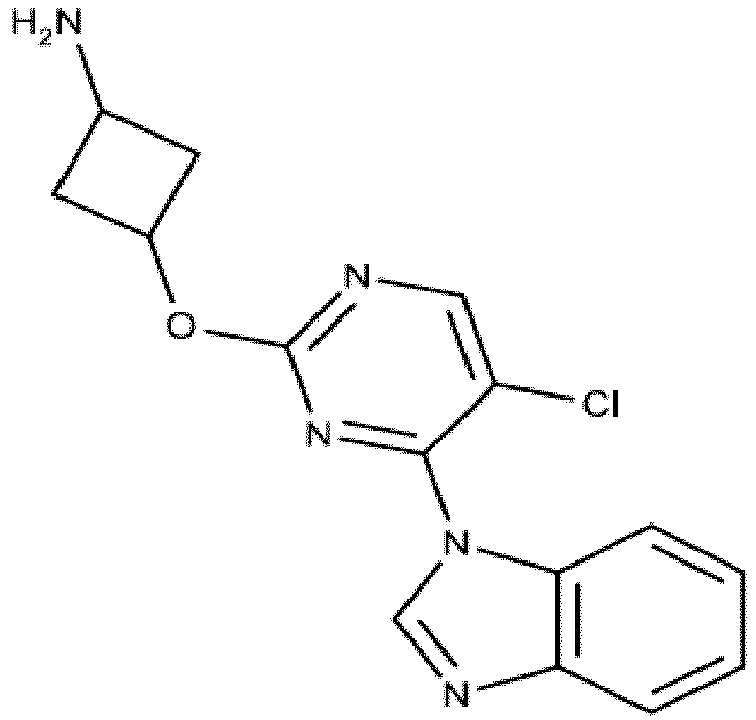
NUCC-0201004 +++ +++ 
NUCC-0201005 ++ ++ 
NUCC-0201006 ++ ++ 
NUCC-0201007 +++ +++ 
NUCC-0201015 ++ ++ 
NUCC-0201016 ++ ++ 
NUCC-0201017 +++ +++ 
NUCC-0201018 ++ ++ 
NUCC-0201019 ++ ++ 
NUCC-0201020 ++ ++ 
NUCC-0201021 +++ +++ 
NUCC-0201022 ++ ++ 
NUCC-0201046 +++ +++ 
NUCC-0201047 +++ +++ 
NUCC-0201048 +++ +++ 
NUCC-0201049 +++ +++ 
NUCC-0201050 ++ ++ 
NUCC-0201051 ++ ++ 
NUCC-0201052 +++ +++ 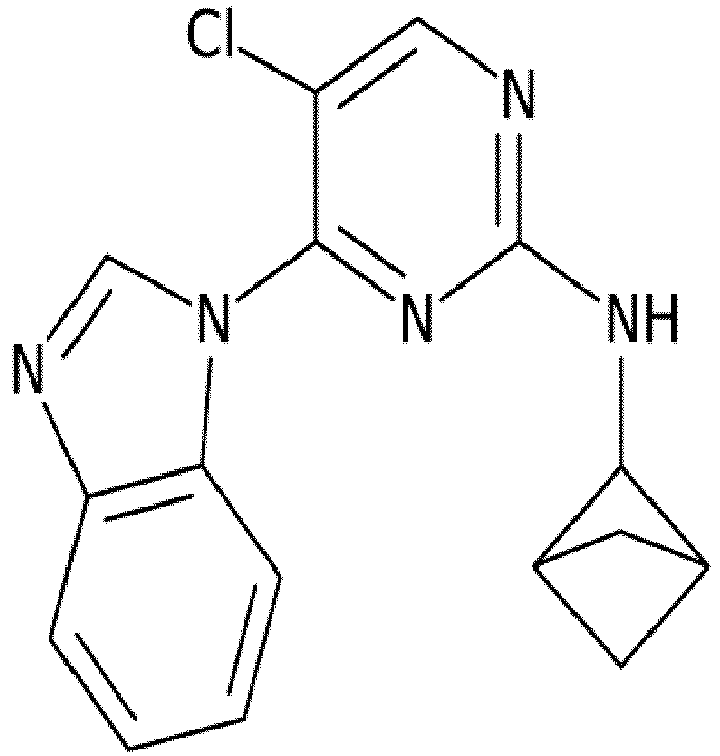
NUCC-0201136 ++ ++ 
NUCC-0201137 +++ +++ 
NUCC-0201246 ++ ++ 
NUCC-0201247 ++ ++ 
NUCC-0201248 ++ +++ 
NUCC-0201593 ++ +++ 
NUCC-0201662 +++ +++ 
NUCC-0201663 +++ ++ 
NUCC-0201664 +++ ++ 
NUCC-0201706 ++ ++ 
NUCC-0201887 +++ +++ 
NUCC-0201888 +++ +++ 
NUCC-0201889 ++ ++ 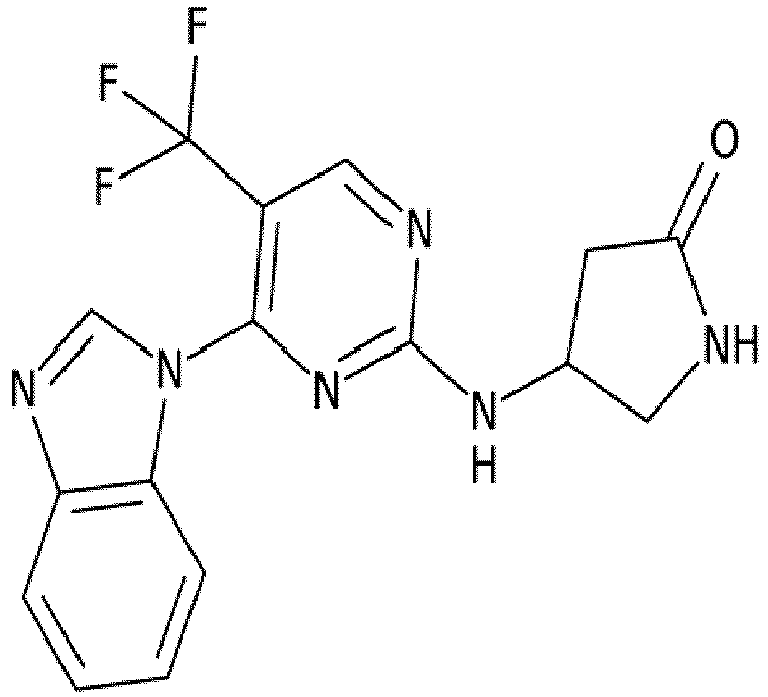
NUCC-0201890 +++ +++ 
NUCC-0201891 ++ +++ 
NUCC-0201892 +++ +++ 
NUCC-0201893 +++ +++ 
NUCC-0201894 +++ +++ 
NUCC-0201895 +++ +++ 
NUCC-0201896 +++ +++ 
NUCC-0201897 +++ +++ 
NUCC-0201898 calc +++ 
NUCC-0201899 ++ +++ 
NUCC-0201900 +++ +++ 
NUCC-0201901 ++ +++ 
NUCC-0201902 +++ +++ 
NUCC-0201903 +++ +++ 
NUCC-0201905 +++ +++ 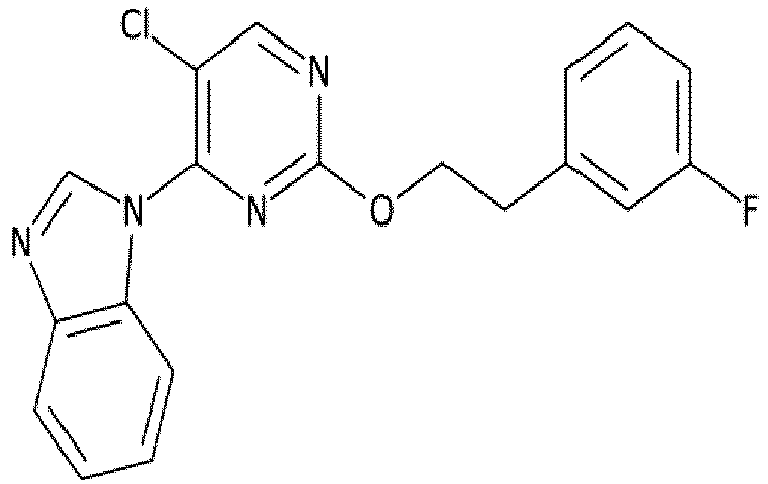
NUCC-0201906 +++ +++ 
NUCC-0201907 +++ +++ 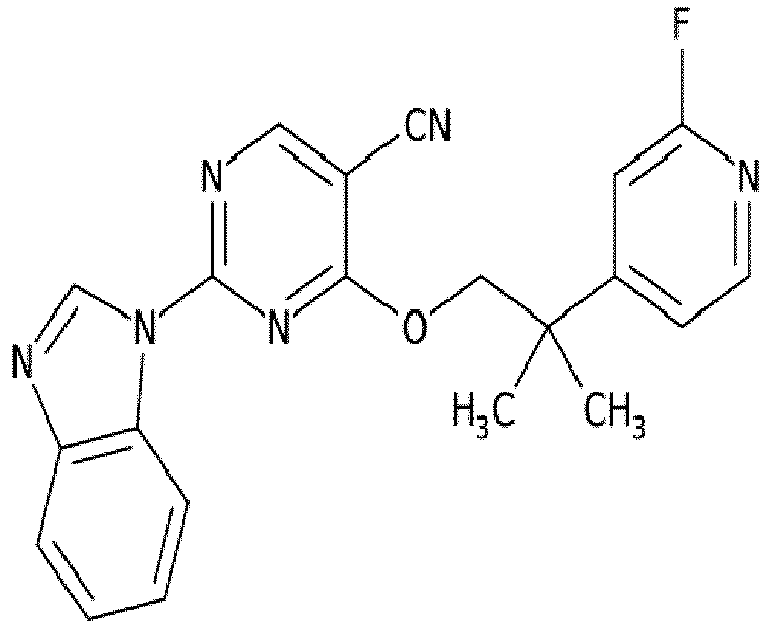
NUCC-0201908 ++ ++ 
NUCC-0201914 +++ +++ 
NUCC-0201915 ++ ++ 
NUCC-0201916 ++ ++ 
NUCC-0201917 +++ +++ 
NUCC-0201918 +++ +++ 
NUCC-0201919 ++ ++ 
NUCC-0201920 +++ +++ + IC50 > 10 µM
++ IC50 1-10 µM
+++ IC50 < 1 µMTable 6. Mnk1 and Mnk2 IC50 for Cellular Flow Structure Molecule Name U937 pEIF4E cellular flow IC50 (+, ++, +++) MV4-11 pEIF4E cellular flow IC50 (+, ++, +++) 
NUCC-0196254 +++ 
NUCC-0200786 +++ +++ 
NUCC-0200788 +++ +++ 
NUCC-0200790 +++ +++ 
NUCC-0200792 +++ +++ 
NUCC-0200793 +++ +++ 
NUCC-0200803 +++ +++ 
NUCC-0200807 +++ +++ 
NUCC-0200808 +++ +++ 
NUCC-0200811 +++ +++ 
NUCC-0200907 +++ +++ + IC50 > 10 µM
++ IC50 1-10 µM
+++ IC50 < 1 µM - In the foregoing description, it will be readily apparent to one skilled in the art that varying substitutions and modifications may be made to the invention disclosed herein without departing from the scope and spirit of the invention. The invention illustratively described herein suitably may be practiced in the absence of any element or elements, limitation or limitations which is not specifically disclosed herein. The terms and expressions which have been employed are used as terms of description and not of limitation, and there is no intention that in the use of such terms and expressions of excluding any equivalents of the features shown and described or portions thereof, but it is recognized that various modifications are possible within the scope of the invention. Thus, it should be understood that although the present invention has been illustrated by specific embodiments and optional features, modification and/or variation of the concepts herein disclosed may be resorted to by those skilled in the art, and that such modifications and variations are considered to be within the scope of this invention.
- The invention is illustrated by the following Embodiments
- Embodiment 1. A compound having Formula I:

- X1, X2, X3, and X4 are the same or different and are C or N, at least one of X1, X2, X3, and X4 is N and preferably no more than two of X1, X2, X3, and X4 is N;
- Z is N, O, or CH;
- n is 0-6 and optionally (CH2)n is substituted with alkyl and forms a branched alkyl substituent;
- R1 is hydrogen; alkyl; alkyoxy; hydroxyl; hydroxyalkyl; carboxyl; carboxyalkyl ester; carboxyalkyl amido; cycloalkyl optionally substituted at one or more positions with hydroxyl, alkyl, alkoxyl, amino, alkylamino, or carboxyl; bicycloalkyl; amino optionally substituted with alkyl; carboxy amido optionally substituted with phenyl or substituted phenyl; thioamido; or
- R1 is one 3-membered, one 4-membered ring, 5-membered ring, one 6-membered ring, or one 7-membered ring which ring is optionally saturated or unsaturated, or R1 is two fused rings which may be 5-membered rings or 6-membered rings which rings are optionally saturated or unsaturated, which one ring or rings are carbocycles or heterocycles including one or more heteroatoms, which one ring or rings optionally are substituted to include one or more non-hydrogen substituents, which non-hydrogen substituents optionally are selected from alkyl, halo, haloalkyl, hydroxyl, phenyl, amino, and carbonyl;
- R2 is hydrogen, alkyl, or R2 and R1 together form one 5-membered ring, one 6-membered ring, or one 7-membered ring which ring is optionally saturated or unsaturated, or R2 and R1 together form two fused rings which may be 5-membered rings or 6-membered rings which rings are optionally saturated or unsaturated, which ring or rings are carbocycles or heterocycles including one or more heteroatoms, which ring or rings optionally are substituted to include one or more non-hydrogen substituents, which non-hydrogen substituents optionally are selected from alkyl, halo, haloalkyl, hydroxyl, phenyl, amino, carbonyl, N-pyrrolidinyl, or caprolactam;
- R3 has a structure selected from


- R3 is *-O-alkyl -R3' or *-NH-alkyl-R3', wherein R3' is hydroxyl, phenyl, pyridinyl, indolyl, or pyrrolidonyl optionally substituted at one or more positions with halo;
- R4 and R4' are selected from hydrogen, alkyl, cycloalkyl; haloalkyl, halo, , alkoxy, cyano, amino, hydroxyl, carboxyl, carboxy alkyl ester, phenyl optionally substituted with alkoxy, haloalkoxy, and benzamido;
- R5 is hydrogen, alkyl, cycloalkyl, amino, carboxyl, carboxy alkyl ester, carboxy amido, carboxy alkyl amido, or N-benzimidazole;
- R6 is hydrogen, alkyl, phenyl optionally substituted at one or more positions with alkyoxy or halo, tetrahydropuranyl, alkylmorpholinyl, and benzyl;
- R7 is hydrogen, or alkyl;
- R8 is hydrogen or phenyl optionally substituted at one or more positions with alkyoxy; and
- Y1, Y2, Y3, and Y4 are the same or different and are selected from C or N and preferably no more than two or three of Y1, Y2, Y3, and Y4 are N;
- R9, R10, R11, R12, and R13 are the same or different and are hydrogen, alkyl, alkoxy, halo, haloalkyl, , nitro, carboxylalkyl ester, or phenyl;
- R14, R15, and R16 are the same or different and are hydrogen, alkyl, halo, haloalkyl, cyano, or phenyl optionally substituted with halo or haloalkyl;
- Embodiment 2. The compound of Embodiment 1, which is not

- Embodiment 3. The compound of Embodiment 1 or 2, having a formula selected from:

- Embodiment 4. The compound of Embodiment 1, 2 or 3 having a formula:

- Embodiment 5. The compound of any preceding Embodiment, wherein Z is O.
- Embodiment 6. The compound of any preceding Embodiment wherein R4 is halo or cyano.
- Embodiment 7. The compound of any preceding Embodiment wherein R1 is phenyl or pyridinyl optionally substituted at one or more positions with halo; or R1 is pyrrollidinyl or pyrrolidonyl; or R1 is cyclobutyl optionally substituted with amino; or R1 is bicyclo [1.1.1]pentane.
- Embodiment 8. The compound of Embodiment 1 having a formula:

- Embodiment 9. The compound of Embodiment 8, wherein R4 is halo or cyano.
- Embodiment 10. The compound of any preceding Embodiment wherein R3 has a formula -W-(CH2)p-R3', wherein W is N or O, p is 0-6, and R3' is one 3-membered, one 4-membered ring, 5-membered ring, one 6-membered ring, or one 7-membered ring which ring is optionally saturated or unsaturated, or R3' is two fused rings which may be 5-membered rings or 6-membered rings which rings are optionally saturated or unsaturated, which one ring or rings optionally are carbocycles or heterocycles including one or more heteroatoms, which one ring or rings optionally are substituted to include one or more non-hydrogen substituents, which non-hydrogen substituents optionally are selected from alkyl, halo, haloalkyl, hydroxyl, phenyl, amino, and carbonyl.
- Embodiment 11. A compound of any preceding Embodiment having a formula:

- Embodiment 12. The compound of Embodiment 11, wherein the alkyl group includes 1-6 carbon atoms and is straight-chain or branched alkyl, optionally R3' is phenyl or pyridinyl which optionally is substituted at one or more positions with halo, and optionally R4 is halo or cyano.
- Embodiment 13. A pharmaceutical composition comprising an effective amount of the compound of any preceding Embodiment, or a pharmaceutically acceptable salt thereof, together with a carrier, excipient, or diluent.
- Embodiment 14. A compound according to any one of Embodiments 1 to 12, or a pharmaceutically acceptable salt thereof, for use in the treatment of a disease or disorder associated with Mnk1 activity and/or Mnk2 activity in a subject in need thereof. Embodiment 15. A compound for use according to Embodiment 14, wherein the disease or disorder associated with Mnk1 activity and/or Mnk2 activity is cancer or a cell proliferative disorder.
- Embodiment 16. A compound for use according to Embodiment 15, wherein the cancer or the cell proliferative disorder is a hematological malignancy.
- Embodiment 17. A compound for use according to Embodiment 16, wherein the hematological malignancy is acute myeloid leukemia (AML).
- Embodiment 18. A compound for use according to Embodiment 14, wherein the disease or disorder associated with Mnk1 activity and/or Mnk2 activity is diabetes.
- Embodiment 19. A compound for use according to Embodiment 14, wherein the disease or disorder associated with Mnk1 activity and/or Mnk2 activity is autism.
- Embodiment 20. A compound for use according to Embodiment 14, wherein the disease or disorder associated with Mnk1 activity and/or Mnk2 activity is fragile X syndrome.
Claims (13)
- A compound having Formula I:
 X1, X2, X3, and X4 are the same or different and are C or N, at least one of X1, X2, X3, and X4 is N and preferably no more than two of X1, X2, X3, and X4 is N;Z is N, O, or CH;n is 0-6 and optionally (CH2)n is substituted with alkyl and forms a branched alkyl substituent;R1 is hydrogen; alkyl; alkyoxy; hydroxyl; hydroxyalkyl; carboxyl; carboxyalkyl ester; carboxyalkyl amido; cycloalkyl optionally substituted at one or more positions with hydroxyl, alkyl, alkoxyl, amino, alkylamino, or carboxyl; bicycloalkyl; amino optionally substituted with alkyl; carboxy amido optionally substituted with phenyl or substituted phenyl; thioamido; orR1 is one 3-membered, one 4-membered ring, 5-membered ring, one 6-membered ring, or one 7-membered ring which ring is optionally saturated or unsaturated, or R1 is two fused rings which may be 5-membered rings or 6-membered rings which rings are optionally saturated or unsaturated, which one ring or rings are carbocycles or heterocycles including one or more heteroatoms, which one ring or rings optionally are substituted to include one or more non-hydrogen substituents, which non-hydrogen substituents optionally are selected from alkyl, halo, haloalkyl, hydroxyl, phenyl, amino, and carbonyl;R2 is hydrogen, alkyl, or R2 and R1 together form one 5-membered ring, one 6-membered ring, or one 7-membered ring which ring is optionally saturated or unsaturated, or R2 and R1 together form two fused rings which may be 5-membered rings or 6-membered rings which rings are optionally saturated or unsaturated, which ring or rings are carbocycles or heterocycles including one or more heteroatoms, which ring or rings optionally are substituted to include one or more non-hydrogen substituents, which non-hydrogen substituents optionally are selected from alkyl, halo, haloalkyl, hydroxyl, phenyl, amino, carbonyl, N-pyrrolidinyl, or caprolactam;R3 has a structure selected from


 R3 is *-O-alkyl-R3' or *-NH-alkyl-R3', wherein R3' is hydroxyl, phenyl, pyridinyl, indolyl, or pyrrolidonyl optionally substituted at one or more positions with halo;R4 and R4' are selected from hydrogen, alkyl, cycloalkyl; haloalkyl, halo, , alkoxy, cyano, amino, hydroxyl, carboxyl, carboxy alkyl ester, phenyl optionally substituted with alkoxy, haloalkoxy, and benzamido;R5 is hydrogen, alkyl, cycloalkyl, amino, carboxyl, carboxy alkyl ester, carboxy amido, carboxy alkyl amido, or N-benzimidazole;R6 is hydrogen, alkyl, phenyl optionally substituted at one or more positions with alkyoxy or halo, tetrahydropuranyl, alkylmorpholinyl, and benzyl;R7 is hydrogen, or alkyl;R8 is hydrogen or phenyl optionally substituted at one or more positions with alkyoxy; andY1, Y2, Y3, and Y4 are the same or different and are selected from C or N and preferably no more than two or three of Y1, Y2, Y3, and Y4 are N;R9, R10, R11, R12, and R13 are the same or different and are hydrogen, alkyl, alkoxy, halo, haloalkyl, , nitro, carboxylalkyl ester, or phenyl;R14, R15, and R16 are the same or different and are hydrogen, alkyl, halo, haloalkyl, cyano, or phenyl optionally substituted with halo or haloalkyl;or a pharmaceutically acceptable salt thereof;
wherein the compound of Formula I is not
- The compound of claim 1, having a formula selected from:

- The compound of claim 1 or 2 wherein R4 is halo or cyano.
- The compound of any preceding claim wherein R1 is phenyl or pyridinyl optionally substituted at one or more positions with halo; or R1 is pyrrollidinyl or pyrrolidonyl; or R1 is cyclobutyl optionally substituted with amino; or R1 is bicyclo[1.1.1]pentane.
- The compound of any preceding claim wherein R3 has a formula - W-(CH2)p-R3', wherein W is N or O, p is 0-6, and R3' is one 3-membered, one 4-membered ring, 5-membered ring, one 6-membered ring, or one 7-membered ring which ring is optionally saturated or unsaturated, or R3' is two fused rings which may be 5-membered rings or 6-membered rings which rings are optionally saturated or unsaturated, which one ring or rings optionally are carbocycles or heterocycles including one or more heteroatoms, which one ring or rings optionally are substituted to include one or more non-hydrogen substituents, which non-hydrogen substituents optionally are selected from alkyl, halo, haloalkyl, hydroxyl, phenyl, amino, and carbonyl.
- A compound of claim 1 having a formula:

- The compound of claim 6, wherein the alkyl group includes 1-6 carbon atoms and is straight-chain or branched alkyl, optionally R3' is phenyl or pyridinyl which optionally is substituted at one or more positions with halo, and optionally R4 is halo or cyano.
- A pharmaceutical composition comprising an effective amount of the compound of any preceding claim, or a pharmaceutically acceptable salt thereof, together with a carrier, excipient, or diluent.
- A compound according to any one of claims 1 to 7, or a pharmaceutically acceptable salt thereof for use in the treatment of a disease or disorder associated with Mnk1 activity and/or Mnk2 activity in a subject in need thereof.
- A compound for use according to claim 9, wherein the disease or disorder associated with Mnk1 activity and/or Mnk2 activity is cancer or a cell proliferative disorder.
- A compound for use according to claim 10, wherein the cancer or the cell proliferative disorder is a hematological malignancy.
- A compound for use according to claim 11, wherein the hematological malignancy is acute myeloid leukemia (AML).
- A compound for use according to claim 9, wherein the disease or disorder associated with Mnk1 activity and/or Mnk2 activity is selected from diabetes, autism, and fragile X syndrome.
Applications Claiming Priority (1)
| Application Number | Priority Date | Filing Date | Title |
|---|---|---|---|
| US15/970,457 US10851082B2 (en) | 2015-10-28 | 2018-05-03 | Substituted aromatic n-heterocyclic compounds as inhibitors of mitogen-activated protein kinase interacting kinase 1 (MNK1) and 2 (MNK2) |
Publications (1)
| Publication Number | Publication Date |
|---|---|
| EP3564235A1 true EP3564235A1 (en) | 2019-11-06 |
Family
ID=66429215
Family Applications (1)
| Application Number | Title | Priority Date | Filing Date |
|---|---|---|---|
| EP19172664.5A Withdrawn EP3564235A1 (en) | 2018-05-03 | 2019-05-03 | Substituted aromatic n-heterocyclic compounds as inhibitors of mitogen-activated protein kinase interacting kinase 1 (mnk1) and 2 (mnk2) |
Country Status (1)
| Country | Link |
|---|---|
| EP (1) | EP3564235A1 (en) |
Citations (11)
| Publication number | Priority date | Publication date | Assignee | Title |
|---|---|---|---|---|
| US6498165B1 (en) | 1999-06-30 | 2002-12-24 | Merck & Co., Inc. | Src kinase inhibitor compounds |
| US20090170095A1 (en) | 2001-10-29 | 2009-07-02 | Develogen Aktiengesellschaft Fuer Entwicklungsbiologische Forschung | Mnk KINASE HOMOLOGOUS PROTEINS INVOLVED IN THE REGULATION OF ENERGY HOMEOSTASIS AND ORGANELLE METABOLISM |
| US20100022538A1 (en) * | 2008-01-22 | 2010-01-28 | Dow Agrosciences Llc | 5-fluoro pyrimidine derivatives |
| WO2013147711A1 (en) * | 2012-03-30 | 2013-10-03 | Agency For Science, Technology And Research | Bicyclic heterocyclic derivatives as mnk1 and mnk2 modulators and uses thereof |
| WO2014081906A2 (en) * | 2012-11-21 | 2014-05-30 | Ptc Therapeutics, Inc. | Substituted reverse pyrimidine bmi-1 inhibitors |
| WO2015030847A1 (en) * | 2013-08-30 | 2015-03-05 | Ptc Therapeutics, Inc. | Substituted pyrimidine bmi-1 inhibitors |
| WO2015108490A2 (en) * | 2014-01-17 | 2015-07-23 | Agency For Science, Technology And Research | Heteroaryl alkyne derivatives and uses thereof |
| WO2017075367A1 (en) * | 2015-10-28 | 2017-05-04 | Northwestern University | Substituted aromatic n-heterocyclic compounds as inhibitors of mitogen-activated protein kinase interacting kinase 1 (mnk1) and 2 (mnk2) |
| WO2017075394A1 (en) * | 2015-10-29 | 2017-05-04 | Effector Therapeutics, Inc. | Isoindoline, azaisoindoline, dihydroindenone and dihydroazaindenone inhibitors of mnk1 and mnk2 |
| US20180244654A1 (en) * | 2015-10-28 | 2018-08-30 | Northwestern University | Substituted aromatic n-heterocyclic compounds as inhibitors of mitogen-activated protein kinase interacting kinase 1 (mnk1) and 2 (mnk2) |
| WO2019110139A1 (en) * | 2017-12-05 | 2019-06-13 | Eth Zurich | New compounds for use as a therapeutically active substance and in particular for use in the treatment of tumors |
-
2019
- 2019-05-03 EP EP19172664.5A patent/EP3564235A1/en not_active Withdrawn
Patent Citations (11)
| Publication number | Priority date | Publication date | Assignee | Title |
|---|---|---|---|---|
| US6498165B1 (en) | 1999-06-30 | 2002-12-24 | Merck & Co., Inc. | Src kinase inhibitor compounds |
| US20090170095A1 (en) | 2001-10-29 | 2009-07-02 | Develogen Aktiengesellschaft Fuer Entwicklungsbiologische Forschung | Mnk KINASE HOMOLOGOUS PROTEINS INVOLVED IN THE REGULATION OF ENERGY HOMEOSTASIS AND ORGANELLE METABOLISM |
| US20100022538A1 (en) * | 2008-01-22 | 2010-01-28 | Dow Agrosciences Llc | 5-fluoro pyrimidine derivatives |
| WO2013147711A1 (en) * | 2012-03-30 | 2013-10-03 | Agency For Science, Technology And Research | Bicyclic heterocyclic derivatives as mnk1 and mnk2 modulators and uses thereof |
| WO2014081906A2 (en) * | 2012-11-21 | 2014-05-30 | Ptc Therapeutics, Inc. | Substituted reverse pyrimidine bmi-1 inhibitors |
| WO2015030847A1 (en) * | 2013-08-30 | 2015-03-05 | Ptc Therapeutics, Inc. | Substituted pyrimidine bmi-1 inhibitors |
| WO2015108490A2 (en) * | 2014-01-17 | 2015-07-23 | Agency For Science, Technology And Research | Heteroaryl alkyne derivatives and uses thereof |
| WO2017075367A1 (en) * | 2015-10-28 | 2017-05-04 | Northwestern University | Substituted aromatic n-heterocyclic compounds as inhibitors of mitogen-activated protein kinase interacting kinase 1 (mnk1) and 2 (mnk2) |
| US20180244654A1 (en) * | 2015-10-28 | 2018-08-30 | Northwestern University | Substituted aromatic n-heterocyclic compounds as inhibitors of mitogen-activated protein kinase interacting kinase 1 (mnk1) and 2 (mnk2) |
| WO2017075394A1 (en) * | 2015-10-29 | 2017-05-04 | Effector Therapeutics, Inc. | Isoindoline, azaisoindoline, dihydroindenone and dihydroazaindenone inhibitors of mnk1 and mnk2 |
| WO2019110139A1 (en) * | 2017-12-05 | 2019-06-13 | Eth Zurich | New compounds for use as a therapeutically active substance and in particular for use in the treatment of tumors |
Non-Patent Citations (9)
| Title |
|---|
| ALTMAN ET AL., BLOOD, vol. 121, no. 18, 2 May 2013 (2013-05-02), pages 3675 - 81 |
| ASSAY AND DRUG DEVELOPMENT TECHNOLOGIES 2009, vol. 7, no. 6, 2009, pages 560 - 72 |
| AUTISM, NATURE, vol. 493, pages 371 - 377 |
| NATURE NEUROSCIENCE, vol. 16, 2013, pages 1530 - 1536 |
| NATURE, vol. 493, pages 371 - 377 |
| OYARZABAL ET AL., J. MED. CHEM., vol. 53, no. 18, 23 September 2010 (2010-09-23), pages 6618 - 28 |
| REGISTRY, CHEMICAL ABSTRACTS SERVICE, COLUMBUS, OHIO, US, 17 September 2009 (2009-09-17), XP002789330 * |
| REGISTRY, CHEMICAL ABSTRACTS SERVICE, COLUMBUS, OHIO, US, 25 April 2011 (2011-04-25), XP002789332 * |
| ZEGZOUTI, H.; ZDANOVSKAIA, M.; HSIAO, K.; GOUELI, S. A.: "ADP-Glo: A Bioluminescent and homogeneous ADP monitoring assay for kinases", ASSAY AND DRUG DEVELOPMENT TECHNOLOGIES, vol. 7, no. 6, 2009, pages 560 - 72, XP055059194, DOI: 10.1089/adt.2009.0222 |
Similar Documents
| Publication | Publication Date | Title |
|---|---|---|
| US10851082B2 (en) | Substituted aromatic n-heterocyclic compounds as inhibitors of mitogen-activated protein kinase interacting kinase 1 (MNK1) and 2 (MNK2) | |
| US10093668B2 (en) | Substituted aromatic N-heterocyclic compounds as inhibitors of mitogen-activated protein kinase interacting kinase 1 (Mnk1) and 2 (Mnk2) | |
| EP3753937B1 (en) | Atr inhibitor and application thereof | |
| EP3584239B1 (en) | O-aminoheteroaryl alkynyl-containing compound, preparation method therefor, and use thereof | |
| US9981968B2 (en) | Substituted pyrrolo[2,3-d]pyrimidines for the treatment of cancer and proliferative disorders | |
| ES2257103T3 (en) | 4-AMINO-2-ARIL-CICLOPENTA (D) SUBSTITUTED PYRIMIDINS, ITS PREPARATION, ITS USE AND PHARMACEUTICAL PREPARATIONS THAT CONTAIN THEM. | |
| EP2933248B1 (en) | Novel renin inhibitor | |
| AU2011334624A1 (en) | Substituted benzopyrazin derivatives as FGFR kinase inhibitors for the treatment of cancer diseases | |
| EP2740728A1 (en) | Uracil derivative and use thereof for medical purposes | |
| EP3417850A1 (en) | Trisubstituted benzotriazole derivatives as dihydroorotate oxygenase inhibitors | |
| US20240207413A1 (en) | Proteolysis-targeting chimeric molecules (protacs) that induce degradation of c-myc protein | |
| EP3697410A1 (en) | Benzimidazole derivatives and their uses | |
| CA3130245A1 (en) | Heterocyclic compound, pharmaceutical composition comprising same, preparation method therefor, and use thereof | |
| WO2017155942A2 (en) | Substituted heterocycles as c-myc targeting agents | |
| EP4692088A1 (en) | Compound acting as wrn helicase inhibitor | |
| EP3418277B1 (en) | Substituted amino six-membered nitric heterocyclic ring compound and preparation and use thereof | |
| EP3615027B1 (en) | Methods of use for trisubstituted benzotriazole derivatives as dihydroorotate oxygenase inhibitors | |
| EP3006438A1 (en) | Cyclic aminomethyl pyrimidine derivative | |
| EP3305794B1 (en) | Selective modulators of the activity of the gpr55 receptor: chromenopyrazole derivatives | |
| US20250223306A1 (en) | Tead inhibitors and methods of use | |
| WO2020187292A1 (en) | 2-substituted pyrazoleamino-4-substituted amino-5-pyrimidine formamide compound, composition and use thereof | |
| EP4313292B1 (en) | Indoline derivatives as ddr1 and ddr2 inhibitors | |
| EP4085057B1 (en) | Pyridine and pyrimidine derivatives useful as pqsr inverse agonists | |
| RU2821516C2 (en) | Pyrazole derivatives as h4 antagonist compounds | |
| WO2024145315A1 (en) | Targeted protein degraders of indoleamine 2,3-dioxygenase 1 (ido1) |
Legal Events
| Date | Code | Title | Description |
|---|---|---|---|
| PUAI | Public reference made under article 153(3) epc to a published international application that has entered the european phase |
Free format text: ORIGINAL CODE: 0009012 |
|
| STAA | Information on the status of an ep patent application or granted ep patent |
Free format text: STATUS: THE APPLICATION HAS BEEN PUBLISHED |
|
| AK | Designated contracting states |
Kind code of ref document: A1 Designated state(s): AL AT BE BG CH CY CZ DE DK EE ES FI FR GB GR HR HU IE IS IT LI LT LU LV MC MK MT NL NO PL PT RO RS SE SI SK SM TR |
|
| AX | Request for extension of the european patent |
Extension state: BA ME |
|
| STAA | Information on the status of an ep patent application or granted ep patent |
Free format text: STATUS: REQUEST FOR EXAMINATION WAS MADE |
|
| 17P | Request for examination filed |
Effective date: 20200527 |
|
| RBV | Designated contracting states (corrected) |
Designated state(s): AL AT BE BG CH CY CZ DE DK EE ES FI FR GB GR HR HU IE IS IT LI LT LU LV MC MK MT NL NO PL PT RO RS SE SI SK SM TR |
|
| STAA | Information on the status of an ep patent application or granted ep patent |
Free format text: STATUS: EXAMINATION IS IN PROGRESS |
|
| 17Q | First examination report despatched |
Effective date: 20220218 |
|
| STAA | Information on the status of an ep patent application or granted ep patent |
Free format text: STATUS: THE APPLICATION IS DEEMED TO BE WITHDRAWN |
|
| 18D | Application deemed to be withdrawn |
Effective date: 20240511 |