EP3564234A1 - Nmda antagonist prodrugs - Google Patents
Nmda antagonist prodrugs Download PDFInfo
- Publication number
- EP3564234A1 EP3564234A1 EP19166031.5A EP19166031A EP3564234A1 EP 3564234 A1 EP3564234 A1 EP 3564234A1 EP 19166031 A EP19166031 A EP 19166031A EP 3564234 A1 EP3564234 A1 EP 3564234A1
- Authority
- EP
- European Patent Office
- Prior art keywords
- phenyl
- pyridin
- compound
- ethanamine
- pyrrolidine
- Prior art date
- Legal status (The legal status is an assumption and is not a legal conclusion. Google has not performed a legal analysis and makes no representation as to the accuracy of the status listed.)
- Granted
Links
- HDEPIBOBWYNTAW-ACRUOGEOSA-N CC(C)[C@@H](C(N(CCC1)[C@@H]1C(N[C@@H](Cc1ncccc1)c1ccccc1)=O)=O)N Chemical compound CC(C)[C@@H](C(N(CCC1)[C@@H]1C(N[C@@H](Cc1ncccc1)c1ccccc1)=O)=O)N HDEPIBOBWYNTAW-ACRUOGEOSA-N 0.000 description 1
Images

Classifications
-
- C—CHEMISTRY; METALLURGY
- C07—ORGANIC CHEMISTRY
- C07D—HETEROCYCLIC COMPOUNDS
- C07D213/00—Heterocyclic compounds containing six-membered rings, not condensed with other rings, with one nitrogen atom as the only ring hetero atom and three or more double bonds between ring members or between ring members and non-ring members
- C07D213/02—Heterocyclic compounds containing six-membered rings, not condensed with other rings, with one nitrogen atom as the only ring hetero atom and three or more double bonds between ring members or between ring members and non-ring members having three double bonds between ring members or between ring members and non-ring members
- C07D213/04—Heterocyclic compounds containing six-membered rings, not condensed with other rings, with one nitrogen atom as the only ring hetero atom and three or more double bonds between ring members or between ring members and non-ring members having three double bonds between ring members or between ring members and non-ring members having no bond between the ring nitrogen atom and a non-ring member or having only hydrogen or carbon atoms directly attached to the ring nitrogen atom
- C07D213/24—Heterocyclic compounds containing six-membered rings, not condensed with other rings, with one nitrogen atom as the only ring hetero atom and three or more double bonds between ring members or between ring members and non-ring members having three double bonds between ring members or between ring members and non-ring members having no bond between the ring nitrogen atom and a non-ring member or having only hydrogen or carbon atoms directly attached to the ring nitrogen atom with substituted hydrocarbon radicals attached to ring carbon atoms
- C07D213/36—Radicals substituted by singly-bound nitrogen atoms
- C07D213/40—Acylated substituent nitrogen atom
-
- A—HUMAN NECESSITIES
- A61—MEDICAL OR VETERINARY SCIENCE; HYGIENE
- A61K—PREPARATIONS FOR MEDICAL, DENTAL OR TOILETRY PURPOSES
- A61K31/00—Medicinal preparations containing organic active ingredients
- A61K31/33—Heterocyclic compounds
- A61K31/395—Heterocyclic compounds having nitrogen as a ring hetero atom, e.g. guanethidine or rifamycins
- A61K31/435—Heterocyclic compounds having nitrogen as a ring hetero atom, e.g. guanethidine or rifamycins having six-membered rings with one nitrogen as the only ring hetero atom
- A61K31/44—Non condensed pyridines; Hydrogenated derivatives thereof
- A61K31/4402—Non condensed pyridines; Hydrogenated derivatives thereof only substituted in position 2, e.g. pheniramine, bisacodyl
-
- A—HUMAN NECESSITIES
- A61—MEDICAL OR VETERINARY SCIENCE; HYGIENE
- A61K—PREPARATIONS FOR MEDICAL, DENTAL OR TOILETRY PURPOSES
- A61K31/00—Medicinal preparations containing organic active ingredients
- A61K31/33—Heterocyclic compounds
- A61K31/395—Heterocyclic compounds having nitrogen as a ring hetero atom, e.g. guanethidine or rifamycins
- A61K31/435—Heterocyclic compounds having nitrogen as a ring hetero atom, e.g. guanethidine or rifamycins having six-membered rings with one nitrogen as the only ring hetero atom
- A61K31/44—Non condensed pyridines; Hydrogenated derivatives thereof
- A61K31/4427—Non condensed pyridines; Hydrogenated derivatives thereof containing further heterocyclic ring systems
- A61K31/4439—Non condensed pyridines; Hydrogenated derivatives thereof containing further heterocyclic ring systems containing a five-membered ring with nitrogen as a ring hetero atom, e.g. omeprazole
-
- A—HUMAN NECESSITIES
- A61—MEDICAL OR VETERINARY SCIENCE; HYGIENE
- A61P—SPECIFIC THERAPEUTIC ACTIVITY OF CHEMICAL COMPOUNDS OR MEDICINAL PREPARATIONS
- A61P25/00—Drugs for disorders of the nervous system
- A61P25/24—Antidepressants
-
- C—CHEMISTRY; METALLURGY
- C07—ORGANIC CHEMISTRY
- C07D—HETEROCYCLIC COMPOUNDS
- C07D401/00—Heterocyclic compounds containing two or more hetero rings, having nitrogen atoms as the only ring hetero atoms, at least one ring being a six-membered ring with only one nitrogen atom
- C07D401/02—Heterocyclic compounds containing two or more hetero rings, having nitrogen atoms as the only ring hetero atoms, at least one ring being a six-membered ring with only one nitrogen atom containing two hetero rings
- C07D401/12—Heterocyclic compounds containing two or more hetero rings, having nitrogen atoms as the only ring hetero atoms, at least one ring being a six-membered ring with only one nitrogen atom containing two hetero rings linked by a chain containing hetero atoms as chain links
-
- C—CHEMISTRY; METALLURGY
- C07—ORGANIC CHEMISTRY
- C07D—HETEROCYCLIC COMPOUNDS
- C07D401/00—Heterocyclic compounds containing two or more hetero rings, having nitrogen atoms as the only ring hetero atoms, at least one ring being a six-membered ring with only one nitrogen atom
- C07D401/14—Heterocyclic compounds containing two or more hetero rings, having nitrogen atoms as the only ring hetero atoms, at least one ring being a six-membered ring with only one nitrogen atom containing three or more hetero rings
-
- C—CHEMISTRY; METALLURGY
- C07—ORGANIC CHEMISTRY
- C07K—PEPTIDES
- C07K5/00—Peptides containing up to four amino acids in a fully defined sequence; Derivatives thereof
- C07K5/04—Peptides containing up to four amino acids in a fully defined sequence; Derivatives thereof containing only normal peptide links
- C07K5/06—Dipeptides
- C07K5/06008—Dipeptides with the first amino acid being neutral
- C07K5/06017—Dipeptides with the first amino acid being neutral and aliphatic
- C07K5/06034—Dipeptides with the first amino acid being neutral and aliphatic the side chain containing 2 to 4 carbon atoms
- C07K5/06043—Leu-amino acid
-
- C—CHEMISTRY; METALLURGY
- C07—ORGANIC CHEMISTRY
- C07K—PEPTIDES
- C07K5/00—Peptides containing up to four amino acids in a fully defined sequence; Derivatives thereof
- C07K5/04—Peptides containing up to four amino acids in a fully defined sequence; Derivatives thereof containing only normal peptide links
- C07K5/06—Dipeptides
- C07K5/06008—Dipeptides with the first amino acid being neutral
- C07K5/06017—Dipeptides with the first amino acid being neutral and aliphatic
- C07K5/06034—Dipeptides with the first amino acid being neutral and aliphatic the side chain containing 2 to 4 carbon atoms
- C07K5/06052—Val-amino acid
-
- C—CHEMISTRY; METALLURGY
- C07—ORGANIC CHEMISTRY
- C07K—PEPTIDES
- C07K5/00—Peptides containing up to four amino acids in a fully defined sequence; Derivatives thereof
- C07K5/04—Peptides containing up to four amino acids in a fully defined sequence; Derivatives thereof containing only normal peptide links
- C07K5/06—Dipeptides
- C07K5/06008—Dipeptides with the first amino acid being neutral
- C07K5/06078—Dipeptides with the first amino acid being neutral and aromatic or cycloaliphatic
-
- C—CHEMISTRY; METALLURGY
- C07—ORGANIC CHEMISTRY
- C07K—PEPTIDES
- C07K5/00—Peptides containing up to four amino acids in a fully defined sequence; Derivatives thereof
- C07K5/04—Peptides containing up to four amino acids in a fully defined sequence; Derivatives thereof containing only normal peptide links
- C07K5/06—Dipeptides
- C07K5/06086—Dipeptides with the first amino acid being basic
-
- C—CHEMISTRY; METALLURGY
- C07—ORGANIC CHEMISTRY
- C07K—PEPTIDES
- C07K5/00—Peptides containing up to four amino acids in a fully defined sequence; Derivatives thereof
- C07K5/04—Peptides containing up to four amino acids in a fully defined sequence; Derivatives thereof containing only normal peptide links
- C07K5/06—Dipeptides
- C07K5/06086—Dipeptides with the first amino acid being basic
- C07K5/06095—Arg-amino acid
-
- C—CHEMISTRY; METALLURGY
- C07—ORGANIC CHEMISTRY
- C07K—PEPTIDES
- C07K5/00—Peptides containing up to four amino acids in a fully defined sequence; Derivatives thereof
- C07K5/04—Peptides containing up to four amino acids in a fully defined sequence; Derivatives thereof containing only normal peptide links
- C07K5/06—Dipeptides
- C07K5/06104—Dipeptides with the first amino acid being acidic
-
- C—CHEMISTRY; METALLURGY
- C07—ORGANIC CHEMISTRY
- C07K—PEPTIDES
- C07K5/00—Peptides containing up to four amino acids in a fully defined sequence; Derivatives thereof
- C07K5/04—Peptides containing up to four amino acids in a fully defined sequence; Derivatives thereof containing only normal peptide links
- C07K5/06—Dipeptides
- C07K5/06139—Dipeptides with the first amino acid being heterocyclic
-
- C—CHEMISTRY; METALLURGY
- C07—ORGANIC CHEMISTRY
- C07K—PEPTIDES
- C07K5/00—Peptides containing up to four amino acids in a fully defined sequence; Derivatives thereof
- C07K5/04—Peptides containing up to four amino acids in a fully defined sequence; Derivatives thereof containing only normal peptide links
- C07K5/06—Dipeptides
- C07K5/06139—Dipeptides with the first amino acid being heterocyclic
- C07K5/06147—Dipeptides with the first amino acid being heterocyclic and His-amino acid; Derivatives thereof
-
- C—CHEMISTRY; METALLURGY
- C07—ORGANIC CHEMISTRY
- C07K—PEPTIDES
- C07K5/00—Peptides containing up to four amino acids in a fully defined sequence; Derivatives thereof
- C07K5/04—Peptides containing up to four amino acids in a fully defined sequence; Derivatives thereof containing only normal peptide links
- C07K5/06—Dipeptides
- C07K5/06139—Dipeptides with the first amino acid being heterocyclic
- C07K5/06156—Dipeptides with the first amino acid being heterocyclic and Trp-amino acid; Derivatives thereof
-
- A—HUMAN NECESSITIES
- A61—MEDICAL OR VETERINARY SCIENCE; HYGIENE
- A61K—PREPARATIONS FOR MEDICAL, DENTAL OR TOILETRY PURPOSES
- A61K38/00—Medicinal preparations containing peptides
Definitions
- This invention is directed to prodrugs of an NMDA antagonist, ( S )-1-phenyl-2-(pyridin-2-yl)ethanamine, and their use in the treatment of depression and depressive disorders, particularly major depressive disorder (MDD), and also for the treatment of pain (such as neuropathic pain).
- the prodrugs of ( S )-1-phenyl-2-(pyridin-2-yl)ethanamine can also be used to treat Rett Syndrome, suicidal ideation, bipolar disorder (including bipolar depression), obsessive compulsive disorder, sarin gas poisoning, and status epilepticus.
- the invention also relates to pharmaceutical compositions comprising the prodrugs and to processes for preparing them.
- Pain in one form or another is a pervasive part of human life. Pain from injury and post-surgical pain is often temporary, but can be severe, and can persist. Neuropathic pain such as diabetic neuropathy and post-herpetic neuralgia severely impacts sufferers. Every year, tens of millions of people around the world, including patients at the end of their lives, suffer from pain without adequate treatment.
- Depression affects about 120 million people worldwide. Symptoms of depression include, but are not limited to, depressed mood, loss of interest or pleasure, feelings of guilt or low self-worth, disturbed sleep or appetite, low energy, and poor concentration, or any combination thereof. These problems can be chronic or recurrent and can lead to substantial impairment of an individual's ability to take care of his or her everyday responsibilities. Depression is the leading cause of disability as measured by Years Lived with a Disability (YLDs) and the fourth leading contributor to the global burden of disease as measured by Disability Adjusted Life Years (DALYs; i.e., the sum of years of potential life lost due to premature mortality and the years of productive life lost due to disability) in 2000. By the year 2020, depression is projected to reach second place in the ranking of DALYs calculated for all ages, in both men and women. Today, depression is already the second cause of DALYs in the age category 15-44 years for both sexes combined.
- YLDs Years Lived with a Disability
- DALYs Disability Adjusted Life
- Prodrugs of ( S )-1-phenyl-2-(pyridin-2-yl)ethanamine are predicted to break down in a human body to provide ( S )-1-phenyl-2-(pyridin-2-yl)ethanamine, so that, when prodrugs of ( S )-1-phenyl-2-(pyridin-2-yl)ethanamine are administered orally, they would break down to liberate a therapeutically effective dose of ( S )-1-phenyl-2-(pyridin-2-yl)ethanamine.
- prodrug of the present invention is administered intravenously it is predicted that the prodrug would liberate ( S )-1-phenyl-2-(pyridin-2-yl)ethanamine to give a lower Cmax, at a slower rate, than if the corresponding dose of ( S )-1-phenyl-2-(pyridin-2-yl)ethanamine had been administered intravenously.
- the use of prodrugs of ( S )-1-Phenyl-2-(pyridin-2-yl)ethanamine would be predicted to improve the clinical safety profile of ( S )-1-Phenyl-2-(pyridin-2-yl)ethanamine (for example under overdose or, drug abuse (eg pill crushing) conditions).
- Figure 1a and 1b illustrates the conversion of prodrug of ( S )-1-phenyl-2-(pyridin-2-yl)ethanamine (Example 5) to ( S )-1-phenyl-2-(pyridin-2-yl)ethanamine during an incubation period in human intestinal fluid.
- figure 1a illustrates prodrug of ( S )-1-phenyl-2-(pyridin-2-yl)ethanamine (Example 5) concentration (initial concentrations of 30, 100, 300 and 600 ⁇ M), as it transforms to ( S )-1-phenyl-2-(pyridin-2-yl)ethanamine, during an incubation period in human intestinal fluid.
- Figure 1b illustrates ( S )-1-phenyl-2-(pyri d in-2-yl)ethanamine concentration, as it converts from prodrug of ( S )-1-phenyl-2-(pyridin-2-yl)ethanamine (Example 5, initial concentrations of 30, 100, 300 and 600 ⁇ M), during an incubation period in human intestinal fluid.
- the present invention provides a compound of formula (I): wherein R 1 is C 1-6 alkyl C(O)O(C 1-6 alkoxy), or AA is a peptide bond-linked natural amino acid; or a pharmaceutically acceptable salt thereof.
- Alkyl is straight or branched chain and contains 1-6, for example 1-4, carbon atoms.
- Alkyl is, for example, methyl, ethyl, n-propyl, iso-propyl, n-butyl, sec-butyl, iso-butyl or tert-butyl.
- Alkoxy is straight or branched chain and contain 1-6, for example 1-4, carbon atoms. Alkoxy is, for example, methoxy, ethoxy, n-propoxy, iso-propoxy, n-butoxy, sec-butoxy, iso-butoxy or tert-butoxy.
- the present invention provides a compound of formula (I) wherein R1 is C 1-6 alkylC(O)O(C 1-6 alkoxy), for example it is C 1-4 alkylC(O)O(C 1-4 alkoxy).
- R1 is C 1-6 alkylC(O)O(C 1-6 alkoxy), for example it is C 1-4 alkylC(O)O(C 1-4 alkoxy).
- Examples include: (CH 3 ) 2 CHC(O)OCH 2 O, (CH 3 ) 2 CHC(O)OCH(CH(CH 3 ) 2 )O, CH 3 C(O)OCH(CH 3 )O or (CH 3 ) 2 CHC(O)OCH(CH 3 )O.
- the present invention provides a compound of formula (I) wherein R1 is and AA is a peptide bond-linked natural amino acid.
- the present invention provides a compound of formula (I) wherein R1 is
- the present invention provides a compound of formula (I) wherein AA is, for example, glycine, alanine, valine, leucine, isoleucine, serine, threonine, cysteine, cystine, methionine, aspartic acid, glutamic acid, asparagine, glutamine, lysine, hydroxylysine, arginine, histidine, phenylalanine, tyrosine, tryptophan, proline or hydroxyproline.
- AA is selected from the group consisting of tyrosine, tryptophan, phenylalanine, leucine, arginine, histidine, lysine and valine.
- AA is selected from the group consisting of tyrosine, arginine, histidine, lysine and valine.
- AA is valine.
- a suitable pharmaceutically acceptable salt is, for example, an acid addition salt such as a hydrochloride, hydrobromide, sulphate, phosphate, acetate, fumarate, maleate, tartrate, lactate, citrate, pyruvate, succinate, oxalate, methanesulphonate, p-toluenesulphonate, bisulphate, benzenesulphonate, ethanesulphonate, malonate, xinafoate, ascorbate, oleate, nicotinate, saccharinate, adipate, formate, glycolate, L-lactate, D-lactate, aspartate, malate, L-tartrate, D-tartrate, stearate, 2-furoate, 3-furoate, napadisylate (naphthalene-1,5-disulfonate or naphthalene-1-(sulfonic acid)-5-sulfonate), edisy
- Compounds of the invention can be prepared by adapting methods described in the art or by adapting methods described in the Examples.
- the compound ( S )-1-phenyl-2-(pyridin-2-yl)ethanamine) can be prepared, for example, by process methodology in EP-0633879 and the content of that document is incorporate by reference.
- R1 is synthesized using a chemical process that proceeds though a 2-(( S )-2-phenyl-2-(( S )-pyrrolid-2-incarboxamido)ethyl)pyridine intermediate.
- the present invention provides the compound 2-(( S )-2-phenyl-2-(( S )-pyrrolid-2-incarboxamido)ethyl)pyridine: or a salt thereof, wherein said salt is, for example, a hydrochloride, hydrobromide, sulphate, phosphate, acetate, methanesulphonate, p -toluenesulphonate, formate or benzoate salt.
- the present invention provides the intermediate compound 2-(( S )-2-phenyl-2-(( S )-pyrrolidin-2-iumcarboxamido)ethyl)pyridinium chloride
- a compound of formula (I), or a pharmaceutically acceptable salt thereof, can be used in the treatment of depression (such as major depressive disorder, for example treatment resistant major depressive disorder).
- a compound of formula (I), or a pharmaceutically acceptable salt thereof can be used in the treatment of pain (such as neuropathic pain, chronic pain, phantom-limb pain, nociceptive pain, psychogenic pain, incident pain or breakthrough pain).
- pain such as neuropathic pain, chronic pain, phantom-limb pain, nociceptive pain, psychogenic pain, incident pain or breakthrough pain.
- a compound of formula (I), or a pharmaceutically acceptable salt thereof can be used in the treatment of Rett Syndrome, suicidal ideation, bipolar disorder, obsessive compulsive disorder, sarin gas poisoning, or status epilepticus.
- the present invention provides a compound of formula (I) or a pharmaceutically-acceptable salt thereof as defined herein for use in therapy. Therefore, the term “prodrug” as used herein may refer to a compound of formula (I) in the form of a salt or in the form of a free base.
- the present invention provides the use of a compound of formula (I) or a pharmaceutically acceptable salt thereof as defined herein in the manufacture of a medicament for use in therapy.
- the present invention provides a method of administering ( S )-1-phenyl-2-(pyridin-2-yl)ethanamine to a patient, said method comprising administering a compound of formula (I), of a pharmaceutically acceptable salt thereof, to a patient wherein said compound of formula (I) metabolises in said patient to produce ( S )-1-phenyl-2-(pyridin-2-yl)ethanamine.
- the term “therapy” also includes “prophylaxis” unless there are specific indications to the contrary.
- the terms “therapeutic” and “therapeutically” should be construed accordingly.
- Prophylaxis is expected to be particularly relevant to the treatment of persons who have suffered a previous episode of, or are otherwise considered to be at increased risk of, the disease or condition in question.
- Persons at risk of developing a particular disease or condition generally include those having a family history of the disease or condition, or those who have been identified by genetic testing or screening to be particularly susceptible to developing the disease or condition.
- the invention still further provides a method of treating depression which comprises administering to a patient in need thereof a therapeutically effective amount of a compound of formula (I) or a pharmaceutically acceptable salt thereof as defined herein.
- the invention still further provides a method of treating MDD which comprises administering to a patient in need thereof a therapeutically effective amount of a compound of formula (I) or a pharmaceutically acceptable salt thereof as defined herein.
- the invention still further provides a method of treating pain which comprises administering to a patient in need thereof a therapeutically effective amount of a compound of formula (I) or a pharmaceutically acceptable salt thereof as defined herein.
- the invention still further provides a method of treating neuropathic pain, chronic pain, phantom-limb pain, nociceptive pain, psychogenic pain, incident pain or breakthrough pain which comprises administering to a patient in need thereof a therapeutically effective amount of a compound of formula (I) or a pharmaceutically acceptable salt thereof as defined herein.
- the daily dosage of the compound of the invention if inhaled, may be in the range from 0.05 micrograms per kilogram body weight ( ⁇ g/kg) to 100 micrograms per kilogram body weight ( ⁇ g/kg).
- the daily dosage of the compound of the invention may be in the range from 0.01 micrograms per kilogram body weight ( ⁇ g/kg) to 100 milligrams per kilogram body weight (mg/kg).
- the pharmaceutical composition will preferably comprise from 0.05 to 99 %w (per cent by weight), more preferably from 0.05 to 80 %w, still more preferably from 0.10 to 70 %w, and even more preferably from 0.10 to 50 %w, of active ingredient, all percentages by weight being based on total composition.
- the pharmaceutical composition comprises 0.5 %w of active ingredient.
- the pharmaceutical composition comprises 20 %w of active ingredient.
- the present invention also provides a pharmaceutical composition
- a pharmaceutical composition comprising a compound of formula (I) or a pharmaceutically acceptable salt thereof as defined herein, in association with a pharmaceutically acceptable adjuvant, diluent or carrier.
- the invention further provides a process for the preparation of a pharmaceutical composition of the invention which comprises mixing a compound of formula (I) or a pharmaceutically acceptable salt thereof as defined herein with a pharmaceutically acceptable adjuvant, diluent or carrier.
- the compound of the invention may be admixed with an adjuvant or a carrier, for example, lactose, saccharose, sorbitol, mannitol; a starch, for example, potato starch, corn starch or amylopectin; a cellulose derivative; a binder, for example, gelatine or polyvinylpyrrolidone; and/or a lubricant, for example, magnesium stearate, calcium stearate, polyethylene glycol, a wax, paraffin, and the like, and then compressed into tablets.
- an adjuvant or a carrier for example, lactose, saccharose, sorbitol, mannitol
- a starch for example, potato starch, corn starch or amylopectin
- a cellulose derivative for example, gelatine or polyvinylpyrrolidone
- a lubricant for example, magnesium stearate, calcium stearate, polyethylene glycol, a wax
- the cores may be coated with a concentrated sugar solution which may contain, for example, gum arabic, gelatine, talcum and titanium dioxide.
- a concentrated sugar solution which may contain, for example, gum arabic, gelatine, talcum and titanium dioxide.
- the tablet may be coated with a suitable polymer dissolved in a readily volatile organic solvent.
- the compound of the invention may be admixed with, for example, a vegetable oil or polyethylene glycol.
- Hard gelatine capsules may contain granules of the compound using either the above-mentioned excipients for tablets.
- liquid or semisolid formulations of the compound of the invention may be filled into hard gelatine capsules.
- Compounds of the invention may also be administered in conjunction with other compounds used for the treatment of the above conditions.
- High pressure liquid chromatography was performed on a reversed phase (RP) column.
- a linear gradient was applied using for example mobile phase A (0.1% Formic Acid in MilliQ H2O or 0.1% NH3 in MilliQ H2O or 10 mM NH4OAc and 5% CH3CN in MilliQ H2O, or 0.05% trifluoric acid in MilliQ H2O, or NH4HCO3 in MilliQ H2O (10mM)) and B (CH3OH or CH3CN).
- MS analyses were performed in positive and/or negative ion mode using electrospray ionization (ESI+/-), atmospheric pressure photo ionization (APPI+/-) and/or atmospheric pressure chemical ionization (APCI+/-).
- ESI+/- electrospray ionization
- APPI+/- atmospheric pressure photo ionization
- APCI+/- atmospheric pressure chemical ionization
- GC Gas chromatography
- MS mass spectrometer
- FID flame ionization detector
- EI electron impact
- CI chemical ionization
- DB-5MS DB-5MS
- Supercritical Fluid Chromatography was performed on a straight phase column.
- An isocratic flow was applied using mobile phase A (CO2) and for example mobile phase B (MeOH, EtOH or IPA).
- HPLC high pressure liquid chromatography
- NMR spectra were recorded on a 300 MHz (or higher field) NMR spectrometer fitted with a probe of suitable configuration. Spectra were recorded at ambient temperature unless otherwise stated. Chemical shifts are given in ppm down- and upfield from TMS (0.00 ppm). The following reference signals were used: TMS ⁇ 0.00, or the residual solvent signal of DMSO-d6 ⁇ 2.49, CD3OD ⁇ 3.30, acetone-d6 2.04, CDCl3 ⁇ 7.25, or D2O ⁇ 4.79 (unless otherwise indicated). Resonance multiplicities are denoted s, d, t, q, m, br and app for singlet, doublet, triplet, quartet, multiplet, broad and apparent, respectively.
- Example 2 diastereomer 1 There are two different diastereomers of Example 2 due to the two possible configurations at the carbon atom identified with *. These are referred to as Example 2 diastereomer 1 and Example 2 diastereomer 2. Their absolute configurations have not been determined.
- Example 3 diastereomer 1 There are two different diastereomers of Example 3 due to the two possible configurations at the carbon atom identified with *. These are referred to as Example 3 diastereomer 1 and Example 3 diastereomer 2. Their absolute configurations have not been determined.
- Example 4 diastereomer 1 There are two different diastereomers of Example 4 due to the two possible configurations at the carbon atom identified with *. These are referred to as Example 4 diastereomer 1 and Example 4 diastereomer 2. Their absolute configurations have not been determined.
- T3P 50% wt. in DMF, 0.86 mL, 1.47 mmol was added dropwise to a solution of (1 S )-1-phenyl-2-(pyridin-2-yl)ethan-1-amine (200 mg, 0.737 mmol), Boc-L-proline (159 mg, 0.737 mmol) and DIPEA (0.64 mL, 3.69 mmol) in CH 2 Cl 2 (7.4 mL) at 0 °C. The reaction was gradually warmed to rt while stirring overnight. The organic layer was washed twice with 5% aq. NaHCO 3 , once with brine, dried over Na 2 SO 4 , filtered and concentrated.
- the product was purified using a 50 g snap column, eluting with a gradient of MeOH and CH 2 Cl 2 (0% MeOH / 100% CH 2 Cl 2 ⁇ 10% MeOH / 90% CH 2 Cl 2 ), yielding the title compound 305 mg (>100%).
- Boc-L-Pro-OH (2.0 g, 9.29 mmol) was dissolved in anhydrous DMF (15 mL).
- HATU 3. g, 9.76 mmol
- Hunig's base 5.3 mL, 30.66 mmol
- 2-[(2 S )-2-azaniumyl-2-phenylethyl]pyridin-1-ium dichloride (2.5 g, 9.29 mmol) was added to the solution and the mixture was stirred for 3 hours 30 minutes at rt.
- the product was purified on a SiO 2 column, eluting with a gradient (0% MeOH / 50% EtOAc / 50% heptane ⁇ 0% MeOH / 100% EtOAc / 0% heptane ⁇ 10% MeOH / 90% EtOAc / 0% heptane) and then on a C-18 column, eluting with a gradient of MeOH and water (0 to 100% MeOH), yielding 2.9 g (78%) of the title compound.
- the title compound as the dihydrochloride salt was then converted to the free base by techniques known to one of ordinary skill in the art.
- the title compound may be prepared as a fumarate salt by methods known to one of ordinary skill in the art.
- N-alpha, N-epsilon-bis(tert-Butoxycarbonyl)-L-lysine dicyclohexylammonium salt (287 mg, 0.54 mmol) was dissolved in anhydrous DMF (4 mL).
- HATU (217 mg, 0.57 mmol)
- DIPEA (0.21 mL, 1.19 mmol) were added and the mixture was stirred at rt for 30 minutes.
- (2 S )-2- ⁇ [(1 S )-1-phenyl-2-(pyridin-1-ium-2-yl)ethyl]carbamoyl ⁇ pyrrolidin-1-ium dichloride 200 mg, 0.54 mmol was added to the solution and the mixture was stirred for 18h at rt. Water was added and the mixture was extracted 3 x with EtOAc. The organic phase was washed with brine, dried over Na 2 SO 4 , filtered and concentrated under reduced pressure.
- the product was purified on a SiO 2 column, eluting with a gradient (0% MeOH / 50% EtOAc / 50% heptane ⁇ 0% MeOH / 100% EtOAc / 0% heptane ⁇ 10% MeOH / 90% EtOAc / 0% heptane) then on a C-18 column, eluting with a gradient of MeOH and water (0 to 100% MeOH), yielding 80 mg (24%) of the title compound.
- Boc-His-OH (166 mg, 0.65 mmol) was dissolved in anhydrous DMF (4 mL). HATU (260 mg, 0.68 mmol) and DIPEA (0.38 mL, 2.85 mmol) were added and the mixture was stirred at rt for 30 minutes. Then, 2-(( S )-2-phenyl-2-(( S )-pyrrolidin-2-iumcarboxamido)ethyl)pyridinium chloride (240 mg, 0.65 mmol) was added and the mixture was stirred for 66 hours at rt. Water was added and the mixture was extracted 3x with EtOAc. The organic phase was washed with brine, dried over Na 2 SO 4 , filtered and concentrated under reduced pressure.
- the product was purified on a SiO 2 column, eluting with a gradient of MeOH and CH 2 Cl 2 (0% to 13% MeOH) then on a C-18 column, eluting with a gradient of MeOH and water (0 to 100% MeOH), yielding 100 mg (29%) of the title compound.
- the title compound can also be named as: 2-[(2 S )-2- ⁇ [(2 S )-1-[(2 S )-2-azaniumyl-3-(4-hydroxyphenyl)propanoyl]pyrrolidin-2-yl]formamido ⁇ -2-phenylethyl]pyridin-1-ium dichloride
- Boc-Tyr-OH (229 mg, 0.81 mmol) was dissolved in anhydrous DMF (5 mL). HATU (325 mg, 0.86 mmol) and DIPEA (0.47 mL, 2.69 mmol) were added and the mixture was stirred at rt for 30 minutes. Then, 2-(( S )-2-phenyl-2-(( S )-pyrrolidin-2-iumcarboxamido)ethyl)pyridinium chloride (300 mg, 0.81 mmol) was added to the solution and the mixture was stirred for 66h at rt. Water was added and the mixture was extracted 3x with EtOAc.
- the title compound can also be named: 2-[(2 S )-2- ⁇ [(2 S )-1-[(2 S )-2-azaniumyl-3-(1H-indol-3-yl)propanoyl]pyrrolidin-2-yl]formamido ⁇ -2-phenylethyl]pyridin-1-ium dichloride STEP A
- Boc-Trp-OH (207 mg, 0.68 mmol) was dissolved in anhydrous DMF (4 mL).
- HATU (271 mg, 0.71 mmol) and DIPEA (0.39 mL, 2.24 mmol) were added and the mixture was stirred at rt for 30 minutes.
- (2 S )-2- ⁇ [(1 S )-1-phenyl-2-(pyridin-1-ium-2-yl)ethyl]carbamoyl ⁇ pyrrolidin-1-ium dichloride 250 mg, 0.68 mmol was added and the mixture was stirred for 18 hours at rt. Water was added and the mixture was extracted 3x with EtOAc.
- Boc-Phe-OH (180 mg, 0.68 mmol) was dissolved in anhydrous DMF (4 mL). HATU (271 mg, 0.71 mmol) and DIPEA (0.39 mL, 2.24 mmol) were added and the mixture was stirred at rt for 30 minutes. Then, (2 S )-2- ⁇ [(1 S )-1-phenyl-2-(pyridin-1-ium-2-yl)ethyl]carbamoyl ⁇ pyrrolidin-1-ium dichloride (250 mg, 0.68 mmol) was added to the solution and the mixture was stirred for 18h at rt. Water was added and the mixture was extracted 3 x with EtOAc.
- N-(tert-Butoxycarbonyl)-L-leucine (157 mg, 0.68 mmol) was dissolved in anhydrous DMF (4 mL).
- HATU (271 mg, 0.71 mmol)
- DIPEA (0.39 mL, 2.24 mmol) were added and the mixture was stirred at rt for 30 minutes.
- (2 S )-2- ⁇ [(1 S )-1-phenyl-2-(pyridin-1-ium-2-yl)ethyl]carbamoyl ⁇ pyrrolidin-1-ium dichloride (250 mg, 0.68 mmol) was added to the solution and the mixture was stirred for 18 hours at rt. Water was added and the mixture was extracted 3x with EtOAc.
- Boc-Arg(Boc) 2 -OH (644 mg, 1.36 mmol) was dissolved in anhydrous DMF (7 mL). HATU (542 mg, 1.43 mmol) and DIPEA (0.78 mL, 4.48 mmol) were added and the mixture was stirred at rt for 30 minutes. Then, (2S)-2- ⁇ [(1S)-1-phenyl-2-(pyridin-1-ium-2-yl)ethyl]carbamoyl ⁇ pyrrolidin-1-ium dichloride (500 mg, 1.36 mmol) was added to the solution and the mixture was stirred for 18h at rt. Water was added and the mixture was extracted 3x with EtOAc.
- the organic phase was washed with brine, dried over Na 2 SO 4 , filtered and concentrated under reduced pressure.
- the product was purified on a SiO 2 column, eluting with a gradient (0% MeOH / 50% EtOAc / 50% heptane ⁇ 0% MeOH / 100% EtOAc / 0% heptane ⁇ 10% MeOH / 90% EtOAc / 0% heptane) then on a C-18 column, eluting with a gradient of MeOH and water (0 to 100% MeOH)., yielding 200 mg (20%) of the title compound.
- Prodrugs described herein are contemplated to be administered orally by those suffering with depression or pain.
- This example illustrates that different prodrugs of ( S )-1-phenyl-2-(pyridin-2-yl)ethanamine, wherein R1 is C 1-6 alkylC(O)O(C 1-6 alkoxy), may be used to achieve differing rates of conversion (i.e., slow or rapid) to ( S )-1-phenyl-2-(pyridin-2-yl)ethanamine to ascertain a suitable PK profile.
- R1 is C 1-6 alkylC(O)O(C 1-6 alkoxy
- Conversion of a prodrug wherein R1 is C 1-6 alkylC(O)O(C 1-6 alkoxy) to ( S )-1-phenyl-2-(pyridin-2-yl)ethanamine is expected to occur via an initial enzymatic hydrolysis of a functional group, such as an ester, followed by a spontaneous conversion to ( S )-1-phenyl-2-(pyridin-2-yl)ethanamine.
- Enzymes involved are expected to be several non-specific, high capacity esterases, which can be shown by inhibiting the conversion with a non-selective esterase inhibitor but not inhibiting the conversion using selective inhibitors. Such esterases are expected to be distributed throughout the human body.
- Human Intestinal Fluid HIF
- human liver S9 fraction and human whole blood have been used to examine the pharmacokinetic properties of the prodrugs of ( S )-1-phenyl-2-(pyridin-2-yl)ethanamine as well as the formation rate and formation extent of the ( S )-1-phenyl-2-(pyridin-2-yl)ethanamine in different bodily compartments.
- the formation rate of ( S )-1-phenyl-2-(pyridin-2-yl)ethanamine from different prodrugs of ( S )-1-phenyl-2-(pyridin-2-yl)ethanamine differs markedly in all tested assays, as shown in Table 1.
- This example illustrates that different prodrugs of ( S )-1-phenyl-2-(pyridin-2-yl)ethanamine, wherein R1 is may be used to achieve differing rates of conversion (i.e., slow or rapid) to ( S )-1-phenyl-2-(pyridin-2-yl)ethanamine to ascertain a suitable PK profile.
- R1 is may be used to achieve differing rates of conversion (i.e., slow or rapid) to ( S )-1-phenyl-2-(pyridin-2-yl)ethanamine to ascertain a suitable PK profile.
- R1 is may be used to achieve differing rates of conversion (i.e., slow or rapid) to ( S )-1-phenyl-2-(pyridin-2-yl)ethanamine to ascertain a suitable PK profile.
- varying R1 to produce different prodrugs results in different pharmacokinetic profiles of ( S )-1-phenyl-2-(pyridin-2-yl)ethan
- Conversion of a prodrug to ( S )-1-phenyl-2-(pyridin-2-yl)ethanamine of a compound of formula (I) wherein R1 is: is expected to occur via enzymatic hydrolysis at the proline C-terminus, releasing a dipeptide and ( S )-1-phenyl-2-(pyridin-2-yl)ethanamine.
- the enzyme involved is expected to be dipeptidyl peptidase IV (DPPIV), which can be shown by inhibiting the conversion with a selective inhibitor of this enzyme. DPPIV is expected to be distributed throughout the human body.
- Human Intestinal Fluid HIF
- human liver S9 fraction and human whole blood have been used to examine the pharmacokinetic properties of prodrugs of ( S )-1-phenyl-2-(pyridin-2-yl)ethanamine as well as the formation rate and formation extent of the ( S )-1-phenyl-2-(pyridin-2-yl)ethanamine in different bodily compartments.
- Caco-2 cells have been used to evaluate the permeability and absorption potential of the prodrugs of ( S )-1-phenyl-2-(pyridin-2-yl)ethanamine.
- the in vitro assays show that different pharmacokinetic plasma profiles of ( S )-1-phenyl-2-(pyridin-2-yl)ethanamine can be achieved by using different prodrugs. Hence, different pharmacokinetic profiles of ( S )-1-phenyl-2-(pyridin-2-yl)ethanamine can be achieved by use of different prodrugs.
- This example illustrates that oral doses of prodrug of ( S )-1-phenyl-2-(pyridin-2-yl)ethanamine have a similar pharmacokinetic profile to an IV 1-hour infusion of ( S )-1-phenyl-2-(pyridin-2-yl)ethanamine.
- ( S )-1-phenyl-2-(pyridin-2-yl)ethanamine projects to have good oral bioavailability (>75%) in man, but a higher than acceptable Cmax when given as an intravenous bolus (relative to its safety profile as a 1-hr infusion).
- PBPK multi-compartmental, physiologically-based pharmacokinetic models
- Table 3 shows key pharmacokinetic predictions for Example 5 - one of the DPPIV cleaved prodrugs.
- Cmax exposure of ( S )-1-phenyl-2-(pyridin-2-yl)ethanamine is predicted to increase by >2x when a given oral dose form is crushed and illicitly delivered as a bolus i.v. administration.
- ( S )-1-phenyl-2-(pyridin-2-yl)ethanamine released from an oral administered prodrug has a PK profile similar to a 1-hr infusion of ( S )-1-phenyl-2-(pyridin-2-yl)ethanamine with no Cmax doubling when given as a bolus i.v..
- a DPPIV inhibitor can be used to stop conversion in case of purposeful or inadvertent misuse - an added safety feature embedded within the DPPIV prodrug design.
- Compound 1 is ( S )-1-phenyl-2-(pyridin-2-yl)ethanamine.
- all doses are selected to contain equivalent amounts of Compound 1 [( S )-1-phenyl-2-(pyridin-2-yl)ethanamine free base], i.e. each dose contains the same amount of Compound 1 within it and potentially available for release in the form of free base ( S )-1-phenyl-2-(pyridin-2-yl)ethanamine.
- modeled Cmax concentrations of free base Compound 1 may be compared directly across different administrations of ( S )-1-phenyl-2-(pyridin-2-yl)ethanamine and prodrug of ( S )-1-phenyl-2-(pyridin-2-yl)ethanamine, as shown within Table 3.
- ( S )-1-phenyl-2-(pyridin-2-yl)ethanamine dihydrochloride and vehicle were administered once per day via oral gavage (water). Formulations were prepared twice, once weekly. Dosing formulations were stored and refrigerated (2-8°C) in amber glass containers until required for dosing. A range of concentrations of ( S )-1-phenyl-2-(pyridin-2-yl)ethanamine dihydrochloride in vehicle were prepared in order to keep the dose volume for all doses (1 mL/kg). Individual doses were based on the most recent body weights of dogs used in the study.
- a prodrug of ( S )-1-phenyl-2-(pyridin-2-yl)ethanamine as fumarate salt (example 5) and vehicle were administered once per day for 14 days via oral gavage at approximately the same time each day ( ⁇ 1 hour), (vehicle is 0.3 M gluconic acid pH 3.0).
- a range of concentrations of prodrug of ( S )-1-phenyl-2-(pyridin-2-yl)ethanamine as fumarate salt in vehicle were prepared (for example 3, 10 and 30 mg/mL of prodrug of ( S )-1-phenyl-2-(pyridin-2-yl)ethanamine) in order to keep the dose volume for all doses (2 mL/kg).
- the dosing formulations were warmed to room temperature by stirring for at least 30 minutes prior to dosing and continuously throughout the administration procedure. Individual doses were based on the most recent body weights of dogs used in the study.
- Compound 1 is ( S )-1-phenyl-2-(pyridin-2-yl)ethanamine.
- Table 4 illustrates the highest blood levels in which seizures do not occur (No Observed Effect Limit, NOEL), and the lowest blood levels in which seizures occur (Lowest Observed Effect Limit, LOEL), following administration of Compound 1 dihydrochloride and following administration of a fumarate salt prodrug of Compound 1. In each case the highest blood concentration (Cmax) of free base ( S )-1-phenyl-2-(pyridin-2-yl)ethanamine is measured.
- the free base ( S )-1-phenyl-2-(pyridin-2-yl)ethanamine is generated directly from Compound 1, administered as the dihydrochloride salt.
- the free base ( S )-1-phenyl-2-(pyridin-2-yl)ethanamine is generated via in vivo conversion from a prodrug of Compound 1, administered as the fumarate salt.
- the NOEL for seizures was higher when the prodrug of ( S )-1-phenyl-2-(pyridin-2-yl)ethanamine as fumarate salt was administered compared to when ( S )-1-phenyl-2-(pyridin-2-yl)ethanamine as dihydrochloride salt was administered.
- Example 5 illustrates that increasing doses of prodrug of ( S )-1-phenyl-2-(pyridin-2-yl)ethanamine, Example 5, produces less than proportional increases in the concentration of ( S )-1-phenyl-2-(pyridin-2-yl)ethanamine in human intestinal fluid, as illustrated in Figure 1a and Figure 1b .
- prodrugs of ( S )-1-phenyl-2-(pyridin-2-yl)ethanamine, wherein R1 is are primarily cleaved by DPPIV. There is the potential for endogenous and / or exogenous modulation of DPPIV to impact the conversion of the prodrug to ( S )-1-phenyl-2-(pyridin-2-yl)ethanamine.
- the mobile phases used consisted of A: 0.03% TFA in H2O (v/v) and B: 0.03% TFA in acetonitrile (v/v).
- the conversion rate from prodrug to ( S )-1-phenyl-2-(pyridin-2-yl)ethanamine was determined by fitting the measured prodrug and ( S )-1-phenyl-2-(pyridin-2-yl)ethanamine concentrations versus time.
- 52 male and 52 female rats were administered either (a) prodrug of ( S )-1-phenyl-2-(pyridin-2-yl)ethanamine as a fumarate salt in vehicle (0.3M Gluconic Acid, pH 3.0) or (b) vehicle (0.3M Gluconic Acid, pH 3.0) once per day for 14 days at approximately the same time each day (09:26 +/- 124 minutes).
- the doses (30, 100, and 300 mg/kg of prodrug of ( S )-1-phenyl-2-(pyridin-2-yl)ethanamine) were administered in a dose volume of 10 mL/kg. After 14 days, blood samples were collected 24 hours post-dose from lateral tail vein in restrained animals.
- Blood samples were collected using 50ul neutral Sarstedt Minivette POCT capillary tubes. The blood was then transferred to pre-chilled tubes containing ice cold sodium citrate, shaken 5-10 times by hand and frozen in dry ice within 10 seconds of collection. Whole blood samples were shipped frozen on dry ice to Covance Laboratories Inc. for analysis. Samples were analyzed for concentrations of prodrug of ( S )-1-phenyl-2-(pyridin-2-yl)ethanamine and ( S )-1-phenyl-2-(pyridin-2-yl)ethanamine. All analytical work was conducted by Covance Laboratories, Inc., Madison, Wisconsin using an LC/MS/MS analytical method developed and validated by that laboratory.
- Table 5 illustrates toxicokinetic parameters following administering therapeutic and supra-therapeutic doses of prodrug of ( S )-1-phenyl-2-(pyridin-2-yl)ethanamine to rats.
- Table 5 Mean Toxicokinetic Parameters for ( S )-1-Phenyl-2-(pyridin-2-yl)ethanamine in Rats after Oral Administration of ( S )-1-(( S )-2-Amino-3-methylbutanoyl)-N-(( S )-1-phenyl-2-(pyridin-2-yl)ethyl)pyrrolidine-2-carboxamide fumerate (Example 5) for 14 Days ( S )-1-Phenyl-2-(pyridin-2-yl)ethanamine - Male (Day 14) Dose 30 mg/kg/day (75 ⁇ mol/kg/day) 100 mg/kg/day (250 ⁇ mol/kg/day) 300 mg/kg/day (750 ⁇ mol/kg/day) C max (
Landscapes
- Chemical & Material Sciences (AREA)
- Organic Chemistry (AREA)
- Health & Medical Sciences (AREA)
- Medicinal Chemistry (AREA)
- Life Sciences & Earth Sciences (AREA)
- General Health & Medical Sciences (AREA)
- Biochemistry (AREA)
- Proteomics, Peptides & Aminoacids (AREA)
- Molecular Biology (AREA)
- Genetics & Genomics (AREA)
- Biophysics (AREA)
- Public Health (AREA)
- Veterinary Medicine (AREA)
- Animal Behavior & Ethology (AREA)
- Pharmacology & Pharmacy (AREA)
- Epidemiology (AREA)
- Pain & Pain Management (AREA)
- Chemical Kinetics & Catalysis (AREA)
- Engineering & Computer Science (AREA)
- Bioinformatics & Cheminformatics (AREA)
- Biomedical Technology (AREA)
- Neurology (AREA)
- Neurosurgery (AREA)
- Psychiatry (AREA)
- General Chemical & Material Sciences (AREA)
- Nuclear Medicine, Radiotherapy & Molecular Imaging (AREA)
- Pharmaceuticals Containing Other Organic And Inorganic Compounds (AREA)
- Plural Heterocyclic Compounds (AREA)
- Pyridine Compounds (AREA)
- Peptides Or Proteins (AREA)
- Medicinal Preparation (AREA)
- Medicines That Contain Protein Lipid Enzymes And Other Medicines (AREA)
Abstract
Description
- This application claims priority to
U.S. provisional patent application serial number 61/899,903, filed November 5, 2013 - This invention is directed to prodrugs of an NMDA antagonist, (S)-1-phenyl-2-(pyridin-2-yl)ethanamine, and their use in the treatment of depression and depressive disorders, particularly major depressive disorder (MDD), and also for the treatment of pain (such as neuropathic pain). The prodrugs of (S)-1-phenyl-2-(pyridin-2-yl)ethanamine can also be used to treat Rett Syndrome, suicidal ideation, bipolar disorder (including bipolar depression), obsessive compulsive disorder, sarin gas poisoning, and status epilepticus. The invention also relates to pharmaceutical compositions comprising the prodrugs and to processes for preparing them.
- Pain in one form or another is a pervasive part of human life. Pain from injury and post-surgical pain is often temporary, but can be severe, and can persist. Neuropathic pain such as diabetic neuropathy and post-herpetic neuralgia severely impacts sufferers. Every year, tens of millions of people around the world, including patients at the end of their lives, suffer from pain without adequate treatment.
- Depression affects about 120 million people worldwide. Symptoms of depression include, but are not limited to, depressed mood, loss of interest or pleasure, feelings of guilt or low self-worth, disturbed sleep or appetite, low energy, and poor concentration, or any combination thereof. These problems can be chronic or recurrent and can lead to substantial impairment of an individual's ability to take care of his or her everyday responsibilities. Depression is the leading cause of disability as measured by Years Lived with a Disability (YLDs) and the fourth leading contributor to the global burden of disease as measured by Disability Adjusted Life Years (DALYs; i.e., the sum of years of potential life lost due to premature mortality and the years of productive life lost due to disability) in 2000. By the year 2020, depression is projected to reach second place in the ranking of DALYs calculated for all ages, in both men and women. Today, depression is already the second cause of DALYs in the age category 15-44 years for both sexes combined.
- (S)-1-Phenyl-2-(pyridin-2-yl)ethanamine dihydrochloride has been disclosed for the treatment of MDD via intravenous infusion treatment (Gerard Sanacora et al, poster presented on 6 December 2012 at the 51st Annual Meeting of the American College of Neuropsychopharmacology in Hollywood, Florida, USA. Other related disclosures include
WO1993/020052 ,WO2000/056324 , andWO2000/63175 -
Figure 1a and 1b illustrates the conversion of prodrug of (S)-1-phenyl-2-(pyridin-2-yl)ethanamine (Example 5) to (S)-1-phenyl-2-(pyridin-2-yl)ethanamine during an incubation period in human intestinal fluid. In particular,figure 1a illustrates prodrug of (S)-1-phenyl-2-(pyridin-2-yl)ethanamine (Example 5) concentration (initial concentrations of 30, 100, 300 and 600 µM), as it transforms to (S)-1-phenyl-2-(pyridin-2-yl)ethanamine, during an incubation period in human intestinal fluid.Figure 1b illustrates (S)-1-phenyl-2-(pyridin-2-yl)ethanamine concentration, as it converts from prodrug of (S)-1-phenyl-2-(pyridin-2-yl)ethanamine (Example 5, initial concentrations of 30, 100, 300 and 600 µM), during an incubation period in human intestinal fluid. - The present invention provides a compound of formula (I):


or a pharmaceutically acceptable salt thereof. - Alkyl is straight or branched chain and contains 1-6, for example 1-4, carbon atoms. Alkyl is, for example, methyl, ethyl, n-propyl, iso-propyl, n-butyl, sec-butyl, iso-butyl or tert-butyl.
- Alkoxy is straight or branched chain and contain 1-6, for example 1-4, carbon atoms. Alkoxy is, for example, methoxy, ethoxy, n-propoxy, iso-propoxy, n-butoxy, sec-butoxy, iso-butoxy or tert-butoxy.
- In one aspect the present invention provides a compound of formula (I) wherein R1 is C1-6 alkylC(O)O(C1-6 alkoxy), for example it is C1-4 alkylC(O)O(C1-4 alkoxy). Examples include: (CH3)2CHC(O)OCH2O, (CH3)2CHC(O)OCH(CH(CH3)2)O, CH3C(O)OCH(CH3)O or (CH3)2CHC(O)OCH(CH3)O.
- In another aspect the present invention provides a compound of formula (I) wherein R1 is

- In yet another aspect the present invention provides a compound of formula (I) wherein R1 is

- (so the chiral centre * has S absolute configuration).
- In a further aspect the present invention provides a compound of formula (I) wherein AA is, for example, glycine, alanine, valine, leucine, isoleucine, serine, threonine, cysteine, cystine, methionine, aspartic acid, glutamic acid, asparagine, glutamine, lysine, hydroxylysine, arginine, histidine, phenylalanine, tyrosine, tryptophan, proline or hydroxyproline. In a still further aspect AA is selected from the group consisting of tyrosine, tryptophan, phenylalanine, leucine, arginine, histidine, lysine and valine. In another aspect AA is selected from the group consisting of tyrosine, arginine, histidine, lysine and valine. In a still further aspect AA is valine.
- A suitable pharmaceutically acceptable salt is, for example, an acid addition salt such as a hydrochloride, hydrobromide, sulphate, phosphate, acetate, fumarate, maleate, tartrate, lactate, citrate, pyruvate, succinate, oxalate, methanesulphonate, p-toluenesulphonate, bisulphate, benzenesulphonate, ethanesulphonate, malonate, xinafoate, ascorbate, oleate, nicotinate, saccharinate, adipate, formate, glycolate, L-lactate, D-lactate, aspartate, malate, L-tartrate, D-tartrate, stearate, 2-furoate, 3-furoate, napadisylate (naphthalene-1,5-disulfonate or naphthalene-1-(sulfonic acid)-5-sulfonate), edisylate (ethane-1,2-disulfonate or ethane-1-(sulfonic acid)-2-sulfonate), isethionate (2-hydroxyethylsulfonate), 2-mesitylenesulphonate, 2-naphthalenesulphonate, D-mandelate, L-mandelate, 2,5-dichlorobenzenesulphonate, cinnamate or benzoate.
- A compound of formula (I) which is:
- (S)-(1-Phenyl-2-(pyridin-2-yl)ethylcarbamoyloxy)methyl isobutyrate;
- 2-Methyl-1-((S)-1-phenyl-2-(pyridin-2-yl)ethylcarbamoyloxy)propyl isobutyrate;
- 2-Methyl-1-((S)-1-phenyl-2-(pyridin-2-yl)ethylcarbamoyloxy)
propyl isobutyrate diastereomer 1; - 2-Methyl-1-((S)-1-phenyl-2-(pyridin-2-yl)ethylcarbamoyloxy)
propyl isobutyrate diastereomer 2; - 1-((S)-1-phenyl-2-(pyridin-2-yl)ethylcarbamoyloxy)ethyl acetate;
- 1-((S)-1-phenyl-2-(pyridin-2-yl)ethylcarbamoyloxy)
ethyl acetate diastereomer 1; - 1-((S)-1-phenyl-2-(pyridin-2-yl)ethylcarbamoyloxy)
ethyl acetate diastereomer 2; - 1-((S)-1-Phenyl-2-(pyridin-2-yl)ethylcarbamoyloxy)ethyl isobutyrate;
- 1-((S)-1-Phenyl-2-(pyridin-2-yl)ethylcarbamoyloxy)
ethyl isobutyrate diastereomer 1; - 1-((S)-1-Phenyl-2-(pyridin-2-yl)ethylcarbamoyloxy)
ethyl isobutyrate diastereomer 2; - (S)-1-((S)-2-Amino-3-methylbutanoyl)-N-((S)-1-phenyl-2-(pyridin-2-yl)ethyl)pyrrolidine-2-carboxamide;
- (S)-1-((S)-2,6-Diaminohexanoyl)-N-((S)-1-phenyl-2-(pyridin-2-yl)ethyl)pyrrolidine-2-carboxamide;
- (S)-1-((S)-2-Amino-3-(1H-imidazol-4-yl)propanoyl)-N-((S)-1-phenyl-2-(pyridin-2-yl)ethyl)pyrrolidine-2-carboxamide;
- 2-((S)-2-((S)-1-((S)-2-Amino-3-(4-hydroxyphenyl)propanoyl)pyrrolidine-2-carboxamido)-2-phenylethyl)pyridine;
- 2-((S)-2-((S)-1-((S)-2-Amino-3-(1H-indol-3-yl)propanoyl)pyrrolidine-2-carboxamido)-2-phenylethyl)pyridine;
- (S)-1-((S)-2-Amino-3-phenylpropanoyl)-N-((S)-1-phenyl-2-(pyridin-2-yl)ethyl)pyrrolidine-2-carboxamide; or,
- (S)-1-((S)-2-Amino-4-methylpentanoyl)-N-((S)-1-phenyl-2-(pyridin-2-yl)ethyl)pyrrolidine-2-carboxamide;
- Compounds of the invention can be prepared by adapting methods described in the art or by adapting methods described in the Examples. The compound (S)-1-phenyl-2-(pyridin-2-yl)ethanamine) can be prepared, for example, by process methodology in
EP-0633879 and the content of that document is incorporate by reference. - Compounds of the present invention wherein R1 is

- Thus, in another aspect, the present invention provides the compound 2-((S)-2-phenyl-2-((S)-pyrrolid-2-incarboxamido)ethyl)pyridine:

- In a further aspect the present invention provides the intermediate compound 2-((S)-2-phenyl-2-((S)-pyrrolidin-2-iumcarboxamido)ethyl)pyridinium chloride

- A compound of formula (I), or a pharmaceutically acceptable salt thereof, can be used in the treatment of depression (such as major depressive disorder, for example treatment resistant major depressive disorder).
- A compound of formula (I), or a pharmaceutically acceptable salt thereof, can be used in the treatment of pain (such as neuropathic pain, chronic pain, phantom-limb pain, nociceptive pain, psychogenic pain, incident pain or breakthrough pain).
- A compound of formula (I), or a pharmaceutically acceptable salt thereof, can be used in the treatment of Rett Syndrome, suicidal ideation, bipolar disorder, obsessive compulsive disorder, sarin gas poisoning, or status epilepticus.
- Thus, the present invention provides a compound of formula (I) or a pharmaceutically-acceptable salt thereof as defined herein for use in therapy. Therefore, the term "prodrug" as used herein may refer to a compound of formula (I) in the form of a salt or in the form of a free base.
- In a further aspect, the present invention provides the use of a compound of formula (I) or a pharmaceutically acceptable salt thereof as defined herein in the manufacture of a medicament for use in therapy.
- In a further aspect the present invention provides a method of administering (S)-1-phenyl-2-(pyridin-2-yl)ethanamine to a patient, said method comprising administering a compound of formula (I), of a pharmaceutically acceptable salt thereof, to a patient wherein said compound of formula (I) metabolises in said patient to produce (S)-1-phenyl-2-(pyridin-2-yl)ethanamine.
- In the context of the present specification, the term "therapy" also includes "prophylaxis" unless there are specific indications to the contrary. The terms "therapeutic" and "therapeutically" should be construed accordingly.
- Prophylaxis is expected to be particularly relevant to the treatment of persons who have suffered a previous episode of, or are otherwise considered to be at increased risk of, the disease or condition in question. Persons at risk of developing a particular disease or condition generally include those having a family history of the disease or condition, or those who have been identified by genetic testing or screening to be particularly susceptible to developing the disease or condition.
- The invention still further provides a method of treating depression which comprises administering to a patient in need thereof a therapeutically effective amount of a compound of formula (I) or a pharmaceutically acceptable salt thereof as defined herein.
- The invention still further provides a method of treating MDD which comprises administering to a patient in need thereof a therapeutically effective amount of a compound of formula (I) or a pharmaceutically acceptable salt thereof as defined herein.
- The invention still further provides a method of treating pain which comprises administering to a patient in need thereof a therapeutically effective amount of a compound of formula (I) or a pharmaceutically acceptable salt thereof as defined herein.
- The invention still further provides a method of treating neuropathic pain, chronic pain, phantom-limb pain, nociceptive pain, psychogenic pain, incident pain or breakthrough pain which comprises administering to a patient in need thereof a therapeutically effective amount of a compound of formula (I) or a pharmaceutically acceptable salt thereof as defined herein.
- The use of a compound of formula (I) or a pharmaceutically acceptable salt thereof for the treatment of depression.
- The use of a compound of formula (I) or a pharmaceutically acceptable salt thereof for the treatment of pain.
- For the above-mentioned therapeutic uses the dosage administered will, of course, vary with the compound employed, the mode of administration, the treatment desired and the disorder indicated. For example, the daily dosage of the compound of the invention, if inhaled, may be in the range from 0.05 micrograms per kilogram body weight (µg/kg) to 100 micrograms per kilogram body weight (µg/kg). Alternatively, if the compound is administered orally, then the daily dosage of the compound of the invention may be in the range from 0.01 micrograms per kilogram body weight (µg/kg) to 100 milligrams per kilogram body weight (mg/kg).
- Compounds of formula (I) and pharmaceutically acceptable salts thereof may be used on their own but will generally be administered in the form of a pharmaceutical composition in which the formula (I) compound/salt (active ingredient) is in association with a pharmaceutically acceptable adjuvant, diluent or carrier. Conventional procedures for the selection and preparation of suitable pharmaceutical formulations are described in, for example, "Pharmaceuticals - The Science of Dosage Form Designs", M. E. Aulton, Churchill Livingstone, 1988.
- Depending on the mode of administration, the pharmaceutical composition will preferably comprise from 0.05 to 99 %w (per cent by weight), more preferably from 0.05 to 80 %w, still more preferably from 0.10 to 70 %w, and even more preferably from 0.10 to 50 %w, of active ingredient, all percentages by weight being based on total composition. In some embodiments, the pharmaceutical composition comprises 0.5 %w of active ingredient. In some embodiments, the pharmaceutical composition comprises 20 %w of active ingredient.
- The present invention also provides a pharmaceutical composition comprising a compound of formula (I) or a pharmaceutically acceptable salt thereof as defined herein, in association with a pharmaceutically acceptable adjuvant, diluent or carrier.
- The invention further provides a process for the preparation of a pharmaceutical composition of the invention which comprises mixing a compound of formula (I) or a pharmaceutically acceptable salt thereof as defined herein with a pharmaceutically acceptable adjuvant, diluent or carrier.
- For oral administration the compound of the invention may be admixed with an adjuvant or a carrier, for example, lactose, saccharose, sorbitol, mannitol; a starch, for example, potato starch, corn starch or amylopectin; a cellulose derivative; a binder, for example, gelatine or polyvinylpyrrolidone; and/or a lubricant, for example, magnesium stearate, calcium stearate, polyethylene glycol, a wax, paraffin, and the like, and then compressed into tablets. If coated tablets are required, the cores, prepared as described above, may be coated with a concentrated sugar solution which may contain, for example, gum arabic, gelatine, talcum and titanium dioxide. Alternatively, the tablet may be coated with a suitable polymer dissolved in a readily volatile organic solvent.
- For the preparation of soft gelatine capsules, the compound of the invention may be admixed with, for example, a vegetable oil or polyethylene glycol. Hard gelatine capsules may contain granules of the compound using either the above-mentioned excipients for tablets. Also liquid or semisolid formulations of the compound of the invention may be filled into hard gelatine capsules.
- Compounds of the invention may also be administered in conjunction with other compounds used for the treatment of the above conditions.
- The following Examples illustrate the present invention. In the Examples certain techniques were used and these are now described.
- High pressure liquid chromatography (HPLC) was performed on a reversed phase (RP) column. A linear gradient was applied using for example mobile phase A (0.1% Formic Acid in MilliQ H2O or 0.1% NH3 in MilliQ H2O or 10 mM NH4OAc and 5% CH3CN in MilliQ H2O, or 0.05% trifluoric acid in MilliQ H2O, or NH4HCO3 in MilliQ H2O (10mM)) and B (CH3OH or CH3CN). Mass spectrometer (MS) analyses were performed in positive and/or negative ion mode using electrospray ionization (ESI+/-), atmospheric pressure photo ionization (APPI+/-) and/or atmospheric pressure chemical ionization (APCI+/-).
- Gas chromatography (GC) was performed on a GC equipped with a mass spectrometer (MS) or a flame ionization detector (FID). The MS ion source was either electron impact (EI), or a chemical ionization (CI, reactant gas: methane). For separation a capillary column was used, for example DB-5MS (J&W Scientific). A linear temperature gradient was applied.
- Supercritical Fluid Chromatography (SFC) was performed on a straight phase column. An isocratic flow was applied using mobile phase A (CO2) and for example mobile phase B (MeOH, EtOH or IPA).
- Alternatively, high pressure liquid chromatography (HPLC) was performed on a straight phase column. A linear gradient or isocratic flow was applied using for example mobile phase A (heptane) and B (EtOH or IPA).
- NMR spectra were recorded on a 300 MHz (or higher field) NMR spectrometer fitted with a probe of suitable configuration. Spectra were recorded at ambient temperature unless otherwise stated. Chemical shifts are given in ppm down- and upfield from TMS (0.00 ppm). The following reference signals were used: TMS δ 0.00, or the residual solvent signal of DMSO-d6 δ 2.49, CD3OD δ 3.30, acetone-d6 2.04, CDCl3 δ 7.25, or D2O δ 4.79 (unless otherwise indicated). Resonance multiplicities are denoted s, d, t, q, m, br and app for singlet, doublet, triplet, quartet, multiplet, broad and apparent, respectively.
-
- DBU
- 1,8-Diazabicyclo[5.4.0]undec-7-ene
- DCM
- Dichloromethane
- DEA
- Diethyl amine
- DIPEA
- Diisopropyl ethyl amine
- DMF
- Dimethylformamide
- DMSO
- Dimethylsulfoxide
- EtOAc
- Ethyl acetate
- HATU
- 2-(1H-7-Azabenzotriazol-1-yl)--1,1,3,3-tetramethyl uronium hexafluorophosphate methanaminium
- IPA
- iso-propanol
- MTBE
- Methyl tert-butyl ether
- rt
- room temperature, or ambient temperature, approx 20-25 °C
- sat
- saturated
- T3P
- Propane phosphonic anhydride
-

-

- To isobutyric acid (0.600 mL, 6.47 mmol) in DCM (6 mL) was added sodium bicarbonate (2092 mg, 24.91 mmol), tetrabutyl ammonium hydrogen sulfate (220 mg, 0.65 mmol) and water (6 mL). With rapid stirring, chloromethyl sulfochloridate (0.767 mL, 7.44 mmol) was added at rt and the reaction mixture was then stirred at rt overnight. The reaction mixture was then diluted with DCM (10 mL), washed with water (2 x 10 mL), dried over Na2SO4, filtered and concentrated to give chloromethyl isobutyrate (746 mg, 84 %), which was used in the next step without further purification.
1H NMR (500 MHz, CDCl3) δ ppm 1.17 (m, 6 H), 2.62 (m, 1 H), 5.72 (s, 2 H). Step B -
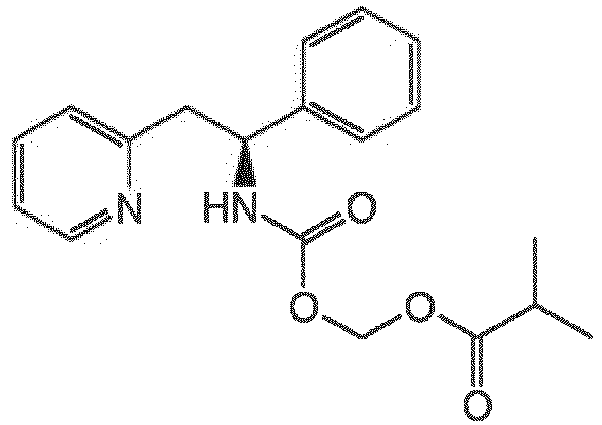
- Cesium carbonate (1543 mg, 4.74 mmol) and tetrabutylammonium iodide (1749 mg, 4.74 mmol) were added to (S)-1-phenyl-2-(pyridin-2-yl)ethanamine (313 mg, 1.58 mmol) in anhydrous DMF (8 mL) at rt. Carbon dioxide gas was bubbled into the reaction mixture for 30 min, followed by addition of chloromethyl isobutyrate (647 mg, 4.74 mmol) in DMF (2 mL). The reaction mixture was stirred at rt with continued CO2 gas bubbling overnight and continued to stir over the weekend without further CO2 gas addition. The reaction mixture was diluted with water and extracted with EtOAc (3x), the combined organic layers were washed with water (2x), brine, dried over Na2SO4, and concentrated. Purification was done by column chromatography using a gradient of EtOAc in heptane (0-60%) to give the title compound (239 mg, 44.2 %).
1H NMR (500 MHz, DMSO-d6) δ ppm 1.00 (m, 6 H), 2.46 (m, 1 H, partially hidden in DMSO-d6), 3.09 (m, 2 H), 5.04 (m, 1 H), 5.52 (m, 2 H), 7.17 - 7.24 (m, 3 H), 7.27 - 7.34 (m, 4 H), 7.65 (td, 1 H), 8.24 (d, 1 H), 8.49 (m, 1H). - There are two different diastereomers of Example 2 due to the two possible configurations at the carbon atom identified with *. These are referred to as Example 2 diastereomer 1 and Example 2
diastereomer 2. Their absolute configurations have not been determined.
-

- (i) 4-(Methylmercapto)phenol (8.46 g, 57.30 mmol) was taken up in DCM (60 mL) and then the reaction flask was chilled to 0 °C, followed by addition of 1-chloro-2-methylpropyl carbonochloridate (4.27 mL, 28.65 mmol). A solution of 4-methylmorpholine (7.87 mL, 71.63 mmol) in DCM (40 mL) was added drop-wise, over 50 min at 0 °C and the resulting mixture stirred at this temperature for 5 minutes, and finally stirred at rt for 150 minutes. The reaction mixture was washed with water (2x), dried over Na2SO4, filtered and evaporated to give 1-chloro-2-methylpropyl 4-(methylthio)phenyl carbonate (13.84 g), which was used in the next step without further purification.
- (ii) A mixture of 1-chloro-2-methylpropyl 4-(methylthio)phenyl carbonate (3.50 g, 12.74 mmol), silver(I) oxide (2.95 g, 12.74 mmol) and isobutyric acid (13.00 mL, 140.12 mmol) under an atmosphere of argon was heated to 95 °C for 2 hours. The reaction mixture was cooled to rt and stirred at rt overnight, then diluted with MTBE, filtered through diatomaceous earth and washed with more MTBE. The combined filtrates were washed with water (4x25 mL), sat. aq. sodium bicarbonate (2x25 mL), dried (Na2SO4), and evaporated to give 3.56 g of 2-methyl-1-((4-(methylthio)phenoxy)carbonyloxy)propyl isobutyrate, which was used in the next step without further purification.
- (iii) 2-Methyl-1-((4-(methylthio)phenoxy)carbonyloxy)propyl isobutyrate (3.56 g, 10.91 mmol) was taken up in a mixture of acetone (30 mL) and water (7.50 mL), followed by addition of oxone (13.41 g, 21.81 mmol) in portions over 5 min, then stirred at rt for 2 hours. The reaction mixture was filtered and the filtrate washed with MTBE (2x50 mL), the volume was reduced to 50 mL (distilling off the acetone) and then the resulting mixture was separated between MTBE and water. The aqueous layer was extracted with MTBE and the combined organics were dried over Na2SO4, filtered and evaporated to give 1.89 g of the title compound, which was used in the next step without further purification.
- Step B:
-

- To a stirred mixture of (S)-1-phenyl-2-(pyridin-2-yl)ethanamine (0.215 g, 1.08 mmol) and sodium bicarbonate (0.182 g, 2.17 mmol) in acetonitrile (3 mL) was added 2-methyl-1-((4-(methylsulfonyl)phenoxy)carbonyloxy)propyl isobutyrate (0.389 g, 1.08 mmol) in acetonitrile (2 mL) and the reaction was stirred at rt for 2 hours. Separated between EtOAc and sat aq NaHCO3, the organic layer was washed with sat aq NaHCO3, dried (Na2SO4) and evaporated to give 413 mg of material, which was purified by column chromatography using a gradient of EtOAc in heptane (0-50%) to give 235 mg as a mixture of the two diastereomers of 2-methyl-1-(S)-1-phenyl-2-(pyridin-2-yl)ethylcarbamoyloxy)propyl isobutyrate.
- Analysis and separation of the diasteremers was done on Chiralpak AD-H, 4.6∗250 mm; 5 µm, using 10% MeOH/90% CO2 at 3 mL/min flow and Chiralpak AD-H, 20∗250 mm; 5 µm, using 10% MeOH/90% CO2 at 50 mL/min flow, respectively.
- 105 mg of
diastereomer 1 was obtained by chiral separation as the first eluting diastereomer in 99% optical purity. Mixture of rotamers:
1H NMR (500 MHz, DMSO-d6) δ ppm 0.66 - 1.07 (m), 1.86 (m), 2.39 (m), 2.98 - 3.21 (m), 5.01 (m), 6.31 (m), 7.10 - 7.26 (m), 7.26 - 7.37 (m), 7.56 - 7.73 (m), 8.10 (d), 8.43 - 8.55 (m). Total no of protons in spectrum: 28. Ratio rotamers major/minor: 1/0.15.
MS (ES+APCI+) m/z 385 (M+H)+ - 104 mg of
diastereomer 2 were obtained as the second-eluting diastereomer. Mixture of rotamers:
1H NMR (500 MHz, DMSO-d6) δ ppm 0.48 - 0.69 (m), 0.75 - 0.87 (m), 0.87 - 1.07 (m), 1.73 (m), 1.85 (m), 2.40 (m), 2.98 (m), 3.03 - 3.18 (m), 4.97 (m), 6.22 - 6.38 (m), 7.13 - 7.26 (m), 7.26 - 7.37 (m), 7.65 (m), 7.78 (d), 8.06 (d), 8.48 (m). Total no of protons in spectrum: 28. Ratio rotamers major/minor: 1/0.17.
MS (ES+APCI+) m/z 385 (M+H)+. - Optical purity = 99%
- There are two different diastereomers of Example 3 due to the two possible configurations at the carbon atom identified with *. These are referred to as Example 3 diastereomer 1 and Example 3
diastereomer 2. Their absolute configurations have not been determined.
-

- (i) A mixture of 1-chloroethyl 4-(methylthio)phenyl carbonate (4.6 g, 18.65 mmol), Silver(I) oxide (4.32 g, 18.65 mmol) and acetic acid (11.75 mL, 205.1 mmol) under an atmosphere of argon was heated to 95 °C for 2h. The reaction mixture was cooled to rt and diluted with MTBE, filtered through diatomaceous earth, and washed with more MTBE. The combined filtrates were washed with water (4 x 25 mL), sat. aq. sodium bicarbonate (2 x 25 mL), dried (Na2SO4), and evaporated to give 1.79 g of 1-((4-(methylthio)phenoxy)carbonyloxy)ethyl acetate which was used in the next step without further purification.
- (ii) 1-((4-(Methylthio)phenoxy)carbonyloxy)ethyl acetate (1.79 g, 6.62 mmol) was taken up in a mixture of acetone (16 mL) and water (4.00 mL). Oxone (8.14 g, 13.24 mmol) was added in portions over 5 min, then stirred at rt overnight. The reaction mixture was filtered and the filtrate washed with MTBE (2x50 mL), the volume was reduced to about 50 mL (distilling off the acetone). The product was separated between MTBE and water. The aqueous layer was extracted with MTBE and the combined organics were dried (Na2SO4), filtered and evaporated to give 832 mg of the title compound and used in the next step without further purification.
-

- To a stirred mixture of (S)-1-phenyl-2-(pyridin-2-yl)ethanamine (198 mg, 1 mmol) and sodium bicarbonate (168 mg, 2.00 mmol) in acetonitrile (4 mL) was added 1-((4-(methylsulfonyl)phenoxy)carbonyloxy)ethyl acetate (302 mg, 1.00 mmol) in acetonitrile (1 mL) and the reaction was stirred at rt for 4 hours. The reaction mixture was then separated between EtOAc and sat aq NaHCO3, the organic layer washed with sat aq NaHCO3, brine, dried over Na2SO4 and evaporated. This mixture was pre-purified by column chromatography using a gradient of EtOAc in heptane (0-50%) to give 160 mg of the title compound as mixture of its two diastereomers.
- Analysis and separation of the diastereomers was done on Phenomenex LuxC4, 4.6∗250 mm; 5 µm, using 30% MeOH+DEA/70% CO2 at 3 mL/min flow and Phenomenex LuxC4, 20∗250 mm; 5 µm, using 25% MeOH+DEA/75% CO2 at 50 mL/min flow, respectively. Example 3,
diastereomer 1 - 29 mg of
diastereomer 1 was obtained by chiral separation as the first eluting diastereomer in 99 % optical purity.
1H NMR (500 MHz, DMSO-d6) δ ppm 1.31 (d, 3 H), 1.92 (s, 3 H), 3.00 - 3.16 (m, 2 H), 5.00 (td, 1 H), 6.52 (q, 1 H), 7.14 - 7.25 (m, 3 H), 7.30 (d, 4 H), 7.65 (t, 1H), 8.13 (d, 1 H), 8.50 (d, 1 H). The signals in the spectrum were broadened and the splitting of the DMSO-signal could not be seen.
13C NMR (126 MHz, DMSO-d6) δ 19.6, 20.7, 44.6, 54.9, 88.7, 121.6, 123.8, 126.4, 126.9, 128.3, 136.2, 143.0, 149.0, 153.2, 158.0, 168.6 ppm. MS (ES+) m/z 328 (M+H)+ Example 3,diastereomer 2 - 39 mg of
diastereomer 2 were obtained as the second eluting diastereomer.
1H NMR (500 MHz, DMSO-d6) δ ppm 1.32 (d, 3 H), 1.95 (s, 3 H), 3.01 - 3.18 (m, 2H), 5.00 (td, 1 H), 6.53 (q, 1 H), 7.13 - 7.24 (m, 3 H), 7.29 (d, 4 H), 7.65 (t, 1 H), 8.17 (d, 1 H), 8.49 (d, 1 H). The signals in the spectrum were broadened and the splitting of the DMSO-signal could not be seen.
13C NMR (126 MHz, DMSO-d6) δ 19.6, 20.7, 44.4, 54.9, 88.6, 121.6, 123.7, 126.4, 126.9, 128.3, 136.2, 143.0, 149.0, 153.1, 158.0, 168.5. MS (ES+) m/z 329 (M+H)+ - Optical purity 98 %.
- There are two different diastereomers of Example 4 due to the two possible configurations at the carbon atom identified with *. These are referred to as Example 4 diastereomer 1 and Example 4
diastereomer 2. Their absolute configurations have not been determined.
-

- (i) 4-(Methylmercapto)phenol (4.91 g, 35.00 mmol) was taken up in DCM (100 mL) and chilled to 0 °C. 1-Chloroethyl chloroformate (1.888 mL, 17.50 mmol) was added. A solution of 4-methylmorpholine (4.81 mL, 43.74 mmol) in DCM (20 mL) was added drop-wise over 10 min at 0 °C and the resulting mixture stirred at this temperature for 5 minutes. The reaction mixture was stirred at rt for 180 min, then diluted with DCM, washed with water (2x), dried over Na2SO4, filtered and evaporated to give 1-chloroethyl 4-(methylthio)phenyl carbonate (6.94 g), which was used in the next step without further purification.
- (ii) A mixture of 1-chloroethyl 4-(methylthio)phenyl carbonate (2.3 g, 9.32 mmol), silver(I) oxide (2.160 g, 9.32 mmol) and isobutyric acid (9.51 ml, 102.55 mmol) under an atmosphere of argon was heated to 95°C for 2h. The reaction mixture was cooled to rt and diluted with MTBE, filtered through diatomaceous earth, washed with more MTBE. The combined filtrates were washed with water (4x25 mL), sat. aq. sodium bicarbonate (2x25 mL), dried (Na2SO4), and evaporated to give 1.16 g of product, which was used in the next step without further purification.
- (iii) 1-((4-(Methylthio)phenoxy)carbonyloxy)ethyl isobutyrate (1.16 g, 3.89 mmol) was taken up in a mixture of acetone (12 mL) and water (3.00 mL). Oxone (4.78 g, 7.78 mmol) was added in portions over 5 min, then stirred at rt overnight. The reaction mixture was filtered and the filtrate washed with MTBE (2x50 mL), the volume was reduced to approximately 50 mL by distilling off the acetone, then separated between MTBE and water. The aqueous layer was extracted with MTBE and the combined organics were dried over Na2SO4, filtered and evaporated to give 531 mg of the title compound, which was used in the next step without further purification.
-

- To a stirred mixture of (S)-1-phenyl-2-(pyridin-2-yl)ethanamine (0.300 g, 1.51 mmol) and sodium bicarbonate (0.254 g, 3.03 mmol) in acetonitrile (6 mL) was added 1-((4-(methylsulfonyl)phenoxy)carbonyloxy)ethyl isobutyrate (0.500 g, 1.51 mmol) in acetonitrile (2 mL) and the reaction was stirred overnight. The mixture was separated between EtOAc and sat aq NaHCO3, the organic layer was washed with sat aq NaHCO3, brine, dried over Na2SO4 and evaporated to give 0.70 g., which was purified by column chromatography using a gradient of EtOAc in heptane (0-50%) to give the title compound (0.309 g, 57.2 %) as mixture of the two diastereomers.
- Analysis and separation of the diastereomers was done on Phenomenex LuxC4, 4.6∗250 mm; 5 µm, using 15% MeOH+DEA/85% CO2 at 3 mL/min flow and Phenomenex LuxC4, 20∗250 mm; 5 µm, using 15% MeOH+DEA/85% CO2 at 50 mL/min flow, respectively. Example 4,
diastereomer 1 - 25 mg of
diastereomer 1 was obtained by chiral separation as the first eluting diastereomer in 99 % optical purity. Mixture of rotamers:
1H NMR (500 MHz, DMSO-d6) δ ppm 0.86 - 1.05 (m), 1.19 (d), 1.32 (d), 2.31 - 2.44 (m), 2.98 - 3.20 (m), 4.94 - 5.07 (m), 6.48 (d), 6.52 (q), 7.15 - 7.25 (m), 7.25 - 7.34 (m), 7.60 - 7.70 (m), 7.77 (d), 8.06 - 8.18 (m), 8.44 - 8.55 (m). Total no of protons in spectrum: 24. Ratio major/ minor: 1:0.07.
MS (ES+APCI+) m/z 357 (M+H)+. - UV Purity =100%.
- 25 mg of
diastereomer 2 were obtained as second eluting isomer. Mixture of rotamers:
1H NMR (500 MHz, DMSO-d6) d ppm 0.82 - 0.94 (m), 0.94 - 1.04 (m), 1.25 (d), 1.32 (d), 2.24 - 2.32 (m), 2.34 - 2.44 (m), 3.00 - 3.17 (m), 5.02 (td), 6.48 (d), 6.52 (q), 7.15 - 7.25 (m), 7.25 - 7.38 (m), 7.55 - 7.77 (m), 8.16 (d), 8.44 - 8.57 (m). Total no of protons in spectrum: 24. Ratio major/minor: 1:0.08.
MS (ES+APCI+) m/z 357 (M+H)+. - UV Purity =100%.
- Optical purity = 99%.
- Examples 5 to 12 use a common intermediate, the preparation of which is now described.
-

-

- T3P (50% wt. in DMF, 0.86 mL, 1.47 mmol) was added dropwise to a solution of (1S)-1-phenyl-2-(pyridin-2-yl)ethan-1-amine (200 mg, 0.737 mmol), Boc-L-proline (159 mg, 0.737 mmol) and DIPEA (0.64 mL, 3.69 mmol) in CH2Cl2 (7.4 mL) at 0 °C. The reaction was gradually warmed to rt while stirring overnight. The organic layer was washed twice with 5% aq. NaHCO3, once with brine, dried over Na2SO4, filtered and concentrated. The product was purified using a 50 g snap column, eluting with a gradient of MeOH and CH2Cl2 (0% MeOH / 100% CH2Cl2 → 10% MeOH / 90% CH2Cl2), yielding the title compound 305 mg (>100%).
1H NMR (300 MHz, CDCl3): ppm 1.35 (s, 9 H), 1.70 - 1.90 (m, 2 H), 2.05 - 2.19 (m, 2 H), 3.13 (dd, 1 H), 3.29 - 3.39 (m, 1 H), 3.46 - 3.62 (m, 2 H), 4.20 - 4.29 (m, 2 H), 5.39 (q, 1 H), 6.91 (d, 1 H), 7.09 - 7.14 (m, 1 H), 7.16 - 7.23 (m, 5 H), 7.49 (td, 1 H), 8.45 - 8.59 (m, 1 H). - Boc-L-Pro-OH (2.0 g, 9.29 mmol) was dissolved in anhydrous DMF (15 mL). HATU (3.7 g, 9.76 mmol) and Hunig's base (5.3 mL, 30.66 mmol) were added and the mixture was stirred at rt for 30 minutes. Then, 2-[(2S)-2-azaniumyl-2-phenylethyl]pyridin-1-ium dichloride (2.5 g, 9.29 mmol) was added to the solution and the mixture was stirred for 3 hours 30 minutes at rt. Water was added and the mixture was extracted 3 x with EtOAc. The organic phase was washed with brine, dried over Na2SO4, filtered and concentrated under reduced pressure. The product was purified on a SiO2 column, eluting with a gradient (0% MeOH / 50% EtOAc / 50% heptane → 0% MeOH / 100% EtOAc / 0% heptane → 10% MeOH / 90% EtOAc / 0% heptane) and then on a C-18 column, eluting with a gradient of MeOH and water (0 to 100% MeOH), yielding 2.9 g (78%) of the title compound.
1H NMR (300 MHz, CDCl3): ppm 1.35 (s, 9 H), 1.70 - 1.90 (m, 2 H), 2.05 - 2.19 (m, 2 H), 3.13 (dd, J = 13.8, 7.1 Hz, 1 H), 3.29 - 3.39 (m, 1 H), 3.46 - 3.62 (m, 2 H), 4.20 - 4.29 (m, 1 H), 5.39 (q, J = 6.8 Hz, 1 H), 6.91 (d, J = 7.3 Hz, 1 H), 7.09 - 7.14 (m, 1 H), 7.16 - 7.23 (m, 5 H), 7.49 (td, J = 7.63, 1.8 Hz, 1 H), 8.45 - 8.59 (m, 1 H). -

- At 0 °C, (S)-tert-butyl 2-((S)-1-phenyl-2-(pyridin-2-yl)ethylcarbamoyl)pyrrolidine-1-carboxylate (305 mg, 0.771 mmol) was dissolved in a 4 M HCl solution in 1,4-dioxane (7.7 mL, 30.8 mmol). The reaction was gradually warmed to rt while stirring overnight. The volatiles were removed under vacuum and the product was triturated in MTBE. The solid was recovered by filtration on a Büchner funnel, washed with MTBE and dried under vacuum affording 263 mg (93%) of the title compound as dihydrochloride salt.
1H NMR (300 MHz, DMSO-d6): ppm 1.61 - 1.84 (m, 3 H), 2.30 - 2.36 (m, 1 H), 3.05 - 3.11 (m, 2 H), 3.39 - 3.47 (m, 2 H), 4.05 - 4.20 (m, 2 H), 5.34 (q, 1 H), 7.17 - 7.41 (m, 5 H), 8.20 - 8.42 (m, 1 H), 8.67 - 8.75 (m, 1 H), 9.45 - 9.62 (m, 2 H). - tert-Butyl (2S)-2-{[(1S)-1-phenyl-2-(pyridin-2-yl)ethyl]carbamoyl}pyrrolidine-1-carboxylate (2.9 g, 7.33 mmol) was dissolved in a 4 M HCl solution in 1,4-dioxane (73 mL, 293.31 mmol). The reaction mixture was stirred at rt for 3h. The volatiles were removed under vacuum and the product was triturated in MTBE. The solid was recovered by filtration on a Büchner funnel, washed with MTBE and dried under vacuum affording 2.7 g (100%) of (2S)-2-{[(1S)-1-phenyl-2-(pyridin-1-ium-2-yl)ethyl]carbamoyl}pyrrolidin-1-ium.
1H NMR (300 MHz, D2O): ppm 1.66 - 1.83 (m, 3 H), 2.20 - 2.26 (m, 1 H), 3.14 (t, J = 6.9 Hz, 2 H), 3.34 (dd, J = 14.1, 8.2 Hz, 1 H), 3.51 (dd, J = 14.4, 7.3 Hz, 1 H), 4.18 (dd, J = 8.5, 6.2 Hz, 1 H), 5.11 (t, J = 7.9 Hz, 1 H), 7.06 - 7.10 (m, 2 H), 7.15 - 7.21 (m, 3 H), 7.61 - 7.70 (m, 2 H), 8.23 (dt, J = 7.9, 1.5 Hz, 1 H), 8.37 (d, J = 5.8 Hz, 1 H). -

- The title compound was prepared as the dihydrochloride of (S)-1-((S)-2-amino-3-methylbutanoyl)-N-((S)-1-phenyl-2-(pyridin-2-yl)ethyl)pyrrolidine-2-carboxamide
-

- T3P (50% wt. in DMF, 0.83 mL, 1.42 mmol) was added dropwise to a solution of (S)-N-((S)-1-phenyl-2-(pyridin-2-yl)ethyl)pyrrolidine-2-carboxamide dihydrochloride salt (263 mg, 0.714 mmol), Boc-L-Valine (155 mg, 0.714 mmol) and DIPEA (0.62 mL, 3.57 mmol) in DCM (7 mL) at 0 °C. The reaction was gradually warmed to rt under stirring overnight. The organic layer was washed twice with 5% aq. NaHCO3, once with brine, dried over Na2SO4, filtered and concentrated. The product was purified using a 50 g snap column, eluting with a gradient of MeOH and CH2Cl2 (5% MeOH / 95% CH2Cl2 → 10% MeOH / 90% CH2Cl2), yielding the title compound 258 mg (73%).
1H NMR (300 MHz, CDCl3): ppm 0.91 (d, 3 H), 1.00 (d, 3 H), 1.43 (s, 9 H), 1.85-1.99 (m, 2 H), 2.00 - 2.16 (m, 1 H), 2.17 - 2.21 (m, 1 H), 3.12 - 3.27 (m, 2 H), 3.47 - 3.62 (m, 1 H), 3.63 - 3.78 (m, 1 H), 4.32 (dd, 1 H), 4.58 (d, 1 H), 5.23 - 5.35 (m, 2 H), 6.97 (d, 1 H), 7.10 (dd, 1 H), 7.14 - 7.30 (m, 5 H), 7.50 (td, 1 H), 7.84 (d, 1 H), 8.48 (dd, 1 H). -

- tert-Butyl (S)-3-methyl-1-oxo-1-((S)-2-((S)-1-phenyl-2-(pyridin-2-yl)ethylcarbamoyl)pyrrolidin-1-yl)butan-2-ylcarbamate (258 mg, 0.522 mmol) was dissolved in a 4 M HCl solution in 1,4-dioxane (5.2 mL, 30.8 mmol). The reaction mixture was stirred overnight. The volatiles were removed under vacuum and the product was triturated in EtOAc. The solid was recovered by filtration on a Büchner funnel, then triturated in Et2O. After filtration on a Büchner funnel, the solid was dried under vacuum affording 200 mg (82%) of the title compound as dihydrochloride salt. The title compound as the dihydrochloride salt was then converted to the free base by techniques known to one of ordinary skill in the art. Alternatively, the title compound may be prepared as a fumarate salt by methods known to one of ordinary skill in the art.
1H NMR (300 MHz, CD3OD): ppm 0.97 (d, 3 H), 1.04 (d, 3 H), 1.68 - 1.79 (m, 1 H), 1.86 - 2.05 (m, 2 H), 2.13 - 2.27 (m, 2 H), 3.50 - 3.61 (m, 3 H), 3.68 - 3.75 (m, 1 H), 4.02 (d, 1 H), 4.45 (dd, 1 H), 5.40 (dd, 1 H), 7.31 - 7.43 (m, 5 H), 7.90 (t, 1 H), 8.02 (d, 1 H), 8.51 (td, 1 H), 8.75 (d, 1 H).
[M+H] + = 395.27 -

- The title compound was prepared as the trichloride, 2-[(2S)-2-{[(2S)-1-[(2S)-2,5-diazaniumylhexanoyl]pyrrolidin-2-yl]formamido}-2-phenylethyl]pyridin-1-ium trichloride STEP A
-

- N-alpha, N-epsilon-bis(tert-Butoxycarbonyl)-L-lysine dicyclohexylammonium salt (287 mg, 0.54 mmol) was dissolved in anhydrous DMF (4 mL). HATU (217 mg, 0.57 mmol) and DIPEA (0.21 mL, 1.19 mmol) were added and the mixture was stirred at rt for 30 minutes. Then, (2S)-2-{[(1S)-1-phenyl-2-(pyridin-1-ium-2-yl)ethyl]carbamoyl}pyrrolidin-1-ium dichloride (200 mg, 0.54 mmol) was added to the solution and the mixture was stirred for 18h at rt. Water was added and the mixture was extracted 3 x with EtOAc. The organic phase was washed with brine, dried over Na2SO4, filtered and concentrated under reduced pressure. The product was purified on a SiO2 column, eluting with a gradient (0% MeOH / 50% EtOAc / 50% heptane → 0% MeOH / 100% EtOAc / 0% heptane → 10% MeOH / 90% EtOAc / 0% heptane) then on a C-18 column, eluting with a gradient of MeOH and water (0 to 100% MeOH), yielding 80 mg (24%) of the title compound.
1H NMR (300 MHz, CDCl3): ppm 1.34 - 1.39 (m, 2 H), 1.41 (s, 9 H), 1.43 (s, 9 H), 1.52 - 1.64 (m, 3 H), 1.68 - 2.02 (m, 4 H), 2.08 - 2.22 (m, 2 H), 3.02 - 3.16 (m, 3 H), 3.20 - 3.28 (m, 1 H), 3.48 - 3.57 (m, 1 H), 3.60 - 3.70 (m, 1 H), 4.40 - 4.51 (m, 1 H), 4.54 - 4.57 (m, 1 H), 4.97 - 5.08 (m, 1 H), 5,29 - 5.39 (m, 2 H), 7.00 (d, 1 H), 7.10 - 7.32 (m, 6 H), 7.52 (td, 1 H), 7.86 (d, 1 H), 8.49 (d, 1 H). -

- tert-Butyl (S)-6-oxo-6-((S)-2-((S)-1-phenyl-2-(pyridin-2-yl)ethylcarbamoyl)pyrrolidin-1-yl)hexane-1,5-diyldicarbamate (80 mg, 0.13 mmol) was dissolved in a 4 M HCl solution in 1,4-dioxane (1.6 mL, 6.4 mmol). The reaction was stirred at rt for 18 hours. The volatiles were removed under vacuum and the product was triturated in MTBE. The solid was recovered by filtration on a Büchner funnel, washed with MTBE and dried under vacuum. The solid was dissolved in water and freeze dried to afford 60 mg (88%) of the title compound.
1H NMR (300 MHz, D2O): ppm 1.23 - 1.35 (m, 2 H), 1.46 - 1.59 (m, 3 H), 1.65 - 1.80 (m, 4 H), 2.04 - 2.13 (m, 1 H), 2.80 (t, 2 H), 3.31 - 3.43 (m, 2 H), 3.47 - 3.57 (m, 2 H), 4.16 (t, 1 H), 4.28 (t, 1 H), 5.11 (t, 1 H), 7.10 - 7.13 (m, 2 H), 7.16 - 7.26 (m, 3 H), 7.68 - 7.73 (m, 2 H), 8.31 (td, 1 H), 8.42 (dd, 1 H);
[M+H]+ = 424.2. -

- The title compound was prepared as the trichloride 2-[(2S)-2-{[(2S)-1-[(2S)-2-azaniumyl-3-(1H-imidazol-1-ium-4-yl)propanoyl]pyrrolidin-2-yl]formamido}-2-phenylethyl]pyridin-1-ium trichloride
-

- Boc-His-OH (166 mg, 0.65 mmol) was dissolved in anhydrous DMF (4 mL). HATU (260 mg, 0.68 mmol) and DIPEA (0.38 mL, 2.85 mmol) were added and the mixture was stirred at rt for 30 minutes. Then, 2-((S)-2-phenyl-2-((S)-pyrrolidin-2-iumcarboxamido)ethyl)pyridinium chloride (240 mg, 0.65 mmol) was added and the mixture was stirred for 66 hours at rt. Water was added and the mixture was extracted 3x with EtOAc. The organic phase was washed with brine, dried over Na2SO4, filtered and concentrated under reduced pressure. The product was purified on a SiO2 column, eluting with a gradient of MeOH and CH2Cl2 (0% to 13% MeOH) then on a C-18 column, eluting with a gradient of MeOH and water (0 to 100% MeOH), yielding 100 mg (29%) of the title compound.
1H NMR (300 MHz, CDCl3): ppm 1.44 (s, 9 H), 1.77 - 2.00 (m, 3 H), 2.05 - 2.19 (m, 1 H), 3.03 - 3.14 (m, 2 H), 3.23 (dd, 1 H), 3.40 (dd, 1 H), 3.52 - 3.58 (m, 1 H), 4.50 - 4.62 (m, 2 H), 5,43 - 5.50 (m, 2 H), 6.91 - 6.97 (m, 2 H), 7.13 - 7.27 (m, 5 H), 7.53 (t, 1 H), 7.65 (s, 1 H), 8.53 (d, 1 H), 8.67 (d, 1 H). -

- tert-Butyl (S)-3-(1H-imidazol-4-yl)-1-oxo-1-((S)-2-((S)-1-phenyl-2-(pyridin-2-yl)ethylcarbamoyl)pyrrolidin-1-yl)propan-2-ylcarbamate (100 mg, 0.19 mmol) was dissolved in a 4 M HCl solution in 1,4-dioxane (2.3 mL, 9.39 mmol). The reaction mixture was stirred at rt for 18h. The volatiles were removed under vacuum and the product was triturated in MTBE. The solid was recovered by filtration on a Büchner funnel, washed with MTBE and dried under vacuum. The solid was dissolved in water and freeze dried to afford 85 mg (69%) of the title compound.
1H NMR (300 MHz, D2O): ppm 1.50 - 1.58 (m, 1 H), 1.69 - 1.76 (m, 2 H), 2.07 - 2.14 (m, 1 H), 3.12 - 3.21 (m, 3 H), 3.38 (dd, 7.3 Hz, 1 H), 3.48 - 3.56 (m, 2 H), 4.32 (t, 1 H), 4.43 (t, 1 H), 5.14 (t, 1 H), 7.08 - 7.12 (m, 2 H), 7.15 - 7.23 (m, 3 H), 7.26 (s, 1 H), 7.65 - 7.70 (m, 2 H), 8.26 (td, 1 H), 8.39 (d, 1 H), 8.49 (d, 1 H);
[M+H]+ = 433.2;
[M+Na]+ = 455.1. -

- The title compound can also be named as: 2-[(2S)-2-{[(2S)-1-[(2S)-2-azaniumyl-3-(4-hydroxyphenyl)propanoyl]pyrrolidin-2-yl]formamido}-2-phenylethyl]pyridin-1-ium dichloride
-

- Boc-Tyr-OH (229 mg, 0.81 mmol) was dissolved in anhydrous DMF (5 mL). HATU (325 mg, 0.86 mmol) and DIPEA (0.47 mL, 2.69 mmol) were added and the mixture was stirred at rt for 30 minutes. Then, 2-((S)-2-phenyl-2-((S)-pyrrolidin-2-iumcarboxamido)ethyl)pyridinium chloride (300 mg, 0.81 mmol) was added to the solution and the mixture was stirred for 66h at rt. Water was added and the mixture was extracted 3x with EtOAc. The organic phase was washed with brine, dried over Na2SO4, filtered and concentrated under reduced pressure. The product was purified on SiO2 column, eluting with a (0% MeOH / 50% EtOAc / 50% heptane → 0% MeOH / 100% EtOAc / 0% heptane → 15% MeOH / 85% EtOAc / 0% heptane) then on a C-18 column, eluting with a gradient of MeOH and water (0 to 100% MeOH), yielding 180 mg (40%) of the title compound.
1H NMR (300 MHz, CDCl3): ppm 1.44 (s, 9 H), 1.73 - 2.02 (m, 3 H), 2.16 - 2.22 (m, 1 H), 2.92 - 3.09 (m, 4 H), 3.35 - 3.42 (m, 1 H), 3.48 - 3.51 (m, 1 H), 3.53 - 3.68 (m, 1 H), 4.48 - 4.51 (m, 1 H), 4.65 - 4.73 (m, 1 H), 5.06 - 5.14 (m, 1 H), 5.43 (d, 1 H), 6.61 (d, 1 H), 6.86 (d,, 2 H), 6.94 - 6.99 (m, 2 H), 7.08 - 7.26 (m, 6 H), 7.42 (dd, 1 H), 8.49 (d, 1 H), 8.63 (s, 1 H). -

- tert-Butyl (S)-3-(4-hydroxyphenyl)-1-oxo-1-((S)-2-((S)-1-phenyl-2-(pyridin-2-yl)ethylcarbamoyl)pyrrolidin-1-yl)propan-2-ylcarbamate (180 mg, 0.32 mmol) was dissolved in a 4 M HCl solution in 1,4-dioxane (3.2 mL, 12.89 mmol). The reaction was stirred at rt for 18 hours. The volatiles were removed under vacuum and the product was triturated in MTBE. The solid was recovered by filtration on a Büchner funnel, washed with MTBE and dried under vacuum. The solid was dissolved in water and freeze dried to afford 150 mg (88%) of the title compound.
1H NMR (300 MHz, D2O): ppm 1.48 - 1.57 (m, 1 H), 1.68 - 1.73 (m, 2 H), 1.98 - 2.05 (m, 1 H), 2.68 - 2.76 (m, 1 H), 2.93 - 3.00 (m, 1 H), 3.10 - 3.19 (m, 1 H), 3.40 - 3.63 (m, 3 H), 4.20 - 4.28 (m, 2 H), 5.14 (t, 1 H), 6.65 (d, 2 H), 6.96 (d, 2 H), 7.13 - 7.22 (m, 5 H), 7.63 - 7.66 (m, 2 H), 8.19 - 8.22 (m, 1 H), 8.40 (d, 1 H);
[M+H]+ = 459.2. -

- The title compound can also be named: 2-[(2S)-2-{[(2S)-1-[(2S)-2-azaniumyl-3-(1H-indol-3-yl)propanoyl]pyrrolidin-2-yl]formamido}-2-phenylethyl]pyridin-1-ium dichloride STEP A
-

- Boc-Trp-OH (207 mg, 0.68 mmol) was dissolved in anhydrous DMF (4 mL). HATU (271 mg, 0.71 mmol) and DIPEA (0.39 mL, 2.24 mmol) were added and the mixture was stirred at rt for 30 minutes. Then, (2S)-2-{[(1S)-1-phenyl-2-(pyridin-1-ium-2-yl)ethyl]carbamoyl}pyrrolidin-1-ium dichloride (250 mg, 0.68 mmol) was added and the mixture was stirred for 18 hours at rt. Water was added and the mixture was extracted 3x with EtOAc. The organic phase was washed with brine, dried over Na2SO4, filtered and concentrated under reduced pressure. The product was purified on a SiO2 column, eluting with a gradient of (0% MeOH / 50% EtOAc / 50% heptane → 0% MeOH / 100% EtOAc / 0% heptane → 15% MeOH / 85% EtOAc / 0% heptane), yielding 410 mg (Quantitative) of the title compound.
1H NMR (300 MHz, CDCl3): ppm 1.44 (s, 9 H), 1.77 - 1.89 (m, 3 H), 2.14 - 2.24 (m, 1 H), 3.03 - 3.24 (m, 4 H), 3.28 3.36 (m, 2 H), 3.54 - 3.65 (m, 1 H), 4.52 - 4.58 (m, 1 H), 4.79 - 4.88 (m, 1 H), 5,12 - 5.27 (m, 1 H), 5.34 - 5.41 (m, 1 H), 6.63 (d, 1 H), 6.94 - 7.31 (m, 8 H), 7.38 - 7.53 (m, 3 H), 7.62 - 7.67 (m, 1 H), 8.59 (d, 1 H), 9.87 (s, 1 H). -

- tert-Butyl (S)-3-(1H-indol-3-yl)-1-oxo-1-((S)-2-((S)-1-phenyl-2-(pyridin-2-yl)ethylcarbamoyl)pyrrolidin-1-yl)propan-2-ylcarbamate (395 mg, 0.68 mmol) was dissolved in a 1 M HCl solution in Et2O (27.0 mL, 27.20 mmol). The reaction mixture was stirred at rt for 4h. The product was triturated in Et2O and the solid was recovered by filtration on a Büchner funnel, washed with Et2O and dried under vacuum. The solid was dissolved in water and freeze dried to afford 175 mg (44%) of the title compound.
1H NMR (300 MHz, D2O): ppm 1.41 - 1.53 (m, 1 H), 1.63 - 1.72 (m, 2 H), 1.93 - 2.04 (m, 1 H), 2.85 (dd, 1 H), 2.94 - 3.55 (m, 5 H), 4.19 - 4.31 (m, 2 H), 5.08 (t, 1 H), 6.90 - 7.31 (m, 9 H), 7.38 (d, 1 H), 7.55 - 7.58 (m, 2 H), 8.15 (t, 1 H), 8.31 (d, 1 H);
[M+H]+ = 482.2,
[M+Na]+ = 504.1. -
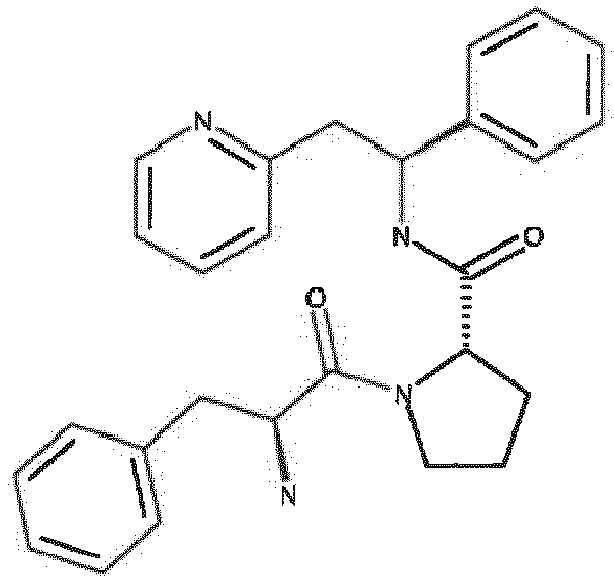
- The title compound was prepared as 2-[(2S)-2-{[(2S)-1-[(2S)-2-azaniumyl-3-phenylpropanoyl]pyrrolidin-2-yl]formamido}-2-phenylethyl]pyridin-1-ium dichloride STEP A
-

- Boc-Phe-OH (180 mg, 0.68 mmol) was dissolved in anhydrous DMF (4 mL). HATU (271 mg, 0.71 mmol) and DIPEA (0.39 mL, 2.24 mmol) were added and the mixture was stirred at rt for 30 minutes. Then, (2S)-2-{[(1S)-1-phenyl-2-(pyridin-1-ium-2-yl)ethyl]carbamoyl}pyrrolidin-1-ium dichloride (250 mg, 0.68 mmol) was added to the solution and the mixture was stirred for 18h at rt. Water was added and the mixture was extracted 3 x with EtOAc. The organic phase was washed with brine, dried over Na2SO4, filtered and concentrated under reduced pressure. The product was purified on a SiO2 column, eluting with a gradient (0% MeOH / 50% EtOAc / 50% heptane → 0% MeOH / 100% EtOAc / 0% heptane → 15% MeOH / 85% EtOAc / 0% heptane), then on a C-18 column, eluting with a gradient of MeOH and water (0 to 100% MeOH), yielding 170 mg (46%) of the title compound.
1H NMR (300 MHz, CDCl3): ppm 1.44 (s, 9 H), 1.73 - 1.91 (m, 3 H), 2.10 - 2.19 (m, 1 H), 3.10 - 3.40 (m, 3 H), 3.45 - 3.61 (m, 2 H), 4.27 - 4.35 (m, 1 H), 4.50 - 4.56 (m, 1 H), 4.60 - 4.69 (m, 1 H), 5,17 - 5.41 (m, 3 H), 6.93 - 7.03 (m, 2 H), 7.06 - 7.32 (m, 9 H), 7.47 - 7.56 (m, 1 H), 7.82 (d, 1 H), 8.48 (d, 1 H). -

- tert-Butyl (S)-1-oxo-3-phenyl-1-((S)-2-((S)-1-phenyl-2-(pyridin-2-yl)ethylcarbamoyl)pyrrolidin-1-yl)propan-2-ylcarbamate (170 mg, 0.31 mmol) was dissolved in a 1 M HCl solution in Et2O (12.5 mL, 12.53 mmol). The reaction mixture was stirred at rt for 18 hours. The product was triturated in Et2O. The solid was recovered by filtration on a Büchner funnel, washed with Et2O and dried under vacuum. The solid was dissolved in water and freeze dried to afford 150 mg (93%) of the title compound.
1H NMR (300 MHz, D2O): ppm 1.39 - 1.48 (m, 1 H), 1.58 - 1.65 (m, 2 H), 1.92 - 1.99 (m, 1 H), 2.66 - 2.74 (m, 1 H), 2.95 - 3.10 (m, 2 H), 3.29 - 3.45 (m, 3 H), 4.15 - 4.27 (m, 2 H), 5.09 (t, 1 H), 6.97 - 7.17 (m, 10 H), 7.59 - 7.64 (m, 2 H), 8.18 (t, 1 H), 8.35 (d, 1 H);
[M+H]+ = 443.3,
[M+Na]+ = 465.2. -

- The title compound was prepared as the dichloride 2-[(2S)-2-{[(2S)-1-[(2S)-2-azaniumyl-4-methylpentanoyl]pyrrolidin-2-yl]formamido}-2-phenylethyl]pyridin-1-ium dichloride
-

- N-(tert-Butoxycarbonyl)-L-leucine (157 mg, 0.68 mmol) was dissolved in anhydrous DMF (4 mL). HATU (271 mg, 0.71 mmol) and DIPEA (0.39 mL, 2.24 mmol) were added and the mixture was stirred at rt for 30 minutes. Then, (2S)-2-{[(1S)-1-phenyl-2-(pyridin-1-ium-2-yl)ethyl]carbamoyl}pyrrolidin-1-ium dichloride (250 mg, 0.68 mmol) was added to the solution and the mixture was stirred for 18 hours at rt. Water was added and the mixture was extracted 3x with EtOAc. The organic phase was washed with brine, dried over Na2SO4, filtered and concentrated under reduced pressure. The product was purified on a SiO2 column, eluting with a gradient (0% MeOH / 50% EtOAc / 50% heptane → 0% MeOH / 100% EtOAc / 0% heptane → 15% MeOH / 85% EtOAc / 0% heptane) then on a C-18 column, eluting with a gradient of MeOH and water (0 to 100% MeOH), yielding 200 mg (58%) of the title compound.
1H NMR (300 MHz, CDCl3): ppm 0.91 (d, 3 H), 0.98 (d, 3 H), 1.34 - 1.52 (m, 1 H), 1.41 (s, 9 H), 1.70 - 1.84 (m, 2 H), 1.85 - 1.96 (m, 3 H), 2.11 - 2.18 (m, 1 H), 3.07 - 3.27 (m, 2 H), 3.47 - 3.56 (m, 1 H), 3.61 - 3.71 (m, 1 H), 4.43 - 4.56 (m, 2 H), 5.14 - 5.18 (m, 1 H), 5,26 - 5.34 (m, 1 H), 6.98 (d, J = 7.7 Hz, 1 H), 7.08 - 7.25 (m, 5 H), 7.52 (t, 1 H), 7.83 (d, 1 H), 8.48 (d, 1 H). -

- tert-Butyl (S)-4-methyl-1-oxo-1-((S)-2-((S)-1-phenyl-2-(pyridin-2-yl)ethylcarbamoyl)pyrrolidin-1-yl)pentan-2-ylcarbamate (200 mg, 0.39 mmol) was dissolved in a 1 M HCl solution in Et2O (15.7 mL, 15.7 mmol). The reaction was stirred at rt for 18h. The product was triturated in Et2O. The solid was recovered by filtration on a Büchner funnel, washed with Et2O and dried under vacuum. The solid was dissolved in water and freeze dried to afford 130 mg (69%) of the title compound.
1H NMR (300 MHz, D2O): ppm 0.72 (d, 6 H), 1.31 - 1.49 (m, 4 H), 1.65 - 1.74 (m, 2 H), 1.93 - 2.02 (m, 1 H), 3.23 - 3.49 (m, 4 H), 3.99 - 4.04 (m, 1 H), 4.16 - 4.21 (m, 1 H), 5.07 (t, 1 H), 7.08 - 7.20 (m, 5 H), 7.63 - 7.67 (m, 2 H), 8.22 (td, 1 H), 8.37 (dd, 1 H);
[M+H]+ = 409.2,
[M+Na]+ = 431.2. -

-

- Boc-Arg(Boc)2-OH (644 mg, 1.36 mmol) was dissolved in anhydrous DMF (7 mL). HATU (542 mg, 1.43 mmol) and DIPEA (0.78 mL, 4.48 mmol) were added and the mixture was stirred at rt for 30 minutes. Then, (2S)-2-{[(1S)-1-phenyl-2-(pyridin-1-ium-2-yl)ethyl]carbamoyl}pyrrolidin-1-ium dichloride (500 mg, 1.36 mmol) was added to the solution and the mixture was stirred for 18h at rt. Water was added and the mixture was extracted 3x with EtOAc. The organic phase was washed with brine, dried over Na2SO4, filtered and concentrated under reduced pressure. The product was purified on a SiO2 column, eluting with a gradient (0% MeOH / 50% EtOAc / 50% heptane → 0% MeOH / 100% EtOAc / 0% heptane → 10% MeOH / 90% EtOAc / 0% heptane) then on a C-18 column, eluting with a gradient of MeOH and water (0 to 100% MeOH)., yielding 200 mg (20%) of the title compound.
1H NMR (300 MHz, CDCl3): ppm 1.43 (s, 9 H), 1.46 (s, 9 H), 1.51 (s, 9 H), 1.57 - 1.76 (m, 4 H), 1.86 - 1.99 (m, 3 H), 2.12 - 2.25 (m, 1 H), 3.11 (dd, 1 H), 3.23 - 3.30 (m, 1 H), 3.58 - 3.95 (m, 4 H), 4.42 (t,, 1 H), 4.56 (d, 1 H), 5,31 - 5.38 (m, 2 H), 6.98 (d, 1 H), 7.17 - 7.33 (m, 5 H), 7.54 (t, 1 H), 7.93 (d, 1 H), 8.56 (d, 1 H). -

- tert-Butyl N-[(1Z)-{[(4S)-4-{[(tert-butoxy)carbonyl]amino}-5-oxo-5-[(2S)-2-{[(1S)-1-phenyl-2-(pyridin-2-yl)ethyl]carbamoyl}pyrrolidin-1-yl]pentyl]amino}({[(tert-butoxy)carbonyl]imino})methyl]carbamate (200 mg, 0.27 mmol) was dissolved in a 1 M HCl solution in Et2O (5.3 mL, 10.64 mmol). The reaction was stirred at rt for 18 hours. The product was triturated in Et2O. The solid was recovered by filtration on a Büchner funnel, washed with Et2O and dried under vacuum. The solid was dissolved in water and freeze dried to afford 140 mg (88%) of the title compound.
1H NMR (300 MHz, D2O): ppm 1.31 - 1.57 (m, 3 H), 1.66 - 1.78 (m, 4 H), 2.00 - 2.10 (m, 1 H), 2.99 (t, 2 H), 3.28 - 3.40 (m, 4 H), 4.16 (t, 1 H), 4.26 (t, 1 H), 5.09 (t, 1 H), 7.10 - 7.13 (m, 2 H), 7.16 - 7.21 (m, 3 H), 7.67 - 7.71 (m, 2 H), 8.27 (t, 1 H), 8.40 (d, 1 H);
[M+H]+ = 452.2. - Prodrugs described herein are contemplated to be administered orally by those suffering with depression or pain.
- This example illustrates that different prodrugs of (S)-1-phenyl-2-(pyridin-2-yl)ethanamine, wherein R1 is C1-6 alkylC(O)O(C1-6 alkoxy), may be used to achieve differing rates of conversion (i.e., slow or rapid) to (S)-1-phenyl-2-(pyridin-2-yl)ethanamine to ascertain a suitable PK profile. Hence, varying R1 to produce different prodrugs results in different pharmacokinetic profiles of (S)-1-phenyl-2-(pyridin-2-yl)ethanamine. Further, this Example illustrates that there is no expected loss in oral exposure when a prodrug is converted to free base. Conversion of a prodrug wherein R1 is C1-6 alkylC(O)O(C1-6 alkoxy) to (S)-1-phenyl-2-(pyridin-2-yl)ethanamine is expected to occur via an initial enzymatic hydrolysis of a functional group, such as an ester, followed by a spontaneous conversion to (S)-1-phenyl-2-(pyridin-2-yl)ethanamine. Enzymes involved are expected to be several non-specific, high capacity esterases, which can be shown by inhibiting the conversion with a non-selective esterase inhibitor but not inhibiting the conversion using selective inhibitors. Such esterases are expected to be distributed throughout the human body. Human Intestinal Fluid (HIF), human liver S9 fraction and human whole blood have been used to examine the pharmacokinetic properties of the prodrugs of (S)-1-phenyl-2-(pyridin-2-yl)ethanamine as well as the formation rate and formation extent of the (S)-1-phenyl-2-(pyridin-2-yl)ethanamine in different bodily compartments. The formation rate of (S)-1-phenyl-2-(pyridin-2-yl)ethanamine from different prodrugs of (S)-1-phenyl-2-(pyridin-2-yl)ethanamine differs markedly in all tested assays, as shown in Table 1.
Table 1 HIF Assay Hum Liver Assay Hum Blood Assay Example Compound Formation Rate HIF (k-1) Formation extent HIF (%) Prodrug Clint Hum Liver S9 (ml/min/mg) Formation extent Hum Liver S9 (%) Formation Rate Hum Blood (k-1) Formation extent Hum Blood (%) Example 1 8.4 100 2300 100 45 100 Example 2 Diastereomer 111 99 1700 96 0.4 76 Example 2 Diastereomer 20.5 100 1900 92 0.2 71 Example 3 Diastereomer 10.3 100 240 96 Not Measured Not Measured Example 3 Diastereomer 28.9 100 1600 94 1.2 100 HIF Assay Hum Liver Assay Hum Blood Assay Example 4 Diastereomer 12.4 72 1200 57 Not measured Not Measured Example 4 Diastereomer 27.5 93 1900 52 2.6 100 - The in vitro results shown in Table 1 show that different pharmacokinetic plasma profiles of (S)-1-phenyl-2-(pyridin-2-yl)ethanamine can be achieved by using different prodrugs of (S)-1-phenyl-2-(pyridin-2-yl)ethanamine. Hence, selection of a particular prodrug will allow different pharmacokinetic profiles of (S)-1-phenyl-2-(pyridin-2-yl)ethanamine to be achieved, that is, different prodrugs may be used to achieve a slow or rapid conversion to (S)-1-phenyl-2-(pyridin-2-yl)ethanamine. Human Intestinal Fluids (HIF), Human Liver and Human Blood assays used to generate the results shown in Table 1 have been described in Malmborg J & Ploeger BA, .J Pharmacol Toxicol Methods (2013) May-Jun 67(3) 203-13, which is incorporated by reference herein.
- This example illustrates that different prodrugs of (S)-1-phenyl-2-(pyridin-2-yl)ethanamine, wherein R1 is

- Conversion of a prodrug to (S)-1-phenyl-2-(pyridin-2-yl)ethanamine of a compound of formula (I) wherein R1 is:

Table 2 HIF Assay Hum Liver Assay Hum Blood Assay Caco-2 Example Formation Rate HIF (k-1) Formation extent HIF (%) Prodrug Clint Hum Liver S9 (ml/min/ mg) Formation extent Hum Liver S9 (%) Formation Rate Hum Blood (k-1) Formation extent Hum Blood (%) Caco-2 Papp (10-6 cm/s) 5 4.1 88 120 87 6.5 93 1.4 6 2.7 72 73 88 4.5 90 0.07 7 2.3 86 33 83 1.1 59 1.6 8 2.6 97 51 94 1.1 86 3.2 12 3.8 87 69 100 8.9 93 8.6 - The in vitro assays show that different pharmacokinetic plasma profiles of (S)-1-phenyl-2-(pyridin-2-yl)ethanamine can be achieved by using different prodrugs. Hence, different pharmacokinetic profiles of (S)-1-phenyl-2-(pyridin-2-yl)ethanamine can be achieved by use of different prodrugs.
- This example illustrates that oral doses of prodrug of (S)-1-phenyl-2-(pyridin-2-yl)ethanamine have a similar pharmacokinetic profile to an IV 1-hour infusion of (S)-1-phenyl-2-(pyridin-2-yl)ethanamine.
- Based on in vitro data, (S)-1-phenyl-2-(pyridin-2-yl)ethanamine (lanicemine) projects to have good oral bioavailability (>75%) in man, but a higher than acceptable Cmax when given as an intravenous bolus (relative to its safety profile as a 1-hr infusion). One selection criterion used to evaluate the utility and suitability of a prodrug of (S)-1-phenyl-2-(pyridin-2-yl)ethanamine was the potential for the prodrug to preserve (S)-1-phenyl-2-(pyridin-2-yl)ethanamine's oral / 1-hr iv infusion characteristics (e.g., Tmax, Cmax, AUC) while blunting the Cmax of the active moiety when the prodrug is administered directly into the blood stream thereby attenuating potential misuse (e.g. abuse liability) and / or Cmax driven safety concerns. As a means of identifying prodrugs with appropriate pharmacokinetic profiles in man, multi-compartmental, physiologically-based pharmacokinetic models (PBPK) were constructed for both (S)-1-phenyl-2-(pyridin-2-yl)ethanamine and each prodrug under consideration. The PBPK models were validated using a set of known prodrugs for which human PK data was available (see Malmborg J & Ploeger BA, .J Pharmacol Toxicol Methods (2013) May-Jun 67(3) 203-13, which is incorporated herein by reference). Rate constants used in the model were based on in vitro stability studies (i.e. human intestinal fluid, human blood, etc.) conducted with both prodrugs and (S)-1-phenyl-2-(pyridin-2-yl)ethanamine (example values shown in Tables 1 and 2).
- Table 3 shows key pharmacokinetic predictions for Example 5 - one of the DPPIV cleaved prodrugs. As exemplified in Table 3 Cmax exposure of (S)-1-phenyl-2-(pyridin-2-yl)ethanamine is predicted to increase by >2x when a given oral dose form is crushed and illicitly delivered as a bolus i.v. administration. In contrast, (S)-1-phenyl-2-(pyridin-2-yl)ethanamine released from an oral administered prodrug has a PK profile similar to a 1-hr infusion of (S)-1-phenyl-2-(pyridin-2-yl)ethanamine with no Cmax doubling when given as a bolus i.v.. Furthermore, because conversion to (S)-1-phenyl-2-(pyridin-2-yl)ethanamine is driven selectively by DPPIV, a DPPIV inhibitor can be used to stop conversion in case of purposeful or inadvertent misuse - an added safety feature embedded within the DPPIV prodrug design.
- In Table 3
Compound 1 is (S)-1-phenyl-2-(pyridin-2-yl)ethanamine. In Table 3 all doses are selected to contain equivalent amounts of Compound 1 [(S)-1-phenyl-2-(pyridin-2-yl)ethanamine free base], i.e. each dose contains the same amount ofCompound 1 within it and potentially available for release in the form of free base (S)-1-phenyl-2-(pyridin-2-yl)ethanamine. Thus, modeled Cmax concentrations offree base Compound 1 may be compared directly across different administrations of (S)-1-phenyl-2-(pyridin-2-yl)ethanamine and prodrug of (S)-1-phenyl-2-(pyridin-2-yl)ethanamine, as shown within Table 3.Table 3 Compound 1 (IV 1-h infusion) Model Predictions Compound 1 (IV-Bolus) Model Predictions Compound 1 from Prodrug (IV-Bolus) Model Predictions Compound 1 (Oral) Model Predictions Compound 1 from Prodrug (Oral) Model Predictions Dose 100 mg 114 mg 270 mg 114 mg 270 mg Tmax 1h 0.11h 0.47h 0.88h 1.1h Cmax 825ng/ml 1821ng/ml 825ng/ml 825ng/ml 825ng/ml AUC 7590 8723 9089 6967 8251 - This example illustrates that when doses of prodrug of (S)-1-phenyl-2-(pyridin-2-yl)ethanamine dihydrochloride (Example 5) and (S)-1-phenyl-2-(pyridin-2-yl)ethanamine dihydrochloride were administered to dogs, the risk of seizures, as represented by NOEL and LOEL, was less with the prodrug.
- (S)-1-phenyl-2-(pyridin-2-yl)ethanamine dihydrochloride and vehicle were administered once per day via oral gavage (water). Formulations were prepared twice, once weekly. Dosing formulations were stored and refrigerated (2-8°C) in amber glass containers until required for dosing. A range of concentrations of (S)-1-phenyl-2-(pyridin-2-yl)ethanamine dihydrochloride in vehicle were prepared in order to keep the dose volume for all doses (1 mL/kg). Individual doses were based on the most recent body weights of dogs used in the study.
- A prodrug of (S)-1-phenyl-2-(pyridin-2-yl)ethanamine as fumarate salt (example 5) and vehicle were administered once per day for 14 days via oral gavage at approximately the same time each day (±1 hour), (vehicle is 0.3 M gluconic acid pH 3.0). A range of concentrations of prodrug of (S)-1-phenyl-2-(pyridin-2-yl)ethanamine as fumarate salt in vehicle were prepared (for example 3, 10 and 30 mg/mL of prodrug of (S)-1-phenyl-2-(pyridin-2-yl)ethanamine) in order to keep the dose volume for all doses (2 mL/kg). The dosing formulations were warmed to room temperature by stirring for at least 30 minutes prior to dosing and continuously throughout the administration procedure. Individual doses were based on the most recent body weights of dogs used in the study.
- Table 4
Compound 1 is (S)-1-phenyl-2-(pyridin-2-yl)ethanamine. Table 4 illustrates the highest blood levels in which seizures do not occur (No Observed Effect Limit, NOEL), and the lowest blood levels in which seizures occur (Lowest Observed Effect Limit, LOEL), following administration ofCompound 1 dihydrochloride and following administration of a fumarate salt prodrug ofCompound 1. In each case the highest blood concentration (Cmax) of free base (S)-1-phenyl-2-(pyridin-2-yl)ethanamine is measured. In the first case, the free base (S)-1-phenyl-2-(pyridin-2-yl)ethanamine is generated directly fromCompound 1, administered as the dihydrochloride salt. In the second case, the free base (S)-1-phenyl-2-(pyridin-2-yl)ethanamine is generated via in vivo conversion from a prodrug ofCompound 1, administered as the fumarate salt. The NOEL for seizures was higher when the prodrug of (S)-1-phenyl-2-(pyridin-2-yl)ethanamine as fumarate salt was administered compared to when (S)-1-phenyl-2-(pyridin-2-yl)ethanamine as dihydrochloride salt was administered.Table 4 Treatment Administered NOEL Seizures in dog Compound 1 Cmax (Dose administered)*LOEL Seizures in dog Compound 1 Cmax (Dose administered)*Compound 1, as di-HCl salt3-6 uM (10 mg/kg) 6-8 uM (20 mg/kg) Prodrug of Compound 1, as fumarate salt10 uM (20 mg/kg) 20-36 uM (60 mg/kg) * All doses administered (in parentheses) reflect free base concentration. - This example illustrates that increasing doses of prodrug of (S)-1-phenyl-2-(pyridin-2-yl)ethanamine, Example 5, produces less than proportional increases in the concentration of (S)-1-phenyl-2-(pyridin-2-yl)ethanamine in human intestinal fluid, as illustrated in
Figure 1a and Figure 1b . As a consequence, it makes it harder to get high concentrations of (S)-1-phenyl-2-(pyridin-2-yl)ethanamine from administering a prodrug of (S)-1-phenyl-2-(pyridin-2-yl)ethanamine relative to administering (S)-1-phenyl-2-(pyridin-2-yl)ethanamine directly, which is sought after for drug abuse. Without wishing to be bound by theory, prodrugs of (S)-1-phenyl-2-(pyridin-2-yl)ethanamine, wherein R1 is, are primarily cleaved by DPPIV. There is the potential for endogenous and / or exogenous modulation of DPPIV to impact the conversion of the prodrug to (S)-1-phenyl-2-(pyridin-2-yl)ethanamine. - Stock solutions of prodrug of (S)-1-phenyl-2-(pyridin-2-yl)ethanamine (0.33, 1, 3 and 6 mmol/L) were prepared by adding a volume (8.25, 25, 75 and 150 µL) of 20 mmol/L solution of prodrug of (S)-1-phenyl-2-(pyridin-2-yl)ethanamine dissolved in DMSO, to FaSSIF-v2 (491.75, 475, 425 and 350 µL) . Subsequently, 10 µL of prodrug of (S)-1-phenyl-2-(pyridin-2-yl)ethanamine stock solution was added to supernatant (90 µL HIF) in a glass vial, mixed for 1 min, and injected on the LC-UV system. The initial concentration in the incubations were 33, 100, 300 and 600 µmol/L and samples were taken at 5, 20, 35, 65 and 125 min from the start of the incubation. An incubation experiment with (S)-1-phenyl-2-(pyridin-2-yl)ethanamine µmol/L) was used as the standard sample (one-point-calibration) to determine the formation rate and concentration of (S)-1-phenyl-2-(pyridin-2-yl)ethanamine. Analysis was performed on a photodiode array detector (the analytical wavelength used was 261 nm) coupled to a Waters Acquity UPLC. The column used was a BEH C-18, 1.7 µm, 2.1×50 mm ID held at 40 °C and using a 0.2 µm in-line pre-filter. The mobile phases used consisted of A: 0.03% TFA in H2O (v/v) and B: 0.03% TFA in acetonitrile (v/v). Example gradient: The initial 1% B was ramped to 95% B over 7 min and then kept at 95% B for 0.4 min at a flow rate of 0.6 mL/min. The conversion rate from prodrug to (S)-1-phenyl-2-(pyridin-2-yl)ethanamine was determined by fitting the measured prodrug and (S)-1-phenyl-2-(pyridin-2-yl)ethanamine concentrations versus time.
- Consistent with the in vitro observations from Example 17, in vivo studies (Example 18 below) in rats illustrate that Cmax exposures of (S)-1-phenyl-2-(pyridin-2-yl)ethanamine, as described above, increases less than proportionally upon the transition between therapeutic and supra-therapeutic doses of a prodrug of (S)-1-phenyl-2-(pyridin-2-yl)ethanamine. The results of these in vivo studies are tabulated in Table 5.
- 52 male and 52 female rats were administered either (a) prodrug of (S)-1-phenyl-2-(pyridin-2-yl)ethanamine as a fumarate salt in vehicle (0.3M Gluconic Acid, pH 3.0) or (b) vehicle (0.3M Gluconic Acid, pH 3.0) once per day for 14 days at approximately the same time each day (09:26 +/- 124 minutes). The doses (30, 100, and 300 mg/kg of prodrug of (S)-1-phenyl-2-(pyridin-2-yl)ethanamine) were administered in a dose volume of 10 mL/kg. After 14 days, blood samples were collected 24 hours post-dose from lateral tail vein in restrained animals. Blood samples were collected using 50ul neutral Sarstedt Minivette POCT capillary tubes. The blood was then transferred to pre-chilled tubes containing ice cold sodium citrate, shaken 5-10 times by hand and frozen in dry ice within 10 seconds of collection. Whole blood samples were shipped frozen on dry ice to Covance Laboratories Inc. for analysis. Samples were analyzed for concentrations of prodrug of (S)-1-phenyl-2-(pyridin-2-yl)ethanamine and (S)-1-phenyl-2-(pyridin-2-yl)ethanamine. All analytical work was conducted by Covance Laboratories, Inc., Madison, Wisconsin using an LC/MS/MS analytical method developed and validated by that laboratory.
- Table 5 illustrates toxicokinetic parameters following administering therapeutic and supra-therapeutic doses of prodrug of (S)-1-phenyl-2-(pyridin-2-yl)ethanamine to rats.
Table 5 Mean Toxicokinetic Parameters for (S)-1-Phenyl-2-(pyridin-2-yl)ethanamine in Rats after Oral Administration of (S)-1-((S)-2-Amino-3-methylbutanoyl)-N-((S)-1-phenyl-2-(pyridin-2-yl)ethyl)pyrrolidine-2-carboxamide fumerate (Example 5) for 14 Days (S)-1-Phenyl-2-(pyridin-2-yl)ethanamine - Male (Day 14) Dose 30 mg/kg/day (75 µmol/kg/day) 100 mg/kg/day (250 µmol/kg/day) 300 mg/kg/day (750 µmol/kg/day) Cmax (nmol/L) 9980 ± 890 20700 ± 7660 50700 ± 18700 AUC0-t (nmol·hr/L) 133000 ± 11100 305000 ± 96600 784000 ± 180000 Tmax (hours) 3.33 ± 2.52 3.00 ± 0 1.54 ± 1.27 (S)-1-Phenyl-2-(pyridin-2-yl)ethanamine - Female (Day 14) Dose 30 mg/kg/day (75 µmol/kg/day) 100 mg/kg/day (250 µmol/kg/day) 300 mg/kg/day (750 (µmol/kg/day) Cmax (nmol/L) 11900 ± 1990 32400 ± 2750 83800 ±8810 AUC0-t (nmol·hr/L) 14600 ± 10000 402000 ± 14000 1150000 ± 319000 Tmax (hours) 3.00 ± 0 1.67 ± 1.15 2.67 ± 2.89 - The following embodiments E1 to E18 also form part of the invention.
- E1. A compound of formula (I):


or a pharmaceutically acceptable salt thereof. - E2. A compound according to
embodiment 1 selected from the group consisting of:- (S)-(1-Phenyl-2-(pyridin-2-yl)ethylcarbamoyloxy)methyl isobutyrate;
- 2-Methyl-1-((S)-1-phenyl-2-(pyridin-2-yl)ethylcarbamoyloxy)propyl isobutyrate;
- 2-Methyl-1-((S)-1-phenyl-2-(pyridin-2-yl)ethylcarbamoyloxy)propyl isobutyrate
diastereomer 1; - 2-Methyl-1-((S)-1-phenyl-2-(pyridin-2-yl)ethylcarbamoyloxy)propyl isobutyrate
diastereomer 2; - 1-((S)-1-phenyl-2-(pyridin-2-yl)ethylcarbamoyloxy)ethyl acetate;
- 1-((S)-1-phenyl-2-(pyridin-2-yl)ethylcarbamoyloxy)
ethyl acetate diastereomer 1; - 1-((S)-1-phenyl-2-(pyridin-2-yl)ethylcarbamoyloxy)
ethyl acetate diastereomer 2; - 1-((S)-1-Phenyl-2-(pyridin-2-yl)ethylcarbamoyloxy)ethyl isobutyrate;
- 1-((S)-1-Phenyl-2-(pyridin-2-yl)ethylcarbamoyloxy)ethyl isobutyrate diastereomer 1;
- 1-((S)-1-Phenyl-2-(pyridin-2-yl)ethylcarbamoyloxy)ethyl isobutyrate diastereomer 2;
- (S)-1-((S)-2-Amino-3-methylbutanoyl)-N-((S)-1-phenyl-2-(pyridin-2-yl)ethyl)pyrrolidine-2-carboxamide;
- (S)-1-((S)-2,6-Diaminohexanoyl)-N-((S)-1-phenyl-2-(pyridin-2-yl)ethyl)pyrrolidine-2-carboxamide;
- (S)-1-((S)-2-Amino-3-(1H-imidazol-4-yl)propanoyl)-N-((S)-1-phenyl-2-(pyridin-2-yl)ethyl)pyrrolidine-2-carboxamide;
- 2-((S)-2-((S)-1-((S)-2-Amino-3-(4-hydroxyphenyl)propanoyl)pyrrolidine-2-carboxamido)-2-phenylethyl)pyridine;
- 2-((S)-2-((S)-1-((S)-2-Amino-3-(1H-indol-3-yl)propanoyl)pyrrolidine-2-carboxamido)-2-phenylethyl)pyridine;
- (S)-1-((S)-2-Amino-3-phenylpropanoyl)-N-((S)-1-phenyl-2-(pyridin-2-yl)ethyl)pyrrolidine-2-carboxamide; or,
- (S)-1-((S)-2-Amino-4-methylpentanoyl)-N-((S)-1-phenyl-2-(pyridin-2-yl)ethyl)pyrrolidine-2-carboxamide;
- E3. The compound (S)-1-((S)-2-amino-3-methylbutanoyl)-N-((S)-1-phenyl-2-(pyridin-2-yl)ethyl)pyrrolidine-2-carboxamide or a pharmaceutically acceptable salt thereof.
- E4. A pharmaceutical composition comprising a compound of formula (I) or a pharmaceutically acceptable salt thereof as disclosed in
embodiment - E5. A compound of formula (I) or a pharmaceutically-acceptable salt thereof as disclosed in
embodiment - E6. Use of a compound of formula (I) or a pharmaceutically acceptable salt thereof as disclosed in
embodiment - E7. Use of a compound of formula (I) or a pharmaceutically acceptable salt thereof as disclosed in
embodiment - E8. Use according to embodiment 6 or 7 wherein the depression disorder is major depressive disorder.
- E9. A method of treating depression which comprises administering to a patient in need thereof a therapeutically effective amount of a compound of formula (I) or a pharmaceutically acceptable salt thereof as disclosed in
embodiment - E10. The method according to embodiment 9 wherein the depression disorder is major depressive disorder.
- E11, Use of a compound of formula (I) or a pharmaceutically acceptable salt thereof as disclosed in
embodiment - E12. Use of a compound of formula (I) or a pharmaceutically acceptable salt thereof as disclosed in
embodiment - E13. A method of treating pain which comprises administering to a patient in need thereof a therapeutically effective amount of a compound of formula (I) or a pharmaceutically acceptable salt thereof as disclosed in
embodiment - E14. Use of a compound of formula (I) or a pharmaceutically acceptable salt thereof as disclosed in
embodiment - E15. Use of a compound of formula (I) or a pharmaceutically acceptable salt thereof as disclosed in
embodiment - E16. A method of treating Rett Syndrome, suicidal ideation, bipolar disorder, obsessive compulsive disorder, sarin gas poisoning, or status epilepticus which comprises administering to a patient in need thereof a therapeutically effective amount of a compound of formula (I) or a pharmaceutically acceptable salt thereof as disclosed in
embodiment - E17. The compound 2-((S)-2-phenyl-2-((S)-pyrrolid-2-incarboxamido)ethyl)pyridine or a salt thereof.

- E18. The compound 2-((S)-2-phenyl-2-((S)-pyrrolidin-2-iumcarboxamido)ethyl)pyridinium dichloride

Claims (15)
- A pharmaceutical composition comprising a compound of formula (I):


or a pharmaceutically acceptable salt thereof,
in association with a pharmaceutically acceptable adjuvant, diluent or carrier. - The pharmaceutical composition according to claim 1, wherein the compound is selected from the group consisting of:(S)-1-((S)-2-Amino-3-methylbutanoyl)-N-((S)-1-phenyl-2-(pyridin-2-yl)ethyl)pyrrolidine-2-carboxamide;(S)-1-((S)-2,6-Diaminohexanoyl)-N-((S)-1-phenyl-2-(pyridin-2-yl)ethyl)pyrrolidine-2-carboxamide;(S)-1-((S)-2-Amino-3-(1H-imidazol-4-yl)propanoyl)-N-((S)-1-phenyl-2-(pyridin-2-yl)ethyl)pyrrolidine-2-carboxamide;2-((S)-2-((S)-1-((S)-2-Amino-3-(4-hydroxyphenyl)propanoyl)pyrrolidine-2-carboxamido)-2-phenylethyl)pyridine;2-((S)-2-((S)-1-((S)-2-Amino-3-(1H-indol-3-yl)propanoyl)pyrrolidine-2-carboxamido)-2-phenylethyl)pyridine;(S)-1-((S)-2-Amino-3-phenylpropanoyl)-N-((S)-1-phenyl-2-(pyridin-2-yl)ethyl)pyrrolidine-2-carboxamide; and(S)-1-((S)-2-Amino-4-methylpentanoy1)-N-((S)-1-phenyl-2-(pyridin-2-yl)ethyl)pyrrolidine-2-carboxamide,or a pharmaceutically acceptable salt of any one of the foregoing.
- The pharmaceutical composition according to claim 1, wherein the compound is (S)-1-((S)-2-amino-3-methylbutanoyl)-N-((S)-1-phenyl-2-(pyridin-2-yl)ethyl)pyrrolidine-2-carboxamide:

- The pharmaceutical composition according to claim 1, wherein the compound is (S)-1-((S)-2-Amino-3-methylbutanoyl)-N-((S)-1-phenyl-2-(pyridin-2-yl)ethyl)pyrrolidine-2-carboxamide dihydrochloride salt:

- The pharmaceutical composition according to claim 1, wherein the compound is (S)-1-((S)-2-amino-3-methylbutanoyl)-N-((S)-1-phenyl-2-(pyridin-2-yl)ethyl)pyrrolidine-2-carboxamide fumarate salt:
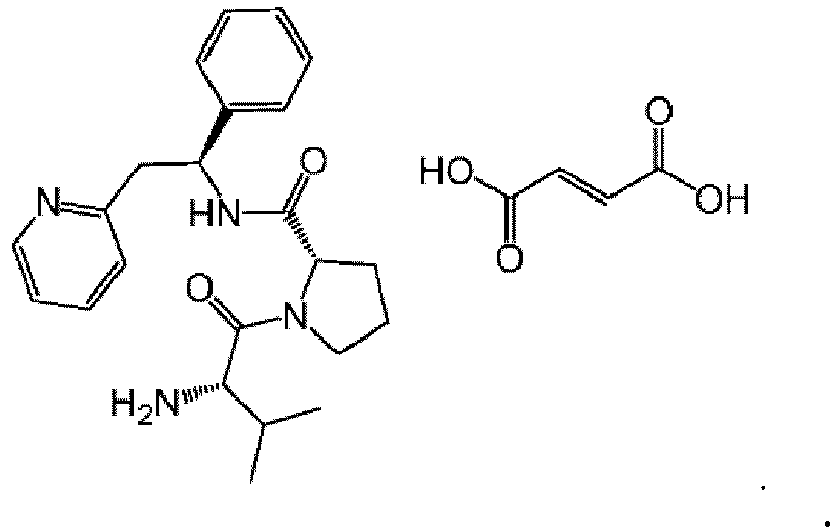
- The pharmaceutical composition according to claim 1, wherein R1 of the compound can be cleaved by a DPPIV enzyme to form (S)-1-phenyl-2-(pyridin-2-yl)ethanamine.
- The pharmaceutical composition according to claim 6, wherein the cleavage of R1 of the compound to form (S)-1-phenyl-2-(pyridin-2-yl)ethanamine can be modulated by the use of a DPPIV inhibitor.
- The pharmaceutical composition according to any one of claims 1 to 7, wherein the pharmaceutical composition is suitable for oral administration.
- A tablet suitable for oral administration comprising a pharmaceutical composition according to claim 8, and optionally comprising a starch, a cellulose derivative, a binder and/or a lubricant.
- The tablet according to claim 9, wherein the tablet is a coated tablet.
- The coated tablet according to claim 10, wherein the core of the tablet is coated with a concentrated sugar solution, wherein the concentrated sugar solution may contain gum arabic, gelatine, talcum and/or titanium dioxide.
- The coated tablet according to claim 11, wherein the core of the tablet is coated with a polymer.
- A capsule suitable for oral administration comprising a pharmaceutical composition according to claim 8.
- The capsule according to claim 13, wherein the capsule is a soft gelatine capsule, and wherein the capsule may comprise a vegetable oil or polyethylene glycol.
- The capsule according to claim 13, wherein the capsule is a hard gelatine capsule, and wherein the capsule may containa) granules,b) liquid formulations and/orc) semisolid formulationsof the compound of formula (I) or a pharmaceutically acceptable salt thereof.
Priority Applications (1)
| Application Number | Priority Date | Filing Date | Title |
|---|---|---|---|
| EP21196371.5A EP4001272B1 (en) | 2013-11-05 | 2014-10-30 | Nmda antagonist prodrugs |
Applications Claiming Priority (3)
| Application Number | Priority Date | Filing Date | Title |
|---|---|---|---|
| US201361899903P | 2013-11-05 | 2013-11-05 | |
| EP14802476.3A EP3066091B1 (en) | 2013-11-05 | 2014-10-30 | Nmda antagonist prodrugs |
| PCT/GB2014/053236 WO2015067923A1 (en) | 2013-11-05 | 2014-10-30 | Nmda antagonist prodrugs |
Related Parent Applications (1)
| Application Number | Title | Priority Date | Filing Date |
|---|---|---|---|
| EP14802476.3A Division EP3066091B1 (en) | 2013-11-05 | 2014-10-30 | Nmda antagonist prodrugs |
Related Child Applications (1)
| Application Number | Title | Priority Date | Filing Date |
|---|---|---|---|
| EP21196371.5A Division EP4001272B1 (en) | 2013-11-05 | 2014-10-30 | Nmda antagonist prodrugs |
Publications (2)
| Publication Number | Publication Date |
|---|---|
| EP3564234A1 true EP3564234A1 (en) | 2019-11-06 |
| EP3564234B1 EP3564234B1 (en) | 2021-09-29 |
Family
ID=51947383
Family Applications (3)
| Application Number | Title | Priority Date | Filing Date |
|---|---|---|---|
| EP14802476.3A Active EP3066091B1 (en) | 2013-11-05 | 2014-10-30 | Nmda antagonist prodrugs |
| EP19166031.5A Active EP3564234B1 (en) | 2013-11-05 | 2014-10-30 | Nmda antagonist prodrugs |
| EP21196371.5A Active EP4001272B1 (en) | 2013-11-05 | 2014-10-30 | Nmda antagonist prodrugs |
Family Applications Before (1)
| Application Number | Title | Priority Date | Filing Date |
|---|---|---|---|
| EP14802476.3A Active EP3066091B1 (en) | 2013-11-05 | 2014-10-30 | Nmda antagonist prodrugs |
Family Applications After (1)
| Application Number | Title | Priority Date | Filing Date |
|---|---|---|---|
| EP21196371.5A Active EP4001272B1 (en) | 2013-11-05 | 2014-10-30 | Nmda antagonist prodrugs |
Country Status (25)
| Country | Link |
|---|---|
| US (4) | US9822075B2 (en) |
| EP (3) | EP3066091B1 (en) |
| JP (4) | JP6479834B2 (en) |
| KR (2) | KR102336426B1 (en) |
| CN (2) | CN111187202B (en) |
| AR (1) | AR098319A1 (en) |
| AU (1) | AU2014345407B2 (en) |
| CA (1) | CA2928004C (en) |
| CY (1) | CY1121749T1 (en) |
| DK (1) | DK3066091T3 (en) |
| ES (3) | ES2733344T3 (en) |
| HR (2) | HRP20191159T1 (en) |
| HU (2) | HUE070532T2 (en) |
| LT (1) | LT3066091T (en) |
| MX (2) | MX394633B (en) |
| PL (2) | PL4001272T3 (en) |
| PT (1) | PT3066091T (en) |
| RS (2) | RS58991B1 (en) |
| RU (1) | RU2695372C2 (en) |
| SI (1) | SI3066091T1 (en) |
| SM (1) | SMT202500023T1 (en) |
| TR (1) | TR201909632T4 (en) |
| TW (1) | TW201609653A (en) |
| UY (1) | UY35823A (en) |
| WO (1) | WO2015067923A1 (en) |
Families Citing this family (5)
| Publication number | Priority date | Publication date | Assignee | Title |
|---|---|---|---|---|
| KR102336426B1 (en) | 2013-11-05 | 2021-12-08 | 아스트라제네카 아베 | Nmda antagonist prodrugs |
| US11358935B2 (en) | 2016-11-28 | 2022-06-14 | Biohaven Pharmaceutical Holding Company Ltd. | Prodrugs of lanicemine and their method of use |
| CN107578281B (en) * | 2017-08-31 | 2021-03-30 | 湖南大学 | Method for predicting user coupon behaviors in electronic commerce environment and model construction method |
| BR112022025900A2 (en) | 2020-06-23 | 2023-01-10 | Biohaven Therapeutics Ltd | TOPICAL FORMULATIONS OF (1S)-1-PHENYL-2-PYRIDIN-2-YLETANAMINE |
| CN122421958A (en) * | 2023-12-22 | 2026-07-17 | 拜奥海芬治疗学有限公司 | Combination therapy for neurotic disorders |
Citations (6)
| Publication number | Priority date | Publication date | Assignee | Title |
|---|---|---|---|---|
| WO1993020052A1 (en) | 1992-04-03 | 1993-10-14 | Fisons Corporation | Enantiomeric 1-phenyl-2-(2-pyridinyl)ethylamine for the treatment of neurodegenerative disorders |
| WO2000056324A1 (en) | 1999-03-23 | 2000-09-28 | Astrazeneca Ab | The use of certain affinity nmda antagonists as antidepressants |
| WO2000063175A2 (en) | 1999-04-15 | 2000-10-26 | Astrazeneca Ab | Novel process |
| WO2000071571A2 (en) * | 1999-05-14 | 2000-11-30 | Boehringer Ingelheim Pharma Kg | Fap-activated anti-tumor compounds |
| WO2010017504A1 (en) * | 2008-08-07 | 2010-02-11 | Xenoport, Inc. | Methods of synthesizing 1-(acyloxy)-alkyl carbamate prodrugs |
| WO2011089216A1 (en) * | 2010-01-22 | 2011-07-28 | Ascendis Pharma As | Dipeptide-based prodrug linkers for aliphatic amine-containing drugs |
Family Cites Families (13)
| Publication number | Priority date | Publication date | Assignee | Title |
|---|---|---|---|---|
| SE7909514L (en) * | 1979-11-16 | 1981-05-17 | Astra Laekemedel Ab | NEW HALOPHENYL-PYRIDYL-ALLYLAMINE DERIVATIVES |
| US4769466A (en) | 1987-02-06 | 1988-09-06 | Pennwalt Corporation | 2-aminoacetamide pyridinyl derivatives |
| ES2083972T3 (en) * | 1988-08-12 | 1996-05-01 | Astra Ab | ARYLALKYL-AMINES AND -AMIDES WITH ANTICONVULSIVE AND NEUROPROTECTORAL PROPERTIES. |
| ES2142320T3 (en) | 1991-10-30 | 2000-04-16 | Astra Ab | 2-PIRAZINYL-ETHYLAMINE DERIVATIVES AND THEIR USE AS PHARMACEUTICAL PRODUCTS. |
| PA8525601A1 (en) | 2000-08-21 | 2002-04-25 | Hoffmann La Roche | PROPHARMS OF (3S, 4S) -4-BENCIL-1- [2- (4-HIDROXI-BENCENOSULFONIL) -ETIL] -PIPERIDIN-3-OL |
| AU2002310409C1 (en) | 2001-06-11 | 2008-04-17 | Xenoport, Inc. | Orally administered dosage forms of GABA analog prodrugs having reduced toxicity |
| GB0310593D0 (en) * | 2003-05-08 | 2003-06-11 | Leuven K U Res & Dev | Peptidic prodrugs |
| CA2551859C (en) | 2003-12-30 | 2011-10-04 | Xenoport, Inc. | Synthesis of acyloxyalkyl carbamate prodrugs and intermediates thereof |
| EP1929030A2 (en) * | 2005-09-08 | 2008-06-11 | Shire LLC | Prodrugs of t3 and t4 with enhanced bioavailability |
| CN101246417B (en) | 2007-02-13 | 2010-09-29 | 艾威梯科技(北京)有限公司 | Method and system for uninterrupted software switching of audio data stream input/output |
| CA2710538A1 (en) | 2008-01-25 | 2009-07-30 | Xenoport, Inc. | Crystalline form of a (3s)-aminomethyl-5-methyl-hexanoic acid prodrug and methods of use |
| US8580850B2 (en) * | 2011-08-11 | 2013-11-12 | Xenoport, Inc. | Anhydrous and hemihydrate crystalline forms of an (R)-baclofen prodrug, methods of synthesis and methods of use |
| KR102336426B1 (en) | 2013-11-05 | 2021-12-08 | 아스트라제네카 아베 | Nmda antagonist prodrugs |
-
2014
- 2014-10-30 KR KR1020167014625A patent/KR102336426B1/en active Active
- 2014-10-30 TR TR2019/09632T patent/TR201909632T4/en unknown
- 2014-10-30 HU HUE21196371A patent/HUE070532T2/en unknown
- 2014-10-30 PT PT14802476T patent/PT3066091T/en unknown
- 2014-10-30 AU AU2014345407A patent/AU2014345407B2/en active Active
- 2014-10-30 HR HRP20191159TT patent/HRP20191159T1/en unknown
- 2014-10-30 PL PL21196371.5T patent/PL4001272T3/en unknown
- 2014-10-30 CA CA2928004A patent/CA2928004C/en active Active
- 2014-10-30 US US15/034,727 patent/US9822075B2/en active Active
- 2014-10-30 HR HRP20241784TT patent/HRP20241784T1/en unknown
- 2014-10-30 RS RS20190821A patent/RS58991B1/en unknown
- 2014-10-30 LT LTEP14802476.3T patent/LT3066091T/en unknown
- 2014-10-30 PL PL14802476T patent/PL3066091T3/en unknown
- 2014-10-30 MX MX2020011946A patent/MX394633B/en unknown
- 2014-10-30 DK DK14802476.3T patent/DK3066091T3/en active
- 2014-10-30 CN CN202010014023.3A patent/CN111187202B/en active Active
- 2014-10-30 RS RS20241459A patent/RS66369B1/en unknown
- 2014-10-30 MX MX2016005567A patent/MX377276B/en active IP Right Grant
- 2014-10-30 HU HUE14802476A patent/HUE045001T2/en unknown
- 2014-10-30 EP EP14802476.3A patent/EP3066091B1/en active Active
- 2014-10-30 JP JP2016551069A patent/JP6479834B2/en active Active
- 2014-10-30 ES ES14802476T patent/ES2733344T3/en active Active
- 2014-10-30 KR KR1020217039470A patent/KR102469167B1/en active Active
- 2014-10-30 EP EP19166031.5A patent/EP3564234B1/en active Active
- 2014-10-30 RU RU2016119493A patent/RU2695372C2/en active
- 2014-10-30 ES ES19166031T patent/ES2894903T3/en active Active
- 2014-10-30 WO PCT/GB2014/053236 patent/WO2015067923A1/en not_active Ceased
- 2014-10-30 SI SI201431242T patent/SI3066091T1/en unknown
- 2014-10-30 SM SM20250023T patent/SMT202500023T1/en unknown
- 2014-10-30 EP EP21196371.5A patent/EP4001272B1/en active Active
- 2014-10-30 ES ES21196371T patent/ES2999064T3/en active Active
- 2014-10-30 CN CN201480060416.0A patent/CN105683180B/en active Active
- 2014-11-05 TW TW103138423A patent/TW201609653A/en unknown
- 2014-11-05 AR ARP140104166A patent/AR098319A1/en unknown
- 2014-11-05 UY UY0001035823A patent/UY35823A/en not_active Application Discontinuation
-
2017
- 2017-10-17 US US15/785,654 patent/US10207994B2/en active Active
-
2019
- 2019-01-20 US US16/252,648 patent/US10815199B2/en active Active
- 2019-02-05 JP JP2019018440A patent/JP6633233B2/en active Active
- 2019-07-02 CY CY20191100691T patent/CY1121749T1/en unknown
- 2019-12-10 JP JP2019222567A patent/JP6856737B2/en active Active
-
2020
- 2020-10-26 US US17/079,553 patent/US12516023B2/en active Active
-
2021
- 2021-03-18 JP JP2021044193A patent/JP7234278B2/en active Active
Patent Citations (7)
| Publication number | Priority date | Publication date | Assignee | Title |
|---|---|---|---|---|
| WO1993020052A1 (en) | 1992-04-03 | 1993-10-14 | Fisons Corporation | Enantiomeric 1-phenyl-2-(2-pyridinyl)ethylamine for the treatment of neurodegenerative disorders |
| EP0633879A1 (en) | 1992-04-03 | 1995-01-18 | Astra Aktiebolag | Enantiomeric 1-phenyl-2-(2-pyridinyl)ethylamine for the treatment of neurodegenerative disorders |
| WO2000056324A1 (en) | 1999-03-23 | 2000-09-28 | Astrazeneca Ab | The use of certain affinity nmda antagonists as antidepressants |
| WO2000063175A2 (en) | 1999-04-15 | 2000-10-26 | Astrazeneca Ab | Novel process |
| WO2000071571A2 (en) * | 1999-05-14 | 2000-11-30 | Boehringer Ingelheim Pharma Kg | Fap-activated anti-tumor compounds |
| WO2010017504A1 (en) * | 2008-08-07 | 2010-02-11 | Xenoport, Inc. | Methods of synthesizing 1-(acyloxy)-alkyl carbamate prodrugs |
| WO2011089216A1 (en) * | 2010-01-22 | 2011-07-28 | Ascendis Pharma As | Dipeptide-based prodrug linkers for aliphatic amine-containing drugs |
Non-Patent Citations (3)
| Title |
|---|
| M. E. AULTON; CHURCHILL LIVINGSTONE: "Pharmaceuticals - The Science of Dosage Form Designs", 1988 |
| MALMBORG J; PLOEGER BA, J PHARMACOL TOXICOL METHODS, vol. 67, no. 3, May 2013 (2013-05-01), pages 203 - 13 |
| RAUTIO JARKKO ET AL: "Prodrugs: design and clinical applications", NATURE REVIEWS. DRUG DISCOVERY, NATURE PUBLISHING GROUP, GB, vol. 7, no. 3, 1 March 2008 (2008-03-01), pages 255 - 270, XP002579584, ISSN: 1474-1784 * |
Also Published As
Similar Documents
| Publication | Publication Date | Title |
|---|---|---|
| US12516023B2 (en) | NMDA antagonist prodrugs | |
| US20250122153A1 (en) | Protease Inhibitors as Antivirals | |
| TW200843778A (en) | Pterin analogs | |
| HK40076024B (en) | Nmda antagonist prodrugs | |
| HK40076024A (en) | Nmda antagonist prodrugs | |
| HK40014361A (en) | Nmda antagonist prodrugs | |
| HK40014361B (en) | Nmda antagonist prodrugs | |
| HK1226721B (en) | Nmda antagonist prodrugs | |
| HK1226721A1 (en) | Nmda antagonist prodrugs | |
| BR112016009949B1 (en) | NMDA ANTAGONIST PRODRUG COMPOUND, PHARMACEUTICAL COMPOSITION, AND USE OF A COMPOUND |
Legal Events
| Date | Code | Title | Description |
|---|---|---|---|
| PUAI | Public reference made under article 153(3) epc to a published international application that has entered the european phase |
Free format text: ORIGINAL CODE: 0009012 |
|
| STAA | Information on the status of an ep patent application or granted ep patent |
Free format text: STATUS: THE APPLICATION HAS BEEN PUBLISHED |
|
| AC | Divisional application: reference to earlier application |
Ref document number: 3066091 Country of ref document: EP Kind code of ref document: P |
|
| AK | Designated contracting states |
Kind code of ref document: A1 Designated state(s): AL AT BE BG CH CY CZ DE DK EE ES FI FR GB GR HR HU IE IS IT LI LT LU LV MC MK MT NL NO PL PT RO RS SE SI SK SM TR |
|
| STAA | Information on the status of an ep patent application or granted ep patent |
Free format text: STATUS: REQUEST FOR EXAMINATION WAS MADE |
|
| 17P | Request for examination filed |
Effective date: 20200504 |
|
| RBV | Designated contracting states (corrected) |
Designated state(s): AL AT BE BG CH CY CZ DE DK EE ES FI FR GB GR HR HU IE IS IT LI LT LU LV MC MK MT NL NO PL PT RO RS SE SI SK SM TR |
|
| REG | Reference to a national code |
Ref country code: HK Ref legal event code: DE Ref document number: 40014361 Country of ref document: HK |
|
| STAA | Information on the status of an ep patent application or granted ep patent |
Free format text: STATUS: EXAMINATION IS IN PROGRESS |
|
| 17Q | First examination report despatched |
Effective date: 20200824 |
|
| GRAP | Despatch of communication of intention to grant a patent |
Free format text: ORIGINAL CODE: EPIDOSNIGR1 |
|
| STAA | Information on the status of an ep patent application or granted ep patent |
Free format text: STATUS: GRANT OF PATENT IS INTENDED |
|
| INTG | Intention to grant announced |
Effective date: 20210630 |
|
| GRAS | Grant fee paid |
Free format text: ORIGINAL CODE: EPIDOSNIGR3 |
|
| GRAA | (expected) grant |
Free format text: ORIGINAL CODE: 0009210 |
|
| STAA | Information on the status of an ep patent application or granted ep patent |
Free format text: STATUS: THE PATENT HAS BEEN GRANTED |
|
| AC | Divisional application: reference to earlier application |
Ref document number: 3066091 Country of ref document: EP Kind code of ref document: P |
|
| AK | Designated contracting states |
Kind code of ref document: B1 Designated state(s): AL AT BE BG CH CY CZ DE DK EE ES FI FR GB GR HR HU IE IS IT LI LT LU LV MC MK MT NL NO PL PT RO RS SE SI SK SM TR |
|
| REG | Reference to a national code |
Ref country code: GB Ref legal event code: FG4D |
|
| REG | Reference to a national code |
Ref country code: CH Ref legal event code: EP Ref country code: AT Ref legal event code: REF Ref document number: 1434115 Country of ref document: AT Kind code of ref document: T Effective date: 20211015 |
|
| REG | Reference to a national code |
Ref country code: DE Ref legal event code: R096 Ref document number: 602014080460 Country of ref document: DE |
|
| REG | Reference to a national code |
Ref country code: IE Ref legal event code: FG4D |
|
| REG | Reference to a national code |
Ref country code: LT Ref legal event code: MG9D |
|
| PG25 | Lapsed in a contracting state [announced via postgrant information from national office to epo] |
Ref country code: RS Free format text: LAPSE BECAUSE OF FAILURE TO SUBMIT A TRANSLATION OF THE DESCRIPTION OR TO PAY THE FEE WITHIN THE PRESCRIBED TIME-LIMIT Effective date: 20210929 Ref country code: SE Free format text: LAPSE BECAUSE OF FAILURE TO SUBMIT A TRANSLATION OF THE DESCRIPTION OR TO PAY THE FEE WITHIN THE PRESCRIBED TIME-LIMIT Effective date: 20210929 Ref country code: FI Free format text: LAPSE BECAUSE OF FAILURE TO SUBMIT A TRANSLATION OF THE DESCRIPTION OR TO PAY THE FEE WITHIN THE PRESCRIBED TIME-LIMIT Effective date: 20210929 Ref country code: NO Free format text: LAPSE BECAUSE OF FAILURE TO SUBMIT A TRANSLATION OF THE DESCRIPTION OR TO PAY THE FEE WITHIN THE PRESCRIBED TIME-LIMIT Effective date: 20211229 Ref country code: HR Free format text: LAPSE BECAUSE OF FAILURE TO SUBMIT A TRANSLATION OF THE DESCRIPTION OR TO PAY THE FEE WITHIN THE PRESCRIBED TIME-LIMIT Effective date: 20210929 Ref country code: BG Free format text: LAPSE BECAUSE OF FAILURE TO SUBMIT A TRANSLATION OF THE DESCRIPTION OR TO PAY THE FEE WITHIN THE PRESCRIBED TIME-LIMIT Effective date: 20211229 Ref country code: LT Free format text: LAPSE BECAUSE OF FAILURE TO SUBMIT A TRANSLATION OF THE DESCRIPTION OR TO PAY THE FEE WITHIN THE PRESCRIBED TIME-LIMIT Effective date: 20210929 |
|
| REG | Reference to a national code |
Ref country code: NL Ref legal event code: MP Effective date: 20210929 |
|
| REG | Reference to a national code |
Ref country code: AT Ref legal event code: MK05 Ref document number: 1434115 Country of ref document: AT Kind code of ref document: T Effective date: 20210929 |
|
| REG | Reference to a national code |
Ref country code: ES Ref legal event code: FG2A Ref document number: 2894903 Country of ref document: ES Kind code of ref document: T3 Effective date: 20220216 |
|
| PG25 | Lapsed in a contracting state [announced via postgrant information from national office to epo] |
Ref country code: LV Free format text: LAPSE BECAUSE OF FAILURE TO SUBMIT A TRANSLATION OF THE DESCRIPTION OR TO PAY THE FEE WITHIN THE PRESCRIBED TIME-LIMIT Effective date: 20210929 Ref country code: GR Free format text: LAPSE BECAUSE OF FAILURE TO SUBMIT A TRANSLATION OF THE DESCRIPTION OR TO PAY THE FEE WITHIN THE PRESCRIBED TIME-LIMIT Effective date: 20211230 |
|
| PG25 | Lapsed in a contracting state [announced via postgrant information from national office to epo] |
Ref country code: AT Free format text: LAPSE BECAUSE OF FAILURE TO SUBMIT A TRANSLATION OF THE DESCRIPTION OR TO PAY THE FEE WITHIN THE PRESCRIBED TIME-LIMIT Effective date: 20210929 |
|
| PG25 | Lapsed in a contracting state [announced via postgrant information from national office to epo] |
Ref country code: IS Free format text: LAPSE BECAUSE OF FAILURE TO SUBMIT A TRANSLATION OF THE DESCRIPTION OR TO PAY THE FEE WITHIN THE PRESCRIBED TIME-LIMIT Effective date: 20220129 Ref country code: SK Free format text: LAPSE BECAUSE OF FAILURE TO SUBMIT A TRANSLATION OF THE DESCRIPTION OR TO PAY THE FEE WITHIN THE PRESCRIBED TIME-LIMIT Effective date: 20210929 Ref country code: RO Free format text: LAPSE BECAUSE OF FAILURE TO SUBMIT A TRANSLATION OF THE DESCRIPTION OR TO PAY THE FEE WITHIN THE PRESCRIBED TIME-LIMIT Effective date: 20210929 Ref country code: PT Free format text: LAPSE BECAUSE OF FAILURE TO SUBMIT A TRANSLATION OF THE DESCRIPTION OR TO PAY THE FEE WITHIN THE PRESCRIBED TIME-LIMIT Effective date: 20220131 Ref country code: PL Free format text: LAPSE BECAUSE OF FAILURE TO SUBMIT A TRANSLATION OF THE DESCRIPTION OR TO PAY THE FEE WITHIN THE PRESCRIBED TIME-LIMIT Effective date: 20210929 Ref country code: NL Free format text: LAPSE BECAUSE OF FAILURE TO SUBMIT A TRANSLATION OF THE DESCRIPTION OR TO PAY THE FEE WITHIN THE PRESCRIBED TIME-LIMIT Effective date: 20210929 Ref country code: EE Free format text: LAPSE BECAUSE OF FAILURE TO SUBMIT A TRANSLATION OF THE DESCRIPTION OR TO PAY THE FEE WITHIN THE PRESCRIBED TIME-LIMIT Effective date: 20210929 Ref country code: CZ Free format text: LAPSE BECAUSE OF FAILURE TO SUBMIT A TRANSLATION OF THE DESCRIPTION OR TO PAY THE FEE WITHIN THE PRESCRIBED TIME-LIMIT Effective date: 20210929 Ref country code: AL Free format text: LAPSE BECAUSE OF FAILURE TO SUBMIT A TRANSLATION OF THE DESCRIPTION OR TO PAY THE FEE WITHIN THE PRESCRIBED TIME-LIMIT Effective date: 20210929 |
|
| REG | Reference to a national code |
Ref country code: BE Ref legal event code: MM Effective date: 20211031 |
|
| PG25 | Lapsed in a contracting state [announced via postgrant information from national office to epo] |
Ref country code: MC Free format text: LAPSE BECAUSE OF FAILURE TO SUBMIT A TRANSLATION OF THE DESCRIPTION OR TO PAY THE FEE WITHIN THE PRESCRIBED TIME-LIMIT Effective date: 20210929 |
|
| REG | Reference to a national code |
Ref country code: DE Ref legal event code: R097 Ref document number: 602014080460 Country of ref document: DE |
|
| PG25 | Lapsed in a contracting state [announced via postgrant information from national office to epo] |
Ref country code: LU Free format text: LAPSE BECAUSE OF NON-PAYMENT OF DUE FEES Effective date: 20211030 Ref country code: DK Free format text: LAPSE BECAUSE OF FAILURE TO SUBMIT A TRANSLATION OF THE DESCRIPTION OR TO PAY THE FEE WITHIN THE PRESCRIBED TIME-LIMIT Effective date: 20210929 Ref country code: BE Free format text: LAPSE BECAUSE OF NON-PAYMENT OF DUE FEES Effective date: 20211031 |
|
| PLBE | No opposition filed within time limit |
Free format text: ORIGINAL CODE: 0009261 |
|
| STAA | Information on the status of an ep patent application or granted ep patent |
Free format text: STATUS: NO OPPOSITION FILED WITHIN TIME LIMIT |
|
| 26N | No opposition filed |
Effective date: 20220630 |
|
| PG25 | Lapsed in a contracting state [announced via postgrant information from national office to epo] |
Ref country code: SI Free format text: LAPSE BECAUSE OF FAILURE TO SUBMIT A TRANSLATION OF THE DESCRIPTION OR TO PAY THE FEE WITHIN THE PRESCRIBED TIME-LIMIT Effective date: 20210929 |
|
| P01 | Opt-out of the competence of the unified patent court (upc) registered |
Effective date: 20230329 |
|
| PG25 | Lapsed in a contracting state [announced via postgrant information from national office to epo] |
Ref country code: CY Free format text: LAPSE BECAUSE OF FAILURE TO SUBMIT A TRANSLATION OF THE DESCRIPTION OR TO PAY THE FEE WITHIN THE PRESCRIBED TIME-LIMIT Effective date: 20210929 |
|
| PG25 | Lapsed in a contracting state [announced via postgrant information from national office to epo] |
Ref country code: SM Free format text: LAPSE BECAUSE OF FAILURE TO SUBMIT A TRANSLATION OF THE DESCRIPTION OR TO PAY THE FEE WITHIN THE PRESCRIBED TIME-LIMIT Effective date: 20210929 Ref country code: HU Free format text: LAPSE BECAUSE OF FAILURE TO SUBMIT A TRANSLATION OF THE DESCRIPTION OR TO PAY THE FEE WITHIN THE PRESCRIBED TIME-LIMIT; INVALID AB INITIO Effective date: 20141030 |
|
| PG25 | Lapsed in a contracting state [announced via postgrant information from national office to epo] |
Ref country code: MK Free format text: LAPSE BECAUSE OF FAILURE TO SUBMIT A TRANSLATION OF THE DESCRIPTION OR TO PAY THE FEE WITHIN THE PRESCRIBED TIME-LIMIT Effective date: 20210929 |
|
| PG25 | Lapsed in a contracting state [announced via postgrant information from national office to epo] |
Ref country code: MT Free format text: LAPSE BECAUSE OF FAILURE TO SUBMIT A TRANSLATION OF THE DESCRIPTION OR TO PAY THE FEE WITHIN THE PRESCRIBED TIME-LIMIT Effective date: 20210929 |
|
| PGFP | Annual fee paid to national office [announced via postgrant information from national office to epo] |
Ref country code: IT Payment date: 20250922 Year of fee payment: 12 |
|
| PGFP | Annual fee paid to national office [announced via postgrant information from national office to epo] |
Ref country code: GB Payment date: 20250911 Year of fee payment: 12 |
|
| PGFP | Annual fee paid to national office [announced via postgrant information from national office to epo] |
Ref country code: FR Payment date: 20250908 Year of fee payment: 12 |
|
| PGFP | Annual fee paid to national office [announced via postgrant information from national office to epo] |
Ref country code: IE Payment date: 20250909 Year of fee payment: 12 |
|
| REG | Reference to a national code |
Ref country code: CH Ref legal event code: U11 Free format text: ST27 STATUS EVENT CODE: U-0-0-U10-U11 (AS PROVIDED BY THE NATIONAL OFFICE) Effective date: 20251101 |
|
| PG25 | Lapsed in a contracting state [announced via postgrant information from national office to epo] |
Ref country code: TR Free format text: LAPSE BECAUSE OF FAILURE TO SUBMIT A TRANSLATION OF THE DESCRIPTION OR TO PAY THE FEE WITHIN THE PRESCRIBED TIME-LIMIT Effective date: 20210929 |
|
| PGFP | Annual fee paid to national office [announced via postgrant information from national office to epo] |
Ref country code: DE Payment date: 20250902 Year of fee payment: 12 |
|
| PGFP | Annual fee paid to national office [announced via postgrant information from national office to epo] |
Ref country code: CH Payment date: 20251101 Year of fee payment: 12 |
|
| PGFP | Annual fee paid to national office [announced via postgrant information from national office to epo] |
Ref country code: ES Payment date: 20251104 Year of fee payment: 12 |