EP3564231A1 - Azabicyclo-substituted triazole derivative, preparation method thereof, and application of same in medicine - Google Patents
Azabicyclo-substituted triazole derivative, preparation method thereof, and application of same in medicine Download PDFInfo
- Publication number
- EP3564231A1 EP3564231A1 EP17885670.4A EP17885670A EP3564231A1 EP 3564231 A1 EP3564231 A1 EP 3564231A1 EP 17885670 A EP17885670 A EP 17885670A EP 3564231 A1 EP3564231 A1 EP 3564231A1
- Authority
- EP
- European Patent Office
- Prior art keywords
- compound
- formula
- ring
- group
- cycloalkyl
- Prior art date
- Legal status (The legal status is an assumption and is not a legal conclusion. Google has not performed a legal analysis and makes no representation as to the accuracy of the status listed.)
- Withdrawn
Links
- 239000003814 drug Substances 0.000 title claims abstract description 16
- 238000002360 preparation method Methods 0.000 title claims abstract description 13
- 150000003852 triazoles Chemical class 0.000 title abstract description 4
- 101800000989 Oxytocin Proteins 0.000 claims abstract description 25
- XNOPRXBHLZRZKH-UHFFFAOYSA-N Oxytocin Natural products N1C(=O)C(N)CSSCC(C(=O)N2C(CCC2)C(=O)NC(CC(C)C)C(=O)NCC(N)=O)NC(=O)C(CC(N)=O)NC(=O)C(CCC(N)=O)NC(=O)C(C(C)CC)NC(=O)C1CC1=CC=C(O)C=C1 XNOPRXBHLZRZKH-UHFFFAOYSA-N 0.000 claims abstract description 24
- XNOPRXBHLZRZKH-DSZYJQQASA-N oxytocin Chemical compound C([C@H]1C(=O)N[C@H](C(N[C@@H](CCC(N)=O)C(=O)N[C@@H](CC(N)=O)C(=O)N[C@@H](CSSC[C@H](N)C(=O)N1)C(=O)N1[C@@H](CCC1)C(=O)N[C@@H](CC(C)C)C(=O)NCC(N)=O)=O)[C@@H](C)CC)C1=CC=C(O)C=C1 XNOPRXBHLZRZKH-DSZYJQQASA-N 0.000 claims abstract description 24
- 229960001723 oxytocin Drugs 0.000 claims abstract description 24
- 239000008194 pharmaceutical composition Substances 0.000 claims abstract description 23
- 208000037265 diseases, disorders, signs and symptoms Diseases 0.000 claims abstract description 14
- 201000010099 disease Diseases 0.000 claims abstract description 9
- 230000009286 beneficial effect Effects 0.000 claims abstract description 6
- 208000035475 disorder Diseases 0.000 claims abstract description 5
- 102100031951 Oxytocin-neurophysin 1 Human genes 0.000 claims abstract 4
- 150000001875 compounds Chemical class 0.000 claims description 163
- -1 cyano, amino Chemical group 0.000 claims description 59
- 125000000623 heterocyclic group Chemical group 0.000 claims description 53
- 125000000753 cycloalkyl group Chemical group 0.000 claims description 51
- 125000000217 alkyl group Chemical group 0.000 claims description 40
- 239000000203 mixture Substances 0.000 claims description 39
- 230000005764 inhibitory process Effects 0.000 claims description 30
- 150000003839 salts Chemical class 0.000 claims description 29
- 125000003545 alkoxy group Chemical group 0.000 claims description 24
- 125000001072 heteroaryl group Chemical group 0.000 claims description 21
- 238000000034 method Methods 0.000 claims description 21
- 208000006262 Psychological Sexual Dysfunctions Diseases 0.000 claims description 20
- 125000003118 aryl group Chemical group 0.000 claims description 20
- 238000010438 heat treatment Methods 0.000 claims description 20
- 229910052736 halogen Inorganic materials 0.000 claims description 18
- 150000002367 halogens Chemical group 0.000 claims description 18
- 125000002887 hydroxy group Chemical group [H]O* 0.000 claims description 14
- 125000000449 nitro group Chemical group [O-][N+](*)=O 0.000 claims description 14
- 125000001424 substituent group Chemical group 0.000 claims description 13
- 229910052739 hydrogen Inorganic materials 0.000 claims description 11
- 239000001257 hydrogen Substances 0.000 claims description 11
- 125000004093 cyano group Chemical group *C#N 0.000 claims description 10
- 230000002378 acidificating effect Effects 0.000 claims description 9
- 125000004435 hydrogen atom Chemical class [H]* 0.000 claims description 9
- 125000002768 hydroxyalkyl group Chemical group 0.000 claims description 9
- 230000001568 sexual effect Effects 0.000 claims description 9
- 208000019454 Feeding and Eating disease Diseases 0.000 claims description 8
- 208000027520 Somatoform disease Diseases 0.000 claims description 8
- 125000001188 haloalkyl group Chemical group 0.000 claims description 8
- 208000027753 pain disease Diseases 0.000 claims description 8
- 239000000546 pharmaceutical excipient Substances 0.000 claims description 8
- 206010036596 premature ejaculation Diseases 0.000 claims description 8
- QCQCHGYLTSGIGX-GHXANHINSA-N 4-[[(3ar,5ar,5br,7ar,9s,11ar,11br,13as)-5a,5b,8,8,11a-pentamethyl-3a-[(5-methylpyridine-3-carbonyl)amino]-2-oxo-1-propan-2-yl-4,5,6,7,7a,9,10,11,11b,12,13,13a-dodecahydro-3h-cyclopenta[a]chrysen-9-yl]oxy]-2,2-dimethyl-4-oxobutanoic acid Chemical compound N([C@@]12CC[C@@]3(C)[C@]4(C)CC[C@H]5C(C)(C)[C@@H](OC(=O)CC(C)(C)C(O)=O)CC[C@]5(C)[C@H]4CC[C@@H]3C1=C(C(C2)=O)C(C)C)C(=O)C1=CN=CC(C)=C1 QCQCHGYLTSGIGX-GHXANHINSA-N 0.000 claims description 6
- 208000005171 Dysmenorrhea Diseases 0.000 claims description 6
- 206010013935 Dysmenorrhoea Diseases 0.000 claims description 6
- 201000001880 Sexual dysfunction Diseases 0.000 claims description 5
- 125000004438 haloalkoxy group Chemical group 0.000 claims description 5
- 125000005844 heterocyclyloxy group Chemical group 0.000 claims description 5
- 231100000872 sexual dysfunction Toxicity 0.000 claims description 5
- 208000027559 Appetite disease Diseases 0.000 claims description 4
- 206010004446 Benign prostatic hyperplasia Diseases 0.000 claims description 4
- 206010007559 Cardiac failure congestive Diseases 0.000 claims description 4
- 206010057671 Female sexual dysfunction Diseases 0.000 claims description 4
- 206010019280 Heart failures Diseases 0.000 claims description 4
- 206010020772 Hypertension Diseases 0.000 claims description 4
- 206010024419 Libido decreased Diseases 0.000 claims description 4
- 206010057672 Male sexual dysfunction Diseases 0.000 claims description 4
- 208000021384 Obsessive-Compulsive disease Diseases 0.000 claims description 4
- 208000005107 Premature Birth Diseases 0.000 claims description 4
- 206010036590 Premature baby Diseases 0.000 claims description 4
- 208000004403 Prostatic Hyperplasia Diseases 0.000 claims description 4
- 230000036528 appetite Effects 0.000 claims description 4
- 235000019789 appetite Nutrition 0.000 claims description 4
- 208000037849 arterial hypertension Diseases 0.000 claims description 4
- 208000019425 cirrhosis of liver Diseases 0.000 claims description 4
- 125000001559 cyclopropyl group Chemical group [H]C1([H])C([H])([H])C1([H])* 0.000 claims description 4
- 239000003085 diluting agent Substances 0.000 claims description 4
- 239000003937 drug carrier Substances 0.000 claims description 4
- 208000017020 hypoactive sexual desire disease Diseases 0.000 claims description 4
- 208000037805 labour Diseases 0.000 claims description 4
- 125000004076 pyridyl group Chemical group 0.000 claims description 4
- 230000003042 antagnostic effect Effects 0.000 claims description 3
- FTNJQNQLEGKTGD-UHFFFAOYSA-N 1,3-benzodioxole Chemical compound C1=CC=C2OCOC2=C1 FTNJQNQLEGKTGD-UHFFFAOYSA-N 0.000 claims description 2
- 229940079593 drug Drugs 0.000 abstract description 5
- 239000003336 oxytocin antagonist Substances 0.000 abstract description 4
- 229940121361 oxytocin antagonists Drugs 0.000 abstract description 4
- 229940124597 therapeutic agent Drugs 0.000 abstract description 2
- 239000000243 solution Substances 0.000 description 154
- 238000006243 chemical reaction Methods 0.000 description 134
- WYURNTSHIVDZCO-UHFFFAOYSA-N Tetrahydrofuran Chemical compound C1CCOC1 WYURNTSHIVDZCO-UHFFFAOYSA-N 0.000 description 74
- XEKOWRVHYACXOJ-UHFFFAOYSA-N Ethyl acetate Chemical compound CCOC(C)=O XEKOWRVHYACXOJ-UHFFFAOYSA-N 0.000 description 63
- 238000004949 mass spectrometry Methods 0.000 description 51
- 239000000047 product Substances 0.000 description 43
- 230000000694 effects Effects 0.000 description 38
- 210000004027 cell Anatomy 0.000 description 37
- YLQBMQCUIZJEEH-UHFFFAOYSA-N tetrahydrofuran Natural products C=1C=COC=1 YLQBMQCUIZJEEH-UHFFFAOYSA-N 0.000 description 37
- 238000012360 testing method Methods 0.000 description 28
- LFQSCWFLJHTTHZ-UHFFFAOYSA-N Ethanol Chemical compound CCO LFQSCWFLJHTTHZ-UHFFFAOYSA-N 0.000 description 27
- DTQVDTLACAAQTR-UHFFFAOYSA-N Trifluoroacetic acid Chemical compound OC(=O)C(F)(F)F DTQVDTLACAAQTR-UHFFFAOYSA-N 0.000 description 26
- HEDRZPFGACZZDS-MICDWDOJSA-N Trichloro(2H)methane Chemical compound [2H]C(Cl)(Cl)Cl HEDRZPFGACZZDS-MICDWDOJSA-N 0.000 description 25
- 238000000746 purification Methods 0.000 description 25
- 239000012043 crude product Substances 0.000 description 24
- 239000002904 solvent Substances 0.000 description 23
- 239000003153 chemical reaction reagent Substances 0.000 description 22
- QTBSBXVTEAMEQO-UHFFFAOYSA-N Acetic acid Chemical compound CC(O)=O QTBSBXVTEAMEQO-UHFFFAOYSA-N 0.000 description 21
- YMWUJEATGCHHMB-UHFFFAOYSA-N Dichloromethane Chemical compound ClCCl YMWUJEATGCHHMB-UHFFFAOYSA-N 0.000 description 21
- 102400000050 Oxytocin Human genes 0.000 description 21
- HEMHJVSKTPXQMS-UHFFFAOYSA-M Sodium hydroxide Chemical compound [OH-].[Na+] HEMHJVSKTPXQMS-UHFFFAOYSA-M 0.000 description 21
- 238000005160 1H NMR spectroscopy Methods 0.000 description 18
- IAZDPXIOMUYVGZ-UHFFFAOYSA-N Dimethylsulphoxide Chemical compound CS(C)=O IAZDPXIOMUYVGZ-UHFFFAOYSA-N 0.000 description 18
- OKKJLVBELUTLKV-UHFFFAOYSA-N Methanol Chemical compound OC OKKJLVBELUTLKV-UHFFFAOYSA-N 0.000 description 18
- OKKJLVBELUTLKV-MZCSYVLQSA-N Deuterated methanol Chemical compound [2H]OC([2H])([2H])[2H] OKKJLVBELUTLKV-MZCSYVLQSA-N 0.000 description 16
- 125000004432 carbon atom Chemical group C* 0.000 description 16
- XLYOFNOQVPJJNP-UHFFFAOYSA-N water Substances O XLYOFNOQVPJJNP-UHFFFAOYSA-N 0.000 description 16
- 102100028139 Oxytocin receptor Human genes 0.000 description 15
- 239000012074 organic phase Substances 0.000 description 15
- 238000004809 thin layer chromatography Methods 0.000 description 15
- RTZKZFJDLAIYFH-UHFFFAOYSA-N Diethyl ether Chemical compound CCOCC RTZKZFJDLAIYFH-UHFFFAOYSA-N 0.000 description 14
- MMAQKNSXSBEGSZ-DSBXPFQDSA-N C1=C(/N=C(\N2C[C@@]3([C@@H](C3)C2)C2=C(Cl)C=C(F)C=C2)/SC)C=NC(=C1)OC Chemical compound C1=C(/N=C(\N2C[C@@]3([C@@H](C3)C2)C2=C(Cl)C=C(F)C=C2)/SC)C=NC(=C1)OC MMAQKNSXSBEGSZ-DSBXPFQDSA-N 0.000 description 13
- VEXZGXHMUGYJMC-UHFFFAOYSA-N Hydrochloric acid Chemical compound Cl VEXZGXHMUGYJMC-UHFFFAOYSA-N 0.000 description 13
- OUVXYXNWSVIOSJ-UHFFFAOYSA-N Fluo-4 Chemical compound CC1=CC=C(N(CC(O)=O)CC(O)=O)C(OCCOC=2C(=CC=C(C=2)C2=C3C=C(F)C(=O)C=C3OC3=CC(O)=C(F)C=C32)N(CC(O)=O)CC(O)=O)=C1 OUVXYXNWSVIOSJ-UHFFFAOYSA-N 0.000 description 12
- ZMXDDKWLCZADIW-UHFFFAOYSA-N N,N-Dimethylformamide Chemical compound CN(C)C=O ZMXDDKWLCZADIW-UHFFFAOYSA-N 0.000 description 12
- ZMANZCXQSJIPKH-UHFFFAOYSA-N Triethylamine Chemical compound CCN(CC)CC ZMANZCXQSJIPKH-UHFFFAOYSA-N 0.000 description 12
- 125000002619 bicyclic group Chemical group 0.000 description 12
- SCVFZCLFOSHCOH-UHFFFAOYSA-M potassium acetate Chemical compound [K+].CC([O-])=O SCVFZCLFOSHCOH-UHFFFAOYSA-M 0.000 description 12
- FAPWRFPIFSIZLT-UHFFFAOYSA-M Sodium chloride Chemical compound [Na+].[Cl-] FAPWRFPIFSIZLT-UHFFFAOYSA-M 0.000 description 11
- VLKZOEOYAKHREP-UHFFFAOYSA-N n-Hexane Chemical compound CCCCCC VLKZOEOYAKHREP-UHFFFAOYSA-N 0.000 description 11
- 125000003367 polycyclic group Chemical group 0.000 description 11
- 125000006413 ring segment Chemical group 0.000 description 11
- 241000700159 Rattus Species 0.000 description 10
- FYSNRJHAOHDILO-UHFFFAOYSA-N thionyl chloride Chemical compound ClS(Cl)=O FYSNRJHAOHDILO-UHFFFAOYSA-N 0.000 description 10
- UYKVJQCPBDDIFD-UHFFFAOYSA-N 1-(2-chloro-4-fluorophenyl)-3-[5-(methoxymethyl)-4-(6-methoxypyridin-3-yl)-1,2,4-triazol-3-yl]-3-azabicyclo[3.1.0]hexane Chemical compound COCc1nnc(N2CC3CC3(C2)c2ccc(F)cc2Cl)n1-c1ccc(OC)nc1 UYKVJQCPBDDIFD-UHFFFAOYSA-N 0.000 description 9
- 0 C*C(C)(C=CC=C1)C=C1C(CC1)=C(C2)C1CN2c1nnc(*)[n]1C1(*)CCC(C)(*)CCCCC1 Chemical compound C*C(C)(C=CC=C1)C=C1C(CC1)=C(C2)C1CN2c1nnc(*)[n]1C1(*)CCC(C)(*)CCCCC1 0.000 description 9
- WMFOQBRAJBCJND-UHFFFAOYSA-M Lithium hydroxide Chemical compound [Li+].[OH-] WMFOQBRAJBCJND-UHFFFAOYSA-M 0.000 description 9
- YXFVVABEGXRONW-UHFFFAOYSA-N Toluene Chemical compound CC1=CC=CC=C1 YXFVVABEGXRONW-UHFFFAOYSA-N 0.000 description 9
- 238000002474 experimental method Methods 0.000 description 9
- UYKVJQCPBDDIFD-LRTDBIEQSA-N (1R,5S)-1-(2-chloro-4-fluorophenyl)-3-[5-(methoxymethyl)-4-(6-methoxypyridin-3-yl)-1,2,4-triazol-3-yl]-3-azabicyclo[3.1.0]hexane Chemical compound COCc1nnc(N2C[C@H]3C[C@]3(C2)c2ccc(F)cc2Cl)n1-c1ccc(OC)nc1 UYKVJQCPBDDIFD-LRTDBIEQSA-N 0.000 description 8
- UYKVJQCPBDDIFD-JSOIARQOSA-N (1S,5R)-1-(2-chloro-4-fluorophenyl)-3-[4-(6-methoxypyridin-3-yl)-5-(trideuteriomethoxymethyl)-1,2,4-triazol-3-yl]-3-azabicyclo[3.1.0]hexane Chemical compound ClC1=C(C=CC(=C1)F)[C@]12CN(C[C@@H]2C1)C1=NN=C(N1C=1C=NC(=CC=1)OC)COC([2H])([2H])[2H] UYKVJQCPBDDIFD-JSOIARQOSA-N 0.000 description 8
- 101000954141 Homo sapiens Vasopressin V1b receptor Proteins 0.000 description 8
- 101000807859 Homo sapiens Vasopressin V2 receptor Proteins 0.000 description 8
- KEAYESYHFKHZAL-UHFFFAOYSA-N Sodium Chemical compound [Na] KEAYESYHFKHZAL-UHFFFAOYSA-N 0.000 description 8
- 239000000706 filtrate Substances 0.000 description 8
- VUQUOGPMUUJORT-UHFFFAOYSA-N methyl 4-methylbenzenesulfonate Chemical compound COS(=O)(=O)C1=CC=C(C)C=C1 VUQUOGPMUUJORT-UHFFFAOYSA-N 0.000 description 8
- 239000013612 plasmid Substances 0.000 description 8
- LPNYRYFBWFDTMA-UHFFFAOYSA-N potassium tert-butoxide Chemical compound [K+].CC(C)(C)[O-] LPNYRYFBWFDTMA-UHFFFAOYSA-N 0.000 description 8
- 239000012312 sodium hydride Substances 0.000 description 8
- 229910000104 sodium hydride Inorganic materials 0.000 description 8
- DAEPDZWVDSPTHF-UHFFFAOYSA-M sodium pyruvate Chemical compound [Na+].CC(=O)C([O-])=O DAEPDZWVDSPTHF-UHFFFAOYSA-M 0.000 description 8
- IVBNDCRHXGVWPI-ZSEKCTLFSA-N (1S,5R)-1-(2-chloro-3-fluorophenyl)-3-[5-(methoxymethyl)-4-(6-methoxypyridin-3-yl)-1,2,4-triazol-3-yl]-3-azabicyclo[3.1.0]hexane Chemical compound COCc1nnc(N2C[C@@H]3C[C@@]3(C2)c2cccc(F)c2Cl)n1-c1ccc(OC)nc1 IVBNDCRHXGVWPI-ZSEKCTLFSA-N 0.000 description 7
- RLPIVCPKSMALAS-LMKMVOKYSA-N (1S,5R)-1-(2-chloro-4-fluorophenyl)-3-[4-(6-methoxypyridin-3-yl)-5-(oxan-4-yloxymethyl)-1,2,4-triazol-3-yl]-3-azabicyclo[3.1.0]hexane Chemical compound COc1ccc(cn1)-n1c(COC2CCOCC2)nnc1N1C[C@@H]2C[C@@]2(C1)c1ccc(F)cc1Cl RLPIVCPKSMALAS-LMKMVOKYSA-N 0.000 description 7
- FPMWLHOKMHXPMM-QKVFXAPYSA-N (1S,5R)-1-(2-chloro-4-fluorophenyl)-3-[5-(difluoromethoxymethyl)-4-(6-methoxypyridin-3-yl)-1,2,4-triazol-3-yl]-3-azabicyclo[3.1.0]hexane Chemical compound COc1ccc(cn1)-n1c(COC(F)F)nnc1N1C[C@@H]2C[C@@]2(C1)c1ccc(F)cc1Cl FPMWLHOKMHXPMM-QKVFXAPYSA-N 0.000 description 7
- KRZUZBMMRVVZET-FPTDNZKUSA-N (1S,5R)-1-(2-chloro-4-fluorophenyl)-3-[5-(ethoxymethyl)-4-(6-methoxypyridin-3-yl)-1,2,4-triazol-3-yl]-3-azabicyclo[3.1.0]hexane Chemical compound CCOCc1nnc(N2C[C@@H]3C[C@@]3(C2)c2ccc(F)cc2Cl)n1-c1ccc(OC)nc1 KRZUZBMMRVVZET-FPTDNZKUSA-N 0.000 description 7
- UYKVJQCPBDDIFD-ZSEKCTLFSA-N (1S,5R)-1-(2-chloro-4-fluorophenyl)-3-[5-(methoxymethyl)-4-(6-methoxypyridin-3-yl)-1,2,4-triazol-3-yl]-3-azabicyclo[3.1.0]hexane Chemical compound COCc1nnc(N2C[C@@H]3C[C@@]3(C2)c2ccc(F)cc2Cl)n1-c1ccc(OC)nc1 UYKVJQCPBDDIFD-ZSEKCTLFSA-N 0.000 description 7
- 239000004480 active ingredient Substances 0.000 description 7
- 239000000872 buffer Substances 0.000 description 7
- 238000004128 high performance liquid chromatography Methods 0.000 description 7
- 239000005457 ice water Substances 0.000 description 7
- PQVZXGGQYNPGOA-RGUAHJAXSA-N (1S,5R)-1-(2-chloro-4-fluorophenyl)-3-[4-(6-methoxypyridin-3-yl)-5-[[(3S)-oxolan-3-yl]oxymethyl]-1,2,4-triazol-3-yl]-3-azabicyclo[3.1.0]hexane Chemical compound COc1ccc(cn1)-n1c(CO[C@H]2CCOC2)nnc1N1C[C@@H]2C[C@@]2(C1)c1ccc(F)cc1Cl PQVZXGGQYNPGOA-RGUAHJAXSA-N 0.000 description 6
- NDIURTOKKQLXTG-FPTDNZKUSA-N (1S,5R)-1-(2-chloro-4-fluorophenyl)-3-[5-(2-fluoroethoxymethyl)-4-(6-methoxypyridin-3-yl)-1,2,4-triazol-3-yl]-3-azabicyclo[3.1.0]hexane Chemical compound COc1ccc(cn1)-n1c(COCCF)nnc1N1C[C@@H]2C[C@@]2(C1)c1ccc(F)cc1Cl NDIURTOKKQLXTG-FPTDNZKUSA-N 0.000 description 6
- KJLIRGDIHDNRBJ-XMHCIUCPSA-N (1S,5R)-3-[4-(1,3-benzodioxol-5-yl)-5-(methoxymethyl)-1,2,4-triazol-3-yl]-1-(2-chloro-4-fluorophenyl)-3-azabicyclo[3.1.0]hexane Chemical compound O1COC2=C1C=CC(=C2)N1C(=NN=C1COC)N1C[C@]2(C[C@H]2C1)C1=C(C=C(C=C1)F)Cl KJLIRGDIHDNRBJ-XMHCIUCPSA-N 0.000 description 6
- WEVYAHXRMPXWCK-UHFFFAOYSA-N Acetonitrile Chemical compound CC#N WEVYAHXRMPXWCK-UHFFFAOYSA-N 0.000 description 6
- KKYJCXQNRXEKQG-WBUWCROPSA-N CS/C(=N/C1=CC2=C(OCO2)C=C1)/N1C[C@]2(C[C@H]2C1)C1=C(C=C(C=C1)F)Cl Chemical compound CS/C(=N/C1=CC2=C(OCO2)C=C1)/N1C[C@]2(C[C@H]2C1)C1=C(C=C(C=C1)F)Cl KKYJCXQNRXEKQG-WBUWCROPSA-N 0.000 description 6
- MMAQKNSXSBEGSZ-SYVXLYKVSA-N CS/C(=N/C=1C=NC(=CC=1)OC)/N1C[C@@]2(C[C@@H]2C1)C1=C(C=C(C=C1)F)Cl Chemical compound CS/C(=N/C=1C=NC(=CC=1)OC)/N1C[C@@]2(C[C@@H]2C1)C1=C(C=C(C=C1)F)Cl MMAQKNSXSBEGSZ-SYVXLYKVSA-N 0.000 description 6
- 238000003650 Calcium Assay Kit Methods 0.000 description 6
- SGOVRFHNRRVKMD-DSBXPFQDSA-N ClC1=C(C=CC=C1F)[C@]12CN(C[C@@H]2C1)\C(=N/C=1C=NC(=CC=1)OC)\SC Chemical compound ClC1=C(C=CC=C1F)[C@]12CN(C[C@@H]2C1)\C(=N/C=1C=NC(=CC=1)OC)\SC SGOVRFHNRRVKMD-DSBXPFQDSA-N 0.000 description 6
- AFVFQIVMOAPDHO-UHFFFAOYSA-N Methanesulfonic acid Chemical compound CS(O)(=O)=O AFVFQIVMOAPDHO-UHFFFAOYSA-N 0.000 description 6
- JGFZNNIVVJXRND-UHFFFAOYSA-N N,N-Diisopropylethylamine (DIPEA) Chemical compound CCN(C(C)C)C(C)C JGFZNNIVVJXRND-UHFFFAOYSA-N 0.000 description 6
- MZRVEZGGRBJDDB-UHFFFAOYSA-N N-Butyllithium Chemical compound [Li]CCCC MZRVEZGGRBJDDB-UHFFFAOYSA-N 0.000 description 6
- KDLHZDBZIXYQEI-UHFFFAOYSA-N Palladium Chemical compound [Pd] KDLHZDBZIXYQEI-UHFFFAOYSA-N 0.000 description 6
- NBIIXXVUZAFLBC-UHFFFAOYSA-N Phosphoric acid Chemical compound OP(O)(O)=O NBIIXXVUZAFLBC-UHFFFAOYSA-N 0.000 description 6
- VYPSYNLAJGMNEJ-UHFFFAOYSA-N Silicium dioxide Chemical compound O=[Si]=O VYPSYNLAJGMNEJ-UHFFFAOYSA-N 0.000 description 6
- CDBYLPFSWZWCQE-UHFFFAOYSA-L Sodium Carbonate Chemical compound [Na+].[Na+].[O-]C([O-])=O CDBYLPFSWZWCQE-UHFFFAOYSA-L 0.000 description 6
- QAOWNCQODCNURD-UHFFFAOYSA-N Sulfuric acid Chemical compound OS(O)(=O)=O QAOWNCQODCNURD-UHFFFAOYSA-N 0.000 description 6
- 108010004977 Vasopressins Proteins 0.000 description 6
- 102000002852 Vasopressins Human genes 0.000 description 6
- BEXZJJQVPWJPOA-VOTSOKGWSA-N [(e)-hept-2-enyl] 6-methyl-4-(4-nitrophenyl)-2-oxo-3,4-dihydro-1h-pyrimidine-5-carboxylate Chemical compound CCCC\C=C\COC(=O)C1=C(C)NC(=O)NC1C1=CC=C([N+]([O-])=O)C=C1 BEXZJJQVPWJPOA-VOTSOKGWSA-N 0.000 description 6
- 125000003342 alkenyl group Chemical group 0.000 description 6
- 125000003282 alkyl amino group Chemical group 0.000 description 6
- 125000004414 alkyl thio group Chemical group 0.000 description 6
- 125000000304 alkynyl group Chemical group 0.000 description 6
- 125000000000 cycloalkoxy group Chemical group 0.000 description 6
- 125000005366 cycloalkylthio group Chemical group 0.000 description 6
- 125000004405 heteroalkoxy group Chemical group 0.000 description 6
- 125000005842 heteroatom Chemical group 0.000 description 6
- 125000004468 heterocyclylthio group Chemical group 0.000 description 6
- 150000007529 inorganic bases Chemical class 0.000 description 6
- 239000012280 lithium aluminium hydride Substances 0.000 description 6
- ZCSHNCUQKCANBX-UHFFFAOYSA-N lithium diisopropylamide Chemical compound [Li+].CC(C)[N-]C(C)C ZCSHNCUQKCANBX-UHFFFAOYSA-N 0.000 description 6
- 239000012160 loading buffer Substances 0.000 description 6
- BDAGIHXWWSANSR-UHFFFAOYSA-N methanoic acid Natural products OC=O BDAGIHXWWSANSR-UHFFFAOYSA-N 0.000 description 6
- 230000001035 methylating effect Effects 0.000 description 6
- 229910052757 nitrogen Inorganic materials 0.000 description 6
- 150000007530 organic bases Chemical class 0.000 description 6
- 210000002381 plasma Anatomy 0.000 description 6
- 235000011056 potassium acetate Nutrition 0.000 description 6
- BWHMMNNQKKPAPP-UHFFFAOYSA-L potassium carbonate Chemical compound [K+].[K+].[O-]C([O-])=O BWHMMNNQKKPAPP-UHFFFAOYSA-L 0.000 description 6
- 238000007363 ring formation reaction Methods 0.000 description 6
- MFRIHAYPQRLWNB-UHFFFAOYSA-N sodium tert-butoxide Chemical compound [Na+].CC(C)(C)[O-] MFRIHAYPQRLWNB-UHFFFAOYSA-N 0.000 description 6
- 150000003573 thiols Chemical class 0.000 description 6
- JOXIMZWYDAKGHI-UHFFFAOYSA-N toluene-4-sulfonic acid Chemical compound CC1=CC=C(S(O)(=O)=O)C=C1 JOXIMZWYDAKGHI-UHFFFAOYSA-N 0.000 description 6
- LWIHDJKSTIGBAC-UHFFFAOYSA-K tripotassium phosphate Chemical compound [K+].[K+].[K+].[O-]P([O-])([O-])=O LWIHDJKSTIGBAC-UHFFFAOYSA-K 0.000 description 6
- RQEMZJWETKWKLF-WLRWDXFRSA-N (1S,5R)-1-(2-chloro-4-fluorophenyl)-3-[4-(6-methoxypyridin-3-yl)-5-(trifluoromethyl)-1,2,4-triazol-3-yl]-3-azabicyclo[3.1.0]hexane Chemical compound ClC1=C(C=CC(=C1)F)[C@]12CN(C[C@@H]2C1)C1=NN=C(N1C=1C=NC(=CC=1)OC)C(F)(F)F RQEMZJWETKWKLF-WLRWDXFRSA-N 0.000 description 5
- PQVZXGGQYNPGOA-MBSHLRGSSA-N (1S,5R)-1-(2-chloro-4-fluorophenyl)-3-[4-(6-methoxypyridin-3-yl)-5-[[(3R)-oxolan-3-yl]oxymethyl]-1,2,4-triazol-3-yl]-3-azabicyclo[3.1.0]hexane Chemical compound COc1ccc(cn1)-n1c(CO[C@@H]2CCOC2)nnc1N1C[C@@H]2C[C@@]2(C1)c1ccc(F)cc1Cl PQVZXGGQYNPGOA-MBSHLRGSSA-N 0.000 description 5
- XQFHGMGKZMZFTF-YBTHPKLGSA-N (1S,5R)-1-(2-chloro-4-fluorophenyl)-3-[5-(difluoromethyl)-4-(6-methoxypyridin-3-yl)-1,2,4-triazol-3-yl]-3-azabicyclo[3.1.0]hexane Chemical compound ClC1=C(C=CC(=C1)F)[C@]12CN(C[C@@H]2C1)C1=NN=C(N1C=1C=NC(=CC=1)OC)C(F)F XQFHGMGKZMZFTF-YBTHPKLGSA-N 0.000 description 5
- PRFZCIACRKBTKN-FPTDNZKUSA-N (1S,5R)-1-(2-chloro-4-fluorophenyl)-3-[5-cyclopropyl-4-(6-methoxypyridin-3-yl)-1,2,4-triazol-3-yl]-3-azabicyclo[3.1.0]hexane Chemical compound COc1ccc(cn1)-n1c(nnc1N1C[C@@H]2C[C@@]2(C1)c1ccc(F)cc1Cl)C1CC1 PRFZCIACRKBTKN-FPTDNZKUSA-N 0.000 description 5
- WBDMTRSLHJXGSI-WJRQTEJMSA-N (1S,5R)-1-(2-chloro-4-fluorophenyl)-3-azabicyclo[3.1.0]hexane hydrochloride Chemical compound Cl.ClC1=C(C=CC(=C1)F)[C@]12CNC[C@@H]2C1 WBDMTRSLHJXGSI-WJRQTEJMSA-N 0.000 description 5
- DDPIHYVFODKELW-ZSEKCTLFSA-N 2-[5-[(1S,5R)-1-(2-chloro-4-fluorophenyl)-3-azabicyclo[3.1.0]hexan-3-yl]-4-(6-methoxypyridin-3-yl)-1,2,4-triazol-3-yl]acetonitrile Chemical compound COc1ccc(cn1)-n1c(CC#N)nnc1N1C[C@@H]2C[C@@]2(C1)c1ccc(F)cc1Cl DDPIHYVFODKELW-ZSEKCTLFSA-N 0.000 description 5
- PCLIMKBDDGJMGD-UHFFFAOYSA-N N-bromosuccinimide Chemical compound BrN1C(=O)CCC1=O PCLIMKBDDGJMGD-UHFFFAOYSA-N 0.000 description 5
- PMZURENOXWZQFD-UHFFFAOYSA-L Sodium Sulfate Chemical compound [Na+].[Na+].[O-]S([O-])(=O)=O PMZURENOXWZQFD-UHFFFAOYSA-L 0.000 description 5
- 239000000796 flavoring agent Substances 0.000 description 5
- 235000013355 food flavoring agent Nutrition 0.000 description 5
- 235000003599 food sweetener Nutrition 0.000 description 5
- 229910052760 oxygen Inorganic materials 0.000 description 5
- 239000003755 preservative agent Substances 0.000 description 5
- 238000010898 silica gel chromatography Methods 0.000 description 5
- 229910052717 sulfur Inorganic materials 0.000 description 5
- 239000003765 sweetening agent Substances 0.000 description 5
- KSIFZDMFCQTDHN-PLNQYNMKSA-N (1R)-1-(2-chloro-4-fluorophenyl)-2-(hydroxymethyl)cyclopropane-1-carbonitrile Chemical compound OCC1C[C@]1(C#N)c1ccc(F)cc1Cl KSIFZDMFCQTDHN-PLNQYNMKSA-N 0.000 description 4
- AZSSYMXRSLXDHB-RDDDGLTNSA-N (1R,5S)-1-(2-chloro-4-fluorophenyl)-3-azabicyclo[3.1.0]hexane Chemical compound ClC1=C(C=CC(=C1)F)[C@@]12CNC[C@H]2C1 AZSSYMXRSLXDHB-RDDDGLTNSA-N 0.000 description 4
- DKNSFKCORUEYSE-QRIDDKLISA-N (1S)-1-(2-chloro-3-fluorophenyl)-2-(hydroxymethyl)cyclopropane-1-carbonitrile Chemical compound ClC1=C(C=CC=C1F)[C@]1(C(C1)CO)C#N DKNSFKCORUEYSE-QRIDDKLISA-N 0.000 description 4
- KSIFZDMFCQTDHN-QRIDDKLISA-N (1S)-1-(2-chloro-4-fluorophenyl)-2-(hydroxymethyl)cyclopropane-1-carbonitrile Chemical compound OCC1C[C@@]1(C#N)c1ccc(F)cc1Cl KSIFZDMFCQTDHN-QRIDDKLISA-N 0.000 description 4
- JBSPETDNURLWID-CPCISQLKSA-N (1S,5R)-1-(2-chloro-3-fluorophenyl)-3-azabicyclo[3.1.0]hexane Chemical compound ClC1=C(C=CC=C1F)[C@]12CNC[C@@H]2C1 JBSPETDNURLWID-CPCISQLKSA-N 0.000 description 4
- HMHWNENVXJKYKP-RBZFPXEDSA-N (1S,5R)-1-(2-chloro-4-fluorophenyl)-3-[4-(6-methoxypyridin-3-yl)-5-methyl-1,2,4-triazol-3-yl]-3-azabicyclo[3.1.0]hexane Chemical compound ClC1=C(C=CC(=C1)F)[C@]12CN(C[C@@H]2C1)C1=NN=C(N1C=1C=NC(=CC=1)OC)C HMHWNENVXJKYKP-RBZFPXEDSA-N 0.000 description 4
- UHEPSJJJMTWUCP-DHDYTCSHSA-N (2r,3r,4r,5r)-2-[(1s,2s,3r,4s,6r)-4,6-diamino-3-[(2s,3r,4r,5s,6r)-3-amino-4,5-dihydroxy-6-[(1r)-1-hydroxyethyl]oxan-2-yl]oxy-2-hydroxycyclohexyl]oxy-5-methyl-4-(methylamino)oxane-3,5-diol;sulfuric acid Chemical compound OS(O)(=O)=O.OS(O)(=O)=O.O1C[C@@](O)(C)[C@H](NC)[C@@H](O)[C@H]1O[C@@H]1[C@@H](O)[C@H](O[C@@H]2[C@@H]([C@@H](O)[C@H](O)[C@@H]([C@@H](C)O)O2)N)[C@@H](N)C[C@H]1N UHEPSJJJMTWUCP-DHDYTCSHSA-N 0.000 description 4
- DKHOOHPFLMBJJU-UHFFFAOYSA-N 1-(2-chloro-4-fluorophenyl)-3-azabicyclo[3.1.0]hexane-2,4-dione Chemical compound ClC1=C(C=CC(=C1)F)C12C(NC(C2C1)=O)=O DKHOOHPFLMBJJU-UHFFFAOYSA-N 0.000 description 4
- LNZWHSCIYAWPNA-UHFFFAOYSA-N 1-(2-chloro-4-fluorophenyl)cyclopropane-1,2-dicarboxylic acid Chemical compound OC(=O)C1CC1(C(O)=O)c1ccc(F)cc1Cl LNZWHSCIYAWPNA-UHFFFAOYSA-N 0.000 description 4
- SNWZECDZPCGLBA-UHFFFAOYSA-N 2-(2-chloro-3-fluorophenyl)acetonitrile Chemical compound FC1=CC=CC(CC#N)=C1Cl SNWZECDZPCGLBA-UHFFFAOYSA-N 0.000 description 4
- FIYZVZAPDGZMLT-UHFFFAOYSA-N 2-(oxan-4-yloxy)acetohydrazide Chemical compound NNC(=O)COC1CCOCC1 FIYZVZAPDGZMLT-UHFFFAOYSA-N 0.000 description 4
- KJNINEUCBVZOHO-YFKPBYRVSA-N 2-[(3S)-oxolan-3-yl]oxyacetohydrazide Chemical compound NNC(=O)CO[C@H]1CCOC1 KJNINEUCBVZOHO-YFKPBYRVSA-N 0.000 description 4
- PQZYHGMASSLVAI-UHFFFAOYSA-N 5-isothiocyanato-2-methoxypyridine Chemical compound COC1=CC=C(N=C=S)C=N1 PQZYHGMASSLVAI-UHFFFAOYSA-N 0.000 description 4
- 108091003079 Bovine Serum Albumin Proteins 0.000 description 4
- UFHFLCQGNIYNRP-UHFFFAOYSA-N Hydrogen Chemical compound [H][H] UFHFLCQGNIYNRP-UHFFFAOYSA-N 0.000 description 4
- 238000005481 NMR spectroscopy Methods 0.000 description 4
- GXBMIBRIOWHPDT-UHFFFAOYSA-N Vasopressin Natural products N1C(=O)C(CC=2C=C(O)C=CC=2)NC(=O)C(N)CSSCC(C(=O)N2C(CCC2)C(=O)NC(CCCN=C(N)N)C(=O)NCC(N)=O)NC(=O)C(CC(N)=O)NC(=O)C(CCC(N)=O)NC(=O)C1CC1=CC=CC=C1 GXBMIBRIOWHPDT-UHFFFAOYSA-N 0.000 description 4
- CPWMSBMIPBTOAW-PLNQYNMKSA-N [(2R)-2-(aminomethyl)-2-(2-chloro-4-fluorophenyl)cyclopropyl]methanol Chemical compound NC[C@@]1(CC1CO)c1ccc(F)cc1Cl CPWMSBMIPBTOAW-PLNQYNMKSA-N 0.000 description 4
- 239000003963 antioxidant agent Substances 0.000 description 4
- 235000006708 antioxidants Nutrition 0.000 description 4
- 239000007900 aqueous suspension Substances 0.000 description 4
- KBZOIRJILGZLEJ-LGYYRGKSSA-N argipressin Chemical compound C([C@H]1C(=O)N[C@@H](CCC(N)=O)C(=O)N[C@@H](CC(N)=O)C(=O)N[C@@H](CSSC[C@@H](C(N[C@@H](CC=2C=CC(O)=CC=2)C(=O)N1)=O)N)C(=O)N1[C@@H](CCC1)C(=O)N[C@@H](CCCN=C(N)N)C(=O)NCC(N)=O)C1=CC=CC=C1 KBZOIRJILGZLEJ-LGYYRGKSSA-N 0.000 description 4
- 125000004429 atom Chemical group 0.000 description 4
- UORVGPXVDQYIDP-UHFFFAOYSA-N borane Chemical compound B UORVGPXVDQYIDP-UHFFFAOYSA-N 0.000 description 4
- 229910052799 carbon Inorganic materials 0.000 description 4
- RBHJBMIOOPYDBQ-UHFFFAOYSA-N carbon dioxide;propan-2-one Chemical compound O=C=O.CC(C)=O RBHJBMIOOPYDBQ-UHFFFAOYSA-N 0.000 description 4
- 239000003086 colorant Substances 0.000 description 4
- 239000002274 desiccant Substances 0.000 description 4
- PJHMSEIWSUNWGF-UHFFFAOYSA-N dimethyl 1-(2-chloro-4-fluorophenyl)cyclopropane-1,2-dicarboxylate Chemical compound COC(=O)C1CC1(C(=O)OC)c1ccc(F)cc1Cl PJHMSEIWSUNWGF-UHFFFAOYSA-N 0.000 description 4
- 238000010828 elution Methods 0.000 description 4
- 239000003797 essential amino acid Substances 0.000 description 4
- 235000020776 essential amino acid Nutrition 0.000 description 4
- UFOSDQFIBKBBFO-UHFFFAOYSA-N ethyl 2-(2-fluoroethoxy)acetate Chemical compound CCOC(=O)COCCF UFOSDQFIBKBBFO-UHFFFAOYSA-N 0.000 description 4
- GGVKVSGVGKXZNI-UHFFFAOYSA-N ethyl 2-(oxan-4-yloxy)acetate Chemical compound CCOC(=O)COC1CCOCC1 GGVKVSGVGKXZNI-UHFFFAOYSA-N 0.000 description 4
- DNNLMXILKPQVRX-ZETCQYMHSA-N ethyl 2-[(3s)-oxolan-3-yl]oxyacetate Chemical compound CCOC(=O)CO[C@H]1CCOC1 DNNLMXILKPQVRX-ZETCQYMHSA-N 0.000 description 4
- 239000012091 fetal bovine serum Substances 0.000 description 4
- 238000005984 hydrogenation reaction Methods 0.000 description 4
- 239000000463 material Substances 0.000 description 4
- MAFZXXZQECZWQZ-UHFFFAOYSA-N methyl 2-bromo-2-(2-chloro-4-fluorophenyl)acetate Chemical compound COC(=O)C(Br)C1=CC=C(F)C=C1Cl MAFZXXZQECZWQZ-UHFFFAOYSA-N 0.000 description 4
- 125000002950 monocyclic group Chemical group 0.000 description 4
- 239000003208 petroleum Substances 0.000 description 4
- 239000000741 silica gel Substances 0.000 description 4
- 229910002027 silica gel Inorganic materials 0.000 description 4
- 229940054269 sodium pyruvate Drugs 0.000 description 4
- 239000000126 substance Substances 0.000 description 4
- 239000000725 suspension Substances 0.000 description 4
- 239000012096 transfection reagent Substances 0.000 description 4
- 229960003726 vasopressin Drugs 0.000 description 4
- BRLQWZUYTZBJKN-VKHMYHEASA-N (-)-Epichlorohydrin Chemical compound ClC[C@H]1CO1 BRLQWZUYTZBJKN-VKHMYHEASA-N 0.000 description 3
- NWZSZGALRFJKBT-KNIFDHDWSA-N (2s)-2,6-diaminohexanoic acid;(2s)-2-hydroxybutanedioic acid Chemical compound OC(=O)[C@@H](O)CC(O)=O.NCCCC[C@H](N)C(O)=O NWZSZGALRFJKBT-KNIFDHDWSA-N 0.000 description 3
- RYHBNJHYFVUHQT-UHFFFAOYSA-N 1,4-Dioxane Chemical compound C1COCCO1 RYHBNJHYFVUHQT-UHFFFAOYSA-N 0.000 description 3
- GSMCLMKFBYLWRP-UHFFFAOYSA-N 2-(2-chloro-4-fluorophenyl)acetonitrile Chemical compound FC1=CC=C(CC#N)C(Cl)=C1 GSMCLMKFBYLWRP-UHFFFAOYSA-N 0.000 description 3
- OSWFIVFLDKOXQC-UHFFFAOYSA-N 4-(3-methoxyphenyl)aniline Chemical compound COC1=CC=CC(C=2C=CC(N)=CC=2)=C1 OSWFIVFLDKOXQC-UHFFFAOYSA-N 0.000 description 3
- NLXLAEXVIDQMFP-UHFFFAOYSA-N Ammonia chloride Chemical class [NH4+].[Cl-] NLXLAEXVIDQMFP-UHFFFAOYSA-N 0.000 description 3
- KDXKERNSBIXSRK-RXMQYKEDSA-N D-lysine Chemical compound NCCCC[C@@H](N)C(O)=O KDXKERNSBIXSRK-RXMQYKEDSA-N 0.000 description 3
- YXHKONLOYHBTNS-UHFFFAOYSA-N Diazomethane Chemical compound C=[N+]=[N-] YXHKONLOYHBTNS-UHFFFAOYSA-N 0.000 description 3
- IAZDPXIOMUYVGZ-WFGJKAKNSA-N Dimethyl sulfoxide Chemical compound [2H]C([2H])([2H])S(=O)C([2H])([2H])[2H] IAZDPXIOMUYVGZ-WFGJKAKNSA-N 0.000 description 3
- 239000007818 Grignard reagent Substances 0.000 description 3
- 241001465754 Metazoa Species 0.000 description 3
- GRYLNZFGIOXLOG-UHFFFAOYSA-N Nitric acid Chemical compound O[N+]([O-])=O GRYLNZFGIOXLOG-UHFFFAOYSA-N 0.000 description 3
- 108090000876 Oxytocin receptors Proteins 0.000 description 3
- KWYUFKZDYYNOTN-UHFFFAOYSA-M Potassium hydroxide Chemical compound [OH-].[K+] KWYUFKZDYYNOTN-UHFFFAOYSA-M 0.000 description 3
- NPXOKRUENSOPAO-UHFFFAOYSA-N Raney nickel Chemical compound [Al].[Ni] NPXOKRUENSOPAO-UHFFFAOYSA-N 0.000 description 3
- 102000004136 Vasopressin Receptors Human genes 0.000 description 3
- 108090000643 Vasopressin Receptors Proteins 0.000 description 3
- ITGYNNMBQHSBBT-YUNKPMOVSA-N [5-[(1S,5R)-1-(2-chloro-4-fluorophenyl)-3-azabicyclo[3.1.0]hexan-3-yl]-4-(6-methoxypyridin-3-yl)-1,2,4-triazol-3-yl]methanol Chemical compound ClC1=C(C=CC(=C1)F)[C@]12CN(C[C@@H]2C1)C1=NN=C(N1C=1C=NC(=CC=1)OC)CO ITGYNNMBQHSBBT-YUNKPMOVSA-N 0.000 description 3
- 239000000556 agonist Substances 0.000 description 3
- AZDRQVAHHNSJOQ-UHFFFAOYSA-N alumane Chemical compound [AlH3] AZDRQVAHHNSJOQ-UHFFFAOYSA-N 0.000 description 3
- 229910000091 aluminium hydride Inorganic materials 0.000 description 3
- 229910000147 aluminium phosphate Inorganic materials 0.000 description 3
- 239000005557 antagonist Substances 0.000 description 3
- 239000012300 argon atmosphere Substances 0.000 description 3
- 229910000085 borane Inorganic materials 0.000 description 3
- FJDQFPXHSGXQBY-UHFFFAOYSA-L caesium carbonate Chemical compound [Cs+].[Cs+].[O-]C([O-])=O FJDQFPXHSGXQBY-UHFFFAOYSA-L 0.000 description 3
- 229910000024 caesium carbonate Inorganic materials 0.000 description 3
- IJOOHPMOJXWVHK-UHFFFAOYSA-N chlorotrimethylsilane Chemical compound C[Si](C)(C)Cl IJOOHPMOJXWVHK-UHFFFAOYSA-N 0.000 description 3
- VAYGXNSJCAHWJZ-UHFFFAOYSA-N dimethyl sulfate Chemical compound COS(=O)(=O)OC VAYGXNSJCAHWJZ-UHFFFAOYSA-N 0.000 description 3
- 239000002270 dispersing agent Substances 0.000 description 3
- 235000019253 formic acid Nutrition 0.000 description 3
- 238000009472 formulation Methods 0.000 description 3
- 239000001963 growth medium Substances 0.000 description 3
- IKDUDTNKRLTJSI-UHFFFAOYSA-N hydrazine monohydrate Substances O.NN IKDUDTNKRLTJSI-UHFFFAOYSA-N 0.000 description 3
- IXCSERBJSXMMFS-UHFFFAOYSA-N hydrogen chloride Substances Cl.Cl IXCSERBJSXMMFS-UHFFFAOYSA-N 0.000 description 3
- 229910000041 hydrogen chloride Inorganic materials 0.000 description 3
- 238000011081 inoculation Methods 0.000 description 3
- INQOMBQAUSQDDS-UHFFFAOYSA-N iodomethane Chemical compound IC INQOMBQAUSQDDS-UHFFFAOYSA-N 0.000 description 3
- YNESATAKKCNGOF-UHFFFAOYSA-N lithium bis(trimethylsilyl)amide Chemical compound [Li+].C[Si](C)(C)[N-][Si](C)(C)C YNESATAKKCNGOF-UHFFFAOYSA-N 0.000 description 3
- 229940098779 methanesulfonic acid Drugs 0.000 description 3
- 125000002496 methyl group Chemical group [H]C([H])([H])* 0.000 description 3
- OIRDBPQYVWXNSJ-UHFFFAOYSA-N methyl trifluoromethansulfonate Chemical compound COS(=O)(=O)C(F)(F)F OIRDBPQYVWXNSJ-UHFFFAOYSA-N 0.000 description 3
- 239000004530 micro-emulsion Substances 0.000 description 3
- 239000012046 mixed solvent Substances 0.000 description 3
- 238000002156 mixing Methods 0.000 description 3
- 229910017604 nitric acid Inorganic materials 0.000 description 3
- 230000018052 penile erection Effects 0.000 description 3
- 229910000027 potassium carbonate Inorganic materials 0.000 description 3
- 235000011181 potassium carbonates Nutrition 0.000 description 3
- 229910000160 potassium phosphate Inorganic materials 0.000 description 3
- 235000011009 potassium phosphates Nutrition 0.000 description 3
- 125000000168 pyrrolyl group Chemical group 0.000 description 3
- 102000005962 receptors Human genes 0.000 description 3
- 108020003175 receptors Proteins 0.000 description 3
- 239000011734 sodium Substances 0.000 description 3
- WRIKHQLVHPKCJU-UHFFFAOYSA-N sodium bis(trimethylsilyl)amide Chemical compound C[Si](C)(C)N([Na])[Si](C)(C)C WRIKHQLVHPKCJU-UHFFFAOYSA-N 0.000 description 3
- 239000012279 sodium borohydride Substances 0.000 description 3
- 229910000033 sodium borohydride Inorganic materials 0.000 description 3
- 229910000029 sodium carbonate Inorganic materials 0.000 description 3
- 235000017550 sodium carbonate Nutrition 0.000 description 3
- 239000000375 suspending agent Substances 0.000 description 3
- 239000003826 tablet Substances 0.000 description 3
- FTVLMFQEYACZNP-UHFFFAOYSA-N trimethylsilyl trifluoromethanesulfonate Chemical compound C[Si](C)(C)OS(=O)(=O)C(F)(F)F FTVLMFQEYACZNP-UHFFFAOYSA-N 0.000 description 3
- 239000000080 wetting agent Substances 0.000 description 3
- BRLQWZUYTZBJKN-GSVOUGTGSA-N (+)-Epichlorohydrin Chemical compound ClC[C@@H]1CO1 BRLQWZUYTZBJKN-GSVOUGTGSA-N 0.000 description 2
- XDPCNPCKDGQBAN-BYPYZUCNSA-N (3s)-oxolan-3-ol Chemical compound O[C@H]1CCOC1 XDPCNPCKDGQBAN-BYPYZUCNSA-N 0.000 description 2
- 125000005918 1,2-dimethylbutyl group Chemical group 0.000 description 2
- AQQPRCFCKCXWGZ-UHFFFAOYSA-N 1-(bromomethyl)-2-chloro-3-fluorobenzene Chemical compound FC1=CC=CC(CBr)=C1Cl AQQPRCFCKCXWGZ-UHFFFAOYSA-N 0.000 description 2
- LDPLGCFPMIQJFR-UHFFFAOYSA-N 2-(difluoromethoxy)acetohydrazide Chemical compound NNC(=O)COC(F)F LDPLGCFPMIQJFR-UHFFFAOYSA-N 0.000 description 2
- JKMHFZQWWAIEOD-UHFFFAOYSA-N 2-[4-(2-hydroxyethyl)piperazin-1-yl]ethanesulfonic acid Chemical compound OCC[NH+]1CCN(CCS([O-])(=O)=O)CC1 JKMHFZQWWAIEOD-UHFFFAOYSA-N 0.000 description 2
- NBPLLPBYZXYAMN-UHFFFAOYSA-N 2-ethoxyacetohydrazide Chemical compound CCOCC(=O)NN NBPLLPBYZXYAMN-UHFFFAOYSA-N 0.000 description 2
- 125000006176 2-ethylbutyl group Chemical group [H]C([H])([H])C([H])([H])C([H])(C([H])([H])*)C([H])([H])C([H])([H])[H] 0.000 description 2
- XEPXDMNZXBUSOI-UHFFFAOYSA-N 2-methoxyacetohydrazide Chemical compound COCC(=O)NN XEPXDMNZXBUSOI-UHFFFAOYSA-N 0.000 description 2
- 125000004493 2-methylbut-1-yl group Chemical group CC(C*)CC 0.000 description 2
- 125000005916 2-methylpentyl group Chemical group 0.000 description 2
- 125000003542 3-methylbutan-2-yl group Chemical group [H]C([H])([H])C([H])(*)C([H])(C([H])([H])[H])C([H])([H])[H] 0.000 description 2
- 125000005917 3-methylpentyl group Chemical group 0.000 description 2
- UVVSPZKAEJHDCY-UHFFFAOYSA-N 5-isothiocyanato-1,3-benzodioxole Chemical compound S=C=NC1=CC=C2OCOC2=C1 UVVSPZKAEJHDCY-UHFFFAOYSA-N 0.000 description 2
- XKRFYHLGVUSROY-UHFFFAOYSA-N Argon Chemical compound [Ar] XKRFYHLGVUSROY-UHFFFAOYSA-N 0.000 description 2
- CIWBSHSKHKDKBQ-JLAZNSOCSA-N Ascorbic acid Chemical compound OC[C@H](O)[C@H]1OC(=O)C(O)=C1O CIWBSHSKHKDKBQ-JLAZNSOCSA-N 0.000 description 2
- IJGRMHOSHXDMSA-UHFFFAOYSA-N Atomic nitrogen Chemical compound N#N IJGRMHOSHXDMSA-UHFFFAOYSA-N 0.000 description 2
- MMAQKNSXSBEGSZ-PTGBLXJZSA-N C1=CC(=NC=C1/N=C(\N1CC2(CC2C1)C1=C(Cl)C=C(F)C=C1)/SC)OC Chemical compound C1=CC(=NC=C1/N=C(\N1CC2(CC2C1)C1=C(Cl)C=C(F)C=C1)/SC)OC MMAQKNSXSBEGSZ-PTGBLXJZSA-N 0.000 description 2
- 239000007995 HEPES buffer Substances 0.000 description 2
- 239000012981 Hank's balanced salt solution Substances 0.000 description 2
- 241000124008 Mammalia Species 0.000 description 2
- BAPJBEWLBFYGME-UHFFFAOYSA-N Methyl acrylate Chemical compound COC(=O)C=C BAPJBEWLBFYGME-UHFFFAOYSA-N 0.000 description 2
- 102000004279 Oxytocin receptors Human genes 0.000 description 2
- XSQUKJJJFZCRTK-UHFFFAOYSA-N Urea Chemical compound NC(N)=O XSQUKJJJFZCRTK-UHFFFAOYSA-N 0.000 description 2
- OFLXLNCGODUUOT-UHFFFAOYSA-N acetohydrazide Chemical compound C\C(O)=N\N OFLXLNCGODUUOT-UHFFFAOYSA-N 0.000 description 2
- 230000003078 antioxidant effect Effects 0.000 description 2
- 239000007864 aqueous solution Substances 0.000 description 2
- 238000003556 assay Methods 0.000 description 2
- 125000002393 azetidinyl group Chemical group 0.000 description 2
- 230000008901 benefit Effects 0.000 description 2
- 230000004071 biological effect Effects 0.000 description 2
- 210000004556 brain Anatomy 0.000 description 2
- 235000013877 carbamide Nutrition 0.000 description 2
- AEULIVPVIDOLIN-UHFFFAOYSA-N cep-11981 Chemical compound C1=C2C3=C4CNC(=O)C4=C4C5=CN(C)N=C5CCC4=C3N(CC(C)C)C2=CC=C1NC1=NC=CC=N1 AEULIVPVIDOLIN-UHFFFAOYSA-N 0.000 description 2
- 238000004440 column chromatography Methods 0.000 description 2
- 125000001995 cyclobutyl group Chemical group [H]C1([H])C([H])([H])C([H])(*)C1([H])[H] 0.000 description 2
- 125000000113 cyclohexyl group Chemical group [H]C1([H])C([H])([H])C([H])([H])C([H])(*)C([H])([H])C1([H])[H] 0.000 description 2
- 125000001511 cyclopentyl group Chemical group [H]C1([H])C([H])([H])C([H])([H])C([H])(*)C1([H])[H] 0.000 description 2
- 238000011161 development Methods 0.000 description 2
- 238000010494 dissociation reaction Methods 0.000 description 2
- 230000005593 dissociations Effects 0.000 description 2
- 239000000839 emulsion Substances 0.000 description 2
- 125000001495 ethyl group Chemical group [H]C([H])([H])C([H])([H])* 0.000 description 2
- 239000008187 granular material Substances 0.000 description 2
- 150000002430 hydrocarbons Chemical group 0.000 description 2
- 239000007972 injectable composition Substances 0.000 description 2
- 229940102223 injectable solution Drugs 0.000 description 2
- 238000002347 injection Methods 0.000 description 2
- 239000007924 injection Substances 0.000 description 2
- 125000000959 isobutyl group Chemical group [H]C([H])([H])C([H])(C([H])([H])[H])C([H])([H])* 0.000 description 2
- 125000004491 isohexyl group Chemical group C(CCC(C)C)* 0.000 description 2
- 125000001972 isopentyl group Chemical group [H]C([H])([H])C([H])(C([H])([H])[H])C([H])([H])C([H])([H])* 0.000 description 2
- 125000001449 isopropyl group Chemical group [H]C([H])([H])C([H])(*)C([H])([H])[H] 0.000 description 2
- 239000007788 liquid Substances 0.000 description 2
- 238000001294 liquid chromatography-tandem mass spectrometry Methods 0.000 description 2
- 238000004519 manufacturing process Methods 0.000 description 2
- 239000002480 mineral oil Substances 0.000 description 2
- 235000010446 mineral oil Nutrition 0.000 description 2
- 125000004108 n-butyl group Chemical group [H]C([H])([H])C([H])([H])C([H])([H])C([H])([H])* 0.000 description 2
- 125000001280 n-hexyl group Chemical group C(CCCCC)* 0.000 description 2
- 125000000740 n-pentyl group Chemical group [H]C([H])([H])C([H])([H])C([H])([H])C([H])([H])C([H])([H])* 0.000 description 2
- 125000004123 n-propyl group Chemical group [H]C([H])([H])C([H])([H])C([H])([H])* 0.000 description 2
- 125000001971 neopentyl group Chemical group [H]C([*])([H])C(C([H])([H])[H])(C([H])([H])[H])C([H])([H])[H] 0.000 description 2
- 239000012299 nitrogen atmosphere Substances 0.000 description 2
- 231100000252 nontoxic Toxicity 0.000 description 2
- 230000003000 nontoxic effect Effects 0.000 description 2
- 239000000346 nonvolatile oil Substances 0.000 description 2
- 239000003921 oil Substances 0.000 description 2
- 239000012053 oil suspension Substances 0.000 description 2
- 235000019198 oils Nutrition 0.000 description 2
- LMYJGUNNJIDROI-UHFFFAOYSA-N oxan-4-ol Chemical compound OC1CCOCC1 LMYJGUNNJIDROI-UHFFFAOYSA-N 0.000 description 2
- 125000003566 oxetanyl group Chemical group 0.000 description 2
- 125000003538 pentan-3-yl group Chemical group [H]C([H])([H])C([H])([H])C([H])(*)C([H])([H])C([H])([H])[H] 0.000 description 2
- 239000012071 phase Substances 0.000 description 2
- 125000003386 piperidinyl group Chemical group 0.000 description 2
- 239000000843 powder Substances 0.000 description 2
- 125000002924 primary amino group Chemical group [H]N([H])* 0.000 description 2
- 210000000664 rectum Anatomy 0.000 description 2
- 238000006722 reduction reaction Methods 0.000 description 2
- 229920006395 saturated elastomer Polymers 0.000 description 2
- 125000002914 sec-butyl group Chemical group [H]C([H])([H])C([H])([H])C([H])(*)C([H])([H])[H] 0.000 description 2
- 125000003003 spiro group Chemical group 0.000 description 2
- 238000012453 sprague-dawley rat model Methods 0.000 description 2
- 239000006228 supernatant Substances 0.000 description 2
- 125000000999 tert-butyl group Chemical group [H]C([H])([H])C(*)(C([H])([H])[H])C([H])([H])[H] 0.000 description 2
- 125000001973 tert-pentyl group Chemical group [H]C([H])([H])C([H])([H])C(*)(C([H])([H])[H])C([H])([H])[H] 0.000 description 2
- VZGDMQKNWNREIO-UHFFFAOYSA-N tetrachloromethane Chemical compound ClC(Cl)(Cl)Cl VZGDMQKNWNREIO-UHFFFAOYSA-N 0.000 description 2
- LEIMLDGFXIOXMT-UHFFFAOYSA-N trimethylsilyl cyanide Chemical compound C[Si](C)(C)C#N LEIMLDGFXIOXMT-UHFFFAOYSA-N 0.000 description 2
- 235000015112 vegetable and seed oil Nutrition 0.000 description 2
- 239000008158 vegetable oil Substances 0.000 description 2
- NDIURTOKKQLXTG-JDMGRSRBSA-N (1S)-1-(2-chloro-4-fluorophenyl)-3-[5-(2-fluoroethoxymethyl)-4-(6-methoxypyridin-3-yl)-1,2,4-triazol-3-yl]-3-azabicyclo[3.1.0]hexane Chemical compound ClC1=C(C=CC(=C1)F)[C@]12CN(CC2C1)C1=NN=C(N1C=1C=NC(=CC=1)OC)COCCF NDIURTOKKQLXTG-JDMGRSRBSA-N 0.000 description 1
- AOSZTAHDEDLTLQ-AZKQZHLXSA-N (1S,2S,4R,8S,9S,11S,12R,13S,19S)-6-[(3-chlorophenyl)methyl]-12,19-difluoro-11-hydroxy-8-(2-hydroxyacetyl)-9,13-dimethyl-6-azapentacyclo[10.8.0.02,9.04,8.013,18]icosa-14,17-dien-16-one Chemical compound C([C@@H]1C[C@H]2[C@H]3[C@]([C@]4(C=CC(=O)C=C4[C@@H](F)C3)C)(F)[C@@H](O)C[C@@]2([C@@]1(C1)C(=O)CO)C)N1CC1=CC=CC(Cl)=C1 AOSZTAHDEDLTLQ-AZKQZHLXSA-N 0.000 description 1
- FANCTJAFZSYTIS-IQUVVAJASA-N (1r,3s,5z)-5-[(2e)-2-[(1r,3as,7ar)-7a-methyl-1-[(2r)-4-(phenylsulfonimidoyl)butan-2-yl]-2,3,3a,5,6,7-hexahydro-1h-inden-4-ylidene]ethylidene]-4-methylidenecyclohexane-1,3-diol Chemical compound C([C@@H](C)[C@@H]1[C@]2(CCCC(/[C@@H]2CC1)=C\C=C\1C([C@@H](O)C[C@H](O)C/1)=C)C)CS(=N)(=O)C1=CC=CC=C1 FANCTJAFZSYTIS-IQUVVAJASA-N 0.000 description 1
- GLGNXYJARSMNGJ-VKTIVEEGSA-N (1s,2s,3r,4r)-3-[[5-chloro-2-[(1-ethyl-6-methoxy-2-oxo-4,5-dihydro-3h-1-benzazepin-7-yl)amino]pyrimidin-4-yl]amino]bicyclo[2.2.1]hept-5-ene-2-carboxamide Chemical compound CCN1C(=O)CCCC2=C(OC)C(NC=3N=C(C(=CN=3)Cl)N[C@H]3[C@H]([C@@]4([H])C[C@@]3(C=C4)[H])C(N)=O)=CC=C21 GLGNXYJARSMNGJ-VKTIVEEGSA-N 0.000 description 1
- GHYOCDFICYLMRF-UTIIJYGPSA-N (2S,3R)-N-[(2S)-3-(cyclopenten-1-yl)-1-[(2R)-2-methyloxiran-2-yl]-1-oxopropan-2-yl]-3-hydroxy-3-(4-methoxyphenyl)-2-[[(2S)-2-[(2-morpholin-4-ylacetyl)amino]propanoyl]amino]propanamide Chemical compound C1(=CCCC1)C[C@@H](C(=O)[C@@]1(OC1)C)NC([C@H]([C@@H](C1=CC=C(C=C1)OC)O)NC([C@H](C)NC(CN1CCOCC1)=O)=O)=O GHYOCDFICYLMRF-UTIIJYGPSA-N 0.000 description 1
- QFLWZFQWSBQYPS-AWRAUJHKSA-N (3S)-3-[[(2S)-2-[[(2S)-2-[5-[(3aS,6aR)-2-oxo-1,3,3a,4,6,6a-hexahydrothieno[3,4-d]imidazol-4-yl]pentanoylamino]-3-methylbutanoyl]amino]-3-(4-hydroxyphenyl)propanoyl]amino]-4-[1-bis(4-chlorophenoxy)phosphorylbutylamino]-4-oxobutanoic acid Chemical compound CCCC(NC(=O)[C@H](CC(O)=O)NC(=O)[C@H](Cc1ccc(O)cc1)NC(=O)[C@@H](NC(=O)CCCCC1SC[C@@H]2NC(=O)N[C@H]12)C(C)C)P(=O)(Oc1ccc(Cl)cc1)Oc1ccc(Cl)cc1 QFLWZFQWSBQYPS-AWRAUJHKSA-N 0.000 description 1
- XDPCNPCKDGQBAN-SCSAIBSYSA-N (3r)-oxolan-3-ol Chemical group O[C@@H]1CCOC1 XDPCNPCKDGQBAN-SCSAIBSYSA-N 0.000 description 1
- 125000006570 (C5-C6) heteroaryl group Chemical group 0.000 description 1
- AZSSYMXRSLXDHB-UHFFFAOYSA-N 1-(2-chloro-4-fluorophenyl)-3-azabicyclo[3.1.0]hexane Chemical compound ClC1=C(C=CC(=C1)F)C12CNCC2C1 AZSSYMXRSLXDHB-UHFFFAOYSA-N 0.000 description 1
- ONBQEOIKXPHGMB-VBSBHUPXSA-N 1-[2-[(2s,3r,4s,5r)-3,4-dihydroxy-5-(hydroxymethyl)oxolan-2-yl]oxy-4,6-dihydroxyphenyl]-3-(4-hydroxyphenyl)propan-1-one Chemical compound O[C@@H]1[C@H](O)[C@@H](CO)O[C@H]1OC1=CC(O)=CC(O)=C1C(=O)CCC1=CC=C(O)C=C1 ONBQEOIKXPHGMB-VBSBHUPXSA-N 0.000 description 1
- UNILWMWFPHPYOR-KXEYIPSPSA-M 1-[6-[2-[3-[3-[3-[2-[2-[3-[[2-[2-[[(2r)-1-[[2-[[(2r)-1-[3-[2-[2-[3-[[2-(2-amino-2-oxoethoxy)acetyl]amino]propoxy]ethoxy]ethoxy]propylamino]-3-hydroxy-1-oxopropan-2-yl]amino]-2-oxoethyl]amino]-3-[(2r)-2,3-di(hexadecanoyloxy)propyl]sulfanyl-1-oxopropan-2-yl Chemical compound O=C1C(SCCC(=O)NCCCOCCOCCOCCCNC(=O)COCC(=O)N[C@@H](CSC[C@@H](COC(=O)CCCCCCCCCCCCCCC)OC(=O)CCCCCCCCCCCCCCC)C(=O)NCC(=O)N[C@H](CO)C(=O)NCCCOCCOCCOCCCNC(=O)COCC(N)=O)CC(=O)N1CCNC(=O)CCCCCN\1C2=CC=C(S([O-])(=O)=O)C=C2CC/1=C/C=C/C=C/C1=[N+](CC)C2=CC=C(S([O-])(=O)=O)C=C2C1 UNILWMWFPHPYOR-KXEYIPSPSA-M 0.000 description 1
- OFUCCBIWEUKISP-UHFFFAOYSA-N 2,2,2-trifluoroacetohydrazide Chemical group NNC(=O)C(F)(F)F OFUCCBIWEUKISP-UHFFFAOYSA-N 0.000 description 1
- QCPHJKOQDCQCIW-UHFFFAOYSA-N 2,2-difluoroacetohydrazide Chemical group NNC(=O)C(F)F QCPHJKOQDCQCIW-UHFFFAOYSA-N 0.000 description 1
- 125000003562 2,2-dimethylpentyl group Chemical group [H]C([H])([H])C([H])([H])C([H])([H])C(C([H])([H])[H])(C([H])([H])[H])C([H])([H])* 0.000 description 1
- 125000003660 2,3-dimethylpentyl group Chemical group [H]C([H])([H])C([H])([H])C([H])(C([H])([H])[H])C([H])(C([H])([H])[H])C([H])([H])* 0.000 description 1
- 125000003764 2,4-dimethylpentyl group Chemical group [H]C([H])([H])C([H])(C([H])([H])[H])C([H])([H])C([H])(C([H])([H])[H])C([H])([H])* 0.000 description 1
- RLOUUJCPBVAPEF-UHFFFAOYSA-N 2-(2-fluoroethoxy)acetohydrazide Chemical compound C(=O)(NN)COCCF RLOUUJCPBVAPEF-UHFFFAOYSA-N 0.000 description 1
- JVKUCNQGESRUCL-UHFFFAOYSA-N 2-Hydroxyethyl 12-hydroxyoctadecanoate Chemical compound CCCCCCC(O)CCCCCCCCCCC(=O)OCCO JVKUCNQGESRUCL-UHFFFAOYSA-N 0.000 description 1
- HPHBOJANXDKUQD-UHFFFAOYSA-N 2-cyanoacetohydrazide Chemical group NNC(=O)CC#N HPHBOJANXDKUQD-UHFFFAOYSA-N 0.000 description 1
- GGDYAKVUZMZKRV-UHFFFAOYSA-N 2-fluoroethanol Chemical compound OCCF GGDYAKVUZMZKRV-UHFFFAOYSA-N 0.000 description 1
- LIUCWHQVLKSECA-UHFFFAOYSA-N 2-hydroxyacetohydrazide Chemical group NNC(=O)CO LIUCWHQVLKSECA-UHFFFAOYSA-N 0.000 description 1
- 125000003229 2-methylhexyl group Chemical group [H]C([H])([H])C([H])([H])C([H])([H])C([H])([H])C([H])(C([H])([H])[H])C([H])([H])* 0.000 description 1
- 125000004336 3,3-dimethylpentyl group Chemical group [H]C([H])([H])C([H])([H])C(C([H])([H])[H])(C([H])([H])[H])C([H])([H])C([H])([H])* 0.000 description 1
- BMYNFMYTOJXKLE-UHFFFAOYSA-N 3-azaniumyl-2-hydroxypropanoate Chemical compound NCC(O)C(O)=O BMYNFMYTOJXKLE-UHFFFAOYSA-N 0.000 description 1
- 125000004337 3-ethylpentyl group Chemical group [H]C([H])([H])C([H])([H])C([H])(C([H])([H])C([H])([H])[H])C([H])([H])C([H])([H])* 0.000 description 1
- 125000003469 3-methylhexyl group Chemical group [H]C([H])([H])C([H])([H])C([H])([H])C([H])(C([H])([H])[H])C([H])([H])C([H])([H])* 0.000 description 1
- ZCYVEMRRCGMTRW-UHFFFAOYSA-N 7553-56-2 Chemical compound [I] ZCYVEMRRCGMTRW-UHFFFAOYSA-N 0.000 description 1
- 239000000275 Adrenocorticotropic Hormone Substances 0.000 description 1
- 102400000748 Beta-endorphin Human genes 0.000 description 1
- 101800005049 Beta-endorphin Proteins 0.000 description 1
- WKBOTKDWSSQWDR-UHFFFAOYSA-N Bromine atom Chemical compound [Br] WKBOTKDWSSQWDR-UHFFFAOYSA-N 0.000 description 1
- 125000001313 C5-C10 heteroaryl group Chemical group 0.000 description 1
- DGJMHKMYSDYOFP-MRXNPFEDSA-N C=CC(N(CCC1)C[C@@H]1N1N=C(C2=CN(CC(C3=CC=CC=C3)(F)F)N=N2)C2=C(N)N=CN=C12)=O Chemical compound C=CC(N(CCC1)C[C@@H]1N1N=C(C2=CN(CC(C3=CC=CC=C3)(F)F)N=N2)C2=C(N)N=CN=C12)=O DGJMHKMYSDYOFP-MRXNPFEDSA-N 0.000 description 1
- QCMHGCDOZLWPOT-FMNCTDSISA-N COC1=C(CC[C@@H]2CCC3=C(C2)C=CC(=C3)[C@H]2CC[C@](N)(CO)C2)C=CC=C1 Chemical compound COC1=C(CC[C@@H]2CCC3=C(C2)C=CC(=C3)[C@H]2CC[C@](N)(CO)C2)C=CC=C1 QCMHGCDOZLWPOT-FMNCTDSISA-N 0.000 description 1
- ASFOXCKGZKYURL-JOCHJYFZSA-N COCc1nnc(N(CC2)C[C@]2(CC=N)c(ccc(F)c2)c2Cl)[n]1-c(cn1)ccc1OC Chemical compound COCc1nnc(N(CC2)C[C@]2(CC=N)c(ccc(F)c2)c2Cl)[n]1-c(cn1)ccc1OC ASFOXCKGZKYURL-JOCHJYFZSA-N 0.000 description 1
- OYPRJOBELJOOCE-UHFFFAOYSA-N Calcium Chemical compound [Ca] OYPRJOBELJOOCE-UHFFFAOYSA-N 0.000 description 1
- KLWPJMFMVPTNCC-UHFFFAOYSA-N Camptothecin Natural products CCC1(O)C(=O)OCC2=C1C=C3C4Nc5ccccc5C=C4CN3C2=O KLWPJMFMVPTNCC-UHFFFAOYSA-N 0.000 description 1
- 241000282693 Cercopithecidae Species 0.000 description 1
- ZAMOUSCENKQFHK-UHFFFAOYSA-N Chlorine atom Chemical compound [Cl] ZAMOUSCENKQFHK-UHFFFAOYSA-N 0.000 description 1
- 229940126657 Compound 17 Drugs 0.000 description 1
- 102400000739 Corticotropin Human genes 0.000 description 1
- 101800000414 Corticotropin Proteins 0.000 description 1
- 238000002965 ELISA Methods 0.000 description 1
- PXGOKWXKJXAPGV-UHFFFAOYSA-N Fluorine Chemical compound FF PXGOKWXKJXAPGV-UHFFFAOYSA-N 0.000 description 1
- 241000282412 Homo Species 0.000 description 1
- 101000801643 Homo sapiens Retinal-specific phospholipid-transporting ATPase ABCA4 Proteins 0.000 description 1
- 101000954157 Homo sapiens Vasopressin V1a receptor Proteins 0.000 description 1
- 206010062767 Hypophysitis Diseases 0.000 description 1
- FYYHWMGAXLPEAU-UHFFFAOYSA-N Magnesium Chemical compound [Mg] FYYHWMGAXLPEAU-UHFFFAOYSA-N 0.000 description 1
- 241000283973 Oryctolagus cuniculus Species 0.000 description 1
- 229940122381 Oxytocin receptor agonist Drugs 0.000 description 1
- 206010033372 Pain and discomfort Diseases 0.000 description 1
- URLKBWYHVLBVBO-UHFFFAOYSA-N Para-Xylene Chemical group CC1=CC=C(C)C=C1 URLKBWYHVLBVBO-UHFFFAOYSA-N 0.000 description 1
- BELBBZDIHDAJOR-UHFFFAOYSA-N Phenolsulfonephthalein Chemical compound C1=CC(O)=CC=C1C1(C=2C=CC(O)=CC=2)C2=CC=CC=C2S(=O)(=O)O1 BELBBZDIHDAJOR-UHFFFAOYSA-N 0.000 description 1
- 108091000080 Phosphotransferase Proteins 0.000 description 1
- 208000006399 Premature Obstetric Labor Diseases 0.000 description 1
- 102100033617 Retinal-specific phospholipid-transporting ATPase ABCA4 Human genes 0.000 description 1
- 229920001304 Solutol HS 15 Polymers 0.000 description 1
- 238000010521 absorption reaction Methods 0.000 description 1
- 239000012445 acidic reagent Substances 0.000 description 1
- 125000001931 aliphatic group Chemical group 0.000 description 1
- 238000004458 analytical method Methods 0.000 description 1
- 239000008346 aqueous phase Substances 0.000 description 1
- 229910052786 argon Inorganic materials 0.000 description 1
- 230000037007 arousal Effects 0.000 description 1
- 235000010323 ascorbic acid Nutrition 0.000 description 1
- 229960005070 ascorbic acid Drugs 0.000 description 1
- 239000011668 ascorbic acid Substances 0.000 description 1
- 239000012298 atmosphere Substances 0.000 description 1
- RYKKJPDBCIAJIB-UHFFFAOYSA-N benzyl 2-(difluoromethoxy)acetate Chemical group FC(F)OCC(=O)OCC1=CC=CC=C1 RYKKJPDBCIAJIB-UHFFFAOYSA-N 0.000 description 1
- WOPZMFQRCBYPJU-NTXHZHDSSA-N beta-endorphin Chemical compound C([C@@H](C(=O)N[C@@H](CCCCN)C(=O)N[C@@H](CC(N)=O)C(=O)N[C@@H](C)C(=O)N[C@@H]([C@@H](C)CC)C(=O)N[C@@H]([C@@H](C)CC)C(=O)N[C@@H](CCCCN)C(=O)N[C@@H](CC(N)=O)C(=O)N[C@@H](C)C(=O)N[C@@H](CC=1C=CC(O)=CC=1)C(=O)N[C@@H](CCCCN)C(=O)N[C@@H](CCCCN)C(=O)NCC(=O)N[C@@H](CCC(N)=O)C(O)=O)NC(=O)[C@H](CC(C)C)NC(=O)[C@@H](NC(=O)[C@@H](NC(=O)[C@H](CC(C)C)NC(=O)[C@H]1N(CCC1)C(=O)[C@@H](NC(=O)[C@H](CCC(N)=O)NC(=O)[C@H](CO)NC(=O)[C@H](CCCCN)NC(=O)[C@H](CCC(N)=O)NC(=O)[C@H](CO)NC(=O)[C@@H](NC(=O)[C@H](CCSC)NC(=O)[C@H](CC=1C=CC=CC=1)NC(=O)CNC(=O)CNC(=O)[C@@H](N)CC=1C=CC(O)=CC=1)[C@@H](C)O)[C@@H](C)O)C(C)C)[C@@H](C)O)C1=CC=CC=C1 WOPZMFQRCBYPJU-NTXHZHDSSA-N 0.000 description 1
- 238000004166 bioassay Methods 0.000 description 1
- 230000015572 biosynthetic process Effects 0.000 description 1
- 210000004369 blood Anatomy 0.000 description 1
- 239000008280 blood Substances 0.000 description 1
- 230000036772 blood pressure Effects 0.000 description 1
- GDTBXPJZTBHREO-UHFFFAOYSA-N bromine Substances BrBr GDTBXPJZTBHREO-UHFFFAOYSA-N 0.000 description 1
- 229910052794 bromium Inorganic materials 0.000 description 1
- 239000011575 calcium Substances 0.000 description 1
- 229910052791 calcium Inorganic materials 0.000 description 1
- VSJKWCGYPAHWDS-FQEVSTJZSA-N camptothecin Chemical compound C1=CC=C2C=C(CN3C4=CC5=C(C3=O)COC(=O)[C@]5(O)CC)C4=NC2=C1 VSJKWCGYPAHWDS-FQEVSTJZSA-N 0.000 description 1
- 229940127093 camptothecin Drugs 0.000 description 1
- 150000001721 carbon Chemical group 0.000 description 1
- 238000004113 cell culture Methods 0.000 description 1
- PBAYDYUZOSNJGU-UHFFFAOYSA-N chelidonic acid Natural products OC(=O)C1=CC(=O)C=C(C(O)=O)O1 PBAYDYUZOSNJGU-UHFFFAOYSA-N 0.000 description 1
- 239000003795 chemical substances by application Substances 0.000 description 1
- 238000004296 chiral HPLC Methods 0.000 description 1
- 239000000460 chlorine Substances 0.000 description 1
- 229910052801 chlorine Inorganic materials 0.000 description 1
- 229940125904 compound 1 Drugs 0.000 description 1
- 229940125797 compound 12 Drugs 0.000 description 1
- 229940125758 compound 15 Drugs 0.000 description 1
- 229940126142 compound 16 Drugs 0.000 description 1
- IDLFZVILOHSSID-OVLDLUHVSA-N corticotropin Chemical compound C([C@@H](C(=O)N[C@@H](CO)C(=O)N[C@@H](CCSC)C(=O)N[C@@H](CCC(O)=O)C(=O)N[C@@H](CC=1NC=NC=1)C(=O)N[C@@H](CC=1C=CC=CC=1)C(=O)N[C@@H](CCCNC(N)=N)C(=O)N[C@@H](CC=1C2=CC=CC=C2NC=1)C(=O)NCC(=O)N[C@@H](CCCCN)C(=O)N1[C@@H](CCC1)C(=O)N[C@@H](C(C)C)C(=O)NCC(=O)N[C@@H](CCCCN)C(=O)N[C@@H](CCCCN)C(=O)N[C@@H](CCCNC(N)=N)C(=O)N[C@@H](CCCNC(N)=N)C(=O)N1[C@@H](CCC1)C(=O)N[C@@H](C(C)C)C(=O)N[C@@H](CCCCN)C(=O)N[C@@H](C(C)C)C(=O)N[C@@H](CC=1C=CC(O)=CC=1)C(=O)N1[C@@H](CCC1)C(=O)N[C@@H](CC(N)=O)C(=O)NCC(=O)N[C@@H](C)C(=O)N[C@@H](CCC(O)=O)C(=O)N[C@@H](CC(O)=O)C(=O)N[C@@H](CCC(O)=O)C(=O)N[C@@H](CO)C(=O)N[C@@H](C)C(=O)N[C@@H](CCC(O)=O)C(=O)N[C@@H](C)C(=O)N[C@@H](CC=1C=CC=CC=1)C(=O)N1[C@@H](CCC1)C(=O)N[C@@H](CC(C)C)C(=O)N[C@@H](CCC(O)=O)C(=O)N[C@@H](CC=1C=CC=CC=1)C(O)=O)NC(=O)[C@@H](N)CO)C1=CC=C(O)C=C1 IDLFZVILOHSSID-OVLDLUHVSA-N 0.000 description 1
- 229960000258 corticotropin Drugs 0.000 description 1
- 125000004122 cyclic group Chemical group 0.000 description 1
- 125000002188 cycloheptatrienyl group Chemical group C1(=CC=CC=CC1)* 0.000 description 1
- 125000000582 cycloheptyl group Chemical group [H]C1([H])C([H])([H])C([H])([H])C([H])([H])C([H])(*)C([H])([H])C1([H])[H] 0.000 description 1
- 125000003678 cyclohexadienyl group Chemical group C1(=CC=CCC1)* 0.000 description 1
- 125000000596 cyclohexenyl group Chemical group C1(=CCCCC1)* 0.000 description 1
- 125000000640 cyclooctyl group Chemical group [H]C1([H])C([H])([H])C([H])([H])C([H])([H])C([H])(*)C([H])([H])C([H])([H])C1([H])[H] 0.000 description 1
- 125000002433 cyclopentenyl group Chemical group C1(=CCCC1)* 0.000 description 1
- JFYKIEHOOZWARC-UHFFFAOYSA-N cyclopropanecarbohydrazide Chemical group NNC(=O)C1CC1 JFYKIEHOOZWARC-UHFFFAOYSA-N 0.000 description 1
- 125000004431 deuterium atom Chemical group 0.000 description 1
- 235000005911 diet Nutrition 0.000 description 1
- 230000037213 diet Effects 0.000 description 1
- 235000014113 dietary fatty acids Nutrition 0.000 description 1
- 230000029087 digestion Effects 0.000 description 1
- 238000009826 distribution Methods 0.000 description 1
- VSJKWCGYPAHWDS-UHFFFAOYSA-N dl-camptothecin Natural products C1=CC=C2C=C(CN3C4=CC5=C(C3=O)COC(=O)C5(O)CC)C4=NC2=C1 VSJKWCGYPAHWDS-UHFFFAOYSA-N 0.000 description 1
- 230000002222 downregulating effect Effects 0.000 description 1
- 239000000890 drug combination Substances 0.000 description 1
- 239000003480 eluent Substances 0.000 description 1
- 239000003974 emollient agent Substances 0.000 description 1
- 239000003995 emulsifying agent Substances 0.000 description 1
- PQJJJMRNHATNKG-UHFFFAOYSA-N ethyl bromoacetate Chemical compound CCOC(=O)CBr PQJJJMRNHATNKG-UHFFFAOYSA-N 0.000 description 1
- 238000011156 evaluation Methods 0.000 description 1
- 230000029142 excretion Effects 0.000 description 1
- 239000000194 fatty acid Substances 0.000 description 1
- 229930195729 fatty acid Natural products 0.000 description 1
- 150000004665 fatty acids Chemical class 0.000 description 1
- 229910052731 fluorine Inorganic materials 0.000 description 1
- 239000011737 fluorine Substances 0.000 description 1
- 125000002541 furyl group Chemical group 0.000 description 1
- 239000007902 hard capsule Substances 0.000 description 1
- 230000036541 health Effects 0.000 description 1
- 238000002868 homogeneous time resolved fluorescence Methods 0.000 description 1
- 229940088597 hormone Drugs 0.000 description 1
- 239000005556 hormone Substances 0.000 description 1
- 210000003016 hypothalamus Anatomy 0.000 description 1
- 125000002883 imidazolyl group Chemical group 0.000 description 1
- 238000011534 incubation Methods 0.000 description 1
- 125000003392 indanyl group Chemical group C1(CCC2=CC=CC=C12)* 0.000 description 1
- 239000004615 ingredient Substances 0.000 description 1
- 230000000977 initiatory effect Effects 0.000 description 1
- 229940102213 injectable suspension Drugs 0.000 description 1
- 238000007918 intramuscular administration Methods 0.000 description 1
- 238000001990 intravenous administration Methods 0.000 description 1
- 238000010253 intravenous injection Methods 0.000 description 1
- 239000011630 iodine Substances 0.000 description 1
- 229910052740 iodine Inorganic materials 0.000 description 1
- INQOMBQAUSQDDS-BJUDXGSMSA-N iodomethane Chemical class I[11CH3] INQOMBQAUSQDDS-BJUDXGSMSA-N 0.000 description 1
- 230000003907 kidney function Effects 0.000 description 1
- 239000007937 lozenge Substances 0.000 description 1
- 239000006166 lysate Substances 0.000 description 1
- 239000011777 magnesium Substances 0.000 description 1
- 229910052749 magnesium Inorganic materials 0.000 description 1
- 239000002609 medium Substances 0.000 description 1
- 238000002844 melting Methods 0.000 description 1
- 230000008018 melting Effects 0.000 description 1
- 210000004914 menses Anatomy 0.000 description 1
- 125000002757 morpholinyl group Chemical group 0.000 description 1
- 239000012452 mother liquor Substances 0.000 description 1
- WHQSYGRFZMUQGQ-UHFFFAOYSA-N n,n-dimethylformamide;hydrate Chemical compound O.CN(C)C=O WHQSYGRFZMUQGQ-UHFFFAOYSA-N 0.000 description 1
- 125000003136 n-heptyl group Chemical group [H]C([H])([H])C([H])([H])C([H])([H])C([H])([H])C([H])([H])C([H])([H])C([H])([H])* 0.000 description 1
- 125000001624 naphthyl group Chemical group 0.000 description 1
- 231100000344 non-irritating Toxicity 0.000 description 1
- 239000007764 o/w emulsion Substances 0.000 description 1
- 230000003287 optical effect Effects 0.000 description 1
- 238000011369 optimal treatment Methods 0.000 description 1
- 210000002963 paraventricular hypothalamic nucleus Anatomy 0.000 description 1
- 239000000825 pharmaceutical preparation Substances 0.000 description 1
- 229960003531 phenolsulfonphthalein Drugs 0.000 description 1
- 125000001997 phenyl group Chemical group [H]C1=C([H])C([H])=C(*)C([H])=C1[H] 0.000 description 1
- 102000020233 phosphotransferase Human genes 0.000 description 1
- 230000001766 physiological effect Effects 0.000 description 1
- 230000035790 physiological processes and functions Effects 0.000 description 1
- 125000004193 piperazinyl group Chemical group 0.000 description 1
- 230000001817 pituitary effect Effects 0.000 description 1
- 210000003635 pituitary gland Anatomy 0.000 description 1
- 230000036470 plasma concentration Effects 0.000 description 1
- 230000003389 potentiating effect Effects 0.000 description 1
- 238000000039 preparative column chromatography Methods 0.000 description 1
- 230000008569 process Effects 0.000 description 1
- 238000012545 processing Methods 0.000 description 1
- 239000000651 prodrug Substances 0.000 description 1
- 229940002612 prodrug Drugs 0.000 description 1
- 150000003180 prostaglandins Chemical class 0.000 description 1
- 102000004169 proteins and genes Human genes 0.000 description 1
- 108090000623 proteins and genes Proteins 0.000 description 1
- 125000003373 pyrazinyl group Chemical group 0.000 description 1
- 125000003226 pyrazolyl group Chemical group 0.000 description 1
- 125000000714 pyrimidinyl group Chemical group 0.000 description 1
- 238000012552 review Methods 0.000 description 1
- 230000014639 sexual reproduction Effects 0.000 description 1
- 239000007901 soft capsule Substances 0.000 description 1
- 239000007787 solid Substances 0.000 description 1
- 239000012086 standard solution Substances 0.000 description 1
- 239000007858 starting material Substances 0.000 description 1
- 230000000638 stimulation Effects 0.000 description 1
- 239000011550 stock solution Substances 0.000 description 1
- 238000007920 subcutaneous administration Methods 0.000 description 1
- 238000006467 substitution reaction Methods 0.000 description 1
- 239000000829 suppository Substances 0.000 description 1
- 238000001308 synthesis method Methods 0.000 description 1
- 238000003786 synthesis reaction Methods 0.000 description 1
- 239000006188 syrup Substances 0.000 description 1
- 235000020357 syrup Nutrition 0.000 description 1
- 125000003718 tetrahydrofuranyl group Chemical group 0.000 description 1
- 125000001712 tetrahydronaphthyl group Chemical group C1(CCCC2=CC=CC=C12)* 0.000 description 1
- 125000001412 tetrahydropyranyl group Chemical group 0.000 description 1
- CZDYPVPMEAXLPK-UHFFFAOYSA-N tetramethylsilane Chemical compound C[Si](C)(C)C CZDYPVPMEAXLPK-UHFFFAOYSA-N 0.000 description 1
- 125000003831 tetrazolyl group Chemical group 0.000 description 1
- 230000001225 therapeutic effect Effects 0.000 description 1
- 238000002560 therapeutic procedure Methods 0.000 description 1
- 238000011285 therapeutic regimen Methods 0.000 description 1
- 239000002562 thickening agent Substances 0.000 description 1
- 125000001544 thienyl group Chemical group 0.000 description 1
- 125000004568 thiomorpholinyl group Chemical group 0.000 description 1
- 238000011282 treatment Methods 0.000 description 1
- 210000004291 uterus Anatomy 0.000 description 1
- 239000005526 vasoconstrictor agent Substances 0.000 description 1
- 239000003981 vehicle Substances 0.000 description 1
- 239000003643 water by type Substances 0.000 description 1
Classifications
-
- A—HUMAN NECESSITIES
- A61—MEDICAL OR VETERINARY SCIENCE; HYGIENE
- A61P—SPECIFIC THERAPEUTIC ACTIVITY OF CHEMICAL COMPOUNDS OR MEDICINAL PREPARATIONS
- A61P15/00—Drugs for genital or sexual disorders; Contraceptives
-
- A—HUMAN NECESSITIES
- A61—MEDICAL OR VETERINARY SCIENCE; HYGIENE
- A61P—SPECIFIC THERAPEUTIC ACTIVITY OF CHEMICAL COMPOUNDS OR MEDICINAL PREPARATIONS
- A61P1/00—Drugs for disorders of the alimentary tract or the digestive system
- A61P1/16—Drugs for disorders of the alimentary tract or the digestive system for liver or gallbladder disorders, e.g. hepatoprotective agents, cholagogues, litholytics
-
- A—HUMAN NECESSITIES
- A61—MEDICAL OR VETERINARY SCIENCE; HYGIENE
- A61P—SPECIFIC THERAPEUTIC ACTIVITY OF CHEMICAL COMPOUNDS OR MEDICINAL PREPARATIONS
- A61P13/00—Drugs for disorders of the urinary system
- A61P13/08—Drugs for disorders of the urinary system of the prostate
-
- A—HUMAN NECESSITIES
- A61—MEDICAL OR VETERINARY SCIENCE; HYGIENE
- A61P—SPECIFIC THERAPEUTIC ACTIVITY OF CHEMICAL COMPOUNDS OR MEDICINAL PREPARATIONS
- A61P13/00—Drugs for disorders of the urinary system
- A61P13/12—Drugs for disorders of the urinary system of the kidneys
-
- A—HUMAN NECESSITIES
- A61—MEDICAL OR VETERINARY SCIENCE; HYGIENE
- A61P—SPECIFIC THERAPEUTIC ACTIVITY OF CHEMICAL COMPOUNDS OR MEDICINAL PREPARATIONS
- A61P15/00—Drugs for genital or sexual disorders; Contraceptives
- A61P15/06—Antiabortive agents; Labour repressants
-
- A—HUMAN NECESSITIES
- A61—MEDICAL OR VETERINARY SCIENCE; HYGIENE
- A61P—SPECIFIC THERAPEUTIC ACTIVITY OF CHEMICAL COMPOUNDS OR MEDICINAL PREPARATIONS
- A61P15/00—Drugs for genital or sexual disorders; Contraceptives
- A61P15/10—Drugs for genital or sexual disorders; Contraceptives for impotence
-
- A—HUMAN NECESSITIES
- A61—MEDICAL OR VETERINARY SCIENCE; HYGIENE
- A61P—SPECIFIC THERAPEUTIC ACTIVITY OF CHEMICAL COMPOUNDS OR MEDICINAL PREPARATIONS
- A61P25/00—Drugs for disorders of the nervous system
-
- A—HUMAN NECESSITIES
- A61—MEDICAL OR VETERINARY SCIENCE; HYGIENE
- A61P—SPECIFIC THERAPEUTIC ACTIVITY OF CHEMICAL COMPOUNDS OR MEDICINAL PREPARATIONS
- A61P25/00—Drugs for disorders of the nervous system
- A61P25/28—Drugs for disorders of the nervous system for treating neurodegenerative disorders of the central nervous system, e.g. nootropic agents, cognition enhancers, drugs for treating Alzheimer's disease or other forms of dementia
-
- A—HUMAN NECESSITIES
- A61—MEDICAL OR VETERINARY SCIENCE; HYGIENE
- A61P—SPECIFIC THERAPEUTIC ACTIVITY OF CHEMICAL COMPOUNDS OR MEDICINAL PREPARATIONS
- A61P27/00—Drugs for disorders of the senses
- A61P27/02—Ophthalmic agents
-
- A—HUMAN NECESSITIES
- A61—MEDICAL OR VETERINARY SCIENCE; HYGIENE
- A61P—SPECIFIC THERAPEUTIC ACTIVITY OF CHEMICAL COMPOUNDS OR MEDICINAL PREPARATIONS
- A61P9/00—Drugs for disorders of the cardiovascular system
- A61P9/04—Inotropic agents, i.e. stimulants of cardiac contraction; Drugs for heart failure
-
- A—HUMAN NECESSITIES
- A61—MEDICAL OR VETERINARY SCIENCE; HYGIENE
- A61P—SPECIFIC THERAPEUTIC ACTIVITY OF CHEMICAL COMPOUNDS OR MEDICINAL PREPARATIONS
- A61P9/00—Drugs for disorders of the cardiovascular system
- A61P9/12—Antihypertensives
-
- C—CHEMISTRY; METALLURGY
- C07—ORGANIC CHEMISTRY
- C07D—HETEROCYCLIC COMPOUNDS
- C07D401/00—Heterocyclic compounds containing two or more hetero rings, having nitrogen atoms as the only ring hetero atoms, at least one ring being a six-membered ring with only one nitrogen atom
- C07D401/14—Heterocyclic compounds containing two or more hetero rings, having nitrogen atoms as the only ring hetero atoms, at least one ring being a six-membered ring with only one nitrogen atom containing three or more hetero rings
-
- C—CHEMISTRY; METALLURGY
- C07—ORGANIC CHEMISTRY
- C07D—HETEROCYCLIC COMPOUNDS
- C07D405/00—Heterocyclic compounds containing both one or more hetero rings having oxygen atoms as the only ring hetero atoms, and one or more rings having nitrogen as the only ring hetero atom
- C07D405/14—Heterocyclic compounds containing both one or more hetero rings having oxygen atoms as the only ring hetero atoms, and one or more rings having nitrogen as the only ring hetero atom containing three or more hetero rings
-
- C—CHEMISTRY; METALLURGY
- C07—ORGANIC CHEMISTRY
- C07B—GENERAL METHODS OF ORGANIC CHEMISTRY; APPARATUS THEREFOR
- C07B2200/00—Indexing scheme relating to specific properties of organic compounds
- C07B2200/07—Optical isomers
Definitions
- the present invention belongs to the field of medicine, and relates to a novel azabicyclo-substituted triazole derivative, a method for preparing the same, a pharmaceutical composition comprising the same, a use thereof as a therapeutic agent, in particular as an oxytocin antagonist, and a use thereof in the preparation of a medicament for treating or preventing a disease or condition where inhibition of oxytocin is known, or can be shown, to produce a beneficial effect.
- Oxytocin is a cyclic nonapeptide that is normally synthesized by the hypothalamic paraventricular nucleus and released via the posterior pituitary. OT has a wide range of physiological functions, including social connections, sexual reproduction, labor and the like. OT exerts physiological effects by binding to oxytocin receptors (OTRs).
- OTRs oxytocin receptors
- oxytocin plays a major role in initiating labor in mammals, in particular in humans.
- An oxytocin modulator e. g. blocker or antagonist would likely be efficacious for treating preterm labor.
- a further condition related to oxytocin is dysmenorrhea, which is characterized by pain and discomfort associated with menses.
- Oxytocin plays a role in dysmenorrhea due to its activity as a uterine vasoconstrictor ( Akerlund et al., Ann. NY Acad. Sci. 734: 47-56, 1994 ). Oxytocin antagonists have a therapeutic efficacy on this condition.
- oxytocin has been found to be one of the most potent agents to induce penile erection in rats, rabbits and monkeys.
- central administration of oxytocin is claimed to reduce the latency to achieve ejaculation and to shorten the post-ejaculatory interval.
- Psychiatry, 57(11): 1012-30, 2000 states that in male animals, oxytocin facilitates penile erections when injected into specific areas of the brain (i.e., periventricular nucleus of the hypothalamus) and shortens the ejaculation latency and postejaculation interval when injected either centrally or peripherally. It has been well documented within the art that the administration of the oxytocin receptor agonist, i.e., 8-vasotocin, significantly reduces non-contact penile erections (see, for example, Melis et al., Neuro science Letters 265: 171-174, 1999 ).
- oxytocin receptor is very similar to that of vasopressin receptors (including V1a receptor, V1b receptor, V2 receptor).
- V1a receptor and V2 receptor are mainly expressed in the periphery, which regulate blood pressure and kidney function, respectively.
- V1b receptor is mainly expressed in the brain and pituitary gland, and can control the release of adrenocorticotropic hormone and ⁇ -endorphin. Therefore, for safety reasons, highly selective OTR agonists are key issues that must be considered in future development ( Alan D. Borthwick. J. Med. Chem. 2010, 53, 6525-6538 ).
- OTR antagonists A series of patent applications of OTR antagonists are currently disclosed, including WO2005028452 , WO2005082866 , WO2006077496 , WO2006092731 , WO2006100588 and WO2006100557 .
- a highly selective OTR antagonist is still the focus of development.
- the inventor designs a compound having a structure of formula (I) by continuous efforts, and finds that a compound having such a structure has a highly selective inhibition effect on OTR.
- the object of the present invention is to provide a compound of formula (I), or a tautomer, mesomer, racemate, enantiomer, diastereomer thereof, or mixture thereof, or a pharmaceutically acceptable salt thereof, wherein:
- the compound of formula (I) is a compound of formula (II): or a tautomer, mesomer, racemate, enantiomer, diastereomer thereof, or mixture thereof, or a pharmaceutically acceptable salt thereof, ring A, ring B, R 1 -R 3 , n and m are as defined in formula (I).
- ring B is 3-5 membered cycloalkyl or heterocyclyl, and preferably cyclopropyl.
- the compound of formula (I) or (II) is a compound of formula (III): or a tautomer, mesomer, racemate, enantiomer, diastereomer thereof, or mixture thereof, or a pharmaceutically acceptable salt thereof, wherein: ring A, R 1 -R 3 , n and m are as defined in formula (I).
- ring A is pyridyl or benzodioxol, and preferably
- R 1 is alkyl or cycloalkyl, wherein the alkyl is optionally substituted by one or more substituents selected from the group consisting of halogen, cyano, alkoxy, haloalkoxy, deuterated alkoxy and heterocyclyloxy.
- each R 2 is identical or different and each is independently selected from the group consisting of hydrogen, halogen and alkyl.
- R 3 is alkoxy
- n 2; and m is 0 or 1.
- the compound of the present invention includes all conformational isomers thereof, e.g., cis-isomers and trans-isomers; and all optical isomers and stereoisomers as well as mixtures thereof.
- the compound of the present invention has asymmetric centers, and therefore there are different enantiomeric and diastereomeric isomers.
- the present invention relates to a use of the compound of the present invention, and all pharmaceutical compositions applying and comprising the same, and a therapeutic method thereof.
- the present invention relates to a use of all such isomers and mixtures thereof.
- Typical compounds of the present invention include, but are not limited to: Example No. Structure and name of the compound 1 (1 S ,5 R )-1-(2-Chloro-4-fluorophenyl)-3-(5-((2-fluoroethoxy)methyl)-4-(6-me thoxypyridin-3-yl)-4 H -1,2,4-triazol-3-yl)-3-azabicyclo[3.1.0]hexane 1 2 (1 S ,5 R )-1-(2-Chloro-4-fluorophenyl)-3-(4-(6-methoxypyridin-3-yl)-5-(((tetra hydro-2 H -pyran-4-yl)oxy)methyl)-4H-1,2,4-triazol-3-yl)-3-azabicyclo[3.1.0] hexane 2 3 (1 S ,5 R )-1-(2-Chloro-4-fluorophenyl)-3-(4-(6-methoxypyridin-3-
- a preferred embodiment of the present invention relates to a compound of formula (I-A) which is an intermediate for preparing the compound of formula (I): or a tautomer, mesomer, racemate, enantiomer, diastereomer thereof, or mixture thereof, or a pharmaceutically acceptable salt thereof, wherein: ring A, ring B, R 2 , R 3 , n and m are as defined in formula (I).
- the compounds of formula (I-A) include, but are not limited to: Example No. Structure and name of the compound 1h Methyl (1 S ,5 R , E )-1-(2-chloro-4-fluorophenyl)- N -(6-methoxypyridin-3-yl)-3-azabicyclo[3.1.0]hexane-3-carbimidothioate 1h 4h Methyl (1 S ,5 R , E )-1-(2-chloro-3-fluorophenyl)- N -(6-methoxypyridin-3-yl)-3-azabicyclo[3.1.0]hexane-3-carbimidothioate 4h 5c Methyl (1 S ,5 R , E )- N -benzo[ d ][1,3]dioxol-5-yl-1-(2-chloro-4-fluorophenyl)-3-azabicyclo[3.1.0]hexane-3-
- the present invention relates to a method for preparing the compound of formula (I), comprising a step of: heating a compound of formula (I-A) and a compound of formula (I-B) or a hydrochloride salt thereof under an acidic condition to obtain the compound of formula (I), wherein: ring A, ring B, R 1 -R 3 , n and m are as defined in formula (I).
- the present invention relates to a method for preparing the compound of formula (III), comprising a step of: heating a compound of formula (III-A) and a compound of formula (I-B) or a hydrochloride salt thereof under an acidic condition to obtain the compound of formula (III), wherein: ring A, R 1 -R 3 , n and m are as defined in formula (I).
- the present invention relates to a pharmaceutical composition
- a pharmaceutical composition comprising a therapeutically effective amount of the compound of formula (I), or a tautomer, mesomer, racemate, enantiomer, diastereomer thereof, or mixture thereof, or a pharmaceutically acceptable salt thereof, and one or more pharmaceutically acceptable carriers, diluents or excipients.
- the present invention also relates to a method for preparing the aforementioned composition, comprising a step of mixing the compound of formula (I), or a tautomer, mesomer, racemate, enantiomer, diastereomer thereof, or mixture thereof, or a pharmaceutically acceptable salt thereof, with one or more pharmaceutically acceptable carriers, diluents or excipients.
- the present invention further relates to a use of the compound of formula (I), or a tautomer, mesomer, racemate, enantiomer, diastereomer thereof, or mixture thereof, or a pharmaceutically acceptable salt thereof, or the pharmaceutical composition comprising the same, in the preparation of a medicament for treating or preventing a disease or condition where inhibition of oxytocin is known, or can be shown, to produce a beneficial effect, wherein the disease or condition is selected from the group consisting of sexual dysfunction, male sexual dysfunction, female sexual dysfunction, hypoactive sexual desire disorder, sexual arousal disorder, orgasmic disorder, sexual pain disorder, premature ejaculation, preterm labour, complications in labour, appetite and feeding disorders, benign prostatic hyperplasia, premature birth, dysmenorrhea, congestive heart failure, arterial hypertension, liver cirrhosis, nephrotic hypertension, ocular hypectension, obsessive compulsive disorder and neuropsychiatric disorders, and more preferably selected from the group consisting of
- the present invention further relates to a use of the compound of formula (I), or a tautomer, mesomer, racemate, enantiomer, diastereomer thereof, or mixture thereof, or a pharmaceutically acceptable salt thereof, or the pharmaceutical composition comprising the same, in the preparation of a medicament for antagonizing oxytocin.
- the present invention further relates to a method for treating or preventing a disease or condition where inhibition of oxytocin is known, or can be shown, to produce a beneficial effect, comprising a step of administering to a patient in need thereof a therapeutically effective amount of the compound of formula (I), or a tautomer, mesomer, racemate, enantiomer, diastereomer thereof, or mixture thereof, or a pharmaceutically acceptable salt thereof, or the pharmaceutical composition comprising the same.
- the present invention further relates to a method for treating or preventing a disease selected from the group consisting of sexual dysfunction, male sexual dysfunction, female sexual dysfunction, hypoactive sexual desire disorder, sexual arousal disorder, orgasmic disorder, sexual pain disorder, premature ejaculation, preterm labour, complications in labour, appetite and feeding disorders, benign prostatic hyperplasia, premature birth, dysmenorrhea, congestive heart failure, arterial hypertension, liver cirrhosis, nephrotic hypertension, ocular hypectension, obsessive compulsive disorder and neuropsychiatric disorders, and preferably selected from the group consisting of sexual dysfunction, sexual arousal disorder, orgasmic disorder, sexual pain disorder and premature ejaculation, comprising a step of administering to a patient in need thereof a therapeutically effective amount of the compound of formula (I), or a tautomer, mesomer, racemate, enantiomer, diastereomer thereof, or mixture thereof, or a pharmaceutically acceptable salt thereof, or the
- the present invention further relates to a method for antagonizing oxytocin, comprising a step of administering to a patient in need thereof a therapeutically effective amount of the compound of formula (I), or a tautomer, mesomer, racemate, enantiomer, diastereomer thereof, or mixture thereof, or a pharmaceutically acceptable salt thereof, or the pharmaceutical composition comprising the same.
- the present invention further relates to the compound of formula (I), or a tautomer, mesomer, racemate, enantiomer, diastereomer thereof, or mixture thereof, or a pharmaceutically acceptable salt thereof, or the pharmaceutical composition comprising the same, for use as a medicament.
- the present invention further relates to the compound of formula (I), or a tautomer, mesomer, racemate, enantiomer, diastereomer thereof, or mixture thereof, or a pharmaceutically acceptable salt thereof, or the pharmaceutical composition comprising the same, for use as an oxytocin antagonist.
- the present invention further relates to the compound of formula (I), or a tautomer, mesomer, racemate, enantiomer, diastereomer thereof, or mixture thereof, or a pharmaceutically acceptable salt thereof, or the pharmaceutical composition comprising the same, for use in treating or preventing a disease selected from the group consisting of sexual dysfunction, male sexual dysfunction, female sexual dysfunction, hypoactive sexual desire disorder, sexual arousal disorder, orgasmic disorder, sexual pain disorder, premature ejaculation, preterm labour, complications in labour, appetite and feeding disorders, benign prostatic hyperplasia, premature birth, dysmenorrhea, congestive heart failure, arterial hypertension, liver cirrhosis, nephrotic hypertension, ocular hypectension, obsessive compulsive disorder and neuropsychiatric disorders, and preferably selected from the group consisting of sexual arousal disorder, orgasmic disorder, sexual pain disorder and premature ejaculation.
- a disease selected from the group consisting of sexual dysfunction, male sexual dysfunction,
- compositions containing the active ingredient can be in a form suitable for oral administration, for example, a tablet, troche, lozenge, aqueous or oily suspension, dispersible powder or granule, emulsion, hard or soft capsule, or syrup or elixir.
- Oral compositions can be prepared according to any known method in the art for the preparation of pharmaceutical composition.
- Such composition can contain one or more ingredients selected from the group consisting of sweeteners, flavoring agents, colorants and preservatives, in order to provide a pleasing and palatable pharmaceutical preparation.
- Tablets contain the active ingredient in admixture with nontoxic pharmaceutically acceptable excipients suitable for the manufacture of tablets.
- An aqueous suspension contains the active ingredient in admixture with excipients suitable for the manufacture of an aqueous suspension.
- the aqueous suspension can also contain one or more preservatives, one or more colorants, one or more flavoring agents, and one or more sweeteners.
- An oil suspension can be formulated by suspending the active ingredient in a vegetable oil or mineral oil.
- the oil suspension can contain a thickener.
- the aforementioned sweeteners and flavoring agents can be added to provide a palatable formulation. These compositions can be preserved by adding an antioxidant.
- the active ingredient in admixture with the dispersants or wetting agents, suspending agent or one or more preservatives can be prepared as a dispersible powder or granule suitable for the preparation of an aqueous suspension by adding water.
- Suitable dispersants or wetting agents and suspending agents are exemplified by those already mentioned above. Additional excipients, such as sweeteners, flavoring agents and colorants, can also be added. These compositions can be preserved by adding an antioxidant, such as ascorbic acid.
- the pharmaceutical composition of the present invention can also be in the form of an oil-in-water emulsion.
- the oil phase can be a vegetable oil or mineral oil or mixture thereof. Suitable emulsifying agents can be naturally occurring phosphatides.
- the emulsion can also contain sweeteners, flavoring agents, preservatives and antioxidants. Such formulations can also contain demulcents, preservatives, colorants, and antioxidants.
- the pharmaceutical composition of the present invention can be in the form of a sterile injectable aqueous solution.
- Acceptable vehicles or solvents that can be used are water, Ringer's solution or isotonic sodium chloride solution.
- the sterile injectable formulation can be a sterile injectable oil-in-water micro-emulsion in which the active ingredient is dissolved in the oil phase.
- the injectable solution or micro-emulsion can be introduced into a patient's bloodstream by local bolus injection.
- the solution and micro-emulsion are preferably administered in a manner that maintains a constant circulating concentration of the compound of the present invention.
- a continuous intravenous delivery device can be used.
- An example of such a device is Deltec CADD-PLUS. TM. 5400 intravenous injection pump.
- the pharmaceutical composition of the present invention can be in the form of a sterile injectable aqueous or oily suspension for intramuscular and subcutaneous administration.
- a suspension can be formulated with suitable dispersants or wetting agents and suspending agents as described above according to known techniques.
- the sterile injectable formulation can also be a sterile injectable solution or suspension prepared in a nontoxic parenterally acceptable diluent or solvent.
- sterile fixed oils can easily be used as a solvent or suspending medium. For this purpose, any blending fixed oils including synthetic mono- or di-glyceride can be employed.
- fatty acids can also be employed in the preparation of an injection.
- the compound of the present invention can be administered in the form of a suppository for rectal administration.
- These pharmaceutical compositions can be prepared by mixing the drug with a suitable non-irritating excipient that is solid at ordinary temperatures, but liquid in the rectum, thereby melting in the rectum to release the drug.
- the dosage of a drug depends on a variety of factors including but not limited to, the following factors: activity of a specific compound, age of the patient, weight of the patient, general health of the patient, behavior of the patient, diet of the patient, administration time, administration route, excretion rate, drug combination and the like.
- the optimal treatment such as treatment mode, daily dose of the compound of formula (I) or the type of pharmaceutically acceptable salt thereof can be verified by traditional therapeutic regimens.
- alkyl refers to a saturated aliphatic hydrocarbon group, which is a straight or branched chain group comprising 1 to 20 carbon atoms, preferably an alkyl having 1 to 12 carbon atoms, and more preferably an alkyl having 1 to 6 carbon atoms.
- Non-limiting examples include methyl, ethyl, n-propyl, isopropyl, n-butyl, isobutyl, tert-butyl, sec-butyl, n-pentyl, 1,1-dimethylpropyl, 1,2-dimethylpropyl, 2,2-dimethylpropyl, 1-ethylpropyl, 2-methylbutyl, 3-methylbutyl, n-hexyl, 1-ethyl-2-methylpropyl, 1,1,2-trimethylpropyl, 1,1-dimethylbutyl, 1,2-dimethylbutyl, 2,2-dimethylbutyl, 1,3-dimethylbutyl, 2-ethylbutyl, 2-methylpentyl, 3-methylpentyl, 4-methylpentyl, 2,3-dimethylbutyl, n-heptyl, 2-methylhexyl, 3-methylhexyl, 4-methylhexyl, 5-methylhexyl,
- an alkyl group is a lower alkyl having 1 to 6 carbon atoms, and non-limiting examples include methyl, ethyl, n-propyl, isopropyl, n-butyl, isobutyl, tert-butyl, sec-butyl, n-pentyl, 1,1-dimethylpropyl, 1,2-dimethylpropyl, 2,2-dimethylpropyl, 1-ethylpropyl, 2-methylbutyl, 3-methylbutyl, n-hexyl, 1-ethyl-2-methylpropyl, 1,1,2-trimethylpropyl, 1,1-dimethylbutyl, 1,2-dimethylbutyl, 2,2-dimethylbutyl, 1,3-dimethylbutyl, 2-ethylbutyl, 2-methylpentyl, 3-methylpentyl, 4-methylpentyl, 2,3-dimethylbutyl, and the like.
- the alkyl group can be substituted or unsubstituted. When substituted, the substituent group(s) can be substituted at any available connection point.
- the substituent group(s) is preferably one or more groups independently optionally selected from the group consisting of alkyl, alkenyl, alkynyl, alkoxy, alkylthio, alkylamino, halogen, thiol, hydroxy, nitro, cyano, cycloalkyl, heterocyclyl, aryl, heteroaryl, cycloalkoxy, heteroalkoxy, cycloalkylthio, heterocyclylthio and -OR 4 .
- cycloalkyl refers to a saturated or partially unsaturated monocyclic or polycyclic hydrocarbon substituent group having 3 to 20 carbon atoms, preferably 3 to 12 carbon atoms, more preferably 3 to 10 carbon atoms, and most preferably 3 to 6 carbon atoms.
- Non-limiting examples of monocyclic cycloalkyl include cyclopropyl, cyclobutyl, cyclopentyl, cyclopentenyl, cyclohexyl, cyclohexenyl, cyclohexadienyl, cycloheptyl, cycloheptatrienyl, cyclooctyl and the like, and preferably cyclopropyl, cyclobutyl, cyclopentyl and cyclohexyl.
- Polycyclic cycloalkyl includes a cycloalkyl having a spiro ring, fused ring or bridged ring.
- spiro cycloalkyl refers to a 5 to 20 membered polycyclic group with monocyclic rings connected through one shared carbon atom (called a spiro atom), wherein the rings can contain one or more double bonds, but none of the rings has a completely conjugated ⁇ -electron system.
- the spiro cycloalkyl is preferably 6 to 14 membered spiro cycloalkyl, and more preferably 7 to 10 membered spiro cycloalkyl.
- the spiro cycloalkyl can be divided into mono-spiro cycloalkyl, di-spiro cycloalkyl, or poly-spiro cycloalkyl, and the spiro cycloalkyl is preferably a mono-spiro cycloalkyl or di-spiro cycloalkyl, and more preferably 4-membered/4-membered, 4-membered/5-membered, 4-membered/6-membered, 5-membered/5-membered, or 5-membered/6-membered mono-spiro cycloalkyl.
- Non-limiting examples of spiro cycloalkyl include:
- fused cycloalkyl refers to a 5 to 20 membered all-carbon polycyclic group, wherein each ring in the system shares an adjacent pair of carbon atoms with another ring, wherein one or more rings can contain one or more double bonds, but none of the rings has a completely conjugated ⁇ -electron system.
- the fused cycloalkyl is preferably 6 to 14 membered fused cycloalkyl, and more preferably 7 to 10 membered fused cycloalkyl.
- the fused cycloalkyl can be divided into bicyclic, tricyclic, tetracyclic or polycyclic fused cycloalkyl, and the fused cycloalkyl is preferably bicyclic or tricyclic fused cycloalkyl, and more preferably 5-membered/5-membered, or 5-membered/6-membered bicyclic fused cycloalkyl.
- fused cycloalkyl include:
- bridged cycloalkyl refers to a 5 to 20 membered all-carbon polycyclic group, wherein every two rings in the system share two disconnected carbon atoms, wherein the rings can have one or more double bonds, but none of the rings has a completely conjugated ⁇ -electron system.
- the bridged cycloalkyl is preferably 6 to 14 membered bridged cycloalkyl, and more preferably 7 to 10 membered bridged cycloalkyl.
- the bridged cycloalkyl can be divided into bicyclic, tricyclic, tetracyclic or polycyclic bridged cycloalkyl, and the bridged cycloalkyl is preferably bicyclic, tricyclic or tetracyclic bridged cycloalkyl, and more preferably bicyclic or tricyclic bridged cycloalkyl.
- bridged cycloalkyls include:
- the ring of cycloalkyl can be fused to the ring of aryl, heteroaryl or heterocyclyl, wherein the ring bound to the parent structure is cycloalkyl.
- Non-limiting examples include indanyl, tetrahydronaphthyl, benzocycloheptyl and the like.
- the cycloalkyl can be optionally substituted or unsubstituted.
- the substituent group(s) is preferably one or more group(s) independently optionally selected from the group consisting of alkyl, alkenyl, alkynyl, alkoxy, alkylthio, alkylamino, halogen, thiol, hydroxy, nitro, cyano, cycloalkyl, heterocyclyl, aryl, heteroaryl, cycloalkoxy, heteroalkoxy, cycloalkylthio, heterocyclylthio and -OR 4 .
- heterocyclyl refers to a 3 to 20 membered saturated or partially unsaturated monocyclic or polycyclic hydrocarbon group, wherein one or more ring atoms are heteroatoms selected from the group consisting of N, O and S(O) t (wherein t is an integer of 0 to 2), but excluding -O-O-, -O-S- or -S-S- in the ring, with the remaining ring atoms being carbon atoms.
- the heterocyclyl has 3 to 12 ring atoms wherein 1 to 4 atoms are heteroatoms; more preferably, the heterocyclyl has 3 to 10 ring atoms, and most preferably 3 to 6 ring atoms.
- Non-limiting examples of monocyclic heterocyclyl include oxetanyl, azetidinyl, tetrahydrofuranyl, tetrahydropyranyl, pyrrolyl, piperidinyl, piperazinyl, morpholinyl, thiomorpholinyl, homopiperazinyl and the like, and preferably azetidinyl, oxetanyl, pyrrolyl and piperidinyl.
- Polycyclic heterocyclyl includes a heterocyclyl having a spiro ring, fused ring or bridged ring.
- spiro heterocyclyl refers to a 5 to 20 membered polycyclic heterocyclyl group with monocyclic rings connected through one shared atom (called a spiro atom), wherein one or more ring atoms are heteroatoms selected from the group consisting of N, O and S(O) t (wherein t is an integer of 0 to 2), with the remaining ring atoms being carbon atoms, where the rings can contain one or more double bonds, but none of the rings has a completely conjugated ⁇ -electron system.
- the spiro heterocyclyl is preferably 6 to 14 membered spiro heterocyclyl, and more preferably 7 to 10 membered spiro heterocyclyl.
- the spiro heterocyclyl can be divided into mono-spiro heterocyclyl, di-spiro heterocyclyl, or poly-spiro heterocyclyl, and the spiro heterocyclyl is preferably mono-spiro heterocyclyl or di-spiro heterocyclyl, and more preferably 4-membered/4-membered, 4-membered/5-membered, 4-membered/6-membered, 5-membered/5-membered, or 5-membered/6-membered mono-spiro heterocyclyl.
- spiro heterocyclyls include:
- fused heterocyclyl refers to a 5 to 20 membered polycyclic heterocyclyl group, wherein each ring in the system shares an adjacent pair of atoms with another ring, wherein one or more rings can contain one or more double bonds, but none of the rings has a completely conjugated ⁇ -electron system, and wherein one or more ring atoms are heteroatoms selected from the group consisting of N, O and S(O) t (wherein t is an integer of 0 to 2), with the remaining ring atoms being carbon atoms.
- the fused heterocyclyl is preferably 6 to 14 membered fused heterocyclyl, and more preferably 7 to 10 membered fused heterocyclyl.
- the fused heterocyclyl can be divided into bicyclic, tricyclic, tetracyclic or polycyclic fused heterocyclyl, and the fused heterocyclyl is preferably bicyclic or tricyclic fused heterocyclyl, and more preferably 5-membered/3-membered, 5-membered/4-membered or 5-membered/5-membered bicyclic fused heterocyclyl.
- fused heterocyclyl include:
- bridged heterocyclyl refers to a 5 to 14 membered polycyclic heterocyclyl group, wherein every two rings in the system share two disconnected atoms, wherein the rings can have one or more double bonds, but none of the rings has a completely conjugated ⁇ -electron system, and wherein one or more ring atoms are heteroatoms selected from the group consisting of N, O and S(O) t (wherein t is an integer of 0 to 2), with the remaining ring atoms being carbon atoms.
- the bridged heterocyclyl is preferably 6 to 14 membered bridged heterocyclyl, and more preferably 7 to 10 membered bridged heterocyclyl.
- the bridged heterocyclyl can be divided into bicyclic, tricyclic, tetracyclic or polycyclic bridged heterocyclyl, and the bridged heterocyclyl is preferably bicyclic, tricyclic or tetracyclic bridged heterocyclyl, and more preferably bicyclic or tricyclic bridged heterocyclyl.
- bridged heterocyclyls include:
- the ring of heterocyclyl can be fused to the ring of aryl, heteroaryl or cycloalkyl, wherein the ring bound to the parent structure is heterocyclyl.
- Non-limiting examples thereof include:
- the heterocyclyl can be optionally substituted or unsubstituted.
- the substituent group(s) is preferably one or more group(s) independently optionally selected from the group consisting of alkyl, alkenyl, alkynyl, alkoxy, alkylthio, alkylamino, halogen, thiol, hydroxy, nitro, cyano, cycloalkyl, heterocyclyl, aryl, heteroaryl, cycloalkoxy, heteroalkoxy, cycloalkylthio, heterocyclylthio and -OR 4 .
- aryl refers to a 6 to 14 membered all-carbon monocyclic ring or polycyclic fused ring (i.e. each ring in the system shares an adjacent pair of carbon atoms with another ring in the system) having a conjugated ⁇ -electron system, preferably 6 to 10 membered aryl, for example, phenyl and naphthyl.
- the ring of aryl can be fused to the ring of heteroaryl, heterocyclyl or cycloalkyl, wherein the ring bound to the parent structure is aryl ring.
- Non-limiting examples thereof include:
- the aryl can be substituted or unsubstituted.
- the substituent group(s) is preferably one or more group(s) independently optionally selected from the group consisting of alkyl, alkenyl, alkynyl, alkoxy, alkylthio, alkylamino, halogen, thiol, hydroxy, nitro, cyano, cycloalkyl, heterocyclyl, aryl, heteroaryl, cycloalkoxy, heteroalkoxy, cycloalkylthio, heterocyclylthio and -OR 4 .
- heteroaryl refers to a 5 to 14 membered heteroaromatic system having 1 to 4 heteroatoms selected from the group consisting of O, S and N.
- the heteroaryl is preferably 5 to 10 membered heteroaryl, more preferably 5 or 6 membered heteroaryl, for example, furanyl, thienyl, pyridyl, pyrrolyl, N-alkylpyrrolyl, pyrimidinyl, pyrazinyl, imidazolyl, pyrazolyl, tetrazolyl and the like, and preferably pyridyl.
- the ring of heteroaryl can be fused to the ring of aryl, heterocyclyl or cycloalkyl, wherein the ring bound to the parent structure is heteroaryl ring. Non-limiting examples thereof include:
- the heteroaryl can be optionally substituted or unsubstituted.
- the substituent group(s) is preferably one or more group(s) independently selected from the group consisting of alkyl, alkenyl, alkynyl, alkoxy, alkylthio, alkylamino, halogen, thiol, hydroxy, nitro, cyano, cycloalkyl, heterocyclyl, aryl, heteroaryl, cycloalkoxy, heteroalkoxy, cycloalkylthio, heterocyclylthio and -OR 4 .
- alkoxy refers to an -O-(alkyl) or an -O-(unsubstituted cycloalkyl) group, wherein the alkyl is as defined above.
- alkoxy include methoxy, ethoxy, propoxy, butoxy, cyclopropyloxy, cyclobutyloxy, cyclopentyloxy, cyclohexyloxy.
- the alkoxy can be optionally substituted or unsubstituted.
- the substituent group(s) is preferably one or more group(s) independently selected from the group consisting of alkyl, alkenyl, alkynyl, alkoxy, alkylthio, alkylamino, halogen, thiol, hydroxy, amino, nitro, cyano, cycloalkyl, heterocyclyl, aryl, heteroaryl, cycloalkoxy, heteroalkoxy, cycloalkylthio, heterocyclylthio and -OR 4 .
- haloalkyl refers to an alkyl group substituted by one or more halogens, wherein the alkyl is as defined above.
- haloalkoxy refers to an -O-(haloalkyl) group, wherein the haloalkyl is as defined above.
- deuterated alkyl refers to an alkyl group substituted by one or more deuterium atoms, wherein the alkyl is as defined above.
- deuterated alkoxy refers to an -O-(deuterated alkyl) group, wherein the deuterated alkyl is as defined above.
- heterocyclyloxy refers to an -O-(heterocyclyl) group, wherein the heterocyclyl is as defined above.
- hydroxyalkyl refers to an alkyl group substituted by hydroxy(s), wherein the alkyl is as defined above.
- hydroxy refers to an -OH group.
- halogen refers to fluorine, chlorine, bromine or iodine.
- amino refers to a -NH 2 group.
- cyano refers to a -CN group.
- nitro refers to a -NO 2 group.
- Optional or “optionally” means that the event or circumstance described subsequently can, but need not, occur, and such a description includes the situation in which the event or circumstance does or does not occur.
- the heterocyclyl optionally substituted by an alkyl means that an alkyl group can be, but need not be, present, and such a description includes the situation of the heterocyclyl being substituted by an alkyl and the heterocyclyl being not substituted by an alkyl.
- Substituted refers to one or more hydrogen atoms in a group, preferably up to 5, more preferably 1 to 3 hydrogen atoms, independently substituted by a corresponding number of substituents. It goes without saying that the substituents only exist in their possible chemical position. The person skilled in the art is able to determine whether the substitution is possible or impossible by experiments or theory without paying excessive efforts. For example, the combination of amino or hydroxy having free hydrogen and carbon atoms having unsaturated bonds (such as olefinic) may be unstable.
- a “pharmaceutical composition” refers to a mixture of one or more of the compounds according to the present invention or physiologically/pharmaceutically acceptable salts or prodrugs thereof with other chemical components, and other components such as physiologically/pharmaceutically acceptable carriers and excipients.
- the purpose of the pharmaceutical composition is to facilitate administration of a compound to an organism, which is conducive to the absorption of the active ingredient so as to show biological activity.
- a “pharmaceutically acceptable salt” refers to a salt of the compound of the present invention, which is safe and effective in mammals and has the desired biological activity.
- R 4 is as defined in the formula (I).
- a method for preparing the compound of formula (I) of the present invention or a tautomer, mesomer, racemate, enantiomer, diastereomer thereof, or mixture thereof, or a pharmaceutically acceptable salt thereof comprises the following steps of:
- the reducing reagent includes, but is not limited to, lithium aluminum hydride, sodium borohydride, DIBAL-H, NaAlH(O-t-Bu) 3 , AlH 3 , NaCNBH 3 , Na(AcO) 3 BH, B 2 H 5 , Li(Et) 3 BH, Pd/C/H 2 and Raney Ni/H 2 .
- the reagent that provides an alkaline condition includes organic bases and inorganic bases.
- the organic bases include, but are not limited to, triethylamine, N , N -diisopropylethylamine, n -butyllithium, lithium diisopropylamide, lithium bis(trimethylsilyl)amine, potassium acetate, sodium tert -butoxide and potassium tert -butoxide.
- the inorganic bases include, but are not limited to, sodium hydride, potassium phosphate, sodium carbonate, potassium carbonate, potassium acetate, cesium carbonate, sodium hydroxide and lithium hydroxide.
- the methylating reagent includes, but is not limited to, methyl p -toluenesulfonate, methyl iodide, methyl Grignard reagent, dimethyl sulfate, methyl trifluoromethanesulfonate and diazomethane.
- the reagent that provides an acidic condition includes, but is not limited to, hydrogen chloride, trifluoroacetic acid, formic acid, acetic acid, hydrochloric acid, sulfuric acid, methanesulfonic acid, nitric acid, phosphoric acid, p -toluenesulfonic acid, Me 3 SiCl and TMSOT f .
- the above reactions are preferably carried out in a solvent.
- the solvent used includes, but is not limited to, acetic acid, methanol, ethanol, toluene, tetrahydrofuran, dichloromethane, petroleum ether, ethyl acetate, n-hexane, dimethyl sulfoxide, 1,4-dioxane, water, N , N -dimethylformamide, and mixtures thereof.
- ring A, ring B, R 1 -R 3 , n and m are as defined in formula (I).
- a method for preparing the compound of formula (I) of the present invention or a tautomer, mesomer, racemate, enantiomer, diastereomer thereof, or mixture thereof, or a pharmaceutically acceptable salt thereof comprises the following steps of:
- the reducing reagent includes, but is not limited to, lithium aluminum hydride, sodium borohydride, DIBAL-H, NaAlH(O-t-Bu) 3 , AlH 3 , NaCNBH 3 , Na(AcO) 3 BH, BH 3 in tetrahydrofuran (IN), B 2 H 5 , Li(Et) 3 BH, Pd/C/H 2 and Raney Ni/H 2 .
- the reagent that provides an alkaline condition includes organic bases and inorganic bases.
- the organic bases include, but are not limited to, triethylamine, N , N -diisopropylethylamine, n -butyllithium, lithium diisopropylamide, lithium bis(trimethylsilyl)amine, potassium acetate, sodium tert -butoxide and potassium tert -butoxide.
- the inorganic bases include, but are not limited to, sodium hydride, potassium phosphate, sodium carbonate, potassium carbonate, potassium acetate, cesium carbonate, sodium hydroxide and lithium hydroxide.
- the methylating reagent includes, but is not limited to, methyl p -toluenesulfonate, methyl iodide, methyl Grignard reagent, dimethyl sulfate, methyl trifluoromethanesulfonate and diazomethane.
- the reagent that provides an acidic condition includes, but is not limited to, hydrogen chloride, trifluoroacetic acid, formic acid, acetic acid, hydrochloric acid, sulfuric acid, methanesulfonic acid, nitric acid, phosphoric acid, p -toluenesulfonic acid, Me 3 SiCl and TMSOT f .
- the above reactions are preferably carried out in a solvent.
- the solvent used includes, but is not limited to, acetic acid, methanol, ethanol, toluene, tetrahydrofuran, dichloromethane, petroleum ether, ethyl acetate, n -hexane, dimethyl sulfoxide, 1,4-dioxane, water, N , N -dimethylformamide, and mixtures thereof.
- ring A, ring B, R 1 -R 3 , n and m are as defined in formula (I).
- a method for preparing the compound of formula (III) of the present invention or a tautomer, mesomer, racemate, enantiomer, diastereomer thereof, or mixture thereof, or a pharmaceutically acceptable salt thereof comprises the following steps of:
- the reducing reagent includes, but is not limited to, lithium aluminum hydride, sodium borohydride, DIBAL-H, NaAlH(O-t-Bu) 3 , AlH 3 , NaCNBH 3 , Na(AcO) 3 BH, BH 3 in tetrahydrofuran (IN), B 2 H 5 , Li(Et) 3 BH, Pd/C/H 2 and Raney Ni/H 2 .
- the reagent that provides an alkaline condition includes organic bases and inorganic bases.
- the organic bases include, but are not limited to, triethylamine, N , N -diisopropylethylamine, n -butyllithium, lithium diisopropylamide, lithium bis(trimethylsilyl)amine, potassium acetate, sodium tert -butoxide and potassium tert -butoxide.
- the inorganic bases include, but are not limited to, sodium hydride, potassium phosphate, sodium carbonate, potassium carbonate, potassium acetate, cesium carbonate, sodium hydroxide and lithium hydroxide.
- the methylating reagent includes, but is not limited to, methyl p -toluenesulfonate, methyl iodide, methyl Grignard reagent, dimethyl sulfate, methyl trifluoromethanesulfonate and diazomethane.
- the reagent that provides an acidic condition includes, but is not limited to, hydrogen chloride, trifluoroacetic acid, formic acid, acetic acid, hydrochloric acid, sulfuric acid, methanesulfonic acid, nitric acid, phosphoric acid, p -toluenesulfonic acid, Me 3 SiCl, TMSOT f .
- the above reactions are preferably carried out in a solvent.
- the solvent used includes, but is not limited to, acetic acid, methanol, ethanol, toluene, tetrahydrofuran, dichloromethane, petroleum ether, ethyl acetate, n -hexane, dimethyl sulfoxide, 1,4-dioxane, water or N , N -dimethylformamide.
- ring A, R 1 -R 3 , n and m are as defined in formula (I).
- NMR nuclear magnetic resonance
- MS mass spectrometry
- MS was determined by a FINNIGAN LCQAd (ESI) mass spectrometer (manufacturer: Thermo, type: Finnigan LCQ advantage MAX).
- HPLC High performance liquid chromatography
- Chiral HPLC was determined on a LC-10A vp (Shimadzu) or SFC-analytical (Berger Instruments Inc.).
- Yantai Huanghai HSGF254 or Qingdao GF254 silica gel plate was used as the thin-layer silica gel chromatography (TLC) plate.
- TLC thin-layer silica gel chromatography
- the dimension of the silica gel plate used in TLC was 0.15 mm to 0.2 mm, and the dimension of the silica gel plate used in product purification was 0.4 mm to 0.5 mm.
- Yantai Huanghai 200 to 300 mesh silica gel was generally used as a carrier for column chromatography.
- Prep Star SD-1 (Varian Instruments Inc.) or SFC-multigram (Berger Instruments Inc.) was used for chiral preparative column chromatography.
- the average kinase inhibition rates and IC 50 values were determined by a NovoStar ELISA (BMG Co., Germany).
- the known starting materials of the present invention can be prepared by the known methods in the art, or can be purchased from ABCR GmbH & Co. KG, Acros Organnics, Aldrich Chemical Company, Accela ChemBio Inc., or Dari chemical Company, etc.
- argon atmosphere or "nitrogen atmosphere” means that a reaction flask is equipped with an argon or nitrogen balloon (about1 L).
- Hydrogen atmosphere means that a reaction flask is equipped with a hydrogen balloon (about1 L).
- the solution refers to an aqueous solution.
- reaction temperature is room temperature from 20°C to 30°C.
- the reaction process in the examples was monitored by thin layer chromatography (TLC).
- TLC thin layer chromatography
- the developing solvent used in the reactions, the eluent system in column chromatography and the developing solvent system in thin layer chromatography for purification of the compounds included: A: dichloromethane/methanol system, B: n -hexane/ethyl acetate system, and C: petroleum ether/ethyl acetate system.
- the ratio of the volume of the solvent was adjusted according to the polarity of the compounds, and a small quantity of alkaline reagent such as triethylamine or acidic reagent such as acetic acid can also be added for adjustment.
- Lithium aluminum hydride (672 mg, 17.7 mmol) was added to 15 mL of tetrahydrofuran. The reaction solution was cooled in an ice bath, and added with the crude product 1c (1.33 g, 5.9 mmol). After completion of the addition, the ice bath was removed. The reaction solution was naturally warmed up to room temperature, and stirred for 15 hours. The reaction solution was added with water (0.7 mL), sodium hydroxide solution (10%, 0.7 mL) and water (2.1 mL) successively, and stirred for 30 minutes after completion of the addition. The reaction solution was filtrated through celite, and the filtrate was concentrated under reduced pressure to obtain the crude title product 1d (1.4 g), which was used directly in the next step without purification. MS m/z (ESI): 230.3 [M+1].
- the crude product 1g (1.86 g, 5.0 mmol) was added to 30 mL of tetrahydrofuran.
- the reaction solution was cooled in an ice bath, and added with potassium tert -butoxide (2.2 g, 20 mmol). After completion of the addition, the reaction solution was stirred for 2 hours, and then added with methyl p -toluenesulfonate (1.86 g, 10.0 mmol). After completion of the addition, the ice bath was removed.
- the reaction solution was naturally warmed up to room temperature, and stirred for 15 hours.
- the reaction solution was added with ice water (90 mL), and then extracted with ethyl acetate (50 mL ⁇ 3).
- Tetrahydropyran-4-ol 2a (1.0 g, 9.8 mmol) was added to 150 mL of tetrahydrofuran. The reaction solution was cooled in an ice bath, and added with 1i (1.96 g, 11.8 mmol). After completion of the addition, the reaction solution was stirred for 30 minutes, and then added with sodium hydride (352 mg, 14.7 mmol). The ice bath was removed, and the reaction solution was stirred for 6 hours. The reaction solution was added with 30 mL of ice water, and then extracted with ethyl acetate (30 mL ⁇ 3).
- the crude product 4g (378 mg, 1 mmol) was added to 10 mL of tetrahydrofuran.
- the reaction solution was cooled in an ice bath, and added with potassium tert -butoxide (337 mg, 3 mmol). After completion of the addition, the reaction solution was stirred for 1 hour, and then added with methyl p -toluenesulfonate (372 mg, 2 mmol). After completion of the addition, the ice bath was removed.
- the reaction solution was naturally warmed up to room temperature, and stirred for 15 hours.
- the reaction solution was added with ice water (30 mL), and then extracted with ethyl acetate (50 mL ⁇ 3).
- the crude product 5b (391 mg, 1 mmol) was added to 30 mL of tetrahydrofuran.
- the reaction solution was cooled in an ice bath, and added with potassium tert -butoxide (337 mg, 3 mmol). After completion of the addition, the reaction solution was stirred for 2 hour, and then added with methyl p-toluenesulfonate (372 mg, 2 mmol). After completion of the addition, the ice bath was removed.
- the reaction solution was naturally warmed up to room temperature, and stirred for 15 hours.
- the reaction solution was added with ice water (80 mL), and then extracted with ethyl acetate (50 mL ⁇ 3).
- the crude product 8h (140 mg, 0.37 mmol) was added to 10 mL of tetrahydrofuran.
- the reaction solution was cooled in an ice bath, and added with potassium tert -butoxide (85 mg, 0.74 mmol). After completion of the addition, the reaction solution was stirred for 3 hours, and then added with methyl p -toluenesulfonate (155 mg, 0.81 mmol). After completion of the addition, the ice bath was removed.
- the reaction solution was naturally warmed up to room temperature, and stirred for 15 hours.
- the reaction solution was added with ice water (20 mL), and then extracted with ethyl acetate (30 mL ⁇ 3).
- Lithium aluminum hydride (210 mg, 5.5 mmol) was added to 8 mL of tetrahydrofuran. The reaction solution was cooled in an ice bath, and added with the crude product 10b (500 mg, 2.22 mmol). After completion of the addition, the ice bath was removed. The reaction solution was naturally warmed up to room temperature, and stirred for 15 hours. The reaction was quenched by adding water (0.25 mL), sodium hydroxide solution (2 N, 0.25 mL) and water (0.75 mL) successively to the reaction solution. The reaction solution was filtrated, and the filtrate was concentrated under reduced pressure to obtain the crude title product 10c (300 mg), which was used directly in the next step without purification. MS m/z (ESI): 230.3 [M+1].
- the crude product 10c (505 mg, 2.2 mmol) was added to 8 mL of dichloromethane. The reaction solution was cooled in an ice bath, and added with thionyl chloride (393 mg, 3.3 mmol). After completion of the addition, the ice bath was removed, and the reaction solution was stirred for 3 hours. The reaction solution was concentrated under reduced pressure to obtain the crude title product 10d (300 mg), which was used directly in the next step without purification. MS m/z (ESI): 212.2 [M+1].
- the crude product 10e (416 mg, 1.1 mmol) was added to 8 mL of tetrahydrofuran.
- the reaction solution was cooled in an ice bath, and added with potassium tert -butoxide (449 mg, 4 mmol). After completion of the addition, the reaction solution was stirred for 1 hour, and then added with methyl p -toluenesulfonate (410 mg, 2.2 mmol). After completion of the addition, the ice bath was removed.
- the reaction solution was naturally warmed up to room temperature, and stirred for 48 hours.
- the reaction solution was added with ice water (20 mL), and then extracted with ethyl acetate (50 mL ⁇ 3).
- Test Example 1 Determination of the inhibition activity of the compounds of the present invention on human OTR
- the pcDNA3.1-hOTR plasmid was transferred into HEK293 cells with the Lipofectamine® 3000 transfection reagent; G418 was added on the next day to screen, and monoclonal cell lines were selected.
- HEK293/human OTR stably transfected cells were inoculated in a 96-well plate with an inoculation density of 25,000 cells/well one day in advance.
- a loading buffer containing Fluo-4 dye was formulated using the reagents in the Fluo-4 NW calcium assay kit, and the culture medium was then removed; 100 ⁇ l of the loading buffer containing Fluo-4 dye were added to each well, and the plate was incubated at 37°C for 30 minutes. After that, the plate was moved to room temperature and equilibrated for 10 minutes.
- the compounds were formulated into concentration gradients of 10 6 , 10 5 , 10 4 , 10 3 , 10 2 and 10 1 nM.
- IC 50 of inhibition activity of the compounds of the present invention on human OTR was determined by the above test, and the obtained IC 50 values are shown in Table 1.
- Table 1 IC 50 of inhibition activity of the compounds of the present invention on human OTR Example No. IC 50 (nM) 1 44 4 29 5 131 6 4.3 8 23 9 14 10 (control) 624 11 1 12 30 13 52 14 68
- the compounds of the present invention have a significant inhibition effect on the human OTR activity.
- Test Example 2 Determination of the inhibition activity of the compounds of the present invention on human V1aR
- the pcDNA3.1-V1aR plasmid was transferred into HEK293 cells with the Lipofectamine® 3000 transfection reagent; G418 was added on the next day to screen, and monoclonal cell lines were selected.
- HEK293/human VlaR stably transfected cells were inoculated in a 96-well plate with an inoculation density of 25,000 cells/well one day in advance.
- a loading buffer containing Fluo-4 dye was formulated using the reagents in the Fluo-4 NW calcium assay kit, and the culture medium was then removed; 100 ⁇ l of the loading buffer containing Fluo-4 dye were added to each well, and the plate was incubated at 37°C for 30 minutes. After that, the plate was moved to room temperature and equilibrated for 10 minutes.
- the compounds were formulated into concentration gradients of 10 6 , 10 5 , 10 4 , 10 3 , 10 2 and 10 1 nM.
- IC 50 of inhibition activity of the compounds of the present invention on human VlaR was determined by the above test, and the obtained IC 50 values are shown in Table 2.
- Table 2 IC 50 of inhibition activity of the compounds of the present invention on human VlaR Example No. IC 50 ( ⁇ M) 1 1 2 4.7 3 7.5 4 3.8 5 1 6 1.7 7 2.0 8 3.0 9 2.9 12 3.6 13 1.9
- the compounds of the present invention have a weak inhibition effect on the human VlaR activity, indicating that the compounds of the present invention have a selective inhibition effect on the OTR activity.
- Test Example 3 Determination of the inhibition activity of the compounds of the present invention on human V1bR
- the pcDNA3.1-V1bR plasmid was transferred into HEK293 cells with the Lipofectamine® 3000 transfection reagent; G418 was added on the next day, and the HEK293/human V1bR pool cell lines were obtained.
- HEK293/human V1bR pool cells were inoculated in a 96-well plate with an inoculation density of 25,000 cells/well one day in advance.
- a loading buffer containing Fluo-4 dye was formulated using the reagents in the Fluo-4 NW calcium assay kit, and the culture medium was then removed; 100 ⁇ l of the loading buffer containing Fluo-4 dye were added to each well, and the plate was incubated at 37°C for 30 minutes. After that, the plate was moved to room temperature and equilibrated for 10 minutes.
- the compounds were formulated into concentration gradients of 10 6 , 10 5 , 10 4 , 10 3 , 10 2 and 10 1 nM.
- IC 50 of inhibition of the compounds of the present invention on human V1bR was determined by the above test, and the obtained IC 50 values are shown in Table 3.
- Table 3 IC 50 of inhibition of the compounds of the present invention on human V1bR activity Example No. IC 50 ( ⁇ M) 1 24.5 3 56.7 4 59.4 6 27.9 7 12.4 8 43.3 9 37.6 11 7.8 12 11.7 14 20.5
- the compounds of the present invention have no significant inhibition effect on the human V1bR activity, indicating that the compounds of the present invention have a selective inhibition effect on the OTR activity.
- Test Example 4 Determination of the inhibition activity of the compounds of the present invention on human V2R
- the pcDNA3.1-V2R plasmid was transferred into HEK293 cells with the Lipofectamine® 3000 transfection reagent; G418 was added on the next day, and the HEK293/human V2R pool cell lines were obtained.
- HEK293/human V2R pool cells were digested with the cell dissociation solution (enzyme-free), thereby dissociating the cells from the cell culture dish into individual cells. After completion, the cell solution was blown well, and centrifuged to remove the supernatant. The cells were re-suspended in the test buffer 1 (1x HBSS+20mM HEPES+0.1%BSA) and counted. The cell density was adjusted to 1250 cells/5 ⁇ l, i.e., 2.5*10 5 /ml.
- the compounds were formulated into a series of concentrations of 20 mM, 6.67 mM, 2.22 mM, 0.74 mM, 0.25 mM, 0.08 mM, 27.4 ⁇ M, 9.14 ⁇ M, 3.05 ⁇ M, 1.02 ⁇ M, 0.34 ⁇ M and 0 ⁇ M (DMSO) with pure DMSO.
- the compounds were then formulated into a 4-fold use concentration with the test buffer 2 (test buffer 1 + 1 mM IBMX).
- Agonist 460 ⁇ M vasopressin was used as the mother liquor, formulated as a 2 ⁇ M solution with DMSO, which was then diluted as a 0.5 nM solution with the test buffer 2.
- the first point was 20 ⁇ l of a stock solution (2848 nM), which was diluted successively to a total of eleven concentrations in 4 fold concentration gradient with the test buffer 1 from the second point.
- IC 50 of inhibition activity of the compounds of the present invention on human V2R was determined by the above test, and the obtained IC 50 values are shown in Table 4.
- Table 4 IC 50 of inhibition activity of the compounds of the present invention on human V2R Example No. IC 50 ( ⁇ M) 1 21.4 3 23.0 4 25.7 6 7.3 7 90 9 32.6 11 6.8 12 29.5 14 10.4
- the compounds of the present invention have no significant inhibition effect on the human V2R activity, indicating that the compounds of the present invention have a selective inhibition effect on the OTR activity.
- Rats were used as test animals.
- the drug concentration in plasma at different time points was determined by LC/MS/MS method after intragastrical administration of the compounds of Examples 6, 8, 9 and 11 to rats.
- the pharmacokinetic behavior of the compounds of the present invention was studied and evaluated in rats.
- SD rats Sixteen healthy adult Sprague-Dawley (SD) rats (half male and half female) were purchased from Shanghai Jiesijie Laboratory Animal Co., LTD, with Certificate No.: SCXK (Shanghai) 2013-0006, and equally divided into 4 groups (4 rats per group).
- test compound A certain amount of the test compound was weighed, and added with 2.5% by volume of DMSO and 97.5% by volume of 10% solutol HS-15 to prepare a 0.2 mg/mL colorless, clear and transparent solution.
- test compounds were administered intragastrically the test compounds at an administration dosage of 2.0 mg/kg and an administration volume of 10.0 mL/kg.
- the rats were intragastrically administered the compounds of Examples 6, 8, 9 and 11.
- 0.2 mL of blood was taken from the orbital sinus before administration and at 0.5, 1.0, 2.0, 4.0, 6.0, 8.0, 11.0 and 24.0 hours after administration.
- the samples were stored in heparinized tubes, and centrifuged for 10 minutes at 4°C at 3,500 rpm to separate the blood plasma.
- the plasma samples were stored at -20°C.
- the rats were fed 2 hours after administration.
- the content of the test compounds in the plasma of rats after intragastrical administration of the test compounds at different concentrations was determined: 25 ⁇ L of rat plasma at each time after administration was taken, added with 50 ⁇ L of the internal standard solution of camptothecin (100 ng/mL) and 200 ⁇ L of acetonitrile, vortex-mixed for 5 minutes, and centrifuged for 10 minutes (4000 rpm). 1.0 ⁇ L of the supernatant was taken from the plasma samples for LC/MS/MS analysis.
- the compounds of the present invention are well absorbed, and have a pharmacokinetic advantage.
Landscapes
- Health & Medical Sciences (AREA)
- Chemical & Material Sciences (AREA)
- Organic Chemistry (AREA)
- Engineering & Computer Science (AREA)
- Bioinformatics & Cheminformatics (AREA)
- Veterinary Medicine (AREA)
- Chemical Kinetics & Catalysis (AREA)
- General Chemical & Material Sciences (AREA)
- Medicinal Chemistry (AREA)
- Nuclear Medicine, Radiotherapy & Molecular Imaging (AREA)
- Pharmacology & Pharmacy (AREA)
- Life Sciences & Earth Sciences (AREA)
- Animal Behavior & Ethology (AREA)
- General Health & Medical Sciences (AREA)
- Public Health (AREA)
- Reproductive Health (AREA)
- Endocrinology (AREA)
- Neurology (AREA)
- Biomedical Technology (AREA)
- Cardiology (AREA)
- Neurosurgery (AREA)
- Gynecology & Obstetrics (AREA)
- Heart & Thoracic Surgery (AREA)
- Hospice & Palliative Care (AREA)
- Urology & Nephrology (AREA)
- Gastroenterology & Hepatology (AREA)
- Pregnancy & Childbirth (AREA)
- Psychiatry (AREA)
- Ophthalmology & Optometry (AREA)
- Pharmaceuticals Containing Other Organic And Inorganic Compounds (AREA)
- Organic Low-Molecular-Weight Compounds And Preparation Thereof (AREA)
- Plural Heterocyclic Compounds (AREA)
Abstract
Description
- The present invention belongs to the field of medicine, and relates to a novel azabicyclo-substituted triazole derivative, a method for preparing the same, a pharmaceutical composition comprising the same, a use thereof as a therapeutic agent, in particular as an oxytocin antagonist, and a use thereof in the preparation of a medicament for treating or preventing a disease or condition where inhibition of oxytocin is known, or can be shown, to produce a beneficial effect.
- Oxytocin (OT) is a cyclic nonapeptide that is normally synthesized by the hypothalamic paraventricular nucleus and released via the posterior pituitary. OT has a wide range of physiological functions, including social connections, sexual reproduction, labor and the like. OT exerts physiological effects by binding to oxytocin receptors (OTRs).
- In recent years, strong evidences have been accumulated, indicating that the hormone oxytocin plays a major role in initiating labor in mammals, in particular in humans. By "down-regulating" oxytocin, it is expected that both the direct (contractile) and indirect (increased prostaglandin synthesis) effects of oxytocin on the uterus could be blocked. An oxytocin modulator, e. g. blocker or antagonist would likely be efficacious for treating preterm labor. A further condition related to oxytocin is dysmenorrhea, which is characterized by pain and discomfort associated with menses. Oxytocin plays a role in dysmenorrhea due to its activity as a uterine vasoconstrictor (Akerlund et al., Ann. NY Acad. Sci. 734: 47-56, 1994). Oxytocin antagonists have a therapeutic efficacy on this condition.
- It is well documented that the levels of circulating oxytocin increase during sexual stimulation and arousal, and peak during orgasm in both men and women. As detailed in Gimpl and Fahrenholz (Physiological Reviews 81(2): 629-683, 2001), oxytocin has been found to be one of the most potent agents to induce penile erection in rats, rabbits and monkeys. In addition, central administration of oxytocin is claimed to reduce the latency to achieve ejaculation and to shorten the post-ejaculatory interval. Likewise, Meston et al (Arch. Gen. Psychiatry, 57(11): 1012-30, 2000) states that in male animals, oxytocin facilitates penile erections when injected into specific areas of the brain (i.e., periventricular nucleus of the hypothalamus) and shortens the ejaculation latency and postejaculation interval when injected either centrally or peripherally. It has been well documented within the art that the administration of the oxytocin receptor agonist, i.e., 8-vasotocin, significantly reduces non-contact penile erections (see, for example, Melis et al., Neuro science Letters 265: 171-174, 1999).
- The structure of oxytocin receptor is very similar to that of vasopressin receptors (including V1a receptor, V1b receptor, V2 receptor). V1a receptor and V2 receptor are mainly expressed in the periphery, which regulate blood pressure and kidney function, respectively. V1b receptor is mainly expressed in the brain and pituitary gland, and can control the release of adrenocorticotropic hormone and β-endorphin. Therefore, for safety reasons, highly selective OTR agonists are key issues that must be considered in future development (Alan D. Borthwick. J. Med. Chem. 2010, 53, 6525-6538).
- A series of patent applications of OTR antagonists are currently disclosed, including
WO2005028452 ,WO2005082866 ,WO2006077496 ,WO2006092731 ,WO2006100588 andWO2006100557 . However, a highly selective OTR antagonist is still the focus of development. The inventor designs a compound having a structure of formula (I) by continuous efforts, and finds that a compound having such a structure has a highly selective inhibition effect on OTR. - The object of the present invention is to provide a compound of formula (I), or a tautomer, mesomer, racemate, enantiomer, diastereomer thereof, or mixture thereof, or a pharmaceutically acceptable salt thereof,

- ring A is aryl or heteroaryl;
- ring B is cycloalkyl or heterocyclyl;
- R1 is alkyl or cycloalkyl, wherein the alkyl is optionally substituted by one or more substituents selected from the group consisting of alkoxy, halogen, haloalkyl, haloalkoxy, deuterated alkoxy, hydroxy, hydroxyalkyl, cyano, amino, nitro, cycloalkyl, heterocyclyl, heterocyclyloxy, aryl, heteroaryl and -OR4;
- each R2 is identical or different and each is independently selected from the group consisting of hydrogen, halogen, alkyl, alkoxy, haloalkyl, hydroxy, hydroxyalkyl, cyano, amino, nitro, cycloalkyl and heterocyclyl;
- each R3 is identical or different and each is independently selected from the group consisting of hydrogen, halogen, alkyl, alkoxy, haloalkyl, hydroxy, hydroxyalkyl, cyano, amino, nitro, cycloalkyl and heterocyclyl;
- R4 is selected from the group consisting of hydroxyalkyl, cycloalkyl, aryl and heteroaryl;
- n is 0, 1, 2, 3, 4 or 5; and
- m is 0, 1, 2, 3 or 4.
- In a preferred embodiment of the present invention, the compound of formula (I) is a compound of formula (II):

ring A, ring B, R1-R3, n and m are as defined in formula (I). - In a preferred embodiment of the present invention, in the compound of formula (I), ring B is 3-5 membered cycloalkyl or heterocyclyl, and preferably cyclopropyl.
- In a preferred embodiment of the present invention, the compound of formula (I) or (II) is a compound of formula (III):

wherein:
ring A, R1-R3, n and m are as defined in formula (I). - In a preferred embodiment of the present invention, in the compound of formula (I), ring A is pyridyl or benzodioxol, and preferably

- In a preferred embodiment of the present invention, in the compound of formula (I), R1 is alkyl or cycloalkyl, wherein the alkyl is optionally substituted by one or more substituents selected from the group consisting of halogen, cyano, alkoxy, haloalkoxy, deuterated alkoxy and heterocyclyloxy.
- In a preferred embodiment of the present invention, in the compound of formula (I), each R2 is identical or different and each is independently selected from the group consisting of hydrogen, halogen and alkyl.
- In a preferred embodiment of the present invention, in the compound of formula (I), R3 is alkoxy.
- In a preferred embodiment of the present invention, in the compound of formula (I), n is 2; and m is 0 or 1.
- The compound of the present invention includes all conformational isomers thereof, e.g., cis-isomers and trans-isomers; and all optical isomers and stereoisomers as well as mixtures thereof. The compound of the present invention has asymmetric centers, and therefore there are different enantiomeric and diastereomeric isomers. The present invention relates to a use of the compound of the present invention, and all pharmaceutical compositions applying and comprising the same, and a therapeutic method thereof. The present invention relates to a use of all such isomers and mixtures thereof.
- Typical compounds of the present invention include, but are not limited to:
Example No. Structure and name of the compound 1 
(1S,5R)-1-(2-Chloro-4-fluorophenyl)-3-(5-((2-fluoroethoxy)methyl)-4-(6-me thoxypyridin-3-yl)-4H-1,2,4-triazol-3-yl)-3-azabicyclo[3.1.0]hexane 1 2 
(1S,5R)-1-(2-Chloro-4-fluorophenyl)-3-(4-(6-methoxypyridin-3-yl)-5-(((tetra hydro-2H-pyran-4-yl)oxy)methyl)-4H-1,2,4-triazol-3-yl)-3-azabicyclo[3.1.0] hexane 2 3 
(1S,5R)-1-(2-Chloro-4-fluorophenyl)-3-(4-(6-methoxypyridin-3-yl)-5-((((S)-t etrahydrofuran-3-yl)oxy)methyl)-4H-1,2,4-triazol-3-yl)-3-azabicyclo[3.1.0]h exane 3 4 
(1S,5R)-1-(2-Chloro-3-fluorophenyl)-3-(5-(methoxymethyl)-4-(6-metho xypyridin-3-yl)-4H-1,2,4-triazol-3-yl)-3-azabicyclo[3.1.0]hexane 4 5 
(1S,5R)-3-(4-(Benzo[d][1,3]dioxol-5-yl)-5-(methoxymethyl)-4H-1,2,4-t riazol-3-yl)-1-(2-chloro-4-fluorophenyl)-3-azabicyclo[3.1.0]hexane 5 6 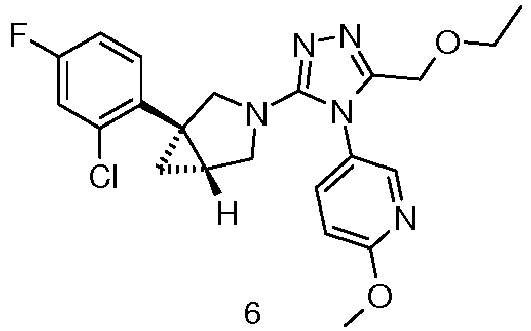
(1S,5R)-1-(2-Chloro-4-fluorophenyl)-3-(5-(ethoxymethyl)-4-(6-methoxypyri din-3-yl)-4H-1,2,4-triazol-3-yl)-3-azabicyclo[3.1.0]hexane 6 7 
(1S,5R)-1-(2-Chloro-4-fluorophenyl)-3-(4-(6-methoxypyridin-3-yl)-5-methyl -4H-1,2,4-triazol-3-yl)-3-azabicyclo[3.1.0]hexane 7 8 
1-(2-Chloro-4-fluorophenyl)-3-(5-(methoxymethyl)-4-(6-methoxypyridin-3-yl)-4H-1,2,4-triazol-3-yl)-3-azabicyclo[3.1.0]hexane 8 9 
(1S,5R)-1-(2-Chloro-4-fluorophenyl)-3-(5-(methoxymethyl)-4-(6-methoxypy ridin-3-yl)-4H-1,2,4-triazol-3-yl)-3-azabicyclo[3.1.0]hexane 9 10 
(1R,5S)-1-(2-Chloro-4-fluorophenyl)-3-(5-(methoxymethyl)-4-(6-methoxypy ridin-3-yl)-4H-1,2,4-triazol-3-yl)-3-azabicyclo[3.1.0]hexane 10 11 
(1S,5R)-1-(2-Chloro-4-fluorophenyl)-3-(5-((difluoromethoxy)methyl)-4-(6-methoxypyridin-3-yl)-4H-1,2,4-triazol-3-yl)-3-azabicyclo[3.1.0]hexane 11 12 
(1S,5R)-1-(2-Chloro-4-fluorophenyl)-3-(4-(6-methoxypyridin-3-yl)-5-(trifluo romethyl)-4H-1,2,4-triazol-3-yl)-3-azabicyclo[3.1.0]hexane 12 13 
(1S,5R)-1-(2-Chloro-4-fluorophenyl)-3-(5-(difluoromethyl)-4-(6-methoxypyr idin-3-yl)-4H-1,2,4-triazol-3-yl)-3-azabicyclo[3.1.0]hexane 13 14 
(1S,5R)-1-(2-Chloro-4-fluorophenyl)-3-(5-((methoxy-d 3)methyl)-4-(6-metho xypyridin-3-yl)-4H-1,2,4-triazol-3-yl)-3-azabicyclo[3.1.0]hexane 14 15 
(1S,5R)-1-(2-Chloro-4-fluorophenyl)-3-(4-(6-methoxypyridin-3-yl)-5-((((R)-tetrahydrofuran-3-yl)oxy)methyl)-4H-1,2,4-triazol-3-yl)-3-azabicyclo[3.1.0] hexane 15 16 
(1S,5R)-1-(2-Chloro-4-fluorophenyl)-3-(4-(6-methoxypyridin-3-yl)-5-cyano methyl-4H-1,2,4-triazol-3-yl)-3-azabicyclo[3.1.0]hexane 16 17 
(1S,5R)-1-(2-Chloro-4-fluorophenyl)-3-(5-cyclopropyl-4-(6-methoxypyridin-3-yl)-4H-1,2,4-triazol-3-yl)-3-azabicyclo[3.1.0]hexane 17 - A preferred embodiment of the present invention relates to a compound of formula (I-A) which is an intermediate for preparing the compound of formula (I):

wherein:
ring A, ring B, R2, R3, n and m are as defined in formula (I). - The compounds of formula (I-A) include, but are not limited to:
Example No. Structure and name of the compound 1h 
Methyl (1S,5R,E)-1-(2-chloro-4-fluorophenyl)-N-(6-methoxypyridin-3-yl)-3-azabicyclo[3.1.0]hexane-3-carbimidothioate 1h 4h 
Methyl (1S,5R,E)-1-(2-chloro-3-fluorophenyl)-N-(6-methoxypyridin-3-yl)-3-azabicyclo[3.1.0]hexane-3-carbimidothioate 4h 5c 
Methyl (1S,5R,E)-N-benzo[d][1,3]dioxol-5-yl-1-(2-chloro-4-fluorophenyl)-3-azabicyclo[3.1.0]hexane-3-carbimidothioate 5c 8i 
Methyl (E)-1-(2-chloro-4-fluorophenyl)-N-(6-methoxypyridin-3-yl)-3-azabicyclo[3.1.0]hexane-3-carbimidothioate 8i 10f 
Methyl (1R,5S,E)-1-(2-chloro-4-fluorophenyl)-N-(6-methoxypyridin-3-yl)-3-azabicyclo[3.1.0]hexane-3-carbimidothioate 10f - In another aspect, the present invention relates to a method for preparing the compound of formula (I), comprising a step of:

wherein:
ring A, ring B, R1-R3, n and m are as defined in formula (I). - In another aspect, the present invention relates to a method for preparing the compound of formula (III), comprising a step of:
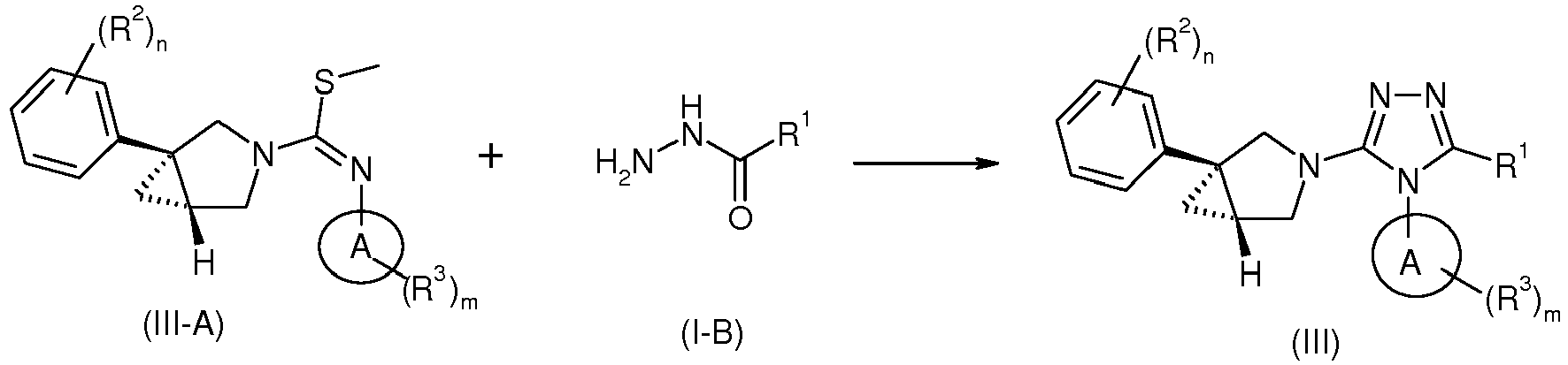
wherein:
ring A, R1-R3, n and m are as defined in formula (I). - In another aspect, the present invention relates to a pharmaceutical composition comprising a therapeutically effective amount of the compound of formula (I), or a tautomer, mesomer, racemate, enantiomer, diastereomer thereof, or mixture thereof, or a pharmaceutically acceptable salt thereof, and one or more pharmaceutically acceptable carriers, diluents or excipients. The present invention also relates to a method for preparing the aforementioned composition, comprising a step of mixing the compound of formula (I), or a tautomer, mesomer, racemate, enantiomer, diastereomer thereof, or mixture thereof, or a pharmaceutically acceptable salt thereof, with one or more pharmaceutically acceptable carriers, diluents or excipients.
- The present invention further relates to a use of the compound of formula (I), or a tautomer, mesomer, racemate, enantiomer, diastereomer thereof, or mixture thereof, or a pharmaceutically acceptable salt thereof, or the pharmaceutical composition comprising the same, in the preparation of a medicament for treating or preventing a disease or condition where inhibition of oxytocin is known, or can be shown, to produce a beneficial effect, wherein the disease or condition is selected from the group consisting of sexual dysfunction, male sexual dysfunction, female sexual dysfunction, hypoactive sexual desire disorder, sexual arousal disorder, orgasmic disorder, sexual pain disorder, premature ejaculation, preterm labour, complications in labour, appetite and feeding disorders, benign prostatic hyperplasia, premature birth, dysmenorrhea, congestive heart failure, arterial hypertension, liver cirrhosis, nephrotic hypertension, ocular hypectension, obsessive compulsive disorder and neuropsychiatric disorders, and more preferably selected from the group consisting of sexual arousal disorder, orgasmic disorder, sexual pain disorder and premature ejaculation.
- The present invention further relates to a use of the compound of formula (I), or a tautomer, mesomer, racemate, enantiomer, diastereomer thereof, or mixture thereof, or a pharmaceutically acceptable salt thereof, or the pharmaceutical composition comprising the same, in the preparation of a medicament for antagonizing oxytocin.
- The present invention further relates to a method for treating or preventing a disease or condition where inhibition of oxytocin is known, or can be shown, to produce a beneficial effect, comprising a step of administering to a patient in need thereof a therapeutically effective amount of the compound of formula (I), or a tautomer, mesomer, racemate, enantiomer, diastereomer thereof, or mixture thereof, or a pharmaceutically acceptable salt thereof, or the pharmaceutical composition comprising the same.
- The present invention further relates to a method for treating or preventing a disease selected from the group consisting of sexual dysfunction, male sexual dysfunction, female sexual dysfunction, hypoactive sexual desire disorder, sexual arousal disorder, orgasmic disorder, sexual pain disorder, premature ejaculation, preterm labour, complications in labour, appetite and feeding disorders, benign prostatic hyperplasia, premature birth, dysmenorrhea, congestive heart failure, arterial hypertension, liver cirrhosis, nephrotic hypertension, ocular hypectension, obsessive compulsive disorder and neuropsychiatric disorders, and preferably selected from the group consisting of sexual dysfunction, sexual arousal disorder, orgasmic disorder, sexual pain disorder and premature ejaculation, comprising a step of administering to a patient in need thereof a therapeutically effective amount of the compound of formula (I), or a tautomer, mesomer, racemate, enantiomer, diastereomer thereof, or mixture thereof, or a pharmaceutically acceptable salt thereof, or the pharmaceutical composition comprising the same.
- The present invention further relates to a method for antagonizing oxytocin, comprising a step of administering to a patient in need thereof a therapeutically effective amount of the compound of formula (I), or a tautomer, mesomer, racemate, enantiomer, diastereomer thereof, or mixture thereof, or a pharmaceutically acceptable salt thereof, or the pharmaceutical composition comprising the same.
- The present invention further relates to the compound of formula (I), or a tautomer, mesomer, racemate, enantiomer, diastereomer thereof, or mixture thereof, or a pharmaceutically acceptable salt thereof, or the pharmaceutical composition comprising the same, for use as a medicament.
- The present invention further relates to the compound of formula (I), or a tautomer, mesomer, racemate, enantiomer, diastereomer thereof, or mixture thereof, or a pharmaceutically acceptable salt thereof, or the pharmaceutical composition comprising the same, for use as an oxytocin antagonist.
- The present invention further relates to the compound of formula (I), or a tautomer, mesomer, racemate, enantiomer, diastereomer thereof, or mixture thereof, or a pharmaceutically acceptable salt thereof, or the pharmaceutical composition comprising the same, for use in treating or preventing a disease selected from the group consisting of sexual dysfunction, male sexual dysfunction, female sexual dysfunction, hypoactive sexual desire disorder, sexual arousal disorder, orgasmic disorder, sexual pain disorder, premature ejaculation, preterm labour, complications in labour, appetite and feeding disorders, benign prostatic hyperplasia, premature birth, dysmenorrhea, congestive heart failure, arterial hypertension, liver cirrhosis, nephrotic hypertension, ocular hypectension, obsessive compulsive disorder and neuropsychiatric disorders, and preferably selected from the group consisting of sexual arousal disorder, orgasmic disorder, sexual pain disorder and premature ejaculation.
- Pharmaceutical compositions containing the active ingredient can be in a form suitable for oral administration, for example, a tablet, troche, lozenge, aqueous or oily suspension, dispersible powder or granule, emulsion, hard or soft capsule, or syrup or elixir. Oral compositions can be prepared according to any known method in the art for the preparation of pharmaceutical composition. Such composition can contain one or more ingredients selected from the group consisting of sweeteners, flavoring agents, colorants and preservatives, in order to provide a pleasing and palatable pharmaceutical preparation. Tablets contain the active ingredient in admixture with nontoxic pharmaceutically acceptable excipients suitable for the manufacture of tablets.
- An aqueous suspension contains the active ingredient in admixture with excipients suitable for the manufacture of an aqueous suspension. The aqueous suspension can also contain one or more preservatives, one or more colorants, one or more flavoring agents, and one or more sweeteners.
- An oil suspension can be formulated by suspending the active ingredient in a vegetable oil or mineral oil. The oil suspension can contain a thickener. The aforementioned sweeteners and flavoring agents can be added to provide a palatable formulation. These compositions can be preserved by adding an antioxidant.
- The active ingredient in admixture with the dispersants or wetting agents, suspending agent or one or more preservatives can be prepared as a dispersible powder or granule suitable for the preparation of an aqueous suspension by adding water. Suitable dispersants or wetting agents and suspending agents are exemplified by those already mentioned above. Additional excipients, such as sweeteners, flavoring agents and colorants, can also be added. These compositions can be preserved by adding an antioxidant, such as ascorbic acid.
- The pharmaceutical composition of the present invention can also be in the form of an oil-in-water emulsion. The oil phase can be a vegetable oil or mineral oil or mixture thereof. Suitable emulsifying agents can be naturally occurring phosphatides. The emulsion can also contain sweeteners, flavoring agents, preservatives and antioxidants. Such formulations can also contain demulcents, preservatives, colorants, and antioxidants.
- The pharmaceutical composition of the present invention can be in the form of a sterile injectable aqueous solution. Acceptable vehicles or solvents that can be used are water, Ringer's solution or isotonic sodium chloride solution. The sterile injectable formulation can be a sterile injectable oil-in-water micro-emulsion in which the active ingredient is dissolved in the oil phase. The injectable solution or micro-emulsion can be introduced into a patient's bloodstream by local bolus injection. Alternatively, the solution and micro-emulsion are preferably administered in a manner that maintains a constant circulating concentration of the compound of the present invention. In order to maintain this constant concentration, a continuous intravenous delivery device can be used. An example of such a device is Deltec CADD-PLUS. TM. 5400 intravenous injection pump.
- The pharmaceutical composition of the present invention can be in the form of a sterile injectable aqueous or oily suspension for intramuscular and subcutaneous administration. Such a suspension can be formulated with suitable dispersants or wetting agents and suspending agents as described above according to known techniques. The sterile injectable formulation can also be a sterile injectable solution or suspension prepared in a nontoxic parenterally acceptable diluent or solvent. Moreover, sterile fixed oils can easily be used as a solvent or suspending medium. For this purpose, any blending fixed oils including synthetic mono- or di-glyceride can be employed. Moreover, fatty acids can also be employed in the preparation of an injection.
- The compound of the present invention can be administered in the form of a suppository for rectal administration. These pharmaceutical compositions can be prepared by mixing the drug with a suitable non-irritating excipient that is solid at ordinary temperatures, but liquid in the rectum, thereby melting in the rectum to release the drug.
- It is well known to those skilled in the art that the dosage of a drug depends on a variety of factors including but not limited to, the following factors: activity of a specific compound, age of the patient, weight of the patient, general health of the patient, behavior of the patient, diet of the patient, administration time, administration route, excretion rate, drug combination and the like. In addition, the optimal treatment, such as treatment mode, daily dose of the compound of formula (I) or the type of pharmaceutically acceptable salt thereof can be verified by traditional therapeutic regimens.
- Unless otherwise stated, the terms used in the specification and claims have the meanings described below.
- The term "alkyl" refers to a saturated aliphatic hydrocarbon group, which is a straight or branched chain group comprising 1 to 20 carbon atoms, preferably an alkyl having 1 to 12 carbon atoms, and more preferably an alkyl having 1 to 6 carbon atoms. Non-limiting examples include methyl, ethyl, n-propyl, isopropyl, n-butyl, isobutyl, tert-butyl, sec-butyl, n-pentyl, 1,1-dimethylpropyl, 1,2-dimethylpropyl, 2,2-dimethylpropyl, 1-ethylpropyl, 2-methylbutyl, 3-methylbutyl, n-hexyl, 1-ethyl-2-methylpropyl, 1,1,2-trimethylpropyl, 1,1-dimethylbutyl, 1,2-dimethylbutyl, 2,2-dimethylbutyl, 1,3-dimethylbutyl, 2-ethylbutyl, 2-methylpentyl, 3-methylpentyl, 4-methylpentyl, 2,3-dimethylbutyl, n-heptyl, 2-methylhexyl, 3-methylhexyl, 4-methylhexyl, 5-methylhexyl, 2,3-dimethylpentyl, 2,4-dimethylpentyl, 2,2-dimethylpentyl, 3,3-dimethylpentyl, 2-ethylpentyl, 3-ethylpentyl, n-octyl, 2,3-dimethylhexyl, 2,4-dimethylhexyl, 2,5-dimethylhexyl, 2,2-dimethylhexyl, 3,3-dimethylhexyl, 4,4-dimethylhexyl, 2-ethylhexyl, 3-ethylhexyl, 4-ethylhexyl, 2-methyl-2-ethylpentyl, 2-methyl-3-ethylpentyl, n-nonyl, 2-methyl-2-ethylhexyl, 2-methyl-3-ethylhexyl, 2,2-diethylpentyl, n-decyl, 3,3-diethylhexyl, 2,2-diethylhexyl, and various branched isomers thereof. More preferably, an alkyl group is a lower alkyl having 1 to 6 carbon atoms, and non-limiting examples include methyl, ethyl, n-propyl, isopropyl, n-butyl, isobutyl, tert-butyl, sec-butyl, n-pentyl, 1,1-dimethylpropyl, 1,2-dimethylpropyl, 2,2-dimethylpropyl, 1-ethylpropyl, 2-methylbutyl, 3-methylbutyl, n-hexyl, 1-ethyl-2-methylpropyl, 1,1,2-trimethylpropyl, 1,1-dimethylbutyl, 1,2-dimethylbutyl, 2,2-dimethylbutyl, 1,3-dimethylbutyl, 2-ethylbutyl, 2-methylpentyl, 3-methylpentyl, 4-methylpentyl, 2,3-dimethylbutyl, and the like. The alkyl group can be substituted or unsubstituted. When substituted, the substituent group(s) can be substituted at any available connection point. The substituent group(s) is preferably one or more groups independently optionally selected from the group consisting of alkyl, alkenyl, alkynyl, alkoxy, alkylthio, alkylamino, halogen, thiol, hydroxy, nitro, cyano, cycloalkyl, heterocyclyl, aryl, heteroaryl, cycloalkoxy, heteroalkoxy, cycloalkylthio, heterocyclylthio and -OR4.
- The term "cycloalkyl" refers to a saturated or partially unsaturated monocyclic or polycyclic hydrocarbon substituent group having 3 to 20 carbon atoms, preferably 3 to 12 carbon atoms, more preferably 3 to 10 carbon atoms, and most preferably 3 to 6 carbon atoms. Non-limiting examples of monocyclic cycloalkyl include cyclopropyl, cyclobutyl, cyclopentyl, cyclopentenyl, cyclohexyl, cyclohexenyl, cyclohexadienyl, cycloheptyl, cycloheptatrienyl, cyclooctyl and the like, and preferably cyclopropyl, cyclobutyl, cyclopentyl and cyclohexyl. Polycyclic cycloalkyl includes a cycloalkyl having a spiro ring, fused ring or bridged ring.
- The term "spiro cycloalkyl" refers to a 5 to 20 membered polycyclic group with monocyclic rings connected through one shared carbon atom (called a spiro atom), wherein the rings can contain one or more double bonds, but none of the rings has a completely conjugated π-electron system. The spiro cycloalkyl is preferably 6 to 14 membered spiro cycloalkyl, and more preferably 7 to 10 membered spiro cycloalkyl. According to the number of the spiro atoms shared between the rings, the spiro cycloalkyl can be divided into mono-spiro cycloalkyl, di-spiro cycloalkyl, or poly-spiro cycloalkyl, and the spiro cycloalkyl is preferably a mono-spiro cycloalkyl or di-spiro cycloalkyl, and more preferably 4-membered/4-membered, 4-membered/5-membered, 4-membered/6-membered, 5-membered/5-membered, or 5-membered/6-membered mono-spiro cycloalkyl. Non-limiting examples of spiro cycloalkyl include:

- The term "fused cycloalkyl" refers to a 5 to 20 membered all-carbon polycyclic group, wherein each ring in the system shares an adjacent pair of carbon atoms with another ring, wherein one or more rings can contain one or more double bonds, but none of the rings has a completely conjugated π-electron system. The fused cycloalkyl is preferably 6 to 14 membered fused cycloalkyl, and more preferably 7 to 10 membered fused cycloalkyl. According to the number of membered rings, the fused cycloalkyl can be divided into bicyclic, tricyclic, tetracyclic or polycyclic fused cycloalkyl, and the fused cycloalkyl is preferably bicyclic or tricyclic fused cycloalkyl, and more preferably 5-membered/5-membered, or 5-membered/6-membered bicyclic fused cycloalkyl. Non-limiting examples of fused cycloalkyl include:

- The term "bridged cycloalkyl" refers to a 5 to 20 membered all-carbon polycyclic group, wherein every two rings in the system share two disconnected carbon atoms, wherein the rings can have one or more double bonds, but none of the rings has a completely conjugated π-electron system. The bridged cycloalkyl is preferably 6 to 14 membered bridged cycloalkyl, and more preferably 7 to 10 membered bridged cycloalkyl. According to the number of membered rings, the bridged cycloalkyl can be divided into bicyclic, tricyclic, tetracyclic or polycyclic bridged cycloalkyl, and the bridged cycloalkyl is preferably bicyclic, tricyclic or tetracyclic bridged cycloalkyl, and more preferably bicyclic or tricyclic bridged cycloalkyl. Non-limiting examples of bridged cycloalkyls include:


- The ring of cycloalkyl can be fused to the ring of aryl, heteroaryl or heterocyclyl, wherein the ring bound to the parent structure is cycloalkyl. Non-limiting examples include indanyl, tetrahydronaphthyl, benzocycloheptyl and the like. The cycloalkyl can be optionally substituted or unsubstituted. When substituted, the substituent group(s) is preferably one or more group(s) independently optionally selected from the group consisting of alkyl, alkenyl, alkynyl, alkoxy, alkylthio, alkylamino, halogen, thiol, hydroxy, nitro, cyano, cycloalkyl, heterocyclyl, aryl, heteroaryl, cycloalkoxy, heteroalkoxy, cycloalkylthio, heterocyclylthio and -OR4.
- The term "heterocyclyl" refers to a 3 to 20 membered saturated or partially unsaturated monocyclic or polycyclic hydrocarbon group, wherein one or more ring atoms are heteroatoms selected from the group consisting of N, O and S(O)t (wherein t is an integer of 0 to 2), but excluding -O-O-, -O-S- or -S-S- in the ring, with the remaining ring atoms being carbon atoms. Preferably, the heterocyclyl has 3 to 12 ring atoms wherein 1 to 4 atoms are heteroatoms; more preferably, the heterocyclyl has 3 to 10 ring atoms, and most preferably 3 to 6 ring atoms. Non-limiting examples of monocyclic heterocyclyl include oxetanyl, azetidinyl, tetrahydrofuranyl, tetrahydropyranyl, pyrrolyl, piperidinyl, piperazinyl, morpholinyl, thiomorpholinyl, homopiperazinyl and the like, and preferably azetidinyl, oxetanyl, pyrrolyl and piperidinyl. Polycyclic heterocyclyl includes a heterocyclyl having a spiro ring, fused ring or bridged ring.
- The term "spiro heterocyclyl" refers to a 5 to 20 membered polycyclic heterocyclyl group with monocyclic rings connected through one shared atom (called a spiro atom), wherein one or more ring atoms are heteroatoms selected from the group consisting of N, O and S(O)t (wherein t is an integer of 0 to 2), with the remaining ring atoms being carbon atoms, where the rings can contain one or more double bonds, but none of the rings has a completely conjugated π-electron system. The spiro heterocyclyl is preferably 6 to 14 membered spiro heterocyclyl, and more preferably 7 to 10 membered spiro heterocyclyl. According to the number of the spiro atoms shared between the rings, the spiro heterocyclyl can be divided into mono-spiro heterocyclyl, di-spiro heterocyclyl, or poly-spiro heterocyclyl, and the spiro heterocyclyl is preferably mono-spiro heterocyclyl or di-spiro heterocyclyl, and more preferably 4-membered/4-membered, 4-membered/5-membered, 4-membered/6-membered, 5-membered/5-membered, or 5-membered/6-membered mono-spiro heterocyclyl. Non-limiting examples of spiro heterocyclyls include:

- The term "fused heterocyclyl" refers to a 5 to 20 membered polycyclic heterocyclyl group, wherein each ring in the system shares an adjacent pair of atoms with another ring, wherein one or more rings can contain one or more double bonds, but none of the rings has a completely conjugated π-electron system, and wherein one or more ring atoms are heteroatoms selected from the group consisting of N, O and S(O)t (wherein t is an integer of 0 to 2), with the remaining ring atoms being carbon atoms. The fused heterocyclyl is preferably 6 to 14 membered fused heterocyclyl, and more preferably 7 to 10 membered fused heterocyclyl. According to the number of membered rings, the fused heterocyclyl can be divided into bicyclic, tricyclic, tetracyclic or polycyclic fused heterocyclyl, and the fused heterocyclyl is preferably bicyclic or tricyclic fused heterocyclyl, and more preferably 5-membered/3-membered, 5-membered/4-membered or 5-membered/5-membered bicyclic fused heterocyclyl. Non-limiting examples of fused heterocyclyl include:


- The term "bridged heterocyclyl" refers to a 5 to 14 membered polycyclic heterocyclyl group, wherein every two rings in the system share two disconnected atoms, wherein the rings can have one or more double bonds, but none of the rings has a completely conjugated π-electron system, and wherein one or more ring atoms are heteroatoms selected from the group consisting of N, O and S(O)t (wherein t is an integer of 0 to 2), with the remaining ring atoms being carbon atoms. The bridged heterocyclyl is preferably 6 to 14 membered bridged heterocyclyl, and more preferably 7 to 10 membered bridged heterocyclyl. According to the number of membered rings, the bridged heterocyclyl can be divided into bicyclic, tricyclic, tetracyclic or polycyclic bridged heterocyclyl, and the bridged heterocyclyl is preferably bicyclic, tricyclic or tetracyclic bridged heterocyclyl, and more preferably bicyclic or tricyclic bridged heterocyclyl. Non-limiting examples of bridged heterocyclyls include:


- The ring of heterocyclyl can be fused to the ring of aryl, heteroaryl or cycloalkyl, wherein the ring bound to the parent structure is heterocyclyl. Non-limiting examples thereof include:

- The heterocyclyl can be optionally substituted or unsubstituted. When substituted, the substituent group(s) is preferably one or more group(s) independently optionally selected from the group consisting of alkyl, alkenyl, alkynyl, alkoxy, alkylthio, alkylamino, halogen, thiol, hydroxy, nitro, cyano, cycloalkyl, heterocyclyl, aryl, heteroaryl, cycloalkoxy, heteroalkoxy, cycloalkylthio, heterocyclylthio and -OR4.
- The term "aryl" refers to a 6 to 14 membered all-carbon monocyclic ring or polycyclic fused ring (i.e. each ring in the system shares an adjacent pair of carbon atoms with another ring in the system) having a conjugated π-electron system, preferably 6 to 10 membered aryl, for example, phenyl and naphthyl. The ring of aryl can be fused to the ring of heteroaryl, heterocyclyl or cycloalkyl, wherein the ring bound to the parent structure is aryl ring. Non-limiting examples thereof include:


- The aryl can be substituted or unsubstituted. When substituted, the substituent group(s) is preferably one or more group(s) independently optionally selected from the group consisting of alkyl, alkenyl, alkynyl, alkoxy, alkylthio, alkylamino, halogen, thiol, hydroxy, nitro, cyano, cycloalkyl, heterocyclyl, aryl, heteroaryl, cycloalkoxy, heteroalkoxy, cycloalkylthio, heterocyclylthio and -OR4.
- The term "heteroaryl" refers to a 5 to 14 membered heteroaromatic system having 1 to 4 heteroatoms selected from the group consisting of O, S and N. The heteroaryl is preferably 5 to 10 membered heteroaryl, more preferably 5 or 6 membered heteroaryl, for example, furanyl, thienyl, pyridyl, pyrrolyl, N-alkylpyrrolyl, pyrimidinyl, pyrazinyl, imidazolyl, pyrazolyl, tetrazolyl and the like, and preferably pyridyl. The ring of heteroaryl can be fused to the ring of aryl, heterocyclyl or cycloalkyl, wherein the ring bound to the parent structure is heteroaryl ring. Non-limiting examples thereof include:


- The heteroaryl can be optionally substituted or unsubstituted. When substituted, the substituent group(s) is preferably one or more group(s) independently selected from the group consisting of alkyl, alkenyl, alkynyl, alkoxy, alkylthio, alkylamino, halogen, thiol, hydroxy, nitro, cyano, cycloalkyl, heterocyclyl, aryl, heteroaryl, cycloalkoxy, heteroalkoxy, cycloalkylthio, heterocyclylthio and -OR4.
- The term "alkoxy" refers to an -O-(alkyl) or an -O-(unsubstituted cycloalkyl) group, wherein the alkyl is as defined above. Non-limiting examples of alkoxy include methoxy, ethoxy, propoxy, butoxy, cyclopropyloxy, cyclobutyloxy, cyclopentyloxy, cyclohexyloxy. The alkoxy can be optionally substituted or unsubstituted. When substituted, the substituent group(s) is preferably one or more group(s) independently selected from the group consisting of alkyl, alkenyl, alkynyl, alkoxy, alkylthio, alkylamino, halogen, thiol, hydroxy, amino, nitro, cyano, cycloalkyl, heterocyclyl, aryl, heteroaryl, cycloalkoxy, heteroalkoxy, cycloalkylthio, heterocyclylthio and -OR4.
- The term "haloalkyl" refers to an alkyl group substituted by one or more halogens, wherein the alkyl is as defined above.
- The term "haloalkoxy" refers to an -O-(haloalkyl) group, wherein the haloalkyl is as defined above.
- The term "deuterated alkyl" refers to an alkyl group substituted by one or more deuterium atoms, wherein the alkyl is as defined above.
- The term "deuterated alkoxy" refers to an -O-(deuterated alkyl) group, wherein the deuterated alkyl is as defined above.
- The term "heterocyclyloxy" refers to an -O-(heterocyclyl) group, wherein the heterocyclyl is as defined above.
- The term "hydroxyalkyl" refers to an alkyl group substituted by hydroxy(s), wherein the alkyl is as defined above.
- The term "hydroxy" refers to an -OH group.
- The term "halogen" refers to fluorine, chlorine, bromine or iodine.
- The term "amino" refers to a -NH2 group.
- The term "cyano" refers to a -CN group.
- The term "nitro" refers to a -NO2 group.
- The term "oxo" refers to an =O group.
- "Optional" or "optionally" means that the event or circumstance described subsequently can, but need not, occur, and such a description includes the situation in which the event or circumstance does or does not occur. For example, "the heterocyclyl optionally substituted by an alkyl" means that an alkyl group can be, but need not be, present, and such a description includes the situation of the heterocyclyl being substituted by an alkyl and the heterocyclyl being not substituted by an alkyl.
- "Substituted" refers to one or more hydrogen atoms in a group, preferably up to 5, more preferably 1 to 3 hydrogen atoms, independently substituted by a corresponding number of substituents. It goes without saying that the substituents only exist in their possible chemical position. The person skilled in the art is able to determine whether the substitution is possible or impossible by experiments or theory without paying excessive efforts. For example, the combination of amino or hydroxy having free hydrogen and carbon atoms having unsaturated bonds (such as olefinic) may be unstable.
- A "pharmaceutical composition" refers to a mixture of one or more of the compounds according to the present invention or physiologically/pharmaceutically acceptable salts or prodrugs thereof with other chemical components, and other components such as physiologically/pharmaceutically acceptable carriers and excipients. The purpose of the pharmaceutical composition is to facilitate administration of a compound to an organism, which is conducive to the absorption of the active ingredient so as to show biological activity.
- A "pharmaceutically acceptable salt" refers to a salt of the compound of the present invention, which is safe and effective in mammals and has the desired biological activity.
- R4 is as defined in the formula (I).
- In order to achieve the object of the present invention, the present invention applies the following technical solutions:
- A method for preparing the compound of formula (I) of the present invention or a tautomer, mesomer, racemate, enantiomer, diastereomer thereof, or mixture thereof, or a pharmaceutically acceptable salt thereof, comprises the following steps of:

- in Step 1, a compound of formula (I-1) is subjected to a reduction reaction in the presence of a reducing reagent to obtain a compound of formula (I-2);
- in step 2, the compound of formula (I-2) and thionyl chloride are subjected to a cyclization reaction to obtain a compound of formula (I-3);
- in Step 3, the compound of formula (I-3) and a compound of formula (I-4) are heated to obtain a compound of formula (I-5);
- in Step 4, the compound of formula (I-5) is reacted with a methylating reagent under an alkaline condition to obtain a compound of formula (I-A);
- in Step 5, the compound of formula (I-A) and a compound of formula (I-B) or a hydrochloride salt thereof are subjected to a cyclization reaction under an acidic condition to obtain the compound of formula (I).
- The reducing reagent includes, but is not limited to, lithium aluminum hydride, sodium borohydride, DIBAL-H, NaAlH(O-t-Bu)3, AlH3, NaCNBH3, Na(AcO)3BH, B2H5, Li(Et)3BH, Pd/C/H2 and Raney Ni/H2.
- The reagent that provides an alkaline condition includes organic bases and inorganic bases. The organic bases include, but are not limited to, triethylamine, N,N-diisopropylethylamine, n-butyllithium, lithium diisopropylamide, lithium bis(trimethylsilyl)amine, potassium acetate, sodium tert-butoxide and potassium tert-butoxide. The inorganic bases include, but are not limited to, sodium hydride, potassium phosphate, sodium carbonate, potassium carbonate, potassium acetate, cesium carbonate, sodium hydroxide and lithium hydroxide.
- The methylating reagent includes, but is not limited to, methyl p-toluenesulfonate, methyl iodide, methyl Grignard reagent, dimethyl sulfate, methyl trifluoromethanesulfonate and diazomethane.
- The reagent that provides an acidic condition includes, but is not limited to, hydrogen chloride, trifluoroacetic acid, formic acid, acetic acid, hydrochloric acid, sulfuric acid, methanesulfonic acid, nitric acid, phosphoric acid, p-toluenesulfonic acid, Me3SiCl and TMSOTf.
- The above reactions are preferably carried out in a solvent. The solvent used includes, but is not limited to, acetic acid, methanol, ethanol, toluene, tetrahydrofuran, dichloromethane, petroleum ether, ethyl acetate, n-hexane, dimethyl sulfoxide, 1,4-dioxane, water, N,N-dimethylformamide, and mixtures thereof.
- Wherein:
ring A, ring B, R1-R3, n and m are as defined in formula (I). - A method for preparing the compound of formula (I) of the present invention or a tautomer, mesomer, racemate, enantiomer, diastereomer thereof, or mixture thereof, or a pharmaceutically acceptable salt thereof, comprises the following steps of:

- in Step 1, a compound of formula (I-1a) is hydrolyzed under an alkaline condition to obtain a compound of formula (I-2a);
- in Step 2, the compound of formula (I-2a) and carbonyl diamine are subjected to a cyclization reaction to obtain a compound of formula (I-3a);
- in step 3, the compound of formula (I-3a) is reacted with a reducing reagent to obtain a compound of formula (I-3);
- in Step 4, the compound of formula (I-3) and a compound of formula (I-4) are heated to obtain a compound of formula (I-5);
- in Step 5, the compound of formula (I-5) is reacted with a methylating reagent under an alkaline condition to obtain a compound of formula (I-A);
- in Step 6, the compound of formula (I-A) and a compound of formula (I-B) or a hydrochloride salt thereof are subjected to a cyclization reaction under an acidic condition to obtain the compound of formula (I).
- The reducing reagent includes, but is not limited to, lithium aluminum hydride, sodium borohydride, DIBAL-H, NaAlH(O-t-Bu)3, AlH3, NaCNBH3, Na(AcO)3BH, BH3 in tetrahydrofuran (IN), B2H5, Li(Et)3BH, Pd/C/H2 and Raney Ni/H2.
- The reagent that provides an alkaline condition includes organic bases and inorganic bases. The organic bases include, but are not limited to, triethylamine, N,N-diisopropylethylamine, n-butyllithium, lithium diisopropylamide, lithium bis(trimethylsilyl)amine, potassium acetate, sodium tert-butoxide and potassium tert-butoxide. The inorganic bases include, but are not limited to, sodium hydride, potassium phosphate, sodium carbonate, potassium carbonate, potassium acetate, cesium carbonate, sodium hydroxide and lithium hydroxide.
- The methylating reagent includes, but is not limited to, methyl p-toluenesulfonate, methyl iodide, methyl Grignard reagent, dimethyl sulfate, methyl trifluoromethanesulfonate and diazomethane.
- The reagent that provides an acidic condition includes, but is not limited to, hydrogen chloride, trifluoroacetic acid, formic acid, acetic acid, hydrochloric acid, sulfuric acid, methanesulfonic acid, nitric acid, phosphoric acid, p-toluenesulfonic acid, Me3SiCl and TMSOTf.
- The above reactions are preferably carried out in a solvent. The solvent used includes, but is not limited to, acetic acid, methanol, ethanol, toluene, tetrahydrofuran, dichloromethane, petroleum ether, ethyl acetate, n-hexane, dimethyl sulfoxide, 1,4-dioxane, water, N,N-dimethylformamide, and mixtures thereof.
- Wherein:
ring A, ring B, R1-R3, n and m are as defined in formula (I). - A method for preparing the compound of formula (III) of the present invention or a tautomer, mesomer, racemate, enantiomer, diastereomer thereof, or mixture thereof, or a pharmaceutically acceptable salt thereof, comprises the following steps of:

- in Step 1, a compound of formula (III-1) is subjected to a reduction reaction in the presence of a reducing reagent to obtain a compound of formula (III-2);
- in Step 2, the compound of formula (III-2) and thionyl chloride are subjected to a cyclization reaction to obtain a compound of formula (III-3);
- in Step 3, the compound of formula (III-3) and a compound of formula (1-4) are heated to obtain a compound of formula (III-5);
- in Step 4, the compound of formula (III-5) is reacted with a methylating reagent under an alkaline condition to obtain a compound of formula (III-A);
- in Step 5, the compound of formula (III-A) and a compound of formula (I-B) or a hydrochloride salt thereof are subjected to a cyclization reaction under an acidic condition to obtain the compound of formula (III).
- The reducing reagent includes, but is not limited to, lithium aluminum hydride, sodium borohydride, DIBAL-H, NaAlH(O-t-Bu)3, AlH3, NaCNBH3, Na(AcO)3BH, BH3 in tetrahydrofuran (IN), B2H5, Li(Et)3BH, Pd/C/H2 and Raney Ni/H2.
- The reagent that provides an alkaline condition includes organic bases and inorganic bases. The organic bases include, but are not limited to, triethylamine, N,N-diisopropylethylamine, n-butyllithium, lithium diisopropylamide, lithium bis(trimethylsilyl)amine, potassium acetate, sodium tert-butoxide and potassium tert-butoxide. The inorganic bases include, but are not limited to, sodium hydride, potassium phosphate, sodium carbonate, potassium carbonate, potassium acetate, cesium carbonate, sodium hydroxide and lithium hydroxide.
- The methylating reagent includes, but is not limited to, methyl p-toluenesulfonate, methyl iodide, methyl Grignard reagent, dimethyl sulfate, methyl trifluoromethanesulfonate and diazomethane.
- The reagent that provides an acidic condition includes, but is not limited to, hydrogen chloride, trifluoroacetic acid, formic acid, acetic acid, hydrochloric acid, sulfuric acid, methanesulfonic acid, nitric acid, phosphoric acid, p-toluenesulfonic acid, Me3SiCl, TMSOTf.
- The above reactions are preferably carried out in a solvent. The solvent used includes, but is not limited to, acetic acid, methanol, ethanol, toluene, tetrahydrofuran, dichloromethane, petroleum ether, ethyl acetate, n-hexane, dimethyl sulfoxide, 1,4-dioxane, water or N,N-dimethylformamide.
- Wherein:
ring A, R1-R3, n and m are as defined in formula (I). - The structures of the compounds were identified by nuclear magnetic resonance (NMR) and/or mass spectrometry (MS). NMR shifts (δ) are given in 10-6 (ppm). NMR was determined by a Bruker AVANCE-400 machine. The solvents for determination were deuterated-dimethyl sulfoxide (DMSO-d6 ), deuterated-chloroform (CDCl3) and deuterated-methanol (CD3OD), and the internal standard was tetramethylsilane (TMS).
- MS was determined by a FINNIGAN LCQAd (ESI) mass spectrometer (manufacturer: Thermo, type: Finnigan LCQ advantage MAX).
- High performance liquid chromatography (HPLC) was determined on an Agilent 1200DAD high pressure liquid chromatograph (Sunfire C18 150×4.6 mm chromatographic column), and a Waters 2695-2996 high pressure liquid chromatography spectrometer (Gimini C18 150×4.6 mm chromatographic column).
- Chiral HPLC was determined on a LC-10A vp (Shimadzu) or SFC-analytical (Berger Instruments Inc.).
- Yantai Huanghai HSGF254 or Qingdao GF254 silica gel plate was used as the thin-layer silica gel chromatography (TLC) plate. The dimension of the silica gel plate used in TLC was 0.15 mm to 0.2 mm, and the dimension of the silica gel plate used in product purification was 0.4 mm to 0.5 mm.
- Yantai Huanghai 200 to 300 mesh silica gel was generally used as a carrier for column chromatography.
- Prep Star SD-1 (Varian Instruments Inc.) or SFC-multigram (Berger Instruments Inc.) was used for chiral preparative column chromatography.
- CombiFlash rapid preparation instrument used was Combiflash Rf200 (TELEDYNE ISCO).
- The average kinase inhibition rates and IC50 values were determined by a NovoStar ELISA (BMG Co., Germany).
- The known starting materials of the present invention can be prepared by the known methods in the art, or can be purchased from ABCR GmbH & Co. KG, Acros Organnics, Aldrich Chemical Company, Accela ChemBio Inc., or Dari chemical Company, etc.
- Unless otherwise stated, the reactions were carried out under argon atmosphere or nitrogen atmosphere.
- "Argon atmosphere" or "nitrogen atmosphere" means that a reaction flask is equipped with an argon or nitrogen balloon (about1 L).
- "Hydrogen atmosphere" means that a reaction flask is equipped with a hydrogen balloon (about1 L).
- Pressurized hydrogenation reactions were performed on a Parr 3916EKX hydrogenation instrument and a Qinglan QL-500 hydrogen generator or HC2-SS hydrogenation instrument.
- In hydrogenation reactions, the reaction system was generally vacuumed and filled with hydrogen, with the above operation was repeated three times.
- CEM Discover-S 908860 type microwave reactor was used in microwave reactions.
- Unless otherwise stated, the solution refers to an aqueous solution.
- Unless otherwise stated, the reaction temperature is room temperature from 20°C to 30°C.
- The reaction process in the examples was monitored by thin layer chromatography (TLC). The developing solvent used in the reactions, the eluent system in column chromatography and the developing solvent system in thin layer chromatography for purification of the compounds included: A: dichloromethane/methanol system, B: n-hexane/ethyl acetate system, and C: petroleum ether/ethyl acetate system. The ratio of the volume of the solvent was adjusted according to the polarity of the compounds, and a small quantity of alkaline reagent such as triethylamine or acidic reagent such as acetic acid can also be added for adjustment.
-
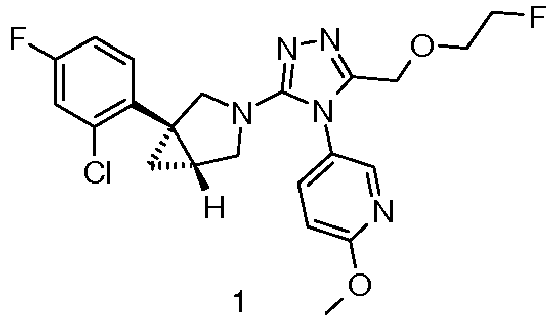

- 2-Chloro-4-fluorophenylacetonitrile 1a (1 g, 5.9 mmol) was dissolved in 20 mL of tetrahydrofuran. The reaction solution was cooled to -20°C in a dry ice-acetone bath, and added slowly with sodium bis(trimethylsilyl)amide (5.9 mL, 11.8 mmol). After completion of the addition, the reaction solution was stirred for 30 minutes, and then added with (R)-2-(chloromethyl)oxirane 1b (600 mg, 6.49 mmol). After completion of the addition, the dry ice-acetone bath was removed. The reaction solution was naturally warmed up to room temperature, and stirred for 2 hours. The reaction was quenched with saturated ammonium chloride solution (20 mL), and the reaction solution was extracted with ethyl acetate (50 mL×3). The organic phases were combined, washed with saturated sodium chloride solution (50 mL×3), and concentrated under reduced pressure to obtain the crude title product 1c (1.35 g), which was used directly in the next step without purification.
MS m/z (ESI): 226.4 [M+1]. - Lithium aluminum hydride (672 mg, 17.7 mmol) was added to 15 mL of tetrahydrofuran. The reaction solution was cooled in an ice bath, and added with the crude product 1c (1.33 g, 5.9 mmol). After completion of the addition, the ice bath was removed. The reaction solution was naturally warmed up to room temperature, and stirred for 15 hours. The reaction solution was added with water (0.7 mL), sodium hydroxide solution (10%, 0.7 mL) and water (2.1 mL) successively, and stirred for 30 minutes after completion of the addition. The reaction solution was filtrated through celite, and the filtrate was concentrated under reduced pressure to obtain the crude title product 1d (1.4 g), which was used directly in the next step without purification.
MS m/z (ESI): 230.3 [M+1]. - The crude product 1d (1.35 g, 5.9 mmol) and thionyl chloride (1.05 g, 8.85 mmol) were added to 10 mL of dichloromethane. After completion of the addition, the reaction solution was stirred for 3 hours. The reaction solution was concentrated under reduced pressure to obtain the crude title product 1e (1.3 g), which was used directly in the next step without purification.
MS m/z (ESI): 212.3 [M+1]. - 5-Isothiocyanato-2-methoxypyridine 1f (1.25 g, 7.5 mmol, prepared according to the known method disclosed in "Bioorganic and Medicinal Chemistry Letters, 2010, 20(2), 516 - 520") and the crude product 1e (1.06 g, 5.0 mmol) were added to 20 mL of tetrahydrofuran. After completion of the addition, the reaction solution was stirred for 2 hours. The reaction solution was concentrated under reduced pressure to obtain the crude title product 1g (1.9 g), which was used directly in the next step without purification.
MS m/z (ESI): 378.2 [M+1]. - The crude product 1g (1.86 g, 5.0 mmol) was added to 30 mL of tetrahydrofuran. The reaction solution was cooled in an ice bath, and added with potassium tert-butoxide (2.2 g, 20 mmol). After completion of the addition, the reaction solution was stirred for 2 hours, and then added with methyl p-toluenesulfonate (1.86 g, 10.0 mmol). After completion of the addition, the ice bath was removed. The reaction solution was naturally warmed up to room temperature, and stirred for 15 hours. The reaction solution was added with ice water (90 mL), and then extracted with ethyl acetate (50 mL×3). The organic phases were combined, and concentrated under reduced pressure. The resulting residue was purified by silica gel column chromatography with elution system B to obtain the title product 1h (700 mg), yield: 32.2%.
MS m/z (ESI): 392.2 [M+1]. - 2-Fluoroethanol (800 mg, 12.49 mmol) and sodium hydride (1.74 g, 10.42 mmol) were added to 30 mL of tetrahydrofuran. The reaction solution was stirred for 2 hours, and then added with ethyl 2-bromoacetate 1i (1.74 g, 10.42 mmol). After completion of the addition, the reaction solution was stirred for 15 hours. The reaction was quenched with 30 mL of water, and the reaction solution was extracted with ethyl acetate (50 mL×3). The organic phases were combined, washed with saturated sodium chloride solution (50 mL×3), and concentrated under reduced pressure to obtain the crude title product 1k (300 mg), which was used directly in the next step without purification.
MS m/z (ESI): 151.2 [M+1]. - The crude product 1k (250 mg, 1.67 mmol) and hydrazine hydrate (85%, 213 mg) were added to 3 mL of ethanol. The reaction solution was added to a sealed tube, and stirred for 15 hours at 80°C. After stopping heating, the reaction solution was concentrated under reduced pressure to obtain the crude title product 1l (250 mg), which was used directly in the next step without purification.
MS m/z (ESI):137.2 [M+1]. - 1h (30 mg, 0.08 mmol), the crude product 1l (31 mg, 0.23 mmol) and trifluoroacetic acid (9 mg, 0.08 mmol) were added to 5 mL of tetrahydrofuran. After completion of the addition, the reaction solution was heated to 65°C and stirred for 1 hour. After stopping heating, the reaction solution was concentrated under reduced pressure. The resulting residue was purified by thin layer chromatography with developing solvent system A to obtain the title product 1 (10 mg), yield: 26.4%.
MS m/z (ESI): 462.1 [M+1].
1H NMR (400 MHz, CDCl3): δ 8.17 (s, 1H), 7.59 (d, 1H), 7.27 (d, 1H), 7.09 (d, 1H), 6.87-6.85 (m, 2H), 4.53 (d, 1H), 4.41 (s, 3H), 3.99 (s, 3H), 3.64-3.62 (m, 4H), 3.42-3.40 (m, 2H), 1.73-1.71 (m, 1H), 0.98-0.95 (m,2H). -


- Tetrahydropyran-4-ol 2a (1.0 g, 9.8 mmol) was added to 150 mL of tetrahydrofuran. The reaction solution was cooled in an ice bath, and added with 1i (1.96 g, 11.8 mmol). After completion of the addition, the reaction solution was stirred for 30 minutes, and then added with sodium hydride (352 mg, 14.7 mmol). The ice bath was removed, and the reaction solution was stirred for 6 hours. The reaction solution was added with 30 mL of ice water, and then extracted with ethyl acetate (30 mL×3). The organic phases were combined, washed with saturated sodium chloride solution (50 mL×3), dried over anhydrous sodium sulfate and filtrated to remove the drying agent. The filtrate was concentrated under reduced pressure to obtain the title product 2b (1.8 g), yield: 87.9%.
MS m/z (ESI): 189.2 [M+1]. - 2b (1.8 g, 9.6 mmol) and hydrazine hydrate (478 mg, 9.6 mmol) were added to 5 mL of ethanol. The reaction solution was added to a sealed tube, and stirred for 48 hours at 80°C. After stopping heating, the reaction solution was concentrated under reduced pressure to obtain the crude title product 2c (1.6 g), which was used directly in the next step without purification.
MS m/z (ESI): 175.0 [M+1]. - 1h (40 mg, 0.1 mmol), the crude product 2c (53 mg, 0.31 mmol) and trifluoroacetic acid (1 mg, 0.01 mmol) were added to 10 mL of tetrahydrofuran. After completion of the addition, the reaction solution was heated to 70°C and stirred for 3 hours. After stopping heating, the reaction solution was concentrated under reduced pressure. The resulting residue was purified by high performance liquid chromatography to obtain the title product 2 (10 mg), yield: 18.2%.
MS m/z (ESI): 500.1 [M+1].
1H NMR (400 MHz, CDCl3): δ 8.19-8.18 (d, 1H), 7.57-7.54 (m, 1H), 7.29-7.25 (m, 1H), 7.10-7.08 (m, 1H), 6.88-6.86 (m, 2H), 4.38 (s, 2H), 4.01 (s, 3H), 3.83-3.75 (m, 2H), 3.69-3.61 (m, 1H), 3.54-3.45 (m, 1H), 3.44-3.30 (m, 5H), 1.82-1.73 (m, 2H), 1.48-1.43 (m, 2H), 0.99-0.97 (m,3H). -


- (S)-3-Hydroxytetrahydrofuran 3a (4 g, 45.4 mmol) was added to 150 mL of tetrahydrofuran. The reaction solution was cooled in an ice bath, added with sodium hydride (2.72 g, 68.1 mmol), stirred for 30 minutes, and then added with 1i (7.58 g, 45.4 mmol). After completion of the addition, the ice bath was removed, and the reaction solution was stirred for 6 hours. The reaction solution was added with 100 mL of ice water, and then extracted with ethyl acetate (30 mL×3). The organic phases were combined, washed with saturated sodium chloride solution (50 mL×3), dried over anhydrous sodium sulfate and filtrated to remove the drying agent. The filtrate was concentrated under reduced pressure to obtain the crude title product 3b (4.5 g), which was used directly in the next step without purification.
MS m/z (ESI): 175.2 [M+1]. - The crude product 3b (1 g, 5.7 mmol) and hydrazine hydrate (287 mg, 5.7 mmol) were added to 5 mL of ethanol. The reaction solution was added to a sealed tube, and stirred for 18 hours at 80°C. After stopping heating, the reaction solution was concentrated under reduced pressure to obtain the crude title product 3c (1.1 g), which was used directly in the next step without purification.
MS m/z (ESI):161.2 [M+1]. - 1h (50 mg, 0.13 mmol), the crude product 3c (31 mg, 0.19 mmol) and trifluoroacetic acid (1 mg, 0.01 mmol) were added to 20 mL of tetrahydrofuran. After completion of the addition, the reaction solution was heated to 70°C and stirred for 3 hours. After stopping heating, the reaction solution was concentrated under reduced pressure. The resulting residue was purified by high performance liquid chromatography to obtain the title product 3 (15 mg), yield: 24.2%.
MS m/z (ESI): 486.2 [M+1].
1H NMR (400 MHz, DMSO-d 6 ): δ 8.20 (s, 1H), 7.60 (d, 1H), 7.31-7.29 (m, 1H), 7.14 (d, 1H), 6.91-6.89 (m, 2H), 4.37 (s, 2H), 4.18-4.17 (m, 1H), 4.05 (s, 3H), 3.81-3.67 (m, 5H), 3.50 (d, 2H), 3.41-3.38 (m, 1H), 1.77-1.63 (m, 3H), 1.02-1.00 (m, 2H). -


- 2-Chloro-3-fluorobenzyl bromide 4a (1.0 g, 4.47 mmol) was added to 10 mL of acetonitrile. The reaction solution was cooled in an ice bath, and added with trimethylcyanosilane 4b (532 mg, 5.37 mmol). After completion of the addition, the ice bath was removed. The reaction solution was naturally warmed up to room temperature, and stirred for 15 hours. The reaction solution was concentrated under reduced pressure, and the resulting residue was purified by silica gel column chromatography with elution system B to obtain the title product 4c (500 mg), yield: 65.9%.
MS m/z (ESI): 170.2 [M+1]. - 4c (500 mg, 2.95 mmol) was added to 10 mL of tetrahydrofuran. The reaction solution was cooled in an ice bath, and added slowly with sodium bis(trimethylsilyl)amide (1.1 g, 5.9 mmol). After completion of the addition, the reaction solution was stirred for 1 hour, and then added with 1b (273 mg, 2.95 mmol). After completion of the addition, the ice bath was removed. The reaction solution was naturally warmed up to room temperature, and stirred for 2 hours. The reaction was quenched with saturated ammonium chloride solution (20 mL), and the reaction solution was extracted with ethyl acetate (50 mL×3). The organic phases were combined, washed with saturated sodium chloride solution (50 mL×3), and concentrated under reduced pressure to obtain the crude title product 4d (670 mg), which was used directly in the next step without purification.
MS m/z (ESI): 226.2 [M+1]. - Lithium aluminum hydride (336 mg, 8.85 mmol) was added to 10 mL of tetrahydrofuran. The reaction solution was cooled in an ice bath, and added with the crude product 4d (666 mg, 2.95 mmol). After completion of the addition, the ice bath was removed. The reaction solution was naturally warmed up to room temperature, and stirred for 15 hours. The reaction solution was added with water (0.35 mL), sodium hydroxide solution (10%, 0.35 mL) and water (1 mL) successively, and stirred for 30 minutes after completion of the addition. The reaction solution was filtrated through celite, and the filtrate was concentrated under reduced pressure to obtain the crude title product 4e (700 mg), which was used directly in the next step without purification.
MS m/z (ESI): 230.3 [M+1]. - The crude product 4e (678 mg, 2.95 mmol) and thionyl chloride (526 mg, 4.43 mmol) were added to 10 mL of dichloromethane. After completion of the addition, the reaction solution was stirred for 3 hours. The reaction solution was concentrated under reduced pressure to obtain the crude title product 4f (600 mg), which was used directly in the next step without purification.
MS m/z (ESI): 212.2 [M+1]. - The crude product 4f (212 mg, 1 mmol) and 1f (332 mg, 2 mmol) were added to 10 mL of tetrahydrofuran. After completion of the addition, the reaction solution was stirred for 2 hours. The reaction solution was concentrated under reduced pressure to obtain the crude title product 4g (350 mg), which was used directly in the next step without purification.
MS m/z (ESI): 378.3 [M+1]. - The crude product 4g (378 mg, 1 mmol) was added to 10 mL of tetrahydrofuran. The reaction solution was cooled in an ice bath, and added with potassium tert-butoxide (337 mg, 3 mmol). After completion of the addition, the reaction solution was stirred for 1 hour, and then added with methyl p-toluenesulfonate (372 mg, 2 mmol). After completion of the addition, the ice bath was removed. The reaction solution was naturally warmed up to room temperature, and stirred for 15 hours. The reaction solution was added with ice water (30 mL), and then extracted with ethyl acetate (50 mL×3). The organic phases were combined, washed with saturated sodium chloride solution (50 mL×3), and concentrated under reduced pressure. The resulting residue was purified by silica gel column chromatography with elution system B to obtain the title product 4h (200 mg), yield: 45.9%.
MS m/z (ESI): 392.3 [M+1]. - 4h (392 mg, 1 mmol), methoxyacetohydrazide 4i (521 mg, 5 mmol) and trifluoroacetic acid (114 mg, 1 mmol) were added to 5 mL of tetrahydrofuran. After completion of the addition, the reaction solution was heated to 70°C and stirred for 3 hours. After stopping heating, the reaction solution was concentrated under reduced pressure. The resulting residue was purified by thin layer chromatography with developing solvent system A to obtain the title product 4 (30 mg), yield: 6.5%.
MS m/z (ESI):430.2 [M+1].
1H NMR (400 MHz, CDCl3): δ 8.16 (s, 1H), 7.56 (d, 1H), 7.27 (d, 1H), 7.14 (d, 2H), 6.85 (d, 1H), 4.27 (s, 2H), 3.99 (s, 3H), 3.65 (d, 1H), 3.47 (d, 2H), 3.36 (d, 1H), 3.27 (s, 3H), 1.77-1.75 (m, 1H), 1.01-0.99 (m, 2H). -


- Benzo[d][1,3]dioxole-5-yl isothiocyanate 5a (311 mg, 1.74 mmol, prepared according to the known method disclosed in "Journal of Medicinal Chemistry, 2015, 58(3), 1123-1139") and the crude product 1e (245 mg, 1.16 mmol) were added to 10 mL of tetrahydrofuran. After completion of the addition, the reaction solution was stirred for 2 hours. The reaction solution was concentrated under reduced pressure to obtain the crude title product 5b (450 mg), which was used directly in the next step without purification.
MS m/z (ESI): 391.2 [M+1]. - The crude product 5b (391 mg, 1 mmol) was added to 30 mL of tetrahydrofuran. The reaction solution was cooled in an ice bath, and added with potassium tert-butoxide (337 mg, 3 mmol). After completion of the addition, the reaction solution was stirred for 2 hour, and then added with methyl p-toluenesulfonate (372 mg, 2 mmol). After completion of the addition, the ice bath was removed. The reaction solution was naturally warmed up to room temperature, and stirred for 15 hours. The reaction solution was added with ice water (80 mL), and then extracted with ethyl acetate (50 mL×3). The organic phases were combined, washed with saturated sodium chloride solution (50 mL×3), and concentrated under reduced pressure. The resulting residue was purified by thin layer chromatography with developing solvent system A to obtain the title product 5c (150 mg), yield: 33.3%.
MS m/z (ESI): 405.3 [M+1]. - 5c (80 mg, 0.2 mmol), 4i (103 mg, 0.99 mmol) and trifluoroacetic acid (23 mg, 0.2 mmol) were added to 5 mL of tetrahydrofuran. After completion of the addition, the reaction solution was heated to 70°C and stirred for 3 hours. After stopping heating, the reaction solution was concentrated under reduced pressure. The resulting residue was purified by thin layer chromatography with developing solvent system A to obtain the title product 5 (20 mg), yield: 21.7%.
MS m/z (ESI): 443.3 [M+1].
1H NMR (400 MHz, CDCl3): δ 7.27 (t, 1H), 7.09 (d, 1H), 6.88 (d, 2H), 6.81 (d, 2H), 6.10 (s, 2H), 4.28 (s, 2H), 3.65 (d, 1H), 3.47 (d, 2H), 3.34 (d, 1H), 3.32 (s, 3H), 1.72-1.69 (m, 1H), 1.01-0.99 (m, 2H). -


- 1h (40 mg, 0.1 mmol), 2-ethoxyacetohydrazide 6a (60 mg, 0.51 mmol) and trifluoroacetic acid (12 mg, 0.1 mmol) were added to 5 mL of tetrahydrofuran. After completion of the addition, the reaction solution was heated to 70°C and stirred for 3 hours. After stopping heating, the reaction solution was concentrated under reduced pressure. The resulting residue was purified by thin layer chromatography with developing solvent system A to obtain the title product 6 (10 mg), yield: 20.3%.
MS m/z (ESI): 444.2 [M+1].
1H NMR (400 MHz, CDCl3): δ 8.15 (s, 1H), 7.56 (d, 1H), 7.27 (d, 1H), 7.08 (d, 1H), 7.05 (d, 1H), 6.86 (d, 1H), 4.31 (s, 2H), 3.99 (s, 3H), 3.62-3.60 (m, 1H), 3.45-3.42 (m, 4H), 3.35 (d, 1H), 1.72-1.70 (m, 1H), 1.09 (t, 3H), 0.97-0.95 (m, 2H). -


- 1h (80 mg, 0.2 mmol), acetohydrazide 7a (76 mg, 1.02 mmol) and trifluoroacetic acid (23 mg, 0.2 mmol) were added to 5 mL of tetrahydrofuran. After completion of the addition, the reaction solution was heated to 70°C and stirred for 3 hours. After stopping heating, the reaction solution was concentrated under reduced pressure. The resulting residue was purified by thin layer chromatography with developing solvent system A to obtain the title product 7 (25 mg), yield: 28.3%.
MS m/z (ESI): 400.2 [M+1].
1H NMR (400 MHz, CDCl3): δ 8.08 (s, 1H), 7.46 (d, 1H), 7.27 (d, 1H), 7.07 (d, 1H), 688-6.86 (m, 2H), 4.00 (s, 3H), 3.64 (d, 1H), 3.36-3.34 (m, 3H), 2.15 (s, 3H), 1.71-1.69 (m, 1H), 0.99-0.96 (m, 2H). -


- Methyl 2-(2-chloro-4-fluorophenylacetate 8a (2.4 g, 11.8 mmol), N-bromosuccinimide 8b (2.4 g, 13.5 mmol) and hydrobromic acid (40%, one drop) were added to 25 mL of carbon tetrachloride. After completion of the addition, the reaction solution was heated to 78°C and stirred for 18 hours. After stopping heating, the reaction solution was naturally cooled to room temperature and filtrated. The filtrate was concentrated under reduced pressure to obtain the crude title product 8c (4.3 g), which was used directly in the next step without purification.
MS m/z (ESI): 280.3 [M+1]. - The crude product 8c (4.3 g, 15 mmol) and methyl acrylate (2 mL, 22 mmol) were added to 20.4 mL of a mixed solvent of diethyl ether and ethanol (V:V = 50:1), the resulting solution was then added to a solution obtained by adding sodium hydride (720 mg, 18 mmol) to 50.5 mL of a mixed solvent of diethyl ether and ethanol (V:V = 100:1). The reaction solution was stirred for 23 hours. The reaction was quenched with 80 mL of water, and the reaction solution was extracted with ethyl acetate (50 mL×3). The organic phases were combined, and concentrated under reduced pressure to obtain the crude title product 8d (4 g), which was used directly in the next step without purification.
MS m/z (ESI): 287.3 [M+1]. - The crude product 8d (4 g, 14 mmol) was added to 60 mL of a mixed solvent of ethanol and water (V: V = 1:1), followed by addition of potassium hydroxide (3 g, 53.5 mmol). After completion of the addition, the reaction solution was heated to 65°C and stirred for 15 hours. After stopping heating, the reaction solution was naturally cooled to room temperature and extracted with ethyl acetate (50 mL×3). The aqueous phase was added dropwise with 2 N hydrochloric acid to adjust the pH to pH 2-3, and then extracted with ethyl acetate (50 mL×3). The organic phases were combined, and concentrated under reduced pressure to obtain the crude title product 8e (1.9 g), which was used directly in the next step without purification.
MS m/z (ESI): 257.2 [M-1]. - The crude product 8e (1.9 g, 7.5 mmol) and carbonyl diamine (1.35 g, 22.5 mmol) were added to 20 mL of 1,4-xylene. After completion of the addition, the reaction solution was heated to 120°C and stirred for 18 hours. After stopping heating, the reaction solution was concentrated under reduced pressure. The resulting residue was purified by high performance liquid chromatography to obtain the title product 8f (110 mg), yield: 6.1%.
MS m/z (ESI): 240.2 [M+1]. - 8f (100 mg, 0.37 mmol) and borane in tetrahydrofuran (1 N, 2 mL) were added to 5 mL of tetrahydrofuran. After completion of the addition, the reaction solution was stirred for 15 hours. The reaction solution was then heated to 60°C, and stirred for 1 hour. The reaction solution was added with hydrochloric acid (6 N, 2 mL) and stirred for 15 minutes. After stopping heating, the reaction solution was evaporated under reduced pressure to remove tetrahydrofuran, and added dropwise with 5 N sodium hydroxide solution to adjust the pH to 12. The reaction solution was stirred for 15 minutes, and extracted with ethyl acetate (20 mL×3). The organic phases were combined, washed with saturated sodium chloride solution (15 mL×2), dried over anhydrous sodium sulfate and filtrated to remove the drying agent. The filtrate was concentrated under reduced pressure to obtain the crude title product 8g (90 mg), which was used directly in the next step without purification.
MS m/z (ESI): 212.2 [M+1]. - The crude product 8g (90 mg, 0.37 mmol) and 1f (90 mg, 0.55 mmol) were added to 5 mL of tetrahydrofuran. After completion of the addition, the reaction solution was heated to 50°C and stirred for 18 hours. The reaction solution was concentrated under reduced pressure to obtain the crude title product 8h (140 mg), which was used directly in the next step without purification.
MS m/z (ESI): 378.3 [M+1]. - The crude product 8h (140 mg, 0.37 mmol) was added to 10 mL of tetrahydrofuran. The reaction solution was cooled in an ice bath, and added with potassium tert-butoxide (85 mg, 0.74 mmol). After completion of the addition, the reaction solution was stirred for 3 hours, and then added with methyl p-toluenesulfonate (155 mg, 0.81 mmol). After completion of the addition, the ice bath was removed. The reaction solution was naturally warmed up to room temperature, and stirred for 15 hours. The reaction solution was added with ice water (20 mL), and then extracted with ethyl acetate (30 mL×3). The organic phases were combined, washed with saturated sodium chloride solution (20 mL×2), dried over anhydrous sodium sulfate and filtrated to remove the drying agent. The filtrate was concentrated under reduced pressure, and the resulting residue was purified by thin layer chromatography with developing solvent system C to obtain the title product 8i (50 mg), yield: 34.4%.
MS m/z (ESI): 392.3 [M+1]. - 8i (50 mg, 0.17 mmol), 4i (88 mg, 0.85 mmol) and trifluoroacetic acid (two drops) were added to 5 mL of tetrahydrofuran. After completion of the addition, the reaction solution was heated to 70°C and stirred for 2 hours. After stopping heating, the reaction solution was concentrated under reduced pressure. The resulting residue was purified by thin layer chromatography with developing solvent system A to obtain the title product 8 (8 mg), yield: 10.9%.
MS m/z (ESI): 430.2 [M+1].
1H NMR (400 MHz, CDCl3): δ 8.17 (s, 1H), 7.56 (d, 1H), 7.27 (d, 1H), 7.10 (d, 1H), 6.91-6.88 (m, 2H), 4.28 (s, 2H), 4.01 (s, 3H), 3.64 (d, 1H), 3.46 (d, 2H), 3.43 (d, 1H), 3.28 (s, 3H), 1.73-1.70 (m, 1H), 1.01-0.98 (m, 2H). -

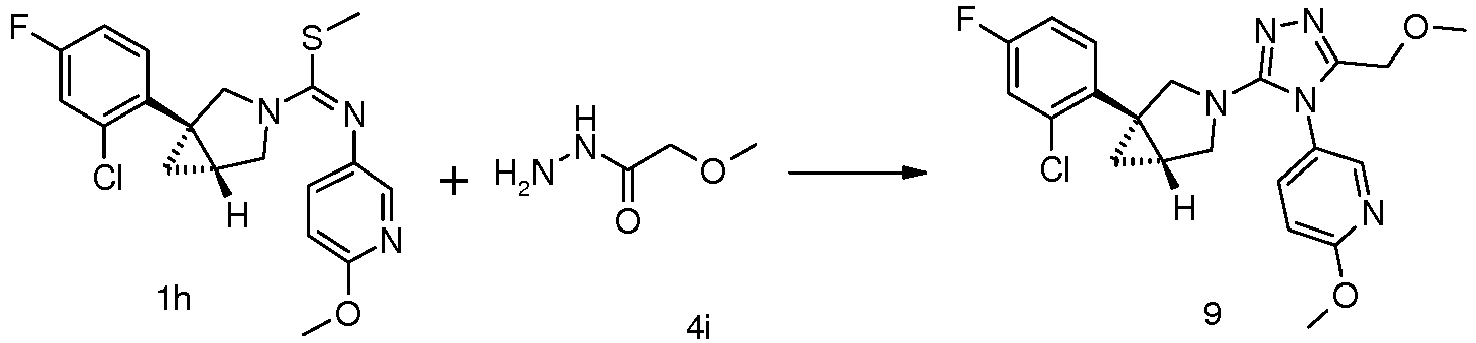
- 1h (180 mg, 0.46 mmol), 4i (239 mg, 2.3 mmol) and trifluoroacetic acid (52 mg, 0.46 mmol) were added to 8 mL of tetrahydrofuran. After completion of the addition, the reaction solution was heated to 70°C and stirred for 3 hours. After stopping heating, the reaction solution was concentrated under reduced pressure. The resulting residue was purified by high performance liquid chromatography to obtain the title product 9 (50 mg), yield: 24.21%.
MS m/z (ESI):430.2 [M+1].
1H NMR (400 MHz, CDCl3): δ 8.22 (s, 1H), 7.66 (d, 1H), 7.27 (t, 1H), 7.10 (d, 1H), 6.91-6.89 (m, 2H), 4.24 (s, 2H), 4.01 (s, 3H), 3.78 (d, 1H), 3.57-3.55 (m, 2H), 3.53 (d, 1H), 3.25 (s, 3H), 1.81-1.79 (m, 1H), 1.10 (t, 1H), 0.95 (t, 1H). -


- 1a (1 g, 5.9 mmol) was dissolved in 8 mL of tetrahydrofuran. The reaction solution was cooled to -20°C in a dry ice-acetone bath, and added slowly with sodium bis(trimethylsilyl)amide (2.2 g, 11.8 mmol). After completion of the addition, the reaction solution was stirred for 30 minutes, and then added with (S)-2-(chloromethyl)oxirane 10a (600 mg, 6.49 mmol). After completion of the addition, the dry ice-acetone bath was removed. The reaction solution was naturally warmed up to room temperature, and stirred for 3 hours. The reaction was quenched with saturated ammonium chloride solution (20 mL), and the reaction solution was extracted with ethyl acetate (50 mL×3). The organic phases were combined, and concentrated under reduced pressure to obtain the crude title product 10b (1.3 g), which was used directly in the next step without purification.
MS m/z (ESI): 226.3 [M+1]. - Lithium aluminum hydride (210 mg, 5.5 mmol) was added to 8 mL of tetrahydrofuran. The reaction solution was cooled in an ice bath, and added with the crude product 10b (500 mg, 2.22 mmol). After completion of the addition, the ice bath was removed. The reaction solution was naturally warmed up to room temperature, and stirred for 15 hours. The reaction was quenched by adding water (0.25 mL), sodium hydroxide solution (2 N, 0.25 mL) and water (0.75 mL) successively to the reaction solution. The reaction solution was filtrated, and the filtrate was concentrated under reduced pressure to obtain the crude title product 10c (300 mg), which was used directly in the next step without purification.
MS m/z (ESI): 230.3 [M+1]. - The crude product 10c (505 mg, 2.2 mmol) was added to 8 mL of dichloromethane. The reaction solution was cooled in an ice bath, and added with thionyl chloride (393 mg, 3.3 mmol). After completion of the addition, the ice bath was removed, and the reaction solution was stirred for 3 hours. The reaction solution was concentrated under reduced pressure to obtain the crude title product 10d (300 mg), which was used directly in the next step without purification.
MS m/z (ESI): 212.2 [M+1]. - The 1f (366 mg, 2.2 mmol) and the crude product 10d (233 mg, 1.1 mmol) were added to 8 mL of tetrahydrofuran. After completion of the addition, the reaction solution was stirred for 3 hours. The reaction solution was concentrated under reduced pressure to obtain the crude title product 10e (260 mg), which was used directly in the next step without purification.
MS m/z (ESI): 378.2 [M+1]. - The crude product 10e (416 mg, 1.1 mmol) was added to 8 mL of tetrahydrofuran. The reaction solution was cooled in an ice bath, and added with potassium tert-butoxide (449 mg, 4 mmol). After completion of the addition, the reaction solution was stirred for 1 hour, and then added with methyl p-toluenesulfonate (410 mg, 2.2 mmol). After completion of the addition, the ice bath was removed. The reaction solution was naturally warmed up to room temperature, and stirred for 48 hours. The reaction solution was added with ice water (20 mL), and then extracted with ethyl acetate (50 mL×3). The organic phases were combined, washed with saturated sodium chloride solution (50 mL×3), and concentrated under reduced pressure. The resulting residue was purified by thin layer chromatography with developing solvent system A to obtain the title product 10f (300 mg), yield: 62.6%.
MS m/z (ESI):392.3 [M+1]. - 10f (100 mg, 0.26 mmol), 4i (133 mg, 1.28 mmol) and trifluoroacetic acid (29 mg, 0.26 mmol) were added to 5 mL of tetrahydrofuran. After completion of the addition, the reaction solution was heated to 70°C and stirred for 3 hours. After stopping heating, the reaction solution was concentrated under reduced pressure. The resulting residue was purified by thin layer chromatography with developing solvent system A, and then purified by high performance liquid chromatography to obtain the title product 10 (10 mg), yield: 9.0%.
MS m/z (ESI): 430.2 [M+1].
1H NMR (400 MHz, CDCl3): δ 8.16 (s, 1H), 7.56 (d, 1H), 7.27 (d, 1H), 7.09 (d, 1H), 6.87-6.85 (m, 2H), 4.27 (s, 2H), 4.00 (s, 3H), 3.66 (d, 1H), 3.45 (d, 2H), 3.36 (d, 1H), 3.27 (s, 3H), 1.72-1.70 (m, 1H), 0.98-0.96 (m, 2H). -


- In accordance with the synthetic route of Example 1, compound 1k in Step 7 was replaced with benzyl 2-(difluoromethoxy)acetate 11a (prepared according to the method disclosed in the patent application "
WO2015180612 "), accordingly, the title compound 11b (35 mg) was prepared. - In accordance with the synthetic route of Example 1, compound 1l in Step 8 was replaced with compound 11b, accordingly, the title compound 11 (20 mg) was prepared, yield: 6.6%.
MS m/z (ESI): 466.4 [M+1].
1H NMR (400 MHz, CD3OD) δ 8.29 (d, 1H), 7.79 (dd, 1H), 7.43 (dd, 1H), 7.22 (dd, 1H), 7.04 (td, 1H), 7.00 (d, 1H), 6.35 (t, 1H), 4.78 (s, 2H), 4.01 (s, 3H), 3.66 (dd, 1H), 3.50 (d, 1H), 3.40 (d, 1H), 3.35 (d, 1H), 1.88-1.82 (m, 1H), 1.06-0.98 (m, 2H). -


- In accordance with the synthetic route of Example 1, compound 1l in Step 8 was replaced with 2,2,2-trifluoroacetohydrazide (purchased from Shanghai Bide Pharmatech Ltd.), accordingly, the title compound 12 (30 mg) was prepared, yield: 51%.
MS m/z (ESI): 454.4 [M+1].
1H NMR (400 MHz, CD3OD) δ 8.35 (s, 1H), 7.87 (d, 1H), 7.44 (dd, 1H), 7.23 (dd, 1H), 7.04 (td, 1H), 7.00 (d, 1H), 4.02 (s, 3H), 3.70 (dd, 1H), 3.54 (d, 1H), 3.43 (d, 1H), 3.38 (d, 1H), 1.89-1.84 (m, 1H), 1.07 (dd, 1H), 0.98 (t, 1H). -

- In accordance with the synthetic route of Example 1, compound 1l in Step 8 was replaced with 2,2-difluoroacetohydrazide (prepared according to the method disclosed in the patent application "
US6979686 "), accordingly, the title compound 13 (12 mg) was prepared, yield: 10.8%.
MS m/z (ESI): 436.1 [M+1].
1H NMR (400 MHz, CDCl3) δ 8.21 (s, 1H), 7.81 (d, 1H), 7.35 (m, 1H), 7.18-7.04 (m, 1H), 6.99-6.79 (m, 2H), 6.78-6.52 (m, 1H), 4.02 (s, 3H), 3.70 (dd, 1H), 3.49-3.42 (m, 2H), 3.41 (d, 1H), 1.89-1.82 (m, 1H), 1.07 (dd, 1H), 0.98 (t, 1H). -


- In accordance with the synthetic route of Example 1, compound 1l in Step 8 was replaced with 2-hydroxyacetohydrazide (prepared according to the method disclosed in the patent application "
WO2008051493 "), accordingly, the title compound 14a (90 mg) was prepared, yield: 68%.
MS m/z (ESI): 416.4 [M+1].
1H NMR (400 MHz, CD3OD) δ 8.29 (d, 1H), 7.80 (dd, 1H), 7.42 (dd, 1H), 7.22 (dd, 1H), 7.03 (td, 1H), 6.99 (d, 1H), 4.42 (s, 2H), 4.02 (s, 3H), 3.64 (dd, 1H), 3.47 (d, 1H), 3.38 (d, 1H), 3.34 (d, 1H), 1.87-1.80 (m, 1H), 1.01 (d, 2H). - 14a (90 mg, 0.22 mmol) and N,N-dimethylformamide (5 mL) were added to a reaction flask under an argon atmosphere. The reaction solution was added with sodium hydride (16 mg, 0.65 mmol) in an ice bath, and stirred for 10 minutes. The reaction solution was added with deuterated iodomethane (156 mg, 1.08 mmol), and warmed up to room temperature for 3 hours. The reaction solution was added with water (15 mL), and then extracted with ethyl acetate (10 mL×3). The organic phases were combined, dried over anhydrous sodium sulfate and concentrated under reduced pressure. The resulting residue was purified by silica gel column chromatography with elution system C to obtain the title product 14 (10 mg), yield: 10.8%.
MS m/z (ESI): 433.2 [M+1].
1H NMR (400 MHz, CDCl3) δ 8.17 (d, 1H), 7.56 (d, 1H), 7.28 (t, 1H), 7.09 (d, 1H), 6.87 (d, 1H), 6.85 (d, 1H), 4.27 (s, 2H), 4.00 (s, 3H), 3.67 (d, 1H), 3.46 (d, 2H), 3.36 (d, 1H), 1.73-1.70 (m, 1H), 0.98-0.95 (m, 2H). -

- In accordance with the synthetic route of Example 3, compound 3a in Step 1 was replaced with (R)-3-hydroxytetrahydrofuran (purchased from Shanghai Bide Pharmatech Ltd.), accordingly, the title compound 15 (30 mg) was prepared, yield: 13.2%.
MS m/z (ESI): 486.4 [M+1].
1H NMR (400 MHz, CD3OD) δ 8.20 (d, 1H), 7.59 (dd, 1H), 7.32-7.28 (m, 1H), 7.14 (dd, 1H), 7.11 (td, 1H), 6.98 (d, 1H), 4.40-4.33 (m, 2H) 4.17-4.15 (m, 1H), 4.03 (s, 3H), 3.81-3.79 (m, 2H), 3.68-3.65 (m, 3H), 3.50 (d, 2H), 3.40 (d, 1H), 1.98-1.90 (m, 1H), 1.89-1.81 (m, 1H), 1.79-1.74 (m, 1H), 1.02-0.92 (m, 2H). -

- In accordance with the synthetic route of Example 1, compound 1l in Step 8 was replaced with 2-cyanoacetohydrazide (purchased from Shanghai Bide Pharmatech Ltd.), accordingly, the title compound 16 (30 mg) was prepared, yield: 24.3%.
MS m/z (ESI): 425.4 [M+1].
1H NMR (400 MHz, CD3OD) δ 8.21 (d, 1H), 7.63 (dd, 1H), 7.33-7.30 (m, 1H), 7.15 (dd, 1H), 7.00 (d, 1H), 6.98 (td, 1H), 4.06 (s, 3H), 3.72-3.69 (m, 3H), 3.49 (d, 2H), 3.42 (d, 1H), 1.80-1.76 (m, 1H), 1.06-0.98 (m, 2H). -

- In accordance with the synthetic route of Example 1, compound 1l in Step 8 was replaced with 2-cyclopropylformohydrazide (purchased from Shanghai Bide Pharmatech Ltd.), accordingly, the title compound 17 (30 mg) was prepared, yield: 27.5%.
MS m/z (ESI): 426.2 [M+1].
1H NMR (400 MHz, CD3OD) δ 8.24 (d, 1H), 7.67 (dd, 1H), 7.30-7.25 (m, 1H), 7.17 (dd, 1H), 6.94 (d, 1H), 6.90 (td, 1H), 4.06 (s, 3H), 3.75 (dd, 1H), 3.55-3.47 (m, 2H), 3.45 (d, 1H), 1.79-1.72 (m, 1H), 1.43-1.36 (m, 1H), 1.15-1.10 (m, 2H), 1.06-0.96 (m, 2H), 0.89-0.86 (m, 2H). - The inhibition effect of the compounds of the present invention on the activity of human OTR protein expressed in HEK293/human OTR stably transfected cells was determined by the following experimental method:
- I. Experimental materials and instruments
- 1. Fluo-4 NW calcium assay kit (F36206, invitrogen)
- 2. MEM (Hyclone, SH30024.01B)
- 3. G418 sulfate (Enzo, ALX-380-013-G005)
- 4. Fetal bovine serum (GIBCO, 10099)
- 5. Sodium pyruvate solution (sigma, S8636-100ML)
- 6. MEM non-essential amino acid solution (100×) (sigma, M7145-100ML)
- 7. Flexstation 3 multi-function microplate reader (Molecular Devices)
- 8. Poly-D-lysine 96-well plate, black/clear (356692, BD)
- 9. Oxytocin (synthesized by GL Biochem Ltd.)
- 10. pcDNA3.1 (invitrogen, V79020)
- 11. pcDNA3.1-hOTR (NM-000916) (synthesized and constructed into pcDNA3.1 plasmid by GENEWIZ Biological Technology Co., Ltd)
- 12. HEK293 cells (Cat. No. GNHu18, Cell bank of Chinese Academy of Sciences)
- II. Experimental procedures
- The pcDNA3.1-hOTR plasmid was transferred into HEK293 cells with the Lipofectamine® 3000 transfection reagent; G418 was added on the next day to screen, and monoclonal cell lines were selected.
- HEK293/human OTR stably transfected cells were inoculated in a 96-well plate with an inoculation density of 25,000 cells/well one day in advance. On the next day, a loading buffer containing Fluo-4 dye was formulated using the reagents in the Fluo-4 NW calcium assay kit, and the culture medium was then removed; 100 µl of the loading buffer containing Fluo-4 dye were added to each well, and the plate was incubated at 37°C for 30 minutes. After that, the plate was moved to room temperature and equilibrated for 10 minutes. The compounds were formulated into concentration gradients of 106, 105, 104, 103, 102 and 101 nM. 1 µl of the compounds in each concentration was added to each well, and the plate was incubated at room temperature for 10 minutes. 50 µl of oxytocin polypeptide (3 nM) were automatically added by the machine, and the values were immediately detected at 494/516 nM by the flexstation 3 microplate reader. IC50 values of the compounds were calculated by Graphpad prism software using fluorescence signals corresponding to different concentrations.
- The inhibition activity of the compounds of the present invention on human OTR was determined by the above test, and the obtained IC50 values are shown in Table 1.
Table 1 IC50 of inhibition activity of the compounds of the present invention on human OTR Example No. IC50 (nM) 1 44 4 29 5 131 6 4.3 8 23 9 14 10 (control) 624 11 1 12 30 13 52 14 68 - Conclusion: The compounds of the present invention have a significant inhibition effect on the human OTR activity.
- The inhibition effect of the compounds of the present invention on the activity of human VlaR protein expressed in HEK293/human VlaR stably transfected cells was determined by the following experimental method:
- I. Experimental materials and instruments
- 1. Fluo-4 NW calcium assay kit (F36206, invitrogen)
- 2. MEM (Hyclone, SH30024.01B)
- 3. G418 sulfate (Enzo, ALX-380-013-G005)
- 4. Fetal bovine serum (GIBCO, 10099)
- 5. Sodium pyruvate solution (sigma, S8636-100ML)
- 6. MEM non-essential amino acid solution (100×) (sigma, M7145-100ML)
- 7. Flexstation 3 multi-function microplate reader (Molecular Devices)
- 8. Poly-D-lysine 96-well plate, black/clear (356692, BD)
- 9. Vasopressin (Tocris, 2935)
- 10. pcDNA3.1 (invitrogen, V79020)
- 11. pcDNA3.1-V1aR (NM-000706) (synthesized and constructed into pcDNA3.1 plasmid by GENEWIZ Biological Technology Co., Ltd)
- 12. HEK293 cells (Cat. No. GNHu18, Cell Bank of Chinese Academy of Sciences)
- II. Experimental procedures
- The pcDNA3.1-V1aR plasmid was transferred into HEK293 cells with the Lipofectamine® 3000 transfection reagent; G418 was added on the next day to screen, and monoclonal cell lines were selected.
- HEK293/human VlaR stably transfected cells were inoculated in a 96-well plate with an inoculation density of 25,000 cells/well one day in advance. On the next day, a loading buffer containing Fluo-4 dye was formulated using the reagents in the Fluo-4 NW calcium assay kit, and the culture medium was then removed; 100 µl of the loading buffer containing Fluo-4 dye were added to each well, and the plate was incubated at 37°C for 30 minutes. After that, the plate was moved to room temperature and equilibrated for 10 minutes. The compounds were formulated into concentration gradients of 106, 105, 104, 103, 102 and 101 nM. 1 µl of the compounds in each concentrationt was added to each well, and the plate was incubated at room temperature for 10 minutes. 50 µl of vasopressin polypeptide (3 nM) were automatically added by the machine, and the values were immediately detected at 494/516 nM by the flexstation 3 microplate reader. IC50 values of the compounds were calculated by Graphpad prism software using fluorescence signals corresponding to different concentrations.
- The inhibition activity of the compounds of the present invention on human VlaR was determined by the above test, and the obtained IC50 values are shown in Table 2.
Table 2 IC50 of inhibition activity of the compounds of the present invention on human VlaR Example No. IC50 (µM) 1 1 2 4.7 3 7.5 4 3.8 5 1 6 1.7 7 2.0 8 3.0 9 2.9 12 3.6 13 1.9 - Conclusion: The compounds of the present invention have a weak inhibition effect on the human VlaR activity, indicating that the compounds of the present invention have a selective inhibition effect on the OTR activity.
- The inhibition effect of the compounds of the present invention on the activity of human V1bR protein expressed in HEK293/human V1bR cells was determined by the following experimental method:
- I. Experimental materials and instruments
- 1. Fluo-4 NW calcium assay kit (F36206, invitrogen)
- 2. MEM (Hyclone, SH30024.01B)
- 3. G418 sulfate (Enzo, ALX-380-013-G005)
- 4. Fetal bovine serum (GIBCO, 10099)
- 5. Sodium pyruvate solution (sigma, S8636-100ML)
- 6. MEM non-essential amino acid solution (100×) (sigma, M7145-100ML)
- 7. Flexstation 3 multi-function microplate reader (Molecular Devices)
- 8. Poly-D-lysine 96-well plate, black/clear (356692, BD)
- 9. Vasopressin (Tocris, 2935)
- 10. pcDNA3.1 (invitrogen, V79020)
- 11. pcDNA3.1-V1bR (NM-000706) (synthesized and constructed into pcDNA3.1 plasmid by GENEWIZ Biological Technology Co., Ltd)
- 12. HEK293 cells (Cat. No. GNHu18, Cell Bank of Chinese Academy of Sciences)
- II. Experimental procedures
- The pcDNA3.1-V1bR plasmid was transferred into HEK293 cells with the Lipofectamine® 3000 transfection reagent; G418 was added on the next day, and the HEK293/human V1bR pool cell lines were obtained.
- HEK293/human V1bR pool cells were inoculated in a 96-well plate with an inoculation density of 25,000 cells/well one day in advance. On the next day, a loading buffer containing Fluo-4 dye was formulated using the reagents in the Fluo-4 NW calcium assay kit, and the culture medium was then removed; 100 µl of the loading buffer containing Fluo-4 dye were added to each well, and the plate was incubated at 37°C for 30 minutes. After that, the plate was moved to room temperature and equilibrated for 10 minutes. The compounds were formulated into concentration gradients of 106, 105, 104, 103, 102 and 101 nM. 1 µl of the compounds in each concentration was added to each well, and the plate was incubated at room temperature for 10 minutes. 50 µl of vasopressin polypeptide (3 nM) were automatically added by the machine, and the values were immediately detected at 494/516 nM by the flexstation 3 microplate reader. IC50 values of the compounds were calculated by Graphpad prism software using fluorescence signals corresponding to different concentrations.
- The inhibition activity of the compounds of the present invention on human V1bR was determined by the above test, and the obtained IC50 values are shown in Table 3.
Table 3 IC50 of inhibition of the compounds of the present invention on human V1bR activity Example No. IC50 (µM) 1 24.5 3 56.7 4 59.4 6 27.9 7 12.4 8 43.3 9 37.6 11 7.8 12 11.7 14 20.5 - Conclusion: The compounds of the present invention have no significant inhibition effect on the human V1bR activity, indicating that the compounds of the present invention have a selective inhibition effect on the OTR activity.
- The inhibition effect of the compounds of the present invention on the activity of human V2R protein expressed in HEK293/human V2R cells was determined by the following experimental method:
- I. Experimental materials and instruments
- 1. cAMP dynamic 2 kit - 1,000 tests (62AM4PEB, Cisbio)
- 2. MEM (Hyclone, SH30024.01B)
- 3. G418 sulfate (Enzo, ALX-380-013-G005)
- 4. Fetal bovine serum (GIBCO, 10099)
- 5. Sodium pyruvate solution (sigma, S8636-100ML)
- 6. MEM non-essential amino acid solution (100×) (sigma, M7145-100ML)
- 7. PheraStar multi-function microplate reader (BMG)
- 8. Corning/Costar 384-well non-adsorbing microplate - black NBS plate (4514, Corning)
- 9. Cell dissociation solution, enzyme-free, PBS (13151014-100ml, Thermo Fisher Scientific)
- 10. HBSS, calcium, magnesium, no phenol red (14025-092, Invitrogen)
- 11. HEPES, 1M buffer (15630-080, GIBCO)
- 12. BSA (0219989725, MP Biomedicals)
- 13. IBMX (I7018-250MG, sigma)
- 14. Vasopressin (Tocris, 2935)
- 15. pcDNA3.1 (invitrogen, V79020)
- 16. pcDNA3.1-V2R (NM-000054) (synthesized and constructed into pcDNA3.1 plasmid by GENEWIZ Biological Technology Co., Ltd)
- 17. HEK293 cells (Cat. No. GNHu18, Cell Bank of Chinese Academy of Sciences)
- II. Experimental procedures
- The pcDNA3.1-V2R plasmid was transferred into HEK293 cells with the Lipofectamine® 3000 transfection reagent; G418 was added on the next day, and the HEK293/human V2R pool cell lines were obtained.
- HEK293/human V2R pool cells were digested with the cell dissociation solution (enzyme-free), thereby dissociating the cells from the cell culture dish into individual cells. After completion, the cell solution was blown well, and centrifuged to remove the supernatant. The cells were re-suspended in the test buffer 1 (1x HBSS+20mM HEPES+0.1%BSA) and counted. The cell density was adjusted to 1250 cells/5 µl, i.e., 2.5*105/ml.
- The compounds were formulated into a series of concentrations of 20 mM, 6.67 mM, 2.22 mM, 0.74 mM, 0.25 mM, 0.08 mM, 27.4 µM, 9.14 µM, 3.05 µM, 1.02 µM, 0.34 µM and 0 µM (DMSO) with pure DMSO. The compounds were then formulated into a 4-fold use concentration with the test buffer 2 (test buffer 1 + 1 mM IBMX).
- Agonist: 460 µM vasopressin was used as the mother liquor, formulated as a 2 µM solution with DMSO, which was then diluted as a 0.5 nM solution with the test buffer 2.
- Standard: The first point was 20 µl of a stock solution (2848 nM), which was diluted successively to a total of eleven concentrations in 4 fold concentration gradient with the test buffer 1 from the second point.
-
- 1. The well-mixed cells were added to a 384-well plate (5 µl/well) without changing the tip.
- 2. The test compounds and positive compound formulated were added (2.5 µl/well), and the tips should be changed.
- 3. The plate was centrifuged at 1000 rpm for 1 min, shaken for 30 sec to mix well, and incubated at room temperature for 30 min.
- 4. The standard curve wells were added with the test buffer 2 (5 µl/well).
- 5. The agonist formulated was added (2.5 µl/well), and the tips should be changed; the plate was centrifuged at 1000 rpm for 1 min, shaken for 30 sec to mix well, and incubated at room temperature for 30 min.
- 6. cAMP-d2 (a component in the cAMP dynamic 2 kit) and Anti-cAMP-Eu-Cryptate (a component in the cAMP dynamic 2 kit) were formulated in the dark, which were then mixed well with cAMP lysate (a component in the cAMP dynamic 2 kit) in a ratio of 1:4. Each well was added with the formulated cAMP-d2 solution (5 µl/well), followed by addition of Anti-cAMP-Eu-Cryptate (5 µl/well). The plate was shaken for 30 sec to mix well, and incubated in the dark at room temperature for 1h.
- 4) Plate reading: The HTRF signals were read by the PheraStar multi-function microplate reader.
- The data in this test was processed using the data processing software Graphpad Prism.
- The inhibition activity of the compounds of the present invention on human V2R was determined by the above test, and the obtained IC50 values are shown in Table 4.
Table 4 IC50 of inhibition activity of the compounds of the present invention on human V2R Example No. IC50 (µM) 1 21.4 3 23.0 4 25.7 6 7.3 7 90 9 32.6 11 6.8 12 29.5 14 10.4 - Conclusion: The compounds of the present invention have no significant inhibition effect on the human V2R activity, indicating that the compounds of the present invention have a selective inhibition effect on the OTR activity.
- Rats were used as test animals. The drug concentration in plasma at different time points was determined by LC/MS/MS method after intragastrical administration of the compounds of Examples 6, 8, 9 and 11 to rats. The pharmacokinetic behavior of the compounds of the present invention was studied and evaluated in rats.
- Compounds of Examples 6, 8, 9 and 11.
- Sixteen healthy adult Sprague-Dawley (SD) rats (half male and half female) were purchased from Shanghai Jiesijie Laboratory Animal Co., LTD, with Certificate No.: SCXK (Shanghai) 2013-0006, and equally divided into 4 groups (4 rats per group).
- A certain amount of the test compound was weighed, and added with 2.5% by volume of DMSO and 97.5% by volume of 10% solutol HS-15 to prepare a 0.2 mg/mL colorless, clear and transparent solution.
- After an overnight fast, SD rats were administered intragastrically the test compounds at an administration dosage of 2.0 mg/kg and an administration volume of 10.0 mL/kg.
- The rats were intragastrically administered the compounds of Examples 6, 8, 9 and 11. 0.2 mL of blood was taken from the orbital sinus before administration and at 0.5, 1.0, 2.0, 4.0, 6.0, 8.0, 11.0 and 24.0 hours after administration. The samples were stored in heparinized tubes, and centrifuged for 10 minutes at 4°C at 3,500 rpm to separate the blood plasma. The plasma samples were stored at -20°C. The rats were fed 2 hours after administration.
- The content of the test compounds in the plasma of rats after intragastrical administration of the test compounds at different concentrations was determined: 25 µL of rat plasma at each time after administration was taken, added with 50 µL of the internal standard solution of camptothecin (100 ng/mL) and 200 µL of acetonitrile, vortex-mixed for 5 minutes, and centrifuged for 10 minutes (4000 rpm). 1.0 µL of the supernatant was taken from the plasma samples for LC/MS/MS analysis.
- Pharmacokinetic parameters of the compounds of the present invention are shown below:
No. Pharmacokinetics assay (2 mg/kg) Plasma concentration Area under curve Half-life Residence time Clearance Apparent distribution volume Cmax (ng /mL) AUC (ng /mL*h) T1/2 (h) MRT (h) CLz/F (ml/min/kg) Vz/F (ml/kg) Example 6 135±80.0 1057±982 3.47±1.72 6.70±0.73 68.9±58.8 18032±17374 Example 8 635±273 1985±1021 1.08±0.21 2.18±0.24 23.3±18.0 1941±983 Example 9 350±142 2042±1025 3.98±3.55 6.23±4.94 20.2±10.3 6004±4440 Example 11 405±110 3985±2970 2.86±1.27 5.82±2.73 12.6±8.03 2465±706 - Conclusion: The compounds of the present invention are well absorbed, and have a pharmacokinetic advantage.
Claims (17)
- A compound of formula (I):
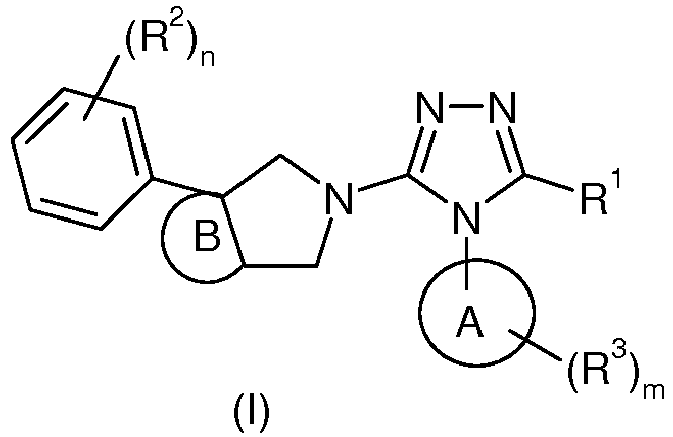
wherein:ring A is aryl or heteroaryl;ring B is cycloalkyl or heterocyclyl;R1 is alkyl or cycloalkyl, wherein the alkyl is optionally substituted by one or more substituents selected from the group consisting of alkoxy, halogen, haloalkyl, haloalkoxy, deuterated alkoxy, hydroxy, hydroxyalkyl, cyano, amino, nitro, cycloalkyl, heterocyclyl, heterocyclyloxy, aryl, heteroaryl and -OR4;each R2 is identical or different and each is independently selected from the group consisting of hydrogen, halogen, alkyl, alkoxy, haloalkyl, hydroxy, hydroxyalkyl, cyano, amino, nitro, cycloalkyl and heterocyclyl;each R3 is identical or different and each is independently selected from the group consisting of hydrogen, halogen, alkyl, alkoxy, haloalkyl, hydroxy, hydroxyalkyl, cyano, amino, nitro, cycloalkyl and heterocyclyl;R4 is selected from the group consisting of hydroxyalkyl, cycloalkyl, aryl and heteroaryl;n is 0, 1, 2, 3, 4 or 5; andm is 0, 1, 2, 3 or 4. - The compound of formula (I) according to claim 1, being a compound of formula (II):

ring A, ring B, R1-R3, n and m are as defined in claim 1. - The compound of formula (I) according to claim 1 or 2, wherein ring B is 3-5 membered cycloalkyl or heterocyclyl, and preferably cyclopropyl.
- The compound of formula (I) according to any one of claims 1 to 3, being a compound of formula (III):

wherein:
ring A, R1-R3, n and m are as defined in claim 1. - The compound of formula (I) according to any one of claims 1 to 4, wherein ring A is pyridyl or benzodioxol, and preferably

- The compound of formula (I) according to any one of claims 1 to 5, wherein R1 is alkyl or cycloalkyl, wherein the alkyl is optionally substituted by one or more substituents selected from the group consisting of halogen, cyano, alkoxy, haloalkoxy, deuterated alkoxy and heterocyclyloxy.
- The compound of formula (I) according to any one of claims 1 to 6, wherein each R2 is identical or different and each is independently selected from the group consisting of hydrogen, halogen and alkyl.
- The compound of formula (I) according to any one of claims 1 to 7, wherein R3 is alkoxy.
- The compound of formula (I) according to any one of claims 1 to 8, wherein n is 2; and m is 0 or 1.
- The compound according to any one of claims 1 to 9, selected from the group consisting of:


- A compound of formula (I-A):

wherein:
ring A, ring B, R2, R3, n and m are as defined in claim 1. - The compound of formula (I-A) according to claim 9, selected from the group consisting of:


- A method for preparing the compound of formula (I) according to claim 1, comprising a step of:

wherein:
ring A, ring B, R1-R3, n and m are as defined in claim 1. - A pharmaceutical composition, comprising a therapeutically effective amount of the compound of formula (I), or a tautomer, mesomer, racemate, enantiomer, diastereomer thereof, or mixture thereof, or a pharmaceutically acceptable salt thereof according to any one of claims 1 to 10, and one or more pharmaceutically acceptable carriers, diluents or excipients.
- Use of the compound of formula (I), or a tautomer, mesomer, racemate, enantiomer, diastereomer thereof, or mixture thereof, or a pharmaceutically acceptable salt thereof according to any one of claims 1 to 10, or the pharmaceutical composition according to claim 14 in the preparation of a medicament for treating or preventing a disease or condition where inhibition of oxytocin is known, or can be shown, to produce a beneficial effect.
- The use according to claim 15, wherein the disease or condition where inhibition of oxytocin is known, or can be shown, to produce a beneficial effect is selected from the group consisting of sexual dysfunction, male sexual dysfunction, female sexual dysfunction, hypoactive sexual desire disorder, sexual arousal disorder, orgasmic disorder, sexual pain disorder, premature ejaculation, preterm labour, complications in labour, appetite and feeding disorders, benign prostatic hyperplasia, premature birth, dysmenorrhea, congestive heart failure, arterial hypertension, liver cirrhosis, nephrotic hypertension, ocular hypectension, obsessive compulsive disorder and neuropsychiatric disorders, and preferably selected from the group consisting of sexual arousal disorder, orgasmic disorder, sexual pain disorder and premature ejaculation.
- Use of the compound of formula (I), or a tautomer, mesomer, racemate, enantiomer, diastereomer thereof, or mixture thereof, or a pharmaceutically acceptable salt thereof according to any one of claims 1 to 10, or the pharmaceutical composition according to claim 14 in the preparation of a medicament for antagonizing oxytocin.
Applications Claiming Priority (2)
| Application Number | Priority Date | Filing Date | Title |
|---|---|---|---|
| CN201611233476 | 2016-12-28 | ||
| PCT/CN2017/118784 WO2018121551A1 (en) | 2016-12-28 | 2017-12-27 | Azabicyclo-substituted triazole derivative, preparation method thereof, and application of same in medicine |
Publications (2)
| Publication Number | Publication Date |
|---|---|
| EP3564231A1 true EP3564231A1 (en) | 2019-11-06 |
| EP3564231A4 EP3564231A4 (en) | 2020-08-12 |
Family
ID=62710083
Family Applications (1)
| Application Number | Title | Priority Date | Filing Date |
|---|---|---|---|
| EP17885670.4A Withdrawn EP3564231A4 (en) | 2016-12-28 | 2017-12-27 | Azabicyclo-substituted triazole derivative, preparation method thereof, and application of same in medicine |
Country Status (9)
| Country | Link |
|---|---|
| US (1) | US20210040073A1 (en) |
| EP (1) | EP3564231A4 (en) |
| JP (1) | JP2020504109A (en) |
| CN (2) | CN113149961B (en) |
| AU (1) | AU2017389819B2 (en) |
| CA (1) | CA3047641A1 (en) |
| MX (1) | MX2019007360A (en) |
| TW (1) | TW201823231A (en) |
| WO (1) | WO2018121551A1 (en) |
Families Citing this family (2)
| Publication number | Priority date | Publication date | Assignee | Title |
|---|---|---|---|---|
| WO2020001460A1 (en) * | 2018-06-27 | 2020-01-02 | 江苏恒瑞医药股份有限公司 | Pharmaceutically acceptable salt, crystal form of azabicyclo substituted triazole derivative and preparation method |
| CN113004250B (en) * | 2019-12-19 | 2022-07-26 | 上海森辉医药有限公司 | Process for preparing substituted triazole derivatives |
Family Cites Families (11)
| Publication number | Priority date | Publication date | Assignee | Title |
|---|---|---|---|---|
| US6979686B1 (en) | 2001-12-07 | 2005-12-27 | Pharmacia Corporation | Substituted pyrazoles as p38 kinase inhibitors |
| JP2007505888A (en) | 2003-09-22 | 2007-03-15 | ファイザー インコーポレイテッド | Substituted triazole derivatives as oxytocin antagonists |
| WO2005082866A2 (en) | 2004-02-20 | 2005-09-09 | Pfizer Limited | Substituted 1, 2, 4- triazole derivatives as oxytocin antagonists |
| AP2007004047A0 (en) * | 2005-01-20 | 2007-06-30 | Pfizer Ltd | Substituted triazole derivatives as oxtocin antagonists |
| GB0504556D0 (en) * | 2005-03-04 | 2005-04-13 | Pfizer Ltd | Novel pharmaceuticals |
| WO2006100588A1 (en) * | 2005-03-21 | 2006-09-28 | Pfizer Limited | Substituted triazole derivatives as oxytocin antagonists |
| JP2008533192A (en) * | 2005-03-21 | 2008-08-21 | ファイザー・リミテッド | Substituted triazole derivatives as oxytocin antagonists |
| WO2007017752A1 (en) * | 2005-08-10 | 2007-02-15 | Pfizer Limited | Substituted triazole derivatives as oxytocin antagonists |
| ES2627352T3 (en) | 2006-10-19 | 2017-07-27 | Signal Pharmaceuticals, Llc | Heteroaryl compounds, their compositions and their use as protein kinase inhibitors |
| CN102372701A (en) * | 2010-08-10 | 2012-03-14 | 江苏恒瑞医药股份有限公司 | Azabicyclo hexane derivative, preparation method, and application of azabicyclo hexane derivative in medicine |
| WO2015180612A1 (en) | 2014-05-28 | 2015-12-03 | Glaxosmithkline Intellectual Property Development Limited | Novel compounds |
-
2017
- 2017-12-27 TW TW106145996A patent/TW201823231A/en unknown
- 2017-12-27 JP JP2019533376A patent/JP2020504109A/en not_active Withdrawn
- 2017-12-27 CN CN202110204338.9A patent/CN113149961B/en active Active
- 2017-12-27 WO PCT/CN2017/118784 patent/WO2018121551A1/en not_active Ceased
- 2017-12-27 AU AU2017389819A patent/AU2017389819B2/en not_active Ceased
- 2017-12-27 MX MX2019007360A patent/MX2019007360A/en unknown
- 2017-12-27 US US16/472,527 patent/US20210040073A1/en not_active Abandoned
- 2017-12-27 CN CN201780020566.2A patent/CN109071492B/en active Active
- 2017-12-27 EP EP17885670.4A patent/EP3564231A4/en not_active Withdrawn
- 2017-12-27 CA CA3047641A patent/CA3047641A1/en not_active Abandoned
Also Published As
| Publication number | Publication date |
|---|---|
| EP3564231A4 (en) | 2020-08-12 |
| CA3047641A1 (en) | 2018-07-05 |
| CN109071492A (en) | 2018-12-21 |
| AU2017389819A1 (en) | 2019-06-20 |
| JP2020504109A (en) | 2020-02-06 |
| WO2018121551A1 (en) | 2018-07-05 |
| CN109071492B (en) | 2021-02-26 |
| AU2017389819B2 (en) | 2021-05-27 |
| TW201823231A (en) | 2018-07-01 |
| CN113149961B (en) | 2022-11-22 |
| MX2019007360A (en) | 2019-08-16 |
| US20210040073A1 (en) | 2021-02-11 |
| CN113149961A (en) | 2021-07-23 |
Similar Documents
| Publication | Publication Date | Title |
|---|---|---|
| CN115244056B (en) | Condensed imidazole derivatives, preparation methods thereof and their application in medicine | |
| EP3378859B1 (en) | Benzofuran derivative, preparation method thereof and use thereof in medicine | |
| CN114805336B (en) | Condensed imidazole compound, preparation method and medical application thereof | |
| JP2018513145A (en) | Imidazoisoindole derivatives, process for producing the same and pharmaceutical use thereof | |
| EP3409658B9 (en) | Tetrahydronaphthalene derivative | |
| CN113544131B (en) | Pyrroloheterocyclic derivatives, their preparation methods and their applications in medicine | |
| EP3560918A1 (en) | Condensed ring group azacyclobutyl triazole derivative, preparation method therefor and use thereof in medicine | |
| CN113825757A (en) | Substituted fused bicyclic derivatives, their preparation method and their application in medicine | |
| WO2019149089A1 (en) | Nitrogen-containing benzoheterocycle compound comprising carboxylic acid group, preparation method and use thereof | |
| WO2020011220A1 (en) | Heteroaryl derivative, preparation method therefor, and medical use thereof | |
| AU2017389819B2 (en) | Azabicyclo-substituted triazole derivative, preparation method thereof, and application of same in medicine | |
| EP3988547A1 (en) | Indazole derivative, preparation method therefor, and pharmaceutical application thereof | |
| WO2022166810A1 (en) | Fused azatricyclic derivative, preparation method therefor, and application thereof in medicine | |
| EP3683206A1 (en) | Deuterium atom-substituted indole formamide derivative, preparation method therefor, and medical applications thereof | |
| JP4174068B1 (en) | Androgen modulator | |
| CN108689996B (en) | Azacyclobutylcarboxamide derivative, preparation method and medical application thereof | |
| TW202227458A (en) | Compounds containing fused tricyclic rings and medical use thereof | |
| HK40059622A (en) | Pyrroloheterocyclic derivative, preparation method therefor, and application thereof in medicine | |
| HK40082497A (en) | Fused imidazole derivatives, preparation method and medical use thereof | |
| HK40064826A (en) | Substituted fused bicyclic derivative, preparation method therefor, and application thereof in medicines |
Legal Events
| Date | Code | Title | Description |
|---|---|---|---|
| STAA | Information on the status of an ep patent application or granted ep patent |
Free format text: STATUS: THE INTERNATIONAL PUBLICATION HAS BEEN MADE |
|
| PUAI | Public reference made under article 153(3) epc to a published international application that has entered the european phase |
Free format text: ORIGINAL CODE: 0009012 |
|
| STAA | Information on the status of an ep patent application or granted ep patent |
Free format text: STATUS: REQUEST FOR EXAMINATION WAS MADE |
|
| 17P | Request for examination filed |
Effective date: 20190618 |
|
| AK | Designated contracting states |
Kind code of ref document: A1 Designated state(s): AL AT BE BG CH CY CZ DE DK EE ES FI FR GB GR HR HU IE IS IT LI LT LU LV MC MK MT NL NO PL PT RO RS SE SI SK SM TR |
|
| AX | Request for extension of the european patent |
Extension state: BA ME |
|
| DAV | Request for validation of the european patent (deleted) | ||
| DAX | Request for extension of the european patent (deleted) | ||
| A4 | Supplementary search report drawn up and despatched |
Effective date: 20200709 |
|
| RIC1 | Information provided on ipc code assigned before grant |
Ipc: C07D 405/14 20060101ALI20200704BHEP Ipc: C07D 401/14 20060101AFI20200704BHEP Ipc: A61K 31/4196 20060101ALI20200704BHEP Ipc: A61K 31/44 20060101ALI20200704BHEP Ipc: A61P 15/00 20060101ALI20200704BHEP |
|
| GRAP | Despatch of communication of intention to grant a patent |
Free format text: ORIGINAL CODE: EPIDOSNIGR1 |
|
| STAA | Information on the status of an ep patent application or granted ep patent |
Free format text: STATUS: GRANT OF PATENT IS INTENDED |
|
| INTG | Intention to grant announced |
Effective date: 20210611 |
|
| STAA | Information on the status of an ep patent application or granted ep patent |
Free format text: STATUS: THE APPLICATION IS DEEMED TO BE WITHDRAWN |
|
| 18D | Application deemed to be withdrawn |
Effective date: 20211022 |