EP3562784B1 - Method for processing a gas stream comprising urea dust and ammonia - Google Patents
Method for processing a gas stream comprising urea dust and ammonia Download PDFInfo
- Publication number
- EP3562784B1 EP3562784B1 EP17832787.0A EP17832787A EP3562784B1 EP 3562784 B1 EP3562784 B1 EP 3562784B1 EP 17832787 A EP17832787 A EP 17832787A EP 3562784 B1 EP3562784 B1 EP 3562784B1
- Authority
- EP
- European Patent Office
- Prior art keywords
- urea
- ammonium sulphate
- solution
- ammonia
- aqueous
- Prior art date
- Legal status (The legal status is an assumption and is not a legal conclusion. Google has not performed a legal analysis and makes no representation as to the accuracy of the status listed.)
- Active
Links
Images
Classifications
-
- C—CHEMISTRY; METALLURGY
- C01—INORGANIC CHEMISTRY
- C01C—AMMONIA; CYANOGEN; COMPOUNDS THEREOF
- C01C1/00—Ammonia; Compounds thereof
- C01C1/24—Sulfates of ammonium
- C01C1/242—Preparation from ammonia and sulfuric acid or sulfur trioxide
-
- B—PERFORMING OPERATIONS; TRANSPORTING
- B01—PHYSICAL OR CHEMICAL PROCESSES OR APPARATUS IN GENERAL
- B01D—SEPARATION
- B01D53/00—Separation of gases or vapours; Recovering vapours of volatile solvents from gases; Chemical or biological purification of waste gases, e.g. engine exhaust gases, smoke, fumes, flue gases, aerosols
- B01D53/34—Chemical or biological purification of waste gases
- B01D53/46—Removing components of defined structure
- B01D53/54—Nitrogen compounds
- B01D53/58—Ammonia
-
- C—CHEMISTRY; METALLURGY
- C01—INORGANIC CHEMISTRY
- C01C—AMMONIA; CYANOGEN; COMPOUNDS THEREOF
- C01C1/00—Ammonia; Compounds thereof
- C01C1/02—Preparation, purification or separation of ammonia
- C01C1/12—Separation of ammonia from gases and vapours
-
- C—CHEMISTRY; METALLURGY
- C05—FERTILISERS; MANUFACTURE THEREOF
- C05C—NITROGENOUS FERTILISERS
- C05C3/00—Fertilisers containing other salts of ammonia or ammonia itself, e.g. gas liquor
- C05C3/005—Post-treatment
-
- C—CHEMISTRY; METALLURGY
- C05—FERTILISERS; MANUFACTURE THEREOF
- C05C—NITROGENOUS FERTILISERS
- C05C9/00—Fertilisers containing urea or urea compounds
- C05C9/005—Post-treatment
-
- C—CHEMISTRY; METALLURGY
- C07—ORGANIC CHEMISTRY
- C07C—ACYCLIC OR CARBOCYCLIC COMPOUNDS
- C07C273/00—Preparation of urea or its derivatives, i.e. compounds containing any of the groups, the nitrogen atoms not being part of nitro or nitroso groups
- C07C273/02—Preparation of urea or its derivatives, i.e. compounds containing any of the groups, the nitrogen atoms not being part of nitro or nitroso groups of urea, its salts, complexes or addition compounds
- C07C273/14—Separation; Purification; Stabilisation; Use of additives
- C07C273/16—Separation; Purification
-
- B—PERFORMING OPERATIONS; TRANSPORTING
- B01—PHYSICAL OR CHEMICAL PROCESSES OR APPARATUS IN GENERAL
- B01D—SEPARATION
- B01D2251/00—Reactants
- B01D2251/50—Inorganic acids
- B01D2251/506—Sulfuric acid
-
- Y—GENERAL TAGGING OF NEW TECHNOLOGICAL DEVELOPMENTS; GENERAL TAGGING OF CROSS-SECTIONAL TECHNOLOGIES SPANNING OVER SEVERAL SECTIONS OF THE IPC; TECHNICAL SUBJECTS COVERED BY FORMER USPC CROSS-REFERENCE ART COLLECTIONS [XRACs] AND DIGESTS
- Y02—TECHNOLOGIES OR APPLICATIONS FOR MITIGATION OR ADAPTATION AGAINST CLIMATE CHANGE
- Y02A—TECHNOLOGIES FOR ADAPTATION TO CLIMATE CHANGE
- Y02A50/00—TECHNOLOGIES FOR ADAPTATION TO CLIMATE CHANGE in human health protection, e.g. against extreme weather
- Y02A50/20—Air quality improvement or preservation, e.g. vehicle emission control or emission reduction by using catalytic converters
Definitions
- the present invention relates to the field of processing a gas stream comprising urea dust and ammonia.
- urea is known from carbon dioxide and an excess amount of ammonia, and provides a urea granulate, suitable for fertilizer applications. Minor amount of solid urea dust and ammonia (liquid or gaseous) are however entrapped in effluent gas streams. Before disposal into the atmosphere, the amount of urea dust and ammonia is to be reduced to environmentally acceptable levels. Preferably, such urea and ammonia is recycled.
- JP 9,227,493 aims to clean such exhaustion gas by simultaneously recovering urea and ammonia from exhaust gas containing urea dust and ammonia gas by bringing the exhaust gas containing urea dust and ammonia gas into contact with an aqueous urea solution, and more preferably an aqueous urea solution with a pH of 3.5 to 5.5 is used.
- WO 2011/032786 describes a method for recovery of urea dust and ammonia from a gas stream by contacting said gas stream with an aqueous sulphuric acid solution, thus forming an acidic solution of ammonium sulphate and urea, whereby the acidic solution is neutralized using ammonia and subsequently concentrated to a urea ammonium sulphate melt comprising less than 5 wt.% of water. This melt is then converted into solid particles comprising urea and ammonium sulphate.
- JP 2000/001466 provides a method for recovering and utilizing urea dust and ammonia in exhaust gases discharged from a urea granulation unit by passing exhaust gases containing urea dust and ammonia, discharged from a urea granulation unit, to a first scrubbing tower in which an aqueous urea solution is circulated to mainly recover the urea dust, then pass the treated gases to a second scrubbing tower in which acid-added water is circulated to mainly recover ammonia, and mix the recovered solutions with the stock for the urea granulation unit to produce the urea product.
- Said method is focused on production of urea and is furthermore not concerned with the efficient removal or separation of ammonia from urea.
- the present invention provides a process for significantly reducing or completely avoiding decomposition risk, and simultaneously allows for optimization in materials and energy balances.
- the current invention provides a solution for at least one of the above mentioned problems by providing a method for processing a gas stream comprising at least urea dust and ammonia (liquid or gaseous).
- a gas stream comprising at least urea dust and ammonia (liquid or gaseous).
- the present invention provides a method for processing a gas stream comprising air, urea dust and ammonia, for the production of urea ammonium sulphate, whereby the urea dust and ammonia in said gas stream is separated from each other in a multi-stage separator at a temperature between 60 °C and 70 °C and further processed into a separate urea processing line and an ammonia processing line, respectively, wherein, prior to said separation, said urea dust is sequestered from said gas stream comprising air, urea dust and ammonia by absorption into a water aerosol in a mist chamber, thereby obtaining a urea aerosol, which is subsequently condensed.
- the method for processing a gas stream comprising air, urea dust and ammonia comprises the steps of:
- the gas stream comprising urea dust and ammonia further comprises air.
- the gas stream is a stream of at least air, comprising at least nitrogen and oxygen in variable concentration.
- the air is atmospheric air comprising a naturally occurring nitrogen and oxygen content, preferably comprising about 78 % nitrogen and about 21 % oxygen, more preferably comprising about 78 % nitrogen, about 21 % oxygen, about 0.9 % argon, about 0.04 % carbon dioxide, and small amounts of other gases.
- the present invention is advantageous in that (i) sulphuric acid used for converting ammonia to ammonium sulphate does not contact with urea, thereby avoiding decomposition risk upon urea decomposition; (ii) urea and ammonium sulphate are processed separately, allowing for improved process control and energy balance; (iii) the proposed method allows to adapt sulphur (S) to nitrogen (N) (S/N) ratio of the ammonium sulphate solution to be optimized independently from the S/N ratio of the urea ammonium sulphate.
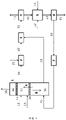
- Figure 1 essentially shows that a gas feed of air, urea dust and ammonia is separated over multiple separation sections of a scrubber to provide a separate urea processing line and a separate ammonia processing line.
- a compartment refers to one or more than one compartment.
- the value to which the modifier "about” refers is itself also specifically disclosed.
- S/N ratio as used within the context of the present disclosure is to be understood as the ratio of sulphur (S) atoms to nitrogen (N) atoms within a mixture, i.e. a urea ammonium sulphate mixture.
- the current invention provides in a solution for at least one of the above mentioned problems by providing a method for processing a gas stream comprising urea dust and ammonia.
- the present invention provides a method for processing a gas stream comprising air, urea dust and ammonia, for the production of urea ammonium sulphate, whereby the urea dust and ammonia in said gas stream is separated from each other in a multi-stage separator at a temperature between 60 °C and 70 °C and further processed into a separate urea processing line and an ammonia processing line, respectively, wherein, prior to said separation, said urea dust is sequestered from said gas stream comprising air, urea dust and ammonia by absorption into a water aerosol in a mist chamber, thereby obtaining a urea aerosol, which is subsequently condensed.
- the methodof the present invention further comprises the steps of:
- a second advantage of the present invention is that urea and ammonium sulphate are processed separately, allowing for the respective urea solution and ammonium sulphate solution to be mixed in the required S/N ratio. This is advantageous since other process parameters such as rate of adding sulphuric acid, evaporation of water and temperature control during preceding steps can remain constant during the previous process steps. This significantly allows for a better process control, avoids further decomposition risks and allows for a better energy balance of the process.
- a third advantage of the present invention is that the proposed method allows to adapt S/N ratio of the ammonium sulphate solution to be optimized for minimal corrosive behaviour, while the S/N ratio of the urea ammonium sulphate solution can be optimized independently to provide a desired fertilizer having a predetermined S/N ratio.
- the present invention provides a method according to the first aspect, whereby said ammonia is separated from said urea dust by passage of said gas stream comprising air, urea dust and ammonia over a multi-stage separation scrubber.
- a gas and dust multi-stage separation scrubber allows for a selective separation of ammonia and urea dust.
- the present invention provides a method according to the first aspect, whereby ammonia separated from said urea dust is subsequently contacted with an aqueous solution of sulphuric acid, thereby obtaining an aqueous solution of ammonium sulphate and an excess of sulphuric acid.
- Contacting of ammonia with sulphuric acid preferably occurs after passing a wet packing system, which is kept wet by adding water and which is sprayed upon with an aqueous sulphuric acid solution through a nozzle, thereby providing an acidic film on the packing which increases the contact with the gaseous ammonia. Accordingly, the ammonia can be absorbed effectively.
- the aqueous sulphuric acid has a concentration of at least 50 wt.% of sulphuric acid, and more preferably of at least 90 wt.% of sulphuric acid, and even more preferably of 90, 92, 94, 96, 98 wt.% of sulphuric acid, or any concentration there in between.
- Lower concentrations of sulphuric acid behave relatively less corrosive, thereby lowering the oxidation resistant requirements towards the materials, i.e. the nozzles and the scrubber.
- concentration of sulphuric acid become too low, the obtained aqueous solution of ammonium sulphate and an excess of sulphuric acid becomes very diluted, thereby requiring high energy input for the final water content reduction.
- said excess of sulphuric acid is provided in a molar ratio of sulphuric acid to ammonia smaller than 1.5, and more preferably smaller than 1.1. Larger excesses of sulphuric acid allow for a faster and/or more quantitative removal of ammonia from the gas stream, but also lead to higher excesses of sulphuric acid in the aqueous solution of ammonium sulphate and an excess of sulphuric acid. The excess of sulphuric acid can later be neutralized, i.e. by addition of gaseous or liquid ammonia.
- Air and/or other gases in the ammonia gas stream may be evacuated from the scrubber after contact with said aqueous solution of sulphuric acid.
- said evacuated gas stream is further at least partially recycled to the compartment of the scrubber for additional contacting with an said aqueous solution of sulphuric acid. This is advantageous for further lowering the concentration of ammonia in the effluent gas which is evacuated from the scrubber.
- Such effluent gas may be disposed in the atmosphere or may be further treated to additionally lower the concentration of ammonia.
- the present invention provides a method according to the first aspect, whereby said excess of sulphuric acid is neutralized with ammonia to a S/N ratio of about 1:2, and subsequently concentrated to obtain an ammonium sulphate solution.
- S/N ratio assures that the melt shows a minimal corrosive behaviour which reduces requirements towards the process equipment.
- the present invention provides a method according to the first aspect, whereby said urea dust in the step of separating urea dust and ammonia from each other is sequestered from said gas stream comprising urea dust and ammonia by absorption in water, thereby obtaining an aqueous solution of urea.
- water is sprayed through a nozzle thereby forming a water vapour in which the urea dust can be entrapped and subsequently condensed to form an aqueous urea solution.
- urea dust can be effectively removed from the gas stream.
- the present invention provides a method according to the first aspect, whereby said aqueous solution of urea is evaporated to yield urea solid.
- the present invention provides a method according to the first aspect, whereby said aqueous solution of urea is evaporated to yield urea solution having a water content of less than 5 wt.%. More preferably, said urea solution is concentrated to a water content of less than 4 wt.%, and even more preferably less than 3 wt.%.
- the present invention provides a method according to the first aspect, whereby said ammonium sulphate solution and said urea solution are mixed to obtain urea ammonium sulphate having a predetermined S/N ratio.
- the present invention provides a method according to the first aspect, whereby said ammonium sulphate solution and said urea solution are mixed and subsequently granulated to obtain urea ammonium sulphate granules.
- the proposed granulation of ammonium sulphate solution and urea solution allows for intimately mixing of both product streams to provide a homogeneous mixture of urea ammonium sulphate.
- the present invention provides a method according to the first aspect, whereby water is evaporated from said ammonium sulphate solution and/or from said urea solution before mixing and/or before granulating.
- the present invention provides a method according to the first aspect, whereby said gas stream comprising urea dust and ammonia is an exhaust gas from a urea plant, a urea granulation unit, a urea prilling tower or a chemical fertilizer plant.
- said gas stream is contacted with water in the multi-stage separator, thereby obtaining a gas phase comprising ammonia and a urea solution, and said method further comprises the steps of:
- Figure 1 essentially shows that a gas feed comprising air, urea dust and ammonia is separated over a packing to provide a urea processing line and an ammonia processing line.
- a supply flow 62 comprising air, urea dust, ammonia and optionally a smaller fraction of ammonium sulphate, is contacted with a water mist in mist chamber 7.
- the mist chamber 7 ensures that urea dust is absorbed in water droplets, thereby forming an urea aerosol.
- the accordingly formed urea aerosol 71 is led to a multi-stage separator 1 at a temperature between 60°C and 70°C. At such temperatures, ammonia in the aerosol 71 is predominantly in the gaseous phase, and as such can pass over the packing 1a according to arrow A.
- packing 1a is kept wet by addition of water via inlet 13.
- Urea is trapped in the compartment 1b of the separator before the packing 1a and condensed to a concentrated aqueous urea solution 11 . This concentrated urea solution can then be further concentrated before being mixed with ammonium sulphate in mixer 3.
- the ammonia flow which has passed the packing 1a is subsequently scrubbed with a 96 wt.% sulphuric acid solution 12 in the top part 1c of the scrubber 1, thereby obtaining an acidic ammonium sulphate solution 14.
- a 96 wt.% sulphuric acid solution 12 in the top part 1c of the scrubber 1, thereby obtaining an acidic ammonium sulphate solution 14.
- the solution is mixed intensively to improve contact between the gaseous ammonia and liquid sulphuric acid.
- Suitable scrubbers can be selected from any of the wet-type scrubbers well known in the industry. Scrubbers may be selected from the type of scrubbers as summarized in Chemical Engineers Handbook (Perry and Chilton), fifth edition, page 20-94 to 20-103 .
- Circulation of the acidic ammonium sulphate solution over the top part 1e of the scrubber 1 may be advisable for a more quantitative removal of ammonia from the exhaust air stream 15.
- Exhaust air 15 is evacuated from the reactor 1 and disposed in the atmosphere or - if necessary - further treated to meet environmental regulations.
- the acidic ammonium sulphate solution is transferred through line 14 to reactor 2 and neutralized using ammonia, added through line 21.
- the exothermic reaction produces heat which allows water in the solution to be heated.
- an aqueous ammonium sulphate solution with an S/N ratio of 1:2 is transferred through line 22 to a mixer 3 where it is mixed with the urea solution form line 11 coming from scrubber 1.
- the mixed solution is fed through line 31 to an evaporator 4 for evaporating water, which is evacuated through line 41 and for providing an ammonium sulphate melt comprising less than 5 wt.% of water.
- the concentrated urea ammonium sulphate solution form separator 4 can be mixed with ammonium sulphate 51 and/or a concentrated urea solution 52 in mixer 5 to ensure the proper S/N ratio of the final product 53.
- the concentration of the urea ammonium sulphate solution or slurry (in line 53 to the granulator 6) can be controlled by adjusting the ammonium sulphate feed (through line 51 ) and the urea feed (through line 52) in amounts to provide a desired, predetermined S/N ratio and granulated in a granulation unit 6 to provide urea ammonium sulphate granules, which are discharged through line 61.
- this process can be carried out in a prilling tower or a pelletizer in series with a solidification belt.
Landscapes
- Chemical & Material Sciences (AREA)
- Organic Chemistry (AREA)
- Analytical Chemistry (AREA)
- Inorganic Chemistry (AREA)
- Engineering & Computer Science (AREA)
- Health & Medical Sciences (AREA)
- Biomedical Technology (AREA)
- Environmental & Geological Engineering (AREA)
- General Chemical & Material Sciences (AREA)
- Oil, Petroleum & Natural Gas (AREA)
- Chemical Kinetics & Catalysis (AREA)
- Treating Waste Gases (AREA)
Description
- The present invention relates to the field of processing a gas stream comprising urea dust and ammonia.
- The production of urea is known from carbon dioxide and an excess amount of ammonia, and provides a urea granulate, suitable for fertilizer applications. Minor amount of solid urea dust and ammonia (liquid or gaseous) are however entrapped in effluent gas streams. Before disposal into the atmosphere, the amount of urea dust and ammonia is to be reduced to environmentally acceptable levels. Preferably, such urea and ammonia is recycled.
-
JP 9,227,493 -
WO 2011/032786 describes a method for recovery of urea dust and ammonia from a gas stream by contacting said gas stream with an aqueous sulphuric acid solution, thus forming an acidic solution of ammonium sulphate and urea, whereby the acidic solution is neutralized using ammonia and subsequently concentrated to a urea ammonium sulphate melt comprising less than 5 wt.% of water. This melt is then converted into solid particles comprising urea and ammonium sulphate. -
JP 2000/001466 - Methods according to the state of the art are however limited. Contacting ammonia with sulphuric acid in presence of urea provides an inherent risk of decomposition since urea decomposes to carbon dioxide and ammonium sulphate upon contact with sulphuric acid. This decomposition risk is more pronounced since the reaction of ammonia with sulphuric acid is highly exothermic. Therefore, a complete or quantitative removal of ammonia from urea is mandatory for safe production of urea ammonium sulphate. Furthermore, the state of the art provides sequential process schemes which are very rigid and do not allow for large variations in gas stream feed composition as well as in variations of product output. Additionally, such processes do not allow for an extended degree of materials and energy optimization of the entire process.
- It will be shown that the present invention provides a process for significantly reducing or completely avoiding decomposition risk, and simultaneously allows for optimization in materials and energy balances.
- The current invention provides a solution for at least one of the above mentioned problems by providing a method for processing a gas stream comprising at least urea dust and ammonia (liquid or gaseous). The present invention is defined by the appended claims.
- The present invention provides a method for processing a gas stream comprising air, urea dust and ammonia, for the production of urea ammonium sulphate, whereby the urea dust and ammonia in said gas stream is separated from each other in a multi-stage separator at a temperature between 60 °C and 70 °C and further processed into a separate urea processing line and an ammonia processing line, respectively, wherein, prior to said separation, said urea dust is sequestered from said gas stream comprising air, urea dust and ammonia by absorption into a water aerosol in a mist chamber, thereby obtaining a urea aerosol, which is subsequently condensed.
- In one embodiment, the method for processing a gas stream comprising air, urea dust and ammonia, comprises the steps of:
- (a) separating said ammonia from said urea aerosol,
- (b) converting said urea aerosol into an aqueous urea solution,
- (c) converting said ammonia to an aqueous ammonium sulphate solution, and
- (d) mixing said aqueous urea solution and said aqueous ammonium sulphate solution, thereby obtaining an urea ammonium sulphate solution.
- The gas stream comprising urea dust and ammonia further comprises air. Hence the gas stream, as used in this application, is a stream of at least air, comprising at least nitrogen and oxygen in variable concentration. Preferably, the air is atmospheric air comprising a naturally occurring nitrogen and oxygen content, preferably comprising about 78 % nitrogen and about 21 % oxygen, more preferably comprising about 78 % nitrogen, about 21 % oxygen, about 0.9 % argon, about 0.04 % carbon dioxide, and small amounts of other gases.
- The present invention is advantageous in that (i) sulphuric acid used for converting ammonia to ammonium sulphate does not contact with urea, thereby avoiding decomposition risk upon urea decomposition; (ii) urea and ammonium sulphate are processed separately, allowing for improved process control and energy balance; (iii) the proposed method allows to adapt sulphur (S) to nitrogen (N) (S/N) ratio of the ammonium sulphate solution to be optimized independently from the S/N ratio of the urea ammonium sulphate.
- By means of further guidance, a figure is included to better appreciate the teaching of the present invention. Said figure is intended to assist the description of the invention and is nowhere intended as a limitation of the presently disclosed invention.
- The figure and symbols contained therein have the meaning as commonly understood by one of ordinary skill in the art to which this invention belongs.
-
Figure 1 essentially shows that a gas feed of air, urea dust and ammonia is separated over multiple separation sections of a scrubber to provide a separate urea processing line and a separate ammonia processing line. - Unless otherwise defined, all terms used in disclosing the invention, including technical and scientific terms, have the meaning as commonly understood by one of ordinary skill in the art to which this invention belongs. By means of further guidance, term definitions are included to better appreciate the teaching of the present invention.
- As used herein, the following terms have the following meanings:
"A", "an", and "the" as used herein refers to both singular and plural referents unless the context clearly dictates otherwise. By way of example, "a compartment" refers to one or more than one compartment. - "About" as used herein referring to a measurable value such as a parameter, an amount, a temporal duration, and the like, is meant to encompass variations of +/-20% or less, preferably +/-10% or less, more preferably +/-5% or less, even more preferably +/-1% or less, and still more preferably +/-0.1% or less of and from the specified value, in so far such variations are appropriate to perform in the disclosed invention. However, it is to be understood that the value to which the modifier "about" refers is itself also specifically disclosed.
- "Comprise," "comprising," and "comprises" and "comprised of" as used herein are synonymous with "include", "including", "includes" or "contain", "containing", "contains" and are inclusive or open-ended terms that specifies the presence of what follows e.g. component and do not exclude or preclude the presence of additional, non-recited components, features, element, members, steps, known in the art or disclosed therein.
- The recitation of numerical ranges by endpoints includes all numbers and fractions subsumed within that range, as well as the recited endpoints. All percentages are to be understood as percentage by weight and are abbreviated as "%wt.", unless otherwise defined or unless a different meaning is obvious to the person skilled in the art from its use and in the context wherein it is used.
- The term "S/N ratio" as used within the context of the present disclosure is to be understood as the ratio of sulphur (S) atoms to nitrogen (N) atoms within a mixture, i.e. a urea ammonium sulphate mixture.
- The current invention provides in a solution for at least one of the above mentioned problems by providing a method for processing a gas stream comprising urea dust and ammonia.
- In a first aspect, the present invention provides a method for processing a gas stream comprising air, urea dust and ammonia, for the production of urea ammonium sulphate, whereby the urea dust and ammonia in said gas stream is separated from each other in a multi-stage separator at a temperature between 60 °C and 70 °C and further processed into a separate urea processing line and an ammonia processing line, respectively, wherein, prior to said separation, said urea dust is sequestered from said gas stream comprising air, urea dust and ammonia by absorption into a water aerosol in a mist chamber, thereby obtaining a urea aerosol, which is subsequently condensed.
- In an embodiment, the methodof the present invention further comprises the steps of:
- (a) separating said ammonia from said urea aerosol),
- (b) converting said urea aerosol) into an aqueous urea solution,
- (c) converting said ammonia into an aqueous ammonium sulphate solution,
- (d) mixing said aqueous urea solution and said aqueous ammonium sulphate solution, thereby obtaining a urea ammonium sulphate solution, and
- (e) optionally, concentrating said aqueous urea solution, said aqueous ammonium sulphate solution, and/or said urea ammonium sulphate solution. A first advantage of the present invention is that sulphuric acid used for converting ammonia to ammonium sulphate does not contact with urea. Urea and sulphuric acid can react, resulting in the decomposition of urea to ammonia and carbon dioxide, after which the ammonia can react with the sulphuric acid. Such a reaction is very exothermic and the evolution of carbon dioxide gas during the reaction may result in decomposition risk.
- A second advantage of the present invention is that urea and ammonium sulphate are processed separately, allowing for the respective urea solution and ammonium sulphate solution to be mixed in the required S/N ratio. This is advantageous since other process parameters such as rate of adding sulphuric acid, evaporation of water and temperature control during preceding steps can remain constant during the previous process steps. This significantly allows for a better process control, avoids further decomposition risks and allows for a better energy balance of the process.
- A third advantage of the present invention is that the proposed method allows to adapt S/N ratio of the ammonium sulphate solution to be optimized for minimal corrosive behaviour, while the S/N ratio of the urea ammonium sulphate solution can be optimized independently to provide a desired fertilizer having a predetermined S/N ratio.
- In a preferred embodiment, the present invention provides a method according to the first aspect, whereby said ammonia is separated from said urea dust by passage of said gas stream comprising air, urea dust and ammonia over a multi-stage separation scrubber. A gas and dust multi-stage separation scrubber allows for a selective separation of ammonia and urea dust.
- In a preferred embodiment, the present invention provides a method according to the first aspect, whereby ammonia separated from said urea dust is subsequently contacted with an aqueous solution of sulphuric acid, thereby obtaining an aqueous solution of ammonium sulphate and an excess of sulphuric acid. Contacting of ammonia with sulphuric acid preferably occurs after passing a wet packing system, which is kept wet by adding water and which is sprayed upon with an aqueous sulphuric acid solution through a nozzle, thereby providing an acidic film on the packing which increases the contact with the gaseous ammonia. Accordingly, the ammonia can be absorbed effectively. Preferably, the aqueous sulphuric acid has a concentration of at least 50 wt.% of sulphuric acid, and more preferably of at least 90 wt.% of sulphuric acid, and even more preferably of 90, 92, 94, 96, 98 wt.% of sulphuric acid, or any concentration there in between. Lower concentrations of sulphuric acid behave relatively less corrosive, thereby lowering the oxidation resistant requirements towards the materials, i.e. the nozzles and the scrubber. However, when concentration of sulphuric acid become too low, the obtained aqueous solution of ammonium sulphate and an excess of sulphuric acid becomes very diluted, thereby requiring high energy input for the final water content reduction.
- In a more preferred embodiment, said excess of sulphuric acid is provided in a molar ratio of sulphuric acid to ammonia smaller than 1.5, and more preferably smaller than 1.1. Larger excesses of sulphuric acid allow for a faster and/or more quantitative removal of ammonia from the gas stream, but also lead to higher excesses of sulphuric acid in the aqueous solution of ammonium sulphate and an excess of sulphuric acid. The excess of sulphuric acid can later be neutralized, i.e. by addition of gaseous or liquid ammonia.
- Air and/or other gases in the ammonia gas stream may be evacuated from the scrubber after contact with said aqueous solution of sulphuric acid. In a preferred embodiment, said evacuated gas stream is further at least partially recycled to the compartment of the scrubber for additional contacting with an said aqueous solution of sulphuric acid. This is advantageous for further lowering the concentration of ammonia in the effluent gas which is evacuated from the scrubber. Such effluent gas may be disposed in the atmosphere or may be further treated to additionally lower the concentration of ammonia.
- In a preferred embodiment, the present invention provides a method according to the first aspect, whereby said excess of sulphuric acid is neutralized with ammonia to a S/N ratio of about 1:2, and subsequently concentrated to obtain an ammonium sulphate solution. Providing an ammonium sulphate melt in the above mention S/N ratio assures that the melt shows a minimal corrosive behaviour which reduces requirements towards the process equipment.
- In a preferred embodiment, the present invention provides a method according to the first aspect, whereby said urea dust in the step of separating urea dust and ammonia from each other is sequestered from said gas stream comprising urea dust and ammonia by absorption in water, thereby obtaining an aqueous solution of urea. Preferably, water is sprayed through a nozzle thereby forming a water vapour in which the urea dust can be entrapped and subsequently condensed to form an aqueous urea solution. As such, urea dust can be effectively removed from the gas stream.
- In a preferred embodiment, the present invention provides a method according to the first aspect, whereby said aqueous solution of urea is evaporated to yield urea solid.
- In a preferred embodiment, the present invention provides a method according to the first aspect, whereby said aqueous solution of urea is evaporated to yield urea solution having a water content of less than 5 wt.%. More preferably, said urea solution is concentrated to a water content of less than 4 wt.%, and even more preferably less than 3 wt.%.
- In a preferred embodiment, the present invention provides a method according to the first aspect, whereby said ammonium sulphate solution and said urea solution are mixed to obtain urea ammonium sulphate having a predetermined S/N ratio.
- In a preferred embodiment, the present invention provides a method according to the first aspect, whereby said ammonium sulphate solution and said urea solution are mixed and subsequently granulated to obtain urea ammonium sulphate granules. The proposed granulation of ammonium sulphate solution and urea solution allows for intimately mixing of both product streams to provide a homogeneous mixture of urea ammonium sulphate.
- In a preferred embodiment, the present invention provides a method according to the first aspect, whereby water is evaporated from said ammonium sulphate solution and/or from said urea solution before mixing and/or before granulating.
- In a preferred embodiment, the present invention provides a method according to the first aspect, whereby said gas stream comprising urea dust and ammonia is an exhaust gas from a urea plant, a urea granulation unit, a urea prilling tower or a chemical fertilizer plant.
- In one embodiment of the method for processing a gas stream comprising air, urea dust and ammonia for the production of urea ammonium sulphate, said gas stream is contacted with water in the multi-stage separator, thereby obtaining a gas phase comprising ammonia and a urea solution, and said method further comprises the steps of:
- (i) contacting said gas phase comprising ammonia with an excess of sulphuric acid in water, thereby obtaining an aqueous solution of ammonium sulphate and an excess of sulphuric acid,
- (ii) neutralizing said aqueous solution of ammonium sulphate and an excess of sulphuric acid with ammonia, thereby obtaining an ammonium sulphate solution,
- (iii) mixing said urea solution with said ammonium sulphate solution,
- (iv) concentrating the mixed urea and ammonium sulphate solution,
- (v) adding ammonium sulphate and/or urea to the mixed urea ammonium sulphate solution, thereby increasing the ammonium sulphate concentration to a desired concentration and capacity,
- (vi) granulating the mixture obtained from step (v), thereby obtaining solid particles comprising urea ammonium sulphate.
- The process of the invention is illustrated more detailed in
Figure 1. Figure 1 essentially shows that a gas feed comprising air, urea dust and ammonia is separated over a packing to provide a urea processing line and an ammonia processing line. - A
supply flow 62 comprising air, urea dust, ammonia and optionally a smaller fraction of ammonium sulphate, is contacted with a water mist inmist chamber 7. Themist chamber 7 ensures that urea dust is absorbed in water droplets, thereby forming an urea aerosol. The accordingly formedurea aerosol 71 is led to amulti-stage separator 1 at a temperature between 60°C and 70°C. At such temperatures, ammonia in theaerosol 71 is predominantly in the gaseous phase, and as such can pass over thepacking 1a according to arrow A. To improve separation of urea dust and ammonia, it is ensured that packing 1a is kept wet by addition of water viainlet 13. Urea is trapped in thecompartment 1b of the separator before thepacking 1a and condensed to a concentratedaqueous urea solution 11. This concentrated urea solution can then be further concentrated before being mixed with ammonium sulphate inmixer 3. - The ammonia flow which has passed the
packing 1a is subsequently scrubbed with a 96 wt.%sulphuric acid solution 12 in thetop part 1c of thescrubber 1, thereby obtaining an acidicammonium sulphate solution 14. In order to sequester ammonia in thesulphuric acid solution 12, the solution is mixed intensively to improve contact between the gaseous ammonia and liquid sulphuric acid. Suitable scrubbers can be selected from any of the wet-type scrubbers well known in the industry. Scrubbers may be selected from the type of scrubbers as summarized in Chemical Engineers Handbook (Perry and Chilton), fifth edition, page 20-94 to 20-103. Circulation of the acidic ammonium sulphate solution over the top part 1e of thescrubber 1 may be advisable for a more quantitative removal of ammonia from theexhaust air stream 15.Exhaust air 15 is evacuated from thereactor 1 and disposed in the atmosphere or - if necessary - further treated to meet environmental regulations. - The acidic ammonium sulphate solution is transferred through
line 14 toreactor 2 and neutralized using ammonia, added throughline 21. The exothermic reaction produces heat which allows water in the solution to be heated. Accordingly, an aqueous ammonium sulphate solution with an S/N ratio of 1:2 is transferred throughline 22 to amixer 3 where it is mixed with the ureasolution form line 11 coming fromscrubber 1. The mixed solution is fed throughline 31 to anevaporator 4 for evaporating water, which is evacuated throughline 41 and for providing an ammonium sulphate melt comprising less than 5 wt.% of water. - The concentrated urea ammonium sulphate
solution form separator 4 can be mixed withammonium sulphate 51 and/or aconcentrated urea solution 52 inmixer 5 to ensure the proper S/N ratio of thefinal product 53. As such, the concentration of the urea ammonium sulphate solution or slurry (inline 53 to the granulator 6) can be controlled by adjusting the ammonium sulphate feed (through line 51) and the urea feed (through line 52) in amounts to provide a desired, predetermined S/N ratio and granulated in agranulation unit 6 to provide urea ammonium sulphate granules, which are discharged throughline 61. Alternatively, this process can be carried out in a prilling tower or a pelletizer in series with a solidification belt. -
- 1
- Scrubber, multi-stage separator
- 1a
- Urea packing, multi-stage aerosol separator
- 1b
- Compartment of scrubber
- 1c
- Compartment of scrubber
- 1d
- Ammonia packing
- 1e
- Scrubber top compartment
- 2
- Reactor Evaporator
- 3
- Mixer
- 4
- Evaporator/separator
- 5
- Mixer
- 6
- Granulation unit
- 7
- Aerosol chamber/mist chamber (demister)
- 11
- Urea solution
- 12
- Sulphuric acid
- 13
- Water
- 14
- Acidic ammonium sulphate solution
- 15
- Exhaust air stream
- 21
- Ammonia supply
- 22
- Ammonium sulphate solution
- 31
- Urea ammonium sulphate solution
- 41
- Water vapour
- 42
- Highly concentrated ammonium sulphate solution
- 51
- Ammonium sulphate
- 52
- Concentrated urea solution
- 53
- Highly concentrated urea ammonium sulphate solution or slurry
- 61
- Discharge flow end product
- 62
- Air, dust and ammonia from granulation unit
- 71
- Urea aerosol comprising air and ammonia
Claims (10)
- Method for processing a gas stream comprising air, urea dust and ammonia, for the production of urea ammonium sulphate, whereby the urea dust and ammonia in said gas stream is separated from each other in a multi-stage separator at a temperature between 60 °C and 70 °C and further processed into a separate urea processing line and an ammonia processing line, respectively, characterized in that, prior to said separation, said urea dust is sequestered from said gas stream comprising air, urea dust and ammonia by absorption into a water aerosol in a mist chamber, thereby obtaining a urea aerosol, which is subsequently condensed.
- Method according to claim 1, comprising the further steps of:(a) separating said ammonia from said urea aerosol,(b) converting said urea aerosol into an aqueous urea solution,(c) converting said ammonia into an aqueous ammonium sulphate solution,(d) mixing said aqueous urea solution and said aqueous ammonium sulphate solution, thereby obtaining a urea ammonium sulphate solution, and(e) optionally, concentrating said aqueous urea solution, said aqueous ammonium sulphate solution, and/or said urea ammonium sulphate solution.
- Method according to claim 1, whereby ammonia, separated from said urea dust, is subsequently contacted with an aqueous solution of sulphuric acid, thereby obtaining an aqueous solution of ammonium sulphate and an excess of sulphuric acid.
- Method according to claim 3, whereby said excess of sulphuric acid is neutralized with ammonia to a ratio of sulphur (S) atoms to nitrogen (N) atoms (S/N ratio) of about 1:2, and subsequently concentrated to obtain an ammonium sulphate solution.
- Method according to claim 4, whereby said aqueous urea solution and said ammonium sulphate solution are mixed, thereby obtaining a urea ammonium sulphate solution.
- Method according to claim 5, whereby said aqueous urea ammonium sulphate solution is concentrated to a water content of less than 5 wt%.
- Method according to claim 5 or 6, whereby said urea ammonium sulphate solution is mixed with urea and/or ammonium sulphate to obtain an urea ammonium sulphate solution or slurry having a predetermined ratio of sulphur (S) atoms to nitrogen (N) atoms (S/N ratio).
- Method according to claim 7, whereby said urea ammonium sulphate solution or slurry is granulated to obtain urea ammonium sulphate granules.
- Method according to any one of claims 1 to 8, whereby said gas stream comprising urea dust and ammonia is an exhaust gas from a plant, a granulation unit, a prilling tower or a chemical fertilizer plant.
- Method according to claim 1, wherein in the multi-stage separator said gas stream is contacted with water, thereby obtaining a gas phase comprising ammonia and a urea solution, and said method further comprising the steps of:(i) contacting said gas phase comprising ammonia with an excess of sulphuric acid in water, thereby obtaining an aqueous solution of ammonium sulphate and an excess of sulphuric acid,(ii) neutralizing said aqueous solution of ammonium sulphate and an excess of sulphuric acid with ammonia, thereby obtaining an ammonium sulphate solution,(iii) mixing said urea solution with said ammonium sulphate solution,(iv) concentrating the mixed urea and ammonium sulphate solution,(v) adding ammonium sulphate and/or urea to the mixed urea ammonium sulphate solution, thereby increasing the ammonium sulphate concentration to a desired concentration and capacity,(vi) granulating the mixture obtained from step (v), thereby obtaining solid particles comprising urea ammonium sulphate.
Applications Claiming Priority (2)
| Application Number | Priority Date | Filing Date | Title |
|---|---|---|---|
| EP16207499 | 2016-12-30 | ||
| PCT/EP2017/084819 WO2018122379A1 (en) | 2016-12-30 | 2017-12-29 | Method for processing a gas stream comprising urea dust and ammonia |
Publications (3)
| Publication Number | Publication Date |
|---|---|
| EP3562784A1 EP3562784A1 (en) | 2019-11-06 |
| EP3562784B1 true EP3562784B1 (en) | 2022-11-02 |
| EP3562784B8 EP3562784B8 (en) | 2022-12-07 |
Family
ID=57962979
Family Applications (1)
| Application Number | Title | Priority Date | Filing Date |
|---|---|---|---|
| EP17832787.0A Active EP3562784B8 (en) | 2016-12-30 | 2017-12-29 | Method for processing a gas stream comprising urea dust and ammonia |
Country Status (2)
| Country | Link |
|---|---|
| EP (1) | EP3562784B8 (en) |
| WO (1) | WO2018122379A1 (en) |
Families Citing this family (5)
| Publication number | Priority date | Publication date | Assignee | Title |
|---|---|---|---|---|
| CN109603443B (en) * | 2019-02-15 | 2021-08-03 | 陕西陕化煤化工集团有限公司 | Recovery unit of ammonia among well low pressure unloading gas |
| EP3808432A1 (en) * | 2019-10-16 | 2021-04-21 | Yara International ASA | Apparatus and method for processing exhaust gas |
| DE102019216931A1 (en) * | 2019-11-04 | 2021-05-06 | Thyssenkrupp Ag | Process and plant for the production of urea granulate |
| EP3831465A1 (en) * | 2019-12-06 | 2021-06-09 | Yara International ASA | Apparatus and method for processing exhaust gas |
| CN115367795B (en) * | 2022-09-01 | 2024-02-20 | 山东东佳集团股份有限公司 | A new process for producing ammonium sulfate by recycling catalyst titanium dioxide water wash liquid into acid-making tail gas system |
Family Cites Families (6)
| Publication number | Priority date | Publication date | Assignee | Title |
|---|---|---|---|---|
| JPH09227493A (en) | 1996-02-27 | 1997-09-02 | Toyo Eng Corp | Urea dust and ammonia recovery method from exhaust gas |
| JP2000001466A (en) | 1998-06-12 | 2000-01-07 | Toyo Eng Corp | Recovery and utilization of urea dust and ammonia in exhaust gas |
| JP2000279736A (en) * | 1999-03-29 | 2000-10-10 | Toyo Eng Corp | Apparatus for treating fluid containing urea dust and ammonia, treatment method using the same, and urea production apparatus provided with the same |
| CN101863696A (en) * | 2009-08-24 | 2010-10-20 | 北京九州美电环保工程有限公司 | Process for producing urea ammonium sulfate by using by-product of ammonium sulfate from flue gas desulfurization with ammonia process |
| EP2301917A1 (en) | 2009-09-16 | 2011-03-30 | Stamicarbon B.V. | Removal of urea and ammonia from exhaust gases |
| CN202933617U (en) * | 2012-09-21 | 2013-05-15 | 中国五环工程有限公司 | Ammoniated tail gas treatment system for fluidized bed large granular urea device |
-
2017
- 2017-12-29 WO PCT/EP2017/084819 patent/WO2018122379A1/en not_active Ceased
- 2017-12-29 EP EP17832787.0A patent/EP3562784B8/en active Active
Also Published As
| Publication number | Publication date |
|---|---|
| EP3562784A1 (en) | 2019-11-06 |
| EP3562784B8 (en) | 2022-12-07 |
| WO2018122379A1 (en) | 2018-07-05 |
Similar Documents
| Publication | Publication Date | Title |
|---|---|---|
| EP3562784A1 (en) | Method for processing a gas stream comprising urea dust and ammonia | |
| US6066304A (en) | Process for removing sulfur dioxide out of a gas | |
| US9556077B2 (en) | Removal of urea and ammonia from exhaust gases | |
| EP2386346A1 (en) | Process for the reduction of ammonia emissions in a urea manufacturing process | |
| JP7277672B2 (en) | Ammonia removal from urea finish | |
| EP3393626B1 (en) | Urea ammonium nitrate production comprising condensation | |
| CN110944731A (en) | Catalytic oxidation of NOx/SOx in flue gas using atmospheric oxygen as oxidizing agent | |
| CN112174165A (en) | Semiconductor grade ammonia water and sulfuric acid recycling and manufacturing method | |
| EP3562783B1 (en) | Processing of exhaust gases from a urea plant | |
| EP2935157B1 (en) | Method for reducing the visible downwind detached plume opacity | |
| TWI757641B (en) | Semiconductor grade ammonia water and sulfuric acid recycling and manufacturing method | |
| US10654758B2 (en) | Urea ammonium nitrate production | |
| CN108002352A (en) | A kind of method of troilite melting flue gas extracting sulfuric acid |
Legal Events
| Date | Code | Title | Description |
|---|---|---|---|
| STAA | Information on the status of an ep patent application or granted ep patent |
Free format text: STATUS: UNKNOWN |
|
| STAA | Information on the status of an ep patent application or granted ep patent |
Free format text: STATUS: THE INTERNATIONAL PUBLICATION HAS BEEN MADE |
|
| PUAI | Public reference made under article 153(3) epc to a published international application that has entered the european phase |
Free format text: ORIGINAL CODE: 0009012 |
|
| STAA | Information on the status of an ep patent application or granted ep patent |
Free format text: STATUS: REQUEST FOR EXAMINATION WAS MADE |
|
| 17P | Request for examination filed |
Effective date: 20190726 |
|
| AK | Designated contracting states |
Kind code of ref document: A1 Designated state(s): AL AT BE BG CH CY CZ DE DK EE ES FI FR GB GR HR HU IE IS IT LI LT LU LV MC MK MT NL NO PL PT RO RS SE SI SK SM TR |
|
| AX | Request for extension of the european patent |
Extension state: BA ME |
|
| DAV | Request for validation of the european patent (deleted) | ||
| DAX | Request for extension of the european patent (deleted) | ||
| STAA | Information on the status of an ep patent application or granted ep patent |
Free format text: STATUS: EXAMINATION IS IN PROGRESS |
|
| 17Q | First examination report despatched |
Effective date: 20200703 |
|
| GRAP | Despatch of communication of intention to grant a patent |
Free format text: ORIGINAL CODE: EPIDOSNIGR1 |
|
| STAA | Information on the status of an ep patent application or granted ep patent |
Free format text: STATUS: GRANT OF PATENT IS INTENDED |
|
| INTG | Intention to grant announced |
Effective date: 20220615 |
|
| GRAS | Grant fee paid |
Free format text: ORIGINAL CODE: EPIDOSNIGR3 |
|
| GRAA | (expected) grant |
Free format text: ORIGINAL CODE: 0009210 |
|
| STAA | Information on the status of an ep patent application or granted ep patent |
Free format text: STATUS: THE PATENT HAS BEEN GRANTED |
|
| GRAT | Correction requested after decision to grant or after decision to maintain patent in amended form |
Free format text: ORIGINAL CODE: EPIDOSNCDEC |
|
| REG | Reference to a national code |
Ref country code: DE Ref legal event code: R081 Ref document number: 602017063343 Country of ref document: DE Owner name: YARA INTERNATIONAL ASA, NO Free format text: FORMER OWNER: YARA INTERNATIONAL ASA, OSLO, NO |
|
| AK | Designated contracting states |
Kind code of ref document: B1 Designated state(s): AL AT BE BG CH CY CZ DE DK EE ES FI FR GB GR HR HU IE IS IT LI LT LU LV MC MK MT NL NO PL PT RO RS SE SI SK SM TR |
|
| REG | Reference to a national code |
Ref country code: GB Ref legal event code: FG4D |
|
| REG | Reference to a national code |
Ref country code: CH Ref legal event code: PK Free format text: BERICHTIGUNG B8 Ref country code: CH Ref legal event code: EP Ref country code: AT Ref legal event code: REF Ref document number: 1528647 Country of ref document: AT Kind code of ref document: T Effective date: 20221115 |
|
| RAP4 | Party data changed (patent owner data changed or rights of a patent transferred) |
Owner name: YARA INTERNATIONAL ASA |
|
| REG | Reference to a national code |
Ref country code: DE Ref legal event code: R096 Ref document number: 602017063343 Country of ref document: DE |
|
| REG | Reference to a national code |
Ref country code: IE Ref legal event code: FG4D |
|
| REG | Reference to a national code |
Ref country code: LT Ref legal event code: MG9D |
|
| REG | Reference to a national code |
Ref country code: NL Ref legal event code: MP Effective date: 20221102 |
|
| REG | Reference to a national code |
Ref country code: AT Ref legal event code: MK05 Ref document number: 1528647 Country of ref document: AT Kind code of ref document: T Effective date: 20221102 |
|
| PG25 | Lapsed in a contracting state [announced via postgrant information from national office to epo] |
Ref country code: SE Free format text: LAPSE BECAUSE OF FAILURE TO SUBMIT A TRANSLATION OF THE DESCRIPTION OR TO PAY THE FEE WITHIN THE PRESCRIBED TIME-LIMIT Effective date: 20221102 Ref country code: PT Free format text: LAPSE BECAUSE OF FAILURE TO SUBMIT A TRANSLATION OF THE DESCRIPTION OR TO PAY THE FEE WITHIN THE PRESCRIBED TIME-LIMIT Effective date: 20230302 Ref country code: NO Free format text: LAPSE BECAUSE OF FAILURE TO SUBMIT A TRANSLATION OF THE DESCRIPTION OR TO PAY THE FEE WITHIN THE PRESCRIBED TIME-LIMIT Effective date: 20230202 Ref country code: LT Free format text: LAPSE BECAUSE OF FAILURE TO SUBMIT A TRANSLATION OF THE DESCRIPTION OR TO PAY THE FEE WITHIN THE PRESCRIBED TIME-LIMIT Effective date: 20221102 Ref country code: FI Free format text: LAPSE BECAUSE OF FAILURE TO SUBMIT A TRANSLATION OF THE DESCRIPTION OR TO PAY THE FEE WITHIN THE PRESCRIBED TIME-LIMIT Effective date: 20221102 Ref country code: ES Free format text: LAPSE BECAUSE OF FAILURE TO SUBMIT A TRANSLATION OF THE DESCRIPTION OR TO PAY THE FEE WITHIN THE PRESCRIBED TIME-LIMIT Effective date: 20221102 Ref country code: AT Free format text: LAPSE BECAUSE OF FAILURE TO SUBMIT A TRANSLATION OF THE DESCRIPTION OR TO PAY THE FEE WITHIN THE PRESCRIBED TIME-LIMIT Effective date: 20221102 |
|
| PG25 | Lapsed in a contracting state [announced via postgrant information from national office to epo] |
Ref country code: RS Free format text: LAPSE BECAUSE OF FAILURE TO SUBMIT A TRANSLATION OF THE DESCRIPTION OR TO PAY THE FEE WITHIN THE PRESCRIBED TIME-LIMIT Effective date: 20221102 Ref country code: PL Free format text: LAPSE BECAUSE OF FAILURE TO SUBMIT A TRANSLATION OF THE DESCRIPTION OR TO PAY THE FEE WITHIN THE PRESCRIBED TIME-LIMIT Effective date: 20221102 Ref country code: LV Free format text: LAPSE BECAUSE OF FAILURE TO SUBMIT A TRANSLATION OF THE DESCRIPTION OR TO PAY THE FEE WITHIN THE PRESCRIBED TIME-LIMIT Effective date: 20221102 Ref country code: IS Free format text: LAPSE BECAUSE OF FAILURE TO SUBMIT A TRANSLATION OF THE DESCRIPTION OR TO PAY THE FEE WITHIN THE PRESCRIBED TIME-LIMIT Effective date: 20230302 Ref country code: HR Free format text: LAPSE BECAUSE OF FAILURE TO SUBMIT A TRANSLATION OF THE DESCRIPTION OR TO PAY THE FEE WITHIN THE PRESCRIBED TIME-LIMIT Effective date: 20221102 Ref country code: GR Free format text: LAPSE BECAUSE OF FAILURE TO SUBMIT A TRANSLATION OF THE DESCRIPTION OR TO PAY THE FEE WITHIN THE PRESCRIBED TIME-LIMIT Effective date: 20230203 |
|
| PG25 | Lapsed in a contracting state [announced via postgrant information from national office to epo] |
Ref country code: NL Free format text: LAPSE BECAUSE OF FAILURE TO SUBMIT A TRANSLATION OF THE DESCRIPTION OR TO PAY THE FEE WITHIN THE PRESCRIBED TIME-LIMIT Effective date: 20221102 |
|
| PG25 | Lapsed in a contracting state [announced via postgrant information from national office to epo] |
Ref country code: SM Free format text: LAPSE BECAUSE OF FAILURE TO SUBMIT A TRANSLATION OF THE DESCRIPTION OR TO PAY THE FEE WITHIN THE PRESCRIBED TIME-LIMIT Effective date: 20221102 Ref country code: RO Free format text: LAPSE BECAUSE OF FAILURE TO SUBMIT A TRANSLATION OF THE DESCRIPTION OR TO PAY THE FEE WITHIN THE PRESCRIBED TIME-LIMIT Effective date: 20221102 Ref country code: EE Free format text: LAPSE BECAUSE OF FAILURE TO SUBMIT A TRANSLATION OF THE DESCRIPTION OR TO PAY THE FEE WITHIN THE PRESCRIBED TIME-LIMIT Effective date: 20221102 Ref country code: DK Free format text: LAPSE BECAUSE OF FAILURE TO SUBMIT A TRANSLATION OF THE DESCRIPTION OR TO PAY THE FEE WITHIN THE PRESCRIBED TIME-LIMIT Effective date: 20221102 Ref country code: CZ Free format text: LAPSE BECAUSE OF FAILURE TO SUBMIT A TRANSLATION OF THE DESCRIPTION OR TO PAY THE FEE WITHIN THE PRESCRIBED TIME-LIMIT Effective date: 20221102 |
|
| REG | Reference to a national code |
Ref country code: CH Ref legal event code: PL |
|
| REG | Reference to a national code |
Ref country code: DE Ref legal event code: R097 Ref document number: 602017063343 Country of ref document: DE |
|
| REG | Reference to a national code |
Ref country code: BE Ref legal event code: MM Effective date: 20221231 |
|
| PG25 | Lapsed in a contracting state [announced via postgrant information from national office to epo] |
Ref country code: SK Free format text: LAPSE BECAUSE OF FAILURE TO SUBMIT A TRANSLATION OF THE DESCRIPTION OR TO PAY THE FEE WITHIN THE PRESCRIBED TIME-LIMIT Effective date: 20221102 Ref country code: LU Free format text: LAPSE BECAUSE OF NON-PAYMENT OF DUE FEES Effective date: 20221229 Ref country code: AL Free format text: LAPSE BECAUSE OF FAILURE TO SUBMIT A TRANSLATION OF THE DESCRIPTION OR TO PAY THE FEE WITHIN THE PRESCRIBED TIME-LIMIT Effective date: 20221102 |
|
| PLBE | No opposition filed within time limit |
Free format text: ORIGINAL CODE: 0009261 |
|
| STAA | Information on the status of an ep patent application or granted ep patent |
Free format text: STATUS: NO OPPOSITION FILED WITHIN TIME LIMIT |
|
| 26N | No opposition filed |
Effective date: 20230803 |
|
| GBPC | Gb: european patent ceased through non-payment of renewal fee |
Effective date: 20230202 |
|
| PG25 | Lapsed in a contracting state [announced via postgrant information from national office to epo] |
Ref country code: LI Free format text: LAPSE BECAUSE OF NON-PAYMENT OF DUE FEES Effective date: 20221231 Ref country code: IE Free format text: LAPSE BECAUSE OF NON-PAYMENT OF DUE FEES Effective date: 20221229 Ref country code: CH Free format text: LAPSE BECAUSE OF NON-PAYMENT OF DUE FEES Effective date: 20221231 |
|
| PG25 | Lapsed in a contracting state [announced via postgrant information from national office to epo] |
Ref country code: SI Free format text: LAPSE BECAUSE OF FAILURE TO SUBMIT A TRANSLATION OF THE DESCRIPTION OR TO PAY THE FEE WITHIN THE PRESCRIBED TIME-LIMIT Effective date: 20221102 Ref country code: FR Free format text: LAPSE BECAUSE OF NON-PAYMENT OF DUE FEES Effective date: 20230102 Ref country code: BE Free format text: LAPSE BECAUSE OF NON-PAYMENT OF DUE FEES Effective date: 20221231 |
|
| PG25 | Lapsed in a contracting state [announced via postgrant information from national office to epo] |
Ref country code: GB Free format text: LAPSE BECAUSE OF NON-PAYMENT OF DUE FEES Effective date: 20230202 |
|
| PG25 | Lapsed in a contracting state [announced via postgrant information from national office to epo] |
Ref country code: GB Free format text: LAPSE BECAUSE OF NON-PAYMENT OF DUE FEES Effective date: 20230202 |
|
| PG25 | Lapsed in a contracting state [announced via postgrant information from national office to epo] |
Ref country code: HU Free format text: LAPSE BECAUSE OF FAILURE TO SUBMIT A TRANSLATION OF THE DESCRIPTION OR TO PAY THE FEE WITHIN THE PRESCRIBED TIME-LIMIT; INVALID AB INITIO Effective date: 20171229 |
|
| PG25 | Lapsed in a contracting state [announced via postgrant information from national office to epo] |
Ref country code: CY Free format text: LAPSE BECAUSE OF FAILURE TO SUBMIT A TRANSLATION OF THE DESCRIPTION OR TO PAY THE FEE WITHIN THE PRESCRIBED TIME-LIMIT Effective date: 20221102 |
|
| PG25 | Lapsed in a contracting state [announced via postgrant information from national office to epo] |
Ref country code: MK Free format text: LAPSE BECAUSE OF FAILURE TO SUBMIT A TRANSLATION OF THE DESCRIPTION OR TO PAY THE FEE WITHIN THE PRESCRIBED TIME-LIMIT Effective date: 20221102 Ref country code: IT Free format text: LAPSE BECAUSE OF FAILURE TO SUBMIT A TRANSLATION OF THE DESCRIPTION OR TO PAY THE FEE WITHIN THE PRESCRIBED TIME-LIMIT Effective date: 20221102 |
|
| PG25 | Lapsed in a contracting state [announced via postgrant information from national office to epo] |
Ref country code: MC Free format text: LAPSE BECAUSE OF FAILURE TO SUBMIT A TRANSLATION OF THE DESCRIPTION OR TO PAY THE FEE WITHIN THE PRESCRIBED TIME-LIMIT Effective date: 20221102 |
|
| PG25 | Lapsed in a contracting state [announced via postgrant information from national office to epo] |
Ref country code: TR Free format text: LAPSE BECAUSE OF FAILURE TO SUBMIT A TRANSLATION OF THE DESCRIPTION OR TO PAY THE FEE WITHIN THE PRESCRIBED TIME-LIMIT Effective date: 20221102 Ref country code: MC Free format text: LAPSE BECAUSE OF FAILURE TO SUBMIT A TRANSLATION OF THE DESCRIPTION OR TO PAY THE FEE WITHIN THE PRESCRIBED TIME-LIMIT Effective date: 20221102 |
|
| PG25 | Lapsed in a contracting state [announced via postgrant information from national office to epo] |
Ref country code: BG Free format text: LAPSE BECAUSE OF FAILURE TO SUBMIT A TRANSLATION OF THE DESCRIPTION OR TO PAY THE FEE WITHIN THE PRESCRIBED TIME-LIMIT Effective date: 20221102 |
|
| PG25 | Lapsed in a contracting state [announced via postgrant information from national office to epo] |
Ref country code: MT Free format text: LAPSE BECAUSE OF FAILURE TO SUBMIT A TRANSLATION OF THE DESCRIPTION OR TO PAY THE FEE WITHIN THE PRESCRIBED TIME-LIMIT Effective date: 20221102 |
|
| PGFP | Annual fee paid to national office [announced via postgrant information from national office to epo] |
Ref country code: DE Payment date: 20251222 Year of fee payment: 9 |