EP3561992A1 - Battery saving system and electrically powered mobility device comprising the same - Google Patents
Battery saving system and electrically powered mobility device comprising the same Download PDFInfo
- Publication number
- EP3561992A1 EP3561992A1 EP18169884.6A EP18169884A EP3561992A1 EP 3561992 A1 EP3561992 A1 EP 3561992A1 EP 18169884 A EP18169884 A EP 18169884A EP 3561992 A1 EP3561992 A1 EP 3561992A1
- Authority
- EP
- European Patent Office
- Prior art keywords
- battery
- voltage
- threshold level
- load current
- charging current
- Prior art date
- Legal status (The legal status is an assumption and is not a legal conclusion. Google has not performed a legal analysis and makes no representation as to the accuracy of the status listed.)
- Granted
Links
Images

Classifications
-
- H—ELECTRICITY
- H02—GENERATION; CONVERSION OR DISTRIBUTION OF ELECTRIC POWER
- H02J—ELECTRIC POWER NETWORKS; CIRCUIT ARRANGEMENTS OR SYSTEMS FOR SUPPLYING OR DISTRIBUTING ELECTRIC POWER; SYSTEMS FOR STORING ELECTRIC ENERGY
- H02J7/00—Circuit arrangements for charging or discharging batteries or for supplying loads from batteries
- H02J7/60—Circuit arrangements for charging or discharging batteries or for supplying loads from batteries including safety or protection arrangements
- H02J7/663—Circuit arrangements for charging or discharging batteries or for supplying loads from batteries including safety or protection arrangements using battery or load disconnect circuits
-
- G—PHYSICS
- G01—MEASURING; TESTING
- G01R—MEASURING ELECTRIC VARIABLES; MEASURING MAGNETIC VARIABLES
- G01R31/00—Arrangements for testing electric properties; Arrangements for locating electric faults; Arrangements for electrical testing characterised by what is being tested not provided for elsewhere
- G01R31/36—Arrangements for testing, measuring or monitoring the electrical condition of accumulators or electric batteries, e.g. capacity or state of charge [SoC]
- G01R31/382—Arrangements for monitoring battery or accumulator variables, e.g. SoC
- G01R31/3828—Arrangements for monitoring battery or accumulator variables, e.g. SoC using current integration
-
- G—PHYSICS
- G01—MEASURING; TESTING
- G01R—MEASURING ELECTRIC VARIABLES; MEASURING MAGNETIC VARIABLES
- G01R31/00—Arrangements for testing electric properties; Arrangements for locating electric faults; Arrangements for electrical testing characterised by what is being tested not provided for elsewhere
- G01R31/36—Arrangements for testing, measuring or monitoring the electrical condition of accumulators or electric batteries, e.g. capacity or state of charge [SoC]
- G01R31/385—Arrangements for measuring battery or accumulator variables
- G01R31/387—Determining ampere-hour charge capacity or SoC
-
- H—ELECTRICITY
- H02—GENERATION; CONVERSION OR DISTRIBUTION OF ELECTRIC POWER
- H02J—ELECTRIC POWER NETWORKS; CIRCUIT ARRANGEMENTS OR SYSTEMS FOR SUPPLYING OR DISTRIBUTING ELECTRIC POWER; SYSTEMS FOR STORING ELECTRIC ENERGY
- H02J7/00—Circuit arrangements for charging or discharging batteries or for supplying loads from batteries
- H02J7/60—Circuit arrangements for charging or discharging batteries or for supplying loads from batteries including safety or protection arrangements
- H02J7/663—Circuit arrangements for charging or discharging batteries or for supplying loads from batteries including safety or protection arrangements using battery or load disconnect circuits
- H02J7/667—Circuit arrangements for charging or discharging batteries or for supplying loads from batteries including safety or protection arrangements using battery or load disconnect circuits disconnection of loads if battery is not under charge, e.g. in vehicle if engine is not running
-
- H—ELECTRICITY
- H02—GENERATION; CONVERSION OR DISTRIBUTION OF ELECTRIC POWER
- H02J—ELECTRIC POWER NETWORKS; CIRCUIT ARRANGEMENTS OR SYSTEMS FOR SUPPLYING OR DISTRIBUTING ELECTRIC POWER; SYSTEMS FOR STORING ELECTRIC ENERGY
- H02J9/00—Circuit arrangements for emergency or stand-by power supply, e.g. for emergency lighting
- H02J9/005—Circuit arrangements for emergency or stand-by power supply, e.g. for emergency lighting using a power saving mode
-
- G—PHYSICS
- G01—MEASURING; TESTING
- G01R—MEASURING ELECTRIC VARIABLES; MEASURING MAGNETIC VARIABLES
- G01R31/00—Arrangements for testing electric properties; Arrangements for locating electric faults; Arrangements for electrical testing characterised by what is being tested not provided for elsewhere
- G01R31/36—Arrangements for testing, measuring or monitoring the electrical condition of accumulators or electric batteries, e.g. capacity or state of charge [SoC]
- G01R31/378—Arrangements for testing, measuring or monitoring the electrical condition of accumulators or electric batteries, e.g. capacity or state of charge [SoC] specially adapted for the type of battery or accumulator
- G01R31/379—Arrangements for testing, measuring or monitoring the electrical condition of accumulators or electric batteries, e.g. capacity or state of charge [SoC] specially adapted for the type of battery or accumulator for lead-acid batteries
-
- H—ELECTRICITY
- H02—GENERATION; CONVERSION OR DISTRIBUTION OF ELECTRIC POWER
- H02J—ELECTRIC POWER NETWORKS; CIRCUIT ARRANGEMENTS OR SYSTEMS FOR SUPPLYING OR DISTRIBUTING ELECTRIC POWER; SYSTEMS FOR STORING ELECTRIC ENERGY
- H02J2207/00—Details of circuit arrangements for charging or discharging batteries or supplying loads from batteries
- H02J2207/10—Control circuit supply, e.g. means for supplying power to the control circuit
-
- H—ELECTRICITY
- H02—GENERATION; CONVERSION OR DISTRIBUTION OF ELECTRIC POWER
- H02J—ELECTRIC POWER NETWORKS; CIRCUIT ARRANGEMENTS OR SYSTEMS FOR SUPPLYING OR DISTRIBUTING ELECTRIC POWER; SYSTEMS FOR STORING ELECTRIC ENERGY
- H02J7/00—Circuit arrangements for charging or discharging batteries or for supplying loads from batteries
- H02J7/60—Circuit arrangements for charging or discharging batteries or for supplying loads from batteries including safety or protection arrangements
- H02J7/61—Circuit arrangements for charging or discharging batteries or for supplying loads from batteries including safety or protection arrangements against overcharge
-
- H—ELECTRICITY
- H02—GENERATION; CONVERSION OR DISTRIBUTION OF ELECTRIC POWER
- H02J—ELECTRIC POWER NETWORKS; CIRCUIT ARRANGEMENTS OR SYSTEMS FOR SUPPLYING OR DISTRIBUTING ELECTRIC POWER; SYSTEMS FOR STORING ELECTRIC ENERGY
- H02J7/00—Circuit arrangements for charging or discharging batteries or for supplying loads from batteries
- H02J7/60—Circuit arrangements for charging or discharging batteries or for supplying loads from batteries including safety or protection arrangements
- H02J7/63—Circuit arrangements for charging or discharging batteries or for supplying loads from batteries including safety or protection arrangements against overdischarge
-
- H—ELECTRICITY
- H02—GENERATION; CONVERSION OR DISTRIBUTION OF ELECTRIC POWER
- H02J—ELECTRIC POWER NETWORKS; CIRCUIT ARRANGEMENTS OR SYSTEMS FOR SUPPLYING OR DISTRIBUTING ELECTRIC POWER; SYSTEMS FOR STORING ELECTRIC ENERGY
- H02J9/00—Circuit arrangements for emergency or stand-by power supply, e.g. for emergency lighting
- H02J9/005—Circuit arrangements for emergency or stand-by power supply, e.g. for emergency lighting using a power saving mode
- H02J9/007—Detection of the absence of a load
Definitions
- the present disclosure generally relates to electrically powered mobility devices.
- An object of the present disclosure is to provide a battery saving system which solves, or at least mitigates problems of the prior art.
- a battery saving system for an electrically powered mobility device comprising a battery and a drive control system powered by the battery
- the battery saving system comprises: a current monitoring circuit configured to monitor a load current provided by the battery, wherein the current monitoring circuit is configured to determine whether a load current magnitude is below a load current threshold level, a timer circuit having a counter configured to successively count as long as the load current level is below the load current threshold level, and to reset the counter in the event that the load current magnitude exceeds the load current threshold level, and a disconnecting switch configured to be operated between an open state and a closed state, wherein the timer circuit is configured to trigger the disconnecting switch to obtain the open state when the counter has reached a predetermined number to thereby disconnect the battery from the drive control system.
- an electrically powered mobility device is meant a mobility aid comprising an electric motor.
- Examples of such electrically powered mobility devices are mobility aids for small children with disabilities, hospital beds and lifting aids.
- the electric motor of devices of this type may only be used seldom, as the device does not necessarily form part of everyday life for its user.
- Such devices may have a drive control system which draws an idle current which is high in relation to the capacity of the battery/batteries.
- a further example of an electrically powered mobility device is an electrically powered wheelchair.
- the battery saving system automatically disconnects/separates the battery from a drive control system and prevents the battery from being drained when not used. This is accomplished by monitoring the load current together with the timer circuit that allows the battery saving system to be idle until the counter reaches the predetermined number before disconnecting the battery from the drive control system with the disconnecting switch. The risk of sulfation may thereby be reduced.
- One embodiment comprises a voltage monitoring circuit configured to monitor a battery voltage, wherein the current monitoring circuit is configured to monitor a charging current, and wherein the timer circuit is configured to reset the counter as long as at least one of a) the battery voltage is above a predetermined voltage threshold level and b) a charging current magnitude is above a predetermined charging current threshold level.
- the counter is hence constantly reset as long as charging is in progress and one of the conditions a) and b) is fulfilled, enabling charging for any given length of time without disconnection of the battery from the battery charger.
- the charging current can be differentiated from the load current since the two currents have opposite signs.
- the counter is configured to be activated when the battery voltage is below the predetermined voltage threshold level and the charging current magnitude is below the predetermined charging current threshold level.
- the disconnecting switch is configured to be set in the open state to disconnect the battery when the charging current magnitude is above a predetermined allowed charging current level.
- the predetermined allowed charging current level is higher than the maximum recommended battery charging current.
- the disconnecting switch is configured to be set in the open state to disconnect the battery when the battery voltage is above a predetermined allowed voltage level.
- the battery is protected against overcharging. This may prolong the lifetime of the battery by reducing the risk of gas being released to the atmosphere during battery gassing. If too much gas is lost, the battery will dry out, reducing the battery lifetime. At the same time the risk of explosion is reduced.
- the predetermined allowed voltage level is higher than the maximum recommended battery charging voltage.
- One embodiment comprises a button configured to enable setting the disconnecting switch in the closed state and to reset the counter.
- One embodiment comprises a power supply configured to be powered by the battery and configured to power the timer circuit, wherein the disconnecting switch is configured to disconnect the power supply from the battery when the disconnecting switch is in the open state, and wherein the button has a mechanical switch configured to be set in a closed position when the button is actuated, causing the power supply to connect to the battery and power the timer circuit.
- the power supply may for example be a power converter, e.g. a DC-DC converter.
- the power supply may for example be series-connected with the disconnecting switch.
- the button may for example include a mechanical switch such as a momentary mechanical switch, which is parallel connected with the disconnecting switch. By pushing the button, the momentary mechanical switch may be set in a closed position, closing the circuit formed by the battery and the power supply. The power supply will thus be powered by the battery.
- the button may hence activate the power supply.
- the power supply may be configured to power the timer circuit.
- the power supply may be configured to power the current monitoring circuit and/or the voltage monitoring circuit. By activating the power supply, the disconnecting switch may be set in the closed state.
- the power supply may be configured to power the timer circuit when activated, causing the timer circuit to trigger the disconnecting switch to obtain its closed state.
- the disconnecting switch comprises a semiconductor switch, such as a transistor
- the timer circuit may send a signal to the semiconductor switch which sets the semiconductor switch in its closed state.
- the power supply will thus be fed from the battery via the disconnecting switch which is in the closed state.
- the drive control system will be connected to and powered by the battery.
- the button may for example be a mechanical button, e.g. a push button such as a momentary push button, or a soft button.
- a method of prolonging the life of a battery of an electrically powered mobility device comprising a drive control system powered by the battery, comprising: detecting a load current from the battery to the drive control system, determining whether a load current magnitude is below a load current threshold level, counting as long as the load current magnitude is below the load current threshold level, in case the load current magnitude exceeds the load current threshold level, resetting the counter, and operating a disconnecting switch to obtain an open state when the counter reaches a predetermined number to thereby disconnect the drive control system from the battery.
- One embodiment comprises, during charging: detecting a battery voltage and a charging current, determining whether the battery voltage is below a predetermined voltage threshold level or the charging current is below a predetermined charging current threshold level, and resetting the counter as long as at least one of a) the battery voltage is above the predetermined voltage threshold level and b) the charging current is above the predetermined charging current threshold level.
- One embodiment comprises operating the disconnecting switch to obtain an open state when the charging current magnitude is above a predetermined allowed charging current level to thereby disconnect the battery from a battery charger.
- One embodiment comprises operating the disconnecting switch to obtain an open state when the battery voltage is above a predetermined allowed voltage level to thereby disconnect the battery from a battery charger.
- the control system may be a supervisory control system which includes the drive control system.
- the supervisory control system may include further control functions than those of the drive control system which are directed to drive control.
- the supervisory control system may for example additionally be configured to control the seating system and any other function not related to drive control.
- the control system may be configured to control the operation of the disconnecting switch based on the state of the timer circuit, in particular the counter.
- an electrically powered mobility device comprising: a battery, a drive control system, and a battery saving system according to the first aspect.
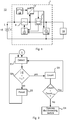
- Fig. 1 depicts a block diagram of an example of a battery saving system 1.
- the battery saving system 1 is configured to be used with an electrically powered mobility device comprising a battery 15 and a drive control system 16.
- the battery saving system 1 is configured to disconnect the drive control system 16 from the battery 15 in case the battery has been in an idle state for a predetermined amount of time and is not being subjected to charging.
- the battery saving system 1 is configured to enable charging of the battery 15 for any given time as long as at least one of the charging current and the battery voltage is above a corresponding predetermined limit.
- the battery saving system 1 is configured to disconnect a battery charger from the battery 15 in the event that the battery charger provides a charging current or voltage which exceeds predetermined limits. The battery 15 is thereby protected from overcharging.
- the exemplified battery saving system 1 comprises a current monitoring circuit 3 and a voltage monitoring circuit 5.
- the battery saving system 1 furthermore comprises a timer circuit 7 and a disconnecting switch 9 configured to be set in a closed state and an open state.
- the battery saving system 1 may additionally comprise a button 11, for example a push button or a button of a digital user interface.
- the battery saving system may additionally comprise a power supply 10.
- the power supply 10 may for example be a power converter such as a DC-DC converter.
- the power supply 10 is configured to power the current monitoring circuit 3, the voltage monitoring circuit 5 and the timer circuit 7.
- the power supply 10 may be configured to be fed by the battery 15.
- the button 11 may include a mechanical switch which normally may be in an open position, and which when the button 11 is pushed may be set in a closed position.
- the power supply 10 is connected to the battery 15 via the mechanical switch of the button 11.
- the power supply 10 is also connected to the battery 15 via the disconnecting switch 9. When the disconnecting switch 9 is in the closed state and the mechanical switch is in the open position, the power supply 10 is powered by the battery 15 via the disconnecting switch 9. When the disconnecting switch 9 is in the open state and mechanical switch is in the open position, the power supply 10 is disconnected from the battery 15.
- An electrically driven mobility device 13 comprising the battery saving system 1 may comprise one or more batteries 15 and a drive control system 16.
- the battery 15 is configured to power the drive control system 16.
- the battery 15 is a rechargeable battery.
- the battery 15 may for example be a lead acid battery.
- the drive control system 16 may for example include an electric motor and/or electronics for controlling the electric motor and/or user interface electronics for interacting with the electrically driven mobility device 13.
- the drive control system 16 generally requires a load current I L with a certain load current magnitude in order for proper operation.
- the load current magnitude required may be above a load current threshold.
- the drive control system normally consumes energy from the battery 15.
- a battery charger C may according to one variation instead provide the energy to the drive control system 16.
- the current monitoring circuit 3 is configured to measure current flowing from the battery 15, i.e. the load current, and current flowing to the battery, i.e. charging current.
- the current monitoring circuit 3 may comprise a current sensor.
- the voltage monitoring circuit 5 is configured to measure a battery voltage V.
- the voltage monitoring circuit 5 may comprise a voltage sensor.
- the disconnecting switch 9 is configured to be set in an open state and in a closed state. In the closed state, the disconnecting switch 9 closes the circuit formed by the battery 15, the power supply 10, and the drive control system 16. The load current I L may thus be fed to the drive control system 16. In the open state, the disconnecting switch 9 opens the circuit formed by the battery 15, the power supply 10, and the drive control system 16. Thus, in the open state, the disconnecting switch 9 disconnects the drive control system 16 from the battery 15. The disconnecting switch 9 furthermore disconnects the power supply 10 from the battery 15.
- the current monitoring circuit 3, the voltage monitoring circuit 5 and the timer circuit 7 will hence not receive any power in this situation.
- the power supply 10 By pushing the button 11, a circuit formed by the battery 15 and the power supply 10 is closed.
- the power supply 10 will thus receive power from the battery 15.
- the power supply 10 can hence power the current monitoring circuit 3, the voltage monitoring circuit 5 and the timer circuit 7.
- the timer circuit 7 When the timer circuit 7 is powered up, it sends a signal to the disconnecting switch 9, which sets the disconnecting switch 9 in the closed state.
- the counter may also be reset.
- the power supply 10 When the button 11 is released causing the mechanical switch to be set in the open position, the power supply 10 will be in a closed circuit with the battery 15 because the disconnecting switch 9 is in the closed state.
- This circuit may for example be realised by a parallel connection between the disconnecting switch 9 and the mechanical switch of the button 11.
- the power supply 10 may be in series-connection with the disconnecting switch 9 and the mechanical switch of the button 11.
- the disconnecting switch 9 may be an electronic switch, for example a semiconducting switch such as a transistor.
- the disconnecting switch 9 may be an electro-mechanical switch such as a relay.
- the timer circuit 7 is configured to count based on measurements provided by the current monitoring circuit 3 and in some cases also based on measurements provided by the voltage monitoring circuit 5. In case the timer circuit 7 has counted and reached a predetermined number, the timer circuit 7 is configured to trigger disconnection of the battery 15 from the drive control system 16 via the disconnecting switch 9.
- the disconnecting switch 9 is thus configured to be set from the closed state into the open state.
- Fig. 2 shows a flowchart of a method of improving the lifetime of the battery 15, when the battery 15 is being used for powering the drive control system 16. The method is performed by the battery saving system 1.
- a step S 1 the current monitoring system 3 detects a load current I L provided by the battery 15 to the drive control system 16.
- the current monitoring system 3 detects whether the current is a load current or a charging current, based on the sign or flow direction of the current.
- the current is the load current I L .
- a step S2 it is determined whether the load current I L has a load current magnitude which exceeds or is below a load current threshold level.
- the timer circuit 7 counts.
- the timer circuit 7 may either count up or count down towards a predetermined number.
- the load current magnitude is continually determined and as long as the load current magnitude is below the load current threshold level, the timer circuit 7 continues to count towards the predetermined number.
- a step S 4 the timer circuit 7 triggers the disconnecting switch 9 to be set in the open state from the closed state.
- the disconnecting switch 9 is hence operated to obtain its open state and the battery 15 is disconnected from the drive control system 16.
- the time for the counter to reach the predetermined number may for example be set to 1.5 hours.
- the timer circuit 7 contains processing circuitry configured to trigger the disconnecting switch 9 to open, i.e. to be set in the open state, in the event that the counter reaches the predetermined number.
- the timer circuit 7 may send a signal to operate the disconnecting switch 9.
- the battery saving system 1 may form part of a mobility device control system, which control system is provided with processing circuitry configured to set the disconnecting switch 9 in the open state in the event that the counter reaches the predetermined number.
- step S2 In case that it is determined in step S2 that the load current I L has a load current magnitude which exceeds the load current threshold level, the counter is reset in a step S5. Thus for every iteration of step S2, the counter is reset in step S5 in case the load current magnitude exceeds the load current threshold level.
- the disconnecting switch 9 will be maintained in the closed state.
- the counter will be reset and hence unable to reach the predetermined number. It can thus be ensured that the battery 15 is connected to the drive control system 16 as long as the electrically powered mobility device 13 is in an active state.
- the disconnecting switch 9 When the disconnecting switch 9 has been set in the open state, the disconnecting switch 9 can be reset to the closed state manually by the user by means of the button 11, as previously described.
- the battery saving system 1 may also be configured to prevent the battery 15 from being disconnected from a battery charger by means of the disconnecting switch 9 when the battery 15 is being charged.
- the battery saving system 1 may be configured to prevent the battery 15 from being disconnected as long as a battery charger intended for the battery 15 is connected to the drive control system 16 and the battery charger operates without faults.
- Fig. 3 shows the battery saving system 1 during charging.
- the battery charger C may be connected to the battery 15 via the drive control system 16.
- the drive control system 16 may be powered by the battery charger C and not by the battery 15.
- the battery charger C provides a charging current Ic for charging the battery 15.
- the charging current I C flows in the opposite direction compared to the load current I L .
- the current monitoring circuit 3 is configured to measure the charging current I C , in particular to determine the charging current magnitude.
- the voltage monitoring circuit 5 is configured to measure the battery voltage V. Based on these two quantities, the counter of the timer circuit 7 is configured to be reset when correct charging is being undertaken as will be described in more detail in the following with reference to Figs 4 and 5 .
- Fig. 4 depicts a flowchart for handling charging.
- current monitoring circuit 3 detects the charging current I C and the voltage monitoring circuit 5 detects the battery voltage V.
- a step S12 it is determined whether the charging current Ic is above a predetermined charging current threshold level or whether the battery voltage V is above a predetermined voltage threshold level.
- Step 11 is then repeated.
- the counter counts in a step S14. In case the counter reaches the predetermined number, in a step S15, the disconnecting switch 9 is operated to be set in the open state.
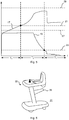
- Fig. 5 schematically depicts an example of a charging curve for the charging current I C and the battery voltage V during charging of a discharged battery 15.
- the voltage curve 17 shows the battery voltage V during charging. In the example, the battery voltage V is low at the commencement of charging.
- the charging current Ic is constant as shown by the current curve 19.
- the counter of the timer circuit 7 is configured to be reset as long as one of the battery voltage V and the charging current magnitude is above a respective predetermined voltage threshold level 21 and a predetermined charging current threshold level 23, as previously explained in conjunction with Fig. 4 . For example, every time the charging current I C and the battery voltage V is measured and it is determined that at least one of the battery voltage V is above the predetermined voltage threshold level 21 and the charging current I C is above the predetermined charging current threshold level 23, the counter is reset.
- the constant charging current I C is above the predetermined charging current threshold level 23, and the battery voltage V is below the predetermined voltage threshold level 21.
- the counter of the timer circuit 7 is hence repeatedly reset during the entire first stage T1 according to step S13.
- the battery voltage V is above the predetermined voltage threshold level 21 and the charging current magnitude is above the predetermined charging current threshold level 23.
- the counter of the timer circuit 7 is hence repeatedly reset during the entire second stage T2 according to step S13.
- the charging current magnitude drops below the predetermined charging current threshold level 23.
- the battery voltage V however maintains a value above the predetermined voltage threshold level 21, which is above the nominal voltage level of the battery 15.
- the counter of the timer circuit 7 is hence repeatedly reset during the entire third stage T3 according to step S13. To this end, as long as these conditions are fulfilled the battery 15 may be charged for any given amount of time without risking being disconnected from the battery charger by means of the disconnecting switch 9.
- the battery saving system 1 may be configured to protect the battery 15 from high voltage and high charging currents during charging. Such a situation could for example occur in case an incorrect battery charger not compatible with the battery 15 is connected to the battery 15 for charging. Such a situation could for example occur due to user error.
- the current monitoring circuit 3 may be configured to detect if the charging current magnitude exceeds a predetermined allowed charging current level 27.
- the predetermined allowed charging current level 27 may for example be higher than the recommended maximum charging current of the battery 15.
- the battery saving system 1 may be configured to set the disconnecting switch 9 in the open state. This disconnection is hence done irrespective of the state of the counter.
- the voltage monitoring circuit 5 may be configured to detect if the battery voltage V exceeds a predetermined allowed voltage level 29.
- the predetermined allowed voltage level 29 is higher than the recommended maximum charging voltage of the battery 15.
- the battery saving system 1 may be configured to set the disconnecting switch 9 in the open state. This disconnection is hence done irrespective of the state of the counter.
- Fig. 6 schematically shows an example of an electrically powered mobility device 31 comprising a seating system 33 including a seat 35.
- the electrically powered mobility device 31 is similar to a wheelchair.
- the electrically powered mobility device 31 may be specifically designed for toddlers.
- Such an electrically powered mobility device 31 may typically only be used relatively rarely compared to a complex power wheelchair.
- the electrically powered mobility device 31 comprises an electric motor (not shown), one or more batteries (not shown), and a battery saving system 1 (not shown) configured to protect the one or more batteries.
Landscapes
- Engineering & Computer Science (AREA)
- Power Engineering (AREA)
- Physics & Mathematics (AREA)
- General Physics & Mathematics (AREA)
- Business, Economics & Management (AREA)
- Emergency Management (AREA)
- Charge And Discharge Circuits For Batteries Or The Like (AREA)
- Secondary Cells (AREA)
Abstract
Description
- The present disclosure generally relates to electrically powered mobility devices.
- Electronic components usually consume energy even when they are switched off. Depending on the battery size and the energy consumption while the system is switched off, there is a risk that the battery/batteries will be drained when the device containing the battery/batteries is not in use.
- For battery powered mobility devices that are not used on a daily basis this could become a major problem. In particular, it could be a problem for mobility devices of the kind where the idle current of a drive control system that controls the operation of the device is high is relation to the capacity of the battery/batteries. The situation is worsened in case the mobility device is left unused for a longer period of time without prior charging. This could result in a total battery drain, especially for batteries such as lead acid batteries which do not comprise any internal electronics. With lead acid batteries there is a risk of sulfation. Sulfation gradually degrades the battery/batteries, resulting in that they lose capacity. This risk increases when batteries are deeply discharged, i.e. when batteries are drained below the lowest recommended voltage.
- An object of the present disclosure is to provide a battery saving system which solves, or at least mitigates problems of the prior art.
- There is hence according to a first aspect of the present disclosure provided a battery saving system for an electrically powered mobility device comprising a battery and a drive control system powered by the battery, wherein the battery saving system comprises: a current monitoring circuit configured to monitor a load current provided by the battery, wherein the current monitoring circuit is configured to determine whether a load current magnitude is below a load current threshold level, a timer circuit having a counter configured to successively count as long as the load current level is below the load current threshold level, and to reset the counter in the event that the load current magnitude exceeds the load current threshold level, and a disconnecting switch configured to be operated between an open state and a closed state, wherein the timer circuit is configured to trigger the disconnecting switch to obtain the open state when the counter has reached a predetermined number to thereby disconnect the battery from the drive control system.
- With an electrically powered mobility device is meant a mobility aid comprising an electric motor. Examples of such electrically powered mobility devices are mobility aids for small children with disabilities, hospital beds and lifting aids. The electric motor of devices of this type may only be used seldom, as the device does not necessarily form part of everyday life for its user. Such devices may have a drive control system which draws an idle current which is high in relation to the capacity of the battery/batteries. A further example of an electrically powered mobility device is an electrically powered wheelchair.
- The battery saving system automatically disconnects/separates the battery from a drive control system and prevents the battery from being drained when not used. This is accomplished by monitoring the load current together with the timer circuit that allows the battery saving system to be idle until the counter reaches the predetermined number before disconnecting the battery from the drive control system with the disconnecting switch. The risk of sulfation may thereby be reduced.
- One embodiment comprises a voltage monitoring circuit configured to monitor a battery voltage, wherein the current monitoring circuit is configured to monitor a charging current, and wherein the timer circuit is configured to reset the counter as long as at least one of a) the battery voltage is above a predetermined voltage threshold level and b) a charging current magnitude is above a predetermined charging current threshold level.
- The counter is hence constantly reset as long as charging is in progress and one of the conditions a) and b) is fulfilled, enabling charging for any given length of time without disconnection of the battery from the battery charger.
- The charging current can be differentiated from the load current since the two currents have opposite signs.
- According to one embodiment the counter is configured to be activated when the battery voltage is below the predetermined voltage threshold level and the charging current magnitude is below the predetermined charging current threshold level.
- According to one embodiment the disconnecting switch is configured to be set in the open state to disconnect the battery when the charging current magnitude is above a predetermined allowed charging current level.
- According to one embodiment the predetermined allowed charging current level is higher than the maximum recommended battery charging current.
- According to one embodiment the disconnecting switch is configured to be set in the open state to disconnect the battery when the battery voltage is above a predetermined allowed voltage level.
- Thus, the battery is protected against overcharging. This may prolong the lifetime of the battery by reducing the risk of gas being released to the atmosphere during battery gassing. If too much gas is lost, the battery will dry out, reducing the battery lifetime. At the same time the risk of explosion is reduced.
- According to one embodiment the predetermined allowed voltage level is higher than the maximum recommended battery charging voltage.
- One embodiment comprises a button configured to enable setting the disconnecting switch in the closed state and to reset the counter.
- One embodiment comprises a power supply configured to be powered by the battery and configured to power the timer circuit, wherein the disconnecting switch is configured to disconnect the power supply from the battery when the disconnecting switch is in the open state, and wherein the button has a mechanical switch configured to be set in a closed position when the button is actuated, causing the power supply to connect to the battery and power the timer circuit.
- The power supply may for example be a power converter, e.g. a DC-DC converter. The power supply may for example be series-connected with the disconnecting switch. The button may for example include a mechanical switch such as a momentary mechanical switch, which is parallel connected with the disconnecting switch. By pushing the button, the momentary mechanical switch may be set in a closed position, closing the circuit formed by the battery and the power supply. The power supply will thus be powered by the battery. The button may hence activate the power supply. The power supply may be configured to power the timer circuit. The power supply may be configured to power the current monitoring circuit and/or the voltage monitoring circuit. By activating the power supply, the disconnecting switch may be set in the closed state. For example, the power supply may be configured to power the timer circuit when activated, causing the timer circuit to trigger the disconnecting switch to obtain its closed state. For example, if the disconnecting switch comprises a semiconductor switch, such as a transistor, the timer circuit may send a signal to the semiconductor switch which sets the semiconductor switch in its closed state. The power supply will thus be fed from the battery via the disconnecting switch which is in the closed state. Moreover, the drive control system will be connected to and powered by the battery. The button may for example be a mechanical button, e.g. a push button such as a momentary push button, or a soft button.
- There is according to a second aspect of the present disclosure provided a method of prolonging the life of a battery of an electrically powered mobility device comprising a drive control system powered by the battery, comprising: detecting a load current from the battery to the drive control system, determining whether a load current magnitude is below a load current threshold level, counting as long as the load current magnitude is below the load current threshold level, in case the load current magnitude exceeds the load current threshold level, resetting the counter, and operating a disconnecting switch to obtain an open state when the counter reaches a predetermined number to thereby disconnect the drive control system from the battery.
- One embodiment comprises, during charging: detecting a battery voltage and a charging current, determining whether the battery voltage is below a predetermined voltage threshold level or the charging current is below a predetermined charging current threshold level, and resetting the counter as long as at least one of a) the battery voltage is above the predetermined voltage threshold level and b) the charging current is above the predetermined charging current threshold level.
- One embodiment comprises operating the disconnecting switch to obtain an open state when the charging current magnitude is above a predetermined allowed charging current level to thereby disconnect the battery from a battery charger.
- One embodiment comprises operating the disconnecting switch to obtain an open state when the battery voltage is above a predetermined allowed voltage level to thereby disconnect the battery from a battery charger.
- There is according to a second aspect of the present disclosure provided a control system for an electrically powered mobility device comprising the battery saving system according to the first aspect. The control system may be a supervisory control system which includes the drive control system. The supervisory control system may include further control functions than those of the drive control system which are directed to drive control. The supervisory control system may for example additionally be configured to control the seating system and any other function not related to drive control.
- The control system may be configured to control the operation of the disconnecting switch based on the state of the timer circuit, in particular the counter.
- There is according to a third aspect of the present disclosure provided an electrically powered mobility device comprising: a battery, a drive control system, and a battery saving system according to the first aspect.
- Generally, all terms used in the claims are to be interpreted according to their ordinary meaning in the technical field, unless explicitly defined otherwise herein. All references to "a/an/the element, apparatus, component, means, etc." are to be interpreted openly as referring to at least one instance of the element, apparatus, component, means, etc., unless explicitly stated otherwise.
- The specific embodiments of the inventive concept will now be described, by way of example, with reference to the accompanying drawings, in which:
-
Fig. 1 schematically shows a block diagram of a battery saving system for an electrically powered mobility device connected to a battery and to a drive control system; -
Fig. 2 schematically shows a flowchart of a method of prolonging the life of a battery of an electrically powered mobility device; -
Fig. 3 schematically shows the battery saving system during charging; -
Fig. 4 schematically shows a flowchart in conjunction with battery charging; -
Fig. 5 schematically shows a graph with different stages during battery charging, in which the battery saving system operates; and -
Fig. 6 schematically shows an example of an electrically powered mobility device. - The inventive concept will now be described more fully hereinafter with reference to the accompanying drawings, in which exemplifying embodiments are shown. The inventive concept may, however, be embodied in many different forms and should not be construed as limited to the embodiments set forth herein; rather, these embodiments are provided by way of example so that this disclosure will be thorough and complete, and will fully convey the scope of the inventive concept to those skilled in the art. Like numbers refer to like elements throughout the description.
-
Fig. 1 depicts a block diagram of an example of abattery saving system 1. Thebattery saving system 1 is configured to be used with an electrically powered mobility device comprising abattery 15 and adrive control system 16. In particular, thebattery saving system 1 is configured to disconnect thedrive control system 16 from thebattery 15 in case the battery has been in an idle state for a predetermined amount of time and is not being subjected to charging. - Additionally, the
battery saving system 1 is configured to enable charging of thebattery 15 for any given time as long as at least one of the charging current and the battery voltage is above a corresponding predetermined limit. - Furthermore, the
battery saving system 1 is configured to disconnect a battery charger from thebattery 15 in the event that the battery charger provides a charging current or voltage which exceeds predetermined limits. Thebattery 15 is thereby protected from overcharging. - The exemplified
battery saving system 1 comprises acurrent monitoring circuit 3 and avoltage monitoring circuit 5. Thebattery saving system 1 furthermore comprises a timer circuit 7 and a disconnectingswitch 9 configured to be set in a closed state and an open state. Thebattery saving system 1 may additionally comprise abutton 11, for example a push button or a button of a digital user interface. - The battery saving system may additionally comprise a
power supply 10. Thepower supply 10 may for example be a power converter such as a DC-DC converter. Thepower supply 10 is configured to power thecurrent monitoring circuit 3, thevoltage monitoring circuit 5 and the timer circuit 7. Thepower supply 10 may be configured to be fed by thebattery 15. Thebutton 11 may include a mechanical switch which normally may be in an open position, and which when thebutton 11 is pushed may be set in a closed position. Thepower supply 10 is connected to thebattery 15 via the mechanical switch of thebutton 11. Thepower supply 10 is also connected to thebattery 15 via the disconnectingswitch 9. When the disconnectingswitch 9 is in the closed state and the mechanical switch is in the open position, thepower supply 10 is powered by thebattery 15 via the disconnectingswitch 9. When the disconnectingswitch 9 is in the open state and mechanical switch is in the open position, thepower supply 10 is disconnected from thebattery 15. - An electrically driven
mobility device 13 comprising thebattery saving system 1 may comprise one ormore batteries 15 and adrive control system 16. For reasons of simplicity, in the present example a single battery will be assumed although several batteries could alternatively be used. Thebattery 15 is configured to power thedrive control system 16. Thebattery 15 is a rechargeable battery. Thebattery 15 may for example be a lead acid battery. Thedrive control system 16 may for example include an electric motor and/or electronics for controlling the electric motor and/or user interface electronics for interacting with the electrically drivenmobility device 13. - The
drive control system 16 generally requires a load current IL with a certain load current magnitude in order for proper operation. The load current magnitude required may be above a load current threshold. The drive control system normally consumes energy from thebattery 15. During charging, a battery charger C may according to one variation instead provide the energy to thedrive control system 16. - The
current monitoring circuit 3 is configured to measure current flowing from thebattery 15, i.e. the load current, and current flowing to the battery, i.e. charging current. Thecurrent monitoring circuit 3 may comprise a current sensor. - The
voltage monitoring circuit 5 is configured to measure a battery voltage V. Thevoltage monitoring circuit 5 may comprise a voltage sensor. - The disconnecting
switch 9 is configured to be set in an open state and in a closed state. In the closed state, the disconnectingswitch 9 closes the circuit formed by thebattery 15, thepower supply 10, and thedrive control system 16. The load current IL may thus be fed to thedrive control system 16. In the open state, the disconnectingswitch 9 opens the circuit formed by thebattery 15, thepower supply 10, and thedrive control system 16. Thus, in the open state, the disconnectingswitch 9 disconnects thedrive control system 16 from thebattery 15. The disconnectingswitch 9 furthermore disconnects thepower supply 10 from thebattery 15. Thecurrent monitoring circuit 3, thevoltage monitoring circuit 5 and the timer circuit 7 will hence not receive any power in this situation. - By pushing the
button 11, a circuit formed by thebattery 15 and thepower supply 10 is closed. Thepower supply 10 will thus receive power from thebattery 15. Thepower supply 10 can hence power thecurrent monitoring circuit 3, thevoltage monitoring circuit 5 and the timer circuit 7. When the timer circuit 7 is powered up, it sends a signal to the disconnectingswitch 9, which sets the disconnectingswitch 9 in the closed state. The counter may also be reset. - When the
button 11 is released causing the mechanical switch to be set in the open position, thepower supply 10 will be in a closed circuit with thebattery 15 because the disconnectingswitch 9 is in the closed state. This circuit may for example be realised by a parallel connection between the disconnectingswitch 9 and the mechanical switch of thebutton 11. Thepower supply 10 may be in series-connection with the disconnectingswitch 9 and the mechanical switch of thebutton 11. - The disconnecting
switch 9 may be an electronic switch, for example a semiconducting switch such as a transistor. Alternatively, the disconnectingswitch 9 may be an electro-mechanical switch such as a relay. - The timer circuit 7 is configured to count based on measurements provided by the
current monitoring circuit 3 and in some cases also based on measurements provided by thevoltage monitoring circuit 5. In case the timer circuit 7 has counted and reached a predetermined number, the timer circuit 7 is configured to trigger disconnection of thebattery 15 from thedrive control system 16 via the disconnectingswitch 9. The disconnectingswitch 9 is thus configured to be set from the closed state into the open state. -
Fig. 2 shows a flowchart of a method of improving the lifetime of thebattery 15, when thebattery 15 is being used for powering thedrive control system 16. The method is performed by thebattery saving system 1. - In a step S1 the
current monitoring system 3 detects a load current IL provided by thebattery 15 to thedrive control system 16. In particular, thecurrent monitoring system 3 detects whether the current is a load current or a charging current, based on the sign or flow direction of the current. As noted above, in the present example, the current is the load current IL. - In a step S2 it is determined whether the load current IL has a load current magnitude which exceeds or is below a load current threshold level.
- In case the load current magnitude is below the load current threshold level, this is an indication that the
battery 15 is not being used, i.e. that the electricallypowered mobility device 13 is in an idle state. - Thus in a step S3, the timer circuit 7 counts. The timer circuit 7 may either count up or count down towards a predetermined number.
- The load current magnitude is continually determined and as long as the load current magnitude is below the load current threshold level, the timer circuit 7 continues to count towards the predetermined number.
- In case the timer circuit 7 reaches the predetermined number, in a step S4 the timer circuit 7 triggers the disconnecting
switch 9 to be set in the open state from the closed state. The disconnectingswitch 9 is hence operated to obtain its open state and thebattery 15 is disconnected from thedrive control system 16. The time for the counter to reach the predetermined number may for example be set to 1.5 hours. - In the example shown in
Fig. 1 , the timer circuit 7 contains processing circuitry configured to trigger the disconnectingswitch 9 to open, i.e. to be set in the open state, in the event that the counter reaches the predetermined number. Hereto, according to this example, the timer circuit 7 may send a signal to operate the disconnectingswitch 9. As an alternative, thebattery saving system 1 may form part of a mobility device control system, which control system is provided with processing circuitry configured to set the disconnectingswitch 9 in the open state in the event that the counter reaches the predetermined number. - In case that it is determined in step S2 that the load current IL has a load current magnitude which exceeds the load current threshold level, the counter is reset in a step S5. Thus for every iteration of step S2, the counter is reset in step S5 in case the load current magnitude exceeds the load current threshold level.
- As long as the counter has not reached the predetermined number, the disconnecting
switch 9 will be maintained in the closed state. Thus, as long as the load current magnitude exceeds the load current threshold level, the counter will be reset and hence unable to reach the predetermined number. It can thus be ensured that thebattery 15 is connected to thedrive control system 16 as long as the electricallypowered mobility device 13 is in an active state. - When the disconnecting
switch 9 has been set in the open state, the disconnectingswitch 9 can be reset to the closed state manually by the user by means of thebutton 11, as previously described. - The
battery saving system 1 may also be configured to prevent thebattery 15 from being disconnected from a battery charger by means of the disconnectingswitch 9 when thebattery 15 is being charged. In particular, thebattery saving system 1 may be configured to prevent thebattery 15 from being disconnected as long as a battery charger intended for thebattery 15 is connected to thedrive control system 16 and the battery charger operates without faults. -
Fig. 3 shows thebattery saving system 1 during charging. The battery charger C may be connected to thebattery 15 via thedrive control system 16. During charging, thedrive control system 16 may be powered by the battery charger C and not by thebattery 15. - The battery charger C provides a charging current Ic for charging the
battery 15. The charging current IC flows in the opposite direction compared to the load current IL. Thecurrent monitoring circuit 3 is configured to measure the charging current IC, in particular to determine the charging current magnitude. Thevoltage monitoring circuit 5 is configured to measure the battery voltage V. Based on these two quantities, the counter of the timer circuit 7 is configured to be reset when correct charging is being undertaken as will be described in more detail in the following with reference toFigs 4 and5 . -
Fig. 4 depicts a flowchart for handling charging. In a step S11current monitoring circuit 3 detects the charging current IC and thevoltage monitoring circuit 5 detects the battery voltage V. - In a step S12 it is determined whether the charging current Ic is above a predetermined charging current threshold level or whether the battery voltage V is above a predetermined voltage threshold level.
- In case the charging current Ic or the battery voltage V is above the corresponding threshold level, the counter is reset in a step S13.
Step 11 is then repeated. - In case both the charging current IC and the battery voltage V is below the corresponding threshold level, the counter counts in a step S14. In case the counter reaches the predetermined number, in a step S15, the disconnecting
switch 9 is operated to be set in the open state. -
Fig. 5 schematically depicts an example of a charging curve for the charging current IC and the battery voltage V during charging of a dischargedbattery 15. Thevoltage curve 17 shows the battery voltage V during charging. In the example, the battery voltage V is low at the commencement of charging. The charging current Ic is constant as shown by thecurrent curve 19. - Based on the sign of the current flowing in the battery circuit, it can be determined whether the
battery 15 is being used in normal operation to power thedrive control system 16 or whether it is being charged, and corresponding measures may be taken in order to prolong the lifetime of thebattery 15. - The counter of the timer circuit 7 is configured to be reset as long as one of the battery voltage V and the charging current magnitude is above a respective predetermined
voltage threshold level 21 and a predetermined chargingcurrent threshold level 23, as previously explained in conjunction withFig. 4 . For example, every time the charging current IC and the battery voltage V is measured and it is determined that at least one of the battery voltage V is above the predeterminedvoltage threshold level 21 and the charging current IC is above the predetermined chargingcurrent threshold level 23, the counter is reset. - According to the exemplified charging curve, during a first stage T1 the constant charging current IC is above the predetermined charging
current threshold level 23, and the battery voltage V is below the predeterminedvoltage threshold level 21. The counter of the timer circuit 7 is hence repeatedly reset during the entire first stage T1 according to step S13. During a second stage T2 the battery voltage V is above the predeterminedvoltage threshold level 21 and the charging current magnitude is above the predetermined chargingcurrent threshold level 23. The counter of the timer circuit 7 is hence repeatedly reset during the entire second stage T2 according to step S13. During a third stage T3, the charging current magnitude drops below the predetermined chargingcurrent threshold level 23. The battery voltage V however maintains a value above the predeterminedvoltage threshold level 21, which is above the nominal voltage level of thebattery 15. The counter of the timer circuit 7 is hence repeatedly reset during the entire third stage T3 according to step S13. To this end, as long as these conditions are fulfilled thebattery 15 may be charged for any given amount of time without risking being disconnected from the battery charger by means of the disconnectingswitch 9. - In addition or alternatively to the above, the
battery saving system 1 may be configured to protect thebattery 15 from high voltage and high charging currents during charging. Such a situation could for example occur in case an incorrect battery charger not compatible with thebattery 15 is connected to thebattery 15 for charging. Such a situation could for example occur due to user error. - Hereto, the
current monitoring circuit 3 may be configured to detect if the charging current magnitude exceeds a predetermined allowed chargingcurrent level 27. The predetermined allowed chargingcurrent level 27 may for example be higher than the recommended maximum charging current of thebattery 15. In case the charging current magnitude exceeds the predetermined allowed chargingcurrent level 27, thebattery saving system 1 may be configured to set the disconnectingswitch 9 in the open state. This disconnection is hence done irrespective of the state of the counter. - The
voltage monitoring circuit 5 may be configured to detect if the battery voltage V exceeds a predetermined allowedvoltage level 29. The predetermined allowedvoltage level 29 is higher than the recommended maximum charging voltage of thebattery 15. In case the battery voltage magnitude exceeds the predetermined allowedvoltage level 29, thebattery saving system 1 may be configured to set the disconnectingswitch 9 in the open state. This disconnection is hence done irrespective of the state of the counter. -
Fig. 6 schematically shows an example of an electricallypowered mobility device 31 comprising aseating system 33 including aseat 35. The electricallypowered mobility device 31 is similar to a wheelchair. The electricallypowered mobility device 31 may be specifically designed for toddlers. Such an electricallypowered mobility device 31 may typically only be used relatively rarely compared to a complex power wheelchair. - The electrically
powered mobility device 31 comprises an electric motor (not shown), one or more batteries (not shown), and a battery saving system 1 (not shown) configured to protect the one or more batteries. - The inventive concept has mainly been described above with reference to a few examples. However, as is readily appreciated by a person skilled in the art, other embodiments than the ones disclosed above are equally possible within the scope of the inventive concept, as defined by the appended claims.
Claims (15)
- A battery saving system (1) for an electrically powered mobility device (13, 31) comprising a battery (15) and a drive control system (16) configured to be powered by the battery (15), wherein the battery saving system (1) comprises:a current monitoring circuit (3) configured to monitor a load current (IL) provided by the battery (15), wherein the current monitoring circuit (3) is configured to determine whether a load current magnitude is below a load current threshold level,a timer circuit (7) having a counter configured to successively count as long as the load current magnitude level is below the load current threshold level, and to reset the counter in the event that the load current level magnitude exceeds the current threshold level, anda disconnecting switch (9) configured to be operated between an open state and a closed state,wherein the timer circuit (7) is configured to trigger the disconnecting switch (9) to obtain the open state when the counter has reached a predetermined number to thereby disconnect the battery (15) from the drive control system(16).
- The battery saving system (1) as claimed in claim 1, comprising a voltage monitoring circuit (5) configured to monitor a battery voltage (V), wherein the current monitoring circuit (3) is configured to monitor a charging current (IC), and wherein the timer circuit (7) is configured to reset the counter as long as at least one of the a) battery voltage (V) is above a predetermined voltage threshold level (21) and b) a charging current magnitude is above a predetermined charging current threshold level (23).
- The battery saving system (1) as claimed in claim 2, wherein the counter is configured to be activated when the battery voltage (V) is below the predetermined voltage threshold level (21) and the charging current magnitude is below the predetermined charging current threshold level (23).
- The battery saving system (1) as claimed in claim 2 or 3, wherein the disconnecting switch (9) is configured to be set in the open state to disconnect the battery (15) when the charging current magnitude is above a predetermined allowed charging current level (27).
- The battery saving system (1) as claimed in claim 4, wherein the predetermined allowed charging current level (27) is higher than the maximum recommended charging current of the battery.
- The battery saving system (1) as claimed in any of claims 2-5, wherein the disconnecting switch (9) is configured to be set in the open state to disconnect the battery (15) when the battery voltage (V) is above a predetermined allowed voltage level (29).
- The battery saving system (1) as claimed in claim 6, wherein the predetermined allowed voltage level (29) is higher than the maximum recommended charging battery voltage.
- The battery saving system (1) as claimed in any of the preceding claims, comprising a button (11) configured to enable setting the disconnecting switch (9) in the closed state and to reset the counter.
- The battery saving system (1) as claimed in claim 8, comprising a power supply (10) configured to be powered by the battery (15) and configured to power the timer circuit (7), wherein the disconnecting switch (9) is configured to disconnect the power supply (10) from the battery (15) when the disconnecting switch (9) is in the open state, and wherein the button (11) has a mechanical switch configured to be set in a closed position when the button is actuated, causing the power supply (10) to connect to the battery (15) and power the timer circuit (7).
- A method of prolonging battery life of a battery (15) of an electrically powered mobility device (13, 31), comprising:detecting (S1) a load current (IL) from the battery (15) to a drive control system (16),determining (S2) whether a load current magnitude is below a load current threshold level,counting (S3) as long as the load current magnitude is below the load current threshold level,in case the load current magnitude exceeds the load current threshold level, (S5) resetting the counter, andoperating (S4) a disconnecting switch (9) to obtain an open state when the counter reaches a predetermined number to thereby disconnect the battery (15) from the drive control system (16).
- The method as claimed in claim 10, comprising, during charging:(S11) detecting a battery voltage (V) and a charging current (IC),(S12) determining whether the battery voltage (V) is below a predetermined voltage threshold level (21) or the charging current (IC) is below a predetermined charging current threshold level (23), andresetting (S13) the counter as long as at least one of a) the battery voltage (V) is below the predetermined voltage threshold level (21) and b) the charging current (IC) is below the predetermined charging current threshold level (23).
- The method as claimed in claim 11, comprising operating the disconnecting switch (9) to obtain an open state when the charging current magnitude is above a predetermined allowed charging current level (27) to thereby disconnect the battery (15) from a battery charger (C).
- The method as claimed in claim 11 or 12, comprising operating the disconnecting switch (9) to obtain an open state when the battery voltage (V) is above a predetermined allowed voltage level (29) to thereby disconnect the battery (15) from a battery charger (C).
- A control system for an electrically powered mobility device (13, 31) comprising the battery saving system (1) as claimed in any of claims 1-9.
- An electrically powered mobility device (13, 31) comprising:a battery (15),a drive control system (16), anda battery saving system (1) as claimed in any of claims 1-9.
Priority Applications (5)
| Application Number | Priority Date | Filing Date | Title |
|---|---|---|---|
| EP18169884.6A EP3561992B1 (en) | 2018-04-27 | 2018-04-27 | Battery saving system and electrically powered mobility device comprising the same |
| ES18169884T ES2924202T3 (en) | 2018-04-27 | 2018-04-27 | Battery saving system and electrically powered mobility device comprising the same |
| US17/050,277 US11522374B2 (en) | 2018-04-27 | 2019-03-19 | Battery saving system and electrically powered mobility device comprising the same |
| CN201980028553.9A CN112106270B (en) | 2018-04-27 | 2019-03-19 | Battery power saving system and electric mobile device comprising same |
| PCT/EP2019/056897 WO2019206525A1 (en) | 2018-04-27 | 2019-03-19 | Battery saving system and electrically powered mobility device comprising the same |
Applications Claiming Priority (1)
| Application Number | Priority Date | Filing Date | Title |
|---|---|---|---|
| EP18169884.6A EP3561992B1 (en) | 2018-04-27 | 2018-04-27 | Battery saving system and electrically powered mobility device comprising the same |
Publications (2)
| Publication Number | Publication Date |
|---|---|
| EP3561992A1 true EP3561992A1 (en) | 2019-10-30 |
| EP3561992B1 EP3561992B1 (en) | 2022-06-29 |
Family
ID=62089653
Family Applications (1)
| Application Number | Title | Priority Date | Filing Date |
|---|---|---|---|
| EP18169884.6A Active EP3561992B1 (en) | 2018-04-27 | 2018-04-27 | Battery saving system and electrically powered mobility device comprising the same |
Country Status (5)
| Country | Link |
|---|---|
| US (1) | US11522374B2 (en) |
| EP (1) | EP3561992B1 (en) |
| CN (1) | CN112106270B (en) |
| ES (1) | ES2924202T3 (en) |
| WO (1) | WO2019206525A1 (en) |
Cited By (1)
| Publication number | Priority date | Publication date | Assignee | Title |
|---|---|---|---|---|
| EP4546602A1 (en) * | 2023-10-23 | 2025-04-30 | Sungrow Power Supply Co., Ltd. | Power supply circuit, battery monitoring circuit, and energy storage device |
Families Citing this family (3)
| Publication number | Priority date | Publication date | Assignee | Title |
|---|---|---|---|---|
| EP3835115A1 (en) * | 2019-12-12 | 2021-06-16 | Permobil AB | Method of estimating the remaining driving distance available from a charge for a powered mobility device |
| CN117134437A (en) * | 2022-05-20 | 2023-11-28 | 华硕电脑股份有限公司 | Battery management system and battery management method |
| CN114744735B (en) * | 2022-06-10 | 2022-08-26 | 成都星联芯通科技有限公司 | Charging equipment and battery system |
Citations (4)
| Publication number | Priority date | Publication date | Assignee | Title |
|---|---|---|---|---|
| US20110169341A1 (en) * | 2007-04-02 | 2011-07-14 | John Manning | Power saving circuit |
| US20120013189A1 (en) * | 2010-07-15 | 2012-01-19 | Vercingetorix, Llc | battery management system |
| US20160218554A1 (en) * | 2013-09-05 | 2016-07-28 | Arcelik Anonim Sirketi | Electrical appliance having zero stand-by power consumption |
| US20170190261A1 (en) * | 2015-12-30 | 2017-07-06 | Thunder Power Hong Kong Ltd. | Battery management system |
Family Cites Families (9)
| Publication number | Priority date | Publication date | Assignee | Title |
|---|---|---|---|---|
| JP2001352687A (en) * | 2000-05-08 | 2001-12-21 | Sun-Lite Trading Ltd | Intelligent switch for battery |
| US7548041B2 (en) * | 2004-12-30 | 2009-06-16 | Linear Technology Corporation | Power management circuit and methodology for battery-powered systems |
| US7542250B2 (en) * | 2007-01-10 | 2009-06-02 | General Electric Company | Micro-electromechanical system based electric motor starter |
| US8284534B2 (en) * | 2007-10-30 | 2012-10-09 | Freescale Semiconductor, Inc. | Overcurrent protection circuit, integrated circuit, apparatus and computer program product |
| US9075090B2 (en) * | 2011-08-11 | 2015-07-07 | Qualcomm Incorporated | Battery monitoring circuit |
| EP2712084B1 (en) * | 2012-09-20 | 2019-11-06 | Infineon Technologies AG | Semiconductor device including short-circuit protection with a variable threshold |
| WO2017110578A1 (en) * | 2015-12-25 | 2017-06-29 | ローム株式会社 | Current monitoring circuit and coulomb counter circuit, and battery management system and motor vehicle using same |
| JP6566992B2 (en) * | 2017-05-31 | 2019-08-28 | キヤノン株式会社 | Electronic device, control method and program |
| JP6424944B1 (en) * | 2017-12-08 | 2018-11-21 | ミツミ電機株式会社 | Secondary battery protection integrated circuit, secondary battery protection device and battery pack |
-
2018
- 2018-04-27 ES ES18169884T patent/ES2924202T3/en active Active
- 2018-04-27 EP EP18169884.6A patent/EP3561992B1/en active Active
-
2019
- 2019-03-19 CN CN201980028553.9A patent/CN112106270B/en active Active
- 2019-03-19 WO PCT/EP2019/056897 patent/WO2019206525A1/en not_active Ceased
- 2019-03-19 US US17/050,277 patent/US11522374B2/en active Active
Patent Citations (4)
| Publication number | Priority date | Publication date | Assignee | Title |
|---|---|---|---|---|
| US20110169341A1 (en) * | 2007-04-02 | 2011-07-14 | John Manning | Power saving circuit |
| US20120013189A1 (en) * | 2010-07-15 | 2012-01-19 | Vercingetorix, Llc | battery management system |
| US20160218554A1 (en) * | 2013-09-05 | 2016-07-28 | Arcelik Anonim Sirketi | Electrical appliance having zero stand-by power consumption |
| US20170190261A1 (en) * | 2015-12-30 | 2017-07-06 | Thunder Power Hong Kong Ltd. | Battery management system |
Cited By (2)
| Publication number | Priority date | Publication date | Assignee | Title |
|---|---|---|---|---|
| EP4546602A1 (en) * | 2023-10-23 | 2025-04-30 | Sungrow Power Supply Co., Ltd. | Power supply circuit, battery monitoring circuit, and energy storage device |
| AU2024204691B2 (en) * | 2023-10-23 | 2025-12-04 | Sungrow Power Supply Co., Ltd. | Power supply circuit, battery monitoring circuit, and energy storage device |
Also Published As
| Publication number | Publication date |
|---|---|
| ES2924202T3 (en) | 2022-10-05 |
| CN112106270A (en) | 2020-12-18 |
| CN112106270B (en) | 2022-10-04 |
| US11522374B2 (en) | 2022-12-06 |
| US20210234382A1 (en) | 2021-07-29 |
| WO2019206525A1 (en) | 2019-10-31 |
| EP3561992B1 (en) | 2022-06-29 |
Similar Documents
| Publication | Publication Date | Title |
|---|---|---|
| US11522374B2 (en) | Battery saving system and electrically powered mobility device comprising the same | |
| CN100442630C (en) | Rechargeable battery packs for power tools | |
| US6388426B1 (en) | Battery power source protecting device for an electromotive device | |
| US10622819B2 (en) | Rechargeable battery protection integrated circuit, rechargeable battery protection device, and battery pack | |
| US8179139B2 (en) | Rechargeable battery abnormality detection apparatus and rechargeable battery apparatus | |
| US8860372B2 (en) | Multiple cell battery charger configured with a parallel topology | |
| EP0440756B1 (en) | Battery assembly and charging system | |
| CN1143421C (en) | Charge and discharge control circuit and rechargeable power supply unit | |
| US11979041B2 (en) | Methods and apparatuses for ultra-portable battery system protection and energy saving | |
| KR20060042009A (en) | Battery condition monitoring circuit and battery unit | |
| CN105322612A (en) | Charge and discharge control circuit and battery device | |
| EP2365602B1 (en) | Battery pack charger | |
| CN101252284B (en) | Semiconductor device and rechargeable power supply unit | |
| JP2004127532A (en) | Battery pack | |
| CN103078354A (en) | Backup battery protection system | |
| JP3347300B2 (en) | Protection circuit for series-connected battery, battery pack provided with the protection circuit, and backup power supply | |
| JP3696101B2 (en) | Charging method and charger | |
| JP2001118607A (en) | Battery pack | |
| JP2004304976A (en) | Charger of secondary battery | |
| US20040189252A1 (en) | Device for controlling the state of charge at constant voltage of a battery of secondary electrochemical cells | |
| TW201115877A (en) | Method of adaptively charging battery | |
| JPH09261892A (en) | Uninterruptible power supply control method | |
| JPH0393424A (en) | Battery protective circuit for no-break power unit |
Legal Events
| Date | Code | Title | Description |
|---|---|---|---|
| PUAI | Public reference made under article 153(3) epc to a published international application that has entered the european phase |
Free format text: ORIGINAL CODE: 0009012 |
|
| STAA | Information on the status of an ep patent application or granted ep patent |
Free format text: STATUS: THE APPLICATION HAS BEEN PUBLISHED |
|
| AK | Designated contracting states |
Kind code of ref document: A1 Designated state(s): AL AT BE BG CH CY CZ DE DK EE ES FI FR GB GR HR HU IE IS IT LI LT LU LV MC MK MT NL NO PL PT RO RS SE SI SK SM TR |
|
| AX | Request for extension of the european patent |
Extension state: BA ME |
|
| STAA | Information on the status of an ep patent application or granted ep patent |
Free format text: STATUS: REQUEST FOR EXAMINATION WAS MADE |
|
| 17P | Request for examination filed |
Effective date: 20200427 |
|
| RBV | Designated contracting states (corrected) |
Designated state(s): AL AT BE BG CH CY CZ DE DK EE ES FI FR GB GR HR HU IE IS IT LI LT LU LV MC MK MT NL NO PL PT RO RS SE SI SK SM TR |
|
| GRAP | Despatch of communication of intention to grant a patent |
Free format text: ORIGINAL CODE: EPIDOSNIGR1 |
|
| STAA | Information on the status of an ep patent application or granted ep patent |
Free format text: STATUS: GRANT OF PATENT IS INTENDED |
|
| GRAJ | Information related to disapproval of communication of intention to grant by the applicant or resumption of examination proceedings by the epo deleted |
Free format text: ORIGINAL CODE: EPIDOSDIGR1 |
|
| STAA | Information on the status of an ep patent application or granted ep patent |
Free format text: STATUS: REQUEST FOR EXAMINATION WAS MADE |
|
| INTG | Intention to grant announced |
Effective date: 20220324 |
|
| INTC | Intention to grant announced (deleted) | ||
| GRAP | Despatch of communication of intention to grant a patent |
Free format text: ORIGINAL CODE: EPIDOSNIGR1 |
|
| STAA | Information on the status of an ep patent application or granted ep patent |
Free format text: STATUS: GRANT OF PATENT IS INTENDED |
|
| GRAS | Grant fee paid |
Free format text: ORIGINAL CODE: EPIDOSNIGR3 |
|
| GRAA | (expected) grant |
Free format text: ORIGINAL CODE: 0009210 |
|
| STAA | Information on the status of an ep patent application or granted ep patent |
Free format text: STATUS: THE PATENT HAS BEEN GRANTED |
|
| INTG | Intention to grant announced |
Effective date: 20220519 |
|
| AK | Designated contracting states |
Kind code of ref document: B1 Designated state(s): AL AT BE BG CH CY CZ DE DK EE ES FI FR GB GR HR HU IE IS IT LI LT LU LV MC MK MT NL NO PL PT RO RS SE SI SK SM TR |
|
| REG | Reference to a national code |
Ref country code: CH Ref legal event code: EP |
|
| REG | Reference to a national code |
Ref country code: AT Ref legal event code: REF Ref document number: 1501966 Country of ref document: AT Kind code of ref document: T Effective date: 20220715 |
|
| REG | Reference to a national code |
Ref country code: IE Ref legal event code: FG4D |
|
| REG | Reference to a national code |
Ref country code: DE Ref legal event code: R096 Ref document number: 602018037212 Country of ref document: DE |
|
| REG | Reference to a national code |
Ref country code: SE Ref legal event code: TRGR |
|
| REG | Reference to a national code |
Ref country code: ES Ref legal event code: FG2A Ref document number: 2924202 Country of ref document: ES Kind code of ref document: T3 Effective date: 20221005 |
|
| REG | Reference to a national code |
Ref country code: LT Ref legal event code: MG9D |
|
| PG25 | Lapsed in a contracting state [announced via postgrant information from national office to epo] |
Ref country code: NO Free format text: LAPSE BECAUSE OF FAILURE TO SUBMIT A TRANSLATION OF THE DESCRIPTION OR TO PAY THE FEE WITHIN THE PRESCRIBED TIME-LIMIT Effective date: 20220929 Ref country code: LT Free format text: LAPSE BECAUSE OF FAILURE TO SUBMIT A TRANSLATION OF THE DESCRIPTION OR TO PAY THE FEE WITHIN THE PRESCRIBED TIME-LIMIT Effective date: 20220629 Ref country code: HR Free format text: LAPSE BECAUSE OF FAILURE TO SUBMIT A TRANSLATION OF THE DESCRIPTION OR TO PAY THE FEE WITHIN THE PRESCRIBED TIME-LIMIT Effective date: 20220629 Ref country code: GR Free format text: LAPSE BECAUSE OF FAILURE TO SUBMIT A TRANSLATION OF THE DESCRIPTION OR TO PAY THE FEE WITHIN THE PRESCRIBED TIME-LIMIT Effective date: 20220930 Ref country code: FI Free format text: LAPSE BECAUSE OF FAILURE TO SUBMIT A TRANSLATION OF THE DESCRIPTION OR TO PAY THE FEE WITHIN THE PRESCRIBED TIME-LIMIT Effective date: 20220629 Ref country code: BG Free format text: LAPSE BECAUSE OF FAILURE TO SUBMIT A TRANSLATION OF THE DESCRIPTION OR TO PAY THE FEE WITHIN THE PRESCRIBED TIME-LIMIT Effective date: 20220929 |
|
| REG | Reference to a national code |
Ref country code: NL Ref legal event code: MP Effective date: 20220629 |
|
| REG | Reference to a national code |
Ref country code: AT Ref legal event code: MK05 Ref document number: 1501966 Country of ref document: AT Kind code of ref document: T Effective date: 20220629 |
|
| PG25 | Lapsed in a contracting state [announced via postgrant information from national office to epo] |
Ref country code: RS Free format text: LAPSE BECAUSE OF FAILURE TO SUBMIT A TRANSLATION OF THE DESCRIPTION OR TO PAY THE FEE WITHIN THE PRESCRIBED TIME-LIMIT Effective date: 20220629 Ref country code: LV Free format text: LAPSE BECAUSE OF FAILURE TO SUBMIT A TRANSLATION OF THE DESCRIPTION OR TO PAY THE FEE WITHIN THE PRESCRIBED TIME-LIMIT Effective date: 20220629 |
|
| PG25 | Lapsed in a contracting state [announced via postgrant information from national office to epo] |
Ref country code: NL Free format text: LAPSE BECAUSE OF FAILURE TO SUBMIT A TRANSLATION OF THE DESCRIPTION OR TO PAY THE FEE WITHIN THE PRESCRIBED TIME-LIMIT Effective date: 20220629 |
|
| PG25 | Lapsed in a contracting state [announced via postgrant information from national office to epo] |
Ref country code: SM Free format text: LAPSE BECAUSE OF FAILURE TO SUBMIT A TRANSLATION OF THE DESCRIPTION OR TO PAY THE FEE WITHIN THE PRESCRIBED TIME-LIMIT Effective date: 20220629 Ref country code: SK Free format text: LAPSE BECAUSE OF FAILURE TO SUBMIT A TRANSLATION OF THE DESCRIPTION OR TO PAY THE FEE WITHIN THE PRESCRIBED TIME-LIMIT Effective date: 20220629 Ref country code: RO Free format text: LAPSE BECAUSE OF FAILURE TO SUBMIT A TRANSLATION OF THE DESCRIPTION OR TO PAY THE FEE WITHIN THE PRESCRIBED TIME-LIMIT Effective date: 20220629 Ref country code: PT Free format text: LAPSE BECAUSE OF FAILURE TO SUBMIT A TRANSLATION OF THE DESCRIPTION OR TO PAY THE FEE WITHIN THE PRESCRIBED TIME-LIMIT Effective date: 20221031 Ref country code: EE Free format text: LAPSE BECAUSE OF FAILURE TO SUBMIT A TRANSLATION OF THE DESCRIPTION OR TO PAY THE FEE WITHIN THE PRESCRIBED TIME-LIMIT Effective date: 20220629 Ref country code: AT Free format text: LAPSE BECAUSE OF FAILURE TO SUBMIT A TRANSLATION OF THE DESCRIPTION OR TO PAY THE FEE WITHIN THE PRESCRIBED TIME-LIMIT Effective date: 20220629 |
|
| PG25 | Lapsed in a contracting state [announced via postgrant information from national office to epo] |
Ref country code: PL Free format text: LAPSE BECAUSE OF FAILURE TO SUBMIT A TRANSLATION OF THE DESCRIPTION OR TO PAY THE FEE WITHIN THE PRESCRIBED TIME-LIMIT Effective date: 20220629 Ref country code: IS Free format text: LAPSE BECAUSE OF FAILURE TO SUBMIT A TRANSLATION OF THE DESCRIPTION OR TO PAY THE FEE WITHIN THE PRESCRIBED TIME-LIMIT Effective date: 20221029 |
|
| REG | Reference to a national code |
Ref country code: DE Ref legal event code: R097 Ref document number: 602018037212 Country of ref document: DE |
|
| PG25 | Lapsed in a contracting state [announced via postgrant information from national office to epo] |
Ref country code: AL Free format text: LAPSE BECAUSE OF FAILURE TO SUBMIT A TRANSLATION OF THE DESCRIPTION OR TO PAY THE FEE WITHIN THE PRESCRIBED TIME-LIMIT Effective date: 20220629 |
|
| PG25 | Lapsed in a contracting state [announced via postgrant information from national office to epo] |
Ref country code: DK Free format text: LAPSE BECAUSE OF FAILURE TO SUBMIT A TRANSLATION OF THE DESCRIPTION OR TO PAY THE FEE WITHIN THE PRESCRIBED TIME-LIMIT Effective date: 20220629 Ref country code: CZ Free format text: LAPSE BECAUSE OF FAILURE TO SUBMIT A TRANSLATION OF THE DESCRIPTION OR TO PAY THE FEE WITHIN THE PRESCRIBED TIME-LIMIT Effective date: 20220629 |
|
| PLBE | No opposition filed within time limit |
Free format text: ORIGINAL CODE: 0009261 |
|
| STAA | Information on the status of an ep patent application or granted ep patent |
Free format text: STATUS: NO OPPOSITION FILED WITHIN TIME LIMIT |
|
| 26N | No opposition filed |
Effective date: 20230330 |
|
| P01 | Opt-out of the competence of the unified patent court (upc) registered |
Effective date: 20230515 |
|
| PG25 | Lapsed in a contracting state [announced via postgrant information from national office to epo] |
Ref country code: SI Free format text: LAPSE BECAUSE OF FAILURE TO SUBMIT A TRANSLATION OF THE DESCRIPTION OR TO PAY THE FEE WITHIN THE PRESCRIBED TIME-LIMIT Effective date: 20220629 |
|
| REG | Reference to a national code |
Ref country code: CH Ref legal event code: PL |
|
| GBPC | Gb: european patent ceased through non-payment of renewal fee |
Effective date: 20230427 |
|
| PG25 | Lapsed in a contracting state [announced via postgrant information from national office to epo] |
Ref country code: LU Free format text: LAPSE BECAUSE OF NON-PAYMENT OF DUE FEES Effective date: 20230427 |
|
| REG | Reference to a national code |
Ref country code: BE Ref legal event code: MM Effective date: 20230430 |
|
| PG25 | Lapsed in a contracting state [announced via postgrant information from national office to epo] |
Ref country code: MC Free format text: LAPSE BECAUSE OF FAILURE TO SUBMIT A TRANSLATION OF THE DESCRIPTION OR TO PAY THE FEE WITHIN THE PRESCRIBED TIME-LIMIT Effective date: 20220629 |
|
| PG25 | Lapsed in a contracting state [announced via postgrant information from national office to epo] |
Ref country code: GB Free format text: LAPSE BECAUSE OF NON-PAYMENT OF DUE FEES Effective date: 20230427 |
|
| PG25 | Lapsed in a contracting state [announced via postgrant information from national office to epo] |
Ref country code: MC Free format text: LAPSE BECAUSE OF FAILURE TO SUBMIT A TRANSLATION OF THE DESCRIPTION OR TO PAY THE FEE WITHIN THE PRESCRIBED TIME-LIMIT Effective date: 20220629 Ref country code: LI Free format text: LAPSE BECAUSE OF NON-PAYMENT OF DUE FEES Effective date: 20230430 Ref country code: IT Free format text: LAPSE BECAUSE OF FAILURE TO SUBMIT A TRANSLATION OF THE DESCRIPTION OR TO PAY THE FEE WITHIN THE PRESCRIBED TIME-LIMIT Effective date: 20220629 Ref country code: GB Free format text: LAPSE BECAUSE OF NON-PAYMENT OF DUE FEES Effective date: 20230427 Ref country code: CH Free format text: LAPSE BECAUSE OF NON-PAYMENT OF DUE FEES Effective date: 20230430 |
|
| REG | Reference to a national code |
Ref country code: IE Ref legal event code: MM4A |
|
| PG25 | Lapsed in a contracting state [announced via postgrant information from national office to epo] |
Ref country code: BE Free format text: LAPSE BECAUSE OF NON-PAYMENT OF DUE FEES Effective date: 20230430 |
|
| PG25 | Lapsed in a contracting state [announced via postgrant information from national office to epo] |
Ref country code: IE Free format text: LAPSE BECAUSE OF NON-PAYMENT OF DUE FEES Effective date: 20230427 |
|
| PG25 | Lapsed in a contracting state [announced via postgrant information from national office to epo] |
Ref country code: IE Free format text: LAPSE BECAUSE OF NON-PAYMENT OF DUE FEES Effective date: 20230427 |
|
| PG25 | Lapsed in a contracting state [announced via postgrant information from national office to epo] |
Ref country code: BG Free format text: LAPSE BECAUSE OF FAILURE TO SUBMIT A TRANSLATION OF THE DESCRIPTION OR TO PAY THE FEE WITHIN THE PRESCRIBED TIME-LIMIT Effective date: 20220629 |
|
| PG25 | Lapsed in a contracting state [announced via postgrant information from national office to epo] |
Ref country code: BG Free format text: LAPSE BECAUSE OF FAILURE TO SUBMIT A TRANSLATION OF THE DESCRIPTION OR TO PAY THE FEE WITHIN THE PRESCRIBED TIME-LIMIT Effective date: 20220629 |
|
| PGFP | Annual fee paid to national office [announced via postgrant information from national office to epo] |
Ref country code: SE Payment date: 20250314 Year of fee payment: 8 |
|
| PGFP | Annual fee paid to national office [announced via postgrant information from national office to epo] |
Ref country code: FR Payment date: 20250318 Year of fee payment: 8 |
|
| PGFP | Annual fee paid to national office [announced via postgrant information from national office to epo] |
Ref country code: DE Payment date: 20250318 Year of fee payment: 8 |
|
| PGFP | Annual fee paid to national office [announced via postgrant information from national office to epo] |
Ref country code: ES Payment date: 20250505 Year of fee payment: 8 |
|
| PG25 | Lapsed in a contracting state [announced via postgrant information from national office to epo] |
Ref country code: CY Free format text: LAPSE BECAUSE OF FAILURE TO SUBMIT A TRANSLATION OF THE DESCRIPTION OR TO PAY THE FEE WITHIN THE PRESCRIBED TIME-LIMIT; INVALID AB INITIO Effective date: 20180427 |
|
| PG25 | Lapsed in a contracting state [announced via postgrant information from national office to epo] |
Ref country code: HU Free format text: LAPSE BECAUSE OF FAILURE TO SUBMIT A TRANSLATION OF THE DESCRIPTION OR TO PAY THE FEE WITHIN THE PRESCRIBED TIME-LIMIT; INVALID AB INITIO Effective date: 20180427 |
|
| PG25 | Lapsed in a contracting state [announced via postgrant information from national office to epo] |
Ref country code: TR Free format text: LAPSE BECAUSE OF FAILURE TO SUBMIT A TRANSLATION OF THE DESCRIPTION OR TO PAY THE FEE WITHIN THE PRESCRIBED TIME-LIMIT Effective date: 20220629 |