EP3561933A1 - High-temperature polymer electrolyte membrane fuel cell stack for optimizing stack operation - Google Patents
High-temperature polymer electrolyte membrane fuel cell stack for optimizing stack operation Download PDFInfo
- Publication number
- EP3561933A1 EP3561933A1 EP18198690.2A EP18198690A EP3561933A1 EP 3561933 A1 EP3561933 A1 EP 3561933A1 EP 18198690 A EP18198690 A EP 18198690A EP 3561933 A1 EP3561933 A1 EP 3561933A1
- Authority
- EP
- European Patent Office
- Prior art keywords
- cell
- end plate
- cooling plates
- stack
- cell assembly
- Prior art date
- Legal status (The legal status is an assumption and is not a legal conclusion. Google has not performed a legal analysis and makes no representation as to the accuracy of the status listed.)
- Granted
Links
Images



Classifications
-
- H—ELECTRICITY
- H01—ELECTRIC ELEMENTS
- H01M—PROCESSES OR MEANS, e.g. BATTERIES, FOR THE DIRECT CONVERSION OF CHEMICAL ENERGY INTO ELECTRICAL ENERGY
- H01M8/00—Fuel cells; Manufacture thereof
- H01M8/24—Grouping of fuel cells, e.g. stacking of fuel cells
- H01M8/249—Grouping of fuel cells, e.g. stacking of fuel cells comprising two or more groupings of fuel cells, e.g. modular assemblies
-
- H—ELECTRICITY
- H01—ELECTRIC ELEMENTS
- H01M—PROCESSES OR MEANS, e.g. BATTERIES, FOR THE DIRECT CONVERSION OF CHEMICAL ENERGY INTO ELECTRICAL ENERGY
- H01M8/00—Fuel cells; Manufacture thereof
- H01M8/04—Auxiliary arrangements, e.g. for control of pressure or for circulation of fluids
- H01M8/04007—Auxiliary arrangements, e.g. for control of pressure or for circulation of fluids related to heat exchange
- H01M8/04029—Heat exchange using liquids
-
- H—ELECTRICITY
- H01—ELECTRIC ELEMENTS
- H01M—PROCESSES OR MEANS, e.g. BATTERIES, FOR THE DIRECT CONVERSION OF CHEMICAL ENERGY INTO ELECTRICAL ENERGY
- H01M8/00—Fuel cells; Manufacture thereof
- H01M8/02—Details
- H01M8/0202—Collectors; Separators, e.g. bipolar separators; Interconnectors
- H01M8/0267—Collectors; Separators, e.g. bipolar separators; Interconnectors having heating or cooling means, e.g. heaters or coolant flow channels
-
- H—ELECTRICITY
- H01—ELECTRIC ELEMENTS
- H01M—PROCESSES OR MEANS, e.g. BATTERIES, FOR THE DIRECT CONVERSION OF CHEMICAL ENERGY INTO ELECTRICAL ENERGY
- H01M8/00—Fuel cells; Manufacture thereof
- H01M8/02—Details
- H01M8/0271—Sealing or supporting means around electrodes, matrices or membranes
-
- H—ELECTRICITY
- H01—ELECTRIC ELEMENTS
- H01M—PROCESSES OR MEANS, e.g. BATTERIES, FOR THE DIRECT CONVERSION OF CHEMICAL ENERGY INTO ELECTRICAL ENERGY
- H01M8/00—Fuel cells; Manufacture thereof
- H01M8/02—Details
- H01M8/0297—Arrangements for joining electrodes, reservoir layers, heat exchange units or bipolar separators to each other
-
- H—ELECTRICITY
- H01—ELECTRIC ELEMENTS
- H01M—PROCESSES OR MEANS, e.g. BATTERIES, FOR THE DIRECT CONVERSION OF CHEMICAL ENERGY INTO ELECTRICAL ENERGY
- H01M8/00—Fuel cells; Manufacture thereof
- H01M8/04—Auxiliary arrangements, e.g. for control of pressure or for circulation of fluids
- H01M8/04007—Auxiliary arrangements, e.g. for control of pressure or for circulation of fluids related to heat exchange
-
- H—ELECTRICITY
- H01—ELECTRIC ELEMENTS
- H01M—PROCESSES OR MEANS, e.g. BATTERIES, FOR THE DIRECT CONVERSION OF CHEMICAL ENERGY INTO ELECTRICAL ENERGY
- H01M8/00—Fuel cells; Manufacture thereof
- H01M8/04—Auxiliary arrangements, e.g. for control of pressure or for circulation of fluids
- H01M8/04007—Auxiliary arrangements, e.g. for control of pressure or for circulation of fluids related to heat exchange
- H01M8/04067—Heat exchange or temperature measuring elements, thermal insulation, e.g. heat pipes, heat pumps, fins
-
- H—ELECTRICITY
- H01—ELECTRIC ELEMENTS
- H01M—PROCESSES OR MEANS, e.g. BATTERIES, FOR THE DIRECT CONVERSION OF CHEMICAL ENERGY INTO ELECTRICAL ENERGY
- H01M8/00—Fuel cells; Manufacture thereof
- H01M8/04—Auxiliary arrangements, e.g. for control of pressure or for circulation of fluids
- H01M8/04298—Processes for controlling fuel cells or fuel cell systems
- H01M8/04313—Processes for controlling fuel cells or fuel cell systems characterised by the detection or assessment of variables; characterised by the detection or assessment of failure or abnormal function
- H01M8/0432—Temperature; Ambient temperature
-
- H—ELECTRICITY
- H01—ELECTRIC ELEMENTS
- H01M—PROCESSES OR MEANS, e.g. BATTERIES, FOR THE DIRECT CONVERSION OF CHEMICAL ENERGY INTO ELECTRICAL ENERGY
- H01M8/00—Fuel cells; Manufacture thereof
- H01M8/04—Auxiliary arrangements, e.g. for control of pressure or for circulation of fluids
- H01M8/04298—Processes for controlling fuel cells or fuel cell systems
- H01M8/04313—Processes for controlling fuel cells or fuel cell systems characterised by the detection or assessment of variables; characterised by the detection or assessment of failure or abnormal function
- H01M8/0432—Temperature; Ambient temperature
- H01M8/04365—Temperature; Ambient temperature of other components of a fuel cell or fuel cell stacks
-
- H—ELECTRICITY
- H01—ELECTRIC ELEMENTS
- H01M—PROCESSES OR MEANS, e.g. BATTERIES, FOR THE DIRECT CONVERSION OF CHEMICAL ENERGY INTO ELECTRICAL ENERGY
- H01M8/00—Fuel cells; Manufacture thereof
- H01M8/04—Auxiliary arrangements, e.g. for control of pressure or for circulation of fluids
- H01M8/04298—Processes for controlling fuel cells or fuel cell systems
- H01M8/04694—Processes for controlling fuel cells or fuel cell systems characterised by variables to be controlled
- H01M8/04701—Temperature
- H01M8/04723—Temperature of the coolant
-
- H—ELECTRICITY
- H01—ELECTRIC ELEMENTS
- H01M—PROCESSES OR MEANS, e.g. BATTERIES, FOR THE DIRECT CONVERSION OF CHEMICAL ENERGY INTO ELECTRICAL ENERGY
- H01M8/00—Fuel cells; Manufacture thereof
- H01M8/04—Auxiliary arrangements, e.g. for control of pressure or for circulation of fluids
- H01M8/04298—Processes for controlling fuel cells or fuel cell systems
- H01M8/04694—Processes for controlling fuel cells or fuel cell systems characterised by variables to be controlled
- H01M8/04746—Pressure; Flow
- H01M8/04783—Pressure differences, e.g. between anode and cathode
-
- H—ELECTRICITY
- H01—ELECTRIC ELEMENTS
- H01M—PROCESSES OR MEANS, e.g. BATTERIES, FOR THE DIRECT CONVERSION OF CHEMICAL ENERGY INTO ELECTRICAL ENERGY
- H01M8/00—Fuel cells; Manufacture thereof
- H01M8/24—Grouping of fuel cells, e.g. stacking of fuel cells
- H01M8/241—Grouping of fuel cells, e.g. stacking of fuel cells with solid or matrix-supported electrolytes
-
- H—ELECTRICITY
- H01—ELECTRIC ELEMENTS
- H01M—PROCESSES OR MEANS, e.g. BATTERIES, FOR THE DIRECT CONVERSION OF CHEMICAL ENERGY INTO ELECTRICAL ENERGY
- H01M8/00—Fuel cells; Manufacture thereof
- H01M8/24—Grouping of fuel cells, e.g. stacking of fuel cells
- H01M8/241—Grouping of fuel cells, e.g. stacking of fuel cells with solid or matrix-supported electrolytes
- H01M8/242—Grouping of fuel cells, e.g. stacking of fuel cells with solid or matrix-supported electrolytes comprising framed electrodes or intermediary frame-like gaskets
-
- H—ELECTRICITY
- H01—ELECTRIC ELEMENTS
- H01M—PROCESSES OR MEANS, e.g. BATTERIES, FOR THE DIRECT CONVERSION OF CHEMICAL ENERGY INTO ELECTRICAL ENERGY
- H01M8/00—Fuel cells; Manufacture thereof
- H01M8/24—Grouping of fuel cells, e.g. stacking of fuel cells
- H01M8/241—Grouping of fuel cells, e.g. stacking of fuel cells with solid or matrix-supported electrolytes
- H01M8/2425—High-temperature cells with solid electrolytes
- H01M8/2432—Grouping of unit cells of planar configuration
-
- H—ELECTRICITY
- H01—ELECTRIC ELEMENTS
- H01M—PROCESSES OR MEANS, e.g. BATTERIES, FOR THE DIRECT CONVERSION OF CHEMICAL ENERGY INTO ELECTRICAL ENERGY
- H01M8/00—Fuel cells; Manufacture thereof
- H01M8/24—Grouping of fuel cells, e.g. stacking of fuel cells
- H01M8/2457—Grouping of fuel cells, e.g. stacking of fuel cells with both reactants being gaseous or vaporised
-
- H—ELECTRICITY
- H01—ELECTRIC ELEMENTS
- H01M—PROCESSES OR MEANS, e.g. BATTERIES, FOR THE DIRECT CONVERSION OF CHEMICAL ENERGY INTO ELECTRICAL ENERGY
- H01M8/00—Fuel cells; Manufacture thereof
- H01M8/24—Grouping of fuel cells, e.g. stacking of fuel cells
- H01M8/2465—Details of groupings of fuel cells
- H01M8/247—Arrangements for tightening a stack, for accommodation of a stack in a tank or for assembling different tanks
- H01M8/248—Means for compression of the fuel cell stacks
-
- H—ELECTRICITY
- H01—ELECTRIC ELEMENTS
- H01M—PROCESSES OR MEANS, e.g. BATTERIES, FOR THE DIRECT CONVERSION OF CHEMICAL ENERGY INTO ELECTRICAL ENERGY
- H01M8/00—Fuel cells; Manufacture thereof
- H01M8/10—Fuel cells with solid electrolytes
- H01M2008/1095—Fuel cells with polymeric electrolytes
-
- H—ELECTRICITY
- H01—ELECTRIC ELEMENTS
- H01M—PROCESSES OR MEANS, e.g. BATTERIES, FOR THE DIRECT CONVERSION OF CHEMICAL ENERGY INTO ELECTRICAL ENERGY
- H01M8/00—Fuel cells; Manufacture thereof
- H01M8/002—Shape, form of a fuel cell
- H01M8/006—Flat
-
- H—ELECTRICITY
- H01—ELECTRIC ELEMENTS
- H01M—PROCESSES OR MEANS, e.g. BATTERIES, FOR THE DIRECT CONVERSION OF CHEMICAL ENERGY INTO ELECTRICAL ENERGY
- H01M8/00—Fuel cells; Manufacture thereof
- H01M8/10—Fuel cells with solid electrolytes
- H01M8/1004—Fuel cells with solid electrolytes characterised by membrane-electrode assemblies [MEA]
-
- H—ELECTRICITY
- H01—ELECTRIC ELEMENTS
- H01M—PROCESSES OR MEANS, e.g. BATTERIES, FOR THE DIRECT CONVERSION OF CHEMICAL ENERGY INTO ELECTRICAL ENERGY
- H01M8/00—Fuel cells; Manufacture thereof
- H01M8/24—Grouping of fuel cells, e.g. stacking of fuel cells
- H01M8/2465—Details of groupings of fuel cells
- H01M8/2484—Details of groupings of fuel cells characterised by external manifolds
-
- Y—GENERAL TAGGING OF NEW TECHNOLOGICAL DEVELOPMENTS; GENERAL TAGGING OF CROSS-SECTIONAL TECHNOLOGIES SPANNING OVER SEVERAL SECTIONS OF THE IPC; TECHNICAL SUBJECTS COVERED BY FORMER USPC CROSS-REFERENCE ART COLLECTIONS [XRACs] AND DIGESTS
- Y02—TECHNOLOGIES OR APPLICATIONS FOR MITIGATION OR ADAPTATION AGAINST CLIMATE CHANGE
- Y02E—REDUCTION OF GREENHOUSE GAS [GHG] EMISSIONS, RELATED TO ENERGY GENERATION, TRANSMISSION OR DISTRIBUTION
- Y02E60/00—Enabling technologies; Technologies with a potential or indirect contribution to GHG emissions mitigation
- Y02E60/30—Hydrogen technology
- Y02E60/50—Fuel cells
Definitions
- One or more example embodiments relate to a high-temperature polymer electrolyte membrane fuel cell (HT-PEMFC) stack for optimizing a stack operation.
- H-PEMFC high-temperature polymer electrolyte membrane fuel cell
- a fuel cell is drawing attention as promising futuristic clean energy technology since the fuel cell is eco-friendly and has a high-efficiency, a high-power density, and the like.
- HT-PEMFC high-temperature polymer electrolyte membrane fuel cell
- PBI polybenzimidazole
- a separate moisture trap is not required since water is generated in a vapor form through the operation of the HT-PEMFC.
- a degradation in performance of a membrane electrode assembly (MEA) by CO poisoning may significantly decrease to be CO-resistant up to CO concentration 3%. Accordingly, a CO removal process may be minimized during a hydrogen reforming process. In addition, a relatively high outlet temperature close to 100°C may be obtained, which may lead to increasing use of thermal energy.
- MEA membrane electrode assembly
- the HT-PEMFC may need to be further developed. Theoretically, the HT-PEMFC has a high electrochemical reaction rate. Practically, a performance of the developed HT-PEMFC may slightly not reach that of a low-temperature polymer electrolyte membrane fuel cell (LT-PEMFC). Also, the HT-PEMFC may have a relatively short durability and lifespan due to a harsh operation condition, for example, an exposure to phosphoric acid and a high temperature.
- LT-PEMFC low-temperature polymer electrolyte membrane fuel cell
- a coolant may penetrate the MEA.
- the performance of an HT-PEMFC stack may be degraded.
- an oil used as a coolant of the HT-PEMFC stack has a viscosity greater than that of water, the oil causes a high differential pressure in a circulation path, which may also lead to damage to the HT-PEMFC.
- the oil used as the coolant of the HT-PEMFC stack operates at high temperature, the oil causes a change in a volume of a separator during a circulation in a coolant flow path formed in the separator of the HT-PEMFC, which may accelerate a damage.
- a non-uniformity of temperature may occur in a stacking direction of the HT-PEMFC stack.
- the non-uniform temperature may decrease an efficiency of the HT-PEMFC.
- At least one example embodiment provides a high-temperature polymer electrolyte membrane fuel cell (HT-PEMFC) stack that may prevent a degradation in a performance and a durability from occurring due to a non-uniform temperature in a stack.
- H-PEMFC high-temperature polymer electrolyte membrane fuel cell
- At least one example embodiment also provides an HT-PEMFC stack that may prevent a gas leakage from occurring due to a loose coupling of the stack.
- a high-temperature polymer electrolyte membrane fuel cell (HT-PEMFC) stack for optimizing a stack operation
- the HT-PEMFC stack including: a coolant inlet configured to allow a coolant to flow in; a plurality of cooling plates configured to move the coolant that flows in through the coolant inlet; and a plurality of cell assemblies each provided between two cooling plates adjacent to each other among the plurality of cooling plates, and each cell assembly including a plurality of cell units. At least a portion of the plurality of cell assemblies each includes a different number of cell units.
- a number of cell units included in each of at least the portion of the plurality of cell assemblies may decrease according to an increase in a distance between a corresponding cell assembly and the coolant inlet.
- the plurality of cooling plates may include: a plurality of first cooling plates; and a plurality of second cooling plates provided relatively distant from the coolant inlet compared to the plurality of first cooling plates, and the plurality of cell assemblies may include: a first cell assembly provided between two first cooling plates adjacent to each other and including a first number of first cell units; and a second cell assembly provided between two second cooling plates adjacent to each other and including a second number of second cell units, the second number being less than the first number.
- the HT-PEMFC stack may further include: an end plate configured to press the plurality of first cooling plates, the plurality of second cooling plates, the first cell assembly, and the second cell assembly.
- the plurality of cooling plates may further include a plurality of third cooling plates provided closer to the end plate than the plurality of second cooling plates
- the plurality of cell assemblies may further include a third cell assembly provided between two third cooling plates adjacent to each other and including a third number of third cell units, the third umber being grater than the second number.
- the end plate may include: a top end plate including the coolant inlet; and a bottom end plate provided to face the top end plate, the first cell assembly may be provided closer to the top end plate than the second cell assembly, and the third cell assembly may be provided closer to the bottom end plate than the second cell assembly.
- the first cell assembly may include: a plurality of first cell units each including a membrane electrode bonding assembly (MEA); and a first dummy cell including a thermocouple and configured to stack in parallel with the plurality of cell units.
- MEA membrane electrode bonding assembly
- the first dummy cell may be provided between two first cell units provided in a middle of the plurality of fist cell units.
- the second cell assembly may include: a plurality of second cell units each including an MEA; and a second dummy cell including a thermocouple and configured to stack in parallel with the plurality of cell units.
- the first cell assembly may include: a plurality of first cell units each including an MEA; and an insulating member configured to surround the plurality of first cell units.
- the HT-PEMFC stack may further include: a coolant hose configured to allow the coolant to flow in each of the plurality of first cooling plates and the plurality of second cooling plates. At least a portion of the insulating member may be provided between the plurality of the first cell units and the coolant hose.
- the HT-PEMFC stack may further include: an end plate configured to press the plurality of first cooling plates and the plurality of first cell assemblies; and a surface pressure measuring device provided on one surface of the end plate and configured to measure a pressure applied to the plurality of first cooling plates and the plurality of first cell assemblies by the end plate.
- the HT-PEMFC stack further including: a clamping bar configured to couple with the end plate; and a relief spring provided at an end of the clamping bar and configured to press the end plate.
- the surface pressure measuring device may be provided between the relief spring and the end plate.
- a plurality of relief springs may be provided along an edge of the end plate, and the surface pressure measuring device may be provided below each of the plurality of relief springs.
- first, second, A, B, (a), (b), and the like may be used herein to describe components.
- Each of these terminologies is not used to define an essence, order or sequence of a corresponding component but used merely to distinguish the corresponding component from other component(s). It should be noted that if it is described in the specification that one component is “connected”, “coupled”, or “joined” to another component, a third component may be “connected”, “coupled”, and “joined” between the first and second components, although the first component may be directly connected, coupled, or joined to the second component.
- a component having a common function with a component included in one example embodiment is described using a like name in another example embodiment. Unless otherwise described, a description made in one example embodiment may be applicable to another example embodiment and a detailed description within a duplicate range is omitted.
- FIG. 1 is a cross-sectional view illustrating a high-temperature polymer electrolyte membrane fuel cell (HT-PEMFC) stack according to an example embodiment.
- H-PEMFC high-temperature polymer electrolyte membrane fuel cell
- an HT-PEMFC stack 10 may include a support assembly 11, a first cell assembly 12a, a second cell assembly 12b, a plurality of cooling plates 13, and a current collector 14 configured to provide a produced current to an outside.
- the plurality of cooling plates 13 may include a plurality of first cooling plates provided on top surfaces or bottom surfaces of the first cell assemblies 12a, respectively, and a plurality of second cooling plates provided on top surfaces or bottom surfaces of the second cell assemblies 12b, respectively.
- the first cooling plate and the second cooling plate may not be different components and may be determined based on a cell assembly on which a corresponding cooling plate is provided between the first cell assembly 12a and the second cell assembly 12b.
- a cooling plate provided between the first cell assembly 12a and the second cell assembly 12b may be referred to as a first cooling plate or a second cooling plate.
- the support assembly 11 may support and press the first cell assembly 12a, the second cell assembly 12b, and the plurality of cooling plates 13.
- the support assembly 11 may include an end plate 110, a middle end plate 111, a clamping bar 112, a relief spring 113, and surface pressure measuring devices 119.
- the end plate 110 refers to a plate that is coupled with each of both ends of the HT-PEMFC stack 10 and may press other components provided between the two end plates 110. To optimize the utilization of a space, the end plate 110 may be in, for example, a rectangular shape. Although not illustrated, the end plate 110 may include a coolant inlet port and a coolant outlet port. For example, a single coolant inlet port and a single coolant outlet port may be provided to an end plate 110, or two coolant inlet ports and two coolant outlet ports may be provided to an end plate 110.
- the middle end plate 111 refers to a plate that is provided at a center between the two end plates 110 and may enhance a fastening force.
- the HT-PEMFC stack 10 may operate at high temperature, and thus have a relatively great thermal expansion compared to that of a low-temperature PEMFC stack. Therefore, a probability that the first cell assembly 12a and/or the second cell assembly 12b are damaged by the thermal expansion may increase. To prevent such damage, it is possible to increase a thickness of a separator. Here, if the thickness of the separator increases, it may be difficult to maintain the fastening force with the two end plates 110.
- the middle end plate 111 may be additionally provided between the two end plates 110 to increase the fastening force.
- the clamping bar 112 may be provided between the two end plates 110 or may be provided between each of the two end plates 110 and the middle end plate 111 and may fasten components provided between the two end plates 110.
- the clamping bar 112 may be provided to pass through at least a portion of the components provided between the two end plates 110 to properly align the components.
- the relief spring 113 may be provided at an end of the clamping bar 112 and press the components provided between the two end plates 110 or between each of the two end plates 110 and the middle end plate 111.
- a pressure may be uniformly applied to the first cell assembly 12a and/or the second cell assembly 12b by adjusting a location and a length of the relief spring 113.
- Surface pressure measuring devices 119 may be provided between the relief spring 113 and the end plate 110.
- Surface pressure measuring device 119 may measure the pressure applied to the components by the relief spring 113.
- a user may determine whether stack coupling is normally performed based on pressure information measured by the plurality of surface pressure measuring devices 119.
- Each of the first cell assembly 12a and the second cell assembly 12b may be provided between the plurality of cooling plates 13, which may be performed a plurality of number of times. Accordingly, a plurality of first cell assemblies 12a and a plurality of second cell assemblies 12b may be provided. For example, referring to FIG. 1 , nine first cell assemblies 12a may be provided above the middle end plate 111, and nine second cell assemblies 12b may be provided below the middle end plate 111. The first cell assembly 12a may be provided between the two cooling plates 13 adjacent to each other.
- the first cell assembly 12a may include a plurality of first cell units 121a, a first dummy cell 122a, and a first insulating member 123a.
- Each of the plurality of first cell units 121a may include a membrane electrode assembly (MEA) and two separators configured to surround a top and a bottom of the MEA, respectively.
- MEA membrane electrode assembly
- the first dummy cell 122a may measure an operation temperature of the MEA.
- the first dummy cell 122a may include a plurality of thermocouples.
- the first dummy cell 122a may be stacked in parallel with the plurality of first cell units 121a.
- the first dummy cell 122a may be formed of a material identical to that of the separator included in the plurality of first cell units 121a.
- the first dummy cell 122a may be provided between the two first cell units 121a provided in the middle of the plurality of first cell units 121a. For example, if an even number of the plurality of first cell units 121a are present, the first dummy cell 122a may be provided between the two first cell units 121a that are provided in the middle. As another example, if an odd number of the plurality of the first cell units 121a are present, the first dummy cell 122a may be provided between any two of three first cell units 121a that are provided in the middle. Due to such arrangement, the first dummy cell 122a may be relatively less influenced by the cooling plate 13 adjacent thereto, and in this state, may measure a real-time temperature of the MEA.
- a single first dummy cell 122a may be provided for each of the plurality of first cell assemblies 12a.
- a temperature distribution in the stack may be measured based on temperature information measured by each of the first dummy cells 122a.
- the first insulating member 123a may surround the plurality of first cell units 121a and the first dummy cell 122a.
- the first insulating member 123a may decrease an amount of heat that is generated in the plurality of first cell units 121a and transferred to a coolant hose 135 of FIG. 4 .
- a temperature of a coolant to be transferred to the plurality of cooling plates 13 through the cooling hose 135 may be maintained to be relatively uniform due to the first insulating member 123a.
- the second cell assembly 12b may include a plurality of second cell units 121b, a second dummy cell 122b, and a second insulating member 123b.
- a number of the plurality of second cell units 121b of the second cell assembly 12b may be less than a number of the plurality of first cell units 121a of the first cell assembly 12a.
- five first cell units 121a may be included in a single first cell assembly 12a
- four second cell units 121b may be include in a single second cell assembly 12b.
- An area of the first cell assembly 12a including the five cell units is indicated with A
- an area of the second cell assembly 12b including the four cell units is indicated with B. That is, a cooling plate ratio of an upper portion is greater than that of an lower portion.
- the lower portion refers to a portion located relatively distant from a coolant inlet through which a coolant flows in from an outside
- the upper portion refers to a portion located relatively closer to the coolant inlet.
- the plurality of cooling plates 13 may be provided to remove heat generated in the HT-PEMFC stack 10, and may remove the heat generated in the first cell assembly 12a and the second cell assembly 12b by moving the coolant using an external manifold scheme.
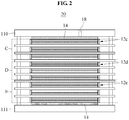
- FIG. 2 is a cross-sectional view illustrating an HT-PEMFC stack according to an example embodiment.
- an HT-PEMFC stack 20 may include end plate 110, middle end plate 111, a first cell assembly 12c, a second cell assembly 12d, a third cell assembly 12e, a plurality of cooling plates, a current collector 14, and a coolant inlet 18.
- the plurality of cooling plates may include a plurality of first cooling plates provided on top surfaces or bottom surfaces of the first cell assemblies 12c, respectively, a plurality of second cooling plate provided on top surfaces or bottom surfaces of the second cell assemblies 12d, respectively, a plurality of third cooling plates provided on top surfaces or bottom surfaces of the third cell assemblies 12e, respectively.
- the first cooling plate, the second cooling plate, and the third cooling plate may not be different components and may be determined based on a cell assembly on which a corresponding cooling plate is provided among the first cell assembly 12c, the second cell assembly 12d, and the third cell assembly 12e.
- the end plate 110 and middle end plate 111 may include a top end plate including the coolant inlet 18, and a bottom end plate provided to face the top end plate.
- the end plate 110 may also be referred to as the top end plate
- the middle end plate 111 may also be referred to as the bottom end plate.
- a coolant may flow in the top end plate 110 through the coolant inlet 18 and be injected into the plurality of cooling plates.
- the first cell assembly 12c may be provided closer to the top end plate 110 than the second cell assembly 12d.
- the third cell assembly 12e may be provided closer to the middle end plate 111 than the second cell assembly 12d.
- the first cell assembly 12c and the third cell assembly 12e are provided closer to the end plate 110 and middle end plate 111, respectively, and thus the end plate 110 and middle end plate 111 may absorb heat. Therefore, an appropriate temperature may be maintained.
- the second cell assembly 12d is provided relatively distant from the end plate 110 and middle end plate 111 compared to the first cell assembly 12c and the third cell assembly 12e. Thus, it is relatively difficult to maintain an appropriate temperature.
- the second cell assembly 12d may include a number of cell units less than a number of cell units included in each of the first cell assembly 12c and the third cell assembly 12e.
- the first cell assembly 12c may include five cell units
- the second cell assembly 12d may include four cell units
- the third cell assembly 12e may include five cell units.
- FIG. 3 is a cross-sectional view illustrating a portion of an HT-PEMFC stack according to an example embodiment.
- the HT-PEMFC stack 20 may include the end plate 110, a first cell assembly 12f, a second cell assembly 12g, a third cell assembly 12h, a fourth cell assembly 12i, a fifth cell assembly 12j, the current collector 14, a plurality of cooling plates, and the coolant inlet 18.
- the first cell assembly 12f, the second cell assembly 12g, the third cell assembly 12h, the fourth cell assembly 12i, and the fifth cell assembly 12j may be arranged to be distant from the coolant inlet 18.
- the first cell assembly 12f may be provided closest to the coolant inlet 18, and the fifth cell assembly 12j may be provided most distant from the coolant inlet 18.
- a number of cell units included in at least a portion of a plurality of cell assemblies may gradually decrease according to an increase in a distance between a corresponding cell assembly and the coolant inlet 18.
- the first cell assembly 12f may include nine cell units and a single dummy cell
- the second cell assembly 12g may include eight cell units and a single dummy cell
- the third cell assembly 12h may include seven cell units and a single dummy cell
- the fourth cell assembly 12i may include six cell units and a single dummy cell
- the fifth cell assembly 12j may include five cell units and a single dummy cell.
- FIG. 4 is an exploded perspective view illustrating a portion of an HT-PEMFC stack according to an example embodiment
- FIG. 5 is a cross-sectional view illustrating a portion of an HT-PEMFC stack according to an example embodiment.
- the cell assembly is provided between two cooling plates 131 and 132.
- the cell assembly may include a plurality of cell units 121, a dummy cell 122, and an insulating member 123.
- the cooling plate 131 attached on a top surface of the cell assembly may include an inlet hole and an outlet hole for hydrogen and oxygen, a plurality of holes 131c through which the plurality of clamping bars 112 of FIG. 1 passes, respectively, and holes 131a and 131b through which coolant hoses 135 and 136 pass, respectively.
- the cooling plate 132 attached on a bottom surface of the cell assembly may include an inlet hole and an outlet hole for hydrogen and oxygen, a plurality of holes 132c through which the plurality of clamping bars 112 of FIG. 1 passes, respectively, and holes 132a and 132b through which the coolant hoses 135 and 136 pass, respectively.
- FIG. 6 is a graph showing an enhancement in a temperature deviation by an HT-PEMFC according to an example embodiment.
- a point in time at which a time is 0 indicates a point in time at which a heat-up ends in the HT-PEMFC stack and a reaction starts in an MEA.
- a temperature difference between a top end plate and a bottom end plate is about 20°C at the point in time at which the time is 0.
- the bottom end plate is in direct contact with an external device and thus may have a temperature less than that of the top end plate due to a heat conduction. While the reaction continues in the MEA, a plurality of cooling plates may cool the MEA.
- an interval between the plurality of cooling plates may decrease according to an increase in a distance between a corresponding cooling plate and a coolant inlet or may decrease according to an increase in a distance between a corresponding cooling plate and each end plate.
- each of the cooling plates may allow a temperature of the HT-PEMFC stack to be uniform through the above structure. Accordingly, referring to the graph, it can be verified that the temperature difference between the top end plate and the bottom end plate approaches about 0°C when 120 minutes elapses.
- FIG. 7 is a top view illustrating a dummy cell according to an example embodiment
- FIG. 8 is a side view illustrating a dummy cell according to an example embodiment.
- a dummy cell 122 may include a dummy cell body 1221, a plurality of dummy cell holes 1222, and a plurality of thermocouples, for example, a first thermocouple TC1, a second thermocouple TC2, and a third thermocouple TC3.
- the dummy cell body 1221 may have a shape corresponding to the cell unit 121a of FIG.1 .
- the dummy cell body 1221 may overlap the cell unit 121 in a stacking direction of a stack.
- the dummy cell body 1221 may also have a bottom surface in a rectangular shape identical thereto.
- the plurality of dummy cell holes 1222 may communicate with a hydrogen inlet hole and outlet hole and an oxygen inlet hole and outlet hole included in the cell unit 121 of FIG. 4 , respectively.
- the plurality of thermocouples may be inserted in the dummy cell body 1221 in a direction vertical to the stacking direction. Only one of the plurality of thermocouples, for example, the first thermocouple TC1, the second thermocouple TC2, and the thermocouple TC3, may be provided. Each of the plurality of thermocouples, for example, the first thermocouple TC1, the second thermocouple TC2, and the thermocouple TC3, may be inserted at a different depth, and may measure a temperature at a different location.
- thermocouple TC1 may measure a temperature of a portion that is a relatively edge
- the third thermocouple TC3 may measure a temperature of a center portion
- the second thermocouple TC2 may measure a temperature between the first thermocouple TC1 and the third thermocouple TC3.
- the third thermocouple TC3 may measure a temperature of a center portion of a unit in which a reaction of the MEA most actively occurs.
- FIG. 9 is a top view illustrating an end plate according to an example embodiment.
- a plurality of relief springs 113 may be provided along an edge of the end plate 110.
- ten relief springs may be provided along an edge of the end plate 110.
- four relief springs 113 may be provided along each long side of the end plate 110, and three relief springs 113 may be provided along each short side of the end plate 110. That is, the ten relief springs 113 may be provided.
- the plurality of surface pressure measuring devices 119 may be provided below the relief springs 113, respectively.
- the plurality of surface pressure measuring devices 119 may uniformly measure a pressure applied to the end plate 110.
- ten surface pressure measuring devices 119 may also be provided.
- a pressure of a top left side is measured to be relatively low compared to a pressure applied to other portions of the end plate 110, a user may further rigidly fasten the relief spring 113 of the top left side to implement a normal coupling.
- MEA membrane electrode assembly
Landscapes
- Life Sciences & Earth Sciences (AREA)
- Engineering & Computer Science (AREA)
- Manufacturing & Machinery (AREA)
- Sustainable Development (AREA)
- Sustainable Energy (AREA)
- Chemical & Material Sciences (AREA)
- Chemical Kinetics & Catalysis (AREA)
- Electrochemistry (AREA)
- General Chemical & Material Sciences (AREA)
- Fuel Cell (AREA)
Abstract
Description
- This application claims the priority benefit of Korean Patent Application No.
10-2018-0048538 filed on April 26, 2018 - One or more example embodiments relate to a high-temperature polymer electrolyte membrane fuel cell (HT-PEMFC) stack for optimizing a stack operation.
- A fuel cell is drawing attention as promising futuristic clean energy technology since the fuel cell is eco-friendly and has a high-efficiency, a high-power density, and the like. Here, research on a high-temperature polymer electrolyte membrane fuel cell (HT-PEMFC) is actively ongoing. The HT-PEMFC uses a polybenzimidazole (PBI)-based electrolyte membrane doped with phosphoric acid, and thus operates without a separate humidification. Also, a separate moisture trap is not required since water is generated in a vapor form through the operation of the HT-PEMFC. Furthermore, when operating the HT-PEMFC at operation temperature of 150°C to 180°C, a degradation in performance of a membrane electrode assembly (MEA) by CO poisoning may significantly decrease to be CO-resistant up to CO concentration 3%. Accordingly, a CO removal process may be minimized during a hydrogen reforming process. In addition, a relatively high outlet temperature close to 100°C may be obtained, which may lead to increasing use of thermal energy.
- The HT-PEMFC may need to be further developed. Theoretically, the HT-PEMFC has a high electrochemical reaction rate. Practically, a performance of the developed HT-PEMFC may slightly not reach that of a low-temperature polymer electrolyte membrane fuel cell (LT-PEMFC). Also, the HT-PEMFC may have a relatively short durability and lifespan due to a harsh operation condition, for example, an exposure to phosphoric acid and a high temperature.
- For example, when a portion of the HT-PEMFC is damaged under the operation condition, such as the high temperature, a coolant may penetrate the MEA. Thus, the performance of an HT-PEMFC stack may be degraded. Also, since an oil used as a coolant of the HT-PEMFC stack has a viscosity greater than that of water, the oil causes a high differential pressure in a circulation path, which may also lead to damage to the HT-PEMFC. Furthermore, since the oil used as the coolant of the HT-PEMFC stack operates at high temperature, the oil causes a change in a volume of a separator during a circulation in a coolant flow path formed in the separator of the HT-PEMFC, which may accelerate a damage.
- In addition, when the HT-PEMFC operates under the operation condition, such as the high-temperature, a non-uniformity of temperature may occur in a stacking direction of the HT-PEMFC stack. The non-uniform temperature may decrease an efficiency of the HT-PEMFC.
- At least one example embodiment provides a high-temperature polymer electrolyte membrane fuel cell (HT-PEMFC) stack that may prevent a degradation in a performance and a durability from occurring due to a non-uniform temperature in a stack.
- At least one example embodiment also provides an HT-PEMFC stack that may prevent a gas leakage from occurring due to a loose coupling of the stack.
- According to an aspect of at least one example embodiment, there is provided a high-temperature polymer electrolyte membrane fuel cell (HT-PEMFC) stack for optimizing a stack operation, the HT-PEMFC stack including: a coolant inlet configured to allow a coolant to flow in; a plurality of cooling plates configured to move the coolant that flows in through the coolant inlet; and a plurality of cell assemblies each provided between two cooling plates adjacent to each other among the plurality of cooling plates, and each cell assembly including a plurality of cell units. At least a portion of the plurality of cell assemblies each includes a different number of cell units.
- A number of cell units included in each of at least the portion of the plurality of cell assemblies may decrease according to an increase in a distance between a corresponding cell assembly and the coolant inlet.
- The plurality of cooling plates may include: a plurality of first cooling plates; and a plurality of second cooling plates provided relatively distant from the coolant inlet compared to the plurality of first cooling plates, and the plurality of cell assemblies may include: a first cell assembly provided between two first cooling plates adjacent to each other and including a first number of first cell units; and a second cell assembly provided between two second cooling plates adjacent to each other and including a second number of second cell units, the second number being less than the first number.
- The HT-PEMFC stack may further include: an end plate configured to press the plurality of first cooling plates, the plurality of second cooling plates, the first cell assembly, and the second cell assembly. The plurality of cooling plates may further include a plurality of third cooling plates provided closer to the end plate than the plurality of second cooling plates, and the plurality of cell assemblies may further include a third cell assembly provided between two third cooling plates adjacent to each other and including a third number of third cell units, the third umber being grater than the second number.
- The end plate may include: a top end plate including the coolant inlet; and a bottom end plate provided to face the top end plate, the first cell assembly may be provided closer to the top end plate than the second cell assembly, and the third cell assembly may be provided closer to the bottom end plate than the second cell assembly.
- The first cell assembly may include: a plurality of first cell units each including a membrane electrode bonding assembly (MEA); and a first dummy cell including a thermocouple and configured to stack in parallel with the plurality of cell units.
- The first dummy cell may be provided between two first cell units provided in a middle of the plurality of fist cell units.
- The second cell assembly may include: a plurality of second cell units each including an MEA; and a second dummy cell including a thermocouple and configured to stack in parallel with the plurality of cell units.
- The first cell assembly may include: a plurality of first cell units each including an MEA; and an insulating member configured to surround the plurality of first cell units.
- The HT-PEMFC stack may further include: a coolant hose configured to allow the coolant to flow in each of the plurality of first cooling plates and the plurality of second cooling plates. At least a portion of the insulating member may be provided between the plurality of the first cell units and the coolant hose.
- The HT-PEMFC stack may further include: an end plate configured to press the plurality of first cooling plates and the plurality of first cell assemblies; and a surface pressure measuring device provided on one surface of the end plate and configured to measure a pressure applied to the plurality of first cooling plates and the plurality of first cell assemblies by the end plate.
- The HT-PEMFC stack further including: a clamping bar configured to couple with the end plate; and a relief spring provided at an end of the clamping bar and configured to press the end plate. The surface pressure measuring device may be provided between the relief spring and the end plate.
- A plurality of relief springs may be provided along an edge of the end plate, and the surface pressure measuring device may be provided below each of the plurality of relief springs.
- Additional aspects of example embodiments will be set forth in part in the description which follows and, in part, will be apparent from the description, or may be learned by practice of the disclosure.
- These and/or other aspects, features, and advantages of the invention will become apparent and more readily appreciated from the following description of example embodiments, taken in conjunction with the accompanying drawings of which:
-
FIG. 1 is a cross-sectional view illustrating a high-temperature polymer electrolyte membrane fuel cell (HT-PEMFC) stack according to an example embodiment; -
FIG. 2 is a cross-sectional view illustrating an HT-PEMFC stack according to an example embodiment; -
FIG. 3 is a cross-sectional view illustrating a portion of an HT-PEMFC stack according to an example embodiment; -
FIG. 4 is an exploded perspective view illustrating a portion of an HT-PEMFC stack according to an example embodiment; -
FIG. 5 is a cross-sectional view illustrating a portion of an HT-PEMFC stack according to an example embodiment; -
FIG. 6 is a graph showing an enhancement in a temperature deviation using an HT-PEMFC according to an example embodiment; -
FIG. 7 is a top view illustrating a dummy cell according to an example embodiment; -
FIG. 8 is a side view illustrating a dummy cell according to an example embodiment; and -
FIG. 9 is a top view illustrating an end plate according to an example embodiment. - Hereinafter, some example embodiments will be described in detail with reference to the accompanying drawings. Regarding the reference numerals assigned to the elements in the drawings, it should be noted that the same elements will be designated by the same reference numerals, wherever possible, even though they are shown in different drawings. Also, in the description of embodiments, detailed description of well-known related structures or functions will be omitted when it is deemed that such description will cause ambiguous interpretation of the present disclosure.
- In addition, terms, such as first, second, A, B, (a), (b), and the like, may be used herein to describe components. Each of these terminologies is not used to define an essence, order or sequence of a corresponding component but used merely to distinguish the corresponding component from other component(s). It should be noted that if it is described in the specification that one component is "connected", "coupled", or "joined" to another component, a third component may be "connected", "coupled", and "joined" between the first and second components, although the first component may be directly connected, coupled, or joined to the second component.
- A component having a common function with a component included in one example embodiment is described using a like name in another example embodiment. Unless otherwise described, a description made in one example embodiment may be applicable to another example embodiment and a detailed description within a duplicate range is omitted.
-
FIG. 1 is a cross-sectional view illustrating a high-temperature polymer electrolyte membrane fuel cell (HT-PEMFC) stack according to an example embodiment. - Referring to
FIG. 1 , an HT-PEMFC stack 10 according to an example embodiment, may include asupport assembly 11, afirst cell assembly 12a, asecond cell assembly 12b, a plurality of coolingplates 13, and acurrent collector 14 configured to provide a produced current to an outside. The plurality of coolingplates 13 may include a plurality of first cooling plates provided on top surfaces or bottom surfaces of thefirst cell assemblies 12a, respectively, and a plurality of second cooling plates provided on top surfaces or bottom surfaces of thesecond cell assemblies 12b, respectively. The first cooling plate and the second cooling plate may not be different components and may be determined based on a cell assembly on which a corresponding cooling plate is provided between thefirst cell assembly 12a and thesecond cell assembly 12b. A cooling plate provided between thefirst cell assembly 12a and thesecond cell assembly 12b may be referred to as a first cooling plate or a second cooling plate. - The
support assembly 11 may support and press thefirst cell assembly 12a, thesecond cell assembly 12b, and the plurality of coolingplates 13. Thesupport assembly 11 may include anend plate 110, amiddle end plate 111, a clampingbar 112, arelief spring 113, and surfacepressure measuring devices 119. - The
end plate 110 refers to a plate that is coupled with each of both ends of the HT-PEMFC stack 10 and may press other components provided between the twoend plates 110. To optimize the utilization of a space, theend plate 110 may be in, for example, a rectangular shape. Although not illustrated, theend plate 110 may include a coolant inlet port and a coolant outlet port. For example, a single coolant inlet port and a single coolant outlet port may be provided to anend plate 110, or two coolant inlet ports and two coolant outlet ports may be provided to anend plate 110. - The
middle end plate 111 refers to a plate that is provided at a center between the twoend plates 110 and may enhance a fastening force. The HT-PEMFC stack 10 may operate at high temperature, and thus have a relatively great thermal expansion compared to that of a low-temperature PEMFC stack. Therefore, a probability that thefirst cell assembly 12a and/or thesecond cell assembly 12b are damaged by the thermal expansion may increase. To prevent such damage, it is possible to increase a thickness of a separator. Here, if the thickness of the separator increases, it may be difficult to maintain the fastening force with the twoend plates 110. Thus, themiddle end plate 111 may be additionally provided between the twoend plates 110 to increase the fastening force. - The clamping
bar 112 may be provided between the twoend plates 110 or may be provided between each of the twoend plates 110 and themiddle end plate 111 and may fasten components provided between the twoend plates 110. The clampingbar 112 may be provided to pass through at least a portion of the components provided between the twoend plates 110 to properly align the components. - The
relief spring 113 may be provided at an end of the clampingbar 112 and press the components provided between the twoend plates 110 or between each of the twoend plates 110 and themiddle end plate 111. A pressure may be uniformly applied to thefirst cell assembly 12a and/or thesecond cell assembly 12b by adjusting a location and a length of therelief spring 113. - Surface
pressure measuring devices 119 may be provided between therelief spring 113 and theend plate 110. Surfacepressure measuring device 119 may measure the pressure applied to the components by therelief spring 113. A user may determine whether stack coupling is normally performed based on pressure information measured by the plurality of surfacepressure measuring devices 119. - Each of the
first cell assembly 12a and thesecond cell assembly 12b may be provided between the plurality of coolingplates 13, which may be performed a plurality of number of times. Accordingly, a plurality offirst cell assemblies 12a and a plurality ofsecond cell assemblies 12b may be provided. For example, referring toFIG. 1 , ninefirst cell assemblies 12a may be provided above themiddle end plate 111, and ninesecond cell assemblies 12b may be provided below themiddle end plate 111. Thefirst cell assembly 12a may be provided between the two coolingplates 13 adjacent to each other. - The
first cell assembly 12a may include a plurality offirst cell units 121a, afirst dummy cell 122a, and a first insulatingmember 123a. - Each of the plurality of
first cell units 121a may include a membrane electrode assembly (MEA) and two separators configured to surround a top and a bottom of the MEA, respectively. - The
first dummy cell 122a may measure an operation temperature of the MEA. For example, thefirst dummy cell 122a may include a plurality of thermocouples. Thefirst dummy cell 122a may be stacked in parallel with the plurality offirst cell units 121a. Thefirst dummy cell 122a may be formed of a material identical to that of the separator included in the plurality offirst cell units 121a. - The
first dummy cell 122a may be provided between the twofirst cell units 121a provided in the middle of the plurality offirst cell units 121a. For example, if an even number of the plurality offirst cell units 121a are present, thefirst dummy cell 122a may be provided between the twofirst cell units 121a that are provided in the middle. As another example, if an odd number of the plurality of thefirst cell units 121a are present, thefirst dummy cell 122a may be provided between any two of threefirst cell units 121a that are provided in the middle. Due to such arrangement, thefirst dummy cell 122a may be relatively less influenced by the coolingplate 13 adjacent thereto, and in this state, may measure a real-time temperature of the MEA. - A single
first dummy cell 122a may be provided for each of the plurality offirst cell assemblies 12a. In this case, a temperature distribution in the stack may be measured based on temperature information measured by each of thefirst dummy cells 122a. - The first insulating
member 123a may surround the plurality offirst cell units 121a and thefirst dummy cell 122a. The first insulatingmember 123a may decrease an amount of heat that is generated in the plurality offirst cell units 121a and transferred to acoolant hose 135 ofFIG. 4 . A temperature of a coolant to be transferred to the plurality of coolingplates 13 through the coolinghose 135 may be maintained to be relatively uniform due to the first insulatingmember 123a. - The
second cell assembly 12b may include a plurality ofsecond cell units 121b, asecond dummy cell 122b, and a second insulatingmember 123b. - A number of the plurality of
second cell units 121b of thesecond cell assembly 12b may be less than a number of the plurality offirst cell units 121a of thefirst cell assembly 12a. For example, fivefirst cell units 121a may be included in a singlefirst cell assembly 12a, and foursecond cell units 121b may be include in a singlesecond cell assembly 12b. An area of thefirst cell assembly 12a including the five cell units is indicated with A, an area of thesecond cell assembly 12b including the four cell units is indicated with B. That is, a cooling plate ratio of an upper portion is greater than that of an lower portion. Here, the lower portion refers to a portion located relatively distant from a coolant inlet through which a coolant flows in from an outside, and the upper portion refers to a portion located relatively closer to the coolant inlet. Through this, a temperature deviation in the stack may decrease through the above structure, and thus an efficiency of a fuel cell may increase. Also, decreases in a performance and a durability by a non-uniformity of temperature may be prevented. - The plurality of cooling
plates 13 may be provided to remove heat generated in the HT-PEMFC stack 10, and may remove the heat generated in thefirst cell assembly 12a and thesecond cell assembly 12b by moving the coolant using an external manifold scheme. -
FIG. 2 is a cross-sectional view illustrating an HT-PEMFC stack according to an example embodiment. - Referring to
FIG 2 , an HT-PEMFC stack 20 may includeend plate 110,middle end plate 111, afirst cell assembly 12c, asecond cell assembly 12d, athird cell assembly 12e, a plurality of cooling plates, acurrent collector 14, and acoolant inlet 18. The plurality of cooling plates may include a plurality of first cooling plates provided on top surfaces or bottom surfaces of thefirst cell assemblies 12c, respectively, a plurality of second cooling plate provided on top surfaces or bottom surfaces of thesecond cell assemblies 12d, respectively, a plurality of third cooling plates provided on top surfaces or bottom surfaces of thethird cell assemblies 12e, respectively. The first cooling plate, the second cooling plate, and the third cooling plate may not be different components and may be determined based on a cell assembly on which a corresponding cooling plate is provided among thefirst cell assembly 12c, thesecond cell assembly 12d, and thethird cell assembly 12e. - The
end plate 110 andmiddle end plate 111 may include a top end plate including thecoolant inlet 18, and a bottom end plate provided to face the top end plate. Herein, theend plate 110 may also be referred to as the top end plate, and themiddle end plate 111 may also be referred to as the bottom end plate. A coolant may flow in thetop end plate 110 through thecoolant inlet 18 and be injected into the plurality of cooling plates. - The
first cell assembly 12c may be provided closer to thetop end plate 110 than thesecond cell assembly 12d. Thethird cell assembly 12e may be provided closer to themiddle end plate 111 than thesecond cell assembly 12d. Thefirst cell assembly 12c and thethird cell assembly 12e are provided closer to theend plate 110 andmiddle end plate 111, respectively, and thus theend plate 110 andmiddle end plate 111 may absorb heat. Therefore, an appropriate temperature may be maintained. Thesecond cell assembly 12d is provided relatively distant from theend plate 110 andmiddle end plate 111 compared to thefirst cell assembly 12c and thethird cell assembly 12e. Thus, it is relatively difficult to maintain an appropriate temperature. Therefore, thesecond cell assembly 12d may include a number of cell units less than a number of cell units included in each of thefirst cell assembly 12c and thethird cell assembly 12e. For example, thefirst cell assembly 12c may include five cell units, thesecond cell assembly 12d may include four cell units, and thethird cell assembly 12e may include five cell units. - Through such a structure, it is possible to decrease a temperature deviation in the stack and to enhance an efficiency of a fuel cell. Also, it is possible to prevent a degradation in a performance and a durability by a non-uniform temperature.
-
FIG. 3 is a cross-sectional view illustrating a portion of an HT-PEMFC stack according to an example embodiment. - Referring to
FIG. 3 , the HT-PEMFC stack 20 may include theend plate 110, afirst cell assembly 12f, asecond cell assembly 12g, athird cell assembly 12h, afourth cell assembly 12i, afifth cell assembly 12j, thecurrent collector 14, a plurality of cooling plates, and thecoolant inlet 18. - The
first cell assembly 12f, thesecond cell assembly 12g, thethird cell assembly 12h, thefourth cell assembly 12i, and thefifth cell assembly 12j may be arranged to be distant from thecoolant inlet 18. For example, thefirst cell assembly 12f may be provided closest to thecoolant inlet 18, and thefifth cell assembly 12j may be provided most distant from thecoolant inlet 18. - A number of cell units included in at least a portion of a plurality of cell assemblies may gradually decrease according to an increase in a distance between a corresponding cell assembly and the
coolant inlet 18. For example, thefirst cell assembly 12f may include nine cell units and a single dummy cell, thesecond cell assembly 12g may include eight cell units and a single dummy cell, thethird cell assembly 12h may include seven cell units and a single dummy cell, thefourth cell assembly 12i may include six cell units and a single dummy cell, and thefifth cell assembly 12j may include five cell units and a single dummy cell. Through such a structure, it is possible to decrease a temperature deviation in the stack and to enhance an efficiency of a fuel cell. Also, it is possible to prevent a degradation in a performance and a durability by a non-uniform temperature. -
FIG. 4 is an exploded perspective view illustrating a portion of an HT-PEMFC stack according to an example embodiment, andFIG. 5 is a cross-sectional view illustrating a portion of an HT-PEMFC stack according to an example embodiment. - Referring to
FIGS. 4 and 5 , a cell assembly is provided between two coolingplates cell units 121, adummy cell 122, and an insulatingmember 123. - The
cooling plate 131 attached on a top surface of the cell assembly may include an inlet hole and an outlet hole for hydrogen and oxygen, a plurality ofholes 131c through which the plurality of clampingbars 112 ofFIG. 1 passes, respectively, andholes coolant hoses cooling plate 132 attached on a bottom surface of the cell assembly may include an inlet hole and an outlet hole for hydrogen and oxygen, a plurality ofholes 132c through which the plurality of clampingbars 112 ofFIG. 1 passes, respectively, andholes coolant hoses - Most heat emitted from the plurality of
cell units 121 and thedummy cell 122, and transferred tocoolant hoses member 123. -
FIG. 6 is a graph showing an enhancement in a temperature deviation by an HT-PEMFC according to an example embodiment. - Referring to
FIG. 6 , a point in time at which a time is 0 indicates a point in time at which a heat-up ends in the HT-PEMFC stack and a reaction starts in an MEA. A temperature difference between a top end plate and a bottom end plate is about 20°C at the point in time at which the time is 0. In general, the bottom end plate is in direct contact with an external device and thus may have a temperature less than that of the top end plate due to a heat conduction. While the reaction continues in the MEA, a plurality of cooling plates may cool the MEA. In particular, an interval between the plurality of cooling plates may decrease according to an increase in a distance between a corresponding cooling plate and a coolant inlet or may decrease according to an increase in a distance between a corresponding cooling plate and each end plate. While the reaction continues in the MEA, each of the cooling plates may allow a temperature of the HT-PEMFC stack to be uniform through the above structure. Accordingly, referring to the graph, it can be verified that the temperature difference between the top end plate and the bottom end plate approaches about 0°C when 120 minutes elapses. -
FIG. 7 is a top view illustrating a dummy cell according to an example embodiment, andFIG. 8 is a side view illustrating a dummy cell according to an example embodiment. - Referring to
FIGS 7 and 8 , adummy cell 122 may include adummy cell body 1221, a plurality ofdummy cell holes 1222, and a plurality of thermocouples, for example, a first thermocouple TC1, a second thermocouple TC2, and a third thermocouple TC3. - The
dummy cell body 1221 may have a shape corresponding to thecell unit 121a ofFIG.1 . For example, thedummy cell body 1221 may overlap thecell unit 121 in a stacking direction of a stack. For example, when thecell unit 121 has a bottom surface in a rectangular shape, thedummy cell body 1221 may also have a bottom surface in a rectangular shape identical thereto. - The plurality of
dummy cell holes 1222 may communicate with a hydrogen inlet hole and outlet hole and an oxygen inlet hole and outlet hole included in thecell unit 121 ofFIG. 4 , respectively. - The plurality of thermocouples, for example, the first thermocouple TC1, the second thermocouple TC2, and the thermocouple TC3, may be inserted in the
dummy cell body 1221 in a direction vertical to the stacking direction. Only one of the plurality of thermocouples, for example, the first thermocouple TC1, the second thermocouple TC2, and the thermocouple TC3, may be provided. Each of the plurality of thermocouples, for example, the first thermocouple TC1, the second thermocouple TC2, and the thermocouple TC3, may be inserted at a different depth, and may measure a temperature at a different location. For example, the thermocouple TC1 may measure a temperature of a portion that is a relatively edge, the third thermocouple TC3 may measure a temperature of a center portion, and the second thermocouple TC2 may measure a temperature between the first thermocouple TC1 and the third thermocouple TC3. In particular, the third thermocouple TC3 may measure a temperature of a center portion of a unit in which a reaction of the MEA most actively occurs. -
FIG. 9 is a top view illustrating an end plate according to an example embodiment. - Referring to
FIG. 9 , a plurality of relief springs 113, for example, ten relief springs, may be provided along an edge of theend plate 110. For example, when theend plate 110 is in a rectangular shape, fourrelief springs 113 may be provided along each long side of theend plate 110, and threerelief springs 113 may be provided along each short side of theend plate 110. That is, the tenrelief springs 113 may be provided. - The plurality of surface
pressure measuring devices 119 may be provided below the relief springs 113, respectively. For example, when the plurality of relief springs 113 is provided along the edge of theend plate 110, the plurality of surfacepressure measuring devices 119 may uniformly measure a pressure applied to theend plate 110. For example, when tenrelief springs 113 are provided, ten surfacepressure measuring devices 119 may also be provided. For example, when a pressure of a top left side is measured to be relatively low compared to a pressure applied to other portions of theend plate 110, a user may further rigidly fasten therelief spring 113 of the top left side to implement a normal coupling. - According to some example embodiments, it is possible to prevent a degradation in a performance and a durability from occurring due to a non-uniform temperature by maintaining a temperature in a stack to be uniform.
- Also, according to some example embodiments, it is possible to measure a temperature in a membrane electrode assembly (MEA) during an actual operation using a dummy cell in a stack.
- Also, according to some example embodiments, it is possible to decrease a non-uniformity of temperature in a stack by preventing a heat from being transferred to a coolant hose using an insulator provided between the stack and the coolant hose.
- Also, according to some example embodiments, it is possible to prevent a gas leakage by verifying whether a stack is normally coupled using a plurality of surface pressure measuring devices provided to an end plate.
- A number of example embodiments have been described above. Nevertheless, it should be understood that various modifications may be made to these example embodiments. For example, suitable results may be achieved if the described techniques are performed in a different order and/or if components in a described system, architecture, device, or circuit are combined in a different manner and/or replaced or supplemented by other components or their equivalents. Accordingly, other implementations are within the scope of the following claims.
Claims (13)
- A high-temperature polymer electrolyte membrane fuel cell (HT-PEMFC) stack for optimizing a stack operation, the HT-PEMFC stack comprising:a coolant inlet configured to allow a coolant to flow in;a plurality of cooling plates configured to move the coolant that flows in through the coolant inlet; anda plurality of cell assemblies each provided between two cooling plates adjacent to each other among the plurality of cooling plates, and each cell assembly comprising a plurality of cell units,wherein at least a portion of the plurality of cell assemblies each comprises a different number of cell units.
- The HT-PEMFC stack of claim 1 or 2, wherein a number of cell units included in each of at least the portion of the plurality of cell assemblies decreases according to an increase in a distance between a corresponding cell assembly and the coolant inlet.
- The HT-PEMFC stack of any one of the preceding claims, wherein the plurality of cooling plates comprises:a plurality of first cooling plates; anda plurality of second cooling plates provided relatively distant from the coolant inlet compared to the plurality of first cooling plates, andthe plurality of cell assemblies comprises:a first cell assembly provided between two first cooling plates adjacent to each other and comprising a first number of first cell units; anda second cell assembly provided between two second cooling plates adjacent to each other and comprising a second number of second cell units, the second number being less than the first number.
- The HT-PEMFC stack of claim 3, further comprising:an end plate configured to press the plurality of first cooling plates, the plurality of second cooling plates, the first cell assembly, and the second cell assembly,wherein the plurality of cooling plates further comprises a plurality of third cooling plates provided closer to the end plate than the plurality of second cooling plates, andthe plurality of cell assemblies further comprises a third cell assembly provided between two third cooling plates adjacent to each other and comprising a third number of third cell units, the third number being greater than the second number.
- The HT-PEMFC stack of claim 4, wherein the end plate comprises:a top end plate comprising the coolant inlet; anda bottom end plate provided to face the top end plate,the first cell assembly is provided closer to the top end plate than the second cell assembly, andthe third cell assembly is provided closer to the bottom end plate than the second cell assembly.
- The HT-PEMFC stack of any one of claims 3 to 5, wherein the first cell assembly comprises:a plurality of first cell units each comprising a membrane electrode bonding assembly (MEA); anda first dummy cell comprising a thermocouple and configured to stack in parallel with the plurality of first cell units.
- The HT-PEMFC stack of claim 6, wherein the first dummy cell is provided between two first cell units provided in a middle of the plurality of first cell units.
- The HT-PEMFC stack of claim 6 or 7, wherein the second cell assembly comprises:a plurality of second cell units each comprising an MEA; anda second dummy cell comprising a thermocouple and configured to stack in parallel with the plurality of second cell units.
- The HT-PEMFC stack of any one of claims 3 to 8, wherein the first cell assembly comprises:a plurality of first cell units each comprising an MEA; andan insulating member configured to surround the plurality of first cell units.
- The HT-PEMFC stack of claim 9, further comprising:a coolant hose configured to allow the coolant to flow in each of the plurality of first cooling plates and the plurality of second cooling plates,wherein at least a portion of the insulating member is provided between the plurality of the first cell units and the coolant hose.
- The HT-PEMFC stack of any one of the preceding claims, further comprising:an end plate configured to press the plurality of cooling plates and the plurality of cell assemblies; anda surface pressure measuring device provided to the end plate and configured to measure a pressure applied to the plurality of cooling plates and the plurality of cell assemblies by the end plate.
- The HT-PEMFC stack of claim 11, further comprising:a clamping bar configured to couple with the end plate; anda relief spring provided at an end of the clamping bar and configured to press the end plate,wherein the surface pressure measuring device is provided between the relief spring and the end plate.
- The HT-PEMFC stack of claim 12, wherein a plurality of relief springs is provided along an edge of the end plate, and
the surface pressure measuring device is provided below each of the plurality of relief springs.
Applications Claiming Priority (1)
| Application Number | Priority Date | Filing Date | Title |
|---|---|---|---|
| KR1020180048538A KR20190124498A (en) | 2018-04-26 | 2018-04-26 | High-temperature polymer electrolyte memberance fuel cell stack for optimizing stack operation |
Publications (2)
| Publication Number | Publication Date |
|---|---|
| EP3561933A1 true EP3561933A1 (en) | 2019-10-30 |
| EP3561933B1 EP3561933B1 (en) | 2024-08-28 |
Family
ID=63762408
Family Applications (1)
| Application Number | Title | Priority Date | Filing Date |
|---|---|---|---|
| EP18198690.2A Active EP3561933B1 (en) | 2018-04-26 | 2018-10-04 | High-temperature polymer electrolyte membrane fuel cell stack for optimizing stack operation |
Country Status (4)
| Country | Link |
|---|---|
| EP (1) | EP3561933B1 (en) |
| KR (1) | KR20190124498A (en) |
| CN (1) | CN110416574A (en) |
| DK (1) | DK3561933T3 (en) |
Cited By (1)
| Publication number | Priority date | Publication date | Assignee | Title |
|---|---|---|---|---|
| WO2022212895A3 (en) * | 2021-04-02 | 2023-01-05 | Advent Technologies, Llc | Fuel cell power systems |
Families Citing this family (2)
| Publication number | Priority date | Publication date | Assignee | Title |
|---|---|---|---|---|
| KR102900657B1 (en) | 2020-07-31 | 2025-12-15 | 주식회사 엘지에너지솔루션 | Cell jig including film type pressure sensor and method for measuring swelling of the battery cell using the same |
| CN118712409B (en) * | 2024-05-27 | 2025-09-05 | 广州汽车集团股份有限公司 | Fuel cell cooling structure, fuel cell, and automobile |
Citations (3)
| Publication number | Priority date | Publication date | Assignee | Title |
|---|---|---|---|---|
| JPH05242903A (en) * | 1992-02-27 | 1993-09-21 | Toshiba Corp | Fuel cell stack |
| US20100266918A1 (en) * | 2009-04-16 | 2010-10-21 | Samsung Electronics Co., Ltd. | Fuel cell stack and fuel cell system with plurality of generation modules |
| US20170237087A1 (en) * | 2016-02-16 | 2017-08-17 | Korea Institute Of Energy Research | High-temperature polymer electrolyte membrane fuel cell stack having independent cooling plate and method of producing the same |
Family Cites Families (5)
| Publication number | Priority date | Publication date | Assignee | Title |
|---|---|---|---|---|
| KR100495736B1 (en) * | 2001-04-03 | 2005-06-16 | 마쯔시다덴기산교 가부시키가이샤 | Polymer electrolyte fuel cell and its operating method |
| CN101138120B (en) * | 2005-03-11 | 2010-12-01 | Bdfip控股有限公司 | Fuel cell stack and method of shutting down fuel cell stack |
| KR101102177B1 (en) * | 2009-08-13 | 2012-01-02 | 두산중공업 주식회사 | Surface pressure control device of fuel cell |
| KR20120012303A (en) * | 2010-07-30 | 2012-02-09 | 삼성전자주식회사 | Fuel cell stack with uniform temperature distribution and its driving method |
| KR101283022B1 (en) * | 2011-06-10 | 2013-07-08 | 현대자동차주식회사 | Fuel cell stack |
-
2018
- 2018-04-26 KR KR1020180048538A patent/KR20190124498A/en not_active Ceased
- 2018-10-04 DK DK18198690.2T patent/DK3561933T3/en active
- 2018-10-04 EP EP18198690.2A patent/EP3561933B1/en active Active
- 2018-10-24 CN CN201811245214.XA patent/CN110416574A/en active Pending
Patent Citations (3)
| Publication number | Priority date | Publication date | Assignee | Title |
|---|---|---|---|---|
| JPH05242903A (en) * | 1992-02-27 | 1993-09-21 | Toshiba Corp | Fuel cell stack |
| US20100266918A1 (en) * | 2009-04-16 | 2010-10-21 | Samsung Electronics Co., Ltd. | Fuel cell stack and fuel cell system with plurality of generation modules |
| US20170237087A1 (en) * | 2016-02-16 | 2017-08-17 | Korea Institute Of Energy Research | High-temperature polymer electrolyte membrane fuel cell stack having independent cooling plate and method of producing the same |
Cited By (1)
| Publication number | Priority date | Publication date | Assignee | Title |
|---|---|---|---|---|
| WO2022212895A3 (en) * | 2021-04-02 | 2023-01-05 | Advent Technologies, Llc | Fuel cell power systems |
Also Published As
| Publication number | Publication date |
|---|---|
| EP3561933B1 (en) | 2024-08-28 |
| DK3561933T3 (en) | 2024-09-23 |
| KR20190124498A (en) | 2019-11-05 |
| CN110416574A (en) | 2019-11-05 |
Similar Documents
| Publication | Publication Date | Title |
|---|---|---|
| US10270116B2 (en) | High-temperature polymer electrolyte membrane fuel cell stack having independent cooling plate and method of producing the same | |
| JP4948823B2 (en) | Fuel cell stack | |
| US9748583B2 (en) | Flow field plate for improved coolant flow | |
| US8927170B2 (en) | Flow field plate for reduced pressure drop in coolant | |
| WO2019151036A1 (en) | Battery pack | |
| EP3561933B1 (en) | High-temperature polymer electrolyte membrane fuel cell stack for optimizing stack operation | |
| JP2019121530A (en) | Power generation cell | |
| JP6659770B2 (en) | Fuel cell stack | |
| KR101261948B1 (en) | Fuel cell stack | |
| KR102666114B1 (en) | Separator, and Fuel cell stack comprising the same | |
| JP2008525991A (en) | Fuel cell with reduced number of cooling plates by varying oxidant flow channel depth | |
| US20140234746A1 (en) | Fuel cell stack | |
| JP2007141551A (en) | Fuel cell stack | |
| KR101759652B1 (en) | Polymer electrolyte membrane fuel cells, fuel cell stack and end plate | |
| CN105378998B (en) | Deform absorption component and fuel cell | |
| US12603303B2 (en) | Fuel cell stack | |
| KR20140046336A (en) | Fuel cell stack having leakage preventing means of cooling medium | |
| US11552311B2 (en) | Fuel cell | |
| KR102329252B1 (en) | High-temperature polymer electrolyte memberance fuel cell stack for optimizing stack operation | |
| KR102872109B1 (en) | Fuel cell | |
| JP4821222B2 (en) | Fuel cell system | |
| JP5398338B2 (en) | Fuel cell stack | |
| JP5443254B2 (en) | Fuel cell | |
| KR101979837B1 (en) | Independent cooling plate for fuel cell and fuel cell comprising the same | |
| US10297842B2 (en) | Fuel cell stack |
Legal Events
| Date | Code | Title | Description |
|---|---|---|---|
| PUAI | Public reference made under article 153(3) epc to a published international application that has entered the european phase |
Free format text: ORIGINAL CODE: 0009012 |
|
| STAA | Information on the status of an ep patent application or granted ep patent |
Free format text: STATUS: REQUEST FOR EXAMINATION WAS MADE |
|
| 17P | Request for examination filed |
Effective date: 20181004 |
|
| AK | Designated contracting states |
Kind code of ref document: A1 Designated state(s): AL AT BE BG CH CY CZ DE DK EE ES FI FR GB GR HR HU IE IS IT LI LT LU LV MC MK MT NL NO PL PT RO RS SE SI SK SM TR |
|
| AX | Request for extension of the european patent |
Extension state: BA ME |
|
| STAA | Information on the status of an ep patent application or granted ep patent |
Free format text: STATUS: EXAMINATION IS IN PROGRESS |
|
| 17Q | First examination report despatched |
Effective date: 20191111 |
|
| GRAP | Despatch of communication of intention to grant a patent |
Free format text: ORIGINAL CODE: EPIDOSNIGR1 |
|
| STAA | Information on the status of an ep patent application or granted ep patent |
Free format text: STATUS: GRANT OF PATENT IS INTENDED |
|
| RIC1 | Information provided on ipc code assigned before grant |
Ipc: H01M 8/00 20160101ALN20240523BHEP Ipc: H01M 8/1018 20160101ALN20240523BHEP Ipc: H01M 8/10 20160101ALN20240523BHEP Ipc: H01M 8/1004 20160101ALN20240523BHEP Ipc: H01M 8/242 20160101ALI20240523BHEP Ipc: H01M 8/2432 20160101ALI20240523BHEP Ipc: H01M 8/0432 20160101ALI20240523BHEP Ipc: H01M 8/04007 20160101ALI20240523BHEP Ipc: H01M 8/0297 20160101ALI20240523BHEP Ipc: H01M 8/0271 20160101ALI20240523BHEP Ipc: H01M 8/249 20160101ALI20240523BHEP Ipc: H01M 8/241 20160101AFI20240523BHEP |
|
| INTG | Intention to grant announced |
Effective date: 20240613 |
|
| GRAS | Grant fee paid |
Free format text: ORIGINAL CODE: EPIDOSNIGR3 |
|
| GRAA | (expected) grant |
Free format text: ORIGINAL CODE: 0009210 |
|
| STAA | Information on the status of an ep patent application or granted ep patent |
Free format text: STATUS: THE PATENT HAS BEEN GRANTED |
|
| AK | Designated contracting states |
Kind code of ref document: B1 Designated state(s): AL AT BE BG CH CY CZ DE DK EE ES FI FR GB GR HR HU IE IS IT LI LT LU LV MC MK MT NL NO PL PT RO RS SE SI SK SM TR |
|
| REG | Reference to a national code |
Ref country code: GB Ref legal event code: FG4D |
|
| REG | Reference to a national code |
Ref country code: CH Ref legal event code: EP |
|
| REG | Reference to a national code |
Ref country code: DE Ref legal event code: R096 Ref document number: 602018073566 Country of ref document: DE |
|
| REG | Reference to a national code |
Ref country code: DK Ref legal event code: T3 Effective date: 20240919 |
|
| REG | Reference to a national code |
Ref country code: IE Ref legal event code: FG4D |
|
| REG | Reference to a national code |
Ref country code: LT Ref legal event code: MG9D |
|
| PG25 | Lapsed in a contracting state [announced via postgrant information from national office to epo] |
Ref country code: NO Free format text: LAPSE BECAUSE OF FAILURE TO SUBMIT A TRANSLATION OF THE DESCRIPTION OR TO PAY THE FEE WITHIN THE PRESCRIBED TIME-LIMIT Effective date: 20241128 |
|
| REG | Reference to a national code |
Ref country code: AT Ref legal event code: MK05 Ref document number: 1718989 Country of ref document: AT Kind code of ref document: T Effective date: 20240828 |
|
| PG25 | Lapsed in a contracting state [announced via postgrant information from national office to epo] |
Ref country code: PL Free format text: LAPSE BECAUSE OF FAILURE TO SUBMIT A TRANSLATION OF THE DESCRIPTION OR TO PAY THE FEE WITHIN THE PRESCRIBED TIME-LIMIT Effective date: 20240828 Ref country code: PT Free format text: LAPSE BECAUSE OF FAILURE TO SUBMIT A TRANSLATION OF THE DESCRIPTION OR TO PAY THE FEE WITHIN THE PRESCRIBED TIME-LIMIT Effective date: 20241230 Ref country code: NL Free format text: LAPSE BECAUSE OF FAILURE TO SUBMIT A TRANSLATION OF THE DESCRIPTION OR TO PAY THE FEE WITHIN THE PRESCRIBED TIME-LIMIT Effective date: 20240828 Ref country code: GR Free format text: LAPSE BECAUSE OF FAILURE TO SUBMIT A TRANSLATION OF THE DESCRIPTION OR TO PAY THE FEE WITHIN THE PRESCRIBED TIME-LIMIT Effective date: 20241129 Ref country code: FI Free format text: LAPSE BECAUSE OF FAILURE TO SUBMIT A TRANSLATION OF THE DESCRIPTION OR TO PAY THE FEE WITHIN THE PRESCRIBED TIME-LIMIT Effective date: 20240828 |
|
| PG25 | Lapsed in a contracting state [announced via postgrant information from national office to epo] |
Ref country code: BG Free format text: LAPSE BECAUSE OF FAILURE TO SUBMIT A TRANSLATION OF THE DESCRIPTION OR TO PAY THE FEE WITHIN THE PRESCRIBED TIME-LIMIT Effective date: 20240828 |
|
| PG25 | Lapsed in a contracting state [announced via postgrant information from national office to epo] |
Ref country code: LV Free format text: LAPSE BECAUSE OF FAILURE TO SUBMIT A TRANSLATION OF THE DESCRIPTION OR TO PAY THE FEE WITHIN THE PRESCRIBED TIME-LIMIT Effective date: 20240828 |
|
| REG | Reference to a national code |
Ref country code: NL Ref legal event code: MP Effective date: 20240828 |
|
| PG25 | Lapsed in a contracting state [announced via postgrant information from national office to epo] |
Ref country code: AT Free format text: LAPSE BECAUSE OF FAILURE TO SUBMIT A TRANSLATION OF THE DESCRIPTION OR TO PAY THE FEE WITHIN THE PRESCRIBED TIME-LIMIT Effective date: 20240828 Ref country code: IS Free format text: LAPSE BECAUSE OF FAILURE TO SUBMIT A TRANSLATION OF THE DESCRIPTION OR TO PAY THE FEE WITHIN THE PRESCRIBED TIME-LIMIT Effective date: 20241228 |
|
| PG25 | Lapsed in a contracting state [announced via postgrant information from national office to epo] |
Ref country code: HR Free format text: LAPSE BECAUSE OF FAILURE TO SUBMIT A TRANSLATION OF THE DESCRIPTION OR TO PAY THE FEE WITHIN THE PRESCRIBED TIME-LIMIT Effective date: 20240828 |
|
| PG25 | Lapsed in a contracting state [announced via postgrant information from national office to epo] |
Ref country code: RS Free format text: LAPSE BECAUSE OF FAILURE TO SUBMIT A TRANSLATION OF THE DESCRIPTION OR TO PAY THE FEE WITHIN THE PRESCRIBED TIME-LIMIT Effective date: 20241128 Ref country code: ES Free format text: LAPSE BECAUSE OF FAILURE TO SUBMIT A TRANSLATION OF THE DESCRIPTION OR TO PAY THE FEE WITHIN THE PRESCRIBED TIME-LIMIT Effective date: 20240828 |
|
| PG25 | Lapsed in a contracting state [announced via postgrant information from national office to epo] |
Ref country code: PT Free format text: LAPSE BECAUSE OF FAILURE TO SUBMIT A TRANSLATION OF THE DESCRIPTION OR TO PAY THE FEE WITHIN THE PRESCRIBED TIME-LIMIT Effective date: 20241230 Ref country code: PL Free format text: LAPSE BECAUSE OF FAILURE TO SUBMIT A TRANSLATION OF THE DESCRIPTION OR TO PAY THE FEE WITHIN THE PRESCRIBED TIME-LIMIT Effective date: 20240828 Ref country code: NO Free format text: LAPSE BECAUSE OF FAILURE TO SUBMIT A TRANSLATION OF THE DESCRIPTION OR TO PAY THE FEE WITHIN THE PRESCRIBED TIME-LIMIT Effective date: 20241128 Ref country code: NL Free format text: LAPSE BECAUSE OF FAILURE TO SUBMIT A TRANSLATION OF THE DESCRIPTION OR TO PAY THE FEE WITHIN THE PRESCRIBED TIME-LIMIT Effective date: 20240828 Ref country code: LV Free format text: LAPSE BECAUSE OF FAILURE TO SUBMIT A TRANSLATION OF THE DESCRIPTION OR TO PAY THE FEE WITHIN THE PRESCRIBED TIME-LIMIT Effective date: 20240828 Ref country code: IS Free format text: LAPSE BECAUSE OF FAILURE TO SUBMIT A TRANSLATION OF THE DESCRIPTION OR TO PAY THE FEE WITHIN THE PRESCRIBED TIME-LIMIT Effective date: 20241228 Ref country code: HR Free format text: LAPSE BECAUSE OF FAILURE TO SUBMIT A TRANSLATION OF THE DESCRIPTION OR TO PAY THE FEE WITHIN THE PRESCRIBED TIME-LIMIT Effective date: 20240828 Ref country code: GR Free format text: LAPSE BECAUSE OF FAILURE TO SUBMIT A TRANSLATION OF THE DESCRIPTION OR TO PAY THE FEE WITHIN THE PRESCRIBED TIME-LIMIT Effective date: 20241129 Ref country code: FI Free format text: LAPSE BECAUSE OF FAILURE TO SUBMIT A TRANSLATION OF THE DESCRIPTION OR TO PAY THE FEE WITHIN THE PRESCRIBED TIME-LIMIT Effective date: 20240828 Ref country code: ES Free format text: LAPSE BECAUSE OF FAILURE TO SUBMIT A TRANSLATION OF THE DESCRIPTION OR TO PAY THE FEE WITHIN THE PRESCRIBED TIME-LIMIT Effective date: 20240828 Ref country code: BG Free format text: LAPSE BECAUSE OF FAILURE TO SUBMIT A TRANSLATION OF THE DESCRIPTION OR TO PAY THE FEE WITHIN THE PRESCRIBED TIME-LIMIT Effective date: 20240828 Ref country code: AT Free format text: LAPSE BECAUSE OF FAILURE TO SUBMIT A TRANSLATION OF THE DESCRIPTION OR TO PAY THE FEE WITHIN THE PRESCRIBED TIME-LIMIT Effective date: 20240828 Ref country code: RS Free format text: LAPSE BECAUSE OF FAILURE TO SUBMIT A TRANSLATION OF THE DESCRIPTION OR TO PAY THE FEE WITHIN THE PRESCRIBED TIME-LIMIT Effective date: 20241128 |
|
| PG25 | Lapsed in a contracting state [announced via postgrant information from national office to epo] |
Ref country code: RO Free format text: LAPSE BECAUSE OF FAILURE TO SUBMIT A TRANSLATION OF THE DESCRIPTION OR TO PAY THE FEE WITHIN THE PRESCRIBED TIME-LIMIT Effective date: 20240828 Ref country code: SM Free format text: LAPSE BECAUSE OF FAILURE TO SUBMIT A TRANSLATION OF THE DESCRIPTION OR TO PAY THE FEE WITHIN THE PRESCRIBED TIME-LIMIT Effective date: 20240828 |
|
| PG25 | Lapsed in a contracting state [announced via postgrant information from national office to epo] |
Ref country code: EE Free format text: LAPSE BECAUSE OF FAILURE TO SUBMIT A TRANSLATION OF THE DESCRIPTION OR TO PAY THE FEE WITHIN THE PRESCRIBED TIME-LIMIT Effective date: 20240828 |
|
| PG25 | Lapsed in a contracting state [announced via postgrant information from national office to epo] |
Ref country code: CZ Free format text: LAPSE BECAUSE OF FAILURE TO SUBMIT A TRANSLATION OF THE DESCRIPTION OR TO PAY THE FEE WITHIN THE PRESCRIBED TIME-LIMIT Effective date: 20240828 |
|
| PG25 | Lapsed in a contracting state [announced via postgrant information from national office to epo] |
Ref country code: IT Free format text: LAPSE BECAUSE OF FAILURE TO SUBMIT A TRANSLATION OF THE DESCRIPTION OR TO PAY THE FEE WITHIN THE PRESCRIBED TIME-LIMIT Effective date: 20240828 Ref country code: SK Free format text: LAPSE BECAUSE OF FAILURE TO SUBMIT A TRANSLATION OF THE DESCRIPTION OR TO PAY THE FEE WITHIN THE PRESCRIBED TIME-LIMIT Effective date: 20240828 |
|
| REG | Reference to a national code |
Ref country code: CH Ref legal event code: PL Ref country code: DE Ref legal event code: R097 Ref document number: 602018073566 Country of ref document: DE |
|
| PLBE | No opposition filed within time limit |
Free format text: ORIGINAL CODE: 0009261 |
|
| STAA | Information on the status of an ep patent application or granted ep patent |
Free format text: STATUS: NO OPPOSITION FILED WITHIN TIME LIMIT |
|
| PG25 | Lapsed in a contracting state [announced via postgrant information from national office to epo] |
Ref country code: MC Free format text: LAPSE BECAUSE OF FAILURE TO SUBMIT A TRANSLATION OF THE DESCRIPTION OR TO PAY THE FEE WITHIN THE PRESCRIBED TIME-LIMIT Effective date: 20240828 |
|
| PG25 | Lapsed in a contracting state [announced via postgrant information from national office to epo] |
Ref country code: BE Free format text: LAPSE BECAUSE OF NON-PAYMENT OF DUE FEES Effective date: 20241031 Ref country code: LU Free format text: LAPSE BECAUSE OF NON-PAYMENT OF DUE FEES Effective date: 20241004 |
|
| PG25 | Lapsed in a contracting state [announced via postgrant information from national office to epo] |
Ref country code: FR Free format text: LAPSE BECAUSE OF NON-PAYMENT OF DUE FEES Effective date: 20241028 |
|
| GBPC | Gb: european patent ceased through non-payment of renewal fee |
Effective date: 20241128 |
|
| PG25 | Lapsed in a contracting state [announced via postgrant information from national office to epo] |
Ref country code: CH Free format text: LAPSE BECAUSE OF NON-PAYMENT OF DUE FEES Effective date: 20241031 |
|
| 26N | No opposition filed |
Effective date: 20250530 |
|
| REG | Reference to a national code |
Ref country code: BE Ref legal event code: MM Effective date: 20241031 |
|
| PG25 | Lapsed in a contracting state [announced via postgrant information from national office to epo] |
Ref country code: SE Free format text: LAPSE BECAUSE OF FAILURE TO SUBMIT A TRANSLATION OF THE DESCRIPTION OR TO PAY THE FEE WITHIN THE PRESCRIBED TIME-LIMIT Effective date: 20240828 |
|
| PG25 | Lapsed in a contracting state [announced via postgrant information from national office to epo] |
Ref country code: GB Free format text: LAPSE BECAUSE OF NON-PAYMENT OF DUE FEES Effective date: 20241128 |
|
| PG25 | Lapsed in a contracting state [announced via postgrant information from national office to epo] |
Ref country code: IE Free format text: LAPSE BECAUSE OF NON-PAYMENT OF DUE FEES Effective date: 20241004 |
|
| PGFP | Annual fee paid to national office [announced via postgrant information from national office to epo] |
Ref country code: DE Payment date: 20250902 Year of fee payment: 8 |
|
| PGFP | Annual fee paid to national office [announced via postgrant information from national office to epo] |
Ref country code: DK Payment date: 20251014 Year of fee payment: 8 |
|
| PG25 | Lapsed in a contracting state [announced via postgrant information from national office to epo] |
Ref country code: CY Free format text: LAPSE BECAUSE OF FAILURE TO SUBMIT A TRANSLATION OF THE DESCRIPTION OR TO PAY THE FEE WITHIN THE PRESCRIBED TIME-LIMIT; INVALID AB INITIO Effective date: 20181004 |
|
| PG25 | Lapsed in a contracting state [announced via postgrant information from national office to epo] |
Ref country code: HU Free format text: LAPSE BECAUSE OF FAILURE TO SUBMIT A TRANSLATION OF THE DESCRIPTION OR TO PAY THE FEE WITHIN THE PRESCRIBED TIME-LIMIT; INVALID AB INITIO Effective date: 20181004 |