EP3561797A1 - Message transmission system, communication terminal, server device, message transmission method, and program - Google Patents
Message transmission system, communication terminal, server device, message transmission method, and program Download PDFInfo
- Publication number
- EP3561797A1 EP3561797A1 EP17884208.4A EP17884208A EP3561797A1 EP 3561797 A1 EP3561797 A1 EP 3561797A1 EP 17884208 A EP17884208 A EP 17884208A EP 3561797 A1 EP3561797 A1 EP 3561797A1
- Authority
- EP
- European Patent Office
- Prior art keywords
- index
- session key
- message
- communication terminal
- server apparatus
- Prior art date
- Legal status (The legal status is an assumption and is not a legal conclusion. Google has not performed a legal analysis and makes no representation as to the accuracy of the status listed.)
- Granted
Links
Images



Classifications
-
- H—ELECTRICITY
- H04—ELECTRIC COMMUNICATION TECHNIQUE
- H04L—TRANSMISSION OF DIGITAL INFORMATION, e.g. TELEGRAPHIC COMMUNICATION
- H04L63/00—Network architectures or network communication protocols for network security
- H04L63/04—Network architectures or network communication protocols for network security for providing a confidential data exchange among entities communicating through data packet networks
- H04L63/0428—Network architectures or network communication protocols for network security for providing a confidential data exchange among entities communicating through data packet networks wherein the data content is protected, e.g. by encrypting or encapsulating the payload
-
- H—ELECTRICITY
- H04—ELECTRIC COMMUNICATION TECHNIQUE
- H04L—TRANSMISSION OF DIGITAL INFORMATION, e.g. TELEGRAPHIC COMMUNICATION
- H04L9/00—Cryptographic mechanisms or cryptographic arrangements for secret or secure communications; Network security protocols
- H04L9/08—Key distribution or management, e.g. generation, sharing or updating, of cryptographic keys or passwords
- H04L9/0891—Revocation or update of secret information, e.g. encryption key update or rekeying
-
- H—ELECTRICITY
- H04—ELECTRIC COMMUNICATION TECHNIQUE
- H04L—TRANSMISSION OF DIGITAL INFORMATION, e.g. TELEGRAPHIC COMMUNICATION
- H04L9/00—Cryptographic mechanisms or cryptographic arrangements for secret or secure communications; Network security protocols
- H04L9/06—Cryptographic mechanisms or cryptographic arrangements for secret or secure communications; Network security protocols the encryption apparatus using shift registers or memories for block-wise or stream coding, e.g. DES systems or RC4; Hash functions; Pseudorandom sequence generators
- H04L9/0618—Block ciphers, i.e. encrypting groups of characters of a plain text message using fixed encryption transformation
-
- G—PHYSICS
- G06—COMPUTING OR CALCULATING; COUNTING
- G06F—ELECTRIC DIGITAL DATA PROCESSING
- G06F16/00—Information retrieval; Database structures therefor; File system structures therefor
-
- G—PHYSICS
- G06—COMPUTING OR CALCULATING; COUNTING
- G06F—ELECTRIC DIGITAL DATA PROCESSING
- G06F16/00—Information retrieval; Database structures therefor; File system structures therefor
- G06F16/90—Details of database functions independent of the retrieved data types
- G06F16/901—Indexing; Data structures therefor; Storage structures
-
- G—PHYSICS
- G06—COMPUTING OR CALCULATING; COUNTING
- G06F—ELECTRIC DIGITAL DATA PROCESSING
- G06F16/00—Information retrieval; Database structures therefor; File system structures therefor
- G06F16/90—Details of database functions independent of the retrieved data types
- G06F16/901—Indexing; Data structures therefor; Storage structures
- G06F16/9014—Indexing; Data structures therefor; Storage structures hash tables
-
- G—PHYSICS
- G06—COMPUTING OR CALCULATING; COUNTING
- G06F—ELECTRIC DIGITAL DATA PROCESSING
- G06F16/00—Information retrieval; Database structures therefor; File system structures therefor
- G06F16/90—Details of database functions independent of the retrieved data types
- G06F16/903—Querying
-
- G—PHYSICS
- G06—COMPUTING OR CALCULATING; COUNTING
- G06F—ELECTRIC DIGITAL DATA PROCESSING
- G06F16/00—Information retrieval; Database structures therefor; File system structures therefor
- G06F16/90—Details of database functions independent of the retrieved data types
- G06F16/95—Retrieval from the web
- G06F16/953—Querying, e.g. by the use of web search engines
-
- G—PHYSICS
- G09—EDUCATION; CRYPTOGRAPHY; DISPLAY; ADVERTISING; SEALS
- G09C—CIPHERING OR DECIPHERING APPARATUS FOR CRYPTOGRAPHIC OR OTHER PURPOSES INVOLVING THE NEED FOR SECRECY
- G09C1/00—Apparatus or methods whereby a given sequence of signs, e.g. an intelligible text, is transformed into an unintelligible sequence of signs by transposing the signs or groups of signs or by replacing them by others according to a predetermined system
-
- H—ELECTRICITY
- H04—ELECTRIC COMMUNICATION TECHNIQUE
- H04L—TRANSMISSION OF DIGITAL INFORMATION, e.g. TELEGRAPHIC COMMUNICATION
- H04L9/00—Cryptographic mechanisms or cryptographic arrangements for secret or secure communications; Network security protocols
- H04L9/008—Cryptographic mechanisms or cryptographic arrangements for secret or secure communications; Network security protocols involving homomorphic encryption
-
- H—ELECTRICITY
- H04—ELECTRIC COMMUNICATION TECHNIQUE
- H04L—TRANSMISSION OF DIGITAL INFORMATION, e.g. TELEGRAPHIC COMMUNICATION
- H04L9/00—Cryptographic mechanisms or cryptographic arrangements for secret or secure communications; Network security protocols
- H04L9/08—Key distribution or management, e.g. generation, sharing or updating, of cryptographic keys or passwords
- H04L9/0816—Key establishment, i.e. cryptographic processes or cryptographic protocols whereby a shared secret becomes available to two or more parties, for subsequent use
- H04L9/085—Secret sharing or secret splitting, e.g. threshold schemes
-
- H—ELECTRICITY
- H04—ELECTRIC COMMUNICATION TECHNIQUE
- H04L—TRANSMISSION OF DIGITAL INFORMATION, e.g. TELEGRAPHIC COMMUNICATION
- H04L9/00—Cryptographic mechanisms or cryptographic arrangements for secret or secure communications; Network security protocols
- H04L9/14—Cryptographic mechanisms or cryptographic arrangements for secret or secure communications; Network security protocols using a plurality of keys or algorithms
- H04L9/16—Cryptographic mechanisms or cryptographic arrangements for secret or secure communications; Network security protocols using a plurality of keys or algorithms the keys or algorithms being changed during operation
-
- H—ELECTRICITY
- H04—ELECTRIC COMMUNICATION TECHNIQUE
- H04L—TRANSMISSION OF DIGITAL INFORMATION, e.g. TELEGRAPHIC COMMUNICATION
- H04L2209/00—Additional information or applications relating to cryptographic mechanisms or cryptographic arrangements for secret or secure communication H04L9/00
- H04L2209/24—Key scheduling, i.e. generating round keys or sub-keys for block encryption
Definitions
- the present invention relates to cryptographic technology, and in particular, a message transmission technique for transmitting and receiving encrypted messages.
- the message transmission systems are prepared for threats to the communication paths and terminals like this, but on the other hand, countermeasures against threats to servers are insufficient.
- the threats to servers here include attacks from the outside, internal abuse by a server administrator, and the like.
- Against the threats to servers there are countermeasures such as storing messages concealed through encryption or the like, but as long as a server side can decrypt them, possibility of message leakage from the servers still remains. Therefore, it is important that messages sent to a server that transmits, receives, and stores messages are kept confidential from the server (server side cannot eavesdrop).
- Non-patent literature 2 proposes a protocol to share a common key (hereinafter also referred to as a session key) between users without disclosing any information to an authentication server in a star network including the authentication server at its center. This makes it possible to exchange messages between the terminals while concealing the messages from the server.
- a session key a common key
- a measure for efficiently finding past interactions is necessary.
- a message search function is conceivable.
- a search key and keyword are input into a hash function, and its output is uploaded as an index to a server.
- an encrypted keyword generated in a similar procedure is uploaded to the server, which in turn searches for an index having the same hash value, and replies with its result. This makes it possible to search for messages stored on the cloud while they are kept confidential.
- sharing a session key between terminals makes it possible to exchange messages while keeping the messages confidential from a server, and makes it possible to search while keeping the messages confidential.
- it is desired to share the session key only among current participating members like Non-patent literature 2 it is necessary to update the session key when an event such as addition or deletion of a user occurs.
- a search key remains not updated, a deleted user cannot read a message because the user cannot get a session key, but there is a problem related to confidentiality that, by improperly acquiring a search query by which another user asked the server, the user can infer contents of a searched keyword and contents of a message transmitted as a response result by the server.
- an objective of the present invention is to provide a message transmission technique capable of improving confidentiality by re-encrypting a search index, when a session key is updated, so as to correspond to a session key after update.
- a message transmission system of the present invention includes a server apparatus and a plurality of communication terminals, at least one communication terminal receiving a message transmitted by another communication terminal, wherein the plurality of communication terminals include a session key storage configured to store a session key shared with other communication terminals, at least one communication terminal further includes an index generation part configured to make a pair of an index generated by using the session key for a character string relating to the message and a message identifier uniquely identifying the message and transmit the pair to the server apparatus, at least one communication terminal further includes a re-encryption key generation part configured to generate, when the session key is updated, a re-encryption key with a session key before update and a session key after update and transmit the re-encryption key to the server apparatus, at least one communication terminal further includes a query generation part configured to encrypt a search keyword with the session key stored in the session key storage to generate a search query and transmit the search query to the server apparatus, and the
- the message transmission technique of the present invention because when a session key is updated, a search index is updated so as to correspond to a session key after update, even if a communication terminal that does not know the session key after update acquires a search query, the communication terminal cannot infer contents of a message. Thus, confidentiality improves.
- a message transmission technique of the present invention solves the above-described problem in a following manner.
- a communication terminal side that communicates with a server conceals a keyword in the message with a session key.
- the communication terminal updates the session key
- the communication terminal generates a re-encryption key for re-encrypting the keyword and transmits the re-encryption key to the server.
- the server uses the re-encryption key to re-encrypt an index encrypted with the session key before update, and thereby converts the index into an index corresponding to a session key after update while keeping the keyword confidential.
- G denotes a cyclic group.
- TCRHF is a target collision resistant hash function to output an element of the group G from a character string of arbitrary length as input.
- a target collision resistant hash function family will be described.
- H ⁇ H i : D i ⁇ R i ⁇ i denotes a hash function family having a definition domain Di and a value range Ri for each i.
- TCRHF of the invention is not limited to this.
- a message transmission system of the embodiment includes a server apparatus 1 and N communication terminals 2 1 , ..., 2 N , where N ⁇ 2, as exemplified in Fig. 1 .
- the server apparatus 1 and the communication terminals 2 1 , ..., 2 N are each connected to a communication network 3.
- the communication network 3 is a communication network of a circuit switching system or packet switching system configured to be able to mutually communicate among connected devices. It is desirable that the communication network 3 is a closed communication path with secured safety, but it is possible to use an open network, for example, the Internet, as long as measures for securing safety such as individually encrypting communication between devices are taken.
- the server apparatus 1 includes a control part 101, a storage 102, a transmission part 103, a reception part 104, an index storage 11, a group ID generation part 12, a re-encryption part 13, and a search part 14 as exemplified in Fig. 2 .
- the communication terminals 2 1 , ..., 2 N each include a control part 201, a storage 202, a transmission part 203, a reception part 204, a group ID storage 21, a session key storage 22, an index generation part 23, a message transmission part 24, a re-encryption key generation part 25, and a query generation part 26 as exemplified in Fig. 3 .
- the control parts 101 and 201 are, for example, central processing units (CPUs).
- the storages 102 and 202 are, for example, main storage devices (RAMs: Random Access Memories).
- the transmission parts 103 and 203 and the reception parts 104 and 204 are, for example, wired or wireless network interface cards (NICs).
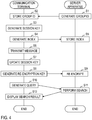
- the server apparatus 1 and communication terminals 2 1 , ..., 2 N perform processing of steps illustrated in Fig. 4 while mutually communicating and thereby implement a message transmission method of the embodiment.
- the server apparatus 1 is a special device that is formed by, for example, causing a known or dedicated computer including a central processing unit (CPU), main storage device (RAM: Random Access Memory), and the like to read a special program. Each device performs processing, for example, under control of the central processing unit. Data input into each device and data obtained by processing are stored in, for example, the main storage device, and the data stored in the main storage device is read out to the central processing unit and used for other processing according to need. At least part of each processing part of each device may be composed of hardware such as an integrated circuit.
- Each storage of each device can be composed of, for example: a main storage device such as a RAM (Random Access Memory); an auxiliary storage device composed of a hard disc, an optical disk, or a semiconductor memory element like a flash memory; or middle ware such as a relational database or key value store.
- a main storage device such as a RAM (Random Access Memory)
- auxiliary storage device composed of a hard disc, an optical disk, or a semiconductor memory element like a flash memory
- middle ware such as a relational database or key value store.
- the communication terminals 2 1 , ..., 2 N are information processing devices such as mobile phones, smart phones, tablet terminals, desktop or laptop personal computers.
- the terminals are not limited to the specific examples, and may be any information processing devices as long as they can present information to users through sight, hearing, or the like and accept input from the users through screen manipulation, voice input, or the like.
- a communication terminal 2 n is any one of the communication terminals 2 1 , ..., 2 N , where n ⁇ ⁇ 1, ..., N ⁇ .
- the message transmission system can form a talk group (hereinafter also simply referred to as a group) made up of a plurality of communication terminals, and allows the communication terminals included in the group to exchange messages with each other.
- step S1 the group ID generation part 12 of the server apparatus 1 generates a group ID uniquely identifying a group including a plurality of communication terminals 2.
- the generated group ID is transmitted to each of the communication terminals 2 included in the group via the transmission part 103.
- step S2 the communication terminal 2 n receives the group ID from the server apparatus 1.
- the received group ID is stored in the group ID storage 21.
- step S3 the communication terminal 2 n shares a session key SK 1 with other communication terminals 2 n' (n' ⁇ n) included in the same group, and stores the session key SK 1 in the session key storage 22.
- Generation and sharing methods of the session key may be performed by using known techniques. It should be noted that the session key SK 1 is not known to the server apparatus 1, and is updated to another session key SK 2 ( ⁇ SK 1 ) in accordance with occurrence of an event such as addition or deletion of a user in the group or elapse of a certain time.
- step S4 the index generation part 23 of the communication terminal 2 n generates an index Index k by using the session key SK 1 stored in the session key storage 22 for a character string s k relating to a message m to be transmitted to the group.
- the character k is each integer from 1 to K, and K is the number of character strings relating to the message m.
- the index Index k is paired with a message identifier ID m uniquely identifying the message m, and transmitted to the server apparatus 1 via the transmission part 203.
- the index Index k is generated as follows. L denotes a searchable character string length.
- the identifier ID m uniquely identifies the message m in the group. Because the message m is kept confidential from the server apparatus 1, it is desirable that a function for generating the identifier ID m from the message m is one for which it is difficult to calculate an inverse image, that is, the message m cannot be easily inferred from the identifier ID m . It is assumed that a function F is a function that takes as input a character string of arbitrary length and outputs a vector of which a dimension number is dependent on the input character string and in which each component is a character string of the length L or less.
- Examples of the function F include a function for outputting meta-information on the message m, a function for outputting the character string included in the message m, and a function for outputting all character strings of a consecutive N-character in the message m utilizing N-gram indexing. Details of N-gram indexing are described in Reference literature 1 below.
- the function F will be described below as a function that outputs all consecutive character strings included in the input message m.
- Consecutive i-character strings in the message m are made into S 1 (i) , S 2 (i) , .... Regarding how to assign S 1 (i) , S 2 (i) , ...
- index j (i) SK 1 TCRHF s j i is calculated.
- step S5 the server apparatus 1 receives the pair ( ⁇ , ID m ) of the index set and message identifier from the communication terminal 2 n and stores the pair in the index storage 11.
- identifiers of messages including a keyword s k are ID k1 , ID k2 , ..., it is desirable for efficiency in the index storage 11 that (Index k , ID k1 , ID k2 , ...) is stored using an index Index k for the keyword s k as a key as shown in Fig. 5 but what kind of table is formed is not limited.
- step S6 the message transmission part 24 of the communication terminal 2 n encrypts the message m with the session key SK 1 stored in the session key storage 22.
- the encrypted message m has a group ID of a transmission destination specified, and is then transmitted to the server apparatus 1 via the transmission part 203.
- step S7 the communication terminal 2 n updates the session key SK 1 stored in the session key storage 22 to a new session key SK 2 .
- Triggers for updating the session key include occurrence of an event such as addition or deletion of a user in the group or elapse of a certain period of time as described above. However, update of the session key is not limited to those triggers.
- the session key SK 2 after update is stored in the session key storage 22.
- the server apparatus 1 At the time of transmission, it is desirable to perform confidential communication like TLS, but there is no limit as to what kind of means to transmit.
- step S9 the re-encryption part 13 of the server apparatus 1 receives the re-encryption key RK 1,2 from the communication terminal 2 n , performs the following calculation for each index Index k generated in the group stored in the index storage 11 as shown in Fig. 5 , and thereby generates an index Index' k corresponding to the session key SK 2 after update.
- Index k ′ Index k RK 1,2
- the power calculation may be performed after calculating a remainder by a prime number p of the re-encryption key RK 1,2 if necessary.
- RK 1,2 times calculation is performed. That is, the following calculation is performed.
- Index k ′ RK 1,2 Index k
- step S10 the query generation part 26 of the communication terminal 2 n encrypts an input search keyword w with the session key SK 2 stored in the session key storage 22, thereby generates a search query Query, and transmits it to the server apparatus 1 via the transmission part 203.
- the query generation part 26 first compares length of a character string of the search keyword w with the searchable character string length L, returns an error if the length of the search keyword w exceeds L, and terminates the processing.
- the time of transmission it is desirable to perform confidential communication like TLS, but there is no limit as to what kind of means to transmit.
- the extracted message identifiers ID k1 , ID k2 , ... are transmitted via the transmission part 103 to the communication terminal 2 n that has transmitted the search query Query.
- step S12 on receiving the message identifier ID m as a search result for the search query Query, the communication terminal 2 n obtains the encrypted message m corresponding to the message identifier ID m , and displays it as the search result on an output part such as a screen.
- a display method for example, it is conceivable to display a list of messages m, which is a search result, by highlighting the search keyword w in the messages, but it is not limited thereto.
- a communication terminal 2 n performs all from generation of an index to generation of a search query, but it is also possible to mix a communication terminal configured to only generate an index, a communication terminal configured to only generate a re-encryption key, and a communication terminal configured to only generate a search query.
- a communication terminal only generates an index it is sufficient to include only the control part 201, storage 202, transmission part 203, reception part 204, group ID storage 21, session key storage 22, index generation part 23, and message transmission part 24.
- a communication terminal only generates an re-encryption key, it is sufficient to include only the control part 201, storage 202, transmission part 203, reception part 204, group ID storage 21, session key storage 22, and re-encryption key generation part 25.
- a communication terminal only generates a search query, it is sufficient to include only the control part 201, storage 202, transmission part 203, reception part 204, group ID storage 21, session key storage 22, and query generation part 26.
- the message transmission technique of the invention by configuring like the above, it is possible to update an index obtained by encrypting a character string relating to a transmitted message to an index corresponding to a session key after update while keeping an original character string confidential when a session key is updated. Therefore, even if a search query transmitted by a user is improperly acquired or the like, contents of a transmitted message cannot be inferred from a searched keyword or search result. According to the present invention, it is possible to improve confidentiality of the message transmission technique.
- the program describing the processing contents can be recorded on a computer-readable recording medium.
- the computer-readable recording medium may be any of, for example, a magnetic recording device, an optical disk, a magneto-optical recording medium, and a semiconductor memory.
- Distribution of the program is carried out, for example, by selling, transferring, and renting a portable recording medium, such as a DVD or CD-ROM, on which the program is recorded.
- the program may be stored in a storage device of a server computer and distributed by transferring the program from the server computer to another computer via a network.
- a computer that executes such a program first stores, for example, the program recorded in the portable recording medium or transferred from the server computer in its own storage device. Then, at the start of processing, the computer reads the program stored in its own recording medium and performs processing according to the read program. As another execution format of the program, the computer may directly read the program from the portable recording medium and perform the processing according to the program, or may sequentially perform processing according to a program received whenever the program is transferred from the server computer to the computer.
- the server computer does not transfer the program to the computer, but by a so-called ASP (Application Service Provider) type service to implement processing functions only by execution instructions and result acquisition, the above-described processing may be performed.
- the program in the embodiment includes information that is used for processing by an electronic computer and conforms to a program (data or the like that is not a direct command to the computer but has a property to define processing of the computer).
- the device is configured by executing the prescribed program on the computer, at least part of the processing contents may be performed by hardware.
Landscapes
- Engineering & Computer Science (AREA)
- Theoretical Computer Science (AREA)
- Databases & Information Systems (AREA)
- Computer Security & Cryptography (AREA)
- Computer Networks & Wireless Communication (AREA)
- Signal Processing (AREA)
- General Physics & Mathematics (AREA)
- Physics & Mathematics (AREA)
- General Engineering & Computer Science (AREA)
- Data Mining & Analysis (AREA)
- Software Systems (AREA)
- Computer Hardware Design (AREA)
- Computing Systems (AREA)
- Computational Linguistics (AREA)
- Information Retrieval, Db Structures And Fs Structures Therefor (AREA)
- Information Transfer Between Computers (AREA)
- Computer And Data Communications (AREA)
Abstract
Description
- The present invention relates to cryptographic technology, and in particular, a message transmission technique for transmitting and receiving encrypted messages.
- In message transmission systems presupposing use in business, there are message transmission systems that use cloud-based transmission systems so as not to leave data in client terminals in consideration of confidential information leakage on a business enterprise while enabling use of multi-devices such as PCs and smart phones. An example of such cloud-based message transmission systems is a product described in Non-patent
literature 1. - In such message transmission systems, eavesdropping on communication paths is prevented by encrypting the communication paths, or as already mentioned, information leakage due to loss or unauthorized removal of terminals is prevented by not leaving data in the terminals. The message transmission systems are prepared for threats to the communication paths and terminals like this, but on the other hand, countermeasures against threats to servers are insufficient. The threats to servers here include attacks from the outside, internal abuse by a server administrator, and the like. Against the threats to servers, there are countermeasures such as storing messages concealed through encryption or the like, but as long as a server side can decrypt them, possibility of message leakage from the servers still remains. Therefore, it is important that messages sent to a server that transmits, receives, and stores messages are kept confidential from the server (server side cannot eavesdrop).
- One method is to realize end-to-end encryption communication that conceals messages from the server and allows only terminals to decrypt them, but there is a problem of how to share a common key used between the terminals. As a solution to this problem, for example, Non-patent
literature 2 proposes a protocol to share a common key (hereinafter also referred to as a session key) between users without disclosing any information to an authentication server in a star network including the authentication server at its center. This makes it possible to exchange messages between the terminals while concealing the messages from the server. - On the other hand, in view of use in business, a measure for efficiently finding past interactions is necessary. As the measure, a message search function is conceivable. However, because messages stored on a cloud are kept confidential when a session key sharing technique between users is applied, it is necessary to be able to search for messages while they are kept confidential. For example, in Non-patent
literature 3, a search key and keyword are input into a hash function, and its output is uploaded as an index to a server. During search, an encrypted keyword generated in a similar procedure is uploaded to the server, which in turn searches for an index having the same hash value, and replies with its result. This makes it possible to search for messages stored on the cloud while they are kept confidential. -
- Non-patent literature 1: NTT Software "Business Chat TopicRoom," [online], [searched on 1 Dec. 2016], Internet <URL: https://www.ntts.co.jp/products/topicroom/index.html>
- Non-patent literature 2: Kobayashi, Tetsutaro; Yoneyama, Kazuki; Yoshida, Reo; Kawahara, Yuto; Fuji, Hitoshi; and Yamamoto, Tomohide "Scalable Dynamic Multi-Party Key Distribution Protocol" SCIS2016, 4E2-3, 2016
- Non-patent literature 3: W. Ogata, K. Koiwa, A. Kanaoka, S. Matsuo, "Toward Practical Searchable Symmetric Encryption", Proceedings of the Advances in Information and Computer Security, Lecture Notes in Computer Science, Volume 8231, pp. 151-167, 2013.
- As described above, sharing a session key between terminals makes it possible to exchange messages while keeping the messages confidential from a server, and makes it possible to search while keeping the messages confidential. However, when it is desired to share the session key only among current participating members like Non-patent
literature 2, it is necessary to update the session key when an event such as addition or deletion of a user occurs. At this time, if a search key remains not updated, a deleted user cannot read a message because the user cannot get a session key, but there is a problem related to confidentiality that, by improperly acquiring a search query by which another user asked the server, the user can infer contents of a searched keyword and contents of a message transmitted as a response result by the server. - In view of the above, an objective of the present invention is to provide a message transmission technique capable of improving confidentiality by re-encrypting a search index, when a session key is updated, so as to correspond to a session key after update.
- In order to solve the above-described problem, a message transmission system of the present invention includes a server apparatus and a plurality of communication terminals, at least one communication terminal receiving a message transmitted by another communication terminal, wherein the plurality of communication terminals include a session key storage configured to store a session key shared with other communication terminals, at least one communication terminal further includes an index generation part configured to make a pair of an index generated by using the session key for a character string relating to the message and a message identifier uniquely identifying the message and transmit the pair to the server apparatus, at least one communication terminal further includes a re-encryption key generation part configured to generate, when the session key is updated, a re-encryption key with a session key before update and a session key after update and transmit the re-encryption key to the server apparatus, at least one communication terminal further includes a query generation part configured to encrypt a search keyword with the session key stored in the session key storage to generate a search query and transmit the search query to the server apparatus, and the server apparatus includes an index storage configured to store the pair of the index and the message identifier received from the communication terminal, a re-encryption part configured to update, by using the re-encryption key received from the communication terminal, the index stored in the index storage to an index generated by using the session key after update for the character string relating to the message, and a search part configured to extract the message identifier of which the index stored in the index storage matches the search query received from the communication terminal and transmit the message identifier to the communication terminal.
- According to the message transmission technique of the present invention, because when a session key is updated, a search index is updated so as to correspond to a session key after update, even if a communication terminal that does not know the session key after update acquires a search query, the communication terminal cannot infer contents of a message. Thus, confidentiality improves.
-
-
Fig. 1 is a diagram exemplifying a functional configuration of a message transmission system; -
Fig. 2 is a diagram exemplifying a functional configuration of a server apparatus; -
Fig. 3 is a diagram exemplifying a functional configuration of a communication terminal; -
Fig. 4 is a diagram exemplifying a processing procedure of a message transmission method; and -
Fig. 5 is a diagram for illustrating re-encryption of an index. - Hereinafter, an embodiment of the present invention will be described in detail. Component parts having the same functions in the drawings will be given the same numbers and redundant description will be omitted.
- A message transmission technique of the present invention solves the above-described problem in a following manner. When a message is transmitted, a communication terminal side that communicates with a server conceals a keyword in the message with a session key. When the communication terminal updates the session key, the communication terminal generates a re-encryption key for re-encrypting the keyword and transmits the re-encryption key to the server. The server uses the re-encryption key to re-encrypt an index encrypted with the session key before update, and thereby converts the index into an index corresponding to a session key after update while keeping the keyword confidential. As a result, it is possible to transmit a message to the server while a keyword in the message is kept confidential, and by re-encrypting an index when a session key is updated, it is possible to prevent people other than participating users from inferring search contents.
- Definitions of symbols used in the following description will be explained. G denotes a cyclic group. As an additive group, there is G=Zp as a residue class ring of an integer ring modulo a prime number p, and as a multiplicative group, there is G=Zn× which is a unit element group of a residue class ring of an integer ring modulo a prime number p. In the following, description is made assuming that G is a multiplicative group. TCRHF is a target collision resistant hash function to output an element of the group G from a character string of arbitrary length as input. Here, the definition of a target collision resistant hash function family will be described. H={Hi: Di→Ri}i denotes a hash function family having a definition domain Di and a value range Ri for each i. When x∈Di extracted randomly from the definition domain Di is given to an arbitrary polynomial time attacker A and an arbitrary suffix i, if it is difficult to find x'∈Di (x'≠x) that satisfies Hi(x)=Hi(x'), H is called a target collision resistant hash function. An example of TCRHF includes TCRHF (x)=SHA256 (x) mod p, where p is a 256-bit prime number and SHA256 is used. However, TCRHF of the invention is not limited to this.
- A message transmission system of the embodiment includes a
server apparatus 1 andN communication terminals 21, ..., 2N, where N≥2, as exemplified inFig. 1 . In the embodiment, theserver apparatus 1 and thecommunication terminals 21, ..., 2N are each connected to acommunication network 3. Thecommunication network 3 is a communication network of a circuit switching system or packet switching system configured to be able to mutually communicate among connected devices. It is desirable that thecommunication network 3 is a closed communication path with secured safety, but it is possible to use an open network, for example, the Internet, as long as measures for securing safety such as individually encrypting communication between devices are taken. - The
server apparatus 1 includes acontrol part 101, astorage 102, atransmission part 103, areception part 104, anindex storage 11, a groupID generation part 12, are-encryption part 13, and asearch part 14 as exemplified inFig. 2 . Thecommunication terminals 21, ..., 2N each include acontrol part 201, astorage 202, atransmission part 203, areception part 204, agroup ID storage 21, asession key storage 22, anindex generation part 23, amessage transmission part 24, a re-encryptionkey generation part 25, and aquery generation part 26 as exemplified inFig. 3 . Thecontrol parts storages transmission parts reception parts server apparatus 1 andcommunication terminals 21, ..., 2N perform processing of steps illustrated inFig. 4 while mutually communicating and thereby implement a message transmission method of the embodiment. - The
server apparatus 1 is a special device that is formed by, for example, causing a known or dedicated computer including a central processing unit (CPU), main storage device (RAM: Random Access Memory), and the like to read a special program. Each device performs processing, for example, under control of the central processing unit. Data input into each device and data obtained by processing are stored in, for example, the main storage device, and the data stored in the main storage device is read out to the central processing unit and used for other processing according to need. At least part of each processing part of each device may be composed of hardware such as an integrated circuit. Each storage of each device can be composed of, for example: a main storage device such as a RAM (Random Access Memory); an auxiliary storage device composed of a hard disc, an optical disk, or a semiconductor memory element like a flash memory; or middle ware such as a relational database or key value store. - Specifically, the
communication terminals 21, ..., 2N are information processing devices such as mobile phones, smart phones, tablet terminals, desktop or laptop personal computers. The terminals are not limited to the specific examples, and may be any information processing devices as long as they can present information to users through sight, hearing, or the like and accept input from the users through screen manipulation, voice input, or the like. - Processing procedure of the message transmission method of the embodiment will be described with reference to
Fig. 4 . In the following description, it is assumed that acommunication terminal 2n is any one of thecommunication terminals 21, ..., 2N, where n ∈ {1, ..., N}. The message transmission system can form a talk group (hereinafter also simply referred to as a group) made up of a plurality of communication terminals, and allows the communication terminals included in the group to exchange messages with each other. - In step S1, the group
ID generation part 12 of theserver apparatus 1 generates a group ID uniquely identifying a group including a plurality ofcommunication terminals 2. The generated group ID is transmitted to each of thecommunication terminals 2 included in the group via thetransmission part 103. - In step S2, the
communication terminal 2n receives the group ID from theserver apparatus 1. The received group ID is stored in thegroup ID storage 21. - In step S3, the
communication terminal 2n shares a session key SK1 with other communication terminals 2n' (n'≠n) included in the same group, and stores the session key SK1 in the sessionkey storage 22. Generation and sharing methods of the session key may be performed by using known techniques. It should be noted that the session key SK1 is not known to theserver apparatus 1, and is updated to another session key SK2 (≠SK1) in accordance with occurrence of an event such as addition or deletion of a user in the group or elapse of a certain time. - In step S4, the
index generation part 23 of thecommunication terminal 2n generates an index Indexk by using the session key SK1 stored in the sessionkey storage 22 for a character string sk relating to a message m to be transmitted to the group. The character k is each integer from 1 to K, and K is the number of character strings relating to the message m. The index Indexk is paired with a message identifier IDm uniquely identifying the message m, and transmitted to theserver apparatus 1 via thetransmission part 203. Specifically, the index Indexk is generated as follows. L denotes a searchable character string length. In a case where an upper limit is not provided for the searchable character string length, it is alright to be L=∞, but here L is assumed to be finite (<∞). The identifier IDm uniquely identifies the message m in the group. Because the message m is kept confidential from theserver apparatus 1, it is desirable that a function for generating the identifier IDm from the message m is one for which it is difficult to calculate an inverse image, that is, the message m cannot be easily inferred from the identifier IDm. It is assumed that a function F is a function that takes as input a character string of arbitrary length and outputs a vector of which a dimension number is dependent on the input character string and in which each component is a character string of the length L or less. Examples of the function F include a function for outputting meta-information on the message m, a function for outputting the character string included in the message m, and a function for outputting all character strings of a consecutive N-character in the message m utilizing N-gram indexing. Details of N-gram indexing are described inReference literature 1 below. - The function F will be described below as a function that outputs all consecutive character strings included in the input message m. In order to generate an output character string, the
index generation part 23 sets λ=min{L, lengthm}, where lengthm denotes character string length of the message m, and performs following operation for each i=1, ..., λ. Consecutive i-character strings in the message m (consecutive character strings in the whole message, consecutive character strings in segments into which the message is sectioned, or the like is conceivable, but not limited to those) are made into S1 (i), S2 (i), .... Regarding how to assign S1 (i), S2 (i), ... to character strings, for example, there is a method for setting a consecutive i-character string taken from a left end of the character string as S1 (i), and setting a consecutive i-character string obtained by shifting one from the left end to right as S2 (i), ..., but it is not limited to this. The function F obtains the following multi-dimensional vector as an output. That is,

- Next, the function F reads out the session key SK1 stored in the session
key storage 22, and calculates the following indexj (i) for each j=1, 2, ..., lengthm-λ+1:


- indexj (i). At this time of power calculation by the session key SK1, the power calculation may be performed after calculating a remainder by a prime number p of the session key SK1 if necessary. If the group G is an additive group, SK1 times calculation is performed. That is,

- For example, if it is supposed that L≥3, and m="", then six indexes


- Then, a pair of a generated index set A and the message identifier IDm given to the message m

server apparatus 1 via thetransmission part 103. At the time of transmission, it is desirable to perform confidential communication like TLS (Transport Layer Security), but there is no limit as to what kind of means to transmit. - In step S5, the
server apparatus 1 receives the pair (Λ, IDm) of the index set and message identifier from thecommunication terminal 2n and stores the pair in theindex storage 11. Assuming that identifiers of messages including a keyword sk are IDk1, IDk2, ..., it is desirable for efficiency in theindex storage 11 that (Indexk, IDk1, IDk2, ...) is stored using an index Indexk for the keyword sk as a key as shown inFig. 5 but what kind of table is formed is not limited. - In step S6, the
message transmission part 24 of thecommunication terminal 2n encrypts the message m with the session key SK1 stored in the sessionkey storage 22. The encrypted message m has a group ID of a transmission destination specified, and is then transmitted to theserver apparatus 1 via thetransmission part 203. - In step S7, the
communication terminal 2n updates the session key SK1 stored in the sessionkey storage 22 to a new session key SK2. Triggers for updating the session key include occurrence of an event such as addition or deletion of a user in the group or elapse of a certain period of time as described above. However, update of the session key is not limited to those triggers. The session key SK2 after update is stored in the sessionkey storage 22. - In step S8, the re-encryption
key generation part 25 of thecommunication terminal 2n uses, when the session key is updated, the session key SK1 before update and the session key SK2 after update to calculate
thereby generates a re-encryption key RK1,2, and transmits it to theserver apparatus 1 via thetransmission part 203. At the time of transmission, it is desirable to perform confidential communication like TLS, but there is no limit as to what kind of means to transmit. - In step S9, the
re-encryption part 13 of theserver apparatus 1 receives the re-encryption key RK1,2 from thecommunication terminal 2n, performs the following calculation for each index Indexk generated in the group stored in theindex storage 11 as shown inFig. 5 , and thereby generates an index Index'k corresponding to the session key SK2 after update.
- At this time of power calculation by the re-encryption key RK1,2, the power calculation may be performed after calculating a remainder by a prime number p of the re-encryption key RK1,2 if necessary. When the group G is an additive group, RK1,2 times calculation is performed. That is, the following calculation is performed.

- In step S10, the
query generation part 26 of thecommunication terminal 2n encrypts an input search keyword w with the session key SK2 stored in the sessionkey storage 22, thereby generates a search query Query, and transmits it to theserver apparatus 1 via thetransmission part 203. Thequery generation part 26 first compares length of a character string of the search keyword w with the searchable character string length L, returns an error if the length of the search keyword w exceeds L, and terminates the processing. If the length of the search keyword w does not exceed L, thequery generation part 26 reads out the current session key SK2 from the sessionkey storage 22, calculates the following formula to generate a search query Query,
and transmits it to theserver apparatus 1 via thetransmission part 203. At the time of transmission, it is desirable to perform confidential communication like TLS, but there is no limit as to what kind of means to transmit. - In step S11, the
search part 14 of theserver apparatus 1 receives the search query Query from thecommunication terminal 2n and extracts all (Index'k, IDk1, IDk2, ...) that satisfy Index'k =Query among pairs (Index'k, IDk1, IDk2, ...) of the index and the message identifiers stored in theindex storage 11. The extracted message identifiers IDk1, IDk2, ... are transmitted via thetransmission part 103 to thecommunication terminal 2n that has transmitted the search query Query. At the time of transmission, it is desirable to perform confidential communication like TLS, but there is no limit as to what kind of means to transmit. - In step S12, on receiving the message identifier IDm as a search result for the search query Query, the
communication terminal 2n obtains the encrypted message m corresponding to the message identifier IDm, and displays it as the search result on an output part such as a screen. As a display method, for example, it is conceivable to display a list of messages m, which is a search result, by highlighting the search keyword w in the messages, but it is not limited thereto. - In the above description, it is explained as a configuration in which one
communication terminal 2n performs all from generation of an index to generation of a search query, but it is also possible to mix a communication terminal configured to only generate an index, a communication terminal configured to only generate a re-encryption key, and a communication terminal configured to only generate a search query. For example, if a communication terminal only generates an index, it is sufficient to include only thecontrol part 201,storage 202,transmission part 203,reception part 204,group ID storage 21, sessionkey storage 22,index generation part 23, andmessage transmission part 24. In addition, for example, if a communication terminal only generates an re-encryption key, it is sufficient to include only thecontrol part 201,storage 202,transmission part 203,reception part 204,group ID storage 21, sessionkey storage 22, and re-encryptionkey generation part 25. Furthermore, for example, if a communication terminal only generates a search query, it is sufficient to include only thecontrol part 201,storage 202,transmission part 203,reception part 204,group ID storage 21, sessionkey storage 22, and querygeneration part 26. - According to the message transmission technique of the invention, by configuring like the above, it is possible to update an index obtained by encrypting a character string relating to a transmitted message to an index corresponding to a session key after update while keeping an original character string confidential when a session key is updated. Therefore, even if a search query transmitted by a user is improperly acquired or the like, contents of a transmitted message cannot be inferred from a searched keyword or search result. According to the present invention, it is possible to improve confidentiality of the message transmission technique.
- Although the embodiment of the present invention has been described above, specific configurations are not limited to the embodiment, it goes without saying that the invention includes modifications or the like if design changes and the like are appropriately made within a range not departing from the spirit of the invention. The various processes described in the embodiment may be executed not only in chronological order according to the described order but also in parallel or individually in accordance with processing capability of a device that executes the processes or needs.
- When a computer implements various processing functions of each device described in the above embodiment, processing contents of functions that each device should have are written by a program. Then, the computer executes the program and thereby implements the various processing functions of each device.
- The program describing the processing contents can be recorded on a computer-readable recording medium. The computer-readable recording medium may be any of, for example, a magnetic recording device, an optical disk, a magneto-optical recording medium, and a semiconductor memory.
- Distribution of the program is carried out, for example, by selling, transferring, and renting a portable recording medium, such as a DVD or CD-ROM, on which the program is recorded. Furthermore, the program may be stored in a storage device of a server computer and distributed by transferring the program from the server computer to another computer via a network.
- A computer that executes such a program first stores, for example, the program recorded in the portable recording medium or transferred from the server computer in its own storage device. Then, at the start of processing, the computer reads the program stored in its own recording medium and performs processing according to the read program. As another execution format of the program, the computer may directly read the program from the portable recording medium and perform the processing according to the program, or may sequentially perform processing according to a program received whenever the program is transferred from the server computer to the computer. In addition, the server computer does not transfer the program to the computer, but by a so-called ASP (Application Service Provider) type service to implement processing functions only by execution instructions and result acquisition, the above-described processing may be performed. The program in the embodiment includes information that is used for processing by an electronic computer and conforms to a program (data or the like that is not a direct command to the computer but has a property to define processing of the computer).
- In the embodiment, although the device is configured by executing the prescribed program on the computer, at least part of the processing contents may be performed by hardware.
Claims (8)
- A message transmission system including a server apparatus and a plurality of communication terminals, at least one communication terminal receiving a message transmitted by another communication terminal, wherein:the plurality of communication terminals includea session key storage configured to store a session key shared with other communication terminals;at least one of the communication terminals further includesan index generation part configured to make a pair of an index generated by using the session key for a character string relating to the message and a message identifier uniquely identifying the message, and transmit the pair to the server apparatus;at least one of the communication terminals further includesa re-encryption key generation part configured to generate, when the session key is updated, a re-encryption key with a session key before update and a session key after update, and transmit the re-encryption key to the server apparatus;at least one of the communication terminals further includesa query generation part configured to encrypt a search keyword with the session key stored in the session key storage to generate a search query, and transmit the search query to the server apparatus; andthe server apparatus includes:an index storage configured to store the pair of the index and the message identifier received from the communication terminal;a re-encryption part configured to update, by using the re-encryption key received from the communication terminal, the index stored in the index storage to an index generated by using the session key after update for the character string relating to the message; anda search part configured to extract the message identifier of which the index stored in the index storage matches the search query received from the communication terminal, and transmit the message identifier to the communication terminal.
- The message transmission system according to Claim 1, wherein
the index generation part generates the index by using the session key and a target collision resistant hash function for an arbitrary character string included in the message or each segment included in the message. - The message transmission system according to Claim 1 or 2, wherein
assuming that G is a multiplicative group, TCRHF is a target collision resistant hash function that outputs an element of the group G from a character string of arbitrary length as input, SK1 is the session key before update, SK2 is the session key after update, RK1,2 is the re-encryption key, K is the number of character strings relating to the message, k is each integer from 1 to K, sk is a character string relating to the message, Indexk is an index before update, Index'k is an index after update, w is the search keyword, and Query is the search query,
the index generation part generates the index by a next formula:


the query generation part generates the search query by a next formula:
- The message transmission system according to Claim 1 or 2, wherein
assuming that G is an additive group, TCRHF is a target collision resistant hash function that outputs an element of the group G from a character string of arbitrary length as input, SK1 is the session key before update, SK2 is the session key after update, RK1,2 is the re-encryption key, K is the number of character strings relating to the message, k is each integer from 1 to K, sk is a character string relating to the message, Indexk is an index before update, Index'k is an index after update, w is the search keyword, and Query is the search query,
the index generation part generates the index by a next formula:


the query generation part generates the search query by a next formula:
- The communication terminal used in the message transmission system according to any of Claims 1 to 4.
- The server apparatus used in the message transmission system according to any of Claims 1 to 4.
- A message transmission method for receiving, by at least one other communication terminal, a message transmitted by a communication terminal in a message transmission system including a server apparatus and a plurality of communication terminals, the message transmission method comprising:a session key storage step of storing, by the communication terminal, a session key shared with other communication terminals in a session key storage;an index generation step of making, by the communication terminal, a pair of an index generated by using the session key for a character string relating to the message and a message identifier uniquely identifying the message, and transmitting the pair to the server apparatus;an index storage step of storing, by the server apparatus, the pair of the index and the message identifier received from the communication terminal in an index storage;a re-encryption key generation step of generating, by the communication terminal when the session key is updated, a re-encryption key with a session key before update and a session key after update, and transmitting the re-encryption key to the server apparatus;a re-encryption step of updating, by the server apparatus, by using the re-encryption key received from the communication terminal, the index stored in the index storage to an index generated by using the session key after update for the character string relating to the message;a query generation step of encrypting, by the communication terminal, a search keyword with the session key stored in the session key storage to generate a search query, and transmitting the search query to the server apparatus; anda search step of extracting, by the server apparatus, the message identifier of which the index stored in the index storage matches the search query received from the communication terminal, and transmitting the message identifier to the communication terminal.
- A program configured to cause a computer to function as the communication terminal according to Claim 5 or the server apparatus according to Claim 6.
Applications Claiming Priority (2)
| Application Number | Priority Date | Filing Date | Title |
|---|---|---|---|
| JP2016246821 | 2016-12-20 | ||
| PCT/JP2017/043766 WO2018116826A1 (en) | 2016-12-20 | 2017-12-06 | Message transmission system, communication terminal, server device, message transmission method, and program |
Publications (3)
| Publication Number | Publication Date |
|---|---|
| EP3561797A1 true EP3561797A1 (en) | 2019-10-30 |
| EP3561797A4 EP3561797A4 (en) | 2020-06-24 |
| EP3561797B1 EP3561797B1 (en) | 2022-02-09 |
Family
ID=62626461
Family Applications (1)
| Application Number | Title | Priority Date | Filing Date |
|---|---|---|---|
| EP17884208.4A Active EP3561797B1 (en) | 2016-12-20 | 2017-12-06 | Message transmission system, communication terminal, server device, message transmission method, and program |
Country Status (6)
| Country | Link |
|---|---|
| US (1) | US11765137B2 (en) |
| EP (1) | EP3561797B1 (en) |
| JP (1) | JP6879311B2 (en) |
| KR (1) | KR102290605B1 (en) |
| CN (1) | CN110062941B (en) |
| WO (1) | WO2018116826A1 (en) |
Families Citing this family (7)
| Publication number | Priority date | Publication date | Assignee | Title |
|---|---|---|---|---|
| JP7140202B2 (en) * | 2018-10-26 | 2022-09-21 | 日本電気株式会社 | Secure computation server, system, secure computation method and program |
| CN111818525B (en) * | 2020-07-13 | 2021-10-26 | 清华大学 | Secret key updating method and system facing space information network |
| KR102913589B1 (en) * | 2021-05-31 | 2026-01-15 | 삼성에스디에스 주식회사 | Apparatus for displaying announcements from instant messaging services and method thereof |
| CN116709316B (en) * | 2023-07-06 | 2024-01-26 | 云南大学 | Stateless group key updating method for large-scale dynamic group based on smart card |
| US12438715B2 (en) * | 2023-07-24 | 2025-10-07 | Kyndryl, Inc. | Preventing access of removed users to messages shared in a group chat |
| CN116846553A (en) * | 2023-07-31 | 2023-10-03 | 深圳市新国都支付技术有限公司 | Key management method and key management device, computer equipment, storage medium |
| CN118445352B (en) * | 2024-04-29 | 2025-03-28 | 广州接点智能科技有限公司 | Data processing method, device and data processing system |
Family Cites Families (25)
| Publication number | Priority date | Publication date | Assignee | Title |
|---|---|---|---|---|
| JPS6038427B2 (en) | 1976-07-12 | 1985-08-31 | 関西ペイント株式会社 | Aqueous coating composition |
| US7475244B2 (en) * | 2002-11-05 | 2009-01-06 | Kabushiki Kaisha Toshiba | Wireless communication device, portable terminal, communication control program and communication system |
| JP4333723B2 (en) * | 2006-09-29 | 2009-09-16 | 株式会社日立製作所 | Communication log management system |
| KR101300843B1 (en) * | 2006-11-29 | 2013-08-29 | 삼성전자주식회사 | Method of generating rekey index and rekey index generator using the same |
| JPWO2009011120A1 (en) * | 2007-07-18 | 2010-09-16 | パナソニック株式会社 | Address generation method, address generation system, communication apparatus, communication method, communication system, and destination communication apparatus |
| CN101593196B (en) * | 2008-05-30 | 2013-09-25 | 日电(中国)有限公司 | Method, device and system for rapidly searching ciphertext |
| JP5441726B2 (en) * | 2010-01-14 | 2014-03-12 | 三菱電機株式会社 | Information processing system, management device, server device, and information processing device |
| KR101133262B1 (en) * | 2010-04-08 | 2012-04-05 | 충남대학교산학협력단 | A hybrid key management method for robust SCADA systems and the session key generating method thereof |
| US8533489B2 (en) * | 2010-09-29 | 2013-09-10 | Microsoft Corporation | Searchable symmetric encryption with dynamic updating |
| JP5412414B2 (en) * | 2010-12-08 | 2014-02-12 | 株式会社日立製作所 | Searchable cryptographic processing system |
| JP5367039B2 (en) * | 2011-09-30 | 2013-12-11 | 株式会社東芝 | Server apparatus and program |
| KR101493212B1 (en) * | 2012-10-31 | 2015-02-23 | 삼성에스디에스 주식회사 | Method and system for id-based encryption and decryption |
| JP6033741B2 (en) * | 2013-06-14 | 2016-11-30 | 株式会社日立製作所 | Encryption key update system and method |
| JP2015033068A (en) * | 2013-08-06 | 2015-02-16 | 日本電信電話株式会社 | File sharing system, information providing apparatus, information acquiring apparatus, method thereof, and program |
| JP6058514B2 (en) * | 2013-10-04 | 2017-01-11 | 株式会社日立製作所 | Cryptographic processing method, cryptographic system, and server |
| US9355271B2 (en) * | 2013-10-18 | 2016-05-31 | Robert Bosch Gmbh | System and method for dynamic, non-interactive, and parallelizable searchable symmetric encryption |
| JP6208586B2 (en) * | 2014-01-16 | 2017-10-04 | 株式会社日立製作所 | Searchable cryptographic processing system and searchable cryptographic processing method |
| US9363243B2 (en) * | 2014-03-26 | 2016-06-07 | Cisco Technology, Inc. | External indexing and search for a secure cloud collaboration system |
| EP3149651B1 (en) | 2014-06-02 | 2020-04-29 | Robert Bosch GmbH | System and method for secure review of audit logs |
| US10237246B1 (en) * | 2015-07-31 | 2019-03-19 | Symphony Communication Services Holdings Llc | Secure message search |
| CN108475480B (en) | 2016-01-15 | 2021-03-23 | 三菱电机株式会社 | Encryption device, encryption method, and storage device |
| US9715546B1 (en) * | 2016-02-18 | 2017-07-25 | Yahoo! Inc. | Method and system for searching encrypted data |
| CN106156349A (en) * | 2016-07-22 | 2016-11-23 | 黎海纤 | Image search method based on information security |
| KR102666331B1 (en) * | 2016-11-11 | 2024-05-17 | 삼성전자주식회사 | A method and terminal device for encrypting a message |
| US10885215B2 (en) * | 2016-11-18 | 2021-01-05 | Duncan MacDougall Greatwood | Searching using encrypted client and server maintained indices |
-
2017
- 2017-12-06 EP EP17884208.4A patent/EP3561797B1/en active Active
- 2017-12-06 KR KR1020197017057A patent/KR102290605B1/en active Active
- 2017-12-06 CN CN201780076291.4A patent/CN110062941B/en active Active
- 2017-12-06 JP JP2018557656A patent/JP6879311B2/en active Active
- 2017-12-06 US US16/468,959 patent/US11765137B2/en active Active
- 2017-12-06 WO PCT/JP2017/043766 patent/WO2018116826A1/en not_active Ceased
Also Published As
| Publication number | Publication date |
|---|---|
| EP3561797B1 (en) | 2022-02-09 |
| WO2018116826A1 (en) | 2018-06-28 |
| EP3561797A4 (en) | 2020-06-24 |
| CN110062941B (en) | 2022-07-15 |
| CN110062941A (en) | 2019-07-26 |
| JPWO2018116826A1 (en) | 2019-10-24 |
| KR102290605B1 (en) | 2021-08-18 |
| KR20190077556A (en) | 2019-07-03 |
| US20200084185A1 (en) | 2020-03-12 |
| JP6879311B2 (en) | 2021-06-02 |
| US11765137B2 (en) | 2023-09-19 |
Similar Documents
| Publication | Publication Date | Title |
|---|---|---|
| US11765137B2 (en) | Message transmission system, communication terminal, server apparatus, message transmission method, and program | |
| US9485096B2 (en) | Encryption / decryption of data with non-persistent, non-shared passkey | |
| US9923877B2 (en) | External indexing and search for a secure cloud collaboration system | |
| US9537918B2 (en) | File sharing with client side encryption | |
| US12244716B2 (en) | Systems and methods for secure identification retrieval | |
| CN113239403B (en) | Data sharing method and device | |
| US20160344707A1 (en) | Encrypted query-based access to data | |
| EP3511845B1 (en) | Encrypted message search method, message transmission/reception system, server, terminal and programme | |
| CN105794145A (en) | Server-aided private set intersection (PSI) with data transfer | |
| US11743044B2 (en) | Password-less authentication using key agreement and multi-party computation (MPC) | |
| JP2014002365A (en) | Encrypted data inquiry method and system which can protect privacy | |
| CN111480313B (en) | Communication terminals, server devices, recording media | |
| CN107171811A (en) | A kind of lightweight RFID safety authentication based on Present algorithms | |
| CN104065623A (en) | Information processing method, trust server and cloud server | |
| US11177949B2 (en) | Data sharing method, data sharing system, data sharing server, communication terminal and program | |
| Sharma et al. | Multiuser searchable encryption with token freshness verification | |
| Zhou et al. | Chaotic map‐based time‐aware multi‐keyword search scheme with designated server | |
| Wang et al. | Privacy preserving protocol for service aggregation in cloud computing | |
| CN114465740A (en) | Method and device for converting identifier and method and device for converting privacy item | |
| Lee et al. | A study of practical proxy reencryption with a keyword search scheme considering cloud storage structure | |
| CN107707611A (en) | Power data cloud processing method, device and system | |
| Luo et al. | Pseudo anonymous and hidden attribute comparison based on quick friend matching in mobile social networks | |
| Rajput et al. | Multi-Authority attribute based encryption in OSN | |
| Lee et al. | Notes on “Authentication protocol using an identifier in an ad hoc network environment” |
Legal Events
| Date | Code | Title | Description |
|---|---|---|---|
| STAA | Information on the status of an ep patent application or granted ep patent |
Free format text: STATUS: THE INTERNATIONAL PUBLICATION HAS BEEN MADE |
|
| PUAI | Public reference made under article 153(3) epc to a published international application that has entered the european phase |
Free format text: ORIGINAL CODE: 0009012 |
|
| STAA | Information on the status of an ep patent application or granted ep patent |
Free format text: STATUS: REQUEST FOR EXAMINATION WAS MADE |
|
| 17P | Request for examination filed |
Effective date: 20190722 |
|
| AK | Designated contracting states |
Kind code of ref document: A1 Designated state(s): AL AT BE BG CH CY CZ DE DK EE ES FI FR GB GR HR HU IE IS IT LI LT LU LV MC MK MT NL NO PL PT RO RS SE SI SK SM TR |
|
| AX | Request for extension of the european patent |
Extension state: BA ME |
|
| DAV | Request for validation of the european patent (deleted) | ||
| DAX | Request for extension of the european patent (deleted) | ||
| A4 | Supplementary search report drawn up and despatched |
Effective date: 20200528 |
|
| RIC1 | Information provided on ipc code assigned before grant |
Ipc: G09C 1/00 20060101AFI20200520BHEP Ipc: G06F 16/00 20190101ALI20200520BHEP Ipc: H04L 9/08 20060101ALI20200520BHEP Ipc: H04L 9/00 20060101ALI20200520BHEP Ipc: H04L 9/16 20060101ALI20200520BHEP |
|
| STAA | Information on the status of an ep patent application or granted ep patent |
Free format text: STATUS: EXAMINATION IS IN PROGRESS |
|
| 17Q | First examination report despatched |
Effective date: 20210215 |
|
| GRAP | Despatch of communication of intention to grant a patent |
Free format text: ORIGINAL CODE: EPIDOSNIGR1 |
|
| STAA | Information on the status of an ep patent application or granted ep patent |
Free format text: STATUS: GRANT OF PATENT IS INTENDED |
|
| INTG | Intention to grant announced |
Effective date: 20210825 |
|
| GRAS | Grant fee paid |
Free format text: ORIGINAL CODE: EPIDOSNIGR3 |
|
| GRAA | (expected) grant |
Free format text: ORIGINAL CODE: 0009210 |
|
| STAA | Information on the status of an ep patent application or granted ep patent |
Free format text: STATUS: THE PATENT HAS BEEN GRANTED |
|
| AK | Designated contracting states |
Kind code of ref document: B1 Designated state(s): AL AT BE BG CH CY CZ DE DK EE ES FI FR GB GR HR HU IE IS IT LI LT LU LV MC MK MT NL NO PL PT RO RS SE SI SK SM TR |
|
| REG | Reference to a national code |
Ref country code: GB Ref legal event code: FG4D |
|
| REG | Reference to a national code |
Ref country code: CH Ref legal event code: EP Ref country code: AT Ref legal event code: REF Ref document number: 1467993 Country of ref document: AT Kind code of ref document: T Effective date: 20220215 |
|
| REG | Reference to a national code |
Ref country code: DE Ref legal event code: R096 Ref document number: 602017053291 Country of ref document: DE |
|
| REG | Reference to a national code |
Ref country code: IE Ref legal event code: FG4D |
|
| REG | Reference to a national code |
Ref country code: LT Ref legal event code: MG9D |
|
| REG | Reference to a national code |
Ref country code: NL Ref legal event code: MP Effective date: 20220209 |
|
| REG | Reference to a national code |
Ref country code: AT Ref legal event code: MK05 Ref document number: 1467993 Country of ref document: AT Kind code of ref document: T Effective date: 20220209 |
|
| PG25 | Lapsed in a contracting state [announced via postgrant information from national office to epo] |
Ref country code: SE Free format text: LAPSE BECAUSE OF FAILURE TO SUBMIT A TRANSLATION OF THE DESCRIPTION OR TO PAY THE FEE WITHIN THE PRESCRIBED TIME-LIMIT Effective date: 20220209 Ref country code: RS Free format text: LAPSE BECAUSE OF FAILURE TO SUBMIT A TRANSLATION OF THE DESCRIPTION OR TO PAY THE FEE WITHIN THE PRESCRIBED TIME-LIMIT Effective date: 20220209 Ref country code: PT Free format text: LAPSE BECAUSE OF FAILURE TO SUBMIT A TRANSLATION OF THE DESCRIPTION OR TO PAY THE FEE WITHIN THE PRESCRIBED TIME-LIMIT Effective date: 20220609 Ref country code: NO Free format text: LAPSE BECAUSE OF FAILURE TO SUBMIT A TRANSLATION OF THE DESCRIPTION OR TO PAY THE FEE WITHIN THE PRESCRIBED TIME-LIMIT Effective date: 20220509 Ref country code: NL Free format text: LAPSE BECAUSE OF FAILURE TO SUBMIT A TRANSLATION OF THE DESCRIPTION OR TO PAY THE FEE WITHIN THE PRESCRIBED TIME-LIMIT Effective date: 20220209 Ref country code: LT Free format text: LAPSE BECAUSE OF FAILURE TO SUBMIT A TRANSLATION OF THE DESCRIPTION OR TO PAY THE FEE WITHIN THE PRESCRIBED TIME-LIMIT Effective date: 20220209 Ref country code: HR Free format text: LAPSE BECAUSE OF FAILURE TO SUBMIT A TRANSLATION OF THE DESCRIPTION OR TO PAY THE FEE WITHIN THE PRESCRIBED TIME-LIMIT Effective date: 20220209 Ref country code: ES Free format text: LAPSE BECAUSE OF FAILURE TO SUBMIT A TRANSLATION OF THE DESCRIPTION OR TO PAY THE FEE WITHIN THE PRESCRIBED TIME-LIMIT Effective date: 20220209 Ref country code: BG Free format text: LAPSE BECAUSE OF FAILURE TO SUBMIT A TRANSLATION OF THE DESCRIPTION OR TO PAY THE FEE WITHIN THE PRESCRIBED TIME-LIMIT Effective date: 20220509 |
|
| PG25 | Lapsed in a contracting state [announced via postgrant information from national office to epo] |
Ref country code: PL Free format text: LAPSE BECAUSE OF FAILURE TO SUBMIT A TRANSLATION OF THE DESCRIPTION OR TO PAY THE FEE WITHIN THE PRESCRIBED TIME-LIMIT Effective date: 20220209 Ref country code: LV Free format text: LAPSE BECAUSE OF FAILURE TO SUBMIT A TRANSLATION OF THE DESCRIPTION OR TO PAY THE FEE WITHIN THE PRESCRIBED TIME-LIMIT Effective date: 20220209 Ref country code: GR Free format text: LAPSE BECAUSE OF FAILURE TO SUBMIT A TRANSLATION OF THE DESCRIPTION OR TO PAY THE FEE WITHIN THE PRESCRIBED TIME-LIMIT Effective date: 20220510 Ref country code: FI Free format text: LAPSE BECAUSE OF FAILURE TO SUBMIT A TRANSLATION OF THE DESCRIPTION OR TO PAY THE FEE WITHIN THE PRESCRIBED TIME-LIMIT Effective date: 20220209 Ref country code: AT Free format text: LAPSE BECAUSE OF FAILURE TO SUBMIT A TRANSLATION OF THE DESCRIPTION OR TO PAY THE FEE WITHIN THE PRESCRIBED TIME-LIMIT Effective date: 20220209 |
|
| PG25 | Lapsed in a contracting state [announced via postgrant information from national office to epo] |
Ref country code: IS Free format text: LAPSE BECAUSE OF FAILURE TO SUBMIT A TRANSLATION OF THE DESCRIPTION OR TO PAY THE FEE WITHIN THE PRESCRIBED TIME-LIMIT Effective date: 20220609 |
|
| PG25 | Lapsed in a contracting state [announced via postgrant information from national office to epo] |
Ref country code: SM Free format text: LAPSE BECAUSE OF FAILURE TO SUBMIT A TRANSLATION OF THE DESCRIPTION OR TO PAY THE FEE WITHIN THE PRESCRIBED TIME-LIMIT Effective date: 20220209 Ref country code: SK Free format text: LAPSE BECAUSE OF FAILURE TO SUBMIT A TRANSLATION OF THE DESCRIPTION OR TO PAY THE FEE WITHIN THE PRESCRIBED TIME-LIMIT Effective date: 20220209 Ref country code: RO Free format text: LAPSE BECAUSE OF FAILURE TO SUBMIT A TRANSLATION OF THE DESCRIPTION OR TO PAY THE FEE WITHIN THE PRESCRIBED TIME-LIMIT Effective date: 20220209 Ref country code: EE Free format text: LAPSE BECAUSE OF FAILURE TO SUBMIT A TRANSLATION OF THE DESCRIPTION OR TO PAY THE FEE WITHIN THE PRESCRIBED TIME-LIMIT Effective date: 20220209 Ref country code: DK Free format text: LAPSE BECAUSE OF FAILURE TO SUBMIT A TRANSLATION OF THE DESCRIPTION OR TO PAY THE FEE WITHIN THE PRESCRIBED TIME-LIMIT Effective date: 20220209 Ref country code: CZ Free format text: LAPSE BECAUSE OF FAILURE TO SUBMIT A TRANSLATION OF THE DESCRIPTION OR TO PAY THE FEE WITHIN THE PRESCRIBED TIME-LIMIT Effective date: 20220209 |
|
| REG | Reference to a national code |
Ref country code: DE Ref legal event code: R097 Ref document number: 602017053291 Country of ref document: DE |
|
| PG25 | Lapsed in a contracting state [announced via postgrant information from national office to epo] |
Ref country code: AL Free format text: LAPSE BECAUSE OF FAILURE TO SUBMIT A TRANSLATION OF THE DESCRIPTION OR TO PAY THE FEE WITHIN THE PRESCRIBED TIME-LIMIT Effective date: 20220209 |
|
| PLBE | No opposition filed within time limit |
Free format text: ORIGINAL CODE: 0009261 |
|
| STAA | Information on the status of an ep patent application or granted ep patent |
Free format text: STATUS: NO OPPOSITION FILED WITHIN TIME LIMIT |
|
| 26N | No opposition filed |
Effective date: 20221110 |
|
| PG25 | Lapsed in a contracting state [announced via postgrant information from national office to epo] |
Ref country code: SI Free format text: LAPSE BECAUSE OF FAILURE TO SUBMIT A TRANSLATION OF THE DESCRIPTION OR TO PAY THE FEE WITHIN THE PRESCRIBED TIME-LIMIT Effective date: 20220209 |
|
| PG25 | Lapsed in a contracting state [announced via postgrant information from national office to epo] |
Ref country code: IT Free format text: LAPSE BECAUSE OF FAILURE TO SUBMIT A TRANSLATION OF THE DESCRIPTION OR TO PAY THE FEE WITHIN THE PRESCRIBED TIME-LIMIT Effective date: 20220209 |
|
| REG | Reference to a national code |
Ref country code: CH Ref legal event code: PL |
|
| REG | Reference to a national code |
Ref country code: BE Ref legal event code: MM Effective date: 20221231 |
|
| PG25 | Lapsed in a contracting state [announced via postgrant information from national office to epo] |
Ref country code: LU Free format text: LAPSE BECAUSE OF NON-PAYMENT OF DUE FEES Effective date: 20221206 |
|
| PG25 | Lapsed in a contracting state [announced via postgrant information from national office to epo] |
Ref country code: LI Free format text: LAPSE BECAUSE OF NON-PAYMENT OF DUE FEES Effective date: 20221231 Ref country code: IE Free format text: LAPSE BECAUSE OF NON-PAYMENT OF DUE FEES Effective date: 20221206 Ref country code: CH Free format text: LAPSE BECAUSE OF NON-PAYMENT OF DUE FEES Effective date: 20221231 |
|
| PG25 | Lapsed in a contracting state [announced via postgrant information from national office to epo] |
Ref country code: BE Free format text: LAPSE BECAUSE OF NON-PAYMENT OF DUE FEES Effective date: 20221231 |
|
| PG25 | Lapsed in a contracting state [announced via postgrant information from national office to epo] |
Ref country code: HU Free format text: LAPSE BECAUSE OF FAILURE TO SUBMIT A TRANSLATION OF THE DESCRIPTION OR TO PAY THE FEE WITHIN THE PRESCRIBED TIME-LIMIT; INVALID AB INITIO Effective date: 20171206 |
|
| PG25 | Lapsed in a contracting state [announced via postgrant information from national office to epo] |
Ref country code: CY Free format text: LAPSE BECAUSE OF FAILURE TO SUBMIT A TRANSLATION OF THE DESCRIPTION OR TO PAY THE FEE WITHIN THE PRESCRIBED TIME-LIMIT Effective date: 20220209 |
|
| PG25 | Lapsed in a contracting state [announced via postgrant information from national office to epo] |
Ref country code: MK Free format text: LAPSE BECAUSE OF FAILURE TO SUBMIT A TRANSLATION OF THE DESCRIPTION OR TO PAY THE FEE WITHIN THE PRESCRIBED TIME-LIMIT Effective date: 20220209 |
|
| PG25 | Lapsed in a contracting state [announced via postgrant information from national office to epo] |
Ref country code: MC Free format text: LAPSE BECAUSE OF FAILURE TO SUBMIT A TRANSLATION OF THE DESCRIPTION OR TO PAY THE FEE WITHIN THE PRESCRIBED TIME-LIMIT Effective date: 20220209 |
|
| PG25 | Lapsed in a contracting state [announced via postgrant information from national office to epo] |
Ref country code: MC Free format text: LAPSE BECAUSE OF FAILURE TO SUBMIT A TRANSLATION OF THE DESCRIPTION OR TO PAY THE FEE WITHIN THE PRESCRIBED TIME-LIMIT Effective date: 20220209 |
|
| PG25 | Lapsed in a contracting state [announced via postgrant information from national office to epo] |
Ref country code: MT Free format text: LAPSE BECAUSE OF FAILURE TO SUBMIT A TRANSLATION OF THE DESCRIPTION OR TO PAY THE FEE WITHIN THE PRESCRIBED TIME-LIMIT Effective date: 20220209 |
|
| PG25 | Lapsed in a contracting state [announced via postgrant information from national office to epo] |
Ref country code: TR Free format text: LAPSE BECAUSE OF FAILURE TO SUBMIT A TRANSLATION OF THE DESCRIPTION OR TO PAY THE FEE WITHIN THE PRESCRIBED TIME-LIMIT Effective date: 20220209 |
|
| PGFP | Annual fee paid to national office [announced via postgrant information from national office to epo] |
Ref country code: DE Payment date: 20251211 Year of fee payment: 9 |
|
| PGFP | Annual fee paid to national office [announced via postgrant information from national office to epo] |
Ref country code: GB Payment date: 20251219 Year of fee payment: 9 |
|
| PGFP | Annual fee paid to national office [announced via postgrant information from national office to epo] |
Ref country code: FR Payment date: 20251229 Year of fee payment: 9 |
|
| REG | Reference to a national code |
Ref country code: DE Ref legal event code: R081 Ref document number: 602017053291 Country of ref document: DE Owner name: NTT, INC., JP Free format text: FORMER OWNER: NIPPON TELEGRAPH AND TELEPHONE CORPORATION, TOKYO, JP Ref country code: DE Ref legal event code: R082 Ref document number: 602017053291 Country of ref document: DE Representative=s name: DENNEMEYER & ASSOCIATES RECHTSANWALTSGESELLSCH, DE |