EP3561726A1 - A device and a method for processing data sequences using a convolutional neural network - Google Patents
A device and a method for processing data sequences using a convolutional neural network Download PDFInfo
- Publication number
- EP3561726A1 EP3561726A1 EP18168781.5A EP18168781A EP3561726A1 EP 3561726 A1 EP3561726 A1 EP 3561726A1 EP 18168781 A EP18168781 A EP 18168781A EP 3561726 A1 EP3561726 A1 EP 3561726A1
- Authority
- EP
- European Patent Office
- Prior art keywords
- sequence
- grid
- generation
- neural network
- convolutional neural
- Prior art date
- Legal status (The legal status is an assumption and is not a legal conclusion. Google has not performed a legal analysis and makes no representation as to the accuracy of the status listed.)
- Pending
Links
Images




Classifications
-
- G—PHYSICS
- G06—COMPUTING OR CALCULATING; COUNTING
- G06N—COMPUTING ARRANGEMENTS BASED ON SPECIFIC COMPUTATIONAL MODELS
- G06N3/00—Computing arrangements based on biological models
- G06N3/02—Neural networks
- G06N3/08—Learning methods
-
- G—PHYSICS
- G06—COMPUTING OR CALCULATING; COUNTING
- G06V—IMAGE OR VIDEO RECOGNITION OR UNDERSTANDING
- G06V10/00—Arrangements for image or video recognition or understanding
- G06V10/40—Extraction of image or video features
- G06V10/44—Local feature extraction by analysis of parts of the pattern, e.g. by detecting edges, contours, loops, corners, strokes or intersections; Connectivity analysis, e.g. of connected components
- G06V10/443—Local feature extraction by analysis of parts of the pattern, e.g. by detecting edges, contours, loops, corners, strokes or intersections; Connectivity analysis, e.g. of connected components by matching or filtering
- G06V10/449—Biologically inspired filters, e.g. difference of Gaussians [DoG] or Gabor filters
- G06V10/451—Biologically inspired filters, e.g. difference of Gaussians [DoG] or Gabor filters with interaction between the filter responses, e.g. cortical complex cells
- G06V10/454—Integrating the filters into a hierarchical structure, e.g. convolutional neural networks [CNN]
-
- G—PHYSICS
- G06—COMPUTING OR CALCULATING; COUNTING
- G06N—COMPUTING ARRANGEMENTS BASED ON SPECIFIC COMPUTATIONAL MODELS
- G06N3/00—Computing arrangements based on biological models
- G06N3/02—Neural networks
- G06N3/04—Architecture, e.g. interconnection topology
- G06N3/044—Recurrent networks, e.g. Hopfield networks
-
- G—PHYSICS
- G06—COMPUTING OR CALCULATING; COUNTING
- G06N—COMPUTING ARRANGEMENTS BASED ON SPECIFIC COMPUTATIONAL MODELS
- G06N3/00—Computing arrangements based on biological models
- G06N3/02—Neural networks
- G06N3/04—Architecture, e.g. interconnection topology
- G06N3/044—Recurrent networks, e.g. Hopfield networks
- G06N3/0442—Recurrent networks, e.g. Hopfield networks characterised by memory or gating, e.g. long short-term memory [LSTM] or gated recurrent units [GRU]
-
- G—PHYSICS
- G06—COMPUTING OR CALCULATING; COUNTING
- G06N—COMPUTING ARRANGEMENTS BASED ON SPECIFIC COMPUTATIONAL MODELS
- G06N3/00—Computing arrangements based on biological models
- G06N3/02—Neural networks
- G06N3/04—Architecture, e.g. interconnection topology
- G06N3/045—Combinations of networks
-
- G—PHYSICS
- G06—COMPUTING OR CALCULATING; COUNTING
- G06N—COMPUTING ARRANGEMENTS BASED ON SPECIFIC COMPUTATIONAL MODELS
- G06N3/00—Computing arrangements based on biological models
- G06N3/02—Neural networks
- G06N3/04—Architecture, e.g. interconnection topology
- G06N3/0464—Convolutional networks [CNN, ConvNet]
-
- G—PHYSICS
- G06—COMPUTING OR CALCULATING; COUNTING
- G06N—COMPUTING ARRANGEMENTS BASED ON SPECIFIC COMPUTATIONAL MODELS
- G06N3/00—Computing arrangements based on biological models
- G06N3/02—Neural networks
- G06N3/08—Learning methods
- G06N3/09—Supervised learning
-
- G—PHYSICS
- G06—COMPUTING OR CALCULATING; COUNTING
- G06T—IMAGE DATA PROCESSING OR GENERATION, IN GENERAL
- G06T7/00—Image analysis
- G06T7/70—Determining position or orientation of objects or cameras
-
- G—PHYSICS
- G06—COMPUTING OR CALCULATING; COUNTING
- G06T—IMAGE DATA PROCESSING OR GENERATION, IN GENERAL
- G06T7/00—Image analysis
- G06T7/70—Determining position or orientation of objects or cameras
- G06T7/73—Determining position or orientation of objects or cameras using feature-based methods
- G06T7/75—Determining position or orientation of objects or cameras using feature-based methods involving models
-
- G—PHYSICS
- G06—COMPUTING OR CALCULATING; COUNTING
- G06V—IMAGE OR VIDEO RECOGNITION OR UNDERSTANDING
- G06V10/00—Arrangements for image or video recognition or understanding
- G06V10/40—Extraction of image or video features
- G06V10/62—Extraction of image or video features relating to a temporal dimension, e.g. time-based feature extraction; Pattern tracking
-
- G—PHYSICS
- G06—COMPUTING OR CALCULATING; COUNTING
- G06V—IMAGE OR VIDEO RECOGNITION OR UNDERSTANDING
- G06V10/00—Arrangements for image or video recognition or understanding
- G06V10/70—Arrangements for image or video recognition or understanding using pattern recognition or machine learning
-
- G—PHYSICS
- G06—COMPUTING OR CALCULATING; COUNTING
- G06V—IMAGE OR VIDEO RECOGNITION OR UNDERSTANDING
- G06V10/00—Arrangements for image or video recognition or understanding
- G06V10/70—Arrangements for image or video recognition or understanding using pattern recognition or machine learning
- G06V10/82—Arrangements for image or video recognition or understanding using pattern recognition or machine learning using neural networks
-
- G—PHYSICS
- G06—COMPUTING OR CALCULATING; COUNTING
- G06V—IMAGE OR VIDEO RECOGNITION OR UNDERSTANDING
- G06V20/00—Scenes; Scene-specific elements
- G06V20/50—Context or environment of the image
- G06V20/56—Context or environment of the image exterior to a vehicle by using sensors mounted on the vehicle
Definitions
- the invention relates to a device and a method for processing data sequences using a convolutional neural network.
- CNNs Convolutional neural networks
- the data can represent image or video data which capture one or more objects present in a (real) scene.
- CNNs have shown to be useful to automatically extract information which characterizes the scene captured by the data more closely, for example information about the position and the motion of objects in the scene.
- CNNs can be configured to perform a semantic analysis of the data (i.e., by pattern recognition).
- a machine can be controlled on the basis of this analysis.
- the scene can for example be a traffic scene in the surrounding of a vehicle which should be controlled on the basis of an automatic semantic analysis of the traffic scene. This is known as an autonomous driving application.
- a CNN is a structural representation of a computer-implemented method for processing data. It comprises processing the data with convolutional kernels which are filter masks comprising a plurality of values (i.e., filter weights) arranged in a predefined pattern.
- the convolutional kernel is convolved with the input data in order to process the data.
- a constant may be added to the result of the convolution followed by filtering with a so-called activation function, as is known to those skilled in the field of neural networks.
- These processing steps may form a structural unit of the CNN often referred to as a convolutional layer.
- the use of convolutional kernels is helpful for avoiding a modification of the spatial pattern in the input data. Therefore, any input data that has a spatial pattern, e.g., images and videos, can be processed by CNNs. Furthermore, convolutional kernels provide superior efficiency of processing when large amounts of data need to be processed.
- a problem of ordinary CNNs is that they are, as such, not configured to process time-dependent data, i.e. sequences of data captured sequentially over time.
- a data item e.g. a "block" of input data
- time stamp which may be the case for a video frame. Therefore, an input sequence of data items is usually processed sequentially, i.e. by processing one data item after the other.
- a disadvantage of this approach is that time-dependencies in the data are not explicitly recognized by the CNN.
- Time-dependencies are present in most types of real data, for example in data, which represents real scenes, e.g., of a traffic environment. This is because objects, in particular moving objects such as vehicles, pedestrians and the like can only move smoothly because of their speed limitation. Such time dependencies are very important for achieving a robust extraction of the desired information, such as a detection of objects or a classification thereof (image classification).
- image classification image classification
- (real) data is usually captured under non-optimum conditions.
- objects can suddenly appear and disappear due to occlusions with other objects. Such phenomena are also known as object birth and object death. Therefore, extracting information from data of complex scenes usually requires the use of temporal information in order to carry out a robust semantic analysis of the data.
- CNN recurrent neural networks
- LSTM long-short-term memories
- the problem underlying the invention is to provide a device and a method for processing data sequences using a CNN, wherein time-dependencies are efficiently and reliably considered by the CNN.
- the device of claim 1 is configured to receive an input sequence comprising a plurality of data items captured over time, each of said data items comprising a multi-dimensional representation of a scene.
- each data item corresponds to one time instant in which the scene has been captured in two, three or more dimensions, i.e. multiple parameters which may include spatial coordinates but also velocity information.
- the sequence of data items can be interpreted as a complex video, wherein the frames of the video correspond to data items representing a scene at a particular time instant.
- the input sequence can be raw data from one or more sensors but can also be a pre-processed version thereof.
- the CNN of the device is configured to generate an output sequence representing the input sequence processed item-wise by the convolutional neural network, i.e., the input sequence is processed sequentially, preferably in the order of the input sequence.
- the output sequence comprises a plurality of data items, each data item corresponding to a processed version of the respective data item of the input sequence.
- the CNN comprises a sampling unit configured to generate an intermediate output sequence by sampling from a past portion of the output sequence according to a sampling grid.
- the past portion of the output sequence may consist of the very last data item of the output sequence but may also include data items further down from the history of the output sequence.
- the intermediate output sequence is a modified version of the past portion of the output sequence, wherein the modification is carried out item-wise by a sampling of the data item. This sampling is useful for taking account of dynamic changes in the data, which may be regarded as an adaption of the data for improving the processing of the input sequence. This will be explained further below.
- the CNN is configured to generate the sampling grid item-wise on the basis of a grid-generation sequence, wherein the grid-generation sequence is based on a combination of the input sequence and an intermediate grid-generation sequence.
- the intermediate grid-generation sequence represents a past portion of the output sequence or a past portion of the grid-generation sequence.
- the grid-generation sequence therefore comprises information of the current input sequence and the "processing history". This history may be provided either in the form of the past portion of the output sequence (e.g., the last data item of the output sequence) or the past portion of the grid-generation sequence (e.g., the last data item of the grid-generation sequence) which again represents a form of recursive processing.
- the CNN is further configured to generate the output sequence based on a weighted combination of the intermediate output sequence and the input sequence.
- the combination can be interpreted as a controlled prediction of the output sequence, wherein for example either more or less of the input sequence is allowed to pass the CNN.
- the intermediate output sequence also represents information about the previous behaviour of the input sequence and the output sequence. Therefore, time-dependencies are explicitly analysed by the CNN and directly influence the processing of the input sequence viz. generation of the output sequence. This enables the CNN to achieve a better robustness in accurately considering, i.e. recognizing temporal information present in the input data sequence.
- the weighted combination is not limited to a direct weighting of the mentioned sequences.
- any of the sequences can be processed prior to weighting.
- the input sequence can be processed by an inner CNN which results in an intermediate input sequence which represents the (raw) input sequence.
- the CNN according to the invention can be a so-called deep neural network.
- the CNN can comprise a plurality of inner CNNs.
- These inner CNNs are regarded as sub-networks, i.e. layers, of an "outer" CNN, in particular the CNN according to the invention.
- These inner CNNs can have the same, similar, or different structures but they all comprise a convolution of the input data with a convolutional kernel.
- an activation function is applied, which can be a function configured to perform a transformation to a predefined scale, for example a scale of [0, 1], i.e. the output data is between zero and one.
- Examples for activation functions are the sigmoid function and the tanh function. Another example is a two-sided threshold function.
- each of the sequences addressed herein comprises a plurality of data items, each data item comprising a plurality of data points.
- any processing of a data item can involve a processing of the data points.
- the data items can be processed one by one.
- data items may be processed in parallel or in combinations of data items.
- the grid-generation sequence is based on an item-wise combination of the input sequence and the intermediate grid-generation sequence.
- the CNN can be configured to form the grid-generation sequence by an item-wise combination of the input sequence and the intermediate grid-generation sequence.
- the combination can be a concatenation of the two involved sequences per item, wherein the concatenation can be adapted such that a subsequent processing of the concatenated data item allows for a separate processing of the two items forming the concatenation.
- the two sequences can be combined by a dedicated neural network, preferably also a CNN.
- this CNN can be a convolutional gated recurrent unit (GRU), which is a type of RNN described in: Tokmakov, P., Alahari, K. and Schmid, C., 2017, Learning Video Object Segmentation with Visual Memory .
- arXiv preprint arXiv:1704.05737.
- the CNN for combining the two sequencecs can be a convolutional LSTM.
- this convolutional LSTM is implemented as described in: Xingjian, S.H.I., Chen, Z., Wang, H., Yeung, D.Y., Wong, W.K. and Woo, W.C., 2015: "Convolutional LSTM network: A machine learning approach for precipitation nowcasting". Advances in neural information processing systems (pp. 802-810 ).
- the intermediate grid-generation sequence is formed by the past portion of the output sequence, in particular wherein the past portion of the output sequence is processed with an inner CNN.
- the intermediate grid-generation sequence can be formed by the past portion of the grid-generation sequence processed with an inner CNN.
- the sampling grid is preferably generated by processing the grid-generation sequence with at least one inner CNN. This is preferably carried out item-wise, i.e., one sampling grid is generated from one data item of the grid-generation sequence. Therefore, a sequence of sampling grids can be formed. However, there is preferably only one sampling grid per time step. In other words, in the (outer) CNN there is no grid sequence but only one grid per time.
- the convolutional neural network is configured to generate the output sequence by carrying out the following steps.
- a first weighting sequence and a second weighting sequence are generated based on one of the input sequence, the intermediate output sequence, the intermediate grid-generation sequence, the grid-generation sequence processed by an inner convolutional network, or a combination thereof.
- Both weighting sequences can be generated on the same basis or differently. For example, each weighting sequence can be generated on different combinations of the above sequences.
- an intermediate input sequence is generated by processing the input sequence with an inner CNN. Then, the intermediate output sequence is weighted with the first weighting sequence and the intermediate input sequence is weighted with the second weighting sequence. These two weighted sequences are then superimposed, e.g. by simply adding the sequences, preferably item-wise.
- the weighting can be a multiplication, in particular a point-wise multiplication, which is also known as the Hadamard product. In the latter case, each involved sequence is composed of data items which comprise a plurality of data points.
- the generating the first weighting sequence and/or the second weighting sequence comprises: - forming a combination, e.g. a concatenation, of at least two of the input sequence, the intermediate output sequence, the intermediate grid-generation sequence, the grid-generation sequence processed by an inner convolutional network; - forming a processed combination by processing the combination with an inner convolutional neural network.
- This inner CNN is preferably configured to process with a convolutional kernel and an activation function, in particular sigmoid function.
- one of the first weighting sequence or the second weighting sequence is formed by the processed combination and wherein the other of the first weighting sequence or the second weighting sequence is formed by the processed combination subtracted from a constant.
- the convolutional neural network can be configured to generate the first and second weighting sequences correspondingly.
- the processing parameters for each weighting sequence can be different, in particular any convolutional kernels used for processing the sequences.
- the sampling grid preferably comprises a plurality of sampling locations, each of the sampling locations being defined by a respective pair of an offset and one of a plurality of data points of an item of the intermediate output sequence.
- an offset represents a location shift of a data point which is underlying the offset. Therefore, the sampling grid defines where the past portion of the output sequence is to be sampled relative to the regular data points of the intermediate output sequence. This can be regarded as a specific form of processing which is controlled through the generated sampling grid.
- the grid is adapted to predict motion in the data. Therefore, the data represented by a given data item can be optimized in view of the temporal changes in the previous data items.
- the motion data can be represented by the offsets, which can be regarded as vectors pointing to the desired sampling location.
- the sampling unit can be configured to perform an interpolation of data points. Therefore, if a sampling location is between given data points of the data item to be sampled, the sampled data point can simply be interpolated from one or more neighbouring data points, e.g., by bi-linear interpolation.
- each data item of the input sequence comprises a plurality of data points, each data point representing a location in the scene and comprising a plurality of parameters, in particular coordinates, of the location.
- the data points of each data item of the input sequence can be formed by an image comprising a plurality of pixels. This is to say that the data points can be formed by pixels in which each data item represents the scene preferably in two or three dimensions.
- each of the sequences described herein can be formed of data items corresponding to the data items of the input sequence with regard to their structure.
- the invention also relates to a system for processing data sequences, the system comprising a sensor for capturing a data sequence and a device according to one of the embodiments described herein.
- the sensor can comprise at least one of a radar sensor, an light- detection-and-ranging sensor, an ultrasonic sensor or a camera.
- each of such sensors is suitable for capturing a scene and thus to generate the input sequence.
- the system can be implemented in a vehicle, such as an ordinary passenger car.
- the system can therefore be configured to generate an output sequence which represents (relevant) information for an autonomous driving application. This is to say that the vehicle can be controlled, e.g., steered, on the basis of the output sequence generated by the CNN implemented in the device of the method.
- the invention is further related to a method for processing data sequences by means of a CNN, the method comprising:
- a CNN is configured for processing by a training of the CNN.
- feed-forward the network receives input data and calculates the output data using initial processing parameters (i.e. filter weights and constants). Then, given the correct output data, the parameters are updated during back-propagation, wherein the gradient from a loss function is calculated (gradient descent).
- each of the inner CNNs can be different in terms of the involved processing parameters, in particular the weights of the convolutional kernel and the activation function.
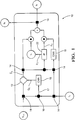
- Fig. 1 to Fig. 10 show variants of CNNs for processing data sequences as schematic block diagrams.
- Fig. 11 shows a block diagram of a system comprising a sensor and a device in which any one of the CNNs can be implemented for processing a sensor sequence captured by the sensor.
- FIG. 1 A first example of a CNN 10 in shown in Fig. 1 .
- the variables h t and h ⁇ t stand for an output sequence and an intermediate output sequence, respectively.
- the variable z t represents a weighting sequence.
- Each data item of the sequences comprises a plurality of data points, for example pixels of an image.
- * denotes the convolutional operator and ⁇ denotes a point-wise multiplication (Hadamard product).
- W indicates a convolutional kernel, with the indices indicating the variables to which the kernel refers.
- Sample denotes sampling by means of a sampling unit 12, with the first argument being the input to the sampling unit 12 and the second argument being the sampling grid.
- the solid black squares 14 generally denote a "duplication" of information, which means that the arrows leaving the squares 14 carry the same information as the input arrow.
- the solid black circles 16 generally denote a combination of information.
- the past portion of the output sequence, h t- 1 is concatenated with the input sequence I t to form an intermediate grid generation sequence at 17.
- This sequence is then processed by CNN 18, which is generally an inner CNN.
- the result is the sampling grid G t in the case of Fig. 1 .
- CNN() is an operator in the equations, wherein the arguments of CNN() refer to a combination of the arguments, e.g., a concatenation.
- Block 22 is a specific form of an inner CNN.
- CNN ( I t ) is an intermediate input sequence.
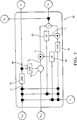
- CNN 20 A second example, CNN 20, is shown in Fig. 2 and is defined by the following set of equations:
- C t CNN I t C t ⁇ 1
- G t CNN
- C t h ⁇ t Sample h t ⁇ 1
- the grid-generation sequence is formed on the basis of a combination of the input sequence I t and an intermediate grid-generation sequence C t -1 .
- the combination is processed by inner CNN 18 which gives C t
- a processed version of the grid-generation sequence which recursively forms the intermediate grid-generation sequence of the next time step ( C t- 1 ).
- the processed version of the grid-generation sequence is further processed by an inner CNN 18' to give the sampling grid G t .
- a further aspect of the CNN 20 is that the first weighting sequence f t and the second weighting sequence i t are formed correspondingly by blocks 22, which have the same input, namely a combination of the intermediate output sequence and the input sequence.
- the CNN 30 shown in Fig. 3 forms a third example described by:
- C t CNN I t C t ⁇ 1
- G t CNN
- C t h ⁇ t Sample h t ⁇ 1
- the CNN 30 deviates from the CNN 20 in that the first and second weighting sequences f t and i t are based on a combination of the past portion of the output sequence h t -1 and the input sequence.
- the CNN 40 deviates from the CNNs 20 and 30 in that the first and second weighting sequences f t and i t are based on a combination of the grid-generation sequence processed by inner CNN 18 and the input sequence.
- CNN 50 shown in Fig. 5 .
- the first and second weighting sequences f t and i t are based on a combination of the intermediate grid-generation sequence C t -1 and the input sequence I t .
- the grid-generation sequence formed at 17 is formed by the same combination.
- CNN 60 shown in Fig. 6 .
- the intermediate grid-generation sequence C t -1 is formed by a past portion of the output sequence h t processed by an inner CNN 18 as shown at the right-end side of CNN 60.
- CNN 70 corresponds to CNN 60 but the first and second weighting sequences f t and i t are formed as in CNN 50.
- CNN 80 shown in Fig. 8 .
- the eighth example corresponds to CNN 10 from Fig. 1 with the difference that the weighting sequence z t is based on a combination of the input sequence and the past portion of the output sequence.
- CNN 20' shown in Fig. 9 .
- the first and second weighting sequences are not formed correspondingly with respect to the input of blocks 22.
- the intermediate output sequence h t is combined with the grid-generation sequence formed at 17 processed with an inner CNN 18, which is C t forming the intermediate grid-generation sequence, i.e. data item C t -1 , for the next time step.
- the second weighting sequence is based on a combination of three sequences, as defined in the formula above for f t and Fig. 9 . From this example it becomes apparent that the input to the blocks 22 do not need to be the same.
- CNN 20 shown in Fig. 10 .
- CNN 20" corresponds to CNN 20' with the difference that the input to blocks 22 can involve the same combination of sequences. Other combinations are possible, also combinations with more than three sequences.
- a system 26 can comprise a sensor 28 for capturing (i.e. acquiring) an input sequence 36 for a device 32, wherein the input sequence 36 can represent a scene, for example a traffic scene.
- the sensor 28 can be a radar sensor mounted on a vehicle (not shown) which is configured for an autonomous driving application by the system 26.
- the input sequence 36 is received by device 32 and processed by a CNN, for example by one of the CNNs shown in Figs. 1 to 10 .
- the device 32 has processing means which are configured to make use of a CNN as described herein.
- An output sequence 38 is outputted by the device 32 and can be inputted to a control unit 34 of a vehicle (not shown).
- the control unit 34 is configured to control the vehicle on the basis of the output sequence 38.
Landscapes
- Engineering & Computer Science (AREA)
- Theoretical Computer Science (AREA)
- Physics & Mathematics (AREA)
- General Physics & Mathematics (AREA)
- Evolutionary Computation (AREA)
- General Health & Medical Sciences (AREA)
- Health & Medical Sciences (AREA)
- Artificial Intelligence (AREA)
- Computing Systems (AREA)
- Software Systems (AREA)
- Life Sciences & Earth Sciences (AREA)
- Biomedical Technology (AREA)
- Molecular Biology (AREA)
- Computer Vision & Pattern Recognition (AREA)
- General Engineering & Computer Science (AREA)
- Computational Linguistics (AREA)
- Data Mining & Analysis (AREA)
- Biophysics (AREA)
- Mathematical Physics (AREA)
- Multimedia (AREA)
- Databases & Information Systems (AREA)
- Medical Informatics (AREA)
- Biodiversity & Conservation Biology (AREA)
- Image Analysis (AREA)
Abstract
Description
- The invention relates to a device and a method for processing data sequences using a convolutional neural network.
- Convolutional neural networks (CNNs) are employed for many applications, especially for applications in which large amounts of data need to be processed for extracting a desired information from the data. For example, the data can represent image or video data which capture one or more objects present in a (real) scene. CNNs have shown to be useful to automatically extract information which characterizes the scene captured by the data more closely, for example information about the position and the motion of objects in the scene. In other words, CNNs can be configured to perform a semantic analysis of the data (i.e., by pattern recognition). As one possible application, a machine can be controlled on the basis of this analysis. The scene can for example be a traffic scene in the surrounding of a vehicle which should be controlled on the basis of an automatic semantic analysis of the traffic scene. This is known as an autonomous driving application.
- A CNN is a structural representation of a computer-implemented method for processing data. It comprises processing the data with convolutional kernels which are filter masks comprising a plurality of values (i.e., filter weights) arranged in a predefined pattern. The convolutional kernel is convolved with the input data in order to process the data. A constant may be added to the result of the convolution followed by filtering with a so-called activation function, as is known to those skilled in the field of neural networks. These processing steps may form a structural unit of the CNN often referred to as a convolutional layer. The use of convolutional kernels is helpful for avoiding a modification of the spatial pattern in the input data. Therefore, any input data that has a spatial pattern, e.g., images and videos, can be processed by CNNs. Furthermore, convolutional kernels provide superior efficiency of processing when large amounts of data need to be processed.
- A problem of ordinary CNNs is that they are, as such, not configured to process time-dependent data, i.e. sequences of data captured sequentially over time. This is to say that an ordinary CNN assumes a data item, e.g. a "block" of input data, to have one common time stamp, which may be the case for a video frame. Therefore, an input sequence of data items is usually processed sequentially, i.e. by processing one data item after the other. A disadvantage of this approach is that time-dependencies in the data are not explicitly recognized by the CNN.
- Time-dependencies are present in most types of real data, for example in data, which represents real scenes, e.g., of a traffic environment. This is because objects, in particular moving objects such as vehicles, pedestrians and the like can only move smoothly because of their speed limitation. Such time dependencies are very important for achieving a robust extraction of the desired information, such as a detection of objects or a classification thereof (image classification). One reason is that (real) data is usually captured under non-optimum conditions. Furthermore, objects can suddenly appear and disappear due to occlusions with other objects. Such phenomena are also known as object birth and object death. Therefore, extracting information from data of complex scenes usually requires the use of temporal information in order to carry out a robust semantic analysis of the data.
- There have been efforts towards enabling CNNs to recognize time-dependencies in sequential data, for example in the form of recurrent neural networks (RNN) and long-short-term memories (LSTM). However, it turned out that these types of neural networks are not always powerful enough to cope with complex data such as data representing a scene with many different moving objects. It is understood that this data can be captured by means of a camera. However, in other applications, in particular modern vehicular applications, the data can be captured by other sensors as well, including one or more radar sensors or a light detection and ranging (lidar) system. In connection with these applications, the data usually represents a traffic scene in the surrounding of the vehicle, wherein different types of sensor data may be available for combination. The traffic scene needs to be analysed constantly and reliably from the data in order to enable safe autonomous driving applications. Yet, a robust extraction of the required information has proven difficult with the known types of CNNs.
- The problem underlying the invention is to provide a device and a method for processing data sequences using a CNN, wherein time-dependencies are efficiently and reliably considered by the CNN.
- The problem is solved by a device comprising the features of
claim 1 and by a method comprising the features ofclaim 14. - The device of
claim 1 is configured to receive an input sequence comprising a plurality of data items captured over time, each of said data items comprising a multi-dimensional representation of a scene. In other words, each data item corresponds to one time instant in which the scene has been captured in two, three or more dimensions, i.e. multiple parameters which may include spatial coordinates but also velocity information. The sequence of data items can be interpreted as a complex video, wherein the frames of the video correspond to data items representing a scene at a particular time instant. The input sequence can be raw data from one or more sensors but can also be a pre-processed version thereof. - The CNN of the device is configured to generate an output sequence representing the input sequence processed item-wise by the convolutional neural network, i.e., the input sequence is processed sequentially, preferably in the order of the input sequence. Also preferably, the output sequence comprises a plurality of data items, each data item corresponding to a processed version of the respective data item of the input sequence.
- The CNN comprises a sampling unit configured to generate an intermediate output sequence by sampling from a past portion of the output sequence according to a sampling grid. The past portion of the output sequence may consist of the very last data item of the output sequence but may also include data items further down from the history of the output sequence. By reusing a past portion in the CNN for processing a current data item of the input sequence a form of recursive processing is implemented by the CNN. The intermediate output sequence is a modified version of the past portion of the output sequence, wherein the modification is carried out item-wise by a sampling of the data item. This sampling is useful for taking account of dynamic changes in the data, which may be regarded as an adaption of the data for improving the processing of the input sequence. This will be explained further below.
- The CNN is configured to generate the sampling grid item-wise on the basis of a grid-generation sequence, wherein the grid-generation sequence is based on a combination of the input sequence and an intermediate grid-generation sequence. The intermediate grid-generation sequence represents a past portion of the output sequence or a past portion of the grid-generation sequence. The grid-generation sequence therefore comprises information of the current input sequence and the "processing history". This history may be provided either in the form of the past portion of the output sequence (e.g., the last data item of the output sequence) or the past portion of the grid-generation sequence (e.g., the last data item of the grid-generation sequence) which again represents a form of recursive processing.
- The CNN is further configured to generate the output sequence based on a weighted combination of the intermediate output sequence and the input sequence. The combination can be interpreted as a controlled prediction of the output sequence, wherein for example either more or less of the input sequence is allowed to pass the CNN. Due to the recursive processing, the intermediate output sequence also represents information about the previous behaviour of the input sequence and the output sequence. Therefore, time-dependencies are explicitly analysed by the CNN and directly influence the processing of the input sequence viz. generation of the output sequence. This enables the CNN to achieve a better robustness in accurately considering, i.e. recognizing temporal information present in the input data sequence. This means that information, which is also encoded through time dependencies, can be extracted with increased accuracy, for example motion data of objects and object-detection data. Furthermore, the analysis of the data is improved with respect to objects which suddenly appear and disappear due to occlusions (e.g., object birth and object death).
- It is noted that, the weighted combination is not limited to a direct weighting of the mentioned sequences. As the case may be, any of the sequences can be processed prior to weighting. For example, the input sequence can be processed by an inner CNN which results in an intermediate input sequence which represents the (raw) input sequence.
- The CNN according to the invention can be a so-called deep neural network. In particular, the CNN can comprise a plurality of inner CNNs. These inner CNNs are regarded as sub-networks, i.e. layers, of an "outer" CNN, in particular the CNN according to the invention. These inner CNNs can have the same, similar, or different structures but they all comprise a convolution of the input data with a convolutional kernel. In addition, it can be that the convolution result is added to a constant and that an activation function is applied, which can be a function configured to perform a transformation to a predefined scale, for example a scale of [0, 1], i.e. the output data is between zero and one. Examples for activation functions are the sigmoid function and the tanh function. Another example is a two-sided threshold function.
- Preferably, each of the sequences addressed herein comprises a plurality of data items, each data item comprising a plurality of data points. In this way, any processing of a data item can involve a processing of the data points. The data items can be processed one by one. Alternatively, data items may be processed in parallel or in combinations of data items.
- Embodiments of the invention are given in the dependent claims, the description and the figures.
- Preferably, the grid-generation sequence is based on an item-wise combination of the input sequence and the intermediate grid-generation sequence. For example, the CNN can be configured to form the grid-generation sequence by an item-wise combination of the input sequence and the intermediate grid-generation sequence. The combination can be a concatenation of the two involved sequences per item, wherein the concatenation can be adapted such that a subsequent processing of the concatenated data item allows for a separate processing of the two items forming the concatenation. As an alternative to a concatenation, the two sequences can be combined by a dedicated neural network, preferably also a CNN. In a specific case, this CNN can be a convolutional gated recurrent unit (GRU), which is a type of RNN described in: Tokmakov, P., Alahari, K. and Schmid, C., 2017, Learning Video Object Segmentation with Visual Memory. arXiv preprint arXiv:1704.05737. In another specific case, the CNN for combining the two sequencecs can be a convolutional LSTM. Preferably, this convolutional LSTM is implemented as described in: Xingjian, S.H.I., Chen, Z., Wang, H., Yeung, D.Y., Wong, W.K. and Woo, W.C., 2015: "Convolutional LSTM network: A machine learning approach for precipitation nowcasting". Advances in neural information processing systems (pp. 802-810).
- According to a preferred embodiment the intermediate grid-generation sequence is formed by the past portion of the output sequence, in particular wherein the past portion of the output sequence is processed with an inner CNN. Alternatively, the intermediate grid-generation sequence can be formed by the past portion of the grid-generation sequence processed with an inner CNN.
- The sampling grid is preferably generated by processing the grid-generation sequence with at least one inner CNN. This is preferably carried out item-wise, i.e., one sampling grid is generated from one data item of the grid-generation sequence. Therefore, a sequence of sampling grids can be formed. However, there is preferably only one sampling grid per time step. In other words, in the (outer) CNN there is no grid sequence but only one grid per time.
- According to a further embodiment the convolutional neural network is configured to generate the output sequence by carrying out the following steps. As a first step a first weighting sequence and a second weighting sequence are generated based on one of the input sequence, the intermediate output sequence, the intermediate grid-generation sequence, the grid-generation sequence processed by an inner convolutional network, or a combination thereof. Both weighting sequences can be generated on the same basis or differently. For example, each weighting sequence can be generated on different combinations of the above sequences.
- As a next step an intermediate input sequence is generated by processing the input sequence with an inner CNN. Then, the intermediate output sequence is weighted with the first weighting sequence and the intermediate input sequence is weighted with the second weighting sequence. These two weighted sequences are then superimposed, e.g. by simply adding the sequences, preferably item-wise. The weighting can be a multiplication, in particular a point-wise multiplication, which is also known as the Hadamard product. In the latter case, each involved sequence is composed of data items which comprise a plurality of data points.
- In one embodiment the generating the first weighting sequence and/or the second weighting sequence comprises: - forming a combination, e.g. a concatenation, of at least two of the input sequence, the intermediate output sequence, the intermediate grid-generation sequence, the grid-generation sequence processed by an inner convolutional network; - forming a processed combination by processing the combination with an inner convolutional neural network. This inner CNN is preferably configured to process with a convolutional kernel and an activation function, in particular sigmoid function.
- In a further embodiment one of the first weighting sequence or the second weighting sequence is formed by the processed combination and wherein the other of the first weighting sequence or the second weighting sequence is formed by the processed combination subtracted from a constant.
- In general, the convolutional neural network can be configured to generate the first and second weighting sequences correspondingly. However, it is understood that the processing parameters for each weighting sequence can be different, in particular any convolutional kernels used for processing the sequences.
- Having regard to the sampling unit, the sampling grid preferably comprises a plurality of sampling locations, each of the sampling locations being defined by a respective pair of an offset and one of a plurality of data points of an item of the intermediate output sequence. So an offset represents a location shift of a data point which is underlying the offset. Therefore, the sampling grid defines where the past portion of the output sequence is to be sampled relative to the regular data points of the intermediate output sequence. This can be regarded as a specific form of processing which is controlled through the generated sampling grid. Preferably, the grid is adapted to predict motion in the data. Therefore, the data represented by a given data item can be optimized in view of the temporal changes in the previous data items. The motion data can be represented by the offsets, which can be regarded as vectors pointing to the desired sampling location. The sampling unit can be configured to perform an interpolation of data points. Therefore, if a sampling location is between given data points of the data item to be sampled, the sampled data point can simply be interpolated from one or more neighbouring data points, e.g., by bi-linear interpolation.
- According to a preferred embodiment each data item of the input sequence comprises a plurality of data points, each data point representing a location in the scene and comprising a plurality of parameters, in particular coordinates, of the location. In particular, the data points of each data item of the input sequence can be formed by an image comprising a plurality of pixels. This is to say that the data points can be formed by pixels in which each data item represents the scene preferably in two or three dimensions. In general, each of the sequences described herein can be formed of data items corresponding to the data items of the input sequence with regard to their structure.
- The invention also relates to a system for processing data sequences, the system comprising a sensor for capturing a data sequence and a device according to one of the embodiments described herein. The sensor can comprise at least one of a radar sensor, an light- detection-and-ranging sensor, an ultrasonic sensor or a camera. As the skilled person understands, each of such sensors is suitable for capturing a scene and thus to generate the input sequence. The system can be implemented in a vehicle, such as an ordinary passenger car. The system can therefore be configured to generate an output sequence which represents (relevant) information for an autonomous driving application. This is to say that the vehicle can be controlled, e.g., steered, on the basis of the output sequence generated by the CNN implemented in the device of the method.
- The invention is further related to a method for processing data sequences by means of a CNN, the method comprising:
- receiving an input sequence comprising a plurality of data items captured over time using a sensor, each of said data items comprising a multi-dimensional representation of a scene,
- generating an output sequence representing the input sequence processed item-wise by the convolutional neural network, wherein generating the output sequence comprises:
- generating a grid-generation sequence based on a combination of the input sequence and an intermediate grid-generation sequence representing a past portion of the output sequence or the grid-generation sequence,
- generating a sampling grid on the basis of the grid-generation sequence,
- generating an intermediate output sequence by sampling from the past portion of the output sequence according to the sampling grid, and
- generating the output sequence based on a weighted combination of the intermediate output sequence and the input sequence.
- As is known to those skilled in the art, a CNN is configured for processing by a training of the CNN. During training of a CNN, there are usually two steps, feed-forward and back-propagation. In feed-forward, the network receives input data and calculates the output data using initial processing parameters (i.e. filter weights and constants). Then, given the correct output data, the parameters are updated during back-propagation, wherein the gradient from a loss function is calculated (gradient descent).
- It is understood that each of the inner CNNs can be different in terms of the involved processing parameters, in particular the weights of the convolutional kernel and the activation function.
- The invention is described further by way of a plurality of examples which are illustrated in the figures in which
Fig. 1 to Fig. 10 show variants of CNNs for processing data sequences as schematic block diagrams.Fig. 11 shows a block diagram of a system comprising a sensor and a device in which any one of the CNNs can be implemented for processing a sensor sequence captured by the sensor. - A first example of a
CNN 10 in shown inFig. 1 . The processing of an input sequence It = {...,I t-2,I t-1,It ,I t+1,...} with t being a sequence index and each element of the sequence being a data item can be described by the following set of equations:


- The variables ht and h̃t stand for an output sequence and an intermediate output sequence, respectively. The variable zt represents a weighting sequence. Each data item of the sequences comprises a plurality of data points, for example pixels of an image.
- In the formulas, * denotes the convolutional operator and ⊙ denotes a point-wise multiplication (Hadamard product). W indicates a convolutional kernel, with the indices indicating the variables to which the kernel refers. "Sample" denotes sampling by means of a
sampling unit 12, with the first argument being the input to thesampling unit 12 and the second argument being the sampling grid. - In
Fig. 1 , the solidblack squares 14 generally denote a "duplication" of information, which means that the arrows leaving thesquares 14 carry the same information as the input arrow. The solidblack circles 16 generally denote a combination of information. For example the past portion of the output sequence, h t-1, is concatenated with the input sequence It to form an intermediate grid generation sequence at 17. This sequence is then processed byCNN 18, which is generally an inner CNN. The result is the sampling grid Gt in the case ofFig. 1 . CNN() is an operator in the equations, wherein the arguments of CNN() refer to a combination of the arguments, e.g., a concatenation. - Similarly, the intermediate output sequence h̃t is concatenated with the input sequence It followed by processing with
block 22 as defined in the equations above, wherein σ denotes the sigmoid function.Block 22 is a specific form of an inner CNN. - As can be seen from the above formulas for ht, the input sequence is processed with another
inner CNN 18. The result, i.e. CNN(It ) is an intermediate input sequence. - The general convention as described in connection with
Fig. 1 is the same inFigs. 2 to 8 . - A second example,
CNN 20, is shown inFig. 2 and is defined by the following set of equations:



- In contrast to the first example, the grid-generation sequence is formed on the basis of a combination of the input sequence It and an intermediate grid-generation sequence C t-1. As can be seen from
Fig. 2 , the combination is processed byinner CNN 18 which gives Ct , a processed version of the grid-generation sequence, which recursively forms the intermediate grid-generation sequence of the next time step (C t-1). The processed version of the grid-generation sequence is further processed by an inner CNN 18' to give the sampling grid Gt. - A further aspect of the
CNN 20 is that the first weighting sequence ft and the second weighting sequence it are formed correspondingly byblocks 22, which have the same input, namely a combination of the intermediate output sequence and the input sequence. - The
CNN 30 shown inFig. 3 forms a third example described by:


- The
CNN 30 deviates from theCNN 20 in that the first and second weighting sequences ft and it are based on a combination of the past portion of the output sequence h t-1 and the input sequence. - A fourth example is given by
CNN 40 inFig. 4 . It is described by the following set of equations:


- The
CNN 40 deviates from theCNNs inner CNN 18 and the input sequence. - A fifth example is given by
CNN 50 shown inFig. 5 . The following set of equations applies:




- As can be seen in
Fig. 5 and in the equations, the first and second weighting sequences ft and it are based on a combination of the intermediate grid-generation sequence C t-1 and the input sequence It. In addition, the grid-generation sequence formed at 17 is formed by the same combination. - A sixth example is given by
CNN 60 shown inFig. 6 . The following set of equations applies:





- As a major difference to the previous cases, the intermediate grid-generation sequence C t-1 is formed by a past portion of the output sequence ht processed by an
inner CNN 18 as shown at the right-end side ofCNN 60. -
CNN 70 shown inFig. 7 is described by the following equations:


-
CNN 70 corresponds toCNN 60 but the first and second weighting sequences ft and it are formed as inCNN 50. - An eighth example is given by
CNN 80 shown inFig. 8 . The following set of equations applies:


- The eighth example corresponds to
CNN 10 fromFig. 1 with the difference that the weighting sequence zt is based on a combination of the input sequence and the past portion of the output sequence. - A ninth example, a variant of
CNN 20 is given by CNN 20' shown inFig. 9 . The following set of equations applies:


- In CNN 20', the first and second weighting sequences are not formed correspondingly with respect to the input of
blocks 22. As can be seen fromFig. 9 and the equations, for the first weighting sequence the intermediate output sequence ht is combined with the grid-generation sequence formed at 17 processed with aninner CNN 18, which is Ct forming the intermediate grid-generation sequence, i.e. data item C t-1, for the next time step. In contrast the second weighting sequence is based on a combination of three sequences, as defined in the formula above for ft andFig. 9 . From this example it becomes apparent that the input to theblocks 22 do not need to be the same. - A tenth example is given by
CNN 20" shown inFig. 10 . The following set of equations applies:


-
CNN 20" corresponds to CNN 20' with the difference that the input toblocks 22 can involve the same combination of sequences. Other combinations are possible, also combinations with more than three sequences. - With reference to
Fig. 11 , asystem 26 can comprise a sensor 28 for capturing (i.e. acquiring) aninput sequence 36 for adevice 32, wherein theinput sequence 36 can represent a scene, for example a traffic scene. The sensor 28 can be a radar sensor mounted on a vehicle (not shown) which is configured for an autonomous driving application by thesystem 26. - The
input sequence 36 is received bydevice 32 and processed by a CNN, for example by one of the CNNs shown inFigs. 1 to 10 . This is to say that thedevice 32 has processing means which are configured to make use of a CNN as described herein. Anoutput sequence 38 is outputted by thedevice 32 and can be inputted to acontrol unit 34 of a vehicle (not shown). Thecontrol unit 34 is configured to control the vehicle on the basis of theoutput sequence 38. -
- 10
- CNN
- 12
- sampling unit
- 14
- duplication
- 16
- concatenation
- 17
- grid-generation sequence
- 18, 18'
- inner CNN
- 20, 20', 20"
- CNN
- 22
- processing block
- 26
- system
- 28
- sensor
- 30
- CNN
- 32
- device
- 34
- control unit
- 36
- input sequence
- 38
- output sequence
- 40,50
- CNN
- 60,70
- CNN
- 80
- CNN
Claims (14)
- A device for processing data sequences comprising a convolutional neural network, whereinthe device is configured to receive an input sequence (It ) comprising a plurality of data items captured over time, each of said data items comprising a multi-dimensional representation of a scene,the convolutional neural network (10, 20) is configured to generate an output sequence (ht ) representing the input sequence processed item-wise by the convolutional neural network,the convolutional neural network (10, 20) comprises a sampling unit (12) configured to generate an intermediate output sequence (h̃t ) by sampling from a past portion of the output sequence (h t-1) according to a sampling grid (Gt ),the convolutional neural network (10, 20) is configured to generate the sampling grid (Gt ) item-wise on the basis of a grid-generation sequence, wherein the grid-generation sequence is based on a combination of the input sequence (It ) and an intermediate grid-generation sequence representing a past portion of the output sequence (h t-1) or the grid-generation sequence (C t-1),the convolutional neural network (10, 20) is configured to generate the output sequence (ht ) based on a weighted combination of the intermediate output sequence (h̃t ) and the input sequence (It ).
- Device according to claim 1,
wherein the grid-generation sequence is based on an item-wise combination of the input sequence (It ) and the intermediate grid-generation sequence. - Device according to claim 1 or 2,
wherein the intermediate grid-generation sequence is formed by the past portion of the output sequence (h t-1)
or wherein the intermediate grid-generation sequence is formed by the past portion of the output sequence (h t-1) processed with an inner convolutional neural network (18),
or wherein the intermediate grid-generation sequence (C t-1) is formed by the past portion of the grid-generation sequence processed with an inner convolutional neural network (18). - Device according to one of the preceding claims,
wherein the convolutional neural network (10, 20) is configured to generate the sampling grid (Gt ) by processing the grid-generation sequence with at least one inner convolutional neural network (18). - Device according to one of the preceding claims,
wherein the convolutional neural network (10, 20) is configured to generate the output sequence (ht ) by- generating a first weighting sequence (ft ) and a second weighting sequence (it ) based on one of
the input sequence (It ),
the intermediate output sequence (h̃t ),
the intermediate grid-generation sequence (h t-1 , C t-1),
the grid-generation sequence processed by an inner convolutional network (C̃t, Ct ),
or a combination thereof,- generating an intermediate input sequence by processing the input sequence (It ) with an inner convolutional neural network (18),- weighting the intermediate output sequence (h̃t ) with the first weighting sequence (ft ),- weighting the intermediate input sequence with the second weighting sequence (it ),- superimposing the weighted intermediate output sequence and the weighted intermediate input sequence. - Device according to claim 5,
wherein generating the first weighting sequence (ft ) and/or the second weighting sequence (it ) comprises:- forming a combination of at least two of
the input sequence (It ),
the intermediate output sequence (h̃t ),
the intermediate grid-generation sequence (h t-1, C t-1),
the grid-generation sequence processed by an inner convolutional network (C̃t, Ct ),- forming a processed combination (it , ft , zt ) by processing the combination with an inner convolutional neural network (22). - Device according to claim 6,
wherein one of the first weighting sequence or the second weighting sequence is formed by the processed combination and wherein the other of the first weighting sequence or the second weighting sequence is formed by the processed combination (zt ) subtracted from a constant. - Device according to one of claims 5 or 6,
wherein the convolutional neural network (10, 20) is configured to generate the first weighting sequence (ft ) and the second weighting sequence (it ) correspondingly. - Device according to one of the preceding claims,
wherein the sampling grid (Gt ) comprises a plurality of sampling locations, each of the sampling locations being defined by a respective pair of an offset and one of a plurality of data points of a data item of the intermediate output sequence (h̃t ). - Device according to one of the preceding claims,
wherein each data item of the input sequence (It ) comprises a plurality of data points, each data point representing a location in the scene and comprising a plurality of parameters, in particular coordinates, of the location. - Device according to one of the preceding claims,
wherein each data item of the input sequence (It ) is formed by an image comprising a plurality of pixels. - A system (26) for processing data sequences, the system (26) comprising a sensor (28) for capturing a data sequence (36) and a device (32) according to one of the preceding claims.
- System according to claim 12,
wherein the sensor (28) comprises at least one of a radar sensor, a light-detection-and-ranging sensor, an ultrasonic sensor, or a camera. - A method for processing data sequences by means of a convolutional neural network, the method comprising:- receiving an input sequence (It ) comprising a plurality of data items captured over time using a sensor, each of said data items comprising a multi-dimensional representation of a scene,- generating an output sequence (ht ) representing the input sequence processed item-wise by the convolutional neural network,wherein generating the output sequence comprises:- generating a grid-generation sequence based on a combination of the input sequence (It ) and an intermediate grid-generation sequence representing a past portion of the output sequence (h t-1) or the grid-generation sequence (C t-1),- generating a sampling grid (Gt ) on the basis of the grid-generation sequence,- generating an intermediate output sequence (h̃t ) by sampling from the past portion of the output sequence (h t-1) according to the sampling grid (Gt ), and- generating the output sequence (ht ) based on a weighted combination of the intermediate output sequence (h̃t ) and the input sequence (It ).
Priority Applications (4)
| Application Number | Priority Date | Filing Date | Title |
|---|---|---|---|
| EP18168781.5A EP3561726A1 (en) | 2018-04-23 | 2018-04-23 | A device and a method for processing data sequences using a convolutional neural network |
| US16/373,939 US11521059B2 (en) | 2018-04-23 | 2019-04-03 | Device and a method for processing data sequences using a convolutional neural network |
| CN201910312221.5A CN110390381B (en) | 2018-04-23 | 2019-04-18 | Apparatus and method for processing data sequences using convolutional neural networks |
| US18/047,680 US11804026B2 (en) | 2018-04-23 | 2022-10-19 | Device and a method for processing data sequences using a convolutional neural network |
Applications Claiming Priority (1)
| Application Number | Priority Date | Filing Date | Title |
|---|---|---|---|
| EP18168781.5A EP3561726A1 (en) | 2018-04-23 | 2018-04-23 | A device and a method for processing data sequences using a convolutional neural network |
Publications (1)
| Publication Number | Publication Date |
|---|---|
| EP3561726A1 true EP3561726A1 (en) | 2019-10-30 |
Family
ID=62046763
Family Applications (1)
| Application Number | Title | Priority Date | Filing Date |
|---|---|---|---|
| EP18168781.5A Pending EP3561726A1 (en) | 2018-04-23 | 2018-04-23 | A device and a method for processing data sequences using a convolutional neural network |
Country Status (3)
| Country | Link |
|---|---|
| US (2) | US11521059B2 (en) |
| EP (1) | EP3561726A1 (en) |
| CN (1) | CN110390381B (en) |
Families Citing this family (5)
| Publication number | Priority date | Publication date | Assignee | Title |
|---|---|---|---|---|
| EP3495988A1 (en) | 2017-12-05 | 2019-06-12 | Aptiv Technologies Limited | Method of processing image data in a connectionist network |
| JP6843780B2 (en) * | 2018-01-18 | 2021-03-17 | ヤフー株式会社 | Information processing equipment, trained models, information processing methods, and programs |
| EP3561727A1 (en) | 2018-04-23 | 2019-10-30 | Aptiv Technologies Limited | A device and a method for extracting dynamic information on a scene using a convolutional neural network |
| IT202000001462A1 (en) * | 2020-01-24 | 2021-07-24 | St Microelectronics Srl | EQUIPMENT TO OPERATE A NEURAL NETWORK, CORRESPONDING PROCEDURE AND IT PRODUCT |
| US12530814B2 (en) * | 2020-02-07 | 2026-01-20 | Deepmind Technologies Limited | Recurrent unit for generating or processing a sequence of images |
Family Cites Families (21)
| Publication number | Priority date | Publication date | Assignee | Title |
|---|---|---|---|---|
| GB9902115D0 (en) | 1999-02-01 | 1999-03-24 | Axeon Limited | Neural networks |
| US20160283864A1 (en) | 2015-03-27 | 2016-09-29 | Qualcomm Incorporated | Sequential image sampling and storage of fine-tuned features |
| US10127685B2 (en) * | 2015-12-16 | 2018-11-13 | Objectvideo Labs, Llc | Profile matching of buildings and urban structures |
| CN105628951B (en) | 2015-12-31 | 2019-11-19 | 北京迈格威科技有限公司 | Method and apparatus for measuring the velocity of an object |
| US10242266B2 (en) | 2016-03-02 | 2019-03-26 | Mitsubishi Electric Research Laboratories, Inc. | Method and system for detecting actions in videos |
| US9760806B1 (en) | 2016-05-11 | 2017-09-12 | TCL Research America Inc. | Method and system for vision-centric deep-learning-based road situation analysis |
| US10902343B2 (en) | 2016-09-30 | 2021-01-26 | Disney Enterprises, Inc. | Deep-learning motion priors for full-body performance capture in real-time |
| CN108073933B (en) | 2016-11-08 | 2021-05-25 | 杭州海康威视数字技术股份有限公司 | A target detection method and device |
| US10701394B1 (en) | 2016-11-10 | 2020-06-30 | Twitter, Inc. | Real-time video super-resolution with spatio-temporal networks and motion compensation |
| US20180211403A1 (en) | 2017-01-20 | 2018-07-26 | Ford Global Technologies, Llc | Recurrent Deep Convolutional Neural Network For Object Detection |
| US10445928B2 (en) | 2017-02-11 | 2019-10-15 | Vayavision Ltd. | Method and system for generating multidimensional maps of a scene using a plurality of sensors of various types |
| US11049018B2 (en) | 2017-06-23 | 2021-06-29 | Nvidia Corporation | Transforming convolutional neural networks for visual sequence learning |
| US10210391B1 (en) | 2017-08-07 | 2019-02-19 | Mitsubishi Electric Research Laboratories, Inc. | Method and system for detecting actions in videos using contour sequences |
| US10460514B2 (en) * | 2017-08-29 | 2019-10-29 | Google Llc | Computing representative shapes for polygon sets |
| US10705531B2 (en) | 2017-09-28 | 2020-07-07 | Nec Corporation | Generative adversarial inverse trajectory optimization for probabilistic vehicle forecasting |
| US10924755B2 (en) | 2017-10-19 | 2021-02-16 | Arizona Board Of Regents On Behalf Of Arizona State University | Real time end-to-end learning system for a high frame rate video compressive sensing network |
| CN107862331A (en) * | 2017-10-31 | 2018-03-30 | 华中科技大学 | It is a kind of based on time series and CNN unsafe acts recognition methods and system |
| EP3495988A1 (en) | 2017-12-05 | 2019-06-12 | Aptiv Technologies Limited | Method of processing image data in a connectionist network |
| EP3525000B1 (en) | 2018-02-09 | 2021-07-21 | Bayerische Motoren Werke Aktiengesellschaft | Methods and apparatuses for object detection in a scene based on lidar data and radar data of the scene |
| EP3561727A1 (en) | 2018-04-23 | 2019-10-30 | Aptiv Technologies Limited | A device and a method for extracting dynamic information on a scene using a convolutional neural network |
| CN119206817A (en) | 2018-06-14 | 2024-12-27 | 英特尔公司 | 3D face capture and modification using image and time tracking neural networks |
-
2018
- 2018-04-23 EP EP18168781.5A patent/EP3561726A1/en active Pending
-
2019
- 2019-04-03 US US16/373,939 patent/US11521059B2/en active Active
- 2019-04-18 CN CN201910312221.5A patent/CN110390381B/en active Active
-
2022
- 2022-10-19 US US18/047,680 patent/US11804026B2/en active Active
Non-Patent Citations (3)
| Title |
|---|
| MCLAUGHLIN NIALL ET AL: "Recurrent Convolutional Network for Video-Based Person Re-identification", 2016 IEEE CONFERENCE ON COMPUTER VISION AND PATTERN RECOGNITION (CVPR), IEEE, 27 June 2016 (2016-06-27), pages 1325 - 1334, XP033021263, DOI: 10.1109/CVPR.2016.148 * |
| TOKMAKOV, P.; ALAHARI, K.; SCHMID, C.: "Learning Video Object Segmentation with Visual Memory", ARXIV PREPRINT ARXIV:1704.05737, 2017 |
| XINGJIAN, S.H.I.; CHEN, Z.; WANG, H.; YEUNG, D.Y.; WONG, W.K.; WOO, W.C.: "Convolutional LSTM network: A machine learning approach for precipitation nowcasting", ADVANCES IN NEURAL INFORMATION PROCESSING SYSTEMS, 2015, pages 802 - 810 |
Also Published As
| Publication number | Publication date |
|---|---|
| US20190325306A1 (en) | 2019-10-24 |
| CN110390381B (en) | 2023-06-30 |
| US11521059B2 (en) | 2022-12-06 |
| CN110390381A (en) | 2019-10-29 |
| US11804026B2 (en) | 2023-10-31 |
| US20230104196A1 (en) | 2023-04-06 |
Similar Documents
| Publication | Publication Date | Title |
|---|---|---|
| US11195038B2 (en) | Device and a method for extracting dynamic information on a scene using a convolutional neural network | |
| US11804026B2 (en) | Device and a method for processing data sequences using a convolutional neural network | |
| Hoang et al. | Enhanced detection and recognition of road markings based on adaptive region of interest and deep learning | |
| CN112307826B (en) | Pedestrian detection method, device, computer-readable storage medium and chip | |
| CN111340844B (en) | Multi-scale characteristic optical flow learning calculation method based on self-attention mechanism | |
| CN107527007B (en) | A method for detecting objects of interest in a vehicle image processing system | |
| EP3548353B1 (en) | System and method for estimating vehicular motion based on monocular video data | |
| US10339421B2 (en) | RGB-D scene labeling with multimodal recurrent neural networks | |
| US11580653B2 (en) | Method and device for ascertaining a depth information image from an input image | |
| CN118644761B (en) | A construction site safety helmet detection method, computer equipment and storage medium | |
| Maslov et al. | Online supervised attention-based recurrent depth estimation from monocular video | |
| Jeeva et al. | Survey on background modeling and foreground detection for real time video surveillance | |
| JP2023549036A (en) | Efficient 3D object detection from point clouds | |
| CN114821774B (en) | Time sequence action detection method and detector based on anchor-free frame technology | |
| CN109747655A (en) | Steering instructions generation method and device for automatic driving vehicle | |
| Tran et al. | Enhancement of robustness in object detection module for advanced driver assistance systems | |
| Razzok et al. | Pedestrian detection under weather conditions using conditional generative adversarial network | |
| Xue et al. | Multiscale feature extraction network for real-time semantic segmentation of road scenes on the autonomous robot | |
| Tran et al. | Robustness enhancement of object detection in advanced driver assistance systems (ADAS) | |
| Karadeniz et al. | Steering angle prediction in autonomous vehicles: A deep learning approach combining VGG16 and LSTM | |
| CN114842012B (en) | Medical image small target detection method and device based on position awareness U-shaped network | |
| Mahakhud et al. | Deep Learning-Based Steering Angle Prediction for Autonomous Driving | |
| US20230267749A1 (en) | System and method of segmenting free space based on electromagnetic waves | |
| Kanáliková et al. | Parking system with image processing | |
| Lu | Anomaly detection in surveillance videos using deep learning |
Legal Events
| Date | Code | Title | Description |
|---|---|---|---|
| PUAI | Public reference made under article 153(3) epc to a published international application that has entered the european phase |
Free format text: ORIGINAL CODE: 0009012 |
|
| STAA | Information on the status of an ep patent application or granted ep patent |
Free format text: STATUS: THE APPLICATION HAS BEEN PUBLISHED |
|
| AK | Designated contracting states |
Kind code of ref document: A1 Designated state(s): AL AT BE BG CH CY CZ DE DK EE ES FI FR GB GR HR HU IE IS IT LI LT LU LV MC MK MT NL NO PL PT RO RS SE SI SK SM TR |
|
| AX | Request for extension of the european patent |
Extension state: BA ME |
|
| STAA | Information on the status of an ep patent application or granted ep patent |
Free format text: STATUS: REQUEST FOR EXAMINATION WAS MADE |
|
| 17P | Request for examination filed |
Effective date: 20200224 |
|
| RBV | Designated contracting states (corrected) |
Designated state(s): AL AT BE BG CH CY CZ DE DK EE ES FI FR GB GR HR HU IE IS IT LI LT LU LV MC MK MT NL NO PL PT RO RS SE SI SK SM TR |
|
| STAA | Information on the status of an ep patent application or granted ep patent |
Free format text: STATUS: EXAMINATION IS IN PROGRESS |
|
| 17Q | First examination report despatched |
Effective date: 20210604 |
|
| RAP3 | Party data changed (applicant data changed or rights of an application transferred) |
Owner name: APTIV TECHNOLOGIES LIMITED |
|
| RAP1 | Party data changed (applicant data changed or rights of an application transferred) |
Owner name: APTIV TECHNOLOGIES AG |
|
| RAP3 | Party data changed (applicant data changed or rights of an application transferred) |
Owner name: APTIV TECHNOLOGIES AG |
|
| REG | Reference to a national code |
Ref country code: DE Ref legal event code: R079 Free format text: PREVIOUS MAIN CLASS: G06K0009460000 Ipc: G06V0020560000 |
|
| GRAP | Despatch of communication of intention to grant a patent |
Free format text: ORIGINAL CODE: EPIDOSNIGR1 |
|
| STAA | Information on the status of an ep patent application or granted ep patent |
Free format text: STATUS: GRANT OF PATENT IS INTENDED |
|
| RIC1 | Information provided on ipc code assigned before grant |
Ipc: G06V 20/56 20220101AFI20260120BHEP Ipc: G06V 10/82 20220101ALI20260120BHEP Ipc: G06V 10/44 20220101ALI20260120BHEP Ipc: G06V 10/62 20220101ALI20260120BHEP Ipc: G06N 3/044 20230101ALI20260120BHEP Ipc: G06N 3/045 20230101ALI20260120BHEP Ipc: G06N 3/0464 20230101ALI20260120BHEP Ipc: G06N 3/09 20230101ALI20260120BHEP |
|
| INTG | Intention to grant announced |
Effective date: 20260205 |
|
| GRAJ | Information related to disapproval of communication of intention to grant by the applicant or resumption of examination proceedings by the epo deleted |
Free format text: ORIGINAL CODE: EPIDOSDIGR1 |
|
| STAA | Information on the status of an ep patent application or granted ep patent |
Free format text: STATUS: EXAMINATION IS IN PROGRESS |
|
| GRAP | Despatch of communication of intention to grant a patent |
Free format text: ORIGINAL CODE: EPIDOSNIGR1 |
|
| STAA | Information on the status of an ep patent application or granted ep patent |
Free format text: STATUS: GRANT OF PATENT IS INTENDED |
|
| INTG | Intention to grant announced |
Effective date: 20260331 |