EP3560936A1 - Method for the synthesis of alkenyl-phosphorous compounds - Google Patents
Method for the synthesis of alkenyl-phosphorous compounds Download PDFInfo
- Publication number
- EP3560936A1 EP3560936A1 EP18168978.7A EP18168978A EP3560936A1 EP 3560936 A1 EP3560936 A1 EP 3560936A1 EP 18168978 A EP18168978 A EP 18168978A EP 3560936 A1 EP3560936 A1 EP 3560936A1
- Authority
- EP
- European Patent Office
- Prior art keywords
- alkyl
- substituted
- unsubstituted
- heteroatom
- cyclic
- Prior art date
- Legal status (The legal status is an assumption and is not a legal conclusion. Google has not performed a legal analysis and makes no representation as to the accuracy of the status listed.)
- Withdrawn
Links
Classifications
-
- C—CHEMISTRY; METALLURGY
- C07—ORGANIC CHEMISTRY
- C07F—ACYCLIC, CARBOCYCLIC OR HETEROCYCLIC COMPOUNDS CONTAINING ELEMENTS OTHER THAN CARBON, HYDROGEN, HALOGEN, OXYGEN, NITROGEN, SULFUR, SELENIUM OR TELLURIUM
- C07F9/00—Compounds containing elements of Groups 5 or 15 of the Periodic Table
- C07F9/02—Phosphorus compounds
- C07F9/28—Phosphorus compounds with one or more P—C bonds
- C07F9/50—Organo-phosphines
- C07F9/53—Organo-phosphine oxides; Organo-phosphine thioxides
- C07F9/5325—Aromatic phosphine oxides or thioxides (P-C aromatic linkage)
-
- C—CHEMISTRY; METALLURGY
- C07—ORGANIC CHEMISTRY
- C07F—ACYCLIC, CARBOCYCLIC OR HETEROCYCLIC COMPOUNDS CONTAINING ELEMENTS OTHER THAN CARBON, HYDROGEN, HALOGEN, OXYGEN, NITROGEN, SULFUR, SELENIUM OR TELLURIUM
- C07F9/00—Compounds containing elements of Groups 5 or 15 of the Periodic Table
- C07F9/02—Phosphorus compounds
- C07F9/28—Phosphorus compounds with one or more P—C bonds
- C07F9/50—Organo-phosphines
- C07F9/53—Organo-phosphine oxides; Organo-phosphine thioxides
- C07F9/5316—Unsaturated acyclic phosphine oxides or thioxides
Definitions
- the invention pertains to a method for the synthesis of specific alkenyl-phosphorous compounds according to formula (I), as defined herein. Furthermore, the invention relates to compounds obtained by this method, and compositions comprising the compounds of the present invention, wherein the compositions are compositions for lighting applications, optical applications, microelectronic compounds, optical brighteners or are detergent compositions. Finally, the invention relates to the use of the compounds of the present invention in lighting applications, optical applications, microelectronic compounds, optical brighteners, or detergent compositions.
- alkynes which require rather harsh conditions, namely alkalinity and reaction temperatures of about 100 °C, as for example disclosed in Koenig et al, J. Org. Chem. 1997, 62, 2414-2422 .
- the present invention pertains to a method for the synthesis of a compound of formula (I): wherein
- the invention refers to a compound obtainable by the method of the present invention.
- composition comprising at least one compound obtainable by the method of the present invention or at least one compound of formula (I): wherein
- Exemplary lighting applications include LED or OLED.
- Exemplary optical applications are displays.
- a preferred field of use for optical brighteners are detergent formulations or polymer matrixes such as polyacrylates, epoxies, and hot melts for adhesive, molding and sealing applications.
- At least one means one or more, i.e. 1, 2, 3, 4, 5, 6, 7, 8, 9, or more.
- At least one refers to the number of chemically different molecules, i.e. to the number of different types of the referenced species, but not to the total number of molecules.
- at least one alkyne means that at least one type of molecule falling within the definition for alkyne is used but that also two or more different molecule types falling within this definition can be present, but does not mean that only one molecule of said alkyne is present.
- compositions or formulations relate to weight % relative to the total weight of the respective composition or formula, if not explicitly stated otherwise.
- essentially without solvent means that in the reaction preferably less than 5 wt.-%, more preferably less than 1 wt.-%, most preferably less than 0.1 wt.-% or no solvent is present, based on the total weight of the composition.
- the reaction is carried out in the presence of oxygen; preferably at least 500 ppm, more preferably at least 10000 ppm of oxygen are present. In the most preferred embodiment the reaction is carried out in the presence of air.
- aryl as used in the present invention means a group which has an aromatic backbone or comprises several aromatic groups either directly or indirectly linked with each other, e.g. via an alkyl group. Examples are phenyl, naphthyl, anthryl, biphenyl, or triphenyl groups.
- R 2 is hydrogen and/or R 1 is a group selected from methyl, ethyl, propyl, butyl, pentyl, hexyl, in particular the linear isomers thereof, ethylether, methylether, propylether, butylether, ethyl diether, propyl diether, butyl diether, ethyl triether, propyl triether, butyl triether, phenyl, methoxycarbonyl, ethoxycarbonyl, propoxycarbonyl, butoxycarbonyl, pentoxycarbonyl, hexoxycarbonyl, methylene methylamine, methylene ethylamine, methylene propylamine, methylene butylamine, methylene dimethyldiamine, methylene diethyldiamine, methylene dipropyl diamine, methylene dibutyl diamine, methylene triamine, methylene mono-, di-, triamine, methylene
- R 3 and R 4 are methyl, ethyl, propyl, butyl, pentyl, hexyl, in particular the linear isomers thereof, phenyl, biphenyl, and triphenyl.
- R 3 is hydrogen, methyl, ethyl, propyl, butyl, hexyl, heptyl, octyl, nonyl, decyl, phenyl, heteroaryl containing N,S,O (e.g.
- R 4 is phenyl, biphenyl, triphenyl, condensed carbon-cycles such as naphthyl, anthracenyl, pyrenyl etc., heteroaryl containing N,S,O (e.g.
- n is 1 to 3, more preferably 1 or 2, most preferably 1.
- both m are 0 or 1, preferably 0.
- X is preferably O.
- the reaction can be performed in an organic solvent, preferably a C 2-12 alcohol, a C 2-12 ether, toluene, dimethyl sulfoxide, acetone, benzene, dichloromethane, a mixture thereof or essentially without solvents. It is especially preferred that essentially no solvent is used.
- organic solvent preferably a C 2-12 alcohol, a C 2-12 ether, toluene, dimethyl sulfoxide, acetone, benzene, dichloromethane, a mixture thereof or essentially without solvents. It is especially preferred that essentially no solvent is used.
- the reaction is preferably performed at 20 to 150°C, preferably at 20 to 80 °C, more preferably 20 to 75 °C, most preferably 20 to 40 °C.
- reaction is preferably performed for 1 minute to 1 month, more preferably 1 hour to 72 hours, most preferably 5 hours to 12 hours.
- reaction is preferably performed in excess of the at least one compound of formula (II), preferably the equivalent ratio of compounds of formula (II) to compounds of formula (III) is at least 1:1, more preferably 2:1, even more preferably 4:1, most preferably 6:1. This is preferred in order to facilitate that the addition to the triple bond of compounds of formula (II) leads to a substituted double bond, as present in compounds of formula (I).
- the at least one compound of formula (II) is distilled prior to use.
- compositions comprising at least one compound obtainable by the method of the present invention or at least one compound of formula (I): wherein
- diphenylphosphine oxide 100 mg, 494 ⁇ mol
- methyl propiolate 83.0 mg, 988 ⁇ mol
- the crude reaction product was subjected to column chromatography (silica gel; Pentane:EE; 1:2) to afford 4a (49.0 mg, 171 ⁇ mol, 35%) and 4b (24.0 mg, 83.8 ⁇ mol, 17%) as a colorless solids.
- diethylphosphine oxide 100 mg, 943 ⁇ mol
- 1-octyne 208 mg, 1.89 mmol
- the crude reaction product was subjected to column chromatography (silica gel; DCM:MeOH; 30:1) to afford 4c (100 mg, 462 ⁇ mol, 49%) as colorless oil.
- Example 3 Addition of diphenylphosphine oxide to several alkynes (Entries 1 and 5 to 9 are according to the invention)
- Entry alkene time temp atmosphere product yield [%] 1 12 [1] 16 h 80 °C air 5a 37 2 12 [1] 16 h r.t. argon 5a 0 3 [2] 12 [1] 16 h r.t. argon 5a 0 4 12 [1] 16 h 80 °C argon 5a traces 5 12 [1] 23 h r.t. balloon of air 5a 80 [3] 6 12 [1] 3 d r.t. balloon of air 5a 50 7 12 [1] 5 d r.t. air 5a 82 [3] 8 [2] 12 [1] 5 d r.t. air 5a 83 [3] 9 12 [4] 42.5 h r.t. air 5a 62 [3] [1] Alkyne not distilled. [2] Exclusion of light. [3] Conversion of phosphine oxide. [4] 10 equiv. of 12 used.
Landscapes
- Chemical & Material Sciences (AREA)
- Organic Chemistry (AREA)
- Health & Medical Sciences (AREA)
- Life Sciences & Earth Sciences (AREA)
- Biochemistry (AREA)
- General Health & Medical Sciences (AREA)
- Molecular Biology (AREA)
- Detergent Compositions (AREA)
- Organic Low-Molecular-Weight Compounds And Preparation Thereof (AREA)
Abstract
The invention pertains to a method for the synthesis of specific alkenyl-phosphorous compounds according to formula (I)

wherein
R1 and R2 are independently selected from hydrogen or a substituted or unsubstituted C1-40 hydrocarbon group, whereby the group optionally contains at least one heteroatom, preferably O, N or S;
X is independently O or S;
R3 and R4 are independently selected from a substituted or unsubstituted C1-40 hydrocarbon group, whereby the group optionally contains at least one heteroatom, preferably O, N or S;
m is independently 0 or 1; and
n is an integer from 1 to 4. Furthermore, the invention relates to compounds obtained by this method, and compositions comprising the compounds of the present invention, wherein the compositions are compositions for lighting applications, optical applications, microelectronic compounds, optical brighteners or are detergent compositions. Finally, the invention relates to the use of the compounds of the present invention in lighting lighting applications, optical applications microelectronic compounds, optical brighteners or detergent compositions.
R1 and R2 are independently selected from hydrogen or a substituted or unsubstituted C1-40 hydrocarbon group, whereby the group optionally contains at least one heteroatom, preferably O, N or S;
X is independently O or S;
R3 and R4 are independently selected from a substituted or unsubstituted C1-40 hydrocarbon group, whereby the group optionally contains at least one heteroatom, preferably O, N or S;
m is independently 0 or 1; and
n is an integer from 1 to 4. Furthermore, the invention relates to compounds obtained by this method, and compositions comprising the compounds of the present invention, wherein the compositions are compositions for lighting applications, optical applications, microelectronic compounds, optical brighteners or are detergent compositions. Finally, the invention relates to the use of the compounds of the present invention in lighting lighting applications, optical applications microelectronic compounds, optical brighteners or detergent compositions.
Description
- The invention pertains to a method for the synthesis of specific alkenyl-phosphorous compounds according to formula (I), as defined herein. Furthermore, the invention relates to compounds obtained by this method, and compositions comprising the compounds of the present invention, wherein the compositions are compositions for lighting applications, optical applications, microelectronic compounds, optical brighteners or are detergent compositions. Finally, the invention relates to the use of the compounds of the present invention in lighting applications, optical applications, microelectronic compounds, optical brighteners, or detergent compositions.
- Various synthesis methods for alkenyl-phosphorous compounds are known in the art. However, the presently known methods have drawbacks like the need for a transition metal catalyst. Such a method using alkenes as starting material is, for example, disclosed in Tanaka et al, J. Am. Chem. Soc. 2000, 122, 5407-5408. However, by employing a transition metal catalyst, the method is expensive because of the high costs for the catalyst, and additionally the catalyst has to be removed from the final product, which is labor intensive, requires time and creates additional costs. Moreover, such reactions, due to the catalysts, often have to be performed under inert gas atmosphere which requires rather sophisticated and expensive equipment.
- Moreover, further methods using alkynes are known, which require rather harsh conditions, namely alkalinity and reaction temperatures of about 100 °C, as for example disclosed in Koenig et al, J. Org. Chem. 1997, 62, 2414-2422.
- It was thus an object of the present invention to provide an improved method, which is less challenging and more environmentally friendly by reducing the overall energy consumption of the method, and preferably waste in form of solvents.
- In this regard, the inventors of the present invention have surprisingly found that the afore-mentioned problems can be solved by the specific method of the present invention.
- Therefore, in a first aspect, the present invention pertains to a method for the synthesis of a compound of formula (I):

- R1 and R2 are independently selected from hydrogen or a substituted or unsubstituted C1-40 hydrocarbon group, whereby the group optionally contains at least one heteroatom, preferably O, N or S;
- X is independently O or S;
- R3 and R4 are independently selected from a substituted or unsubstituted C1-40 hydrocarbon group, whereby the group optionally contains at least one heteroatom, preferably O, N or S;
- m is independently 0 or 1; and
- n is an integer from 1 to 4, preferably n is 1;
- comprising or consisting of the steps:
- reacting a compound of formula (II)

- with a compound of formula (III)

- R3, R4, and m are as defined in formula (I), and wherein
- the reaction is carried out in the presence of oxygen.
- reacting a compound of formula (II)
- With this method, which is based on alkyne compounds as starting materials, neither a catalyst, harsh conditions nor a high reaction temperature is necessary. The improved method is thus cheaper, needs less process steps and is less energy consuming compared to the known processes.
- In a second aspect, the invention refers to a compound obtainable by the method of the present invention.
- In a further aspect, the invention pertains to composition comprising at least one compound obtainable by the method of the present invention or at least one compound of formula (I):

- R1 and R2 are independently selected from hydrogen or a substituted or unsubstituted C1-40 hydrocarbon group, whereby the group optionally contains at least one heteroatom, preferably O, N or S;
- X is independently O or S;
- R3 and R4 are independently selected from a substituted or unsubstituted C1-40 hydrocarbon group, whereby the group optionally contains at least one heteroatom, preferably O, N or S;
- m is independently 0 or 1; and
- n is an integer from 1 to 4, preferably n is 1; and wherein the composition is a composition for lighting applications, optical applications, microelectronic compounds, optical brighteners, or is a detergent composition.
- Exemplary lighting applications include LED or OLED. Exemplary optical applications are displays. A preferred field of use for optical brighteners are detergent formulations or polymer matrixes such as polyacrylates, epoxies, and hot melts for adhesive, molding and sealing applications.
- Finally the use of at least one compound obtainable by the method of the present invention or of at least one compound of formula (I):

- R1 and R2 are independently selected from hydrogen or a substituted or unsubstituted C1-40 hydrocarbon group, whereby the group optionally contains at least one heteroatom, preferably O, N or S;
- X is independently O or S;
- R3 and R4 are independently selected from a substituted or unsubstituted C1-40 hydrocarbon group, whereby the group optionally contains at least one heteroatom, preferably O, N or S;
- m is independently 0 or 1; and
- n is an integer from 1 to 4, preferably n is 1; in lighting applications, optical applications, microelectronic compounds, optical brighteners, or detergent compositions is an additional aspect of the present invention.
- Further preferred embodiments are set forth in the appended claims.
- In the following, the invention is described in greater detail. It is however understood that the present invention is not limited to the below embodiments.
- In the present specification, the terms "a" and "an" and "at least one" are the same as the term "one or more".
- "At least one" means one or more, i.e. 1, 2, 3, 4, 5, 6, 7, 8, 9, or more. "At least one", as used herein in relation to any component, refers to the number of chemically different molecules, i.e. to the number of different types of the referenced species, but not to the total number of molecules. For example, "at least one alkyne" means that at least one type of molecule falling within the definition for alkyne is used but that also two or more different molecule types falling within this definition can be present, but does not mean that only one molecule of said alkyne is present.
- All percentages given herein in relation to the compositions or formulations relate to weight % relative to the total weight of the respective composition or formula, if not explicitly stated otherwise.
- If a specific alkyl is disclosed, it is referred to all isomers of this alkyl, i.e. linear and branched isomers, if not explicitly stated otherwise. For example if the term "butyl" is disclosed, the term includes "n-butyl, iso-butyl, sec-butyl, and tert-butyl".
- The term "essentially without solvent" means that in the reaction preferably less than 5 wt.-%, more preferably less than 1 wt.-%, most preferably less than 0.1 wt.-% or no solvent is present, based on the total weight of the composition.
- In the compounds of formula (I) even though the group R1 has been depicted as an (E) isomer, not only (E) isomers are claimed but (E) and (Z) isomers are encompassed, since the addition reaction is in general not stereoselective. Depending on the substituents, only (E) or (Z) isomers or mixtures of those can be present.
- In the present invention, it is important that the reaction is carried out in the presence of oxygen; preferably at least 500 ppm, more preferably at least 10000 ppm of oxygen are present. In the most preferred embodiment the reaction is carried out in the presence of air.
- The specific alkenyl-phosphorous compounds of the present invention are represented by formula (I):

- R1 and R2 are independently selected from hydrogen or a substituted or unsubstituted C1-40 hydrocarbon group, whereby the group optionally contains at least one heteroatom, preferably O, N or S;
- X is independently O or S;
- R3 and R4 are independently selected from a substituted or unsubstituted C1-40 hydrocarbon group, whereby the group optionally contains at least one heteroatom, preferably O, N or S;
- m is independently 0 or 1; and
- n is an integer from 1 to 4, preferably n is 1.
- According to the present invention, the optional substituent of a group can be selected from -F, -Cl, -Br, =O, -NH2, -NHR5, with R5 being a C1-16 alkyl, preferably a C1-4 alkyl, -NR5R6, with R5 being a C1-16 alkyl, preferably a C1-4 alkyl and R6 being a C1-4 alkyl, -COOH, -C(=O)H, -C(=O)OR7 with R7 being a C1-16 alkyl, preferably a C1-6 alkyl.
- In the following, preferred embodiments will be disclosed for the different groups of formulas (I) to (III). With regard to R1 it is pointed out that in the following only the monovalent groups are explicitly mentioned which are present if n is 1. However, the respective multivalent groups are encompassed for R1 as well. For example, if it is disclosed that R1 can be methyl (n = 1), it is understood that the options of it being a methylene bridge (n = 2), methanetriyl (n = 3) and a fourfold substituted carbon atom (n = 4) are encompassed as well.
- In a preferred embodiment R1 and R2 are independently selected from hydrogen or a group selected from methyl, ethyl, substituted or unsubstituted, branched, linear or cyclic C3-40 alkyl, whereby the substituted or unsubstituted, branched, linear or cyclic C3-40 alkyl group optionally contains at least one heteroatom, preferably O, N or S; allyl; substituted or unsubstituted branched, linear or cyclic C3-40 alkenyl, whereby the substituted or unsubstituted branched, linear or cyclic C3-40 alkenyl group optionally contains at least one heteroatom, preferably O, N or S; substituted or unsubstituted aryl, which optionally contains at least one heteroatom, preferably O, N or S, in its ring, wherein the at least one optional substituent of the afore-mentioned groups is selected from -F, -Cl, -Br, =O, -NH2, -NHR5, with R5 being a C1-16 alkyl, preferably a C1-4 alkyl, -NR5R6, with R5 being a C1-16 alkyl, preferably a C1-4 alkyl and R6 being a C1-4 alkyl, -COOH, -C(=O)H, -C(=O)OR7 with R7 being a C1-16 alkyl, preferably a C1-6 alkyl.
- The term "aryl" as used in the present invention means a group which has an aromatic backbone or comprises several aromatic groups either directly or indirectly linked with each other, e.g. via an alkyl group. Examples are phenyl, naphthyl, anthryl, biphenyl, or triphenyl groups.
- In a more preferred embodiment R2 is hydrogen and/or R1 is selected from a group selected from methyl, ethyl, substituted or unsubstituted, branched, linear or cyclic C3-40 alkyl, whereby the substituted or unsubstituted, branched, linear or cyclic C3-40 alkyl group optionally contains at least one heteroatom, preferably O, N or S; allyl; substituted or unsubstituted, branched, linear or cyclic C4-40 alkenyl, whereby the cyclic C4-40 alkenyl optionally contains at least one heteroatom, preferably O, N or S, in its ring; substituted or unsubstituted C6-18 aryl, which optionally contains at least one heteroatom, preferably O, N or S, in its ring, wherein the at least one optional substituent of the afore-mentioned groups is selected from -F, -Cl, -Br, =O, -NH2, -NHR5, with R5 being a C1-16 alkyl, preferably a C1-4 alkyl, -NR5R6, with R5 being a C1-16 alkyl, preferably a C1-4 alkyl and R6 being a C1-4 alkyl, -COOH, -C(=O)H, -C(=O)OR7 with R7 being a C1-16 alkyl, preferably a C1-6 alkyl.
- In an even more preferred embodiment R2 is hydrogen and/or R1 is selected from a group selected from methyl, ethyl, substituted or unsubstituted, branched, linear or cyclic C3-15 alkyl, substituted or unsubstituted C6-18 aryl, which optionally contains at least one heteroatom, preferably O, N or S, in its ring, wherein the at least one optional substituent of the afore-mentioned groups is selected from -F,-Cl, -Br, =O, -NH2, -NHR5, with R5 being a C1-16 alkyl, preferably a C1-4 alkyl, -NR5R6, with R5 being a C1-16 alkyl, preferably a C1-4 alkyl and R6 being a C1-4 alkyl, -COOH, -C(=O)H, -C(=O)OR7 with R7 being a C1-16 alkyl, preferably a C1-6 alkyl.
- In an especially preferred embodiment, R2 is hydrogen and/or R1 is a group selected from methyl, ethyl, propyl, butyl, pentyl, hexyl, in particular the linear isomers thereof, ethylether, methylether, propylether, butylether, ethyl diether, propyl diether, butyl diether, ethyl triether, propyl triether, butyl triether, phenyl, methoxycarbonyl, ethoxycarbonyl, propoxycarbonyl, butoxycarbonyl, pentoxycarbonyl, hexoxycarbonyl, methylene methylamine, methylene ethylamine, methylene propylamine, methylene butylamine, methylene dimethyldiamine, methylene diethyldiamine, methylene dipropyl diamine, methylene dibutyl diamine, methylene triamine, methylene mono-, di-, tri-methyl triamine, methylene mono-, di-, tri-ethyl triamine, methylene mono-, di-, tri-propyl triamine, methylene mono-, di-, tri-butyl triamine, methylene oxycarboxymethyl, methylene oxycarboxyethyl, methylene oxycarboxybutyl, methylene aminocarboxymethyl, methylene aminocarboxyethyl, methylene aminocarboxybutyl and their mixtures.
- In further preferred embodiments R3 and R4 are independently selected from a group selected from methyl, ethyl, substituted or unsubstituted, branched, linear or cyclic C3-40 alkyl, whereby the substituted or unsubstituted, branched, linear or cyclic C3-40 alkyl group optionally contains at least one heteroatom, preferably O, N or S; allyl; substituted or unsubstituted, branched, linear or cyclic C3-40 alkenyl, whereby the substituted or unsubstituted, branched, linear or cyclic C3-40 alkenyl group optionally contains at least one heteroatom, preferably O, N or S; substituted or unsubstituted aryl, which optionally contains at least one heteroatom, preferably O, N or S, in its ring, wherein the at least one optional substituent of the afore-mentioned groups is selected from -F, -Cl, -Br, =O, -NH2, -NHR5, with R5 being a C1-16 alkyl, preferably a C1-4 alkyl, -NR5R6, with R5 being a C1-16 alkyl, preferably a C1-4 alkyl and R6 being a C1-4 alkyl, -COOH, -C(=O)H, -C(=O)OR7 with R7 being a C1-16 alkyl, preferably a C1-6 alkyl. This limitation is in particular preferred in combination with any of the above-mentioned embodiments of R1 and R2.
- In an even more preferred embodiment R3 and R4 are independently selected from a group selected from methyl, ethylene, substituted or unsubstituted, branched, linear or cyclic C3-15 alkyl, substituted or unsubstituted C6-18 aryl, which optionally contains at least one heteroatom, preferably O, N or S, in its ring, wherein the at least one optional substituent of the afore-mentioned groups is selected from -F, -Cl, -Br, =O, -NH2, -NHR5, with R5 being a C1-16 alkyl, preferably a C1-4 alkyl, -NR5R6, with R5 being a C1-16 alkyl, preferably a C1-4 alkyl and R6 being a C1-4 alkyl, -COOH, -C(=O)H, -C(=O)OR7 with R7 being a C1-16 alkyl, preferably a C1-6 alkyl. This limitation is particularly preferred in combination with any of the above-mentioned embodiments of R1 and R2.
- Especially preferred groups of R3 and R4 are methyl, ethyl, propyl, butyl, pentyl, hexyl, in particular the linear isomers thereof, phenyl, biphenyl, and triphenyl. In an especially preferred embodiment R3 is hydrogen, methyl, ethyl, propyl, butyl, hexyl, heptyl, octyl, nonyl, decyl, phenyl, heteroaryl containing N,S,O (e.g. pyridinyl, imidazoyl, oxazoyl, thiophenyl, furanyl) with and without substituents such as aryl, OH, CN, NH2, N(alkyl)2, OMe, OEt, COMe, COEt, CO2Me, CO2Et, CONMe2, CONEt2, NO2, SO3H, SO3Na, SOalkyl, PO4H2, PO4Na2, S-Alkyl, S-Aryl, or their mixtures, and/or R4 is phenyl, biphenyl, triphenyl, condensed carbon-cycles such as naphthyl, anthracenyl, pyrenyl etc., heteroaryl containing N,S,O (e.g. pyridin, imidazol, oxazol, thiophen, furan), all with and without substituents such as aryl, OH, CN, NH2, N(alkyl)2, OMe, OEt, COMe, COEt, CO2Me, CO2Et, CONMe2, CONEt2, NO2, SO3H, SO3Na, SOalkyl, PO4H2, PO4Na2, S-Alkyl, S-Aryl or their mixtures. This limitation is particularly preferred in combination with any of the above-mentioned embodiments of R1 and R2. It is especially preferred that R3 and R4 are both the same.
- In most preferred embodiments in addition to the restriction of any one of the above-mentioned embodiments in view of R1 and R2 and/or R3 and R4, n is 1 to 3, more preferably 1 or 2, most preferably 1.
- In most preferred embodiments in addition to the restriction of any one of the above-mentioned embodiments in view of R1 and R2, and/or R3 and R4, and/or n, both m are 0 or 1, preferably 0.
- In further most preferred embodiments in addition to the restriction of any one of the above-mentioned embodiments in view of R1 and R2, and/or R3 and R4, and/or n and/or m, X is preferably O.
- With regard to the optional substituent of the afore-mentioned groups, they are selected from -F, -Cl, -Br, =O, -NH2, -NHR5, with R5 being a C1-16 alkyl, preferably a C1-4 alkyl, -NR5R6, with R5 being a C1-16 alkyl, preferably a C1-4 alkyl and R6 being a C1-4 alkyl, -COOH, -C(=O)H, -C(=O)OR7 with R7 being a C1-16 alkyl, preferably a C1-6 alkyl.
- In order to obtain the preferred embodiments for the compounds of formula (I) as disclosed above, the substituents in the starting materials, i.e., compounds of formula (II) and formula (III) are the same as stated above, respectively.
- In the method according to the present invention, the reaction can be performed in an organic solvent, preferably a C2-12 alcohol, a C2-12 ether, toluene, dimethyl sulfoxide, acetone, benzene, dichloromethane, a mixture thereof or essentially without solvents. It is especially preferred that essentially no solvent is used.
- In the method according to the present invention, the reaction is preferably performed at 20 to 150°C, preferably at 20 to 80 °C, more preferably 20 to 75 °C, most preferably 20 to 40 °C.
- Furthermore, the reaction is preferably performed for 1 minute to 1 month, more preferably 1 hour to 72 hours, most preferably 5 hours to 12 hours.
- Moreover, the reaction is preferably performed in excess of the at least one compound of formula (II), preferably the equivalent ratio of compounds of formula (II) to compounds of formula (III) is at least 1:1, more preferably 2:1, even more preferably 4:1, most preferably 6:1. This is preferred in order to facilitate that the addition to the triple bond of compounds of formula (II) leads to a substituted double bond, as present in compounds of formula (I).
- In a further preferred embodiment the at least one compound of formula (II) is distilled prior to use.
- In compositions comprising at least one compound obtainable by the method of the present invention or at least one compound of formula (I):

- R1 and R2 are independently selected from hydrogen or a substituted or unsubstituted C1-40 hydrocarbon group, whereby the group optionally contains at least one heteroatom, preferably O, N or S;
- X is independently O or S;
- R3 and R4 are independently selected from a substituted or unsubstituted C1-40 hydrocarbon group, whereby the group optionally contains at least one heteroatom, preferably O, N or S;
- m is independently 0 or 1; and
- n is an integer from 1 to 4, preferably n is 1; and wherein the composition is a composition for lighting applications, optical applications, microelectronic compounds, optical brighteners or a detergent composition, it is preferred that the compounds are present in 0.001 to 5 wt.-%, preferably 0.01 to 2 wt.-%, based on the total weight of the composition. This is in particular preferable, if the composition is an optical brightener or a detergent composition.
- The invention is further illustrated by the following, non-limiting examples.
- In a vial (3 mL) diphenylphosphine oxide (100 mg, 494 µmol) and methyl propiolate (83.0 mg, 988 µmol) were stirred for eight days at room temperature. The crude reaction product was subjected to column chromatography (silica gel; Pentane:EE; 1:2) to afford 4a (49.0 mg, 171 µmol, 35%) and 4b (24.0 mg, 83.8 µmol, 17%) as a colorless solids.

- 4a: R f = 0.20 (Pentane:EE; 1:1).
- FTIR (film): ṽ = 3055, 3001, 1724, 1437, 1302, 1241, 1184, 1120, 999, 803, 693 cm-1.
- 1H-NMR (300 MHz, CDCl3): δ = 7.75 - 7.64 (m, 4H, Ar-H), 7.61 - 7.43 (m, 7H, CH, Ar-H), 6.81 (t, J = 17.3 Hz, 1H, CH), 3.79 (s, 3H, CH 3) ppm.
- 13C-NMR (75 MHz, CDCl3): δ = 52.3 (CH3) 128.8 (d, J = 12.4 Hz, 4C, CH), 131.3 (d, J = 10.1 Hz, 4C, CH), 131.2 (d, J = 107.3 Hz, 2C, C), 132.4 (d, J = 2.8 Hz, 2C, CH) 136.4 (d, J = 4.2 Hz, CH), 138.2 (d, J = 93.9 Hz, CH), 165.0 (d, J = 21.3 Hz, C) ppm.
- 31P-NMR (162 MHz, CDCl3) δ = 22.1 ppm. MS (ESI): 309 ([M+Na]+, 100%), 595 ([2M+Na]+, 61%), 881 ([3M+Na]+, 34%). HRMS (ESI) Exact mass calculated for C16H15O3PNa ([M+Na]+): 309.0651, found: 309.0650. m.p.: 134-136° C.
- 4b: R f = 0.09 (Pentane:EE; 1:1).
- FTIR (film): ṽ = 3014, 2955, 1731, 1435, 1231, 1163, 1119, 992, 885, 721, 691 cm-1.
- 1H-NMR (300 MHz, CDCl3): δ = 7.81 - 7.70 (m, 4H, Ar-H), 7.57 - 7.41 (m, 7H, Ar-H), 6.88 - 6.67 (m, 2H, CH), 3.50 (s, 3H, CH3 ) ppm.
- 13C-NMR (75 MHz, CDCl3): δ = 51.9 (CH3) 128.6 (d, J = 12.4 Hz, 4C, CH), 131.0 (d, J = 10.0 Hz, 4C, CH), 131.8 (d, J = 2.8 Hz, 2C, CH), 132.9 (d, J = 108.0 Hz, C, 2C), 135.36 (d, J = 92.1 Hz, CH), 137.3 (d, J = 2.7 Hz, CH), 164.8 (d, J = 8.2 Hz, C) ppm.
- 31P-NMR (122 MHz, CDCl3) δ = 20.4 ppm.
- MS (ESI): 309 ([M+Na]+, 67%), 595 ([2M+Na]+, 100%).
- HRMS (ESI) Exact mass calculated for C16H15O3PNa ([M+Na]+): 309.0651, found: 309.0635. m.p.: 102-104° C.
- In a vial (3 mL) diethylphosphine oxide (100 mg, 943 µmol) and 1-octyne (208 mg, 1.89 mmol) were stirred for 33 days at 80°C. The crude reaction product was subjected to column chromatography (silica gel; DCM:MeOH; 30:1) to afford 4c (100 mg, 462 µmol, 49%) as colorless oil.
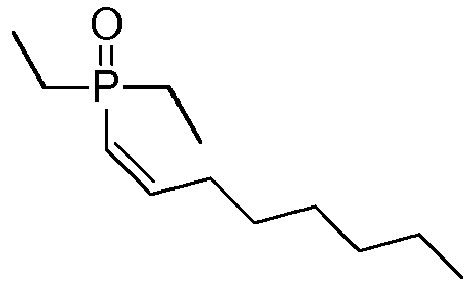
- 4c: R f = 0.07 (DCM:MeOH; 30:1).
- FTIR (film): ṽ = 3415, 2926, 2856, 1624, 1459, 1266, 1164, 1036, 703, 632 cm-1.
- MS (ESI): 217 ([M+H]+, 13%), 239 ([M+Na]+, 7%) 455 ([2M+Na]+, 100%).
- HRMS (ESI) Exact mass calculated for C12H25OPNa ([M+Na]+): 239.15352, found: 239.15281.
-

Entry alkene time temp atmosphere product yield [%] 1 12[1] 16 h 80 °C air 5a 37 2 12[1] 16 h r.t. argon 5a 0 3[2] 12[1] 16 h r.t. argon 5a 0 4 12[1] 16 h 80 °C argon 5a traces 5 12[1] 23 h r.t. balloon of air 5a 80[3] 6 12[1] 3 d r.t. balloon of air 5a 50 7 12[1] 5 d r.t. air 5a 82[3] 8[2] 12[1] 5 d r.t. air 5a 83[3] 9 12[4] 42.5 h r.t. air 5a 62[3] [1] Alkyne not distilled.
[2] Exclusion of light.
[3] Conversion of phosphine oxide.
[4] 10 equiv. of 12 used. - As can be seen from comparative examples of entries 2 to 4, the presence of oxygen is mandatory in order to successfully perform the method.
-

Entry Time [h] Conversion [%] 1 15,5 51 2 40,5 72 3 70 82 4 98 83 5 140,5 88 - It can be seen that most of the product is already formed within 50 hours reaction time and after that, in order to gain 20% more, the reaction time has to be doubled. From an economical viewpoint it is thus can be preferred to stop the reaction after 50 hours.
-

Entry P-compd alkyne time temp. solv. atm. prod. ratio 1 : 5 [1] yield [%] 1 1 4b 5 d r.t. - air 5b 1:4.5 n.d. 2 1 4b 23 h r.t. - balloon of air 5b 1:4 n.d. 3 1 4b 16 h 80 °C - air 5b n.d. 37 4 1 4a 4 d r.t. - air 5a 1:9 n.d. 5 1 4a 8 d r.t. - air 5a n.d. 52 6 10 4b 2d r.t. DCM air 5c 1:>29[2] n.d. 7 10 4a 42 h r.t. - air 5d 1:0.47[2] n.d. n.d. = not determined

Claims (14)
- A method for the synthesis of a compound of formula (I):
 R1 and R2 are independently selected from hydrogen or a substituted or unsubstituted C1-40 hydrocarbon group, whereby the group optionally contains at least one heteroatom, preferably O, N or S;X is independently O or S;R3 and R4 are independently selected from a substituted or unsubstituted C1-40 hydrocarbon group, whereby the group optionally contains at least one heteroatom, preferably O, N or S;m is independently 0 or 1; andn is an integer from 1 to 4;comprising or consisting of the steps:reacting a compound of formula (II)
 with a compound of formula (III)
 R3, R4, and m are as defined in formula (I), and whereinthe reaction is carried out in the presence of oxygen.
 - The method according to claim 1, wherein R1 and R2 are independently selected from hydrogen or a group selected from methyl ,ethyl, substituted or unsubstituted, branched, linear or cyclic C3-40 alkyl, whereby the substituted or unsubstituted, branched, linear or cyclic C3-40 alkyl group optionally contains at least one heteroatom, preferably O, N or S; allyl; substituted or unsubstituted, branched, linear or cyclic C3-40 alkenyl, whereby the substituted or unsubstituted, branched, linear or cyclic C3-40 alkenyl group optionally contains at least one heteroatom, preferably O, N or S; substituted or unsubstituted aryl, which optionally contains at least one heteroatom, preferably O, N or S, in its ring, wherein the at least one optional substituent of the afore-mentioned groups is selected from -F, -Cl, -Br, =O, -NH2, -NHR5, with R5 being a C1-16 alkyl, preferably a C1-4 alkyl, -NR5R6, with R5 being a C1-16 alkyl, preferably a C1-4 alkyl and R6 being a C1-4 alkyl, -COOH, -C(=O)H, -C(=O)OR7 with R7 being a C1-16 alkyl, preferably a C1-6 alkyl.
- The method according to claim 1 or 2, wherein R3 and R4 are independently selected from a group selected from methyl, ethyl, substituted or unsubstituted, branched, linear or cyclic C3-40 alkyl, whereby the substituted or unsubstituted, branched, linear or cyclic C3-40 alkyl group optionally contains at least one heteroatom, preferably O, N or S; allyl; substituted or unsubstituted, branched, linear or cyclic C3-40 alkenyl, whereby the substituted or unsubstituted, branched, linear or cyclic C3-40 alkenyl group optionally contains at least one heteroatom, preferably O, N or S; substituted or unsubstituted aryl, which optionally contains at least one heteroatom, preferably O, N or S, in its ring, wherein the at least one optional substituent of the afore-mentioned groups is selected from -F, -Cl, -Br, =O, -NH2, -NHR5, with R5 being a C1-16 alkyl, preferably a C1-4 alkyl,-NR5R6, with R5 being a C1-16 alkyl, preferably a C1-4 alkyl and R6 being a C1-4 alkyl, -COOH,-C(=O)H, -C(=O)OR7 with R7 being a C1-16 alkyl, preferably a C1-6 alkyl.
- The method according to any one of claims 1 to 3, wherein the reaction is performed in an organic solvent, preferably a C2-12 alcohol, a C2-12 ether, toluene, dimethyl sulfoxide, acetone, benzene, dichloromethane, a mixture thereof or essentially without solvents.
- The method according to any one of claims 1 to 4, wherein the reaction is performed at 20 to 150°C, preferably at 20 to 80 °C, more preferably 20 to 75 °C, most preferably 20 to 40 °C.
- The method according to any one of claims 1 to 5, wherein the reaction is performed for 1 minute to 1 month, preferably 1 hour to 72 hours, more preferably 5 hours to 50 hours.
- The method according to any one of claims 1 to 6, wherein the reaction is performed in excess of the at least one compound of formula (II), preferably the equivalent ratio of compounds of formula (II) to compounds of formula (III) is at least 2:1, more preferably at least 4:1, most preferably 6:1.
- A compound obtainable by the method of any one of claims 1 to 7.
- A composition comprising at least one compound according to claim 8 or at least one compound of formula (I):
 R1 and R2 are independently selected from hydrogen or a substituted or unsubstituted C1-40 hydrocarbon group, whereby the group optionally contains at least one heteroatom, preferably O, N or S;X is independently O or S;R3 and R4 are independently selected from a substituted or unsubstituted C1-40 hydrocarbon group, whereby the group optionally contains at least one heteroatom, preferably O, N or S;m is independently 0 or 1; andn is an integer from 1 to 4; and wherein the composition is a composition for lighting applications, optical applications, microelectronic compounds, optical brighteners or is a detergent composition.
 - The composition according to claim 9, wherein R1 and R2 are independently selected from hydrogen or a group selected from methyl ,ethyl, substituted or unsubstituted, branched, linear or cyclic C3-40 alkyl, whereby the substituted or unsubstituted, branched, linear or cyclic C3-40 alkyl group optionally contains at least one heteroatom, preferably O, N or S; allyl; substituted or unsubstituted, branched, linear or cyclic C3-40 alkenyl, whereby the substituted or unsubstituted, branched, linear or cyclic C3-40 alkenyl group optionally contains at least one heteroatom, preferably O, N or S; substituted or unsubstituted aryl, which optionally contains at least one heteroatom, preferably O, N or S, in its ring, wherein the at least one optional substituent of the afore-mentioned groups is selected from -F, -Cl, -Br, =O, -NH2, -NHR5, with R5 being a C1-16 alkyl, preferably a C1-4 alkyl, -NR5R6, with R5 being a C1-16 alkyl, preferably a C1-4 alkyl and R6 being a C1-4 alkyl, -COOH, -C(=O)H, -C(=O)OR7 with R7 being a C1-16 alkyl, preferably a C1-6 alkyl.
- The composition according to claim 9 or 10, wherein R3 and R4 are independently selected from a group selected from methyl, ethyl, substituted or unsubstituted, branched, linear or cyclic C3-40 alkyl, whereby the substituted or unsubstituted, branched, linear or cyclic C3-40 alkyl group optionally contains at least one heteroatom, preferably O, N or S; allyl; substituted or unsubstituted, branched, linear or cyclic C3-40 alkenyl, whereby the substituted or unsubstituted, branched, linear or cyclic C3-40 alkenyl group optionally contains at least one heteroatom, preferably O, N or S; substituted or unsubstituted aryl, which optionally contains at least one heteroatom, preferably O, N or S, in its ring, wherein the at least one optional substituent of the afore-mentioned groups is selected from -F, -Cl, -Br, =O, -NH2, -NHR5, with R5 being a C1-16 alkyl, preferably a C1-4 alkyl, -NR5R6, with R5 being a C1-16 alkyl, preferably a C1-4 alkyl and R6 being a C1-4 alkyl, -COOH, -C(=O)H, -C(=O)OR7 with R7 being a C1-16 alkyl, preferably a C1-6 alkyl.
- The use of at least one compound according to claim 8 or at least one compound of formula (I):
 R1 and R2 are independently selected from hydrogen or a substituted or unsubstituted C1-40 hydrocarbon group, whereby the group optionally contains at least one heteroatom, preferably O, N or S;X is independently O or S;R3 and R4 are independently selected from a substituted or unsubstituted C1-40 hydrocarbon group, whereby the group optionally contains at least one heteroatom, preferably O, N or S;m is independently 0 or 1; andn is an integer from 1 to 4; in lighting applications, optical applications, microelectronic compounds, optical brighteners or detergent compositions.
 - The use according to claim 12, wherein R1 and R2 are independently selected from hydrogen or a group selected from methyl ,ethyl, substituted or unsubstituted, branched, linear or cyclic C3-40 alkyl, whereby the substituted or unsubstituted, branched, linear or cyclic C3-40 alkyl group optionally contains at least one heteroatom, preferably O, N or S; allyl; substituted or unsubstituted, branched, linear or cyclic C3-40 alkenyl, whereby the substituted or unsubstituted, branched, linear or cyclic C3-40 alkenyl group optionally contains at least one heteroatom, preferably O, N or S; substituted or unsubstituted aryl, which optionally contains at least one heteroatom, preferably O, N or S, in its ring, wherein the at least one optional substituent of the afore-mentioned groups is selected from -F, -Cl, -Br, =O, -NH2, -NHR5, with R5 being a C1-16 alkyl, preferably a C1-4 alkyl, -NR5R6, with R5 being a C1-16 alkyl, preferably a C1-4 alkyl and R6 being a C1-4 alkyl, -COOH, -C(=O)H, -C(=O)OR7 with R7 being a C1-16 alkyl, preferably a C1-6 alkyl.
- The use according to claim 12 or 13, wherein R3 and R4 are independently selected from a group selected from methyl, ethyl, substituted or unsubstituted, branched, linear or cyclic C3-40 alkyl, whereby the substituted or unsubstituted, branched, linear or cyclic C3-40 alkyl group optionally contains at least one heteroatom, preferably O, N or S; allyl; substituted or unsubstituted, branched, linear or cyclic C3-40 alkenyl, whereby the substituted or unsubstituted, branched, linear or cyclic C3-40 alkenyl group optionally contains at least one heteroatom, preferably O, N or S; substituted or unsubstituted aryl, which optionally contains at least one heteroatom, preferably O, N or S, in its ring, wherein the at least one optional substituent of the afore-mentioned groups is selected from -F, -Cl, -Br, =O, -NH2, -NHR5, with R5 being a C1-16 alkyl, preferably a C1-4 alkyl,-NR5R6, with R5 being a C1-16 alkyl, preferably a C1-4 alkyl and R6 being a C1-4 alkyl, -COOH,-C(=O)H, -C(=O)OR7 with R7 being a C1-16 alkyl, preferably a C1-6 alkyl.
Priority Applications (1)
| Application Number | Priority Date | Filing Date | Title |
|---|---|---|---|
| EP18168978.7A EP3560936A1 (en) | 2018-04-24 | 2018-04-24 | Method for the synthesis of alkenyl-phosphorous compounds |
Applications Claiming Priority (1)
| Application Number | Priority Date | Filing Date | Title |
|---|---|---|---|
| EP18168978.7A EP3560936A1 (en) | 2018-04-24 | 2018-04-24 | Method for the synthesis of alkenyl-phosphorous compounds |
Publications (1)
| Publication Number | Publication Date |
|---|---|
| EP3560936A1 true EP3560936A1 (en) | 2019-10-30 |
Family
ID=62062900
Family Applications (1)
| Application Number | Title | Priority Date | Filing Date |
|---|---|---|---|
| EP18168978.7A Withdrawn EP3560936A1 (en) | 2018-04-24 | 2018-04-24 | Method for the synthesis of alkenyl-phosphorous compounds |
Country Status (1)
| Country | Link |
|---|---|
| EP (1) | EP3560936A1 (en) |
Citations (1)
| Publication number | Priority date | Publication date | Assignee | Title |
|---|---|---|---|---|
| US20110237720A1 (en) * | 2008-11-06 | 2011-09-29 | Clariant Finance (Bvi) Limited | Method for Producing Dialkylphosphinic Acids and Esters and Salts Thereof by Means of Vinyl Compounds and Use Thereof |
-
2018
- 2018-04-24 EP EP18168978.7A patent/EP3560936A1/en not_active Withdrawn
Patent Citations (1)
| Publication number | Priority date | Publication date | Assignee | Title |
|---|---|---|---|---|
| US20110237720A1 (en) * | 2008-11-06 | 2011-09-29 | Clariant Finance (Bvi) Limited | Method for Producing Dialkylphosphinic Acids and Esters and Salts Thereof by Means of Vinyl Compounds and Use Thereof |
Non-Patent Citations (4)
| Title |
|---|
| KOENIG ET AL., J. ORG. CHEM., vol. 62, 1997, pages 2414 - 2422 |
| OSAMU TAYAMA ET AL: "Hydrophosphorylation of Alkenes with Dialkyl Phosphites Catalyzed by Mn(III) under Air", JOURNAL OF ORGANIC CHEMISTRY, WILLIAMS & WILKINS, US, vol. 69, no. 16, 6 August 2004 (2004-08-06), pages 5494 - 5496, XP002632530, ISSN: 0022-3263, [retrieved on 20040703], DOI: 10.1021/JO049657J * |
| TANAKA ET AL., J. AM. CHEM. SOC., vol. 122, 2000, pages 5407 - 5408 |
| VICTORIA GUTIERREZ ET AL: "Direct synthesis of [beta]-ketophosphonates and vinyl phosphonates from alkenes or alkynes catalyzed by CuNPs/ZnO", RSC ADVANCES, vol. 5, no. 81, 1 January 2015 (2015-01-01), pages 65739 - 65744, XP055509182, ISSN: 2046-2069, DOI: 10.1039/C5RA10223E * |
Similar Documents
| Publication | Publication Date | Title |
|---|---|---|
| EP1442007B1 (en) | Method for the production of arylamines | |
| EP3530664B1 (en) | Diol, process for producing diol, di(meth)acrylate, and process for producing di(meth)acrylate | |
| CN112552285A (en) | Synthesis method of 4- (2,2, 2-trichloroethyl) -beta-lactam derivative | |
| WO2004024670A1 (en) | Process for producing arylamine | |
| EP2998335A1 (en) | Method for producing biphenyl-skeleton-containing epoxy resin | |
| JP6819892B2 (en) | Monoglycidyl isocyanurate compound and its production method | |
| EP3560936A1 (en) | Method for the synthesis of alkenyl-phosphorous compounds | |
| US7847117B2 (en) | Process for preparing alkyl(methoxymethyl)trimethylsilanylmethylamines | |
| EP3560938A1 (en) | Luminescent alkenyl-phosphorus containing materials | |
| CN114423727B (en) | Method for producing fluorine-containing compound | |
| CN113861238B (en) | A method for the simultaneous synthesis of secondary/tertiary phosphine oxide compounds with phosphine chiral centers catalyzed by palladium/chiral ligands | |
| JP2014084289A (en) | Method for producing fluorene derivative | |
| CN116940545A (en) | Method for producing fluorine-containing compound, and fluorine-containing compound | |
| KR102779378B1 (en) | 1-allylisochroman derivatives and preparing method thereof | |
| CN109369514B (en) | Synthetic method of six-membered carbocyclic ring derivative | |
| WO2017044043A1 (en) | Process for direct amidation of amines via rh(i)-catalyzed addition of boroxines | |
| CN119661475B (en) | Preparation method of alpha-allyl-alpha, alpha-difluoro amide compound | |
| KR102823550B1 (en) | Method of preparing alkenylated ortho-carborane | |
| KR102168966B1 (en) | Method for preparing chlorotrifluoromethylated compound using organic photocatalyst | |
| JP5178098B2 (en) | Alicyclic vinyl ether compounds | |
| JP6659445B2 (en) | Debenzylation method | |
| JP7168161B2 (en) | Method for producing heterol multimer | |
| JP5794570B2 (en) | Method for producing arylamines | |
| KR20240069893A (en) | Novel method for preparing high purity 9-phenylcarbazole | |
| CN119707988A (en) | A method for synthesizing polycyclic quinazolinone derivatives with antiviral activity |
Legal Events
| Date | Code | Title | Description |
|---|---|---|---|
| PUAI | Public reference made under article 153(3) epc to a published international application that has entered the european phase |
Free format text: ORIGINAL CODE: 0009012 |
|
| AK | Designated contracting states |
Kind code of ref document: A1 Designated state(s): AL AT BE BG CH CY CZ DE DK EE ES FI FR GB GR HR HU IE IS IT LI LT LU LV MC MK MT NL NO PL PT RO RS SE SI SK SM TR |
|
| AX | Request for extension of the european patent |
Extension state: BA ME |
|
| STAA | Information on the status of an ep patent application or granted ep patent |
Free format text: STATUS: THE APPLICATION IS DEEMED TO BE WITHDRAWN |
|
| 18D | Application deemed to be withdrawn |
Effective date: 20200603 |