EP3560918A1 - Condensed ring group azacyclobutyl triazole derivative, preparation method therefor and use thereof in medicine - Google Patents
Condensed ring group azacyclobutyl triazole derivative, preparation method therefor and use thereof in medicine Download PDFInfo
- Publication number
- EP3560918A1 EP3560918A1 EP17882608.7A EP17882608A EP3560918A1 EP 3560918 A1 EP3560918 A1 EP 3560918A1 EP 17882608 A EP17882608 A EP 17882608A EP 3560918 A1 EP3560918 A1 EP 3560918A1
- Authority
- EP
- European Patent Office
- Prior art keywords
- mmol
- compound
- formula
- group
- reaction solution
- Prior art date
- Legal status (The legal status is an assumption and is not a legal conclusion. Google has not performed a legal analysis and makes no representation as to the accuracy of the status listed.)
- Withdrawn
Links
- 0 CCC(C)(*)C*(C(C1)CN1c1nnc(*)[n]1C1=CC=CC(C)(*)N=C1)C1=CC=C*(C*)C=C1I Chemical compound CCC(C)(*)C*(C(C1)CN1c1nnc(*)[n]1C1=CC=CC(C)(*)N=C1)C1=CC=C*(C*)C=C1I 0.000 description 10
- JLEKZKXVEIHLHQ-UHFFFAOYSA-N COCc1nnc(N(C2)CC2[n]2c(ccc(F)c3)c3c(Cl)c2)[n]1-c(cn1)ccc1OC Chemical compound COCc1nnc(N(C2)CC2[n]2c(ccc(F)c3)c3c(Cl)c2)[n]1-c(cn1)ccc1OC JLEKZKXVEIHLHQ-UHFFFAOYSA-N 0.000 description 2
- WRGRJYZGGINUHU-HIXSDJFHSA-N COc(nc1)ccc1/N=C(\N(C1)CC1c1ccnc2c1ccc(F)c2)/SC Chemical compound COc(nc1)ccc1/N=C(\N(C1)CC1c1ccnc2c1ccc(F)c2)/SC WRGRJYZGGINUHU-HIXSDJFHSA-N 0.000 description 2
- UFBIKKMAFKBLNT-UHFFFAOYSA-N CCOCc1nnc(N(C2)CC2[n]2c(ccc(F)c3)c3c(Cl)c2)[n]1-c(cn1)ccc1OC Chemical compound CCOCc1nnc(N(C2)CC2[n]2c(ccc(F)c3)c3c(Cl)c2)[n]1-c(cn1)ccc1OC UFBIKKMAFKBLNT-UHFFFAOYSA-N 0.000 description 1
- XINNTZHVAXMREV-UHFFFAOYSA-N COCc1nnc(N(C2)CC2N(CCC2)c(cc3)c2cc3F)[n]1-c(cc1)cc2c1OCO2 Chemical compound COCc1nnc(N(C2)CC2N(CCC2)c(cc3)c2cc3F)[n]1-c(cc1)cc2c1OCO2 XINNTZHVAXMREV-UHFFFAOYSA-N 0.000 description 1
- SXKRYBWAQHZQHZ-UHFFFAOYSA-N COCc1nnc(N(C2)CC2N(CCC2)c3c2c(F)ccc3)[n]1-c(cc1)cnc1OC Chemical compound COCc1nnc(N(C2)CC2N(CCC2)c3c2c(F)ccc3)[n]1-c(cc1)cnc1OC SXKRYBWAQHZQHZ-UHFFFAOYSA-N 0.000 description 1
- WCMNJTWEVHLOBG-UHFFFAOYSA-N COCc1nnc(N(C2)CC2N2c3cccc(F)c3OCC2)[n]1-c(cc1)cnc1OC Chemical compound COCc1nnc(N(C2)CC2N2c3cccc(F)c3OCC2)[n]1-c(cc1)cnc1OC WCMNJTWEVHLOBG-UHFFFAOYSA-N 0.000 description 1
- NVPOWNQGBJQVLO-UHFFFAOYSA-N COCc1nnc(N(C2)CC2[n](cc2)c(cc3)c2cc3F)[n]1-c(cn1)ccc1OC Chemical compound COCc1nnc(N(C2)CC2[n](cc2)c(cc3)c2cc3F)[n]1-c(cn1)ccc1OC NVPOWNQGBJQVLO-UHFFFAOYSA-N 0.000 description 1
- AJMHSEAJXVFVCN-UHFFFAOYSA-N COCc1nnc(N(C2)CC2[n]2ncc3c2ccc(F)c3)[n]1-c(cc1)cnc1OC Chemical compound COCc1nnc(N(C2)CC2[n]2ncc3c2ccc(F)c3)[n]1-c(cc1)cnc1OC AJMHSEAJXVFVCN-UHFFFAOYSA-N 0.000 description 1
- HYLCQHBTGNDTQH-HIXSDJFHSA-N COc(cc1)ncc1/N=C(\N(C1)CC1[n]1c(ccc(F)c2)c2c(C#N)c1)/SC Chemical compound COc(cc1)ncc1/N=C(\N(C1)CC1[n]1c(ccc(F)c2)c2c(C#N)c1)/SC HYLCQHBTGNDTQH-HIXSDJFHSA-N 0.000 description 1
- RMKNVJWVLYETNW-RELWKKBWSA-N COc(cc1)ncc1/N=C(\N(C1)CC1[n]1ncc2c1ccc(F)c2)/SC Chemical compound COc(cc1)ncc1/N=C(\N(C1)CC1[n]1ncc2c1ccc(F)c2)/SC RMKNVJWVLYETNW-RELWKKBWSA-N 0.000 description 1
- COFWLMVAHSRFSI-UHFFFAOYSA-N COc(nc1)ccc1-[n]1c(N(C2)CC2N(CCOc2c3)c2ccc3F)nnc1C(F)(F)F Chemical compound COc(nc1)ccc1-[n]1c(N(C2)CC2N(CCOc2c3)c2ccc3F)nnc1C(F)(F)F COFWLMVAHSRFSI-UHFFFAOYSA-N 0.000 description 1
- HXQNEILKFRIEQQ-BSYVCWPDSA-N COc(nc1)ccc1/N=C(\N(C1)CC1N(CCC1)c2c1c(F)ccc2)/SC Chemical compound COc(nc1)ccc1/N=C(\N(C1)CC1N(CCC1)c2c1c(F)ccc2)/SC HXQNEILKFRIEQQ-BSYVCWPDSA-N 0.000 description 1
- VGAXCLMDKWGDHD-ZBJSNUHESA-N COc(nc1)ccc1/N=C(\N(C1)CC1N1c2cccc(F)c2OCC1)/SC Chemical compound COc(nc1)ccc1/N=C(\N(C1)CC1N1c2cccc(F)c2OCC1)/SC VGAXCLMDKWGDHD-ZBJSNUHESA-N 0.000 description 1
- CYFPCVDMBZICOP-ZBJSNUHESA-N COc(nc1)ccc1/N=C(\N(C1)CC1[n](cc1)c(cc2)c1cc2F)/SC Chemical compound COc(nc1)ccc1/N=C(\N(C1)CC1[n](cc1)c(cc2)c1cc2F)/SC CYFPCVDMBZICOP-ZBJSNUHESA-N 0.000 description 1
- JXYHJHSEBXSKAH-DARPEHSRSA-N COc(nc1)ccc1/N=C(\N(C1)CC1c1c(ccc(F)c2)c2ccc1)/SC Chemical compound COc(nc1)ccc1/N=C(\N(C1)CC1c1c(ccc(F)c2)c2ccc1)/SC JXYHJHSEBXSKAH-DARPEHSRSA-N 0.000 description 1
- CFTGZUOSVRUVNQ-ZBJSNUHESA-N COc(nc1)ccc1/N=C(\N(C1)CC1c1c[o]c2c1ccc(F)c2)/SC Chemical compound COc(nc1)ccc1/N=C(\N(C1)CC1c1c[o]c2c1ccc(F)c2)/SC CFTGZUOSVRUVNQ-ZBJSNUHESA-N 0.000 description 1
- LSEOJDKOQDSUHM-BSYVCWPDSA-N CS/C(/N(C1)CC1[n]1c(ccc(F)c2)c2c(Cl)c1)=N/c(cc1)cc2c1OCO2 Chemical compound CS/C(/N(C1)CC1[n]1c(ccc(F)c2)c2c(Cl)c1)=N/c(cc1)cc2c1OCO2 LSEOJDKOQDSUHM-BSYVCWPDSA-N 0.000 description 1
- UVZWJORSNJBCBT-UHFFFAOYSA-N C[n]1c(cc(cc2)F)c2c(C(C2)CN2c2nnc(COC)[n]2-c(cn2)ccc2OC)c1 Chemical compound C[n]1c(cc(cc2)F)c2c(C(C2)CN2c2nnc(COC)[n]2-c(cn2)ccc2OC)c1 UVZWJORSNJBCBT-UHFFFAOYSA-N 0.000 description 1
- GRUPAEWJLDLTPV-UHFFFAOYSA-N NC1C=C2OCC2C1 Chemical compound NC1C=C2OCC2C1 GRUPAEWJLDLTPV-UHFFFAOYSA-N 0.000 description 1
Images

Classifications
-
- C—CHEMISTRY; METALLURGY
- C07—ORGANIC CHEMISTRY
- C07D—HETEROCYCLIC COMPOUNDS
- C07D401/00—Heterocyclic compounds containing two or more hetero rings, having nitrogen atoms as the only ring hetero atoms, at least one ring being a six-membered ring with only one nitrogen atom
- C07D401/14—Heterocyclic compounds containing two or more hetero rings, having nitrogen atoms as the only ring hetero atoms, at least one ring being a six-membered ring with only one nitrogen atom containing three or more hetero rings
-
- A—HUMAN NECESSITIES
- A61—MEDICAL OR VETERINARY SCIENCE; HYGIENE
- A61K—PREPARATIONS FOR MEDICAL, DENTAL OR TOILETRY PURPOSES
- A61K31/00—Medicinal preparations containing organic active ingredients
- A61K31/33—Heterocyclic compounds
- A61K31/395—Heterocyclic compounds having nitrogen as a ring hetero atom, e.g. guanethidine or rifamycins
- A61K31/435—Heterocyclic compounds having nitrogen as a ring hetero atom, e.g. guanethidine or rifamycins having six-membered rings with one nitrogen as the only ring hetero atom
- A61K31/44—Non condensed pyridines; Hydrogenated derivatives thereof
- A61K31/4427—Non condensed pyridines; Hydrogenated derivatives thereof containing further heterocyclic ring systems
- A61K31/4439—Non condensed pyridines; Hydrogenated derivatives thereof containing further heterocyclic ring systems containing a five-membered ring with nitrogen as a ring hetero atom, e.g. omeprazole
-
- A—HUMAN NECESSITIES
- A61—MEDICAL OR VETERINARY SCIENCE; HYGIENE
- A61K—PREPARATIONS FOR MEDICAL, DENTAL OR TOILETRY PURPOSES
- A61K31/00—Medicinal preparations containing organic active ingredients
- A61K31/33—Heterocyclic compounds
- A61K31/395—Heterocyclic compounds having nitrogen as a ring hetero atom, e.g. guanethidine or rifamycins
- A61K31/435—Heterocyclic compounds having nitrogen as a ring hetero atom, e.g. guanethidine or rifamycins having six-membered rings with one nitrogen as the only ring hetero atom
- A61K31/47—Quinolines; Isoquinolines
- A61K31/4709—Non-condensed quinolines and containing further heterocyclic rings
-
- A—HUMAN NECESSITIES
- A61—MEDICAL OR VETERINARY SCIENCE; HYGIENE
- A61K—PREPARATIONS FOR MEDICAL, DENTAL OR TOILETRY PURPOSES
- A61K31/00—Medicinal preparations containing organic active ingredients
- A61K31/33—Heterocyclic compounds
- A61K31/395—Heterocyclic compounds having nitrogen as a ring hetero atom, e.g. guanethidine or rifamycins
- A61K31/535—Heterocyclic compounds having nitrogen as a ring hetero atom, e.g. guanethidine or rifamycins having six-membered rings with at least one nitrogen and one oxygen as the ring hetero atoms, e.g. 1,2-oxazines
- A61K31/5375—1,4-Oxazines, e.g. morpholine
- A61K31/538—1,4-Oxazines, e.g. morpholine ortho- or peri-condensed with carbocyclic ring systems
-
- A—HUMAN NECESSITIES
- A61—MEDICAL OR VETERINARY SCIENCE; HYGIENE
- A61P—SPECIFIC THERAPEUTIC ACTIVITY OF CHEMICAL COMPOUNDS OR MEDICINAL PREPARATIONS
- A61P15/00—Drugs for genital or sexual disorders; Contraceptives
-
- C—CHEMISTRY; METALLURGY
- C07—ORGANIC CHEMISTRY
- C07D—HETEROCYCLIC COMPOUNDS
- C07D401/00—Heterocyclic compounds containing two or more hetero rings, having nitrogen atoms as the only ring hetero atoms, at least one ring being a six-membered ring with only one nitrogen atom
- C07D401/02—Heterocyclic compounds containing two or more hetero rings, having nitrogen atoms as the only ring hetero atoms, at least one ring being a six-membered ring with only one nitrogen atom containing two hetero rings
- C07D401/12—Heterocyclic compounds containing two or more hetero rings, having nitrogen atoms as the only ring hetero atoms, at least one ring being a six-membered ring with only one nitrogen atom containing two hetero rings linked by a chain containing hetero atoms as chain links
-
- C—CHEMISTRY; METALLURGY
- C07—ORGANIC CHEMISTRY
- C07D—HETEROCYCLIC COMPOUNDS
- C07D405/00—Heterocyclic compounds containing both one or more hetero rings having oxygen atoms as the only ring hetero atoms, and one or more rings having nitrogen as the only ring hetero atom
- C07D405/14—Heterocyclic compounds containing both one or more hetero rings having oxygen atoms as the only ring hetero atoms, and one or more rings having nitrogen as the only ring hetero atom containing three or more hetero rings
-
- C—CHEMISTRY; METALLURGY
- C07—ORGANIC CHEMISTRY
- C07D—HETEROCYCLIC COMPOUNDS
- C07D409/00—Heterocyclic compounds containing two or more hetero rings, at least one ring having sulfur atoms as the only ring hetero atoms
- C07D409/14—Heterocyclic compounds containing two or more hetero rings, at least one ring having sulfur atoms as the only ring hetero atoms containing three or more hetero rings
-
- C—CHEMISTRY; METALLURGY
- C07—ORGANIC CHEMISTRY
- C07D—HETEROCYCLIC COMPOUNDS
- C07D413/00—Heterocyclic compounds containing two or more hetero rings, at least one ring having nitrogen and oxygen atoms as the only ring hetero atoms
- C07D413/14—Heterocyclic compounds containing two or more hetero rings, at least one ring having nitrogen and oxygen atoms as the only ring hetero atoms containing three or more hetero rings
Definitions
- the present invention belongs to the field of medicine, and relates to a novelcondensed ring azacyclobutyl triazole derivative, a method for preparing the same, a pharmaceutical composition comprising the same, a use thereof as a therapeutic agent, in particular as an oxytocin antagonist, and a use thereof in the preparation of medicaments for the treatment or prevention of diseases or conditions for which inhibition of oxytocin is known, or can be shown, to produce a beneficial effect.
- Oxytocin is a cyclic nonapeptide that is normally synthesized by the hypothalamic paraventricular nucleus and released via the posterior pituitary. OT has a wide range of physiological functions, including social connections, sexual reproduction, labour and the like. OT exerts physiological effects by binding to oxytocin receptors (OTRs).
- OTRs oxytocin receptors
- Oxytocin regulators (such as blockers or antagonists) may be effective in treating abortion. Studies have also shown that premature patients have a higher oxytocin sensitivity and oxytocin receptor density compared with women of the same gestational age. Therefore, the application of oxytocin receptor antagonist to block the action of oxytocin and its receptors is an important way to resist premature birth.
- oxytocin regulators can also be used to improve the pregnancy rate of patients receiving test-tube baby embryo transfer, especially patients that have suffered from several unsuccessful transfers.
- Another condition associated with oxytocin is dysmenorrhea, which is characterized by pain and discomfort during menstruation. Oxytocin plays a role in dysmenorrhea due to its activity as a uterine vasoconstrictor ( Akerlund et al., Ann. NY Acad. Sci. 734: 47-56, 1994 ). Oxytocin antagonists have a therapeutic efficacy on this condition.
- oxytocin has been found to be one of the most potent agents to induce penile erection in rats, rabbits and monkeys.
- central administration of oxytocin is claimed to reduce the latency to achieve ejaculation and to shorten the post-ejaculatory interval.
- Psychiatry, 57(11): 1012-30, 2000 states that in male animals, oxytocin facilitates penile erections when injected into specific areas of the brain (i.e., periventricular nucleus of the hypothalamus) and shortens the ejaculation latency and postejaculation interval when injected either centrally or peripherally. Oxytocin has also been successfully used to treat a patient with ahedonia. Inhalation of oxytocin through the nasal cavity can effectively restore ejaculation in patients who have previously failed to ejaculate during sexual intercourse ( Ishak et al., J. Sex Med., 5(4):1022-4, 2007 ).
- Antagonists (or blockers) of oxytocin receptors have been shown to prolong the ejaculation latency of patients with prospermia in clinical trials.
- a selective oxytocin receptor antagonist IX-01 in the phase II clinical trials when being administrated orally (400 mg or 800 mg) to a patient with prospermia, can significantly prolong the vaginal ejaculation latency of the patient and improve the patient's self-perception ( McMahon, et. al., J. Urol., 197(4S):e1344, 2017 ).
- oxytocin receptor is very similar to that of vasopressin receptors (including V1a receptor, V1b receptor, V2 receptor).
- V1a receptor and V2 receptor are mainly expressed in the periphery, which regulate blood pressure and kidney function, respectively.
- V1b receptor is mainly expressed in the brain and pituitary gland, and can control the release of adrenocorticotropic hormone and ⁇ -endorphin. Therefore, for safety reasons, highly selective OTR agonists are key issues that must be considered in future development ( Alan D. Borthwick. J. Med. Chem. 2010, 53, 6525-6538 ).
- OTR antagonists A series of patent applications of OTR antagonists are currently disclosed, including WO2005028452 , WO2005082866 , WO2006077496 , WO2006092731 , WO2006100588 and WO2006100557 .
- highly selective OTR antagonist is still the focus of development.
- the inventor designs a compound having a structure of formula (I) by continuous efforts, and finds that a compound having such a structure has a highly selective inhibition effect on OTR, good absorption and good brain permeability, and can effectively block the downstream function of the oxytocin receptor mediated by oxytocin.
- An object of the present invention is to provide a compound of formula (I), or a tautomer, mesomer, racemate, enantiomer, diastereomer thereof, or the mixture thereof, or a pharmaceutically acceptable salt thereof, wherein:
- the compound of formula (I) is a compound of formula (II): or a tautomer, mesomer, racemate, enantiomer, diastereomer thereof, or the mixture thereof, or a pharmaceutically acceptable salt thereof, wherein:
- the compound of formula (I) is a compound of formula (III): wherein:
- the compound of formula (I) is a compound of formula (IV): or a tautomer, mesomer, racemate, enantiomer, diastereomer thereof, or the mixture thereof, or a pharmaceutically acceptable salt thereof, wherein:
- the compound of formula (I), wherein the ring A is pyridyl or benzodioxole; and preferably
- the compound of formula (I), wherein the ring B is pyrrolyl, furyl, thienyl, imidazolyl, pyrazolyl, oxazolyl, phenyl, pyridyl, pyranyl, pyrrolidinyl, piperidinyl, piperazinyl, morpholinyl, morpholin-3-one, tetrahydropyranyl, dihydropyranyl, tetrahydropyridyl, dihydropyrrolyl, dihydro-1,4-oxazinyl or 2 H -1,4-oxazin-3-one.
- the compound of formula (I), wherein is selected from the group consisting of: wherein: R 2 , R 4 , n and t are as defined in formula (I).
- the compound of formula (I), wherein R 1 is alkyl, wherein the alkyl is optionally substituted by one or more substituents selected from the group consisting of alkoxy, halogen, haloalkyl, haloalkoxy, hydroxy, NHS(O) s R 5 and NHC(O)OR 5 ; R 5 is alkyl; and s is 0, 1 or 2.
- each R 2 is identical or unidentical and each is independently selected from the group consisting of hydrogen, halogen, alkyl and haloalkyl.
- each R 4 is identical or unidentical and each is independently selected from the group consisting of hydrogen, halogen, alkyl, haloalkyl, cyano, oxo and -C(O)OR 5 ; and R 5 is alkyl.
- the compound of the present invention includes all conformational isomers thereof, e . g ., cis -isomers and trans -isomers; and all optical isomers and stereoisomers as well as mixtures thereof.
- the compound of the present invention has asymmetric centers, and thus there are different enantiomeric and diastereomeric isomers.
- the present invention relates to a use of the compound of the present invention, and all pharmaceutical compositions applying or comprising the same, and a therapeutic method thereof.
- the present invention relates to a use of all such isomers and mixtures thereof.
- Typical compounds of the present invention include, but are not limited to the following: Example No. Structure and name of the compound 1 7-Fluoro-4-(1-(5-(methoxymethyl)-4-(6-methoxypyridin-3-yl)-4 H -1,2,4-triazol-3-yl)azetidin-3-yl)quinoline 1 2 5-(3-(3-(6-Fluoronaphthalen-1-yl)azetidin-1-yl)-5-(methoxymethyl)-4 H -1,2,4-triazol-4-yl)-2-methoxypyridine 2 3 1-(1-(4-(Benzo[ d ][1,3]dioxolan-5-yl)-5-(methoxymethyl)-4 H -1,2,4-triazol-3-yl)azetidin-3-yl)-3-chloro-5-fluoro-1 H -indole 3 4 3-Chloro-1-(1-(
- a preferred embodiment of the present invention relates to a compound of formula (I-A) which is an intermediate for synthesizing the compound of formula (I): or a tautomer, mesomer, racemate, enantiomer, diastereomer thereof, or the mixture thereof, or a pharmaceutically acceptable salt thereof, wherein:
- the compounds of formula (I-A) include but are not limited to the following: Example No. Structure and name of the compound 1g Methyl ( E )-3-(7-fluoroquinolin-4-yl)- N -(6-methoxypyridin-3-yl)azetidine-1-carbimidothioate 1g 2f Methyl ( E )-3-(6-fluoronaphthalen-1-yl)- N -(6-methoxypyridin-3-yl)azetidine-1-carbimidothioate 2f 3i Methyl ( E )- N -benzo[ d ][1,3]dioxolan-5-yl-3-(3-chloro-5-fluoro-1 H -indol-1-yl)azetidine-1-carbimidothioate 3i 4b Methyl ( E )-3-(3-chloro-5-fluoro-1 H -indo
- the present invention relates to a method for preparing the compound of formula (I), comprising a step of: heating a compound of formula (I-A) and a compound of formula (I-B) or a hydrochloride salt thereof under an acidic condition to obtain the compound of formula (I), wherein: ring A, ring B, R 1 -R 4 , G, n, m and t are as defined in formula (I).
- the present invention relates to a method for preparing the compound of formula (II), comprising a step of: wherein:
- the present invention relates to a method for preparing the compound of formula (III), comprising a step of: heating a compound of formula (III-A) and a compound of formula (I-B) or a hydrochloride salt thereof under an acidic condition to obtain the compound of formula (III), wherein:
- the present invention relates to a method for preparing the compound of formula (III), comprising a step of: heating a compound of formula (IV-A) and a compound of formula (I-B) or a hydrochloride salt thereof under an acidic condition to obtain the compound of formula (IV), wherein:
- the present invention relates to a pharmaceutical composition
- a pharmaceutical composition comprising a therapeutically effective amount of the compound of formula (I), or a tautomer, mesomer, racemate, enantiomer, diastereomer thereof, or the mixture thereof, or a pharmaceutically acceptable salt thereof, and one or more pharmaceutically acceptable carriers, diluents or excipients.
- the present invention also relates to a method for preparing the aforementioned composition, comprising a step of mixing the compound of formula (I), or a tautomer, mesomer, racemate, enantiomer, diastereomer thereof, or the mixture thereof, or a pharmaceutically acceptable salt thereof, with one or more pharmaceutically acceptable carriers, diluents or excipients.
- the present invention further relates to a use of the compound of formula (I), or a tautomer, mesomer, racemate, enantiomer, diastereomer thereof, or the mixture thereof, or a pharmaceutically acceptable salt thereof, or the pharmaceutical composition comprising the same in the preparation of medicaments for the treatment or prevention of diseases or conditions for which inhibition of oxytocin is known, or can be shown, to produce a beneficial effect, wherein the disease or condition is preferably selected from the group consisting of sexual dysfunction, hypoactive sexual desire disorder, sexual arousal disorder, orgasmic disorder, sexual pain disorder, premature ejaculation, preterm labour, complications in labour, appetite and feeding disorders, benign prostatic hyperplasia, premature birth, dysmenorrhea, congestive heart failure, arterial hypertension, liver cirrhosis, nephrotic hypertension, ocular hypectension, obsessive and behavioral disorders and neuropsychiatric disorders, and more preferably selected from the group consisting of sexual dysfunction, sexual arousal disorder
- the present invention further relates to a use of the compound of formula (I), or a tautomer, mesomer, racemate, enantiomer, diastereomer thereof, or the mixture thereof, or a pharmaceutically acceptable salt thereof, or the pharmaceutical composition comprising the same in the preparation of medicaments for antagonizing oxytocin.
- the present invention further relates to a method for the treatment or prevention of diseases or conditions for which inhibition of oxytocin is known, or can be shown, to produce a beneficial effect, which comprises a step of administering to a patient in need of it a therapeutically effective amount of the compound of formula (I), or a tautomer, mesomer, racemate, enantiomer, diastereomer thereof, or the mixture thereof, or a pharmaceutically acceptable salt thereof, or the pharmaceutical composition comprising the same.
- the present invention further relates to a method for the treatment or prevention of diseases selected from the group consisting of sexual dysfunction, hypoactive sexual desire disorder, sexual arousal disorder, orgasmic disorder, sexual pain disorder, premature ejaculation, preterm labour, complications in labour, appetite and feeding disorders, benign prostatic hyperplasia, premature birth, dysmenorrhea, congestive heart failure, arterial hypertension, liver cirrhosis, nephrotic hypertension, ocular hypectension, obsessive and behavioral disorders and neuropsychiatric disorders, and preferably selected from the group consisting of sexual dysfunction, sexual arousal disorder, orgasmic disorder, sexual pain disorder and premature ejaculation, which comprises a step of administering to a patient in need of it a therapeutically effective amount of the compound of formula (I), or a tautomer, mesomer, racemate, enantiomer, diastereomer thereof, or the mixture thereof, or a pharmaceutically acceptable salt thereof, or the pharmaceutical composition comprising the same.
- the present invention further relates to a method for antagonizing oxytocin, comprising a step of administering to a patient in need of it a therapeutically effective amount of the compound of formula (I), or a tautomer, mesomer, racemate, enantiomer, diastereomer thereof, or the mixture thereof, or a pharmaceutically acceptable salt thereof, or the pharmaceutical composition comprising the same.
- the present invention further relates to the compound of formula (I), or a tautomer, mesomer, racemate, enantiomer, diastereomer thereof, or the mixture thereof, or a pharmaceutically acceptable salt thereof, or the pharmaceutical composition comprising the same, for use as a medicament.
- the present invention further relates to the compound of formula (I), or a tautomer, mesomer, racemate, enantiomer, diastereomer thereof, or the mixture thereof, or a pharmaceutically acceptable salt thereof, or the pharmaceutical composition comprising the same, for use as an oxytocin antagonist.
- the present invention further relates to the compound of formula (I), or a tautomer, mesomer, racemate, enantiomer, diastereomer thereof, or the mixture thereof, or a pharmaceutically acceptable salt thereof, or the pharmaceutical composition comprising the same, for use in the treatment or prevention of diseases selected from the group consisting of sexual dysfunction, hypoactive sexual desire disorder, sexual arousal disorder, orgasmic disorder, sexual pain disorder, premature ejaculation, preterm labour, complications in labour, appetite and feeding disorders, benign prostatic hyperplasia, premature birth, dysmenorrhea, congestive heart failure, arterial hypertension, liver cirrhosis, nephrotic hypertension, ocular hypectension, obsessive and behavioral disorders and neuropsychiatric disorders, and preferably selected from the group consisting of sexual dysfunction, sexual arousal disorder, orgasmic disorder, sexual pain disorder and premature ejaculation.
- diseases selected from the group consisting of sexual dysfunction, hypoactive sexual desire disorder, sexual arousal disorder,
- the pharmaceutical composition containing the active ingredient may be in a form suitable for oral administration, for example, a tablet, a troche, a lozenge, an aqueous or oily suspension, a dispersible powder or granule, an emulsion, a hard or soft capsule, or a syrup or elixir.
- the oral compositions can be prepared according to any known method in the art for the preparation of pharmaceutical composition. Such compositions may contain one or more ingredients selected from the group consisting of sweeteners, flavoring agents, colorants and preservatives, in order to provide a pleasing and palatable pharmaceutical preparation.
- a tablet contains the active ingredient in admixture with nontoxic pharmaceutically acceptable excipients suitable for the manufacture of tablets.
- An aqueous suspension contains the active ingredient in admixture with excipients suitable for the manufacture of an aqueous suspension. Such excipient is a suspending agent.
- An oil suspension can be formulated by suspending the active ingredient in a vegetable oil.
- the oil suspension may contain a thickener.
- the aforementioned sweeteners and flavoring agents may be added to provide a palatable preparation.
- These compositions can be preserved by adding an antioxidant, such as butylated hydroxyanisole or alpha-tocopherol.
- the active ingredient in admixture with the dispersants or wetting agents, suspending agent or one or more preservatives can be provided as a dispersible powder or granule suitable for the preparation of an aqueous suspension by adding water.
- Suitable dispersants or wetting agents and suspending agents are exemplified by those already mentioned above. Additional excipients, such as sweeteners, flavoring agents and colorants, may also be added. These compositions can be preserved by adding an antioxidant, such as ascorbic acid.
- the pharmaceutical composition of the present invention may also be in the form of an oil-in-water emulsion.
- the oil phase may be a vegetable oil such as olive oil or peanut oil, or mineral oil such as liquid paraffin, or the mixture thereof.
- the emulsion may also contain sweeteners, flavoring agents, preservatives and antioxidants. Such preparations may also contain moderator, preservatives, colorants, and antioxidants.
- the pharmaceutical composition of the present invention may be in the form of a sterile injectable aqueous solution.
- the sterile injectable formulation may be a sterile injectable oil-in-water micro-emulsion in which the active ingredient is dissolved in the oil phase.
- the pharmaceutical composition of the present invention may be in the form of a sterile injectable aqueous or oily suspension for intramuscular and subcutaneous administration.
- a suspension can be formulated with suitable dispersants or wetting agents and suspending agents as described above according to the known techniques.
- the sterile injectable preparation may also be a sterile injectable solution or suspension prepared in a nontoxic parenterally acceptable diluent or solvent. Sterile fixed oils may easily be used as a solvent or suspending medium.
- the compound of the present invention can be administered in the form of a suppository for rectal administration.
- These pharmaceutical compositions can be prepared by mixing the drug with a suitable non-irritating excipient that is solid at ordinary temperatures, but liquid in the rectum, thereby melting in the rectum to release the drug.
- a suitable non-irritating excipient that is solid at ordinary temperatures, but liquid in the rectum, thereby melting in the rectum to release the drug.
- the dosage of a drug depends on a variety of factors including but not limited to, the following factors: activity of a specific compound, age of the patient, weight of the patient, general health of the patient, behavior of the patient, diet of the patient, administration time, administration route, excretion rate, drug combination and the like.
- the optimal treatment such as treatment mode, daily dose of the compound of formula (I) or the type of the pharmaceutically acceptable salt thereof can be verified by traditional therapeutic regimens.
- alkyl refers to a saturated aliphatic hydrocarbon group, which is a straight or branched chain group comprising 1 to 20 carbon atoms, preferably an alkyl having 1 to 12 carbon atoms, and more preferably an alkyl having 1 to 6 carbon atoms.
- Non-limiting examples include methyl, ethyl, n-propyl, isopropyl, n-butyl, isobutyl, tert-butyl, sec-butyl, n-pentyl, 1,1-dimethylpropyl, 1,2-dimethylpropyl, 2,2-dimethylpropyl, 1-ethylpropyl, 2-methylbutyl, 3-methylbutyl, n-hexyl, 1-ethyl-2-methylpropyl, 1,1,2-trimethylpropyl, 1,1-dimethylbutyl, 1,2-dimethylbutyl, 2,2-dimethylbutyl, 1,3-dimethylbutyl, 2-ethylbutyl, 2-methylpentyl, 3-methylpentyl, 4-methylpentyl, 2,3-dimethylbutyl, n-heptyl, 2-methylhexyl, 3-methylhexyl, 4-methylhexyl, 5-methylhexyl,
- an alkyl group is a lower alkyl having 1 to 6 carbon atoms, and non-limiting examples include methyl, ethyl, n-propyl, isopropyl, n-butyl, isobutyl, tert-butyl, sec-butyl, n-pentyl, 1,1-dimethylpropyl, 1,2-dimethylpropyl, 2,2-dimethylpropyl, 1-ethylpropyl, 2-methylbutyl, 3-methylbutyl, n-hexyl, 1-ethyl-2-methylpropyl, 1,1,2-trimethylpropyl, 1,1-dimethylbutyl, 1,2-dimethylbutyl, 2,2-dimethylbutyl, 1,3-dimethylbutyl, 2-ethylbutyl, 2-methylpentyl, 3-methylpentyl, 4-methylpentyl, 2,3-dimethylbutyl, and the like.
- the alkyl group can be substituted or unsubstituted. When substituted, the substituent group(s) can be substituted at any available connection point.
- the substituent group(s) is preferably one or more groups independently optionally selected from the group consisting of alkyl, alkenyl, alkynyl, alkoxy, alkylthio, alkylamino, halogen, thiol, hydroxy, nitro, cyano, cycloalkyl, heterocyclyl, aryl, heteroaryl, cycloalkoxy, heteroalkoxy, cycloalkylthio and heterocyclylthio.
- cycloalkyl refers to a saturated or partially unsaturated monocyclic or polycyclic hydrocarbon substituent group having 3 to 20 carbon atoms, preferably 3 to 12 carbon atoms, more preferably 3 to 10 carbon atoms, and most preferably 3 to 6 carbon atoms.
- Non-limiting examples of monocyclic cycloalkyl include cyclopropyl, cyclobutyl, cyclopentyl, cyclopentenyl, cyclohexyl, cyclohexenyl, cyclohexadienyl, cycloheptyl, cycloheptatrienyl, cyclooctyl and the like, and preferably cyclopropyl, cyclobutyl, cyclopentyl and cyclohexyl.
- Polycyclic cycloalkyl includes a cycloalkyl having a spiro ring, fused ring or bridged ring.
- spiro cycloalkyl refers to a 5 to 20 membered polycyclic group with rings connected through one shared carbon atom (called a spiro atom), wherein the rings can contain one or more double bonds, but none of the rings has a completely conjugated ⁇ -electron system.
- the spiro cycloalkyl is preferably 6 to 14 membered spiro cycloalkyl, and more preferably 7 to 10 membered spiro cycloalkyl.
- the spiro cycloalkyl can be divided into mono-spiro cycloalkyl, di-spiro cycloalkyl, or poly-spiro cycloalkyl, and the spiro cycloalkyl is preferably a mono-spiro cycloalkyl or di-spiro cycloalkyl, and more preferably 4-membered/4-membered, 4-membered/5-membered, 4-membered/6-membered, 5-membered/5-membered, or 5-membered/6-membered mono-spiro cycloalkyl.
- Non-limiting examples of spiro cycloalkyl include:
- fused cycloalkyl refers to a 5 to 20 membered all-carbon polycyclic group, wherein each ring in the system shares an adjacent pair of carbon atoms with another ring, wherein one or more rings can contain one or more double bonds, but none of the rings has a completely conjugated ⁇ -electron system.
- the fused cycloalkyl is preferably 6 to 14 membered fused cycloalkyl, and more preferably 7 to 10 membered fused cycloalkyl.
- the fused cycloalkyl can be divided into bicyclic, tricyclic, tetracyclic or polycyclic fused cycloalkyl, and the fused cycloalkyl is preferably bicyclic or tricyclic fused cycloalkyl, and more preferably 5-membered/5-membered, or 5-membered/6-membered bicyclic fused cycloalkyl.
- fused cycloalkyl include:
- bridged cycloalkyl refers to a 5 to 20 membered all-carbon polycyclic group, wherein every two rings in the system share two disconnected carbon atoms, wherein the rings can have one or more double bonds, but none of the rings has a completely conjugated ⁇ -electron system.
- the bridged cycloalkyl is preferably 6 to 14 membered bridged cycloalkyl, and more preferably 7 to 10 membered bridged cycloalkyl.
- the bridged cycloalkyl can be divided into bicyclic, tricyclic, tetracyclic or polycyclic bridged cycloalkyl, and the bridged cycloalkyl is preferably bicyclic, tricyclic or tetracyclic bridged cycloalkyl, and more preferably bicyclic or tricyclic bridged cycloalkyl.
- bridged cycloalkyls include:
- the ring of cycloalkyl can be fused to the ring of aryl, heteroaryl or heterocyclyl, wherein the ring bound to the parent structure is cycloalkyl.
- Non-limiting examples include indanyl, tetrahydronaphthyl, benzocycloheptyl and the like.
- the cycloalkyl can be optionally substituted or unsubstituted.
- the substituent group(s) is preferably one or more group(s) independently optionally selected from the group consisting of alkyl, alkenyl, alkynyl, alkoxy, alkylthio, alkylamino, halogen, thiol, hydroxy, nitro, cyano, cycloalkyl, heterocyclyl, aryl, heteroaryl, cycloalkoxy, heteroalkoxy, cycloalkylthio, heterocyclylthio and -C(O)OR 5 .
- heterocyclyl refers to a 3 to 20 membered saturated or partially unsaturated monocyclic or polycyclic hydrocarbon group, wherein one or more ring atoms are heteroatoms selected from the group consisting of N, O and S(O) q (wherein q is an integer of 0 to 2), but excluding -O-O-, -O-S- or -S-S- in the ring, with the remaining ring atoms being carbon atoms.
- the heterocyclyl has 3 to 12 ring atoms wherein 1 to 4 atoms are heteroatoms; more preferably, the heterocyclyl has 3 to 10 ring atoms, and most preferably 3 to 6 ring atoms.
- Non-limiting examples of monocyclic heterocyclyl include oxacyclobutyl, azacyclobutyl, tetrahydrofuranyl, tetrahydropyranyl, pyrrolyl, piperidinyl, piperazinyl, morpholinyl, thiomorpholinyl, homopiperazinyl and the like, and preferably azacyclobutyl, oxacyclobutyl, pyrrolyl and piperidinyl.
- Polycyclic heterocyclyl includes a heterocyclyl having a spiro ring, fused ring or bridged ring.
- spiro heterocyclyl refers to a 5 to 20 membered polycyclic heterocyclyl group with rings connected through one shared atom (called a spiro atom), wherein one or more ring atoms are heteroatoms selected from the group consisting of N, O and S(O) q (wherein q is an integer of 0 to 2), with the remaining ring atoms being carbon atoms, where the rings can contain one or more double bonds, but none of the rings has a completely conjugated ⁇ -electron system.
- the spiro heterocyclyl is preferably 6 to 14 membered spiro heterocyclyl, and more preferably 7 to 10 membered spiro heterocyclyl.
- the spiro heterocyclyl can be divided into mono-spiro heterocyclyl, di-spiro heterocyclyl, or poly-spiro heterocyclyl, and the spiro heterocyclyl is preferably mono-spiro heterocyclyl or di-spiro heterocyclyl, and more preferably 4-membered/4-membered, 4-membered/5-membered, 4-membered/6-membered, 5-membered/5-membered, or 5-membered/6-membered mono-spiro heterocyclyl.
- spiro heterocyclyls include:
- fused heterocyclyl refers to a 5 to 20 membered polycyclic heterocyclyl group, wherein each ring in the system shares an adjacent pair of atoms with another ring, wherein one or more rings can contain one or more double bonds, but none of the rings has a completely conjugated ⁇ -electron system, and wherein one or more ring atoms are heteroatoms selected from the group consisting of N, O and S(O) q (wherein q is an integer of 0 to 2), with the remaining ring atoms being carbon atoms.
- the fused heterocyclyl is preferably 6 to 14 membered fused heterocyclyl, and more preferably 7 to 10 membered fused heterocyclyl.
- the fused heterocyclyl can be divided into bicyclic, tricyclic, tetracyclic or polycyclic fused heterocyclyl, the fused heterocyclyl is preferably bicyclic or tricyclic fused heterocyclyl, and more preferably 5-membered/3-membered, 5-membered/4-membered or 5-membered/5-membered bicyclic fused heterocyclyl.
- fused heterocyclyl include:
- bridged heterocyclyl refers to a 5 to 14 membered polycyclic heterocyclyl group, wherein every two rings in the system share two disconnected atoms, wherein the rings can have one or more double bonds, but none of the rings has a completely conjugated ⁇ -electron system, and wherein one or more ring atoms are heteroatoms selected from the group consisting of N, O and S(O) q (wherein q is an integer of 0 to 2), with the remaining ring atoms being carbon atoms.
- the bridged heterocyclyl is preferably 6 to 14 membered bridged heterocyclyl, and more preferably 7 to 10 membered bridged heterocyclyl.
- the bridged heterocyclyl can be divided into bicyclic, tricyclic, tetracyclic or polycyclic bridged heterocyclyl, and the bridged heterocyclyl is preferably bicyclic, tricyclic or tetracyclic bridged heterocyclyl, and more preferably bicyclic or tricyclic bridged heterocyclyl.
- bridged heterocyclyls include:
- the ring of heterocyclyl can be fused to the ring of aryl, heteroaryl or cycloalkyl, wherein the ring bound to the parent structure is heterocyclyl.
- Non-limiting examples thereof include:
- the heterocyclyl can be optionally substituted or unsubstituted.
- the substituent group(s) is preferably one or more group(s) independently optionally selected from the group consisting of alkyl, alkenyl, alkynyl, alkoxy, alkylthio, alkylamino, halogen, thiol, hydroxy, nitro, cyano, cycloalkyl, heterocyclyl, aryl, heteroaryl, cycloalkoxy, heteroalkoxy, cycloalkylthio, heterocyclylthio and -C(O)OR 5 .
- aryl refers to a 6 to 14 membered all-carbon monocyclic ring or polycyclic fused ring (i.e. each ring in the system shares an adjacent pair of carbon atoms with another ring in the system) having a conjugated ⁇ -electron system, preferably 6 to 10 membered aryl, for example, phenyl and naphthyl.
- the ring of aryl can be fused to the ring of heteroaryl, heterocyclyl or cycloalkyl, wherein the ring bound to the parent structure is aryl ring.
- Non-limiting examples thereof include:
- the aryl can be substituted or unsubstituted.
- the substituent group(s) is preferably one or more group(s) independently optionally selected from the group consisting of alkyl, alkenyl, alkynyl, alkoxy, alkylthio, alkylamino, halogen, thiol, hydroxy, nitro, cyano, cycloalkyl, heterocyclyl, aryl, heteroaryl, cycloalkoxy, heteroalkoxy, cycloalkylthio, heterocyclylthio and -C(O)OR 5 .
- heteroaryl refers to a 5 to 14 membered heteroaromatic system having 1 to 4 heteroatoms selected from the group consisting of O, S and N.
- the heteroaryl is preferably 5 to 10 membered heteroaryl, more preferably 5 or 6 membered heteroaryl, for example, furanyl, thienyl, pyridyl, pyrrolyl, N-alkylpyrrolyl, pyrimidinyl, pyrazinyl, imidazolyl, pyrazolyl, tetrazolyl and the like, and preferably pyridyl.
- the ring of heteroaryl can be fused to the ring of aryl, heterocyclyl or cycloalkyl, wherein the ring bound to the parent structure is heteroaryl ring. Non-limiting examples thereof include: and
- the heteroaryl can be optionally substituted or unsubstituted.
- the substituent group(s) is preferably one or more group(s) independently selected from the group consisting of alkyl, alkenyl, alkynyl, alkoxy, alkylthio, alkylamino, halogen, thiol, hydroxy, nitro, cyano, cycloalkyl, heterocyclyl, aryl, heteroaryl, cycloalkoxy, heteroalkoxy, cycloalkylthio, heterocyclylthio and -C(O)OR 5 .
- alkoxy refers to an -O-(alkyl) or an -O-(unsubstituted cycloalkyl) group, wherein the alkyl is as defined above.
- alkoxy include methoxy, ethoxy, propoxy, butoxy, cyclopropyloxy, cyclobutyloxy, cyclopentyloxy, cyclohexyloxy.
- the alkoxy can be optionally substituted or unsubstituted.
- the substituent group(s) is preferably one or more group(s) independently selected from the group consisting of alkyl, alkenyl, alkynyl, alkoxy, alkylthio, alkylamino, halogen, thiol, hydroxy, amino, nitro, cyano, cycloalkyl, heterocyclyl, aryl, heteroaryl, cycloalkoxy, heteroalkoxy, cycloalkylthio, heterocyclylthio and -C(O)OR 5 .
- haloalkyl refers to an alkyl group substituted by one or more halogens, wherein the alkyl is as defined above.
- haloalkoxy refers to an -O-(haloalkyl) group, wherein the haloalkyl is as defined above.
- heterocyclyloxy refers to an -O-(heterocyclyl) group, wherein the heterocyclyl is as defined above.
- hydroxyalkyl refers to an alkyl group substituted by hydroxy, wherein the alkyl is as defined above.
- hydroxy refers to an -OH group.
- halogen refers to fluorine, chlorine, bromine or iodine.
- amino refers to a -NH 2 group.
- cyano refers to a -CN group.
- nitro refers to a -NO 2 group.
- Optional or “optionally” means that the event or circumstance described subsequently can, but need not, occur, and such a description includes the situation in which the event or circumstance does or does not occur.
- the heterocyclyl optionally substituted by an alkyl means that an alkyl group can be, but need not be, present, and such a description includes the situation of the heterocyclyl being substituted by an alkyl and the heterocyclyl being not substituted by an alkyl.
- Substituted refers to one or more hydrogen atoms in a group, preferably up to 5, more preferably 1 to 3 hydrogen atoms, independently substituted by the corresponding numbers of substituents. It goes without saying that the substituents only exist in their possible chemical position. The person skilled in the art is able to determine whether the substitution is possible or impossible by experiments or theory without paying excessive efforts. For example, the binding of an amino or hydroxy with free hydrogen to a carbon atom with unsaturated bonds (such as olefinic) may be unstable.
- a “pharmaceutical composition” refers to a mixture of one or more of the compounds according to the present invention or physiologically/pharmaceuticallyacceptable salts or prodrugs thereof with other chemical components, and other components such as physiologically/pharmaceutically acceptable carriers and excipients.
- the purpose of the pharmaceutical composition is to facilitate the administration of a compound to an organism, which is conducive to the absorption of the active ingredient so as to show biological activity.
- a “pharmaceutically acceptable salt” refers to a salt of the compound of the present invention, which is safe and effective in mammals and has the desired biological activity.
- R 5 is as defined in the formula (I).
- Figure 1 shows the pharmacodynamic effect of compound 2 on the uterine contraction model induced by OT in rat.
- a method for preparing the compound of formula (I) of the present invention or a tautomer, mesomer, racemate, enantiomer, diastereomer thereof, or the mixture thereof, or a pharmaceutically acceptable salt thereof comprises the following steps of:
- Step 1 a compound of formula (I-1) and a compound of formula (I-2) are subjected to a coupling reaction in the presence of a catalyst to obtain a compound of formula (I-3); or a compound of formula (I-1a) and a compound of formula (I-2a) are subjected to a reduction reaction in the presence of a reducing reagent to obtain the compound of formula (I-3);
- Step 2 the protecting group of the compound of formula (I-3) is removed under an acidic condition to obtain a compound of formula (I-4) or a salt thereof;
- Step 3 the compound of formula (1-4) or a salt thereof and a compound of formula (I-5) are heated to obtain a compound of formula (I-6);
- Step 4 the compound of formula (I-6) is reacted with a methylating agent under an alkaline condition to obtain a compound of formula (I-A);
- Step 5 the compound of formula (I-A) and a compound of formula (I-B) or a salt thereof are subjected to a cyclization reaction under an acidic condition to obtain the compound of formula (I).
- the catalyst includes, but is not limited to, palladium/carbon, Raney Ni, tetrakis(triphenylphosphine)palladium, palladium dichloride, palladium acetate, bis(dibenzylideneacetone)palladium, chloro(2-dicyclohexylphosphino-2',4',6'-triisopropyl-1,1'-biphenyl)[2-(2'-amino-1,1'-bip henyl)]palladium, [1,1'-bis(diphenylphosphino)ferrocene]palladium dichloride, 1,1'-bis(dibenzylphosphoryl)dichloroferrocene palladium or tris(dibenzylideneacetone)dipalladium, and preferably bis(dibenzylideneacetone)palladium.
- the reducing reagent includes, but is not limited to, lithium aluminum hydride, sodium borohydride, DIBAL-H, NaAlH(O-t-Bu) 3 , AlH 3 , NaCNBH 3 , Na(AcO) 3 BH, B 2 H 5 , Li(Et) 3 BH, Pd/C/H 2 and Raney Ni/H 2 .
- the reagent that provides an alkaline condition includes organic bases and inorganic bases.
- the organic bases include, but are not limited to, triethylamine, N , N -diisopropylethylamine, n -butyllithium, lithium diisopropylamide, lithium bis(trimethylsilyl)amine, potassium acetate, sodium tert -butoxide and potassium tert -butoxide.
- the inorganic bases include, but are not limited to, sodium hydride, potassium phosphate, sodium carbonate, potassium carbonate, potassium acetate, cesium carbonate, sodium hydroxide and lithium hydroxide.
- the methylating agent includes, but is not limited to, methyl p -toluenesulfonate, methyl iodide, methyl Grignard reagent, dimethyl sulfate, methyl trifluoromethanesulfonate and diazomethane.
- the reagent that provides an acidic condition includes, but is not limited to, hydrogen chloride, a solution of hydrogen chloride in 1,4-dioxane, trifluoroacetic acid, formic acid, acetic acid, hydrochloric acid, sulfuric acid, methanesulfonic acid, nitric acid, phosphoric acid, p -toluenesulfonic acid, Me 3 SiCl and TMSOT f .
- the above reactions are preferably carried out in a solvent.
- the solvent includes, but is not limited to, acetic acid, methanol, ethanol, toluene, tetrahydrofuran, dichloromethane, petroleum ether, ethyl acetate, n -hexane, dimethyl sulfoxide, 1,4-dioxane, water, N , N -dimethylformamide, and the mixtures thereof.
- a method for preparing the compound of formula (III) of the present invention or a tautomer, mesomer, racemate, enantiomer, diastereomer thereof, or the mixture thereof, or a pharmaceutically acceptable salt thereof comprises the following steps of:
- Step 1 a compound of formula (III-1) or a salt thereof and a compound of formula (III-2) are heated to obtain a compound of formula (III-3);
- Step 2 the compound of formula (III-3) is reacted with a methylating agent under an alkaline condition to obtain a compound of formula (III-A);
- Step 3 the compound of formula (III-A) and a compound of formula (I-B) or a hydrochloride salt thereof are subjected to a cyclization reaction under an acidic condition to obtain the compound of formula (III).
- the methylating agent includes, but is not limited to, methyl p -toluenesulfonate, methyl iodide, methyl Grignard reagent, dimethyl sulfate, methyl trifluoromethanesulfonate and diazomethane.
- the reagent that provides an acidic condition includes, but is not limited to, hydrogen chloride, trifluoroacetic acid, formic acid, acetic acid, hydrochloric acid, sulfuric acid, methanesulfonic acid, nitric acid, phosphoric acid, p -toluenesulfonic acid, Me 3 SiCl and TMSOT f .
- the above reactions are preferably carried out in a solvent.
- the solvent includes, but is not limited to, acetic acid, methanol, ethanol, toluene, tetrahydrofuran, dichloromethane, petroleum ether, ethyl acetate, n-hexane, dimethyl sulfoxide, 1,4-dioxane, water, N , N -dimethylformamide, and mixtures thereof.
- a method for preparing the compound of formula (IV) of the present invention or a tautomer, mesomer, racemate, enantiomer, diastereomer thereof, or the mixture thereof, or a pharmaceutically acceptable salt thereof comprises the following steps of:
- Step 1 a compound of formula (IV-1) or a salt thereof and a compound of formula (III-2) are heated to obtain a compound of formula (IV-2);
- Step 2 the compound of formula (IV-2) is reacted with a methylating agent under an alkaline condition to obtain a compound of formula (IV-A);
- Step 3 the compound of formula (IV-A) and a compound of formula (I-B) or a hydrochloride salt thereof are subjected to a cyclization reaction under an acidic condition to obtain the compound of formula (IV).
- the methylating agent includes, but is not limited to, methyl p -toluenesulfonate, methyl iodide, methyl Grignard reagent, dimethyl sulfate, methyl trifluoromethanesulfonate and diazomethane.
- the reagent that provides an acidic condition includes, but is not limited to, hydrogen chloride, trifluoroacetic acid, formic acid, acetic acid, hydrochloric acid, sulfuric acid, methanesulfonic acid, nitric acid, phosphoric acid, p -toluenesulfonic acid, Me 3 SiCl and TMSOT f .
- the above reactions are preferably carried out in a solvent.
- the solvent includes, but is not limited to, acetic acid, methanol, ethanol, toluene, tetrahydrofuran, dichloromethane, petroleum ether, ethyl acetate, n -hexane, dimethyl sulfoxide, 1,4-dioxane, water, N , N -dimethylformamide, and mixtures thereof.
- NMR nuclear magnetic resonance
- MS mass spectrometry
- ⁇ NMR shifts ( ⁇ ) are given in 10 -6 (ppm).
- NMR is determined by a Bruker AVANCE-400 machine.
- the solvent for determination is deuterated-dimethyl sulfoxide (DMSO- d 6 ), deuterated-chloroform (CDCl 3 ) or deuterated-methanol (CD 3 OD), with tetramethylsilane (TMS) as the internal standard.
- DMSO- d 6 deuterated-dimethyl sulfoxide
- CDCl 3 deuterated-chloroform
- CD 3 OD deuterated-methanol
- TMS tetramethylsilane
- MS is determined by a FINNIGAN LCQAd (ESI) mass spectrometer (manufacturer: Thermo, type: Finnigan LCQ advantage MAX).
- HPLC High performance liquid chromatography
- Chiral HPLC is determined on a LC-10A vp (Shimadzu) or SFC-analytical (Berger Instruments Inc.).
- Yantai Huanghai HSGF254 or Qingdao GF254 silica gel plate is used for the thin-layer silica gel chromatography (TLC).
- the dimension of the silica gel plate used in TLC is 0.15 mm to 0.2 mm, and 0.4 mm to 0.5 mm for purification of product.
- Yantai Huanghai 200 to 300 mesh silica gel is generally used as a carrier for column chromatography.
- Prep Star SD-1 (Varian Instruments Inc.) or SFC-multigram (Berger Instruments Inc.) is used for chiral preparative column chromatography.
- CombiFlash rapid preparation instrument is Combiflash Rf200 (TELEDYNE ISCO).
- the average kinase inhibition rates and IC 50 values are determined by a NovoStar microplate reader (BMG Co., Germany).
- the known starting raw materials of the present invention may be prepared by the known methods in the art, or may be purchased from ABCR GmbH & Co. KG, Acros Organnics, Aldrich Chemical Company, Accela ChemBio Inc., or Dari chemical Company, etc.
- the reactions are carried out under argon atmosphere or nitrogen atmosphere.
- argon atmosphere or "nitrogen atmosphere” means that a reaction flask is equipped with an argon or nitrogen balloon (about1 L).
- Hydrogen atmosphere means that a reaction flask is equipped with a hydrogen balloon (about 1 L).
- Pressurized hydrogenation reaction is performed on a Parr 3916EKX hydrogenation instrument and a Qinglan QL-500 hydrogen generator or HC2-SS hydrogenation instrument.
- reaction system In hydrogenation reactions, the reaction system is generally vacuumed and filled with hydrogen, with the above operation is repeated three times.
- the solution refers to an aqueous solution.
- reaction temperature is room temperature from 20°C to 30°C.
- the reaction process in the examples is monitored by thin layer chromatography (TLC).
- TLC thin layer chromatography
- the developing solvent used during the reactions, the eluent system for the column chromatography and the developing solvent system for the thin layer chromatography for purification of the compounds included: A: dichloromethane/methanol system, B: n -hexane/ethyl acetate system, and C: petroleum ether/ethyl acetate system.
- the ratio of the volume of the solvent is adjusted according to the polarity of the compounds, and a small quantity of alkaline reagent such as triethylamine or acidic reagent such as acetic acid may also be added for adjustment.
- reaction solution was then added with bis(dibenzylideneacetone)palladium (405.1 mg, 0.4400 mmol), 2-dicyclohexylphosphine-2',4',6'-triisopropylbiphenyl (211 mg, 0.44 mmol) and 4-bromo-7-fluoroquinoline 1a (200 mg, 0.88 mmol, Accela ChemBio Inc.).
- the reaction solution was heated and stirred at 50°C to react for 3 hours.
- the reaction solution was cooled to room temperature, and concentrated under reduced pressure to remove the organic solvent.
- the resulting residues were purified by silica gel column chromatography with elution system C to obtain the title product 1c (9.5 g, yellow solid), yield: 64.6%.
- 5-Fluoroindoline 3a 2000 mg, 7.44 mmol
- tert -butyl 3-oxoazetidine-1-carboxylate 3b (1273.16 mg, 7.44 mmol, prepared according to the known method disclosed in " Organic Process Research & Development, 2015, 19(11), 1548-1553 ") were dissolved in 30 mL of dichloromethane successively, and reacted for 1 hour. The reaction solution was then added with sodium triacetoxyborohydride (3.15 g, 14.88 mmol), and reacted for 12 hours after addition.
- the crude product 3h (98 mg, 0.24 mmol) was dissolved in 30 mL of tetrahydrofuran, and cooled to 0°C.
- the above solution was added with potassium tert -butoxide (60.91 mg, 0.54 mmol), and reacted in an ice bath for 1 hour after addition.
- the above reaction solution was added with methyl 4-methylbenzenesulfonate (45.19 mg, 0.24 mmol), and stirred at room temperature for 12 hours.
- the reaction solution was concentrated under reduced pressure to remove the organic solvent.
- the resulting residues were added with ethyl acetate (50 mL ⁇ 2), and washed with water (30 mL ⁇ 2).
- the crude product 4a (373 mg, 0.62 mmol) was dissolved in 15 mL of tetrahydrofuran, and cooled to 0°C. The above solution was added with potassium tert -butoxide (208.17 mg, 1.86 mmol), and reacted for 1 hour after addition. The above reaction solution was added with methyl 4-methylbenzenesulfonate (172.74 mg, 0.93 mmol), and then slowly warmed up to room temperature and stirred for 16 hours. The reaction solution was concentrated under reduced pressure to remove the organic solvent. The resulting residues were purified by thin layer chromatography with developing solvent system C to obtain the title product 4b (140 mg, yellow oil), yield: 55.9%. MS m/z (ESI): 405.3 [M+1].
- the crude product 5e (980 mg, 1.66 mmol) was dissolved in 40 mL of tetrahydrofuran, and cooled to 0°C.
- the above solution was added with potassium tert -butoxide (372.25 mg, 3.32 mmol), and reacted for 1 hour after addition.
- the above reaction solution was added with methyl 4-methylbenzenesulfonate (370.69 mg, 1.99 mmol), and then slowly warmed up to room temperature, and reacted for 16 hours.
- the reaction solution was concentrated under reduced pressure to remove the organic solvent.
- the resulting residues were added with 60 mL of ethyl acetate, and washed with water (30 mL ⁇ 2).
- the crude product 7c (131.93 mg, 0.31 mmol) was dissolved in 10 mL of tetrahydrofuran, and cooled to 0°C. The above solution was added with potassium tert -butoxide (69.76 mg, 0.62 mmol), and reacted for 1 hour after addition. The above reaction solution was then added with methyl 4-methylbenzenesulfonate (69.47 mg, 0.37 mmol), and then slowly warmed up to room temperature, and reacted for 16 hours. The reaction solution was concentrated under reduced pressure to remove the organic solvent. The resulting residues were purified by thin layer chromatography with developing solvent system C to obtain the title product 7d (56 mg, yellow oil), yield: 41.1%. MS m/z (ESI): 439.1 [M+1].
- 6-Fluorobenzothiophene 9a 500 mg, 3.29 mmol
- N -bromosuccinimide 584.73 mg, 3.29 mmol
- the reaction solution was concentrated under reduced pressure, and the resulting residues were purified by thin layer chromatography with developing solvent system C to obtain the title product 9b (200 mg, colorless oil), yield: 23.4%.
- the crude product 11c (140 mg, 0.59 mmol) and methyl 2-hydroxyacetate (65.33 mg, 0.73 mmol) were dissolved in 200 mL of tetrahydrofuran.
- the reaction solution was then added with sodium hydride (20.18 mg, 0.88 mmol), and reacted under reflux for 3 hours.
- the reaction solution was concentrated under reduced pressure to remove tetrahydrofuran.
- the residues were dissolved in 200 mL of ethyl acetate, washed with water (100 mL ⁇ 2) and saturated sodium chloride solution (100 mL ⁇ 1) respectively, dried over anhydrous magnesium sulfate, and filtered.
- the crude product 12d (80 mg, 0.14 mmol) was dissolved in 15 mL of tetrahydrofuran, and cooled to 0°C in an ice bath. The above solution was then added with potassium tert -butoxide (31.31 mg, 0.28 mmol), and reacted at 0°C for 1 hour after addition. The above solution was added with methyl 4-methylbenzenesulfonate (3.78 mg, 0.18 mmol), and then slowly warmed up to room temperature, and reacted for 12 hours. The reaction solution was concentrated under reduced pressure to remove the solvent. The crude title product 12e (60 mg, yellow oil) was obtained, which was used directly in the next step without purification. MS m/z (ESI): 373.1 [M+1].
- the crude product 14c (300 mg, 1.03 mmol) was dissolved in 5 mL of N , N -dimethylformamide. The above solution was slowly added with sodium hydride (49.6 mg, 2.07 mmol) in portions at 0°C, and reacted for 0.5 hour. The reaction solution was then added with methyl iodide (220 mg, 1.55 mmol), and the reaction was monitored by LC-MS until the starting material was completely reacted. The reaction solution was added with 10 mL of water, stirred for 10 minutes, and extracted with ethyl acetate (20 mL ⁇ 3). The organic phases were combined, dried over anhydrous sodium sulfate, and filtered. The filtrate was concentrated under reduced pressure to obtain the crude title product 14d (320 mg, yellow oil), which was used directly in the next step without purification. MS m/z (ESI): 305.2 [M+1].
- the crude product 14f (180 mg, 0.49 mmol) was dissolved in 5 mL of tetrahydrofuran, and then added with potassium tert -butoxide (75.18 mg, 0.67 mmol) in an ice bath, and reacted for 2 hours. The reaction solution was then added with methyl 4-methylbenzenesulfonate (93.58 mg, 0.50 mmol), and reacted for 15 hours. The reaction solution was poured into 30 mL of water to quench the reaction, and extracted with ethyl acetate (30 mL ⁇ 3). The organic phases were combined, washed with saturated sodium chloride solution (30 mL ⁇ 2), dried over anhydrous sodium sulfate, and filtered.
- 5-Fluoro-1,2,3,4-tetrahydroquinoline 19a (700 mg, 4.64 mmol, prepared according to the method disclosed in the patent application “ WO 2012094462 “), 3b (792.65 mg, 4.63 mmol) and sodium triacetoxyborohydride (1962.67 mg, 9.26 mmol) were dissolved in 50 mL of dichloromethane successively, and reacted for 12 hours after addition. The reaction solution was poured into 50 ml of water, and the organic phase was dried over anhydrous sodium sulfate and filtered.
- the crude product 19d (193 mg, 0.52 mmol) was dissolved in 50 mL of tetrahydrofuran, and cooled to 0°C. The above solution was added with potassium tert -butoxide (174.43 mg, 1.55 mmol), and reacted for 1 hour after addition. The reaction solution was then added with methyl 4-methylbenzenesulfonate (96.5 mg, 0.52 mmol), and then slowly warmed up to room temperature, and reacted for 12 hours. The reaction solution was poured into 50 mL of water, and extracted with ethyl acetate (30 mL ⁇ 3). The organic phases were combined, dried over anhydrous sodium sulfate, and filtered.
- the crude product 21f (360 mg, 0.96 mmol) was dissolved in 20 mL of tetrahydrofuran, and cooled to 0°C. The above solution was added with potassium tert -butoxide (269.29 mg, 1.45 mmol), and reacted for 0.5 hour after addition. The reaction solution was then added with methyl 4-methylbenzenesulfonate (269.29 mg, 1.45 mmol), and then slowly warmed up to room temperature, and reacted for 16 hours. The reaction solution was poured into 50 mL of water, and extracted with ethyl acetate (30 mL ⁇ 3). The organic phases were combined, dried over anhydrous sodium sulfate, and filtered.
- the crude product 22b (998.16 mg, 5.31 mmol), 1,2-dibromoethane (998.16, 5.31 mmol) and potassium carbonate (489.57 mg, 3.54 mmol) were dissolved in 50 mL of N , N -dimethylformamide. After addition, the reaction solution was reacted at 90°C for 12 hours. The reaction solution was concentrated under reduced pressure, and the residues were added with 100 mL of water and extracted with dichloromethane (100 mL ⁇ 3). The organic phases were combined, dried over anhydrous sodium sulfate, and filtered.
- the crude product 23b (500 mg, 1.64 mmol) was dissolved in 15 mL of tetrahydrofuran, and cooled to 0°C. The above solution was added with potassium tert -butoxide (550 mg, 4.92 mmol), and reacted for 2 hours after addition. The reaction solution was then added with methyl 4-methylbenzenesulfonate (0.46 g, 2.46 mmol), and reacted for 12 hours. The reaction solution was concentrated under reduced pressure, and the resulting residues were purified by thin layer chromatography with developing solvent system C to obtain the title product 23c (20 mg, yellow solid), yield: 3.0%. MS m/z (ESI): 372.1 [M+1].
- the crude product 24b (1000 mg, 3.54 mmol), 1,2-dibromoethane (1330.88 mg, 7.08 mmol) and potassium carbonate (979.14 mg, 7.08 mmol) were dissolved in 50 mL of N , N -dimethylformamide. After addition, the reaction solution was reacted at 90°C for 12 hours. The reaction solution was concentrated under reduced pressure, and the residues were added with 100 mL of water and extracted with dichloromethane (100 mL ⁇ 3). The organic phases were combined, dried over anhydrous sodium sulfate, and filtered.
- the crude product 24e 250 mg, 0.67 mmol
- potassium tert -butoxide 149.84 mg, 1.34 mmol
- the reaction solution was then added with methyl 4-methylbenzenesulfonate (249.68 mg, 1.34 mmol), and then slowly warmed up to room temperature, and reacted for 12 hours.
- the reaction solution was poured into 25 mL of water, and extracted with dichloromethane (30 mL ⁇ 3). The organic phases were combined, dried over anhydrous sodium sulfate, and filtered.
- Example 5 The synthetic route of Example 5 was applied except that the starting material 5a in Step 1 was replaced with 3a, to obtain the product methyl ( E )-3-(5-fluoro-1 H -indol-1-yl)- N -(6-methoxypyridin-3-yl)azetidine-1-carbimidothioate 25a (76 mg, yellow solid) in Step 5, yield: 23%. MS m/z (ESI): 371.2 [M+1].
- Example 19 The synthetic route of Example 19 was applied except thatthe starting material 19a in Step 1 was replaced with 6-fluoro-1,2,3,4-tetrahydroquinoline, to obtain the product methyl ( E )-3-(6-fluoro-3,4-dihydroquinolin-1(2 H )-yl)- N -(6-methoxypyridin-3-yl)azetidine-1-ca rbimidothioate 26a (500 mg, brown oil) in Step 4, yield: 26.77%. MS m/z (ESI): 387.1 [M+1].
- Example 19 The synthetic route of Example 19 was applied except that the starting material 19a in Step 1 was replaced with 6-fluoro-1,2,3,4-tetrahydroquinoline and the compound 1e in Step 3 was replaced with compound 3g, to obtain the product methyl ( E )- N -benzo[ d ][1,3]dioxolan-5-yl-3-(6-fluoro-3,4-dihydroquinolin-1(2 H )-yl)azetidine-1 -carbimidothioate 27a (200 mg, yellow solid) in Step 4, yield: 48.25%. MS m/z (ESI): 400.1 [M+1].
- Example 19 The synthetic route of Example 19 was applied except thatthe starting material 19a in Step 1 was replaced with 6-fluoro-1,2,3,4-tetrahydroquinoline and the compound 1e in Step 3 was replaced with compound 3g, to obtain the title product 28 (8 mg, pale yellow solid) was prepared. MS m/z (ESI): 438.1 [M+1].
- Example 19 The synthetic route of Example 19 was applied except thatthe starting material 19a in Step 1 was replaced with 6-fluoro-1,2,3,4-tetrahydroquinoline and the starting material 2-methoxyacetylhydrazine in Step 5 was replaced with acetylhydrazine, to obtain the title product 29 (10 mg, white solid). MS m/z (ESI): 395.2 [M+1].
- Example 19 The synthetic route of Example 19 was applied except that the starting material 19a in Step 1 was replaced with 6-fluoro-1,2,3,4-tetrahydroquinoline, to obtain the title product 30 (20 mg, brown solid). MS m/z (ESI): 425.2 [M+1].
- 1 H NMR 400 MHz, CD 3 OD) ⁇ 8.29 (d, 1H), 7.78-7.81 (m, 1H), 6.97 (d, 1H), 6.70-6.73 (m, 2H), 6.27-6.30 (m, 1H), 4.329-4.38 (m, 3H), 3.91-4.04 (m, 7H), 3.25 (s, 3H), 3.05 (t, 2H), 2.70 (t, 2H), 1.90-1.96 (m, 2H).
- Example 24 The synthetic route of Example 24 was applied except that the starting material 2-methoxyacetylhydrazine in Step 6 was replaced with 2-ethoxyacetylhydrazine, to obtain the title product 31 (25 mg, brown paste). MS m/z (ESI): 441.4 [M+1].
- Example 24 The synthetic route of Example 24 was applied except thatthe starting material 2-methoxyacetylhydrazine in Step 6 was replaced with acetylhydrazine, to obtain the title product 32 (25 mg, brown paste). MS m/z (ESI): 397.4 [M+1].
- 1 H NMR 400 MHz, CD 3 OD) ⁇ 8.28 (d, 1H), 7.80-7.77 (m, 1H), 7.00 (d, 1H), 6.51-6.47 (m, 2H), 6.39-6.36 (m, 1H), 4.31-4.28 (m, 3H), 4.02-4.00 (m, 5H), 3.97-3.63 (m, 2H), 3.16-3.14 (m, 2H), 2.20 (s, 3H).
- Example 15 The synthetic route of Example 15 was applied except thatthe starting material 15a in Step 1 was replaced with 5-fluoro-1 H -indazole, to obtain the product methyl ( E )-3-(5-fluoro-1 H -indazol-1-yl)- N -(6-methoxypyridin-3-yl)azetidine-1-carbimidothioa te 33a (75 mg, yellow oil) in Step 4, yield: 26%. MS m/z (ESI): 372.1 [M+1].
- Example 5 The synthetic route of Example 5 was applied except that the starting material 2-ethoxyacetylhydrazine in Step 6 was replaced with compound 34b, to obtain the title product 34 (10 mg, white solid). MS m/z (ESI): 459.2 [M+1].
- Example 24 The synthetic route of Example 24 was applied except thatthe starting material 2-methoxyacetylhydrazine (Shanghai Bide Pharmatech Ltd.) in Step 6 was replaced with 2,2-difluoroacetylhydrazine, to obtain the title product 35 (20 mg, white solid). MS m/z (ESI): 433.2 [M+1].
- Example 26 The synthetic route of Example 26 was applied except thatthe starting material 2-methoxyacetylhydrazine was replaced with hydroxymethylacetylhydrazine (Shanghai Bide Pharmatech Ltd.), to obtain (5-(3-(6-fluoro-3,4-dihydroquinolin-1(2 H )-yl)azetidin-1-yl)-4-(6-methoxypyridin-3-yl)-4 H -1,2,4-triazol-3-yl)methanol 36a .
- 36a 200 mg, 0.48 mmol
- triethylamine 101 mg, 1 mmol
- Example 24 The synthetic route of Example 24 was applied except thatthe starting material 2-methoxyacetylhydrazine in Step 6 was replaced with compound 34b, to obtain the title product 37 (20 mg, white solid). MS m/z (ESI): 463.2 [M+1].
- 1 H NMR 400 MHz, CD 3 OD) ⁇ 8.23 (d, 1H), 7.61-7.59 (m, 1H), 6.95 (d, 1H), 6.60-6.57 (m, 1H), 6.52-6.50 (m, 1H), 6.25-6.21 (m, 2H), 4.82 (s, 2H), 4.35-4.28 (m, 3H), 4.06 (s, 3H), 4.03-4.01 (m, 4H), 3.18-3.16 (m, 2H).
- Example 2 The synthetic route of Example 2 was applied except that the starting material 2-methoxyacetylhydrazine in Step 6 was replaced with compound 34b, to obtain the title product 38 (15 mg, pale yellow solid). MS m/z (ESI): 456.4 [M+1].
- Example 26 The synthetic route of Example 26 was applied except that the starting material 2-ethoxyacetylhydrazine in Step 5 was replaced with 2,2,2-trifluoroacetylhydrazine (Shanghai Bide Pharmatech Ltd.), to obtain the title product 39 (20 mg, white solid). MS m/z (ESI): 449.5 [M+1].
- Example 36 The synthetic route of Example 36 was applied except that the starting material methyl chloroformate in Step 3 was replaced with methylsulfonyl chloride, to obtain the title product 40 (10 mg, white solid). MS m/z (ESI): 488.3[M+1].
- Example 2 The synthetic route of Example 2 was applied except thatthe starting material 2-methoxyacetylhydrazine in Step 6 was replaced with 2-hydroxylacetylhydrazine (Shanghai Bide Pharmatech Ltd.), to obtain the title product 41 (20 mg, white solid). MS m/z (ESI): 406.1 [M+1].
- Example 19 The synthetic route of Example 19 was applied except that the starting material 19a in Step 1 was replaced with 6-fluoro-4,4-dimethyl-1,2,3,4-tetrahydroquinoline (prepared according to the known method disclosed in " Bioorganic and Medicinal Chemistry Letters, 2008, 18(5), 1617-1622 "), to obtain the title product 42 (20 mg, brown solid). MS m/z (ESI): 453.2 [M+1].
- Example 24 The synthetic route of Example 24 was applied except thatthe starting material 2-methoxyacetylhydrazine in Step 6 was replaced with 2,2,2-trifluoroacetylhydrazine, to obtain the title product 43 (20 mg, pale yellow solid). MS m/z (ESI): 451.2 [M+1].
- 1 H NMR 400 MHz, CDCl 3 ) ⁇ 8.19 (d, 1H), 7.56 (d, 1H), 6.92 (d, 1H), 6.56 (d, 1H), 6.48 (t, 1H), 6.19-6.17 (m, 1H), 4.32-4.30 (m, 3H), 4.03-4.01 (m, 7H), 3.13 (t, 2H).
- Test Example 1 Determination of the inhibition activity of the compounds of the present invention on human OTR
- the pcDNA3.1-hOTR plasmid was transferred into HEK293 cells with the Lipofectamine® 3000 transfection reagent; G418 was added on the next day to screen, and monoclonal cell lines were selected.
- HEK293/human OTR stably transfected cells were inoculated in a 96-well plate with an inoculation density of 25,000 cells/well one day in advance.
- a loading buffer containing Fluo-4 dye was formulated using the reagents in the Fluo-4 NW calcium assay kit, and the culture medium was then removed; 100 ⁇ l of the loading buffer containing Fluo-4 dye were added to each well, and the plate was incubated at 37°C for 30 minutes. After that, the plate was moved to room temperature and equilibrated for 10 minutes.
- the compounds were formulated at 10 6 , 10 5 , 10 4 , 10 3 , 10 2 and 10 1 nM.
- IC 50 of inhibition activity of the compounds of the present invention on human OTR was determined by the above test, and the obtained IC 50 values are shown in Table 1.
- Table 1 IC 50 of inhibition activity of the compounds of the present invention on human OTR Example No. IC 50 (nM) 2 2 5 188 9 40 10 91 11 221 14 130 17 64 19 41 20 104 21 25 22 177 24 100 25 23 26 7 27 8 28 231 29 64 30 4 31 79 34 8 35 181 36 124 37 4 38 2 39 6 41 150 42 23 43 15
- the compounds of the present invention have a significant inhibition effect on the human OTR activity.
- Test Example 2 Determination of the inhibition activity of the compounds of the present invention on human V1aR
- the pcDNA3.1-V1aR plasmid was transferred into HEK293 cells with the Lipofectamine® 3000 transfection reagent; G418 was added on the next day to screen, and monoclonal cell lines were selected.
- HEK293/human VlaR stably transfected cells were inoculated in a 96-well plate with an inoculation density of 25,000 cells/well one day in advance.
- a loading buffer containing Fluo-4 dye was formulated using the reagents in the Fluo-4 NW calcium assay kit, and the culture medium was then removed; 100 ⁇ l of the loading buffer containing Fluo-4 dye were added to each well, and the plate was incubated at 37°C for 30 minutes. After that, the plate was moved to room temperature and equilibrated for 10 minutes.
- the compounds were formulated at 10 6 , 10 5 , 10 4 , 10 3 , 10 2 and 10 1 nM.
- IC 50 of inhibition activity of the compounds of the present invention on human V1aR was determined by the above test, and the obtained IC 50 values are shown in Table 2.
- Table 2 IC 50 of inhibition activity of the compounds of the present invention on human V1aR Example No. IC 50 ( ⁇ M) 1 18.1 2 4.5 3 7.0 4 2.3 6 4.7 7 6.7 9 1.2 10 5.7 11 2.3 13 11.9 14 10.9 17 4.4 18 59.5 19 2.0 20 3.1 21 2.7 22 7.5 24 10.7 28 2.4 29 6.2 30 8.5 31 3.5 32 23.0 35 14.1 36 2.1 37 1.7 39 2 41 9.0 42 4.5 43 7.9
- the compounds of the present invention have a weak inhibition effect on the human V1aR activity, indicating that the compounds of the present invention have a selective inhibition effect on the OTR activity.
- Test Example 3 Determination of the inhibition activity of the compounds of the present invention on human V1bR
- the pcDNA3.1-V1bR plasmid was transferred into HEK293 cells with the Lipofectamine® 3000 transfection reagent; G418 was added on the next day, and the HEK293/human V1bR pool cell lines were obtained.
- HEK293/human V1bR pool cells were inoculated in a 96-well plate with an inoculation density of 25,000 cells/well one day in advance.
- a loading buffer containing Fluo-4 dye was formulated using the reagents in the Fluo-4 NW calcium assay kit, and the culture medium was then removed; 100 ⁇ l of the loading buffer containing Fluo-4 dye were added to each well, and the plate was incubated at 37°C for 30 minutes. After that, the plate was moved to room temperature and equilibrated for 10 minutes.
- the compounds were formulated into 10 6 , 10 5 , 10 4 , 10 3 , 10 2 and 10 1 nM.
- IC 50 of inhibition activity of the compounds of the present invention on human V1bR was determined by the above test, and the obtained IC 50 values are shown in Table 3.
- Table 3 IC 50 of inhibition activity of the compounds of the present invention on human V1bR Example No. IC 50 ( ⁇ M) 1 448 2 26 9 42.7 10 12.4 14 25.8 17 19.8 18 59.5 21 38.8 24 44.1 26 61.0 27 13.9 29 95.1 30 20.7 31 54.5 32 77.2
- the compounds of the present invention have no significant inhibition effect on the human V1bR activity, indicating that the compounds of the present invention have a selective inhibition effect on the OTR activity.
- Test Example 4 Determination of the inhibition activity of the compounds of the present invention on human V2R
- the pcDNA3.1-V2R plasmid was transferred into HEK293 cells with the Lipofectamine® 3000 transfection reagent; G418 was added on the next day, and the HEK293/human V2R pool cell lines were obtained.
- HEK293/human V2R pool cells were dissociated with the cell dissociation solution (enzyme-free), thereby dissociating the cells from the cell culture dish into individual cells. Then the cell solution was blown well, and centrifuged to remove the supernatant. The cells were resuspended in the test buffer 1 (1x HBSS+20mM HEPES+0.1%BSA) and counted. The cell density was adjusted to 1250 cells/5 ⁇ l, i.e., 2.5 ⁇ 10 5 /ml.
- the compounds were formulated into a series of concentrations of 20 mM, 6.67 mM, 2.22 mM, 0.74 mM, 0.25 mM, 0.08 mM, 27.4 ⁇ M, 9.14 ⁇ M, 3.05 ⁇ M, 1.02 ⁇ M, 0.34 ⁇ M and 0 ⁇ M (DMSO) with pure DMSO.
- the compounds were then formulated into a 4-fold using concentration with the test buffer 2 (test buffer 1 + 1 mM IBMX).
- vasopressin 460 ⁇ M vasopressin was used as the mother liquor, which was formulated at 2 ⁇ M with DMSO, and then diluted at 0.5 nM with the test buffer 2.
- the first point was 20 ⁇ l of a stock solution (2848 nM), which was diluted successively to a total of eleven concentrations in 4 fold concentration gradient with the test buffer 1 from the second point.
- IC 50 of inhibition activity of the compounds of the present invention on human V2R was determined by the above test, and the IC 50 values obtained are shown in Table 4.
- Table 4 IC 50 of inhibition activity of the compounds of the present invention on human V2R Example No. IC 50 ( ⁇ M) 1 >100 2 4.9 9 12.5 10 20.7 11 25.7 14 11.8 17 10.9 18 59.4 21 17.3 23 52.0 24 67.2 26 1.4 27 9.1 29 12.1 30 6.7 31 5.8 32 >100
- the compounds of the present invention have no significant inhibition effect on the human V2R activity, indicating that the compounds of the present invention have a selective inhibition effect on the OTR activity.
- Test Example 5 Determination of the activity of the compounds of the present invention on the brain permeability of rats
- the activity of the compounds of the present invention on the brain permeability of rats was determined by the following experimental method:
- the drug compounds were diluted to 50 mM with DMSO to obtain a stock solution I.
- An appropriate amount of stock solution I was diluted with methanol to obtain a diluted stock solution II (200 ⁇ M).
- 10 ⁇ l of stock solution II was moved to a 1.5 ml Eppendorf tube, and then added with 990 ⁇ l of blank plasma, and mixed well to obtain 2 ⁇ M of plasma sample 2 (concentration of DMSO ⁇ 0.2%), which was used for the determination of plasma protein binding rate at this concentration.
- 50 ⁇ l of the above plasma sample formulated was marked as T 0 , and stored at -80°C in a refrigerator for testing.
- the equilibrium dialysis tube of RED Device Inserts was inserted into a 96-well plate.
- 300 ⁇ l of the above plasma sample 2 containing test compound and corresponding blank plasma sample were added to wells with red mark (plasma chamber).
- 500 ⁇ l of phosphate buffer solution (pH 7.4) was added to another well side-by-side with red mark too (buffer chamber). According to the above procedures, each concentration of each compound had 2-3 samples.
- the 96-well plate was covered by a sealing tape, and the entire plate was placed in a heat mixer and equilibrated at 37°C at 400 rpm for 4 h. The 96-well plate device was removed from the heat mixer after incubation to achieve equilibrium dialysis.
- Brain tissue protein binding equilibrium dialysis process the blank brain tissue 2 was formulated into a blank brain homogenate with PBS (pH 7.4) according to a dilution factor of 11, and added with compound to formulate a 2 ⁇ M brain homogenate. Other procedures were the same with that of plasma protein binding, the chromatographic peak area ratios of the total drug (brain homo chamber) and the free drug (buffer chamber) to the internal standard were determined by the established LC/MS/MS method respectively, and the free percent (f u brain hom %) was calculated.
- the brain permeability indexes of the compounds of the present invention are shown below: No. Kp-unbound Example 2 0.199 Example 17 0.295 Example 38 0.175 Positive control Example 25 in WO2006077496 0.064
- the compounds of the present invention have good brain permeability, which is more than three times of that of the positive control compound.
- the pharmacokinetic behavior of the compounds of the present invention was studied and evaluated in rats.
- SD rats Twenty-one healthy adult male Sprague-Dawley (SD) rats were purchased from Shanghai Jiesijie Laboratory Animal Co., LTD, with Certificate No.: SCXK (Shanghai) 2013-0006, and equally divided into 7 groups (3 rats per group).
- test compound A certain amount of the test compound was weighed, and added with 2.5% by volume of DMSO and 97.5% by volume of 10% solutol HS-15 to formulate a 0.2 mg/mL colorless, clear and transparent solution.
- test compounds were administered intragastrically the test compounds at an administration dosage of 30.0 mg/kg and an administration volume of 10.0 mL/kg.
- the rats were intragastrically administered the compounds of Examples 2, 17, 34, 37, 38, 39 and 43.
- 0.2 mL of blood was taken from the orbital sinus before administration and at 0.5, 1.0, 2.0, 4.0, 6.0, 8.0, 11.0 and 24.0 hours after administration.
- the samples were stored in heparinized tubes, and centrifuged for 10 minutes at 4°C at 3500 rpm to separate the plasma.
- the plasma samples were stored at -20°C.
- the rats were fed 2 hours after administration.
- test compounds in the plasma of rats after intragastrical administration of the test compounds at different concentrations was determined: 50 ⁇ L of rat plasma at each time after administration was taken, added with 50 ⁇ L of the internal standard solution of camptothecin (100 ng/mL) and 150 ⁇ L of acetonitrile, vortex-mixed for 5 minutes, and centrifuged for 10 minutes (4000 rpm). 3 ⁇ L of the supernatant was taken from the plasma samples for LC/MS/MS analysis.
- the compounds of the present invention are well absorbed, and have a pharmacokinetic advantage.
- Test Example 7 Experiment of treating oxytocin-induced rat uterine contraction model of OTR inhibitors
- OTR inhibitors compound 2-10mpk, compound 2-30mpk and compound 2-100mpk
- OT oxytocin
- the SD rats were grouped as follows: Groups N Inducing agent Administration dosage Administration volume and route Solvent group 10 1 ⁇ g/kg OT - 6 ml/kg, p.o. Compound 2-10mpk 10 1 ⁇ g/kg OT 10 mg/kg 6 ml/kg, p.o. Compound 2-30mpk 10 1 ⁇ g/kg OT 30 mg/kg 6 ml/kg, p.o. Compound 2-100mpk 10 1 ⁇ g/kg OT 100 mg/kg 6 ml/kg, p.o. Note: p.o. refers to oral administration.
- the SD rats were adaptively feed to appropriate body weight and randomly grouped as follows: solvent group, compound 2-10mpk, compound 2-30mpk and compound 2-100mpk.
- the drug was orally administrated to the animal one hour before modeling.
- the animal was anaesthetized 20 minutes after administration (by 8 ml/kg of 20% urethane).
- a PE catheter was inserted into the jugular vein for intravenous administration, which was filled with physiological saline.
- the abdomen was opened.
- the left cornua uteri near the ovarian side was ligatured, and wired at a distance of 3 cm from the ovary.
- AUC area under curve
- AUC 0 area under curve before induction
- AUC T area under curve after induction.
Landscapes
- Chemical & Material Sciences (AREA)
- Organic Chemistry (AREA)
- Health & Medical Sciences (AREA)
- Pharmacology & Pharmacy (AREA)
- Veterinary Medicine (AREA)
- Public Health (AREA)
- General Health & Medical Sciences (AREA)
- Animal Behavior & Ethology (AREA)
- Life Sciences & Earth Sciences (AREA)
- Medicinal Chemistry (AREA)
- Endocrinology (AREA)
- Nuclear Medicine, Radiotherapy & Molecular Imaging (AREA)
- General Chemical & Material Sciences (AREA)
- Chemical Kinetics & Catalysis (AREA)
- Reproductive Health (AREA)
- Bioinformatics & Cheminformatics (AREA)
- Engineering & Computer Science (AREA)
- Epidemiology (AREA)
- Pharmaceuticals Containing Other Organic And Inorganic Compounds (AREA)
- Plural Heterocyclic Compounds (AREA)
Abstract
Description
- The present invention belongs to the field of medicine, and relates to a novelcondensed ring azacyclobutyl triazole derivative, a method for preparing the same, a pharmaceutical composition comprising the same, a use thereof as a therapeutic agent, in particular as an oxytocin antagonist, and a use thereof in the preparation of medicaments for the treatment or prevention of diseases or conditions for which inhibition of oxytocin is known, or can be shown, to produce a beneficial effect.
- Oxytocin (OT) is a cyclic nonapeptide that is normally synthesized by the hypothalamic paraventricular nucleus and released via the posterior pituitary. OT has a wide range of physiological functions, including social connections, sexual reproduction, labour and the like. OT exerts physiological effects by binding to oxytocin receptors (OTRs).
- In recent years, strong evidences have been accumulated, indicating that oxytocin hormone plays a major role in inducing labour of mammals, especially humans. By "down-regulating" oxytocin, it is expected to block the direct (contraction) and indirect (increase in prostaglandin synthesis) effects of oxytocin on the uterus. Oxytocin regulators (such as blockers or antagonists) may be effective in treating abortion. Studies have also shown that premature patients have a higher oxytocin sensitivity and oxytocin receptor density compared with women of the same gestational age. Therefore, the application of oxytocin receptor antagonist to block the action of oxytocin and its receptors is an important way to resist premature birth. During the test-tube baby embryo transfer, some patients have an increased uterine contraction, which is inversely related to the implantation success rate of the embryo (Lan et al., Reprod Biomed Online. 25(3):254-60, 2012). Therefore, oxytocin regulators can also be used to improve the pregnancy rate of patients receiving test-tube baby embryo transfer, especially patients that have suffered from several unsuccessful transfers. Another condition associated with oxytocin is dysmenorrhea, which is characterized by pain and discomfort during menstruation. Oxytocin plays a role in dysmenorrhea due to its activity as a uterine vasoconstrictor (Akerlund et al., Ann. NY Acad. Sci. 734: 47-56, 1994). Oxytocin antagonists have a therapeutic efficacy on this condition.
- It is well documented that the levels of circulating oxytocin increase during sexual stimulation and arousal, and peak during orgasm in both men and women. As detailed in Gimpl and Fahrenholz (Physiological Reviews 81(2): 629-683, 2001), oxytocin has been found to be one of the most potent agents to induce penile erection in rats, rabbits and monkeys. In addition, central administration of oxytocin is claimed to reduce the latency to achieve ejaculation and to shorten the post-ejaculatory interval. Likewise, Meston et al (Arch. Gen. Psychiatry, 57(11): 1012-30, 2000) states that in male animals, oxytocin facilitates penile erections when injected into specific areas of the brain (i.e., periventricular nucleus of the hypothalamus) and shortens the ejaculation latency and postejaculation interval when injected either centrally or peripherally. Oxytocin has also been successfully used to treat a patient with ahedonia. Inhalation of oxytocin through the nasal cavity can effectively restore ejaculation in patients who have previously failed to ejaculate during sexual intercourse (Ishak et al., J. Sex Med., 5(4):1022-4, 2007). Antagonists (or blockers) of oxytocin receptors have been shown to prolong the ejaculation latency of patients with prospermia in clinical trials. A selective oxytocin receptor antagonist IX-01 in the phase II clinical trials, when being administrated orally (400 mg or 800 mg) to a patient with prospermia, can significantly prolong the vaginal ejaculation latency of the patient and improve the patient's self-perception (McMahon, et. al., J. Urol., 197(4S):e1344, 2017). Documents also report that in the ejaculation model of rats, an oxytocin receptor antagonist with poor brain permeability (GSK557296) can effectively inhibit the ejaculation behavior of rats only when being administered at specific central sites (intraventricular and intrathecal injection) (Clement et al., Br. J. Pharmacol., 169:1477-85, 2013). GSK557296 did not show corresponding efficacy after oral administration in the phase II clinical trials (Shinghal et.al., J. Sex Med., 10:2506-17, 2013). Therefore, the discovery of oxytocin receptor antagonists with good brain permeability is the key to the development of drugs for the treatment of ejaculation dysfunction such as prospermia.
- The structure of oxytocin receptor is very similar to that of vasopressin receptors (including V1a receptor, V1b receptor, V2 receptor). V1a receptor and V2 receptor are mainly expressed in the periphery, which regulate blood pressure and kidney function, respectively. V1b receptor is mainly expressed in the brain and pituitary gland, and can control the release of adrenocorticotropic hormone and β-endorphin. Therefore, for safety reasons, highly selective OTR agonists are key issues that must be considered in future development (Alan D. Borthwick. J. Med. Chem. 2010, 53, 6525-6538).
- A series of patent applications of OTR antagonists are currently disclosed, including
WO2005028452 ,WO2005082866 ,WO2006077496 ,WO2006092731 ,WO2006100588 andWO2006100557 . However, highly selective OTR antagonist is still the focus of development. The inventor designs a compound having a structure of formula (I) by continuous efforts, and finds that a compound having such a structure has a highly selective inhibition effect on OTR, good absorption and good brain permeability, and can effectively block the downstream function of the oxytocin receptor mediated by oxytocin. - An object of the present invention is to provide a compound of formula (I),

wherein: - G is selected from the group consisting of C, CH and N;
- ring A is aryl or heteroaryl;
- ring B is selected from the group consisting of cycloalkyl, heterocyclyl, aryl and heteroaryl;
- R1 is alkyl, wherein the alkyl is optionally substituted by one or more substituents selected from the group consisting of alkyl, alkoxy, halogen, haloalkyl, haloalkoxy, hydroxy, hydroxyalkyl, cyano, amino, nitro, cycloalkyl, heterocyclyl, heterocyclyloxy, NHS(O)sR5, NHC(O)OR5, aryl and heteroaryl;
- each R2 is identical or unidentical and each is independently selected from the group consisting of hydrogen, halogen, alkyl, alkoxy, haloalkyl, oxo, hydroxy, hydroxyalkyl, cyano, amino, nitro, cycloalkyl, heterocyclyl and -C(O)OR5;
- each R3 is identical or unidentical and each is independently selected from the group consisting of hydrogen, halogen, alkyl, alkoxy, haloalkyl, hydroxy, hydroxyalkyl, cyano, amino, nitro, cycloalkyl and heterocyclyl;
- each R4 is identical or unidentical and each is independently selected from the group consisting of hydrogen, halogen, alkyl, alkoxy, haloalkyl, oxo, hydroxy, hydroxyalkyl, cyano, amino, nitro, cycloalkyl, heterocyclyl and -C(O)OR5;
- R5 is selected from the group consisting of hydrogen, alkyl, haloalkyl, hydroxyalkyl, cycloalkyl, heterocyclyl, aryl and heteroaryl;
- s is 0, 1 or 2;
- n is 0, 1, 2, 3 or 4;
- m is 0, 1, 2, 3 or 4; and
- t is 0, 1, 2 or 3.
- In a preferred embodiment of the present invention, the compound of formula (I) is a compound of formula (II):

wherein: - ---- is a single bond or a double bond;
- G is selected from the group consisting of C, CH and N;
- G1 is selected from the group consisting of N, NH, C, CH, CH2, O and S;
- G2 is selected from the group consisting of C, CH, CH2, N and NH;
- x is 0 or 1;
- y is 0 or 1; and
- ring A, R1-R4, n, m and t are as defined in formula (I).
- In a preferred embodiment of the present invention, the compound of formula (I) is a compound of formula (III):
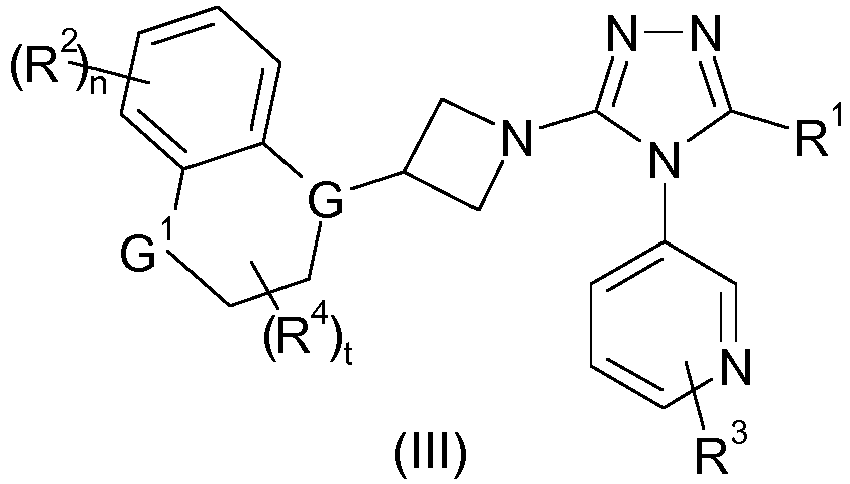
- G is selected from the group consisting of C, CH and N;
- G1 is selected from the group consisting of N, NH, C, CH, CH2 and O;
- R1-R4, n and t are as defined in formula (I).
- In a preferred embodiment of the present invention, the compound of formula (I) is a compound of formula (IV):

wherein: - is a single bond or a double bond;
- G is selected from the group consisting of C, CH and N;
- G1 is selected from the group consisting of N, NH, C, CH, CH2, O and S;
- G2 is selected from the group consisting of C, CH, CH2, N and NH;
- R1-R4, n and t are as defined in formula (I).
- In a preferred embodiment of the present invention, the compound of formula (I), wherein the ring A is pyridyl or benzodioxole; and preferably

- In a preferred embodiment of the present invention, the compound of formula (I), wherein the ring B is pyrrolyl, furyl, thienyl, imidazolyl, pyrazolyl, oxazolyl, phenyl, pyridyl, pyranyl, pyrrolidinyl, piperidinyl, piperazinyl, morpholinyl, morpholin-3-one, tetrahydropyranyl, dihydropyranyl, tetrahydropyridyl, dihydropyrrolyl, dihydro-1,4-oxazinyl or 2H-1,4-oxazin-3-one.
- In a preferred embodiment of the present invention, the compound of formula (I), wherein


R2, R4, n and t are as defined in formula (I). - In a preferred embodiment of the present invention, the compound of formula (I), wherein R1 is alkyl, wherein the alkyl is optionally substituted by one or more substituents selected from the group consisting of alkoxy, halogen, haloalkyl, haloalkoxy, hydroxy, NHS(O)sR5 and NHC(O)OR5; R5 is alkyl; and s is 0, 1 or 2.
- In a preferred embodiment of the present invention, the compound of formula (I), wherein each R2 is identical or unidentical and each is independently selected from the group consisting of hydrogen, halogen, alkyl and haloalkyl.
- In a preferred embodiment of the present invention, the compound of formula (I), wherein R3 is alkoxy.
- In a preferred embodiment of the present invention, the compound of formula (I), wherein each R4 is identical or unidentical and each is independently selected from the group consisting of hydrogen, halogen, alkyl, haloalkyl, cyano, oxo and -C(O)OR5; and R5 is alkyl.
- In a preferred embodiment of the present invention, the compound of formula (I), wherein n is 1 or 2; and m is 0 or 1.
- The compound of the present invention includes all conformational isomers thereof, e.g., cis-isomers and trans-isomers; and all optical isomers and stereoisomers as well as mixtures thereof. The compound of the present invention has asymmetric centers, and thus there are different enantiomeric and diastereomeric isomers. The present invention relates to a use of the compound of the present invention, and all pharmaceutical compositions applying or comprising the same, and a therapeutic method thereof. The present invention relates to a use of all such isomers and mixtures thereof.
- Typical compounds of the present invention include, but are not limited to the following:
Example No. Structure and name of the compound 1 
7-Fluoro-4-(1-(5-(methoxymethyl)-4-(6-methoxypyridin-3-yl)-4H-1,2,4-triazol-3-yl)azetidin-3-yl)quinoline 1 2 
5-(3-(3-(6-Fluoronaphthalen-1-yl)azetidin-1-yl)-5-(methoxymethyl)-4H-1,2,4-triazol-4-yl)-2-methoxypyridine 2 3 
1-(1-(4-(Benzo[d][1,3]dioxolan-5-yl)-5-(methoxymethyl)-4H-1,2,4-triazol-3-yl)azetidin-3-yl)-3-chloro-5-fluoro-1H-indole 3 4 
3-Chloro-1-(1-(5-(ethoxymethyl)-4-(6-methoxypyridin-3-yl)-4H-1,2,4-triazol-3-yl)azetidin-3-yl)-5-fluoro-1H-indole 4 5 
1-(1-(5-(Ethoxymethyl)-4-(6-methoxypyridin-3-yl)-4H-1,2,4-triazol-3-yl)azetidin-3-yl)-5-fluoro-3-methyl-1H-indole 5 6 
5-Fluoro-1-(1-(4-(6-methoxypyridin-3-yl)-5-methyl-4H-1,2,4-triazol-3-yl)azetidin-3-yl)-3-methyl-1H-indole 6 7 
5-Fluoro-1-(1-(5-(methoxymethyl)-4-(6-methoxypyridin-3-yl)-4H-1,2,4-triazol-3-yl)azetidin-3-yl)-3-(trifluoromethyl)-1H-indole 7 8 
Methyl 6-fluoro-3-(1-(5-(methoxymethyl)-4-(6-methoxypyridin-3-yl)-4H-1,2,4-triazol-3-yl)azetidin-3-yl)benzofuran-2-carboxylate 8 9 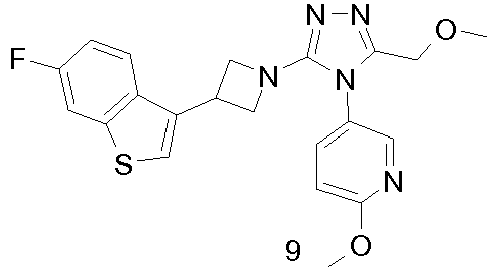
5-(3-(3-(6-Fluorobenzo[b]thiophen-3-yl)azetidin-1-yl)-5-(methoxymethyl)-4H-1,2,4-triazol-4-yl)-2-methoxypyridine 9 10 
3-Chloro-5-fluoro-1-(1-(5-(methoxymethyl)-4-(6-methoxypyridin-3-yl)-4H-1,2,4-triazol-3-yl)azetidin-3-yl)-1H-indole 10 11 
5-(3-(3-(6-Fluorobenzofuran-3-yl)azetidin-1-yl)-5-(methoxymethyl)-4H-1,2,4-triazol-4-yl)-2-methoxypyridine 11 12 
6-Fluoro-3-(1-(5-(methoxymethyl)-4-(6-methoxypyridin-3-yl)-4H-1,2,4-triazol-3-yl)azetidin-3-yl)benzo[d]isoxazole 12 13 
5-Fluoro-1-(1-(5-(methoxymethyl)-4-(6-methoxypyridin-3-yl)-4H-1,2,4-triazol-3-yl)azetidin-3-yl)-1H-indole-3-carbonitrile 13 14 
6-Fluoro-3-(1-(5-(methoxymethyl)-4-(6-methoxypyridin-3-yl)-4H-1,2,4-triazol-3-yl)azetidin-3-yl)-1-methyl-1H-indole 14 15 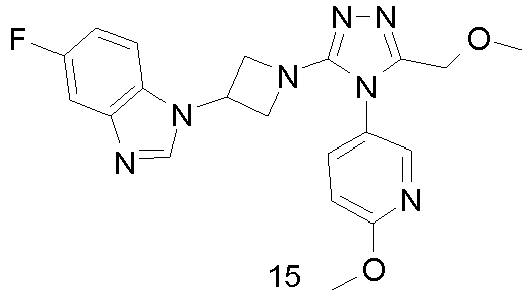
5-Fluoro-1-(1-(5-(methoxymethyl)-4-(6-methoxypyridin-3-yl)-4H-1,2,4-triazol-3-yl)azetidin-3-yl)-1H-benzo[d]imidazole 15 16 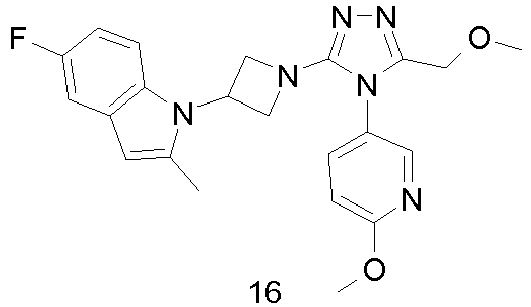
5-Fluoro-1-(1-(5-(methoxymethyl)-4-(6-methoxypyridin-3-yl)-4H-1,2,4-triazol-3-yl)azetidin-3-yl)-2-methyl-1H-indole 16 17 
5-Fluoro-1-(1-(5-(methoxymethyl)-4-(6-methoxypyridin-3-yl)-4H-1,2,4-triazol-3-yl)azetidm-3-yl)-3-methyl-1H-indole 17 18 
7-Fluoro-4-(1-(5-(methoxymethyl)-4-(6-methoxypyridin-3-yl)-4H-1,2,4-triazol-3-yl)azetidin-3-yl)-2H-benzo[b][1,4]oxazin-3(4H)-one 18 19 
5-Fluoro-1-(1-(5-(methoxymethyl)-4-(6-methoxypyridin-3-yl)-4H-1,2,4-triazol-3-yl)azetidin-3-yl)-1,2,3,4-tetrahydroquinoline 19 20 
5-Fluoro-1-(1-(4-(6-methoxypyridin-3-yl)-5-methyl-4H-1,2,4-triazol-3-yl)azetidin-3-yl)-1,2,3,4-tetrahydroquinoline 20 21 
5-(3-(3-(7-Fluorobenzodihydropyran-4-yl)azetidin-1-yl)-5-(methoxymethyl)-4H-1,2,4-triazol-4-yl)-2-methoxypyridine 21 22 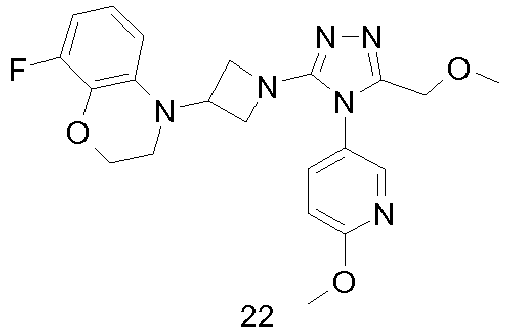
8-Fluoro-4-(1-(5-(methoxymethyl)-4-(6-methoxypyridin-3-yl)-4H-1,2,4-triazol-3-yl)azetidin-3-yl)-3,4-dihydro-2H-benzo[b][1,4]oxazine 22 23 
5-Fluoro-1-(1-(5-(methoxymethyl)-4-(6-methoxypyridin-3-yl)-4H-1,2,4-triazol-3-yl)azetidin-3-yl)indoline 23 24 
7-Fluoro-4-(1-(5-(methoxymethyl)-4-(6-methoxypyridin-3-yl)-4H-1,2,4-triazol-3-yl)azetidin-3-yl)-3,4-dihydro-2H-benzo[b][1,4]oxazine 24 25 
5-Fluoro-1-(1-(5-(methoxymethyl)-4-(6-methoxypyridin-3-yl)-4H-1,2,4-triazol-3-yl)azetidin-3-yl)-1H-indole 25 26 
1-(1-(5-(Ethoxymethyl)-4-(6-methoxypyridin-3-yl)-4H-1,2,4-triazol-3-yl)azetidin-3-yl)-6-fluoro-1,2,3,4-tetrahydroquinoline 26 27 
1-(1-(4-(Benzo[d][1,3]dioxolan-5-yl)-5-(ethoxymethyl)-4H-1,2,4-triazol-3-yl)azetidin-3-yl)-6-fluoro-1,2,3,4-tetrahydroquinoline 27 28 
1-(1-(4-(Benzo[d][1,3]dioxolan-5-yl)-5-(methoxymethyl)-4H-1,2,4-triazol-3-yl)azetidin-3-yl)-6-fluoro-1,2,3,4-tetrahydroquinoline 28 29 
6-Fluoro-1-(1-(4-(6-methoxypyridin-3-yl)-5-methyl-4H-1,2,4-triazol-3-yl)azetidin-3-yl)-1,2,3,4-tetrahydroquinoline 29 30 
6-Fluoro-1-(1-(5-(methoxymethyl)-4-(6-methoxypyridin-3-yl)-4H-1,2,4-triazol-3-yl)azetidin-3-yl)-1,2,3,4-tetrahydroquinoline 30 31 
4-(1-(5-(Ethoxymethyl)-4-(6-methoxypyridin-3-yl)-4H-1,2,4-triazol-3-yl)azetidin-3-yl)-7-fluoro-3,4-dihydro-2H-benzo[b][1,4]oxazine 31 32 
7-Fluoro-4-(1-(4-(6-methoxypyridin-3-yl)-5-methyl-4H-1,2,4-triazol-3-yl)azetidin-3-yl)-3,4-dihydro-2H-benzo[b][1,4]oxazine 32 33 
5-Fluoro-1-(1-(5-(methoxymethyl)-4-(6-methoxypyridin-3-yl)-4H-1,2,4-triazol-3-yl)azetidin-3-yl)-1 H-indazole 33 34 
1-(1-(5-((Difluoromethoxy)methyl)-4-(6-methoxypyridin-3-yl)-4H-1,2,4-triazol-3-yl)azetidin-3-yl)-5-fluoro-3-methyl-1H-indole 34 35 
4-(1-(5-(Difluoromethyl)-4-(6-methoxypyridin-3-yl)-4H-1,2,4-triazol-3-yl)azetidin-3-yl)-7-fluoro-3,4-dihydro-2H-benzo[b][1,4]oxazine 35 36 
Methyl ((5-(3-(6-fluoro-3,4-dihydroquinolin-1(2H)-yl)azetidin-1-yl)-4-(6-methoxypyridin-3-yl)-4H-1,2,4-triazol-3-yl)methyl)carbamate 36 37 
4-(1-(5-((Difluoromethoxy)methyl)-4-(6-methoxypyridin-3-yl)-4H-1,2,4-triazo1-3-yl)azetidin-3-yl)-7-fluoro-3,4-dihydro-2H-benzo[b][1,4]oxazine 37 38 
5-(3-((Difluoromethoxy)methyl)-5-(3-(6-fluoronaphthalen-1-yl)azetidin-1 -yl)-4H-1,2,4-triazol-4-yl)-2-methoxypyridine 38 39 
6-Fluoro-1-(1-(4-(6-methoxypyridin-3-yl)-5-(trifluoromethyl)-4H-1,2,4-triazol-3-yl)azetidin-3-yl)-1,2,3,4-tetrahydroquinoline 39 40 
N-((5-(3-(6-Fluoro-3,4-dihydroquinolin-1(2H)-yl)azetidin-1-yl)-4-(6-methoxypyridin-3-yl)-4H-1,2,4-triazol-3-yl)methyl)methanesulfonamide 40 41 
(5-(3-(6-Fluoronaphthalen-1-yl)azetidin-1-yl)-4-(6-methoxypyridin-3-yl)-4H-1,2,4-triazol-3-yl)methanol 2 42 
6-Fluoro-1-(1-(5-(methoxymethyl)-4-(6-methoxypyridin-3-yl)-4H-1,2,4-triazol-3-yl)azetidin-3-yl)-4,4-dimethyl-1,2,3,4-tetrahydroquinoline 42 43 
7-Fluoro-4-(1-(4-(6-methoxypyridin-3-yl)-5-(trifluoromethyl)-4H-1,2,4-triazol-3-yl)azetidin-3-yl)-3,4-dihydro-2H-benzo[b][1,4]oxazine 43 - A preferred embodiment of the present invention relates to a compound of formula (I-A) which is an intermediate for synthesizing the compound of formula (I):

wherein: - G is selected from the group consisting of C, CH and N;
- ring A, ring B, R2-R4, n, m and t are as defined in formula (I).
- The compounds of formula (I-A) include but are not limited to the following:
Example No. Structure and name of the compound 1g 
Methyl (E)-3-(7-fluoroquinolin-4-yl)-N-(6-methoxypyridin-3-yl)azetidine-1-carbimidothioate 1g 2f 
Methyl (E)-3-(6-fluoronaphthalen-1-yl)-N-(6-methoxypyridin-3-yl)azetidine-1-carbimidothioate 2f 3i 
Methyl (E)-N-benzo[d][1,3]dioxolan-5-yl-3-(3-chloro-5-fluoro-1H-indol-1-yl)azetidine-1-carbimidothioate 3i 4b 
Methyl (E)-3-(3-chloro-5-fluoro-1H-indol-1-yl)-N-(6-methoxypyridin-3-yl)azetidine-1-carbimidothioate 4b 5f 
Methyl (E)-3-(5-fluoro-3-methyl-1H-indol-1 -yl)-N-(6-methoxypyridin-3-yl)azetidine-1-carbimidothioate 5f 7d 
Methyl (E)-3-(5-fluoro-3-(trifluoromethyl)-1H-indol-1-yl)-N-(6-methoxypyridin-3-yl)azetidine-1-carbimidothioate 7d 8f 
Methyl (E)-6-fluoro-3-(1-(((6-methoxypyridin-3-yl)imino)(methylthio)methyl)azetidin-3-yl)benzofuran-2-carboxylate 8f 9f 
Methyl (E)-3 -(6-fluorobenzo[b]thiophen-3-yl)-N-(6-methoxypyridin-3-yl)azetidine-1-carbimidothioate 9f 11i 
Methyl (E)-3-(6-fluorobenzofuran-3-yl)-N-(6-methoxypyridin-3-yl)azetidine-1-carbimidothioate 11i 12e 
Methyl (E)-3-(6-fluorobenzo[d]isoxazol-3-yl)-N-(6-methoxypyridin-3-yl)azetidine-1-carbimidothioate 12e 13d 
Methyl (E)-3-(3-cyano-5-fluoro-1H-indol-1-yl)-N-(6-methoxypyridin-3-yl)azetidine-1-carbimidothioate 13d 14g 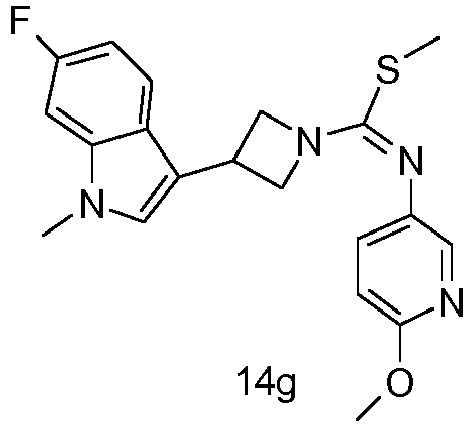
Methyl (E)-3-(6-fluoro-1-methyl-1 H-indol-3-yl)-N-(6-methoxypyridin-3-yl)azetidine-1-carbimidothioate 14g 15f 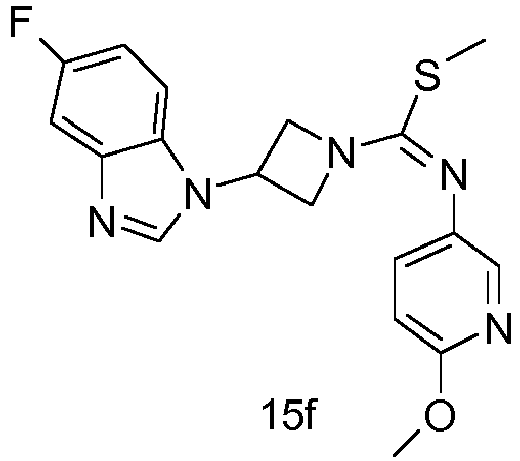
Methyl (E)-3-(5-fluoro-1H-benzo[d]imidazol-1-yl)-N-(6-methoxypyridin-3-yl)azetidine-1-carbimidothioate 15f 16f 
Methyl (E)-3-(5-fluoro-2-methyl-1H-indol-1 -yl)-N-(6-methoxypyridin-3-yl)azetidine-1-carbimidothioate 16f 18g 
Methyl (E)-3-(7-fluoro-3-oxo-2H-benzo[b][1,4]oxazin-4(3H)-yl)-N-(6-methoxypyridin-3-yl)azetidine-1-carbimidothioate 18g 19e 
Methyl (E)-3-(5-fluoro-3,4-dihydroquinolin-1(2H)-yl)-N-(6-methoxypyridin-3-yl)azetidine-1-carbimidothioate 19e 21g 
Methyl (E)-3-(7-fluorodihydrobenzopyran-4-yl)-N-(6-methoxypyridin-3-yl)azetidine-1-carbimidothioate 21g 22f 
Methyl (E)-3-(8-fluoro-2H-benzo[b][1,4]oxazin-4(3H)-yl)-N-(6-methoxypyridin-3-yl)azetidine-1-carbimidothioate 22f 23c 
Methyl (E)-3-(5-fluoroindolin-1-yl)-N-(6-methoxypyridin-3-yl)azetidine-1-carbimidothioate 23c 24f 
Methyl (E)-3-(7-fluoro-2H-benzo[b][1,4]oxazin-4(3H)-yl)-N-(6-methoxypyridin-3-yl)azetidine-1-carbimidothioate 24f 25a 
Methyl (E)-3-(5-fluoro-1H-indol-1-yl)-N-(6-methoxypyridin-3-yl)azetidine-1-carbimidothioate 25a 26a 
Methyl (E)-3-(6-fluoro-3,4-dihydroquinolin-1(2H)-yl)-N-(6-methoxypyridin-3-yl)azetidine-1-carbimidothioate 26a 27a 
Methyl (E)-N-benzo[d][1,3]dioxolan-5-yl-3-(6-fluoro-3,4-dihydroquinolin-1(2H)-yl)azetidine-1-carbimidothioate 27a 33a 
Methyl (E)-3-(5-fluoro-1H-indazol-1-yl)-N-(6-methoxypyridin-3-yl)azetidine-1-carbimidothioate 33a - In another aspect, the present invention relates to a method for preparing the compound of formula (I), comprising a step of:

wherein:
ring A, ring B, R1-R4, G, n, m and t are as defined in formula (I). - In another aspect, the present invention relates to a method for preparing the compound of formula (II), comprising a step of:

- ---- is a single bond or a double bond;
- G is selected from the group consisting of C, CH and N;
- G1 is selected from the group consisting of N, NH, C, CH, CH2, O and S;
- G2 is selected from the group consisting of C, CH, CH2, N and NH;
- X is 0 or 1;
- Y is 0 or 1; and
- ring A, R1-R4, n, m and t are as defined in formula (I).
- In another aspect, the present invention relates to a method for preparing the compound of formula (III), comprising a step of:
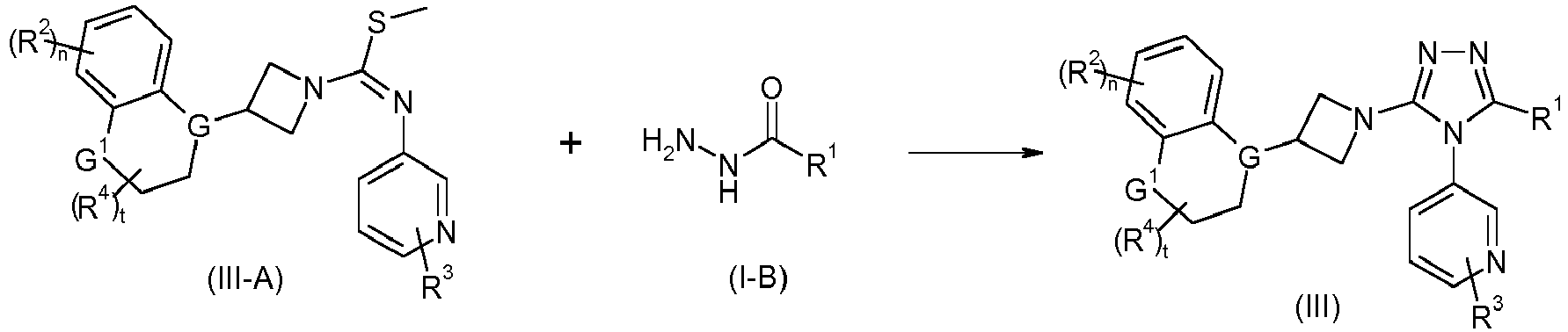
wherein: - G is selected from the group consisting of C, CH and N;
- G1 is selected from the group consisting of N, NH, C, CH, CH2 and O;
- R1-R4, n and t are as defined in formula (I).
- In another aspect, the present invention relates to a method for preparing the compound of formula (III), comprising a step of:

wherein: - is a single bond or a double bond;
- G is selected from the group consisting of C, CH and N;
- G1 is selected from the group consisting of N, NH, C, CH, CH2, O and S;
- G2 is selected from the group consisting of C, CH, CH2, N and NH;
- R1-R4, n and t are as defined in formula (I).
- In another aspect, the present invention relates to a pharmaceutical composition comprising a therapeutically effective amount of the compound of formula (I), or a tautomer, mesomer, racemate, enantiomer, diastereomer thereof, or the mixture thereof, or a pharmaceutically acceptable salt thereof, and one or more pharmaceutically acceptable carriers, diluents or excipients. The present invention also relates to a method for preparing the aforementioned composition, comprising a step of mixing the compound of formula (I), or a tautomer, mesomer, racemate, enantiomer, diastereomer thereof, or the mixture thereof, or a pharmaceutically acceptable salt thereof, with one or more pharmaceutically acceptable carriers, diluents or excipients.
- The present invention further relates to a use of the compound of formula (I), or a tautomer, mesomer, racemate, enantiomer, diastereomer thereof, or the mixture thereof, or a pharmaceutically acceptable salt thereof, or the pharmaceutical composition comprising the same in the preparation of medicaments for the treatment or prevention of diseases or conditions for which inhibition of oxytocin is known, or can be shown, to produce a beneficial effect, wherein the disease or condition is preferably selected from the group consisting of sexual dysfunction, hypoactive sexual desire disorder, sexual arousal disorder, orgasmic disorder, sexual pain disorder, premature ejaculation, preterm labour, complications in labour, appetite and feeding disorders, benign prostatic hyperplasia, premature birth, dysmenorrhea, congestive heart failure, arterial hypertension, liver cirrhosis, nephrotic hypertension, ocular hypectension, obsessive and behavioral disorders and neuropsychiatric disorders, and more preferably selected from the group consisting of sexual dysfunction, sexual arousal disorder, orgasmic disorder, sexual pain disorder and premature ejaculation.
- The present invention further relates to a use of the compound of formula (I), or a tautomer, mesomer, racemate, enantiomer, diastereomer thereof, or the mixture thereof, or a pharmaceutically acceptable salt thereof, or the pharmaceutical composition comprising the same in the preparation of medicaments for antagonizing oxytocin.
- The present invention further relates to a method for the treatment or prevention of diseases or conditions for which inhibition of oxytocin is known, or can be shown, to produce a beneficial effect, which comprises a step of administering to a patient in need of it a therapeutically effective amount of the compound of formula (I), or a tautomer, mesomer, racemate, enantiomer, diastereomer thereof, or the mixture thereof, or a pharmaceutically acceptable salt thereof, or the pharmaceutical composition comprising the same.
- The present invention further relates to a method for the treatment or prevention of diseases selected from the group consisting of sexual dysfunction, hypoactive sexual desire disorder, sexual arousal disorder, orgasmic disorder, sexual pain disorder, premature ejaculation, preterm labour, complications in labour, appetite and feeding disorders, benign prostatic hyperplasia, premature birth, dysmenorrhea, congestive heart failure, arterial hypertension, liver cirrhosis, nephrotic hypertension, ocular hypectension, obsessive and behavioral disorders and neuropsychiatric disorders, and preferably selected from the group consisting of sexual dysfunction, sexual arousal disorder, orgasmic disorder, sexual pain disorder and premature ejaculation, which comprises a step of administering to a patient in need of it a therapeutically effective amount of the compound of formula (I), or a tautomer, mesomer, racemate, enantiomer, diastereomer thereof, or the mixture thereof, or a pharmaceutically acceptable salt thereof, or the pharmaceutical composition comprising the same.
- The present invention further relates to a method for antagonizing oxytocin, comprising a step of administering to a patient in need of it a therapeutically effective amount of the compound of formula (I), or a tautomer, mesomer, racemate, enantiomer, diastereomer thereof, or the mixture thereof, or a pharmaceutically acceptable salt thereof, or the pharmaceutical composition comprising the same.
- The present invention further relates to the compound of formula (I), or a tautomer, mesomer, racemate, enantiomer, diastereomer thereof, or the mixture thereof, or a pharmaceutically acceptable salt thereof, or the pharmaceutical composition comprising the same, for use as a medicament.
- The present invention further relates to the compound of formula (I), or a tautomer, mesomer, racemate, enantiomer, diastereomer thereof, or the mixture thereof, or a pharmaceutically acceptable salt thereof, or the pharmaceutical composition comprising the same, for use as an oxytocin antagonist.
- The present invention further relates to the compound of formula (I), or a tautomer, mesomer, racemate, enantiomer, diastereomer thereof, or the mixture thereof, or a pharmaceutically acceptable salt thereof, or the pharmaceutical composition comprising the same, for use in the treatment or prevention of diseases selected from the group consisting of sexual dysfunction, hypoactive sexual desire disorder, sexual arousal disorder, orgasmic disorder, sexual pain disorder, premature ejaculation, preterm labour, complications in labour, appetite and feeding disorders, benign prostatic hyperplasia, premature birth, dysmenorrhea, congestive heart failure, arterial hypertension, liver cirrhosis, nephrotic hypertension, ocular hypectension, obsessive and behavioral disorders and neuropsychiatric disorders, and preferably selected from the group consisting of sexual dysfunction, sexual arousal disorder, orgasmic disorder, sexual pain disorder and premature ejaculation.
- The pharmaceutical composition containing the active ingredient may be in a form suitable for oral administration, for example, a tablet, a troche, a lozenge, an aqueous or oily suspension, a dispersible powder or granule, an emulsion, a hard or soft capsule, or a syrup or elixir. The oral compositions can be prepared according to any known method in the art for the preparation of pharmaceutical composition. Such compositions may contain one or more ingredients selected from the group consisting of sweeteners, flavoring agents, colorants and preservatives, in order to provide a pleasing and palatable pharmaceutical preparation. A tablet contains the active ingredient in admixture with nontoxic pharmaceutically acceptable excipients suitable for the manufacture of tablets. An aqueous suspension contains the active ingredient in admixture with excipients suitable for the manufacture of an aqueous suspension. Such excipient is a suspending agent.
- An oil suspension can be formulated by suspending the active ingredient in a vegetable oil. The oil suspension may contain a thickener. The aforementioned sweeteners and flavoring agents may be added to provide a palatable preparation. These compositions can be preserved by adding an antioxidant, such as butylated hydroxyanisole or alpha-tocopherol.
- The active ingredient in admixture with the dispersants or wetting agents, suspending agent or one or more preservatives can be provided as a dispersible powder or granule suitable for the preparation of an aqueous suspension by adding water. Suitable dispersants or wetting agents and suspending agents are exemplified by those already mentioned above. Additional excipients, such as sweeteners, flavoring agents and colorants, may also be added. These compositions can be preserved by adding an antioxidant, such as ascorbic acid.
- The pharmaceutical composition of the present invention may also be in the form of an oil-in-water emulsion. The oil phase may be a vegetable oil such as olive oil or peanut oil, or mineral oil such as liquid paraffin, or the mixture thereof. The emulsion may also contain sweeteners, flavoring agents, preservatives and antioxidants. Such preparations may also contain moderator, preservatives, colorants, and antioxidants.
- The pharmaceutical composition of the present invention may be in the form of a sterile injectable aqueous solution. The sterile injectable formulation may be a sterile injectable oil-in-water micro-emulsion in which the active ingredient is dissolved in the oil phase.
- The pharmaceutical composition of the present invention may be in the form of a sterile injectable aqueous or oily suspension for intramuscular and subcutaneous administration. Such a suspension can be formulated with suitable dispersants or wetting agents and suspending agents as described above according to the known techniques. The sterile injectable preparation may also be a sterile injectable solution or suspension prepared in a nontoxic parenterally acceptable diluent or solvent. Sterile fixed oils may easily be used as a solvent or suspending medium.
- The compound of the present invention can be administered in the form of a suppository for rectal administration. These pharmaceutical compositions can be prepared by mixing the drug with a suitable non-irritating excipient that is solid at ordinary temperatures, but liquid in the rectum, thereby melting in the rectum to release the drug. It is well known to those skilled in the art that the dosage of a drug depends on a variety of factors including but not limited to, the following factors: activity of a specific compound, age of the patient, weight of the patient, general health of the patient, behavior of the patient, diet of the patient, administration time, administration route, excretion rate, drug combination and the like. In addition, the optimal treatment, such as treatment mode, daily dose of the compound of formula (I) or the type of the pharmaceutically acceptable salt thereof can be verified by traditional therapeutic regimens.
- Unless otherwise stated, the terms used in the specification and claims have the meanings described below.
- The term "alkyl" refers to a saturated aliphatic hydrocarbon group, which is a straight or branched chain group comprising 1 to 20 carbon atoms, preferably an alkyl having 1 to 12 carbon atoms, and more preferably an alkyl having 1 to 6 carbon atoms. Non-limiting examples include methyl, ethyl, n-propyl, isopropyl, n-butyl, isobutyl, tert-butyl, sec-butyl, n-pentyl, 1,1-dimethylpropyl, 1,2-dimethylpropyl, 2,2-dimethylpropyl, 1-ethylpropyl, 2-methylbutyl, 3-methylbutyl, n-hexyl, 1-ethyl-2-methylpropyl, 1,1,2-trimethylpropyl, 1,1-dimethylbutyl, 1,2-dimethylbutyl, 2,2-dimethylbutyl, 1,3-dimethylbutyl, 2-ethylbutyl, 2-methylpentyl, 3-methylpentyl, 4-methylpentyl, 2,3-dimethylbutyl, n-heptyl, 2-methylhexyl, 3-methylhexyl, 4-methylhexyl, 5-methylhexyl, 2,3-dimethylpentyl, 2,4-dimethylpentyl, 2,2-dimethylpentyl, 3,3-dimethylpentyl, 2-ethylpentyl, 3-ethylpentyl, n-octyl, 2,3-dimethylhexyl, 2,4-dimethylhexyl, 2,5-dimethylhexyl, 2,2-dimethylhexyl, 3,3-dimethylhexyl, 4,4-dimethylhexyl, 2-ethylhexyl, 3-ethylhexyl, 4-ethylhexyl, 2-methyl-2-ethylpentyl, 2-methyl-3-ethylpentyl, n-nonyl, 2-methyl-2-ethylhexyl, 2-methyl-3-ethylhexyl, 2,2-diethylpentyl, n-decyl, 3,3-diethylhexyl, 2,2-diethylhexyl, and various branched isomers thereof. More preferably, an alkyl group is a lower alkyl having 1 to 6 carbon atoms, and non-limiting examples include methyl, ethyl, n-propyl, isopropyl, n-butyl, isobutyl, tert-butyl, sec-butyl, n-pentyl, 1,1-dimethylpropyl, 1,2-dimethylpropyl, 2,2-dimethylpropyl, 1-ethylpropyl, 2-methylbutyl, 3-methylbutyl, n-hexyl, 1-ethyl-2-methylpropyl, 1,1,2-trimethylpropyl, 1,1-dimethylbutyl, 1,2-dimethylbutyl, 2,2-dimethylbutyl, 1,3-dimethylbutyl, 2-ethylbutyl, 2-methylpentyl, 3-methylpentyl, 4-methylpentyl, 2,3-dimethylbutyl, and the like. The alkyl group can be substituted or unsubstituted. When substituted, the substituent group(s) can be substituted at any available connection point. The substituent group(s) is preferably one or more groups independently optionally selected from the group consisting of alkyl, alkenyl, alkynyl, alkoxy, alkylthio, alkylamino, halogen, thiol, hydroxy, nitro, cyano, cycloalkyl, heterocyclyl, aryl, heteroaryl, cycloalkoxy, heteroalkoxy, cycloalkylthio and heterocyclylthio.
- The term "cycloalkyl" refers to a saturated or partially unsaturated monocyclic or polycyclic hydrocarbon substituent group having 3 to 20 carbon atoms, preferably 3 to 12 carbon atoms, more preferably 3 to 10 carbon atoms, and most preferably 3 to 6 carbon atoms. Non-limiting examples of monocyclic cycloalkyl include cyclopropyl, cyclobutyl, cyclopentyl, cyclopentenyl, cyclohexyl, cyclohexenyl, cyclohexadienyl, cycloheptyl, cycloheptatrienyl, cyclooctyl and the like, and preferably cyclopropyl, cyclobutyl, cyclopentyl and cyclohexyl. Polycyclic cycloalkyl includes a cycloalkyl having a spiro ring, fused ring or bridged ring.
- The term "spiro cycloalkyl" refers to a 5 to 20 membered polycyclic group with rings connected through one shared carbon atom (called a spiro atom), wherein the rings can contain one or more double bonds, but none of the rings has a completely conjugated π-electron system. The spiro cycloalkyl is preferably 6 to 14 membered spiro cycloalkyl, and more preferably 7 to 10 membered spiro cycloalkyl. According to the number of the spiro atoms shared between the rings, the spiro cycloalkyl can be divided into mono-spiro cycloalkyl, di-spiro cycloalkyl, or poly-spiro cycloalkyl, and the spiro cycloalkyl is preferably a mono-spiro cycloalkyl or di-spiro cycloalkyl, and more preferably 4-membered/4-membered, 4-membered/5-membered, 4-membered/6-membered, 5-membered/5-membered, or 5-membered/6-membered mono-spiro cycloalkyl. Non-limiting examples of spiro cycloalkyl include:

- The term "fused cycloalkyl" refers to a 5 to 20 membered all-carbon polycyclic group, wherein each ring in the system shares an adjacent pair of carbon atoms with another ring, wherein one or more rings can contain one or more double bonds, but none of the rings has a completely conjugated π-electron system. The fused cycloalkyl is preferably 6 to 14 membered fused cycloalkyl, and more preferably 7 to 10 membered fused cycloalkyl. According to the number of membered rings, the fused cycloalkyl can be divided into bicyclic, tricyclic, tetracyclic or polycyclic fused cycloalkyl, and the fused cycloalkyl is preferably bicyclic or tricyclic fused cycloalkyl, and more preferably 5-membered/5-membered, or 5-membered/6-membered bicyclic fused cycloalkyl. Non-limiting examples of fused cycloalkyl include:

- The term "bridged cycloalkyl" refers to a 5 to 20 membered all-carbon polycyclic group, wherein every two rings in the system share two disconnected carbon atoms, wherein the rings can have one or more double bonds, but none of the rings has a completely conjugated π-electron system. The bridged cycloalkyl is preferably 6 to 14 membered bridged cycloalkyl, and more preferably 7 to 10 membered bridged cycloalkyl. According to the number of membered rings, the bridged cycloalkyl can be divided into bicyclic, tricyclic, tetracyclic or polycyclic bridged cycloalkyl, and the bridged cycloalkyl is preferably bicyclic, tricyclic or tetracyclic bridged cycloalkyl, and more preferably bicyclic or tricyclic bridged cycloalkyl. Non-limiting examples of bridged cycloalkyls include:


- The ring of cycloalkyl can be fused to the ring of aryl, heteroaryl or heterocyclyl, wherein the ring bound to the parent structure is cycloalkyl. Non-limiting examples include indanyl, tetrahydronaphthyl, benzocycloheptyl and the like. The cycloalkyl can be optionally substituted or unsubstituted. When substituted, the substituent group(s) is preferably one or more group(s) independently optionally selected from the group consisting of alkyl, alkenyl, alkynyl, alkoxy, alkylthio, alkylamino, halogen, thiol, hydroxy, nitro, cyano, cycloalkyl, heterocyclyl, aryl, heteroaryl, cycloalkoxy, heteroalkoxy, cycloalkylthio, heterocyclylthio and -C(O)OR5.
- The term "heterocyclyl" refers to a 3 to 20 membered saturated or partially unsaturated monocyclic or polycyclic hydrocarbon group, wherein one or more ring atoms are heteroatoms selected from the group consisting of N, O and S(O)q (wherein q is an integer of 0 to 2), but excluding -O-O-, -O-S- or -S-S- in the ring, with the remaining ring atoms being carbon atoms. Preferably, the heterocyclyl has 3 to 12 ring atoms wherein 1 to 4 atoms are heteroatoms; more preferably, the heterocyclyl has 3 to 10 ring atoms, and most preferably 3 to 6 ring atoms. Non-limiting examples of monocyclic heterocyclyl include oxacyclobutyl, azacyclobutyl, tetrahydrofuranyl, tetrahydropyranyl, pyrrolyl, piperidinyl, piperazinyl, morpholinyl, thiomorpholinyl, homopiperazinyl and the like, and preferably azacyclobutyl, oxacyclobutyl, pyrrolyl and piperidinyl. Polycyclic heterocyclyl includes a heterocyclyl having a spiro ring, fused ring or bridged ring.
- The term "spiro heterocyclyl" refers to a 5 to 20 membered polycyclic heterocyclyl group with rings connected through one shared atom (called a spiro atom), wherein one or more ring atoms are heteroatoms selected from the group consisting of N, O and S(O)q (wherein q is an integer of 0 to 2), with the remaining ring atoms being carbon atoms, where the rings can contain one or more double bonds, but none of the rings has a completely conjugated π-electron system. The spiro heterocyclyl is preferably 6 to 14 membered spiro heterocyclyl, and more preferably 7 to 10 membered spiro heterocyclyl. According to the number of the spiro atoms shared between the rings, the spiro heterocyclyl can be divided into mono-spiro heterocyclyl, di-spiro heterocyclyl, or poly-spiro heterocyclyl, and the spiro heterocyclyl is preferably mono-spiro heterocyclyl or di-spiro heterocyclyl, and more preferably 4-membered/4-membered, 4-membered/5-membered, 4-membered/6-membered, 5-membered/5-membered, or 5-membered/6-membered mono-spiro heterocyclyl. Non-limiting examples of spiro heterocyclyls include:

- The term "fused heterocyclyl" refers to a 5 to 20 membered polycyclic heterocyclyl group, wherein each ring in the system shares an adjacent pair of atoms with another ring, wherein one or more rings can contain one or more double bonds, but none of the rings has a completely conjugated π-electron system, and wherein one or more ring atoms are heteroatoms selected from the group consisting of N, O and S(O)q (wherein q is an integer of 0 to 2), with the remaining ring atoms being carbon atoms. The fused heterocyclyl is preferably 6 to 14 membered fused heterocyclyl, and more preferably 7 to 10 membered fused heterocyclyl. According to the number of membered rings, the fused heterocyclyl can be divided into bicyclic, tricyclic, tetracyclic or polycyclic fused heterocyclyl, the fused heterocyclyl is preferably bicyclic or tricyclic fused heterocyclyl, and more preferably 5-membered/3-membered, 5-membered/4-membered or 5-membered/5-membered bicyclic fused heterocyclyl. Non-limiting examples of fused heterocyclyl include:


- The term "bridged heterocyclyl" refers to a 5 to 14 membered polycyclic heterocyclyl group, wherein every two rings in the system share two disconnected atoms, wherein the rings can have one or more double bonds, but none of the rings has a completely conjugated π-electron system, and wherein one or more ring atoms are heteroatoms selected from the group consisting of N, O and S(O)q (wherein q is an integer of 0 to 2), with the remaining ring atoms being carbon atoms. The bridged heterocyclyl is preferably 6 to 14 membered bridged heterocyclyl, and more preferably 7 to 10 membered bridged heterocyclyl. According to the number of membered rings, the bridged heterocyclyl can be divided into bicyclic, tricyclic, tetracyclic or polycyclic bridged heterocyclyl, and the bridged heterocyclyl is preferably bicyclic, tricyclic or tetracyclic bridged heterocyclyl, and more preferably bicyclic or tricyclic bridged heterocyclyl. Non-limiting examples of bridged heterocyclyls include:


- The ring of heterocyclyl can be fused to the ring of aryl, heteroaryl or cycloalkyl, wherein the ring bound to the parent structure is heterocyclyl. Non-limiting examples thereof include:


- The heterocyclyl can be optionally substituted or unsubstituted. When substituted, the substituent group(s) is preferably one or more group(s) independently optionally selected from the group consisting of alkyl, alkenyl, alkynyl, alkoxy, alkylthio, alkylamino, halogen, thiol, hydroxy, nitro, cyano, cycloalkyl, heterocyclyl, aryl, heteroaryl, cycloalkoxy, heteroalkoxy, cycloalkylthio, heterocyclylthio and -C(O)OR5.
- The term "aryl" refers to a 6 to 14 membered all-carbon monocyclic ring or polycyclic fused ring (i.e. each ring in the system shares an adjacent pair of carbon atoms with another ring in the system) having a conjugated π-electron system, preferably 6 to 10 membered aryl, for example, phenyl and naphthyl. The ring of aryl can be fused to the ring of heteroaryl, heterocyclyl or cycloalkyl, wherein the ring bound to the parent structure is aryl ring. Non-limiting examples thereof include:


- The aryl can be substituted or unsubstituted. When substituted, the substituent group(s) is preferably one or more group(s) independently optionally selected from the group consisting of alkyl, alkenyl, alkynyl, alkoxy, alkylthio, alkylamino, halogen, thiol, hydroxy, nitro, cyano, cycloalkyl, heterocyclyl, aryl, heteroaryl, cycloalkoxy, heteroalkoxy, cycloalkylthio, heterocyclylthio and -C(O)OR5.
- The term "heteroaryl" refers to a 5 to 14 membered heteroaromatic system having 1 to 4 heteroatoms selected from the group consisting of O, S and N. The heteroaryl is preferably 5 to 10 membered heteroaryl, more preferably 5 or 6 membered heteroaryl, for example, furanyl, thienyl, pyridyl, pyrrolyl, N-alkylpyrrolyl, pyrimidinyl, pyrazinyl, imidazolyl, pyrazolyl, tetrazolyl and the like, and preferably pyridyl. The ring of heteroaryl can be fused to the ring of aryl, heterocyclyl or cycloalkyl, wherein the ring bound to the parent structure is heteroaryl ring. Non-limiting examples thereof include:


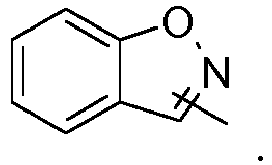
- The heteroaryl can be optionally substituted or unsubstituted. When substituted, the substituent group(s) is preferably one or more group(s) independently selected from the group consisting of alkyl, alkenyl, alkynyl, alkoxy, alkylthio, alkylamino, halogen, thiol, hydroxy, nitro, cyano, cycloalkyl, heterocyclyl, aryl, heteroaryl, cycloalkoxy, heteroalkoxy, cycloalkylthio, heterocyclylthio and -C(O)OR5.
- The term "alkoxy" refers to an -O-(alkyl) or an -O-(unsubstituted cycloalkyl) group, wherein the alkyl is as defined above. Non-limiting examples of alkoxy include methoxy, ethoxy, propoxy, butoxy, cyclopropyloxy, cyclobutyloxy, cyclopentyloxy, cyclohexyloxy. The alkoxy can be optionally substituted or unsubstituted. When substituted, the substituent group(s) is preferably one or more group(s) independently selected from the group consisting of alkyl, alkenyl, alkynyl, alkoxy, alkylthio, alkylamino, halogen, thiol, hydroxy, amino, nitro, cyano, cycloalkyl, heterocyclyl, aryl, heteroaryl, cycloalkoxy, heteroalkoxy, cycloalkylthio, heterocyclylthio and -C(O)OR5.
- The term "haloalkyl" refers to an alkyl group substituted by one or more halogens, wherein the alkyl is as defined above.
- The term "haloalkoxy" refers to an -O-(haloalkyl) group, wherein the haloalkyl is as defined above.
- The term "heterocyclyloxy" refers to an -O-(heterocyclyl) group, wherein the heterocyclyl is as defined above.
- The term "hydroxyalkyl" refers to an alkyl group substituted by hydroxy, wherein the alkyl is as defined above.
- The term "hydroxy" refers to an -OH group.
- The term "halogen" refers to fluorine, chlorine, bromine or iodine.
- The term "amino" refers to a -NH2 group.
- The term "cyano" refers to a -CN group.
- The term "nitro" refers to a -NO2 group.
- The term "oxo" refers to an =O group.
- "Optional" or "optionally" means that the event or circumstance described subsequently can, but need not, occur, and such a description includes the situation in which the event or circumstance does or does not occur. For example, "the heterocyclyl optionally substituted by an alkyl" means that an alkyl group can be, but need not be, present, and such a description includes the situation of the heterocyclyl being substituted by an alkyl and the heterocyclyl being not substituted by an alkyl.
- "Substituted" refers to one or more hydrogen atoms in a group, preferably up to 5, more preferably 1 to 3 hydrogen atoms, independently substituted by the corresponding numbers of substituents. It goes without saying that the substituents only exist in their possible chemical position. The person skilled in the art is able to determine whether the substitution is possible or impossible by experiments or theory without paying excessive efforts. For example, the binding of an amino or hydroxy with free hydrogen to a carbon atom with unsaturated bonds (such as olefinic) may be unstable.
- A "pharmaceutical composition" refers to a mixture of one or more of the compounds according to the present invention or physiologically/pharmaceuticallyacceptable salts or prodrugs thereof with other chemical components, and other components such as physiologically/pharmaceutically acceptable carriers and excipients. The purpose of the pharmaceutical composition is to facilitate the administration of a compound to an organism, which is conducive to the absorption of the active ingredient so as to show biological activity.
- A "pharmaceutically acceptable salt" refers to a salt of the compound of the present invention, which is safe and effective in mammals and has the desired biological activity.
- R5 is as defined in the formula (I).
-
Figure 1 shows the pharmacodynamic effect ofcompound 2 on the uterine contraction model induced by OT in rat. - In order to achieve the object of the present invention, the present invention applies the following technical solutions:
- A method for preparing the compound of formula (I) of the present invention or a tautomer, mesomer, racemate, enantiomer, diastereomer thereof, or the mixture thereof, or a pharmaceutically acceptable salt thereof, comprises the following steps of:

- Step 1: a compound of formula (I-1) and a compound of formula (I-2) are subjected to a coupling reaction in the presence of a catalyst to obtain a compound of formula (I-3); or a compound of formula (I-1a) and a compound of formula (I-2a) are subjected to a reduction reaction in the presence of a reducing reagent to obtain the compound of formula (I-3);
- Step 2: the protecting group of the compound of formula (I-3) is removed under an acidic condition to obtain a compound of formula (I-4) or a salt thereof;
- Step 3: the compound of formula (1-4) or a salt thereof and a compound of formula (I-5) are heated to obtain a compound of formula (I-6);
- Step 4: the compound of formula (I-6) is reacted with a methylating agent under an alkaline condition to obtain a compound of formula (I-A);
- Step 5: the compound of formula (I-A) and a compound of formula (I-B) or a salt thereof are subjected to a cyclization reaction under an acidic condition to obtain the compound of formula (I).
- The catalyst includes, but is not limited to, palladium/carbon, Raney Ni, tetrakis(triphenylphosphine)palladium, palladium dichloride, palladium acetate, bis(dibenzylideneacetone)palladium, chloro(2-dicyclohexylphosphino-2',4',6'-triisopropyl-1,1'-biphenyl)[2-(2'-amino-1,1'-bip henyl)]palladium, [1,1'-bis(diphenylphosphino)ferrocene]palladium dichloride, 1,1'-bis(dibenzylphosphoryl)dichloroferrocene palladium or tris(dibenzylideneacetone)dipalladium, and preferably bis(dibenzylideneacetone)palladium.
- The reducing reagent includes, but is not limited to, lithium aluminum hydride, sodium borohydride, DIBAL-H, NaAlH(O-t-Bu)3, AlH3, NaCNBH3, Na(AcO)3BH, B2H5, Li(Et)3BH, Pd/C/H2 and Raney Ni/H2.
- The reagent that provides an alkaline condition includes organic bases and inorganic bases. The organic bases include, but are not limited to, triethylamine, N,N-diisopropylethylamine, n-butyllithium, lithium diisopropylamide, lithium bis(trimethylsilyl)amine, potassium acetate, sodium tert-butoxide and potassium tert-butoxide. The inorganic bases include, but are not limited to, sodium hydride, potassium phosphate, sodium carbonate, potassium carbonate, potassium acetate, cesium carbonate, sodium hydroxide and lithium hydroxide.
- The methylating agent includes, but is not limited to, methyl p-toluenesulfonate, methyl iodide, methyl Grignard reagent, dimethyl sulfate, methyl trifluoromethanesulfonate and diazomethane.
- The reagent that provides an acidic condition includes, but is not limited to, hydrogen chloride, a solution of hydrogen chloride in 1,4-dioxane, trifluoroacetic acid, formic acid, acetic acid, hydrochloric acid, sulfuric acid, methanesulfonic acid, nitric acid, phosphoric acid, p-toluenesulfonic acid, Me3SiCl and TMSOTf.
- The above reactions are preferably carried out in a solvent. The solvent includes, but is not limited to, acetic acid, methanol, ethanol, toluene, tetrahydrofuran, dichloromethane, petroleum ether, ethyl acetate, n-hexane, dimethyl sulfoxide, 1,4-dioxane, water, N,N-dimethylformamide, and the mixtures thereof.
- Wherein:
- G is selected from the group consisting of C, CH and N;
- X1 and X2 are both halogen;
- G3 is selected from the group consisting of tert-butoxycarbonyl, acetyl, benzyl, allyl and p-methoxybenzyl;
- ring A, ring B, R1-R4, n, m and t are as defined in formula (I).
- A method for preparing the compound of formula (III) of the present invention or a tautomer, mesomer, racemate, enantiomer, diastereomer thereof, or the mixture thereof, or a pharmaceutically acceptable salt thereof, comprises the following steps of:

- Step 1: a compound of formula (III-1) or a salt thereof and a compound of formula (III-2) are heated to obtain a compound of formula (III-3);
- Step 2:the compound of formula (III-3) is reacted with a methylating agent under an alkaline condition to obtain a compound of formula (III-A);
- Step 3: the compound of formula (III-A) and a compound of formula (I-B) or a hydrochloride salt thereof are subjected to a cyclization reaction under an acidic condition to obtain the compound of formula (III).
- The methylating agent includes, but is not limited to, methyl p-toluenesulfonate, methyl iodide, methyl Grignard reagent, dimethyl sulfate, methyl trifluoromethanesulfonate and diazomethane.
- The reagent that provides an acidic condition includes, but is not limited to, hydrogen chloride, trifluoroacetic acid, formic acid, acetic acid, hydrochloric acid, sulfuric acid, methanesulfonic acid, nitric acid, phosphoric acid, p-toluenesulfonic acid, Me3SiCl and TMSOTf.
- The above reactions are preferably carried out in a solvent. The solvent includes, but is not limited to, acetic acid, methanol, ethanol, toluene, tetrahydrofuran, dichloromethane, petroleum ether, ethyl acetate, n-hexane, dimethyl sulfoxide, 1,4-dioxane, water, N,N-dimethylformamide, and mixtures thereof.
- Wherein:
- G is selected from the group consisting of C, CH and N;
- G1 is selected from the group consisting of N, NH, C, CH, CH2 and O;
- R1-R4, n and t are as defined in formula (I).
- A method for preparing the compound of formula (IV) of the present invention or a tautomer, mesomer, racemate, enantiomer, diastereomer thereof, or the mixture thereof, or a pharmaceutically acceptable salt thereof, comprises the following steps of:
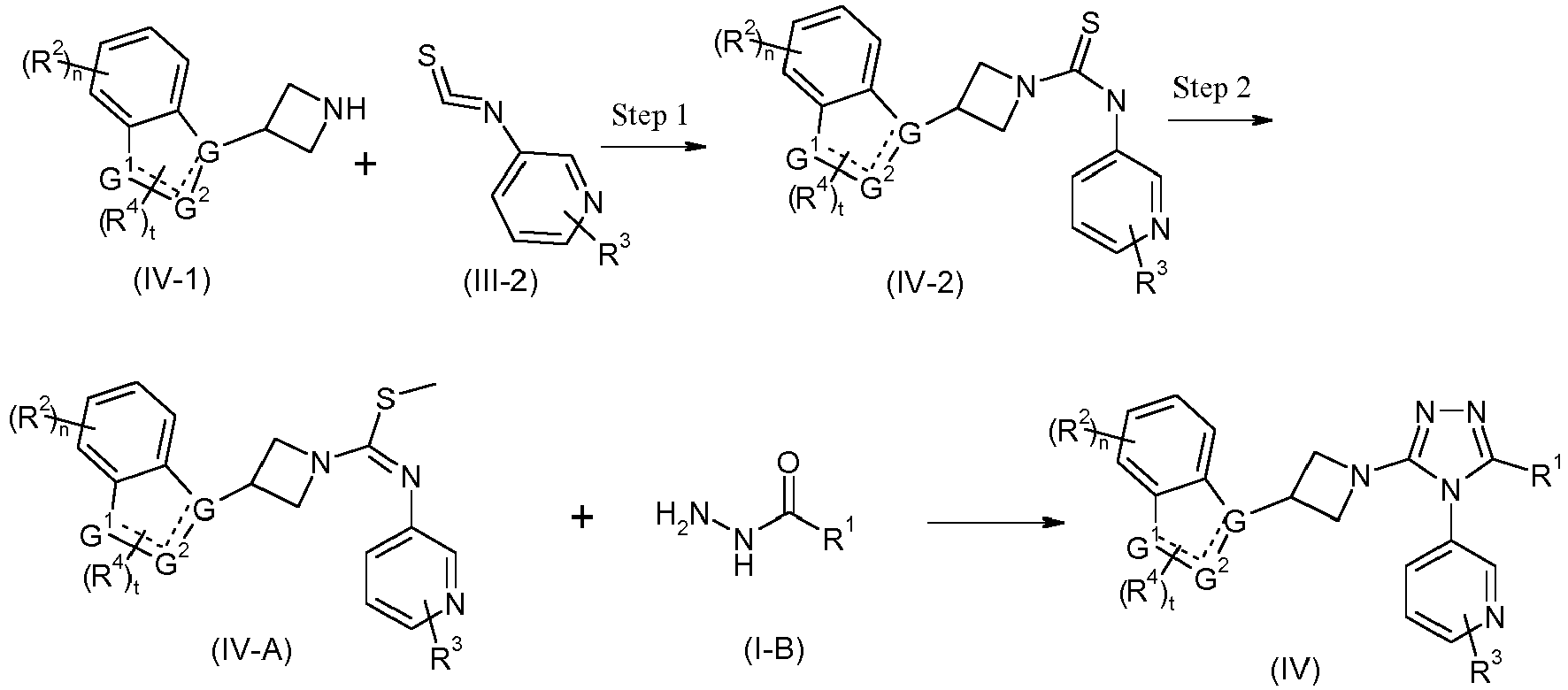
- Step 1: a compound of formula (IV-1) or a salt thereof and a compound of formula (III-2) are heated to obtain a compound of formula (IV-2);
- Step 2: the compound of formula (IV-2) is reacted with a methylating agent under an alkaline condition to obtain a compound of formula (IV-A);
- Step 3: the compound of formula (IV-A) and a compound of formula (I-B) or a hydrochloride salt thereof are subjected to a cyclization reaction under an acidic condition to obtain the compound of formula (IV).
- The methylating agent includes, but is not limited to, methyl p-toluenesulfonate, methyl iodide, methyl Grignard reagent, dimethyl sulfate, methyl trifluoromethanesulfonate and diazomethane.
- The reagent that provides an acidic condition includes, but is not limited to, hydrogen chloride, trifluoroacetic acid, formic acid, acetic acid, hydrochloric acid, sulfuric acid, methanesulfonic acid, nitric acid, phosphoric acid, p-toluenesulfonic acid, Me3SiCl and TMSOTf.
- The above reactions are preferably carried out in a solvent. The solvent includes, but is not limited to, acetic acid, methanol, ethanol, toluene, tetrahydrofuran, dichloromethane, petroleum ether, ethyl acetate, n-hexane, dimethyl sulfoxide, 1,4-dioxane, water, N,N-dimethylformamide, and mixtures thereof.
- Wherein:
- is a single bond or a double bond;
- G is selected from the group consisting of C, CH and N;
- G1 is selected from the group consisting of N, NH, C, CH, CH2, O and S;
- G2 is selected from the group consisting of C, CH, CH2, N and NH;
- R1-R4, n and t are as defined in formula (I).
- The structures of the compounds are identified by nuclear magnetic resonance (NMR) and/or mass spectrometry (MS). NMR shifts (δ) are given in 10-6 (ppm). NMR is determined by a Bruker AVANCE-400 machine. The solvent for determination is deuterated-dimethyl sulfoxide (DMSO-d6 ), deuterated-chloroform (CDCl3) or deuterated-methanol (CD3OD), with tetramethylsilane (TMS) as the internal standard.
- MS is determined by a FINNIGAN LCQAd (ESI) mass spectrometer (manufacturer: Thermo, type: Finnigan LCQ advantage MAX).
- High performance liquid chromatography (HPLC) is determined on an Agilent 1200DAD high pressure liquid chromatograph (Sunfire C18 150×4.6 mm chromatographic column), and a Waters 2695-2996 high pressure liquid chromatograph (Gimini C18 150×4.6 mm chromatographic column).
- Chiral HPLC is determined on a LC-10A vp (Shimadzu) or SFC-analytical (Berger Instruments Inc.).
- Yantai Huanghai HSGF254 or Qingdao GF254 silica gel plate is used for the thin-layer silica gel chromatography (TLC). The dimension of the silica gel plate used in TLC is 0.15 mm to 0.2 mm, and 0.4 mm to 0.5 mm for purification of product.
- Yantai Huanghai 200 to 300 mesh silica gel is generally used as a carrier for column chromatography.
- Prep Star SD-1 (Varian Instruments Inc.) or SFC-multigram (Berger Instruments Inc.) is used for chiral preparative column chromatography.
- CombiFlash rapid preparation instrument is Combiflash Rf200 (TELEDYNE ISCO).
- The average kinase inhibition rates and IC50 values are determined by a NovoStar microplate reader (BMG Co., Germany).
- The known starting raw materials of the present invention may be prepared by the known methods in the art, or may be purchased from ABCR GmbH & Co. KG, Acros Organnics, Aldrich Chemical Company, Accela ChemBio Inc., or Dari chemical Company, etc.
- Unless otherwise stated, the reactions are carried out under argon atmosphere or nitrogen atmosphere.
- "Argon atmosphere" or "nitrogen atmosphere" means that a reaction flask is equipped with an argon or nitrogen balloon (about1 L).
- "Hydrogen atmosphere" means that a reaction flask is equipped with a hydrogen balloon (about 1 L).
- Pressurized hydrogenation reaction is performed on a Parr 3916EKX hydrogenation instrument and a Qinglan QL-500 hydrogen generator or HC2-SS hydrogenation instrument.
- In hydrogenation reactions, the reaction system is generally vacuumed and filled with hydrogen, with the above operation is repeated three times.
- CEM Discover-S 908860 type microwave reactor is used in microwave reactions.
- Unless otherwise stated, the solution refers to an aqueous solution.
- Unless otherwise stated, the reaction temperature is room temperature from 20°C to 30°C.
- The reaction process in the examples is monitored by thin layer chromatography (TLC). The developing solvent used during the reactions, the eluent system for the column chromatography and the developing solvent system for the thin layer chromatography for purification of the compounds includ: A: dichloromethane/methanol system, B: n-hexane/ethyl acetate system, and C: petroleum ether/ethyl acetate system. The ratio of the volume of the solvent is adjusted according to the polarity of the compounds, and a small quantity of alkaline reagent such as triethylamine or acidic reagent such as acetic acid may also be added for adjustment.
-

- Zinc (173.54 mg, 2.65 mmol), iodine (112.28 mg, 0.4400 mmol) and tert-butyl 3-iodoazetidine-1-carboxylate 1b (250.48 mg, 0.88 mmol, prepared according to the known method disclosed in "Organic Letters, 2014, 16(23), 6160-6163") were dissolved in 30 mL of N,N-dimethylformamide. After addition, the reaction solution was reacted for 1 hour under argon atmosphere. The reaction solution was then added with bis(dibenzylideneacetone)palladium (405.1 mg, 0.4400 mmol), 2-dicyclohexylphosphine-2',4',6'-triisopropylbiphenyl (211 mg, 0.44 mmol) and 4-bromo-7-fluoroquinoline 1a (200 mg, 0.88 mmol, Accela ChemBio Inc.). After addition, the reaction solution was heated and stirred at 50°C to react for 3 hours. The reaction solution was cooled to room temperature, and concentrated under reduced pressure to remove the organic solvent. The resulting residues were purified by silica gel column chromatography with elution system C to obtain the title product 1c (9.5 g, yellow solid), yield: 64.6%.
MS m/z (ESI): 303.2 [M+1]. - 1c (100 mg, 0.33 mmol) and 0.83 mL solution of hydrogen chloride in 1,4-dioxane (4 M) were dissolved in 5 mL of dichloromethane successively, and the reaction solution was stirred for 3 hours. The above reaction solution was concentrated under reduced pressure to remove the solvent to give the crude title product 1d (100 mg, white solid), which was used directly in the next step without purification.
MS m/z (ESI): 203.4 [M+1]. - 5-Isothiocyanato-2-methylpyridine 1e (82.18 mg, 0.49 mmol, prepared according to the known method disclosed in "Bioorganic & Medicinal Chemistry Letters, 2010, 20(2), 516-520") and the crude product 1d (100 mg, 0.49 mmol) were dissolved in 20 mL of dichloromethane. After addition, the reaction solution was stirred for 3 hours. The reaction solution containing the title product 1f was used directly in the next step without purification.
MS m/z (ESI): 369.2 [M+1]. - The crude product 1f (100 mg, 0.27 mmol) and potassium tert-butoxide (60.91 mg, 0.54 mmol) were dissolved in 20 mL of tetrahydrofuran, and the reaction solution was stirred in an ice bath for 1 hour. The above reaction solution was added with methyl 4-methylbenzenesulfonate (101.09 mg, 0.54 mmol), and stirred at room temperature for 12 hours. The solvent was removed, and the resulting residues were purified by thin layer chromatography with developing solvent system C to obtain the title product 1g (50 mg, yellow oil), yield: 38.5%.
MS m/z (ESI): 383.4 [M+1]. - 1g (50 mg, 0.13 mmol), trifluoroacetic acid (29.81 mg, 0.26 mmol) and 2-methoxyacetylhydrazine (27.22 mg, 0.26 mmol) were dissolved in 20 mL of tetrahydrofuran. After addition, the reaction solution was stirred at 65°C for 3 hours. The reaction solution was cooled to room temperature, and concentrated under reduced pressure to remove the solvent. The resulting residues were purified by high performance liquid chromatography to obtain the title product 1 (10 mg, colorless paste), yield: 17.1%.
MS m/z (ESI): 421.4 [M+1].
1H NMR (400 MHz, CD3OD) δ 8.85 (d, 1H), 8.32 (d, 1H), 7.98-7.94 (m, 1H), 7.85-7.82 (m, 1H), 7.71-7.65 (m, 1H), 7.68-7.46 (m, 2H), 7.00 (d, 1H), 4.78-4.70 (m, 1H), 4.39-4.30 (m, 4H), 4.13-4.09 (m, 2H), 4.00 (s, 3H), 3.26 (s, 3H). -

- 1b (1134.58 mg, 4.01 mmol), iodine (39.12 mg, 0.15 mmol) and zinc (604.65 mg, 9.25 mmol) were added into a reaction flask, and reacted for 0.5 hour under argon atmosphere. Bis(dibenzylideneacetone)palladium (141.15 mg, 0.15 mmol), 2-dicyclohexylphosphine-2',4',6'-triisopropylbiphenyl (73.48 mg, 0.15 mmol) and 4-bromo-7-fluoro-1,2-dihydronaphthalene 2a (700 mg, 3.08 mmol, prepared according to the known method disclosed in "Chemistry - A European Journal, 2015, 21(14), 5561-5583") were added to the above reaction solution. After addition, the reaction solution was heated and stirred at 50°C for 3 hours. The reaction solution was cooled to room temperature, and then concentrated under reduced pressure. The resulting residues were purified by silica gel column chromatography with elution system C to obtain the title product 2b (700 mg, brown oil), yield: 74.8%.
MS m/z (ESI): 304.1 [M+1]. - 2,3-Dichloro-5,6-dicyano-p-quinone (336.72 mg, 1.48 mmol) and 2b (300 mg, 0.99 mmol) were dissolved in 30 mL of toluene, and then reacted at 80°C for 12 hoursafter addition. The reaction solution was cooled to room temperature, and then concentrated under reduced pressure to remove the solvent. The resulting residues were purified by thin layer chromatography with developing solvent system C to obtain the title product 2c (180 mg, brown oil), yield: 60.4%.
MS m/z (ESI): 302.2 [M+1]. - 2c (180 mg, 0.60 mmol) and 0.5 mL solution of hydrogen chloride in 1,4-dioxane (4 M) were dissolved in 30 mL of dichloromethane, and reacted for 2 hoursafter addition. The above reaction solution was concentrated under reduced pressure to obtain the crude title product 2d (120 mg, brown solid), which was used directly in the next step without purification.
MS m/z (ESI): 202.1 [M+1]. - The crude product 2d (120 mg, 0.6) and 1e (99.11 mg, 0.60 mmol) were added to 50 mL of tetrahydrofuran, and the reaction solution was stirred for 2 hours after addition. The resulting reaction solution containing the title product 2e was used directly in the next step without purification.
MS m/z (ESI): 368.1 [M+1]. - The crude product 2e (200 mg, 0.54 mmol) was dissolved in 50 mL of tetrahydrofuran, and cooled to 0°C. The above solution was added with potassium tert-butoxide (183.23 mg, 1.63 mmol), and then reacted for 1 hour after addition. The above reaction solution was added with methyl 4-methylbenzenesulfonate (101.09 mg, 0.54 mmol), and stirred at room temperature for 12 hours. The reaction solution was then added with 50 mL of ethyl acetate, and washed with water (20 mL×3). The organic phases were combined, and concentrated under reduced pressure to remove the solvent. The resulting residues were purified by thin layer chromatography with developing solvent system C to obtain the title product 2f (100 mg, brown oil), yield: 48.2%.
MS m/z (ESI): 382.1 [M+1]. - 2f (100 mg, 0.26 mmol), trifluoroacetic acid (0.1 mL, 0.13 mmol) and 2-methoxyacetylhydrazine (27.29 mg, 0.26 mmol) were dissolved in 50 mL of tetrahydrofuran. After addition, the reaction solution was reacted under reflux for 3 hours. The reaction solution was cooled to room temperature, and concentrated under reduced pressure to remove the solvent. The resulting residues were purified by thin layer chromatography with developing solvent system A to obtain the title product 2 (30 mg, brown solid), yield: 26.7%.
MS m/z (ESI): 420.1 [M+1].
1H NMR (400 MHz, CD3OD) δ 8.32 (s, 1H), 7.75-7.84 (m, 3H), 7.51-7.55 (m, 2H) ,7.43 (d, 1H), 7.25-7.32 (m, 1H), 7.00 (d, 1H), 4.51-4.66 (m, 1H), 4.35 (t, 4H), 4.10 (t, 2H), 4.00 (s, 3H), 3.26 (s, 3H). -


- 5-Fluoroindoline 3a (2000 mg, 7.44 mmol) and tert-butyl 3-oxoazetidine-1-carboxylate 3b (1273.16 mg, 7.44 mmol, prepared according to the known method disclosed in " Organic Process Research & Development, 2015, 19(11), 1548-1553") were dissolved in 30 mL of dichloromethane successively, and reacted for 1 hour. The reaction solution was then added with sodium triacetoxyborohydride (3.15 g, 14.88 mmol), and reacted for 12 hours after addition. The reaction solution was concentrated under reduced pressure, and the resulting residues were dissolved in 50 mL of ethyl acetate, and washed with saturated sodium bicarbonate solution (30 mL×2). The organic phase was dried over anhydrous sodium sulfate, and filtered to remove the drying agent. The filtrate was concentrated under reduced pressure, and the resulting residues were purified by silica gel column chromatography with elution system C to obtain the title product 3c (1.50 g, white solid), yield: 69.0%.
MS m/z (ESI): 293.1 [M+1]. - 3c (400 mg, 1.37 mmol) was dissolved in 20 mL of dichloromethane, and the solution was placed in an ice bath to cool to 0°C. The above solution was then added with 2,3-dichloro-5,6-dicyano-p-quinone (310.59 mg, 1.37 mmol), and reacted for 1 hour after addition. The reaction solution was concentrated under reduced pressure to remove the organic solvent. The resulting residues were purified by thin layer chromatography with developing solvent system C to obtain the title product 3d (100 mg, colorless oil), yield: 25.2%.
MS m/z (ESI): 291.3 [M+1]. - 3d (100 mg, 0.34 mmol) and N-chlorosuccinimide (68.99 mg, 0.52 mmol) were dissolved in 10 mL of tetrahydrofuran successively. After addition, the reaction solution was heated and reacted at 60°C for 3 hours. The reaction solution was concentrated under reduced pressure to remove the solvent, and the resulting residues were purified by thin layer chromatography with developing solvent system C to obtain the title product 3e (100 mg, colorless oil), yield: 89.4%.
MS m/z (ESI): 325.5 [M+1]. - 3e (80 mg, 0.25 mmol) and 2 mL solution of hydrogen chloride in 1,4-dioxane (4 M) were dissolved in 20 mL of dichloromethane, and reacted for 1 hour after addition. The reaction solution was concentrated under reduced pressure to remove the organic solvent. The crude title product 3f was obtained, which was used directly in the next step without purification.
MS m/z (ESI): 225.3 [M+1]. - 5-Isothiocyanatobenzo[d][1,3]dioxole 3g (43.87 mg, 0.24 mmol, prepared according to the known method disclosed in "Journal of Medicinal Chemistry, 2015, 58(3), 1123-1139") and 3f (55 mg, 0.24 mmol) were dissolved in 30 mL of tetrahydrofuran, and reacted for 2 hours after addition. The reaction solution containing the title product 3h was used directly in the next step without purification.
MS m/z (ESI): 404.3 [M+1]. - The crude product 3h (98 mg, 0.24 mmol) was dissolved in 30 mL of tetrahydrofuran, and cooled to 0°C. The above solution was added with potassium tert-butoxide (60.91 mg, 0.54 mmol), and reacted in an ice bath for 1 hour after addition. The above reaction solution was added with methyl 4-methylbenzenesulfonate (45.19 mg, 0.24 mmol), and stirred at room temperature for 12 hours. The reaction solution was concentrated under reduced pressure to remove the organic solvent. The resulting residues were added with ethyl acetate (50 mL×2), and washed with water (30 mL×2). The organic phase was dried over anhydrous sodium sulfate, and filtered to remove the drying agent. The filtrate was concentrated under reduced pressure, and the resulting residues were purified by thin layer chromatography with developing solvent system C to obtain the title product 3i (98 mg, yellow oil), yield: 96.6%.
MS m/z (ESI): 418.3 [M+1]. - 3i (98 mg, 0.23 mmol), trifluoroacetic acid (29.81 mg, 0.26 mmol) and 2-methoxyacetylhydrazine (24.42 mg, 0.23 mmol) were dissolved in 30 mL of tetrahydrofuran. After addition, the reaction solution was heated to reflux and reacted for 3 hours. The reaction solution was concentrated under reduced pressure to remove the solvent, and the resulting residues were purified by thin layer chromatography with developing solvent system A to obtain the title product 3 (30 mg, brown oil), yield: 26.7%.
MS m/z (ESI): 456.4 [M+1].
1H NMR (400 MHz, CD3OD) δ 7.64 (s, 1H), 7.51-7.52 (m, 1H), 7.17-7.20 (m, 1H), 6.99-7.05 (m, 4H), 6.09 (s, 2H), 5.36-5.40 (m, 1H), 4.34-4.39 (m, 4H), 4.04-4.09 (m, 2H), 3.28 (s, 3H). -


- The crude product 3f (162 mg, 0.62 mmol) and 1e (201.43 mg, 0.62 mmol) were dissolved in 10 mL of dichloromethane, and reacted for 2 hours after addition. The reaction solution was concentrated under reduced pressure to remove the organic solvent to give the crude title product 4a (373 mg, brown solid), which was used directly in the next step without purification.
MS m/z (ESI): 391.2 [M+1]. - The crude product 4a (373 mg, 0.62 mmol) was dissolved in 15 mL of tetrahydrofuran, and cooled to 0°C. The above solution was added with potassium tert-butoxide (208.17 mg, 1.86 mmol), and reacted for 1 hour after addition. The above reaction solution was added with methyl 4-methylbenzenesulfonate (172.74 mg, 0.93 mmol), and then slowly warmed up to room temperature and stirred for 16 hours. The reaction solution was concentrated under reduced pressure to remove the organic solvent. The resulting residues were purified by thin layer chromatography with developing solvent system C to obtain the title product 4b (140 mg, yellow oil), yield: 55.9%.
MS m/z (ESI): 405.3 [M+1]. - 4b (70 mg, 0.17 mmol), trifluoroacetic acid (0.006 mL, 0.085 mmol) and 2-ethoxyacetylhydrazine (40.85 mg, 0.35 mmol) were dissolved in 30 mL of tetrahydrofuran successively. After addition, the reaction solution was heated to 70°C and reacted for 3 hours. The reaction solution was concentrated under reduced pressure, and the resulting residues were purified by thin layer chromatography with developing solvent system A to obtain the title product 4 (60 mg, pale yellow oil), yield: 76.0%.
MS m/z (ESI): 457.1 [M+1].
1H NMR (400 MHz, CD3OD) δ 8.34 (d, 1H), 7.86 (d, 1H), 7.66 (s, 1H), 7.48 (d, 1H), 7.18 (d, 1H), 7.03 (d, 1H), 6.98 (d, 1H), 5.39-5.42 (m, 1H), 4.40 (s, 2H), 4.34 (t, 2H), 4.14 (d, 2H), 3.98 (s, 3H), 3.61-3.66 (m, 2H), 1.26 (t, 3H). -


- 5-Fluoro-3-methylindoline 5a (1912.34 mg, 6.70 mmol, prepared according to the method disclosed in the patent application "
WO2009065919 ") and 3b (1147.69 mg, 6.7 mmol) were dissolved in 30 mL of dichloromethane successively, and reacted for 1 hour. The reaction solution was then added with sodium triacetoxyborohydride (2.84 g, 13.4 mmol), and reacted for 12 hours after addition. The reaction solution was concentrated under reduced pressure to remove the organic solvent. The resulting residues were dissolved in 50 mL of ethyl acetate, and washed with saturated sodium bicarbonate solution (30 mL×2). The organic phases were combined, dried over anhydrous sodium sulfate, and filtered to remove the drying agent. The filtrate was concentrated under reduced pressure, and the resulting residues were purified by silica gel column chromatography with elution system C to obtain the title product 5b (1330 mg, colorless oil), yield: 64.8%.
MS m/z (ESI): 307.3 [M+1]. - 5b (1330 mg, 4.34 mmol) was dissolved in 30 mL of dichloromethane, and the solution was placed in an ice bath to cool to 0°C. The above solution was then added with 2,3-dichloro-5,6-dicyano-p-quinone (985.41 mg, 4.34 mmol), and reacted for 1 hour after addition. The reaction solution was concentrated under reduced pressure. The resulting residues were purified by thin layer chromatography with developing solvent system C to obtain the title product 5c (1160 mg, colorless oil), yield: 87.8%.
MS m/z (ESI): 305.1 [M+1]. - 5c (500 mg, 1.64 mmol) was dissolved in 10 mL of dichloromethane. The above solution was then added with 2.05 mL soluton of hydrogen chloride in 1,4-dioxane (4 M), and reacted for 2 hours after addition. The reaction solution was concentrated under reduced pressure to remove the organic solvent to give the crude title product 5d (400 mg, white solid), which was used directly in the next step without purification.
MS m/z (ESI): 205.1 [M+1]. - The crude product 5d (400 mg, 1.66 mmol) and 1e (563.66 mg, 1.66 mmol) were dissolved in 40 mL of dichloromethane successively, and reacted for 2 hours after addition. The reaction solution was concentrated under reduced pressure to remove the organic solvent to give the crude title product 5e (980 mg, yellow solid), which was used directly in the next step without purification.
MS m/z (ESI): 371.2 [M+1]. - The crude product 5e (980 mg, 1.66 mmol) was dissolved in 40 mL of tetrahydrofuran, and cooled to 0°C. The above solution was added with potassium tert-butoxide (372.25 mg, 3.32 mmol), and reacted for 1 hour after addition. The above reaction solution was added with methyl 4-methylbenzenesulfonate (370.69 mg, 1.99 mmol), and then slowly warmed up to room temperature, and reacted for 16 hours. The reaction solution was concentrated under reduced pressure to remove the organic solvent. The resulting residues were added with 60 mL of ethyl acetate, and washed with water (30 mL×2). The organic phases were combined, dried over anhydrous sodium sulfate, and filtered. The filtrate was concentrated under reduced pressure, and the resulting residues were purified by silica gel column chromatography with elution system C to obtain the title product 5f (555 mg, yellow), yield: 87.0%.
MS m/z (ESI): 385.3 [M+1]. - 5f (85 mg, 0.22 mmol), 2-ethoxyacetylhydrazine (26.12 mg, 0.22 mmol) and three drops of trifluoroacetic acid were dissolved in 10 mL of tetrahydrofuran successively. After addition, the reaction solution was heated to 70°C and reacted for 3 hours. The reaction solution was concentrated under reduced pressure to remove the solvent, and the resulting residues were purified by thin layer chromatography with developing solvent system A to obtain the title product 5 (60 mg, yellow oil), yield: 62.2%.
MS m/z (ESI): 437.5 [M+1].
1H NMR (400 MHz, CD3OD) δ 8.34 (d, 1H), 7.86 (d, 1H), 7.36 (d, 1H), 7.32 (s, 1H), 7.17 (d, 1H), 7.15 (d, 1H), 6.97 (t, 1H), 5.31-5.41 (m, 1H), 4.40 (s, 2H), 4.33 (t, 2H), 4.13 (d, 2H), 3.98 (s, 3H), 3.41-3.45 (m, 2H), 2.27 (s, 3H), 1.10 (t, 3H). -


- 5f (75 mg, 0.20 mmol), acetylhydrazine (14.45 mg, 0.2 mmol) and three drops of trifluoroacetic acid were dissolved in 10 mL of tetrahydrofuran successively. After addition, the reaction solution was heated to 70°C and reacted for 3 hours. The reaction solution was concentrated under reduced pressure to remove the solvent, and the resulting residues were purified by thin layer chromatography with developing solvent system A to obtain the title product 6 (12 mg, white solid), yield: 15.7%.
MS m/z (ESI): 393.1 [M+1].
1H NMR (400 MHz, CD3OD) δ 8.31 (d, 1H), 7.82 (d, 1H), 7.36 (d, 1H), 7.30 (s, 1H), 7.15 (d, 1H), 7.00 (d, 1H), 6.91 (t, 1H), 5.30-5.41 (m, 1H), 4.29 (t, 2H), 4.10 (d, 2H), 3.98 (s, 3H), 2.27 (s, 3H), 2.22 (t, 3H). -


- 3d (110mg, 0.38 mmol), cuprous thiophene-2-formate (7.22 mg, 0.04 mmol, prepared according to the known method disclosed in "Chemistry - A European Journal, 2013, 19(31), 10353-1035"), 1-(trifluoromethyl)-1,2-phenyliodo-3(1H)-one (178.47mg, 0.57 mmol, prepared according to the known method disclosed in "Angewandte Chemie, International Edition, 2014, 53(52), 14559-14563") and 4,4,4',4',5,5,5',5'-octamethyl-2,2'-bis(1,3,2-dioxaborolane) (9.62mg, 0.04 mmol) were added to 3 mL of chloroform. After addition, the reaction solution was reacted under argon atmosphere at 60°C for 16 hours. The reaction solution was concentrated under reduced pressure, and the resulting residues were purified by thin layer chromatography with developing solvent system C to obtain the title product 7a (50 mg, yellow oil), yield: 33.1%.
MS m/z (ESI): 303.0 [M-55]. - 7a (50 mg, 0.14 mmol) and trifluoroacetic acid (2 mL, 0.14 mmol) were added to 20 mL of dichloromethane, and reacted for 1 hour after addition. The reaction solution was concentrated under reduced pressure to remove the solvent to give the crude title product 7b (36 mg, yellow oil), which was used directly in the next step without purification.
MS m/z (ESI): 259.1 [M+1]. - The crude product 7b (80.1 mg, 0.31 mmol) and 1e (105.22 mg, 0.31 mmol) were dissolved in 10 mL of dichloromethane, and reacted for 2 hours after addition. The reaction solution was concentrated under reduced pressure to remove the organic solvent to give the crude title product 7c (135 mg, yellow oil), which was used directly in the next step without purification.
MS m/z (ESI): 425.1 [M+1]. - The crude product 7c (131.93 mg, 0.31 mmol) was dissolved in 10 mL of tetrahydrofuran, and cooled to 0°C. The above solution was added with potassium tert-butoxide (69.76 mg, 0.62 mmol), and reacted for 1 hour after addition. The above reaction solution was then added with methyl 4-methylbenzenesulfonate (69.47 mg, 0.37 mmol), and then slowly warmed up to room temperature, and reacted for 16 hours. The reaction solution was concentrated under reduced pressure to remove the organic solvent. The resulting residues were purified by thin layer chromatography with developing solvent system C to obtain the title product 7d (56 mg, yellow oil), yield: 41.1%.
MS m/z (ESI): 439.1 [M+1]. - 7d (20.42 mg, 0.050 mmol), trifluoroacetic acid (0.35 mg, 0.1 mmol) and 2-methoxyacetylhydrazine (9.7 mg, 0.09 mmol) were dissolved in 20 mL of tetrahydrofuran. After addition, the reaction solution was heated to 70°C and reacted for 2 hours. The reaction solution was cooled to room temperature, and concentrated under reduced pressure. The resulting residues were purified by HPLC to obtain the title product 7 (20 mg, pale yellow oil), yield: 82.0%.
MS m/z (ESI): 477.2 [M+1].
1H NMR (400 MHz, CDCl3) δ 8.26-8.25 (m, 1H), 8.03-8.01 (m, 1H), 7.67-7.66 (m, 1H), 7.34-7.33 (m, 1H), 7.24-7.18 (m, 1H), 6.89-6.85 (m, 2H), 5.39-5.34 (m, 1H), 4.51-4.41 (m, 4H), 4.38 (s, 2H), 3.95 (s, 3H), 3.33 (s, 3H). -
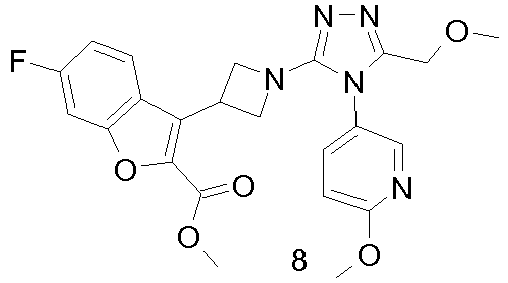

- 1-Bromo-2,4-difluorobenzene (8374.04 mg, 43.39 mmol) was dissolved in 50 mL of tetrahydrofuran, and cooled to -78°C under argon atmosphere. n-Butyllithium (2779.63 mg, 43.39 mmol) was then added and reacted for 0.5 hour. The above reaction solution was added with tert-butyl 3-(methoxy(methyl)carbamoyl)azetidine-1-carboxylate 8a (5300 mg, 21.7 mmol, prepared according to the known method disclosed in "Journal of Medicinal Chemistry, 2007,50(20), 4868-4881"), and then slowly warmed up to room temperature, and reacted for 12 hours. The reaction solution was added with saturated ammonium chloride solution, and extracted with dichloromethane (20 mL×3). The organic phases were combined, and concentrated under reduced pressure. The resulting residues were purified by thin layer chromatography with developing solvent system C to obtain the title product 8b (255 mg, yellow oil), yield: 3.9%.
MS m/z (ESI): 243.1 [M-55]. - 8b (255 mg, 0.86 mmol), methyl 2-hydroxyacetate (84.99 mg, 0.94 mmol) and sodium hydride (30.88 mg, 1.29 mmol) were dissolved in 50 mL of tetrahydrofuran. After addition, the reaction solution was heated to reflux and reacted for 3 hours. The reaction solution was added with 20 mL of ethyl acetate, washed with 40 mL of water, dried over anhydrous sodium sulfate, and filteredfiltered. The filtrate was concentrated under reduced pressure to remove the solvent, and the resulting residues were purified by thin layer chromatography with developing solvent system C to obtain the title product 8c (40 mg, yellow solid), yield: 13.4%.
MS m/z (ESI): 350.1 [M+1]. - 8c (200 mg, 0.65 mmol) and 2 mL of trifluoroacetic acid were mixed and reacted at 30°C for 2 hours. The reaction solution was filtered and concentrated under reduced pressure to obtain the crude title product 8d (21 mg, yellow oil), which was used directly in the next step without purification.
MS m/z (ESI): 250.1 [M+1]. - 1e (160.37mg, 0.96 mmol) and the crude product 8d (21 mg, 0.080 mmol) were dissolved in 10 mL of tetrahydrofuran, and reacted for 16 hours after addition. The resulting reaction solution containing the title product 8e was used directly in the next step without purification.
MS m/z (ESI): 416.1 [M+1]. - The crude product 8e (35 mg, 0.08 mmol) and methyl 4-methylbenzenesulfonate (15.69 mg, 0.08 mmol) were dissolved in 10 mL of tetrahydrofuran, and reacted for 0.5 hour. The reaction solution was then added with potassium tert-butoxide (28.36 mg, 0.25 mmol), and reacted for 16 hours after addition. The reaction solution was added with 10 mL of water, and extracted with dichloromethane (10 mL×3). The organic phases were combined, dried over anhydrous sodium sulfate, and filtered. The filtrate was concentrated under reduced pressure to remove the solvent, and the resulting residues were purified by thin layer chromatography with developing solvent system C to obtain the title product 8f (20 mg, pale yellow solid), yield: 49.7%.
MS m/z (ESI): 430.1 [M+1]. - 8f (100 mg, 0.26 mmol), trifluoroacetic acid (0.53 mg, 0.1 mmol) and 2-methoxyacetylhydrazine (9.7 mg, 0.09 mmol) were dissolved in 20 mL of tetrahydrofuran. After addition, the reaction solution was reacted at 70°C for 2 hours. The reaction solution was cooled to room temperature, and concentrated under reduced pressure to remove the solvent. The resulting residues were purified by HPLC to obtain the title product 8 (20 mg, pale yellow oil), yield: 91.9%.
MS m/z (ESI): 468.2[M+1].
1H NMR (400 MHz, CDCl3) δ 8.25-8.24 (m, 1H), 8.04-8.02 (m, 1H), 7.65-7.62 (m, 1H), 7.29-7.27 (m, 1H), 7.13-7.11 (m, 1H), 6.86-6.84 (m, 1H), 4.88-4.83 (m, 1H), 4.37-4.33 (m, 4H), 4.12-4.08 (m, 2H), 3.96 (s, 3H), 3.93 (s, 3H), 3.31 (s, 3H). -


- 6-Fluorobenzothiophene 9a (500 mg, 3.29 mmol) and N-bromosuccinimide (584.73 mg, 3.29 mmol) were dissolved in 10 mL of N,N-dimethylformamide, and reacted for 16 hours after addition. The reaction solution was concentrated under reduced pressure, and the resulting residues were purified by thin layer chromatography with developing solvent system C to obtain the title product 9b (200 mg, colorless oil), yield: 23.4%.
- Zinc (604.65 mg, 9.25 mmol), iodine (109.84 mg, 0.43 mmol) and 1b (245.03 mg, 0.87 mmol) were added to 30 mL of N,N-dimethylformamide, and reacted under argon atmosphere for 1 hour after addition. The above reaction solution was then added with 9b (200 mg, 0.87 mmol), bis(dibenzylideneacetone)palladium (792.56 mg, 0.87 mmol) and 2-dicyclohexylphosphine-2',4',6'-triisopropylbiphenyl (412.6 mg, 0.87 mmol). After addition, the reaction solution was heated at 50°C for 3 hours. The reaction solution was cooled to room temperature, and filtered. The filtrate was collected, and concentrated under reduced pressure to remove the solvent. The resulting residues were purified by thin layer chromatography with developing solvent system C to obtain the title product 9c (100 mg, black oil), yield: 37.0%.
MS m/z (ESI): 308.4 [M+1]. - 9c (200 mg, 0.65 mmol) and 1.63 mL solution of hydrogen chloride in 1,4-dioxane (4 M) were dissolved in 5 mL of dichloromethane successively, and the reaction solution was stirred for 3 hours. The above reaction solution was concentrated under reduced pressure to remove the solvent to give the crude title product 9d (200 mg, yellow solid), which was used directly in the next step without purification.
MS m/z (ESI): 208.4 [M+1]. - 1e (160.37mg, 0.96 mmol) and the crude product 9d (200 mg, 0.96 mmol) were dissolved in 20 mL of tetrahydrofuran, and reacted for 3 hours after addition. The resulting reaction solution containing the title product 9e was used directly in the next step without purification.
MS m/z (ESI): 374.2 [M+1]. - The crude product 9e (200 mg, 0.54 mmol), potassium tert-butoxide (60.91 mg, 0.54 mmol) and methyl 4-methylbenzenesulfonate (101.09 mg, 0.54 mmol) were dissolved in 20 mL of tetrahydrofuran, and reacted for 16 hours after addition. The reaction solution was concentrated under reduced pressure, and the resulting residues were purified by thin layer chromatography with developing solvent system C to obtain the title product 9f (100 mg, colorless oil), yield: 38.6%.
MS m/z (ESI): 388.2 [M+1]. - 9f (100 mg, 0.26 mmol), trifluoroacetic acid (58.85 mg, 0.52 mmol) and 2-methoxyacetylhydrazine (53.74 mg, 0.52 mmol) were dissolved in 20 mL of tetrahydrofuran. After addition, the reaction solution was reacted at 65°C for 3 hours. The reaction solution was cooled to room temperature, and concentrated under reduced pressure to remove the solvent. The resulting residues were purified by HPLC to obtain the title product 9 (15 mg, brown paste), yield: 13.1%.
MS m/z (ESI): 426.4 [M+1].
1H NMR (400 MHz, CD3OD) δ 8.42 (d, 1H), 7.93-7.90 (m, 1H), 7.68-7.65 (m, 2H), 7.52 (s, 1H), 7.22-7.18 (m, 1H), 7.04-7.00 (m, 1H), 4.51-4.42 (m, 3H), 4.36 (s, 2H), 4.24-4.18 (m, 2H), 4.01 (s, 3H), 3.29 (s, 3H). -


- 4b (56 mg, 0.14 mmol), 2-methoxyacetylhydrazine (14.4 mg, 0.14 mmol) and three drops of trifluoroacetic acid were dissolved in 10 mL of tetrahydrofuran successively. After addition, the reaction solution was heated to 70°C and reacted for 3 hours. The reaction solution was concentrated under reduced pressure to remove the solvent, and the resulting residues were purified by thin layer chromatography with developing solvent system A to obtain the title product 10 (20 mg, white solid), yield: 31.9%.
MS m/z (ESI): 443.1 [M+1].
1H NMR (400 MHz, CD3OD) δ 8.34 (d, 1H), 7.85 (d, 1H), 7.66 (s, 1H), 7.50 (d, 1H), 7.19 (d, 1H), 7.03 (t, 1H), 6.98 (d, 1H), 5.35-5.45 (m, 1H), 4.34-4.39 (m, 4H), 4.14 (d, 2H), 3.98 (s, 3H), 3.27 (s, 3H). -


- 1-Acetylazetidine-3-carboxylic acid 11a (1500 mg, 10.48 mmol) was dissolved in 20 mL of dichloromethane, and cooled to 0°C. The above solution was then added with oxalyl chloride (1995.2 mg, 15.72 mmol), and reacted at room temperature for 1.5 hours. The reaction solution was concentrated under reduced pressure to remove the organic solvent to give the crude title product 11b (1600 mg, yellow solid), which was used directly in the next step without purification.
- Aluminum trichloride (3465.73 mg, 25.99 mmol), the crude product 11b (2.1g, 13 mmol) and 1,3-difluorobenzene were dissolved in 40 mL of dichloromethane, and reacted under reflux for 3 hours after addition. The reaction solution was poured into a mixture of ice water and hydrochloric acid (V: V = 1:1), and extracted with dichloromethane (20 mL×3). The organic phases were combined, dried over anhydrous sodium sulfate, and filtered. The filtrate was concentrated under reduced pressure to remove the organic solvent to give the crude title product 11c (300 mg, yellow oil), which was used directly in the next step without purification.
MS m/z (ESI): 240.1 [M+1]. - The crude product 11c (140 mg, 0.59 mmol) and methyl 2-hydroxyacetate (65.33 mg, 0.73 mmol) were dissolved in 200 mL of tetrahydrofuran. The reaction solution was then added with sodium hydride (20.18 mg, 0.88 mmol), and reacted under reflux for 3 hours. The reaction solution was concentrated under reduced pressure to remove tetrahydrofuran. The residues were dissolved in 200 mL of ethyl acetate, washed with water (100 mL×2) and saturated sodium chloride solution (100 mL×1) respectively, dried over anhydrous magnesium sulfate, and filtered. The filtrate was concentrated under reduced pressure to remove the organic solvent, and the resulting residues were purified by the CombiFlash rapid preparation instrument with elution system C to obtain the title product 11d (200 mg, yellow oil), yield: 100%.
MS m/z (ESI): 292.1 [M+1]. - 11d (200 mg, 0.69 mmol) and lithium hydroxide hydrate (86.44 mg, 20.6 mmol) were dissolved in 20 mL of a mixed solution of water and tetrahydrofuran (V:V = 1:1), and reacted for 2 hours. The reaction solution was concentrated under reduced pressure. The residues were dissolved in 200 mL of ethyl acetate, washed with water (100 mL×2) and saturated sodium chloride solution (100 mL) respectively, dried over magnesium sulfate, and filtered. The filtrate was concentrated under reduced pressure, and the resulting residues were purified by the CombiFlash rapid preparation instrument with elution system C to obtain the title product 11e (100 mg, yellow oil), yield: 52.5%.
MS m/z (ESI): 278.1 [M+1]. - 11e (30 mg, 0.11 mmol), quinoline (5 g, 38.71 mmol) and copper (20.63 mg, 0.32 mmol) were mixed, and reacted at 200°C for 10 mintues. The reaction solution was filtered, and the filtrate was added with 1 N hydrochloric acid (20 mL) and dichloromethane (20 mL×3). The organic phases were combined, dried over anhydrous sodium sulfate, and filtered. The filtrate was concentrated under reduced pressure to remove the organic solvent, and the resulting residues were purified by thin layer chromatography with developing solvent system C to obtain the title product 11f (100 mg, yellow oil), yield: 100%.
MS m/z (ESI): 234.1 [M+1]. - 11f (20 mg, 0.09 mmol) and 10 mL of hydrochloric acid (12 M) were dissolved in 3 mL of ethanol, and reacted at 60°C for 12 hours. The reaction solution was concentrated under reduced pressure until dryness. The residues were added dropwise with 12 M hydrochloric acid to adjust the pH to acidic, and filtered. The filter cake was collected to obtain the crude title product 11g (100 mg, white solid), which was used directly in the next step without purification.
MS m/z (ESI): 192.2 [M+1]. - The crude product 11g (30 mg, 0.16 mmol) and 1e (26.1 mg, 0.16 mmol) were dissolved in 10 mL of tetrahydrofuran, and reacted for 12 hours after addition. The reaction solution containing the title product 11h was used directly in the next step without purification.
- The crude product 11h (56 mg, 0.16 mmol) and methyl 4-methylbenzenesulfonate (58.36 mg, 0.31 mmol) were dissolved in 10 mL of tetrahydrofuran, and reacted for 0.5 hour. The reaction solution was then added with potassium tert-butoxide (35.16 mg, 0.31 mmol), and reacted for 12 hours after addition. The reaction solution was added with 20 mL of water, and extracted with ethyl acetate (20 mL×3). The organic phases were combined, dried over anhydrous sodium sulfate, and filtered. The filtrate was concentrated under reduced pressure to remove the solvent, and the resulting residues were purified by thin layer chromatography with developing solvent system A to obtain the title product 11i (40 mg, pale yellow solid), yield: 61.9%.
MS m/z (ESI): 372.1 [M+1]. - 11i (40 mg, 0.11 mmol), trifluoroacetic acid (1.23 mg, 0.01 mmol) and 2-methoxyacetylhydrazine (22.42 mg, 0.22 mmol) were dissolved in 20 mL of tetrahydrofuran. After addition, the reaction solution was reacted at 70°C for 2 hours. The reaction solution was cooled to room temperature, and concentrated under reduced pressure to remove the solvent. The resulting residues were purified by HPLC to obtain the title product 11 (20 mg, pale yellow oil), yield: 45.4%.
MS m/z (ESI): 410.2 [M+1].
1H NMR (400 MHz,CDCl3) δ 8.23-8.22 (m, 1H), 7.63-7.62 (m, 1H), 7.61-7.60 (m, 1H), 7.53 (s, 1H) 7.24-7.14 (m, 1H), 7.07-6.95 (m, 1H), 6.86-6.84 (m, 1H), 4.34 (s, 2H), 4.25-4.21 (m, 2H), 4.03-3.85. (m, 6H), 3.31(s, 3H). -


- 8b (300 mg, 1.01 mmol), hydroxylamine hydrochloride (140.24 mg, 2.02 mmol) and sodium acetate (206.94 mg, 2.52 mmol) were dissolved in 12 mL of ethanol successively, and reacted for 12 hours. The reaction solution was concentrated under reduced pressure to remove the organic solvent, and the resulting residues were purified by thin layer chromatography with developing solvent system C to obtain the title product 12a (110 mg, pale yellow solid), yield: 34.9%.
MS m/z (ESI): 313.2 [M+1]. - 12a (110 mg, 0.35 mmol) and potassium tert-butoxide (59.28 mg, 0.53 mmol) were added to 10 mL of tetrahydrofuran successively, and heated to 60°C to react for 12 hours. The reaction solution was cooled to room temperature, and concentrated under reduced pressure. The resulting residues were purified by thin layer chromatography with developing solvent system C to obtain the title product 12b (40 mg, yellow oil), yield: 38.8%.
MS m/z (ESI): 293.1 [M+1]. - 12b (40 mg, 0.14 mmol) and 0.34 mL solution of hydrogen chloride in 1,4-dioxane (4 M) were added to 10 mL of dichloromethane successively, and reacted for 2 hour. The reaction solution was concentrated under reduced pressure to remove the organic solvent to give the crude title product 12c (32 mg, white solid), which was used directly in the next step without purification.
MS m/z (ESI): 193.3 [M+1]. - 1e (47.47 mg, 0.14 mmol) and the crude product 12c (32 mg, 0.14 mmol) were dissolved in 10 mL of tetrahydrofuran, and reacted for 12 hours after addition. The above reaction solution was concentrated under reduced pressure to obtain the crude title product 12d (35 mg, yellow solid), which was used directly in the next step without purification.
MS m/z (ESI): 359.1 [M+1]. - The crude product 12d (80 mg, 0.14 mmol) was dissolved in 15 mL of tetrahydrofuran, and cooled to 0°C in an ice bath. The above solution was then added with potassium tert-butoxide (31.31 mg, 0.28 mmol), and reacted at 0°C for 1 hour after addition. The above solution was added with methyl 4-methylbenzenesulfonate (3.78 mg, 0.18 mmol), and then slowly warmed up to room temperature, and reacted for 12 hours. The reaction solution was concentrated under reduced pressure to remove the solvent. The crude title product 12e (60 mg, yellow oil) was obtained, which was used directly in the next step without purification.
MS m/z (ESI): 373.1 [M+1]. - The crude product 12e (60 mg, 0.16 mmol), 2-methoxyacetylhydrazine (16.77 mg, 0.16 mmol) and three drops of trifluoroacetic acid were dissolved in 15 mL of tetrahydrofuran successively. After addition, the reaction solution was heated to 70°C and reacted for 3 hours. The reaction solution was cooled to room temperature, and concentrated under reduced pressure to remove the solvent. The resulting residues were purified by thin layer chromatography with developing solvent system A to obtain the title product 12 (10 mg, pale yellow oil), yield: 15.1%.
MS m/z (ESI): 411.2 [M+1].
1H NMR (400 MHz, CD3OD) δ 8.34 (d, 1H), 7.83-7.88 (m, 2H), 7.44 (d, 1H), 7.20 (d, 1H), 6.98 (d, 1H), 4.35-4.39 (m, 4H), 4.12 (d, 2H), 3.98 (s, 3H), 3.46 (s, 1H), 3.27 (s, 3H). -


- 3d (300 mg, 1.03 mmol), phenylacetonitrile (242.1 mg, 2.07 mmol) and cuprous iodide (393.59 mg, 2.07 mmol) were dissolved in 20 mL of N,N-dimethylformamide, and reacted at 100°C for 12 hours after addition. The reaction solution was concentrated under reduced pressure to remove the solvent, and the resulting residues were purified by thin layer chromatography with developing solvent system C to obtain the title product 13a (100 mg, yellow oil), yield: 30.7%.
MS m/z (ESI): 316.2 [M+1]. - 13a (100 mg, 0.32 mmol) was dissolved in 10 mL of dichloromethane. The above solution was then added with 0.79 mL solution of hydrogen chloride in 1,4-dioxane (4 M), and reacted for 3 hours. The reaction solution was concentrated under reduced pressure to obtain the crude title product 13b (215.23 mg, yellow solid), which was used directly in the next step without purification.
MS m/z (ESI): 216.2 [M+1]. - The crude product 13b (100 mg, 0.46 mmol) and 1e (201.43 mg, 0.62 mmol) were dissolved in 10 mL of tetrahydrofuran, and reacted for 3 hours after addition. The reaction solution containing the title product 13c was used directly in the next step without purification.
MS m/z (ESI): 382.2 [M+1]. - The crude product 13c (100 mg, 0.26 mmol), potassium tert-butoxide (88.25 mg, 0.79 mmol) and methyl 4-methylbenzenesulfonate (172.74 mg, 0.93 mmol) were dissolved in 20 mL of tetrahydrofuran, and reacted for 12 hours. The reaction solution was concentrated under reduced pressure to remove the organic solvent. The resulting residues were purified by thin layer chromatography with developing solvent system A to obtain the title product 13d (80 mg, yellow oil), yield: 38.9%.
MS m/z (ESI): 396.2 [M+1]. - 13d (50 mg, 0.13 mmol), trifluoroacetic acid (14.42 mg, 0.13 mmol) and 2-methylacetylhydrazine (19.75 mg, 0.19 mmol) were dissolved in 10 mL of tetrahydrofuran successively. After addition, the reaction solution was heated to 65°C and reacted for 3 hours. The reaction solution was cooled to room temperature, and concentrated under reduced pressure to remove the solvent. The resulting residues were purified by HPLC to obtain the title product 13 (5 mg, white solid), yield: 8.2%.
MS m/z (ESI): 434.4 [M+1].
1H NMR (400 MHz, CD3OD) δ 8.35-8.33 (m, 2H), 7.87-7.84 (m, 1H), 7.64-7.60 (m, 1H),7.36 (d, 1H), 7.18-7.14 (m, 1H), 7.04-7.00 (m, 1H), 4.61-4.59 (m, 3H), 4.46-4.40 (m, 2H), 4.20-4.16 (m, 2H), 3.98 (s, 3H), 3.26 (s, 3H). -


- Tert-butyl 3-(6-fluoro-1H-indol-3-yl)-3-hydroxyazetidine-1-carboxylate 14b 6-Fluoroindole 14a (1500 mg, 11.1 mmol) and potassium hydroxide (678.85 mg, 12.1 mmol) were dissolved in 30 mL of methanol, and stirred until potassium hydroxide dissolved. The above reaction solution was added with 3b (2071.15 mg, 12.10 mmol), and reacted at 50°C after addition. The completion of the reaction was monitored by TLC. The reaction solution was cooled to room temperature, added with 100 mL of ethyl acetate, washed with water (50 mL×3) and saturated sodium chloride solution (50 mL×2) successively, dried over anhydrous sodium sulfate, and filtered. The filtrate was concentrated under reduced pressure, and the resulting residues were purified by thin layer chromatography with developing solvent system A to obtain the title product 14b (3300 mg, pale yellow oil), yield: 87.4%.
MS m/z (ESI): 307.2 [M+1]. - 14b (300 mg, 0.98 mmol) was dissolved in 2 mL of dichloromethane, and added with triethylsilane (1138.77 mg, 9.79 mmol) in an ice bath. When the reaction solution became turbid, it was added dropwise with trifluoroacetic acid (334.99 mg, 2.94 mmol) and reacted for 10 minutes. The reaction solution was added with 30 mL of saturated sodium bicarbonate solution to quench the reaction, and extracted with dichloromethane (30 mL×3). The organic phases were combined, washed with saturated sodium chloride solution (20 mL×2), dried over anhydrous sodium sulfate, and filtered. The filtrate was concentrated under reduced pressure to remove the organic solvent to give the crude title product 14c (290.33 mg, yellow oil), which was used directly in the next step without purification.
MS m/z (ESI): 291.2 [M+1]. - The crude product 14c (300 mg, 1.03 mmol) was dissolved in 5 mL of N,N-dimethylformamide. The above solution was slowly added with sodium hydride (49.6 mg, 2.07 mmol) in portions at 0°C, and reacted for 0.5 hour. The reaction solution was then added with methyl iodide (220 mg, 1.55 mmol), and the reaction was monitored by LC-MS until the starting material was completely reacted. The reaction solution was added with 10 mL of water, stirred for 10 minutes, and extracted with ethyl acetate (20 mL×3). The organic phases were combined, dried over anhydrous sodium sulfate, and filtered. The filtrate was concentrated under reduced pressure to obtain the crude title product 14d (320 mg, yellow oil), which was used directly in the next step without purification.
MS m/z (ESI): 305.2 [M+1]. - The crude product 14d (140 mg, 0.46 mmol) and a solution of hydrogen chloride in 1,4-dioxane (1 mL, 4.60 mmol) were dissolved in 2.5 mL of dichloromethane, and reacted for 2 hours. The reaction was monitored by LC-MS until the starting material was completely reacted. The reaction solution was concentrated under reduced pressure to remove the solvent to give the crude title product 14e (100 mg, white solid), which was used directly in the next step without purification.
MS m/z (ESI): 205.3 [M+1]. - The crude product 14e (100 mg, 0.49 mmol) and 1e (122.06 mg, 0.73 mmol) were dissolved in 5 mL of tetrahydrofuran, and reacted for 1.5 hours after addition. The reaction solution was concentrated under reduced pressure to obtain the crude title product 14f (180 mg, yellow oil), which was used directly in the next step without purification.
MS m/z (ESI): 371.4 [M+1]. - The crude product 14f (180 mg, 0.49 mmol) was dissolved in 5 mL of tetrahydrofuran, and then added with potassium tert-butoxide (75.18 mg, 0.67 mmol) in an ice bath, and reacted for 2 hours. The reaction solution was then added with methyl 4-methylbenzenesulfonate (93.58 mg, 0.50 mmol), and reacted for 15 hours. The reaction solution was poured into 30 mL of water to quench the reaction, and extracted with ethyl acetate (30 mL×3). The organic phases were combined, washed with saturated sodium chloride solution (30 mL×2), dried over anhydrous sodium sulfate, and filtered. The filtrate was concentrated under reduced pressure, and the resulting residues were purified by thin layer chromatography with developing solvent system C to obtain the title product 14g (150 mg, yellow liquid), yield: 72.0%.
MS m/z (ESI): 385.2 [M+1]. - 14g (180 mg, 0.47 mmol), trifluoroacetic acid (5.34 mg, 0.050 mmol) and 2-methylacetylhydrazine (243.71 mg, 2.34 mmol) were dissolved in 6 mL of tetrahydrofuran successively. After addition, the reaction solution was reacted at 70°C for 3 hours. The reaction solution was concentrated under reduced pressure to remove the solvent, and the resulting residues were purified by thin layer chromatography with developing solvent system A to obtain the title product 14 (15 mg, pale yellow solid), yield: 7.2%.
MS m/z (ESI): 423.1 [M+1].
1H NMR (400 MHz, CDCl3) δ 8.22 (d,1 H), 7.62 (d, 1H), 7.49 (d, 1H), 6.96-6.83 (m, 4H), 4.34 (s, 2H), 4.19 (d, 2H), 4.05 (m, 1H), 3.98 (s, 5H), 3.69 (s, 3H), 1.26 (s, 3H). -


- 5-Fluoro-1H-benzo[d|imidazole 15a (500 mg, 3.67 mmol), 1-(tert-butoxycarbonyl)-3-(methanesulfonyloxy)azabutane 15b (1015.32 mg, 4.04 mmol, prepared according to the known method disclosed in "Organic Process Research & Development, 2015, 19(12), 2067-2074") and cesium carbonate (2393.45 mg, 7.35 mmol) were dissolved in 50 mL of N,N-dimethylformamide, and reacted at 80°C for 16 hours. The reaction solution was poured into ice water, and extracted with ethyl acetate (50 mL×3). The organic phases were combined, washed with saturated sodium chloride solution, dried over anhydrous sodium sulfate, and filtered. The filtrate was concentrated under reduced pressure, and the resulting residues were purified by silica gel column chromatography with elution system A to obtain the title product 15c (609 mg, pale yellow solid), yield: 56.9%.
MS m/z (ESI): 292.1 [M+1]. - 15c (609 mg, 2.09 mmol) and a solution of hydrogen chloride in 1,4-dioxane (3.05 mL, 12.18 mmol) were dissolved in 5 mL of dichloromethane, and reacted for 12 hours. The reaction solution was concentrated under reduced pressure to remove the solvent to give the crude title product 15d (450 mg, white solid), which was used directly in the next step without purification.
MS m/z (ESI): 192.0 [M+1]. - The crude product 15d (450 mg, 2.35 mmol) and 1e (586.74 mg, 3.53 mmol) were dissolved in 35 mL of tetrahydrofuran, and reacted for 2 hours after addition. The reaction solution was concentrated under reduced pressure to remove the organic solvent, and the resulting residues were purified by thin layer chromatography with developing solvent system A to obtain the title product 15e (700 mg, pale yellow paste), yield: 83.2%.
MS m/z (ESI): 358.5 [M+1]. - 15e (700 mg, 1.96 mmol) was dissolved in 35 mL of tetrahydrofuran, and then added with potassium tert-butoxide (329.65 mg, 2.94 mmol) in an ice bath, and reacted for 0.5 hour. The reaction solution was then added with methyl 4-methylbenzenesulfonate (364.74 mg, 1.96 mmol), and reacted for 16 hours. The reaction solution was poured into 30 ml of water, and extracted with ethyl acetate (20 mL×3). The organic phases were combined, washed with saturated sodium chloride solution, dried over anhydrous sodium sulfate, and filtered. The filtrate was concentrated under reduced pressure to remove the solvent to give the crude title product 15f (800 mg, white paste), which was used directly in the next step without purification.
MS m/z (ESI): 372.1 [M+1]. - The crude product 15f (600 mg, 1.62 mmol), trifluoroacetic acid (18.42 mg, 0.16 mmol) and 2-methylacetylhydrazine (168.18 mg, 1.62 mmol) were dissolved in 50 mL of tetrahydrofuran successively. After addition, the reaction solution was heated to reflux and reacted for 2 hours. The reaction solution was cooled to room temperature, and concentrated under reduced pressure. The resulting residues were purified by HPLC to obtain the title product 15 (100 mg, pale yellow solid), yield: 15.1%.
MS m/z (ESI): 410.1[M+1].
1HNMR (400 MHz, DMSO-d6 ) δ 8.29 (s, 1H), 8.05 (d, 1H), 7.69-7.67 (m, 1H), 7.53-7.50 (m, 1H), 7.35-7.32 (m, 1H), 7.13-7.12 (m, 1H), 6.93-6.89 (m, 1H), 5.24-5.18 (m, 1H), 4.52-4.50 (m, 2H), 4.40 (s, 2H), 4.30-4.24 (m, 2H), 4.01 (s, 3H), 3.37 (s, 3H). -


- 5-Fluoro-2-methylindoline 16a (1.30 g, 8.60 mmol, prepared according to the known method disclosed in "Tetrahedron: Asymmetry, 2006, 17(17), 2558-2564") and 3b (1.47 g, 8.60 mmol) were dissolved in 40 mL of dichloromethane successively, and stirred for 2 hours. The reaction solution was then added with sodium triacetoxyborohydride (2.73 g, 12.90 mmol), and reacted for 12 hours after addition. The reaction solution was poured into 50 ml of water, and the water phase was extracted with dichloromethane (50 mL×2). The organic phases were combined, dried over anhydrous sodium sulfate, and filtered. The filtrate was concentrated under reduced pressure, and the resulting residues were purified by thin layer chromatography with developing solvent system A to obtain the title product 16b (1.80 g, yellow oil), yield: 64.3%.
MS m/z (ESI): 307.1 [M+1]. - 16b (270 mg, 0.88 mmol) was dissolved in 10 mL of dichloromethane, and the solution was placed in an ice bath to cool to 0°C. The above solution was then added with 2,3-dichloro-5,6-dicyano-p-quinone (300.07 mg, 1.32 mmol), and reacted for 1 hour after addition. The reaction solution was concentrated under reduced pressure, and the resulting residues were purified by thin layer chromatography with developing solvent system B to obtain the title product 16c (170 mg, yellow solid), yield: 57.0%.
MS m/z (ESI): 305.3 [M+1]. - 16c (170 mg, 0.55 mmol) was dissolved in 10 mL of dichloromethane. The above solution was then added with 2 mL solution of hydrogen chloride in 1,4-dioxane (4 M), and reacted for 16 hours after addition. The reaction solution was concentrated under reduced pressure to give the crude title product 16d (100 mg, pale yellow solid), which was used directly in the next step without purification.
MS m/z (ESI): 205.1 [M+1]. - The crude product 16d (100 mg, 0.49 mmol) and 1e (122.06 mg, 0.73 mmol) were dissolved in 15 mL of tetrahydrofuran successively, and reacted for 2 hours after addition. The reaction solution was concentrated under reduced pressure to give the crude title product 16e (980 mg, yellow solid), which was used directly in the next step without purification.
MS m/z (ESI): 371.1 [M+1]. - 16e (150 mg, 0.40 mmol) was dissolved in 15 mL of tetrahydrofuran, and cooled to 0°C. The above solution was then added with potassium tert-butoxide (90.87 mg, 0.81 mmol), and reacted for 0.5 hour after addition. The reaction solution was then added with methyl 4-methylbenzenesulfonate (113.11 mg, 0.61 mmol), and then slowly warmed up to room temperature, and reacted for 16 hours. The reaction solution was poured into 50 mL of water, and extracted with ethyl acetate (50 mL×3). The organic phases were combined, dried over anhydrous sodium sulfate, and filtered. The filtrate was concentrated under reduced pressure to give the crude title product 16f (150 mg, yellow paste), which was used directly in the next step without purification.
MS m/z (ESI): 385.1 [M+1]. - The crude product 16f (150 mg, 0.39 mmol), 2-methoxyacetylhydrazine (60.93 mg, 0.59 mmol) and trifluoroacetic acid (4.45 mg, 0.040 mmol) were dissolved in 15 mL of tetrahydrofuran successively. After addition, the reaction solution was heated to 70°C and reacted for 2 hours. The reaction solution was concentrated under reduced pressure, and the resulting residues were purified by HPLC to obtain the title product 16 (30 mg, pale yellow solid), yield: 18.2%.
MS m/z (ESI): 423.1 [M+1].
1HNMR (400 MHz, DMSO-d6 ) δ 8.37 (s, 1H), 7.80 (d, 1H), 7.60-7.58 (m, 1H), 7.21 (d, 1H), 6.97-6.92 (m,2H), 6.21 (s, 1H), 5.42-5.38 (m, 1H), 4.73-4.64 (m, 4H), 4.35 (s, 2H), 4.00 (s, 3H), 3.31 (s, 3H),2.38 (s,3H). -


- 5f (60 mg, 0.16 mmol), 2-methoxyacetylhydrazine (16.25 mg, 0.16 mmol) and three drops of trifluoroacetic acid were dissolved in 10 mL of tetrahydrofuran successively. After addition, the reaction solution was heated to 66°C and reacted for 3 hours. The reaction solution was concentrated under reduced pressure, and the resulting residues were purified by thin layer chromatography with developing solvent system A to obtain the title product 17 (15 mg, pale yellow oil), yield: 22.8%.
MS m/z (ESI): 423.5 [M+1].
1H NMR (400 MHz, CD3OD) δ 8.33 (d, 1H), 7.85 (d, 1H), 7.36 (d, 1H), 7.32 (s, 1H), 7.15 (d, 1H), 6.98 (d, 1H), 6.95 (t, 1H), 5.32-5.38 (m, 1H), 4.35 (s, 2H), 4.31 (d, 2H), 4.13 (t, 2H), 3.98 (s, 3H), 3.28 (s, 3H), 2.27 (s, 3H). -


- 2-Amino-5-fluorophenol 18a (1000 mg, 7.87 mmol) and 3b (1346.68 mg, 7.87 mmol) were dissolved in 40 mL of dichloromethane successively, and stirred for 2 hours. The reaction solution was then added with sodium triacetoxyborohydride (5001.73 mg, 23.6 mmol), and reacted for 12 hours after addition. The reaction solution was poured into 50 ml of water, and washed. The organic phases were combined, dried over anhydrous sodium sulfate, and filtered. The filtrate was concentrated under reduced pressure, and the resulting residues were purified by thin layer chromatography with developing solvent system A to obtain the title product 18b (1500 mg, brown solid), yield: 67.6%.
MS m/z (ESI): 283.1 [M+1]. - 18b (500 mg, 1.77 mmol) and triethylamine (202.38 mg, 2 mmol) were dissolved in 50 mL of dichloromethane. The above reaction solution was added with 2-chloroacetyl chloride (124.23 mg, 1.1 mmol) in an ice bath, then slowly warmed up to room temperature, and reacted for 1 hour. The reaction solution was washed with 30 mL of water, and the organic phase was dried over anhydrous sodium sulfate and filtered. The filtrate was concentrated under reduced pressure, and the resulting residues were purified by silica gel column chromatography with elution system C to obtain the title product 18c (500 mg, brown solid), yield: 78.6%.
MS m/z (ESI): 359.1 [M+1]. - 18c (500 mg, 1.39 mmol) and potassium carbonate (577.82 mg, 4.18 mmol) were dissolved in 30 mL of N,N-dimethylformamide, and reacted at 100°C for 12 hours. The reaction solution was cooled to room temperature, and filtered. The filtrate was concentrated under reduced pressure, and the resulting residues were purified by thin layer chromatography with developing solvent system C to obtain the title product 18d (170 mg, brown oil), yield: 37.8%.
MS m/z (ESI): 323.2 [M+1]. - 18d (50 mg, 0.16 mmol) and trifluoroacetic acid (176.87 mg, 1.55 mmol) were dissolved in 20 mL of dichloromethane, and reacted for 0.5 hour after addition. The reaction solution was concentrated under reduced pressure, and the resulting residues were purified by thin layer chromatography with developing solvent system A to obtain the title product 18e (34 mg, brown solid), yield: 98.6%.
MS m/z (ESI): 223.1 [M+1]. - 18e (100 mg, 0.45 mmol) and 1e (74.79 mg, 0.45 mmol) were dissolved in 30 mL of tetrahydrofuran successively, and reacted for 2 hours after addition. The reaction solution was concentrated under reduced pressure to remove the organic solvent, and the resulting residues were purified by thin layer chromatography with developing solvent system C to obtain the title product 18f (40 mg, brown oil), yield: 22.9%.
MS m/z (ESI): 389.3 [M+1]. - 18f (40 mg, 0.1 mmol) was dissolved in 20 mL of tetrahydrofuran, and cooled to 0°C. The above solution was then added with potassium tert-butoxide (12 mg, 0.10 mmol), and reacted for 0.5 hour after addition. The reaction solution was then added with methyl 4-methylbenzenesulfonate (19.18 mg, 0.10 mmol), and then slowly warmed up to room temperature, and reacted for 12 hours. The reaction solution was poured into 30 mL of water, extracted with ethyl acetate (30 mL×3), and washed with saturated sodium chloride solution (30 mL×2). The organic phases were combined, dried over anhydrous sodium sulfate, and filtered. The filtrate was concentrated under reduced pressure, and the resulting residues were purified by thin layer chromatography with developing solvent system C to obtain the title product 18g (10 mg, brown solid), yield: 24.1%.
MS m/z (ESI): 403.1 [M+1]. - 18g (60 mg, 0.15 mmol), 2-methoxyacetylhydrazine (15.52 mg, 0.15 mmol) and trifluoroacetic acid (1.7 mg, 0.010 mmol) were dissolved in 20 mL of tetrahydrofuran successively. After addition, the reaction solution was heated to reflux and reacted for 3 hours. The reaction solution was concentrated under reduced pressure, and the resulting residues were purified by thin layer chromatography with developing solvent system A to obtain the title product 18 (20 mg, brown solid), yield: 28.9%.
MS m/z (ESI): 441.1[M+1].
1H NMR (400 MHz, CD3OD) δ 8.28 (d, 1H), 7.78-7.81 (m, 1H), 6.99 (d, 1H), 6.82-6.86 (m, 3H), 4.53 (s, 2H), 4.31 (s, 2H), 4.14-4.16 (m, 3H), 4.04 (s, 3H), 3.50-3.55 (m, 2H), 3.24 (s, 3H). -


- 5-Fluoro-1,2,3,4-tetrahydroquinoline 19a (700 mg, 4.64 mmol, prepared according to the method disclosed in the patent application "
WO 2012094462 "), 3b (792.65 mg, 4.63 mmol) and sodium triacetoxyborohydride (1962.67 mg, 9.26 mmol) were dissolved in 50 mL of dichloromethane successively, and reacted for 12 hours after addition. The reaction solution was poured into 50 ml of water, and the organic phase was dried over anhydrous sodium sulfate and filtered. The filtrate was concentrated under reduced pressure, and the resulting residues were purified by thin layer chromatography with developing solvent system C to obtain the title product 19b (180 mg, brown oil), yield: 12.7%.
MS m/z (ESI): 307.1 [M+1]. - 19b (160 mg, 0.52 mmol) and 2 mL of hydrochloric acid (12 M) were dissolved in 30 mL of dichloromethane, and reacted for 2 hours after addition. The reaction solution was concentrated under reduced pressure, and the resulting residues were purified by thin layer chromatography with developing solvent system C to obtain the title product 19c (107 mg, brown solid), yield: 99.3%.
MS m/z (ESI): 207.1 [M+1]. - 19c (107 mg, 0.52 mmol) and 1e (86.22 mg, 0.52 mmol) were dissolved in 30 mL of tetrahydrofuran successively, and reacted for 2 hours after addition. The reaction solution was concentrated under reduced pressure to obtain the crude title product 19d (193 mg, brown solid), which was used directly in the next step without purification.
MS m/z (ESI): 373.1 [M+1]. - The crude product 19d (193 mg, 0.52 mmol) was dissolved in 50 mL of tetrahydrofuran, and cooled to 0°C. The above solution was added with potassium tert-butoxide (174.43 mg, 1.55 mmol), and reacted for 1 hour after addition. The reaction solution was then added with methyl 4-methylbenzenesulfonate (96.5 mg, 0.52 mmol), and then slowly warmed up to room temperature, and reacted for 12 hours. The reaction solution was poured into 50 mL of water, and extracted with ethyl acetate (30 mL×3). The organic phases were combined, dried over anhydrous sodium sulfate, and filtered. The filtrate was concentrated under reduced pressure, and the resulting residues were purified by thin layer chromatography with developing solvent system C to obtain the title product 19e (120 mg, brown oil), yield: 59.9%.
MS m/z (ESI): 387.1 [M+1]. - 19e (60 mg, 0.16 mmol), 2-methoxyacetylhydrazine (17 mg, 0.16 mmol) and trifluoroacetic acid (5 mg, 0.040 mmol) were dissolved in 50 mL of tetrahydrofuran successively. After addition, the reaction solution was heated to reflux and reacted for 3 hours. The reaction solution was concentrated under reduced pressure, and the resulting residues were purified by thin layer chromatography with developing solvent system A to obtain the title product 19 (30 mg, brown solid), yield: 44.1%.
MS m/z (ESI): 425.2 [M+1].
1H NMR (400 MHz, CD3OD) δ 8.29 (d, 1H), 7.79-7.82 (m, 1H), 6.95-7.00 (m, 2H), 6.39-6.41 (m, 1H), 6.19 (d, 1H), 4.49-4.50 (m, 1H), 4.32 (s, 2H), 3.93-4.04 (m, 7H), 3.26 (s, 3H), 3.15-3.18 (m, 2H), 2.69 (t, 2H), 1.93-1.96 (m, 2H). -


- 19e (60 mg, 0.16 mmol), acetylhydrazine (60 mg, 0.81 mmol) and trifluoroacetic acid (60 mg, 0.53 mmol) were dissolved in 50 mL of tetrahydrofuran successively. After addition, the reaction solution was heated to reflux and reacted for 3 hours. The reaction solution was concentrated under reduced pressure, and the resulting residues were purified by HPLC to obtain the title product 20 (10 mg, white solid), yield: 16.3%.
MS m/z (ESI): 395.2 [M+1].
1H NMR (400 MHz, CDCl3) δ 8.12-8.11 (m, 1H), 7.51-7.48 (m, 1H), 6.97-6.91 (m, 2H), 6.44-6.40 (m, 1H), 6.06-6.04 (m, 1H), 4.44-4.41 (m, 1H), 4.02 (s, 3H), 4.01-3.94 (m, 4H), 3.15-3.12 (m, 2H), 2.72-2.68 (m, 2H), 2.21 (s, 3H), 1.96-1.90 (m, 2H). -


- 10 mL of phosphorus tribromide and 7-fluorobenzodihydropyran-4-one 21a (2000 mg, 12.04 mmol, prepared according to the known method disclosed in "European Journal of Medicinal Chemistry, 2015, 90, 834-844") were mixed. The reaction solution was reacted at 90°C for 16 hours. The reaction solution was poured into 50 mL of ice water, and added with saturated sodium bicarbonate solution to adjust the pH to >7, and extracted with ethyl acetate (30 mL×3). The organic phases were combined, dried over anhydrous sodium sulfate, and filtered. The filtrate was concentrated under reduced pressure, and the resulting residues were purified by silica gel column chromatography with elution system B to obtain the title product 21b (490 mg, white solid), yield: 17.6%.
- 1b (741.61 mg, 2.62 mmol), iodine (83.11 mg, 0.33 mmol) and zinc (713.6 mg, 10.9 mmol) were added to 30 mL of N,N-dimethylformamide, and reacted under argon atmosphere for 0.5 hour. The above reaction solution was added with bis(dibenzylideneacetone)palladium (99.9 mg, 0.11 mmol), 2-dicyclohexylphosphine-2',4',6'-triisopropylbiphenyl (52.03mg, 0.11 mmol) and 4-bromo-7-fluoro-1,2-dihydronaphthalene 21b (500 mg, 2.18 mmol). After addition, the reaction solution was heated to 55°C for 5 hours. The reaction solution was cooled to room temperature, and concentrated under reduced pressure. The resulting residues were purified by silica gel column chromatography with elution system B to obtain the title product 21c (300 mg, pale yellow solid), yield: 40.5%.
MS m/z (ESI): 250.1 [M-55]. - 21c (300 mg, 0.98 mmol) was dissolved in 10 mL of methanol. The above reaction solution was then added with platinum dioxide (22.31 mg, 0.98 mmol), and reacted under hydrogen atmosphere for 1 hour. The reaction solution was filtered, and the filtrate was concentrated under reduced pressure to give the crude title product 21d (300 mg, yellow solid), which was used directly in the next step without purification.
MS m/z (ESI): 252.1 [M-55]. - The crude product 21d (300 mg, 0.98 mmol) and 5 mL solution of hydrogen chloride in 1,4-dioxane (4 M) were dissolved in 5 mL of dichloromethane, and reacted for 2 hours after addition. The reaction solution was concentrated under reduced pressure to obtain the crude title product 21e (200 mg, white solid), which was used directly in the next step without purification.
MS m/z (ESI): 208.2 [M+1]. - The crude product 21e (200 mg, 0.97 mmol) and 1e (160.39 mg, 0.97 mmol) were dissolved in 15 mL of tetrahydrofuran successively, and reacted for 2 hours after addition. The reaction solution was concentrated under reduced pressure to obtain the crude title product 21f (360 mg, brown solid), which was used directly in the next step without purification.
MS m/z (ESI): 374.2 [M+1]. - The crude product 21f (360 mg, 0.96 mmol) was dissolved in 20 mL of tetrahydrofuran, and cooled to 0°C. The above solution was added with potassium tert-butoxide (269.29 mg, 1.45 mmol), and reacted for 0.5 hour after addition. The reaction solution was then added with methyl 4-methylbenzenesulfonate (269.29 mg, 1.45 mmol), and then slowly warmed up to room temperature, and reacted for 16 hours. The reaction solution was poured into 50 mL of water, and extracted with ethyl acetate (30 mL×3). The organic phases were combined, dried over anhydrous sodium sulfate, and filtered. The filtrate was concentrated under reduced pressure, and the resulting residues were purified by silica gel column chromatography with elution system A to obtain the title product 21g (150 mg, yellow oil), yield: 40.2%.
MS m/z (ESI): 388.1 [M+1]. - 21g (150 mg, 0.39 mmol), 2-methoxyacetylhydrazine (48.36 mg, 0.46 mmol) and trifluoroacetic acid (4.41 mg, 0.040 mmol) were dissolved in 20 mL of tetrahydrofuran successively. After addition, the reaction solution was heated to reflux and reacted for 2 hours. The reaction solution was concentrated under reduced pressure, and the resulting residues were purified by thin layer chromatography with developing solvent system A to obtain the title product 21 (30 mg, white paste), yield: 18.8%.
MS m/z (ESI): 426.2 [M+1].
1H NMR (400 MHz, DMSO-d6 ) δ 8.25 (s, 1H), 7.64 (d, 1H), 7.91 (d, 1H), 6.84-6.80 (m, 1H), 6.56-6.52 (m, 2H), 4.35 (s, 2H), 4.17-4.16 (m, 2H), 4.04 (s, 3H), 4.00-3.98 (m, 1H), 3.91-3.90 (m, 1H), 3.78-3.76 (m, 1H), 3.72-3.70 (m, 1H), 3.34 (s, 3H), 2.98-2.93 (m, 2H), 2.03-1.98 (m, 1H), 1.66-1.62 (m, 1H). -


- 2-Amino-6-fluorophenol 22a (1000 mg, 7.87 mmol), sodium triacetoxyborohydride (1667.24 mg, 7.87 mmol) and 3b (1346.68 mg, 7.87 mmol) were dissolved in 100 mL of dichloromethane, and reacted for 12 hours after addition. The reaction solution was poured into 100 mL of water, extracted with dichloromethane (100 mL×3), and washed. The organic phases were combined, dried over anhydrous sodium sulfate, and filtered. The filtrate was concentrated under reduced pressure to obtain the crude title product 22b (1500 mg, brown paste), which was used directly in the next step without purification.
MS m/z (ESI): 283.2 [M+1]. - The crude product 22b (998.16 mg, 5.31 mmol), 1,2-dibromoethane (998.16, 5.31 mmol) and potassium carbonate (489.57 mg, 3.54 mmol) were dissolved in 50 mL of N,N-dimethylformamide. After addition, the reaction solution was reacted at 90°C for 12 hours. The reaction solution was concentrated under reduced pressure, and the residues were added with 100 mL of water and extracted with dichloromethane (100 mL×3). The organic phases were combined, dried over anhydrous sodium sulfate, and filtered. The filtrate was concentrated under reduced pressure, and the resulting residues were purified by thin layer chromatography with developing solvent system C to obtain the title product 22c (1000 mg, brown solid), yield: 73.2%.
MS m/z (ESI): 309.4 [M+1]. - 22c (1000 mg, 3.24 mmol) and 8.11 mL solution of hydrogen chloride in 1,4-dioxane (4 M) were dissolved in 20 mL of dichloromethane, and reacted for 3 hours after addition. The reaction solution was concentrated under reduced pressure to obtain the crude title product 22d (900 mg, black solid), which was used directly in the next step without purification.
MS m/z (ESI): 209.2 [M+1]. - 22d (500 mg, 2.40 mmol) and 1e (399.08 mg, 2.40 mmol) were dissolved in 50 mL of tetrahydrofuran successively, and reacted for 3 hours after addition. The reaction solution was concentrated under reduced pressure to obtain the crude title product 22e (600 mg, black solid), which was used directly in the next step without purification.
MS m/z (ESI): 375.4 [M+1]. - The crude product 22e (300 mg, 0.80 mmol) and potassium tert-butoxide (179.81 mg, 1.6 mmol) were dissolved in 30 mL of tetrahydrofuran, cooled to 0°C, and reacted for 1 hour after addition. The reaction solution was then added with methyl 4-methylbenzenesulfonate (149.21 mg, 0.80 mmol), and then slowly warmed up to room temperature, and reacted for 16 hours. The reaction solution was poured into 25 mL of water, and extracted with dichloromethane (30 mL×3). The organic phases were combined, dried over anhydrous sodium sulfate, and filtered. The filtrate was concentrated under reduced pressure, and the resulting residues were purified by thin layer chromatography with developing solvent system C to obtain the title product 22f (100 mg, yellow oil), yield: 22.5%.
MS m/z (ESI): 389.2 [M+1]. - 22f (100 mg, 0.26 mmol), 2-methoxyacetylhydrazine (53.6 mg, 0.51 mmol) and trifluoroacetic acid (29.35 mg, 0.26 mmol) were dissolved in 20 mL of tetrahydrofuran successively. After addition, the reaction solution was heated to 65°C and reacted for 3 hours. The reaction solution was concentrated under reduced pressure, and the resulting residues were purified by thin layer chromatography with developing solvent system A to obtain the title product 22 (15 mg, brown solid), yield: 12.7%.
MS m/z (ESI): 427.4 [M+1].
1H NMR (400 MHz, CD3OD) δ 8.30 (d, 1H), 7.82-7.79 (m, 1H), 7.00 (m, 1H), 6.69-6.67 (m, 1H), 6.55-6.50 (m, 1H), 6.25 (d, 1H), 4.48-4.45 (m, 1H), 4.37-4.30 (m, 4H), 4.06-3.97 (m, 7H), 3.30-3.25 (m, 5H). -


- 3c (0.48 g, 1.64 mmol) and 3 mL solution of hydrogen chloride in 1,4-dioxane (4 M) were dissolved in 10 mL of dichloromethane, and reacted for 12 hours after addition. The reaction solution was concentrated under reduced pressure to obtain the crude title product 23a (588 mg, yellow solid), which was used directly in the next step without purification.
MS m/z (ESI): 193.1 [M+1]. - The crude product 23a (400 mg, 1.64 mmol) and 1e (272 mg, 1.64 mmol) were dissolved in 20 mL of tetrahydrofuran successively, and stirred for 3 hours after addition. The reaction solution was then warmed up to 50°C and reacted for 12 hours. The reaction solution was concentrated under reduced pressure to obtain the crude title product 23b (588 mg, black solid), which was used directly in the next step without purification.
MS m/z (ESI): 359.2 [M+1]. - The crude product 23b (500 mg, 1.64 mmol) was dissolved in 15 mL of tetrahydrofuran, and cooled to 0°C. The above solution was added with potassium tert-butoxide (550 mg, 4.92 mmol), and reacted for 2 hours after addition. The reaction solution was then added with methyl 4-methylbenzenesulfonate (0.46 g, 2.46 mmol), and reacted for 12 hours. The reaction solution was concentrated under reduced pressure, and the resulting residues were purified by thin layer chromatography with developing solvent system C to obtain the title product 23c (20 mg, yellow solid), yield: 3.0%.
MS m/z (ESI): 372.1 [M+1]. - 23c (20 mg, 53.7 µmol), 2-methoxyacetylhydrazine (6 mg, 0.51µmol) and three drops of trifluoroacetic acid were dissolved in 10 mL of tetrahydrofuran successively. After addition, the reaction solution was heated to 70°C and reacted for 2 hours. The reaction solution was concentrated under reduced pressure, and the resulting residues were purified by thin layer chromatography with developing solvent system A to obtain the title product 23 (5 mg, yellow oil), yield: 22.7%.
MS m/z (ESI): 411.2 [M+1].
1H NMR (400 MHz, CD3OD) δ 8.29 (s, 1H), 7.80 (d, 1H), 6.97 (d, 1H), 6.84 (d, 1H), 6.71 (d, 1H), 6.30 (d, 1H), 4.36 (d, 1H), 4.32 (s, 2H), 4.25 (t, 1H), 3.97-4.00 (m, 6H), 3.46 (t, 2H), 3.29 (s, 3H), 2.92 (t, 2H). -


- 2-Amino-5-fluorophenol 24a (1000 mg, 7.87 mmol), sodium triacetoxyborohydride (1667.24 mg, 7.87 mmol) and 3b (1346.68 mg, 7.87 mmol) were dissolved in 60 mL of dichloromethane, and reacted for 12 hours after addition. The reaction solution was added with 50 mL of water, extracted with dichloromethane (50 mL×2), and washed. The organic phases were combined, dried over anhydrous sodium sulfate, and filtered. The filtrate was concentrated under reduced pressure to obtain the crude title product 24b (1500 mg, brown paste), which was used directly in the next step without purification.
MS m/z (ESI): 283.2 [M+1]. - The crude product 24b (1000 mg, 3.54 mmol), 1,2-dibromoethane (1330.88 mg, 7.08 mmol) and potassium carbonate (979.14 mg, 7.08 mmol) were dissolved in 50 mL of N,N-dimethylformamide. After addition, the reaction solution was reacted at 90°C for 12 hours. The reaction solution was concentrated under reduced pressure, and the residues were added with 100 mL of water and extracted with dichloromethane (100 mL×3). The organic phases were combined, dried over anhydrous sodium sulfate, and filtered. The filtrate was concentrated under reduced pressure, and the resulting residues were purified by thin layer chromatography with developing solvent system C to obtain the title product 24c (700 mg, brown solid), yield: 54.5%.
MS m/z (ESI): 309.2 [M+1]. - 24c (600 mg, 1.95 mmol) and 4.86 mL solution of hydrogen chloride in 1,4-dioxane (4 M) were dissolved in 5 mL of dichloromethane, and reacted for 3 hours after addition. The reaction solution was concentrated under reduced pressure to obtain the crude title product 24d (900 mg, black solid), which was used directly in the next step without purification.
MS m/z (ESI): 209.2 [M+1]. - The crude product 24d (500 mg, 2.40 mmol) and 1e (399.08 mg, 2.40 mmol) were dissolved in 50 mL of tetrahydrofuran successively, and reacted for 3 hours after addition. The reaction solution was concentrated under reduced pressure to obtain the crude title product 24e (600 mg, black solid), which was used directly in the next step without purification.
MS m/z (ESI): 375.4 [M+1]. - The crude product 24e (250 mg, 0.67 mmol) and potassium tert-butoxide (149.84 mg, 1.34 mmol) were dissolved in 30 mL of tetrahydrofuran, and cooled to 0°C and reacted for 1 hour after addition. The reaction solution was then added with methyl 4-methylbenzenesulfonate (249.68 mg, 1.34 mmol), and then slowly warmed up to room temperature, and reacted for 12 hours. The reaction solution was poured into 25 mL of water, and extracted with dichloromethane (30 mL×3). The organic phases were combined, dried over anhydrous sodium sulfate, and filtered. The filtrate was concentrated under reduced pressure, and the resulting residues were purified by thin layer chromatography with developing solvent system C to obtain the title product 24f (100 mg, yellow oil), yield: 30.8%.
MS m/z (ESI): 389.2 [M+1]. - 24f (900 mg, 2.32 mmol), 2-methoxyacetylhydrazine (482.41 mg, 4.62 mmol) and trifluoroacetic acid (528.33 mg, 4.63 mmol) were dissolved in 40 mL of tetrahydrofuran successively. After addition, the reaction solution was heated to 65°C and reacted for 3 hours. The reaction solution was concentrated under reduced pressure, and the resulting residues were purified by HPLC to obtain the title product 24 (220 mg, yellow solid), yield: 21.8%.
MS m/z (ESI): 427.4 [M+1].
1H NMR (400 MHz, CD3OD) δ 8.30 (d, 1H), 7.83-7.80 (m, 1H), 7.00 (d, 1H), 6.51-6.47 (m, 2H), 6.39-6.36 (m, 1H), 4.35-4.29 (m, 5H), 4.04-4.00 (m, 5H), 3.98-3.94 (m, 2H), 3.26 (s, 3H), 3.16-3.14 (m, 2H). -


- The synthetic route of Example 5 was applied except that the starting material 5a in Step 1 was replaced with 3a, to obtain the product methyl (E)-3-(5-fluoro-1H-indol-1-yl)-N-(6-methoxypyridin-3-yl)azetidine-1-carbimidothioate 25a (76 mg, yellow solid) in Step 5, yield: 23%.
MS m/z (ESI): 371.2 [M+1]. - 25a (76 mg, 0.205 mmol), 2-methoxyacetylhydrazine (21 mg, 0.205 mmol) and 0.05 mL of trifluoroacetic acid were dissolved in 15 mL of tetrahydrofuran. After addition, the reaction solution was heated to 70°C and reacted for 2 hours. The reaction solution was concentrated under reduced pressure, and the resulting residues were purified by thin layer chromatography with developing solvent system A to obtain the title product 25 (15 mg, yellow oil), yield: 18%.
MS m/z (ESI): 409.4 [M+1].
1H NMR (400 MHz, CD3OD) δ 8.33 (d, 1H), 7.85 (d, 1H), 7.53 (d, 1H), 7.43 (d, 1H), 7.22 (d, 1H), 6.98 (d, 1H), 6.94 (t, 1H), 6.52 (d, 1H), 5.35-5.45 (m, 1H), 4.33-4.39 (m, 4H), 4.15 (d, 2H), 3.98 (s, 3H), 3.28 (s, 3H). -


- The synthetic route of Example 19 was applied except thatthe starting material 19a in Step 1 was replaced with 6-fluoro-1,2,3,4-tetrahydroquinoline, to obtain the product methyl (E)-3-(6-fluoro-3,4-dihydroquinolin-1(2H)-yl)-N-(6-methoxypyridin-3-yl)azetidine-1-ca rbimidothioate 26a (500 mg, brown oil) in Step 4, yield: 26.77%.
MS m/z (ESI): 387.1 [M+1]. - 26a (200 mg, 0.52 mmol), 2-ethoxyacetylhydrazine (61.13 mg, 0.52 mmol) and 0.1 mL of trifluoroacetic acid were dissolved in 30 mL of tetrahydrofuran, and reacted under reflux for 3 hours. The reaction solution was concentrated under reduced pressure, and the resulting residues were purified by thin layer chromatography with developing solvent system A to obtain the title product 26 (50 mg, white solid), yield: 20.93%.
MS m/z (ESI): 439.2 [M+1].
1H NMR (400 MHz, CD3OD) δ 8.29 (d, 1H), 7.79-7.82 (m, 1H), 6.98 (d, 1H), 6.69-6.75 (m, 2H), 6.27-6.30 (m, 1H), 4.34-4.38 (m, 3H), 3.91-4.03 (m, 7H), 3.34-3.40 (m, 2H), 3.07 (t, 2H), 2.71 (t, 2H), 1.91-1.96 (m, 2H), 1.07-1.10 (t, 3H). -


- The synthetic route of Example 19 was applied except that the starting material 19a in Step 1 was replaced with 6-fluoro-1,2,3,4-tetrahydroquinoline and the compound 1e in Step 3 was replaced with compound 3g, to obtain the product methyl (E)-N-benzo[d][1,3]dioxolan-5-yl-3-(6-fluoro-3,4-dihydroquinolin-1(2H)-yl)azetidine-1 -carbimidothioate 27a (200 mg, yellow solid) in Step 4, yield: 48.25%.
MS m/z (ESI): 400.1 [M+1]. - 27a (200 mg, 0.5 mmol), 2-ethoxyacetylhydrazine (88.71 mg, 0.75 mmol) and 0.1 mL of trifluoroacetic acid were dissolved in 20 mL of tetrahydrofuran, heated to 70°C and stirred to react for 2 hours. The reaction solution was concentrated under reduced pressure, and the resulting residues were purified by HPLC to obtain the title product 27 (20 mg, yellow solid), yield: 8.28%.
MS m/z (ESI): 452.2 [M+1].
1H NMR (400 MHz, DMSO-d6 ) δ 6.94-6.89 (m, 3H), 6.89-6.73 (m, 2H), 6.22-6.20 (m, 1H), 6.14 (s, 2H), 4.40 (s, 2H), 4.38-4.34 (m, 1H), 4.03-3.97 (m, 4H), 3.55-3.50 (m, 2H), 3.12-3.09 (m, 2H), 2.75-2.72 (m, 2H), 1.99-1.93 (m, 2H), 1.19-1.16 (t, 3H). -

- The synthetic route of Example 19 was applied except thatthe starting material 19a in Step 1 was replaced with 6-fluoro-1,2,3,4-tetrahydroquinoline and the compound 1e in Step 3 was replaced with compound 3g, to obtain the title product 28 (8 mg, pale yellow solid) was prepared.
MS m/z (ESI): 438.1 [M+1].
1H NMR (400 MHz, CDCl3) δ 6.93-6.89 (m, 3H), 6.76-6.70 (m, 2H), 6.15-6.11 (m, 3H), 4.49-4.45 (m, 1H), 4.15-4.09 (m, 4H), 4.08-4.04 (m, 2H), 3.29 (s, 3H), 3.10-3.07 (m, 2H), 2.72-2.69 (m, 2H), 1.97-1.91 (m, 2H). -

- The synthetic route of Example 19 was applied except thatthe starting material 19a in Step 1 was replaced with 6-fluoro-1,2,3,4-tetrahydroquinoline and the starting material 2-methoxyacetylhydrazine in Step 5 was replaced with acetylhydrazine, to obtain the title product 29 (10 mg, white solid).
MS m/z (ESI): 395.2 [M+1].
1H NMR (400 MHz, CD3OD) δ 8.27 (d, 1H), 7.80-7.77 (m, 1H), 7.02 (d, 1H), 6.75-6.72 (m, 2H), 6.30-6.27 (m, 1H), 4.37-4.33 (m, 1H), 4.01-3.98 (m, 5H), 3.93-3.90 (m, 2H), 3.07-3.04 (m, 2H), 2.72-2.69 (m, 2H), 2.19 (s, 3H), 1.94-1.91 (m, 2H). -

- The synthetic route of Example 19 was applied except that the starting material 19a in Step 1 was replaced with 6-fluoro-1,2,3,4-tetrahydroquinoline, to obtain the title product 30 (20 mg, brown solid).
MS m/z (ESI): 425.2 [M+1].
1H NMR (400 MHz, CD3OD) δ 8.29 (d, 1H), 7.78-7.81 (m, 1H), 6.97 (d, 1H), 6.70-6.73 (m, 2H), 6.27-6.30 (m, 1H), 4.329-4.38 (m, 3H), 3.91-4.04 (m, 7H), 3.25 (s, 3H), 3.05 (t, 2H), 2.70 (t, 2H), 1.90-1.96 (m, 2H). -
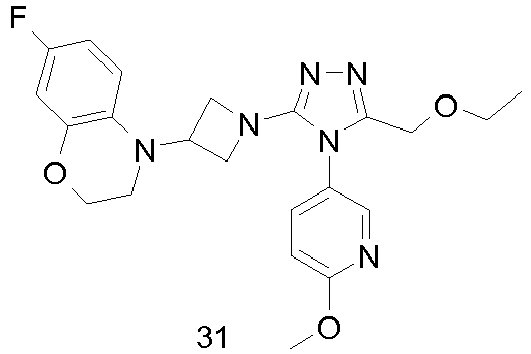
- The synthetic route of Example 24 was applied except that the starting material 2-methoxyacetylhydrazine in Step 6 was replaced with 2-ethoxyacetylhydrazine, to obtain the title product 31 (25 mg, brown paste).
MS m/z (ESI): 441.4 [M+1].
1H NMR (400 MHz, CD3OD) δ 8.31 (d, 1H), 7.83-7.80 (m, 1H), 7.00 (d, 1H), 6.51-6.47 (m, 2H), 6.39-6.36 (m, 1H), 4.35-4.30 (m, 5H), 4.02-4.00 (m, 5H), 3.97-3.63 (m, 2H), 3.47-3.40 (m, 2H), 3.16-3.14 (m, 2H), 1.11-1.08 (m, 3H). -

- The synthetic route of Example 24 was applied except thatthe starting material 2-methoxyacetylhydrazine in Step 6 was replaced with acetylhydrazine, to obtain the title product 32 (25 mg, brown paste).
MS m/z (ESI): 397.4 [M+1].
1H NMR (400 MHz, CD3OD) δ 8.28 (d, 1H), 7.80-7.77 (m, 1H), 7.00 (d, 1H), 6.51-6.47 (m, 2H), 6.39-6.36 (m, 1H), 4.31-4.28 (m, 3H), 4.02-4.00 (m, 5H), 3.97-3.63 (m, 2H), 3.16-3.14 (m, 2H), 2.20 (s, 3H). -


- The synthetic route of Example 15 was applied except thatthe starting material 15a in Step 1 was replaced with 5-fluoro-1H-indazole, to obtain the product methyl (E)-3-(5-fluoro-1H-indazol-1-yl)-N-(6-methoxypyridin-3-yl)azetidine-1-carbimidothioa te 33a (75 mg, yellow oil) in Step 4, yield: 26%.
MS m/z (ESI): 372.1 [M+1]. - 33a (50 mg, 0.13 mmol), 2-methoxyacetylhydrazine (70.07 mg, 0.67 mmol) and trifluoroacetic acid (1.53 mg, 0.01 mmol) were dissolved in 5 mL of tetrahydrofuran. After addition, the reaction solution was heated to 70°C and reacted for 3 hours. The reaction solution was concentrated under reduced pressure, and the resulting residues were purified by thin layer chromatography with developing solvent system A to obtain the title product 33 (8 mg, yellow solid), yield: 13.82%.
MS m/z (ESI): 410.2 [M+1].
1H NMR (400 MHz, CDCl3) δ 8.24 (s, 1H), 7.99 (s, 1H), 7.65 (d, 1H), 7.34 (t, 2H), 7.16 (t, 1H), 6.86 (d, 1H), 5.45-5.43 (m, 1H), 4.52 (m,2H), 4.35 (s, 2H), 4.28 (t, 2H), 3.97 (s, 3H), 3.30 (s, 3H). -


- The crude product benzyl 2-(difluoromethoxy)acetate 34a (140 mg, 1.67 mmol, prepared according to the method disclosed in the patent application "
WO2015180612 ") and hydrazine hydrate (85%, 57.2 mg) were added to 3 mL of ethanol. The reaction solution was added to a sealed tube, and stirred at 80°C for 15 hours. After stopping heating, the reaction solution was concentrated under reduced pressure to obtain the crude title product 34b (100 mg), which was used directly in the next step without purification.
MS m/z (ESI):141.1 [M+1]. - The synthetic route of Example 5 was applied except that the starting material 2-ethoxyacetylhydrazine in Step 6 was replaced with compound 34b, to obtain the title product 34 (10 mg, white solid).
MS m/z (ESI): 459.2 [M+1].
1H NMR (400 MHz, CD3OD) δ 8.34 (d, 1H), 7.85-7.83 (m, 1H), 7.36-7.17 (m, 2H) 7.16-7.14 (m, 1H), 6.99 (d, 1H), 6.97-6.91 (m, 1H), 6.39 (t, 1H), 5.37-5.33 (m, 1H), 4.84 (s, 2H), 4.36-4.32 (m, 2H), 4.15-4.13 (m, 2H), 3.98 (s, 3H), 2.26 (s, 3H). -

- The synthetic route of Example 24 was applied except thatthe starting material 2-methoxyacetylhydrazine (Shanghai Bide Pharmatech Ltd.) in Step 6 was replaced with 2,2-difluoroacetylhydrazine, to obtain the title product 35 (20 mg, white solid).
MS m/z (ESI): 433.2 [M+1].
1H NMR (400 MHz, CD3OD) δ 8.26 (d, 1H), 7.63-7.60 (m, 1H), 6.94 (d, 1H), 6.78 (s, 1H), 6.60-6.58 (m, 1H), 6.57-6.52 (m, 1H), 6.24-6.21 (m, 1H), 4.36-4.17 (m, 3H), 4.06 (s, 3H), 4.04-4.02 (m, 4H), 3.17-3.15 (m, 2H). -


- The synthetic route of Example 26 was applied except thatthe starting material 2-methoxyacetylhydrazine was replaced with hydroxymethylacetylhydrazine (Shanghai Bide Pharmatech Ltd.), to obtain (5-(3-(6-fluoro-3,4-dihydroquinolin-1(2H)-yl)azetidin-1-yl)-4-(6-methoxypyridin-3-yl)-4H-1,2,4-triazol-3-yl)methanol 36a. 36a (200 mg, 0.48 mmol) and triethylamine (101 mg, 1 mmol) were dissolved in 10 mL of dichloromethane. The above reaction solution was added with methylsulfonyl chloride (58 mg, 0.5 mmol) in an ice bath, and then slowly warmed up to room temperature, and reacted for 3 hours. The reaction solution was concentrated under reduced pressure until dryness, and the residues were dissolved in 10 mL of N,N-dimethylformamide and added with sodium azide (65 mg, 1 mmol). The reaction solution was poured into 30 mL of water, extracted with ethyl acetate (30 mL×3), and washed with saturated sodium chloride solution (30 mL×2). The organic phases were combined, dried over anhydrous sodium sulfate, and filtered. The filtrate was concentrated under reduced pressure to obtain the title product 36b (165 mg, white solid), yield: 75.3%.
MS m/z (ESI): 436.1 [M+1]. - 36b (130 mg, 0.3 mmol) was dissolved in 10 mL of methanol, and added with 10% Pd/C (300 mg, 0.3 mmol). The reaction system was purged with hydrogen for three times, and the reaction solution was reacted under hydrogen atmosphere for 3 hours. The reaction solution was filtered, and the filtrate was concentrated under reduced pressure to obtain the crude title product 36c (130 mg, white solid), yield: 100%.
MS m/z (ESI): 410.2[M+1]. - 36c (41 mg, 0.1 mmol) and triethylamine (20.2 mg, 0.2 mmol) were dissolved in 10 mL of dichloromethane. The above reaction solution was added with methyl chloroformate (58 mg, 0.5 mmol) in an ice bath, and then slowly warmed up to room temperature, and reacted for 3 hours. The reaction solution was poured into 30 mL of water, extracted with dichloromethane (20 mL×3), and washed with saturated sodium chloride solution (30 mL×2). The organic phases were combined, dried over anhydrous sodium sulfate, and filtered. The filtrate was concentrated under reduced pressure, and the resulting residues were purified by HPLC to obtain the title product 36 (10 mg, white solid), yield: 21.3%.
MS m/z (ESI): 468.2[M+1].
1H NMR (400 MHz, CD3OD) δ 8.25 (d, 1H), 7.77-7.74 (m, 1H), 6.96 (d, 1H), 6.74-6.69 (m, 2H), 6.29-6.26 (m, 1H), 4.35-4.31 (m, 1H), 4.25 (s, 2H), 4.03-3.97 (m, 7H), 3.53 (s, 3H), 3.07 (t, 2H), 2.70 (t, 2H), 2.03-1.91 (m, 2H). -

- The synthetic route of Example 24 was applied except thatthe starting material 2-methoxyacetylhydrazine in Step 6 was replaced with compound 34b, to obtain the title product 37 (20 mg, white solid).
MS m/z (ESI): 463.2 [M+1].
1H NMR (400 MHz, CD3OD) δ 8.23 (d, 1H), 7.61-7.59 (m, 1H), 6.95 (d, 1H), 6.60-6.57 (m, 1H), 6.52-6.50 (m, 1H), 6.25-6.21 (m, 2H), 4.82 (s, 2H), 4.35-4.28 (m, 3H), 4.06 (s, 3H), 4.03-4.01 (m, 4H), 3.18-3.16 (m, 2H). -

- The synthetic route of Example 2 was applied except that the starting material 2-methoxyacetylhydrazine in Step 6 was replaced with compound 34b, to obtain the title product 38 (15 mg, pale yellow solid).
MS m/z (ESI): 456.4 [M+1].
1H NMR (400 MHz, CDCl3) δ 8.21 (d, 1H), 7.70 (d, 1H), 7.61-7.59 (m, 1H), 7.58 (d, 1H), 7.49-7.46 (m, 2H), 7.36 (d, 1H), 7.27 (d, 1H), 6.91 (d, 1H), 6.19 (t, 1H), 4.78 (s, 2H), 4.57-4.54 (m, 1H), 4.29 (t, 2H), 4.17 (t, 2H), 4.01 (s, 3H). -
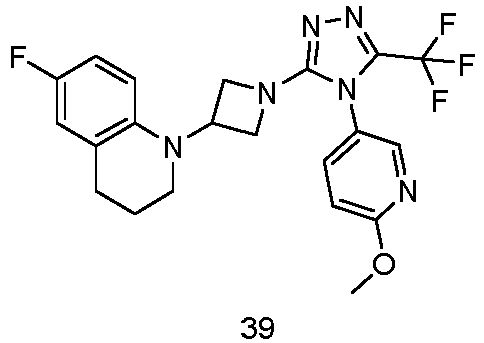
- The synthetic route of Example 26 was applied except that the starting material 2-ethoxyacetylhydrazine in Step 5 was replaced with 2,2,2-trifluoroacetylhydrazine (Shanghai Bide Pharmatech Ltd.), to obtain the title product 39 (20 mg, white solid).
MS m/z (ESI): 449.5 [M+1].
1H NMR (400 MHz, CD3OD) δ 8.35 (d, 1H), 7.87 (dd, 1H), 7.01 (d, 1H), 6.78-6.68 (m, 2H), 6.29 (dd, 1H), 4.45-4.37 (m, 1H), 4.08-3.98 (m, 7H), 3.08 (t, 2H), 2.71 (t, 2H), 1.98-1.89 (m, 2H). -

- The synthetic route of Example 36 was applied except thatthe starting material methyl chloroformate in Step 3 was replaced with methylsulfonyl chloride, to obtain the title product 40 (10 mg, white solid).
MS m/z (ESI): 488.3[M+1].
1H NMR (400 MHz, CD3OD) δ 8.29 (d, 1H), 7.81-7.79 (m, 1H), 6.99 (d, 1H), 6.75-6.69 (m, 2H), 6.29-6.26 (m, 1H), 4.36-4.34 (m, 1H), 4.20 (s, 2H), 4.01-3.90 (m, 7H), 3.07 (t, 2H), 2.88 (s, 3H), 2.72-2.67 (m, 2H), 2.03-1.91 (m, 2H). -

- The synthetic route of Example 2 was applied except thatthe starting material 2-methoxyacetylhydrazine in Step 6 was replaced with 2-hydroxylacetylhydrazine (Shanghai Bide Pharmatech Ltd.), to obtain the title product 41 (20 mg, white solid).
MS m/z (ESI): 406.1 [M+1].
1H NMR (400 MHz, CD3OD) δ 8.23 (d, 1H), 7.86-7.83 (m, 2H), 7.76 (d, 1H), 7.57-7.51 (m, 2H), 7.43-7.41 (m, 1H), 7.33-7.32 (m, 1H), 7.00 (d, 2H), 4.67-4.63 (m, 1H), 4.46 (s, 2H), 4.32 (t, 2H), 4.09 (s, 2H), 4.00 (s, 3H). -

- The synthetic route of Example 19 was applied except that the starting material 19a in Step 1 was replaced with 6-fluoro-4,4-dimethyl-1,2,3,4-tetrahydroquinoline (prepared according to the known method disclosed in "Bioorganic and Medicinal Chemistry Letters, 2008, 18(5), 1617-1622"), to obtain the title product 42 (20 mg, brown solid).
MS m/z (ESI): 453.2 [M+1].
1H NMR (400 MHz, CD3OD) δ 8.29 (d, 1H), 7.82-7.79 (m, 1H), 7.00-6.93 (m, 2H), 6.77-6.70 (m, 1H), 6.27-6.23 (m, 1H), 4.40-4.38 (m, 3H), 3.99-3.88 (m, 7H), 3.25 (s, 3H), 3.13 (t, 2H), 1.76 (t, 2H), 1.29 (s, 6H). -

- The synthetic route of Example 24 was applied except thatthe starting material 2-methoxyacetylhydrazine in Step 6 was replaced with 2,2,2-trifluoroacetylhydrazine, to obtain the title product 43 (20 mg, pale yellow solid).
MS m/z (ESI): 451.2 [M+1].
1H NMR (400 MHz, CDCl3) δ 8.19 (d, 1H), 7.56 (d, 1H), 6.92 (d, 1H), 6.56 (d, 1H), 6.48 (t, 1H), 6.19-6.17 (m, 1H), 4.32-4.30 (m, 3H), 4.03-4.01 (m, 7H), 3.13 (t, 2H). -

- The title product was prepared according to the method disclosed in the patent application "
WO2006077496 ".
MS m/z (ESI): 420.3 [M+1].
1H NMR (400 MHz, CDCl3) δ 8.19-8.25 (m, 1H), 7.62 (dd, 1H), 7.13 (dd, 1H), 6.83-6.92 (m, 2H), 6.51 (dd, 1H), 4.87-4.94 (m, 1H), 4.32 (s, 2H), 4.13-4.20 (m, 2H), 3.98-4.06 (m, 5H), 3.30 (s, 3H). - The inhibition effect of the compounds of the present invention on the activity of human OTR protein expressed in HEK293/human OTR stably transfected cells was determined by the following experimental method:
-
- 1. Fluo-4 NW calcium assay kit (F36206, invitrogen)
- 2. MEM (Hyclone, SH30024.01B)
- 3. G418 sulfate (Enzo, ALX-380-013-G005)
- 4. Fetal bovine serum (GIBCO, 10099)
- 5. Sodium pyruvate solution (sigma, S8636-100ML)
- 6. MEM non-essential amino acid solution (100×) (sigma, M7145-100ML)
- 7. Flexstation 3 multi-function microplate reader (Molecular Devices)
- 8. Poly-D-lysine 96-well plate, black/clear (356692, BD)
- 9. Oxytocin (synthesized by GL Biochem Ltd.)
- 10. pcDNA3.1 (invitrogen, V79020)
- 11. pcDNA3.1-hOTR (NM-000706) (synthesized and constructed into pcDNA3.1 plasmid by GENEWIZ Biological Technology Co., Ltd)
- 12. HEK293 cells (Cat. No. GNHu18, Cell bank of Chinese Academy of Sciences)
- The pcDNA3.1-hOTR plasmid was transferred into HEK293 cells with the Lipofectamine® 3000 transfection reagent; G418 was added on the next day to screen, and monoclonal cell lines were selected.
- HEK293/human OTR stably transfected cells were inoculated in a 96-well plate with an inoculation density of 25,000 cells/well one day in advance. On the next day, a loading buffer containing Fluo-4 dye was formulated using the reagents in the Fluo-4 NW calcium assay kit, and the culture medium was then removed; 100 µl of the loading buffer containing Fluo-4 dye were added to each well, and the plate was incubated at 37°C for 30 minutes. After that, the plate was moved to room temperature and equilibrated for 10 minutes. The compounds were formulated at 106, 105, 104, 103, 102 and 101 nM. 1 µl of the compounds in each concentration was added to each well, and the plate was incubated at room temperature for 10 minutes. 50 µl of oxytocin polypeptide (3 nM) were automatically added by the machine, and the values were immediately detected at 494/516 nM by the flexstation 3 microplate reader. IC50 values of the compounds were calculated by Graphpad prism software using fluorescence signals corresponding to different concentrations.
- The inhibition activity of the compounds of the present invention on human OTR was determined by the above test, and the obtained IC50 values are shown in Table 1.
Table 1 IC50 of inhibition activity of the compounds of the present invention on human OTR Example No. IC50(nM) 2 2 5 188 9 40 10 91 11 221 14 130 17 64 19 41 20 104 21 25 22 177 24 100 25 23 26 7 27 8 28 231 29 64 30 4 31 79 34 8 35 181 36 124 37 4 38 2 39 6 41 150 42 23 43 15 - Conclusion: The compounds of the present invention have a significant inhibition effect on the human OTR activity.
- The inhibition effect of the compounds of the present invention on the activity of human VlaR protein expressed in HEK293/human VlaR stably transfected cells was determined by the following experimental method:
-
- 1. Fluo-4 NW calcium assay kit (F36206, invitrogen)
- 2. MEM (Hyclone, SH30024.01B)
- 3. G418 sulfate (Enzo, ALX-380-013-G005)
- 4. Fetal bovine serum (GIBCO, 10099)
- 5. Sodium pyruvate solution (sigma, S8636-100ML)
- 6. MEM non-essential amino acid solution (100×) (sigma, M7145-100ML)
- 7. Flexstation 3 multi-function microplate reader (Molecular Devices)
- 8. Poly-D-lysine 96-well plate, black/clear (356692, BD)
- 9. Vasopressin (Tocris, 2935)
- 10. pcDNA3.1 (invitrogen, V79020)
- 11. pcDNA3.1-V1aR (NM-000706) (synthesized and constructed into pcDNA3.1 plasmid by GENEWIZ Biological Technology Co., Ltd)
- 12. HEK293 cells (Cat. No. GNHu18, Cell Bank of Chinese Academy of Sciences)
- The pcDNA3.1-V1aR plasmid was transferred into HEK293 cells with the Lipofectamine® 3000 transfection reagent; G418 was added on the next day to screen, and monoclonal cell lines were selected.
- HEK293/human VlaR stably transfected cells were inoculated in a 96-well plate with an inoculation density of 25,000 cells/well one day in advance. On the next day, a loading buffer containing Fluo-4 dye was formulated using the reagents in the Fluo-4 NW calcium assay kit, and the culture medium was then removed; 100 µl of the loading buffer containing Fluo-4 dye were added to each well, and the plate was incubated at 37°C for 30 minutes. After that, the plate was moved to room temperature and equilibrated for 10 minutes. The compounds were formulated at 106, 105, 104, 103, 102 and 101 nM. 1 µl of the compounds in each concentrationt was added to each well, and the plate was incubated at room temperature for 10 minutes. 50 µl of vasopressin polypeptide (3 nM) were automatically added by the machine, and the values were immediately detected at 494/516 nM by the flexstation 3 microplate reader. IC50 values of the compounds were calculated by Graphpad prism software using fluorescence signals corresponding to different concentrations.
- The inhibition activity of the compounds of the present invention on human V1aR was determined by the above test, and the obtained IC50 values are shown in Table 2.
Table 2 IC50 of inhibition activity of the compounds of the present invention on human V1aR Example No. IC50(µM) 1 18.1 2 4.5 3 7.0 4 2.3 6 4.7 7 6.7 9 1.2 10 5.7 11 2.3 13 11.9 14 10.9 17 4.4 18 59.5 19 2.0 20 3.1 21 2.7 22 7.5 24 10.7 28 2.4 29 6.2 30 8.5 31 3.5 32 23.0 35 14.1 36 2.1 37 1.7 39 2 41 9.0 42 4.5 43 7.9 - Conclusion: The compounds of the present invention have a weak inhibition effect on the human V1aR activity, indicating that the compounds of the present invention have a selective inhibition effect on the OTR activity.
- The inhibition effect of the compounds of the present invention on the activity of human V1bR protein expressed in HEK293/human V1bR cells was determined by the following experimental method:
-
- 1. Fluo-4 NW calcium assay kit (F36206, invitrogen)
- 2. MEM (Hyclone, SH30024.01B)
- 3. G418 sulfate (Enzo, ALX-380-013-G005)
- 4. Fetal bovine serum (GIBCO, 10099)
- 5. Sodium pyruvate solution (sigma, S8636-100ML)
- 6. MEM non-essential amino acid solution (100×) (sigma, M7145-100ML)
- 7. Flexstation 3 multi-function microplate reader (Molecular Devices)
- 8. Poly-D-lysine 96-well plate, black/clear (356692, BD)
- 9. Vasopressin (Tocris, 2935)
- 10. pcDNA3.1 (invitrogen, V79020)
- 11. pcDNA3.1-V1bR (NM-000706) (synthesized and constructed into pcDNA3.1 plasmid by GENEWIZ Biological Technology Co., Ltd)
- 12. HEK293 cells (Cat. No. GNHu18, Cell Bank of Chinese Academy of Sciences)
- The pcDNA3.1-V1bR plasmid was transferred into HEK293 cells with the Lipofectamine® 3000 transfection reagent; G418 was added on the next day, and the HEK293/human V1bR pool cell lines were obtained.
- HEK293/human V1bR pool cells were inoculated in a 96-well plate with an inoculation density of 25,000 cells/well one day in advance. On the next day, a loading buffer containing Fluo-4 dye was formulated using the reagents in the Fluo-4 NW calcium assay kit, and the culture medium was then removed; 100 µl of the loading buffer containing Fluo-4 dye were added to each well, and the plate was incubated at 37°C for 30 minutes. After that, the plate was moved to room temperature and equilibrated for 10 minutes. The compounds were formulated into 106, 105, 104, 103, 102 and 101 nM. 1 µl of the compounds in each concentration was added to each well, and the plate was incubated at room temperature for 10 minutes. 50 µl of vasopressin polypeptide (3 nM) were automatically added by the machine, and the values were immediately detected at 494/516 nM by the flexstation 3 microplate reader. IC50 values of the compounds were calculated by Graphpad prism software using fluorescence signals corresponding to different concentrations.
- The inhibition activity of the compounds of the present invention on human V1bR was determined by the above test, and the obtained IC50 values are shown in Table 3.
Table 3 IC50 of inhibition activity of the compounds of the present invention on human V1bR Example No. IC50(µM) 1 448 2 26 9 42.7 10 12.4 14 25.8 17 19.8 18 59.5 21 38.8 24 44.1 26 61.0 27 13.9 29 95.1 30 20.7 31 54.5 32 77.2 - Conclusion: The compounds of the present invention have no significant inhibition effect on the human V1bR activity, indicating that the compounds of the present invention have a selective inhibition effect on the OTR activity.
- The inhibition effect of the compounds of the present invention on the activity of human V2R protein expressed in HEK293/human V2R cells was determined by the following experimental method:
-
- 1. cAMP dynamic 2 kit - 1,000 tests (62AM4PEB, Cisbio)
- 2. MEM (Hyclone, SH30024.01B)
- 3. G418 sulfate (Enzo, ALX-380-013-G005)
- 4. Fetal bovine serum (GIBCO, 10099)
- 5. Sodium pyruvate solution (sigma, S8636-100ML)
- 6. MEM non-essential amino acid solution (100×) (sigma, M7145-100ML)
- 7. PheraStar multi-function microplate reader (BMG)
- 8. Corning/Costar 384-well non-adsorbing microplate - black NBS plate (4514, Corning)
- 9. Cell dissociation solution, enzyme-free, PBS (13151014-100ml, Thermo Fisher Scientific)
- 10. HBSS, calcium, magnesium, phenol red free (14025-092, Invitrogen)
- 11. HEPES, 1M buffer (15630-080, GIBCO)
- 12. BSA (0219989725, MP Biomedicals)
- 13. IBMX (I7018-250MG, sigma)
- 14. Vasopressin (Tocris, 2935)
- 15. pcDNA3.1 (invitrogen, V79020)
- 16. pcDNA3.1-V2R (NM-000054) (synthesized and constructed into pcDNA3.1 plasmid by GENEWIZ Biological Technology Co., Ltd)
- 17. HEK293 cells (Cat. No. GNHu18, Cell Bank of Chinese Academy of Sciences)
- The pcDNA3.1-V2R plasmid was transferred into HEK293 cells with the Lipofectamine® 3000 transfection reagent; G418 was added on the next day, and the HEK293/human V2R pool cell lines were obtained.
- HEK293/human V2R pool cells were dissociated with the cell dissociation solution (enzyme-free), thereby dissociating the cells from the cell culture dish into individual cells. Then the cell solution was blown well, and centrifuged to remove the supernatant. The cells were resuspended in the test buffer 1 (1x HBSS+20mM HEPES+0.1%BSA) and counted. The cell density was adjusted to 1250 cells/5 µl, i.e., 2.5∗105/ml.
- The compounds were formulated into a series of concentrations of 20 mM, 6.67 mM, 2.22 mM, 0.74 mM, 0.25 mM, 0.08 mM, 27.4 µM, 9.14 µM, 3.05 µM, 1.02 µM, 0.34 µM and 0 µM (DMSO) with pure DMSO. The compounds were then formulated into a 4-fold using concentration with the test buffer 2 (test buffer 1 + 1 mM IBMX).
- Agonist: 460 µM vasopressin was used as the mother liquor, which was formulated at 2 µM with DMSO, and then diluted at 0.5 nM with the
test buffer 2. - Standards: The first point was 20 µl of a stock solution (2848 nM), which was diluted successively to a total of eleven concentrations in 4 fold concentration gradient with the test buffer 1 from the second point.
-
- 1. The well-mixed cells were added to a 384-well plate (5µl/well) without changing the tip.
- 2. The test compounds and positive compound formulated were added (2.5 µl/well), and the tips should be changed.
- 3. The plate was centrifuged at 1000 rpm for 1 min, shaken for 30 sec to mix well, and incubated at room temperature for 30 min.
- 4. The standard curve wells were added with the test buffer 2 (5 µl/well).
- 5. The agonist formulated was added (2.5 µl/well), and the tips should be changed; the plate was centrifuged at 1000 rpm for 1 min, shaken for 30 sec to mix well, and incubated at room temperature for 30 min.
- 6. cAMP-d2 (a component in the cAMP dynamic 2 kit) and Anti-cAMP-Eu-Cryptate (a component in the cAMP dynamic 2 kit) were formulated in the dark, which were then mixed well with cAMP lysate (a component in the cAMP dynamic 2 kit) in a ratio of 1:4. Each well was added with the formulated cAMP-d2 solution (5 µl/well), followed by addition of Anti-cAMP-Eu-Cryptate (5 µl/well). The plate was shaken for 30 sec to mix well, and incubated in the dark at room temperature for 1h.
- 4) Plate reading: The HTRF signals were read by the PheraStar multi-function microplate reader.
- The data in this test was processed using the data processing software Graphpad Prism.
- The inhibition activity of the compounds of the present invention on human V2R was determined by the above test, and the IC50 values obtained are shown in Table 4.
Table 4 IC50 of inhibition activity of the compounds of the present invention on human V2R Example No. IC50(µM) 1 >100 2 4.9 9 12.5 10 20.7 11 25.7 14 11.8 17 10.9 18 59.4 21 17.3 23 52.0 24 67.2 26 1.4 27 9.1 29 12.1 30 6.7 31 5.8 32 >100 - Conclusion: The compounds of the present invention have no significant inhibition effect on the human V2R activity, indicating that the compounds of the present invention have a selective inhibition effect on the OTR activity.
- The activity of the compounds of the present invention on the brain permeability of rats was determined by the following experimental method:
-
- 1. RED Device Inserts (Thermo Scientific, QL21291110)
- 2. API 4000 Q-trap linear ion trap mass spectrometer (Applied Biosystems)
- 3. LC-30A ultra high pressure liquid chromatography system (Shimadzu)
- 4. pH 7.4 PBS (100 mM, stored in 4°C refrigerator)
- 5. SD rats, provided by Jiesijie Laboratory Animal Co., LTD, with Certificate No.: SCXK (Shanghai) 2013-0006.
- Four SD rats (half male and half female) were maintained in a 12 hours light/ 12 hours dark cycle, in a constant temperature of 24±3°C and a humidity of 50-60%, and free access to food and water. The compounds were administered intragastrically to the rats after fasting overnight. The administration dosage was 10 mg/kg. The administration group was sacrificed after blood collection at 0.5 h to 2 h after administration (blood volume: 0.5 ml). The blood sample was stored in heparinized tubes, and centrifuged for 10 minutes at 3500 rpm to separate the plasma, which was marked as plasma 1 and stored at 20°C. The animal was decapitated after sacrificing, and the brain tissue was collected. The residual blood in the brain tissue was sucked with a filter paper, which was marked as brain tissue 1, and stored at 0°C ten minutes later. Another three animals were treated by the same method as that of administration group to obtain blank plasma and
brain tissue 2. - The drug compounds were diluted to 50 mM with DMSO to obtain a stock solution I. An appropriate amount of stock solution I was diluted with methanol to obtain a diluted stock solution II (200 µM). 10 µl of stock solution II was moved to a 1.5 ml Eppendorf tube, and then added with 990 µl of blank plasma, and mixed well to obtain 2 µM of plasma sample 2 (concentration of DMSO ≤ 0.2%), which was used for the determination of plasma protein binding rate at this concentration. 50 µl of the above plasma sample formulated was marked as T0, and stored at -80°C in a refrigerator for testing.
- The equilibrium dialysis tube of RED Device Inserts was inserted into a 96-well plate. 300 µl of the
above plasma sample 2 containing test compound and corresponding blank plasma sample were added to wells with red mark (plasma chamber). 500 µl of phosphate buffer solution (pH 7.4) was added to another well side-by-side with red mark too (buffer chamber). According to the above procedures, each concentration of each compound had 2-3 samples. Then, the 96-well plate was covered by a sealing tape, and the entire plate was placed in a heat mixer and equilibrated at 37°C at 400 rpm for 4 h. The 96-well plate device was removed from the heat mixer after incubation to achieve equilibrium dialysis. 50 µl of equilibrated plasma sample or dialysate sample was added with 50 µl of corresponding unequilibrated blank phosphate buffer solution free of compounds or blank plasma free of compounds, and then added with 300 µl of internal standard (formulated with acetonitrile), vortex-mixed for 5 min, and centrifuged for 10 minutes (4000 rpm). The supernatant was collected for LC/MS/MS analysis. T0 sample was not subjected to incubation. The chromatographic peak area ratios of the total drug (plasma chamber) and the free drug (buffer chamber) to the internal standard were determined directly by the LC/MS/MS method established above respectively, and the free percent (fu plasma %) was calculated. - Brain tissue protein binding equilibrium dialysis process: the
blank brain tissue 2 was formulated into a blank brain homogenate with PBS (pH 7.4) according to a dilution factor of 11, and added with compound to formulate a 2 µM brain homogenate. Other procedures were the same with that of plasma protein binding, the chromatographic peak area ratios of the total drug (brain homo chamber) and the free drug (buffer chamber) to the internal standard were determined by the established LC/MS/MS method respectively, and the free percent (fu brain hom %) was calculated. -
- 1) The drug concentrations in plasma 1 and brain tissue 1 of rats 0.5 h after administration were determined by the established LC/MS/MS method respectively, which were the total concentration (Ctotal, p and Ctotal, b);
- 2) The protein binding rates of the compound in the plasma and brain tissue of rat were determined respectively by equilibrium dialysis method with the RED Device Inserts device, so as to calculate the free percent (fu plasma %, fu brain %);


- 3) The blood-brain permeability index Kp-unbound was calculated using the following formula.

- The brain permeability indexes of the compounds of the present invention are shown below:
No. Kp-unbound Example 2 0.199 Example 17 0.295 Example 38 0.175 Positive control Example 25 in WO2006077496 0.064 - Conclusion: The compounds of the present invention have good brain permeability, which is more than three times of that of the positive control compound.
- Male SD rats were used as test animals. The drug concentration in plasma at different time points was determined by LC/MS/MS method after intragastrical administration of the compounds of Examples 2, 17, 34, 37, 38, 39 and 43 to rats. The pharmacokinetic behavior of the compounds of the present invention was studied and evaluated in rats.
- Compounds of Examples 2, 17, 34, 37, 38, 39 and 43.
- Twenty-one healthy adult male Sprague-Dawley (SD) rats were purchased from Shanghai Jiesijie Laboratory Animal Co., LTD, with Certificate No.: SCXK (Shanghai) 2013-0006, and equally divided into 7 groups (3 rats per group).
- A certain amount of the test compound was weighed, and added with 2.5% by volume of DMSO and 97.5% by volume of 10% solutol HS-15 to formulate a 0.2 mg/mL colorless, clear and transparent solution.
- After an overnight fast, SD rats were administered intragastrically the test compounds at an administration dosage of 30.0 mg/kg and an administration volume of 10.0 mL/kg.
- The rats were intragastrically administered the compounds of Examples 2, 17, 34, 37, 38, 39 and 43. 0.2 mL of blood was taken from the orbital sinus before administration and at 0.5, 1.0, 2.0, 4.0, 6.0, 8.0, 11.0 and 24.0 hours after administration. The samples were stored in heparinized tubes, and centrifuged for 10 minutes at 4°C at 3500 rpm to separate the plasma. The plasma samples were stored at -20°C. The rats were fed 2 hours after administration.
- The content of the test compounds in the plasma of rats after intragastrical administration of the test compounds at different concentrations was determined: 50 µL of rat plasma at each time after administration was taken, added with 50 µL of the internal standard solution of camptothecin (100 ng/mL) and 150 µL of acetonitrile, vortex-mixed for 5 minutes, and centrifuged for 10 minutes (4000 rpm). 3 µL of the supernatant was taken from the plasma samples for LC/MS/MS analysis.
- Pharmacokinetic parameters of the compounds of the present invention are shown below:
No. Pharmacokinetics assay (30 mg/kg, male rats) Plasma concentration Area under curve Half-life Residence time Clearance Apparent distribution volume Cmax (ng /mL) AUC (ng/mL∗h) T1/2 (h) MRT (h) CLz/F (ml/min/kg) Vz/F (ml/kg) Example 2 3930±3026 8580±3564 0.91±0.25 2.46±1.44 63.8±26.5 5294±3442 Example 17 2020±580 11188±439 1 3.35±0.399 5.08±0.552 48±19 13694±3831 Example 34 1073±252 5328±981 2.16±0.345 3.84±1.08 95.8±16.0 17805±3334 Example 37 1115±950 8185±9853 2.95±0.42 4.90±1.36 201±223 56326±65981 Example 38 1055±270 5626±3011 2.83±1.90 4.19±1.25 104±44 27799±22764 Example 39 1202±68.5 3832±83.7 3.09±0.199 3.61±0.022 131±2.85 34980±3010 Example 43 1579±601 5564±2329 3.31±0.23 106±59 3.81±0.12 31129±19284 - Conclusion: The compounds of the present invention are well absorbed, and have a pharmacokinetic advantage.
- Test Example 7. Experiment of treating oxytocin-induced rat uterine contraction model of OTR inhibitors
- The efficacy of OTR inhibitors (compound 2-10mpk, compound 2-30mpk and compound 2-100mpk) on oxytocin (OT)-induced rat uterine contraction model was evaluated by establishing a rat uterine contraction model.
-
- Oxytocin (OT, GL Biochem, customized, item No. 269099), stored at -80°C;
- Polyoxyethylene hydrogenated castor oil (Cremophor RH 40, Shanghai Chineway Pharmaceutical Technology Co., LTD.);
- Glyceryl monolinoleate (Masine35-1, GATTEFOSSE SAS);
- Ulatan, Shanghai Bide Pharmatech Ltd.;
- Compound 2-100mpk: 221.0 mg of
compound 2 was weighed, added with 5.40 ml of Cremophor RH40, 2.16 ml of Masine 35-1, 3.24 ml of polyethylene glycol 400 (PEG400) and 1.20 ml of ethanol respectively, and mixed well by ultrasonic vibration; - Compound 2-30mpk: 54.2 mg of
compound 2 was weighed, added with 4.50 ml of Cremophor RH40, 1.80 ml of Masine 35-1, 2.70 ml of polyethylene glycol 400 (PEG400) and 1.00 ml of ethanol respectively, and mixed well by ultrasonic vibration; - Compound 2-10mpk: 1 ml of compound 2-100mpk solution was added with 9 ml of solvent (45% of Cremophor RH40, 18% of Masine 35-1, 27% of PEG400 and 10% of ethanol), and mixed well.
- Forty laboratory female SD rats were purchased from Shanghai SLAC Laboratory Animal Co.,Ltd (Shanghai, China, Certificate No.: SCXK (Shanghai) 2012-0002, Qualification Certificate No.: 20150000541877), and weighed 180-200 g when purchased. The rats (5 rats per cage) were maintained in a 12 hours light/ 12 hours dark cycle, in a constant temperature of 23±1°C and a humidity of 50-60%, and free access to food and water. The animals were subjected to the test after purchasing and adaptive feeding.
- After adaptive feeding, the SD rats were grouped as follows:
Groups N Inducing agent Administration dosage Administration volume and route Solvent group 10 1µg/kg OT - 6 ml/kg, p.o. Compound 2-10mpk 10 1µg/kg OT 10 mg/kg 6 ml/kg, p.o. Compound 2-30mpk 10 1µg/kg OT 30 mg/kg 6 ml/kg, p.o. Compound 2-100mpk 10 1µg/kg OT 100 mg/kg 6 ml/kg, p.o. Note: p.o. refers to oral administration. - The SD rats were adaptively feed to appropriate body weight and randomly grouped as follows: solvent group, compound 2-10mpk, compound 2-30mpk and compound 2-100mpk. The drug was orally administrated to the animal one hour before modeling. The animal was anaesthetized 20 minutes after administration (by 8 ml/kg of 20% urethane). A PE catheter was inserted into the jugular vein for intravenous administration, which was filled with physiological saline. The abdomen was opened. The left cornua uteri near the ovarian side was ligatured, and wired at a distance of 3 cm from the ovary. An incision was made, and inserted a PE catheter connected with a pressure transducer, which was injected with 0.1 ml of normal saline through a tee after ligation. The multi-function signal acquisition and processing system was connected. After pressure equilibrium, 1µg/kg of OT was administrated intravenously one hour after administration of the drug, and the change in uterine pressure within 10-15 minutes was observed.
- After completion of the experiment, the area under curve (AUC) of the uterine contraction pressure 5 minutes before and after the administration of the inducing agent was calculated respectively. The efficacy of the test compound was evaluated by calculating the ratio of the difference value in AUC before and after induction to the AUC before induction, and comparing with the difference value of the ratio after administration of the test compound.

- AUC0 : area under curve before induction; AUCT : area under curve after induction.
- The efficacy of
compound 2 on the OT-induced rat uterine contraction model is shown inFigure 1 . - Comparing to the solvent control group, 30mpk and 100mpk of
compound 2 can effectively block the downstream function (uterine contraction) of oxytocin receptors mediated by oxytocin. The uterine contraction model can quantitatively characterize the OTR antagonistic activity of the compound. Documents have reported that the oxytocin receptors in the male brain are closely related to the ejaculation function of male. Therefore, the compounds of the present invention having a strong oxytocin receptor antagonistic function can be used for the treatment of male sexual dysfunction under the condition of having a good brain permeability.
Claims (19)
- A compound of formula (I):

wherein:G is selected from the group consisting of C, CH and N;ring A is aryl or heteroaryl;ring B is selected from the group consisting of cycloalkyl, heterocyclyl, aryl and heteroaryl;R1 is alkyl, wherein the alkyl is optionally substituted by one or more substituents selected from the group consisting of alkoxy, halogen, haloalkyl, haloalkoxy, hydroxy, hydroxyalkyl, cyano, amino, nitro, cycloalkyl, heterocyclyl, heterocyclyloxy, NHS(O)sR5, NHC(O)OR5, aryl and heteroaryl;each R2 is identical or unidentical and each is independently selected from the group consisting of hydrogen, halogen, alkyl, alkoxy, haloalkyl, oxo, hydroxy, hydroxyalkyl, cyano, amino, nitro, cycloalkyl, heterocyclyl and -C(O)OR5;each R3 is identical or unidentical and each is independently selected from the group consisting of hydrogen, halogen, alkyl, alkoxy, haloalkyl, hydroxy, hydroxyalkyl, cyano, amino, nitro, cycloalkyl and heterocyclyl;each R4 is identical or unidentical and each is independently selected from the group consisting of hydrogen, halogen, alkyl, alkoxy, haloalkyl, oxo, hydroxy, hydroxyalkyl, cyano, amino, nitro, cycloalkyl, heterocyclyl and -C(O)OR5;R5 is selected from the group consisting of hydrogen, alkyl, haloalkyl, hydroxyalkyl, cycloalkyl, heterocyclyl, aryl and heteroaryl;s is 0, 1 or 2;n is 0, 1, 2, 3 or 4;m is 0, 1, 2, 3 or 4; andt is 0, 1, 2 or 3. - The compound of formula (I) according to claim 1, which is a compound of formula (II):

wherein:---- is a single bond or a double bond;G is selected from the group consisting of C, CH and N;G1 is selected from the group consisting of N, NH, C, CH, CH2, O and S;G2 is selected from the group consisting of C, CH, CH2, N and NH;x is 0 or 1;y is 0 or 1; andring A, R1∼R4, n, m and t are as defined in claim 1. - The compound of formula (I) according to claims 1 or 2, which is a compound of formula (III):

wherein:G is selected from the group consisting of C, CH and N;G1 is selected from the group consisting of N, NH, C, CH, CH2 and O;R1∼R4, n and t are as defined in claim 1. - The compound of formula (I) according to claims 1 or 2, which is a compound of formula (IV):

wherein:---- is a single bond or a double bond;G is selected from the group consisting of C, CH and N;G1 is selected from the group consisting of N, NH, C, CH, CH2, O and S;G2 is selected from the group consisting of C, CH, CH2, N and NH;R1∼R4, n and t are as defined in claim 1. - The compound of formula (I) according to claims 1 or 2, wherein ring A is pyridyl or benzodioxole; and preferably

- The compound of formula (I) according to claims 1 or 5, wherein


R2, R4, n and t are as defined in claim 1. - The compound of formula (I) according to any one of claims 1 to 6, wherein R1 is alkyl, wherein the alkyl is optionally substituted by one or more substituents selected from the group consisting of alkoxy, halogen, haloalkyl, haloalkoxy, hydroxy, NHS(O)sR5 and NHC(O)OR5; R5 is alkyl; and s is 0, 1 or 2.
- The compound of formula (I) according to any one of claims 1 to 7, wherein each R2 is identical or unidentical and each is independently selected from the group consisting of hydrogen, halogen, alkyl and haloalkyl.
- The compound of formula (I) according to any one of claims 1 to 8, wherein R3 is alkoxy.
- The compound of formula (I) according to any one of claims 1 to 9, wherein each R4 is identical or unidentical and each is independently selected from the group consisting of hydrogen, halogen, alkyl, haloalkyl, cyano, oxo and -C(O)OR5; and R5 is alkyl.
- The compound of formula (I) according to any one of claims 1 to 10, wherein n is 1 or 2; and m is 0 or 1.
- The compound of formula (I) according to any one of claims 1 to 11, which is selected from the group consisting of:


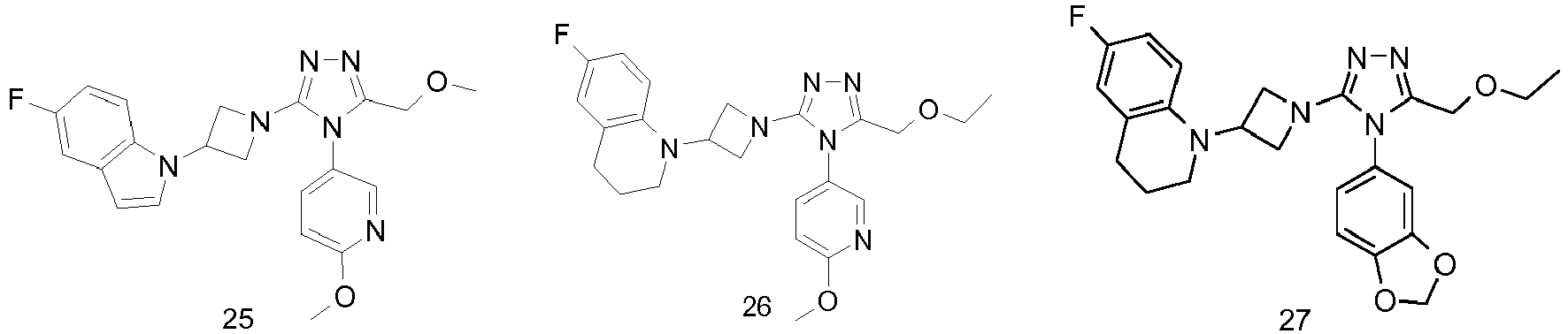


- A compound of formula (I-A):

wherein:G is selected from the group consisting of C, CH and N;ring A, ring B, R2∼R4, n, m and t are as defined in claim 1. - The compound of formula (I-A) according to claim 13, which is selected from the group consisting of:


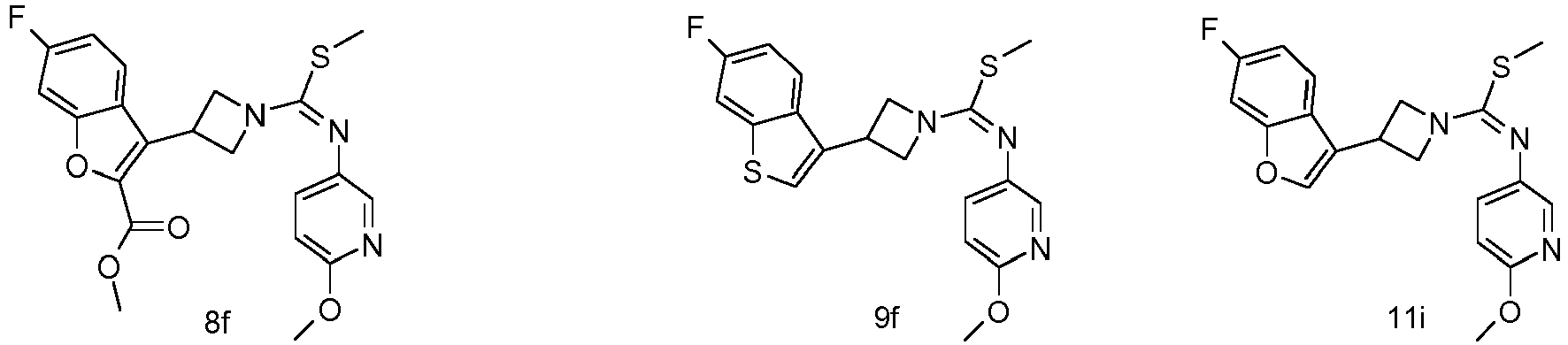


- A method for preparing the compound of formula (I) according to claim 1 comprising a step of:

wherein:
ring A, ring B, R1∼R4, G, n, m and t are as defined in claim 1. - A pharmaceutical composition comprising a therapeutically effective amount of the compound of formula (I) according to any one of claims 1 to 12, or a tautomer, mesomer, racemate, enantiomer, diastereomer thereof, or the mixture thereof, or a pharmaceutically acceptable salt thereof, and one or more pharmaceutically acceptable carriers, diluents or excipients.
- Use of the compound of formula (I) according to any one of claims 1 to 12, or a tautomer, mesomer, racemate, enantiomer, diastereomer thereof, or the mixture thereof, or a pharmaceutically acceptable salt thereof, or the pharmaceutical composition according to claim 16 in the preparation of medicaments for the treatment or prevention of diseases or conditions for which inhibition of oxytocin is known, or can be shown, to produce a beneficial effect.
- The use according to claim 17, wherein the diseases or conditions for which inhibition of oxytocin is known, or can be shown, to produce a beneficial effect is selected from the group consisting of sexual dysfunction, hypoactive sexual desire disorder, sexual arousal disorder, orgasmic disorder, sexual pain disorder, premature ejaculation, preterm labour, complications in labour, appetite and feeding disorders, benign prostatic hyperplasia, premature birth, dysmenorrhea, congestive heart failure, arterial hypertension, liver cirrhosis, nephrotic hypertension, ocular hypertension, obsessive and behavioral disorders and neuropsychiatric disorders, and preferably selected from the group consisting of sexual dysfunction, sexual arousal disorder, orgasmic disorder, sexual pain disorder and premature ejaculation.
- Use of the compound of formula (I) according to any one of claims 1 to 12, or a tautomer, mesomer, racemate, enantiomer, diastereomer thereof, or the mixture thereof, or a pharmaceutically acceptable salt thereof, or the pharmaceutical composition according to claim 16 in the preparation of medicaments for antagonizing oxytocin.
Applications Claiming Priority (2)
| Application Number | Priority Date | Filing Date | Title |
|---|---|---|---|
| CN201611191169 | 2016-12-21 | ||
| PCT/CN2017/117421 WO2018113694A1 (en) | 2016-12-21 | 2017-12-20 | Condensed ring group azacyclobutyl triazole derivative, preparation method therefor and use thereof in medicine |
Publications (2)
| Publication Number | Publication Date |
|---|---|
| EP3560918A1 true EP3560918A1 (en) | 2019-10-30 |
| EP3560918A4 EP3560918A4 (en) | 2020-05-20 |
Family
ID=62624494
Family Applications (1)
| Application Number | Title | Priority Date | Filing Date |
|---|---|---|---|
| EP17882608.7A Withdrawn EP3560918A4 (en) | 2016-12-21 | 2017-12-20 | CONDENSED RING GROUPS AZACYCLOBUTYL TRIAZOLE DERIVATIVE, PRODUCTION METHOD THEREFOR AND USE THEREOF IN MEDICINE |
Country Status (12)
| Country | Link |
|---|---|
| US (1) | US10889569B2 (en) |
| EP (1) | EP3560918A4 (en) |
| JP (1) | JP2020502211A (en) |
| KR (1) | KR20190094187A (en) |
| CN (1) | CN108884071B (en) |
| AU (1) | AU2017379024B2 (en) |
| BR (1) | BR112019011758A2 (en) |
| CA (1) | CA3047643A1 (en) |
| MX (1) | MX2019007213A (en) |
| RU (1) | RU2019118993A (en) |
| TW (1) | TW201823230A (en) |
| WO (1) | WO2018113694A1 (en) |
Families Citing this family (5)
| Publication number | Priority date | Publication date | Assignee | Title |
|---|---|---|---|---|
| TW202016092A (en) * | 2018-06-20 | 2020-05-01 | 大陸商江蘇恆瑞醫藥股份有限公司 | Crystal form of OTR inhibitor and preparation method thereof |
| WO2019242642A1 (en) * | 2018-06-20 | 2019-12-26 | 江苏恒瑞医药股份有限公司 | Pharmaceutically acceptable salt and crystal form of otr inhibitor and preparation method thereof |
| CN113004250B (en) * | 2019-12-19 | 2022-07-26 | 上海森辉医药有限公司 | Process for preparing substituted triazole derivatives |
| US20250101001A1 (en) * | 2021-12-15 | 2025-03-27 | Delix Therapeutics, Inc. | Constrained amine psychoplastogens and uses thereof |
| WO2024258988A2 (en) * | 2023-06-13 | 2024-12-19 | Delix Therapeutics, Inc. | Serotonin releasing compounds and uses thereof |
Family Cites Families (9)
| Publication number | Priority date | Publication date | Assignee | Title |
|---|---|---|---|---|
| EP1673355A1 (en) * | 2003-09-22 | 2006-06-28 | Pfizer Limited | Substituted triazole derivatives as oxytocin antagonists |
| WO2005082866A2 (en) | 2004-02-20 | 2005-09-09 | Pfizer Limited | Substituted 1, 2, 4- triazole derivatives as oxytocin antagonists |
| AP2007004047A0 (en) * | 2005-01-20 | 2007-06-30 | Pfizer Ltd | Substituted triazole derivatives as oxtocin antagonists |
| GB0504556D0 (en) | 2005-03-04 | 2005-04-13 | Pfizer Ltd | Novel pharmaceuticals |
| EP1863795B1 (en) | 2005-03-21 | 2008-10-29 | Pfizer Limited | Substituted triazole derivatives as oxytocin antagonists |
| US20080214622A1 (en) * | 2005-03-21 | 2008-09-04 | Alan Daniel Brown | Substituted Triazole Derivatives As Oxytocin Antagonists |
| US8829006B2 (en) | 2007-11-22 | 2014-09-09 | Boehringer Ingelheim International Gmbh | Compounds |
| WO2012094462A2 (en) | 2011-01-05 | 2012-07-12 | Bioenergenix | Heterocyclic compounds for the inhibition of pask |
| CN106536489B (en) | 2014-05-28 | 2020-02-07 | 葛兰素史密斯克莱知识产权发展有限公司 | Retinoid-related orphan receptor gamma modulators and uses thereof |
-
2017
- 2017-12-20 US US16/471,069 patent/US10889569B2/en not_active Expired - Fee Related
- 2017-12-20 BR BR112019011758-0A patent/BR112019011758A2/en not_active Application Discontinuation
- 2017-12-20 AU AU2017379024A patent/AU2017379024B2/en not_active Ceased
- 2017-12-20 CA CA3047643A patent/CA3047643A1/en not_active Abandoned
- 2017-12-20 CN CN201780020514.5A patent/CN108884071B/en active Active
- 2017-12-20 JP JP2019533464A patent/JP2020502211A/en not_active Withdrawn
- 2017-12-20 RU RU2019118993A patent/RU2019118993A/en not_active Application Discontinuation
- 2017-12-20 MX MX2019007213A patent/MX2019007213A/en unknown
- 2017-12-20 TW TW106144814A patent/TW201823230A/en unknown
- 2017-12-20 KR KR1020197018652A patent/KR20190094187A/en not_active Withdrawn
- 2017-12-20 EP EP17882608.7A patent/EP3560918A4/en not_active Withdrawn
- 2017-12-20 WO PCT/CN2017/117421 patent/WO2018113694A1/en not_active Ceased
Also Published As
| Publication number | Publication date |
|---|---|
| CN108884071A (en) | 2018-11-23 |
| JP2020502211A (en) | 2020-01-23 |
| US10889569B2 (en) | 2021-01-12 |
| RU2019118993A3 (en) | 2021-01-22 |
| AU2017379024A1 (en) | 2019-06-13 |
| BR112019011758A2 (en) | 2019-10-29 |
| TW201823230A (en) | 2018-07-01 |
| CA3047643A1 (en) | 2018-06-28 |
| RU2019118993A (en) | 2021-01-22 |
| EP3560918A4 (en) | 2020-05-20 |
| US20200017466A1 (en) | 2020-01-16 |
| CN108884071B (en) | 2021-05-14 |
| KR20190094187A (en) | 2019-08-12 |
| WO2018113694A1 (en) | 2018-06-28 |
| MX2019007213A (en) | 2019-08-16 |
| AU2017379024B2 (en) | 2021-03-04 |
Similar Documents
| Publication | Publication Date | Title |
|---|---|---|
| EP3378859B1 (en) | Benzofuran derivative, preparation method thereof and use thereof in medicine | |
| CN109311889B (en) | Activin receptor-like kinase inhibitors | |
| EP3560918A1 (en) | Condensed ring group azacyclobutyl triazole derivative, preparation method therefor and use thereof in medicine | |
| WO2024208305A1 (en) | Fused tetracyclic compound and preparation method therefor and use thereof in medicine | |
| CA2652852A1 (en) | Derivatives of ureas of piperidine or pyrrolidine, their preparation and their therapeutical use | |
| TW202102505A (en) | A pyrroloheterocyclic derivative and preparation method and medical use thereof | |
| TW201934554A (en) | Pyrazolo[1,5-a][1,3,5]triazin-2-amine derivatives, preparation method thereof and application thereof in medicine | |
| CN112028891B (en) | Adenosine receptor antagonists | |
| EP2896613A1 (en) | Sulfonamide compound | |
| CN116829556A (en) | Fused azatricyclic derivatives, their preparation methods and their applications in medicine | |
| AU2017389819B2 (en) | Azabicyclo-substituted triazole derivative, preparation method thereof, and application of same in medicine | |
| CN117430590A (en) | Cyclopropyl compounds, their preparation methods and their applications in medicine | |
| TW202214656A (en) | Oxazaspiro derivatives, their preparation method and their medical use | |
| WO2022161166A1 (en) | Targeting chimeric compound, pharmaceutical composition comprising same, preparation method therefor and use thereof | |
| CN113527307A (en) | Triazole group-containing fused ring derivative inhibitor, and preparation method and application thereof | |
| HK1261712A1 (en) | Condensed ring group azacyclobutyl triazole derivative, preparation method therefor and use thereof in medicine | |
| CN118638177A (en) | Heterocyclic compounds, preparation methods thereof and their application in medicine | |
| CN118791498A (en) | Tetracyclic compounds, preparation methods thereof and their medical applications | |
| WO2022161447A1 (en) | Dicarboxamide compound, preparation method therefor, and pharmaceutical use thereof | |
| CN116970029A (en) | Bridged ring compound, preparation method thereof and application thereof in medicine | |
| CN116925174A (en) | Urea compounds, their preparation methods and their applications in medicine | |
| WO2026026956A1 (en) | Tacc inhibitor compound, pharmaceutical composition, and preparation method therefor and use thereof | |
| WO2025252241A1 (en) | Macrocyclic derivatives and use thereof | |
| CN113549074A (en) | Triazole group-containing fused ring derivative inhibitor, and preparation method and application thereof | |
| HK40003732B (en) | Inhibitors of activin receptor-like kinase |
Legal Events
| Date | Code | Title | Description |
|---|---|---|---|
| STAA | Information on the status of an ep patent application or granted ep patent |
Free format text: STATUS: THE INTERNATIONAL PUBLICATION HAS BEEN MADE |
|
| PUAI | Public reference made under article 153(3) epc to a published international application that has entered the european phase |
Free format text: ORIGINAL CODE: 0009012 |
|
| STAA | Information on the status of an ep patent application or granted ep patent |
Free format text: STATUS: REQUEST FOR EXAMINATION WAS MADE |
|
| 17P | Request for examination filed |
Effective date: 20190719 |
|
| AK | Designated contracting states |
Kind code of ref document: A1 Designated state(s): AL AT BE BG CH CY CZ DE DK EE ES FI FR GB GR HR HU IE IS IT LI LT LU LV MC MK MT NL NO PL PT RO RS SE SI SK SM TR |
|
| AX | Request for extension of the european patent |
Extension state: BA ME |
|
| DAV | Request for validation of the european patent (deleted) | ||
| DAX | Request for extension of the european patent (deleted) | ||
| A4 | Supplementary search report drawn up and despatched |
Effective date: 20200421 |
|
| RIC1 | Information provided on ipc code assigned before grant |
Ipc: C07D 401/14 20060101AFI20200415BHEP Ipc: A61K 31/4196 20060101ALI20200415BHEP Ipc: A61K 31/397 20060101ALI20200415BHEP Ipc: A61P 15/00 20060101ALI20200415BHEP |
|
| STAA | Information on the status of an ep patent application or granted ep patent |
Free format text: STATUS: EXAMINATION IS IN PROGRESS |
|
| 17Q | First examination report despatched |
Effective date: 20210702 |
|
| STAA | Information on the status of an ep patent application or granted ep patent |
Free format text: STATUS: THE APPLICATION IS DEEMED TO BE WITHDRAWN |
|
| 18D | Application deemed to be withdrawn |
Effective date: 20211113 |