EP3560904A1 - Oriented aln sintered body, and production method therefor - Google Patents
Oriented aln sintered body, and production method therefor Download PDFInfo
- Publication number
- EP3560904A1 EP3560904A1 EP17884131.8A EP17884131A EP3560904A1 EP 3560904 A1 EP3560904 A1 EP 3560904A1 EP 17884131 A EP17884131 A EP 17884131A EP 3560904 A1 EP3560904 A1 EP 3560904A1
- Authority
- EP
- European Patent Office
- Prior art keywords
- aln
- sintered body
- plate
- powder
- oriented
- Prior art date
- Legal status (The legal status is an assumption and is not a legal conclusion. Google has not performed a legal analysis and makes no representation as to the accuracy of the status listed.)
- Granted
Links
Images


Classifications
-
- C—CHEMISTRY; METALLURGY
- C01—INORGANIC CHEMISTRY
- C01B—NON-METALLIC ELEMENTS; COMPOUNDS THEREOF; METALLOIDS OR COMPOUNDS THEREOF NOT COVERED BY SUBCLASS C01C
- C01B21/00—Nitrogen; Compounds thereof
- C01B21/06—Binary compounds of nitrogen with metals, with silicon, or with boron, or with carbon, i.e. nitrides; Compounds of nitrogen with more than one metal, silicon or boron
- C01B21/072—Binary compounds of nitrogen with metals, with silicon, or with boron, or with carbon, i.e. nitrides; Compounds of nitrogen with more than one metal, silicon or boron with aluminium
- C01B21/0728—After-treatment, e.g. grinding, purification
-
- C—CHEMISTRY; METALLURGY
- C04—CEMENTS; CONCRETE; ARTIFICIAL STONE; CERAMICS; REFRACTORIES
- C04B—LIME, MAGNESIA; SLAG; CEMENTS; COMPOSITIONS THEREOF, e.g. MORTARS, CONCRETE OR LIKE BUILDING MATERIALS; ARTIFICIAL STONE; CERAMICS; REFRACTORIES; TREATMENT OF NATURAL STONE
- C04B35/00—Shaped ceramic products characterised by their composition; Ceramics compositions; Processing powders of inorganic compounds preparatory to the manufacturing of ceramic products
- C04B35/515—Shaped ceramic products characterised by their composition; Ceramics compositions; Processing powders of inorganic compounds preparatory to the manufacturing of ceramic products based on non-oxide ceramics
- C04B35/58—Shaped ceramic products characterised by their composition; Ceramics compositions; Processing powders of inorganic compounds preparatory to the manufacturing of ceramic products based on non-oxide ceramics based on borides, nitrides, i.e. nitrides, oxynitrides, carbonitrides or oxycarbonitrides or silicides
- C04B35/581—Shaped ceramic products characterised by their composition; Ceramics compositions; Processing powders of inorganic compounds preparatory to the manufacturing of ceramic products based on non-oxide ceramics based on borides, nitrides, i.e. nitrides, oxynitrides, carbonitrides or oxycarbonitrides or silicides based on aluminium nitride
-
- C—CHEMISTRY; METALLURGY
- C04—CEMENTS; CONCRETE; ARTIFICIAL STONE; CERAMICS; REFRACTORIES
- C04B—LIME, MAGNESIA; SLAG; CEMENTS; COMPOSITIONS THEREOF, e.g. MORTARS, CONCRETE OR LIKE BUILDING MATERIALS; ARTIFICIAL STONE; CERAMICS; REFRACTORIES; TREATMENT OF NATURAL STONE
- C04B35/00—Shaped ceramic products characterised by their composition; Ceramics compositions; Processing powders of inorganic compounds preparatory to the manufacturing of ceramic products
- C04B35/622—Forming processes; Processing powders of inorganic compounds preparatory to the manufacturing of ceramic products
- C04B35/64—Burning or sintering processes
- C04B35/645—Pressure sintering
-
- H—ELECTRICITY
- H03—ELECTRONIC CIRCUITRY
- H03H—IMPEDANCE NETWORKS, e.g. RESONANT CIRCUITS; RESONATORS
- H03H7/00—Multiple-port networks comprising only passive electrical elements as network components
- H03H7/38—Impedance-matching networks
-
- C—CHEMISTRY; METALLURGY
- C04—CEMENTS; CONCRETE; ARTIFICIAL STONE; CERAMICS; REFRACTORIES
- C04B—LIME, MAGNESIA; SLAG; CEMENTS; COMPOSITIONS THEREOF, e.g. MORTARS, CONCRETE OR LIKE BUILDING MATERIALS; ARTIFICIAL STONE; CERAMICS; REFRACTORIES; TREATMENT OF NATURAL STONE
- C04B2235/00—Aspects relating to ceramic starting mixtures or sintered ceramic products
- C04B2235/02—Composition of constituents of the starting material or of secondary phases of the final product
- C04B2235/30—Constituents and secondary phases not being of a fibrous nature
- C04B2235/32—Metal oxides, mixed metal oxides, or oxide-forming salts thereof, e.g. carbonates, nitrates, (oxy)hydroxides, chlorides
- C04B2235/3205—Alkaline earth oxides or oxide forming salts thereof, e.g. beryllium oxide
- C04B2235/3208—Calcium oxide or oxide-forming salts thereof, e.g. lime
-
- C—CHEMISTRY; METALLURGY
- C04—CEMENTS; CONCRETE; ARTIFICIAL STONE; CERAMICS; REFRACTORIES
- C04B—LIME, MAGNESIA; SLAG; CEMENTS; COMPOSITIONS THEREOF, e.g. MORTARS, CONCRETE OR LIKE BUILDING MATERIALS; ARTIFICIAL STONE; CERAMICS; REFRACTORIES; TREATMENT OF NATURAL STONE
- C04B2235/00—Aspects relating to ceramic starting mixtures or sintered ceramic products
- C04B2235/02—Composition of constituents of the starting material or of secondary phases of the final product
- C04B2235/30—Constituents and secondary phases not being of a fibrous nature
- C04B2235/32—Metal oxides, mixed metal oxides, or oxide-forming salts thereof, e.g. carbonates, nitrates, (oxy)hydroxides, chlorides
- C04B2235/3217—Aluminum oxide or oxide forming salts thereof, e.g. bauxite, alpha-alumina
-
- C—CHEMISTRY; METALLURGY
- C04—CEMENTS; CONCRETE; ARTIFICIAL STONE; CERAMICS; REFRACTORIES
- C04B—LIME, MAGNESIA; SLAG; CEMENTS; COMPOSITIONS THEREOF, e.g. MORTARS, CONCRETE OR LIKE BUILDING MATERIALS; ARTIFICIAL STONE; CERAMICS; REFRACTORIES; TREATMENT OF NATURAL STONE
- C04B2235/00—Aspects relating to ceramic starting mixtures or sintered ceramic products
- C04B2235/02—Composition of constituents of the starting material or of secondary phases of the final product
- C04B2235/30—Constituents and secondary phases not being of a fibrous nature
- C04B2235/32—Metal oxides, mixed metal oxides, or oxide-forming salts thereof, e.g. carbonates, nitrates, (oxy)hydroxides, chlorides
- C04B2235/3217—Aluminum oxide or oxide forming salts thereof, e.g. bauxite, alpha-alumina
- C04B2235/3222—Aluminates other than alumino-silicates, e.g. spinel (MgAl2O4)
-
- C—CHEMISTRY; METALLURGY
- C04—CEMENTS; CONCRETE; ARTIFICIAL STONE; CERAMICS; REFRACTORIES
- C04B—LIME, MAGNESIA; SLAG; CEMENTS; COMPOSITIONS THEREOF, e.g. MORTARS, CONCRETE OR LIKE BUILDING MATERIALS; ARTIFICIAL STONE; CERAMICS; REFRACTORIES; TREATMENT OF NATURAL STONE
- C04B2235/00—Aspects relating to ceramic starting mixtures or sintered ceramic products
- C04B2235/02—Composition of constituents of the starting material or of secondary phases of the final product
- C04B2235/30—Constituents and secondary phases not being of a fibrous nature
- C04B2235/32—Metal oxides, mixed metal oxides, or oxide-forming salts thereof, e.g. carbonates, nitrates, (oxy)hydroxides, chlorides
- C04B2235/3224—Rare earth oxide or oxide forming salts thereof, e.g. scandium oxide
-
- C—CHEMISTRY; METALLURGY
- C04—CEMENTS; CONCRETE; ARTIFICIAL STONE; CERAMICS; REFRACTORIES
- C04B—LIME, MAGNESIA; SLAG; CEMENTS; COMPOSITIONS THEREOF, e.g. MORTARS, CONCRETE OR LIKE BUILDING MATERIALS; ARTIFICIAL STONE; CERAMICS; REFRACTORIES; TREATMENT OF NATURAL STONE
- C04B2235/00—Aspects relating to ceramic starting mixtures or sintered ceramic products
- C04B2235/02—Composition of constituents of the starting material or of secondary phases of the final product
- C04B2235/30—Constituents and secondary phases not being of a fibrous nature
- C04B2235/38—Non-oxide ceramic constituents or additives
- C04B2235/3852—Nitrides, e.g. oxynitrides, carbonitrides, oxycarbonitrides, lithium nitride, magnesium nitride
- C04B2235/3865—Aluminium nitrides
-
- C—CHEMISTRY; METALLURGY
- C04—CEMENTS; CONCRETE; ARTIFICIAL STONE; CERAMICS; REFRACTORIES
- C04B—LIME, MAGNESIA; SLAG; CEMENTS; COMPOSITIONS THEREOF, e.g. MORTARS, CONCRETE OR LIKE BUILDING MATERIALS; ARTIFICIAL STONE; CERAMICS; REFRACTORIES; TREATMENT OF NATURAL STONE
- C04B2235/00—Aspects relating to ceramic starting mixtures or sintered ceramic products
- C04B2235/02—Composition of constituents of the starting material or of secondary phases of the final product
- C04B2235/50—Constituents or additives of the starting mixture chosen for their shape or used because of their shape or their physical appearance
- C04B2235/52—Constituents or additives characterised by their shapes
- C04B2235/528—Spheres
-
- C—CHEMISTRY; METALLURGY
- C04—CEMENTS; CONCRETE; ARTIFICIAL STONE; CERAMICS; REFRACTORIES
- C04B—LIME, MAGNESIA; SLAG; CEMENTS; COMPOSITIONS THEREOF, e.g. MORTARS, CONCRETE OR LIKE BUILDING MATERIALS; ARTIFICIAL STONE; CERAMICS; REFRACTORIES; TREATMENT OF NATURAL STONE
- C04B2235/00—Aspects relating to ceramic starting mixtures or sintered ceramic products
- C04B2235/02—Composition of constituents of the starting material or of secondary phases of the final product
- C04B2235/50—Constituents or additives of the starting mixture chosen for their shape or used because of their shape or their physical appearance
- C04B2235/52—Constituents or additives characterised by their shapes
- C04B2235/5292—Flakes, platelets or plates
-
- C—CHEMISTRY; METALLURGY
- C04—CEMENTS; CONCRETE; ARTIFICIAL STONE; CERAMICS; REFRACTORIES
- C04B—LIME, MAGNESIA; SLAG; CEMENTS; COMPOSITIONS THEREOF, e.g. MORTARS, CONCRETE OR LIKE BUILDING MATERIALS; ARTIFICIAL STONE; CERAMICS; REFRACTORIES; TREATMENT OF NATURAL STONE
- C04B2235/00—Aspects relating to ceramic starting mixtures or sintered ceramic products
- C04B2235/02—Composition of constituents of the starting material or of secondary phases of the final product
- C04B2235/50—Constituents or additives of the starting mixture chosen for their shape or used because of their shape or their physical appearance
- C04B2235/52—Constituents or additives characterised by their shapes
- C04B2235/5296—Constituents or additives characterised by their shapes with a defined aspect ratio, e.g. indicating sphericity
-
- C—CHEMISTRY; METALLURGY
- C04—CEMENTS; CONCRETE; ARTIFICIAL STONE; CERAMICS; REFRACTORIES
- C04B—LIME, MAGNESIA; SLAG; CEMENTS; COMPOSITIONS THEREOF, e.g. MORTARS, CONCRETE OR LIKE BUILDING MATERIALS; ARTIFICIAL STONE; CERAMICS; REFRACTORIES; TREATMENT OF NATURAL STONE
- C04B2235/00—Aspects relating to ceramic starting mixtures or sintered ceramic products
- C04B2235/02—Composition of constituents of the starting material or of secondary phases of the final product
- C04B2235/50—Constituents or additives of the starting mixture chosen for their shape or used because of their shape or their physical appearance
- C04B2235/54—Particle size related information
- C04B2235/5418—Particle size related information expressed by the size of the particles or aggregates thereof
- C04B2235/5436—Particle size related information expressed by the size of the particles or aggregates thereof micrometer sized, i.e. from 1 to 100 micron
-
- C—CHEMISTRY; METALLURGY
- C04—CEMENTS; CONCRETE; ARTIFICIAL STONE; CERAMICS; REFRACTORIES
- C04B—LIME, MAGNESIA; SLAG; CEMENTS; COMPOSITIONS THEREOF, e.g. MORTARS, CONCRETE OR LIKE BUILDING MATERIALS; ARTIFICIAL STONE; CERAMICS; REFRACTORIES; TREATMENT OF NATURAL STONE
- C04B2235/00—Aspects relating to ceramic starting mixtures or sintered ceramic products
- C04B2235/02—Composition of constituents of the starting material or of secondary phases of the final product
- C04B2235/50—Constituents or additives of the starting mixture chosen for their shape or used because of their shape or their physical appearance
- C04B2235/54—Particle size related information
- C04B2235/5418—Particle size related information expressed by the size of the particles or aggregates thereof
- C04B2235/5445—Particle size related information expressed by the size of the particles or aggregates thereof submicron sized, i.e. from 0,1 to 1 micron
-
- C—CHEMISTRY; METALLURGY
- C04—CEMENTS; CONCRETE; ARTIFICIAL STONE; CERAMICS; REFRACTORIES
- C04B—LIME, MAGNESIA; SLAG; CEMENTS; COMPOSITIONS THEREOF, e.g. MORTARS, CONCRETE OR LIKE BUILDING MATERIALS; ARTIFICIAL STONE; CERAMICS; REFRACTORIES; TREATMENT OF NATURAL STONE
- C04B2235/00—Aspects relating to ceramic starting mixtures or sintered ceramic products
- C04B2235/02—Composition of constituents of the starting material or of secondary phases of the final product
- C04B2235/50—Constituents or additives of the starting mixture chosen for their shape or used because of their shape or their physical appearance
- C04B2235/54—Particle size related information
- C04B2235/5418—Particle size related information expressed by the size of the particles or aggregates thereof
- C04B2235/5454—Particle size related information expressed by the size of the particles or aggregates thereof nanometer sized, i.e. below 100 nm
-
- C—CHEMISTRY; METALLURGY
- C04—CEMENTS; CONCRETE; ARTIFICIAL STONE; CERAMICS; REFRACTORIES
- C04B—LIME, MAGNESIA; SLAG; CEMENTS; COMPOSITIONS THEREOF, e.g. MORTARS, CONCRETE OR LIKE BUILDING MATERIALS; ARTIFICIAL STONE; CERAMICS; REFRACTORIES; TREATMENT OF NATURAL STONE
- C04B2235/00—Aspects relating to ceramic starting mixtures or sintered ceramic products
- C04B2235/70—Aspects relating to sintered or melt-casted ceramic products
- C04B2235/72—Products characterised by the absence or the low content of specific components, e.g. alkali metal free alumina ceramics
-
- C—CHEMISTRY; METALLURGY
- C04—CEMENTS; CONCRETE; ARTIFICIAL STONE; CERAMICS; REFRACTORIES
- C04B—LIME, MAGNESIA; SLAG; CEMENTS; COMPOSITIONS THEREOF, e.g. MORTARS, CONCRETE OR LIKE BUILDING MATERIALS; ARTIFICIAL STONE; CERAMICS; REFRACTORIES; TREATMENT OF NATURAL STONE
- C04B2235/00—Aspects relating to ceramic starting mixtures or sintered ceramic products
- C04B2235/70—Aspects relating to sintered or melt-casted ceramic products
- C04B2235/72—Products characterised by the absence or the low content of specific components, e.g. alkali metal free alumina ceramics
- C04B2235/723—Oxygen content
-
- C—CHEMISTRY; METALLURGY
- C04—CEMENTS; CONCRETE; ARTIFICIAL STONE; CERAMICS; REFRACTORIES
- C04B—LIME, MAGNESIA; SLAG; CEMENTS; COMPOSITIONS THEREOF, e.g. MORTARS, CONCRETE OR LIKE BUILDING MATERIALS; ARTIFICIAL STONE; CERAMICS; REFRACTORIES; TREATMENT OF NATURAL STONE
- C04B2235/00—Aspects relating to ceramic starting mixtures or sintered ceramic products
- C04B2235/70—Aspects relating to sintered or melt-casted ceramic products
- C04B2235/74—Physical characteristics
- C04B2235/77—Density
-
- C—CHEMISTRY; METALLURGY
- C04—CEMENTS; CONCRETE; ARTIFICIAL STONE; CERAMICS; REFRACTORIES
- C04B—LIME, MAGNESIA; SLAG; CEMENTS; COMPOSITIONS THEREOF, e.g. MORTARS, CONCRETE OR LIKE BUILDING MATERIALS; ARTIFICIAL STONE; CERAMICS; REFRACTORIES; TREATMENT OF NATURAL STONE
- C04B2235/00—Aspects relating to ceramic starting mixtures or sintered ceramic products
- C04B2235/70—Aspects relating to sintered or melt-casted ceramic products
- C04B2235/74—Physical characteristics
- C04B2235/78—Grain sizes and shapes, product microstructures, e.g. acicular grains, equiaxed grains, platelet-structures
- C04B2235/787—Oriented grains
-
- C—CHEMISTRY; METALLURGY
- C04—CEMENTS; CONCRETE; ARTIFICIAL STONE; CERAMICS; REFRACTORIES
- C04B—LIME, MAGNESIA; SLAG; CEMENTS; COMPOSITIONS THEREOF, e.g. MORTARS, CONCRETE OR LIKE BUILDING MATERIALS; ARTIFICIAL STONE; CERAMICS; REFRACTORIES; TREATMENT OF NATURAL STONE
- C04B2235/00—Aspects relating to ceramic starting mixtures or sintered ceramic products
- C04B2235/70—Aspects relating to sintered or melt-casted ceramic products
- C04B2235/96—Properties of ceramic products, e.g. mechanical properties such as strength, toughness, wear resistance
- C04B2235/963—Surface properties, e.g. surface roughness
-
- H—ELECTRICITY
- H03—ELECTRONIC CIRCUITRY
- H03H—IMPEDANCE NETWORKS, e.g. RESONANT CIRCUITS; RESONATORS
- H03H7/00—Multiple-port networks comprising only passive electrical elements as network components
- H03H7/01—Frequency selective two-port networks
- H03H2007/013—Notch or bandstop filters
Definitions
- the present invention relates to an oriented AlN sintered body and a method for producing the same.
- Aluminum nitride is a material having various good properties.
- aluminum nitride is known to have good plasma resistance and thermal conductivity and is used as a material of an electrostatic chuck and a ceramic heater.
- piezoelectric properties it is also known that, among piezoelectric substances, aluminum nitride exhibits a very high use-limit temperature of 1,200°C, exhibits piezoelectricity which is several times the piezoelectricity of quartz crystal, and has a high modulus of elasticity and maintains the linearity of piezoelectricity even for high pressures.
- NPL 1 has reported that enhancement of the c-axis orientation of aluminum nitride improves thermal conductivity.
- NPL 1 a slurry prepared by adding, as a sintering aid, CaF 2 to an aluminum nitride powder is formed in a rotating magnetic field, and the resulting formed body is subjected to spark plasma sintering to obtain an aluminum nitride sintered body having a high c-axis orientation.
- NPL 1 it is difficult to produce an aluminum nitride sintered body having a high c-axis orientation at a low cost because a rotating magnetic field is used. Furthermore, in NPL 1, the c-axis orientation determined by using Lotgering is about 0.7, and thus the sintered body is not considered to have sufficient orientation.
- the present invention has been made in order to solve the problems described above, and a main object of the present invention is to provide an AlN sintered body having a high degree of c-plane orientation at a relatively low cost.
- a method for producing an oriented AlN sintered body according to the present invention includes a first step of preparing a formed body by forming a mixture obtained by mixing a sintering aid with an AlN raw-material powder containing a plate-like AlN powder whose plate surface is a c-plane and which has an aspect ratio of 3 or more and an average thickness of 0.05 to 1.8 ⁇ m, wherein the mixture is formed such that the plate surface of the plate-like AlN powder is disposed along a surface of the formed body, and a second step of obtaining an oriented AlN sintered body by subjecting the formed body to hot-press sintering in a non-oxidizing atmosphere while applying a pressure to the surface of the formed body.
- a formed body is formed such that a plate surface (c-plane) of a plate-like AlN powder is disposed along a surface of the formed body.
- This formed body contains a sintering aid.
- hot-press sintering of the formed body the formed body is subjected to hot-press sintering in a non-oxidizing atmosphere while applying a pressure to the surface of the formed body, that is, while applying a pressure to the formed body from a direction substantially perpendicular to the surface of the formed body. Consequently, sintering of an AlN raw-material powder containing the plate-like AlN powder is promoted by the sintering aid.
- the plate surface (c-plane) of the plate-like AlN powder is arranged along the surface of the formed body, the sintering proceeds while the plate-like AlN powder functions as a template. As a result, an oriented AlN sintered body having a high degree of c-plane orientation is obtained. Since this production method uses hot-press sintering without using a rotating magnetic field, the cost can be suppressed to be low compared with the case where a rotating magnetic field is used.
- An oriented AlN sintered body according to the present invention is an oriented AlN sintered body having a polycrystalline structure, in which a grain boundary phase that contains a component derived from a sintering aid is present between AlN sintered grains, a degree of c-plane orientation is 70% or more as determined by a Lotgering method, and a relative density is 98.6% or more.
- This oriented AlN sintered body has a high degree of c-plane orientation and thus has good plasma resistance and piezoelectric properties.
- Such an oriented AlN sintered body can be suitably produced by the above method for producing an oriented AlN sintered body.
- a method for producing an oriented AlN sintered body includes a first step of preparing a formed body by forming a mixture obtained by mixing a sintering aid with an AlN raw-material powder containing a plate-like AlN powder whose plate surface is a c-plane, in which the mixture is formed such that the plate surface of the plate-like AlN powder is disposed along a surface of the formed body, and a second step of obtaining an oriented AlN sintered body by subjecting the formed body to hot-press sintering in a non-oxidizing atmosphere while applying a pressure to the surface of the formed body.
- the plate-like AlN powder is an AlN powder whose plate surface is a c-plane.
- the plate-like AlN powder preferably has an aspect ratio of 3 or more.
- the aspect ratio refers to average particle size/average thickness.
- the average particle size is an average of the plate surface in a long-axis direction
- the average thickness is an average of a short-axis length of a particle.
- the use of the AlN raw-material powder that contains a plate-like AlN powder having an aspect ratio of 3 or more increases the degree of c-plane orientation of an AlN sintered body that is finally obtained.
- the aspect ratio is preferably 5 or more.
- the average particle size of the plate-like AlN powder is preferably large from the viewpoint of achieving high orientation, and the average particle size is preferably 2 ⁇ m or more, preferably 5 ⁇ m or more, and more preferably 7 ⁇ m or more.
- the average particle size of the plate-like AlN powder is preferably small from the viewpoint of densification, and the average particle size is preferably 20 ⁇ m or less and more preferably 10 ⁇ m or less.
- the average particle size is preferably 2 to 20 ⁇ m in order to realize both high orientation and densification.
- the average thickness is preferably 0.05 ⁇ m or more, preferably 0.07 ⁇ m or more, more preferably 0.1 ⁇ m or more, more preferably 0.3 ⁇ m or more, more preferably 0.5 ⁇ m or more, and still more preferably 0.8 ⁇ m or more.
- the average thickness is preferably 1.8 ⁇ m or less, more preferably 1.5 ⁇ m or less, more preferably 1 ⁇ m or less, and still more preferably 0.5 ⁇ m or less.
- the plate-like AlN powder has an excessively large average thickness
- a ratio of a shear stress that is received by side surfaces (surfaces parallel to the thickness direction) of plate-like AlN particles relative to a total shear stress applied from the blade to the particles increases, and consequently, the orientation of the plate-like AlN particles may be disordered.
- the average thickness is preferably 0.05 to 1.8 ⁇ m in order to realize both the ease of preparation and the ease of orientation of the plate-like AlN powder.
- the particles constituting the plate-like AlN powder do not agglomerate, are separated from each other, and are each present in the form of a single particle.
- at least one treatment of a classification treatment, a disintegration treatment, and an elutriation treatment is employed.
- An example of the classification treatment is air-stream classification.
- Examples of the disintegration treatment include pot disintegration and wet-type atomization.
- the elutriation treatment is preferably employed when fine particles are mixed.
- Whether or not particles constituting the plate-like AlN powder are present in the form of a single particle can be determined on the basis of an image obtained with a wet flow-type particle size/shape analyzer (model number: FPIA-3000S, available from Sysmex Corporation).
- a plate-like AlN powder having a high purity is preferably used.
- the purity of the plate-like AlN powder is preferably 98% by mass or more and more preferably 99% by mass or more.
- a metal impurity concentration concentration of metals other than Al
- an oxygen concentration is preferably 1% by mass or less and particularly preferably 0.8% by mass or less.
- a component that is the same as the sintering aid or impurities that volatilize and disappear during sintering may be contained.
- the AlN raw-material powder may be the plate-like AlN powder itself.
- the AlN raw-material powder may be a mixed AlN powder in which a plate-like AlN powder and a spherical AlN powder are mixed.
- the average particle size of the spherical AlN powder is preferably smaller than the average particle size of the plate-like AlN powder and is preferably 1.5 ⁇ m or less.
- the plate-like AlN powder is formed into a seed crystal (template)
- the spherical AlN powder is formed into a matrix
- the template is homoepitaxially grown while incorporating the matrix.
- This production method is referred to as a templated grain growth (TGG) method.
- TGG templated grain growth
- the mass ratio of the plate-like AlN powder to the spherical AlN powder is appropriately determined in consideration of the aspect ratio and the average particle size of the plate-like AlN powder. For example, with an increase in the average particle size of the plate-like AlN powder, the mass ratio of the plate-like AlN powder to the spherical AlN powder may be decreased.
- the sintering aid has a function of promoting sintering of AlN. Since AlN is less likely to sinter compared with alumina and the like, it is preferable to add such a sintering aid and to perform hot-press sintering.
- a complex oxide of Ca and Al or a rare-earth oxide such as yttria is preferably used. This is because these oxides have plasma resistance that is substantially the same as AlN and thus do not adversely affect plasma resistance even if the oxides remain in the oriented AlN sintered body.
- the complex oxide of Ca and Al include complex oxides that contain CaO and Al 2 O 3 in appropriate ratios, such as C2A, C3A, and C4A.
- the sintering aid is preferably used in an amount of 1% to 10% by mass and more preferably 2% to 8% by mass relative to the total mass of the plate-like AlN powder, the spherical AlN powder, and the sintering aid.
- a formed body is prepared by forming a mixture obtained by mixing a sintering aid with an AlN raw-material powder, in which the mixture is formed such that the plate surface of the plate-like AlN powder is disposed along a surface of the formed body. Consequently, since the c-axis of the plate-like AlN powder is easily arranged in the direction orthogonal to the surface of the formed body, the degree of c-plane orientation of the AlN sintered body improves.
- the forming method in this case include, but are not particularly limited to, tape casting, extrusion molding, cast molding, injection molding, and uniaxial pressing.
- a multilayer formed body may be prepared by stacking a plurality of formed bodies obtained by any of these forming methods.
- an oriented AlN sintered body is obtained by subjecting the formed body obtained in the first step to hot-press sintering while applying a pressure to the surface of the formed body.
- degreasing may be performed before the hot-press sintering.
- the atmosphere of the hot-press sintering is preferably a non-oxidizing atmosphere such as a nitrogen atmosphere, an argon atmosphere, or a vacuum.
- the pressure (surface pressure) of the hot-press sintering is preferably 50 kgf/cm 2 or more and preferably 200 kgf/cm 2 or more.
- the temperature (maximum attained temperature) of the hot-press sintering is preferably 1,800°C to 1,950°C and more preferably 1,880°C to 1,920°C.
- the time of the hot-press sintering is not particularly limited but is appropriately determined in a range of, for example, 2 to 10 hours.
- the furnace for the hot-press sintering is not particularly limited.
- a furnace made of graphite can be used.
- An oriented AlN sintered body of the present embodiment is a polycrystalline structure in which a grain boundary phase that contains a component derived from a sintering aid is present between AlN sintered grains, and a degree of c-plane orientation is 70% or more as determined by a Lotgering method.
- This oriented AlN sintered body can be suitably produced by the above method for producing an oriented AlN sintered body.
- the oriented AlN sintered body has a high degree of c-plane orientation and thus has good plasma resistance and piezoelectric properties.
- the oriented AlN sintered body is useful as a material of members for which plasma resistance is required, such as members for semiconductor manufacturing apparatuses, and a material of members for which high piezoelectric properties are required, such as sensors for high temperatures.
- the degree of c-plane orientation is preferably 95% or more and more preferably 97% or more. This is because plasma resistance and piezoelectric properties improve with an increase in the degree of c-plane orientation.
- the sintering aid include complex oxides of Ca and Al and rare-earth oxides such as yttria, as described above. When the sintering aid is a complex oxide of Ca and Al, the grain boundary phase contains a Ca component.
- the grain boundary phase contains a Y component.
- the relative density of the oriented AlN sintered body of the embodiment is preferably 98.6% or more, preferably 99.1% or more, more preferably 99.8% or more, and still more preferably 100%. This is because plasma resistance improves with an increase in the relative density.
- Fig. 1 illustrates an example of steps of producing an AlN sintered body by the TGG method.
- a plate-like AlN powder 10 is prepared (refer to Fig. 1(a) ).
- the plate-like AlN powder 10 has a plate surface 10a which is a c-plane.
- a formed body 20 is produced by using a mixed AlN powder in which the plate-like AlN powder 10, a spherical AlN powder 12, and a sintering aid 14 are mixed (first step, refer to Fig. 1(b) ).
- the formed body 20 is produced such that the plate surface 10a (c-plane) of the plate-like AlN powder 10 is arranged along a surface 20a of the formed body 20.
- the formed body 20 is subjected to hot-press sintering while applying a pressure from a direction substantially perpendicular to the surface 20a (second step, refer to Fig. 1(c) ). Consequently, the sintering of the plate-like AlN powder 10 and the spherical AlN powder 12 is promoted by the sintering aid 14. Since the plate surface 10a (c-plane) of the plate-like AlN powder 10 is arranged along the surface 20a of the formed body 20, the sintering proceeds while the plate-like AlN powder 10 functions as a template. As a result, an oriented AlN sintered body 30 having a high degree of c-plane orientation is obtained. A grain boundary phase 34 that contains a component derived from the sintering aid 14 is present between AlN sintered grains 32 in the oriented AlN sintered body 30.
- a plate-like alumina available from Kinsei Matec Co., Ltd.
- 50 g of carbon black Mitsubishi Chemical Corporation
- 1,000 g of ⁇ 2 alumina balls 1,000 g
- IPA TOKUSO IPA, available from Tokuyama Corporation
- a plate-like alumina having an average particle size of 2 ⁇ m, 5 ⁇ m, or 7 ⁇ m was used as the plate-like alumina.
- the plate-like alumina having an average particle size of 2 ⁇ m had an average thickness of 0.08 ⁇ m and an aspect ratio of 25.
- the plate-like alumina having an average particle size of 5 ⁇ m had an average thickness of 0.07 ⁇ m and an aspect ratio of 70.
- the plate-like alumina having an average particle size of 7 ⁇ m had an average thickness of 0.1 ⁇ m and an aspect ratio of 70.
- drying was conducted with a rotary evaporator.
- the dried plate-like alumina-carbon mixture was slightly pulverized with a mortar.
- a carbon crucible was filled with 100 g of the mixture and placed in a high-temperature atmosphere furnace.
- plate-like AlN powders having various average particle sizes, average thicknesses, and aspect ratios were used. These plate-like AlN powders were produced by preparing plate-like alumina powders having different shapes, and nitriding the plate-like alumina powders. The plate-like alumina powders having different shapes were prepared as described below. First, gibbsite aluminum hydroxide was subjected to wet pulverization to adjust the average particle size to 0.4 to 3 ⁇ m. Orthophosphoric acid was added in an amount of 1.0 ⁇ 10 -5 to 1.0 ⁇ 10 -2 moles relative to one mole of aluminum hydroxide to form a slurry.
- An increase in the amount of orthophosphoric acid added increases the aspect ratio.
- the resulting slurry was granulated and dried at a drying temperature of 140°C by using a spray dry (Model: FL-12, available from Ohkawara Kakohki Co., Ltd.), so that the content of water in the raw material was less than 1% by weight.
- the resulting powder was formed into a 50 wt% aqueous slurry and then subjected to hydrothermal synthesis at a synthesis temperature of 600°C and a pressure of 15 MPa. After the hydrothermal synthesis, the resulting product was washed with water and dried to obtain white alumina particles.
- the particle size of alumina can be decreased without changing the aspect ratio by adding a part of the orthophosphoric acid to water used for the hydrothermal synthesis without adding the part of the orthophosphoric acid in the formation of the slurry.
- the plate-like AlN powder prepared above included single particles and agglomerated particles, the single particles were selected by performing disintegration and classification. Specifically, 100 g of the prepared plate-like AlN powder, 300 g of alumina balls having a diameter ⁇ of 15 mm, and 60 mL of IPA (TOKUSO IPA, available from Tokuyama Corporation) were put in a poly-pot container, and disintegration was conducted at 30 rpm for 240 minutes. Subsequently, drying was conducted with a rotary evaporator. The dried plate-like AlN powder was classified with a precise air classifier (model number: TC-15NSC) available from Nisshin Engineering Inc.
- a precise air classifier model number: TC-15NSC
- Figs. 2 to 4 show an example of images of an AlN powder, the images being obtained by this analyzer.
- Fig. 2 includes images of a single particle
- Fig. 3 includes images of an agglomerated particle
- Fig. 4 includes images of a particle that includes a single particle and a fine particle adhering to the single particle.
- the numerical values indicated under the images each represents a length of the plate surface in the long-axis direction, that is, a particle size ( ⁇ m).
- a particle that includes a single particle and a fine particle adhering to the single particle was also considered as a single particle.
- the average particle size and the average thickness of the plate-like AlN powder were considered to be the same as those of the plate-like alumina powder used.
- C3A was synthesized as described below.
- 56 g of calcium carbonate (Shilver-W, available from Shiraishi Calcium Kaisha, Ltd.), 19 g of ⁇ -alumina (TM-300D, available from Taimei Chemicals Co., Ltd.), 1,000 g of ⁇ 15 alumina balls, and 125 mL of IPA (TOKUSO IPA, available from Tokuyama Corporation) were put in a poly-pot container, and pulverization and mixing were conducted at 110 rpm for 120 minutes. Subsequently, drying was conducted with a rotary evaporator to prepare a mixed powder. An alumina crucible was filled with 70 g of this mixed powder and placed in an air atmosphere furnace.
- C2A was synthesized in the same manner as described above by using 47 g of calcium carbonate and 24 g of alumina to prepare an aid formed from C3A and C12A7.
- C4A was synthesized by mixing 40 g of C3A and 15 g of CaCO 3 .
- a ratio CaO/Al 2 O 3 (molar ratio) of C3A, C2A, and C4A are 3, 2, and 4, respectively.
- the plate-like AlN powder obtained in (1) above, a commercially available spherical AlN powder (F-Grade, average particle size: 1.2 ⁇ m, available from Tokuyama Corporation), and the Ca-Al-O-based aid obtained in (2) above were weighed in the mass ratio shown in Table 1 so that the total weight was 20 g. These were put in a poly-pot container together with 300 g of alumina balls having a diameter ⁇ of 15 mm and 60 mL of IPA (TOKUSO IPA, available from Tokuyama Corporation), and pulverization and mixing were conducted were conducted at 30 rpm for 240 minutes. Subsequently, drying was conducted with a rotary evaporator to prepare a mixed powder.
- IPA IPA
- a tape cast body was prepared by using the slurry prepared in this manner. Specifically, the slurry was cast by a doctor blade method on a PET film to form a sheet-like tape cast body having a dry thickness of 100 ⁇ m such that the plate surface (c-plane) of the plate-like AlN powder was arranged along the surface of the tape cast body. The resulting tape cast body was cut into circular pieces each having a diameter of 20 mm. Subsequently, 40 circular pieces were stacked. The resulting stacked body was placed on an Al plate having a thickness of 10 mm and then placed in a package. The package was evacuated to prepare a vacuum package. The vacuum package was isostatically pressed in hot water at 85°C at a pressure of 100 kgf/cm 2 to prepare a disk-shaped multilayer formed body.
- the multilayer formed body obtained in (4) above was placed in a degreasing furnace and degreased at 600°C for 10 hours.
- sintering was performed under the sintering conditions shown in Tables 1 and 2 to obtain AlN sintered bodies.
- degreased bodies were sintered by hot-pressing in nitrogen using a graphite mold at a sintering temperature (maximum attained temperature) of 1,800°C to 1,900°C for 2 to 10 hours at a surface pressure of 200 kgf/cm 2 to obtain AlN sintered bodies.
- the direction in which the pressure was applied during hot-pressing was a stacking direction of the multilayer formed body (a direction substantially perpendicular to the surface of the tape cast body).
- the disk-shaped AlN multilayer formed body was placed in an XRD apparatus so as to be parallel to the upper surface of the AlN multilayer formed body, and the upper surface was irradiated with X-rays to measure the degree of c-plane orientation.
- An XRD profile was measured with the XRD apparatus (RINT-TTR III, available from Rigaku Corporation) in a 2 ⁇ range of 20° to 70°. Specifically, the measurement was performed using CuK ⁇ radiation at a voltage of 50 kV and a current of 300 mA.
- the degree of c-plane orientation f (%) was calculated by the Lotgering method.
- the degree of c-plane orientation was calculated by formulae described below.
- P represents a value obtained from the XRD profile of the AlN sintered body
- P 0 represents a value calculated from reference AlN (JCPDS card No. 076-0566). Note that (100), (002), (101), (102), (110), and (103) were used as (hkl).
- f P ⁇ P 0 / 1 ⁇ P 0 ⁇ 100
- the amount of impurity metals was analyzed by a method of decomposition with sulfuric acid in a pressurized vessel in accordance with JIS R1649 using an inductively coupled plasma (ICP) emission spectrometer (PS3520UV-DD, available from Hitachi High-Technologies Corporation).
- ICP inductively coupled plasma
- PS3520UV-DD inductively coupled plasma
- the amount of oxygen was measured by an inert gas fusion-infrared absorption spectroscopy in accordance with JIS R1675 (methods for scientific analysis of fine AlN powders for fine ceramics).
- the bulk density was measured in accordance with JIS R1634 (test methods for density and open porosity of sintered bodies of fine ceramics), and the relative density was calculated on the assumption that the theoretical density is 3.260.
- the disk-shaped AlN sintered body was polished so as to be parallel to the upper surface of the AlN sintered body, and the polished surface was then irradiated with X-rays to measure the degree of c-plane orientation.
- An XRD profile was measured with an XRD apparatus (RINT-TTR III, available from Rigaku Corporation) in a 2 ⁇ range of 20° to 70°. Specifically, the measurement was performed using CuK ⁇ radiation at a voltage of 50 kV and a current of 300 mA.
- the degree of c-plane orientation f (%) was calculated by the Lotgering method. Specifically, the degree of c-plane orientation was calculated by formulae described below.
- P represents a value obtained from the XRD profile of the AlN sintered body
- P0 represents a value calculated from reference AlN (JCPDS card No. 076-0566). Note that (100), (002), (101), (102), (110), and (103) were used as (hkl).
- f P ⁇ P 0 / 1 ⁇ P 0 ⁇ 100
- An arbitrary cross section of the AlN sintered body prepared above was preliminary polished with a diamond abrasive and then polished with a cross-section polisher (CP) (SM-09010, available from JEOL, Ltd).
- the CP falls under the category of ion milling.
- a backscattered electron image of the resulting cross section was taken with a scanning electron microscope (JSM-6390, available from JEOL, Ltd.) at a magnification of 2,000.
- a sample was polished. Specifically, polishing was performed at a polishing pressure of 180 g/cm 2 for a polishing time of 20 minutes by using a buff to which a 9- ⁇ m diamond was applied. Subsequently, polishing was performed at a polishing pressure of 180 g/cm 2 for a polishing time of 20 minutes by using a buff to which a 3- ⁇ m diamond was applied. After the polishing, a part of the polished surface was masked, and the resulting sample was exposed to a corrosive environment to perform a corrosion resistance test.
- NF 3 nitrogen fluoride
- RF radio-frequency
- Table 1 shows evaluation results of the AlN sintered bodies of Experimental Examples.
- Each of the AlN sintered bodies obtained in Experimental Examples 1 to 15, 17, 18, 23, 25 to 28, and 30 to 36 had a high degree of c-plane orientation of 70% or more and had good plasma resistance (corrosion resistance).
- the degree of c-plane orientation was 44%, which was not sufficiently high, because normal-pressure sintering was conducted instead of hot-press sintering.
- the degrees of c-plane orientation were low, namely, 10% and 40%, respectively, and sufficient corrosion resistance was not obtained because the plate-like AlN powders used had an aspect ratio of less than 3.
- the AlN sintered bodies obtained in Experimental Examples 1 to 15, 17, 18, 23, 25 to 28, and 30 to 36 are useful as materials of members for which plasma resistance is required, such as members for semiconductor manufacturing apparatuses, and materials of members for which high piezoelectric properties are required, such as sensors for high temperatures.
- hot-press sintering is used without using a rotating magnetic field, which is used in NPL 1.
- NPL 1 a rotating magnetic field
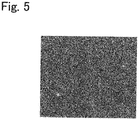
- Fig. 5 shows a photograph of a backscattered electron image of Experimental Example 3.
- the blackish region is AlN
- the (two) white spots are each a Ca-Al-based oxide (where Ca is a component derived from the sintering aid) contained in a grain boundary phase between AlN sintered grains. Since the average atomic weight of the Ca-Al-based oxide is higher than that of AlN, the Ca-Al-based oxide appears brighter than AlN. Therefore, the Ca-Al-based oxide can be easily distinguished by visual observation. Similar photographs of backscattered electron images were obtained in other Experimental Examples (except for Experimental Example 16).
- Experimental Examples 1 to 15, 17, 18, 23, 25 to 28, and 30 to 36 correspond to Examples of the present invention, and Experimental Examples 16, 19 to 22, 24, and 29 correspond to Comparative Examples. These Experimental Examples do not limit the present invention.
- the oriented AlN sintered body of the present invention can be used as, for example, a plasma-resistant material or a piezoelectric material.
Landscapes
- Chemical & Material Sciences (AREA)
- Engineering & Computer Science (AREA)
- Ceramic Engineering (AREA)
- Manufacturing & Machinery (AREA)
- Organic Chemistry (AREA)
- Materials Engineering (AREA)
- Structural Engineering (AREA)
- Inorganic Chemistry (AREA)
- Ceramic Products (AREA)
Abstract
Description
- The present invention relates to an oriented AlN sintered body and a method for producing the same.
- Aluminum nitride is a material having various good properties. For example, aluminum nitride is known to have good plasma resistance and thermal conductivity and is used as a material of an electrostatic chuck and a ceramic heater. Regarding piezoelectric properties, it is also known that, among piezoelectric substances, aluminum nitride exhibits a very high use-limit temperature of 1,200°C, exhibits piezoelectricity which is several times the piezoelectricity of quartz crystal, and has a high modulus of elasticity and maintains the linearity of piezoelectricity even for high pressures. NPL 1 has reported that enhancement of the c-axis orientation of aluminum nitride improves thermal conductivity. In NPL 1, a slurry prepared by adding, as a sintering aid, CaF2 to an aluminum nitride powder is formed in a rotating magnetic field, and the resulting formed body is subjected to spark plasma sintering to obtain an aluminum nitride sintered body having a high c-axis orientation.
- NPL 1: Proceedings of the 29th Fall Meeting, issued by The Ceramic Society of Japan, 2016, Program number: 3B17
- However, in NPL 1, it is difficult to produce an aluminum nitride sintered body having a high c-axis orientation at a low cost because a rotating magnetic field is used. Furthermore, in NPL 1, the c-axis orientation determined by using Lotgering is about 0.7, and thus the sintered body is not considered to have sufficient orientation.
- The present invention has been made in order to solve the problems described above, and a main object of the present invention is to provide an AlN sintered body having a high degree of c-plane orientation at a relatively low cost.
- A method for producing an oriented AlN sintered body according to the present invention includes
a first step of preparing a formed body by forming a mixture obtained by mixing a sintering aid with an AlN raw-material powder containing a plate-like AlN powder whose plate surface is a c-plane and which has an aspect ratio of 3 or more and an average thickness of 0.05 to 1.8 µm, wherein the mixture is formed such that the plate surface of the plate-like AlN powder is disposed along a surface of the formed body, and
a second step of obtaining an oriented AlN sintered body by subjecting the formed body to hot-press sintering in a non-oxidizing atmosphere while applying a pressure to the surface of the formed body. - In the method for producing an oriented AlN sintered body, a formed body is formed such that a plate surface (c-plane) of a plate-like AlN powder is disposed along a surface of the formed body. This formed body contains a sintering aid. In hot-press sintering of the formed body, the formed body is subjected to hot-press sintering in a non-oxidizing atmosphere while applying a pressure to the surface of the formed body, that is, while applying a pressure to the formed body from a direction substantially perpendicular to the surface of the formed body. Consequently, sintering of an AlN raw-material powder containing the plate-like AlN powder is promoted by the sintering aid. Furthermore, since the plate surface (c-plane) of the plate-like AlN powder is arranged along the surface of the formed body, the sintering proceeds while the plate-like AlN powder functions as a template. As a result, an oriented AlN sintered body having a high degree of c-plane orientation is obtained. Since this production method uses hot-press sintering without using a rotating magnetic field, the cost can be suppressed to be low compared with the case where a rotating magnetic field is used.
- An oriented AlN sintered body according to the present invention is an oriented AlN sintered body having a polycrystalline structure, in which a grain boundary phase that contains a component derived from a sintering aid is present between AlN sintered grains, a degree of c-plane orientation is 70% or more as determined by a Lotgering method, and a relative density is 98.6% or more.
- This oriented AlN sintered body has a high degree of c-plane orientation and thus has good plasma resistance and piezoelectric properties. Such an oriented AlN sintered body can be suitably produced by the above method for producing an oriented AlN sintered body.
-
-
Fig. 1 includes explanatory views illustrating an example of steps of producing an AlN sintered body by a TGG method. -
Fig. 2 includes photographs each showing an image of a single particle of a plate-like AlN powder. -
Fig. 3 includes photographs each showing an image of an agglomerated particle of a plate-like AlN powder. -
Fig. 4 includes photographs each showing an image of a particle that includes a single particle of a plate-like AlN powder and a fine particle adhering to the single particle. -
Fig. 5 is a photograph of a backscattered electron image of a cross section of an AlN sintered body. Description of Embodiments - A preferred embodiment of the present invention will be described below.
- A method for producing an oriented AlN sintered body according to the present embodiment includes
a first step of preparing a formed body by forming a mixture obtained by mixing a sintering aid with an AlN raw-material powder containing a plate-like AlN powder whose plate surface is a c-plane, in which the mixture is formed such that the plate surface of the plate-like AlN powder is disposed along a surface of the formed body, and
a second step of obtaining an oriented AlN sintered body by subjecting the formed body to hot-press sintering in a non-oxidizing atmosphere while applying a pressure to the surface of the formed body. - The plate-like AlN powder is an AlN powder whose plate surface is a c-plane. The plate-like AlN powder preferably has an aspect ratio of 3 or more. The aspect ratio refers to average particle size/average thickness. Herein, the average particle size is an average of the plate surface in a long-axis direction, and the average thickness is an average of a short-axis length of a particle. The use of the AlN raw-material powder that contains a plate-like AlN powder having an aspect ratio of 3 or more increases the degree of c-plane orientation of an AlN sintered body that is finally obtained. The aspect ratio is preferably 5 or more. The average particle size of the plate-like AlN powder is preferably large from the viewpoint of achieving high orientation, and the average particle size is preferably 2 µm or more, preferably 5 µm or more, and more preferably 7 µm or more. However, the average particle size of the plate-like AlN powder is preferably small from the viewpoint of densification, and the average particle size is preferably 20 µm or less and more preferably 10 µm or less. In view of the above, the average particle size is preferably 2 to 20 µm in order to realize both high orientation and densification. From the viewpoint of the ease of preparation of the plate-like AlN powder, the average thickness is preferably 0.05 µm or more, preferably 0.07 µm or more, more preferably 0.1 µm or more, more preferably 0.3 µm or more, more preferably 0.5 µm or more, and still more preferably 0.8 µm or more. On the other hand, from the viewpoint of the ease of orientation of the plate-like AlN powder, the average thickness is preferably 1.8 µm or less, more preferably 1.5 µm or less, more preferably 1 µm or less, and still more preferably 0.5 µm or less. In the case where the plate-like AlN powder has an excessively large average thickness, for example, when the thickness of a formed body before sintering is adjusted by using a doctor blade or the like, a ratio of a shear stress that is received by side surfaces (surfaces parallel to the thickness direction) of plate-like AlN particles relative to a total shear stress applied from the blade to the particles increases, and consequently, the orientation of the plate-like AlN particles may be disordered. In view of this, the average thickness is preferably 0.05 to 1.8 µm in order to realize both the ease of preparation and the ease of orientation of the plate-like AlN powder. Preferably, the particles constituting the plate-like AlN powder do not agglomerate, are separated from each other, and are each present in the form of a single particle. In order to cause the particles constituting the plate-like AlN powder to be present in the form of a single particle, at least one treatment of a classification treatment, a disintegration treatment, and an elutriation treatment is employed. An example of the classification treatment is air-stream classification. Examples of the disintegration treatment include pot disintegration and wet-type atomization. The elutriation treatment is preferably employed when fine particles are mixed. Whether or not particles constituting the plate-like AlN powder are present in the form of a single particle can be determined on the basis of an image obtained with a wet flow-type particle size/shape analyzer (model number: FPIA-3000S, available from Sysmex Corporation). A plate-like AlN powder having a high purity is preferably used. The purity of the plate-like AlN powder is preferably 98% by mass or more and more preferably 99% by mass or more. In particular, a metal impurity concentration (concentration of metals other than Al) is preferably 50 ppm by mass or less, and an oxygen concentration is preferably 1% by mass or less and particularly preferably 0.8% by mass or less. However, a component that is the same as the sintering aid or impurities that volatilize and disappear during sintering may be contained.
- The AlN raw-material powder may be the plate-like AlN powder itself. Alternatively, the AlN raw-material powder may be a mixed AlN powder in which a plate-like AlN powder and a spherical AlN powder are mixed. The average particle size of the spherical AlN powder is preferably smaller than the average particle size of the plate-like AlN powder and is preferably 1.5 µm or less. When such a mixed AlN powder is used as the AlN raw-material powder, during sintering, the plate-like AlN powder is formed into a seed crystal (template), the spherical AlN powder is formed into a matrix, and the template is homoepitaxially grown while incorporating the matrix. This production method is referred to as a templated grain growth (TGG) method. The mass ratio of the plate-like AlN powder to the spherical AlN powder is appropriately determined in consideration of the aspect ratio and the average particle size of the plate-like AlN powder. For example, with an increase in the average particle size of the plate-like AlN powder, the mass ratio of the plate-like AlN powder to the spherical AlN powder may be decreased.
- The sintering aid has a function of promoting sintering of AlN. Since AlN is less likely to sinter compared with alumina and the like, it is preferable to add such a sintering aid and to perform hot-press sintering. As the sintering aid, a complex oxide of Ca and Al or a rare-earth oxide such as yttria is preferably used. This is because these oxides have plasma resistance that is substantially the same as AlN and thus do not adversely affect plasma resistance even if the oxides remain in the oriented AlN sintered body. Examples of the complex oxide of Ca and Al include complex oxides that contain CaO and Al2O3 in appropriate ratios, such as C2A, C3A, and C4A. The sintering aid is preferably used in an amount of 1% to 10% by mass and more preferably 2% to 8% by mass relative to the total mass of the plate-like AlN powder, the spherical AlN powder, and the sintering aid.
- In the first step, a formed body is prepared by forming a mixture obtained by mixing a sintering aid with an AlN raw-material powder, in which the mixture is formed such that the plate surface of the plate-like AlN powder is disposed along a surface of the formed body. Consequently, since the c-axis of the plate-like AlN powder is easily arranged in the direction orthogonal to the surface of the formed body, the degree of c-plane orientation of the AlN sintered body improves. Examples of the forming method in this case include, but are not particularly limited to, tape casting, extrusion molding, cast molding, injection molding, and uniaxial pressing. A multilayer formed body may be prepared by stacking a plurality of formed bodies obtained by any of these forming methods.
- In the second step, an oriented AlN sintered body is obtained by subjecting the formed body obtained in the first step to hot-press sintering while applying a pressure to the surface of the formed body. Before the hot-press sintering, degreasing may be performed. The atmosphere of the hot-press sintering is preferably a non-oxidizing atmosphere such as a nitrogen atmosphere, an argon atmosphere, or a vacuum. The pressure (surface pressure) of the hot-press sintering is preferably 50 kgf/cm2 or more and preferably 200 kgf/cm2 or more. The temperature (maximum attained temperature) of the hot-press sintering is preferably 1,800°C to 1,950°C and more preferably 1,880°C to 1,920°C. The time of the hot-press sintering is not particularly limited but is appropriately determined in a range of, for example, 2 to 10 hours. The furnace for the hot-press sintering is not particularly limited. For example, a furnace made of graphite can be used.
- An oriented AlN sintered body of the present embodiment is a polycrystalline structure in which a grain boundary phase that contains a component derived from a sintering aid is present between AlN sintered grains, and a degree of c-plane orientation is 70% or more as determined by a Lotgering method. This oriented AlN sintered body can be suitably produced by the above method for producing an oriented AlN sintered body. The oriented AlN sintered body has a high degree of c-plane orientation and thus has good plasma resistance and piezoelectric properties. Therefore, the oriented AlN sintered body is useful as a material of members for which plasma resistance is required, such as members for semiconductor manufacturing apparatuses, and a material of members for which high piezoelectric properties are required, such as sensors for high temperatures. In the oriented AlN sintered body of the embodiment, the degree of c-plane orientation is preferably 95% or more and more preferably 97% or more. This is because plasma resistance and piezoelectric properties improve with an increase in the degree of c-plane orientation. Examples of the sintering aid include complex oxides of Ca and Al and rare-earth oxides such as yttria, as described above. When the sintering aid is a complex oxide of Ca and Al, the grain boundary phase contains a Ca component. When the sintering aid is yttria, the grain boundary phase contains a Y component. The relative density of the oriented AlN sintered body of the embodiment is preferably 98.6% or more, preferably 99.1% or more, more preferably 99.8% or more, and still more preferably 100%. This is because plasma resistance improves with an increase in the relative density.
- Here,
Fig. 1 illustrates an example of steps of producing an AlN sintered body by the TGG method. First, a plate-like AlN powder 10 is prepared (refer toFig. 1(a) ). The plate-like AlN powder 10 has aplate surface 10a which is a c-plane. Next, a formedbody 20 is produced by using a mixed AlN powder in which the plate-like AlN powder 10, aspherical AlN powder 12, and asintering aid 14 are mixed (first step, refer toFig. 1(b) ). At this time, the formedbody 20 is produced such that theplate surface 10a (c-plane) of the plate-like AlN powder 10 is arranged along asurface 20a of the formedbody 20. Next, the formedbody 20 is subjected to hot-press sintering while applying a pressure from a direction substantially perpendicular to thesurface 20a (second step, refer toFig. 1(c) ). Consequently, the sintering of the plate-like AlN powder 10 and thespherical AlN powder 12 is promoted by thesintering aid 14. Since theplate surface 10a (c-plane) of the plate-like AlN powder 10 is arranged along thesurface 20a of the formedbody 20, the sintering proceeds while the plate-like AlN powder 10 functions as a template. As a result, an oriented AlN sinteredbody 30 having a high degree of c-plane orientation is obtained. Agrain boundary phase 34 that contains a component derived from thesintering aid 14 is present between AlN sinteredgrains 32 in the oriented AlN sinteredbody 30. -



- One hundred grams of a plate-like alumina (available from Kinsei Matec Co., Ltd.), 50 g of carbon black (Mitsubishi Chemical Corporation), 1,000 g of φ2 alumina balls, and 350 mL of IPA (TOKUSO IPA, available from Tokuyama Corporation) were each weighed and put in a poly-pot container, and pulverization and mixing were conducted at 30 rpm for 240 minutes. A plate-like alumina having an average particle size of 2 µm, 5 µm, or 7 µm was used as the plate-like alumina. The plate-like alumina having an average particle size of 2 µm had an average thickness of 0.08 µm and an aspect ratio of 25. The plate-like alumina having an average particle size of 5 µm had an average thickness of 0.07 µm and an aspect ratio of 70. The plate-like alumina having an average particle size of 7 µm had an average thickness of 0.1 µm and an aspect ratio of 70. Subsequently, drying was conducted with a rotary evaporator. The dried plate-like alumina-carbon mixture was slightly pulverized with a mortar. A carbon crucible was filled with 100 g of the mixture and placed in a high-temperature atmosphere furnace. While nitrogen was allowed to flow at a rate of 3 L/min, the temperature was increased to 1,600°C at a temperature-increasing rate of 200°C/hr, and the crucible was held at the temperature for 20 hours. After the completion of the reaction, natural cooling was performed, and a sample was removed from the crucible. In order to remove remaining carbon, the sample was further heat-treated at 650°C for 10 hours in an oxidizing atmosphere using a muffle furnace. Thus, a plate-like AlN powder was obtained.
- In Experimental Examples 1 to 36, plate-like AlN powders having various average particle sizes, average thicknesses, and aspect ratios were used. These plate-like AlN powders were produced by preparing plate-like alumina powders having different shapes, and nitriding the plate-like alumina powders. The plate-like alumina powders having different shapes were prepared as described below. First, gibbsite aluminum hydroxide was subjected to wet pulverization to adjust the average particle size to 0.4 to 3 µm. Orthophosphoric acid was added in an amount of 1.0 × 10⁻⁵ to 1.0 × 10⁻² moles relative to one mole of aluminum hydroxide to form a slurry. An increase in the average particle size of aluminum hydroxide increases the average particle size of alumina. An increase in the amount of orthophosphoric acid added increases the aspect ratio. The resulting slurry was granulated and dried at a drying temperature of 140°C by using a spray dry (Model: FL-12, available from Ohkawara Kakohki Co., Ltd.), so that the content of water in the raw material was less than 1% by weight. The resulting powder was formed into a 50 wt% aqueous slurry and then subjected to hydrothermal synthesis at a synthesis temperature of 600°C and a pressure of 15 MPa. After the hydrothermal synthesis, the resulting product was washed with water and dried to obtain white alumina particles. The particle size of alumina can be decreased without changing the aspect ratio by adding a part of the orthophosphoric acid to water used for the hydrothermal synthesis without adding the part of the orthophosphoric acid in the formation of the slurry.
- Since the plate-like AlN powder prepared above included single particles and agglomerated particles, the single particles were selected by performing disintegration and classification. Specifically, 100 g of the prepared plate-like AlN powder, 300 g of alumina balls having a diameter φ of 15 mm, and 60 mL of IPA (TOKUSO IPA, available from Tokuyama Corporation) were put in a poly-pot container, and disintegration was conducted at 30 rpm for 240 minutes. Subsequently, drying was conducted with a rotary evaporator. The dried plate-like AlN powder was classified with a precise air classifier (model number: TC-15NSC) available from Nisshin Engineering Inc. The classification point was set to the same size as the average particle size, and fine particles after classification were used as the raw material. An image of the finally obtained plate-like AlN powder was observed with a wet flow-type particle size/shape analyzer (FPIA-3000S, available from Sysmex Corporation), and it was confirmed that the plate-like AlN powder was formed of single particles.
Figs. 2 to 4 show an example of images of an AlN powder, the images being obtained by this analyzer.Fig. 2 includes images of a single particle,Fig. 3 includes images of an agglomerated particle, andFig. 4 includes images of a particle that includes a single particle and a fine particle adhering to the single particle. The numerical values indicated under the images each represents a length of the plate surface in the long-axis direction, that is, a particle size (µm). Herein, a particle that includes a single particle and a fine particle adhering to the single particle was also considered as a single particle. Note that the average particle size and the average thickness of the plate-like AlN powder were considered to be the same as those of the plate-like alumina powder used. - C3A was synthesized as described below. First, 56 g of calcium carbonate (Shilver-W, available from Shiraishi Calcium Kaisha, Ltd.), 19 g of γ-alumina (TM-300D, available from Taimei Chemicals Co., Ltd.), 1,000 g of φ15 alumina balls, and 125 mL of IPA (TOKUSO IPA, available from Tokuyama Corporation) were put in a poly-pot container, and pulverization and mixing were conducted at 110 rpm for 120 minutes. Subsequently, drying was conducted with a rotary evaporator to prepare a mixed powder. An alumina crucible was filled with 70 g of this mixed powder and placed in an air atmosphere furnace. The temperature was increased to 1,250°C at a temperature-increasing rate of 200°C/hr, and the crucible was held at the temperature for 3 hours. After the completion of the reaction, natural cooling was performed, and a sample was removed from the crucible. C2A was synthesized in the same manner as described above by using 47 g of calcium carbonate and 24 g of alumina to prepare an aid formed from C3A and C12A7. C4A was synthesized by mixing 40 g of C3A and 15 g of CaCO3. A ratio CaO/Al2O3 (molar ratio) of C3A, C2A, and C4A are 3, 2, and 4, respectively.
- The plate-like AlN powder obtained in (1) above, a commercially available spherical AlN powder (F-Grade, average particle size: 1.2 µm, available from Tokuyama Corporation), and the Ca-Al-O-based aid obtained in (2) above were weighed in the mass ratio shown in Table 1 so that the total weight was 20 g. These were put in a poly-pot container together with 300 g of alumina balls having a diameter φ of 15 mm and 60 mL of IPA (TOKUSO IPA, available from Tokuyama Corporation), and pulverization and mixing were conducted were conducted at 30 rpm for 240 minutes. Subsequently, drying was conducted with a rotary evaporator to prepare a mixed powder.
- To 100 parts by mass of the mixed powder prepared in (3) above, 7.8 parts by mass of polyvinyl butyral (product number: BM-2, available from Sekisui Chemical Co., Ltd.) serving as a binder, 3.9 parts by mass of di(2-ethylhexyl) phthalate (available from Kurogane Kasei Co., Ltd.) serving as a plasticizer, 2 parts by mass of sorbitan trioleate (RHEODOL SP-030, available from Kao Corporation) serving as a dispersant, and 2-ethylhexanol serving as a dispersion medium were added, the resulting mixture was mixed. The amount of the dispersion medium was adjusted such that the resulting slurry had a viscosity of 20,000 cp. A tape cast body was prepared by using the slurry prepared in this manner. Specifically, the slurry was cast by a doctor blade method on a PET film to form a sheet-like tape cast body having a dry thickness of 100 µm such that the plate surface (c-plane) of the plate-like AlN powder was arranged along the surface of the tape cast body. The resulting tape cast body was cut into circular pieces each having a diameter of 20 mm. Subsequently, 40 circular pieces were stacked. The resulting stacked body was placed on an Al plate having a thickness of 10 mm and then placed in a package. The package was evacuated to prepare a vacuum package. The vacuum package was isostatically pressed in hot water at 85°C at a pressure of 100 kgf/cm2 to prepare a disk-shaped multilayer formed body.
- The multilayer formed body obtained in (4) above was placed in a degreasing furnace and degreased at 600°C for 10 hours. In Experimental Examples 1 to 15 and 17 to 36, sintering was performed under the sintering conditions shown in Tables 1 and 2 to obtain AlN sintered bodies. Specifically, degreased bodies were sintered by hot-pressing in nitrogen using a graphite mold at a sintering temperature (maximum attained temperature) of 1,800°C to 1,900°C for 2 to 10 hours at a surface pressure of 200 kgf/cm2 to obtain AlN sintered bodies. The direction in which the pressure was applied during hot-pressing was a stacking direction of the multilayer formed body (a direction substantially perpendicular to the surface of the tape cast body). When the temperature was decreased from the sintering temperature, the pressure during pressing was maintained until the temperature reaches room temperature. In Experimental Example 16, the resulting degreased body was sintered in nitrogen at atmospheric pressure at a sintering temperature (maximum attained temperature) of 1,880°C for 5 hours to obtain an AlN sintered body.
- To examine the degree of orientation of the AlN multilayer formed body prepared above, the disk-shaped AlN multilayer formed body was placed in an XRD apparatus so as to be parallel to the upper surface of the AlN multilayer formed body, and the upper surface was irradiated with X-rays to measure the degree of c-plane orientation. An XRD profile was measured with the XRD apparatus (RINT-TTR III, available from Rigaku Corporation) in a 2θ range of 20° to 70°. Specifically, the measurement was performed using CuKα radiation at a voltage of 50 kV and a current of 300 mA. The degree of c-plane orientation f (%) was calculated by the Lotgering method. Specifically, the degree of c-plane orientation was calculated by formulae described below. In the formulae, P represents a value obtained from the XRD profile of the AlN sintered body, and P0 represents a value calculated from reference AlN (JCPDS card No. 076-0566). Note that (100), (002), (101), (102), (110), and (103) were used as (hkl).

- P0 = ∑I0(002)/∑I0(hkl)
- P = ∑I(002) /∑I (hkl)
- The amount of impurity metals was analyzed by a method of decomposition with sulfuric acid in a pressurized vessel in accordance with JIS R1649 using an inductively coupled plasma (ICP) emission spectrometer (PS3520UV-DD, available from Hitachi High-Technologies Corporation). Here, the measurement was performed for Si, Fe, Ti, Ca, Mg, K, Na, P, Cr, Mn, Ni, Zn, Ga, Y, and Zr as the impurity metals. The amount of oxygen was measured by an inert gas fusion-infrared absorption spectroscopy in accordance with JIS R1675 (methods for scientific analysis of fine AlN powders for fine ceramics).
- The bulk density was measured in accordance with JIS R1634 (test methods for density and open porosity of sintered bodies of fine ceramics), and the relative density was calculated on the assumption that the theoretical density is 3.260.
- To examine the degree of orientation of the AlN sintered body prepared above, the disk-shaped AlN sintered body was polished so as to be parallel to the upper surface of the AlN sintered body, and the polished surface was then irradiated with X-rays to measure the degree of c-plane orientation. An XRD profile was measured with an XRD apparatus (RINT-TTR III, available from Rigaku Corporation) in a 2θ range of 20° to 70°. Specifically, the measurement was performed using CuKα radiation at a voltage of 50 kV and a current of 300 mA. The degree of c-plane orientation f (%) was calculated by the Lotgering method. Specifically, the degree of c-plane orientation was calculated by formulae described below. In the formulae, P represents a value obtained from the XRD profile of the AlN sintered body, and P0 represents a value calculated from reference AlN (JCPDS card No. 076-0566). Note that (100), (002), (101), (102), (110), and (103) were used as (hkl).

- P0 = ∑I0(002)/∑I0(hkl)
- P = ∑I(002)/∑I(hkl)
- An arbitrary cross section of the AlN sintered body prepared above was preliminary polished with a diamond abrasive and then polished with a cross-section polisher (CP) (SM-09010, available from JEOL, Ltd). The CP falls under the category of ion milling. A backscattered electron image of the resulting cross section was taken with a scanning electron microscope (JSM-6390, available from JEOL, Ltd.) at a magnification of 2,000.
- First, a sample was polished. Specifically, polishing was performed at a polishing pressure of 180 g/cm2 for a polishing time of 20 minutes by using a buff to which a 9-µm diamond was applied. Subsequently, polishing was performed at a polishing pressure of 180 g/cm2 for a polishing time of 20 minutes by using a buff to which a 3-µm diamond was applied. After the polishing, a part of the polished surface was masked, and the resulting sample was exposed to a corrosive environment to perform a corrosion resistance test. Specifically, nitrogen fluoride (NF3) was supplied as a corrosive gas at a flow rate of 75 sccm (standard cm3/min), a radio-frequency (RF) voltage of 800 W was applied to generate plasma, and the sample was maintained in the high-temperature corrosive environment at 600°C for 5 hours. No bias was applied. After the corrosion resistance test, a surface roughness (Rmax) was measured with a surface roughness meter. An Rmax before the corrosion resistance test was 0.5 µm. The corrosion resistance was evaluated on a scale of four levels A to D described below.
- A: Rmax is 1 µm or less.
- B: Rmax is more than 1 µm and 1.5 µm or less.
- C: Rmax is more than 1.5 µm and 2 µm or less.
- D: Rmax is more than 2 µm.
- Table 1 shows evaluation results of the AlN sintered bodies of Experimental Examples. Each of the AlN sintered bodies obtained in Experimental Examples 1 to 15, 17, 18, 23, 25 to 28, and 30 to 36 had a high degree of c-plane orientation of 70% or more and had good plasma resistance (corrosion resistance). In contrast, in Experimental Example 16, the degree of c-plane orientation was 44%, which was not sufficiently high, because normal-pressure sintering was conducted instead of hot-press sintering. In Experimental Examples 19 to 21, and 29, sufficient corrosion resistance was not obtained because the average thickness exceeded 1.8 µm. In Experimental Examples 22 and 24, the degrees of c-plane orientation were low, namely, 10% and 40%, respectively, and sufficient corrosion resistance was not obtained because the plate-like AlN powders used had an aspect ratio of less than 3.
- The AlN sintered bodies obtained in Experimental Examples 1 to 15, 17, 18, 23, 25 to 28, and 30 to 36 are useful as materials of members for which plasma resistance is required, such as members for semiconductor manufacturing apparatuses, and materials of members for which high piezoelectric properties are required, such as sensors for high temperatures. In Experimental Examples 1 to 15, 17, 18, 23, 25 to 28, and 30 to 36, hot-press sintering is used without using a rotating magnetic field, which is used in NPL 1. Thus, an AlN sintered body having a high degree of c-plane orientation can be produced at a low cost compared with the case where a rotating magnetic field is used.
-
Fig. 5 shows a photograph of a backscattered electron image of Experimental Example 3. InFig. 5 , the blackish region is AlN, and the (two) white spots are each a Ca-Al-based oxide (where Ca is a component derived from the sintering aid) contained in a grain boundary phase between AlN sintered grains. Since the average atomic weight of the Ca-Al-based oxide is higher than that of AlN, the Ca-Al-based oxide appears brighter than AlN. Therefore, the Ca-Al-based oxide can be easily distinguished by visual observation. Similar photographs of backscattered electron images were obtained in other Experimental Examples (except for Experimental Example 16). - Experimental Examples 1 to 15, 17, 18, 23, 25 to 28, and 30 to 36 correspond to Examples of the present invention, and Experimental Examples 16, 19 to 22, 24, and 29 correspond to Comparative Examples. These Experimental Examples do not limit the present invention.
- The present application claims priority from Japanese Patent Application No.
2016-247873 filed December 21, 2016 PCT/JP2017/025084 filed July 10, 2017 - The oriented AlN sintered body of the present invention can be used as, for example, a plasma-resistant material or a piezoelectric material.
- 10 plate-like AlN powder, 10a plate surface (c-plane), 12 spherical AlN powder, 14 sintering aid, 20 formed body, 20a surface, 30 oriented AlN sintered body, 32 AlN sintered grain, 34 grain boundary phase.
Claims (10)
- A method for producing an oriented AlN sintered body, comprising:a first step of preparing a formed body by forming a mixture obtained by mixing a sintering aid with an AlN raw-material powder containing a plate-like AlN powder whose plate surface is a c-plane and which has an aspect ratio of 3 or more and an average thickness of 0.05 to 1.8 µm, wherein the mixture is formed such that the plate surface of the plate-like AlN powder is disposed along a surface of the formed body; anda second step of obtaining an oriented AlN sintered body by subjecting the formed body to hot-press sintering in a non-oxidizing atmosphere while applying a pressure to the surface of the formed body.
- The method for producing an oriented AlN sintered body according to Claim 1,
wherein in the first step, particles contained in the plate-like AlN powder do not agglomerate and are separated from each other. - The method for producing an oriented AlN sintered body according to Claim 1 or 2,
wherein in the first step, a plurality of tape cast bodies each obtained by forming the mixed powder into a sheet are stacked to prepare a multilayer formed body, and
in the second step, the multilayer formed body is subjected to hot-press sintering. - The method for producing an oriented AlN sintered body according to any one of Claims 1 to 3,
wherein the AlN raw-material powder contains a spherical AlN powder besides the plate-like AlN powder. - The method for producing an oriented AlN sintered body according to any one of Claims 1 to 4,
wherein the sintering aid is a complex oxide of Ca and Al or a rare-earth oxide. - The method for producing an oriented AlN sintered body according to any one of Claims 1 to 5,
wherein the plate-like AlN powder has an average particle size of 2 to 20 µm. - An oriented AlN sintered body having a polycrystalline structure, wherein a grain boundary phase that contains a component derived from a sintering aid is present between AlN sintered grains, a degree of c-plane orientation is 70% or more as determined by a Lotgering method, and a relative density is 98.6% or more.
- The oriented AlN sintered body according to Claim 7,
wherein the sintering aid is a complex oxide of Ca and Al or a rare-earth oxide. - The oriented AlN sintered body according to Claim 7 or 8,
wherein the degree of c-plane orientation is 95% or more. - The oriented AlN sintered body according to any one of Claims 7 to 9,
wherein the relative density is 99.1% or more.
Applications Claiming Priority (3)
| Application Number | Priority Date | Filing Date | Title |
|---|---|---|---|
| JP2016247873 | 2016-12-21 | ||
| JP2017025084 | 2017-07-10 | ||
| PCT/JP2017/045764 WO2018117161A1 (en) | 2016-12-21 | 2017-12-20 | Oriented aln sintered body, and production method therefor |
Publications (3)
| Publication Number | Publication Date |
|---|---|
| EP3560904A1 true EP3560904A1 (en) | 2019-10-30 |
| EP3560904A4 EP3560904A4 (en) | 2020-06-10 |
| EP3560904B1 EP3560904B1 (en) | 2022-05-04 |
Family
ID=62626448
Family Applications (1)
| Application Number | Title | Priority Date | Filing Date |
|---|---|---|---|
| EP17884131.8A Not-in-force EP3560904B1 (en) | 2016-12-21 | 2017-12-20 | Oriented aln sintered body, and production method therefor |
Country Status (7)
| Country | Link |
|---|---|
| US (1) | US11059753B2 (en) |
| EP (1) | EP3560904B1 (en) |
| JP (1) | JP6982000B2 (en) |
| KR (1) | KR102557206B1 (en) |
| CN (1) | CN110088061B (en) |
| TW (1) | TWI746750B (en) |
| WO (1) | WO2018117161A1 (en) |
Families Citing this family (4)
| Publication number | Priority date | Publication date | Assignee | Title |
|---|---|---|---|---|
| WO2018173170A1 (en) * | 2017-03-22 | 2018-09-27 | 日本碍子株式会社 | Aluminum nitride particles |
| KR102519299B1 (en) * | 2018-03-27 | 2023-04-06 | 엔지케이 인슐레이터 엘티디 | aluminum nitride plate |
| US12398038B2 (en) | 2020-04-14 | 2025-08-26 | Kwansei Gakuin Educational Foundation | Manufacturing method of modified aluminum nitride raw material, modified aluminum nitride raw material, manufacturing method of aluminum nitride crystals, and downfall defect prevention method |
| TWI857769B (en) * | 2023-08-31 | 2024-10-01 | 同欣電子工業股份有限公司 | Ceramic substrate and method for manufacturing the same |
Family Cites Families (16)
| Publication number | Priority date | Publication date | Assignee | Title |
|---|---|---|---|---|
| JP2565305B2 (en) * | 1985-10-31 | 1996-12-18 | 京セラ株式会社 | High thermal conductivity aluminum nitride sintered body and manufacturing method thereof |
| JPS6321511A (en) * | 1986-07-15 | 1988-01-29 | Mitsubishi Electric Corp | Testing pulse oscillator |
| US4847221A (en) * | 1987-01-13 | 1989-07-11 | Kabushiki Kaisha Toshiba | AlN sintered body having high thermal conductivity and a method of fabricating the same |
| JPH0735302B2 (en) * | 1987-02-20 | 1995-04-19 | 住友電気工業株式会社 | Method for manufacturing aluminum nitride sintered body |
| DE69419636T2 (en) * | 1993-03-16 | 2000-02-10 | Honda Giken Kogyo K.K., Tokio/Tokyo | Process for the production of ultrafine composite particles from aluminum nitride and rare earth nitride |
| EP0669412B1 (en) * | 1994-02-25 | 2002-05-22 | Sumitomo Electric Industries, Ltd. | Aluminim nitride thin film substrate and process for producing same |
| JP2916664B2 (en) * | 1994-05-24 | 1999-07-05 | 株式会社ニッカトー | Oriented alumina sintered body |
| EP1518843A3 (en) * | 2003-09-25 | 2007-05-23 | Tokuyama Corporation | Aluminum nitride sintered body and method of producing the same |
| CN100469736C (en) * | 2007-07-20 | 2009-03-18 | 中国人民解放军国防科学技术大学 | Method for preparing carbon nanotube reinforced aluminum nitride composite material |
| JP5366811B2 (en) | 2007-09-03 | 2013-12-11 | 株式会社トクヤマ | Modified aluminum nitride sintered body |
| JP5315970B2 (en) * | 2008-12-15 | 2013-10-16 | 三菱化学株式会社 | Aluminum nitride having high aspect ratio, method for producing the same, and resin composition using the same |
| JP5721095B2 (en) * | 2010-07-02 | 2015-05-20 | 国立大学法人静岡大学 | Aluminum nitride crystal particle manufacturing apparatus and aluminum nitride crystal particle manufacturing method |
| DE102010050900A1 (en) | 2010-11-10 | 2012-05-10 | Esk Ceramics Gmbh & Co. Kg | Boron nitride agglomerates, process for their preparation and their use |
| KR20120098118A (en) * | 2011-02-28 | 2012-09-05 | 영남대학교 산학협력단 | Manufacturing method of polycrystalline aluminum oxynitride with improved transparency |
| WO2014123247A1 (en) * | 2013-02-08 | 2014-08-14 | 株式会社トクヤマ | Aluminum nitride powder |
| WO2018173170A1 (en) * | 2017-03-22 | 2018-09-27 | 日本碍子株式会社 | Aluminum nitride particles |
-
2017
- 2017-12-20 KR KR1020197015822A patent/KR102557206B1/en active Active
- 2017-12-20 WO PCT/JP2017/045764 patent/WO2018117161A1/en not_active Ceased
- 2017-12-20 EP EP17884131.8A patent/EP3560904B1/en not_active Not-in-force
- 2017-12-20 CN CN201780073408.3A patent/CN110088061B/en active Active
- 2017-12-20 JP JP2018558037A patent/JP6982000B2/en active Active
- 2017-12-21 TW TW106145027A patent/TWI746750B/en active
-
2019
- 2019-05-23 US US16/420,334 patent/US11059753B2/en active Active
Also Published As
| Publication number | Publication date |
|---|---|
| JP6982000B2 (en) | 2021-12-17 |
| TWI746750B (en) | 2021-11-21 |
| EP3560904B1 (en) | 2022-05-04 |
| EP3560904A4 (en) | 2020-06-10 |
| KR102557206B1 (en) | 2023-07-18 |
| TW201835004A (en) | 2018-10-01 |
| CN110088061B (en) | 2022-05-13 |
| WO2018117161A1 (en) | 2018-06-28 |
| US11059753B2 (en) | 2021-07-13 |
| JPWO2018117161A1 (en) | 2019-10-31 |
| US20190276369A1 (en) | 2019-09-12 |
| CN110088061A (en) | 2019-08-02 |
| KR20190098134A (en) | 2019-08-21 |
Similar Documents
| Publication | Publication Date | Title |
|---|---|---|
| US9902654B2 (en) | ZrO2-Al2O3-based ceramic sintered compact and production method thereof | |
| TWI464133B (en) | Polycrystalline MgO sintered body and its manufacturing method and MgO target for sputtering | |
| US11059753B2 (en) | Oriented ALN sintered body and method for producing the same | |
| US7566675B2 (en) | Corrosion-resistant material manufacturing method | |
| CN100519480C (en) | High thermally conductive aluminum nitride sintered product | |
| WO2007026739A1 (en) | Corrosion resistant member, treatment apparatus and sample treatment method using the member, and method for manufacture of corrosion resistant member | |
| US11014855B2 (en) | Transparent AlN sintered body and method for producing the same | |
| KR100569643B1 (en) | An aluminum nitride ceramics, a member used for the production of semiconductors and a method of producing an aluminum nitride sintered body | |
| WO2017057552A1 (en) | Method for producing transparent alumina sintered body | |
| EP3388406B1 (en) | Ceramic sintered body | |
| JP2003112963A (en) | Alumina sintered body and method for producing the same | |
| US20220306542A1 (en) | Yttrium oxide-based sintered body, production method therefor, and member for semiconductor production apparatus | |
| JP7717478B2 (en) | Ceramic sintered body, its manufacturing method, and silicon nitride powder | |
| JP4564257B2 (en) | High thermal conductivity aluminum nitride sintered body | |
| EP3659991A1 (en) | Aluminum nitride sintered compact and method for producing same | |
| JP2024104617A (en) | Alumina-zirconia mixed material and its manufacturing method |
Legal Events
| Date | Code | Title | Description |
|---|---|---|---|
| STAA | Information on the status of an ep patent application or granted ep patent |
Free format text: STATUS: THE INTERNATIONAL PUBLICATION HAS BEEN MADE |
|
| PUAI | Public reference made under article 153(3) epc to a published international application that has entered the european phase |
Free format text: ORIGINAL CODE: 0009012 |
|
| STAA | Information on the status of an ep patent application or granted ep patent |
Free format text: STATUS: REQUEST FOR EXAMINATION WAS MADE |
|
| 17P | Request for examination filed |
Effective date: 20190529 |
|
| AK | Designated contracting states |
Kind code of ref document: A1 Designated state(s): AL AT BE BG CH CY CZ DE DK EE ES FI FR GB GR HR HU IE IS IT LI LT LU LV MC MK MT NL NO PL PT RO RS SE SI SK SM TR |
|
| AX | Request for extension of the european patent |
Extension state: BA ME |
|
| DAV | Request for validation of the european patent (deleted) | ||
| DAX | Request for extension of the european patent (deleted) | ||
| A4 | Supplementary search report drawn up and despatched |
Effective date: 20200512 |
|
| RIC1 | Information provided on ipc code assigned before grant |
Ipc: C30B 29/40 20060101ALI20200506BHEP Ipc: H03H 7/01 20060101ALI20200506BHEP Ipc: H01L 21/00 20060101ALI20200506BHEP Ipc: H01L 33/00 20100101ALI20200506BHEP Ipc: C04B 35/645 20060101ALI20200506BHEP Ipc: H03H 3/00 20060101ALI20200506BHEP Ipc: C04B 35/581 20060101AFI20200506BHEP Ipc: H03H 7/38 20060101ALI20200506BHEP Ipc: C01B 21/072 20060101ALI20200506BHEP |
|
| STAA | Information on the status of an ep patent application or granted ep patent |
Free format text: STATUS: EXAMINATION IS IN PROGRESS |
|
| 17Q | First examination report despatched |
Effective date: 20210401 |
|
| GRAP | Despatch of communication of intention to grant a patent |
Free format text: ORIGINAL CODE: EPIDOSNIGR1 |
|
| STAA | Information on the status of an ep patent application or granted ep patent |
Free format text: STATUS: GRANT OF PATENT IS INTENDED |
|
| INTG | Intention to grant announced |
Effective date: 20220215 |
|
| GRAS | Grant fee paid |
Free format text: ORIGINAL CODE: EPIDOSNIGR3 |
|
| GRAA | (expected) grant |
Free format text: ORIGINAL CODE: 0009210 |
|
| STAA | Information on the status of an ep patent application or granted ep patent |
Free format text: STATUS: THE PATENT HAS BEEN GRANTED |
|
| AK | Designated contracting states |
Kind code of ref document: B1 Designated state(s): AL AT BE BG CH CY CZ DE DK EE ES FI FR GB GR HR HU IE IS IT LI LT LU LV MC MK MT NL NO PL PT RO RS SE SI SK SM TR |
|
| REG | Reference to a national code |
Ref country code: GB Ref legal event code: FG4D |
|
| REG | Reference to a national code |
Ref country code: CH Ref legal event code: EP |
|
| REG | Reference to a national code |
Ref country code: AT Ref legal event code: REF Ref document number: 1488917 Country of ref document: AT Kind code of ref document: T Effective date: 20220515 |
|
| REG | Reference to a national code |
Ref country code: IE Ref legal event code: FG4D Ref country code: DE Ref legal event code: R096 Ref document number: 602017057128 Country of ref document: DE |
|
| REG | Reference to a national code |
Ref country code: LT Ref legal event code: MG9D |
|
| REG | Reference to a national code |
Ref country code: NL Ref legal event code: MP Effective date: 20220504 |
|
| REG | Reference to a national code |
Ref country code: AT Ref legal event code: MK05 Ref document number: 1488917 Country of ref document: AT Kind code of ref document: T Effective date: 20220504 |
|
| PG25 | Lapsed in a contracting state [announced via postgrant information from national office to epo] |
Ref country code: SE Free format text: LAPSE BECAUSE OF FAILURE TO SUBMIT A TRANSLATION OF THE DESCRIPTION OR TO PAY THE FEE WITHIN THE PRESCRIBED TIME-LIMIT Effective date: 20220504 Ref country code: PT Free format text: LAPSE BECAUSE OF FAILURE TO SUBMIT A TRANSLATION OF THE DESCRIPTION OR TO PAY THE FEE WITHIN THE PRESCRIBED TIME-LIMIT Effective date: 20220905 Ref country code: NO Free format text: LAPSE BECAUSE OF FAILURE TO SUBMIT A TRANSLATION OF THE DESCRIPTION OR TO PAY THE FEE WITHIN THE PRESCRIBED TIME-LIMIT Effective date: 20220804 Ref country code: NL Free format text: LAPSE BECAUSE OF FAILURE TO SUBMIT A TRANSLATION OF THE DESCRIPTION OR TO PAY THE FEE WITHIN THE PRESCRIBED TIME-LIMIT Effective date: 20220504 Ref country code: LT Free format text: LAPSE BECAUSE OF FAILURE TO SUBMIT A TRANSLATION OF THE DESCRIPTION OR TO PAY THE FEE WITHIN THE PRESCRIBED TIME-LIMIT Effective date: 20220504 Ref country code: HR Free format text: LAPSE BECAUSE OF FAILURE TO SUBMIT A TRANSLATION OF THE DESCRIPTION OR TO PAY THE FEE WITHIN THE PRESCRIBED TIME-LIMIT Effective date: 20220504 Ref country code: GR Free format text: LAPSE BECAUSE OF FAILURE TO SUBMIT A TRANSLATION OF THE DESCRIPTION OR TO PAY THE FEE WITHIN THE PRESCRIBED TIME-LIMIT Effective date: 20220805 Ref country code: FI Free format text: LAPSE BECAUSE OF FAILURE TO SUBMIT A TRANSLATION OF THE DESCRIPTION OR TO PAY THE FEE WITHIN THE PRESCRIBED TIME-LIMIT Effective date: 20220504 Ref country code: ES Free format text: LAPSE BECAUSE OF FAILURE TO SUBMIT A TRANSLATION OF THE DESCRIPTION OR TO PAY THE FEE WITHIN THE PRESCRIBED TIME-LIMIT Effective date: 20220504 Ref country code: BG Free format text: LAPSE BECAUSE OF FAILURE TO SUBMIT A TRANSLATION OF THE DESCRIPTION OR TO PAY THE FEE WITHIN THE PRESCRIBED TIME-LIMIT Effective date: 20220804 Ref country code: AT Free format text: LAPSE BECAUSE OF FAILURE TO SUBMIT A TRANSLATION OF THE DESCRIPTION OR TO PAY THE FEE WITHIN THE PRESCRIBED TIME-LIMIT Effective date: 20220504 |
|
| PG25 | Lapsed in a contracting state [announced via postgrant information from national office to epo] |
Ref country code: RS Free format text: LAPSE BECAUSE OF FAILURE TO SUBMIT A TRANSLATION OF THE DESCRIPTION OR TO PAY THE FEE WITHIN THE PRESCRIBED TIME-LIMIT Effective date: 20220504 Ref country code: PL Free format text: LAPSE BECAUSE OF FAILURE TO SUBMIT A TRANSLATION OF THE DESCRIPTION OR TO PAY THE FEE WITHIN THE PRESCRIBED TIME-LIMIT Effective date: 20220504 Ref country code: LV Free format text: LAPSE BECAUSE OF FAILURE TO SUBMIT A TRANSLATION OF THE DESCRIPTION OR TO PAY THE FEE WITHIN THE PRESCRIBED TIME-LIMIT Effective date: 20220504 Ref country code: IS Free format text: LAPSE BECAUSE OF FAILURE TO SUBMIT A TRANSLATION OF THE DESCRIPTION OR TO PAY THE FEE WITHIN THE PRESCRIBED TIME-LIMIT Effective date: 20220904 |
|
| PG25 | Lapsed in a contracting state [announced via postgrant information from national office to epo] |
Ref country code: SM Free format text: LAPSE BECAUSE OF FAILURE TO SUBMIT A TRANSLATION OF THE DESCRIPTION OR TO PAY THE FEE WITHIN THE PRESCRIBED TIME-LIMIT Effective date: 20220504 Ref country code: SK Free format text: LAPSE BECAUSE OF FAILURE TO SUBMIT A TRANSLATION OF THE DESCRIPTION OR TO PAY THE FEE WITHIN THE PRESCRIBED TIME-LIMIT Effective date: 20220504 Ref country code: RO Free format text: LAPSE BECAUSE OF FAILURE TO SUBMIT A TRANSLATION OF THE DESCRIPTION OR TO PAY THE FEE WITHIN THE PRESCRIBED TIME-LIMIT Effective date: 20220504 Ref country code: EE Free format text: LAPSE BECAUSE OF FAILURE TO SUBMIT A TRANSLATION OF THE DESCRIPTION OR TO PAY THE FEE WITHIN THE PRESCRIBED TIME-LIMIT Effective date: 20220504 Ref country code: DK Free format text: LAPSE BECAUSE OF FAILURE TO SUBMIT A TRANSLATION OF THE DESCRIPTION OR TO PAY THE FEE WITHIN THE PRESCRIBED TIME-LIMIT Effective date: 20220504 Ref country code: CZ Free format text: LAPSE BECAUSE OF FAILURE TO SUBMIT A TRANSLATION OF THE DESCRIPTION OR TO PAY THE FEE WITHIN THE PRESCRIBED TIME-LIMIT Effective date: 20220504 |
|
| REG | Reference to a national code |
Ref country code: DE Ref legal event code: R097 Ref document number: 602017057128 Country of ref document: DE |
|
| PLBE | No opposition filed within time limit |
Free format text: ORIGINAL CODE: 0009261 |
|
| STAA | Information on the status of an ep patent application or granted ep patent |
Free format text: STATUS: NO OPPOSITION FILED WITHIN TIME LIMIT |
|
| PG25 | Lapsed in a contracting state [announced via postgrant information from national office to epo] |
Ref country code: AL Free format text: LAPSE BECAUSE OF FAILURE TO SUBMIT A TRANSLATION OF THE DESCRIPTION OR TO PAY THE FEE WITHIN THE PRESCRIBED TIME-LIMIT Effective date: 20220504 |
|
| 26N | No opposition filed |
Effective date: 20230207 |
|
| PG25 | Lapsed in a contracting state [announced via postgrant information from national office to epo] |
Ref country code: SI Free format text: LAPSE BECAUSE OF FAILURE TO SUBMIT A TRANSLATION OF THE DESCRIPTION OR TO PAY THE FEE WITHIN THE PRESCRIBED TIME-LIMIT Effective date: 20220504 |
|
| REG | Reference to a national code |
Ref country code: CH Ref legal event code: PL |
|
| REG | Reference to a national code |
Ref country code: BE Ref legal event code: MM Effective date: 20221231 |
|
| PG25 | Lapsed in a contracting state [announced via postgrant information from national office to epo] |
Ref country code: LU Free format text: LAPSE BECAUSE OF NON-PAYMENT OF DUE FEES Effective date: 20221220 |
|
| PG25 | Lapsed in a contracting state [announced via postgrant information from national office to epo] |
Ref country code: LI Free format text: LAPSE BECAUSE OF NON-PAYMENT OF DUE FEES Effective date: 20221231 Ref country code: IE Free format text: LAPSE BECAUSE OF NON-PAYMENT OF DUE FEES Effective date: 20221220 Ref country code: CH Free format text: LAPSE BECAUSE OF NON-PAYMENT OF DUE FEES Effective date: 20221231 |
|
| PG25 | Lapsed in a contracting state [announced via postgrant information from national office to epo] |
Ref country code: BE Free format text: LAPSE BECAUSE OF NON-PAYMENT OF DUE FEES Effective date: 20221231 |
|
| PGFP | Annual fee paid to national office [announced via postgrant information from national office to epo] |
Ref country code: GB Payment date: 20231102 Year of fee payment: 7 |
|
| PG25 | Lapsed in a contracting state [announced via postgrant information from national office to epo] |
Ref country code: IT Free format text: LAPSE BECAUSE OF FAILURE TO SUBMIT A TRANSLATION OF THE DESCRIPTION OR TO PAY THE FEE WITHIN THE PRESCRIBED TIME-LIMIT Effective date: 20220504 |
|
| PGFP | Annual fee paid to national office [announced via postgrant information from national office to epo] |
Ref country code: FR Payment date: 20231108 Year of fee payment: 7 Ref country code: DE Payment date: 20231031 Year of fee payment: 7 |
|
| PG25 | Lapsed in a contracting state [announced via postgrant information from national office to epo] |
Ref country code: HU Free format text: LAPSE BECAUSE OF FAILURE TO SUBMIT A TRANSLATION OF THE DESCRIPTION OR TO PAY THE FEE WITHIN THE PRESCRIBED TIME-LIMIT; INVALID AB INITIO Effective date: 20171220 |
|
| PG25 | Lapsed in a contracting state [announced via postgrant information from national office to epo] |
Ref country code: CY Free format text: LAPSE BECAUSE OF FAILURE TO SUBMIT A TRANSLATION OF THE DESCRIPTION OR TO PAY THE FEE WITHIN THE PRESCRIBED TIME-LIMIT Effective date: 20220504 |
|
| PG25 | Lapsed in a contracting state [announced via postgrant information from national office to epo] |
Ref country code: MK Free format text: LAPSE BECAUSE OF FAILURE TO SUBMIT A TRANSLATION OF THE DESCRIPTION OR TO PAY THE FEE WITHIN THE PRESCRIBED TIME-LIMIT Effective date: 20220504 |
|
| PG25 | Lapsed in a contracting state [announced via postgrant information from national office to epo] |
Ref country code: MC Free format text: LAPSE BECAUSE OF FAILURE TO SUBMIT A TRANSLATION OF THE DESCRIPTION OR TO PAY THE FEE WITHIN THE PRESCRIBED TIME-LIMIT Effective date: 20220504 |
|
| PG25 | Lapsed in a contracting state [announced via postgrant information from national office to epo] |
Ref country code: MC Free format text: LAPSE BECAUSE OF FAILURE TO SUBMIT A TRANSLATION OF THE DESCRIPTION OR TO PAY THE FEE WITHIN THE PRESCRIBED TIME-LIMIT Effective date: 20220504 |
|
| PG25 | Lapsed in a contracting state [announced via postgrant information from national office to epo] |
Ref country code: MT Free format text: LAPSE BECAUSE OF FAILURE TO SUBMIT A TRANSLATION OF THE DESCRIPTION OR TO PAY THE FEE WITHIN THE PRESCRIBED TIME-LIMIT Effective date: 20220504 |
|
| PG25 | Lapsed in a contracting state [announced via postgrant information from national office to epo] |
Ref country code: BG Free format text: LAPSE BECAUSE OF FAILURE TO SUBMIT A TRANSLATION OF THE DESCRIPTION OR TO PAY THE FEE WITHIN THE PRESCRIBED TIME-LIMIT Effective date: 20220504 |
|
| PG25 | Lapsed in a contracting state [announced via postgrant information from national office to epo] |
Ref country code: BG Free format text: LAPSE BECAUSE OF FAILURE TO SUBMIT A TRANSLATION OF THE DESCRIPTION OR TO PAY THE FEE WITHIN THE PRESCRIBED TIME-LIMIT Effective date: 20220504 |
|
| REG | Reference to a national code |
Ref country code: DE Ref legal event code: R119 Ref document number: 602017057128 Country of ref document: DE |
|
| GBPC | Gb: european patent ceased through non-payment of renewal fee |
Effective date: 20241220 |
|
| PG25 | Lapsed in a contracting state [announced via postgrant information from national office to epo] |
Ref country code: DE Free format text: LAPSE BECAUSE OF NON-PAYMENT OF DUE FEES Effective date: 20250701 |
|
| PG25 | Lapsed in a contracting state [announced via postgrant information from national office to epo] |
Ref country code: GB Free format text: LAPSE BECAUSE OF NON-PAYMENT OF DUE FEES Effective date: 20241220 |
|
| PG25 | Lapsed in a contracting state [announced via postgrant information from national office to epo] |
Ref country code: FR Free format text: LAPSE BECAUSE OF NON-PAYMENT OF DUE FEES Effective date: 20241231 |
|
| PG25 | Lapsed in a contracting state [announced via postgrant information from national office to epo] |
Ref country code: TR Free format text: LAPSE BECAUSE OF FAILURE TO SUBMIT A TRANSLATION OF THE DESCRIPTION OR TO PAY THE FEE WITHIN THE PRESCRIBED TIME-LIMIT Effective date: 20220504 |