EP3560891B1 - Silicon-based active material particles for secondary battery and method for producing same - Google Patents
Silicon-based active material particles for secondary battery and method for producing same Download PDFInfo
- Publication number
- EP3560891B1 EP3560891B1 EP17843958.4A EP17843958A EP3560891B1 EP 3560891 B1 EP3560891 B1 EP 3560891B1 EP 17843958 A EP17843958 A EP 17843958A EP 3560891 B1 EP3560891 B1 EP 3560891B1
- Authority
- EP
- European Patent Office
- Prior art keywords
- silicon
- particles
- active material
- based active
- material particles
- Prior art date
- Legal status (The legal status is an assumption and is not a legal conclusion. Google has not performed a legal analysis and makes no representation as to the accuracy of the status listed.)
- Active
Links
Images

Classifications
-
- C—CHEMISTRY; METALLURGY
- C01—INORGANIC CHEMISTRY
- C01B—NON-METALLIC ELEMENTS; COMPOUNDS THEREOF; METALLOIDS OR COMPOUNDS THEREOF NOT COVERED BY SUBCLASS C01C
- C01B33/00—Silicon; Compounds thereof
- C01B33/02—Silicon
-
- C—CHEMISTRY; METALLURGY
- C01—INORGANIC CHEMISTRY
- C01B—NON-METALLIC ELEMENTS; COMPOUNDS THEREOF; METALLOIDS OR COMPOUNDS THEREOF NOT COVERED BY SUBCLASS C01C
- C01B33/00—Silicon; Compounds thereof
- C01B33/02—Silicon
- C01B33/021—Preparation
-
- H—ELECTRICITY
- H01—ELECTRIC ELEMENTS
- H01M—PROCESSES OR MEANS, e.g. BATTERIES, FOR THE DIRECT CONVERSION OF CHEMICAL ENERGY INTO ELECTRICAL ENERGY
- H01M4/00—Electrodes
- H01M4/02—Electrodes composed of, or comprising, active material
- H01M4/04—Processes of manufacture in general
- H01M4/043—Processes of manufacture in general involving compressing or compaction
-
- H—ELECTRICITY
- H01—ELECTRIC ELEMENTS
- H01M—PROCESSES OR MEANS, e.g. BATTERIES, FOR THE DIRECT CONVERSION OF CHEMICAL ENERGY INTO ELECTRICAL ENERGY
- H01M4/00—Electrodes
- H01M4/02—Electrodes composed of, or comprising, active material
- H01M4/04—Processes of manufacture in general
- H01M4/0471—Processes of manufacture in general involving thermal treatment, e.g. firing, sintering, backing particulate active material, thermal decomposition, pyrolysis
-
- H—ELECTRICITY
- H01—ELECTRIC ELEMENTS
- H01M—PROCESSES OR MEANS, e.g. BATTERIES, FOR THE DIRECT CONVERSION OF CHEMICAL ENERGY INTO ELECTRICAL ENERGY
- H01M4/00—Electrodes
- H01M4/02—Electrodes composed of, or comprising, active material
- H01M4/13—Electrodes for accumulators with non-aqueous electrolyte, e.g. for lithium-accumulators; Processes of manufacture thereof
- H01M4/134—Electrodes based on metals, Si or alloys
-
- H—ELECTRICITY
- H01—ELECTRIC ELEMENTS
- H01M—PROCESSES OR MEANS, e.g. BATTERIES, FOR THE DIRECT CONVERSION OF CHEMICAL ENERGY INTO ELECTRICAL ENERGY
- H01M4/00—Electrodes
- H01M4/02—Electrodes composed of, or comprising, active material
- H01M4/36—Selection of substances as active materials, active masses, active liquids
-
- H—ELECTRICITY
- H01—ELECTRIC ELEMENTS
- H01M—PROCESSES OR MEANS, e.g. BATTERIES, FOR THE DIRECT CONVERSION OF CHEMICAL ENERGY INTO ELECTRICAL ENERGY
- H01M4/00—Electrodes
- H01M4/02—Electrodes composed of, or comprising, active material
- H01M4/36—Selection of substances as active materials, active masses, active liquids
- H01M4/362—Composites
- H01M4/366—Composites as layered products
-
- H—ELECTRICITY
- H01—ELECTRIC ELEMENTS
- H01M—PROCESSES OR MEANS, e.g. BATTERIES, FOR THE DIRECT CONVERSION OF CHEMICAL ENERGY INTO ELECTRICAL ENERGY
- H01M4/00—Electrodes
- H01M4/02—Electrodes composed of, or comprising, active material
- H01M4/36—Selection of substances as active materials, active masses, active liquids
- H01M4/38—Selection of substances as active materials, active masses, active liquids of elements or alloys
-
- H—ELECTRICITY
- H01—ELECTRIC ELEMENTS
- H01M—PROCESSES OR MEANS, e.g. BATTERIES, FOR THE DIRECT CONVERSION OF CHEMICAL ENERGY INTO ELECTRICAL ENERGY
- H01M4/00—Electrodes
- H01M4/02—Electrodes composed of, or comprising, active material
- H01M4/36—Selection of substances as active materials, active masses, active liquids
- H01M4/38—Selection of substances as active materials, active masses, active liquids of elements or alloys
- H01M4/386—Silicon or alloys based on silicon
-
- C—CHEMISTRY; METALLURGY
- C01—INORGANIC CHEMISTRY
- C01P—INDEXING SCHEME RELATING TO STRUCTURAL AND PHYSICAL ASPECTS OF SOLID INORGANIC COMPOUNDS
- C01P2004/00—Particle morphology
- C01P2004/80—Particles consisting of a mixture of two or more inorganic phases
-
- Y—GENERAL TAGGING OF NEW TECHNOLOGICAL DEVELOPMENTS; GENERAL TAGGING OF CROSS-SECTIONAL TECHNOLOGIES SPANNING OVER SEVERAL SECTIONS OF THE IPC; TECHNICAL SUBJECTS COVERED BY FORMER USPC CROSS-REFERENCE ART COLLECTIONS [XRACs] AND DIGESTS
- Y02—TECHNOLOGIES OR APPLICATIONS FOR MITIGATION OR ADAPTATION AGAINST CLIMATE CHANGE
- Y02E—REDUCTION OF GREENHOUSE GAS [GHG] EMISSIONS, RELATED TO ENERGY GENERATION, TRANSMISSION OR DISTRIBUTION
- Y02E60/00—Enabling technologies; Technologies with a potential or indirect contribution to GHG emissions mitigation
- Y02E60/10—Energy storage using batteries
Definitions
- the present invention relates to a secondary battery technology, and more particularly, to a method for producing a silicon-based negative electrode active material.
- a secondary battery is a battery that can be charged and discharged using an electrode material having excellent reversibility, and a typical commercialized example thereof is a lithium secondary battery.
- the lithium secondary battery is expected to be applied as a medium/large-sized power source mounted on a transportation means (e.g. automobiles) or used for power storage of a power supply network (e.g. smart grid), as well as a compact power source for small IT devices (e.g. smart phones, portable computers, and electronic paper).
- lithium metal is used as a negative electrode material of a lithium secondary battery
- crystalline carbon e.g. graphite and artificial graphite
- soft carbon e.g. graphite and artificial graphite
- hard carbon e.g., graphite and artificial graphite
- carbon-based active materials to which lithium can be intercalated and deintercalated
- non-carbon negative electrode materials having a capacity of 500 mAh/g or greater e.g. silicon (Si), tin (Sn), or aluminum (Al)
- Si silicon
- Sn tin
- Al aluminum
- silicon has the largest theoretical capacity of about 4,200 mAh/g, and thus the commercialization of silicon is very important in terms of capacity.
- the volume of silicon when charged increases by about four times compared to the volume when discharged, and thus, the electrical connection between active materials and the electrical connection between a current collector and the active materials may be destroyed due to the volume change during charging and discharging, and the progress of an irreversible reaction (e.g. formation of a solid electrolyte interface (SEI) layer (e.g. Li 2 O)) due to corrosion of the active material by the electrolyte, and subsequent deterioration in lifetime is a major obstacle to commercialization.
- SEI solid electrolyte interface
- KR 101550781 B1 relates to a manufacturing method of a silicon-based active material particle for a secondary battery and a silicon-based active material particle.
- KR 2015 0117316 A relates to an anode active material for a secondary battery and a manufacturing method thereof.
- WO 2016/085953 A1 relates to highly porous synergistic combinations of silicon and carbon materials are, articles that incorporate such materials and processes for producing the materials.
- EP 2900596 A1 relates to a silicon/carbon composite comprising mesoporous silicon particles and carbon coating provided on the silicon particles, wherein the silicon particles have two pore size distributions of 2 ⁇ 4 nm and 20 ⁇ 40 nm.
- a technical problem to be solved in the present invention is the provision of a method for preparing silicon-based active material particles having a long lifetime by improving energy density by improving irreversible capacity and reducing changes in volume according to charging/discharging, by using a silicon-based material.
- the method for preparing silicon-based active material particles includes a step of providing silicon powder; a step of providing a pre-pulverization mixture, in which the silicon powder is dispersed in a solvent for dispersion containing an antioxidant; a step of applying mechanical compression and shear stress to the silicon powder of the pre-pulverization mixture to granulate the silicon powder, thereby forming silicon particles having an oxygen content controlled by the antioxidant; and a step of drying the resulting material containing the silicon particles to obtain silicon-based active material particles.
- the antioxidant may be selected from the group consisting of alpha lipoic acid, octene, propyl gallate, tocopherol, glutathione, butyl hydroxyanisole, butylated hydroxytoluene, tertiary butyl hydroquinone, nordihydroguaiaretic acid, sesamol, vitamin E, vitamin C, and quercetin.
- the antioxidant may include alpha lipoic acid or octene.
- the antioxidant may be used in an amount of 1 wt% to 10 wt% relative to the weight of the silicon powder.
- the solvent for dispersion may further include water, deionized water, an alcoholic solvent, or a mixture of two or more thereof.
- the alcoholic solvent may include any one selected from the group consisting of ethyl alcohol, methyl alcohol, glycerol, propylene glycol, isopropyl alcohol, isobutyl alcohol, polyvinyl alcohol, cyclohexanol, octyl alcohol, decanol, hexadecanol, ethylene glycol, 1,2-octanediol, 1,2-dodecanediol, and 1,2-hexadecanediol, or a mixture thereof.
- the step of applying mechanical compression and shear stress may be performed by a mill pulverization process using a composition of abrasive particles along with the solvent for dispersion.
- the silicon-based active material particles prepared by an embodiment of the present invention may be silicon-based active material particles which include a core of the silicon particle and a chemical oxide layer formed on the core of the silicon particle, and the oxygen content relative to the total weight of the silicon-based active material particles may be limited to the range of 6 wt% to 10 wt%.
- the silicon-based active material particles may be formed by a pre-pulverization mixture, which is dispersed in a solvent for dispersion that includes silicon powder and an antioxidant, and the oxygen content may be controlled by the weight of the antioxidant relative to the weight of the silicon powder.
- a method for preparing silicon-based active material particles may be provided, wherein during the preparation of the silicon-based particles excessive expansion of the core of the silicon particle during charging/discharging of the battery is prevented and subsequent micronization is prevented while stable formation of solid electrolyte interface (SEI) is induced, by controlling the oxygen content within the silicon particle by providing a pre-pulverization mixture, in which silicon powder is dispersed in a solvent for dispersion that includes an antioxidant, thus contributing to the improvement of the lifetime of the silicon-based active material particles.
- SEI solid electrolyte interface
- an oxide film may be controlled by a solvent for dispersion used in the process of granulating the silicon powder.
- a method for preparing a silicon-based active material particle with a long lifetime may be provided, by reducing the oxygen content in the active material and thereby improving the initial capacity of the battery and the battery efficiency.
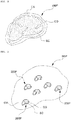
- FIGS. 1A and 1B are cross-sectional views showing various shapes of granulated silicon particles (SC) according to various embodiments of the present invention
- FIG. 2 is a cross-sectional view showing the shape of silicon - based active material particles (100P) with one or more additional layers formed on the core of the silicon particles (SC) of FIG. 1A .
- the granulated silicon particles (SC) have a potato shape as shown in FIG. 1A , or a flake-type irregular shape with a planar surface (PS) as shown in FIG. 1B .
- Silicon particles (SC) having such irregular shapes are granulated particles or finely granulated particles formed by mechanical compression and shear stress applied to the granulated silicon powder, as produced by the method described later.
- the silicon particles (SC) finely granulated by mechanical compression and shear stress may be in the form of irregular particles. Additionally, due to the stress, the finely granulated silicon particles formed together with the chemical oxide may have low crystallinity or easily be amorphous particles having no crystal domains of several tens of nanometers or more. When the size of mechanical compression and shear stress are too small, finely granulated silicon particles will have large crystal domains of tens of nanometers or more. Additionally, when the mechanical compression and shear stress are too large, the silicon particles are micronized and sufficient capacity as the active material cannot be obtained, and thus stress control in the pulverizing method is required.
- the grain-type particles shown in FIGS. 1A and 1B in connection with the amorphous silicon particles (SC) are exemplary.
- the silicon particles of the present invention may be particles having irregular cross-sectional shapes perpendicular to the axial direction even in a hollow tube structure or a fiber structure.
- the planar surfaces (PS) of the silicon particles (SC) may be the dominant surfaces among all of the outer surfaces of the silicon particles (SC), in which the dominant surface may be a ⁇ 110 ⁇ surface.
- the area of the ⁇ 110 ⁇ surface of the silicon particles (SC) may be larger than the area of other ⁇ 100 ⁇ surfaces and the area of ⁇ 111 ⁇ surfaces.
- the average particle diameter of the silicon-based active material particles (100P) may be in the range of 30 nm to 300 nm, and preferably the silicon-based active material particles have an average particle diameter in the range of 30 nm to 200 nm.
- the average diameter of the silicon-based active material particles (100P) is less than 30 nm, the relative proportion of the conductive layer or the conductive material in particle form in the active material slurry becomes large and thus the battery capacity deteriorates, whereas when the average diameter of the particle exceeds 300 nm, there is a problem in that amorphization to minimize the surface energy is difficult.
- the silicon-based active material particles (100P) may include a chemical oxide layer (CO) formed on the core of silicon particles (SC).
- the chemical oxide layer (CO) may be a silicon oxide layer formed at a low temperature by a solvent for dispersion, which includes an antioxidant in a liquid state in the presence of when under mechanical compression and shear stress, as described below.
- the oxygen content of the silicon particles (SC) may be controlled depending on the content of the antioxidant. For example, as the content of the antioxidant increases, the formation of the silicon oxide layer on the core of the silicon particles (SC) is controlled in an inversely proportional manner, and thus the oxygen content of silicon particles (SC) may be reduced.
- the thickness of the chemical oxidation layer (CO) may be in the range of a few nanometers to a few tens of nanometers, and preferably in the range of 3 nm to 15 nm.
- the chemical oxidation layer (CO) may be formed on the cores of the silicon particles (SC) as shown, the chemical oxidation layer (CO) may grow even inside the cores of silicon particles (SC) due to the diffusion of oxygen or cracks from stress.
- the oxygen content relative to the total weight of the cores of silicon particles (SC) and the chemical oxide layer (CO) may be in the range of 5 wt% to 15 wt%, and preferably 6 wt% to 10 wt%. Since the initial charging rate and the capacity retention characteristics are both maintained at 75% or greater within the oxygen content range, silicon-based active material particles suitable for commercialization may be provided. When the oxygen content exceeds 10 wt%, there is a problem in that the initial charging rate is reduced to 75% or less, whereas when the oxygen content is less than 6 wt%, a chemical oxide layer may not be formed to have an appropriate thickness, thereby attenuating the charging/discharging efficiency of the silicon particles.
- the oxygen content may be measured using an infrared detection technique using a commercial element analyzer (ELTRA ONH-2000). Specifically, the oxygen contained in a sample is converted to carbon dioxide using the sample (2 mg to 10 mg), a calorie of 8 kW, and helium (purity of 99.995%) as a carrier gas, and the amount of oxygen can be quantified by measuring the amount of the carbon dioxide generated.
- ELTRA ONH-2000 the element analyzer
- the chemical oxide layer (CO) has an advantage over the silicon oxide layer formed by a conventional thermal oxidation process or thin-film deposition process (e.g. a chemical vapor deposition process) in that the chemical oxide layer (CO) can form a stable phase with minimal influence on the crystal structures of the silicon particles.
- a high processing temperature hinders amorphization of silicon particles.
- the chemical oxide layer (CO) can be formed at a low temperature and may be formed under high compression and shear stress, a silicon oxide layer may be formed while pursuing granulation of the silicon particles (SC) and, selectively, amorphization of the silicon particles (SC).
- the degree of irregularity of the silicon-based active material particles (100P) may be determined by the shape of the cores of the inner silicon particles (SC) and may depend on the compressive stress and the shear stress of the granulation process.
- a conductive layer (CS) may be further formed on the outermost portions of the silicon-based active material particles (100P) so as to reduce contact resistance between the silicon-based active material particles (100P) and to secure an electron movement path.
- the conductive layer (CS) may include a carbon-based conductive layer (e.g. a graphite layer, a soft carbon layer, or a graphene layer). Additionally, the conductive layer (CS) may be nanoscale particles of conductive metal oxides (e.g. antimony zinc oxide or antimony tin oxide) or layers including the same.
- FIG. 3 is a cross-sectional view showing the shape of silicon-based active material complex including the silicon particles of FIG. 1A .
- the silicon-based active material complex may include a carbon matrix (CM), and at least one silicon-based active material particles (200P) dispersed in a carbon matrix (CM).
- the silicon-based active material particles (200P) may include cores of silicon particles (SC) and a chemical oxide layer (CO) formed on the cores of silicon particles (SC).
- the silicon-based active material complex may be comprised of secondary particles, including at least one silicon-based active material particles (200P).
- the average particle diameter of the silicon-based active material complex (SEP) may be in the range of 1 ⁇ m to 10 ⁇ m.
- the carbon matrix (CM) is for the electrical connection between the silicon-based active material particles (200P) that are in contact with each other and can reduce the internal resistance to the current collector (not shown).
- the carbon matrix (CM) may be crystalline or an at least partially amorphous carbon film.
- the carbon matrix (CM) may include graphite, soft carbon, or graphene.
- the carbon matrix (CM) may cause a reaction with an electrolyte, and thus, low crystallinity or amorphous carbon film having chemical resistance may be used.
- the carbon matrix (CM) may have a mixture of a conductive SP2 graphite structure and an insulating SP3 diamond structure.
- the SP2 graphite structure may have a larger mole fraction than the SP3 diamond structure, which may be controlled via a heat treatment process.
- the silicon-based active material particles (200P) may be comprised of primary particles.
- the average particle diameter of the silicon-based active material particles (200P) may be in the range of 30 nm to 300 nm, and preferably, the silicon-based active material particles have an average particle diameter in the range of 30 nm to 200 nm.
- the average diameter of the silicon-based active material particles (200P) is less than 30 nm, the relative proportion of the conductive layer or the conductive material in particle form in the active material slurry becomes large and thus the battery capacity deteriorates, whereas when the average diameter of the particle exceeds 300 nm, there is a problem in that amorphization to minimize the surface energy is difficult .
- the silicon particles (SC) of the silicon-based active material particles (200P) may correspond to the silicon particles (SC) shown in FIG. 1A or the silicon particles (SC) shown in FIG. 1B .
- the above-described silicon particles are exemplary, and the present invention is not limited thereto.
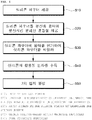
- FIG. 4 is a flow chart showing a method of preparing silicon-based active material particles according to an embodiment of the present invention.
- silicon powder is prepared (S10).
- the silicon powder is commercially available granulated particles having an average diameter in the range of a few micrometers to a few thousand micrometers.
- the silicon powder may be polycrystalline or a single crystal, but the present invention is not limited thereto.
- a pre-pulverization mixture in which the silicon powder is dispersed in a solvent for dispersion in a liquid state containing an antioxidant is provided (S20).
- a solvent containing an antioxidant may be used so as to control the oxygen content of the silicon.
- the antioxidant may include alpha lipoic acid, octene, propyl gallate, tocopherol, glutathione, butyl hydroxyanisole (butylated hydroxyl anisole), butylated hydroxytoluene, tertiary butyl hydroquinone, nordihydroguaiaretic acid, sesamol, vitamin E, vitamin C, and quercetin.
- the antioxidant may be used in an amount of 1 wt% to 10 wt% relative to the weight of the silicon powder.
- the amount of oxygen contained in the silicon-based active material particles may be excessive and thereby the irreversible capacity may be increased.
- the antioxidant is used in an amount greater than 10 wt% relative to the weight of the silicon powder, a chemical oxide layer (CO) is barely formed and thus it is difficult to suppress the volume expansion of the silicon-based active material particles thereby resulting in a drastic deterioration of the lifetime of the battery. Accordingly, it is preferred that the antioxidant be used in an amount of 1 wt% to 10 wt% relative to the weight of the silicon powder.
- the solvent for dispersion may further include water, deionized water, an alcoholic solvent, or a mixture of two or more thereof.
- the alcoholic solvent may be at least one selected from the group consisting of ethyl alcohol, methyl alcohol, glycerol, propylene glycol, isopropyl alcohol, isobutyl alcohol, polyvinyl alcohol, cyclohexanol, octyl alcohol, decanol, hexadecanol, ethylene glycol, 1,2-octanediol, 1,2-dodecanediol, and 1,2-hexadecanediol, and a mixture thereof.
- the alcoholic solvent is ethyl alcohol.
- the application of mechanical compression and shear stress to the silicon powder may be achieved by grinding, which performs pressing and abrasion while supplying the pre-pulverization mixture between a spinning abrasive plate and a fixed plate.
- the application of mechanical compression and shear stress to the silicon powder may be performed by a milling method, in which the pre-pulverization mixture and abrasive particles are charged into a cylindrical or conical container rotating about a central axis and rotated.
- the abrasive particles may be beads including ceramic particles, metal particles, or a mixture thereof, but the present invention is not limited thereto.
- the abrasive particles may apply mechanical compression and shear stress to the silicon powder by having an appropriate average size relative to the size of the silicon powder.
- the silicon-based active material particles may be formed from the granulated silicon particles while simultaneously applying the mechanical compression and shear stress.
- a chemical oxide layer may be further formed on the granulated silicon particles.
- the chemical oxide layer may include a silicon oxide.
- the thickness of the chemical oxidation layer may be in the range of 2 nm to 30 nm, and preferably in the range of 3 nm to 15 nm.
- the oxygen content relative to the total weight of the cores of the silicon particles (SC) and a chemical oxide layer(CO) may be in the range of 5 wt% to 15 wt%, and preferably 6 wt% to 10 wt%.
- a silicon-based active material complex suitable for commercialization may be provided.
- silicon complex particles may be obtained by drying the resulting product including the silicon-based active material particles (S40).
- a subsequent step such as a sorting step for scrubbing the obtained silicon complex particles may be further performed.
- the silicon-based secondary active material particles are formed using at least one of the silicon-based active material particles (S50).
- the silicon-based active material particles including the silicon particles and a liquid organic compound including a carbon precursor are mixed to form a dispersion solution.
- the silicon particles dispersed in the dispersion solution are obtained again and dried to form solid secondary particles.
- the solid secondary particles are heat treated, and thereby the carbon matrix including the carbon precursor is carbonized so silicon-based secondary active material particles may be formed.
- any one selected from the group consisting of hydrocarbon-based compounds, alcohol-based compounds, ether-based compounds, and ester-based compounds, or a mixed solution of two or more thereof may be used.
- the hydrocarbon may be hexene, nonene, dodecene, pentadecene, toluene, xylene, chlorobenzoic acid, benzene, hexadecyne, tetradecyne, or octadecyne.
- these compounds are exemplary, and other liquid hydrocarbons of linear or branched type having a carbon number in the range of 6 to 20 may be applied.
- the alcohol may be any one selected from ethyl alcohol, methyl alcohol, glycerol, propylene glycol, isopropyl alcohol, isobutyl alcohol, polyvinyl alcohol, cyclohexanol, octyl alcohol, decanol, hexadecanol, ethylene glycol, 1,2-octanediol, 1,2-dodecanediol, and 1,2-hexadecanediol, or a mixture thereof.
- the alcohol-based organic solution other primary alcohols, secondary alcohols, and tertiary alcohols may be used.
- the ether may be cyclic ethers (e.g . octyl ether, butyl ether, hexyl ether, benzyl ether, phenyl ether, decyl ether, ethyl methyl ether, dimethyl ether, diethyl ether, diphenyl ether, tetrahydrofuran, 1,4-dioxane) and polyethers (e.g. polyethylene glycol (PEG), polypropylene glycol (PPG), polytetramethylene glycol (PTMG), polyoxymethylene (POM), polytetrahydrofuran).
- PEG polyethylene glycol
- PPG polypropylene glycol
- PTMG polytetramethylene glycol
- POM polyoxymethylene
- the above-described polyethers are exemplary, and other aliphatic or aromatic polyethers may be used as the ether-based organic solvent.
- the ester may be a cyclic ester (e.g. polyethylene terephthalate, acrylate esters and cellulose acetate, isobutyl acetate, isopropyl acetate, allyl hexanoate, benzyl acetate, bornyl acetate, butyl acetate, and lactone).
- an additional carbon precursor for increasing the carbon-containing concentration may further include any one among the carbon-containing natural and synthetic polymer materials that can be dissolved using the liquid organic compound as a solvent, or a mixture thereof.
- any one among additional carbon-containing natural and synthetic polymer materials or a mixture thereof may be dissolved in a solvent other than the liquid organic compound such as water (e.g. distilled water or deionized water).
- the carbon-containing polymer materials may be chitosan, glucose, sucrose, maltose, lactose, starch, glycogen, polystyrene (PS), polyethylene (PE), polypropylene (PP), polyvinyl chloride (PVC), polyacrylonitrile (PAN), polyethylene (PE), polyacrylic acid (PAA), polyvinylpyrrolidone (PVP), or a mixture thereof.
- solid secondary particles may be obtained by dissolving the polymer materials (e.g. PAN, PAA, PVP, etc. ) in an appropriate solvent, dispersing the silicon-based active material particles in the solvent, then obtaining intermediate particles wetted with the polymer material, followed by drying.
- a commercially available polysilicon powder having an average diameter of about 5 ⁇ m was prepared and the polysilicon powder was dispersed in a solvent for dispersion, which contained 95 wt% of ethanol and respectively, 5 wt% of an antioxidant: alpha lipoic acid, octene, propyl gallate,
- tocopherol, glutathione, butyl hydroxyanisole, and phenol,and thereby a pre-pulverization mixture was prepared.
- the amounts of the alpha lipoic acid and the ethanol used are values relative to 100 parts by weight (wt%) of silicon powder.
- a commercially available polysilicon powder having an average diameter of about 5 ⁇ m was prepared and the polysilicon powder was dispersed in a solvent for dispersion, which contained 100 wt% of ethanol, and thereby a pre-pulverization mixture was prepared.
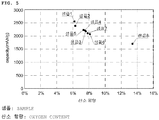
- FIG. 5 is a graph evaluating the battery characteristics of the silicon-based active material particles samples according to the Examples and Comparative Examples of the present invention.
- a method for preparing silicon-based active material particles may be provided, wherein during the preparation of the silicon-based particles excessive expansion of the core of the silicon particle during charging/discharging of the battery is prevented and subsequent micronization is prevented while stable formation of solid electrolyte interface (SEI) is induced, by controlling the oxygen content within the silicon particle by providing a pre-pulverization mixture, in which silicon powder is dispersed in a solvent for dispersion that includes an antioxidant, thus contributing to the improvement of the lifetime of the silicon-based active material particles.
- SEI solid electrolyte interface
- an oxide film may be controlled by a solvent for dispersion used in the process of granulating the silicon powder.
- a method for preparing a silicon-based active material particle with a long lifetime may be provided, by reducing the oxygen content in the active material and thereby improving the initial capacity of the battery and the battery efficiency.
Landscapes
- Chemical & Material Sciences (AREA)
- Chemical Kinetics & Catalysis (AREA)
- Electrochemistry (AREA)
- General Chemical & Material Sciences (AREA)
- Organic Chemistry (AREA)
- Engineering & Computer Science (AREA)
- Inorganic Chemistry (AREA)
- Manufacturing & Machinery (AREA)
- Composite Materials (AREA)
- Materials Engineering (AREA)
- Battery Electrode And Active Subsutance (AREA)
- Silicon Compounds (AREA)
Description
- The present invention relates to a secondary battery technology, and more particularly, to a method for producing a silicon-based negative electrode active material.
- A secondary battery is a battery that can be charged and discharged using an electrode material having excellent reversibility, and a typical commercialized example thereof is a lithium secondary battery. The lithium secondary battery is expected to be applied as a medium/large-sized power source mounted on a transportation means (e.g. automobiles) or used for power storage of a power supply network (e.g. smart grid), as well as a compact power source for small IT devices (e.g. smart phones, portable computers, and electronic paper).
- When lithium metal is used as a negative electrode material of a lithium secondary battery, there is a risk that a short-circuit or explosion of the battery may occur due to formation of a dendrite. Therefore, instead of lithium metal, crystalline carbon (e.g. graphite and artificial graphite), soft carbon, hard carbon, and carbon-based active materials to which lithium can be intercalated and deintercalated, are widely used. However, with the expansion of the applications of the secondary battery, there is an increasing demand for higher capacity and higher output from a secondary battery. Accordingly, non-carbon negative electrode materials having a capacity of 500 mAh/g or greater (e.g. silicon (Si), tin (Sn), or aluminum (Al)), which can replace carbon-based negative electrode materials having a theoretical capacity of 372 mAh/g and can be alloyed with lithium, are receiving attention.
- Among these non-carbon negative electrode materials, silicon has the largest theoretical capacity of about 4,200 mAh/g, and thus the commercialization of silicon is very important in terms of capacity. However, the volume of silicon when charged increases by about four times compared to the volume when discharged, and thus, the electrical connection between active materials and the electrical connection between a current collector and the active materials may be destroyed due to the volume change during charging and discharging, and the progress of an irreversible reaction (e.g. formation of a solid electrolyte interface (SEI) layer (e.g. Li2O)) due to corrosion of the active material by the electrolyte, and subsequent deterioration in lifetime is a major obstacle to commercialization.
- While many conventional methods have been proposed to achieve a relatively high capacity battery with minimized volume expansion and shrinkage of an active material to improve the lifetime, the most commercially feasible method is to make silicon particles into nano particles. However, even in the cases of nano-sized silicon particles, these nano-sized silicon particles did not meet the standards for commercialization because of the micronization of the particles due to repeated volume expansion/shrinkage, even to a small extent, and subsequent rapid deterioration of the lifetime. Therefore, for commercialization of silicon materials, it is necessary to design particles capable of maximizing the capacity of a battery while suppressing volume change during charging/discharging, and a manufacturing technique thereof.
KR 101550781 B1
KR 2015 0117316 A
WO 2016/085953 A1 relates to highly porous synergistic combinations of silicon and carbon materials are, articles that incorporate such materials and processes for producing the materials.
EP 2900596 A1 relates to a silicon/carbon composite comprising mesoporous silicon particles and carbon coating provided on the silicon particles, wherein the silicon particles have two pore size distributions of 2∼4 nm and 20∼40 nm. - Accordingly, a technical problem to be solved in the present invention is the provision of a method for preparing silicon-based active material particles having a long lifetime by improving energy density by improving irreversible capacity and reducing changes in volume according to charging/discharging, by using a silicon-based material.
- Additionally, another technical problem to be solved in the present invention is the provision of silicon-based active material particles having the advantages described above.
- To solve the above problems, the method for preparing silicon-based active material particles according to an embodiment of the present invention includes a step of providing silicon powder; a step of providing a pre-pulverization mixture, in which the silicon powder is dispersed in a solvent for dispersion containing an antioxidant; a step of applying mechanical compression and shear stress to the silicon powder of the pre-pulverization mixture to granulate the silicon powder, thereby forming silicon particles having an oxygen content controlled by the antioxidant; and a step of drying the resulting material containing the silicon particles to obtain silicon-based active material particles.
- In an embodiment, the antioxidant may be selected from the group consisting of alpha lipoic acid, octene, propyl gallate, tocopherol, glutathione, butyl hydroxyanisole, butylated hydroxytoluene, tertiary butyl hydroquinone, nordihydroguaiaretic acid, sesamol, vitamin E, vitamin C, and quercetin. In another embodiment, the antioxidant may include alpha lipoic acid or octene.
- In an embodiment, the antioxidant may be used in an amount of 1 wt% to 10 wt% relative to the weight of the silicon powder. The solvent for dispersion may further include water, deionized water, an alcoholic solvent, or a mixture of two or more thereof.
- In an embodiment, the alcoholic solvent may include any one selected from the group consisting of ethyl alcohol, methyl alcohol, glycerol, propylene glycol, isopropyl alcohol, isobutyl alcohol, polyvinyl alcohol, cyclohexanol, octyl alcohol, decanol, hexadecanol, ethylene glycol, 1,2-octanediol, 1,2-dodecanediol, and 1,2-hexadecanediol, or a mixture thereof.
- In an embodiment, the step of applying mechanical compression and shear stress may be performed by a mill pulverization process using a composition of abrasive particles along with the solvent for dispersion.
- To solve the above problems, the silicon-based active material particles prepared by an embodiment of the present invention may be silicon-based active material particles which include a core of the silicon particle and a chemical oxide layer formed on the core of the silicon particle, and the oxygen content relative to the total weight of the silicon-based active material particles may be limited to the range of 6 wt% to 10 wt%.
- In an embodiment, the silicon-based active material particles may be formed by a pre-pulverization mixture, which is dispersed in a solvent for dispersion that includes silicon powder and an antioxidant, and the oxygen content may be controlled by the weight of the antioxidant relative to the weight of the silicon powder.
- According to an embodiment of the present invention, a method for preparing silicon-based active material particles may be provided, wherein during the preparation of the silicon-based particles excessive expansion of the core of the silicon particle during charging/discharging of the battery is prevented and subsequent micronization is prevented while stable formation of solid electrolyte interface (SEI) is induced, by controlling the oxygen content within the silicon particle by providing a pre-pulverization mixture, in which silicon powder is dispersed in a solvent for dispersion that includes an antioxidant, thus contributing to the improvement of the lifetime of the silicon-based active material particles.
- Additionally, the formation of an oxide film may be controlled by a solvent for dispersion used in the process of granulating the silicon powder. As a result, a method for preparing a silicon-based active material particle with a long lifetime may be provided, by reducing the oxygen content in the active material and thereby improving the initial capacity of the battery and the battery efficiency.
-
-
FIGS. 1A and 1B are cross-sectional views showing various shapes of granulated silicon particles according to various embodiments of the present invention. -
FIG. 2 is a cross-sectional view showing the shape of silicon particles with one or more additional layers formed on the core of the silicon particles ofFIG. 1A . -
FIG. 3 is a cross-sectional view showing the shape of silicon-based active material particles including the silicon particles ofFIG. 1A . -
FIG. 4 is a flow chart showing a method of preparing silicon-based active material particles according to an embodiment of the present invention. -
FIG. 5 is a graph evaluating the battery characteristics of the silicon-based active material particles samples according to the Examples and Comparative Examples of the present invention. - Hereinafter, preferred embodiments of the present invention will be described in detail with reference to accompanying drawings.
- Examples of the present invention are provided to more fully describe the present invention to those skilled in the art. The following Examples may be modified in various ways, but the scope of the present invention is not limited to these Examples described hereinbelow. Rather, these Examples are provided so that the present disclosure will be more faithful and complete and fully convey the spirit of the present invention to those skilled in the art.
- Additionally, in the drawings, thickness and size of each layer are exaggerated for convenience and clarity of explanation, and the same reference numerals refer to the same elements in the drawings. As used herein, the term "and/or" includes any and all combinations of any of listed items.
- The terminology used herein is used for the purpose of describing particular embodiments and is not intended to limit the invention. As used herein, the singular forms may include the plural forms as well, unless the context explicitly indicates otherwise. Additionally, it is apparent that the terms "comprise" and/or "comprising," when used in this specification, specify the presence of stated features, integers, steps, operations, members, components, and/or groups thereof, but do not exclude the presence or addition of one or more other features, integers, steps, operations, members, components, and/or groups thereof.
-
FIGS. 1A and 1B are cross-sectional views showing various shapes of granulated silicon particles (SC) according to various embodiments of the present invention, andFIG. 2 is a cross-sectional view showing the shape of silicon - based active material particles (100P) with one or more additional layers formed on the core of the silicon particles (SC) ofFIG. 1A . - The granulated silicon particles (SC) have a potato shape as shown in
FIG. 1A , or a flake-type irregular shape with a planar surface (PS) as shown inFIG. 1B . Silicon particles (SC) having such irregular shapes are granulated particles or finely granulated particles formed by mechanical compression and shear stress applied to the granulated silicon powder, as produced by the method described later. - The silicon particles (SC) finely granulated by mechanical compression and shear stress may be in the form of irregular particles. Additionally, due to the stress, the finely granulated silicon particles formed together with the chemical oxide may have low crystallinity or easily be amorphous particles having no crystal domains of several tens of nanometers or more. When the size of mechanical compression and shear stress are too small, finely granulated silicon particles will have large crystal domains of tens of nanometers or more. Additionally, when the mechanical compression and shear stress are too large, the silicon particles are micronized and sufficient capacity as the active material cannot be obtained, and thus stress control in the pulverizing method is required.
- The grain-type particles shown in
FIGS. 1A and 1B in connection with the amorphous silicon particles (SC) are exemplary. In another embodiment, the silicon particles of the present invention may be particles having irregular cross-sectional shapes perpendicular to the axial direction even in a hollow tube structure or a fiber structure. The planar surfaces (PS) of the silicon particles (SC) may be the dominant surfaces among all of the outer surfaces of the silicon particles (SC), in which the dominant surface may be a {110} surface. Quantitatively, the area of the {110} surface of the silicon particles (SC) may be larger than the area of other {100} surfaces and the area of {111} surfaces. - The average particle diameter of the silicon-based active material particles (100P) may be in the range of 30 nm to 300 nm, and preferably the silicon-based active material particles have an average particle diameter in the range of 30 nm to 200 nm. When the average diameter of the silicon-based active material particles (100P) is less than 30 nm, the relative proportion of the conductive layer or the conductive material in particle form in the active material slurry becomes large and thus the battery capacity deteriorates, whereas when the average diameter of the particle exceeds 300 nm, there is a problem in that amorphization to minimize the surface energy is difficult.
- The silicon-based active material particles (100P) according to an embodiment of the present invention, as shown in
FIG. 2 , may include a chemical oxide layer (CO) formed on the core of silicon particles (SC). The chemical oxide layer (CO) may be a silicon oxide layer formed at a low temperature by a solvent for dispersion, which includes an antioxidant in a liquid state in the presence of when under mechanical compression and shear stress, as described below. The oxygen content of the silicon particles (SC) may be controlled depending on the content of the antioxidant. For example, as the content of the antioxidant increases, the formation of the silicon oxide layer on the core of the silicon particles (SC) is controlled in an inversely proportional manner, and thus the oxygen content of silicon particles (SC) may be reduced. The thickness of the chemical oxidation layer (CO) may be in the range of a few nanometers to a few tens of nanometers, and preferably in the range of 3 nm to 15 nm. The chemical oxidation layer (CO) may be formed on the cores of the silicon particles (SC) as shown, the chemical oxidation layer (CO) may grow even inside the cores of silicon particles (SC) due to the diffusion of oxygen or cracks from stress. - In the silicon-based active material particles (100P), the oxygen content relative to the total weight of the cores of silicon particles (SC) and the chemical oxide layer (CO) may be in the range of 5 wt% to 15 wt%, and preferably 6 wt% to 10 wt%. Since the initial charging rate and the capacity retention characteristics are both maintained at 75% or greater within the oxygen content range, silicon-based active material particles suitable for commercialization may be provided. When the oxygen content exceeds 10 wt%, there is a problem in that the initial charging rate is reduced to 75% or less, whereas when the oxygen content is less than 6 wt%, a chemical oxide layer may not be formed to have an appropriate thickness, thereby attenuating the charging/discharging efficiency of the silicon particles.
- In an embodiment, the oxygen content may be measured using an infrared detection technique using a commercial element analyzer (ELTRA ONH-2000). Specifically, the oxygen contained in a sample is converted to carbon dioxide using the sample (2 mg to 10 mg), a calorie of 8 kW, and helium (purity of 99.995%) as a carrier gas, and the amount of oxygen can be quantified by measuring the amount of the carbon dioxide generated. The method of measuring the oxygen content using the element analyzer (ELTRA ONH-2000) is only one example, and the measurement method is not limited thereto.
- The chemical oxide layer (CO) has an advantage over the silicon oxide layer formed by a conventional thermal oxidation process or thin-film deposition process (e.g. a chemical vapor deposition process) in that the chemical oxide layer (CO) can form a stable phase with minimal influence on the crystal structures of the silicon particles. Generally, in cases of thermal oxidation and chemical vapor deposition, a high processing temperature hinders amorphization of silicon particles. However, since the chemical oxide layer (CO) can be formed at a low temperature and may be formed under high compression and shear stress, a silicon oxide layer may be formed while pursuing granulation of the silicon particles (SC) and, selectively, amorphization of the silicon particles (SC). As a result, the charging/discharging efficiency of the silicon particles may be improved and lifetime thereof may be increased. The degree of irregularity of the silicon-based active material particles (100P) may be determined by the shape of the cores of the inner silicon particles (SC) and may depend on the compressive stress and the shear stress of the granulation process.
- In some embodiments, since the chemical oxide layer (CO) of the silicon-based active material particles (100P) is electrically insulative, a conductive layer (CS) may be further formed on the outermost portions of the silicon-based active material particles (100P) so as to reduce contact resistance between the silicon-based active material particles (100P) and to secure an electron movement path. The conductive layer (CS) may include a carbon-based conductive layer (e.g. a graphite layer, a soft carbon layer, or a graphene layer). Additionally, the conductive layer (CS) may be nanoscale particles of conductive metal oxides (e.g. antimony zinc oxide or antimony tin oxide) or layers including the same.
-
FIG. 3 is a cross-sectional view showing the shape of silicon-based active material complex including the silicon particles ofFIG. 1A . - Referring to
FIG. 3 , the silicon-based active material complex (SEP) may include a carbon matrix (CM), and at least one silicon-based active material particles (200P) dispersed in a carbon matrix (CM). The silicon-based active material particles (200P) may include cores of silicon particles (SC) and a chemical oxide layer (CO) formed on the cores of silicon particles (SC). - In an embodiment, the silicon-based active material complex (SEP) may be comprised of secondary particles, including at least one silicon-based active material particles (200P). The average particle diameter of the silicon-based active material complex (SEP) may be in the range of 1 µm to 10 µm.
- The carbon matrix (CM) is for the electrical connection between the silicon-based active material particles (200P) that are in contact with each other and can reduce the internal resistance to the current collector (not shown). In an embodiment, the carbon matrix (CM) may be crystalline or an at least partially amorphous carbon film.
- In an embodiment, the carbon matrix (CM) may include graphite, soft carbon, or graphene. When the carbon matrix (CM) has high crystallinity as in graphite, the carbon matrix (CM) may cause a reaction with an electrolyte, and thus, low crystallinity or amorphous carbon film having chemical resistance may be used. Additionally, the carbon matrix (CM) may have a mixture of a conductive SP2 graphite structure and an insulating SP3 diamond structure. For the carbon matrix (CM) to have conductivity, the SP2 graphite structure may have a larger mole fraction than the SP3 diamond structure, which may be controlled via a heat treatment process.
- The silicon-based active material particles (200P) may be comprised of primary particles. In an embodiment, the average particle diameter of the silicon-based active material particles (200P) may be in the range of 30 nm to 300 nm, and preferably, the silicon-based active material particles have an average particle diameter in the range of 30 nm to 200 nm. When the average diameter of the silicon-based active material particles (200P) is less than 30 nm, the relative proportion of the conductive layer or the conductive material in particle form in the active material slurry becomes large and thus the battery capacity deteriorates, whereas when the average diameter of the particle exceeds 300 nm, there is a problem in that amorphization to minimize the surface energy is difficult .
- In an embodiment, the silicon particles (SC) of the silicon-based active material particles (200P) may correspond to the silicon particles (SC) shown in
FIG. 1A or the silicon particles (SC) shown inFIG. 1B . The above-described silicon particles are exemplary, and the present invention is not limited thereto. -
FIG. 4 is a flow chart showing a method of preparing silicon-based active material particles according to an embodiment of the present invention. - Referring to
FIG. 4 , first, silicon powder is prepared (S10). The silicon powder is commercially available granulated particles having an average diameter in the range of a few micrometers to a few thousand micrometers. The silicon powder may be polycrystalline or a single crystal, but the present invention is not limited thereto. - A pre-pulverization mixture in which the silicon powder is dispersed in a solvent for dispersion in a liquid state containing an antioxidant is provided (S20). In an embodiment, as the solvent for dispersion, a solvent containing an antioxidant may be used so as to control the oxygen content of the silicon. In an embodiment, the antioxidant may include alpha lipoic acid, octene, propyl gallate, tocopherol, glutathione, butyl hydroxyanisole (butylated hydroxyl anisole), butylated hydroxytoluene, tertiary butyl hydroquinone, nordihydroguaiaretic acid, sesamol, vitamin E, vitamin C, and quercetin.
- In an embodiment, the antioxidant may be used in an amount of 1 wt% to 10 wt% relative to the weight of the silicon powder. For example, when the antioxidant is used in an amount less than 1 wt% relative to the weight of the silicon powder, the amount of oxygen contained in the silicon-based active material particles may be excessive and thereby the irreversible capacity may be increased. When the antioxidant is used in an amount greater than 10 wt% relative to the weight of the silicon powder, a chemical oxide layer (CO) is barely formed and thus it is difficult to suppress the volume expansion of the silicon-based active material particles thereby resulting in a drastic deterioration of the lifetime of the battery. Accordingly, it is preferred that the antioxidant be used in an amount of 1 wt% to 10 wt% relative to the weight of the silicon powder.
- The solvent for dispersion may further include water, deionized water, an alcoholic solvent, or a mixture of two or more thereof. The alcoholic solvent may be at least one selected from the group consisting of ethyl alcohol, methyl alcohol, glycerol, propylene glycol, isopropyl alcohol, isobutyl alcohol, polyvinyl alcohol, cyclohexanol, octyl alcohol, decanol, hexadecanol, ethylene glycol, 1,2-octanediol, 1,2-dodecanediol, and 1,2-hexadecanediol, and a mixture thereof. Preferably, the alcoholic solvent is ethyl alcohol.
- Mechanical compression and shear stress are applied to the silicon powder of the pre-pulverization mixture to granulate the silicon powder and thereby the silicon particles that will be be the cores of the silicon-based active material particles are formed (S30). Such a granulation process is efficient in preparing amorphous silicon particles.
- In an embodiment, the application of mechanical compression and shear stress to the silicon powder may be achieved by grinding, which performs pressing and abrasion while supplying the pre-pulverization mixture between a spinning abrasive plate and a fixed plate. In another embodiment, the application of mechanical compression and shear stress to the silicon powder may be performed by a milling method, in which the pre-pulverization mixture and abrasive particles are charged into a cylindrical or conical container rotating about a central axis and rotated. The abrasive particles may be beads including ceramic particles, metal particles, or a mixture thereof, but the present invention is not limited thereto. The abrasive particles may apply mechanical compression and shear stress to the silicon powder by having an appropriate average size relative to the size of the silicon powder.
- In an embodiment, the silicon-based active material particles may be formed from the granulated silicon particles while simultaneously applying the mechanical compression and shear stress. In an embodiment, a chemical oxide layer may be further formed on the granulated silicon particles. As described above, the chemical oxide layer may include a silicon oxide. The thickness of the chemical oxidation layer may be in the range of 2 nm to 30 nm, and preferably in the range of 3 nm to 15 nm.
- In the silicon-based active material particles (see 100P of
FIG. 2 ), the oxygen content relative to the total weight of the cores of the silicon particles (SC) and a chemical oxide layer(CO) may be in the range of 5 wt% to 15 wt%, and preferably 6 wt% to 10 wt%. When the initial charging rate and the capacity retention characteristics are both maintained at 75% or greater within the above range of oxygen content, a silicon-based active material complex suitable for commercialization may be provided. - Then, silicon complex particles may be obtained by drying the resulting product including the silicon-based active material particles (S40). Preferably, a subsequent step such as a sorting step for scrubbing the obtained silicon complex particles may be further performed.
- The silicon-based secondary active material particles are formed using at least one of the silicon-based active material particles (S50). The silicon-based active material particles including the silicon particles and a liquid organic compound including a carbon precursor are mixed to form a dispersion solution.
- Then, the silicon particles dispersed in the dispersion solution are obtained again and dried to form solid secondary particles. The solid secondary particles are heat treated, and thereby the carbon matrix including the carbon precursor is carbonized so silicon-based secondary active material particles may be formed. These preparation methods are exemplary, and the present invention is not limited thereto.
- In an embodiment, as the carbon precursor, any one selected from the group consisting of hydrocarbon-based compounds, alcohol-based compounds, ether-based compounds, and ester-based compounds, or a mixed solution of two or more thereof may be used. In an embodiment, the hydrocarbon may be hexene, nonene, dodecene, pentadecene, toluene, xylene, chlorobenzoic acid, benzene, hexadecyne, tetradecyne, or octadecyne. However, these compounds are exemplary, and other liquid hydrocarbons of linear or branched type having a carbon number in the range of 6 to 20 may be applied.
- Additionally, the alcohol may be any one selected from ethyl alcohol, methyl alcohol, glycerol, propylene glycol, isopropyl alcohol, isobutyl alcohol, polyvinyl alcohol, cyclohexanol, octyl alcohol, decanol, hexadecanol, ethylene glycol, 1,2-octanediol, 1,2-dodecanediol, and 1,2-hexadecanediol, or a mixture thereof. As the alcohol-based organic solution, other primary alcohols, secondary alcohols, and tertiary alcohols may be used.
- The ether may be cyclic ethers (e.g. octyl ether, butyl ether, hexyl ether, benzyl ether, phenyl ether, decyl ether, ethyl methyl ether, dimethyl ether, diethyl ether, diphenyl ether, tetrahydrofuran, 1,4-dioxane) and polyethers (e.g. polyethylene glycol (PEG), polypropylene glycol (PPG), polytetramethylene glycol (PTMG), polyoxymethylene (POM), polytetrahydrofuran). The above-described polyethers are exemplary, and other aliphatic or aromatic polyethers may be used as the ether-based organic solvent. The ester may be a cyclic ester (e.g. polyethylene terephthalate, acrylate esters and cellulose acetate, isobutyl acetate, isopropyl acetate, allyl hexanoate, benzyl acetate, bornyl acetate, butyl acetate, and lactone).
- In another embodiment, as an additional carbon precursor for increasing the carbon-containing concentration, may further include any one among the carbon-containing natural and synthetic polymer materials that can be dissolved using the liquid organic compound as a solvent, or a mixture thereof. In yet another embodiment, any one among additional carbon-containing natural and synthetic polymer materials or a mixture thereof may be dissolved in a solvent other than the liquid organic compound such as water (e.g. distilled water or deionized water).
- The carbon-containing polymer materials may be chitosan, glucose, sucrose, maltose, lactose, starch, glycogen, polystyrene (PS), polyethylene (PE), polypropylene (PP), polyvinyl chloride (PVC), polyacrylonitrile (PAN), polyethylene (PE), polyacrylic acid (PAA), polyvinylpyrrolidone (PVP), or a mixture thereof. For example, solid secondary particles may be obtained by dissolving the polymer materials (e.g. PAN, PAA, PVP, etc.) in an appropriate solvent, dispersing the silicon-based active material particles in the solvent, then obtaining intermediate particles wetted with the polymer material, followed by drying.
- Hereinafter, the characteristics and advantages of the present invention will be described according to specific Experimental Examples selected from the above-mentioned materials and the composition ratios disclosed therefor in the Examples described above. The following disclosure is for illustrative purposes only and the present invention is not to be construed as limited thereto.
- A commercially available polysilicon powder having an average diameter of about 5 µm was prepared and the polysilicon powder was dispersed in a solvent for dispersion, which contained 95 wt% of ethanol and respectively, 5 wt% of an antioxidant: alpha lipoic acid, octene, propyl gallate,
- tocopherol, glutathione, butyl hydroxyanisole, and phenol,and thereby a pre-pulverization mixture was prepared. A time-controlled mill pulverization process, which can apply compressive and shear stress to the pre-pulverization mixture, was repeated at least once and thereby the silicon-based active material particles were prepared. The amounts of the alpha lipoic acid and the ethanol used are values relative to 100 parts by weight (wt%) of silicon powder.
- A commercially available polysilicon powder having an average diameter of about 5 µm was prepared and the polysilicon powder was dispersed in a solvent for dispersion, which contained 100 wt% of ethanol, and thereby a pre-pulverization mixture was prepared. A time-controlled mill pulverization process, which can apply compressive and shear stress to the pre-pulverization mixture, was repeated at least once and thereby the silicon-based active material particles were prepared.
- Battery characteristics were evaluated for samples containing silicon cathode active materials according to the Experimental Examples and Comparative Examples. The sizes of oxygen content (%), capacity to weight (mAh/g), and initial efficiency (%) were evaluated using half cells which were prepared using silicon negative electrode active material particles according to the Experimental Examples and Comparative Examples. The measured test data are shown in Table 1 below. In particular, the charging/discharging rate was 0.5 C. The reference initial capacity is 4,200 mAh/g, which is the theoretical capacity of silicon.
[Table 1] Anti-oxidant Sample Oxygen Content (%) Capacity to Weight (mAh/g) Initial Efficiency (%) Experimental Example 1 Sample 1 Alpha Lipoic Acid 6.2% 2,554 mAh/g 88.0 % Sample 2 Octene 6.3% 2,387 mAh/g 87.6% Sample 3 Propyl Gallate 7 .6% 2,177 mAh/g 84.4 % Sample 4 Tocopherol 7.5% 2,213 mAh/g 84.7% Sample 5 Glutathione 7.3% 2,234 mAh/g 85.8 % Sample 6 ButylHydroxy anisole 8.1% 2,074 mAh/g 82.1% Sample 7 Phenol 7.8% 2,106 mAh/g 83.5% Comparative Example Sample 8 No Addition 13.4% 1,701 mAh/g 78.5% -
FIG. 5 is a graph evaluating the battery characteristics of the silicon-based active material particles samples according to the Examples and Comparative Examples of the present invention. - Referring to Table 1 and
FIG. 5 together, it was confirmed that while the oxygen contents (%) of Experimental Example 1 (samples 1 to 7) were less than 10%, the oxygen content (%) of Comparative Example (in which the sample was prepared using a solvent for dispersion not containing an antioxidant) was higher than 10%. These results confirmed that the formation of an oxidative layer of the silicon-based active material particles was controlled by the antioxidant contained in the solvent for dispersion thereby reducing the oxygen content. Additionally, it was confirmed that as the oxygen content decreased, the capacity to weight and initial efficiency of silicon-based active material particles according to the Comparative Example were improved. From these results, it was confirmed that the process of dispersing silicon powder using the solvent for dispersion containing an antioxidant enabled an effect of improving lifetime in a battery, in which silicon-based active material particles were applied as a negative electrode active material. - According to an embodiment of the present invention, a method for preparing silicon-based active material particles may be provided, wherein during the preparation of the silicon-based particles excessive expansion of the core of the silicon particle during charging/discharging of the battery is prevented and subsequent micronization is prevented while stable formation of solid electrolyte interface (SEI) is induced, by controlling the oxygen content within the silicon particle by providing a pre-pulverization mixture, in which silicon powder is dispersed in a solvent for dispersion that includes an antioxidant, thus contributing to the improvement of the lifetime of the silicon-based active material particles.
- Additionally, the formation of an oxide film may be controlled by a solvent for dispersion used in the process of granulating the silicon powder. As a result, a method for preparing a silicon-based active material particle with a long lifetime may be provided, by reducing the oxygen content in the active material and thereby improving the initial capacity of the battery and the battery efficiency.
- The present invention described above is not limited to exemplary embodiments and accompanying drawings thereof, and it will be apparent to those skilled in the art that various substitutions, modifications, and changes can be made hereto without departing from the technical concept of the present invention defined in the following claims.
-
- 100P, 200P: silicon-based active material particles
- SC: silicon particles
- PS: planar surface
- CS: conductive layer
- CO: chemical oxide layer
- SEP: silicon-based active material complex
- CM: carbon matrix
Claims (10)
- A method for preparing silicon-based active material particles, the method comprising:a step of providing silicon powder;a step of providing a pre-pulverization mixture, in which the silicon powder is dispersed in a solvent for dispersion comprising an antioxidant;a step of applying mechanical compression and shear stress to the silicon powder of the pre-pulverization mixture to granulate the silicon powder, thereby forming silicon particles having an oxygen content controlled by the antioxidant; anda step of drying the resulting product comprising the silicon particles to obtain silicon-based active material particles.
- The method of claim 1, wherein the antioxidant is selected from the group consisting of alpha lipoic acid, octene, propyl gallate, tocopherol, glutathione, butyl hydroxyanisole, butylated hydroxytoluene, tertiary butyl hydroquinone, nordihydroguaiaretic acid, sesamol, vitamin E, vitamin C, and quercetin.
- The method of any preceding claim, wherein the antioxidant is used in an amount of 1 wt% to 10 wt% relative to the weight of the silicon powder.
- The method of any preceding claim, wherein the solvent for dispersion further comprises water, deionized water, an alcoholic solvent, or a mixture of two or more thereof; optionally
wherein the alcoholic solvent comprises any one selected from the group consisting of ethyl alcohol, methyl alcohol, glycerol, propylene glycol, isopropyl alcohol, isobutyl alcohol, polyvinyl alcohol, cyclohexanol, octyl alcohol, decanol, hexadecanol, ethylene glycol, 1,2-octanediol, 1,2-dodecanediol, and 1,2-hexadecanediol, or a mixture thereof. - The method of any preceding claim, wherein the step of applying mechanical compression and shear stress is achieved by grinding, which performs pressing and abrasion while supplying the pre-pulverization mixture between a spinning abrasive plate and a fixed plate.
- The method of any preceding claim, wherein the silicon-based active material particles include a chemical oxide layer formed on a core of a silicon particle; optionally
wherein in the silicon-based active material particles the oxygen content relative to the total weight of the cores of silicon particles and the chemical oxide layers is limited to the range of 5 wt% to 15 wt% or 6 wt% to 10 wt%. - The method of claim 6, wherein the chemical oxide layer is a silicon oxide layer formed at a low temperature by the solvent for dispersion comprising the antioxidant during the step of applying mechanical compression and shear stress.
- The method of claim 6 or 7, wherein the cores of silicon particles have a low crystallinity or are amorphous.
- The method of any preceding claim, wherein the average particle diameter of the silicon-based active material particles is in the range of 30 nm to 300 nm or 30 nm to 200 nm.
- The method of any preceding claim, wherein the method further comprises:a step of mixing the resulting product comprising the silicon particles and a carbon precursor solvent to form a dispersion solution;a step of forming solid secondary particles, in which the silicon particles are dispersed, within the carbon precursor matrix from the dispersion solution; anda step of heat treating the solid secondary particles to carbonize the carbon precursor matrix, thereby forming silicon-based secondary active material particles.
Applications Claiming Priority (2)
| Application Number | Priority Date | Filing Date | Title |
|---|---|---|---|
| KR1020160106853A KR101773719B1 (en) | 2016-08-23 | 2016-08-23 | Silicon based active material for rechargeable battery and method of fabricating the same |
| PCT/KR2017/009223 WO2018038538A1 (en) | 2016-08-23 | 2017-08-23 | Silicon-based active material particles for secondary battery and method for producing same |
Publications (3)
| Publication Number | Publication Date |
|---|---|
| EP3560891A1 EP3560891A1 (en) | 2019-10-30 |
| EP3560891A4 EP3560891A4 (en) | 2020-01-22 |
| EP3560891B1 true EP3560891B1 (en) | 2021-05-05 |
Family
ID=59923862
Family Applications (1)
| Application Number | Title | Priority Date | Filing Date |
|---|---|---|---|
| EP17843958.4A Active EP3560891B1 (en) | 2016-08-23 | 2017-08-23 | Silicon-based active material particles for secondary battery and method for producing same |
Country Status (6)
| Country | Link |
|---|---|
| US (1) | US11171332B2 (en) |
| EP (1) | EP3560891B1 (en) |
| JP (1) | JP7094943B2 (en) |
| KR (1) | KR101773719B1 (en) |
| CN (1) | CN109843799B (en) |
| WO (1) | WO2018038538A1 (en) |
Families Citing this family (17)
| Publication number | Priority date | Publication date | Assignee | Title |
|---|---|---|---|---|
| JP2006017418A (en) * | 2004-07-05 | 2006-01-19 | Institute Of Physical & Chemical Research | Apparatus and method for freezing and thawing moisture content |
| KR101567203B1 (en) | 2014-04-09 | 2015-11-09 | (주)오렌지파워 | Negative electrode material for rechargeable battery and method of fabricating the same |
| KR101604352B1 (en) | 2014-04-22 | 2016-03-18 | (주)오렌지파워 | Negative electrode active material and rechargeable battery having the same |
| KR101550781B1 (en) | 2014-07-23 | 2015-09-08 | (주)오렌지파워 | Method of forming silicon based active material for rechargeable battery |
| GB2533161C (en) | 2014-12-12 | 2019-07-24 | Nexeon Ltd | Electrodes for metal-ion batteries |
| KR101726037B1 (en) | 2015-03-26 | 2017-04-11 | (주)오렌지파워 | Silicon based negative electrode material for rechargeable battery and method of fabricating the same |
| KR101918815B1 (en) | 2016-08-23 | 2018-11-15 | 넥시온 엘티디. | Anode Active Material for Rechargeable Battery and Preparing Method thereof |
| GB2563455B (en) | 2017-06-16 | 2019-06-19 | Nexeon Ltd | Particulate electroactive materials for use in metal-ion batteries |
| KR102285980B1 (en) * | 2017-11-09 | 2021-08-04 | 주식회사 엘지에너지솔루션 | Negative electrode active material, negative electrode comprising the negative electrode active material, and lithium secondarty battery comprising the negative electrode |
| JP7168360B2 (en) * | 2018-07-04 | 2022-11-09 | 株式会社Soken | Method for manufacturing all-solid-state battery |
| KR102885277B1 (en) | 2020-02-24 | 2025-11-11 | 삼성에스디아이 주식회사 | Negative active material for rechargeable lithium battery, and rechargeable lithium battery including same |
| CN111640919B (en) * | 2020-05-14 | 2021-10-22 | 浙江金鹰新能源技术开发有限公司 | A high first-efficiency silicon carbon anode material and preparation method thereof, and lithium ion battery |
| CN115775862A (en) * | 2021-09-08 | 2023-03-10 | 苏州能宇新材料科技有限公司 | Nano-silicon pre-dispersed negative electrode slurry and preparation method thereof |
| CN115810739A (en) * | 2021-09-14 | 2023-03-17 | 苏州能宇新材料科技有限公司 | Silicon-carbon negative electrode slurry, preparation method thereof and lithium ion battery |
| CN116190592A (en) * | 2022-12-14 | 2023-05-30 | 贝特瑞新材料集团股份有限公司 | Negative electrode materials and lithium-ion batteries |
| CN118652658B (en) * | 2024-05-28 | 2025-01-21 | 中国林业科学研究院林产化学工业研究所 | A water-soluble self-repairing binder for lithium-sulfur battery positive electrode, preparation method and application thereof |
| KR20250173367A (en) * | 2024-06-03 | 2025-12-10 | 주식회사 엘지화학 | Negative electrode active material, method for manufacturing the same, negative electrode and secondary battery comprising the same |
Family Cites Families (56)
| Publication number | Priority date | Publication date | Assignee | Title |
|---|---|---|---|---|
| JP2003190784A (en) * | 2001-10-17 | 2003-07-08 | Kawatetsu Techno Res Corp | Oxygen absorber and its package |
| EP1313158A3 (en) | 2001-11-20 | 2004-09-08 | Canon Kabushiki Kaisha | Electrode material for rechargeable lithium battery, electrode comprising said electrode material, rechargeable lithium battery having said electrode , and process for the production thereof |
| WO2003078688A1 (en) | 2002-03-15 | 2003-09-25 | Canon Kabushiki Kaisha | Porous material and process for producing the same |
| JP4464173B2 (en) | 2003-03-26 | 2010-05-19 | キヤノン株式会社 | Electrode material for lithium secondary battery, electrode structure having the electrode material, and secondary battery having the electrode structure |
| KR100721500B1 (en) * | 2003-03-26 | 2007-05-23 | 캐논 가부시끼가이샤 | Electrode material for lithium secondary battery and electrode structure having the electrode material |
| JP4401984B2 (en) | 2004-03-08 | 2010-01-20 | 三星エスディアイ株式会社 | Negative electrode active material for lithium secondary battery, negative electrode active material for lithium secondary battery, and lithium secondary battery |
| US7955735B2 (en) | 2004-11-15 | 2011-06-07 | Panasonic Corporation | Non-aqueous electrolyte secondary battery |
| US20060147802A1 (en) | 2005-01-05 | 2006-07-06 | Kiyotaka Yasuda | Anode for nonaqueous secondary battery, process of producing the anode, and nonaqueous secondary battery |
| US20090010833A1 (en) | 2006-11-28 | 2009-01-08 | Cima Nano Tech Israel Ltd. | Process for producing ultra-fine powder of crystalline silicon |
| GB0709165D0 (en) | 2007-05-11 | 2007-06-20 | Nexeon Ltd | A silicon anode for a rechargeable battery |
| GB0713895D0 (en) | 2007-07-17 | 2007-08-29 | Nexeon Ltd | Production |
| GB0713898D0 (en) | 2007-07-17 | 2007-08-29 | Nexeon Ltd | A method of fabricating structured particles composed of silcon or a silicon-based material and their use in lithium rechargeable batteries |
| JP5245592B2 (en) | 2008-07-14 | 2013-07-24 | 信越化学工業株式会社 | Negative electrode material for non-aqueous electrolyte secondary battery, lithium ion secondary battery and electrochemical capacitor |
| GB0817936D0 (en) * | 2008-09-30 | 2008-11-05 | Intrinsiq Materials Global Ltd | Porous materials |
| JP5310251B2 (en) | 2009-05-18 | 2013-10-09 | 信越化学工業株式会社 | Method for producing negative electrode material for non-aqueous electrolyte secondary battery |
| WO2011002013A1 (en) | 2009-06-30 | 2011-01-06 | 日本ゼオン株式会社 | Active material for electrode for nonaqueous-electrolyte secondary battery, and nonaqueous-electrolyte secondary battery |
| GB201005979D0 (en) | 2010-04-09 | 2010-05-26 | Nexeon Ltd | A method of fabricating structured particles composed of silicon or a silicon-based material and their use in lithium rechargeable batteries |
| WO2012000858A1 (en) * | 2010-06-29 | 2012-01-05 | Umicore | Submicron sized silicon powder with low oxygen content |
| GB201014706D0 (en) | 2010-09-03 | 2010-10-20 | Nexeon Ltd | Porous electroactive material |
| KR101358867B1 (en) | 2011-04-20 | 2014-02-06 | 한양대학교 산학협력단 | SiOx-based complex powder, preparation method thereof and the use of the same |
| CN103503206B (en) | 2011-04-22 | 2016-03-02 | 昭和电工株式会社 | The manufacture method of positive active material for lithium secondary battery |
| GB2492167C (en) | 2011-06-24 | 2018-12-05 | Nexeon Ltd | Structured particles |
| CA2754372A1 (en) | 2011-10-04 | 2013-04-04 | Hydro-Quebec | Positive-electrode material for lithium-ion secondary battery and method of producing same |
| EP2900596B1 (en) * | 2011-11-30 | 2017-09-27 | Robert Bosch GmbH | Mesoporous silicon/carbon composite for use as lithium ion battery anode material and process of preparing the same |
| US10388948B2 (en) | 2012-01-30 | 2019-08-20 | Nexeon Limited | Composition of SI/C electro active material |
| GB2499984B (en) | 2012-02-28 | 2014-08-06 | Nexeon Ltd | Composite particles comprising a removable filler |
| US9123955B2 (en) | 2012-04-06 | 2015-09-01 | Samsung Sdi Co., Ltd. | Negative active material, lithium battery including the material, and method for manufacturing the material |
| GB2502625B (en) | 2012-06-06 | 2015-07-29 | Nexeon Ltd | Method of forming silicon |
| KR101363549B1 (en) * | 2012-06-13 | 2014-02-14 | 주식회사 예일전자 | Manufacturing method of silicon oxide, in use of anode material for secondary battery |
| CN103633295B (en) | 2012-08-23 | 2018-03-02 | 上海杉杉科技有限公司 | A kind of Si-C composite material, lithium ion battery and its preparation method and application |
| KR101730956B1 (en) | 2012-10-11 | 2017-04-27 | 삼성에스디아이 주식회사 | Negative active material, manufacturing method thereof, and lithium battery containing the material |
| GB2507535B (en) | 2012-11-02 | 2015-07-15 | Nexeon Ltd | Multilayer electrode |
| WO2014189886A1 (en) * | 2013-05-24 | 2014-11-27 | Nanogram Corporation | Printable inks with silicon/germanium based nanoparticles with high viscosity alcohol solvents |
| DE102013211388A1 (en) * | 2013-06-18 | 2014-12-18 | Wacker Chemie Ag | Electrode material and its use in lithium-ion batteries |
| WO2015030531A1 (en) | 2013-09-02 | 2015-03-05 | 주식회사 엘지화학 | Porous silicon based particles, method for preparing same and anode active material comprising same |
| KR101704103B1 (en) | 2013-09-17 | 2017-02-07 | 주식회사 엘지화학 | Porous silicon based anode active material and lithium secondary battery comprising the same |
| GB2520946A (en) | 2013-12-03 | 2015-06-10 | Nexeon Ltd | Electrodes for Metal-Ion Batteries |
| KR20160088338A (en) * | 2013-12-10 | 2016-07-25 | 삼성전자주식회사 | Anode active material for lithium ion secondary battery, and manufacturing method therefor |
| US20150221936A1 (en) | 2014-02-05 | 2015-08-06 | GM Global Technology Operations LLC | Negative electrode material for a lithium ion battery |
| KR101567203B1 (en) | 2014-04-09 | 2015-11-09 | (주)오렌지파워 | Negative electrode material for rechargeable battery and method of fabricating the same |
| JP5956690B2 (en) | 2014-04-16 | 2016-07-27 | 昭和電工株式会社 | Negative electrode material for lithium ion battery and its use |
| KR20150120795A (en) | 2014-04-18 | 2015-10-28 | 삼성에스디아이 주식회사 | Negative electrode composition, and negative electrode and lithium battery containing the same |
| KR101604352B1 (en) | 2014-04-22 | 2016-03-18 | (주)오렌지파워 | Negative electrode active material and rechargeable battery having the same |
| EP2966037A1 (en) | 2014-07-08 | 2016-01-13 | Umicore SA | A composite particle comprising a carbon-based matrix and silicon particles embedded therein, a powder consisting of such composite particles, use of such composite particles and an electrode for a battery |
| KR101550781B1 (en) * | 2014-07-23 | 2015-09-08 | (주)오렌지파워 | Method of forming silicon based active material for rechargeable battery |
| GB2529411A (en) | 2014-08-18 | 2016-02-24 | Nexeon Ltd | Electroactive materials for metal-ion batteries |
| GB2529410A (en) | 2014-08-18 | 2016-02-24 | Nexeon Ltd | Electroactive materials for metal-ion batteries |
| EP3224881A1 (en) | 2014-11-25 | 2017-10-04 | Corning Incorporated | Method and material for lithium ion battery anodes |
| GB2533161C (en) | 2014-12-12 | 2019-07-24 | Nexeon Ltd | Electrodes for metal-ion batteries |
| KR101614016B1 (en) | 2014-12-31 | 2016-04-20 | (주)오렌지파워 | Silicon based negative electrode material for rechargeable battery and method of fabricating the same |
| WO2016137024A1 (en) | 2015-02-24 | 2016-09-01 | (주)오렌지파워 | Silicon anode active material and preparation method therefor |
| GB2536435B (en) | 2015-03-16 | 2018-02-28 | Nexeon Ltd | Electroactive materials for metal-ion batteries |
| KR101726037B1 (en) | 2015-03-26 | 2017-04-11 | (주)오렌지파워 | Silicon based negative electrode material for rechargeable battery and method of fabricating the same |
| TWI594487B (en) | 2015-04-28 | 2017-08-01 | 烏明克公司 | Composite powder for use in anode of lithium ion battery, method for manufacturing composite powder, and lithium ion battery |
| CN109417163B (en) | 2016-06-14 | 2022-06-17 | 奈克松有限公司 | Electrode for metal ion battery |
| KR101918815B1 (en) | 2016-08-23 | 2018-11-15 | 넥시온 엘티디. | Anode Active Material for Rechargeable Battery and Preparing Method thereof |
-
2016
- 2016-08-23 KR KR1020160106853A patent/KR101773719B1/en active Active
-
2017
- 2017-08-23 CN CN201780063095.3A patent/CN109843799B/en active Active
- 2017-08-23 US US16/326,672 patent/US11171332B2/en active Active
- 2017-08-23 WO PCT/KR2017/009223 patent/WO2018038538A1/en not_active Ceased
- 2017-08-23 JP JP2019507795A patent/JP7094943B2/en active Active
- 2017-08-23 EP EP17843958.4A patent/EP3560891B1/en active Active
Also Published As
| Publication number | Publication date |
|---|---|
| US11171332B2 (en) | 2021-11-09 |
| KR101773719B1 (en) | 2017-09-01 |
| WO2018038538A1 (en) | 2018-03-01 |
| US20190190020A1 (en) | 2019-06-20 |
| JP7094943B2 (en) | 2022-07-04 |
| CN109843799B (en) | 2022-10-14 |
| EP3560891A1 (en) | 2019-10-30 |
| JP2019533273A (en) | 2019-11-14 |
| CN109843799A (en) | 2019-06-04 |
| EP3560891A4 (en) | 2020-01-22 |
Similar Documents
| Publication | Publication Date | Title |
|---|---|---|
| US11171332B2 (en) | Silicon-based active material particles for secondary battery and method for producing same | |
| US11196042B2 (en) | Method for preparing silicon-based active material particles for secondary battery and silicon-based active material particles | |
| KR101614016B1 (en) | Silicon based negative electrode material for rechargeable battery and method of fabricating the same | |
| KR102841336B1 (en) | Multi-component composite negative electrode material and method for producing the same, lithium ion battery negative electrode material and lithium ion battery | |
| EP3131141B1 (en) | Negative electrode active material for secondary battery and method for manufacturing same | |
| CN115332523B (en) | Silicon-carbon negative electrode material derived by using polymer gel as matrix and preparation method thereof | |
| KR101162588B1 (en) | Active material for Anode, Method for manufacturing the same, And Secondary Battery and Super Capacitor including the Same | |
| KR102854382B1 (en) | Silicon-carbon composite material with internal pore structure and its preparation method and application | |
| KR101813666B1 (en) | Graphene-based battery electrodes having continuous flow paths | |
| KR101211568B1 (en) | Active material for Anode, Method for manufacturing the same, And Secondary Battery and Super Capacitor including the Same | |
| CN107408681A (en) | Silicium cathode active material and preparation method thereof | |
| EP4276937A1 (en) | Element-doped silicon-carbon composite negative electrode material and preparation method thereof | |
| US9590240B2 (en) | Metal/non-metal co-doped lithium titanate spheres with hierarchical micro/nano architectures for high rate lithium ion batteries | |
| CN116759563B (en) | Porous lithium battery composite anode material, preparation method thereof and lithium battery | |
| US20170214038A1 (en) | Lithium titanate electrode material, producing method and applications of same | |
| KR102923488B1 (en) | Cathode material and method for manufacturing the same, secondary battery | |
| KR102850062B1 (en) | Anode material having high capacity for lithium ion cell | |
| EP4478459A1 (en) | Composite negative electrode material, preparation method therefor, negative electrode piece, battery, and electric device | |
| KR20240094823A (en) | Anode material having high capacity for lithium ion cell | |
| CN121368817A (en) | Negative electrode active material of lithium secondary battery and preparation method thereof | |
| KR20250093086A (en) | Precursor for negative electrode material of lithium secondary battery and the method for manufacturing the same | |
| KR20250085871A (en) | Negative electrode material of lithium secondary battery, and the method for manufacturing the same | |
| KR20260072356A (en) | Carbon-iodine-binder composite cathode sheet for aqueous zinc-iodine battery and dry manufacturing method thereof |
Legal Events
| Date | Code | Title | Description |
|---|---|---|---|
| STAA | Information on the status of an ep patent application or granted ep patent |
Free format text: STATUS: THE INTERNATIONAL PUBLICATION HAS BEEN MADE |
|
| PUAI | Public reference made under article 153(3) epc to a published international application that has entered the european phase |
Free format text: ORIGINAL CODE: 0009012 |
|
| STAA | Information on the status of an ep patent application or granted ep patent |
Free format text: STATUS: REQUEST FOR EXAMINATION WAS MADE |
|
| PUAB | Information related to the publication of an a document modified or deleted |
Free format text: ORIGINAL CODE: 0009199EPPU |
|
| PUAI | Public reference made under article 153(3) epc to a published international application that has entered the european phase |
Free format text: ORIGINAL CODE: 0009012 |
|
| 17P | Request for examination filed |
Effective date: 20190325 |
|
| AK | Designated contracting states |
Kind code of ref document: A1 Designated state(s): AL AT BE BG CH CY CZ DE DK EE ES FI FR GB GR HR HU IE IS IT LI LT LU LV MC MK MT NL NO PL PT RO RS SE SI SK SM TR |
|
| AX | Request for extension of the european patent |
Extension state: BA ME |
|
| DAV | Request for validation of the european patent (deleted) | ||
| DAX | Request for extension of the european patent (deleted) | ||
| A4 | Supplementary search report drawn up and despatched |
Effective date: 20200107 |
|
| RIC1 | Information provided on ipc code assigned before grant |
Ipc: H01M 4/36 20060101ALI20191219BHEP Ipc: C01B 33/021 20060101AFI20191219BHEP Ipc: H01M 4/38 20060101ALI20191219BHEP |
|
| GRAP | Despatch of communication of intention to grant a patent |
Free format text: ORIGINAL CODE: EPIDOSNIGR1 |
|
| STAA | Information on the status of an ep patent application or granted ep patent |
Free format text: STATUS: GRANT OF PATENT IS INTENDED |
|
| RIC1 | Information provided on ipc code assigned before grant |
Ipc: H01M 4/36 20060101ALI20201118BHEP Ipc: C01B 33/02 20060101ALI20201118BHEP Ipc: C01B 33/021 20060101AFI20201118BHEP Ipc: H01M 4/38 20060101ALI20201118BHEP |
|
| INTG | Intention to grant announced |
Effective date: 20201216 |
|
| GRAS | Grant fee paid |
Free format text: ORIGINAL CODE: EPIDOSNIGR3 |
|
| GRAA | (expected) grant |
Free format text: ORIGINAL CODE: 0009210 |
|
| STAA | Information on the status of an ep patent application or granted ep patent |
Free format text: STATUS: THE PATENT HAS BEEN GRANTED |
|
| AK | Designated contracting states |
Kind code of ref document: B1 Designated state(s): AL AT BE BG CH CY CZ DE DK EE ES FI FR GB GR HR HU IE IS IT LI LT LU LV MC MK MT NL NO PL PT RO RS SE SI SK SM TR |
|
| REG | Reference to a national code |
Ref country code: GB Ref legal event code: FG4D |
|
| REG | Reference to a national code |
Ref country code: CH Ref legal event code: EP |
|
| REG | Reference to a national code |
Ref country code: AT Ref legal event code: REF Ref document number: 1389617 Country of ref document: AT Kind code of ref document: T Effective date: 20210515 |
|
| REG | Reference to a national code |
Ref country code: IE Ref legal event code: FG4D |
|
| REG | Reference to a national code |
Ref country code: DE Ref legal event code: R096 Ref document number: 602017038323 Country of ref document: DE |
|
| REG | Reference to a national code |
Ref country code: NL Ref legal event code: FP |
|
| REG | Reference to a national code |
Ref country code: LT Ref legal event code: MG9D |
|
| REG | Reference to a national code |
Ref country code: AT Ref legal event code: MK05 Ref document number: 1389617 Country of ref document: AT Kind code of ref document: T Effective date: 20210505 |
|
| PG25 | Lapsed in a contracting state [announced via postgrant information from national office to epo] |
Ref country code: BG Free format text: LAPSE BECAUSE OF FAILURE TO SUBMIT A TRANSLATION OF THE DESCRIPTION OR TO PAY THE FEE WITHIN THE PRESCRIBED TIME-LIMIT Effective date: 20210805 Ref country code: AT Free format text: LAPSE BECAUSE OF FAILURE TO SUBMIT A TRANSLATION OF THE DESCRIPTION OR TO PAY THE FEE WITHIN THE PRESCRIBED TIME-LIMIT Effective date: 20210505 Ref country code: HR Free format text: LAPSE BECAUSE OF FAILURE TO SUBMIT A TRANSLATION OF THE DESCRIPTION OR TO PAY THE FEE WITHIN THE PRESCRIBED TIME-LIMIT Effective date: 20210505 Ref country code: FI Free format text: LAPSE BECAUSE OF FAILURE TO SUBMIT A TRANSLATION OF THE DESCRIPTION OR TO PAY THE FEE WITHIN THE PRESCRIBED TIME-LIMIT Effective date: 20210505 Ref country code: LT Free format text: LAPSE BECAUSE OF FAILURE TO SUBMIT A TRANSLATION OF THE DESCRIPTION OR TO PAY THE FEE WITHIN THE PRESCRIBED TIME-LIMIT Effective date: 20210505 |
|
| PG25 | Lapsed in a contracting state [announced via postgrant information from national office to epo] |
Ref country code: SE Free format text: LAPSE BECAUSE OF FAILURE TO SUBMIT A TRANSLATION OF THE DESCRIPTION OR TO PAY THE FEE WITHIN THE PRESCRIBED TIME-LIMIT Effective date: 20210505 Ref country code: RS Free format text: LAPSE BECAUSE OF FAILURE TO SUBMIT A TRANSLATION OF THE DESCRIPTION OR TO PAY THE FEE WITHIN THE PRESCRIBED TIME-LIMIT Effective date: 20210505 Ref country code: PT Free format text: LAPSE BECAUSE OF FAILURE TO SUBMIT A TRANSLATION OF THE DESCRIPTION OR TO PAY THE FEE WITHIN THE PRESCRIBED TIME-LIMIT Effective date: 20210906 Ref country code: NO Free format text: LAPSE BECAUSE OF FAILURE TO SUBMIT A TRANSLATION OF THE DESCRIPTION OR TO PAY THE FEE WITHIN THE PRESCRIBED TIME-LIMIT Effective date: 20210805 Ref country code: PL Free format text: LAPSE BECAUSE OF FAILURE TO SUBMIT A TRANSLATION OF THE DESCRIPTION OR TO PAY THE FEE WITHIN THE PRESCRIBED TIME-LIMIT Effective date: 20210505 Ref country code: LV Free format text: LAPSE BECAUSE OF FAILURE TO SUBMIT A TRANSLATION OF THE DESCRIPTION OR TO PAY THE FEE WITHIN THE PRESCRIBED TIME-LIMIT Effective date: 20210505 Ref country code: IS Free format text: LAPSE BECAUSE OF FAILURE TO SUBMIT A TRANSLATION OF THE DESCRIPTION OR TO PAY THE FEE WITHIN THE PRESCRIBED TIME-LIMIT Effective date: 20210905 Ref country code: GR Free format text: LAPSE BECAUSE OF FAILURE TO SUBMIT A TRANSLATION OF THE DESCRIPTION OR TO PAY THE FEE WITHIN THE PRESCRIBED TIME-LIMIT Effective date: 20210806 |
|
| PG25 | Lapsed in a contracting state [announced via postgrant information from national office to epo] |
Ref country code: DK Free format text: LAPSE BECAUSE OF FAILURE TO SUBMIT A TRANSLATION OF THE DESCRIPTION OR TO PAY THE FEE WITHIN THE PRESCRIBED TIME-LIMIT Effective date: 20210505 Ref country code: CZ Free format text: LAPSE BECAUSE OF FAILURE TO SUBMIT A TRANSLATION OF THE DESCRIPTION OR TO PAY THE FEE WITHIN THE PRESCRIBED TIME-LIMIT Effective date: 20210505 Ref country code: RO Free format text: LAPSE BECAUSE OF FAILURE TO SUBMIT A TRANSLATION OF THE DESCRIPTION OR TO PAY THE FEE WITHIN THE PRESCRIBED TIME-LIMIT Effective date: 20210505 Ref country code: SM Free format text: LAPSE BECAUSE OF FAILURE TO SUBMIT A TRANSLATION OF THE DESCRIPTION OR TO PAY THE FEE WITHIN THE PRESCRIBED TIME-LIMIT Effective date: 20210505 Ref country code: SK Free format text: LAPSE BECAUSE OF FAILURE TO SUBMIT A TRANSLATION OF THE DESCRIPTION OR TO PAY THE FEE WITHIN THE PRESCRIBED TIME-LIMIT Effective date: 20210505 Ref country code: EE Free format text: LAPSE BECAUSE OF FAILURE TO SUBMIT A TRANSLATION OF THE DESCRIPTION OR TO PAY THE FEE WITHIN THE PRESCRIBED TIME-LIMIT Effective date: 20210505 Ref country code: ES Free format text: LAPSE BECAUSE OF FAILURE TO SUBMIT A TRANSLATION OF THE DESCRIPTION OR TO PAY THE FEE WITHIN THE PRESCRIBED TIME-LIMIT Effective date: 20210505 |
|
| REG | Reference to a national code |
Ref country code: DE Ref legal event code: R097 Ref document number: 602017038323 Country of ref document: DE |
|
| PLBE | No opposition filed within time limit |
Free format text: ORIGINAL CODE: 0009261 |
|
| STAA | Information on the status of an ep patent application or granted ep patent |
Free format text: STATUS: NO OPPOSITION FILED WITHIN TIME LIMIT |
|
| REG | Reference to a national code |
Ref country code: CH Ref legal event code: PL |
|
| PG25 | Lapsed in a contracting state [announced via postgrant information from national office to epo] |
Ref country code: MC Free format text: LAPSE BECAUSE OF FAILURE TO SUBMIT A TRANSLATION OF THE DESCRIPTION OR TO PAY THE FEE WITHIN THE PRESCRIBED TIME-LIMIT Effective date: 20210505 |
|
| 26N | No opposition filed |
Effective date: 20220208 |
|
| REG | Reference to a national code |
Ref country code: BE Ref legal event code: MM Effective date: 20210831 |
|
| PG25 | Lapsed in a contracting state [announced via postgrant information from national office to epo] |
Ref country code: LI Free format text: LAPSE BECAUSE OF NON-PAYMENT OF DUE FEES Effective date: 20210831 Ref country code: CH Free format text: LAPSE BECAUSE OF NON-PAYMENT OF DUE FEES Effective date: 20210831 |
|
| PG25 | Lapsed in a contracting state [announced via postgrant information from national office to epo] |
Ref country code: IS Free format text: LAPSE BECAUSE OF FAILURE TO SUBMIT A TRANSLATION OF THE DESCRIPTION OR TO PAY THE FEE WITHIN THE PRESCRIBED TIME-LIMIT Effective date: 20210905 Ref country code: LU Free format text: LAPSE BECAUSE OF NON-PAYMENT OF DUE FEES Effective date: 20210823 Ref country code: AL Free format text: LAPSE BECAUSE OF FAILURE TO SUBMIT A TRANSLATION OF THE DESCRIPTION OR TO PAY THE FEE WITHIN THE PRESCRIBED TIME-LIMIT Effective date: 20210505 |
|
| PG25 | Lapsed in a contracting state [announced via postgrant information from national office to epo] |
Ref country code: IT Free format text: LAPSE BECAUSE OF FAILURE TO SUBMIT A TRANSLATION OF THE DESCRIPTION OR TO PAY THE FEE WITHIN THE PRESCRIBED TIME-LIMIT Effective date: 20210505 Ref country code: IE Free format text: LAPSE BECAUSE OF NON-PAYMENT OF DUE FEES Effective date: 20210823 Ref country code: BE Free format text: LAPSE BECAUSE OF NON-PAYMENT OF DUE FEES Effective date: 20210831 |
|
| P01 | Opt-out of the competence of the unified patent court (upc) registered |
Effective date: 20230517 |
|
| PG25 | Lapsed in a contracting state [announced via postgrant information from national office to epo] |
Ref country code: CY Free format text: LAPSE BECAUSE OF FAILURE TO SUBMIT A TRANSLATION OF THE DESCRIPTION OR TO PAY THE FEE WITHIN THE PRESCRIBED TIME-LIMIT Effective date: 20210505 |
|
| PG25 | Lapsed in a contracting state [announced via postgrant information from national office to epo] |
Ref country code: HU Free format text: LAPSE BECAUSE OF FAILURE TO SUBMIT A TRANSLATION OF THE DESCRIPTION OR TO PAY THE FEE WITHIN THE PRESCRIBED TIME-LIMIT; INVALID AB INITIO Effective date: 20170823 |
|
| PG25 | Lapsed in a contracting state [announced via postgrant information from national office to epo] |
Ref country code: MK Free format text: LAPSE BECAUSE OF FAILURE TO SUBMIT A TRANSLATION OF THE DESCRIPTION OR TO PAY THE FEE WITHIN THE PRESCRIBED TIME-LIMIT Effective date: 20210505 |
|
| PG25 | Lapsed in a contracting state [announced via postgrant information from national office to epo] |
Ref country code: TR Free format text: LAPSE BECAUSE OF FAILURE TO SUBMIT A TRANSLATION OF THE DESCRIPTION OR TO PAY THE FEE WITHIN THE PRESCRIBED TIME-LIMIT Effective date: 20210505 |
|
| PG25 | Lapsed in a contracting state [announced via postgrant information from national office to epo] |
Ref country code: MT Free format text: LAPSE BECAUSE OF FAILURE TO SUBMIT A TRANSLATION OF THE DESCRIPTION OR TO PAY THE FEE WITHIN THE PRESCRIBED TIME-LIMIT Effective date: 20210505 |
|
| PGFP | Annual fee paid to national office [announced via postgrant information from national office to epo] |
Ref country code: NL Payment date: 20250704 Year of fee payment: 9 |
|
| PGFP | Annual fee paid to national office [announced via postgrant information from national office to epo] |
Ref country code: DE Payment date: 20250702 Year of fee payment: 9 |
|
| PGFP | Annual fee paid to national office [announced via postgrant information from national office to epo] |
Ref country code: GB Payment date: 20250703 Year of fee payment: 9 |
|
| PGFP | Annual fee paid to national office [announced via postgrant information from national office to epo] |
Ref country code: FR Payment date: 20250703 Year of fee payment: 9 |