EP3557823B1 - Method for monitoring traffic between network members in a network - Google Patents
Method for monitoring traffic between network members in a network Download PDFInfo
- Publication number
- EP3557823B1 EP3557823B1 EP18167991.1A EP18167991A EP3557823B1 EP 3557823 B1 EP3557823 B1 EP 3557823B1 EP 18167991 A EP18167991 A EP 18167991A EP 3557823 B1 EP3557823 B1 EP 3557823B1
- Authority
- EP
- European Patent Office
- Prior art keywords
- data
- transmitted
- cam
- size
- rules
- Prior art date
- Legal status (The legal status is an assumption and is not a legal conclusion. Google has not performed a legal analysis and makes no representation as to the accuracy of the status listed.)
- Active
Links
Images

Classifications
-
- H—ELECTRICITY
- H04—ELECTRIC COMMUNICATION TECHNIQUE
- H04L—TRANSMISSION OF DIGITAL INFORMATION, e.g. TELEGRAPHIC COMMUNICATION
- H04L67/00—Network arrangements or protocols for supporting network services or applications
- H04L67/01—Protocols
- H04L67/06—Protocols specially adapted for file transfer, e.g. file transfer protocol [FTP]
-
- H—ELECTRICITY
- H04—ELECTRIC COMMUNICATION TECHNIQUE
- H04L—TRANSMISSION OF DIGITAL INFORMATION, e.g. TELEGRAPHIC COMMUNICATION
- H04L49/00—Packet switching elements
- H04L49/35—Switches specially adapted for specific applications
- H04L49/354—Switches specially adapted for specific applications for supporting virtual local area networks [VLAN]
Definitions
- the present invention relates to a method for monitoring traffic between network members in a network as well as a computing unit and a computer program for performing the method.
- So called content addressable memory is a type of memory, which can search its entire content in one clock cycle, in the course of which the CAM searches by content and not by address.
- the CAM compares input search data against a table of stored data and returns the address of matching data.
- a ternary content addressable memory has the ability to store and search three different inputs, 0, 1, and x, where x represents a so called “don't care” state.
- a TCAM might have an entry such as "10xx0,” where "x" indicates the "don't care” state. This entry will match any of the four search keys: "10000,” “10010,” “10100,” or "10110.”
- a binary content addressable memory can only store and search 0 or 1.
- a CAM in a network switch for monitoring traffic between network members in a network is described e.g. in EP patent application 17185250.2 .
- the CAM Upon receiving a data transmission between two network members, the CAM compares this received data transmission with a stateful firewall rule from the stateful firewall state table stored in the CAM. Depending on a result of this comparison the received data transmission is allowed, denied, or transferred to a processor unit of the network switch for further evaluation.
- CAM content addressable memory
- TCAM ternary content addressable memory
- access control lists include one or more rules that each define a condition and one or more actions to be performed if the condition is satisfied.
- the conditions may be stored on a ternary content-addressable memory (TCAM), which receives a portion of network traffic and compares different portions of a header to entries in the TCAM.
- TCAM ternary content-addressable memory
- US 2002/0191605 discloses methods and apparatus for classifying data packets in data processing systems.
- a first packet classification method determines which of a plurality of predefined processing rules applies to a data packet, where each rule is associated with a range of possible data values.
- the network switch comprises a processor unit and a content addressable memory (CAM), particularly a ternary content addressable memory (TCAM).
- CAM content addressable memory
- TCAM ternary content addressable memory
- the processor unit can be a single central processing unit (CPU) or a multicore processor with two or more CPUs.
- Rules concerning data transmissions between different network members are stored in the CAM. These rules particularly state whether data transmissions between different network members are allowed or denied.
- the rules especially comprise different entries concerning attributes of data transmissions, e.g. a source (IP) address, a destination (IP) address, a source port, a destination port, a communication protocol (e.g. TCP, UDP, ICMP), etc.
- IP source
- IP destination
- a communication protocol e.g. TCP, UDP, ICMP
- each rule also has a specific action as an entry. This action will particularly be performed if the attributes of a data transmission match all the entries of the corresponding rule. As this action the data transmission can especially be allowed, denied, or transferred to the processor unit for further evaluation.
- the rules stored in the CAM have a certain size or byte size and especially all rules have the same size. For example, each rule can have a size of 48 bytes.
- the data to be transmitted are compared with the rules stored in the CAM and depending on a result of this comparison it is selected whether to allow the data transmission or to deny the data transmission or to transfer the data to be transmitted to the processor unit.
- the CAM itself compares the data to be transmitted or its attributes with the entries of the rules. If all attributes of the data to be transmitted match the entries of one of the rules, the CAM particularly performs the corresponding action of this rule, i.e. allowing or denying the data transmission or transmitting the data to be transmitted to the CPU.
- the present invention provides an improvement for the use of content addressable memory CAM, particularly ternary content addressable memory TCAM in firewalls, especially for the use in automotive networks.
- the present invention provides improvements for data transmissions with a size that does not equal the size of a CAM rule or an integer multiple of the size of a CAM rule, particularly twice the size of a CAM rule.
- the invention remedies disadvantages for data transmissions of that kind being transferred between different network members.
- predetermined data are added to the data to be transmitted such that the data to be transmitted have a size equal to or greater than the certain value. Afterwards the data to be transmitted are compared with the rules stored in the CAM. Particularly, the CAM itself adds the predetermined data to the data to be transmitted. It is also possible that an element of the network switch adds the predetermined data, e.g. the CPU, a switch core, a memory access controller (MAC), etc.
- MAC memory access controller
- the data to be transmitted are usually denied or dropped.
- data to be transmitted of that kind are padded to the size of a CAM rule with predetermined data such that the CAM can compare the data to be transmitted with its rules.
- the data to be transmitted if the data to be transmitted have a size or byte size larger than a threshold depending on the size of the rules stored in the CAM and if it is selected to transfer the data to be transmitted to the processor unit, a predetermined identification number is assigned to the data to be transmitted. Afterwards, the data to be transmitted are particularly transferred to the CPU, which determines whether to allow or deny the data transmission. Particularly, if the data to be transmitted or their attributes match one of the rules or its entries and if the action of that corresponding rule is to transfer the data to be transmitted to the CPU, the CAM itself assigns the identification number to the data to be transmitted. However, it is also possible that an element of the network switch assigns the identification number, e.g. the CPU, a switch core, a memory access controller (MAC), etc.
- MAC memory access controller
- the size of the data to be transmitted is larger than the size of the rules, only an amount of the data to be transmitted with the size of the rules is evaluated by the CAM. If the data to be transmitted are transferred to the CPU for further evaluation, the CPU usually has to evaluate the entire data to be transmitted. Thus, also the amount of the data to be transmitted, which has already been evaluated by the CAM and compared with the rules, is usually re-evaluated by the CPU, leading to an increased latency of the CPU.
- the predetermined identification number is assigned to the data to be transmitted of that kind. By means of this identification number the CPU can particularly recognise which amount of the data to be transmitted has already been evaluated by the CAM and which amount has not yet been evaluated.
- the present invention thus allows monitoring the traffic of data transmissions with different sizes independent of the CAM rule size, especially without the danger of denying data transmissions with a too small size and without increased latency when the CPU evaluates data to be transmitted with a too large size.
- two or more rules in the CAM are combined to a combined rule. Since a combined rule of that kind has more entries than a single rule, more attributes of the received data to be transmitted can be evaluated by means of a combined rule. Thus, received data to be transmitted can be evaluated in greater detail by means of combined rules.
- the size of a combined rule equals the sum of the single rules' sizes, which are combined. Therefore, the size of a combined rule is particularly an integer multiple of the size of one single CAM rule.
- two rules can be combined to a combined rule with twice the size of a single CAM rule.
- a combined rule of two single rules is hereafter also referred to a double rule.
- a double rule With a size of e.g. 48 bytes for a single rule, a double rule has a size of e.g. 96 bytes.
- single rules as well as combined rules can be provided in the CAM.
- This combination of rules yields the advantage of more flexibility when using a CAM for network switches since simpler single rules with smaller size as well as more complex rules with larger size can be provided.
- there are also disadvantages when it comes to the size of the data to be transmitted particularly if the size of the data to be transmitted does not equal the size of a single rule or the size of a combined rule, i.e. the size of an integer multiple of a single rule.
- the data to be transmitted of that kind are particularly padded to the size of a combined rule.
- the certain value preferably equals the size of a combined rule. If single rules and double rules are provided in the CAM, the certain value preferably equals the size of two rules stored in the CAM.
- the size of the data to be transmitted is larger than the size of the rule, only an amount of data of the data to be transmitted with the size of the corresponding rules is evaluated by the CAM. For example when using a single rule of e.g. 48 bytes, only 48 bytes of the data to be transmitted are evaluated by the CAM, particularly the first 48 bytes of the data to be transmitted. If the data to be transmitted are transferred to the CPU for further evaluation, the CPU usually evaluates the entire data to be transmitted, leading to an increased latency of the CPU.
- the CPU particularly evaluates only the part of the data to be transmitted not yet evaluated by the CAM, e.g. starting with the 49 th byte.
- the threshold thus preferably equals the size of one CAM rule, particularly if single rules and double rules are provided in the CAM according to a particularly preferred embodiment.
- the threshold preferably equals the size of one rule stored in the CAM or equals the size of an integer multiple of one rule stored in the CAM.
- the threshold equals the size of two rules stored in the CAM. This threshold can especially be used if single rules as well as double rules are provided in the CAM.
- the predetermined data can be just zeros or just ones or a random combination of zeros and ones.
- the predetermined data can be random data.
- the entries of the TCAM rules concerning these predetermined data can be linked with an x, i.e. a "don't care" state.
- the specific content of the predetermined data is particularly not of relevance. It can therefore expediently be prevented that the data transmission is denied because the predetermined data do not match the corresponding entries of a TCAM rule. It can preferably be selected whether the addition of predetermined data is enabled or disabled.
- the predetermined identification number corresponds to a rule of the rules stored in the CAM, which matches the data to be transmitted.
- the CPU knows which rule has triggered this transfer. The CPU therefore especially knows that a certain amount of data of the data to be transmitted matches this rule and the CPU therefore especially only evaluates the remaining amount of data of the data to be transmitted. Thus, low latency for further evaluation of the data to be transmitted can be provided.
- the predetermined identification number corresponds to an amount of data of the data to be transmitted with a size equal to the threshold.
- the identification number thus especially represents the amount of the data to be transmitted, which has already been evaluated by the CAM.
- the predetermined identification number corresponds to an amount of data of the data to be transmitted which is compared with the rules of the CAM.
- This amount of data particularly has a size equal to the threshold.
- the processor unit further evaluates an amount of data of the data to be transmitted which has not been compared with the rules stored in the CAM.
- this amount of data has a size equal to the total size of the data to be transmitted minus the threshold.
- a predetermined amount of data of the data to be transmitted is replaced with the predetermined identification number.
- certain attributes, fields or entries of the data to be transmitted are replaced with the identification number.
- the CPU can first of all evaluate the corresponding attribute or field corresponding to the predetermined amount of data. If this attribute or field comprises the predetermined identification number, the CPU particularly knows only to evaluate the amount of the data to be transmitted, which has not yet been evaluated by the CAM. If the attribute or field does not comprises a predetermined identification number, the CPU particularly knows, that the data to be transmitted do not match any of the rules stored in the CAM and is especially instructed to evaluate the entire data to be transmitted.
- the amount of data, which has been replaced with the predetermined identification number is restored.
- configuration data are provided correlating predetermined identification numbers with rules stored in the CAM.
- This configuration data can e.g. be provided as a table, a configuration file, as a JSON (JavaScript Object Notation) file, etc.
- the configuration data can especially be stored in a memory unit of the network switch like a flash memory, EEPROM, etc., or particularly in an internal memory of the CPU, e.g. register.
- the configuration data can be created during a configuration phase of the network switch or the network.
- the CAM rules can be created during this configuration phase and can be stored it the CAM.
- a whitelist of allowed communications and allowed data transmissions between different network members can particularly be used.
- a corresponding rule is particularly stored in the CAM. If, however, two or more entries in the whitelist yield substantially identical rules, only one rule can be stored in the CAM representing these data transmissions.
- the content addressable memory is a ternary content addressable memory (TCAM).
- TCAM ternary content addressable memory
- the CAM can compare attributes of the data to be transmitted as input search data against a table of stored data, i.e. stored attributes of data to be transmitted in the form of rules.
- certain attributes of the data to be transmitted can particularly be associated with the "don't care" states of the TCAM.
- the traffic monitoring according to the present invention can be used for different kinds of networks.
- the present invention is particularly preferred for the use in a safety critical network like an automotive network, especially with complex electric-electronic-architecture (E/E-architecture).
- E/E-architecture electric-electronic-architecture
- different components of a vehicle are connected with each other.
- the network members can e.g. be ECUs, sensors or actuators of the vehicle.
- network members outside of the vehicle can be connected with the network switch and thus with the automotive network, e.g. an external server or a cloud.
- the network members can be different subdomains or particularly Virtual Local Area Networks (VLAN).
- a subdomain or VLAN of that kind can comprise different components, which are connected with each other by a communication link, e.g. Ethernet, CAN, LIN, etc.
- Different subdomains or VLANs thus can have different communication links. Therefore, an appearance of multiple networks can be created while just having one physical network.
- a VLAN can especially be connected to one or more ports of the network switch.
- these different subdomains or VLANs are connected with each other by means of the network switch.
- VLANs of that kind can preferably be implemented in an automotive network, wherein each VLAN can e.g. comprise ECUs, sensors or actuators.
- a computing unit according to the invention is configured, in particular by a computer program, to carry out an inventive method.
- Suitable media for providing the computer program are in particular diskettes, hard drives, flash memory, EEPROM, CD-ROMs, DVDs etc. Downloading a program via computer networks (Internet, intranet, etc.) is possible.
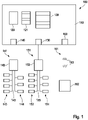
- Fig. 1 schematically shows a network 100 configured to perform a preferred embodiment of a method according to the invention.
- the network 100 is especially an automotive network and is for example implemented in a vehicle.
- a network switch being implemented as Ethernet switch 110 with a plurality of ports 140, 150, 160 is provided, with which a plurality of network members is connected.
- the network 100 is particularly embedded according to a domain controlled architecture, wherein different subdomains or Virtual Local Area Networks (VLAN) are connected with each other by means of the Ethernet switch 110.
- VLAN Virtual Local Area Networks
- a first network member 141 is connected with the network switch 110 at a port 140 and can for example be a first VLAN 141.
- This VLAN 141 can itself comprise several members which are connected with each other by means of a communication link 145, e.g. a CAN Bus or Ethernet.
- the VLAN 141 can comprise a domain controller 142, e.g. a motor control unit, several sensors 143 and actuators 144.
- a second network member 151 connected with the Ethernet switch 110 at a port 150 can for example be a second VLAN with a domain controller 152, e.g. an electronic control unit (ECU) of the vehicle, sensors 153 and actuators 154 connected via a Bus system 155 like CAN.
- This ECU 152 can for instance control an entertainment system of the vehicle.
- a third network member 161 is connected with the Ethernet switch 110.
- This third network member 161 can for example be an external server 162, with which the vehicle is connected via a wireless link 163.
- the network 100 can comprise further ports and further network members not shown in Fig. 1 for reasons of simplification.
- the Ethernet switch 110 comprises a processor unit 120, e.g. a central processing unit CPU, and content addressable memory CAM 130, preferably a ternary content addressable memory TCAM.
- the firewall is implemented in the Ethernet switch 110 in a co-design by software executed on the CPU 120 and by hardware in the form of the TCAM 130.
- a memory unit 121 is provided in the Ethernet switch 110, e.g. a flash memory, to which the CPU 120 has access.
- TCAM 130 rules concerning data transmissions between different network members are stored. Each of these rules concerns a specific data transmission between two network members, i.e. data to be transmitted from one network member to another network member, and describes attributes of the corresponding transmission.
- each rule can describe the following attributes:
- each single rule stored in the TCAM 130 has a size of 48 bytes.
- Data to be transmitted can be evaluated in greater detail and more attributes of data to be transmitted can be evaluated by means these double rules.
- IPv6 Internet Protocol version 6
- UDP User Datagram Protocol
- TCP Transmission Control Protocol
- IPv4 Internet Protocol version 4
- data to be transmitted or data packets especially have a size of 46 bytes when using UDP and especially 58 bytes when using TCP.
- All the above referenced data to be transmitted have a size smaller than a 96 byte double rule. However, usually data to be transmitted are dropped or denied if they are smaller than a rule. Thus, when using 96 byte double rules for the above referenced data to be transmitted there is the danger that the data transmissions are denied just because of their size, but not because of their content. This problem also occurs for IPv4 UDP data transmissions with a size of 46 bytes when using a single 48 byte rule.
- the IPv6 UDP data to be transmitted with 66 bytes, the IPv6 TCP data to be transmitted with 78 bytes, and the IPv4 TCP data to be transmitted with 58 bytes are at least larger than the 48 byte single rules.
- these data to be transmitted are transferred to the CPU 120 for further evaluation, usually the entire data to be transmitted will be evaluated by the CPU 120.
- the part of the data to be transmitted which has already been evaluated by the TCAM 130, will be evaluated again by the CPU 120 leading to an increased latency.
- the network switch 110 is configured to perform a preferred embodiment of a method according to the invention, which will hereafter be described with reference to Fig. 2 , which schematically shows this preferred embodiment as a block diagram.
- a whitelist of allowed communications and allowed data transmissions between different network members is created in step 201.
- rules for data transmissions are created and stored in the TCAM 130, particularly single 48 byte rules as well as double 96 bate rules.
- step 203 configuration data are created and stored in the memory unit 121, particularly in the form of a JSON file.
- These configuration data particularly comprise correlations between individual identification numbers representing corresponding rules of the TCAM 130 as well as the data of these corresponding rules.
- the configuration phase of the network 100 is particularly finished and the network 100 activated in step 204.
- step 205 during regular operation of the network 100 data to be transmitted e.g. from the domain controller 142 of the VLAN 141 to the domain controller 152 of the VLAN 151 are received at port 140 of the network switch 110.
- these data to be transmitted are in the form of a 66 byte data packet according to IPv6 using UPD.
- step 206 it is determined, particularly by the TCAM 130 itself, whether these received data to be transmitted have a size smaller than a certain value depending on a size of the rules stored in the TCAM 130.
- this certain value equals the size of a double rule of 96 bytes.
- the data to be transmitted are compared in step 208 with the rules stored in the TCAM 130.
- predetermined data are added in step 207 to the data to be transmitted such that the data to be transmitted have a size at least equal to the certain value. For example, zeros can be added as predetermined data.
- the data to be transmitted are compared with the rules stored in the TCAM 130 in step 208. This way it can be achieved that no data transmission is denied just because its size is smaller than a 96 byte double rule.
- the attributes of the data to be transmitted are compared with the entries of the different TCAM 130 single and double rules.
- These attributes of the data to be transmitted are e.g. IP-addresses and Ethernet switch ports of the source network member 142 and the destination network member 152, the protocol for a connection between these two network members like UDP, a VLAN ID representing the VLAN 151 of the destination network member 152, and the data to be transmitted between these two network members 142, 152.
- the corresponding action linked with that rule is performed. For example in step 209 it is selected to allow or deny the data transmission as corresponding action.
- step 210 it is e.g. selected to transfer the data to be transmitted to the CPU 120 for further evaluation as action.
- this second threshold equals the size of a single rule of 48 bytes.
- the data to be transmitted are transferred to the CPU 120 in step 212, which further evaluates the data in step 213 and determines whether to allow or deny the data transmission.
- a 48 byte single rule triggers to further transfer the data to be transmitted to the CPU 120 and if the data to be transmitted have a size larger than the threshold of 48 bytes, the first 48 bytes of the data to be transmitted have already been evaluated by the TCAM 130 and match the corresponding 48 byte single rule.
- a predetermined identification number is assigned to the data to be transmitted in step 214.
- the predetermined identification number corresponds to the rule stored in the TCAM matching the data to be transmitted and furthermore corresponds to an amount of data of the data to be transmitted which has been compared with the rules of the TCAM in step 208.
- a predetermined amount of the data to be transmitted is replaced with this identification number.
- the data to be transmitted are transferred to the CPU 120 in step 215 for further evaluation.
- the CPU 120 particularly first of all reads the field or amount of data corresponding to the VLAN ID of the destination network member and therefore reads the identification number.
- the CPU 120 determines in step 217 whether there is an entry for this data in the configuration data, i.e. the JSON file in the memory unit 121.
- the CPU 120 Since there is an entry for the identification number in the JSON file for the corresponding 48 byte single rule, the CPU 120 knows that the first 48 bytes of the data to be transmitted have already been evaluated by the TCAM 130 in step 208. Thus, in step 218 the CPU 120 does not evaluate the first 48 bytes of the data to be transmitted again but further evaluates the data to be transmitted starting at the 49 th byte.
- the CPU 120 determines in step 219 whether to allow or to deny the data transmission. If it is determined to deny the data transmission, the CPU 120 drops the data to be transmitted in step 220.
- the CPU 120 restores in step 221 the amount of data, which has been replaced with the identification number in step 214, i.e. the VLAN ID.
- the CPU 120 can particularly restore the corresponding original data in step 221 using the JSON file stored in the memory unit 121.
- the data to be transmitted are transferred to destination network member 152.
Landscapes
- Engineering & Computer Science (AREA)
- Computer Networks & Wireless Communication (AREA)
- Signal Processing (AREA)
- Small-Scale Networks (AREA)
Description
- The present invention relates to a method for monitoring traffic between network members in a network as well as a computing unit and a computer program for performing the method.
- So called content addressable memory (CAM) is a type of memory, which can search its entire content in one clock cycle, in the course of which the CAM searches by content and not by address. The CAM compares input search data against a table of stored data and returns the address of matching data.
- A ternary content addressable memory (TCAM) has the ability to store and search three different inputs, 0, 1, and x, where x represents a so called "don't care" state. For example, a TCAM might have an entry such as "10xx0," where "x" indicates the "don't care" state. This entry will match any of the four search keys: "10000," "10010," "10100," or "10110." A binary content addressable memory can only store and search 0 or 1.
- The use of a CAM in a network switch for monitoring traffic between network members in a network is described e.g. in
EP patent application 17185250.2 - It is desirable to further improve the use of content addressable memory (CAM), particularly ternary content addressable memory (TCAM) in firewalls, especially for the use in automotive networks.
-
US 2014/0082122 discloses access control lists include one or more rules that each define a condition and one or more actions to be performed if the condition is satisfied. The conditions may be stored on a ternary content-addressable memory (TCAM), which receives a portion of network traffic and compares different portions of a header to entries in the TCAM. -
US 2002/0191605 discloses methods and apparatus for classifying data packets in data processing systems. A first packet classification method determines which of a plurality of predefined processing rules applies to a data packet, where each rule is associated with a range of possible data values. - According to the invention a method for monitoring traffic between network members in a network as well as a computing unit and a computer program for performing the method with the features of the independent claims are proposed. Advantageous further developments form the subject matter of the dependent claims and of the subsequent description.
- Different network members are connected with a network switch, e.g. an Ethernet switch. Particularly, each network member is connected with a different port of the network switch. The network switch comprises a processor unit and a content addressable memory (CAM), particularly a ternary content addressable memory (TCAM). The processor unit can be a single central processing unit (CPU) or a multicore processor with two or more CPUs.
- Rules concerning data transmissions between different network members are stored in the CAM. These rules particularly state whether data transmissions between different network members are allowed or denied. For this purpose, the rules especially comprise different entries concerning attributes of data transmissions, e.g. a source (IP) address, a destination (IP) address, a source port, a destination port, a communication protocol (e.g. TCP, UDP, ICMP), etc. Particularly, each rule also has a specific action as an entry. This action will particularly be performed if the attributes of a data transmission match all the entries of the corresponding rule. As this action the data transmission can especially be allowed, denied, or transferred to the processor unit for further evaluation. The rules stored in the CAM have a certain size or byte size and especially all rules have the same size. For example, each rule can have a size of 48 bytes.
- Upon receiving a data transmission between two network members, i.e. data to be transmitted from one network member to another network member, the data to be transmitted are compared with the rules stored in the CAM and depending on a result of this comparison it is selected whether to allow the data transmission or to deny the data transmission or to transfer the data to be transmitted to the processor unit. Particularly, the CAM itself compares the data to be transmitted or its attributes with the entries of the rules. If all attributes of the data to be transmitted match the entries of one of the rules, the CAM particularly performs the corresponding action of this rule, i.e. allowing or denying the data transmission or transmitting the data to be transmitted to the CPU.
- The present invention provides an improvement for the use of content addressable memory CAM, particularly ternary content addressable memory TCAM in firewalls, especially for the use in automotive networks. In particular, the present invention provides improvements for data transmissions with a size that does not equal the size of a CAM rule or an integer multiple of the size of a CAM rule, particularly twice the size of a CAM rule. Particularly, the invention remedies disadvantages for data transmissions of that kind being transferred between different network members.
- As a general information it is mentioned that, if the data to be transmitted have a size or byte size smaller than a certain value depending on a size of the rules stored in the CAM, predetermined data are added to the data to be transmitted such that the data to be transmitted have a size equal to or greater than the certain value. Afterwards the data to be transmitted are compared with the rules stored in the CAM. Particularly, the CAM itself adds the predetermined data to the data to be transmitted. It is also possible that an element of the network switch adds the predetermined data, e.g. the CPU, a switch core, a memory access controller (MAC), etc.
- If the size of the data to be transmitted is smaller than the size of the rules, the data to be transmitted are usually denied or dropped. In this case, there is the problem that data transmissions are denied just because the data to be transmitted have a too small size for the CAM rules although they actually should not have been denied because of their content. In order to overcome this disadvantage in the course of the present method data to be transmitted of that kind are padded to the size of a CAM rule with predetermined data such that the CAM can compare the data to be transmitted with its rules.
- According to the invention, if the data to be transmitted have a size or byte size larger than a threshold depending on the size of the rules stored in the CAM and if it is selected to transfer the data to be transmitted to the processor unit, a predetermined identification number is assigned to the data to be transmitted. Afterwards, the data to be transmitted are particularly transferred to the CPU, which determines whether to allow or deny the data transmission. Particularly, if the data to be transmitted or their attributes match one of the rules or its entries and if the action of that corresponding rule is to transfer the data to be transmitted to the CPU, the CAM itself assigns the identification number to the data to be transmitted. However, it is also possible that an element of the network switch assigns the identification number, e.g. the CPU, a switch core, a memory access controller (MAC), etc.
- If the size of the data to be transmitted is larger than the size of the rules, only an amount of the data to be transmitted with the size of the rules is evaluated by the CAM. If the data to be transmitted are transferred to the CPU for further evaluation, the CPU usually has to evaluate the entire data to be transmitted. Thus, also the amount of the data to be transmitted, which has already been evaluated by the CAM and compared with the rules, is usually re-evaluated by the CPU, leading to an increased latency of the CPU. In order to overcome this disadvantage, in the course of the present method the predetermined identification number is assigned to the data to be transmitted of that kind. By means of this identification number the CPU can particularly recognise which amount of the data to be transmitted has already been evaluated by the CAM and which amount has not yet been evaluated.
- The present invention thus allows monitoring the traffic of data transmissions with different sizes independent of the CAM rule size, especially without the danger of denying data transmissions with a too small size and without increased latency when the CPU evaluates data to be transmitted with a too large size.
- According to a particularly advantageous embodiment two or more rules in the CAM are combined to a combined rule. Since a combined rule of that kind has more entries than a single rule, more attributes of the received data to be transmitted can be evaluated by means of a combined rule. Thus, received data to be transmitted can be evaluated in greater detail by means of combined rules. The size of a combined rule equals the sum of the single rules' sizes, which are combined. Therefore, the size of a combined rule is particularly an integer multiple of the size of one single CAM rule.
- According to a particularly preferred embodiment, two rules can be combined to a combined rule with twice the size of a single CAM rule. A combined rule of two single rules is hereafter also referred to a double rule. With a size of e.g. 48 bytes for a single rule, a double rule has a size of e.g. 96 bytes.
- Particularly, single rules as well as combined rules can be provided in the CAM. This combination of rules yields the advantage of more flexibility when using a CAM for network switches since simpler single rules with smaller size as well as more complex rules with larger size can be provided. However, there are also disadvantages when it comes to the size of the data to be transmitted, particularly if the size of the data to be transmitted does not equal the size of a single rule or the size of a combined rule, i.e. the size of an integer multiple of a single rule.
- Particularly when using both single and combined rules in the CAM, there is usually the danger of data transmissions being denied just because they have a too small size for the combined rules although they actually should not have been denied because of their content. For example, data to be transmitted of e.g. 66 bytes are evaluated by the CAM when using a single rule with e.g. 48 bytes but are usually denied or dropped when using a combined rule of e.g. 96 bytes. Since predetermined data are added to the data to be transmitted of that kind according to the first aspect of the present method, this problem can be overcome. Thus, the data to be transmitted of that kind are particularly padded to the size of a combined rule. For this purpose the certain value preferably equals the size of a combined rule. If single rules and double rules are provided in the CAM, the certain value preferably equals the size of two rules stored in the CAM.
- When using both single and combined rules there is usually particularly the danger of high latency when transferring the data to be transmitted to the processor unit for further evaluation. If the size of the data to be transmitted is larger than the size of the rule, only an amount of data of the data to be transmitted with the size of the corresponding rules is evaluated by the CAM. For example when using a single rule of e.g. 48 bytes, only 48 bytes of the data to be transmitted are evaluated by the CAM, particularly the first 48 bytes of the data to be transmitted. If the data to be transmitted are transferred to the CPU for further evaluation, the CPU usually evaluates the entire data to be transmitted, leading to an increased latency of the CPU. Since the predetermined identification number is assigned to the data to be transmitted of that kind according to the second aspect of the present method, this problem can be overcome. By means of the identification number the CPU particularly evaluates only the part of the data to be transmitted not yet evaluated by the CAM, e.g. starting with the 49th byte. The threshold thus preferably equals the size of one CAM rule, particularly if single rules and double rules are provided in the CAM according to a particularly preferred embodiment.
- The threshold preferably equals the size of one rule stored in the CAM or equals the size of an integer multiple of one rule stored in the CAM. Thus, data to be transmitted with different sizes than the CAM rules or combined rules can effectively be monitored by means of the network switch.
- According to particularly preferred embodiment, the threshold equals the size of two rules stored in the CAM. This threshold can especially be used if single rules as well as double rules are provided in the CAM.
- According to a preferred embodiment the predetermined data can be just zeros or just ones or a random combination of zeros and ones. Preferably, the predetermined data can be random data. Particularly, when using a TCAM the entries of the TCAM rules concerning these predetermined data can be linked with an x, i.e. a "don't care" state. Thus, the specific content of the predetermined data is particularly not of relevance. It can therefore expediently be prevented that the data transmission is denied because the predetermined data do not match the corresponding entries of a TCAM rule. It can preferably be selected whether the addition of predetermined data is enabled or disabled.
- Preferably, if the data to be transmitted have a size larger than the threshold, the predetermined identification number corresponds to a rule of the rules stored in the CAM, which matches the data to be transmitted. Thus, when transferring the data to be transmitted for further evaluation, by means of the identification number the CPU knows which rule has triggered this transfer. The CPU therefore especially knows that a certain amount of data of the data to be transmitted matches this rule and the CPU therefore especially only evaluates the remaining amount of data of the data to be transmitted. Thus, low latency for further evaluation of the data to be transmitted can be provided.
- Advantageously, if the data to be transmitted have a size larger than the threshold, the predetermined identification number corresponds to an amount of data of the data to be transmitted with a size equal to the threshold. The identification number thus especially represents the amount of the data to be transmitted, which has already been evaluated by the CAM. When transferring the data to be transmitted to the CPU, by means of the identification number the CPU knows only to evaluate the remaining amount of data of the data to be transmitted, leading to a low latency for further evaluation.
- Preferably, if the data to be transmitted have a size larger than the threshold, the predetermined identification number corresponds to an amount of data of the data to be transmitted which is compared with the rules of the CAM. This amount of data particularly has a size equal to the threshold. Thus, by means of the identification number the CPU especially knows which part of the data to be transmitted has already been evaluated by the CAM and especially only evaluates the remaining part of the data to be transmitted, leading to a low latency for further evaluation.
- Advantageously, if the data to be transmitted have a size larger than the threshold, by means of the identification number the processor unit further evaluates an amount of data of the data to be transmitted which has not been compared with the rules stored in the CAM. Particularly, this amount of data has a size equal to the total size of the data to be transmitted minus the threshold. Thus, the further evaluation can be performed with low latency.
- Preferably, if the data to be transmitted have a size larger than the threshold, a predetermined amount of data of the data to be transmitted is replaced with the predetermined identification number. Particularly, certain attributes, fields or entries of the data to be transmitted are replaced with the identification number. Particularly, before evaluating the entire data to be transmitted, the CPU can first of all evaluate the corresponding attribute or field corresponding to the predetermined amount of data. If this attribute or field comprises the predetermined identification number, the CPU particularly knows only to evaluate the amount of the data to be transmitted, which has not yet been evaluated by the CAM. If the attribute or field does not comprises a predetermined identification number, the CPU particularly knows, that the data to be transmitted do not match any of the rules stored in the CAM and is especially instructed to evaluate the entire data to be transmitted. Preferably, after further evaluating the data to be transmitted and particularly if the data transmission is allowed, the amount of data, which has been replaced with the predetermined identification number, is restored.
- Advantageously, if the data to be transmitted have a size larger than the threshold, configuration data are provided correlating predetermined identification numbers with rules stored in the CAM. Thus, when the data to be transmitted are transferred to the CPU for further evaluation, by reading the identification number and by means of the configuration data, the CPU knows determine which rule of the CAM has triggered the further evaluation and thus particularly which amount of the data to be transmitted has already been evaluated by the CAM.
- This configuration data can e.g. be provided as a table, a configuration file, as a JSON (JavaScript Object Notation) file, etc. The configuration data can especially be stored in a memory unit of the network switch like a flash memory, EEPROM, etc., or particularly in an internal memory of the CPU, e.g. register.
- Particularly, the configuration data can be created during a configuration phase of the network switch or the network. Expediently, also the CAM rules can be created during this configuration phase and can be stored it the CAM. For this purpose, a whitelist of allowed communications and allowed data transmissions between different network members can particularly be used. For all the entries in the whitelist of allowed data transmissions a corresponding rule is particularly stored in the CAM. If, however, two or more entries in the whitelist yield substantially identical rules, only one rule can be stored in the CAM representing these data transmissions.
- According to a particularly advantageous embodiment, the content addressable memory (CAM) is a ternary content addressable memory (TCAM). By its ability to search itself by content and not by address, the CAM can compare attributes of the data to be transmitted as input search data against a table of stored data, i.e. stored attributes of data to be transmitted in the form of rules. By means of a ternary content addressable memory (TCAM) certain attributes of the data to be transmitted can particularly be associated with the "don't care" states of the TCAM.
- The traffic monitoring according to the present invention can be used for different kinds of networks. The present invention is particularly preferred for the use in a safety critical network like an automotive network, especially with complex electric-electronic-architecture (E/E-architecture). Particularly, by means of this automotive network, different components of a vehicle are connected with each other. The network members can e.g. be ECUs, sensors or actuators of the vehicle. Particularly, also network members outside of the vehicle can be connected with the network switch and thus with the automotive network, e.g. an external server or a cloud.
- According to an advantageous embodiment, the network members can be different subdomains or particularly Virtual Local Area Networks (VLAN). A subdomain or VLAN of that kind can comprise different components, which are connected with each other by a communication link, e.g. Ethernet, CAN, LIN, etc. Different subdomains or VLANs thus can have different communication links. Therefore, an appearance of multiple networks can be created while just having one physical network. This way, VLANs can keep network applications separate despite expediently being connected to the same physical network and particularly without requiring multiple sets of cabling and networking devices to be deployed. A VLAN can especially be connected to one or more ports of the network switch. In the course of so called domain controlled architecture, these different subdomains or VLANs are connected with each other by means of the network switch. VLANs of that kind can preferably be implemented in an automotive network, wherein each VLAN can e.g. comprise ECUs, sensors or actuators.
- With automotive networks becoming more and more complex with time, the traffic in automotive networks increases and so does the amount of safety critical data to be monitored. With the network switch implemented according to the invention, this amount of data can be monitored at wire speed or near wire speed with little delay and the strict safety regulations of automotive networks can be satisfied. Strict firewalling of safety critical data can be enabled in order to e.g. prevent attacks and introduction of harmful content into the automotive network.
- A computing unit according to the invention, especially a network switch, is configured, in particular by a computer program, to carry out an inventive method.
- The implementation of the invention in the form of software is advantageous because this allows particularly low costs, especially if an executing processing unit is still being used for other tasks and therefore is present anyway. Suitable media for providing the computer program are in particular diskettes, hard drives, flash memory, EEPROM, CD-ROMs, DVDs etc. Downloading a program via computer networks (Internet, intranet, etc.) is possible.
- Further advantages and developments of the invention are specified in the description and the associated drawings.
- It goes without saying, that the features named above and still to be explained below can be used not only in the combination indicated respectively, but also in other combinations or in a stand-alone manner, without going beyond the scope of the present invention.
- The invention is illustrated schematically in the drawings on the basis of exemplary embodiments and will be described in detail in the following with reference to the drawings.
- Description of drawings
- Fig. 1
- schematically shows a network configured to perform a preferred embodiment of a method according to the invention.
- Fig. 2
- schematically shows a preferred embodiment of a method according to the invention as a block diagram.
-
Fig. 1 schematically shows anetwork 100 configured to perform a preferred embodiment of a method according to the invention. Thenetwork 100 is especially an automotive network and is for example implemented in a vehicle. - A network switch being implemented as
Ethernet switch 110 with a plurality ofports network 100 is particularly embedded according to a domain controlled architecture, wherein different subdomains or Virtual Local Area Networks (VLAN) are connected with each other by means of theEthernet switch 110. - A
first network member 141 is connected with thenetwork switch 110 at aport 140 and can for example be afirst VLAN 141. ThisVLAN 141 can itself comprise several members which are connected with each other by means of acommunication link 145, e.g. a CAN Bus or Ethernet. TheVLAN 141 can comprise adomain controller 142, e.g. a motor control unit,several sensors 143 andactuators 144. - A
second network member 151 connected with theEthernet switch 110 at aport 150 can for example be a second VLAN with adomain controller 152, e.g. an electronic control unit (ECU) of the vehicle,sensors 153 andactuators 154 connected via aBus system 155 like CAN. ThisECU 152 can for instance control an entertainment system of the vehicle. - At a port 160 a
third network member 161 is connected with theEthernet switch 110. Thisthird network member 161 can for example be anexternal server 162, with which the vehicle is connected via awireless link 163. - It shall be understood that the
network 100 can comprise further ports and further network members not shown inFig. 1 for reasons of simplification. - In order to prevent attacks and the introduction of harmful content into the
vehicle network 100, traffic between the network members is monitored by means of a firewall implemented in theEthernet switch 110. For this purpose theEthernet switch 110 comprises aprocessor unit 120, e.g. a central processing unit CPU, and contentaddressable memory CAM 130, preferably a ternary content addressable memory TCAM. The firewall is implemented in theEthernet switch 110 in a co-design by software executed on theCPU 120 and by hardware in the form of theTCAM 130. Further, amemory unit 121 is provided in theEthernet switch 110, e.g. a flash memory, to which theCPU 120 has access. - In the
TCAM 130 rules concerning data transmissions between different network members are stored. Each of these rules concerns a specific data transmission between two network members, i.e. data to be transmitted from one network member to another network member, and describes attributes of the corresponding transmission. - For example, each rule can describe the following attributes:
- an individual identification number representing the corresponding rule;
- an IP-address and the Ethernet switch port of a source network member;
- an IP-address and the Ethernet switch port of a destination network member;
- a protocol for a connection between these two network members;
- a VLAN ID representing the VLAN of the destination network member;
- data or a data packet to be transmitted between these two network members;
- an action, which is performed when the attributes of received data to be transmitted match the attributes of the corresponding rule, particularly to allow or deny or transfer the data to be transmitted to the
CPU 120 for further evaluation. - For example, each single rule stored in the
TCAM 130 has a size of 48 bytes. There is moreover the possibility to combine several rules to a combined rule. Particularly, two rules can be combined to a double rule with a size of 96 bytes. Data to be transmitted can be evaluated in greater detail and more attributes of data to be transmitted can be evaluated by means these double rules. - In this example, there are single rules with 48 bytes as well as double rules with 96 bytes provided in the
TCAM 130 yielding more flexibility since simpler single rules with smaller size as well as more complex rules with larger size can be provided. - For example, under Internet Protocol version 6 (IPv6), data to be transmitted or data packets especially have a size of 66 bytes when using User Datagram Protocol (UDP) and especially a size of 78 bytes when using Transmission Control Protocol (TCP). Under Internet Protocol version 4 (IPv4), data to be transmitted or data packets especially have a size of 46 bytes when using UDP and especially 58 bytes when using TCP.
- All the above referenced data to be transmitted have a size smaller than a 96 byte double rule. However, usually data to be transmitted are dropped or denied if they are smaller than a rule. Thus, when using 96 byte double rules for the above referenced data to be transmitted there is the danger that the data transmissions are denied just because of their size, but not because of their content. This problem also occurs for IPv4 UDP data transmissions with a size of 46 bytes when using a single 48 byte rule.
- When using a 48 byte single rule, the IPv6 UDP data to be transmitted with 66 bytes, the IPv6 TCP data to be transmitted with 78 bytes, and the IPv4 TCP data to be transmitted with 58 bytes are at least larger than the 48 byte single rules. However, if these data to be transmitted are transferred to the
CPU 120 for further evaluation, usually the entire data to be transmitted will be evaluated by theCPU 120. Thus, also the part of the data to be transmitted, which has already been evaluated by theTCAM 130, will be evaluated again by theCPU 120 leading to an increased latency. - In order to overcome these disadvantages, the
network switch 110 is configured to perform a preferred embodiment of a method according to the invention, which will hereafter be described with reference toFig. 2 , which schematically shows this preferred embodiment as a block diagram. - Before the
network 100 is activated first of all a configuration phase is performed, in the course of which a whitelist of allowed communications and allowed data transmissions between different network members is created instep 201. Based on this whitelist, instep 202 rules for data transmissions are created and stored in theTCAM 130, particularly single 48 byte rules as well as double 96 bate rules. - In
step 203 configuration data are created and stored in thememory unit 121, particularly in the form of a JSON file. These configuration data particularly comprise correlations between individual identification numbers representing corresponding rules of theTCAM 130 as well as the data of these corresponding rules. - After storing the JSON file in the
memory unit 121, the configuration phase of thenetwork 100 is particularly finished and thenetwork 100 activated instep 204. - In
step 205 during regular operation of thenetwork 100 data to be transmitted e.g. from thedomain controller 142 of theVLAN 141 to thedomain controller 152 of theVLAN 151 are received atport 140 of thenetwork switch 110. For example, these data to be transmitted are in the form of a 66 byte data packet according to IPv6 using UPD. - In
step 206 it is determined, particularly by theTCAM 130 itself, whether these received data to be transmitted have a size smaller than a certain value depending on a size of the rules stored in theTCAM 130. Preferably this certain value equals the size of a double rule of 96 bytes. - If the size of the data to be transmitted is larger than the certain value of 96 bytes, the data to be transmitted are compared in
step 208 with the rules stored in theTCAM 130. However, if the size of the data to be transmitted is smaller than the certain value, predetermined data are added instep 207 to the data to be transmitted such that the data to be transmitted have a size at least equal to the certain value. For example, zeros can be added as predetermined data. Afterwards the data to be transmitted are compared with the rules stored in theTCAM 130 instep 208. This way it can be achieved that no data transmission is denied just because its size is smaller than a 96 byte double rule. - When the data to be transmitted are compared with the rules stored in the
TCAM 130 instep 208, the attributes of the data to be transmitted are compared with the entries of thedifferent TCAM 130 single and double rules. These attributes of the data to be transmitted are e.g. IP-addresses and Ethernet switch ports of thesource network member 142 and thedestination network member 152, the protocol for a connection between these two network members like UDP, a VLAN ID representing theVLAN 151 of thedestination network member 152, and the data to be transmitted between these twonetwork members - When all these attributes match a rule in the
TCAM 130, the corresponding action linked with that rule is performed. For example instep 209 it is selected to allow or deny the data transmission as corresponding action. - In
step 210 it is e.g. selected to transfer the data to be transmitted to theCPU 120 for further evaluation as action. In this case it is determined instep 211 whether the data to be transmitted have a size larger than a threshold depending on the size of the rules stored in theTCAM 130. Preferably, this second threshold equals the size of a single rule of 48 bytes. - If this is not the case, the data to be transmitted are transferred to the
CPU 120 instep 212, which further evaluates the data instep 213 and determines whether to allow or deny the data transmission. - If for example a 48 byte single rule triggers to further transfer the data to be transmitted to the
CPU 120 and if the data to be transmitted have a size larger than the threshold of 48 bytes, the first 48 bytes of the data to be transmitted have already been evaluated by theTCAM 130 and match the corresponding 48 byte single rule. - In this case, i.e. if it is selected to transfer the data to be transmitted to the
CPU 120 and if the data to be transmitted have a size larger than the threshold of 48 bytes, a predetermined identification number is assigned to the data to be transmitted instep 214. Particularly, the individual identification number of the configuration data created instep 203 representing the corresponding single rule, which matches the present data to be transmitted, is assigned to the data to be transmitted. - Therefore, the predetermined identification number corresponds to the rule stored in the TCAM matching the data to be transmitted and furthermore corresponds to an amount of data of the data to be transmitted which has been compared with the rules of the TCAM in
step 208. - Preferably, a predetermined amount of the data to be transmitted, particularly a certain field of the data to be transmitted e.g. the field for the VLAN ID of the destination network member, is replaced with this identification number.
- Afterwards, i.e. after assigning the identification number, the data to be transmitted are transferred to the
CPU 120 instep 215 for further evaluation. Instep 216 theCPU 120 particularly first of all reads the field or amount of data corresponding to the VLAN ID of the destination network member and therefore reads the identification number. TheCPU 120 determines instep 217 whether there is an entry for this data in the configuration data, i.e. the JSON file in thememory unit 121. - Since there is an entry for the identification number in the JSON file for the corresponding 48 byte single rule, the
CPU 120 knows that the first 48 bytes of the data to be transmitted have already been evaluated by theTCAM 130 instep 208. Thus, instep 218 theCPU 120 does not evaluate the first 48 bytes of the data to be transmitted again but further evaluates the data to be transmitted starting at the 49th byte. - Depending on this further evaluation the
CPU 120 determines instep 219 whether to allow or to deny the data transmission. If it is determined to deny the data transmission, theCPU 120 drops the data to be transmitted instep 220. - If it is determined to allow the data transmission, the
CPU 120 restores instep 221 the amount of data, which has been replaced with the identification number instep 214, i.e. the VLAN ID. For this purpose, theCPU 120 can particularly restore the corresponding original data instep 221 using the JSON file stored in thememory unit 121. Instep 222 the data to be transmitted are transferred todestination network member 152.
Claims (13)
- A method for monitoring traffic between network members (141, 151, 161) in a network (100) by a network switch (110),wherein in the network (100) different network members (141, 151, 161) are connected with the network switch (110) comprising a processor unit (120) and a content addressable memory CAM (130), in which rules concerning data transmissions between different network members (141, 151, 161) are stored;wherein upon receiving (205) data to be transmitted between two network members (142, 152), the data to be transmitted are compared (208) with the rules stored in the CAM (130) and depending on a result of this comparison it is selected whether to allow (209) the data transmission or to deny (209) the data transmission or to transfer (210) the data to be transmitted to the processor unit (120);wherein if the data to be transmitted have a size larger than a threshold which depends on the size of the rules stored in the CAM (130), only an amount of the data to be transmitted with the size of the rules stored in the CAM (130) is compared (208) with the rules stored in the CAM (130) and if it is selected (210) to transfer the data to be transmitted to the processor unit (120), a predetermined identification number is assigned (214) to the data to be transmittedand by means of the identification number, the processor unit (120) further evaluates an amount of the data to be transmitted, which has not been compared with the rules stored in the CAM (130).
- The method according to claim 1, wherein, if the data to be transmitted have
a size larger than the threshold, the predetermined identification number corresponds to a rule of the rules stored in the CAM (130), which matches the data to be transmitted. - The method according to claim 1 or 2, wherein, if the data to be transmitted
have a size larger than the threshold, the predetermined identification number corresponds to an amount of the data to be transmitted with a size equal to the second threshold. - The method according to any one of the preceding claims, wherein, if the
data to be transmitted have a size larger than the threshold, the predetermined identification number corresponds to an amount of the data to be transmitted which is compared with the rules of the CAM (130). - The method according to any one of the preceding claims, wherein, if the
data to be transmitted have a size larger than the threshold, a predetermined amount of the data to be transmitted is replaced with the predetermined identification number (214). - The method according to any one of the preceding claims, wherein, if the
data to be transmitted have a size larger than the threshold, configuration data are provided (203) correlating predetermined identification numbers with rules stored in the CAM (130). - The method according to any one of the preceding claims, wherein in the CAM (130) two or more different rules are combined to a combined rule.
- The method according to any one of the preceding claims, wherein the threshold equals the size of one rule stored in the CAM (130) and/or equals the size of an integer multiple of one rule stored in the CAM (130).
- The method according to any of the preceding claims, wherein the threshold equals the size of two rules stored in the CAM (130).
- The method according to any one of the preceding claims, wherein the content addressable memory CAM (130) is a ternary content addressable memory TCAM (130).
- Computing unit adapted to perform a method according to any one of the preceding claims.
- A computer program which causes a computing unit to (110) perform a method according to any one of claims 1 to 10 when it is executed on the computing unit (110).
- A machine-readable storage medium having stored there on a computer program of claim 12.
Priority Applications (1)
| Application Number | Priority Date | Filing Date | Title |
|---|---|---|---|
| EP18167991.1A EP3557823B1 (en) | 2018-04-18 | 2018-04-18 | Method for monitoring traffic between network members in a network |
Applications Claiming Priority (1)
| Application Number | Priority Date | Filing Date | Title |
|---|---|---|---|
| EP18167991.1A EP3557823B1 (en) | 2018-04-18 | 2018-04-18 | Method for monitoring traffic between network members in a network |
Publications (2)
| Publication Number | Publication Date |
|---|---|
| EP3557823A1 EP3557823A1 (en) | 2019-10-23 |
| EP3557823B1 true EP3557823B1 (en) | 2022-12-14 |
Family
ID=62116192
Family Applications (1)
| Application Number | Title | Priority Date | Filing Date |
|---|---|---|---|
| EP18167991.1A Active EP3557823B1 (en) | 2018-04-18 | 2018-04-18 | Method for monitoring traffic between network members in a network |
Country Status (1)
| Country | Link |
|---|---|
| EP (1) | EP3557823B1 (en) |
Family Cites Families (3)
| Publication number | Priority date | Publication date | Assignee | Title |
|---|---|---|---|---|
| US7193997B2 (en) * | 2001-03-19 | 2007-03-20 | International Business Machines Corporation | Packet classification |
| US20090125470A1 (en) * | 2007-11-09 | 2009-05-14 | Juniper Networks, Inc. | System and Method for Managing Access Control Lists |
| US9225644B2 (en) * | 2012-09-14 | 2015-12-29 | International Business Machines Corporation | Using special-case hardware units for facilitating access control lists on a networking element |
-
2018
- 2018-04-18 EP EP18167991.1A patent/EP3557823B1/en active Active
Also Published As
| Publication number | Publication date |
|---|---|
| EP3557823A1 (en) | 2019-10-23 |
Similar Documents
| Publication | Publication Date | Title |
|---|---|---|
| US10834085B2 (en) | Method and apparatus for speeding up ACL rule lookups that include TCP/UDP port ranges in the rules | |
| EP1915671B1 (en) | Apparatus and method for facilitating network security | |
| EP1523138B1 (en) | Access control mechanism for routers | |
| EP1683311B1 (en) | Dynamic unknown l2 flooding control with mac limits | |
| US6917946B2 (en) | Method and system for partitioning filter rules for multi-search enforcement | |
| CN105917339B (en) | Method for operating a security gateway between data buses for vehicles | |
| JP3568850B2 (en) | How the data packet filter works | |
| EP3442192B1 (en) | Method for monitoring traffic between network members in a network | |
| EP2878113B1 (en) | Improving hardware utilization for a bidirectional access control list in a low latency high-throughput network | |
| JP6074776B2 (en) | Intelligent PHY with security detection for Ethernet networks | |
| US10708272B1 (en) | Optimized hash-based ACL lookup offload | |
| US8826447B2 (en) | Intelligent connectors integrating magnetic modular jacks and intelligent physical layer devices | |
| US10397116B1 (en) | Access control based on range-matching | |
| EP3456027A1 (en) | System and method for a fallback access control list port configuration | |
| US7433357B2 (en) | Apparatus and method for performing header lookup based on sequential lookup | |
| US7177313B2 (en) | Method and system for converting ranges into overlapping prefixes for a longest prefix match | |
| US10547532B2 (en) | Parallelization of inline tool chaining | |
| US20200067882A1 (en) | Systems and methods for operating a networking device | |
| WO2017131765A1 (en) | Verifying a service function chain | |
| EP3557823A1 (en) | Method for monitoring traffic between network members in a network | |
| US20230319078A1 (en) | System and method for detecting and mitigating port scanning attacks | |
| CN112217784A (en) | Apparatus and method for attack recognition in computer networks | |
| Mühlbach et al. | Netstage/dpr: A self-adaptable fpga platform for application-level network security | |
| CN119449348A (en) | Group filtering based on vehicle status | |
| US20160191388A1 (en) | Pattern Matching Values of a Packet Which May Result in False-Positive Matches |
Legal Events
| Date | Code | Title | Description |
|---|---|---|---|
| PUAI | Public reference made under article 153(3) epc to a published international application that has entered the european phase |
Free format text: ORIGINAL CODE: 0009012 |
|
| STAA | Information on the status of an ep patent application or granted ep patent |
Free format text: STATUS: THE APPLICATION HAS BEEN PUBLISHED |
|
| AK | Designated contracting states |
Kind code of ref document: A1 Designated state(s): AL AT BE BG CH CY CZ DE DK EE ES FI FR GB GR HR HU IE IS IT LI LT LU LV MC MK MT NL NO PL PT RO RS SE SI SK SM TR |
|
| AX | Request for extension of the european patent |
Extension state: BA ME |
|
| RAP1 | Party data changed (applicant data changed or rights of an application transferred) |
Owner name: ROBERT BOSCH GMBH |
|
| STAA | Information on the status of an ep patent application or granted ep patent |
Free format text: STATUS: REQUEST FOR EXAMINATION WAS MADE |
|
| 17P | Request for examination filed |
Effective date: 20200423 |
|
| RBV | Designated contracting states (corrected) |
Designated state(s): AL AT BE BG CH CY CZ DE DK EE ES FI FR GB GR HR HU IE IS IT LI LT LU LV MC MK MT NL NO PL PT RO RS SE SI SK SM TR |
|
| STAA | Information on the status of an ep patent application or granted ep patent |
Free format text: STATUS: EXAMINATION IS IN PROGRESS |
|
| 17Q | First examination report despatched |
Effective date: 20201130 |
|
| REG | Reference to a national code |
Ref country code: DE Ref legal event code: R079 Ref document number: 602018044169 Country of ref document: DE Free format text: PREVIOUS MAIN CLASS: H04L0012640000 Ipc: H04L0067060000 |
|
| GRAP | Despatch of communication of intention to grant a patent |
Free format text: ORIGINAL CODE: EPIDOSNIGR1 |
|
| STAA | Information on the status of an ep patent application or granted ep patent |
Free format text: STATUS: GRANT OF PATENT IS INTENDED |
|
| RIC1 | Information provided on ipc code assigned before grant |
Ipc: H04L 49/354 20220101ALN20220623BHEP Ipc: H04L 67/06 20220101AFI20220623BHEP |
|
| INTG | Intention to grant announced |
Effective date: 20220706 |
|
| GRAS | Grant fee paid |
Free format text: ORIGINAL CODE: EPIDOSNIGR3 |
|
| GRAA | (expected) grant |
Free format text: ORIGINAL CODE: 0009210 |
|
| STAA | Information on the status of an ep patent application or granted ep patent |
Free format text: STATUS: THE PATENT HAS BEEN GRANTED |
|
| AK | Designated contracting states |
Kind code of ref document: B1 Designated state(s): AL AT BE BG CH CY CZ DE DK EE ES FI FR GB GR HR HU IE IS IT LI LT LU LV MC MK MT NL NO PL PT RO RS SE SI SK SM TR |
|
| REG | Reference to a national code |
Ref country code: GB Ref legal event code: FG4D |
|
| REG | Reference to a national code |
Ref country code: CH Ref legal event code: EP |
|
| REG | Reference to a national code |
Ref country code: DE Ref legal event code: R096 Ref document number: 602018044169 Country of ref document: DE |
|
| REG | Reference to a national code |
Ref country code: IE Ref legal event code: FG4D |
|
| REG | Reference to a national code |
Ref country code: AT Ref legal event code: REF Ref document number: 1538354 Country of ref document: AT Kind code of ref document: T Effective date: 20230115 |
|
| REG | Reference to a national code |
Ref country code: LT Ref legal event code: MG9D |
|
| REG | Reference to a national code |
Ref country code: NL Ref legal event code: MP Effective date: 20221214 |
|
| PG25 | Lapsed in a contracting state [announced via postgrant information from national office to epo] |
Ref country code: SE Free format text: LAPSE BECAUSE OF FAILURE TO SUBMIT A TRANSLATION OF THE DESCRIPTION OR TO PAY THE FEE WITHIN THE PRESCRIBED TIME-LIMIT Effective date: 20221214 Ref country code: NO Free format text: LAPSE BECAUSE OF FAILURE TO SUBMIT A TRANSLATION OF THE DESCRIPTION OR TO PAY THE FEE WITHIN THE PRESCRIBED TIME-LIMIT Effective date: 20230314 Ref country code: LT Free format text: LAPSE BECAUSE OF FAILURE TO SUBMIT A TRANSLATION OF THE DESCRIPTION OR TO PAY THE FEE WITHIN THE PRESCRIBED TIME-LIMIT Effective date: 20221214 Ref country code: FI Free format text: LAPSE BECAUSE OF FAILURE TO SUBMIT A TRANSLATION OF THE DESCRIPTION OR TO PAY THE FEE WITHIN THE PRESCRIBED TIME-LIMIT Effective date: 20221214 |
|
| REG | Reference to a national code |
Ref country code: AT Ref legal event code: MK05 Ref document number: 1538354 Country of ref document: AT Kind code of ref document: T Effective date: 20221214 |
|
| PG25 | Lapsed in a contracting state [announced via postgrant information from national office to epo] |
Ref country code: RS Free format text: LAPSE BECAUSE OF FAILURE TO SUBMIT A TRANSLATION OF THE DESCRIPTION OR TO PAY THE FEE WITHIN THE PRESCRIBED TIME-LIMIT Effective date: 20221214 Ref country code: LV Free format text: LAPSE BECAUSE OF FAILURE TO SUBMIT A TRANSLATION OF THE DESCRIPTION OR TO PAY THE FEE WITHIN THE PRESCRIBED TIME-LIMIT Effective date: 20221214 Ref country code: HR Free format text: LAPSE BECAUSE OF FAILURE TO SUBMIT A TRANSLATION OF THE DESCRIPTION OR TO PAY THE FEE WITHIN THE PRESCRIBED TIME-LIMIT Effective date: 20221214 Ref country code: GR Free format text: LAPSE BECAUSE OF FAILURE TO SUBMIT A TRANSLATION OF THE DESCRIPTION OR TO PAY THE FEE WITHIN THE PRESCRIBED TIME-LIMIT Effective date: 20230315 |
|
| PG25 | Lapsed in a contracting state [announced via postgrant information from national office to epo] |
Ref country code: NL Free format text: LAPSE BECAUSE OF FAILURE TO SUBMIT A TRANSLATION OF THE DESCRIPTION OR TO PAY THE FEE WITHIN THE PRESCRIBED TIME-LIMIT Effective date: 20221214 |
|
| PG25 | Lapsed in a contracting state [announced via postgrant information from national office to epo] |
Ref country code: SM Free format text: LAPSE BECAUSE OF FAILURE TO SUBMIT A TRANSLATION OF THE DESCRIPTION OR TO PAY THE FEE WITHIN THE PRESCRIBED TIME-LIMIT Effective date: 20221214 Ref country code: RO Free format text: LAPSE BECAUSE OF FAILURE TO SUBMIT A TRANSLATION OF THE DESCRIPTION OR TO PAY THE FEE WITHIN THE PRESCRIBED TIME-LIMIT Effective date: 20221214 Ref country code: PT Free format text: LAPSE BECAUSE OF FAILURE TO SUBMIT A TRANSLATION OF THE DESCRIPTION OR TO PAY THE FEE WITHIN THE PRESCRIBED TIME-LIMIT Effective date: 20230414 Ref country code: ES Free format text: LAPSE BECAUSE OF FAILURE TO SUBMIT A TRANSLATION OF THE DESCRIPTION OR TO PAY THE FEE WITHIN THE PRESCRIBED TIME-LIMIT Effective date: 20221214 Ref country code: EE Free format text: LAPSE BECAUSE OF FAILURE TO SUBMIT A TRANSLATION OF THE DESCRIPTION OR TO PAY THE FEE WITHIN THE PRESCRIBED TIME-LIMIT Effective date: 20221214 Ref country code: CZ Free format text: LAPSE BECAUSE OF FAILURE TO SUBMIT A TRANSLATION OF THE DESCRIPTION OR TO PAY THE FEE WITHIN THE PRESCRIBED TIME-LIMIT Effective date: 20221214 Ref country code: AT Free format text: LAPSE BECAUSE OF FAILURE TO SUBMIT A TRANSLATION OF THE DESCRIPTION OR TO PAY THE FEE WITHIN THE PRESCRIBED TIME-LIMIT Effective date: 20221214 |
|
| PG25 | Lapsed in a contracting state [announced via postgrant information from national office to epo] |
Ref country code: SK Free format text: LAPSE BECAUSE OF FAILURE TO SUBMIT A TRANSLATION OF THE DESCRIPTION OR TO PAY THE FEE WITHIN THE PRESCRIBED TIME-LIMIT Effective date: 20221214 Ref country code: PL Free format text: LAPSE BECAUSE OF FAILURE TO SUBMIT A TRANSLATION OF THE DESCRIPTION OR TO PAY THE FEE WITHIN THE PRESCRIBED TIME-LIMIT Effective date: 20221214 Ref country code: IS Free format text: LAPSE BECAUSE OF FAILURE TO SUBMIT A TRANSLATION OF THE DESCRIPTION OR TO PAY THE FEE WITHIN THE PRESCRIBED TIME-LIMIT Effective date: 20230414 Ref country code: AL Free format text: LAPSE BECAUSE OF FAILURE TO SUBMIT A TRANSLATION OF THE DESCRIPTION OR TO PAY THE FEE WITHIN THE PRESCRIBED TIME-LIMIT Effective date: 20221214 |
|
| REG | Reference to a national code |
Ref country code: DE Ref legal event code: R097 Ref document number: 602018044169 Country of ref document: DE |
|
| PLBE | No opposition filed within time limit |
Free format text: ORIGINAL CODE: 0009261 |
|
| STAA | Information on the status of an ep patent application or granted ep patent |
Free format text: STATUS: NO OPPOSITION FILED WITHIN TIME LIMIT |
|
| PG25 | Lapsed in a contracting state [announced via postgrant information from national office to epo] |
Ref country code: DK Free format text: LAPSE BECAUSE OF FAILURE TO SUBMIT A TRANSLATION OF THE DESCRIPTION OR TO PAY THE FEE WITHIN THE PRESCRIBED TIME-LIMIT Effective date: 20221214 |
|
| 26N | No opposition filed |
Effective date: 20230915 |
|
| PG25 | Lapsed in a contracting state [announced via postgrant information from national office to epo] |
Ref country code: SI Free format text: LAPSE BECAUSE OF FAILURE TO SUBMIT A TRANSLATION OF THE DESCRIPTION OR TO PAY THE FEE WITHIN THE PRESCRIBED TIME-LIMIT Effective date: 20221214 |
|
| REG | Reference to a national code |
Ref country code: CH Ref legal event code: PL |
|
| GBPC | Gb: european patent ceased through non-payment of renewal fee |
Effective date: 20230418 |
|
| PG25 | Lapsed in a contracting state [announced via postgrant information from national office to epo] |
Ref country code: LU Free format text: LAPSE BECAUSE OF NON-PAYMENT OF DUE FEES Effective date: 20230418 |
|
| REG | Reference to a national code |
Ref country code: BE Ref legal event code: MM Effective date: 20230430 |
|
| PG25 | Lapsed in a contracting state [announced via postgrant information from national office to epo] |
Ref country code: MC Free format text: LAPSE BECAUSE OF FAILURE TO SUBMIT A TRANSLATION OF THE DESCRIPTION OR TO PAY THE FEE WITHIN THE PRESCRIBED TIME-LIMIT Effective date: 20221214 |
|
| PG25 | Lapsed in a contracting state [announced via postgrant information from national office to epo] |
Ref country code: GB Free format text: LAPSE BECAUSE OF NON-PAYMENT OF DUE FEES Effective date: 20230418 |
|
| PG25 | Lapsed in a contracting state [announced via postgrant information from national office to epo] |
Ref country code: MC Free format text: LAPSE BECAUSE OF FAILURE TO SUBMIT A TRANSLATION OF THE DESCRIPTION OR TO PAY THE FEE WITHIN THE PRESCRIBED TIME-LIMIT Effective date: 20221214 Ref country code: LI Free format text: LAPSE BECAUSE OF NON-PAYMENT OF DUE FEES Effective date: 20230430 Ref country code: GB Free format text: LAPSE BECAUSE OF NON-PAYMENT OF DUE FEES Effective date: 20230418 Ref country code: FR Free format text: LAPSE BECAUSE OF NON-PAYMENT OF DUE FEES Effective date: 20230430 Ref country code: CH Free format text: LAPSE BECAUSE OF NON-PAYMENT OF DUE FEES Effective date: 20230430 |
|
| REG | Reference to a national code |
Ref country code: IE Ref legal event code: MM4A |
|
| PG25 | Lapsed in a contracting state [announced via postgrant information from national office to epo] |
Ref country code: BE Free format text: LAPSE BECAUSE OF NON-PAYMENT OF DUE FEES Effective date: 20230430 |
|
| PG25 | Lapsed in a contracting state [announced via postgrant information from national office to epo] |
Ref country code: IE Free format text: LAPSE BECAUSE OF NON-PAYMENT OF DUE FEES Effective date: 20230418 |
|
| PG25 | Lapsed in a contracting state [announced via postgrant information from national office to epo] |
Ref country code: IE Free format text: LAPSE BECAUSE OF NON-PAYMENT OF DUE FEES Effective date: 20230418 |
|
| PG25 | Lapsed in a contracting state [announced via postgrant information from national office to epo] |
Ref country code: IT Free format text: LAPSE BECAUSE OF FAILURE TO SUBMIT A TRANSLATION OF THE DESCRIPTION OR TO PAY THE FEE WITHIN THE PRESCRIBED TIME-LIMIT Effective date: 20221214 |
|
| PG25 | Lapsed in a contracting state [announced via postgrant information from national office to epo] |
Ref country code: BG Free format text: LAPSE BECAUSE OF FAILURE TO SUBMIT A TRANSLATION OF THE DESCRIPTION OR TO PAY THE FEE WITHIN THE PRESCRIBED TIME-LIMIT Effective date: 20221214 |
|
| PG25 | Lapsed in a contracting state [announced via postgrant information from national office to epo] |
Ref country code: BG Free format text: LAPSE BECAUSE OF FAILURE TO SUBMIT A TRANSLATION OF THE DESCRIPTION OR TO PAY THE FEE WITHIN THE PRESCRIBED TIME-LIMIT Effective date: 20221214 |
|
| PGFP | Annual fee paid to national office [announced via postgrant information from national office to epo] |
Ref country code: DE Payment date: 20250624 Year of fee payment: 8 |
|
| PG25 | Lapsed in a contracting state [announced via postgrant information from national office to epo] |
Ref country code: CY Free format text: LAPSE BECAUSE OF FAILURE TO SUBMIT A TRANSLATION OF THE DESCRIPTION OR TO PAY THE FEE WITHIN THE PRESCRIBED TIME-LIMIT; INVALID AB INITIO Effective date: 20180418 |
|
| PG25 | Lapsed in a contracting state [announced via postgrant information from national office to epo] |
Ref country code: HU Free format text: LAPSE BECAUSE OF FAILURE TO SUBMIT A TRANSLATION OF THE DESCRIPTION OR TO PAY THE FEE WITHIN THE PRESCRIBED TIME-LIMIT; INVALID AB INITIO Effective date: 20180418 |
|
| PG25 | Lapsed in a contracting state [announced via postgrant information from national office to epo] |
Ref country code: TR Free format text: LAPSE BECAUSE OF FAILURE TO SUBMIT A TRANSLATION OF THE DESCRIPTION OR TO PAY THE FEE WITHIN THE PRESCRIBED TIME-LIMIT Effective date: 20221214 |