EP3557814A1 - Outsourcing processing operations with homomorphic encryption - Google Patents
Outsourcing processing operations with homomorphic encryption Download PDFInfo
- Publication number
- EP3557814A1 EP3557814A1 EP19165431.8A EP19165431A EP3557814A1 EP 3557814 A1 EP3557814 A1 EP 3557814A1 EP 19165431 A EP19165431 A EP 19165431A EP 3557814 A1 EP3557814 A1 EP 3557814A1
- Authority
- EP
- European Patent Office
- Prior art keywords
- ciphertext
- tee
- generate
- gpu
- data
- Prior art date
- Legal status (The legal status is an assumption and is not a legal conclusion. Google has not performed a legal analysis and makes no representation as to the accuracy of the status listed.)
- Granted
Links
Images




Classifications
-
- H—ELECTRICITY
- H04—ELECTRIC COMMUNICATION TECHNIQUE
- H04L—TRANSMISSION OF DIGITAL INFORMATION, e.g. TELEGRAPHIC COMMUNICATION
- H04L9/00—Cryptographic mechanisms or cryptographic arrangements for secret or secure communications; Network security protocols
- H04L9/008—Cryptographic mechanisms or cryptographic arrangements for secret or secure communications; Network security protocols involving homomorphic encryption
-
- H—ELECTRICITY
- H04—ELECTRIC COMMUNICATION TECHNIQUE
- H04L—TRANSMISSION OF DIGITAL INFORMATION, e.g. TELEGRAPHIC COMMUNICATION
- H04L9/00—Cryptographic mechanisms or cryptographic arrangements for secret or secure communications; Network security protocols
- H04L9/06—Cryptographic mechanisms or cryptographic arrangements for secret or secure communications; Network security protocols the encryption apparatus using shift registers or memories for block-wise or stream coding, e.g. DES systems or RC4; Hash functions; Pseudorandom sequence generators
- H04L9/0618—Block ciphers, i.e. encrypting groups of characters of a plain text message using fixed encryption transformation
-
- H—ELECTRICITY
- H04—ELECTRIC COMMUNICATION TECHNIQUE
- H04L—TRANSMISSION OF DIGITAL INFORMATION, e.g. TELEGRAPHIC COMMUNICATION
- H04L9/00—Cryptographic mechanisms or cryptographic arrangements for secret or secure communications; Network security protocols
- H04L9/08—Key distribution or management, e.g. generation, sharing or updating, of cryptographic keys or passwords
- H04L9/0861—Generation of secret information including derivation or calculation of cryptographic keys or passwords
-
- H—ELECTRICITY
- H04—ELECTRIC COMMUNICATION TECHNIQUE
- H04L—TRANSMISSION OF DIGITAL INFORMATION, e.g. TELEGRAPHIC COMMUNICATION
- H04L2209/00—Additional information or applications relating to cryptographic mechanisms or cryptographic arrangements for secret or secure communication H04L9/00
- H04L2209/12—Details relating to cryptographic hardware or logic circuitry
- H04L2209/122—Hardware reduction or efficient architectures
-
- H—ELECTRICITY
- H04—ELECTRIC COMMUNICATION TECHNIQUE
- H04L—TRANSMISSION OF DIGITAL INFORMATION, e.g. TELEGRAPHIC COMMUNICATION
- H04L2209/00—Additional information or applications relating to cryptographic mechanisms or cryptographic arrangements for secret or secure communication H04L9/00
- H04L2209/12—Details relating to cryptographic hardware or logic circuitry
- H04L2209/127—Trusted platform modules [TPM]
Definitions
- the embodiments discussed herein relate to outsourcing processing operations with homomorphic encryption.
- a trusted execution environment which is a secure area of a processor, may provide security guarantees such as confidentiality of user data, even while performing operations (e.g., computations) on the user data.
- a method may include encrypting data at trusted execution environment (TEE) to generate a first ciphertext.
- the method may also include conveying the first ciphertext to a graphics processing unit (GPU).
- the method may include performing, at the GPU, at least one somewhat homomorphic encryption (SHE) evaluation operation on the first ciphertext to generate a second ciphertext.
- the method may include conveying the second ciphertext to the TEE.
- the method may include decrypting, at the TEE, the second ciphertext to generate a function.
- Various embodiments discussed herein relate to outsourcing one or more processing operations via encryption (e.g., homomorphic encryption). More specifically, for example, one or more processing operations (e.g., TEE computations) may be outsourced from a TEE (e.g., of a central processing unit (CPU)) to another processing unit (e.g., graphics processing unit (GPU)) with encryption (e.g., homomorphic encryption).
- a processing operation e.g., TEE computations
- another processing unit e.g., graphics processing unit (GPU)
- encryption e.g., homomorphic encryption
- Fully homomorphic encryption may allow for processing operations (e.g., computations) to be performed on a ciphertext of a message. Further, FHE may allow for decryption and recovery of the message. FHE is inherently inefficient and may be considered impractical.
- a "weaker" variant of FHE referred to as “somewhat homomorphic encryption” (SHE), allows for homomorphic encryption, but for limited or smaller operations (e.g., computations). In most instances, SHE is much faster than FHE.
- TEEs are secure areas of a processor (e.g., a main processor (e.g., a central processing unit (CPU))) that may not be accessed, modified, or examined by any outside party. TEEs allow for performance of various cryptographic operations. TEEs are relatively efficient (e.g., fractionally slower than computing in the clear). However, TEEs only support relatively small amounts of memory and may not allow use of outside resources (e.g., GPUs).
- a main processor e.g., a central processing unit (CPU)
- CPU central processing unit
- GPUs may be configured for parallelization and/or single instruction multiple data (SIMD) processing. Further, compared to a CPU, GPUs may have lower clock speeds. Although GPUs may have been originally designed for graphics processing, more recently, GPUs are designed for more general computations.
- SIMD single instruction multiple data
- SHE may be used within a TEE to implement more efficient secure computation with the TEE using outside resources, such as a GPU.
- one or more secure computations may be split into multiple SHE computations wherein a TEE may be used in a secure manner.
- Various embodiments disclosed herein may eliminate some of the drawbacks of TEEs for performing expensive computations efficiently and without resorting to slow cryptographic schemes, such as software FHE.
- various embodiments of the present disclosure provide a technical solution to one or more problems that arise from technology that could not reasonably be performed by a person, and various embodiments disclosed herein are rooted in computer technology in order to overcome the problems and/or challenges described above. Further, at least some embodiments disclosed herein may improve computer-related technology by allowing computer performance of a function not previously performable by a computer.
- FIG. 1 illustrates an example system 100, according to at least one embodiment of the present disclosure.
- System 100 includes a central processing unit (CPU) 102, a TEE 104, and a processing unit 106.
- TEE 104 may be within CPU 102.
- processing unit 106 may include a graphics processing unit (GPU).
- GPU graphics processing unit
- TEE 104 may be configured to encrypt an input (e.g., a message) and generate a ciphertext. More specifically, for example, TEE 104 may be configured to receive an input x (e.g., an input received at processing unit 102) and generate a ciphertext c via an Encrypt function 108. Further, the ciphertext may be conveyed to processing unit 106, which, as described more fully herein, may be configured to generate another ciphertext. In at least some embodiments, ciphertext c and a function f (also referred to herein as an intermediate function) may be conveyed from TEE 104 to processing unit 106.
- ciphertext c and a function f also referred to herein as an intermediate function
- processing unit 106 may be configured to receive ciphertext c , perform a SHE operation (e.g., a SHE evaluation) (e.g., via an Eval function 110) of function f on ciphertext c to generate ciphertext c' .
- processing unit 106 may be configured convey the other ciphertext (e.g., ciphertext c' ) to TEE 104 for decryption.
- TEE 104 may decrypt ciphertext c' (e.g., via a Decrypt function 112) to generate a function f(x) .
- TEE 104 may further include a Keygen function 114 for generating a secret key sk , which may be used for decryption (e.g., decryption of ciphertext c' ).
- Some embodiments of the present disclosure may relate to determining whether a TEE (e.g., TEE 104) should outsource one or more operations (e.g., computations) to another processing unit (e.g., processing unit 106). In at least some embodiments, various factors may be considered in determining whether to outsource one or more operations.
- TEE e.g., TEE 104
- operations e.g., computations
- processing unit 106 e.g., processing unit 106
- various factors may be considered in determining whether to outsource one or more operations.
- a computation time of a function at a TEE (e.g., TEE 104), an encryption time of an input (e.g., a message) at the TEE, an operation time (e.g., an evaluation time) of the function at the other processing unit (e.g., processing unit 106), and/or a decryption time of ciphertext at the TEE may be considered in determining whether to outsource an operation (e.g., a computation).
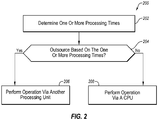
- FIG. 2 illustrates a flowchart of an example method 200 of determining whether to outsource an operation, in accordance with one or more embodiments of the present disclosure.
- one or more of the operations associated with method 200 may be performed by system 100 of FIG. 1 .
- method 200 may be performed by any suitable system, apparatus, or device.
- processor 610 of system 600 shown in FIG. 6 may perform one or more of the operations associated with method 200.
- steps and operations associated with one or more of the blocks of method 200 may be divided into additional blocks, combined into fewer blocks, or eliminated, depending on the desired implementation.
- one or more processing times for one or more operations associated with a system may be determined, and method 200 may proceed to block 204.
- a computation time for performing a function e.g., function f ; see FIG. 1
- a TEE e.g., TEE 104 of FIG. 1
- a central processing unit e.g., CPU 102 of FIG. 1
- an encryption time of an input e.g., input x; see FIG. 1
- an evaluation time e.g., a homomorphic evaluation time
- a decryption time of a ciphertext e.g., ciphertext c' of FIG. 1
- a determination may be made as to whether to outsource one or more operations. In some embodiments, the determination may be made based on at least one of the processing times determined at block 202. If it is determined to outsource the one or more operations, method 200 may proceed to block 206. If it is determined to not outsource the one or more operations, method 200 may proceed to block 208.
- a computation time of a function at a TEE (e.g., TEE 104) is greater than the sum of 1) an encryption time of an input at the TEE; 2) an evaluation time of the function at the other processing unit (e.g., processing unit 106); and 3) a decryption time of ciphertext at the TEE, it may be determined to outsource the computation to the other processing unit (e.g., processing unit 106 of FIG.
- the computation time of a function at the TEE (e.g., TEE 104) is less than or equal to the sum of 1) the encryption time of an input at the TEE; 2) the evaluation time of the function at the other processing unit (e.g., processing unit 106); and 3) the decryption time of ciphertext at the TEE, it may be determined to not outsource the computation to the other processing unit (e.g., if computation time of function f in TEE 104 ! > (encryption time of input x in TEE 104 + homomorphic evaluation time of function f in processing unit 106 + decryption time of ciphertext c' in TEE 104), then the computation of function f may not be outsourced).
- the one or more operations may be performed at the other processing unit (e.g., processing unit 106 of FIG. 1 ).
- the one or more operations may be performed at the TEE (e.g., at CPU 102 of FIG. 1 ).
- n functions f i e.g., for evaluation of (e.g., f 1 (x 1 ),..., f n (x n ))
- an encryption time of an input e.g., input x ; see FIG. 1
- evaluation times e.g., a homomorphic evaluation times
- a decryption time of a ciphertext e.g., ciphertext c n ' of FIG. 1
- a ciphertext e.g., ciphertext c n ' of FIG. 1
- n functions at a TEE e.g., TEE 104
- the sum of 1) an encryption time of an input at the TEE; 2) the evaluation times of the n functions at the other processing unit (e.g., processing unit 106); and 3) a decryption time of ciphertext at the TEE it may be determined to outsource the operations to the other processing unit (e.g., processing unit 106 of FIG. 1 ).
- the operations of method 200 may be implemented in differing order.
- the outlined operations and actions are only provided as examples, and some of the operations and actions may be optional, combined into fewer operations and actions, or expanded into additional operations and actions without detracting from the essence of the disclosed embodiment.
- FIG. 3 illustrates a flowchart of an example method 300 of outsourcing an operation with encryption, in accordance with one or more embodiments of the present disclosure.
- one or more of the operations associated with method 300 may be performed by system 100 of FIG. 1 .
- method 300 may be performed by any suitable system, apparatus, or device.
- processor 610 of system 600 shown in FIG. 6 may perform one or more of the operations associated with method 300.
- steps and operations associated with one or more of the blocks of method 300 may be divided into additional blocks, combined into fewer blocks, or eliminated, depending on the desired implementation.
- an input may be encrypted at a first processing unit to generate a first ciphertext, and method 300 may proceed to block 304.
- an input x (e.g., a message) may be encrypted via homomorphic encryption at CPU 102 to generate ciphertext c .
- input x may be encrypted at TEE 104 of CPU 102.
- the input may be encrypted via processor 610 of FIG. 6 .
- the first ciphertext may be conveyed to a second processing unit, and method 300 may proceed to block 306.
- ciphertext c may be conveyed to processing unit 106, which may include, for example, a GPU.
- processing unit 106 may include, for example, a GPU.
- a function e.g., function f ; see FIG. 1
- CPU 102 may be conveyed from CPU 102 to processing unit 106.
- an operation may be performed on the first ciphertext to generate a second ciphertext, and method 300 may proceed to block 308.
- a SHE evaluation e.g., via Eval function 110
- may be performed e.g., based on function f
- ciphertext c to generate ciphertext c' .
- the second ciphertext may be conveyed to the first processing unit, and method 300 may proceed to block 310.
- ciphertext c' may be conveyed from processing unit 106 to processing unit 102 (see FIG. 1 ).
- the second ciphertext may be decrypted to determine (e.g., compute) a function.
- ciphertext c' may be decrypted at TEE 104 (e.g., via Decrypt function 112) to compute function f(x) .
- the second ciphertext may be decrypted via processor 610 of FIG. 6 .
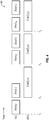
- FIG. 4 depicts an example timing diagram 400 for evaluation of a function (e.g., f 1 (x 1 ),..., f n (x n ) ) .
- a function e.g., f 1 (x 1 ),..., f n (x n )
- an input e.g., a message
- x 1 may be encrypted at a TEE (e.g., TEE 104 of FIG. 1 ) to generate a ciphertext c 1 .
- an input e.g., a message
- ciphertext c 1 may be evaluated (e.g., based on a function f 1 ) at a GPU to generate a ciphertext c 1' .
- an input (e.g., a message) x 3 may be encrypted at the TEE to generate a ciphertext c 3
- ciphertext c 1' may be decrypted at the TEE
- ciphertext c 2 may be evaluated (e.g., based on a function f 2 ) at the GPU to generate a ciphertext c 2'
- an input (e.g., a message) x 4 may be encrypted at the TEE
- ciphertext c 2' may be decrypted at the TEE
- ciphertext c 3 may be evaluated (e.g., based on a function f 3 ) at the GPU.
- matrices of dimension O ( n ) in terms of addition and multiplication cost may be O ( n 3 ) or in terms of inner product evaluation cost may be O ( n 2 ).
- a GPU implementation may be much faster (e.g., because an algorithm is highly parallelizable).
- the cost for encryption/decryption which occurs at the TEE, may have a cost of O ( n 2 ).
- the cost for evaluation may remain O ( n 3 ).
- evaluation cost at a GPU may be considerably smaller than plain multiplication inside the TEE. Further, SHE schemes, which are very fast and parallelizable for inner product computations, are available.
- Fully homomorphic encryption schemes may support an arbitrary function by bootstrapping SHE schemes, in accordance with various embodiments of the present disclosure.
- bootstrapping may be achieved by refreshing a ciphertext periodically.
- Bootstrapping which may be the bottleneck of FHE schemes, may be performed, in accordance with various embodiments.
- FIG. 5 depicts an example system 500 including a TEE 502 and a GPU 504.
- TEE 502 may encrypt an input x o to generate ciphertext c 1 , which may be sent to GPU 504.
- GPU 504 may evaluate ciphertext c 1 to generate ciphertext c 1' , which may be conveyed to TEE 502.
- TEE 502 may decrypt ciphertext c i'-1 to generate x i-1 .
- Tee 502 may encrypt x i-1 to generate c i .
- GPU 504 may evaluate ciphertext c i to generate ciphertext c i' , which may be conveyed to TEE 502.
- neural networks may be securely evaluated via one or more embodiments of the present disclosure.
- Neural networks may include layered execution of two basic operations, inner product and thresholding.
- the inner product evaluation may be a simple form of multiplication that can be outsourced to a processor (e.g., processor 106 of FIG. 1 , which may include a GPU) after applying a secret key SHE at a TEE (e.g.,. TEE 104 of FIG. 1 ).
- the processor e.g., the GPU
- the processor may also facilitate the inner product computations over all inputs (e.g., via SIMD linear algebra operations.)
- a GPU may be leveraged for parallel computation of each layer of the neural network.
- eigenvalues and eigenvectors may be securely computed.
- general algorithms may apply to many higher level algorithms, such as, principal component analysis and quadratic optimization problems.
- these algorithms may be used in many machine learning algorithms, such as, support vector machine (SVMs) and domain specific problems (e.g., PageRank and recommendation systems).
- SVMs support vector machine
- domain specific problems e.g., PageRank and recommendation systems
- iterations maybe outsourced to a processor (e.g., processing unit 106 (e.g., a GPU)), which may support linear algebra operations, and encrypted iteration results may be refreshed using a TEE (e.g., TEE 104 of FIG. 1 ).
- a processor e.g., processing unit 106 (e.g., a GPU)
- TEE e.g., TEE 104 of FIG. 1
- FIG. 6 illustrates an example system 600, according to at least one embodiment described herein.
- System 600 may include any suitable system, apparatus, or device configured for determining whether to outsource an operation and/or outsourcing one or more operations with encryption.
- System 600 may include a processor 610, a memory 620, a data storage 630, and a communication device 640, which all may be communicatively coupled.
- Data storage 630 may include various types of data, such as operation times (e.g., computation times, encryption times, evaluation time, and/or decryption times), data (e.g., encrypted and/or decrypted), function data, secret keys, and/or other data associated with outsourcing (and possibly determining whether to outsource) one or more operations with encryption.
- operation times e.g., computation times, encryption times, evaluation time, and/or decryption times
- data e.g., encrypted and/or decrypted
- function data e.g., secret keys, and/or other data associated with outsourcing (and possibly
- processor 610 may include any suitable special-purpose or general-purpose computer, computing entity, or processing device including various computer hardware or software modules and may be configured to execute instructions stored on any applicable computer-readable storage media.
- processor 610 may include a microprocessor, a microcontroller, a digital signal processor (DSP), an application-specific integrated circuit (ASIC), a Field-Programmable Gate Array (FPGA), or any other digital or analog circuitry configured to interpret and/or to execute program instructions and/or to process data.
- DSP digital signal processor
- ASIC application-specific integrated circuit
- FPGA Field-Programmable Gate Array
- processor 610 may include any number of processors distributed across any number of network or physical locations that are configured to perform individually or collectively any number of operations described herein.
- processor 610 may interpret and/or execute program instructions and/or process data stored in memory 620, data storage 630, or memory 620 and data storage 630.
- processor 610 may fetch program instructions from data storage 630 and load the program instructions into memory 620.
- processor 610 may execute the program instructions, such as instructions to perform one or more blocks of method 200 and/or method 300 as described herein.
- processor 610 may run SHE and/or FHE operations.
- processor 610 may determine operation times (e.g., computation times, encryption times, evaluation times, and/or decryption times).
- processor 610 may perform SHE operations (e.g., Eval function), encrypt and/or decrypt data (e.g., input and/or messages).
- Memory 620 and data storage 630 may include computer-readable storage media or one or more computer-readable storage mediums for carrying or having computer-executable instructions or data structures stored thereon.
- Such computer-readable storage media may be any available media that may be accessed by a general-purpose or special-purpose computer, such as processor 610.
- such computer-readable storage media may include non-transitory computer-readable storage media including Random Access Memory (RAM), Read-Only Memory (ROM), Electrically Erasable Programmable Read-Only Memory (EEPROM), Compact Disc Read-Only Memory (CD-ROM) or other optical disk storage, magnetic disk storage or other magnetic storage devices, flash memory devices (e.g., solid state memory devices), or any other storage medium which may be used to carry or store desired program code in the form of computer-executable instructions or data structures and which may be accessed by a general-purpose or special-purpose computer. Combinations of the above may also be included within the scope of computer-readable storage media.
- Computer-executable instructions may include, for example, instructions and data configured to cause processor 610 to perform a certain operation or group of operations.
- Communication unit 640 may include any component, device, system, or combination thereof that is configured to transmit or receive information over a network. In some embodiments, communication unit 640 may communicate with other devices at other locations, the same location, or even other components within the same system. For example, communication unit 640 may include a modem, a network card (wireless or wired), an infrared communication device, a wireless communication device (such as an antenna), and/or chipset (such as a Bluetooth device, an 802.6 device (e.g., Metropolitan Area Network (MAN)), a WiFi device, a WiMax device, cellular communication facilities, etc.), and/or the like. Communication unit 640 may permit data to be exchanged with a network and/or any other devices or systems described in the present disclosure. For example, communication unit 640 may allow system 600 to communicate with other systems and/or devices.
- MAN Metropolitan Area Network
- data storage 630 may be multiple different storage mediums located in multiple locations and accessed by processor 610 through a network.
- embodiments described herein may include the use of a special purpose or general purpose computer (e.g., processor 610 of FIG. 6 ) including various computer hardware or software modules, as discussed in greater detail below. Further, as indicated above, embodiments described herein may be implemented using computer-readable media (e.g., memory 620 or data storage 630 of FIG. 6 ) for carrying or having computer-executable instructions or data structures stored thereon.
- a special purpose or general purpose computer e.g., processor 610 of FIG. 6
- embodiments described herein may be implemented using computer-readable media (e.g., memory 620 or data storage 630 of FIG. 6 ) for carrying or having computer-executable instructions or data structures stored thereon.
- module or “component” may refer to specific hardware implementations configured to perform the operations of the module or component and/or software objects or software routines that may be stored on and/or executed by, for example, processing unit 102, processing unit 104 (see FIG. 1 ), and/or computing system 600.
- the different components and modules described herein may be implemented as objects or processes that execute on a computing system (e.g., as separate threads). While some of the system and methods described herein are generally described as being implemented in software (stored on and/or executed by system 600), specific hardware implementations or a combination of software and specific hardware implementations are also possible and contemplated.
- a "computing entity” may include any computing system as defined herein, or any module or combination of modules running on a computing system, such as system 600.
- any disjunctive word or phrase presenting two or more alternative terms, whether in the description, claims, or drawings, should be understood to contemplate the possibilities of including one of the terms, either of the terms, or both terms.
- the phrase “A or B” should be understood to include the possibilities of "A” or “B” or “A and B.”
Landscapes
- Engineering & Computer Science (AREA)
- Computer Security & Cryptography (AREA)
- Computer Networks & Wireless Communication (AREA)
- Signal Processing (AREA)
- Management, Administration, Business Operations System, And Electronic Commerce (AREA)
- Storage Device Security (AREA)
Abstract
Description
- The embodiments discussed herein relate to outsourcing processing operations with homomorphic encryption.
- A trusted execution environment (TEE), which is a secure area of a processor, may provide security guarantees such as confidentiality of user data, even while performing operations (e.g., computations) on the user data.
- The subject matter claimed herein is not limited to embodiments that solve any disadvantages or that operate only in environments such as those described above. Rather, this background is only provided to illustrate one example technology area where some embodiments described herein may be practiced.
- According to an aspect of an embodiment, a method may include encrypting data at trusted execution environment (TEE) to generate a first ciphertext. The method may also include conveying the first ciphertext to a graphics processing unit (GPU). Further, the method may include performing, at the GPU, at least one somewhat homomorphic encryption (SHE) evaluation operation on the first ciphertext to generate a second ciphertext. Moreover, the method may include conveying the second ciphertext to the TEE. In addition, the method may include decrypting, at the TEE, the second ciphertext to generate a function.
- The object and advantages of the embodiments will be realized and achieved at least by the elements, features, and combinations particularly pointed out in the claims.
- It is to be understood that both the foregoing general description and the following detailed description are exemplary and explanatory and are not restrictive of the invention, as claimed.
- Example embodiments will be described and explained with additional specificity and detail through the use of the accompanying drawings in which:
-
FIG. 1 illustrates an example system including a trusted execution environment; -
FIG. 2 depicts an example flow diagram of a method of determining whether to outsource an operation; -
FIG. 3 depicts an example flow diagram of a method of outsourcing an operation with encryption; -
FIG. 4 depicts an example timing diagram for processing operations at a plurality of processing units; -
FIG. 5 illustrates an example system including a plurality of processing units; and -
FIG. 6 is a block diagram of an example computing system. - Various embodiments discussed herein relate to outsourcing one or more processing operations via encryption (e.g., homomorphic encryption). More specifically, for example, one or more processing operations (e.g., TEE computations) may be outsourced from a TEE (e.g., of a central processing unit (CPU)) to another processing unit (e.g., graphics processing unit (GPU)) with encryption (e.g., homomorphic encryption).
- Fully homomorphic encryption (FHE) may allow for processing operations (e.g., computations) to be performed on a ciphertext of a message. Further, FHE may allow for decryption and recovery of the message. FHE is inherently inefficient and may be considered impractical. A "weaker" variant of FHE, referred to as "somewhat homomorphic encryption" (SHE), allows for homomorphic encryption, but for limited or smaller operations (e.g., computations). In most instances, SHE is much faster than FHE.
- TEEs are secure areas of a processor (e.g., a main processor (e.g., a central processing unit (CPU))) that may not be accessed, modified, or examined by any outside party. TEEs allow for performance of various cryptographic operations. TEEs are relatively efficient (e.g., fractionally slower than computing in the clear). However, TEEs only support relatively small amounts of memory and may not allow use of outside resources (e.g., GPUs).
- GPUs may be configured for parallelization and/or single instruction multiple data (SIMD) processing. Further, compared to a CPU, GPUs may have lower clock speeds. Although GPUs may have been originally designed for graphics processing, more recently, GPUs are designed for more general computations.
- In various embodiments of the present disclosure, SHE may be used within a TEE to implement more efficient secure computation with the TEE using outside resources, such as a GPU. For example, in at least some embodiments, one or more secure computations may be split into multiple SHE computations wherein a TEE may be used in a secure manner.
- Various embodiments disclosed herein may eliminate some of the drawbacks of TEEs for performing expensive computations efficiently and without resorting to slow cryptographic schemes, such as software FHE.
- Thus, various embodiments of the present disclosure, as described more fully herein, provide a technical solution to one or more problems that arise from technology that could not reasonably be performed by a person, and various embodiments disclosed herein are rooted in computer technology in order to overcome the problems and/or challenges described above. Further, at least some embodiments disclosed herein may improve computer-related technology by allowing computer performance of a function not previously performable by a computer.
- Embodiments of the present disclosure will be explained with reference to the accompanying drawings.
-
FIG. 1 illustrates anexample system 100, according to at least one embodiment of the present disclosure.System 100 includes a central processing unit (CPU) 102, a TEE 104, and aprocessing unit 106. In at least some embodiments, TEE 104 may be withinCPU 102. For example,processing unit 106 may include a graphics processing unit (GPU). - According to at least some embodiments, TEE 104 may be configured to encrypt an input (e.g., a message) and generate a ciphertext. More specifically, for example, TEE 104 may be configured to receive an input x (e.g., an input received at processing unit 102) and generate a ciphertext c via an
Encrypt function 108. Further, the ciphertext may be conveyed to processingunit 106, which, as described more fully herein, may be configured to generate another ciphertext. In at least some embodiments, ciphertext c and a function f (also referred to herein as an intermediate function) may be conveyed fromTEE 104 toprocessing unit 106. - Further, for example,
processing unit 106 may be configured to receive ciphertext c, perform a SHE operation (e.g., a SHE evaluation) (e.g., via an Eval function 110) of function f on ciphertext c to generate ciphertext c'. Moreover,processing unit 106 may be configured convey the other ciphertext (e.g., ciphertext c') toTEE 104 for decryption. For example, upon receipt thereof,TEE 104 may decrypt ciphertext c' (e.g., via a Decrypt function 112) to generate a function f(x). TEE 104 may further include a Keygen function 114 for generating a secret key sk, which may be used for decryption (e.g., decryption of ciphertext c'). - Some embodiments of the present disclosure may relate to determining whether a TEE (e.g., TEE 104) should outsource one or more operations (e.g., computations) to another processing unit (e.g., processing unit 106). In at least some embodiments, various factors may be considered in determining whether to outsource one or more operations. For example, a computation time of a function at a TEE (e.g., TEE 104), an encryption time of an input (e.g., a message) at the TEE, an operation time (e.g., an evaluation time) of the function at the other processing unit (e.g., processing unit 106), and/or a decryption time of ciphertext at the TEE may be considered in determining whether to outsource an operation (e.g., a computation).
-
FIG. 2 illustrates a flowchart of anexample method 200 of determining whether to outsource an operation, in accordance with one or more embodiments of the present disclosure. In some embodiments, one or more of the operations associated withmethod 200 may be performed bysystem 100 ofFIG. 1 . Alternately or additionally,method 200 may be performed by any suitable system, apparatus, or device. For example,processor 610 ofsystem 600 shown inFIG. 6 may perform one or more of the operations associated withmethod 200. Although illustrated with discrete blocks, the steps and operations associated with one or more of the blocks ofmethod 200 may be divided into additional blocks, combined into fewer blocks, or eliminated, depending on the desired implementation. - At
block 202, one or more processing times for one or more operations associated with a system (e.g.,system 100 ofFIG. 1 ) may be determined, andmethod 200 may proceed to block 204. For example, one or more of a computation time for performing a function (e.g., function f; seeFIG. 1 ) at a TEE (e.g.,TEE 104 ofFIG. 1 ) of a central processing unit (e.g.,CPU 102 ofFIG. 1 ), an encryption time of an input (e.g., input x; seeFIG. 1 ) at the TEE, an evaluation time (e.g., a homomorphic evaluation time) of the function at another processing unit (e.g.,processing unit 106 ofFIG. 1 ), and a decryption time of a ciphertext (e.g., ciphertext c' ofFIG. 1 ) at the TEE may be determined. - At
block 204, a determination may be made as to whether to outsource one or more operations. In some embodiments, the determination may be made based on at least one of the processing times determined atblock 202. If it is determined to outsource the one or more operations,method 200 may proceed to block 206. If it is determined to not outsource the one or more operations,method 200 may proceed to block 208. - For example, in at least some embodiments, if a computation time of a function at a TEE (e.g., TEE 104) is greater than the sum of 1) an encryption time of an input at the TEE; 2) an evaluation time of the function at the other processing unit (e.g., processing unit 106); and 3) a decryption time of ciphertext at the TEE, it may be determined to outsource the computation to the other processing unit (e.g., processing
unit 106 ofFIG. 1 ) (e.g., if computation time of function f inTEE 104 > (encryption time of input x inTEE 104 + homomorphic evaluation time of function f inprocessing unit 106 + decryption time of ciphertext c' in TEE 104), then the computation of function f may be outsourced). - If the computation time of a function at the TEE (e.g., TEE 104) is less than or equal to the sum of 1) the encryption time of an input at the TEE; 2) the evaluation time of the function at the other processing unit (e.g., processing unit 106); and 3) the decryption time of ciphertext at the TEE, it may be determined to not outsource the computation to the other processing unit (e.g., if computation time of function f in
TEE 104 ! > (encryption time of input x inTEE 104 + homomorphic evaluation time of function f inprocessing unit 106 + decryption time of ciphertext c' in TEE 104), then the computation of function f may not be outsourced). - At
block 206, the one or more operations may be performed at the other processing unit (e.g., processingunit 106 ofFIG. 1 ). Atblock 208, the one or more operations may be performed at the TEE (e.g., atCPU 102 ofFIG. 1 ). - Modifications, additions, or omissions may be made to
method 200 without departing from the scope of the present disclosure. For example, in some embodiments, atblock 202, computation times of n functions fi (e.g., for evaluation of (e.g., f1(x1),..., fn(xn))) at the TEE, an encryption time of an input (e.g., input x; seeFIG. 1 ) at the TEE, evaluation times (e.g., a homomorphic evaluation times) of n functions fi at another processing unit (e.g., processingunit 106 ofFIG. 1 ), and a decryption time of a ciphertext (e.g., ciphertext cn' ofFIG. 1 ) may be determined. - Further, in this example, at
block 204, if computation times of the n functions at a TEE (e.g., TEE 104) is greater than the sum of 1) an encryption time of an input at the TEE; 2) the evaluation times of the n functions at the other processing unit (e.g., processing unit 106); and 3) a decryption time of ciphertext at the TEE, it may be determined to outsource the operations to the other processing unit (e.g., processingunit 106 ofFIG. 1 ). - Further, for example, the operations of
method 200 may be implemented in differing order. Furthermore, the outlined operations and actions are only provided as examples, and some of the operations and actions may be optional, combined into fewer operations and actions, or expanded into additional operations and actions without detracting from the essence of the disclosed embodiment. -
FIG. 3 illustrates a flowchart of anexample method 300 of outsourcing an operation with encryption, in accordance with one or more embodiments of the present disclosure. In some embodiments, one or more of the operations associated withmethod 300 may be performed bysystem 100 ofFIG. 1 . Alternately or additionally,method 300 may be performed by any suitable system, apparatus, or device. For example,processor 610 ofsystem 600 shown inFIG. 6 may perform one or more of the operations associated withmethod 300. Although illustrated with discrete blocks, the steps and operations associated with one or more of the blocks ofmethod 300 may be divided into additional blocks, combined into fewer blocks, or eliminated, depending on the desired implementation. - At
block 302, an input may be encrypted at a first processing unit to generate a first ciphertext, andmethod 300 may proceed to block 304. For example, with reference toFIG. 1 , an input x (e.g., a message) may be encrypted via homomorphic encryption atCPU 102 to generate ciphertext c. More specifically, for example, input x may be encrypted atTEE 104 ofCPU 102. Further, for example, the input may be encrypted viaprocessor 610 ofFIG. 6 . - At
block 304, the first ciphertext may be conveyed to a second processing unit, andmethod 300 may proceed to block 306. For example, with reference toFIG. 1 , ciphertext c may be conveyed toprocessing unit 106, which may include, for example, a GPU. Further, in at least some embodiments, a function (e.g., function f; seeFIG. 1 ) may be conveyed fromCPU 102 toprocessing unit 106. - At
block 306, an operation may be performed on the first ciphertext to generate a second ciphertext, andmethod 300 may proceed to block 308. For example, with reference again toFIG. 1 , a SHE evaluation (e.g., via Eval function 110) may be performed (e.g., based on function f) on ciphertext c to generate ciphertext c'. - At
block 308, the second ciphertext may be conveyed to the first processing unit, andmethod 300 may proceed to block 310. For example, ciphertext c' may be conveyed fromprocessing unit 106 to processing unit 102 (seeFIG. 1 ). - At
block 310, the second ciphertext may be decrypted to determine (e.g., compute) a function. For example, with reference toFIG. 1 , ciphertext c' may be decrypted at TEE 104 (e.g., via Decrypt function 112) to compute function f(x). Further, for example, the second ciphertext may be decrypted viaprocessor 610 ofFIG. 6 . - Modifications, additions, or omissions may be made to
method 300 without departing from the scope of the present disclosure. For example, the operations ofmethod 300 may be implemented in differing order. Furthermore, the outlined operations and actions are only provided as examples, and some of the operations and actions may be optional, combined into fewer operations and actions, or expanded into additional operations and actions without detracting from the essence of the disclosed embodiment. - In at least some embodiments, computations at a TEE (e.g.,
TEE 104 ofFIG. 1 ) and another processor unit (e.g.,processor 106 ofFIG. 1 ) may be performed in parallel (e.g., via building a pipeline).FIG. 4 depicts an example timing diagram 400 for evaluation of a function (e.g., f1(x1),..., fn(xn)). For example, at a time T1, an input (e.g., a message) x1 may be encrypted at a TEE (e.g.,TEE 104 ofFIG. 1 ) to generate a ciphertext c1 . Further, at a time T2, an input (e.g., a message) x2 may be encrypted at the TEE. Also, at time T2, ciphertext c1 may be evaluated (e.g., based on a function f1 ) at a GPU to generate a ciphertext c1'. At a time T3, an input (e.g., a message) x3 may be encrypted at the TEE to generate a ciphertext c3, ciphertext c1' may be decrypted at the TEE, and ciphertext c2 may be evaluated (e.g., based on a function f2) at the GPU to generate a ciphertext c2' . Moreover, at a time T4, an input (e.g., a message) x4 may be encrypted at the TEE, ciphertext c2' may be decrypted at the TEE, and ciphertext c3 may be evaluated (e.g., based on a function f3 ) at the GPU. - In one example use case including matrix multiplication, for matrices of dimension O(n), in terms of addition and multiplication cost may be O(n 3) or in terms of inner product evaluation cost may be O(n 2).
- For large matrices, a GPU implementation may be much faster (e.g., because an algorithm is highly parallelizable). For homomorphic encryption (e.g., using a TEE and a GPU), the cost for encryption/decryption, which occurs at the TEE, may have a cost of O(n 2). The cost for evaluation may remain O(n 3). For a fast SHE scheme, evaluation cost at a GPU may be considerably smaller than plain multiplication inside the TEE. Further, SHE schemes, which are very fast and parallelizable for inner product computations, are available.
- Fully homomorphic encryption schemes may support an arbitrary function by bootstrapping SHE schemes, in accordance with various embodiments of the present disclosure. For example, bootstrapping may be achieved by refreshing a ciphertext periodically. Bootstrapping, which may be the bottleneck of FHE schemes, may be performed, in accordance with various embodiments.
- For example,
FIG. 5 depicts anexample system 500 including aTEE 502 and a GPU 504. In one contemplated operation,TEE 502 may encrypt an input xo to generate ciphertext c1, which may be sent to GPU 504. Further, GPU 504 may evaluate ciphertext c1 to generate ciphertext c1' , which may be conveyed toTEE 502. Further,TEE 502 may decrypt ciphertext ci'-1 to generate xi-1 . Further,Tee 502 may encrypt xi-1 to generate ci . Moreover, GPU 504 may evaluate ciphertext ci to generate ciphertext ci' , which may be conveyed toTEE 502. - For example, in a secure deep learning application, neural networks may be securely evaluated via one or more embodiments of the present disclosure. Neural networks may include layered execution of two basic operations, inner product and thresholding. The inner product evaluation may be a simple form of multiplication that can be outsourced to a processor (e.g.,
processor 106 ofFIG. 1 , which may include a GPU) after applying a secret key SHE at a TEE (e.g.,.TEE 104 ofFIG. 1 ). - In this embodiment, the processor (e.g., the GPU) may also facilitate the inner product computations over all inputs (e.g., via SIMD linear algebra operations.) Thus, according to various embodiments, a GPU may be leveraged for parallel computation of each layer of the neural network.
- As another example, eigenvalues and eigenvectors may be securely computed. In this example, general algorithms may apply to many higher level algorithms, such as, principal component analysis and quadratic optimization problems. In turn, these algorithms may be used in many machine learning algorithms, such as, support vector machine (SVMs) and domain specific problems (e.g., PageRank and recommendation systems). This example may include iterations of vector and matrix product computations.
- According to various embodiments, iterations maybe outsourced to a processor (e.g., processing unit 106 (e.g., a GPU)), which may support linear algebra operations, and encrypted iteration results may be refreshed using a TEE (e.g.,
TEE 104 ofFIG. 1 ). -
FIG. 6 illustrates anexample system 600, according to at least one embodiment described herein.System 600 may include any suitable system, apparatus, or device configured for determining whether to outsource an operation and/or outsourcing one or more operations with encryption.System 600 may include aprocessor 610, amemory 620, adata storage 630, and acommunication device 640, which all may be communicatively coupled.Data storage 630 may include various types of data, such as operation times (e.g., computation times, encryption times, evaluation time, and/or decryption times), data (e.g., encrypted and/or decrypted), function data, secret keys, and/or other data associated with outsourcing (and possibly determining whether to outsource) one or more operations with encryption. - Generally,
processor 610 may include any suitable special-purpose or general-purpose computer, computing entity, or processing device including various computer hardware or software modules and may be configured to execute instructions stored on any applicable computer-readable storage media. For example,processor 610 may include a microprocessor, a microcontroller, a digital signal processor (DSP), an application-specific integrated circuit (ASIC), a Field-Programmable Gate Array (FPGA), or any other digital or analog circuitry configured to interpret and/or to execute program instructions and/or to process data. - Although illustrated as a single processor in
FIG. 6 , it is understood thatprocessor 610 may include any number of processors distributed across any number of network or physical locations that are configured to perform individually or collectively any number of operations described herein. In some embodiments,processor 610 may interpret and/or execute program instructions and/or process data stored inmemory 620,data storage 630, ormemory 620 anddata storage 630. In some embodiments,processor 610 may fetch program instructions fromdata storage 630 and load the program instructions intomemory 620. - After the program instructions are loaded into
memory 620,processor 610 may execute the program instructions, such as instructions to perform one or more blocks ofmethod 200 and/ormethod 300 as described herein. According to various embodiments,processor 610 may run SHE and/or FHE operations. For example,processor 610 may determine operation times (e.g., computation times, encryption times, evaluation times, and/or decryption times). Further, for example,processor 610 may perform SHE operations (e.g., Eval function), encrypt and/or decrypt data (e.g., input and/or messages). -
Memory 620 anddata storage 630 may include computer-readable storage media or one or more computer-readable storage mediums for carrying or having computer-executable instructions or data structures stored thereon. Such computer-readable storage media may be any available media that may be accessed by a general-purpose or special-purpose computer, such asprocessor 610. - By way of example, and not limitation, such computer-readable storage media may include non-transitory computer-readable storage media including Random Access Memory (RAM), Read-Only Memory (ROM), Electrically Erasable Programmable Read-Only Memory (EEPROM), Compact Disc Read-Only Memory (CD-ROM) or other optical disk storage, magnetic disk storage or other magnetic storage devices, flash memory devices (e.g., solid state memory devices), or any other storage medium which may be used to carry or store desired program code in the form of computer-executable instructions or data structures and which may be accessed by a general-purpose or special-purpose computer. Combinations of the above may also be included within the scope of computer-readable storage media. Computer-executable instructions may include, for example, instructions and data configured to cause
processor 610 to perform a certain operation or group of operations. -
Communication unit 640 may include any component, device, system, or combination thereof that is configured to transmit or receive information over a network. In some embodiments,communication unit 640 may communicate with other devices at other locations, the same location, or even other components within the same system. For example,communication unit 640 may include a modem, a network card (wireless or wired), an infrared communication device, a wireless communication device (such as an antenna), and/or chipset (such as a Bluetooth device, an 802.6 device (e.g., Metropolitan Area Network (MAN)), a WiFi device, a WiMax device, cellular communication facilities, etc.), and/or the like.Communication unit 640 may permit data to be exchanged with a network and/or any other devices or systems described in the present disclosure. For example,communication unit 640 may allowsystem 600 to communicate with other systems and/or devices. - Modifications, additions, or omissions may be made to
system 600 without departing from the scope of the present disclosure. For example,data storage 630 may be multiple different storage mediums located in multiple locations and accessed byprocessor 610 through a network. - As indicated above, the embodiments described herein may include the use of a special purpose or general purpose computer (e.g.,
processor 610 ofFIG. 6 ) including various computer hardware or software modules, as discussed in greater detail below. Further, as indicated above, embodiments described herein may be implemented using computer-readable media (e.g.,memory 620 ordata storage 630 ofFIG. 6 ) for carrying or having computer-executable instructions or data structures stored thereon. - As used herein, the terms "module" or "component" may refer to specific hardware implementations configured to perform the operations of the module or component and/or software objects or software routines that may be stored on and/or executed by, for example, processing
unit 102, processing unit 104 (seeFIG. 1 ), and/orcomputing system 600. In some embodiments, the different components and modules described herein may be implemented as objects or processes that execute on a computing system (e.g., as separate threads). While some of the system and methods described herein are generally described as being implemented in software (stored on and/or executed by system 600), specific hardware implementations or a combination of software and specific hardware implementations are also possible and contemplated. In this description, a "computing entity" may include any computing system as defined herein, or any module or combination of modules running on a computing system, such assystem 600. - Terms used in the present disclosure and especially in the appended claims (e.g., bodies of the appended claims) are generally intended as "open" terms (e.g., the term "including" should be interpreted as "including, but not limited to," the term "having" should be interpreted as "having at least," the term "includes" should be interpreted as "includes, but is not limited to," etc.).
- Additionally, if a specific number of an introduced claim recitation is intended, such an intent will be explicitly recited in the claim, and in the absence of such recitation no such intent is present. For example, as an aid to understanding, the following appended claims may contain usage of the introductory phrases "at least one" and "one or more" to introduce claim recitations. However, the use of such phrases should not be construed to imply that the introduction of a claim recitation by the indefinite articles "a" or "an" limits any particular claim containing such introduced claim recitation to embodiments containing only one such recitation, even when the same claim includes the introductory phrases "one or more" or "at least one" and indefinite articles such as "a" or "an" (e.g., "a" and/or "an" should be interpreted to mean "at least one" or "one or more"); the same holds true for the use of definite articles used to introduce claim recitations.
- In addition, even if a specific number of an introduced claim recitation is explicitly recited, those skilled in the art will recognize that such recitation should be interpreted to mean at least the recited number (e.g., the bare recitation of "two recitations," without other modifiers, means at least two recitations, or two or more recitations). Furthermore, in those instances where a convention analogous to "at least one of A, B, and C, etc." or "one or more of A, B, and C, etc." is used, in general such a construction is intended to include A alone, B alone, C alone, A and B together, A and C together, B and C together, or A, B, and C together, etc.
- Further, any disjunctive word or phrase presenting two or more alternative terms, whether in the description, claims, or drawings, should be understood to contemplate the possibilities of including one of the terms, either of the terms, or both terms. For example, the phrase "A or B" should be understood to include the possibilities of "A" or "B" or "A and B."
- All examples and conditional language recited in the present disclosure are intended for pedagogical objects to aid the reader in understanding the invention and the concepts contributed by the inventor to furthering the art, and are to be construed as being without limitation to such specifically recited examples and conditions. Although embodiments of the present disclosure have been described in detail, various changes, substitutions, and alterations could be made hereto without departing from the spirit and scope of the present disclosure
- The following statements are useful for understanding embodiments of the present invention
- S1. A method of outsourcing an operation, the method comprising:
- encrypting data at a trusted execution environment (TEE) to generate a first ciphertext;
- conveying the first ciphertext to a graphics processing unit (GPU);
- performing, at the GPU, at least one somewhat homomorphic encryption (SHE) evaluation operation on the first ciphertext to generate a second ciphertext;
- conveying the second ciphertext to the TEE; and
- decrypting, at the TEE, the second ciphertext to compute a function.
- S2. The method of statement S1, further comprising determining, based on estimated processing times of at least one of encrypting the data, performing the SHE evaluation operation, and decrypting the second ciphertext, whether to outsource the SHE evaluation operation to the GPU.
- S3. The method of statement S1, further comprising at least one of:
- encrypting second data at the TEE to generate a third ciphertext while substantially simultaneously performing the at least one SHE evaluation operation on the first ciphertext; and
- performing the at least one SHE evaluation operation on the third ciphertext while substantially simultaneously decrypting the second ciphertext.
- S4. The method of statement S1, further comprising evaluating one or more arbitrary functions via bootstrapping a plurality of SHE schemes.
- S5. The method of statement S1, wherein decrypting the second ciphertext comprises decrypting the second ciphertext via a secret key generated at the TEE.
- S6. The method of statement S1, wherein performing the at least one SHE evaluation operation comprises evaluating the first ciphertext based on an intermediate function.
- S7. The method of statement S1, wherein encrypting data comprises encrypting data via homomorphic encryption.
- S8. A system, comprising:
one or more processing units configured to:- encrypt data at a trusted execution environment (TEE) to generate a first ciphertext;
- convey the first ciphertext to a graphics processing unit (GPU);
- perform, at the GPU, at least one somewhat homomorphic encryption (SHE) evaluation operation on the first ciphertext to generate a second ciphertext;
- convey the second ciphertext to the TEE; and
- decrypt, at the TEE, the second ciphertext to generate a function.
- S9. The system of statement S8, wherein the one or more processing units are further configured to determine, based on estimated processing times of at least one of encrypting the data, performing the SHE evaluation operation, and decrypting the second ciphertext, whether to outsource the SHE evaluation operation to the GPU.
- S10. The system of statement S8, wherein the one or more processing units are further configured to at least one of:
- encrypt second data at the TEE to generate a third ciphertext and perform the at least one SHE evaluation operation on the first ciphertext substantially simultaneously; and
- perform the at least one SHE evaluation operation on the third ciphertext and decrypting the second ciphertext substantially simultaneously.
- S11. The system of statement S8, wherein the one or more processing units are further configured to evaluate one or more arbitrary functions via bootstrapping a plurality of SHE schemes.
- S12. The system of statement S8, wherein the TEE is configured to decrypt the second ciphertext via a secret key generated at the TEE.
- S13. The system of statement S8, wherein the one or more processing units are further configured to evaluate the first ciphertext based on an intermediate function.
- S14. The system of statement S8, wherein the data is encrypted via homomorphic encryption.
- S15. One or more non-transitory computer-readable media that include instructions that, when executed by one or more processors, are configured to cause the one or more processors to perform operations, the operations comprising:
- encrypting data at a trusted execution environment (TEE) to generate a first ciphertext;
- conveying the first ciphertext to a graphics processing unit (GPU);
- performing, at the GPU, at least one somewhat homomorphic encryption (SHE) evaluation operation on the first ciphertext to generate a second ciphertext;
- conveying the second ciphertext to the TEE; and
- decrypting, at the TEE, the second ciphertext to generate a function.
- S16. The computer-readable media of statement S15, the operations further comprising determining, based on estimated processing times of at least one of encrypting the data, performing the SHE evaluation operation, and decrypting the second ciphertext, whether to outsource the SHE evaluation operation to the GPU.
- S17. The computer-readable media of statement S15, the operations further comprising at least one of:
- encrypting second data at the TEE to generate a third ciphertext while substantially simultaneously performing the at least one SHE evaluation operation on the first ciphertext; and
- performing the at least one SHE evaluation operation on the third ciphertext while substantially simultaneously decrypting the second ciphertext.
- S18. The computer-readable media of statement S15, the operations further comprising evaluating one or more arbitrary functions via bootstrapping a plurality of SHE schemes.
- S19. The computer-readable media of statement S15, wherein decrypting the second ciphertext comprises decrypting the second ciphertext via a secret key generated at the TEE.
- S20. The computer-readable media of statement S15, wherein performing the at least one SHE evaluation operation comprises evaluating the first ciphertext based on an intermediate function.
Claims (15)
- A method of outsourcing an operation, the method comprising:encrypting data at a trusted execution environment (TEE) to generate a first ciphertext;conveying the first ciphertext to a graphics processing unit (GPU);performing, at the GPU, at least one somewhat homomorphic encryption (SHE) evaluation operation on the first ciphertext to generate a second ciphertext;conveying the second ciphertext to the TEE; anddecrypting, at the TEE, the second ciphertext to compute a function.
- The method of claim 1, further comprising determining, based on estimated processing times of at least one of encrypting the data, performing the SHE evaluation operation, and decrypting the second ciphertext, whether to outsource the SHE evaluation operation to the GPU.
- The method of claim 1 or claim 2, further comprising at least one of:encrypting second data at the TEE to generate a third ciphertext while substantially simultaneously performing the at least one SHE evaluation operation on the first ciphertext; andperforming the at least one SHE evaluation operation on the third ciphertext while substantially simultaneously decrypting the second ciphertext.
- The method of any of the preceding claims, further comprising evaluating one or more arbitrary functions via bootstrapping a plurality of SHE schemes.
- The method of any of the preceding claims, wherein decrypting the second ciphertext comprises decrypting the second ciphertext via a secret key generated at the TEE.
- The method of any of the preceding claims, wherein performing the at least one SHE evaluation operation comprises evaluating the first ciphertext based on an intermediate function.
- The method of any of the preceding claims, wherein encrypting data comprises encrypting data via homomorphic encryption.
- A system, comprising one or more processing units configured to:encrypt data at a trusted execution environment (TEE) to generate a first ciphertext;convey the first ciphertext to a graphics processing unit (GPU);perform, at the GPU, at least one somewhat homomorphic encryption (SHE) evaluation operation on the first ciphertext to generate a second ciphertext;convey the second ciphertext to the TEE; anddecrypt, at the TEE, the second ciphertext to generate a function.
- The system of claim 8, wherein the one or more processing units are further configured to determine, based on estimated processing times of at least one of encrypting the data, performing the SHE evaluation operation, and decrypting the second ciphertext, whether to outsource the SHE evaluation operation to the GPU.
- The system of claim 8 or claim 9, wherein the one or more processing units are further configured to at least one of:encrypt second data at the TEE to generate a third ciphertext and perform the at least one SHE evaluation operation on the first ciphertext substantially simultaneously; andperform the at least one SHE evaluation operation on the third ciphertext and decrypt the second ciphertext substantially simultaneously.
- The system of any of claims 8 to 10, wherein the one or more processing units are further configured to evaluate one or more arbitrary functions via bootstrapping a plurality of SHE schemes.
- The system of any of claims 8 to 11, wherein the TEE is configured to decrypt the second ciphertext via a secret key generated at the TEE.
- The system of any of claims 8 to 12, wherein the one or more processing units are further configured to evaluate the first ciphertext based on an intermediate function.
- The system of any of claims 8 to 13, wherein the data is encrypted via homomorphic encryption.
- One or more non-transitory computer-readable media that include instructions that, when executed by one or more processors, are configured to cause the one or more processors to perform operations, the operations comprising:encrypting data at a trusted execution environment (TEE) to generate a first ciphertext;conveying the first ciphertext to a graphics processing unit (GPU);performing, at the GPU, at least one somewhat homomorphic encryption (SHE) evaluation operation on the first ciphertext to generate a second ciphertext;conveying the second ciphertext to the TEE; anddecrypting, at the TEE, the second ciphertext to generate a function.
Applications Claiming Priority (1)
| Application Number | Priority Date | Filing Date | Title |
|---|---|---|---|
| US15/956,626 US10797856B2 (en) | 2018-04-18 | 2018-04-18 | Outsourcing processing operations with homomorphic encryption |
Publications (2)
| Publication Number | Publication Date |
|---|---|
| EP3557814A1 true EP3557814A1 (en) | 2019-10-23 |
| EP3557814B1 EP3557814B1 (en) | 2022-08-03 |
Family
ID=65995499
Family Applications (1)
| Application Number | Title | Priority Date | Filing Date |
|---|---|---|---|
| EP19165431.8A Active EP3557814B1 (en) | 2018-04-18 | 2019-03-27 | Outsourcing processing operations with homomorphic encryption |
Country Status (3)
| Country | Link |
|---|---|
| US (1) | US10797856B2 (en) |
| EP (1) | EP3557814B1 (en) |
| JP (1) | JP2019191575A (en) |
Families Citing this family (18)
| Publication number | Priority date | Publication date | Assignee | Title |
|---|---|---|---|---|
| US11443072B2 (en) * | 2018-06-29 | 2022-09-13 | Microsoft Technology Licensing, Llc | Peripheral device with resource isolation |
| US11223485B2 (en) * | 2018-07-17 | 2022-01-11 | Huawei Technologies Co., Ltd. | Verifiable encryption based on trusted execution environment |
| US11126757B2 (en) | 2018-10-19 | 2021-09-21 | Microsoft Technology Licensing, Llc | Peripheral device |
| JP7179788B2 (en) * | 2020-01-21 | 2022-11-29 | Kddi株式会社 | Secure computing device, secure computing method and secure computing program |
| US12099997B1 (en) | 2020-01-31 | 2024-09-24 | Steven Mark Hoffberg | Tokenized fungible liabilities |
| CN112487460B (en) * | 2020-05-09 | 2022-04-12 | 支付宝(杭州)信息技术有限公司 | Privacy protection-based business prediction model training method and device |
| EP3937419B1 (en) | 2020-07-07 | 2023-07-19 | Samsung Electronics Co., Ltd. | Electronic device using homomorphic encryption and encrypted data processing method thereof |
| KR20220005705A (en) | 2020-07-07 | 2022-01-14 | 삼성전자주식회사 | The electronic device for using homomorphic encryption and the method for processing encrypted data thereof |
| CN111931207B (en) * | 2020-08-07 | 2024-04-09 | 北京百度网讯科技有限公司 | Method, device, equipment and storage medium for obtaining intersection of privacy sets |
| US11902424B2 (en) * | 2020-11-20 | 2024-02-13 | International Business Machines Corporation | Secure re-encryption of homomorphically encrypted data |
| US12045337B2 (en) | 2021-05-21 | 2024-07-23 | Samsung Electronics Co., Ltd. | Apparatus and method for providing secure execution environment for NPU |
| CN113541921B (en) * | 2021-06-24 | 2022-06-10 | 电子科技大学 | A method for fully homomorphic encryption using GPU |
| US11979484B2 (en) | 2021-07-21 | 2024-05-07 | Bank Of America Corporation | System for electronic data encryption and decryption using a consensus draft process |
| JP2023027612A (en) * | 2021-08-17 | 2023-03-02 | 株式会社日立製作所 | Information processing program and information processing device |
| US20250055671A1 (en) * | 2021-12-14 | 2025-02-13 | NEC Laboratories Europe GmbH | Using leveled homomorphic encryption in a client-server setting for evaluating an artificial neural network over an encrypted input |
| JP2024164476A (en) * | 2023-05-15 | 2024-11-27 | 株式会社日立製作所 | Information processing method and information processing system |
| FR3157599B1 (en) * | 2023-12-21 | 2026-02-20 | Commissariat Energie Atomique | Data processing method |
| CN118839775B (en) * | 2024-09-20 | 2025-01-24 | 蚂蚁科技集团股份有限公司 | A method and device for reasoning calculation based on LLM model |
Citations (1)
| Publication number | Priority date | Publication date | Assignee | Title |
|---|---|---|---|---|
| EP3113438A1 (en) * | 2015-06-30 | 2017-01-04 | Skidata Ag | Method for configuring electronic devices, in particular for configuration of components of an access control system |
Family Cites Families (14)
| Publication number | Priority date | Publication date | Assignee | Title |
|---|---|---|---|---|
| JP2012128581A (en) * | 2010-12-14 | 2012-07-05 | Mitsubishi Electric Corp | Communication code generation apparatus, function utilization computer, function disclosure computer, computer system, communication code generation method and program |
| US9313028B2 (en) * | 2012-06-12 | 2016-04-12 | Kryptnostic | Method for fully homomorphic encryption using multivariate cryptography |
| US9819650B2 (en) * | 2014-07-22 | 2017-11-14 | Nanthealth, Inc. | Homomorphic encryption in a healthcare network environment, system and methods |
| JP6413743B2 (en) * | 2014-12-16 | 2018-10-31 | 富士通株式会社 | Cryptographic processing apparatus, cryptographic processing method, and cryptographic processing program |
| US9729312B2 (en) * | 2015-04-28 | 2017-08-08 | The United States Of America As Represented By The Secretary Of The Navy | System and method for high-assurance data storage and processing based on homomorphic encryption |
| US9830480B2 (en) * | 2015-05-27 | 2017-11-28 | Google Llc | Policies for secrets in trusted execution environments |
| GB201517331D0 (en) * | 2015-10-01 | 2015-11-18 | Chase Information Technology Services Ltd And Cannings Nigel H | System and method for preserving privacy of data in a cloud |
| JP6588106B2 (en) * | 2016-01-07 | 2019-10-09 | 株式会社日立製作所 | Computer system and computer control method |
| US10296709B2 (en) * | 2016-06-10 | 2019-05-21 | Microsoft Technology Licensing, Llc | Privacy-preserving genomic prediction |
| JP6719339B2 (en) * | 2016-08-30 | 2020-07-08 | 三菱電機株式会社 | Cryptographic system, cryptographic method, and cryptographic program |
| US10095880B2 (en) * | 2016-09-01 | 2018-10-09 | International Business Machines Corporation | Performing secure queries from a higher security domain of information in a lower security domain |
| US10298385B2 (en) * | 2017-04-11 | 2019-05-21 | The Governing Council Of The University Of Toronto | Homomorphic processing unit (HPU) for accelerating secure computations under homomorphic encryption |
| US10541805B2 (en) * | 2017-06-26 | 2020-01-21 | Microsoft Technology Licensing, Llc | Variable relinearization in homomorphic encryption |
| US10749665B2 (en) * | 2017-06-29 | 2020-08-18 | Microsoft Technology Licensing, Llc | High-precision rational number arithmetic in homomorphic encryption |
-
2018
- 2018-04-18 US US15/956,626 patent/US10797856B2/en not_active Expired - Fee Related
-
2019
- 2019-03-27 EP EP19165431.8A patent/EP3557814B1/en active Active
- 2019-04-05 JP JP2019072402A patent/JP2019191575A/en active Pending
Patent Citations (1)
| Publication number | Priority date | Publication date | Assignee | Title |
|---|---|---|---|---|
| EP3113438A1 (en) * | 2015-06-30 | 2017-01-04 | Skidata Ag | Method for configuring electronic devices, in particular for configuration of components of an access control system |
Non-Patent Citations (2)
| Title |
|---|
| DIALLO MAMADOU H ET AL: "Nomad: A Framework for Developing Mission-Critical Cloud-Based Applications", 2015 10TH INTERNATIONAL CONFERENCE ON AVAILABILITY, RELIABILITY AND SECURITY, IEEE, 24 August 2015 (2015-08-24), pages 660 - 669, XP032795307, DOI: 10.1109/ARES.2015.94 * |
| TIAN YUAN ET AL: "Somewhat homomorphic cryptography for matrix multiplication using GPU acceleration", 2014 INTERNATIONAL SYMPOSIUM ON BIOMETRICS AND SECURITY TECHNOLOGIES (ISBAST), IEEE, 26 August 2014 (2014-08-26), pages 166 - 170, XP032722697, DOI: 10.1109/ISBAST.2014.7013115 * |
Also Published As
| Publication number | Publication date |
|---|---|
| EP3557814B1 (en) | 2022-08-03 |
| US10797856B2 (en) | 2020-10-06 |
| JP2019191575A (en) | 2019-10-31 |
| US20190327077A1 (en) | 2019-10-24 |
Similar Documents
| Publication | Publication Date | Title |
|---|---|---|
| US10797856B2 (en) | Outsourcing processing operations with homomorphic encryption | |
| Podschwadt et al. | A survey of deep learning architectures for privacy-preserving machine learning with fully homomorphic encryption | |
| CN112148437B (en) | Calculation task acceleration processing method, device and equipment for federal learning | |
| US20250158802A1 (en) | Privacy-preserving neural network model and privacy-preserving prediction using the privacy-preserving neural network model | |
| CN107038383B (en) | Data processing method and device | |
| US20220014351A1 (en) | Electronic device using homomorphic encryption and encrypted data processing method thereof | |
| US20230154630A1 (en) | Realizing private and practical pharmacological collaboration using a neural network architecture configured for reduced computation overhead | |
| Bajard et al. | Improving the efficiency of SVM classification with FHE | |
| US20250038949A1 (en) | Practical sorting on large-scale encrypted data | |
| US11902432B2 (en) | System and method to optimize generation of coprime numbers in cryptographic applications | |
| US11463236B2 (en) | Programmable block cipher with masked inputs | |
| Wang et al. | HT2ML: An efficient hybrid framework for privacy-preserving Machine Learning using HE and TEE | |
| CN116633526B (en) | Data processing method, device, equipment and medium | |
| US12579320B2 (en) | Split counters with dynamic epoch tracking for cryptographic protection of secure data | |
| Takeshita et al. | Gps: Integration of graphene, palisade, and sgx for large-scale aggregations of distributed data | |
| WO2022150010A1 (en) | Method and system for privacy-preserving logistic regression training based on homomorphically encrypted ciphertexts | |
| Yang et al. | Fregata: fast private inference with unified secure two-party protocols | |
| EP3624390A1 (en) | Devices and methods for protecting cryptographic programs | |
| US20240413968A1 (en) | Protection of homomorphic encryption computations by masking without unmasking | |
| US11509470B1 (en) | Systems and methods for providing a privacy-preserving training approach in blind learning with secure enclaves | |
| Lavdanskyi et al. | Accelerating operations on permutations using graphics processing units | |
| Patchappen et al. | Batch processing of multi-variant AES cipher with GPU | |
| Wang et al. | Popcorn: Paillier meets compression for efficient oblivious neural network inference | |
| Leurent | Time-memory trade-offs for near-collisions | |
| Burak | Parallelization of encryption algorithm based on chaos system and neural networks |
Legal Events
| Date | Code | Title | Description |
|---|---|---|---|
| PUAI | Public reference made under article 153(3) epc to a published international application that has entered the european phase |
Free format text: ORIGINAL CODE: 0009012 |
|
| STAA | Information on the status of an ep patent application or granted ep patent |
Free format text: STATUS: THE APPLICATION HAS BEEN PUBLISHED |
|
| AK | Designated contracting states |
Kind code of ref document: A1 Designated state(s): AL AT BE BG CH CY CZ DE DK EE ES FI FR GB GR HR HU IE IS IT LI LT LU LV MC MK MT NL NO PL PT RO RS SE SI SK SM TR |
|
| AX | Request for extension of the european patent |
Extension state: BA ME |
|
| STAA | Information on the status of an ep patent application or granted ep patent |
Free format text: STATUS: REQUEST FOR EXAMINATION WAS MADE |
|
| 17P | Request for examination filed |
Effective date: 20191230 |
|
| RBV | Designated contracting states (corrected) |
Designated state(s): AL AT BE BG CH CY CZ DE DK EE ES FI FR GB GR HR HU IE IS IT LI LT LU LV MC MK MT NL NO PL PT RO RS SE SI SK SM TR |
|
| STAA | Information on the status of an ep patent application or granted ep patent |
Free format text: STATUS: EXAMINATION IS IN PROGRESS |
|
| 17Q | First examination report despatched |
Effective date: 20210112 |
|
| GRAP | Despatch of communication of intention to grant a patent |
Free format text: ORIGINAL CODE: EPIDOSNIGR1 |
|
| STAA | Information on the status of an ep patent application or granted ep patent |
Free format text: STATUS: GRANT OF PATENT IS INTENDED |
|
| INTG | Intention to grant announced |
Effective date: 20220224 |
|
| GRAS | Grant fee paid |
Free format text: ORIGINAL CODE: EPIDOSNIGR3 |
|
| GRAA | (expected) grant |
Free format text: ORIGINAL CODE: 0009210 |
|
| STAA | Information on the status of an ep patent application or granted ep patent |
Free format text: STATUS: THE PATENT HAS BEEN GRANTED |
|
| AK | Designated contracting states |
Kind code of ref document: B1 Designated state(s): AL AT BE BG CH CY CZ DE DK EE ES FI FR GB GR HR HU IE IS IT LI LT LU LV MC MK MT NL NO PL PT RO RS SE SI SK SM TR |
|
| REG | Reference to a national code |
Ref country code: AT Ref legal event code: REF Ref document number: 1509634 Country of ref document: AT Kind code of ref document: T Effective date: 20220815 Ref country code: CH Ref legal event code: EP |
|
| REG | Reference to a national code |
Ref country code: DE Ref legal event code: R096 Ref document number: 602019017657 Country of ref document: DE |
|
| REG | Reference to a national code |
Ref country code: IE Ref legal event code: FG4D |
|
| REG | Reference to a national code |
Ref country code: LT Ref legal event code: MG9D |
|
| REG | Reference to a national code |
Ref country code: NL Ref legal event code: MP Effective date: 20220803 |
|
| PG25 | Lapsed in a contracting state [announced via postgrant information from national office to epo] |
Ref country code: SE Free format text: LAPSE BECAUSE OF FAILURE TO SUBMIT A TRANSLATION OF THE DESCRIPTION OR TO PAY THE FEE WITHIN THE PRESCRIBED TIME-LIMIT Effective date: 20220803 Ref country code: RS Free format text: LAPSE BECAUSE OF FAILURE TO SUBMIT A TRANSLATION OF THE DESCRIPTION OR TO PAY THE FEE WITHIN THE PRESCRIBED TIME-LIMIT Effective date: 20220803 Ref country code: PT Free format text: LAPSE BECAUSE OF FAILURE TO SUBMIT A TRANSLATION OF THE DESCRIPTION OR TO PAY THE FEE WITHIN THE PRESCRIBED TIME-LIMIT Effective date: 20221205 Ref country code: NO Free format text: LAPSE BECAUSE OF FAILURE TO SUBMIT A TRANSLATION OF THE DESCRIPTION OR TO PAY THE FEE WITHIN THE PRESCRIBED TIME-LIMIT Effective date: 20221103 Ref country code: NL Free format text: LAPSE BECAUSE OF FAILURE TO SUBMIT A TRANSLATION OF THE DESCRIPTION OR TO PAY THE FEE WITHIN THE PRESCRIBED TIME-LIMIT Effective date: 20220803 Ref country code: LV Free format text: LAPSE BECAUSE OF FAILURE TO SUBMIT A TRANSLATION OF THE DESCRIPTION OR TO PAY THE FEE WITHIN THE PRESCRIBED TIME-LIMIT Effective date: 20220803 Ref country code: LT Free format text: LAPSE BECAUSE OF FAILURE TO SUBMIT A TRANSLATION OF THE DESCRIPTION OR TO PAY THE FEE WITHIN THE PRESCRIBED TIME-LIMIT Effective date: 20220803 Ref country code: FI Free format text: LAPSE BECAUSE OF FAILURE TO SUBMIT A TRANSLATION OF THE DESCRIPTION OR TO PAY THE FEE WITHIN THE PRESCRIBED TIME-LIMIT Effective date: 20220803 Ref country code: ES Free format text: LAPSE BECAUSE OF FAILURE TO SUBMIT A TRANSLATION OF THE DESCRIPTION OR TO PAY THE FEE WITHIN THE PRESCRIBED TIME-LIMIT Effective date: 20220803 |
|
| REG | Reference to a national code |
Ref country code: AT Ref legal event code: MK05 Ref document number: 1509634 Country of ref document: AT Kind code of ref document: T Effective date: 20220803 |
|
| PG25 | Lapsed in a contracting state [announced via postgrant information from national office to epo] |
Ref country code: PL Free format text: LAPSE BECAUSE OF FAILURE TO SUBMIT A TRANSLATION OF THE DESCRIPTION OR TO PAY THE FEE WITHIN THE PRESCRIBED TIME-LIMIT Effective date: 20220803 Ref country code: IS Free format text: LAPSE BECAUSE OF FAILURE TO SUBMIT A TRANSLATION OF THE DESCRIPTION OR TO PAY THE FEE WITHIN THE PRESCRIBED TIME-LIMIT Effective date: 20221203 Ref country code: HR Free format text: LAPSE BECAUSE OF FAILURE TO SUBMIT A TRANSLATION OF THE DESCRIPTION OR TO PAY THE FEE WITHIN THE PRESCRIBED TIME-LIMIT Effective date: 20220803 Ref country code: GR Free format text: LAPSE BECAUSE OF FAILURE TO SUBMIT A TRANSLATION OF THE DESCRIPTION OR TO PAY THE FEE WITHIN THE PRESCRIBED TIME-LIMIT Effective date: 20221104 |
|
| PG25 | Lapsed in a contracting state [announced via postgrant information from national office to epo] |
Ref country code: SM Free format text: LAPSE BECAUSE OF FAILURE TO SUBMIT A TRANSLATION OF THE DESCRIPTION OR TO PAY THE FEE WITHIN THE PRESCRIBED TIME-LIMIT Effective date: 20220803 Ref country code: RO Free format text: LAPSE BECAUSE OF FAILURE TO SUBMIT A TRANSLATION OF THE DESCRIPTION OR TO PAY THE FEE WITHIN THE PRESCRIBED TIME-LIMIT Effective date: 20220803 Ref country code: DK Free format text: LAPSE BECAUSE OF FAILURE TO SUBMIT A TRANSLATION OF THE DESCRIPTION OR TO PAY THE FEE WITHIN THE PRESCRIBED TIME-LIMIT Effective date: 20220803 Ref country code: CZ Free format text: LAPSE BECAUSE OF FAILURE TO SUBMIT A TRANSLATION OF THE DESCRIPTION OR TO PAY THE FEE WITHIN THE PRESCRIBED TIME-LIMIT Effective date: 20220803 Ref country code: AT Free format text: LAPSE BECAUSE OF FAILURE TO SUBMIT A TRANSLATION OF THE DESCRIPTION OR TO PAY THE FEE WITHIN THE PRESCRIBED TIME-LIMIT Effective date: 20220803 |
|
| PGFP | Annual fee paid to national office [announced via postgrant information from national office to epo] |
Ref country code: FR Payment date: 20230113 Year of fee payment: 5 |
|
| REG | Reference to a national code |
Ref country code: DE Ref legal event code: R097 Ref document number: 602019017657 Country of ref document: DE |
|
| PG25 | Lapsed in a contracting state [announced via postgrant information from national office to epo] |
Ref country code: SK Free format text: LAPSE BECAUSE OF FAILURE TO SUBMIT A TRANSLATION OF THE DESCRIPTION OR TO PAY THE FEE WITHIN THE PRESCRIBED TIME-LIMIT Effective date: 20220803 Ref country code: EE Free format text: LAPSE BECAUSE OF FAILURE TO SUBMIT A TRANSLATION OF THE DESCRIPTION OR TO PAY THE FEE WITHIN THE PRESCRIBED TIME-LIMIT Effective date: 20220803 |
|
| PGFP | Annual fee paid to national office [announced via postgrant information from national office to epo] |
Ref country code: GB Payment date: 20230103 Year of fee payment: 5 Ref country code: DE Payment date: 20230103 Year of fee payment: 5 |
|
| PLBE | No opposition filed within time limit |
Free format text: ORIGINAL CODE: 0009261 |
|
| STAA | Information on the status of an ep patent application or granted ep patent |
Free format text: STATUS: NO OPPOSITION FILED WITHIN TIME LIMIT |
|
| PG25 | Lapsed in a contracting state [announced via postgrant information from national office to epo] |
Ref country code: AL Free format text: LAPSE BECAUSE OF FAILURE TO SUBMIT A TRANSLATION OF THE DESCRIPTION OR TO PAY THE FEE WITHIN THE PRESCRIBED TIME-LIMIT Effective date: 20220803 |
|
| 26N | No opposition filed |
Effective date: 20230504 |
|
| PG25 | Lapsed in a contracting state [announced via postgrant information from national office to epo] |
Ref country code: SI Free format text: LAPSE BECAUSE OF FAILURE TO SUBMIT A TRANSLATION OF THE DESCRIPTION OR TO PAY THE FEE WITHIN THE PRESCRIBED TIME-LIMIT Effective date: 20220803 |
|
| PG25 | Lapsed in a contracting state [announced via postgrant information from national office to epo] |
Ref country code: MC Free format text: LAPSE BECAUSE OF FAILURE TO SUBMIT A TRANSLATION OF THE DESCRIPTION OR TO PAY THE FEE WITHIN THE PRESCRIBED TIME-LIMIT Effective date: 20220803 |
|
| REG | Reference to a national code |
Ref country code: CH Ref legal event code: PL |
|
| REG | Reference to a national code |
Ref country code: BE Ref legal event code: MM Effective date: 20230331 |
|
| PG25 | Lapsed in a contracting state [announced via postgrant information from national office to epo] |
Ref country code: LU Free format text: LAPSE BECAUSE OF NON-PAYMENT OF DUE FEES Effective date: 20230327 |
|
| REG | Reference to a national code |
Ref country code: IE Ref legal event code: MM4A |
|
| PG25 | Lapsed in a contracting state [announced via postgrant information from national office to epo] |
Ref country code: LI Free format text: LAPSE BECAUSE OF NON-PAYMENT OF DUE FEES Effective date: 20230331 Ref country code: IE Free format text: LAPSE BECAUSE OF NON-PAYMENT OF DUE FEES Effective date: 20230327 Ref country code: CH Free format text: LAPSE BECAUSE OF NON-PAYMENT OF DUE FEES Effective date: 20230331 |
|
| PG25 | Lapsed in a contracting state [announced via postgrant information from national office to epo] |
Ref country code: BE Free format text: LAPSE BECAUSE OF NON-PAYMENT OF DUE FEES Effective date: 20230331 |
|
| PG25 | Lapsed in a contracting state [announced via postgrant information from national office to epo] |
Ref country code: IT Free format text: LAPSE BECAUSE OF FAILURE TO SUBMIT A TRANSLATION OF THE DESCRIPTION OR TO PAY THE FEE WITHIN THE PRESCRIBED TIME-LIMIT Effective date: 20220803 |
|
| REG | Reference to a national code |
Ref country code: DE Ref legal event code: R119 Ref document number: 602019017657 Country of ref document: DE |
|
| PG25 | Lapsed in a contracting state [announced via postgrant information from national office to epo] |
Ref country code: BG Free format text: LAPSE BECAUSE OF FAILURE TO SUBMIT A TRANSLATION OF THE DESCRIPTION OR TO PAY THE FEE WITHIN THE PRESCRIBED TIME-LIMIT Effective date: 20220803 |
|
| GBPC | Gb: european patent ceased through non-payment of renewal fee |
Effective date: 20240327 |
|
| PG25 | Lapsed in a contracting state [announced via postgrant information from national office to epo] |
Ref country code: BG Free format text: LAPSE BECAUSE OF FAILURE TO SUBMIT A TRANSLATION OF THE DESCRIPTION OR TO PAY THE FEE WITHIN THE PRESCRIBED TIME-LIMIT Effective date: 20220803 |
|
| PG25 | Lapsed in a contracting state [announced via postgrant information from national office to epo] |
Ref country code: DE Free format text: LAPSE BECAUSE OF NON-PAYMENT OF DUE FEES Effective date: 20241001 |
|
| PG25 | Lapsed in a contracting state [announced via postgrant information from national office to epo] |
Ref country code: GB Free format text: LAPSE BECAUSE OF NON-PAYMENT OF DUE FEES Effective date: 20240327 |
|
| PG25 | Lapsed in a contracting state [announced via postgrant information from national office to epo] |
Ref country code: FR Free format text: LAPSE BECAUSE OF NON-PAYMENT OF DUE FEES Effective date: 20240331 |
|
| PG25 | Lapsed in a contracting state [announced via postgrant information from national office to epo] |
Ref country code: GB Free format text: LAPSE BECAUSE OF NON-PAYMENT OF DUE FEES Effective date: 20240327 Ref country code: FR Free format text: LAPSE BECAUSE OF NON-PAYMENT OF DUE FEES Effective date: 20240331 Ref country code: DE Free format text: LAPSE BECAUSE OF NON-PAYMENT OF DUE FEES Effective date: 20241001 |
|
| PG25 | Lapsed in a contracting state [announced via postgrant information from national office to epo] |
Ref country code: CY Free format text: LAPSE BECAUSE OF FAILURE TO SUBMIT A TRANSLATION OF THE DESCRIPTION OR TO PAY THE FEE WITHIN THE PRESCRIBED TIME-LIMIT; INVALID AB INITIO Effective date: 20190327 |
|
| PG25 | Lapsed in a contracting state [announced via postgrant information from national office to epo] |
Ref country code: HU Free format text: LAPSE BECAUSE OF FAILURE TO SUBMIT A TRANSLATION OF THE DESCRIPTION OR TO PAY THE FEE WITHIN THE PRESCRIBED TIME-LIMIT; INVALID AB INITIO Effective date: 20190327 |
|
| PG25 | Lapsed in a contracting state [announced via postgrant information from national office to epo] |
Ref country code: TR Free format text: LAPSE BECAUSE OF FAILURE TO SUBMIT A TRANSLATION OF THE DESCRIPTION OR TO PAY THE FEE WITHIN THE PRESCRIBED TIME-LIMIT Effective date: 20220803 |