EP3557800A1 - Method, device and system for ack/nack report - Google Patents
Method, device and system for ack/nack report Download PDFInfo
- Publication number
- EP3557800A1 EP3557800A1 EP17832801.9A EP17832801A EP3557800A1 EP 3557800 A1 EP3557800 A1 EP 3557800A1 EP 17832801 A EP17832801 A EP 17832801A EP 3557800 A1 EP3557800 A1 EP 3557800A1
- Authority
- EP
- European Patent Office
- Prior art keywords
- pusch
- ack
- initial
- symb
- srs
- Prior art date
- Legal status (The legal status is an assumption and is not a legal conclusion. Google has not performed a legal analysis and makes no representation as to the accuracy of the status listed.)
- Granted
Links
Images


Classifications
-
- H—ELECTRICITY
- H04—ELECTRIC COMMUNICATION TECHNIQUE
- H04L—TRANSMISSION OF DIGITAL INFORMATION, e.g. TELEGRAPHIC COMMUNICATION
- H04L1/00—Arrangements for detecting or preventing errors in the information received
- H04L1/12—Arrangements for detecting or preventing errors in the information received by using return channel
- H04L1/16—Arrangements for detecting or preventing errors in the information received by using return channel in which the return channel carries supervisory signals, e.g. repetition request signals
- H04L1/18—Automatic repetition systems, e.g. Van Duuren systems
- H04L1/1829—Arrangements specially adapted for the receiver end
- H04L1/1861—Physical mapping arrangements
-
- H—ELECTRICITY
- H04—ELECTRIC COMMUNICATION TECHNIQUE
- H04L—TRANSMISSION OF DIGITAL INFORMATION, e.g. TELEGRAPHIC COMMUNICATION
- H04L1/00—Arrangements for detecting or preventing errors in the information received
- H04L1/12—Arrangements for detecting or preventing errors in the information received by using return channel
- H04L1/16—Arrangements for detecting or preventing errors in the information received by using return channel in which the return channel carries supervisory signals, e.g. repetition request signals
- H04L1/1607—Details of the supervisory signal
-
- H—ELECTRICITY
- H04—ELECTRIC COMMUNICATION TECHNIQUE
- H04L—TRANSMISSION OF DIGITAL INFORMATION, e.g. TELEGRAPHIC COMMUNICATION
- H04L1/00—Arrangements for detecting or preventing errors in the information received
- H04L1/12—Arrangements for detecting or preventing errors in the information received by using return channel
- H04L1/16—Arrangements for detecting or preventing errors in the information received by using return channel in which the return channel carries supervisory signals, e.g. repetition request signals
- H04L1/18—Automatic repetition systems, e.g. Van Duuren systems
- H04L1/1812—Hybrid protocols; Hybrid automatic repeat request [HARQ]
-
- H—ELECTRICITY
- H04—ELECTRIC COMMUNICATION TECHNIQUE
- H04L—TRANSMISSION OF DIGITAL INFORMATION, e.g. TELEGRAPHIC COMMUNICATION
- H04L5/00—Arrangements affording multiple use of the transmission path
- H04L5/003—Arrangements for allocating sub-channels of the transmission path
- H04L5/0053—Allocation of signalling, i.e. of overhead other than pilot signals
- H04L5/0055—Physical resource allocation for ACK/NACK
-
- H—ELECTRICITY
- H04—ELECTRIC COMMUNICATION TECHNIQUE
- H04W—WIRELESS COMMUNICATION NETWORKS
- H04W28/00—Network traffic management; Network resource management
- H04W28/02—Traffic management, e.g. flow control or congestion control
- H04W28/04—Error control
-
- H—ELECTRICITY
- H04—ELECTRIC COMMUNICATION TECHNIQUE
- H04W—WIRELESS COMMUNICATION NETWORKS
- H04W4/00—Services specially adapted for wireless communication networks; Facilities therefor
- H04W4/70—Services for machine-to-machine communication [M2M] or machine type communication [MTC]
-
- H—ELECTRICITY
- H04—ELECTRIC COMMUNICATION TECHNIQUE
- H04L—TRANSMISSION OF DIGITAL INFORMATION, e.g. TELEGRAPHIC COMMUNICATION
- H04L5/00—Arrangements affording multiple use of the transmission path
- H04L5/0001—Arrangements for dividing the transmission path
- H04L5/0003—Two-dimensional division
- H04L5/0005—Time-frequency
- H04L5/0007—Time-frequency the frequencies being orthogonal, e.g. OFDM(A) or DMT
Definitions
- the present disclosure generally relates to the field of mobile communications, and more particularly, to a technology of ACK/ NACK reporting for Cat-M mechanism.
- Cat-M is introduced in 3GPP LTE Release 13.
- the target for Cat-M UE is low complexity and low power consumption.
- Cat-M UE is only used for narrow band, namely maximum 6 Resource Blocks (RB) could be occupied for Cat-M DL and UL physical channels.
- RB Resource Blocks
- the ACK/NACK message is multiplexed via PUSCH
- the effect on code rate by these OFDM symbols in guard period is not considered when calculating the number of resource elements (REs) occupied by this ACK/NACK. If more REs are occupied by the ACK/NACK transmission, the PUSCH data code rate will be higher than expected.
- SINR Signal To Interference Plus Noise Ratio
- decoding of the PUSCH data will fail.
- CEModeA Crossage Enhancement Mode A
- the object of the present disclosure is to provide a method, apparatus and system of ACK/NACK reporting for Cat-M mechanism.
- a method for ACK/NACK reporting of Cat-M mechanism comprising steps of:
- a user equipment for ACK/NACK reporting of Cat-M mechanism wherein the user equipment comprises:
- an eNB for ACK/NACK reporting of Cat-M mechanism wherein the eNB comprises:
- a system for ACK/NACK reporting of Cat-M mechanism comprising a user equipment and an eNB, wherein the user equipment comprises:
- the present disclosure provides a novel solution of computing the number of REs occupied by ACK/NACK on PUSCH.
- the present disclosure rule outs the number of OFDM symbols of the guard period from calculation of the number of ACK/NACK Res, i.e., Q-prime. This may effectively lower the UE's PUSCH data code rate, and meanwhile enhance the eNB's decoding performance on PUSCH.
- first and second may be used here to describe respective units, these units should not be limited by these terms. Use of these terms are only for distinguishing one unit from another unit. For example, without departing from the scope of exemplary embodiments, a first unit may be referred to as a second unit, and likewise the second unit may be referred to as the first unit.
- the term "and/or" used here includes any and all combinations of one or more associated items as listed.
- Fig. 1 shows a flow diagram of a method according to an embodiment of the present disclosure, which specifically shows an ACK/NACK reporting process in the Cat-M mechanism.
- step S1 an eNB transmits downlink data to a UE; in step S2, the UE feeds back an ACK/NACK message to the eNB on PUSCH based on the received downlink data.
- the ACK/NACK message fed back by the UE is not limited to a feedback to one piece of DL data, but also may be a feedback to multiple pieces of DL data as received. Therefore, in the case of feedback for only one piece of DL data, the bit number of ACK/NACK is 1; in the case of feedback for a plurality of pieces of DL data, each piece of DL data corresponds to a 1-bit ACK/NACK.
- the UE When the UE successfully decodes the DL data, it returns ACK; when the decoding fails, returns NACK. UE may regularly/ periodically feed back the ACK/NACK message to the eNB.
- the existing Q-prime algorithm does not rule out the OFDM symbols occupied by the UL guard period.
- the UE side it causes a relatively high PUSCH data code rate; for the eNB side, it deteriorates the PUSCH decoding performance.
- the present disclosure provides a novel solution of computing the number of REs occupied by ACK/NACK on PUSCH.
- the present disclosure takes the number of OFDM symbols of the guard period into consideration for computing the number of ACK/NACK Res, i.e., Q-prime.
- the present disclosure redefines N symb PUSCH ⁇ initial for the CEModeA UE, thereby ruling out the OFDM symbols not used for PUSCH data transmission.
- N symb PUSCH ⁇ initial 2 ⁇ N symb UL ⁇ 1 ⁇ N SRS ⁇ N start PUSCH ⁇ N end PUSCH
- N start PUSCH is the serial number of an initial OFDM symbol for PUSCH transmission
- N end PUSCH is a minimum value between 0 and a difference, the difference being a difference between the number of OFDM symbols punctured off the end of the current subframe and the number of SRS OFDM symbols.
- beta_offset_index 9
- the method of computing the number of REs (Q-prime) occupied by ACK/ NACK on PUSCH may effectively reduce the PUSCH data code rate of the UE and meanwhile improve the eNB's decoding performance on PUSCH.
- Fig. 2 shows a schematic diagram of a system according to one embodiment of the present disclosure, specifically showing apparatuses respectively in a UE and an eNB that participate in ACK/NACK reporting for the Cat-M mechanism.
- a reporting apparatus 11 is arranged in UE10, and a receiving apparatus 21 is arranged in eNB20.
- the reporting apparatus 11 feeds back an ACK/NACK message to the eNB on PUSCH based on the received downlink data; correspondingly, the receiving apparatus 21 receives the ACK/NACK message on PUSCH as fed back by the UE, the ACK/NACK message corresponding to the downlink data transmitted by the eNB to the UE previously.
- the ACK/NACK message fed back by the reporting apparatus 11 in UE is not limited to a feedback to one piece of DL data, but also may be a feedback to multiple pieces of DL data as received. Therefore, in the case of feedback for only one piece of DL data, the bit number of ACK/NACK is 1; in the case of feedback for a plurality of pieces of DL data, each piece of DL data corresponds to a 1-bit ACK/NACK.
- the reporting apparatus 11 When the UE successfully decodes the DL data, the reporting apparatus 11 returns ACK; when the decoding fails, the reporting apparatus 11 returns NACK.
- the reporting apparatus 11 may regularly/ periodically feed back the ACK/NACK message to the eNB.
- the existing Q-prime algorithm does not rule out the OFDM symbols occupied by the UL guard period.
- the UE side it causes a relatively high PUSCH data code rate; for the eNB side, it deteriorates the PUSCH decoding performance.
- the present disclosure provides a novel solution of computing the number of REs occupied by ACK/NACK on PUSCH.
- the present disclosure takes the number of OFDM symbols of the guard period into consideration for computing the number of ACK/NACK Res, i.e., Q-prime.
- the present disclosure redefines N symb PUSCH ⁇ initial for the CEModeA UE, thereby ruling out the OFDM symbols not used for PUSCH data transmission.
- N symb PUSCH ⁇ initial is redefined according to the above equation (2).
- N symb PUSCH ⁇ initial may be redefined according to the above equation (3).
- the method of computing the number of REs (Q-prime) occupied by ACK/ NACK on PUSCH according to the present disclosure may effectively reduce the PUSCH data code rate of the UE and meanwhile improve the eNB's decoding performance on PUSCH.
Landscapes
- Engineering & Computer Science (AREA)
- Signal Processing (AREA)
- Computer Networks & Wireless Communication (AREA)
- Detection And Prevention Of Errors In Transmission (AREA)
- Mobile Radio Communication Systems (AREA)
Abstract
Description
- The present disclosure generally relates to the field of mobile communications, and more particularly, to a technology of ACK/ NACK reporting for Cat-M mechanism.
- To ease Internet of Things (IoT) devices data transmission via LTE network, Cat-M is introduced in 3GPP LTE Release 13. The target for Cat-M UE is low complexity and low power consumption. Cat-M UE is only used for narrow band, namely maximum 6 Resource Blocks (RB) could be occupied for Cat-M DL and UL physical channels. For UL, a guard period is created for Tx-to-Tx frequency retuning between two consecutive subframes. It is counted as one or multiple OFDM symbols. These OFDM symbols could not be used for PUSCH data transmission.
- However, when the ACK/NACK message is multiplexed via PUSCH, the effect on code rate by these OFDM symbols in guard period is not considered when calculating the number of resource elements (REs) occupied by this ACK/NACK. If more REs are occupied by the ACK/NACK transmission, the PUSCH data code rate will be higher than expected. In a low SINR (Signal To Interference Plus Noise Ratio) environment, decoding of the PUSCH data will fail. For a CEModeA (Coverage Enhancement Mode A) UE, the situation will be even worse.
- To this end, the prior art has two solutions:
- 1) lower down

- 2) lower PUSCH MCS (Modulation Coding Scheme) through BLER (Block Error Ratio) control. After experiencing multiple PUSCH data HARQ (Hybrid Automatic Repeat Request) failures by lowering the scheduling UL grant MCS, this solution will be valid. However, this solution has two drawbacks. Firstly, the transmission blocks are smaller than normal cases; secondly, a plurality of RBs are wasted before BLER control becomes valid.
- The object of the present disclosure is to provide a method, apparatus and system of ACK/NACK reporting for Cat-M mechanism.
- According to one aspect of the present disclosure, there is provided a method for ACK/NACK reporting of Cat-M mechanism, comprising steps of:
- feeding back, by a user equipment, an ACK/NACK message to an eNB on PUSCH based on received downlink data,
- According to another aspect of the present disclosure, there is provided a user equipment for ACK/NACK reporting of Cat-M mechanism, wherein the user equipment comprises:
- a reporting apparatus for feeding back an ACK/NACK message to an eNB on PUSCH based on received downlink data,
- wherein when computing the number of resource elements occupied by the ACK/NACK message on PUSCH, the number of OFDM symbols in a guard period is ruled out.
- According to another aspect of the present disclosure, there is provided an eNB for ACK/NACK reporting of Cat-M mechanism, wherein the eNB comprises:
- a receiving apparatus for receiving, on PUSCH, an ACK/NACK message fed back by a user equipment, the ACK/NACK message corresponding to the downlink data previously transmitted by the eNB to the user equipment,
- wherein when computing the number of resource elements occupied by the ACK/NACK message on PUSCH, the number of OFDM symbols in a guard period is ruled out.
- According to yet another aspect of the present disclosure, there is provided a system for ACK/NACK reporting of Cat-M mechanism, wherein the system comprises a user equipment and an eNB,
wherein the user equipment comprises: - a reporting apparatus for feeding back an ACK/ NACK message to the eNB on PUSCH based on received downlink data,
- wherein the eNB comprises:
- a receiving apparatus for receiving, on PUSCH, the ACK/NACK message fed back by the user equipment, the ACK/NACK message corresponding to the downlink data previously transmitted by the eNB to the user equipment,
- wherein when computing the number of resource elements occupied by the ACK/NACK message on PUSCH, the number of OFDM symbols in a guard period is ruled out.
- Compared with the prior art, the present disclosure provides a novel solution of computing the number of REs occupied by ACK/NACK on PUSCH. For CEModeA UE, the present disclosure rule outs the number of OFDM symbols of the guard period from calculation of the number of ACK/NACK Res, i.e., Q-prime. This may effectively lower the UE's PUSCH data code rate, and meanwhile enhance the eNB's decoding performance on PUSCH.
- Other features, objectives and advantages of the present disclosure will become more apparent through reading the detailed depiction of the non-limiting embodiments with reference to the accompanying drawings:
-
Fig. 1 shows a flow diagram of a method of ACK/NACK reporting for Cat-M mechanism according to an embodiment of the present disclosure; -
Fig. 2 shows a schematic diagram of a system of ACK/NACK reporting for Cat-M mechanism according to an embodiment of the present disclosure. - In the accompanied drawings, same or like reference numerals represent same or similar components.
- Before discussing the exemplary embodiments in more details, it should be noted that some exemplary embodiments are described as processes or methods depicted as flow diagrams. Although the flow diagrams describe various operations as sequential processing, many operations therein may be implemented in parallel, concurrently or simultaneously. Besides, the sequence of various operations may be re-arranged. When the operations are completed, the processing may be terminated; besides, there may also include additional steps that are not included in the drawings. The processing may correspond to a method, a function, a specification, a sub-routine, a sub-program, etc.
- The methods that will be discussed infra (some of which will be illustrated through flow diagrams) may be implemented through hardware, software, firmware, middleware, microcode, hardware descriptive language or any combination thereof. When they are implemented using software, firmware, middleware or microcode, the program codes or code segments for implementing essential tasks may be stored in a computer or computer readable medium (e.g., storage medium). (One or more) processors may implement essential tasks.
- The specific structures and functional details disclosed here are only representative and intended to describe the exemplary embodiments of the present disclosure. Further, the present disclosure may be specifically implemented by a plurality of alternative modes and should not be construed to being only limited to the embodiments illustrated herein.
- It should be understood that although terms like "first" and "second" may be used here to describe respective units, these units should not be limited by these terms. Use of these terms are only for distinguishing one unit from another unit. For example, without departing from the scope of exemplary embodiments, a first unit may be referred to as a second unit, and likewise the second unit may be referred to as the first unit. The term "and/or" used here includes any and all combinations of one or more associated items as listed.
- It should be understood that when one unit is "connected" or "coupled" to a further unit, it may be directly connected or coupled to the further unit, or an intermediate unit may exist. In contrast, when a unit is "directly connected" or "directly coupled" to a further unit, an intermediate unit does not exist. Other terms (e.g., "disposed between" VS. "directly disposed between," "adjacent to" VS. "immediately adjacent to," and the like) for describing a relationship between units should be interpreted in a similar manner.
- The term used here is only for describing preferred embodiments, not intended to limit the exemplary embodiments. Unless otherwise indicated, a singular form "a(n)" or "one" used here is also intended to cover plurality. It should also be understood that the terms "comprise" and/or "include" as used here limit the presence of features, integers, steps, operations, units and/or components as stated, but do not exclude presence or addition of one or more other features, integers, steps, operations, units, components and/or combinations.
- It should also be mentioned that in some alternative implementations, the functions/ actions as mentioned may occur according to the sequences different from what are indicated in the drawings. For example, dependent on the functions/ actions as involved, two successively indicated diagrams actually may be executed substantially simultaneously or sometimes may be executed in a reverse order.
- Hereinafter, the present disclosure will be described in further detail with reference to the accompanying drawings.
-
Fig. 1 shows a flow diagram of a method according to an embodiment of the present disclosure, which specifically shows an ACK/NACK reporting process in the Cat-M mechanism. - As shown in
Fig. 1 , in step S1, an eNB transmits downlink data to a UE; in step S2, the UE feeds back an ACK/NACK message to the eNB on PUSCH based on the received downlink data. - Particularly, the ACK/NACK message fed back by the UE is not limited to a feedback to one piece of DL data, but also may be a feedback to multiple pieces of DL data as received. Therefore, in the case of feedback for only one piece of DL data, the bit number of ACK/NACK is 1; in the case of feedback for a plurality of pieces of DL data, each piece of DL data corresponds to a 1-bit ACK/NACK.
- When the UE successfully decodes the DL data, it returns ACK; when the decoding fails, returns NACK. UE may regularly/ periodically feed back the ACK/NACK message to the eNB.
- For the number of REs (Q-Prime) occupied by the ACK/NACK on PUSCH may be calculated with equation (1) below according to 3GPP 36.212 section 5.2.2.6.

- Where,
- O represents the number of bits of ACK/NACK;
-

-


-


- Kr represents a code block size of the PUSCH transmission block;
- C represents the number of code blocks of the PUSCH transmission block; and
-

- It may be seen from the above equation (1) that the existing Q-prime algorithm does not rule out the OFDM symbols occupied by the UL guard period. For the UE side, it causes a relatively high PUSCH data code rate; for the eNB side, it deteriorates the PUSCH decoding performance.
- Therefore, the present disclosure provides a novel solution of computing the number of REs occupied by ACK/NACK on PUSCH. For the CEModeA UE, the present disclosure takes the number of OFDM symbols of the guard period into consideration for computing the number of ACK/NACK Res, i.e., Q-prime.
- Specifically, because the number of OFDM symbols in the guard period will affect
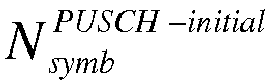

- Here,


where

- Alternatively,


where N Muted is the number of OFDM symbols not used for PUSCH transmission, which is caused by SRS puncturing or PUSCH frequency retuning. - Hereinafter, the number of REs occupied by the ACK/NACK on PUSCH that are computed according to the equation (1) and the equation (2) with redefined

- Suppose: number of RB = 1, MCS = 2, the bit number of ACK/ NACK = 1, beta_offset_index = 9, N SRS=0, and the retuned OFSM symbols are the first symbol and the last symbol.
- Accordingly, O=1,

- According to beta_offset_index = 9, for example, table 8.6.3-1 of 3GPP 36.213 D30 may be looked up to obtain

- By querying table 7.1.7.2.1-1 of 3GPP 36.213 D30 and adding 24-bit CRC check bits to the queried results,

- According to


- However, according to

it is derived that
- Therefore, the PUSCH data code rate = 56/(2∗(12∗10-35))=0.32.
- In addition, it may be likewise derived according to equation (3) that

- Based on the comparison above, it may be seen that the method of computing the number of REs (Q-prime) occupied by ACK/ NACK on PUSCH according to the present disclosure may effectively reduce the PUSCH data code rate of the UE and meanwhile improve the eNB's decoding performance on PUSCH.
-
Fig. 2 shows a schematic diagram of a system according to one embodiment of the present disclosure, specifically showing apparatuses respectively in a UE and an eNB that participate in ACK/NACK reporting for the Cat-M mechanism. - As shown in
Fig. 2 , a reporting apparatus 11 is arranged in UE10, and a receiving apparatus 21 is arranged in eNB20. - Specifically, the reporting apparatus 11 feeds back an ACK/NACK message to the eNB on PUSCH based on the received downlink data; correspondingly, the receiving apparatus 21 receives the ACK/NACK message on PUSCH as fed back by the UE, the ACK/NACK message corresponding to the downlink data transmitted by the eNB to the UE previously.
- Particularly, the ACK/NACK message fed back by the reporting apparatus 11 in UE is not limited to a feedback to one piece of DL data, but also may be a feedback to multiple pieces of DL data as received. Therefore, in the case of feedback for only one piece of DL data, the bit number of ACK/NACK is 1; in the case of feedback for a plurality of pieces of DL data, each piece of DL data corresponds to a 1-bit ACK/NACK.
- When the UE successfully decodes the DL data, the reporting apparatus 11 returns ACK; when the decoding fails, the reporting apparatus 11 returns NACK. The reporting apparatus 11 may regularly/ periodically feed back the ACK/NACK message to the eNB.
- For the number of REs (Q-Prime) occupied by the ACK/NACK on PUSCH may be calculated with the above equation (1) according to 3GPP 36.212 section 5.2.2.6.
- It may be seen from the above equation (1) that the existing Q-prime algorithm does not rule out the OFDM symbols occupied by the UL guard period. For the UE side, it causes a relatively high PUSCH data code rate; for the eNB side, it deteriorates the PUSCH decoding performance.
- Therefore, the present disclosure provides a novel solution of computing the number of REs occupied by ACK/NACK on PUSCH. For the CEModeA UE, the present disclosure takes the number of OFDM symbols of the guard period into consideration for computing the number of ACK/NACK Res, i.e., Q-prime.
- Specifically, because the number of OFDM symbols in the guard period will affect

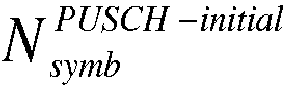
- Here,

- Alternatively,
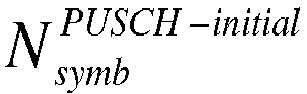
- The method of computing the number of REs (Q-prime) occupied by ACK/ NACK on PUSCH according to the present disclosure may effectively reduce the PUSCH data code rate of the UE and meanwhile improve the eNB's decoding performance on PUSCH.
Claims (13)
- A method for ACK/NACK reporting of Cat-M mechanism, comprising steps of:- feeding back, by a user equipment, an ACK/NACK message to an eNB on PUSCH based on received downlink data,wherein when computing the number of resource elements occupied by the ACK/NACK message on PUSCH, the number of OFDM symbols in a guard period is ruled out.
- The method according to claim 1, wherein when computing the number of SC-FDMA symbols that carry PUSCH data in an initial PUSCH transmission subframe, the number of OFDM symbols in the guard period is ruled out.
- The method according to claim 2, wherein the number of SC-FDMA symbols that carry the PUSCH data in the initial PUSCH transmission subframe is denoted as

wherein the step of ruling out the number of OFDM symbols in the guard period specifically comprises:- when calculating
- The method according to claim 2, wherein the number of SC-FDMA symbols that carry the PUSCH data in the initial PUSCH transmission subframe is denoted as
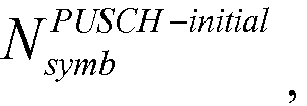
 where
where N SRS is the number of SRS SC-FDMA symbols reserved in the current subframe,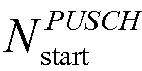

- A user equipment for ACK/NACK reporting of Cat-M mechanism, wherein the user equipment comprises:a reporting apparatus for feeding back an ACK/NACK message to an eNB on PUSCH based on received downlink data,wherein when computing the number of resource elements occupied by the ACK/NACK message on PUSCH, the number of OFDM symbols in a guard period is ruled out.
- The user equipment according to claim 5, wherein when computing the number of SC-FDMA symbols that carry PUSCH data in an initial PUSCH transmission subframe, the number of OFDM symbols in the guard period is ruled out.
- The user equipment according to claim 2, wherein the number of SC-FDMA symbols that carry the PUSCH data in the initial PUSCH transmission subframe is denoted as

 where
where N SRS is the number of SRS SC-FDMA symbols reserved in the current subframe,

- An eNB for ACK/NACK reporting of Cat-M mechanism, wherein the eNB comprises:a receiving apparatus for receiving, on PUSCH, an ACK/NACK message fed back by a user equipment, the ACK/NACK message corresponding to the downlink data previously transmitted by the eNB to the user equipment,wherein when computing the number of resource elements occupied by the ACK/NACK message on PUSCH, the number of OFDM symbols in a guard period is ruled out.
- The eNB according to claim 8, wherein when computing the number of SC-FDMA symbols that carry PUSCH data in an initial PUSCH transmission subframe, the number of OFDM symbols in the guard period is ruled out.
- The eNB according to claim 9, wherein the number of SC-FDMA symbols that carry the PUSCH data in the initial PUSCH transmission subframe is denoted as

 where
where N SRS is the number of SRS SC-FDMA symbols reserved in the current subframe,

- A system for ACK/NACK reporting of Cat-M mechanism, wherein the system comprises a user equipment and an eNB,
wherein the user equipment comprises:a reporting apparatus for feeding back an ACK/ NACK message to the eNB on PUSCH based on received downlink data,wherein the eNB comprises:a receiving apparatus for receiving, on PUSCH, the ACK/NACK message fed back by the user equipment, the ACK/NACK message corresponding to the downlink data previously transmitted by the eNB to the user equipment,wherein when computing the number of resource elements occupied by the ACK/NACK message on PUSCH, the number of OFDM symbols in a guard period is ruled out. - The system according to claim 11, wherein when computing the number of SC-FDMA symbols that carry PUSCH data in an initial PUSCH transmission subframe, the number of OFDM symbols in the guard period is ruled out.
- The system according to claim 12, wherein the number of SC-FDMA symbols that carry the PUSCH data in an initial PUSCH transmission subframe is denoted as

 where
where N SRS is the number of SRS SC-FDMA symbols reserved in the current subframe,

Applications Claiming Priority (2)
| Application Number | Priority Date | Filing Date | Title |
|---|---|---|---|
| CN201611169471.0A CN108206731A (en) | 2016-12-16 | 2016-12-16 | A kind of method, equipment and system for ACK/NACK reports |
| PCT/IB2017/001665 WO2018109557A1 (en) | 2016-12-16 | 2017-12-15 | Method, device and system for ack/nack report |
Publications (2)
| Publication Number | Publication Date |
|---|---|
| EP3557800A1 true EP3557800A1 (en) | 2019-10-23 |
| EP3557800B1 EP3557800B1 (en) | 2022-10-19 |
Family
ID=61017951
Family Applications (1)
| Application Number | Title | Priority Date | Filing Date |
|---|---|---|---|
| EP17832801.9A Active EP3557800B1 (en) | 2016-12-16 | 2017-12-15 | Method, device and system for ack/nack report |
Country Status (4)
| Country | Link |
|---|---|
| US (1) | US11469873B2 (en) |
| EP (1) | EP3557800B1 (en) |
| CN (1) | CN108206731A (en) |
| WO (1) | WO2018109557A1 (en) |
Cited By (1)
| Publication number | Priority date | Publication date | Assignee | Title |
|---|---|---|---|---|
| US11469873B2 (en) | 2016-12-16 | 2022-10-11 | Alcatel Lucent | Method, apparatus and system for ACK/NACK reporting |
Family Cites Families (15)
| Publication number | Priority date | Publication date | Assignee | Title |
|---|---|---|---|---|
| US8792411B2 (en) | 2009-07-29 | 2014-07-29 | Lg Electronics Inc. | Method and apparatus for transmitting control signal of relay station in wireless communication system |
| CN102237985B (en) * | 2010-05-06 | 2015-12-16 | 中兴通讯股份有限公司 | The processing method of back haul link ascending control information, system and relay station |
| EP2421188A3 (en) | 2010-08-20 | 2014-11-26 | LG Electronics Inc. | Method for transmitting control information in a wireless communication system and apparatus therefor |
| US20150049676A1 (en) * | 2010-11-05 | 2015-02-19 | Nokia Siemens Networks Oy | Configuration Uncertainty |
| EP3331183B1 (en) * | 2011-02-15 | 2019-06-12 | LG Electronics Inc. | Method and apparatus for transmitting channel quality control information in wireless access system |
| US9319211B2 (en) * | 2013-08-23 | 2016-04-19 | Telefonaktiebolaget Lm Ericsson (Publ) | Node and method for downlink scheduling and hybrid automatic repeat request timing |
| US10432386B2 (en) * | 2015-10-19 | 2019-10-01 | Qualcomm Incorporated | Flexible time division duplexing (TDD) subframe structure with latency reduction |
| US10721044B2 (en) * | 2016-03-15 | 2020-07-21 | Qualcomm Incorporated | Downlink control and retransmission indicator channel for relaxing ACK processing time constraints |
| US11304226B2 (en) * | 2016-05-09 | 2022-04-12 | Sharp Kabushiki Kaisha | User equipments, base stations and methods |
| US10462739B2 (en) * | 2016-06-21 | 2019-10-29 | Samsung Electronics Co., Ltd. | Transmissions of physical downlink control channels in a communication system |
| EP3934356B1 (en) * | 2016-07-12 | 2023-09-27 | Guangdong Oppo Mobile Telecommunications Corp., Ltd. | Data transmission method, terminal device, and network device |
| US10498593B2 (en) * | 2016-09-07 | 2019-12-03 | Qualcomm Incorporated | Cell-specific reference signal (CRS) and control channel configuration in wireless communications |
| CN109716694B (en) * | 2016-11-04 | 2021-03-30 | 华为技术有限公司 | HARQ-ACK feedback information transmission method and related device |
| AU2016428724B2 (en) * | 2016-11-04 | 2020-09-17 | Huawei Technologies Co., Ltd. | Slot scheduling method and apparatus |
| CN108206731A (en) | 2016-12-16 | 2018-06-26 | 上海诺基亚贝尔股份有限公司 | A kind of method, equipment and system for ACK/NACK reports |
-
2016
- 2016-12-16 CN CN201611169471.0A patent/CN108206731A/en active Pending
-
2017
- 2017-12-15 US US16/470,459 patent/US11469873B2/en active Active
- 2017-12-15 WO PCT/IB2017/001665 patent/WO2018109557A1/en not_active Ceased
- 2017-12-15 EP EP17832801.9A patent/EP3557800B1/en active Active
Cited By (1)
| Publication number | Priority date | Publication date | Assignee | Title |
|---|---|---|---|---|
| US11469873B2 (en) | 2016-12-16 | 2022-10-11 | Alcatel Lucent | Method, apparatus and system for ACK/NACK reporting |
Also Published As
| Publication number | Publication date |
|---|---|
| WO2018109557A1 (en) | 2018-06-21 |
| US20200213061A1 (en) | 2020-07-02 |
| US11469873B2 (en) | 2022-10-11 |
| EP3557800B1 (en) | 2022-10-19 |
| CN108206731A (en) | 2018-06-26 |
Similar Documents
| Publication | Publication Date | Title |
|---|---|---|
| USRE48606E1 (en) | Generation of HARQ-ACK information and power control of HARQ-ACK signals in TDD systems with downlink of carrier aggregation | |
| US10849155B2 (en) | Method and apparatus for transmitting uplink control information | |
| AU2018341374B2 (en) | Uplink transmission method and corresponding equipment | |
| US10912038B2 (en) | Uplink scheduling method and apparatus | |
| US9419778B2 (en) | Method and apparatus for coding of HARQ-ACK transmission in TDD systems with downlink carrier aggregation | |
| US20200328850A1 (en) | Method and terminal for data transmission | |
| RU2600978C1 (en) | Method of allocating resources, method of transmitting channel state information, base station and user equipment | |
| US10517096B2 (en) | Method for sending control information, user equipment, and base station | |
| US20190082457A1 (en) | Downlink control information communication method, terminal, and base station | |
| EP3301850A1 (en) | Systems and methods for frequency division duplex communication | |
| US20140369290A1 (en) | Method and Apparatus for Sending Hybrid Automatic Repeat Request Acknowledge Information | |
| US20180027549A1 (en) | Uplink control information transmitting method and apparatus | |
| CN102651662B (en) | Method and device for information transmission | |
| EP3876453A1 (en) | Information transmission method and apparatus | |
| CN104601304B (en) | The transmission method and device and method of reseptance and device of ACK/NACK feedback informations | |
| EP3972164A1 (en) | Method and apparatus for transmitting response information | |
| CN104144041B (en) | The feedback information transmission method and device of a kind of downlink data | |
| EP3557800B1 (en) | Method, device and system for ack/nack report | |
| CN113114431B (en) | Information transmission method, network equipment and terminal | |
| CN112533289B (en) | Uplink control information transmission method, terminal, electronic device and storage medium | |
| CN112312546B (en) | Transmission and configuration method of physical uplink control channel, terminal and network equipment |
Legal Events
| Date | Code | Title | Description |
|---|---|---|---|
| STAA | Information on the status of an ep patent application or granted ep patent |
Free format text: STATUS: UNKNOWN |
|
| STAA | Information on the status of an ep patent application or granted ep patent |
Free format text: STATUS: THE INTERNATIONAL PUBLICATION HAS BEEN MADE |
|
| PUAI | Public reference made under article 153(3) epc to a published international application that has entered the european phase |
Free format text: ORIGINAL CODE: 0009012 |
|
| STAA | Information on the status of an ep patent application or granted ep patent |
Free format text: STATUS: REQUEST FOR EXAMINATION WAS MADE |
|
| 17P | Request for examination filed |
Effective date: 20190628 |
|
| AK | Designated contracting states |
Kind code of ref document: A1 Designated state(s): AL AT BE BG CH CY CZ DE DK EE ES FI FR GB GR HR HU IE IS IT LI LT LU LV MC MK MT NL NO PL PT RO RS SE SI SK SM TR |
|
| AX | Request for extension of the european patent |
Extension state: BA ME |
|
| DAV | Request for validation of the european patent (deleted) | ||
| DAX | Request for extension of the european patent (deleted) | ||
| STAA | Information on the status of an ep patent application or granted ep patent |
Free format text: STATUS: EXAMINATION IS IN PROGRESS |
|
| 17Q | First examination report despatched |
Effective date: 20210707 |
|
| GRAP | Despatch of communication of intention to grant a patent |
Free format text: ORIGINAL CODE: EPIDOSNIGR1 |
|
| STAA | Information on the status of an ep patent application or granted ep patent |
Free format text: STATUS: GRANT OF PATENT IS INTENDED |
|
| INTG | Intention to grant announced |
Effective date: 20220627 |
|
| GRAS | Grant fee paid |
Free format text: ORIGINAL CODE: EPIDOSNIGR3 |
|
| GRAA | (expected) grant |
Free format text: ORIGINAL CODE: 0009210 |
|
| STAA | Information on the status of an ep patent application or granted ep patent |
Free format text: STATUS: THE PATENT HAS BEEN GRANTED |
|
| AK | Designated contracting states |
Kind code of ref document: B1 Designated state(s): AL AT BE BG CH CY CZ DE DK EE ES FI FR GB GR HR HU IE IS IT LI LT LU LV MC MK MT NL NO PL PT RO RS SE SI SK SM TR |
|
| REG | Reference to a national code |
Ref country code: GB Ref legal event code: FG4D |
|
| REG | Reference to a national code |
Ref country code: CH Ref legal event code: EP |
|
| REG | Reference to a national code |
Ref country code: DE Ref legal event code: R096 Ref document number: 602017062851 Country of ref document: DE |
|
| REG | Reference to a national code |
Ref country code: IE Ref legal event code: FG4D |
|
| REG | Reference to a national code |
Ref country code: AT Ref legal event code: REF Ref document number: 1526229 Country of ref document: AT Kind code of ref document: T Effective date: 20221115 |
|
| REG | Reference to a national code |
Ref country code: LT Ref legal event code: MG9D |
|
| REG | Reference to a national code |
Ref country code: NL Ref legal event code: MP Effective date: 20221019 |
|
| REG | Reference to a national code |
Ref country code: AT Ref legal event code: MK05 Ref document number: 1526229 Country of ref document: AT Kind code of ref document: T Effective date: 20221019 |
|
| PG25 | Lapsed in a contracting state [announced via postgrant information from national office to epo] |
Ref country code: NL Free format text: LAPSE BECAUSE OF FAILURE TO SUBMIT A TRANSLATION OF THE DESCRIPTION OR TO PAY THE FEE WITHIN THE PRESCRIBED TIME-LIMIT Effective date: 20221019 |
|
| PG25 | Lapsed in a contracting state [announced via postgrant information from national office to epo] |
Ref country code: SE Free format text: LAPSE BECAUSE OF FAILURE TO SUBMIT A TRANSLATION OF THE DESCRIPTION OR TO PAY THE FEE WITHIN THE PRESCRIBED TIME-LIMIT Effective date: 20221019 Ref country code: PT Free format text: LAPSE BECAUSE OF FAILURE TO SUBMIT A TRANSLATION OF THE DESCRIPTION OR TO PAY THE FEE WITHIN THE PRESCRIBED TIME-LIMIT Effective date: 20230220 Ref country code: NO Free format text: LAPSE BECAUSE OF FAILURE TO SUBMIT A TRANSLATION OF THE DESCRIPTION OR TO PAY THE FEE WITHIN THE PRESCRIBED TIME-LIMIT Effective date: 20230119 Ref country code: LT Free format text: LAPSE BECAUSE OF FAILURE TO SUBMIT A TRANSLATION OF THE DESCRIPTION OR TO PAY THE FEE WITHIN THE PRESCRIBED TIME-LIMIT Effective date: 20221019 Ref country code: FI Free format text: LAPSE BECAUSE OF FAILURE TO SUBMIT A TRANSLATION OF THE DESCRIPTION OR TO PAY THE FEE WITHIN THE PRESCRIBED TIME-LIMIT Effective date: 20221019 Ref country code: ES Free format text: LAPSE BECAUSE OF FAILURE TO SUBMIT A TRANSLATION OF THE DESCRIPTION OR TO PAY THE FEE WITHIN THE PRESCRIBED TIME-LIMIT Effective date: 20221019 Ref country code: AT Free format text: LAPSE BECAUSE OF FAILURE TO SUBMIT A TRANSLATION OF THE DESCRIPTION OR TO PAY THE FEE WITHIN THE PRESCRIBED TIME-LIMIT Effective date: 20221019 |
|
| PG25 | Lapsed in a contracting state [announced via postgrant information from national office to epo] |
Ref country code: RS Free format text: LAPSE BECAUSE OF FAILURE TO SUBMIT A TRANSLATION OF THE DESCRIPTION OR TO PAY THE FEE WITHIN THE PRESCRIBED TIME-LIMIT Effective date: 20221019 Ref country code: PL Free format text: LAPSE BECAUSE OF FAILURE TO SUBMIT A TRANSLATION OF THE DESCRIPTION OR TO PAY THE FEE WITHIN THE PRESCRIBED TIME-LIMIT Effective date: 20221019 Ref country code: LV Free format text: LAPSE BECAUSE OF FAILURE TO SUBMIT A TRANSLATION OF THE DESCRIPTION OR TO PAY THE FEE WITHIN THE PRESCRIBED TIME-LIMIT Effective date: 20221019 Ref country code: IS Free format text: LAPSE BECAUSE OF FAILURE TO SUBMIT A TRANSLATION OF THE DESCRIPTION OR TO PAY THE FEE WITHIN THE PRESCRIBED TIME-LIMIT Effective date: 20230219 Ref country code: HR Free format text: LAPSE BECAUSE OF FAILURE TO SUBMIT A TRANSLATION OF THE DESCRIPTION OR TO PAY THE FEE WITHIN THE PRESCRIBED TIME-LIMIT Effective date: 20221019 Ref country code: GR Free format text: LAPSE BECAUSE OF FAILURE TO SUBMIT A TRANSLATION OF THE DESCRIPTION OR TO PAY THE FEE WITHIN THE PRESCRIBED TIME-LIMIT Effective date: 20230120 |
|
| REG | Reference to a national code |
Ref country code: DE Ref legal event code: R097 Ref document number: 602017062851 Country of ref document: DE |
|
| PG25 | Lapsed in a contracting state [announced via postgrant information from national office to epo] |
Ref country code: SM Free format text: LAPSE BECAUSE OF FAILURE TO SUBMIT A TRANSLATION OF THE DESCRIPTION OR TO PAY THE FEE WITHIN THE PRESCRIBED TIME-LIMIT Effective date: 20221019 Ref country code: RO Free format text: LAPSE BECAUSE OF FAILURE TO SUBMIT A TRANSLATION OF THE DESCRIPTION OR TO PAY THE FEE WITHIN THE PRESCRIBED TIME-LIMIT Effective date: 20221019 Ref country code: EE Free format text: LAPSE BECAUSE OF FAILURE TO SUBMIT A TRANSLATION OF THE DESCRIPTION OR TO PAY THE FEE WITHIN THE PRESCRIBED TIME-LIMIT Effective date: 20221019 Ref country code: DK Free format text: LAPSE BECAUSE OF FAILURE TO SUBMIT A TRANSLATION OF THE DESCRIPTION OR TO PAY THE FEE WITHIN THE PRESCRIBED TIME-LIMIT Effective date: 20221019 Ref country code: CZ Free format text: LAPSE BECAUSE OF FAILURE TO SUBMIT A TRANSLATION OF THE DESCRIPTION OR TO PAY THE FEE WITHIN THE PRESCRIBED TIME-LIMIT Effective date: 20221019 |
|
| REG | Reference to a national code |
Ref country code: CH Ref legal event code: PL |
|
| REG | Reference to a national code |
Ref country code: BE Ref legal event code: MM Effective date: 20221231 |
|
| PLBE | No opposition filed within time limit |
Free format text: ORIGINAL CODE: 0009261 |
|
| STAA | Information on the status of an ep patent application or granted ep patent |
Free format text: STATUS: NO OPPOSITION FILED WITHIN TIME LIMIT |
|
| PG25 | Lapsed in a contracting state [announced via postgrant information from national office to epo] |
Ref country code: SK Free format text: LAPSE BECAUSE OF FAILURE TO SUBMIT A TRANSLATION OF THE DESCRIPTION OR TO PAY THE FEE WITHIN THE PRESCRIBED TIME-LIMIT Effective date: 20221019 Ref country code: LU Free format text: LAPSE BECAUSE OF NON-PAYMENT OF DUE FEES Effective date: 20221215 Ref country code: AL Free format text: LAPSE BECAUSE OF FAILURE TO SUBMIT A TRANSLATION OF THE DESCRIPTION OR TO PAY THE FEE WITHIN THE PRESCRIBED TIME-LIMIT Effective date: 20221019 |
|
| 26N | No opposition filed |
Effective date: 20230720 |
|
| PG25 | Lapsed in a contracting state [announced via postgrant information from national office to epo] |
Ref country code: LI Free format text: LAPSE BECAUSE OF NON-PAYMENT OF DUE FEES Effective date: 20221231 Ref country code: IE Free format text: LAPSE BECAUSE OF NON-PAYMENT OF DUE FEES Effective date: 20221215 Ref country code: CH Free format text: LAPSE BECAUSE OF NON-PAYMENT OF DUE FEES Effective date: 20221231 |
|
| PG25 | Lapsed in a contracting state [announced via postgrant information from national office to epo] |
Ref country code: SI Free format text: LAPSE BECAUSE OF FAILURE TO SUBMIT A TRANSLATION OF THE DESCRIPTION OR TO PAY THE FEE WITHIN THE PRESCRIBED TIME-LIMIT Effective date: 20221019 Ref country code: BE Free format text: LAPSE BECAUSE OF NON-PAYMENT OF DUE FEES Effective date: 20221231 |
|
| PG25 | Lapsed in a contracting state [announced via postgrant information from national office to epo] |
Ref country code: HU Free format text: LAPSE BECAUSE OF FAILURE TO SUBMIT A TRANSLATION OF THE DESCRIPTION OR TO PAY THE FEE WITHIN THE PRESCRIBED TIME-LIMIT; INVALID AB INITIO Effective date: 20171215 |
|
| PG25 | Lapsed in a contracting state [announced via postgrant information from national office to epo] |
Ref country code: CY Free format text: LAPSE BECAUSE OF FAILURE TO SUBMIT A TRANSLATION OF THE DESCRIPTION OR TO PAY THE FEE WITHIN THE PRESCRIBED TIME-LIMIT Effective date: 20221019 |
|
| PG25 | Lapsed in a contracting state [announced via postgrant information from national office to epo] |
Ref country code: MK Free format text: LAPSE BECAUSE OF FAILURE TO SUBMIT A TRANSLATION OF THE DESCRIPTION OR TO PAY THE FEE WITHIN THE PRESCRIBED TIME-LIMIT Effective date: 20221019 Ref country code: IT Free format text: LAPSE BECAUSE OF FAILURE TO SUBMIT A TRANSLATION OF THE DESCRIPTION OR TO PAY THE FEE WITHIN THE PRESCRIBED TIME-LIMIT Effective date: 20221019 |
|
| PG25 | Lapsed in a contracting state [announced via postgrant information from national office to epo] |
Ref country code: MC Free format text: LAPSE BECAUSE OF FAILURE TO SUBMIT A TRANSLATION OF THE DESCRIPTION OR TO PAY THE FEE WITHIN THE PRESCRIBED TIME-LIMIT Effective date: 20221019 |
|
| PG25 | Lapsed in a contracting state [announced via postgrant information from national office to epo] |
Ref country code: TR Free format text: LAPSE BECAUSE OF FAILURE TO SUBMIT A TRANSLATION OF THE DESCRIPTION OR TO PAY THE FEE WITHIN THE PRESCRIBED TIME-LIMIT Effective date: 20221019 Ref country code: MC Free format text: LAPSE BECAUSE OF FAILURE TO SUBMIT A TRANSLATION OF THE DESCRIPTION OR TO PAY THE FEE WITHIN THE PRESCRIBED TIME-LIMIT Effective date: 20221019 |
|
| PG25 | Lapsed in a contracting state [announced via postgrant information from national office to epo] |
Ref country code: BG Free format text: LAPSE BECAUSE OF FAILURE TO SUBMIT A TRANSLATION OF THE DESCRIPTION OR TO PAY THE FEE WITHIN THE PRESCRIBED TIME-LIMIT Effective date: 20221019 |
|
| PG25 | Lapsed in a contracting state [announced via postgrant information from national office to epo] |
Ref country code: MT Free format text: LAPSE BECAUSE OF FAILURE TO SUBMIT A TRANSLATION OF THE DESCRIPTION OR TO PAY THE FEE WITHIN THE PRESCRIBED TIME-LIMIT Effective date: 20221019 |
|
| PGFP | Annual fee paid to national office [announced via postgrant information from national office to epo] |
Ref country code: DE Payment date: 20251104 Year of fee payment: 9 |
|
| PGFP | Annual fee paid to national office [announced via postgrant information from national office to epo] |
Ref country code: GB Payment date: 20251030 Year of fee payment: 9 |
|
| PGFP | Annual fee paid to national office [announced via postgrant information from national office to epo] |
Ref country code: FR Payment date: 20251110 Year of fee payment: 9 |