EP3557689A1 - Battery pack - Google Patents
Battery pack Download PDFInfo
- Publication number
- EP3557689A1 EP3557689A1 EP19164836.9A EP19164836A EP3557689A1 EP 3557689 A1 EP3557689 A1 EP 3557689A1 EP 19164836 A EP19164836 A EP 19164836A EP 3557689 A1 EP3557689 A1 EP 3557689A1
- Authority
- EP
- European Patent Office
- Prior art keywords
- heat storage
- battery cells
- battery
- cell
- storage cell
- Prior art date
- Legal status (The legal status is an assumption and is not a legal conclusion. Google has not performed a legal analysis and makes no representation as to the accuracy of the status listed.)
- Withdrawn
Links
- 210000004027 cell Anatomy 0.000 claims abstract description 258
- 238000005338 heat storage Methods 0.000 claims abstract description 164
- 210000000352 storage cell Anatomy 0.000 claims abstract description 136
- 239000007788 liquid Substances 0.000 claims description 17
- 229910052751 metal Inorganic materials 0.000 claims description 13
- 239000002184 metal Substances 0.000 claims description 13
- 239000000463 material Substances 0.000 claims description 6
- 230000004048 modification Effects 0.000 description 38
- 238000012986 modification Methods 0.000 description 38
- XEEYBQQBJWHFJM-UHFFFAOYSA-N Iron Chemical compound [Fe] XEEYBQQBJWHFJM-UHFFFAOYSA-N 0.000 description 9
- 239000011232 storage material Substances 0.000 description 9
- 229910052782 aluminium Inorganic materials 0.000 description 8
- XAGFODPZIPBFFR-UHFFFAOYSA-N aluminium Chemical compound [Al] XAGFODPZIPBFFR-UHFFFAOYSA-N 0.000 description 8
- 238000009826 distribution Methods 0.000 description 7
- 239000011449 brick Substances 0.000 description 4
- 239000004568 cement Substances 0.000 description 4
- 239000000919 ceramic Substances 0.000 description 4
- 239000010949 copper Substances 0.000 description 4
- 229910052742 iron Inorganic materials 0.000 description 4
- 238000004519 manufacturing process Methods 0.000 description 4
- RYGMFSIKBFXOCR-UHFFFAOYSA-N Copper Chemical compound [Cu] RYGMFSIKBFXOCR-UHFFFAOYSA-N 0.000 description 3
- 229910052802 copper Inorganic materials 0.000 description 3
- 239000003921 oil Substances 0.000 description 3
- 239000012188 paraffin wax Substances 0.000 description 3
- OKTJSMMVPCPJKN-UHFFFAOYSA-N Carbon Chemical compound [C] OKTJSMMVPCPJKN-UHFFFAOYSA-N 0.000 description 2
- 229910021542 Vanadium(IV) oxide Inorganic materials 0.000 description 2
- 239000004020 conductor Substances 0.000 description 2
- 239000000470 constituent Substances 0.000 description 2
- 238000010586 diagram Methods 0.000 description 2
- 235000014113 dietary fatty acids Nutrition 0.000 description 2
- 229930195729 fatty acid Natural products 0.000 description 2
- 239000000194 fatty acid Substances 0.000 description 2
- 150000004665 fatty acids Chemical class 0.000 description 2
- 229910002804 graphite Inorganic materials 0.000 description 2
- 239000010439 graphite Substances 0.000 description 2
- 229910017053 inorganic salt Inorganic materials 0.000 description 2
- 239000011159 matrix material Substances 0.000 description 2
- 150000005846 sugar alcohols Chemical class 0.000 description 2
- GRUMUEUJTSXQOI-UHFFFAOYSA-N vanadium dioxide Chemical compound O=[V]=O GRUMUEUJTSXQOI-UHFFFAOYSA-N 0.000 description 2
- XLYOFNOQVPJJNP-UHFFFAOYSA-N water Substances O XLYOFNOQVPJJNP-UHFFFAOYSA-N 0.000 description 2
- 229910000838 Al alloy Inorganic materials 0.000 description 1
- 229910000881 Cu alloy Inorganic materials 0.000 description 1
- YCKRFDGAMUMZLT-UHFFFAOYSA-N Fluorine atom Chemical compound [F] YCKRFDGAMUMZLT-UHFFFAOYSA-N 0.000 description 1
- HBBGRARXTFLTSG-UHFFFAOYSA-N Lithium ion Chemical compound [Li+] HBBGRARXTFLTSG-UHFFFAOYSA-N 0.000 description 1
- XUIMIQQOPSSXEZ-UHFFFAOYSA-N Silicon Chemical compound [Si] XUIMIQQOPSSXEZ-UHFFFAOYSA-N 0.000 description 1
- 239000011231 conductive filler Substances 0.000 description 1
- 238000010276 construction Methods 0.000 description 1
- 230000002542 deteriorative effect Effects 0.000 description 1
- 230000000694 effects Effects 0.000 description 1
- 238000005516 engineering process Methods 0.000 description 1
- 239000011737 fluorine Substances 0.000 description 1
- 229910052731 fluorine Inorganic materials 0.000 description 1
- PCHJSUWPFVWCPO-UHFFFAOYSA-N gold Chemical compound [Au] PCHJSUWPFVWCPO-UHFFFAOYSA-N 0.000 description 1
- 239000010931 gold Substances 0.000 description 1
- 229910052737 gold Inorganic materials 0.000 description 1
- 229910001416 lithium ion Inorganic materials 0.000 description 1
- 239000007769 metal material Substances 0.000 description 1
- 239000011347 resin Substances 0.000 description 1
- 229920005989 resin Polymers 0.000 description 1
- 229910052710 silicon Inorganic materials 0.000 description 1
- 239000010703 silicon Substances 0.000 description 1
- 239000007787 solid Substances 0.000 description 1
- 239000010935 stainless steel Substances 0.000 description 1
- 229910001220 stainless steel Inorganic materials 0.000 description 1
- MCPTUMJSKDUTAQ-UHFFFAOYSA-N vanadium;hydrate Chemical compound O.[V] MCPTUMJSKDUTAQ-UHFFFAOYSA-N 0.000 description 1
Images




Classifications
-
- H—ELECTRICITY
- H01—ELECTRIC ELEMENTS
- H01M—PROCESSES OR MEANS, e.g. BATTERIES, FOR THE DIRECT CONVERSION OF CHEMICAL ENERGY INTO ELECTRICAL ENERGY
- H01M50/00—Constructional details or processes of manufacture of the non-active parts of electrochemical cells other than fuel cells, e.g. hybrid cells
- H01M50/20—Mountings; Secondary casings or frames; Racks, modules or packs; Suspension devices; Shock absorbers; Transport or carrying devices; Holders
- H01M50/204—Racks, modules or packs for multiple batteries or multiple cells
- H01M50/207—Racks, modules or packs for multiple batteries or multiple cells characterised by their shape
- H01M50/213—Racks, modules or packs for multiple batteries or multiple cells characterised by their shape adapted for cells having curved cross-section, e.g. round or elliptic
-
- H—ELECTRICITY
- H01—ELECTRIC ELEMENTS
- H01M—PROCESSES OR MEANS, e.g. BATTERIES, FOR THE DIRECT CONVERSION OF CHEMICAL ENERGY INTO ELECTRICAL ENERGY
- H01M10/00—Secondary cells; Manufacture thereof
- H01M10/60—Heating or cooling; Temperature control
- H01M10/61—Types of temperature control
- H01M10/613—Cooling or keeping cold
-
- H—ELECTRICITY
- H01—ELECTRIC ELEMENTS
- H01M—PROCESSES OR MEANS, e.g. BATTERIES, FOR THE DIRECT CONVERSION OF CHEMICAL ENERGY INTO ELECTRICAL ENERGY
- H01M10/00—Secondary cells; Manufacture thereof
- H01M10/60—Heating or cooling; Temperature control
- H01M10/61—Types of temperature control
- H01M10/617—Types of temperature control for achieving uniformity or desired distribution of temperature
-
- H—ELECTRICITY
- H01—ELECTRIC ELEMENTS
- H01M—PROCESSES OR MEANS, e.g. BATTERIES, FOR THE DIRECT CONVERSION OF CHEMICAL ENERGY INTO ELECTRICAL ENERGY
- H01M10/00—Secondary cells; Manufacture thereof
- H01M10/60—Heating or cooling; Temperature control
- H01M10/62—Heating or cooling; Temperature control specially adapted for specific applications
- H01M10/625—Vehicles
-
- H—ELECTRICITY
- H01—ELECTRIC ELEMENTS
- H01M—PROCESSES OR MEANS, e.g. BATTERIES, FOR THE DIRECT CONVERSION OF CHEMICAL ENERGY INTO ELECTRICAL ENERGY
- H01M10/00—Secondary cells; Manufacture thereof
- H01M10/60—Heating or cooling; Temperature control
- H01M10/64—Heating or cooling; Temperature control characterised by the shape of the cells
- H01M10/643—Cylindrical cells
-
- H—ELECTRICITY
- H01—ELECTRIC ELEMENTS
- H01M—PROCESSES OR MEANS, e.g. BATTERIES, FOR THE DIRECT CONVERSION OF CHEMICAL ENERGY INTO ELECTRICAL ENERGY
- H01M10/00—Secondary cells; Manufacture thereof
- H01M10/60—Heating or cooling; Temperature control
- H01M10/64—Heating or cooling; Temperature control characterised by the shape of the cells
- H01M10/647—Prismatic or flat cells, e.g. pouch cells
-
- H—ELECTRICITY
- H01—ELECTRIC ELEMENTS
- H01M—PROCESSES OR MEANS, e.g. BATTERIES, FOR THE DIRECT CONVERSION OF CHEMICAL ENERGY INTO ELECTRICAL ENERGY
- H01M10/00—Secondary cells; Manufacture thereof
- H01M10/60—Heating or cooling; Temperature control
- H01M10/65—Means for temperature control structurally associated with the cells
- H01M10/653—Means for temperature control structurally associated with the cells characterised by electrically insulating or thermally conductive materials
-
- H—ELECTRICITY
- H01—ELECTRIC ELEMENTS
- H01M—PROCESSES OR MEANS, e.g. BATTERIES, FOR THE DIRECT CONVERSION OF CHEMICAL ENERGY INTO ELECTRICAL ENERGY
- H01M10/00—Secondary cells; Manufacture thereof
- H01M10/60—Heating or cooling; Temperature control
- H01M10/65—Means for temperature control structurally associated with the cells
- H01M10/655—Solid structures for heat exchange or heat conduction
- H01M10/6553—Terminals or leads
-
- H—ELECTRICITY
- H01—ELECTRIC ELEMENTS
- H01M—PROCESSES OR MEANS, e.g. BATTERIES, FOR THE DIRECT CONVERSION OF CHEMICAL ENERGY INTO ELECTRICAL ENERGY
- H01M10/00—Secondary cells; Manufacture thereof
- H01M10/60—Heating or cooling; Temperature control
- H01M10/65—Means for temperature control structurally associated with the cells
- H01M10/655—Solid structures for heat exchange or heat conduction
- H01M10/6554—Rods or plates
- H01M10/6555—Rods or plates arranged between the cells
-
- H—ELECTRICITY
- H01—ELECTRIC ELEMENTS
- H01M—PROCESSES OR MEANS, e.g. BATTERIES, FOR THE DIRECT CONVERSION OF CHEMICAL ENERGY INTO ELECTRICAL ENERGY
- H01M10/00—Secondary cells; Manufacture thereof
- H01M10/60—Heating or cooling; Temperature control
- H01M10/65—Means for temperature control structurally associated with the cells
- H01M10/659—Means for temperature control structurally associated with the cells by heat storage or buffering, e.g. heat capacity or liquid-solid phase changes or transition
-
- H—ELECTRICITY
- H01—ELECTRIC ELEMENTS
- H01M—PROCESSES OR MEANS, e.g. BATTERIES, FOR THE DIRECT CONVERSION OF CHEMICAL ENERGY INTO ELECTRICAL ENERGY
- H01M2220/00—Batteries for particular applications
- H01M2220/20—Batteries in motive systems, e.g. vehicle, ship, plane
-
- Y—GENERAL TAGGING OF NEW TECHNOLOGICAL DEVELOPMENTS; GENERAL TAGGING OF CROSS-SECTIONAL TECHNOLOGIES SPANNING OVER SEVERAL SECTIONS OF THE IPC; TECHNICAL SUBJECTS COVERED BY FORMER USPC CROSS-REFERENCE ART COLLECTIONS [XRACs] AND DIGESTS
- Y02—TECHNOLOGIES OR APPLICATIONS FOR MITIGATION OR ADAPTATION AGAINST CLIMATE CHANGE
- Y02E—REDUCTION OF GREENHOUSE GAS [GHG] EMISSIONS, RELATED TO ENERGY GENERATION, TRANSMISSION OR DISTRIBUTION
- Y02E60/00—Enabling technologies; Technologies with a potential or indirect contribution to GHG emissions mitigation
- Y02E60/10—Energy storage using batteries
Definitions
- the present invention relates to a battery pack.
- a vehicle such as an electric vehicle and a hybrid vehicle is equipped with a battery pack as a power supply for supplying electric power to a motor that is a drive source.
- a battery pack a plurality of battery cells is accommodated.
- a technology relating to a vehicular battery pack that includes a plurality of batteries, a heat conductive member thermally connected to each battery via a contact portion that comes in contact with at least an outer surface of each battery, and a heat storage member thermally connected to the heat conductive member, and in which the heat conductive member has a thermal transfer portion that comes in contact with the heat storage member with a plurality of surfaces.
- Japanese Patent Application Laid-open No. 2018-014205 it is said that, by thermally connecting each battery cell and the heat storage member via the heat conductive member, downsizing is possible without deteriorating energy density with respect to the volume of the battery pack.
- An object of the present invention is to provide a battery pack capable of reducing the bias in temperature distribution in a plurality of battery cells.
- a battery pack includes a housing; a plurality of battery cells provided in an inner space of the housing and having substantially same size and outer shape; a heat storage cell provided in the inner space of the housing, arrayed together with the plurality of battery cells, and placed at a position surrounded by the plurality of battery cells; and a heat conductive body thermally connecting the plurality of battery cells and the heat storage cell and having thermal conductivity higher than that of an atmosphere, wherein a size and an outer shape of the heat storage cell are substantially same as a size and an outer shape of each of the battery cells.
- FIG. 1 is a plan view illustrating the battery pack according to the embodiment.
- FIG. 2 is a perspective view illustrating a battery cell and a heat storage cell in the embodiment.
- FIG. 3 is a cross-sectional view illustrating the heat storage cell in the embodiment.
- FIG. 4 is a cross-sectional view illustrating the battery pack in the embodiment.
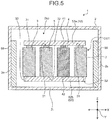
- FIG. 5 is a cross-sectional view illustrating the battery pack in the embodiment.
- FIG. 4 is the cross-sectional view of the IV-IV cross-section indicated in FIG. 1 .
- FIG. 5 is the cross-sectional view of the V-V cross-section indicated in FIG. 1 .
- the first direction is referred to as "width direction X”
- the second direction is referred to as “depth direction Y”
- the third direction is referred to as "height direction Z”.
- the width direction X and the depth direction Y correspond to the directions along the horizontal direction
- the height direction Z corresponds to the direction along the vertical direction.
- the upper side in the vertical direction is referred to as “up”
- the lower side in the vertical direction is referred to as "down”.
- the respective directions used in the following description are described as the directions in a state where the battery pack 1 is installed on a vehicle, unless otherwise specifically noted.
- the battery pack 1 is a vehicular battery pack installed on a vehicle (for example, an electric vehicle and a hybrid vehicle) that includes a motor as a drive source, for example.
- the battery pack 1 is used for supplying electric power to the motor or the like.
- the battery pack 1 in the embodiment includes a housing 2, a plurality of battery cells 3, a heat storage cell 4, and heat conductive bodies TC.
- the housing 2 is a box-shaped member, and has an inner space 2sp.
- the housing 2 has thermal conductivity.
- the housing 2 is formed of iron (Fe), copper (Cu), aluminum (Al), or the like, for example.
- a bottom portion 2t of the housing 2 is in a substantially rectangular plate-like shape that is parallel to the width direction X and the depth direction Y, and is orthogonal to the height direction Z.
- the housing 2 includes sidewalls 2s provided standing on all sides of the bottom portion 2t along the height direction Z (see FIG. 1 and FIG. 4 ). That is, the shape of the housing 2 in the embodiment is substantially rectangular parallelepiped.
- the plurality of battery cells 3 and the heat storage cell 4 are accommodated in the inner space 2sp of the housing 2.
- the inner space 2sp is a space surrounded by the bottom portion 2t and the sidewalls 2s.
- the plurality of battery cells 3 and the heat storage cell 4 are arrayed in the inner space 2sp of the housing 2.
- the plurality of battery cells 3 and the heat storage cell 4 are arrayed in a zigzag pattern or in a matrix form.
- the battery pack 1 of the embodiment has three cell array groups CG in which the battery cells 3 are lined up in the width direction X.
- One out of the three cell array groups CG includes the heat storage cell 4 lined up along the width direction X together with the battery cells 3.
- the three cell array groups CG are lined up along the depth direction Y.
- the plurality of battery cells 3 and the heat storage cell 4 are arrayed in three rows in a zigzag pattern along the width direction X.
- the heat storage cell 4 is, as viewed from the height direction Z, placed at a position surrounded by the plurality of battery cells 3.
- the cell array group CG positioned at the center in the depth direction Y is referred to as a first cell array group CG1.
- One of the cell array groups CG adjacent to the first cell array group CG1 in the depth direction Y is referred to as a second cell array group CG2, and the other of the cell array groups CG adjacent to the first cell array group CG1 in the depth direction Y is referred to as a third cell array group CG3.
- the first cell array group CG1 is made up of three battery cells 3 and one heat storage cell 4 lined up along the width direction X.
- the heat storage cell 4 is placed at a position sandwiched by the battery cells 3 in the width direction X.
- the second cell array group CG2 is made up of three battery cells 3.
- the battery cells 3 in the second cell array group CG2 and the battery cells 3 and the heat storage cell 4 in the first cell array group CG1 are placed alternately in the width direction X.
- the third cell array group CG3 is made up of three battery cells 3.
- the battery cells 3 in the third cell array group CG3 and the battery cells 3 and the heat storage cell 4 in the first cell array group CG1 are placed alternately in the width direction X.
- the plurality of battery cells 3 is each a rechargeable secondary battery, and the size and the outer shape thereof are identical, for example.
- the battery cell 3 is a lithium-ion battery, for example.
- the battery cell 3 of the embodiment includes a main unit portion 30, a positive terminal 31, and a negative terminal 32.
- the main unit portion 30 has a cylindrical outer shape extending in an axial direction. Out of both ends in the axial direction of the main unit portion 30, the positive terminal 31 is formed on one end, and the negative terminal 32 is formed on the other end.
- the positive terminal 31 is a portion in a disc shape for which the direction orthogonal to the axial direction is the radial direction.
- the diameter of the positive terminal 31 is smaller than the diameter of the main unit portion 30.
- the negative terminal 32 is a flat portion formed on the other end of the main unit portion 30.
- the size and the outer shape of the heat storage cell 4 are substantially the same as the size and the outer shape of the battery cell 3, and are identical, for example.
- the heat storage cell 4 of the embodiment includes a main unit portion 40, a pseudo-positive terminal 41, and a pseudo-negative terminal 42.
- the size and the outer shape of the main unit portion 40 of the heat storage cell 4 are substantially the same as the size and the outer shape of the main unit portion 30 of the battery cell 3. That is, the heat storage cell 4 has a cylindrical shape.
- the pseudo-positive terminal 41 is a portion modeled on the positive terminal 31.
- the size and the outer shape of the pseudo-positive terminal 41 are substantially the same as the size and the outer shape of the positive terminal 31.
- the pseudo-negative terminal 42 is a portion modeled on the negative terminal 32.
- the size and the outer shape of the pseudo-negative terminal 42 are substantially the same as those of the negative terminal 32.
- the size and the outer shape of the plurality of battery cells 3 only need to be substantially the same, and that the size and the outer shape of the heat storage cell 4 only need to be substantially the same as the size and the outer shape of the battery cell 3.
- the size is substantially the same does not necessarily need to be in an identical size strictly. For example, variations in size in a degree that arises in a manufacturing process are allowed.
- that "the outer shape is substantially the same” does not necessarily need to be in an identical shape strictly. For example, differences in surface texture and unevenness of a surface due to differences in material and variations in shape in a degree that arises in a manufacturing process are allowed.
- that "the size and the outer shape are substantially the same” includes the case where the cross-sectional area and the cross-sectional shape of a cross-section orthogonal to the height direction Z in the main unit portion (the main unit portions 30, 40) are substantially equal, even when the shapes of the upper surface and the lower surface of the cell (the battery cell 3, the heat storage cell 4) are different. That "the cross-sectional area and the cross-sectional shape are substantially equal” does not necessarily need to be in an identical cross-sectional area and an identical cross-sectional shape strictly. For example, variations in cross-sectional area and in cross-sectional shape in a degree that arises in a manufacturing process are allowed.
- the battery cell 3 and the heat storage cell 4 are substantially the same in size and in outer shape.
- the heat storage cell 4 has a thermal capacity higher than that of the battery cell 3.
- the heat storage cell 4 is made up of a heat storage material that stores heat by sensible heat or latent heat.
- the heat storage cell 4 is made up including a metal case 43a and a heat storage medium 43b.
- the metal case 43a is formed of a metal material such as aluminum, for example.
- As the heat storage medium 43b oil, metal such as iron and aluminum, ceramic, cement, brick, paraffin, fatty acids, sugar alcohol, inorganic salt hydrate, vanadium dioxide, water, and others can be used.
- the oil, metal such as iron and aluminum, ceramic, cement, and brick store heat by sensible heat.
- the paraffin, fatty acids, sugar alcohol, inorganic salt hydrate, and vanadium dioxide store heat by latent heat.
- the water stores heat by sensible heat and latent heat.
- the heat storage cell 4 may include no metal case 43a.
- a whole of the heat storage cell 4 may be formed of a heat storage material, for example.
- a heat storage material that stores sensible heat as a solid is used as is.
- metal such as iron and aluminum, ceramic, cement, brick, and others can be used as the heat storage material to form the heat storage cell 4.
- the heat conductive body TC has thermal conductivity higher than that of the atmosphere. As illustrated in FIG. 1 , in the battery pack 1 in the embodiment, as the heat conductive bodies TC, heat conductive sheets 51 and a bus bar 52 are provided.
- the heat conductive sheet 51 is a sheet-like member including the heat conductive material.
- the heat conductive sheets 51 are placed sandwiching the respective cell array groups CG in the depth direction Y.
- the heat conductive sheets 51 thermally connect the plurality of battery cells 3 and the heat storage cell 4 that are arrayed in the inner space 2sp of the housing 2, and enable transferring of heat between the battery cells 3 and the heat storage cell 4.
- Between the adjacent cell array groups CG one heat conductive sheet 51 is placed being sandwiched by the two adjacent cell array groups CG.
- each heat conductive sheet 51 is formed in a wavy shape along the curved surface shape of the outer circumferential surfaces of the respective battery cells 3 arrayed along the width direction X.
- the heat conductive sheets 51 are placed at an interspace between the first cell array group CG1 and the second cell array group CG2, at an interspace between the first cell array group CG1 and the third cell array group CG3, and at positions sandwiching the three cell array groups CG.
- the heat conductive sheet 51 placed at the interspace between the first cell array group CG1 and the second cell array group CG2 is formed in a wavy shape so as to come in contact with the outer circumferential surfaces of the respective battery cells 3 included in the first cell array group CG1, with the outer circumferential surface of the heat storage cell 4 included in the first cell array group CG1, and with the outer circumferential surfaces of the respective battery cells 3 included in the second cell array group CG2.
- the heat conductive sheet 51 placed at the interspace between the first cell array group CG1 and the third cell array group CG3 is formed in a wavy shape so as to come in contact with the outer circumferential surfaces of the respective battery cells 3 included in the first cell array group CG1, with the outer circumferential surface of the heat storage cell 4 included in the first cell array group CG1, and with the outer circumferential surfaces of the respective battery cells 3 included in the third cell array group CG3.
- One of the heat conductive sheets 51 placed at the positions sandwiching the three cell array groups CG is formed in a wavy shape so as to come in contact with the outer circumferential surfaces of the respective battery cells 3 included in the second cell array group CG2.
- the other of the heat conductive sheets 51 placed at the positions sandwiching the three cell array groups CG is formed in a wavy shape so as to come in contact with the outer circumferential surfaces of the respective battery cells 3 included in the third cell array group CG3.
- the heat conductive sheet 51 only needs to be provided at an interspace between the heat storage cell 4 and at least one of the plurality of battery cells 3, and to be in contact with the heat storage cell 4 and the at least one of the plurality of battery cells 3.
- As the heat conductive material of the heat conductive sheet 51 graphite, resin containing heat conductive filler, and metal such as copper and aluminum can be used.
- the heat conductive sheet 51 of the embodiment is made up of sheet-like graphite.
- plate-like heat storage members 50 are provided on inner wall surfaces 2b of the sidewalls 2s in the housing 2.
- the heat storage members 50 are placed along the inner wall surfaces 2b so as to surround the inner space 2sp of the housing 2.
- the heat storage member 50 is formed of a heat storage material.
- metal such as iron and aluminum, ceramic, cement, brick, and others can be used as the heat storage material to form the heat storage member 50.
- the sidewalls 2s of the housing 2 have a pair of sidewall portions 2sa opposite to each other across the plurality of battery cells 3 and the heat storage cell 4.
- the pair of sidewall portions 2sa is thermally connected to the respective heat conductive sheets 51.
- a state in which the heat conductive sheets 51 and the pair of sidewall portions 2sa are thermally connected includes not only the case where the heat conductive sheet 51 and the sidewall portion 2sa are directly in contact but also the case where the transferring of heat between the heat conductive sheet 51 and the sidewall portion 2sa is possible indirectly via a member having heat conductivity.
- the heat conductive sheets 51 and the pair of sidewall portions 2sa are thermally connected via the heat storage members 50.
- Both end portions 51a and 51b of the heat conductive sheet 51 in the width direction X are embedded in the heat storage members 50.
- the plurality of battery cells 3 and the heat storage cell 4 are thermally connected to the housing 2 via the heat conductive sheets 51 and the heat storage members 50.
- the battery cells 3 and the heat storage cell 4 included in the first cell array group CG1 are arrayed such that the positive terminals 31 and the pseudo-positive terminal 41 face upward, and such that the negative terminals 32 and the pseudo-negative terminal 42 face downward.
- the battery cells 3 included in the second cell array group CG2 are arrayed such that the negative terminals 32 face upward and the positive terminals 31 face downward.
- the battery cells 3 included in the third cell array group CG3 are arrayed such that the negative terminals 32 face upward and the positive terminals 31 face downward.
- the bus bar 52 electrically connects the plurality of battery cells 3.
- the bus bar 52 of the embodiment includes a first bus bar 52a that is placed on the respective battery cells 3 and the heat storage cell 4, and a second bus bar 52b that is placed below the respective battery cells 3 and the heat storage cell 4. That is, the plurality of battery cells 3 and the heat storage cell 4 are, in the height direction Z, sandwiched by the two bus bars (the first bus bar 52a, the second bus bar 52b).
- the first bus bar 52a and the second bus bar 52b are each made up of a pair of two bus bars.
- One of the pair of two bus bars constituting the first bus bar 52a is electrically and thermally connected to the positive terminal 31 of each battery cell 3 in the first cell array group CG1, and the negative terminal 32 of each battery cell 3 in the third cell array group CG3.
- the one of the pair of two bus bars constituting the first bus bar 52a is also thermally connected to the pseudo-positive terminal 41 of the heat storage cell 4.
- the other of the pair of two bus bars constituting the first bus bar 52a is electrically and thermally connected to the negative terminal 32 of each battery cell 3 in the second cell array group CG2.
- One of the pair of two bus bars constituting the second bus bar 52b is electrically and thermally connected to the negative terminal 32 of each battery cell 3 in the first cell array group CG1, and the positive terminal 31 of each battery cell 3 in the second cell array group CG2.
- the one of the pair of two bus bars constituting the second bus bar 52b is also thermally connected to the pseudo-negative terminal 42 of the heat storage cell 4.
- the other of the pair of two bus bars constituting the second bus bar 52b is electrically and thermally connected to the positive terminal 31 of each battery cell 3 in the third cell array group CG3.
- the bus bar 52 is connected to the positive terminal 31 and the negative terminal 32 of each battery cell 3 and to the pseudo-positive terminal 41 and the pseudo-negative terminal 42 of the heat storage cell 4.
- the bus bar 52 electrically connects the respective battery cells 3 included in one cell array group CG in parallel, and electrically connects the respective cell array groups CG in series.
- the heat storage cell 4 can transfer heat with the respective battery cells 3 via the bus bar 52 (the first bus bar 52a and the second bus bar 52b).
- the bus bar 52 of the embodiment is a plate-like metal member.
- the bus bar 52 is formed of copper, copper alloy, aluminum, aluminum alloy, gold, and stainless steel, for example.
- the bus bar 52 only needs to electrically connect the plurality of battery cells 3 in at least one of series connection and parallel connection, and the embodiment is not limited to the above-described connection form. Furthermore, in the case where the battery pack 1 is provided with the heat conductive body TC other than the bus bar 52, the bus bar 52 may be not thermally connected to the heat storage cell 4.
- the battery pack 1 in the embodiment includes: the housing 2; the plurality of battery cells 3 provided in the inner space 2sp of the housing 2 and having substantially the same size and outer shape; the heat storage cell 4 provided in the inner space 2sp of the housing 2, arrayed together with the plurality of battery cells 3, and placed at a position surrounded by the plurality of battery cells 3; and the heat conductive bodies TC thermally connecting the plurality of battery cells 3 and the heat storage cell 4 and having heat conductivity higher than that of the atmosphere, and the size and the outer shape of the heat storage cell 4 are substantially the same as the size and the outer shape of the battery cell 3.
- the heat storage cell 4 is placed at a position surrounded by the plurality of battery cells 3, and the plurality of battery cells 3 and the heat storage cell 4 are thermally connected by the heat conductive bodies TC.
- the heat storage cell 4 it is possible to store in the heat storage cell 4 the heat that is generated from the plurality of battery cells 3 arrayed in the inner space 2sp.
- the size and the outer shape of the heat storage cell 4 are substantially the same as the size and the outer shape of the battery cell 3, it is possible to array the heat storage cell 4 together with the battery cells 3. Accordingly, as compared with the case where a member having a heat storage property and having the size and the outer shape different from those of the battery cell 3 is provided, the assembling workability is improved.
- the heat is likely to accumulate in a central area of the plurality of battery cells arrayed in the inner space of the housing in particular, and the temperature tends to become higher compared with the surrounding areas.
- the battery pack 1 in the embodiment by placing the heat storage cell 4 at a position surrounded by the plurality of battery cells 3, and by storing the heat generated in the battery cells 3 in the heat storage cell 4, it is possible to reduce the bias in temperature distribution in the plurality of battery cells 3.
- the thermal capacity of the heat storage cell 4 is greater than the thermal capacity of the battery cell 3. Because the heat storage cell 4 can store more heat than the battery cell 3 can, it is possible to effectively reduce the bias in temperature distribution in the plurality of battery cells 3.
- the heat storage cell 4 includes the metal case 43a having the size and the outer shape substantially the same as those of the battery cell 3, and the heat storage medium 43b that is provided inside the metal case 43a.
- the heat storage material in a liquid form can also be used as the heat storage medium 43b.
- the heat conductive bodies TC include the bus bar 52, the battery cells 3 are electrically connected to one another by the bus bar 52, and the bus bar 52 thermally connects the plurality of battery cells 3 and the heat storage cell 4.
- the bus bar 52 is used not only as a member that electrically connects each battery cell 3 but also as a member that enables the transferring of heat between the respective battery cells 3 and the heat storage cell 4. For example, it is possible to omit a dedicated component that enables the transferring of heat between the heat storage cell 4 and the battery cells 3. Consequently, reducing the number of components is possible, and downsizing the battery pack 1 is possible.
- the heat conductive bodies TC include the heat conductive sheets 51, and the heat conductive sheet 51 is provided at an interspace between the heat storage cell 4 and at least one of the plurality of battery cells 3 and is in contact with the heat storage cell 4 and the at least one of the plurality of battery cells 3.
- the heat conductive sheet 51 is provided at an interspace between the heat storage cell 4 and at least one of the plurality of battery cells 3 and is in contact with the heat storage cell 4 and the at least one of the plurality of battery cells 3.
- the housing 2 has a pair of sidewall portions 2sa opposite to each other across the plurality of battery cells 3 and the heat storage cell 4, and the pair of sidewall portions 2sa are thermally connected to the respective heat conductive sheets 51.
- the heat is exchanged between the battery cells 3 and the sidewall portions 2sa along the direction from one of the pair of sidewall portions 2sa toward the other, because the heat in the central area of the battery cells 3 arrayed in the inner space 2sp is difficult to escape, the temperature in the central area may become higher than that of the surrounding area. Even in such a configuration, because the heat storage cell 4 is placed at a position surrounded by the plurality of battery cells 3, it is possible to effectively reduce the bias in temperature distribution in the plurality of battery cells 3.
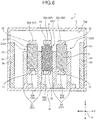
- FIG. 6 is a cross-sectional view illustrating the battery pack in the first modification of the embodiment.
- FIG. 6 is a diagram corresponding to FIG. 4 in the above-described embodiment.
- the point that is different from the battery pack 1 in the above-described embodiment is that the heat conductive sheets 51 and the bottom portion 2t of the housing 2 are in contact.
- the other configurations are the same as those of the above-described embodiment.
- the heat conductive sheets 51 in the first modification extend lower than the battery cells 3 and the heat storage cell 4 and are in contact with the bottom portion 2t of the housing 2.
- the lower end portion of the heat conductive sheet 51 is bent along the bottom portion 2t of the housing 2.
- the principal surface on one side of the heat conductive sheet 51 is made to come in contact with the bottom portion 2t of the housing 2.
- the first modification it is configured to release the heat generated in the battery cells 3 to the bottom portion 2t of the housing 2 via the heat conductive sheets 51.
- this configuration as compared with a configuration that releases the heat from the battery cells 3 to the sidewall portions 2sa via the heat conductive sheets 51, it is possible to efficiently release the heat in the central area of the plurality of battery cells.
- FIG. 7 is a cross-sectional view illustrating the battery pack in the second modification of the embodiment.
- FIG. 7 is a diagram corresponding to FIG. 4 in the above-described embodiment.
- the point that is different from the battery pack 1 in the above-described embodiment is that a liquid 53 is stored in the inner space 2sp of the housing 2.
- the other configurations are the same as those of the above-described embodiment.
- the battery pack 1 in the second modification includes the liquid 53 as the heat conductive body TC.
- the liquid 53 is stored in the inner space 2sp of the housing 2.
- the battery cells 3 and the heat storage cell 4 are immersed in the liquid 53.
- the battery cells 3 and the heat storage cell 4 in the second modification are immersed into the liquid 53 up to the vicinities of the central portions in the height direction Z.
- an insulative liquid such as silicon oil, paraffin, and fluorine based inert liquid can be used, for example.
- the battery cells 3 and the heat storage cell 4 are also thermally connected via the liquid 53.
- a part of the heat conductive sheets 51 also is immersed in the liquid 53.
- the heat conductive sheets 51 in the second modification extend slightly lower than the battery cells 3 and the heat storage cell 4 but are spaced apart from the bottom portion 2t of the housing 2.
- a gelatinous material 53g in place of the liquid 53 may be provided.
- the gelatinous material 53g is provided so as to be in contact with at least a part of the battery cells 3 and at least a part of the heat storage cell 4.
- the heat conductive body TC includes the liquid 53 stored in the inner space 2sp of the housing 2, and at least a part of the plurality of battery cells 3 and at least a part of the heat storage cell 4 are immersed into the liquid 53. Because the heat can be transmitted from the battery cells 3 to the heat storage cell 4 via the liquid 53, as compared with the case where the heat is transmitted from the battery cells 3 to the heat storage cell 4 via the atmosphere, efficient transfer of the heat is possible.
- the heat conductive body TC may be the gelatinous material 53g that is in contact with at least a part of the plurality of battery cells 3 and at least a part of the heat storage cell 4. Because the heat can be transmitted from the battery cells 3 to the heat storage cell 4 via the gelatinous material 53g, as compared with the case where the heat is transmitted from the battery cells 3 to the heat storage cell 4 via the atmosphere, efficient transfer of the heat is possible.
- FIG. 8 is a plan view illustrating the battery pack in the third modification of the embodiment.
- the point that is different from the battery pack 1 in the above-described embodiment is that the first cell array group CG1 is made up of three battery cells 3 and two heat storage cells 4 lined up along the width direction X. Furthermore, the point that is also different from that of the above-described embodiment is that the second cell array group CG2 and the third cell array group CG3 are each made up of four battery cells 3.
- the battery cells 3 and the heat storage cells 4 in the first cell array group CG1 are placed alternately in the width direction X.
- the heat storage cells 4 are each placed at a position sandwiched by the battery cells 3 in the width direction X.
- the plurality of battery cells 3 and the heat storage cells 4 included in the cell array groups CG are placed in a zigzag pattern as with the above-described embodiment. That is, the battery cells 3 in the second cell array group CG2, and the battery cells 3 and the heat storage cells 4 in the first cell array group CG1 are placed alternately in the width direction X.
- the battery cells 3 in the third cell array group CG3, and the battery cells 3 and the heat storage cells 4 in the first cell array group CG1 are placed alternately in the width direction X.
- the heat storage cell 4 may be placed for each such place.
- the number of the heat storage cells 4 is determined in consideration of the energy density of charging power in the battery pack 1, the heat that is generated in the battery cells 3, or the like.
- FIG. 9 is a perspective view illustrating a battery cell and a heat storage cell in the fourth modification of the embodiment.
- FIG. 10 is a plan view illustrating the battery pack in the fourth modification of the embodiment.
- a battery cell 3a is a rectangular battery cell. Furthermore, the point that is also different from that of the above-described embodiment is that the size and the outer shape of a heat storage cell 4a are substantially the same as those of the rectangular battery cell 3a.
- the battery cell 3a includes a main unit portion 30a, a positive terminal 31a, and a negative terminal 32a.
- the main unit portion 30a has a flat substantially rectangular parallelepiped shape.
- the positive terminal 31a and the negative terminal 32a are arranged on one of six outer wall surfaces of the main unit portion 30a.
- the positive terminal 31a and the negative terminal 32a are arranged in line in one direction (the width direction X) at the upper surface of the main unit portion 30a.
- the positive terminal 31a and the negative terminal 32a are each a rectangular plate-like terminal provided on the outer wall surface of the main unit portion 30a.
- the heat storage cell 4a includes a main unit portion 40a, a pseudo-positive terminal 41a, and a pseudo-negative terminal 42a.
- the pseudo-positive terminal 41a and the pseudo-negative terminal 42a are electrically conductive.
- the size and the outer shape of the main unit portion 40a are substantially the same as the size and the outer shape of the main unit portion 30a.
- the pseudo-positive terminal 41a is modeled on the positive terminal 31a, and the pseudo-negative terminal 42a is modeled on the negative terminal 32a. That is, the size and the outer shape of the heat storage cell 4a are substantially the same as the size and the outer shape of the battery cell 3a.
- a plurality of battery cells 3a and a plurality of heat storage cells 4a are arrayed in a matrix form.
- the size and the outer shape of each battery cell 3a are substantially the same.
- the size and the outer shape of each heat storage cell 4a are substantially the same.
- the battery pack 1 in the fourth modification has three cell array groups CG in which the battery cells 3a are lined up along the depth direction Y.
- the three cell array groups CG are lined up along the width direction X.
- the heat storage cell 4a is, as viewed from the height direction Z, placed at a position surrounded by the plurality of battery cells 3a.
- the battery cell 3a is arrayed such that the positive terminal 31a and the negative terminal 32a are lined up along the width direction X. Furthermore, the heat storage cell 4a is also arrayed in the same manner such that the pseudo-positive terminal 41a and the pseudo-negative terminal 42a are lined up along the width direction X.
- each cell array group CG the positive terminal 31a (or the pseudo-positive terminal 41a) and the negative terminal 32a (or the pseudo-negative terminal 42a) are placed alternately along the depth direction Y. That is, in one cell array group CG, two terminal groups in which the terminal (the positive terminal 31a and the negative terminal 32a) of the battery cell 3a and the terminal (the pseudo-positive terminal 41a and the pseudo-negative terminal 42a) of the heat storage cell 4a are lined up along the depth direction Y are placed. In one terminal group, the positive terminal 31a (or the pseudo-positive terminal 41a) and the negative terminal 32a (the pseudo-negative terminal 42a) are placed alternately along the depth direction Y.
- the cell array group CG positioned at the center in the width direction X is referred to as the first cell array group CG1.
- One of the cell array groups CG adjacent to the first cell array group CG1 in the width direction X is referred to as the second cell array group CG2, and the other of the cell array groups CG adjacent to the first cell array group CG1 in the width direction X is referred to as the third cell array group CG3.
- the first cell array group CG1 is made up of four battery cells 3a and three heat storage cells 4a lined up along the depth direction Y.
- the heat storage cells 4a are each placed at a position sandwiched by the battery cells 3a in the depth direction Y. That is, in the first cell array group CG1, the plurality of battery cells 3a and heat storage cells 4a are placed alternately in the depth direction Y.
- the battery cells 3a of each cell array group CG are electrically connected in series via a plurality of bus bars 52.
- the pseudo-positive terminal 41a of the heat storage cell 4a is connected, via the bus bar 52, to the negative terminal 32a of the battery cell 3a adjacent in the depth direction Y
- the pseudo-negative terminal 42a of the heat storage cell 4a is connected, via another bus bar 52, to the positive terminal 31a of another battery cell 3a adjacent in the depth direction Y.
- the respective battery cells 3a and the respective heat storage cells 4a are electrically and thermally connected via the bus bars 52.
- the heat conductive sheets 51 are placed sandwiching the respective battery cells 3a and the respective heat storage cells 4a in the depth direction Y.
- the heat conductive sheets 51 thermally connect the battery cells 3a and the heat storage cells 4a that are arrayed in the inner space 2sp of the housing 2, and enable the transferring of heat between the battery cells 3a and the heat storage cells 4a.
- the heat conductive sheet 51 is provided at an interspace between the heat storage cell 4a and at least one of the plurality of battery cells 3a, and is in contact with the heat storage cell 4a and the at least one of the plurality of battery cells 3a.
- a pair of sidewall portions 2sa of the housing 2 is thermally connected to the respective heat conductive sheets 51.
- a state in which the heat conductive sheets 51 and the pair of sidewall portions 2sa are thermally connected includes not only the case where the heat conductive sheets 51 and the sidewall portion 2sa are directly in contact but also the case where the transferring of heat between the heat conductive sheets 51 and the sidewall portion 2sa is possible indirectly via a member having heat conductivity.
- the heat conductive sheets 51 and the pair of sidewall portions 2sa are thermally connected via the heat storage members 50 provided on the inner wall surfaces 2b of the housing 2. In the width direction X, both end portions 51a and 51b of the heat conductive sheets 51 are embedded in the heat storage members 50.
- the plurality of battery cells 3a and the heat storage cells 4a are thermally connected to the housing 2 via the heat conductive sheets 51 and the heat storage members 50.
- the battery pack according to the present embodiments includes a heat storage cell arrayed together with a plurality of battery cells and placed at a position surrounded by the plurality of battery cells, and a heat conductive body thermally connecting the plurality of battery cells and the heat storage cell and having thermal conductivity higher than that of the atmosphere.
- the invention has an effect in that the bias in temperature distribution in the plurality of battery cells can be reduced.
Landscapes
- Chemical & Material Sciences (AREA)
- Chemical Kinetics & Catalysis (AREA)
- Electrochemistry (AREA)
- General Chemical & Material Sciences (AREA)
- Engineering & Computer Science (AREA)
- Manufacturing & Machinery (AREA)
- Secondary Cells (AREA)
- Battery Mounting, Suspending (AREA)
- Arrangement Or Mounting Of Propulsion Units For Vehicles (AREA)
Abstract
Description
- The present invention relates to a battery pack.
- A vehicle such as an electric vehicle and a hybrid vehicle is equipped with a battery pack as a power supply for supplying electric power to a motor that is a drive source. In the battery pack, a plurality of battery cells is accommodated. For example, in Japanese Patent Application Laid-open No.
2018-014205 2018-014205 - Incidentally, in a battery pack, reducing a bias in temperature distribution in a plurality of battery cells accommodated in the battery pack is desired.
- An object of the present invention is to provide a battery pack capable of reducing the bias in temperature distribution in a plurality of battery cells.
- In order to achieve the above mentioned object, a battery pack according to one aspect of the present invention includes a housing; a plurality of battery cells provided in an inner space of the housing and having substantially same size and outer shape; a heat storage cell provided in the inner space of the housing, arrayed together with the plurality of battery cells, and placed at a position surrounded by the plurality of battery cells; and a heat conductive body thermally connecting the plurality of battery cells and the heat storage cell and having thermal conductivity higher than that of an atmosphere, wherein a size and an outer shape of the heat storage cell are substantially same as a size and an outer shape of each of the battery cells.
- The above and other objects, features, advantages and technical and industrial significance of this invention will be better understood by reading the following detailed description of presently preferred embodiments of the invention, when considered in connection with the accompanying drawings.
-
-
FIG. 1 is a plan view illustrating a battery pack according to an embodiment; -
FIG. 2 is a perspective view illustrating a battery cell and a heat storage cell in the embodiment; -
FIG. 3 is a cross-sectional view illustrating the heat storage cell in the embodiment; -
FIG. 4 is a cross-sectional view illustrating the battery pack in the embodiment; -
FIG. 5 is a cross-sectional view illustrating the battery pack in the embodiment; -
FIG. 6 is a cross-sectional view illustrating a battery pack according to a first modification of the embodiment; -
FIG. 7 is a cross-sectional view illustrating a battery pack according to a second modification of the embodiment; -
FIG. 8 is a plan view illustrating a battery pack according to a third modification of the embodiment; -
FIG. 9 is a perspective view illustrating a battery cell and a heat storage cell according to a fourth modification of the embodiment; and -
FIG. 10 is a plan view illustrating a battery pack in the fourth modification of the embodiment. - The following describes in detail a battery pack according to an exemplary embodiment of the present invention with reference to the accompanying drawings. The invention, however, is not intended to be limited by the embodiment. The constituent elements in the following embodiment include elements easily achieved by a person skilled in the art or elements being substantially the same as the constituent elements.
- With reference to
FIG. 1 to FIG. 5 , the exemplary embodiment will be described. The embodiment relates to a battery pack.FIG. 1 is a plan view illustrating the battery pack according to the embodiment.FIG. 2 is a perspective view illustrating a battery cell and a heat storage cell in the embodiment.FIG. 3 is a cross-sectional view illustrating the heat storage cell in the embodiment.FIG. 4 is a cross-sectional view illustrating the battery pack in the embodiment.FIG. 5 is a cross-sectional view illustrating the battery pack in the embodiment.FIG. 4 is the cross-sectional view of the IV-IV cross-section indicated inFIG. 1 .FIG. 5 is the cross-sectional view of the V-V cross-section indicated inFIG. 1 . - In the following description, out of a first direction, a second direction, and a third direction orthogonal to one another, the first direction is referred to as "width direction X", the second direction is referred to as "depth direction Y", and the third direction is referred to as "height direction Z". Furthermore, typically, in a state where a
battery pack 1 is installed on a vehicle, the width direction X and the depth direction Y correspond to the directions along the horizontal direction, and the height direction Z corresponds to the direction along the vertical direction. In the height direction Z, the upper side in the vertical direction is referred to as "up" and the lower side in the vertical direction is referred to as "down". The respective directions used in the following description are described as the directions in a state where thebattery pack 1 is installed on a vehicle, unless otherwise specifically noted. - The
battery pack 1 according to the embodiment is a vehicular battery pack installed on a vehicle (for example, an electric vehicle and a hybrid vehicle) that includes a motor as a drive source, for example. Thebattery pack 1 is used for supplying electric power to the motor or the like. - As illustrated in
FIG. 1 , thebattery pack 1 in the embodiment includes ahousing 2, a plurality ofbattery cells 3, aheat storage cell 4, and heat conductive bodies TC. Thehousing 2 is a box-shaped member, and has an inner space 2sp. Thehousing 2 has thermal conductivity. Thehousing 2 is formed of iron (Fe), copper (Cu), aluminum (Al), or the like, for example. In the embodiment, abottom portion 2t of thehousing 2 is in a substantially rectangular plate-like shape that is parallel to the width direction X and the depth direction Y, and is orthogonal to the height direction Z. Thehousing 2 includessidewalls 2s provided standing on all sides of thebottom portion 2t along the height direction Z (seeFIG. 1 andFIG. 4 ). That is, the shape of thehousing 2 in the embodiment is substantially rectangular parallelepiped. - The plurality of
battery cells 3 and theheat storage cell 4 are accommodated in the inner space 2sp of thehousing 2. The inner space 2sp is a space surrounded by thebottom portion 2t and thesidewalls 2s. The plurality ofbattery cells 3 and theheat storage cell 4 are arrayed in the inner space 2sp of thehousing 2. For example, the plurality ofbattery cells 3 and theheat storage cell 4 are arrayed in a zigzag pattern or in a matrix form. Thebattery pack 1 of the embodiment has three cell array groups CG in which thebattery cells 3 are lined up in the width direction X. One out of the three cell array groups CG includes theheat storage cell 4 lined up along the width direction X together with thebattery cells 3. The three cell array groups CG are lined up along the depth direction Y. In the embodiment, the plurality ofbattery cells 3 and theheat storage cell 4 are arrayed in three rows in a zigzag pattern along the width direction X. Theheat storage cell 4 is, as viewed from the height direction Z, placed at a position surrounded by the plurality ofbattery cells 3. - Out of the three cell array groups CG lined up along the depth direction Y, the cell array group CG positioned at the center in the depth direction Y is referred to as a first cell array group CG1. One of the cell array groups CG adjacent to the first cell array group CG1 in the depth direction Y is referred to as a second cell array group CG2, and the other of the cell array groups CG adjacent to the first cell array group CG1 in the depth direction Y is referred to as a third cell array group CG3.
- In the embodiment, the first cell array group CG1 is made up of three
battery cells 3 and oneheat storage cell 4 lined up along the width direction X. Theheat storage cell 4 is placed at a position sandwiched by thebattery cells 3 in the width direction X. The second cell array group CG2 is made up of threebattery cells 3. Thebattery cells 3 in the second cell array group CG2 and thebattery cells 3 and theheat storage cell 4 in the first cell array group CG1 are placed alternately in the width direction X. The third cell array group CG3 is made up of threebattery cells 3. Thebattery cells 3 in the third cell array group CG3 and thebattery cells 3 and theheat storage cell 4 in the first cell array group CG1 are placed alternately in the width direction X. - The plurality of
battery cells 3 is each a rechargeable secondary battery, and the size and the outer shape thereof are identical, for example. Thebattery cell 3 is a lithium-ion battery, for example. As illustrated inFIG. 2 , thebattery cell 3 of the embodiment includes amain unit portion 30, apositive terminal 31, and anegative terminal 32. Themain unit portion 30 has a cylindrical outer shape extending in an axial direction. Out of both ends in the axial direction of themain unit portion 30, thepositive terminal 31 is formed on one end, and thenegative terminal 32 is formed on the other end. Thepositive terminal 31 is a portion in a disc shape for which the direction orthogonal to the axial direction is the radial direction. The diameter of thepositive terminal 31 is smaller than the diameter of themain unit portion 30. Thenegative terminal 32 is a flat portion formed on the other end of themain unit portion 30. - The size and the outer shape of the
heat storage cell 4 are substantially the same as the size and the outer shape of thebattery cell 3, and are identical, for example. Theheat storage cell 4 of the embodiment includes amain unit portion 40, apseudo-positive terminal 41, and apseudo-negative terminal 42. The size and the outer shape of themain unit portion 40 of theheat storage cell 4 are substantially the same as the size and the outer shape of themain unit portion 30 of thebattery cell 3. That is, theheat storage cell 4 has a cylindrical shape. Thepseudo-positive terminal 41 is a portion modeled on thepositive terminal 31. The size and the outer shape of the pseudo-positive terminal 41 are substantially the same as the size and the outer shape of thepositive terminal 31. Thepseudo-negative terminal 42 is a portion modeled on thenegative terminal 32. The size and the outer shape of the pseudo-negative terminal 42 are substantially the same as those of thenegative terminal 32. - Note that the size and the outer shape of the plurality of
battery cells 3 only need to be substantially the same, and that the size and the outer shape of theheat storage cell 4 only need to be substantially the same as the size and the outer shape of thebattery cell 3. - In the present description, that "the size is substantially the same" does not necessarily need to be in an identical size strictly. For example, variations in size in a degree that arises in a manufacturing process are allowed. In the present description, that "the outer shape is substantially the same" does not necessarily need to be in an identical shape strictly. For example, differences in surface texture and unevenness of a surface due to differences in material and variations in shape in a degree that arises in a manufacturing process are allowed.
- In the present description, that "the size and the outer shape are substantially the same" includes the case where the cross-sectional area and the cross-sectional shape of a cross-section orthogonal to the height direction Z in the main unit portion (the
main unit portions 30, 40) are substantially equal, even when the shapes of the upper surface and the lower surface of the cell (thebattery cell 3, the heat storage cell 4) are different. That "the cross-sectional area and the cross-sectional shape are substantially equal" does not necessarily need to be in an identical cross-sectional area and an identical cross-sectional shape strictly. For example, variations in cross-sectional area and in cross-sectional shape in a degree that arises in a manufacturing process are allowed. For example, in theheat storage cell 4, even in a case where it is made up of only the cylindricalmain unit portion 40 without forming thepseudo-positive terminal 41 and thepseudo-negative terminal 42, thebattery cell 3 and theheat storage cell 4 are substantially the same in size and in outer shape. - The
heat storage cell 4 has a thermal capacity higher than that of thebattery cell 3. Theheat storage cell 4 is made up of a heat storage material that stores heat by sensible heat or latent heat. In the embodiment, theheat storage cell 4 is made up including ametal case 43a and aheat storage medium 43b. Themetal case 43a is formed of a metal material such as aluminum, for example. As theheat storage medium 43b, oil, metal such as iron and aluminum, ceramic, cement, brick, paraffin, fatty acids, sugar alcohol, inorganic salt hydrate, vanadium dioxide, water, and others can be used. The oil, metal such as iron and aluminum, ceramic, cement, and brick store heat by sensible heat. The paraffin, fatty acids, sugar alcohol, inorganic salt hydrate, and vanadium dioxide store heat by latent heat. The water stores heat by sensible heat and latent heat. - The
heat storage cell 4 may include nometal case 43a. A whole of theheat storage cell 4 may be formed of a heat storage material, for example. In this case, as the heat storage material to form theheat storage cell 4, a heat storage material that stores sensible heat as a solid is used as is. For example, as the heat storage material to form theheat storage cell 4, metal such as iron and aluminum, ceramic, cement, brick, and others can be used. - The heat conductive body TC has thermal conductivity higher than that of the atmosphere. As illustrated in
FIG. 1 , in thebattery pack 1 in the embodiment, as the heat conductive bodies TC, heatconductive sheets 51 and abus bar 52 are provided. - The heat
conductive sheet 51 is a sheet-like member including the heat conductive material. The heatconductive sheets 51 are placed sandwiching the respective cell array groups CG in the depth direction Y. The heatconductive sheets 51 thermally connect the plurality ofbattery cells 3 and theheat storage cell 4 that are arrayed in the inner space 2sp of thehousing 2, and enable transferring of heat between thebattery cells 3 and theheat storage cell 4. Between the adjacent cell array groups CG, one heatconductive sheet 51 is placed being sandwiched by the two adjacent cell array groups CG. At this time, as viewed from the height direction Z, each heatconductive sheet 51 is formed in a wavy shape along the curved surface shape of the outer circumferential surfaces of therespective battery cells 3 arrayed along the width direction X. - In the embodiment, the heat
conductive sheets 51 are placed at an interspace between the first cell array group CG1 and the second cell array group CG2, at an interspace between the first cell array group CG1 and the third cell array group CG3, and at positions sandwiching the three cell array groups CG. The heatconductive sheet 51 placed at the interspace between the first cell array group CG1 and the second cell array group CG2 is formed in a wavy shape so as to come in contact with the outer circumferential surfaces of therespective battery cells 3 included in the first cell array group CG1, with the outer circumferential surface of theheat storage cell 4 included in the first cell array group CG1, and with the outer circumferential surfaces of therespective battery cells 3 included in the second cell array group CG2. The heatconductive sheet 51 placed at the interspace between the first cell array group CG1 and the third cell array group CG3 is formed in a wavy shape so as to come in contact with the outer circumferential surfaces of therespective battery cells 3 included in the first cell array group CG1, with the outer circumferential surface of theheat storage cell 4 included in the first cell array group CG1, and with the outer circumferential surfaces of therespective battery cells 3 included in the third cell array group CG3. One of the heatconductive sheets 51 placed at the positions sandwiching the three cell array groups CG is formed in a wavy shape so as to come in contact with the outer circumferential surfaces of therespective battery cells 3 included in the second cell array group CG2. The other of the heatconductive sheets 51 placed at the positions sandwiching the three cell array groups CG is formed in a wavy shape so as to come in contact with the outer circumferential surfaces of therespective battery cells 3 included in the third cell array group CG3. - The heat
conductive sheet 51 only needs to be provided at an interspace between theheat storage cell 4 and at least one of the plurality ofbattery cells 3, and to be in contact with theheat storage cell 4 and the at least one of the plurality ofbattery cells 3. As the heat conductive material of the heatconductive sheet 51, graphite, resin containing heat conductive filler, and metal such as copper and aluminum can be used. The heatconductive sheet 51 of the embodiment is made up of sheet-like graphite. - As illustrated in
FIG. 4 , on inner wall surfaces 2b of thesidewalls 2s in thehousing 2, plate-likeheat storage members 50 are provided. Theheat storage members 50 are placed along the inner wall surfaces 2b so as to surround the inner space 2sp of thehousing 2. Theheat storage member 50 is formed of a heat storage material. For example, as the heat storage material to form theheat storage member 50, metal such as iron and aluminum, ceramic, cement, brick, and others can be used. - As illustrated in
FIG. 1 , thesidewalls 2s of thehousing 2 have a pair of sidewall portions 2sa opposite to each other across the plurality ofbattery cells 3 and theheat storage cell 4. The pair of sidewall portions 2sa is thermally connected to the respective heatconductive sheets 51. A state in which the heatconductive sheets 51 and the pair of sidewall portions 2sa are thermally connected includes not only the case where the heatconductive sheet 51 and the sidewall portion 2sa are directly in contact but also the case where the transferring of heat between the heatconductive sheet 51 and the sidewall portion 2sa is possible indirectly via a member having heat conductivity. In the embodiment, the heatconductive sheets 51 and the pair of sidewall portions 2sa are thermally connected via theheat storage members 50. Bothend portions conductive sheet 51 in the width direction X are embedded in theheat storage members 50. The plurality ofbattery cells 3 and theheat storage cell 4 are thermally connected to thehousing 2 via the heatconductive sheets 51 and theheat storage members 50. - As illustrated in
FIG. 5 , in the embodiment, thebattery cells 3 and theheat storage cell 4 included in the first cell array group CG1 are arrayed such that thepositive terminals 31 and the pseudo-positive terminal 41 face upward, and such that thenegative terminals 32 and the pseudo-negative terminal 42 face downward. As illustrated inFIG. 4 , thebattery cells 3 included in the second cell array group CG2 are arrayed such that thenegative terminals 32 face upward and thepositive terminals 31 face downward. Thebattery cells 3 included in the third cell array group CG3 are arrayed such that thenegative terminals 32 face upward and thepositive terminals 31 face downward. - The
bus bar 52 electrically connects the plurality ofbattery cells 3. As illustrated inFIG. 4 andFIG. 5 , thebus bar 52 of the embodiment includes afirst bus bar 52a that is placed on therespective battery cells 3 and theheat storage cell 4, and asecond bus bar 52b that is placed below therespective battery cells 3 and theheat storage cell 4. That is, the plurality ofbattery cells 3 and theheat storage cell 4 are, in the height direction Z, sandwiched by the two bus bars (thefirst bus bar 52a, thesecond bus bar 52b). - As illustrated in
FIG. 1 , in the embodiment, thefirst bus bar 52a and thesecond bus bar 52b are each made up of a pair of two bus bars. One of the pair of two bus bars constituting thefirst bus bar 52a is electrically and thermally connected to thepositive terminal 31 of eachbattery cell 3 in the first cell array group CG1, and thenegative terminal 32 of eachbattery cell 3 in the third cell array group CG3. The one of the pair of two bus bars constituting thefirst bus bar 52a is also thermally connected to thepseudo-positive terminal 41 of theheat storage cell 4. The other of the pair of two bus bars constituting thefirst bus bar 52a is electrically and thermally connected to thenegative terminal 32 of eachbattery cell 3 in the second cell array group CG2. - One of the pair of two bus bars constituting the
second bus bar 52b is electrically and thermally connected to thenegative terminal 32 of eachbattery cell 3 in the first cell array group CG1, and thepositive terminal 31 of eachbattery cell 3 in the second cell array group CG2. The one of the pair of two bus bars constituting thesecond bus bar 52b is also thermally connected to thepseudo-negative terminal 42 of theheat storage cell 4. The other of the pair of two bus bars constituting thesecond bus bar 52b is electrically and thermally connected to thepositive terminal 31 of eachbattery cell 3 in the third cell array group CG3. - As illustrated in
FIG. 4 , in the embodiment, thebus bar 52 is connected to thepositive terminal 31 and thenegative terminal 32 of eachbattery cell 3 and to thepseudo-positive terminal 41 and thepseudo-negative terminal 42 of theheat storage cell 4. Thebus bar 52 electrically connects therespective battery cells 3 included in one cell array group CG in parallel, and electrically connects the respective cell array groups CG in series. By this connection, theheat storage cell 4 can transfer heat with therespective battery cells 3 via the bus bar 52 (thefirst bus bar 52a and thesecond bus bar 52b). Thebus bar 52 of the embodiment is a plate-like metal member. Thebus bar 52 is formed of copper, copper alloy, aluminum, aluminum alloy, gold, and stainless steel, for example. - The
bus bar 52 only needs to electrically connect the plurality ofbattery cells 3 in at least one of series connection and parallel connection, and the embodiment is not limited to the above-described connection form. Furthermore, in the case where thebattery pack 1 is provided with the heat conductive body TC other than thebus bar 52, thebus bar 52 may be not thermally connected to theheat storage cell 4. - As in the foregoing, the
battery pack 1 in the embodiment includes: thehousing 2; the plurality ofbattery cells 3 provided in the inner space 2sp of thehousing 2 and having substantially the same size and outer shape; theheat storage cell 4 provided in the inner space 2sp of thehousing 2, arrayed together with the plurality ofbattery cells 3, and placed at a position surrounded by the plurality ofbattery cells 3; and the heat conductive bodies TC thermally connecting the plurality ofbattery cells 3 and theheat storage cell 4 and having heat conductivity higher than that of the atmosphere, and the size and the outer shape of theheat storage cell 4 are substantially the same as the size and the outer shape of thebattery cell 3. - In the
battery pack 1 in the embodiment, theheat storage cell 4 is placed at a position surrounded by the plurality ofbattery cells 3, and the plurality ofbattery cells 3 and theheat storage cell 4 are thermally connected by the heat conductive bodies TC. With this configuration, it is possible to store in theheat storage cell 4 the heat that is generated from the plurality ofbattery cells 3 arrayed in the inner space 2sp. Furthermore, because the size and the outer shape of theheat storage cell 4 are substantially the same as the size and the outer shape of thebattery cell 3, it is possible to array theheat storage cell 4 together with thebattery cells 3. Accordingly, as compared with the case where a member having a heat storage property and having the size and the outer shape different from those of thebattery cell 3 is provided, the assembling workability is improved. - In a battery pack in which no
heat storage cell 4 is provided, the heat is likely to accumulate in a central area of the plurality of battery cells arrayed in the inner space of the housing in particular, and the temperature tends to become higher compared with the surrounding areas. In thebattery pack 1 in the embodiment, by placing theheat storage cell 4 at a position surrounded by the plurality ofbattery cells 3, and by storing the heat generated in thebattery cells 3 in theheat storage cell 4, it is possible to reduce the bias in temperature distribution in the plurality ofbattery cells 3. - Furthermore, in the
battery pack 1 in the embodiment, the thermal capacity of theheat storage cell 4 is greater than the thermal capacity of thebattery cell 3. Because theheat storage cell 4 can store more heat than thebattery cell 3 can, it is possible to effectively reduce the bias in temperature distribution in the plurality ofbattery cells 3. - In the
battery pack 1 in the embodiment, theheat storage cell 4 includes themetal case 43a having the size and the outer shape substantially the same as those of thebattery cell 3, and theheat storage medium 43b that is provided inside themetal case 43a. With this configuration, because the heat storage material itself is not needed to be modeled on the outer shape of thebattery cell 3, the manufacturing of theheat storage cell 4 is facilitated. Furthermore, the heat storage material in a liquid form can also be used as theheat storage medium 43b. - In the
battery pack 1 in the embodiment, the heat conductive bodies TC include thebus bar 52, thebattery cells 3 are electrically connected to one another by thebus bar 52, and thebus bar 52 thermally connects the plurality ofbattery cells 3 and theheat storage cell 4. In the embodiment, thebus bar 52 is used not only as a member that electrically connects eachbattery cell 3 but also as a member that enables the transferring of heat between therespective battery cells 3 and theheat storage cell 4. For example, it is possible to omit a dedicated component that enables the transferring of heat between theheat storage cell 4 and thebattery cells 3. Consequently, reducing the number of components is possible, and downsizing thebattery pack 1 is possible. - In the
battery pack 1 in the embodiment, the heat conductive bodies TC include the heatconductive sheets 51, and the heatconductive sheet 51 is provided at an interspace between theheat storage cell 4 and at least one of the plurality ofbattery cells 3 and is in contact with theheat storage cell 4 and the at least one of the plurality ofbattery cells 3. In the embodiment, as compared with the case where the interspace between theheat storage cell 4 and at least one of the plurality ofbattery cells 3 is the atmosphere, it is possible to efficiently transmit the heat to theheat storage cell 4 from thebattery cell 3. - In the
battery pack 1 in the embodiment, thehousing 2 has a pair of sidewall portions 2sa opposite to each other across the plurality ofbattery cells 3 and theheat storage cell 4, and the pair of sidewall portions 2sa are thermally connected to the respective heatconductive sheets 51. In a case where the heat is exchanged between thebattery cells 3 and the sidewall portions 2sa along the direction from one of the pair of sidewall portions 2sa toward the other, because the heat in the central area of thebattery cells 3 arrayed in the inner space 2sp is difficult to escape, the temperature in the central area may become higher than that of the surrounding area. Even in such a configuration, because theheat storage cell 4 is placed at a position surrounded by the plurality ofbattery cells 3, it is possible to effectively reduce the bias in temperature distribution in the plurality ofbattery cells 3. - Next, with reference to
FIG. 6 , abattery pack 1 according to a first modification of the embodiment will be described.FIG. 6 is a cross-sectional view illustrating the battery pack in the first modification of the embodiment.FIG. 6 is a diagram corresponding toFIG. 4 in the above-described embodiment. - In the
battery pack 1 in the first modification, the point that is different from thebattery pack 1 in the above-described embodiment is that the heatconductive sheets 51 and thebottom portion 2t of thehousing 2 are in contact. The other configurations are the same as those of the above-described embodiment. - As illustrated in
FIG. 6 , the heatconductive sheets 51 in the first modification extend lower than thebattery cells 3 and theheat storage cell 4 and are in contact with thebottom portion 2t of thehousing 2. The lower end portion of the heatconductive sheet 51 is bent along thebottom portion 2t of thehousing 2. As the heatconductive sheet 51 is bent along thebottom portion 2t of thehousing 2, the principal surface on one side of the heatconductive sheet 51 is made to come in contact with thebottom portion 2t of thehousing 2. With this configuration, a wider contact area than that by making the end portion of the heatconductive sheet 51 come in contact is ensured. - In the first modification, it is configured to release the heat generated in the
battery cells 3 to thebottom portion 2t of thehousing 2 via the heatconductive sheets 51. With this configuration, as compared with a configuration that releases the heat from thebattery cells 3 to the sidewall portions 2sa via the heatconductive sheets 51, it is possible to efficiently release the heat in the central area of the plurality of battery cells. - Next, with reference to
FIG. 7 , abattery pack 1 according to a second modification of the embodiment will be described.FIG. 7 is a cross-sectional view illustrating the battery pack in the second modification of the embodiment.FIG. 7 is a diagram corresponding toFIG. 4 in the above-described embodiment. - In the
battery pack 1 in the second modification, the point that is different from thebattery pack 1 in the above-described embodiment is that a liquid 53 is stored in the inner space 2sp of thehousing 2. The other configurations are the same as those of the above-described embodiment. - As illustrated in
FIG. 7 , thebattery pack 1 in the second modification includes the liquid 53 as the heat conductive body TC. The liquid 53 is stored in the inner space 2sp of thehousing 2. Thebattery cells 3 and theheat storage cell 4 are immersed in the liquid 53. Thebattery cells 3 and theheat storage cell 4 in the second modification are immersed into the liquid 53 up to the vicinities of the central portions in the height direction Z. As the liquid 53, an insulative liquid such as silicon oil, paraffin, and fluorine based inert liquid can be used, for example. Thebattery cells 3 and theheat storage cell 4 are also thermally connected via the liquid 53. Furthermore, a part of the heatconductive sheets 51 also is immersed in the liquid 53. The heatconductive sheets 51 in the second modification extend slightly lower than thebattery cells 3 and theheat storage cell 4 but are spaced apart from thebottom portion 2t of thehousing 2. - As the heat conductive body TC, a
gelatinous material 53g in place of the liquid 53 may be provided. In this case, thegelatinous material 53g is provided so as to be in contact with at least a part of thebattery cells 3 and at least a part of theheat storage cell 4. - In the
battery pack 1 in the second modification, the heat conductive body TC includes the liquid 53 stored in the inner space 2sp of thehousing 2, and at least a part of the plurality ofbattery cells 3 and at least a part of theheat storage cell 4 are immersed into the liquid 53. Because the heat can be transmitted from thebattery cells 3 to theheat storage cell 4 via the liquid 53, as compared with the case where the heat is transmitted from thebattery cells 3 to theheat storage cell 4 via the atmosphere, efficient transfer of the heat is possible. - In the
battery pack 1 in the second modification, the heat conductive body TC may be thegelatinous material 53g that is in contact with at least a part of the plurality ofbattery cells 3 and at least a part of theheat storage cell 4. Because the heat can be transmitted from thebattery cells 3 to theheat storage cell 4 via thegelatinous material 53g, as compared with the case where the heat is transmitted from thebattery cells 3 to theheat storage cell 4 via the atmosphere, efficient transfer of the heat is possible. - Next, with reference to
FIG. 8 , abattery pack 1 according to a third modification of the embodiment will be described.FIG. 8 is a plan view illustrating the battery pack in the third modification of the embodiment. - In the
battery pack 1 in the third modification, the point that is different from thebattery pack 1 in the above-described embodiment is that the first cell array group CG1 is made up of threebattery cells 3 and twoheat storage cells 4 lined up along the width direction X. Furthermore, the point that is also different from that of the above-described embodiment is that the second cell array group CG2 and the third cell array group CG3 are each made up of fourbattery cells 3. - As illustrated in
FIG. 8 , thebattery cells 3 and theheat storage cells 4 in the first cell array group CG1 are placed alternately in the width direction X. At this time, theheat storage cells 4 are each placed at a position sandwiched by thebattery cells 3 in the width direction X. - The plurality of
battery cells 3 and theheat storage cells 4 included in the cell array groups CG are placed in a zigzag pattern as with the above-described embodiment. That is, thebattery cells 3 in the second cell array group CG2, and thebattery cells 3 and theheat storage cells 4 in the first cell array group CG1 are placed alternately in the width direction X. Thebattery cells 3 in the third cell array group CG3, and thebattery cells 3 and theheat storage cells 4 in the first cell array group CG1 are placed alternately in the width direction X. - As in the third modification, in a case in which there are a plurality of places where the
heat storage cell 4 can be placed surrounded by a plurality ofbattery cells 3, theheat storage cell 4 may be placed for each such place. The number of theheat storage cells 4 is determined in consideration of the energy density of charging power in thebattery pack 1, the heat that is generated in thebattery cells 3, or the like. - Next, with reference to
FIG. 9 andFIG. 10 , abattery pack 1 according to a fourth modification of the embodiment will be described..FIG. 9 is a perspective view illustrating a battery cell and a heat storage cell in the fourth modification of the embodiment.FIG. 10 is a plan view illustrating the battery pack in the fourth modification of the embodiment. - In the
battery pack 1 in the fourth modification, the point that is different from thebattery pack 1 in the above-described embodiment is that abattery cell 3a is a rectangular battery cell. Furthermore, the point that is also different from that of the above-described embodiment is that the size and the outer shape of aheat storage cell 4a are substantially the same as those of therectangular battery cell 3a. - As illustrated in
FIG. 9 , thebattery cell 3a includes amain unit portion 30a, apositive terminal 31a, and anegative terminal 32a. Themain unit portion 30a has a flat substantially rectangular parallelepiped shape. Thepositive terminal 31a and thenegative terminal 32a are arranged on one of six outer wall surfaces of themain unit portion 30a. In the fourth modification, thepositive terminal 31a and thenegative terminal 32a are arranged in line in one direction (the width direction X) at the upper surface of themain unit portion 30a. Thepositive terminal 31a and thenegative terminal 32a are each a rectangular plate-like terminal provided on the outer wall surface of themain unit portion 30a. - The
heat storage cell 4a includes amain unit portion 40a, apseudo-positive terminal 41a, and apseudo-negative terminal 42a. In theheat storage cell 4a, thepseudo-positive terminal 41a and thepseudo-negative terminal 42a are electrically conductive. The size and the outer shape of themain unit portion 40a are substantially the same as the size and the outer shape of themain unit portion 30a. Thepseudo-positive terminal 41a is modeled on thepositive terminal 31a, and thepseudo-negative terminal 42a is modeled on thenegative terminal 32a. That is, the size and the outer shape of theheat storage cell 4a are substantially the same as the size and the outer shape of thebattery cell 3a. - As illustrated in
FIG. 10 , in thebattery pack 1 in the fourth embodiment, a plurality ofbattery cells 3a and a plurality ofheat storage cells 4a are arrayed in a matrix form. In the plurality ofbattery cells 3a, the size and the outer shape of eachbattery cell 3a are substantially the same. Furthermore, in the plurality ofheat storage cells 4a, the size and the outer shape of eachheat storage cell 4a are substantially the same. Thebattery pack 1 in the fourth modification has three cell array groups CG in which thebattery cells 3a are lined up along the depth direction Y. The three cell array groups CG are lined up along the width direction X. Theheat storage cell 4a is, as viewed from the height direction Z, placed at a position surrounded by the plurality ofbattery cells 3a. - The
battery cell 3a is arrayed such that thepositive terminal 31a and thenegative terminal 32a are lined up along the width direction X. Furthermore, theheat storage cell 4a is also arrayed in the same manner such that thepseudo-positive terminal 41a and thepseudo-negative terminal 42a are lined up along the width direction X. - In each cell array group CG, the
positive terminal 31a (or the pseudo-positive terminal 41a) and thenegative terminal 32a (or the pseudo-negative terminal 42a) are placed alternately along the depth direction Y. That is, in one cell array group CG, two terminal groups in which the terminal (thepositive terminal 31a and thenegative terminal 32a) of thebattery cell 3a and the terminal (thepseudo-positive terminal 41a and the pseudo-negative terminal 42a) of theheat storage cell 4a are lined up along the depth direction Y are placed. In one terminal group, thepositive terminal 31a (or the pseudo-positive terminal 41a) and thenegative terminal 32a (the pseudo-negative terminal 42a) are placed alternately along the depth direction Y. - In the fourth modification, out of the three cell array groups CG lined up along the width direction X, the cell array group CG positioned at the center in the width direction X is referred to as the first cell array group CG1. One of the cell array groups CG adjacent to the first cell array group CG1 in the width direction X is referred to as the second cell array group CG2, and the other of the cell array groups CG adjacent to the first cell array group CG1 in the width direction X is referred to as the third cell array group CG3.
- The first cell array group CG1 is made up of four
battery cells 3a and threeheat storage cells 4a lined up along the depth direction Y. Theheat storage cells 4a are each placed at a position sandwiched by thebattery cells 3a in the depth direction Y. That is, in the first cell array group CG1, the plurality ofbattery cells 3a andheat storage cells 4a are placed alternately in the depth direction Y. - The
battery cells 3a of each cell array group CG are electrically connected in series via a plurality of bus bars 52. At this time, the pseudo-positive terminal 41a of theheat storage cell 4a is connected, via thebus bar 52, to thenegative terminal 32a of thebattery cell 3a adjacent in the depth direction Y, and the pseudo-negative terminal 42a of theheat storage cell 4a is connected, via anotherbus bar 52, to thepositive terminal 31a of anotherbattery cell 3a adjacent in the depth direction Y. Therespective battery cells 3a and the respectiveheat storage cells 4a are electrically and thermally connected via the bus bars 52. - The heat
conductive sheets 51 are placed sandwiching therespective battery cells 3a and the respectiveheat storage cells 4a in the depth direction Y. The heatconductive sheets 51 thermally connect thebattery cells 3a and theheat storage cells 4a that are arrayed in the inner space 2sp of thehousing 2, and enable the transferring of heat between thebattery cells 3a and theheat storage cells 4a. The heatconductive sheet 51 is provided at an interspace between theheat storage cell 4a and at least one of the plurality ofbattery cells 3a, and is in contact with theheat storage cell 4a and the at least one of the plurality ofbattery cells 3a. - In the fourth modification, a pair of sidewall portions 2sa of the
housing 2 is thermally connected to the respective heatconductive sheets 51. A state in which the heatconductive sheets 51 and the pair of sidewall portions 2sa are thermally connected includes not only the case where the heatconductive sheets 51 and the sidewall portion 2sa are directly in contact but also the case where the transferring of heat between the heatconductive sheets 51 and the sidewall portion 2sa is possible indirectly via a member having heat conductivity. In the fourth modification, the heatconductive sheets 51 and the pair of sidewall portions 2sa are thermally connected via theheat storage members 50 provided on the inner wall surfaces 2b of thehousing 2. In the width direction X, bothend portions conductive sheets 51 are embedded in theheat storage members 50. The plurality ofbattery cells 3a and theheat storage cells 4a are thermally connected to thehousing 2 via the heatconductive sheets 51 and theheat storage members 50. - In the
battery pack 1 in which therectangular battery cells 3a are arrayed as in the fourth modification, by placing theheat storage cells 4a at positions surrounded by the plurality ofbattery cells 3a, it is possible to reduce the bias in temperature distribution in the plurality ofbattery cells 3a. - The disclosed content in the above-described embodiment and the respective modifications can be implemented in combination as appropriate.
- The battery pack according to the present embodiments includes a heat storage cell arrayed together with a plurality of battery cells and placed at a position surrounded by the plurality of battery cells, and a heat conductive body thermally connecting the plurality of battery cells and the heat storage cell and having thermal conductivity higher than that of the atmosphere. With the battery pack according to the present invention, the invention has an effect in that the bias in temperature distribution in the plurality of battery cells can be reduced.
- Although the invention has been described with respect to specific embodiments for a complete and clear disclosure, the appended claims are not to be thus limited but are to be construed as embodying all modifications and alternative constructions that may occur to one skilled in the art that fairly fall within the basic teaching herein set forth.
Claims (8)
- A battery pack (1) comprising:a housing (2);a plurality of battery cells (3) provided in an inner space (2sp) of the housing (2) and having substantially same size and outer shape;a heat storage cell (4) provided in the inner space (2sp) of the housing (2), arrayed together with the plurality of battery cells (3), and placed at a position surrounded by the plurality of battery cells (3); anda heat conductive body (TC) thermally connecting the plurality of battery cells (3) and the heat storage cell (4) and having thermal conductivity higher than that of an atmosphere, whereina size and an outer shape of the heat storage cell (4) are substantially same as a size and an outer shape of each of the battery cells (3).
- The battery pack (1) according to claim 1, wherein
a thermal capacity of the heat storage cell (4) is greater than a thermal capacity of the battery cell (3). - The battery pack (1) according to claim 1 or 2, wherein
the heat storage cell (4) includes a metal case (43a) having a size and an outer shape substantially same as the size and the outer shape of the battery cell (3), and a heat storage medium (43b) that is provided inside the metal case (43a). - The battery pack (1) according to any one of claims 1 to 3, wherein
the heat conductive body (TC) includes a bus bar (52),
the battery cells (3) are electrically connected to one another by the bus bar (52), and
the bus bar (52) thermally connects the plurality of battery cells (3) and the heat storage cell (4). - The battery pack (1) according to any one of claims 1 to 4, wherein
the heat conductive body (TC) includes a heat conductive sheet (51), and
the heat conductive sheet (51) is provided at an interspace between the heat storage cell (4) and at least one of the plurality of battery cells (3), and is in contact with the heat storage cell (4) and the at least one of the plurality of battery cells (3). - The battery pack (1) according to claim 5, wherein
the housing (2) has a pair of sidewall portions (2sa) opposite to each other across the plurality of battery cells (3) and the heat storage cell (4), and
the pair of sidewall portions (2sa) are each thermally connected to the heat conductive sheet (51). - The battery pack (1) according to any one of claims 1 to 6, wherein
the heat conductive body (TC) includes a liquid (53) stored in the inner space (2sp) of the housing (2), and
at least a part of the plurality of battery cells (3) and at least a part of the heat storage cell (4) are immersed into the liquid (53). - The battery pack (1) according to any one of claims 1 to 6, wherein
the heat conductive body (TC) includes a gelatinous material (53g) that is in contact with at least a part of the plurality of battery cells (3) and at least a part of the heat storage cell (4).
Applications Claiming Priority (1)
| Application Number | Priority Date | Filing Date | Title |
|---|---|---|---|
| JP2018081196A JP7086468B2 (en) | 2018-04-20 | 2018-04-20 | Battery pack |
Publications (1)
| Publication Number | Publication Date |
|---|---|
| EP3557689A1 true EP3557689A1 (en) | 2019-10-23 |
Family
ID=65911057
Family Applications (1)
| Application Number | Title | Priority Date | Filing Date |
|---|---|---|---|
| EP19164836.9A Withdrawn EP3557689A1 (en) | 2018-04-20 | 2019-03-25 | Battery pack |
Country Status (3)
| Country | Link |
|---|---|
| EP (1) | EP3557689A1 (en) |
| JP (1) | JP7086468B2 (en) |
| CN (1) | CN110391477A (en) |
Cited By (3)
| Publication number | Priority date | Publication date | Assignee | Title |
|---|---|---|---|---|
| FR3111237A1 (en) * | 2020-06-08 | 2021-12-10 | Commissariat A L'energie Atomique Et Aux Energies Alternatives | Electric heater comprising a device for homogenizing its internal temperature |
| WO2022268411A3 (en) * | 2021-06-25 | 2023-03-23 | Bayerische Motoren Werke Aktiengesellschaft | High-voltage accumulator module having a multiplicity of battery cells |
| DE102023004634A1 (en) * | 2023-11-15 | 2024-08-29 | Mercedes-Benz Group AG | Electrical energy storage |
Families Citing this family (1)
| Publication number | Priority date | Publication date | Assignee | Title |
|---|---|---|---|---|
| DE102021117747B3 (en) * | 2021-07-09 | 2022-05-05 | Bayerische Motoren Werke Aktiengesellschaft | Battery device with immersion temperature control and motor vehicle |
Citations (5)
| Publication number | Priority date | Publication date | Assignee | Title |
|---|---|---|---|---|
| US20020064707A1 (en) * | 2000-10-31 | 2002-05-30 | Bjorn Wessman | Method and arrangement for providing a compact battery with autonomous cooling |
| JP2002373708A (en) * | 2001-06-15 | 2002-12-26 | Hitachi Koki Co Ltd | Battery pack |
| US20090123815A1 (en) * | 2007-10-24 | 2009-05-14 | Ulrich Alkemade | Electrochemical energy store |
| US20140170462A1 (en) * | 2012-12-14 | 2014-06-19 | Dr. Ing. H.C. F. Porsche Aktiengesellschaft | Electrical energy store |
| JP2018014205A (en) | 2016-07-20 | 2018-01-25 | 矢崎総業株式会社 | Battery pack for vehicles |
Family Cites Families (5)
| Publication number | Priority date | Publication date | Assignee | Title |
|---|---|---|---|---|
| JP2009135088A (en) | 2007-10-29 | 2009-06-18 | Panasonic Corp | Battery pack and battery-equipped equipment |
| JP4632097B2 (en) * | 2008-03-05 | 2011-02-16 | 株式会社デンソー | Assembled battery |
| JP2014086342A (en) * | 2012-10-25 | 2014-05-12 | Sanyo Electric Co Ltd | Battery pack and manufacturing method therefor |
| CN106257739A (en) * | 2015-12-18 | 2016-12-28 | 上海卡耐新能源有限公司 | A kind of battery module and preparation method thereof |
| JP6751320B2 (en) | 2016-08-29 | 2020-09-02 | 矢崎総業株式会社 | Vehicle battery pack |
-
2018
- 2018-04-20 JP JP2018081196A patent/JP7086468B2/en active Active
-
2019
- 2019-03-25 EP EP19164836.9A patent/EP3557689A1/en not_active Withdrawn
- 2019-04-19 CN CN201910316695.7A patent/CN110391477A/en not_active Withdrawn
Patent Citations (5)
| Publication number | Priority date | Publication date | Assignee | Title |
|---|---|---|---|---|
| US20020064707A1 (en) * | 2000-10-31 | 2002-05-30 | Bjorn Wessman | Method and arrangement for providing a compact battery with autonomous cooling |
| JP2002373708A (en) * | 2001-06-15 | 2002-12-26 | Hitachi Koki Co Ltd | Battery pack |
| US20090123815A1 (en) * | 2007-10-24 | 2009-05-14 | Ulrich Alkemade | Electrochemical energy store |
| US20140170462A1 (en) * | 2012-12-14 | 2014-06-19 | Dr. Ing. H.C. F. Porsche Aktiengesellschaft | Electrical energy store |
| JP2018014205A (en) | 2016-07-20 | 2018-01-25 | 矢崎総業株式会社 | Battery pack for vehicles |
Cited By (4)
| Publication number | Priority date | Publication date | Assignee | Title |
|---|---|---|---|---|
| FR3111237A1 (en) * | 2020-06-08 | 2021-12-10 | Commissariat A L'energie Atomique Et Aux Energies Alternatives | Electric heater comprising a device for homogenizing its internal temperature |
| EP3923401A1 (en) | 2020-06-08 | 2021-12-15 | Commissariat à l'Energie Atomique et aux Energies Alternatives | Electric battery including a device for homogenizing its internal temperature |
| WO2022268411A3 (en) * | 2021-06-25 | 2023-03-23 | Bayerische Motoren Werke Aktiengesellschaft | High-voltage accumulator module having a multiplicity of battery cells |
| DE102023004634A1 (en) * | 2023-11-15 | 2024-08-29 | Mercedes-Benz Group AG | Electrical energy storage |
Also Published As
| Publication number | Publication date |
|---|---|
| JP7086468B2 (en) | 2022-06-20 |
| JP2019192382A (en) | 2019-10-31 |
| CN110391477A (en) | 2019-10-29 |
Similar Documents
| Publication | Publication Date | Title |
|---|---|---|
| US12040468B2 (en) | Battery module | |
| KR102072765B1 (en) | Battery module, battery pack comprising the battery module and vehicle comprising the battery pack | |
| JP4833420B2 (en) | Battery pack | |
| US6858344B2 (en) | Prismatic battery having cooling structure and battery pack using the same | |
| US8808898B2 (en) | Battery pack for an electric powertrain vehicle | |
| KR102072764B1 (en) | Battery module, battery pack comprising the battery module and vehicle comprising the battery pack | |
| US11990592B2 (en) | Battery, apparatus using battery, and manufacturing method and manufacturing device of battery | |
| KR20180131602A (en) | Cooling devices for energy storage devices | |
| US20230307752A1 (en) | Battery pack structures and systems | |
| JP7086468B2 (en) | Battery pack | |
| KR20140039350A (en) | Battery module of improved cooling efficiency | |
| KR102911130B1 (en) | Batteries, electrical devices, battery manufacturing methods and devices | |
| WO2024156098A1 (en) | Thermal management component, thermal management system, battery and electrical apparatus | |
| EP2793310B1 (en) | Cell module provided with cell block | |
| CN221861763U (en) | Battery box, battery and power consumption device | |
| EP2355201B1 (en) | Battery pack for an electric powertrain vehicle | |
| KR102648405B1 (en) | Battery pack using immersion cooling method | |
| CN216389577U (en) | Thermal management system of battery and power utilization device | |
| JP2022036336A (en) | Battery pack | |
| WO2025246038A1 (en) | Battery and electric apparatus | |
| EP4398384A1 (en) | Battery cell and battery | |
| JP3224790U (en) | Storage battery and storage battery system | |
| KR20240003775A (en) | Battery system with thermal runaway stability | |
| JP5037846B2 (en) | Sodium-sulfur battery | |
| CN222927619U (en) | Battery monomer, battery and electric equipment |
Legal Events
| Date | Code | Title | Description |
|---|---|---|---|
| PUAI | Public reference made under article 153(3) epc to a published international application that has entered the european phase |
Free format text: ORIGINAL CODE: 0009012 |
|
| STAA | Information on the status of an ep patent application or granted ep patent |
Free format text: STATUS: REQUEST FOR EXAMINATION WAS MADE |
|
| 17P | Request for examination filed |
Effective date: 20190325 |
|
| AK | Designated contracting states |
Kind code of ref document: A1 Designated state(s): AL AT BE BG CH CY CZ DE DK EE ES FI FR GB GR HR HU IE IS IT LI LT LU LV MC MK MT NL NO PL PT RO RS SE SI SK SM TR |
|
| AX | Request for extension of the european patent |
Extension state: BA ME |
|
| RBV | Designated contracting states (corrected) |
Designated state(s): AL AT BE BG CH CY CZ DE DK EE ES FI FR GB GR HR HU IE IS IT LI LT LU LV MC MK MT NL NO PL PT RO RS SE SI SK SM TR |
|
| STAA | Information on the status of an ep patent application or granted ep patent |
Free format text: STATUS: EXAMINATION IS IN PROGRESS |
|
| 17Q | First examination report despatched |
Effective date: 20220603 |
|
| STAA | Information on the status of an ep patent application or granted ep patent |
Free format text: STATUS: THE APPLICATION HAS BEEN WITHDRAWN |
|
| 18W | Application withdrawn |
Effective date: 20220805 |