EP3557475A1 - Street marking color recognition - Google Patents
Street marking color recognition Download PDFInfo
- Publication number
- EP3557475A1 EP3557475A1 EP18167546.3A EP18167546A EP3557475A1 EP 3557475 A1 EP3557475 A1 EP 3557475A1 EP 18167546 A EP18167546 A EP 18167546A EP 3557475 A1 EP3557475 A1 EP 3557475A1
- Authority
- EP
- European Patent Office
- Prior art keywords
- color
- street
- marking
- threshold value
- score
- Prior art date
- Legal status (The legal status is an assumption and is not a legal conclusion. Google has not performed a legal analysis and makes no representation as to the accuracy of the status listed.)
- Granted
Links
Images


Classifications
-
- G—PHYSICS
- G06—COMPUTING OR CALCULATING; COUNTING
- G06V—IMAGE OR VIDEO RECOGNITION OR UNDERSTANDING
- G06V20/00—Scenes; Scene-specific elements
- G06V20/50—Context or environment of the image
- G06V20/56—Context or environment of the image exterior to a vehicle by using sensors mounted on the vehicle
- G06V20/588—Recognition of the road, e.g. of lane markings; Recognition of the vehicle driving pattern in relation to the road
-
- B—PERFORMING OPERATIONS; TRANSPORTING
- B60—VEHICLES IN GENERAL
- B60R—VEHICLES, VEHICLE FITTINGS, OR VEHICLE PARTS, NOT OTHERWISE PROVIDED FOR
- B60R11/00—Arrangements for holding or mounting articles, not otherwise provided for
- B60R11/04—Mounting of cameras operative during drive; Arrangement of controls thereof relative to the vehicle
-
- G—PHYSICS
- G01—MEASURING; TESTING
- G01J—MEASUREMENT OF INTENSITY, VELOCITY, SPECTRAL CONTENT, POLARISATION, PHASE OR PULSE CHARACTERISTICS OF INFRARED, VISIBLE OR ULTRAVIOLET LIGHT; COLORIMETRY; RADIATION PYROMETRY
- G01J3/00—Spectrometry; Spectrophotometry; Monochromators; Measuring colours
- G01J3/46—Measurement of colour; Colour measuring devices, e.g. colorimeters
- G01J3/463—Colour matching
-
- G—PHYSICS
- G06—COMPUTING OR CALCULATING; COUNTING
- G06T—IMAGE DATA PROCESSING OR GENERATION, IN GENERAL
- G06T7/00—Image analysis
- G06T7/90—Determination of colour characteristics
-
- H—ELECTRICITY
- H04—ELECTRIC COMMUNICATION TECHNIQUE
- H04N—PICTORIAL COMMUNICATION, e.g. TELEVISION
- H04N23/00—Cameras or camera modules comprising electronic image sensors; Control thereof
- H04N23/10—Cameras or camera modules comprising electronic image sensors; Control thereof for generating image signals from different wavelengths
-
- B—PERFORMING OPERATIONS; TRANSPORTING
- B60—VEHICLES IN GENERAL
- B60R—VEHICLES, VEHICLE FITTINGS, OR VEHICLE PARTS, NOT OTHERWISE PROVIDED FOR
- B60R2300/00—Details of viewing arrangements using cameras and displays, specially adapted for use in a vehicle
- B60R2300/80—Details of viewing arrangements using cameras and displays, specially adapted for use in a vehicle characterised by the intended use of the viewing arrangement
- B60R2300/804—Details of viewing arrangements using cameras and displays, specially adapted for use in a vehicle characterised by the intended use of the viewing arrangement for lane monitoring
-
- B—PERFORMING OPERATIONS; TRANSPORTING
- B60—VEHICLES IN GENERAL
- B60R—VEHICLES, VEHICLE FITTINGS, OR VEHICLE PARTS, NOT OTHERWISE PROVIDED FOR
- B60R2300/00—Details of viewing arrangements using cameras and displays, specially adapted for use in a vehicle
- B60R2300/80—Details of viewing arrangements using cameras and displays, specially adapted for use in a vehicle characterised by the intended use of the viewing arrangement
- B60R2300/8053—Details of viewing arrangements using cameras and displays, specially adapted for use in a vehicle characterised by the intended use of the viewing arrangement for bad weather conditions or night vision
-
- G—PHYSICS
- G06—COMPUTING OR CALCULATING; COUNTING
- G06T—IMAGE DATA PROCESSING OR GENERATION, IN GENERAL
- G06T2207/00—Indexing scheme for image analysis or image enhancement
- G06T2207/10—Image acquisition modality
- G06T2207/10024—Color image
-
- G—PHYSICS
- G06—COMPUTING OR CALCULATING; COUNTING
- G06T—IMAGE DATA PROCESSING OR GENERATION, IN GENERAL
- G06T2207/00—Indexing scheme for image analysis or image enhancement
- G06T2207/30—Subject of image; Context of image processing
- G06T2207/30248—Vehicle exterior or interior
- G06T2207/30252—Vehicle exterior; Vicinity of vehicle
- G06T2207/30256—Lane; Road marking
Definitions
- the invention relates to a method and to an image processing system, for determining the color of a street marking.
- Color extraction can significantly enhance the functionality of street marking detection, allowing to distinguish between different street markings based on their colors.
- road marking regulations may prescribe that street markings should be treated differently based on their colors. For example, according to European traffic rules, when yellow and white color lane markings are detected, the yellow lane marking should be treated with higher priority to override directions provided by the white lane marking. Such yellow lane markings are often used to improve road safety near construction zones.
- the different color channels measure the different color intensities corresponding to the visual spectrum, and thus allow a straightforward color classification, e.g. based on a three-color information chart.
- color balance methods e.g. gray balance, neutral balance, or white balance methods
- white balance methods can be used.
- the goal of the white balance is to render the color in the image correctly, in particular to compensate color shift effects caused by changes in illumination characteristics.
- the low sun illumination has a low temperature, which renders everything with a reddish color.
- Human eyes are quite good at white balance, but one still has the experience that an image taken under incandescent lamp shows significant color shift, wherein a white object often seems yellowish.
- the problem is even more challenging when a red-clear camera is used instead of the conventional RGB camera, which is often the case in automobile applications.
- the pixels provide only red color information and clear color information, wherein the clear color information provides no red, green or blue color information.
- red-clear camera In a four pixel arrangement of a red-clear camera, one pixel can capture the red light information, whereas the remaining three pixels have no R/G/B filters provided on top of them. In other words, images captured by red-clear cameras do not provide full R/G/B color information. It follows that the above described color balance problem cannot be compensated by traditional color balance methods, since the image captured by the red-clear camera provides no green and blue color information.
- an object of the present invention to provide an improved street marking color determination, in particular to distinguish street lanes having different colors, for example to provide street marking color determination with improved lighting condition compensation.
- a method for determining the color of a street marking comprises:
- the method advantageously determines the color of a street marking by comparing a color score to at least one threshold value.
- the color score represents a value that is determined by comparing at least two different color information provided by a set of pixels, wherein the set of pixels corresponds to the street marking.
- the image can contain a set of pixels captured by an RGB camera, i.e. a camera for capturing images having pixels with red, green and blue color information.
- the color yellow for example, corresponds to a combination of the red and green color information.
- the proportions of the red, green and blue channel information, at each set of pixels can be analyzed by comparison to determine the color of the street marking. This has the advantage that if, for example, the lighting conditions change such as to affect the red, green and blue channel information in a similar manner, for example due to lighting and brightness changes affecting all colors, the proportions of the channel information may remain relatively unaffected. As a result, the color detection is less sensitive to changes in image conditioning.
- the camera captures images having pixels with red color information and clear color information.
- the clear color information corresponds to pixels having no red, green or blue color distinction.
- green and blue channel information it is not possible to distinguish all visible spectrum colors. For example, it is not possible to distinguish the color yellow from pure red, or, e.g. magenta, which is a combination of red and blue.
- the two pieces of color information provided by the red-clear type camera can be sufficient to distinguish between the colors.
- traffic rules may prescribe that only white and yellow colors should be used.
- the red-channel information can be compared to the clear color information, and when a certain proportion of the color information is met, the color can be detected, for example as yellow.
- the color of a street marking is determined by comparing at least two pieces of color information provided by a set of pixels, such as to determine a color score.
- the color score can represent a value indicating the detected color, for example, indicating the above proportion of color information to describe the yellowness of the street marking.
- the color score can be determined by calculating proportions or other dependencies, based on a comparison of the different pieces of color information provided by the set of pixels, for example by using a training-based classifier, such as for example a neural network or a Fuzzy logic based classifier.
- the classifier can be trained by using a machine learning based training data set, for example with labeled white and yellow lane markings, such as to train the classifier to calculate a color score based on the pieces of color information provided by the set of pixels.
- the color score is compared to at least one threshold value.
- the color score can be compared to one threshold value such as to decide between two different colors, two threshold values such as to decide between three different colors, or n threshold values such as to decide between n+1 different colors.
- the color score only needs to be compared with a single threshold value, to separate the two colors.
- the color score is determined based on a comparison of the different pieces of color information, and thus may compensate illumination affects that affect the different colors in the same or similar way.
- the at least one threshold value is determined to further enhance this advantageous property. This is particular useful when changing illumination conditions, for example during urban/suburban night driving, make it difficult to correctly distinguish the different colors.
- low sun light at dusk may shift colors to reddish in a camera image, which may cause a white color lane marking to be incorrectly recognized as yellow, in particular when using a red-clear camera.
- the color shift may depend on the type of street lights or the vehicle's own front light spectral and intensity characteristics.
- the color scores determined for a plurality of street markings are preferably gathered, such as to determine the at least one threshold value based on the statistical distribution of the gathered color scores.
- the color scores can be gathered based on a plurality of street markings detected in a plurality of images, for example in a plurality of image frames of a video stream, in particular during capturing of the video stream taken from a vehicle.
- the statistical distribution of the determined color score can be analyzed and estimated. For example, if in multiple frames, there is only one color (e.g. either white or yellow) of captured lane markings, the statistical distribution of the determined color score can be efficiently modelled for classification purposes, for example as a single Gaussian statistical distribution.
- the relative difference between different colors for example yellow and white colors
- This allows an efficient threshold value to be determined for improving classification of the color of street markings based on the different color score statistical distributions, for example based on probability calculations derived from the different color score statistical distributions.
- the color scores can be gathered from frames of a video stream, and the corresponding threshold value determined based on the gathered color scores, during capturing of the video stream taken from a vehicle. In this way, the threshold value can be adapted to changes in image conditions during driving.
- the threshold value is determined based on the statistical distribution of the color score being modelled as a superposition of a plurality of statistical color distributions, wherein each of the statistical color distributions corresponds to a color of a street marking, further preferred, wherein the statistical distribution is modelled as a superposition of a plurality of Gaussian statistical color distributions.
- the color scores can be modelled as a superposition of two distinguishable Gaussian statistical distributions.
- the color of the street marking is determined to correspond to a first color if the color score is greater than a threshold value, and the color of the street marking is determined to correspond to a second color if the color score is smaller than the threshold value.
- the first and second colors correspond to the colors of a street lane, further preferred wherein the first and second colors correspond to the colors yellow and white, or white and yellow, respectively.
- the proposed method according to the present invention is different from the conventional color balance used for RGB cameras, wherein certain color channels are being amplified, either as analog signals on a camera sensor, or as digital signals in digital post-processing algorithms, to correctly render the color.
- a threshold value is used to correctly distinguish between the different colors based on a comparison with a color score.
- the color score is derived by comparison of different pieces color information, and thus can, in combination with the comparison with the threshold value, enhance the robustness and efficiency of the color detection, in particular wherein changing image conditions can affect the intensities of each of the different pieces of color information provided by the respective set of pixels.
- an image processing system comprising:
- the image processing system advantageously determines the color of a street marking by comparing a color score to at least one threshold value.
- the color score represents a value that is determined by comparing at least two different pieces of color information provided by a set of pixels, wherein the set of pixels corresponds to the street marking.
- the image processing system comprises a camera, and an image processing means coupled to the camera.
- the image processing means can include computing means, such as for example a microprocessor coupled to storage means, wherein the storage means includes software adapted to be executed by the microprocessor, such as to have the image processing means: detect a street marking as a set of pixels provided by the image, wherein the pixels include at least two different pieces of color information, determine a color score for the street marking by comparing said at least two different pieces of color information, and determine the color of the street marking by comparing the color score to at least one threshold value, in accordance with the present invention.
- the camera is an RGB camera, i.e. a camera for capturing images having pixels with red, green and blue color information, or a red-clear type camera wherein the camera captures images having pixels with red color information and clear color information.
- the clear color information corresponds to pixels having no red, green or blue color distinction.
- red-clear type camera Without the green and blue channel information, it is not possible for the red-clear type camera to distinguish all visible spectrum colors. For example, it is not possible to distinguish the color yellow from pure red, or, e.g. magenta, which is a combination of red and blue.
- the two pieces of color information provided by the red-clear type camera can be sufficient to distinguish between the colors.
- the color of a street marking is determined by having the image processing means compare at least two pieces of color information provided by a set of pixels, such as to determine a color score.
- the color score can represent a value indicating the detected color, for example, indicating a proportion of color information to describe the yellowness of the street marking.
- the color score can be determined by calculating proportions or other dependencies, based on a comparison of the different pieces of color information provided by the set of pixels, for example by using a training-based classifier, such as for example a neural network or a Fuzzy logic based classifier.
- the classifier can be trained by using a machine learning based training data set, for example with labeled white and yellow lane markings, such as to train the classifier to calculate a color score based on the different pieces of color information provided by the set of pixels.
- the image processing means is adapted to determine the color of the street marking by comparing the color score to at least one threshold value.
- the color score can be compared to one threshold value such as to decide between two different colors, two threshold values such as to decide between three different colors, or n threshold values such as to decide between n+1 different colors.
- the color score is determined based on a comparison of the different pieces of color information, and thus may compensate illumination affects that affect the different colors in the same or similar way.
- the image processing means is adapted to gather the color scores determined for a plurality of street markings, and to determine the at least one threshold value based on the statistical distribution of the gathered color scores.
- the image processing means can be adapted to gather the color scores based on a plurality of street markings detected in a plurality of images captured by the camera, preferably as detected in a plurality of image frames of a video stream captured by the camera.
- color scores determined for a plurality of street markings are gathered to determine the at least one threshold value based on the statistical distribution of the gathered color scores.
- the statistical distribution of the determined color score can be analyzed and used for determining the at least one threshold value. For example, if in multiple frames, there is only one color (e.g. either white or yellow) of captured lane markings, the statistical distribution of the determined color score can be efficiently modelled for classification purposes, for example as a single Gaussian statistical distribution.
- the color scores can be gathered from frames of a video stream, and the corresponding threshold value determined based on the gathered color scores, during capturing of the video stream taken from a vehicle.
- the threshold value can be adapted to changes in image conditions during driving.
- the relative difference between different colors for example yellow and white colors, can be described in statistical terms. This allows an efficient threshold value to be determined for improving classification of the color of street markings based on the different color score statistical distributions, for example based on probability calculations derived from the different color score statistical distributions.
- the image processing means is adapted to determine the at least one threshold value based on modelling the statistical distribution of the color score as a superposition of a plurality of statistical color distributions.
- each of the statistical color distributions corresponds to a color of a street marking, further preferred wherein the statistical distribution is modelled as a superposition of a plurality of Gaussian statistical color distributions.
- the color scores can be modelled as a superposition of two distinguishable Gaussian statistical distributions, allowing a computationally efficient approach to determine a threshold value based on probabilistic considerations, for example by maximum likelihood considerations.
- the image processing means is adapted to determine that the color of the street marking corresponds to a first color if the color score is greater than a threshold value, and to determine that the color of the street marking corresponds to a second color if the color score is smaller than the threshold value, preferably wherein the first and second colors correspond to the colors yellow and white, or white and yellow, respectively.
- the camera of the image processing system according to the present invention is configured to be mounted on a vehicle, preferably on a front part, rear part or side part of a vehicle.
- the camera is suitably positioned to capture images of street markings without obstacles blocking the view. This can be particularly useful when capturing a sequence of image frames in a video stream for gathering color scores for a street lane.
- the color of a street marking is the color of a street lane marking, further preferred a yellow color or a white color.
- the image processing system uses at least one threshold value to correctly distinguish between the different colors based on a comparison with a color score.
- the color score is derived by comparison of different pieces of color information, and thus can, in combination with the comparison with the at least one threshold value, enhance the robustness and efficiency of the color detection, in particular when changing image conditions affect the intensities of each of the different pieces of color information in the same or similar manner.
- Fig. 1 shows a street marking scenario 100, wherein a vehicle 110 having a camera 120 is travelling along a road with white street markings 130.
- the camera 120 is mounted behind the rear-view mirror of the vehicle 110, such as to be provided with an unobstructed front view.
- the camera could also be mounted on a front part, rear part or side part of the vehicle 110, for example to provide a different viewpoint on the street markings.
- the white street markings 130 are arranged to define the road edges and to separate two road lanes. Thus, the white street markings 130 provide lane markings. The white street markings can also indicate road exits, road crossings or parking zones, depending on the road scenario under consideration.
- a road construction zone 140 with a construction machine 150 is shown to overlap one of the white street marking 130, and to extend inside the street lane being used by the vehicle 110.
- yellow street markings 160 have been provided to override the white street markings 130.
- the yellow street markings are arranged to guide the vehicle 110 to pass the construction zone 140 at a safe distance.
- the yellow lane 160 marking should be treated with higher priority to override directions provided by the white lane marking.
- Fig. 2 shows a corresponding method for determining the color of a street marking 200.
- An image of the street is captured 210, and a street marking 130, 160 is detected as a set of pixels provided by the image 220, wherein the pixels include at least two different pieces of color information.
- the set of pixels provided by the image can be provided by an RGB camera 120, i.e. a camera for capturing images having pixels with red, green and blue color information.
- the set of pixels provided by the image can be provided by a red-clear type camera 120, i.e. a camera for capturing images having pixels with red color information and clear color information.
- Fig. 3 shows a pixel arrangement of a red-clear camera, with pixels 310 which are adapted to capture red light information, whereas the remaining pixels 320 have no R/G/B filters provided on top of them.
- images captured by red-clear cameras do not provide full R/G/B color information.
- the at least two different pieces of color information are compared to determine a color score for the street marking.
- the color score can represent a value indicating the detected color, for example, as detailed above, indicating a proportion of color information to describe the yellowness of the street marking.
- the color score can be determined by calculating proportions or other dependencies, based on a comparison of the different pieces of color information provided by the set of pixels, for example by using a training-based classifier, such as for example a neural network or a Fuzzy logic based classifier.
- the classifier can be trained by using a machine learning based training data set, for example with labeled white and yellow lane markings, such as to train the classifier to calculate a color score based on the different pieces of color information provided by the set of pixels.
- step 240 shown in Fig. 2 the color score is compared to at least one threshold value to determine the color of the street marking.
- red-clear camera when using the red-clear camera, it is not possible to distinguish all visible spectrum colors. For example, it is not possible to distinguish the color yellow from pure red, or, e.g. magenta, which is a combination of red and blue.
- the red-channel information can be compared to the clear color information, for example to determine the proportion of the color information, and the resulting color score can used to distinguish between the two colors.
- the color score is compared to a threshold value.
- the color score is determined based on a comparison of the different pieces of color information, and thus may compensate illumination affects that affect the different colors in the same or similar way. For example, changes in brightness and illumination that affect the different colors in the same or similar way can be compensated by comparing the different pieces of color information, for example by determining the proportion of color information.
- the threshold value can be determined based on the statistical distribution of the gathered color scores.
- the color scores can be gathered based on street markings detected in a plurality of images, for example in a plurality of image frames of a video stream captured by the camera 120.
- the statistical distribution of the determined color score can be analyzed and estimated. For example, if in multiple frames, there is only one color (e.g. either white or yellow) of captured lane markings, the statistical distribution of the determined color score can be efficiently modelled for classification purposes, for example as a single Gaussian statistical distribution.
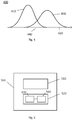
- Fig. 4 shows color score statistical distribution functions 400 wherein a Gaussian statistical distribution for the color white 410 is defined as a Gaussian probability density function 420 of the color score.
- a Gaussian statistical distribution for the color white 410 is defined as a Gaussian probability density function 420 of the color score.
- the relative difference between the two different colors can be described in statistical terms, and the corresponding threshold value 440 can be determined based on probability calculations derived from the different color score statistical distributions 410, 430.
- the threshold value can be determined based on the statistical distribution of the color score being modelled as a superposition of a plurality of statistical color distributions, wherein each of the statistical color distributions corresponds to a color of a street marking.
- the color of the street marking is determined to correspond to a yellow color if the color score is greater than the threshold value, and the color of the street marking is determined to correspond to a white color if the color score is smaller than the threshold value, or vice-versa.
- the color score is compared to n threshold values such as to decide between n+1 different colors.
- At least one threshold value is used to correctly distinguish between the different colors based on a comparison with a color score.
- the color score is derived by comparison of different pieces of color information, and thus can, in combination with the comparison with the at least one threshold value, enhance the robustness and efficiency of the color detection, in particular when changing image conditions affect the intensities of each of the pieces of color information in the same or similar manner.
- Fig. 5 shows an image processing system 500 that is adapted to perform the method 200 shown in Fig. 2 .
- the image processing system 500 comprises the camera 510, 120 for capturing the image of the street, and an image processing means 520 coupled to the camera 510.
- the image processing means is adapted to perform the above steps of: detecting a street marking as a set of pixels provided by the image, wherein the pixels include at least two different pieces of color information, determining a color score for the street marking by comparing said at least two different pieces of color information, and determining the color of the street marking by comparing the color score to at least one threshold value 440.
- the image processing means 520 includes computing means 530, such as for example a microprocessor, coupled to storage means 540, wherein the storage means 540 includes software adapted to be executed by the microprocessor, such as to perform the method steps shown in Fig. 2 .
Landscapes
- Engineering & Computer Science (AREA)
- Physics & Mathematics (AREA)
- General Physics & Mathematics (AREA)
- Theoretical Computer Science (AREA)
- Multimedia (AREA)
- Computer Vision & Pattern Recognition (AREA)
- Spectroscopy & Molecular Physics (AREA)
- Mechanical Engineering (AREA)
- Signal Processing (AREA)
- Image Analysis (AREA)
- Image Processing (AREA)
Abstract
capturing an image of a street,
detecting a street marking as a set of pixels provided by the image, wherein the pixels include at least two different pieces of color information,
determining a color score for the street marking by comparing said at least two different pieces of color information, and
determining the color of the street marking by comparing the color score to at least one threshold value.
Description
- The invention relates to a method and to an image processing system, for determining the color of a street marking.
- Applications are known in the prior art that permit detecting and tracking street markings, such as for example lane markings, on the road. The challenges faced by such applications can depend on the different lighting conditions, raining, poor lane markings, and the problem of distinguishing street markings from objects on the road.
- Color extraction can significantly enhance the functionality of street marking detection, allowing to distinguish between different street markings based on their colors. In this respect, road marking regulations may prescribe that street markings should be treated differently based on their colors. For example, according to European traffic rules, when yellow and white color lane markings are detected, the yellow lane marking should be treated with higher priority to override directions provided by the white lane marking. Such yellow lane markings are often used to improve road safety near construction zones.
- For a conventional red-green-blue RGB camera, which separately records red, green and blue color information for image pixels, the different color channels measure the different color intensities corresponding to the visual spectrum, and thus allow a straightforward color classification, e.g. based on a three-color information chart.
- However, as image conditions can affect the correctness of the detected color, the color may require adjustment to render specific colors correctly. For this purpose, color balance methods, e.g. gray balance, neutral balance, or white balance methods, can be used. For example, the goal of the white balance is to render the color in the image correctly, in particular to compensate color shift effects caused by changes in illumination characteristics.
- For example, at dusk, the low sun illumination has a low temperature, which renders everything with a reddish color. Human eyes are quite good at white balance, but one still has the experience that an image taken under incandescent lamp shows significant color shift, wherein a white object often seems yellowish.
- Also for camera sensors, it can be challenging to correct the color shift. This problem is particularly relevant for a lane detection system attempting to correctly detect and distinguish white and yellow lane markings based on their colors, in particular when faced with changing lighting conditions.
- The problem is even more challenging when a red-clear camera is used instead of the conventional RGB camera, which is often the case in automobile applications. In images captured by red-clear cameras, the pixels provide only red color information and clear color information, wherein the clear color information provides no red, green or blue color information.
- For example, in a four pixel arrangement of a red-clear camera, one pixel can capture the red light information, whereas the remaining three pixels have no R/G/B filters provided on top of them. In other words, images captured by red-clear cameras do not provide full R/G/B color information. It follows that the above described color balance problem cannot be compensated by traditional color balance methods, since the image captured by the red-clear camera provides no green and blue color information.
- In view of the foregoing it is an object of the present invention to provide an improved street marking color determination, in particular to distinguish street lanes having different colors, for example to provide street marking color determination with improved lighting condition compensation.
- These objects are satisfied by a method for determining the color of a street marking according to claim 1, and by the image processing system described in independent claim 9.
- In accordance with a first aspect of the invention, a method for determining the color of a street marking comprises:
- capturing an image of a street,
- detecting a street marking as a set of pixels provided by the image, wherein the pixels include at least two different pieces of color information,
- determining a color score for the street marking by comparing said at least two different pieces of color information, and
- determining the color of the street marking by comparing the color score to at least one threshold value.
- The method advantageously determines the color of a street marking by comparing a color score to at least one threshold value. The color score represents a value that is determined by comparing at least two different color information provided by a set of pixels, wherein the set of pixels corresponds to the street marking.
- For example, the image can contain a set of pixels captured by an RGB camera, i.e. a camera for capturing images having pixels with red, green and blue color information. Here, the color yellow, for example, corresponds to a combination of the red and green color information. Hence, for a RGB camera, the proportions of the red, green and blue channel information, at each set of pixels, can be analyzed by comparison to determine the color of the street marking. This has the advantage that if, for example, the lighting conditions change such as to affect the red, green and blue channel information in a similar manner, for example due to lighting and brightness changes affecting all colors, the proportions of the channel information may remain relatively unaffected. As a result, the color detection is less sensitive to changes in image conditioning.
- Similarly, when using a red-clear type camera, the camera captures images having pixels with red color information and clear color information. As mentioned above, the clear color information corresponds to pixels having no red, green or blue color distinction.
- Without the green and blue channel information, it is not possible to distinguish all visible spectrum colors. For example, it is not possible to distinguish the color yellow from pure red, or, e.g. magenta, which is a combination of red and blue.
- However, if only a limited number of colors need to be detected, the two pieces of color information provided by the red-clear type camera can be sufficient to distinguish between the colors. For example, when determining the color of a street marking, in particular the color of a road edge marking or lane marking, traffic rules may prescribe that only white and yellow colors should be used. In this case, the red-channel information can be compared to the clear color information, and when a certain proportion of the color information is met, the color can be detected, for example as yellow.
- More specifically, according to the present invention, the color of a street marking is determined by comparing at least two pieces of color information provided by a set of pixels, such as to determine a color score. The color score can represent a value indicating the detected color, for example, indicating the above proportion of color information to describe the yellowness of the street marking.
- The color score can be determined by calculating proportions or other dependencies, based on a comparison of the different pieces of color information provided by the set of pixels, for example by using a training-based classifier, such as for example a neural network or a Fuzzy logic based classifier. In an example, the classifier can be trained by using a machine learning based training data set, for example with labeled white and yellow lane markings, such as to train the classifier to calculate a color score based on the pieces of color information provided by the set of pixels.
- In order to determine the color of the street marking, the color score is compared to at least one threshold value. For example, the color score can be compared to one threshold value such as to decide between two different colors, two threshold values such as to decide between three different colors, or n threshold values such as to decide between n+1 different colors. Hence, if there are only two possible colors, for example white and yellow colors of a street lane marking, the color score only needs to be compared with a single threshold value, to separate the two colors.
- As mentioned above, although image conditions can affect the intensities of each of the different pieces of color information provided by the set of pixels, the color score is determined based on a comparison of the different pieces of color information, and thus may compensate illumination affects that affect the different colors in the same or similar way.
- Preferably, the at least one threshold value is determined to further enhance this advantageous property. This is particular useful when changing illumination conditions, for example during urban/suburban night driving, make it difficult to correctly distinguish the different colors. As mentioned above, low sun light at dusk may shift colors to reddish in a camera image, which may cause a white color lane marking to be incorrectly recognized as yellow, in particular when using a red-clear camera. In another example, the color shift may depend on the type of street lights or the vehicle's own front light spectral and intensity characteristics.
- In view of this problem, the color scores determined for a plurality of street markings are preferably gathered, such as to determine the at least one threshold value based on the statistical distribution of the gathered color scores. For example, the color scores can be gathered based on a plurality of street markings detected in a plurality of images, for example in a plurality of image frames of a video stream, in particular during capturing of the video stream taken from a vehicle.
- By gathering the color scores determined from the street markings in each camera frame, in particular the color scores determined from lane markings in a plurality of image frames of a video stream, the statistical distribution of the determined color score can be analyzed and estimated. For example, if in multiple frames, there is only one color (e.g. either white or yellow) of captured lane markings, the statistical distribution of the determined color score can be efficiently modelled for classification purposes, for example as a single Gaussian statistical distribution.
- Thus, by analyzing the color score distribution cross multiple frames, the relative difference between different colors, for example yellow and white colors, can be described in statistical terms. This allows an efficient threshold value to be determined for improving classification of the color of street markings based on the different color score statistical distributions, for example based on probability calculations derived from the different color score statistical distributions. Preferably, the color scores can be gathered from frames of a video stream, and the corresponding threshold value determined based on the gathered color scores, during capturing of the video stream taken from a vehicle. In this way, the threshold value can be adapted to changes in image conditions during driving.
- In other words, preferably, the threshold value is determined based on the statistical distribution of the color score being modelled as a superposition of a plurality of statistical color distributions, wherein each of the statistical color distributions corresponds to a color of a street marking, further preferred, wherein the statistical distribution is modelled as a superposition of a plurality of Gaussian statistical color distributions.
- For example, if there are only two different colors involved, for example yellow and white colored lanes, then the color scores can be modelled as a superposition of two distinguishable Gaussian statistical distributions.
- In an example of the present invention, the color of the street marking is determined to correspond to a first color if the color score is greater than a threshold value, and the color of the street marking is determined to correspond to a second color if the color score is smaller than the threshold value. Preferably, the first and second colors correspond to the colors of a street lane, further preferred wherein the first and second colors correspond to the colors yellow and white, or white and yellow, respectively.
- The proposed method according to the present invention is different from the conventional color balance used for RGB cameras, wherein certain color channels are being amplified, either as analog signals on a camera sensor, or as digital signals in digital post-processing algorithms, to correctly render the color. According to the present invention, a threshold value is used to correctly distinguish between the different colors based on a comparison with a color score. Hence, the color score is derived by comparison of different pieces color information, and thus can, in combination with the comparison with the threshold value, enhance the robustness and efficiency of the color detection, in particular wherein changing image conditions can affect the intensities of each of the different pieces of color information provided by the respective set of pixels.
- In accordance with a second aspect of the present invention, an image processing system is provided, comprising:
- a camera adapted to capture an image of a street,
- an image processing means coupled to the camera,
- wherein the image processing means is adapted to:
- detect a street marking as a set of pixels provided by the image, wherein the pixels include at least two different pieces of color information,
- determine a color score for the street marking by comparing said at least two different pieces of color information, and
- determine the color of the street marking by comparing the color score to at least one threshold value.
- The image processing system advantageously determines the color of a street marking by comparing a color score to at least one threshold value. The color score represents a value that is determined by comparing at least two different pieces of color information provided by a set of pixels, wherein the set of pixels corresponds to the street marking.
- For this purpose, the image processing system comprises a camera, and an image processing means coupled to the camera. The image processing means can include computing means, such as for example a microprocessor coupled to storage means, wherein the storage means includes software adapted to be executed by the microprocessor, such as to have the image processing means: detect a street marking as a set of pixels provided by the image, wherein the pixels include at least two different pieces of color information, determine a color score for the street marking by comparing said at least two different pieces of color information, and determine the color of the street marking by comparing the color score to at least one threshold value, in accordance with the present invention.
- Preferably, the camera is an RGB camera, i.e. a camera for capturing images having pixels with red, green and blue color information, or a red-clear type camera wherein the camera captures images having pixels with red color information and clear color information. As mentioned above, the clear color information corresponds to pixels having no red, green or blue color distinction.
- Without the green and blue channel information, it is not possible for the red-clear type camera to distinguish all visible spectrum colors. For example, it is not possible to distinguish the color yellow from pure red, or, e.g. magenta, which is a combination of red and blue.
- However, if only a limited number of colors need to be detected, the two pieces of color information provided by the red-clear type camera can be sufficient to distinguish between the colors.
- More specifically, according to the present invention, the color of a street marking is determined by having the image processing means compare at least two pieces of color information provided by a set of pixels, such as to determine a color score. The color score can represent a value indicating the detected color, for example, indicating a proportion of color information to describe the yellowness of the street marking.
- As mentioned above, the color score can be determined by calculating proportions or other dependencies, based on a comparison of the different pieces of color information provided by the set of pixels, for example by using a training-based classifier, such as for example a neural network or a Fuzzy logic based classifier. In an example, the classifier can be trained by using a machine learning based training data set, for example with labeled white and yellow lane markings, such as to train the classifier to calculate a color score based on the different pieces of color information provided by the set of pixels.
- According to the present invention, the image processing means is adapted to determine the color of the street marking by comparing the color score to at least one threshold value. For example, the color score can be compared to one threshold value such as to decide between two different colors, two threshold values such as to decide between three different colors, or n threshold values such as to decide between n+1 different colors.
- As detailed above, although image conditions can affect the intensities of each of the different pieces of color information provided by the set of pixels, the color score is determined based on a comparison of the different pieces of color information, and thus may compensate illumination affects that affect the different colors in the same or similar way.
- Preferably, the image processing means is adapted to gather the color scores determined for a plurality of street markings, and to determine the at least one threshold value based on the statistical distribution of the gathered color scores. For example the image processing means can be adapted to gather the color scores based on a plurality of street markings detected in a plurality of images captured by the camera, preferably as detected in a plurality of image frames of a video stream captured by the camera.
- In this way, color scores determined for a plurality of street markings are gathered to determine the at least one threshold value based on the statistical distribution of the gathered color scores. Thus, the statistical distribution of the determined color score can be analyzed and used for determining the at least one threshold value. For example, if in multiple frames, there is only one color (e.g. either white or yellow) of captured lane markings, the statistical distribution of the determined color score can be efficiently modelled for classification purposes, for example as a single Gaussian statistical distribution.
- Preferably, the color scores can be gathered from frames of a video stream, and the corresponding threshold value determined based on the gathered color scores, during capturing of the video stream taken from a vehicle. In this way, the threshold value can be adapted to changes in image conditions during driving.
- By analyzing the color score distribution for multiple frames, the relative difference between different colors, for example yellow and white colors, can be described in statistical terms. This allows an efficient threshold value to be determined for improving classification of the color of street markings based on the different color score statistical distributions, for example based on probability calculations derived from the different color score statistical distributions.
- Preferably, the image processing means is adapted to determine the at least one threshold value based on modelling the statistical distribution of the color score as a superposition of a plurality of statistical color distributions. Here, each of the statistical color distributions corresponds to a color of a street marking, further preferred wherein the statistical distribution is modelled as a superposition of a plurality of Gaussian statistical color distributions.
- For example, if there are only two different colors involved, e.g. yellow and white colored lanes, then the color scores can be modelled as a superposition of two distinguishable Gaussian statistical distributions, allowing a computationally efficient approach to determine a threshold value based on probabilistic considerations, for example by maximum likelihood considerations.
- Preferably, the image processing means is adapted to determine that the color of the street marking corresponds to a first color if the color score is greater than a threshold value, and to determine that the color of the street marking corresponds to a second color if the color score is smaller than the threshold value, preferably wherein the first and second colors correspond to the colors yellow and white, or white and yellow, respectively.
- In an example, the camera of the image processing system according to the present invention is configured to be mounted on a vehicle, preferably on a front part, rear part or side part of a vehicle. In this way, the camera is suitably positioned to capture images of street markings without obstacles blocking the view. This can be particularly useful when capturing a sequence of image frames in a video stream for gathering color scores for a street lane.
- Preferably, the color of a street marking is the color of a street lane marking, further preferred a yellow color or a white color.
- Accordingly, the image processing system according to the present invention uses at least one threshold value to correctly distinguish between the different colors based on a comparison with a color score. The color score is derived by comparison of different pieces of color information, and thus can, in combination with the comparison with the at least one threshold value, enhance the robustness and efficiency of the color detection, in particular when changing image conditions affect the intensities of each of the different pieces of color information in the same or similar manner.
- Further embodiments of the invention are described in the following description of the Figures. The invention will be explained in the following by means of embodiments and with reference to the drawings in which is shown:
- Fig. 1
- a street marking scenario;
- Fig. 2
- a method for determining the color of a street marking;
- Fig. 3
- a red-clear type camera pixel arrangement;
- Fig. 4
- color score statistical distribution functions; and
- Fig. 5
- an image processing system.
-
Fig. 1 shows astreet marking scenario 100, wherein avehicle 110 having acamera 120 is travelling along a road withwhite street markings 130. Thecamera 120 is mounted behind the rear-view mirror of thevehicle 110, such as to be provided with an unobstructed front view. The camera could also be mounted on a front part, rear part or side part of thevehicle 110, for example to provide a different viewpoint on the street markings. - The
white street markings 130 are arranged to define the road edges and to separate two road lanes. Thus, thewhite street markings 130 provide lane markings. The white street markings can also indicate road exits, road crossings or parking zones, depending on the road scenario under consideration. - In
Fig. 1 , aroad construction zone 140 with aconstruction machine 150 is shown to overlap one of the white street marking 130, and to extend inside the street lane being used by thevehicle 110. - Such as to improve safety in the
road construction zone 140,yellow street markings 160 have been provided to override thewhite street markings 130. Thus, the yellow street markings are arranged to guide thevehicle 110 to pass theconstruction zone 140 at a safe distance. For example, according to European traffic rules, when yellow and white color lane markings are being used, theyellow lane 160 marking should be treated with higher priority to override directions provided by the white lane marking. - It follows that a correct color extraction is required to distinguishing between the different street markings based on their colors, for example to enhance safety where
yellow street markings 160 have been provided to overridewhite street markings 130, for example atconstruction zones 140. -
Fig. 2 shows a corresponding method for determining the color of a street marking 200. An image of the street is captured 210, and a street marking 130, 160 is detected as a set of pixels provided by theimage 220, wherein the pixels include at least two different pieces of color information. - For example, the set of pixels provided by the image can be provided by an
RGB camera 120, i.e. a camera for capturing images having pixels with red, green and blue color information. Alternatively, the set of pixels provided by the image can be provided by a red-clear type camera 120, i.e. a camera for capturing images having pixels with red color information and clear color information. - For example,
Fig. 3 shows a pixel arrangement of a red-clear camera, withpixels 310 which are adapted to capture red light information, whereas the remainingpixels 320 have no R/G/B filters provided on top of them. In other words, images captured by red-clear cameras do not provide full R/G/B color information. - In
step 230 shown inFig. 2 , the at least two different pieces of color information are compared to determine a color score for the street marking. The color score can represent a value indicating the detected color, for example, as detailed above, indicating a proportion of color information to describe the yellowness of the street marking. - For example, the color score can be determined by calculating proportions or other dependencies, based on a comparison of the different pieces of color information provided by the set of pixels, for example by using a training-based classifier, such as for example a neural network or a Fuzzy logic based classifier. In an example, the classifier can be trained by using a machine learning based training data set, for example with labeled white and yellow lane markings, such as to train the classifier to calculate a color score based on the different pieces of color information provided by the set of pixels.
- Then, in
step 240 shown inFig. 2 , the color score is compared to at least one threshold value to determine the color of the street marking. - For example, when using the red-clear camera, it is not possible to distinguish all visible spectrum colors. For example, it is not possible to distinguish the color yellow from pure red, or, e.g. magenta, which is a combination of red and blue.
- However, as the
street markings Fig. 1 are either white or yellow, the red-channel information can be compared to the clear color information, for example to determine the proportion of the color information, and the resulting color score can used to distinguish between the two colors. - More specifically, such as to distinguish between the white and yellow colors of the street markings, the color score is compared to a threshold value.
- In this way, the color score is determined based on a comparison of the different pieces of color information, and thus may compensate illumination affects that affect the different colors in the same or similar way. For example, changes in brightness and illumination that affect the different colors in the same or similar way can be compensated by comparing the different pieces of color information, for example by determining the proportion of color information.
- Moreover, by gathering color scores determined for the street marking, the threshold value can be determined based on the statistical distribution of the gathered color scores. For example, the color scores can be gathered based on street markings detected in a plurality of images, for example in a plurality of image frames of a video stream captured by the
camera 120. - In this way, the statistical distribution of the determined color score can be analyzed and estimated. For example, if in multiple frames, there is only one color (e.g. either white or yellow) of captured lane markings, the statistical distribution of the determined color score can be efficiently modelled for classification purposes, for example as a single Gaussian statistical distribution.
-
Fig. 4 shows color scorestatistical distribution functions 400 wherein a Gaussian statistical distribution for thecolor white 410 is defined as a Gaussianprobability density function 420 of the color score. By repeating the analysis for a yellow lane marking that is captured in multiple frames of a video stream, the corresponding Gaussian statistical distribution for the color yellow 423 results. Thus, the two different colors correspond to the two different Gaussianstatistical distribution functions Fig. 4 . - It follows that the relative difference between the two different colors can be described in statistical terms, and the
corresponding threshold value 440 can be determined based on probability calculations derived from the different color scorestatistical distributions - In other words, the threshold value can be determined based on the statistical distribution of the color score being modelled as a superposition of a plurality of statistical color distributions, wherein each of the statistical color distributions corresponds to a color of a street marking.
- Then, the color of the street marking is determined to correspond to a yellow color if the color score is greater than the threshold value, and the color of the street marking is determined to correspond to a white color if the color score is smaller than the threshold value, or vice-versa.
- As mentioned above, if more than two colors need to be detected, the color score is compared to n threshold values such as to decide between n+1 different colors.
- Accordingly, at least one threshold value is used to correctly distinguish between the different colors based on a comparison with a color score. Hence, the color score is derived by comparison of different pieces of color information, and thus can, in combination with the comparison with the at least one threshold value, enhance the robustness and efficiency of the color detection, in particular when changing image conditions affect the intensities of each of the pieces of color information in the same or similar manner.
-
Fig. 5 shows animage processing system 500 that is adapted to perform themethod 200 shown inFig. 2 . For this purpose, theimage processing system 500 comprises thecamera camera 510. The image processing means is adapted to perform the above steps of: detecting a street marking as a set of pixels provided by the image, wherein the pixels include at least two different pieces of color information, determining a color score for the street marking by comparing said at least two different pieces of color information, and determining the color of the street marking by comparing the color score to at least onethreshold value 440. - Here, the image processing means 520 includes computing means 530, such as for example a microprocessor, coupled to storage means 540, wherein the storage means 540 includes software adapted to be executed by the microprocessor, such as to perform the method steps shown in
Fig. 2 . -
- 100
- street marking scenario
- 110
- vehicle
- 120,510
- camera
- 130
- white street markings
- 140
- road construction zone
- 150
- construction machine
- 160
- yellow street markings
- 200
- method for determining the color of a street marking
- 210
- capture image of street
- 220
- detect street marking
- 230
- determine color score
- 240
- compare color score to threshold value
- 300
- a red-clear type camera pixel arrangement
- 310
- pixels adapted to capture red light information
- 320
- pixels with no R/G/B filters provided on top of them
- 400
- color score statistical distribution functions
- 410, 430
- Gaussian statistical distribution of a first/second color score
- 420
- color score axis
- 440
- threshold value
- 500
- image processing system
- 520
- image processing means
- 530
- computing means
- 540
- storage means
Claims (15)
- A method for determining the color of a street marking (200), comprising:capturing an image of a street (210),detecting a street marking as a set of pixels provided by the image (220),wherein the pixels include at least two different pieces of color information,determining a color score for the street marking by comparing said at least two different pieces of color information (230), anddetermining the color of the street marking by comparing the color score to at least one threshold value (240).
- The method (200) of claim 1, wherein a red-clear camera (120, 510) is used for capturing the image, such that the image has pixels with red color information (310) and clear color information (320), wherein the clear color information (320) corresponds to pixels having no red, green or blue color distinction.
- The method (200) of claim 1 or 2, wherein color score is determined by calculating proportions or other dependencies based on a comparison of the at least two different pieces of color information (230), preferably by using a training-based classifier, such as for example a neural network or a Fuzzy logic based classifier.
- The method (200) of any of claims 1 to 3, further comprising:
gathering the color scores determined for a plurality of street markings (130, 160), and determining the at least one threshold value (440) based on the statistical distribution (410, 430) of the gathered color scores. - The method (200) of claim 4, wherein the color scores are gathered based on a plurality of street markings (130, 160) detected in a plurality of images, preferably detected in a plurality of image frames of a video stream, further preferred wherein the color scores are gathered and the at least one threshold value (440) is determined during capturing of the video stream taken from a vehicle (110).
- The method (200) of claim 4 or 5, wherein the threshold value (440) is determined based on the statistical distribution being modelled as a superposition of a plurality of statistical color distributions (410, 430), wherein each of the statistical color distributions (410, 430) corresponds to a color of a street marking (130, 160), preferably wherein the statistical distribution is modelled as a superposition of a plurality of Gaussian statistical color distributions (410, 430).
- The method (200) of any of claims 1 to 6, wherein the color of the street marking (130, 160) is determined to correspond to a first color if the color score is greater than a threshold value (440), and the color of the street marking is determined to correspond to a second color if the color score is smaller than the threshold value (440).
- The method (200) of claim 7, wherein the first and second colors correspond to the colors of a street lane (130, 160), preferably wherein the first and second colors correspond to the colors yellow (160) and white (130), or white (130) and yellow (160), respectively.
- An image processing system (500), comprising:a camera (120, 510) adapted to capture an image of a street,an image processing means (520) coupled to the camera (510),wherein the image processing means (520) is adapted to:detect a street marking (130, 160) as a set of pixels provided by the image,wherein the pixels include at least two different pieces of color information,determine a color score for the street marking (130, 160) by comparing said at least two different pieces of color information, anddetermine the color of the street marking by comparing the color score to at least one threshold value (440).
- The image processing system (500) of claim 9, wherein the camera (120, 510) is a red-green-blue camera for capturing images having pixels with red, green and blue color information, or wherein the camera (120, 510) is a red-clear camera for capturing images having pixels with red color information (310) and clear color information (320), wherein the clear color information (320) corresponds to pixels having no red, green or blue color distinction.
- The image processing system (500) of claim 9 or 10, wherein the image processing means (520) is adapted to gather the color scores determined for a plurality of street markings (130, 160), and to determine the at least one threshold value (440) based on the statistical distribution of the gathered color scores (410, 430), preferably wherein the image processing means (520) is adapted to gather the color scores based on a plurality of street markings (130, 160) detected in a plurality of images captured by the camera (120, 510), further preferred detected in a plurality of image frames of a video stream captured by the camera (120, 510) wherein the color scores are gathered and the at least one threshold value (440) is determined during capturing of the video stream taken from a vehicle (110).
- The image processing system (500) of claim 11, wherein the image processing means (520) is adapted to determine the at least one threshold value (440) based on modelling the statistical distribution as a superposition of a plurality of statistical color distributions (410, 430), wherein each of the statistical color distributions (410, 430) corresponds to a color of a street marking (130, 160), preferably wherein the statistical distribution is modelled as a superposition of a plurality of Gaussian statistical color distributions (410, 430).
- The image processing system (500) of any of claims 9 to 12, wherein the image processing means (520) is adapted to determine that the color of the street marking (130, 160) corresponds to a first color if the color score is greater than the threshold value (440), and to determine that the color of the street marking (130, 160) corresponds to a second color if the color score is smaller than the threshold value (440), preferably wherein the first and second colors correspond to the colors yellow and white, or white and yellow, respectively.
- The image processing system (500) of any of claims 9 to 13, wherein the camera (120, 510) is configured to be mounted on a vehicle (110), preferably on a front part, rear part or side part of a vehicle (110).
- The image processing system (500) of any of claims 9 to 14, wherein the color of a street marking (130, 160) is the color of a street lane marking, preferably a yellow color or a white color.
Priority Applications (3)
| Application Number | Priority Date | Filing Date | Title |
|---|---|---|---|
| EP18167546.3A EP3557475B1 (en) | 2018-04-16 | 2018-04-16 | Street marking color recognition |
| US16/369,914 US10977500B2 (en) | 2018-04-16 | 2019-03-29 | Street marking color recognition |
| CN201910298981.5A CN110388985B (en) | 2018-04-16 | 2019-04-15 | Method for determining color of street sign and image processing system |
Applications Claiming Priority (1)
| Application Number | Priority Date | Filing Date | Title |
|---|---|---|---|
| EP18167546.3A EP3557475B1 (en) | 2018-04-16 | 2018-04-16 | Street marking color recognition |
Publications (2)
| Publication Number | Publication Date |
|---|---|
| EP3557475A1 true EP3557475A1 (en) | 2019-10-23 |
| EP3557475B1 EP3557475B1 (en) | 2024-09-18 |
Family
ID=62104089
Family Applications (1)
| Application Number | Title | Priority Date | Filing Date |
|---|---|---|---|
| EP18167546.3A Active EP3557475B1 (en) | 2018-04-16 | 2018-04-16 | Street marking color recognition |
Country Status (3)
| Country | Link |
|---|---|
| US (1) | US10977500B2 (en) |
| EP (1) | EP3557475B1 (en) |
| CN (1) | CN110388985B (en) |
Families Citing this family (2)
| Publication number | Priority date | Publication date | Assignee | Title |
|---|---|---|---|---|
| US11729371B2 (en) * | 2020-10-14 | 2023-08-15 | Ford Global Technologies, Llc | Systems and methods for improved camera color calibration |
| CN113066153B (en) * | 2021-04-28 | 2023-03-31 | 浙江中控技术股份有限公司 | Method, device and equipment for generating pipeline flow chart and storage medium |
Citations (4)
| Publication number | Priority date | Publication date | Assignee | Title |
|---|---|---|---|---|
| JP2000029516A (en) * | 1998-07-10 | 2000-01-28 | Hokuyo Automatic Co | Guide sensor |
| JP2002123819A (en) * | 2000-10-13 | 2002-04-26 | Toyota Central Res & Dev Lab Inc | Lane mark highlighter |
| DE102008031861A1 (en) * | 2008-07-05 | 2010-01-07 | Götting jun., Hans-Heinrich | Tracking sensor for detecting optical marks on path to guide vehicle, has color filter and comparator that examines scenes using sensor with and without filters and compares scenes with one another |
| US20150215550A1 (en) * | 2004-05-25 | 2015-07-30 | Continental Automotive Gmbh | Monitoring Unit for a Motor Vehicle, Having Partial Color Encoding |
Family Cites Families (7)
| Publication number | Priority date | Publication date | Assignee | Title |
|---|---|---|---|---|
| US8946849B2 (en) | 2012-05-15 | 2015-02-03 | Taiwan Semiconductor Manufacturing Company, Ltd. | BSI image sensor chips with separated color filters and methods for forming the same |
| US9455285B2 (en) | 2015-02-04 | 2016-09-27 | Semiconductors Components Industries, Llc | Image sensors with phase detection pixels |
| US20170246473A1 (en) * | 2016-02-25 | 2017-08-31 | Sava Marinkovich | Method and system for managing treatments |
| CN106874875A (en) * | 2017-02-17 | 2017-06-20 | 武汉理工大学 | A kind of vehicle-mounted lane detection system and method |
| US10296795B2 (en) * | 2017-06-26 | 2019-05-21 | Here Global B.V. | Method, apparatus, and system for estimating a quality of lane features of a roadway |
| CN107590470B (en) * | 2017-09-18 | 2020-08-04 | 浙江大华技术股份有限公司 | Lane line detection method and device |
| CN107833244A (en) * | 2017-11-02 | 2018-03-23 | 南京市测绘勘察研究院股份有限公司 | An automatic identification method of street tree attributes based on vehicle-mounted lidar data |
-
2018
- 2018-04-16 EP EP18167546.3A patent/EP3557475B1/en active Active
-
2019
- 2019-03-29 US US16/369,914 patent/US10977500B2/en active Active
- 2019-04-15 CN CN201910298981.5A patent/CN110388985B/en active Active
Patent Citations (4)
| Publication number | Priority date | Publication date | Assignee | Title |
|---|---|---|---|---|
| JP2000029516A (en) * | 1998-07-10 | 2000-01-28 | Hokuyo Automatic Co | Guide sensor |
| JP2002123819A (en) * | 2000-10-13 | 2002-04-26 | Toyota Central Res & Dev Lab Inc | Lane mark highlighter |
| US20150215550A1 (en) * | 2004-05-25 | 2015-07-30 | Continental Automotive Gmbh | Monitoring Unit for a Motor Vehicle, Having Partial Color Encoding |
| DE102008031861A1 (en) * | 2008-07-05 | 2010-01-07 | Götting jun., Hans-Heinrich | Tracking sensor for detecting optical marks on path to guide vehicle, has color filter and comparator that examines scenes using sensor with and without filters and compares scenes with one another |
Non-Patent Citations (2)
| Title |
|---|
| DUDA R O ET AL: "Pattern Classification, Bayesian Decision Theory", 1 January 2001, PATTERN CLASSIFICATION, NEW YORK, JOHN WILEY & SONS, US, PAGE(S) 20 - 83, ISBN: 978-0-471-05669-0, XP002365513 * |
| DUDA R O ET AL: "Pattern Classification, Introduction", 1 January 2001, PATTERN CLASSIFICATION, NEW YORK, JOHN WILEY & SONS, US, PAGE(S) 1 - 19, ISBN: 978-0-471-05669-0, XP002365512 * |
Also Published As
| Publication number | Publication date |
|---|---|
| US10977500B2 (en) | 2021-04-13 |
| CN110388985B (en) | 2022-03-01 |
| US20190318175A1 (en) | 2019-10-17 |
| CN110388985A (en) | 2019-10-29 |
| EP3557475B1 (en) | 2024-09-18 |
Similar Documents
| Publication | Publication Date | Title |
|---|---|---|
| CN105160924B (en) | Intelligent signal lamp condition detection method and detecting system based on Video processing | |
| US9558412B2 (en) | Vehicle exterior environment recognition device | |
| US8750567B2 (en) | Road structure detection and tracking | |
| US8019157B2 (en) | Method of vehicle segmentation and counting for nighttime video frames | |
| EP3506169A2 (en) | Driver assistance system and method for object detection and notification | |
| CA2609526C (en) | Vehicle and road sign recognition device | |
| CN110688907B (en) | Method and device for identifying object based on night road light source | |
| CN107679508A (en) | Road traffic sign detection recognition methods, apparatus and system | |
| CN109299674B (en) | Tunnel illegal lane change detection method based on car lamp | |
| CN101030256B (en) | Method and apparatus for cutting vehicle image | |
| JP4807354B2 (en) | Vehicle detection device, vehicle detection system, and vehicle detection method | |
| CN113989771A (en) | A Traffic Signal Recognition Method Based on Digital Image Processing | |
| US20140226349A1 (en) | Apparatus for detecting other vehicle lights and light control apparatus for vehicles | |
| US20200410256A1 (en) | Method and Device for Detecting Lanes, Driver Assistance System and Vehicle | |
| US20120229644A1 (en) | Edge point extracting apparatus and lane detection apparatus | |
| CN111292529A (en) | A method for identifying the distribution of fog mass on expressways | |
| CA2614247A1 (en) | Vehicle and lane mark recognition apparatus | |
| US10977500B2 (en) | Street marking color recognition | |
| JP7759386B2 (en) | Image Processing Method | |
| US7003137B2 (en) | Target recognition apparatus | |
| JP2003331384A (en) | Vehicle type identification device | |
| CN115131745A (en) | Traffic signal lamp identification method and system under night scene | |
| US10417518B2 (en) | Vehicle camera system | |
| KR101237374B1 (en) | Image processing method for detecting traffic light | |
| US12530743B2 (en) | Image data alignment for mobile system sensors |
Legal Events
| Date | Code | Title | Description |
|---|---|---|---|
| PUAI | Public reference made under article 153(3) epc to a published international application that has entered the european phase |
Free format text: ORIGINAL CODE: 0009012 |
|
| STAA | Information on the status of an ep patent application or granted ep patent |
Free format text: STATUS: THE APPLICATION HAS BEEN PUBLISHED |
|
| AK | Designated contracting states |
Kind code of ref document: A1 Designated state(s): AL AT BE BG CH CY CZ DE DK EE ES FI FR GB GR HR HU IE IS IT LI LT LU LV MC MK MT NL NO PL PT RO RS SE SI SK SM TR |
|
| AX | Request for extension of the european patent |
Extension state: BA ME |
|
| STAA | Information on the status of an ep patent application or granted ep patent |
Free format text: STATUS: REQUEST FOR EXAMINATION WAS MADE |
|
| 17P | Request for examination filed |
Effective date: 20200311 |
|
| RBV | Designated contracting states (corrected) |
Designated state(s): AL AT BE BG CH CY CZ DE DK EE ES FI FR GB GR HR HU IE IS IT LI LT LU LV MC MK MT NL NO PL PT RO RS SE SI SK SM TR |
|
| STAA | Information on the status of an ep patent application or granted ep patent |
Free format text: STATUS: EXAMINATION IS IN PROGRESS |
|
| 17Q | First examination report despatched |
Effective date: 20210719 |
|
| RAP3 | Party data changed (applicant data changed or rights of an application transferred) |
Owner name: APTIV TECHNOLOGIES LIMITED |
|
| RAP1 | Party data changed (applicant data changed or rights of an application transferred) |
Owner name: APTIV TECHNOLOGIES AG |
|
| REG | Reference to a national code |
Ref country code: DE Ref legal event code: R079 Free format text: PREVIOUS MAIN CLASS: G06K0009000000 Ipc: G06V0020560000 Ref document number: 602018074440 Country of ref document: DE |
|
| GRAP | Despatch of communication of intention to grant a patent |
Free format text: ORIGINAL CODE: EPIDOSNIGR1 |
|
| STAA | Information on the status of an ep patent application or granted ep patent |
Free format text: STATUS: GRANT OF PATENT IS INTENDED |
|
| RIC1 | Information provided on ipc code assigned before grant |
Ipc: G06V 20/56 20220101AFI20240611BHEP |
|
| INTG | Intention to grant announced |
Effective date: 20240627 |
|
| GRAS | Grant fee paid |
Free format text: ORIGINAL CODE: EPIDOSNIGR3 |
|
| GRAA | (expected) grant |
Free format text: ORIGINAL CODE: 0009210 |
|
| STAA | Information on the status of an ep patent application or granted ep patent |
Free format text: STATUS: THE PATENT HAS BEEN GRANTED |
|
| AK | Designated contracting states |
Kind code of ref document: B1 Designated state(s): AL AT BE BG CH CY CZ DE DK EE ES FI FR GB GR HR HU IE IS IT LI LT LU LV MC MK MT NL NO PL PT RO RS SE SI SK SM TR |
|
| P01 | Opt-out of the competence of the unified patent court (upc) registered |
Free format text: CASE NUMBER: APP_46551/2024 Effective date: 20240812 |
|
| REG | Reference to a national code |
Ref country code: GB Ref legal event code: FG4D |
|
| RAP4 | Party data changed (patent owner data changed or rights of a patent transferred) |
Owner name: APTIV TECHNOLOGIES AG |
|
| REG | Reference to a national code |
Ref country code: CH Ref legal event code: EP |
|
| REG | Reference to a national code |
Ref country code: IE Ref legal event code: FG4D |
|
| REG | Reference to a national code |
Ref country code: DE Ref legal event code: R096 Ref document number: 602018074440 Country of ref document: DE |
|
| REG | Reference to a national code |
Ref country code: LT Ref legal event code: MG9D |
|
| PG25 | Lapsed in a contracting state [announced via postgrant information from national office to epo] |
Ref country code: NO Free format text: LAPSE BECAUSE OF FAILURE TO SUBMIT A TRANSLATION OF THE DESCRIPTION OR TO PAY THE FEE WITHIN THE PRESCRIBED TIME-LIMIT Effective date: 20241218 |
|
| PG25 | Lapsed in a contracting state [announced via postgrant information from national office to epo] |
Ref country code: GR Free format text: LAPSE BECAUSE OF FAILURE TO SUBMIT A TRANSLATION OF THE DESCRIPTION OR TO PAY THE FEE WITHIN THE PRESCRIBED TIME-LIMIT Effective date: 20241219 Ref country code: FI Free format text: LAPSE BECAUSE OF FAILURE TO SUBMIT A TRANSLATION OF THE DESCRIPTION OR TO PAY THE FEE WITHIN THE PRESCRIBED TIME-LIMIT Effective date: 20240918 |
|
| PG25 | Lapsed in a contracting state [announced via postgrant information from national office to epo] |
Ref country code: BG Free format text: LAPSE BECAUSE OF FAILURE TO SUBMIT A TRANSLATION OF THE DESCRIPTION OR TO PAY THE FEE WITHIN THE PRESCRIBED TIME-LIMIT Effective date: 20240918 |
|
| PG25 | Lapsed in a contracting state [announced via postgrant information from national office to epo] |
Ref country code: LV Free format text: LAPSE BECAUSE OF FAILURE TO SUBMIT A TRANSLATION OF THE DESCRIPTION OR TO PAY THE FEE WITHIN THE PRESCRIBED TIME-LIMIT Effective date: 20240918 |
|
| PG25 | Lapsed in a contracting state [announced via postgrant information from national office to epo] |
Ref country code: HR Free format text: LAPSE BECAUSE OF FAILURE TO SUBMIT A TRANSLATION OF THE DESCRIPTION OR TO PAY THE FEE WITHIN THE PRESCRIBED TIME-LIMIT Effective date: 20240918 |
|
| REG | Reference to a national code |
Ref country code: NL Ref legal event code: MP Effective date: 20240918 |
|
| PG25 | Lapsed in a contracting state [announced via postgrant information from national office to epo] |
Ref country code: RS Free format text: LAPSE BECAUSE OF FAILURE TO SUBMIT A TRANSLATION OF THE DESCRIPTION OR TO PAY THE FEE WITHIN THE PRESCRIBED TIME-LIMIT Effective date: 20241218 |
|
| PG25 | Lapsed in a contracting state [announced via postgrant information from national office to epo] |
Ref country code: RS Free format text: LAPSE BECAUSE OF FAILURE TO SUBMIT A TRANSLATION OF THE DESCRIPTION OR TO PAY THE FEE WITHIN THE PRESCRIBED TIME-LIMIT Effective date: 20241218 Ref country code: NO Free format text: LAPSE BECAUSE OF FAILURE TO SUBMIT A TRANSLATION OF THE DESCRIPTION OR TO PAY THE FEE WITHIN THE PRESCRIBED TIME-LIMIT Effective date: 20241218 Ref country code: LV Free format text: LAPSE BECAUSE OF FAILURE TO SUBMIT A TRANSLATION OF THE DESCRIPTION OR TO PAY THE FEE WITHIN THE PRESCRIBED TIME-LIMIT Effective date: 20240918 Ref country code: HR Free format text: LAPSE BECAUSE OF FAILURE TO SUBMIT A TRANSLATION OF THE DESCRIPTION OR TO PAY THE FEE WITHIN THE PRESCRIBED TIME-LIMIT Effective date: 20240918 Ref country code: GR Free format text: LAPSE BECAUSE OF FAILURE TO SUBMIT A TRANSLATION OF THE DESCRIPTION OR TO PAY THE FEE WITHIN THE PRESCRIBED TIME-LIMIT Effective date: 20241219 Ref country code: FI Free format text: LAPSE BECAUSE OF FAILURE TO SUBMIT A TRANSLATION OF THE DESCRIPTION OR TO PAY THE FEE WITHIN THE PRESCRIBED TIME-LIMIT Effective date: 20240918 Ref country code: BG Free format text: LAPSE BECAUSE OF FAILURE TO SUBMIT A TRANSLATION OF THE DESCRIPTION OR TO PAY THE FEE WITHIN THE PRESCRIBED TIME-LIMIT Effective date: 20240918 |
|
| REG | Reference to a national code |
Ref country code: AT Ref legal event code: MK05 Ref document number: 1725356 Country of ref document: AT Kind code of ref document: T Effective date: 20240918 |
|
| PG25 | Lapsed in a contracting state [announced via postgrant information from national office to epo] |
Ref country code: NL Free format text: LAPSE BECAUSE OF FAILURE TO SUBMIT A TRANSLATION OF THE DESCRIPTION OR TO PAY THE FEE WITHIN THE PRESCRIBED TIME-LIMIT Effective date: 20240918 |
|
| PG25 | Lapsed in a contracting state [announced via postgrant information from national office to epo] |
Ref country code: PT Free format text: LAPSE BECAUSE OF FAILURE TO SUBMIT A TRANSLATION OF THE DESCRIPTION OR TO PAY THE FEE WITHIN THE PRESCRIBED TIME-LIMIT Effective date: 20250120 Ref country code: IS Free format text: LAPSE BECAUSE OF FAILURE TO SUBMIT A TRANSLATION OF THE DESCRIPTION OR TO PAY THE FEE WITHIN THE PRESCRIBED TIME-LIMIT Effective date: 20250118 |
|
| PG25 | Lapsed in a contracting state [announced via postgrant information from national office to epo] |
Ref country code: SM Free format text: LAPSE BECAUSE OF FAILURE TO SUBMIT A TRANSLATION OF THE DESCRIPTION OR TO PAY THE FEE WITHIN THE PRESCRIBED TIME-LIMIT Effective date: 20240918 Ref country code: RO Free format text: LAPSE BECAUSE OF FAILURE TO SUBMIT A TRANSLATION OF THE DESCRIPTION OR TO PAY THE FEE WITHIN THE PRESCRIBED TIME-LIMIT Effective date: 20240918 |
|
| PG25 | Lapsed in a contracting state [announced via postgrant information from national office to epo] |
Ref country code: ES Free format text: LAPSE BECAUSE OF FAILURE TO SUBMIT A TRANSLATION OF THE DESCRIPTION OR TO PAY THE FEE WITHIN THE PRESCRIBED TIME-LIMIT Effective date: 20240918 |
|
| PG25 | Lapsed in a contracting state [announced via postgrant information from national office to epo] |
Ref country code: AT Free format text: LAPSE BECAUSE OF FAILURE TO SUBMIT A TRANSLATION OF THE DESCRIPTION OR TO PAY THE FEE WITHIN THE PRESCRIBED TIME-LIMIT Effective date: 20240918 Ref country code: EE Free format text: LAPSE BECAUSE OF FAILURE TO SUBMIT A TRANSLATION OF THE DESCRIPTION OR TO PAY THE FEE WITHIN THE PRESCRIBED TIME-LIMIT Effective date: 20240918 |
|
| PG25 | Lapsed in a contracting state [announced via postgrant information from national office to epo] |
Ref country code: CZ Free format text: LAPSE BECAUSE OF FAILURE TO SUBMIT A TRANSLATION OF THE DESCRIPTION OR TO PAY THE FEE WITHIN THE PRESCRIBED TIME-LIMIT Effective date: 20240918 Ref country code: PL Free format text: LAPSE BECAUSE OF FAILURE TO SUBMIT A TRANSLATION OF THE DESCRIPTION OR TO PAY THE FEE WITHIN THE PRESCRIBED TIME-LIMIT Effective date: 20240918 |
|
| PG25 | Lapsed in a contracting state [announced via postgrant information from national office to epo] |
Ref country code: SK Free format text: LAPSE BECAUSE OF FAILURE TO SUBMIT A TRANSLATION OF THE DESCRIPTION OR TO PAY THE FEE WITHIN THE PRESCRIBED TIME-LIMIT Effective date: 20240918 Ref country code: IT Free format text: LAPSE BECAUSE OF FAILURE TO SUBMIT A TRANSLATION OF THE DESCRIPTION OR TO PAY THE FEE WITHIN THE PRESCRIBED TIME-LIMIT Effective date: 20240918 |
|
| REG | Reference to a national code |
Ref country code: DE Ref legal event code: R097 Ref document number: 602018074440 Country of ref document: DE |
|
| PGFP | Annual fee paid to national office [announced via postgrant information from national office to epo] |
Ref country code: DE Payment date: 20250313 Year of fee payment: 8 |
|
| PG25 | Lapsed in a contracting state [announced via postgrant information from national office to epo] |
Ref country code: DK Free format text: LAPSE BECAUSE OF FAILURE TO SUBMIT A TRANSLATION OF THE DESCRIPTION OR TO PAY THE FEE WITHIN THE PRESCRIBED TIME-LIMIT Effective date: 20240918 |
|
| PGFP | Annual fee paid to national office [announced via postgrant information from national office to epo] |
Ref country code: FR Payment date: 20250404 Year of fee payment: 8 |
|
| PLBE | No opposition filed within time limit |
Free format text: ORIGINAL CODE: 0009261 |
|
| STAA | Information on the status of an ep patent application or granted ep patent |
Free format text: STATUS: NO OPPOSITION FILED WITHIN TIME LIMIT |
|
| 26N | No opposition filed |
Effective date: 20250619 |
|
| PG25 | Lapsed in a contracting state [announced via postgrant information from national office to epo] |
Ref country code: SE Free format text: LAPSE BECAUSE OF FAILURE TO SUBMIT A TRANSLATION OF THE DESCRIPTION OR TO PAY THE FEE WITHIN THE PRESCRIBED TIME-LIMIT Effective date: 20240918 |
|
| REG | Reference to a national code |
Ref country code: CH Ref legal event code: H13 Free format text: ST27 STATUS EVENT CODE: U-0-0-H10-H13 (AS PROVIDED BY THE NATIONAL OFFICE) Effective date: 20251125 |
|
| PG25 | Lapsed in a contracting state [announced via postgrant information from national office to epo] |
Ref country code: LU Free format text: LAPSE BECAUSE OF NON-PAYMENT OF DUE FEES Effective date: 20250416 |
|
| PG25 | Lapsed in a contracting state [announced via postgrant information from national office to epo] |
Ref country code: MC Free format text: LAPSE BECAUSE OF FAILURE TO SUBMIT A TRANSLATION OF THE DESCRIPTION OR TO PAY THE FEE WITHIN THE PRESCRIBED TIME-LIMIT Effective date: 20240918 |
|
| REG | Reference to a national code |
Ref country code: BE Ref legal event code: MM Effective date: 20250430 |
|
| PG25 | Lapsed in a contracting state [announced via postgrant information from national office to epo] |
Ref country code: BE Free format text: LAPSE BECAUSE OF NON-PAYMENT OF DUE FEES Effective date: 20250430 |
|
| PG25 | Lapsed in a contracting state [announced via postgrant information from national office to epo] |
Ref country code: CH Free format text: LAPSE BECAUSE OF NON-PAYMENT OF DUE FEES Effective date: 20250430 |
|
| PGFP | Annual fee paid to national office [announced via postgrant information from national office to epo] |
Ref country code: GB Payment date: 20260305 Year of fee payment: 9 |
|
| PG25 | Lapsed in a contracting state [announced via postgrant information from national office to epo] |
Ref country code: IE Free format text: LAPSE BECAUSE OF NON-PAYMENT OF DUE FEES Effective date: 20250416 |