EP3556756A1 - Substituted propanamides as inhibitors of nucleases - Google Patents
Substituted propanamides as inhibitors of nucleases Download PDFInfo
- Publication number
- EP3556756A1 EP3556756A1 EP18167664.4A EP18167664A EP3556756A1 EP 3556756 A1 EP3556756 A1 EP 3556756A1 EP 18167664 A EP18167664 A EP 18167664A EP 3556756 A1 EP3556756 A1 EP 3556756A1
- Authority
- EP
- European Patent Office
- Prior art keywords
- alkyl
- mmol
- nmr
- mhz
- ppm
- Prior art date
- Legal status (The legal status is an assumption and is not a legal conclusion. Google has not performed a legal analysis and makes no representation as to the accuracy of the status listed.)
- Granted
Links
- 0 COC(C(C#N)=Cc1ccc(*)c(*)c1)=O Chemical compound COC(C(C#N)=Cc1ccc(*)c(*)c1)=O 0.000 description 2
- UWKIKYCKGHMBQH-GZTJUZNOSA-N CC(C)(C)c1cc(/C=C(/C(Nc2nc(-c3ccccn3)c[s]2)=O)\C#N)cc(C(C)(C)C)c1O Chemical compound CC(C)(C)c1cc(/C=C(/C(Nc2nc(-c3ccccn3)c[s]2)=O)\C#N)cc(C(C)(C)C)c1O UWKIKYCKGHMBQH-GZTJUZNOSA-N 0.000 description 1
- QPDFBPIHEDAUKK-UHFFFAOYSA-N COc(ccc(C=O)c1Br)c1O Chemical compound COc(ccc(C=O)c1Br)c1O QPDFBPIHEDAUKK-UHFFFAOYSA-N 0.000 description 1
- YIHOSJVIHQRIPQ-WUXMJOGZSA-N COc1ccnc(-c2c[s]c(NC(/C(/C#N)=C/c(cc3O)ccc3O)=O)n2)c1 Chemical compound COc1ccnc(-c2c[s]c(NC(/C(/C#N)=C/c(cc3O)ccc3O)=O)n2)c1 YIHOSJVIHQRIPQ-WUXMJOGZSA-N 0.000 description 1
- LLFNEIKPGDKEPC-UHFFFAOYSA-N COc1nc(-c2c[s]c(NC(CC#N)=O)n2)ccc1 Chemical compound COc1nc(-c2c[s]c(NC(CC#N)=O)n2)ccc1 LLFNEIKPGDKEPC-UHFFFAOYSA-N 0.000 description 1
- YPCGNDIIQZOEHO-UHFFFAOYSA-N Cc(cc1)ccc1-c1c[s]c(NC(CC#N)=O)n1 Chemical compound Cc(cc1)ccc1-c1c[s]c(NC(CC#N)=O)n1 YPCGNDIIQZOEHO-UHFFFAOYSA-N 0.000 description 1
- XNUVGCPSNXMDRF-LFYBBSHMSA-N Cc1cc(-c2c[s]c(NC(/C(/C#N)=C/c(cc3O)ccc3O)=O)n2)c[s]1 Chemical compound Cc1cc(-c2c[s]c(NC(/C(/C#N)=C/c(cc3O)ccc3O)=O)n2)c[s]1 XNUVGCPSNXMDRF-LFYBBSHMSA-N 0.000 description 1
- BGODRJVTSTYZGJ-UHFFFAOYSA-N Cc1ccnc(-c2c[s]c(NC(CC#N)=O)n2)c1 Chemical compound Cc1ccnc(-c2c[s]c(NC(CC#N)=O)n2)c1 BGODRJVTSTYZGJ-UHFFFAOYSA-N 0.000 description 1
- PQVANVSDCRSXBG-RIYZIHGNSA-N N#C/C(/C(Nc1nc(-c2ccccc2)c[s]1)=O)=C\c(cc1O)ccc1O Chemical compound N#C/C(/C(Nc1nc(-c2ccccc2)c[s]1)=O)=C\c(cc1O)ccc1O PQVANVSDCRSXBG-RIYZIHGNSA-N 0.000 description 1
- STIKMDUOHXGIOM-MKMNVTDBSA-N N#C/C(/C(Nc1nc(-c2ccccc2)c[s]1)=O)=C\c1cc(C(F)(F)F)cc(C(F)(F)F)c1 Chemical compound N#C/C(/C(Nc1nc(-c2ccccc2)c[s]1)=O)=C\c1cc(C(F)(F)F)cc(C(F)(F)F)c1 STIKMDUOHXGIOM-MKMNVTDBSA-N 0.000 description 1
- ZXBNYMYINJAQKX-KPKJPENVSA-N N#C/C(/C(Nc1nc(-c2ccccn2)c[s]1)=O)=C\c(cc1O)ccc1O Chemical compound N#C/C(/C(Nc1nc(-c2ccccn2)c[s]1)=O)=C\c(cc1O)ccc1O ZXBNYMYINJAQKX-KPKJPENVSA-N 0.000 description 1
- JCTDTJSNNRUYIP-UHFFFAOYSA-N N#CC(Cc(cc1O)ccc1O)C(Nc1nc(-c(nccc2)c2F)c[s]1)=O Chemical compound N#CC(Cc(cc1O)ccc1O)C(Nc1nc(-c(nccc2)c2F)c[s]1)=O JCTDTJSNNRUYIP-UHFFFAOYSA-N 0.000 description 1
- FVDRGWJMHHMRJJ-UHFFFAOYSA-N N#CC(Cc(cc1O)ccc1O)C(Nc1nc(-c2ccc(CCCC3)c3c2)c[s]1)O Chemical compound N#CC(Cc(cc1O)ccc1O)C(Nc1nc(-c2ccc(CCCC3)c3c2)c[s]1)O FVDRGWJMHHMRJJ-UHFFFAOYSA-N 0.000 description 1
- HNMOEZUXHOTNBZ-UHFFFAOYSA-N N#CC(Cc(cc1O)ccc1O)C(Nc1nc(-c2ccccc2C(F)(F)F)c[s]1)=O Chemical compound N#CC(Cc(cc1O)ccc1O)C(Nc1nc(-c2ccccc2C(F)(F)F)c[s]1)=O HNMOEZUXHOTNBZ-UHFFFAOYSA-N 0.000 description 1
- BRSKSIOLISONGT-UHFFFAOYSA-N N#CC(Cc1ccc2nc[nH]c2c1)C(Nc1nc(-c2ccccc2)c[s]1)=O Chemical compound N#CC(Cc1ccc2nc[nH]c2c1)C(Nc1nc(-c2ccccc2)c[s]1)=O BRSKSIOLISONGT-UHFFFAOYSA-N 0.000 description 1
- PTDRLKPVBZANMC-UHFFFAOYSA-N N#CCC(Nc1nc(-c2ccccc2)c(C2CCCCC2)[s]1)=O Chemical compound N#CCC(Nc1nc(-c2ccccc2)c(C2CCCCC2)[s]1)=O PTDRLKPVBZANMC-UHFFFAOYSA-N 0.000 description 1
- ZBRNKOLWXWMLTA-UHFFFAOYSA-N Nc1nc(-c(cc2)ccc2Br)c[s]1 Chemical compound Nc1nc(-c(cc2)ccc2Br)c[s]1 ZBRNKOLWXWMLTA-UHFFFAOYSA-N 0.000 description 1
- PWVLBESTTRJTFT-UHFFFAOYSA-N Nc1nc(-c(cc2)ccc2OC(F)(F)F)c[s]1 Chemical compound Nc1nc(-c(cc2)ccc2OC(F)(F)F)c[s]1 PWVLBESTTRJTFT-UHFFFAOYSA-N 0.000 description 1
- XCDNQJNJCJJQEC-UHFFFAOYSA-N Nc1nc(-c2ccc(CCCC3)c3c2)c[s]1 Chemical compound Nc1nc(-c2ccc(CCCC3)c3c2)c[s]1 XCDNQJNJCJJQEC-UHFFFAOYSA-N 0.000 description 1
Classifications
-
- C—CHEMISTRY; METALLURGY
- C07—ORGANIC CHEMISTRY
- C07D—HETEROCYCLIC COMPOUNDS
- C07D277/00—Heterocyclic compounds containing 1,3-thiazole or hydrogenated 1,3-thiazole rings
- C07D277/02—Heterocyclic compounds containing 1,3-thiazole or hydrogenated 1,3-thiazole rings not condensed with other rings
- C07D277/20—Heterocyclic compounds containing 1,3-thiazole or hydrogenated 1,3-thiazole rings not condensed with other rings having two or three double bonds between ring members or between ring members and non-ring members
- C07D277/32—Heterocyclic compounds containing 1,3-thiazole or hydrogenated 1,3-thiazole rings not condensed with other rings having two or three double bonds between ring members or between ring members and non-ring members with hetero atoms or with carbon atoms having three bonds to hetero atoms with at the most one bond to halogen, e.g. ester or nitrile radicals, directly attached to ring carbon atoms
- C07D277/38—Nitrogen atoms
- C07D277/44—Acylated amino or imino radicals
- C07D277/46—Acylated amino or imino radicals by carboxylic acids, or sulfur or nitrogen analogues thereof
-
- A—HUMAN NECESSITIES
- A61—MEDICAL OR VETERINARY SCIENCE; HYGIENE
- A61K—PREPARATIONS FOR MEDICAL, DENTAL OR TOILETRY PURPOSES
- A61K31/00—Medicinal preparations containing organic active ingredients
- A61K31/33—Heterocyclic compounds
- A61K31/395—Heterocyclic compounds having nitrogen as a ring hetero atom, e.g. guanethidine or rifamycins
- A61K31/41—Heterocyclic compounds having nitrogen as a ring hetero atom, e.g. guanethidine or rifamycins having five-membered rings with two or more ring hetero atoms, at least one of which being nitrogen, e.g. tetrazole
- A61K31/425—Thiazoles
- A61K31/427—Thiazoles not condensed and containing further heterocyclic rings
-
- A—HUMAN NECESSITIES
- A61—MEDICAL OR VETERINARY SCIENCE; HYGIENE
- A61P—SPECIFIC THERAPEUTIC ACTIVITY OF CHEMICAL COMPOUNDS OR MEDICINAL PREPARATIONS
- A61P25/00—Drugs for disorders of the nervous system
-
- A—HUMAN NECESSITIES
- A61—MEDICAL OR VETERINARY SCIENCE; HYGIENE
- A61P—SPECIFIC THERAPEUTIC ACTIVITY OF CHEMICAL COMPOUNDS OR MEDICINAL PREPARATIONS
- A61P35/00—Antineoplastic agents
-
- C—CHEMISTRY; METALLURGY
- C07—ORGANIC CHEMISTRY
- C07D—HETEROCYCLIC COMPOUNDS
- C07D417/00—Heterocyclic compounds containing two or more hetero rings, at least one ring having nitrogen and sulfur atoms as the only ring hetero atoms, not provided for by group C07D415/00
- C07D417/02—Heterocyclic compounds containing two or more hetero rings, at least one ring having nitrogen and sulfur atoms as the only ring hetero atoms, not provided for by group C07D415/00 containing two hetero rings
- C07D417/04—Heterocyclic compounds containing two or more hetero rings, at least one ring having nitrogen and sulfur atoms as the only ring hetero atoms, not provided for by group C07D415/00 containing two hetero rings directly linked by a ring-member-to-ring-member bond
-
- C—CHEMISTRY; METALLURGY
- C07—ORGANIC CHEMISTRY
- C07D—HETEROCYCLIC COMPOUNDS
- C07D417/00—Heterocyclic compounds containing two or more hetero rings, at least one ring having nitrogen and sulfur atoms as the only ring hetero atoms, not provided for by group C07D415/00
- C07D417/02—Heterocyclic compounds containing two or more hetero rings, at least one ring having nitrogen and sulfur atoms as the only ring hetero atoms, not provided for by group C07D415/00 containing two hetero rings
- C07D417/12—Heterocyclic compounds containing two or more hetero rings, at least one ring having nitrogen and sulfur atoms as the only ring hetero atoms, not provided for by group C07D415/00 containing two hetero rings linked by a chain containing hetero atoms as chain links
Definitions
- the present invention relates to substituted propanamides as inhibitors of nucleases, especially nuclease MRE11 and MRE11-containing complexes, pharmaceutical compositions containing the compounds, and methods of treatment using the compounds and compositions to treat diseases such as cancer, neurological disorders and other genome instability associated diseases.
- DDR DNA damage response
- MRN MRE11-RAD50-NBS1
- NHEJ non-homologous end-joining
- PIKKs phosphatidylinositol-3' kinase-related kinases
- MRE11 is the subunit core of the MRN complex and displays 3'-5'exonuclease activity, single-stranded and DNA-hairpin endonuclease activity.
- the MRE11-RAD50 complex functions include DNA binding, bridging the ends of DSBs and their processing.
- NBS1 does not possess any enzymatic activity; its role lies in signaling and interacting with other proteins ( DNA Repair 2010, 9, 1299 .; Cell 2008, 135, 97 .).
- MRN complex The significance of MRN complex is underlined by the fact that germline mutations of MRE11, NBS1 and RAD50 cause ataxia-telangiectasia-like disease (ATLD), Nijmegen breakage syndrome (NBS) and NBS-like disorder (NBSLD), respectively ( Cell 1998, 93, 477 .; Cell, 1999, 99, 577 .; Am. J. Hum. Genet. 2009, 84, 605 ).
- ATLD ataxia-telangiectasia-like disease
- NBS Nijmegen breakage syndrome
- NBSLD NBS-like disorder
- ATLD ataxia-telangiectasia
- DSB-inducing agents chromosome fragility
- DNA damage-dependent cell-cycle arrest high predisposition to cancer
- PARP poly(ADP-ribose) polymerase
- MRE11-deficient cells are also sensitive to topoisomerase poisons, suggesting a role of MRE11 in removal of TOP1/TOP2-lessions and in stimulating an effect of topo inhibitors ( Mol. Cell. Biol. 2004, 24, 9682 .).
- triapine RNR inhibitor
- RNR inhibitor triapine
- the present invention provides substituted propanamide compounds, methods of preparing such compounds, pharmaceutical compositions comprising one or more of such compounds, methods of preparing pharmaceutical formulations comprising one or more of such compounds, and methods of treatment, prevention, inhibition or amelioration of one or more diseases, preferably diseases associated with MRE11 nuclease and/or MRE11-related DNA repair pathways using such compounds or pharmaceutical compositions.
- the present invention provides compounds represented by general formula (1): or pharmaceutically acceptable salts, or solvates thereof, which are suitable for use in a method of treatment of cancer, premature aging and/or neurological diseases, more specifically of genome instability-related cancer, genome instability-related premature aging and/or genome instability-related neurological diseases, in particular MRE11-related cancer, MRE11-related premature aging and/or MRE11-related neurological diseases, wherein:
- Pharmaceutically acceptable salts are salts with acids or bases, or acid addition salts.
- the acids and bases can be inorganic or organic acids and bases commonly used in the art of formulation, such as hydrochloride, hydrobromide, sulfate, bisulfate, phosphate, hydrogen phosphate, acetate, benzoate, succinate, fumarate, maleate, lactate, citrate, tartrate, gluconate, methanesulfonate, benzenesulfonate, para-toluenesulfonate, primary, secondary and tertiary amides, ammonia.
- Solvates are structures containing molecules of a solvent, such as water (hydrates) or any other pharmaceutically acceptable solvent molecules.
- R 1 is preferably selected from C 6 -C 12 aryl and heteroaryl having 5 to 12 ring atoms, wherein said aryl or heteroaryl is monocyclic, bicyclic or tricyclic, and the rings may be condensed or non-condensed.
- the aryls and heteroaryls include condensed rings wherein one or more rings are aromatic and one or more rings are aliphatic.
- the aryl or heteroaryl may optionally be substituted by one or more substituents, independently selected from the group consisting of F, Cl, Br, OH, C 1 -C 6 alkyl, O(C 1 -C 4 alkyl), phenyl, O-phenyl, NH 2 , N(C 1 -C 4 alkyl) 2 , NO 2 , NHCO(C 1 -C 4 alkyl), CF 3 , OCF 3 , CN, S(O) 2 C 1 -C 6 -alkyl, SO 2 NH(C 1 -C 6 -alkyl), SO 2 N(C 1 -C 6 -alkyl) 2 .
- substituents independently selected from the group consisting of F, Cl, Br, OH, C 1 -C 6 alkyl, O(C 1 -C 4 alkyl), phenyl, O-phenyl, NH 2 , N(C 1 -C 4 alkyl) 2 , NO 2
- the aryl in R1 is phenyl, biphenyl or naphthyl. More preferably, the substituents attached to the aryl or heteroaryl in R 1 are selected from F, Cl, Br, C 1 -C 6 alkyl, O(C 1 -C 4 alkyl), NO 2 , NHCO(C 1 -C 4 alkyl), CF 3 , CN, phenyl, OH; or the substituents may be selected from S(O) 2 C 1 -C 6 -alkyl, SO 2 NH(C 1 -C 6 -alkyl), SO 2 N(C 1 -C 6 -alkyl) 2 .
- R 1 is selected from C 6 -C 12 aryl (preferably phenyl) and heteroaryl having 5 to 12 ring atoms, said aryl or heteroaryl is monocyclic, bicyclic or tricyclic, and the rings may be condensed or non-condensed.
- the aryls and heteroaryls include condensed rings wherein one or more rings are aromatic and one or more rings are aliphatic.
- the aryl or heteroaryl is substituted with one to three OH groups, preferably with two OH groups or one OH group and one group selected from CN, Cl, Br, F. Preferably, the OH groups are in vicinal positions.
- the aryl or heteroaryl may optionally be substituted by one or more further substituents, independently selected from the group consisting of F, Cl, Br, C 1 -C 6 alkyl, O(C 1 -C 4 alkyl), phenyl, O-phenyl, NH 2 , N(C 1 -C 4 alkyl) 2 , NO 2 , NHCO(C 1 -C 4 alkyl), CF 3 , OCF 3 , CN, S(O) 2 C 1 -C 6 -alkyl, SO 2 NH(C 1 -C 6 -alkyl), SO 2 N(C 1 -C 6 -alkyl) 2 ; in particular selected from F, Cl, Br, C 1 -C 6 alkyl, O(C 1 -C 4 alkyl), CF 3 , OCF 3 .
- R 1 is 3,4-dihydroxyphenyl.
- R 2 is preferably selected from aryl, cycloalkyl which may optionally be substituted by one or more substituents, independently selected from the group consisting of F, Cl, Br, OH, C 1 -C 6 alkyl, S(O) 2 C 1 -C 6 -alkyl, CF 3 , OCF 3 , SO 2 NH(C 1 -C 6 -alkyl), SO 2 N(C 1 -C 6 -alkyl) 2 .
- R 2 is preferably selected from C 6 -C 12 aryl and heteroaryl having 5 to 12 ring atoms, wherein said aryl or heteroaryl is monocyclic, bicyclic or tricyclic, and the rings may be condensed or non-condensed.
- the aryl or heteroaryl may optionally be substituted by one or more substituents, independently selected from the group consisting of F, Cl, Br, OH, C 1 -C 6 alkyl, O-C 1 -C 6 alkyl, phenyl, O-phenyl, NH 2 , N(C 1 -C 4 alkyl) 2 , NO 2 , NHCO(C 1 -C 4 alkyl), CF 3 , OCF 3 , CN, SO 2 NH(C 1 -C 6 -alkyl), SO 2 N(C 1 -C 6 -alkyl) 2 , S(O) 2 C 1 -C 6 -alkyl. More preferably, the aryl in R 2 is phenyl, biphenyl or naphthyl.
- R 2 is preferably selected from C 6 -C 12 aryl and heteroaryl having 5 to 12 ring atoms, which may optionally be substituted by one or more substituents, independently selected from the group consisting of F, Cl, Br, C 1 -C 4 linear or branched alkyl, phenyl, morpholinyl, C 3 -C 5 cycloalkyl, O(C 1 -C 4 alkyl), phenyl, O-phenyl, NH 2 , N(C 1 -C 4 alkyl) 2 , NO 2 , NHCO(C 1 -C 4 alkyl), CF 3 , OCF 3 , CN, S(O) 2 C 1 -C 6 -alkyl, SO 2 NH(C 1 -C 6 -alkyl), SO 2 N(C 1 -C 6 -alkyl) 2 ; in particular selected from F, Cl, Br, C 1 -C 6 alkyl, O(C 1 -C 4 al
- R 2 is selected from phenyl, naphthyl, benzofuranyl, pyridyl, thiophenyl, pyridazinyl, which are unsubstituted or substituted with one to two substituents selected independently from O(C 1 -C 4 alkyl), phenyl, morpholinyl, OH, C 1 -C 4 linear or branched alkyl, C 3 -C 5 cycloalkyl, F, Br, Cl, CF 3 , OCF 3 .
- R 3 is preferably selected from H, phenyl, methyl, ethyl, propyl, isopropyl, butyl, isobutyl, tert-butyl, F, Cl, Br, cyclopropyl, cyclobutyl, cyclopentyl, cyclohexyl, tetrahydropyranyl, tetrahydrofuranyl, piperidinyl, which are unsubstituted or substituted by one or more substituents, independently selected from the group consisting of F, Cl, Br, OH, C 1 -C 6 alkyl, phenyl, NH 2 , N(C 1 -C 4 alkyl) 2 , NO 2 , NHCO(C 1 -C 4 alkyl), CF 3 , OCF 3 , CN, SO 2 NH(C 1 -C 6 -alkyl), SO 2 N(C 1 -C 6 -alkyl) 2 , S(O)
- R 4 is preferably selected from H, methyl, ethyl, isopropyl.
- R 4 is H.
- R 5 is preferably selected from H, phenyl. More preferably, R 5 is H.
- R 6 is preferably selected from H, methyl, ethyl, isopropyl.
- R 6 is H.
- the alkyls, O-phenyls and phenyls may optionally be further substituted by one or more substituents selected from F, Cl, Br, C 1 -C 6 -alkyl, OH, O-C 1 -C 6 -alkyl, SH, SCH 3 , S(O)C 1 -C 6 -alkyl, S(O) 2 C 1 -C 6 -alkyl, CF 3 , OCF 3 , NH 2 , NH(C 1 -C 6 -alkyl), N(C 1 -C 6 -alkyl) 2 (such as N(CH 3 ) 2 ), NO 2 , COOH, COO(C 1 -C 6 -alkyl), CONH 2 , CONH(C 1 -C 6 -alkyl), CON(C 1 -C 6 -alkyl) 2 , NHC(O)C 1 -C 6 -alkyl, or NHC(O)NH
- the present invention encompasses the following compounds: 3-(4-acetamidophenyl)-2-cyano- N -(4-phenylthiazol-2-yl)propanamide N -(4-(4-bromophenyl)thiazol-2-yl)-2-cyano-3-(3,4-dihydroxyphenyl)propanamide 2-cyano-3-(3,4-dihydroxyphenyl)- N -(4-phenylthiazol-2-yl)propanamide 2-cyano- N -(4-(4-cyanophenyl)thiazol-2-yl)-3-(3,4-dihydroxyphenyl)propanamide 2-cyano-3-(3,4-dihydroxyphenyl)- N -(4-(4-(trifluoromethyl)phenyl)thiazol-2-yl)propanamide 2-cyano-3-(3,4-dihydroxyphenyl)- N -(4-(4-(trifluoromethyl)phen
- properly functionalized cyanoacetate ( 5 ) can be condensed with aminothiazole ( 3 ) to provide target compounds ( 1 ).
- the compounds of Formula ( 1 ) act as inhibitors of nuclease MRE11, and are useful in the treatment and prevention of diseases associated with genome instability, e.g. cancer (in particular breast, colon, prostate, lung, head and neck, hepatic, ovarian, colorectal, gastric, melanoma cancers, leukemias, Nijmegen breakage syndrome and Nijmegen breakage-like syndrome, Ataxia-telangiectasia and Ataxia-telangiectasia-like disorder, and Fanconi anemia), premature aging and neurological diseases.
- cancer in particular breast, colon, prostate, lung, head and neck, hepatic, ovarian, colorectal, gastric, melanoma cancers, leukemias, Nijmegen breakage syndrome and Nijmegen breakage-like syndrome, Ataxia-telangiectasia and Ataxia-telangiectasia-like disorder, and Fanconi anemia
- premature aging and neurological diseases e.g.
- the present invention thus provides the compounds of formula ( 1 ) for use as medicaments. More specifically, it provides the compounds of formula ( 1 ) for use in the treatment and prevention of conditions selected from genome instability-associated diseases, e.g. cancer (in particular breast, colon, prostate, lung, head and neck, hepatic, ovarian, colorectal, gastric, melanoma cancers, leukemias, Nijmegen breakage syndrome and Nijmegen breakage-like syndrome, Ataxia-telangiectasia and Ataxia-telangiectasia-like disorder, and Fanconi anemia), premature aging and neurological diseases.
- the present invention provides the compounds of formula ( 1 ) for use in the treatment of solid tumors with mutated BRCA-2. Tests for diagnosing BRCA-2 mutations are commercially available.
- the present invention also provides a method for treatment, inhibition, amelioration or prevention of a condition selected from genome instability-associated diseases, e.g. cancer (in particular breast, colon, prostate, lung, head and neck, hepatic, ovarian, colorectal, gastric, melanoma cancers, leukemias, Nijmegen breakage syndrome and Nijmegen breakage-like syndrome, Ataxia-telangiectasia and Ataxia-telangiectasia-like disorder, and Fanconi anemia), premature aging and neurological diseases in a patient suffering from such condition, comprising the step of administering at least one compound of formula ( 1 ) to said patient.
- a condition selected from genome instability-associated diseases, e.g. cancer (in particular breast, colon, prostate, lung, head and neck, hepatic, ovarian, colorectal, gastric, melanoma cancers, leukemias, Nijmegen breakage syndrome and Nijmegen breakage-like syndrome, Ataxia-telan
- the present invention further includes pharmaceutical compositions comprising at least one compound of formula ( 1 ) and at least one pharmaceutically acceptable auxiliary compound.
- auxiliary compounds may include, e.g., carriers, diluents, fillers, preservatives, stabilisers, binders, wetting agents, emulsifiers, buffers, etc. Suitable auxiliary compounds are well known to those skilled in the art of formulation.
- the pharmaceutical compositions are prepared by known methods, e.g., mixing, dissolving, etc.
- the present invention may also provide novel compounds of general formula ( 1 ) as defined above, including the preferred embodiments, with the proviso that if R 1 is phenyl, then it is not substituted by two alkoxy substituents attached to the phenyl through oxygen atom.
- the present invention provides substituted propanamides which are represented by general formula (1), or pharmaceutically acceptable salts, solvates, esters or prodrugs thereof, wherein the various moieties are as described above.
- reaction solvents were purchased anhydrous and were stored under nitrogen. Unless noted otherwise, the reactions were carried out in oven-dried glassware under atmosphere of nitrogen. Column chromatography was carried out using silica gel (pore size 60 ⁇ , 230-400 mesh particle size, 40-63 ⁇ m particle size).
- Step 1 To a solution of the appropriate aminothiazole (1 eq) in anhydrous acetonitrile (1 mL per 1 mmol), was added NEt 3 (1 eq, unless stated otherwise) at 25 °C. The mixture was heated to 80 °C and a solution of chloroacetyl chloride (1.5 eq.) in dry acetonitrile (0.5 mL per 1 mmol) was added. The reaction mixture was stirred at 80 °C for 2 h. A saturated aqueous solution of NH 4 Cl (10 mL per 1 mmol of aminothiazole) was added and the mixture was extracted with EtOAc (3 ⁇ 15 mL per 1 mmol of aminothiazole).
- Step 2 The chloroacetamide was dissolved in anhydrous DMF (1 mL per 1 mmol) and KCN (1 eq, unless stated otherwise) was added and stirred at 25 °C for 6 h. Water (5 ml per 1 mmol) was added and the mixture was extracted with EtOAc (3 ⁇ 15 mL per 1 mmol). The combined organic extracts were dried over MgSO 4 , filtered, and the solvent was evaporated in vacuo. The residue was purified by column chromatography to provide the desired cyanoacetamide.
- n -BuLi (1.6 M in hexane) (2 eq) was added dropwise to a solution of tert- butyl (4-bromothiazol-2-yl)(4-methoxybenzyl)carbamate (1.25 mmol), 2-isopropoxy-4,4,5,5-tetramethyl-1,3,2-dioxaborolane (1.5 eq) and THF (6 mL/mmol) at -78 °C and stirred for 1 h, then the reaction mixture was quenched with a saturated aqueous solution of NH 4 Cl (8 mL/mmol) at -78 °C.
- Trifluoroacetic acid (4 mL/mmol) was added to a tert- butyl (4-methoxybenzyl)(4-substitutedthiazol-2-yl)carbamate (1 eq) and stirred at 70 °C for 2 h, then the solvent was evaporated under reduced pressure. The residue was quenched with a saturated aqueous solution of NaHCO 3 (30 mL/mmol), and extracted with CH 2 Cl 2 or EtOAc (2 ⁇ 50 mL/mmol). The combined organic extracts were dried over MgSO 4 , filtered, and concentrated under reduced pressure. The residue was purified by column chromatography to provide the desired target compound.
- the reaction mixture was cooled to 25 °C, diluted with EtOAc (15 mL), poured into a saturated aqueous solution of NH 4 Cl (15 mL), and extracted with EtOAc (2 ⁇ 15 mL). The combined organic extracts were washed with water (15 mL) and brine (15 mL), dried over MgSO 4 , filtered, and the solvent was evaporated in vacuo. The residue was purified by column chromatography (hexane:EtOAc; 10:1). The product was obtained as a colorless oil (630 mg, 85 %).
- the compound was prepared according to General procedure D2 with 3,4-bis((2-(trimethylsilyl)ethoxy)methoxy)benzaldehyde (2.136 g, 5.36 mmol), ethylcyanoacetate (758 mg, 0.71 mL, 6.7 mmol), and piperidine (46 mg, 53 ⁇ L, 0.536 mmol) in anhydrous CH 2 Cl 2 (25 mL) at reflux for 4 h. Ethylcyanoacetate (121 mg, 0.114mL, 1.07 mmol) was added and the mixture stirred at reflux for 2 additional hh. The same addition of ethylcyanoacetate followed by reflux for 2 h was repeated two more times.
- Ethyl (E)-3-(3,4-bis((2-(trimethylsilyl)ethoxy)methoxy)phenyl)-2-cyanoacrylate (540 mg, 1.09 mmol) was dissolved in anhydrous THF (5 mL) and cooled to 0°C. A solution of LiEt 3 BH (1 M in THF, 1.3 mL, 1.3 mmol) was added and the mixture was stirred for 30 min at 0 °C. Mixture was poured into a saturated aqueous solution of NH 4 Cl (25 mL) and extracted with EtOAc (3 ⁇ 15 mL). The organic fractions were combined washed with brine (25 mL), dried over MgSO 4 , filtered and evaporated.
- Ethyl (E)-3-(3,4-bis((2-(trimethylsilyl)ethoxy)methoxy)phenyl)-2-cyanoacrylate (540 mg, 1.09 mmol) was dissolved in dry THF (5 mL) and cooled to 0 °C. A solution of LiEt 3 BH (1 M in THF 1.3 mL, 1.3 mmol) was added and the resulting mixture was stirred at 0 °C for 30 min. The mixture was poured into a saturated aqueous solution of NH 4 Cl (25 mL) and extracted with EtOAc (3 ⁇ 15 mL).
- tert- butyl (4-methoxybenzyl)(4-(4,4,5,5-tetramethyl-1,3,2-dioxaborolan-2-yl)thiazol-2-yl)carbamate was prepared from n -BuLi (1.6 M in hexane, 0.82 mL, 2.50 mmol), tert -butyl (4-bromothiazol-2-yl)(4-methoxybenzyl)carbamate (0.500 g, 1.25 mmol), and 2-isopropoxy-4,4,5,5-tetramethyl-1,3,2-dioxaborolane (0.383 mL, 1.87mmol) in THF (8 mL); the reaction time was 1 h at -78 °C.
- tert -butyl (4-methoxybenzyl)(4-(4-(trifluoromethyl)pyridin-2-yl)thiazol-2-yl)carbamate was prepared from tert -butyl (4-methoxybenzyl)(4-(4,4,5,5-tetramethyl-1,3,2-dioxaborolan-2-yl)thiazol-2-yl)carbamate (0.558 g, 1.25 mmol), 2-bromo-4-(trifluoromethyl)pyridine (0.310 g, 1.37 mmol), K 3 PO 4 (0.796 g, 3.75 mmol), Pd(dppf)Cl 2 (0.91 g, 0.125 mmol) and DME/H 2 O (12 and 3 mL respectively); the reaction time was 3 h at 80 °C.
- the compound was prepared according to General procedure B from 4-(2-bromoacetyl)benzonitrile (0.5 g, 2.23 mmol) and thiourea (190 mg, 4.45 mmol) in EtOH (3 ml). Work-up 2 of General procedure B. The product was obtained as a white solid (375 mg, 84 %).
- 2-bromo-1-phenyl-2-( p -tolyl)ethan-1-one was prepared according to General procedure A1 from 1-phenyl-2-( p -tolyl)ethan-1-one (1.00 g, 4.76 mmol) and Br 2 (0.76 g, 240 ⁇ L, 4.76 mmol) in CH 2 Cl 2 (10 mL).
- the crude intermediate (2-bromo-1-phenyl-2-(p-tolyl)ethan-1-one) was obtained as a white solid (1.32 g, 99 %) and used as such in the next step.
- 4-phenyl-5-( p -tolyl)thiazol-2-amine was prepared according to General procedure B from 2-bromo-1-phenyl-2-(p-tolyl)ethan-1-one (1.00 g, 3.57 mmol) and thiourea (0.54 g, 7.14 mmol) in EtOH (10 mL). Work-up 2 of General procedure B. The product was obtained as a white solid (1.06 g, 85 %).
- 1-([1,1'-biphenyl]-3-yl)-2-bromoethan-1-one was prepared according to General procedure A1 from 1-([1,1'-biphenyl]-3-yl)ethan-1-one (0.5 g, 3.16 mmol) and Br 2 (0.50 g, 160 ⁇ L, 3.16 mmol) in CH 2 Cl 2 (10 mL).
- the crude intermediate (1-([1,1'-biphenyl]-3-yl)-2-bromoethan-1-one) was obtained as a white solid (870 mg, 100 %) and used as such in the next step.
- the compound was prepared according to General procedure B from 1-(4- tert -butylphenyl)-2-chloroethane (0.230 g, 1.092 mmol), thiourea (0.125 g, 1.637 mmol) in EtOH (4 mL). Work-up 1 of General procedure B. The residue was purified by column chromatography (hexane:EtOAc; 1:0 to 2:1) to afford the product as a colorless solid (0.227 g, 89 %).
- the compound was prepared according to General procedure B from 2-bromo-1-(thiophen-3-yl)ethan-1-one (0.31 g, 1.5 mmol) and thiourea (170 mg, 2.25 mmol) in EtOH (3 mL). Workup 2 of General procedure B. The product was obtained as a white solid (246 mg, 90 %).
- 2-bromo-2-cyclohexyl-1-phenylethan-1-one the compound was prepared according to General procedure A1 from 2-bromo-2-cyclohexyl-1-phenylethan-1-one (0.6 g, 2.97 mmol) and Br 2 (0.47 g, 150 ⁇ L, 2.97 mmol) in CH 2 Cl 2 (10 mL).
- the crude product (2-bromo-2-cyclohexyl-1-phenylethan-1-one) was obtained as a yelow solid (670 mg, 80 %) and used as such in the next step.
- 5-cyclohexyl-4-phenylthiazol-2-amine was prepared according to General procedure B with 2-bromo-2-cyclohexyl-1-phenylethan-1-one (560 mg, 2.0 mmol), thiourea (340 mg, 4.46 mmol) in EtOH (10 mL). Work-up 2 of General procedure B. The product was obtained as a white solid (250 mg, 33 %).
- 2-bromo-1-(4-methylthiophen-3-yl)ethan-1-one was prepared according to General procedure A2 from 1-(4-methylthiophen-3-yl)ethan-1-one (0.325 g, 2.32 mmol) and CuBr 2 (1.04 g, 4.64 mmol) in CHCl 3 (2 mL) and EtOAc (2 mL). The crude intermediate was used as such in the next step.
- 4-(4-methylthiophen-3-yl)thiazol-2-amine was prepared according to General procedure B from 2-bromo-1-(4-methylthiophen-3-yl)ethan-1-one (508 mg, 2.32 mmol) and thiourea (270 mg, 3,48 mmol) in EtOH (5 mL). Work-up 2 of General procedure B. The product was obtained as a white solid (320 mg, 70 %).
- 2-bromo-1-(4-cyclohexylphenyl)ethan-1-one was prepared according to General procedure A2 from 1-(4-cyclohexylphenyl)ethan-1-one (0.53 g, 2.6 mmol) and CuBr 2 (1.2 g, 5.25 mmol) in CHCl 3 (3 mL) and EtOAc (3 mL). The crude intermediate was used as such in the next step.
- 4-(4-cyclohexylphenyl)thiazol-2-amine was prepared according to General procedure B from 2-bromo-1-(4-cyclohexylphenyl)ethan-1-one (730 mg, 2.6 mmol) and thiourea (300 mg, 3.9 mmol) in EtOH (5 mL). Work-up 2 of General procedure B. The product was obtained as a white solid (420 mg, 60 %,) and did not require any further purification.
- 2-bromo-1-(4-cyclohexylphenyl)ethan-1-one was prepared according to General procedure A2 from 1-(4-cyclohexylphenyl)ethan-1-one (0.53 g, 2.6 mmol) and CuBr 2 (1.2 g, 5.25 mmol) in CHCl 3 (3 mL) and EtOAc (3 mL). The crude intermediate was used as such in the next step.
- 4-(4-cyclohexylphenyl)thiazol-2-amine was prepared according to General procedure B from 2-bromo-1-(4-cyclohexylphenyl)ethan-1-one (730 mg, 2.6 mmol) and thiourea (300 mg, 3.9 mmol) in EtOH (5 mL). Work-up 2 of General procedure B. The product, was obtained as a white solid (420 mg, 60 %) and did not require any further purification.
- 2-bromo-1-(pyridin-2-yl)ethan-1-one was prepared according to General procedure A4 from 2-acetylpyridine (1.0 g, 8.25 mmol), HBr (47% in H 2 O, 4.26 mL, 24.7 mmol), Br 2 (0.636 mL, 12.38 mmol) in acetic acid (20.0 mL); the reaction time was 16 h. Work-up 1 of General procedure A4. The crude product was obtained as a pale yellow solid (1.25 g, 6.24 mmol, 76 %) and used as such in the next step.
- 4-(pyridin-2-yl)thiazol-2-amine was prepared according to General procedure B from 2-bromo-1-(pyridin-2-yl)ethan-1-one (1.22 g, 4.34 mmol) and thiourea (0.495 g, 6.51 mmol) in EtOH (18 ml). Work-up 1 of General procedure B. The product, purified by column chromatography (hexane:EtOAc; 1:1 to 0:1), was obtained as a light green solid (0.3 g, 39 %).
- 2-bromo-1-(6-methylpyridin-2-yl)ethan-1-one was prepared according to General procedure A4 from 2-acetyl-6-methylpyridine (0.350 g, 2.58 mmol), HBr (47% in H 2 O, 0.897 mL, 7.76 mmol), and Br 2 (0.20 mL, 3.886 mmol) in acetic acid (8 mL); the reaction time was 24 h. Work-up 2 of General procedure A4. The crude intermediate 2-bromo-1-(6-methylpyridin-2-yl)ethan-1-one was obtained as a yellow solid (800 mg, 3.737 mmol) and used as such in the next step.
- 4-(6-methylpyridin-2-yl)thiazol-2-amine was prepared according to General procedure B from 2-bromo-1-(6-methylpyridin-2-yl)ethan-1-one (800 mg, 3.73 mmol) and thiourea (426 mg, 5.60 mmol) in EtOH (15 mL). Work-up 1 of General procedure B. The product, purified by column chromatography (hexane:EtOAc; 1:1 to 0:1), was obtained as a light green solid (260 mg, 53 %).
- 2-bromo-1-(2-(trifluoromethyl)phenyl)ethan-1-one was prepared according to General procedure A2 from 1-(2-(trifluoromethyl)phenyl)ethan-1-one (0.54 g, 2.87mmol) and CuBr 2 (1.3 g, 5.74 mmol) in CHCl 3 (3 mL) and EtOAc (3 mL). The crude product was used as such in the next step.
- 4-(2-(trifluoromethyl)phenyl)thiazol-2-amine was prepared according to General procedure B from 2-bromo-1-(2-(trifluoromethyl)phenyl)ethan-1-one (766 mg, 2.87 mmol) and thiourea (330 mg, 4.3 mmol) in EtOH (3 mL). Work-up 1 of General procedure B. The product, purified by column chromatography (hexane:EtOAc; 7:3), was obtained as a white solid (550 mg, 80 %).
- 2-bromo-1-(3,4-dichlorophenyl)ethan-1-one was prepared according to General procedure A2 from 1-(3,4-dichlorophenyl)ethan-1-one (0.5 g, 2.6 mmol) and CuBr 2 (1.2 g, 5.2 mmol) in CHCl 3 (3 mL) and EtOAc (3 mL). The crude product was used as such in the next step.
- 4-(3,4-dichlorophenyl)thiazol-2-amine was prepared according to General procedure B from 2-bromo-1-(3,4-dichlorophenyl)ethan-1-one (700 mg, 2.6 mmol) and thiourea (300 mg, 3.9 mmol) in EtOH (3 mL). Work-up 2 of General procedure B. The product was obtained as a white solid (326 mg, 50 %) and did not require any further purification.
- 2-bromo-1-( o -tolyl)ethan-1-one was prepared according to General procedure A2 from 1-( o -tolyl)ethan-1-one (0.514 g, 3.83mmol) and CuBr 2 (1.7 g, 7.66 mmol) in CHCl 3 (3 mL) and EtOAc (3 mL). The crude product was used as such in the next step.
- 4-( o -tolyl)thiazol-2-amine was prepared according to General procedure B from 2-bromo-1-( o- tolyl)ethan-1-one (815 mg, 3.83 mmol) and thiourea (440 mg, 5.7 mmol) in EtOH (3 mL). Work-up 2 of General procedure B. The product was obtained as a white solid (534 mg, 75 %) and did not require any further purification.
- 4-(3-chlorophenyl)thiazol-2-amine was prepared according to general procedure B from 2-bromo-1-(3-chlorophenyl)ethanone (300 mg, 1.285 mmol), thiourea (147 mg, 1.928 mmol) in EtOH (5 mL). Work-up 2 of General procedure B. The product was obtained as an off-white solid (238 mg, 88 % yield).
- 2-bromo-1-(4-methylpyridin-2-yl)ethan-1-one was prepared according to General procedure A3 from 1-(4-methylpyridin-2-yl)ethan-1-one (0.26 g, 1.93 mmol), Et 3 N (0.23 g, 0.33 mL, 2.3 mmol), TMSOTf (0.47 g, 0.39 mL, 2.13 mmol) and NBS (0.4 g, 2.3 mmol) in CH 2 Cl 2 (2 mL). The crude product was used as such in the next step.
- 4-(4-methylpyridin-2-yl)thiazol-2-amine was prepared according to General procedure B from 2-bromo-1-(4-methylpyridin-2-yl)ethan-1-one (413 mg, 1.93 mmol) and thiourea (220 mg, 2.8 mmol) in EtOH (3 mL). Work-up 2 of General procedure B. The product was obtained as a brown solid (170 mg, 50 %).
- 2-bromo-1-(5-methylpyridin-2-yl)ethan-1-one was prepared according to General procedure A3 from 1-(5-methylpyridin-2-yl)ethan-1-one (0.32 g, 2.33 mmol), Et 3 N (0.26 g, 0.36 mL, 2.6 mmol), TMSOTf (0.57 g, 0.46 mL, 2.56 mmol) and NBS (0.46 g, 2.56 mmol) in CH 2 Cl 2 (3 mL). The crude product was used as such in the next step.
- 4-(5-methylpyridin-2-yl)thiazol-2-amine was prepared according to General procedure B from 2-bromo-1-(5-methylpyridin-2-yl)ethan-1-one (0.5 g, 2.33 mmol) and thiourea (265 mg, 3.5 mmol) in EtOH (3 mL). Work-up 2 of General procedure B. The product was obtained as an orange solid (300 mg, 70 %).
- 4-(4-isopropylphenyl)thiazol-2-amine was prepared according to General procedure B from 2-bromo-1-(4-isopropylphenyl)ethanone (360 mg, 1.492 mmol) and thiourea (171 mg, 2.240 mmol) in absolute EtOH (6 mL). Work-up 1 of General procedure B. The product, purified by column chromatography (hexane:EtOAc, 5:1 to 1:2), followed by another column chromatography (CH 2 Cl 2 :EtOAc, 10:1 to 8:1), was obtained as a brown solid (296 mg, 91 % yield).
- 2-bromo-1-(4-methoxypyridin-2-yl)ethan-1-one was prepared according to General procedure A3 from 1-(4-methoxypyridin-2-yl)ethan-1-one (0.3 g, 2.0 mmol), Et 3 N (0.25 g, 350 ⁇ L, 2.5 mmol), TMSOTf (0.51 g, 0.42 mL, 2.5 mmol) and NBS (0.45 g, 2.5 mmol) in CH 2 Cl 2 (3 mL). The crude product was used as such in the next step.
- 4-(4-methoxypyridin-2-yl)thiazol-2-amine was prepared according to General procedure B from 2-bromo-1-(4-methoxypyridin-2-yl)ethan-1-one (0.46 g, 2.0 mmol) and thiourea (270 mg, 3.4 mmol) in EtOH (3 mL). Work-up 2 of General procedure B. The product was obtained as a white solid (260 mg, 65 %).
- 2-bromo-1-(5-methoxypyridin-2-yl)ethan-1-one was prepared according to General procedure A3 from 1-(5-methoxypyridin-2-yl)ethan-1-one (0.3 g, 2.0 mmol), Et 3 N (0.24 g, 330 ⁇ L, 2.4 mmol), TMSOTf (0.53 g, 0.43 mL, 2.4 mmol) and NBS (0.43 g, 2.4 mmol) in CH 2 Cl 2 (3 mL). The crude product was used as such in the next step.
- 4-(5-methoxypyridin-2-yl)thiazol-2-amine was prepared according to General procedure B from 2-bromo-1-(5-methoxypyridin-2-yl)ethan-1-one (0.46 g, 2.0 mmol) and thiourea (230 mg, 3.0 mmol) in EtOH (3 mL). Work-up 2 of General procedure B. The product was obtained as a white solid (200 mg, 50 %).
- 2-bromo-1-(6-methoxypyridin-2-yl)ethan-1-one was prepared according to General procedure A3 from 1-(6-methoxypyridin-2-yl)ethan-1-one (0.3 g, 2 mmol), Et 3 N (0.25 g, 0.35 mL, 2.51 mmol), TMSOTf (0.51 g, 0.42 mL, 2.31 mmol) and NBS (0.45 g, 2.51 mmol) in CH 2 Cl 2 (3 mL). The crude intermediate was used as such in the next step.
- 4-(6-methoxypyridin-2-yl)thiazol-2-amine was prepared according to General procedure B from 2-bromo-1-(6-methoxypyridin-2-yl)ethan-1-one (460 mg, 2 mmol) and thiourea (270 mg, 3.43 mmol) in EtOH (3 mL). Work-up 2 of General procedure B. The product was obtained as a pale yellow solid (320 mg, 80 %).
- 2-bromo-1-(2,4-dichlorophenyl)ethan-1-one was prepared according to General procedure A1 from 1-(2,4-dichlorophenyl)ethan-1-one (2.41 g, 12.75 mmol) and Br 2 (2.3 g, 735 ⁇ L, 12.75 mmol) in CH 2 Cl 2 (15 ml).
- the crude product 2-bromo-1-(2,4-dichlorophenyl)ethan-1-one was obtained as a white solid and used as such in the next step.
- 4-(2,4-dichlorophenyl)thiazol-2-amine was prepared according to General procedure B from 2-bromo-1-(2,4-dichlorophenyl)ethan-1-one (3.4 g, 12.75 mmol) and thiourea (1.4 g, 19 mmol) in EtOH (15 mL). Work-up 2 of General procedure B. The product was obtained as a white solid (2.26 g, 75 %).
- 2-bromo-1-(3-fluoropyridin-2-yl)ethan-1-one was prepared according to General procedure A3 from 1-(3-fluoropyridin-2-yl)ethan-1-one (0.3 g, 2.15 mmol), Et 3 N (0.26 g, 360 ⁇ L, 2.6 mmol), TMSOTf (0.53 g, 0.43 mL, 2.4 mmol) and NBS (0.46 g, 2.6 mmol) in CH 2 Cl 2 (3 mL). The crude product was used as such in the next step.
- 4-(3-fluoropyridin-2-yl)thiazol-2-amine was prepared according to General procedure B from 2-bromo-1-(3-fluoropyridin-2-yl)ethan-1-one (0.47 g, 2.15 mmol) and thiourea (245 mg, 3.2 mmol) in EtOH (3 mL). Work-up 2 of General procedure B. The product was obtained as a white solid (260 mg, 60 %).
- 2-bromo-1-(2-fluoro-4-methoxyphenyl)ethan-1-one was prepared according to General procedure A1 from 1-(2-fluoro-4-methoxyphenyl)ethan-1-one (1 g, 6 mmol) and Br 2 (0.95 g, 300 ⁇ L, 6 mmol) in CH 2 Cl 2 (5 mL).
- the crude product (2-bromo-1-(2-fluoro-4-methoxyphenyl)ethan-1-one) was obtained as a white solid and used as such in the next step.
- 4-(2-fluoro-4-methoxyphenyl)thiazol-2-amine was prepared according to General procedure B from 2-bromo-1-(2-fluoro-4-methoxyphenyl)ethan-1-one (1.5 g, 6 mmol) and thiourea (680 mg, 9 mmol) in EtOH (5 mL). Work-up 2 of General procedure B. The product was obtained as a white solid (740 mg, 55 %).
- the compound was prepared according to General procedure G from tert -butyl (4-methoxybenzyl)(4-(4-(trifluoromethyl)pyridin-2-yl)thiazol-2-yl)carbamate (0.450 g, 0.966 mmol) and trifluoroacetic acid (4.0 mL); the reaction time was 2 h at 70 °C.
- the product purified by column chromatography (CH 2 Cl 2 : MeOH; 1:0 to 15:1); was obtained as a light yellow solid (0.230 g, 92 %).
- 2-bromo-1-(2,5-dichlorothiophen-3-yl)ethan-1-one was prepared according to General procedure A2 from 1-(2,5-dichlorothiophen-3-yl)ethan-1-one (0.500 g, 2.56 mmol) and copper (II) bromide (1.14 g, 5.12 mmol) in chloroform (8 mL) and ethyl acetate (8 mL); the reaction time was 2 h.
- the crude intermediate (2-bromo-1-(2,5-dichlorothiophen-3-yl)ethan-1-one) was obtained as a yellow solid (700 mg, 2.55 mmol) and used as such in the next step.
- 4-(5-bromothiophen-2-yl)thiazol-2-amine was prepared according to General procedure B from 2-bromo-1-(2,5-dichlorothiophen-3-yl)ethan-1-one (600 mg, 2.19 mmol) and thiourea (250 mg, 3.28 mmol) in EtOH (15 mL). Work-up 1 of General procedure B. The product, purified by column chromatography (hexane:EtOAc; 1:0 to 6.5:3.5), was obtained as a pale yellow solid (340 mg, 53 %).
- the compound was prepared according to General procedure C1 from 2-amino-4-phenylthiazole (0.5 g, 2.837 mmol), ethyl cyanoacetate (0.453 mL, 4.255 mmol) and NaOEt (21% in EtOH, 1.59 mL, 4.255 mmol) in EtOH (10 mL); the reaction time was 3 h at reflux.
- the product purified by column chromatography (toluene:EtOAc; 5:1 to 1:1), was obtained as an off-white solid (0.586 g, 85 %).
- the compound was prepared according to General procedure C1 from 4-(4-bromophenyl)thiazol-2-amine (540 mg, 2.12 mmol), ethyl cyanoacetate (250 ⁇ L, 2.33 mmol) and NaOEt (21% in EtOH, 0.80 mL, 2.12 mmol).
- the product purified by column chromatography (toluene:EtOAc; 1:1), was obtained as a white solid (425 mg, 65 %).
- the compound was prepared according to General procedure C1 from 4-(2-aminothiazol-4-yl)benzonitrile (205 mg, 1.02 mmol), ethyl cyanoacetate (170 ⁇ L, 1.53 mmol) and NaOEt (21% in EtOH, 380 ⁇ L, 1.02 mmol).
- the product purified by column chromatography (hexane:EtOAc; 1:1), was obtained as a white solid (260 mg, 96 %).
- the compound was prepared according to General procedure C1 from 4-(4-(trifluoromethyl)phenyl)thiazol-2-amine (200 mg, 0.81 mmol), ethyl cyanoacetate (130 ⁇ L, 1.22 mmol) and NaOEt (21% in EtOH, 300 ⁇ L, 0.81 mmol).
- the product purified by column chromatography (hexane:EtOAc; 2:1), was obtained as a white solid (210 mg, 85 %).
- the compound was prepared according to General procedure C1 from 4-(p-tolyl)thiazol-2-amine (0.259 g, 1.36 mmol), ethyl cyanoacetate (217 ⁇ L, 2.04 mmol) and NaOEt (21% in EtOH, 763 ⁇ L, 2.04 mmol) in EtOH (2 mL).
- the reaction mixture was stirred at 55 °C for 6 h.
- the product purified by column chromatography (hexane:EtOAc; 1:0 to 1:1), was obtained as a pale yellow solid (0.284 g, 81 %).
- the compound was prepared according to General procedure C1 from 4-phenyl-5-(p-tolyl)thiazol-2-amine (0.4 g, 1.5 mmol) in EtOH (5 mL), ethyl cyanoacetate (240 ⁇ L, 2.25 mmol) and NaOEt (21% in EtOH, 560 ⁇ L, 1.5 mmol).
- EtOH 5 mL
- ethyl cyanoacetate 240 ⁇ L, 2.25 mmol
- NaOEt 21% in EtOH, 560 ⁇ L, 1.5 mmol
- the product purified by column chromatography (hexane:EtOAc; 1:1), was obtained as a white solid (240 mg, 50 %).
- the compound was prepared according to General procedure C1 from 4-(4-(trifluoromethoxy)phenyl)thiazol-2-amine (0.2 g, 0.77 mmol), ethyl cyanoacetate (123 ⁇ L, 1.15 mmol) and NaOEt (21% in EtOH, 430 ⁇ L, 1.15 mmol) in EtOH (2 mL). The mixture was stirred at 55 °C for 6 h. The product, purified by column chromatography (hexane:EtOAc; 1:0 to 1:1), was obtained as an off-white solid (0.216 g, 85 %).
- the compound was prepared according to General procedure C1 from 4-([1,1'-biphenyl]-3-yl)thiazol-2-amine (250 mg, 1.0 mmol) in EtOH (3 mL), ethyl cyanoacetate (130 ⁇ L, 1.5 mmol) and NaOEt (21% in EtOH, 370 ⁇ L, 1.0 mmol).
- EtOH 3 mL
- ethyl cyanoacetate 130 ⁇ L, 1.5 mmol
- NaOEt 21% in EtOH, 370 ⁇ L, 1.0 mmol
- the product purified by column chromatography (hexane:EtOAc; 3:2), was obtained as a white solid (300 mg, 65 %).
- the compound was prepared according to General procedure C1 from 4,5-diphenylthiazol-2-amine (0.079 g, 0.313 mmol), ethyl cyanoacetate (50 ⁇ L, 0.47 mmol) and NaOEt (21% in EtOH, 175 ⁇ L, 0.47 mmol) in EtOH (2 mL). The reaction mixture was stirred at 55 °C for 3 h. The crude product was triturated with CH 2 Cl 2 :EtOAc (1 mL + 1 mL), and the solid was collected by filtration and dried under vacuum. The product was obtained as a white solid (0.059 g, 59 %).
- the compound was prepared according to General procedure C1 from 4-(4-( tert -butyl)phenyl)thiazol-2-amine (0.63 g, 2.69 mmol), ethyl cyanoacetate (430 ⁇ L, 4.04 mmol) and NaOEt (21% in EtOH, 1.51 mL, 4.04 mmol) in EtOH (6 mL).
- the product purified by column chromatography (hexane:EtOAc; 10:1 to 4:1), was obtained as an off-white solid (0.575 g, 71 %).
- the compound was prepared according to General procedure C1 from 4-(naphthalen-2-yl)thiazol-2-amine (0.207 g, 0.915 mmol), ethylcyanoacetate (146 ⁇ L, 1.37 mmol) and NaOEt (21% in EtOH, 512 ⁇ L, 1.37 mmol) in EtOH (2 mL). The mixture was heated at 50 °C for 21 h. Solvent was evaporated in vacuo, the solid residue was mixed with a saturated aqueous solution of NH 4 Cl (20 mL), and the mixture was extracted with EtOAc (3 ⁇ 25 mL). The combined organic phases were washed with brine, dried over MgSO 4 , filtered, and the solvent was evaporated in vacuo.
- the compound was prepared according to General procedure C1 from 4-(thiophen-3-yl)thiazol-2-amine (135 mg, 0.74 mmol), ethyl cyanoacetate (90 ⁇ L, 0.81 mmol), and NaOEt (21% in EtOH, 280 ⁇ L, 0.74 mmol).
- the product purified by column chromatography (hexane:EtOAc; 1:1), was obtained as a white solid (77 mg, 40 %).
- the compound was prepared according to General procedure C1 from 5-cyclohexyl-4-phenylthiazol-2-amine (0.1 g, 0.39 mmol), ethylcyanoacetate (62 ⁇ L, 0.6 mmol), and NaOEt (21% in EtOH, 150 ⁇ L, 0.38 mmol) in EtOH (3 mL), The product, purified by column chromatography (hexane:EtOAc; 1:1), was obtained as a white solid (50 mg, 40 %).
- the compound was prepared according to General procedure C3 from 4-(pyridin-2-yl)thiazol-2-amine (0.285 g, 1.60 mmol), ethyl cyanoacetate (0.256 mL, 2.41 mmol) and NaH (60 % in mineral oil, 0.077 mg, 1.92 mmol)) in MeOH (5 mL); the reaction time was 4h at 60 °C.
- the product purified by column chromatography (hexane:EtOAc; 1:1 to 0:1), was obtained as a yellow solid (0.245 g, 62 %).
- the compound was prepared according to General procedure C3 from 4-(6-methylpyridin-2-yl)thiazol-2-amine (0.250 g, 1.30 mmol), ethyl cyanoacetate (0.208 mL, 1.96 mmol) and NaH (60 % in mineral oil, 0.057 mg, 1.44 mmol)) in MeOH (5 mL); the reaction time was 4 h at 60 °C.
- the product purified by column chromatography (hexane:EtOAc; 1:1 to 0:1), was obtained as an off-white solid (0.290 g, 86 %).
- the compound was prepared according to General procedure C1 from 4-(2-(trifluoromethyl)phenyl)thiazol-2-amine (300 mg, 1.22 mmol), ethyl cyanoacetate (206 mg, 195 ⁇ L, 1.8 mmol), and Na (28 mg, 1.22 mmol) in EtOH (2 mL).
- the product purified by column chromatography (hexane:EtOAc; 7:3), was obtained as a white solid (211 mg, 55 %).
- the compound was prepared according to General procedure C1 from 4-(3,4-dichlorophenyl)thiazol-2-amine (300 mg, 1.22 mmol), ethyl cyanoacetate (206 mg, 195 ⁇ L, 1.8 mmol), and Na (28 mg, 1.22 mmol) in EtOH (2 mL).
- the product purified by column chromatography (hexane:EtOAc; 7:3), was obtained as a white solid (280 mg, 75 %).
- the compound was prepared according to General procedure C1 from 4-(o-tolyl)thiazol-2-amine (285 mg, 1.5 mmol), ethyl cyanoacetate (250 mg, 250 ⁇ L, 2.25 mmol), and Na (35 mg, 1.5 mmol) in EtOH (1.5 mL).
- the product purified by column chromatography (hexane:EtOAc; 7:3), was obtained as a white solid (310 mg, 80 %).
- the compound was prepared according to General procedure C3 from 4-(3-chlorophenyl)thiazol-2-amine (150 mg, 0.712 mmol), ethyl cyanoacetate (114 ⁇ L, 1.068 mmol) and NaH (60 % in mineral oil, 30 mg, 0.783 mmol) in MeOH (1 mL) and THF (3 mL); the reaction time was 6 h at 50 °C.
- the product purified by column chromatography on silica gel (hexane:EtOAc; 10:1 to 2:1), was obtained as a white solid (171 mg, 87 %).
- the compound was prepared according to General procedure C3 from 4-(4-methylpyridin-2-yl)thiazol-2-amine (160 mg, 0.84 mmol), ethylcyanoacetate (140 mg, 130 ⁇ L, 1.3 mmol), NaH (60% in mineral oil, 34 mg, 0.84 mmol) in THF (2 mL) and MeOH (0.1 mL).
- the product purified by column chromatography (EtOAc:MeOH; 1:0 to 10:1), was obtained as a white solid (125 mg, 60 %).
- the compound was prepared according to General procedure C3 from 4-(5-methylpyridin-2-yl)thiazol-2-amine (280 mg, 1.47 mmol), ethyl cyanoacetate (260 mg, 245 ⁇ L, 2.2 mmol), and NaH (60% in mineral oil, 59 mg, 1.47 mmol) in THF (3 mL) and MeOH (0.1 mL).
- the product purified by column chromatography (CH 2 Cl 2 :MeOH; 10:1), was obtained as a pink solid (280 mg, 75 %).
- the compound was prepared according to General procedure C3 from 4-(4-isopropylphenyl)thiazol-2-amine (250 mg, 1.145 mmol), ethyl cyanoacetate (244 ⁇ L, 2.290 mmol), and NaH (60% in mineral oil, 50 mg, 1.260 mmol) in MeOH (1 mL) and THF (3 mL). The mixture was stirred at 50 °C for 4 h. The product, purified by column chromatography on silica gel (hexane:EtOAc, 10:1 to 2:1), was obtained as a white solid (227 mg, 69 %).
- the compound was prepared according to General procedure C3 from 4-(4-methoxypyridin-2-yl)thiazol-2-amine (212 mg, 1.0 mmol), ethyl cyanoacetate (170 mg, 150 ⁇ L, 1.5 mmol,), and NaH (60% in mineral oil, 44 mg, 1.1 mmol) in THF (2 mL) and MeOH (0.1 mL).
- the product purified by column chromatography (hexane:EtOAc; 1:1 to 0:1), was obtained as an white solid (130 mg, 50 %).
- the compound was prepared according to General procedure C3 from 4-(5-methoxypyridin-2-yl)thiazol-2-amine (180 mg, 1.13 mmol), ethyl cyanoacetate (170 mg, 165 ⁇ L, 1.3 mmol), and NaH (60% in mineral oil, 35 mg, 0.88 mmol) in THF (3 mL) and MeOH (0.1 mL).
- the product purified by column chromatography (hexane:EtOAc; 1:1 to 0:1), was obtained as a white solid (110 mg, 45 %).
- the compound was prepared according to General procedure C3 from 4-(6-methoxypyridin-2-yl)thiazol-2-amine (270 mg, 1.3 mmol), ethyl cyanoacetate (220 mg, 0.2 mL, 1.95 mmol), and NaH (60% in mineral oil, 60 mg, 1.43 mmol) in THF (2 mL) and MeOH (0.1 mL).
- the reaction mixture was poured into a saturated aqueous solution of NH 4 Cl (15 mL). The precipitate was collected by filtration, washed with water (3 mL) and EtOAc (5 mL), and dried undervacuum. The product was obtained as a white solid (270 mg, 75 %).
- the compound was prepared according to General procedure C3 from 4-(2,4-dichlorophenyl)thiazol-2-amine (1.0 g, 4.0 mmol), ethyl cyanoacetate (0.8 g, 750 ⁇ L, 6.0 mmol), and NaH (60% in mineral oil, 163 mg, 4.0 mmol) in THF (5 mL) and MeOH (0.3 mL).
- the product purified by column chromatography (hexane:EtOAc; 5:1), was obtained as a white solid (850 mg, 70 %).
- the compound was prepared according to General procedure C3 from 4-(3-fluoropyridin-2-yl)thiazol-2-amine (250 mg, 1.28 mmol), ethyl cyanoacetate (216 mg, 205 ⁇ L, 1.92 mmol), and NaH (60% in mineral oil, 51 mg, 1.28 mmol) in THF (3 mL) and MeOH (0.1 mL).
- the reaction mixture was poured into a saturated aqueous solution of NH 4 Cl (10 mL). The precipitate was collected by filtration, washed with EtOAc:MeOH (1:0.1, 5.5 mL) and Et 2 O (2 mL), and dried under vacuum.
- the product was obtained as a white solid (230 mg, 70 %).
- the compound was prepared according to General procedure C3 from 4-(2-fluoro-4-methoxyphenyl)thiazol-2-amine (640 mg, 2.85 mmol), ethyl cyanoacetate (480 mg, 450 ⁇ L, 3.14 mmol), and NaH (60% in mineral oil, 126 mg, 3.14 mmol) in THF (3 mL) and MeOH (0.1 mL).
- the product purified by column chromatography (hexane:EtOAc; 5:1), was obtained as a white solid (630 mg, 75 %).
- the compound was prepared according to General procedure C3 from 4-(4-(trifluoromethyl)pyridin-2-yl)thiazol-2-amine (220 mg, 0.897 mmol), ethyl cyanoacetate (0.143 mL, 1.34 mmol) and NaH (60 % in mineral oil, 0.047 mg, 1.16 mmol) in MeOH (6 mL); the reaction time was 20 h at 60 °C.
- the product purified by column chromatography (CH 2 Cl 2 :MeOH; 1:0 to 9.5:0.5), was obtained as a white solid (110 mg, 39 %).
- the compound was prepared according to General procedure C3 from 4-(2,5-dichlorothiophen-3-yl)thiazol-2-amine (330 mg, 1.31 mmol), ethyl cyanoacetate (0.209 mL, 1.97 mmol) and NaH (60 % in mineral oil, 0.057 mg, 1.44 mmol) in MeOH (8 mL); the reaction time was 14 h at 60 °C.
- the product purified by column chromatography (hexane:EtOAc; 1:0 to 3:1), was obtained as a yellow solid (328 mg, 78 %).
- the compound was prepared according to General procedure D1 from 2-cyano- N -(4-phenylthiazol-2-yl)acetamide (54 mg, 0.22 mmol), 4-acetamidobenzaldehyde (34 mg, 0.211 mmol), and NEt 3 (31 ⁇ L, 0.22 mmol) in EtOH (1 mL); the reaction time was 3 h.
- the solvent was evaporated in vacuo and the residue was purified by column chromatography (hexane:EtOAc; 1:0 to 1:2). The product was obtained as a yellow solid (76 mg, 94 %).
- the compound was prepared according to General procedure D1 from N -(4-(4-bromophenyl)thiazol-2-yl)-2-cyanoacetamide (150 mg, 0.46 mmol), 3,4-dihydroxybenzaldehyde (61 mg, 0.44 mmol) and NEt 3 (65 ⁇ L, 0.46 mmol) in EtOH (3 mL); the reaction time was 4 h. Work-up 1 of General procedure D1. The product was obtained as a yellow solid (80 mg, 40%).
- the compound was prepared according to General procedure D2 from 2-cyano- N -(4-phenylthiazol-2-yl)acetamide (775 mg, 3.19 mmol), 3,4-dihydroxybenzaldehyde (440 mg, 3.19 mmol), and piperidine (31 ⁇ L, 0.319 mmol) in CH 2 Cl 2 (20 mL); the reaction time was 3 h.
- the crude product was purified by column chromatography (toluene:EtOAc; 1:1). The combined fractions containing the product were concentrated in vacuo to the volume of 10 mL.
- the compound was prepared according to General procedure D1 from 2-cyano- N -(4-(4-cyanophenyl)thiazol-2-yl)acetamide (90 mg, 0.33 mmol), 3,4-dihydroxybenzaldehyde (42 mg, 0.30 mmol) and NEt 3 (46 ⁇ L, 0.33 mmol) in EtOH (3 mL). The reaction time was 4 h at 50 °C and then 16 h at 25 °C. Work-up 2 of General procedure D1. The crude product was purified by column chromatography (hexane:EtOAc:MeOH; 1:1:0 to 0:50:1). The fractions containing the product were concentrated in vacuo to the residual volume of 5 mL.
- the compound was prepared according to General procedure D1 from 2-cyano- N -(4-(4-trifluoromethylphenyl)thiazol-2-yl)acetamide (80 mg, 0.33 mmol), 3,4-dihydroxybenzaldehyde (32 mg, 0.30 mmol) and NEt 3 (36 ⁇ L, 0.26 mmol) in EtOH (3 mL); the reaction time was 4 h at 50 °C and then 16 h at 25 °C. Work-up 1 of General procedure D1. The product was obtained as a yellow solid (42 mg, 40 %).
- the compound was prepared according to General procedure D1 from 2-cyano- N -(4-(p-tolyl)thiazol-2-yl)acetamide (60 mg, 0.233 mmol), 3,4-dihydroxybenzaldehyde (31 mg, 0.222 mmol) and NEt 3 (32 ⁇ L, 0.233 mmol) in EtOH (1 mL); the reaction time was 1.5 h.
- the solvent was evaporated in vacuo and the residue was stirred in a mixture of CH 2 Cl 2 and CH 3 CN (1.5 mL + 1.5 mL) at 25 °C for 2 h.
- the solid was collected by filtration, washed on filter with EtOH (1 mL), diethyl ether (1 mL), and dried under vacuum.
- the compound was prepared according to General procedure D1 from 2-cyano- N -(4,5-diphenylthiazol-2-yl)acetamide (70 mg, 0.22 mmol), 3,5-dichloro-4-hydroxybenzaldehyde (40 mg, 0.21 mmol) and NEt 3 (30 ⁇ L, 0.22 mmol) in EtOH (3 mL); the reaction time was 4 h. Work-up 2 of General procedure D1. The product, purified by reverse phase column chromatography (H 2 O:MeOH:AcOH; 45:55:0.05 to 5:95:0.05), was obtained as a pale yellow solid (65 mg, 60%).
- the compound was prepared according to General procedure D1 from 2-cyano- N -(4-(4-(trifluoromethoxy)phenyl)thiazol-2-yl)acetamide (55 mg, 0.168 mmol), 3,4-dihydroxybenzaldehyde (22 mg, 0.16 mmol) and NEt 3 (23 ⁇ L, 0.168 mmol) in EtOH (1 mL); the reaction time was 2 h.
- the solvent was evaporated in vacuo and the residue was purified by preparative TLC (hexane:EtOAc, 1:1), followed by reverse phase column chromatography (H 2 O:MeOH:AcOH; 70:30:0.05 to 20:80:0.05).
- the compound was prepared according to General procedure D1 from 2-cyano- N -(4-(4-(trifluoromethoxy)phenyl)thiazol-2-yl)acetamide (50 mg, 0.15 mmol), 4-hydroxy-3,5-dichlorobenzaldehyde (28 mg, 0.14 mmol) and NEt 3 (21 ⁇ L, 0.15 mmol) in EtOH (3 mL); the reaction time was 4 h. Work-up 2 of General procedure D1. The product, purified by column chromatography (hexane:EtOAc:MeOH; 1:1:0 to 0:10:1), was obtained as a yellow solid (35 mg, 45 %).
- the compound was prepared according to General procedure D2 from N -(4-([1,1'-biphenyl]-3-yl)thiazol-2-yl)-2-cyanoacetamide (200 mg, 0.6 mmol), 3,4-dihydroxybenzaldehyde (85 mg, 0.6 mmol) and piperidine (6.0 ⁇ L, 0.06 mmol) in CH 2 Cl 2 (3 mL); the reaction time was 4 h at reflux and then 16 h at 25 °C.
- the product purified by reverse phase column chromatography (H 2 O:MeOH:AcOH; 45:55:0.05 to 10:90:0.05), was obtained as a yellow solid (80 mg, 30 %).
- the compound was prepared according to General procedure D1 from 2-cyano- N -(4-phenylthiazol-2-yl)acetamide (50 mg, 0.21 mmol), 3,5-di- tert -butyl-4-hydroxybenzaldehyde hemihydrate (50 mg, 0.21 mmol), and piperidine (2.0 ⁇ L, 0.027 mmol) in CH 2 Cl 2 (2 mL); the reaction time was 2 h at reflux. The solvent was evaporated in vacuo and the residue was purified by column chromatography (hexane:EtOAc; 10:1 to 3:1). The product was obtained as a yellow solid (72 mg, 76 %).
- the compound was prepared according to General procedure D2 from N -(4-(4-( tert -butyl)phenyl)thiazol-2-yl)-2-cyanoacetamide (80 mg, 0.267 mmol), 3,4-dihydroxybenzaldehyde (37 mg, 0.267 mmol) and piperidine (3.0 ⁇ L, 0.027 mmol) in CH 2 Cl 2 (6 mL); the reaction time was 2 h at reflux and then 16 h at 25 °C.
- the product purified by reverse phase column chromatography (H 2 O:MeOH:AcOH; 40:60:0.05 to 6:94:0.05), was obtained as a yellow solid (110 mg, 89 %).
- the compound was prepared according to General procedure D1 from 2-cyano- N -(4-(thiophen-3-yl)thiazol-2-yl)acetamide (67 mg, 0.27 mmol), 3,4-dihydroxybenzaldehyde (35 mg, 0.25 mmol) and NEt 3 (40 ⁇ L, 0.27 mmol) in EtOH (3 mL); the reaction time was 2.5 h at 50 °C and then 16 h at 25 °C. Work-up 1 of General procedure D1. The product was obtained as a yellow solid (55 mg, 55 %).
- the compound was prepared according to General procedure D2 from 2-cyano- N -(5-cyclohexyl-4-phenylthiazol-2-yl)acetamide (50 mg, 0.15 mmol), 3,4-dihydroxybenzaldehyde (31 mg, 0.15 mmol) and piperidine (2 ⁇ L, 0.02 mmol) in CH 2 Cl 2 (2 mL); the reaction time was 4 h at 50 °C and then 16 h at 25 °C .
- the product purified by reverse phase column chromatography (H 2 O:MeOH:AcOH; 45:55:0.5 to 10:90:0.5), was obtained as a yellow solid (30 mg, 45 %).
- the compound was prepared according to General procedure D1 from 2-cyano- N -(4-phenylthiazol-2-yl)acetamide (80 mg, 0.33 mmol), 4-hydroxy-3,5-dimethylbenzaldehyde (47 mg, 0.31 mmol) and NEt 3 (46 ⁇ L, 0.33 mmol) in EtOH (3 mL); the reaction time was 4 h. Work-up 1 of General procedure D1. The product was obtained as a yellow solid (50 mg, 50 %).
- the compound was prepared according to General procedure D2 from 2-cyano- N -(4-phenylthiazol-2-yl)acetamide (90 mg, 0.42 mmol), 2-bromo-3,4-dihydroxybenzaldehyde (73 mg, 0.42 mmol) and piperidine (3 ⁇ L, 0.027 mmol) in CH 2 Cl 2 (3 mL). The reaction time was 2 h at reflux. The product, purified by reverse phase column chromatography (H 2 O:MeOH:AcOH; 60:40:0.05 to 5:95:0.05), was obtained as a yellow solid (150 mg, 80 %).
- the compound was prepared according to General procedure D2 from N -(4-(4-( tert -butyl)phenyl)thiazol-2-yl)-2-cyanoacetamide (75 mg, 0.251 mmol), 4-hydroxy-3,5-dimethylbenzaldehyde (38 mg, 0.251 mmol), and piperidine (1.8 mg, 2 ⁇ L, 0.025 mmol) in CH 2 Cl 2 (4 mL); the reaction time was 3 h at reflux. The residue was purified by column chromatography (hexane:EtOAc; 10:1 to 2:1) to give the product as a yellow solid (101 mg, 93 %).
- the compound was prepared according to General procedure D2 from N -(4-(4-( tert -butyl)phenyl)thiazol-2-yl)-2-cyanoacetamide (75 mg, 0.251 mmol), 3,5-di- tert -butyl-4-hydroxybenzaldehyde (59 mg, 0.251 mmol), and piperidine (2 ⁇ L, 0.025 mmol) in CH 2 Cl 2 (4 mL); the reaction time was 3 h at reflux. The residue was purified by column chromatography (hexane:EtOAc, 10:1 to 6:1) to give the product as a yellow solid (124 mg, 96 % yield).
- the compound was prepared according to General procedure D2 from 2-cyano- N -(4-phenylthiazol-2-yl)acetamide (47 mg, 0.20 mmol), 5-formyl-2-hydroxybenzonitrile (30 mg, 0.20 mmol) and piperidine (3 ⁇ L, 0.027 mmol) in CH 2 Cl 2 (2 mL). The reaction time was 2 h at reflux. The precipitate was collected by filtration, washed with CH 2 Cl 2 (3 mL) and dried under vacuum. The product was obtained as a yellow solid (50 mg, 70 %).
- the compound was prepared according to General procedure D2 from 2-cyano- N -(4-(4-methylthiophen-3-yl)thiazol-2-yl)acetamide (50 mg, 0.19 mmol), 3,4-dihydroxybenzaldehyde (26 mg, 0.19 mmol) and piperidine (3 ⁇ L, 0.027 mmol) in CH 2 Cl 2 (2 mL). The reaction time was 2 h at reflux. The product, purified by reverse phase column chromatography (H 2 O:MeOH:AcOH; 60:40:0.05 to 5:95:0.05), was obtained as a yellow solid (55 mg, 75 %).
- the compound was prepared according to General procedure D2 from 2-cyano- N -(4-(4-cyclohexylphenyl)thiazol-2-yl)acetamide (75 mg, 0.23 mmol), 3,4-dihydroxybenzaldehyde (32 mg, 0.23 mmol), and piperidine (3 ⁇ L, 0.027 mmol) in CH 2 Cl 2 (3 mL).
- the reaction time was 2 h at reflux.
- the product purified by reverse phase column chromatography (H 2 O:MeOH:AcOH; 60:40:0.05 to 5:95:0.05), was obtained as a yellow solid (70 mg, 70 %).
- the compound was prepared according to General procedure D2 from 2-cyano- N -(4-(4-cyclohexylphenyl)thiazol-2-yl)acetamide (75 mg, 0.23 mmol), 3,4-dihydroxybenzaldehyde (32 mg, 0.23 mmol), and piperidine (3 ⁇ L, 0.027 mmol) in CH 2 Cl 2 (3 mL).
- the reaction time was 2 h at reflux.
- the product purified by reverse phase column chromatography (H 2 O:MeOH:AcOH; 60:40:0.05 to 5:95:0.05), was obtained as a yellow solid (70 mg, 70 %).
- the compound was prepared according to General procedure D2 from 2-cyano- N -(4-phenylthiazol-2-yl)acetamide (93 mg, 0.38 mmol), 3-chloro-4-hydroxy-5-methylbenzaldehyde (65 mg, 0.38 mmol), and piperidine (3 ⁇ L, 0.027 mmol) in CH 2 Cl 2 (3 mL). The reaction time was 2 h at reflux. The precipitate was collected by filtration, washed with CH 2 Cl 2 (3 mL) and dried under vacuum. The product was obtained as a yellow solid (130 mg, 85 %).
- the compound was prepared according to General procedure D2 from 2-cyano- N -(4-phenylthiazol-2-yl)acetamide (143 mg, 0.58 mmol), 3-chloro-5-fluoro-4-hydroxybenzaldehyde (100 mg, 0.58 mmol), and piperidine (3 ⁇ L, 0.027 mmol) in CH 2 Cl 2 (3 mL). The reaction time was 2 h at reflux. The precipitate was collected by filtration, washed with CH 2 Cl 2 (3 mL) and dried under vacuum. The product was obtained as a yellow solid (130 mg, 55 %).
- the compound was prepared according to General procedure D2 from 2-cyano- N -(4-(pyridin-2-yl)thiazol-2-yl)acetamide (110 mg, 0.450 mmol), 3,4-dihydroxybenzaldehyde (62 mg, 0.450 mmol), and piperidine (4.4 ⁇ L, 0.045 mmol) in CH 2 Cl 2 (6 mL); the reaction time was 3 h.
- the solvent was evaporated and the solid residue was triturated with EtOAc (8 mL). The solid was collected by filtration, washed with MeOH (5 mL) and dried under vacuum to afford the pure product as a pale yellow solid (90 mg, 55 %).
- the compound was prepared according to General procedure D2 from 2-cyano- N -(4-(6-methylpyridin-2-yl)thiazol-2-yl)acetamide (180 mg, 0.696 mmol), 3,4-dihydroxybenzaldehyde (96 mg, 0.696 mmol), and piperidine (6.8 ⁇ L, 0.069 mmol) in CH 2 Cl 2 (8 mL); the reaction time was 3 h. The solvent was evaporated and the solid residue was triturated with EtOAc (8 mL). The solid was collected by filtration, washed with MeOH (5 mL) and dried under vacuum to afford the product as a yellow solid (180 mg, 68 %).
- the compound was prepared according to General procedure D2 from 2-cyano- N -(4-(2-(trifluoromethyl)phenyl)thiazol-2-yl)acetamide (100 mg, 0.32 mmol), 3,4-dihydroxybenzaldehyde (44 mg, 0.32 mmol), and piperidine (3 ⁇ L, 0.027 mmol) in CH 2 Cl 2 (3 mL).
- the reaction time was 2 h at reflux.
- the product purified by reverse phase column chromatography (H 2 O:MeOH:AcOH; 60:40:0.05 to 5:95:0.05), was obtained as a yellow solid (100 mg, 70 %).
- the compound was prepared according to General procedure D2 from 2-cyano- N -(4-(3,4-dichlorophenyl)thiazol-2-yl)acetamide (100 mg, 0.32 mmol), 3,4-dihydroxybenzaldehyde (44 mg, 0.32 mmol), and piperidine (3 ⁇ L, 0.027 mmol) in CH 2 Cl 2 (3 mL).
- the reaction time was 2 h at reflux.
- the product purified by reverse phase column chromatography (H 2 O:MeOH:AcOH; 60:40:0.05 to 5:95:0.05), was obtained as a yellow solid (50 mg, 40 %).
- the compound was prepared according to General procedure D2 from 2-cyano- N -(4-( o -tolyl)thiazol-2-yl)acetamide (100 mg, 0.39 mmol), 3,4-dihydroxybenzaldehyde (54 mg, 0.39 mmol), and piperidine (3 ⁇ L, 0.027 mmol) in anhydrous CH 2 Cl 2 (3 mL). The reaction time was 2 h at reflux. The precipitate was collected by filtration, washed with CH 2 Cl 2 (3 mL) and dried under vacuum. Product was obtained as a yellow solid (110 mg, 75 %).
- the compound was prepared according to General procedure D2 from N -(4-(3-chlorophenyl)thiazol-2-yl)-2-cyanoacetamide (150 mg, 0.540 mmol), 3,4-dihydroxybenzaldehyde (75 mg, 0.540 mmol), and piperidine (4 ⁇ L, 0.054 mmol) in CH 2 Cl 2 (5 mL); the reaction time was 2 h at reflux .
- the compound was prepared according to General procedure D2 from 2-cyano- N -(4-(6-methoxypyridin-2-yl)thiazol-2-yl)acetamide (148 mg, 0.607 mmol), 3,5-bis(trifluoromethyl)benzaldehyde (147 mg, 0.607 mmol), and piperidine (5 mg, 6 ⁇ L, 0.061 mmol) in CH 2 Cl 2 (3 mL).
- the product purified by column chromatography on silica gel (hexane:EtOAc; 20:1 to 5:1), was obtained as a yellow solid (197 mg, 67 %).
- the compound was prepared according to General procedure D2 from 2-cyano- N -(4-(4-methylpyridin-2-yl)thiazol-2-yl)acetamide (60 mg, 0.23 mmol), 3,4-dihydroxybenzaldehyde (32 mg, 0.23 mmol), and piperidine (3 ⁇ L, 0.027 mmol) in CH 2 Cl 2 (3 mL).
- the reaction time was 2 h at reflux.
- the precipitate was collected by filtration, washed with a mixture of CH 2 Cl 2 :MeOH (3 mL + 0.3 mL) and dried under vacuum.
- the product was obtained as a yellow solid (80 mg, 95 %).
- the compound was prepared according to General procedure D2 from 2-cyano- N -(4-(5-methylpyridin-2-yl)thiazol-2-yl)acetamide (77 mg, 0.3 mmol), 3,4-dihydroxybenzaldehyde (41 mg, 0.3 mmol), and piperidine (3 ⁇ L, 0.027 mmol) in CH 2 Cl 2 (3 mL). The reaction time was 2 h at reflux. The precipitate was collected by filtration, washed with CH 2 Cl 2 (5 mL) and dried under vacuum. The product was obtained as a yellow solid (76 mg, 70 %).
- the compound was prepared according to General procedure D2 from 2-cyano- N -(4-(4-isopropylphenyl)thiazol-2-yl)acetamide (200 mg, 0.701 mmol), 3,4-dihydroxybenzaldehyde (97 mg, 0.701 mmol), and piperidine (5 ⁇ L, 0.070 mmol) in CH 2 Cl 2 (6 mL). The reaction time was 3 h at reflux.
- the compound was prepared according to General procedure D2 from 2-cyano- N -(4-(4-methoxypyridin-2-yl)thiazol-2-yl)acetamide (60 mg, 0.22 mmol), 3,4-dihydroxybenzaldehyde (30 mg, 0.22 mmol), and piperidine (3 ⁇ L, 0.027 mmol) in CH 2 Cl 2 (5 mL). The reaction time was 2 h at reflux. The precipitate was collected by filtration, washed with CH 2 Cl 2 (5 mL) and dried under vacuum. The product was obtained as a yellow solid (50 mg, 60 %).
- the compound was prepared according to General procedure D2 from 2-cyano- N -(4-(5-methoxypyridin-2-yl)thiazol-2-yl)acetamide (60 mg, 0.22 mmol), 3,4-dihydroxybenzaldehyde (30 mg, 0.22 mmol), and piperidine (3 ⁇ L, 0.027 mmol) in CH 2 Cl 2 (3 mL). The reaction time was 2 h at reflux. The precipitate was collected by filtration, washed with CH 2 Cl 2 (5 mL) and dried under vacuum. The product was obtained as a yellow solid (80 mg, 90 %).
- the compound was prepared according to General procedure D2 from 2-cyano- N -(4-(pyridin-2-yl)thiazol-2-yl)acetamide (80 mg, 0.33 mmol), 3,5-di- tert -butyl-4-hydroxybenzaldehyde (77 mg, 0.33 mmol), and piperidine (3 ⁇ L, 0.027 mmol) in CH 2 Cl 2 (5 mL). The reaction time was 2 h at reflux. The precipitate was collected by filtration, washed with CH 2 Cl 2 (5 mL) and dried under vacuum. The product was obtained as a yellow solid (65 mg, 45 %).
- the compound was prepared according to General procedure D2 from 2-cyano- N -(4-(6-methoxypyridin-2-yl)thiazol-2-yl)acetamide (80 mg, 0.3 mmol), 3,4-dihydroxybenzaldehyde (40 mg, 0.3 mmol), and piperidine (3 ⁇ L, 0.027 mmol) in CH 2 Cl 2 (3 mL). The reaction time was 2 h at reflux. The precipitate was collected by filtration, washed with CH 2 Cl 2 (3 mL) and dried under vacuum. The product was obtained as a yellow solid (50 mg, 60 %).
- the compound was prepared according to General procedure D2 from 2-cyano- N -(4-(2,4-dichlorophenyl)thiazol-2-yl)acetamide (330 mg, 1.1 mmol), 3,4-dihydroxybenzaldehyde (138 mg, 1.1 mmol), and piperidine (3 ⁇ L, 0.027 mmol) in CH 2 Cl 2 (3 mL). The reaction time was 2 h at reflux. The precipitate was collected by filtration, washed with CH 2 Cl 2 (5 mL) and dried under vacuum. The product was obtained as a yellow solid (360 mg, 85 %).
- the compound was prepared according to General procedure D2 from 2-cyano- N -(4-(3-fluoropyridin-2-yl)thiazol-2-yl)acetamide (100 mg, 0.39 mmol), 3,4-dihydroxybenzaldehyde (65 mg, 0.39 mmol), and piperidine (3 ⁇ L, 0.027 mmol) in CH 2 Cl 2 (3 mL). The reaction time was 2 h at reflux. The precipitate was collected by filtration, washed with CH 2 Cl 2 (5 mL) and dried under vacuum. The product was obtained as a yellow solid (100 mg, 70 %).
- the compound was prepared according to General procedure D2 from 2-cyano- N -(4-(2-fluoro-4-methoxyphenyl)thiazol-2-yl)acetamide (150 mg, 0.56 mmol), 3,4-dihydroxybenzaldehyde (80 mg, 0.56 mmol), and piperidine (3 ⁇ L, 0.027 mmol) in CH 2 Cl 2 (5 mL). The reaction time was 2 h at reflux. The precipitate was collected by filtration, washed with CH 2 Cl 2 (5 mL) and dried under vacuum. The product was obtained as a yellow solid (190 mg, 85 %).
- the compound was prepared according to General procedure D2 from 2-cyano- N -(4-(4-(trifluoromethyl)pyridin-2-yl)thiazol-2-yl)acetamide (110 mg, 0.352 mmol), 3,4-dihydroxybenzaldehyde (48 mg, 0.352 mmol), and piperidine (3.5 ⁇ L, 0.035 mmol) in CH 2 Cl 2 (7 mL); the reaction time was 4 h at 45 °C.
- the product purified by column chromatography (CH 2 Cl 2 :MeOH; 1:0 to 9.5:0.5), was obtained as a dark yellow solid (65 mg, 43 %).
- the compound was prepared according to General procedure D2 from 2-cyano- N -(4-(2,5-dichlorothiophen-3-yl)thiazol-2-yl)acetamide (214 mg, 0.67 mmol), 3,4-dihydroxybenzaldehyde (93 mg, 0.67 mmol), and piperidine (6.6 ⁇ L, 0.067 mmol) in CH 2 Cl 2 (10 mL) and THF (3 mL); the reaction time was 3 h.
- the product purified by reverse phase column chromatography (H 2 O:MeOH:AcOH; 50:50:0.05 to 10:90:0.05), was obtained as a dark yellow solid (54 mg, 18 %).
- the compound was prepared according to General procedure E from ( E )-3-(4-acetamidophenyl)-2-cyano- N -(4-phenylthiazol-2-yl)acrylamide (43 mg, 0.111 mmol) and NaBH 4 (9 mg, 0.221 mmol) in MeOH (2 mL); the reaction time was 2 h.
- the product purified by column chromatography (CH 2 Cl 2 :MeOH; 1:0 to 5:1), was obtained as a pale yellow solid (32 mg, 74 %).
- the compound was prepared according to General procedure E from ( E )- N -(4-(4-bromophenyl)thiazol-2-yl)-2-cyano-3-(3,4-dihydroxyphenyl)acrylamide (110 mg, 0.25 mmol) and NaBH 4 (20 mg, 0.5 mmol) in MeOH (3 mL); the reaction time was 16 h.
- the product purified by reverse phase column chromatography (H 2 O:MeOH:AcOH; 45:55:0.05 to 25:75:0.05), was obtained as a pale yellow solid (73 mg, 70 %).
- the compound was prepared according to General procedure E from ( E )-2-cyano-3-(3,4-dihydroxyphenyl)- N -(4-phenylthiazol-2-yl)acrylamide (150 mg, 0.4 mmol) and NaBH 4 (30 mg, 0.8 mmol) in MeOH (2 mL); the reaction time was 4 h.
- the product purified by reverse phase column chromatography (H 2 O:MeOH:AcOH; 45:55:0.05 to 30:70:0.05), was obtained as a pale yellow solid (83 mg, 55 %).
- the compound was prepared according to General procedure E from ( E )-2-cyano- N -(4-(4-cyanophenyl)thiazol-2-yl)-3-(3,4-dihydroxyphenyl)acrylamide (110 mg, 0.28 mmol) and NaBH 4 (11 mg, 0.56 mmol) in MeOH (3 mL); the reaction time was 4 h.
- the product purified by reverse phase column chromatography (H 2 O:MeOH:AcOH; 45:55:0.05 to 30:70:0.05), was obtained as a pale yellow solid (40 mg, 36 %).
- the compound was prepared according to General procedure E from ( E )-2-cyano-3-(3,4-dihydroxyphenyl)- N -(4-(4-(trifluoromethyl)phenyl)thiazol-2-yl)acrylamide (56 mg, 0.13 mmol) and NaBH 4 (10 mg, 0.26 mmol) in MeOH (2 mL); the reaction time was 16 h.
- the product purified by reverse phase column chromatography (H 2 O:MeOH:AcOH; 45:55:0.05 to 20:80:0.05), was obtained as a pale yellow solid (36 mg, 77 %).
- the compound was prepared according to General procedure E from ( E )-2-cyano-3-(3,4-dihydroxyphenyl)- N -(4-phenyl-5-(p-tolyl)thiazol-2-yl)acrylamide (70 mg, 0.15 mmol) and NaBH 4 (10 mg, 0.3 mmol) in MeOH (3 mL); the reaction time was 16 h.
- the product purified by reverse phase column chromatography (H 2 O:MeOH:AcOH; 45:55:0.05 to 15:85:0.05), was obtained as a pale yellow solid (43 mg, 65 %).
- the compound was prepared according to General procedure E from ( E )- N -(4-([1,1'-biphenyl]-3-yl)thiazol-2-yl)-2-cyano-3-(3,4-dihydroxyphenyl)acrylamide (50 mg, 0.11 mmol) and NaBH 4 (8 mg, 0.22 mmol) in MeOH (3 mL); the reaction time was 16 h.
- the product purified by reverse phase column chromatography (H 2 O:MeOH:AcOH; 45:55:0.05 to 15:85:0.05), was obtained as a yellow solid (30 mg, 64 %).
- the compound was prepared according to General procedure E from ( E )-2-cyano-3-(3,5-di- tert -butyl-4-hydroxyphenyl)- N -(4-phenylthiazol-2-yl)acrylamide (50 mg, 0.11 mmol) and NaBH 4 (12 mg, 0.32 mmol) in a mixture of MeOH (2 mL) and THF (1 mL); the reaction time was 6 h.
- the product purified by reverse phase column chromatography (H 2 O:MeOH:AcOH; 45:55:0.05 to 5:95:0.05), was obtained as a pale yellow solid (36 mg, 72 %).
- the compound was prepared according to General procedure E from ( E )-2-cyano-3-(3,4-dihydroxyphenyl)- N -(4-(thiophen-3-yl)thiazol-2-yl)acrylamide (75 mg, 0.2 mmol) and NaBH 4 (15 mg, 0.4 mmol) in MeOH (2 mL); the reaction time was 16 h.
- the product purified by reverse phase column chromatography (H 2 O:MeOH:AcOH; 45:55:0.05 to 20:80:0.05), was obtained as a pale yellow solid (51 mg, 70 %).
- the compound was prepared according to General procedure E from ( E )-2-cyano- N -(5-cyclohexyl-4-phenylthiazol-2-yl)-3-(3,4-dihydroxyphenyl)acrylamide (52 mg, 0.16 mmol) and NaBH 4 (22 mg, 0.32 mmol) in EtOH (2 mL); the reaction time was 3 h.
- the product purified by reverse phase column chromatography (H 2 O:MeOH:AcOH; 60:40:0.05 to 5:95:0.05), was obtained as a white solid (40 mg, 75 %).
- the compound was prepared according to General procedure E from (E)-2-cyano-3-(4-hydroxy-3,5-dimethylphenyl)- N -(4-phenylthiazol-2-yl)acrylamide (50 mg, 0.133 mmol) and NaBH 4 (10 mg, 0.26 mmol) in MeOH (3 mL); the reaction time was 16 h.
- the product purified by reverse phase column chromatography (H 2 O:MeOH:AcOH; 45:55:0.05 to 1:4:0.05), was obtained as a pale yellow solid (30 mg, 60 %).
- the compound was prepared according to General procedure E from ( E )-3-(2-bromo-3,4-dihydroxyphenyl)-2-cyano- N -(4-phenylthiazol-2-yl)acrylamide (50 mg, 0.11 mmol) and NaBH 4 (8 mg, 0.22 mmol) in EtOH (2 mL); the reaction time was 2 h.
- the product purified by reverse phase column chromatography (H 2 O:MeOH:AcOH; 60:40:0.05 to 5:95:0.05), was obtained as a white solid (30 mg, 60 %).
- the compound was prepared according to General procedure E from (E)-2-cyano-3-(3-cyano-4-hydroxyphenyl)- N -(4-phenylthiazol-2-yl)acrylamide (20 mg, 0.05 mmol) and NaBH 4 (4 mg, 0.1 mmol) in EtOH (2 mL); the reaction time was 2 h.
- the product purified by reverse phase column chromatography (H 2 O:MeOH:AcOH; 60:40:0.05 to 5:95:0.05), was obtained as a white solid (16 mg, 80%).
- the compound was prepared according to General procedure E from ( E )-2-cyano-3-(3,4-dihydroxyphenyl)- N -(4-(4-methylthiophen-3-yl)thiazol-2-yl)acrylamide (32 mg, 0.08 mmol) and NaBH 4 (6 mg, 0.16 mmol) in EtOH (2 mL); the reaction time was 2 h.
- the product purified by reverse phase column chromatography (H 2 O:MeOH:AcOH; 60:40:0.05 to 5:95:0.05), was obtained as a white solid (15 mg, 50%).
- the compound was prepared according to General procedure E from ( E )-2-cyano-3-(3,4-dihydroxyphenyl)- N -(4-(5,6,7,8-tetrahydronaphthalen-2-yl)thiazol-2-yl)acrylamide (55 mg, 0.13 mmol) and NaBH 4 (10 mg, 0.26 mmol) in EtOH (3 mL); the reaction time was 2 h.
- the product purified by reverse phase column chromatography (H 2 O:MeOH:AcOH; 60:40:0.05 to 5:95:0.05), was obtained as a white solid (33 mg, 60 %).
- the compound was prepared according to General procedure E from ( E )-2-cyano- N -(4-(4-cyclohexylphenyl)thiazol-2-yl)-3-(3,4-dihydroxyphenyl)acrylamide (30 mg, 0.07 mmol) and NaBH 4 (5 mg, 0.13 mmol) in EtOH (2 mL); the reaction time was 2 h.
- the product purified by reverse phase column chromatography (H 2 O:MeOH:AcOH; 60:40:0.05 to 5:95:0.05), was obtained as a white solid (10 mg, 33 %).
- the compound was prepared according to General procedure E from ( E )-3-(3-chloro-4-hydroxy-5-methylphenyl)-2-cyano- N -(4-phenylthiazol-2-yl)acrylamide (120 mg, 0.3 mmol) and NaBH 4 (21 mg, 0.6 mmol) in EtOH (3 mL); the reaction time was 2 h.
- the product purified by column chromatography (hexane:EtOAc; 7:3), was obtained as a white solid (80 mg, 70%).
- the compound was prepared according to General procedure E from (E)-3-(3-chloro-5-fluoro-4-hydroxyphenyl)-2-cyano- N -(4-phenylthiazol-2-yl)acrylamide (95 mg, 0.22mmol) and NaBH 4 (17 mg, 0.44 mmol) in EtOH (3 mL); the reaction time was 2 h.
- the product purified by column chromatography (hexane:EtOAc; 7:3), was obtained as a white solid (55 mg, 60%).
- the compound was prepared according to General procedure E from ( E )-2-cyano-3-(3,4-dihydroxyphenyl)- N -(4-(pyridin-2-yl)thiazol-2-yl)acrylamide (50 mg, 0.137 mmol) and NaBH 4 (10 mg, 0.274 mmol) in MeOH (3 mL) and THF (3 mL); the reaction time was 2 h.
- the product purified by column chromatography (CH 2 Cl 2 :MeOH; 1:0 to 9.2:0.8), was obtained as a pale yellow solid (40 mg, 80 %).
- the compound was prepared according to General procedure E from ( E )-2-cyano-3-(3,4-dihydroxyphenyl)- N -(4-(6-methylpyridin-2-yl)thiazol-2-yl)acrylamide (125 mg, 0.330 mmol) and NaBH 4 (25 mg, 0.660 mmol) in MeOH (8 mL) and THF (6 mL); the reaction time was 2 h.
- the product purified by column chromatography (CH 2 Cl 2 :MeOH; 1:0 to 19:1), was obtained as a pale yellow solid (30 mg, 24 %).
- the compound was prepared according to General procedure E from ( E )-2-cyano-3-(3,4-dihydroxyphenyl)- N -(4-(2-(trifluoromethyl)phenyl)thiazol-2-yl)acrylamide (65 mg, 0.15 mmol) and NaBH 4 (11 mg, 0.30 mmol) in EtOH (2 mL); the reaction time was 2 h.
- the product purified by reverse phase column chromatography (H 2 O:MeOH:AcOH; 60:40:0.05to 5:95:0.05), was obtained as a white solid (20 mg, 30%).
- the compound was prepared according to General procedure E from ( E )-2-cyano- N -(4-(3,4-dichlorophenyl)thiazol-2-yl)-3-(3,4-dihydroxyphenyl)acrylamide (35 mg, 0.08 mmol) and NaBH 4 (6 mg, 0.16 mmol) in EtOH (2 mL); the reaction time was 2 h.
- the product purified by reverse phase column chromatography (H 2 O:MeOH:AcOH; 60:40:0.05 to 5:95:0.05), was obtained as a white solid (30 mg, 85 %).
- the compound was prepared according to General procedure E from ( E )-2-cyano-3-(3,4-dihydroxyphenyl)- N -(4-( o -tolyl)thiazol-2-yl)acrylamide (60 mg, 0.16 mmol) and NaBH 4 (12 mg, 0.32 mmol) in EtOH (2 mL); the reaction time was 2 h.
- the product purified by reverse phase column chromatography (H 2 O:MeOH:AcOH; 60:40:0.05 to 5:95:0.05), was obtained as a white solid (50 mg, 85%).
- the compound was prepared according to General procedure E from ( E )- N -(4-(3-chlorophenyl)thiazol-2-y l )-2-cyano-3-(3,4-dihydroxyphenyl)acrylamide (82 mg, 0.206 mmol) and NaBH 4 (31 mg, 0.824 mmol) in MeOH (5 mL); the reaction time was 3 h.
- the product purified by column chromatography on silica gel (hexane:EtOAc, 10:1 to 1:1), was obtained as a white solid (57 mg, 69 % yield).
- the compound was prepared according to General procedure E from ( E )-3-(3,5-bis(trifluoromethyl)phenyl)-2-cyano- N -(4-phenylthiazol-2-yl)acrylamide (140 mg, 0.29 mmol) and NaBH 4 (22 mg, 0.579 mmol) in MeOH (5 mL); the reaction time was 2 h.
- the product purified by column chromatography on silica gel (hexane:EtOAc; 1:0 to 2:1), was obtained as a pale yellow solid (109 mg, 80 %).
- the compound was prepared according to General procedure E from ( E )-2-cyano-3-(3,4-dihydroxyphenyl)- N -(4-(4-methylpyridin-2-yl)thiazol-2-yl)acrylamide (37 mg, 0.1 mmol) and NaBH 4 (8 mg, 0.2 mmol) in EtOH (3 mL); the reaction time was 2 h.
- the product purified by reverse phase column chromatography (H 2 O:MeOH:AcOH; 60:40:0.05 to 5:95:0.05), was obtained as a white solid (30 mg, 80%).
- the compound was prepared according to General procedure E from ( E )-2-cyano-3-(3,4-dihydroxyphenyl)- N -(4-(5-methylpyridin-2-yl)thiazol-2-yl)acrylamide (46 mg, 0.12 mmol) and NaBH 4 (9 mg, 0.24 mmol) in EtOH (3 mL); the reaction time was 2 h.
- the product purified by reverse phase column chromatography (H 2 O:MeOH:AcOH; 60:40:0.05 to 5:95:0.05), was obtained as a white solid (30 mg, 65 %).
- the compound was prepared according to General procedure E from ( E )-2-cyano-3-(3,4-dihydroxyphenyl)- N -(4-(4-isopropylphenyl)thiazol-2-yl)acrylamide (95 mg, 0.234 mmol) and NaBH 4 (35 mg, 0.936 mmol) in MeOH (5 mL); the reaction time was 2 h.
- the compound was prepared according to General procedure E from ( E )-2-cyano-3-(3,4-dihydroxyphenyl)- N -(4-(4-methoxypyridin-2-yl)thiazol-2-yl)acrylamide (40 mg, 0.1 mmol) and NaBH 4 (9 mg, 0.2 mmol) in EtOH (2 mL); the reaction time was 2 h.
- the product purified by reverse phase column chromatography (H 2 O:MeOH:AcOH; 60:40:0.05 to 5:95:0.05), was obtained as a white solid (26 mg, 65 %).
- the compound was prepared according to General procedure E from ( E )-2-cyano-3-(3,4-dihydroxyphenyl)- N -(4-(5-methoxypyridin-2-yl)thiazol-2-yl)acrylamide (50 mg, 0.13 mmol) and NaBH 4 (10 mg, 0.26 mmol) in EtOH (2 mL); the reaction time was 2 h.
- the product purified by reverse phase column chromatography (H 2 O:MeOH:AcOH; 60:40:0.05 to 5:95:0.05), was obtained as a white solid (40 mg, 80 %).
- the compound was prepared according to General procedure E from ( E )-2-cyano-3-(3,5-di- tert -butyl-4-hydroxyphenyl)- N -(4-(pyridin-2-yl)thiazol-2-yl)acrylamide (40 mg, 0.09 mmol) and NaBH 4 (8 mg, 0.18 mmol) in EtOH (3 mL); the reaction time was 2 h.
- the product purified by reverse phase column chromatography (H 2 O:MeOH:AcOH; 60:40:0.05 to 5:95:0.05), was obtained as a white solid (30 mg, 75 %).
- the compound was prepared according to General procedure E from ( E )-2-cyano-3-(3,4-dihydroxyphenyl)- N -(4-(6-methoxypyridin-2-yl)thiazol-2-yl)acrylamide (60 mg, 0.15 mmol) and NaBH 4 (12 mg, 0.3 mmol) in EtOH (3 mL); the reaction time was 2 h.
- the product purified by reverse phase column chromatography (H 2 O:MeOH:AcOH; 60:40:0.05 to 5:95:0.05), was obtained as a white solid (30 mg, 60%,).
- the compound was prepared according to General procedure E from ( E )-2-cyano- N -(4-(2,4-dichlorophenyl)thiazol-2-yl)-3-(3,4-dihydroxyphenyl)acrylamide (160 mg, 0.37 mmol) and NaBH 4 (27 mg, 0.74 mmol) in EtOH (5 mL); the reaction time was 2 h.
- the product purified by reverse phase column chromatography (H 2 O:MeOH:AcOH; 60:40:0.05 to 5:95:0.05), was obtained as a white solid (65 mg, 40 %).
- the compound was prepared according to General procedure E from ( E )-2-cyano-3-(3,4-dihydroxyphenyl)- N -(4-(3-fluoropyridin-2-yl)thiazol-2-yl)acrylamide (63 mg, 0.16 mmol) and NaBH 4 (12 mg, 0.33 mmol) in EtOH (3 mL); the reaction time was 2 h.
- the product purified by reverse phase column chromatography (H 2 O:MeOH:AcOH; 60:40:0.05 to 5:95:0.05), was obtained as a white solid (35 mg, 55 %).
- the compound was prepared according to General procedure E from ( E )-2-cyano-3-(3,4-dihydroxyphenyl)- N -(4-(4-(trifluoromethyl)pyridin-2-yl)thiazol-2-yl)acrylamide (60 mg, 0.138 mmol) and NaBH 4 (11 mg, 0.277 mmol) in MeOH (5 mL); the reaction time was 3 h.
- the product purified by column chromatography (CH 2 Cl 2 :MeOH; 1:0. to 19:1), was obtained as an off-white solid (25 mg, 42 %).
Landscapes
- Chemical & Material Sciences (AREA)
- Organic Chemistry (AREA)
- Health & Medical Sciences (AREA)
- Life Sciences & Earth Sciences (AREA)
- Medicinal Chemistry (AREA)
- Pharmacology & Pharmacy (AREA)
- Animal Behavior & Ethology (AREA)
- General Health & Medical Sciences (AREA)
- Public Health (AREA)
- Veterinary Medicine (AREA)
- General Chemical & Material Sciences (AREA)
- Chemical Kinetics & Catalysis (AREA)
- Nuclear Medicine, Radiotherapy & Molecular Imaging (AREA)
- Engineering & Computer Science (AREA)
- Bioinformatics & Cheminformatics (AREA)
- Biomedical Technology (AREA)
- Neurology (AREA)
- Neurosurgery (AREA)
- Epidemiology (AREA)
- Pharmaceuticals Containing Other Organic And Inorganic Compounds (AREA)
- Enzymes And Modification Thereof (AREA)
- Thiazole And Isothizaole Compounds (AREA)
- Plural Heterocyclic Compounds (AREA)
Abstract
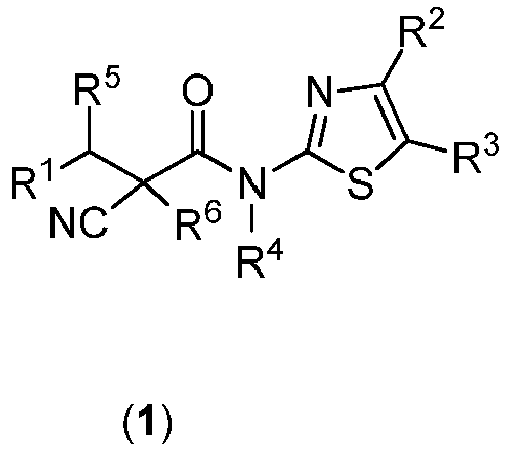
Description
- The present invention relates to substituted propanamides as inhibitors of nucleases, especially nuclease MRE11 and MRE11-containing complexes, pharmaceutical compositions containing the compounds, and methods of treatment using the compounds and compositions to treat diseases such as cancer, neurological disorders and other genome instability associated diseases.
- Despite intense development of new anticancer substances, the clinical treatment of most frequently diagnosed solid tumors needs to be improved and for some malignancies reasonably efficient therapies need to be developed, as they are practically non-existent. Early detection followed by surgery remains the main tool that enables significant expansion of life span for majority of patients. In most malignancies it may be necessary to modulate (preferably in a synergistic manner) several relevant biological pathways. Accordingly, the required phenotype (death of tumor cells) can be elicited by synthetic lethal modulation of properly chosen biological processes. Synthetic lethal interactions tend to form clusters; one significant network of such interactions encompasses the biological processes involved in the DNA damage/repair. Selective and efficient activity modulation of selected processes is therefore of significant importance and can lead to a new generation of modern anticancer drugs.
- Maintenance of genomic integrity ensured by multifaceted cellular DNA damage response (DDR) is a fundamental biological phenomenon shared by all organisms. On one hand, the DDR network of genome surveillance, checkpoint and repair pathways counterbalances the potentially mutagenic effects of endogenous (oxidative and replicative lesions) and exogenous (e.g. ionizing or UV radiation, cigarette smoke) DNA damaging assaults. On the other hand, modulation of selected components can be exploited in efficient treatment of malignant diseases. It is likely that optimal synthetic lethal treatments will be different for particular tumor sub-populations; this approach is therefore compatible with the concept of personalized medicine.
- Amongst the DNA repair processing enzymes, the MRE11-RAD50-NBS1 (MRN) complex plays an important role in preserving genomic integrity by acting as a DNA damage sensor of double strand breaks (DSB) and by promoting repair through non-homologous end-joining (NHEJ) or homologous recombination (Nature Reviews 2002, 3, 317.; Trends Biochem. Sciences 2002, 27, 410.). In response to DSB, MRN activates and recruits ATM (belonging to the phosphatidylinositol-3' kinase-related kinases (PIKKs) family) to damaged DNA sites. ATM initiates a signaling cascade leading to cell cycle arrest and DNA repair. MRE11 is the subunit core of the MRN complex and displays 3'-5'exonuclease activity, single-stranded and DNA-hairpin endonuclease activity. The MRE11-RAD50 complex functions include DNA binding, bridging the ends of DSBs and their processing. NBS1 does not possess any enzymatic activity; its role lies in signaling and interacting with other proteins (DNA Repair 2010, 9, 1299.; Cell 2008, 135, 97.). The significance of MRN complex is underlined by the fact that germline mutations of MRE11, NBS1 and RAD50 cause ataxia-telangiectasia-like disease (ATLD), Nijmegen breakage syndrome (NBS) and NBS-like disorder (NBSLD), respectively (Cell 1998, 93, 477.; Cell, 1999, 99, 577.; Am. J. Hum. Genet. 2009, 84, 605). ATLD, NBS and NBSLD have similar features as does ataxia-telangiectasia (AT), caused by mutations in the ATM gene, which include hypersensitivity to DSB-inducing agents, chromosome fragility, DNA damage-dependent cell-cycle arrest and high predisposition to cancer (Cell 1998, 93, 477.; Oncogene 2007, 26, 7749; Cell 1999, 99, 577.; Am. J. Hum. Genet. 2009, 84, 605.). In addition, depletion of MRE11 leads to sensitization to poly(ADP-ribose) polymerase (PARP) inhibition (Cancer Res. 2011, 71, 2632.). Futhermore, MRE11-deficient cells are also sensitive to topoisomerase poisons, suggesting a role of MRE11 in removal of TOP1/TOP2-lessions and in stimulating an effect of topo inhibitors ( Mol. Cell. Biol. 2004, 24, 9682.). Indeed, triapine (RNR inhibitor) was recently shown to block MRN-mediated recombination and sensitize ovarian cancer cells to PARP and topo inhibitors (Mol. Cancer Res. 2014, 12, 381.; Cancer Res. 2012, 72, 2814.). Therapeutic importance of MRE11 inhibitors in modern oncology is further supported by recently reported synthetically lethal genetic interactions for MRE11-FEN1 (PLoS Genet. 2013, 9, 1, e1003254.) and MRE11-BRCA2 (Cancer Res., 2012, 72, 2814.). Defects in some DNA repair processes also manifest themselves in neuronal tissues and thus can be associated with human neurological disorders (Cell 2007, 130, 991.). Mirin and two its structurally closely related analogs PFM01 and PFM03 (Mol. Cell 2014, 53, 1.;
WO 2010/075372 ) are essentially the only reported examples of (relatively weak) inhibitors of MRE11 nuclease. - The present invention provides substituted propanamide compounds, methods of preparing such compounds, pharmaceutical compositions comprising one or more of such compounds, methods of preparing pharmaceutical formulations comprising one or more of such compounds, and methods of treatment, prevention, inhibition or amelioration of one or more diseases, preferably diseases associated with MRE11 nuclease and/or MRE11-related DNA repair pathways using such compounds or pharmaceutical compositions.
- The present invention provides compounds represented by general formula (1):
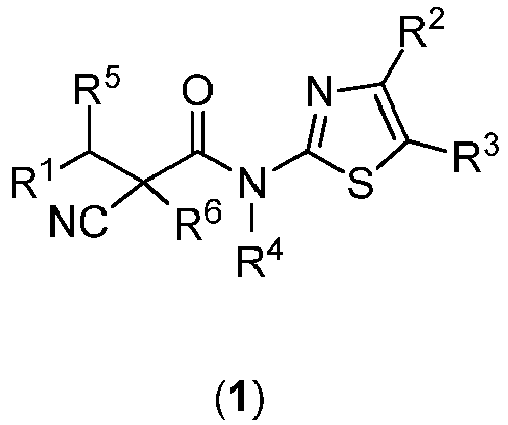
- R1 is selected from the group consisting of alkyl; aryl; cycloalkyl; heterocyclyl; and heteroaryl; wherein each of the alkyl, aryl, cycloalkyl, heterocyclyl, heteroaryl, can be unsubstituted or optionally substituted with one or more moieties which can be the same or different, each moiety being independently selected from the group consisting of F, Cl, Br, I, OH, CN, N3,=O, O(C1-C6-alkyl), =S, SH, S(C1-C6-alkyl), S(O)C1-C6-alkyl, S(O)2C1-C6-alkyl, CF3, C2F5, OCF3, OC2F5, NH2, NH(C1-C6-alkyl), N(C1-C6-alkyl)2 (such as N(CH3)2), =N-OH, =N-O(C1-C6-alkyl), NO2, COOH, COO(C1-C6-alkyl), CO(C1-C6-alkyl), CONH2, CONH(C1-C6-alkyl), CON(C1-C6-alkyl)2, (C1-C6-alkyl)-S(O)2-NH-, (C1-C6-alkyl)-S(O)2-N(C1-C6-alkyl)-, (C1-C6-alkyl)-NH-(SO)2-, (C1-C6-alkyl)2N-(SO)2-, (C1-C6-alkyl)-CO-NH-, (C1-C6-alkyl)-CO-N(C1-C6-alkyl)-, (C1-C6-alkyl)-OCO-NH-, (C1-C6-alkyl)-OCO-N(C1-C6-alkyl)-, (C1-C6-alkyl)-CO-NH-CO-, (C1-C6-alkyl)-CO-N(C1-C6-alkyl)-CO-, NH2-CO-NH-, (C1-C6-alkyl)-NH-CO-NH-, (C1-C6-alkyl)2N-CO-NH-, NH2-CO-N(C1-C6-alkyl)-, (C1-C6-alkyl)-NH-CO-NCC1-C6-alkyl)-, (C1-C6-alkyl)2N-CO-N(C1-C6-alkyl)-, NH2-S(O)2-NH-, (C1-C6-alkyl)-NH-S(O)2-NH-, (C1-C6-alkyl)2N-S(O)2-NH-, NH2-S(O)2-N(C1-C6-alkyl)-, (C1-C6-alkyl)-NH-S(O)2-N(C1-C6-alkyl)-, (C1-C6-alkyl)2N-S(O)2N(C1-C6-alkyl)-, C1-C6-alkyl, O-C1-C6-alkyl, O-phenyl, phenyl;
whereas the C1-C6-alkyl, O-phenyl, phenyl in these moieties can optionally be further substituted by one or more substituents selected independently from: F, Cl, Br, I, C1-C6-alkyl, OH, O-C1-C6-alkyl, SH, SCH3, S(O)C1-C6-alkyl, S(O)2C1-C6-alkyl, CF3, OCF3, NH2, NH(C1-C6-alkyl), N(C1-C6-alkyl)2 (such as N(CH3)2), NO2, COOH, COO(C1-C6-alkyl), CONH2, CONH(C1-C6-alkyl), CON(C1-C6-alkyl)2, NHC(O)C1-C6-alkyl, or NHC(O)NH2; - R2 is selected from the group consisting of aryl; heteroaryl; cycloalkyl; heterocyclyl; and alkyl;
wherein each of the alkyl, aryl, cycloalkyl, heterocyclyl, heteroaryl, can be unsubstituted or optionally substituted with one or more moieties which can be the same or different, each moiety being independently selected from the group consisting of F, Cl, Br, I, OH, CN, N3, =O, O(C1-C6-alkyl), =S, SH, S(C1-C6-alkyl), S(O)C1-C6-alkyl, S(O)2C1-C6-alkyl, CF3, C2F5, OCF3, OC2F5, NH2, NH(C1-C6-alkyl), N(C1-C6-alkyl)2 (such as N(CH3)2), =N-OH, =N-O(C1-C6-alkyl), NO2, COOH, COO(C1-C6-alkyl), CO(C1-C6-alkyl), CONH2, CONH(C1-C6-alkyl), CON(C1-C6-alkyl)2, (C1-C6-alkyl)-S(O)2-NH-, (C1-C6-alkyl)-S(O)2-N(C1-C6-alkyl)-, (C1-C6-alkyl)-NH-(SO)2-, (C1-C6-alkyl)2N-(SO)2-, (C1-C6-alkyl)-CO-NH-, (C1-C6-alkyl)-CO-N(C1-C6-alkyl)-, (C1-C6-alkyl)-OCO-NH-, (C1-C6-alkyl)-OCO-N(C1-C6-alkyl)-, (C1-C6-alkyl)-CO-NH-CO-, (C1-C6-alkyl)-CO-N(C1-C6-alkyl)-CO-, NH2-CO-NH-, (C1-C6-alkyl)-NH-CO-NH-, (C1-C6-alkyl)2N-CO-NH-, NH2-CO-N(C1-C6-alkyl)-, (C1-C6-alkyl)-NH-CO-N(C1-C6-alkyl)-, (C1-C6-alkyl)2N-CO-N(C1-C6-alkyl)-, NH2-S(O)2-NH-, (C1-C6-alkyl)-NH-S(O)2-NH-, (C1-C6-alkyl)2N-S(O)2-NH-, NH2-S(O)2-N(C1-C6-alkyl)-, (C1-C6-alkyl)-NH-S(O)2-N(C1-C6-alkyl)-, (C1-C6-alkyl)2N-S(O)2-N(C1-C6-alkyl)-, C1-C6-alkyl, O-C1-C6-alkyl, O-phenyl, phenyl, heterocyclyl, heteroaryl;
whereas the C1-C6-alkyl, O-phenyl, phenyl, heterocyclyl, heteroaryl in these moieties can optionally be further substituted by one or more substituents selected independently from: F, Cl, Br, C1-C6-alkyl, OH, O-C1-C6-alkyl, SH, SCH3, S(O)C1-C6-alkyl, S(O)2C1-C6-alkyl, CF3, OCF3, NH2, NH(C1-C6-alkyl), N(C1-C6-alkyl)2 (such as N(CH3)2), NO2, COOH, COO(C1-C6-alkyl), CONH2, CONH(C1-C6-alkyl), CON(C1-C6-alkyl)2, NHC(O)C1-C6-alkyl, or NHC(O)NH2, - R3 is selected from the group consisting of H; aryl; cycloalkyl; halogen; alkyl; heterocyclyl; and heteroaryl,
wherein each of the aryl, cycloalkyl, alkyl or heteroaryl can be unsubstituted or optionally substituted with one or more moieties which can be the same or different, each moiety being independently selected from the group consisting of F, Cl, Br, I, OH, CN, N3, =O, O(C1-C6-alkyl), =S, SH, S(C1-C6-alkyl), S(O)C1-C6-alkyl, S(O)2C1-C6-alkyl, CF3, C2F5, OCF3, OC2F5, NH2, NH(C1-C6-alkyl), N(C1-C6-alkyl)2 (such as N(CH3)2), =N-OH, =N-O(C1-C6-alkyl), NO2, COOH, COO(C1-C6-alkyl), CO(C1-C6-alkyl), CONH2, CONH(C1-C6-alkyl), CON(C1-C6-alkyl)2, (C1-C6-alkyl)-S(O)2-NH-, (C1-C6-alkyl)-S(O)2-N(C1-C6-alkyl)-, (C1-C6-alkyl)-NH-(SO)2-, (C1-C6-alkyl)2N-(SO)2-, (C1-C6-alkyl)-CO-NH-, (C1-C6-alkyl)-CO-N(C1-C6-alkyl)-, (C1-C6-alkyl)-OCO-NH-, (C1-C6-alkyl)-OCO-N(C1-C6-alkyl)-, (C1-C6-alkyl)-CO-NH-CO-, (C1-C6-alkyl)-CO-N(C1-C6-alkyl)-CO-, NH2-CO-NH-, (C1-C6-alkyl)-NH-CO-NH-, (C1-C6-alkyl)2N-CO-NH-, NH2-CO-N(C1-C6-alkyl)-, (C1-C6-alkyl)-NH-CO-N(C1-C6-alkyl)-, (C1-C6-alkyl)2N-CO-N(C1-C6-alkyl)-, NH2-S(O)2-NH-, (C1-C6-alkyl)-NH-S(O)2-NH-, (C1-C6-alkyl)2N-S(O)2-NH-, NH2-S(O)2-N(C1-C6-alkyl)-, (C1-C6-alkyl)-NH-S(O)2-N(C1-C6-alkyl)-, (C1-C6-alkyl)2N-S(O)2-N(C1-C6-alkyl)-, C1-C6-alkyl, O-C1-C6-alkyl, O-phenyl, phenyl;
whereas the C1-C6-alkyl, O-phenyl, phenyl in these moieties can optionally be further substituted by one or more substituents selected independently from: alkyl, O-phenyl, phenyl being optionally substituted by F, Cl, Br, C1-C6-alkyl, OH, O-C1-C6-alkyl, SH, SCH3, S(O)C1-C6-alkyl, S(O)2C1-C6-alkyl, CF3, OCF3, NH2, NH(C1-C6-alkyl), N(C1-C6-alkyl)2 (such as N(CH3)2), NO2, COOH, COO(C1-C6-alkyl), CONH2, CONH(C1-C6-alkyl), CON(C1-C6-alkyl)2, NHC(O)C1-C6-alkyl, or NHC(O)NH2, - R2 and R3 together with the carbon atoms to which they are bound may also form an aliphatic or aromatic ring structure, preferably a monocyclic or polycyclic ring structure having 5-10 ring atoms selected from C, N, O, S;
- R4 is selected from the group consisting of H and C1-C6-alkyl;
- R5 is selected from the group consisting of H; C1-C6-alkyl; and aryl;
- R6 is selected from the group consisting of H and C1-C6-alkyl;
- or R5 and R6 together with the -CH2-CH2- moiety connecting these two substituents may form a cyclopropyl ring, unsubstituted or optionally substituted with alkyl, O-phenyl, phenyl being optionally substituted by F, Cl, Br, C1-C6-alkyl, OH, O-C1-C6-alkyl, SH, SCH3, S(O)C1-C6-alkyl, S(O)2C1-C6-alkyl, CF3, OCF3, NH2, NH(C1-C6-alkyl), N(C1-C6-alkyl)2 (such as N(CH3)2), NO2, COOH, COO(C1-C6-alkyl), CONH2, CONH(C1-C6-alkyl), CON(C1-C6-alkyl)2, NHC(O)C1-C6-alkyl, or NHC(O)NH2.
- In this description and unless indicated otherwise, the generic substituent groups have the following meanings:
- "alkyl" means an aliphatic hydrocarbon group which may be straight or branched and contains 1 to 8 carbon atoms, preferably 1 to 6 carbon atoms, even more preferably 1 to 4 carbon atoms, in the chain. Examples of suitable alkyls are methyl, ethyl, propyl, isopropyl, butyl, isobutyl, tert-butyl, pentyl, isopentyl, hexyl;
- "aryl" means an aromatic monocyclic or polycyclic ring system containing 6 to 14 carbon atoms, preferably 6 to 10 carbon atoms. Aryls can preferably be monocyclic or bicyclic or tricyclic, condensed or non-condensed. Examples of suitable aryls are phenyl, naphthyl, biphenyl,
- "cycloalkyl" means an aliphatic monocyclic or polycyclic ring system comprising 3 to 10 carbon atoms, preferably 5 to 7 carbon atoms. Suitable examples include cyclopentyl, cyclohexyl, cycloheptyl, 1-decalinyl, norbornyl, adamantyl;
- "heterocyclyl" means an aliphatic monocyclic or polycyclic ring system containing 3 to 10 carbon atoms, preferably 4 to 8 carbon atoms, and at least one heteroatom selected from the group consisting of nitrogen, oxygen and sulfur. Suitable examples include piperazinyl and morpholinyl;
- "heteroaryl" means an aromatic monocyclic or polycyclic ring system containing 3 to 14 carbon atoms, preferably 3 to 7 carbon atoms, and at least one heteroatom selected from the group consisting of nitrogen, oxygen and sulfur. Heteroaryls can preferably be monocyclic or bicyclic or tricyclic, condensed or non-condensed. Examples of suitable heteroaryls are pyridyl, pyrimidinyl, pyrazinyl, furanyl, thienyl, pyrazolyl, oxazolyl, thiazolyl, isothiazolyl, isoxazolyl, pyrrolyl, imidazolyl, benzimidazolyl, dihydrobenzimidazolyl, indolyl, indolinolyl, imidazopyridazinyl, benzoxazinyl, dihydrobenzoxazinyl, benzofuranyl. Especially preferred are heteroaryls containing at least one nitrogen atom.
- Pharmaceutically acceptable salts are salts with acids or bases, or acid addition salts. The acids and bases can be inorganic or organic acids and bases commonly used in the art of formulation, such as hydrochloride, hydrobromide, sulfate, bisulfate, phosphate, hydrogen phosphate, acetate, benzoate, succinate, fumarate, maleate, lactate, citrate, tartrate, gluconate, methanesulfonate, benzenesulfonate, para-toluenesulfonate, primary, secondary and tertiary amides, ammonia. Solvates are structures containing molecules of a solvent, such as water (hydrates) or any other pharmaceutically acceptable solvent molecules.
- R1 is preferably selected from C6-C12 aryl and heteroaryl having 5 to 12 ring atoms, wherein said aryl or heteroaryl is monocyclic, bicyclic or tricyclic, and the rings may be condensed or non-condensed. The aryls and heteroaryls include condensed rings wherein one or more rings are aromatic and one or more rings are aliphatic. The aryl or heteroaryl may optionally be substituted by one or more substituents, independently selected from the group consisting of F, Cl, Br, OH, C1-C6 alkyl, O(C1-C4 alkyl), phenyl, O-phenyl, NH2, N(C1-C4 alkyl)2, NO2, NHCO(C1-C4 alkyl), CF3, OCF3, CN, S(O)2C1-C6-alkyl, SO2NH(C1-C6-alkyl), SO2N(C1-C6-alkyl)2.
More preferably, the aryl in R1 is phenyl, biphenyl or naphthyl.
More preferably, the substituents attached to the aryl or heteroaryl in R1 are selected from F, Cl, Br, C1-C6 alkyl, O(C1-C4 alkyl), NO2, NHCO(C1-C4 alkyl), CF3, CN, phenyl, OH; or the substituents may be selected from S(O)2C1-C6-alkyl, SO2NH(C1-C6-alkyl), SO2N(C1-C6-alkyl)2. - More preferably, R1 is selected from C6-C12 aryl (preferably phenyl) and heteroaryl having 5 to 12 ring atoms, said aryl or heteroaryl is monocyclic, bicyclic or tricyclic, and the rings may be condensed or non-condensed. The aryls and heteroaryls include condensed rings wherein one or more rings are aromatic and one or more rings are aliphatic. The aryl or heteroaryl is substituted with one to three OH groups, preferably with two OH groups or one OH group and one group selected from CN, Cl, Br, F. Preferably, the OH groups are in vicinal positions. The aryl or heteroaryl may optionally be substituted by one or more further substituents, independently selected from the group consisting of F, Cl, Br, C1-C6 alkyl, O(C1-C4 alkyl), phenyl, O-phenyl, NH2, N(C1-C4 alkyl)2, NO2, NHCO(C1-C4 alkyl), CF3, OCF3, CN, S(O)2C1-C6-alkyl, SO2NH(C1-C6-alkyl), SO2N(C1-C6-alkyl)2; in particular selected from F, Cl, Br, C1-C6 alkyl, O(C1-C4 alkyl), CF3, OCF3.
- Most preferably, R1 is 3,4-dihydroxyphenyl.
- In one embodiment, R2 is preferably selected from aryl, cycloalkyl which may optionally be substituted by one or more substituents, independently selected from the group consisting of F, Cl, Br, OH, C1-C6 alkyl, S(O)2C1-C6-alkyl, CF3, OCF3, SO2NH(C1-C6-alkyl), SO2N(C1-C6-alkyl)2.
In another embodiment, R2 is preferably selected from C6-C12 aryl and heteroaryl having 5 to 12 ring atoms, wherein said aryl or heteroaryl is monocyclic, bicyclic or tricyclic, and the rings may be condensed or non-condensed. The aryl or heteroaryl may optionally be substituted by one or more substituents, independently selected from the group consisting of F, Cl, Br, OH, C1-C6 alkyl, O-C1-C6 alkyl, phenyl, O-phenyl, NH2, N(C1-C4 alkyl)2, NO2, NHCO(C1-C4 alkyl), CF3, OCF3, CN, SO2NH(C1-C6-alkyl), SO2N(C1-C6-alkyl)2, S(O)2C1-C6-alkyl.
More preferably, the aryl in R2 is phenyl, biphenyl or naphthyl. - R2 is preferably selected from C6-C12 aryl and heteroaryl having 5 to 12 ring atoms, which may optionally be substituted by one or more substituents, independently selected from the group consisting of F, Cl, Br, C1-C4 linear or branched alkyl, phenyl, morpholinyl, C3-C5 cycloalkyl, O(C1-C4 alkyl), phenyl, O-phenyl, NH2, N(C1-C4 alkyl)2, NO2, NHCO(C1-C4 alkyl), CF3, OCF3, CN, S(O)2C1-C6-alkyl, SO2NH(C1-C6-alkyl), SO2N(C1-C6-alkyl)2; in particular selected from F, Cl, Br, C1-C6 alkyl, O(C1-C4 alkyl), CF3, OCF3.
- More preferably, R2 is selected from phenyl, naphthyl, benzofuranyl, pyridyl, thiophenyl, pyridazinyl, which are unsubstituted or substituted with one to two substituents selected independently from O(C1-C4 alkyl), phenyl, morpholinyl, OH, C1-C4 linear or branched alkyl, C3-C5 cycloalkyl, F, Br, Cl, CF3, OCF3.
- R3 is preferably selected from H, phenyl, methyl, ethyl, propyl, isopropyl, butyl, isobutyl, tert-butyl, F, Cl, Br, cyclopropyl, cyclobutyl, cyclopentyl, cyclohexyl, tetrahydropyranyl, tetrahydrofuranyl, piperidinyl, which are unsubstituted or substituted by one or more substituents, independently selected from the group consisting of F, Cl, Br, OH, C1-C6 alkyl, phenyl, NH2, N(C1-C4 alkyl)2, NO2, NHCO(C1-C4 alkyl), CF3, OCF3, CN, SO2NH(C1-C6-alkyl), SO2N(C1-C6-alkyl)2, S(O)2C1-C6-alkyl.
- R4 is preferably selected from H, methyl, ethyl, isopropyl. For example, R4 is H.
- R5 is preferably selected from H, phenyl. More preferably, R5 is H.
- R6 is preferably selected from H, methyl, ethyl, isopropyl. For example, R6 is H.
- In all preferred embodiments, the alkyls, O-phenyls and phenyls may optionally be further substituted by one or more substituents selected from F, Cl, Br, C1-C6-alkyl, OH, O-C1-C6-alkyl, SH, SCH3, S(O)C1-C6-alkyl, S(O)2C1-C6-alkyl, CF3, OCF3, NH2, NH(C1-C6-alkyl), N(C1-C6-alkyl)2 (such as N(CH3)2), NO2, COOH, COO(C1-C6-alkyl), CONH2, CONH(C1-C6-alkyl), CON(C1-C6-alkyl)2, NHC(O)C1-C6-alkyl, or NHC(O)NH2.
- It should be understood that the preferred and/or specific embodiments of the substituent groups can be combined in any combinations, and they can be combined in any combinations with the most general embodiments of the substituent groups.
- In particular, the present invention encompasses the following compounds:
3-(4-acetamidophenyl)-2-cyano-N-(4-phenylthiazol-2-yl)propanamide N-(4-(4-bromophenyl)thiazol-2-yl)-2-cyano-3-(3,4-dihydroxyphenyl)propanamide 2-cyano-3-(3,4-dihydroxyphenyl)-N-(4-phenylthiazol-2-yl)propanamide 2-cyano-N-(4-(4-cyanophenyl)thiazol-2-yl)-3-(3,4-dihydroxyphenyl)propanamide 2-cyano-3-(3,4-dihydroxyphenyl)-N-(4-(4-(trifluoromethyl)phenyl)thiazol-2-yl)propanamide 2-cyano-3-(3,4-dihydroxyphenyl)-N-(4-(p-tolyl)thiazol-2-yl)propanamide 2-cyano-3-(3,5-dichloro-4-hydroxyphenyl)-N-(4,5-diphenylthiazol-2-yl)propanamide 2-cyano-3-(3,4-dihydroxyphenyl)-N-(4-phenyl-5-(p-tolyl)thiazol-2-yl)propanamide 2-cyano-3-(3,4-dihydroxyphenyl)-N-(4-(4-(trifluoromethoxy)phenyl)thiazol-2-yl)propanamide 2-cyano-3-(3,5-dichloro-4-hydroxyphenyl)-N-(4-(4-(trifluoromethoxy)phenyl)thiazol-2-yl)propanamide N-(4-([1,1'-biphenyl]-3-yl)thiazol-2-yl)-2-cyano-3-(3,4-dihydroxyphenyl)propanamide 2-cyano-3-(3,5-di-tert-butyl-4-hydroxyphenyl)-N-(4-phenylthiazol-2-yl)propanamide N-(4-(4-(tert-butyl)phenyl)thiazol-2-yl)-2-cyano-3-(3,4-dihydroxyphenyl)propanamide 2-(3,4-dihydroxybenzyl)-N 1-(4-phenylthiazol-2-yl)malonamide 3-(1H-benzo[d]imidazol-6-yl)-2-cyano-N-(4-phenylthiazol-2-yl)propanamide 2-cyano-3-(3,5-dichloro-4-hydroxyphenyl)-N-(4-(naphthalen-2-yl)thiazol-2-yl)propanamide 2-cyano-3-(3,4-dihydroxyphenyl)-N-(4-(thiophen-3-yl)thiazol-2-yl)propanamide 2-cyano-N-(5-cyclohexyl-4-phenylthiazol-2-yl)-3-(3,4-dihydroxyphenyl)propanamide 2-cyano-3-(4-hydroxy-3,5-dimethylphenyl)-N-(4-phenylthiazol-2-yl)propanamide 3-(2-bromo-3,4-dihydroxyphenyl)-2-cyano-N-(4-phenylthiazol-2-yl)propanamide N-(4-(4-(tert-butyl)phenyl)thiazol-2-yl)-2-cyano-3-(4-hydroxy-3,5-dimethylphenyl)propanamide N-(4-(4-(tert-butyl)phenyl)thiazol-2-yl)-2-cyano-3-(3,5-di-tert-butyl-4-hydroxyphenyl)propanamide 2-cyano-3-(3-cyano-4-hydroxyphenyl)-N-(4-phenylthiazol-2-yl)propanamide 2-cyano-3-(3,4-dihydroxyphenyl)-N-(4-(5-methylthiophen-3-yl)thiazol-2-yl)propanamide 2-cyano-3-(3,4-dihydroxyphenyl)-N-(4-(5,6,7,8-tetrahydronaphthalen-2-yl)thiazol-2-yl)propanamide 2-cyano-N-(4-(4-cyclohexylphenyl)thiazol-2-yl)-3-(3,4-dihydroxyphenyl)propanamide 3-(3-chloro-4-hydroxy-5-methylphenyl)-2-cyano-N-(4-phenylthiazol-2-yl)propanamide 3-(3-chloro-5-fluoro-4-hydroxyphenyl)-2-cyano-N-(4-phenylthiazol-2-yl)propanamide 2-cyano-3-(3,4-dihydroxyphenyl)-N-(4-(pyridin-2-yl)thiazol-2-yl)propanamide 2-cyano-3-(3,4-dihydroxyphenyl)-N-(4-(6-methylpyridin-2-yl)thiazol-2-yl)propanamide 2-cyano-3-(3,4-dihydroxyphenyl)-N-(4-(2-(trifluoromethyl)phenyl)thiazol-2-yl)propanamide 2-cyano-N-(4-(3,4-dichlorophenyl)thiazol-2-yl)-3-(3,4-dihydroxyphenyl)propanamide 2-cyano-3-(3,4-dihydroxyphenyl)-N-(4-(o-tolyl)thiazol-2-yl)propanamide N-(4-(3-chlorophenyl)thiazol-2-yl)-2-cyano-3-(3,4-dihydroxyphenyl)propanamide 3-(3,5-bis(trifluoromethyl)phenyl)-2-cyano-N-(4-phenylthiazol-2-yl)propanamide 2-cyano-3-(3,4-dihydroxyphenyl)-N-(4-(4-methylpyridin-2-yl)thiazol-2-yl)propanamide 2-cyano-3-(3,4-dihydroxyphenyl)-N-(4-(5-methylpyridin-2-yl)thiazol-2-yl)propanamide 2-cyano-3-(3,4-dihydroxyphenyl)-N-(4-(4-isopropylphenyl)thiazol-2-yl)propanamide 2-cyano-3-(3,4-dihydroxyphenyl)-N-(4-(4-methoxypyridin-2-yl)thiazol-2-yl)propanamide 2-cyano-3-(3,4-dihydroxyphenyl)-N-(4-(5-methoxypyridin-2-yl)thiazol-2-yl)propanamide 2-cyano-3-(3,5-di-tert-butyl-4-hydroxyphenyl)-N-(4-(pyridin-2-yl)thiazol-2-yl)propanamide 2-cyano-3-(3,4-dihydroxyphenyl)-N-(4-(6-methoxypyridin-2-yl)thiazol-2-yl)propanamide 2-cyano-N-(4-(2,4-dichlorophenyl)thiazol-2-yl)-3-(3,4-dihydroxyphenyl)propanamide 2-cyano-3-(3,4-dihydroxyphenyl)-N-(4-(3-fluoropyridin-2-yl)thiazol-2-yl)propanamide 2-cyano-3-(3,4-dihydroxyphenyl)-N-(4-(2-fluoro-4-methoxyphenyl)thiazol-2-yl)propanamide 2-cyano-3-(3,4-dihydroxyphenyl)-N-(4-(4-(trifluoromethyl)pyridin-2-yl)thiazol-2-yl)propanamide 2-cyano-N-(4-(2,5-dichlorothiophen-3-yl)thiazol-2-yl)-3-(3,4-dihydroxyphenyl) propanamide 2-cyano-3-(3,4-dihydroxyphenyl)-N-(4-phenylthiazol-2-yl)butanamide 2-cyano-3-(3,4-dihydroxyphenyl)-2-methyl-N-(4-phenylthiazol-2-yl)propanamide - In general, the compounds described in this invention can be prepared through the general routes described below in Scheme 1.
- Briefly, condensation of appropriate bromoketone (2) with thiourea provides the corresponding aminothiazole (3), which reacts with ethyl cyanoacetate under basic conditions to afford the corresponding amide (4). Alternatively, amide (4) can be prepared in two steps from aminothiazole (3) via reaction with chloroacetyl chloride followed by reaction with potassium cyanide. Subsequent condensation with appropriate aldehyde or ketone compound in the presence of a base followed by reduction provides the target compound (1) (where R6 = H). Target compounds (1) with R6 = alkyl can be prepared from proper compounds (1) with R6 = H by alkylation. Alternatively, properly functionalized cyanoacetate (5) can be condensed with aminothiazole (3) to provide target compounds (1).
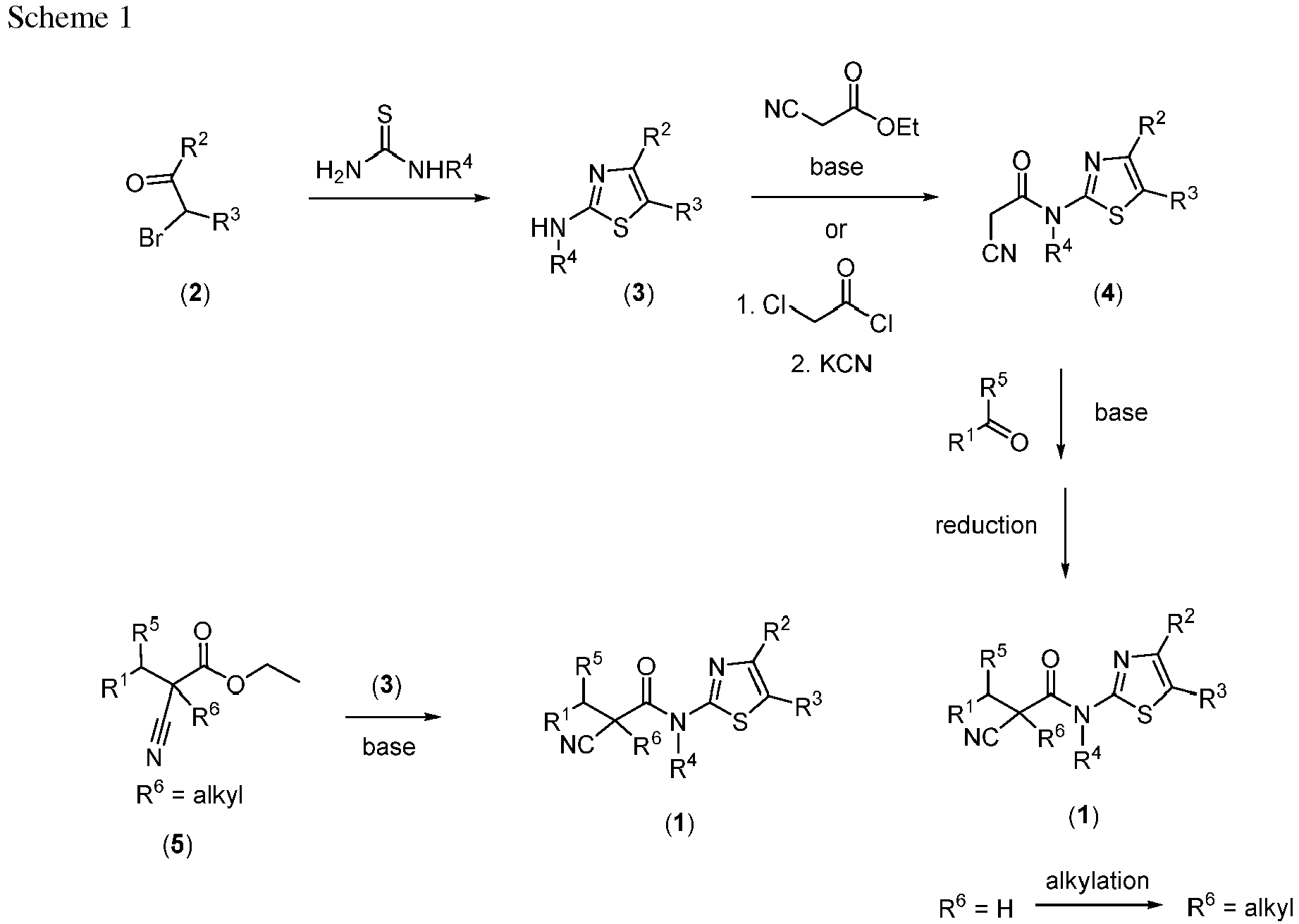
- Target compounds (1) with R5 = alkyl can be prepared from proper unsaturated precursors via addition of cuprate (Scheme 2).

- The compounds of Formula (1) act as inhibitors of nuclease MRE11, and are useful in the treatment and prevention of diseases associated with genome instability, e.g. cancer (in particular breast, colon, prostate, lung, head and neck, hepatic, ovarian, colorectal, gastric, melanoma cancers, leukemias, Nijmegen breakage syndrome and Nijmegen breakage-like syndrome, Ataxia-telangiectasia and Ataxia-telangiectasia-like disorder, and Fanconi anemia), premature aging and neurological diseases.
- The present invention thus provides the compounds of formula (1) for use as medicaments. More specifically, it provides the compounds of formula (1) for use in the treatment and prevention of conditions selected from genome instability-associated diseases, e.g. cancer (in particular breast, colon, prostate, lung, head and neck, hepatic, ovarian, colorectal, gastric, melanoma cancers, leukemias, Nijmegen breakage syndrome and Nijmegen breakage-like syndrome, Ataxia-telangiectasia and Ataxia-telangiectasia-like disorder, and Fanconi anemia), premature aging and neurological diseases. In one embodiment, the present invention provides the compounds of formula (1) for use in the treatment of solid tumors with mutated BRCA-2. Tests for diagnosing BRCA-2 mutations are commercially available.
- The present invention also provides a method for treatment, inhibition, amelioration or prevention of a condition selected from genome instability-associated diseases, e.g. cancer (in particular breast, colon, prostate, lung, head and neck, hepatic, ovarian, colorectal, gastric, melanoma cancers, leukemias, Nijmegen breakage syndrome and Nijmegen breakage-like syndrome, Ataxia-telangiectasia and Ataxia-telangiectasia-like disorder, and Fanconi anemia), premature aging and neurological diseases in a patient suffering from such condition, comprising the step of administering at least one compound of formula (1) to said patient.
- The present invention further includes pharmaceutical compositions comprising at least one compound of formula (1) and at least one pharmaceutically acceptable auxiliary compound. The auxiliary compounds may include, e.g., carriers, diluents, fillers, preservatives, stabilisers, binders, wetting agents, emulsifiers, buffers, etc. Suitable auxiliary compounds are well known to those skilled in the art of formulation. The pharmaceutical compositions are prepared by known methods, e.g., mixing, dissolving, etc.
- The present invention may also provide novel compounds of general formula (1) as defined above, including the preferred embodiments, with the proviso that if R1 is phenyl, then it is not substituted by two alkoxy substituents attached to the phenyl through oxygen atom.
- The present invention provides substituted propanamides which are represented by general formula (1), or pharmaceutically acceptable salts, solvates, esters or prodrugs thereof, wherein the various moieties are as described above.
- All commercially available reagents were used as supplied without further purification. The reaction solvents were purchased anhydrous and were stored under nitrogen. Unless noted otherwise, the reactions were carried out in oven-dried glassware under atmosphere of nitrogen. Column chromatography was carried out using silica gel (pore size 60 Å, 230-400 mesh particle size, 40-63 µm particle size).
- Purification by preparative thin layer chromatography was performed using plates from Merck (PLC Silica gel 60 F254, 1 mm). Reverse phase column chromatography was carried out using C18-reverse phase silica gel (pore size 90 Å, 230-400 mesh particle size, 40-63 µm particle size). NMR spectra were obtained in indicated deuterated solvents; chemical shifts are quoted in parts per million (δ) referenced to the appropriate deuterated solvent employed. Multiplicities are indicated by s (singlet), d (doublet), t (triplet), q (quartet), p (pentet), sept (septet), m (multiplet) or (br) broad, or combinations thereof. Coupling constant values are given in Hz.
- To a cold solution (0 °C) of the substrate (i.e. appropriate acetophenone derivative) in CH2Cl2 (14 mL per 1 mmol of the substrate, unless stated otherwise) was added Br2 (1 eq), the resulting mixture was allowed to warm to 25 °C and stirred for 1 h (unless stated otherwise). A saturated aqueous solution of NaHCO3 (3 mL per 1 mmol of the substrate) was added and the mixture was extracted with CH2Cl2 (3 mL per 1 mmol of the substrate). The combined organic extracts were washed with a 10% aqueous solution of Na2S2O3 (2 mL per 1 mmol of the substrate), brine (2 mL per 1 mmol of the substrate), dried over MgSO4, filtered, and the solvent was evaporated in vacuo. The resulting product - the desired bromoketone - was used directly without further purification in the next step.
- To a solution of the appropriate acetophenone derivative in a mixture of CHCl3 and EtOAc (1:1) (2 mL per 1 mmol of the substrate, unless stated otherwise), was added CuBr2 (2 eq.) and the resulting mixture was refluxed for 2 h. The mixture was filtered through a HPLC filter and evaporated in vacuo. The product was dried under vacuum and put to next step without further purification.
- To a solution of the appropriate acetophenone derivative in CH2Cl2 (2 mL per 1 mmol of the substrate, unless stated otherwise), were added NEt3 (1.2 eq) and TMFOTf (1.1 eq.) at 0 °C. The mixture was allowed to warm to 25 °C and stirred for 16 h. The reaction mixture was then again cooled to 0 °C and NBS (1.1 eq.) was added. The mixture was stirred at 0 °C for 15-30 min. The crude mixture was absorbed on silica and quickly filtered through a pad of silica gel (hexane:EtOAc; 1:1, unless stated otherwise) to provide the desired bromo-acetophenone, which was used directly in the next step.
- The appropriate acetophenone (1 eq) was added to the solution of HBr (47% in H2O, 3 eq) and acetic acid (3 mL per 1 mmol of the substrate, unless stated otherwise) at 25 °C. Then Br2 (1.1 eq) was added dropwise at 25 °C and the resulting reaction mixture was stirred at 25 °C for 16 h.
- Then diethyl ether (5 mL per 1 mmol of the substrate) was added and the reaction mixture was stirred for 30 minutes. The formed precipitate was collected by filtration, washed with diethyl ether (2 x 2 mL per mmol of the substrate) and dried under vacuum. The crude product was used as such in the next step.
- A saturated aqueous solution of NaHCO3 was added until the pH was neutral and the mixture was extracted with EtOAc (3 x 10 mL per 1 mmol of the substrate). The combined organic extracts were dried over MgSO4, filtered, and the solvent was evaporated in vacuo. The resulting product was used directly without further purification in the next step.
- A mixture of the substrate (i.e. appropriate bromoketone) (1 eq) and thiourea (1.5 eq) in EtOH (3 mL per 1 mmol of bromoketone, unless stated otherwise) was refluxed for 2 h (unless stated otherwise).
- A saturated aqueous solution of NaHCO3 (3 mL per 1 mmol of bromoketone) was added to the mixture, which was then extracted with EtOAc (3 × 5 mL per 1 mmol of bromoketone). The combined organic extracts were washed with brine (3 mL per 1 mmol of bromoketone), dried over MgSO4, filtered, and the solvent was evaporated in vacuo. If necessary, the product was purified by column chromatography on silica gel (unless stated otherwise) to provide the desired aminothiazole.
- The solvent was evaporated in vacuo. The resulting solid was triturated with EtOAc (1 mL per 1 mmol of bromoketone) and the mixture was filtered. The solid residue was dissolved in MeOH (1 mL per 1 mmol of bromoketone). A saturated aqueous solution of NaHCO3 (3 mL per 1 mmol of bromoketone) was added and the mixture was extracted with EtOAc (3 × 5 mL per 1 mmol of bromoketone). The combined organic extracts were washed with brine (3 mL per 1 mmol of bromoketone), dried over MgSO4, filtered, and the solvent was evaporated in vacuo. The product - the desired aminothiazole - was usually sufficiently pure and was used directly without further purification (unless stated otherwise) in the next step.
- To a mixture of the appropriate aminothiazole (1 eq) and ethyl cyanoacetate (1.5 eq) in anhydrous EtOH or MeOH (2 mL per 1 mmol of aminothiazole, unless stated otherwise) was added a solution of NaOEt (21% in EtOH) (1.5 eq, unless stated otherwise) or NaOEt (about 1 mM in EtOH, freshly made from Na and anhydrous EtOH) at 25 °C. The mixture was heated to 55 °C for 5 h (unless stated otherwise). A saturated aqueous solution of NH4Cl (10 mL per 1 mmol of aminothiazole) was added and the mixture was extracted with EtOAc (3 × 15 mL per 1 mmol of aminothiazole). The organic extracts were washed with water (10 mL per 1 mmol of aminothiazole), brine (10 mL per 1 mmol of aminothiazole), dried over MgSO4, filtered, and the solvent was evaporated in vacuo. The residue was purified by column chromatography on silica gel (unless stated otherwise) to provide the desired amide.
- Step 1: To a solution of the appropriate aminothiazole (1 eq) in anhydrous acetonitrile (1 mL per 1 mmol), was added NEt3 (1 eq, unless stated otherwise) at 25 °C. The mixture was heated to 80 °C and a solution of chloroacetyl chloride (1.5 eq.) in dry acetonitrile (0.5 mL per 1 mmol) was added. The reaction mixture was stirred at 80 °C for 2 h. A saturated aqueous solution of NH4Cl (10 mL per 1 mmol of aminothiazole) was added and the mixture was extracted with EtOAc (3 × 15 mL per 1 mmol of aminothiazole). Organic phases were combined and washed with brine (10 mL per 1 mmol of aminothiazole), dried over MgSO4, filtered, and the solvent was evaporated in vacuo. The residue was quickly filtered through a pad of silica gel (hexane:EtOAc; 1:1, unless stated otherwise) to provide the corresponding chloroacetamide.
- Step 2: The chloroacetamide was dissolved in anhydrous DMF (1 mL per 1 mmol) and KCN (1 eq, unless stated otherwise) was added and stirred at 25 °C for 6 h. Water (5 ml per 1 mmol) was added and the mixture was extracted with EtOAc (3 × 15 mL per 1 mmol). The combined organic extracts were dried over MgSO4, filtered, and the solvent was evaporated in vacuo. The residue was purified by column chromatography to provide the desired cyanoacetamide.
- To a solution of the appropriate aminothiazole (1 eq) in anhydrous THF:MeOH (5:1) (6 mL per 1 mmol, unless stated otherwise), was added NaH (1.1 eq, 60% in mineral oil) at 0 °C. The mixture was stirred at 55 °C and ethyl cyanoacetate (1.5 eq) was added. After 4 h, additional ethyl cyanoacetate (1.5 eq) was added and the mixture was refluxed for 14 h. The mixture was cooled to 25 °C, a saturated aqueous solution of NH4Cl (20 mL per 1 mmol of aminothiazole) was added and the mixture was extracted with EtOAc (3 × 20 mL per 1 mmol of aminothiazole). Organic phases were combined and washed with brine (20 mL per 1 mmol of aminothiazole), dried over MgSO4, filtered, and the solvent was evaporated in vacuo. The residue was purified by column chromatography to provide the desired cyanoacetamide.
- To a mixture of the appropriate aldehyde (0.95 eq) and cyanoacetamide (1 eq) in absolute EtOH (17 mL per 1 mmol of aldehyde, unless stated otherwise) was added triethylamine (1 eq) and the mixture was stirred at 50 °C for 2 h (unless stated otherwise).
- When a precipitate appeared, the solvent was removed by filtration. The solid residue was dissolved in EtOAc (ca. 5 mL per 0.05 mmol of aldehyde) and a saturated aqueous solution of NH4Cl (5 mL per 0.05 mmol of aldehyde) was added. The mixture was extracted with EtOAc (3 × 5 mL per 0.05 mmol of aldehyde). The combined organic extracts were washed with water (ca. 4 mL per 0.05 mmol of aldehyde), brine (ca. 4 mL per 0.05 mmol of aldehyde), dried over MgSO4, filtered, and the solvent was evaporated in vacuo. The resulting product - the desired acrylamide - was usually sufficiently pure and was used directly in the next step without further purification (unless stated otherwise).
- When no precipitate appeared, a saturated aqueous solution of NH4Cl (5 mL per 0.05 mmol of aldehyde) was added to the reaction mixture, which was then extracted with EtOAc (3 × 5 mL per 0.05 mmol of aldehyde). The organic extracts were washed with water (4 mL per 0.05 mmol of aldehyde), brine (4 mL per 0.05 mmol of aldehyde), dried over MgSO4, filtered, and the solvent was evaporated in vacuo. The residue was purified by column chromatography on silica gel and/or by reverse phase column chromatography on C18 silica gel to provide the desired acrylamide.
- To a mixture of the appropriate aldehyde (1 eq) and cyanoacetamide (1 eq) in CH2Cl2 or CH3CN (10 mL per 1 mmol of aldehyde, unless stated otherwise) was added piperidine (0.1 eq). The mixture was refluxed for 2 h (unless stated otherwise). A saturated aqueous solution of NH4Cl (5 mL per 0.1 mmol of aldehyde) was added and the mixture was extracted with EtOAc (3 × 5 mL per 0.1 mmol of aldehyde). The organic extracts were washed with water (5 mL per 0.1 mmol of aldehyde), brine (5 mL per 0.1 mmol of aldehyde), dried over MgSO4, filtered, and the solvent was evaporated in vacuo. The residue was purified by preparative TLC and/or by column chromatography on silica gel and/or by reverse phase column chromatography on C18 silica gel (unless stated otherwise) to provide the desired acrylamide.
- To a solution of the appropriate acrylamide (1 eq) in anhydrous MeOH (20 mL per 1 mmol of acrylamide, unless stated otherwise) was added NaBH4 (2 eq) at 0 °C. The mixture was allowed to warm to 25 °C and stirred for 2-16 h. A saturated aqueous solution of NH4Cl (10 mL per 0.1 mmol of acrylamide) was added and the mixture was extracted with EtOAc (3 × 10 mL per 0.1 mmol of acrylamide). The organic extracts were washed with water (5 mL per 0.1 mmol of acrylamide), brine (5 mL per 0.1 mmol of acrylamide), dried over MgSO4, filtered, and the solvent was evaporated in vacuo. The residue was purified by preparative TLC and/or by column chromatography on silica gel and/or by reverse phase column chromatography on C18 silica gel to provide the desired target compound.
- Compounds that contained residual AcOH after reverse phase column chromatography were subjected to treatment with a saturated aqueous solution of NaHCO3 (10 mL per 0.1 mmol of acrylamide) and EtOAc (3 × 10 mL per 0.1 mmol of acrylamide). The organic extracts were combined, washed with brine (5 mL per 0.1 mmol of acrylamide), dried over MgSO4, and the solvent was evaporated in vacuo.
- n-BuLi (1.6 M in hexane) (2 eq) was added dropwise to a solution of tert-butyl (4-bromothiazol-2-yl)(4-methoxybenzyl)carbamate (1.25 mmol), 2-isopropoxy-4,4,5,5-tetramethyl-1,3,2-dioxaborolane (1.5 eq) and THF (6 mL/mmol) at -78 °C and stirred for 1 h, then the reaction mixture was quenched with a saturated aqueous solution of NH4Cl (8 mL/mmol) at -78 °C. The reaction mixture was warmed up to room temperature and extracted with EtOAc (2 × 40 mL/mmol). The combined organic extracts were washed with brine (16 mL/mmol), dried over MgSO4, filtered, and concentrated under reduced pressure to obtained the crude tert-butyl (4-methoxybenzyl)(4-(4,4,5,5-tetramethyl-1,3,2-dioxaborolan-2-yl)thiazol-2-yl)carbamate, which was used into next step without further purification.
- A solution of tert-butyl (4-methoxybenzyl)(4-(4,4,5,5-tetramethyl-1,3,2-dioxaborolan-2-yl)thiazol-2-yl)carbamate (1 eq) in DME (10 mL/mmol) and H2O (2 mL/mmol) was added to a mixture of the appropriate aryl halide (1.1 eq), K3PO4 (3.0 eq) and Pd(dppf)Cl2 (0.1 eq). The reaction mixture was stirred at 80 °C for 3 h, then diluted with water (20 mL/mmol), and extracted with EtOAc (2 × 40 mL/mmol). The combined organic extracts were washed with brine (15 mL/mmol), dried over MgSO4, filtered, and concentrated under reduced pressure. The residue was purified by column chromatography to provide the desired target compound.
- Trifluoroacetic acid (4 mL/mmol) was added to a tert-butyl (4-methoxybenzyl)(4-substitutedthiazol-2-yl)carbamate (1 eq) and stirred at 70 °C for 2 h, then the solvent was evaporated under reduced pressure. The residue was quenched with a saturated aqueous solution of NaHCO3 (30 mL/mmol), and extracted with CH2Cl2 or EtOAc (2 × 50 mL/mmol). The combined organic extracts were dried over MgSO4, filtered, and concentrated under reduced pressure. The residue was purified by column chromatography to provide the desired target compound.
-
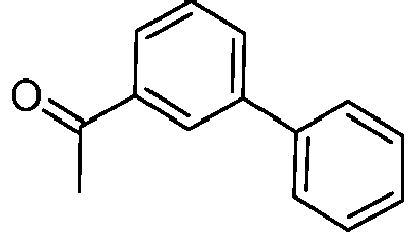
- A mixture of dioxane and water (4 + 1 mL) was added to a mixture of 1-(3-bromophenyl)ethan-1-one (0.75 g, 3.78 mmol, 0.5 mL), phenylboronic acid (0.55 g, 4.5 mmol), K2CO3 (1.04 g, 7.56 mmol) and Pd(dppf)Cl2 (55 mg, 0.1 mmol). The reaction mixture was degassed for 10 min by bubbling argon, then it was stirred at 90 °C for 18 h. The reaction mixture was cooled to 25 °C, diluted with EtOAc (15 mL), poured into a saturated aqueous solution of NH4Cl (15 mL), and extracted with EtOAc (2 × 15 mL). The combined organic extracts were washed with water (15 mL) and brine (15 mL), dried over MgSO4, filtered, and the solvent was evaporated in vacuo. The residue was purified by column chromatography (hexane:EtOAc; 10:1). The product was obtained as a colorless oil (630 mg, 85 %).
1H NMR (500 MHz, CDCl3) δ (ppm) 8.19 (t, J = 1.8 Hz, 1H), 7.95 (ddd, J = 7.7, 1.7, 1.1 Hz, 1H), 7.80 (ddd, J = 7.7, 1.9, 1.1 Hz, 1H), 7.66 - 7.61 (m, 2H), 7.55 (t, J = 7.7 Hz, 1H), 7.51 - 7.46 (m, 2H), 7.43 - 7.37 (m, 1H), 2.67 (s, 3H);
13C NMR (126 MHz, CDCl3) δ (ppm) 198.3, 142.0, 140.4, 137.9, 132.0, 129.3, 129.2, 128.0, 127.4, 127.4, 127.2, 27.0; -

- 3,4-dihydroxybenzaldehyde (2 g, 14.48 mmol) was dissolved in CH2Cl2 (100 mL) and DIPEA (11.83 g, 15.1 mL, 86.88 mmol) was added. The mixture was cooled to 0 °C and SEMCl (7.24 g, 7.7 mL, 43.44 mmol) was added. The mixture was left to warm up slowly to 25 °C and stirred for 16 h. The mixture was poured in a saturated aqueous solution of NH4Cl (100 mL) and the phases were separated. The organic phase was washed with an aqueous solution of citric acid (5 % in water, 2 x 100 mL), dried over MgSO4, filtered, and evaporated in-vacuo. The product, purified by column chromatography (hexane:EtOAc; 20:1 to 5:1), was obtained as a colorless oil (4.328 g, 75 %).
1H NMR (500 MHz, CDCl3) δ (ppm) 9.87 (s, 1H), 7.70 (d, J = 2.0 Hz, 1H), 7.53 - 7.47 (m, 1H), 7.31 (d, J = 8.4 Hz, 1H), 5.36 (s, 2H), 5.34 (s, 2H), 3.84 - 3.77 (m, 4H), 1.02 - 0.91 (m, 4H), -0.01 (d, J = 1.3 Hz, 18H);
13C NMR (126 MHz, CDCl3) δ (ppm) 191.0, 153.0, 147.8, 131.1, 126.1, 116.0, 115.4, 93.9, 93.6, 67.0, 66.8, 18.2, 18.2, -1.3. -

- The compound was prepared according to General procedure D2 with 3,4-bis((2-(trimethylsilyl)ethoxy)methoxy)benzaldehyde (2.136 g, 5.36 mmol), ethylcyanoacetate (758 mg, 0.71 mL, 6.7 mmol), and piperidine (46 mg, 53 µL, 0.536 mmol) in anhydrous CH2Cl2 (25 mL) at reflux for 4 h. Ethylcyanoacetate (121 mg, 0.114mL, 1.07 mmol) was added and the mixture stirred at reflux for 2 additional hh. The same addition of ethylcyanoacetate followed by reflux for 2 h was repeated two more times. The mixture was poured in a saturated aqueous solution of NH4Cl (50 mL) and the phases were separated. The organic phase was washed with brine (50 mL), dried over MgSO4, filtered, and the solvent was evaporated in vacuo. The residue was purified by column chromatography (hexane:EtOAc; 1:0 to 10:1) to give a pale yellow oil (2.403 g, 91 %).
1H NMR (500 MHz, CDCl3) δ (ppm) 8.15 (s, 1H), 7.86 (d, J = 2.1 Hz, 1H), 7.68 (dd, J = 8.6, 2.2 Hz, 1H), 7.28 (d, J = 8.5 Hz, 1H), 5.36 (s, 2H), 5.32 (s, 2H), 4.37 (q, J = 7.2 Hz, 2H), 3.86 - 3.76 (m, 4H), 1.39 (t, J = 7.1 Hz, 3H), 1.03 - 0.92 (m, 4H), 0.00 (s, 18H);
13C NMR (126 MHz, CDCl3) δ (ppm) 163.2, 154.6, 152.2, 147.5, 127.0, 125.7, 119.0, 115.9, 100.6, 94.2, 93.6, 67.1, 66.9, 62.6, 18.2, 18.2, 14.4, -1.3. -

- Ethyl (E)-3-(3,4-bis((2-(trimethylsilyl)ethoxy)methoxy)phenyl)-2-cyanoacrylate (540 mg, 1.09 mmol) was dissolved in anhydrous THF (5 mL) and cooled to 0°C. A solution of LiEt3BH (1 M in THF, 1.3 mL, 1.3 mmol) was added and the mixture was stirred for 30 min at 0 °C. Mixture was poured into a saturated aqueous solution of NH4Cl (25 mL) and extracted with EtOAc (3 × 15 mL). The organic fractions were combined washed with brine (25 mL), dried over MgSO4, filtered and evaporated. The product, purified by column chromatography (hexane:EtOAc; 10:1), was obtained as a colorless oil (430 mg, 80 %).
1H NMR (500 MHz, CDCl3) δ (ppm) 7.16 (d, J = 8.3 Hz, 1H), 7.11 (d, J = 2.1 Hz, 1H), 6.87 (dd, J = 8.3, 2.2 Hz, 1H), 5.29 (d, J = 1.2 Hz, 2H), 5.27 (s, 2H), 4.27 (q, J = 7.1 Hz, 2H), 3.86 - 3.78 (m, 4H), 3.69 (dd, J = 8.5, 5.9 Hz, 1H), 3.29 - 3.09 (m, 2H), 1.31 (t, J = 7.1 Hz, 3H), 1.04 - 0.95 (m, 4H), 0.03 (s, 9H), 0.02 (s, 9H);
13C NMR (126 MHz, CDCl3) δ (ppm) 165.8, 147.9, 147.3, 129.5, 123.0, 117.4, 116.9, 116.4, 94.2, 94.1, 66.7, 66.6, 63.1, 40.1, 35.6, 18.3, 18.3, 14.2, -1.2;
HRMS calcd for C24H40NO6Si2 [M-H]- 494.2400, found 494.2385. -

- To a solution of ethyl 3-(3,4-bis((2-(trimethylsilyl)ethoxy)methoxy)phenyl)-2-cyanopropanoate (290 mg, 0.58 mmol) in anhydrous THF at 0 °C, was added NaH (60 % in mineral oil, 28 mg, 0.7 mmol) and the mixture was stirred at 25 °C for 15 min. Then, dimethyl sulfate (95 mg, 72 µL, 0.75 mmol) was added and the mixture was stirred at 25 °C for 16 h. The mixture was poured into water (10 mL) and extracted with EtOAc (3 × 15 mL). The organic fractions were combined and washed with brine (25 mL), dried over MgSO4, filtered, and the solvent was evaporated in vacuo. The product, purified by column chromatography (hexane:EtOAc; 10:1), was obtained as a colorless oil (220 mg, 75 %).
1H NMR (500 MHz, CDCl3) δ(ppm) 7.12 (d, J = 8.3 Hz, 1H), 7.11 (d, J = 2.1 Hz, 1H), 6.85 (dd, J = 8.3, 2.2 Hz, 1H), 5.29 - 5.24 (m, 4H), 4.22 (q, J = 7.1 Hz, 2H), 3.88 - 3.73 (m, 4H), 3.07 (dd, J = 96.2, 13.6 Hz, 2H), 1.59 (s, 3H), 1.26 (t, J = 7.2 Hz, 3H), 1.04 - 0.90 (m, 4H), 0.00 (s, 18H);
13C NMR (126 MHz, CDCl3) δ (ppm) 170.4, 148.7, 148.6, 129.5, 125.2, 121.2, 119.8, 117.8, 95.4, 95.3, 67.8, 64.2, 46.8, 44.6, 24.4, 19.5, 19.5, 15.3, 0.0;
HRMS calcd for C25H47N2O6Si2 [M+NH4]+ 527.2967, found 527.2880. -

- Isovanillin (2 g, 13 mmol) was dissolved in dioxane (16.7 mL) and water (6.7 mL), cooled to 0 °C. NBS (2.39 g, 13.4 mmol) was added in portions over 30 min. The solution was allowed to warm to 25°C and stirred for 2 h. Water (30 mL) was added, the precipitate was collected by filtration and dried under vacuum. The product was obtained as a white solid (2.74 g, 91 %).
1H NMR (500 MHz, DMSO-d 6) δ (ppm) 10.11 (s, 1H), 9.89 (s, 1H), 7.41 (d, J = 8.3 Hz, 1H), 7.15 (d, J = 8.5 Hz, 1H), 3.93 (s, 3H);
13C NMR (126 MHz, DMSO-d 6) δ(ppm) 190.8, 153.3, 144.0, 126.7, 122.0, 113.3, 110.4, 56.4. -
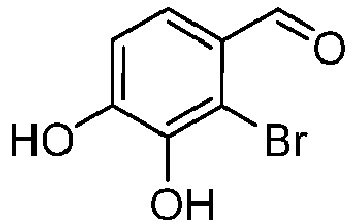
- To a solution of 2-bromo-3-hydroxy-4-methoxybenzaldehyde (0.5 g, 2,16 mmol) in anhydrous CH2Cl2 (10 mL) at -78 °C was added BBr3 (1M in CH2Cl2, 8.7 mL, 8.7 mmol). The mixture was warmed up to 25 °C and stirred for 16 h. Then the solution was cooled down to -78 °C and MeOH (5 mL) was added. The mixture was poured into water (25 mL) and extracted with EtOAc (3 × 10 mL). Combined organic fractions were washed with brine (25 mL), dried over MgSO4, filtered, and the solvent was evaporated. The residue was purified by column chromatography (hexane:EtOAc; 3:2). The product was obtained as a white solid (280 mg, 60 %).
1H NMR (500 MHz, DMSO-d 6) δ (ppm) 10.06 (s, 1H), 7.30 (d, J = 8.4 Hz, 1H), 6.91 (d, J = 8.3 Hz, 1H); 13C NMR (126 MHz, DMSO-d 6) δ (ppm) 190.5, 152.3, 143.2, 125.5, 122.3, 114.4, 114.0;
HRMS calcd for C7H4NBrO3 [M-H]- 214.9349, found 214.9353. -

- 2-chloro-6-methylphenol (0.5 mg, 3.5mmol) and hexamethylenetetramine (0.5 g, 3.5 mmol) were dissolved in TFA (3 mL) and stirred 30 min at 60 °C. The mixture was poured into ice-water (20 mL) and extracted with Et2O (3 × 20 mL). The organic fractions were combined, washed with brine (25 mL), dried over MgSO4, filtered, and the solvent was evaporated. The product, purified by column chromatography (hexane:EtOAc; 7:3), was obtained as a white solid (220 mg, 40 %).
1H NMR (500 MHz, CDCl3) δ (ppm) 9.82 (s, 1H), 7.74 (d, J = 1.9 Hz, 1H), 7.64 - 7.59 (m, 1H), 6.18 (s, 1H), 2.36 (s, 3H);
13C NMR (126 MHz, CDCl3) δ (ppm) 190.0, 155.0, 131.6, 130.2, 128.6, 127.0, 120.8, 16.5;
HRMS calcd for C8H6ClO2 [M-H]- 169.0062, found 169.0060. -

- 2-fluoro-6-chlorophenol (0.5 mg, 3.5mmol) and hexamethylenetetramine (0.5 g, 3.5 mmol) were dissolved in TFA (3 mL) and stirred at 60 °C for 16 h. The mixture was poured into ice-water (20 mL) and extracted with Et2O (3 × 20 mL). The organic fractions were combined, washed with brine (25 mL), dried over MgSO4, filtered, and the solvent was evaporated. The product, purified by column chromatography (hexane:EtOAc; 7:3), was obtained as a white solid (250 mg, 40 %).
1H NMR (500 MHz, CDCl3) δ (ppm) 9.83 (d, J = 2.1 Hz, 1H), 7.74 - 7.71 (m, 1H), 7.59 (dd, J = 9.6, 1.8 Hz, 1H), 6.12 (s, 1H);
13C NMR (126 MHz, CDCl3) δ (ppm) 188.8, 151.6 (d, J = 248.2 Hz), 146.2 (d, J = 15.3 Hz), 129.7 (d, J = 5.4 Hz), 127.5 (d, J = 3.1 Hz), 122.7, 115.4 (d, J = 18.5 Hz);
19F NMR (471 MHz, CDCl3) δ (ppm) -132.12;
HRMS calcd for C7H3ClFO2 [M-H]- 172.9811, found 172.9809. -

- Ethyl (E)-3-(3,4-bis((2-(trimethylsilyl)ethoxy)methoxy)phenyl)-2-cyanoacrylate (540 mg, 1.09 mmol) was dissolved in dry THF (5 mL) and cooled to 0 °C. A solution of LiEt3BH (1 M in THF 1.3 mL, 1.3 mmol) was added and the resulting mixture was stirred at 0 °C for 30 min. The mixture was poured into a saturated aqueous solution of NH4Cl (25 mL) and extracted with EtOAc (3 × 15 mL). The organic fractions were combined, washed with brine (25 mL), dried under MgSO4, and the solvent was and evaporated. The product, purified on column chromatography (hexane:EtOAc; 10:1), was obtained as a colorless oil (430 mg, 80 %).
1H NMR (500 MHz, CDCl3) δ (ppm) 7.16 (d, J = 8.3 Hz, 1H), 7.11 (d, J = 2.1 Hz, 1H), 6.87 (dd, J = 8.3, 2.2 Hz, 1H), 5.29 (d, J = 1.2 Hz, 2H), 5.27 (s, 2H), 4.27 (q, J = 7.1 Hz, 2H), 3.86 - 3.78 (m, 4H), 3.69 (dd, J = 8.5, 5.9 Hz, 1H), 3.29 - 3.09 (m, 2H), 1.31 (t, J = 7.1 Hz, 3H), 1.04 - 0.95 (m, 4H), 0.03 (s, 9H), 0.02 (s, 9H);
13C NMR (126 MHz, CDCl3) δ (ppm) 165.8, 147.9, 147.3, 129.5, 123.0, 117.4, 116.9, 116.4, 94.2, 94.1, 66.7, 66.6, 63.1, 40.1, 35.6, 18.3, 18.3, 14.2, -1.2. -

- Ethyl 3-(3,4-bis((2-(trimethylsilyl)ethoxy)methoxy)phenyl)-2-cyanopropanoate (290 mg, 0.58 mmol) was dissolved in THF (3 mL), the solution was cooled to 0 °C, NaH (60 % in mineral oil, 28 mg, 0.7 mmol) was added and the mixture was stirred at 25 °C for 15 min. Dimethyl sulfate (95 mg, 72 µL, 0.75 mmol) was added and the mixture was stirred at 25 °C for 16 h. The mixture was poured into water (10 mL) and extracted with EtOAc (3 × 15 mL). The organic fractions were combined, washed with brine (25 mL), dried over MgSO4, filtered, and the solvent was evaporated in vacuo. The product, purified by column chromatography (hexane:EtOAc; 10:1), was obtained as a colorless oil (220 mg, 75 %).
1H NMR (500 MHz, CDCl3) δ (ppm) 7.12 (d, J = 8.3 Hz, 1H), 7.11 (d, J = 2.1 Hz, 1H), 6.85 (dd, J = 8.3, 2.2 Hz, 1H), 5.29 - 5.24 (m, 4H), 4.22 (q, J = 7.1 Hz, 2H), 3.88 - 3.73 (m, 4H), 3.07 (dd, J = 96.2, 13.6 Hz, 2H), 1.59 (s, 3H), 1.26 (t, J = 7.2 Hz, 3H), 1.04 - 0.90 (m, 4H), 0.00 (s, 18H);
13C NMR (126 MHz, CDCl3) δ (ppm) 170.4, 148.7, 148.6, 129.5, 125.2, 121.2, 119.8, 117.8, 95.4, 95.3, 67.8, 64.2, 46.8, 44.6, 24.4, 19.5, 19.5, 15.3, 0.0;
HRMS calcd for C25H47N2O6Si2 [M+NH4]+ 527.2967, found 527.2880. -
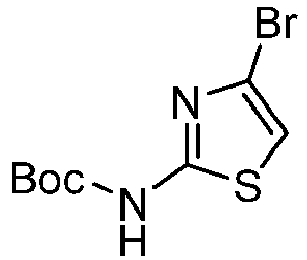
- Di-tert-butyl dicarbonate (2.43 g, 11.17 mmol) was added to a mixture of 4-bromothiazol-2-amine (2.00 g, 11.17 mmol) and DMAP (136 mg, 1.11 mmol) in CH2Cl2 (25 mL) and the mixture was stirred at 25 °C for 24 h. The resulting solution was quenched with a saturated aqueous solution of NaHCO3 (100 mL) and the mixture was extracted with CH2Cl2 (2 × 200 mL). The organic extracts were combined, dried over MgSO4, filtered, and concentrated under reduced pressure. The residue was purified by column chromatography (hexane:EtOAc; 1:0 to 9.5:0.5) to afford the product (2.50 g, 80 %) as a white solid.
1H NMR (500 MHz, CDCl3) δ (ppm) 8.83 (s, 1H), 6.79 (s, 1H), 1.54 (s, 9H);
13C NMR (126 MHz, CDCl3) δ (ppm) 160.7, 152.1, 120.6, 110.5, 83.5, 28.3;
HRMS calcd for C8H12BrN2O2S [M+H]+ 280.9777, found 280.9774. -

- 4-Methoxybenzyl chloride (2.72 mL, 20.09 mmol) was added to a solution of tert-butyl (4-bromothiazol-2-yl)carbamate (5.10 g, 18.26 mmol) and Cs2CO3 (11.90 g, 36.53 mmol) in DMF (40 mL) and the mixture was stirred at 80 °C for 1 h. The reaction mixture was cooled to 25 °C, quenched with water (100 mL), and extracted with EtOAc (3 × 300 mL). The organic extracts were dried over MgSO4, filtered, and concentrated under reduced pressure. The residue was purified by column chromatography (hexane:EtOAc; 1:0 to 9.5:0.5) to afford the product (7.20 g, 99%) as a pale yellow wax.
1H NMR (500 MHz, CDCl3) δ (ppm) 7.36 - 7.31 (m, 2H), 6.85 - 6.81 (m, 2H), 6.81 (s, 1H), 5.21 (s, 2H), 3.78 (s, 3H), 1.52 (s, 9H);
13C NMR (126 MHz, CDCl3) δ (ppm) 161.9, 159.1, 153.0, 129.7, 129.6, 120.5, 113.8, 112.1, 84.1, 55.4, 49.7, 28.3;
HRMS calcd for C16H20BrN2O3S [M+H]+ 401.0353, found 401.0359. -
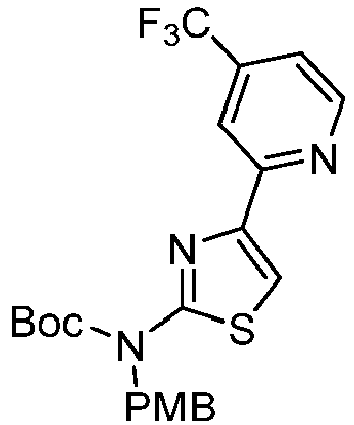
- According to General procedure F, tert-butyl (4-methoxybenzyl)(4-(4,4,5,5-tetramethyl-1,3,2-dioxaborolan-2-yl)thiazol-2-yl)carbamate was prepared from n-BuLi (1.6 M in hexane, 0.82 mL, 2.50 mmol), tert-butyl (4-bromothiazol-2-yl)(4-methoxybenzyl)carbamate (0.500 g, 1.25 mmol), and 2-isopropoxy-4,4,5,5-tetramethyl-1,3,2-dioxaborolane (0.383 mL, 1.87mmol) in THF (8 mL); the reaction time was 1 h at -78 °C. The crude product was obtained as a pale-yellow wax (0.558 g, 1.25 mmol) and used as such in the next step.
tert-butyl (4-methoxybenzyl)(4-(4-(trifluoromethyl)pyridin-2-yl)thiazol-2-yl)carbamate was prepared from tert-butyl (4-methoxybenzyl)(4-(4,4,5,5-tetramethyl-1,3,2-dioxaborolan-2-yl)thiazol-2-yl)carbamate (0.558 g, 1.25 mmol), 2-bromo-4-(trifluoromethyl)pyridine (0.310 g, 1.37 mmol), K3PO4 (0.796 g, 3.75 mmol), Pd(dppf)Cl2 (0.91 g, 0.125 mmol) and DME/H2O (12 and 3 mL respectively); the reaction time was 3 h at 80 °C. The product, purified by column chromatography (hexane:EtOAc; 1:0 to 9:1), was obtained as a colorless wax (0.350 g, 60 %).
1H NMR (500 MHz, CDCl3) δ (ppm) 8.74 (d, J = 5.04 Hz, 1H), 8.25 (d, J = 1.57 Hz, 1H), 7.81 (s, 1H), 7.42 - 7.36 (m, 3H), 6.87 - 6.82 (m, 2H), 5.34 (s, 2H), 3.78 (s, 3H), 1.57 (s, 9H);
13C NMR (126 MHz, CDCl3) δ (ppm) 161.7, 159.1, 154.4, 150.3, 148.3, 139.2, 130.1, 129.6, 124.2 (q, 1 J C-F = 272.6 Hz), 122.1, 117.7 (d, J = 3.64 Hz), 116.6, 114.3, 113.9, 83.9, 55.4, 50.1, 28.4;
19F NMR (471 MHz, CDCl3) δ (ppm) -64.96;
HRMS calcd for C22H23F3N3O3S [M+H]+ 466.1407, found 466.1409. -

- The compound was prepared according to General procedure B from 2-bromoacetophenone (3.21 g, 16.15 mmol) and thiourea (1.84 g, 24.22 mmol) in EtOH (20 mL). Work-up 2 of General procedure B. The product was obtained as a white solid (2.82 g, 99 %).
1H NMR (500 MHz, DMSO-d 6) δ(ppm) 7.79 (d, J = 7.3 Hz, 2H), 7.40 - 7.31 (m, 2H), 7.29 - 7.21 (m, 1H), 7.01 (s, 2H), 6.99 (s, 1H). -

- A solution of NBS (1.062 g, 5.97 mmol) in CH2Cl2 (15 mL) was added to a solution of 4-phenylthiazol-2-amine (1.052 g, 5.97 mmol) in CH2Cl2 (50 mL) and the mixture was stirred at 25 °C for 2 h. A saturated aqueous solution of NH4Cl (25 mL) was added to the mixture, the organic phase was separated, washed with water (25 mL), brine (25 mL), dried over MgSO4, filtered, and the solvent was evaporated in vacuo. The residue was purified by column chromatography (hexane:EtOAc; 1:0 to 1:1). The product was obtained as a pale purple solid (1.211 g, 80 %).
1H NMR (500 MHz, DMSO-d 6) δ (ppm) 7.83 - 7.78 (m, 2H), 7.45 - 7.39 (m, 2H), 7.38 - 7.32 (m, 1H), 7.28 (s, 2H);
13C NMR (126 MHz, DMSO-d 6) δ (ppm) 166.9, 147.2, 133.7, 128.1, 127.9, 87.0;
HRMS calcd for C9H8BrN2S [M+H]+ 256.9565, found 256.9565. -

- The compound was prepared according to General procedure B from 2,4'-dibromoacetophenone (2.07 g, 7.45 mmol) and thiourea (0.85 g, 11.17 mmol) in EtOH (20 mL). Work-up 1 of General procedure B. The product, obtained as a yellow solid (1.895 g, 100 %), did not require any further purification.
1H NMR (500 MHz, DMSO-d 6) δ (ppm) 7.78 - 7.70 (m, 2H), 7.58 - 7.50 (m, 2H), 7.07 (s, 1H), 7.06 (s, 1H);
13C NMR (126 MHz, DMSO-d 6) δ (ppm) 168.3, 148.6, 134.1, 131.3, 127.5, 120.0, 102.4;
HRMS calcd for C9H8BrN2S [M+H]+ 256.9565, found 256.9565. -

- The compound was prepared according to General procedure B from 4-(2-bromoacetyl)benzonitrile (0.5 g, 2.23 mmol) and thiourea (190 mg, 4.45 mmol) in EtOH (3 ml). Work-up 2 of General procedure B. The product was obtained as a white solid (375 mg, 84 %).
1H NMR (500 MHz, DMSO-d 6) δ (ppm) 8.00 - 7.93 (m, 2H), 7.83 - 7.78 (m, 2H), 7.32 (s, 1H), 7.16 (s, 2H);
13C NMR (126 MHz, DMSO-d 6) δ (ppm) 168.4, 148.1, 138.9, 132.5, 126.1, 119.0, 109.1, 105.5;
HRMS calcd for C10H8N3S [M+H]+ 202.0433, found 202.0432. -
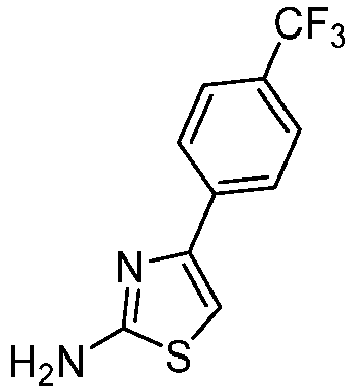
- The compound was prepared according to General procedure B from 2-bromo-4'-(trifluoromethyl)acetophenone (0.302 g, 1.131 mmol) and thiourea (0.129 g, 1.7 mmol) in EtOH (5 mL). Work-up 1 of General procedure B. The product, obtained as a white solid (0.267 g, 97 %), did not require any further purification.
1H NMR (500 MHz, DMSO-d 6) δ (ppm) 8.00 (d, J = 8.1 Hz, 2H), 7.71 (d, J = 8.4 Hz, 2H), 7.24 (s, 1H), 7.13 (s, 2H);
13C NMR (126 MHz, DMSO-d 6) δ (ppm) 168.4, 148.3, 138.5, 127.1 (q, J = 31.8 Hz), 126.0, 125.4 (q, J = 4.0 Hz), 124.4 (q, J = 271.6 Hz), 104.3;
19F NMR (471 MHz, DMSO-d 6) δ (ppm) -60.83;
HRMS calcd for C10H8F3N2S [M+H]+ 245.0355, found 245.0354. -

- The compound was prepared according to General procedure B from 2-bromo-4'-methylacetophenone (0.598 g, 2.8 mmol) and thiourea (0.32 g, 4.21 mmol) in EtOH (6 mL). Work-up 1 of General procedure B. The product, obtained as a pale yellow solid (0.534 g, 100 %), did not require any further purification. 1H NMR (500 MHz, DMSO-d 6) δ (ppm) 7.68 (d, J = 8.3 Hz, 2H), 7.16 (d, J = 8.2 Hz, 2H), 6.98 (s, 2H), 6.90 (s, 1H), 2.30 (s, 3H);
13C NMR (126 MHz, DMSO-d 6) δ (ppm) 168.0, 149.9, 136.3, 132.3, 129.0, 125.4, 101.0, 20.7;
HRMS calcd for C10H11N2S [M+H]+ 191.0637, found 191.0636. -

- 2-bromo-1-phenyl-2-(p-tolyl)ethan-1-one was prepared according to General procedure A1 from 1-phenyl-2-(p-tolyl)ethan-1-one (1.00 g, 4.76 mmol) and Br2 (0.76 g, 240 µL, 4.76 mmol) in CH2Cl2 (10 mL). The crude intermediate (2-bromo-1-phenyl-2-(p-tolyl)ethan-1-one) was obtained as a white solid (1.32 g, 99 %) and used as such in the next step.
- 4-phenyl-5-(p-tolyl)thiazol-2-amine was prepared according to General procedure B from 2-bromo-1-phenyl-2-(p-tolyl)ethan-1-one (1.00 g, 3.57 mmol) and thiourea (0.54 g, 7.14 mmol) in EtOH (10 mL). Work-up 2 of General procedure B. The product was obtained as a white solid (1.06 g, 85 %).
1H NMR (500 MHz, DMSO-d 6) δ (ppm) 7.40 - 7.36 (m, 2H), 7.28 - 7.18 (m, 3H), 7.10 (s, 4H), 7.05 (s, 2H), 2.28 (s, 3H);
13C NMR (126 MHz, DMSO-d 6) δ (ppm) 165.8, 144.4, 136.3, 135.5, 129.8, 129.2, 128.8, 128.3, 127.9, 127.1, 119.2, 20.7;
HRMS calcd for C16H15N2S [M+H]+ 267.0950, found 267.0951. -

- The compound was prepared according to General procedure B from 2-bromo-4'-(trifluoromethoxy)acetophenone (0.26 g, 0.918 mmol) and thiourea (0.105 g, 1.38 mmol) in EtOH (6 mL). Work-up 1 of General procedure B. The product, obtained as a white solid (0.227 g, 95 %), did not require any further purification.
1H NMR (500 MHz, DMSO-d 6) δ (ppm) 7.91 (d, J = 8.9 Hz, 2H), 7.39 - 7.31 (m, 2H), 7.14 - 7.03 (m, 3H);
13C NMR (126 MHz, DMSO-d 6) δ (ppm) 168.4, 148.4, 147.2, 134.2, 127.2, 121.0, 120.1 (q, J = 255.7 Hz), 102.5;
19F NMR (471 MHz, DMSO-d 6) δ (ppm) -56.74;
HRMS calcd for C10H8F3N2OS [M+H]+ 261.0304, found 261.0303. -

- 1-([1,1'-biphenyl]-3-yl)-2-bromoethan-1-one was prepared according to General procedure A1 from 1-([1,1'-biphenyl]-3-yl)ethan-1-one (0.5 g, 3.16 mmol) and Br2 (0.50 g, 160 µL, 3.16 mmol) in CH2Cl2 (10 mL). The crude intermediate (1-([1,1'-biphenyl]-3-yl)-2-bromoethan-1-one) was obtained as a white solid (870 mg, 100 %) and used as such in the next step.
- 4-([1,1'-biphenyl]-3-yl)thiazol-2-amine was prepared according to General procedure B from 1-([1,1'-biphenyl]-3-yl)-2-bromoethan-1-one (870 mg, 3.16 mmol) and thiourea (360 mg, 4.74 mmol) in EtOH (10 mL). Work-up 2 of General procedure B. The product was obtained as a pale yellow wax (0.60 g, 75 %).
1H NMR (500 MHz, DMSO-d 6) δ (ppm) 8.10 - 8.08 (m, 1H), 7.80 - 7.77 (m, 1H), 7.72 - 7.65 (m, 2H), 7.56 - 7.53 (m, 1H), 7.51 - 7.44 (m, 3H), 7.41 - 7.36 (m, 1H), 7.14 (s, 1H), 7.06 (s, 2H);
13C NMR (126 MHz, DMSO-d 6) δ (ppm) 168.2, 149.7, 140.4, 140.2, 135.5, 129.1, 128.9, 127.5, 126.7, 125.5, 124.9, 123.9, 102.0;
HRMS calcd for C15H13N2S [M+H]+ 253.0794, found 253.0795. -

- A mixture of dioxane and water (2.0 + 0.5 mL) was added to a mixture of 5-bromo-4-phenylthiazol-2-amine (0.116 g, 0.455 mmol), phenylboronic acid (0.069 g, 0.568 mmol), K2CO3 (0.251 g, 1.82 mmol) and Pd(PPh3)4 (0.026 g, 0.023 mmol). The reaction mixture mixture was degassed by bubbling N2 for 5 min, then it was stirred at 55 °C for 5 h and then at 75 °C for 16 h. The mixture was cooled to 25 °C, diluted with EtOAc (5 mL), poured into a saturated aqueous solution of NH4Cl (20 mL) and extracted with EtOAc (3 × 25 mL). The combined organic extracts were washed with water (20 mL) and brine (20 mL), dried over MgSO4, filtered, and the solvent was evaporated in vacuo. The residue was purified by column chromatography (hexane:EtOAc; 1:0 to 1:1) to afford the product as a white solid (0.035 g, 30 %).
1H NMR (500 MHz, DMSO-d 6) δ (ppm) 7.39 - 7.35 (m, 2H), 7.31 - 7.18 (m, 8H), 7.09 (s, 2H);
13C NMR (126 MHz, DMSO-d 6) δ (ppm) 166.0, 144.9, 135.4, 132.8, 128.9, 128.6, 128.4, 128.0, 127.2, 127.0, 119.0;
HRMS calcd for C15H13N2S [M+H]+ 253.0794, found 253.0793. -

- The compound was prepared according to General procedure B from 1-(4-tert-butylphenyl)-2-chloroethane (0.230 g, 1.092 mmol), thiourea (0.125 g, 1.637 mmol) in EtOH (4 mL). Work-up 1 of General procedure B. The residue was purified by column chromatography (hexane:EtOAc; 1:0 to 2:1) to afford the product as a colorless solid (0.227 g, 89 %).
1H NMR (500 MHz, DMSO-d 6) δ (ppm) 7.73 - 7.68 (m, 2H), 7.40 - 7.34 (m, 2H), 6.99 (s, 2H), 6.90 (s, 1H), 1.29 (s, 9H);
13C NMR (126 MHz, DMSO-d 6) δ (ppm) 168.1, 149.9, 149.5, 132.3, 125.2, 125.1, 100.6, 34.2, 31.1; HRMS calcd for C13H17N2S [M+H]+ 233.1107, found 233.1107. -

- The compound was prepared according to General procedure B from 2-bromo-2'-acetophenone (0.967 g, 3.88 mmol) and thiourea (0.443 g, 5.82 mmol) in EtOH (5 mL). Work-up 1 of General procedure B. The product was obtained as a pale pink solid (0.747 g, 85 %) and did not require any additional purification. 1H NMR (500 MHz, DMSO-d 6) δ (ppm) 8.32 (d, J = 1.8 Hz, 1H), 7.99 - 7.84 (m, 4H), 7.55 - 7.43 (m, 2H), 7.16 (s, 1H), 7.09 (s, 2H);
13C NMR (126 MHz, DMSO-d 6) δ (ppm) 168.2, 149.8, 133.2, 132.3, 132.2, 128.0, 127.8, 127.5, 126.3, 125.7, 124.0, 124.0, 102.4.;
HRMS calcd for C13H11N2S [M+H]+ 227.0637, found 227.0636. -

- The compound was prepared according to General procedure B from 2-bromo-1-(thiophen-3-yl)ethan-1-one (0.31 g, 1.5 mmol) and thiourea (170 mg, 2.25 mmol) in EtOH (3 mL). Workup 2 of General procedure B. The product was obtained as a white solid (246 mg, 90 %).
1H NMR (500 MHz, DMSO-d 6) δ (ppm) 7.61 (dd, J = 3.0, 1.3 Hz, 1H), 7.51 (dd, J = 5.0, 3.0 Hz, 1H), 7.45 (dd, J = 5.0, 1.2 Hz, 1H), 7.00 (s, 2H), 6.83 (s, 1H);
13C NMR (126 MHz, DMSO-d 6) δ (ppm) 168.1, 146.3, 137.3, 126.4, 125.8, 120.7, 101.0;
HRMS calcd for C7H7N2S2 [M+H]+ 183.0045, found 183.0045. -

- 2-bromo-2-cyclohexyl-1-phenylethan-1-one: the compound was prepared according to General procedure A1 from 2-bromo-2-cyclohexyl-1-phenylethan-1-one (0.6 g, 2.97 mmol) and Br2 (0.47 g, 150 µL, 2.97 mmol) in CH2Cl2 (10 mL). The crude product (2-bromo-2-cyclohexyl-1-phenylethan-1-one) was obtained as a yelow solid (670 mg, 80 %) and used as such in the next step.
5-cyclohexyl-4-phenylthiazol-2-amine was prepared according to General procedure B with 2-bromo-2-cyclohexyl-1-phenylethan-1-one (560 mg, 2.0 mmol), thiourea (340 mg, 4.46 mmol) in EtOH (10 mL). Work-up 2 of General procedure B. The product was obtained as a white solid (250 mg, 33 %).
1H NMR (500 MHz, DMSO-d 6) δ (ppm) 7.47 - 7.43 (m, 2H), 7.42 - 7.37 (m, 2H), 7.33 - 7.27 (m, 1H), 6.84 (s, 2H), 2.90 - 2.81 (m, 1H), 1.93 - 1.84 (m, 2H), 1.76 - 1.68 (m, 2H), 1.64 (d, J = 11.7 Hz, 1H), 1.37 - 1.13 (m, 5H);
13C NMR (126 MHz, DMSO-d 6) δ (ppm) 164.7, 135.6, 128.2, 128.1, 127.9, 127.0, 115.7, 36.5, 35.9, 26.0, 25.2;
HRMS calcd for C15H19N2S [M+H]+ 259.1263, found 259.1263. -
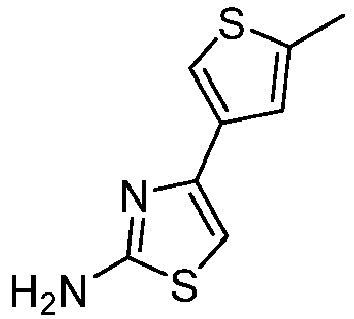
- 2-bromo-1-(4-methylthiophen-3-yl)ethan-1-one was prepared according to General procedure A2 from 1-(4-methylthiophen-3-yl)ethan-1-one (0.325 g, 2.32 mmol) and CuBr2 (1.04 g, 4.64 mmol) in CHCl3 (2 mL) and EtOAc (2 mL). The crude intermediate was used as such in the next step.
- 4-(4-methylthiophen-3-yl)thiazol-2-amine was prepared according to General procedure B from 2-bromo-1-(4-methylthiophen-3-yl)ethan-1-one (508 mg, 2.32 mmol) and thiourea (270 mg, 3,48 mmol) in EtOH (5 mL). Work-up 2 of General procedure B. The product was obtained as a white solid (320 mg, 70 %). 1H NMR (500 MHz, DMSO-d 6) δ (ppm) 7.18 (s, 1H), 7.08 (s, 2H), 6.96 (s, 1H), 6.77 (s, 1H), 2.19 (s, 3H);
13C NMR (126 MHz, DMSO-d 6) δ (ppm) 168.1, 144.6, 138.8, 137.5, 124.8, 119.9, 99.4, 15.4;
HRMS calcd for C8H9N2S2 [M+H]+ 197.0202, found 197.0198. -

- 2-bromo-1-(4-cyclohexylphenyl)ethan-1-one was prepared according to General procedure A2 from 1-(4-cyclohexylphenyl)ethan-1-one (0.53 g, 2.6 mmol) and CuBr2 (1.2 g, 5.25 mmol) in CHCl3 (3 mL) and EtOAc (3 mL). The crude intermediate was used as such in the next step.
- 4-(4-cyclohexylphenyl)thiazol-2-amine was prepared according to General procedure B from 2-bromo-1-(4-cyclohexylphenyl)ethan-1-one (730 mg, 2.6 mmol) and thiourea (300 mg, 3.9 mmol) in EtOH (5 mL). Work-up 2 of General procedure B. The product was obtained as a white solid (420 mg, 60 %,) and did not require any further purification.
1H NMR (500 MHz, DMSO-d 6) δ (ppm) 7.72 - 7.66 (m, 2H), 7.23 - 7.17 (m, 2H), 6.98 (s, 2H), 6.89 (s, 1H), 2.47 (d, J = 7.9 Hz, 1H), 1.85 - 1.75 (m, 5H), 1.48 - 1.30 (m, 5H);
13C NMR (126 MHz, DMSO-d 6) δ (ppm) 168.0, 149.9, 146.5, 132.7, 126.6, 125.5, 100.5, 43.4, 33.8, 26.3, 25.6;
HRMS calcd for C13H15N2 [M+H]+ 231.0950, found 231.0946. -

- 2-bromo-1-(4-cyclohexylphenyl)ethan-1-one was prepared according to General procedure A2 from 1-(4-cyclohexylphenyl)ethan-1-one (0.53 g, 2.6 mmol) and CuBr2 (1.2 g, 5.25 mmol) in CHCl3 (3 mL) and EtOAc (3 mL). The crude intermediate was used as such in the next step.
- 4-(4-cyclohexylphenyl)thiazol-2-amine was prepared according to General procedure B from 2-bromo-1-(4-cyclohexylphenyl)ethan-1-one (730 mg, 2.6 mmol) and thiourea (300 mg, 3.9 mmol) in EtOH (5 mL). Work-up 2 of General procedure B. The product, was obtained as a white solid (420 mg, 60 %) and did not require any further purification.
1H NMR (500 MHz, DMSO-d 6) δ (ppm) 7.72 - 7.66 (m, 2H), 7.23 - 7.17 (m, 2H), 6.98 (s, 2H), 6.89 (s, 1H), 2.47 (d, J = 7.9 Hz, 1H), 1.85 - 1.75 (m, 5H), 1.48 - 1.30 (m, 5H);
13C NMR (126 MHz, DMSO-d 6) δ (ppm) 168.0, 149.9, 146.5, 132.7, 126.6, 125.5, 100.5, 43.4, 33.8, 26.3, 25.6;
HRMS calcd for C15H19N2S [M+H]+ 259.1263, found 259.1258. -

- 2-bromo-1-(pyridin-2-yl)ethan-1-one was prepared according to General procedure A4 from 2-acetylpyridine (1.0 g, 8.25 mmol), HBr (47% in H2O, 4.26 mL, 24.7 mmol), Br2 (0.636 mL, 12.38 mmol) in acetic acid (20.0 mL); the reaction time was 16 h. Work-up 1 of General procedure A4. The crude product was obtained as a pale yellow solid (1.25 g, 6.24 mmol, 76 %) and used as such in the next step.
- 4-(pyridin-2-yl)thiazol-2-amine was prepared according to General procedure B from 2-bromo-1-(pyridin-2-yl)ethan-1-one (1.22 g, 4.34 mmol) and thiourea (0.495 g, 6.51 mmol) in EtOH (18 ml). Work-up 1 of General procedure B. The product, purified by column chromatography (hexane:EtOAc; 1:1 to 0:1), was obtained as a light green solid (0.3 g, 39 %).
1H NMR (500 MHz, DMSO-d6 ) δ (ppm) 8.53 (dt, J = 4.69, 1.38 Hz, 1H), 7.85 - 7.77 (m, 2H), 7.28 - 7.22 (m, 2H), 7.08 (s, 2H);
13C NMR (126 MHz, DMSO-d6 ) δ (ppm) 168.4, 152.4, 150.1, 149.2, 136.9, 122.1, 120.0, 105.3;
HRMS calcd for C8H8N3S [M+H]+ 178.0433, found 178.0435. -

- 2-bromo-1-(6-methylpyridin-2-yl)ethan-1-one was prepared according to General procedure A4 from 2-acetyl-6-methylpyridine (0.350 g, 2.58 mmol), HBr (47% in H2O, 0.897 mL, 7.76 mmol), and Br2 (0.20 mL, 3.886 mmol) in acetic acid (8 mL); the reaction time was 24 h. Work-up 2 of General procedure A4. The crude intermediate 2-bromo-1-(6-methylpyridin-2-yl)ethan-1-one was obtained as a yellow solid (800 mg, 3.737 mmol) and used as such in the next step.
- 4-(6-methylpyridin-2-yl)thiazol-2-amine was prepared according to General procedure B from 2-bromo-1-(6-methylpyridin-2-yl)ethan-1-one (800 mg, 3.73 mmol) and thiourea (426 mg, 5.60 mmol) in EtOH (15 mL). Work-up 1 of General procedure B. The product, purified by column chromatography (hexane:EtOAc; 1:1 to 0:1), was obtained as a light green solid (260 mg, 53 %).
1H NMR (500 MHz, DMSO-d6 ) δ (ppm) 7.68 (t, J = 7.65 Hz, 1H), 7.62 (d, J = 7.60 Hz, 1H), 7.18 (s, 1H), 7.11 (dd, J = 7.54, 1.08 Hz, 1H), 7.04 (s, 2H), 2.47 (s, 3H);
13C NMR (126 MHz, DMSO-d6 ) δ (ppm) 168.2, 157.3, 151.8, 150.2, 137.0, 121.5, 117.2, 105.0, 24.2; HRMS calcd for C9H10N3S [M+H]+ 192.0590, found 192.0592. -

- 2-bromo-1-(2-(trifluoromethyl)phenyl)ethan-1-one was prepared according to General procedure A2 from 1-(2-(trifluoromethyl)phenyl)ethan-1-one (0.54 g, 2.87mmol) and CuBr2 (1.3 g, 5.74 mmol) in CHCl3 (3 mL) and EtOAc (3 mL). The crude product was used as such in the next step.
- 4-(2-(trifluoromethyl)phenyl)thiazol-2-amine was prepared according to General procedure B from 2-bromo-1-(2-(trifluoromethyl)phenyl)ethan-1-one (766 mg, 2.87 mmol) and thiourea (330 mg, 4.3 mmol) in EtOH (3 mL). Work-up 1 of General procedure B. The product, purified by column chromatography (hexane:EtOAc; 7:3), was obtained as a white solid (550 mg, 80 %).
1H NMR (500 MHz, DMSO-d 6) δ (ppm) 7.79 - 7.74 (m, 1H), 7.69 - 7.64 (m, 1H), 7.60 (d, J = 8.3 Hz, 1H), 7.57 - 7.50 (m, 1H), 6.99 (s, 2H), 6.57 (s, 1H);
13C NMR (126 MHz, DMSO-d 6) δ (ppm) 167.6, 147.4, 135.1, 132.0, 131.8, 128.0, 126.6 (q, J = 29.9 Hz), 126.1 (q, J = 5.5 Hz), 124.1 (q, J = 273.4 Hz), 104.9 (q, J = 5.9, 2.6 Hz);
19F NMR (471 MHz, DMSO-d 6) δ (ppm) -56.35;
HRMS calcd for C10H8F3N2S [M+H]+ 245.0355, found 245.0353. -

- 2-bromo-1-(3,4-dichlorophenyl)ethan-1-one was prepared according to General procedure A2 from 1-(3,4-dichlorophenyl)ethan-1-one (0.5 g, 2.6 mmol) and CuBr2 (1.2 g, 5.2 mmol) in CHCl3 (3 mL) and EtOAc (3 mL). The crude product was used as such in the next step.
- 4-(3,4-dichlorophenyl)thiazol-2-amine was prepared according to General procedure B from 2-bromo-1-(3,4-dichlorophenyl)ethan-1-one (700 mg, 2.6 mmol) and thiourea (300 mg, 3.9 mmol) in EtOH (3 mL). Work-up 2 of General procedure B. The product was obtained as a white solid (326 mg, 50 %) and did not require any further purification.
1H NMR (500 MHz, DMSO-d 6) δ (ppm) 8.01 (d, J = 2.0 Hz, 1H), 7.77 (dd, J = 8.4, 2.0 Hz, 1H), 7.64 - 7.58 (m, 1H), 7.21 (d, J = 1.4 Hz, 1H), 7.12 (s, 2H);
13C NMR (126 MHz, DMSO-d 6) δ (ppm) 168.4, 147.2, 135.4, 131.2, 130.6, 129.2, 127.1, 125.5, 103.7; HRMS calcd for C9H5Cl2N2S [M-H]- 242.9556, found 242.9553. -

- 2-bromo-1-(o-tolyl)ethan-1-one was prepared according to General procedure A2 from 1-(o-tolyl)ethan-1-one (0.514 g, 3.83mmol) and CuBr2 (1.7 g, 7.66 mmol) in CHCl3 (3 mL) and EtOAc (3 mL). The crude product was used as such in the next step.
- 4-(o-tolyl)thiazol-2-amine was prepared according to General procedure B from 2-bromo-1-(o-tolyl)ethan-1-one (815 mg, 3.83 mmol) and thiourea (440 mg, 5.7 mmol) in EtOH (3 mL). Work-up 2 of General procedure B. The product was obtained as a white solid (534 mg, 75 %) and did not require any further purification.
1H NMR (500 MHz, DMSO-d 6) δ (ppm) 7.59 - 7.52 (m, 1H), 7.25 - 7.15 (m, 3H), 6.94 (s, 2H), 6.59 (s, 1H), 2.41 (s, 3H);
13C NMR (126 MHz, DMSO-d 6) δ (ppm) 167.2, 150.2, 135.1, 135.1, 130.6, 129.1, 127.1, 125.5, 104.1, 21.1;
HRMS calcd for C10H11N2S [M+H]+ 191.0637, found 191.0640. -

- 4-(3-chlorophenyl)thiazol-2-amine was prepared according to general procedure B from 2-bromo-1-(3-chlorophenyl)ethanone (300 mg, 1.285 mmol), thiourea (147 mg, 1.928 mmol) in EtOH (5 mL). Work-up 2 of General procedure B. The product was obtained as an off-white solid (238 mg, 88 % yield).
1H NMR (500 MHz, DMSO-d 6) δ (ppm) 7.83 (t, J = 1.9 Hz, 1H), 7.75 (dt, J = 7.8, 1.3 Hz, 1H), 7.39 (t, J = 7.9 Hz, 1H), 7.30 (ddd, J = 7.9, 2.1, 1.1 Hz, 1H), 7.16 (s, 1H), 7.08 (s, 2H);
13C NMR (126 MHz, DMSO-d 6) δ (ppm) 168.3, 148.2, 136.9, 133.3, 130.3, 126.8, 125.2, 123.9, 103.1; HRMS calcd for C9H8ClN2S [M+H]+ 211.0091, found 211.0090. -

- 2-bromo-1-(4-methylpyridin-2-yl)ethan-1-one was prepared according to General procedure A3 from 1-(4-methylpyridin-2-yl)ethan-1-one (0.26 g, 1.93 mmol), Et3N (0.23 g, 0.33 mL, 2.3 mmol), TMSOTf (0.47 g, 0.39 mL, 2.13 mmol) and NBS (0.4 g, 2.3 mmol) in CH2Cl2 (2 mL). The crude product was used as such in the next step.
- 4-(4-methylpyridin-2-yl)thiazol-2-amine was prepared according to General procedure B from 2-bromo-1-(4-methylpyridin-2-yl)ethan-1-one (413 mg, 1.93 mmol) and thiourea (220 mg, 2.8 mmol) in EtOH (3 mL). Work-up 2 of General procedure B. The product was obtained as a brown solid (170 mg, 50 %).
1H NMR (500 MHz, DMSO-d 6) δ (ppm) 8.37 (d, J = 5.0 Hz, 1H), 7.67 (d, J = 1.6 Hz, 1H), 7.21 (s, 1H), 7.08 (dd, J = 5.0, 1.5 Hz, 1H), 7.05 (s, 2H), 2.33 (s, 3H);
13C NMR (126 MHz, DMSO-d 6) δ (ppm) 168.3, 152.3, 150.2, 149.0, 147.4, 122.9, 120.9, 105.2, 20.6; HRMS calcd for C9H10N3S [M+H]+ 192.0590, found 192.0593. -

- 2-bromo-1-(5-methylpyridin-2-yl)ethan-1-one was prepared according to General procedure A3 from 1-(5-methylpyridin-2-yl)ethan-1-one (0.32 g, 2.33 mmol), Et3N (0.26 g, 0.36 mL, 2.6 mmol), TMSOTf (0.57 g, 0.46 mL, 2.56 mmol) and NBS (0.46 g, 2.56 mmol) in CH2Cl2 (3 mL). The crude product was used as such in the next step.
- 4-(5-methylpyridin-2-yl)thiazol-2-amine was prepared according to General procedure B from 2-bromo-1-(5-methylpyridin-2-yl)ethan-1-one (0.5 g, 2.33 mmol) and thiourea (265 mg, 3.5 mmol) in EtOH (3 mL). Work-up 2 of General procedure B. The product was obtained as an orange solid (300 mg, 70 %). 1H NMR (500 MHz, DMSO-d 6) δ (ppm) 8.39 - 8.35 (m, 1H), 7.72 (d, J = 7.9 Hz, 1H), 7.61 (dd, J = 8.1, 2.2 Hz, 1H), 7.17 (s, 1H), 7.04 (s, 2H), 2.29 (s, 3H);
13C NMR (126 MHz, DMSO-d 6) δ (ppm) 168.3, 150.2, 150.1, 149.5, 137.1, 131.3, 119.6, 104.3, 17.7; HRMS calcd for C9H10N3S [M+H]+ 192.0590, found 192.0588. -

- 4-(4-isopropylphenyl)thiazol-2-amine was prepared according to General procedure B from 2-bromo-1-(4-isopropylphenyl)ethanone (360 mg, 1.492 mmol) and thiourea (171 mg, 2.240 mmol) in absolute EtOH (6 mL). Work-up 1 of General procedure B. The product, purified by column chromatography (hexane:EtOAc, 5:1 to 1:2), followed by another column chromatography (CH2Cl2:EtOAc, 10:1 to 8:1), was obtained as a brown solid (296 mg, 91 % yield).
1H NMR (500 MHz, DMSO-d 6) δ (ppm) 7.72 - 7.69 (m, 2H), 7.25 - 7.20 (m, 2H), 7.00 (s, 2H), 6.90 (s, 1H), 2.88 (hept, J = 6.9 Hz, 1H), 1.21 (d, J = 6.9 Hz, 6H);
13C NMR (126 MHz, DMSO-d 6) δ (ppm) 168.0, 149.9, 147.3, 132.6, 126.3, 125.5, 100.6, 33.1, 23.8; HRMS calcd for C12H15N2S [M+H]+ 219.0950, found 219.0948. -

- 2-bromo-1-(4-methoxypyridin-2-yl)ethan-1-one was prepared according to General procedure A3 from 1-(4-methoxypyridin-2-yl)ethan-1-one (0.3 g, 2.0 mmol), Et3N (0.25 g, 350 µL, 2.5 mmol), TMSOTf (0.51 g, 0.42 mL, 2.5 mmol) and NBS (0.45 g, 2.5 mmol) in CH2Cl2 (3 mL). The crude product was used as such in the next step.
- 4-(4-methoxypyridin-2-yl)thiazol-2-amine was prepared according to General procedure B from 2-bromo-1-(4-methoxypyridin-2-yl)ethan-1-one (0.46 g, 2.0 mmol) and thiourea (270 mg, 3.4 mmol) in EtOH (3 mL). Work-up 2 of General procedure B. The product was obtained as a white solid (260 mg, 65 %).
1H NMR (500 MHz, DMSO-d 6) δ (ppm) 8.34 (d, J = 5.6 Hz, 1H), 7.37 (d, J = 2.6 Hz, 1H), 7.23 (s, 1H), 7.10 (s, 2H), 6.83 (dd, J = 5.6, 2.6 Hz, 1H), 3.84 (s, 3H);
13C NMR (126 MHz, DMSO-d 6) δ (ppm) 168.3, 165.9, 154.1, 150.5, 150.0, 108.5, 105.7, 105.6, 55.1; HRMS calcd for C9H10N3OS [M+H]+ 208.0539, found 208.0534. -

- 2-bromo-1-(5-methoxypyridin-2-yl)ethan-1-one was prepared according to General procedure A3 from 1-(5-methoxypyridin-2-yl)ethan-1-one (0.3 g, 2.0 mmol), Et3N (0.24 g, 330 µL, 2.4 mmol), TMSOTf (0.53 g, 0.43 mL, 2.4 mmol) and NBS (0.43 g, 2.4 mmol) in CH2Cl2 (3 mL). The crude product was used as such in the next step.
- 4-(5-methoxypyridin-2-yl)thiazol-2-amine was prepared according to General procedure B from 2-bromo-1-(5-methoxypyridin-2-yl)ethan-1-one (0.46 g, 2.0 mmol) and thiourea (230 mg, 3.0 mmol) in EtOH (3 mL). Work-up 2 of General procedure B. The product was obtained as a white solid (200 mg, 50 %).
1H NMR (500 MHz, DMSO-d 6) δ (ppm) 8.25 (d, J = 3.0 Hz, 1H), 7.77 (d, J = 8.6 Hz, 1H), 7.40 (dd, J = 8.7, 3.1 Hz, 1H), 7.04 (s, 1H), 7.02 (s, 2H), 3.84 (s, 3H);
13C NMR (126 MHz, DMSO-d 6) δ (ppm) 168.9, 154.9, 150.4, 146.1, 137.7, 121.1, 103.4, 56.0;
HRMS calcd for C9H10N3OS [M+H]+ 208.0539, found 208.0536. -

- 2-bromo-1-(6-methoxypyridin-2-yl)ethan-1-one was prepared according to General procedure A3 from 1-(6-methoxypyridin-2-yl)ethan-1-one (0.3 g, 2 mmol), Et3N (0.25 g, 0.35 mL, 2.51 mmol), TMSOTf (0.51 g, 0.42 mL, 2.31 mmol) and NBS (0.45 g, 2.51 mmol) in CH2Cl2 (3 mL). The crude intermediate was used as such in the next step.
- 4-(6-methoxypyridin-2-yl)thiazol-2-amine was prepared according to General procedure B from 2-bromo-1-(6-methoxypyridin-2-yl)ethan-1-one (460 mg, 2 mmol) and thiourea (270 mg, 3.43 mmol) in EtOH (3 mL). Work-up 2 of General procedure B. The product was obtained as a pale yellow solid (320 mg, 80 %).
1H NMR (500 MHz,CDCl3) δ (ppm) 7.61 (dd, J = 8.2, 7.4 Hz, 1H), 7.49 (dd, J = 7.4, 0.9 Hz, 1H), 7.34 (s, 1H), 6.66 (dd, J = 8.2, 0.8 Hz, 1H), 5.09 (s, 2H), 4.00 (s, 3H);
13C NMR (126 MHz, CDCl3) δ (ppm) 167.4, 163.74 151.4, 150.2, 139.5, 113.6, 110.0, 107.5, 53.3; HRMS calcd for C9H10N3OS [M+H]+ 208.0539, found 208.0549. -

- 2-bromo-1-(2,4-dichlorophenyl)ethan-1-one was prepared according to General procedure A1 from 1-(2,4-dichlorophenyl)ethan-1-one (2.41 g, 12.75 mmol) and Br2 (2.3 g, 735 µL, 12.75 mmol) in CH2Cl2 (15 ml). The crude product 2-bromo-1-(2,4-dichlorophenyl)ethan-1-one was obtained as a white solid and used as such in the next step.
- 4-(2,4-dichlorophenyl)thiazol-2-amine was prepared according to General procedure B from 2-bromo-1-(2,4-dichlorophenyl)ethan-1-one (3.4 g, 12.75 mmol) and thiourea (1.4 g, 19 mmol) in EtOH (15 mL). Work-up 2 of General procedure B. The product was obtained as a white solid (2.26 g, 75 %).
1H NMR (500 MHz, DMSO-d 6) δ (ppm) 7.88 (d, J = 8.5 Hz, 1H), 7.64 - 7.60 (m, 1H), 7.48 - 7.41 (m, 1H), 7.10 (s, 1H), 7.08 (s, 2H);
13C NMR (126 MHz, DMSO-d 6) δ (ppm) 167.2, 145.1, 132.3, 132.2, 132.0, 131.3, 129.6, 127.3, 106.9; HRMS calcd for C9H7Cl2N2S [M+H]+ 244.9702, found 244.9705. -

- 2-bromo-1-(3-fluoropyridin-2-yl)ethan-1-one was prepared according to General procedure A3 from 1-(3-fluoropyridin-2-yl)ethan-1-one (0.3 g, 2.15 mmol), Et3N (0.26 g, 360 µL, 2.6 mmol), TMSOTf (0.53 g, 0.43 mL, 2.4 mmol) and NBS (0.46 g, 2.6 mmol) in CH2Cl2 (3 mL). The crude product was used as such in the next step.
- 4-(3-fluoropyridin-2-yl)thiazol-2-amine was prepared according to General procedure B from 2-bromo-1-(3-fluoropyridin-2-yl)ethan-1-one (0.47 g, 2.15 mmol) and thiourea (245 mg, 3.2 mmol) in EtOH (3 mL). Work-up 2 of General procedure B. The product was obtained as a white solid (260 mg, 60 %).
1H NMR (500 MHz, DMSO-d 6) δ (ppm) 8.44 - 8.38 (m, 1H), 7.72 (ddd, J = 11.7, 8.3, 1.4 Hz, 1H), 7.41 - 7.35 (m, 1H), 7.19 (d, J = 1.1 Hz, 1H), 7.09 (s, 2H);
13C NMR (126 MHz, DMSO-d 6) δ (ppm) 167.9, 156.1 (d, J = 262.4 Hz), 146.1 (d, J = 7.3 Hz), 145.1 (d, J = 5.3 Hz), 140.8 (d, J = 9.9 Hz), 124.4 (d, J = 20.0 Hz), 123.9 (d, J = 4.3 Hz), 108.7 (d, J = 7.1 Hz);
19F NMR (282 MHz, DMSO-d 6) δ (ppm) -120.51;
HRMS calcd for C8H7FN3OS [M+H]+ 196.0339, found 196.0333. -

- 2-bromo-1-(2-fluoro-4-methoxyphenyl)ethan-1-one was prepared according to General procedure A1 from 1-(2-fluoro-4-methoxyphenyl)ethan-1-one (1 g, 6 mmol) and Br2 (0.95 g, 300 µL, 6 mmol) in CH2Cl2 (5 mL). The crude product (2-bromo-1-(2-fluoro-4-methoxyphenyl)ethan-1-one) was obtained as a white solid and used as such in the next step.
- 4-(2-fluoro-4-methoxyphenyl)thiazol-2-amine was prepared according to General procedure B from 2-bromo-1-(2-fluoro-4-methoxyphenyl)ethan-1-one (1.5 g, 6 mmol) and thiourea (680 mg, 9 mmol) in EtOH (5 mL). Work-up 2 of General procedure B. The product was obtained as a white solid (740 mg, 55 %).
1H NMR (500 MHz, CDCl3) δ (ppm) 7.97 - 7.90 (m, 1H), 6.87 (d, J = 2.3 Hz, 1H), 6.75 (dd, J = 8.7, 2.3 Hz, 1H), 6.68 (dd, J = 13.3, 2.6 Hz, 1H), 5.20 (s, 2H), 3.83 (s, 3H);
13C NMR (126 MHz, CDCl3) δ (ppm) 166.6, 161.0 (d, J = 250.3 Hz), 160.2 (d, J = 11.7 Hz), 144.9 (d, J = 2.7 Hz), 130.5 (d, J = 4.9 Hz), 115.5 (d, J = 11.8 Hz), 110.1 (d, J = 3.0 Hz), 105.9 (d, J = 14.4 Hz), 102.2 (d, J = 26.3 Hz), 55.8;
19F NMR (471 MHz, CDCl3) δ (ppm) -111.94;
HRMS calcd for C10H10FN2OS [M+H]+ 225.0492, found 225.0495. -

- The compound was prepared according to General procedure G from tert-butyl (4-methoxybenzyl)(4-(4-(trifluoromethyl)pyridin-2-yl)thiazol-2-yl)carbamate (0.450 g, 0.966 mmol) and trifluoroacetic acid (4.0 mL); the reaction time was 2 h at 70 °C. The product, purified by column chromatography (CH2Cl2: MeOH; 1:0 to 15:1); was obtained as a light yellow solid (0.230 g, 92 %).
1H NMR (500 MHz, DMSO-d6 ) δ (ppm) 8.81 (d, J = 5.03 Hz, 1H), 8.03 (s, 1H), 7.63 (dd, J = 5.00, 1.72 Hz, 1H), 7.41 (s, 1H), 7.23 (s, 2H);
13C NMR (126 MHz, DMSO-d6 ) δ (ppm)168.8, 153.6, 151.0, 148.4, 137.5, 124.1 (q, J = 273.5 Hz), 117.6 - 117.0 (m), 115.8 - 114.4 (m), 107.3;
19F NMR (471 MHz, DMSO-d6 ) δ (ppm) -63.81;
HRMS calcd for C9H7F3N3S [M+H]+ 246.0307, found 246.0310. -

- 2-bromo-1-(2,5-dichlorothiophen-3-yl)ethan-1-one was prepared according to General procedure A2 from 1-(2,5-dichlorothiophen-3-yl)ethan-1-one (0.500 g, 2.56 mmol) and copper (II) bromide (1.14 g, 5.12 mmol) in chloroform (8 mL) and ethyl acetate (8 mL); the reaction time was 2 h. The crude intermediate (2-bromo-1-(2,5-dichlorothiophen-3-yl)ethan-1-one) was obtained as a yellow solid (700 mg, 2.55 mmol) and used as such in the next step.
- 4-(5-bromothiophen-2-yl)thiazol-2-amine was prepared according to General procedure B from 2-bromo-1-(2,5-dichlorothiophen-3-yl)ethan-1-one (600 mg, 2.19 mmol) and thiourea (250 mg, 3.28 mmol) in EtOH (15 mL). Work-up 1 of General procedure B. The product, purified by column chromatography (hexane:EtOAc; 1:0 to 6.5:3.5), was obtained as a pale yellow solid (340 mg, 53 %).
1H NMR (500 MHz, CDCl3) δ (ppm) 7.25 (s, 1H), 7.04 (s, 1H), 5.06 (s, 2H);
13C NMR (126 MHz, CDCl3) δ (ppm) 166.4, 143.5, 132.3, 127.6, 126.2, 121.7, 106.9;
HRMS calcd for C7H5Cl2N2S2 [M+H]+ 250.9266, found 250.9269. -

- The compound was prepared according to General procedure C1 from 2-amino-4-phenylthiazole (0.5 g, 2.837 mmol), ethyl cyanoacetate (0.453 mL, 4.255 mmol) and NaOEt (21% in EtOH, 1.59 mL, 4.255 mmol) in EtOH (10 mL); the reaction time was 3 h at reflux. The product, purified by column chromatography (toluene:EtOAc; 5:1 to 1:1), was obtained as an off-white solid (0.586 g, 85 %).
IR (cm-1) 3207, 3081, 2944, 2913, 2211, 1660, 1554, 1480, 1445, 1389, 1265, 1180, 945, 781, 733;
1H NMR (500 MHz, DMSO-d 6) δ (ppm) 12.59 (s, 1H), 7.93 - 7.85 (m, 2H), 7.69 (s, 1H), 7.43 (dd, J = 8.3, 7.0 Hz, 2H), 7.36 - 7.29 (m, 1H), 4.06 (s, 2H);
13C NMR (126 MHz, DMSO-d 6) δ (ppm) 161.8, 157.3, 149.0, 134.0, 128.7, 127.9, 125.6, 115.1, 108.6, 25.9;
HRMS calcd for C12H10N3OS [M+H]+ 244.0539, found 244.0538. -

- The compound was prepared according to General procedure C1 from 4-(4-bromophenyl)thiazol-2-amine (540 mg, 2.12 mmol), ethyl cyanoacetate (250 µL, 2.33 mmol) and NaOEt (21% in EtOH, 0.80 mL, 2.12 mmol). The product, purified by column chromatography (toluene:EtOAc; 1:1), was obtained as a white solid (425 mg, 65 %).
1H NMR (500 MHz, DMSO-d 6) δ (ppm) 12.60 (s, 1H), 7.87 - 7.81 (m, 2H), 7.76 (s, 1H), 7.66 - 7.60 (m, 2H), 4.06 (s, 2H);
13C NMR (126 MHz, DMSO-d 6) δ (ppm) 161.9, 157.5, 147.8, 133.2, 131.7, 127.6, 120.9, 115.1, 109.4, 25.9;
HRMS calcd for C12H7BrN3OS [M-H]- 321.9478, found 321.9479. -

- The compound was prepared according to General procedure C1 from 4-(2-aminothiazol-4-yl)benzonitrile (205 mg, 1.02 mmol), ethyl cyanoacetate (170 µL, 1.53 mmol) and NaOEt (21% in EtOH, 380 µL, 1.02 mmol). The product, purified by column chromatography (hexane:EtOAc; 1:1), was obtained as a white solid (260 mg, 96 %).
1H NMR (500 MHz, DMSO-d 6) δ (ppm) 12.66 (s, 1H), 8.07 (d, J = 8.2 Hz, 2H), 7.98 (d, J = 1.2 Hz, 1H), 7.90 (d, J = 8.1 Hz, 2H), 4.07 (s, 2H);
13C NMR (126 MHz, DMSO-d 6) δ (ppm) 162.1, 157.8, 147.2, 138.1, 132.8, 126.3, 118.2, 115.1, 112.1, 110.1, 25.9;
HRMS calcd for C13H7N4OS [M-H]- 267.0346, found 267.0346. -

- The compound was prepared according to General procedure C1 from 4-(4-(trifluoromethyl)phenyl)thiazol-2-amine (200 mg, 0.81 mmol), ethyl cyanoacetate (130 µL, 1.22 mmol) and NaOEt (21% in EtOH, 300 µL, 0.81 mmol). The product, purified by column chromatography (hexane:EtOAc; 2:1), was obtained as a white solid (210 mg, 85 %).
1H NMR (500 MHz, DMSO-d 6) δ (ppm) 12.67 (s, 1H), 8.10 (d, J = 8.1 Hz, 2H), 7.91 (s, 1H), 7.79 (d, J = 8.1 Hz, 2H), 4.07 (s, 2H);
13C NMR (126 MHz, DMSO-d 6) δ (ppm) 162.0, 157.7, 147.4, 137.7, 127.9 (q, J = 32.1 Hz), 126.2, 125.7 (q, J = 4.0 Hz), 124. 8 (d, J = 81.2, 271.9 Hz), 115.1, 111.2, 25.9;
19F NMR (471 MHz, DMSO-d 6) δ (ppm) -60.97;
HRMS calcd for C13H7F3N3OS [M-H]- 310.0267, found 310.0267. -

- The compound was prepared according to General procedure C1 from 4-(p-tolyl)thiazol-2-amine (0.259 g, 1.36 mmol), ethyl cyanoacetate (217 µL, 2.04 mmol) and NaOEt (21% in EtOH, 763 µL, 2.04 mmol) in EtOH (2 mL). The reaction mixture was stirred at 55 °C for 6 h. The product, purified by column chromatography (hexane:EtOAc; 1:0 to 1:1), was obtained as a pale yellow solid (0.284 g, 81 %).
1H NMR (500 MHz, DMSO-d 6) δ (ppm) 12.56 (s, 1H), 7.78 (d, J = 8.4 Hz, 2H), 7.60 (s, 1H), 7.24 (d, J = 8.1 Hz, 2H), 4.05 (s, 2H), 2.32 (s, 3H);
13C NMR (126 MHz, DMSO-d 6) δ (ppm) 161.8, 157.2, 149.1, 137.2, 131.4, 129.3, 125.6, 115.1, 107.7, 25.9, 20.8;
HRMS calcd for C13H12N3OS [M+H]+ 258.0696 found 258.0696. -

- The compound was prepared according to General procedure C1 from 4-phenyl-5-(p-tolyl)thiazol-2-amine (0.4 g, 1.5 mmol) in EtOH (5 mL), ethyl cyanoacetate (240 µL, 2.25 mmol) and NaOEt (21% in EtOH, 560 µL, 1.5 mmol). The product, purified by column chromatography (hexane:EtOAc; 1:1), was obtained as a white solid (240 mg, 50 %).
1H NMR (500 MHz, DMSO-d 6) δ (ppm) 12.62 (s, 1H), 7.46 - 7.39 (m, 2H), 7.35 - 7.27 (m, 3H), 7.23 - 7.17 (m, 4H), 4.07 (s, 2H), 2.32 (s, 3H);
13C NMR (126 MHz, DMSO-d 6) δ (ppm) 161.9, 154.9, 143.6, 137.6, 134.5, 129.5, 129.1, 128.5, 128.3, 128.3, 127.7, 126.1, 115.1, 25.8, 20.7;
HRMS calcd for C19H14N3OS [M-H]- 332.0863, found 332.0862. -
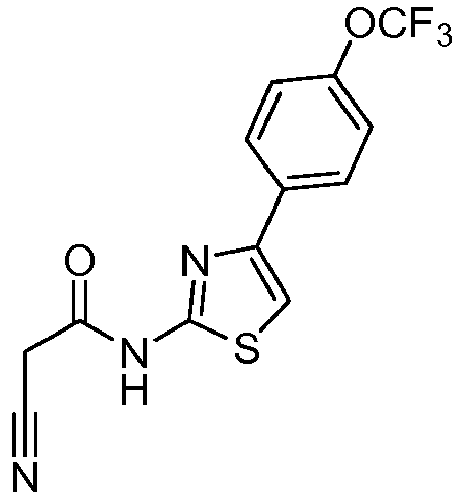
- The compound was prepared according to General procedure C1 from 4-(4-(trifluoromethoxy)phenyl)thiazol-2-amine (0.2 g, 0.77 mmol), ethyl cyanoacetate (123 µL, 1.15 mmol) and NaOEt (21% in EtOH, 430 µL, 1.15 mmol) in EtOH (2 mL). The mixture was stirred at 55 °C for 6 h. The product, purified by column chromatography (hexane:EtOAc; 1:0 to 1:1), was obtained as an off-white solid (0.216 g, 85 %).
1H NMR (500 MHz, DMSO-d 6) δ (ppm) 12.62 (s, 1H), 8.00 (d, J = 8.7 Hz, 2H), 7.77 (s, 1H), 7.43 (d, J = 8.7 Hz, 2H), 4.06 (s, 2H);
13C NMR (126 MHz, DMSO-d 6) δ (ppm) 162.5, 158.1, 148.3, 148.0, 133.8, 128.0, 121.8, 120.6 (q, J = 256.2 Hz), 115.6, 110.1, 26.4;
19F NMR (471 MHz, DMSO-d 6) δ (ppm) -56.73;
HRMS calcd for C13H9F3N3O2S [M+H]+ 328.0362, found 328.0360. -
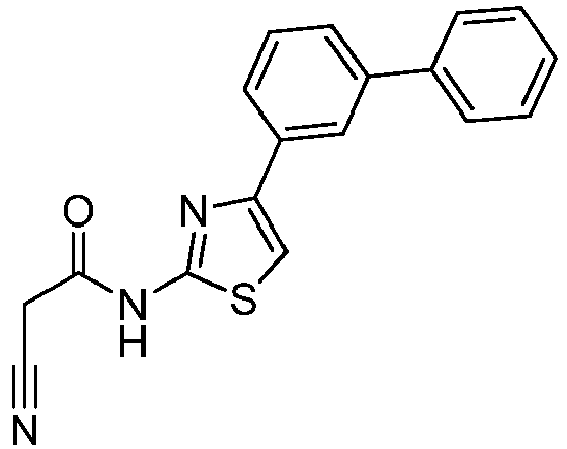
- The compound was prepared according to General procedure C1 from 4-([1,1'-biphenyl]-3-yl)thiazol-2-amine (250 mg, 1.0 mmol) in EtOH (3 mL), ethyl cyanoacetate (130 µL, 1.5 mmol) and NaOEt (21% in EtOH, 370 µL, 1.0 mmol). The product, purified by column chromatography (hexane:EtOAc; 3:2), was obtained as a white solid (300 mg, 65 %).
1H NMR (500 MHz, CDCl3) δ (ppm) 8.05 - 8.02 (m, 1H), 7.78 - 7.74 (m, 1H), 7.68 - 7.63 (m, 2H), 7.56 - 7.52 (m, 1H), 7.49 - 7.44 (m, 3H), 7.40 - 7.34 (m, 1H), 6.79 (s, 1H);
13C NMR (126 MHz, CDCl3) δ (ppm) 167.5, 151.5, 141.9, 141.3, 135.3, 129.2, 128.9, 127.56, 127.5, 126.8, 125.2, 125.2, 103.4;
HRMS calcd for C18H12N3OS [M-H]- 318.0707, found 318.0707. -

- The compound was prepared according to General procedure C1 from 4,5-diphenylthiazol-2-amine (0.079 g, 0.313 mmol), ethyl cyanoacetate (50 µL, 0.47 mmol) and NaOEt (21% in EtOH, 175 µL, 0.47 mmol) in EtOH (2 mL). The reaction mixture was stirred at 55 °C for 3 h. The crude product was triturated with CH2Cl2:EtOAc (1 mL + 1 mL), and the solid was collected by filtration and dried under vacuum. The product was obtained as a white solid (0.059 g, 59 %).
1H NMR (500 MHz, DMSO-d 6) δ (ppm) 12.66 (s, 1H), 7.47 - 7.36 (m, 5H), 7.36 - 7.27 (m, 5H), 4.08 (s, 2H);
13C NMR (126 MHz, DMSO-d 6) δ (ppm) 162.0, 155.3, 143.9, 134.4, 131.6, 129.3, 128.9, 128.4, 128.3, 128.1, 127.8, 125.9, 115.1, 25.9;
HRMS calcd for C18H12N3OS [M-H]- 318.0707, found 318.0709. -
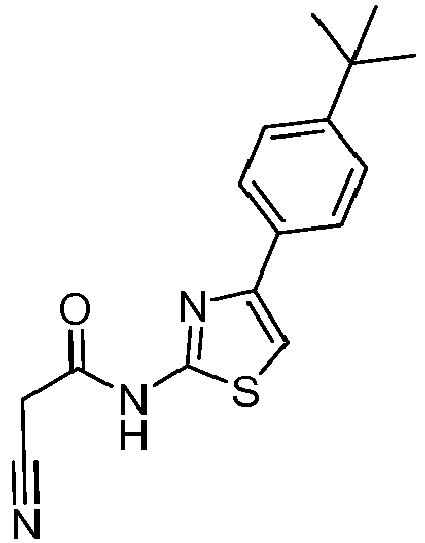
- The compound was prepared according to General procedure C1 from 4-(4-(tert-butyl)phenyl)thiazol-2-amine (0.63 g, 2.69 mmol), ethyl cyanoacetate (430 µL, 4.04 mmol) and NaOEt (21% in EtOH, 1.51 mL, 4.04 mmol) in EtOH (6 mL). The product, purified by column chromatography (hexane:EtOAc; 10:1 to 4:1), was obtained as an off-white solid (0.575 g, 71 %).
1H NMR (500 MHz, DMSO-d 6) δ (ppm) 12.58 (s, 1H), 7.82 (d, J = 8.5 Hz, 2H), 7.60 (s, 1H), 7.45 (d, J = 8.6 Hz, 2H), 4.05 (s, 2H), 1.30 (s, 9H);
13C NMR (126 MHz, DMSO-d 6) δ (ppm) 161.8, 157.2, 150.4, 149.0, 131.4, 125.5, 125.4, 115.1, 107.8, 34.3, 31.0, 25.9;
HRMS calcd for C16H18N3OS [M+H]+ 300.1165, found 300.1168. -

- The compound was prepared according to General procedure C1 from 4-(naphthalen-2-yl)thiazol-2-amine (0.207 g, 0.915 mmol), ethylcyanoacetate (146 µL, 1.37 mmol) and NaOEt (21% in EtOH, 512 µL, 1.37 mmol) in EtOH (2 mL). The mixture was heated at 50 °C for 21 h. Solvent was evaporated in vacuo, the solid residue was mixed with a saturated aqueous solution of NH4Cl (20 mL), and the mixture was extracted with EtOAc (3 × 25 mL). The combined organic phases were washed with brine, dried over MgSO4, filtered, and the solvent was evaporated in vacuo. The obtained product did not require any further purification. The product was obtained as a pale pink solid (0.161 g, 60 %).
1H NMR (500 MHz, DMSO-d 6) δ (ppm) 12.68 (s, 1H), 8.42 (s, 1H), 8.05 (d, J = 8.5, 1.7 Hz, 1H), 8.00 - 7.90 (m, 3H), 7.83 (d, J = 1.5 Hz, 1H), 7.59 - 7.47 (m, 2H), 4.08 (s, 2H);
13C NMR (126 MHz, DMSO-d 6) δ (ppm) 161.9, 157.4, 148.9, 133.1, 132.5, 131.5, 128.3, 128.1, 127.6, 126.5, 126.2, 124.3, 123.9, 115.1, 109.2, 25.9;
HRMS calcd for C16H12N3OS [M+H]+ 294.0696, found 294.0695. -
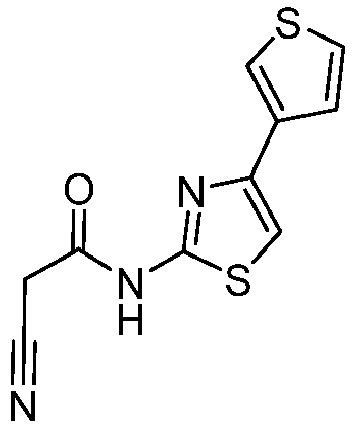
- The compound was prepared according to General procedure C1 from 4-(thiophen-3-yl)thiazol-2-amine (135 mg, 0.74 mmol), ethyl cyanoacetate (90 µL, 0.81 mmol), and NaOEt (21% in EtOH, 280 µL, 0.74 mmol). The product, purified by column chromatography (hexane:EtOAc; 1:1), was obtained as a white solid (77 mg, 40 %).
1H NMR (500 MHz, DMSO-d 6) δ (ppm) 12.59 (s, 1H), 7.80 - 7.76 (m, 1H), 7.60 (dd, J = 5.1, 3.0 Hz, 1H), 7.55 (dd, J = 5.0, 1.2 Hz, 1H), 7.52 (s, 1H), 4.04 (s, 2H);
13C NMR (126 MHz, DMSO-d 6) δ (ppm) 161.8, 157.2, 145.4, 136.4, 127.0, 125.9, 121.6, 115.1, 108.0, 25.8;
HRMS calcd for C10H6N3OS2 [M-H]- 247.9958, found 247.9959. -
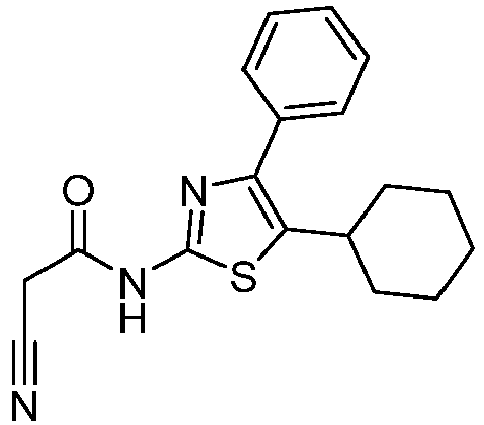
- The compound was prepared according to General procedure C1 from 5-cyclohexyl-4-phenylthiazol-2-amine (0.1 g, 0.39 mmol), ethylcyanoacetate (62 µL, 0.6 mmol), and NaOEt (21% in EtOH, 150 µL, 0.38 mmol) in EtOH (3 mL), The product, purified by column chromatography (hexane:EtOAc; 1:1), was obtained as a white solid (50 mg, 40 %).
1H NMR (500 MHz, DMSO-d 6) δ (ppm) 12.41 (s, 1H), 7.55 - 7.50 (m, 2H), 7.49 - 7.43 (m, 2H), 7.40 - 7.35 (m, 1H), 4.01 (s, 2H), 3.09 - 2.91 (m, 1H), 1.98 - 1.92 (m, 2H), 1.80 - 1.73 (m, 2H), 1.70 - 1.65 (m, 1H), 1.41 (q, J = 12.0 Hz, 2H), 1.35 - 1.23 (m, 3H);
13C NMR (126 MHz, DMSO-d 6) δ (ppm) 161.4, 153.7, 143.3, 135.0, 134.4, 128.5, 128.2, 128.0, 127.5, 115.2, 36.4, 35.9, 26.1, 25.1;
HRMS calcd for C18H18N3OS [M-H]- 324.1176, found 324.1176. -
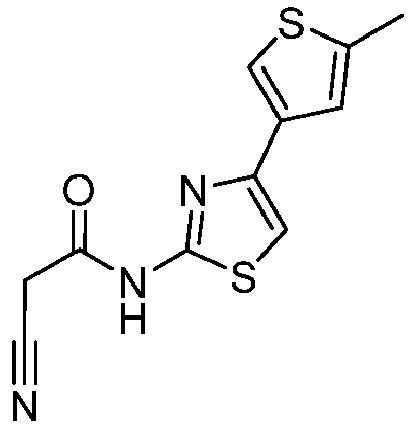
- The compound was prepared according to General procedure C2:
- Step 1: from 4-(4-methylthiophen-3-yl)thiazol-2-amine (150 mg, 0.78 mmol), chloroacetyl chloride (131 mg, 92 µL, 1.12 mmol), Et3N (113 mg, 155 µL, 1.12 mmol) in CH3CN (2.5 mL). After the work-up, the residue was purified by column chromatography (hexane:EtOAc; 7:3); the corresponding 2-chloroacetamide was obtained as a white solid (100 mg, 0.37 mmol).
- Step 2: from KCN (50 mg, 0.78 mmol) in DMF (2 mL). The product, purified by column chromatography (hexane:EtOAc; 7:3), was obtained as an off-white solid (95 mg, 45 %).
1H NMR (500 MHz, DMSO-d 6) δ (ppm) 12.66 (s, 1H), 7.47 (s, 1H), 7.34 (s, 1H), 7.07 (s, 1H), 4.03 (s, 2H), 2.22 (s, 3H);
13C NMR (126 MHz, DMSO-d 6) δ (ppm) 162.4, 157.8, 144.4, 138.4, 138.3, 126.5, 121.4, 115.6, 107.1, 26.4, 15.9;
HRMS calcd for C11H10N3OS2 [M+H]+ 264.0260, found 264.0256. -

- The compound was prepared according to General procedure C2:
- Step 1: from 4-(4-cyclohexylphenyl)thiazol-2-amine (360 mg, 1.4 mmol), chloroacetyl chloride (234 mg, 165 µL, 2.1 mmol), and Et3N (140 mg, 194 µL, 1.4 mmol) in CH3CN (7 mL). After the work-up, the residuewas purified by column chromatography (hexane:EtOAc; 7:3) to afford the corresponding 2-chloroacetamide as a white solid (430 mg, 1.4 mmol).
- Step 2: from KCN (190 mg, 2.8 mmol) in DMF (1 mL). The product, purified by column chromatography (hexane:EtOAc; 7:3), was obtained as an off-white solid (265 mg, 60 %).
1H NMR (500 MHz, DMSO-d 6) δ 12.56 (s, 1H), 7.60 - 7.56 (m, 3H), 7.10 (d, J = 8.2 Hz, 1H), 4.08 - 4.01 (m, 2H), 2.74 (dt, J = 17.1, 5.1 Hz, 4H), 1.81 - 1.70 (m, 4H);
13C NMR (126 MHz, DMSO) δ 161.7, 157.0, 149.2, 136.8, 136.5, 131.3, 129.2, 126.2, 122.8, 115.1, 107.4, 28.8, 28.5, 25.8, 22.7. -

- The compound was prepared according to General procedure C2:
- Step 1: from 4-(4-cyclohexylphenyl)thiazol-2-amine (360 mg, 1.4 mmol), chloroacetyl chloride (234 mg, 165 µL, 2.1 mmol), and Et3N (140 mg, 194 µL, 1.4 mmol) in CH3CN (7 mL). After the work-up, the residue was purified by column chromatography (hexane:EtOAc; 7:3), to afford the corresponding 2-chloroacetamide as a white solid (450 mg, 1.4 mmol).
- Step 2: from KCN (190 mg, 2.8 mmol) in DMF (1 mL). The product, purified by column chromatography (hexane:EtOAc; 7:3), was obtained as a pale yellow solid (265 mg, 60 %,).
1H NMR (500 MHz, DMSO-d 6) δ (ppm) 12.50 (s, 1H), 7.75 - 7.70 (m, 2H), 7.53 (s, 1H), 7.24 - 7.18 (m, 2H), 3.98 (s, 2H), 2.47 (d, J = 2.8 Hz, 1H), 1.78 - 1.69 (m, 5H), 1.42 - 1.25 (m, 5H).
13C NMR (126 MHz, CDCl3) δ (ppm) 170.3, 161.8, 157.1, 149.1, 147.3, 131.8, 125.6, 115.1, 107.6, 43.5, 33.8, 26.3, 25.5, 20.7.
HRMS calcd for C18H20N3OS [M+H]+ 326.1322, found 326.1320. -

- The compound was prepared according to General procedure C3 from 4-(pyridin-2-yl)thiazol-2-amine (0.285 g, 1.60 mmol), ethyl cyanoacetate (0.256 mL, 2.41 mmol) and NaH (60 % in mineral oil, 0.077 mg, 1.92 mmol)) in MeOH (5 mL); the reaction time was 4h at 60 °C. The product, purified by column chromatography (hexane:EtOAc; 1:1 to 0:1), was obtained as a yellow solid (0.245 g, 62 %).
1H NMR (500 MHz, DMSO-d6 ) δ (ppm) 12.63 (s, 1H), 8.61 (dt, J = 4.66, 1.47 Hz, 1H), 7.95 - 7.86 (m, 3H), 7.36 - 7.32 (m, 1H), 4.07 (s, 2H);
13C NMR (126 MHz, DMSO-d6 ) δ (ppm) 161.9, 157.5, 151.8, 149.5, 149.1, 137.3, 122.9, 119.9, 115.1, 112.1, 25.9;
HRMS calcd for C11H9N4OS [M+H]+ 245.0492, found 245.0497. -

- The compound was prepared according to General procedure C3 from 4-(6-methylpyridin-2-yl)thiazol-2-amine (0.250 g, 1.30 mmol), ethyl cyanoacetate (0.208 mL, 1.96 mmol) and NaH (60 % in mineral oil, 0.057 mg, 1.44 mmol)) in MeOH (5 mL); the reaction time was 4 h at 60 °C. The product, purified by column chromatography (hexane:EtOAc; 1:1 to 0:1), was obtained as an off-white solid (0.290 g, 86 %). 1H NMR (500 MHz, DMSO-d6 ) δ (ppm) 12.62 (s, 1H), 7.82 (s, 1H), 7.79 - 7.71 (m, 2H), 7.20 (dd, J = 7.34, 1.26 Hz, 1H), 4.06 (s, 2H), 2.51 (s, 3H);
13C NMR (126 MHz, DMSO-d6 ) δ (ppm) 161.9, 157.8, 157.4, 151.1, 149.3, 137.4, 122.3, 117.1, 115.1, 111.8, 25.9, 24.1;
HRMS calcd for C12H11N4OS [M+H]+ 259.0648, found 259.0650. -

- The compound was prepared according to General procedure C1 from 4-(2-(trifluoromethyl)phenyl)thiazol-2-amine (300 mg, 1.22 mmol), ethyl cyanoacetate (206 mg, 195 µL, 1.8 mmol), and Na (28 mg, 1.22 mmol) in EtOH (2 mL). The product, purified by column chromatography (hexane:EtOAc; 7:3), was obtained as a white solid (211 mg, 55 %).
1H NMR (500 MHz, DMSO-d 6) δ (ppm) 12.54 (s, 1H), 7.86 - 7.81 (m, 1H), 7.77 - 7.71 (m, 1H), 7.66 - 7.59 (m, 2H), 7.33 (s, 1H), 4.06 (s, 2H);
13C NMR (126 MHz, DMSO-d 6) δ (ppm) 162.0, 156.6, 146.8, 134.2, 132.3, 132.0, 128.7, 127.0 (q, J = 30.0 Hz), 126.3 (q, J = 5.4 Hz), 124.0 (q, J = 273.4 Hz), 115.1, 112.5, 25.9;
19F NMR (471 MHz, DMSO-d 6) δ (ppm) -56.39;
HRMS calcd for C13H9F3N3OS [M+H]+ 312.0413, found 312.0417. -

- The compound was prepared according to General procedure C1 from 4-(3,4-dichlorophenyl)thiazol-2-amine (300 mg, 1.22 mmol), ethyl cyanoacetate (206 mg, 195 µL, 1.8 mmol), and Na (28 mg, 1.22 mmol) in EtOH (2 mL). The product, purified by column chromatography (hexane:EtOAc; 7:3), was obtained as a white solid (280 mg, 75 %).
1H NMR (500 MHz, DMSO-d 6) δ (ppm) 12.63 (s, 1H), 8.12 (d, J = 2.0 Hz, 1H), 7.90 (s, 1H), 7.87 (dd, J = 8.4, 2.0 Hz, 1H), 7.70 (dd, J = 8.4, 1.0 Hz, 1H), 4.07 (s, 2H);
13C NMR (126 MHz, DMSO-d 6) δ (ppm) 162.0, 157.6, 146.4, 134.6, 131.5, 131.0, 130.1, 127.3, 125.7, 115.1, 110.6, 25.9;
HRMS calcd for C12H6Cl2N3OS [M-H]- 309.9614, found 309.9610. -

- The compound was prepared according to General procedure C1 from 4-(o-tolyl)thiazol-2-amine (285 mg, 1.5 mmol), ethyl cyanoacetate (250 mg, 250 µL, 2.25 mmol), and Na (35 mg, 1.5 mmol) in EtOH (1.5 mL). The product, purified by column chromatography (hexane:EtOAc; 7:3), was obtained as a white solid (310 mg, 80 %).
1H NMR (500 MHz, DMSO-d 6) δ (ppm) 12.52 (s, 1H), 7.60 - 7.53 (m, 1H), 7.33 (s, 1H), 7.31 - 7.22 (m, 3H), 4.05 (s, 2H), 2.42 (s, 3H);
13C NMR (126 MHz, DMSO-d 6) δ (ppm) 161.7, 156.3, 149.2, 135.4, 134.2, 130.8, 129.2, 127.8, 125.8, 115.2, 111.4, 25.9, 20.9;
HRMS calcd for C13H12N3OS [M+H]+ 258.0696, found 258.0699. -
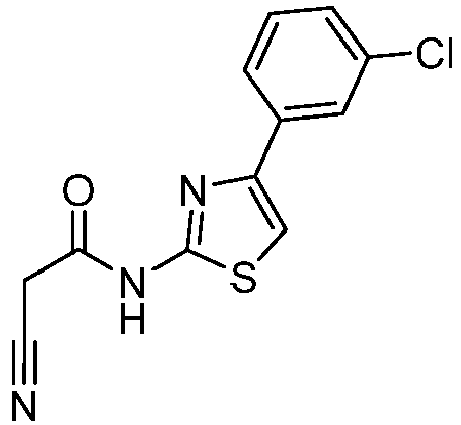
- The compound was prepared according to General procedure C3 from 4-(3-chlorophenyl)thiazol-2-amine (150 mg, 0.712 mmol), ethyl cyanoacetate (114 µL, 1.068 mmol) and NaH (60 % in mineral oil, 30 mg, 0.783 mmol) in MeOH (1 mL) and THF (3 mL); the reaction time was 6 h at 50 °C. The product, purified by column chromatography on silica gel (hexane:EtOAc; 10:1 to 2:1), was obtained as a white solid (171 mg, 87 %).
1H NMR (500 MHz, DMSO-d 6) δ (ppm) 12.62 (s, 1H), 7.94 (t, J = 1.9 Hz, 1H), 7.88 - 7.85 (m, 1H), 7.84 (s, 1H), 7.47 (t, J = 7.9 Hz, 1H), 7.41 - 7.37 (m, 1H), 4.06 (s, 2H);
13C NMR (126 MHz, DMSO-d 6) δ (ppm) 162.0, 157.5, 147.3, 136.0, 133.6, 130.7, 127.6, 125.3, 124.2, 115.1, 110.1, 25.9;
HRMS calcd for C12H9ClN3OS [M+H]+ 278.0149, found 278.0147. -

- The compound was prepared according to General procedure C3 from 4-(4-methylpyridin-2-yl)thiazol-2-amine (160 mg, 0.84 mmol), ethylcyanoacetate (140 mg, 130 µL, 1.3 mmol), NaH (60% in mineral oil, 34 mg, 0.84 mmol) in THF (2 mL) and MeOH (0.1 mL). The product, purified by column chromatography (EtOAc:MeOH; 1:0 to 10:1), was obtained as a white solid (125 mg, 60 %).
1H NMR (500 MHz, DMSO-d 6) δ (ppm) 12.62 (s, 1H), 8.45 (d, J = 4.9 Hz, 1H), 7.85 (s, 1H), 7.76 (s, 1H), 7.17 (d, J = 5.0 Hz, 1H), 4.07 (s, 2H), 2.37 (s, 3H);
13C NMR (126 MHz, DMSO-d 6) δ (ppm) 161.9, 157.5, 151.7, 149.3, 149.2, 147.8, 123.6, 120.8, 115.1, 112.0, 25.9, 20.7;
HRMS calcd for C12H11N4OS [M+H]+ 259.0648, found 259.0646. -

- The compound was prepared according to General procedure C3 from 4-(5-methylpyridin-2-yl)thiazol-2-amine (280 mg, 1.47 mmol), ethyl cyanoacetate (260 mg, 245 µL, 2.2 mmol), and NaH (60% in mineral oil, 59 mg, 1.47 mmol) in THF (3 mL) and MeOH (0.1 mL). The product, purified by column chromatography (CH2Cl2:MeOH; 10:1), was obtained as a pink solid (280 mg, 75 %).
1H NMR (500 MHz, DMSO-d 6) δ (ppm) 12.60 (s, 1H), 8.44 (d, J = 2.1 Hz, 1H), 7.82 (d, J = 8.1 Hz, 1H), 7.80 (s, 1H), 7.69 (dd, J = 8.0, 2.2 Hz, 1H), 4.06 (s, 2H), 2.32 (s, 3H);
13C NMR (126 MHz, DMSO-d 6) δ (ppm) 161.9, 157.5, 149.8, 149.4, 149.3, 137.5, 132.2, 119.5, 115.1, 111.2, 25.9, 17.7;
HRMS calcd for C12H11N4OS [M+H]+ 259.0648, found 259.0645. -

- The compound was prepared according to General procedure C3 from 4-(4-isopropylphenyl)thiazol-2-amine (250 mg, 1.145 mmol), ethyl cyanoacetate (244 µL, 2.290 mmol), and NaH (60% in mineral oil, 50 mg, 1.260 mmol) in MeOH (1 mL) and THF (3 mL). The mixture was stirred at 50 °C for 4 h. The product, purified by column chromatography on silica gel (hexane:EtOAc, 10:1 to 2:1), was obtained as a white solid (227 mg, 69 %).
1H NMR (500 MHz, DMSO-d 6) δ (ppm) 12.57 (s, 1H), 7.80 (d, J = 8.4 Hz, 2H), 7.60 (s, 1H), 7.30 (d, J = 8.5 Hz, 2H), 4.05 (s, 2H), 2.91 (hept, J = 6.7 Hz, 1H), 1.22 (d, J = 7.0 Hz, 6H);
13C NMR (126 MHz, DMSO-d 6) δ (ppm) 161.8, 157.2, 149.1, 148.1, 131.8, 126.6, 125.7, 115.1, 107.7, 33.1, 25.9, 23.7;
HRMS calcd for C15H16N3OS [M+H]+ 286.1009, found 286.1010. -
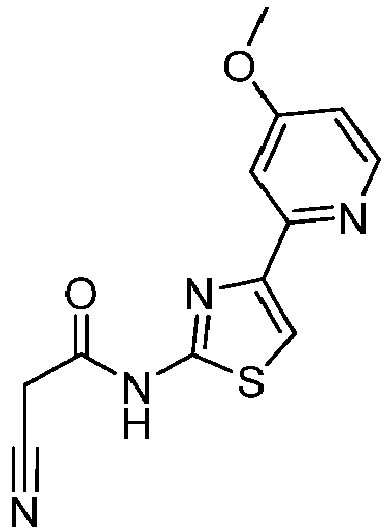
- The compound was prepared according to General procedure C3 from 4-(4-methoxypyridin-2-yl)thiazol-2-amine (212 mg, 1.0 mmol), ethyl cyanoacetate (170 mg, 150 µL, 1.5 mmol,), and NaH (60% in mineral oil, 44 mg, 1.1 mmol) in THF (2 mL) and MeOH (0.1 mL). The product, purified by column chromatography (hexane:EtOAc; 1:1 to 0:1), was obtained as an white solid (130 mg, 50 %).
1H NMR (500 MHz, DMSO-d 6) δ (ppm) 12.64 (s, 1H), 8.42 (d, J = 5.6 Hz, 1H), 7.86 (s, 1H), 7.46 (d, J = 2.5 Hz, 1H), 6.93 (dd, J = 5.7, 2.6 Hz, 1H), 4.06 (s, 2H), 3.87 (s, 3H);
13C NMR (126 MHz, DMSO-d 6) δ (ppm) 166.1, 162.0, 157.5, 153.4, 151.0, 149.0, 115.1, 112.4, 109.2, 105.8, 55.3, 25.9;
HRMS calcd for C12H11N4O2S [M+H]+ 275.0597, found 275.0595. -

- The compound was prepared according to General procedure C3 from 4-(5-methoxypyridin-2-yl)thiazol-2-amine (180 mg, 1.13 mmol), ethyl cyanoacetate (170 mg, 165 µL, 1.3 mmol), and NaH (60% in mineral oil, 35 mg, 0.88 mmol) in THF (3 mL) and MeOH (0.1 mL). The product, purified by column chromatography (hexane:EtOAc; 1:1 to 0:1), was obtained as a white solid (110 mg, 45 %).
1H NMR (500 MHz, DMSO-d 6) δ (ppm) 12.58 (s, 1H), 8.32 (dd, J = 3.0, 0.6 Hz, 1H), 7.87 (d, J = 8.7 Hz, 1H), 7.69 (s, 1H), 7.48 (dd, J = 8.7, 3.0 Hz, 1H), 4.06 (s, 2H), 3.86 (s, 3H);
13C NMR (126 MHz, DMSO-d 6) δ (ppm) 161.8, 157.4, 154.8, 149.0, 144.8, 137.5, 121.0, 120.6, 115.1, 109.9, 55.6, 25.9;
HRMS calcd for C12H11N4O2S [M+H]+ 275.0597, found 275.0599. -

- The compound was prepared according to General procedure C3 from 4-(6-methoxypyridin-2-yl)thiazol-2-amine (270 mg, 1.3 mmol), ethyl cyanoacetate (220 mg, 0.2 mL, 1.95 mmol), and NaH (60% in mineral oil, 60 mg, 1.43 mmol) in THF (2 mL) and MeOH (0.1 mL). The reaction mixture was poured into a saturated aqueous solution of NH4Cl (15 mL). The precipitate was collected by filtration, washed with water (3 mL) and EtOAc (5 mL), and dried undervacuum. The product was obtained as a white solid (270 mg, 75 %).
1H NMR (500 MHz, DMSO-d 6) δ (ppm) 12.61 (s, 1H), 7.86 (s, 1H), 7.78 (dd, J = 8.2, 7.4 Hz, 1H), 7.51 (d, J = 7.3 Hz, 1H), 6.77 (d, J = 8.1 Hz, 1H), 4.06 (s, 2H), 3.94 (s, 3H);
13C NMR (126 MHz, DMSO-d 6) δ (ppm) 163.1, 162.0, 157.5, 149.4, 149.0, 140.0, 115.1, 112.9, 112.2, 109.9, 52.8, 25.9;
HRMS calcd for C12H11N4O2S [M+H]+ 275.0597, found 275.0594. -

- The compound was prepared according to General procedure C3 from 4-(2,4-dichlorophenyl)thiazol-2-amine (1.0 g, 4.0 mmol), ethyl cyanoacetate (0.8 g, 750 µL, 6.0 mmol), and NaH (60% in mineral oil, 163 mg, 4.0 mmol) in THF (5 mL) and MeOH (0.3 mL). The product, purified by column chromatography (hexane:EtOAc; 5:1), was obtained as a white solid (850 mg, 70 %).
1H NMR (500 MHz, DMSO-d 6) δ (ppm) 12.64 (s, 1H), 7.84 (d, J = 8.5 Hz, 1H), 7.72 (s, 1H), 7.72 (d, J = 2.3 Hz, 1H), 7.53 (dd, J = 8.4, 2.2 Hz, 1H), 4.06 (s, 2H);
13C NMR (126 MHz, DMSO-d 6) δ (ppm) 162.0, 161.7, 156.7, 144.6, 133.0, 132.2, 131.8, 129.8, 127.6, 115.1, 113.9, 25.9;
HRMS calcd for C12H8Cl2N3OS [M+H]+ 311.9760, found 311.9762. -

- The compound was prepared according to General procedure C3 from 4-(3-fluoropyridin-2-yl)thiazol-2-amine (250 mg, 1.28 mmol), ethyl cyanoacetate (216 mg, 205 µL, 1.92 mmol), and NaH (60% in mineral oil, 51 mg, 1.28 mmol) in THF (3 mL) and MeOH (0.1 mL). The reaction mixture was poured into a saturated aqueous solution of NH4Cl (10 mL). The precipitate was collected by filtration, washed with EtOAc:MeOH (1:0.1, 5.5 mL) and Et2O (2 mL), and dried under vacuum. The product was obtained as a white solid (230 mg, 70 %).
1H NMR (500 MHz, DMSO-d 6) δ (ppm) 12.77 (s, 1H), 8.52 - 8.46 (m, 1H), 7.85 (s, 1H), 7.84 - 7.77 (m, 1H), 7.51 - 7.43 (m, 1H), 4.07 (s, 2H);
13C NMR (126 MHz, DMSO-d 6) δ (ppm) 162.0, 157.1, 156.3 (d, J = 262.5 Hz), 145.4 (d, J = 5.3 Hz), 145.2 (d, J = 6.2 Hz), 140.0 (d, J = 9.8 Hz), 124.8 (d, J = 15.0 Hz), 124.7, 115.5 (d, J = 6.4 Hz), 115.1, 25.9;
19F NMR (471 MHz, DMSO-d 6) δ-121.09;
HRMS calcd for C11H8FN3OS [M+H]+ 263.0397, found 263.0399. -

- The compound was prepared according to General procedure C3 from 4-(2-fluoro-4-methoxyphenyl)thiazol-2-amine (640 mg, 2.85 mmol), ethyl cyanoacetate (480 mg, 450 µL, 3.14 mmol), and NaH (60% in mineral oil, 126 mg, 3.14 mmol) in THF (3 mL) and MeOH (0.1 mL). The product, purified by column chromatography (hexane:EtOAc; 5:1), was obtained as a white solid (630 mg, 75 %). 1H NMR (500 MHz, DMSO-d 6) δ (ppm) 12.57 (s, 1H), 7.96 - 7.85 (m, 1H), 7.41 (d, J = 2.5 Hz, 1H), 6.93 (dd, J = 13.6, 2.6 Hz, 1H), 6.89 (dd, J = 8.7, 2.6 Hz, 1H), 4.05 (s, 2H), 3.81 (s, 3H);
13C NMR (126 MHz, DMSO-d 6) δ (ppm) 161.9, 160.2 (d, J = 248.8 Hz), 160.1 (d, J = 11.1 Hz), 156.7, 142.9, 129.7 (d, J = 4.8 Hz), 115.1, 114.4 (d, J = 12.0 Hz), 110.7, 110.7 (d, J = 10.7 Hz), 102.1 (d, J = 25.9 Hz), 55.7, 25.9;
19F NMR (471 MHz, DMSO-d 6) δ (ppm) -112.16;
HRMS calcd for C13H11FN3O2S [M+H]+ 292.0551, found 292.0551. -

- The compound was prepared according to General procedure C3 from 4-(4-(trifluoromethyl)pyridin-2-yl)thiazol-2-amine (220 mg, 0.897 mmol), ethyl cyanoacetate (0.143 mL, 1.34 mmol) and NaH (60 % in mineral oil, 0.047 mg, 1.16 mmol) in MeOH (6 mL); the reaction time was 20 h at 60 °C. The product, purified by column chromatography (CH2Cl2:MeOH; 1:0 to 9.5:0.5), was obtained as a white solid (110 mg, 39 %).
1H NMR (500 MHz, DMSO-d6 ) δ (ppm) 12.72 (s, 1H), 8.90 (d, J = 5.08 Hz, 1H), 8.14 (s, 1H), 8.04 (s, 1H), 7.73 (dd, J = 5.06, 1.76 Hz, 1H), 4.08 (s, 2H);
13C NMR (126 MHz, DMSO-d6 ) δ (ppm) 162.1, 158.0, 153.1, 151.3, 147.5, 137.8, 137.5, 124.0 (q, 1 J C-F = 272.8 Hz), 118.2 (d, J = 3.69 Hz), 115.2 - 114.8 (m), 114.0, 25.9;
19F NMR (471 MHz, DMSO-d6 ) δ (ppm) -63.83;
HRMS calcd for C12H8F3N4OS [M+H]+ 313.0365, found 313.0369. -

- The compound was prepared according to General procedure C3 from 4-(2,5-dichlorothiophen-3-yl)thiazol-2-amine (330 mg, 1.31 mmol), ethyl cyanoacetate (0.209 mL, 1.97 mmol) and NaH (60 % in mineral oil, 0.057 mg, 1.44 mmol) in MeOH (8 mL); the reaction time was 14 h at 60 °C. The product, purified by column chromatography (hexane:EtOAc; 1:0 to 3:1), was obtained as a yellow solid (328 mg, 78 %).
1H NMR (500 MHz, DMSO-d6 ) δ (ppm) 12.60 (s, 1H), 7.73 (s, 1H), 7.41 (s, 1H), 4.06 (s, 2H);
13C NMR (126 MHz, DMSO-d6 ) δ (ppm) 162.1, 157.0, 141.5, 132.2, 127.4, 125.2, 121.0, 115.0, 112.4, 25.9;
HRMS calcd for C10H6Cl2N3OS2 [M+H]+ 317.9324, found 317.9323. -

- The compound was prepared according to General procedure D1 from 2-cyano-N-(4-phenylthiazol-2-yl)acetamide (54 mg, 0.22 mmol), 4-acetamidobenzaldehyde (34 mg, 0.211 mmol), and NEt3 (31 µL, 0.22 mmol) in EtOH (1 mL); the reaction time was 3 h. The solvent was evaporated in vacuo and the residue was purified by column chromatography (hexane:EtOAc; 1:0 to 1:2). The product was obtained as a yellow solid (76 mg, 94 %).
1H NMR (500 MHz, DMSO-d 6) δ (ppm) 12.80 (s, 1H), 10.40 (s, 1H), 8.43 (s, 1H), 8.00 (d, J = 8.9 Hz, 2H), 7.94 (d, J = 7.5 Hz, 2H), 7.81 (d, J = 8.9 Hz, 2H), 7.70 (s, 1H), 7.45 (t, J = 7.7 Hz, 2H), 7.35 (t, J = 7.5 Hz, 1H), 2.11 (s, 3H);
13C NMR (126 MHz, DMSO-d 6) δ (ppm) 169.1, 161.4, 151.4, 149.2, 143.6, 134.0, 131.9, 128.7, 127.9, 126.0, 125.7, 118.9, 116.1, 108.8, 24.2;
HRMS calcd for C21H15N4O2S [M-H]- 387.0921, found 387.0921. -
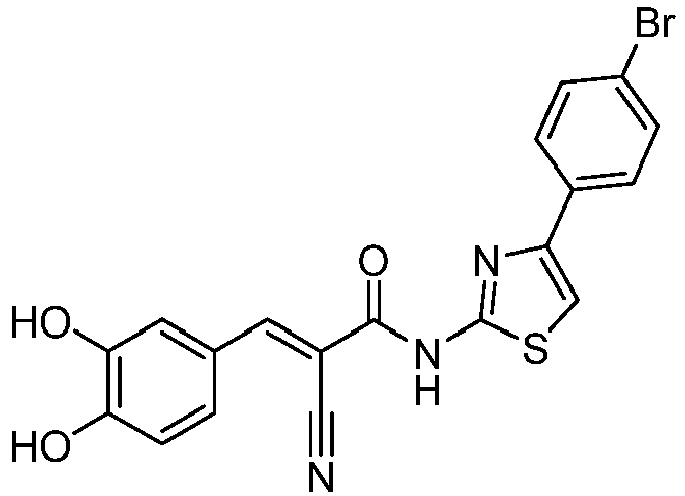
- The compound was prepared according to General procedure D1 from N-(4-(4-bromophenyl)thiazol-2-yl)-2-cyanoacetamide (150 mg, 0.46 mmol), 3,4-dihydroxybenzaldehyde (61 mg, 0.44 mmol) and NEt3 (65 µL, 0.46 mmol) in EtOH (3 mL); the reaction time was 4 h. Work-up 1 of General procedure D1. The product was obtained as a yellow solid (80 mg, 40%).
1H NMR (500 MHz, DMSO-d 6) δ (ppm) 12.68 (s, 1H), 10.29 (s, 1H), 9.65 (s, 1H), 8.31 (s, 1H), 7.89 (d, J = 8.4 Hz, 2H), 7.77 (s, 1H), 7.65 (d, J = 8.4 Hz, 2H), 7.61 (d, J = 2.1 Hz, 1H), 7.38 (dd, J = 8.4, 2.2 Hz, 1H), 6.94 (d, J = 8.3 Hz, 1H);
13C NMR (126 MHz, DMSO-d 6) δ (ppm) 161.8, 152.1, 158.1, 151.5, 147.9, 145.8, 133.3, 131.7, 127.7, 125.9, 123.1, 120.9, 116.5, 116.4, 116.1, 109.5;
HRMS calcd for C19H12BrN3O3S [M-H]- 441.9691, found 441.9691. -

- The compound was prepared according to General procedure D2 from 2-cyano-N-(4-phenylthiazol-2-yl)acetamide (775 mg, 3.19 mmol), 3,4-dihydroxybenzaldehyde (440 mg, 3.19 mmol), and piperidine (31 µL, 0.319 mmol) in CH2Cl2 (20 mL); the reaction time was 3 h. The crude product was purified by column chromatography (toluene:EtOAc; 1:1). The combined fractions containing the product were concentrated in vacuo to the volume of 10 mL. EtOAc (1 mL) was added and the precipitated solid was collected by filtration, washed on filter with a mixture of toluene and EtOAc (2.7 mL + 0.3 mL), and dried under vacuum. The product was obtained as a yellow solid (780 mg, 67 %).
1H NMR (500 MHz, DMSO-d 6) δ (ppm) 12.64 (s, 1H), 10.21 (s, 1H), 9.70 (s, 1H), 8.32 (s, 1H), 7.94 (d, J = 7.0 Hz, 2H), 7.68 (s, 1H), 7.62 (d, J = 2.3 Hz, 1H), 7.45 (m, J = 7.7 Hz, 2H), 7.39 (dd, J = 8.4, 2.3 Hz, 1H), 7.38 - 7.31 (m, 1H), 6.94 (d, J = 8.2 Hz, 1H);
13C NMR (126 MHz, DMSO-d 6) δ (ppm) 161.9, 158.2, 152.1, 151.5, 149.1, 145.8, 134.1, 128.7, 127.9, 125.9, 125.7, 123.1, 116.5, 116.1, 108.7, 99.7;
HRMS calcd for C9H2N3O3S [M-H]- 362.0605, found 362.0608. -

- The compound was prepared according to General procedure D1 from 2-cyano-N-(4-(4-cyanophenyl)thiazol-2-yl)acetamide (90 mg, 0.33 mmol), 3,4-dihydroxybenzaldehyde (42 mg, 0.30 mmol) and NEt3 (46 µL, 0.33 mmol) in EtOH (3 mL). The reaction time was 4 h at 50 °C and then 16 h at 25 °C. Work-up 2 of General procedure D1. The crude product was purified by column chromatography (hexane:EtOAc:MeOH; 1:1:0 to 0:50:1). The fractions containing the product were concentrated in vacuo to the residual volume of 5 mL. The precipitate was collected by filtration and dried under vacuum. The product was obtained as a yellow solid (35 mg, 30 %).
1H NMR (500 MHz, DMSO-d 6) δ (ppm) 12.74 (s, 1H), 10.30 (s, 1H), 9.66 (s, 1H), 8.32 (s, 1H), 8.16 - 8.07 (m, 2H), 8.00 (s, 1H), 7.96 - 7.84 (m, 2H), 7.62 (d, J = 2.3 Hz, 1H), 7.39 (dd, J = 8.4, 2.2 Hz, 1H), 6.94 (d, J = 8.2 Hz, 1H);
13C NMR (126 MHz, DMSO-d 6) δ (ppm) 162.0, 158.6, 152.3, 151.6, 147.3, 145.8, 138.3, 132.8, 126.3, 126.0, 123.1, 118.8, 116.5, 116.3, 116.1, 112.3, 110.0;
HRMS calcd for C2oH11N4O3S [M-H]- 387.0557, found 387.0558. -
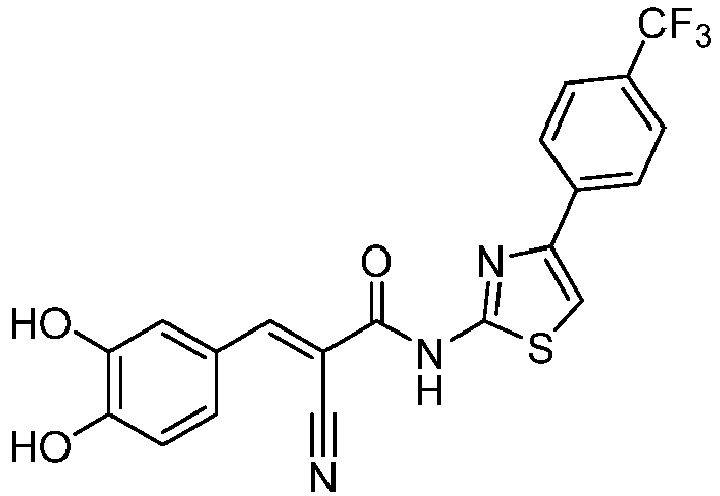
- The compound was prepared according to General procedure D1 from 2-cyano-N-(4-(4-trifluoromethylphenyl)thiazol-2-yl)acetamide (80 mg, 0.33 mmol), 3,4-dihydroxybenzaldehyde (32 mg, 0.30 mmol) and NEt3 (36 µL, 0.26 mmol) in EtOH (3 mL); the reaction time was 4 h at 50 °C and then 16 h at 25 °C. Work-up 1 of General procedure D1. The product was obtained as a yellow solid (42 mg, 40 %).
1H NMR (500 MHz, DMSO-d 6) δ (ppm) 12.64 (s, 1H), 9.74 (s, 2H), 8.32 (s, 1H), 8.16 (d, J = 8.3 Hz, 2H), 7.92 (s, 1H), 7.82 (d, J = 8.2 Hz, 2H), 7.63 (d, J = 2.3 Hz, 1H), 7.39 (dd, J = 8.4, 2.3 Hz, 1H), 6.94 (d, J = 8.3 Hz, 1H);
13C NMR (126 MHz, DMSO-d 6) δ (ppm) 162.2, 159.0, 152.5, 152.1, 147.2, 146.3, 138.4, 128.4 (q, J = 31.8 Hz), 126.8, 126.2 (q, J = 4.5 Hz), 126.2 (q, J = 70.8 Hz), 124.8 (q, J = 272.2 Hz), 123.6, 117.0, 116.6, 111.7;
HRMS calcd for C20H11F3N3O3S [M-H]- 430.0479, found 430.0481. -

- The compound was prepared according to General procedure D1 from 2-cyano-N-(4-(p-tolyl)thiazol-2-yl)acetamide (60 mg, 0.233 mmol), 3,4-dihydroxybenzaldehyde (31 mg, 0.222 mmol) and NEt3 (32 µL, 0.233 mmol) in EtOH (1 mL); the reaction time was 1.5 h. The solvent was evaporated in vacuo and the residue was stirred in a mixture of CH2Cl2 and CH3CN (1.5 mL + 1.5 mL) at 25 °C for 2 h. The solid was collected by filtration, washed on filter with EtOH (1 mL), diethyl ether (1 mL), and dried under vacuum. The product was obtained as an orange solid (33 mg, 38 %).
1H NMR (500 MHz, DMSO-d 6) δ (ppm) 10.69 (s, 2H), 8.28 (s, 1H), 7.83 (d, J = 7.9 Hz, 2H), 7.61 (d, J = 2.3 Hz, 1H), 7.57 (s, 1H), 7.38 (dd, J = 8.4, 2.3 Hz, 1H), 7.26 (d, J = 8.2 Hz, 2H), 6.92 (d, J = 8.2 Hz, 1H), 2.34 (s, 3H);
13C NMR (126 MHz, DMSO-d 6) δ (ppm) 162.4, 159.4, 151.8, 151.6, 145.8, 137.1, 131.4, 129.3, 125.9, 125.7, 123.0, 116.7, 116.3, 116.1, 107.6, 20.8;
HRMS calcd for C20H14N3O3S [M-H]- 376.0761, found 376.0761. -

- The compound was prepared according to General procedure D1 from 2-cyano-N-(4,5-diphenylthiazol-2-yl)acetamide (70 mg, 0.22 mmol), 3,5-dichloro-4-hydroxybenzaldehyde (40 mg, 0.21 mmol) and NEt3 (30 µL, 0.22 mmol) in EtOH (3 mL); the reaction time was 4 h. Work-up 2 of General procedure D1. The product, purified by reverse phase column chromatography (H2O:MeOH:AcOH; 45:55:0.05 to 5:95:0.05), was obtained as a pale yellow solid (65 mg, 60%).
1H NMR (500 MHz, DMSO-d 6) δ (ppm) 12.86 (s, 1H), 8.32 (s, 1H), 8.05 (s, 2H), 7.47 - 7.43 (m, 2H), 7.41 - 7.31 (m, 8H);
13C NMR (126 MHz, DMSO-d 6) δ (ppm) 149.8, 132.0, 131.5, 129.7, 129.5, 129.1, 128.9, 128.6, 123.5, 116.8;
HRMS calcd for C25H14Cl2N3O2S [M-H]- 490.0189, found 490.0190. -

- The compound was prepared according to General procedure D1 from 2-cyano-N-(4-phenyl-5-(p-tolyl)thiazol-2-yl)acetamide (90 mg, 0.27 mmol), 3,4-dihydroxybenzaldehyde (35 mg, 0.26 mmol) and NEt3 (38 µL, 0.27 mmol) in EtOH (3 mL); the reaction time was 4 h. Work-up 2 of General procedure D1. The product, purified by reverse phase column chromatography (H2O:MeOH:AcOH; 40:60:0.05 to 15:85:0.05), was obtained as a yellow solid (40 mg, 40%).
1H NMR (500 MHz, DMSO-d 6) δ (ppm) 12.70 (s, 1H), 10.26 (s, 1H), 9.66 (s, 1H), 8.31 (s, 1H), 7.61 (d, J = 2.3 Hz, 1H), 7.49 - 7.44 (m, 2H), 7.38 (dd, J = 8.4, 2.3 Hz, 1H), 7.36 - 7.30 (m, 3H), 7.25 - 7.17 (m, 4H), 6.93 (d, J = 8.4 Hz, 1H), 2.32 (s, 3H);
13C NMR (126 MHz, DMSO-d 6) δ (ppm) 152.0, 151.5, 145.8, 137.5, 129.5, 129.1, 128.6, 128.5, 128.3, 127.8, 125.9, 123.1, 116.5, 116.1, 20.7;
HRMS calcd for C26H18N3O3S [M-H]- 452.1074, found 452.1075. -

- The compound was prepared according to General procedure D1 from 2-cyano-N-(4-(4-(trifluoromethoxy)phenyl)thiazol-2-yl)acetamide (55 mg, 0.168 mmol), 3,4-dihydroxybenzaldehyde (22 mg, 0.16 mmol) and NEt3 (23 µL, 0.168 mmol) in EtOH (1 mL); the reaction time was 2 h. The solvent was evaporated in vacuo and the residue was purified by preparative TLC (hexane:EtOAc, 1:1), followed by reverse phase column chromatography (H2O:MeOH:AcOH; 70:30:0.05 to 20:80:0.05). The product was obtained as an orange-brown solid (15 mg, 20 %).
1H NMR (500 MHz, DMSO-d 6) δ (ppm) 8.29 (s, 1H), 8.08 - 8.02 (m, 2H), 7.75 (s, 1H), 7.61 (d, J = 2.1 Hz, 1H), 7.44 (d, J = 7.9 Hz, 2H), 7.38 (dd, J = 8.4, 2.3 Hz, 1H), 6.93 (d, J = 8.2 Hz, 1H); 13C NMR (126 MHz, DMSO-d 6) δ (ppm) 152.4, 152.2, 148.3, 146.3, 134.0, 128.0, 126.4, 123.6, 121.8, 120.6 (q, J = 256.2 Hz), 117.1, 117.0, 116.6, 110.1;
19F NMR (471 MHz, DMSO-d 6) δ (ppm) -56.68;
HRMS calcd for C20H11F3N3O4S [M-H]- 446.0428, found 446.0428. -

- The compound was prepared according to General procedure D1 from 2-cyano-N-(4-(4-(trifluoromethoxy)phenyl)thiazol-2-yl)acetamide (50 mg, 0.15 mmol), 4-hydroxy-3,5-dichlorobenzaldehyde (28 mg, 0.14 mmol) and NEt3 (21 µL, 0.15 mmol) in EtOH (3 mL); the reaction time was 4 h. Work-up 2 of General procedure D1. The product, purified by column chromatography (hexane:EtOAc:MeOH; 1:1:0 to 0:10:1), was obtained as a yellow solid (35 mg, 45 %).
1H NMR (500 MHz, DMSO-d 6) δ (ppm) 12.84 (s, 1H), 8.36 (s, 1H), 8.06 - 8.04 (m, 4H), 7.80 (s, 1H), 7.45 (d, J = 8.3 Hz, 2H);
13C NMR (126 MHz, DMSO-d 6) δ (ppm) 161.1, 153.6, 149.4, 147.9, 130.8, 127.5, 122.7, 121.3, 121.1, 120.1 (q, J = 256.2 Hz), 119.0, 115.8, 109.9;
19F NMR (471 MHz, DMSO-d 6) δ (ppm) -56.69;
HRMS calcd for C20H9F3N3O3S [M-H]- 497.9699, found 497.9697. -

- The compound was prepared according to General procedure D2 from N-(4-([1,1'-biphenyl]-3-yl)thiazol-2-yl)-2-cyanoacetamide (200 mg, 0.6 mmol), 3,4-dihydroxybenzaldehyde (85 mg, 0.6 mmol) and piperidine (6.0 µL, 0.06 mmol) in CH2Cl2 (3 mL); the reaction time was 4 h at reflux and then 16 h at 25 °C. The product, purified by reverse phase column chromatography (H2O:MeOH:AcOH; 45:55:0.05 to 10:90:0.05), was obtained as a yellow solid (80 mg, 30 %).
1H NMR (500 MHz, DMSO-d 6) δ (ppm) 12.61 (s, 1H), 9.81 (s, 2H), 8.32 (s, 1H), 8.24 (s, 1H), 7.94 (d, J = 7.7 Hz, 1H), 7.83 (s, 1H), 7.74 (d, J = 7.6 Hz, 2H), 7.64 (d, J = 7.9 Hz, 1H), 7.62 (d, J = 2.2 Hz, 1H), 7.56 - 7.53 (m, 1H), 7.52 - 7.50 (m, 1H), 7.43 - 7.37 (m, 2H), 6.94 (d, J = 8.3 Hz, 1H);
13C NMR (126 MHz, DMSO-d 6) δ (ppm) 161.9, 152.0, 151.6, 145.8, 140.7, 140.0, 134.5, 129.4, 128.9, 127.6, 126.7, 126.2, 125.7, 124.8, 124.1, 123.1, 116.5, 116.1;
HRMS calcd for C25H16N3O3S [M-H]- 438.0918, found 438.0918. -

- The compound was prepared according to General procedure D1 from 2-cyano-N-(4-phenylthiazol-2-yl)acetamide (50 mg, 0.21 mmol), 3,5-di-tert-butyl-4-hydroxybenzaldehyde hemihydrate (50 mg, 0.21 mmol), and piperidine (2.0 µL, 0.027 mmol) in CH2Cl2 (2 mL); the reaction time was 2 h at reflux. The solvent was evaporated in vacuo and the residue was purified by column chromatography (hexane:EtOAc; 10:1 to 3:1). The product was obtained as a yellow solid (72 mg, 76 %).
1H NMR (500 MHz, DMSO-d 6) δ (ppm) 12.66 (s, 1H), 8.49 (s, 1H), 8.16 (s, 1H), 8.00 - 7.89 (m, 4H), 7.69 (s, 1H), 7.49 - 7.41 (m, 2H), 7.39 - 7.31 (m, 1H), 1.43 (s, 18H);
13C NMR (126 MHz, DMSO-d 6) δ (ppm) 159.2, 152.9, 139.0, 134.1, 128.7, 128.7, 127.9, 125.7, 122.9, 116.6, 108.7, 34.7, 29.9;
HRMS calcd for C27H28N3O2S [M-H]- 458.1908, found 458.1908. -

- The compound was prepared according to General procedure D2 from N-(4-(4-(tert-butyl)phenyl)thiazol-2-yl)-2-cyanoacetamide (80 mg, 0.267 mmol), 3,4-dihydroxybenzaldehyde (37 mg, 0.267 mmol) and piperidine (3.0 µL, 0.027 mmol) in CH2Cl2 (6 mL); the reaction time was 2 h at reflux and then 16 h at 25 °C. The product, purified by reverse phase column chromatography (H2O:MeOH:AcOH; 40:60:0.05 to 6:94:0.05), was obtained as a yellow solid (110 mg, 89 %).
1H NMR (500 MHz, DMSO-d 6) δ (ppm) 8.29 (s, 1H), 7.89 - 7.82 (m, 2H), 7.65 - 7.56 (m, 2H), 7.46 (d, J = 8.5 Hz, 2H), 7.38 (d, J = 8.4 Hz, 1H), 6.92 (d, J = 8.2 Hz, 1H), 1.31 (s, 9H);
13C NMR (126 MHz, DMSO-d 6) δ (ppm) 162.3, 151.8, 151.7, 150.4, 145.8, 131.2, 125.9, 125.5, 125.4, 123.1, 116.4, 116.1, 107.8, 34.3, 31.0;
HRMS calcd for C23H22N3O3S [M+H]+ 420.1376, found 420.1377. -

- The compound was prepared according to General procedure D1 from 2-cyano-N-(4-(naphthalen-2-yl)thiazol-2-yl)acetamide (50 mg, 0.17 mmol), 3,5-dichloro-4-hydroxybenzaldehyde (31 mg, 0.16 mmol) and NEt3 (24 µL, 0.17 mmol) in EtOH (1.5 mL); the reaction time was 4 h. Work-up 2 of General procedure D1. The product, purified by column chromatography (CH2Cl2:MeOH; 10:1), was obtained as a pale yellow solid (30 mg, 40 %).
1H NMR (500 MHz, DMSO-d 6) δ (ppm) 12.86 (s, 1H), 8.49 (d, J = 1.6 Hz, 1H), 8.39 (s, 1H), 8.07 (s, 3H), 7.99 (d, J = 8.7 Hz, 1H), 7.97 - 7.92 (m, 2H), 7.86 (s, 1H), 7.61 - 7.49 (m, 2H);
13C NMR (126 MHz, DMSO-d 6) δ (ppm) 161.0, 153.4, 149.3, 133.1, 132.6, 131.4, 130.8, 128.3, 128.1, 128.0, 127.6, 126.6, 126.3, 124.4, 123.9, 122.7, 115.7;
HRMS calcd for C23H12Cl2N3O2S [M-H]- 464.0033, found 464.0032. -

- The compound was prepared according to General procedure D1 from 2-cyano-N-(4-(thiophen-3-yl)thiazol-2-yl)acetamide (67 mg, 0.27 mmol), 3,4-dihydroxybenzaldehyde (35 mg, 0.25 mmol) and NEt3 (40 µL, 0.27 mmol) in EtOH (3 mL); the reaction time was 2.5 h at 50 °C and then 16 h at 25 °C. Work-up 1 of General procedure D1. The product was obtained as a yellow solid (55 mg, 55 %).
1H NMR (500 MHz, DMSO-d 6) δ (ppm) 12.55 (s, 1H), 9.85 (s, 2H), 8.29 (s, 1H), 7.85 (s, 1H), 7.66 - 7.57 (m, 3H), 7.51 (s, 1H), 7.37 (dd, J = 8.4, 2.1 Hz, 1H), 6.93 (d, J = 8.3 Hz, 1H);
13C NMR (126 MHz, DMSO-d 6) δ (ppm) 162.3, 151.8, 151.5, 145.8, 135.9, 127.0, 126.0, 125.8, 123.1, 121.6, 116.6, 116.5, 116.0, 107.9;
HRMS calcd for C17H10N3O3S2 [M-H]- 368.0169, found 368.0169. -

- The compound was prepared according to General procedure D2 from 2-cyano-N-(5-cyclohexyl-4-phenylthiazol-2-yl)acetamide (50 mg, 0.15 mmol), 3,4-dihydroxybenzaldehyde (31 mg, 0.15 mmol) and piperidine (2 µL, 0.02 mmol) in CH2Cl2 (2 mL); the reaction time was 4 h at 50 °C and then 16 h at 25 °C . The product, purified by reverse phase column chromatography (H2O:MeOH:AcOH; 45:55:0.5 to 10:90:0.5), was obtained as a yellow solid (30 mg, 45 %).
1H NMR (500 MHz, DMSO-d 6) δ (ppm) 12.51 (s, 1H), 10.13 (s, 1H), 9.70 (s, 1H), 8.24 (s, 1H), 7.60 (d, J = 2.3 Hz, 1H), 7.55 (d, J = 7.3 Hz, 2H), 7.48 (dd, J = 8.6, 6.8 Hz, 2H), 7.40 (t, J = 7.3 Hz, 1H), 7.35 (dd, J = 8.4, 2.3 Hz, 1H), 6.92 (d, J = 8.3 Hz, 1H), 3.05 - 2.91 (m, 1H), 2.02 - 1.90 (m, 2H), 1.83 - 1.74 (m, 2H), 1.72 - 1.63 (m, 1H), 1.51 - 1.37 (m, 2H), 1.36 - 1.22 (m, 3H);
13C NMR (126 MHz, DMSO-d 6) δ (ppm) 151.6, 151.3, 145.8, 135.0, 128.5, 128.9, 127.7, 125.7, 123.2, 116.5, 116.0, 36.4, 35.7, 26.1, 25.2;
HRMS calcd for C25H22N3O3S [M-H]- 444.1387, found 444.1387. -

- The compound was prepared according to General procedure D1 from 2-cyano-N-(4-phenylthiazol-2-yl)acetamide (80 mg, 0.33 mmol), 4-hydroxy-3,5-dimethylbenzaldehyde (47 mg, 0.31 mmol) and NEt3 (46 µL, 0.33 mmol) in EtOH (3 mL); the reaction time was 4 h. Work-up 1 of General procedure D1. The product was obtained as a yellow solid (50 mg, 50 %).
1H NMR (500 MHz, DMSO-d 6) δ (ppm) 12.67 (s, 1H), 9.60 (s, 1H), 8.34 (s, 1H), 7.98 - 7.89 (m, 2H), 7.76 - 7.67 (m, 3H), 7.46 - 7.44 (m, 2H), 7.38 - 7.31 (m, 1H), 2.24 (s, 6H);
13C NMR (126 MHz, DMSO-d 6) δ (ppm) 162.0, 158.7, 151.9, 134.0, 131.9, 128.7, 127.9, 125.7, 125.1, 122.7, 116.5, 108.6, 100.1, 16.6;
HRMS calcd for C21H6N3O2S [M-H]- 374.0969, found 374.0969. -
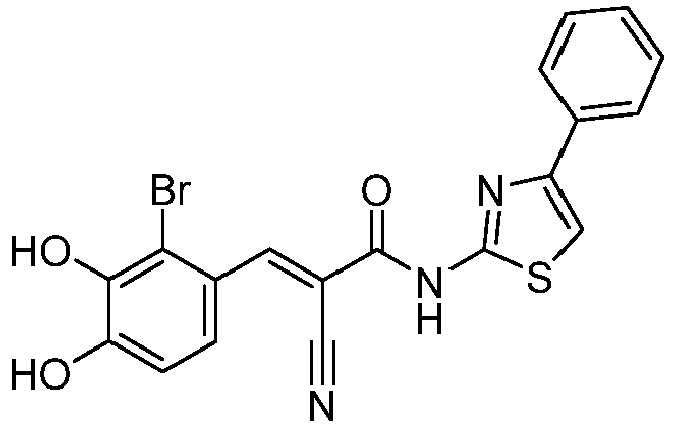
- The compound was prepared according to General procedure D2 from 2-cyano-N-(4-phenylthiazol-2-yl)acetamide (90 mg, 0.42 mmol), 2-bromo-3,4-dihydroxybenzaldehyde (73 mg, 0.42 mmol) and piperidine (3 µL, 0.027 mmol) in CH2Cl2 (3 mL). The reaction time was 2 h at reflux. The product, purified by reverse phase column chromatography (H2O:MeOH:AcOH; 60:40:0.05 to 5:95:0.05), was obtained as a yellow solid (150 mg, 80 %).
1H NMR (500 MHz, DMSO-d 6) δ (ppm) 8.41 (s, 1H), 7.95 - 7.91 (m, 2H), 7.85 (d, J = 8.7 Hz, 1H), 7.57 (s, 1H), 7.48 - 7.39 (m, 2H), 7.36 - 7.28 (m, 1H), 6.66 (d, J = 8.7 Hz, 1H);
13C NMR (126 MHz, DMSO-d 6) δ (ppm) 163.1, 161.0, 149.2, 148.1, 145.2, 134.3, 128.6, 127.6, 125.7, 123.5, 118.1, 114.4, 112.8, 108.1;
HRMS calcd for C9H13BrN3O3S [M+H]+ 443.9836, found 443.9840. -
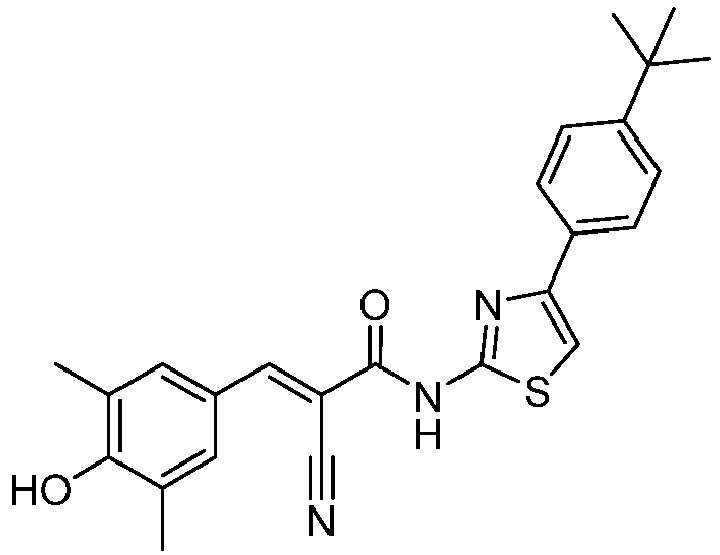
- The compound was prepared according to General procedure D2 from N-(4-(4-(tert-butyl)phenyl)thiazol-2-yl)-2-cyanoacetamide (75 mg, 0.251 mmol), 4-hydroxy-3,5-dimethylbenzaldehyde (38 mg, 0.251 mmol), and piperidine (1.8 mg, 2 µL, 0.025 mmol) in CH2Cl2 (4 mL); the reaction time was 3 h at reflux. The residue was purified by column chromatography (hexane:EtOAc; 10:1 to 2:1) to give the product as a yellow solid (101 mg, 93 %).
1H NMR (500 MHz, DMSO-d 6) δ (ppm) 12.63 (s, 1H), 9.61 (s, 1H), 8.33 (s, 1H), 7.86 (d, J = 8.4 Hz, 2H), 7.71 (s, 2H), 7.62 (s, 1H), 7.47 (d, J = 8.5 Hz, 2H), 2.24 (s, 6H), 1.31 (s, 9H);
13C NMR (126 MHz, DMSO-d 6) δ (ppm) 161.8, 158.7, 157.9, 151.8, 150.4, 131.9, 125.5, 125.1, 122.7, 116.5, 108.0, 99.9, 34.5, 34.3, 31.1, 31.0, 16.6;
HRMS calcd for C25H26N3O2S [M+H]+ 432.1740, found 432.1738. -

- The compound was prepared according to General procedure D2 from N-(4-(4-(tert-butyl)phenyl)thiazol-2-yl)-2-cyanoacetamide (75 mg, 0.251 mmol), 3,5-di-tert-butyl-4-hydroxybenzaldehyde (59 mg, 0.251 mmol), and piperidine (2 µL, 0.025 mmol) in CH2Cl2 (4 mL); the reaction time was 3 h at reflux. The residue was purified by column chromatography (hexane:EtOAc, 10:1 to 6:1) to give the product as a yellow solid (124 mg, 96 % yield).
1H NMR (500 MHz, DMSO-d 6) δ (ppm) 12.65 (s, 1H), 8.49 (s, 1H), 8.16 (s, 1H), 7.94 (s, 2H), 7.86 (d, J = 8.4 Hz, 2H), 7.62 (s, 1H), 7.47 (d, J = 8.5 Hz, 2H), 1.43 (s, 18H), 1.31 (s, 9H);
13C NMR (126 MHz, DMSO-d 6) δ (ppm) 159.7, 159.4, 157.0, 156.2, 151.5, 150.7, 137.3, 131.6, 129.9, 126.0, 125.9, 123.7, 117.2, 108.1, 97.5, 34.8, 34.8, 31.4, 30.2;
HRMS calcd for C31H37N3O2S [M+H]+ 516.2679, found 516.2678. -

- The compound was prepared according to General procedure D2 from 2-cyano-N-(4-phenylthiazol-2-yl)acetamide (47 mg, 0.20 mmol), 5-formyl-2-hydroxybenzonitrile (30 mg, 0.20 mmol) and piperidine (3 µL, 0.027 mmol) in CH2Cl2 (2 mL). The reaction time was 2 h at reflux. The precipitate was collected by filtration, washed with CH2Cl2 (3 mL) and dried under vacuum. The product was obtained as a yellow solid (50 mg, 70 %).
1H NMR (500 MHz, DMSO-d 6) δ (ppm) 8.14 (s, 1H), 8.01 - 7.97 (m, 1H), 7.96 - 7.90 (m, 3H), 7.62 (s, 1H), 7.48 - 7.41 (m, 2H), 7.37 - 7.30 (m, 1H), 6.45 (d, J = 9.4 Hz, 1H);
13C NMR (126 MHz, DMSO-d 6) δ (ppm) 174.9, 163.0, 158.9, 149.9, 148.6, 140.8, 135.0, 134.2, 128.7, 127.7, 125.7, 122.0, 119.3, 118.2, 114.1, 108.2, 102.0;
HRMS calcd for C20H13N4O2S [M+H]+ 373.0754, found 373.0750. -

- The compound was prepared according to General procedure D2 from 2-cyano-N-(4-(4-methylthiophen-3-yl)thiazol-2-yl)acetamide (50 mg, 0.19 mmol), 3,4-dihydroxybenzaldehyde (26 mg, 0.19 mmol) and piperidine (3 µL, 0.027 mmol) in CH2Cl2 (2 mL). The reaction time was 2 h at reflux. The product, purified by reverse phase column chromatography (H2O:MeOH:AcOH; 60:40:0.05 to 5:95:0.05), was obtained as a yellow solid (55 mg, 75 %).
1H NMR (500 MHz, DMSO-d 6) δ (ppm) 10.01 (s, 2H), 8.30 (s, 1H), 7.60 (d, J = 2.3 Hz, 1H), 7.40 (s, 1H), 7.37 (dd, J = 8.5, 2.3 Hz, 1H), 7.32 (d, J = 3.5 Hz, 1H), 6.94 (d, J = 8.3 Hz, 1H), 6.79 (dd, J = 3.5, 1.3 Hz, 1H), 2.46 (s, 3H);
13C NMR (126 MHz, DMSO-d 6) δ (ppm) 162.1, 158.4, 151.9, 151.6, 145.8, 144.0, 138.9, 135.9, 126.3, 125.8, 123.8, 123.1, 116.6, 116.5, 116.1, 106.2, 15.0;
HRMS calcd for C18H14N3O3S2 [M+H]+ 384.0471, found 384.0468. -
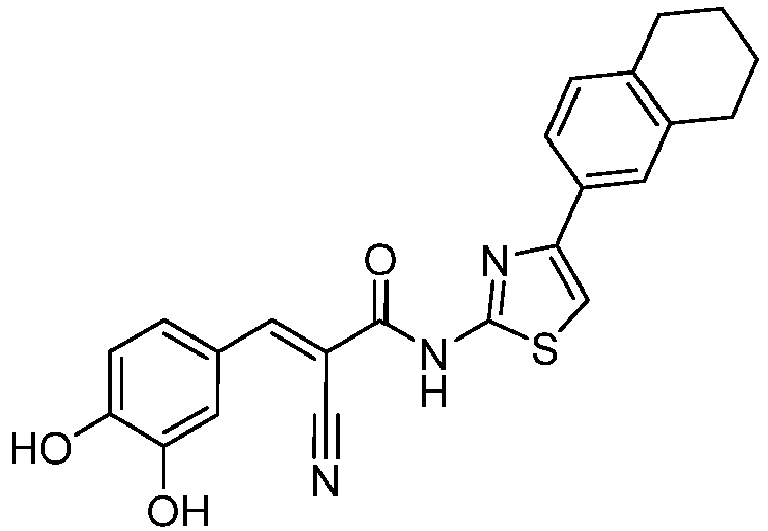
- The compound was prepared according to General procedure D2 from 2-cyano-N-(4-(4-cyclohexylphenyl)thiazol-2-yl)acetamide (75 mg, 0.23 mmol), 3,4-dihydroxybenzaldehyde (32 mg, 0.23 mmol), and piperidine (3 µL, 0.027 mmol) in CH2Cl2 (3 mL). The reaction time was 2 h at reflux. The product, purified by reverse phase column chromatography (H2O:MeOH:AcOH; 60:40:0.05 to 5:95:0.05), was obtained as a yellow solid (70 mg, 70 %).
1H NMR (500 MHz, DMSO-d 6) δ (ppm) 12.51 (s, 1H), 9.98 (s, 2H), 8.30 (s, 1H), 7.66 - 7.59 (m, 3H), 7.55 (s, 1H), 7.38 (dd, J = 8.4, 2.3 Hz, 1H), 7.11 (d, J = 7.9 Hz, 1H), 6.93 (d, J = 8.3 Hz, 1H), 2.84 - 2.66 (m, 4H), 1.81 - 1.71 (m, 4H);
13C NMR (126 MHz, DMSO-d 6) δ (ppm) 162.3, 158.7, 151.8, 151.7, 148.2, 145.8, 136.8, 136.5, 131.2, 129.2, 126.3, 125.9, 123.1, 122.9, 116.6, 116.4, 116.1, 107.4, 30.6, 28.8, 28.6, 22.7;
HRMS calcd for C23H2N3O3S [M+H]+ 418.1220, found 418.1220. -
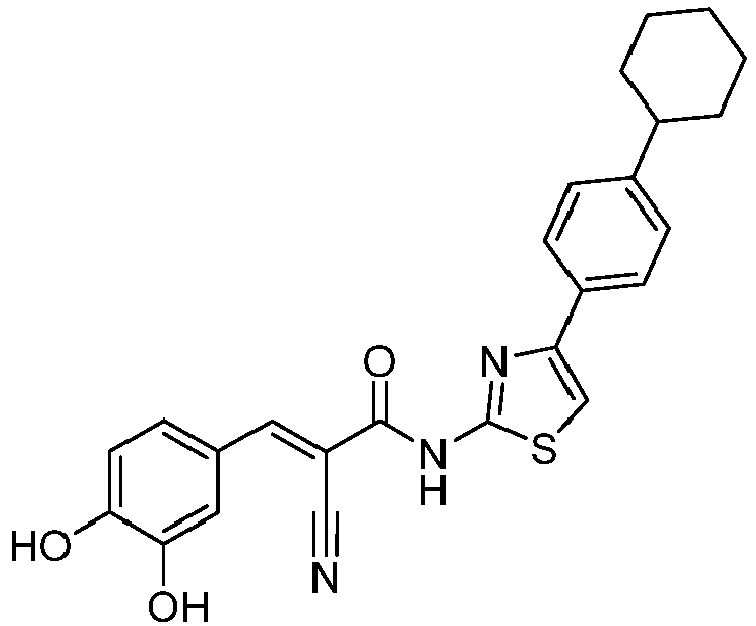
- The compound was prepared according to General procedure D2 from 2-cyano-N-(4-(4-cyclohexylphenyl)thiazol-2-yl)acetamide (75 mg, 0.23 mmol), 3,4-dihydroxybenzaldehyde (32 mg, 0.23 mmol), and piperidine (3 µL, 0.027 mmol) in CH2Cl2 (3 mL). The reaction time was 2 h at reflux. The product, purified by reverse phase column chromatography (H2O:MeOH:AcOH; 60:40:0.05 to 5:95:0.05), was obtained as a yellow solid (70 mg, 70 %).
1H NMR (500 MHz, DMSO-d 6) δ (ppm) 12.63 (s, 1H), 10.25 (s, 1H), 9.65 (s, 1H), 8.30 (s, 1H), 7.84 (d, J = 7.9 Hz, 2H), 7.66 - 7.55 (m, 2H), 7.38 (dd, J = 8.4, 2.3 Hz, 1H), 7.29 (d, J = 8.2 Hz, 2H), 6.93 (d, J = 8.3 Hz, 1H), 2.57 - 2.53 (m, 1H), 1.86 - 1.75 (m, 4H), 1.74 - 1.68 (m, 1H), 1.48 - 1.33 (m, 4H), 1.31 - 1.20 (m, 1H);
13C NMR (126 MHz, DMSO-d 6) δ (ppm) 161.9, 152.0, 151.5, 149.2, 147.3, 145.8, 131.9, 127.0, 125.8, 125.7, 123.1, 116.5, 116.0, 107.9, 43.5, 33.8, 26.3, 25.6;
HRMS calcd for C25H22N3O3S [M-H]- 444.1387, found 444.1381. -

- The compound was prepared according to General procedure D2 from 2-cyano-N-(4-phenylthiazol-2-yl)acetamide (93 mg, 0.38 mmol), 3-chloro-4-hydroxy-5-methylbenzaldehyde (65 mg, 0.38 mmol), and piperidine (3 µL, 0.027 mmol) in CH2Cl2 (3 mL). The reaction time was 2 h at reflux. The precipitate was collected by filtration, washed with CH2Cl2 (3 mL) and dried under vacuum. The product was obtained as a yellow solid (130 mg, 85 %).
1H NMR (500 MHz, DMSO-d 6) δ (ppm) 12.78 (s, 1H), 10.50 (s, 1H), 8.34 (s, 1H), 7.97 (d, J = 2.2 Hz, 1H), 7.95 - 7.92 (m, 2H), 7.79 - 7.74 (m, 1H), 7.69 (s, 1H), 7.49 - 7.42 (m, 2H), 7.39 - 7.32 (m, 1H), 2.28 (s, 3H);
13C NMR (126 MHz, DMSO-d 6) δ (ppm) 161.7, 155.7, 150.5, 133.7, 132.3, 129.8, 128.7, 128.0, 127.6, 125.7, 123.5, 121.0, 116.1, 108.7, 16.8;
HRMS calcd for C20H15ClN3O2S [M+H]+ 396.0568, found 396.0564. -

- The compound was prepared according to General procedure D2 from 2-cyano-N-(4-phenylthiazol-2-yl)acetamide (143 mg, 0.58 mmol), 3-chloro-5-fluoro-4-hydroxybenzaldehyde (100 mg, 0.58 mmol), and piperidine (3 µL, 0.027 mmol) in CH2Cl2 (3 mL). The reaction time was 2 h at reflux. The precipitate was collected by filtration, washed with CH2Cl2 (3 mL) and dried under vacuum. The product was obtained as a yellow solid (130 mg, 55 %).
1H NMR (500 MHz, DMSO-d 6) δ (ppm) 12.88 (s, 1H), 11.84 (s, 1H), 8.36 (s, 1H), 7.95 - 7.90 (m, 3H), 7.87 (dd, J = 11.6, 2.2 Hz, 1H), 7.70 (s, 1H), 7.49 - 7.43 (m, 2H), 7.39 - 7.33 (m, 1H);
13C NMR (126 MHz, DMSO-d 6) δ (ppm) 151.5 (d, J = 243.4 Hz), 149.6, 146.7 (d, J = 17.8 Hz), 133.5, 128.7, 128.3 (d, J = 69.2 Hz), 125.7, 122.7 (d, J = 5.3 Hz), 122.4, 116.3 (d, J = 20.2 Hz), 115.9, 108.8; 19F NMR (471 MHz, DMSO-d 6) δ (ppm) -129.93;
HRMS calcd for C19H12ClFN3O2S [M+H]+ 400.0317, found 400.0314. -

- The compound was prepared according to General procedure D2 from 2-cyano-N-(4-(pyridin-2-yl)thiazol-2-yl)acetamide (110 mg, 0.450 mmol), 3,4-dihydroxybenzaldehyde (62 mg, 0.450 mmol), and piperidine (4.4 µL, 0.045 mmol) in CH2Cl2 (6 mL); the reaction time was 3 h. The solvent was evaporated and the solid residue was triturated with EtOAc (8 mL). The solid was collected by filtration, washed with MeOH (5 mL) and dried under vacuum to afford the pure product as a pale yellow solid (90 mg, 55 %).
1H NMR (500 MHz, DMSO-d 6) δ (ppm) 12.67 (brs, 1H), 10.30 (brs, 1H), 9.70 (brs, 1H), 8.66 - 8.56 (m, 1H), 8.32 (s, 1H), 8.00 (d, J = 7.85 Hz, 1H), 7.94 - 7.86 (m, 2H), 7.62 (d, J = 2.26 Hz, 1H), 7.43 - 7.32 (m, 2H), 6.94 (d, J = 8.29 Hz, 1H);
13C NMR (126 MHz, DMSO-d 6) δ (ppm) 152.1, 151.5, 149.5, 145.8, 137.2, 125.9, 123.1, 122.9, 120.0, 116.5, 116.4, 116.0, 112.2;
HRMS calcd for C18H13N4O3S [M+H]+ 365.0703, found 365.0697. -
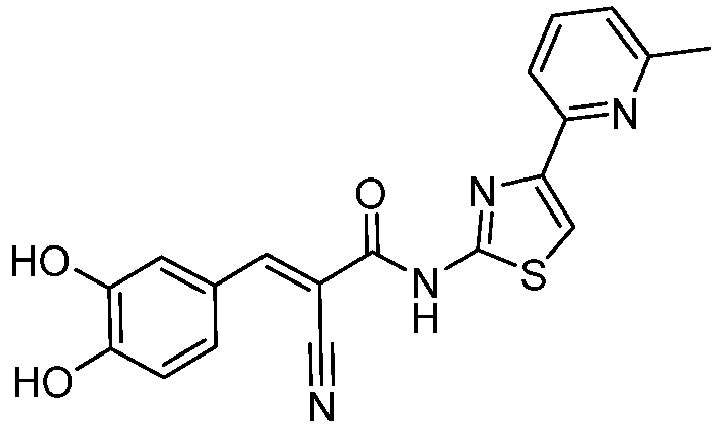
- The compound was prepared according to General procedure D2 from 2-cyano-N-(4-(6-methylpyridin-2-yl)thiazol-2-yl)acetamide (180 mg, 0.696 mmol), 3,4-dihydroxybenzaldehyde (96 mg, 0.696 mmol), and piperidine (6.8 µL, 0.069 mmol) in CH2Cl2 (8 mL); the reaction time was 3 h. The solvent was evaporated and the solid residue was triturated with EtOAc (8 mL). The solid was collected by filtration, washed with MeOH (5 mL) and dried under vacuum to afford the product as a yellow solid (180 mg, 68 %).
1H NMR (500 MHz, DMSO-d 6) δ (ppm) 12.39 (brs, 1H), 9.77 (brs, 2H), 8.31 (s, 1H), 7.83 (s, 1H), 7.82 - 7.75 (m, 2H), 7.62 (d, J = 2.29 Hz, 1H), 7.38 (dd, J = 8.39, 2.29 Hz, 1H), 7.21 (dd, J = 7.32, 1.37 Hz, 1H), 6.93 (d, J = 8.27 Hz, 1H), 2.52 (s, 3H);
13C NMR (126 MHz, DMSO-d6 ) δ (ppm) 157.8, 152.0, 151.5, 151.1, 145.8, 137.4, 125.8, 123.1, 122.2, 117.2, 116.5, 116.0, 111.9, 24.2;
HRMS calcd for C19H15N4O3S [M+H]+ 379.0859, found 379.0857. -

- The compound was prepared according to General procedure D2 from 2-cyano-N-(4-(2-(trifluoromethyl)phenyl)thiazol-2-yl)acetamide (100 mg, 0.32 mmol), 3,4-dihydroxybenzaldehyde (44 mg, 0.32 mmol), and piperidine (3 µL, 0.027 mmol) in CH2Cl2 (3 mL). The reaction time was 2 h at reflux. The product, purified by reverse phase column chromatography (H2O:MeOH:AcOH; 60:40:0.05 to 5:95:0.05), was obtained as a yellow solid (100 mg, 70 %).
1H NMR (500 MHz, DMSO-d 6) δ (ppm) 12.65 (s, 1H), 10.21 (s, 0H), 9.68 (s, 1H), 8.28 (s, 1H), 7.85 (d, J = 7.8 Hz, 1H), 7.78 - 7.72 (m, 1H), 7.69 - 7.62 (m, 2H), 7.60 (d, J = 2.1 Hz, 1H), 7.37 (dd, J = 8.4, 2.2 Hz, 1H), 7.30 (s, 1H), 6.93 (d, J = 8.3 Hz, 1H);
13C NMR (126 MHz, DMSO-d 6) δ (ppm) 162.0, 157.4, 152.0, 151.5, 145.8, 132.2, 132.1, 127.0 (q, J = 31.8 Hz), 126.2 (q, J = 5.4 Hz), 125.8, 124.0 (q, J = 274.0 Hz), 123.1, 116.5, 116.1;
19F NMR (471 MHz, DMSO-d 6) δ (ppm) -56.27;
HRMS calcd for C20H13F3N3O3S [M+H]+ 432.0624, found 432.0627. -

- The compound was prepared according to General procedure D2 from 2-cyano-N-(4-(3,4-dichlorophenyl)thiazol-2-yl)acetamide (100 mg, 0.32 mmol), 3,4-dihydroxybenzaldehyde (44 mg, 0.32 mmol), and piperidine (3 µL, 0.027 mmol) in CH2Cl2 (3 mL). The reaction time was 2 h at reflux. The product, purified by reverse phase column chromatography (H2O:MeOH:AcOH; 60:40:0.05 to 5:95:0.05), was obtained as a yellow solid (50 mg, 40 %).
1H NMR (500 MHz, DMSO-d 6) δ (ppm) 12.60 (s, 1H), 10.21 (s, 1H), 9.70 (s, 1H), 8.31 (s, 1H), 8.19 (d, J = 2.0 Hz, 1H), 7.92 (dd, J = 8.4, 2.1 Hz, 1H), 7.90 (s, 1H), 7.71 (d, J = 8.4 Hz, 1H), 7.62 (d, J = 2.2 Hz, 1H), 7.38 (dd, J = 8.4, 2.2 Hz, 1H), 6.94 (d, J = 8.3 Hz, 1H);
13C NMR (126 MHz, DMSO-d 6) δ (ppm) 162.2, 158.9, 152.1, 151.6, 146.3, 145.8, 134.7, 131.6, 131.0, 130.1, 127.4, 125.9, 125.7, 123.1, 116.5, 116.4, 116.1, 110.7;
HRMS calcd for C19H12Cl2N3O3S [M+H]+ 431.9971, found 431.9968. -

- The compound was prepared according to General procedure D2 from 2-cyano-N-(4-(o-tolyl)thiazol-2-yl)acetamide (100 mg, 0.39 mmol), 3,4-dihydroxybenzaldehyde (54 mg, 0.39 mmol), and piperidine (3 µL, 0.027 mmol) in anhydrous CH2Cl2 (3 mL). The reaction time was 2 h at reflux. The precipitate was collected by filtration, washed with CH2Cl2 (3 mL) and dried under vacuum. Product was obtained as a yellow solid (110 mg, 75 %).
1H NMR (500 MHz, DMSO-d 6) δ (ppm) 12.61 (s, 1H), 9.89 (s, 2H), 8.28 (s, 1H), 7.61 (d, J = 2.2 Hz, 1H), 7.59 (d, J = 6.7 Hz, 1H), 7.37 (dd, J = 8.4, 2.2 Hz, 1H), 7.28 (ddt, J = 9.7, 6.0, 3.4 Hz, 4H), 6.93 (d, J = 8.3 Hz, 1H), 2.44 (s, 3H);
13C NMR (126 MHz, DMSO-d 6) δ (ppm) 162.4, 151.9, 151.4, 145.8, 135.5, 130.7, 129.4, 127.9, 125.8, 123.2, 116.5, 116.0, 111.2, 20.8;
HRMS calcd for C20H16N3O3S [M+H]+ 378.0907, found 378.0907. -

- The compound was prepared according to General procedure D2 from N-(4-(3-chlorophenyl)thiazol-2-yl)-2-cyanoacetamide (150 mg, 0.540 mmol), 3,4-dihydroxybenzaldehyde (75 mg, 0.540 mmol), and piperidine (4 µL, 0.054 mmol) in CH2Cl2 (5 mL); the reaction time was 2 h at reflux . The residue was purified by column chromatography (hexane:EtOAc, 10:1 to 1:3), followed by reverse phase column chromatography (H2O:MeOH:AcOH; 50:50:0.05 to 8:92:0.05) to give the product as an orange solid (164 mg, 0.412 mmol, 76 % yield).
1H NMR (500 MHz, DMSO-d 6) δ (ppm) 8.21 (s, 1H), 7.99 (t, J = 1.9 Hz, 1H), 7.89 (d, J = 7.8 Hz, 1H), 7.73 (s, 1H), 7.60 (d, J = 2.4 Hz, 1H), 7.46 (t, J = 7.9 Hz, 1H), 7.39 - 7.32 (m, 2H), 6.85 (s, 1H);
13C NMR (126 MHz, DMSO-d 6) δ (ppm) 164.9, 163.0, 161.0, 150.9, 147.0, 146.1, 136.6, 133.5, 130.6, 127.3, 125.4, 124.1, 117.3, 116.2, 115.7, 109.6, 101.7;
HRMS calcd for C19H13ClN3O3S [M+H]+ 398.0361, found 398.0362. -
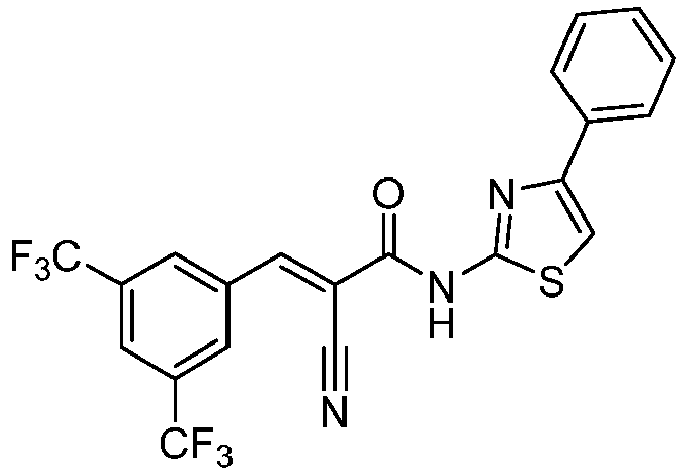
- The compound was prepared according to General procedure D2 from 2-cyano-N-(4-(6-methoxypyridin-2-yl)thiazol-2-yl)acetamide (148 mg, 0.607 mmol), 3,5-bis(trifluoromethyl)benzaldehyde (147 mg, 0.607 mmol), and piperidine (5 mg, 6 µL, 0.061 mmol) in CH2Cl2 (3 mL). The product, purified by column chromatography on silica gel (hexane:EtOAc; 20:1 to 5:1), was obtained as a yellow solid (197 mg, 67 %).
1H NMR (500 MHz, DMSO-d 6) δ (ppm) 13.03 (s, 1H), 8.69 (s, 1H), 8.61 (s, 2H), 8.39 (s, 1H), 7.93 (d, J = 7.5 Hz, 2H), 7.74 (s, 1H), 7.46 (t, J = 7.7 Hz, 2H), 7.37 (t, J = 7.2 Hz, 1H);
13C NMR (126 MHz, DMSO-d 6) δ (ppm) 148.9 , 134.3 , 131.0 (q, J = 32.9 Hz), 130.2, 128.8, 128.1, 125.8, 125.4 , 124.0 (q, J = 273.3 Hz), 109.1;
19F NMR (471 MHz, DMSO-d 6) δ (ppm) -61.59;
HRMS calcd for C21H12F6N3OS [M+H]+ 468.0600, found 468.0598. -
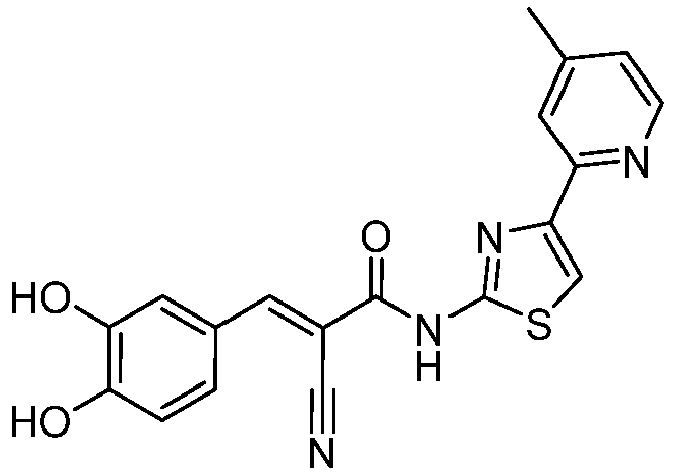
- The compound was prepared according to General procedure D2 from 2-cyano-N-(4-(4-methylpyridin-2-yl)thiazol-2-yl)acetamide (60 mg, 0.23 mmol), 3,4-dihydroxybenzaldehyde (32 mg, 0.23 mmol), and piperidine (3 µL, 0.027 mmol) in CH2Cl2 (3 mL). The reaction time was 2 h at reflux. The precipitate was collected by filtration, washed with a mixture of CH2Cl2:MeOH (3 mL + 0.3 mL) and dried under vacuum. The product was obtained as a yellow solid (80 mg, 95 %).
1H NMR (500 MHz, DMSO-d 6) δ (ppm) 12.61 (s, 1H), 9.79 (s, 2H), 8.47 (d, J = 4.9 Hz, 1H), 8.32 (s, 1H), 7.86 (s, 2H), 7.62 (d, J = 2.2 Hz, 1H), 7.39 (dd, J = 8.4, 2.2 Hz, 1H), 7.18 (d, J = 5.0 Hz, 1H), 6.94 (d, J = 8.3 Hz, 1H), 2.39 (s, 3H);
13C NMR (126 MHz, DMSO-d 6) δ (ppm) 162.1, 158.6, 152.1, 151.6, 149.3, 147.8, 145.8, 125.9, 123.6, 123.1, 120.9, 116.5, 116.4, 116.1, 112.1, 20.7;
HRMS calcd for C19H15N4O3S [M+H]+ 379.0859, found 379.0863. -
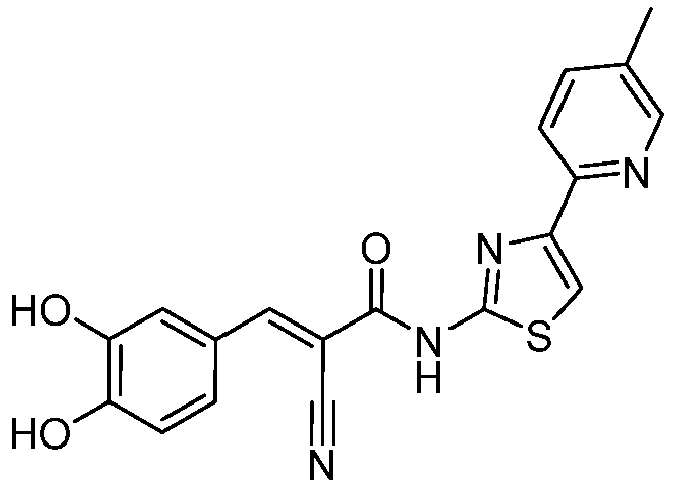
- The compound was prepared according to General procedure D2 from 2-cyano-N-(4-(5-methylpyridin-2-yl)thiazol-2-yl)acetamide (77 mg, 0.3 mmol), 3,4-dihydroxybenzaldehyde (41 mg, 0.3 mmol), and piperidine (3 µL, 0.027 mmol) in CH2Cl2 (3 mL). The reaction time was 2 h at reflux. The precipitate was collected by filtration, washed with CH2Cl2 (5 mL) and dried under vacuum. The product was obtained as a yellow solid (76 mg, 70 %).
1H NMR (500 MHz, DMSO-d 6) δ (ppm) 10.24 (s, 3H), 8.44 (d, J = 2.2 Hz, 1H), 8.22 (s, 1H), 7.90 (d, J = 8.0 Hz, 1H), 7.73 (s, 1H), 7.69 (dd, J = 8.1, 2.2 Hz, 1H), 7.60 (d, J = 2.3 Hz, 1H), 7.35 (dd, J = 8.3, 2.3 Hz, 1H), 6.89 (d, J = 8.3 Hz, 1H), 2.33 (s, 3H);
13C NMR (126 MHz, DMSO-d 6) δ (ppm) 162.9, 161.0, 152.0, 150.8, 149.8, 149.7, 148.8, 145.9, 137.4, 131.8, 125.8, 123.0, 119.5, 117.2, 116.0, 110.7, 17.7;
HRMS calcd for C19H15N4O3S [M+H]+ 379.0859, found 379.0864. -

- The compound was prepared according to General procedure D2 from 2-cyano-N-(4-(4-isopropylphenyl)thiazol-2-yl)acetamide (200 mg, 0.701 mmol), 3,4-dihydroxybenzaldehyde (97 mg, 0.701 mmol), and piperidine (5 µL, 0.070 mmol) in CH2Cl2 (6 mL). The reaction time was 3 h at reflux. The product, purified by column chromatography (hexane:EtOAc, 10:1 to 1:1) followed by reverse phase column chromatography (C18 silica gel, H2O:MeOH:AcOH; 50:50:0.05 to 8:92:0.05), was obtained as a dark yellow solid (195 mg, 69 % yield).
1H NMR (500 MHz, DMSO-d 6) δ (ppm) 8.22 (s, 1H), 7.85 (d, J = 8.5 Hz, 2H), 7.60 (d, J = 2.3 Hz, 1H), 7.52 (s, 1H), 7.35 (dd, J = 8.4, 2.3 Hz, 1H), 7.32 - 7.28 (m, 2H), 6.85 (d, J = 6.5 Hz, 1H), 2.92 (hept, J = 6.8 Hz, 1H), 1.23 (d, J = 6.9 Hz, 6H);
13C NMR (126 MHz, DMSO-d 6) δ (ppm) 167.6, 162.6, 159.5, 151.5, 148.4, 148.1, 146.0, 131.8, 126.6, 125.7, 122.8, 116.9, 116.1, 107.6, 33.1, 23.8;
HRMS calcd for C22H20N3O3S [M+H]+ 406.1220, found 406.1222. -
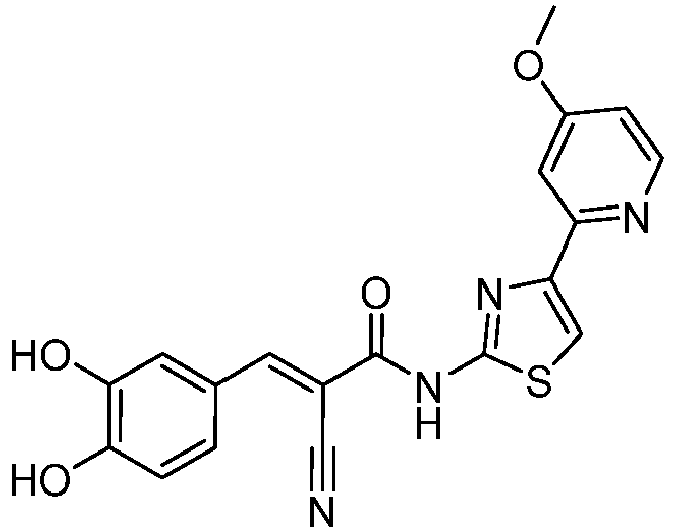
- The compound was prepared according to General procedure D2 from 2-cyano-N-(4-(4-methoxypyridin-2-yl)thiazol-2-yl)acetamide (60 mg, 0.22 mmol), 3,4-dihydroxybenzaldehyde (30 mg, 0.22 mmol), and piperidine (3 µL, 0.027 mmol) in CH2Cl2 (5 mL). The reaction time was 2 h at reflux. The precipitate was collected by filtration, washed with CH2Cl2 (5 mL) and dried under vacuum. The product was obtained as a yellow solid (50 mg, 60 %).
1H NMR (500 MHz, DMSO-d 6) δ (ppm) 12.54 (s, 1H), 9.88 (s, 2H), 8.43 (d, J = 5.6 Hz, 1H), 8.31 (s, 1H), 7.87 (s, 1H), 7.62 (d, J = 2.2 Hz, 1H), 7.57 (d, J = 2.5 Hz, 1H), 7.39 (dd, J = 8.4, 2.3 Hz, 1H), 6.96 - 6.92 (m, 2H), 3.89 (s, 3H);
13C NMR (126 MHz, DMSO-d 6) δ (ppm) 166.1, 162.2, 158.8, 153.4, 152.0, 151.6, 150.8, 148.9, 145.8, 125.9, 123.1, 116.5, 116.1, 112.5, 109.3, 105.7, 55.3;
HRMS calcd for C19H15N4O4S [M+H]+ 395.0809, found 395.0808. -
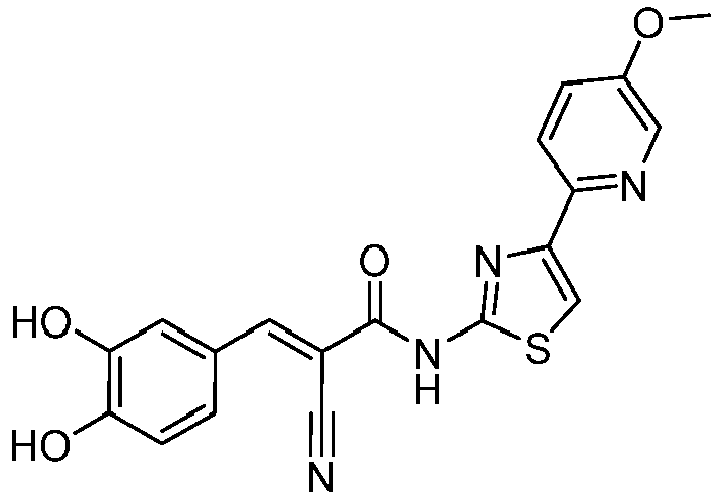
- The compound was prepared according to General procedure D2 from 2-cyano-N-(4-(5-methoxypyridin-2-yl)thiazol-2-yl)acetamide (60 mg, 0.22 mmol), 3,4-dihydroxybenzaldehyde (30 mg, 0.22 mmol), and piperidine (3 µL, 0.027 mmol) in CH2Cl2 (3 mL). The reaction time was 2 h at reflux. The precipitate was collected by filtration, washed with CH2Cl2 (5 mL) and dried under vacuum. The product was obtained as a yellow solid (80 mg, 90 %).
1H NMR (500 MHz, DMSO-d 6) δ (ppm) 9.70 (s, 2H), 8.30 (d, J = 3.0 Hz, 1H), 8.12 (s, 1H), 7.96 (d, J= 8.7 Hz, 1H), 7.57 (d, J = 2.3 Hz, 1H), 7.52 (s, 1H), 7.46 (dd, J = 8.7, 3.0 Hz, 1H), 7.31 (dd, J = 8.4, 2.2 Hz, 1H), 6.83 (d, J = 8.3 Hz, 1H), 3.86 (s, 3H);
13C NMR (126 MHz, DMSO-d 6) δ (ppm) 172.3, 163.7, 154.5, 152.5, 149.5, 148.4, 145.9, 145.7, 137.2, 125.8, 122.8, 120.8, 120.5, 118.0, 115.9, 115.4, 108.8, 55.6;
HRMS calcd for C19H15N4O4S [M+H]+ 395.0809, found 395.0807. -

- The compound was prepared according to General procedure D2 from 2-cyano-N-(4-(pyridin-2-yl)thiazol-2-yl)acetamide (80 mg, 0.33 mmol), 3,5-di-tert-butyl-4-hydroxybenzaldehyde (77 mg, 0.33 mmol), and piperidine (3 µL, 0.027 mmol) in CH2Cl2 (5 mL). The reaction time was 2 h at reflux. The precipitate was collected by filtration, washed with CH2Cl2 (5 mL) and dried under vacuum. The product was obtained as a yellow solid (65 mg, 45 %).
1H NMR (500 MHz, DMSO-d 6)) δ (ppm) 12.72 (s, 1H), 8.64 - 8.61 (m, 1H), 8.50 (s, 1H), 8.17 (s, 1H), 8.04 - 7.99 (m, 1H), 7.95 (s, 2H), 7.93 - 7.87 (m, 2H), 7.38 - 7.33 (m, 1H), 1.44 (s, 18H);
13C NMR (126 MHz, DMSO-d 6) δ (ppm) 162.0, 159.5, 152.9, 151.9, 149.5, 139.0, 137.3, 128.7, 122.9, 122.8, 120.0, 116.6, 112.3, 34.7, 29.9;
HRMS calcd for C26H29N4O2S [M+H]+ 461.2006, found 461.2004. -

- The compound was prepared according to General procedure D2 from 2-cyano-N-(4-(6-methoxypyridin-2-yl)thiazol-2-yl)acetamide (80 mg, 0.3 mmol), 3,4-dihydroxybenzaldehyde (40 mg, 0.3 mmol), and piperidine (3 µL, 0.027 mmol) in CH2Cl2 (3 mL). The reaction time was 2 h at reflux. The precipitate was collected by filtration, washed with CH2Cl2 (3 mL) and dried under vacuum. The product was obtained as a yellow solid (50 mg, 60 %).
1H NMR (500 MHz, DMSO-d 6) δ (ppm) 12.54 (s, 1H), 9.88 (s, 2H), 8.43 (d, J = 5.6 Hz, 1H), 8.31 (s, 1H), 7.87 (s, 1H), 7.62 (d, J = 2.2 Hz, 1H), 7.57 (d, J = 2.5 Hz, 1H), 7.39 (dd, J = 8.4, 2.3 Hz, 1H), 6.96 - 6.92 (m, 2H), 3.89 (s, 3H);
13C NMR (126 MHz, DMSO-d 6) δ (ppm) 166.1, 162.2, 158.8, 153.4, 152.0, 151.6, 150.8, 148.9, 145.8, 125.9, 123.1, 116.5, 116.1, 112.5, 109.3, 105.7, 55.3;
HRMS calcd for C19H15N4O4S [M+H]+ 395.0809, found 395.0810. -

- The compound was prepared according to General procedure D2 from 2-cyano-N-(4-(2,4-dichlorophenyl)thiazol-2-yl)acetamide (330 mg, 1.1 mmol), 3,4-dihydroxybenzaldehyde (138 mg, 1.1 mmol), and piperidine (3 µL, 0.027 mmol) in CH2Cl2 (3 mL). The reaction time was 2 h at reflux. The precipitate was collected by filtration, washed with CH2Cl2 (5 mL) and dried under vacuum. The product was obtained as a yellow solid (360 mg, 85 %).
1H NMR (500 MHz, DMSO-d 6) δ (ppm) 12.67 (s, 1H), 10.20 (s, 1H), 9.68 (s, 1H), 8.31 (s, 1H), 7.88 (s, 1H), 7.83 - 7.76 (m, 1H), 7.62 (d, J = 2.2 Hz, 1H), 7.59 (d, J = 7.3 Hz, 1H), 7.38 (dd, J = 8.4, 2.2 Hz, 1H), 6.94 (d, J = 8.3 Hz, 1H), 6.78 (d, J = 8.1 Hz, 1H);
13C NMR (126 MHz, DMSO-d 6) δ (ppm) 163.1, 161.9, 152.1, 151.6, 145.8, 140.0, 125.9, 123.1, 116.5, 116.1, 112.9, 112.3, 109.9;
HRMS calcd for C19H12Cl2N3O3S [M+H]+ 431.9971, found 431.9969. -

- The compound was prepared according to General procedure D2 from 2-cyano-N-(4-(3-fluoropyridin-2-yl)thiazol-2-yl)acetamide (100 mg, 0.39 mmol), 3,4-dihydroxybenzaldehyde (65 mg, 0.39 mmol), and piperidine (3 µL, 0.027 mmol) in CH2Cl2 (3 mL). The reaction time was 2 h at reflux. The precipitate was collected by filtration, washed with CH2Cl2 (5 mL) and dried under vacuum. The product was obtained as a yellow solid (100 mg, 70 %).
1H NMR (500 MHz, DMSO-d 6) δ (ppm) 12.83 (s, 1H), 10.72 - 9.32 (m, 2H), 8.51 (d, J = 4.7, 1.9 Hz, 1H), 8.34 (s, 1H), 7.89 - 7.79 (m, 2H), 7.64 - 7.59 (m, 1H), 7.51 - 7.46 (m, 1H), 7.41 - 7.36 (m, 1H), 6.95 - 6.92 (m, 1H);
13C NMR (126 MHz, DMSO-d 6) δ (ppm) 156.5 (d, J = 261.6 Hz), 152.0, 151.6, 145.8, 145.4 (d, J = 5.2 Hz), 125.8, 124.7 (d, J = 4.3 Hz), 124.6, 123.1, 116.5, 116.1, 115.6;
19F NMR (471 MHz, DMSO-d 6) δ (ppm) -121.02;
HRMS calcd for C18H10FN4O3S [M-H]- 381.0463, found 381.0458. -

- The compound was prepared according to General procedure D2 from 2-cyano-N-(4-(2-fluoro-4-methoxyphenyl)thiazol-2-yl)acetamide (150 mg, 0.56 mmol), 3,4-dihydroxybenzaldehyde (80 mg, 0.56 mmol), and piperidine (3 µL, 0.027 mmol) in CH2Cl2 (5 mL). The reaction time was 2 h at reflux. The precipitate was collected by filtration, washed with CH2Cl2 (5 mL) and dried under vacuum. The product was obtained as a yellow solid (190 mg, 85 %).
1H NMR (500 MHz, DMSO-d 6) δ (ppm) 10.55 (s, 3H), 8.28 (s, 1H), 8.03 - 7.96 (m, 1H), 7.61 (d, J = 2.3 Hz, 1H), 7.40 (d, J = 2.4 Hz, 1H), 7.37 (dd, J = 8.4, 2.3 Hz, 1H), 7.01 - 6.88 (m, 3H), 3.82 (s, 3H);
13C NMR (126 MHz, DMSO-d 6) δ (ppm) 160.2 (d, J = 249.0 Hz), 160.0 (d, J = 11.6 Hz), 151.8 (d, J = 10.9 Hz), 145.8, 129.8 (d, J = 5.3 Hz), 125.9, 123.1, 114.5, 110.7, 110.6, 102.1 (d, J = 26.2 Hz), 55.7; HRMS calcd for C20H15FN3O4S [M+H]+ 412.0762, found 412.0765. -

- The compound was prepared according to General procedure D2 from 2-cyano-N-(4-(4-(trifluoromethyl)pyridin-2-yl)thiazol-2-yl)acetamide (110 mg, 0.352 mmol), 3,4-dihydroxybenzaldehyde (48 mg, 0.352 mmol), and piperidine (3.5 µL, 0.035 mmol) in CH2Cl2 (7 mL); the reaction time was 4 h at 45 °C. The product, purified by column chromatography (CH2Cl2:MeOH; 1:0 to 9.5:0.5), was obtained as a dark yellow solid (65 mg, 43 %).
1H NMR (500 MHz, DMSO-d 6) δ (ppm) 12.72 (s, 1H), 10.27 (s, 1H), 9.70 (s, 1H), 8.91 (d, J = 5.03 Hz, 1H), 8.33 (s, 1H), 8.25 (s, 1H), 8.06 (s, 1H), 7.74 (dd, J = 5.08, 1.72 Hz, 1H), 7.62 (d, J = 2.29 Hz, 1H), 7.39 (dd, J = 8.39, 2.24 Hz, 1H), 6.94 (d, J = 8.24 Hz, 1H);
13C NMR (126 MHz, DMSO-d 6) δ (ppm) 162.1, 159.2, 152.2, 151.6, 151.3, 147.7, 145.8, 137.8, 137.5, 125.9, 124.0 (q, 1 J C-F = 273.4 Hz), 123.1, 118.1, 116.5, 116.3, 116.1, 115.1, 114.1;
19F NMR (471 MHz, DMSO-d 6) δ (ppm) -63.73;
HRMS calcd for C19H12P3N4O3S [M+H]+ 433.0577, found 433.0580. -

- The compound was prepared according to General procedure D2 from 2-cyano-N-(4-(2,5-dichlorothiophen-3-yl)thiazol-2-yl)acetamide (214 mg, 0.67 mmol), 3,4-dihydroxybenzaldehyde (93 mg, 0.67 mmol), and piperidine (6.6 µL, 0.067 mmol) in CH2Cl2 (10 mL) and THF (3 mL); the reaction time was 3 h. The product, purified by reverse phase column chromatography (H2O:MeOH:AcOH; 50:50:0.05 to 10:90:0.05), was obtained as a dark yellow solid (54 mg, 18 %).
1H NMR (500 MHz, DMSO-d 6) δ (ppm) 10.23 (brs, 3H), 8.19 (s, 1H), 7.62 (s, 1H), 7.59 (d, J = 2.26 Hz, 1H), 7.48 (s, 1H), 7.34 (dd, J = 8.37, 2.27 Hz, 1H), 6.88 (d, J = 8.30 Hz, 1H);
13C NMR (126 MHz, DMSO-d 6) δ (ppm) 163.6, 150.8, 145.8, 141.2, 132.8, 127.7, 125.6, 124.9, 120.3, 117.2, 116.0, 111.8;
HRMS calcd for C17H10Cl2N3O3S2 [M+H]+ 437.9535, found 437.9535. -

- (E)-2-cyano-3-(3,4-dihydroxyphenyl)-N-(4-phenylthiazol-2-yl)acrylamide (0.85 g, 2.33 mmol) was dissolved in anhydrous CH2Cl2 (10 mL). DMAP (14 mg, 0.11 mmol), Et3N (0.6 g, 0.8 mL, 5.8 mmol) and TIPSCl (0.95g, 1.05 mL, 4.91 mmol) were added and the mixture was stirred for 16 h at 25 °C. The product, purified by column chromatography (hexane:EtOAc; 5:1), was obtained as a yellow solid (1.24 g, 80 %).
1H NMR (500 MHz, DMSO-d 6) δ (ppm) 9.60 (s, 1H), 8.30 (s, 1H), 7.90 - 7.84 (m, 2H), 7.61 - 7.57 (m, 1H), 7.56 - 7.49 (m, 1H), 7.47 - 7.40 (m, 2H), 7.37 - 7.31 (m, 1H), 7.24 - 7.21 (m, 1H), 6.95 (d, J = 8.4 Hz, 1H), 1.47 - 1.31 (m, 6H), 1.16 (d, J = 2.6 Hz, 18H), 1.15 (d, J = 2.6 Hz, 18H);
13C NMR (126 MHz, DMSO-d 6) δ (ppm) 159.1, 156.8, 154.7, 153.5, 150.6, 147.9, 134.1, 128.8, 128.2, 126.9, 126.1, 124.7, 121.7, 120.2, 116.8, 108.5, 18.0, 17.9, 13.2, 13.2; -

- The compound was prepared according to General procedure E from (E)-3-(4-acetamidophenyl)-2-cyano-N-(4-phenylthiazol-2-yl)acrylamide (43 mg, 0.111 mmol) and NaBH4 (9 mg, 0.221 mmol) in MeOH (2 mL); the reaction time was 2 h. The product, purified by column chromatography (CH2Cl2:MeOH; 1:0 to 5:1), was obtained as a pale yellow solid (32 mg, 74 %).
1H NMR (500 MHz, DMSO-d 6) δ (ppm) 12.79 (s, 1H), 9.90 (s, 1H), 7.90 (dd, J = 8.5, 1.3 Hz, 2H), 7.71 (s, 1H), 7.53 (d, J = 8.7 Hz, 2H), 7.47 - 7.41 (m, 2H), 7.37 - 7.31 (m, 1H), 7.25 (d, J = 8.5 Hz, 2H), 4.31 (dd, J = 9.5, 6.0 Hz, 1H), 3.29 - 3.26 (m, 1H), 3.12 (dd, J = 13.6, 9.5 Hz, 1H), 2.02 (s, 3H);
13C NMR (126 MHz, DMSO-d 6) δ (ppm) 168.2, 164.0, 157.2, 149.1, 138.4, 134.0, 130.6, 129.3, 128.8, 127.9, 125.7, 119.0, 117.2, 108.9, 40.4, 34.8, 23.9;
HRMS calcd for C21H17N4O2S [M-H]- 389.1078, found 389.1078. -

- The compound was prepared according to General procedure E from (E)-N-(4-(4-bromophenyl)thiazol-2-yl)-2-cyano-3-(3,4-dihydroxyphenyl)acrylamide (110 mg, 0.25 mmol) and NaBH4 (20 mg, 0.5 mmol) in MeOH (3 mL); the reaction time was 16 h. The product, purified by reverse phase column chromatography (H2O:MeOH:AcOH; 45:55:0.05 to 25:75:0.05), was obtained as a pale yellow solid (73 mg, 70 %).
1H NMR (500 MHz, DMSO-d 6) δ (ppm) 12.78 (s, 1H), 8.84 (s, 2H), 7.90 - 7.82 (m, 2H), 7.79 (s, 1H), 7.70 - 7.56 (m, 2H), 6.72 (d, J = 2.1 Hz, 1H), 6.67 (d, J = 8.0 Hz, 1H), 6.56 (dd, J = 8.0, 2.1 Hz, 1H), 4.24 (dd, J = 9.4, 5.9 Hz, 1H), 3.23 - 2.87 (m, 2H);
13C NMR (126 MHz, DMSO-d 6) δ (ppm) 164.2, 157.4, 147.9, 145.1, 144.5, 133.2, 131.7, 127.7, 126.8, 121.0, 119.8, 117.3, 116.4, 115.5, 109.7, 40.6, 34.9;
HRMS calcd for C19H12BrN3O3S [M-H]- 443.9847, found 443.9845. -

- The compound was prepared according to General procedure E from (E)-2-cyano-3-(3,4-dihydroxyphenyl)-N-(4-phenylthiazol-2-yl)acrylamide (150 mg, 0.4 mmol) and NaBH4 (30 mg, 0.8 mmol) in MeOH (2 mL); the reaction time was 4 h. The product, purified by reverse phase column chromatography (H2O:MeOH:AcOH; 45:55:0.05 to 30:70:0.05), was obtained as a pale yellow solid (83 mg, 55 %).
1H NMR (500 MHz, CDCl3) δ (ppm) 7.73 (s, 1H), 7.71 (s, 1H), 7.42 - 7.40 (m, 2H), 7.38 - 7.36 (m, 1H), 7.16 (s, 1H), 6.64 (d, J = 8.0 Hz, 1H), 6.55 (d, J = 2.1 Hz, 1H), 6.40 (d, J = 8.2 Hz, 1H), 3.36 (t, J = 7.0 Hz, 1H), 3.08 - 2.88 (m, 2H);
13C NMR (126 MHz, CDCl3) δ (ppm) 163.2, 158.6, 149.9, 144.1, 143.8, 133.6, 129.5, 129.3, 127.4, 126.6, 121.7, 116.5, 116.3, 116.0, 109.3, 40.8, 35.7;
HRMS calcd for C19H14N3O3S [M-H]- 364.0761, found 364.0760. -

- The compound was prepared according to General procedure E from (E)-2-cyano-N-(4-(4-cyanophenyl)thiazol-2-yl)-3-(3,4-dihydroxyphenyl)acrylamide (110 mg, 0.28 mmol) and NaBH4 (11 mg, 0.56 mmol) in MeOH (3 mL); the reaction time was 4 h. The product, purified by reverse phase column chromatography (H2O:MeOH:AcOH; 45:55:0.05 to 30:70:0.05), was obtained as a pale yellow solid (40 mg, 36 %).
1H NMR (500 MHz, DMSO-d 6) δ (ppm) 12.83 (s, 1H), 8.85 (s, 1H), 8.82 (s, 1H), 8.15 - 8.05 (m, 2H), 8.01 (s, 1H), 7.95 - 7.87 (m, 2H), 6.72 (d, J = 2.1 Hz, 1H), 6.67 (d, J = 8.0 Hz, 1H), 6.56 (dd, J = 8.1, 2.1 Hz, 1H), 4.25 (dd, J = 9.4, 5.9 Hz, 1H), 3.22 - 2.90 (m, 2H);
13C NMR (126 MHz, DMSO-d 6) δ (ppm) 164.4, 157.7, 147.3, 145.1, 144.5, 138.1, 132.8, 126.8, 126.3, 119.8, 118.8, 117.2, 116.3, 115.5, 112.4, 110.1, 40.6, 34.9;
HRMS calcd for C20H13N4O3S [M-H]- 389.0714, found 389.0715. -
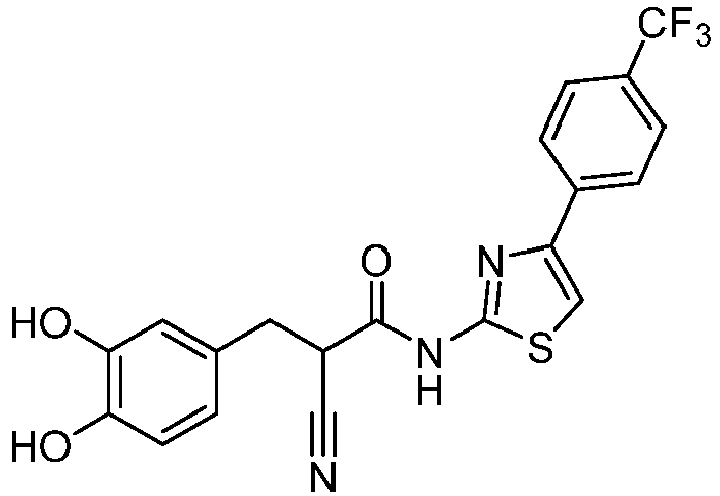
- The compound was prepared according to General procedure E from (E)-2-cyano-3-(3,4-dihydroxyphenyl)-N-(4-(4-(trifluoromethyl)phenyl)thiazol-2-yl)acrylamide (56 mg, 0.13 mmol) and NaBH4 (10 mg, 0.26 mmol) in MeOH (2 mL); the reaction time was 16 h. The product, purified by reverse phase column chromatography (H2O:MeOH:AcOH; 45:55:0.05 to 20:80:0.05), was obtained as a pale yellow solid (36 mg, 77 %).
1H NMR (500 MHz, DMSO-d 6) δ (ppm) 12.84 (s, 1H), 8.85 (s, 1H), 8.82 (s, 1H), 8.12 (d, J = 8.1 Hz, 2H), 7.95 (s, 1H), 7.81 (d, J = 8.3 Hz, 2H), 6.72 (d, J = 2.1 Hz, 1H), 6.67 (d, J = 8.0 Hz, 1H), 6.56 (dd, J = 8.1, 2.1 Hz, 1H), 4.25 (dd, J = 9.4, 5.8 Hz, 1H), 3.23 - 2.90 (m, 2H);
13C NMR (126 MHz, DMSO-d 6) δ (ppm) 164.3, 157.6, 147.5, 145.1, 144.5, 137.7, 127.9 (q, J = 31.1 Hz), 126.8, 126.2, 125.7 (q, J = 4.0 Hz), 124.2 (q, J = 272.2 Hz), 119.8, 117.3, 116.3, 115.5, 111.4, 40.6, 34.9; 19F NMR (471 MHz, DMSO-d 6) δ (ppm) -60.95;
HRMS calcd for C20H13F3N3O3S [M-H]- 432.0635, found 432.0634. -

- (E)-2-cyano-3-(3,4-dihydroxyphenyl)-N-(4-(p-tolyl)thiazol-2-yl)acrylamide (25 mg, 0.066 mmol) was dissolved in THF (5 mL) and 10-20 % Pd(OH)2 on active charcoal (1 mg) was added. The suspension was stirred under atmosphere of H2 (1 bar) at 50 °C for 4 h. The suspension was filtered, the filtrate was concentrated in vacuo and the residue was purified by preparative TLC (hexane:EtOAc; 1:1). The product was obtained as a pale yellow solid (10 mg, 40 %).
1H NMR (500 MHz, CDCl3) δ (ppm) 7.59 (s, 1H), 7.57 (s, 1H), 7.22 (d, J = 7.8 Hz, 2H), 7.08 (s, 1H), 6.62 (d, J = 8.0 Hz, 1H), 6.53 (s, 1H), 6.32 (dd, J = 8.0, 1.9 Hz, 1H), 3.23 (t, J = 7.3 Hz, 1H), 2.97 - 2.86 (m, 2H), 2.37 (s, 3H);
13C NMR (126 MHz, CDCl3) δ (ppm) 163.5, 158.9, 149.8, 144.0, 143.7, 139.5, 130.8, 130.2, 127.5, 126.6, 121.5, 118.8, 116.5, 116.3, 116.0, 108.6, 40.7, 35.8;
HRMS calcd for C2OH16N3O3S [M-H]- 378.0918, found 378.0919. -

- The compound was prepared according to General procedure E from (E)-2-cyano-3-(3,5-dichloro-4-hydroxyphenyl)-N-(4,5-diphenylthiazol-2-yl)acrylamide (42 mg, 0.08 mmol) and NaBH4 (6 mg, 0.16 mmol) in MeOH (3 mL); the reaction time was 2 h. The product, purified by preparative TLC (hexane:EtOAc; 2:1), was obtained as a pale yellow solid (25 mg, 65 %).
1H NMR (500 MHz, CDCl3) δ (ppm) 7.49 - 7.45 (m, 2H), 7.39 - 7.29 (m, 8H), 6.97 (s, 2H), 3.04 - 2.82 (m, 2H), 2.70 (t, J = 7.2 Hz, 1H);
13C NMR (126 MHz, CDCl3) δ (ppm) 163.0, 157.5, 147.6, 143.2, 133.8, 131.0, 129.7, 129.3, 129.2, 129.2, 129.2, 129.1, 128.7, 128.6, 121.4, 115.7, 39.5, 34.6;
HRMS calcd for C25H16Cl2N3O2S [M-H]- 492.0346, found 492.0345. -

- The compound was prepared according to General procedure E from (E)-2-cyano-3-(3,4-dihydroxyphenyl)-N-(4-phenyl-5-(p-tolyl)thiazol-2-yl)acrylamide (70 mg, 0.15 mmol) and NaBH4 (10 mg, 0.3 mmol) in MeOH (3 mL); the reaction time was 16 h. The product, purified by reverse phase column chromatography (H2O:MeOH:AcOH; 45:55:0.05 to 15:85:0.05), was obtained as a pale yellow solid (43 mg, 65 %).
1H NMR (500 MHz, DMSO-d 6) δ (ppm) 12.80 (s, 1H), 8.86 (s, 1H), 8.83 (s, 1H), 7.48 - 7.39 (m, 2H), 7.35 - 7.26 (m, 3H), 7.21 - 7.15 (m, Hz, 4H), 6.72 (d, J = 2.1 Hz, 1H), 6.68 (d, J = 8.0 Hz, 1H), 6.57 (dd, J = 8.1, 2.1 Hz, 1H), 4.23 (dd, J = 9.3, 6.0 Hz, 1H), 3.22 - 2.92 (m, 2H), 2.32 (s, 3H);
13C NMR (126 MHz, DMSO-d 6) δ (ppm) 164.2, 145.1, 144.5, 137.6, 134.5, 129.5, 129.1, 128.5, 128.3, 128.3, 127.7, 126.8, 119.8, 117.3, 116.4, 115.5, 40.6, 35.0, 20.7;
HRMS calcd for C26H20N3O3S [M-H]- 454.1231, found 454.1233. -

- The compound was prepared according to General procedure E from (E)-2-cyano-3-(3,4-dihydroxyphenyl)-N-(4-(4-(trifluoromethoxy)phenyl)thiazol-2-yl)acrylamide (100 mg, 0.22 mmol) and NaBH4 (16 mg, 0.44 mmol) in MeOH (3 mL); the reaction time was 16 h. The product, purified by preparative TLC (hexane:EtOAc; 1:1), was obtained as a pale yellow solid (44 mg, 44 %).
1H NMR (500 MHz, DMSO-d 6) δ (ppm) 12.80 (s, 1H), 8.84 (s, 2H), 8.05 - 7.98 (m, 2H), 7.80 (s, 1H), 7.47 - 7.41 (m, 2H), 6.72 (d, J = 2.1 Hz, 1H), 6.67 (d, J = 8.0 Hz, 1H), 6.56 (dd, J = 8.1, 2.1 Hz, 1H), 4.24 (dd, J = 9.4, 5.9 Hz, 1H), 3.21 - 2.92 (m, 2H);
13C NMR (126 MHz, DMSO-d 6) δ (ppm) 164.2, 157.5, 147.8, 147.6, 145.1, 144.5, 133.3, 127.5, 126.8, 121.1, 120.1 (q, J = 256.2 Hz), 119.8, 117.3, 116.4, 115.5, 109.9, 40.6, 34.9;
HRMS calcd for C20H13F3N3O4S [M-H]- 448.0584, found 448.0583. -

- The compound was prepared according to General procedure E from (E)-2-cyano-3-(3,5-dichloro-4-hydroxyphenyl)-N-(4-(4-(trifluoromethoxy)phenyl)thiazol-2-yl)acrylamide (80 mg, 0.16 mmol) and NaBH4 (12 mg, 0.32 mmol) in MeOH (3 mL); the reaction time was 16 h. The product, purified by reverse phase column chromatography (H2O:MeOH:AcOH; 45:55:0.05 to 10:90:0.05), was obtained as a pale yellow solid (41 mg, 50 %).
1H NMR (500 MHz, DMSO-d 6) δ (ppm) 12.79 (s, 1H), 10.13 (s, 1H), 8.06 - 7.99 (m, 2H), 7.81 (s, 1H), 7.47 - 7.41 (m, 2H), 7.37 (s, 2H), 4.34 (dd, J = 9.5, 5.7 Hz, 1H), 3.28 - 3.02 (m, 2H);
13C NMR (126 MHz, DMSO-d 6) δ (ppm) 163.8, 157.4, 148.2, 147.8, 147.7, 133.2, 129.2, 129.1, 127.5, 122.1, 121.3, 120.1 (d, J = 256.2 Hz), 116.9, 109.9, 40.3, 33.7;
19F NMR (471 MHz, DMSO-d 6) δ (ppm) -56.71;
HRMS calcd for C20H11Cl2F3N3O3S [M-H]- 499.9856, found 499.9855. -

- The compound was prepared according to General procedure E from (E)-N-(4-([1,1'-biphenyl]-3-yl)thiazol-2-yl)-2-cyano-3-(3,4-dihydroxyphenyl)acrylamide (50 mg, 0.11 mmol) and NaBH4 (8 mg, 0.22 mmol) in MeOH (3 mL); the reaction time was 16 h. The product, purified by reverse phase column chromatography (H2O:MeOH:AcOH; 45:55:0.05 to 15:85:0.05), was obtained as a yellow solid (30 mg, 64 %).
1H NMR (500 MHz, DMSO-d 6) δ (ppm) 12.79 (s, 1H), 8.85 (s, 1H), 8.82 (s, 1H), 8.22 - 8.16 (m, 1H), 7.95 - 7.89 (m, 1H), 7.87 (s, 1H), 7.76 - 7.70 (m, 2H), 7.67 - 7.61 (m, 1H), 7.55 (d, J = 7.8 Hz, 1H), 7.53 - 7.49 (m, 2H), 7.43 - 7.38 (m, 1H), 6.73 (d, J = 2.1 Hz, 1H), 6.67 (d, J = 8.0 Hz, 1H), 6.57 (dd, J = 8.0, 2.1 Hz, 1H), 4.24 (dd, J = 9.4, 5.8 Hz, 1H), 3.22 - 2.92 (m, 2H);
13C NMR (126 MHz, DMSO-d 6) δ (ppm) 164.1, 157.2, 148.9, 145.1, 144.5, 140.7, 140.0, 134.6, 129.4, 128.9, 127.6, 126.8, 126.7, 124.7, 124.1, 119.8, 116.4, 115.5, 109.3, 40.6, 35.0;
HRMS calcd for C25H18N3O3S [M-H]- 440.1074, found 440.1073. -

- The compound was prepared according to General procedure E from (E)-2-cyano-3-(3,5-di-tert-butyl-4-hydroxyphenyl)-N-(4-phenylthiazol-2-yl)acrylamide (50 mg, 0.11 mmol) and NaBH4 (12 mg, 0.32 mmol) in a mixture of MeOH (2 mL) and THF (1 mL); the reaction time was 6 h. The product, purified by reverse phase column chromatography (H2O:MeOH:AcOH; 45:55:0.05 to 5:95:0.05), was obtained as a pale yellow solid (36 mg, 72 %).
1H NMR (500 MHz, DMSO-d 6) δ (ppm) 12.72 (s, 1H), 7.89 (dd, J = 8.3, 1.4 Hz, 2H), 7.71 (s, 1H), 7.44 (t, J = 7.7 Hz, 2H), 7.36 - 7.29 (m, 1H), 7.04 (s, 2H), 6.85 (s, 1H), 4.23 (dd, J = 8.5, 6.2 Hz, 1H), 3.20 (dd, J = 13.5, 6.2 Hz, 1H), 3.11 (dd, J = 13.6, 8.5 Hz, 1H), 1.33 (s, 18H).;
13C NMR (126 MHz, DMSO-d 6) δ 164.3, 161.0, 157.2, 153.0, 149.1, 139.1, 134.0, 128.7, 127.9, 126.9, 125.6, 125.4, 117.4, 108.8, 40.8, 35.9, 34.4, 30.2;
HRMS calcd for C27H30N3O2S [M-H]- 460.2064, found 460.2065. -
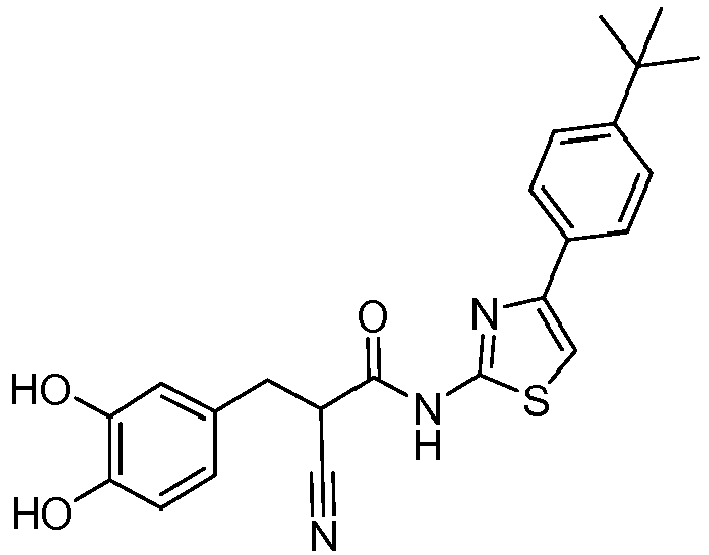
- The compound was prepared according to General procedure E from (E)-N-(4-(4-(tert-butyl)phenyl)thiazol-2-yl)-2-cyano-3-(3,4-dihydroxyphenyl)acrylamide (50 mg, 0.192 mmol) and NaBH4 (18 mg, 0.477 mmol) in MeOH (3 mL); the reaction time was 4 h. The product, purified by column chromatography (hexane:EtOAc; 3:1 to 1:2), was obtained as a pale yellow solid (45 mg, 90 %).
1H NMR (500 MHz, DMSO-d 6) δ (ppm) 12.8 (s, 1H), 8.8 (s, 1H), 8.8 (s, 1H), 7.8 (d, J = 8.5 Hz, 2H), 7.6 (s, 1H), 7.5 (d, J = 8.5 Hz, 2H), 6.7 (d, J = 2.1 Hz, 1H), 6.7 (d, J = 7.9 Hz, 1H), 6.6 (dd, J = 8.0, 2.2 Hz, 1H), 4.2 (dd, J = 9.5, 6.0 Hz, 1H), 3.2 (dd, J = 13.7, 5.9 Hz, 1H), 3.0 (dd, J = 13.7, 9.5 Hz, 1H), 1.3 (s, 9H);
13C NMR (126 MHz, DMSO-d 6) δ (ppm) 164.1, 157.1, 150.4, 149.1, 145.1, 144.5, 131.4, 126.9, 125.5, 125.4, 119.8, 117.3, 116.4, 115.5, 108.1, 40.6, 35.0, 34.3, 31.0;
HRMS calcd for C23H24N3O3S [M+H]+ 422.1533, found 422.1536. -

- A mixture of 2-cyano-3-(3,4-dihydroxyphenyl)-N-(4-phenylthiazol-2-yl)propanamide (67 mg, 0.183 mmol) and hydride-platinum(II) complex [PtH{(PMe2O)2H}(PMe2OH)] (CAS # 173416-05-2) (16 mg, 0.037 mmol) in EtOH (4 mL) and water (1 mL) was stired at 100 °C for 24 h. The solvent was evaporated and the residue was purified by column chromatography (hexane:EtOAc, 1:1 to 0:1) to afford the product as a white solid (51 mg, 73 % yield).
1H NMR (500 MHz, DMSO-d 6) δ (ppm) 12.13 (s, 1H), 8.67 (s, 1H), 8.61 (s, 1H), 7.91 - 7.84 (m, 2H), 7.61 (s, 1H), 7.42 (dd, J = 8.6, 7.0 Hz, 2H), 7.36 - 7.27 (m, 2H), 7.18 (s, 1H), 6.63 (d, J = 2.1 Hz, 1H), 6.59 (d, J = 8.1 Hz, 1H), 6.47 (dd, J = 8.0, 2.1 Hz, 1H), 3.68 (t, J = 7.5 Hz, 1H), 3.01 - 2.90 (m, 2H);
13C NMR (126 MHz, DMSO-d 6) δ (ppm) 169.4, 167.9, 157.5, 148.8, 144.8, 143.6, 134.2, 129.6, 128.7, 127.7, 125.6, 119.4, 116.3, 115.3, 108.1, 54.7, 33.8;
HRMS calcd for C19H18N3O4S [M+H]+ 384.1013, found 384.1014. -

- (E)-3-(1H-benzo[d]imidazol-6-yl)-2-cyano-N-(4-phenylthiazol-2-yl)acrylamide was prepared according to General procedure D2 from 2-cyano-N-(4-phenylthiazol-2-yl)acetamide (100 mg, 0.411 mmol), 1H-benzimidazol-5-carbaldehyde (60 mg, 0.411 mmol), and piperidine (3.5 mg, 0.041 mmol, 4 µL) in CH2Cl2 (4 mL). The reaction time was 2 h at reflux. The yellow precipitate was collected by filtration, washed with CH2Cl2 (5 mL) and dried under vacuum. The product was obtained as a yellow solid (152 mg, 0.409 mmol, 99 %) and used as such in the next step.
HRMS calcd for C20H14N5OS [M+H]+ 372.0914, found 372.0912.
3-(1H-benzo[d]imidazol-6-yl)-2-cyano-N-(4-phenylthiazol-2-yl)propanamide was prepared according to General procedure E from (E)-3-(1H-benzo[d]imidazol-6-yl)-2-cyano-N-(4-phenylthiazol-2-yl)acrylamide (93 mg, 0.25 mmol) and NaBH4 (39 mg, 1.0 mmol) in MeOH (3 mL); the reaction time was 2 h. The product, purified by column chromatography on silica gel (CH2Cl2:MeOH; 1:0 to 10:1), was obtained as a pale yellow solid (63 mg, 67 %).
1H NMR (500 MHz, CDCl3) δ (ppm) 12.82 (s, 1H), 12.43 (s, 1H), 8.19 (s, 1H), 7.94 - 7.87 (m, 2H), 7.72 (s, 1H), 7.56 (s, 2H), 7.46 - 7.41 (m, 2H), 7.38 - 7.30 (m, 1H), 7.18 (d, J = 8.2 Hz, 1H), 4.39 (dd, J = 9.5, 5.8 Hz, 1H), 3.46 (dd, J = 13.5, 5.7 Hz, 1H), 3.30 - 3.24 (m, 1H);
13C NMR (126 MHz, CDCl3) δ (ppm) 164.1, 157.3, 149.1, 142.3, 134.0, 128.7, 127.9, 125.6, 123.1, 119.5, 117.3, 112.0, 108.8, 41.0, 35.6;
HRMS calcd for C20H16N5OS [M+H]+ 374.1070, found 374.1073. -

- The compound was prepared according to General procedure E from (E)-2-cyano-3-(3,5-dichloro-4-hydroxyphenyl)-N-(4-(naphthalen-2-yl)thiazol-2-yl)acrylamide (150 mg, 0.322 mmol) and NaBH4 (49 mg, 1.287 mmol) in MeOH (6.5 mL). The mixture was stirred for 4 h. The residue was purified by reverse phase column chromatography (H2O:MeOH:AcOH; 50:50:0.05 to 92:8:0.05) to afford the product as a gray solid (73 mg, 48 %).
1H NMR (500 MHz, DMSO-d 6) δ (ppm) 12.84 (s, 1H), 10.14 (s, 1H), 8.43 (s, 1H), 8.05 (dd, J = 8.5, 1.8 Hz, 1H), 8.00 - 7.91 (m, 3H), 7.88 (s, 1H), 7.57 - 7.50 (m, 2H), 7.39 (s, 2H), 4.36 (dd, J = 9.5, 5.8 Hz, 1H), 3.29 - 3.23 (m, 1H), 3.15 (dd, J = 13.7, 9.6 Hz, 1H);
13C NMR (126 MHz, DMSO-d 6) δ (ppm) 163.8, 157.3, 149.0, 148.2, 133.1, 132.6, 131.4, 129.2, 128.3, 128.2, 127.6, 126.5, 126.2, 124.3, 123.9, 122.1, 117.0, 109.6, 40.4, 33.8;
HRMS calcd for C23H15Cl2N3O2S [M+H]+ 468.0335, found 468.0335. -

- Ethyl 3-(3,4-bis((2-(trimethylsilyl)ethoxy)methoxy)phenyl)-2-cyano-2-methylpropanoate (74 mg, 0.14 mmol) and 4-phenylthiazol-2-amine (27 mg, 0.15 mmol) were dissolved in THF (2 mL) and the solution was cooled to -10 °C. A solution of i-PrMgCl · LiCl (1.3M in THF, 115 µL, 0.15 mmol) was added and the mixture was stirred at 25 °C for 30 min. The mixture was poured into water (10 mL) and extracted with EtOAc (3 × 10 mL). Organic fractions were combined, washed with brine (20 mL), dried over MgSO4, filtered, and the solvent was evaporated. The residue was purified by column chromatography (hexane:EtOAc; 10:1) to afford the product as a colorless wax (45 mg, 50 %).
1H NMR (500 MHz, CDCl3) δ (ppm) 7.85 - 7.79 (m, 2H), 7.44 - 7.39 (m, 2H), 7.37 - 7.31 (m, 1H), 7.19 (s, 1H), 7.13 (s, 1H), 7.12 (d, J = 11.0 Hz, 1H), 6.87 (dd, J = 8.4, 2.1 Hz, 1H), 5.23 (d, J = 1.2 Hz, 2H), 5.23 - 5.17 (m, 2H), 3.82 - 3.72 (m, 4H), 3.18 (dd, J = 154.7, 13.6 Hz, 2H), 1.76 (s, 3H), 1.02 - 0.89 (m, 4H), -0.00 (s, 18H);
13C NMR (126 MHz, CDCl3) δ (ppm) 166.4, 150.6, 147.6, 134.2, 129.0, 128.4, 128.0, 126.3, 123.8, 120.6, 118.3, 116.7, 108.5, 94.1, 94.0, 66.6, 66.6, 46.8, 43.8, 23.8, 18.2, 18.2, -1.2;
HRMS calcd for C32H46N3O5SSi2 [M+H]+ 640.2691, found 640.2686. -

- The compound was prepared according to General procedure E from (E)-2-cyano-3-(3,4-dihydroxyphenyl)-N-(4-(thiophen-3-yl)thiazol-2-yl)acrylamide (75 mg, 0.2 mmol) and NaBH4 (15 mg, 0.4 mmol) in MeOH (2 mL); the reaction time was 16 h. The product, purified by reverse phase column chromatography (H2O:MeOH:AcOH; 45:55:0.05 to 20:80:0.05), was obtained as a pale yellow solid (51 mg, 70 %).
1H NMR (500 MHz, DMSO-d 6) δ (ppm) 12.76 (s, 1H), 8.85 (s, 1H), 8.82 (s, 1H), 7.79 (dd, J = 2.9, 1.3 Hz, 1H), 7.61 (dd, J = 5.0, 3.0 Hz, 1H), 7.56 (dd, J = 5.0, 1.3 Hz, 1H), 7.54 (s, 1H), 6.72 (d, J = 2.1 Hz, 1H), 6.67 (d, J = 7.9 Hz, 1H), 6.56 (dd, J = 8.0, 2.1 Hz, 1H), 4.22 (dd, J = 9.4, 5.9 Hz, 1H), 3.23 - 2.90 (m, 2H);
13C NMR (126 MHz, DMSO-d 6) δ (ppm) 164.1, 157.1, 145.5, 145.1, 144.5, 136.4, 127.1, 126.8, 126.0, 121.6, 119.8, 117.3, 116.4, 115.5, 108.3, 40.6, 35.0;
HRMS calcd for C17H12N3O3S2 [M-H]- 370.0326, found 370.0325. -

- The compound was prepared according to General procedure E from (E)-2-cyano-N-(5-cyclohexyl-4-phenylthiazol-2-yl)-3-(3,4-dihydroxyphenyl)acrylamide (52 mg, 0.16 mmol) and NaBH4 (22 mg, 0.32 mmol) in EtOH (2 mL); the reaction time was 3 h. The product, purified by reverse phase column chromatography (H2O:MeOH:AcOH; 60:40:0.05 to 5:95:0.05), was obtained as a white solid (40 mg, 75 %).
1H NMR (500 MHz, DMSO-d 6) δ 12.61 (s, 1H), 8.85 (s, 1H), 8.83 (s, 1H), 7.56 - 7.51 (m, 2H), 7.47 (dd, J = 8.5, 6.8 Hz, 2H), 7.41 - 7.34 (m, 1H), 6.71 (d, J = 2.1 Hz, 1H), 6.67 (d, J = 8.0 Hz, 1H), 6.56 (dd, J = 8.1, 2.1 Hz, 1H), 4.18 (dd, J = 9.3, 6.1 Hz, 1H), 3.19 - 2.91 (m, 3H), 1.98 - 1.93 (m, 2H), 1.82 - 1.73 (m, 2H), 1.68 (s, 1H), 1.50 - 1.36 (m, 2H), 1.36 - 1.22 (m, 3H);
13C NMR (126 MHz, DMSO-d 6) δ 163.7, 153.6, 145.1, 144.5, 143.4, 135.0, 134.6, 128.5, 128.2, 127.6, 126.9, 119.8, 117.4, 116.3, 115.5, 40.4, 36.4, 35.9, 34.9, 26.1, 25.2;
HRMS calcd for C25H26N3O3S [M+H]+ 448.1689, found 448.1681. -

- The compound was prepared according to General procedure E from (E)-2-cyano-3-(4-hydroxy-3,5-dimethylphenyl)-N-(4-phenylthiazol-2-yl)acrylamide (50 mg, 0.133 mmol) and NaBH4 (10 mg, 0.26 mmol) in MeOH (3 mL); the reaction time was 16 h. The product, purified by reverse phase column chromatography (H2O:MeOH:AcOH; 45:55:0.05 to 1:4:0.05), was obtained as a pale yellow solid (30 mg, 60 %).
1H NMR (500 MHz, DMSO-d 6) δ (ppm) 12.74 (s, 1H), 8.16 (s, 1H), 7.96 - 7.86 (m, 2H), 7.71 (s, 1H), 7.44 - 7.42 (m, 2H), 7.37 - 7.30 (m, 1H), 6.87 (s, 2H), 4.24 (dd, J = 9.6, 5.8 Hz, 1H), 3.22 - 2.92 (m, 2H), 2.13 (s, 6H);
13C NMR (126 MHz, DMSO-d 6) δ (ppm) 164.2, 157.3, 152.3, 149.1, 134.0, 128.7, 127.9, 126.4, 125.6, 124.2, 117.3, 108.8, 40.7, 34.9, 16.6;
HRMS calcd for C21H18N3O2S [M-H]- 376.1125, found 376.1125. -

- The compound was prepared according to General procedure E from (E)-3-(2-bromo-3,4-dihydroxyphenyl)-2-cyano-N-(4-phenylthiazol-2-yl)acrylamide (50 mg, 0.11 mmol) and NaBH4 (8 mg, 0.22 mmol) in EtOH (2 mL); the reaction time was 2 h. The product, purified by reverse phase column chromatography (H2O:MeOH:AcOH; 60:40:0.05 to 5:95:0.05), was obtained as a white solid (30 mg, 60 %).
1H NMR (500 MHz, DMSO-d 6) δ (ppm) 12.83 (s, 1H), 9.77 (s, 1H), 9.15 (s, 1H), 7.94 - 7.85 (m, 2H), 7.73 (s, 1H), 7.48 - 7.40 (m, 2H), 7.37 - 7.29 (m, 1H), 6.76 - 6.68 (m, 2H), 4.32 (t, J = 7.8 Hz, 1H), 3.31 - 3.25 (m, 2H);
13C NMR (126 MHz, DMSO-d 6) δ (ppm) 163.5, 157.0, 149.1, 145.4, 143.1, 134.0, 128.7, 127.9, 125.9, 125.6, 120.8, 116.9, 114.0, 112.4, 109.0, 38.1, 35.0;
HRMS calcd for C19H15BrN3O3S [M+H]+ 445.9993, found 445.9993. -
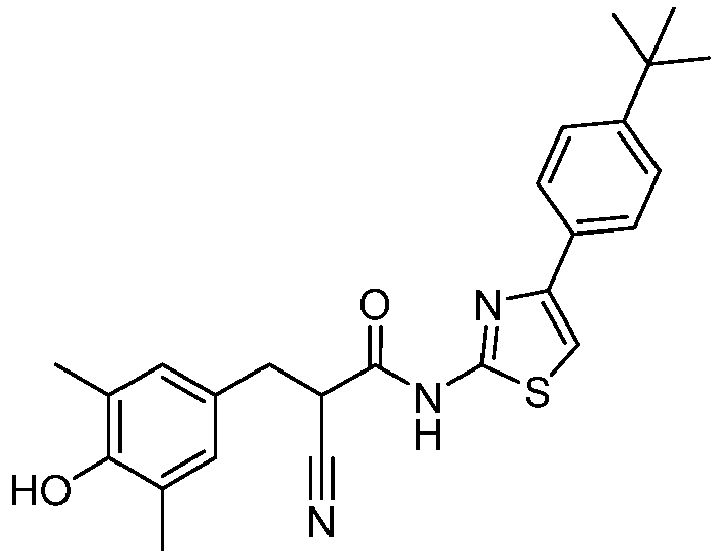
- The compound was prepared according to General procedure E from (E)-N-(4-(4-(tert-butyl)phenyl)thiazol-2-yl)-2-cyano-3-(4-hydroxy-3,5-dimethylphenyl)acrylamide (74 mg, 0.17 mmol) and NaBH4 (27 mg, 0.685 mmol) in MeOH (2 mL); the reaction time was 2 h. The product, purified by column chromatography on silica gel (hexane:EtOAc; 1:0 to 3:1), followed by reverse phase column chromatography (H2O:MeOH:AcOH; 70:30:0.05 to 80:20:0.05) was obtained as a white solid (44 mg, 60 %).
1H NMR (500 MHz, CDCl3) δ (ppm) 12.73 (s, 1H), 8.15 (s, 1H), 7.82 (d, J = 8.6 Hz, 2H), 7.63 (s, 1H), 7.45 (d, J = 8.6 Hz, 2H), 6.87 (s, 2H), 4.23 (dd, J = 9.6, 6.0 Hz, 1H), 3.16 (dd, J = 13.6, 5.8 Hz, 1H), 2.97 (dd, J = 13.7, 9.3 Hz, 1H), 2.13 (s, 6H), 1.31 (s, 9H);
13C NMR (126 MHz, CDCl3) δ (ppm) 164.2, 152.3, 150.4, 149.1, 131.4, 128.8, 126.4, 125.5, 125.4, 124.2, 117.4, 108.0, 40.7, 34.9, 34.3, 31.0, 16.6;
HRMS calcd for C25H28N3O2S [M+H]+- 434.1897, found 434.1894. -
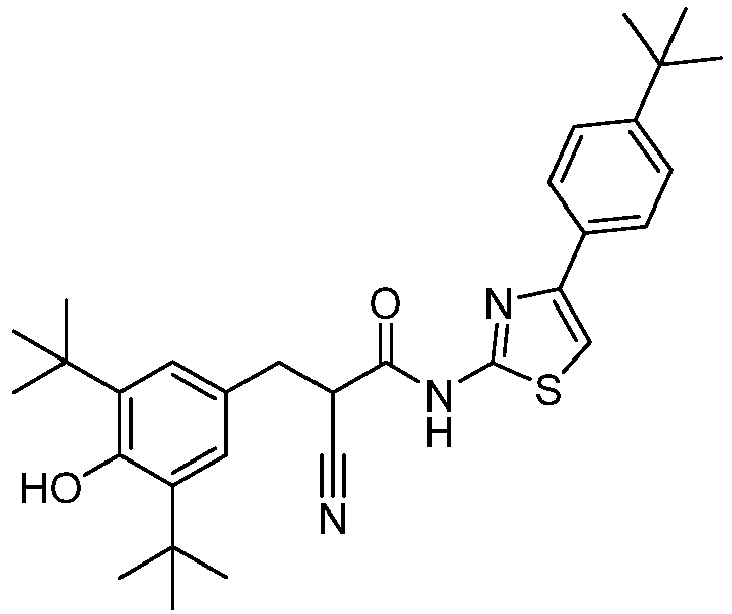
- The compound was prepared according to General procedure E from (E)-N-(4-(4-(tert-butyl)phenyl)thiazol-2-yl)-2-cyano-3-(3,5-di-tert-butyl-4-hydroxyphenyl)acrylamide (85 mg, 0.165 mmol), NaBH4 (25 mg, 0.660 mmol) in MeOH (4 mL). The reaction mixture was stirred for 3 h. The product, purified by reverse phase column chromatography (MeOH:H2O:AcOH; 60:40:0.05 to 90:10:0.05), was obtained as a white solid (54 mg, 63 % yield).
1H NMR (500 MHz, DMSO-d 6) δ (ppm) 12.71 (s, 1H), 7.81 (d, J = 8.6 Hz, 2H), 7.63 (s, 1H), 7.45 (d, J = 8.7 Hz, 2H), 7.04 (s, 2H), 6.85 (s, 1H), 4.22 (dd, J = 8.5, 6.0 Hz, 1H), 3.19 (dd, J = 13.6, 6.3 Hz, 1H), 3.10 (dd, J = 13.5, 8.6 Hz, 1H), 1.33 (s, 18H), 1.30 (s, 9H);
13C NMR (126 MHz, DMSO-d 6) δ (ppm) 164.2, 157.1, 153.0, 150.4, 149.1, 139.1, 131.4, 126.9, 125.5, 125.4, 125.4, 117.4, 108.0, 40.8, 35.9, 34.4, 34.3, 31.0, 30.3;
HRMS calcd for C31H40N3O2S [M+H]+ 518.2836, found 518.2833. -

- The compound was prepared according to General procedure E from (E)-2-cyano-3-(3-cyano-4-hydroxyphenyl)-N-(4-phenylthiazol-2-yl)acrylamide (20 mg, 0.05 mmol) and NaBH4 (4 mg, 0.1 mmol) in EtOH (2 mL); the reaction time was 2 h. The product, purified by reverse phase column chromatography (H2O:MeOH:AcOH; 60:40:0.05 to 5:95:0.05), was obtained as a white solid (16 mg, 80%).
1H NMR (500 MHz, DMSO-d 6) δ (ppm) 12.77 (s, 1H), 11.07 (s, 1H), 7.94 - 7.85 (m, 2H), 7.72 (s, 1H), 7.59 (d, J = 2.4 Hz, 1H), 7.47 - 7.42 (m, 3H), 7.38 - 7.32 (m, 1H), 7.03 - 6.97 (m, 1H), 4.32 (dd, J = 9.4, 5.9 Hz, 1H), 3.29 - 3.07 (m, 2H);
13C NMR (126 MHz, DMSO-d 6) δ (ppm) 163.8, 159.3, 149.1, 135.5, 134.0, 133.6, 128.7, 127.9, 127.4, 125.6, 117.0, 116.8, 116.3, 109.6, 108.9, 98.8, 40.3, 33.9;
HRMS calcd for C20H15N4O2S [M+H]+ 375.0910, found 375.0908. -

- The compound was prepared according to General procedure E from (E)-2-cyano-3-(3,4-dihydroxyphenyl)-N-(4-(4-methylthiophen-3-yl)thiazol-2-yl)acrylamide (32 mg, 0.08 mmol) and NaBH4 (6 mg, 0.16 mmol) in EtOH (2 mL); the reaction time was 2 h. The product, purified by reverse phase column chromatography (H2O:MeOH:AcOH; 60:40:0.05 to 5:95:0.05), was obtained as a white solid (15 mg, 50%).
1H NMR (500 MHz, DMSO-d 6) δ (ppm) 12.83 (s, 1H), 8.85 (s, 1H), 8.82 (s, 1H), 7.50 (s, 1H), 7.35 (d, J = 1.4 Hz, 1H), 7.08 (d, J = 1.3 Hz, 1H), 6.71 (d, J = 2.2 Hz, 1H), 6.66 (d, J = 8.0 Hz, 1H), 6.55 (dd, J = 8.1, 2.1 Hz, 1H), 4.20 (dd, J = 9.5, 5.9 Hz, 1H), 3.20 - 2.91 (m, 2H), 2.23 (d, J = 1.1 Hz, 3H);
13C NMR (126 MHz, DMSO-d 6) δ (ppm) 164.1, 157.2, 145.1, 144.5, 144.0, 137.9, 137.7, 126.8, 126.0, 120.9, 119.8, 117.2, 116.3, 115.5, 106.4, 40.6, 35.0, 15.4;
HRMS calcd for C18H16N3O3S2 [M+H]+ 386.0628, found 386.0625. -

- The compound was prepared according to General procedure E from (E)-2-cyano-3-(3,4-dihydroxyphenyl)-N-(4-(5,6,7,8-tetrahydronaphthalen-2-yl)thiazol-2-yl)acrylamide (55 mg, 0.13 mmol) and NaBH4 (10 mg, 0.26 mmol) in EtOH (3 mL); the reaction time was 2 h. The product, purified by reverse phase column chromatography (H2O:MeOH:AcOH; 60:40:0.05 to 5:95:0.05), was obtained as a white solid (33 mg, 60 %).
1H NMR (500 MHz, CDCl3) δ (ppm) 7.41 (dd, J = 7.8, 1.8 Hz, 1H), 7.38 (s, 1H), 7.11 (d, J = 7.9 Hz, 1H), 7.08 (s, 1H), 6.61 (d, J = 8.1 Hz, 1H), 6.53 - 6.48 (m, 1H), 6.32 (dd, J = 8.4, 2.0 Hz, 1H), 3.28 - 3.17 (m, 1H), 2.99 - 2.86 (m, 2H), 2.77 (dd, J = 16.2, 5.5 Hz, 4H), 1.86 - 1.73 (m, 4H);
13C NMR (126 MHz, CDCl3) δ (ppm) 163.61, 158.8, 150.1, 144.0, 143.7, 138.9, 138.5, 130.8, 130.3, 127.5, 127.3, 123.8, 121.5, 116.6, 116.2, 115.9, 108.4, 40.6, 35.9, 29.7, 29.4, 23.2, 23.2;
HRMS calcd for C23H22N3O3S [M+H]+ 420.1376, found 420.1377. -

- The compound was prepared according to General procedure E from (E)-2-cyano-N-(4-(4-cyclohexylphenyl)thiazol-2-yl)-3-(3,4-dihydroxyphenyl)acrylamide (30 mg, 0.07 mmol) and NaBH4 (5 mg, 0.13 mmol) in EtOH (2 mL); the reaction time was 2 h. The product, purified by reverse phase column chromatography (H2O:MeOH:AcOH; 60:40:0.05 to 5:95:0.05), was obtained as a white solid (10 mg, 33 %).
1H NMR (500 MHz, CDCl3) δ (ppm) 7.69 - 7.62 (m, 2H), 7.29 (d, J = 8.3 Hz, 2H), 7.12 (s, 1H), 6.65 (d, J = 8.0 Hz, 1H), 6.52 (d, J = 2.1 Hz, 1H), 6.39 (dd, J = 8.1, 2.1 Hz, 1H), 3.37 - 3.26 (m, 1H), 3.04 - 2.88 (m, 2H), 2.60 - 2.49 (m, 1H), 1.95 - 1.81 (m, 4H), 1.81 - 1.72 (m, 1H), 1.52 - 1.34 (m, 4H), 1.27 (s, 1H); 13C NMR (126 MHz, CDCl3) δ (ppm) 163.2, 158.5, 150.2, 149.5, 144.0, 143.7, 131.4, 128.0, 127.4, 126.6, 121.7, 116.5, 116.2, 116.0, 108.6, 44.6, 40.7, 35.7, 34.5, 27.0, 26.3;
HRMS calcd for C25H26N3O3S [M+H]+ 448.1689, found 444.1680. -

- The compound was prepared according to General procedure E from (E)-3-(3-chloro-4-hydroxy-5-methylphenyl)-2-cyano-N-(4-phenylthiazol-2-yl)acrylamide (120 mg, 0.3 mmol) and NaBH4 (21 mg, 0.6 mmol) in EtOH (3 mL); the reaction time was 2 h. The product, purified by column chromatography (hexane:EtOAc; 7:3), was obtained as a white solid (80 mg, 70%).
1H NMR (500 MHz, DMSO-d 6) δ (ppm) 12.75 (s, 1H), 9.09 (s, 1H), 7.95 - 7.87 (m, 2H), 7.72 (s, 1H), 7.48 - 7.41 (m, 2H), 7.38 - 7.30 (m, 1H), 7.19 (d, J = 2.2 Hz, 1H), 7.02 (d, J = 1.7 Hz, 1H), 4.29 (dd, J = 9.6, 5.8 Hz, 1H), 3.25 - 3.01 (m, 2H), 2.17 (s, 3H);
13C NMR (126 MHz, DMSO-d 6) δ (ppm) 163.9, 157.1, 150.0, 149.1, 134.0, 130.0, 128.7, 128.0, 127.9, 127.5, 126.9, 125.6, 120.3, 117.1, 108.9, 40.5, 34.3, 16.7;
HRMS calcd for C20H17ClN3O2S [M+H]+ 398.0725, found 398.0720. -
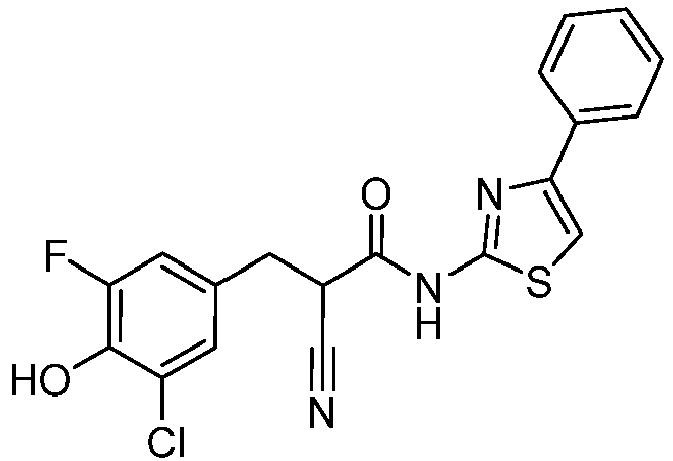
- The compound was prepared according to General procedure E from (E)-3-(3-chloro-5-fluoro-4-hydroxyphenyl)-2-cyano-N-(4-phenylthiazol-2-yl)acrylamide (95 mg, 0.22mmol) and NaBH4 (17 mg, 0.44 mmol) in EtOH (3 mL); the reaction time was 2 h. The product, purified by column chromatography (hexane:EtOAc; 7:3), was obtained as a white solid (55 mg, 60%).
1H NMR (500 MHz, DMSO-d 6) δ (ppm) 12.77 (s, 1H), 10.40 - 10.28 (m, 1H), 7.93 - 7.88 (m, 2H), 7.72 (s, 1H), 7.48 - 7.41 (m, 2H), 7.36 - 7.32 (m, 1H), 7.26 - 7.21 (m, 1H), 7.17 (dd, J = 11.3, 2.1 Hz, 1H), 4.34 (dd, J = 9.5, 5.8 Hz, 1H), 3.29 - 3.09 (m, 2H);
13C NMR (126 MHz, DMSO-d 6) δ (ppm) 163.7, 157.1, 151.6 (d, J = 241.9 Hz), 149.1, 140.7 (d, J = 16.3 Hz), 134.0, 128.8, 128.0, 127.9, 125.8 (d, J = 3.0 Hz), 125.7, 121.9 (d, J = 4.5 Hz), 117.0, 115.5 (d, J = 19.4 Hz), 108.9, 40.3, 34.0;
19F NMR (471 MHz, DMSO-d 6) δ (ppm) -131.37;
HRMS calcd for C19H14ClFN3O2S [M+H]+ 402.0474, found 402.0471. -

- The compound was prepared according to General procedure E from (E)-2-cyano-3-(3,4-dihydroxyphenyl)-N-(4-(pyridin-2-yl)thiazol-2-yl)acrylamide (50 mg, 0.137 mmol) and NaBH4 (10 mg, 0.274 mmol) in MeOH (3 mL) and THF (3 mL); the reaction time was 2 h. The product, purified by column chromatography (CH2Cl2:MeOH; 1:0 to 9.2:0.8), was obtained as a pale yellow solid (40 mg, 80 %).
1H NMR (500 MHz, DMSO-d 6) δ (ppm) 12.80 (s, 1H), 8.84 (d, J = 15.47 Hz, 2H), 8.64 - 8.58 (m, 1H), 7.94 (d, J = 7.82 Hz, 1H), 7.92 - 7.86 (m, 2H), 7.38 - 7.31 (m, 1H), 6.72 (d, J = 2.14 Hz, 1H), 6.67 (d, J = 8.01 Hz, 1H), 6.57 (dd, J = 8.06, 2.13 Hz, 1H), 4.24 (dd, J = 9.42, 5.84 Hz, 1H), 3.21 - 3.12 (m, 1H), 2.98 (dd, J = 13.62, 9.47 Hz, 1H);
13C NMR (126 MHz, DMSO-d 6) δ (ppm) 164.2, 157.5, 151.7, 149.5, 149.2, 145.1, 144.5, 137.3, 126.8, 122.9, 119.9, 119.8, 117.3, 116.3, 115.5, 112.4, 40.6, 34.9;
HRMS calcd for C18H15N4O3S [M+H]+ 367.0859, found 367.0859. -
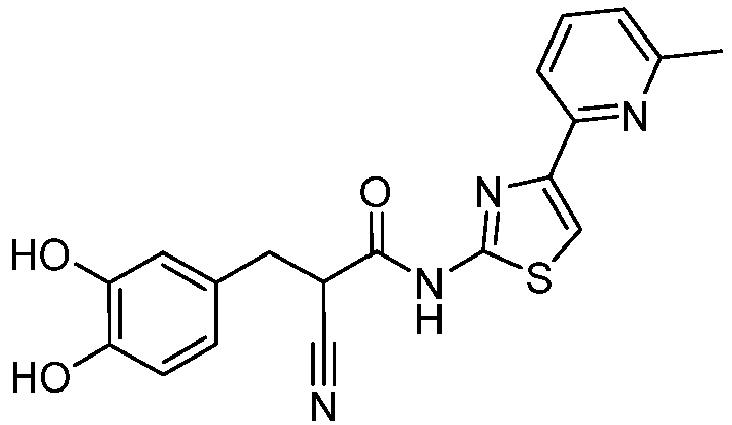
- The compound was prepared according to General procedure E from (E)-2-cyano-3-(3,4-dihydroxyphenyl)-N-(4-(6-methylpyridin-2-yl)thiazol-2-yl)acrylamide (125 mg, 0.330 mmol) and NaBH4 (25 mg, 0.660 mmol) in MeOH (8 mL) and THF (6 mL); the reaction time was 2 h. The product, purified by column chromatography (CH2Cl2:MeOH; 1:0 to 19:1), was obtained as a pale yellow solid (30 mg, 24 %).
1H NMR (500 MHz, DMSO-d 6) δ (ppm) 12.80 (s, 1H), 8.84 (s, 2H), 7.86 (s, 1H), 7.82 - 7.71 (m, 2H), 7.25 - 7.19 (m, 1H), 6.72 (d, J = 2.14 Hz, 1H), 6.67 (d, J = 7.97 Hz, 1H), 6.57 (dd, J = 8.04, 2.13 Hz, 1H), 4.24 (dd, J = 9.46, 5.85 Hz, 1H), 3.16 (dd, J = 13.60, 5.88 Hz, 1H), 2.98 (dd, J = 13.66, 9.44 Hz, 1H), 2.52 (s, 3H);
13C NMR (126 MHz, DMSO-d 6) δ 164.2, 157.8, 151.1, 149.4, 145.1, 144.5, 137.4, 126.8, 122.3, 119.8, 117.3, 117.1, 116.3, 115.5, 112.1, 40.6, 34.9, 24.1;
HRMS calcd for C19H17N4O3S [M+H]+ 381.1016, found 381.1018. -

- The compound was prepared according to General procedure E from (E)-2-cyano-3-(3,4-dihydroxyphenyl)-N-(4-(2-(trifluoromethyl)phenyl)thiazol-2-yl)acrylamide (65 mg, 0.15 mmol) and NaBH4 (11 mg, 0.30 mmol) in EtOH (2 mL); the reaction time was 2 h. The product, purified by reverse phase column chromatography (H2O:MeOH:AcOH; 60:40:0.05to 5:95:0.05), was obtained as a white solid (20 mg, 30%).
1H NMR (500 MHz, CDCl3) δ (ppm) 7.78 (d, J = 7.6 Hz, 1H), 7.62 - 7.50 (m, 3H), 7.11 (s, 1H), 6.66 (d, J = 8.0 Hz, 1H), 6.61 (d, J = 2.1 Hz, 1H), 6.54 (dd, J = 8.1, 2.1 Hz, 1H), 3.54 - 3.41 (m, 1H), 3.18 - 3.00 (m, 2H);
13C NMR (126 MHz, CDCl3) δ (ppm) 162.8, 157.1, 147.2, 144.1, 143.9, 133.5, 132.1, 132.1, 129.2, 128.9 (q, J = 31.0 Hz), 127.2, 126.9 (q, J = 5.8 Hz), 124.1 (q, J = 273.9 Hz), 121.8, 116.6, 116.3, 116.0, 113.4 (q, J = 3.2 Hz), 40.9, 35.7;
19F NMR (471 MHz, CDCl3) δ (ppm) -57.74;
HRMS calcd for C20H15F3N3O3S [M+H]+ 434.0781, found 434.0785. -
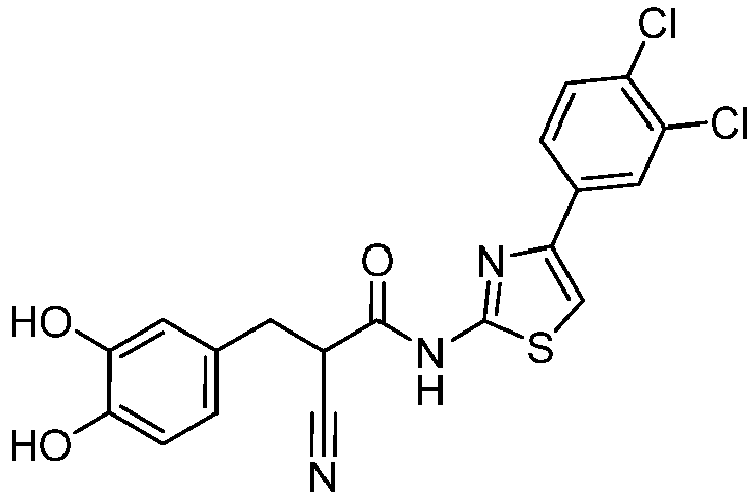
- The compound was prepared according to General procedure E from (E)-2-cyano-N-(4-(3,4-dichlorophenyl)thiazol-2-yl)-3-(3,4-dihydroxyphenyl)acrylamide (35 mg, 0.08 mmol) and NaBH4 (6 mg, 0.16 mmol) in EtOH (2 mL); the reaction time was 2 h. The product, purified by reverse phase column chromatography (H2O:MeOH:AcOH; 60:40:0.05 to 5:95:0.05), was obtained as a white solid (30 mg, 85 %).
1H NMR (500 MHz, DMSO-d 6) δ (ppm) 12.80 (s, 1H), 8.85 (s, 1H), 8.82 (s, 1H), 8.14 (d, J = 2.0 Hz, 1H), 7.92 (s, 1H), 7.89 (dd, J = 8.4, 2.1 Hz, 1H), 7.71 (dd, J = 8.4, 1.2 Hz, 1H), 6.72 (d, J = 2.1 Hz, 1H), 6.67 (d, J = 8.0 Hz, 1H), 6.56 (dd, J = 8.0, 2.1 Hz, 1H), 4.24 (dd, J = 9.4, 5.9 Hz, 1H), 3.22 - 2.94 (m, 2H);
13C NMR (126 MHz, DMSO-d 6) δ (ppm) 164.3, 157.6, 146.5, 145.1, 144.5, 134.6, 131.6, 131.0, 130.2, 127.3, 126.8, 125.7, 119.8, 117.2, 116.3, 115.5, 110.9, 40.6, 34.9;
HRMS calcd for C19H14Cl2N3O3S [M+H]+ 434.0127, found 434.0124. -
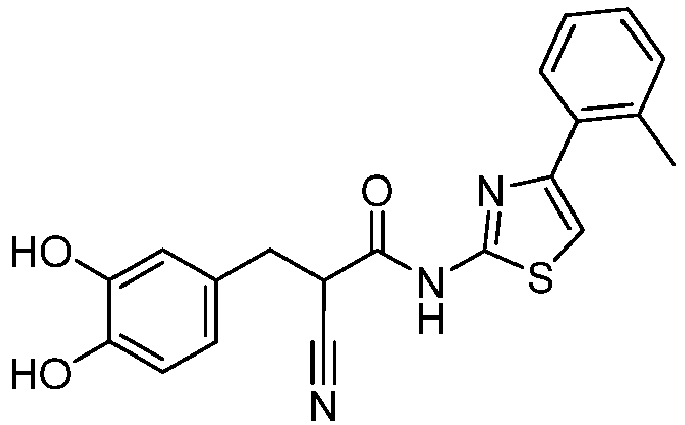
- The compound was prepared according to General procedure E from (E)-2-cyano-3-(3,4-dihydroxyphenyl)-N-(4-(o-tolyl)thiazol-2-yl)acrylamide (60 mg, 0.16 mmol) and NaBH4 (12 mg, 0.32 mmol) in EtOH (2 mL); the reaction time was 2 h. The product, purified by reverse phase column chromatography (H2O:MeOH:AcOH; 60:40:0.05 to 5:95:0.05), was obtained as a white solid (50 mg, 85%).
1H NMR (500 MHz, CDCl3) δ (ppm) 7.46 - 7.42 (m, 1H), 7.38 - 7.32 (m, 1H), 7.30 - 7.23 (m, 2H), 6.98 (s, 1H), 6.67 (d, J = 8.1 Hz, 1H), 6.60 (d, J = 2.1 Hz, 1H), 6.49 (dd, J = 8.1, 2.1 Hz, 1H), 3.08 - 3.03 (m, 1H), 3.02 - 2.91 (m, 2H), 2.35 (s, 3H);
13C NMR (126 MHz, CDCl3) δ (ppm) 163.4, 158.4, 148.5, 144.0, 144.0, 136.6, 133.0, 131.6, 129.9, 129.7, 127.2, 126.7, 121.9, 116.5, 116.3, 115.9, 111.8, 40.4, 35.7, 20.8;
HRMS calcd for C20H18N3O3S [M+H]+ 380.1063, found 380.1069. -

- The compound was prepared according to General procedure E from (E)-N-(4-(3-chlorophenyl)thiazol-2-yl)-2-cyano-3-(3,4-dihydroxyphenyl)acrylamide (82 mg, 0.206 mmol) and NaBH4 (31 mg, 0.824 mmol) in MeOH (5 mL); the reaction time was 3 h. The product, purified by column chromatography on silica gel (hexane:EtOAc, 10:1 to 1:1), was obtained as a white solid (57 mg, 69 % yield).
1H NMR (500 MHz, DMSO-d 6) δ(ppm) 12.79 (s, 1H), 8.85 (s, 2H), 7.96 (t, J = 1.9 Hz, 1H), 7.90 - 7.85 (m, 2H), 7.48 (t, J = 7.9 Hz, 1H), 7.40 (m, J = 8.0, 3.3 Hz, 1H), 6.72 (d, J = 2.3 Hz, 1H), 6.67 (d, J = 7.9 Hz, 1H), 6.56 (dd, J = 8.1, 2.1 Hz, 1H), 4.24 (dd, J = 9.5, 6.0 Hz, 1H), 3.16 (dd, J = 13.6, 5.8 Hz, 1H), 2.98 (dd, J = 13.7, 9.4 Hz, 1H);
13C NMR (126 MHz, DMSO-d 6) δ (ppm) 164.2, 157.4, 147.5, 145.1, 144.5, 136.0, 133.6, 130.7, 127.6, 126.8, 125.4, 124.2, 119.8, 117.3, 116.4, 115.5, 110.3, 40.6, 34.9;
HRMS calcd for C19H15ClN3O3S [M+H]+400.0517, found 400.0516. -

- The compound was prepared according to General procedure E from (E)-3-(3,5-bis(trifluoromethyl)phenyl)-2-cyano-N-(4-phenylthiazol-2-yl)acrylamide (140 mg, 0.29 mmol) and NaBH4 (22 mg, 0.579 mmol) in MeOH (5 mL); the reaction time was 2 h. The product, purified by column chromatography on silica gel (hexane:EtOAc; 1:0 to 2:1), was obtained as a pale yellow solid (109 mg, 80 %).
1H NMR (500 MHz, DMSO-d 6) δ (ppm) 12.79 (s, 1H), 8.11 (d, J = 1.6 Hz, 2H), 8.06 (s, 1H), 7.90 (dd, J = 8.3, 1.3 Hz, 2H), 7.73 (s, 1H), 7.44 (d, J = 7.9 Hz, 2H), 7.37 - 7.32 (m, 1H), 4.49 (dd, J = 9.5, 5.7 Hz, 1H), 3.56 (dd, J = 13.7, 5.7 Hz, 1H), 3.48 (dd, J = 13.5, 9.5 Hz, 1H);
13C NMR (126 MHz, DMSO-d 6) δ (ppm) 163.5, 157.1, 149.1, 139.8, 134.0, 130.3 (q, J = 33.4 Hz), 130.3, 128.8, 127.9, 125.6, 124.3 (q J = 273.4 Hz), 121.2, 116.7, 109.0, 39.8, 34.4;
19F NMR (471 MHz, DMSO-d 6) δ (ppm) -61.4;
HRMS calcd for C21H14F6N3OS [M+H]+ 470.0756, found 470.0759. -

- The compound was prepared according to General procedure E from (E)-2-cyano-3-(3,4-dihydroxyphenyl)-N-(4-(4-methylpyridin-2-yl)thiazol-2-yl)acrylamide (37 mg, 0.1 mmol) and NaBH4 (8 mg, 0.2 mmol) in EtOH (3 mL); the reaction time was 2 h. The product, purified by reverse phase column chromatography (H2O:MeOH:AcOH; 60:40:0.05 to 5:95:0.05), was obtained as a white solid (30 mg, 80%).
1H NMR (500 MHz, DMSO-d 6) δ (ppm) 12.77 (s, 1H), 8.84 (s, 2H), 8.46 (d, J = 4.8 Hz, 1H), 7.86 (s, 1H), 7.78 (d, J = 1.5 Hz, 1H), 7.18 (dd, J = 5.1, 1.6 Hz, 1H), 6.72 (d, J = 2.1 Hz, 1H), 6.67 (d, J = 8.0 Hz, 1H), 6.56 (dd, J = 8.1, 2.1 Hz, 1H), 4.22 (dd, J = 9.4, 5.9 Hz, 1H), 3.21 - 2.94 (m, 2H), 2.38 (s, 3H);
13C NMR (126 MHz, DMSO-d 6) δ (ppm) 164.3, 157.6, 151.7, 149.3, 149.3, 147.8, 145.1, 144.5, 126.9, 123.6, 120.8, 119.8, 117.3, 116.3, 115.5, 112.2, 40.7, 35.0, 20.7;
HRMS calcd for C19H17N4O3S [M+H]+ 381.1016, found 381.1018. -

- The compound was prepared according to General procedure E from (E)-2-cyano-3-(3,4-dihydroxyphenyl)-N-(4-(5-methylpyridin-2-yl)thiazol-2-yl)acrylamide (46 mg, 0.12 mmol) and NaBH4 (9 mg, 0.24 mmol) in EtOH (3 mL); the reaction time was 2 h. The product, purified by reverse phase column chromatography (H2O:MeOH:AcOH; 60:40:0.05 to 5:95:0.05), was obtained as a white solid (30 mg, 65 %).
1H NMR (500 MHz, DMSO-d 6) δ (ppm) 12.77 (s, 1H), 8.85 (s, 1H), 8.82 (s, 1H), 8.45 (d, J = 2.1 Hz, 1H), 7.84 (d, J = 8.1 Hz, 1H), 7.82 (s, 1H), 7.70 (dd, J = 8.2, 2.3 Hz, 1H), 6.72 (d, J = 2.1 Hz, 1H), 6.67 (d, J = 8.0 Hz, 1H), 6.56 (dd, J = 8.1, 2.1 Hz, 1H), 4.22 (dd, J = 9.4, 5.8 Hz, 1H), 3.21 - 2.93 (m, 2H), 2.33 (s, 3H);
13C NMR (126 MHz, DMSO-d 6) δ (ppm) 164.3, 157.8, 149.8, 149.4, 149.3, 145.1, 144.5, 137.5, 132.1, 126.9, 119.8, 119.5, 117.4, 116.3, 115.5, 111.4, 40.7, 35.0, 17.7;
HRMS calcd for C19H17N4O3S [M+H]+ 381.1016, found 381.1020. -
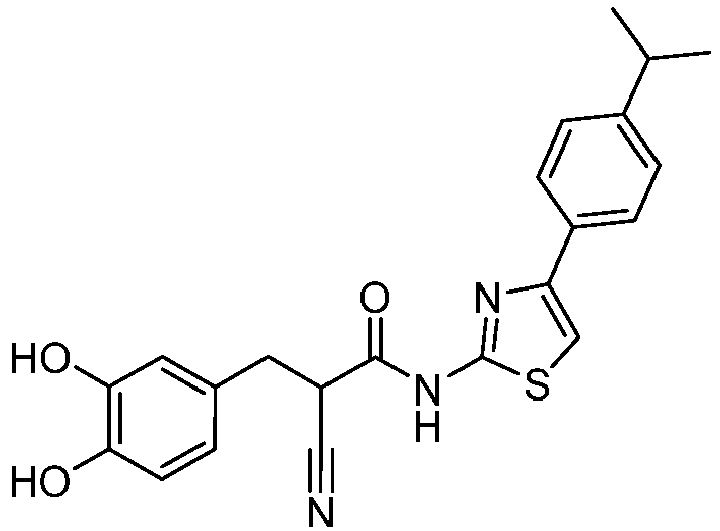
- The compound was prepared according to General procedure E from (E)-2-cyano-3-(3,4-dihydroxyphenyl)-N-(4-(4-isopropylphenyl)thiazol-2-yl)acrylamide (95 mg, 0.234 mmol) and NaBH4 (35 mg, 0.936 mmol) in MeOH (5 mL); the reaction time was 2 h. The product, purified by column chromatography on silica gel (hexane:EtOAc, 10:1 to 1:1), reverse phase column chromatography (MeOH:H2O:AcOH; 50:50:0.05 to 92:8:0.05), preparative TLC (hexane:EtOAc, 1:1) and by reverse phase column chromatography (MeOH:H2O:AcOH; 50:50:0.05 to 92:8:0.05), was obtained as a white solid (9 mg, 9 % yield).
1H NMR (500 MHz, CDCl3) δ(ppm) 7.64 (d, J = 8.3 Hz, 2H), 7.29 (d, J = 8.3 Hz, 2H), 7.11 (s, 1H), 6.65 (d, J = 8.1 Hz, 1H), 6.56 (d, J = 2.1 Hz, 1H), 6.41 (dd, J = 8.0, 2.2 Hz, 1H), 3.39 (dd, J = 7.1 Hz, 1H), 3.05 - 2.86 (m, 3H), 1.26 (d, J = 6.9 Hz, 6H);
13C NMR (126 MHz, CDCl3) δ (ppm) 163.3, 158.6, 150.2, 149.7, 144.0, 143.7, 131.0, 127.5, 127.3, 126.5, 121.6, 116.4, 116.2, 115.9, 108.4, 40.8, 35.7, 34.1, 24.0;
HRMS calcd for C22H22N3O3S [M+H]+ 408.1376, found 408.1377. -

- The compound was prepared according to General procedure E from (E)-2-cyano-3-(3,4-dihydroxyphenyl)-N-(4-(4-methoxypyridin-2-yl)thiazol-2-yl)acrylamide (40 mg, 0.1 mmol) and NaBH4 (9 mg, 0.2 mmol) in EtOH (2 mL); the reaction time was 2 h. The product, purified by reverse phase column chromatography (H2O:MeOH:AcOH; 60:40:0.05 to 5:95:0.05), was obtained as a white solid (26 mg, 65 %).
1H NMR (500 MHz, DMSO-d 6) δ (ppm) 12.80 (s, 1H), 8.85 (s, 1H), 8.82 (s, 1H), 8.42 (d, J = 5.7 Hz, 1H), 7.89 (s, 1H), 7.48 (d, J = 2.5 Hz, 1H), 6.93 (dd, J = 5.7, 2.6 Hz, 1H), 6.72 (d, J = 2.1 Hz, 1H), 6.67 (d, J = 7.9 Hz, 1H), 6.56 (dd, J = 8.0, 2.1 Hz, 1H), 4.23 (dd, J = 9.4, 5.9 Hz, 1H), 3.88 (s, 3H), 3.22 - 2.93 (m, 2H);
13C NMR (126 MHz, DMSO-d 6) δ (ppm) 166.1, 164.3, 157.5, 153.4, 150.9, 149.1, 145.1, 144.5, 126.8, 119.8, 117.3, 116.3, 115.5, 112.7, 109.3, 105.7, 55.3, 40.6, 35.0;
HRMS calcd for C19H17N4O4S [M+H]+ 397.0965, found 397.0960. -

- The compound was prepared according to General procedure E from (E)-2-cyano-3-(3,4-dihydroxyphenyl)-N-(4-(5-methoxypyridin-2-yl)thiazol-2-yl)acrylamide (50 mg, 0.13 mmol) and NaBH4 (10 mg, 0.26 mmol) in EtOH (2 mL); the reaction time was 2 h. The product, purified by reverse phase column chromatography (H2O:MeOH:AcOH; 60:40:0.05 to 5:95:0.05), was obtained as a white solid (40 mg, 80 %).
1H NMR (500 MHz, DMSO-d 6) δ (ppm) 12.75 (s, 1H), 8.85 (s, 1H), 8.82 (s, 1H), 8.33 (d, J = 3.0 Hz, 1H), 7.89 (d, J = 8.6 Hz, 1H), 7.71 (s, 1H), 7.48 (dd, J = 8.7, 3.0 Hz, 1H), 6.72 (d, J = 2.1 Hz, 1H), 6.67 (d, J = 8.0 Hz, 1H), 6.56 (dd, J = 8.0, 2.2 Hz, 1H), 4.23 (dd, J = 9.4, 5.9 Hz, 1H), 3.87 (s, 3H), 3.19 - 2.93 (m, 2H);
13C NMR (126 MHz, DMSO-d 6) δ (ppm) 164.2, 157.4, 154.8, 154.8, 149.1, 145.1, 144.5, 137.5, 126.9, 121.0, 120.6, 119.8, 117.3, 116.3, 115.5, 110.1, 55.6, 40.6, 35.0;
HRMS calcd for C19H17N4O4S [M+H]+ 397.0965, found 397.0966. -

- The compound was prepared according to General procedure E from (E)-2-cyano-3-(3,5-di-tert-butyl-4-hydroxyphenyl)-N-(4-(pyridin-2-yl)thiazol-2-yl)acrylamide (40 mg, 0.09 mmol) and NaBH4 (8 mg, 0.18 mmol) in EtOH (3 mL); the reaction time was 2 h. The product, purified by reverse phase column chromatography (H2O:MeOH:AcOH; 60:40:0.05 to 5:95:0.05), was obtained as a white solid (30 mg, 75 %).
1H NMR (500 MHz, DMSO-d 6) δ (ppm) 12.76 (s, 1H), 8.63 - 8.60 (m, 1H), 7.94 - 7.87 (m, 3H), 7.38 - 7.31 (m, 1H), 7.04 (s, 2H), 6.85 (s, 1H), 4.24 (dd, J = 8.5, 6.1 Hz, 1H), 3.24 - 3.05 (m, 2H), 1.33 (s, 18H); 13C NMR (126 MHz, DMSO-d 6) δ (ppm) 164.4, 157.5, 153.0, 151.8, 149.5, 149.3, 139.1, 137.3, 126.9, 125.4, 122.9, 119.9, 117.4, 112.4, 40.9, 35.9, 34.4, 30.2;
HRMS calcd for C26H31N4O2S [M+H]+ 463.2162, found 463.2160. -

- The compound was prepared according to General procedure E from (E)-2-cyano-3-(3,4-dihydroxyphenyl)-N-(4-(6-methoxypyridin-2-yl)thiazol-2-yl)acrylamide (60 mg, 0.15 mmol) and NaBH4 (12 mg, 0.3 mmol) in EtOH (3 mL); the reaction time was 2 h. The product, purified by reverse phase column chromatography (H2O:MeOH:AcOH; 60:40:0.05 to 5:95:0.05), was obtained as a white solid (30 mg, 60%,).
1H NMR (500 MHz, DMSO-d 6) δ (ppm) 12.78 (s, 1H), 8.85 (s, 1H), 8.82 (s, 1H), 7.89 (s, 1H), 7.82 - 7.76 (m, 1H), 7.52 (d, J = 7.3 Hz, 1H), 6.77 (d, J = 8.1 Hz, 1H), 6.72 (d, J = 2.1 Hz, 1H), 6.67 (d, J = 8.0 Hz, 1H), 6.56 (dd, J = 8.1, 2.1 Hz, 1H), 4.24 (dd, J = 9.5, 5.9 Hz, 1H), 3.94 (s, 3H), 3.21 - 2.92 (m, 2H); 13C NMR (126 MHz, DMSO-d 6) δ (ppm) 164.2, 163.1, 157.4, 149.4, 149.1, 145.1, 144.5, 140.1, 126.8, 119.8, 117.3, 116.4, 115.5, 112.9, 112.5, 109.9, 52.9, 40.6, 35.0;
HRMS calcd for C19H17N4O4S [M+H]+ 397.0965, found 397.0965. -

- The compound was prepared according to General procedure E from (E)-2-cyano-N-(4-(2,4-dichlorophenyl)thiazol-2-yl)-3-(3,4-dihydroxyphenyl)acrylamide (160 mg, 0.37 mmol) and NaBH4 (27 mg, 0.74 mmol) in EtOH (5 mL); the reaction time was 2 h. The product, purified by reverse phase column chromatography (H2O:MeOH:AcOH; 60:40:0.05 to 5:95:0.05), was obtained as a white solid (65 mg, 40 %).
1H NMR (500 MHz, DMSO-d 6) δ (ppm) 12.83 (s, 1H), 8.85 (s, 1H), 8.82 (s, 1H), 7.86 (d, J = 8.5 Hz, 1H), 7.75 (s, 1H), 7.73 (d, J = 2.2 Hz, 1H), 7.53 (dd, J = 8.5, 2.2 Hz, 1H), 6.72 (d, J = 2.1 Hz, 1H), 6.67 (d, J = 8.0 Hz, 1H), 6.56 (dd, J = 8.1, 2.1 Hz, 1H), 4.23 (dd, J = 9.4, 5.9 Hz, 1H), 3.22 - 2.92 (m, 2H); 13C NMR (126 MHz, DMSO-d 6) δ (ppm) 164.2, 156.6, 145.1, 144.7, 144.5, 133.0, 132.3, 131.8, 131.8, 129.8, 127.6, 126.8, 119.8, 117.3, 116.3, 115.5, 114.2, 40.6, 34.9;
HRMS calcd for C19H12Cl2N3O3S [M+H]+ 431.9971, found 431.9978. -

- The compound was prepared according to General procedure E from (E)-2-cyano-3-(3,4-dihydroxyphenyl)-N-(4-(3-fluoropyridin-2-yl)thiazol-2-yl)acrylamide (63 mg, 0.16 mmol) and NaBH4 (12 mg, 0.33 mmol) in EtOH (3 mL); the reaction time was 2 h. The product, purified by reverse phase column chromatography (H2O:MeOH:AcOH; 60:40:0.05 to 5:95:0.05), was obtained as a white solid (35 mg, 55 %).
1H NMR (500 MHz, DMSO-d 6) δ (ppm) 12.95 (s, 1H), 8.85 (s, 1H), 8.81 (s, 1H), 8.53 - 8.46 (m, 1H), 7.87 (s, 1H), 7.86 - 7.78 (m, 1H), 7.51 - 7.44 (m, 1H), 6.72 (d, J = 2.1 Hz, 1H), 6.67 (d, J = 7.9 Hz, 1H), 6.56 (dd, J = 8.0, 2.1 Hz, 1H), 4.27 - 4.17 (m, 1H), 3.21 - 2.93 (m, 2H);
13C NMR (126 MHz, DMSO-d 6) δ (ppm) 156.3 (d, J = 261.6 Hz), 145.5 (d, J = 5.1 Hz), 145.3 (d, J = 4.7 Hz), 145.1, 144.5, 130.0 (d, J = 10.4 Hz), 126.8, 124.8 (d, J = 14.9 Hz), 124.7, 119.8, 117.3, 116.4, 115.7 (d, J = 7.9 Hz), 115.5, 40.7, 35.0;
19F NMR (471 MHz, DMSO-d 6) δ (ppm) -121.09;
HRMS calcd for C18H14FN4O3S [M+H]+ 385.0865, found 385.0762. -

- The compound was prepared according to General procedure E from (E)-2-cyano-3-(3,4-dihydroxyphenyl)-N-(4-(2-fluoro-4-methoxyphenyl)thiazol-2-yl)acrylamide (80 mg, 0.2 mmol) and NaBH4 (15 mg, 0.4 mmol) in EtOH (3 mL); the reaction time was 2 h. The product, purified by column chromatography (hexane:EtOAc; 3:1) followed by reverse phase column chromatography (H2O:MeOH:AcOH; 60:40:0.05 to 5:95:0.05), was obtained as a white solid (45 mg, 55 %).
1H NMR (500 MHz, DMSO-d 6) δ (ppm) 12.75 (s, 1H), 8.85 (s, 1H), 8.83 (s, 1H), 7.96 - 7.88 (m, 1H), 7.44 (d, J = 2.4 Hz, 1H), 6.95 (dd, J = 13.5, 2.5 Hz, 1H), 6.90 (dd, J = 8.7, 2.6 Hz, 1H), 6.72 (d, J = 2.1 Hz, 1H), 6.67 (d, J = 8.0 Hz, 1H), 6.56 (dd, J = 8.1, 2.2 Hz, 1H), 4.23 (dd, J = 9.4, 5.9 Hz, 1H), 3.28 (s, 3H), 3.19 - 2.95 (m, 2H);
13C NMR (126 MHz, DMSO-d 6) δ (ppm) 164.1, 160.2 (d, J = 248.8 Hz), 160.1 (d, J = 11.3 Hz), 156.6, 145.1, 144.5, 143.0, 129.7 (d, J = 5.0 Hz), 126.8, 119.8, 117.3, 116.4, 115.5, 114.4 (d, J = 12.0 Hz), 110.9 (d, J = 12.6 Hz), 110.7 (d, J = 2.0 Hz), 102.1 (d, J = 25.9 Hz), 55.7, 40.6, 34.9;
19F NMR (471 MHz, DMSO-d 6) δ (ppm) -112.16;
HRMS calcd for C20H17FN3O4S [M+H]+ 414.0918, found 414.0920. -

- The compound was prepared according to General procedure E from (E)-2-cyano-3-(3,4-dihydroxyphenyl)-N-(4-(4-(trifluoromethyl)pyridin-2-yl)thiazol-2-yl)acrylamide (60 mg, 0.138 mmol) and NaBH4 (11 mg, 0.277 mmol) in MeOH (5 mL); the reaction time was 3 h. The product, purified by column chromatography (CH2Cl2:MeOH; 1:0. to 19:1), was obtained as an off-white solid (25 mg, 42 %). 1H NMR (500 MHz, DMSO-d 6) δ (ppm) 12.88 (s, 1H), 8.91 (dd, J = 5.31, 2.52 Hz, 1H), 8.84 (dd, J = 14.62, 2.59 Hz, 2H), 8.16 (s, 1H), 8.07 (d, J = 2.62 Hz, 1H), 7.76 - 7.70 (m, 1H), 6.72 (t, J = 2.39 Hz, 1H), 6.67 (dd, J = 8.08, 2.61 Hz, 1H), 6.56 (dt, J = 8.01, 2.51 Hz, 1H), 4.30 - 4.15 (m, 1H), 3.21 - 3.13 (m, 1H), 3.05 - 2.93 (m, 1H);
13C NMR (126 MHz, CDCl3) δ (ppm) 164.4, 158.0, 153.1, 151.4, 147.6, 145.1, 144.5, 137.8, 126.7, 124.0 (q, 1 J C-F = 272.9 Hz), 119.8, 118.3, 117.2, 116.3, 115.5, 115.0, 114.3, 40.7, 34.9;
19F NMR (471 MHz, DMSO-d 6) δ (ppm) -63.82;
HRMS calcd for C19H14F3N4O3S [M+H]+ 435.0733, found 435.0738. -

- The compound was prepared according to General procedure E from (E)-2-cyano-N-(4-(2,5-dichlorothiophen-3-yl)thiazol-2-yl)-3-(3,4-dihydroxyphenyl) acrylamide (265 mg, 0.604 mmol) and NaBH4 (46 mg, 1.20 mmol) in MeOH (8 mL); the reaction time was 2 h. The product, purified by column chromatography (hexane:EtOAc; 1:0 to 1:1), was obtained as a white solid (90 mg, 34 %).
1H NMR (500 MHz, DMSO-d6 ) δ (ppm) 12.77 (s, 1H), 8.83 (d, J = 12.72 Hz, 2H), 7.75 (s, 1H), 7.43 (s, 1H), 6.71 (d, J = 2.14 Hz, 1H), 6.67 (d, J = 8.01 Hz, 1H), 6.56 (dd, J = 8.07, 2.12 Hz, 1H), 4.24 (dd, J = 9.46, 5.83 Hz, 1H), 3.15 (dd, J = 13.64, 5.82 Hz, 1H), 2.97 (dd, J = 13.61, 9.50 Hz, 1H);
13C NMR (126 MHz, DMSO-d6 ) δ (ppm) 164.3, 156.9, 145.1, 144.5, 141.6, 132.2, 127.4, 126.8, 125.2, 121.0, 119.8, 117.2, 116.3, 115.5, 112.7, 40.6, 34.9;
HRMS calcd for C17H12Cl2N3O3S2 [M+H]+ 439.9692, found 439.9690. -
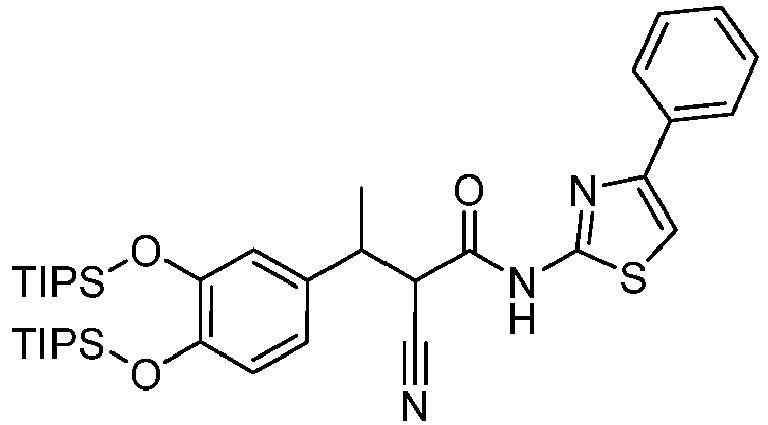
- In THF (5 mL) was suspended CuCN (275 mg, 3.07 mmol) and the mixture was cooled to - 5 °C. MeLi (1.6 M in Et2O, 3.7 mL, 5.9 mmol) was added to the solution and the mixture was stirred at 25 °C for 15 min. Then, a solution of (E)-3-(3,4-bis((triisopropylsilyl)oxy)phenyl)-2-cyano-N-(4-phenylthiazol-2-yl)acrylamide (0.74 g, 1.1 mmol) in THF (5 mL) was added and the resulting mixture was stirred at 25 °C for 16 h. The solution was poured into aqueous 1 M HCl (20 mL) and extracted with EtOAc (3 × 10 mL). The combined organic fractions were washed with brine, dried over MgSO4, filtered, and the solvent was evaporated. The residue was purified by column chromatography (hexane:EtOAc; 10:1) to afford the product as a colorless solid (610 mg, 80 %). The product contains two diastereoisomers in 1:1 ratio.
1H NMR (500 MHz, CDCl3) δ 7.84 - 7.80 (m, 2H), 7.80 - 7.76 (m, 2H), 7.46 - 7.38 (m, 4H), 7.38 - 7.31 (m, 2H), 7.20 (s, 1H), 7.16 (s, 1H), 6.84 - 6.82 (m, 2H), 6.81 (d, J = 8.2 Hz, 1H), 6.75 (d, J = 8.2 Hz, 1H), 6.73 - 6.68 (m, 2H), 3.83 (d, J = 5.4 Hz, 1H), 3.74 (d, J = 5.4 Hz, 1H), 3.64 - 3.55 (m, 2H), 1.54 (d, J = 7.1 Hz, 3H), 1.49 (d, J = 7.0 Hz, 3H), 1.26 (ddq, J = 29.0, 15.0, 7.4 Hz, 12H), 1.14 - 1.07 (m, 72H);
HRMS calcd for C38H56N3O3SSi2 [M-H]- 690.3586, found 690.3584. -

- To a solution of 3-(3,4-bis((triisopropylsilyl)oxy)phenyl)-2-cyano-N-(4-phenylthiazol-2-yl)butanamide (96 mg, 0.14 mmol) in CH2Cl2 (2 mL) at -78 °C, was added TBAF (1M in THF, 0.3 mL, 0.3 mmol) and the mixture was stirred at -78 °C for 1 h. The mixture was absorbed on the stationary phase and purified by reverse phase column chromatography (H2O:MeOH:AcOH; 60:40:0.05 to 5:95:0.05). The product was obtained as a white solid (50 mg, 95%). The product contains two diastereoisomers in 1:1 ratio.
1H NMR (500 MHz, DMSO-d 6) δ 12.76 (s, 2H), 8.90 - 8.78 (m, 4H), 7.95 - 7.86 (m, 4H), 7.71 (s, 1H), 7.68 (s, 1H), 7.48 - 7.39 (m, 4H), 7.38 - 7.30 (m, 2H), 6.80 (d, J = 2.0 Hz, 1H), 6.72 - 6.61 (m, 4H), 6.54 (dd, J = 8.1, 2.2 Hz, 1H), 4.29 - 4.17 (m, 2H), 3.50 - 3.32 (m, 2H), 1.32 (d, J = 7.0 Hz, 3H), 1.26 (d, J = 7.0 Hz, 3H);
HRMS calcd for C20H18N3O3S [M+H]+ 380.1063, found 380.1069. -

- Ethyl 3-(3,4-bis((2-(trimethylsilyl)ethoxy)methoxy)phenyl)-2-cyano-2-methylpropanoate (74 mg, 0.14 mmol) and 4-phenylthiazol-2-amine (27 mg, 0.15 mmol) were dissolved in dry THF (2 mL) and the solution was cooled to -10 °C. A solution of i-PrMgCl · LiCl (1.3 M in THF, 115 µL, 0.15 mmol) was added and the mixture was stirred at 25 °C for 30 min. The mixture was poured into water (10 mL) and extracted with EtOAc (3 × 10 mL). The organic fractions were combined, washed with brine (20 mL), dried over MgSO4, filtered, and the solvent was evaporated in vacuo. The residue was purified by column chromatography (hexane:EtOAc; 10:1) to afford the product as a colorless wax (45 mg, 50 %).
1H NMR (500 MHz, CDCl3) δ (ppm) 7.85 - 7.79 (m, 2H), 7.44 - 7.39 (m, 2H), 7.37 - 7.31 (m, 1H), 7.19 (s, 1H), 7.13 (s, 1H), 7.12 (d, J = 11.0 Hz, 1H), 6.87 (dd, J = 8.4, 2.1 Hz, 1H), 5.23 (d, J = 1.2 Hz, 2H), 5.23 - 5.17 (m, 2H), 3.82 - 3.72 (m, 4H), 3.18 (dd, J = 154.7, 13.6 Hz, 2H), 1.76 (s, 3H), 1.02 - 0.89 (m, 4H), -0.00 (s, 18H);
13C NMR (126 MHz, CDCl3) δ (ppm) 166.4, 150.6, 147.6, 134.2, 129.0, 128.4, 128.0, 126.3, 123.8, 120.6, 118.3, 116.7, 108.5, 94.1, 94.0, 66.6, 66.6, 46.8, 43.8, 23.8, 18.2, 18.2, -1.2;
HRMS calcd for C32H46N3O5SSi2 [M+H]+ 640.2691, found 640.2686. -

- A solution of 3-(3,4-bis((2-(trimethylsilyl)ethoxy)methoxy)phenyl)-2-cyano-2-methyl-N-(4-phenylthiazol-2-yl)propenamide (25 mg, 0.04 mmol) in CH2Cl2 (3 mL) was cooled to 0 °C, TESCl (24 mg, 27 µL, 0.16 mmol) and MeOH (0.1 mL) were added and the reaction mixture was stirred at 25 °C for 1 h. The mixture was poured into water (10 mL) and extracted with EtOAc (3 × 10 mL). The organic fractions were combined, washed with brine (20 mL), dried over MgSO4, filtered, and the solvent was evaporated in vacuo. The residue was purified by reverse phase column chromatography (H2O:MeOH:AcOH; 60:40:0.05 to 5:95:0.05) to afford the product as a white solid (10 mg, 65%).
1H NMR (500 MHz, CDCl3) δ (ppm) 7.77 - 7.71 (m, 2H), 7.44 - 7.39 (m, 2H), 7.39 - 7.34 (m, 1H), 7.18 (s, 1H), 6.65 (d, J = 2.1 Hz, 1H), 6.54 (d, J = 8.0 Hz, 1H), 6.48 (dd, J = 8.1, 2.1 Hz, 1H), 3.12 (d, J = 13.6 Hz, 1H), 2.84 (d, J = 13.7 Hz, 1H), 1.77 (s, 3H);
13C NMR (126 MHz, CDCl3) δ (ppm) 166.3, 157.6, 150.2, 144.2, 144.1, 133.8, 129.1, 128.8, 126.7, 125.9, 122.0, 120.6, 117.1, 115.6, 109.0, 47.2, 44.8, 23.1;
HRMS calcd for C20H18N3O3S [M+H]+ 380.1063, found 380.1060. - The DNA substrate is prepared by mixing the oligonucleotides listed below in a 1:1 ratio to reach a final concentration of 6 µM in a buffer containing 50 mM Tris pH 7.5, 100 mM NaCl and 8 mM MgCl2.
- The mixture is heat for 3 min at 65 °C and let to cool down slowly to RT. Then it is stored at -20 °C.
- Oligo 1: 5' CY5 - CTAAGTTCGTCAGGATTCCAGC
- Oligo 2: 5' CTCTATCACTGTTACAATGCTGGAATCCTGACGAACTTAG - BBQ [650]
- This substrate is a 5' overhang, which is a preferred substrate of MRE11. The CY5 fluorescent label is quenched by the quencher BBQ [650] and therefore it shows no or very low fluorescence. The fluorescence increases upon substrate cleavage by MRE11, when separation of the two labels occur.
- The conditions of the assay are as follows:
- Microplate type: 1536 Well Black Round Bottom Polystyrene Not Treated (Corning cat no. 3936)
- Total reaction volume: 5 µL
- MRE11 concentration in the reaction: 18 nM
- DNA substrate concentration in the reaction: 40 nM
- Number of compounds to test: 257
- Inhibitor concentration range tested: 7 nM - 50 µM
- Multiplicates: 3
- Concentration points: 13
- Dilution step: 2.1
- Each plate contains a series of high and low signal control wells, where no compound is added:
- High signal: MRE11 + DNA substrate
- Low signal: DNA substrate only
- These are used during data evaluation.
- Two extra assay controls:
- 1) To check whether unwinding of DNA by the compounds alone occurs.
The DNA substrate [CY5+BBQ(650)] is mixed with the compounds with no protein present. This is done as a single measurement at 25 µM inhibitor concentration. - 2) To check whether the compounds are able to quench the CY5.
- The CY5 single stranded oligo is mixed with the compounds with no protein present. This is done as a single measurement at 25 µM inhibitor concentration.
- The layout of the plates is created by the in-house software (CZ-Openscreen Prague) and this information is transferred to the robotic HTS station.
-
- 1) Prepare 50 mL of master mix:
- 16.7 mL 5x reaction buffer (150 mM Bis Tris pH 7; 5 mM DTT)
- 1042 µL 400 mM MnCl2
- 32.3 mL H2O
- 2) Fill the plates with 3 µL of master mix per well using MultiDrop (Thermo Scientific)
- 3) Transfer of compounds to the plates at the robotic station with the contactless Echo dispenser (Labcyte)
- 4) Measurement of autofluorescence with the EnVision reader (PerkinElmer)
- 5) Prepare 20 mL of 90 nM MRE11 in T+50 buffer (25 mM Tris-HCl pH7.5, 50 mM KCl 8.7% glycerol, 0.5 mM EDTA)
- 6) Add 1 µL of 90 nM MRE11 to the corresponding wells using MultiDrop
- 7) Preincubation at RT for 30 min
- 8) Prepare 20 mL of a 200 nM solution of 5' overhang DNA substrate:
480 µL 6 µM DNA + 19.52 mL H2O - 9) Prepare 4 mL of a 200 nM solution of the single stranded DNA (oligo 1):
8 µL 100 µM DNA + 4 mL H2O - 10) Add 1 µL of each 200 nM DNA solution to the corresponding wells with the MultiDrop
- 11) Fluorescence measurement with the EnVision reader every 45 minutes Fluorescence readout: CY5 λex/em = 620/665 nm
- The reaction is started by the addition of DNA and the reaction time is counted from that moment, including a 15 min delay. Ten timepoints are measured:
min h 1 15 0.3 2 60 1.0 3 105 1.8 4 150 2.5 5 195 3.3 6 240 4.0 7 285 4.8 8 330 5.5 9 375 6.3 10 420 7.0 - The assay data analysis was performed at t= 4 h. This corresponds to the time when the reaction is close to its maximum.
- The data analysis was performed using the in-house software (CZ-Openscreen Prague) to obtain IC50 for each compound.
- DR-GFP U2OS cells (Methods in Molecular Biology 2012, 920, 379.) were transfected with 2.5 µg of I-SceI-expressing pCAGGS vector and treated with the inhibitors at 25 µM concentration. 72 hours after the transfection, the cells were trypsinized and resuspended in 3% BSA in PBS. GFP fluorescence detection was carried out using a BD FACSVerse flow cytometer and data analyzed with FlowJo software.
- U2OS cells were pre-treated for 1h with MRE11 inhibitors followed by addition of 1uM camptothecin for 1h. Cells were lysed in SDS-PAGE loading buffer, sonicated and boiled at 70°C for 10 min. Equal amounts of protein (50-100 µg) were analysed by Tris-glycine gel electrophoresis Expression levels were quantified using Multi Gauge software and expressed relative to loading control. Phosphorylated RPA32 S4/S8 (A300-245A, Bethyl Laboratories) 1:1000 dilution was used.
- Table 1 summarizes the inhibitory activities of indicated compounds tested in the in vitro HTS nuclease assay (IC50), HR assay (inhibition of HR @ 25 µM) and RPA assay (% of inhibition of RPA phosphorylation at [10 µM] or [25 µM] (concentration of the inhibitor)).
- HTS nuclease assay: (IC50)
- A: IC50 < 2 µM
- B: 2 µM < IC50 < 10 µM
- C: 10 µM < IC50 < 90 µM
- HR assay: inhibition of HR @ 25 µM
- A: HR inhibition > 75%
- B: 75% > HR inhibition > 50%
- C: 50% > HR inhibition
| compound | IC50 (µM) | HR assay | RPA assay |
| Preparative Example 128 | N.A. | B | N.A. |
| 3-(4-acetamidophenyl)-2-cyano-N-(4-phenylthiazol-2-yl)propanamide | |||
| Preparative Example 129 | B | A | 60% at 10 µM |
| N-(4-(4-bromophenyl)thiazol-2-yl)-2-cyano-3-(3,4-dihydroxyphenyl)propanamide | |||
| Preparative Example 130 | B | B | N.A. |
| 2-cyano-3-(3,4-dihydroxyphenyl)-N-(4-phenylthiazol-2-yl)propanamide | |||
| Preparative Example 131 | B | B | N.A. |
| 2-cyano-N-(4-(4-cyanophenyl)thiazol-2-yl)-3-(3,4-dihydroxyphenyl)propanamide | |||
| Preparative Example 132 | B | A | N.A. |
| 2-cyano-3-(3,4-dihydroxyphenyl)-N-(4-(4-(trifluoromethyl)phenyl)thiazol-2-yl)propanamide | |||
| Preparative Example 133 | B | C | N.A. |
| 2-cyano-3-(3,4-dihydroxyphenyl)-N-(4-(p-tolyl)thiazol-2-yl)propanamide | |||
| Preparative Example 134 | B | C | N.A. |
| 2-cyano-3-(3,5-dichloro-4-hydroxyphenyl)-N-(4,5-diphenylthiazol-2-yl)propanamide | |||
| Preparative Example 135 | A | A | N.A. |
| 2-cyano-3-(3,4-dihydroxyphenyl)-N-(4-phenyl-5-(p-tolyl)thiazol-2-yl)propanamide | |||
| Preparative Example 136 | B | A | 40% at 10 µM |
| 2-cyano-3-(3,4-dihydroxyphenyl)-N-(4-(4-(trifluoromethoxy)phenyl)thiazol-2-yl)propanamide | |||
| Preparative Example 137 | B | C | N.A. |
| 2-cyano-3-(3,5-dichloro-4-hydroxyphenyl)-N-(4-(4-(trifluoromethoxy)phenyl)thiazol-2-yl)propanamide | |||
| Preparative Example 138 | B | A | N.A. |
| N-(4-([1,1'-biphenyl]-3-yl)thiazol-2-yl)-2-cyano-3-(3,4-dihydroxyphenyl)propanamide | |||
| Preparative Example 139 | N.A. | A | 70% at 10 µM |
| 2-cyano-3-(3,5-di-tert-butyl-4-hydroxyphenyl)-N-(4-phenylthiazol-2-yl)propanamide | |||
| Preparative Example 140 | B | A | 40% at 10 µM |
| N-(4-(4-(tert-butyl)phenyl)thiazol-2-yl)-2-cyano-3-(3,4-dihydroxyphenyl)propanamide | |||
| Preparative Example 141 | B | B | N.A. |
| 2-(3,4-dihydroxybenzyl)-N 1-(4-phenylthiazol-2-yl)malonamide | |||
| Preparative Example 142 | C | C | N.A. |
| 3-(1H-benzo[d]imidazol-6-yl)-2-cyano-N-(4-phenylthiazol-2-yl)propanamide | |||
| Preparative Example 143 | B | C | N.A. |
| 2-cyano-3-(3,5-dichloro-4-hydroxyphenyl)-N-(4-(naphthalen-2-yl)thiazol-2-yl)propanamide | |||
| Preparative Example 145 | B | C | N.A. |
| 2-cyano-3-(3,4-dihydroxyphenyl)-N-(4-(thiophen-3-yl)thiazol-2-yl)propanamide | |||
| Preparative Example 146 | B | A | N.A. |
| 2-cyano-N-(5-cyclohexyl-4-phenylthiazol-2-yl)-3-(3,4-dihydroxyphenyl)propanamide | |||
| Preparative Example 147 | C | B | N.A. |
| 2-cyano-3-(4-hydroxy-3,5-dimethylphenyl)-N-(4-phenylthiazol-2-yl)propanamide | |||
| Preparative Example 148 | A | A | 90% at 25 µM |
| 3-(2-bromo-3,4-dihydroxyphenyl)-2-cyano-N-(4-phenylthiazol-2-yl)propanamide | |||
| Preparative Example 149 | C | A | N.A. |
| N-(4-(4-(tert-butyl)phenyl)thiazol-2-yl)-2-cyano-3-(4-hydroxy-3,5-dimethylphenyl)propanamide | |||
| Preparative Example 150 | N.A. | A | N.A. |
| N-(4-(4-(tert-butyl)phenyl)thiazol-2-yl)-2-cyano-3-(3,5-di-tert-butyl-4-hydroxyphenyl)propanamide | |||
| Preparative Example 151 | C | C | N.A. |
| 2-cyano-3-(3-cyano-4-hydroxyphenyl)-N-(4-phenylthiazol-2-yl)propanamide | |||
| Preparative Example 152 | B | C | N.A. |
| 2-cyano-3-(3,4-dihydroxyphenyl)-N-(4-(5-methylthiophen-3-yl)thiazol-2-yl)propanamide (SH-1413) | |||
| Preparative Example 153 | B | A | N.A. |
| 2-cyano-3-(3,4-dihydroxyphenyl)-N-(4-(5,6,7,8-tetrahydronaphthalen-2-yl)thiazol-2-yl)propanamide | |||
| Preparative Example 154 | B | A | N.A. |
| 2-cyano-N-(4-(4-cyclohexylphenyl)thiazol-2-yl)-3-(3,4-dihydroxyphenyl)propanamide | |||
| Preparative Example 155 | C | C | N.A. |
| 3-(3-chloro-4-hydroxy-5-methylphenyl)-2-cyano-N-(4-phenylthiazol-2-yl)propanamide | |||
| Preparative Example 156 | B | C | N.A. |
| 3-(3-chloro-5-fluoro-4-hydroxyphenyl)-2-cyano-N-(4-phenylthiazol-2-yl)propanamide | |||
| Preparative Example 157 | B | A | N.A. |
| 2-cyano-3-(3,4-dihydroxyphenyl)-N-(4-(pyridin-2-yl)thiazol-2-yl)propanamide | |||
| Preparative Example 158 | B | A | N.A. |
| 2-cyano-3-(3,4-dihydroxyphenyl)-N-(4-(6-methylpyridin-2-yl)thiazol- 2-yl)propanamide | |||
| Preparative Example 159 | B | C | N.A. |
| 2-cyano-3-(3,4-dihydroxyphenyl)-N-(4-(2-(trifluoromethyl)phenyl)thiazol-2-yl)propanamide | |||
| Preparative Example 160 | A | B | N.A. |
| 2-cyano-N-(4-(3,4-dichlorophenyl)thiazol-2-yl)-3-(3,4-dihydroxyphenyl)propanamide | |||
| Preparative Example 161 | B | B | N.A. |
| 2-cyano-3-(3,4-dihydroxyphenyl)-N-(4-(o-tolyl)thiazol-2-yl)propanamide | |||
| Preparative Example 162 | B | B | N.A. |
| N-(4-(3-chlorophenyl)thiazol-2-yl)-2-cyano-3-(3,4-dihydroxyphenyl)propanamide | |||
| Preparative Example 163 | N.A. | A | N.A. |
| 3-(3,5-bis(trifluoromethyl)phenyl)-2-cyano-N-(4-phenylthiazol-2-yl)propanamide | |||
| Preparative Example 164 | B | A | N.A. |
| 2-cyano-3-(3,4-dihydroxyphenyl)-N-(4-(4-methylpyridin-2-yl)thiazol-2-yl)propanamide | |||
| Preparative Example 165 | A | A | N.A. |
| 2-cyano-3-(3,4-dihydroxyphenyl)-N-(4-(5-methylpyridin-2-yl)thiazol- 2-yl)propanamide | |||
| Preparative Example 166 | B | A | N.A. |
| 2-cyano-3-(3,4-dihydroxyphenyl)-N-(4-(4-isopropylphenyl)thiazol-2-yl)propanamide | |||
| Preparative Example 167 | A | A | N.A. |
| 2-cyano-3-(3,4-dihydroxyphenyl)-N-(4-(4-methoxypyridin-2-yl)thiazol-2-yl)propanamide | |||
| Preparative Example 168 | A | A | N.A. |
| 2-cyano-3-(3,4-dihydroxyphenyl)-N-(4-(5-methoxypyridin-2-yl)thiazol-2-yl)propanamide | |||
| Preparative Example 169 | C | A | N.A. |
| 2-cyano-3-(3,5-di-tert-butyl-4-hydroxyphenyl)-N-(4-(pyridin-2-yl)thiazol-2-yl)propanamide | |||
| Preparative Example 170 | B | B | N.A. |
| 2-cyano-3-(3,4-dihydroxyphenyl)-N-(4-(6-methoxypyridin-2-yl)thiazol-2-yl)propanamide | |||
| Preparative Example 171 | A | A | N.A. |
| 2-cyano-N-(4-(2,4-dichlorophenyl)thiazol-2-yl)-3-(3,4-dihydroxyphenyl)propanamide | |||
| Preparative Example 172 | A | A | N.A. |
| 2-cyano-3-(3,4-dihydroxyphenyl)-N-(4-(3-fluoropyridin-2-yl)thiazol-2-yl)propanamide | |||
| Preparative Example 173 | A | A | N.A. |
| 2-cyano-3-(3,4-dihydroxyphenyl)-N-(4-(2-fluoro-4-methoxyphenyl)thiazol-2-yl)propanamide | |||
| Preparative Example 174 | A | A | N.A. |
| 2-cyano-3-(3,4-dihydroxyphenyl)-N-(4-(4-(trifluoromethyl)pyridin-2-yl)thiazol-2-yl)propanamide | |||
| Preparative Example 175 | B | B | N.A. |
| 2-cyano-N-(4-(2,5-dichlorothiophen-3-yl)thiazol-2-yl)-3-(3,4-dihydroxyphenyl) propanamide | |||
| Preparative Example 177 | N.A. | B | N.A. |
| 2-cyano-3-(3,4-dihydroxyphenyl)-N-(4-phenylthiazol-2-yl)butanamide | |||
| Preparative Example 179 | C | C | N.A. |
| 2-cyano-3-(3,4-dihydroxyphenyl)-2-methyl-N-(4-phenylthiazol-2-yl)propanamide |

Claims (12)
- A compound of general formula (1):
 R1 is selected from the group consisting of alkyl; aryl; cycloalkyl; heterocyclyl; and heteroaryl;
wherein each of the alkyl, aryl, cycloalkyl, heterocyclyl, heteroaryl, can be unsubstituted or optionally substituted with one or more moieties which can be the same or different, each moiety being independently selected from the group consisting of F, Cl, Br, I, OH, CN, N3, =O, O(C1-C6-alkyl), =S, SH, S(C1-C6-alkyl), S(O)C1-C6-alkyl, S(O)2C1-C6-alkyl, CF3, C2F5, OCF3, OC2F5, NH2, NH(C1-C6-alkyl), N(C1-C6-alkyl)2 (such as N(CH3)2), =N-OH, =N-O(C1-C6-alkyl), NO2, COOH, COO(C1-C6-alkyl), CO(C1-C6-alkyl), CONH2, CONH(C1-C6-alkyl), CON(C1-C6-alkyl)2, (C1-C6-alkyl)-S(O)2-NH-, (C1-C6-alkyl)-S(O)2-N(C1-C6-alkyl)-, (C1-C6-alkyl)-NH-(SO)2-, (C1-C6)2N-(SO)2-, (C1-C6-alkyl)-CO-NH-, (C1-C6-alkyl)-CO-N(C1-C6-alkyl)-, (C1-C6-alkyl)-OCO-NH-, (C1-C6-alkyl)-OCO-N(C1-C6-alkyl)-, (C1-C6-alkyl)-CO-NH-CO-, (C1-C6-alkyl)-CO-N(C1-C6-alkyl)-CO-, NH2-CO-NH-, (C1-C6-alkyl)-NH-CO-NH-, (C1-C6-alkyl)2N-CO-NH-, NH2-CO-N(C1-C6-alkyl)-, (C1-C6-alkyl)-NH-CO-N(C1-C6-alkyl)-, (C1-C6-alkyl)2N-CO-N(C1-C6-alkyl)-, NH2-S(O)2-NH-, (C1-C6-alkyl)-NH-S(O)2-NH-, (C1-C6-alkyl)2N-S(O)2-NH-, NH2-S(O)2-N(C1-C6-alkyl)-, (C1-C6-alkyl)-NH-S(O)2-N(C1-C6-alkyl)-, (C1-C6-alkyl)2N-S(O)2-N(C1-C6-alkyl)-, C1-C6-alkyl, O-C1-C6-alkyl, O-phenyl, phenyl;
whereas the C1-C6-alkyl, O-phenyl, phenyl in these moieties can optionally be further substituted by one or more substituents selected independently from: F, Cl, Br, C1-C6-alkyl, OH, O-C1-C6-alkyl, SH, SCH3, S(O)C1-C6-alkyl, S(O)2C1-C6-alkyl, CF3, OCF3, NH2, NH(C1-C6-alkyl), N(C1-C6-alkyl)2 (such as N(CH3)2), NO2, COOH, COO(C1-C6-alkyl), CONH2, CONH(C1-C6-alkyl), CON(C1-C6-alkyl)2, NHC(O)C1-C6-alkyl, or NHC(O)NH2;R2 is selected from the group consisting of aryl; heteroaryl; cycloalkyl; heterocyclyl; and alkyl;
wherein each of the alkyl, aryl, cycloalkyl, heterocyclyl, heteroaryl, can be unsubstituted or optionally substituted with one or more moieties which can be the same or different, each moiety being independently selected from the group consisting of F, Cl, Br, I, OH, CN, N3, =O, O(C1-C6-alkyl), =S, SH, S(C1-C6-alkyl), S(O)C1-C6-alkyl, S(O)2C1-C6-alkyl, CF3, C2F5, OCF3, OC2F5, NH2, NH(C1-C6-alkyl), N(C1-C6-alkyl)2 (such as N(CH3)2), =N-OH, =N-O(C1-C6-alkyl), NO2, COOH, COO(C1-C6-alkyl), CO(C1-C6-alkyl), CONH2, CONH(C1-C6-alkyl), CON(C1-C6-alkyl)2, (C1-C6-alkyl)-S(O)2-NH-, (C1-C6-alkyl)-S(O)2-N(C1-C6-alkyl)-, (C1-C6-alkyl)-NH-(SO)2-, (C1-C6-alkyl)2N-(SO)2-, (C1-C6-alkyl)-CO-NH-, (C1-C6-alkyl)-CO-N(C1-C6-alkyl)-, (C1-C6-alkyl)-OCO-NH-, (C1-C6-alkyl)-OCO-N(C1-C6-alkyl)-, (C1-C6-alkyl)-CO-NH-CO-, (C1-C6-alkyl)-CO-N(C1-C6-alkyl)-CO-, NH2-CO-NH-, (C1-C6-alkyl)-NH-CO-NH-, (C1-C6-alkyl)2N-CO-NH-, NH2-CO-N(C1-C6-alkyl)-, (C1-C6-alkyl)-NH-CO-N(C1-C6-alkyl)-, (C1-C6-alkyl)2N-CO-N(C1-C6-alkyl)-, NH2-S(O)2-NH-, (C1-C6-alkyl)-NH-S(O)2-NH-, (C1-C6-alkyl)2N-S(O)2-NH-, NH2-S(O)2-N(C1-C6-alkyl)-, (C1-C6-alkyl)-NH-S(O)2-N(C1-C6-alkyl)-, (C1-C6-alkyl)2N-S(O)2-N(C1-C6-alkyl)-, C1-C6-alkyl, O-C1-C6-alkyl, O-phenyl, phenyl, heterocyclyl, heteroaryl;
whereas the C1-C6-alkyl, O-phenyl, phenyl, heterocyclyl, heteroaryl in these moieties can optionally be further substituted by one or more substituents selected independently from: F, Cl, Br, C1-C6-alkyl, OH, O-C1-C6-alkyl, SH, SCH3, S(O)C1-C6-alkyl, S(O)2C1-C6-alkyl, CF3, OCF3, NH2, NH(C1-C6-alkyl), N(C1-C6-alkyl)2 (such as N(CH3)2), NO2, COOH, COO(C1-C6-alkyl), CONH2, CONH(C1-C6-alkyl), CON(C1-C6-alkyl)2, NHC(O)C1-C6-alkyl, or NHC(O)NH2,R3 is selected from the group consisting of H; aryl; cycloalkyl; halogen; alkyl; and heteroaryl,
wherein each of the aryl, cycloalkyl, alkyl or heteroaryl can be unsubstituted or optionally substituted with one or more moieties which can be the same or different, each moiety being independently selected from the group consisting of F, Cl, Br, I, OH, CN, N3, =O, O(C1-C6-alkyl), =S, SH, S(C1-C6-alkyl), S(O)C1-C6-alkyl, S(O)2C1-C6-alkyl, CF3, C2F5, OCF3, OC2F5, NH2, NH(C1-C6-alkyl), N(C1-C6-alkyl)2 (such as N(CH3)2), =N-OH, =N-O(C1-C6-alkyl), NO2, COOH, COO(C1-C6-alkyl), CO(C1-C6-alkyl), CONH2, CONH(C1-C6-alkyl), CON(C1-C6-alkyl)2, (C1-C6-alkyl)-S(O)2-NH-, (C1-C6-alkyl)-S(O)2-N(C1-C6-alkyl)-, (C1-C6-alkyl)-NH-(SO)2-, (C1-C6-alkyl)2N-(SO)2-, (C1-C6-alkyl)-CO-NH-, (C1-C6-alkyl)-CO-N(C1-C6-alkyl)-, (C1-C6-alkyl)-OCO-NH-, (C1-C6-alkyl)-OCO-N(C1-C6-alkyl)-, (C1-C6-alkyl)-CO-NH-CO-, (C1-C6-alkyl)-CO-N(C1-C6-alkyl)-CO-, NH2-CO-NH-, (C1-C6-alkyl)-NH-CO-NH-, (C1-C6-alkyl)2N-CO-NH-, NH2-CO-N(C1-C6-alkyl)-, (C1-C6-alkyl)-NH-CO-N(C1-C6-alkyl)-, (C1-C6-alkyl)2N-CO-N(C1-C6-alkyl)-, NH2-S(O)2-NH-, (C1-C6-alkyl)-NH-S(O)2-NH-, (C1-C6-alkyl)2N-S(O)2-NH-, NH2-S(O)2-N(C1-C6-alkyl)-, (C1-C6-alkyl)-NH-S(O)2-N(C1-C6-alkyl)-, (C1-C6-alkyl)2N-S(O)2-N(C1-C6-alkyl)-, C1-C6-alkyl, O-C1-C6-alkyl, O-phenyl, phenyl;
whereas the C1-C6-alkyl, O-phenyl, phenyl in these moieties can optionally be further substituted by one or more substituents selected independently from: alkyl, O-phenyl, phenyl being optionally substituted by F, Cl, Br, C1-C6-alkyl, OH, O-C1-C6-alkyl, SH, SCH3, S(O)C1-C6-alkyl, S(O)2C1-C6-alkyl, CF3, OCF3, NH2, NH(C1-C6-alkyl), N(C1-C6-alkyl)2 (such as N(CH3)2), NO2, COOH, COO(C1-C6-alkyl), CONH2, CONH(C1-C6-alkyl), CON(C1-C6-alkyl)2, NHC(O)C1-C6-alkyl, or NHC(O)NH2,R2 and R3 together with the carbon atoms to which they are bound may also form an aliphatic or aromatic ring structure, preferably a monocyclic or polycyclic ring structure having 5-10 ring atoms selected from C, N, O, S;R4 is selected from the group consisting of H and C1-C6-alkyl;R5 is selected from the group consisting of H; C1-C6-alkyl; and aryl;R6 is selected from the group consisting of H and C1-C6-alkyl;or R5 and R6 together with the -CH2-CH2- moiety connecting these two substituents may form a cyclopropyl ring, unsubstituted or optionally substituted with alkyl, O-phenyl, phenyl being optionally substituted by F, Cl, Br, C1-C6-alkyl, OH, O-C1-C6-alkyl, SH, SCH3, S(O)C1-C6-alkyl, S(O)2C1-C6-alkyl, CF3, OCF3, NH2, NH(C1-C6-alkyl), N(C1-C6-alkyl), (such as N(CH3)2), NO2, COOH, COO(C1-C6-alkyl), CONH2, CONH(C1-C6-alkyl), CON(C1-C6-alkyl)2, NHC(O)C1-C6-alkyl, or NHC(O)NH2. - The compound according to claim 1, wherein R1 is selected from C6-C12 aryl and heteroaryl having 5 to 12 ring atoms, wherein the aryl or heteroaryl is substituted with one to three OH groups, preferably with two OH groups, and the aryl or heteroaryl may optionally be further substituted by one or more substituents, independently selected from the group consisting of F, Cl, Br, C1-C6 alkyl, O(C1-C4 alkyl), phenyl, O-phenyl, NH2, N(C1-C4 alkyl)2, NO2, NHCO(C1-C4 alkyl), CF3, OCF3, CN, S(O)2C1-C6-alkyl, SO2NH(C1-C6-alkyl), SO2N(C1-C6-alkyl)2; in particular selected from F, Cl, Br, C1-C6 alkyl, O(C1-C4 alkyl), CF3, OCF3.
- The compound according to claim 1, wherein R1 is selected from C6-C12 aryl and heteroaryl having 5 to 12 ring atoms, wherein the aryl or heteroaryl is substituted with two OH groups or one OH group and one group selected from CN, Cl, Br, F, and the aryl or heteroaryl may optionally be further substituted by one or more substituents, independently selected from the group consisting of F, Cl, Br, C1-C6 alkyl, O(C1-C4 alkyl), phenyl, O-phenyl, NH2, N(C1-C4 alkyl)2, NO2, NHCO(C1-C4 alkyl), CF3, OCF3, CN, S(O)2C1-C6-alkyl, SO2NH(C1-C6-alkyl), SO2N(C1-C6-alkyl)2; in particular selected from F, Cl, Br, C1-C6 alkyl, O(C1-C4 alkyl), CF3, OCF3; preferably, R1 is 3,4-dihydroxyphenyl.
- The compound according to claim 1 or 2, wherein any one of the previous claims, wherein R2 is selected from C6-C12 aryl and heteroaryl having 5 to 12 ring atoms, which may optionally be substituted by one or more substituents, independently selected from the group consisting of F, Cl, Br, C1-C4 linear or branched alkyl, C3-C5 cycloalkyl, O(C1-C4 alkyl), phenyl, O-phenyl, NH2, N(C1-C4 alkyl)2, NO2, NHCO(C1-C4 alkyl), CF3, OCF3, CN, S(O)2C1-C6-alkyl, SO2NH(C1-C6-alkyl), SO2N(C1-C6-alkyl)2; in particular selected from F, Cl, Br, C1-C6 alkyl, O(C1-C4 alkyl), CF3, OCF3.
- The compound according to any one of the preceding claims, wherein R2 is substituted by at least one substituent selected from F, Cl, Br, OH, C1-C6 alkyl, O-C1-C6 alkyl, CF3, OCF3, phenyl, morpholinyl; or R2 is substituted by at least one substituent selected from S(O)2C1-C6-alkyl, SO2NH(C1-C6-alkyl), SO2N(C1-C6-alkyl)2; or R2 is substituted by at least one substituent selected from NHC(O)NH(C1-C6-alkyl), NHC(O)N(C1-C6-alkyl)2, NHSO2(C1-C6-alkyl), N (C1-C6-alkyl)SO2(C1-C6-alkyl).
- The compound according to any one of the preceding claims, wherein R3 is selected from H, phenyl, methyl, ethyl, propyl, isopropyl, butyl, isobutyl, tert-butyl, F, Cl, Br, cyclopropyl, cyclobutyl, cyclopentyl, cyclohexyl, tetrahydropyranyl, tetrahydrofuranyl, piperidinyl, which are unsubstituted or substituted by one or more substituents, independently selected from the group consisting of F, Cl, Br, OH, C1-C6 alkyl, phenyl, NH2, N(C1-C4 alkyl)2, NO2, NHCO(C1-C4 alkyl), CF3, OCF3, CN, SO2NH(C1-C6-alkyl), SO2N(C1-C6-alkyl)2, S(O)2C1-C6-alkyl.
- The compound according to any one of the preceding claims, wherein R4 is selected from H, methyl, ethyl, isopropyl, preferably R4 is H.
- The compound according to any one of the preceding claims, wherein R5 is selected from H, phenyl.
- The compound according to any one of the preceding claims, wherein R6 is selected from H, methyl, ethyl, isopropyl, preferably R6 is H.
- A compound according to any one of claims 1 to 9 for use in a method of treatment of cancer, premature aging and/or neurological diseases, more specifically for use in a method of treatment of of genome instability-related cancer, genome instability-related premature aging and/or genome instability-related neurological diseases, in particular for use in a method of treatment of MRE11-related cancer, MRE11-related premature aging and/or MRE11-related neurological diseases.
- The compound for use according to claim 10 in a method of treatment of breast, colon, prostate, lung, head and neck, hepatic, ovarian, colorectal, gastric, melanoma cancers, leukemias, Nijmegen breakage syndrome and Nijmegen breakage-like syndrome, Ataxia-telangiectasia and Ataxia-telangiectasia-like disorder, and Fanconi anemia.
- A pharmaceutical composition comprising at least one compound of formula (1) according to any one of claims 1 to 9 and at least one pharmaceutically acceptable auxiliary compound selected from the group consisting of pharmaceutically acceptable carriers, diluents, fillers, preservatives, stabilisers, binders, wetting agents, emulsifiers, buffers.
Priority Applications (9)
| Application Number | Priority Date | Filing Date | Title |
|---|---|---|---|
| ES18167664T ES2841951T3 (en) | 2018-04-17 | 2018-04-17 | Substituted Propanamides as Nuclease Inhibitors |
| EP18167664.4A EP3556756B1 (en) | 2018-04-17 | 2018-04-17 | Substituted propanamides as inhibitors of nucleases |
| PCT/EP2019/059693 WO2019201867A1 (en) | 2018-04-17 | 2019-04-15 | Substituted propanamides as inhibitors of nucleases |
| CN201980040643.XA CN112351983A (en) | 2018-04-17 | 2019-04-15 | Substituted propionamides as inhibitors of nucleases |
| AU2019256672A AU2019256672B2 (en) | 2018-04-17 | 2019-04-15 | Substituted propanamides as inhibitors of nucleases |
| JP2020556932A JP7148999B2 (en) | 2018-04-17 | 2019-04-15 | Substituted propanamides as inhibitors of nucleases |
| CA3096941A CA3096941A1 (en) | 2018-04-17 | 2019-04-15 | Substituted propanamides as inhibitors of nucleases |
| US17/047,255 US11453663B2 (en) | 2018-04-17 | 2019-04-15 | Substituted propanamides as inhibitors of nucleases |
| IL277869A IL277869B2 (en) | 2018-04-17 | 2020-10-07 | Substituted propanamides as inhibitors of nucleases |
Applications Claiming Priority (1)
| Application Number | Priority Date | Filing Date | Title |
|---|---|---|---|
| EP18167664.4A EP3556756B1 (en) | 2018-04-17 | 2018-04-17 | Substituted propanamides as inhibitors of nucleases |
Publications (2)
| Publication Number | Publication Date |
|---|---|
| EP3556756A1 true EP3556756A1 (en) | 2019-10-23 |
| EP3556756B1 EP3556756B1 (en) | 2020-10-07 |
Family
ID=62017188
Family Applications (1)
| Application Number | Title | Priority Date | Filing Date |
|---|---|---|---|
| EP18167664.4A Not-in-force EP3556756B1 (en) | 2018-04-17 | 2018-04-17 | Substituted propanamides as inhibitors of nucleases |
Country Status (9)
| Country | Link |
|---|---|
| US (1) | US11453663B2 (en) |
| EP (1) | EP3556756B1 (en) |
| JP (1) | JP7148999B2 (en) |
| CN (1) | CN112351983A (en) |
| AU (1) | AU2019256672B2 (en) |
| CA (1) | CA3096941A1 (en) |
| ES (1) | ES2841951T3 (en) |
| IL (1) | IL277869B2 (en) |
| WO (1) | WO2019201867A1 (en) |
Families Citing this family (2)
| Publication number | Priority date | Publication date | Assignee | Title |
|---|---|---|---|---|
| ES2906335T3 (en) * | 2018-04-17 | 2022-04-18 | Univ Masarykova | Substituted aminothiazoles as nuclease inhibitors |
| WO2023083330A1 (en) * | 2021-11-12 | 2023-05-19 | 百极优棠(广东)医药科技有限公司 | Drak2 inhibitor, and preparation method therefor and use thereof |
Citations (1)
| Publication number | Priority date | Publication date | Assignee | Title |
|---|---|---|---|---|
| WO2010075372A1 (en) | 2008-12-22 | 2010-07-01 | The Trustees Of Columbia University In The City Of New York | Inhibitors of mre11, rad50 and/or nbs1 |
Family Cites Families (3)
| Publication number | Priority date | Publication date | Assignee | Title |
|---|---|---|---|---|
| US6262096B1 (en) * | 1997-11-12 | 2001-07-17 | Bristol-Myers Squibb Company | Aminothiazole inhibitors of cyclin dependent kinases |
| AR049333A1 (en) * | 2004-04-02 | 2006-07-19 | Vertex Pharma | INHIBITING AZAINDOLS OF ROCK PROTEINQUINASES AND OTHER KINASE PROTEINS. PHARMACEUTICAL COMPOSITIONS. |
| ES2906335T3 (en) * | 2018-04-17 | 2022-04-18 | Univ Masarykova | Substituted aminothiazoles as nuclease inhibitors |
-
2018
- 2018-04-17 EP EP18167664.4A patent/EP3556756B1/en not_active Not-in-force
- 2018-04-17 ES ES18167664T patent/ES2841951T3/en active Active
-
2019
- 2019-04-15 JP JP2020556932A patent/JP7148999B2/en active Active
- 2019-04-15 WO PCT/EP2019/059693 patent/WO2019201867A1/en not_active Ceased
- 2019-04-15 AU AU2019256672A patent/AU2019256672B2/en not_active Ceased
- 2019-04-15 CN CN201980040643.XA patent/CN112351983A/en active Pending
- 2019-04-15 CA CA3096941A patent/CA3096941A1/en active Pending
- 2019-04-15 US US17/047,255 patent/US11453663B2/en active Active
-
2020
- 2020-10-07 IL IL277869A patent/IL277869B2/en unknown
Patent Citations (1)
| Publication number | Priority date | Publication date | Assignee | Title |
|---|---|---|---|---|
| WO2010075372A1 (en) | 2008-12-22 | 2010-07-01 | The Trustees Of Columbia University In The City Of New York | Inhibitors of mre11, rad50 and/or nbs1 |
Non-Patent Citations (23)
| Title |
|---|
| AM. J. HUM. GENET., vol. 84, 2009, pages 605 |
| CANCER RES., vol. 71, 2011, pages 2632 |
| CANCER RES., vol. 72, 2012, pages 2814 |
| CELL, vol. 130, 2007, pages 991 |
| CELL, vol. 135, 2008, pages 97 |
| CELL, vol. 93, 1998, pages 477 |
| CELL, vol. 99, 1999, pages 577 |
| DATABASE REGISTRY [online] CHEMICAL ABSTRACTS SERVICE, COLUMBUS, OHIO, US; 1 January 2014 (2014-01-01), XP002782368, retrieved from STN Database accession no. RN:1508762-55-7 * |
| DATABASE REGISTRY [online] CHEMICAL ABSTRACTS SERVICE, COLUMBUS, OHIO, US; 17 January 2014 (2014-01-17), XP002782367, retrieved from STN Database accession no. RN:1523103-48-1 * |
| DATABASE REGISTRY [online] CHEMICAL ABSTRACTS SERVICE, COLUMBUS, OHIO, US; 18 April 2011 (2011-04-18), XP002765275, retrieved from STN Database accession no. RN: 1282053-99-9 * |
| DATABASE REGISTRY [online] CHEMICAL ABSTRACTS SERVICE, COLUMBUS, OHIO, US; 24 April 2011 (2011-04-24), XP002765276, retrieved from STN Database accession no. RN: 1285004-38-7 * |
| DATABASE REGISTRY [online] CHEMICAL ABSTRACTS SERVICE, COLUMBUS, OHIO, US; 25 April 2011 (2011-04-25), XP002765277, retrieved from STN Database accession no. RN: 1285571-19-8 * |
| DATABASE REGISTRY [online] CHEMICAL ABSTRACTS SERVICE, COLUMBUS, OHIO, US; 26 December 2013 (2013-12-26), XP002782369, retrieved from STN Database accession no. RN:1504510-93-3 * |
| DATABASE REGISTRY [online] CHEMICAL ABSTRACTS SERVICE, COLUMBUS, OHIO, US; 3 June 2011 (2011-06-03), XP002765278, retrieved from STN Database accession no. RN: 1304869-29-1 * |
| DNA REPAIR, vol. 9, 2010, pages 1299 |
| METHODS IN MOLECULAR BIOLOGY, vol. 920, 2012, pages 379 |
| MOL. CANCER RES., vol. 12, 2014, pages 381 |
| MOL. CELL, vol. 53, 2014, pages 1 |
| MOL. CELL. BIOL., vol. 24, 2004, pages 9682 |
| NATURE REVIEWS, vol. 3, 2002, pages 317 |
| ONCOGENE, vol. 26, 2007, pages 7749 |
| PLOS GENET, vol. 9, no. 1, 2013, pages el003254 |
| TRENDS BIOCHEM. SCIENCES, vol. 27, 2002, pages 410 |
Also Published As
| Publication number | Publication date |
|---|---|
| IL277869B2 (en) | 2023-05-01 |
| JP7148999B2 (en) | 2022-10-06 |
| IL277869B1 (en) | 2023-01-01 |
| JP2021521236A (en) | 2021-08-26 |
| AU2019256672B2 (en) | 2022-10-13 |
| EP3556756B1 (en) | 2020-10-07 |
| US11453663B2 (en) | 2022-09-27 |
| IL277869A (en) | 2020-11-30 |
| ES2841951T3 (en) | 2021-07-12 |
| WO2019201867A1 (en) | 2019-10-24 |
| US20220073507A1 (en) | 2022-03-10 |
| AU2019256672A1 (en) | 2020-11-05 |
| CA3096941A1 (en) | 2019-10-24 |
| CN112351983A (en) | 2021-02-09 |
Similar Documents
| Publication | Publication Date | Title |
|---|---|---|
| EP2233474B1 (en) | Condensed aminodihydrothiazine derivative | |
| EP2520575B1 (en) | 1,3,4-oxadiazole-2-carboxamide compound | |
| EA007868B1 (en) | Novel multicyclic compounds and the use thereof | |
| EP3782995B1 (en) | Spiro condensed imidazoline-2,4-dione derivatives as histone acetyltransferase inhibitors for the treatment of cancer diseases | |
| EP2445915B1 (en) | 3-substituted-8-substituted-3h imidazo[5,1-d][1,2,3,5-tetrazin-4-one compounds and their use | |
| EP4089089A1 (en) | Polycyclic compounds for inhibiting rna helicase dhx33 and use thereof | |
| EP3556756B1 (en) | Substituted propanamides as inhibitors of nucleases | |
| EP2957562B1 (en) | Pyrazolotriazines as inhibitors of nucleases | |
| JP2006518726A (en) | Chemical derivatives that bind very specifically to G-quadruplex DNA structures and their use as specific anti-cancer agents | |
| EP3556755B1 (en) | Substituted aminothiazoles as inhibitors of nucleases | |
| EP3184525B1 (en) | 3-phenyl-5-ureidoisothiazole-4-carboxamide derivatives as kinase inhibitors | |
| EP4353727A1 (en) | Substituted furopyridines for therapeutic use | |
| Esfandiari et al. | New Imidazo [1, 2-a] Pyridin-2-Yl Derivatives as AChE, BChE, and LOX Inhibitors; Design, Synthesis, and Biological Evaluation | |
| EP4085059B1 (en) | Heteroaryl compounds as inhibitors of programmed necrosis pathway, composition and method using the same | |
| CN108640898A (en) | 1,3- dioxane -4,6- cyclohexadione compounds, preparation method, pharmaceutical composition and its application | |
| Chowrasia et al. | Synthetic modulation including structure establishment, antiproliferative activity of some p-aryl substituted (Z)-2-cyanoethylideneacetohydrazides, and their structure activity relationship | |
| EP3148997B1 (en) | Helquats with heteroaromatic substituents, preparation thereof, and use thereof as g-quadruplex stabilizers | |
| CN120647642A (en) | Benzimidazolo 2-amino-1, 3, 4-thiadiazole derivative, preparation method and pharmaceutical application thereof | |
| Basmadjian et al. | Revision of the Synthesis and Pharmacological Activity of a Reported Translation Inhibitor | |
| HK1172321B (en) | 3-substituted-8-substituted-3h imidazo[5,1-d][1,2,3,5-tetrazin-4-one compounds and their use | |
| HK1147743B (en) | Condensed aminodihydrothiazine derivative |
Legal Events
| Date | Code | Title | Description |
|---|---|---|---|
| PUAI | Public reference made under article 153(3) epc to a published international application that has entered the european phase |
Free format text: ORIGINAL CODE: 0009012 |
|
| STAA | Information on the status of an ep patent application or granted ep patent |
Free format text: STATUS: THE APPLICATION HAS BEEN PUBLISHED |
|
| AK | Designated contracting states |
Kind code of ref document: A1 Designated state(s): AL AT BE BG CH CY CZ DE DK EE ES FI FR GB GR HR HU IE IS IT LI LT LU LV MC MK MT NL NO PL PT RO RS SE SI SK SM TR |
|
| AX | Request for extension of the european patent |
Extension state: BA ME |
|
| STAA | Information on the status of an ep patent application or granted ep patent |
Free format text: STATUS: REQUEST FOR EXAMINATION WAS MADE |
|
| 17P | Request for examination filed |
Effective date: 20200224 |
|
| RBV | Designated contracting states (corrected) |
Designated state(s): AL AT BE BG CH CY CZ DE DK EE ES FI FR GB GR HR HU IE IS IT LI LT LU LV MC MK MT NL NO PL PT RO RS SE SI SK SM TR |
|
| GRAP | Despatch of communication of intention to grant a patent |
Free format text: ORIGINAL CODE: EPIDOSNIGR1 |
|
| STAA | Information on the status of an ep patent application or granted ep patent |
Free format text: STATUS: GRANT OF PATENT IS INTENDED |
|
| RIC1 | Information provided on ipc code assigned before grant |
Ipc: C07D 277/46 20060101ALI20200409BHEP Ipc: A61P 25/00 20060101ALI20200409BHEP Ipc: C07D 417/04 20060101AFI20200409BHEP Ipc: A61K 31/426 20060101ALI20200409BHEP Ipc: C07D 417/12 20060101ALI20200409BHEP Ipc: A61P 35/00 20060101ALI20200409BHEP |
|
| INTG | Intention to grant announced |
Effective date: 20200504 |
|
| GRAS | Grant fee paid |
Free format text: ORIGINAL CODE: EPIDOSNIGR3 |
|
| GRAA | (expected) grant |
Free format text: ORIGINAL CODE: 0009210 |
|
| STAA | Information on the status of an ep patent application or granted ep patent |
Free format text: STATUS: THE PATENT HAS BEEN GRANTED |
|
| AK | Designated contracting states |
Kind code of ref document: B1 Designated state(s): AL AT BE BG CH CY CZ DE DK EE ES FI FR GB GR HR HU IE IS IT LI LT LU LV MC MK MT NL NO PL PT RO RS SE SI SK SM TR |
|
| REG | Reference to a national code |
Ref country code: GB Ref legal event code: FG4D |
|
| REG | Reference to a national code |
Ref country code: CH Ref legal event code: EP Ref country code: AT Ref legal event code: REF Ref document number: 1321042 Country of ref document: AT Kind code of ref document: T Effective date: 20201015 |
|
| REG | Reference to a national code |
Ref country code: IE Ref legal event code: FG4D |
|
| REG | Reference to a national code |
Ref country code: DE Ref legal event code: R096 Ref document number: 602018008390 Country of ref document: DE |
|
| REG | Reference to a national code |
Ref country code: NL Ref legal event code: MP Effective date: 20201007 |
|
| REG | Reference to a national code |
Ref country code: AT Ref legal event code: MK05 Ref document number: 1321042 Country of ref document: AT Kind code of ref document: T Effective date: 20201007 |
|
| PG25 | Lapsed in a contracting state [announced via postgrant information from national office to epo] |
Ref country code: GR Free format text: LAPSE BECAUSE OF FAILURE TO SUBMIT A TRANSLATION OF THE DESCRIPTION OR TO PAY THE FEE WITHIN THE PRESCRIBED TIME-LIMIT Effective date: 20210108 Ref country code: NO Free format text: LAPSE BECAUSE OF FAILURE TO SUBMIT A TRANSLATION OF THE DESCRIPTION OR TO PAY THE FEE WITHIN THE PRESCRIBED TIME-LIMIT Effective date: 20210107 Ref country code: RS Free format text: LAPSE BECAUSE OF FAILURE TO SUBMIT A TRANSLATION OF THE DESCRIPTION OR TO PAY THE FEE WITHIN THE PRESCRIBED TIME-LIMIT Effective date: 20201007 Ref country code: PT Free format text: LAPSE BECAUSE OF FAILURE TO SUBMIT A TRANSLATION OF THE DESCRIPTION OR TO PAY THE FEE WITHIN THE PRESCRIBED TIME-LIMIT Effective date: 20210208 Ref country code: FI Free format text: LAPSE BECAUSE OF FAILURE TO SUBMIT A TRANSLATION OF THE DESCRIPTION OR TO PAY THE FEE WITHIN THE PRESCRIBED TIME-LIMIT Effective date: 20201007 |
|
| REG | Reference to a national code |
Ref country code: LT Ref legal event code: MG4D |
|
| PG25 | Lapsed in a contracting state [announced via postgrant information from national office to epo] |
Ref country code: AT Free format text: LAPSE BECAUSE OF FAILURE TO SUBMIT A TRANSLATION OF THE DESCRIPTION OR TO PAY THE FEE WITHIN THE PRESCRIBED TIME-LIMIT Effective date: 20201007 Ref country code: LV Free format text: LAPSE BECAUSE OF FAILURE TO SUBMIT A TRANSLATION OF THE DESCRIPTION OR TO PAY THE FEE WITHIN THE PRESCRIBED TIME-LIMIT Effective date: 20201007 Ref country code: IS Free format text: LAPSE BECAUSE OF FAILURE TO SUBMIT A TRANSLATION OF THE DESCRIPTION OR TO PAY THE FEE WITHIN THE PRESCRIBED TIME-LIMIT Effective date: 20210207 Ref country code: PL Free format text: LAPSE BECAUSE OF FAILURE TO SUBMIT A TRANSLATION OF THE DESCRIPTION OR TO PAY THE FEE WITHIN THE PRESCRIBED TIME-LIMIT Effective date: 20201007 Ref country code: SE Free format text: LAPSE BECAUSE OF FAILURE TO SUBMIT A TRANSLATION OF THE DESCRIPTION OR TO PAY THE FEE WITHIN THE PRESCRIBED TIME-LIMIT Effective date: 20201007 Ref country code: BG Free format text: LAPSE BECAUSE OF FAILURE TO SUBMIT A TRANSLATION OF THE DESCRIPTION OR TO PAY THE FEE WITHIN THE PRESCRIBED TIME-LIMIT Effective date: 20210107 |
|
| PG25 | Lapsed in a contracting state [announced via postgrant information from national office to epo] |
Ref country code: HR Free format text: LAPSE BECAUSE OF FAILURE TO SUBMIT A TRANSLATION OF THE DESCRIPTION OR TO PAY THE FEE WITHIN THE PRESCRIBED TIME-LIMIT Effective date: 20201007 Ref country code: NL Free format text: LAPSE BECAUSE OF FAILURE TO SUBMIT A TRANSLATION OF THE DESCRIPTION OR TO PAY THE FEE WITHIN THE PRESCRIBED TIME-LIMIT Effective date: 20201007 |
|
| REG | Reference to a national code |
Ref country code: DE Ref legal event code: R097 Ref document number: 602018008390 Country of ref document: DE |
|
| REG | Reference to a national code |
Ref country code: ES Ref legal event code: FG2A Ref document number: 2841951 Country of ref document: ES Kind code of ref document: T3 Effective date: 20210712 |
|
| PG25 | Lapsed in a contracting state [announced via postgrant information from national office to epo] |
Ref country code: SM Free format text: LAPSE BECAUSE OF FAILURE TO SUBMIT A TRANSLATION OF THE DESCRIPTION OR TO PAY THE FEE WITHIN THE PRESCRIBED TIME-LIMIT Effective date: 20201007 Ref country code: EE Free format text: LAPSE BECAUSE OF FAILURE TO SUBMIT A TRANSLATION OF THE DESCRIPTION OR TO PAY THE FEE WITHIN THE PRESCRIBED TIME-LIMIT Effective date: 20201007 Ref country code: CZ Free format text: LAPSE BECAUSE OF FAILURE TO SUBMIT A TRANSLATION OF THE DESCRIPTION OR TO PAY THE FEE WITHIN THE PRESCRIBED TIME-LIMIT Effective date: 20201007 Ref country code: LT Free format text: LAPSE BECAUSE OF FAILURE TO SUBMIT A TRANSLATION OF THE DESCRIPTION OR TO PAY THE FEE WITHIN THE PRESCRIBED TIME-LIMIT Effective date: 20201007 Ref country code: RO Free format text: LAPSE BECAUSE OF FAILURE TO SUBMIT A TRANSLATION OF THE DESCRIPTION OR TO PAY THE FEE WITHIN THE PRESCRIBED TIME-LIMIT Effective date: 20201007 Ref country code: SK Free format text: LAPSE BECAUSE OF FAILURE TO SUBMIT A TRANSLATION OF THE DESCRIPTION OR TO PAY THE FEE WITHIN THE PRESCRIBED TIME-LIMIT Effective date: 20201007 |
|
| PLBE | No opposition filed within time limit |
Free format text: ORIGINAL CODE: 0009261 |
|
| STAA | Information on the status of an ep patent application or granted ep patent |
Free format text: STATUS: NO OPPOSITION FILED WITHIN TIME LIMIT |
|
| PG25 | Lapsed in a contracting state [announced via postgrant information from national office to epo] |
Ref country code: DK Free format text: LAPSE BECAUSE OF FAILURE TO SUBMIT A TRANSLATION OF THE DESCRIPTION OR TO PAY THE FEE WITHIN THE PRESCRIBED TIME-LIMIT Effective date: 20201007 |
|
| 26N | No opposition filed |
Effective date: 20210708 |
|
| PG25 | Lapsed in a contracting state [announced via postgrant information from national office to epo] |
Ref country code: AL Free format text: LAPSE BECAUSE OF FAILURE TO SUBMIT A TRANSLATION OF THE DESCRIPTION OR TO PAY THE FEE WITHIN THE PRESCRIBED TIME-LIMIT Effective date: 20201007 |
|
| PG25 | Lapsed in a contracting state [announced via postgrant information from national office to epo] |
Ref country code: SI Free format text: LAPSE BECAUSE OF FAILURE TO SUBMIT A TRANSLATION OF THE DESCRIPTION OR TO PAY THE FEE WITHIN THE PRESCRIBED TIME-LIMIT Effective date: 20201007 Ref country code: MC Free format text: LAPSE BECAUSE OF FAILURE TO SUBMIT A TRANSLATION OF THE DESCRIPTION OR TO PAY THE FEE WITHIN THE PRESCRIBED TIME-LIMIT Effective date: 20201007 |
|
| PG25 | Lapsed in a contracting state [announced via postgrant information from national office to epo] |
Ref country code: LU Free format text: LAPSE BECAUSE OF NON-PAYMENT OF DUE FEES Effective date: 20210417 |
|
| REG | Reference to a national code |
Ref country code: BE Ref legal event code: MM Effective date: 20210430 |
|
| PG25 | Lapsed in a contracting state [announced via postgrant information from national office to epo] |
Ref country code: IE Free format text: LAPSE BECAUSE OF NON-PAYMENT OF DUE FEES Effective date: 20210417 |
|
| PG25 | Lapsed in a contracting state [announced via postgrant information from national office to epo] |
Ref country code: IS Free format text: LAPSE BECAUSE OF FAILURE TO SUBMIT A TRANSLATION OF THE DESCRIPTION OR TO PAY THE FEE WITHIN THE PRESCRIBED TIME-LIMIT Effective date: 20210207 |
|
| PG25 | Lapsed in a contracting state [announced via postgrant information from national office to epo] |
Ref country code: BE Free format text: LAPSE BECAUSE OF NON-PAYMENT OF DUE FEES Effective date: 20210430 |
|
| PGFP | Annual fee paid to national office [announced via postgrant information from national office to epo] |
Ref country code: IT Payment date: 20220415 Year of fee payment: 5 Ref country code: GB Payment date: 20220421 Year of fee payment: 5 Ref country code: FR Payment date: 20220414 Year of fee payment: 5 Ref country code: ES Payment date: 20220509 Year of fee payment: 5 Ref country code: DE Payment date: 20220422 Year of fee payment: 5 |
|
| PGFP | Annual fee paid to national office [announced via postgrant information from national office to epo] |
Ref country code: CH Payment date: 20220419 Year of fee payment: 5 |
|
| PG25 | Lapsed in a contracting state [announced via postgrant information from national office to epo] |
Ref country code: CY Free format text: LAPSE BECAUSE OF FAILURE TO SUBMIT A TRANSLATION OF THE DESCRIPTION OR TO PAY THE FEE WITHIN THE PRESCRIBED TIME-LIMIT Effective date: 20201007 |
|
| PG25 | Lapsed in a contracting state [announced via postgrant information from national office to epo] |
Ref country code: HU Free format text: LAPSE BECAUSE OF FAILURE TO SUBMIT A TRANSLATION OF THE DESCRIPTION OR TO PAY THE FEE WITHIN THE PRESCRIBED TIME-LIMIT; INVALID AB INITIO Effective date: 20180417 |
|
| REG | Reference to a national code |
Ref country code: DE Ref legal event code: R119 Ref document number: 602018008390 Country of ref document: DE |
|
| REG | Reference to a national code |
Ref country code: CH Ref legal event code: PL |
|
| GBPC | Gb: european patent ceased through non-payment of renewal fee |
Effective date: 20230417 |
|
| PG25 | Lapsed in a contracting state [announced via postgrant information from national office to epo] |
Ref country code: GB Free format text: LAPSE BECAUSE OF NON-PAYMENT OF DUE FEES Effective date: 20230417 |
|
| PG25 | Lapsed in a contracting state [announced via postgrant information from national office to epo] |
Ref country code: LI Free format text: LAPSE BECAUSE OF NON-PAYMENT OF DUE FEES Effective date: 20230430 Ref country code: FR Free format text: LAPSE BECAUSE OF NON-PAYMENT OF DUE FEES Effective date: 20230430 Ref country code: DE Free format text: LAPSE BECAUSE OF NON-PAYMENT OF DUE FEES Effective date: 20231103 Ref country code: CH Free format text: LAPSE BECAUSE OF NON-PAYMENT OF DUE FEES Effective date: 20230430 Ref country code: GB Free format text: LAPSE BECAUSE OF NON-PAYMENT OF DUE FEES Effective date: 20230417 |
|
| PG25 | Lapsed in a contracting state [announced via postgrant information from national office to epo] |
Ref country code: MK Free format text: LAPSE BECAUSE OF FAILURE TO SUBMIT A TRANSLATION OF THE DESCRIPTION OR TO PAY THE FEE WITHIN THE PRESCRIBED TIME-LIMIT Effective date: 20201007 Ref country code: IT Free format text: LAPSE BECAUSE OF NON-PAYMENT OF DUE FEES Effective date: 20230417 |
|
| REG | Reference to a national code |
Ref country code: ES Ref legal event code: FD2A Effective date: 20240528 |
|
| PG25 | Lapsed in a contracting state [announced via postgrant information from national office to epo] |
Ref country code: ES Free format text: LAPSE BECAUSE OF NON-PAYMENT OF DUE FEES Effective date: 20230418 |
|
| PG25 | Lapsed in a contracting state [announced via postgrant information from national office to epo] |
Ref country code: ES Free format text: LAPSE BECAUSE OF NON-PAYMENT OF DUE FEES Effective date: 20230418 |
|
| PG25 | Lapsed in a contracting state [announced via postgrant information from national office to epo] |
Ref country code: MT Free format text: LAPSE BECAUSE OF FAILURE TO SUBMIT A TRANSLATION OF THE DESCRIPTION OR TO PAY THE FEE WITHIN THE PRESCRIBED TIME-LIMIT Effective date: 20201007 |
|
| PG25 | Lapsed in a contracting state [announced via postgrant information from national office to epo] |
Ref country code: TR Free format text: LAPSE BECAUSE OF FAILURE TO SUBMIT A TRANSLATION OF THE DESCRIPTION OR TO PAY THE FEE WITHIN THE PRESCRIBED TIME-LIMIT Effective date: 20201007 |