EP3556526A1 - Mold for manufacturing of parts of vehicle seats - Google Patents
Mold for manufacturing of parts of vehicle seats Download PDFInfo
- Publication number
- EP3556526A1 EP3556526A1 EP19169210.2A EP19169210A EP3556526A1 EP 3556526 A1 EP3556526 A1 EP 3556526A1 EP 19169210 A EP19169210 A EP 19169210A EP 3556526 A1 EP3556526 A1 EP 3556526A1
- Authority
- EP
- European Patent Office
- Prior art keywords
- mold
- cavity
- manufacturing
- parts
- base
- Prior art date
- Legal status (The legal status is an assumption and is not a legal conclusion. Google has not performed a legal analysis and makes no representation as to the accuracy of the status listed.)
- Withdrawn
Links
Images

Classifications
-
- B—PERFORMING OPERATIONS; TRANSPORTING
- B29—WORKING OF PLASTICS; WORKING OF SUBSTANCES IN A PLASTIC STATE IN GENERAL
- B29C—SHAPING OR JOINING OF PLASTICS; SHAPING OF MATERIAL IN A PLASTIC STATE, NOT OTHERWISE PROVIDED FOR; AFTER-TREATMENT OF THE SHAPED PRODUCTS, e.g. REPAIRING
- B29C33/00—Moulds or cores; Details thereof or accessories therefor
- B29C33/10—Moulds or cores; Details thereof or accessories therefor with incorporated venting means
-
- B—PERFORMING OPERATIONS; TRANSPORTING
- B29—WORKING OF PLASTICS; WORKING OF SUBSTANCES IN A PLASTIC STATE IN GENERAL
- B29C—SHAPING OR JOINING OF PLASTICS; SHAPING OF MATERIAL IN A PLASTIC STATE, NOT OTHERWISE PROVIDED FOR; AFTER-TREATMENT OF THE SHAPED PRODUCTS, e.g. REPAIRING
- B29C33/00—Moulds or cores; Details thereof or accessories therefor
- B29C33/0038—Moulds or cores; Details thereof or accessories therefor with sealing means or the like
-
- B—PERFORMING OPERATIONS; TRANSPORTING
- B29—WORKING OF PLASTICS; WORKING OF SUBSTANCES IN A PLASTIC STATE IN GENERAL
- B29C—SHAPING OR JOINING OF PLASTICS; SHAPING OF MATERIAL IN A PLASTIC STATE, NOT OTHERWISE PROVIDED FOR; AFTER-TREATMENT OF THE SHAPED PRODUCTS, e.g. REPAIRING
- B29C39/00—Shaping by casting, i.e. introducing the moulding material into a mould or between confining surfaces without significant moulding pressure; Apparatus therefor
- B29C39/22—Component parts, details or accessories; Auxiliary operations
- B29C39/26—Moulds or cores
-
- B—PERFORMING OPERATIONS; TRANSPORTING
- B29—WORKING OF PLASTICS; WORKING OF SUBSTANCES IN A PLASTIC STATE IN GENERAL
- B29C—SHAPING OR JOINING OF PLASTICS; SHAPING OF MATERIAL IN A PLASTIC STATE, NOT OTHERWISE PROVIDED FOR; AFTER-TREATMENT OF THE SHAPED PRODUCTS, e.g. REPAIRING
- B29C44/00—Shaping by internal pressure generated in the material, e.g. swelling or foaming ; Producing porous or cellular expanded plastics articles
- B29C44/34—Auxiliary operations
- B29C44/58—Moulds
- B29C44/588—Moulds with means for venting, e.g. releasing foaming gas
-
- B—PERFORMING OPERATIONS; TRANSPORTING
- B60—VEHICLES IN GENERAL
- B60N—SEATS SPECIALLY ADAPTED FOR VEHICLES; VEHICLE PASSENGER ACCOMMODATION NOT OTHERWISE PROVIDED FOR
- B60N2/00—Seats specially adapted for vehicles; Arrangement or mounting of seats in vehicles
-
- B—PERFORMING OPERATIONS; TRANSPORTING
- B29—WORKING OF PLASTICS; WORKING OF SUBSTANCES IN A PLASTIC STATE IN GENERAL
- B29L—INDEXING SCHEME ASSOCIATED WITH SUBCLASS B29C, RELATING TO PARTICULAR ARTICLES
- B29L2031/00—Other particular articles
- B29L2031/771—Seats
Definitions
- the present invention relates to a mold for the manufacturing of parts of vehicle seats that increases the quality of the piece manufactured in the mold, preventing the appearance of irregularities in the manufactured piece.
- the mold for the manufacturing of parts of vehicle seats that is the object of the invention is applicable in the automotive industry, specifically in the industry of manufacturing of components for vehicles.
- the softness of the suspension and the level of acoustic insulation of the cabin are also important, but no matter how good these are, the seats of a car are the most important for ensuring the comfort of the driver and the occupants; if the seats fail, the experience of driving or travel may be anything but enjoyable.
- the seat must offer the driver good lumbar support, balanced cushioning and fill that absorbs the vibrations that are produced on irregular pavement, as it is known that a seat that offers inadequate or insufficient support causes increased fatigue and back pain.
- the seats also perform a safety function because a good seat, during sudden deceleration, prevents the body from slipping out from under the seatbelt and sliding forward (submarine effect), protects the sides of the abdomen in case of a lateral impact, and adequately cradles the head, preventing cervical injuries in case of a rear end collision.
- the part obtained from the expandable material is perfect, free of hollows or air bubbles as a result of poor discharge of the gases inside the mold during the curing or molding process.
- the mold of the invention proposes a solution to improve the expulsion of the air and gases generated inside the mold that are trapped when it is closed and that cause so many problems of dimensional and surface homogeneity in the final part with conventional molds that do not incorporate the combination of elements proposed in the new mold of the invention.
- Another objective is to minimize the ridge of surplus material on the obtained part in the closure zone of the molds, reducing as much as possible the manual work to grind the final piece.
- the invention that is described discloses a mold for the manufacturing of parts of vehicle seats that comprises a base with a cavity and a cover, which in turn includes a complementary projecting structure of the cavity.
- the base also comprises a perimeter suction chamber around the cavity, which is connected to the inside of the hollow structure by means of several openings for the removal of gases.
- the perimeter suction chamber houses a sealing gasket with a hollow interior configuration.
- the openings or channels for the removal of gases have dimensions that fall within the ranges: 10-20 mm. wide and 0.1-0.35 mm. high.
- the object of the invention is a mold (1) to fabricate pieces that then make up a seat in a vehicle.
- the mold (1) which comprises a base (2) which comprises a cavity (4) and a cover (3) that in turn comprises a complementary projecting structure (5) of the cavity (4) so that, when the base (2) and the cover (3) are put in contact with each other, a hollow structure (6) is generated between the cavity (4) and the projecting structure (5), such that by injecting material into the hollow structure (6), a piece for a vehicle seat is obtained.
- the base (2) also comprises a perimeter suction chamber (7) around the cavity (4), with said perimeter suction chamber (7) connected to the inside of the hollow structure (6) by means of several openings (8) located in the interior zone of the perimeter suction chamber (7) of the base (2).
- the openings (8) allow the removal or discharge of gases from the hollow structure (6) to the perimeter suction chamber (7), during the process of forming the seat part, but prevent the injected material from exiting from the interior of the hollow structure (6), precisely due to the limitation of its height.
- the openings (8) have dimensions that are within the ranges: 10-20 mm. wide and 0.1-0.35 mm. high, it is by means of these small dimensions of the openings that the gases are allowed to exit from the hollow structure (6) and the material is prevented from exiting, during the formation of the seat part.
- the mold that is the object of the invention also has several conventional suction conduits (not shown in the figures) that are connected to the hollow structure (6), these suction conduits are configured to suction the gases removed from the interior of the cavity (4) during the process of forming the injected seat part.
- the perimeter suction chamber (7) houses a sealing gasket (9), with a special configuration because it is hollow on the inside to prevent the deformation that is suffered due to the pressure of the gases that exit from the hollow structure (6) from leaving it inoperative at certain points, so that it is compressed with greater uniformity expanding its top part on the side, generating an optimum hermetic seal between the base (2) and the cover (3).
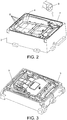
- Figure 2 shows a cross-section of the sealing gasket (9) housed in the perimeter suction chamber (7).
- the mold that is the object of the invention comprises cooling circuits (10) and centering elements (not shown in the figures) that are common elements in these types of molds.
Landscapes
- Engineering & Computer Science (AREA)
- Mechanical Engineering (AREA)
- Aviation & Aerospace Engineering (AREA)
- Transportation (AREA)
- Moulds For Moulding Plastics Or The Like (AREA)
Abstract
Description
- The present invention relates to a mold for the manufacturing of parts of vehicle seats that increases the quality of the piece manufactured in the mold, preventing the appearance of irregularities in the manufactured piece. The mold for the manufacturing of parts of vehicle seats that is the object of the invention is applicable in the automotive industry, specifically in the industry of manufacturing of components for vehicles.
- The softness of the suspension and the level of acoustic insulation of the cabin are also important, but no matter how good these are, the seats of a car are the most important for ensuring the comfort of the driver and the occupants; if the seats fail, the experience of driving or travel may be anything but enjoyable.
- The seat must offer the driver good lumbar support, balanced cushioning and fill that absorbs the vibrations that are produced on irregular pavement, as it is known that a seat that offers inadequate or insufficient support causes increased fatigue and back pain.
- But in addition to the comfort of the seat it helps with the task of driving the car, properly supporting the body laterally, for example on a curve, and also supporting it during braking, for example, preventing the hips from sliding forward.
- The seats also perform a safety function because a good seat, during sudden deceleration, prevents the body from slipping out from under the seatbelt and sliding forward (submarine effect), protects the sides of the abdomen in case of a lateral impact, and adequately cradles the head, preventing cervical injuries in case of a rear end collision.
- For the safety function to be performed appropriately, it is very important that the part obtained from the expandable material is perfect, free of hollows or air bubbles as a result of poor discharge of the gases inside the mold during the curing or molding process.
- The molds used in the manufacturing of the parts which, once assembled, make up a seat of a vehicle, generate problems of dimensional and surface homogeneity, which ultimately have an impact on the final quality of the seat that is manufactured and therefore constitute a point in regard to which evolution is required.
- The exothermic reaction of the materials used produces an abundance of gases, heat, etc.
- The mold of the invention proposes a solution to improve the expulsion of the air and gases generated inside the mold that are trapped when it is closed and that cause so many problems of dimensional and surface homogeneity in the final part with conventional molds that do not incorporate the combination of elements proposed in the new mold of the invention.
- Another objective is to minimize the ridge of surplus material on the obtained part in the closure zone of the molds, reducing as much as possible the manual work to grind the final piece.
- The invention that is described discloses a mold for the manufacturing of parts of vehicle seats that comprises a base with a cavity and a cover, which in turn includes a complementary projecting structure of the cavity.
- In the mold that is the object of the invention, the base also comprises a perimeter suction chamber around the cavity, which is connected to the inside of the hollow structure by means of several openings for the removal of gases.
- In the mold for the manufacturing of parts of vehicle seats that is the object of the invention, the perimeter suction chamber houses a sealing gasket with a hollow interior configuration.
- In the mold for the manufacturing of parts of vehicle seats that is the object of the invention, the openings or channels for the removal of gases have dimensions that fall within the ranges: 10-20 mm. wide and 0.1-0.35 mm. high.
- As a complement to the description provided below, and for the purpose of helping to make the characteristics of the invention more readily understandable, this specification is accompanied by a set of drawings which for an integral part of it and by way of illustration and not limitation, represent the following:
-
Figure 1 shows a perspective view of the mold with the cover and the base in contact. -
Figure 2 shows a perspective view of the base of the mold that is the object of the invention with a detailed view of the cross-section of the sealing gasket. -
Figure 3 shows a perspective view of the cover of the mold in the inverted position. -
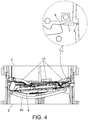
Figure 4 shows a cross-section of the mold that is the object of the invention. - The different numerical references that are shown in the figures correspond to the following elements:
- 1. mold,
- 2. base,
- 3. cover,
- 4. cavity,
- 5. projecting structure,
- 6. hollow structure,
- 7. perimeter structure chamber,
- 8. openings,
- 9. sealing gasket and
- 10. cooling circuit.
- As already indicated, and as shown in the figures mentioned above, the object of the invention is a mold (1) to fabricate pieces that then make up a seat in a vehicle. The mold (1) which comprises a base (2) which comprises a cavity (4) and a cover (3) that in turn comprises a complementary projecting structure (5) of the cavity (4) so that, when the base (2) and the cover (3) are put in contact with each other, a hollow structure (6) is generated between the cavity (4) and the projecting structure (5), such that by injecting material into the hollow structure (6), a piece for a vehicle seat is obtained.
- The base (2) also comprises a perimeter suction chamber (7) around the cavity (4), with said perimeter suction chamber (7) connected to the inside of the hollow structure (6) by means of several openings (8) located in the interior zone of the perimeter suction chamber (7) of the base (2).
- The openings (8) allow the removal or discharge of gases from the hollow structure (6) to the perimeter suction chamber (7), during the process of forming the seat part, but prevent the injected material from exiting from the interior of the hollow structure (6), precisely due to the limitation of its height.
- The openings (8) have dimensions that are within the ranges: 10-20 mm. wide and 0.1-0.35 mm. high, it is by means of these small dimensions of the openings that the gases are allowed to exit from the hollow structure (6) and the material is prevented from exiting, during the formation of the seat part.
- The mold that is the object of the invention also has several conventional suction conduits (not shown in the figures) that are connected to the hollow structure (6), these suction conduits are configured to suction the gases removed from the interior of the cavity (4) during the process of forming the injected seat part.
- The perimeter suction chamber (7) houses a sealing gasket (9), with a special configuration because it is hollow on the inside to prevent the deformation that is suffered due to the pressure of the gases that exit from the hollow structure (6) from leaving it inoperative at certain points, so that it is compressed with greater uniformity expanding its top part on the side, generating an optimum hermetic seal between the base (2) and the cover (3).
Figure 2 shows a cross-section of the sealing gasket (9) housed in the perimeter suction chamber (7). - The mold that is the object of the invention comprises cooling circuits (10) and centering elements (not shown in the figures) that are common elements in these types of molds.
- The invention must not be limited to the preferred embodiment described in this document. Experts in the subject may develop other embodiments in light of the description provided here. Consequently, the scope of the invention is defined by the following claims.
Claims (3)
- A mold (1) for the manufacturing of parts of vehicle seats comprising a base (2) which comprises a cavity (4) and a cover (3) that in turn includes a complementary projecting structure (5) of the cavity (4) characterized in that the base (2) comprises a perimeter suction chamber (7) around the cavity (4), which is connected to the inside of the hollow structure (6) by means of several openings (8) for the removal of gases.
- The mold (1) for the manufacturing of parts of vehicle seats according to claim 1 characterized in that the perimeter suction chamber (7) houses a sealing gasket (9) with a hollow interior configuration.
- The mold (1) for the manufacturing of parts of vehicle seats according to any of the preceding claims characterized in that the openings have dimensions that fall within the ranges: 10-20 mm wide and 0.1-0.35 mm high.
Applications Claiming Priority (1)
| Application Number | Priority Date | Filing Date | Title |
|---|---|---|---|
| ES201830569U ES1211970Y (en) | 2018-04-20 | 2018-04-20 | MOLD FOR MANUFACTURE OF VEHICLE SEAT PARTS |
Publications (1)
| Publication Number | Publication Date |
|---|---|
| EP3556526A1 true EP3556526A1 (en) | 2019-10-23 |
Family
ID=62084819
Family Applications (1)
| Application Number | Title | Priority Date | Filing Date |
|---|---|---|---|
| EP19169210.2A Withdrawn EP3556526A1 (en) | 2018-04-20 | 2019-04-15 | Mold for manufacturing of parts of vehicle seats |
Country Status (3)
| Country | Link |
|---|---|
| EP (1) | EP3556526A1 (en) |
| ES (1) | ES1211970Y (en) |
| RU (1) | RU2729859C1 (en) |
Families Citing this family (1)
| Publication number | Priority date | Publication date | Assignee | Title |
|---|---|---|---|---|
| CN109624185A (en) * | 2018-12-12 | 2019-04-16 | 深圳麦德利宇航材料科技有限公司 | A kind of exhaust apparatus of aero seat foaming mould |
Citations (5)
| Publication number | Priority date | Publication date | Assignee | Title |
|---|---|---|---|---|
| GB999604A (en) * | 1963-05-31 | 1965-07-28 | Manfred Matthias Dunkel | Improvements in or relating to dies or moulds |
| US4120632A (en) * | 1972-01-12 | 1978-10-17 | Klepper-Werke Kommanditgesellschaft | Molds for production of plastics material boats |
| JPH09286029A (en) * | 1996-04-24 | 1997-11-04 | Nishikawa Kasei Co Ltd | Molding method and molding apparatus for foam molded article |
| US20040247834A1 (en) * | 2003-06-03 | 2004-12-09 | Matthias Ludwig | Foaming mold for a composite part |
| US20150283767A1 (en) * | 2012-10-29 | 2015-10-08 | Kraussmaffei Technologies Gmbh | Method for producing composite material components made of plastic by a process of high-pressure resin transfer molding and pertaining tool for high-pressure resin transfer molding |
Family Cites Families (3)
| Publication number | Priority date | Publication date | Assignee | Title |
|---|---|---|---|---|
| DE3837221A1 (en) * | 1987-11-04 | 1989-05-24 | Honda Motor Co Ltd | FORMING PROCESS FOR PRODUCING FOAM-SHAPED PRODUCTS WITH EMBEDDED INSERT |
| US5837172A (en) * | 1995-10-30 | 1998-11-17 | Davidson Textron Inc. | Method for manufacturing an automotive trim product |
| US7481637B2 (en) * | 2004-05-12 | 2009-01-27 | Woodbridge Foam Corporation | Vented mold and method for producing molded article |
-
2018
- 2018-04-20 ES ES201830569U patent/ES1211970Y/en not_active Expired - Fee Related
-
2019
- 2019-04-15 EP EP19169210.2A patent/EP3556526A1/en not_active Withdrawn
- 2019-04-17 RU RU2019111646A patent/RU2729859C1/en not_active IP Right Cessation
Patent Citations (6)
| Publication number | Priority date | Publication date | Assignee | Title |
|---|---|---|---|---|
| GB999604A (en) * | 1963-05-31 | 1965-07-28 | Manfred Matthias Dunkel | Improvements in or relating to dies or moulds |
| US4120632A (en) * | 1972-01-12 | 1978-10-17 | Klepper-Werke Kommanditgesellschaft | Molds for production of plastics material boats |
| JPH09286029A (en) * | 1996-04-24 | 1997-11-04 | Nishikawa Kasei Co Ltd | Molding method and molding apparatus for foam molded article |
| JP3459861B2 (en) * | 1996-04-24 | 2003-10-27 | 西川化成株式会社 | Molding method and molding apparatus for foam molded articles |
| US20040247834A1 (en) * | 2003-06-03 | 2004-12-09 | Matthias Ludwig | Foaming mold for a composite part |
| US20150283767A1 (en) * | 2012-10-29 | 2015-10-08 | Kraussmaffei Technologies Gmbh | Method for producing composite material components made of plastic by a process of high-pressure resin transfer molding and pertaining tool for high-pressure resin transfer molding |
Also Published As
| Publication number | Publication date |
|---|---|
| RU2729859C1 (en) | 2020-08-12 |
| ES1211970Y (en) | 2018-07-31 |
| ES1211970U (en) | 2018-05-10 |
Similar Documents
| Publication | Publication Date | Title |
|---|---|---|
| US9487117B2 (en) | Method for producing a cushion element and method and tool for the production thereto | |
| CN106239845B (en) | Shell forming device and method | |
| CN109154347A (en) | Spring element for vehicle shock absorber, vehicle shock absorber and vehicle with vehicle shock absorber | |
| JP5037148B2 (en) | Cushion pad manufacturing method | |
| EP3556526A1 (en) | Mold for manufacturing of parts of vehicle seats | |
| JP2014121793A (en) | Method for producing under cover for vehicle and under cover for vehicle | |
| US10046488B2 (en) | Method of manufacturing foam molded product, apparatus for manufacturing foam molded product, and foam molded product | |
| JP4972029B2 (en) | Shock absorbing member and method for forming the same | |
| US12358191B2 (en) | Method for manufacturing molded foam, and molded foam | |
| JP4790328B2 (en) | Resin molded body | |
| KR20230007626A (en) | Double density molding device capable of surface vitrification and molding method using the same | |
| JP2011225164A (en) | Shock absorbing material and method for manufacturing the same | |
| JP2025066580A (en) | Vehicle soundproofing material and method for producing vehicle soundproofing material | |
| JP7042813B2 (en) | Foam molding mold and manufacturing method of foam molded body | |
| KR101145140B1 (en) | Manufacturing method of Crash pad for vehicle | |
| KR20070122296A (en) | Crash Pad Forming Equipment and Forming Process for Invisible Airbag | |
| JP7656531B2 (en) | Method and mold for foam molding | |
| JP2009066941A (en) | Molding method for foamed resin molded products | |
| KR20160100508A (en) | The mold of seat for vehicle | |
| JP4697546B2 (en) | Interior material for vehicle and manufacturing method thereof | |
| JP4841299B2 (en) | Manufacturing method of foam products | |
| KR20160099303A (en) | The mold of seat for vehicle | |
| JP2003095139A (en) | Resin hood for vehicle and its manufacturing method | |
| JP2011225165A (en) | Shock absorbing material and method for manufacturing the same | |
| JP2000006167A (en) | Foam molding equipment |
Legal Events
| Date | Code | Title | Description |
|---|---|---|---|
| PUAI | Public reference made under article 153(3) epc to a published international application that has entered the european phase |
Free format text: ORIGINAL CODE: 0009012 |
|
| AK | Designated contracting states |
Kind code of ref document: A1 Designated state(s): AL AT BE BG CH CY CZ DE DK EE ES FI FR GB GR HR HU IE IS IT LI LT LU LV MC MK MT NL NO PL PT RO RS SE SI SK SM TR |
|
| AX | Request for extension of the european patent |
Extension state: BA ME |
|
| 17P | Request for examination filed |
Effective date: 20200423 |
|
| RBV | Designated contracting states (corrected) |
Designated state(s): AL AT BE BG CH CY CZ DE DK EE ES FI FR GB GR HR HU IE IS IT LI LT LU LV MC MK MT NL NO PL PT RO RS SE SI SK SM TR |
|
| 17Q | First examination report despatched |
Effective date: 20200713 |
|
| 18D | Application deemed to be withdrawn |
Effective date: 20201124 |