EP3556443A1 - Tangible mobile game programming environment for non-specialists - Google Patents
Tangible mobile game programming environment for non-specialists Download PDFInfo
- Publication number
- EP3556443A1 EP3556443A1 EP18167975.4A EP18167975A EP3556443A1 EP 3556443 A1 EP3556443 A1 EP 3556443A1 EP 18167975 A EP18167975 A EP 18167975A EP 3556443 A1 EP3556443 A1 EP 3556443A1
- Authority
- EP
- European Patent Office
- Prior art keywords
- game
- user
- mobile device
- video
- programming
- Prior art date
- Legal status (The legal status is an assumption and is not a legal conclusion. Google has not performed a legal analysis and makes no representation as to the accuracy of the status listed.)
- Withdrawn
Links
- 230000000007 visual effect Effects 0.000 claims abstract description 26
- 238000012545 processing Methods 0.000 claims abstract description 16
- 230000003993 interaction Effects 0.000 claims description 42
- 238000000034 method Methods 0.000 claims description 23
- 230000009471 action Effects 0.000 claims description 13
- 238000011161 development Methods 0.000 claims description 3
- 238000005259 measurement Methods 0.000 claims description 3
- 238000004590 computer program Methods 0.000 claims description 2
- 238000004891 communication Methods 0.000 description 16
- 230000008859 change Effects 0.000 description 5
- 230000006399 behavior Effects 0.000 description 4
- 230000003190 augmentative effect Effects 0.000 description 3
- 238000004422 calculation algorithm Methods 0.000 description 3
- 238000001514 detection method Methods 0.000 description 3
- 238000005516 engineering process Methods 0.000 description 3
- 239000011521 glass Substances 0.000 description 3
- 238000007781 pre-processing Methods 0.000 description 3
- 230000008569 process Effects 0.000 description 3
- 241001465754 Metazoa Species 0.000 description 2
- 230000001413 cellular effect Effects 0.000 description 2
- 238000012360 testing method Methods 0.000 description 2
- 241000282412 Homo Species 0.000 description 1
- 238000004458 analytical method Methods 0.000 description 1
- 238000013459 approach Methods 0.000 description 1
- 238000007635 classification algorithm Methods 0.000 description 1
- 238000010276 construction Methods 0.000 description 1
- 238000012517 data analytics Methods 0.000 description 1
- 238000013461 design Methods 0.000 description 1
- 230000000694 effects Effects 0.000 description 1
- 238000000605 extraction Methods 0.000 description 1
- 230000004424 eye movement Effects 0.000 description 1
- 230000006870 function Effects 0.000 description 1
- 230000005484 gravity Effects 0.000 description 1
- 238000010801 machine learning Methods 0.000 description 1
- 230000000704 physical effect Effects 0.000 description 1
- 238000002360 preparation method Methods 0.000 description 1
- 238000011160 research Methods 0.000 description 1
- 238000000926 separation method Methods 0.000 description 1
- 239000004984 smart glass Substances 0.000 description 1
- 238000012549 training Methods 0.000 description 1
- 230000001960 triggered effect Effects 0.000 description 1
Images

Classifications
-
- A—HUMAN NECESSITIES
- A63—SPORTS; GAMES; AMUSEMENTS
- A63F—CARD, BOARD, OR ROULETTE GAMES; INDOOR GAMES USING SMALL MOVING PLAYING BODIES; VIDEO GAMES; GAMES NOT OTHERWISE PROVIDED FOR
- A63F13/00—Video games, i.e. games using an electronically generated display having two or more dimensions
- A63F13/20—Input arrangements for video game devices
- A63F13/21—Input arrangements for video game devices characterised by their sensors, purposes or types
- A63F13/211—Input arrangements for video game devices characterised by their sensors, purposes or types using inertial sensors, e.g. accelerometers or gyroscopes
-
- A—HUMAN NECESSITIES
- A63—SPORTS; GAMES; AMUSEMENTS
- A63F—CARD, BOARD, OR ROULETTE GAMES; INDOOR GAMES USING SMALL MOVING PLAYING BODIES; VIDEO GAMES; GAMES NOT OTHERWISE PROVIDED FOR
- A63F13/00—Video games, i.e. games using an electronically generated display having two or more dimensions
- A63F13/20—Input arrangements for video game devices
- A63F13/21—Input arrangements for video game devices characterised by their sensors, purposes or types
- A63F13/213—Input arrangements for video game devices characterised by their sensors, purposes or types comprising photodetecting means, e.g. cameras, photodiodes or infrared cells
-
- A—HUMAN NECESSITIES
- A63—SPORTS; GAMES; AMUSEMENTS
- A63F—CARD, BOARD, OR ROULETTE GAMES; INDOOR GAMES USING SMALL MOVING PLAYING BODIES; VIDEO GAMES; GAMES NOT OTHERWISE PROVIDED FOR
- A63F13/00—Video games, i.e. games using an electronically generated display having two or more dimensions
- A63F13/20—Input arrangements for video game devices
- A63F13/21—Input arrangements for video game devices characterised by their sensors, purposes or types
- A63F13/214—Input arrangements for video game devices characterised by their sensors, purposes or types for locating contacts on a surface, e.g. floor mats or touch pads
- A63F13/2145—Input arrangements for video game devices characterised by their sensors, purposes or types for locating contacts on a surface, e.g. floor mats or touch pads the surface being also a display device, e.g. touch screens
-
- A—HUMAN NECESSITIES
- A63—SPORTS; GAMES; AMUSEMENTS
- A63F—CARD, BOARD, OR ROULETTE GAMES; INDOOR GAMES USING SMALL MOVING PLAYING BODIES; VIDEO GAMES; GAMES NOT OTHERWISE PROVIDED FOR
- A63F13/00—Video games, i.e. games using an electronically generated display having two or more dimensions
- A63F13/20—Input arrangements for video game devices
- A63F13/21—Input arrangements for video game devices characterised by their sensors, purposes or types
- A63F13/215—Input arrangements for video game devices characterised by their sensors, purposes or types comprising means for detecting acoustic signals, e.g. using a microphone
-
- A—HUMAN NECESSITIES
- A63—SPORTS; GAMES; AMUSEMENTS
- A63F—CARD, BOARD, OR ROULETTE GAMES; INDOOR GAMES USING SMALL MOVING PLAYING BODIES; VIDEO GAMES; GAMES NOT OTHERWISE PROVIDED FOR
- A63F13/00—Video games, i.e. games using an electronically generated display having two or more dimensions
- A63F13/60—Generating or modifying game content before or while executing the game program, e.g. authoring tools specially adapted for game development or game-integrated level editor
- A63F13/63—Generating or modifying game content before or while executing the game program, e.g. authoring tools specially adapted for game development or game-integrated level editor by the player, e.g. authoring using a level editor
-
- A—HUMAN NECESSITIES
- A63—SPORTS; GAMES; AMUSEMENTS
- A63F—CARD, BOARD, OR ROULETTE GAMES; INDOOR GAMES USING SMALL MOVING PLAYING BODIES; VIDEO GAMES; GAMES NOT OTHERWISE PROVIDED FOR
- A63F13/00—Video games, i.e. games using an electronically generated display having two or more dimensions
- A63F13/60—Generating or modifying game content before or while executing the game program, e.g. authoring tools specially adapted for game development or game-integrated level editor
- A63F13/65—Generating or modifying game content before or while executing the game program, e.g. authoring tools specially adapted for game development or game-integrated level editor automatically by game devices or servers from real world data, e.g. measurement in live racing competition
-
- A—HUMAN NECESSITIES
- A63—SPORTS; GAMES; AMUSEMENTS
- A63F—CARD, BOARD, OR ROULETTE GAMES; INDOOR GAMES USING SMALL MOVING PLAYING BODIES; VIDEO GAMES; GAMES NOT OTHERWISE PROVIDED FOR
- A63F13/00—Video games, i.e. games using an electronically generated display having two or more dimensions
- A63F13/90—Constructional details or arrangements of video game devices not provided for in groups A63F13/20 or A63F13/25, e.g. housing, wiring, connections or cabinets
- A63F13/92—Video game devices specially adapted to be hand-held while playing
Definitions
- the present invention concerns the programming of video games.
- Video games are an unbounded artistic space. Indeed, in a video game, not only the visual, music and audio atmospheres can be created in total freedom, but also the behaviours of the characters, which can represent humans, aliens, animals or machines. This allows game developers to create worlds, with their own rules, dynamics and history, and tell stories in a unique way. To develop video games, one must combine strong human and technical skills, making them a complete creative and intellectual media. This has outstanding motivational power; for example, research shows that video games are a great approach to teach programming to beginners.
- this object is achieved by a method, a computer program, a mobile device and a system according to the independent claims.
- a video game programming tool By realising a video game programming tool on a mobile device and by using the at least one sensor of the mobile device, new game elements can be easily recorded and added as a game object or a property of a game object in the environment of the video game.
- This overcomes the cumbersome programming and definition of game objects and allows also non-specialist to program video games.
- the video game programming tool can be used everywhere, because it is realised in the mobile device. This allows to program the video game at places, where the inspirations for the game objects are taken and recorded. This allows also to use dead time on the mobile phone to create original content for video games instead of consuming superficial content.
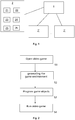
- Fig. 1 shows an embodiment of the system for programming a video game.
- the system comprises a server 1 and multiple client devices 2, 2'.
- the client devices 2, 2' are configured to allow users of the client devices 2, 2' to program a video game as explained in more detail below and/or configured to interact with the server 1 as explained below.
- the client device 2, 2' is a standard processing device with a client software (client program or client app) configured to program the video game and/or configured to interact with the server 1.
- At least one of the client devices 2, preferably multiple of the client devices 2, 2' are mobile devices.
- Mobile devices are preferably smartphones and/or tablets. It is however also possible that the mobile device is a virtual or augmented reality headset or glasses.
- the mobile device 2 comprises preferably a processing unit 21, a user interaction means 22, a communication interface 26 and at least one sensor.
- the processing unit 21 is any hardware configured to perform the functions of the mobile device 2 described in here, in particular to program the video game and/or to interact with the server 1.
- the processing unit 21 can for example comprises a combination of a central processor unit (CPU), graphics processing unit (GPU), Random access memory (RAM), Read-only memory (ROM) and/or a storage for storing the client software as well known in the state of the art.
- CPU central processor unit
- GPU graphics processing unit
- RAM Random access memory
- ROM Read-only memory
- storage for storing the client software as well known in the state of the art.
- any other construction of the processing unit 21 is possible.
- the user interactions means 22 is configured to show a graphical user interface for programming the video game and for receiving user input from the user of the mobile device 2.
- a touch screen 22 is a preferred embodiment for the user interaction means 22 of the mobile device 2.
- the client software and/or the mobile device 2 is configured to program the video game, in particular one or some or all of the later described single steps, mainly by touch actions on the touch screen.
- the touch screen 22 other user interaction means could be used in the mobile device, e.g. for the virtual or augmented reality headset or glasses.
- user inputs and user interactions can be made by eye movements or by body gestures.
- the user interaction means 22 could comprise one or two displays or projectors for showing the graphical user interface to the user.
- the user interaction means 22 could comprise a gesture detection means for detecting gestures of the body for a user input.
- Gestures of the body could be gestures of the eye, of the head, of the hands, etc..
- the gesture detection means could also detect gestures of others than the user wearing the mobile device.
- the communication interface 26 is configured to communicate with the server 1.
- the communication interface 26 is a wireless communication interface.
- the communication interface 26 is configured to access the internet.
- the communication with the server 1 works over the internet.
- the communication interface 26 is configured to communicate over a cellular radio network, preferably a phone cellular radio network like GPRS, EDGE, UMTS (3G), LTE (4G), 5G, etc.
- the communication interface 26 is configured to communicate over a wireless local area network (WLAN).
- WLAN wireless local area network
- other wireless communication methods are possible and also wired communication methods are possible.
- There could also be peer-to-peer communication between two client devices for example through wireless radio, but also through infrared, sound, and visual light and images (for examples two screen seeing each others through their cameras).
- the at least one sensor is configured to record game elements.
- a game element is a general definition of an element for a video game.
- the game element can be instantiated once as a game object or its property or several times as game objects or its properties in (a game level of) a video game. Instantiating the game element as a game object includes also the possibility to add this game object to another game object.
- the game object added to the other game object can than be shown or hidden depending on the set of rules and/or a condition of the video game.
- the game object is the realisation of the game element in the video game, for example at a special location in the environment of the video game.
- the game object is existing and the instantiated game element provides a property of the game object like an animation or a sound.
- Game elements can be 3D-objects, images, video sequences, audio sequences, movements, etc..
- the at least one sensor comprises a camera for recording the visual game elements.
- a camera is preferably configured to record (two dimensional) images and/or videos.
- the camera can also be configured to record 3D-images and/or videos.
- the camera can for example be a depth-camera, a time of flight camera, a 3D scanner, a plenoptic camera or any other camera type being configured to record 3D images and/or videos.
- Visual game elements can be the shape and/or the surface appearance of an object, a game character, a background, etc.
- the at least one sensor comprises a microphone for recording audio sequences as game elements.
- the at least one sensor comprises an inertial measurement unit (IMU) for recording a movement of the mobile device 2.
- the IMU comprises an accelerometer, a gyroscope and/or magnetometer.
- Other or additional movement sensors could be used to record a movement of the mobile device 2.
- a triangulation sensor could be used for tracking a position change and thus a movement.
- the triangulation sensor could also be used in combination with the IMU to improve the movement detection.
- GPS or WI-FI-triangulation sensors can be used as triangulation sensor.
- the movement of the mobile device 2 can be used for defining a movement of a certain game object. For example, the user of the mobile device 2 performs a certain movement with the mobile device 2 in a recording period. This recorded movement can then be used for defining a movement of a game object in the video game to be programmed.
- the game elements are prepared by the user on the basis of the one or more recordings of the at least one sensor.
- the client software and/or the mobile device 2 performs an automatic or semi-automatic pre-processing to convert the recordings from the sensor into potential game elements for the video game to be programmed.
- the video images from the camera can be pre-processed to rendered 3D structures with a reduced storage amount and with a quick reproducibility.
- audio sequences can be changed in volume or a filter for noise removal can be applied.
- a probabilistic filter like a Kalman filter can be applied on the recorded movement.
- the semi-automatic pre-processing the user could select the kind or type of game element the user wants to extract from the recording.
- pre-processing For example, if he would like to extract the colour or image recorded for a background or if he would like to extract the 3D shape of an object.
- Other examples of pre-processing are foreground extraction of 2D object based on different methods such as geometric shapes (square, ellipses), manual selection, intelligent foreground/background separation, etc..
- a game element can be based on one or more recordings.
- a game element could be a combination of two or more of a 3D-shape, a surface appearance, a sound and a movement of the game element.
- the client software and/or the mobile device 2 comprise preferably a game element library with multiple game elements.
- the game element library can contain also game elements which are not based on recordings, e.g. images with partial transparency (sprites), geometric visual elements, sounds and movements which appear often in video games.
- Game elements determined from recordings of the at least one recording can be stored in the game element library for later use in the video game.
- the game element library could be stored in the mobile device 2 and/or in the server 1.
- the game element library can be partly stored on the server 1 like for game elements which are available for multiple users and partly be stored on the mobile device 2 like for game elements of the user.
- the user could also share some game elements based on recordings of the at least one sensor of the mobile device 2 with other users of other client devices 2'.
- the server 1 is preferably configured to communicate with the client devices 2, 2' and/or the respective client software on those devices 2, 2'.
- the server 1 can perform all, some, certain processing steps described later for programming the video game on the mobile device 1.
- the server 1 can be one or more computing devices with a communication connection to the client devices 2, 2'.
- the server 1 can comprise a plurality of computing devices which are arranged in a rack, a server room or even at remote locations.
- the server 1 is preferably configured to share video games among different users as described in the following.
- the system for programming video games comprises a plurality of users which are registered at the system.
- the user registration might also be implicit, for example through their mobile device account, username, email, International Mobile Equipment Identity (IMEI) or any other unique identifier.
- IMEI International Mobile Equipment Identity
- Each user can program video games with its client devices 2, 2', upload or store programmed video games for sharing or co-programming with other users, play video games shared by the server 1 or by another user.
- the system and/or the server 1 comprises a video game library which is shared among the users.
- the video game library comprises a plurality of video games.
- each video games it associates characteristics of the game like the author, who has access (all users, some defined users, only programming users, only consuming users), how access is granted (for free, for compensation in money, for programming services), state (ready, under development), what kind of access (for programming, for playing, for both).
- Each user can thus access one of the video games in the video game library for playing the game or for further developing the game or for using the video game as a basis for a new game.
- Each user can upload or insert a video game programmed or further developed in the video game library for sharing the video game with other users. When the user uploads or inserts the video game, he could define the above-mentioned characteristics of the video game for the defining the kind of sharing.
- a kind of video game marketplace can be created where video games can be exchanged not only for playing, but also for developing and co-developing video games.
- Fig. 2 shows now a method for programming a video game on a mobile device 2.
- the method performed by the mobile device 2. This shall mean, that all user interactions described here for programming the video game are performed by a user on the mobile device 2. This does not exclude that at least a part of the described steps is performed by a processing unit (not shown) on the server 1 or even on other client devices 2' of other users. This shall further not exclude that some parts of the same video game are programmed from another client device 2' which is not a mobile device.
- a video game is opened.
- the video game is opened in a programming mode which allows to further develop the opened video game by programming steps performed by the user on the mobile device 2 and/or on the client software.
- the step of opening a video game can comprise the initialization of a new video game, if the opened video game does not exist yet.
- the step of opening a video game can also be the opening of an existing video game or video game project.
- the existing video game to be opened can be stored in a video game file stored on the mobile device 2 or on the server 1.
- the existing video game can be a video game under development of the user of the mobile device 2.
- the existing video game can also be a video game offered by other users via the server 1 for further developing the video game.
- the opened video game is for the sake of brevity called shortly the video game.
- the video game can comprise one or more game levels.
- an introductory screen listing lists games created by the user, by her friends and by the community. Users can search for games, and optionally buy and sell them. If creators of third-party games allow, these games can be "forked", that is, used as a base to start a new game.
- Several games can be combined together.
- the system tracks the tree of authors, as in current source code revision systems such as git. All content of a game, including levels, visual and audio assets, characters logic, etc. are available through this system. Data analytics and machine learning is used on the server to present the content to the user in a personalised way.
- the game environment is generated.
- the generation of the game environment comprises preferably the generation of the visual game environment, the audio game environment and/or maybe other properties of the game environment.
- the game environment is generated by generating game objects in a game level of the video game. In the state of the art, the preparation of the game environment needed to be programmed by design experts and/or separate editing tools were needed to generate the game environment.
- the mobile device 2 and/or the client software comprises a visual programming interface for generating the game environment.
- the visual programming interface is a graphical user interface of a user interaction means 22 of the mobile device 2 which allows to instantiate game elements as game objects in the game level by a user interaction of the user on the user interaction means 22.
- the visual programming interface is a graphical user interface on the touch screen 22 of the mobile device 2 which allows to instantiate game element as game objects in the game level by a touch interaction of the user on the touch screen 22.
- the touch interaction of the user generates a block of programming code for the video game defining the game object in the game environment as defined by the touch interaction.
- the touch interaction is for example a drag and drop or a selection touch interaction.
- the touch interaction corresponds in particular not to a keyboard input corresponding to the generated block of programming code.
- This visual programming interface facilitates the generation of game objects in the game environment, because the time and expert knowledge for coding can be avoided. In the following, the exemplary generation of game objects is described in more detail.
- the visual programming interface is a graphical user interface of a user interaction means 22 of the mobile device 2 which allows to instantiate game element as game objects in the game level by a gesture recognition of the user in the user interaction means 22.
- Game elements are available in a library. New game elements are captured from the real world by the user through the sensors 23, 24, 25 of the mobile device 2. For example, the visual elements of the game (main protagonist, other characters, obstacles and background) are captured through the camera 23. Computer vision algorithms allowing the user to crop them easily. For example, the audio effects are recorded with the microphone 24 built in the mobile device 2. For example, the movement or animations of game elements, for example a platform doing a pre-defined movement, are recorded by the IMU 25 of the mobile device 2. These animations can be briefly edited, for example set to loop continuously. In addition, game elements can be collected from other sources, such as the address book of the user, or his photo gallery. Game elements instantiated in the level are called game objects.
- a game object can be the character controlled by the player, a non-playing character, an obstacle or an element of the decor.
- the user can freely layout game objects and change their size through user interactions on the touch screen 22.
- User interactions can be gestures, haptic interactions with the touch screen
- the step of recording new game elements comprise preferably a (automatic / semi-automatic) processing step that transforms raw sensor data into game elements in the mobile device 2.
- a processing step that transforms raw sensor data into game elements in the mobile device 2.
- visual assets once they are acquired from the device's camera 23 or from another source, different cropping algorithms are available.
- the user can select a geometric region (rectangular, circular or polygonal), or mark the object and the background of the image by touch and a classification algorithm will crop automatically.
- an algorithm will trim silence at the beginning and the end of the sample, and adjust the volume.
- the user For example for animations, the user demonstrates a movement using the mobile device 2, which is recorded by the combination of its accelerometer, gyroscope and magnetometer.
- a probabilistic filter for example a Kalman filter, is applied to smooth the trajectory. Then, the user can apply small changes, for example to make it loop or to control its ruggedness through easy-to-understand icons.
- the trajectory is previewed on the screen of the device.
- the mobile device 2 could connect with external sensor devices for recording game elements.
- this external sensor device comprises an IMU or any other movement sensor for recording the movement of the external sensor device.
- the external sensor device could also be an augmented or virtual reality headset or glasses with a camera, microphone and/or IMU unit as described above.
- the external sensor device with the IMU or any other movement sensor is preferably configured to be attached to a part of a body to record the movement of the corresponding part of the body of a character in the video game.
- the body is preferably a human body, but can also be an animal body or even a robot body.
- the external sensor device could be any consumer wearable like a smart watch, smart glasses, running sensors in shoes, etc..
- the connection between the mobile device 2 and the external sensor could be via a short range wireless communication technology like Bluetooth, NFC or via a wired communication technology like USB or via other wireless communication technology like WLAN.
- Fig. 3 shows one embodiment for the step S2 of generating the game environment.
- a game element is recorded by the at least one sensor 23, 24, 25 of the mobile device 2.
- the recorded (and optionally processed) game element is stored in a library.
- the recorded and/or stored game element is selected as a game element or as a property of a game object.
- step S24 if the game element is selected as game object, the game objects needs to be placed in the game environment of the game level of the video game.
- the game objects are programmed. This means that for each game object, a set of rules governing the behaviour of the game objects are generated.
- the programming of the game objects needed to be programmed by programmers with separate programming tools.
- the mobile device 2 and/or the client software comprises a visual programming interface for programming the game objects.
- the visual programming interface is a graphical user interface on the touch screen 22 of the mobile device 2 which allows to define the set of rules for the game objects of the game level by a touch interaction of the user on the touch screen 22.
- the touch interaction of the user generates a block of programming code for the video game defining some of the set of rules defined by the touch interaction.
- the touch interaction is for example a drag and drop or a selection touch interaction.
- the touch interaction corresponds in particular not to a keyboard input corresponding to the generated block of programming code.
- This visual programming interface facilitates the generation of game objects in the game environment, because the time and expert knowledge for coding can be avoided.
- the exemplary game object programming environment for programming of a set of rules for one game object is explained in more detail.
- This environment allows to generate a set of rules governing the behaviour of the game object.
- the set of rules set up the physical properties of the object, such as how it reacts to gravity and collision with other objects.
- the environment also allows to set up the logic of the object, e.g. by visually assembling lists of events-actions pairs, optionally ordered by states defined in the video game. For each pair, all actions are triggered when all events occur.
- steps S2 and S3 are alternated. It is possible to define first all game objects in step S2 and program then their behaviour in step S3. Alternatively, each game object can be defined in step S2 and then programmed in step S3 such that the steps S2 and S3 are alternated.
- step S4 the programmed video game can be executed/run on a game engine to test the programmed video game.
- the game engine runs the programmed game level. That is, it analyses the interactions between the game objects and applies the actions defined in the events-actions pairs. To do so, a physics engine simulates the laws of physics in the virtual world and detects collisions, and one low-overhead virtual machine per game objects executes the logic in reaction to physical events. Moreover, virtual buttons can be displayed on the screen of the device, allowing the user to interact with the game. It is further possible to use the abilities of the mobile device 2 to allow user interaction in the video game.
- the at least one sensor e.g. the camera 23, the microphone 24 and/or the IMU 25, can be used to detect user input (e.g. by a gesture) in the video game.
- the video game can obviously also be closed and reopened for stopping and continuing the programming process, respectively.
- the video game can be tested on the mobile device 2, e.g. by running the programmed video game on the game engine of the mobile device 2. It is however also possible to test the programmed video game in a game browser. This allows to share the link to the programmed video game by email, instant messenger, SMS or other communication medium.
- the method described is preferably realised as a software running on the system and/or on the mobile device 2.
- the described steps can be performed exclusively by the mobile device 2.
- the described steps could be processed however also by the server 1.
- Such a software comprises preferably a visual editor module for performing the step S2 described above.
- Such a software comprises preferably a (visual) game programming module for performing the step S3 described above.
- Such a software comprises preferably a game engine for running a programmed game or a selected game, i.e. for performing the step S4 described above.
Landscapes
- Engineering & Computer Science (AREA)
- Multimedia (AREA)
- Human Computer Interaction (AREA)
- User Interface Of Digital Computer (AREA)
- Processing Or Creating Images (AREA)
Abstract
Mobile device (2) comprising at least one sensor (23, 24, 25) and a processing section (21), wherein the processing section (21) is configured to perform a program for programming a video game comprising: a visual editor for generating the game environment by generating visual game objects in a game level of a video game, wherein the visual editor is configured to record at least one game element on the basis of the at least one sensor (23, 24, 25) of the mobile device (2) and instantiating the at least one recorded game element in the game level as a game object or as a property of the game object; and a programming module for programming the game level by generating a set of rules governing the behaviour of the game objects.
Description
- The present invention concerns the programming of video games.
- Video games are an unbounded artistic space. Indeed, in a video game, not only the visual, music and audio atmospheres can be created in total freedom, but also the behaviours of the characters, which can represent humans, aliens, animals or machines. This allows game developers to create worlds, with their own rules, dynamics and history, and tell stories in a unique way. To develop video games, one must combine strong human and technical skills, making them a complete creative and intellectual media. This has outstanding motivational power; for example, research shows that video games are a great approach to teach programming to beginners.
- However, creating a video game is a tedious process, involving a complex set of tools like editors for the visual and audio assets, a programming environment, tools for web site and deployment and so on to be used in a proper order. This limits the creation of video games to professionals and enthusiast amateurs who could invest months or years in training.
- It is an object of the invention to make the process of programming a video game easier and more accessible.
- According to the invention, this object is achieved by a method, a computer program, a mobile device and a system according to the independent claims.
- By realising a video game programming tool on a mobile device and by using the at least one sensor of the mobile device, new game elements can be easily recorded and added as a game object or a property of a game object in the environment of the video game. This overcomes the cumbersome programming and definition of game objects and allows also non-specialist to program video games. In addition, the video game programming tool can be used everywhere, because it is realised in the mobile device. This allows to program the video game at places, where the inspirations for the game objects are taken and recorded. This allows also to use dead time on the mobile phone to create original content for video games instead of consuming superficial content.
- The dependant claims refer to further advantageous embodiments.
- The invention will be better understood with the aid of the description of an embodiment given by way of example and illustrated by the figures, in which:
-
Fig. 1 shows an embodiment of a system for programming a video game. -
Fig. 2 shows an embodiment of a method for programming a video game. -
Fig. 3 shows an embodiment of the step of generating the game environment. -
Fig. 1 shows an embodiment of the system for programming a video game. The system comprises aserver 1 andmultiple client devices 2, 2'. - The
client devices 2, 2' are configured to allow users of theclient devices 2, 2' to program a video game as explained in more detail below and/or configured to interact with theserver 1 as explained below. Preferably, theclient device 2, 2' is a standard processing device with a client software (client program or client app) configured to program the video game and/or configured to interact with theserver 1. - At least one of the
client devices 2, preferably multiple of theclient devices 2, 2' are mobile devices. Mobile devices are preferably smartphones and/or tablets. It is however also possible that the mobile device is a virtual or augmented reality headset or glasses. Themobile device 2 comprises preferably aprocessing unit 21, a user interaction means 22, acommunication interface 26 and at least one sensor. - The
processing unit 21 is any hardware configured to perform the functions of themobile device 2 described in here, in particular to program the video game and/or to interact with theserver 1. Theprocessing unit 21 can for example comprises a combination of a central processor unit (CPU), graphics processing unit (GPU), Random access memory (RAM), Read-only memory (ROM) and/or a storage for storing the client software as well known in the state of the art. However, any other construction of theprocessing unit 21 is possible. - The user interactions means 22 is configured to show a graphical user interface for programming the video game and for receiving user input from the user of the
mobile device 2. A touch screen 22 is a preferred embodiment for the user interaction means 22 of themobile device 2. Preferably, the client software and/or themobile device 2 is configured to program the video game, in particular one or some or all of the later described single steps, mainly by touch actions on the touch screen. Instead of the touch screen 22 other user interaction means could be used in the mobile device, e.g. for the virtual or augmented reality headset or glasses. For examples user inputs and user interactions can be made by eye movements or by body gestures. For example, the user interaction means 22 could comprise one or two displays or projectors for showing the graphical user interface to the user. For example, the user interaction means 22 could comprise a gesture detection means for detecting gestures of the body for a user input. Gestures of the body could be gestures of the eye, of the head, of the hands, etc.. The gesture detection means could also detect gestures of others than the user wearing the mobile device. - The
communication interface 26 is configured to communicate with theserver 1. Preferably, thecommunication interface 26 is a wireless communication interface. Preferably, thecommunication interface 26 is configured to access the internet. Preferably, the communication with theserver 1 works over the internet. Preferably, thecommunication interface 26 is configured to communicate over a cellular radio network, preferably a phone cellular radio network like GPRS, EDGE, UMTS (3G), LTE (4G), 5G, etc. Preferably, thecommunication interface 26 is configured to communicate over a wireless local area network (WLAN). However, other wireless communication methods are possible and also wired communication methods are possible. It is also possible that there is no connection to aserver 1. There could also be peer-to-peer communication between two client devices, for example through wireless radio, but also through infrared, sound, and visual light and images (for examples two screen seeing each others through their cameras). - The at least one sensor is configured to record game elements. A game element is a general definition of an element for a video game. The game element can be instantiated once as a game object or its property or several times as game objects or its properties in (a game level of) a video game. Instantiating the game element as a game object includes also the possibility to add this game object to another game object. The game object added to the other game object can than be shown or hidden depending on the set of rules and/or a condition of the video game. In one example the game object is the realisation of the game element in the video game, for example at a special location in the environment of the video game. In another example, the game object is existing and the instantiated game element provides a property of the game object like an animation or a sound. Game elements can be 3D-objects, images, video sequences, audio sequences, movements, etc..
- In one embodiment, the at least one sensor comprises a camera for recording the visual game elements. A camera is preferably configured to record (two dimensional) images and/or videos. The camera can also be configured to record 3D-images and/or videos. The camera can for example be a depth-camera, a time of flight camera, a 3D scanner, a plenoptic camera or any other camera type being configured to record 3D images and/or videos. Visual game elements can be the shape and/or the surface appearance of an object, a game character, a background, etc.
- In one embodiment, the at least one sensor comprises a microphone for recording audio sequences as game elements.
- In one embodiment, the at least one sensor comprises an inertial measurement unit (IMU) for recording a movement of the
mobile device 2. Preferably, the IMU comprises an accelerometer, a gyroscope and/or magnetometer. Other or additional movement sensors could be used to record a movement of themobile device 2. For example, a triangulation sensor could be used for tracking a position change and thus a movement. The triangulation sensor could also be used in combination with the IMU to improve the movement detection. GPS or WI-FI-triangulation sensors can be used as triangulation sensor. The movement of themobile device 2 can be used for defining a movement of a certain game object. For example, the user of themobile device 2 performs a certain movement with themobile device 2 in a recording period. This recorded movement can then be used for defining a movement of a game object in the video game to be programmed. - Preferably, the game elements are prepared by the user on the basis of the one or more recordings of the at least one sensor. Preferably, the client software and/or the
mobile device 2 performs an automatic or semi-automatic pre-processing to convert the recordings from the sensor into potential game elements for the video game to be programmed. For example, the video images from the camera can be pre-processed to rendered 3D structures with a reduced storage amount and with a quick reproducibility. For example, audio sequences can be changed in volume or a filter for noise removal can be applied. For example, a probabilistic filter like a Kalman filter can be applied on the recorded movement. For the semi-automatic pre-processing, the user could select the kind or type of game element the user wants to extract from the recording. For example, if he would like to extract the colour or image recorded for a background or if he would like to extract the 3D shape of an object. Other examples of pre-processing are foreground extraction of 2D object based on different methods such as geometric shapes (square, ellipses), manual selection, intelligent foreground/background separation, etc.. - Preferably, a game element can be based on one or more recordings. For example, a game element could be a combination of two or more of a 3D-shape, a surface appearance, a sound and a movement of the game element.
- The client software and/or the
mobile device 2 comprise preferably a game element library with multiple game elements. The game element library can contain also game elements which are not based on recordings, e.g. images with partial transparency (sprites), geometric visual elements, sounds and movements which appear often in video games. Game elements determined from recordings of the at least one recording can be stored in the game element library for later use in the video game. However, it is also possible to use a game element determined from at least one recording just for one game object (without storing the game element for later use in the library). The game element library could be stored in themobile device 2 and/or in theserver 1. For example, the game element library can be partly stored on theserver 1 like for game elements which are available for multiple users and partly be stored on themobile device 2 like for game elements of the user. The user could also share some game elements based on recordings of the at least one sensor of themobile device 2 with other users of other client devices 2'. - The
server 1 is preferably configured to communicate with theclient devices 2, 2' and/or the respective client software on thosedevices 2, 2'. Theserver 1 can perform all, some, certain processing steps described later for programming the video game on themobile device 1. Theserver 1 can be one or more computing devices with a communication connection to theclient devices 2, 2'. Theserver 1 can comprise a plurality of computing devices which are arranged in a rack, a server room or even at remote locations. Theserver 1 is preferably configured to share video games among different users as described in the following. - Preferably, the system for programming video games comprises a plurality of users which are registered at the system. The user registration might also be implicit, for example through their mobile device account, username, email, International Mobile Equipment Identity (IMEI) or any other unique identifier. Each user can program video games with its
client devices 2, 2', upload or store programmed video games for sharing or co-programming with other users, play video games shared by theserver 1 or by another user. Preferably, the system and/or theserver 1 comprises a video game library which is shared among the users. The video game library comprises a plurality of video games. For each video games it associates characteristics of the game like the author, who has access (all users, some defined users, only programming users, only consuming users), how access is granted (for free, for compensation in money, for programming services), state (ready, under development), what kind of access (for programming, for playing, for both). Each user can thus access one of the video games in the video game library for playing the game or for further developing the game or for using the video game as a basis for a new game. Each user can upload or insert a video game programmed or further developed in the video game library for sharing the video game with other users. When the user uploads or inserts the video game, he could define the above-mentioned characteristics of the video game for the defining the kind of sharing. Thus, a kind of video game marketplace can be created where video games can be exchanged not only for playing, but also for developing and co-developing video games. -
Fig. 2 shows now a method for programming a video game on amobile device 2. In the following, we will for simplicity describe the method performed by themobile device 2. This shall mean, that all user interactions described here for programming the video game are performed by a user on themobile device 2. This does not exclude that at least a part of the described steps is performed by a processing unit (not shown) on theserver 1 or even on other client devices 2' of other users. This shall further not exclude that some parts of the same video game are programmed from another client device 2' which is not a mobile device. - In a first step S1, a video game is opened. In this context, the video game is opened in a programming mode which allows to further develop the opened video game by programming steps performed by the user on the
mobile device 2 and/or on the client software. The step of opening a video game can comprise the initialization of a new video game, if the opened video game does not exist yet. The step of opening a video game can also be the opening of an existing video game or video game project. The existing video game to be opened can be stored in a video game file stored on themobile device 2 or on theserver 1. The existing video game can be a video game under development of the user of themobile device 2. The existing video game can also be a video game offered by other users via theserver 1 for further developing the video game. The opened video game is for the sake of brevity called shortly the video game. The video game can comprise one or more game levels. Preferably an introductory screen listing lists games created by the user, by her friends and by the community. Users can search for games, and optionally buy and sell them. If creators of third-party games allow, these games can be "forked", that is, used as a base to start a new game. Several games can be combined together. The system tracks the tree of authors, as in current source code revision systems such as git. All content of a game, including levels, visual and audio assets, characters logic, etc. are available through this system. Data analytics and machine learning is used on the server to present the content to the user in a personalised way. - In a further step S2, the game environment is generated. The generation of the game environment comprises preferably the generation of the visual game environment, the audio game environment and/or maybe other properties of the game environment. The game environment is generated by generating game objects in a game level of the video game. In the state of the art, the preparation of the game environment needed to be programmed by design experts and/or separate editing tools were needed to generate the game environment. In a preferred embodiment, the
mobile device 2 and/or the client software comprises a visual programming interface for generating the game environment. The visual programming interface is a graphical user interface of a user interaction means 22 of themobile device 2 which allows to instantiate game elements as game objects in the game level by a user interaction of the user on the user interaction means 22. In one embodiment, the visual programming interface is a graphical user interface on the touch screen 22 of themobile device 2 which allows to instantiate game element as game objects in the game level by a touch interaction of the user on the touch screen 22. The touch interaction of the user generates a block of programming code for the video game defining the game object in the game environment as defined by the touch interaction. The touch interaction is for example a drag and drop or a selection touch interaction. The touch interaction corresponds in particular not to a keyboard input corresponding to the generated block of programming code. This visual programming interface facilitates the generation of game objects in the game environment, because the time and expert knowledge for coding can be avoided. In the following, the exemplary generation of game objects is described in more detail. In another embodiment, the visual programming interface is a graphical user interface of a user interaction means 22 of themobile device 2 which allows to instantiate game element as game objects in the game level by a gesture recognition of the user in the user interaction means 22. - Game elements are available in a library. New game elements are captured from the real world by the user through the
sensors mobile device 2. For example, the visual elements of the game (main protagonist, other characters, obstacles and background) are captured through thecamera 23. Computer vision algorithms allowing the user to crop them easily. For example, the audio effects are recorded with themicrophone 24 built in themobile device 2. For example, the movement or animations of game elements, for example a platform doing a pre-defined movement, are recorded by theIMU 25 of themobile device 2. These animations can be briefly edited, for example set to loop continuously. In addition, game elements can be collected from other sources, such as the address book of the user, or his photo gallery. Game elements instantiated in the level are called game objects. A game object can be the character controlled by the player, a non-playing character, an obstacle or an element of the decor. The user can freely layout game objects and change their size through user interactions on the touch screen 22. User interactions can be gestures, haptic interactions with the touch screen - As already mentioned above, the step of recording new game elements comprise preferably a (automatic / semi-automatic) processing step that transforms raw sensor data into game elements in the
mobile device 2. For example for visual assets, once they are acquired from the device'scamera 23 or from another source, different cropping algorithms are available. The user can select a geometric region (rectangular, circular or polygonal), or mark the object and the background of the image by touch and a classification algorithm will crop automatically. For example for audio assets, once they are recorded using the device's microphone or taken from another source, an algorithm will trim silence at the beginning and the end of the sample, and adjust the volume. For example for animations, the user demonstrates a movement using themobile device 2, which is recorded by the combination of its accelerometer, gyroscope and magnetometer. A probabilistic filter, for example a Kalman filter, is applied to smooth the trajectory. Then, the user can apply small changes, for example to make it loop or to control its ruggedness through easy-to-understand icons. The trajectory is previewed on the screen of the device. - In one embodiment, the
mobile device 2 could connect with external sensor devices for recording game elements. Preferably this external sensor device comprises an IMU or any other movement sensor for recording the movement of the external sensor device. The external sensor device could also be an augmented or virtual reality headset or glasses with a camera, microphone and/or IMU unit as described above. The external sensor device with the IMU or any other movement sensor is preferably configured to be attached to a part of a body to record the movement of the corresponding part of the body of a character in the video game. The body is preferably a human body, but can also be an animal body or even a robot body. This allows to record in an easy way the movement of a body part like a hand, a foot and/or a head by an external sensor directly into themobile device 2 for the use of the movement of the corresponding part of a body of the character in the video game. The external sensor device could be any consumer wearable like a smart watch, smart glasses, running sensors in shoes, etc.. The connection between themobile device 2 and the external sensor could be via a short range wireless communication technology like Bluetooth, NFC or via a wired communication technology like USB or via other wireless communication technology like WLAN. -
Fig. 3 shows one embodiment for the step S2 of generating the game environment. In a first step S21, a game element is recorded by the at least onesensor mobile device 2. In the optional step S22, the recorded (and optionally processed) game element is stored in a library. In step S23, the recorded and/or stored game element is selected as a game element or as a property of a game object. In step S24, if the game element is selected as game object, the game objects needs to be placed in the game environment of the game level of the video game. - In step S3, the game objects are programmed. This means that for each game object, a set of rules governing the behaviour of the game objects are generated. In the state of the art, the programming of the game objects needed to be programmed by programmers with separate programming tools. In a preferred embodiment, the
mobile device 2 and/or the client software comprises a visual programming interface for programming the game objects. The visual programming interface is a graphical user interface on the touch screen 22 of themobile device 2 which allows to define the set of rules for the game objects of the game level by a touch interaction of the user on the touch screen 22. The touch interaction of the user generates a block of programming code for the video game defining some of the set of rules defined by the touch interaction. The touch interaction is for example a drag and drop or a selection touch interaction. The touch interaction corresponds in particular not to a keyboard input corresponding to the generated block of programming code. This visual programming interface facilitates the generation of game objects in the game environment, because the time and expert knowledge for coding can be avoided. In the following, the exemplary game object programming environment for programming of a set of rules for one game object is explained in more detail. - This environment allows to generate a set of rules governing the behaviour of the game object. Preferably, the set of rules set up the physical properties of the object, such as how it reacts to gravity and collision with other objects. The environment also allows to set up the logic of the object, e.g. by visually assembling lists of events-actions pairs, optionally ordered by states defined in the video game. For each pair, all actions are triggered when all events occur.
- The possible events are:
- initialization: when the level starts or the state is entered,
- collision: when another game object touches the game object,
- proximity: when another game object is in the vicinity of the game object,
- user input: when the user presses a virtual button on the screen or moves the device,
- timer elapsed: after a specific time has elapsed,
- animation finished: when a specific animation has finished,
- imu: the mobile device has a given position or orientation,
- sound finished: a sound has finished playing,
- check variable: a variable has a given range of value.
- The possible actions are:
- move: the speed of the game object is set,
- force: a force is applied to the game object for a small duration,
- start animation: this object will follow a pre-recorded path,
- destroy: the game object self-destroys,
- spawn: a new game object of a given type is created at the location of the game object,
- change sprite: a different image is selected for the game object,
- timer: the timer is started for a given duration,
- change state: another list of events-actions pairs will be considered for the object,
- change level: another level is loaded,
- sound: start playing a sound,
- set variable: set the value of a variable,
- show/hide child: show or hide a child game object,
- save/load screen: show a save or load screen.
- The order of the steps S2 and S3 is arbitrary. It is possible to define first all game objects in step S2 and program then their behaviour in step S3. Alternatively, each game object can be defined in step S2 and then programmed in step S3 such that the steps S2 and S3 are alternated.
- In step S4, the programmed video game can be executed/run on a game engine to test the programmed video game. This step is optional, but recommended. The game engine runs the programmed game level. That is, it analyses the interactions between the game objects and applies the actions defined in the events-actions pairs. To do so, a physics engine simulates the laws of physics in the virtual world and detects collisions, and one low-overhead virtual machine per game objects executes the logic in reaction to physical events. Moreover, virtual buttons can be displayed on the screen of the device, allowing the user to interact with the game. It is further possible to use the abilities of the
mobile device 2 to allow user interaction in the video game. For example, the at least one sensor, e.g. thecamera 23, themicrophone 24 and/or theIMU 25, can be used to detect user input (e.g. by a gesture) in the video game. - The video game can obviously also be closed and reopened for stopping and continuing the programming process, respectively.
- The video game can be tested on the
mobile device 2, e.g. by running the programmed video game on the game engine of themobile device 2. It is however also possible to test the programmed video game in a game browser. This allows to share the link to the programmed video game by email, instant messenger, SMS or other communication medium. - The method described is preferably realised as a software running on the system and/or on the
mobile device 2. The described steps can be performed exclusively by themobile device 2. The described steps could be processed however also by theserver 1. Such a software comprises preferably a visual editor module for performing the step S2 described above. Such a software comprises preferably a (visual) game programming module for performing the step S3 described above. Such a software comprises preferably a game engine for running a programmed game or a selected game, i.e. for performing the step S4 described above.
Claims (15)
- Method for programming a video game on a processing device comprising the following steps performed at least partially on the processing device:opening a video game;generating the game environment by generating game objects in a game level of the video game (S2);programming the game object by generating a set of rules governing the behaviour of the game objects (S3);characterized in thatthe processing device is a mobile device (2) with at least one sensor (23, 24, 25), andthe step of generating the game environment comprises the steps of recording at least one game element on the basis of the at least one sensor (23, 24, 25) of the mobile device (2) (S21) and instantiating the at least one recorded game element in the game level as a game object or as a property of a game object (S23, S24).
- Method according to one of the previous claims,
wherein the at least one sensor comprises a camera (23), and one of the at least one game element is an image taken from the camera (23) or a video sequence taken from the camera (23) or a 3D object taken from the camera (23) or computed from images or a video sequence taken from the camera (23); and/or
wherein the at least one sensor comprises a microphone (24), and one of the at least one game element is an audio sequence taken from the microphone; and/or
wherein the at least one sensor comprises an inertial measurement unit (25), and one of the at least one game element is a movement recorded with the inertial measurement unit (25). - Method according to one of the previous claims, wherein a plurality of game elements are stored in a library from where a user can select a game element as a game object or as a property of a game object in the game level, wherein each game element recorded with the at least one sensor (23, 24, 25) can be stored in the library.
- Method according to one of the previous claims, wherein the step of generating the game environment (S2) is performed by a user of the mobile device (2) via a graphical user interface on a user interaction means (22) of the mobile device (2) which allows to instantiate game element as game objects in the game level by a user interaction of the user on the user interaction means (22), wherein the user interaction of the user generates a block of programming code for the video game defining the game object in the game environment as defined by the user interaction.
- Method according to one of the previous claims, wherein the step of programming the game level is performed by a user of the mobile device (2) via a graphical user interface on a user interaction means (22) of the mobile device (2) which allows to define the set of rules for the game objects of the game level by a user interaction of the user on the user interaction means (22), wherein the user interaction of the user generates a block of programming code for the video game defining some of the set of rules defined by the user interaction.
- Method according to the previous claim, wherein the set of rules comprises for each game object at least one event-action-pair defining each, at least one action for the game object, when a certain event is detected, wherein the user selects the event and/or the action from a list of predefined events and/or actions by a selection on the user interaction means (22).
- Method according to one of the previous claims, comprising the step of running the game level on a game engine on the mobile device (2) (S4).
- Method according to one of the previous claims, wherein mobile device (2) comprises a client program associated to a user registered with a server (1) for performing the steps of programming the video game on the mobile device (2), wherein the client program of the user interacts with the server (1) and/or with other users registered at the server (1).
- Method according to claim 8, wherein the client program receives from the server (1) and shows on a user interaction means (22) a list of video games from other users, wherein one of the video games of the other users is opened by the client program and is further developed by the user actions of the user of the client program on the mobile device (2).
- Method according to claim 9, wherein the server (1) keeps track of the authorship of each user which contributed on the video game.
- Method according to one of claims 8 to 10, wherein the client program of the user makes the video game programmed available for other users on the server for sale, for further development and/or for playing upon request of the user.
- Computer program configured to perform the steps of the method according to one of the previous claims, when executed on a mobile device (2) with at least one sensor (23, 24, 25) or when executed on a system comprising a mobile device (2) with at least one sensor (23, 24, 25) and a server (1).
- Mobile device (2) comprising at least one sensor (23, 24, 25) and a processing section (21), wherein the processing section (21) is configured to perform a program for programming a video game comprising:a visual editor for generating the game environment by generating visual game objects in a game level of a video game, wherein the visual editor is configured to record at least one game element on the basis of the at least one sensor (23, 24, 25) of the mobile device (2) and instantiating the at least one recorded game element in the game level as a game object or as a property of the game object; anda programming module for programming the game level by generating a set of rules governing the behaviour of the game objects.
- Mobile device (2) according to the previous claim, wherein the program for programming the video game comprises a game engine for running the programmed game.
- System comprising a server (1) and a plurality of mobile devices (2, 2') according to one of claims 13 or 14.
Priority Applications (2)
| Application Number | Priority Date | Filing Date | Title |
|---|---|---|---|
| EP18167975.4A EP3556443A1 (en) | 2018-04-18 | 2018-04-18 | Tangible mobile game programming environment for non-specialists |
| PCT/EP2019/059594 WO2019201822A1 (en) | 2018-04-18 | 2019-04-15 | Tangible mobile game programming environment for non-specialists |
Applications Claiming Priority (1)
| Application Number | Priority Date | Filing Date | Title |
|---|---|---|---|
| EP18167975.4A EP3556443A1 (en) | 2018-04-18 | 2018-04-18 | Tangible mobile game programming environment for non-specialists |
Publications (1)
| Publication Number | Publication Date |
|---|---|
| EP3556443A1 true EP3556443A1 (en) | 2019-10-23 |
Family
ID=62025703
Family Applications (1)
| Application Number | Title | Priority Date | Filing Date |
|---|---|---|---|
| EP18167975.4A Withdrawn EP3556443A1 (en) | 2018-04-18 | 2018-04-18 | Tangible mobile game programming environment for non-specialists |
Country Status (2)
| Country | Link |
|---|---|
| EP (1) | EP3556443A1 (en) |
| WO (1) | WO2019201822A1 (en) |
Cited By (1)
| Publication number | Priority date | Publication date | Assignee | Title |
|---|---|---|---|---|
| CN116204167A (en) * | 2023-04-27 | 2023-06-02 | 杭州朗迅科技股份有限公司 | Method and system for realizing full-flow visual editing Virtual Reality (VR) |
Families Citing this family (1)
| Publication number | Priority date | Publication date | Assignee | Title |
|---|---|---|---|---|
| CN111068329B (en) * | 2019-11-18 | 2023-09-08 | 北京欢乐扬帆科技有限公司 | Game level configuration method and device, electronic equipment and storage medium |
Citations (2)
| Publication number | Priority date | Publication date | Assignee | Title |
|---|---|---|---|---|
| US20110260830A1 (en) * | 2010-04-22 | 2011-10-27 | Sony Computer Entertainment Inc. | Biometric interface for a handheld device |
| US20150165323A1 (en) * | 2013-12-17 | 2015-06-18 | Microsoft Corporation | Analog undo for reversing virtual world edits |
-
2018
- 2018-04-18 EP EP18167975.4A patent/EP3556443A1/en not_active Withdrawn
-
2019
- 2019-04-15 WO PCT/EP2019/059594 patent/WO2019201822A1/en not_active Ceased
Patent Citations (2)
| Publication number | Priority date | Publication date | Assignee | Title |
|---|---|---|---|---|
| US20110260830A1 (en) * | 2010-04-22 | 2011-10-27 | Sony Computer Entertainment Inc. | Biometric interface for a handheld device |
| US20150165323A1 (en) * | 2013-12-17 | 2015-06-18 | Microsoft Corporation | Analog undo for reversing virtual world edits |
Cited By (2)
| Publication number | Priority date | Publication date | Assignee | Title |
|---|---|---|---|---|
| CN116204167A (en) * | 2023-04-27 | 2023-06-02 | 杭州朗迅科技股份有限公司 | Method and system for realizing full-flow visual editing Virtual Reality (VR) |
| CN116204167B (en) * | 2023-04-27 | 2023-08-15 | 杭州朗迅科技股份有限公司 | Method and system for realizing full-flow visual editing Virtual Reality (VR) |
Also Published As
| Publication number | Publication date |
|---|---|
| WO2019201822A1 (en) | 2019-10-24 |
Similar Documents
| Publication | Publication Date | Title |
|---|---|---|
| US11158131B1 (en) | System and method for generating augmented reality objects | |
| CN114247141A (en) | Method, device, equipment, medium and program product for guiding task in virtual scene | |
| KR20200115231A (en) | Virtual character generation from image or video data | |
| JP2022545128A (en) | Artificial Intelligence (AI) controlled camera perspective generator and AI broadcaster | |
| KR20200100046A (en) | Information processing device, information processing method and program | |
| WO2022142626A1 (en) | Adaptive display method and apparatus for virtual scene, and electronic device, storage medium and computer program product | |
| US10616033B2 (en) | Different perspectives from a common virtual environment | |
| US11612813B2 (en) | Automatic multimedia production for performance of an online activity | |
| KR102854560B1 (en) | Method and electronic device for image augmentation | |
| CN112800252B (en) | Method, device, equipment and storage medium for playing media files in virtual scene | |
| US12589307B2 (en) | Avatar generation using an image of a person with modifier description | |
| KR20250044394A (en) | Virtual Closet AR Experience | |
| KR20250005475A (en) | Multi-modal human interaction control augmented reality | |
| WO2019201822A1 (en) | Tangible mobile game programming environment for non-specialists | |
| EP4532064B1 (en) | Method and system for automatically controlling user interruption during game play of a video game | |
| US20250083051A1 (en) | Game Scene Recommendation With AI-Driven Modification | |
| US12377345B2 (en) | Methods and systems for interactive gaming platform scene generation utilizing captured visual data and artificial intelligence-generated environment | |
| US20250021166A1 (en) | Controller use by hand-tracked communicator and gesture predictor | |
| CN116764240A (en) | Performance recording method, device, equipment and storage medium in virtual scene | |
| US20250010180A1 (en) | Artificial intelligence determined emotional state with dynamic modification of output of an interaction application | |
| US20250269277A1 (en) | Generation of highlight reel from stored user generated content for a user specified time period | |
| CN113763568B (en) | Augmented reality display processing method, device, equipment and storage medium | |
| US20260131247A1 (en) | Avatar generation using an image of a person with modifier description | |
| US12496529B2 (en) | Method for personalizing a video game trophy | |
| US20250121288A1 (en) | Methods and systems for implementing and utilizing interactive neural engines in interactive platforms |
Legal Events
| Date | Code | Title | Description |
|---|---|---|---|
| PUAI | Public reference made under article 153(3) epc to a published international application that has entered the european phase |
Free format text: ORIGINAL CODE: 0009012 |
|
| AK | Designated contracting states |
Kind code of ref document: A1 Designated state(s): AL AT BE BG CH CY CZ DE DK EE ES FI FR GB GR HR HU IE IS IT LI LT LU LV MC MK MT NL NO PL PT RO RS SE SI SK SM TR |
|
| AX | Request for extension of the european patent |
Extension state: BA ME |
|
| STAA | Information on the status of an ep patent application or granted ep patent |
Free format text: STATUS: THE APPLICATION IS DEEMED TO BE WITHDRAWN |
|
| 18D | Application deemed to be withdrawn |
Effective date: 20200603 |