EP3554111A1 - Wireless fidelity (wifi) connection method and related product - Google Patents
Wireless fidelity (wifi) connection method and related product Download PDFInfo
- Publication number
- EP3554111A1 EP3554111A1 EP17896741.0A EP17896741A EP3554111A1 EP 3554111 A1 EP3554111 A1 EP 3554111A1 EP 17896741 A EP17896741 A EP 17896741A EP 3554111 A1 EP3554111 A1 EP 3554111A1
- Authority
- EP
- European Patent Office
- Prior art keywords
- aps
- information
- list
- lists
- positive integer
- Prior art date
- Legal status (The legal status is an assumption and is not a legal conclusion. Google has not performed a legal analysis and makes no representation as to the accuracy of the status listed.)
- Withdrawn
Links
Images


Classifications
-
- H—ELECTRICITY
- H04—ELECTRIC COMMUNICATION TECHNIQUE
- H04W—WIRELESS COMMUNICATION NETWORKS
- H04W12/00—Security arrangements; Authentication; Protecting privacy or anonymity
- H04W12/03—Protecting confidentiality, e.g. by encryption
-
- H—ELECTRICITY
- H04—ELECTRIC COMMUNICATION TECHNIQUE
- H04W—WIRELESS COMMUNICATION NETWORKS
- H04W12/00—Security arrangements; Authentication; Protecting privacy or anonymity
- H04W12/02—Protecting privacy or anonymity, e.g. protecting personally identifiable information [PII]
-
- H—ELECTRICITY
- H04—ELECTRIC COMMUNICATION TECHNIQUE
- H04B—TRANSMISSION
- H04B17/00—Monitoring; Testing
- H04B17/30—Monitoring; Testing of propagation channels
- H04B17/309—Measuring or estimating channel quality parameters
- H04B17/318—Received signal strength
-
- H—ELECTRICITY
- H04—ELECTRIC COMMUNICATION TECHNIQUE
- H04W—WIRELESS COMMUNICATION NETWORKS
- H04W48/00—Access restriction; Network selection; Access point selection
- H04W48/16—Discovering, processing access restriction or access information
-
- H—ELECTRICITY
- H04—ELECTRIC COMMUNICATION TECHNIQUE
- H04W—WIRELESS COMMUNICATION NETWORKS
- H04W48/00—Access restriction; Network selection; Access point selection
- H04W48/20—Selecting an access point
-
- H—ELECTRICITY
- H04—ELECTRIC COMMUNICATION TECHNIQUE
- H04W—WIRELESS COMMUNICATION NETWORKS
- H04W76/00—Connection management
- H04W76/10—Connection setup
-
- H—ELECTRICITY
- H04—ELECTRIC COMMUNICATION TECHNIQUE
- H04W—WIRELESS COMMUNICATION NETWORKS
- H04W8/00—Network data management
- H04W8/005—Discovery of network devices, e.g. terminals
Definitions
- the present disclosure relates to the technical field of communications, and particularly to a method for wireless fidelity (Wi-Fi®) connection and related products.
- Wi-Fi® wireless fidelity
- one or more access points may be selected to be hidden to improve security of the APs.
- Implementations of the present disclosure provide a method for Wi-Fi connection and related products, which can search hidden APs automatically.
- a method for Wi-Fi connection includes the following.
- Wi-Fi scan is performed to obtain information of M APs, where M is a positive integer.
- Information of N APs that satisfies a predetermined requirement is selected from the information of the M APs to generate a first Wi-Fi list, where N is a positive integer smaller than or equal to M .
- X Wi-Fi lists are determined from historical data of Wi-Fi connection, where each of the X Wi-Fi lists corresponds to an AP previously connected, the historical data of Wi-Fi connection contains Y Wi-Fi lists, Y is a positive integer, and X is a positive integer smaller than or equal to M .
- the first Wi-Fi list is updated according to the X Wi-Fi lists.
- an apparatus for Wi-Fi connection includes a first scanning unit, a first selecting unit, a determining unit, and an updating unit.
- the first scanning unit is configured to perform Wi-Fi scan to obtain information of M APs, where M is a positive integer.
- the first selecting unit is configured to select, from the information of the M APs, information of N APs that satisfies a predetermined requirement to generate a first Wi-Fi list, where N is a positive integer smaller than or equal to M.
- the determining unit is configured to determine X Wi-Fi lists from historical data of Wi-Fi connection according to the first Wi-Fi list, where each of the X Wi-Fi lists corresponds to an AP previously connected, the historical data of Wi-Fi connection contains Y Wi-Fi lists, Y is a positive integer, and X is a positive integer smaller than or equal to M.
- the updating unit is configured to update the first Wi-Fi list according to the X Wi-Fi lists.
- a mobile terminal includes a memory, a processor, and one or more programs.
- the one or more programs are stored in the memory and operable with the processor.
- the one or more programs includes instructions for executing some of or all operations described in the first aspect of the implementations of the present disclosure.
- a computer readable storage medium configured to store computer programs, where the computer programs are operable with a processor to execute some of or all operations described in the first aspect of the implementations of the present disclosure.
- a computer program product includes a non-transitory computer-readable storage medium storing computer programs, where the computer programs are operable with a computer to execute some of or all operations described in the first aspect of the implementations of the present disclosure.
- the computer program product may be an software installation package.
- Wi-Fi wireless fidelity
- Examplementation means that specific characteristics, structures, or properties described in connection with an implementation may be included in at least one implementation of the disclosure. This word displayed at each position in the specification does not refer to the same implementation as well as an independent or alternate implementation mutually exclusive to other implementations. It may be explicitly and implicitly understood by those skilled in the art that the implementations described in the disclosure may be combined with the other implementations.
- a mobile terminal described in the implementations of the disclosure may include a smart phone (such as an Android® phone, an iOS® phone, and a Windows® phone), a tablet computer, a palmtop computer, a notebook computer, a mobile Internet device (MID), wearable equipment, or the like, which are not exhausted but only listed as examples.
- the mobile terminal includes, but is not limited to, the listed mobile terminals.
- a specified AP when a specified AP is not added in response to user operation, the AP cannot be displayed. Therefore, a hidden AP that is not recorded by a mobile terminal cannot be displayed in a Wi-Fi list after Wi-Fi scan of the mobile terminal. Thus, such a specified AP cannot be selected by a user, and the mobile terminal cannot be connected to the specified AP. Moreover, it is relatively tedious to add an AP via user operations, since the AP is displayed only when an input service set identifier (SSID) is completely matched.
- SSID input service set identifier
- the SSID contains a special character (such as " " and “ ”) or a symbol (such as "*", "/", or “@”), it may be easy to input an error SSID, and thus it may need to input the specified AP for many times.
- historical data of Wi-Fi connection in the implementations of the disclosure may include multiple Wi-Fi lists.
- Each Wi-Fi list may correspond to an AP previously connected by the mobile terminal.
- Each Wi-Fi list may include information of multiple APs. For example, after Wi-Fi scan, the mobile terminal may obtain information of multiple APs, and may select APs to generate a Wi-Fi list, where the selected APs each have a signal strength value higher than a preset threshold.
- an AP not previously connected by the mobile terminal refers to an AP to which the mobile terminal does not select to be connected, or an AP to which the mobile terminal selected to be connected but failed to be connected.
- An AP previously connected by the mobile terminal refers to an AP to which the mobile terminal selected to be connected and was connected to.
- the information of one AP may include, but is not limited to: an SSID, a basic service set identifier (BSSID), an encryption scheme, and whether the AP is hidden or not (a hidden state or a non-hidden state). It is to be noted that, when a certain AP is in the hidden state, it is possible to find the AP only by performing Wi-Fi scan according to an SSID or BSSID of the AP.
- each time after the mobile terminal is connected to an AP properties of the AP, such as an SSID, a BSSID, an encryption scheme, and whether the AP is hidden or not, may be recorded, and information of multiple APs around the AP are selected to generate a Wi-Fi list, where the multiple APs each have a signal strength value higher than a certain threshold.
- the historical data of Wi-Fi connection may be obtained.
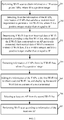
- FIG. 1 is a schematic flow chart illustrating a method for Wi-Fi connection according to a first implementation of the present disclosure.
- the method for Wi-Fi connection described in implementations of the disclosure includes the following.
- Wi-Fi scan is performed to obtain information of M APs, where M is a positive integer.
- a Wi-Fi module may be enabled to perform Wi-Fi scan. After the Wi-Fi scan, information of multiple APs can be obtained.
- information of N APs is selected from the information of the M APs to generate a first Wi-Fi list, where the information of each of the N APs satisfies a predetermined requirement, and N is a positive integer smaller than or equal to M.
- the predetermined requirement may be that a signal strength value is higher than a certain threshold.
- the predetermined requirement may be that a distance between an AP and the mobile terminal is smaller than a certain threshold.
- the information of the N APs that satisfies the predetermined requirement is selected from the information of the M APs as follows.
- Each of the M APs may have a fixed position, and a position of the mobile terminal may be obtained via a global positioning system (GPS) or Wi-Fi positioning technologies. Therefore, the distance between each of the M APs and the mobile terminal may be determined to obtain the M distances.
- the preset distance threshold may be set by default or by a user. The N distances each smaller than the preset distance threshold may be selected from the M distances, and the information of the N APs each corresponding to one of the N distances may be obtained.
- X Wi-Fi lists are determined from historical data of Wi-Fi connection, where each of the X Wi-Fi lists corresponds to an AP previously connected by the mobile terminal, the historical data of Wi-Fi connection contains Y Wi-Fi lists, Y is a positive integer, and X is a positive integer smaller than or equal to M.
- the historical data of Wi-Fi connection contains the Y Wi-Fi lists, Y is a positive integer, and X is a positive integer smaller than or equal to M .
- the mobile terminal may select from the historical data of Wi-Fi connection the X Wi-Fi lists each matching with the first Wi-Fi list, where each of the X Wi-Fi lists corresponds to one AP previously connected by the mobile terminal.
- the X Wi-Fi lists are determined from the historical data of Wi-Fi connection as follows.
- the similarity value between the first Wi-Fi list and each of the Y Wi-Fi lists may be determined.
- the number of APs each having the same service set identifier (SSID) and encryption scheme as one AP in the i th Wi-Fi list may be determined and denoted as a.
- a ratio of a to the number of APs in the first Wi-Fi list may be calculated and denoted as b.
- a ratio of a to the number of APs in the i th Wi-Fi list may be calculated and denoted as c .
- a mean of b and c may be calculated and denoted as ( b + c )/2 , which may be considered as a similarity value between the first Wi-Fi list and the i th Wi-Fi list.
- the Y similarity values may be obtained.
- the second preset threshold may be set by default or by the user.
- the X similarity values each larger than the second preset threshold may be selected from the Y similarity values, and the X Wi-Fi lists each corresponding to one of the X similarity values may be obtained.
- the first Wi-Fi list is updated according to the X Wi-Fi lists.
- information of some of or all the APs in the X Wi-Fi lists may be added to the first Wi-Fi list.
- the first Wi-Fi list is updated according to the X Wi-Fi lists as follows.
- the second Wi-Fi list may be generated according to the information of the Z APs. In order to facilitate the user to choose any one of the Z APs, the second Wi-Fi list may be displayed on the screen of the mobile terminal. The Z APs may be displayed in a random order. Further, at least one AP may be selected from the second Wi-Fi list by the user to perform Wi-Fi scan.
- SSIDs and encryption schemes of Wi-Fi hotspots around the AP are recorded in a Wi-Fi list L, where the Wi-Fi hotspots each have a signal strength value higher than R (for example, -90db).
- the information of the AP and information in the Wi-Fi list L may be recorded in a Hashtable in a form of (AP information, Wi-Fi list L ).
- Wi-Fi environment according to the information of the APs obtained via current scan, APs having a signal strength value higher than R (for example, - 90db) may be selected to be recorded in a Wi-Fi list C ; the mobile terminal matches the APs in the Wi-Fi list C with the APs in the Wi-Fi list L of the historical data of Wi-Fi connection; if in the Wi-Fi list C the APs each having the same SSID and encryption scheme as one AP in the Wi-Fi list L account for 80%, an initial match successes.
- R for example, - 90db
- an SSID corresponding to the Wi-Fi list L is recorded in a Wi-Fi list S .
- SSIDs of the APs are extracted sequentially from the Wi-Fi list S to perform specified SSID scan.
- the mobile terminal may be automatically connected to one AP when the AP is scanned. In this way, in the environment the mobile terminal can be automatically connected to the AP that was previously connected by the mobile terminal but is currently hidden.
- Wi-Fi scan is performed to obtain the information of the M APs, where M is a positive integer.
- the information of the N APs that satisfies the predetermined requirement is selected from the information of the M APs to generate the first Wi-Fi list, where N is a positive integer smaller than or equal to M .
- the X Wi-Fi lists are determined from the historical data of Wi-Fi connection, where each of the X Wi-Fi lists corresponds to an AP previously connected by the mobile terminal, the historical data of Wi-Fi connection contains the Y Wi-Fi lists, Y is a positive integer, and X is a positive integer smaller than or equal to M.
- the first Wi-Fi list is updated according to the X Wi-Fi lists. In this way, when the AP previously connected by the mobile terminal is changed to a hidden state from a non-hidden state, the AP can be automatically searched. Additionally, more APs can be scanned. Therefore, an efficiency of Wi-Fi connection can be improved.
- FIG. 2 is a schematic flow chart illustrating a method for Wi-Fi connection according to a second implementation of the present disclosure.
- the method may include the following.
- Wi-Fi scan is performed to obtain information of M APs, where M is a positive integer.
- information of N APs is selected from the information of the M APs to generate a first Wi-Fi list, where the information of each of the N APs satisfies a predetermined requirement, and N is a positive integer smaller than or equal to M.
- X Wi-Fi lists are determined from historical data of Wi-Fi connection, where each of the X Wi-Fi lists corresponds to an AP previously connected by a mobile terminal, the historical data of Wi-Fi connection contains Y Wi-Fi lists, Y is a positive integer, and X is a positive integer smaller than or equal to M.
- information of Z APs is extracted from the X Wi-Fi lists, where Z is a positive integer.
- the Z APs having highest signal strength values may be selected from the X Wi-Fi list, and the information of the Z APs may be obtained, where Z is a positive integer.
- the information of the Z APs may be extracted from the X Wi-Fi lists as follows.
- All APs in the X Wi-Fi lists are obtained.
- a deduplicating operation is performed on the all APs to obtain the Z APs.
- the information of the Z APs is obtained.
- Two of the X Wi-Fi lists may contain a same AP. Therefore, all the APs may be extracted from the X Wi-Fi lists, and only one of the same APs is retained. For instance, if API is contained in three Wi-Fi lists, then only one API is retained. In this way, the Z APs and the information of the Z APs may be obtained, where Z is a positive integer.
- the information of the Z APs is added to the first Wi-Fi list to obtain a second Wi-Fi list, and the second Wi-Fi list is displayed on a screen of the mobile terminal.
- the second Wi-Fi list may be generated according to the information of the Z APs. In order to facilitate the user to choose any one of the Z APs, the second Wi-Fi list may be displayed on the screen of the mobile terminal. The Z APs may be displayed in a random order. Further, at least one AP may be selected from the second Wi-Fi list by the user to perform Wi-Fi scan.
- At least one AP may be selected from the second Wi-Fi list.
- the second Wi-Fi list may include an AP A , an AP B, and an AP C .
- the AP A and the AP B may be selected.
- Wi-Fi scan is performed according to information of the at least one AP.
- the mobile terminal may perform Wi-Fi scan according to information of the at least one AP. Taking the AP A and the AP B as an example, the mobile terminal may perform Wi-Fi scan according to SSIDs of the AP A and the AP B .
- Wi-Fi scan may be performed according to an SSID and an encryption scheme of the at least one AP. In another implementation, Wi-Fi scan may be performed according to a BSSID of the at least one AP.
- Wi-Fi scan is performed to obtain the information of the M APs, where M is a positive integer.
- the information of the N APs that satisfies the predetermined requirement is selected from the information of the M APs to generate the first Wi-Fi list, where N is a positive integer smaller than or equal to M .
- the X Wi-Fi lists are determined from the historical data of Wi-Fi connection, where each of the X Wi-Fi lists corresponds to an AP previously connected by the mobile terminal, the historical data of Wi-Fi connection contains the Y Wi-Fi lists, Y is a positive integer, and X is a positive integer smaller than or equal to M.
- the first Wi-Fi list is updated according to the X Wi-Fi lists. In this way, when the AP previously connected by the mobile terminal is changed to a hidden state from a non-hidden state, the AP can be automatically searched. Additionally, more APs can be scanned. Therefore, an efficiency of Wi-Fi connection can be improved.
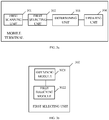
- FIG. 3a is a schematic structural diagram illustrating the apparatus for Wi-Fi connection according to an implementation of the present disclosure.
- the apparatus for Wi-Fi connection includes a first scanning unit 301, a first selecting unit 302, a determining unit 303, and an updating unit 304.
- the first scanning unit 301 is configured to perform Wi-Fi scan to obtain information of M APs, where M is a positive integer.
- the first selecting unit 302 is configured to select, from the information of the M APs, information of N APs to generate a first Wi-Fi list, where the information of each of N APs satisfies a predetermined requirement, and N is a positive integer smaller than or equal to M.
- the determining unit 303 is configured to determine X Wi-Fi lists from historical data of Wi-Fi connection according to the first Wi-Fi list, where each of the X Wi-Fi lists corresponds to an AP previously connected, the historical data of Wi-Fi connection contains Y Wi-Fi lists, Y is a positive integer, and X is a positive integer smaller than or equal to M.
- the updating unit 304 is configured to update the first Wi-Fi list according to the X Wi-Fi lists.
- FIG. 3b is a detailed structure of the first selecting unit 302 of the apparatus for Wi-Fi connection illustrated in FIG. 3a .
- the first selecting unit 302 may include an obtaining module 3021 and a first selecting module 3022.
- the obtaining module 3021 is configured to obtain a signal strength value of each of the M APs from the information of the M APs to obtain M signal strength values.
- the first selecting module 3022 is configured to select, from the M signal strength values, N signal strength values each higher than a first preset threshold, and to obtain the information of the N APs each corresponding to one of the N signal strength values.
- the first selecting unit 302 is configured to determine a distance between each of the M APs and the mobile terminal to obtain M distances, to select, from the M distances, N distances each smaller than a preset distance threshold, and to obtain the information of the N APs each corresponding to one of the N distances.
- FIG. 3c is a detailed structure of the determining unit 303 of the apparatus for Wi-Fi connection illustrated in FIG. 3a .
- the determining unit 303 may include a determining module 3031 and a second selecting module 3032.
- the determining module 3031 is configured to determine a similarity value between the first Wi-Fi list and each of the Y Wi-Fi lists to obtain Y similarity values.
- the second selecting module 3032 is configured to select, from the Y similarity values, X similarity values each larger than a second preset threshold, and to obtain the X Wi-Fi lists each corresponding to one of the X similarity values.
- FIG. 3d is a detailed structure of the updating unit 304 of the apparatus for Wi-Fi connection illustrated in FIG. 3a .
- the updating unit 304 may include an extracting module 3041 and a processing module 3042.
- the extracting module 3041 is configured to extract information of Z APs from the X Wi-Fi lists, where Z is a positive integer.
- the processing module 3042 is configured to add the information of the Z APs to the first Wi-Fi list to obtain a second Wi-Fi list, and to display the second Wi-Fi list on a screen of the mobile terminal.
- the extracting module 3041 is configured to obtain all APs in the X Wi-Fi lists, to perform a deduplicating operation on the all APs to obtain the Z APs, and to obtain the information of the Z APs.
- FIG. 3e is a variant structure of the apparatus for Wi-Fi connection illustrated in FIG. 3a .
- the structure illustrated in FIG. 3e further includes a second selecting unit 305 and a second scanning unit 306.
- the second selecting unit 305 is configured to select at least one AP from the second Wi-Fi list, after the processing module 3042 displays the second Wi-Fi list on the screen of the mobile terminal.
- the second scanning unit 306 is configured to perform Wi-Fi scan according to information of the at least one AP.
- the second scanning unit 306 is configured to perform Wi-Fi scan according to an SSID and an encryption scheme of the at least one AP.
- the second scanning unit 306 is configured to perform Wi-Fi scan according to a BSSID of the at least one AP.
- Wi-Fi scan is performed to obtain the information of the M APs, where M is a positive integer.
- the information of the N APs that satisfies the predetermined requirement is selected from the information of the M APs to generate the first Wi-Fi list, where N is a positive integer smaller than or equal to M.
- the X Wi-Fi lists are determined from the historical data of Wi-Fi connection, where each of the X Wi-Fi lists corresponds to one AP previously connected by the mobile terminal, the historical data of Wi-Fi connection contains the Y Wi-Fi lists, Y is a positive integer, and X is a positive integer smaller than or equal to M .
- the first Wi-Fi list is updated according to the X Wi-Fi lists. In this way, when the AP previously connected by the mobile terminal is changed to a hidden state from a non-hidden state, the AP can be automatically searched. Additionally, more APs can be scanned. Therefore, an efficiency of Wi-Fi connection can be improved.
- each unit may be, for example, an application specific integrated circuit (ASIC), a single circuit, a processor (shared, dedicated, or chipset) and a memory for executing one or more software or firmware programs, a combinational logic circuit, and/or other suitable components that can achieve the above described functions.
- ASIC application specific integrated circuit
- processor shared, dedicated, or chipset
- memory for executing one or more software or firmware programs, a combinational logic circuit, and/or other suitable components that can achieve the above described functions.
- the first scanning unit 301 configured to perform Wi-Fi scan to obtain the information of the M APs may be implemented by a mobile terminal illustrated in FIG. 4 .
- a processor 3000 may perform Wi-Fi scan to obtain the information of the M APs by invoking executable program codes stored in a memory 4000.
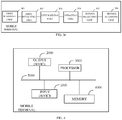
- FIG. 4 is a schematic structural diagram illustrating the mobile terminal according to an implementation of the present disclosure.
- the mobile terminal described in the implementation includes at least one input device 1000, at least one output device 2000, at least one processor 3000 such as a central processing unit (CPU), and a memory 4000.
- the input device 1000, the output device 2000, the processor 3000, and the memory 4000 are coupled with each other through a bus 5000.
- the input device 1000 may be a touch screen, a physical key, or a mouse.
- the output device 2000 may be a display screen.
- the memory 4000 may be a random access memory (RAM), and may be a nonvolatile memory, such as a disk storage.
- the memory 4000 is configured to store a set of program codes, and the input device 1000, the output device 2000, and the processor 3000 are configured to invoke the program codes stored in the memory 4000 to perform the following.
- the processor 3000 is configured to perform Wi-Fi scan to obtain information of M APs, where M is a positive integer, and to select, from the information of the M APs, information of N APs that satisfies a predetermined requirement to generate a first Wi-Fi list, where N is a positive integer smaller than or equal to M .
- the processor 3000 is further configured to determine X Wi-Fi lists from historical data of Wi-Fi connection according to the first Wi-Fi list, where each of the X Wi-Fi lists corresponds to an AP previously connected by the mobile terminal, the historical data of Wi-Fi connection contains Y Wi-Fi lists, Y is a positive integer, and X is a positive integer smaller than or equal to M .
- the processor 300o is further configured to update the first Wi-Fi list according to the X Wi-Fi lists.
- the processor 3000 configured to select the information of the N APs that satisfies the predetermined requirement from the information of the M APs is configured to obtain a signal strength value of each of the M APs from the information of the M APs to obtain M signal strength values, to select, from the M signal strength values, N signal strength values each higher than a first preset threshold, and to obtain the information of the N APs each corresponding to one of the N signal strength values.
- the processor 3000 configured to select the information of the N APs that satisfies the predetermined requirement from the information of the M APs is configured to determine a distance between each of the M APs and the mobile terminal to obtain M distances, to select, from the M distances, N distances each smaller than a preset distance threshold, and to obtain the information of the N APs each corresponding to one of the N distances.
- the processor 3000 configured to determine the X Wi-Fi lists from the historical data of Wi-Fi connection according to the first Wi-Fi list is configured to determine a similarity value between the first Wi-Fi list and each of the Y Wi-Fi lists to obtain Y similarity values, to select, from the Y similarity values, X similarity values each larger than a second preset threshold, and to obtain the X Wi-Fi lists each corresponding to one of the X similarity values.
- the processor 3000 configured to update the first Wi-Fi list according to the X Wi-Fi lists is configured to extract information of Z APs from the X Wi-Fi lists, to add the information of the Z APs to the first Wi-Fi list to obtain a second Wi-Fi list, and to display the second Wi-Fi list on a screen of the mobile terminal, where Z is a positive integer.
- the processor 3000 configured to extract the information of the Z APs from the X Wi-Fi lists is configured to obtain all APs in the X Wi-Fi lists, to perform a deduplicating operation on the all APs to obtain the Z APs, and to obtain the information of the Z APs.
- the processor 3000 is further configured to select at least one AP from the second Wi-Fi list, and to perform Wi-Fi scan according to information of the at least one AP.
- the processor 3000 configured to perform Wi-Fi scan according to the information of the at least one AP is configured to perform Wi-Fi scan according to an SSID and an encryption scheme of the at least one AP.
- the processor 3000 configured to perform Wi-Fi scan according to the information of the at least one AP is configured to perform Wi-Fi scan according to a BSSID of the at least one AP.
- the implementations of the present disclosure also provide a computer storage medium.
- the computer readable storage medium is configured to store computer programs, where the computer programs are operable to execute some of or all operations of the method for Wi-Fi connection described in any one of method implementations of the present disclosure.
- the implementations of the present disclosure also provide a computer program product.
- the computer program product includes a non-transitory computer-readable storage medium that stores computer programs, where the computer programs are operable with a computer to execute some of or all operations of the method for Wi-Fi connection described in any one of method implementations of the present disclosure.
- the implementation of the disclosure may be provided as a method, an apparatus (equipment), or a computer program product. Therefore, the present disclosure may use a form of hardware only implementations, software only implementations, or implementations with a combination of software and hardware. Moreover, the present disclosure may use a form of a computer program product that is implemented on one or more computer-usable storage media (including but not limited to a disk memory, a CD-ROM, an optical memory, and the like) that include computer-usable program codes.
- the computer program is stored/distributed in a proper medium and is provided as or used as a part of the hardware together with another hardware, or may also use another allocation form, such as by using the Internet or another wired or wireless telecommunications system.
- each flow and/or block in the flowcharts and/or the block diagrams and combinations of the flows and/or blocks in the flowcharts and/or the block diagrams may be implemented by computer program instructions.
- These computer program instructions may be provided for a universal computer, a dedicated computer, an embedded processor, or a processor of other programmable data processing equipment to generate a machine, so that an apparatus for realizing a function specified in one flow or more flows in the flowcharts and/or one block or more blocks in the block diagrams is generated by the instructions executed through the computer or the processor of the other programmable data processing device.
- These computer program instructions may also be stored in a computer-readable memory capable of guiding the computer or the other programmable data processing device to work in a specific manner, so that a product including an instruction device may be generated by the instructions stored in the computer-readable memory, the instruction device realizing the function specified in one flow or many flows in the flowcharts and/or one block or many blocks in the block diagrams.
- These computer program instructions may further be loaded onto the computer or the other programmable data processing device, so that a series of operations are executed on the computer or the other programmable data processing device to generate processing implemented by the computer, and operations for realizing the function specified in one flow or many flows in the flowcharts and/or one block or many blocks in the block diagrams are provided by the instructions executed on the computer or the other programmable data processing device.
Landscapes
- Engineering & Computer Science (AREA)
- Computer Networks & Wireless Communication (AREA)
- Signal Processing (AREA)
- Computer Security & Cryptography (AREA)
- Quality & Reliability (AREA)
- Physics & Mathematics (AREA)
- Electromagnetism (AREA)
- Databases & Information Systems (AREA)
- Mobile Radio Communication Systems (AREA)
Abstract
Description
- This application claims priority to Chinese Patent Application No.
201710091097.5, filed on February 20, 2017 - The present disclosure relates to the technical field of communications, and particularly to a method for wireless fidelity (Wi-Fi®) connection and related products.
- With rapid development of information technologies, mobile terminals such as mobile phones and tablet computers become increasingly popular. User requirements on the mobile terminals also become increasingly high. There is not only a need for a relatively high processing speed, but also an increasing dependence on Wi-Fi. With popularization of the mobile terminals and Wi-Fi, it is frequent to connect the mobile terminals to a Wi-Fi network.
- In the present technology, one or more access points (APs) may be selected to be hidden to improve security of the APs.
- Implementations of the present disclosure provide a method for Wi-Fi connection and related products, which can search hidden APs automatically.
- According to a first aspect of the implementations of the present disclosure, a method for Wi-Fi connection is provided. The method includes the following.
- Wi-Fi scan is performed to obtain information of M APs, where M is a positive integer. Information of N APs that satisfies a predetermined requirement is selected from the information of the M APs to generate a first Wi-Fi list, where N is a positive integer smaller than or equal to M. According to the first Wi-Fi list, X Wi-Fi lists are determined from historical data of Wi-Fi connection, where each of the X Wi-Fi lists corresponds to an AP previously connected, the historical data of Wi-Fi connection contains Y Wi-Fi lists, Y is a positive integer, and X is a positive integer smaller than or equal to M. The first Wi-Fi list is updated according to the X Wi-Fi lists.
- According to a second aspect of the implementations of the present disclosure, an apparatus for Wi-Fi connection is provided. The apparatus includes a first scanning unit, a first selecting unit, a determining unit, and an updating unit.
- The first scanning unit is configured to perform Wi-Fi scan to obtain information of M APs, where M is a positive integer.
- The first selecting unit is configured to select, from the information of the M APs, information of N APs that satisfies a predetermined requirement to generate a first Wi-Fi list, where N is a positive integer smaller than or equal to M.
- The determining unit is configured to determine X Wi-Fi lists from historical data of Wi-Fi connection according to the first Wi-Fi list, where each of the X Wi-Fi lists corresponds to an AP previously connected, the historical data of Wi-Fi connection contains Y Wi-Fi lists, Y is a positive integer, and X is a positive integer smaller than or equal to M.
- The updating unit is configured to update the first Wi-Fi list according to the X Wi-Fi lists.
- According to a third aspect of the implementations of the present disclosure, a mobile terminal is provided. The mobile terminal includes a memory, a processor, and one or more programs. The one or more programs are stored in the memory and operable with the processor. The one or more programs includes instructions for executing some of or all operations described in the first aspect of the implementations of the present disclosure.
- According to a fourth aspect of the implementations of the present disclosure, a computer readable storage medium is provided. The computer readable storage medium is configured to store computer programs, where the computer programs are operable with a processor to execute some of or all operations described in the first aspect of the implementations of the present disclosure.
- According to a fifth aspect of the implementations of the present disclosure, a computer program product is provided. The computer program product includes a non-transitory computer-readable storage medium storing computer programs, where the computer programs are operable with a computer to execute some of or all operations described in the first aspect of the implementations of the present disclosure. The computer program product may be an software installation package.
- To describe technical solutions in implementations of the present disclosure more clearly, the following briefly introduces the accompanying drawings required for describing the implementations. Apparently, the accompanying drawings in the following description illustrate some implementations of the present disclosure. Those of ordinary skill in the art may also obtain other drawings based on these accompanying drawings without creative efforts.
-
FIG. 1 is a schematic flow chart illustrating a method for Wi-Fi connection according to a first implementation of the present disclosure. -
FIG. 2 is a schematic flow chart illustrating a method for Wi-Fi connection according to a second implementation of the present disclosure. -
FIG. 3a is a schematic structural diagram illustrating an apparatus for Wi-Fi connection according to an implementation of the present disclosure. -
FIG. 3b is a schematic structural diagram illustrating a first selecting unit of the apparatus for Wi-Fi connection illustrated inFIG. 3a according to an implementation of the present disclosure. -
FIG. 3c is a schematic structural diagram illustrating a determining unit of the apparatus for Wi-Fi connection illustrated inFIG. 3a according to an implementation of the present disclosure. -
FIG. 3d is a schematic structural diagram illustrating an updating unit of the apparatus for Wi-Fi connection illustrated inFIG. 3a according to an implementation of the present disclosure. -
FIG. 3e is another schematic structural diagram illustrating the apparatus for Wi-Fi connection illustrated inFIG. 3a according to an implementation of the present disclosure. -
FIG. 4 is a schematic structural diagram illustrating a mobile terminal according to an implementation of the present disclosure. - In related arts, in a process of wireless fidelity (Wi-Fi) scan, a problem may occur. Taking a certain access point (AP) to which a mobile terminal was previously connected as an example, before the AP is hidden, the mobile terminal can find the AP by Wi-Fi scan and then be connected to the AP; however, after the AP is hidden, the mobile terminal cannot find the AP. Therefore, implementations of the present disclosure provide a method for Wi-Fi connection and related products, which can search hidden APs automatically.
- Technical solutions of the present disclosure will be further described below through implementations with reference to the accompanying drawings. Apparently, the described implementations are merely some rather than all implementations of the present disclosure. All other implementations obtained by those of ordinary skill in the art based on the implementations of the present disclosure without creative efforts shall fall within the protection scope of the present disclosure.
- The terms "first", "second", "third", "fourth", and the like used in the specification, the claims, and the accompany drawings of the present disclosure are used to distinguish different objects rather than describe a particular order. Further, the terms "include", "comprise", and "have" as well as variations thereof are intended to cover non-exclusive inclusion. For example, a process, method, system, product, or apparatus including a series of steps or units is not limited to the listed steps or units; on the contrary, it can optionally include other steps or units that are not listed; alternatively, other steps or units inherent to the process, method, product, or device can be included either.
- "Implementation" mentioned in the disclosure means that specific characteristics, structures, or properties described in connection with an implementation may be included in at least one implementation of the disclosure. This word displayed at each position in the specification does not refer to the same implementation as well as an independent or alternate implementation mutually exclusive to other implementations. It may be explicitly and implicitly understood by those skilled in the art that the implementations described in the disclosure may be combined with the other implementations.
- A mobile terminal described in the implementations of the disclosure may include a smart phone (such as an Android® phone, an iOS® phone, and a Windows® phone), a tablet computer, a palmtop computer, a notebook computer, a mobile Internet device (MID), wearable equipment, or the like, which are not exhausted but only listed as examples. The mobile terminal includes, but is not limited to, the listed mobile terminals.
- Generally, when a specified AP is not added in response to user operation, the AP cannot be displayed. Therefore, a hidden AP that is not recorded by a mobile terminal cannot be displayed in a Wi-Fi list after Wi-Fi scan of the mobile terminal. Thus, such a specified AP cannot be selected by a user, and the mobile terminal cannot be connected to the specified AP. Moreover, it is relatively tedious to add an AP via user operations, since the AP is displayed only when an input service set identifier (SSID) is completely matched. If the SSID contains a special character (such as "" and "
 ") or a symbol (such as "*", "/", or "@"), it may be easy to input an error SSID, and thus it may need to input the specified AP for many times.
- In an implementation, historical data of Wi-Fi connection in the implementations of the disclosure may include multiple Wi-Fi lists. Each Wi-Fi list may correspond to an AP previously connected by the mobile terminal. Each Wi-Fi list may include information of multiple APs. For example, after Wi-Fi scan, the mobile terminal may obtain information of multiple APs, and may select APs to generate a Wi-Fi list, where the selected APs each have a signal strength value higher than a preset threshold. In the implementations of the disclosure, an AP not previously connected by the mobile terminal refers to an AP to which the mobile terminal does not select to be connected, or an AP to which the mobile terminal selected to be connected but failed to be connected. An AP previously connected by the mobile terminal refers to an AP to which the mobile terminal selected to be connected and was connected to. The information of one AP may include, but is not limited to: an SSID, a basic service set identifier (BSSID), an encryption scheme, and whether the AP is hidden or not (a hidden state or a non-hidden state). It is to be noted that, when a certain AP is in the hidden state, it is possible to find the AP only by performing Wi-Fi scan according to an SSID or BSSID of the AP. In a practical application, each time after the mobile terminal is connected to an AP, properties of the AP, such as an SSID, a BSSID, an encryption scheme, and whether the AP is hidden or not, may be recorded, and information of multiple APs around the AP are selected to generate a Wi-Fi list, where the multiple APs each have a signal strength value higher than a certain threshold. As such, the historical data of Wi-Fi connection may be obtained.
- Referring to
FIG. 1, FIG. 1 is a schematic flow chart illustrating a method for Wi-Fi connection according to a first implementation of the present disclosure. The method for Wi-Fi connection described in implementations of the disclosure includes the following. - At
block 101, Wi-Fi scan is performed to obtain information of M APs, where M is a positive integer. - When a mobile terminal needs to be connected to a Wi-Fi network, a Wi-Fi module may be enabled to perform Wi-Fi scan. After the Wi-Fi scan, information of multiple APs can be obtained.
- At
block 102, information of N APs is selected from the information of the M APs to generate a first Wi-Fi list, where the information of each of the N APs satisfies a predetermined requirement, and N is a positive integer smaller than or equal to M. - For example, the predetermined requirement may be that a signal strength value is higher than a certain threshold. For another example, the predetermined requirement may be that a distance between an AP and the mobile terminal is smaller than a certain threshold.
- In an implementation, at
block 102, the information of the N APs that satisfies the predetermined requirement is selected from the information of the M APs as follows. - 21) A signal strength value of each of the M APs is obtained from the information of the M APs to obtain M signal strength values.
- 22) N signal strength values each higher than a first preset threshold are selected from the M signal strength values, and the information of the N APs each corresponding to one of the N signal strength values is obtained.
After the Wi-Fi scan, the mobile terminal can obtain the information of the multiple APs. However, the multiple APs are not all stable. Generally, the closer an AP to the mobile terminal, the higher the signal strength of the AP. Assuming that the information of the M APs is obtained after the Wi-Fi scan, the information of the N APs may be selected from the information of the M APs to generate a target Wi-Fi list, where M is a positive integer, and the N APs each have a signal strength value higher than the first preset threshold. Of course, the target Wi-Fi list may be displayed on a screen of the mobile terminal. The first preset threshold may be set by default or by a user.
In an implementation, atblock 102, the information of the N APs that satisfies the predetermined requirement is selected from the information of the M APs as follows. - 23) A distance between each of the M APs and the mobile terminal is determined to obtain M distances.
- 24) N distances each smaller than a preset distance threshold are selected from the M distances, and the information of the N APs each corresponding to one of the N distances is obtained.
- Each of the M APs may have a fixed position, and a position of the mobile terminal may be obtained via a global positioning system (GPS) or Wi-Fi positioning technologies. Therefore, the distance between each of the M APs and the mobile terminal may be determined to obtain the M distances. The preset distance threshold may be set by default or by a user. The N distances each smaller than the preset distance threshold may be selected from the M distances, and the information of the N APs each corresponding to one of the N distances may be obtained.
- At
block 103, according to the first Wi-Fi list, X Wi-Fi lists are determined from historical data of Wi-Fi connection, where each of the X Wi-Fi lists corresponds to an AP previously connected by the mobile terminal, the historical data of Wi-Fi connection contains Y Wi-Fi lists, Y is a positive integer, and X is a positive integer smaller than or equal to M. - The historical data of Wi-Fi connection contains the Y Wi-Fi lists, Y is a positive integer, and X is a positive integer smaller than or equal to M. The mobile terminal may select from the historical data of Wi-Fi connection the X Wi-Fi lists each matching with the first Wi-Fi list, where each of the X Wi-Fi lists corresponds to one AP previously connected by the mobile terminal.
- In an implementation, at
block 103, according to the first Wi-Fi list, the X Wi-Fi lists are determined from the historical data of Wi-Fi connection as follows. - 31) A similarity value between the first Wi-Fi list and each of the Y Wi-Fi lists is determined to obtain Y similarity values.
- 32) X similarity values each larger than a second preset threshold are selected from the Y similarity values, and the X Wi-Fi lists each corresponding to one of the X similarity values are obtained.
- At 31, the similarity value between the first Wi-Fi list and each of the Y Wi-Fi lists may be determined. Taking an i th Wi-Fi list as an example, in the first Wi-Fi list the number of APs each having the same service set identifier (SSID) and encryption scheme as one AP in the i th Wi-Fi list may be determined and denoted as a. A ratio of a to the number of APs in the first Wi-Fi list may be calculated and denoted as b. A ratio of a to the number of APs in the i th Wi-Fi list may be calculated and denoted as c. A mean of b and c may be calculated and denoted as (b+c)/2, which may be considered as a similarity value between the first Wi-Fi list and the i th Wi-Fi list. As such, the Y similarity values may be obtained. The second preset threshold may be set by default or by the user. The X similarity values each larger than the second preset threshold may be selected from the Y similarity values, and the X Wi-Fi lists each corresponding to one of the X similarity values may be obtained.
- At
block 104, the first Wi-Fi list is updated according to the X Wi-Fi lists. - In an implementation, information of some of or all the APs in the X Wi-Fi lists may be added to the first Wi-Fi list.
- In an implementation, at
block 104, the first Wi-Fi list is updated according to the X Wi-Fi lists as follows. - 41) Information of Z APs is extracted from the X Wi-Fi lists, where Z is a positive integer.
- 42) The information of the Z APs is added to the first Wi-Fi list to obtain a second Wi-Fi list, and the second Wi-Fi list is displayed on the screen of the mobile terminal.
- The second Wi-Fi list may be generated according to the information of the Z APs. In order to facilitate the user to choose any one of the Z APs, the second Wi-Fi list may be displayed on the screen of the mobile terminal. The Z APs may be displayed in a random order. Further, at least one AP may be selected from the second Wi-Fi list by the user to perform Wi-Fi scan.
- In an implementation, each time after the mobile terminal is connected to an AP (already recorded), properties of the AP, such as an SSID, an BSSID, an encryption scheme, whether the AP is hidden or not, and so on, may be recorded in a local file. In addition, SSIDs and encryption schemes of Wi-Fi hotspots around the AP are recorded in a Wi-Fi list L, where the Wi-Fi hotspots each have a signal strength value higher than R (for example, -90db). The information of the AP and information in the Wi-Fi list L may be recorded in a Hashtable in a form of (AP information, Wi-Fi list L). Wi-Fi environment: according to the information of the APs obtained via current scan, APs having a signal strength value higher than R (for example, - 90db) may be selected to be recorded in a Wi-Fi list C; the mobile terminal matches the APs in the Wi-Fi list C with the APs in the Wi-Fi list L of the historical data of Wi-Fi connection; if in the Wi-Fi list C the APs each having the same SSID and encryption scheme as one AP in the Wi-Fi list L account for 80%, an initial match successes. After the initial match of the Wi-Fi environment successes, if the AP previously connected by the mobile terminal and corresponding to the Wi-Fi list L is in a non-hidden state, an SSID corresponding to the Wi-Fi list L is recorded in a Wi-Fi list S. SSIDs of the APs are extracted sequentially from the Wi-Fi list S to perform specified SSID scan. The mobile terminal may be automatically connected to one AP when the AP is scanned. In this way, in the environment the mobile terminal can be automatically connected to the AP that was previously connected by the mobile terminal but is currently hidden.
- It can be seen that, according to the implementations of the present disclosure, Wi-Fi scan is performed to obtain the information of the M APs, where M is a positive integer. The information of the N APs that satisfies the predetermined requirement is selected from the information of the M APs to generate the first Wi-Fi list, where N is a positive integer smaller than or equal to M. According to the first Wi-Fi list, the X Wi-Fi lists are determined from the historical data of Wi-Fi connection, where each of the X Wi-Fi lists corresponds to an AP previously connected by the mobile terminal, the historical data of Wi-Fi connection contains the Y Wi-Fi lists, Y is a positive integer, and X is a positive integer smaller than or equal to M. The first Wi-Fi list is updated according to the X Wi-Fi lists. In this way, when the AP previously connected by the mobile terminal is changed to a hidden state from a non-hidden state, the AP can be automatically searched. Additionally, more APs can be scanned. Therefore, an efficiency of Wi-Fi connection can be improved.
- In consistence with the above, referring to
FIG. 2, FIG. 2 is a schematic flow chart illustrating a method for Wi-Fi connection according to a second implementation of the present disclosure. The method may include the following. - At
block 201, Wi-Fi scan is performed to obtain information of M APs, where M is a positive integer. - At
block 202, information of N APs is selected from the information of the M APs to generate a first Wi-Fi list, where the information of each of the N APs satisfies a predetermined requirement, and N is a positive integer smaller than or equal to M. - At
block 203, according to the first Wi-Fi list, X Wi-Fi lists are determined from historical data of Wi-Fi connection, where each of the X Wi-Fi lists corresponds to an AP previously connected by a mobile terminal, the historical data of Wi-Fi connection contains Y Wi-Fi lists, Y is a positive integer, and X is a positive integer smaller than or equal to M. - For detail descriptions of operations at blocks 201-203, reference may be made to corresponding operations of the method for Wi-Fi connection described in
FIG. 1 , and details are not be repeated herein. - At
block 204, information of Z APs is extracted from the X Wi-Fi lists, where Z is a positive integer. - The Z APs having highest signal strength values may be selected from the X Wi-Fi list, and the information of the Z APs may be obtained, where Z is a positive integer.
- For example, the information of the Z APs may be extracted from the X Wi-Fi lists as follows.
- All APs in the X Wi-Fi lists are obtained. A deduplicating operation is performed on the all APs to obtain the Z APs. The information of the Z APs is obtained.
- Two of the X Wi-Fi lists may contain a same AP. Therefore, all the APs may be extracted from the X Wi-Fi lists, and only one of the same APs is retained. For instance, if API is contained in three Wi-Fi lists, then only one API is retained. In this way, the Z APs and the information of the Z APs may be obtained, where Z is a positive integer.
- At
block 205, the information of the Z APs is added to the first Wi-Fi list to obtain a second Wi-Fi list, and the second Wi-Fi list is displayed on a screen of the mobile terminal. - The second Wi-Fi list may be generated according to the information of the Z APs. In order to facilitate the user to choose any one of the Z APs, the second Wi-Fi list may be displayed on the screen of the mobile terminal. The Z APs may be displayed in a random order. Further, at least one AP may be selected from the second Wi-Fi list by the user to perform Wi-Fi scan.
- At
block 206, at least one AP is selected from the second Wi-Fi list. - At least one AP may be selected from the second Wi-Fi list. For instance, the second Wi-Fi list may include an AP A, an AP B, and an AP C. The AP A and the AP B may be selected.
- At
block 207, Wi-Fi scan is performed according to information of the at least one AP. - The mobile terminal may perform Wi-Fi scan according to information of the at least one AP. Taking the AP A and the AP B as an example, the mobile terminal may perform Wi-Fi scan according to SSIDs of the AP A and the AP B.
- In an implementation, at
block 207, Wi-Fi scan may be performed according to an SSID and an encryption scheme of the at least one AP. In another implementation, Wi-Fi scan may be performed according to a BSSID of the at least one AP. - It can be seen that, according to the implementations of the present disclosure, Wi-Fi scan is performed to obtain the information of the M APs, where M is a positive integer. The information of the N APs that satisfies the predetermined requirement is selected from the information of the M APs to generate the first Wi-Fi list, where N is a positive integer smaller than or equal to M. According to the first Wi-Fi list, the X Wi-Fi lists are determined from the historical data of Wi-Fi connection, where each of the X Wi-Fi lists corresponds to an AP previously connected by the mobile terminal, the historical data of Wi-Fi connection contains the Y Wi-Fi lists, Y is a positive integer, and X is a positive integer smaller than or equal to M. The first Wi-Fi list is updated according to the X Wi-Fi lists. In this way, when the AP previously connected by the mobile terminal is changed to a hidden state from a non-hidden state, the AP can be automatically searched. Additionally, more APs can be scanned. Therefore, an efficiency of Wi-Fi connection can be improved.
- In consistence with the above, an apparatus for implementing the above method for Wi-Fi connection is provided, as described in detail below.
- Referring to
FIG. 3a, FIG. 3a is a schematic structural diagram illustrating the apparatus for Wi-Fi connection according to an implementation of the present disclosure. The apparatus for Wi-Fi connection includes afirst scanning unit 301, a first selectingunit 302, a determiningunit 303, and an updatingunit 304. - The
first scanning unit 301 is configured to perform Wi-Fi scan to obtain information of M APs, where M is a positive integer. - The first selecting
unit 302 is configured to select, from the information of the M APs, information of N APs to generate a first Wi-Fi list, where the information of each of N APs satisfies a predetermined requirement, and N is a positive integer smaller than or equal to M. - The determining
unit 303 is configured to determine X Wi-Fi lists from historical data of Wi-Fi connection according to the first Wi-Fi list, where each of the X Wi-Fi lists corresponds to an AP previously connected, the historical data of Wi-Fi connection contains Y Wi-Fi lists, Y is a positive integer, and X is a positive integer smaller than or equal to M. - The updating
unit 304 is configured to update the first Wi-Fi list according to the X Wi-Fi lists. -
FIG. 3b is a detailed structure of the first selectingunit 302 of the apparatus for Wi-Fi connection illustrated inFIG. 3a . As illustrated inFIG. 3b , the first selectingunit 302 may include an obtainingmodule 3021 and a first selectingmodule 3022. - The obtaining
module 3021 is configured to obtain a signal strength value of each of the M APs from the information of the M APs to obtain M signal strength values. - The first selecting
module 3022 is configured to select, from the M signal strength values, N signal strength values each higher than a first preset threshold, and to obtain the information of the N APs each corresponding to one of the N signal strength values. - In an implementation, the first selecting
unit 302 is configured to determine a distance between each of the M APs and the mobile terminal to obtain M distances, to select, from the M distances, N distances each smaller than a preset distance threshold, and to obtain the information of the N APs each corresponding to one of the N distances. -
FIG. 3c is a detailed structure of the determiningunit 303 of the apparatus for Wi-Fi connection illustrated inFIG. 3a . As illustrated inFIG. 3c , the determiningunit 303 may include a determiningmodule 3031 and a second selectingmodule 3032. - The determining
module 3031 is configured to determine a similarity value between the first Wi-Fi list and each of the Y Wi-Fi lists to obtain Y similarity values. - The second selecting
module 3032 is configured to select, from the Y similarity values, X similarity values each larger than a second preset threshold, and to obtain the X Wi-Fi lists each corresponding to one of the X similarity values. -
FIG. 3d is a detailed structure of the updatingunit 304 of the apparatus for Wi-Fi connection illustrated inFIG. 3a . As illustrated inFIG. 3d , the updatingunit 304 may include an extractingmodule 3041 and aprocessing module 3042. - The extracting
module 3041 is configured to extract information of Z APs from the X Wi-Fi lists, where Z is a positive integer. - The
processing module 3042 is configured to add the information of the Z APs to the first Wi-Fi list to obtain a second Wi-Fi list, and to display the second Wi-Fi list on a screen of the mobile terminal. - In an implementation, the extracting
module 3041 is configured to obtain all APs in the X Wi-Fi lists, to perform a deduplicating operation on the all APs to obtain the Z APs, and to obtain the information of the Z APs. -
FIG. 3e is a variant structure of the apparatus for Wi-Fi connection illustrated inFIG. 3a . Compared with the structure illustrated inFIG. 3a , the structure illustrated inFIG. 3e further includes a second selectingunit 305 and asecond scanning unit 306. - The second selecting
unit 305 is configured to select at least one AP from the second Wi-Fi list, after theprocessing module 3042 displays the second Wi-Fi list on the screen of the mobile terminal. - The
second scanning unit 306 is configured to perform Wi-Fi scan according to information of the at least one AP. - In an implementation, the
second scanning unit 306 is configured to perform Wi-Fi scan according to an SSID and an encryption scheme of the at least one AP. - In an implementation, the
second scanning unit 306 is configured to perform Wi-Fi scan according to a BSSID of the at least one AP. - It can be seen that, according to the apparatus for Wi-Fi connection described in the implementations of the present disclosure, Wi-Fi scan is performed to obtain the information of the M APs, where M is a positive integer. The information of the N APs that satisfies the predetermined requirement is selected from the information of the M APs to generate the first Wi-Fi list, where N is a positive integer smaller than or equal to M. According to the first Wi-Fi list, the X Wi-Fi lists are determined from the historical data of Wi-Fi connection, where each of the X Wi-Fi lists corresponds to one AP previously connected by the mobile terminal, the historical data of Wi-Fi connection contains the Y Wi-Fi lists, Y is a positive integer, and X is a positive integer smaller than or equal to M. The first Wi-Fi list is updated according to the X Wi-Fi lists. In this way, when the AP previously connected by the mobile terminal is changed to a hidden state from a non-hidden state, the AP can be automatically searched. Additionally, more APs can be scanned. Therefore, an efficiency of Wi-Fi connection can be improved.
- It is to be noted that, the apparatus for Wi-Fi connection described in the apparatus implementation of the disclosure is presented in the form of functional units. The term "unit" used herein should be understood as the broadest meaning as possible, and an object for implementing functions defined by each "unit" may be, for example, an application specific integrated circuit (ASIC), a single circuit, a processor (shared, dedicated, or chipset) and a memory for executing one or more software or firmware programs, a combinational logic circuit, and/or other suitable components that can achieve the above described functions.
- For example, the
first scanning unit 301 configured to perform Wi-Fi scan to obtain the information of the M APs may be implemented by a mobile terminal illustrated inFIG. 4 . Aprocessor 3000 may perform Wi-Fi scan to obtain the information of the M APs by invoking executable program codes stored in amemory 4000. - In consistence with the above, referring to
FIG. 4, FIG. 4 is a schematic structural diagram illustrating the mobile terminal according to an implementation of the present disclosure. The mobile terminal described in the implementation includes at least oneinput device 1000, at least oneoutput device 2000, at least oneprocessor 3000 such as a central processing unit (CPU), and amemory 4000. Theinput device 1000, theoutput device 2000, theprocessor 3000, and thememory 4000 are coupled with each other through abus 5000. - The
input device 1000 may be a touch screen, a physical key, or a mouse. - The
output device 2000 may be a display screen. - The
memory 4000 may be a random access memory (RAM), and may be a nonvolatile memory, such as a disk storage. Thememory 4000 is configured to store a set of program codes, and theinput device 1000, theoutput device 2000, and theprocessor 3000 are configured to invoke the program codes stored in thememory 4000 to perform the following. - The
processor 3000 is configured to perform Wi-Fi scan to obtain information of M APs, where M is a positive integer, and to select, from the information of the M APs, information of N APs that satisfies a predetermined requirement to generate a first Wi-Fi list, where N is a positive integer smaller than or equal to M. Theprocessor 3000 is further configured to determine X Wi-Fi lists from historical data of Wi-Fi connection according to the first Wi-Fi list, where each of the X Wi-Fi lists corresponds to an AP previously connected by the mobile terminal, the historical data of Wi-Fi connection contains Y Wi-Fi lists, Y is a positive integer, and X is a positive integer smaller than or equal to M. The processor 300o is further configured to update the first Wi-Fi list according to the X Wi-Fi lists. - In an implementation, the
processor 3000 configured to select the information of the N APs that satisfies the predetermined requirement from the information of the M APs is configured to obtain a signal strength value of each of the M APs from the information of the M APs to obtain M signal strength values, to select, from the M signal strength values, N signal strength values each higher than a first preset threshold, and to obtain the information of the N APs each corresponding to one of the N signal strength values. - In an implementation, the
processor 3000 configured to select the information of the N APs that satisfies the predetermined requirement from the information of the M APs is configured to determine a distance between each of the M APs and the mobile terminal to obtain M distances, to select, from the M distances, N distances each smaller than a preset distance threshold, and to obtain the information of the N APs each corresponding to one of the N distances. - In an implementation, the
processor 3000 configured to determine the X Wi-Fi lists from the historical data of Wi-Fi connection according to the first Wi-Fi list is configured to determine a similarity value between the first Wi-Fi list and each of the Y Wi-Fi lists to obtain Y similarity values, to select, from the Y similarity values, X similarity values each larger than a second preset threshold, and to obtain the X Wi-Fi lists each corresponding to one of the X similarity values. - In an implementation, the
processor 3000 configured to update the first Wi-Fi list according to the X Wi-Fi lists is configured to extract information of Z APs from the X Wi-Fi lists, to add the information of the Z APs to the first Wi-Fi list to obtain a second Wi-Fi list, and to display the second Wi-Fi list on a screen of the mobile terminal, where Z is a positive integer. - In an implementation, the
processor 3000 configured to extract the information of the Z APs from the X Wi-Fi lists is configured to obtain all APs in the X Wi-Fi lists, to perform a deduplicating operation on the all APs to obtain the Z APs, and to obtain the information of the Z APs. - In an implementation, after the
processor 3000 displays the second Wi-Fi list on the screen of the mobile terminal, theprocessor 3000 is further configured to select at least one AP from the second Wi-Fi list, and to perform Wi-Fi scan according to information of the at least one AP. - In an implementation, the
processor 3000 configured to perform Wi-Fi scan according to the information of the at least one AP is configured to perform Wi-Fi scan according to an SSID and an encryption scheme of the at least one AP. - In an implementation, the
processor 3000 configured to perform Wi-Fi scan according to the information of the at least one AP is configured to perform Wi-Fi scan according to a BSSID of the at least one AP. - The implementations of the present disclosure also provide a computer storage medium. The computer readable storage medium is configured to store computer programs, where the computer programs are operable to execute some of or all operations of the method for Wi-Fi connection described in any one of method implementations of the present disclosure.
- The implementations of the present disclosure also provide a computer program product. The computer program product includes a non-transitory computer-readable storage medium that stores computer programs, where the computer programs are operable with a computer to execute some of or all operations of the method for Wi-Fi connection described in any one of method implementations of the present disclosure.
- Although the disclosure has been described in conjunction with various implementations herein, however, other variations to the enclosed implementations can be understood and effected by those skilled in the art from a study of the drawings, the disclosure, and the appended claims. In the claims, the word "comprising" does not exclude other elements or steps, and the indefinite article "a" or "an" does not exclude a plurality. The mere fact that certain measures are recited in mutually different dependent claims does not indicate that a combination of these measures cannot be used to advantage.
- Those skilled in the art should understand that the implementation of the disclosure may be provided as a method, an apparatus (equipment), or a computer program product. Therefore, the present disclosure may use a form of hardware only implementations, software only implementations, or implementations with a combination of software and hardware. Moreover, the present disclosure may use a form of a computer program product that is implemented on one or more computer-usable storage media (including but not limited to a disk memory, a CD-ROM, an optical memory, and the like) that include computer-usable program codes. The computer program is stored/distributed in a proper medium and is provided as or used as a part of the hardware together with another hardware, or may also use another allocation form, such as by using the Internet or another wired or wireless telecommunications system.
- The disclosure is described in connection with flowcharts and/or block diagrams of the method, apparatus (equipment), and computer program product according to the implementations of the disclosure. It should be understood that each flow and/or block in the flowcharts and/or the block diagrams and combinations of the flows and/or blocks in the flowcharts and/or the block diagrams may be implemented by computer program instructions. These computer program instructions may be provided for a universal computer, a dedicated computer, an embedded processor, or a processor of other programmable data processing equipment to generate a machine, so that an apparatus for realizing a function specified in one flow or more flows in the flowcharts and/or one block or more blocks in the block diagrams is generated by the instructions executed through the computer or the processor of the other programmable data processing device.
- These computer program instructions may also be stored in a computer-readable memory capable of guiding the computer or the other programmable data processing device to work in a specific manner, so that a product including an instruction device may be generated by the instructions stored in the computer-readable memory, the instruction device realizing the function specified in one flow or many flows in the flowcharts and/or one block or many blocks in the block diagrams.
- These computer program instructions may further be loaded onto the computer or the other programmable data processing device, so that a series of operations are executed on the computer or the other programmable data processing device to generate processing implemented by the computer, and operations for realizing the function specified in one flow or many flows in the flowcharts and/or one block or many blocks in the block diagrams are provided by the instructions executed on the computer or the other programmable data processing device.
- Although the disclosure is described in connection with specific characteristics and the implementations, obviously, various modifications and combinations may be made to the disclosure without departing from the spirit and scope of the disclosure. Correspondingly, the specification and the drawings are only exemplary descriptions about the disclosure defined by the appended claims, and are considered to cover any and all modifications, variations, combinations or equivalents in the scope of the disclosure. Obviously, those skilled in the art may make various modifications and variations to the disclosure without departing from the spirit and scope of the disclosure. Therefore, if these modifications and variations of the disclosure belong to the scope of the claims of the disclosure and equivalent technologies thereof, the disclosure is also intended to include these modifications and variations.
Claims (20)
- A method for wireless fidelity, Wi-Fi, connection, comprising:performing Wi-Fi scan to obtain information of M access points, APs, M being a positive integer;selecting, from the information of the M APs, information of N APs to generate a first Wi-Fi list, the information of each of the N APs satisfying a predetermined requirement, and N being a positive integer smaller than or equal to M;determining, according to the first Wi-Fi list, X Wi-Fi lists from historical data of Wi-Fi connection, each of the X Wi-Fi lists corresponding to an AP previously connected, the historical data of Wi-Fi connection containing Y Wi-Fi lists, Y being a positive integer, and X being a positive integer smaller than or equal to M; andupdating the first Wi-Fi list according to the X Wi-Fi lists.
- The method of claim 1, wherein selecting, from the information of the M APs, the information of the N APs that satisfies the predetermined requirement comprises:obtaining a signal strength value of each of the M APs from the information of the M APs to obtain M signal strength values; andselecting, from the M signal strength values, N signal strength values each higher than a first preset threshold, and obtaining the information of the N APs each corresponding to one of the N signal strength values.
- The method of claim 1, wherein selecting, from the information of the M APs, the information of the N APs that satisfies the predetermined requirement comprises:determining a distance between each of the M APs and a mobile terminal to obtain M distances; andselecting, from the M distances, N distances each smaller than a preset distance threshold, and obtaining the information of the N APs each corresponding to one of the N distances.
- The method of any of claims 1-3, wherein determining, according to the first Wi-Fi list, the X Wi-Fi lists from the historical data of Wi-Fi connection comprises:determining a similarity value between the first Wi-Fi list and each of the Y Wi-Fi lists to obtain Y similarity values; andselecting, from the Y similarity values, X similarity values each larger than a second preset threshold, and obtaining the X Wi-Fi lists each corresponding to one of the X similarity values.
- The method of any of claims 1-4, wherein updating the first Wi-Fi list according to the X Wi-Fi lists comprises:extracting information of Z APs from the X Wi-Fi lists, Z being a positive integer; andadding the information of the Z APs to the first Wi-Fi list to obtain a second Wi-Fi list, and displaying the second Wi-Fi list on a screen of a mobile terminal.
- The method of claim 5, wherein extracting the information of the Z APs from the X Wi-Fi lists comprises:obtaining all APs in the X Wi-Fi lists;performing a deduplicating operation on the all APs to obtain the Z APs; andobtaining the information of the Z APs.
- The method of claim 5, further comprising the following after displaying the second Wi-Fi list on the screen of the mobile terminal:selecting at least one AP from the second Wi-Fi list; andperforming Wi-Fi scan according to information of the at least one AP.
- The method of claim 7, wherein performing the Wi-Fi scan according to the information of the at least one AP comprises:
performing the Wi-Fi scan according to a service set identifier, SSID, and an encryption scheme of at the at least one AP. - The method of claim 7, wherein performing the Wi-Fi scan according to the information of the at least one AP comprises:
performing the Wi-Fi scan according to a basic service set identifier, BSSID, of the at least one AP. - An apparatus for wireless fidelity, Wi-Fi, connection, comprising:a first scanning unit, configured to perform Wi-Fi scan to obtain information of M access points, APs, M being a positive integer;a first selecting unit, configured to select, from the information of the M APs, information of N APs to generate a first Wi-Fi list, the information of each of the N APs satisfying a predetermined requirement, and N being a positive integer smaller than or equal to M;a determining unit, configured to determine, according to the first Wi-Fi list, X Wi-Fi lists from historical data of Wi-Fi connection, each of the X Wi-Fi lists corresponding to an AP previously connected, the historical data of Wi-Fi connection containing Y Wi-Fi lists, Y being a positive integer, and X being a positive integer smaller than or equal to M; andan updating unit, configured to update the first Wi-Fi list according to the X Wi-Fi lists.
- The apparatus of claim 10, wherein the first selecting unit comprises:an obtaining module, configured to obtain a signal strength value of each of the M APs from the information of the M APs to obtain M signal strength values; anda first selecting module, configured to select, from the M signal strength values, N signal strength values each higher than a first preset threshold, and to obtain the information of the N APs each corresponding to one of the N signal strength values.
- The apparatus of claim 10, wherein the first selecting unit is configured to:determine a distance between each of the M APs and a mobile terminal to obtain M distances; andselect, from the M distances, N distances each smaller than a preset distance threshold, and obtain the information of the N APs each corresponding to one of the N distances.
- The apparatus of any of claims 10-12, wherein the determining unit comprises:a determining module, configured to determine a similarity value between the first Wi-Fi list and each of the Y Wi-Fi lists to obtain Y similarity values; anda second selecting module, configured to select, from the Y similarity values, X similarity values each larger than a second preset threshold, and to obtain the X Wi-Fi lists each corresponding to one of the X similarity values.
- The apparatus of any of claims 10-13, wherein the updating unit comprises:an extracting module, configured to extract information of Z APs from the X Wi-Fi lists, wherein Z is a positive integer; anda processing module, configured to add the information of the Z APs to the first Wi-Fi list to obtain a second Wi-Fi list, and to display the second Wi-Fi list on a screen of a mobile terminal.
- The apparatus of claim 14, further comprising:a second selecting unit, configured to select at least one AP from the second Wi-Fi list after the processing module displays the second Wi-Fi list on the screen of the mobile terminal; anda second scanning unit, configured to perform Wi-Fi scan according to information of the at least one AP.
- The apparatus of claim 15, wherein the second scanning unit is configured to:
perform the Wi-Fi scan according to a service set identifier, SSID, and an encryption scheme of the at least one AP. - The apparatus of claim 15, wherein the second scanning unit is configured to:
perform the Wi-Fi scan according to a basic service set identifier, BSSID, of the at least one AP. - A mobile terminal, comprising:a memory; anda processor, configured to invoke codes or instructions stored in the memory to execute the method of any of claims 1 to 9.
- A computer storage medium, configured to store computer programs, the computer programs being operable with a computer to execute the method of any of claims 1 to 9.
- A computer program product, comprising a non-transitory computer-readable storage medium that stores computer programs, the computer programs being operable with a computer to execute the method of any of claims 1 to 9.
Applications Claiming Priority (2)
| Application Number | Priority Date | Filing Date | Title |
|---|---|---|---|
| CN201710091097.5A CN106686588B (en) | 2017-02-20 | 2017-02-20 | Wireless fidelity Wi-Fi connection method and mobile terminal |
| PCT/CN2017/103172 WO2018149135A1 (en) | 2017-02-20 | 2017-09-25 | Wireless fidelity (wifi) connection method and related product |
Publications (2)
| Publication Number | Publication Date |
|---|---|
| EP3554111A1 true EP3554111A1 (en) | 2019-10-16 |
| EP3554111A4 EP3554111A4 (en) | 2019-12-18 |
Family
ID=58861798
Family Applications (1)
| Application Number | Title | Priority Date | Filing Date |
|---|---|---|---|
| EP17896741.0A Withdrawn EP3554111A4 (en) | 2017-02-20 | 2017-09-25 | WI-FI CONNECTION METHOD AND RELATED PRODUCT |
Country Status (4)
| Country | Link |
|---|---|
| US (1) | US11323873B2 (en) |
| EP (1) | EP3554111A4 (en) |
| CN (1) | CN106686588B (en) |
| WO (1) | WO2018149135A1 (en) |
Families Citing this family (3)
| Publication number | Priority date | Publication date | Assignee | Title |
|---|---|---|---|---|
| CN106686588B (en) * | 2017-02-20 | 2020-02-07 | Oppo广东移动通信有限公司 | Wireless fidelity Wi-Fi connection method and mobile terminal |
| CN113225787B (en) * | 2021-04-06 | 2023-02-28 | Oppo广东移动通信有限公司 | Wi-Fi scanning method, terminal equipment and storage medium |
| CN115968012A (en) * | 2021-06-16 | 2023-04-14 | 中兴通讯股份有限公司 | WiFi access method, terminal equipment and storage medium |
Family Cites Families (21)
| Publication number | Priority date | Publication date | Assignee | Title |
|---|---|---|---|---|
| EP2527859B1 (en) * | 2004-10-29 | 2016-04-20 | Skyhook Wireless, Inc. | Location beacon database and server, method of building location beacon database, and location based service using same |
| US8275377B2 (en) * | 2006-04-20 | 2012-09-25 | Qualcomm Incorporated | Wireless handoffs between multiple networks |
| US8165101B2 (en) * | 2006-09-29 | 2012-04-24 | Microsoft Corporation | Automatic detection of hidden networks |
| US8811349B2 (en) * | 2007-02-21 | 2014-08-19 | Qualcomm Incorporated | Wireless node search procedure |
| US9713074B2 (en) * | 2009-06-05 | 2017-07-18 | Apple Inc. | Network association in an environment with hidden networks |
| KR101154732B1 (en) * | 2009-11-20 | 2012-06-08 | 삼성에스디에스 주식회사 | Realtime Location Estimating System and Method for Wireless Device Using Wireless LAN Access Point Based on Reliability |
| US8570993B2 (en) * | 2010-05-20 | 2013-10-29 | At&T Mobility Ii Llc | Wi-Fi intelligent selection engine |
| US9084122B2 (en) * | 2012-07-31 | 2015-07-14 | Qualcomm Incorporated | Processing of access point crowdsourcing data |
| CN104427587A (en) * | 2013-08-23 | 2015-03-18 | 联想移动通信科技有限公司 | Connection method for wireless local area network access point, and mobile equipment |
| US20150131460A1 (en) * | 2013-11-13 | 2015-05-14 | Qualcomm Incorporated | Method and apparatus for using rssi and rtt information for choosing access points to associate with |
| US9686692B2 (en) * | 2014-03-20 | 2017-06-20 | Microsoft Technology Licesning, LLC | Wi-Fi tile transfer |
| JP6118457B2 (en) * | 2014-05-05 | 2017-04-19 | ▲華▼▲為▼終端有限公司Huawei Device Co., Ltd. | Wi-Fi network connection method, Wi-Fi controller, and Wi-Fi apparatus |
| CN104394263A (en) * | 2014-09-30 | 2015-03-04 | 小米科技有限责任公司 | Accessing point list displaying method and device |
| CN104936181B (en) | 2015-06-25 | 2018-12-25 | 新华三技术有限公司 | A kind of access authentication method and device connecting specified AP |
| CN105142203A (en) | 2015-08-20 | 2015-12-09 | 深圳市金立通信设备有限公司 | Wireless fidelity (Wi-Fi) hotspot scanning method and terminal |
| CN106488529B (en) * | 2015-08-24 | 2020-06-02 | 中兴通讯股份有限公司 | A method and device for accessing a WIFI network |
| CN105430764B (en) | 2015-12-30 | 2019-01-25 | 魅族科技(中国)有限公司 | A kind of method and terminal connecting Wi-Fi Hotspot |
| KR102557529B1 (en) * | 2016-02-05 | 2023-07-20 | 삼성전자주식회사 | Method and apparatus for providing crowdsourcing services |
| CN106255106A (en) * | 2016-07-26 | 2016-12-21 | 广东欧珀移动通信有限公司 | A wireless network connection method and device |
| KR102598441B1 (en) * | 2016-08-25 | 2023-11-06 | 삼성전자 주식회사 | Method for recognizing location and electronic device implementing the same |
| CN106686588B (en) * | 2017-02-20 | 2020-02-07 | Oppo广东移动通信有限公司 | Wireless fidelity Wi-Fi connection method and mobile terminal |
-
2017
- 2017-02-20 CN CN201710091097.5A patent/CN106686588B/en not_active Expired - Fee Related
- 2017-09-25 EP EP17896741.0A patent/EP3554111A4/en not_active Withdrawn
- 2017-09-25 WO PCT/CN2017/103172 patent/WO2018149135A1/en not_active Ceased
-
2019
- 2019-08-08 US US16/535,847 patent/US11323873B2/en active Active
Also Published As
| Publication number | Publication date |
|---|---|
| EP3554111A4 (en) | 2019-12-18 |
| US11323873B2 (en) | 2022-05-03 |
| CN106686588B (en) | 2020-02-07 |
| WO2018149135A1 (en) | 2018-08-23 |
| CN106686588A (en) | 2017-05-17 |
| US20190364497A1 (en) | 2019-11-28 |
Similar Documents
| Publication | Publication Date | Title |
|---|---|---|
| US10873900B2 (en) | Method for wireless fidelity connection and related products | |
| US10299197B2 (en) | Wireless fidelity connection method, mobile terminal and storage medium | |
| US10462669B2 (en) | Wi-Fi connection method, mobile terminal and storage medium | |
| US11070529B2 (en) | Method for wireless fidelity connection and related products | |
| MX2014001816A (en) | Method, apparatus and computer program product for displaying items on multiple floors in multi-level maps. | |
| EP3364693B1 (en) | Wi-fi connection method, mobile terminal and storage medium | |
| US11323873B2 (en) | Method for wireless fidelity connection and related products | |
| EP3376797A1 (en) | Method for searching for network and terminal | |
| US11044766B2 (en) | Method for Wi-Fi connection and related products | |
| WO2018103403A1 (en) | Wireless fidelity (wi-fi) scanning method and related product | |
| CN106535102B (en) | A kind of mobile terminal locating method and mobile terminal | |
| CN106793015A (en) | A wireless fidelity Wi-Fi connection method and mobile terminal | |
| CN106793016B (en) | Wireless fidelity Wi-Fi connection method and mobile terminal | |
| CN106550423A (en) | Access point management method and terminal | |
| US20160085798A1 (en) | Method and system for storing user information | |
| US11423109B2 (en) | Information processing method, server and computer program product | |
| CN105357106A (en) | Content display method, terminal equipment and system |
Legal Events
| Date | Code | Title | Description |
|---|---|---|---|
| STAA | Information on the status of an ep patent application or granted ep patent |
Free format text: STATUS: THE INTERNATIONAL PUBLICATION HAS BEEN MADE |
|
| PUAI | Public reference made under article 153(3) epc to a published international application that has entered the european phase |
Free format text: ORIGINAL CODE: 0009012 |
|
| STAA | Information on the status of an ep patent application or granted ep patent |
Free format text: STATUS: REQUEST FOR EXAMINATION WAS MADE |
|
| 17P | Request for examination filed |
Effective date: 20190710 |
|
| AK | Designated contracting states |
Kind code of ref document: A1 Designated state(s): AL AT BE BG CH CY CZ DE DK EE ES FI FR GB GR HR HU IE IS IT LI LT LU LV MC MK MT NL NO PL PT RO RS SE SI SK SM TR |
|
| AX | Request for extension of the european patent |
Extension state: BA ME |
|
| RAP1 | Party data changed (applicant data changed or rights of an application transferred) |
Owner name: GUANGDONG OPPO MOBILE TELECOMMUNICATIONS CORP., LT |
|
| A4 | Supplementary search report drawn up and despatched |
Effective date: 20191120 |
|
| RIC1 | Information provided on ipc code assigned before grant |
Ipc: H04W 48/16 20090101ALI20191114BHEP Ipc: H04W 76/10 20180101ALI20191114BHEP Ipc: H04W 12/02 20090101AFI20191114BHEP |
|
| DAV | Request for validation of the european patent (deleted) | ||
| DAX | Request for extension of the european patent (deleted) | ||
| STAA | Information on the status of an ep patent application or granted ep patent |
Free format text: STATUS: EXAMINATION IS IN PROGRESS |
|
| 17Q | First examination report despatched |
Effective date: 20210909 |
|
| STAA | Information on the status of an ep patent application or granted ep patent |
Free format text: STATUS: THE APPLICATION IS DEEMED TO BE WITHDRAWN |
|
| 18D | Application deemed to be withdrawn |
Effective date: 20230808 |