EP3553999A1 - Paillier encryption with publicly verifiable ciphertexts - Google Patents
Paillier encryption with publicly verifiable ciphertexts Download PDFInfo
- Publication number
- EP3553999A1 EP3553999A1 EP19152887.6A EP19152887A EP3553999A1 EP 3553999 A1 EP3553999 A1 EP 3553999A1 EP 19152887 A EP19152887 A EP 19152887A EP 3553999 A1 EP3553999 A1 EP 3553999A1
- Authority
- EP
- European Patent Office
- Prior art keywords
- mod
- ciphertext
- verification value
- computing
- hash function
- Prior art date
- Legal status (The legal status is an assumption and is not a legal conclusion. Google has not performed a legal analysis and makes no representation as to the accuracy of the status listed.)
- Granted
Links
Images

Classifications
-
- H—ELECTRICITY
- H04—ELECTRIC COMMUNICATION TECHNIQUE
- H04L—TRANSMISSION OF DIGITAL INFORMATION, e.g. TELEGRAPHIC COMMUNICATION
- H04L9/00—Cryptographic mechanisms or cryptographic arrangements for secret or secure communications; Network security protocols
- H04L9/30—Public key, i.e. encryption algorithm being computationally infeasible to invert or user's encryption keys not requiring secrecy
- H04L9/3006—Public key, i.e. encryption algorithm being computationally infeasible to invert or user's encryption keys not requiring secrecy underlying computational problems or public-key parameters
- H04L9/302—Public key, i.e. encryption algorithm being computationally infeasible to invert or user's encryption keys not requiring secrecy underlying computational problems or public-key parameters involving the integer factorization problem, e.g. RSA or quadratic sieve [QS] schemes
-
- H—ELECTRICITY
- H04—ELECTRIC COMMUNICATION TECHNIQUE
- H04L—TRANSMISSION OF DIGITAL INFORMATION, e.g. TELEGRAPHIC COMMUNICATION
- H04L9/00—Cryptographic mechanisms or cryptographic arrangements for secret or secure communications; Network security protocols
- H04L9/30—Public key, i.e. encryption algorithm being computationally infeasible to invert or user's encryption keys not requiring secrecy
- H04L9/3006—Public key, i.e. encryption algorithm being computationally infeasible to invert or user's encryption keys not requiring secrecy underlying computational problems or public-key parameters
- H04L9/3033—Public key, i.e. encryption algorithm being computationally infeasible to invert or user's encryption keys not requiring secrecy underlying computational problems or public-key parameters details relating to pseudo-prime or prime number generation, e.g. primality test
-
- H—ELECTRICITY
- H04—ELECTRIC COMMUNICATION TECHNIQUE
- H04L—TRANSMISSION OF DIGITAL INFORMATION, e.g. TELEGRAPHIC COMMUNICATION
- H04L9/00—Cryptographic mechanisms or cryptographic arrangements for secret or secure communications; Network security protocols
- H04L9/32—Cryptographic mechanisms or cryptographic arrangements for secret or secure communications; Network security protocols including means for verifying the identity or authority of a user of the system or for message authentication, e.g. authorization, entity authentication, data integrity or data verification, non-repudiation, key authentication or verification of credentials
- H04L9/3218—Cryptographic mechanisms or cryptographic arrangements for secret or secure communications; Network security protocols including means for verifying the identity or authority of a user of the system or for message authentication, e.g. authorization, entity authentication, data integrity or data verification, non-repudiation, key authentication or verification of credentials using proof of knowledge, e.g. Fiat-Shamir, GQ, Schnorr, ornon-interactive zero-knowledge proofs
Definitions
- Various exemplary embodiments disclosed herein relate generally to a method and apparatus for implementing new encryption schemes with additional properties.
- Chosen ciphertext attacks are one method used by attacker to compromise encryption and decryption schemes, so implementing encryption schemes resistant to chosen ciphertext attacks provides increased security.
- Various embodiments relate to a method of encrypting a message m using a Paillier cryptosystem, including: computing a ciphertext c based upon the message m , N, and r, where N is the product of two distinct primes p and q , and r is randomly chosen such that r ⁇ [1, N ); computing a first verification value based upon u and N, where u is randomly chosen such that u ⁇ [1, N ); computing a second verification value s based upon u, r, the ciphertext c, the verification value, and a hash function H.
- V H ( u N mod N) where V is the first verification value.
- V G ( u N mod N) where V is the first verification value and G is a hash function different from hash function H.
- a method of decrypting a ciphertext using a Paillier cryptosystem including a value c, a first verification value, and a second verification value s , including: validating the ciphertext by checking the first verification value based upon the second verification value s , N, the value c, and a hash function H, where N is the product of two distinct primes p and q; deciphering the ciphertext to produce a message m from the value c using a secret key and N.
- validating the ciphertext further includes a public key pk .
- a public-key encryption scheme includes a tuple of three algorithms (KeyGen, Enc, Dec).
- the key generation algorithm KeyGen is a randomized algorithm that takes as input a security parameter ⁇ and returns a matching pair ( pk, sk ) of a public key and a secret key. This may be expressed as pk sk ⁇ $ KeyGen ⁇ .
- Encryption is carried out as follows. Let denote the message space.
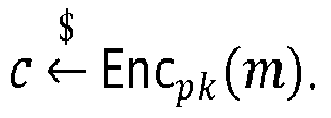
- the encryption algorithm Enc is a randomized algorithm that takes as input a public key pk and a plaintext and returns a ciphertext c. This maybe expressed as c ⁇ $ Enc pk m .
- the decryption algorithm Dec takes as input a secret key sk (associated with pk ) and a ciphertext c . It returns the corresponding plaintext m or a special symbol 1 indicating that the ciphertext is invalid. This may be expressed as m ⁇ Dec sk ( c ) if c is a valid ciphertext and ⁇ Dec sk ( c ) if it is not.
- Zero-knowledge proofs can be made non-interactive in the random oracle model by replacing the challenge by a hash of the transcript to that point. This is known as the Fiat-Shamir heuristic.
- the Paillier cryptosystem is a public-key encryption scheme supporting a large message space.
- Pascal Paillier Public-key cryptosystems based on composite degree residuosity classes, Advances in Cryptology - EU-ROCRYPT'99 (Jacques Stern, ed.), Lecture Notes in Computer Science, vol. 1592, Springer, Heidelberg, May 1999, pp. 223-238 , which incorporated herein for all purposes by reference.
- the scheme is equipped with an additive homomorphism. This property is useful when one performs addition operations on the ciphertexts.
- ⁇ be a security parameter.
- the message space is namely the ring of integers modulo N.
- GQ Guillou-Quisquater identification protocol
- the proof can be made non-interactive by replacing c with H ( C ) for some cryptographic hash function H mapping to .
- an adversary is viewed as a pair ( , ) of probabilistic algorithms. This corresponds to adversary running the algorithms in two stages.
- algorithm takes as input the public key pk . can submit any ciphertext of its choice and receives the corresponding plaintext (or ⁇ ). outputs two equal-size messages m 0 and
- a challenge ciphertext c * which is the encryption of m 0 or of m 1 under pk; i.e., c * ⁇ Enc pk ( m b ) where b is chosen uniformly at random in ⁇ 0,1 ⁇ .
- c * Enc pk ( m b ) where b is chosen uniformly at random in ⁇ 0,1 ⁇ .
- the goal of is to guess correctly - with probability significantly greater than 1/2- if c * corresponds to the encryption of m 0 or of m 1 .
- the Paillier cryptosystem is semantically secure. Unfortunately, the Paillier cryptosystem does not meet the stronger notion of chosen-ciphertext security. This is due to the underlying additive homomorphism.
- the decryption of c proceeds in two stages as follows.
- Recovering M Recover M using the private key ⁇ as:
- the Paillier-Pointcheval cryptosystem is chosen-ciphertext secure. Unfortunately, checking the validity of a ciphertext requires the knowledge of the private decryption key. In a threshold environment none of the decryption servers possess the private key needed to perform this validity test. Consequently, there is a need for chosen-ciphertext versions of Paillier cryptosystem with public validity test. This disclosure presents several embodiments of such a Paillier cryptosystem.
- the proposed cryptosystems have two useful features: public validity and compatibility.
- anyone can check the validity of a ciphertext. No private key is involved in the process. This is useful for threshold decryption.
- the resulting ciphertexts can readily be converted into regular Paillier ciphertexts. This is useful when addition operations need to be applied to ciphertexts.
- a first embodiment of a modified Paillier cryptosystem will now be described. Based on the above observation, the Paillier cryptosystem can therefore be modified into a new cryptosystem. The key generation, encryption, and decryption operations of the first embodiment will now be described.
- Encryption proceeds as follows.
- the above cryptosystem yields a zero-knowledge proof of knowledge of the plaintext.
- N is much larger than the image size of hash function H.
- H hash function
- the second embodiment provides such a modification. It results in shorter ciphertexts while keeping the properties of the first embodiment.
- the key generation, encryption, and decryption operations of the second embodiment will now be described.
- the message space is namely the ring of integers modulo N.
- Encryption proceeds as follows.
- Embodiments described herein may be applied to all services or products requiring chosen-ciphertext secure encryption. Remarkably, the validity of the resulting ciphertexts can be publicly verified. Furthermore, the resulting ciphertexts can be converted into regular Paillier ciphertexts and so combined using the underlying additive homomorphism. Accordingly, the embodiments described herein provide a technological advancement to encryption protocols that are both homomorphic and secure against chosen ciphertext attacks.
- FIG. 1 illustrates an exemplary hardware diagram 100 for implementing a cryptosystem according to the embodiments described above.
- the device 100 includes a processor 120, memory 130, user interface 140, network interface 150, and storage 160 interconnected via one or more system buses 110.
- FIG. 1 constitutes, in some respects, an abstraction and that the actual organization of the components of the device 100 may be more complex than illustrated.
- the processor 120 may be any hardware device capable of executing instructions stored in memory 130 or storage 160 or otherwise processing data.
- the processor may include a microprocessor, field programmable gate array (FPGA), application-specific integrated circuit (ASIC), or other similar devices.
- FPGA field programmable gate array
- ASIC application-specific integrated circuit
- the memory 130 may include various memories such as, for example L1, L2, or L3 cache or system memory. As such, the memory 130 may include static random-access memory (SRAM), dynamic RAM (DRAM), flash memory, read only memory (ROM), or other similar memory devices.
- SRAM static random-access memory
- DRAM dynamic RAM
- ROM read only memory
- the user interface 140 may include one or more devices for enabling communication with a user such as an administrator.
- the user interface 140 may include a display, a mouse, and a keyboard for receiving user commands.
- the user interface 140 may include a command line interface or graphical user interface that may be presented to a remote terminal via the network interface 150. In some embodiments, no user interface may be present.
- the network interface 150 may include one or more devices for enabling communication with other hardware devices.
- the network interface 150 may include a network interface card (NIC) configured to communicate according to the Ethernet protocol.
- NIC network interface card
- the network interface 150 may implement a TCP/IP stack for communication according to the TCP/IP protocols.
- TCP/IP protocols Various alternative or additional hardware or configurations for the network interface 150 will be apparent.
- the storage 160 may include one or more machine-readable storage media such as read-only memory (ROM), random-access memory (RAM), magnetic disk storage media, optical storage media, flash-memory devices, or similar storage media.
- the storage 160 may store instructions for execution by the processor 120 or data upon with the processor 120 may operate.
- the storage 160 may store a base operating system 161 for controlling various basic operations of the hardware 100.
- software for key generation, 162, encryption 163, and decryption 163 may be stored in the memory. This software may implement the various embodiments described above.
- the memory 130 may also be considered to constitute a “storage device” and the storage 160 may be considered a “memory.”
- the memory 130 and storage 160 may both be considered to be “non-transitory machine-readable media.”
- the term “non-transitory” will be understood to exclude transitory signals but to include all forms of storage, including both volatile and non-volatile memories. While the host device 100 is shown as including one of each described component, the various components may be duplicated in various embodiments.
- the processor 120 may include multiple microprocessors that are configured to independently execute the methods described herein or are configured to perform steps or subroutines of the methods described herein such that the multiple processors cooperate to achieve the functionality described herein.
- the various hardware components may belong to separate physical systems.
- the processor 120 may include a first processor in a first server and a second processor in a second server.
- non-transitory machine-readable storage medium will be understood to exclude a transitory propagation signal but to include all forms of volatile and non-volatile memory.
Landscapes
- Engineering & Computer Science (AREA)
- Theoretical Computer Science (AREA)
- Computing Systems (AREA)
- Computer Security & Cryptography (AREA)
- Computer Networks & Wireless Communication (AREA)
- Signal Processing (AREA)
- Storage Device Security (AREA)
- Physics & Mathematics (AREA)
- General Physics & Mathematics (AREA)
Abstract
Description
- Various exemplary embodiments disclosed herein relate generally to a method and apparatus for implementing new encryption schemes with additional properties.
- Various schemes have been developed for encrypting and decrypting data. Chosen ciphertext attacks are one method used by attacker to compromise encryption and decryption schemes, so implementing encryption schemes resistant to chosen ciphertext attacks provides increased security.
- A summary of various exemplary embodiments is presented below. Some simplifications and omissions may be made in the following summary, which is intended to highlight and introduce some aspects of the various exemplary embodiments, but not to limit the scope of the invention. Detailed descriptions of an exemplary embodiment adequate to allow those of ordinary skill in the art to make and use the inventive concepts will follow in later sections.
- Various embodiments relate to a method of encrypting a message m using a Paillier cryptosystem, including: computing a ciphertext c based upon the message m, N, and r, where N is the product of two distinct primes p and q, and r is randomly chosen such that r ∈ [1, N); computing a first verification value based upon u and N, where u is randomly chosen such that u ∈ [1, N); computing a second verification value s based upon u, r, the ciphertext c, the verification value, and a hash function H.
- Various embodiments are described, wherein c = (1 + mN) rN mod N 2 .
- Various embodiments are described, wherein U = uN mod N where U is the first verification value.
- Various embodiments are described, wherein s = ure mod N and where e = H(c, U).
- Various embodiments are described, wherein s = ure mod N and where e = H(c, U, pk) where pk is a public key.
- Various embodiments are described, wherein V = H(uN mod N) where V is the first verification value.
- Various embodiments are described, wherein s = ure mod N and where e = H(c, V).
- Various embodiments are described, wherein s = ure mod N and where e = H(c, U, pk) where pk is a public key.
- Various embodiments are described, wherein V = G(uN mod N) where V is the first verification value and G is a hash function different from hash function H.
- Various embodiments are described, wherein s = ure mod N and where e = H(c, V).
- Various embodiments are described, wherein s = ure mod N and where e = H(c, V, pk) where pk is a public key.
- Various embodiments are described, further including generating a secret key sk and public key pk further including: generating the two distinct primes p and q and computing N; computing λ = lcm (p - 1, q - 1); selecting the hash function H modeled as a random oracle with an identifier H_identifier; and wherein the public key pk = {N, H_identifier} and the private key sk = {λ}.
- Further various embodiments relate to a method of decrypting a ciphertext using a Paillier cryptosystem including a value c, a first verification value, and a second verification value s, including: validating the ciphertext by checking the first verification value based upon the second verification value s, N, the value c, and a hash function H, where N is the product of two distinct primes p and q; deciphering the ciphertext to produce a message m from the value c using a secret key and N.
- Various embodiments are described, wherein validating the ciphertext further includes: computing e = H(c,V) and U = sN c-e mod N, where V is first verification value; and checking that the first verification value V equals H(U).
- Various embodiments are described, wherein validating the ciphertext further includes: computing e = H(c,V) and U = sN c-e mod N, where V is first verification value; and checking that the first verification value V equals G(U), where G is a hash function different from hash function H.
- Various embodiments are described, wherein

- Various embodiments are described, wherein deciphering the ciphertext to produce a message m further includes: computing r = cd mod N, where d is the secret key and d = N -1 mod λ where λ = lcm (p - 1, q - 1); and computing

- Various embodiments are described, wherein validating the ciphertext further includes: computing e = H(c,U), where U is verification value; and checking that the verification value U equals sN c-e mod N.
- Various embodiments are described, wherein validating the ciphertext further includes a public key pk.
- In order to better understand various exemplary embodiments, reference is made to the accompanying drawings, wherein:
-
FIG. 1 illustrates an exemplary hardware diagram for implementing a cryptosystem according to the embodiments described herein. - To facilitate understanding, identical reference numerals have been used to designate elements having substantially the same or similar structure and/or substantially the same or similar function.
- The description and drawings illustrate the principles of the invention. It will thus be appreciated that those skilled in the art will be able to devise various arrangements that, although not explicitly described or shown herein, embody the principles of the invention and are included within its scope. Furthermore, all examples recited herein are principally intended expressly to be for pedagogical purposes to aid the reader in understanding the principles of the invention and the concepts contributed by the inventor(s) to furthering the art and are to be construed as being without limitation to such specifically recited examples and conditions. Additionally, the term, "or," as used herein, refers to a non-exclusive or (i.e., and/or), unless otherwise indicated (e.g., "or else" or "or in the alternative"). Also, the various embodiments described herein are not necessarily mutually exclusive, as some embodiments can be combined with one or more other embodiments to form new embodiments. First, a formal definition for public-key encryption will be described. Then the notion of a zero-knowledge proof will be described.
- A public-key encryption scheme includes a tuple of three algorithms (KeyGen, Enc, Dec).
- The key generation algorithm KeyGen is a randomized algorithm that takes as input a security parameter κ and returns a matching pair (pk, sk) of a public key and a secret key. This may be expressed as

- Encryption is carried out as follows. Letdenote the message space. The encryption algorithm Enc is a randomized algorithm that takes as input a public key pk and a plaintext


- The decryption algorithm Dec takes as input a secret key sk (associated with pk) and a ciphertext c. It returns the corresponding plaintext m or a special symbol 1 indicating that the ciphertext is invalid. This may be expressed as m ← Dec sk (c) if c is a valid ciphertext and ⊥← Dec sk (c) if it is not.
- For any


- Zero-knowledge proofs will now be described. Informally, in a zero-knowledge proof, Peggy (prover) proves to Victor (verifier) the validity of a statement that includes secret information in a way that Victor does not learn anything more as a result of this process.
- For example, consider a cyclic group

- 1. Peggy chooses a random integer
 ), and sends C to Victor;
- 2. Victor flips a fair coin c ∈ {0,1} and sends the challenge c to Peggy;
Peggy computes the response
Victor checks that
- It can be verified that the cheating probability for Peggy is 2-ℓ.
- Zero-knowledge proofs can be made non-interactive in the random oracle model by replacing the challenge by a hash of the transcript to that point. This is known as the Fiat-Shamir heuristic. In the above example, the challenge c is then set to c = h(C) for some cryptographic hash function h mapping to {0,1}. This can be further improved to a single pass using the Schnorr protocol (again in the random orale model) by viewing the pair (x,y = gx ) as a signing/verification key pair:
- 1a. Peggy chooses a random integer
 ), generates the signature

- 2. Victor checks that

- Assuming that H behaves as a random oracle, the cheating probability for Peggy is 1/q.
- If the representation of c is shorter than that of C (which is usually the case), Peggy can instead send the pair (c, s) to Victor. The verification equation is then replaced with

- The Paillier cryptosystem and the Guillou-Quisquater (GQ) identification scheme will now be briefly described.
- The Paillier cryptosystem is a public-key encryption scheme supporting a large message space. For a more detailed description see Pascal Paillier, Public-key cryptosystems based on composite degree residuosity classes, Advances in Cryptology - EU-ROCRYPT'99 (Jacques Stern, ed.), Lecture Notes in Computer Science, vol. 1592, Springer, Heidelberg, May 1999, pp. 223-238, which incorporated herein for all purposes by reference. Furthermore, as will be apparent, the scheme is equipped with an additive homomorphism. This property is useful when one performs addition operations on the ciphertexts.
- A description of the Paillier cryptosystem is as follows.
- Key generation: Let κ be a security parameter. On input κ, the key generation algorithm generates two distinct primes p and q and computes N = pq and λ = lcm (p - 1, q - 1). The public key is pk = {N} and private key is sk = {λ}.
- The message space is

- Encryption: The encryption of a message


- Decryption: Given a ciphertext c, the corresponding plaintext is recovered using the private key λ in two steps as:
- 1. Compute

- 2. Return m = L/λ mod N.
- It is worth noting that for any

- The Paillier cryptosystem is additively homomorphic. Given two Paillier ciphertexts,


 ). Indeed, letting c 1 = (1 + m 1 N) r 1 N mod N 2 and c 2 = (1 + m 2 N) r 2 N mod N 2, the following results

- The Guillou-Quisquater (GQ) identification protocol will now be described. The so-called GQ protocol, named after its inventors Guillou and Quisquater, is a practical zero-knowledge protocol. For more detailed information about the GQ protocol see Louis C. Guillou and Jean-Jacques Quisquater, A practical zero-knowledge protocol fitted to security microprocessor minimizing both transmission and memory, Advances in Cryptology - EU-ROCRYPT'88 (C. G. Günther, ed.), Lecture Notes in Computer Science, vol. 330, Springer, Heidelberg, May 1988, pp. 123-128, which is incorporated herein for all purposes by reference.
- Let N = pq where p and q are distinct primes. To prove in a zero-knowledge way that Peggy knows a secret value s satisfying se v ≡ 1 (mod N) where v, e, N are public, Peggy (prover) executes the following protocol with Victor (verifier):
- 1. Peggy chooses a random integer r in , computes the commitment C = re mod N, and sends C to Victor;

- 2. Victor chooses a random challenge

- 3. Peggy computes the response R = r sc mod N and sends R to Victor;
- 4. Victor checks that

- Proof. It is easily verified that Re vc ≡ (r sc ) e vc ≡ re (se v) c ≡ C (mod N).
- Assuming the random oracle model, the proof can be made non-interactive by replacing c with H(C) for some cryptographic hash function H mapping to.

- In the presence of a passive adversary, the "right" notion of security for public-key encryption is known as semantic security. Informally, it means that an adversary should not learn any information whatsoever about a plaintext given its encryption (beyond the length of the plaintext).
- Against active adversaries, this is not enough. The "right" notion of security is then chosen-ciphertext security or equivalently non-malleability. Intuitively, it implies that semantic security must hold even if the attacker is given adaptive access to a decryption oracle.
- More formally, an adversaryis viewed as a pair (
 ,
, ) of probabilistic algorithms. This corresponds to adversary
 running the algorithms in two stages.
- In the "find" stage, algorithmtakes as input the public key pk.
 can submit any ciphertext of its choice and receives the corresponding plaintext (or ⊥).
 outputs two equal-size messages m 0 and
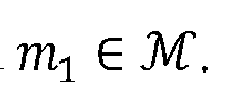
- In the "guess" stage, algorithmreceives a challenge ciphertext c* which is the encryption of m 0 or of m 1 under pk; i.e., c* ← Enc pk (mb ) where b is chosen uniformly at random in {0,1}. Again,
 can submit any ciphertext and see the corresponding decryption; the sole exception is that
 cannot ask for the decryption of the challenge ciphertext c*.
- The goal ofis to guess correctly - with probability significantly greater than 1/2- if c* corresponds to the encryption of m 0 or of m 1.

- An encryption scheme is said chosen-ciphertext secure if no such adversary

- The Paillier cryptosystem is semantically secure. Unfortunately, the Paillier cryptosystem does not meet the stronger notion of chosen-ciphertext security. This is due to the underlying additive homomorphism.
- Upon receiving the challenge ciphertext c* = (1 + mbN) rN mod N 2, the adversarydoes the following:

- 1. It chooses at random µ,

- 2. It submits c † to the decryption oracle and obtains the corresponding plaintext m †;
- 3. It recovers mb = m † - µ mod N; and
- 4. If mb = m 0 it outputs 0; otherwise it outputs 1.
- To remedy this situation, Paillier subsequently proposed with Pointcheval a chosen-ciphertext secure version of his cryptosystem. For more details see Pascal Paillier and David Pointcheval, Efficient public-key cryptosystems provably secure against active adversaries, Advances in Cryptology- ASIACRYPT'99 (Kwok-Yan Lam, Eiji Okamoto, and Chaoping Xing, eds.), Lecture Notes in Computer Science, vol. 1716, Springer, Heidelberg, November 1999, pp. 165-179, which is hereby incorporated herein by reference for all purposes. The improved cryptosystem requires two hash functions G, H mapping to. Slightly simplifying the scheme described by Paillier and Pointcheval, the encryption of a message


c = (1 + M N) z mod N 2 where
z = H(m, r) N mod N 2 and M = m || r + G(z mod N) mod N. - The decryption of c proceeds in two stages as follows.
- Recovering M : Recover M using the private key λ as:
- 1. Compute

- 2. Obtain M = L/λ mod N.
- Validating the ciphertext and returning the message or ⊥:
Define m || r = M - G(c mod N). - If H(m,r) N ≡ c (mod N) return m;
- Otherwise, return ⊥ (invalid ciphertext).
- The Paillier-Pointcheval cryptosystem is chosen-ciphertext secure. Unfortunately, checking the validity of a ciphertext requires the knowledge of the private decryption key. In a threshold environment none of the decryption servers possess the private key needed to perform this validity test. Consequently, there is a need for chosen-ciphertext versions of Paillier cryptosystem with public validity test. This disclosure presents several embodiments of such a Paillier cryptosystem.
- In addition to chosen-ciphertext security, the proposed cryptosystems have two useful features: public validity and compatibility. Anyone can check the validity of a ciphertext. No private key is involved in the process. This is useful for threshold decryption. The resulting ciphertexts can readily be converted into regular Paillier ciphertexts. This is useful when addition operations need to be applied to ciphertexts.
- An important observation is that a Paillier ciphertext, c = (1 + m N)rN mod N 2, satisfies the relation

- Viewing the pair (r,c -1 mod N) as a signing/verification key pair in the GQ protocol, the encryptor can prove the knowledge of the randomness r used for forming the ciphertext by issuing a GQ 'signature' (U,s) with
U = uN mod N and s = ure mod N where e = H(c,U)
for some cryptographic hash function H. - A first embodiment of a modified Paillier cryptosystem will now be described. Based on the above observation, the Paillier cryptosystem can therefore be modified into a new cryptosystem. The key generation, encryption, and decryption operations of the first embodiment will now be described.
- Key generation proceeds as follows. Let κ be a security parameter. On input κ, the key generation algorithm generates two distinct primes p and q and selects a hash function H modeled as a random oracle. The key generation operation computes N = pq and λ = lcm (p - 1, q - 1). The public key is pk = {N,H_identifier} and private key is sk = {λ}. The message space is

- Encryption proceeds as follows. The encryption of a message


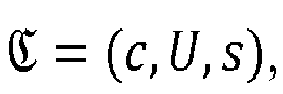
- Decryption proceeds as follows. Given a ciphertext
- Validating the ciphertext: Compute e = H(c,U) and check whether

- Deciphering the ciphertext: From the component c, the corresponding plaintext may be recovered using the private key λ in two steps as:
- 1. Compute

- 2. Return m = L/λ mod N.
- Given a ciphertext


- Hence, the above cryptosystem yields a zero-knowledge proof of knowledge of the plaintext.
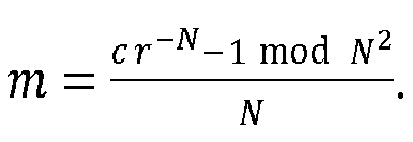
- The previous cryptosystem is subject to many variants. For example, the hash function can include the public key as an additional input by defining e = H(c,U,pk). Another variant is to define the private sk = {d} where d = N -1 mod λ, and to recover the plaintext corresponding to a valid ciphertext

- 1. Compute r = cd mod N, and
- 2. Return
- A second embodiment of a modified Paillier cryptosystem will now be described. In practical settings, the size of modulus N is much larger than the image size of hash function H. For example, for a security level of κ = 128 bits, N is of size 3072 bits, and a hash value is of size 256 bits.
- It is therefore advantageous to trade a mod-N value against a hash value. The second embodiment provides such a modification. It results in shorter ciphertexts while keeping the properties of the first embodiment. The key generation, encryption, and decryption operations of the second embodiment will now be described.
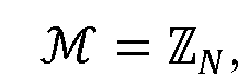
- Key generation proceeds as follows: Let κ be a security parameter. On input κ, the key generation algorithm generates two distinct primes p and q and selects a hash function H modeled as a random oracle. It computes N = pq and λ = lcm (p - 1, q - 1). The public key is pk = {N,H_identifier} and the private key is sk = {λ}. The message space is
- Encryption proceeds as follows. The encryption of a message


- Decryption proceeds as follows: Given a ciphertext

- Validating the ciphertext: Compute e = H(c,V) and U = sN c-e mod N, and check whether

- Deciphering the ciphertext: From the component c, the corresponding plaintext can be recovered using the private key λ in two steps as:
- 1. Compute

- 2. Return m = L/λ mod N.
- Several variants may be derived from the above description. In particular, the modifications mentioned with respect to the first embodiment described above apply similarly to this second embodiment. Yet another variant is to select a different hash function, for example V = G(uN mod N), for defining the component V of a ciphertext.
- Note that the embodiments described above produce ciphertexts that are triplets where the first component is a regular Paillier ciphertext. It is therefore straightforward to convert any ciphertext into a regular Paillier ciphertext.
- Embodiments described herein may be applied to all services or products requiring chosen-ciphertext secure encryption. Remarkably, the validity of the resulting ciphertexts can be publicly verified. Furthermore, the resulting ciphertexts can be converted into regular Paillier ciphertexts and so combined using the underlying additive homomorphism. Accordingly, the embodiments described herein provide a technological advancement to encryption protocols that are both homomorphic and secure against chosen ciphertext attacks.
-
FIG. 1 illustrates an exemplary hardware diagram 100 for implementing a cryptosystem according to the embodiments described above. As shown, thedevice 100 includes aprocessor 120,memory 130,user interface 140,network interface 150, andstorage 160 interconnected via one ormore system buses 110. It will be understood thatFIG. 1 constitutes, in some respects, an abstraction and that the actual organization of the components of thedevice 100 may be more complex than illustrated. - The
processor 120 may be any hardware device capable of executing instructions stored inmemory 130 orstorage 160 or otherwise processing data. As such, the processor may include a microprocessor, field programmable gate array (FPGA), application-specific integrated circuit (ASIC), or other similar devices. - The
memory 130 may include various memories such as, for example L1, L2, or L3 cache or system memory. As such, thememory 130 may include static random-access memory (SRAM), dynamic RAM (DRAM), flash memory, read only memory (ROM), or other similar memory devices. - The
user interface 140 may include one or more devices for enabling communication with a user such as an administrator. For example, theuser interface 140 may include a display, a mouse, and a keyboard for receiving user commands. In some embodiments, theuser interface 140 may include a command line interface or graphical user interface that may be presented to a remote terminal via thenetwork interface 150. In some embodiments, no user interface may be present. - The
network interface 150 may include one or more devices for enabling communication with other hardware devices. For example, thenetwork interface 150 may include a network interface card (NIC) configured to communicate according to the Ethernet protocol. Additionally, thenetwork interface 150 may implement a TCP/IP stack for communication according to the TCP/IP protocols. Various alternative or additional hardware or configurations for thenetwork interface 150 will be apparent. - The
storage 160 may include one or more machine-readable storage media such as read-only memory (ROM), random-access memory (RAM), magnetic disk storage media, optical storage media, flash-memory devices, or similar storage media. In various embodiments, thestorage 160 may store instructions for execution by theprocessor 120 or data upon with theprocessor 120 may operate. For example, thestorage 160 may store abase operating system 161 for controlling various basic operations of thehardware 100. Further, software for key generation, 162,encryption 163, anddecryption 163 may be stored in the memory. This software may implement the various embodiments described above. - It will be apparent that various information described as stored in the
storage 160 may be additionally or alternatively stored in thememory 130. In this respect, thememory 130 may also be considered to constitute a "storage device" and thestorage 160 may be considered a "memory." Various other arrangements will be apparent. Further, thememory 130 andstorage 160 may both be considered to be "non-transitory machine-readable media." As used herein, the term "non-transitory" will be understood to exclude transitory signals but to include all forms of storage, including both volatile and non-volatile memories. While thehost device 100 is shown as including one of each described component, the various components may be duplicated in various embodiments. For example, theprocessor 120 may include multiple microprocessors that are configured to independently execute the methods described herein or are configured to perform steps or subroutines of the methods described herein such that the multiple processors cooperate to achieve the functionality described herein. Further, where thedevice 100 is implemented in a cloud computing system, the various hardware components may belong to separate physical systems. For example, theprocessor 120 may include a first processor in a first server and a second processor in a second server. - Any combination of specific software running on a processor to implement the embodiments of the invention, constitute a specific dedicated machine.
- As used herein, the term "non-transitory machine-readable storage medium" will be understood to exclude a transitory propagation signal but to include all forms of volatile and non-volatile memory.
- It should be appreciated by those skilled in the art that any block diagrams herein represent conceptual views of illustrative circuitry embodying the principles of the invention.
- Although the various exemplary embodiments have been described in detail with particular reference to certain exemplary aspects thereof, it should be understood that the invention is capable of other embodiments and its details are capable of modifications in various obvious respects. As is readily apparent to those skilled in the art, variations and modifications can be effected while remaining within the spirit and scope of the invention. Accordingly, the foregoing disclosure, description, and figures are for illustrative purposes only and do not in any way limit the invention, which is defined only by the claims.
Claims (15)
- A method of encrypting a message m using a Paillier cryptosystem, comprising:- computing a ciphertext c based upon the message m, N, and r, where N is the product of two distinct primes p and q, and r is randomly chosen such that r ∈ [1, N);- computing a first verification value based upon u and N, where u is randomly chosen such that u ∈ [1, N);- computing a second verification value s based upon u, r, the ciphertext c, the verification value, and a hash function H.
- The method of claim 1, wherein c = (1 + mN) rN mod N 2.
- The method of claim 1 or 2, wherein U = uN mod N where U is the first verification value.
- The method of claim 3, wherein s = ure mod N and where e = H(c,U).
- The method of claim 3, wherein s = ure mod N and where e = H(c,U,pk) where pk is a public key.
- The method of any preceding claim, wherein V = H(uN mod N) where V is the first verification value.
- The method of claim 6, wherein s = ure mod N and where e = H(c,V).
- The method of claim 6, wherein s = ure mod N and where e = H(c,U,pk) where pk is a public key.
- The method of any one of claims 1 to 5, wherein V = G(uN mod N) where V is the first verification value and G is a hash function different from hash function H.
- The method of claim 9, wherein s = ure mod N and where e = H(c,V).
- The method of claim 9, wherein s = ure mod N and where e = H(c,V,pk) where pk is a public key.
- The method of any preceding claim, further comprising generating a secret key sk and public key pk further including:- generating the two distinct primes p and q and computing N;- computing λ = lcm (p - 1, q - 1);- selecting the hash function H modeled as a random oracle with an identifier H_identifier; andwherein the public key pk = {N,H_identifier} and the private key sk = {λ}.
- A method of decrypting a ciphertext using a Paillier cryptosystem including a value c, a first verification value, and a second verification value s, comprising:- validating the ciphertext by checking the first verification value based upon the second verification value s, N, the value c, and a hash function H, where N is the product of two distinct primes p and q;- deciphering the ciphertext to produce a message m from the value c using a secret key and N.
- The method of claim 13, wherein validating the ciphertext further includes:- computing e = H(c,V) and U = sN c-e mod N, where V is first verification value; and- checking that the first verification value V equals H(U).
- The method of claim 13, wherein validating the ciphertext further includes:- computing e = H(c,V) and U = sN c-e mod N, where V is first verification value; and- checking that the first verification value V equals G(U), where G is a hash function different from hash function H.
Applications Claiming Priority (1)
| Application Number | Priority Date | Filing Date | Title |
|---|---|---|---|
| US15/951,590 US10680818B2 (en) | 2018-04-12 | 2018-04-12 | Encryption schemes with additional properties |
Publications (2)
| Publication Number | Publication Date |
|---|---|
| EP3553999A1 true EP3553999A1 (en) | 2019-10-16 |
| EP3553999B1 EP3553999B1 (en) | 2020-10-28 |
Family
ID=65138934
Family Applications (1)
| Application Number | Title | Priority Date | Filing Date |
|---|---|---|---|
| EP19152887.6A Active EP3553999B1 (en) | 2018-04-12 | 2019-01-21 | Paillier encryption with publicly verifiable ciphertexts |
Country Status (2)
| Country | Link |
|---|---|
| US (1) | US10680818B2 (en) |
| EP (1) | EP3553999B1 (en) |
Families Citing this family (3)
| Publication number | Priority date | Publication date | Assignee | Title |
|---|---|---|---|---|
| US20190318118A1 (en) * | 2018-04-16 | 2019-10-17 | International Business Machines Corporation | Secure encrypted document retrieval |
| US12099997B1 (en) | 2020-01-31 | 2024-09-24 | Steven Mark Hoffberg | Tokenized fungible liabilities |
| CN111832050B (en) * | 2020-07-10 | 2021-03-26 | 深圳致星科技有限公司 | Paillier encryption scheme based on FPGA chip implementation for federal learning |
Family Cites Families (3)
| Publication number | Priority date | Publication date | Assignee | Title |
|---|---|---|---|---|
| US8024274B2 (en) * | 2006-05-05 | 2011-09-20 | President And Fellows Of Harvard College | Practical secrecy-preserving, verifiably correct and trustworthy auctions |
| WO2012045628A1 (en) * | 2010-10-08 | 2012-04-12 | Thomson Licensing | Public key encryption system based on the quadratic residuosity assumption |
| US10333696B2 (en) * | 2015-01-12 | 2019-06-25 | X-Prime, Inc. | Systems and methods for implementing an efficient, scalable homomorphic transformation of encrypted data with minimal data expansion and improved processing efficiency |
-
2018
- 2018-04-12 US US15/951,590 patent/US10680818B2/en active Active
-
2019
- 2019-01-21 EP EP19152887.6A patent/EP3553999B1/en active Active
Non-Patent Citations (6)
| Title |
|---|
| CAMENISCH J ET AL: "PRACTICAL VERIFIABLE ENCRYPTION AND DECRYPTION OF DISCRETE LOGARITHMS", ADVANCES IN CRYPTOLOGY - CRYPTO 2003. 23RD ANNUAL INTERNATIONAL CRYPTOLOGY CONFERENCE, SANTA BARBARA, CA, AUGUST 17 - 21, 2003 PROCEEDINGS; [LECTURE NOTES IN COMPUTER SCIENCE ; VOL. 2729], BERLIN, SPRINGER, DE, 17 August 2003 (2003-08-17), pages 126 - 144, XP001200990, ISBN: 978-3-540-40674-7 * |
| DOUGLAS WIKSTRÃM: "Designated Confirmer Signatures Revisited", INTERNATIONAL ASSOCIATION FOR CRYPTOLOGIC RESEARCH,, vol. 20111003:075250, 26 February 2007 (2007-02-26), pages 1 - 56, XP061002070 * |
| GEORG NEUGEBAUER ET AL: "Privacy-Preserving Multi-Party Reconciliation Secure in the Malicious Model (Extended version)", INTERNATIONAL ASSOCIATION FOR CRYPTOLOGIC RESEARCH,, vol. 20131015:065429, 11 October 2013 (2013-10-11), pages 1 - 22, XP061008280 * |
| LOUIS C. GUILLOU; JEAN-JACQUES QUISQUATER: "Lecture Notes in Computer Science", vol. 330, May 1988, SPRINGER, article "A practical zero-knowledge protocol fitted to security microprocessor minimizing both transmission and memory, Advances in Cryptology - EU-ROCRYPT'88", pages: 123 - 128 |
| PASCAL PAILLIER: "Lecture Notes in Computer Science", vol. 1592, May 1999, SPRINGER, article "Public-key cryptosystems based on composite degree residuosity classes, Advances in Cryptology - EU-ROCRYPT'99", pages: 223 - 23 8 |
| PASCAL PAILLIER; DAVID POINTCHEVAL: "Lecture Notes in Computer Science", vol. 1716, November 1999, SPRINGER, article "Efficient public-key cryptosystems provably secure against active adversaries, Advances in Cryptology- ASIACRYPT'99", pages: 165 - 179 |
Also Published As
| Publication number | Publication date |
|---|---|
| EP3553999B1 (en) | 2020-10-28 |
| US20190319791A1 (en) | 2019-10-17 |
| US10680818B2 (en) | 2020-06-09 |
Similar Documents
| Publication | Publication Date | Title |
|---|---|---|
| Nick et al. | MuSig-DN: Schnorr multi-signatures with verifiably deterministic nonces | |
| US5146500A (en) | Public key cryptographic system using elliptic curves over rings | |
| Okamoto | Efficient blind and partially blind signatures without random oracles | |
| Camenisch et al. | An accumulator based on bilinear maps and efficient revocation for anonymous credentials | |
| Dodis et al. | Anonymous identification in ad hoc groups | |
| Libert et al. | The exact security of an identity based signature and its applications | |
| US20180309574A1 (en) | One-shot verifiable encryption from lattices | |
| US9088419B2 (en) | Keyed PV signatures | |
| Fersch et al. | On the one-per-message unforgeability of (EC) DSA and its variants | |
| Yuen et al. | How to construct identity-based signatures without the key escrow problem | |
| Cheng et al. | An Improved Certificateless Signcryption in the Standard Model. | |
| EP3553999B1 (en) | Paillier encryption with publicly verifiable ciphertexts | |
| Komlo et al. | Arctic: Lightweight and stateless threshold schnorr signatures | |
| Li et al. | An efficient signcryption scheme with key privacy | |
| Joye et al. | On the power of misbehaving adversaries and security analysis of the original EPOC | |
| Malone-Lee | Signcryption with non-interactive non-repudiation | |
| Liu et al. | New efficient identity based encryption without pairings | |
| Ghadafi et al. | Efficient two-move blind signatures in the common reference string model | |
| Chang et al. | Cryptanalysis on an improved version of ElGamal-like public-key encryption scheme for encrypting large messages | |
| Tian et al. | A systematic method to design strong designated verifier signature without random oracles | |
| Tian | A new strong multiple designated verifiers signature | |
| Desmedt et al. | A new and improved paradigm for hybrid encryption secure against chosen-ciphertext attack | |
| Yuen et al. | Related randomness attacks for public key cryptosystems | |
| Duc et al. | Diae: Re-rolling the dise | |
| Akinwande | Advances in Homomorphic Cryptosystems. |
Legal Events
| Date | Code | Title | Description |
|---|---|---|---|
| PUAI | Public reference made under article 153(3) epc to a published international application that has entered the european phase |
Free format text: ORIGINAL CODE: 0009012 |
|
| STAA | Information on the status of an ep patent application or granted ep patent |
Free format text: STATUS: THE APPLICATION HAS BEEN PUBLISHED |
|
| AK | Designated contracting states |
Kind code of ref document: A1 Designated state(s): AL AT BE BG CH CY CZ DE DK EE ES FI FR GB GR HR HU IE IS IT LI LT LU LV MC MK MT NL NO PL PT RO RS SE SI SK SM TR |
|
| AX | Request for extension of the european patent |
Extension state: BA ME |
|
| STAA | Information on the status of an ep patent application or granted ep patent |
Free format text: STATUS: REQUEST FOR EXAMINATION WAS MADE |
|
| 17P | Request for examination filed |
Effective date: 20200416 |
|
| RBV | Designated contracting states (corrected) |
Designated state(s): AL AT BE BG CH CY CZ DE DK EE ES FI FR GB GR HR HU IE IS IT LI LT LU LV MC MK MT NL NO PL PT RO RS SE SI SK SM TR |
|
| GRAP | Despatch of communication of intention to grant a patent |
Free format text: ORIGINAL CODE: EPIDOSNIGR1 |
|
| STAA | Information on the status of an ep patent application or granted ep patent |
Free format text: STATUS: GRANT OF PATENT IS INTENDED |
|
| INTG | Intention to grant announced |
Effective date: 20200624 |
|
| GRAS | Grant fee paid |
Free format text: ORIGINAL CODE: EPIDOSNIGR3 |
|
| GRAA | (expected) grant |
Free format text: ORIGINAL CODE: 0009210 |
|
| STAA | Information on the status of an ep patent application or granted ep patent |
Free format text: STATUS: THE PATENT HAS BEEN GRANTED |
|
| AK | Designated contracting states |
Kind code of ref document: B1 Designated state(s): AL AT BE BG CH CY CZ DE DK EE ES FI FR GB GR HR HU IE IS IT LI LT LU LV MC MK MT NL NO PL PT RO RS SE SI SK SM TR |
|
| REG | Reference to a national code |
Ref country code: GB Ref legal event code: FG4D |
|
| REG | Reference to a national code |
Ref country code: CH Ref legal event code: EP |
|
| REG | Reference to a national code |
Ref country code: AT Ref legal event code: REF Ref document number: 1329343 Country of ref document: AT Kind code of ref document: T Effective date: 20201115 |
|
| REG | Reference to a national code |
Ref country code: DE Ref legal event code: R096 Ref document number: 602019001047 Country of ref document: DE |
|
| REG | Reference to a national code |
Ref country code: IE Ref legal event code: FG4D |
|
| REG | Reference to a national code |
Ref country code: AT Ref legal event code: MK05 Ref document number: 1329343 Country of ref document: AT Kind code of ref document: T Effective date: 20201028 |
|
| REG | Reference to a national code |
Ref country code: NL Ref legal event code: MP Effective date: 20201028 |
|
| PG25 | Lapsed in a contracting state [announced via postgrant information from national office to epo] |
Ref country code: GR Free format text: LAPSE BECAUSE OF FAILURE TO SUBMIT A TRANSLATION OF THE DESCRIPTION OR TO PAY THE FEE WITHIN THE PRESCRIBED TIME-LIMIT Effective date: 20210129 Ref country code: NO Free format text: LAPSE BECAUSE OF FAILURE TO SUBMIT A TRANSLATION OF THE DESCRIPTION OR TO PAY THE FEE WITHIN THE PRESCRIBED TIME-LIMIT Effective date: 20210128 Ref country code: FI Free format text: LAPSE BECAUSE OF FAILURE TO SUBMIT A TRANSLATION OF THE DESCRIPTION OR TO PAY THE FEE WITHIN THE PRESCRIBED TIME-LIMIT Effective date: 20201028 Ref country code: RS Free format text: LAPSE BECAUSE OF FAILURE TO SUBMIT A TRANSLATION OF THE DESCRIPTION OR TO PAY THE FEE WITHIN THE PRESCRIBED TIME-LIMIT Effective date: 20201028 Ref country code: PT Free format text: LAPSE BECAUSE OF FAILURE TO SUBMIT A TRANSLATION OF THE DESCRIPTION OR TO PAY THE FEE WITHIN THE PRESCRIBED TIME-LIMIT Effective date: 20210301 |
|
| REG | Reference to a national code |
Ref country code: LT Ref legal event code: MG4D |
|
| PG25 | Lapsed in a contracting state [announced via postgrant information from national office to epo] |
Ref country code: AT Free format text: LAPSE BECAUSE OF FAILURE TO SUBMIT A TRANSLATION OF THE DESCRIPTION OR TO PAY THE FEE WITHIN THE PRESCRIBED TIME-LIMIT Effective date: 20201028 Ref country code: ES Free format text: LAPSE BECAUSE OF FAILURE TO SUBMIT A TRANSLATION OF THE DESCRIPTION OR TO PAY THE FEE WITHIN THE PRESCRIBED TIME-LIMIT Effective date: 20201028 Ref country code: SE Free format text: LAPSE BECAUSE OF FAILURE TO SUBMIT A TRANSLATION OF THE DESCRIPTION OR TO PAY THE FEE WITHIN THE PRESCRIBED TIME-LIMIT Effective date: 20201028 Ref country code: IS Free format text: LAPSE BECAUSE OF FAILURE TO SUBMIT A TRANSLATION OF THE DESCRIPTION OR TO PAY THE FEE WITHIN THE PRESCRIBED TIME-LIMIT Effective date: 20210228 Ref country code: LV Free format text: LAPSE BECAUSE OF FAILURE TO SUBMIT A TRANSLATION OF THE DESCRIPTION OR TO PAY THE FEE WITHIN THE PRESCRIBED TIME-LIMIT Effective date: 20201028 Ref country code: PL Free format text: LAPSE BECAUSE OF FAILURE TO SUBMIT A TRANSLATION OF THE DESCRIPTION OR TO PAY THE FEE WITHIN THE PRESCRIBED TIME-LIMIT Effective date: 20201028 Ref country code: BG Free format text: LAPSE BECAUSE OF FAILURE TO SUBMIT A TRANSLATION OF THE DESCRIPTION OR TO PAY THE FEE WITHIN THE PRESCRIBED TIME-LIMIT Effective date: 20210128 |
|
| PG25 | Lapsed in a contracting state [announced via postgrant information from national office to epo] |
Ref country code: HR Free format text: LAPSE BECAUSE OF FAILURE TO SUBMIT A TRANSLATION OF THE DESCRIPTION OR TO PAY THE FEE WITHIN THE PRESCRIBED TIME-LIMIT Effective date: 20201028 Ref country code: NL Free format text: LAPSE BECAUSE OF FAILURE TO SUBMIT A TRANSLATION OF THE DESCRIPTION OR TO PAY THE FEE WITHIN THE PRESCRIBED TIME-LIMIT Effective date: 20201028 |
|
| REG | Reference to a national code |
Ref country code: DE Ref legal event code: R097 Ref document number: 602019001047 Country of ref document: DE |
|
| PG25 | Lapsed in a contracting state [announced via postgrant information from national office to epo] |
Ref country code: SK Free format text: LAPSE BECAUSE OF FAILURE TO SUBMIT A TRANSLATION OF THE DESCRIPTION OR TO PAY THE FEE WITHIN THE PRESCRIBED TIME-LIMIT Effective date: 20201028 Ref country code: SM Free format text: LAPSE BECAUSE OF FAILURE TO SUBMIT A TRANSLATION OF THE DESCRIPTION OR TO PAY THE FEE WITHIN THE PRESCRIBED TIME-LIMIT Effective date: 20201028 Ref country code: CZ Free format text: LAPSE BECAUSE OF FAILURE TO SUBMIT A TRANSLATION OF THE DESCRIPTION OR TO PAY THE FEE WITHIN THE PRESCRIBED TIME-LIMIT Effective date: 20201028 Ref country code: EE Free format text: LAPSE BECAUSE OF FAILURE TO SUBMIT A TRANSLATION OF THE DESCRIPTION OR TO PAY THE FEE WITHIN THE PRESCRIBED TIME-LIMIT Effective date: 20201028 Ref country code: LT Free format text: LAPSE BECAUSE OF FAILURE TO SUBMIT A TRANSLATION OF THE DESCRIPTION OR TO PAY THE FEE WITHIN THE PRESCRIBED TIME-LIMIT Effective date: 20201028 Ref country code: RO Free format text: LAPSE BECAUSE OF FAILURE TO SUBMIT A TRANSLATION OF THE DESCRIPTION OR TO PAY THE FEE WITHIN THE PRESCRIBED TIME-LIMIT Effective date: 20201028 |
|
| PG25 | Lapsed in a contracting state [announced via postgrant information from national office to epo] |
Ref country code: MC Free format text: LAPSE BECAUSE OF FAILURE TO SUBMIT A TRANSLATION OF THE DESCRIPTION OR TO PAY THE FEE WITHIN THE PRESCRIBED TIME-LIMIT Effective date: 20201028 Ref country code: DK Free format text: LAPSE BECAUSE OF FAILURE TO SUBMIT A TRANSLATION OF THE DESCRIPTION OR TO PAY THE FEE WITHIN THE PRESCRIBED TIME-LIMIT Effective date: 20201028 |
|
| PLBE | No opposition filed within time limit |
Free format text: ORIGINAL CODE: 0009261 |
|
| STAA | Information on the status of an ep patent application or granted ep patent |
Free format text: STATUS: NO OPPOSITION FILED WITHIN TIME LIMIT |
|
| PG25 | Lapsed in a contracting state [announced via postgrant information from national office to epo] |
Ref country code: LU Free format text: LAPSE BECAUSE OF NON-PAYMENT OF DUE FEES Effective date: 20210121 |
|
| 26N | No opposition filed |
Effective date: 20210729 |
|
| REG | Reference to a national code |
Ref country code: BE Ref legal event code: MM Effective date: 20210131 |
|
| PG25 | Lapsed in a contracting state [announced via postgrant information from national office to epo] |
Ref country code: IT Free format text: LAPSE BECAUSE OF FAILURE TO SUBMIT A TRANSLATION OF THE DESCRIPTION OR TO PAY THE FEE WITHIN THE PRESCRIBED TIME-LIMIT Effective date: 20201028 Ref country code: AL Free format text: LAPSE BECAUSE OF FAILURE TO SUBMIT A TRANSLATION OF THE DESCRIPTION OR TO PAY THE FEE WITHIN THE PRESCRIBED TIME-LIMIT Effective date: 20201028 |
|
| PG25 | Lapsed in a contracting state [announced via postgrant information from national office to epo] |
Ref country code: SI Free format text: LAPSE BECAUSE OF FAILURE TO SUBMIT A TRANSLATION OF THE DESCRIPTION OR TO PAY THE FEE WITHIN THE PRESCRIBED TIME-LIMIT Effective date: 20201028 |
|
| PG25 | Lapsed in a contracting state [announced via postgrant information from national office to epo] |
Ref country code: IE Free format text: LAPSE BECAUSE OF NON-PAYMENT OF DUE FEES Effective date: 20210121 |
|
| PG25 | Lapsed in a contracting state [announced via postgrant information from national office to epo] |
Ref country code: IS Free format text: LAPSE BECAUSE OF FAILURE TO SUBMIT A TRANSLATION OF THE DESCRIPTION OR TO PAY THE FEE WITHIN THE PRESCRIBED TIME-LIMIT Effective date: 20210228 |
|
| PG25 | Lapsed in a contracting state [announced via postgrant information from national office to epo] |
Ref country code: BE Free format text: LAPSE BECAUSE OF NON-PAYMENT OF DUE FEES Effective date: 20210131 |
|
| REG | Reference to a national code |
Ref country code: CH Ref legal event code: PL |
|
| PG25 | Lapsed in a contracting state [announced via postgrant information from national office to epo] |
Ref country code: LI Free format text: LAPSE BECAUSE OF NON-PAYMENT OF DUE FEES Effective date: 20220131 Ref country code: CH Free format text: LAPSE BECAUSE OF NON-PAYMENT OF DUE FEES Effective date: 20220131 |
|
| PG25 | Lapsed in a contracting state [announced via postgrant information from national office to epo] |
Ref country code: CY Free format text: LAPSE BECAUSE OF FAILURE TO SUBMIT A TRANSLATION OF THE DESCRIPTION OR TO PAY THE FEE WITHIN THE PRESCRIBED TIME-LIMIT Effective date: 20201028 |
|
| PG25 | Lapsed in a contracting state [announced via postgrant information from national office to epo] |
Ref country code: HU Free format text: LAPSE BECAUSE OF FAILURE TO SUBMIT A TRANSLATION OF THE DESCRIPTION OR TO PAY THE FEE WITHIN THE PRESCRIBED TIME-LIMIT; INVALID AB INITIO Effective date: 20190121 |
|
| P01 | Opt-out of the competence of the unified patent court (upc) registered |
Effective date: 20230725 |
|
| GBPC | Gb: european patent ceased through non-payment of renewal fee |
Effective date: 20230121 |
|
| PG25 | Lapsed in a contracting state [announced via postgrant information from national office to epo] |
Ref country code: GB Free format text: LAPSE BECAUSE OF NON-PAYMENT OF DUE FEES Effective date: 20230121 |
|
| PG25 | Lapsed in a contracting state [announced via postgrant information from national office to epo] |
Ref country code: MK Free format text: LAPSE BECAUSE OF FAILURE TO SUBMIT A TRANSLATION OF THE DESCRIPTION OR TO PAY THE FEE WITHIN THE PRESCRIBED TIME-LIMIT Effective date: 20201028 |
|
| PG25 | Lapsed in a contracting state [announced via postgrant information from national office to epo] |
Ref country code: MT Free format text: LAPSE BECAUSE OF FAILURE TO SUBMIT A TRANSLATION OF THE DESCRIPTION OR TO PAY THE FEE WITHIN THE PRESCRIBED TIME-LIMIT Effective date: 20201028 |
|
| PG25 | Lapsed in a contracting state [announced via postgrant information from national office to epo] |
Ref country code: TR Free format text: LAPSE BECAUSE OF FAILURE TO SUBMIT A TRANSLATION OF THE DESCRIPTION OR TO PAY THE FEE WITHIN THE PRESCRIBED TIME-LIMIT Effective date: 20201028 |
|
| PGFP | Annual fee paid to national office [announced via postgrant information from national office to epo] |
Ref country code: FR Payment date: 20251217 Year of fee payment: 8 |
|
| PGFP | Annual fee paid to national office [announced via postgrant information from national office to epo] |
Ref country code: DE Payment date: 20251217 Year of fee payment: 8 |