EP3553707A1 - Label for positioning item subjected to security inspection and method for positioning item subjected to security inspection - Google Patents
Label for positioning item subjected to security inspection and method for positioning item subjected to security inspection Download PDFInfo
- Publication number
- EP3553707A1 EP3553707A1 EP17878993.9A EP17878993A EP3553707A1 EP 3553707 A1 EP3553707 A1 EP 3553707A1 EP 17878993 A EP17878993 A EP 17878993A EP 3553707 A1 EP3553707 A1 EP 3553707A1
- Authority
- EP
- European Patent Office
- Prior art keywords
- security inspection
- identifier
- label
- image
- item subjected
- Prior art date
- Legal status (The legal status is an assumption and is not a legal conclusion. Google has not performed a legal analysis and makes no representation as to the accuracy of the status listed.)
- Granted
Links
Images


Classifications
-
- G—PHYSICS
- G06—COMPUTING OR CALCULATING; COUNTING
- G06K—GRAPHICAL DATA READING; PRESENTATION OF DATA; RECORD CARRIERS; HANDLING RECORD CARRIERS
- G06K7/00—Methods or arrangements for sensing record carriers, e.g. for reading patterns
- G06K7/10—Methods or arrangements for sensing record carriers, e.g. for reading patterns by electromagnetic radiation, e.g. optical sensing; by corpuscular radiation
- G06K7/10544—Methods or arrangements for sensing record carriers, e.g. for reading patterns by electromagnetic radiation, e.g. optical sensing; by corpuscular radiation by scanning of the records by radiation in the optical part of the electromagnetic spectrum
- G06K7/10792—Special measures in relation to the object to be scanned
- G06K7/10801—Multidistance reading
- G06K7/10811—Focalisation
-
- G—PHYSICS
- G06—COMPUTING OR CALCULATING; COUNTING
- G06K—GRAPHICAL DATA READING; PRESENTATION OF DATA; RECORD CARRIERS; HANDLING RECORD CARRIERS
- G06K19/00—Record carriers for use with machines and with at least a part designed to carry digital markings
- G06K19/06—Record carriers for use with machines and with at least a part designed to carry digital markings characterised by the kind of the digital marking, e.g. shape, nature, code
- G06K19/06009—Record carriers for use with machines and with at least a part designed to carry digital markings characterised by the kind of the digital marking, e.g. shape, nature, code with optically detectable marking
- G06K19/06046—Constructional details
- G06K19/06056—Constructional details the marking comprising a further embedded marking, e.g. a 1D bar code with the black bars containing a smaller sized coding
-
- A—HUMAN NECESSITIES
- A45—HAND OR TRAVELLING ARTICLES
- A45C—PURSES; LUGGAGE; HAND CARRIED BAGS
- A45C13/00—Details; Accessories
- A45C13/42—Devices for identifying luggage; Means for attaching same
-
- G—PHYSICS
- G01—MEASURING; TESTING
- G01V—GEOPHYSICS; GRAVITATIONAL MEASUREMENTS; DETECTING MASSES OR OBJECTS; TAGS
- G01V5/00—Prospecting or detecting by the use of ionising radiation, e.g. of natural or induced radioactivity
- G01V5/20—Detecting prohibited goods, e.g. weapons, explosives, hazardous substances, contraband or smuggled objects
-
- G—PHYSICS
- G06—COMPUTING OR CALCULATING; COUNTING
- G06K—GRAPHICAL DATA READING; PRESENTATION OF DATA; RECORD CARRIERS; HANDLING RECORD CARRIERS
- G06K7/00—Methods or arrangements for sensing record carriers, e.g. for reading patterns
- G06K7/10—Methods or arrangements for sensing record carriers, e.g. for reading patterns by electromagnetic radiation, e.g. optical sensing; by corpuscular radiation
- G06K7/14—Methods or arrangements for sensing record carriers, e.g. for reading patterns by electromagnetic radiation, e.g. optical sensing; by corpuscular radiation using light without selection of wavelength, e.g. sensing reflected white light
- G06K7/1404—Methods for optical code recognition
-
- G—PHYSICS
- G06—COMPUTING OR CALCULATING; COUNTING
- G06K—GRAPHICAL DATA READING; PRESENTATION OF DATA; RECORD CARRIERS; HANDLING RECORD CARRIERS
- G06K7/00—Methods or arrangements for sensing record carriers, e.g. for reading patterns
- G06K7/10—Methods or arrangements for sensing record carriers, e.g. for reading patterns by electromagnetic radiation, e.g. optical sensing; by corpuscular radiation
- G06K7/14—Methods or arrangements for sensing record carriers, e.g. for reading patterns by electromagnetic radiation, e.g. optical sensing; by corpuscular radiation using light without selection of wavelength, e.g. sensing reflected white light
- G06K7/1404—Methods for optical code recognition
- G06K7/1408—Methods for optical code recognition the method being specifically adapted for the type of code
- G06K7/1417—2D bar codes
-
- G—PHYSICS
- G06—COMPUTING OR CALCULATING; COUNTING
- G06K—GRAPHICAL DATA READING; PRESENTATION OF DATA; RECORD CARRIERS; HANDLING RECORD CARRIERS
- G06K7/00—Methods or arrangements for sensing record carriers, e.g. for reading patterns
- G06K7/10—Methods or arrangements for sensing record carriers, e.g. for reading patterns by electromagnetic radiation, e.g. optical sensing; by corpuscular radiation
- G06K7/14—Methods or arrangements for sensing record carriers, e.g. for reading patterns by electromagnetic radiation, e.g. optical sensing; by corpuscular radiation using light without selection of wavelength, e.g. sensing reflected white light
- G06K7/1404—Methods for optical code recognition
- G06K7/1439—Methods for optical code recognition including a method step for retrieval of the optical code
- G06K7/1443—Methods for optical code recognition including a method step for retrieval of the optical code locating of the code in an image
-
- G—PHYSICS
- G09—EDUCATION; CRYPTOGRAPHY; DISPLAY; ADVERTISING; SEALS
- G09F—DISPLAYING; ADVERTISING; SIGNS; LABELS OR NAME-PLATES; SEALS
- G09F3/00—Labels, tag tickets, or similar identification or indication means; Seals; Postage or like stamps
- G09F3/02—Forms or constructions
-
- G—PHYSICS
- G09—EDUCATION; CRYPTOGRAPHY; DISPLAY; ADVERTISING; SEALS
- G09F—DISPLAYING; ADVERTISING; SIGNS; LABELS OR NAME-PLATES; SEALS
- G09F3/00—Labels, tag tickets, or similar identification or indication means; Seals; Postage or like stamps
- G09F3/02—Forms or constructions
- G09F3/0297—Forms or constructions including a machine-readable marking, e.g. a bar code
-
- G—PHYSICS
- G09—EDUCATION; CRYPTOGRAPHY; DISPLAY; ADVERTISING; SEALS
- G09F—DISPLAYING; ADVERTISING; SIGNS; LABELS OR NAME-PLATES; SEALS
- G09F3/00—Labels, tag tickets, or similar identification or indication means; Seals; Postage or like stamps
- G09F3/02—Forms or constructions
- G09F2003/0254—Luggage tag
Definitions
- the present disclosure relates to the technical field of security inspection, and in particular to a label for positioning an item subjected to security inspection and a method for positioning an item subjected to security inspection.
- An important part of building multi-dimensional passenger information is to bind security inspection information of packages carried by passengers into important sites with the packages.
- a RFID label is attached to a package through a RFID (Radio Frequency Identification) labelling machine, and a RFID identification system is integrated around the security inspection machine or inside the security inspection machine, so that the package with the RFID label can be identified in a coverage area of the RFID identification system, thereby the time that the package with the RFID label enters the security machine can be determined, and then the package can correspond to a security inspection image of the package
- RFID Radio Frequency Identification
- the embodiment of the present disclosure provides a label for positioning item subjected to security inspection and a method for positioning item subjected to security inspection, which can solve the above problem, i.e., it is unable to match between the security inspection images and items subjected to security inspection one by one in a complex environment.
- the present disclosure provides a label to be bound with an item subjected to security inspection and used for positioning the item subjected to security inspection, the label includes an identifier for uniquely identifying the label, wherein the identifier is to be displayed in a security inspection image when the item subjected to security inspection passes through a security inspection device.
- the present disclosure provides a method for positioning an item subjected to security inspection, including: binding the item subjected to security inspection with a label comprising an identifier; obtaining a security inspection image of the item subjected to security inspection when the item subjected to security inspection passes through a security inspection device; recognizing an identifier in the security inspection image; and comparing and tracking the identifier recognized from the security inspection image and the identifier in the label bound with the item subjected to security inspection, when the item subjected to security inspection needs to be positioned.
- the embodiment of the present disclosure provides a label for positioning an item subjected to security inspection and a method for positioning item subjected to security inspection.
- the identifier in the present disclosure can be displayed in the security inspection image when the item subjected to security inspection passes through the security inspection device, and the item subjected to security inspection is bound with the identifier before passing through the security inspection device. And then when the item subjected to security inspection passes through the security inspection device, the security inspection image including the identifier is formed in the security inspection device. After acquiring the security inspection image, the security inspection device can obtain the identifier contained in the security inspection image by identifying the security inspection image.
- the security inspection device can compare and track the identifier recognized from the security inspection image and the identifier in the label bound with the item subjected to security inspection, so as to position the item subjected to security inspection. In this way, in the case with complex environmental conditions or more security items, the individual items subjected to security inspection can be recognized from the security inspection image due to different identifiers of the items subjected to security inspection.
- Fig. 1 shows a schematic structural diagram of a label 100 for positioning an item subjected to security inspection in accordance with an embodiment of the present disclosure.
- the label 100 in Fig. 1 is bound with the item subjected to security inspection, and includes an identifier 110.
- the identifier 110 is used for uniquely identifying label, and the identifier 110 can be displayed in the security inspection image when passing through a security inspection device.
- the identifier 110 includes a positioning point 111 and/or a character 112.
- Fig. 2 shows a specific schematic structural diagram of the identifier 110 in the label 100 for positioning the item subjected to security inspection according to Fig. 1 .
- the identifier 110 includes the positioning point 111 and the character 112
- the identifier 110 shown in Fig. 1 includes the character 112, where the character 112 is a digital character in a 7-segment digital format.
- the number of characters is not limited, the character 112 may be a number, a letter, a symbol, etc., and a combination thereof.
- the identifier 110 includes both a plurality of positioning points 111 and the character 112, the plurality of positioning points 111 are arranged based on a preset pattern, and the character 112 is disposed adjacent to the plurality of positioning points 111. As shown in Fig. 2 , there are three positioning points 111, which form a triangle, and the character 112 is disposed adjacent to the three positioning points 111. As such, when identifying the identifier 110, an image area of the identifier can be identified from the security inspection image based on the shape of the three positioning points 111, so as to improve the accuracy of the identification for the identifier.
- the identifier 110 includes both the positioning points 111 and the character 112, and the positioning point 111 is located at a beginning and/or ending position of the identifier 110.
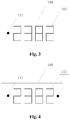
- Fig. 3 shows another specific schematic structural diagram of the identifier 110 in the label 100 for positioning the item subjected to security inspection according to Fig. 1 .
- the positioning point 111 is located at the beginning position of the identifier 110, so that a correct sequence of identifier 110 can be identified by the positioning point 111 to avoid the error of the identified identifier 110 caused by the sequence error of the identifier 110 when identifying the identifier 110.
- FIG. 4 shows still another specific schematic structural diagram of the identifier 110 in the label 100 for positioning the item subjected to security inspection according to Fig. 1 .
- two positioning points 111 are respectively located at the beginning and ending positions of the identifier 110, as such an exact position and sequence of the identifier 110 can be identified through the positioning point 111 to avoid the error of the identified identifier 110 caused by the sequence error of the identifier 110 when identifying the identifier 110.
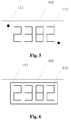
- Fig. 5 shows yet another specific schematic structural diagram of the identifier 110 in the label 100 for positioning the item subjected to security inspection according to Fig. 1 .
- two positioning points 111 are respectively located at the beginning and ending positions of the identifier 110, and two identifier 110 are disposed diagonally, which have the same function as those in Fig. 2 , Fig. 3 and Fig. 4 .
- the positioning point 111 shown in Figs. 2 , 3 , 4 , or 5 is only one implementation of the positioning point 111 in the embodiments of the present disclosure.
- the positioning point 111 in the embodiments of the present disclosure may also be implemented in other ways, for example, the positioning point 111 is circular.
- FIG. 6 shows a schematic structural diagram of a label 100 for positioning item subjected to security inspection provided in accordance with another embodiment of the present disclosure.
- an identifier 110 includes an identification block 113 and a character 112.
- the identification block 113 is disposed around the character 112, and the character 112 is surrounded by the identification block 113.
- the image area of the identifier can be identified from the security inspection image based on the shape of the identification block 113, so as to improve the accuracy of the identification for the identifier.
- identification block 113 shown in Fig. 6 is only one implementation of the identification block 113 in the embodiments of the present disclosure, and the identification block 113 in the embodiments of the present disclosure may also be implemented in other ways, for example, the identification box 113 may have other shapes, or the identification box 113 is a border semi-enclosing the character 112, etc.
- the formats and the number of the characters 112 can be set according to specific scenes, and the character 112 shown in Figs. 2 , 3 , 4 , 5, or 6 is only one implementation of the character 112 in the embodiments of the present disclosure.
- a material of the identifier 110 needs to be a material capable of imaging under radiation of the security inspection device, including lead or iron.
- the way in which the label 100 binds with the item subjected to security inspection includes any way that can be implemented, for example, fixing the label 100 directly on the item subjected to security inspection, or fixing the label 100 on a luggage tray and placing the item subjected to security inspection in the luggage tray to allow the binding between the label 100 and the item subjected to security inspection, etc., which will not be described in more details here.
- Fig. 7 shows a schematic flow chart of a method 200 for positioning an item subjected to security inspection in accordance with an embodiment of the present disclosure.
- the method 200 may be used in the scenes of security inspection for the item subjected to security inspection using the label shown in Figs. 1 to 3 .
- the method 200 includes the following steps: 201, binding an item subjected to security inspection with a label including an identifier; 202, obtaining a security inspection image of the item subjected to security inspection when the item passes through a security inspection device; 203, recognizing an identifier in the security inspection image; and 204, comparing and tracking the identifier recognized from the security inspection image and the identifier in the label bound with the item subjected to security inspection, when the item subjected to security inspection needs to be positioned.
- the item subjected to security inspection is bound with the identifier before security inspection.
- the identifier can uniquely identify the item subjected to security inspection.
- the security inspection device can obtain the security inspection image under the radiation of the security inspection device, and the identifier can also be imaged on the security inspection image, so the image of the identifier is included in the security inspection image.
- step 203 after obtaining the security inspection image including the identifier, it is necessary to position the item subjected to security inspection in the security inspection image according to the identifier, identify the identifier in the image area, and obtain the identifier included in the security inspection image.
- the method of recognizing identifiers in an image may be any method that can be implemented.
- the identifier in the image area is identified by a LeNet5 convolution neural network.
- the item subjected to security inspection can be tracked based on the identifier recognized and the identifier in the label.
- an identification surface of the label setting the identifier needs to be disposed perpendicularly to a ray in the security inspection device.
- the item subjected to security inspection are bound with the identifier before the item subjected to security inspection passes through the security inspection device, and when the item subjected to security inspection passes through the security inspection device, the security inspection image including the identifier is also formed in the security inspection device.
- the identifier included in the security inspection image may be obtained by the identification of the security inspection image.
- the security inspection device can compare and track the identifier recognized from the security inspection image and the identifier in the label bound with the item subjected to security inspection, so as to position the item subjected to security inspection. In this way, in the case with complex environmental conditions or more security items, the individual items subjected to security inspection can be recognized from the security inspection image due to different identifiers of the items subjected to security inspection.
- step 203 can be specifically implemented as following steps: recognizing a predicted identifier corresponding to the identifier in the security inspection image and the probability of the predicted identifier of the undetermined value as the identifier in the security inspection image, based on the LeNet5 convolution neural network algorithm; and matching between structural characteristics of the identifier in the security inspection image and structural characteristics of the predicted identifier; identifying the predicted identifier being the identifier in the security inspection image, when the structural characteristics of the predicted identifier match the structural characteristics of the identifier in the security inspection image.
- an improved LeNet5 can also employed to recognize the identifier in the image. Based on the LeNet5 convolution network identification, the predicted identifier corresponding to the identifier in the security inspection image and the probability of the predicted identifier of the undetermined value being the identifier in the security inspection image, that is, the probability of being the characters in the identifier, are determined at a output layer, and the character that may be in the identifier is processed according to the structural characteristics thereof.
- a middle position of the character in the image area can be recognized, and it may be determined whether the middle position of the character in the image area has the imaging of the character.
- the structure of the imaging at the middle position of the character in the image area can be further determined. If the middle position of the character in the image area has the imaging of the character, it means that the character in the identifier is not 0, and thus 0 can be excluded. If the structure of the imaging at the middle position of the character in the image area is the same as that at the middle position of the character 8, it means that the character in the identifier is 8.
- the accuracy of recognition is increased by the improved LeNet5. For example, there will be no horizontal strokes at the top of the image of character 4 in the figure above.
- the predicted identifiers are sorted according to the probability from a high probability to a low probability, and then the matching may be performed between the structural characteristics of the predicted identifier and the identifiers in the security inspection image sequentially from a high probability to a low probability.
- the method of recognizing the identifiers in the security inspection image can also include other methods that can be implemented, such as template matching, K mean method, Blob feature recognition method, Shape Context and so on, which is not to be limited here.
- Fig. 8 shows a schematic flow chart of a method 200 for positioning an item subjected to security inspection in accordance with another embodiment of the present disclosure.
- the steps 201-204 shown in Fig. 8 are substantially the same as the steps 201-204 involved in the method shown in Fig. 4 , but the difference is that before step 203, the method 200 can also include: step 205, extracting the image area of the identifier in the label from the security inspection image based on a feature of the identifier in the label.
- the image of the item subjected to security inspection and the label are included in the security inspection image. If the identifier in the security inspection image is directly identified, it is necessary to process the whole security inspection image, thus not only the identification process is complex, but also the identification accuracy is reduced. Therefore, at step 205, the image area of the identifier in the label is extracted from the security inspection image based on the feature of the identifier in the label, and after the image area corresponding to the identifier in the security inspection image is extracted, the identifier in the image area is recognized.
- the complexity of the recognition process can be reduced by only performing the recognition on the extracted image area. Also, the noise in the image area is less than the noised in the whole security inspection image, and thus the accuracy of the recognition can be improved.
- the extracting the image area of the label identifier from the security inspection image based on the character of the identifier in the label includes: extracting the image area based on a pixel value and/or a gray value of the identifier in the label in the security inspection image, and extracting the image area based on a shape and/or a position of the identifier in the label in the security inspection image.
- the pixel value or the gray value of the identifier in the security inspection image are all determined values or within a certain range. For example, when the identifier is made of lead, because the lead absorbs a lot of X rays, the gray value obtained from the security inspection image formed by the X rays is low, and the gray value is substantially less than 15000.
- the value range for a single pixel is [0-65535].
- threshold segmentation of the security inspection image is performed based on the pixel value and/or the gray value of the image area in the security inspection image to obtain candidate areas, and the candidate area which does not meet the requirements is removed.
- the image area is extracted based on the shape and/or the position of the identifier in the label in the security inspection image, it is possible to identify the area in the security inspection image that can conform to the shape or position characteristics of the identifier. For example, if the positioning points of the identifier forms a triangle, then an area forming a triangle can be identified in the security inspection image. For example, if the positioning point is included at the beginning of the identifier, then an area which has an end including a point image can be identified, etc.
- the image area can also be extracted based on other features of the identifier in the label, for example, the size, concavity and convexity of the identifier in the label, etc.
- the four methods for extracting the image area of the identifier above can be combined freely, or the method for extracting the image area of the identifier can be selected according to the features of the identifier, which will not be described in more details here.
- the method of binding the item subjected to security inspection and the label including the identifiers can include: install the label on the luggage tray; and place the item subjected to security inspection on the luggage tray to allow the binding of the item subjected to security inspection and the label.
- the identifiers can be used as distinguishing boundaries of the multiple luggage trays.
- the functional blocks shown in the structural block diagram described above can be implemented as hardware, software, firmware or a combination thereof. When implemented in hardware, it can be electronic circuits, application specific integrated circuits (ASIC), appropriate firmware, plug-ins, function cards, etc. When implemented in a software manner, the elements of the present disclosure are programs or code segments used to perform the required tasks. Programs or code segments can be stored in machine-readable media, or transmitted on transmission media or communication links through data signals carried in carriers. "Machine-readable media" may include any medium capable of storing or transmitting information.
- machine readable media examples include electronic circuits, semiconductor memory devices, ROM, flash memory, erasable ROM (EROM), floppy disk, CD-ROM, optical disk, hard disk, optical fiber medium, radio frequency (RF) link, etc.
- Code segments can be downloaded via computer networks such as the Internet and the Intranet.
Landscapes
- Physics & Mathematics (AREA)
- Engineering & Computer Science (AREA)
- General Physics & Mathematics (AREA)
- Theoretical Computer Science (AREA)
- Electromagnetism (AREA)
- Artificial Intelligence (AREA)
- General Health & Medical Sciences (AREA)
- Toxicology (AREA)
- Health & Medical Sciences (AREA)
- Computer Vision & Pattern Recognition (AREA)
- High Energy & Nuclear Physics (AREA)
- Life Sciences & Earth Sciences (AREA)
- General Life Sciences & Earth Sciences (AREA)
- Geophysics (AREA)
- Image Analysis (AREA)
- Analysing Materials By The Use Of Radiation (AREA)
Abstract
Description
- The present disclosure relates to the technical field of security inspection, and in particular to a label for positioning an item subjected to security inspection and a method for positioning an item subjected to security inspection.
- In civil aviation, railway, subway and other common safety inspection sites, due to a large number of people and packages, during security inspection of packages, a real-time imaging system of a security inspection machine often presents images in which the packages are connected with each other. At the same time, because of a great difference in an imaging mechanism between visible lights and the security inspection machine, a security inspector may not be able to distinguish, by images obtained by visible light imaging, the packages in the security inspection images in which the packages are connected with each other, so it is difficult to match between the packages in the security inspection image and the actual packages one by one. Currently, security situations are complex and changeable. In civil aviation airports, subway and other important sites, building multi-dimensional information of passengers can help an anti-terrorism department to identify dangerous information and prevent terrorist crimes in advance. An important part of building multi-dimensional passenger information is to bind security inspection information of packages carried by passengers into important sites with the packages. In existing methods, a RFID label is attached to a package through a RFID (Radio Frequency Identification) labelling machine, and a RFID identification system is integrated around the security inspection machine or inside the security inspection machine, so that the package with the RFID label can be identified in a coverage area of the RFID identification system, thereby the time that the package with the RFID label enters the security machine can be determined, and then the package can correspond to a security inspection image of the package However, if multiple packages with RFID labels enter the security inspection machine at the same time, it is still difficult to match between the security inspection images of the packages and the packages one by one.
- The embodiment of the present disclosure provides a label for positioning item subjected to security inspection and a method for positioning item subjected to security inspection, which can solve the above problem, i.e., it is unable to match between the security inspection images and items subjected to security inspection one by one in a complex environment.
- In the first aspect, the present disclosure provides a label to be bound with an item subjected to security inspection and used for positioning the item subjected to security inspection, the label includes an identifier for uniquely identifying the label, wherein the identifier is to be displayed in a security inspection image when the item subjected to security inspection passes through a security inspection device.
- In the second aspect, the present disclosure provides a method for positioning an item subjected to security inspection, including:
binding the item subjected to security inspection with a label comprising an identifier; obtaining a security inspection image of the item subjected to security inspection when the item subjected to security inspection passes through a security inspection device; recognizing an identifier in the security inspection image; and comparing and tracking the identifier recognized from the security inspection image and the identifier in the label bound with the item subjected to security inspection, when the item subjected to security inspection needs to be positioned. - The embodiment of the present disclosure provides a label for positioning an item subjected to security inspection and a method for positioning item subjected to security inspection. The identifier in the present disclosure can be displayed in the security inspection image when the item subjected to security inspection passes through the security inspection device, and the item subjected to security inspection is bound with the identifier before passing through the security inspection device. And then when the item subjected to security inspection passes through the security inspection device, the security inspection image including the identifier is formed in the security inspection device. After acquiring the security inspection image, the security inspection device can obtain the identifier contained in the security inspection image by identifying the security inspection image. And then when the item subjected to security inspection needs to be positioned, the security inspection device can compare and track the identifier recognized from the security inspection image and the identifier in the label bound with the item subjected to security inspection, so as to position the item subjected to security inspection. In this way, in the case with complex environmental conditions or more security items, the individual items subjected to security inspection can be recognized from the security inspection image due to different identifiers of the items subjected to security inspection.
- In order to illustrate the technical solution of the embodiments of the present disclosure more clearly, we will briefly introduce the appended drawings used in the embodiments of the present disclosure. Obviously, the figures described below are just some embodiments of the present disclosure, and for ordinary skill in the art, other drawings can also be obtained from these drawings without creative labor.
-
Fig. 1 is a schematic structural diagram of a label for positioning an item subjected to security inspection provided in accordance with an embodiment of the present disclosure. -
Fig. 2 shows a specific schematic structural diagram of the identifier in the label for positioning the item subjected to security inspection according toFig. 1 . -
Fig. 3 shows another specific schematic structural diagram of the identifier in the label for positioning the item subjected to security inspection according toFig. 1 . -
Fig. 4 shows still another specific schematic structural diagram of the identifier in the label for positioning the item subjected to security inspection according toFig. 1 . -
Fig. 5 shows yet another specific schematic structural diagram of the identifier in the label for positioning the item subjected to security inspection according toFig. 1 . -
Fig. 6 shows a schematic structural diagram of a label for positioning the item subjected to security inspection provided in accordance with another embodiment of the present disclosure. -
Fig. 7 is a schematic flow chart of a method for positioning the item subjected to security inspection provided in accordance with an embodiment of the present disclosure. -
Fig. 8 is a schematic flow chart of a method for positioning the item subjected to security inspection provided in accordance with another embodiment of the present disclosure. - The features and exemplary embodiments of various aspects of the present disclosure will be described in detail below. In the following detailed description, many specific details are presented in order to provide a comprehensive understanding of the present disclosure. However, it is obvious to those skilled in the art that the present disclosure can be implemented without some of these specific details. The following description of the embodiments is merely intended to provide a better understanding of the present disclosure by illustrating examples of the present disclosure. The present disclosure is not limited to any specific configuration and algorithm proposed below, but covers any modification, replacement and improvement of elements, components and algorithms without departing from the spirit of the present disclosure. In the appended drawings and the following description, well-known structures and techniques are not shown in order to avoid unnecessary ambiguity of the present disclosure.
-
Fig. 1 shows a schematic structural diagram of alabel 100 for positioning an item subjected to security inspection in accordance with an embodiment of the present disclosure. Thelabel 100 inFig. 1 is bound with the item subjected to security inspection, and includes anidentifier 110. Theidentifier 110 is used for uniquely identifying label, and theidentifier 110 can be displayed in the security inspection image when passing through a security inspection device. - As an optional embodiment, the
identifier 110 includes apositioning point 111 and/or acharacter 112.Fig. 2 shows a specific schematic structural diagram of theidentifier 110 in thelabel 100 for positioning the item subjected to security inspection according toFig. 1 . As shown inFig. 2 , theidentifier 110 includes thepositioning point 111 and thecharacter 112, and theidentifier 110 shown inFig. 1 includes thecharacter 112, where thecharacter 112 is a digital character in a 7-segment digital format. - It should be noted that the number of characters is not limited, the
character 112 may be a number, a letter, a symbol, etc., and a combination thereof. - As an optional embodiment, the
identifier 110 includes both a plurality ofpositioning points 111 and thecharacter 112, the plurality ofpositioning points 111 are arranged based on a preset pattern, and thecharacter 112 is disposed adjacent to the plurality ofpositioning points 111. As shown inFig. 2 , there are threepositioning points 111, which form a triangle, and thecharacter 112 is disposed adjacent to the threepositioning points 111. As such, when identifying theidentifier 110, an image area of the identifier can be identified from the security inspection image based on the shape of the threepositioning points 111, so as to improve the accuracy of the identification for the identifier. - As an optional embodiment, the
identifier 110 includes both thepositioning points 111 and thecharacter 112, and thepositioning point 111 is located at a beginning and/or ending position of theidentifier 110.Fig. 3 shows another specific schematic structural diagram of theidentifier 110 in thelabel 100 for positioning the item subjected to security inspection according toFig. 1 . As shown inFig. 3 , thepositioning point 111 is located at the beginning position of theidentifier 110, so that a correct sequence ofidentifier 110 can be identified by thepositioning point 111 to avoid the error of the identifiedidentifier 110 caused by the sequence error of theidentifier 110 when identifying theidentifier 110.Fig. 4 shows still another specific schematic structural diagram of theidentifier 110 in thelabel 100 for positioning the item subjected to security inspection according toFig. 1 . As shown inFig. 4 , twopositioning points 111 are respectively located at the beginning and ending positions of theidentifier 110, as such an exact position and sequence of theidentifier 110 can be identified through thepositioning point 111 to avoid the error of the identifiedidentifier 110 caused by the sequence error of theidentifier 110 when identifying theidentifier 110.Fig. 5 shows yet another specific schematic structural diagram of theidentifier 110 in thelabel 100 for positioning the item subjected to security inspection according toFig. 1 . As shown inFig. 5 , twopositioning points 111 are respectively located at the beginning and ending positions of theidentifier 110, and twoidentifier 110 are disposed diagonally, which have the same function as those inFig. 2 ,Fig. 3 and Fig. 4 . - It should be noted that the
positioning point 111 shown inFigs. 2 ,3 ,4 , or5 is only one implementation of thepositioning point 111 in the embodiments of the present disclosure. Thepositioning point 111 in the embodiments of the present disclosure may also be implemented in other ways, for example, thepositioning point 111 is circular. -
Fig. 6 shows a schematic structural diagram of alabel 100 for positioning item subjected to security inspection provided in accordance with another embodiment of the present disclosure. As shown inFig. 6 , anidentifier 110 includes anidentification block 113 and acharacter 112. Theidentification block 113 is disposed around thecharacter 112, and thecharacter 112 is surrounded by theidentification block 113. As such, when identifying theidentifier 110, the image area of the identifier can be identified from the security inspection image based on the shape of theidentification block 113, so as to improve the accuracy of the identification for the identifier. - It should be noted that the
identification block 113 shown inFig. 6 is only one implementation of theidentification block 113 in the embodiments of the present disclosure, and theidentification block 113 in the embodiments of the present disclosure may also be implemented in other ways, for example, theidentification box 113 may have other shapes, or theidentification box 113 is a border semi-enclosing thecharacter 112, etc. - It should be noted that in the above embodiments, the formats and the number of the
characters 112 can be set according to specific scenes, and thecharacter 112 shown inFigs. 2 ,3 ,4 ,5, or 6 is only one implementation of thecharacter 112 in the embodiments of the present disclosure. - As an optional embodiment, since the
identifier 110 can be displayed in the security inspection image when passing through the security inspection device, a material of theidentifier 110 needs to be a material capable of imaging under radiation of the security inspection device, including lead or iron. - It should be noted that in the embodiment of the present disclosure, the way in which the
label 100 binds with the item subjected to security inspection includes any way that can be implemented, for example, fixing thelabel 100 directly on the item subjected to security inspection, or fixing thelabel 100 on a luggage tray and placing the item subjected to security inspection in the luggage tray to allow the binding between thelabel 100 and the item subjected to security inspection, etc., which will not be described in more details here. -
Fig. 7 shows a schematic flow chart of a method 200 for positioning an item subjected to security inspection in accordance with an embodiment of the present disclosure. The method 200 may be used in the scenes of security inspection for the item subjected to security inspection using the label shown inFigs. 1 to 3 . The method 200 includes the following steps: 201, binding an item subjected to security inspection with a label including an identifier; 202, obtaining a security inspection image of the item subjected to security inspection when the item passes through a security inspection device; 203, recognizing an identifier in the security inspection image; and 204, comparing and tracking the identifier recognized from the security inspection image and the identifier in the label bound with the item subjected to security inspection, when the item subjected to security inspection needs to be positioned. - At
step 201, the item subjected to security inspection is bound with the identifier before security inspection. The identifier can uniquely identify the item subjected to security inspection. - At
step 202, when the item subjected to security inspection passes through the security inspection device, the security inspection device can obtain the security inspection image under the radiation of the security inspection device, and the identifier can also be imaged on the security inspection image, so the image of the identifier is included in the security inspection image. - At
step 203, after obtaining the security inspection image including the identifier, it is necessary to position the item subjected to security inspection in the security inspection image according to the identifier, identify the identifier in the image area, and obtain the identifier included in the security inspection image. - It should be noted that, the method of recognizing identifiers in an image may be any method that can be implemented. For example, in the embodiment of the present disclosure, the identifier in the image area is identified by a LeNet5 convolution neural network.
- At
step 204, when the item subjected to security inspection needs to be positioned, the item subjected to security inspection can be tracked based on the identifier recognized and the identifier in the label. - It should be noted that, when the label is used for security inspection, in order to make the identifier clearly imaged in the security inspection image, an identification surface of the label setting the identifier needs to be disposed perpendicularly to a ray in the security inspection device.
- In the embodiment of the present disclosure, the item subjected to security inspection are bound with the identifier before the item subjected to security inspection passes through the security inspection device, and when the item subjected to security inspection passes through the security inspection device, the security inspection image including the identifier is also formed in the security inspection device. After the security inspection image is obtained by the security inspection device, the identifier included in the security inspection image may be obtained by the identification of the security inspection image. When the item subjected to security inspection needs to be positioned, the security inspection device can compare and track the identifier recognized from the security inspection image and the identifier in the label bound with the item subjected to security inspection, so as to position the item subjected to security inspection. In this way, in the case with complex environmental conditions or more security items, the individual items subjected to security inspection can be recognized from the security inspection image due to different identifiers of the items subjected to security inspection.
- As an optional embodiment, step 203 can be specifically implemented as following steps: recognizing a predicted identifier corresponding to the identifier in the security inspection image and the probability of the predicted identifier of the undetermined value as the identifier in the security inspection image, based on the LeNet5 convolution neural network algorithm; and matching between structural characteristics of the identifier in the security inspection image and structural characteristics of the predicted identifier; identifying the predicted identifier being the identifier in the security inspection image, when the structural characteristics of the predicted identifier match the structural characteristics of the identifier in the security inspection image.
- Specifically, in the embodiment of the present disclosure, an improved LeNet5 can also employed to recognize the identifier in the image. Based on the LeNet5 convolution network identification, the predicted identifier corresponding to the identifier in the security inspection image and the probability of the predicted identifier of the undetermined value being the identifier in the security inspection image, that is, the probability of being the characters in the identifier, are determined at a output layer, and the character that may be in the identifier is processed according to the structural characteristics thereof. For example, assuming the real character is 8 and the LeNet5 convolution network determines that the probability of the character in the identifier being 0 is relatively high, then a middle position of the character in the image area can be recognized, and it may be determined whether the middle position of the character in the image area has the imaging of the character. The structure of the imaging at the middle position of the character in the image area can be further determined. If the middle position of the character in the image area has the imaging of the character, it means that the character in the identifier is not 0, and thus 0 can be excluded. If the structure of the imaging at the middle position of the character in the image area is the same as that at the middle position of the character 8, it means that the character in the identifier is 8. Thus the accuracy of recognition is increased by the improved LeNet5. For example, there will be no horizontal strokes at the top of the image of character 4 in the figure above.
- It should be noted that, when matching between the structural characteristics of the predicted identifiers and the identifiers in the security inspection image, the predicted identifiers are sorted according to the probability from a high probability to a low probability, and then the matching may be performed between the structural characteristics of the predicted identifier and the identifiers in the security inspection image sequentially from a high probability to a low probability.
- In the embodiment of the present disclosure, the method of recognizing the identifiers in the security inspection image can also include other methods that can be implemented, such as template matching, K mean method, Blob feature recognition method, Shape Context and so on, which is not to be limited here.
-
Fig. 8 shows a schematic flow chart of a method 200 for positioning an item subjected to security inspection in accordance with another embodiment of the present disclosure. The steps 201-204 shown inFig. 8 are substantially the same as the steps 201-204 involved in the method shown inFig. 4 , but the difference is that beforestep 203, the method 200 can also include:step 205, extracting the image area of the identifier in the label from the security inspection image based on a feature of the identifier in the label. - In the method 200, at
step 203, for recognizing the identifier in the security inspection image, the image of the item subjected to security inspection and the label are included in the security inspection image. If the identifier in the security inspection image is directly identified, it is necessary to process the whole security inspection image, thus not only the identification process is complex, but also the identification accuracy is reduced. Therefore, atstep 205, the image area of the identifier in the label is extracted from the security inspection image based on the feature of the identifier in the label, and after the image area corresponding to the identifier in the security inspection image is extracted, the identifier in the image area is recognized. Because the image area after label imaging is much smaller than the whole security inspection image, the complexity of the recognition process can be reduced by only performing the recognition on the extracted image area. Also, the noise in the image area is less than the noised in the whole security inspection image, and thus the accuracy of the recognition can be improved. - Specifically, the extracting the image area of the label identifier from the security inspection image based on the character of the identifier in the label includes: extracting the image area based on a pixel value and/or a gray value of the identifier in the label in the security inspection image, and extracting the image area based on a shape and/or a position of the identifier in the label in the security inspection image.
- The pixel value or the gray value of the identifier in the security inspection image are all determined values or within a certain range. For example, when the identifier is made of lead, because the lead absorbs a lot of X rays, the gray value obtained from the security inspection image formed by the X rays is low, and the gray value is substantially less than 15000.The value range for a single pixel is [0-65535].
- When the image area is extracted based on the pixel value and/or the gray value of the identifier in the label in the security inspection image, threshold segmentation of the security inspection image is performed based on the pixel value and/or the gray value of the image area in the security inspection image to obtain candidate areas, and the candidate area which does not meet the requirements is removed. When the image area is extracted based on the shape and/or the position of the identifier in the label in the security inspection image, it is possible to identify the area in the security inspection image that can conform to the shape or position characteristics of the identifier. For example, if the positioning points of the identifier forms a triangle, then an area forming a triangle can be identified in the security inspection image. For example, if the positioning point is included at the beginning of the identifier, then an area which has an end including a point image can be identified, etc.
- It should be noted that, in the embodiment of the present disclosure, the image area can also be extracted based on other features of the identifier in the label, for example, the size, concavity and convexity of the identifier in the label, etc.
- It should be noted that, in the embodiment of the present disclosure, the four methods for extracting the image area of the identifier above can be combined freely, or the method for extracting the image area of the identifier can be selected according to the features of the identifier, which will not be described in more details here.
- As an optional embodiment, the method of binding the item subjected to security inspection and the label including the identifiers can include: install the label on the luggage tray; and place the item subjected to security inspection on the luggage tray to allow the binding of the item subjected to security inspection and the label.
- As such, when the label is installed on a hand rest part of the luggage tray, if there are multiple luggage trays entering the security inspection device continuously in the sequence of the hand rest parts entering the security inspection device, the identifiers can be used as distinguishing boundaries of the multiple luggage trays.
- The functional blocks shown in the structural block diagram described above can be implemented as hardware, software, firmware or a combination thereof. When implemented in hardware, it can be electronic circuits, application specific integrated circuits (ASIC), appropriate firmware, plug-ins, function cards, etc. When implemented in a software manner, the elements of the present disclosure are programs or code segments used to perform the required tasks. Programs or code segments can be stored in machine-readable media, or transmitted on transmission media or communication links through data signals carried in carriers. "Machine-readable media" may include any medium capable of storing or transmitting information. Examples of machine readable media include electronic circuits, semiconductor memory devices, ROM, flash memory, erasable ROM (EROM), floppy disk, CD-ROM, optical disk, hard disk, optical fiber medium, radio frequency (RF) link, etc. Code segments can be downloaded via computer networks such as the Internet and the Intranet.
- The present disclosure can be realized in other specific forms without departing from its spirit and essential features. For example, the algorithm described in a particular embodiment may be modified, and the system architecture does not depart from the basic spirit of the present disclosure. Therefore, the current embodiments are regarded as exemplary rather than restrictive in all respects. The scope of the present disclosure is defined by the appended claims rather than the above descriptions, and falls into the meaning of the claims and all changes within the scope of the equivalent, thus being included in the scope of the present disclosure.
Claims (13)
- A label to be bound with an item subjected to security inspection and used for positioning the item subjected to security inspection, including an identifier for uniquely identifying the label, wherein the identifier is to be displayed in a security inspection image when the item subjected to security inspection passes through a security inspection device.
- The label of claim 1, wherein the identifier includes a positioning point and/or a character.
- The label of claim 2, wherein as the identifier includes both a plurality of positioning points and a character, the plurality of positioning points are arranged based on a preset pattern, and the character is disposed adjacent to the plurality of positioning points.
- The label of claim 1, wherein as the identifier includes both a positioning point and a character, the positioning point is located at a beginning position and/or an ending position of the identifier.
- The label of claim 1, wherein the identifier includes an identification block and a character.
- The label of any one of claims 1 to 5, wherein the identifier is made of lead or iron.
- A method for positioning an item subjected to security inspection, including:binding the item subjected to security inspection with a label including an identifier;obtaining a security inspection image of the item subjected to security inspection when the item subjected to security inspection passes through a security inspection device;recognizing an identifier in the security inspection image;comparing and tracking the identifier recognized from the security inspection image and the identifier in the label bound with the item subjected to security inspection, when the item subjected to security inspection needs to be positioned.
- The method of claim 7, wherein before recognizing the identifier in the security inspection image, the method further includes:
extracting an image region of the identifier in the label from the security inspection image based on a feature of the identifier in the label. - The method of claim 8, wherein the extracting an image region of the identifier in the label from the security inspection image based on a feature of the identifier in the label includes:
extracting the image region based on a pixel value and/or a gray value of the identifier in the label in the security inspection image. - The method of claim 8 or 9, wherein the extracting an image region of the identifier in the label from the security inspection image based on a feature of the identifier in the label includes:
extracting the image region based on a shape and/or a position of the identifier in the label in the security inspection image. - The method of claim 7, wherein the binding the item subjected to security inspection with a label including an identifier includes:installing the label on a luggage tray; andplacing the item subjected to security inspection on the luggage tray to allow the binding of the item subjected to security inspection and the label.
- The method of claim 7, wherein the recognizing an identifier in the security inspection image includes:recognizing a predicted identifier corresponding to the identifier in the security inspection image and a probability of the predicted identifier with an undetermined value being the identifier in the security inspection image, based on a LeNet5 convolution neural network algorithm;matching between structural characteristics of the identifier in the security inspection image and structural characteristics of the predicted identifier;identifying the predicted identifier being the identifier in the security inspection image, when the structural characteristics of the predicted identifier match the structural characteristics of the identifier in the security inspection image.
- The method of claim 7, wherein an identification surface of the label setting the identifier is disposed perpendicularly to a ray in the security inspection device.
Applications Claiming Priority (2)
| Application Number | Priority Date | Filing Date | Title |
|---|---|---|---|
| CN201611123370.XA CN106599967A (en) | 2016-12-08 | 2016-12-08 | Security check item positioning label and security check item positioning method |
| PCT/CN2017/109714 WO2018103486A1 (en) | 2016-12-08 | 2017-11-07 | Label for positioning item subjected to security inspection and method for positioning item subjected to security inspection |
Publications (3)
| Publication Number | Publication Date |
|---|---|
| EP3553707A1 true EP3553707A1 (en) | 2019-10-16 |
| EP3553707A4 EP3553707A4 (en) | 2020-07-22 |
| EP3553707B1 EP3553707B1 (en) | 2023-10-11 |
Family
ID=58598574
Family Applications (1)
| Application Number | Title | Priority Date | Filing Date |
|---|---|---|---|
| EP17878993.9A Active EP3553707B1 (en) | 2016-12-08 | 2017-11-07 | Label for positioning item subjected to security inspection and method for positioning item subjected to security inspection |
Country Status (3)
| Country | Link |
|---|---|
| EP (1) | EP3553707B1 (en) |
| CN (1) | CN106599967A (en) |
| WO (1) | WO2018103486A1 (en) |
Families Citing this family (9)
| Publication number | Priority date | Publication date | Assignee | Title |
|---|---|---|---|---|
| CN106599967A (en) * | 2016-12-08 | 2017-04-26 | 同方威视技术股份有限公司 | Security check item positioning label and security check item positioning method |
| CN108064394B (en) * | 2017-08-11 | 2021-12-03 | 深圳前海达闼云端智能科技有限公司 | Method and device for detecting security check article and electronic equipment |
| CN109557114B (en) * | 2017-09-25 | 2021-07-16 | 清华大学 | Inspection method and inspection apparatus and computer readable medium |
| CN111259677B (en) * | 2018-12-02 | 2024-05-03 | 上海双十信息科技有限公司 | Method, device and storage medium for binding tag identification and image of article |
| CN116958605B (en) * | 2018-12-24 | 2025-09-09 | 同方威视技术股份有限公司 | Security check image processing method and system |
| CN109946746A (en) * | 2019-03-21 | 2019-06-28 | 长安大学 | A kind of safe examination system and method based on deep neural network |
| CN110749933A (en) * | 2019-07-18 | 2020-02-04 | 中云智慧(北京)科技有限公司 | A kind of baggage security inspection method and inspection system of inbound passengers |
| CN111439594B (en) * | 2020-03-09 | 2022-02-18 | 兰剑智能科技股份有限公司 | Unstacking method and system based on 3D visual guidance |
| CN116689328B (en) * | 2023-08-09 | 2023-10-31 | 成都新西旺自动化科技有限公司 | Clamping control material distributing device and clamping control material distributing method for mobile phone rear cover product |
Family Cites Families (11)
| Publication number | Priority date | Publication date | Assignee | Title |
|---|---|---|---|---|
| NZ240172A (en) * | 1991-10-09 | 1996-05-28 | Kiwisoft Programs Ltd | Computerised detection and identification of multiple labels in a field of view |
| GB0800882D0 (en) * | 2008-01-18 | 2008-02-27 | Uws Ventures Ltd | Microwave imaging system |
| DE102009015606A1 (en) * | 2009-04-02 | 2010-10-28 | Smiths Heimann Gmbh | Transport When identification |
| US9157873B2 (en) * | 2009-06-15 | 2015-10-13 | Optosecurity, Inc. | Method and apparatus for assessing the threat status of luggage |
| US8657809B2 (en) * | 2010-09-29 | 2014-02-25 | Stryker Leibinger Gmbh & Co., Kg | Surgical navigation system |
| US8171810B1 (en) * | 2011-08-25 | 2012-05-08 | Qylur Security Systems, Inc. | Multi-threat detection system |
| US9470816B2 (en) * | 2013-02-12 | 2016-10-18 | Dsa Detection Llc | Human visible and X-ray visible markings for security screenings |
| FR3017972B1 (en) * | 2014-02-21 | 2016-02-26 | Beweis | SAFETY METHOD FOR RADIO CONTROL |
| CN204422778U (en) * | 2014-12-17 | 2015-06-24 | 同方威视技术股份有限公司 | Safe examination system |
| CN104502368B (en) * | 2014-12-29 | 2018-11-23 | 同方威视技术股份有限公司 | Integrated safe checks system |
| CN106599967A (en) * | 2016-12-08 | 2017-04-26 | 同方威视技术股份有限公司 | Security check item positioning label and security check item positioning method |
-
2016
- 2016-12-08 CN CN201611123370.XA patent/CN106599967A/en active Pending
-
2017
- 2017-11-07 EP EP17878993.9A patent/EP3553707B1/en active Active
- 2017-11-07 WO PCT/CN2017/109714 patent/WO2018103486A1/en not_active Ceased
Also Published As
| Publication number | Publication date |
|---|---|
| CN106599967A (en) | 2017-04-26 |
| EP3553707A4 (en) | 2020-07-22 |
| EP3553707B1 (en) | 2023-10-11 |
| WO2018103486A1 (en) | 2018-06-14 |
Similar Documents
| Publication | Publication Date | Title |
|---|---|---|
| EP3553707B1 (en) | Label for positioning item subjected to security inspection and method for positioning item subjected to security inspection | |
| Siriborvornratanakul | An automatic road distress visual inspection system using an onboard in‐car camera | |
| CN104766042B (en) | Traffic sign boards recognition methods and device | |
| CN103870803A (en) | Vehicle license plate recognition method and system based on coarse positioning and fine positioning fusion | |
| CN111191611B (en) | Traffic sign identification method based on deep learning | |
| Duan et al. | An end to end recognition for license plates using convolutional neural networks | |
| CA2815591A1 (en) | Method for detecting and recognising an object in an image, and an apparatus and a computer program therefor | |
| Lin et al. | Automatic vehicle license plate recognition system for smart transportation | |
| KR20240119872A (en) | Apparatus and method for automatically recognizing bonded truck in the port gate based on deep learning | |
| CN112733771B (en) | Railway train jumper wire foreign matter fault identification method and system | |
| CN119032384A (en) | System and method for detecting an object | |
| Zhang et al. | Enhancing OCR with line segmentation mask for container text recognition in container terminal | |
| CN111402185A (en) | Image detection method and device | |
| Hossen et al. | Vehicle license plate detection and tilt correction based on HSI color model and SUSAN corner detector | |
| WO2023012050A1 (en) | Method and system for recognizing and classifying restricted road signs for a vehicle automation system | |
| CN109214243A (en) | Method for tracking target, device and unmanned plane | |
| CN103824073A (en) | Image information extraction method | |
| CN206273697U (en) | A kind of security baggage pallet | |
| Ho et al. | Intelligent speed bump system with dynamic license plate recognition | |
| Nigussie et al. | Automatic recognition of Ethiopian license plates | |
| Amin et al. | An automatic number plate recognition of Bangladeshi vehicles | |
| Islam et al. | Automatic vehicle Bangla license plate detection and recognition | |
| Vijayalakshmi et al. | Design of algorithm for vehicle identification by number plate recognition | |
| Deb et al. | Vehicle license plate detection algorithm based on color space and geometrical properties | |
| JP7665764B2 (en) | Removing burn-in from full-motion video images for video applications |
Legal Events
| Date | Code | Title | Description |
|---|---|---|---|
| STAA | Information on the status of an ep patent application or granted ep patent |
Free format text: STATUS: THE INTERNATIONAL PUBLICATION HAS BEEN MADE |
|
| PUAI | Public reference made under article 153(3) epc to a published international application that has entered the european phase |
Free format text: ORIGINAL CODE: 0009012 |
|
| STAA | Information on the status of an ep patent application or granted ep patent |
Free format text: STATUS: REQUEST FOR EXAMINATION WAS MADE |
|
| 17P | Request for examination filed |
Effective date: 20181221 |
|
| AK | Designated contracting states |
Kind code of ref document: A1 Designated state(s): AL AT BE BG CH CY CZ DE DK EE ES FI FR GB GR HR HU IE IS IT LI LT LU LV MC MK MT NL NO PL PT RO RS SE SI SK SM TR |
|
| AX | Request for extension of the european patent |
Extension state: BA ME |
|
| DAV | Request for validation of the european patent (deleted) | ||
| DAX | Request for extension of the european patent (deleted) | ||
| A4 | Supplementary search report drawn up and despatched |
Effective date: 20200624 |
|
| RIC1 | Information provided on ipc code assigned before grant |
Ipc: G06T 7/00 20170101ALI20200618BHEP Ipc: G06T 7/70 20170101ALI20200618BHEP Ipc: A45C 13/42 20060101ALI20200618BHEP Ipc: G09F 3/02 20060101ALN20200618BHEP Ipc: G01V 5/00 20060101ALI20200618BHEP Ipc: G06T 7/10 20170101ALI20200618BHEP Ipc: B65G 43/08 20060101ALI20200618BHEP Ipc: G06K 19/06 20060101AFI20200618BHEP Ipc: G09F 3/00 20060101ALI20200618BHEP |
|
| STAA | Information on the status of an ep patent application or granted ep patent |
Free format text: STATUS: EXAMINATION IS IN PROGRESS |
|
| 17Q | First examination report despatched |
Effective date: 20220429 |
|
| REG | Reference to a national code |
Free format text: PREVIOUS MAIN CLASS: G06K0019060000 Ref country code: DE Ref legal event code: R079 Ref document number: 602017075323 Country of ref document: DE Free format text: PREVIOUS MAIN CLASS: G06K0019060000 Ipc: G01V0005000000 |
|
| GRAP | Despatch of communication of intention to grant a patent |
Free format text: ORIGINAL CODE: EPIDOSNIGR1 |
|
| STAA | Information on the status of an ep patent application or granted ep patent |
Free format text: STATUS: GRANT OF PATENT IS INTENDED |
|
| RIC1 | Information provided on ipc code assigned before grant |
Ipc: G09F 3/00 20060101ALI20230417BHEP Ipc: G09F 3/02 20060101ALI20230417BHEP Ipc: G06K 7/14 20060101ALI20230417BHEP Ipc: G06K 7/10 20060101ALI20230417BHEP Ipc: A45C 13/42 20060101ALI20230417BHEP Ipc: G01V 5/00 20060101AFI20230417BHEP |
|
| INTG | Intention to grant announced |
Effective date: 20230515 |
|
| GRAS | Grant fee paid |
Free format text: ORIGINAL CODE: EPIDOSNIGR3 |
|
| GRAA | (expected) grant |
Free format text: ORIGINAL CODE: 0009210 |
|
| STAA | Information on the status of an ep patent application or granted ep patent |
Free format text: STATUS: THE PATENT HAS BEEN GRANTED |
|
| AK | Designated contracting states |
Kind code of ref document: B1 Designated state(s): AL AT BE BG CH CY CZ DE DK EE ES FI FR GB GR HR HU IE IS IT LI LT LU LV MC MK MT NL NO PL PT RO RS SE SI SK SM TR |
|
| REG | Reference to a national code |
Ref country code: GB Ref legal event code: FG4D |
|
| REG | Reference to a national code |
Ref country code: CH Ref legal event code: EP |
|
| REG | Reference to a national code |
Ref country code: DE Ref legal event code: R096 Ref document number: 602017075323 Country of ref document: DE |
|
| REG | Reference to a national code |
Ref country code: IE Ref legal event code: FG4D |
|
| P01 | Opt-out of the competence of the unified patent court (upc) registered |
Effective date: 20231208 |
|
| REG | Reference to a national code |
Ref country code: LT Ref legal event code: MG9D |
|
| REG | Reference to a national code |
Ref country code: NL Ref legal event code: MP Effective date: 20231011 |
|
| REG | Reference to a national code |
Ref country code: AT Ref legal event code: MK05 Ref document number: 1620767 Country of ref document: AT Kind code of ref document: T Effective date: 20231011 |
|
| PG25 | Lapsed in a contracting state [announced via postgrant information from national office to epo] |
Ref country code: NL Free format text: LAPSE BECAUSE OF FAILURE TO SUBMIT A TRANSLATION OF THE DESCRIPTION OR TO PAY THE FEE WITHIN THE PRESCRIBED TIME-LIMIT Effective date: 20231011 |
|
| PG25 | Lapsed in a contracting state [announced via postgrant information from national office to epo] |
Ref country code: GR Free format text: LAPSE BECAUSE OF FAILURE TO SUBMIT A TRANSLATION OF THE DESCRIPTION OR TO PAY THE FEE WITHIN THE PRESCRIBED TIME-LIMIT Effective date: 20240112 |
|
| PG25 | Lapsed in a contracting state [announced via postgrant information from national office to epo] |
Ref country code: IS Free format text: LAPSE BECAUSE OF FAILURE TO SUBMIT A TRANSLATION OF THE DESCRIPTION OR TO PAY THE FEE WITHIN THE PRESCRIBED TIME-LIMIT Effective date: 20240211 |
|
| PG25 | Lapsed in a contracting state [announced via postgrant information from national office to epo] |
Ref country code: LT Free format text: LAPSE BECAUSE OF FAILURE TO SUBMIT A TRANSLATION OF THE DESCRIPTION OR TO PAY THE FEE WITHIN THE PRESCRIBED TIME-LIMIT Effective date: 20231011 |
|
| PG25 | Lapsed in a contracting state [announced via postgrant information from national office to epo] |
Ref country code: AT Free format text: LAPSE BECAUSE OF FAILURE TO SUBMIT A TRANSLATION OF THE DESCRIPTION OR TO PAY THE FEE WITHIN THE PRESCRIBED TIME-LIMIT Effective date: 20231011 |
|
| PG25 | Lapsed in a contracting state [announced via postgrant information from national office to epo] |
Ref country code: ES Free format text: LAPSE BECAUSE OF FAILURE TO SUBMIT A TRANSLATION OF THE DESCRIPTION OR TO PAY THE FEE WITHIN THE PRESCRIBED TIME-LIMIT Effective date: 20231011 |
|
| PG25 | Lapsed in a contracting state [announced via postgrant information from national office to epo] |
Ref country code: LT Free format text: LAPSE BECAUSE OF FAILURE TO SUBMIT A TRANSLATION OF THE DESCRIPTION OR TO PAY THE FEE WITHIN THE PRESCRIBED TIME-LIMIT Effective date: 20231011 Ref country code: IS Free format text: LAPSE BECAUSE OF FAILURE TO SUBMIT A TRANSLATION OF THE DESCRIPTION OR TO PAY THE FEE WITHIN THE PRESCRIBED TIME-LIMIT Effective date: 20240211 Ref country code: GR Free format text: LAPSE BECAUSE OF FAILURE TO SUBMIT A TRANSLATION OF THE DESCRIPTION OR TO PAY THE FEE WITHIN THE PRESCRIBED TIME-LIMIT Effective date: 20240112 Ref country code: ES Free format text: LAPSE BECAUSE OF FAILURE TO SUBMIT A TRANSLATION OF THE DESCRIPTION OR TO PAY THE FEE WITHIN THE PRESCRIBED TIME-LIMIT Effective date: 20231011 Ref country code: BG Free format text: LAPSE BECAUSE OF FAILURE TO SUBMIT A TRANSLATION OF THE DESCRIPTION OR TO PAY THE FEE WITHIN THE PRESCRIBED TIME-LIMIT Effective date: 20240111 Ref country code: AT Free format text: LAPSE BECAUSE OF FAILURE TO SUBMIT A TRANSLATION OF THE DESCRIPTION OR TO PAY THE FEE WITHIN THE PRESCRIBED TIME-LIMIT Effective date: 20231011 Ref country code: PT Free format text: LAPSE BECAUSE OF FAILURE TO SUBMIT A TRANSLATION OF THE DESCRIPTION OR TO PAY THE FEE WITHIN THE PRESCRIBED TIME-LIMIT Effective date: 20240212 |
|
| PG25 | Lapsed in a contracting state [announced via postgrant information from national office to epo] |
Ref country code: SE Free format text: LAPSE BECAUSE OF FAILURE TO SUBMIT A TRANSLATION OF THE DESCRIPTION OR TO PAY THE FEE WITHIN THE PRESCRIBED TIME-LIMIT Effective date: 20231011 Ref country code: RS Free format text: LAPSE BECAUSE OF FAILURE TO SUBMIT A TRANSLATION OF THE DESCRIPTION OR TO PAY THE FEE WITHIN THE PRESCRIBED TIME-LIMIT Effective date: 20231011 Ref country code: PL Free format text: LAPSE BECAUSE OF FAILURE TO SUBMIT A TRANSLATION OF THE DESCRIPTION OR TO PAY THE FEE WITHIN THE PRESCRIBED TIME-LIMIT Effective date: 20231011 Ref country code: NO Free format text: LAPSE BECAUSE OF FAILURE TO SUBMIT A TRANSLATION OF THE DESCRIPTION OR TO PAY THE FEE WITHIN THE PRESCRIBED TIME-LIMIT Effective date: 20240111 Ref country code: LV Free format text: LAPSE BECAUSE OF FAILURE TO SUBMIT A TRANSLATION OF THE DESCRIPTION OR TO PAY THE FEE WITHIN THE PRESCRIBED TIME-LIMIT Effective date: 20231011 Ref country code: HR Free format text: LAPSE BECAUSE OF FAILURE TO SUBMIT A TRANSLATION OF THE DESCRIPTION OR TO PAY THE FEE WITHIN THE PRESCRIBED TIME-LIMIT Effective date: 20231011 |
|
| REG | Reference to a national code |
Ref country code: DE Ref legal event code: R119 Ref document number: 602017075323 Country of ref document: DE |
|
| REG | Reference to a national code |
Ref country code: CH Ref legal event code: PL |
|
| PG25 | Lapsed in a contracting state [announced via postgrant information from national office to epo] |
Ref country code: DK Free format text: LAPSE BECAUSE OF FAILURE TO SUBMIT A TRANSLATION OF THE DESCRIPTION OR TO PAY THE FEE WITHIN THE PRESCRIBED TIME-LIMIT Effective date: 20231011 |
|
| PG25 | Lapsed in a contracting state [announced via postgrant information from national office to epo] |
Ref country code: LU Free format text: LAPSE BECAUSE OF NON-PAYMENT OF DUE FEES Effective date: 20231107 |
|
| PG25 | Lapsed in a contracting state [announced via postgrant information from national office to epo] |
Ref country code: CH Free format text: LAPSE BECAUSE OF NON-PAYMENT OF DUE FEES Effective date: 20231130 |
|
| PG25 | Lapsed in a contracting state [announced via postgrant information from national office to epo] |
Ref country code: CZ Free format text: LAPSE BECAUSE OF FAILURE TO SUBMIT A TRANSLATION OF THE DESCRIPTION OR TO PAY THE FEE WITHIN THE PRESCRIBED TIME-LIMIT Effective date: 20231011 |
|
| PG25 | Lapsed in a contracting state [announced via postgrant information from national office to epo] |
Ref country code: SK Free format text: LAPSE BECAUSE OF FAILURE TO SUBMIT A TRANSLATION OF THE DESCRIPTION OR TO PAY THE FEE WITHIN THE PRESCRIBED TIME-LIMIT Effective date: 20231011 |
|
| PG25 | Lapsed in a contracting state [announced via postgrant information from national office to epo] |
Ref country code: SM Free format text: LAPSE BECAUSE OF FAILURE TO SUBMIT A TRANSLATION OF THE DESCRIPTION OR TO PAY THE FEE WITHIN THE PRESCRIBED TIME-LIMIT Effective date: 20231011 Ref country code: SK Free format text: LAPSE BECAUSE OF FAILURE TO SUBMIT A TRANSLATION OF THE DESCRIPTION OR TO PAY THE FEE WITHIN THE PRESCRIBED TIME-LIMIT Effective date: 20231011 Ref country code: RO Free format text: LAPSE BECAUSE OF FAILURE TO SUBMIT A TRANSLATION OF THE DESCRIPTION OR TO PAY THE FEE WITHIN THE PRESCRIBED TIME-LIMIT Effective date: 20231011 Ref country code: LU Free format text: LAPSE BECAUSE OF NON-PAYMENT OF DUE FEES Effective date: 20231107 Ref country code: IT Free format text: LAPSE BECAUSE OF FAILURE TO SUBMIT A TRANSLATION OF THE DESCRIPTION OR TO PAY THE FEE WITHIN THE PRESCRIBED TIME-LIMIT Effective date: 20231011 Ref country code: EE Free format text: LAPSE BECAUSE OF FAILURE TO SUBMIT A TRANSLATION OF THE DESCRIPTION OR TO PAY THE FEE WITHIN THE PRESCRIBED TIME-LIMIT Effective date: 20231011 Ref country code: DK Free format text: LAPSE BECAUSE OF FAILURE TO SUBMIT A TRANSLATION OF THE DESCRIPTION OR TO PAY THE FEE WITHIN THE PRESCRIBED TIME-LIMIT Effective date: 20231011 Ref country code: CZ Free format text: LAPSE BECAUSE OF FAILURE TO SUBMIT A TRANSLATION OF THE DESCRIPTION OR TO PAY THE FEE WITHIN THE PRESCRIBED TIME-LIMIT Effective date: 20231011 Ref country code: CH Free format text: LAPSE BECAUSE OF NON-PAYMENT OF DUE FEES Effective date: 20231130 |
|
| REG | Reference to a national code |
Ref country code: BE Ref legal event code: MM Effective date: 20231130 |
|
| PLBE | No opposition filed within time limit |
Free format text: ORIGINAL CODE: 0009261 |
|
| STAA | Information on the status of an ep patent application or granted ep patent |
Free format text: STATUS: NO OPPOSITION FILED WITHIN TIME LIMIT |
|
| PG25 | Lapsed in a contracting state [announced via postgrant information from national office to epo] |
Ref country code: MC Free format text: LAPSE BECAUSE OF FAILURE TO SUBMIT A TRANSLATION OF THE DESCRIPTION OR TO PAY THE FEE WITHIN THE PRESCRIBED TIME-LIMIT Effective date: 20231011 |
|
| PG25 | Lapsed in a contracting state [announced via postgrant information from national office to epo] |
Ref country code: MC Free format text: LAPSE BECAUSE OF FAILURE TO SUBMIT A TRANSLATION OF THE DESCRIPTION OR TO PAY THE FEE WITHIN THE PRESCRIBED TIME-LIMIT Effective date: 20231011 |
|
| REG | Reference to a national code |
Ref country code: IE Ref legal event code: MM4A |
|
| 26N | No opposition filed |
Effective date: 20240712 |
|
| PG25 | Lapsed in a contracting state [announced via postgrant information from national office to epo] |
Ref country code: IE Free format text: LAPSE BECAUSE OF NON-PAYMENT OF DUE FEES Effective date: 20231107 Ref country code: DE Free format text: LAPSE BECAUSE OF NON-PAYMENT OF DUE FEES Effective date: 20240601 |
|
| PG25 | Lapsed in a contracting state [announced via postgrant information from national office to epo] |
Ref country code: BE Free format text: LAPSE BECAUSE OF NON-PAYMENT OF DUE FEES Effective date: 20231130 |
|
| PG25 | Lapsed in a contracting state [announced via postgrant information from national office to epo] |
Ref country code: FR Free format text: LAPSE BECAUSE OF NON-PAYMENT OF DUE FEES Effective date: 20231211 |
|
| PG25 | Lapsed in a contracting state [announced via postgrant information from national office to epo] |
Ref country code: SI Free format text: LAPSE BECAUSE OF FAILURE TO SUBMIT A TRANSLATION OF THE DESCRIPTION OR TO PAY THE FEE WITHIN THE PRESCRIBED TIME-LIMIT Effective date: 20231011 |
|
| PG25 | Lapsed in a contracting state [announced via postgrant information from national office to epo] |
Ref country code: SI Free format text: LAPSE BECAUSE OF FAILURE TO SUBMIT A TRANSLATION OF THE DESCRIPTION OR TO PAY THE FEE WITHIN THE PRESCRIBED TIME-LIMIT Effective date: 20231011 Ref country code: IE Free format text: LAPSE BECAUSE OF NON-PAYMENT OF DUE FEES Effective date: 20231107 Ref country code: FR Free format text: LAPSE BECAUSE OF NON-PAYMENT OF DUE FEES Effective date: 20231211 Ref country code: DE Free format text: LAPSE BECAUSE OF NON-PAYMENT OF DUE FEES Effective date: 20240601 Ref country code: BE Free format text: LAPSE BECAUSE OF NON-PAYMENT OF DUE FEES Effective date: 20231130 |
|
| PG25 | Lapsed in a contracting state [announced via postgrant information from national office to epo] |
Ref country code: FI Free format text: LAPSE BECAUSE OF FAILURE TO SUBMIT A TRANSLATION OF THE DESCRIPTION OR TO PAY THE FEE WITHIN THE PRESCRIBED TIME-LIMIT Effective date: 20231011 |
|
| PG25 | Lapsed in a contracting state [announced via postgrant information from national office to epo] |
Ref country code: CY Free format text: LAPSE BECAUSE OF FAILURE TO SUBMIT A TRANSLATION OF THE DESCRIPTION OR TO PAY THE FEE WITHIN THE PRESCRIBED TIME-LIMIT; INVALID AB INITIO Effective date: 20171107 |
|
| PG25 | Lapsed in a contracting state [announced via postgrant information from national office to epo] |
Ref country code: HU Free format text: LAPSE BECAUSE OF FAILURE TO SUBMIT A TRANSLATION OF THE DESCRIPTION OR TO PAY THE FEE WITHIN THE PRESCRIBED TIME-LIMIT; INVALID AB INITIO Effective date: 20171107 |
|
| PG25 | Lapsed in a contracting state [announced via postgrant information from national office to epo] |
Ref country code: TR Free format text: LAPSE BECAUSE OF FAILURE TO SUBMIT A TRANSLATION OF THE DESCRIPTION OR TO PAY THE FEE WITHIN THE PRESCRIBED TIME-LIMIT Effective date: 20231011 |
|
| PGFP | Annual fee paid to national office [announced via postgrant information from national office to epo] |
Ref country code: GB Payment date: 20251010 Year of fee payment: 9 |