EP3553185A1 - Method for acquiring information on prognosis of breast cancer, and device for determining prognosis of breast cancer - Google Patents
Method for acquiring information on prognosis of breast cancer, and device for determining prognosis of breast cancer Download PDFInfo
- Publication number
- EP3553185A1 EP3553185A1 EP19168813.4A EP19168813A EP3553185A1 EP 3553185 A1 EP3553185 A1 EP 3553185A1 EP 19168813 A EP19168813 A EP 19168813A EP 3553185 A1 EP3553185 A1 EP 3553185A1
- Authority
- EP
- European Patent Office
- Prior art keywords
- breast cancer
- recurrence
- risk
- gene
- il6st
- Prior art date
- Legal status (The legal status is an assumption and is not a legal conclusion. Google has not performed a legal analysis and makes no representation as to the accuracy of the status listed.)
- Granted
Links
Images





Classifications
-
- C—CHEMISTRY; METALLURGY
- C12—BIOCHEMISTRY; BEER; SPIRITS; WINE; VINEGAR; MICROBIOLOGY; ENZYMOLOGY; MUTATION OR GENETIC ENGINEERING
- C12Q—MEASURING OR TESTING PROCESSES INVOLVING ENZYMES, NUCLEIC ACIDS OR MICROORGANISMS; COMPOSITIONS OR TEST PAPERS THEREFOR; PROCESSES OF PREPARING SUCH COMPOSITIONS; CONDITION-RESPONSIVE CONTROL IN MICROBIOLOGICAL OR ENZYMOLOGICAL PROCESSES
- C12Q1/00—Measuring or testing processes involving enzymes, nucleic acids or microorganisms; Compositions therefor; Processes of preparing such compositions
- C12Q1/68—Measuring or testing processes involving enzymes, nucleic acids or microorganisms; Compositions therefor; Processes of preparing such compositions involving nucleic acids
- C12Q1/6876—Nucleic acid products used in the analysis of nucleic acids, e.g. primers or probes
- C12Q1/6883—Nucleic acid products used in the analysis of nucleic acids, e.g. primers or probes for diseases caused by alterations of genetic material
- C12Q1/6886—Nucleic acid products used in the analysis of nucleic acids, e.g. primers or probes for diseases caused by alterations of genetic material for cancer
-
- C—CHEMISTRY; METALLURGY
- C12—BIOCHEMISTRY; BEER; SPIRITS; WINE; VINEGAR; MICROBIOLOGY; ENZYMOLOGY; MUTATION OR GENETIC ENGINEERING
- C12Q—MEASURING OR TESTING PROCESSES INVOLVING ENZYMES, NUCLEIC ACIDS OR MICROORGANISMS; COMPOSITIONS OR TEST PAPERS THEREFOR; PROCESSES OF PREPARING SUCH COMPOSITIONS; CONDITION-RESPONSIVE CONTROL IN MICROBIOLOGICAL OR ENZYMOLOGICAL PROCESSES
- C12Q2600/00—Oligonucleotides characterized by their use
- C12Q2600/112—Disease subtyping, staging or classification
-
- C—CHEMISTRY; METALLURGY
- C12—BIOCHEMISTRY; BEER; SPIRITS; WINE; VINEGAR; MICROBIOLOGY; ENZYMOLOGY; MUTATION OR GENETIC ENGINEERING
- C12Q—MEASURING OR TESTING PROCESSES INVOLVING ENZYMES, NUCLEIC ACIDS OR MICROORGANISMS; COMPOSITIONS OR TEST PAPERS THEREFOR; PROCESSES OF PREPARING SUCH COMPOSITIONS; CONDITION-RESPONSIVE CONTROL IN MICROBIOLOGICAL OR ENZYMOLOGICAL PROCESSES
- C12Q2600/00—Oligonucleotides characterized by their use
- C12Q2600/118—Prognosis of disease development
-
- C—CHEMISTRY; METALLURGY
- C12—BIOCHEMISTRY; BEER; SPIRITS; WINE; VINEGAR; MICROBIOLOGY; ENZYMOLOGY; MUTATION OR GENETIC ENGINEERING
- C12Q—MEASURING OR TESTING PROCESSES INVOLVING ENZYMES, NUCLEIC ACIDS OR MICROORGANISMS; COMPOSITIONS OR TEST PAPERS THEREFOR; PROCESSES OF PREPARING SUCH COMPOSITIONS; CONDITION-RESPONSIVE CONTROL IN MICROBIOLOGICAL OR ENZYMOLOGICAL PROCESSES
- C12Q2600/00—Oligonucleotides characterized by their use
- C12Q2600/158—Expression markers
Definitions
- the present invention relates to a method for acquiring information on prognosis of breast cancer.
- the present invention also relates to a device for determining prognosis of breast cancer.
- Oncotype DX registered trademark
- MammaPrint registered trademark
- PAM50-ROR NemaPrint
- EndoPredict registered trademark
- Curebest registered trademark 95GC Breast (Osaka University and Sysmex Corporation: see US Patent Application Publication No. 2011/0263444 ), and the like are known.
- These multigene assays are excellent in predicting early recurrence of breast cancer within 5 years after surgery.
- hormone receptor positive breast cancer As postoperative adjuvant therapy for hormone receptor positive breast cancer, it is standard to administer hormones such as tamoxifen for 5 years after surgery. However, breast cancer may recur also more than 5 years after surgery. Especially, in hormone receptor positive breast cancer, late recurrence more than 5 years after surgery tends to be higher than that in negative breast cancer. In recent years, it has been shown that hormone therapy which administers hormones for 10 years after surgery (extended endocrine treatment) has an effect of reducing risk of recurrence and death, by large-scale clinical trials aTTom and ATLAS. However, long-term administration of hormones has problems of side effects. Also, when extended endocrine treatment is performed for all breast cancer patients, another problem of an increase in medical expenses also arises.
- extended endocrine treatment is performed for all breast cancer patients, another problem of an increase in medical expenses also arises.
- the above multigene assays are methods suitable for predicting early recurrence within 5 years after surgery.
- Early recurrent breast cancer has high cell growth ability, and late recurrent breast cancer has low cell growth ability.
- prediction accuracy of late recurrence by the multigene assays is limited. Accordingly, it is desirable to develop a method to enable prediction of late recurrence of breast cancer with high accuracy.
- the present invention provides a method for acquiring information on prognosis of breast cancer, the method including: a measuring step of measuring expression levels of genes of IL6ST, NPY1R, ELOVL5, OPA1, ASAH1, ALDH6A1 and SYBU in an RNA sample prepared from a biological sample collected from a subject; an analyzing step of analyzing the measured expression levels of genes; and an acquiring step of acquiring information on prognosis of breast cancer based on an analysis result.
- the present invention provides a device for determining prognosis of breast cancer, the device including a processor, and a computer containing a memory under control of the processor, wherein the memory is recorded with a computer program for causing the computer to execute the steps of: acquiring information on expression levels of genes of IL6ST, NPY1R, ELOVL5, OPA1, ASAH1, ALDH6A1 and SYBU in an RNA sample prepared from a biological sample collected from a subject; determining prognosis of breast cancer based on the information on the expression levels of genes; and outputting a determination result.
- the present invention provides a computer program for determining prognosis of breast cancer recorded on a computer readable medium, the computer program causing a computer to execute the steps of: acquiring information on expression levels of genes of IL6ST, NPY1R, ELOVL5, OPA1, ASAH1, ALDH6A1 and SYBU in an RNA sample prepared from a biological sample collected from a subject; determining prognosis of breast cancer based on the information on the expression levels of genes; and outputting a determination result.
- the present invention enables prediction of prognosis of breast cancer in a subject, especially, late recurrence after surgery with high accuracy.
- a method for acquiring information on prognosis of breast cancer of the present embodiment (hereinafter, also simply referred to as "method") enables acquisition of information on prognosis of breast cancer of a subject, by measuring and analyzing expression levels of predetermined genes.
- information on prognosis of breast cancer information on risk of recurrence after surgery, especially, information on risk of late recurrence after surgery can be acquired.
- the risk of recurrence after surgery in a subject especially, whether the risk of late recurrence after surgery is high or low can be accurately predicted.
- late recurrence means recurrence more than 5 years after surgery.
- the phrase "more than 5 years after surgery” refers to a day after 5 years have elapsed from a day of surgery (that is, it does not include a day of 5 years after surgery).
- the method of the present embodiment is especially suitable for predicting risk of recurrence more than 5 years within 10 years after surgery.
- genes of IL6ST, NPY1R, ELOVL5, OPA1, ASAH1, ALDH6A1 and SYBU in an RNA sample prepared from a biological sample collected from a subject are measured.
- these seven genes are also referred to as "first gene group”.
- these 30 genes are also referred to as "second gene group". In the present embodiment, it is particularly preferable to measure the expression levels of all 37 genes contained in the first and second gene groups.
- the subject is a breast cancer patient. It is known that ER-positive breast cancer patients tend to recur more than 5 years after surgery, compared with ER-negative breast cancer patients. Accordingly, an ER-positive breast cancer patient is preferable as the breast cancer patient.
- the subject may be undergoing preoperative adjuvant therapy as long as a biological sample containing breast cancer cells can be collected.
- preoperative adjuvant therapy include administration of hormones, administration of anticancer agents, and combinations thereof.
- the hormones include tamoxifen, toremifene, leuprorelin acetate, goserelin acetate, anastrozole, fulvestrant, and the like.
- the anticancer agents include adriamycin, epirubicin, paclitaxel, docetaxel, cyclophosphamide, methotrexate, fluorouracil, and the like.
- the subject may be a subject who did not have recurrence of breast cancer, for example, for 5 years after surgery.
- the subject may be a subject whose risk of early recurrence of breast cancer has been determined to be low by a prognosis prediction method publicly known in the art.
- a prognosis prediction method a method capable of predicting early recurrence of breast cancer is preferable. Examples include multigene assays such as Oncotype DX (registered trademark), MammaPrint (registered trademark), PAM50-ROR, EndoPredict (registered trademark) and Curebest (registered trademark) 95GC Breast.
- ER-positive breast cancer tends to recur late
- ER-negative breast cancer tends to recur early.
- One of causes of breast cancer recurrence includes micrometastasis.
- the present inventors have searched for marker genes for the purpose of establishing an inspection method for predicting recurrence time, when breast cancer remains as a micrometastasis in the body after surgery. Specifically, patients with breast cancer recurrence have been divided into an early recurrence group and a late recurrence group according to recurrence time, and differences in gene expression levels between the two groups have been comprehensively analyzed. As a result, the present inventors have identified the above 37 genes as genes associated with late recurrence of breast cancer.
- the subject is an ER-positive breast cancer patient, and expression levels of genes of IL6ST, NPY1R, ELOVL5, OPA1, ASAH1, ALDH6A1, SYBU, CALB2, ASAP2, RAB5C, PTP4A2, ABCC10, OXTR, HSPA2, SMURF2, SLC7A8, RALA, ADRA2A, MYCBP, CX3CR1, ERCC1, DNAJA3, NINJ1, C4orf43, IFI35, ZNF688, SNX1, CREBL2, HPN, NME3, STS, KLF7, PDHB, NKX3-1, DEXI, GSTM3 and LCMT1 in an RNA sample prepared from a biological sample collected from the subject are measured.
- colorectal cancer, lung cancer, ER-negative breast cancer and the like are known to have a fast growth rate among cancers.
- a fast growth rate exists in the body as a micrometastasis which cannot be pointed out by image inspection, it is considered that the cancer will recur within 5 years after surgery.
- cure may be achieved by effects of surgery, preoperative or postoperative drug therapy and the like, the therapeutic effects cannot be examined even by assays such as microarray. Therefore, in clinical practice, when a patient has no recurrence for 5 years, it is common to finish follow-up of the patient, considering that cancer has been cured.
- ER-positive breast cancer has a slower growth rate than ER-negative breast cancer, and since hormone therapy is effective, cases recurring more than 5 years after surgery are seen. Therefore, it is dangerous to consider that cancer has been cured in ER-positive breast cancer even when the patient has no recurrence for 5 years after surgery. On the other hand, there are not a few cases of ER-positive breast cancer recurred within 5 years after surgery.
- the present inventors have considered that, among ER-positive breast cancers, there exists breast cancer with a fast growth rate that recurs within 5 years after surgery when there is micrometastasis at the time of surgery by about 30 to 50%, as with ER-negative breast cancer.
- breast cancer has been cured when ER-positive breast cancer with a fast growth rate does not recur for 5 years after surgery.
- breast cancer is cured, administration of hormones more than 5 years after surgery is unnecessary.
- the expression levels of all the above 37 genes in an RNA sample prepared from a biological sample collected from an ER-positive breast cancer patient are measured and analyzed, whereby risk of late recurrence of the patient can be accurately predicted.
- extended endocrine treatment can be safely omitted.
- the biological sample is not particularly limited as long as it contains breast cancer cells of the subject. Examples thereof include cells collected by fine-needle aspiration, tissues collected by surgery or biopsy, and the like.
- a formalin-fixed paraffin-embedded (FFPE) specimen prepared from cells or tissues collected from the subject may be used as the biological sample.
- the biological sample is a cell or tissue collected from a subject not yet undergoing treatment for breast cancer, or a breast cancer patient undergoing only preoperative adjuvant therapy with hormones, or an FFPE specimen thereof.
- the RNA sample contains RNA extracted from the biological sample or a nucleic acid derived from the RNA, and is a sample to be subjected to measurement of the gene expression levels.
- a method for extracting RNA from the biological sample is publicly known per se.
- the biological sample is a cell or a tissue
- extraction of RNA can be performed, for example, as follows. First, the biological sample is mixed with a solubilizing solution containing guanidine thiocyanate and a surfactant. Physical treatment (stirring, homogenizing, ultrasonic disruption, etc.) is performed on the resulting mixed solution to release RNA contained in the biological sample into the mixed solution.
- RNA can be extracted from the biological sample.
- the extracted RNA may be purified.
- RNA can be purified by centrifuging a mixed solution containing RNA to collect a supernatant, and extracting the supernatant with phenol/chloroform. Extraction and purification of RNA from the biological sample may be performed using a commercially available RNA extraction kit.
- RNA can be extracted from the specimen.
- Extraction and purification of RNA from the FFPE specimen may be performed by using a commercially available nucleic acid extraction kit for FFPE specimen.
- RNA extracted from the biological sample and purified may be used as the RNA sample.
- cDNA obtained by reverse transcribing mRNA contained in the RNA may be used, or cRNA obtained by in vitro transcription (IVT) amplification of the cDNA may be used as the RNA sample.
- IVT in vitro transcription
- a method for acquiring cDNA and cRNA is publicly known per se.
- the term "expression level of a gene” means the amount of mRNA transcribed from a gene or the amount of substance reflecting the amount of mRNA.
- the substance reflecting the amount of mRNA include cDNA, cRNA, and the like. Since the amount of mRNA transcribed from a gene is often very small, it is preferable to measure the amount of cDNA or cRNA.
- the expression level of a gene may be represented by either concentration, copy number, or a measured value indicating concentration or copy number.
- the nucleotide sequence of each of the above genes is publicly known per se. Information on these nucleotide sequences can be obtained, for example, from a publicly known database such as a database (http://www.ncbi.nlm.nih.gov/) provided by the National Center for Biotechnology Information (NCBI) of the United States National Library of Medicine.
- Table 1-1 and Table 1-2 show UniGene IDs, GenBank accession numbers and probe set IDs of each gene.
- the probe set IDs shown in Table 1-1 and Table 1-2 are numbers for specifying a probe set loaded on GeneChip (registered trademark) Human Genome U133 Plus 2.0 Array (Affymetrix, Inc.). Each probe set contains 11 to 20 probes.
- nucleotide sequences of probes included in a probe set specified by each probe set ID can be obtained from Affymetrix's web page (http://www.affymetrix.com/analysis/index.affx) and the like.
- the "UniGene ID” is ID number of UniGene which is a database published by NCBI.
- the "GenBank accession number” is an accession number of public database GenBank used for designing a sequence of each probe of microarray GeneChip (registered trademark) manufactured by Affymetrix, Inc.
- the "gene number” is a number assigned to a gene corresponding to each probe set ID.
- a method for measuring the expression levels of genes is not particularly limited, and can be appropriately selected from publicly known measurement methods. Examples of the method include microarrays, quantitative RT-PCR, quantitative PCR, and the like. In the present embodiment, it is preferable to measure the expression levels of genes using a microarray. In this case, it is more preferable to measure expression levels of genes using probe sets specified by the probe set IDs shown in Table 1-1 and Table 1-2. For example, when the expression levels of seven genes of the first gene group are measured, it is preferable to use probe sets specified by nine probe set IDs shown in Table 1-1.
- the probe sets specified by 42 probe set IDs shown in Table 1-1 and Table 1-2 it is preferable to use the probe sets specified by 42 probe set IDs shown in Table 1-1 and Table 1-2.
- the microarray is not particularly limited as long as it is a chip in which a probe capable of specifically hybridizing to mRNA transcribed from each of the above genes, or cDNA or cRNA derived from the mRNA (hereinafter also referred to as "target nucleic acid”) is immobilized on a suitable substrate.
- the probe can be appropriately designed based on the nucleotide sequence of each of the above genes.
- the length of the probe may be 10 to 50 nucleotides.
- the microarray itself can be prepared by a publicly known method. In the present embodiment, it is preferable to use a microarray loading probe sets specified by the probe set IDs shown in Table 1-1 and Table 1-2. A commercially available microarray may be used.
- the phrase "capable of specifically hybridizing” means that a probe can hybridize to a target nucleic acid under stringent conditions.
- stringent conditions means conditions commonly used by those skilled in the art under which hybridization of polynucleotides is performed. It is known that the stringency of conditions under which hybridization is performed is a function of temperature, salt concentration of hybridization buffer, probe length, GC content of nucleotide sequence of probe and concentration of chaotropic agent in hybridization buffer, and those skilled in the art can suitably set in consideration of these conditions.
- the stringent conditions conditions described in, for example, Molecular Cloning: A Laboratory Manual (second edition) (Sambrook, J. et al., Cold Spring Harbor Laboratory Press, New York (1989 )) and the like can be used.
- the target nucleic acid is labeled with a publicly known labeling substance.
- a publicly known labeling substance By labeling the target nucleic acid, it is easy to measure a signal from the probe on the microarray.
- the labeling substance include fluorescent substances, hapten such as biotin, radioactive substances, and the like.
- the fluorescent substance include Cy3, Cy5, FITC, Alexa Fluor (trademark), and the like.
- the expression level of gene is obtained as a signal from the probe, such as fluorescence intensity, luminescence intensity or current amount.
- the signal can be detected by a scanner included in a microarray analyzer.
- the scanner include GeneChip (registered trademark) Scanner3000 7G (Affymetrix, Inc.), Illumina (registered trademark) BeadArray Reader (Illumina, Inc.), and the like.
- measurement data (raw data) of gene expression levels may be normalized by a publicly known statistical algorithm for analysis.
- a statistical algorithm include RMA, MAS5, PLIER, and the like.
- RMA, MAS5 and PLIER can be used, for example, in Affymetrix Expression Console (trademark) software (manufactured by Affymetrix, Inc.).
- the gene expression levels can be analyzed by a publicly known method such as a classification method, a scoring method, or a hierarchical cluster analysis.
- classification method include diagonal linear discriminant analysis (DLDA), between-group analysis (BGA) (see Culhane A.C. et al., Between-group analysis of microarray data, Bioinformatics, 2002, vol. 18, p. 1600-1608 ), support vector machine (SVM), k nearest neighbor classification (kNN), decision tree, random forest, neural net, and the like.
- DLDA diagonal linear discriminant analysis
- BGA between-group analysis
- SVM support vector machine
- kNN k nearest neighbor classification
- Hierarchical cluster analysis can be performed, for example, as follows. Using data on expression levels of a specimen (RNA sample) derived from a subject, data on expression levels in a group of specimens known to have good prognosis, data on expression levels in a group of specimens known to recur late, a distance indicating similarity between specimens is calculated based on the expression levels. Based on this distance, various clusters are formed. Analysis is performed by integrating clusters and creating tree diagrams. Examples of the distance include Spearman rank correlation coefficient, Euclidean distance, and the like. Integration of clusters can be performed, for example, by ward method, furthest neighbor method, distance-between-centroids method, and the like. Among them, the Spearman rank correlation coefficient and the ward method are preferably used.
- scoring method examples include principal component analysis, multiple regression analysis, logistic regression analysis, Partial Least Square, and the like.
- scoring is performed so as to classify a score of a specimen predicted to have a good prognosis and a score of a specimen predicted to have a poor prognosis, based on the expression levels.
- a discriminant constructed using DLDA can be used.
- the discriminant represented by the following formula (I) is shown as the discriminant.
- m i in the formula (II) can be acquired as follows. For example, when the method according to the present embodiment is performed on each of a plurality of subjects in one cohort, first, expression levels of genes are measured using the probe sets shown in Table 2-1 and Table 2-2, for specimens (RNA samples) derived from each of the plurality of subjects. From the measured expression levels of genes, a mean value in the specimens of the plurality of subjects is calculated. The obtained mean value of the expression levels of genes can be used as m i .
- expression levels of the genes shown in Table 2-1 and Table 2-2 are measured and data are accumulated, and a mean value may be calculated for the expression levels of the genes of those patients.
- the mean value of the expression levels of the genes thus obtained can be used as m i in the formula (II) when the method of the present embodiment is performed on a predetermined subject in the facility.
- the solution D is a positive value, it can be determined that risk of late recurrence of the subject is high.
- the solution D is zero or a negative value, it can be determined that the risk of late recurrence of the subject is low.
- it may be decided to administer hormones until 10 years after surgery.
- the above 42 probe sets correspond to genes whose expression levels are significantly different between the late recurrence group and the early recurrence group. Therefore, when it has been determined that the risk of late recurrence is low based on the expression levels of genes measured by the probe sets, it means the same as it has been determined that the risk of early recurrence is high. Accordingly, in the present embodiment, a determination result that the risk of late recurrence is low may be rephrased as a determination result that the risk of early recurrence is high. That is, by performing the method of the present embodiment immediately after surgery, it can be predicted whether the risk of late recurrence is high or the risk of early recurrence is high for a subject.
- breast cancer does not recur for 5 years after surgery in the subject whose risk of late recurrence has been determined to be low (i.e., the subject whose risk of early recurrence has been determined to be high), it may be considered that breast cancer has been cured.
- collection of a biological sample, measurement of gene expression levels, and analysis of the gene expression levels may be performed at substantially the same time.
- collection of a biological sample and measurement and analysis of gene expression levels may be performed at times apart by a predetermined period.
- a predetermined period for example, 5 years after surgery
- measurement and analysis of expression levels of the genes may be performed using an RNA sample prepared from the FFPE specimen.
- collection of a biological sample, measurement of gene expression levels, and analysis of the gene expression levels may be performed at times apart by a predetermined period.
- RNA sample is prepared from cells or tissues collected from a subject, expression levels of the genes are measured, measurement data is stored, and after a predetermined period (for example, 5 years after surgery) has elapsed, analysis of the expression levels may be performed using the measurement data.
- a predetermined period for example, 5 years after surgery
- the method of the present embodiment can accurately predict the risk of late recurrence of breast cancer, it is possible to predict the recurrence risk within 10 years after surgery, by combining the method of the present embodiment with a publicly known method for predicting the risk of early recurrence of breast cancer.
- the method of the present embodiment and the method for predicting the risk of early recurrence of breast cancer may be performed at the same time.
- the method for predicting the risk of early recurrence of breast cancer is performed, and when it has been determined that the recurrence risk within 5 years after surgery is low, the method of the present embodiment may be performed.
- the method of the present embodiment may be performed at 5 years after surgery.
- the method of the present embodiment when it has been determined that the recurrence risk within 5 years after surgery is high by the method for predicting the risk of early recurrence of breast cancer, the method of the present embodiment may be further performed.
- the expression levels of genes used in the method of the present embodiment and the expression levels of genes used in the method for predicting the risk of early recurrence may be acquired by a single measurement, for example, with a microarray. In this case, all the measured expression levels of genes may be simultaneously analyzed. Alternatively, the expression levels of genes used in the method for predicting the risk of early recurrence are analyzed, then the expression levels of genes used in the method of the present embodiment may be analyzed.
- RNA sample prepared from the cells or tissues When a part of cells or tissues collected from a subject is stored as an FFPE specimen, first, from an RNA sample prepared from the cells or tissues, measurement and analysis of expression levels of the genes used in the method for predicting the risk of early recurrence are performed. After that (for example, after 5 years), from the RNA sample prepared from the FFPE specimen, the expression levels of genes used in the method of the present embodiment may be measured and analyzed.
- Patent Document 1 A publicly known method for predicting the risk of early recurrence of breast cancer is not particularly limited, and for example, the method described in Patent Document 1 is preferable (Patent Document 1 is incorporated herein by reference).
- the subject may be a subject whose risk of early recurrence of breast cancer has been determined to be low, based on gene expression levels measured using probe sets specified by 95 probe set IDs shown in Table 3-1 and Table 3-2.
- the method of the present embodiment may be combined with a publicly known method for predicting responsiveness to chemotherapy and prognosis.
- a multigene assay MPCP155 (see Tsunashima R. et al., Construction of multi-gene classifier for prediction of response to and prognosis after neoadjuvant chemotherapy for estrogen receptor positive breast cancers, Cancer Letters, 2015, vol. 365, p. 166-173 , which is incorporated herein by reference) is known.
- the subject may be a subject whose responsiveness to chemotherapy has been determined, based on gene expression levels measured using probe sets specified by 155 probe set IDs shown in Table 4-1 and Table 4-5.
- a biological sample is collected from a subject by vacuum-assisted breast biopsy (VAB). Then, tissue diagnosis is performed using a part of the biological sample to diagnose breast cancer.
- VAB vacuum-assisted breast biopsy
- RNA samples are prepared from the remaining biological sample, and expression levels of genes are measured using GeneChip (registered trademark) Human Genome U133 Plus 2.0 Array (Affymetrix, Inc.).
- This microarray contains not only the 42 probe sets used in the method of the present embodiment but also probe sets used in Curebest (registered trademark) 95GC Breast (hereinafter also referred to as “95GC”) and MPCP155 (hereinafter also referred to as "155GC”). Accordingly, it is possible to acquire gene expression level data for a plurality of multigene assays by performing measurement by microarray only once, with respect to a biological sample obtained by biopsy for diagnosis of breast cancer.
- a multigene assay by microarray may further be combined with a multigene assay by RT-PCR method.
- the multigene assay by RT-PCR method includes Oncotype DX (registered trademark).
- tissue diagnosis is performed using a part of the biological sample obtained by VAB to diagnose breast cancer.
- RNA samples are prepared from the remaining biological sample, and expression levels of genes are measured using GeneChip (registered trademark) Human Genome U133 Plus 2.0 Array (Affymetrix, Inc.) and RT-PCR method.
- a biological sample is collected from a subject by VAB, and diagnosis of breast cancer by tissue diagnosis and determination of risk of early recurrence by 95GC are performed.
- the process proceeds to step S1-1.
- preoperative hormone therapy (NAE) or surgery is performed on the subject.
- NAE preoperative hormone therapy
- the process proceeds to step S1-2.
- preoperative chemotherapy NAC (A/T)
- adriamycin or a taxane anticancer agent is performed on the subject, and then surgery is performed.
- step S1-3 determination of risk of late recurrence by the method of the present embodiment (hereinafter also referred to as "42GC") is performed.
- 42GC determination of risk of late recurrence by the method of the present embodiment
- step S1-4 hormone therapy for 5 years after surgery (5y-HT) is performed on the subject.
- step S1-5 hormone therapy for 10 years after surgery (10y-HT) is performed on the subject.
- step S1-2 When the postoperative course in step S1-2 is pathologically complete non-remission (Non-pCR), the process proceeds to step S1-6.
- step S1-6 determination of responsiveness to chemotherapy by 155GC is performed. When it has been determined that the responsiveness is low (L-CS*: low chemo-sensitivity) by 155GC, the process proceeds to step S1-7.
- step S1-7 determination of the risk of late recurrence by 42GC is performed. When it has been determined that the risk of late recurrence is low by 42GC, the process proceeds to step S1-8, and when it has been determined that the risk of late recurrence is high, the process proceeds to step S1-9.
- Steps S1-8 and S1-9 are the same as those described for steps S1-4 and S1-5, respectively.
- step S1-6 when it has been determined that the responsiveness is high (H-CS*: high chemo-sensitivity) by 155GC, the process proceeds to step S1-10.
- step S1-10 additional chemotherapy (Additional CT) is performed on the subject and determination of the risk of late recurrence by 42GC is performed.
- step S1-11 When it has been determined that the risk of late recurrence is low by 42GC, the process proceeds to step S1-11, and when it has been determined that the risk of late recurrence is high, the process proceeds to step S1-12.
- Steps S1-11 and S1-12 are the same as those described for steps S1-4 and S1-5, respectively.
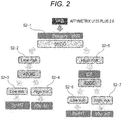
- a biological sample is collected from a subject by VAB, and diagnosis of breast cancer is performed by tissue diagnosis.
- diagnosis of breast cancer is performed by tissue diagnosis.
- the process proceeds to step S2-1.
- step S2-1 surgery is performed on the subject.
- pN0 lymph node metastasis
- pN classification postoperative pathological classification
- determination of the risk of early recurrence by 95GC is performed.
- the process proceeds to step S2-2.
- step S2-2 determination of the risk of late recurrence by 42GC is performed on the subject.
- step S2-3 When it has been determined that the risk of late recurrence is low by 42GC, the process proceeds to step S2-3, and when it has been determined that the risk of late recurrence is high, the process proceeds to step S2-4.
- Steps S2-3 and S2-4 are the same as those described for steps S1-4 and S1-5, respectively.
- step S2-1 when it has been determined that the risk of early recurrence is high by 95GC, the process proceeds to step S2-5.
- step S2-5 chemotherapy (CT) is performed on the subject and determination of the risk of late recurrence by 42GC is performed.
- CT chemotherapy
- step S2-6 When it has been determined that the risk of late recurrence is low by 42GC, the process proceeds to step S2-6, and when it has been determined that the risk of late recurrence is high, the process proceeds to step S2-7.
- Steps S2-6 and S2-7 are the same as those described for steps S1-4 and S1-5, respectively.
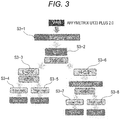
- a biological sample is collected from a subject by VAB, and diagnosis of breast cancer is performed by tissue diagnosis.
- the process proceeds to step S3-1.
- step S3-1 surgery is performed on the subject.
- lymph node metastasis (pN1-3) by pN classification the process proceeds to step S3-2.
- step S3-2 chemotherapy (CT) is performed on the subject and determination of responsiveness to chemotherapy by 155GC is performed.
- L-CS* responsiveness is low
- step S3-4 When it has been determined that the risk of late recurrence is low by 42GC, the process proceeds to step S3-4, and when it has been determined that the risk of late recurrence is high, the process proceeds to step S3-5.
- Steps S3-4 and S3-5 are the same as those described for steps S1-4 and S1-5, respectively
- step S3-2 when it has been determined that the responsiveness is high (H-CS*) by 155GC, the process proceeds to step S3-6.
- step S3-6 additional chemotherapy (Additional CT) is performed on the subject and determination of the risk of late recurrence by 42GC is performed.
- step S3-7 When it has been determined that the risk of late recurrence is low by 42GC, the process proceeds to step S3-7, and when it has been determined that the risk of late recurrence is high, the process proceeds to step S3-8.
- Steps S3-7 and S3-8 are the same as those described for steps S1-4 and S1-5, respectively
- a biological sample is collected from a subject by VAB, and diagnosis of breast cancer is performed by tissue diagnosis.
- diagnosis of breast cancer is performed by tissue diagnosis.
- the process proceeds to step S4-1.
- step S4-1 surgery is performed on the subject.
- lymph node metastasis (pN1) by pN classification
- determination of the risk of early recurrence by Oncotype DX (registered trademark) is performed.
- Oncotype DX registered trademark
- the process proceeds to step S4-2.
- step S4-2 determination of the risk of late recurrence by 42GC is performed on the subject.
- step S4-3 When it has been determined that the risk of late recurrence is low by 42GC, the process proceeds to step S4-3, and when it has been determined that the risk of late recurrence is high, the process proceeds to step S4-4.
- Steps S4-3 and S4-4 are the same as those described for steps S1-4 and S1-5, respectively
- step S4-1 when it has been determined that the risk of early recurrence is high by Oncotype DX (registered trademark), the process proceeds to step S4-5.
- step S4-5 chemotherapy (CT) is performed on the subject and determination of responsiveness to chemotherapy by 155GC is performed.
- L-CS* responsiveness is low
- step S4-6 determination of the risk of late recurrence by 42GC is performed.
- the process proceeds to step S4-7, and when it has been determined that the risk of late recurrence is high, the process proceeds to step S4-8.
- Steps S4-7 and S4-8 are the same as those described for steps S1-4 and S1-5, respectively
- step S4-5 when it has been determined that the responsiveness is high (H-CS*) by 155GC, the process proceeds to step S4-9.
- step S4-9 additional chemotherapy (Additional CT) is performed on the subject and determination of the risk of late recurrence by 42GC is performed.
- Additional CT Additional CT
- step S4-10 When it has been determined that the risk of late recurrence is low by 42GC, the process proceeds to step S4-10, and when it has been determined that the risk of late recurrence is high, the process proceeds to step S4-11. Steps S4-10 and S4-11 are the same as those described for steps S1-4 and S1-5, respectively.
- a determination device 10 shown in Fig. 5 includes a measuring device 20 and a computer system 30 connected to the measuring device 20.
- the measuring device 20 is a microarray scanner that detects a signal based on a target nucleic acid hybridized to a probe on a microarray.
- the signal is optical information such as a fluorescence signal.
- the measuring device 20 acquires optical information based on the target nucleic acid hybridized to the probe on the microarray, and the measuring device 20 transmits the acquired optical information to the computer system 30.
- the microarray scanner is not particularly limited as long as it can detect a signal based on the target nucleic acid hybridized to the probe. Since the type of the signal differs depending on the labeling substance used for labeling the target nucleic acid, the microarray scanner can be appropriately selected according to the type of the labeling substance. For example, when the labeling substance is a fluorescent substance, a microarray scanner capable of detecting a fluorescence signal can be used as the measuring device 20.
- the measuring device 20 may be a nucleic acid amplification detection apparatus.
- a reaction solution containing an RNA sample, an enzyme for nucleic acid amplification, a primer and the like is set in the measuring device 20, and a nucleic acid in the reaction solution is amplified by the nucleic acid amplification method.
- the measuring device 20 acquires optical information such as fluorescence generated from the reaction solution and turbidity of the reaction solution by an amplification reaction, and the measuring device 20 transmits the optical information to the computer system 30.
- the computer system 30 includes a computer main body 300, an input unit 301, and a display unit 302 that displays specimen information, a determination result, and the like.
- the computer system 30 receives the optical information from the measuring device 20.
- the processor of the computer system 30 executes a program for determining prognosis of breast cancer, based on the optical information.
- the computer system 30 may be equipment separate from the measuring device 20, or may be equipment including the measuring device 20. In the latter case, the computer system 30 may itself be the determination device 10.
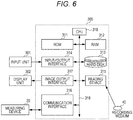
- the computer main body 300 includes a central processing unit (CPU) 310, a read only memory (ROM) 311, a random access memory (RAM) 312, a hard disk 313, an input/output interface 314, a reading device 315, a communication interface 316, and an image output interface 317.
- the CPU 310, the ROM 311, the RAM 312, the hard disk 313, the input/output interface 314, the reading device 315, the communication interface 316 and the image output interface 317 are data-communicably connected by a bus 318.
- the measuring device 20 is communicably connected to the computer system 30 via the communication interface 316.
- the CPU 310 can execute a program stored in the ROM 311 or the hard disk 313 and a program loaded in the RAM 312.
- the CPU 310 calculates fluorescence intensity based on the optical information acquired from the measuring device 20.
- the CPU 310 calculates solution D according to a discriminant represented by formula (I) stored in the ROM 311 or the hard disk 313.
- the CPU 310 determines prognosis of breast cancer based on the acquired solution D and the determination criteria stored in the ROM 311 or the hard disk 313.
- the CPU 310 outputs the determination result and displays the determination result on the display unit 302.
- the ROM 311 includes a mask ROM, PROM, EPROM, EEPROM, and the like.
- ROM 311 a computer program executed by the CPU 310 and data used for executing the computer program are recorded.
- the RAM 312 includes SRAM, DRAM, and the like.
- the RAM 312 is used for reading the program recorded in the ROM 311 and the hard disk 313.
- the RAM 312 is also used as a work area of the CPU 310 when these programs are executed.
- the hard disk 313 has installed therein an operating system to be executed by the CPU 310, a computer program such as an application program (the program for determining prognosis of breast cancer), and data used for executing the computer program.
- a computer program such as an application program (the program for determining prognosis of breast cancer), and data used for executing the computer program.
- the reading device 315 includes a flexible disk drive, a CD-ROM drive, a DVD-ROM drive, and the like.
- the reading device 315 can read a program or data recorded on a portable recording medium 40.
- the input/output interface 314 includes, for example, a serial interface such as USB, IEEE1394 and RS-232C, a parallel interface such as SCSI, IDE and IEEE1284, and an analog interface including a D/A converter, an A/D converter and the like.
- the input unit 301 such as a keyboard and a mouse is connected to the input/output interface 314. An operator can input various commands to the computer main body 300 through the input unit 301.
- the communication interface 316 is, for example, an Ethernet (registered trademark) interface or the like.
- the computer main body 300 can also transmit print data to a printer or the like through the communication interface 316.
- the image output interface 317 is connected to the display unit 302 including an LCD, a CRT, and the like. As a result, the display unit 302 can output a video signal corresponding to the image data coming from the CPU 310.
- the display unit 302 displays an image (screen) according to the input video signal.
- a processing procedure for determining prognosis of breast cancer executed by the determination device 10 will be described.
- a case where determination of the risk of late recurrence is performed based on a fluorescence signal generated from the target nucleic acid bound to the probe on the microarray will be described as an example.
- the present embodiment is not limited to this example.
- step S101 the CPU 310 acquires optical information (fluorescence signal) from the measuring device 20, the CPU 310 calculates a fluorescence intensity from the acquired optical information, and the CPU 310 stores the calculated fluorescence intensity in the hard disk 313.
- step S102 the CPU 310 calculates solution D according to the discriminant represented by the formula (I) stored in the hard disk 313, using the calculated fluorescence intensity, and the CPU 310 stores the solution D in the hard disk 313.
- step S103 the CPU 310 compares the calculated solution D with the determination criteria stored in the hard disk 313. When the solution D is a positive value, the process proceeds to step S104, and a determination result indicating that the late recurrence risk of the subject is high is stored in the hard disk 313.
- step S105 the process proceeds to step S105, and a determination result indicating that the late recurrence risk of the subject is low is stored in the hard disk 313.
- the CPU 310 outputs the determination result, and the CPU 310 displays the determination result on the display unit 302, or the CPU 310 makes a printer print out the determination result. Accordingly, it is possible to provide doctors and the like with information to assist the determination of prognosis of breast cancer.
- the term "95GC” indicates risk of early recurrence determined by Curebest (registered trademark) 95GC Breast (Sysmex Corporation).
- the term “155GC” indicates responsiveness to chemotherapy (chemo-sensitivity) determined by MPCP155 (see Non-Patent Document 1).
- patients with recurrence 177 cases
- patients with recurrence within 5 years ( ⁇ 5 years) after surgery are called “early recurrence group”
- patients with recurrence more than 5 years (> 5 years) after surgery are called “late recurrence group”.
- Gene expression level data (fluorescence intensity data) of the breast cancer patients was normalized by using CEL file data of each data set and MAS5 statistical algorithm of analysis software (Affymetrix Expression Console (trademark) software, manufactured by Affymetrix, Inc.). Next, for each data set, from a value of a gene expression level measured by each probe set of the microarray, a mean value of the gene expression levels in the data set was subtracted to standardize the value of the expression level of each gene (mean-centering).
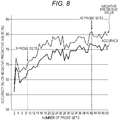
- the accuracy refers to a ratio obtained by dividing the sum of "the number of cases in which late recurrence was predicted, and late recurrence occurred" and "the number of cases in which late recurrence was not predicted, and late recurrence did not occur” by "the total number of cases”.
- the negative predictive value is a ratio obtained by dividing "the number of cases in which late recurrence was not predicted, and late recurrence did not occur” by "the number of cases in which late recurrence was not predicted”. The results are shown in Fig. 8 .
- the negative predictive value and the accuracy were maximized when the number of probe sets was 42. It was found that the negative predictive value was at least 70% when the number of probe sets was nine or more.
- the negative predictive value is a probability that late recurrence actually does not occur when it is predicted that late recurrence does not occur.
- the selected 42 probe sets correspond to genes whose expression levels were significantly different between the late recurrence group and the early recurrence group. Therefore, when it is predicted that late recurrence does not occur based on the expression levels of genes measured by the probe sets, it means the same as the case where it is predicted that early recurrence occurs. That is, the negative predictive value can be rephrased as a probability that early recurrence actually occurs when it is predicted that early recurrence occurs.
- the probe set IDs are IDs assigned to the probe sets of GeneChip (registered trademark) Human Genome U133 Plus 2.0 Array (Affymetrix, Inc.).
- the obtained discriminant is represented by the following formula (I).
- D ⁇ i w i ⁇ y i ⁇ ⁇ 4.763756453
- i a number assigned to each gene shown in Table 6-1 and Table 6-2
- w i a weighting factor of gene numbered i shown in Table 6-1 and Table 6-2
- y i a standardized expression level of gene according to a formula represented by formula (II):
- y i x i ⁇ m i wherein x i represents an expression level of gene numbered i shown in Table 6-1 and Table 6-2, and m i represents a mean value of expression levels of genes numbered i shown in Table 6-1 and Table 6-2 over specimens, and ⁇ i represents a sum total over the genes.
- solution D of the discriminant When solution D of the discriminant is a positive value, it is predicted that risk of late recurrence of the subject is high. When the solution D is zero or a negative value, it is predicted that the risk of late recurrence of the subject is low. When it is predicted that the risk of late recurrence is high, there is a possibility that micrometastasis of breast cancer with slow growth rate may exist in the body of the subject even if no recurrence is observed for 5 years after surgery, and extended endocrine treatment can be applied to the subject. As described above, the prediction that the risk of late recurrence is low can be rephrased as a prediction that the risk of early recurrence is high. When breast cancer does not recur for 5 years after surgery in a subject predicted to have a low risk of late recurrence, it can be considered that breast cancer has been cured.
- the risk of late recurrence of breast cancer was predicted for ER-positive breast cancer patients (564 cases) who did not recur for 5 years after surgery, by the discriminant represented by the formula (I).
- the discriminant represented by the formula (I).
- the distant recurrence-free survival rate (DRFS rate) for 15 years after surgery was examined by Kaplan-Meier plot. Significant differences were evaluated by log-rank test. The results are shown in Fig. 9A .
- the distant recurrence-free survival rate for 15 years after surgery was about 70% for patients predicted to have a high risk of late recurrence ("high-risk group” in the figure), whereas it was about 85% for patients predicted to have a low risk of late recurrence ("low-risk group” in the figure).
- p was 0.0061 by log-rank test.
- the distant recurrence-free survival rate for 15 years after surgery was about 75% in the high-risk group, whereas it was 100% in the low-risk group. p was 0.020 by log-rank test.
- the risk of late recurrence is significantly lower in the low-risk group than in the high-risk group. From these results, it was shown that the risk of late recurrence of breast cancer can be predicted with high accuracy by analyzing the gene expression levels measured using the probes specified by the probe set IDs shown in Table 6-1 and Table 6-2.
Landscapes
- Chemical & Material Sciences (AREA)
- Life Sciences & Earth Sciences (AREA)
- Health & Medical Sciences (AREA)
- Organic Chemistry (AREA)
- Proteomics, Peptides & Aminoacids (AREA)
- Engineering & Computer Science (AREA)
- Immunology (AREA)
- Pathology (AREA)
- Analytical Chemistry (AREA)
- Zoology (AREA)
- Genetics & Genomics (AREA)
- Wood Science & Technology (AREA)
- Physics & Mathematics (AREA)
- Biotechnology (AREA)
- Microbiology (AREA)
- Molecular Biology (AREA)
- Hospice & Palliative Care (AREA)
- Biophysics (AREA)
- Oncology (AREA)
- Biochemistry (AREA)
- Bioinformatics & Cheminformatics (AREA)
- General Engineering & Computer Science (AREA)
- General Health & Medical Sciences (AREA)
- Measuring Or Testing Involving Enzymes Or Micro-Organisms (AREA)
- Apparatus Associated With Microorganisms And Enzymes (AREA)
Abstract
Description
- The present invention relates to a method for acquiring information on prognosis of breast cancer. The present invention also relates to a device for determining prognosis of breast cancer.
- As multigene assays for recurrence prediction aiming for tailored treatment of breast cancer, Oncotype DX (registered trademark) (Genomic Health, Inc.), MammaPrint (registered trademark) (Agendia), PAM50-ROR (Nanostring Technologies, Inc.), EndoPredict (registered trademark) (Myriad Genetics, Inc.), Curebest (registered trademark) 95GC Breast (Osaka University and Sysmex Corporation: see
US Patent Application Publication No. 2011/0263444 ), and the like are known. These multigene assays are excellent in predicting early recurrence of breast cancer within 5 years after surgery. - As postoperative adjuvant therapy for hormone receptor positive breast cancer, it is standard to administer hormones such as tamoxifen for 5 years after surgery. However, breast cancer may recur also more than 5 years after surgery. Especially, in hormone receptor positive breast cancer, late recurrence more than 5 years after surgery tends to be higher than that in negative breast cancer. In recent years, it has been shown that hormone therapy which administers hormones for 10 years after surgery (extended endocrine treatment) has an effect of reducing risk of recurrence and death, by large-scale clinical trials aTTom and ATLAS. However, long-term administration of hormones has problems of side effects. Also, when extended endocrine treatment is performed for all breast cancer patients, another problem of an increase in medical expenses also arises. Therefore, in clinical sites, a need for a method to predict late recurrence more than 5 years after surgery has rapidly increased in order to decide patients to which extended endocrine treatment is applied. Therefore, attempts have been made to predict late recurrence by the above multigene assays.
- However, the above multigene assays are methods suitable for predicting early recurrence within 5 years after surgery. Early recurrent breast cancer has high cell growth ability, and late recurrent breast cancer has low cell growth ability. Thus, since biological characteristics of early recurrent breast cancer and late recurrent breast cancer differ, prediction accuracy of late recurrence by the multigene assays is limited. Accordingly, it is desirable to develop a method to enable prediction of late recurrence of breast cancer with high accuracy.
- The present invention provides a method for acquiring information on prognosis of breast cancer, the method including: a measuring step of measuring expression levels of genes of IL6ST, NPY1R, ELOVL5, OPA1, ASAH1, ALDH6A1 and SYBU in an RNA sample prepared from a biological sample collected from a subject; an analyzing step of analyzing the measured expression levels of genes; and an acquiring step of acquiring information on prognosis of breast cancer based on an analysis result.
- The present invention provides a device for determining prognosis of breast cancer, the device including a processor, and a computer containing a memory under control of the processor, wherein the memory is recorded with a computer program for causing the computer to execute the steps of: acquiring information on expression levels of genes of IL6ST, NPY1R, ELOVL5, OPA1, ASAH1, ALDH6A1 and SYBU in an RNA sample prepared from a biological sample collected from a subject; determining prognosis of breast cancer based on the information on the expression levels of genes; and outputting a determination result.
- The present invention provides a computer program for determining prognosis of breast cancer recorded on a computer readable medium, the computer program causing a computer to execute the steps of: acquiring information on expression levels of genes of IL6ST, NPY1R, ELOVL5, OPA1, ASAH1, ALDH6A1 and SYBU in an RNA sample prepared from a biological sample collected from a subject; determining prognosis of breast cancer based on the information on the expression levels of genes; and outputting a determination result.
- The present invention enables prediction of prognosis of breast cancer in a subject, especially, late recurrence after surgery with high accuracy.
-
-
Fig. 1 is a decision tree of a treatment policy for patients with estrogen receptor (ER)-positive, locally advanced breast cancer. -
Fig. 2 is a decision tree of a treatment policy for patients with ER-positive early breast cancer (pN0: no lymph node metastasis). -
Fig. 3 is a decision tree of a treatment policy for patients with ER-positive early breast cancer (pN1-3: with lymph node metastasis). -
Fig. 4 is a decision tree of a treatment policy for patients with ER-positive early breast cancer (pN1: with lymph node metastasis). -
Fig. 5 is a schematic diagram showing an example of a device for determining prognosis of breast cancer. -
Fig. 6 is a block diagram showing a hardware configuration of the device for determining prognosis of breast cancer. -
Fig. 7 is a flowchart for determination using the device for determining prognosis of breast cancer. -
Fig. 8 is a graph showing a relationship between the number of probe sets and accuracy or negative predictive value (NPV). -
Fig. 9A is a graph showing a relationship between period after surgery and distant recurrence-free survival rate in a training set. -
Fig. 9B is a graph showing a relationship between period after surgery and distant recurrence-free survival rate in a validation set. - A method for acquiring information on prognosis of breast cancer of the present embodiment (hereinafter, also simply referred to as "method") enables acquisition of information on prognosis of breast cancer of a subject, by measuring and analyzing expression levels of predetermined genes. As the information on prognosis of breast cancer, information on risk of recurrence after surgery, especially, information on risk of late recurrence after surgery can be acquired. More specifically, according to the method of the present embodiment, the risk of recurrence after surgery in a subject, especially, whether the risk of late recurrence after surgery is high or low can be accurately predicted. In the present specification, the term "late recurrence" means recurrence more than 5 years after surgery. The phrase "more than 5 years after surgery" refers to a day after 5 years have elapsed from a day of surgery (that is, it does not include a day of 5 years after surgery). The method of the present embodiment is especially suitable for predicting risk of recurrence more than 5 years within 10 years after surgery.
- By providing information obtained by the method of the present embodiment to a person who decides diagnosis and treatment policy (for example, a doctor or the like), it is possible to assist diagnosis of recurrence risk of breast cancer. Based on the information obtained by the method of the present embodiment, it is possible to decide necessity of hormone therapy over a long period of 10 years, so that reduction of side effects and suppression of medical expenses are expected.
- In the method of the present embodiment, first, expression levels of genes of IL6ST, NPY1R, ELOVL5, OPA1, ASAH1, ALDH6A1 and SYBU in an RNA sample prepared from a biological sample collected from a subject are measured. Hereinafter, these seven genes are also referred to as "first gene group".
- In a preferred embodiment, in addition to the above seven genes, an expression level of at least one gene selected from CALB2, ASAP2, RAB5C, PTP4A2, ABCC10, OXTR, HSPA2, SMURF2, SLC7A8, RALA, ADRA2A, MYCBP, CX3CR1, ERCC1, DNAJA3, NINJ1, C4orf43, IFI35, ZNF688, SNX1, CREBL2, HPN, NME3, STS, KLF7, PDHB, NKX3-1, DEXI, GSTM3 and LCMT1 is further measured. Hereinafter, these 30 genes are also referred to as "second gene group". In the present embodiment, it is particularly preferable to measure the expression levels of all 37 genes contained in the first and second gene groups.
- The subject is a breast cancer patient. It is known that ER-positive breast cancer patients tend to recur more than 5 years after surgery, compared with ER-negative breast cancer patients. Accordingly, an ER-positive breast cancer patient is preferable as the breast cancer patient. The subject may be undergoing preoperative adjuvant therapy as long as a biological sample containing breast cancer cells can be collected. Examples of the preoperative adjuvant therapy include administration of hormones, administration of anticancer agents, and combinations thereof. Examples of the hormones include tamoxifen, toremifene, leuprorelin acetate, goserelin acetate, anastrozole, fulvestrant, and the like. Examples of the anticancer agents include adriamycin, epirubicin, paclitaxel, docetaxel, cyclophosphamide, methotrexate, fluorouracil, and the like.
- Since the method of the present embodiment can predict recurrence risk more than 5 years after surgery, the subject may be a subject who did not have recurrence of breast cancer, for example, for 5 years after surgery. The subject may be a subject whose risk of early recurrence of breast cancer has been determined to be low by a prognosis prediction method publicly known in the art. As such a prognosis prediction method, a method capable of predicting early recurrence of breast cancer is preferable. Examples include multigene assays such as Oncotype DX (registered trademark), MammaPrint (registered trademark), PAM50-ROR, EndoPredict (registered trademark) and Curebest (registered trademark) 95GC Breast. The term "early recurrence" refers to recurrence within 5 years after surgery. In the present specification, the phrases "within 5 years after surgery" and "for 5 years after surgery" refer to a day until 5 years have elapsed from the day of surgery (that is, they include the day of 5 years after surgery).
- As described above, ER-positive breast cancer tends to recur late, and ER-negative breast cancer tends to recur early. One of causes of breast cancer recurrence includes micrometastasis. The present inventors have searched for marker genes for the purpose of establishing an inspection method for predicting recurrence time, when breast cancer remains as a micrometastasis in the body after surgery. Specifically, patients with breast cancer recurrence have been divided into an early recurrence group and a late recurrence group according to recurrence time, and differences in gene expression levels between the two groups have been comprehensively analyzed. As a result, the present inventors have identified the above 37 genes as genes associated with late recurrence of breast cancer. Thus, in a preferred embodiment, the subject is an ER-positive breast cancer patient, and expression levels of genes of IL6ST, NPY1R, ELOVL5, OPA1, ASAH1, ALDH6A1, SYBU, CALB2, ASAP2, RAB5C, PTP4A2, ABCC10, OXTR, HSPA2, SMURF2, SLC7A8, RALA, ADRA2A, MYCBP, CX3CR1, ERCC1, DNAJA3, NINJ1, C4orf43, IFI35, ZNF688, SNX1, CREBL2, HPN, NME3, STS, KLF7, PDHB, NKX3-1, DEXI, GSTM3 and LCMT1 in an RNA sample prepared from a biological sample collected from the subject are measured.
- In general, colorectal cancer, lung cancer, ER-negative breast cancer and the like are known to have a fast growth rate among cancers. When such cancer with a fast growth rate exists in the body as a micrometastasis which cannot be pointed out by image inspection, it is considered that the cancer will recur within 5 years after surgery. However, no one knows whether or not there is such a micrometastasis at the time of surgery. While cure may be achieved by effects of surgery, preoperative or postoperative drug therapy and the like, the therapeutic effects cannot be examined even by assays such as microarray. Therefore, in clinical practice, when a patient has no recurrence for 5 years, it is common to finish follow-up of the patient, considering that cancer has been cured. However, ER-positive breast cancer has a slower growth rate than ER-negative breast cancer, and since hormone therapy is effective, cases recurring more than 5 years after surgery are seen. Therefore, it is dangerous to consider that cancer has been cured in ER-positive breast cancer even when the patient has no recurrence for 5 years after surgery. On the other hand, there are not a few cases of ER-positive breast cancer recurred within 5 years after surgery. The present inventors have considered that, among ER-positive breast cancers, there exists breast cancer with a fast growth rate that recurs within 5 years after surgery when there is micrometastasis at the time of surgery by about 30 to 50%, as with ER-negative breast cancer. In a case where such breast cancer with a fast growth rate and breast cancer with a slow growth rate can be accurately found in an inspection, it can be considered that breast cancer has been cured when ER-positive breast cancer with a fast growth rate does not recur for 5 years after surgery. When breast cancer is cured, administration of hormones more than 5 years after surgery is unnecessary. In the present embodiment, the expression levels of all the above 37 genes in an RNA sample prepared from a biological sample collected from an ER-positive breast cancer patient are measured and analyzed, whereby risk of late recurrence of the patient can be accurately predicted. When ER-positive breast cancer does not recur for 5 years after surgery in a patient whose risk of late recurrence has been determined to be low, extended endocrine treatment can be safely omitted.
- The biological sample is not particularly limited as long as it contains breast cancer cells of the subject. Examples thereof include cells collected by fine-needle aspiration, tissues collected by surgery or biopsy, and the like. A formalin-fixed paraffin-embedded (FFPE) specimen prepared from cells or tissues collected from the subject may be used as the biological sample. In a preferred embodiment, the biological sample is a cell or tissue collected from a subject not yet undergoing treatment for breast cancer, or a breast cancer patient undergoing only preoperative adjuvant therapy with hormones, or an FFPE specimen thereof.
- The RNA sample contains RNA extracted from the biological sample or a nucleic acid derived from the RNA, and is a sample to be subjected to measurement of the gene expression levels. A method for extracting RNA from the biological sample is publicly known per se. When the biological sample is a cell or a tissue, extraction of RNA can be performed, for example, as follows. First, the biological sample is mixed with a solubilizing solution containing guanidine thiocyanate and a surfactant. Physical treatment (stirring, homogenizing, ultrasonic disruption, etc.) is performed on the resulting mixed solution to release RNA contained in the biological sample into the mixed solution. Thus, RNA can be extracted from the biological sample. The extracted RNA may be purified. For example, RNA can be purified by centrifuging a mixed solution containing RNA to collect a supernatant, and extracting the supernatant with phenol/chloroform. Extraction and purification of RNA from the biological sample may be performed using a commercially available RNA extraction kit.
- When the biological sample is an FFPE specimen, extraction of RNA can be performed, for example, as follows. First, xylene is added to the FFPE specimen and deparaffinization treatment is performed. The deparaffinized specimen is immersed in ethanol to make it hydrophilic. By treating the hydrophilized specimen with a protease to release formalin-crosslinked nucleic acid, RNA can be extracted from the specimen. Extraction and purification of RNA from the FFPE specimen may be performed by using a commercially available nucleic acid extraction kit for FFPE specimen.
- In the present embodiment, RNA extracted from the biological sample and purified may be used as the RNA sample. Alternatively, cDNA obtained by reverse transcribing mRNA contained in the RNA may be used, or cRNA obtained by in vitro transcription (IVT) amplification of the cDNA may be used as the RNA sample. A method for acquiring cDNA and cRNA is publicly known per se.
- In the present specification, the term "expression level of a gene" means the amount of mRNA transcribed from a gene or the amount of substance reflecting the amount of mRNA. Examples of the substance reflecting the amount of mRNA include cDNA, cRNA, and the like. Since the amount of mRNA transcribed from a gene is often very small, it is preferable to measure the amount of cDNA or cRNA. The expression level of a gene may be represented by either concentration, copy number, or a measured value indicating concentration or copy number.
- The nucleotide sequence of each of the above genes is publicly known per se. Information on these nucleotide sequences can be obtained, for example, from a publicly known database such as a database (http://www.ncbi.nlm.nih.gov/) provided by the National Center for Biotechnology Information (NCBI) of the United States National Library of Medicine. Table 1-1 and Table 1-2 show UniGene IDs, GenBank accession numbers and probe set IDs of each gene. The probe set IDs shown in Table 1-1 and Table 1-2 are numbers for specifying a probe set loaded on GeneChip (registered trademark) Human Genome U133 Plus 2.0 Array (Affymetrix, Inc.). Each probe set contains 11 to 20 probes. Information on nucleotide sequences of probes included in a probe set specified by each probe set ID can be obtained from Affymetrix's web page (http://www.affymetrix.com/analysis/index.affx) and the like. The "UniGene ID" is ID number of UniGene which is a database published by NCBI. The "GenBank accession number" is an accession number of public database GenBank used for designing a sequence of each probe of microarray GeneChip (registered trademark) manufactured by Affymetrix, Inc. The "gene number" is a number assigned to a gene corresponding to each probe set ID.
-
Table 1-1 Gene number Probe set ID Gene symbol UniGene ID GenBank accession number 1 212196_at IL6ST Hs.532082 AW242916 2 205440_s_at NPY1R Hs.519057 NM_000909 3 208788_at ELOVL5 Hs.520189 AL136939 4 214306_at OPA1 Hs.594504 AA209332 5 212195_at IL6ST Hs.532082 AL049265 6 210980_s_at ASAH1 Hs.527412 U47674 7 204864_s_at IL6ST Hs.532082 NM_002184 8 221590_s_at ALDH6A1 Hs.293970 AF130089 9 218692_at SYBU Hs.390738 NM_017786 -
Table 1-2 Gene number Probe set ID Gene symbol UniGene ID GenBank accession number 10 205428_s_at CALB2 Hs.106857 NM_001740 11 206414_s_at ASAP2 Hs.555902 NM_003887 12 201156_s_at RAB5C Hs.650382 AF141304 13 216988_s_at PTP4A2 Hs.470477 L48722 14 213485_s_at ABCC10 Hs.55879 AK000002 15 206825_at OXTR Hs.2820 NM 000916 16 211538_s_at HSPA2 Hs.432648 U56725 17 205596_s_at SMURF2 Hs.515011 AY014180 18 202752_x_at SLC7A8 Hs.596643 NM_012244 19 214435_x_at RALA Hs.6906 NM_005402 20 209869_at ADRA2A Hs.249159 AF284095 21 203360_s_at MYCBP Hs.591506 D50692 22 205898_at CX3CR1 Hs.78913 U20350 23 203720_s_at ERCC1 Hs.435981 NM_001983 24 205963_s_at DNAJA3 Hs.459779 NM_005147 25 211000_s_at IL6ST Hs.532082 AB015706 26 203045_at NINJ1 Hs.494457 NM_004148 27 218513_at C4orf43 Hs.267446 NM_018352 28 209417_s_at IFI35 Hs.632258 BC001356 29 213527_s_at ZNF688 Hs.301463 AI095896 30 201716_at SNX1 Hs.188634 NM_003099 31 201988_s_at CREBL2 Hs.591156 BF438056 32 204934_s_at HPN Hs.182385 NM_002151 33 204862_s_at NME3 Hs.514065 NM_002513 34 203769_s_at STS Hs.522578 NM_000351 35 204334_at KLF7 Hs.471221 AA488672 36 208911_s_at PDHB Hs.161357 M34055 37 204863_s_at IL6ST Hs.532082 BE856546 38 209706_at NKX3-1 Hs.55999 AF247704 39 203733_at DEXI Hs.592051 NM_014015 40 213702_x_at ASAH1 Hs.527412 AI934569 41 202554_s_at GSTM3 Hs.2006 AL527430 42 221515_s_at LCMT1 Hs.337730 BC001214 - A method for measuring the expression levels of genes is not particularly limited, and can be appropriately selected from publicly known measurement methods. Examples of the method include microarrays, quantitative RT-PCR, quantitative PCR, and the like. In the present embodiment, it is preferable to measure the expression levels of genes using a microarray. In this case, it is more preferable to measure expression levels of genes using probe sets specified by the probe set IDs shown in Table 1-1 and Table 1-2. For example, when the expression levels of seven genes of the first gene group are measured, it is preferable to use probe sets specified by nine probe set IDs shown in Table 1-1. When the expression level of at least one gene selected from the second gene group is further measured in addition to the above seven genes, it is preferable to use the probe sets specified by nine probe set IDs shown in Table 1-1 and a probe set specified by a probe set ID corresponding to the gene to be measured shown in Table 1-2. When the expression levels of all 37 genes contained in the first and second gene groups are measured, it is preferable to use the probe sets specified by 42 probe set IDs shown in Table 1-1 and Table 1-2.
- The microarray is not particularly limited as long as it is a chip in which a probe capable of specifically hybridizing to mRNA transcribed from each of the above genes, or cDNA or cRNA derived from the mRNA (hereinafter also referred to as "target nucleic acid") is immobilized on a suitable substrate. The probe can be appropriately designed based on the nucleotide sequence of each of the above genes. The length of the probe may be 10 to 50 nucleotides. The microarray itself can be prepared by a publicly known method. In the present embodiment, it is preferable to use a microarray loading probe sets specified by the probe set IDs shown in Table 1-1 and Table 1-2. A commercially available microarray may be used.
- As used herein, the phrase "capable of specifically hybridizing" means that a probe can hybridize to a target nucleic acid under stringent conditions. The term "stringent conditions" means conditions commonly used by those skilled in the art under which hybridization of polynucleotides is performed. It is known that the stringency of conditions under which hybridization is performed is a function of temperature, salt concentration of hybridization buffer, probe length, GC content of nucleotide sequence of probe and concentration of chaotropic agent in hybridization buffer, and those skilled in the art can suitably set in consideration of these conditions. As the stringent conditions, conditions described in, for example, Molecular Cloning: A Laboratory Manual (second edition) (Sambrook, J. et al., Cold Spring Harbor Laboratory Press, New York (1989)) and the like can be used.
- When the microarray is used, it is preferable that the target nucleic acid is labeled with a publicly known labeling substance. By labeling the target nucleic acid, it is easy to measure a signal from the probe on the microarray. In the present embodiment, while mRNA extracted from the biological sample may be labeled, it is preferable to label cDNA or cRNA derived from the mRNA. Examples of the labeling substance include fluorescent substances, hapten such as biotin, radioactive substances, and the like. Examples of the fluorescent substance include Cy3, Cy5, FITC, Alexa Fluor (trademark), and the like.
- In measurement by the microarray, the expression level of gene is obtained as a signal from the probe, such as fluorescence intensity, luminescence intensity or current amount. The signal can be detected by a scanner included in a microarray analyzer. Examples of the scanner include GeneChip (registered trademark) Scanner3000 7G (Affymetrix, Inc.), Illumina (registered trademark) BeadArray Reader (Illumina, Inc.), and the like.
- Next, in the method of the present embodiment, the measured gene expression levels are analyzed. In the present embodiment, measurement data (raw data) of gene expression levels may be normalized by a publicly known statistical algorithm for analysis. Examples of such a statistical algorithm include RMA, MAS5, PLIER, and the like. RMA, MAS5 and PLIER can be used, for example, in Affymetrix Expression Console (trademark) software (manufactured by Affymetrix, Inc.).
- The gene expression levels can be analyzed by a publicly known method such as a classification method, a scoring method, or a hierarchical cluster analysis. Examples of the classification method include diagonal linear discriminant analysis (DLDA), between-group analysis (BGA) (see Culhane A.C. et al., Between-group analysis of microarray data, Bioinformatics, 2002, vol. 18, p. 1600-1608), support vector machine (SVM), k nearest neighbor classification (kNN), decision tree, random forest, neural net, and the like.
- Hierarchical cluster analysis can be performed, for example, as follows. Using data on expression levels of a specimen (RNA sample) derived from a subject, data on expression levels in a group of specimens known to have good prognosis, data on expression levels in a group of specimens known to recur late, a distance indicating similarity between specimens is calculated based on the expression levels. Based on this distance, various clusters are formed. Analysis is performed by integrating clusters and creating tree diagrams. Examples of the distance include Spearman rank correlation coefficient, Euclidean distance, and the like. Integration of clusters can be performed, for example, by ward method, furthest neighbor method, distance-between-centroids method, and the like. Among them, the Spearman rank correlation coefficient and the ward method are preferably used.
- Examples of the scoring method include principal component analysis, multiple regression analysis, logistic regression analysis, Partial Least Square, and the like. When the gene expression levels are analyzed using the scoring method, scoring is performed so as to classify a score of a specimen predicted to have a good prognosis and a score of a specimen predicted to have a poor prognosis, based on the expression levels.
- When the gene expression levels are analyzed by DLDA classification method, a discriminant constructed using DLDA can be used. For example, when expression levels of genes are measured using the probe sets specified by the probe set IDs shown in Table 1, the discriminant represented by the following formula (I) is shown as the discriminant.


and ∑i represents a sum total over the genes. -
Table 2-1 Gene number Probe set ID Gene symbol Weighting factor 1 212196_at IL6ST 1.43235997 2 205440_s_at NPY1R 0.450736337 3 208788_at ELOVL5 1.793041948 4 214306_at OPA1 -2.545950461 5 212195_at IL6ST 1.539087017 6 210980_s_at ASAH1 1.539921375 7 204864_s_at IL6ST 1.151743979 8 221590_s_at ALDH6A1 1.837908119 9 218692_at SYBU 1.149172541 -
Table 2-2 Gene number Probe set ID Gene symbol Weighting factor 10 205428_s_at CALB2 -1.179415269 11 206414_s_at ASAP2 -2.323532179 12 201156_s_at RAB5C 2.316847761 13 216988_s_at PTP4A2 2.002072892 14 213485_s_at ABCC10 -2.306701292 15 206825_at OXTR -1.1298499 16 211538_s_at HSPA2 0.964294299 17 205596_s_at SMURF2 -2.109236485 18 202752_x_at SLC7A8 1.363057605 19 214435_x_at RALA -2.288374092 20 209869_at ADRA2A 1.377444437 21 203360_s_at MYCBP 1.688897659 22 205898_at CX3CR1 0.740592577 23 203720_s_at ERCC1 1.658860215 24 205963_s_at DNAJA3 2.534304027 25 211000_s_at IL6ST 0.971312607 26 203045_at NINJ1 1.889380552 27 218513_at C4orf43 1.429869188 28 209417_s_at IFI35 1.323441517 29 213527_s_at ZNF688 2.158913805 30 201716_at SNX1 2.2492475 31 201988_s_at CREBL2 1.921069642 32 204934_s_at HPN 1.115597062 33 204862_s_at NME3 1.661682832 34 203769_s_at STS -1.392023997 35 204334_at KLF7 -1.662199312 36 208911_s_at PDHB 2.071027409 37 204863_s_at IL6ST 0.825924727 38 209706_at NKX3-1 0.611126615 39 203733_at DEXI 1.847912036 40 213702_x_at ASAH1 1.575733773 41 202554_s_at GSTM3 0.648154701 42 221515_s_at LCMT1 1.7259299 - mi in the formula (II) can be acquired as follows. For example, when the method according to the present embodiment is performed on each of a plurality of subjects in one cohort, first, expression levels of genes are measured using the probe sets shown in Table 2-1 and Table 2-2, for specimens (RNA samples) derived from each of the plurality of subjects. From the measured expression levels of genes, a mean value in the specimens of the plurality of subjects is calculated. The obtained mean value of the expression levels of genes can be used as mi.
- Alternatively, with respect to a plurality of breast cancer patients in the same facility, expression levels of the genes shown in Table 2-1 and Table 2-2 are measured and data are accumulated, and a mean value may be calculated for the expression levels of the genes of those patients. The mean value of the expression levels of the genes thus obtained can be used as mi in the formula (II) when the method of the present embodiment is performed on a predetermined subject in the facility.
- When the expression levels are analyzed using the discriminant represented by the formula (I), the value of the expression level in the specimen is assigned to xi (i = 1, 2, ..., 42) of the formula (II) in sequence, to calculate solution D. When the solution D is a positive value, it can be determined that risk of late recurrence of the subject is high. When the solution D is zero or a negative value, it can be determined that the risk of late recurrence of the subject is low. For a subject whose risk of late recurrence has been determined to be high, it may be decided to administer hormones until 10 years after surgery. For a subject whose risk of late recurrence has been determined to be low, it may be decided to administer hormones until 5 years after surgery.
- The above 42 probe sets correspond to genes whose expression levels are significantly different between the late recurrence group and the early recurrence group. Therefore, when it has been determined that the risk of late recurrence is low based on the expression levels of genes measured by the probe sets, it means the same as it has been determined that the risk of early recurrence is high. Accordingly, in the present embodiment, a determination result that the risk of late recurrence is low may be rephrased as a determination result that the risk of early recurrence is high. That is, by performing the method of the present embodiment immediately after surgery, it can be predicted whether the risk of late recurrence is high or the risk of early recurrence is high for a subject. When breast cancer does not recur for 5 years after surgery in the subject whose risk of late recurrence has been determined to be low (i.e., the subject whose risk of early recurrence has been determined to be high), it may be considered that breast cancer has been cured.
- In the present embodiment, collection of a biological sample, measurement of gene expression levels, and analysis of the gene expression levels may be performed at substantially the same time. In another embodiment, collection of a biological sample and measurement and analysis of gene expression levels may be performed at times apart by a predetermined period. For example, cells or tissues collected from a subject are stored as an FFPE specimen, and after a predetermined period (for example, 5 years after surgery) has elapsed, measurement and analysis of expression levels of the genes may be performed using an RNA sample prepared from the FFPE specimen. Alternatively, collection of a biological sample, measurement of gene expression levels, and analysis of the gene expression levels may be performed at times apart by a predetermined period. For example, an RNA sample is prepared from cells or tissues collected from a subject, expression levels of the genes are measured, measurement data is stored, and after a predetermined period (for example, 5 years after surgery) has elapsed, analysis of the expression levels may be performed using the measurement data.
- Since the method of the present embodiment can accurately predict the risk of late recurrence of breast cancer, it is possible to predict the recurrence risk within 10 years after surgery, by combining the method of the present embodiment with a publicly known method for predicting the risk of early recurrence of breast cancer. For example, the method of the present embodiment and the method for predicting the risk of early recurrence of breast cancer may be performed at the same time. Alternatively, first, the method for predicting the risk of early recurrence of breast cancer is performed, and when it has been determined that the recurrence risk within 5 years after surgery is low, the method of the present embodiment may be performed. Alternatively, when it is determined that the recurrence risk within 5 years after surgery is low by the method for predicting the risk of early recurrence of breast cancer, and the subject does not actually have recurrence of breast cancer for 5 years after surgery, the method of the present embodiment may be performed at 5 years after surgery. In the present embodiment, when it has been determined that the recurrence risk within 5 years after surgery is high by the method for predicting the risk of early recurrence of breast cancer, the method of the present embodiment may be further performed.
- When the method of the present embodiment is combined with a publicly known method for predicting the risk of early recurrence of breast cancer, the expression levels of genes used in the method of the present embodiment and the expression levels of genes used in the method for predicting the risk of early recurrence may be acquired by a single measurement, for example, with a microarray. In this case, all the measured expression levels of genes may be simultaneously analyzed. Alternatively, the expression levels of genes used in the method for predicting the risk of early recurrence are analyzed, then the expression levels of genes used in the method of the present embodiment may be analyzed.
- When a part of cells or tissues collected from a subject is stored as an FFPE specimen, first, from an RNA sample prepared from the cells or tissues, measurement and analysis of expression levels of the genes used in the method for predicting the risk of early recurrence are performed. After that (for example, after 5 years), from the RNA sample prepared from the FFPE specimen, the expression levels of genes used in the method of the present embodiment may be measured and analyzed.
- A publicly known method for predicting the risk of early recurrence of breast cancer is not particularly limited, and for example, the method described in
Patent Document 1 is preferable (Patent Document 1 is incorporated herein by reference). In the present embodiment, the subject may be a subject whose risk of early recurrence of breast cancer has been determined to be low, based on gene expression levels measured using probe sets specified by 95 probe set IDs shown in Table 3-1 and Table 3-2. -
Table 3-1 Number Probe set ID Gene symbol UniGene ID GenBank accession number 1 219306_at KIF15 Hs.646856 NM_020242 2 218585_s_at DTL Hs.656473 NM_016448 3 221677_s_at DONSON Hs.436341 AF232674 4 201088_at KPNA2 Hs.594238 NM_002266 5 209034_at PNRC1 Hs.75969 AF279899 6 202610_s_at MED14 Hs.407604 AF135802 7 218906_x_at KLC2 Hs.280792 NM_022822 8 212723_at JMJD6 Hs.514505 AK021780 9 222231_s_at LRRC59 Hs.370927 AK025328 10 208838_at CAND1 Hs.546407 AB020636 11 218039_at NUSAP1 Hs.615092 NM_016359 12 209472_at CCBL2 Hs.481898 BC000819 13 212898_at KIAA0406 Hs.655481 AB007866 14 202620_s_at PLOD2 Hs.477866 NM_000935 15 201059_at CTTN Hs.596164 NM_005231 16 201841_s_at HSPB1 Hs.520973 NM_001540 17 203755_at BUB1B Hs.631699 NM_001211 18 211750_x_at TUBA1C Hs.719091 BC005946 19 38158_at ESPL1 Hs.153479 D79987 20 204709_s_at KIF23 Hs.270845 NM_004856 21 201589_at SMC1A Hs.211602 D80000 22 218460_at HEATR2 Hs.535896 NM_017802 23 207430_s_at MSMB Hs.255462 NM_002443 24 212139_at GCN1L1 Hs.298716 D86973 25 211596_s_at LRIG1 Hs.518055 AB050468 26 212160_at XPOT Hs.85951 AI984005 27 219238_at PIGV Hs.259605 NM_017837 28 203432_at TMPO Hs.11355 AW272611 29 201377_at UBAP2L Hs.490551 NM_014847 30 218875_s_at FBXO5 Hs.520506 NM_012177 31 221922_at GPSM2 Hs.584901 AW195581 32 218727_at SLC38A7 Hs.10499 NM_018231 33 207469_s_at PIR Hs.495728 NM_003662 34 218483_s_at C11orf60 Hs.533738 NM_020153 35 204641_at NEK2 Hs.153704 NM_002497 36 219502_at NEIL3 Hs.405467 NM_ 018248 37 209054_s_at WHSC1 Hs.113876 AF083389 38 220318_at EPN3 Hs.670090 NM_017957 39 210297_s_at MSMB Hs.255462 U22178 40 209186_at ATP2A2 Hs.506759 M23114 41 219787_s_at ECT2 Hs.518299 NM_018098 42 45633_at GINS3 Hs.47125 AI421812 43 200848_at AHCYL1 Hs.705418 AA479488 44 200822_x_at TPI1 Hs.524219 NM_000365 45 211072_x_at TUBA1B Hs.719075 BC006481 46 200811_at CIRBP Hs.634522 NM_001280 47 202864_s_at SP100 Hs.369056 NM_003113 48 202154_x_at TUBB3 Hs.511743 NM_006086 49 213152_s_at SFRS2B Hs.476680 AI343248 50 209368_at EPHX2 Hs.212088 AF233336 -
Table 3-2 Number Probe set ID Gene symbol UniGene ID GenBank accession number 51 211058_x_at TUBA1B Hs.719075 BC006379 52 209251_x_at TUBA1C Hs.719091 BC004949 53 213646_x_at TUBA1B Hs.719075 BE300252 54 204540_at EEF1A2 Hs.433839 NM_001958 55 202026_at SDHD Hs.719164 NM_003002 56 201090_x_at TUBA1B Hs.719075 NM_006082 57 213119_at SLC36A1 Hs.269004 AW058600 58 217840_at DDX41 Hs.484288 NM_016222 59 206559_x_at EEF1A1 --- NM_001403 60 202066_at PPFIA1 Hs.530749 AA195259 61 203108_at GPRC5A Hs.631733 NM_003979 62 218697_at NCKIPSD Hs.655006 NM_016453 63 222039_at KIF18B Hs.135094 AA292789 64 202069_s_at IDH3A Hs.591110 AI826060 65 203362_s_at MAD2L1 Hs.591697 NM_002358 66 202666_s_at ACTL6A Hs.435326 NM_004301 67 204892_x_at EEF1A1 Hs.520703 NM_001402 68 205682_x_at APOM Hs.534468 NM_019101 69 209714_s_at CDKN3 Hs.84113 AF213033 70 218381_s_at U2AF2 Hs.528007 NM_007279 71 201947_s_at CCT2 Hs.189772 NM_006431 72 212722_s_at JMJD6 Hs.514505 AK021780 73 204825_at MELK Hs.184339 NM_014791 74 203184_at FBN2 Hs.519294 NM_001999 75 201266_at TXNRD1 Hs.708065 NM_003330 76 202969_at DYRK2 Hs.173135 AI216690 77 204817_at ESPL1 Hs.153479 NM_012291 78 209523_at TAF2 Hs.122752 AK001618 79 218491_s_at THYN1 Hs.13645 NM_014174 80 217363_x_at --- --- AL031313 81 218009_s_at PRC1 Hs.567385 NM_003981 82 204026_s_at ZWINT Hs.591363 NM_007057 83 218355_at KIF4A Hs.648326 NM_012310 84 202153_s_at NUP62 Hs.574492 NM_016553 85 213011_s_at TPI1 Hs.524219 BF116254 86 217966_s_at FAM129A Hs.518662 NM_022083 87 214782_at CTTN Hs.596164 AU155105 88 217967_s_at FAM129A Hs.518662 AF288391 89 204649_at TROAP Hs.524399 NM_005480 90 35671_at GTF3C1 Hs.371718 U02619 91 213502_x_at LOC91316 Hs.148656 AA398569 92 221285_at ST8SIA2 Hs.302341 NM_006011 93 221519_at FBXW4 Hs.500822 AF281859 94 20255_1_s_at CRIM1 Hs.699247 BG546884 95 217138_x_at IGL@ Hs.449585 AJ249377 - When the subject is administered with anticancer agents as a preoperative adjuvant therapy, the method of the present embodiment may be combined with a publicly known method for predicting responsiveness to chemotherapy and prognosis. As such a method, a multigene assay, MPCP155 (see Tsunashima R. et al., Construction of multi-gene classifier for prediction of response to and prognosis after neoadjuvant chemotherapy for estrogen receptor positive breast cancers, Cancer Letters, 2015, vol. 365, p. 166-173, which is incorporated herein by reference) is known. In the present embodiment, the subject may be a subject whose responsiveness to chemotherapy has been determined, based on gene expression levels measured using probe sets specified by 155 probe set IDs shown in Table 4-1 and Table 4-5.
-
Table 4-1 Number Probe set ID Gene symbol 1 205896_at SLC22A4 2 203685_at BCL2 3 200970_s_at SERP1 4 205355_at ACADSB 5 210678_s_at AGPAT2 6 210046_s_at IDH2 7 37152_at PPARD 8 205733_at BLM 9 215649_s_at MVK 10 214594_x_at ATP8B1 11 218096_at AGPAT5 12 203684_s_at BCL2 13 202671_s_at PDXK 14 32837_at AGPAT2 15 218923_at CTBS 16 200846_s_at PPP1CA 17 207005_s_at BCL2 18 221753_at SSH1 19 208705_s_at EIF5 20 207621_s_at PEMT 21 200849_s_at AHCYL1 22 221065_s_at CHST8 23 209281_s_at ATP2B1 24 217006_x_at FASN 25 214095_at SHMT2 26 213607_x_at NADK 27 206130_s_at ASGR2 28 200784_s_at LRP1 29 205301_s_at OGG1 30 201627_s_at INSIG1 31 205768_s_at SLC27A2 32 203770_s_at STS 33 202376_at SERPINA3 34 219723_x_at AGPAT3 35 218506_x_at GLYR1 36 208051_s_at PAIP1 37 205769_at SLC27A2 -
Table 4-2 Number Probe set ID Gene symbol 38 211762_s_at KPNA2 39 204879_at PDPN 40 219429_at FA2H 41 211627_x_at ESR1 42 202779_s_at UBE2S 43 210609_s_at TP53I3 44 209064_x_at PAIP1 45 208830_s_at SUPT6H 46 219048_at PIGN 47 209041_s_at UBE2G2 48 201523_x_at UBE2N 49 208511_at PTTG3P 50 222074_at UROD 51 209496_at RARRES2 52 203366_at POLG 53 201782_s_at AIP 54 202715_at CAD 55 208624_s_at EIF4G1 56 210449_x_at MAPK14 57 201610_at ICMT 58 217294_s_at ENOI 59 205140_at FPGT 60 204430_s_at SLC2A5 61 204167_at BTD 62 203566_s_at AGL 63 210688_s_at CPT1A 64 213613_s_at NADK 65 215988_s_at DLG1 66 206925_at ST8SIA4 67 203365_s_at MMP15 68 215842_s_at ATP11A 69 203939_at NT5E 70 201695_s_at PNP 71 200878_at EPAS1 72 209740_s_at PNPLA4 73 218313_s_at GALNT7 74 209773_s_at RRM2 -
Table 4-3 Number Probe set ID Gene symbol 75 217607_x_at EIF4G2 76 205816_at ITGB8 77 203244_at PEX5 78 207851_s_at INSR 79 207275_s_at ACSL1 80 204044_at QPRT 81 201218_at CTBP2 82 209916_at DHTKD1 83 200785_s_at LRP1 84 213343_s_at GDPD5 85 218533_s_at UCKL1 86 203381_s_at APOE 87 221142_s_at PECR 88 209533_s_at PLAA 89 218018_at PDXK 90 205225_at ESR1 91 32502_at GDPD5 92 201080_at PIP4K2B 93 208696_at CCT5 94 209735_at ABCG2 95 203554_x_at PTTG1 96 206587_at CCT6B 97 202580_x_at FOXM1 98 214210_at SLC25A17 99 201291_s_at TOP2A 100 200675_at CD81 101 208510_s_at PPARG 102 205128_x_at PTGS1 103 216551_x_at PLCG1 104 203634_s_at CPT1A 105 204946_s_at TOP3A 106 212883_at APOE 107 207076_s_at ASS1 108 211026_s_at MGLL 109 200879_s_at EPAS1 110 209537_at EXTL2 111 221485_at B4GALT5 -
Table 4-4 Number Probe set ID Gene symbol 112 220948_s_at ATP1A1 113 218760_at COQ6 114 211233_x_at ESR1 115 203343_at UGDH 116 217190_x_at ESR1 117 203099 s at CDYL 118 202533_s_at DHFR 119 206197_at NME5 120 219718_at FGGY 121 201081_s_at PIP4K2B 122 215210_s_at DLST 123 211234_x_at ESR1 124 203767_s_at STS 125 218924_s_at CTBS 126 204059_s_at ME1 127 211754_s_at SLC25A17 128 213279_at DHRS1 129 217289_s_at SLC37A4 130 204161_s_at ENPP4 131 34187_at RBMS2 132 202922_at GCLC 133 209616_s_at CES1 134 218951_s_at PLCXD1 135 40829_at WDTC1 136 201117_s_at CPE 137 213379_at COQ2 138 203633_at CPT1A 139 206311_s_at PLA2G1B 140 206630_at TYR 141 210745_at ONECUT1 142 205552_s_at OAS1 143 209425_at AMACR 144 201625_s_at INSIG1 145 203072_at MYOIE 146 209998_at PIGO 147 201898_s_at UBE2A 148 204956_at MTAP -
Table 4-5 Number Probe set ID Gene symbol 149 215966_x_at GK3P 150 209681_at SLC19A2 151 59631_at TXNRD3 152 219394_at PGS1 153 206492_at FHIT 154 211738_x_at CELA3A 155 209165_at AATF - Flows when a treatment policy for breast cancer patients is decided by combining the method of the present embodiment with a publicly known multigene assay for predicting risk of early recurrence of breast cancer will be described with reference to
Figs. 1 to 4 . In any ofFigs. 1 to 4 , first, a biological sample is collected from a subject by vacuum-assisted breast biopsy (VAB). Then, tissue diagnosis is performed using a part of the biological sample to diagnose breast cancer. When diagnosed as breast cancer, RNA samples are prepared from the remaining biological sample, and expression levels of genes are measured using GeneChip (registered trademark) Human Genome U133 Plus 2.0 Array (Affymetrix, Inc.). This microarray contains not only the 42 probe sets used in the method of the present embodiment but also probe sets used in Curebest (registered trademark) 95GC Breast (hereinafter also referred to as "95GC") and MPCP155 (hereinafter also referred to as "155GC"). Accordingly, it is possible to acquire gene expression level data for a plurality of multigene assays by performing measurement by microarray only once, with respect to a biological sample obtained by biopsy for diagnosis of breast cancer. A multigene assay by microarray may further be combined with a multigene assay by RT-PCR method. The multigene assay by RT-PCR method includes Oncotype DX (registered trademark). In this case, first, tissue diagnosis is performed using a part of the biological sample obtained by VAB to diagnose breast cancer. When diagnosed as breast cancer, RNA samples are prepared from the remaining biological sample, and expression levels of genes are measured using GeneChip (registered trademark) Human Genome U133 Plus 2.0 Array (Affymetrix, Inc.) and RT-PCR method. - Referring to
Fig. 1 , first, a biological sample is collected from a subject by VAB, and diagnosis of breast cancer by tissue diagnosis and determination of risk of early recurrence by 95GC are performed. When it has been determined that the risk of early recurrence is low by 95GC, the process proceeds to step S1-1. In step S1-1, preoperative hormone therapy (NAE) or surgery is performed on the subject. When it has been determined that the risk of early recurrence is high by 95GC, the process proceeds to step S1-2. In step S1-2, preoperative chemotherapy (NAC (A/T)) with adriamycin or a taxane anticancer agent is performed on the subject, and then surgery is performed. When the postoperative course is pathologically complete remission (pCR), the process proceeds to step S1-3. In step S1-3, determination of risk of late recurrence by the method of the present embodiment (hereinafter also referred to as "42GC") is performed. When it has been determined that the risk of late recurrence is low by 42GC, the process proceeds to step S1-4. In step S1-4, hormone therapy for 5 years after surgery (5y-HT) is performed on the subject. When it has been determined that the risk of late recurrence is high by 42GC, the process proceeds to step S1-5. In step S1-5, hormone therapy for 10 years after surgery (10y-HT) is performed on the subject. - When the postoperative course in step S1-2 is pathologically complete non-remission (Non-pCR), the process proceeds to step S1-6. In step S1-6, determination of responsiveness to chemotherapy by 155GC is performed. When it has been determined that the responsiveness is low (L-CS*: low chemo-sensitivity) by 155GC, the process proceeds to step S1-7. In step S1-7, determination of the risk of late recurrence by 42GC is performed. When it has been determined that the risk of late recurrence is low by 42GC, the process proceeds to step S1-8, and when it has been determined that the risk of late recurrence is high, the process proceeds to step S1-9. Steps S1-8 and S1-9 are the same as those described for steps S1-4 and S1-5, respectively. In step S1-6, when it has been determined that the responsiveness is high (H-CS*: high chemo-sensitivity) by 155GC, the process proceeds to step S1-10. In step S1-10, additional chemotherapy (Additional CT) is performed on the subject and determination of the risk of late recurrence by 42GC is performed. When it has been determined that the risk of late recurrence is low by 42GC, the process proceeds to step S1-11, and when it has been determined that the risk of late recurrence is high, the process proceeds to step S1-12. Steps S1-11 and S1-12 are the same as those described for steps S1-4 and S1-5, respectively.
- Referring to
Fig. 2 , first, a biological sample is collected from a subject by VAB, and diagnosis of breast cancer is performed by tissue diagnosis. When diagnosed as breast cancer, the process proceeds to step S2-1. In step S2-1, surgery is performed on the subject. When it has been determined that there is no lymph node metastasis (pN0) by postoperative pathological classification (pN classification), determination of the risk of early recurrence by 95GC is performed. When it has been determined that the risk of early recurrence is low by 95GC, the process proceeds to step S2-2. In step S2-2, determination of the risk of late recurrence by 42GC is performed on the subject. When it has been determined that the risk of late recurrence is low by 42GC, the process proceeds to step S2-3, and when it has been determined that the risk of late recurrence is high, the process proceeds to step S2-4. Steps S2-3 and S2-4 are the same as those described for steps S1-4 and S1-5, respectively. In step S2-1, when it has been determined that the risk of early recurrence is high by 95GC, the process proceeds to step S2-5. In step S2-5, chemotherapy (CT) is performed on the subject and determination of the risk of late recurrence by 42GC is performed. When it has been determined that the risk of late recurrence is low by 42GC, the process proceeds to step S2-6, and when it has been determined that the risk of late recurrence is high, the process proceeds to step S2-7. Steps S2-6 and S2-7 are the same as those described for steps S1-4 and S1-5, respectively. - Referring to
Fig. 3 , first, a biological sample is collected from a subject by VAB, and diagnosis of breast cancer is performed by tissue diagnosis. When diagnosed as breast cancer, the process proceeds to step S3-1. In step S3-1, surgery is performed on the subject. When it has been determined that there is lymph node metastasis (pN1-3) by pN classification, the process proceeds to step S3-2. In step S3-2, chemotherapy (CT) is performed on the subject and determination of responsiveness to chemotherapy by 155GC is performed. When it has been determined that the responsiveness is low (L-CS*) by 155GC, the process proceeds to step S3-3. In step S3-3, determination of the risk of late recurrence by 42GC is performed. When it has been determined that the risk of late recurrence is low by 42GC, the process proceeds to step S3-4, and when it has been determined that the risk of late recurrence is high, the process proceeds to step S3-5. Steps S3-4 and S3-5 are the same as those described for steps S1-4 and S1-5, respectively In step S3-2, when it has been determined that the responsiveness is high (H-CS*) by 155GC, the process proceeds to step S3-6. In step S3-6, additional chemotherapy (Additional CT) is performed on the subject and determination of the risk of late recurrence by 42GC is performed. When it has been determined that the risk of late recurrence is low by 42GC, the process proceeds to step S3-7, and when it has been determined that the risk of late recurrence is high, the process proceeds to step S3-8. Steps S3-7 and S3-8 are the same as those described for steps S1-4 and S1-5, respectively - Referring to
Fig. 4 , first, a biological sample is collected from a subject by VAB, and diagnosis of breast cancer is performed by tissue diagnosis. When diagnosed as breast cancer, the process proceeds to step S4-1. In step S4-1, surgery is performed on the subject. When it has been determined that there is lymph node metastasis (pN1) by pN classification, determination of the risk of early recurrence by Oncotype DX (registered trademark) is performed. When it has been determined that the risk of early recurrence is low by Oncotype DX (registered trademark), the process proceeds to step S4-2. In step S4-2, determination of the risk of late recurrence by 42GC is performed on the subject. When it has been determined that the risk of late recurrence is low by 42GC, the process proceeds to step S4-3, and when it has been determined that the risk of late recurrence is high, the process proceeds to step S4-4. Steps S4-3 and S4-4 are the same as those described for steps S1-4 and S1-5, respectively In step S4-1, when it has been determined that the risk of early recurrence is high by Oncotype DX (registered trademark), the process proceeds to step S4-5. In step S4-5, chemotherapy (CT) is performed on the subject and determination of responsiveness to chemotherapy by 155GC is performed. When it has been determined that the responsiveness is low (L-CS*) by 155GC, the process proceeds to step S4-6. In step S4-6, determination of the risk of late recurrence by 42GC is performed. When it has been determined that the risk of late recurrence is low by 42GC, the process proceeds to step S4-7, and when it has been determined that the risk of late recurrence is high, the process proceeds to step S4-8. Steps S4-7 and S4-8 are the same as those described for steps S1-4 and S1-5, respectively In step S4-5, when it has been determined that the responsiveness is high (H-CS*) by 155GC, the process proceeds to step S4-9. In step S4-9, additional chemotherapy (Additional CT) is performed on the subject and determination of the risk of late recurrence by 42GC is performed. When it has been determined that the risk of late recurrence is low by 42GC, the process proceeds to step S4-10, and when it has been determined that the risk of late recurrence is high, the process proceeds to step S4-11. Steps S4-10 and S4-11 are the same as those described for steps S1-4 and S1-5, respectively - The scope of the present disclosure also includes a device and a computer program for implementing the above-described method of the present embodiment. An example of the device for determining prognosis of breast cancer of the present embodiment will be described with reference to the drawings. However, the present embodiment is not limited only to the embodiment shown in this example. A
determination device 10 shown inFig. 5 includes a measuringdevice 20 and acomputer system 30 connected to the measuringdevice 20. - In this example, the measuring
device 20 is a microarray scanner that detects a signal based on a target nucleic acid hybridized to a probe on a microarray. The signal is optical information such as a fluorescence signal. In this case, when the microarray that is brought into contact with the RNA sample is set in the measuringdevice 20, the measuringdevice 20 acquires optical information based on the target nucleic acid hybridized to the probe on the microarray, and the measuringdevice 20 transmits the acquired optical information to thecomputer system 30. - The microarray scanner is not particularly limited as long as it can detect a signal based on the target nucleic acid hybridized to the probe. Since the type of the signal differs depending on the labeling substance used for labeling the target nucleic acid, the microarray scanner can be appropriately selected according to the type of the labeling substance. For example, when the labeling substance is a fluorescent substance, a microarray scanner capable of detecting a fluorescence signal can be used as the measuring
device 20. - When expression levels of genes are analyzed by a nucleic acid amplification method such as quantitative RT-PCR, the measuring
device 20 may be a nucleic acid amplification detection apparatus. In this case, a reaction solution containing an RNA sample, an enzyme for nucleic acid amplification, a primer and the like is set in the measuringdevice 20, and a nucleic acid in the reaction solution is amplified by the nucleic acid amplification method. The measuringdevice 20 acquires optical information such as fluorescence generated from the reaction solution and turbidity of the reaction solution by an amplification reaction, and the measuringdevice 20 transmits the optical information to thecomputer system 30. - The
computer system 30 includes a computermain body 300, aninput unit 301, and adisplay unit 302 that displays specimen information, a determination result, and the like. Thecomputer system 30 receives the optical information from the measuringdevice 20. Then, the processor of thecomputer system 30 executes a program for determining prognosis of breast cancer, based on the optical information. As shown inFig. 5 , thecomputer system 30 may be equipment separate from the measuringdevice 20, or may be equipment including the measuringdevice 20. In the latter case, thecomputer system 30 may itself be thedetermination device 10. - Referring to
Fig. 6 , the computermain body 300 includes a central processing unit (CPU) 310, a read only memory (ROM) 311, a random access memory (RAM) 312, ahard disk 313, an input/output interface 314, areading device 315, acommunication interface 316, and animage output interface 317. TheCPU 310, theROM 311, theRAM 312, thehard disk 313, the input/output interface 314, thereading device 315, thecommunication interface 316 and theimage output interface 317 are data-communicably connected by abus 318. The measuringdevice 20 is communicably connected to thecomputer system 30 via thecommunication interface 316. - The
CPU 310 can execute a program stored in theROM 311 or thehard disk 313 and a program loaded in theRAM 312. TheCPU 310 calculates fluorescence intensity based on the optical information acquired from the measuringdevice 20. TheCPU 310 calculates solution D according to a discriminant represented by formula (I) stored in theROM 311 or thehard disk 313. Then, theCPU 310 determines prognosis of breast cancer based on the acquired solution D and the determination criteria stored in theROM 311 or thehard disk 313. TheCPU 310 outputs the determination result and displays the determination result on thedisplay unit 302. - The
ROM 311 includes a mask ROM, PROM, EPROM, EEPROM, and the like. In theROM 311, a computer program executed by theCPU 310 and data used for executing the computer program are recorded. - The
RAM 312 includes SRAM, DRAM, and the like. TheRAM 312 is used for reading the program recorded in theROM 311 and thehard disk 313. TheRAM 312 is also used as a work area of theCPU 310 when these programs are executed. - The
hard disk 313 has installed therein an operating system to be executed by theCPU 310, a computer program such as an application program (the program for determining prognosis of breast cancer), and data used for executing the computer program. - The
reading device 315 includes a flexible disk drive, a CD-ROM drive, a DVD-ROM drive, and the like. Thereading device 315 can read a program or data recorded on aportable recording medium 40. - The input/
output interface 314 includes, for example, a serial interface such as USB, IEEE1394 and RS-232C, a parallel interface such as SCSI, IDE and IEEE1284, and an analog interface including a D/A converter, an A/D converter and the like. Theinput unit 301 such as a keyboard and a mouse is connected to the input/output interface 314. An operator can input various commands to the computermain body 300 through theinput unit 301. - The
communication interface 316 is, for example, an Ethernet (registered trademark) interface or the like. The computermain body 300 can also transmit print data to a printer or the like through thecommunication interface 316. - The
image output interface 317 is connected to thedisplay unit 302 including an LCD, a CRT, and the like. As a result, thedisplay unit 302 can output a video signal corresponding to the image data coming from theCPU 310. Thedisplay unit 302 displays an image (screen) according to the input video signal. - Referring to
Fig. 7 , a processing procedure for determining prognosis of breast cancer executed by thedetermination device 10 will be described. Here, a case where determination of the risk of late recurrence is performed based on a fluorescence signal generated from the target nucleic acid bound to the probe on the microarray will be described as an example. However, the present embodiment is not limited to this example. - In step S101, the
CPU 310 acquires optical information (fluorescence signal) from the measuringdevice 20, theCPU 310 calculates a fluorescence intensity from the acquired optical information, and theCPU 310 stores the calculated fluorescence intensity in thehard disk 313. In step S102, theCPU 310 calculates solution D according to the discriminant represented by the formula (I) stored in thehard disk 313, using the calculated fluorescence intensity, and theCPU 310 stores the solution D in thehard disk 313. In step S103, theCPU 310 compares the calculated solution D with the determination criteria stored in thehard disk 313. When the solution D is a positive value, the process proceeds to step S104, and a determination result indicating that the late recurrence risk of the subject is high is stored in thehard disk 313. When the solution D is zero or a negative value, the process proceeds to step S105, and a determination result indicating that the late recurrence risk of the subject is low is stored in thehard disk 313. In step S105, theCPU 310 outputs the determination result, and theCPU 310 displays the determination result on thedisplay unit 302, or theCPU 310 makes a printer print out the determination result. Accordingly, it is possible to provide doctors and the like with information to assist the determination of prognosis of breast cancer. - Hereinafter, the present disclosure will be described in more detail by examples, but the present disclosure is not limited to these examples.
- Data of breast cancer patients (779 cases) shown in Table 5 were extracted from four data sets of accession numbers: GSE6532, GSE12093, GSE17705 and GSE26971 in NCBI Gene Expression Omnibus (http://www.ncbi.nlm.nih.gov/geo/) of microarray experiments. All of these patients were ER positive and also received only administration of hormones as a treatment. In the table, "cT" is a clinical tumor diameter, "cN" is a clinical nodal state (presence or absence of lymph node metastasis), and "PR" is a progesterone receptor. The term "95GC" indicates risk of early recurrence determined by Curebest (registered trademark) 95GC Breast (Sysmex Corporation). The term "155GC" indicates responsiveness to chemotherapy (chemo-sensitivity) determined by MPCP155 (see Non-Patent Document 1). Hereinbelow, among patients with recurrence (177 cases), patients with recurrence within 5 years (≤ 5 years) after surgery are called "early recurrence group", and patients with recurrence more than 5 years (> 5 years) after surgery are called "late recurrence group".
-
Table 5 Training set GSE6532 GSE12093 GSE17705 GSE26971 Total Number of cases 87 136 298 258 779 Age < 50 3 NA NA NA 3 ≥ 50 84 NA NA NA 84 cT T1 43 NA NA 102 145 T2/3/4 44 NA NA 145 189 Unknown 0 NA NA 11 11 cN Positive 58 0 112 87 257 Negative 29 136 175 129 469 Unknown 0 0 11 42 53 Histological grade 1 17 NA NA NA 17 2/3 53 NA NA NA 53 Unknown 17 NA NA NA 17 PR Positive 64 NA NA NA 64 Negative 21 NA NA NA 21 Unknown 2 NA NA NA 2 Recurrence 28 20 71 58 177 ≤ 5 yrs 14 12 42 41 109 > 5 yrs 14 8 29 17 68 No recurrence Sub type 59 116 227 200 602 Luminal A 37 65 148 132 382 Luminal B 50 71 150 126 397 95GC Low risk 48 85 177 151 461 High risk 39 51 121 107 318 155GC Low sensitivity 42 61 146 113 362 High sensitivity 45 75 152 145 417 - Gene expression level data (fluorescence intensity data) of the breast cancer patients was normalized by using CEL file data of each data set and MAS5 statistical algorithm of analysis software (Affymetrix Expression Console (trademark) software, manufactured by Affymetrix, Inc.). Next, for each data set, from a value of a gene expression level measured by each probe set of the microarray, a mean value of the gene expression levels in the data set was subtracted to standardize the value of the expression level of each gene (mean-centering). Then, z-score was calculated for each probe set on the microarray, by using a package "GeneMeta v1 .16.0" (http://www.bioconductor.org/packages/2.4/bioc/html/GeneMeta.html) contained in an additional package "BioConductor" ver. 2.4 used in software for statistical analysis "R", according to a literature by Choi J.K et al. (Combining multiple microarray studies and modeling interstudy variation, Bioinformatics, 2003, vol. 19, suppl. 1, p. i84-94).
- It was evaluated by chi-square test that the expression level of the gene corresponding to the probe set was different between the early recurrence group and the late recurrence group, and a probe set with p value of less than 0.01 was selected. Next, using a diagonal linear discriminant analysis (DLDA) as an algorithm of a discriminant, a probe set group was selected while increasing the number of the probe sets to be selected one by one in ascending order of the p value in the chi-square test, and a discriminant was constructed. Using the obtained discriminant and data of the above 177 recurrent patients, the number of probe sets with which accuracy and negative predictive value are maximized were determined by Leave-One-Out Cross-Validation method. The accuracy refers to a ratio obtained by dividing the sum of "the number of cases in which late recurrence was predicted, and late recurrence occurred" and "the number of cases in which late recurrence was not predicted, and late recurrence did not occur" by "the total number of cases". The negative predictive value is a ratio obtained by dividing "the number of cases in which late recurrence was not predicted, and late recurrence did not occur" by "the number of cases in which late recurrence was not predicted". The results are shown in
Fig. 8 . - From
Fig. 8 , it was found that the negative predictive value and the accuracy were maximized when the number of probe sets was 42. It was found that the negative predictive value was at least 70% when the number of probe sets was nine or more. As described above, the negative predictive value is a probability that late recurrence actually does not occur when it is predicted that late recurrence does not occur. The selected 42 probe sets correspond to genes whose expression levels were significantly different between the late recurrence group and the early recurrence group. Therefore, when it is predicted that late recurrence does not occur based on the expression levels of genes measured by the probe sets, it means the same as the case where it is predicted that early recurrence occurs. That is, the negative predictive value can be rephrased as a probability that early recurrence actually occurs when it is predicted that early recurrence occurs. - IDs, z-scores, p values of chi-square test and weighting factors in the discriminants of the selected 42 probe sets are shown in Table 6-1 and Table 6-2. In which of the late recurrence group and the early recurrence group each gene is highly expressed is also shown in Table 6-1 and Table 6-2. In the table, "late" refers to a late recurrence group, "early" refers to an early recurrence group. The probe set IDs are IDs assigned to the probe sets of GeneChip (registered trademark) Human Genome U133 Plus 2.0 Array (Affymetrix, Inc.).
-
Table 6-1 Gene number Probe set ID Gene symbol Z-score P value Weighting factor High expression 1 212196_at IL6ST -4.12792 0.0000366 1.43235997 Late 2 205440_s_at NPY1R -3.88231 0.000103 0.450736337 Late 3 208788_at ELOVL5 -3.72932 0.000192 1.793041948 Late 4 214306_at OPA1 3.70520 0.000211 -2.545950461 Early 5 212195_at IL6ST -3.66917 0.000243 1.539087017 Late 6 210980_s_at ASAH1 -3.65969 0.000252 1.539921375 Late 7 204864_s_at IL6ST -3.65831 0.000253 1.151743979 Late 8 221590_s_at ALDH6A1 -3.59018 0.000330 1.837908119 Late 9 218692_at SYBU -3.57397 0.000351 1.149172541 Late 10 205428_s_at CALB2 3.55933 0.000371 -1.179415269 Early 11 206414_s_at ASAP2 3.55143 0.000383 -2.323532179 Early 12 201156_s_at RAB5C -3.54402 0.000394 2.316847761 Late 13 216988_s_at PTP4A2 -3.52418 0.000424 2.002072892 Late 14 213485_s_at ABCC10 3.51999 0.000431 -2.306701292 Early 15 206825_at OXTR 3.51415 0.000441 -1.1298499 Early 16 211538_s_at HSPA2 -3.50756 0.000452 0.964294299 Late 17 205596_s_at SMURF2 3.49837 0.000468 -2.109236485 Early 18 202752_x_at SLC7A8 -3.46945 0.000521 1.363057605 Late 19 214435_x_at RALA 3.45260 0.000555 -2.288374092 Early 20 209869_at ADRA2A -3.44181 0.000577 1.377444437 Late 21 203360_s_at MYCBP -3.39767 0.000679 1.688897659 Late 22 205898_at CX3CR1 -3.39344 0.000690 0.740592577 Late 23 203720_s_at ERCC1 -3.37674 0.000733 1.658860215 Late 24 205963_s_at DNAJA3 -3.36349 0.000769 2.534304027 Late 25 211000_s_at IL6ST -3.31557 0.000914 0.971312607 Late 26 203045_at NINJ1 -3.29288 0.000991 1.889380552 Late 27 218513_at C4orf43 -3.26230 0.001105 1.429869188 Late 28 209417_s_at IFI35 -3.26153 0.001108 1.323441517 Late 29 213527_s_at ZNF688 -3.25889 0.001118 2.158913805 Late 30 201716_at SNX1 -3.25195 0.001146 2.2492475 Late 31 201988_s_at CREBL2 -3.22177 0.001274 1.921069642 Late 32 204934_s_at HPN -3.21415 0.001308 1.115597062 Late 33 204862_s_at NME3 -3.13797 0.001701 1.661682832 Late 34 203769_s_at STS 3.12877 0.001755 -1.392023997 Early 35 204334_at KLF7 3.10363 0.001911 -1.662199312 Early 36 208911_s_at PDHB -3.09973 0.001936 2.071027409 Late 37 204863_s_at IL6ST -3.09878 0.001943 0.825924727 Late -
Table 6-2 Gene number Probe set ID Gene symbol Z-score P value Weighting factor High expression 38 209706_at NKX3-1 -3.08717 0.002020 0.611126615 Late 39 203733_at DEXI -3.07032 0.002138 1.847912036 Late 40 213702_x_at ASAH1 -3.06744 0.002158 1.575733773 Late 41 202554_s_at GSTM3 -3.05803 0.002227 0.648154701 Late 42 221515_s_at LCMT1 -3.04479 0.002328 1.7259299 Late - Based on the above results, a final discriminant was constructed. The obtained discriminant is represented by the following formula (I).


and ∑i represents a sum total over the genes. - When solution D of the discriminant is a positive value, it is predicted that risk of late recurrence of the subject is high. When the solution D is zero or a negative value, it is predicted that the risk of late recurrence of the subject is low. When it is predicted that the risk of late recurrence is high, there is a possibility that micrometastasis of breast cancer with slow growth rate may exist in the body of the subject even if no recurrence is observed for 5 years after surgery, and extended endocrine treatment can be applied to the subject. As described above, the prediction that the risk of late recurrence is low can be rephrased as a prediction that the risk of early recurrence is high. When breast cancer does not recur for 5 years after surgery in a subject predicted to have a low risk of late recurrence, it can be considered that breast cancer has been cured.
- Among a training set of Example 1, the risk of late recurrence of breast cancer was predicted for ER-positive breast cancer patients (564 cases) who did not recur for 5 years after surgery, by the discriminant represented by the formula (I). For patients (381 cases) predicted to have a high risk of late recurrence and patients (183 cases) predicted to have a low risk of late recurrence, the distant recurrence-free survival rate (DRFS rate) for 15 years after surgery was examined by Kaplan-Meier plot. Significant differences were evaluated by log-rank test. The results are shown in
Fig. 9A . - Gene expression level data of ER-positive breast cancer patients (165 cases) who did not recur for 5 years after surgery, which are different from the breast cancer patients of the training set, was used as a validation set. Using the data, the risk of late recurrence was predicted in the same manner as above. For patients (112 cases) predicted to have a high risk of late recurrence and patients (53 cases) predicted to have a low risk of late recurrence, the distant recurrence-free survival rate for 15 years after surgery was examined by Kaplan-Meier plot. Significant differences were evaluated by log-rank test. The results are shown in
Fig. 9B . - From
Fig. 9A , the distant recurrence-free survival rate for 15 years after surgery was about 70% for patients predicted to have a high risk of late recurrence ("high-risk group" in the figure), whereas it was about 85% for patients predicted to have a low risk of late recurrence ("low-risk group" in the figure). p was 0.0061 by log-rank test. Likewise, fromFig. 9B , the distant recurrence-free survival rate for 15 years after surgery was about 75% in the high-risk group, whereas it was 100% in the low-risk group. p was 0.020 by log-rank test. Accordingly, it can be said that the risk of late recurrence is significantly lower in the low-risk group than in the high-risk group. From these results, it was shown that the risk of late recurrence of breast cancer can be predicted with high accuracy by analyzing the gene expression levels measured using the probes specified by the probe set IDs shown in Table 6-1 and Table 6-2.
Claims (15)
- A method for acquiring information on prognosis of breast cancer, the method comprising:a measuring step of measuring expression levels of genes of IL6ST, NPY1R, ELOVL5, OPA1, ASAH1, ALDH6A1 and SYBU in an RNA sample prepared from a biological sample collected from a subject;an analyzing step of analyzing the measured expression levels of genes; andan acquiring step of acquiring information on prognosis of breast cancer based on an analysis result.
- The method according to claim 1, wherein, in the measuring step, the expression levels are measured using probe sets specified by probe set IDs shown in Table 1.
[Table 1]Table 1 Gene number Probe set ID Gene symbol 1 212196_at IL6ST 2 205440_s_at NPY1R 3 208788_at ELOVL5 4 214306_at OPA1 5 212195_at IL6ST 6 210980_s_at ASAH1 7 204864_s_at IL6ST 8 221590_s_at ALDH6A1 9 218692_at SYBU - The method according to claim 1, wherein, in the measuring step, an expression level of at least one gene selected from CALB2, ASAP2, RAB5C, PTP4A2, ABCC10, OXTR, HSPA2, SMURF2, SLC7A8, RALA, ADRA2A, MYCBP, CX3CR1, ERCC1, DNAJA3, NINJ1, C4orf43, IFI35, ZNF688, SNX1, CREBL2, HPN, NME3, STS, KLF7, PDHB, NKX3-1, DEXI, GSTM3 and LCMT1 is further measured.
- The method according to claim 3, wherein, in the measuring step, the expression level of gene is measured using probe sets specified by probe set IDs shown in Table 2-1 and Table 2-2.
[Table 2]Table 2-1 [Table 3]Gene number Probe set ID Gene symbol 1 212196_at IL6ST 2 205440_s_at NPY1R 3 208788_at ELOVL5 4 214306_at OPA1 5 212195_at IL6ST 6 210980_s_at ASAH1 7 204864_s_at IL6ST 8 221590_s_at ALDH6A1 9 218692_at SYBU Table 2-2 Gene number Probe set ID Gene symbol 10 205428_s_at CALB2 11 206414_s_at ASAP2 12 201156_s_at RAB5C 13 216988_s_at PTP4A2 14 213485_s_at ABCC10 15 206825_at OXTR 16 211538_s_at HSPA2 17 205596_s_at SMURF2 18 202752_x_at SLC7A8 19 214435_x_at RALA 20 209869_at ADRA2A 21 203360_s_at MYCBP 22 205898_at CX3CR1 23 203720_s_at ERCC1 24 205963_s_at DNAJA3 25 211000_s_at IL6ST 26 203045_at NINJ1 27 218513_at C4orf43 28 209417_s_at IFI35 29 213527_s_at ZNF688 30 201716_at SNX1 31 201988_s_at CREBL2 32 204934_s_at HPN 33 204862_s_at NME3 34 203769_s_at STS 35 204334_at KLF7 36 208911_s_at PDHB 37 204863_s_at IL6ST 38 209706_at NKX3-1 39 203733_at DEXI 40 213702_x_at ASAH1 41 202554_s_at GSTM3 42 221515_s_at LCMT1 - The method according to any one of claims 1 to 4, wherein the information on prognosis of breast cancer is information on risk of recurrence after surgery.
- The method according to claim 5, wherein the information on risk of recurrence after surgery is information on risk of late recurrence after surgery.
- The method according to claim 6, wherein the information on risk of late recurrence is information on risk of recurrence more than 5 years within 10 years after surgery.
- The method according to any one of claims 1 to 7, wherein, in the analyzing step, the expression level is analyzed using a classification method, a hierarchical cluster analysis or a scoring method.
- The method according to claim 8, wherein the classification method is a diagonal linear discriminant analysis or between-group analysis.
- The method according to any one of claims 1 to 8, wherein, in the analyzing step, using the expression level and a discriminant represented by the following formula (I), solution D of the discriminant is determined, and
in the acquiring step, risk of late recurrence of the subject is determined to be high when the solution D is a positive value, and risk of late recurrence of the subject is determined to be low when the solution D is zero or a negative value.

and ∑i represents a sum total over the genes.
[Table 4]Table 3-1 [Table 5]Gene number Probe set ID Gene symbol Weighting factor 1 212196_at IL6ST 1.43235997 2 205440_s_at NPY1R 0.450736337 3 208788_at ELOVL5 1.793041948 4 214306_at OPA1 -2.545950461 5 212195_at IL6ST 1.539087017 6 210980_s_at ASAH1 1.539921375 7 204864_s_at IL6ST 1.151743979 8 221590_s_at ALDH6A1 1.837908119 9 218692_at SYBU 1.149172541 Table 3-2 Gene number Probe set ID Gene symbol Weighting factor 10 205428_s_at CALB2 -1.179415269 11 206414_s_at ASAP2 -2.323532179 12 201156_s_at RAB5C 2.316847761 13 216988_s_at PTP4A2 2.002072892 14 213485_s_at ABCC10 -2.306701292 15 206825_at OXTR -1.1298499 16 211538_s_at HSPA2 0.964294299 17 205596_s_at SMURF2 -2.109236485 18 202752_x_at SLC7A8 1.363057605 19 214435_x_at RALA -2.288374092 20 209869_at ADRA2A 1.377444437 21 203360_s_at MYCBP 1.688897659 22 205898_at CX3CR1 0.740592577 23 203720_s_at ERCC1 1.658860215 24 205963_s_at DNAJA3 2.534304027 25 211000_s_at IL6ST 0.971312607 26 203045_at NINJ1 1.889380552 27 218513_at C4orf43 1.429869188 28 209417_s_at IFI35 1.323441517 29 213527_s_at ZNF688 2.158913805 30 201716_at SNX1 2.2492475 31 201988_s_at CREBL2 1.921069642 32 204934_s_at HPN 1.115597062 33 204862_s_at NME3 1.661682832 34 203769_s_at STS -1.392023997 35 204334_at KLF7 -1.662199312 36 208911_s_at PDHB 2.071027409 37 204863_s_at IL6ST 0.825924727 38 209706_at NKX3-1 0.611126615 39 203733_at DEXI 1.847912036 40 213702_x_at ASAH1 1.575733773 41 202554_s_at GSTM3 0.648154701 42 221515_s_at LCMT1 1.7259299 - The method according to any one of claims 1 to 10, wherein the subject is a patient with estrogen receptor (ER)-positive breast cancer.
- The method according to any one of claims 1 to 11, wherein the subject is a subject who did not have recurrence of breast cancer for 5 years after surgery.
- The method according to any one of claims 1 to 12, wherein the subject is a subject whose risk of early recurrence of breast cancer has been determined to be low.
- The method according to claim 13, wherein the subject is a subject whose risk of early recurrence of breast cancer has been determined to be low, based on gene expression levels measured using probe sets specified by 95 probe set IDs shown in Table 4-1 and Table 4-2.
[Table 6]Table 4-1 [Table 7]Number Probe set ID Gene symbol UniGene ID GenBank accession number 1 219306_at KIF15 Hs.646856 NM_020242 2 218585_s_at DTL Hs.656473 NM_016448 3 221677_s_at DONSON Hs.436341 AF232674 4 201088_at KPNA2 Hs.594238 NM_002266 5 209034_at PNRC1 Hs.75969 AF279899 6 202610_s_at MED 14 Hs.407604 AF135802 7 218906_x_at KLC2 Hs.280792 NM_022822 8 212723_at JMJD6 Hs.514505 AK021780 9 222231_s_at LRRC59 Hs.370927 AK025328 10 208838_at CAND1 Hs.546407 AB020636 11 218039_at NUSAP1 Hs.615092 NM_016359 12 209472_at CCBL2 Hs.481898 BC000819 13 212898_at KIAA0406 Hs.655481 AB007866 14 202620_s_at PLOD2 Hs.477866 NM_000935 15 201059_at CTTN Hs.596164 NM_005231 16 201841_s_at HSPB1 Hs.520973 NM_001540 17 203755_at BUB1B Hs.631699 NM_001211 18 211750_x_at TUBA1C Hs.719091 BC005946 19 38158_at ESPL1 Hs.153479 D79987 20 204709_s_at KIF23 Hs.270845 NM_004856 21 201589_at SMC1A Hs.211602 D80000 22 218460_at HEATR2 Hs.535896 NM_017802 23 207430_s_at MSMB Hs.255462 NM_002443 24 212139_at GCN1L1 Hs.298716 D86973 25 211596_s_at LRIG1 Hs.518055 AB050468 26 212160_at XPOT Hs.85951 AI984005 27 219238_at PIGV Hs.259605 NM_017837 28 203432_at TMPO Hs.11355 AW272611 29 201377_at UBAP2L Hs.490551 NM_ 014847 30 218875_s_at FBXO5 Hs.520506 NM_012177 31 221922_at GPSM2 Hs.584901 AW195581 32 218727_at SLC38A7 Hs.10499 NM_ 018231 33 207469_s_at PIR Hs.495728 NM_ 003662 34 218483_s_at C11orf60 Hs.533738 NM_ 020153 35 204641_at NEK2 Hs.153704 NM_ 002497 36 219502_at NEIL3 Hs.405467 NM_ 018248 37 209054_s_at WHSC1 Hs.113876 AF083389 38 220318_at EPN3 Hs.670090 NM_ 017957 39 210297_s_at MSMB Hs.255462 U22178 40 209186_at ATP2A2 Hs.506759 M23114 41 219787_s_at ECT2 Hs.518299 NM_018098 42 45633_at GINS3 Hs.47125 AI421812 43 200848_at AHCYL1 Hs.705418 AA479488 44 200822_x_at TPI1 Hs.524219 NM_000365 45 211072_x_at TUBA1B Hs.719075 BC006481 46 200811_at CIRBP Hs.634522 NM_001280 47 202864_s_at SP100 Hs.369056 NM_003113 48 202154_x_at TUBB3 Hs.511743 NM_006086 49 213152_s_at SFRS2B Hs.476680 AI343248 50 209368_at EPHX2 Hs.212088 AF233336 Table 4-2 Number Probe set ID Gene symbol UniGene ID GenBank accession number 51 211058_x_at TUBA1B Hs.719075 BC006379 52 209251_x_at TUBA1C Hs.719091 BC004949 53 213646_x_at TUBA1B Hs.719075 BE300252 54 204540_at EEF1A2 Hs.433839 NM_001958 55 202026_at SDHD Hs.719164 NM_003002 56 201090_x_at TUBA1B Hs.719075 NM_006082 57 213119_at SLC36A1 Hs.269004 AW058600 58 217840_at DDX41 Hs.484288 NM_016222 59 206559_x_at EEF1A1 --- NM_001403 60 202066_at PPFIA1 Hs.530749 AA195259 61 203108_at GPRC5A Hs.631733 NM_003979 62 218697_at NCKIPSD Hs.655006 NM_016453 63 222039_at KIF18B Hs.135094 AA292789 64 202069_s_at IDH3A Hs.591110 AI826060 65 203362_s_at MAD2L1 Hs.591697 NM_002358 66 202666_s_at ACTL6A Hs.435326 NM_004301 67 204892_x_at EEF1A1 Hs.520703 NM_001402 68 205682_x_at APOM Hs.534468 NM_019101 69 209714_s_at CDKN3 Hs.84113 AF213033 70 218381_s_at U2AF2 Hs.528007 NM_007279 71 201947_s_at CCT2 Hs. 189772 NM_006431 72 212722_s_at JMJD6 Hs.514505 AK021780 73 204825_at MELK Hs.184339 NM_014791 74 203184_at FBN2 Hs.519294 NM_001999 75 201266_at TXNRD1 Hs.708065 NM_003330 76 202969_at DYRK2 Hs.173135 AI216690 77 204817_at ESPL1 Hs.153479 NM_012291 78 209523_at TAF2 Hs.122752 AK001618 79 218491_s_at THYN1 Hs.13645 NM_014174 80 217363_x_at --- --- AL031313 81 218009_s_at PRC1 Hs.567385 NM_003981 82 204026_s_at ZWINT Hs.591363 NM_007057 83 218355_at KIF4A Hs.648326 NM_012310 84 202153_s_at NUP62 Hs.574492 NM_016553 85 213011_s_at TPI1 Hs.524219 BF116254 86 217966_s_at FAM129A Hs.518662 NM_022083 87 214782_at CTTN Hs.596164 AU155105 88 217967_s_at FAM129A Hs.518662 AF288391 89 204649_at TROAP Hs.524399 NM_005480 90 35671_at GTF3C1 Hs.371718 U02619 91 213502_x_at LOC91316 Hs.148656 AA398569 92 221285_at ST8SIA2 Hs.302341 NM_006011 93 221519_at FBXW4 Hs.500822 AF281859 94 202551_s_at CRIM1 Hs.699247 BG546884 95 217138_ x_ at IGL@ Hs.449585 AJ249377 - A device for determining prognosis of breast cancer, the device comprising
a processor, and a computer containing a memory under control of the processor,
wherein the memory is recorded with a computer program for causing the computer to execute the steps of:acquiring information on expression levels of genes of IL6ST, NPY1R, ELOVL5, OPA1, ASAH1, ALDH6A1 and SYBU in an RNA sample prepared from a biological sample collected from a subject;determining prognosis of breast cancer based on the information on the expression levels of genes; andoutputting a determination result.
Applications Claiming Priority (1)
| Application Number | Priority Date | Filing Date | Title |
|---|---|---|---|
| JP2018077986A JP7199045B2 (en) | 2018-04-13 | 2018-04-13 | METHOD FOR ACQUIRING INFORMATION ON BREAST CANCER PROGNOSTICS, BREAST CANCER PROGNOSTIC DETERMINATION DEVICE, AND COMPUTER PROGRAM |
Publications (2)
| Publication Number | Publication Date |
|---|---|
| EP3553185A1 true EP3553185A1 (en) | 2019-10-16 |
| EP3553185B1 EP3553185B1 (en) | 2021-07-28 |
Family
ID=66105282
Family Applications (1)
| Application Number | Title | Priority Date | Filing Date |
|---|---|---|---|
| EP19168813.4A Active EP3553185B1 (en) | 2018-04-13 | 2019-04-12 | Method for acquiring information on prognosis of breast cancer, and device for determining prognosis of breast cancer |
Country Status (2)
| Country | Link |
|---|---|
| EP (1) | EP3553185B1 (en) |
| JP (1) | JP7199045B2 (en) |
Cited By (1)
| Publication number | Priority date | Publication date | Assignee | Title |
|---|---|---|---|---|
| CN113930506A (en) * | 2021-09-23 | 2022-01-14 | 江苏大学附属医院 | Glutamine metabolism gene label scoring system for predicting hepatocellular carcinoma prognosis and treatment resistance |
Citations (4)
| Publication number | Priority date | Publication date | Assignee | Title |
|---|---|---|---|---|
| WO2011063274A2 (en) * | 2009-11-23 | 2011-05-26 | Genomic Health, Inc. | Methods to predict clinical outcome of cancer |
| WO2011120984A1 (en) * | 2010-03-31 | 2011-10-06 | Sividon Diagnostics Gmbh | Method for breast cancer recurrence prediction under endocrine treatment |
| US20110263444A1 (en) | 2010-04-22 | 2011-10-27 | Sysmex Corporation | Method for examining prognosis of breast cancer |
| US20130178381A1 (en) * | 2011-07-13 | 2013-07-11 | Oscar Krijgsman | Means and methods for molecular classification of breast cancer |
-
2018
- 2018-04-13 JP JP2018077986A patent/JP7199045B2/en active Active
-
2019
- 2019-04-12 EP EP19168813.4A patent/EP3553185B1/en active Active
Patent Citations (4)
| Publication number | Priority date | Publication date | Assignee | Title |
|---|---|---|---|---|
| WO2011063274A2 (en) * | 2009-11-23 | 2011-05-26 | Genomic Health, Inc. | Methods to predict clinical outcome of cancer |
| WO2011120984A1 (en) * | 2010-03-31 | 2011-10-06 | Sividon Diagnostics Gmbh | Method for breast cancer recurrence prediction under endocrine treatment |
| US20110263444A1 (en) | 2010-04-22 | 2011-10-27 | Sysmex Corporation | Method for examining prognosis of breast cancer |
| US20130178381A1 (en) * | 2011-07-13 | 2013-07-11 | Oscar Krijgsman | Means and methods for molecular classification of breast cancer |
Non-Patent Citations (7)
| Title |
|---|
| CHOI J.K ET AL.: "Combining multiple microarray studies and modeling interstudy variation", BIOINFORMATICS, vol. 19, no. 1, 2003, pages i84 - 94 |
| CULHANE A.C. ET AL.: "Between-group analysis of microarray data", BIOINFORMATICS, vol. 18, 2002, pages 1600 - 1608 |
| NAOI YASUTO ET AL: "Multi-gene classifiers for prediction of recurrence in breast cancer patients", BREAST CANCER, JAPANESE BREAST CANCER SOCIETY, TOKYO, JP, vol. 23, no. 1, 21 February 2015 (2015-02-21), pages 12 - 18, XP035590589, ISSN: 1340-6868, [retrieved on 20150221], DOI: 10.1007/S12282-015-0596-9 * |
| RUCKHAEBERLE EUGEN ET AL: "Microarray analysis of altered sphingolipid metabolism reveals prognostic significance of sphingosine kinase 1 in breast cancer", BREAST CANCER RESEARCH AND TREATMENT, vol. 112, no. 1, November 2008 (2008-11-01), pages 41 - 52, XP019639878, ISSN: 0167-6806 * |
| SAENGER NICOLE ET AL: "Acid ceramidase is associated with an improved prognosis in both DCIS and invasive breast cancer", MOLECULAR ONCOLOGY, vol. 9, no. 1, January 2015 (2015-01-01), pages 58 - 67, XP002793859 * |
| SAMBROOK, J. ET AL.: "Molecular Cloning: A Laboratory Manual", 1989, COLD SPRING HARBOR LABORATORY PRESS |
| TSUNASHIMA R. ET AL.: "Construction of multi-gene classifier for prediction of response to and prognosis after neoadjuvant chemotherapy for estrogen receptor positive breast cancers", CANCER LETTERS, vol. 365, 2015, pages 166 - 173 |
Cited By (2)
| Publication number | Priority date | Publication date | Assignee | Title |
|---|---|---|---|---|
| CN113930506A (en) * | 2021-09-23 | 2022-01-14 | 江苏大学附属医院 | Glutamine metabolism gene label scoring system for predicting hepatocellular carcinoma prognosis and treatment resistance |
| CN113930506B (en) * | 2021-09-23 | 2022-10-18 | 江苏大学附属医院 | A glutamine metabolism gene signature scoring system for predicting prognosis and treatment resistance in hepatocellular carcinoma |
Also Published As
| Publication number | Publication date |
|---|---|
| JP7199045B2 (en) | 2023-01-05 |
| EP3553185B1 (en) | 2021-07-28 |
| JP2019180344A (en) | 2019-10-24 |
Similar Documents
| Publication | Publication Date | Title |
|---|---|---|
| JP7042717B2 (en) | How to Predict the Clinical Outcomes of Cancer | |
| EP2392678B1 (en) | Prognosis prediction for colorectal cancer | |
| JP6246845B2 (en) | Methods for quantifying prostate cancer prognosis using gene expression | |
| US10619211B2 (en) | Methods using DNA methylation for identifying a cell or a mixture of cells for prognosis and diagnosis of diseases, and for cell remediation therapies | |
| Deng et al. | Noninvasive discrimination of rejection in cardiac allograft recipients using gene expression profiling | |
| CN103733065B (en) | Molecular diagnostic tests for cancer | |
| US11091809B2 (en) | Molecular diagnostic test for cancer | |
| AU2012261820A1 (en) | Molecular diagnostic test for cancer | |
| CA2869295A1 (en) | Methods using dna methylation for identifying a cell or a mixture of cells for prognosis and diagnosis of diseases, and for cell remediation therapies | |
| JP6164689B2 (en) | Diagnosis assistance method and determination apparatus for sensitivity to breast cancer preoperative chemotherapy | |
| AU2016201170A1 (en) | Prognosis prediction for colorectal cancer | |
| US12209283B2 (en) | Genome-wide classifiers for detection of subacute transplant rejection and other transplant conditions | |
| US20110039710A1 (en) | Apparatus and methods for applications of genomic microarrays in screening, surveillance and diagnostics | |
| EP3553185B1 (en) | Method for acquiring information on prognosis of breast cancer, and device for determining prognosis of breast cancer | |
| US20160298198A1 (en) | Method for predicting development of melanoma brain metastasis | |
| CN114990215A (en) | Application of microRNA biomarker in lung cancer diagnosis or prognosis prediction | |
| WO2016066797A2 (en) | Ovarian cancer prognostic subgrouping | |
| US20240363197A1 (en) | Methods for characterizing infections and methods for developing tests for the same | |
| Moll et al. | Transcript-specific expression profiles derived from sequence-based analysis of standard microarrays | |
| AU2015263998A1 (en) | Gene expression profiles associated with sub-clinical kidney transplant rejection | |
| Patel et al. | Gene-level germline contributions to clinical risk of recurrence scores in Black and White breast cancer patients | |
| Feichtinger et al. | Chordoma Low-Template Microarray Analysis | |
| Clevert | A new summarization method for affymetrix probe level data |
Legal Events
| Date | Code | Title | Description |
|---|---|---|---|
| PUAI | Public reference made under article 153(3) epc to a published international application that has entered the european phase |
Free format text: ORIGINAL CODE: 0009012 |
|
| STAA | Information on the status of an ep patent application or granted ep patent |
Free format text: STATUS: THE APPLICATION HAS BEEN PUBLISHED |
|
| AK | Designated contracting states |
Kind code of ref document: A1 Designated state(s): AL AT BE BG CH CY CZ DE DK EE ES FI FR GB GR HR HU IE IS IT LI LT LU LV MC MK MT NL NO PL PT RO RS SE SI SK SM TR |
|
| AX | Request for extension of the european patent |
Extension state: BA ME |
|
| STAA | Information on the status of an ep patent application or granted ep patent |
Free format text: STATUS: REQUEST FOR EXAMINATION WAS MADE |
|
| 17P | Request for examination filed |
Effective date: 20200331 |
|
| RBV | Designated contracting states (corrected) |
Designated state(s): AL AT BE BG CH CY CZ DE DK EE ES FI FR GB GR HR HU IE IS IT LI LT LU LV MC MK MT NL NO PL PT RO RS SE SI SK SM TR |
|
| STAA | Information on the status of an ep patent application or granted ep patent |
Free format text: STATUS: EXAMINATION IS IN PROGRESS |
|
| 17Q | First examination report despatched |
Effective date: 20200612 |
|
| GRAP | Despatch of communication of intention to grant a patent |
Free format text: ORIGINAL CODE: EPIDOSNIGR1 |
|
| STAA | Information on the status of an ep patent application or granted ep patent |
Free format text: STATUS: GRANT OF PATENT IS INTENDED |
|
| INTG | Intention to grant announced |
Effective date: 20210315 |
|
| GRAS | Grant fee paid |
Free format text: ORIGINAL CODE: EPIDOSNIGR3 |
|
| GRAA | (expected) grant |
Free format text: ORIGINAL CODE: 0009210 |
|
| STAA | Information on the status of an ep patent application or granted ep patent |
Free format text: STATUS: THE PATENT HAS BEEN GRANTED |
|
| AK | Designated contracting states |
Kind code of ref document: B1 Designated state(s): AL AT BE BG CH CY CZ DE DK EE ES FI FR GB GR HR HU IE IS IT LI LT LU LV MC MK MT NL NO PL PT RO RS SE SI SK SM TR |
|
| REG | Reference to a national code |
Ref country code: GB Ref legal event code: FG4D |
|
| REG | Reference to a national code |
Ref country code: CH Ref legal event code: EP |
|
| REG | Reference to a national code |
Ref country code: DE Ref legal event code: R096 Ref document number: 602019006350 Country of ref document: DE |
|
| REG | Reference to a national code |
Ref country code: AT Ref legal event code: REF Ref document number: 1414793 Country of ref document: AT Kind code of ref document: T Effective date: 20210815 |
|
| REG | Reference to a national code |
Ref country code: IE Ref legal event code: FG4D |
|
| REG | Reference to a national code |
Ref country code: LT Ref legal event code: MG9D |
|
| REG | Reference to a national code |
Ref country code: NL Ref legal event code: MP Effective date: 20210728 |
|
| REG | Reference to a national code |
Ref country code: AT Ref legal event code: MK05 Ref document number: 1414793 Country of ref document: AT Kind code of ref document: T Effective date: 20210728 |
|
| PG25 | Lapsed in a contracting state [announced via postgrant information from national office to epo] |
Ref country code: RS Free format text: LAPSE BECAUSE OF FAILURE TO SUBMIT A TRANSLATION OF THE DESCRIPTION OR TO PAY THE FEE WITHIN THE PRESCRIBED TIME-LIMIT Effective date: 20210728 Ref country code: SE Free format text: LAPSE BECAUSE OF FAILURE TO SUBMIT A TRANSLATION OF THE DESCRIPTION OR TO PAY THE FEE WITHIN THE PRESCRIBED TIME-LIMIT Effective date: 20210728 Ref country code: ES Free format text: LAPSE BECAUSE OF FAILURE TO SUBMIT A TRANSLATION OF THE DESCRIPTION OR TO PAY THE FEE WITHIN THE PRESCRIBED TIME-LIMIT Effective date: 20210728 Ref country code: FI Free format text: LAPSE BECAUSE OF FAILURE TO SUBMIT A TRANSLATION OF THE DESCRIPTION OR TO PAY THE FEE WITHIN THE PRESCRIBED TIME-LIMIT Effective date: 20210728 Ref country code: PT Free format text: LAPSE BECAUSE OF FAILURE TO SUBMIT A TRANSLATION OF THE DESCRIPTION OR TO PAY THE FEE WITHIN THE PRESCRIBED TIME-LIMIT Effective date: 20211129 Ref country code: NL Free format text: LAPSE BECAUSE OF FAILURE TO SUBMIT A TRANSLATION OF THE DESCRIPTION OR TO PAY THE FEE WITHIN THE PRESCRIBED TIME-LIMIT Effective date: 20210728 Ref country code: NO Free format text: LAPSE BECAUSE OF FAILURE TO SUBMIT A TRANSLATION OF THE DESCRIPTION OR TO PAY THE FEE WITHIN THE PRESCRIBED TIME-LIMIT Effective date: 20211028 Ref country code: HR Free format text: LAPSE BECAUSE OF FAILURE TO SUBMIT A TRANSLATION OF THE DESCRIPTION OR TO PAY THE FEE WITHIN THE PRESCRIBED TIME-LIMIT Effective date: 20210728 Ref country code: LT Free format text: LAPSE BECAUSE OF FAILURE TO SUBMIT A TRANSLATION OF THE DESCRIPTION OR TO PAY THE FEE WITHIN THE PRESCRIBED TIME-LIMIT Effective date: 20210728 Ref country code: AT Free format text: LAPSE BECAUSE OF FAILURE TO SUBMIT A TRANSLATION OF THE DESCRIPTION OR TO PAY THE FEE WITHIN THE PRESCRIBED TIME-LIMIT Effective date: 20210728 Ref country code: BG Free format text: LAPSE BECAUSE OF FAILURE TO SUBMIT A TRANSLATION OF THE DESCRIPTION OR TO PAY THE FEE WITHIN THE PRESCRIBED TIME-LIMIT Effective date: 20211028 |
|
| PG25 | Lapsed in a contracting state [announced via postgrant information from national office to epo] |
Ref country code: PL Free format text: LAPSE BECAUSE OF FAILURE TO SUBMIT A TRANSLATION OF THE DESCRIPTION OR TO PAY THE FEE WITHIN THE PRESCRIBED TIME-LIMIT Effective date: 20210728 Ref country code: LV Free format text: LAPSE BECAUSE OF FAILURE TO SUBMIT A TRANSLATION OF THE DESCRIPTION OR TO PAY THE FEE WITHIN THE PRESCRIBED TIME-LIMIT Effective date: 20210728 Ref country code: GR Free format text: LAPSE BECAUSE OF FAILURE TO SUBMIT A TRANSLATION OF THE DESCRIPTION OR TO PAY THE FEE WITHIN THE PRESCRIBED TIME-LIMIT Effective date: 20211029 |
|
| PG25 | Lapsed in a contracting state [announced via postgrant information from national office to epo] |
Ref country code: DK Free format text: LAPSE BECAUSE OF FAILURE TO SUBMIT A TRANSLATION OF THE DESCRIPTION OR TO PAY THE FEE WITHIN THE PRESCRIBED TIME-LIMIT Effective date: 20210728 |
|
| REG | Reference to a national code |
Ref country code: DE Ref legal event code: R097 Ref document number: 602019006350 Country of ref document: DE |
|
| PG25 | Lapsed in a contracting state [announced via postgrant information from national office to epo] |
Ref country code: SM Free format text: LAPSE BECAUSE OF FAILURE TO SUBMIT A TRANSLATION OF THE DESCRIPTION OR TO PAY THE FEE WITHIN THE PRESCRIBED TIME-LIMIT Effective date: 20210728 Ref country code: SK Free format text: LAPSE BECAUSE OF FAILURE TO SUBMIT A TRANSLATION OF THE DESCRIPTION OR TO PAY THE FEE WITHIN THE PRESCRIBED TIME-LIMIT Effective date: 20210728 Ref country code: RO Free format text: LAPSE BECAUSE OF FAILURE TO SUBMIT A TRANSLATION OF THE DESCRIPTION OR TO PAY THE FEE WITHIN THE PRESCRIBED TIME-LIMIT Effective date: 20210728 Ref country code: EE Free format text: LAPSE BECAUSE OF FAILURE TO SUBMIT A TRANSLATION OF THE DESCRIPTION OR TO PAY THE FEE WITHIN THE PRESCRIBED TIME-LIMIT Effective date: 20210728 Ref country code: CZ Free format text: LAPSE BECAUSE OF FAILURE TO SUBMIT A TRANSLATION OF THE DESCRIPTION OR TO PAY THE FEE WITHIN THE PRESCRIBED TIME-LIMIT Effective date: 20210728 Ref country code: AL Free format text: LAPSE BECAUSE OF FAILURE TO SUBMIT A TRANSLATION OF THE DESCRIPTION OR TO PAY THE FEE WITHIN THE PRESCRIBED TIME-LIMIT Effective date: 20210728 |
|
| PLBE | No opposition filed within time limit |
Free format text: ORIGINAL CODE: 0009261 |
|
| STAA | Information on the status of an ep patent application or granted ep patent |
Free format text: STATUS: NO OPPOSITION FILED WITHIN TIME LIMIT |
|
| 26N | No opposition filed |
Effective date: 20220429 |
|
| PG25 | Lapsed in a contracting state [announced via postgrant information from national office to epo] |
Ref country code: IT Free format text: LAPSE BECAUSE OF FAILURE TO SUBMIT A TRANSLATION OF THE DESCRIPTION OR TO PAY THE FEE WITHIN THE PRESCRIBED TIME-LIMIT Effective date: 20210728 |
|
| REG | Reference to a national code |
Ref country code: CH Ref legal event code: PL |
|
| REG | Reference to a national code |
Ref country code: BE Ref legal event code: MM Effective date: 20220430 |
|
| PG25 | Lapsed in a contracting state [announced via postgrant information from national office to epo] |
Ref country code: MC Free format text: LAPSE BECAUSE OF FAILURE TO SUBMIT A TRANSLATION OF THE DESCRIPTION OR TO PAY THE FEE WITHIN THE PRESCRIBED TIME-LIMIT Effective date: 20210728 Ref country code: LU Free format text: LAPSE BECAUSE OF NON-PAYMENT OF DUE FEES Effective date: 20220412 Ref country code: LI Free format text: LAPSE BECAUSE OF NON-PAYMENT OF DUE FEES Effective date: 20220430 Ref country code: FR Free format text: LAPSE BECAUSE OF NON-PAYMENT OF DUE FEES Effective date: 20220430 Ref country code: CH Free format text: LAPSE BECAUSE OF NON-PAYMENT OF DUE FEES Effective date: 20220430 |
|
| PG25 | Lapsed in a contracting state [announced via postgrant information from national office to epo] |
Ref country code: BE Free format text: LAPSE BECAUSE OF NON-PAYMENT OF DUE FEES Effective date: 20220430 |
|
| PG25 | Lapsed in a contracting state [announced via postgrant information from national office to epo] |
Ref country code: IE Free format text: LAPSE BECAUSE OF NON-PAYMENT OF DUE FEES Effective date: 20220412 |
|
| GBPC | Gb: european patent ceased through non-payment of renewal fee |
Effective date: 20230412 |
|
| PG25 | Lapsed in a contracting state [announced via postgrant information from national office to epo] |
Ref country code: GB Free format text: LAPSE BECAUSE OF NON-PAYMENT OF DUE FEES Effective date: 20230412 |
|
| PG25 | Lapsed in a contracting state [announced via postgrant information from national office to epo] |
Ref country code: GB Free format text: LAPSE BECAUSE OF NON-PAYMENT OF DUE FEES Effective date: 20230412 |
|
| PG25 | Lapsed in a contracting state [announced via postgrant information from national office to epo] |
Ref country code: HU Free format text: LAPSE BECAUSE OF FAILURE TO SUBMIT A TRANSLATION OF THE DESCRIPTION OR TO PAY THE FEE WITHIN THE PRESCRIBED TIME-LIMIT; INVALID AB INITIO Effective date: 20190412 |
|
| PG25 | Lapsed in a contracting state [announced via postgrant information from national office to epo] |
Ref country code: MK Free format text: LAPSE BECAUSE OF FAILURE TO SUBMIT A TRANSLATION OF THE DESCRIPTION OR TO PAY THE FEE WITHIN THE PRESCRIBED TIME-LIMIT Effective date: 20210728 Ref country code: CY Free format text: LAPSE BECAUSE OF FAILURE TO SUBMIT A TRANSLATION OF THE DESCRIPTION OR TO PAY THE FEE WITHIN THE PRESCRIBED TIME-LIMIT Effective date: 20210728 |
|
| PG25 | Lapsed in a contracting state [announced via postgrant information from national office to epo] |
Ref country code: MT Free format text: LAPSE BECAUSE OF FAILURE TO SUBMIT A TRANSLATION OF THE DESCRIPTION OR TO PAY THE FEE WITHIN THE PRESCRIBED TIME-LIMIT Effective date: 20210728 |
|
| PGFP | Annual fee paid to national office [announced via postgrant information from national office to epo] |
Ref country code: DE Payment date: 20250423 Year of fee payment: 7 |
|
| PG25 | Lapsed in a contracting state [announced via postgrant information from national office to epo] |
Ref country code: TR Free format text: LAPSE BECAUSE OF FAILURE TO SUBMIT A TRANSLATION OF THE DESCRIPTION OR TO PAY THE FEE WITHIN THE PRESCRIBED TIME-LIMIT Effective date: 20210728 |