EP3552816B1 - Multilayer wrap for bundling of cable and bundled cable - Google Patents
Multilayer wrap for bundling of cable and bundled cable Download PDFInfo
- Publication number
- EP3552816B1 EP3552816B1 EP19167840.8A EP19167840A EP3552816B1 EP 3552816 B1 EP3552816 B1 EP 3552816B1 EP 19167840 A EP19167840 A EP 19167840A EP 3552816 B1 EP3552816 B1 EP 3552816B1
- Authority
- EP
- European Patent Office
- Prior art keywords
- wrap
- layer
- cable
- multilayer
- innermost
- Prior art date
- Legal status (The legal status is an assumption and is not a legal conclusion. Google has not performed a legal analysis and makes no representation as to the accuracy of the status listed.)
- Active
Links
Images

Classifications
-
- H—ELECTRICITY
- H01—ELECTRIC ELEMENTS
- H01B—CABLES; CONDUCTORS; INSULATORS; SELECTION OF MATERIALS FOR THEIR CONDUCTIVE, INSULATING OR DIELECTRIC PROPERTIES
- H01B7/00—Insulated conductors or cables characterised by their form
- H01B7/17—Protection against damage caused by external factors, e.g. sheaths or armouring
- H01B7/18—Protection against damage caused by wear, mechanical force or pressure; Sheaths; Armouring
- H01B7/1805—Protections not provided for in groups H01B7/182 - H01B7/26
-
- B—PERFORMING OPERATIONS; TRANSPORTING
- B32—LAYERED PRODUCTS
- B32B—LAYERED PRODUCTS, i.e. PRODUCTS BUILT-UP OF STRATA OF FLAT OR NON-FLAT, e.g. CELLULAR OR HONEYCOMB, FORM
- B32B27/00—Layered products comprising a layer of synthetic resin
- B32B27/12—Layered products comprising a layer of synthetic resin next to a fibrous or filamentary layer
-
- B—PERFORMING OPERATIONS; TRANSPORTING
- B32—LAYERED PRODUCTS
- B32B—LAYERED PRODUCTS, i.e. PRODUCTS BUILT-UP OF STRATA OF FLAT OR NON-FLAT, e.g. CELLULAR OR HONEYCOMB, FORM
- B32B3/00—Layered products comprising a layer with external or internal discontinuities or unevennesses, or a layer of non-planar shape; Layered products comprising a layer having particular features of form
- B32B3/02—Layered products comprising a layer with external or internal discontinuities or unevennesses, or a layer of non-planar shape; Layered products comprising a layer having particular features of form characterised by features of form at particular places, e.g. in edge regions
- B32B3/06—Layered products comprising a layer with external or internal discontinuities or unevennesses, or a layer of non-planar shape; Layered products comprising a layer having particular features of form characterised by features of form at particular places, e.g. in edge regions for securing layers together; for attaching the product to another member, e.g. to a support, or to another product, e.g. groove/tongue, interlocking
-
- B—PERFORMING OPERATIONS; TRANSPORTING
- B32—LAYERED PRODUCTS
- B32B—LAYERED PRODUCTS, i.e. PRODUCTS BUILT-UP OF STRATA OF FLAT OR NON-FLAT, e.g. CELLULAR OR HONEYCOMB, FORM
- B32B5/00—Layered products characterised by the non- homogeneity or physical structure, i.e. comprising a fibrous, filamentary, particulate or foam layer; Layered products characterised by having a layer differing constitutionally or physically in different parts
- B32B5/02—Layered products characterised by the non- homogeneity or physical structure, i.e. comprising a fibrous, filamentary, particulate or foam layer; Layered products characterised by having a layer differing constitutionally or physically in different parts characterised by structural features of a fibrous or filamentary layer
- B32B5/022—Non-woven fabric
-
- B—PERFORMING OPERATIONS; TRANSPORTING
- B32—LAYERED PRODUCTS
- B32B—LAYERED PRODUCTS, i.e. PRODUCTS BUILT-UP OF STRATA OF FLAT OR NON-FLAT, e.g. CELLULAR OR HONEYCOMB, FORM
- B32B5/00—Layered products characterised by the non- homogeneity or physical structure, i.e. comprising a fibrous, filamentary, particulate or foam layer; Layered products characterised by having a layer differing constitutionally or physically in different parts
- B32B5/02—Layered products characterised by the non- homogeneity or physical structure, i.e. comprising a fibrous, filamentary, particulate or foam layer; Layered products characterised by having a layer differing constitutionally or physically in different parts characterised by structural features of a fibrous or filamentary layer
- B32B5/024—Woven fabric
-
- B—PERFORMING OPERATIONS; TRANSPORTING
- B32—LAYERED PRODUCTS
- B32B—LAYERED PRODUCTS, i.e. PRODUCTS BUILT-UP OF STRATA OF FLAT OR NON-FLAT, e.g. CELLULAR OR HONEYCOMB, FORM
- B32B5/00—Layered products characterised by the non- homogeneity or physical structure, i.e. comprising a fibrous, filamentary, particulate or foam layer; Layered products characterised by having a layer differing constitutionally or physically in different parts
- B32B5/22—Layered products characterised by the non- homogeneity or physical structure, i.e. comprising a fibrous, filamentary, particulate or foam layer; Layered products characterised by having a layer differing constitutionally or physically in different parts characterised by the presence of two or more layers which are next to each other and are fibrous, filamentary, formed of particles or foamed
- B32B5/24—Layered products characterised by the non- homogeneity or physical structure, i.e. comprising a fibrous, filamentary, particulate or foam layer; Layered products characterised by having a layer differing constitutionally or physically in different parts characterised by the presence of two or more layers which are next to each other and are fibrous, filamentary, formed of particles or foamed one layer being a fibrous or filamentary layer
- B32B5/26—Layered products characterised by the non- homogeneity or physical structure, i.e. comprising a fibrous, filamentary, particulate or foam layer; Layered products characterised by having a layer differing constitutionally or physically in different parts characterised by the presence of two or more layers which are next to each other and are fibrous, filamentary, formed of particles or foamed one layer being a fibrous or filamentary layer another layer next to it also being fibrous or filamentary
-
- B—PERFORMING OPERATIONS; TRANSPORTING
- B32—LAYERED PRODUCTS
- B32B—LAYERED PRODUCTS, i.e. PRODUCTS BUILT-UP OF STRATA OF FLAT OR NON-FLAT, e.g. CELLULAR OR HONEYCOMB, FORM
- B32B7/00—Layered products characterised by the relation between layers; Layered products characterised by the relative orientation of features between layers, or by the relative values of a measurable parameter between layers, i.e. products comprising layers having different physical, chemical or physicochemical properties; Layered products characterised by the interconnection of layers
- B32B7/04—Interconnection of layers
- B32B7/12—Interconnection of layers using interposed adhesives or interposed materials with bonding properties
-
- B—PERFORMING OPERATIONS; TRANSPORTING
- B65—CONVEYING; PACKING; STORING; HANDLING THIN OR FILAMENTARY MATERIAL
- B65B—MACHINES, APPARATUS OR DEVICES FOR, OR METHODS OF, PACKAGING ARTICLES OR MATERIALS; UNPACKING
- B65B11/00—Wrapping, e.g. partially or wholly enclosing, articles or quantities of material, in strips, sheets or blanks, of flexible material
- B65B11/02—Wrapping articles or quantities of material, without changing their position during the wrapping operation, e.g. in moulds with hinged folders
-
- B—PERFORMING OPERATIONS; TRANSPORTING
- B65—CONVEYING; PACKING; STORING; HANDLING THIN OR FILAMENTARY MATERIAL
- B65B—MACHINES, APPARATUS OR DEVICES FOR, OR METHODS OF, PACKAGING ARTICLES OR MATERIALS; UNPACKING
- B65B13/00—Bundling articles
- B65B13/02—Applying and securing binding material around articles or groups of articles, e.g. using strings, wires, strips, bands or tapes
-
- B—PERFORMING OPERATIONS; TRANSPORTING
- B65—CONVEYING; PACKING; STORING; HANDLING THIN OR FILAMENTARY MATERIAL
- B65B—MACHINES, APPARATUS OR DEVICES FOR, OR METHODS OF, PACKAGING ARTICLES OR MATERIALS; UNPACKING
- B65B27/00—Bundling particular articles presenting special problems using string, wire, or narrow tape or band; Baling fibrous material, e.g. peat, not otherwise provided for
- B65B27/10—Bundling rods, sticks, or like elongated objects
-
- H—ELECTRICITY
- H01—ELECTRIC ELEMENTS
- H01B—CABLES; CONDUCTORS; INSULATORS; SELECTION OF MATERIALS FOR THEIR CONDUCTIVE, INSULATING OR DIELECTRIC PROPERTIES
- H01B7/00—Insulated conductors or cables characterised by their form
- H01B7/02—Disposition of insulation
- H01B7/0208—Cables with several layers of insulating material
- H01B7/0225—Three or more layers
-
- B—PERFORMING OPERATIONS; TRANSPORTING
- B32—LAYERED PRODUCTS
- B32B—LAYERED PRODUCTS, i.e. PRODUCTS BUILT-UP OF STRATA OF FLAT OR NON-FLAT, e.g. CELLULAR OR HONEYCOMB, FORM
- B32B2250/00—Layers arrangement
- B32B2250/02—2 layers
-
- B—PERFORMING OPERATIONS; TRANSPORTING
- B32—LAYERED PRODUCTS
- B32B—LAYERED PRODUCTS, i.e. PRODUCTS BUILT-UP OF STRATA OF FLAT OR NON-FLAT, e.g. CELLULAR OR HONEYCOMB, FORM
- B32B2250/00—Layers arrangement
- B32B2250/20—All layers being fibrous or filamentary
-
- B—PERFORMING OPERATIONS; TRANSPORTING
- B32—LAYERED PRODUCTS
- B32B—LAYERED PRODUCTS, i.e. PRODUCTS BUILT-UP OF STRATA OF FLAT OR NON-FLAT, e.g. CELLULAR OR HONEYCOMB, FORM
- B32B2250/00—Layers arrangement
- B32B2250/44—Number of layers variable across the laminate
-
- B—PERFORMING OPERATIONS; TRANSPORTING
- B32—LAYERED PRODUCTS
- B32B—LAYERED PRODUCTS, i.e. PRODUCTS BUILT-UP OF STRATA OF FLAT OR NON-FLAT, e.g. CELLULAR OR HONEYCOMB, FORM
- B32B2255/00—Coating on the layer surface
- B32B2255/02—Coating on the layer surface on fibrous or filamentary layer
-
- B—PERFORMING OPERATIONS; TRANSPORTING
- B32—LAYERED PRODUCTS
- B32B—LAYERED PRODUCTS, i.e. PRODUCTS BUILT-UP OF STRATA OF FLAT OR NON-FLAT, e.g. CELLULAR OR HONEYCOMB, FORM
- B32B2262/00—Composition or structural features of fibres which form a fibrous or filamentary layer or are present as additives
- B32B2262/02—Synthetic macromolecular fibres
- B32B2262/0261—Polyamide fibres
-
- B—PERFORMING OPERATIONS; TRANSPORTING
- B32—LAYERED PRODUCTS
- B32B—LAYERED PRODUCTS, i.e. PRODUCTS BUILT-UP OF STRATA OF FLAT OR NON-FLAT, e.g. CELLULAR OR HONEYCOMB, FORM
- B32B2262/00—Composition or structural features of fibres which form a fibrous or filamentary layer or are present as additives
- B32B2262/02—Synthetic macromolecular fibres
- B32B2262/0276—Polyester fibres
-
- B—PERFORMING OPERATIONS; TRANSPORTING
- B32—LAYERED PRODUCTS
- B32B—LAYERED PRODUCTS, i.e. PRODUCTS BUILT-UP OF STRATA OF FLAT OR NON-FLAT, e.g. CELLULAR OR HONEYCOMB, FORM
- B32B2262/00—Composition or structural features of fibres which form a fibrous or filamentary layer or are present as additives
- B32B2262/02—Synthetic macromolecular fibres
- B32B2262/0276—Polyester fibres
- B32B2262/0284—Polyethylene terephthalate [PET] or polybutylene terephthalate [PBT]
-
- B—PERFORMING OPERATIONS; TRANSPORTING
- B32—LAYERED PRODUCTS
- B32B—LAYERED PRODUCTS, i.e. PRODUCTS BUILT-UP OF STRATA OF FLAT OR NON-FLAT, e.g. CELLULAR OR HONEYCOMB, FORM
- B32B2262/00—Composition or structural features of fibres which form a fibrous or filamentary layer or are present as additives
- B32B2262/14—Mixture of at least two fibres made of different materials
-
- B—PERFORMING OPERATIONS; TRANSPORTING
- B32—LAYERED PRODUCTS
- B32B—LAYERED PRODUCTS, i.e. PRODUCTS BUILT-UP OF STRATA OF FLAT OR NON-FLAT, e.g. CELLULAR OR HONEYCOMB, FORM
- B32B2307/00—Properties of the layers or laminate
- B32B2307/10—Properties of the layers or laminate having particular acoustical properties
- B32B2307/102—Insulating
-
- B—PERFORMING OPERATIONS; TRANSPORTING
- B32—LAYERED PRODUCTS
- B32B—LAYERED PRODUCTS, i.e. PRODUCTS BUILT-UP OF STRATA OF FLAT OR NON-FLAT, e.g. CELLULAR OR HONEYCOMB, FORM
- B32B2307/00—Properties of the layers or laminate
- B32B2307/50—Properties of the layers or laminate having particular mechanical properties
- B32B2307/554—Wear resistance
-
- B—PERFORMING OPERATIONS; TRANSPORTING
- B32—LAYERED PRODUCTS
- B32B—LAYERED PRODUCTS, i.e. PRODUCTS BUILT-UP OF STRATA OF FLAT OR NON-FLAT, e.g. CELLULAR OR HONEYCOMB, FORM
- B32B2307/00—Properties of the layers or laminate
- B32B2307/50—Properties of the layers or laminate having particular mechanical properties
- B32B2307/56—Damping, energy absorption
-
- B—PERFORMING OPERATIONS; TRANSPORTING
- B32—LAYERED PRODUCTS
- B32B—LAYERED PRODUCTS, i.e. PRODUCTS BUILT-UP OF STRATA OF FLAT OR NON-FLAT, e.g. CELLULAR OR HONEYCOMB, FORM
- B32B2307/00—Properties of the layers or laminate
- B32B2307/70—Other properties
- B32B2307/718—Weight, e.g. weight per square meter
-
- B—PERFORMING OPERATIONS; TRANSPORTING
- B32—LAYERED PRODUCTS
- B32B—LAYERED PRODUCTS, i.e. PRODUCTS BUILT-UP OF STRATA OF FLAT OR NON-FLAT, e.g. CELLULAR OR HONEYCOMB, FORM
- B32B2307/00—Properties of the layers or laminate
- B32B2307/70—Other properties
- B32B2307/732—Dimensional properties
-
- B—PERFORMING OPERATIONS; TRANSPORTING
- B32—LAYERED PRODUCTS
- B32B—LAYERED PRODUCTS, i.e. PRODUCTS BUILT-UP OF STRATA OF FLAT OR NON-FLAT, e.g. CELLULAR OR HONEYCOMB, FORM
- B32B2405/00—Adhesive articles, e.g. adhesive tapes
-
- B—PERFORMING OPERATIONS; TRANSPORTING
- B32—LAYERED PRODUCTS
- B32B—LAYERED PRODUCTS, i.e. PRODUCTS BUILT-UP OF STRATA OF FLAT OR NON-FLAT, e.g. CELLULAR OR HONEYCOMB, FORM
- B32B2457/00—Electrical equipment
-
- B—PERFORMING OPERATIONS; TRANSPORTING
- B32—LAYERED PRODUCTS
- B32B—LAYERED PRODUCTS, i.e. PRODUCTS BUILT-UP OF STRATA OF FLAT OR NON-FLAT, e.g. CELLULAR OR HONEYCOMB, FORM
- B32B2571/00—Protective equipment
-
- B—PERFORMING OPERATIONS; TRANSPORTING
- B32—LAYERED PRODUCTS
- B32B—LAYERED PRODUCTS, i.e. PRODUCTS BUILT-UP OF STRATA OF FLAT OR NON-FLAT, e.g. CELLULAR OR HONEYCOMB, FORM
- B32B2605/00—Vehicles
- B32B2605/08—Cars
-
- H—ELECTRICITY
- H01—ELECTRIC ELEMENTS
- H01B—CABLES; CONDUCTORS; INSULATORS; SELECTION OF MATERIALS FOR THEIR CONDUCTIVE, INSULATING OR DIELECTRIC PROPERTIES
- H01B3/00—Insulators or insulating bodies characterised by the insulating materials; Selection of materials for their insulating or dielectric properties
- H01B3/18—Insulators or insulating bodies characterised by the insulating materials; Selection of materials for their insulating or dielectric properties mainly consisting of organic substances
- H01B3/30—Insulators or insulating bodies characterised by the insulating materials; Selection of materials for their insulating or dielectric properties mainly consisting of organic substances plastics; resins; waxes
- H01B3/303—Macromolecular compounds obtained by reactions forming a linkage containing nitrogen with or without oxygen or carbon in the main chain of the macromolecule, not provided for in groups H01B3/38 or H01B3/302
- H01B3/305—Polyamides or polyesteramides
-
- H—ELECTRICITY
- H01—ELECTRIC ELEMENTS
- H01B—CABLES; CONDUCTORS; INSULATORS; SELECTION OF MATERIALS FOR THEIR CONDUCTIVE, INSULATING OR DIELECTRIC PROPERTIES
- H01B3/00—Insulators or insulating bodies characterised by the insulating materials; Selection of materials for their insulating or dielectric properties
- H01B3/18—Insulators or insulating bodies characterised by the insulating materials; Selection of materials for their insulating or dielectric properties mainly consisting of organic substances
- H01B3/30—Insulators or insulating bodies characterised by the insulating materials; Selection of materials for their insulating or dielectric properties mainly consisting of organic substances plastics; resins; waxes
- H01B3/42—Insulators or insulating bodies characterised by the insulating materials; Selection of materials for their insulating or dielectric properties mainly consisting of organic substances plastics; resins; waxes polyesters; polyethers; polyacetals
-
- H—ELECTRICITY
- H01—ELECTRIC ELEMENTS
- H01B—CABLES; CONDUCTORS; INSULATORS; SELECTION OF MATERIALS FOR THEIR CONDUCTIVE, INSULATING OR DIELECTRIC PROPERTIES
- H01B3/00—Insulators or insulating bodies characterised by the insulating materials; Selection of materials for their insulating or dielectric properties
- H01B3/18—Insulators or insulating bodies characterised by the insulating materials; Selection of materials for their insulating or dielectric properties mainly consisting of organic substances
- H01B3/30—Insulators or insulating bodies characterised by the insulating materials; Selection of materials for their insulating or dielectric properties mainly consisting of organic substances plastics; resins; waxes
- H01B3/42—Insulators or insulating bodies characterised by the insulating materials; Selection of materials for their insulating or dielectric properties mainly consisting of organic substances plastics; resins; waxes polyesters; polyethers; polyacetals
- H01B3/421—Polyesters
Definitions
- the present disclosure relates generally to wrap and tapes for bundling of cable, wires, cords and similar structures. More particularly, the disclosure relates to multilayer wrap and tapes for bundling of cable, wires and cords, along with bundled cable, for vehicular applications.
- wraps of one or more wires, electrical lines, cords and other similar structures are wrapped either before installation or in situ, for packaging and space efficiency. That is, the wrap of these wires results in a smaller form factor as compared to a form factor of the wires without the wrap.
- Another function of such wrap for bundling of cable is to provide a protective function, e.g., abrasion and wear resistance.
- a protective function e.g., abrasion and wear resistance
- the wires bundled by the wrap are subjected to movement relative to one another (or other features within the structure housing them) from application-related motion and vibration that can lead to wear and deterioration.
- Another function of the wrap is to provide sound damping, particularly for wrap employed in vehicular and other applications that can result in significant motion of the wires bundled by the wrap.
- Wrap and tapes with particular compositions and configurations are available with relatively high abrasion and wear resistance. These types of wrap can be employed in vehicular applications, such as within engine compartments that experience high levels of application-related motion and vibration. On the other hand, these conventional wrap and tapes typically suffer from low sound damping resistance.
- wrap and tapes with certain compositions and configurations are available with relatively high sound damping and noise suppression. These types of wrap can also be employed in many vehicular applications, typically those in close proximity to occupants of the vehicle susceptible to noise associated with relative movement of components within the vehicle. Nevertheless, these conventional wrap and tapes generally suffer from relatively low abrasion and wear resistance.
- US 2015/298422 A1 discloses a highly abrasion-resistant technical adhesive tape, in particular an adhesive tape which can be rolled into an adhesive tape roll, preferably a cable winding tape, comprising a strip-shaped double-layer substrate with a pressure-sensitive adhesive coating on one side, a first textile layer composed of a fabric and a second textile layer composed of a fabric, the first and second textile layers being firmly connected to each other over the entire surface by an adhesive connection layer, wherein the fabric of the first textile layer and the fabric of the second textile layer each have a basis weight in the range from 50 g/m 2 to 300 g/m 2 , wherein the adhesive connection layer has a basis weight in the range from 50 g/m 2 to 300 g/m 2 , and wherein the adhesive tape has a thickness of at least 0.50 mm and at least one tape edge is shaped as a pattern deviating from a straight line, which is structured using a separating process.
- a wrap for bundling cable comprises a multilayer wrap that comprises: (a) an outermost layer comprising a first polymer textile; (b) an innermost layer comprising a second polymer textile; and (c) an adhesive layer between the outermost and innermost layers.
- the first and second textiles differ from one another.
- the multilayer wrap comprises an abrasion resistance that exceeds an abrasion resistance of the innermost and outermost layers alone, as measured under the ISO 6722 Standard.
- the multilayer wrap comprises a damping resistance of at least class B, as measured under the LV 312 Standard, wherein the first polymer textile of the outermost layer is a cloth comprising polyethylene terephthalate (PET), polyester, polyamide or a combination thereof, having a basis weight of 100 g/m 2 to 400 g/m 2 and a thickness of 150 ⁇ m to 350 ⁇ m, wherein the second polymer textile of the innermost layer is a fleece, having a basis weight of 50 g/m 2 to 250 g/m 2 and a thickness of 150 ⁇ m to 600 ⁇ m.
- PET polyethylene terephthalate
- polyester polyamide
- the second polymer textile of the innermost layer is a fleece, having a basis weight of 50 g/m 2 to 250 g/m 2 and a thickness of 150 ⁇ m to 600 ⁇ m.
- a wrap for bundling cable comprises a multilayer wrap that comprises: (a) an outermost layer comprising a first polymer textile; (b) an innermost layer comprising a second polymer textile; and (c) an adhesive layer between the outermost and innermost layers.
- the first and second textiles differ from one another.
- the multilayer wrap comprises an abrasion resistance that exceeds an abrasion resistance of the innermost and outermost layers alone, as measured under the ISO 6722 Standard.
- the multilayer wrap comprises a damping resistance of at least class B, as measured under the LV 312 Standard, wherein the first polymer textile of the outermost layer is a cloth comprising polyethylene terephthalate (PET), polyester, polyamide or a combination thereof, having a basis weight of 100 g/m 2 to 400 g/m 2 and a thickness of 150 ⁇ m to 350 ⁇ m, wherein the second polymer textile of the innermost layer is a fleece, having a basis weight of 50 g/m 2 to 250 g/m 2 and a thickness of 150 ⁇ m to 600 ⁇ m. Further, a portion of the adhesive layer is in contact with the innermost layer and exposed adjacent to the outermost layer. In addition, the wrap is configured for longitudinal bundling of cable.
- PET polyethylene terephthalate
- polyester polyamide
- the second polymer textile of the innermost layer is a fleece, having a basis weight of 50 g/m 2 to 250 g/m 2 and a thickness of 150 ⁇ m to 600
- a bundled cable comprises a plurality of cables; and a multilayer wrap arranged to bundle the plurality of cables.
- the wrap comprises: (a) an outermost layer comprising a first polymer textile; (b) an innermost layer comprising a second polymer textile; and (c) an adhesive layer between the outermost and innermost layers.
- the first and second textiles differ from one another.
- the multilayer wrap comprises an abrasion resistance that exceeds an abrasion resistance of the innermost and outermost layers alone, as measured under the ISO 6722 Standard.
- the multilayer wrap comprises a damping resistance of at least class B, as measured under the LV 312 Standard, wherein the first polymer textile of the outermost layer is a cloth comprising polyethylene terephthalate (PET), polyester, polyamide or a combination thereof, having a basis weight of 100 g/m 2 to 400 g/m 2 and a thickness of 150 ⁇ m to 350 ⁇ m, wherein the second polymer textile of the innermost layer is a fleece, having a basis weight of 50 g/m 2 to 250 g/m 2 and a thickness of 150 ⁇ m to 600 ⁇ m. Further, a first portion of the adhesive layer is in contact with at least one of the plurality of cables and a second portion of the adhesive layer is in contact with the outermost layer.
- the first polymer textile of the outermost layer is a cloth comprising polyethylene terephthalate (PET), polyester, polyamide or a combination thereof, having a basis weight of 100 g/m 2 to 400 g/m 2 and a thickness of
- the term "and/or,” when used in a list of two or more items, means that any one of the listed items can be employed by itself, or any combination of two or more of the listed items can be employed.
- the composition can contain A alone; B alone; C alone; A and B in combination; A and C in combination; B and C in combination; or A, B, and C in combination.
- relational terms such as first and second, top and bottom, and the like, are used solely to distinguish one entity or action from another entity or action, without necessarily requiring or implying any actual such relationship or order between such entities or actions.
- the term "coupled” in all of its forms: couple, coupling, coupled, etc. generally means the joining of two components (electrical or mechanical) directly or indirectly to one another. Such joining may be stationary in nature or movable in nature. Such joining may be achieved with the two components (electrical or mechanical) and any additional intermediate members being integrally formed as a single unitary body with one another or with the two components. Such joining may be permanent in nature, or may be removable or releasable in nature, unless otherwise stated.
- the term “about” means that amounts, sizes, formulations, parameters, and other quantities and characteristics are not and need not be exact, but may be approximate and/or larger or smaller, as desired, reflecting tolerances, conversion factors, rounding off, measurement error and the like, and other factors known to those of skill in the art.
- the term “about” is used in describing a value or an end-point of a range, the disclosure should be understood to include the specific value or end-point referred to.
- substantially is intended to note that a described feature is equal or approximately equal to a value or description.
- a “substantially planar” surface is intended to denote a surface that is planar or approximately planar.
- substantially is intended to denote that two values are equal or approximately equal.
- substantially may denote values within about 10% of each other, such as within about 5% of each other, or within about 2% of each other.
- the terms "the,” “a,” or “an,” mean “at least one,” and should not be limited to “only one” unless explicitly indicated to the contrary.
- reference to “a component” includes embodiments having two or more such components unless the context clearly indicates otherwise.
- wrap for bundling of cable and bundled cable that comprise a multilayer wrap with an outermost layer, an innermost layer and an adhesive layer between the innermost and outermost layers.
- the wrap and bundled cable can be characterized by a combination of abrasion resistance and damping resistance.
- the multilayer wrap of these wrap and bundled cable aspects can comprise an abrasion resistance that exceeds an abrasion resistance of the innermost and outermost layers alone.
- wrap and bundled cables Another advantage of these wrap and bundled cables is that their superior combination of abrasion resistance and damping properties allows their use across a wide array of application environments. As a result, these wrap and bundled cable can be employed by an assembler without the need to select between different types of wrap and bundled cable, depending upon the particular abrasion resistance and/or damping requirements of a given application. Accordingly, manufacturing-related costs can be reduced through the use of the wrap and bundled cable of the disclosure.
- the wrap 100 depicted in exemplary form in FIG. 1 is a multilayer wrap that comprises: (a) an outermost layer 10 comprising a first polymer textile; (b) an innermost layer 30 comprising a second polymer textile; and (c) an adhesive layer 20 between the outermost and innermost layers 10, 30.
- the innermost layer 10 has a thickness 12
- the outermost layer 30 has a thickness 32
- the adhesive layer 20 has a thickness 22.
- the first and second textiles differ from one another.
- the multilayer wrap 100 comprises an abrasion resistance that exceeds an abrasion resistance of the innermost and outermost layers 10, 30 alone, as measured under the ISO 6722 Standard.
- the multilayer wrap 100 comprises a damping resistance of at least class B, as measured under the LV 312 Standard.
- the polymer textiles of the outermost and innermost layers 10, 30 of the multilayer wrap 100 can, according to some embodiments, comprise one or more of a cloth, a velour, a fleece and a non-woven. Accordingly, the polymer textiles employed by the multilayer wrap 100 can comprise various fabrics, weaves and non-woven arrangements of their fiber and associated materials. Further, each of the polymer textiles can be fabricated from polyethylene terephthalate (PET), polyester, polyolefin, polyamide, and combinations of these materials. In certain implementations of the multilayer wrap 100 depicted in FIG. 1 , the polymer textiles of one or both of the outermost and innermost layers 10, 30 can further comprise additional fillers, reinforcements, and the like such as glass fibers, carbon fibers or other high elastic modulus polymeric fibers.
- PET polyethylene terephthalate
- the polymer textiles of one or both of the outermost and innermost layers 10, 30 can further comprise additional fillers, reinforcements, and the like such as glass fibers, carbon fibers
- the polymer textile of the outermost layer 10 is a cloth. Further, the polymer textile of the outermost layer 10 can be fabricated from a PET material, a polyester material, a polyamide material and combinations of these materials. According to another implementation of the wrap 100, the polymer textile of the innermost layer 30 is a fleece. Further, the polymer textile of the innermost layer 30 can, in some embodiments, be fabricated from a polyamide material.
- the polymer textiles employed for the outermost and innermost layers 10, 30 differ from one another. Without being bound by theory, this configuration is believed to influence the combination of high abrasion resistance and sound damping afforded to the wrap 100. Further, the abrasion resistance of the wrap 100 tends to exceed the abrasion resistance of each of the outermost and innermost layers 10, 30, as measured on an individual basis.
- the polymer textiles employed for the outermost and innermost layers 10, 30 of the wrap 100 are configured to have certain densities (also referred to herein as "basis weight").
- the outermost layer 10 has a basis weight from about 100 g/m 2 to about 400 g/m 2 .
- the innermost layer 30 has a basis weight from about 50 g/m 2 to about 250 g/m 2 .
- the thickness 12 of the outermost layer 10 ranges from about 150 ⁇ m to about 350 ⁇ m.
- the thickness 32 of the innermost layer 30 ranges from about 150 ⁇ m to about 600 ⁇ m.
- the adhesive layer 20 of the multilayer wrap 100 can comprise any of various viscoelastic adhesive compositions as understood by those of ordinary skill in the field of the disclosure.
- the adhesive layer 20 includes an acrylate-based adhesive, a polyacrylate-based adhesive, a silicone-based adhesive, a synthetic rubber-based adhesive, a natural rubber-based adhesive or a combination of these adhesives.
- embodiments of the adhesive layer 20 can incorporate one or more backing layers on either or both sides of the adhesive. These backing layers can be fabricated from one or more polymeric materials including polyvinyl chloride (PVC), polyethylene, polypropylene, and polyester.
- PVC polyvinyl chloride
- the adhesive layer 20 includes an acrylate-based adhesive.
- the thickness 22 of the adhesive layer can range from about 50 ⁇ m to about 1000 ⁇ m, from about 50 ⁇ m to about 900 ⁇ m, from about 50 ⁇ m to about 800 ⁇ m, from about 50 ⁇ m to about 700 ⁇ m, from about 50 ⁇ m to about 600 ⁇ m, from about 50 ⁇ m to about 500 ⁇ m, from about 100 ⁇ m to about 1000 ⁇ m, from about 100 ⁇ m to about 900 ⁇ m, from about 100 ⁇ m to about 800 ⁇ m, from about 100 ⁇ m to about 700 ⁇ m, from about 100 ⁇ m to about 600 ⁇ m, from about 100 ⁇ m to about 500 ⁇ m, from about 150 ⁇ m to about 1000 ⁇ m, from about 150 ⁇ m to about 900 ⁇ m, from about 150 ⁇ m to about 800 ⁇ m, from about 150 ⁇ m to about 700 ⁇ m, from about 150 ⁇ m to about 600 ⁇ m, from about 150 ⁇ m to about 900 ⁇ m, from about 150 ⁇ m to
- the multilayer wrap 100 can be characterized by an abrasion resistance of at least 1000 abrasion strokes according to the LV 312 Standard, "Adhesive tapes for cable sets in motor vehicles” (January 2005), employed by various automakers (e.g., Audi, BMW, Volkswagen, etc.) ("LV 312 Standard”), and as measured by the ISO 6722 Standard.
- LV 312 Standard "Adhesive tapes for cable sets in motor vehicles”
- the multilayer wrap 100 can be characterized by an abrasion resistance of Class D (1000-4999 abrasion strokes), Class E (5000-14999 abrasion strokes), Class F (15000-29999 abrasion strokes) or even Class G (2: 30000 abrasion strokes), according to the LV 312 Standard, and as measured by the ISO 6722 Standard.
- Class D 1000-4999 abrasion strokes
- Class E 5000-14999 abrasion strokes
- Class F 15000-29999 abrasion strokes
- Class G 2: 30000 abrasion strokes
- the multilayer wrap 100 can exhibit an abrasion resistance of at least 1000 abrasion strokes, at least 2000 abrasion strokes, at least 3000 abrasion strokes, at least 4000 abrasion strokes, at least 5000 abrasion strokes, at least 7500 abrasion strokes, at least 10000 abrasion strokes, at least 20000 abrasion strokes, at least 30000 abrasion strokes, at least 40000 abrasion strokes, at least 50000 abrasion strokes, and even higher levels of abrasion resistance, according to the LV 312 Standard and as measured by the ISO 6722 Standard.
- the wrap is characterized by a sound damping of at least 2 dB according to the LV 312 Standard. Further, in some aspects, the sound damping of the multilayer wrap 100 can be characterized as being in Class B, Class C, Class D, and even Class E, according to the LV 312 Standards.
- the multilayer wrap 100 is characterized by a sound damping of at least 2 dB, of at least 3 dB, of at least 4 dB, of at least 5 dB, of at least 10 dB, of at least 15 dB, of at least 20 dB, of at least 25 dB, of at least 30 dB, of at least 35 dB, of at least 40 dB, of at least 45 dB, of at least 50 dB, and all levels of damping between these lower thresholds, as measured according to the LV 312 Standard.
- the multilayer wrap 100 depicted in FIG. 1 can be characterized by a combination of both good abrasion resistance and sound damping properties. Accordingly, embodiments of the multilayer wrap 100 depicted in FIG. 1 can exhibit an abrasion resistance of 1000 abrasion strokes and sound damping of at least 2 dB, as measured according to the LV 312 Standard. In some aspects, embodiments of the multilayer wrap 100 can exhibit an abrasion resistance of Class D, Class E, Class F, or Class G while maintaining a sound damping of at least 2 dB, as measured under the LV 312 Standard. In another aspect of the disclosure, embodiments of the multilayer wrap 100 can exhibit an abrasion resistance of Class D, Class E, Class F, or Class G while maintaining a sound damping of at least 10 dB, as measured under the LV 312 Standard.
- abrasion resistance is measured according to the ISO 6722 Standard and classified under the LV 312 Standard.
- abrasion is tested according to the ISO 6722 Standard by scraping a mandrel with a diameter of 5 mm across a multilayer tape sample until failure of the sample.
- Each scrape back and forth is defined as a stroke and can be grouped according to various Classes (e.g., Class A, Class B, etc.), according to the LV 312 Standard.
- all abrasion resistance values reported in the disclosure refer to an average number of abrasion strokes before failure for a particular sample configuration.
- sound damping is measured according to the LV 312 Standard, and referenced in that standard as “acoustic insulation” or “noise attenuation”. Unless otherwise noted, all sound damping values reported in the disclosure are given in units of decibels "dB" and refer to an average dB difference between a test rod with no covering and the same test rod covered with the sample.
- FIG. 2 an exemplary multilayer wrap 100a for bundling cable is provided.
- the multilayer wrap 100a depicted in FIG. 2 is similar to the wrap 100 depicted in FIG. 1 .
- like-numbered elements in each of the figures have the same or substantially similar structure and function and the multilayer wrap 100a exhibits the same abrasion resistance and sound damping properties as the multilayer wrap 100 (see FIG. 1 ).
- the wrap 100a depicted in exemplary form in FIG. 2 is a multilayer wrap that comprises: (a) an outermost layer 10 comprising a first polymer textile; (b) an innermost layer 30 comprising a second polymer textile; and (c) an adhesive layer 20 between the outermost and innermost layers 10, 30.
- the innermost layer 10 has a thickness 12
- the outermost layer 30 has a thickness 32
- the adhesive layer 20 has a thickness 22.
- the first and second textiles differ from one another.
- the multilayer wrap 100a comprises an abrasion resistance that exceeds an abrasion resistance of the innermost and outermost layers 10, 30 alone, as measured under the ISO 6722 Standard.
- the multilayer wrap 100a comprises a damping resistance of at least class B, as measured under the LV 312 Standard.
- the multilayer wrap 100a for bundling of cable is further configured for longitudinal bundling of cable.
- the multilayer wrap 100a can be employed to bundle or wrap cable in a longitudinal fashion, without the need for a spiral wrapping methodology. More particularly, a first portion 24a and a second portion 24b of the adhesive layer 20 are in contact with the innermost layer 30. Further, the first and second portions 24a, 24b of the adhesive layer 20 are exposed adjacent to the outermost layer 10. As such, the first and second portions 24a, 24b of the adhesive layer 20 are not covered or otherwise in contact with the outermost layer 10.
- the wrap 100a can be longitudinally wrapped around cable, wire or the like such that the innermost layer 10 is in substantial contact with the cable, wire or the like and the first and second portions 24a, 24b secure the wrap 100a around the cable, wire or the like.
- the lengths of the first and second portions 24a, 24b are substantially the same or, in other aspects, differ from one another.
- the wrap 100a includes a single exposed portion of the adhesive layer 20 (e.g., 24a or 24b as shown in FIG. 2 ) or more than two exposed portions of the adhesive layer 20 (not shown).
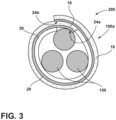
- a bundled cable 200 is provided that includes a multilayer wrap 100a (see also FIG. 2 ) and a plurality of cables 150.
- the multilayer wrap 100a depicted in FIG. 3 is the same as the wrap 100a depicted in FIG. 2 .
- like-numbered elements in each of the figures have the same or substantially similar structure and function and the multilayer wrap 100a in FIG. 3 exhibits the same abrasion resistance and sound damping properties as the multilayer wrap 100a shown in FIG. 2 .
- embodiments of the bundled cable 200 are configured such that the first and second portions 24a, 24b of the adhesive layer 20 of the wrap 100a are configured such that the second portion 24b is longer than the first portion 24a.
- the multilayer wrap 100a is arranged to bundle the plurality of cables 150.
- the first portion 24a of the adhesive layer 20 is in contact with one or more of the plurality of cables 150 (e.g., to adhere the adhesive layer 20 to the cables 150).
- the second portion 24b of the adhesive layer 20 of the wrap 100a is wrapped around the plurality of cables 150 and attached to a portion of the outermost layer 10 (e.g., to adhere the adhesive layer 20 to the outermost layer 10, thus securing the cables 150 within the wrap 100a).
- the first portion 24a of the adhesive layer 20 is in contact with one or more of the plurality of cables 150 (e.g., to adhere the adhesive layer 20 to the cables 150).
- the second portion 24b of the adhesive layer 20 of the wrap 100a is wrapped around the plurality of cables 150 and attached to a portion of the outermost layer 10 (e.g., to adhere the adhesive layer 20 to the outermost layer 10, thus securing the cables 150 within the wrap 100a).
- embodiments of the bundled cable 200 are configured such that the second portion 24b of the adhesive layer 20 of the wrap 100a is placed in contact with a portion of the outermost layer 10 that resides above the first portion 24a of the adhesive layer. According to other implementations of the bundled cable 200 (not shown), the second portion 24b is adhered to another portion of the outermost layer 10 that does not reside above the first portion 24a of the adhesive layer 20. As would be understood by those with ordinary skill in the field of the disclosure, other configurations of the bundled cable 200 are envisioned that are consistent with concepts elucidated above and shown in exemplary form in FIG. 3 .
- various configurations of wrap for bundling of cable according to aspects of the disclosure and consistent with the multilayer wrap 100 (see FIG. 1 ), have been prepared.
- the "outermost layer” corresponds to an outermost layer of the wrap (e.g., as consistent with the outermost layer 10) and the “innermost layer” corresponds to an innermost layer (e.g., as consistent with the innermost layer 30) of the wrap.
- the "PET” is a PET cloth
- the "210 ⁇ m fleece” is a fleece layer having a thickness of 210 ⁇ m and a polyester composition
- the "540 ⁇ m fleece” is a fleece layer having a thickness of 540 ⁇ m and a polyester composition
- the "velour” is a velour textile having a polyamide composition
- “polyamide” is a polyamide cloth.
- the "outermost layer” (e.g., as comparable to the outermost layer 10 shown in FIG. 1 ) of the multilayer wrap configurations is PET tape, 210 ⁇ m thick fleece, 540 ⁇ m thick fleece, velour or polyamide.
- the "innermost layer” (e.g., as comparable to the innermost layer 30 shown in FIG. 1 ) of the multilayer wrap configurations is PET cloth, 210 ⁇ m thick fleece, 540 ⁇ m thick fleece, velour or polyamide.
- each of the tested multilayer wrap combinations exhibits a combination of both abrasion resistance and sound damping.
- Table 1 A lists the abrasion results
- Table 1 B lists the damping results associated with the samples of this example.
- the abrasion testing was measured according to the ISO 6722 and LV 312 Standards, and the number of abrasion strokes is reported from the testing of each of three samples from each Sample ID configuration. Further, an average number of abrasion strokes from each Sample ID configuration is reported, along with resulting abrasion class according to the LV 312 Standard.
- a theoretical number of abrasion strokes and abrasion class is reported for each Sample ID configuration, as calculated based on the summation of the reported abrasion strokes associated with each individual layer of a given Sample ID configuration.
- Table 1 B the damping testing was measured according to the LV 312 Standard, and the damping in decibels (dB) is reported from the testing of each of three samples from each Sample ID configuration. Further, an average damping from each Sample ID configuration is reported, along with the damping class according to the LV 312 Standard,
- each tested multilayer wrap configuration exhibited average abrasion resistance levels as measured under the ISO 6722 and LV 312 Standards in excess of the theoretical abrasion resistance level for that configuration. That is, each of the combinations demonstrated superior abrasion resistance than what would otherwise be expected by summing the abrasion resistance levels exhibited by their respective individual layers.
- certain multilayer wrap configurations employing PET tape, polyamide or velour as the outermost layer with fleece or velour as the innermost layer i.e., Sample IDs C, G, H and I
- Sample IDs C, G, H and I demonstrate relatively high average abrasion resistance levels in excess of 10000 strokes.
- each tested multilayer wrap configuration exhibited an average damping of at least about 3 dB with a damping class of B or greater, as measured under the LV 312 Standard.
- certain multilayer wrap configurations employing PET tape, polyamide or velour as the outermost layer with fleece or velour as the innermost layer i.e., Sample IDs C, E, G, H and I
- Sample IDs C, E, G, H and I demonstrate relatively high damping levels in excess of about 13 dB.
- each of the multilayer wrap combinations was measured with an abrasion resistance of 1000 abrasion strokes and sound damping of at least 2 dB, as measured according to the LV 312 and ISO 6722 Standards.
- the combinations of PET tape/velour, velour/540 ⁇ m fleece and polyamide/velour i.e., Sample IDs C, G and I
- Sample IDs C, G and I result in a particularly advantageous combination of abrasion resistance and sound damping. That is, these combinations were measured with an abrasion resistance of at least 10000 abrasion strokes and a sound damping of at least 18 dB, as measured according to the LV 312 and ISO 6722 Standards.
- the multilayer wrap comprises an abrasion resistance of at least 1000 strokes and a damping resistance of at least 2 dB of attenuation, as measured under the ISO 6722 and LV 312 Standards.
- a wrap for bundling cable wherein a portion of the adhesive layer is in contact with the innermost layer and exposed adjacent to the outermost layer, and further wherein the wrap is configured for longitudinal bundling of cable.
- a bundled cable comprises a plurality of cables; and a multilayer wrap arranged to bundle the plurality of cables.
Landscapes
- Engineering & Computer Science (AREA)
- Textile Engineering (AREA)
- Mechanical Engineering (AREA)
- Insulated Conductors (AREA)
- Laminated Bodies (AREA)
- Details Of Indoor Wiring (AREA)
- Package Frames And Binding Bands (AREA)
Description
- The present disclosure relates generally to wrap and tapes for bundling of cable, wires, cords and similar structures. More particularly, the disclosure relates to multilayer wrap and tapes for bundling of cable, wires and cords, along with bundled cable, for vehicular applications.
- In many industry segments, including the automotive industry, bundles of one or more wires, electrical lines, cords and other similar structures are wrapped either before installation or in situ, for packaging and space efficiency. That is, the wrap of these wires results in a smaller form factor as compared to a form factor of the wires without the wrap. Another function of such wrap for bundling of cable is to provide a protective function, e.g., abrasion and wear resistance. For example, in many applications, the wires bundled by the wrap are subjected to movement relative to one another (or other features within the structure housing them) from application-related motion and vibration that can lead to wear and deterioration. Another function of the wrap is to provide sound damping, particularly for wrap employed in vehicular and other applications that can result in significant motion of the wires bundled by the wrap.
- Wrap and tapes with particular compositions and configurations are available with relatively high abrasion and wear resistance. These types of wrap can be employed in vehicular applications, such as within engine compartments that experience high levels of application-related motion and vibration. On the other hand, these conventional wrap and tapes typically suffer from low sound damping resistance.
- Other wrap and tapes with certain compositions and configurations are available with relatively high sound damping and noise suppression. These types of wrap can also be employed in many vehicular applications, typically those in close proximity to occupants of the vehicle susceptible to noise associated with relative movement of components within the vehicle. Nevertheless, these conventional wrap and tapes generally suffer from relatively low abrasion and wear resistance.
- Many vehicular applications, and other industrial applications, are such that wrap and tapes for bundling of wires, cable and the like are subjected to significant vibration and motion, which can lead to wear and unacceptable levels of vibration-induced noise. Accordingly, there is a need for wrap for bundling of cable with a combination of wear resistance and noise damping characteristics. There is also a need for low cost and efficient methods of making such wrap.
US 2015/298422 A1 discloses a highly abrasion-resistant technical adhesive tape, in particular an adhesive tape which can be rolled into an adhesive tape roll, preferably a cable winding tape, comprising a strip-shaped double-layer substrate with a pressure-sensitive adhesive coating on one side, a first textile layer composed of a fabric and a second textile layer composed of a fabric, the first and second textile layers being firmly connected to each other over the entire surface by an adhesive connection layer, wherein the fabric of the first textile layer and the fabric of the second textile layer each have a basis weight in the range from 50 g/m2 to 300 g/m2 , wherein the adhesive connection layer has a basis weight in the range from 50 g/m2 to 300 g/m2 , and wherein the adhesive tape has a thickness of at least 0.50 mm and at least one tape edge is shaped as a pattern deviating from a straight line, which is structured using a separating process. - According to some aspects of the present disclosure, a wrap for bundling cable is provided. The wrap comprises a multilayer wrap that comprises: (a) an outermost layer comprising a first polymer textile; (b) an innermost layer comprising a second polymer textile; and (c) an adhesive layer between the outermost and innermost layers. The first and second textiles differ from one another. Further, the multilayer wrap comprises an abrasion resistance that exceeds an abrasion resistance of the innermost and outermost layers alone, as measured under the ISO 6722 Standard. In addition, the multilayer wrap comprises a damping resistance of at least class B, as measured under the LV 312 Standard, wherein the first polymer textile of the outermost layer is a cloth comprising polyethylene terephthalate (PET), polyester, polyamide or a combination thereof, having a basis weight of 100 g/m2 to 400 g/m2 and a thickness of 150 µm to 350 µm, wherein the second polymer textile of the innermost layer is a fleece, having a basis weight of 50 g/m2 to 250 g/m2 and a thickness of 150 µm to 600 µm..
- According to some aspects of the present disclosure, a wrap for bundling cable is provided. The wrap comprises a multilayer wrap that comprises: (a) an outermost layer comprising a first polymer textile; (b) an innermost layer comprising a second polymer textile; and (c) an adhesive layer between the outermost and innermost layers. The first and second textiles differ from one another. Further, the multilayer wrap comprises an abrasion resistance that exceeds an abrasion resistance of the innermost and outermost layers alone, as measured under the ISO 6722 Standard. The multilayer wrap comprises a damping resistance of at least class B, as measured under the LV 312 Standard, wherein the first polymer textile of the outermost layer is a cloth comprising polyethylene terephthalate (PET), polyester, polyamide or a combination thereof, having a basis weight of 100 g/m2 to 400 g/m2 and a thickness of 150 µm to 350 µm, wherein the second polymer textile of the innermost layer is a fleece, having a basis weight of 50 g/m2 to 250 g/m2 and a thickness of 150 µm to 600 µm. Further, a portion of the adhesive layer is in contact with the innermost layer and exposed adjacent to the outermost layer. In addition, the wrap is configured for longitudinal bundling of cable.
- According to some aspects of the present disclosure, a bundled cable is provided. The cable comprises a plurality of cables; and a multilayer wrap arranged to bundle the plurality of cables. The wrap comprises: (a) an outermost layer comprising a first polymer textile; (b) an innermost layer comprising a second polymer textile; and (c) an adhesive layer between the outermost and innermost layers. The first and second textiles differ from one another. Further, the multilayer wrap comprises an abrasion resistance that exceeds an abrasion resistance of the innermost and outermost layers alone, as measured under the ISO 6722 Standard. The multilayer wrap comprises a damping resistance of at least class B, as measured under the LV 312 Standard, wherein the first polymer textile of the outermost layer is a cloth comprising polyethylene terephthalate (PET), polyester, polyamide or a combination thereof, having a basis weight of 100 g/m2 to 400 g/m2 and a thickness of 150 µm to 350 µm, wherein the second polymer textile of the innermost layer is a fleece, having a basis weight of 50 g/m2 to 250 g/m2 and a thickness of 150 µm to 600 µm. Further, a first portion of the adhesive layer is in contact with at least one of the plurality of cables and a second portion of the adhesive layer is in contact with the outermost layer.
- Additional features and advantages will be set forth in the detailed description which follows, and will be readily apparent to those skilled in the art from that description or recognized by practicing the embodiments as described herein, including the detailed description which follows, the claims, as well as the appended drawings.
- It is to be understood that both the foregoing general description and the following detailed description describe various embodiments and are intended to provide an overview or framework to understanding the nature and character of the claimed subject matter.
- The accompanying drawings are included to provide a further understanding of the various embodiments, and are incorporated into and constitute a part of this specification. The drawings illustrate the various embodiments described herein, and together with the description serve to explain the principles and operation of the claimed subject matter.
- The following is a description of the figures in the accompanying drawings. The figures are not necessarily to scale, and certain features and certain views of the figures may be shown exaggerated in scale or in schematic in the interest of clarity and conciseness.
- In the drawings:
-
FIG. 1 is a schematic cross-sectional view of a wrap for bundling cable, according to an embodiment of the disclosure. -
FIG. 2 is a schematic cross-sectional view of a wrap for bundling cable, according to another embodiment of the disclosure -
FIG. 3 is a schematic cross-sectional view of a bundled cable, according to a further embodiment of the disclosure. - The foregoing summary, as well as the following detailed description of certain inventive techniques, will be better understood when read in conjunction with the figures. It should be understood that the claims are not limited to the arrangements and instrumentality shown in the figures. Furthermore, the appearance shown in the figures is one of many ornamental appearances that can be employed to achieve the stated functions of the apparatus.
- Additional features and advantages will be set forth in the detailed description which follows and will be apparent to those skilled in the art from the description, or recognized by practicing the embodiments as described in the following description, together with the claims and appended drawings.
- As used herein, the term "and/or," when used in a list of two or more items, means that any one of the listed items can be employed by itself, or any combination of two or more of the listed items can be employed. For example, if a composition is described as containing components A, B, and/or C, the composition can contain A alone; B alone; C alone; A and B in combination; A and C in combination; B and C in combination; or A, B, and C in combination.
- In this document, relational terms, such as first and second, top and bottom, and the like, are used solely to distinguish one entity or action from another entity or action, without necessarily requiring or implying any actual such relationship or order between such entities or actions.
- Modifications of the disclosure will occur to those skilled in the art and to those who make or use the disclosure. Therefore, it is understood that the embodiments shown in the drawings and described above are merely for illustrative purposes and not intended to limit the scope of the disclosure, which is defined by the following claims, as interpreted according to the principles of patent law, including the doctrine of equivalents.
- For purposes of this disclosure, the term "coupled" (in all of its forms: couple, coupling, coupled, etc.) generally means the joining of two components (electrical or mechanical) directly or indirectly to one another. Such joining may be stationary in nature or movable in nature. Such joining may be achieved with the two components (electrical or mechanical) and any additional intermediate members being integrally formed as a single unitary body with one another or with the two components. Such joining may be permanent in nature, or may be removable or releasable in nature, unless otherwise stated.
- As used herein, the term "about" means that amounts, sizes, formulations, parameters, and other quantities and characteristics are not and need not be exact, but may be approximate and/or larger or smaller, as desired, reflecting tolerances, conversion factors, rounding off, measurement error and the like, and other factors known to those of skill in the art. When the term "about" is used in describing a value or an end-point of a range, the disclosure should be understood to include the specific value or end-point referred to. Whether or not a numerical value or end-point of a range in the specification recites "about," the numerical value or end-point of a range is intended to include two embodiments: one modified by "about," and one not modified by "about." It will be further understood that the end-points of each of the ranges are significant both in relation to the other end-point, and independently of the other end-point.
- The terms "substantial," "substantially," and variations thereof as used herein are intended to note that a described feature is equal or approximately equal to a value or description. For example, a "substantially planar" surface is intended to denote a surface that is planar or approximately planar. Moreover, "substantially" is intended to denote that two values are equal or approximately equal. In some embodiments, "substantially" may denote values within about 10% of each other, such as within about 5% of each other, or within about 2% of each other.
- Directional terms as used herein-for example up, down, right, left, front, back, top, bottom-are made only with reference to the figures as drawn and are not intended to imply absolute orientation.
- As used herein the terms "the," "a," or "an," mean "at least one," and should not be limited to "only one" unless explicitly indicated to the contrary. Thus, for example, reference to "a component" includes embodiments having two or more such components unless the context clearly indicates otherwise.
- Referring to the drawings in general and to
FIG. 1 in particular, it will be understood that the illustrations are for the purpose of describing particular embodiments and are not intended to limit the disclosure appended claims thereto. The drawings are not necessarily to scale, and certain features and certain views of the drawings may be shown exaggerated in scale or in schematic form in the interest of clarity and conciseness. - Described in this disclosure are wrap for bundling of cable and bundled cable that comprise a multilayer wrap with an outermost layer, an innermost layer and an adhesive layer between the innermost and outermost layers. Further, the wrap and bundled cable can be characterized by a combination of abrasion resistance and damping resistance. In addition, the multilayer wrap of these wrap and bundled cable aspects can comprise an abrasion resistance that exceeds an abrasion resistance of the innermost and outermost layers alone.
- There are various advantages associated with the wrap for bundled cable aspects and the bundled cable aspects of the disclosure. Foremost, embodiments of these wrap and bundled cables can possess a superior combination of abrasion resistance and sound damping characteristics. Accordingly, these wrap and bundled cables can be employed in industrial applications requiring such a combination of properties. These applications include, but are not limited to, automobile applications in proximity to the engine compartment and passenger compartment, such as wire and electrical connections in proximity to the firewall that separates these compartments. In some cases, these wrap and bundled cables can be employed in applications requiring at least Class B sound damping under the LV 312 Standard, and Class D abrasion resistance under the ISO 6722 and LV 312 Standards.
- Another advantage of these wrap and bundled cables is that their superior combination of abrasion resistance and damping properties allows their use across a wide array of application environments. As a result, these wrap and bundled cable can be employed by an assembler without the need to select between different types of wrap and bundled cable, depending upon the particular abrasion resistance and/or damping requirements of a given application. Accordingly, manufacturing-related costs can be reduced through the use of the wrap and bundled cable of the disclosure.
- Referring now to
FIG. 1 , awrap 100 for bundling cable is provided. Thewrap 100 depicted in exemplary form inFIG. 1 is a multilayer wrap that comprises: (a) anoutermost layer 10 comprising a first polymer textile; (b) aninnermost layer 30 comprising a second polymer textile; and (c) anadhesive layer 20 between the outermost andinnermost layers FIG. 1 , theinnermost layer 10 has athickness 12, theoutermost layer 30 has athickness 32 and theadhesive layer 20 has athickness 22. Further, the first and second textiles differ from one another. In addition, themultilayer wrap 100 comprises an abrasion resistance that exceeds an abrasion resistance of the innermost andoutermost layers multilayer wrap 100 comprises a damping resistance of at least class B, as measured under the LV 312 Standard. - Referring again to
FIG. 1 , the polymer textiles of the outermost andinnermost layers multilayer wrap 100 can, according to some embodiments, comprise one or more of a cloth, a velour, a fleece and a non-woven. Accordingly, the polymer textiles employed by themultilayer wrap 100 can comprise various fabrics, weaves and non-woven arrangements of their fiber and associated materials. Further, each of the polymer textiles can be fabricated from polyethylene terephthalate (PET), polyester, polyolefin, polyamide, and combinations of these materials. In certain implementations of themultilayer wrap 100 depicted inFIG. 1 , the polymer textiles of one or both of the outermost andinnermost layers - According to an implementation of the
wrap 100, the polymer textile of theoutermost layer 10 is a cloth. Further, the polymer textile of theoutermost layer 10 can be fabricated from a PET material, a polyester material, a polyamide material and combinations of these materials. According to another implementation of thewrap 100, the polymer textile of theinnermost layer 30 is a fleece. Further, the polymer textile of theinnermost layer 30 can, in some embodiments, be fabricated from a polyamide material. - Referring again to the
multilayer wrap 100 depicted inFIG. 1 , the polymer textiles employed for the outermost andinnermost layers wrap 100. Further, the abrasion resistance of thewrap 100 tends to exceed the abrasion resistance of each of the outermost andinnermost layers - According to some embodiments, the polymer textiles employed for the outermost and
innermost layers FIG. 1 ) are configured to have certain densities (also referred to herein as "basis weight"). Theoutermost layer 10 has a basis weight from about 100 g/m2 to about 400 g/m2. Theinnermost layer 30 has a basis weight from about 50 g/m2 to about 250 g/m2. - According to an implementation of the wrap 100 (see
FIG. 1 ), thethickness 12 of theoutermost layer 10 ranges from about 150 µm to about 350 µm. According to another implementation of thewrap 100, thethickness 32 of theinnermost layer 30 ranges from about 150 µm to about 600 µm. - Referring to
FIG. 1 , theadhesive layer 20 of themultilayer wrap 100 can comprise any of various viscoelastic adhesive compositions as understood by those of ordinary skill in the field of the disclosure. According to some embodiments, theadhesive layer 20 includes an acrylate-based adhesive, a polyacrylate-based adhesive, a silicone-based adhesive, a synthetic rubber-based adhesive, a natural rubber-based adhesive or a combination of these adhesives. Further, embodiments of theadhesive layer 20 can incorporate one or more backing layers on either or both sides of the adhesive. These backing layers can be fabricated from one or more polymeric materials including polyvinyl chloride (PVC), polyethylene, polypropylene, and polyester. In a preferred embodiment, theadhesive layer 20 includes an acrylate-based adhesive. - Referring again to the
multilayer wrap 100 depicted inFIG. 1 , thethickness 22 of the adhesive layer can range from about 50 µm to about 1000 µm, from about 50 µm to about 900 µm, from about 50 µm to about 800 µm, from about 50 µm to about 700 µm, from about 50 µm to about 600 µm, from about 50 µm to about 500 µm, from about 100 µm to about 1000 µm, from about 100 µm to about 900 µm, from about 100 µm to about 800 µm, from about 100 µm to about 700 µm, from about 100 µm to about 600 µm, from about 100 µm to about 500 µm, from about 150 µm to about 1000 µm, from about 150 µm to about 900 µm, from about 150 µm to about 800 µm, from about 150 µm to about 700 µm, from about 150 µm to about 600 µm, from about 150 µm to about 500 µm, from about 150 µm to about 450 µm, from about 150 µm to about 400 µm, from about 150 µm to about 350 µm, from about 150 µm to about 300 µm, and all thickness values between these thickness range endpoints. - According to some embodiments, the
multilayer wrap 100 can be characterized by an abrasion resistance of at least 1000 abrasion strokes according to the LV 312 Standard, "Adhesive tapes for cable sets in motor vehicles" (January 2005), employed by various automakers (e.g., Audi, BMW, Volkswagen, etc.) ("LV 312 Standard"), and as measured by the ISO 6722 Standard. According to an embodiment, themultilayer wrap 100 can be characterized by an abrasion resistance of Class D (1000-4999 abrasion strokes), Class E (5000-14999 abrasion strokes), Class F (15000-29999 abrasion strokes) or even Class G (2: 30000 abrasion strokes), according to the LV 312 Standard, and as measured by the ISO 6722 Standard. In some implementations, themultilayer wrap 100 can exhibit an abrasion resistance of at least 1000 abrasion strokes, at least 2000 abrasion strokes, at least 3000 abrasion strokes, at least 4000 abrasion strokes, at least 5000 abrasion strokes, at least 7500 abrasion strokes, at least 10000 abrasion strokes, at least 20000 abrasion strokes, at least 30000 abrasion strokes, at least 40000 abrasion strokes, at least 50000 abrasion strokes, and even higher levels of abrasion resistance, according to the LV 312 Standard and as measured by the ISO 6722 Standard. - In some implementations of the
multilayer wrap 100 depicted inFIG. 1 , the wrap is characterized by a sound damping of at least 2 dB according to the LV 312 Standard. Further, in some aspects, the sound damping of themultilayer wrap 100 can be characterized as being in Class B, Class C, Class D, and even Class E, according to the LV 312 Standards. According to embodiments of the disclosure, themultilayer wrap 100 is characterized by a sound damping of at least 2 dB, of at least 3 dB, of at least 4 dB, of at least 5 dB, of at least 10 dB, of at least 15 dB, of at least 20 dB, of at least 25 dB, of at least 30 dB, of at least 35 dB, of at least 40 dB, of at least 45 dB, of at least 50 dB, and all levels of damping between these lower thresholds, as measured according to the LV 312 Standard. - As noted earlier, the
multilayer wrap 100 depicted inFIG. 1 can be characterized by a combination of both good abrasion resistance and sound damping properties. Accordingly, embodiments of themultilayer wrap 100 depicted inFIG. 1 can exhibit an abrasion resistance of 1000 abrasion strokes and sound damping of at least 2 dB, as measured according to the LV 312 Standard. In some aspects, embodiments of themultilayer wrap 100 can exhibit an abrasion resistance of Class D, Class E, Class F, or Class G while maintaining a sound damping of at least 2 dB, as measured under the LV 312 Standard. In another aspect of the disclosure, embodiments of themultilayer wrap 100 can exhibit an abrasion resistance of Class D, Class E, Class F, or Class G while maintaining a sound damping of at least 10 dB, as measured under the LV 312 Standard. - As used herein, "abrasion resistance" is measured according to the ISO 6722 Standard and classified under the LV 312 Standard. In particular, abrasion is tested according to the ISO 6722 Standard by scraping a mandrel with a diameter of 5 mm across a multilayer tape sample until failure of the sample. Each scrape back and forth is defined as a stroke and can be grouped according to various Classes (e.g., Class A, Class B, etc.), according to the LV 312 Standard. Further, unless otherwise noted, all abrasion resistance values reported in the disclosure refer to an average number of abrasion strokes before failure for a particular sample configuration.
- As also used herein, "sound damping" is measured according to the LV 312 Standard, and referenced in that standard as "acoustic insulation" or "noise attenuation". Unless otherwise noted, all sound damping values reported in the disclosure are given in units of decibels "dB" and refer to an average dB difference between a test rod with no covering and the same test rod covered with the sample.
- Referring now to
FIG. 2 , anexemplary multilayer wrap 100a for bundling cable is provided. Unless otherwise noted, themultilayer wrap 100a depicted inFIG. 2 is similar to thewrap 100 depicted inFIG. 1 . As such, like-numbered elements in each of the figures have the same or substantially similar structure and function and themultilayer wrap 100a exhibits the same abrasion resistance and sound damping properties as the multilayer wrap 100 (seeFIG. 1 ). Thewrap 100a depicted in exemplary form inFIG. 2 is a multilayer wrap that comprises: (a) anoutermost layer 10 comprising a first polymer textile; (b) aninnermost layer 30 comprising a second polymer textile; and (c) anadhesive layer 20 between the outermost andinnermost layers FIG. 2 , theinnermost layer 10 has athickness 12, theoutermost layer 30 has athickness 32 and theadhesive layer 20 has athickness 22. Further, the first and second textiles differ from one another. In addition, themultilayer wrap 100a comprises an abrasion resistance that exceeds an abrasion resistance of the innermost andoutermost layers multilayer wrap 100a comprises a damping resistance of at least class B, as measured under the LV 312 Standard. - Referring again to
FIG. 2 , themultilayer wrap 100a for bundling of cable is further configured for longitudinal bundling of cable. As such, themultilayer wrap 100a can be employed to bundle or wrap cable in a longitudinal fashion, without the need for a spiral wrapping methodology. More particularly, afirst portion 24a and asecond portion 24b of theadhesive layer 20 are in contact with theinnermost layer 30. Further, the first andsecond portions adhesive layer 20 are exposed adjacent to theoutermost layer 10. As such, the first andsecond portions adhesive layer 20 are not covered or otherwise in contact with theoutermost layer 10. In embodiments of themultilayer wrap 100a, thewrap 100a can be longitudinally wrapped around cable, wire or the like such that theinnermost layer 10 is in substantial contact with the cable, wire or the like and the first andsecond portions wrap 100a around the cable, wire or the like. According to some implementations of thewrap 100a, the lengths of the first andsecond portions wrap 100a, thewrap 100a includes a single exposed portion of the adhesive layer 20 (e.g., 24a or 24b as shown inFIG. 2 ) or more than two exposed portions of the adhesive layer 20 (not shown). - Referring now to
FIG. 3 , a bundledcable 200 is provided that includes amultilayer wrap 100a (see alsoFIG. 2 ) and a plurality ofcables 150. Unless otherwise noted, themultilayer wrap 100a depicted inFIG. 3 is the same as thewrap 100a depicted inFIG. 2 . As such, like-numbered elements in each of the figures have the same or substantially similar structure and function and themultilayer wrap 100a inFIG. 3 exhibits the same abrasion resistance and sound damping properties as themultilayer wrap 100a shown inFIG. 2 . Further, embodiments of the bundledcable 200 are configured such that the first andsecond portions adhesive layer 20 of thewrap 100a are configured such that thesecond portion 24b is longer than thefirst portion 24a. Referring again to the bundledcable 200, themultilayer wrap 100a is arranged to bundle the plurality ofcables 150. In particular, thefirst portion 24a of theadhesive layer 20 is in contact with one or more of the plurality of cables 150 (e.g., to adhere theadhesive layer 20 to the cables 150). Further, thesecond portion 24b of theadhesive layer 20 of thewrap 100a is wrapped around the plurality ofcables 150 and attached to a portion of the outermost layer 10 (e.g., to adhere theadhesive layer 20 to theoutermost layer 10, thus securing thecables 150 within thewrap 100a). As shown inFIG. 3 , embodiments of the bundledcable 200 are configured such that thesecond portion 24b of theadhesive layer 20 of thewrap 100a is placed in contact with a portion of theoutermost layer 10 that resides above thefirst portion 24a of the adhesive layer. According to other implementations of the bundled cable 200 (not shown), thesecond portion 24b is adhered to another portion of theoutermost layer 10 that does not reside above thefirst portion 24a of theadhesive layer 20. As would be understood by those with ordinary skill in the field of the disclosure, other configurations of the bundledcable 200 are envisioned that are consistent with concepts elucidated above and shown in exemplary form inFIG. 3 . - The following examples describe various features and advantages provided by the disclosure, and are in no way intended to limit the invention and appended claims.
- In this example, various configurations of wrap for bundling of cable, according to aspects of the disclosure and consistent with the multilayer wrap 100 (see
FIG. 1 ), have been prepared. As listed in Tables 1 A and 1B, the "outermost layer" corresponds to an outermost layer of the wrap (e.g., as consistent with the outermost layer 10) and the "innermost layer" corresponds to an innermost layer (e.g., as consistent with the innermost layer 30) of the wrap. Further, the "PET" is a PET cloth; the "210 µm fleece" is a fleece layer having a thickness of 210 µm and a polyester composition; the "540 µm fleece" is a fleece layer having a thickness of 540 µm and a polyester composition; the "velour" is a velour textile having a polyamide composition; and "polyamide" is a polyamide cloth. Each of the combinations, designated as Sample IDs "A" through "I", was laminated together by placing an acrylate adhesive on the designated "outermost layer" and pressing the outermost layer with adhesive onto the "innermost layer". - As noted in Tables 1A and 1B, the "outermost layer" (e.g., as comparable to the
outermost layer 10 shown inFIG. 1 ) of the multilayer wrap configurations is PET tape, 210 µm thick fleece, 540 µm thick fleece, velour or polyamide. As also noted in Tables 1A and 1B, the "innermost layer" (e.g., as comparable to theinnermost layer 30 shown inFIG. 1 ) of the multilayer wrap configurations is PET cloth, 210 µm thick fleece, 540 µm thick fleece, velour or polyamide. In addition, each of the multilayer wrap configurations listed in Tables 1A and 1B included an acrylate adhesive (e.g., as comparable to theadhesive layer 20 shown inFIG. 1 ).TABLE 1 A - Abrasion Results Sample ID Outermost layer Innermost Layer Abrasion (strokes) Avg. (strokes) Class Theor. Abrasion (strokes) Theor. Abrasion Class A PET 210µm fleece 2311 2463 2602 2459 D 1422 D B PET 540µm fleece 5162 6153 4978 5431 E 1949 D C PET Velour 11520 17841 13390 14250 E 4634 D D Polyamide PET 44145 46478 38728 43117 G 21164 F E Velour 210µm fleece 6886 7825 9333 8015 E 3328 D F Polyamide 210µm fleece 21860 22537 18531 20976 F 19858 F G Velour 540µm fleece 11113 10159 8696 9989 E 3855 D H Polyamide 540µm fleece 23532 17441 22445 21139 F 20385 F I Polyamide Velour 43832 55725 52596 50718 G 23070 F TABLE 1B - Damping Results Sample ID Outermost layer Innermost Layer Damping (dB) Avg (dB) Damping Class A PET 210µm fleece 8.1 6.6 9.6 8.1 C B PET 540µm fleece 12.4 11.5 11.3 11.7 D C PET Velour 20.7 20.2 20.2 20.4 E D Polyamide PET 2.8 3.2 2 2.7 B E Velour 210µm fleece 20.6 18.4 18.3 19.1 E F Polyamide 210µm fleece 6.9 5.8 5.3 6 C G Velour 540µm fleece 19.4 17.5 17.3 18.1 E H Polyamide 540µm fleece 13.2 12.7 12.7 12.9 D I Polyamide Velour 20.7 20.2 20.3 20.4 E - As is evident from Tables 1 A and 1 B, each of the tested multilayer wrap combinations exhibits a combination of both abrasion resistance and sound damping. In particular, Table 1 A lists the abrasion results and Table 1 B lists the damping results associated with the samples of this example. In Table 1 A, the abrasion testing was measured according to the ISO 6722 and LV 312 Standards, and the number of abrasion strokes is reported from the testing of each of three samples from each Sample ID configuration. Further, an average number of abrasion strokes from each Sample ID configuration is reported, along with resulting abrasion class according to the LV 312 Standard. In addition, a theoretical number of abrasion strokes and abrasion class is reported for each Sample ID configuration, as calculated based on the summation of the reported abrasion strokes associated with each individual layer of a given Sample ID configuration. As for Table 1 B, the damping testing was measured according to the LV 312 Standard, and the damping in decibels (dB) is reported from the testing of each of three samples from each Sample ID configuration. Further, an average damping from each Sample ID configuration is reported, along with the damping class according to the LV 312 Standard,
- Referring to Table 1 A, it is evident from the data in the table that each tested multilayer wrap configuration exhibited average abrasion resistance levels as measured under the ISO 6722 and LV 312 Standards in excess of the theoretical abrasion resistance level for that configuration. That is, each of the combinations demonstrated superior abrasion resistance than what would otherwise be expected by summing the abrasion resistance levels exhibited by their respective individual layers. Further, certain multilayer wrap configurations employing PET tape, polyamide or velour as the outermost layer with fleece or velour as the innermost layer (i.e., Sample IDs C, G, H and I) demonstrate relatively high average abrasion resistance levels in excess of 10000 strokes.
- Referring to Table 1 B, it is evident from the data in the table that each tested multilayer wrap configuration exhibited an average damping of at least about 3 dB with a damping class of B or greater, as measured under the LV 312 Standard. Further, certain multilayer wrap configurations employing PET tape, polyamide or velour as the outermost layer with fleece or velour as the innermost layer (i.e., Sample IDs C, E, G, H and I) demonstrate relatively high damping levels in excess of about 13 dB.
- As is also evident from Tables 1 A and 1B, each of the multilayer wrap combinations was measured with an abrasion resistance of 1000 abrasion strokes and sound damping of at least 2 dB, as measured according to the LV 312 and ISO 6722 Standards. Further, it is evident from Tables 1 A and 1 B that the combinations of PET tape/velour, velour/540 µm fleece and polyamide/velour (i.e., Sample IDs C, G and I) result in a particularly advantageous combination of abrasion resistance and sound damping. That is, these combinations were measured with an abrasion resistance of at least 10000 abrasion strokes and a sound damping of at least 18 dB, as measured according to the LV 312 and ISO 6722 Standards.
- According to a further aspect, the multilayer wrap comprises an abrasion resistance of at least 1000 strokes and a damping resistance of at least 2 dB of attenuation, as measured under the ISO 6722 and LV 312 Standards.
- According to a further aspect, a wrap for bundling cable is provided, wherein a portion of the adhesive layer is in contact with the innermost layer and exposed adjacent to the outermost layer, and further wherein the wrap is configured for longitudinal bundling of cable.
- According to a further aspect, a bundled cable is provided. The bundle cable comprises a plurality of cables; and a multilayer wrap arranged to bundle the plurality of cables.
Claims (4)
- A wrap for bundling cable, comprising:a multilayer wrap that comprises:(a) an outermost layer comprising a first polymer textile;(b) an innermost layer comprising a second polymer textile; and(c) a single adhesive layer between the outermost and innermost layers,wherein the first and second textiles differ from one another,wherein the multilayer wrap comprises an abrasion resistance that exceeds an abrasion resistance of the innermost and outermost layers alone, as measured under the ISO 6722 Standard, andfurther wherein the multilayer wrap comprises a damping resistance of at least class B, as measured under the LV 312 Standardwherein the first polymer textile of the outermost layer is a cloth comprising polyethylene terephthalate (PET), polyester, polyamide or a combination thereof, having a basis weight of 100 g/m2 to 400 g/m2 and a thickness of 150 µm to 350 µm,wherein the second polymer textile of the innermost layer is a fleece, having a basis weight of 50 g/m2 to 250 g/m2 and a thickness of 150 µm to 600 µm.
- The wrap according to claim 1, wherein the multilayer wrap comprises an abrasion resistance of at least 1000 strokes and a damping resistance of at least 2 dB of attenuation, as measured under the ISO 6722 and LV 312 Standards.
- A wrap according to one of the preceding claims,wherein a portion of the adhesive layer is in contact with the innermost layer and exposed adjacent to the outermost layer, andfurther wherein the wrap is configured for longitudinal bundling of cable.
- A bundled cable, comprising:a plurality of cables; anda multilayer wrap according to one of the preceding claims arranged to bundle the plurality of cables.
Applications Claiming Priority (1)
| Application Number | Priority Date | Filing Date | Title |
|---|---|---|---|
| US15/952,370 US20190318843A1 (en) | 2018-04-13 | 2018-04-13 | Multilayer wrap for bundling of cable and bundled cable |
Publications (3)
| Publication Number | Publication Date |
|---|---|
| EP3552816A1 EP3552816A1 (en) | 2019-10-16 |
| EP3552816B1 true EP3552816B1 (en) | 2025-03-19 |
| EP3552816C0 EP3552816C0 (en) | 2025-03-19 |
Family
ID=66102512
Family Applications (1)
| Application Number | Title | Priority Date | Filing Date |
|---|---|---|---|
| EP19167840.8A Active EP3552816B1 (en) | 2018-04-13 | 2019-04-08 | Multilayer wrap for bundling of cable and bundled cable |
Country Status (4)
| Country | Link |
|---|---|
| US (1) | US20190318843A1 (en) |
| EP (1) | EP3552816B1 (en) |
| JP (1) | JP7306861B2 (en) |
| CN (1) | CN110371342B (en) |
Families Citing this family (4)
| Publication number | Priority date | Publication date | Assignee | Title |
|---|---|---|---|---|
| EP3910761A1 (en) * | 2020-05-15 | 2021-11-17 | Siemens Aktiengesellschaft | Flat insulating fabric of a dynamo-electric machine |
| CN112373165A (en) * | 2020-11-30 | 2021-02-19 | 芜湖航天特种电缆厂股份有限公司 | Self-rolling type braided sleeve for aerospace and preparation method thereof |
| CN113510976A (en) * | 2021-05-31 | 2021-10-19 | 武汉速安达建筑橡塑制品有限公司 | Belt or net based on coated fabric leftover material and preparation device, method and application thereof |
| US11569006B1 (en) * | 2021-08-20 | 2023-01-31 | Tesa Se | Cover for a cable harness with different color layers |
Citations (5)
| Publication number | Priority date | Publication date | Assignee | Title |
|---|---|---|---|---|
| DE10042732A1 (en) * | 2000-08-31 | 2002-03-28 | Tesa Ag | Process for sheathing elongated goods, such as in particular cable sets with an adhesive tape |
| US20040082243A1 (en) | 2000-08-16 | 2004-04-29 | Kuelper Klaus | Adhesive tapes comprising a textile support for enveloping elongated material, particularly looms of cables |
| DE202005013009U1 (en) * | 2005-08-16 | 2005-10-27 | Certoplast Vorwerk & Sohn Gmbh | Adhesive tape for e.g. bundling cables in automobiles has a carrier with a fine web layer with more than 25 filaments per centimeter in both directions |
| US20070173156A1 (en) | 2004-03-04 | 2007-07-26 | Tesa Ag | Highly abrasion-resistant tape for binding cable trees in motor vehicles |
| EP1911824A1 (en) | 2006-10-11 | 2008-04-16 | Coroplast Fritz Müller GmbH & Co. KG | Cable wrapping tape, in particular for the motor area of an automobile |
Family Cites Families (4)
| Publication number | Priority date | Publication date | Assignee | Title |
|---|---|---|---|---|
| US20020098311A1 (en) * | 1999-09-02 | 2002-07-25 | Michael Lindner | Protective sheathing |
| DE102007058460A1 (en) * | 2007-12-04 | 2009-06-10 | Tesa Ag | Noise-damping and highly abrasion-resistant tape, in particular for the bandage of wire harnesses in automobiles |
| DE102014105609A1 (en) * | 2014-04-22 | 2015-10-22 | Coroplast Fritz Müller Gmbh & Co. Kg | Hand tearable fabric tape with high abrasion resistance and noise damping and method of making the same |
| DE102014111494A1 (en) * | 2014-08-12 | 2016-02-18 | Certoplast Vorwerk & Sohn Gmbh | Method for producing a casing for elongated material |
-
2018
- 2018-04-13 US US15/952,370 patent/US20190318843A1/en not_active Abandoned
-
2019
- 2019-04-08 EP EP19167840.8A patent/EP3552816B1/en active Active
- 2019-04-12 JP JP2019076036A patent/JP7306861B2/en active Active
- 2019-04-15 CN CN201910298245.XA patent/CN110371342B/en not_active Ceased
Patent Citations (5)
| Publication number | Priority date | Publication date | Assignee | Title |
|---|---|---|---|---|
| US20040082243A1 (en) | 2000-08-16 | 2004-04-29 | Kuelper Klaus | Adhesive tapes comprising a textile support for enveloping elongated material, particularly looms of cables |
| DE10042732A1 (en) * | 2000-08-31 | 2002-03-28 | Tesa Ag | Process for sheathing elongated goods, such as in particular cable sets with an adhesive tape |
| US20070173156A1 (en) | 2004-03-04 | 2007-07-26 | Tesa Ag | Highly abrasion-resistant tape for binding cable trees in motor vehicles |
| DE202005013009U1 (en) * | 2005-08-16 | 2005-10-27 | Certoplast Vorwerk & Sohn Gmbh | Adhesive tape for e.g. bundling cables in automobiles has a carrier with a fine web layer with more than 25 filaments per centimeter in both directions |
| EP1911824A1 (en) | 2006-10-11 | 2008-04-16 | Coroplast Fritz Müller GmbH & Co. KG | Cable wrapping tape, in particular for the motor area of an automobile |
Non-Patent Citations (3)
| Title |
|---|
| ANONYMOUS: "Schutzsysteme für Leitungssätze in Kraftfahrzeugen - Klebebänder; Prüfrichtlinie", AUDI AG NORMUNG; PRüFRICHTLINIE LV 312-1, 1 January 2014 (2014-01-01), XP093331383 |
| ANONYMOUS: "Self adhesive tapes - Measurement of Thickness - English version of DIN EN 1942:2008-06", DIN EN 1942, 1 June 2008 (2008-06-01), XP093331391 |
| HILMAR FUCHS; WILHELM ALBRECHT: "Vliesstoffe : Rohstoffe, Herstellung, Anwendung, Eigenschaften, Prüfung", 1 January 2012, WILEY-VCH , Weinheim , ISBN: 978-3-527-31519-2, article ALBRECHT, WILHELMERTH, HOLGER: "16 Prüfverfahren", pages: 545 - 580, XP009565027 |
Also Published As
| Publication number | Publication date |
|---|---|
| CN110371342A (en) | 2019-10-25 |
| JP2019206391A (en) | 2019-12-05 |
| EP3552816C0 (en) | 2025-03-19 |
| JP7306861B2 (en) | 2023-07-11 |
| CN110371342B (en) | 2022-02-22 |
| EP3552816A1 (en) | 2019-10-16 |
| US20190318843A1 (en) | 2019-10-17 |
Similar Documents
| Publication | Publication Date | Title |
|---|---|---|
| EP3552816A1 (en) | Multilayer wrap for bundling of cable and bundled cable | |
| CN1946549B (en) | Highly abrasionproof strip for armouring cable harnesses in motorcars | |
| JP5469787B2 (en) | Conductive monofilament and cloth | |
| US11410792B2 (en) | Multicore cable | |
| EP0478784B1 (en) | Cloth adhesive tape for binding wire harness | |
| US10204714B2 (en) | Sheathing for an elongated product and use thereof | |
| US12131847B2 (en) | Multicore cable | |
| JP7038463B2 (en) | Insulated wire | |
| US5698477A (en) | Adhesive cloth tape for a wiring harness | |
| EP0957493A1 (en) | Improved automotive-wire insulation | |
| JP5775753B2 (en) | Impedance adjustment sheet and shielded wiring member | |
| US20200407599A1 (en) | Adhesive cable-wrapping tape | |
| JP2017215176A (en) | Capacitance detection line and applied goods thereof | |
| US11569006B1 (en) | Cover for a cable harness with different color layers | |
| WO2021166874A1 (en) | Wire harness | |
| CN114585702A (en) | Adhesive tape | |
| DE202005021453U1 (en) | High abrasion resistant tape for the bandaging of wire harnesses in automobiles | |
| US12187928B2 (en) | Adhesive tape for wrapping cables | |
| CN210606691U (en) | High-speed motion super-flexible cable | |
| CN110228432B (en) | Self-adhesion braided tube | |
| JP2026511732A (en) | Adhesive tape and covering method for covering long articles, such as cable harnesses in particular. | |
| JPH1166975A (en) | Fire resistant wire | |
| JP2023072237A (en) | Multilayer tape for binding wires, wire bundles, and methods for bonding wire bundles to components | |
| WO2022114090A1 (en) | Wire harness | |
| KR20200091407A (en) | Method for manufacturing lapping of elongated objects |
Legal Events
| Date | Code | Title | Description |
|---|---|---|---|
| PUAI | Public reference made under article 153(3) epc to a published international application that has entered the european phase |
Free format text: ORIGINAL CODE: 0009012 |
|
| STAA | Information on the status of an ep patent application or granted ep patent |
Free format text: STATUS: THE APPLICATION HAS BEEN PUBLISHED |
|
| AK | Designated contracting states |
Kind code of ref document: A1 Designated state(s): AL AT BE BG CH CY CZ DE DK EE ES FI FR GB GR HR HU IE IS IT LI LT LU LV MC MK MT NL NO PL PT RO RS SE SI SK SM TR |
|
| AX | Request for extension of the european patent |
Extension state: BA ME |
|
| TPAC | Observations filed by third parties |
Free format text: ORIGINAL CODE: EPIDOSNTIPA |
|
| STAA | Information on the status of an ep patent application or granted ep patent |
Free format text: STATUS: REQUEST FOR EXAMINATION WAS MADE |
|
| TPAC | Observations filed by third parties |
Free format text: ORIGINAL CODE: EPIDOSNTIPA |
|
| 17P | Request for examination filed |
Effective date: 20200416 |
|
| RBV | Designated contracting states (corrected) |
Designated state(s): AL AT BE BG CH CY CZ DE DK EE ES FI FR GB GR HR HU IE IS IT LI LT LU LV MC MK MT NL NO PL PT RO RS SE SI SK SM TR |
|
| STAA | Information on the status of an ep patent application or granted ep patent |
Free format text: STATUS: EXAMINATION IS IN PROGRESS |
|
| 17Q | First examination report despatched |
Effective date: 20201105 |
|
| TPAC | Observations filed by third parties |
Free format text: ORIGINAL CODE: EPIDOSNTIPA |
|
| GRAP | Despatch of communication of intention to grant a patent |
Free format text: ORIGINAL CODE: EPIDOSNIGR1 |
|
| STAA | Information on the status of an ep patent application or granted ep patent |
Free format text: STATUS: GRANT OF PATENT IS INTENDED |
|
| GRAJ | Information related to disapproval of communication of intention to grant by the applicant or resumption of examination proceedings by the epo deleted |
Free format text: ORIGINAL CODE: EPIDOSDIGR1 |
|
| STAA | Information on the status of an ep patent application or granted ep patent |
Free format text: STATUS: EXAMINATION IS IN PROGRESS |
|
| GRAP | Despatch of communication of intention to grant a patent |
Free format text: ORIGINAL CODE: EPIDOSNIGR1 |
|
| STAA | Information on the status of an ep patent application or granted ep patent |
Free format text: STATUS: GRANT OF PATENT IS INTENDED |
|
| GRAJ | Information related to disapproval of communication of intention to grant by the applicant or resumption of examination proceedings by the epo deleted |
Free format text: ORIGINAL CODE: EPIDOSDIGR1 |
|
| GRAP | Despatch of communication of intention to grant a patent |
Free format text: ORIGINAL CODE: EPIDOSNIGR1 |
|
| INTG | Intention to grant announced |
Effective date: 20240307 |
|
| GRAJ | Information related to disapproval of communication of intention to grant by the applicant or resumption of examination proceedings by the epo deleted |
Free format text: ORIGINAL CODE: EPIDOSDIGR1 |
|
| STAA | Information on the status of an ep patent application or granted ep patent |
Free format text: STATUS: EXAMINATION IS IN PROGRESS |
|
| GRAP | Despatch of communication of intention to grant a patent |
Free format text: ORIGINAL CODE: EPIDOSNIGR1 |
|
| STAA | Information on the status of an ep patent application or granted ep patent |
Free format text: STATUS: GRANT OF PATENT IS INTENDED |
|
| INTG | Intention to grant announced |
Effective date: 20240322 |
|
| GRAJ | Information related to disapproval of communication of intention to grant by the applicant or resumption of examination proceedings by the epo deleted |
Free format text: ORIGINAL CODE: EPIDOSDIGR1 |
|
| STAA | Information on the status of an ep patent application or granted ep patent |
Free format text: STATUS: EXAMINATION IS IN PROGRESS |
|
| INTG | Intention to grant announced |
Effective date: 20240322 |
|
| GRAP | Despatch of communication of intention to grant a patent |
Free format text: ORIGINAL CODE: EPIDOSNIGR1 |
|
| INTG | Intention to grant announced |
Effective date: 20240404 |
|
| STAA | Information on the status of an ep patent application or granted ep patent |
Free format text: STATUS: GRANT OF PATENT IS INTENDED |
|
| INTG | Intention to grant announced |
Effective date: 20240417 |
|
| INTC | Intention to grant announced (deleted) | ||
| INTG | Intention to grant announced |
Effective date: 20240502 |
|
| GRAJ | Information related to disapproval of communication of intention to grant by the applicant or resumption of examination proceedings by the epo deleted |
Free format text: ORIGINAL CODE: EPIDOSDIGR1 |
|
| STAA | Information on the status of an ep patent application or granted ep patent |
Free format text: STATUS: EXAMINATION IS IN PROGRESS |
|
| GRAP | Despatch of communication of intention to grant a patent |
Free format text: ORIGINAL CODE: EPIDOSNIGR1 |
|
| STAA | Information on the status of an ep patent application or granted ep patent |
Free format text: STATUS: GRANT OF PATENT IS INTENDED |
|
| INTC | Intention to grant announced (deleted) | ||
| INTG | Intention to grant announced |
Effective date: 20240906 |
|
| GRAS | Grant fee paid |
Free format text: ORIGINAL CODE: EPIDOSNIGR3 |
|
| GRAA | (expected) grant |
Free format text: ORIGINAL CODE: 0009210 |
|
| STAA | Information on the status of an ep patent application or granted ep patent |
Free format text: STATUS: THE PATENT HAS BEEN GRANTED |
|
| AK | Designated contracting states |
Kind code of ref document: B1 Designated state(s): AL AT BE BG CH CY CZ DE DK EE ES FI FR GB GR HR HU IE IS IT LI LT LU LV MC MK MT NL NO PL PT RO RS SE SI SK SM TR |
|
| REG | Reference to a national code |
Ref country code: GB Ref legal event code: FG4D |
|
| REG | Reference to a national code |
Ref country code: CH Ref legal event code: EP |
|
| REG | Reference to a national code |
Ref country code: IE Ref legal event code: FG4D |
|
| REG | Reference to a national code |
Ref country code: DE Ref legal event code: R096 Ref document number: 602019067390 Country of ref document: DE |
|
| U01 | Request for unitary effect filed |
Effective date: 20250319 |
|
| U07 | Unitary effect registered |
Designated state(s): AT BE BG DE DK EE FI FR IT LT LU LV MT NL PT RO SE SI Effective date: 20250325 |
|
| U20 | Renewal fee for the european patent with unitary effect paid |
Year of fee payment: 7 Effective date: 20250528 |
|
| PG25 | Lapsed in a contracting state [announced via postgrant information from national office to epo] |
Ref country code: RS Free format text: LAPSE BECAUSE OF FAILURE TO SUBMIT A TRANSLATION OF THE DESCRIPTION OR TO PAY THE FEE WITHIN THE PRESCRIBED TIME-LIMIT Effective date: 20250619 |
|
| PG25 | Lapsed in a contracting state [announced via postgrant information from national office to epo] |
Ref country code: NO Free format text: LAPSE BECAUSE OF FAILURE TO SUBMIT A TRANSLATION OF THE DESCRIPTION OR TO PAY THE FEE WITHIN THE PRESCRIBED TIME-LIMIT Effective date: 20250619 |
|
| PG25 | Lapsed in a contracting state [announced via postgrant information from national office to epo] |
Ref country code: HR Free format text: LAPSE BECAUSE OF FAILURE TO SUBMIT A TRANSLATION OF THE DESCRIPTION OR TO PAY THE FEE WITHIN THE PRESCRIBED TIME-LIMIT Effective date: 20250319 |
|
| PG25 | Lapsed in a contracting state [announced via postgrant information from national office to epo] |
Ref country code: GR Free format text: LAPSE BECAUSE OF FAILURE TO SUBMIT A TRANSLATION OF THE DESCRIPTION OR TO PAY THE FEE WITHIN THE PRESCRIBED TIME-LIMIT Effective date: 20250620 |
|
| PG25 | Lapsed in a contracting state [announced via postgrant information from national office to epo] |
Ref country code: SM Free format text: LAPSE BECAUSE OF FAILURE TO SUBMIT A TRANSLATION OF THE DESCRIPTION OR TO PAY THE FEE WITHIN THE PRESCRIBED TIME-LIMIT Effective date: 20250319 |
|
| PG25 | Lapsed in a contracting state [announced via postgrant information from national office to epo] |
Ref country code: ES Free format text: LAPSE BECAUSE OF FAILURE TO SUBMIT A TRANSLATION OF THE DESCRIPTION OR TO PAY THE FEE WITHIN THE PRESCRIBED TIME-LIMIT Effective date: 20250319 |
|
| PG25 | Lapsed in a contracting state [announced via postgrant information from national office to epo] |
Ref country code: PL Free format text: LAPSE BECAUSE OF FAILURE TO SUBMIT A TRANSLATION OF THE DESCRIPTION OR TO PAY THE FEE WITHIN THE PRESCRIBED TIME-LIMIT Effective date: 20250319 |
|
| PLBI | Opposition filed |
Free format text: ORIGINAL CODE: 0009260 |
|
| PG25 | Lapsed in a contracting state [announced via postgrant information from national office to epo] |
Ref country code: CZ Free format text: LAPSE BECAUSE OF FAILURE TO SUBMIT A TRANSLATION OF THE DESCRIPTION OR TO PAY THE FEE WITHIN THE PRESCRIBED TIME-LIMIT Effective date: 20250319 |
|
| REG | Reference to a national code |
Ref country code: CH Ref legal event code: L10 Free format text: ST27 STATUS EVENT CODE: U-0-0-L10-L00 (AS PROVIDED BY THE NATIONAL OFFICE) Effective date: 20251022 |
|
| PG25 | Lapsed in a contracting state [announced via postgrant information from national office to epo] |
Ref country code: SK Free format text: LAPSE BECAUSE OF FAILURE TO SUBMIT A TRANSLATION OF THE DESCRIPTION OR TO PAY THE FEE WITHIN THE PRESCRIBED TIME-LIMIT Effective date: 20250319 |
|
| PG25 | Lapsed in a contracting state [announced via postgrant information from national office to epo] |
Ref country code: IS Free format text: LAPSE BECAUSE OF FAILURE TO SUBMIT A TRANSLATION OF THE DESCRIPTION OR TO PAY THE FEE WITHIN THE PRESCRIBED TIME-LIMIT Effective date: 20250719 |
|
| 26 | Opposition filed |
Opponent name: CERTOPLAST TECHNISCHE KLEBEBAENDER GMBH Effective date: 20251010 |
|
| REG | Reference to a national code |
Ref country code: CH Ref legal event code: H13 Free format text: ST27 STATUS EVENT CODE: U-0-0-H10-H13 (AS PROVIDED BY THE NATIONAL OFFICE) Effective date: 20251125 |
|
| PG25 | Lapsed in a contracting state [announced via postgrant information from national office to epo] |
Ref country code: MC Free format text: LAPSE BECAUSE OF FAILURE TO SUBMIT A TRANSLATION OF THE DESCRIPTION OR TO PAY THE FEE WITHIN THE PRESCRIBED TIME-LIMIT Effective date: 20250319 |
|
| PLAX | Notice of opposition and request to file observation + time limit sent |
Free format text: ORIGINAL CODE: EPIDOSNOBS2 |
|
| PLAS | Information related to reply of patent proprietor to notice(s) of opposition deleted |
Free format text: ORIGINAL CODE: EPIDOSDOBS3 |
|
| PLBB | Reply of patent proprietor to notice(s) of opposition received |
Free format text: ORIGINAL CODE: EPIDOSNOBS3 |
|
| PG25 | Lapsed in a contracting state [announced via postgrant information from national office to epo] |
Ref country code: CH Free format text: LAPSE BECAUSE OF NON-PAYMENT OF DUE FEES Effective date: 20250430 |
|
| GBPC | Gb: european patent ceased through non-payment of renewal fee |
Effective date: 20250619 |
|
| PG25 | Lapsed in a contracting state [announced via postgrant information from national office to epo] |
Ref country code: GB Free format text: LAPSE BECAUSE OF NON-PAYMENT OF DUE FEES Effective date: 20250619 |
|
| PG25 | Lapsed in a contracting state [announced via postgrant information from national office to epo] |
Ref country code: IE Free format text: LAPSE BECAUSE OF NON-PAYMENT OF DUE FEES Effective date: 20250408 |
|
| PLAF | Information modified related to communication of a notice of opposition and request to file observations + time limit |
Free format text: ORIGINAL CODE: EPIDOSCOBS2 |
|
| U20 | Renewal fee for the european patent with unitary effect paid |
Year of fee payment: 8 Effective date: 20260428 |
|
| PG25 | Lapsed in a contracting state [announced via postgrant information from national office to epo] |
Ref country code: CY Free format text: LAPSE BECAUSE OF FAILURE TO SUBMIT A TRANSLATION OF THE DESCRIPTION OR TO PAY THE FEE WITHIN THE PRESCRIBED TIME-LIMIT Effective date: 20250319 |
|
| PLBB | Reply of patent proprietor to notice(s) of opposition received |
Free format text: ORIGINAL CODE: EPIDOSNOBS3 |