EP3551639B1 - Novel chiral dihydrobenzoazaphosphole ligands and synthesis thereof - Google Patents
Novel chiral dihydrobenzoazaphosphole ligands and synthesis thereof Download PDFInfo
- Publication number
- EP3551639B1 EP3551639B1 EP17817612.9A EP17817612A EP3551639B1 EP 3551639 B1 EP3551639 B1 EP 3551639B1 EP 17817612 A EP17817612 A EP 17817612A EP 3551639 B1 EP3551639 B1 EP 3551639B1
- Authority
- EP
- European Patent Office
- Prior art keywords
- mmol
- mhz
- cdcl
- alkyl
- phenyl
- Prior art date
- Legal status (The legal status is an assumption and is not a legal conclusion. Google has not performed a legal analysis and makes no representation as to the accuracy of the status listed.)
- Active
Links
Classifications
-
- C—CHEMISTRY; METALLURGY
- C07—ORGANIC CHEMISTRY
- C07F—ACYCLIC, CARBOCYCLIC OR HETEROCYCLIC COMPOUNDS CONTAINING ELEMENTS OTHER THAN CARBON, HYDROGEN, HALOGEN, OXYGEN, NITROGEN, SULFUR, SELENIUM OR TELLURIUM
- C07F9/00—Compounds containing elements of Groups 5 or 15 of the Periodic Table
- C07F9/02—Phosphorus compounds
- C07F9/547—Heterocyclic compounds, e.g. containing phosphorus as a ring hetero atom
- C07F9/6564—Heterocyclic compounds, e.g. containing phosphorus as a ring hetero atom having phosphorus atoms, with or without nitrogen, oxygen, sulfur, selenium or tellurium atoms, as ring hetero atoms
- C07F9/6581—Heterocyclic compounds, e.g. containing phosphorus as a ring hetero atom having phosphorus atoms, with or without nitrogen, oxygen, sulfur, selenium or tellurium atoms, as ring hetero atoms having phosphorus and nitrogen atoms with or without oxygen or sulfur atoms, as ring hetero atoms
- C07F9/6584—Heterocyclic compounds, e.g. containing phosphorus as a ring hetero atom having phosphorus atoms, with or without nitrogen, oxygen, sulfur, selenium or tellurium atoms, as ring hetero atoms having phosphorus and nitrogen atoms with or without oxygen or sulfur atoms, as ring hetero atoms having one phosphorus atom as ring hetero atom
- C07F9/65842—Cyclic amide derivatives of acids of phosphorus, in which one nitrogen atom belongs to the ring
- C07F9/65844—Cyclic amide derivatives of acids of phosphorus, in which one nitrogen atom belongs to the ring the phosphorus atom being part of a five-membered ring which may be condensed with another ring system
-
- C—CHEMISTRY; METALLURGY
- C07—ORGANIC CHEMISTRY
- C07B—GENERAL METHODS OF ORGANIC CHEMISTRY; APPARATUS THEREFOR
- C07B53/00—Asymmetric syntheses
-
- C—CHEMISTRY; METALLURGY
- C07—ORGANIC CHEMISTRY
- C07F—ACYCLIC, CARBOCYCLIC OR HETEROCYCLIC COMPOUNDS CONTAINING ELEMENTS OTHER THAN CARBON, HYDROGEN, HALOGEN, OXYGEN, NITROGEN, SULFUR, SELENIUM OR TELLURIUM
- C07F15/00—Compounds containing elements of Groups 8, 9, 10 or 18 of the Periodic Table
- C07F15/0006—Compounds containing elements of Groups 8, 9, 10 or 18 of the Periodic Table compounds of the platinum group
- C07F15/0073—Rhodium compounds
-
- C—CHEMISTRY; METALLURGY
- C07—ORGANIC CHEMISTRY
- C07F—ACYCLIC, CARBOCYCLIC OR HETEROCYCLIC COMPOUNDS CONTAINING ELEMENTS OTHER THAN CARBON, HYDROGEN, HALOGEN, OXYGEN, NITROGEN, SULFUR, SELENIUM OR TELLURIUM
- C07F9/00—Compounds containing elements of Groups 5 or 15 of the Periodic Table
- C07F9/02—Phosphorus compounds
- C07F9/547—Heterocyclic compounds, e.g. containing phosphorus as a ring hetero atom
- C07F9/6564—Heterocyclic compounds, e.g. containing phosphorus as a ring hetero atom having phosphorus atoms, with or without nitrogen, oxygen, sulfur, selenium or tellurium atoms, as ring hetero atoms
- C07F9/6581—Heterocyclic compounds, e.g. containing phosphorus as a ring hetero atom having phosphorus atoms, with or without nitrogen, oxygen, sulfur, selenium or tellurium atoms, as ring hetero atoms having phosphorus and nitrogen atoms with or without oxygen or sulfur atoms, as ring hetero atoms
- C07F9/65811—Heterocyclic compounds, e.g. containing phosphorus as a ring hetero atom having phosphorus atoms, with or without nitrogen, oxygen, sulfur, selenium or tellurium atoms, as ring hetero atoms having phosphorus and nitrogen atoms with or without oxygen or sulfur atoms, as ring hetero atoms having four or more phosphorus atoms as ring hetero atoms
Definitions
- This invention describes novel phosphorous ligands useful in asymmetric transformations in organic synthesis.
- Another family of BOP ligands ( U.S. 8552212 ) is represented by formulas C and D.
- This invention relates to novel phosphorous ligands of general formulas I and II. Methods of using the ligands in organic synthesis are described. Also disclosed herein is a process of preparing the novel ligands.
- One embodiment of the present invention is directed to a novel class of phosphorous ligands represented by formula I wherein each
- the family of ligands represented by formula I have utility in important organic transformations, for example Negishi coupling, Suzuki coupling and asymmetric hydrogenation. Examples are shown in the Synthetic Examples section.
- Another disclosure is directed to the synthesis of the core intermediate dihydrobeno[d][1,3]oxaphosphole III comprising
- Reacting intermediate IIIa wherein R' and R are independently selected from C 1-6 alkyl and Prt is a protecting group with a suitable base to provide intermediate IIIb; and Removing the protecting group to provide III.
- intermediate IIIa is prepared by treating intermediate IIIc with methanesulfonyl chloride in the presence of a suitable base
- intermediate IIIc is prepared by treating intermediate IIId with RPCl 2 in the presence of a suitable base followed by treatment with water to form intermediate IIIe followed by treatment with formaldehyde in the presence of a suitable base to provide IIIc
- R' and R are both t-butyl and Prt is tetrahydropyranyl.
- a given chemical formula or name shall encompass tautomers and all stereo, optical and geometrical isomers (e.g. enantiomers, diastereomers, E/Z isomers, etc.) and racemates thereof as well as mixtures in different proportions of the separate enantiomers, mixtures of diastereomers, or mixtures of any of the foregoing forms where such isomers and enantiomers exist.
- Some of the compounds of formula (I) can exist in more than one tautomeric form.
- the invention includes methods for using all such tautomers.
- C 1-4 alkyl is a saturated aliphatic hydrocarbon monovalent radical containing 1-4 carbons such as methyl, ethyl, n -propyl, 1-methylethyl (isopropyl), n -butyl or t -butyl;
- C 1-4 alkoxy is a C 1-4 alkyl with a terminal oxygen, such as methoxy, ethoxy, propoxy, butoxy.
- All alkyl, alkenyl and alkynyl groups shall be understood as being branched or unbranched, or uncyclized where structurally possible and unless otherwise specified.
- C 1-n -alkyl wherein n is an integer from 2 to n, either alone or in combination with another radical denotes an acyclic, saturated, branched or linear hydrocarbon radical with 1 to n C atoms.
- C 1-5 -alkyl embraces the radicals H 3 C-, H 3 C-CH 2 -, H 3 C-CH 2 -CH 2 -, H 3 C-CH(CH 3 )-, H 3 C-CH 2 -CH 2 -CH 2 -, H 3 C-CH 2 -CH(CH 3 )-, H 3 C-CH(CH 3 )-CH 2 -, H 3 C-C(CH 3 ) 2 -, H 3 C-CH 2 -CH 2 -CH 2 -CH 2 -, H 3 C-CH 2 -CH 2 -CH(CH 3 )-, H 3 C-CH 2 -CH(CH 3 )-CH 2 -, H 3 C-CH(CH 3 )-CH 2 -, H 3 C-CH(CH 3 )-CH 2 -, H 3 C-CH 2 -C(CH 3 ) 2 -, H 3 C-C(CH 3 ) 2 -CH 2 -, H 3 C-CH(CH 3 )
- C 1-n -alkylene wherein n is an integer 1 to n, either alone or in combination with another radical, denotes an acyclic, straight or branched chain divalent alkyl radical containing from 1 to n carbon atoms.
- C 1-4 -alkylene includes -(CH 2 )-, -(CH 2 -CH 2 )-, - (CH(CH 3 ))-, -(CH 2 -CH 2 -CH 2 )-, -(C(CH 3 ) 2 )-, -(CH(CH 2 CH 3 ))-, -(CH(CH 3 )-CH 2 )-, -(CH 2 -CH(CH 3 ))-, -(CH 2 -CH 2 -CH 2 -CH 2 )-, -(CH 2 -CH 2 -CH(CH 3 ))-, -(CH(CH 3 )-CH 2 -CH 2 )-, -(CH 2 -CH(CH 3 )-CH 2 )-, -(CH 2 -CH(CH 3 )-CH 2 )-, -(CH 2 -CH(CH 3 )-CH 2 )-, -(CH 2 -CH(CH 3 )
- C 3-n -cycloalkyl wherein n is an integer 4 to n, either alone or in combination with another radical denotes a cyclic, saturated, unbranched hydrocarbon radical with 3 to n C atoms.
- C 3-7 -cycloalkyl includes cyclopropyl, cyclobutyl, cyclopentyl, cyclohexyl and cycloheptyl.
- heteroatom as used herein shall be understood to mean atoms other than carbon such as O, N, S and P.
- aryl denotes a carbocyclic aromatic monocyclic group containing 6 carbon atoms which may be further fused to a second 5- or 6-membered carbocyclic group which may be aromatic, saturated or unsaturated.
- Aryl includes, but is not limited to, phenyl, indanyl, indenyl, naphthyl, anthracenyl, phenanthrenyl, tetrahydronaphthyl and dihydronaphthyl.
- heteroaryl means an aromatic 5 to 6-membered monocyclic heteroaryl or an aromatic 7 to 11-membered heteroaryl bicyclic ring where at least one of the rings is aromatic, wherein the heteroaryl ring contains 1-4 heteroatoms such as N, O and S.
- Non-limiting examples of 5 to 6-membered monocyclic heteroaryl rings include furanyl, oxazolyl, isoxazolyl, oxadiazolyl, thiazolyl, pyrazolyl, pyrrolyl, imidazolyl, tetrazolyl, triazolyl, thienyl, thiadiazolyl, pyridinyl, pyrimidinyl, pyridazinyl, pyrazinyl, triazinyl, and purinyl.
- Non-limiting examples of 7 to 11-membered heteroaryl bicyclic heteroaryl rings include benzimidazolyl, quinolinyl, dihydro-2 H- quinolinyl, tetrahydroquinolinyl, isoquinolinyl, quinazolinyl, indazolyl, thieno[2,3-d]pyrimidinyl, indolyl, isoindolyl, benzofuranyl, dihydrobenzofuranyl, benzopyranyl, benzodioxolyl, benzoxazolyl and benzothiazolyl.
- heterocyclyl means a stable nonaromatic 4-8 membered monocyclic heterocyclic radical or a stable nonaromatic 6 to 11-membered fused bicyclic, bridged bicyclic or spirocyclic heterocyclic radical.
- the 5 to 11-membered heterocycle consists of carbon atoms and one or more, preferably from one to four heteroatoms chosen from nitrogen, oxygen and sulfur.
- the heterocycle may be either saturated or partially unsaturated.
- Non-limiting examples of nonaromatic 4-8 membered monocyclic heterocyclic radicals include tetrahydrofuranyl, azetidinyl, pyrrolidinyl, pyranyl, tetrahydropyranyl, dioxanyl, thiomorpholinyl, 1,1-dioxo-1 ⁇ 6 -thiomorpholinyl, morpholinyl, piperidinyl, piperazinyl, and azepinyl.
- Non-limiting examples of nonaromatic 6 to 11-membered fused bicyclic radicals include octahydroindolyl, octahydrobenzofuranyl, and octahydrobenzothiophenyl.
- Non-limiting examples of nonaromatic 6 to 11-membered bridged bicyclic radicals include 2-azabicyclo[2.2.1]heptanyl, 3-azabicyclo[3.1.0]hexanyl, and 3-azabicyclo[3.2.1]octanyl.
- Non-limiting examples of nonaromatic 6 to 11-membered spirocyclic heterocyclic radicals include 7-azaspiro[3,3]heptanyl, 7-spiro[3,4]octanyl, and 7-aza-spiro[3,4]octanyl.
- heterocyclyl or is intended to include all the possible isomeric forms.
- halogen as used in the present specification shall be understood to mean bromine, chlorine, fluorine or iodine.
- alkyl non-limiting examples would be -CH 2 CHF 2 , -CF 3 etc.
- nitrogen or N and "sulfur” or S includes any oxidized form of nitrogen and sulfur and the quaternized form of any basic nitrogen.
- -S-C 1-6 alkyl radical unless otherwise specified, this shall be understood to include -S(O)-C 1-6 alkyl and -S(O) 2 -C 1-6 alkyl, likewise, -S-R a may be represented as phenyl-S(O) m - when R a is phenyl and where m is 0, 1 or 2.
- IIIa A solution of IIIa (61.5 g, 126 mmol) in THF (600 mL) was cooled to 0 °C. Aqueous NaOH solution (132 mmol, 132 mL, 1M in water) was added slowly while keeping temperature below 5 °C. After addition, the reaction mixture was stirred at room temperature for 17 h. The reaction mixture was diluted with water (300 mL). THF was removed under vacuum. The solid was collected to give 1-[3-tert-Butyl-3-oxo-4-(tetrahydro-pyran-2-yloxy)-2,3-dihydro-benzo[1,3]azaphosphol-1-yl]-2,2-dimethyl-propan-1-one (IIIb) the product (95% yield).
- reaction mixture Upon completion, the reaction mixture was cooled to 0 °C, and washed with cold 5% NaOH aqueous solution (100 mL ⁇ 2), cold 1M HCl (100 mL), and cold water (100 mL). The organic layer was dried with anhydrous MgSO 4 and concentrated. The residue was chased with hexanes. The solid was collected by filtration and washed with hexanes to give the product (2a) as a white solid (23.3 g, 81%).
- reaction mixture was stirred at rt for 5 minutes and heated at 67 °C for 1h.
- the reaction mixture was passed through a pad of diatomaceous earth and washed with THF (3 ⁇ 10 mL).
- THF 3 ⁇ 10 mL
- the crude was concentrated and purified by column chromatography by silica gel using 0 to 8% methanol in dichloromethane to obtain (4s)-3-(tert-butyl)-4-(2,6-dimethoxyphenyl)-1-phenyl-1,2-dihydrobenzo[d][1,3]azaphosphole 3-oxide as a brown solid (0.92 g, 75% yield).
- reaction mixture was stirred at rt for 5 minutes and heated at 67 °C for 6h.
- the reaction mixture was passed through a pad of celite and washed with THF (3 ⁇ 1 mL).
- THF 3 ⁇ 1 mL
- the crude was concentrated and purified by column chromatography by silica gel using 0 to 10% methanol in dichloromethane to obtain (4s)-3-(tert-butyl)-4-(2,6-dimethoxyphenyl)-1-(4-methoxyphenyl)-1,2-dihydrobenzo[d][1,3]azaphosphole 3-oxide as a yellow solid (85 mg, 65% yield).
- reaction mixture was stirred at rt for 5 minutes and heated at 67 °C for 3h.
- the reaction mixture was passed through a pad of celite and washed with THF (3 ⁇ 50 mL).
- THF 3 ⁇ 50 mL
- the crude was concentrated and purified by column chromatography by silica gel using 0 to 4% methanol in dichloromethane to obtain 3-(tert-butyl)-4-(2,6-dimethoxyphenyl)-1-(4-(trifluoromethyl)phenyl)-1,2-dihydrobenzo[d][1,3]azaphosphole 3-oxide as yellow solid (4.53 mg, 64% yield).
- the solution was stirred at 140 °C for 1h.
- the solution was cooled to room temperature and passed through a pad of diatomaceous earth.
- the filtrate was diluted with dichloromethane (50 mL) washed with 1M NaOH (2 ⁇ 20 mL) and water (20 mL).
- reaction mixture was stirred at rt for 5 minutes and heated at 67 °C overnight.
- the reaction mixture was passed through a pad of celite and washed with THF (3 ⁇ 50 mL).
- THF 3 ⁇ 50 mL
- the crude was concentrated and purified by column chromatography by silica gel using 0 to 6% methanol in dichloromethane to obtain 10b as yellow solid (1.29 mg, 98% yield).
- a crimp-cap vial with a magnetic stir-bar was charged with 1-bromo-2-methylnaphthalene (106 mg, 0.43 mmol) and sealed.
- THF (1 mL) was added and the vial was immersed in a dry ice/acetone bath (-78 °C).
- a 1.55 M solution of t-BuLi (0.57 mL, 0.88 mmol) was charged dropwise over 2 min. The reaction mixture becomes thick and chalky and is allowed to stir for 1h.
- a second crimp-cap vial was prepared a solution of ZnBr 2 (136 mg, 0.6 mmol) in THF (1 mL).
- the ZnBr 2 solution was added to the reaction mixture at -78 °C and then warmed to rt and allowed to stir for 15 min before use.
- a third crimp-cap vial with stir-bar were charged the arylbromide (70 mg, 0.289 mmol, 1 eq), Pd 2 (dba) 3 (6.6 mg, 0.0072 mmol, 2.5 mol%), and ligand Idd (12.2 mg, 0.029 mmol, 10 mol%).
- the mixture was inerted with Ar using vacuum-purge cycles. THF (1 mL) was then added, and the mixture was allowed to stir for 10 min.
- the zincate solution was then transferred to the catalyst/bromide solution by syringe.
- ZnBr 2 (5.17 g, 22.94 mmol) in THF (17 mL) was then transferred by cannula to the aryllithium reagent at rt, and the mixture was allowed to stir for an additional 20 min.
- a solution of triflate 1 (4.0, 9.10 mmol), Pd 2 (dba) 3 (0.167 g, 0.182 mmol), and rac-BIDIME (0.181 g, 0.546 mmol) in THF (2 mL) was prepared in the glove box. The vial was sealed with a septum. The catalyst/triflate solution was then transferred to the ArZnBr solution using cannula transfer.
- the final mixture was then immersed in an oil bath at 65 °C heated for 2.5 h before analyzing it by UPLC/MS.
- the solvent was removed under reduced pressure. 100 mL of DCM was added. Then 30 mL of 20% citric acid solution was added. Organic layer was separated. The aqueous layer was washed with DCM (3 ⁇ 30 mL). The organic layers were collected together, dried with Na 2 SO 4 and purified flash chromatography (5% MeOH in DCM). 60% isolated yield of 2 was achieved.
- the phosphine oxide 2 (0.150 g, 0.255 mmol) was charged to a 50 mL 3-nekced rb with magnetic stir-bar. A reflux condenser was added, and the closed atmosphere was purged with Ar using vacuum-purge cycles. Toluene (5.0 mL) (sparged with argon before use) was charged followed by triethylamine (0.142 mL, 1.02 mmol) and HSiCl 3 (0.077 mL, .765 mmol). The mixture was then immersed in an oil bath and left for stirring at 65 °C for 3 h. The reaction was monitored by 31 P NMR from crude mixture.
- the reaction was then cooled to rt and quenched with 6 mL of degassed (Ar sparge) 15% NaOH at 0 °C. The mixture was left for stirring at rt for 30 mins. The aqueous layer was then separated and extracted under N 2 with EtOAc (3 ⁇ 5 mL). The combined organics were dried with Na 2 SO 4 . The solution passed through a narrow neutral alumina (0.5") and eluted with 50% EtOAc in DCM. Then the solvent was pumped off to yield the product Iv (81%).
- Ligands Iu and 1x were prepared by the same procedure ising intermediates 4 and 8 respectively.
Landscapes
- Chemical & Material Sciences (AREA)
- Organic Chemistry (AREA)
- Health & Medical Sciences (AREA)
- Life Sciences & Earth Sciences (AREA)
- Biochemistry (AREA)
- General Health & Medical Sciences (AREA)
- Molecular Biology (AREA)
Description
- This invention describes novel phosphorous ligands useful in asymmetric transformations in organic synthesis.
- The increasing demand to produce enantiomerically pure pharmaceuticals, agrochemicals, flavors, and other fine chemicals has advanced the field of asymmetric catalytic technologies. Development of efficient asymmetric metal-catalyzed transformations has played a central role for the advancement of asymmetric catalysis. In the past decades, metal-catalyzed reactions with chiral phosphine ligands have been widely utilized and advanced for variety of asymmetric transformations. Development of efficient chiral phosphorus ligands is essential for the success of asymmetric hydrogenation. Known chiral phosphorus ligands in this field include Knowles' DIPAMP [Knowles, W. S. Acc. Chem. Res. 1983, 16, 106], Kagan's DIOP [Kagan et al, J. Am. Chem. Soc. 1972, 94, 6429], Noyori's BINAP [Noyori, R. Chem. Soc. Rev. 1989, 18, 187], Burk's Duphos and BPE [Burk, M. J. et al, Organometallics 1990, 9, 2653; Burk, M. J. et al, Angew. Chem., Int. Ed. Engl. 1990, 29, 1462], Imamoto's BisP* [ Imamoto, T. et al, J. Am. Chem. Soc. 1997, 119, 1799], Zhang's PennPhos [Zhang, X. et al, Angew. Chem. Int. Ed. Engl. 1999, 38, 516] and TangPhos [
US2004/0229846 and Zhang, X. et al, Angew. Chem. Int. Ed. 2002, 41, 1613.], Pfizer's trichickenfootphos [WO2005/087370 and Hoge, G. et al, J. Am. Chem. Soc. 2004, 126, 5966]. - More recently, families of phosphine ligands ontaining a unique dihydrobenzooxaphosphole (BOP) core which are structurally rigid, electronically and sterically tunable, and air-stable have been discovered. For example, one family of ligands (
U.S. 9,096,626 
- Another family of BOP ligands (
U.S. 8552212 ) is represented by formulas C and D.
- Another family of ligands (
U.S. 8,946,418 ) is represented by formulas E and F.
- These unique chiral BOP ligands have demonstrated superior reactivity and selectivity for various organic and asymmetric transformations including Suzuki-Miyaura cross-coupling reaction, Negishi coupling, asymmetric hydrogenation of enamides, ketones, and unfunctionalized alkenes, asymmetric proprogylation, asymmetric ketone and imine addition, asymmetric dearomative cyclization and reductive alkynone cyclization, asymmetric hydroboration and asymmetric ring-opening reactions.
- The following publications further disclose dihydrobenzoazaphospholes:
- CANDICE L. JOE ET AL: "Enantioselective Hydroformylation of Aniline Derivatives", JOURNAL OF ORGANIC CHEMISTRY, 28, 1105-7 and vol. 76, no. 18, 16 September 2011 (2011-09-16), pages 7590-7596;
- THOMAS E LIGHTBURN ET AL: "Catalytic Scaffolding Ligands: An Efficient Strategy for Directing Reactions", JOURNAL OF THE AMERICAN CHEMICAL SOCIETY, AMERICAN CHEMICAL SOCIETY, US,vol. 130, no. 29, 2008, pages 9210-9211;
- AMANDA D WORTHY ET AL: "Regioselective Hydroformylation of Sulfonamides using a Scaffolding Ligand", ORGANIC LETTERS , 14(23), 6012-vol. 11, no. 13, 2009, pages 2764-2767;
- BHASKAR R. ALURI ET AL: "[pi]-Excess Aromatic [sigma] 2 P Ligands: Formation of a Heterocyclic 1,2-Diphosphine by the Addition of t BuLi and Subsequent Inverse Addition of the Product at the P=C Bonds of Two Molecules of 1-Neopentyl-1,3-benzazaphosphole : [pi]-Excess Aromatic [sigma] 2 P Ligands", HETEROATOM CHEMISTRY, vol. 26, no. 6, November 2015 (2015-11), pages 426-435;
- JOACHIM HEINICKE ET AL: "Ambident Reactivity of P?CH-NHeterocycles: Lithiation and Substitution Sites", PHOSPHORUS, SULFUR AND SILICON AND THE RELATED ELEMENTS, vol. 186, no. 4, 31 March 2011 (2011-03-31), pages 683-687;
-
WO 2011/056737 A1 (BOEHRINGER INGELHEIM INT [DE]; QU BO [US];SENANAYAKE CHRIS HUGH [US ]); - BHASKAR R ALURI ET AL: "Sterically and Polarity-Controlled Reactions of tBuLi with PCH-NR Heterocycles: Novel Heterocyclic P- and P,O-Ligands and Preliminary Tests in Transition-Metal Catalysis", CHEMISTRY - A EUROPEAN JOURNAL, WILEY - V C H VERLAG GMBH& CO. KGAA, DE,vol. 14, no. 14, 9 May 2008 (2008-05-09), pages 4328-4335; and MOHAMMED GHALIB ET AL: "Solvent-controlled lithiation of PC-N-heterocycles: Synthesis of mono- and bis(trimethylsilyl)-tert-butyl-dihydrobenzazaphospholes - A new type of highly bulky and basic phosphine ligands", JOURNAL OF ORGANOMETALLIC CHEMISTRY, vol. 763-764, August 2014 (2014-08), pages 44-51.
- Although tremendous progress has been made in the field of asymmetric hydrogenation and many efficient chiral ligands have been developed, the design of new efficient ligands continues to be important since there is no universal ligand for hydrogenation of various kinds of prochiral substrates.
- This invention relates to novel phosphorous ligands of general formulas I and II. Methods of using the ligands in organic synthesis are described. Also disclosed herein is a process of preparing the novel ligands.
- One embodiment of the present invention is directed to a novel class of phosphorous ligands represented by formula I

- R1 is selected from H, -C1-3alkyl, -C(O)-C1-4alkyl , -C(O)NHR5, benzyl, and phenyl, optionally substituted with one to two groups selected from -CF3, -OC1-3alkyl, halogen, -NH(C1-3alkyl), and -N(C1-3alkyl)2;
- R2 is selected from H, C1-3alkyl, -CH2-adamantyl, phenyl, pyridyl, -benzyl and -CH2naphthyl, wherein the phenyl, pyridyl, -benzyl and -CH2naphthyl is optionally substituted with one to three groups selected from C1-3alkyl, -OCH3 -CF3 and halogen;
- R2' is H or if R2 is C1-6alkyl , R2' may be C1-6alkyl; or
- R2 and R2' together with the carbon they are bonded to may form a spiro cyclopentyl or cyclohexyl ring;
- R3 is C1-6alkyl;
- X is a bond and
- R4 is selected from phenyl, optionally substituted with one to three groups selected from -OCH3, C1-3alkyl and halogen; or
- R4 is -X-R6; or
- R4 is selected from

- R4 is the group

- wherein * indicates the point of attachment;
- X is O;
- R5 is phenyl, optionally substituted with one to three groups selected from -OCH3, C1-3alkyl and halogen;
- R6 is C1-3alkyl; and
- R7, R8 and R9 are each H;
- and the diastereomers and enantiomers thereof.
- In another embodiment there are compounds of formula I as described above, wherein
- R1 is selected from H, -CH3, -C(O)-t-butyl, -C(O)NHR5, benzyl, and phenyl, optionally substituted with -CF3 or -OCH3;
- R2 is selected from H, C1-3alkyl, -CH2-adamantyl, 2,4,6-triisopropylbenzyl, -CH2naphthyl and pyridyl optionally substituted with -OCH3;
- R2 is H or if R2 is methyl, R2' may be methyl; or
- R2 and R2' together with the carbon they are bonded to may form a spiro cyclopentyl or cyclohexyl ring;
- R3 is t-butyl;
- R4 is 2,6-dimethoxyphenyl,

- R4 is the group

- wherein * indicates the point of attachment; or
- R4 is -X-R6;
- X is O; and
- R6 is methyl;
- R5 is phenyl; and
- R7, R8 and R9 are each H;
- and the diastereomers and enantiomers thereof.
- In another embodiment there is a compound of formula I selected from the group consisting of


- The family of ligands represented by formula I have utility in important organic transformations, for example Negishi coupling, Suzuki coupling and asymmetric hydrogenation. Examples are shown in the Synthetic Examples section.
- Another disclosure is directed to compounds of formula II

- R1 and R1' are independently selected from H, C1-6alkyl, -C(O)C1-6alkyl, -C(O)NHR5, -SO2C1-6alkyl, -S(O)C1-6alkyl, -P(O)R13R14, -C(=NR13)NR13R14, optionally substituted benzyl and optionally substituted aryl or heteroaryl;
- R3 and R3 are independently selected from alkyl, cycloalkyl and optionally substituted aryl;
- R4, R4', R7, R7', R8, R8', R9 and R9' are independently selected from hydrogen, halo, perhaloalkyl, -NR11R12, -OR11, -SR11, -Si(R11)3, -CN, -NO2, -OH, alkyl, alkenyl, alkynyl, cycloalkyl, heterocycloalkyl, benzyl, aryl, alkyl, heteroarylalkyl, bicycloaryl, heterobicycloaryl, - C(O)alkyl, -C(S)alkyl, -S(O)1-2alkyl, benzyl, aryl, heteroaryl, aryloxy and heteroaryloxy, wherein each alkyl, alkenyl, alkynyl, cycloalkyl, heterocycloalkyl, aryl and heteroaryl are unsubstituted or substituted;
- R11 and R12 are independently selected from H, C1-6alkyl, C3-6cycloalkyl, CH2C3-10cycloalkyl, - C(O)C1-6alkyl, optionally substituted aryl, heteroaryl and -CH2-aryl; and
- R13 and R14 are independently selected from C1-6alkyl and optionally substituted aryl;
- and the diastereomers and enantiomers thereof.
- Furthermore, also disclosed herein are compounds of formula II as described above, wherein
- R1 is selected from -SO2aryl, -C(O)-aryl, -C(O)C1-6alkyl, -NC(O)-aryl and -NC(O)C1-6alkyl, wherein each aryl and alkyl is optionally substituted;
- and the diastereomers and enantiomers thereof.
- In another part of the invention there is a compound of formula IIa

- Another disclosure is directed to the synthesis of the core intermediate dihydrobeno[d][1,3]oxaphosphole III comprising

- Reacting intermediate IIIa, wherein R' and R are independently selected from C1-6alkyl and Prt is a protecting group with a suitable base to provide intermediate IIIb; and Removing the protecting group to provide III.
- Another disclosure is directed to the process described above, wherein the intermediate IIIa is prepared by treating intermediate IIIc with methanesulfonyl chloride in the presence of a suitable base

- Another disclosure is directed to the process described above, wherein the intermediate IIIc is prepared by treating intermediate IIId with RPCl2 in the presence of a suitable base followed by treatment with water to form intermediate IIIe followed by treatment with formaldehyde in the presence of a suitable base to provide IIIc

- Another disclosure is directed to any of the process embodiments above wherein R' and R are both t-butyl and Prt is tetrahydropyranyl.
- Unless specifically indicated, throughout the specification and the appended claims, a given chemical formula or name shall encompass tautomers and all stereo, optical and geometrical isomers (e.g. enantiomers, diastereomers, E/Z isomers, etc.) and racemates thereof as well as mixtures in different proportions of the separate enantiomers, mixtures of diastereomers, or mixtures of any of the foregoing forms where such isomers and enantiomers exist.
- Some of the compounds of formula (I) can exist in more than one tautomeric form. The invention includes methods for using all such tautomers.
- For all compounds disclosed hereinabove in this application, in the event the nomenclature is in conflict with the structure, it shall be understood that the compound is defined by the structure.
- All terms as used herein in this specification, unless otherwise stated, shall be understood in their ordinary meaning as known in the art. For example, "C1-4alkyl"is a saturated aliphatic hydrocarbon monovalent radical containing 1-4 carbons such as methyl, ethyl, n-propyl, 1-methylethyl (isopropyl), n-butyl or t-butyl; "C1-4 alkoxy" is a C1-4 alkyl with a terminal oxygen, such as methoxy, ethoxy, propoxy, butoxy. All alkyl, alkenyl and alkynyl groups shall be understood as being branched or unbranched, or uncyclized where structurally possible and unless otherwise specified. Other more specific definitions are as follows:
The term "C1-n-alkyl", wherein n is an integer from 2 to n, either alone or in combination with another radical denotes an acyclic, saturated, branched or linear hydrocarbon radical with 1 to n C atoms. For example the term C1-5-alkyl embraces the radicals H3C-, H3C-CH2-, H3C-CH2-CH2-, H3C-CH(CH3)-, H3C-CH2-CH2-CH2-, H3C-CH2-CH(CH3)-, H3C-CH(CH3)-CH2-, H3C-C(CH3)2-, H3C-CH2-CH2-CH2-CH2-, H3C-CH2-CH2-CH(CH3)-, H3C-CH2-CH(CH3)-CH2-, H3C-CH(CH3)-CH2-CH2-, H3C-CH2-C(CH3)2-, H3C-C(CH3)2-CH2-, H3C-CH(CH3)-CH(CH3)- and H3C-CH2-CH(CH2CH3)-. - The term "C1-n-alkylene" wherein n is an integer 1 to n, either alone or in combination with another radical, denotes an acyclic, straight or branched chain divalent alkyl radical containing from 1 to n carbon atoms. For example the term C1-4-alkylene includes -(CH2)-, -(CH2-CH2)-, - (CH(CH3))-, -(CH2-CH2-CH2)-, -(C(CH3)2)-, -(CH(CH2CH3))-, -(CH(CH3)-CH2)-, -(CH2-CH(CH3))-, -(CH2-CH2-CH2-CH2)-, -(CH2-CH2-CH(CH3))-, -(CH(CH3)-CH2-CH2)-, -(CH2-CH(CH3)-CH2)-, -(CH2-C(CH3)2)-, -(C (CH3)2-CH2)-, -(CH(CH3)-CH(CH3))-, -(CH2-CH(CH2CH3))-, -(CH(CH2CH3)-CH2)-, -(CH(CH2CH2CH3))- , -(CHCH(CH3)2)- and - C(CH3)(CH2CH3)-.
- The term "C3-n-cycloalkyl", wherein n is an integer 4 to n, either alone or in combination with another radical denotes a cyclic, saturated, unbranched hydrocarbon radical with 3 to n C atoms. For example the term C3-7-cycloalkyl includes cyclopropyl, cyclobutyl, cyclopentyl, cyclohexyl and cycloheptyl.
- The term "heteroatom" as used herein shall be understood to mean atoms other than carbon such as O, N, S and P.
- The term "aryl" as used herein, either alone or in combination with another radical, denotes a carbocyclic aromatic monocyclic group containing 6 carbon atoms which may be further fused to a second 5- or 6-membered carbocyclic group which may be aromatic, saturated or unsaturated. Aryl includes, but is not limited to, phenyl, indanyl, indenyl, naphthyl, anthracenyl, phenanthrenyl, tetrahydronaphthyl and dihydronaphthyl.
- The term "heteroaryl" means an aromatic 5 to 6-membered monocyclic heteroaryl or an aromatic 7 to 11-membered heteroaryl bicyclic ring where at least one of the rings is aromatic, wherein the heteroaryl ring contains 1-4 heteroatoms such as N, O and S. Non-limiting examples of 5 to 6-membered monocyclic heteroaryl rings include furanyl, oxazolyl, isoxazolyl, oxadiazolyl, thiazolyl, pyrazolyl, pyrrolyl, imidazolyl, tetrazolyl, triazolyl, thienyl, thiadiazolyl, pyridinyl, pyrimidinyl, pyridazinyl, pyrazinyl, triazinyl, and purinyl. Non-limiting examples of 7 to 11-membered heteroaryl bicyclic heteroaryl rings include benzimidazolyl, quinolinyl, dihydro-2H-quinolinyl, tetrahydroquinolinyl, isoquinolinyl, quinazolinyl, indazolyl, thieno[2,3-d]pyrimidinyl, indolyl, isoindolyl, benzofuranyl, dihydrobenzofuranyl, benzopyranyl, benzodioxolyl, benzoxazolyl and benzothiazolyl.
- The term "heterocyclyl" means a stable nonaromatic 4-8 membered monocyclic heterocyclic radical or a stable nonaromatic 6 to 11-membered fused bicyclic, bridged bicyclic or spirocyclic heterocyclic radical. The 5 to 11-membered heterocycle consists of carbon atoms and one or more, preferably from one to four heteroatoms chosen from nitrogen, oxygen and sulfur. The heterocycle may be either saturated or partially unsaturated. Non-limiting examples of nonaromatic 4-8 membered monocyclic heterocyclic radicals include tetrahydrofuranyl, azetidinyl, pyrrolidinyl, pyranyl, tetrahydropyranyl, dioxanyl, thiomorpholinyl, 1,1-dioxo-1λ6-thiomorpholinyl, morpholinyl, piperidinyl, piperazinyl, and azepinyl. Non-limiting examples of nonaromatic 6 to 11-membered fused bicyclic radicals include octahydroindolyl, octahydrobenzofuranyl, and octahydrobenzothiophenyl. Non-limiting examples of nonaromatic 6 to 11-membered bridged bicyclic radicals include 2-azabicyclo[2.2.1]heptanyl, 3-azabicyclo[3.1.0]hexanyl, and 3-azabicyclo[3.2.1]octanyl. Non-limiting examples of nonaromatic 6 to 11-membered spirocyclic heterocyclic radicals include 7-azaspiro[3,3]heptanyl, 7-spiro[3,4]octanyl, and 7-aza-spiro[3,4]octanyl. The term "heterocyclyl" or is intended to include all the possible isomeric forms.
- The term "halogen" as used in the present specification shall be understood to mean bromine, chlorine, fluorine or iodine. The definitions "halogenated", "partially or fully halogenated"; partially or fully fluorinated; "substituted by one or more halogen atoms", includes for example, mono, di or tri halo derivatives on one or more carbon atoms. For alkyl, non-limiting examples would be -CH2CHF2, -CF3 etc.
- Each alkyl, cycloalkyl, heterocycle, aryl or heteroaryl, or the analogs thereof, described herein shall be understood to be optionally partially or fully halogenated.
- As used herein, "nitrogen" or N and "sulfur" or S includes any oxidized form of nitrogen and sulfur and the quaternized form of any basic nitrogen. For example, for an -S-C1-6 alkyl radical, unless otherwise specified, this shall be understood to include -S(O)-C1-6 alkyl and -S(O)2-C1-6 alkyl, likewise, -S-Ra may be represented as phenyl-S(O)m- when Ra is phenyl and where m is 0, 1 or 2.
- As used herein, "optionally substituted" means a group is 1 with one or more groups mentioned in the definitions above or in the embodiments above.
-

- A solution of 3-aminophenol (IIIf) (300 g, 2.75 mol) in THF (2.4 L) was cooled to -10 °C. Pivaloyl chloride (339 mL, 2.75 mol) was added while maintaining temperature below -5 °C. After complete addition, the mixture was kept for 2 h. Triethylamine (113 mL, 0.825 mol) was added slowly while maintaining temperature below -5 °C and hold for another 2 h. Additional triethylamine (0.1 eq) was added to achieve complete conversion. The reaction mixture was warmed to 23 °C and acidified to pH = 1 with conc. HCl. THF was removed by distillation. The solid was collected by filtration and then washed with water to give the product (IIIg) as a white solid (360 g, 68% yield). 1H (400 MHz, CDCl3) δ = 8.19 (s, 1H), 7.96 (t, J = 2.22, 1H), 7.41 (s, 1H), 7.15, (t, J = 2.22, 1H), 6.66 (ddd, J = 8.16, 2.40, 0.84 Hz, 1H), 6.52 (ddd, J = 7.96, 1.98, 0.82 Hz, 1H), 1.34 (s, 9H). 13C NMR (100 MHz, CDCl3) δ = 117.80, 157.77, 138.54, 129.65, 112.03, 110.52, 107.49, 39.82, 27.59.
- To a solution of N-(3-hydroxyphenyl)pivalamide (IIIg) (360 g, 1.87 mol) and pyridinium p-toluenesulfonate (PPTS) (46.87 g, 0.187 mol) in CH2Cl2 (2 L) was added dihydropyran (485 mL, 5.60 mol). The reaction mixture was then heated at 35 0C overnight. Additional dihydropyran (1 eq) was added to push reaction to completion. The reaction was quenched with sat. NaHCO3 (400 mL) and then washed with water twice (400 mL × 2). The organic layers were dried with anhydrous MgSO4 and concentrated. The crude product was purified by recrystallization in EtOAc/hexanes to produce the product N-(3-((tetrahydro-2H-pyran-2-yl)oxy)phenyl)pivalamide (IIId) as a white solid (420 g, 81% yield). 1H (400 MHz, CDCl3) δ = 7.35 (t, J = 2.2 Hz, 1H), 7.29 (bs, 1H), 7.21 (t, J = 8.1 Hz, 1H), 7.12 (qd, J = 0.9, 8.0 Hz, 1H), 6.80 (ddd, J = 0.9, 2.5, 8.2, 1H), 5.44 (t, J = 3.2, 1H) 3.90 (m, 1H), 3.61 (dtd, J = 1.2, 4.1, 11.3 Hz, 1H), 1.99 (m, 1H), 1.84 (m, 2H), 1.55-1.75 (m, 3H), 1.31 (s, 9H). 13C NMR (100 MHz, CDCl3) δ = 176.5, 157.6, 139.1, 129.6, 113.1, 112.4, 108.3, 96.3, 61.9, 39.6, 30.3, 27.6, 25.2, 18.6.
- A mixture of IIId (50 g, 180.3 mmol) and THF (500 mL) was cooled to -10 °C under argon. A solution of n-BuLi (181 mL, 453 mmol, 2.5 M in hexanes) was added dropwise maintaining the temperature below 0 °C. The mixture was then kept at 2-5 °C for 2 h. A solution of t-BuPCl2 (51.4 g solution, 235 mmol, 72.5% w/w in THF) was added dropwise maintaining the temperature below 0 °C. After complete addition, the reaction mixture was warmed up to 23 °C and left overnight at room temperature. Water (50 mL) was added followed by addition of a solution of 6M NaOH solution (60 mL, 360 mmol) and a solution of formaldehyde (2.0 eq., 37wt% in water). The mixture was heated to remove the organic solvent and reach the internal temperature 70-75 °C. Another portion of formaldehyde (3.0 eq.) was added. The mixture was kept at 70-75 °C until the reaction was complete (4 h). The mixture was cooled to 40-45 °C at least over 0.5 h. Methyl t-butyl ether (MTBE) (150 mL) was added. The slurry was further cooled to 20-25 °C at least over 0.5 h. After being stirred at least for 0.5 h at 20-25 °,C, the solid was collected by filtration and washed with 2V of MTBE (100 mL). The product, N-(2-(tert-butyl(hydroxymethyl)phosphoryl)-3-((tetrahydro-2H-pyran-2-yl)oxy)phenyl)pivalamide (IIIc) was dried under vacuum and isolated as a white solid with 40% yield. 1H (400 MHz, CDCl3) δ = 11.75 (d, J = 33.21 Hz, 1H), 8.32 (dd, J = 8.44, 3.22 Hz, 1H), 7.42 (t, J = 8.42 Hz, 1H), 6.91 (dd, J = 8.41, 4.36 Hz, 0.4H, diasteriomer 1), 6.86 (dd, J = 8.36, 4.40 Hz, 0.6H, diasteriomer 2), 5.40-5.36 (m, 0.6H, diasteriomer 2), 5.31-5.28 (m, 0.4H, diasteriomer 1), 4.47-4.35, (m, 1.6H), 4.14 (ddd, J= 13.77, 3.42, 1.66 Hz, 0.4H, diasteriomer 1), 3.90-3.81 (m, 1H), 3.71-3.60 (m, 1H), 3.33 (ddd, 7.95, 7.01, 4.17 Hz, 0.6H, diasteriomer 2), 3.19 (dt, J = 10.04, 1.84 Hz, 0.4H, diasteriomer 1), 2.03-1.62 (m, 6H), 1.32 (s, 9H), 1.21 (m, 9H). 13C NMR (100 MHz, CDCl3) δ = 177.89, 147.12, 146.73, 134.58, 134.41, 115.78, 115.72, 115.58, 115.51, 108.47, 108.41, 108.14, 108.08, 98.85, 97.45, 63.99, 63.46, 59.80, 59.14, 59.05, 58.39, 40.23, 35.94, 35.40, 30.23, 30.13, 27.53, 24.74, 24.64, 24.44, 24.39, 20.18, 19.96. 31P (162 MHz, CDCl3) δ = 59.11, 58.42.
- To a solution of IIIc (16.39 g, 39.83 mmol) in CH2Cl2 (160 mL) was added TEA (28 mL, 200 mmol). After the solution was cooled to -5 °C, MsCl (4.7 mL, 60 mmol) was added dropwise while maintaining the internal temperature below 5 °C. After complete addition, the reaction mixture was stirred at room temperature for 1.5 h. The reaction was quenched with water (160 mL) and extracted with CH2Cl2 (32 mL × 3). The organic layers were combined, dried with anhydrous MgSO4 and concentrated to remove of most CH2Cl2. Hexane was added and the remained CH2Cl2 was removed. The solid was collected by filtration to give (tert-Butyl(2-pivalamido-6-((tetrahydro-2H-pyran-2-yl)oxy)-phenyl)phosphoryl)methyl methanesulfonate (IIIa) as a white solid (18.4 g, 95% yield). 1H (500 MHz, CDCl3) δ = 11.72-11.62 (m, 1H), 8.34 (dt, J = 8.32, 3.43 Hz, 1H), 7.44 (t, J = 8.43 Hz, 1H), 6.96-6.88 (m, 1H), 5.42-5.28 (m, 1H), 5.13-4.85 (m, 2H), 3.94-3.80 (m, 1H), 3.74-3.60 (m, 1H), 3.22-3.18 (m, 2H), 2.05-1.62 (m, 6H), 1.31 (s, 9H), 1.24 (m, 9H). 13C NMR (125 MHz, CDCl3) δ = 177.86, 158.21, 158.19, 147.29, 135.03, 134.92, 115.90, 115.85, 115.80, 108.58, 108.53, 108.48, 108.43, 100.49, 99.18, 97.66, 64.70, 64.13, 64.10, 63.78, 63.57, 40.27, 38.25, 38.26, 36.51, 36.48, 35.93, 30.07, 27.64, 27.52, 24.71, 24.54, 24.47, 20.18, 19.92, 18.63. 31P (202 MHz, CDCl3) δ = 55.25
- A solution of IIIa (61.5 g, 126 mmol) in THF (600 mL) was cooled to 0 °C. Aqueous NaOH solution (132 mmol, 132 mL, 1M in water) was added slowly while keeping temperature below 5 °C. After addition, the reaction mixture was stirred at room temperature for 17 h. The reaction mixture was diluted with water (300 mL). THF was removed under vacuum. The solid was collected to give 1-[3-tert-Butyl-3-oxo-4-(tetrahydro-pyran-2-yloxy)-2,3-dihydro-benzo[1,3]azaphosphol-1-yl]-2,2-dimethyl-propan-1-one (IIIb) the product (95% yield). 1H (400 MHz, CDCl3) δ = 7.91-7.82 (m, 1H), 7.42 (t, J = 8.35 Hz, 1H), 6.98 (dd, J = 8.22, 4.43 Hz, 0.3H, diasteriomer 1), 6.86 (dd, J = 8.32, 4.40 Hz, 0.7H, diasteriomer 2), 5.73, (bs, 0.7H), 5.37 (bs, 0.3H), 4.35 (dd, J = 13.72, 6.76 Hz, 1H), 4.03 (t, J = 14.42 Hz, 1H), 3.95 (dq, J = 10.33, 2.51 Hz, 1H), 3.70 (td, J = 11.56, 3.36 Hz, 0.3H, diasteriomer 1), 3.55 (m, 0.7H, diasteriomer 2), 2.27-1.83 (m, 3H), 1.74-1.55 (m, 3H), 1.42 (s, 9H), 1.31-1.21 (m, 9h). 13C NMR (125 MHz, CDCl3) δ = 177.85, 135.03, 134.91, 115.84, 115.77, 108.57, 108.51, 99.16, 97.64, 64.77, 64.06, 63.77, 63.55, 40.27, 38.35, 38.26, 36.54, 30.06, 27.63, 27.51, 24.71, 24.54, 24.46, 20.18, 19.91. 31P (162 MHz, CDCl3) δ = 58.70
- To a solution of IIIb (33.00 g; 83.87 mmol; 1.00 eq.) in methanol (165.00 ml) was charged PPTS (4.22 g; 16.77 mmol; 0.20 eq.). The mixture was heated at 50 °C for 2 h. After most of MeOH was removed by distillation, water was added. The product III was isolated as a white solid with 89% yield. 1H (400 MHz, CDCl3) δ = 9.98 (bs, 1H), 7.73 (dd, J = 8.53, 3.14 Hz, 1H), 7.29 (t, J = 8.26 Hz, 1H), 6.68 (dd, J = 8.07, 4.46 Hz, 1H), 4.29 (dd, J = 13.86, 5.72 Hz, 1H), 4.06 (t, J = 14.06 Hz, 1H), 1.14 (s, 9H), 1.24 (d, J = 16.48 Hz, 9H). 13C NMR (100 MHz, CDCl3) δ = 177.09, 177.05, 159.78, 150.49, 150.37, 135.92, 112.52, 112.46, 111.93, 111.84, 46.62, 45.99, 41.03, 34.23, 33.50, 28.25, 24.42. 31P (162 MHz, CDCl3) δ = 62.74
-

- To a solution of 1-(3-(tert-butyl)-4-hydroxy-3-oxo-2-hydrobenzo[d][1,3]azaphosphol-1-yl)-2,2-dimethylpropan-1-one (III) (20.3 g, 65.5 mmol) and CH2Cl2 (30 mL) were charged TEA (18 mL, 131 mmol) and N-phenyl-bis(trifluoromethanesulfonimide) (PhNTf2) (25.8 g, 72.1 mmol). The solution was stirred at room temperature for 1 h. Upon completion, the reaction mixture was cooled to 0 °C, and washed with cold 5% NaOH aqueous solution (100 mL × 2), cold 1M HCl (100 mL), and cold water (100 mL). The organic layer was dried with anhydrous MgSO4 and concentrated. The residue was chased with hexanes. The solid was collected by filtration and washed with hexanes to give the product (2a) as a white solid (23.3 g, 81%). 1H (400 MHz, CDCl3) δ = 8.27 (dd, J = 8.56, 2.19 Hz, 1H), 7.58 (t, J = 8.42 Hz, 1H), 7.17 (dd, J = 8.22, 3.73 Hz, 1H), 4.40 (dd, J = 13.86, 6.97 Hz, 1H), 4.17 (dd, J = 15.32, 14.05 Hz, 1H), 1.43 (s, 9H), 1.24 (d, J = 16.53 Hz, 9H). 31P (162 MHz, CDCl3) δ = 57.91
- To a solution of 3,5-dimethoxybenzene (3.09 g, 22.4 mmol) in THF (12 mL) at -5 °C was added n-BuLi while maintaining internal temperature below 1 °C. After addition, the reaction mixture was warmed to room temperature and stirred for 2 h. the resulting solution was transferred to a stirred slurry of ZnBr2 in THF at 0 °C. The reaction mixture was then warmed to room temperature. After 30 minutes, it is ready for use.
- After a solution of Pd2(dba)3 (0.01 mol%), ligand Ic (0.04 mol%) and triflate 2a (6.2g) in THF was stirred for 15 minutes, the organozinc reagent from above was charged by cannula. After complete charge, the reaction mixture was heated at 70 °C for 30 minutes. Upon complete conversion, the reaction mixture was cooled to room temperature and filtered through a short pad of diatomaceous earth. The filtrate was concentrated and purified by column chromatography on silica gel using 0 to 20% EtOAc/Hexanes as eluent to afford 1-((4s)-3-(tert-butyl)-4-(2,6-dimethoxyphenyl)-3-oxido-2-hydrobenzo[d][1,3]azaphosphol-1-yl)-2,2-dimethylpropan-1-one (2b) as a gray solid (5.26 g, 87% yield). 1H (500 MHz, CDCl3) δ = 8.21 (dd, J = 8.53, 3.13 Hz, 1H), 7.53 (t, J = 7.93 Hz, 1H), 7.30 (t, J = 8.40 Hz, 1H), 7.02 (dd, J = 7.20, 3.30 Hz, 1H), 6.65 (d, J = 8.40 Hz, 1H), 6.55 (d, J = 8.35 Hz, 1H), 4.31 (dd, J = 13.58, 7.28 Hz, 1H), 4.02 (t, J = 14.03 Hz, 1H), 3.77 (s, 3H), 3.70 (s, 3H), 1.43 (s, 9H), 0.90 (d, J = 15.55 Hz, 9H). 13C NMR (125 MHz, CDCl3) δ = 177.10, 177.07, 158.81, 157.43, 149.41, 149.29, 138.16, 138.12, 133.01, 132.99, 130.04, 127.97, 127.90, 119.65, 119.58, 118.92, 118.22, 116.89, 116.87, 104.24, 102.91, 55.83, 55.27, 46.33, 45.83, 41.00, 34.22, 33.66, 28.43, 28.30, 28.15, 23.60, 23.59. 31P (202 MHz, CDCl3) δ = 57.53
- To a stirring solution of 2b (12.73 g, 29.64 mmol) in methanol (120 mL) at room temperature, sodium hydroxide (1M in water, 48 mmol) was charged. Then, the solution was heated to 50 °C for 1.5 h. The reaction was quenched with 2M HCl, adjusting pH to 7. After quenching, the solution was concentrated to form a slurry. The slurry was filtered and washed with water and recrystallized with cold DCM to give the product 2c as white solids (7.81 g, 77%). 1H (500 MHz, CDCl3) δ = 7.35 (dt, J = 7.70, 0.85 Hz, 1H), 7.28 (t, J = 8.25 Hz, 1H), 6.68-6.64 (m, 3H), 6.55 (d, J = 8.35 Hz, 1H), 3.79 (s, 3H), 3.72 (s, 3H), 3.62-3.51 (m, 2H), 0.89 (d, J = 15.60 Hz, 9H). 13C NMR (125 MHz, CDCl3) δ = 158.75, 157.45, 156.09, 155.94, 138.65, 138.60, 133.36, 133.35, 129.59, 122.38, 122.31, 118.09, 111.45, 111.39, 104.44, 102.98, 77.22, 56.01, 55.36, 53.42, 43.43, 42.91, 34.14, 33.57, 23.59, 23.58. 31P (202 MHz, CDCl3) δ = 64.68.
-
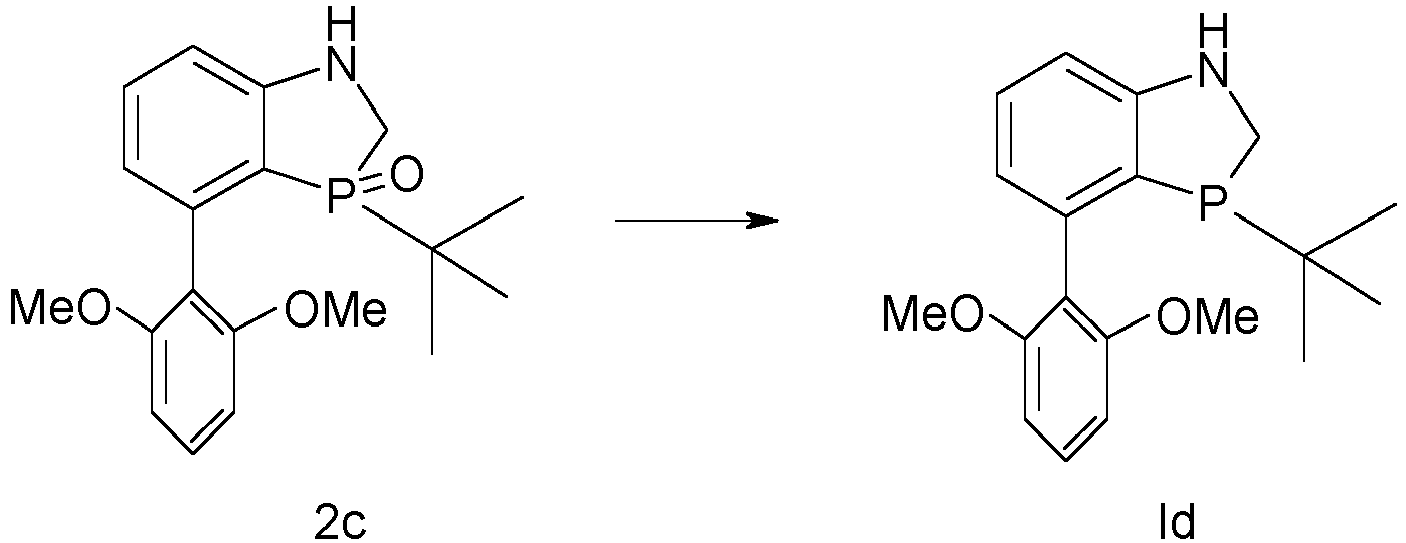
- (4s)-3-(Tert-butyl)-4-(2,6-dimethoxyphenyl)-1,2-dihydrobenzo[d][1,3]azaphosphole 3-oxide (2c) (1.20 g, 3.47 mmol) was charged in an oven-dried flask, followed by vacuum-argon purging cycles three times. Toluene (24 mL), triethylamine (5.67 mL, 41.6 mmol) and trichlorosilane (2.8 mL, 28 mmol) were added sequentially. The reaction mixture was heated at 110 °C for 3 h. The reaction was quenched with 30% aqueous NaOH solution (20V) and stirred for 30 minutes. The solution was extracted with degassed MTBE or 1:1 EtOAc/CH2Cl2 (3 × 10 mL). Each extraction aliquot was passed through a column of aluminum oxide in vacuo. The filtrate was concentrated and dried completely under vacuum overnight to give the product Id as a white solid (0.92 g, 80% yield). 1H (400 MHz, CDCl3) δ = 7.27 (t, J = 8.34 Hz, 1H), 7.20 (t, J = 7.68 Hz, 1H), 6.68 (d, J = 7.92 Hz, 1H), 6.66-6.61 (m, 2H), 6.58 (d, J = 8.24 Hz, 1H), 3.77 (s, 3H), 3.72 (s, 3H), 3.65-3.52 (m, 2H), 0.76 (d, J = 11.92 Hz, 9H). 13C NMR (100 MHz, CDCl3) δ = 157.96, 157.20, 155.42, 138.75, 138.57, 129.80, 128.72, 121.41, 120.24, 108.70, 104.45, 103.61, 55.98, 55.96, 55.40, 43.58, 43.39, 31.53, 31.34, 29.71, 26.95, 26.80, 23.60. 31P (162 MHz, CDCl3) δ = -0.17.
-

- An inerted flask was charged with (4s)-3-(tert-butyl)-4-(2,6-dimethoxyphenyl)-1,2-dihydrobenzo[d][1,3]azaphosphole 3-oxide (1.00 g, 2.89 mmol), Pd2dba3 (0.066 g, 0.072 mmol), RuPHOS (0.135 g, 0.289 mmol), and sodium t-butoxide (0.33 g, 3.5 mmol). The flask was backfilled with nitrogen thrice. Phenyl bromide (0.35 mL, 3.5 mmol), and THF (10 mL) were added, followed by backfilling with nitrogen thrice. The reaction mixture was stirred at rt for 5 minutes and heated at 67 °C for 1h. The reaction mixture was passed through a pad of diatomaceous earth and washed with THF (3 × 10 mL). The crude was concentrated and purified by column chromatography by silica gel using 0 to 8% methanol in dichloromethane to obtain (4s)-3-(tert-butyl)-4-(2,6-dimethoxyphenyl)-1-phenyl-1,2-dihydrobenzo[d][1,3]azaphosphole 3-oxide as a brown solid (0.92 g, 75% yield). 1H (500 MHz, CDCl3) δ = 7.39 (t, J = 7.83 Hz, 2H), 7.33-7.27 (m, 4H), 7.14 (t, J = 7.15 Hz, 1H), 6.94 (dd, J = 8.25, 3.30 Hz, 1H), 6.70-6.66 (m, 2H), 6.56 (d, J = 8.35 Hz, 1H), 4.07 (t, J = 14.10 Hz, 1H), 3.82 (s, 3H), 3.78 (dd, J = 13.60, 5.50 Hz, 1H), 3.75 (s, 3H), 0.93 (d, J = 15.50 Hz, 9H). 13C NMR (125 MHz, CDCl3) δ = 158.83, 157.49, 153.56, 153.44, 143.81, 143.76, 139.16, 139.12, 133.09, 133.07, 129.72, 129.53, 124.29, 122.72, 122.61, 122.54, 117.75, 117.72, 115.91, 115.21, 109.88, 109.81, 104.43, 102.98, 56.00, 55.36, 50.21, 49.69, 34.11, 33.54, 23.62, 23.61. 31P (202 MHz, CDCl3) δ = 58.45.
- The above intermediate (0.40 g, 0.95 mmol) was charged in an oven-dried flask, followed by vacuum-argon purging cycles three times. Toluene (8 mL), triethylamine (1.6 mL, 11 mmol) and trichlorosilane (0.77 mL, 7.6 mmol) were added sequentially. The reaction mixture was heated at 110 °C for 2 h. The reaction was quenched with 30% aqueous NaOH solution (10 mL) and stirred for 30 minutes. The solution was extracted with degassed 1:1 EtOAc/CH2Cl2 (3 × 5 mL). Each extraction aliquot was passed through a column of aluminum oxide in vacuo. The filtrate was concentrated and dried completely under vacuum overnight to give the product Ig as a yellow solid (0.274 g, 72% yield). 1H (500 MHz, CDCl3) δ = 7.38-7.27 (m, 5H), 7.21 (t, J = 7.80 Hz, 1H), 7.06-6.98 (m, 2H), 6.72-6.64 (m, 2H), 6.60 (d, J = 8.35 Hz, 1H), 4.21 (dd, J = 23.03, 12.68 Hz, 1H), 3.81-3.70 (m, 7H), 0.76 (d, J = 11.95 Hz, 9H). 13C NMR (125 MHz, CDCl3) δ = 158.82, 158.05, 157.49, 157.17, 153.47, 151.10, 151.08, 144.84, 144.82, 143.74, 139.47, 139.32, 139.16, 139.12, 133.11, 133.10, 129.72, 129.60, 129.59, 129.53, 129.14, 129.04, 128.85, 128.29, 127.25, 127.15, 125.30, 124.31, 122.73, 122.62, 122.54, 122.07, 121.84, 121.80, 120.31, 119.93, 119.91, 109.88, 109.82, 108.77, 104.52, 104.43, 103.62, 102.97, 77.22, 56.00, 55.97, 55.96, 55.40, 55.36, 50.40, 50.23, 50.17, 49.65, 34.10, 33.53, 31.24, 30.91, 30.75, 26.69, 26.57, 23.62, 23.61, 21.46. 31P (202 MHz, CDCl3) δ = -16.81.
-

- An inerted flask was charged with (4s)-3-(tert-butyl)-4-(2,6-dimethoxyphenyl)-1,2-dihydrobenzo[d][1,3]azaphosphole 3-oxide (0.100 g, 0.289 mmol), Pd2dba3 (0.0067 g, 0.0072 mmol), RuPHOS (0.0135 g, 0.0289 mmol), and sodium t-butoxide (0.033 g, 0.35 mmol). The flask was backfilled with nitrogen thrice. 4-bromoanisole (0.05 mL, 0.35 mmol), and THF (1 mL) were added, followed by backfilling with nitrogen thrice. The reaction mixture was stirred at rt for 5 minutes and heated at 67 °C for 6h. The reaction mixture was passed through a pad of celite and washed with THF (3 × 1 mL). The crude was concentrated and purified by column chromatography by silica gel using 0 to 10% methanol in dichloromethane to obtain (4s)-3-(tert-butyl)-4-(2,6-dimethoxyphenyl)-1-(4-methoxyphenyl)-1,2-dihydrobenzo[d][1,3]azaphosphole 3-oxide as a yellow solid (85 mg, 65% yield). 1H (500 MHz, CDCl3) δ = 7.31-7.27 (m, 2H), 7.22 (d, J = 8.80 Hz, 2H), 6.94 (d, J = 8.80 Hz, 2H), 6.69-6.61 (m, 3H), 6.56 (d, J = 8.85 Hz, 2H), 3.95 (t, J = 14.28 Hz, 1H), 3.84 (s, 3H), 3.83 (s, 3H), 3.77-3.73 (m, 4H), 0.94 (d, J = 15.41 Hz, 9H). 13C NMR (125 MHz, CDCl3) δ = 158.83, 157.52, 157.15, 155.03, 154.91, 138.88, 138.84, 136.91, 136.85, 133.17, 133.16, 129.65, 127.80, 125.82, 121.84, 121.76, 117.97, 117.95, 114.99, 114.94, 109.46, 109.39, 104.44, 104.19, 102.99, 56.01, 55.65, 55.55, 50.82, 50.31, 34.21, 33.64, 23.67, 23.66, 23.34. 31P (202 MHz, CDCl3) δ = 58.75.
- The above intermediate (0.358 g, 0.792 mmol) was charged in an oven-dried flask, followed by vacuum-argon purging cycles three times. Toluene (7 mL), triethylamine (1.3 mL, 9.6 mmol) and trichlorosilane (0.65 mL, 6.4 mmol) were added sequentially. Then, the reaction mixture was heated at 110 °C for 2 h. The reaction was quenched with 30% aqueous NaOH solution (10 mL) and stirred for 30 minutes. The solution was extracted with degassed 1:1 EtOAc/CH2Cl2 (3 × 5 mL). Each extraction aliquot was passed through an inerted column of aluminum oxide in vacuo. The filtrate was concentrated and dried completely under vacuum overnight to give the product (Ie) as a yellow solid (0.234 g, 68% yield, contains 20% starting material, easily oxidized). HRMS (ESI+/TOF): m/z calcd for C26H31NO4P+ [M+O+H]+ 452.1985, found 452.1969.
-

- An inerted flask was charged with (4s)-3-(tert-butyl)-4-(2,6-dimethoxyphenyl)-1,2-dihydrobenzo[d][1,3]azaphosphole 3-oxide (5.00 g, 14.5 mmol), Pd2dba3 (0.199 g, 0.217 mmol), RuPHOS (0.405 g, 0.867 mmol), and sodium t-butoxide (1.67 g, 17.34 mmol). The flask was backfilled with nitrogen thrice. 4-Bromobenzotriflouride (2.43 mL, 17.34 mmol), and THF (50 mL) were added, followed by backfilling with nitrogen thrice. The reaction mixture was stirred at rt for 5 minutes and heated at 67 °C for 3h. The reaction mixture was passed through a pad of celite and washed with THF (3 × 50 mL). The crude was concentrated and purified by column chromatography by silica gel using 0 to 4% methanol in dichloromethane to obtain 3-(tert-butyl)-4-(2,6-dimethoxyphenyl)-1-(4-(trifluoromethyl)phenyl)-1,2-dihydrobenzo[d][1,3]azaphosphole 3-oxide as yellow solid (4.53 mg, 64% yield). 1H (400 MHz, CDCl3) δ = 7.61 (d, J = 8.52 Hz, 2H), 7.42-7.34 (m, 3H), 7.31 (t, J = 8.38 Hz, 1H), 7.15 (dd, J = 8.34, 3.50 Hz, 1H), 6.79 (dd, J = 7.40, 3.48 Hz, 1H), 6.67 (d, J = 8.32 Hz, 2H), 6.57 (d, J = 8.32 Hz, 2H), 4.12 (t, J = 13.76 Hz, 1H), 3.85-3.72 (m, 7H), 0.93 (t, J = 15.65 Hz, 9H). 13C NMR (100 MHz, CDCl3) = 158.76, 157.44, 151.74, 151.59, 146.81, 146.75, 139.65, 139.60, 133.14, 133.12, 129.92, 126.75, 126.71, 126.67, 126.64, 125.52, 124.99, 124.66, 124.20, 124.10, 122.82, 120.56, 117.49, 117.32, 117.29, 116.60, 110.61, 110.53, 104.41, 102.99, 55.97, 55.36, 50.01, 49.37, 34.09, 33.38, 23.57. 31P (162 MHz, CDCl3) δ = 57.64
- The above intermediate (0.88 g, 1.8 mmol) was charged in an oven-dried flask, followed by vacuum-argon purging cycles three times. Toluene (18 mL), triethylamine (3.0 mL, 22 mmol) and trichlorosilane (1.45 mL, 14.4 mmol) were added sequentially. The reaction mixture was heated at 110 °C for 2 h. The reaction was quenched with 30% aqueous NaOH solution (20 mL) and stirred for 30 minutes. The solution was extracted with degassed 1:1 EtOAc/CH2Cl2 (3 × 10 mL). Each extraction aliquot was passed through a column of aluminum oxide in vacuo. The filtrate was concentrated and dried completely under vacuum overnight to give the product (If) as a yellow solid (0.73 g, 86% yield). 1H (400 MHz, CDCl3) δ = 7.49 (d, J = Hz, 2H), 7.29 (d, J = Hz, 2H), 7.23 (t, J = Hz, 1H), 7.19-7.10 (m, 2H), 6.77 (ddd, J = Hz, 1H), 6.66 (d, J = 8.28 Hz, 1H), 6.60 (d, J = 8.40 Hz, 1H), 4.24 (dd, J = 23.05, 12.72 Hz, 2H), 3.80-3.70 (m, 7H), 0.72 (d, J = 12.04 Hz, 9H). 13C NMR (100 MHz, CDCl3) δ = 133.13, 129.92, 129.65, 129.06, 126.66, 126.45, 126.41, 123.41, 123.36, 120.57, 118.37, 110.60, 109.90, 104.51, 103.64, 102.98, 55.95, 55.40, 50.37, 50.15, 30.69, 23.57. 31P (162 MHz, CDCl3) δ = -17.20.
-

- An inerted flask was charged with 3-(tert-butyl)-4-(2,6-dimethoxyphenyl)-1,2-dihydrobenzo[d][1,3]azaphosphole 3-oxide (1.00 g, 2.89 mmol) and backfilled with nitrogen thrice. Phenyl isocyanate (0.94 mL, 8.7 mmol), Hünig's base (0.60 mL, 3.5 mmol), and THF (10 mL) were charged into the flask and the flask backfilled again with nitrogen thrice. The reaction mixture was kept stirring at 77 °C overnight. THF was removed in vacuo followed by the addition of dichloromethane (20 mL) to crash out excess phenyl isocyanate. The solids were filtered and washed with dichloromethane (2 × 20 mL). The filtrate was concentrated and purified by column chromatography on silica gel using 0 to 8% methanol in dichloromethane to obtain 3-(tert-butyl)-4-(2,6-dimethoxyphenyl)-N-phenyl-2-hydrobenzo[d][1,3]azaphosphole-1-carboxamide 3-oxide as white solid (1.13 g, 84% yield).
- To an oven-dried flask, the above intermediate (0.500 g, 1.08 mmol) was charged, followed by vacuum-argon purging cycles three times. Toluene (10 mL), triethylamine (1.8 mL, 13 mmol) and trichlorosilane (0.87 mL, 1.2 mmol) were added sequentially. The reaction mixture was heated at 110 °C for 2 h. The reaction was quenched with 30% aqueous NaOH solution (10 mL) and stirred for 30 minutes. The solution was extracted with degassed 1:1 EtOAc/CH2Cl2 (3 × 5 mL). Each extraction aliquot was passed through a column of aluminum oxide in vacuo. The filtrate was concentrated and dried completely under vacuum overnight to give the product (Ih) as a white solid (0.38 g, 79% yield). 1H (400 MHz, CDCl3) δ = 7.78 (d, J = 8.20 Hz, 1H), 7.47 (d, J = 7.72 Hz, 2H), 7.41 (t, J = 7.88 Hz, 1H), 7.36-7.28 (m, 3H), 7.09 (t, J = 7.38 Hz, 1H), 6.97 (dd, J = 7.56, 3.32 Hz, 1H), 6.94 (s, 1H), 6.66 (d, J = 8.36 Hz, 1H), 6.60 (d, J = 8.36 Hz, 1H), 4.20 (dd, J = 12.84, 2.32 Hz, 1H), 3.98 (dd, J = 12.86, 22.51 Hz, 1H), 3.76 (s, 3H), 3.73 (s, 3H), 0.75 (d, J = 12.08 Hz, 9H). 31P (162 MHz, CDCl3) δ = -15.85.
-

- 1-(3-(tert-Butyl)-4-(2,6-dimethoxyphenyl)-3-oxido-2-hydrobenzo[d][1,3]azaphosphol-1-yl)-2,2-dimethylpropan-1-one (2b, Example 2) (1.00 g, 2.32 mmol) was charged in an oven-dried flask, followed by vacuum-argon purging cycles three times. Toluene (20 mL), triethylamine (3.8 mL, 29 mmol) and trichlorosilane (1.88 mL, 18.6 mmol) were added sequentially. Then, the reaction mixture was heated at 110 °C and stirred at this temperature for 3 h. The reaction was quenched with 30% aqueous NaOH solution (20V) and stirred for 30 minutes. The solution was extracted with degassed MTBE or 1:1 EtOAc/CH2Cl2 (3 × 10 mL). Each extraction aliquot was passed through a column of aluminum oxide in vacuo. The filtrate was concentrated and dried completely under vacuum overnight to give the product (Ic) as a white solid (0.89 g, 92% yield). 1H (500 MHz, CDCl3) δ = 8.05 (d, J = 8.40 Hz, 1H), 7.30 (t, J = 7.93 Hz, 1H), 7.22 (t, J = 8.35 Hz, 1H), 6.90 (dd, J = 7.28, 3.23 Hz, 1H), 6.54 (dd, J = 28.78, 8.33 Hz, 1H), 4.30 (dd, J = 13.03, 2.03 Hz, 1H), 3.91 (dd, J = 20.88, 13.02 Hz, 1H), 3.66 (s, 3H), 3.62 (s, 3H), 1.37 (s, 9H), 0.65 (d, J = 12.00 Hz, 9H). 13C NMR (125 MHz, CDCl3) δ = 176.67, 176.65, 158.05, 148.99, 148.97, 138.22, 138.06, 130.05, 129.66, 129.65, 129.11, 129.04, 128.99, 126.73, 126.69, 119.54, 119.52, 118.98, 104.41, 104.24, 103.64, 102.91, 55.85, 55.84, 55.33, 55.27, 46.87, 46.69, 41.00, 40.80, 31.93, 31.46, 31.30, 31.25, 29.70, 29.66, 29.37, 28.34, 26.82, 26.70, 23.60, 22.70, 14.12. 31P (202 MHz, CDCl3) δ = -11.51.+
-

- A flask was charged with 3-(tert-butyl)-3-oxido-1-pivaloyl-1,2-dihydrobenzo[d][1,3] azaphosphol-4-yl trifluoromethanesulfonate (2a) (1.33 g, 3.01 mmol), potassium bromide (0.714 g, 6.03 mmol), zinc powder (0.59 g, 9.04 mmol), Pd2dba3 (0.083 g, 0.09 mmol), and XPhos (0.115 g, 0.24 mmol). The flask was backfilled with nitrogen thrice after the addition of solids. DMAC (4.5 mL) was charged and the flask backfilled thrice again with nitrogen. The solution was stirred at 140 °C for 1h. The solution was cooled to room temperature and passed through a pad of diatomaceous earth. The filtrate was diluted with dichloromethane (50 mL) washed with 1M NaOH (2 × 20 mL) and water (20 mL). The combined organic layers were dried (MgSO4), filtered and concentrated and purified by column chromatography on silica gel using 0 to 5% methanol in dichloromethane as eluent to obtain 1,1'-(3,3'-di-tert-butyl-3,3'-dioxido-2,2'-dihydro-[4,4'-bibenzo[d][1,3]azaphosphole]-1,1'-diyl)bis(2,2-dimethylpropan-1-one) (9a) as a yellow solid (0.378 g, 43%). 1H (400 MHz, CDCl3) δ = 8.33 (dd, J = 8.08, 2.88 Hz, 1H), 8.23 (dd, J = 7.44, 3.96 Hz, 1H), 8.12 (dd, J = 8.86, 2.60Hz, 1H), 7.26 (t, J = 7.88 Hz, 1H), 7.50 (t, J = 8.06 Hz, 1H), 7.17, (dd, J = 7.26, 2.98 Hz, 1H), 4.43 (dd, J = 13.54, 6.46 Hz, 1H), 4.37-4.20 (m, 2H), 4.08 (t, J = 14.28 Hz, 1H), 1.44 (s, 9H), 1.42 (s, 9H), 0.92 (d, J = 15.92 Hz, 9H), 0.83 (d, J = 14.96 Hz, 9H). 13C NMR (100 MHz, CDCl3) = 133.42, 132.20, 130.00, 129.93, 125.61, 125.52, 121.74, 120.45, 46.72, 46.06, 45.17, 41.06, 28.30, 24.15, 24.07. 31P (162 MHz, CDCl3) δ = 61.82.
- 9a (0.100 g, 0.171 mmol) was charged into an oven-dried flask, followed by vacuum-argon purging cycles three times. Toluene (2 mL), triethylamine (0.29 mL, 2.05 mmol) and trichlorosilane (0.14 mL, 1.37 mmol) were added sequentially. The reaction mixture was heated at 110 °C for 2 h. The reaction was quenched with 30% aqueous NaOH solution (10 mL) and stirred for 30 minutes. The product was extracted with degassed 1:1 EtOAc/CH2Cl2 (3 × 5 mL). The extraction solution was passed through a column of aluminum oxide in vacuo. The elute was concentrated and dried completely under vacuum overnight to give the product (Ii) as a white solid (0.070 g, 72% yield). 1H (400 MHz, CD2Cl2) δ = 8.07 (d, J = Hz, 2H), 7.30 (t, J = Hz, 2H), 7.01 (d, J = Hz, 2H), 4.29 (d, J = Hz, 2H), 4.03-3.90 (m, 2H), 1.35 (s, 18H), 0.58-0.51 (m, 18H). 13C NMR (100 MHz, CD2Cl2) δ = 176.87, 149.54, 145.38, 130.01, 125.60, 118.94, 46.43, 46.30, 46.18, 40.79, 31.58, 28.08, 28.03, 26.96, 26.88. 31P (162 MHz, CD2Cl2) δ = -10.83.
-

- An inerted flask was charged with 3-(tert-butyl)-4-methoxy-1,2-dihydrobenzo[d][1,3]azaphosphole 3-oxide (10a) (1.00 g, 4.18 mmol), Pd2dba3 (0.0962 g, 0.105 mmol), RuPHOS (0.1951 g, 0.418 mmol), and sodium t-butoxide (0.482 g, 5.01 mmol). The flask was backfilled with nitrogen thrice. Phenyl bromide (0.51 mL, 5.01 mmol), and THF (10 mL) were added, followed by backfilling with nitrogen thrice. The reaction mixture was stirred at rt for 5 minutes and heated at 67 °C overnight. The reaction mixture was passed through a pad of celite and washed with THF (3 × 50 mL). The crude was concentrated and purified by column chromatography by silica gel using 0 to 6% methanol in dichloromethane to obtain 10b as yellow solid (1.29 mg, 98% yield). 1H (400 MHz, CDCl3) δ = 7.41-7.35 (m, 2H), 7.27-7.14 (m, 4H), 6.48 (dd, J = 8.32, 3.01 Hz, 1H), 6.29 (dd, J = 8.12, 4.52 Hz, 1H), 4.03 (t, × 14.52 Hz, 1H), 3.88 (s, 3H), 3.85 (dd, J = 13.99, 4.27 Hz, 1H), 1.29 (d, J = 16.05 Hz, 9H). 13C NMR (100 MHz, CDCl3) = 143.56, 135.72, 129.59, 124.95, 123.42, 104.31, 104.22, 100.71, 100.64, 55.37, 50.77, 50.14, 34.36, 33.62, 24.46. 31P (162 MHz, CDCl3) δ = 60.37
- Intermediate 10b was reduced by the procedure described in Example 9 to produce Ip. 1H (500 MHz, CDCl3) δ = 7.27-7.18 (m, 4H), 7.05 (m, 1H), 6.96 (m, 1H), 6.57 (m,1H), 6.26 (m, 1H), 3.88 (s, 3H), 4.11-4.04 (m, 1H), 3.77-3.74 (m, 4H), 0.92 (d, J = 11.85 Hz, 9H). 31P (202 MHz, CDCl3) δ = -23.65. MS(M+H)+: 300.3.
-

- An inerted flask was charged with 3-(tert-butyl)-4-methoxy-1,2-dihydrobenzo[d][1,3]azaphosphole 3-oxide (10a) (0.500 g, 2.09 mmol) and backfilled with nitrogen thrice. Phenyl isocyanate (0.68 mL, 6.3 mmol), Hünig's base (0.44 mL, 2.5 mmol), and THF (5 mL) were charged into the flask and the flask was vacuumed and backfilled again with nitrogen three times. The reaction mixture was stirred at 77 °C overnight. THF was removed in vacuo followed by the addition of dichloromethane (20 mL) to crash out excess phenyl isocyanate. The solid was filtered and washed with dichloromethane (2 × 20 mL). The filtrate was concentrated and purified by column chromatography on silica gel using 0 to 8% methanol in dichloromethane to give (11a) as a white solid (0.77 g, 100% yield). 1H (400 MHz, CDCl3) δ = 8.85 (s, 1H), 7.58 (dd, J = 8.60, 1.04 Hz, 2H), 7.41-7.27 (m, 4H), 7.04 (tt, J = 7.36, 1.09 Hz, 1H), 3.78 (dd, J = 7.98, 4.58 Hz, 1H), 4.57 (t, J = 15.04 Hz, 1H), 3.91 (dd, J = 14.36, 3.56 Hz, 1H), 3.44 (s, 3H), 1.26 (d, J = 16.61 Hz, 9H). 13C NMR (100 MHz, CDCl3) = 160.57, 153.51, 153.44, 150.34, 139.15, 136.47, 128.60, 122.96, 119.73, 110.37, 110.28, 104.72, 103.85, 103.65, 103.59, 54.93, 45.30, 44.67, 34.07, 33.31, 24.70. 31P (162 MHz, CDCl3) δ = 59.74
- Intermediate 111a was reduced by the procedure described in Example 9 to produce Io. 1H (500 MHz, CDCl3) δ = 7.52 (d, J = 8.15 Hz, 1H), 7.45 (d, J = 7.95 Hz, 2H), 7.34-7.32 (m, 2H), 7.26 (bs, 1H), 7.11-7.08 (m, 1H), 6.87 (bs, 1H), 6.61-6.58 (m, 1H), 4.18 (dd, J = 2.6, 12.6 Hz, 1H), 3.98-3.91 (m, 1H), 3.86 (s, 3H), 1.00 (d, J = 12.3 Hz, 9H). 31P (202 MHz, CDCl3) δ = - 22.04. MS(M+H)+: 343.3.
- The following examples illustrate the utility of the ligands in various organic reactions.
-

- A crimp-cap vial with a magnetic stir-bar was charged with 1-bromo-2-methylnaphthalene (106 mg, 0.43 mmol) and sealed. THF (1 mL) was added and the vial was immersed in a dry ice/acetone bath (-78 °C). A 1.55 M solution of t-BuLi (0.57 mL, 0.88 mmol) was charged dropwise over 2 min. The reaction mixture becomes thick and chalky and is allowed to stir for 1h. In a second crimp-cap vial was prepared a solution of ZnBr2 (136 mg, 0.6 mmol) in THF (1 mL). The ZnBr2 solution was added to the reaction mixture at -78 °C and then warmed to rt and allowed to stir for 15 min before use. In a third crimp-cap vial with stir-bar were charged the arylbromide (70 mg, 0.289 mmol, 1 eq), Pd2(dba)3 (6.6 mg, 0.0072 mmol, 2.5 mol%), and ligand Idd (12.2 mg, 0.029 mmol, 10 mol%). The mixture was inerted with Ar using vacuum-purge cycles. THF (1 mL) was then added, and the mixture was allowed to stir for 10 min. The zincate solution was then transferred to the catalyst/bromide solution by syringe. The final mixture was then immersed in an oil bath at 60 °C. After 12 hours, the reaction was cooled to rt and quenched with 2M HCl (5 mL). DCM (10 mL) was then added. The layers were separated, and the aqueous phase was extracted with DCM (1 × 50 mL). The combined organics were washed with 20% citric acid solution, rinsed with brine, dried with MgSO4, and concentrated in vacuo. Purification of the crude mixture by flash chromatography (gradient, 0-50% DCM in hexanes) afforded 78.6 mg (96%) of a colorless oil. 1H NMR (500Hz, CDCl3) 7.85 (m, 4H), 7.47 (d, J = 8.5 Hz, 2H), 7.35 (t, J = 7.0 Hz, 2H), 7.16 (t, J = 7. 0 Hz, 2H), 7.04 (d, J = 8.6 Hz, 2H), 2.02 (s, 6H).
-

- A 100 mL 2-neck round-bottom flask with magnetic stir-bar and fitted with a reflux condenser with a short-path distillation head was purged with N2. Then 9-bromo-10-mesitylanthraene (7.00 g, 18.66 mmol) and THF (24 mL) were charged to the flask. The solution was cooled to -78 °C in a dry ice acetone bath. t-BuLi (1.58 M in pentane, 38.24 mmol) was then added dropwise over 20 min. The resulting yellow slurry was stirred at -78 °C for 10 min and then allowed to warm to rt and stirred for an additional 15 min before use. ZnBr2 (5.17 g, 22.94 mmol) in THF (17 mL) was then transferred by cannula to the aryllithium reagent at rt, and the mixture was allowed to stir for an additional 20 min. A solution of triflate 1 (4.0, 9.10 mmol), Pd2(dba)3 (0.167 g, 0.182 mmol), and rac-BIDIME (0.181 g, 0.546 mmol) in THF (2 mL) was prepared in the glove box. The vial was sealed with a septum. The catalyst/triflate solution was then transferred to the ArZnBr solution using cannula transfer. The final mixture was then immersed in an oil bath at 65 °C heated for 2.5 h before analyzing it by UPLC/MS. The solvent was removed under reduced pressure. 100 mL of DCM was added. Then 30 mL of 20% citric acid solution was added. Organic layer was separated. The aqueous layer was washed with DCM (3 × 30 mL). The organic layers were collected together, dried with Na2SO4 and purified flash chromatography (5% MeOH in DCM). 60% isolated yield of 2 was achieved.
- 1H NMR (500 MHz, CDCl3) δ 8.67 (d, J=8.67, 1H), 7.81-7.86 (m, 2H), 7.53 (d, J=7.53, 1H), 7.27-7.48(m, 6H), 7.16 (m, 1H), 7.10(d, J=15.45, 2H), 4.42-4.46(m, 1H), 4,24-4.30(m, 1H), 2.48 (s, 3H), 1.79(s, 3H), 1.66 (s, 3H), 1.45(s, 9H), 0.54 (d, J=17.10, 9H). 13C (125 MHz, CDCl3) δ 177.7, 171.2, 151.1, 142.6, 137.9, 137.8, 137.3, 134.3, 134.2, 132.9, 131.2, 130.4, 129.4, 129.2, 129.1, 128.5, 128.4, 128.2, 126.5, 125.8, 125.7, 125.4, 125.2, 124.9, 121.0, 120.9, 60.4, 46.7, 41.3, 34.0, 28.3, 24.1, 24.1, 21.1, 20.2, 20.0, 14.2
- 4: To a stirring solution of 2 (2.0 g, 3.40 mmol) in methanol (1 mL) at room temperature, sodium hydroxide (5.5 mL, 1M in water, 5.5 mmol) was charged. Then, the solution was heated to 50 °C for 1.5h. The reaction was quenched with 2M HCl, adjusting pH to 7. After quenching the reaction was concentrated under vacuum, DCM (30 mL) was added, organic layer separated, and then the aqueous layer was extracted with DCM (10 mL × 5). Organic layers were combined, dried with Na2SO4, concentrated, recrystallized from cold DCM to obtain intermediate 4 74% yield. 1H NMR (500 MHz, CDCl3) δ 7.90 (d, J=9.05, 1H), 7.69 (d, J=8.65, 1H), 7.49-7.51 (m, 2H), 7.41-7.44(m, 2H), 7.28-7.34 (m, 3H), 7.09 (d, J=7.25, 2H), 6.88-6.91 (m, 2H), 4.40 (d, J=18.05, 1H), 3.54-3.64 (m, 2H), 2.46 (s, 3H), 1.78 (s, 3H), 1.67 (s, 3H), 0.47 (d, J=15.95, 9H). 31P (202 MHz, CDCl3) δ 65.29
- A round bottom was charged with phosphine oxide 4, (1.11 g, 2.20 mmol), Pd2dba3 (0.051 g, 0.055 mmol), RuPHOS (0.103 g, 0.22 mmol), and sodium t-butoxide (0.253 g, 2.64 mmol). Then the flask was treated for vacuum-purged with argon 3 times. Phenyl bromide (0.28 mL, 0.2.64 mmol), and THF (7 mL) were added. The reaction mixture was stirred at rt for 5 minutes and heated at 67 °C for 6 h before analyzed by LC-MS. The reaction mixture was passed through a pad of celite and washed with THF (3 × 2 mL). The crude was concentrated and purified by column chromatography by silica gel using 0 to 70% ethylacetate to hexane to obtain intermediate 6 (57% yield). MS of the product - 580
- A septa capped vial was purged with argon and then charged with 6 (0.021 g, 0.036 mmol) and THF maintaining inert atmosphere. Then the vial was cooled to -78 °C. Then Me2SO4 (0.0043 g, 0.180 mmol) and LDA (0.036 mL, 0.072 mmol) were added. It was stirred at -78 °C for 2h before it was warmed to rt, stirred for another 1h. Then quenched with 2M HCl (0.2 mL). The product was purified from flash chromatography (EtOAc to hexane, 0 to 70%) to obtain intermediate 8 in 40% yield. 31P (202 MHz, CDCl3) δ 60.43
- The phosphine oxide 2 (0.150 g, 0.255 mmol) was charged to a 50 mL 3-nekced rb with magnetic stir-bar. A reflux condenser was added, and the closed atmosphere was purged with Ar using vacuum-purge cycles. Toluene (5.0 mL) (sparged with argon before use) was charged followed by triethylamine (0.142 mL, 1.02 mmol) and HSiCl3 (0.077 mL, .765 mmol). The mixture was then immersed in an oil bath and left for stirring at 65 °C for 3 h. The reaction was monitored by 31P NMR from crude mixture. The reaction was then cooled to rt and quenched with 6 mL of degassed (Ar sparge) 15% NaOH at 0 °C. The mixture was left for stirring at rt for 30 mins. The aqueous layer was then separated and extracted under N2 with EtOAc (3 × 5 mL). The combined organics were dried with Na2SO4. The solution passed through a narrow neutral alumina (0.5") and eluted with 50% EtOAc in DCM. Then the solvent was pumped off to yield the product Iv (81%).
- 1H NMR (500 MHz, CDCl3) δ 8.32 (d, J=8.20, 1H), 7.87 (d, 8.70, 1H), 7.74 (d, J=8.70), 7.58-7.61 (m, 1H), 7.48-7.52 (m, 1H), 7.27-7.39 (m, 5H), 7.12 (s, 1H), 7.09 (s, 1H), 4.41 (dd, J=13.15, 2.35, 1H), 4.05 (dd, J=22.36, 13.10, 1H), 2.46 (s, 3H), 1.83 (s, 3H), 1.65 (s, 3H), 1.48 (s, 9H), 0.42 (d, J=12.20, 9H). 31P (202 MHz, CDCl3) δ -12.26
- Ligands Iu and 1x were prepared by the same procedure ising intermediates 4 and 8 respectively.
- Analytical data (Iu): 31P (202 MHz, CDCl3) δ 7.60
- Analytical data (Ix): 31P (202 MHz, CDCl3) δ 7.32
-

- A vial was charged with Pd2(dba)3 (2.0 mg, 0.002 mmol, 2 mol % complex, 4 mol % Pd), Ligand Ix (2.3 mg, 0.004 mmol, 4 mol %), NaOt-Bu (19.0 mg, 0.2 mmol, 2.0 equiv.), the phenol substrate (16.2 mg, 1.0 equiv.), the bromobenzene (0.022 mL, 0.2 mmol, 2.0 equiv.), and C6F6 (0.5 mL) in a N2 filled glove box. The mixture was stirred under nitrogen at 60 °C for 12 h before being analyzed by GC-MS. ee condition: Chiral column condition: Chiralcel OJ-3, n-heptane/1-propanol, 99.5/0.5 isocratic, 25 °C, 1.5 mL/ min. 100% conversion, 66% ee.
- MS of the product - 238, 147, 91.
-

- A mixture of 2,6-dimethylbromobenzene (1.0 g), 2,4 difluorophenylboronic acid (1.019 g), Pd2(dba)3 (0.0124 g), Ligand Ic C (22 mg) and K3PO4 (3.44 g) in toluene (11 mL) was heated at 100 °C overnight. Full conversion was observed.
- 1H NMR (400 MHz, CDCl3) δ 7.22-7.18 (m, 1H), 7.13-7.08 (m, 3H), 6.98-6.89 (m, 2H), 2.05 (s, 6H);
-

- A mixture of 2,4,6-tri-iso-propyl-1-bromobenzene (141 mg, 0.500 mmol), 2-biphenyl boronic acid (149 mg, 0.75 mmol), Pd2(dba)3 (2.3 mg, 0.0025 mmol), Ligand Ic, Id, If, or Ig (2 mol%, 0.010 mmol), and K3PO4 (318 mg, 1.50 mmol) in toluene (1.0 mL) was heated at 100 °C for 15 min. Full conversion to the desired product was observed with all ligands.
- 1H NMR (400 MHz, CDCl3) δ 7.51 (dd, J = 7.7, 1.2 Hz), 7.44 (dt, J = 7.2, 1.4 Hz, 1H), 7.37 (dt, J = 7.4, 1.5 Hz, 1H), 7.24 (dd, J = 7.5, 1.1 Hz, 1H), 7.07 - 7.15 (m, 5H), 6.92 (s, 2H), 2.88 (sept, J = 6.8 Hz, 1H), 2.56 (sept, J = 6.8 Hz, 2H), 1.26 (d, J = 6.8 Hz, 6H), 1.03 (d, J = 6.8 Hz, 6H), 0.86 (d, J = 6.8 Hz, 6H).
-

- To a mixture of CuCl2 (0.7 mg, 0.005 mmol), ligand Ii (2.8 mg, 0.005 mmol), tris(3,5-dimethylphenyl)phosphine (2.2 mg, 0.005 mmol), and KOt-Bu (5.6 mg, 0.05 mmol) were added 2-phenyl-1-tetralone (22 mg, 0.1 mmol) and t-AmylOH (0.25 mL) under nitrogen. The reaction vessel was transferred into an autoclave and pressurized with hydrogen to 400 psi (2758 kPa). The reaction mixture was stirred at this pressure and 20 °C for 24 h. After release of the hydrogen and purging with nitrogen, the reaction mixture was filtered through a plug of diatomaceous earth to afford crude alcohol 2 (>95% conversion, 97:3 er). The enantiomeric excess of the products was determined by chiral HPLC with a Phenomenex Lux Cellulose 3 (4.6 × 150 mm) column (heptane/denatured ethanol = 95:5, 1.5 mL/min, 10 ° C, rt1 (enantiomer 1, minor) = 10.3 min, rt2 (enantiomer 2, major) = 17.1 min. MS calcd for C17H17O2 + [M-18]+: 207.3, found 207.2.
-

- To a glass vial were added 1.0 mg Rh(NBD)2(BF4) (0.0027 mmol) and 2.4 mg (0.004 mmol) ligand IIa and 1 mL degassed CH2Cl2. The mixture was stirred under nitrogen for 10 min. Then 57 mg N-(1-naphthalenyl)vinylacetamide (0.27 mmol) was added to the mixture. The vial was inserted into a hydrogenation reactor. The reactor was then sealed, purged with N2 three times and H2 three times. The mixture was stirred under 50 psi (345 kPa) H2 pressure at 20 °C for 20 h. Upon completion, the reactor was vented and a sample was taken and analyzed. The desired product N-(1-(naphthalenyl)ethyl)acetamide was observed as [C14H15NO + H+] = 214.1, and 95.2:4.8 er; Enantioselectivity was determined on HPLC using a ChiralPak AD-3 column, 150 mm × 4.6 mm, heptane/n-propanol 90:10, 1.3mL/min, 30 °C, t1 = 4.41 min, t2 = 5.72 min.
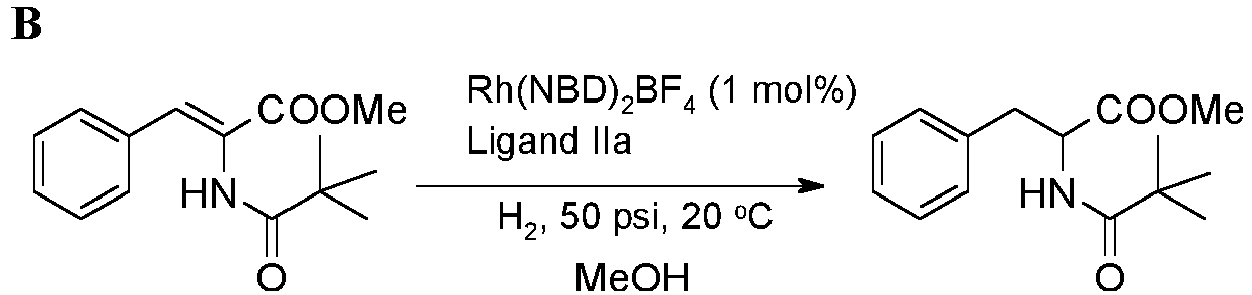
- To a glass vial were added 0.95 mg Rh(NBD)2(BF4) (0.0025 mmol) and 2.24 mg (0.0038 mmol) ligand IIa and 1 mL degassed MeOH. The mixture was stirred under nitrogen for 10 min. Then 65.3 mg methyl (Z)-3-phenyl-2-pivalamidoacrylate (0.25 mmol) was added to the mixture. The vial was inserted into a hydrogenation reactr. The reactor was then sealed, purged with N2 three times and H2 three times. The mixture was stirred under 50 psi (345 kPa) H2 pressure at 20 °C for 20 h. Upon completion, the reactor was vented and a sample was taken and analyzed. The desired product methyl pivaloylphenylalaninate was observed as [C15H22NO3 + H+] = 264.1 and 95.0:5.0 er; Enantioselectivity was determined on HPLC using a Kromasil 3-Amycoat column, 250 mm × 4.6 mm, heptane/EtOH 95:5, 1.3mL/min, 25 °C, t1 = 6.05 min, t2 = 6.92 min.
-

- A solution containing 3-(tert-butyl)-4-methoxy-1-phenyl-1,2-dihydrobenzo[d][1,3]azaphosphole 3-oxide (10b) (0.500 g, 1.59 mmol) in THF (10 mL, degassed with argon) was cooled to -65 °C. LDA (1M in THF/hexanes, 2.38 mL, 2.38 mmol) was added dropwise. After addition, the reaction mixture was stirred between -70 to -65 °C for 1h. Cu(OAc)2 (1.152 g, 6.35 mmol) was added and stirred at -65 °C for 10 minutes. The reaction was then slowly warmed to room temperature. The reaction was then quenched with NH4OH solution (10 mL) and water (10 mL) and stirred for 10 minutes. The solution was then extracted with CH2Cl2 (3 × 10 mL). The organic layers were combined, washed with water (10 mL), dried (MgSO4) and concentrated. The crude was then purified by column chromatography on silica gel using 0 to 5% MeOH in CH2Cl2 as eluent to afford 19a as a yellow solid. 1H (400 MHz, CDCl3) δ = 7.05-6.99 (m, 10H), 6.88-6.83 (m, 2H), 6.29 (dd, J = 8.12, 4.12 Hz, 2H), 6.23 (dd, J = 8.28, 2.68 Hz, 2h), 5.30-5.18 (m, 1H), 3.84 (s, 6H), 1.24 (d, J = 16.12 Hz, 18H). 13C NMR (100 MHz, CDCl3) = 162.4, 153.4, 153.3, 143.5, 135.1, 129.6, 128.8, 123.2, 128.8, 106.4, 106.38, 106.3, 103.4, 102.6, 102.0, 102.0, 101.9, 55.3, 25.5, 25.5, 51.9, 51.9, 34.9, 34.2, 24.5. 31P (162 MHz, CDCl3) δ =65.13. HRMS (ESI+/TOF): m/z calcd for C36H43N2O4P2 + [M+H]+ 629.2693, found 629.2691. Optical rotation: [α]D 18 = +181.66 (c = 0.01, MeOH).
- An oven dried 50 mL Schlenk flask equipped with a magnetic stir bar was charged with phosphine oxide 19a (100 mg, 0.159 mmol) and m-xylene (5 mL). The solution was thoroughly degassed by vacuum purge-and-refill with argon before addition of 330 uL Et3N (2.39 mmol) and 160 uL HSiCl3 (1.59 mmol). The resulting mixture was heated to 145 °C for 14 h. A sample was taken and 31P NMR analysis indicated complete conversion to the free phosphine. The mixture was cooled down to 0 °C with an ice bath and quenched with degassed 30% aqueous NaOH (5 mL) over 10 min. The resulting mixture was then stirred at 60 °C for 1 h. The mixture was cooled to room temperature and the layers were separated under argon. The aqueous layer was washed once with degassed MTBE. The combined organic was dried over MgSO4 and concentrated. It was purified on a short neutral alumina column with degassed EtOAc as eluent. The major fraction was collected and dried to yield the product IIa as an off white solid (30 mg, 40% yield). 1H NMR (400 MHz, CDCl3) δ 7.16 (m, 2H), 7.12 (m, 4H), 7.03-6.98 (m, 4H), 6.81-6.75 (m, 2H), 6.68 (d, J = 7.9 Hz, 2H), 6.40 (d, J = 7.9 Hz, 2H), 4.17 (J = 5.6 Hz, 2H), 3.79 (s, 6H), 0.84 (d, J = 12.4 Hz, 18H); 31P (162 MHz, CDCl3) δ -6.88;
Claims (4)
- A compound of formula I
 R1 is selected from H, -C1-3alkyl, -C(O)-C1-4alkyl , -C(O)NHR5, benzyl, and phenyl, optionally substituted with one to two groups selected from -CF3, -OC1-3alkyl, halogen, -NH(C1-3alkyl), and -N(C1-3alkyl)2;R2 is selected from H, C1-3alkyl, -CH2-adamantyl, phenyl, pyridyl, -benzyl and -CH2naphthyl, wherein the phenyl, pyridyl, -benzyl and -CH2naphthyl is optionally substituted with one to three groups selected from C1-3alkyl, -OCH3 -CF3 and halogen;R2' is H or if R2 is C1-6alkyl , R2' may be C1-6alkyl; orR3 is C1-6alkyl;R4 is selected from phenyl, optionally substituted with one to three groups selected from - OCH3, , C1-3alkyl and halogen; orR4 is -X-R6; orR4 is selected from
 R4 is the group
 wherein * indicates the point of attachment;X is O;R5 is phenyl, optionally substituted with one to three groups selected from -OCH3, , C1-3alkyl and halogen;R6 is C1-3alkyl; andR7, R8 and R9 are each H;and the diastereomers and enantiomers thereof.
 - The compound according to claim 1 whereinR1 is selected from H, -CH3, -C(O)-t-butyl, -C(O)NHR5, benzyl, and phenyl, optionally substituted with -CF3 or -OCH3;R2 is selected from H, C1-3alkyl, -CH2-adamantyl, 2,4,6-triisopropylbenzyl, -CH2naphthyl and pyridyl optionally substituted with -OCH3;R2 is H or if R2 is methyl, R2' may be methyl; orR3 is t-butyl;R4 is 2,6-dimethoxyphenyl,
 R4 is the group
 wherein * indicates the point of attachment; orR4 is -X-R6;X is O; andR6 is methyl;R5 is phenyl; andR7, R8 and R9 are each H;and the diastereomers and enantiomers thereof.
 - The compound according to claim 1 selected from the group consisting of


- A compound of formula IIa

Applications Claiming Priority (2)
| Application Number | Priority Date | Filing Date | Title |
|---|---|---|---|
| US201662430375P | 2016-12-06 | 2016-12-06 | |
| PCT/US2017/064582 WO2018106621A1 (en) | 2016-12-06 | 2017-12-05 | Novel chiral dihydrobenzoazaphosphole ligands and synthesis thereof |
Publications (2)
| Publication Number | Publication Date |
|---|---|
| EP3551639A1 EP3551639A1 (en) | 2019-10-16 |
| EP3551639B1 true EP3551639B1 (en) | 2023-08-23 |
Family
ID=60703225
Family Applications (1)
| Application Number | Title | Priority Date | Filing Date |
|---|---|---|---|
| EP17817612.9A Active EP3551639B1 (en) | 2016-12-06 | 2017-12-05 | Novel chiral dihydrobenzoazaphosphole ligands and synthesis thereof |
Country Status (4)
| Country | Link |
|---|---|
| US (1) | US10196413B2 (en) |
| EP (1) | EP3551639B1 (en) |
| JP (1) | JP7069202B2 (en) |
| WO (1) | WO2018106621A1 (en) |
Families Citing this family (2)
| Publication number | Priority date | Publication date | Assignee | Title |
|---|---|---|---|---|
| CN109096338B (en) * | 2018-09-10 | 2020-05-12 | 中国科学院上海有机化学研究所 | Benzazepine phosphinophosphine oxygen ligand and complex containing the same, preparation method and application |
| CN114315894B (en) * | 2021-12-09 | 2023-05-26 | 同济大学 | Chiral alpha-aryl phosphate, chiral alpha-aryl phosphine compound and synthesis thereof |
Family Cites Families (6)
| Publication number | Priority date | Publication date | Assignee | Title |
|---|---|---|---|---|
| US7169953B2 (en) | 2001-11-09 | 2007-01-30 | The Penn State Research Foundation | P-chiral phospholanes and phosphocyclic compounds and their use in asymmetric catalytic reactions |
| DE602005002253T2 (en) | 2004-03-12 | 2008-05-29 | Warner-Lambert Company Llc | C1-SYMMETRIC BISPHOSPHINLIGANDES AND THEIR USE IN THE ASYMMETRIC SYNTHESIS OF PREGABALIN |
| JP5750449B2 (en) * | 2009-11-05 | 2015-07-22 | ベーリンガー インゲルハイム インターナショナル ゲゼルシャフト ミット ベシュレンクテル ハフツング | New chiral phosphorus ligand |
| US9096626B2 (en) | 2010-04-05 | 2015-08-04 | Boehringer Ingelheim International Gmbh | Monophosphorus ligands and their use in cross-coupling reactions |
| US8946418B1 (en) | 2013-07-10 | 2015-02-03 | Boehringer Ingelheim International Gmbh | Chiral nitrogen-phosphorus ligands and their use for asymmetric hydrogenation of alkenes |
| CN104558038B (en) * | 2013-10-23 | 2017-03-22 | 中国科学院上海有机化学研究所 | Preparation method of substituted 2,3-dihydrobenzo[d][1,3] oxa-phosphole ligand |
-
2017
- 2017-12-05 US US15/831,419 patent/US10196413B2/en active Active
- 2017-12-05 EP EP17817612.9A patent/EP3551639B1/en active Active
- 2017-12-05 JP JP2019551245A patent/JP7069202B2/en active Active
- 2017-12-05 WO PCT/US2017/064582 patent/WO2018106621A1/en not_active Ceased
Also Published As
| Publication number | Publication date |
|---|---|
| EP3551639A1 (en) | 2019-10-16 |
| JP2020511471A (en) | 2020-04-16 |
| US10196413B2 (en) | 2019-02-05 |
| US20180155377A1 (en) | 2018-06-07 |
| WO2018106621A1 (en) | 2018-06-14 |
| JP7069202B2 (en) | 2022-05-17 |
Similar Documents
| Publication | Publication Date | Title |
|---|---|---|
| EP2496589B1 (en) | Novel chiral phosphorus ligands | |
| EP3019509B1 (en) | Novel chiral nitrogen-phosphorus ligands and their use for asymmetric hydrogenation of alkenes | |
| CN102030780B (en) | Chiral spiro-phosphate and preparation method and application thereof | |
| EA030228B1 (en) | Phosphine ligands for catalytic reactions | |
| CN115073251A (en) | Method for asymmetrically catalyzing and synthesizing nicotine | |
| US10196413B2 (en) | Chiral dihydrobenzoazaphosphole ligands and synthesis thereof | |
| Pakulski et al. | New Monodentate P, C‐Stereogenic Bicyclic Phosphanes: 1‐Phenyl‐1, 3a, 4, 5, 6, 6a‐hexahydrocyclopenta [b] phosphole and 1‐Phenyloctahydrocyclopenta [b] phosphole | |
| JP3310381B2 (en) | Method for producing isoprene derivative | |
| JP2000514450A (en) | Ligands for asymmetric catalysis | |
| US10544177B2 (en) | Chiral dihydrobenzooxaphosphole ligands and synthesis thereof | |
| JPH11228589A (en) | Binuclear iridium (I) phosphine complex compounds and their use as catalysts in asymmetric hydroamination of olefins | |
| Zalubovskis et al. | Iridium-catalyzed asymmetric hydrogenation of olefins using pyridine-phosphinites derived from the chiral pool | |
| CN115583975B (en) | Preparation method of compound containing six-membered nitrogen-phosphorus heterocycle structure | |
| TW202608905A (en) | Chiral aminophosphine ligands, iridium catalysts comprising these ligands and use of these catalysts in asymmetric hydrogenations | |
| EP4692101A1 (en) | Diphosphine-diborane complex and method for producing same | |
| CN114315726B (en) | Preparation method of gem-difluoroallyl compound | |
| Xu et al. | Synthesis of New Chiral [2‐(1‐Hydroxyalkyl) pyrrolidino] methyl‐ferrocenes and Application to the Catalytic Asymmetric Addition of Diethylzinc to Arylaldehydes | |
| CN111018918B (en) | Metal complex, intermediate, preparation method and application thereof | |
| CN121342890A (en) | A chiral benzoxadiphosphine ligand, its complexes and applications | |
| WO2017059181A1 (en) | Ni(0) catalysts | |
| CN121021576A (en) | A multi-chiral non-biaryl organosilicon transisomer, its preparation method and application | |
| KR100592130B1 (en) | Novel diphenylarsines | |
| Kasák et al. | An expedient synthesis of dialkylphosphane-borane complexes from sodium phosphide, and their alkylation under phase-transfer conditions | |
| CN121270606A (en) | Method for preparing diphosphine monooxide by selective single reduction of diphosphine dioxide | |
| Liu | Part I: Desymmetrization of cyclic olefins via asymmetric Heck reaction and hydroarylation. Part II: Fast Suzuki coupling of aryl tosylates |
Legal Events
| Date | Code | Title | Description |
|---|---|---|---|
| STAA | Information on the status of an ep patent application or granted ep patent |
Free format text: STATUS: UNKNOWN |
|
| STAA | Information on the status of an ep patent application or granted ep patent |
Free format text: STATUS: THE INTERNATIONAL PUBLICATION HAS BEEN MADE |
|
| PUAI | Public reference made under article 153(3) epc to a published international application that has entered the european phase |
Free format text: ORIGINAL CODE: 0009012 |
|
| STAA | Information on the status of an ep patent application or granted ep patent |
Free format text: STATUS: REQUEST FOR EXAMINATION WAS MADE |
|
| 17P | Request for examination filed |
Effective date: 20190708 |
|
| AK | Designated contracting states |
Kind code of ref document: A1 Designated state(s): AL AT BE BG CH CY CZ DE DK EE ES FI FR GB GR HR HU IE IS IT LI LT LU LV MC MK MT NL NO PL PT RO RS SE SI SK SM TR |
|
| AX | Request for extension of the european patent |
Extension state: BA ME |
|
| DAV | Request for validation of the european patent (deleted) | ||
| DAX | Request for extension of the european patent (deleted) | ||
| STAA | Information on the status of an ep patent application or granted ep patent |
Free format text: STATUS: EXAMINATION IS IN PROGRESS |
|
| 17Q | First examination report despatched |
Effective date: 20200721 |
|
| GRAP | Despatch of communication of intention to grant a patent |
Free format text: ORIGINAL CODE: EPIDOSNIGR1 |
|
| STAA | Information on the status of an ep patent application or granted ep patent |
Free format text: STATUS: GRANT OF PATENT IS INTENDED |
|
| RIC1 | Information provided on ipc code assigned before grant |
Ipc: C07F 9/6584 20060101ALI20230404BHEP Ipc: C07F 15/00 20060101ALI20230404BHEP Ipc: C07B 53/00 20060101ALI20230404BHEP Ipc: C07F 9/6581 20060101AFI20230404BHEP |
|
| INTG | Intention to grant announced |
Effective date: 20230424 |
|
| GRAS | Grant fee paid |
Free format text: ORIGINAL CODE: EPIDOSNIGR3 |
|
| GRAA | (expected) grant |
Free format text: ORIGINAL CODE: 0009210 |
|
| STAA | Information on the status of an ep patent application or granted ep patent |
Free format text: STATUS: THE PATENT HAS BEEN GRANTED |
|
| AK | Designated contracting states |
Kind code of ref document: B1 Designated state(s): AL AT BE BG CH CY CZ DE DK EE ES FI FR GB GR HR HU IE IS IT LI LT LU LV MC MK MT NL NO PL PT RO RS SE SI SK SM TR |
|
| REG | Reference to a national code |
Ref country code: GB Ref legal event code: FG4D |
|
| REG | Reference to a national code |
Ref country code: CH Ref legal event code: EP |
|
| REG | Reference to a national code |
Ref country code: DE Ref legal event code: R096 Ref document number: 602017073183 Country of ref document: DE |
|
| REG | Reference to a national code |
Ref country code: IE Ref legal event code: FG4D |
|
| REG | Reference to a national code |
Ref country code: LT Ref legal event code: MG9D |
|
| REG | Reference to a national code |
Ref country code: NL Ref legal event code: MP Effective date: 20230823 |
|
| REG | Reference to a national code |
Ref country code: AT Ref legal event code: MK05 Ref document number: 1602506 Country of ref document: AT Kind code of ref document: T Effective date: 20230823 |
|
| PG25 | Lapsed in a contracting state [announced via postgrant information from national office to epo] |
Ref country code: GR Free format text: LAPSE BECAUSE OF FAILURE TO SUBMIT A TRANSLATION OF THE DESCRIPTION OR TO PAY THE FEE WITHIN THE PRESCRIBED TIME-LIMIT Effective date: 20231124 |
|
| PG25 | Lapsed in a contracting state [announced via postgrant information from national office to epo] |
Ref country code: IS Free format text: LAPSE BECAUSE OF FAILURE TO SUBMIT A TRANSLATION OF THE DESCRIPTION OR TO PAY THE FEE WITHIN THE PRESCRIBED TIME-LIMIT Effective date: 20231223 |
|
| PG25 | Lapsed in a contracting state [announced via postgrant information from national office to epo] |
Ref country code: SE Free format text: LAPSE BECAUSE OF FAILURE TO SUBMIT A TRANSLATION OF THE DESCRIPTION OR TO PAY THE FEE WITHIN THE PRESCRIBED TIME-LIMIT Effective date: 20230823 Ref country code: RS Free format text: LAPSE BECAUSE OF FAILURE TO SUBMIT A TRANSLATION OF THE DESCRIPTION OR TO PAY THE FEE WITHIN THE PRESCRIBED TIME-LIMIT Effective date: 20230823 Ref country code: PT Free format text: LAPSE BECAUSE OF FAILURE TO SUBMIT A TRANSLATION OF THE DESCRIPTION OR TO PAY THE FEE WITHIN THE PRESCRIBED TIME-LIMIT Effective date: 20231226 Ref country code: NO Free format text: LAPSE BECAUSE OF FAILURE TO SUBMIT A TRANSLATION OF THE DESCRIPTION OR TO PAY THE FEE WITHIN THE PRESCRIBED TIME-LIMIT Effective date: 20231123 Ref country code: NL Free format text: LAPSE BECAUSE OF FAILURE TO SUBMIT A TRANSLATION OF THE DESCRIPTION OR TO PAY THE FEE WITHIN THE PRESCRIBED TIME-LIMIT Effective date: 20230823 Ref country code: LV Free format text: LAPSE BECAUSE OF FAILURE TO SUBMIT A TRANSLATION OF THE DESCRIPTION OR TO PAY THE FEE WITHIN THE PRESCRIBED TIME-LIMIT Effective date: 20230823 Ref country code: LT Free format text: LAPSE BECAUSE OF FAILURE TO SUBMIT A TRANSLATION OF THE DESCRIPTION OR TO PAY THE FEE WITHIN THE PRESCRIBED TIME-LIMIT Effective date: 20230823 Ref country code: IS Free format text: LAPSE BECAUSE OF FAILURE TO SUBMIT A TRANSLATION OF THE DESCRIPTION OR TO PAY THE FEE WITHIN THE PRESCRIBED TIME-LIMIT Effective date: 20231223 Ref country code: HR Free format text: LAPSE BECAUSE OF FAILURE TO SUBMIT A TRANSLATION OF THE DESCRIPTION OR TO PAY THE FEE WITHIN THE PRESCRIBED TIME-LIMIT Effective date: 20230823 Ref country code: GR Free format text: LAPSE BECAUSE OF FAILURE TO SUBMIT A TRANSLATION OF THE DESCRIPTION OR TO PAY THE FEE WITHIN THE PRESCRIBED TIME-LIMIT Effective date: 20231124 Ref country code: FI Free format text: LAPSE BECAUSE OF FAILURE TO SUBMIT A TRANSLATION OF THE DESCRIPTION OR TO PAY THE FEE WITHIN THE PRESCRIBED TIME-LIMIT Effective date: 20230823 Ref country code: AT Free format text: LAPSE BECAUSE OF FAILURE TO SUBMIT A TRANSLATION OF THE DESCRIPTION OR TO PAY THE FEE WITHIN THE PRESCRIBED TIME-LIMIT Effective date: 20230823 |
|
| PG25 | Lapsed in a contracting state [announced via postgrant information from national office to epo] |
Ref country code: PL Free format text: LAPSE BECAUSE OF FAILURE TO SUBMIT A TRANSLATION OF THE DESCRIPTION OR TO PAY THE FEE WITHIN THE PRESCRIBED TIME-LIMIT Effective date: 20230823 |
|
| PG25 | Lapsed in a contracting state [announced via postgrant information from national office to epo] |
Ref country code: ES Free format text: LAPSE BECAUSE OF FAILURE TO SUBMIT A TRANSLATION OF THE DESCRIPTION OR TO PAY THE FEE WITHIN THE PRESCRIBED TIME-LIMIT Effective date: 20230823 |
|
| PG25 | Lapsed in a contracting state [announced via postgrant information from national office to epo] |
Ref country code: SM Free format text: LAPSE BECAUSE OF FAILURE TO SUBMIT A TRANSLATION OF THE DESCRIPTION OR TO PAY THE FEE WITHIN THE PRESCRIBED TIME-LIMIT Effective date: 20230823 Ref country code: RO Free format text: LAPSE BECAUSE OF FAILURE TO SUBMIT A TRANSLATION OF THE DESCRIPTION OR TO PAY THE FEE WITHIN THE PRESCRIBED TIME-LIMIT Effective date: 20230823 Ref country code: ES Free format text: LAPSE BECAUSE OF FAILURE TO SUBMIT A TRANSLATION OF THE DESCRIPTION OR TO PAY THE FEE WITHIN THE PRESCRIBED TIME-LIMIT Effective date: 20230823 Ref country code: EE Free format text: LAPSE BECAUSE OF FAILURE TO SUBMIT A TRANSLATION OF THE DESCRIPTION OR TO PAY THE FEE WITHIN THE PRESCRIBED TIME-LIMIT Effective date: 20230823 Ref country code: DK Free format text: LAPSE BECAUSE OF FAILURE TO SUBMIT A TRANSLATION OF THE DESCRIPTION OR TO PAY THE FEE WITHIN THE PRESCRIBED TIME-LIMIT Effective date: 20230823 Ref country code: CZ Free format text: LAPSE BECAUSE OF FAILURE TO SUBMIT A TRANSLATION OF THE DESCRIPTION OR TO PAY THE FEE WITHIN THE PRESCRIBED TIME-LIMIT Effective date: 20230823 Ref country code: SK Free format text: LAPSE BECAUSE OF FAILURE TO SUBMIT A TRANSLATION OF THE DESCRIPTION OR TO PAY THE FEE WITHIN THE PRESCRIBED TIME-LIMIT Effective date: 20230823 |
|
| REG | Reference to a national code |
Ref country code: DE Ref legal event code: R097 Ref document number: 602017073183 Country of ref document: DE |
|
| PG25 | Lapsed in a contracting state [announced via postgrant information from national office to epo] |
Ref country code: IT Free format text: LAPSE BECAUSE OF FAILURE TO SUBMIT A TRANSLATION OF THE DESCRIPTION OR TO PAY THE FEE WITHIN THE PRESCRIBED TIME-LIMIT Effective date: 20230823 |
|
| PLBE | No opposition filed within time limit |
Free format text: ORIGINAL CODE: 0009261 |
|
| STAA | Information on the status of an ep patent application or granted ep patent |
Free format text: STATUS: NO OPPOSITION FILED WITHIN TIME LIMIT |
|
| 26N | No opposition filed |
Effective date: 20240524 |
|
| PG25 | Lapsed in a contracting state [announced via postgrant information from national office to epo] |
Ref country code: SI Free format text: LAPSE BECAUSE OF FAILURE TO SUBMIT A TRANSLATION OF THE DESCRIPTION OR TO PAY THE FEE WITHIN THE PRESCRIBED TIME-LIMIT Effective date: 20230823 |
|
| REG | Reference to a national code |
Ref country code: CH Ref legal event code: PL |
|
| PG25 | Lapsed in a contracting state [announced via postgrant information from national office to epo] |
Ref country code: LU Free format text: LAPSE BECAUSE OF NON-PAYMENT OF DUE FEES Effective date: 20231205 |
|
| PG25 | Lapsed in a contracting state [announced via postgrant information from national office to epo] |
Ref country code: MC Free format text: LAPSE BECAUSE OF FAILURE TO SUBMIT A TRANSLATION OF THE DESCRIPTION OR TO PAY THE FEE WITHIN THE PRESCRIBED TIME-LIMIT Effective date: 20230823 |
|
| REG | Reference to a national code |
Ref country code: BE Ref legal event code: MM Effective date: 20231231 |
|
| PG25 | Lapsed in a contracting state [announced via postgrant information from national office to epo] |
Ref country code: MC Free format text: LAPSE BECAUSE OF FAILURE TO SUBMIT A TRANSLATION OF THE DESCRIPTION OR TO PAY THE FEE WITHIN THE PRESCRIBED TIME-LIMIT Effective date: 20230823 Ref country code: LU Free format text: LAPSE BECAUSE OF NON-PAYMENT OF DUE FEES Effective date: 20231205 |
|
| REG | Reference to a national code |
Ref country code: IE Ref legal event code: MM4A |
|
| PG25 | Lapsed in a contracting state [announced via postgrant information from national office to epo] |
Ref country code: IE Free format text: LAPSE BECAUSE OF NON-PAYMENT OF DUE FEES Effective date: 20231205 |
|
| PG25 | Lapsed in a contracting state [announced via postgrant information from national office to epo] |
Ref country code: BE Free format text: LAPSE BECAUSE OF NON-PAYMENT OF DUE FEES Effective date: 20231231 |
|
| PG25 | Lapsed in a contracting state [announced via postgrant information from national office to epo] |
Ref country code: CH Free format text: LAPSE BECAUSE OF NON-PAYMENT OF DUE FEES Effective date: 20231231 |
|
| PG25 | Lapsed in a contracting state [announced via postgrant information from national office to epo] |
Ref country code: IE Free format text: LAPSE BECAUSE OF NON-PAYMENT OF DUE FEES Effective date: 20231205 Ref country code: CH Free format text: LAPSE BECAUSE OF NON-PAYMENT OF DUE FEES Effective date: 20231231 Ref country code: BE Free format text: LAPSE BECAUSE OF NON-PAYMENT OF DUE FEES Effective date: 20231231 |
|
| PG25 | Lapsed in a contracting state [announced via postgrant information from national office to epo] |
Ref country code: BG Free format text: LAPSE BECAUSE OF FAILURE TO SUBMIT A TRANSLATION OF THE DESCRIPTION OR TO PAY THE FEE WITHIN THE PRESCRIBED TIME-LIMIT Effective date: 20230823 |
|
| PG25 | Lapsed in a contracting state [announced via postgrant information from national office to epo] |
Ref country code: BG Free format text: LAPSE BECAUSE OF FAILURE TO SUBMIT A TRANSLATION OF THE DESCRIPTION OR TO PAY THE FEE WITHIN THE PRESCRIBED TIME-LIMIT Effective date: 20230823 |
|
| PG25 | Lapsed in a contracting state [announced via postgrant information from national office to epo] |
Ref country code: CY Free format text: LAPSE BECAUSE OF FAILURE TO SUBMIT A TRANSLATION OF THE DESCRIPTION OR TO PAY THE FEE WITHIN THE PRESCRIBED TIME-LIMIT; INVALID AB INITIO Effective date: 20171205 |
|
| PG25 | Lapsed in a contracting state [announced via postgrant information from national office to epo] |
Ref country code: HU Free format text: LAPSE BECAUSE OF FAILURE TO SUBMIT A TRANSLATION OF THE DESCRIPTION OR TO PAY THE FEE WITHIN THE PRESCRIBED TIME-LIMIT; INVALID AB INITIO Effective date: 20171205 |
|
| PG25 | Lapsed in a contracting state [announced via postgrant information from national office to epo] |
Ref country code: TR Free format text: LAPSE BECAUSE OF FAILURE TO SUBMIT A TRANSLATION OF THE DESCRIPTION OR TO PAY THE FEE WITHIN THE PRESCRIBED TIME-LIMIT Effective date: 20230823 |
|
| PGFP | Annual fee paid to national office [announced via postgrant information from national office to epo] |
Ref country code: DE Payment date: 20251211 Year of fee payment: 9 |
|
| PGFP | Annual fee paid to national office [announced via postgrant information from national office to epo] |
Ref country code: GB Payment date: 20251219 Year of fee payment: 9 |
|
| PGFP | Annual fee paid to national office [announced via postgrant information from national office to epo] |
Ref country code: FR Payment date: 20251229 Year of fee payment: 9 |