EP3551618B1 - Sulfonamides as inhibitors of the uptake of extracellular citrate - Google Patents
Sulfonamides as inhibitors of the uptake of extracellular citrate Download PDFInfo
- Publication number
- EP3551618B1 EP3551618B1 EP17811906.1A EP17811906A EP3551618B1 EP 3551618 B1 EP3551618 B1 EP 3551618B1 EP 17811906 A EP17811906 A EP 17811906A EP 3551618 B1 EP3551618 B1 EP 3551618B1
- Authority
- EP
- European Patent Office
- Prior art keywords
- group
- citrate
- compound
- compounds
- cells
- Prior art date
- Legal status (The legal status is an assumption and is not a legal conclusion. Google has not performed a legal analysis and makes no representation as to the accuracy of the status listed.)
- Active
Links
- 0 *CNC(C(CC1)CCN1S(c1cc(*)cc(*)c1)(=O)=O)=O Chemical compound *CNC(C(CC1)CCN1S(c1cc(*)cc(*)c1)(=O)=O)=O 0.000 description 1
Classifications
-
- C—CHEMISTRY; METALLURGY
- C07—ORGANIC CHEMISTRY
- C07D—HETEROCYCLIC COMPOUNDS
- C07D211/00—Heterocyclic compounds containing hydrogenated pyridine rings, not condensed with other rings
- C07D211/92—Heterocyclic compounds containing hydrogenated pyridine rings, not condensed with other rings with a hetero atom directly attached to the ring nitrogen atom
- C07D211/96—Sulfur atom
-
- A—HUMAN NECESSITIES
- A61—MEDICAL OR VETERINARY SCIENCE; HYGIENE
- A61P—SPECIFIC THERAPEUTIC ACTIVITY OF CHEMICAL COMPOUNDS OR MEDICINAL PREPARATIONS
- A61P3/00—Drugs for disorders of the metabolism
-
- A—HUMAN NECESSITIES
- A61—MEDICAL OR VETERINARY SCIENCE; HYGIENE
- A61P—SPECIFIC THERAPEUTIC ACTIVITY OF CHEMICAL COMPOUNDS OR MEDICINAL PREPARATIONS
- A61P9/00—Drugs for disorders of the cardiovascular system
-
- C—CHEMISTRY; METALLURGY
- C07—ORGANIC CHEMISTRY
- C07D—HETEROCYCLIC COMPOUNDS
- C07D401/00—Heterocyclic compounds containing two or more hetero rings, having nitrogen atoms as the only ring hetero atoms, at least one ring being a six-membered ring with only one nitrogen atom
- C07D401/02—Heterocyclic compounds containing two or more hetero rings, having nitrogen atoms as the only ring hetero atoms, at least one ring being a six-membered ring with only one nitrogen atom containing two hetero rings
- C07D401/12—Heterocyclic compounds containing two or more hetero rings, having nitrogen atoms as the only ring hetero atoms, at least one ring being a six-membered ring with only one nitrogen atom containing two hetero rings linked by a chain containing hetero atoms as chain links
-
- C—CHEMISTRY; METALLURGY
- C07—ORGANIC CHEMISTRY
- C07D—HETEROCYCLIC COMPOUNDS
- C07D417/00—Heterocyclic compounds containing two or more hetero rings, at least one ring having nitrogen and sulfur atoms as the only ring hetero atoms, not provided for by group C07D415/00
- C07D417/02—Heterocyclic compounds containing two or more hetero rings, at least one ring having nitrogen and sulfur atoms as the only ring hetero atoms, not provided for by group C07D415/00 containing two hetero rings
- C07D417/12—Heterocyclic compounds containing two or more hetero rings, at least one ring having nitrogen and sulfur atoms as the only ring hetero atoms, not provided for by group C07D415/00 containing two hetero rings linked by a chain containing hetero atoms as chain links
Definitions
- This invention relates to substituted 1-(benzenesulfonyl)-piperidine-4-carboxylic acid amide derivatives and to their use as inhibitors of the uptake of extracellular citrate, to pharmaceutical compositions containing the same, and to methods of using the same as agents for the treatment of metabolic and/or cardiovascular diseases.
- citrate As citrate is known to be a key intermediate in energy metabolism, the inhibition of sodium-coupled citrate transporters, such as SLC13A5 (NaCT), predominantly located in the liver and the brain, has attracted interest as a potential therapeutic approach, e.g. for the treatment of metabolic disorders and diseases ( Pajor, Pflugers Arch - Eur J Physiol 2014, 466, 119-130 ).
- SLC13A5 NaCT
- Cyanotriazole compounds as stimulators of the citric acid cycle activity are disclosed in WO 2015/008872 .
- the present invention relates to a compound of formula (I) wherein
- the present invention relates to a pharmaceutical composition
- a pharmaceutical composition comprising one or more compounds of formula (I), as defined hereinbefore or hereinafter, or a pharmaceutically acceptable salt thereof and one or more pharmaceutically acceptable excipients.
- the present invention relates to a method for the treatment of one or more metabolic and/or cardiovascular diseases in a patient in need thereof characterized in that a compound of formula (I), as defined hereinbefore or hereinafter, or a pharmaceutically acceptable salt thereof is administered to the patient.
- the present invention relates to a compound of formula (I), as defined hereinbefore or hereinafter, or a pharmaceutically acceptable salt thereof for use in a method for the treatment of one or more metabolic and/or cardiovascular diseases in a patient in need thereof, the method being characterized in that said compound is administered to the patient.
- the present invention relates to the use of a compound of formula (I), as defined hereinbefore or hereinafter, or a pharmaceutically acceptable salt thereof in the manufacture of a medicament for the treatment of one or more metabolic and/or cardiovascular diseases in a patient in need thereof, the method being characterized in that said compound or a pharmaceutically acceptable salt thereof is administered to the patient.
- a given chemical formula or name shall encompass tautomers and all stereo, optical and geometrical isomers (e.g. enantiomers, diastereomers, E/Z isomers etc%) and racemates thereof as well as mixtures in different proportions of the separate enantiomers, mixtures of diastereomers, or mixtures of any of the foregoing forms where such isomers and enantiomers exist, as well as salts, including pharmaceutically acceptable salts thereof and solvates thereof such as for instance hydrates including solvates of the free compounds or solvates of a salt of the compound.
- pharmaceutically acceptable refers to those compounds, materials, compositions, and/or dosage forms which are, within the scope of sound medical judgment, suitable for use in contact with the tissues of human beings and animals without excessive toxicity, irritation, allergic response, or other problem or complication, and commensurate with a reasonable benefit/risk ratio.
- pharmaceutically acceptable salt refers to derivatives of the disclosed compounds wherein the parent compound is modified by making acid or base salts thereof. Examples of pharmaceutically acceptable salts include, but are not limited to, mineral or organic acid salts of basic residues such as amines; alkali or organic salts of acidic residues such as carboxylic acids; and the like.
- halogen generally denotes fluorine, chlorine, bromine and iodine.
- C 1-n -alkyl wherein n is an integer, either alone or in combination with another radical, denotes an acyclic, saturated, branched or linear hydrocarbon radical with 1 to n C atoms.
- C 1-4 -alkyl embraces the radicals H 3 C-(Me), H 3 C-CH 2 -(Et), H 3 C-CH 2 -CH 2 -, H 3 C-CH(CH 3 )-, H 3 C-CH 2 -CH 2 -CH 2 -,
- treatment and “treating” as used herein embrace both therapeutic, i.e. curative and/or palliative, and preventive, i.e. prophylactic, treatment.
- Therapeutic treatment refers to the treatment of patients having already developed one or more of said conditions in manifest, acute or chronic form. Therapeutic treatment may be symptomatic treatment in order to relieve the symptoms of the specific indication or causal treatment in order to reverse or partially reverse the conditions of the indication or to stop or slow down progression of the disease.
- Preventive treatment refers to the treatment of patients at risk of developing one or more of said conditions, prior to the clinical onset of the disease in order to reduce said risk.
- treatment and “treating” include the administration of one or more active compounds in order to prevent or delay the onset of the symptoms or complications and to prevent or delay the development of the disease, condition or disorder and/or in order to eliminate or control the disease, condition or disorder as well as to alleviate the symptoms or complications associated with the disease, condition or disorder.
- terapéuticaally effective amount means an amount of a compound of the present invention that (i) treats or prevents the particular disease or condition, (ii) attenuates, ameliorates, or eliminates one or more symptoms of the particular disease or condition, or (iii) prevents or delays the onset of one or more symptoms of the particular disease or condition described herein.
- the present invention discloses novel inhibitors of the sodium-coupled citrate transporter SLC13A5 which may be useful in the treatment of diseases and/or conditions associated with or modulated by uptake of extracellular citrate, including but not limited to the treatment of metabolic and/or cardiovascular diseases.
- the compounds of formula (I), as defined hereinbefore or hereinafter, or pharmaceutically acceptable salts thereof are expected to be useful in the treatment of diseases and/or conditions associated with or modulated by uptake of extracellular citrate, including but not limited to the treatment of metabolic and/or associated cardiovascular diseases.
- R 1 is selected from the group R i -G1 consisting of halogen, CN, C 1-3 -alkyl and C 1-4 -alkyl-O-. According to another embodiment, R 1 is selected from the group R 1 -G2 consisting of Cl, Br, methyl, methoxy and ethoxy. According to another embodiment, R 1 is selected from the group R'-G3 consisting of Cl, Br and ethoxy. According to another embodiment, R 1 is selected from the group R 1 -G4 consisting of Cl, Br and methyl.
- R 2 is selected from the group R i -G1 consisting of halogen, CN, C 1-3 -alkyl and C 1-4 -alkyl-O-. According to another embodiment, R 2 is selected from the group R 2 -G2 consisting of Cl, Br and methyl. According to another embodiment, R 2 is selected from the group R 2 -G3 consisting of Cl and Br.
- A is selected from the group A-G1 consisting of phenyl, substituted with R 3 and optionally substituted with R 4 , 2-pyridyl, optionally substituted with R 5 , 3-pyridyl, optionally substituted with R 6 and 2-thiazolyl, optionally substituted with R 7 , wherein R 3 , R 4 , R 5 , R 6 and R 7 are defined as hereinbefore or hereinafter.
- A is selected from the group A-G2 consisting of phenyl, substituted with R 3 and optionally substituted with R 4 , wherein R 3 and R 4 are defined as hereinbefore or hereinafter.
- A is selected from the group A-G3 consisting of 2-pyridyl, optionally substituted with R 5 , wherein R 5 is defined as hereinbefore or hereinafter.
- A is selected from the group A-G4 consisting of 3-pyridyl, optionally substituted with R 6 , wherein R 6 is defined as hereinbefore or hereinafter.
- A is selected from the group A-G5 consisting of 2-thiazolyl, optionally substituted with R 7 , wherein R 7 is defined as hereinbefore or hereinafter.
- R 3 is selected from the group R i -G1 consisting of halogen, CN, C 1-3 -alkyl and C 1-4 -alkyl-O-. According to another embodiment, R 3 is selected from the group R 3 -G2 consisting of halogen, CN, methyl and methoxy. According to another embodiment, R 3 is selected from the group R 3 -G3 consisting of F, Cl and CN.
- R 4 is selected from the group R i -G1 consisting of halogen, CN, C 1-3 -alkyl and C 1-4 -alkyl-O-. According to another embodiment, R 4 is selected from the group R 4 -G2 consisting of F and methyl. According to another embodiment, R 4 is selected from the group R 4 -G3 consisting of F.
- R 5 is selected from the group R i -G1 consisting of halogen, CN, C 1-3 -alkyl and C 1-4 -alkyl-O-. According to another embodiment, R 5 is selected from the group R 5 -G2 consisting of halogen, methyl and ethyl. According to another embodiment, R 5 is selected from the group R 5 -G3 consisting of F and ethyl.
- R 6 is selected from the group R i -G1 consisting of halogen, CN, C 1-3 -alkyl and C 1-4 -alkyl-O-. According to another embodiment, R 6 is selected from the group R 6 -G2 consisting of Cl, methyl and methoxy.
- R 7 is selected from the group R i -G1 consisting of halogen, CN, C 1-3 -alkyl and C 1-4 -alkyl-O-. According to another embodiment, R 7 is selected from the group R 7 -G2 consisting of methyl.
- the compound of formula (I) is selected from the group consisting of (I-5) and (I-10)
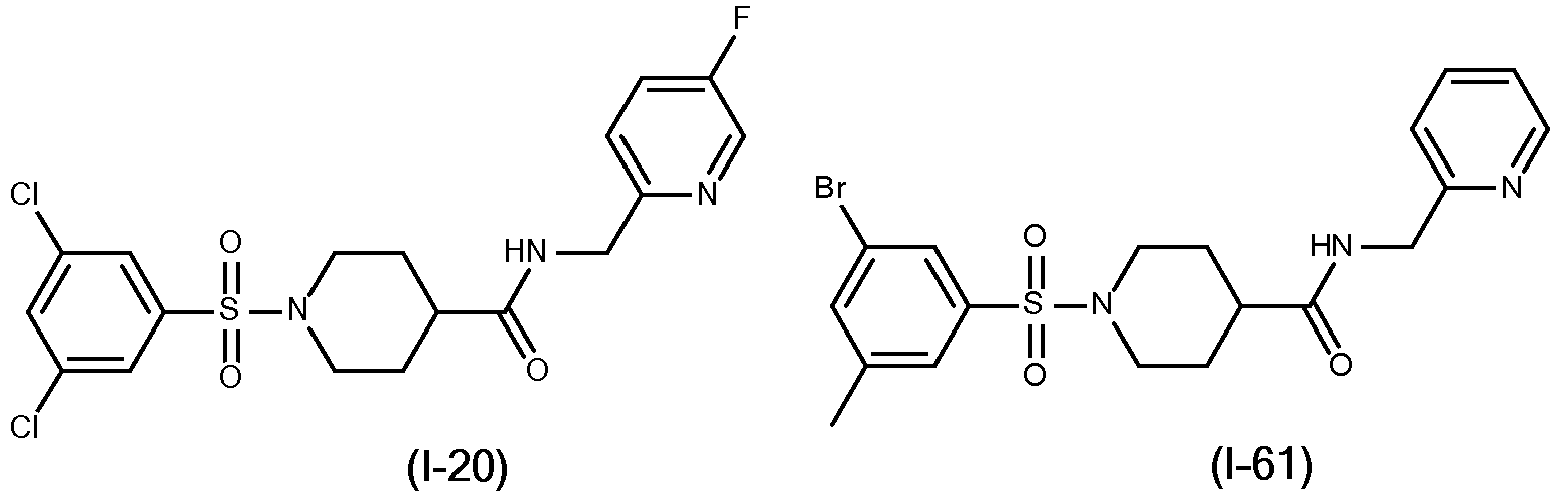
- the compound of formula (I) is selected from the group consisting of (1-20) and (1-61)
- Embodiment Substituents R 1 R 2 A R 3 R 4 R 3 R 6 R 7 (I-a) R 1 -G2 R 2 -G2 A-G2 R 3 -G2 R 4 -G2 - - - (I-b) R 1 -G3 R 2 -G3 A-G2 R 3 -G3 R 4 -G3 - - - (I-c) R 1 -G2 R 2 -G3 A-G3 - - R 5 -G2 - - (I-d) R 1 -G4 R 2 -G3 A-G3 - - R 5 -G3 - - (I-e) R 1 -G3 R 2 -G3 A-G4 - - - R 6 -G2 - (I-f) R 1 -G2 R 2 -G2 A-G5 - - - - R 7 -G2
- the compounds according to the present invention and their intermediates may be obtained using methods of synthesis which are known to the one skilled in the art and described in the literature of organic synthesis.
- the compounds are obtained in analogous fashion to the general and specific methods of preparation explained more fully hereinafter, in particular in section Examples and Experimental Data.
- the order in carrying out the reaction steps may be varied. Variants of the reaction methods that are known to the one skilled in the art, but not described in detail here, may also be used.
- the general processes for preparing the compounds according to the invention will become apparent to the one skilled in the art studying the schemes hereinafter.
- Starting materials may be prepared by methods that are described in the literature or herein, or may be prepared in an analogous or similar manner. Any functional groups in the starting materials or intermediates may be protected using conventional protecting groups. These protecting groups may be cleaved again at a suitable stage within the reaction sequence using methods familiar to the one skilled in the art.
- Compounds of formula (I) can be prepared by standard amidation procedures from acids of formula (II) and primary amines of formula H 2 N-CH 2 -A wherein A is defined as hereinbefore or hereinafter, applying e.g. the coupling reagent HATU in the presence of a base, e.g. DIPEA.
- Compounds of formula (II) can be prepared by standard deprotection procedures from esters of formula (III).
- Esters of formula (III) can be prepared from sulfonyl chlorides of formula (IV) and esters of formula (V) (in which R' denotes a protecting group, e.g. methyl or ethyl) in the presence of a base, e.g.
- the substituents R 1 , R 2 and A can be modified by procedures of organic synthesis known to the person skilled in the art. The meaning of the substituents R 1 , R 2 and A prior to such modifications may thereby deviate from the definitions used for compounds of formula (I) hereinbefore or hereinafter.
- the compounds according to the present invention are isolated and purified in a manner known per se, for example by distilling off the solvent under reduced pressure and recrystallizing the residue obtained from a suitable solvent or subjecting it to one of the customary purification methods, such as, for example, column chromatography on a suitable support material.
- the pharmaceutically acceptable salts of the present invention can be synthesized by conventional chemical methods from the parent compound which may contain a basic moiety. Generally, such salts can be prepared by reacting the free base forms of these compounds with a sufficient amount of the appropriate acid in water or in an organic diluent like ether, ethyl acetate, ethanol, isopropanol, or acetonitrile, or a mixture thereof. Salts of other acids than those mentioned above which, for example, are useful for purifying or isolating the compounds of the present invention (e.g. trifluoro acetate salts) are also part of the invention.
- a compound of the invention or a pharmaceutically acceptable salt thereof may be used as active ingredients in pharmaceutical compositions.
- suitable preparations for administering the compounds of the invention will be apparent to those with ordinary skill in the art and include for example tablets, pills, capsules, suppositories, lozenges, troches, solutions, syrups, elixirs, sachets, injectables, inhalatives and powders etc..
- Suitable tablets may be obtained, for example, by mixing one or more compounds according to formula (I) with known excipients, for example inert diluents, carriers, disintegrants, adjuvants, surfactants, binders and/or lubricants.
- a pharmaceutical composition comprising at least one compound of formula (I), as defined hereinbefore or hereinafter, or a pharmaceutically acceptable salt thereof and at least one pharmaceutically acceptable excipient is provided, preferably as a solid oral dosage form, more preferably selected from the group consisting of coated and uncoated tablets.
- the compounds of the invention are useful in methods for the treatment of metabolic and/or cardiovascular diseases, due to their citrate transport inhibitory activity.
- the present invention relates to a compound of formula (I) as defined hereinbefore or hereinafter or a pharmaceutically acceptable salt thereof for use in above-mentioned method of treatment.
- the present invention relates to the use of said compound or of pharmaceutically acceptable salt thereof in the manufacture of a medicament for above-mentioned method of treatment.
- the present invention relates to a method for the treatment of above mentioned diseases and conditions, which method comprises the administration of a compound of general formula (I) to a human being, in particular of a therapeutically effective amount thereof.
- a compound of general formula (I) to a human being, in particular of a therapeutically effective amount thereof.
- the actual therapeutically effective amount or therapeutic dosage will usually depend on factors known by those skilled in the art such as age and weight of the patient, route of administration and severity of disease.
- the compounds will be administered at dosages and in a manner which allows a therapeutically effective amount to be delivered based upon patient's unique condition.
- a method for the treatment of one or more metabolic and/or cardiovascular diseases in a patient in need thereof characterized in that a therapeutically effective amount of at least one compound of formula (I), as defined hereinbefore or hereinafter, or a pharmaceutically acceptable salt thereof is administered to the patient.
- example compounds are prepared according to the procedure described for the synthesis of example (1-1) from the respective sulfonyl chloride and the respective amine as indicated in the table.
- additional molar equivalents of DIPEA are added in step 3.
- the title compound is not readily obtained by precipitation in good quality, it is purified (after extraction with e.g. DCM) by preparative HPLC.
- HPLC retention times are measured under the following parameters.
- HepG2 cells endogenously expressing hSLC13A5 were obtained from the Wistar Institute ( Knowles et al., Science 1980, 209, 497-499 ).
- HepG2 cells endogenously express hSLC13A5 transporter which is responsible for the uptake of citrate into these cells.
- Uptake of 14 C-citrate can be completely blocked by specific SLC13A5 inhibitors and the signal can be competed with unlabelled citrate.
- the uptake of 14 C-citrate into HepG2 cells is monitored using the Cytostar-T assay.
- This assay format is based on the imported radioactive citrate brought into proximity with the scintillant contained within the base of the plate by virtue of the biological processes within the cells.
- the radioactive decay is converted to a light signal based on the integration of the scintillation matrix into the assay plate.
- the HepG2 cells are cultivated in cell culture medium (EMEM + 10% fetal calf serum + 1x NEAA and 10 mM L-Glutamin).
- cell culture medium EMEM + 10% fetal calf serum + 1x NEAA and 10 mM L-Glutamin.
- the medium of the confluent cultures is discarded and the cells are washed with DPBS w/o Mg 2+ w/o Ca 2+ .
- the cells are detached by the addition of 1.0 mL 2x Trypsin in DPBS w/o Mg 2+ w/o Ca 2+ with 7.5 mM EDTA per 75 cm 2 culture flask for up to 3 minutes at 37°C and resuspended in 10 mL cell culture medium.
- 20 ⁇ L of 14 C-citrate working solution is added to each well (final volume per well: 120 ⁇ L; final 14 C-citrate concentration ⁇ 1.8 ⁇ M/well)).
- the plates are sealed on the top using a transparent plastic foil and on the bottom using a white plastic foil. Following the sealing, the plate is placed into the TopCount NXT HTS and the signal is recorded.
- IC 50 values of the compounds are calculated in IDBS XLfit by sigmoidal dose-response (variable slope).
- the human embryonic kidney 293 (HEK 293)-Flp-In cells (293Flp-In-hSLC13A5) over-expressing hSLC13A5 transporter were cloned:
- the originating plasmid pcDNA3.1-hSLC13A5 containing hSLC13A5 was synthesized at GeneArt.
- the cDNA for hSLC13A5 was taken from this plasmid by means of PCR amplification using primers with added HindIII (N-terminal) and XhoI (C-terminal) restriction sites and sub-cloned in frame into pcDNA5/FRT from Invitrogen using the respective restriction enzymes.
- HEK293 Flp-In cells from Invitrogen were stably co-transfected using the pcDNA/FRT-hSLC13A5 plasmid as well as the pOG44 plasmid.
- HEK 293-Flp-In cells are used that stably over-express hSLC13A5 transporter which is responsible for the uptake of citrate into these cells.
- Uptake of 14 C-citrate can be completely blocked by specific SLC13A5 inhibitors and the signal can be competed with unlabelled citrate.
- the uptake of 14 C-citrate into the 293Flp-In-hSLC13A5 cells is monitored using the WGA-PVT SPA (wheat germ agglutinin-polyvinyltoluene scintillation proximity assay) beads that bind to the 293Flp-In cells due to their WGA-PVT surface.
- This assay format is based on the imported radioactive citrate brought into proximity with the SPA beads by virtue of the biological processes within the cells.
- the radioactive decay is converted into a light signal that can be measured using e.g. the TopCount plate reader.
- the 293Flp-In-hSLC13A5 cells are cultivated in cell culture medium (DMEM + 10% fetal calf serum + 100 ⁇ g/mL Hygromycin B). The medium of the confluent cultures is discarded and the cells are washed with DPBS (w/o Mg 2+ w/o Ca 2+ ). The cells are detached by the addition of 2.0 mL Accumax per 75 cm 2 culture flask for up to 3 minutes at 37°C and resuspended in 10 mL assay medium. After cell counting, 50,000 cells/well are administered in a volume of 50 ⁇ L into the white OptiPlates-96 containing the respective test compound concentrations.
- DMEM + 10% fetal calf serum + 100 ⁇ g/mL Hygromycin B The medium of the confluent cultures is discarded and the cells are washed with DPBS (w/o Mg 2+ w/o Ca 2+ ).
- DPBS w/o Mg 2+ w
- the plates After incubation for 4 h at 37°C in a humid cell culture incubator and the addition of 30 ⁇ L of WGA-PVT SPA beads to each well (0.25 mg/well), the plates are sealed on the top using a transparent plastic foil. Incubate the plates for 1 h by room temperature and gentle shaking. After incubation, the plate is placed into the TopCount NXT HTS and the signal is recorded.
- test compounds The performance of the test compounds is calculated as follows: Wells containing cells incubated with 1% DMSO only deliver values for the non-inhibited 14 C-citrate uptake into 293Flp-In-hSLC13A5 cells (100 %CTL). Wells containing cells which have received 30 mM non-labelled potassium citrate solution in addition to the 14 C-citrate working solution deliver values for the background (0 %CTL).
- IC 50 values of the compounds are calculated in IDBS XLfit by sigmoidal dose-response (variable slope).
- the human embryonic kidney 293 cell clone (HEK293-hGlyT2) over-expressing the human GlyT2 transporter was generated (the plasmid pCMV6-XL5-hGlyT2 containing the cDNA coding for the human GlyT2 transporter was obtained from Origene, the cDNA for GlyT2 was taken from this plasmid and sub-cloned into pcDNA3.1zeo from Invitrogen).
- Human embryonic kidney 293 (HEK 293) cells are used that stably over-express the human GlyT2 receptor which is responsible for the uptake of glycine into these cells. Uptake of 3 H-glycine can be completely blocked by specific GlyT2 inhibitors and the signal can be competed with unlabelled glycine.
- the uptake of 3 H-glycine into the HEK 293 hGlyT2 cells is monitored using the Cytostar-T assay.
- This assay format is based on the imported radioactive glycine brought into proximity with the scintillant contained within the base of the plate by virtue of the biological processes within the cells.
- the radioactive decay is converted to a light signal based on the integration of the scintillation matrix into the assay plate.
- the hGlyT2 over-expressing HEK 293 cells are cultivated in cell culture medium (DMEM +10% fetal calf serum + 100 ⁇ g/mL Zeocin).
- cell culture medium DMEM +10% fetal calf serum + 100 ⁇ g/mL Zeocin.
- the medium of the 90% confluent cultures is removed and the cells are washed with DPBS.
- the cells are detached by the addition of 2 mL AccuMax and resuspended in 10 mL culture medium.
- the cell suspension is centrifuged at 1000 U/min for 5min, the supernatant is removed and cells resuspended in expression medium (MEM (medium without glycine) + 10% fetal calf serum) without glycine to 200,000 cells/mL and distributed into the Cytostar-T Scintillating 96-well Microplates (40,000 cells/well; 200 ⁇ l/well).
- MEM medium without glycine
- fetal calf serum fetal calf serum
- HBSS/Ala buffer HBSS 10x (+Ca, +Mg) with 5 mM Alanine adjusted to pH 7.4 with NaOH
- HBSS 10x (+Ca, +Mg
- Alanine adjusted to pH 7.4 with NaOH
- 100 ⁇ L/well of HBSS/Ala containing 1.2x the concentration of compound in 1.2% DMSO test range final: 100 ⁇ M - 100 nM incubated for 20 min at 37°C.
- IC 50 values of the compounds are calculated in IDBS XLfit by sigmoidal dose-response (variable slope).
Landscapes
- Organic Chemistry (AREA)
- Chemical & Material Sciences (AREA)
- Health & Medical Sciences (AREA)
- Medicinal Chemistry (AREA)
- General Chemical & Material Sciences (AREA)
- Veterinary Medicine (AREA)
- Chemical Kinetics & Catalysis (AREA)
- Life Sciences & Earth Sciences (AREA)
- Pharmacology & Pharmacy (AREA)
- Nuclear Medicine, Radiotherapy & Molecular Imaging (AREA)
- Engineering & Computer Science (AREA)
- Bioinformatics & Cheminformatics (AREA)
- Public Health (AREA)
- Animal Behavior & Ethology (AREA)
- General Health & Medical Sciences (AREA)
- Heart & Thoracic Surgery (AREA)
- Cardiology (AREA)
- Diabetes (AREA)
- Hematology (AREA)
- Obesity (AREA)
- Pharmaceuticals Containing Other Organic And Inorganic Compounds (AREA)
- Plural Heterocyclic Compounds (AREA)
- Hydrogenated Pyridines (AREA)
Description
- This invention relates to substituted 1-(benzenesulfonyl)-piperidine-4-carboxylic acid amide derivatives and to their use as inhibitors of the uptake of extracellular citrate, to pharmaceutical compositions containing the same, and to methods of using the same as agents for the treatment of metabolic and/or cardiovascular diseases.
- As citrate is known to be a key intermediate in energy metabolism, the inhibition of sodium-coupled citrate transporters, such as SLC13A5 (NaCT), predominantly located in the liver and the brain, has attracted interest as a potential therapeutic approach, e.g. for the treatment of metabolic disorders and diseases (Pajor, Pflugers Arch - Eur J Physiol 2014, 466, 119-130).
- Potent and selective inhibitors of SLC13A5, characterized by a dicarboxylate moiety, are disclosed by Huard et al. (Sci. Rep. 2015, 5, 17391; J. Med. Chem. 2016, 59, 1165-1175). The same structural motif is shared by the inhibitor reported by Brachs et al. (Diabetologie und Stoffwechsel 2016; 11 - P163).
- Substituted 1-(benzenesulfonyl)-piperidine-4-carboxylic acid amide derivatives have been described as soluble epoxide hydrolase (sEH) inhibitors (Xie et al., Bioorg. Med. Chem. Lett. 2009, 19, 2354-2359;
WO 2010/080183 ). - Cyanotriazole compounds as stimulators of the citric acid cycle activity are disclosed in
WO 2015/008872 . - In a first aspect, the present invention relates to a compound of formula (I)

- R1 and R2 are independently selected from the group Ri-G1 consisting of halogen, CN, C1-3-alkyl and C1-4-alkyl-O-;
- A is selected from the group A-G1 consisting of
- phenyl, substituted with R3 and optionally substituted with R4,
- 2-pyridyl, optionally substituted with R5,
- 3-pyridyl, optionally substituted with R6 and
- 2-thiazolyl, optionally substituted with R7;
- wherein R3, R4, R5, R6 and R7 are independently selected from the group consisting of halogen, CN, C1-3-alkyl and C1-4-alkyl-O.
or a salt thereof. - In a second aspect, the present invention relates to a pharmaceutical composition comprising one or more compounds of formula (I), as defined hereinbefore or hereinafter, or a pharmaceutically acceptable salt thereof and one or more pharmaceutically acceptable excipients.
- In a third aspect, the present invention relates to a method for the treatment of one or more metabolic and/or cardiovascular diseases in a patient in need thereof characterized
in that a compound of formula (I), as defined hereinbefore or hereinafter, or a pharmaceutically acceptable salt thereof is administered to the patient. - In a further aspect, the present invention relates to a compound of formula (I), as defined hereinbefore or hereinafter, or a pharmaceutically acceptable salt thereof for use in a method for the treatment of one or more metabolic and/or cardiovascular diseases in a patient in need thereof, the method being characterized in that said compound is administered to the patient.
- In a further aspect, the present invention relates to the use of a compound of formula (I), as defined hereinbefore or hereinafter, or a pharmaceutically acceptable salt thereof in the manufacture of a medicament for the treatment of one or more metabolic and/or cardiovascular diseases in a patient in need thereof, the method being characterized in that said compound or a pharmaceutically acceptable salt thereof is administered to the patient.
- Other aspects of the present invention will become apparent to the person skilled in the art directly from the foregoing and following description.
- Terms not specifically defined herein should be given the meanings that would be given to them by one of skill in the art in light of the disclosure and the context. As used in the specification, however, unless specified to the contrary, the following terms have the meaning indicated and the following conventions are adhered to.
- Unless specifically indicated, throughout the specification and the appended claims, a given chemical formula or name shall encompass tautomers and all stereo, optical and geometrical isomers (e.g. enantiomers, diastereomers, E/Z isomers etc...) and racemates thereof as well as mixtures in different proportions of the separate enantiomers, mixtures of diastereomers, or mixtures of any of the foregoing forms where such isomers and enantiomers exist, as well as salts, including pharmaceutically acceptable salts thereof and solvates thereof such as for instance hydrates including solvates of the free compounds or solvates of a salt of the compound.
- The phrase "pharmaceutically acceptable" is employed herein to refer to those compounds, materials, compositions, and/or dosage forms which are, within the scope of sound medical judgment, suitable for use in contact with the tissues of human beings and animals without excessive toxicity, irritation, allergic response, or other problem or complication, and commensurate with a reasonable benefit/risk ratio.
As used herein, "pharmaceutically acceptable salt" refers to derivatives of the disclosed compounds wherein the parent compound is modified by making acid or base salts thereof. Examples of pharmaceutically acceptable salts include, but are not limited to, mineral or organic acid salts of basic residues such as amines; alkali or organic salts of acidic residues such as carboxylic acids; and the like. - The term halogen generally denotes fluorine, chlorine, bromine and iodine.
- The term "C1-n-alkyl", wherein n is an integer, either alone or in combination with another radical, denotes an acyclic, saturated, branched or linear hydrocarbon radical with 1 to n C atoms. For example the term C1-4-alkyl embraces the radicals H3C-(Me), H3C-CH2-(Et), H3C-CH2-CH2-, H3C-CH(CH3)-, H3C-CH2-CH2-CH2-,
- H3C-CH2-CH(CH3)-, H3C-CH(CH3)-CH2-, H3C-C(CH3)2-.
- The terms "treatment" and "treating" as used herein embrace both therapeutic, i.e. curative and/or palliative, and preventive, i.e. prophylactic, treatment.
Therapeutic treatment refers to the treatment of patients having already developed one or more of said conditions in manifest, acute or chronic form. Therapeutic treatment may be symptomatic treatment in order to relieve the symptoms of the specific indication or causal treatment in order to reverse or partially reverse the conditions of the indication or to stop or slow down progression of the disease.
Preventive treatment ("prevention") refers to the treatment of patients at risk of developing one or more of said conditions, prior to the clinical onset of the disease in order to reduce said risk.
The terms "treatment" and "treating" include the administration of one or more active compounds in order to prevent or delay the onset of the symptoms or complications and to prevent or delay the development of the disease, condition or disorder and/or in order to eliminate or control the disease, condition or disorder as well as to alleviate the symptoms or complications associated with the disease, condition or disorder. - The term "therapeutically effective amount" means an amount of a compound of the present invention that (i) treats or prevents the particular disease or condition, (ii) attenuates, ameliorates, or eliminates one or more symptoms of the particular disease or condition, or (iii) prevents or delays the onset of one or more symptoms of the particular disease or condition described herein.
- The present invention discloses novel inhibitors of the sodium-coupled citrate transporter SLC13A5 which may be useful in the treatment of diseases and/or conditions associated with or modulated by uptake of extracellular citrate, including but not limited to the treatment of metabolic and/or cardiovascular diseases.
- In a first aspect of the present invention, it is found that compounds of formula (I)

In experiments performed on two different cellular systems of citrate uptake, HepG2 cells endogenously expressing human SLC13A5 (hSLC13A5) or HEK293 Flp-In cells over-expressing hSLC13A5, compounds of the invention revealed unexpected inhibitory activity. This effect is thus attributed to the inhibition of SLC13A5 and considered to be relevant under physiological conditions. Also, selectivity of the inhibitory activity within the SLC family of membrane transport proteins could be demonstrated by tests with the glycine transporter 2 (GlyT2, SLC6A5). The results of these investigations are described in more detail in section Examples and Experimental Data. - Therefore, the compounds of formula (I), as defined hereinbefore or hereinafter, or pharmaceutically acceptable salts thereof are expected to be useful in the treatment of diseases and/or conditions associated with or modulated by uptake of extracellular citrate, including but not limited to the treatment of metabolic and/or associated cardiovascular diseases.
- Thus, according to one aspect of the present invention, a compound of formula (I)

- According to one embodiment, R1 is selected from the group Ri-G1 consisting of halogen, CN, C1-3-alkyl and C1-4-alkyl-O-.
According to another embodiment, R1 is selected from the group R1-G2 consisting of Cl, Br, methyl, methoxy and ethoxy.
According to another embodiment, R1 is selected from the group R'-G3 consisting of Cl, Br and ethoxy.
According to another embodiment, R1 is selected from the group R1-G4 consisting of Cl, Br and methyl. - According to one embodiment, R2 is selected from the group Ri-G1 consisting of halogen, CN, C1-3-alkyl and C1-4-alkyl-O-.
According to another embodiment, R2 is selected from the group R2-G2 consisting of Cl, Br and methyl.
According to another embodiment, R2 is selected from the group R2-G3 consisting of Cl and Br. - According to one embodiment, A is selected from the group A-G1 consisting of phenyl, substituted with R3 and optionally substituted with R4, 2-pyridyl, optionally substituted with R5, 3-pyridyl, optionally substituted with R6 and 2-thiazolyl, optionally substituted with R7, wherein R3, R4, R5, R6 and R7 are defined as hereinbefore or hereinafter.
According to another embodiment, A is selected from the group A-G2 consisting of phenyl, substituted with R3 and optionally substituted with R4, wherein
R3 and R4 are defined as hereinbefore or hereinafter.
According to another embodiment, A is selected from the group A-G3 consisting of 2-pyridyl, optionally substituted with R5, wherein R5 is defined as hereinbefore or hereinafter.
According to another embodiment, A is selected from the group A-G4 consisting of 3-pyridyl, optionally substituted with R6, wherein R6 is defined as hereinbefore or hereinafter.
According to another embodiment, A is selected from the group A-G5 consisting of 2-thiazolyl, optionally substituted with R7, wherein R7 is defined as hereinbefore or hereinafter. - According to one embodiment, R3 is selected from the group Ri-G1 consisting of halogen, CN, C1-3-alkyl and C1-4-alkyl-O-.
According to another embodiment, R3 is selected from the group R3-G2 consisting of halogen, CN, methyl and methoxy.
According to another embodiment, R3 is selected from the group R3-G3 consisting of F, Cl and CN. - According to one embodiment, R4 is selected from the group Ri-G1 consisting of halogen, CN, C1-3-alkyl and C1-4-alkyl-O-.
According to another embodiment, R4 is selected from the group R4-G2 consisting of F and methyl.
According to another embodiment, R4 is selected from the group R4-G3 consisting of F. - According to one embodiment, R5 is selected from the group Ri-G1 consisting of halogen, CN, C1-3-alkyl and C1-4-alkyl-O-.
According to another embodiment, R5 is selected from the group R5-G2 consisting of halogen, methyl and ethyl.
According to another embodiment, R5 is selected from the group R5-G3 consisting of F and ethyl. - According to one embodiment, R6 is selected from the group Ri-G1 consisting of halogen, CN, C1-3-alkyl and C1-4-alkyl-O-.
According to another embodiment, R6 is selected from the group R6-G2 consisting of Cl, methyl and methoxy. - According to one embodiment, R7 is selected from the group Ri-G1 consisting of halogen, CN, C1-3-alkyl and C1-4-alkyl-O-.
According to another embodiment, R7 is selected from the group R7-G2 consisting of methyl. - According to one embodiment, the compound of formula (I) is selected from the group consisting of (I-5) and (I-10)

- According to another embodiment, the compound of formula (I) is selected from the group consisting of (1-20) and (1-61)
- Further preferred subgeneric embodiments of the compounds of formula (I) are set forth as embodiments (I-a) to (I-f) in the following table, wherein the above-mentioned substituent definitions are used and wherein the substituents R4, R5, R6 and R7 are optional (as described in the definition of substituent A), i.e. they may be present or not:
Embodiment Substituents R1 R2 A R3 R4 R3 R6 R7 (I-a) R1-G2 R2-G2 A-G2 R3-G2 R4-G2 - - - (I-b) R1-G3 R2-G3 A-G2 R3-G3 R4-G3 - - - (I-c) R1-G2 R2-G3 A-G3 - - R5-G2 - - (I-d) R1-G4 R2-G3 A-G3 - - R5-G3 - - (I-e) R1-G3 R2-G3 A-G4 - - - R6-G2 - (I-f) R1-G2 R2-G2 A-G5 - - - - R7-G2 - The compounds according to the present invention and their intermediates may be obtained using methods of synthesis which are known to the one skilled in the art and described in the literature of organic synthesis. Preferably, the compounds are obtained in analogous fashion to the general and specific methods of preparation explained more fully hereinafter, in particular in section Examples and Experimental Data. In some cases, the order in carrying out the reaction steps may be varied. Variants of the reaction methods that are known to the one skilled in the art, but not described in detail here, may also be used.
The general processes for preparing the compounds according to the invention will become apparent to the one skilled in the art studying the schemes hereinafter. Starting materials may be prepared by methods that are described in the literature or herein, or may be prepared in an analogous or similar manner. Any functional groups in the starting materials or intermediates may be protected using conventional protecting groups. These protecting groups may be cleaved again at a suitable stage within the reaction sequence using methods familiar to the one skilled in the art.
- Compounds of formula (I) can be prepared by standard amidation procedures from acids of formula (II) and primary amines of formula H2N-CH2-A wherein A is defined as hereinbefore or hereinafter, applying e.g. the coupling reagent HATU in the presence of a base, e.g. DIPEA. Compounds of formula (II) can be prepared by standard deprotection procedures from esters of formula (III). Esters of formula (III) can be prepared from sulfonyl chlorides of formula (IV) and esters of formula (V) (in which R' denotes a protecting group, e.g. methyl or ethyl) in the presence of a base, e.g. triethylamine, in a solvent like e.g. dichloromethane.
The substituents R1, R2 and A can be modified by procedures of organic synthesis known to the person skilled in the art. The meaning of the substituents R1, R2 and A prior to such modifications may thereby deviate from the definitions used for compounds of formula (I) hereinbefore or hereinafter.
The compounds according to the present invention are isolated and purified in a manner known per se, for example by distilling off the solvent under reduced pressure and recrystallizing the residue obtained from a suitable solvent or subjecting it to one of the customary purification methods, such as, for example, column chromatography on a suitable support material.
The compounds according to the present invention are advantageously obtainable using the methods described in section Examples and Experimental Data, which may also be combined for this purpose with methods known to the skilled person from his/her expert knowledge. Likewise, further compounds according to this invention, whose preparations are not explicitly described hereinbefore or hereinafter, can be prepared analogously or similarly to the examples. - The pharmaceutically acceptable salts of the present invention can be synthesized by conventional chemical methods from the parent compound which may contain a basic moiety. Generally, such salts can be prepared by reacting the free base forms of these compounds with a sufficient amount of the appropriate acid in water or in an organic diluent like ether, ethyl acetate, ethanol, isopropanol, or acetonitrile, or a mixture thereof. Salts of other acids than those mentioned above which, for example, are useful for purifying or isolating the compounds of the present invention (e.g. trifluoro acetate salts) are also part of the invention.
- In a second aspect of the present invention, it is described that a compound of the invention or a pharmaceutically acceptable salt thereof may be used as active ingredients in pharmaceutical compositions.
Suitable preparations for administering the compounds of the invention will be apparent to those with ordinary skill in the art and include for example tablets, pills, capsules, suppositories, lozenges, troches, solutions, syrups, elixirs, sachets, injectables, inhalatives and powders etc..
Suitable tablets may be obtained, for example, by mixing one or more compounds according to formula (I) with known excipients, for example inert diluents, carriers, disintegrants, adjuvants, surfactants, binders and/or lubricants.
In one embodiment, a pharmaceutical composition comprising at least one compound of formula (I), as defined hereinbefore or hereinafter, or a pharmaceutically acceptable salt thereof and at least one pharmaceutically acceptable excipient is provided, preferably as a solid oral dosage form, more preferably selected from the group consisting of coated and uncoated tablets. - In a third aspect of the present invention, the compounds of the invention are useful in methods for the treatment of metabolic and/or cardiovascular diseases, due to their citrate transport inhibitory activity.
Thus, the present invention relates to a compound of formula (I) as defined hereinbefore or hereinafter or a pharmaceutically acceptable salt thereof for use in above-mentioned method of treatment. Also the present invention relates to the use of said compound or of pharmaceutically acceptable salt thereof in the manufacture of a medicament for above-mentioned method of treatment. - In a further aspect, the present invention relates to a method for the treatment of above mentioned diseases and conditions, which method comprises the administration of a compound of general formula (I) to a human being, in particular of a therapeutically effective amount thereof.
The actual therapeutically effective amount or therapeutic dosage will usually depend on factors known by those skilled in the art such as age and weight of the patient, route of administration and severity of disease. In any case, the compounds will be administered at dosages and in a manner which allows a therapeutically effective amount to be delivered based upon patient's unique condition.
According to this aspect of the present invention, a method for the treatment of one or more metabolic and/or cardiovascular diseases in a patient in need thereof is provided characterized in that a therapeutically effective amount of at least one compound of formula (I), as defined hereinbefore or hereinafter, or a pharmaceutically acceptable salt thereof is administered to the patient. - The following examples are for the purpose of illustration of the invention only and are not intended in any way to limit the scope of the present invention.
- The following abbreviations are used hereinbefore and hereinafter:
- ACN
- Acetonitrile
- Aq.
- aqueous
- DCM
- Dichloromethane
- DIPEA
- Diisopropyl-ethylamine
- DMF
- N,N-Dimethylformamide
- ESI
- Electrospray ionization
- h
- hour
- HATU
- O-(7-Azabenzotriazol-1-yl)-N,N,N',N'-tetramethyluronium hexafluorophosphate
- min
- minutes
- r.t.
- ambient temperature (about 20°C)
- RT
- retention time
- TFA
- Trifluoroacetic acid
- The sulfonyl chlorides applied in the synthesis of example compounds are known in the literature or are prepared according to procedures known in the literature of organic synthesis.
Intermediate Structure Comment (IV-1) 
(IV-2) 
(IV-3) 
(IV-4) 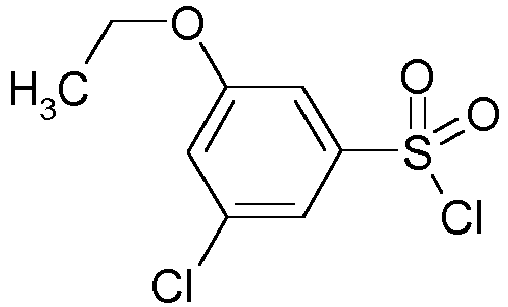
Prepared analogously to the procedure described for the synthesis of intermediate (IV-5) in WO2008/113760 (IV-5) 
Synthesis described in WO2008/113760 (IV-6) 
Synthesis described in WO2009/030715 -

- To a mixture of the sulfonyl chloride 3,5-dichlorbenzenesulfonyl chloride (10.0 g; 40.7 mmol) and DCM (100 mL), methyl isonipecotate (6.05 mL; 44.8 mmol) and triethylamine (6.25 mL; 44.8 mmol) are added. The mixture is stirred at r.t. overnight. The mixture is washed successively with aq. HCl (1 mol/L) and water. The organic layer is dried over MgSO4, filtered and the solvent is removed in vacuo.
C13H15Cl2NO4S ESI pos.+neg. (Loop-Inj.): [M+H]+ 352 m/z
HPLC (RT): 1.05 min (HPLC method B) - A mixture of the intermediate obtained from step 1 (14.9 g; 42.3 mmol), aq. sodium hydroxide (4 mol/L; 31.7 mL; 127 mmol) and methanol (100 mL) are stirred at 70 °C for 3 h. After cooling to r.t. the reaction mixture is added to aq. HCl (4 mol/L; 50 mL), the precipitate is filtered off and dried at 50 °C.
C12H13Cl2NO4S ESI pos.+neg. (Loop-Inj.): [M+H]+ 338 m/z
HPLC (RT): 0.96 min (HPLC method B) - A mixture of the intermediate obtained from step 2 (1.00 g; 2.96 mmol), HATU (1.24 g; 3.25 mmol), DMF (2.50 mL) and DIPEA (0.56 mL; 3.25 mmol) is stirred at r.t. for 20 min. The amine 4-cyanobenzylamine (0.36 mL, 2.96 mmol) is added and the resulting mixture is stirred at r.t. for 2 h. A molar surplus of aq. NaHCO3 solution is added with stirring and the precipitate is filtered off and dried at 50 °C to yield the title compound.
C20H19Cl2N3O3S ESI pos.+neg. (Loop-Inj.): [M+H]+ 452 m/z
HPLC (RT): 0.70 min (HPLC method A) - The following example compounds are prepared according to the procedure described for the synthesis of example (1-1) from the respective sulfonyl chloride and the respective amine as indicated in the table.
In cases where the amine is applied as a hydrochloride (or other salt), additional molar equivalents of DIPEA are added in step 3. In cases where the title compound is not readily obtained by precipitation in good quality, it is purified (after extraction with e.g. DCM) by preparative HPLC.


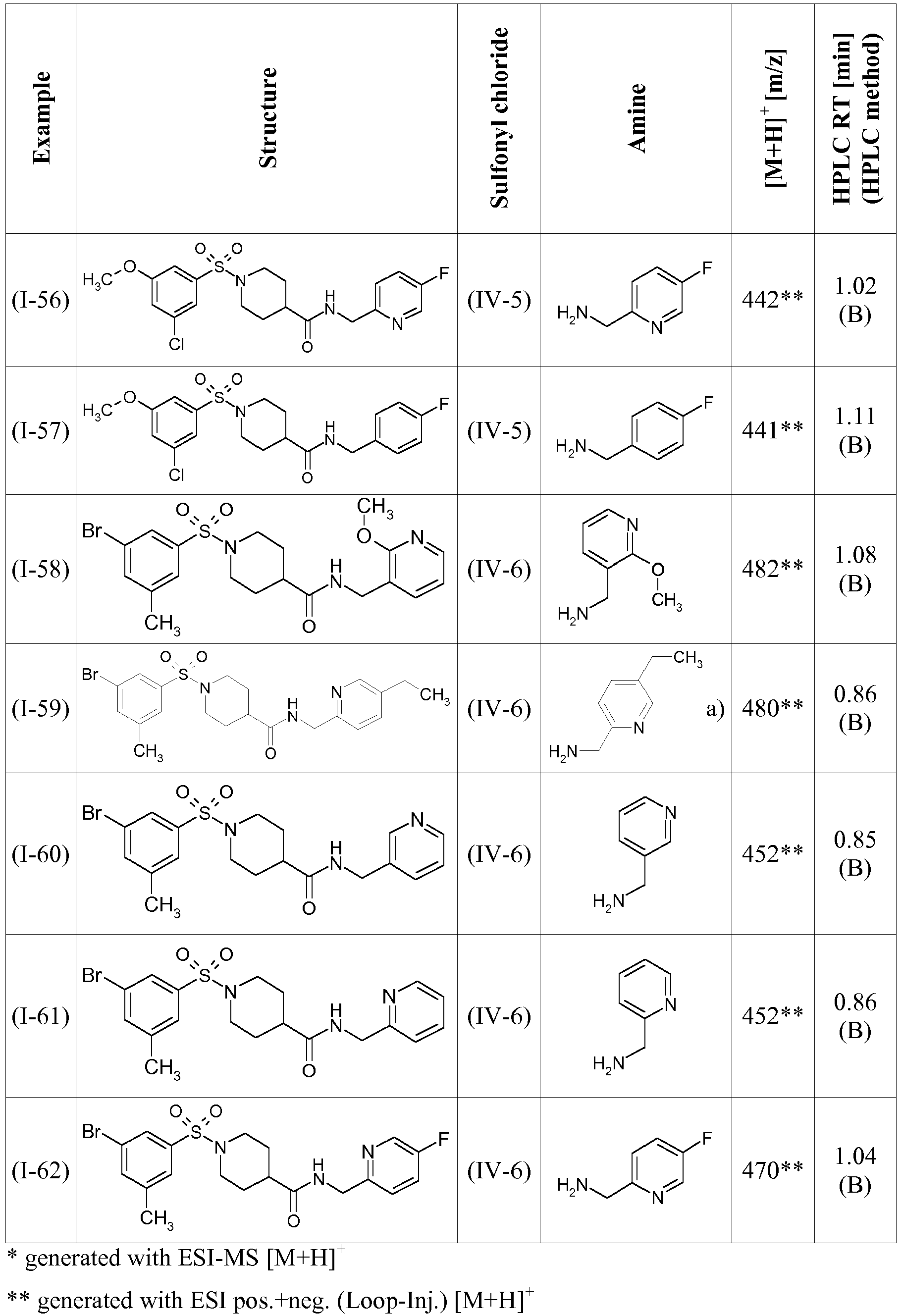
- a) 2-Aminomethyl-5-ethylpyridine is prepared from 2-cyano-5-ethylpyridine analogously to the procedure described for the synthesis of 2-aminomethyl-5-methylpyridine from 2-cyano-5-methylpyridine in
WO2013/30138 - b) 2-Aminomethyl-5-methylthiazole is prepared from 2-hydroxymethyl-5-methylthiazole analogously to the sequence described for the synthesis of 2-aminomethyl-4-methylthiazole from 2-hydroxymethyl-4-methylthiazole in
WO2009/15369 - As a rule, 1H-NMR and mass spectra have been obtained for the compounds prepared. Mass peaks given (e.g. [M+H]+) refer to monoisotopic molecular weight.
- Stationary phase: XBridge™ C18; 10 µm or SunFire™ C18; 10 µm (both from Waters)
- The HPLC retention times given are measured under the following parameters.
-
Column: SunFire™ C18, 2.1 x 30 mm, 2.5 µm (Waters) Gradient time [min] % Solvent [H2O, 0.1% TFA] % Solvent [ACN] Flow [mL/min] Temperature [°C] 0.00 99 1 1.5 60 0.02 99 1 1.5 60 1.00 0 100 1.5 60 1.10 0 100 1.5 60 -
Column: SunFire™ C18, 3.0 x 30 mm, 2.5 µm (Waters) Gradient time [min] % Solvent [H2O, 0.1% TFA] % Solvent [ACN] Flow [mL/min] Temperature [°C] 0.00 97 3 2.2 60 0.20 97 3 2.2 60 1.20 0 100 2.2 60 1.25 0 100 3 60 1.40 0 100 3 60 -
Column: SunFire™ C18, 3.0 x 30 mm, 2.5 µm (Waters) Gradient time [min] % Solvent [H2O, 0.1% TFA] % Solvent [ACN, 0.08% TFA] Flow [mL/min] Temperature [°C] 0.0 95 5 1.5 60 1.3 0 100 1.5 60 1.5 0 100 1.5 60 1.6 95 5 1.5 60 -
Column: XBridge™ C18, 3.0 x 30 mm, 2.5 µm (Waters) Gradient time [min] % Solvent [H2O, 0.1% NH3] % Solvent [ACN] Flow [mL/min] Temperature [°C] 0.0 95 5 1.5 60 1.3 1.0 99 1.5 60 1.5 0.1 99.9 1.5 60 1.6 95 5 1.5 60 -
Column: SunFire™ C18, 3.0 x 30 mm, 2.5µm (Waters) Gradient time [min] % Solvent [H2O, 0.1% TFA] % Solvent [ACN] Flow [ml/min] Temperature [°C] 0.0 98.0 2.0 2.0 60 1.2 0.0 100.0 2.0 60 1.4 0.0 100.0 2.0 60 -
Column: XBridge™ C18, 3.0 x 30 mm, 2.5 µm (Waters) Gradient time [min] % Solvent [H2O, 0.1% NH3] % Solvent [ACN] Flow [mL/min] Temperature [°C] 0.00 97 3 2.2 60 0.20 97 3 2.2 60 1.20 0 100 2.2 60 1.25 0 100 3 60 1.40 0 100 3 60 - HepG2 cells endogenously expressing hSLC13A5 were obtained from the Wistar Institute (Knowles et al., Science 1980, 209, 497-499).
- HepG2 cells endogenously express hSLC13A5 transporter which is responsible for the uptake of citrate into these cells. Uptake of 14C-citrate can be completely blocked by specific SLC13A5 inhibitors and the signal can be competed with unlabelled citrate. The uptake of 14C-citrate into HepG2 cells is monitored using the Cytostar-T assay. This assay format is based on the imported radioactive citrate brought into proximity with the scintillant contained within the base of the plate by virtue of the biological processes within the cells. The radioactive decay is converted to a light signal based on the integration of the scintillation matrix into the assay plate.
- Starting from 10 mM stock solutions in 100% DMSO, compounds are diluted in pure DMSO using the appropriate dilution steps. Prior to the uptake assay, 400 µL assay medium + 4.8 µL compound solution (or pure DMSO for non-inhibited control wells) are mixed (final DMSO concentration in the assay: 1% (v/v))
14C-citrate working solution (volumes required per 96-well):
1.88 mL assay medium (50% DMEM + 50% Ham's F-12 + 15mM HEPES (pH7.4) (medium contains 15.5 mM D(+)-glucose) + 21.2 µL 14C-citric acid stock solution (stock: 0.1 mCi/mL = 111,000,000 dpm/500 µL; ∼1mmol/L). - The HepG2 cells are cultivated in cell culture medium (EMEM + 10% fetal calf serum + 1x NEAA and 10 mM L-Glutamin). For the assay, the medium of the confluent cultures is discarded and the cells are washed with DPBS w/o Mg2+ w/o Ca2+. The cells are detached by the addition of 1.0 mL 2x Trypsin in DPBS w/o Mg2+ w/o Ca2+ with 7.5 mM EDTA per 75 cm2 culture flask for up to 3 minutes at 37°C and resuspended in 10 mL cell culture medium. Following cell counting, 100,000 cells/well are seeded in a volume of 200 µL into Cytostar-T Scintillating 96-well microplates. After overnight incubation in a humid cell culture incubator at 37°C, 5% CO2, the cell culture medium is carefully aspirated and the cells are incubated with 200 µL prewarmed (37°C) assay medium (50% DMEM + 50% Ham's F-12 + 15mM HEPES (pH 7.4) (medium contains 15.5m M D(+)-glucose) per well for at least 1h prior to the experiment.
- Immediately prior to uptake assay, the assay medium is carefully removed and 100 µL test compound dilution is added to each well (n=3).
Following a 20 min incubation at 37°C in the cell culture incubator, 20 µL of 14C-citrate working solution is added to each well (final volume per well: 120 µL; final 14C-citrate concentration ∼1.8 µM/well)).
After incubation over night at 37°C in the cell culture incubator, the plates are sealed on the top using a transparent plastic foil and on the bottom using a white plastic foil. Following the sealing, the plate is placed into the TopCount NXT HTS and the signal is recorded. - The IC50 values of the compounds are calculated in IDBS XLfit by sigmoidal dose-response (variable slope).
- The human embryonic kidney 293 (HEK 293)-Flp-In cells (293Flp-In-hSLC13A5) over-expressing hSLC13A5 transporter were cloned: The originating plasmid pcDNA3.1-hSLC13A5 containing hSLC13A5 was synthesized at GeneArt. The cDNA for hSLC13A5 was taken from this plasmid by means of PCR amplification using primers with added HindIII (N-terminal) and XhoI (C-terminal) restriction sites and sub-cloned in frame into pcDNA5/FRT from Invitrogen using the respective restriction enzymes. HEK293 Flp-In cells from Invitrogen were stably co-transfected using the pcDNA/FRT-hSLC13A5 plasmid as well as the pOG44 plasmid.
- HEK 293-Flp-In cells are used that stably over-express hSLC13A5 transporter which is responsible for the uptake of citrate into these cells. Uptake of 14C-citrate can be completely blocked by specific SLC13A5 inhibitors and the signal can be competed with unlabelled citrate.
The uptake of 14C-citrate into the 293Flp-In-hSLC13A5 cells is monitored using the WGA-PVT SPA (wheat germ agglutinin-polyvinyltoluene scintillation proximity assay) beads that bind to the 293Flp-In cells due to their WGA-PVT surface. This assay format is based on the imported radioactive citrate brought into proximity with the SPA beads by virtue of the biological processes within the cells. The radioactive decay is converted into a light signal that can be measured using e.g. the TopCount plate reader. - Starting from 10 mM stock solutions in 100% DMSO, compounds are diluted in pure DMSO using the appropriate dilution steps.
Prior to the uptake assay, 200 µL assay medium (1x HBSS (with Ca2+ and Mg2+, w/o Phenolred), contains 5.56 mM D(+)-Glucose) + 19.44 mM D(+)-Glucose (final concentration of D(+)-Glucose is 25 mM)) + 4.8 µL compound solution (or pure DMSO for non-inhibited control wells) are mixed (final DMSO concentration in the assay: 1% (v/v)).
After preparing the 2fold-concentrated test compound dilutions, 50 µL are pipetted to each well of white OptiPlates-96 and incubated at 37°C in an incubator. - 14C-citrate working solution (volumes required per 96-well):
2.1 mL assay medium + 23.65 µL 14C-citric acid stock solution (stock: 0.1 mCi/mL = 111,000,000 dpm/500 µL). - The 293Flp-In-hSLC13A5 cells are cultivated in cell culture medium (DMEM + 10% fetal calf serum + 100 µg/mL Hygromycin B).The medium of the confluent cultures is discarded and the cells are washed with DPBS (w/o Mg2+ w/o Ca2+). The cells are detached by the addition of 2.0 mL Accumax per 75 cm2 culture flask for up to 3 minutes at 37°C and resuspended in 10 mL assay medium. After cell counting, 50,000 cells/well are administered in a volume of 50 µL into the white OptiPlates-96 containing the respective test compound concentrations. Following a 20 min incubation at 37°C in the cell culture incubator, 20 µL of 14C-citrate working solution is added to each well (final volume per well: 120 µL; final 14C-citrate concentration: approx. 2µM/well).
- After incubation for 4 h at 37°C in a humid cell culture incubator and the addition of 30 µL of WGA-PVT SPA beads to each well (0.25 mg/well), the plates are sealed on the top using a transparent plastic foil. Incubate the plates for 1 h by room temperature and gentle shaking.
After incubation, the plate is placed into the TopCount NXT HTS and the signal is recorded. - The performance of the test compounds is calculated as follows:
Wells containing cells incubated with 1% DMSO only deliver values for the non-inhibited 14C-citrate uptake into 293Flp-In-hSLC13A5 cells (100 %CTL). Wells containing cells which have received 30 mM non-labelled potassium citrate solution in addition to the 14C-citrate working solution deliver values for the background (0 %CTL). - The IC50 values of the compounds are calculated in IDBS XLfit by sigmoidal dose-response (variable slope).
- The human embryonic kidney 293 cell clone (HEK293-hGlyT2) over-expressing the human GlyT2 transporter was generated (the plasmid pCMV6-XL5-hGlyT2 containing the cDNA coding for the human GlyT2 transporter was obtained from Origene, the cDNA for GlyT2 was taken from this plasmid and sub-cloned into pcDNA3.1zeo from Invitrogen).
- Human embryonic kidney 293 (HEK 293) cells are used that stably over-express the human GlyT2 receptor which is responsible for the uptake of glycine into these cells. Uptake of 3H-glycine can be completely blocked by specific GlyT2 inhibitors and the signal can be competed with unlabelled glycine.
- The uptake of 3H-glycine into the HEK 293 hGlyT2 cells is monitored using the Cytostar-T assay. This assay format is based on the imported radioactive glycine brought into proximity with the scintillant contained within the base of the plate by virtue of the biological processes within the cells. The radioactive decay is converted to a light signal based on the integration of the scintillation matrix into the assay plate.
- The hGlyT2 over-expressing HEK 293 cells are cultivated in cell culture medium (DMEM +10% fetal calf serum + 100 µg/mL Zeocin). For the assay, the medium of the 90% confluent cultures is removed and the cells are washed with DPBS. The cells are detached by the addition of 2 mL AccuMax and resuspended in 10 mL culture medium. The cell suspension is centrifuged at 1000 U/min for 5min, the supernatant is removed and cells resuspended in expression medium (MEM (medium without glycine) + 10% fetal calf serum) without glycine to 200,000 cells/mL and distributed into the Cytostar-T Scintillating 96-well Microplates (40,000 cells/well; 200 µl/well). The lid covered MTPs are then incubated for 24 hours at 37°C; 5% CO2.
- The following day, the cell plates are washed once with 200 µL HBSS/Ala buffer (HBSS 10x (+Ca, +Mg) with 5 mM Alanine adjusted to pH 7.4 with NaOH) following a 1 h incubation at 37°C; 5% CO2, and subsequently 100 µL/well of HBSS/Ala containing 1.2x the concentration of compound in 1.2% DMSO (test range final: 100 µM - 100 nM) incubated for 20 min at 37°C. Following the addition of 20 µL/well 3H-glycine in HBSS/Ala (final 3H-glycine concentration 100 nM) and an incubation for 2 hours at 37°C, the assay plate is placed into the Topcount NXT HTS and the signal is recorded.
- The IC50 values of the compounds are calculated in IDBS XLfit by sigmoidal dose-response (variable slope).
-
Example HepG2 / 14C-citrate uptake assay IC50 [µM] Recombinant hSLC13A5 / 14C-citrate uptake assay IC50 [µM] Recombinant human GlyT2/3H-glycine uptake assay IC50 [µM] (I-1) 0.074 0.079 >100 (I-2) 0.035 0.087 >100 (I-3) 0.471 (I-4) 0.094 (I-5) 0.022 0.056 >100 (I-6) 0.082 (I-7) 0.030 (I-8) 0.037 (I-9) 0.246 0.303 (I-10) 0.024 0.056 >100 (I-11) 0.455 0.687 >100 (I-12) 0.103 0.132 (I-13) 0.201 0.475 (I-14) 0.083 (I-15) 0.152 0.193 >100 (I-16) 0.632 0.675 (I-17) 0.130 0.138 (I-18) 0.060 (I-19) 0.072 (I-20) 0.233 0.392 >70 (I-21) 0.065 (I-22) 0.084 (I-23) 0.142 0.091 (I-24) 0.083 (I-25) 0.037 (I-26) 0.290 0.449 (I-27) 0.113 0.341 >100 (I-28) 0.171 0.127 (I-29) 0.043 (I-30) 0.014 (I-31) 0.066 0.041 (I-32) 0.023 (I-33) 0.182 0.275 (I-34) 0.027 (I-35) 0.147 0.054 (I-36) 0.448 0.354 (I-37) 0.253 0.089 (I-38) 0.014 (I-39) 0.014 (I-40) 0.017 0.026 (I-41) 0.155 0.438 (I-42) 0.035 (I-43) 0.046 (I-44) 0.132 0.703 (I-45) 0.025 (I-46) 0.202 0.398 (I-47) 0.034 (I-48) 0.017 (I-49) 0.100 0.154 >100 (I-50) 0.073 0.127 (I-51) 0.014 0.066 (I-52) 0.051 0.200 (I-53) 0.110 0.410 (I-54) 0.062 0.231 (I-55) 0.056 0.189 (I-56) 0.292 0.436 (I-57) 0.048 0.167 (I-58) 0.168 0.837 (I-59) 0.027 0.098 (I-60) 0.422 0.918 (I-61) 0.149 0.437 >100 (I-62) 0.099 0.232
Claims (14)
- A compound of formula (I)
 R1 and R2 are independently selected from the group consisting of halogen, CN, C1-3-alkyl and C1-4-alkyl-O-;A is selected from the group consisting of phenyl, substituted with R3 and optionally substituted with R4,2-pyridyl, optionally substituted with R5,3-pyridyl, optionally substituted with R6 and2-thiazolyl, optionally substituted with R7;and wherein R3, R4, R5, R6 and R7 are independently selected from the group consisting ofhalogen, CN, C1-3-alkyl and C1-4-alkyl-O-
or a salt thereof. - A compound according to claim 1 wherein
R1 is selected from the group consisting of
Cl, Br, methyl, methoxy and ethoxy. - A compound according to one or more of claims 1 to 2 wherein
R2 is selected from the group consisting of
Cl, Br and methyl. - A compound according to one or more of claims 1 to 3 wherein
A is selected from the group consisting of
phenyl, substituted with R3 and optionally substituted with R4,
wherein R3 and R4 are defined as in claim 1. - A compound according to one or more of claims 1 to 3 wherein
A is selected from the group consisting of
2-pyridyl, optionally substituted with R5,
wherein R5 is defined as in claim 1. - A compound according to one or more of claims 1 to 3 wherein
A is selected from the group consisting of
3-pyridyl, optionally substituted with R6,
wherein R6 is defined as in claim 1. - A compound according to one or more of claims 1 to 3 wherein
A is selected from the group consisting of
2-thiazolyl, optionally substituted with R7,
wherein R7 is defined as in claim 1. - A compound according to one or more of claims 1 to 4 wherein
R3 is selected from the group consisting of
halogen, CN, methyl and methoxy. - A compound according to one or more of claims 1 to 4 and 8 wherein
R4 is selected from the group consisting of
F and methyl. - A compound according to one or more of claims 1 to 3 and 5 wherein
R5 is selected from the group consisting of
halogen, methyl and ethyl. - A compound according to one or more of claims 1 to 3 and 6 wherein
R6 is selected from the group consisting of
Cl, methyl and methoxy. - A compound according to one or more of claims 1 to 3 and 7 wherein
R7 is methyl. - A pharmaceutical composition comprising at least one compound of formula (I) according to one or more of claims 1 to 12 or a pharmaceutically acceptable salt thereof and at least one pharmaceutically acceptable excipient.
- A compound according to any of claims 1 to 12 or a pharmaceutically acceptable salt thereof for use in a method for the treatment of one or more metabolic and/or cardiovascular diseases in a patient in need thereof characterized in that a compound of formula (I) according to one or more of claims 1 to 12 or a pharmaceutically acceptable salt thereof is administered to the patient.
Applications Claiming Priority (2)
| Application Number | Priority Date | Filing Date | Title |
|---|---|---|---|
| EP16203086 | 2016-12-09 | ||
| PCT/EP2017/081359 WO2018104220A1 (en) | 2016-12-09 | 2017-12-04 | Sulfonamides as inhibitors of the uptake of extracellular citrate |
Publications (2)
| Publication Number | Publication Date |
|---|---|
| EP3551618A1 EP3551618A1 (en) | 2019-10-16 |
| EP3551618B1 true EP3551618B1 (en) | 2020-09-16 |
Family
ID=57539116
Family Applications (1)
| Application Number | Title | Priority Date | Filing Date |
|---|---|---|---|
| EP17811906.1A Active EP3551618B1 (en) | 2016-12-09 | 2017-12-04 | Sulfonamides as inhibitors of the uptake of extracellular citrate |
Country Status (5)
| Country | Link |
|---|---|
| US (1) | US10793522B2 (en) |
| EP (1) | EP3551618B1 (en) |
| JP (1) | JP7007381B2 (en) |
| CN (1) | CN110325527B (en) |
| WO (1) | WO2018104220A1 (en) |
Families Citing this family (3)
| Publication number | Priority date | Publication date | Assignee | Title |
|---|---|---|---|---|
| JP7007381B2 (en) | 2016-12-09 | 2022-01-24 | ベーリンガー インゲルハイム インターナショナル ゲゼルシャフト ミット ベシュレンクテル ハフツング | Sulfonamide as an inhibitor of extracellular citric acid uptake |
| GB2560713A (en) * | 2017-03-20 | 2018-09-26 | Eternygen Gmbh | Inhibitor of citrate transporter |
| GB201918410D0 (en) * | 2019-12-13 | 2020-01-29 | Z Factor Ltd | Compounds and their use for the treatment of alpha1-antitrypsin deficiency |
Family Cites Families (7)
| Publication number | Priority date | Publication date | Assignee | Title |
|---|---|---|---|---|
| AU2006326134B2 (en) | 2005-12-12 | 2012-07-19 | Nerviano Medical Sciences S.R.L. | Substituted pyrazolo [4,3-c] pyridine derivatives active as kinase inhibitors |
| KR20100051668A (en) | 2007-07-26 | 2010-05-17 | 코멘티스, 인코포레이티드 | Isophthalamide derivatives inhibiting beta-secretase activity |
| WO2010080183A1 (en) | 2009-01-08 | 2010-07-15 | The Trustees Of Columbia University In The City Of New York | Potent non-urea inhibitors of soluble epoxide hydrolase |
| US8258158B2 (en) | 2009-09-11 | 2012-09-04 | Hoffmann-La Roche Inc. | HSL inhibitors useful in the treatment of diabetes |
| WO2013030138A1 (en) | 2011-09-01 | 2013-03-07 | F. Hoffmann-La Roche Ag | Pyrrolopyrazine kinase inhibitors |
| SG11201600108PA (en) | 2013-07-17 | 2016-02-26 | Otsuka Pharma Co Ltd | Cyanotriazole compounds |
| JP7007381B2 (en) | 2016-12-09 | 2022-01-24 | ベーリンガー インゲルハイム インターナショナル ゲゼルシャフト ミット ベシュレンクテル ハフツング | Sulfonamide as an inhibitor of extracellular citric acid uptake |
-
2017
- 2017-12-04 JP JP2019530714A patent/JP7007381B2/en active Active
- 2017-12-04 US US16/467,499 patent/US10793522B2/en active Active
- 2017-12-04 CN CN201780074706.4A patent/CN110325527B/en active Active
- 2017-12-04 WO PCT/EP2017/081359 patent/WO2018104220A1/en not_active Ceased
- 2017-12-04 EP EP17811906.1A patent/EP3551618B1/en active Active
Non-Patent Citations (1)
| Title |
|---|
| None * |
Also Published As
| Publication number | Publication date |
|---|---|
| CN110325527A (en) | 2019-10-11 |
| CN110325527B (en) | 2022-08-09 |
| JP7007381B2 (en) | 2022-01-24 |
| JP2020500907A (en) | 2020-01-16 |
| EP3551618A1 (en) | 2019-10-16 |
| US20200062708A1 (en) | 2020-02-27 |
| WO2018104220A1 (en) | 2018-06-14 |
| US10793522B2 (en) | 2020-10-06 |
Similar Documents
| Publication | Publication Date | Title |
|---|---|---|
| EP2903998B1 (en) | Iap antagonists | |
| TWI775556B (en) | Compositions and methods for inhibiting arginase activity | |
| CN112585140B (en) | Optically Active Azabicyclo Derivatives | |
| EP2882740B1 (en) | Iap antagonists | |
| EP2897949B1 (en) | Iap antagonists | |
| EP0303697B1 (en) | Derivatives of physiologically active substance k-252 | |
| US9932326B2 (en) | Potent and selective inhibitors of hepatitis C virus | |
| CN112996789B (en) | Antiviral pyridopyrazines oxazindione compounds | |
| US20230150974A1 (en) | Compounds and uses thereof | |
| AU2023358081A1 (en) | Novel bicyclic heterocyclyl compounds and use thereof | |
| JP2002522433A (en) | FSH mimic for the treatment of infertility | |
| CA3237911A1 (en) | Method for producing n-alkyl amino acid and peptide including n-alkyl amino acid | |
| JP2015504425A (en) | Macrocycles for inhibiting inhibitors of apoptosis | |
| US20160376307A1 (en) | Iap antagonists | |
| KR20190044499A (en) | Compound for inducing the degradation of cereblon protein, preparation method thereof and pharmaceutical composition for use in preventing or treating cancer containing the same as an active ingredient | |
| KR20230061505A (en) | Sulfamoyl urea derivatives containing an alkyl-oxacycloalkyl moiety and uses thereof | |
| AU2017273857A1 (en) | Compounds | |
| TW200538101A (en) | Dipeptidyl peptidase-Ⅳ inhibitors | |
| CA3191304A1 (en) | Antibody-drug conjugates comprising glp1 peptidomimetics and uses thereof | |
| EP2864296A1 (en) | 2h-imidazol-4-amine compounds and their use as bace inhibitors | |
| US10793522B2 (en) | Sulfonamides as inhibitors of the uptake of extracellular citrate | |
| US9926295B2 (en) | Potent and selective inhibitors of hepatitis C virus | |
| AU2020360170B2 (en) | Bet degrader | |
| KR20150064736A (en) | Azaindolines | |
| TW201910312A (en) | Cyclic amine derivative and pharmaceutical use thereof |
Legal Events
| Date | Code | Title | Description |
|---|---|---|---|
| STAA | Information on the status of an ep patent application or granted ep patent |
Free format text: STATUS: UNKNOWN |
|
| STAA | Information on the status of an ep patent application or granted ep patent |
Free format text: STATUS: THE INTERNATIONAL PUBLICATION HAS BEEN MADE |
|
| PUAI | Public reference made under article 153(3) epc to a published international application that has entered the european phase |
Free format text: ORIGINAL CODE: 0009012 |
|
| STAA | Information on the status of an ep patent application or granted ep patent |
Free format text: STATUS: REQUEST FOR EXAMINATION WAS MADE |
|
| 17P | Request for examination filed |
Effective date: 20190709 |
|
| AK | Designated contracting states |
Kind code of ref document: A1 Designated state(s): AL AT BE BG CH CY CZ DE DK EE ES FI FR GB GR HR HU IE IS IT LI LT LU LV MC MK MT NL NO PL PT RO RS SE SI SK SM TR |
|
| AX | Request for extension of the european patent |
Extension state: BA ME |
|
| DAV | Request for validation of the european patent (deleted) | ||
| DAX | Request for extension of the european patent (deleted) | ||
| GRAP | Despatch of communication of intention to grant a patent |
Free format text: ORIGINAL CODE: EPIDOSNIGR1 |
|
| STAA | Information on the status of an ep patent application or granted ep patent |
Free format text: STATUS: GRANT OF PATENT IS INTENDED |
|
| INTG | Intention to grant announced |
Effective date: 20200422 |
|
| GRAS | Grant fee paid |
Free format text: ORIGINAL CODE: EPIDOSNIGR3 |
|
| GRAA | (expected) grant |
Free format text: ORIGINAL CODE: 0009210 |
|
| STAA | Information on the status of an ep patent application or granted ep patent |
Free format text: STATUS: THE PATENT HAS BEEN GRANTED |
|
| AK | Designated contracting states |
Kind code of ref document: B1 Designated state(s): AL AT BE BG CH CY CZ DE DK EE ES FI FR GB GR HR HU IE IS IT LI LT LU LV MC MK MT NL NO PL PT RO RS SE SI SK SM TR |
|
| REG | Reference to a national code |
Ref country code: GB Ref legal event code: FG4D |
|
| REG | Reference to a national code |
Ref country code: CH Ref legal event code: EP |
|
| REG | Reference to a national code |
Ref country code: DE Ref legal event code: R096 Ref document number: 602017023879 Country of ref document: DE |
|
| REG | Reference to a national code |
Ref country code: IE Ref legal event code: FG4D |
|
| REG | Reference to a national code |
Ref country code: AT Ref legal event code: REF Ref document number: 1314073 Country of ref document: AT Kind code of ref document: T Effective date: 20201015 |
|
| PG25 | Lapsed in a contracting state [announced via postgrant information from national office to epo] |
Ref country code: FI Free format text: LAPSE BECAUSE OF FAILURE TO SUBMIT A TRANSLATION OF THE DESCRIPTION OR TO PAY THE FEE WITHIN THE PRESCRIBED TIME-LIMIT Effective date: 20200916 Ref country code: HR Free format text: LAPSE BECAUSE OF FAILURE TO SUBMIT A TRANSLATION OF THE DESCRIPTION OR TO PAY THE FEE WITHIN THE PRESCRIBED TIME-LIMIT Effective date: 20200916 Ref country code: SE Free format text: LAPSE BECAUSE OF FAILURE TO SUBMIT A TRANSLATION OF THE DESCRIPTION OR TO PAY THE FEE WITHIN THE PRESCRIBED TIME-LIMIT Effective date: 20200916 Ref country code: BG Free format text: LAPSE BECAUSE OF FAILURE TO SUBMIT A TRANSLATION OF THE DESCRIPTION OR TO PAY THE FEE WITHIN THE PRESCRIBED TIME-LIMIT Effective date: 20201216 Ref country code: GR Free format text: LAPSE BECAUSE OF FAILURE TO SUBMIT A TRANSLATION OF THE DESCRIPTION OR TO PAY THE FEE WITHIN THE PRESCRIBED TIME-LIMIT Effective date: 20201217 Ref country code: NO Free format text: LAPSE BECAUSE OF FAILURE TO SUBMIT A TRANSLATION OF THE DESCRIPTION OR TO PAY THE FEE WITHIN THE PRESCRIBED TIME-LIMIT Effective date: 20201216 |
|
| REG | Reference to a national code |
Ref country code: AT Ref legal event code: MK05 Ref document number: 1314073 Country of ref document: AT Kind code of ref document: T Effective date: 20200916 |
|
| REG | Reference to a national code |
Ref country code: NL Ref legal event code: MP Effective date: 20200916 |
|
| PG25 | Lapsed in a contracting state [announced via postgrant information from national office to epo] |
Ref country code: LV Free format text: LAPSE BECAUSE OF FAILURE TO SUBMIT A TRANSLATION OF THE DESCRIPTION OR TO PAY THE FEE WITHIN THE PRESCRIBED TIME-LIMIT Effective date: 20200916 Ref country code: RS Free format text: LAPSE BECAUSE OF FAILURE TO SUBMIT A TRANSLATION OF THE DESCRIPTION OR TO PAY THE FEE WITHIN THE PRESCRIBED TIME-LIMIT Effective date: 20200916 |
|
| REG | Reference to a national code |
Ref country code: LT Ref legal event code: MG4D |
|
| PG25 | Lapsed in a contracting state [announced via postgrant information from national office to epo] |
Ref country code: EE Free format text: LAPSE BECAUSE OF FAILURE TO SUBMIT A TRANSLATION OF THE DESCRIPTION OR TO PAY THE FEE WITHIN THE PRESCRIBED TIME-LIMIT Effective date: 20200916 Ref country code: CZ Free format text: LAPSE BECAUSE OF FAILURE TO SUBMIT A TRANSLATION OF THE DESCRIPTION OR TO PAY THE FEE WITHIN THE PRESCRIBED TIME-LIMIT Effective date: 20200916 Ref country code: PT Free format text: LAPSE BECAUSE OF FAILURE TO SUBMIT A TRANSLATION OF THE DESCRIPTION OR TO PAY THE FEE WITHIN THE PRESCRIBED TIME-LIMIT Effective date: 20210118 Ref country code: RO Free format text: LAPSE BECAUSE OF FAILURE TO SUBMIT A TRANSLATION OF THE DESCRIPTION OR TO PAY THE FEE WITHIN THE PRESCRIBED TIME-LIMIT Effective date: 20200916 Ref country code: SM Free format text: LAPSE BECAUSE OF FAILURE TO SUBMIT A TRANSLATION OF THE DESCRIPTION OR TO PAY THE FEE WITHIN THE PRESCRIBED TIME-LIMIT Effective date: 20200916 Ref country code: LT Free format text: LAPSE BECAUSE OF FAILURE TO SUBMIT A TRANSLATION OF THE DESCRIPTION OR TO PAY THE FEE WITHIN THE PRESCRIBED TIME-LIMIT Effective date: 20200916 |
|
| PG25 | Lapsed in a contracting state [announced via postgrant information from national office to epo] |
Ref country code: ES Free format text: LAPSE BECAUSE OF FAILURE TO SUBMIT A TRANSLATION OF THE DESCRIPTION OR TO PAY THE FEE WITHIN THE PRESCRIBED TIME-LIMIT Effective date: 20200916 Ref country code: AT Free format text: LAPSE BECAUSE OF FAILURE TO SUBMIT A TRANSLATION OF THE DESCRIPTION OR TO PAY THE FEE WITHIN THE PRESCRIBED TIME-LIMIT Effective date: 20200916 Ref country code: AL Free format text: LAPSE BECAUSE OF FAILURE TO SUBMIT A TRANSLATION OF THE DESCRIPTION OR TO PAY THE FEE WITHIN THE PRESCRIBED TIME-LIMIT Effective date: 20200916 Ref country code: PL Free format text: LAPSE BECAUSE OF FAILURE TO SUBMIT A TRANSLATION OF THE DESCRIPTION OR TO PAY THE FEE WITHIN THE PRESCRIBED TIME-LIMIT Effective date: 20200916 Ref country code: IS Free format text: LAPSE BECAUSE OF FAILURE TO SUBMIT A TRANSLATION OF THE DESCRIPTION OR TO PAY THE FEE WITHIN THE PRESCRIBED TIME-LIMIT Effective date: 20210116 |
|
| REG | Reference to a national code |
Ref country code: DE Ref legal event code: R097 Ref document number: 602017023879 Country of ref document: DE |
|
| PG25 | Lapsed in a contracting state [announced via postgrant information from national office to epo] |
Ref country code: SK Free format text: LAPSE BECAUSE OF FAILURE TO SUBMIT A TRANSLATION OF THE DESCRIPTION OR TO PAY THE FEE WITHIN THE PRESCRIBED TIME-LIMIT Effective date: 20200916 |
|
| PLBE | No opposition filed within time limit |
Free format text: ORIGINAL CODE: 0009261 |
|
| STAA | Information on the status of an ep patent application or granted ep patent |
Free format text: STATUS: NO OPPOSITION FILED WITHIN TIME LIMIT |
|
| REG | Reference to a national code |
Ref country code: CH Ref legal event code: PL |
|
| 26N | No opposition filed |
Effective date: 20210617 |
|
| PG25 | Lapsed in a contracting state [announced via postgrant information from national office to epo] |
Ref country code: DK Free format text: LAPSE BECAUSE OF FAILURE TO SUBMIT A TRANSLATION OF THE DESCRIPTION OR TO PAY THE FEE WITHIN THE PRESCRIBED TIME-LIMIT Effective date: 20200916 Ref country code: SI Free format text: LAPSE BECAUSE OF FAILURE TO SUBMIT A TRANSLATION OF THE DESCRIPTION OR TO PAY THE FEE WITHIN THE PRESCRIBED TIME-LIMIT Effective date: 20200916 Ref country code: MC Free format text: LAPSE BECAUSE OF FAILURE TO SUBMIT A TRANSLATION OF THE DESCRIPTION OR TO PAY THE FEE WITHIN THE PRESCRIBED TIME-LIMIT Effective date: 20200916 |
|
| REG | Reference to a national code |
Ref country code: BE Ref legal event code: MM Effective date: 20201231 |
|
| PG25 | Lapsed in a contracting state [announced via postgrant information from national office to epo] |
Ref country code: IT Free format text: LAPSE BECAUSE OF FAILURE TO SUBMIT A TRANSLATION OF THE DESCRIPTION OR TO PAY THE FEE WITHIN THE PRESCRIBED TIME-LIMIT Effective date: 20200916 Ref country code: LU Free format text: LAPSE BECAUSE OF NON-PAYMENT OF DUE FEES Effective date: 20201204 Ref country code: IE Free format text: LAPSE BECAUSE OF NON-PAYMENT OF DUE FEES Effective date: 20201204 |
|
| PG25 | Lapsed in a contracting state [announced via postgrant information from national office to epo] |
Ref country code: CH Free format text: LAPSE BECAUSE OF NON-PAYMENT OF DUE FEES Effective date: 20201231 Ref country code: LI Free format text: LAPSE BECAUSE OF NON-PAYMENT OF DUE FEES Effective date: 20201231 |
|
| PG25 | Lapsed in a contracting state [announced via postgrant information from national office to epo] |
Ref country code: TR Free format text: LAPSE BECAUSE OF FAILURE TO SUBMIT A TRANSLATION OF THE DESCRIPTION OR TO PAY THE FEE WITHIN THE PRESCRIBED TIME-LIMIT Effective date: 20200916 Ref country code: MT Free format text: LAPSE BECAUSE OF FAILURE TO SUBMIT A TRANSLATION OF THE DESCRIPTION OR TO PAY THE FEE WITHIN THE PRESCRIBED TIME-LIMIT Effective date: 20200916 Ref country code: CY Free format text: LAPSE BECAUSE OF FAILURE TO SUBMIT A TRANSLATION OF THE DESCRIPTION OR TO PAY THE FEE WITHIN THE PRESCRIBED TIME-LIMIT Effective date: 20200916 |
|
| PG25 | Lapsed in a contracting state [announced via postgrant information from national office to epo] |
Ref country code: MK Free format text: LAPSE BECAUSE OF FAILURE TO SUBMIT A TRANSLATION OF THE DESCRIPTION OR TO PAY THE FEE WITHIN THE PRESCRIBED TIME-LIMIT Effective date: 20200916 |
|
| PG25 | Lapsed in a contracting state [announced via postgrant information from national office to epo] |
Ref country code: BE Free format text: LAPSE BECAUSE OF NON-PAYMENT OF DUE FEES Effective date: 20201231 |
|
| P01 | Opt-out of the competence of the unified patent court (upc) registered |
Effective date: 20230508 |
|
| PG25 | Lapsed in a contracting state [announced via postgrant information from national office to epo] |
Ref country code: NL Free format text: LAPSE BECAUSE OF NON-PAYMENT OF DUE FEES Effective date: 20200923 |
|
| PGFP | Annual fee paid to national office [announced via postgrant information from national office to epo] |
Ref country code: DE Payment date: 20251211 Year of fee payment: 9 |
|
| PGFP | Annual fee paid to national office [announced via postgrant information from national office to epo] |
Ref country code: GB Payment date: 20251219 Year of fee payment: 9 |
|
| PGFP | Annual fee paid to national office [announced via postgrant information from national office to epo] |
Ref country code: FR Payment date: 20251229 Year of fee payment: 9 |