EP3550982B1 - A method of processing a food object - Google Patents
A method of processing a food object Download PDFInfo
- Publication number
- EP3550982B1 EP3550982B1 EP17825131.0A EP17825131A EP3550982B1 EP 3550982 B1 EP3550982 B1 EP 3550982B1 EP 17825131 A EP17825131 A EP 17825131A EP 3550982 B1 EP3550982 B1 EP 3550982B1
- Authority
- EP
- European Patent Office
- Prior art keywords
- food
- food object
- undesired objects
- objects
- image data
- Prior art date
- Legal status (The legal status is an assumption and is not a legal conclusion. Google has not performed a legal analysis and makes no representation as to the accuracy of the status listed.)
- Active
Links
Images

Classifications
-
- A—HUMAN NECESSITIES
- A22—BUTCHERING; MEAT TREATMENT; PROCESSING POULTRY OR FISH
- A22B—SLAUGHTERING
- A22B5/00—Accessories for use during or after slaughtering
- A22B5/0017—Apparatus for cutting, dividing or deboning carcasses
-
- A—HUMAN NECESSITIES
- A22—BUTCHERING; MEAT TREATMENT; PROCESSING POULTRY OR FISH
- A22C—PROCESSING MEAT, POULTRY, OR FISH
- A22C25/00—Processing fish ; Curing of fish; Stunning of fish by electric current; Investigating fish by optical means
- A22C25/16—Removing fish-bones; Filleting fish
-
- A—HUMAN NECESSITIES
- A22—BUTCHERING; MEAT TREATMENT; PROCESSING POULTRY OR FISH
- A22B—SLAUGHTERING
- A22B5/00—Accessories for use during or after slaughtering
- A22B5/0017—Apparatus for cutting, dividing or deboning carcasses
- A22B5/0029—Cutting through or detaching portions of a carcass
-
- A—HUMAN NECESSITIES
- A22—BUTCHERING; MEAT TREATMENT; PROCESSING POULTRY OR FISH
- A22B—SLAUGHTERING
- A22B5/00—Accessories for use during or after slaughtering
- A22B5/0017—Apparatus for cutting, dividing or deboning carcasses
- A22B5/0041—Electronic, robotic or computer assisted cutting, dividing or deboning carcasses
-
- A—HUMAN NECESSITIES
- A22—BUTCHERING; MEAT TREATMENT; PROCESSING POULTRY OR FISH
- A22B—SLAUGHTERING
- A22B5/00—Accessories for use during or after slaughtering
- A22B5/0064—Accessories for use during or after slaughtering for classifying or grading carcasses; for measuring back fat
- A22B5/007—Non-invasive scanning of carcasses, e.g. using image recognition, tomography, X-rays, ultrasound
-
- A—HUMAN NECESSITIES
- A22—BUTCHERING; MEAT TREATMENT; PROCESSING POULTRY OR FISH
- A22C—PROCESSING MEAT, POULTRY, OR FISH
- A22C17/00—Other devices for processing meat or bones
-
- A—HUMAN NECESSITIES
- A22—BUTCHERING; MEAT TREATMENT; PROCESSING POULTRY OR FISH
- A22C—PROCESSING MEAT, POULTRY, OR FISH
- A22C17/00—Other devices for processing meat or bones
- A22C17/0006—Cutting or shaping meat
-
- A—HUMAN NECESSITIES
- A22—BUTCHERING; MEAT TREATMENT; PROCESSING POULTRY OR FISH
- A22C—PROCESSING MEAT, POULTRY, OR FISH
- A22C17/00—Other devices for processing meat or bones
- A22C17/0006—Cutting or shaping meat
- A22C17/002—Producing portions of meat with predetermined characteristics, e.g. weight or particular dimensions
-
- A—HUMAN NECESSITIES
- A22—BUTCHERING; MEAT TREATMENT; PROCESSING POULTRY OR FISH
- A22C—PROCESSING MEAT, POULTRY, OR FISH
- A22C17/00—Other devices for processing meat or bones
- A22C17/0073—Other devices for processing meat or bones using visual recognition, X-rays, ultrasounds, or other contactless means to determine quality or size of portioned meat
-
- A—HUMAN NECESSITIES
- A22—BUTCHERING; MEAT TREATMENT; PROCESSING POULTRY OR FISH
- A22C—PROCESSING MEAT, POULTRY, OR FISH
- A22C17/00—Other devices for processing meat or bones
- A22C17/0073—Other devices for processing meat or bones using visual recognition, X-rays, ultrasounds, or other contactless means to determine quality or size of portioned meat
- A22C17/0086—Calculating cutting patterns based on visual recognition
-
- A—HUMAN NECESSITIES
- A22—BUTCHERING; MEAT TREATMENT; PROCESSING POULTRY OR FISH
- A22C—PROCESSING MEAT, POULTRY, OR FISH
- A22C21/00—Processing poultry
-
- A—HUMAN NECESSITIES
- A22—BUTCHERING; MEAT TREATMENT; PROCESSING POULTRY OR FISH
- A22C—PROCESSING MEAT, POULTRY, OR FISH
- A22C21/00—Processing poultry
- A22C21/0023—Dividing poultry
-
- A—HUMAN NECESSITIES
- A22—BUTCHERING; MEAT TREATMENT; PROCESSING POULTRY OR FISH
- A22C—PROCESSING MEAT, POULTRY, OR FISH
- A22C21/00—Processing poultry
- A22C21/0023—Dividing poultry
- A22C21/003—Filleting poultry, i.e. extracting, cutting or shaping poultry fillets
-
- A—HUMAN NECESSITIES
- A22—BUTCHERING; MEAT TREATMENT; PROCESSING POULTRY OR FISH
- A22C—PROCESSING MEAT, POULTRY, OR FISH
- A22C25/00—Processing fish ; Curing of fish; Stunning of fish by electric current; Investigating fish by optical means
- A22C25/18—Cutting fish into portions
-
- A—HUMAN NECESSITIES
- A22—BUTCHERING; MEAT TREATMENT; PROCESSING POULTRY OR FISH
- A22C—PROCESSING MEAT, POULTRY, OR FISH
- A22C17/00—Other devices for processing meat or bones
- A22C17/0073—Other devices for processing meat or bones using visual recognition, X-rays, ultrasounds, or other contactless means to determine quality or size of portioned meat
- A22C17/008—Other devices for processing meat or bones using visual recognition, X-rays, ultrasounds, or other contactless means to determine quality or size of portioned meat for measuring quality, e.g. to determine further processing
Definitions
- the present invention relates to a method of processing a food object while the food object is being conveyed.
- Imaging equipment such as X-ray devices are becoming more and more important within the food industry.
- One implementation is to use X-ray devices in processing fish fillets, where the acquired X-ray data after passing through the fish fillets are used as an operation parameter for operating a cutting device, e.g. a high pressure water jet cutter, in cutting the fish fillets (or any other food product) into smaller pieces.
- a cutting device e.g. a high pressure water jet cutter
- the X-ray device detects an undesired object, e.g. bones, the whole fish fillet will not be cut but rejected and sent to a rework station where typically an operator manually removes the undesired object.
- EP3081090 discloses a cutting apparatus comprising a cutter (103) arranged above a gap extending across a conveyor belt.
- An imaging system produces image data of the food items, and a computer system is adapted to process said image data to generate operation parameters for operating movement of a cutter.
- WO02/43502 discloses a method of detecting material desired to be removed from a workpiece comprising scanning the workpiece; determining existence of undesirable material in the workpiece based on the scanning and if it is determined that undesirable material exists, performing a selectable step of cutting out a portion of the workpiece that contains the undesirable material.
- the invention preferably seeks to mitigate, alleviate or eliminate one or more of the above mentioned disadvantages singly or in any combination.
- a method is provided according to claim 1.
- the food object will not be treated differently depending on whether such undesired objects are detected or not and therefore the time needed to convey the food object is utilized in performing the cutting step. Thus, valuable time is saved which enhances the throughput.
- the food object may by any type of a food object, such as, but not limited to, a fish fillet, a piece of meat, e.g. poultry meat etc.
- said step of cutting the food object comprises the step of determining a pattern based on the image data, and performing the cutting in accordance with the pattern.
- the pattern could be determined dynamically in accordance to said acquired image data for each time a food object is processed, i.e. a new pattern is generated for each new food object. In that way, depending on e.g. the size and/shape and/or thickness, the cutting of the food object is determined, preferably aiming at maximizing the yield.
- said image data comprises X-ray data obtained by means of exposing the food object with an X-ray beam and processing the intensities of the X-ray beam after penetrating through the food object.
- X-ray data obtained by means of exposing the food object with an X-ray beam and processing the intensities of the X-ray beam after penetrating through the food object.
- undesired objects such as bones, metal and the like may be detected.
- the detected intensities may be processed to estimate the weight of the food object, which may be used as an additional operation parameter in cutting the food object into e.g. fixed portions.
- the method further comprises automatically separating those smaller food pieces containing the undesired objects from the food object. This may e.g. be performed using a robotic system comprising a robotic arm, where the location of the smaller food piece or pieces containing undesired objects is used as a control signal to the robotic system for automatically removing these smaller food piece or pieces containing said undesired object(s) from the remaining part of the food object.
- Another alternative to automatically separating those smaller food pieces containing the undesired objects from the food object may comprise using a conveyor assembly, e.g. slidable conveyor or conveyor part, a pivotable conveyor or conveyor part or the like, which is well known to a person skilled in the art, where the location of the smaller food piece or pieces containing undesired objects is used as a control signal to the conveyor assembly, e.g. to control the temporal opening between adjacent conveyors. Thus, only the piece or pieces containing undesired objects is rejected.
- a conveyor assembly e.g. slidable conveyor or conveyor part, a pivotable conveyor or conveyor part or the like
- the step of determining, based on the acquired image data, whether the food object contains undesired objects comprises detecting whether detected objects are above a pre-defined size range, wherein, if the detected objects exceed the pre-defined size range, the detected objects are considered to be undesired objects. Accordingly, it may be decided that if such objects are e.g. bones, that the length of the bones may be the pre-defined size range, e.g. all bones being 1mm or less are not considered to be undesired objects, whereas all bones above 1mm are considered to be undesired objects.
- the width of the detected objects may also be considered as an additional or a dominant factor in this pre-defined size range.
- the imaging means may as an example selected from one or more of the following: an X-ray apparatus, Near Infrared (NIR) device, a RGB, hyperspectral imaging and fluorescence, a digital camera.
- NIR Near Infrared
- RGB Red, Green, Blue
- hyperspectral imaging and fluorescence a digital camera.
- the cutting means may as an example comprise a high pressure water cutter or any type of cutting blades, e.g. circular rotation cutting blade.
- the system further comprises an automatic removing device for utilizing the identification of which of the smaller food pieces contain the undesired objects in automatically removing these smaller food pieces from the remaining part of the food object.
- the automatic removing device could be a robotic system comprising at least one robotic arm or a conveyor assembly.
- FIG 1 shows a flowchart of an embodiment of a method according to the present invention of processing a food object while the food object is being conveyed.
- the food object may be a fish fillet, poultry meat, beef, pork and the like. In the following, it will be assumed that the food object is a fish fillet.
- step (S1) image data of the food object is acquired.
- the image data includes in one embodiment X-ray data obtained by means of exposing the food object with an X-ray beam and processing the intensities of the X-ray beam after penetrating through the food object. This is especially suitable in detecting bones, metal objects or any other undesired objects in the fish fillet.
- the image data may also include digital data obtained by means of an inspection device such as a digital camera and where said undesired objects are selected from one or more of bloodspots, nematodes or gapings.
- step (S2) 102 the food object is cut into smaller food pieces, e.g. loin part, belly part, tail part etc. This may be performed based on pre-fixed cutting patterns. In a preferred embodiment this cutting is determined dynamically in accordance to said acquired image data. This means that depending on the size/shape/geometry of the food object the cutting is determined accordingly.
- step (S3) 103 it is determined, based on the acquired image data, whether the food object contains undesired objects.
- step (S4) 104 in case such undesired objects in (S4) are detected, it is identified which of the smaller food pieces contain the undesired objects.
- the method may further comprise automatically separating those smaller food pieces containing the undesired objects from the food object.
- This may be performed via any type of a reject conveyor device or conveyor assembly such as by arranging two conveyors in an end-to-end arrangement and temporarily withdrawing one of the ends and create a gap there between through which the food pieces containing the undesired objects may be dropped down to a reject area or to a rework station where e.g. an operator may manually process the rejected piece.
- This may also be done using any type of a robotic arm, or an operator may be informed via any type of a device, e.g. via a display, which of the food piece(s) contain the undesired objects.
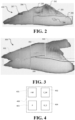
- Figure 2 shows one example where a fish fillet 200, a white fish, has been automatically cut into smaller pieces and where the cut includes cutting around the pin bones 205 in the fish fillet, where the pieces include a loin part 201, a belly part 202 and belly portion 203, and a tail part 204.
- This cutting may e.g. be performed using a high pressure water jet, but other cutting tools well known to a skilled person in the art may of cause be used.
- the image date comprise X-ray data that are processed and based thereon it is decided how to cut this particular fish fillet depending on the size/shape of the fish fillet, i.e. the cutting is performed in a dynamic way.
- the X-ray data are processed to determine whether any of the cut pieces contain undesired objects, such as bones or any other undesired fragments.
- the X-ray data indicates that a small piece of a bone is within the box 207 (in addition to the pin bone area 205) in the tail part 204, and another bone within the box 206 at the loin part.
- the size of these bone fragments are determined and based thereon it is determined whether or not they should be considered as being undesired objects.
- a bone of 2 mm length or less may be considered as not being undesired object, whereas bone fragments above 2 mm is considered as being an undesired object.
- only the size of the bone within box 206 may be categorized as being an undesired object and thus only this loin part is to be removed/rejected to a rework area where e.g. an operator will easily detect the undesired object, in this case the detected bone, as discussed above, instead of removing the whole fish fillet to e.g. said rework station.
- Figure 3 shows another fillet 300 that has been cut into similar pieces 301 - 304, but where no undesired object has been detected and thus no piece needs to be rejected.
- FIG. 4 depicts a block diagram of a system 400 according to the present invention for processing a food object while the food object is being conveyed by a conveying means.
- the system comprises an image means (I_M) 401 for acquiring image data of the food object, a cutting means (C_M) 402 for cutting the food object into smaller food pieces, a processor (P) 403 for determining, based on the acquired image data, whether the food object contains undesired objects, and in case such undesired objects are detected, identifying which of the smaller food pieces contain the undesired objects.
- I_M image means
- C_M cutting means
- P processor
- the system further comprises an automatic removing device (R_D) 404 for utilizing the identification of which of the smaller food pieces contain the undesired objects in automatically removing these smaller food pieces from the remaining part of the food object.
- the automatic removing device (R_D) 404 may be a robot, or a reject structure embedded in a conveyor.
- the imaging means may comprise one or more of the following: an X-ray apparatus, a Near Infrared (NIR) device, a RGB, hyperspectral imaging and fluorescence, a digital camera.
- the cutting means may in one embodiment comprise a high pressure water cutter.
- the automatic removing device may comprise a conveyor assembly the automatically, e.g. two conveyors arranged in an end-to-end arrangement (one end ends where the other one starts) where e.g.one end of the conveyors is connected to a moving mechanism that allows a temporal opening between the two conveyors, where in response to a control signal indicating which of the smaller food pieces contain said undesired objects (e.g. bone), the temporal opening is created and the smaller food piece (or pieces) containing the smaller food object(s) is rejected and e.g. recirculated to e.g. an operator that may manually remove e.g. the bone therefrom, and even recirculate the processed piece back into the image means where it may be detected if the undesired object has fully been removed or not.
- a control signal indicating which of the smaller food pieces contain said undesired objects (e.g. bone)
- the temporal opening is created and the smaller food piece (or pieces) containing the smaller food object(s) is rejected and
Landscapes
- Life Sciences & Earth Sciences (AREA)
- Engineering & Computer Science (AREA)
- Food Science & Technology (AREA)
- Wood Science & Technology (AREA)
- Zoology (AREA)
- Biophysics (AREA)
- Computer Vision & Pattern Recognition (AREA)
- Automation & Control Theory (AREA)
- General Engineering & Computer Science (AREA)
- Robotics (AREA)
- Processing Of Meat And Fish (AREA)
- Analysing Materials By The Use Of Radiation (AREA)
Description
- The present invention relates to a method of processing a food object while the food object is being conveyed.
- Imaging equipment such as X-ray devices are becoming more and more important within the food industry. One implementation is to use X-ray devices in processing fish fillets, where the acquired X-ray data after passing through the fish fillets are used as an operation parameter for operating a cutting device, e.g. a high pressure water jet cutter, in cutting the fish fillets (or any other food product) into smaller pieces. If the X-ray device, however, detects an undesired object, e.g. bones, the whole fish fillet will not be cut but rejected and sent to a rework station where typically an operator manually removes the undesired object. Subsequently, the processed fish fillet is recirculated into the X-ray device, but this recirculation is typically performed manually. The problem with this approach is that finding the undesired object can be a tedious and time consuming process. This approach also leads to excessive handling of the raw material.
-
EP3081090 discloses a cutting apparatus comprising a cutter (103) arranged above a gap extending across a conveyor belt. An imaging system produces image data of the food items, and a computer system is adapted to process said image data to generate operation parameters for operating movement of a cutter. -
WO02/43502 - It would be advantageous to achieve an improved solution in processing food objects where the throughput is increased such that not the whole object needs to be rejected if an undesired object is detected.
- In general, the invention preferably seeks to mitigate, alleviate or eliminate one or more of the above mentioned disadvantages singly or in any combination. In particular, it may be seen as an object of the present invention to provide an improved method of processing food objects that solves the above mentioned problems, or other problems, of the prior art.
- According to a first aspect of the invention, a method is provided according to
claim 1. - Accordingly, the food object will not be treated differently depending on whether such undesired objects are detected or not and therefore the time needed to convey the food object is utilized in performing the cutting step. Thus, valuable time is saved which enhances the throughput. The food object may by any type of a food object, such as, but not limited to, a fish fillet, a piece of meat, e.g. poultry meat etc.
- Also, the fact that it is now known which of the smaller food pieces contains the undesired object(s), only that particular one (or more) smaller food piece(s) may be removed from the remaining food object and rejected and sent to e.g. a rework station where typically an operator manually removes the undesired object. Thus, less raw material will be rejected (instead of rejecting the whole food object), which facilitates looking for the undesired objects meaning that less time will be spent on the rework and thus the overall throughput is further enhanced. The undesired object may include, but is not limited to, bones, bloodspots, gapings, or nematodes.
In one embodiment, said step of cutting the food object comprises the step of determining a pattern based on the image data, and performing the cutting in accordance with the pattern. - The pattern could be determined dynamically in accordance to said acquired image data for each time a food object is processed, i.e. a new pattern is generated for each new food object. In that way, depending on e.g. the size and/shape and/or thickness, the cutting of the food object is determined, preferably aiming at maximizing the yield.
- In one embodiment, said image data comprises X-ray data obtained by means of exposing the food object with an X-ray beam and processing the intensities of the X-ray beam after penetrating through the food object. In that way, undesired objects such as bones, metal and the like may be detected. Moreover, the detected intensities may be processed to estimate the weight of the food object, which may be used as an additional operation parameter in cutting the food object into e.g. fixed portions.
- In one embodiment, the method further comprises automatically separating those smaller food pieces containing the undesired objects from the food object. This may e.g. be performed using a robotic system comprising a robotic arm, where the location of the smaller food piece or pieces containing undesired objects is used as a control signal to the robotic system for automatically removing these smaller food piece or pieces containing said undesired object(s) from the remaining part of the food object.
- Another alternative to automatically separating those smaller food pieces containing the undesired objects from the food object may comprise using a conveyor assembly, e.g. slidable conveyor or conveyor part, a pivotable conveyor or conveyor part or the like, which is well known to a person skilled in the art, where the location of the smaller food piece or pieces containing undesired objects is used as a control signal to the conveyor assembly, e.g. to control the temporal opening between adjacent conveyors. Thus, only the piece or pieces containing undesired objects is rejected.
- In one embodiment, the step of determining, based on the acquired image data, whether the food object contains undesired objects comprises detecting whether detected objects are above a pre-defined size range, wherein, if the detected objects exceed the pre-defined size range, the detected objects are considered to be undesired objects. Accordingly, it may be decided that if such objects are e.g. bones, that the length of the bones may be the pre-defined size range, e.g. all bones being 1mm or less are not considered to be undesired objects, whereas all bones above 1mm are considered to be undesired objects. The width of the detected objects may also be considered as an additional or a dominant factor in this pre-defined size range.
- According to another aspect of the invention a system is provided according to claim 10.
- The imaging means may as an example selected from one or more of the following: an X-ray apparatus, Near Infrared (NIR) device, a RGB, hyperspectral imaging and fluorescence, a digital camera.
- The cutting means may as an example comprise a high pressure water cutter or any type of cutting blades, e.g. circular rotation cutting blade.
- In one embodiment, the system further comprises an automatic removing device for utilizing the identification of which of the smaller food pieces contain the undesired objects in automatically removing these smaller food pieces from the remaining part of the food object. The automatic removing device could be a robotic system comprising at least one robotic arm or a conveyor assembly.
- In general the various aspects of the invention may be combined and coupled in any way possible within the scope of the invention. These and other aspects, features and/or advantages of the invention will be apparent from, and elucidated with reference to the embodiments described hereinafter.
- Embodiments of the invention will be described, by way of example only, with reference to the drawings, in which
-
figure 1 shows a flowchart of an embodiment of a method according to the present invention of processing a food object while the food object is being conveyed, -
figures 2 and 3 show two examples of where a fish fillet, a white fish, has been automatically cut into smaller pieces, and -
figure 4 shows a block diagram of a system according to the present invention. -
Figure 1 shows a flowchart of an embodiment of a method according to the present invention of processing a food object while the food object is being conveyed. The food object may be a fish fillet, poultry meat, beef, pork and the like. In the following, it will be assumed that the food object is a fish fillet. - In step (S1) 101 image data of the food object is acquired. The image data includes in one embodiment X-ray data obtained by means of exposing the food object with an X-ray beam and processing the intensities of the X-ray beam after penetrating through the food object. This is especially suitable in detecting bones, metal objects or any other undesired objects in the fish fillet.
- The image data may also include digital data obtained by means of an inspection device such as a digital camera and where said undesired objects are selected from one or more of bloodspots, nematodes or gapings.
- In step (S2) 102 the food object is cut into smaller food pieces, e.g. loin part, belly part, tail part etc. This may be performed based on pre-fixed cutting patterns. In a preferred embodiment this cutting is determined dynamically in accordance to said acquired image data. This means that depending on the size/shape/geometry of the food object the cutting is determined accordingly.
- In step (S3) 103 it is determined, based on the acquired image data, whether the food object contains undesired objects.
- In step (S4) 104, in case such undesired objects in (S4) are detected, it is identified which of the smaller food pieces contain the undesired objects.
- In step (S5) 105, the method may further comprise automatically separating those smaller food pieces containing the undesired objects from the food object. This may be performed via any type of a reject conveyor device or conveyor assembly such as by arranging two conveyors in an end-to-end arrangement and temporarily withdrawing one of the ends and create a gap there between through which the food pieces containing the undesired objects may be dropped down to a reject area or to a rework station where e.g. an operator may manually process the rejected piece. This may also be done using any type of a robotic arm, or an operator may be informed via any type of a device, e.g. via a display, which of the food piece(s) contain the undesired objects.
-
Figure 2 shows one example where afish fillet 200, a white fish, has been automatically cut into smaller pieces and where the cut includes cutting around thepin bones 205 in the fish fillet, where the pieces include aloin part 201, abelly part 202 andbelly portion 203, and atail part 204. This cutting may e.g. be performed using a high pressure water jet, but other cutting tools well known to a skilled person in the art may of cause be used. - The image date comprise X-ray data that are processed and based thereon it is decided how to cut this particular fish fillet depending on the size/shape of the fish fillet, i.e. the cutting is performed in a dynamic way. Moreover, the X-ray data are processed to determine whether any of the cut pieces contain undesired objects, such as bones or any other undesired fragments. In this case, the X-ray data indicates that a small piece of a bone is within the box 207 (in addition to the pin bone area 205) in the
tail part 204, and another bone within thebox 206 at the loin part. In this case, the size of these bone fragments are determined and based thereon it is determined whether or not they should be considered as being undesired objects. As an example, a bone of 2 mm length or less may be considered as not being undesired object, whereas bone fragments above 2 mm is considered as being an undesired object. In this particular case, only the size of the bone withinbox 206 may be categorized as being an undesired object and thus only this loin part is to be removed/rejected to a rework area where e.g. an operator will easily detect the undesired object, in this case the detected bone, as discussed above, instead of removing the whole fish fillet to e.g. said rework station. -
Figure 3 shows anotherfillet 300 that has been cut into similar pieces 301 - 304, but where no undesired object has been detected and thus no piece needs to be rejected. -
Figure 4 depicts a block diagram of asystem 400 according to the present invention for processing a food object while the food object is being conveyed by a conveying means. The system comprises an image means (I_M) 401 for acquiring image data of the food object, a cutting means (C_M) 402 for cutting the food object into smaller food pieces, a processor (P) 403 for determining, based on the acquired image data, whether the food object contains undesired objects, and in case such undesired objects are detected, identifying which of the smaller food pieces contain the undesired objects. The system further comprises an automatic removing device (R_D) 404 for utilizing the identification of which of the smaller food pieces contain the undesired objects in automatically removing these smaller food pieces from the remaining part of the food object. The automatic removing device (R_D) 404 may be a robot, or a reject structure embedded in a conveyor. - The imaging means may comprise one or more of the following: an X-ray apparatus, a Near Infrared (NIR) device, a RGB, hyperspectral imaging and fluorescence, a digital camera. The cutting means may in one embodiment comprise a high pressure water cutter.
- The automatic removing device may comprise a conveyor assembly the automatically, e.g. two conveyors arranged in an end-to-end arrangement (one end ends where the other one starts) where e.g.one end of the conveyors is connected to a moving mechanism that allows a temporal opening between the two conveyors, where in response to a control signal indicating which of the smaller food pieces contain said undesired objects (e.g. bone), the temporal opening is created and the smaller food piece (or pieces) containing the smaller food object(s) is rejected and e.g. recirculated to e.g. an operator that may manually remove e.g. the bone therefrom, and even recirculate the processed piece back into the image means where it may be detected if the undesired object has fully been removed or not.
- The scope of protection of the current invention is defined by the appended claims.
Claims (14)
- A method of processing a food object while the food object is being conveyed, comprising:• acquiring image data of the food object (101),• cutting the food object into smaller food pieces (102),• determining, based on the acquired image data, whether the food object contains undesired objects (103), and in case such undesired objects are detected,• identifying which of the smaller food pieces contain the undesired objects (104),characterised in that the food object is not treated differently whether undesired objects are detected or not.
- The method according to claim 1, wherein said step of cutting the food object comprises the step of determining a pattern based on the image data, and performing the cutting in accordance with the pattern.
- The method of claim 2, wherein the pattern is determined dynamically in accordance with a set of image data for each received food object.
- The method according to any of the preceding claims, wherein said image data comprise X-ray data obtained by means of exposing the food object with an X-ray beam and processing the intensities of the X-ray beam after penetrating through the food object.
- The method according to any of the preceding claims, further comprising automatically separating those smaller food pieces containing the undesired objects from the food object (105) based on the identification of which of the smaller food pieces contain the undesired objects (104).
- The method according to any of the preceding claims, wherein said undesired objects include one or more of the following: bones, bloodspots, gapings, or nematodes.
- The method according to any of the preceding claims, where said acquired image data comprise digital data obtained by means of an inspection device such as a digital camera, RGB hyperspectral imaging and fluorescence, and where said undesired objects are selected from one or more of: bloodspots, nematodes or gapings.
- The method according to any of the preceding claims, wherein the food object is a fish fillet.
- The method according to any of the preceding claims, wherein the step of determining, based on the acquired image data, whether the food object contains undesired objects comprises detecting whether detected objects are above a pre-defined size range, wherein if the detected objects exceed the pre-defined size range the detected objects are considered to be undesired objects.
- A system for processing a food object while the food object is being conveyed by a conveying means, comprising:• image means for acquiring image data of the food object (101),• cutting means for cutting the food object into smaller food pieces (102),• a processor for:∘ determining, based on the acquired image data, whether the food object contains undesired objects (103), and in case such undesired objects are detected,∘ identifying which of the smaller food pieces contain the undesired objects (104),characterised in that the food object is not treated differently whether undesired objects are detected or not.
- The system according to claim 10, wherein the imaging means is selected from one or more of the following:an X-ray apparatus,a Near Infrared (NIR) device,a RGB hyperspectral imaging and fluorescence,a digital camera.
- The system according to claim 10 or 11, wherein the cutting means comprises a high pressure water cutter.
- The system according to any of the claims 10 to 12, further comprising automatic removing device for utilizing the identification of which of the smaller food pieces contain the undesired objects in automatically removing these smaller food pieces from the remaining part of the food object.
- The system according to claim 13, wherein the automatic removing device is selected from one or more of the following: a robotic system comprising at least one robotic arm or a conveyor assembly.
Applications Claiming Priority (2)
| Application Number | Priority Date | Filing Date | Title |
|---|---|---|---|
| DKPA201670965A DK179426B9 (en) | 2016-12-06 | 2016-12-06 | A method of processing a food object |
| PCT/EP2017/081643 WO2018104373A1 (en) | 2016-12-06 | 2017-12-06 | A method of processing a food object |
Publications (2)
| Publication Number | Publication Date |
|---|---|
| EP3550982A1 EP3550982A1 (en) | 2019-10-16 |
| EP3550982B1 true EP3550982B1 (en) | 2024-11-20 |
Family
ID=60923441
Family Applications (1)
| Application Number | Title | Priority Date | Filing Date |
|---|---|---|---|
| EP17825131.0A Active EP3550982B1 (en) | 2016-12-06 | 2017-12-06 | A method of processing a food object |
Country Status (7)
| Country | Link |
|---|---|
| US (1) | US20200060294A1 (en) |
| EP (1) | EP3550982B1 (en) |
| DK (2) | DK179426B9 (en) |
| ES (1) | ES3008633T3 (en) |
| IS (1) | IS3009B (en) |
| PL (1) | PL3550982T3 (en) |
| WO (1) | WO2018104373A1 (en) |
Families Citing this family (6)
| Publication number | Priority date | Publication date | Assignee | Title |
|---|---|---|---|---|
| DK179426B9 (en) | 2016-12-06 | 2018-07-12 | Marel Iceland Ehf | A method of processing a food object |
| US11925182B2 (en) * | 2018-07-02 | 2024-03-12 | Marel Salmon A/S | Detecting surface characteristics of food objects |
| DK180343B1 (en) * | 2018-11-26 | 2021-01-15 | Teknologisk Inst | System and method for automatic removal of foreign objects from a food surface |
| ES3014507T3 (en) | 2021-04-06 | 2025-04-23 | Nordischer Maschinenbau | Method and apparatus for identifiying defects in the surface of convex items |
| US11599984B2 (en) | 2021-04-29 | 2023-03-07 | Syscom, Inc. | Methods and apparatus for detecting defects for poultry piece grading |
| US20240264088A1 (en) * | 2023-02-06 | 2024-08-08 | Shweta Gupta | Hyperspectral imaging and artificial intelligence detection methods and systems |
Citations (4)
| Publication number | Priority date | Publication date | Assignee | Title |
|---|---|---|---|---|
| US20060161380A1 (en) | 2004-12-30 | 2006-07-20 | Bottemiller Robert L | Determining the position and angular orientation of food products |
| WO2011079893A2 (en) | 2009-12-23 | 2011-07-07 | CFS Bühl GmbH | Method for classifying the quality of food slices of a stick of food |
| WO2011095998A1 (en) | 2010-02-05 | 2011-08-11 | Valka Ehf | Food processing apparatus for detecting and cutting tough tissues from food items |
| WO2018104373A1 (en) | 2016-12-06 | 2018-06-14 | Marel Iceland Ehf. | A method of processing a food object |
Family Cites Families (5)
| Publication number | Priority date | Publication date | Assignee | Title |
|---|---|---|---|---|
| DE19834524A1 (en) * | 1998-07-31 | 2000-02-10 | Nordischer Maschinenbau | Device or method for processing meat |
| US6563904B2 (en) * | 2000-12-01 | 2003-05-13 | Fmc Technologies, Inc. | Apparatus and method for detecting and removing undesirable material from workpieces |
| IS7959A (en) * | 2004-12-16 | 2006-06-17 | Skaginn Hf. | Athferth og bunathur vith sjölbeta automatic vartarthst "ku, skurth meth vatni og snyrtingur β afurth |
| EP2636495A1 (en) * | 2012-03-08 | 2013-09-11 | Marel Iceland EHF | A cutting apparatus for cutting food items conveyed on a conveyor including at least one conveyor belt and food processing system comprising such apparatus |
| EP3169161B1 (en) * | 2014-07-15 | 2018-11-07 | Marel Iceland EHF | Pinbone removal system and method |
-
2016
- 2016-12-06 DK DKPA201670965A patent/DK179426B9/en active
-
2017
- 2017-12-06 US US16/466,448 patent/US20200060294A1/en not_active Abandoned
- 2017-12-06 ES ES17825131T patent/ES3008633T3/en active Active
- 2017-12-06 WO PCT/EP2017/081643 patent/WO2018104373A1/en not_active Ceased
- 2017-12-06 DK DK17825131.0T patent/DK3550982T3/en active
- 2017-12-06 PL PL17825131.0T patent/PL3550982T3/en unknown
- 2017-12-06 EP EP17825131.0A patent/EP3550982B1/en active Active
-
2018
- 2018-09-28 IS IS050240A patent/IS3009B/en unknown
Patent Citations (4)
| Publication number | Priority date | Publication date | Assignee | Title |
|---|---|---|---|---|
| US20060161380A1 (en) | 2004-12-30 | 2006-07-20 | Bottemiller Robert L | Determining the position and angular orientation of food products |
| WO2011079893A2 (en) | 2009-12-23 | 2011-07-07 | CFS Bühl GmbH | Method for classifying the quality of food slices of a stick of food |
| WO2011095998A1 (en) | 2010-02-05 | 2011-08-11 | Valka Ehf | Food processing apparatus for detecting and cutting tough tissues from food items |
| WO2018104373A1 (en) | 2016-12-06 | 2018-06-14 | Marel Iceland Ehf. | A method of processing a food object |
Non-Patent Citations (1)
| Title |
|---|
| KRISTIN ANNA THORARINSDOTTIR, KRISTJAN HALLVARDSSON: "NORDIC INNOVATION PUBLICATION 2015:07 // JUNE 2015 APRICOT Automated Pinbone Removal in Cod and Whitefish", NORDIC INNOVATION, INTERNET, 1 June 2015 (2015-06-01), Internet , XP055327834, Retrieved from the Internet <URL:http://www.nordicinnovation.org/Global/_Publications/Reports/2015/P11056 APRICOT.pdf> [retrieved on 20161209] |
Also Published As
| Publication number | Publication date |
|---|---|
| IS3009B (en) | 2019-03-15 |
| EP3550982A1 (en) | 2019-10-16 |
| ES3008633T3 (en) | 2025-03-24 |
| WO2018104373A1 (en) | 2018-06-14 |
| DK179426B1 (en) | 2018-06-18 |
| DK3550982T3 (en) | 2025-02-03 |
| US20200060294A1 (en) | 2020-02-27 |
| PL3550982T3 (en) | 2025-03-24 |
| DK201670965A1 (en) | 2018-06-14 |
| DK179426B9 (en) | 2018-07-12 |
Similar Documents
| Publication | Publication Date | Title |
|---|---|---|
| US20200060294A1 (en) | A method of processing a food object | |
| US12465952B2 (en) | Food processing device | |
| EP2986427B1 (en) | A cutting apparatus for cutting food objects | |
| EP3197282B1 (en) | A method and a device for automatically cutting meat products such as beef tenderloin into portions | |
| RU2652140C1 (en) | Method and installation for removing extraneous impunity from foodstuffs | |
| EP3920708B1 (en) | Imaging based portion cutting | |
| DK182110B1 (en) | Apparatus, system and method for filleting and pinbone removal | |
| EP2912946B1 (en) | Right/left discrimination system for pig carcass limb sections | |
| US20240000088A1 (en) | A method of tracking a food item in a processing facility, and a system for processing food items | |
| EP3179861B1 (en) | Method and apparatus of creating batches for food items conveyed by a conveyor means | |
| EP4249187B1 (en) | Tool checking device, tool checking program, and tool checking method for robot arm | |
| EP4372677A1 (en) | System and method for detecting an unwanted structure in one or more x-ray images of a food product | |
| DK180343B1 (en) | System and method for automatic removal of foreign objects from a food surface | |
| EP4249188B1 (en) | Tool checking device, tool checking program, and tool checking method for robot arm |
Legal Events
| Date | Code | Title | Description |
|---|---|---|---|
| STAA | Information on the status of an ep patent application or granted ep patent |
Free format text: STATUS: UNKNOWN |
|
| STAA | Information on the status of an ep patent application or granted ep patent |
Free format text: STATUS: THE INTERNATIONAL PUBLICATION HAS BEEN MADE |
|
| PUAI | Public reference made under article 153(3) epc to a published international application that has entered the european phase |
Free format text: ORIGINAL CODE: 0009012 |
|
| STAA | Information on the status of an ep patent application or granted ep patent |
Free format text: STATUS: REQUEST FOR EXAMINATION WAS MADE |
|
| 17P | Request for examination filed |
Effective date: 20190708 |
|
| AK | Designated contracting states |
Kind code of ref document: A1 Designated state(s): AL AT BE BG CH CY CZ DE DK EE ES FI FR GB GR HR HU IE IS IT LI LT LU LV MC MK MT NL NO PL PT RO RS SE SI SK SM TR |
|
| AX | Request for extension of the european patent |
Extension state: BA ME |
|
| DAV | Request for validation of the european patent (deleted) | ||
| DAX | Request for extension of the european patent (deleted) | ||
| STAA | Information on the status of an ep patent application or granted ep patent |
Free format text: STATUS: EXAMINATION IS IN PROGRESS |
|
| 17Q | First examination report despatched |
Effective date: 20230901 |
|
| GRAP | Despatch of communication of intention to grant a patent |
Free format text: ORIGINAL CODE: EPIDOSNIGR1 |
|
| STAA | Information on the status of an ep patent application or granted ep patent |
Free format text: STATUS: GRANT OF PATENT IS INTENDED |
|
| GRAS | Grant fee paid |
Free format text: ORIGINAL CODE: EPIDOSNIGR3 |
|
| INTG | Intention to grant announced |
Effective date: 20240906 |
|
| GRAA | (expected) grant |
Free format text: ORIGINAL CODE: 0009210 |
|
| STAA | Information on the status of an ep patent application or granted ep patent |
Free format text: STATUS: THE PATENT HAS BEEN GRANTED |
|
| AK | Designated contracting states |
Kind code of ref document: B1 Designated state(s): AL AT BE BG CH CY CZ DE DK EE ES FI FR GB GR HR HU IE IS IT LI LT LU LV MC MK MT NL NO PL PT RO RS SE SI SK SM TR |
|
| P01 | Opt-out of the competence of the unified patent court (upc) registered |
Free format text: CASE NUMBER: APP_55855/2024 Effective date: 20241011 |
|
| REG | Reference to a national code |
Ref country code: GB Ref legal event code: FG4D |
|
| REG | Reference to a national code |
Ref country code: CH Ref legal event code: EP |
|
| REG | Reference to a national code |
Ref country code: DE Ref legal event code: R096 Ref document number: 602017086277 Country of ref document: DE |
|
| REG | Reference to a national code |
Ref country code: IE Ref legal event code: FG4D |
|
| PGFP | Annual fee paid to national office [announced via postgrant information from national office to epo] |
Ref country code: SE Payment date: 20241219 Year of fee payment: 8 |
|
| REG | Reference to a national code |
Ref country code: DK Ref legal event code: T3 Effective date: 20250130 |
|
| REG | Reference to a national code |
Ref country code: SE Ref legal event code: TRGR |
|
| REG | Reference to a national code |
Ref country code: ES Ref legal event code: FG2A Ref document number: 3008633 Country of ref document: ES Kind code of ref document: T3 Effective date: 20250324 |
|
| REG | Reference to a national code |
Ref country code: LT Ref legal event code: MG9D |
|
| REG | Reference to a national code |
Ref country code: NL Ref legal event code: MP Effective date: 20241120 |
|
| PG25 | Lapsed in a contracting state [announced via postgrant information from national office to epo] |
Ref country code: PT Free format text: LAPSE BECAUSE OF FAILURE TO SUBMIT A TRANSLATION OF THE DESCRIPTION OR TO PAY THE FEE WITHIN THE PRESCRIBED TIME-LIMIT Effective date: 20250320 Ref country code: HR Free format text: LAPSE BECAUSE OF FAILURE TO SUBMIT A TRANSLATION OF THE DESCRIPTION OR TO PAY THE FEE WITHIN THE PRESCRIBED TIME-LIMIT Effective date: 20241120 |
|
| PG25 | Lapsed in a contracting state [announced via postgrant information from national office to epo] |
Ref country code: FI Free format text: LAPSE BECAUSE OF FAILURE TO SUBMIT A TRANSLATION OF THE DESCRIPTION OR TO PAY THE FEE WITHIN THE PRESCRIBED TIME-LIMIT Effective date: 20241120 Ref country code: NL Free format text: LAPSE BECAUSE OF FAILURE TO SUBMIT A TRANSLATION OF THE DESCRIPTION OR TO PAY THE FEE WITHIN THE PRESCRIBED TIME-LIMIT Effective date: 20241120 |
|
| REG | Reference to a national code |
Ref country code: AT Ref legal event code: MK05 Ref document number: 1742694 Country of ref document: AT Kind code of ref document: T Effective date: 20241120 |
|
| PG25 | Lapsed in a contracting state [announced via postgrant information from national office to epo] |
Ref country code: BG Free format text: LAPSE BECAUSE OF FAILURE TO SUBMIT A TRANSLATION OF THE DESCRIPTION OR TO PAY THE FEE WITHIN THE PRESCRIBED TIME-LIMIT Effective date: 20241120 |
|
| PGFP | Annual fee paid to national office [announced via postgrant information from national office to epo] |
Ref country code: ES Payment date: 20250103 Year of fee payment: 8 |
|
| PG25 | Lapsed in a contracting state [announced via postgrant information from national office to epo] |
Ref country code: GR Free format text: LAPSE BECAUSE OF FAILURE TO SUBMIT A TRANSLATION OF THE DESCRIPTION OR TO PAY THE FEE WITHIN THE PRESCRIBED TIME-LIMIT Effective date: 20250221 Ref country code: LV Free format text: LAPSE BECAUSE OF FAILURE TO SUBMIT A TRANSLATION OF THE DESCRIPTION OR TO PAY THE FEE WITHIN THE PRESCRIBED TIME-LIMIT Effective date: 20241120 Ref country code: AT Free format text: LAPSE BECAUSE OF FAILURE TO SUBMIT A TRANSLATION OF THE DESCRIPTION OR TO PAY THE FEE WITHIN THE PRESCRIBED TIME-LIMIT Effective date: 20241120 |
|
| PG25 | Lapsed in a contracting state [announced via postgrant information from national office to epo] |
Ref country code: RS Free format text: LAPSE BECAUSE OF FAILURE TO SUBMIT A TRANSLATION OF THE DESCRIPTION OR TO PAY THE FEE WITHIN THE PRESCRIBED TIME-LIMIT Effective date: 20250220 |
|
| PG25 | Lapsed in a contracting state [announced via postgrant information from national office to epo] |
Ref country code: SM Free format text: LAPSE BECAUSE OF FAILURE TO SUBMIT A TRANSLATION OF THE DESCRIPTION OR TO PAY THE FEE WITHIN THE PRESCRIBED TIME-LIMIT Effective date: 20241120 |
|
| PG25 | Lapsed in a contracting state [announced via postgrant information from national office to epo] |
Ref country code: EE Free format text: LAPSE BECAUSE OF FAILURE TO SUBMIT A TRANSLATION OF THE DESCRIPTION OR TO PAY THE FEE WITHIN THE PRESCRIBED TIME-LIMIT Effective date: 20241120 |
|
| PG25 | Lapsed in a contracting state [announced via postgrant information from national office to epo] |
Ref country code: RO Free format text: LAPSE BECAUSE OF FAILURE TO SUBMIT A TRANSLATION OF THE DESCRIPTION OR TO PAY THE FEE WITHIN THE PRESCRIBED TIME-LIMIT Effective date: 20241120 |
|
| PG25 | Lapsed in a contracting state [announced via postgrant information from national office to epo] |
Ref country code: SK Free format text: LAPSE BECAUSE OF FAILURE TO SUBMIT A TRANSLATION OF THE DESCRIPTION OR TO PAY THE FEE WITHIN THE PRESCRIBED TIME-LIMIT Effective date: 20241120 |
|
| PG25 | Lapsed in a contracting state [announced via postgrant information from national office to epo] |
Ref country code: CZ Free format text: LAPSE BECAUSE OF FAILURE TO SUBMIT A TRANSLATION OF THE DESCRIPTION OR TO PAY THE FEE WITHIN THE PRESCRIBED TIME-LIMIT Effective date: 20241120 |
|
| PG25 | Lapsed in a contracting state [announced via postgrant information from national office to epo] |
Ref country code: IT Free format text: LAPSE BECAUSE OF FAILURE TO SUBMIT A TRANSLATION OF THE DESCRIPTION OR TO PAY THE FEE WITHIN THE PRESCRIBED TIME-LIMIT Effective date: 20241120 |
|
| REG | Reference to a national code |
Ref country code: CH Ref legal event code: PL |
|
| PG25 | Lapsed in a contracting state [announced via postgrant information from national office to epo] |
Ref country code: LU Free format text: LAPSE BECAUSE OF NON-PAYMENT OF DUE FEES Effective date: 20241206 |
|
| REG | Reference to a national code |
Ref country code: DE Ref legal event code: R026 Ref document number: 602017086277 Country of ref document: DE |
|
| PLBI | Opposition filed |
Free format text: ORIGINAL CODE: 0009260 |
|
| PLAX | Notice of opposition and request to file observation + time limit sent |
Free format text: ORIGINAL CODE: EPIDOSNOBS2 |
|
| PG25 | Lapsed in a contracting state [announced via postgrant information from national office to epo] |
Ref country code: MC Free format text: LAPSE BECAUSE OF FAILURE TO SUBMIT A TRANSLATION OF THE DESCRIPTION OR TO PAY THE FEE WITHIN THE PRESCRIBED TIME-LIMIT Effective date: 20241120 |
|
| 26 | Opposition filed |
Opponent name: NORDISCHER MASCHINENBAU RUD. BAADER GMBH + CO. KG Effective date: 20250820 |
|
| PG25 | Lapsed in a contracting state [announced via postgrant information from national office to epo] |
Ref country code: CH Free format text: LAPSE BECAUSE OF NON-PAYMENT OF DUE FEES Effective date: 20241231 |
|
| PG25 | Lapsed in a contracting state [announced via postgrant information from national office to epo] |
Ref country code: IE Free format text: LAPSE BECAUSE OF NON-PAYMENT OF DUE FEES Effective date: 20241206 |
|
| PLBB | Reply of patent proprietor to notice(s) of opposition received |
Free format text: ORIGINAL CODE: EPIDOSNOBS3 |
|
| PGFP | Annual fee paid to national office [announced via postgrant information from national office to epo] |
Ref country code: DE Payment date: 20251126 Year of fee payment: 9 Ref country code: IS Payment date: 20251209 Year of fee payment: 9 |
|
| PGFP | Annual fee paid to national office [announced via postgrant information from national office to epo] |
Ref country code: GB Payment date: 20251120 Year of fee payment: 9 |
|
| PGFP | Annual fee paid to national office [announced via postgrant information from national office to epo] |
Ref country code: NO Payment date: 20251121 Year of fee payment: 9 |
|
| PGFP | Annual fee paid to national office [announced via postgrant information from national office to epo] |
Ref country code: DK Payment date: 20251119 Year of fee payment: 9 |
|
| PGFP | Annual fee paid to national office [announced via postgrant information from national office to epo] |
Ref country code: FR Payment date: 20251119 Year of fee payment: 9 |
|
| PGFP | Annual fee paid to national office [announced via postgrant information from national office to epo] |
Ref country code: BE Payment date: 20251119 Year of fee payment: 9 |
|
| PGFP | Annual fee paid to national office [announced via postgrant information from national office to epo] |
Ref country code: PL Payment date: 20251124 Year of fee payment: 9 |
|
| PG25 | Lapsed in a contracting state [announced via postgrant information from national office to epo] |
Ref country code: CY Free format text: LAPSE BECAUSE OF FAILURE TO SUBMIT A TRANSLATION OF THE DESCRIPTION OR TO PAY THE FEE WITHIN THE PRESCRIBED TIME-LIMIT; INVALID AB INITIO Effective date: 20171206 |