EP3550838A1 - Resilient signal encoding - Google Patents
Resilient signal encoding Download PDFInfo
- Publication number
- EP3550838A1 EP3550838A1 EP19156790.8A EP19156790A EP3550838A1 EP 3550838 A1 EP3550838 A1 EP 3550838A1 EP 19156790 A EP19156790 A EP 19156790A EP 3550838 A1 EP3550838 A1 EP 3550838A1
- Authority
- EP
- European Patent Office
- Prior art keywords
- frame
- frames
- encoding
- signal
- difference
- Prior art date
- Legal status (The legal status is an assumption and is not a legal conclusion. Google has not performed a legal analysis and makes no representation as to the accuracy of the status listed.)
- Granted
Links
Images

Classifications
-
- H—ELECTRICITY
- H04—ELECTRIC COMMUNICATION TECHNIQUE
- H04N—PICTORIAL COMMUNICATION, e.g. TELEVISION
- H04N19/00—Methods or arrangements for coding, decoding, compressing or decompressing digital video signals
- H04N19/85—Methods or arrangements for coding, decoding, compressing or decompressing digital video signals using pre-processing or post-processing specially adapted for video compression
- H04N19/89—Methods or arrangements for coding, decoding, compressing or decompressing digital video signals using pre-processing or post-processing specially adapted for video compression involving methods or arrangements for detection of transmission errors at the decoder
-
- H—ELECTRICITY
- H04—ELECTRIC COMMUNICATION TECHNIQUE
- H04N—PICTORIAL COMMUNICATION, e.g. TELEVISION
- H04N19/00—Methods or arrangements for coding, decoding, compressing or decompressing digital video signals
- H04N19/10—Methods or arrangements for coding, decoding, compressing or decompressing digital video signals using adaptive coding
- H04N19/102—Methods or arrangements for coding, decoding, compressing or decompressing digital video signals using adaptive coding characterised by the element, parameter or selection affected or controlled by the adaptive coding
- H04N19/103—Selection of coding mode or of prediction mode
- H04N19/105—Selection of the reference unit for prediction within a chosen coding or prediction mode, e.g. adaptive choice of position and number of pixels used for prediction
-
- H—ELECTRICITY
- H04—ELECTRIC COMMUNICATION TECHNIQUE
- H04N—PICTORIAL COMMUNICATION, e.g. TELEVISION
- H04N19/00—Methods or arrangements for coding, decoding, compressing or decompressing digital video signals
- H04N19/10—Methods or arrangements for coding, decoding, compressing or decompressing digital video signals using adaptive coding
- H04N19/102—Methods or arrangements for coding, decoding, compressing or decompressing digital video signals using adaptive coding characterised by the element, parameter or selection affected or controlled by the adaptive coding
- H04N19/103—Selection of coding mode or of prediction mode
- H04N19/107—Selection of coding mode or of prediction mode between spatial and temporal predictive coding, e.g. picture refresh
-
- H—ELECTRICITY
- H04—ELECTRIC COMMUNICATION TECHNIQUE
- H04N—PICTORIAL COMMUNICATION, e.g. TELEVISION
- H04N19/00—Methods or arrangements for coding, decoding, compressing or decompressing digital video signals
- H04N19/10—Methods or arrangements for coding, decoding, compressing or decompressing digital video signals using adaptive coding
- H04N19/134—Methods or arrangements for coding, decoding, compressing or decompressing digital video signals using adaptive coding characterised by the element, parameter or criterion affecting or controlling the adaptive coding
- H04N19/164—Feedback from the receiver or from the transmission channel
-
- H—ELECTRICITY
- H04—ELECTRIC COMMUNICATION TECHNIQUE
- H04N—PICTORIAL COMMUNICATION, e.g. TELEVISION
- H04N19/00—Methods or arrangements for coding, decoding, compressing or decompressing digital video signals
- H04N19/46—Embedding additional information in the video signal during the compression process
-
- H—ELECTRICITY
- H04—ELECTRIC COMMUNICATION TECHNIQUE
- H04N—PICTORIAL COMMUNICATION, e.g. TELEVISION
- H04N19/00—Methods or arrangements for coding, decoding, compressing or decompressing digital video signals
- H04N19/60—Methods or arrangements for coding, decoding, compressing or decompressing digital video signals using transform coding
- H04N19/61—Methods or arrangements for coding, decoding, compressing or decompressing digital video signals using transform coding in combination with predictive coding
-
- H—ELECTRICITY
- H04—ELECTRIC COMMUNICATION TECHNIQUE
- H04N—PICTORIAL COMMUNICATION, e.g. TELEVISION
- H04N21/00—Selective content distribution, e.g. interactive television or video on demand [VOD]
- H04N21/60—Network structure or processes for video distribution between server and client or between remote clients; Control signalling between clients, server and network components; Transmission of management data between server and client, e.g. sending from server to client commands for recording incoming content stream; Communication details between server and client
- H04N21/63—Control signaling related to video distribution between client, server and network components; Network processes for video distribution between server and clients or between remote clients, e.g. transmitting basic layer and enhancement layers over different transmission paths, setting up a peer-to-peer communication via Internet between remote STB's; Communication protocols; Addressing
- H04N21/637—Control signals issued by the client directed to the server or network components
- H04N21/6377—Control signals issued by the client directed to the server or network components directed to server
-
- H—ELECTRICITY
- H04—ELECTRIC COMMUNICATION TECHNIQUE
- H04N—PICTORIAL COMMUNICATION, e.g. TELEVISION
- H04N21/00—Selective content distribution, e.g. interactive television or video on demand [VOD]
- H04N21/60—Network structure or processes for video distribution between server and client or between remote clients; Control signalling between clients, server and network components; Transmission of management data between server and client, e.g. sending from server to client commands for recording incoming content stream; Communication details between server and client
- H04N21/63—Control signaling related to video distribution between client, server and network components; Network processes for video distribution between server and clients or between remote clients, e.g. transmitting basic layer and enhancement layers over different transmission paths, setting up a peer-to-peer communication via Internet between remote STB's; Communication protocols; Addressing
- H04N21/637—Control signals issued by the client directed to the server or network components
- H04N21/6377—Control signals issued by the client directed to the server or network components directed to server
- H04N21/6379—Control signals issued by the client directed to the server or network components directed to server directed to encoder, e.g. for requesting a lower encoding rate
-
- H—ELECTRICITY
- H04—ELECTRIC COMMUNICATION TECHNIQUE
- H04N—PICTORIAL COMMUNICATION, e.g. TELEVISION
- H04N21/00—Selective content distribution, e.g. interactive television or video on demand [VOD]
- H04N21/60—Network structure or processes for video distribution between server and client or between remote clients; Control signalling between clients, server and network components; Transmission of management data between server and client, e.g. sending from server to client commands for recording incoming content stream; Communication details between server and client
- H04N21/65—Transmission of management data between client and server
- H04N21/658—Transmission by the client directed to the server
- H04N21/6583—Acknowledgement
Definitions
- the present disclosure relates to the field of encoding digital signals to reduce bandwidth utilization.
- a system and method for resilient signal encoding are known in the art.
- a digital signal that is composed of successive frames of information may be encoded using various mechanisms in order to reduce the bandwidth required to transmit the signal.
- One such mechanism is inter-frame encoding where in some frames may be encoded as independently decodable frames (a.k.a. i-frames) while the remaining frames each may be encoded relative to an independently decodable frame as difference frames (p-frames) or relative to another p-frame.
- the mechanism is susceptible to some p-frames becoming undecodable when the frame relative to which they were encoded is lost or corrupted in transmission.
- IETF Internet Engineering Task Force
- RTCP Real-time Transport Control Protocol
- RTP/AVPF Internet Engineering Task Force
- RFC 4585 a receiver of the encoded frames may inform the encoder of the frames when some received frames are undecodable.
- a system and method for resilient signal encoding is described herein.
- the system and method provide for encoding a digital signal to reduce bandwidth required to transmit the encoded signal while mitigating the impact of frames lost or corrupted during transmission.
- the system and method may be used in applications such as, for example, video conferencing, telepresence, streaming media, video editing and other similar applications.
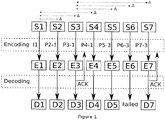
- Figure 1 is a schematic representation of a time series of encoded frames of an encoded signal.
- the encoded signal is derived from an input signal in accordance with the system and method for resilient signal encoding.
- the input signal may be a digital signal that comprises a sequence of data samples (e.g. frames) that represent, for example, a video stream or other similar content.
- the input signal describes herein represents a video stream comprising a sequence of video frames S1-S7 but the illustration is not intended to be limiting in any way.
- time is represented in the horizontal axis progressing from left (earlier time) to right (later time).
- a first frame of the input signal S1 may be encoded as an independently decodable frame (II) and placed in the encoded signal as encoded frame E1.
- the independently decodable frame E1 may be transmitted to a receiver for decoding.
- the receiver may decode the independently decodable frame without reference to any other frames in the encoded signal as decoded frame D1.
- a subsequent frame of the input signal S2 may be encoded as a difference frame (P2-1) that represents a content difference between the first frame S1 and the subsequent frame S2.
- the first frame acts as a reference frame for the encoding of the subsequent frame.
- the difference frame E2 may be transmitted to the receiver for decoding.
- the receiver may decode the difference frame E2 by referencing the independently decodable frame E1.
- the independently decodable frame E1 which corresponds to the first frame S1, acts as a reference frame for the decoding of the difference frame E2. Further frames of the input signal S3 and S4 may be encoded as difference frames E3 and E4 in a manner similar to that described above with reference to the subsequent frame S2.
- the receiver may send an acknowledgement (ACK) indicating that the difference frame was successfully decoded.
- ACK acknowledgement
- the frame associated with acknowledgement S3 may be assigned as the reference frame and further subsequent frames of the input signal S5, S6 and S7 may be encoded as difference frames E5, E6 and E7 that represent a content difference between the frame S5, S6 and S7 and the reference frame S3.
- the receiver may send an acknowledgement for each difference frame that is successfully decoded. Alternatively the receiver may only send an acknowledgement for difference frames that are marked as acknowledgement-requested and that have been successfully decoded.
- difference frames such as, for example, every N th frame may be marked as acknowledgement-requested before they are transmitted.
- Difference frames that are marked as acknowledgement-requested may be candidate reference frames.
- the interval N for marking candidate reference frames may be a number between 2 and a predetermined upper limit (e.g. 3000) that may be preconfigured or may be user specified.
- a difference frame may be marked as acknowledgement-requested (e.g. a candidate reference frame) based on the content of the frame and/or one or more frames occurring before or after the frame, for example, to minimize the difference between the reference frame and subsequently encoded frames.
- frames designated as golden frames e.g.
- acknowledgement-requested may be marked as acknowledgement-requested.
- encoded frame E3 was successfully decoded and an acknowledgement was sent.
- frames S5, S6 and S7 are encoded as difference frames E5, E6 and E7 relative to S3 that corresponds to frame E3 associated with the sent acknowledgement.
- the receiver may send an acknowledgement whether or not a difference frame was successfully decoded.
- the acknowledgement may include a binary variable, flag or other similar indicator that has one value or state to signify successful decoding and another value or state to signify a failure to successfully decode the difference frame.
- the acknowledgement may further include one or more indicators of the outcomes (e.g. success or failure) of decoding earlier frames.
- the acknowledgement may also include indicators of the outcomes of decoding of K previous frames.
- the number of previous frames K may be a number (e.g. 7, 15, 23 or 31) that may be preconfigured or may be user specified.
- the acknowledgement may take the form of a binary bit mask in which a first bit represents the outcome of decoding a current frame and K further bits represent the outcome of decoding K previous frames.
- the indicator of the outcome of decoding each frames may assigned to a class where the class specifies the number of times (e.g. 32, 16, 8 or 0) that the indicator will be repeated (e.g. included in an acknowledgement).
- the inclusion of an indicator of the outcome of decoding previous frames may be limited to previous frames that are candidate reference frames (e.g. frames that are mark acknowledgement-requested).
- the redundant inclusion of indicators of the outcome of decoding one or more previous frames in the acknowledgement allows the system and method to be resilient when one or more acknowledgements are lost during transmission. An indicator that fails to be returned a first lost acknowledgement may be successfully returned in a subsequent acknowledgement.
- a failure to successfully decode frame E6 is shown resulting in no acknowledgement being sent for E6.
- Encoded frame E7 is successfully decoded despite the failure to decode E6 because E3 was successfully decoded to D3 and E7 was encoded relative to S3. Due to the failure to decode E6, no acknowledgement was sent but the system and method may receive an acknowledgement of the successful decoding of E7 instead.
- Difference frame E7 may, for example, be marked as acknowledgement-requested when no acknowledgement is received for E6.
- Subsequently encoded frames may be encoded relative to S7. Alternatively, when no acknowledgement is received for E6 subsequent frames may continue to be encoded relative to the current reference frame S3 until an acknowledgement is received for a subsequent candidate reference frame, for example the next N th frame.
- S4 is encoded relative to S1 even though acknowledgement was sent for E3. After an acknowledge is sent, encoding of subsequent frames may continue to use a previous reference frame for some time due to various factors including propagation delay, caching, pipelining and other similar latency related factors.
- encoding may operate in one of two possible modes: normal mode and safe mode. Selection of one of the two modes may be responsive to feedback from the receiver (e.g. acknowledgements received).
- safe mode only uses as a reference frame a frame for which an acknowledgement, including a positive indication of successfully decoding, has been received.
- normal mode encoding may use as a reference frame any frame including a frame for which no acknowledgement including a positive indication of successfully decoding has been received.
- Encoding may switch from normal mode to safe mode when, for example, an acknowledgement is received that includes an indicator of unsuccessful decoding of a frame.
- Encoding may switch from safe mode to normal mode when an abatement criterion is met.
- the abatement criterion may include, for example, when a positive indication of successfully decoding has been received for L success frames, where L is a number that may be preconfigured or may be user specified. Alternatively, the abatement criterion may specify a minimum time duration during which encoding remains in safe mode to mitigate frequent switching between safe and normal mode. Encoding may be configured to start either in normal mode or safe mode.
- the independently decodable frame and each of the difference frames is uniquely identifiable using, for example, sequence numbers that may be included in the encoded frames.
- Each difference frame may also include identification of the reference frame from which it was encoded and that may be used to decode the difference frame.
- Each acknowledgement sent by the receiver may identify the frame that was successfully decoded using, for example, the sequence number of the frame.
- the system and method may encode and transmit only a single independently decodable frame thereby mitigating the bandwidth required to transmit the encoded signal.
- Further independently decodable frames may be encoded and transmitted at any time responsive to input such as, for example, a force reset request or detection of the loss or failure to decode a previous independently decodable frame.
- the receiver When the receiver successfully decodes an independently decodable frame, the receiver may send an acknowledgement (ACK) indicating that the independently decodable frame was successfully decoded.
- ACK acknowledgement
- a further independently decodable frame may be encoded and transmitted to the receiver.
- the system and method for resilient signal encoding may use various forms of inter-frame compression either lossy or lossless.
- the inter-frame compression may be used in combination with other compression techniques (e.g. predictive encoding).
- the system and method for resilient signal encoding may use encoding formats such as, for example, International Telecommunication Union - Telecommunication Standardization Sector (ITU-T) Advanced Video Coding For Generic Audiovisual Services (AVC)/H.264 or High Efficiency Video Coding (HEVC)/H.265 including scalable and multiview extensions of these formats such as scalable video coding (SVC), multiview video coding (MVC), 3-dimensional coding (3D), and The WebM Project VP8 or VP9 coding.
- ITU-T International Telecommunication Union - Telecommunication Standardization Sector
- AVC Advanced Video Coding For Generic Audiovisual Services
- HEVC High Efficiency Video Coding
- SVC scalable video coding
- MVC multiview video coding
- 3D 3-dimensional coding
- the acknowledgements may be received using in-band signaling in accordance with a video codec syntax being used for the encoded frames (e.g. H.264), as part of an ITU-T Supplementary Enhancement Information (SEI) message, or using a user data extension mechanism.
- SEI Supplementary Enhancement Information
- the acknowledgements may be sent out-of-band using mechanisms such as, for example, as part of an IETF Session Initiation Protocol (SIP) message, as part of a Moving Picture Expert Group (MPEG) green MPEG set of metadata dedicated to resource saving, as part of an IETF Real Time Communication Web (RTCWeb) mechanism, as part of an IETF codec control message or as part of an IETF Audio-Visual Profile with Feedback (AVPF) message.
- SIP IETF Session Initiation Protocol
- MPEG Moving Picture Expert Group
- RTCWeb Real Time Communication Web
- AVPF Audio-Visual Profile with Feedback
- the acknowledgement-requested marking of a frame may be sent as a flag or as a syntax element using in-band signaling in accordance with a video codec syntax being used for the encoded frames (e.g. H.264), as part of an ITU-T SEI message or using a user data extension mechanism.
- a video codec syntax being used for the encoded frames (e.g. H.264)
- the acknowledgement-requested marking of a frame my be sent out-of-band using mechanisms such as, for example, as part of a MPEG green MPEG set of metadata dedicated to resource saving, as part of an IETF RTCWeb mechanism or as part of an IETF SIP message.
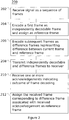
- Fig. 2 is a representation of a method for resilient signal encoding.
- the method 200 may, for example, be implemented using the system 300 described herein with reference to Figure 3 .
- the method 200 includes the following acts.
- Receiving a signal as a sequence of frames 202. Encoding a first frame, of the received frames, as an independently decodable frame (a.k.a. an i-frame) and assigning or designating the first frame as a reference frame 204.
- Encoding subsequent frames, of the received signal as difference frames (a.k.a. p-frames) representing a difference between a current frame, of the subsequent frames, and the reference frame 206.
- Receiving one or more acknowledgements each indicating the outcome of frame decoding 210.
- An acknowledgement may be sent by the receiver when an independently decodable frame or a difference frame has been successfully decoded.
- An acknowledgement may be sent by the receiver when a golden frame has been successfully decoded.
- the receiver may only send an acknowledgement for difference frames that are marked as acknowledgement-requested.
- the acknowledgement may further include one or more indicators of the outcomes (e.g. success or failure) of decoding earlier frames.
- the acknowledgement may also include indicators of the outcomes of decoding of K previous frames. Assigning or designating the received frame corresponding to a difference frame associated with a received acknowledgement as the reference frame 212.
- Subsequently encoded difference frames as described in act 206 may represent a difference between the current frame and the newly assigned reference frame.
- the method may further include switching between a safe mode according to act 212 described above and a normal mode where encoding may use as a reference frame any frame including a frame for which no acknowledgement including a positive indication of successfully decoding has been received.
- FIG. 3 is a schematic representation of a system for resilient signal encoding 300.
- the system 300 comprises a processor 302, memory 304 (the contents of which are accessible by the processor 302) and an I/O interface 306.
- the memory 304 may store instructions which when executed using the process 302 may cause the system 300 to render the functionality associated with a signal receiver 308, an encoder 310, a signal transmitter 312 and a decoder 314. Alternatively, or in addition, the instructions when executed using the process 302 may configure the system 300 to implement the acts of method 200.
- the memory 304 may store information in data structures including, for example, signal frames 316, encoded frames 318, reference frame 320, decoded frames 322 and golden frames.
- the processor 302 may comprise a single processor or multiple processors that may be disposed on a single chip, on multiple devices or distributed over more that one system.
- the processor 302 may be hardware that executes computer executable instructions or computer code embodied in the memory 304 or in other memory to perform one or more features of the system.
- the processor 302 may include a general purpose processor, a central processing unit (CPU), a graphics processing unit (GPU), an application specific integrated circuit (ASIC), a digital signal processor (DSP), a field programmable gate array (FPGA), a digital circuit, an analog circuit, a microcontroller, any other type of processor, or any combination thereof.
- the memory 304 may comprise a device for storing and retrieving data, processor executable instructions, or any combination thereof.
- the memory 304 may include non-volatile and/or volatile memory, such as a random access memory (RAM), a read-only memory (ROM), an erasable programmable read-only memory (EPROM), or a flash memory.
- RAM random access memory
- ROM read-only memory
- EPROM erasable programmable read-only memory
- flash memory a flash memory.
- the memory 304 may comprise a single device or multiple devices that may be disposed on one or more dedicated memory devices or on a processor or other similar device.
- the memory 304 may include an optical, magnetic (hard-drive) or any other form of data storage device.
- the memory 304 may store computer code, such as signal receiver 308, encoder 310, signal transmitter 312 and decoder 314 as described herein.
- the computer code may include instructions executable with the processor 302.
- the computer code may be written in any computer language, such as C, C++, assembly language, channel program code, and/or any combination of computer languages.
- the signal receiver 308 may receive a signal as a sequence of frames.
- the encoder 310 may encode a first frame, of the received frames, as an independently decodable frame and assign the first frame as a reference frame.
- the encoder 310 may encode subsequent frames, of the received signal, as difference frames representing a difference between a current frame, of the subsequent frames, and the reference frame.
- the signal transmitter 312 may transmit the independently decodable frame and the difference frames, as they are encoded, to a receiver.
- the signal receiver 308 may also receive acknowledgements associated with successfully decoded frames.
- the received frame corresponding to the difference frame associated with a received acknowledgement may be assigned as the reference frame.
- Subsequently encoded frames of the received frames may be encoded relative to the newly assigned reference frame by the encoder 310.
- the system 300 may not include the decoder 314 when an encoded signal is only transmitted to the receiver (e.g. in one-way transmission).
- the system 300 may include the decoder 314.
- the decoder 314 decodes the received encoded frames and when a frame is successfully decoded, the decoder 314 may send an acknowledgement to the transmitter of the encoded frames.
- the receiver may only send an acknowledgement for difference frames that are marked as acknowledgement-requested.
- the I/O interface 306 may be used to connect devices such as, for example, data transmission media and other components of the system 300.
- the system 300 may include more, fewer, or different components than illustrated in Figure 3 . Furthermore, each one of the components of system 300 may include more, fewer, or different elements than is illustrated in Figure 3 .
- Flags, data, databases, tables, entities, and other data structures may be separately stored and managed, may be incorporated into a single memory or database, may be distributed, or may be logically and physically organized in many different ways.
- the components may operate independently or be part of a same program or hardware.
- the components may be resident on separate hardware, such as separate removable circuit boards, or share common hardware, such as a same memory and processor for implementing instructions from the memory. Programs may be parts of a single program, separate programs, or distributed across several memories and processors.
- the functions, acts or tasks illustrated in the figures or described may be executed in response to one or more sets of logic or instructions stored in or on computer readable media.
- the functions, acts or tasks are independent of the particular type of instructions set, storage media, processor or processing strategy and may be performed by software, hardware, integrated circuits, firmware, micro code and the like, operating alone or in combination.
- processing strategies may include multiprocessing, multitasking, parallel processing, distributed processing, and/or any other type of processing.
- the instructions are stored on a removable media device for reading by local or remote systems.
- the logic or instructions are stored in a remote location for transfer through a computer network or over telephone lines.
- the logic or instructions may be stored within a given computer such as, for example, a CPU.
Landscapes
- Engineering & Computer Science (AREA)
- Multimedia (AREA)
- Signal Processing (AREA)
- Compression Or Coding Systems Of Tv Signals (AREA)
- Detection And Prevention Of Errors In Transmission (AREA)
Abstract
Description
- The present disclosure relates to the field of encoding digital signals to reduce bandwidth utilization. In particular, to a system and method for resilient signal encoding.
- A digital signal that is composed of successive frames of information (a.k.a. data) may be encoded using various mechanisms in order to reduce the bandwidth required to transmit the signal. One such mechanism is inter-frame encoding where in some frames may be encoded as independently decodable frames (a.k.a. i-frames) while the remaining frames each may be encoded relative to an independently decodable frame as difference frames (p-frames) or relative to another p-frame. The mechanism is susceptible to some p-frames becoming undecodable when the frame relative to which they were encoded is lost or corrupted in transmission. Some mechanisms (e.g. Internet Engineering Task Force (IETF) Extended RTP Profile for Real-time Transport Control Protocol (RTCP)-Based Feedback (RTP/AVPF) RFC 4585) are used whereby a receiver of the encoded frames may inform the encoder of the frames when some received frames are undecodable.
- Typically a trade-off is made between resilience to frame loss or corruption and a degree of bandwidth utilization (i.e. compression) in either or both of a downlink channel and an uplink channel.
- The system and method may be better understood with reference to the following drawings and description. The components in the figures are not necessarily to scale, emphasis instead being placed upon illustrating the principles of the disclosure. Moreover, in the figures, like referenced numerals designate corresponding parts throughout the different views.
- Other systems, methods, features and advantages will be, or will become, apparent to one with skill in the art upon examination of the following figures and detailed description. It is intended that all such additional systems, methods, features and advantages be included with this description and be protected by the following claims.
-
Fig. 1 is a schematic representation of a time series of encoded frames of a digital signal. -
Fig. 2 is a schematic representation of a method for resilient signal encoding. -
Fig. 3 is a schematic representation of system for resilient signal encoding. - A system and method for resilient signal encoding is described herein. The system and method provide for encoding a digital signal to reduce bandwidth required to transmit the encoded signal while mitigating the impact of frames lost or corrupted during transmission. The system and method may be used in applications such as, for example, video conferencing, telepresence, streaming media, video editing and other similar applications.
-
Figure 1 is a schematic representation of a time series of encoded frames of an encoded signal. The encoded signal is derived from an input signal in accordance with the system and method for resilient signal encoding. The input signal may be a digital signal that comprises a sequence of data samples (e.g. frames) that represent, for example, a video stream or other similar content. For illustrative purposes the input signal describes herein represents a video stream comprising a sequence of video frames S1-S7 but the illustration is not intended to be limiting in any way. InFigure 1 time is represented in the horizontal axis progressing from left (earlier time) to right (later time). - A first frame of the input signal S1 may be encoded as an independently decodable frame (II) and placed in the encoded signal as encoded frame E1. The independently decodable frame E1 may be transmitted to a receiver for decoding. The receiver may decode the independently decodable frame without reference to any other frames in the encoded signal as decoded frame D1. A subsequent frame of the input signal S2 may be encoded as a difference frame (P2-1) that represents a content difference between the first frame S1 and the subsequent frame S2. The first frame acts as a reference frame for the encoding of the subsequent frame. The difference frame E2 may be transmitted to the receiver for decoding. The receiver may decode the difference frame E2 by referencing the independently decodable frame E1. The independently decodable frame E1, which corresponds to the first frame S1, acts as a reference frame for the decoding of the difference frame E2. Further frames of the input signal S3 and S4 may be encoded as difference frames E3 and E4 in a manner similar to that described above with reference to the subsequent frame S2.
- When the receiver successfully decodes a difference frame, the receiver may send an acknowledgement (ACK) indicating that the difference frame was successfully decoded. In response to receiving the acknowledgement (ACK), the frame associated with acknowledgement S3 may be assigned as the reference frame and further subsequent frames of the input signal S5, S6 and S7 may be encoded as difference frames E5, E6 and E7 that represent a content difference between the frame S5, S6 and S7 and the reference frame S3. The receiver may send an acknowledgement for each difference frame that is successfully decoded. Alternatively the receiver may only send an acknowledgement for difference frames that are marked as acknowledgement-requested and that have been successfully decoded. During encoding some difference frames such as, for example, every Nth frame may be marked as acknowledgement-requested before they are transmitted. Difference frames that are marked as acknowledgement-requested may be candidate reference frames. The interval N for marking candidate reference frames may be a number between 2 and a predetermined upper limit (e.g. 3000) that may be preconfigured or may be user specified. In a further alternative, a difference frame may be marked as acknowledgement-requested (e.g. a candidate reference frame) based on the content of the frame and/or one or more frames occurring before or after the frame, for example, to minimize the difference between the reference frame and subsequently encoded frames. In another alternative, frames designated as golden frames (e.g. as specified in Internet Engineering Task Force (IETF) RFC 6386, VP8 Data Format and Decoding Guide) may be marked as acknowledgement-requested. In the example illustrated in
Figure 1 , encoded frame E3 was successfully decoded and an acknowledgement was sent. Subsequently, frames S5, S6 and S7 are encoded as difference frames E5, E6 and E7 relative to S3 that corresponds to frame E3 associated with the sent acknowledgement. - Alternatively, or in addition, the receiver may send an acknowledgement whether or not a difference frame was successfully decoded. The acknowledgement may include a binary variable, flag or other similar indicator that has one value or state to signify successful decoding and another value or state to signify a failure to successfully decode the difference frame. The acknowledgement may further include one or more indicators of the outcomes (e.g. success or failure) of decoding earlier frames. For example, the acknowledgement may also include indicators of the outcomes of decoding of K previous frames. The number of previous frames K may be a number (e.g. 7, 15, 23 or 31) that may be preconfigured or may be user specified. The acknowledgement may take the form of a binary bit mask in which a first bit represents the outcome of decoding a current frame and K further bits represent the outcome of decoding K previous frames. In a further alternative, the indicator of the outcome of decoding each frames may assigned to a class where the class specifies the number of times (e.g. 32, 16, 8 or 0) that the indicator will be repeated (e.g. included in an acknowledgement). The inclusion of an indicator of the outcome of decoding previous frames may be limited to previous frames that are candidate reference frames (e.g. frames that are mark acknowledgement-requested). The redundant inclusion of indicators of the outcome of decoding one or more previous frames in the acknowledgement allows the system and method to be resilient when one or more acknowledgements are lost during transmission. An indicator that fails to be returned a first lost acknowledgement may be successfully returned in a subsequent acknowledgement.
- A failure to successfully decode frame E6 is shown resulting in no acknowledgement being sent for E6. Encoded frame E7 is successfully decoded despite the failure to decode E6 because E3 was successfully decoded to D3 and E7 was encoded relative to S3. Due to the failure to decode E6, no acknowledgement was sent but the system and method may receive an acknowledgement of the successful decoding of E7 instead. Difference frame E7 may, for example, be marked as acknowledgement-requested when no acknowledgement is received for E6. Subsequently encoded frames may be encoded relative to S7. Alternatively, when no acknowledgement is received for E6 subsequent frames may continue to be encoded relative to the current reference frame S3 until an acknowledgement is received for a subsequent candidate reference frame, for example the next Nth frame.
- In the illustrated example of
Figure 1 , S4 is encoded relative to S1 even though acknowledgement was sent for E3. After an acknowledge is sent, encoding of subsequent frames may continue to use a previous reference frame for some time due to various factors including propagation delay, caching, pipelining and other similar latency related factors. - Alternatively, or in addition, encoding may operate in one of two possible modes: normal mode and safe mode. Selection of one of the two modes may be responsive to feedback from the receiver (e.g. acknowledgements received). In safe mode encoding only uses as a reference frame a frame for which an acknowledgement, including a positive indication of successfully decoding, has been received. In normal mode encoding may use as a reference frame any frame including a frame for which no acknowledgement including a positive indication of successfully decoding has been received. Encoding may switch from normal mode to safe mode when, for example, an acknowledgement is received that includes an indicator of unsuccessful decoding of a frame. Encoding may switch from safe mode to normal mode when an abatement criterion is met. The abatement criterion may include, for example, when a positive indication of successfully decoding has been received for L success frames, where L is a number that may be preconfigured or may be user specified. Alternatively, the abatement criterion may specify a minimum time duration during which encoding remains in safe mode to mitigate frequent switching between safe and normal mode. Encoding may be configured to start either in normal mode or safe mode.
- The independently decodable frame and each of the difference frames is uniquely identifiable using, for example, sequence numbers that may be included in the encoded frames. Each difference frame may also include identification of the reference frame from which it was encoded and that may be used to decode the difference frame. Each acknowledgement sent by the receiver may identify the frame that was successfully decoded using, for example, the sequence number of the frame.
- The system and method may encode and transmit only a single independently decodable frame thereby mitigating the bandwidth required to transmit the encoded signal. Further independently decodable frames may be encoded and transmitted at any time responsive to input such as, for example, a force reset request or detection of the loss or failure to decode a previous independently decodable frame. When the receiver successfully decodes an independently decodable frame, the receiver may send an acknowledgement (ACK) indicating that the independently decodable frame was successfully decoded. In the absence of receiving an acknowledgement, a further independently decodable frame may be encoded and transmitted to the receiver.
- The system and method for resilient signal encoding may use various forms of inter-frame compression either lossy or lossless. The inter-frame compression may be used in combination with other compression techniques (e.g. predictive encoding). The system and method for resilient signal encoding may use encoding formats such as, for example, International Telecommunication Union - Telecommunication Standardization Sector (ITU-T) Advanced Video Coding For Generic Audiovisual Services (AVC)/H.264 or High Efficiency Video Coding (HEVC)/H.265 including scalable and multiview extensions of these formats such as scalable video coding (SVC), multiview video coding (MVC), 3-dimensional coding (3D), and The WebM Project VP8 or VP9 coding.
- The acknowledgements may be received using in-band signaling in accordance with a video codec syntax being used for the encoded frames (e.g. H.264), as part of an ITU-T Supplementary Enhancement Information (SEI) message, or using a user data extension mechanism. Alternatively or in addition, the acknowledgements may be sent out-of-band using mechanisms such as, for example, as part of an IETF Session Initiation Protocol (SIP) message, as part of a Moving Picture Expert Group (MPEG) green MPEG set of metadata dedicated to resource saving, as part of an IETF Real Time Communication Web (RTCWeb) mechanism, as part of an IETF codec control message or as part of an IETF Audio-Visual Profile with Feedback (AVPF) message.
- The acknowledgement-requested marking of a frame may be sent as a flag or as a syntax element using in-band signaling in accordance with a video codec syntax being used for the encoded frames (e.g. H.264), as part of an ITU-T SEI message or using a user data extension mechanism. Alternatively, or in addition, the acknowledgement-requested marking of a frame my be sent out-of-band using mechanisms such as, for example, as part of a MPEG green MPEG set of metadata dedicated to resource saving, as part of an IETF RTCWeb mechanism or as part of an IETF SIP message.
-
Fig. 2 is a representation of a method for resilient signal encoding. Themethod 200 may, for example, be implemented using thesystem 300 described herein with reference toFigure 3 . Themethod 200 includes the following acts. Receiving a signal as a sequence offrames 202. Encoding a first frame, of the received frames, as an independently decodable frame (a.k.a. an i-frame) and assigning or designating the first frame as areference frame 204. Encoding subsequent frames, of the received signal, as difference frames (a.k.a. p-frames) representing a difference between a current frame, of the subsequent frames, and thereference frame 206. Transmitting the independently decodable frame and the difference frames, as they are encoded, to areceiver 208. Receiving one or more acknowledgements (a.k.a. ACK) each indicating the outcome offrame decoding 210. An acknowledgement may be sent by the receiver when an independently decodable frame or a difference frame has been successfully decoded. An acknowledgement may be sent by the receiver when a golden frame has been successfully decoded. The receiver may only send an acknowledgement for difference frames that are marked as acknowledgement-requested. The acknowledgement may further include one or more indicators of the outcomes (e.g. success or failure) of decoding earlier frames. For example, the acknowledgement may also include indicators of the outcomes of decoding of K previous frames. Assigning or designating the received frame corresponding to a difference frame associated with a received acknowledgement as thereference frame 212. Subsequently encoded difference frames as described inact 206 may represent a difference between the current frame and the newly assigned reference frame. In an alternative embodiment, the method may further include switching between a safe mode according to act 212 described above and a normal mode where encoding may use as a reference frame any frame including a frame for which no acknowledgement including a positive indication of successfully decoding has been received. -
Figure 3 is a schematic representation of a system forresilient signal encoding 300. Thesystem 300 comprises aprocessor 302, memory 304 (the contents of which are accessible by the processor 302) and an I/O interface 306. Thememory 304 may store instructions which when executed using theprocess 302 may cause thesystem 300 to render the functionality associated with asignal receiver 308, anencoder 310, asignal transmitter 312 and adecoder 314. Alternatively, or in addition, the instructions when executed using theprocess 302 may configure thesystem 300 to implement the acts ofmethod 200. In addition thememory 304 may store information in data structures including, for example, signal frames 316, encodedframes 318,reference frame 320, decodedframes 322 and golden frames. - The
processor 302 may comprise a single processor or multiple processors that may be disposed on a single chip, on multiple devices or distributed over more that one system. Theprocessor 302 may be hardware that executes computer executable instructions or computer code embodied in thememory 304 or in other memory to perform one or more features of the system. Theprocessor 302 may include a general purpose processor, a central processing unit (CPU), a graphics processing unit (GPU), an application specific integrated circuit (ASIC), a digital signal processor (DSP), a field programmable gate array (FPGA), a digital circuit, an analog circuit, a microcontroller, any other type of processor, or any combination thereof. - The
memory 304 may comprise a device for storing and retrieving data, processor executable instructions, or any combination thereof. Thememory 304 may include non-volatile and/or volatile memory, such as a random access memory (RAM), a read-only memory (ROM), an erasable programmable read-only memory (EPROM), or a flash memory. Thememory 304 may comprise a single device or multiple devices that may be disposed on one or more dedicated memory devices or on a processor or other similar device. Alternatively or in addition, thememory 304 may include an optical, magnetic (hard-drive) or any other form of data storage device. - The
memory 304 may store computer code, such assignal receiver 308,encoder 310,signal transmitter 312 anddecoder 314 as described herein. The computer code may include instructions executable with theprocessor 302. The computer code may be written in any computer language, such as C, C++, assembly language, channel program code, and/or any combination of computer languages. Thesignal receiver 308 may receive a signal as a sequence of frames. Theencoder 310 may encode a first frame, of the received frames, as an independently decodable frame and assign the first frame as a reference frame. Theencoder 310 may encode subsequent frames, of the received signal, as difference frames representing a difference between a current frame, of the subsequent frames, and the reference frame. Thesignal transmitter 312 may transmit the independently decodable frame and the difference frames, as they are encoded, to a receiver. Thesignal receiver 308 may also receive acknowledgements associated with successfully decoded frames. When an acknowledgement is received, the received frame corresponding to the difference frame associated with a received acknowledgement may be assigned as the reference frame. Subsequently encoded frames of the received frames may be encoded relative to the newly assigned reference frame by theencoder 310. Thesystem 300 may not include thedecoder 314 when an encoded signal is only transmitted to the receiver (e.g. in one-way transmission). When encoded signals are transmitted to the receiver and also received by the system (e.g. in two-way transmission) thesystem 300 may include thedecoder 314. Thedecoder 314 decodes the received encoded frames and when a frame is successfully decoded, thedecoder 314 may send an acknowledgement to the transmitter of the encoded frames. The receiver may only send an acknowledgement for difference frames that are marked as acknowledgement-requested. - The I/
O interface 306 may be used to connect devices such as, for example, data transmission media and other components of thesystem 300. - All of the disclosure, regardless of the particular implementation described, is exemplary in nature, rather than limiting. The
system 300 may include more, fewer, or different components than illustrated inFigure 3 . Furthermore, each one of the components ofsystem 300 may include more, fewer, or different elements than is illustrated inFigure 3 . Flags, data, databases, tables, entities, and other data structures may be separately stored and managed, may be incorporated into a single memory or database, may be distributed, or may be logically and physically organized in many different ways. The components may operate independently or be part of a same program or hardware. The components may be resident on separate hardware, such as separate removable circuit boards, or share common hardware, such as a same memory and processor for implementing instructions from the memory. Programs may be parts of a single program, separate programs, or distributed across several memories and processors. - The functions, acts or tasks illustrated in the figures or described may be executed in response to one or more sets of logic or instructions stored in or on computer readable media. The functions, acts or tasks are independent of the particular type of instructions set, storage media, processor or processing strategy and may be performed by software, hardware, integrated circuits, firmware, micro code and the like, operating alone or in combination. Likewise, processing strategies may include multiprocessing, multitasking, parallel processing, distributed processing, and/or any other type of processing. In one embodiment, the instructions are stored on a removable media device for reading by local or remote systems. In other embodiments, the logic or instructions are stored in a remote location for transfer through a computer network or over telephone lines. In yet other embodiments, the logic or instructions may be stored within a given computer such as, for example, a CPU.
- While various embodiments of the system and method for on-demand user control have been described, it will be apparent to those of ordinary skill in the art that many more embodiments and implementations are possible within the scope of the present invention. Accordingly, the invention is not to be restricted except in light of the attached claims and their equivalents.
- Aspects and features of the present disclosure are set forth in the following numbered clauses which contain the subject matter of the claims of the parent application as filed.
- 1. A method of encoding a signal comprising:
- receiving, over time, a sequence of input frames that comprise the signal (202);
- encoding a first frame of the sequence of input frames as an independently decodable frame and assigning the first frame as a current reference frame (204);
- encoding subsequently received input frames, in the sequence of input frames, each as a difference frame that represents a difference between the input frame and the current reference frame (206);
- transmitting the independently decodable frame and each of the difference frames, after each is encoded, to a receiver (208);
- receiving one or more acknowledgements from the receiver (210); and assigning an input frame corresponding to a difference frame associated with a received acknowledgment, of the one or more acknowledgements, as the current reference frame (212).
- 2. The method of encoding a signal of clause 1, where the signal includes a video stream.
- 3. The method for encoding a signal of clause 1, where the received acknowledgement includes one or more indicators each signifying an outcome of a decoding of an associated difference frame.
- 4. The method for encoding a signal of clause 1, where the receiver decodes each difference frame using a frame previously decoded by the receiver that corresponds to the current reference frame from which the difference frame was derived without referencing any intervening frames in the sequence of frames between the current reference frame and the difference frame.
- 5. The method for encoding a signal of clause 1, where each of the one or more acknowledgements is associated with one or more difference frames that are each marked as an acknowledgement-requested.
- 6. The method for encoding a signal of clause 5, where each N difference frame is marked as the acknowledgement-requested before being transmitted and where N is a predetermined value.
- 7. The method for encoding a signal of clause 5, where the acknowledgement-requested mark for each of the one or more difference frames is sent in-band using mechanisms including any of: in accordance with a video codec syntax being used for the encoding the input frames, in accordance with an ITU-T Supplementary Enhancement Information (SEI) message, and using a user data extension mechanism.
- 8. The method for encoding a signal of clause 5, where the acknowledgement-requested mark for each of the one or more difference frames is sent out-of-band using mechanisms including any of: a Moving Picture Expert Group (MPEG) green MPEG set of metadata, an IETF RTCweb mechanism and an IETF Session Initiation Protocol (SIP) message.
- 9. The method for encoding a signal of clause 1, where the independently decodable frame and each difference frame are encoded in accordance with an ITU-T Video Coding Experts Group H.264 standard.
- 10. The method for encoding a signal of clause 1, where the one or more acknowledgements are received in-band using mechanisms in accordance with: a video codec syntax, a ITU-T Supplementary Enhancement Information (SEI) message, or a user data extension mechanism.
- 11. The method for encoding a signal of clause 1, where the one or more acknowledgements are received out-of-band using mechanisms including any of:
- an IETF RTCweb mechanism, an IETF codec control message, an IETF AVPF message, a Moving Picture Expert Group (MPEG) green MPEG set of metadata,
- IETF codec control message and a IETF Session Initiation Protocol (SIP) message.
- 12. The method for encoding a signal of clause 1, where the method switches between operating modes, and the method further comprising:
- when in a safe mode, assigning an input frame corresponding to a difference frame associated with a received acknowledgment, of the one or more acknowledgements, as the current reference frame; and
- when in a normal mode, assigning an input frame as the current reference frame regardless of receiving an acknowledgement associated with a difference frame corresponding to the input frame
- 13. The method for encoding a signal of clause 12, further comprising:
- switching to safe mode when one of the one or more received acknowledgements includes an indicator signifying the outcome of the decoding of an associated difference frame was unsuccessful; and
- switching to normal mode when an abatement criterion is met.
- 14. The method for encoding a signal of clause 13, where the abatement criterion includes any of: receiving a positive indication of successful decoding of a predetermined number of successive difference frames; and a minimum time duration of operation in safe mode.
- 15. A system for encoding a signal comprising:
- one or more processors; and
- memory containing instructions executable by the one or more processors to configure the system to implement the method of any of clauses 1 to 14.
Claims (13)
- A method of encoding a signal comprising:receiving, over time, a sequence of input frames that comprise the signal; encoding a first frame of the sequence of input frames as an independently decodable frame and assigning the first frame as a current reference frame;encoding subsequently received input frames, in the sequence of input frames, each as a difference frame that represents a difference between the input frame and the current reference frame;transmitting the independently decodable frame and each of the difference frames, after each is encoded, to a receiver;receiving one or more acknowledgements from the receiver;assigning an input frame corresponding to a difference frame associated with a received acknowledgment, of the one or more acknowledgements, as the current reference frame;switching to a safe operating mode when one or more acknowledgements indicate that one of the independently decodable frame or the difference frames was unsuccessfully decoded; andswitching to a normal operating mode when an abatement criterion is met; wherein the one or more acknowledgements are received through an in-band or an out-of-band signaling.
- The method of encoding a signal of claim 1, where the signal includes a video stream.
- The method for encoding a signal of claim 1, where the plurality of difference frames was predesignated.
- The method for encoding a signal of claim 1, where the receiver decodes each difference frame using a frame previously decoded by the receiver that corresponds to the current reference frame from which the difference frame was derived without referencing any intervening frames in the sequence of frames between the current reference frame and the difference frame.
- The method for encoding a signal of claim 1, where each of the one or more acknowledgements is associated with one or more difference frames that are each marked as an acknowledgement-requested.
- The method for encoding a signal of claim 5, where each N difference frame is marked as the acknowledgement-requested before being transmitted and where N is a predetermined value.
- The method for encoding a signal of claim 5, where the acknowledgement-requested mark for each of the one or more difference frames is sent in-band using mechanisms including any of: in accordance with a video codec syntax being used for the encoding the input frames, in accordance with an ITU-T Supplementary Enhancement Information (SEI) message, and using a user data extension mechanism.
- The method for encoding a signal of claim 5, where the acknowledgement-requested mark for each of the one or more difference frames is sent out-of-band using mechanisms including any of: a Moving Picture Expert Group (MPEG) green MPEG set of metadata, an IETF RTCweb mechanism and an IETF Session Initiation Protocol (SIP) message.
- The method for encoding a signal of claim 1, where the independently decodable frame and each difference frame are encoded in accordance with an ITU-T Video Coding Experts Group H.264 standard.
- The method for encoding a signal of claim 1, where the one or more acknowledgements are received in-band using mechanisms in accordance with: a video codec syntax, a ITU-T Supplementary Enhancement Information (SEI) message, or a user data extension mechanism.
- The method for encoding a signal of claim 1, where the one or more acknowledgements are received out-of-band using mechanisms including any of: an IETF RTCweb mechanism, an IETF codec control message, an IETF AVPF message, a Moving Picture Expert Group (MPEG) green MPEG set of metadata, IETF codec control message and a IETF Session Initiation Protocol (SIP) message.
- The method for encoding a signal of claim 1, where the abatement criterion includes any of:
receiving a positive indication of successful decoding of a predetermined number of successive difference frames; and a minimum time duration of operation in safe mode. - A system for encoding a signal comprising:one or more processors; andmemory containing instructions which, when executed by the one or more processors, cause the one or more processors to carry out the method of any of claims 1 to 12.
Priority Applications (1)
| Application Number | Priority Date | Filing Date | Title |
|---|---|---|---|
| EP19156790.8A EP3550838B1 (en) | 2013-03-25 | 2013-03-25 | Resilient signal encoding |
Applications Claiming Priority (2)
| Application Number | Priority Date | Filing Date | Title |
|---|---|---|---|
| EP19156790.8A EP3550838B1 (en) | 2013-03-25 | 2013-03-25 | Resilient signal encoding |
| EP13160824.2A EP2785062B1 (en) | 2013-03-25 | 2013-03-25 | Resilient signal encoding |
Related Parent Applications (1)
| Application Number | Title | Priority Date | Filing Date |
|---|---|---|---|
| EP13160824.2A Division EP2785062B1 (en) | 2013-03-25 | 2013-03-25 | Resilient signal encoding |
Publications (2)
| Publication Number | Publication Date |
|---|---|
| EP3550838A1 true EP3550838A1 (en) | 2019-10-09 |
| EP3550838B1 EP3550838B1 (en) | 2020-10-28 |
Family
ID=47913269
Family Applications (2)
| Application Number | Title | Priority Date | Filing Date |
|---|---|---|---|
| EP13160824.2A Active EP2785062B1 (en) | 2013-03-25 | 2013-03-25 | Resilient signal encoding |
| EP19156790.8A Active EP3550838B1 (en) | 2013-03-25 | 2013-03-25 | Resilient signal encoding |
Family Applications Before (1)
| Application Number | Title | Priority Date | Filing Date |
|---|---|---|---|
| EP13160824.2A Active EP2785062B1 (en) | 2013-03-25 | 2013-03-25 | Resilient signal encoding |
Country Status (1)
| Country | Link |
|---|---|
| EP (2) | EP2785062B1 (en) |
Families Citing this family (2)
| Publication number | Priority date | Publication date | Assignee | Title |
|---|---|---|---|---|
| CN111183648A (en) * | 2018-03-09 | 2020-05-19 | 深圳市大疆创新科技有限公司 | System and method for supporting fast feedback based video coding |
| CN118138776A (en) * | 2024-04-07 | 2024-06-04 | 北京字跳网络技术有限公司 | Video encoding method, device, equipment and storage medium |
Citations (1)
| Publication number | Priority date | Publication date | Assignee | Title |
|---|---|---|---|---|
| EP0763944A2 (en) * | 1995-09-18 | 1997-03-19 | Oki Electric Industry Company, Limited | Video coder, decoder and transmission system |
-
2013
- 2013-03-25 EP EP13160824.2A patent/EP2785062B1/en active Active
- 2013-03-25 EP EP19156790.8A patent/EP3550838B1/en active Active
Patent Citations (1)
| Publication number | Priority date | Publication date | Assignee | Title |
|---|---|---|---|---|
| EP0763944A2 (en) * | 1995-09-18 | 1997-03-19 | Oki Electric Industry Company, Limited | Video coder, decoder and transmission system |
Non-Patent Citations (2)
| Title |
|---|
| HONGYUAN CHEN ET AL: "Adaptive Dly-Ack for TCP over 802.15.3 WPAN", GLOBAL TELECOMMUNICATIONS CONFERENCE, 2004. GLOBECOM '04. IEEE DALLAS, TX, USA 29 NOV.-3 DEC., 2004, PISCATAWAY, NJ, USA,IEEE, PISCATAWAY, NJ, USA, vol. 3, 29 November 2004 (2004-11-29), pages 1686 - 1690, XP010757808, ISBN: 978-0-7803-8794-2, DOI: 10.1109/GLOCOM.2004.1378268 * |
| TOSHIHISA NAKAI ET AL: "Error Resilient Video Coding using Backward Channel Signaling", 38. MPEG MEETING; 17-02-1997 - 21-02-1997; SEVILLA; (MOTION PICTUREEXPERT GROUP OR ISO/IEC JTC1/SC29/WG11),, no. M1718, 11 February 1997 (1997-02-11), XP030031010, ISSN: 0000-0326 * |
Also Published As
| Publication number | Publication date |
|---|---|
| EP3550838B1 (en) | 2020-10-28 |
| EP2785062A1 (en) | 2014-10-01 |
| EP2785062B1 (en) | 2019-02-13 |
| HK1202743A1 (en) | 2015-10-02 |
Similar Documents
| Publication | Publication Date | Title |
|---|---|---|
| JP5848810B2 (en) | Absolute or explicit reference picture signal transmission | |
| CN104704841B (en) | Code and decode the method and apparatus and computer readable storage medium of video data | |
| KR102058759B1 (en) | Signaling of state information for a decoded picture buffer and reference picture lists | |
| JP5993453B2 (en) | Encoder and method for assigning bottom layer identification information to clean random access images | |
| US8259802B2 (en) | Reference pictures for inter-frame differential video coding | |
| US20080247463A1 (en) | Long term reference frame management with error feedback for compressed video communication | |
| US9774869B2 (en) | Resilient signal encoding | |
| JP6672159B2 (en) | Reference picture selection | |
| CN103152576B (en) | A video encoding and decoding device suitable for multicast anti-packet loss | |
| JP2017535167A (en) | Syntax structure indicating completion of coding region | |
| US9332309B2 (en) | Sync frame recovery in real time video transmission system | |
| TW200904194A (en) | Feedback based scalable video coding | |
| US20120219067A1 (en) | Transmitting A Video Signal | |
| KR20090099546A (en) | Method and apparatus for video error concealment using high level syntax reference views in multi-view coded video | |
| CN106878751A (en) | The identification method of intra coding pattern, treating method and apparatus | |
| US20240357148A1 (en) | Video data stream, video encoder, apparatus and methods for a hypothetical reference decoder and for output layer sets | |
| CN101127919A (en) | A method for encoding video sequences | |
| CA2847028C (en) | Resilient signal encoding | |
| EP2785062A1 (en) | Resilient signal encoding | |
| US20130101030A1 (en) | Transmission of video data | |
| CN112995214A (en) | Real-time video transmission system, method and computer readable storage medium | |
| CN103024374A (en) | Transmission of video data | |
| HK1202743B (en) | Resilient signal encoding | |
| TW201528771A (en) | Image transmission system with finite retransmission and method thereof | |
| US20140233653A1 (en) | Decoder and encoder for picture outputting and methods thereof |
Legal Events
| Date | Code | Title | Description |
|---|---|---|---|
| PUAI | Public reference made under article 153(3) epc to a published international application that has entered the european phase |
Free format text: ORIGINAL CODE: 0009012 |
|
| STAA | Information on the status of an ep patent application or granted ep patent |
Free format text: STATUS: THE APPLICATION HAS BEEN PUBLISHED |
|
| AC | Divisional application: reference to earlier application |
Ref document number: 2785062 Country of ref document: EP Kind code of ref document: P |
|
| AK | Designated contracting states |
Kind code of ref document: A1 Designated state(s): AL AT BE BG CH CY CZ DE DK EE ES FI FR GB GR HR HU IE IS IT LI LT LU LV MC MK MT NL NO PL PT RO RS SE SI SK SM TR |
|
| STAA | Information on the status of an ep patent application or granted ep patent |
Free format text: STATUS: REQUEST FOR EXAMINATION WAS MADE |
|
| GRAP | Despatch of communication of intention to grant a patent |
Free format text: ORIGINAL CODE: EPIDOSNIGR1 |
|
| STAA | Information on the status of an ep patent application or granted ep patent |
Free format text: STATUS: GRANT OF PATENT IS INTENDED |
|
| 17P | Request for examination filed |
Effective date: 20200407 |
|
| RBV | Designated contracting states (corrected) |
Designated state(s): AL AT BE BG CH CY CZ DE DK EE ES FI FR GB GR HR HU IE IS IT LI LT LU LV MC MK MT NL NO PL PT RO RS SE SI SK SM TR |
|
| INTG | Intention to grant announced |
Effective date: 20200511 |
|
| RAP1 | Party data changed (applicant data changed or rights of an application transferred) |
Owner name: BLACKBERRY LIMITED |
|
| GRAS | Grant fee paid |
Free format text: ORIGINAL CODE: EPIDOSNIGR3 |
|
| GRAA | (expected) grant |
Free format text: ORIGINAL CODE: 0009210 |
|
| STAA | Information on the status of an ep patent application or granted ep patent |
Free format text: STATUS: THE PATENT HAS BEEN GRANTED |
|
| AC | Divisional application: reference to earlier application |
Ref document number: 2785062 Country of ref document: EP Kind code of ref document: P |
|
| AK | Designated contracting states |
Kind code of ref document: B1 Designated state(s): AL AT BE BG CH CY CZ DE DK EE ES FI FR GB GR HR HU IE IS IT LI LT LU LV MC MK MT NL NO PL PT RO RS SE SI SK SM TR |
|
| REG | Reference to a national code |
Ref country code: GB Ref legal event code: FG4D |
|
| REG | Reference to a national code |
Ref country code: CH Ref legal event code: EP |
|
| REG | Reference to a national code |
Ref country code: AT Ref legal event code: REF Ref document number: 1329444 Country of ref document: AT Kind code of ref document: T Effective date: 20201115 |
|
| REG | Reference to a national code |
Ref country code: DE Ref legal event code: R096 Ref document number: 602013073721 Country of ref document: DE |
|
| REG | Reference to a national code |
Ref country code: IE Ref legal event code: FG4D |
|
| REG | Reference to a national code |
Ref country code: AT Ref legal event code: MK05 Ref document number: 1329444 Country of ref document: AT Kind code of ref document: T Effective date: 20201028 |
|
| REG | Reference to a national code |
Ref country code: NL Ref legal event code: MP Effective date: 20201028 |
|
| PG25 | Lapsed in a contracting state [announced via postgrant information from national office to epo] |
Ref country code: FI Free format text: LAPSE BECAUSE OF FAILURE TO SUBMIT A TRANSLATION OF THE DESCRIPTION OR TO PAY THE FEE WITHIN THE PRESCRIBED TIME-LIMIT Effective date: 20201028 Ref country code: RS Free format text: LAPSE BECAUSE OF FAILURE TO SUBMIT A TRANSLATION OF THE DESCRIPTION OR TO PAY THE FEE WITHIN THE PRESCRIBED TIME-LIMIT Effective date: 20201028 Ref country code: PT Free format text: LAPSE BECAUSE OF FAILURE TO SUBMIT A TRANSLATION OF THE DESCRIPTION OR TO PAY THE FEE WITHIN THE PRESCRIBED TIME-LIMIT Effective date: 20210301 Ref country code: GR Free format text: LAPSE BECAUSE OF FAILURE TO SUBMIT A TRANSLATION OF THE DESCRIPTION OR TO PAY THE FEE WITHIN THE PRESCRIBED TIME-LIMIT Effective date: 20210129 Ref country code: NO Free format text: LAPSE BECAUSE OF FAILURE TO SUBMIT A TRANSLATION OF THE DESCRIPTION OR TO PAY THE FEE WITHIN THE PRESCRIBED TIME-LIMIT Effective date: 20210128 |
|
| REG | Reference to a national code |
Ref country code: LT Ref legal event code: MG4D |
|
| PG25 | Lapsed in a contracting state [announced via postgrant information from national office to epo] |
Ref country code: AT Free format text: LAPSE BECAUSE OF FAILURE TO SUBMIT A TRANSLATION OF THE DESCRIPTION OR TO PAY THE FEE WITHIN THE PRESCRIBED TIME-LIMIT Effective date: 20201028 Ref country code: ES Free format text: LAPSE BECAUSE OF FAILURE TO SUBMIT A TRANSLATION OF THE DESCRIPTION OR TO PAY THE FEE WITHIN THE PRESCRIBED TIME-LIMIT Effective date: 20201028 Ref country code: IS Free format text: LAPSE BECAUSE OF FAILURE TO SUBMIT A TRANSLATION OF THE DESCRIPTION OR TO PAY THE FEE WITHIN THE PRESCRIBED TIME-LIMIT Effective date: 20210228 Ref country code: LV Free format text: LAPSE BECAUSE OF FAILURE TO SUBMIT A TRANSLATION OF THE DESCRIPTION OR TO PAY THE FEE WITHIN THE PRESCRIBED TIME-LIMIT Effective date: 20201028 Ref country code: PL Free format text: LAPSE BECAUSE OF FAILURE TO SUBMIT A TRANSLATION OF THE DESCRIPTION OR TO PAY THE FEE WITHIN THE PRESCRIBED TIME-LIMIT Effective date: 20201028 Ref country code: SE Free format text: LAPSE BECAUSE OF FAILURE TO SUBMIT A TRANSLATION OF THE DESCRIPTION OR TO PAY THE FEE WITHIN THE PRESCRIBED TIME-LIMIT Effective date: 20201028 Ref country code: BG Free format text: LAPSE BECAUSE OF FAILURE TO SUBMIT A TRANSLATION OF THE DESCRIPTION OR TO PAY THE FEE WITHIN THE PRESCRIBED TIME-LIMIT Effective date: 20210128 |
|
| PG25 | Lapsed in a contracting state [announced via postgrant information from national office to epo] |
Ref country code: NL Free format text: LAPSE BECAUSE OF FAILURE TO SUBMIT A TRANSLATION OF THE DESCRIPTION OR TO PAY THE FEE WITHIN THE PRESCRIBED TIME-LIMIT Effective date: 20201028 Ref country code: HR Free format text: LAPSE BECAUSE OF FAILURE TO SUBMIT A TRANSLATION OF THE DESCRIPTION OR TO PAY THE FEE WITHIN THE PRESCRIBED TIME-LIMIT Effective date: 20201028 |
|
| REG | Reference to a national code |
Ref country code: DE Ref legal event code: R097 Ref document number: 602013073721 Country of ref document: DE |
|
| PG25 | Lapsed in a contracting state [announced via postgrant information from national office to epo] |
Ref country code: LT Free format text: LAPSE BECAUSE OF FAILURE TO SUBMIT A TRANSLATION OF THE DESCRIPTION OR TO PAY THE FEE WITHIN THE PRESCRIBED TIME-LIMIT Effective date: 20201028 Ref country code: RO Free format text: LAPSE BECAUSE OF FAILURE TO SUBMIT A TRANSLATION OF THE DESCRIPTION OR TO PAY THE FEE WITHIN THE PRESCRIBED TIME-LIMIT Effective date: 20201028 Ref country code: EE Free format text: LAPSE BECAUSE OF FAILURE TO SUBMIT A TRANSLATION OF THE DESCRIPTION OR TO PAY THE FEE WITHIN THE PRESCRIBED TIME-LIMIT Effective date: 20201028 Ref country code: SK Free format text: LAPSE BECAUSE OF FAILURE TO SUBMIT A TRANSLATION OF THE DESCRIPTION OR TO PAY THE FEE WITHIN THE PRESCRIBED TIME-LIMIT Effective date: 20201028 Ref country code: SM Free format text: LAPSE BECAUSE OF FAILURE TO SUBMIT A TRANSLATION OF THE DESCRIPTION OR TO PAY THE FEE WITHIN THE PRESCRIBED TIME-LIMIT Effective date: 20201028 Ref country code: CZ Free format text: LAPSE BECAUSE OF FAILURE TO SUBMIT A TRANSLATION OF THE DESCRIPTION OR TO PAY THE FEE WITHIN THE PRESCRIBED TIME-LIMIT Effective date: 20201028 |
|
| PG25 | Lapsed in a contracting state [announced via postgrant information from national office to epo] |
Ref country code: DK Free format text: LAPSE BECAUSE OF FAILURE TO SUBMIT A TRANSLATION OF THE DESCRIPTION OR TO PAY THE FEE WITHIN THE PRESCRIBED TIME-LIMIT Effective date: 20201028 |
|
| PLBE | No opposition filed within time limit |
Free format text: ORIGINAL CODE: 0009261 |
|
| STAA | Information on the status of an ep patent application or granted ep patent |
Free format text: STATUS: NO OPPOSITION FILED WITHIN TIME LIMIT |
|
| 26N | No opposition filed |
Effective date: 20210729 |
|
| PG25 | Lapsed in a contracting state [announced via postgrant information from national office to epo] |
Ref country code: AL Free format text: LAPSE BECAUSE OF FAILURE TO SUBMIT A TRANSLATION OF THE DESCRIPTION OR TO PAY THE FEE WITHIN THE PRESCRIBED TIME-LIMIT Effective date: 20201028 Ref country code: MC Free format text: LAPSE BECAUSE OF FAILURE TO SUBMIT A TRANSLATION OF THE DESCRIPTION OR TO PAY THE FEE WITHIN THE PRESCRIBED TIME-LIMIT Effective date: 20201028 Ref country code: IT Free format text: LAPSE BECAUSE OF FAILURE TO SUBMIT A TRANSLATION OF THE DESCRIPTION OR TO PAY THE FEE WITHIN THE PRESCRIBED TIME-LIMIT Effective date: 20201028 |
|
| REG | Reference to a national code |
Ref country code: CH Ref legal event code: PL |
|
| PG25 | Lapsed in a contracting state [announced via postgrant information from national office to epo] |
Ref country code: SI Free format text: LAPSE BECAUSE OF FAILURE TO SUBMIT A TRANSLATION OF THE DESCRIPTION OR TO PAY THE FEE WITHIN THE PRESCRIBED TIME-LIMIT Effective date: 20201028 |
|
| REG | Reference to a national code |
Ref country code: BE Ref legal event code: MM Effective date: 20210331 |
|
| PG25 | Lapsed in a contracting state [announced via postgrant information from national office to epo] |
Ref country code: CH Free format text: LAPSE BECAUSE OF NON-PAYMENT OF DUE FEES Effective date: 20210331 Ref country code: LI Free format text: LAPSE BECAUSE OF NON-PAYMENT OF DUE FEES Effective date: 20210331 Ref country code: IE Free format text: LAPSE BECAUSE OF NON-PAYMENT OF DUE FEES Effective date: 20210325 Ref country code: LU Free format text: LAPSE BECAUSE OF NON-PAYMENT OF DUE FEES Effective date: 20210325 |
|
| PG25 | Lapsed in a contracting state [announced via postgrant information from national office to epo] |
Ref country code: IS Free format text: LAPSE BECAUSE OF FAILURE TO SUBMIT A TRANSLATION OF THE DESCRIPTION OR TO PAY THE FEE WITHIN THE PRESCRIBED TIME-LIMIT Effective date: 20210228 |
|
| PG25 | Lapsed in a contracting state [announced via postgrant information from national office to epo] |
Ref country code: BE Free format text: LAPSE BECAUSE OF NON-PAYMENT OF DUE FEES Effective date: 20210331 |
|
| PG25 | Lapsed in a contracting state [announced via postgrant information from national office to epo] |
Ref country code: CY Free format text: LAPSE BECAUSE OF FAILURE TO SUBMIT A TRANSLATION OF THE DESCRIPTION OR TO PAY THE FEE WITHIN THE PRESCRIBED TIME-LIMIT Effective date: 20201028 |
|
| PG25 | Lapsed in a contracting state [announced via postgrant information from national office to epo] |
Ref country code: HU Free format text: LAPSE BECAUSE OF FAILURE TO SUBMIT A TRANSLATION OF THE DESCRIPTION OR TO PAY THE FEE WITHIN THE PRESCRIBED TIME-LIMIT; INVALID AB INITIO Effective date: 20130325 |
|
| PG25 | Lapsed in a contracting state [announced via postgrant information from national office to epo] |
Ref country code: MK Free format text: LAPSE BECAUSE OF FAILURE TO SUBMIT A TRANSLATION OF THE DESCRIPTION OR TO PAY THE FEE WITHIN THE PRESCRIBED TIME-LIMIT Effective date: 20201028 |
|
| REG | Reference to a national code |
Ref country code: DE Ref legal event code: R081 Ref document number: 602013073721 Country of ref document: DE Owner name: MALIKIE INNOVATIONS LTD., IE Free format text: FORMER OWNER: BLACKBERRY LIMITED, WATERLOO, ONTARIO, CA |
|
| REG | Reference to a national code |
Ref country code: GB Ref legal event code: 732E Free format text: REGISTERED BETWEEN 20240620 AND 20240627 |
|
| PG25 | Lapsed in a contracting state [announced via postgrant information from national office to epo] |
Ref country code: MT Free format text: LAPSE BECAUSE OF FAILURE TO SUBMIT A TRANSLATION OF THE DESCRIPTION OR TO PAY THE FEE WITHIN THE PRESCRIBED TIME-LIMIT Effective date: 20201028 |
|
| PG25 | Lapsed in a contracting state [announced via postgrant information from national office to epo] |
Ref country code: TR Free format text: LAPSE BECAUSE OF FAILURE TO SUBMIT A TRANSLATION OF THE DESCRIPTION OR TO PAY THE FEE WITHIN THE PRESCRIBED TIME-LIMIT Effective date: 20201028 |
|
| PGFP | Annual fee paid to national office [announced via postgrant information from national office to epo] |
Ref country code: GB Payment date: 20260319 Year of fee payment: 14 |
|
| PGFP | Annual fee paid to national office [announced via postgrant information from national office to epo] |
Ref country code: DE Payment date: 20260320 Year of fee payment: 14 |
|
| PGFP | Annual fee paid to national office [announced via postgrant information from national office to epo] |
Ref country code: FR Payment date: 20260323 Year of fee payment: 14 |