EP3549938A1 - Novel hydrazone derivatives for preventing or treating ebv-related cancers - Google Patents
Novel hydrazone derivatives for preventing or treating ebv-related cancers Download PDFInfo
- Publication number
- EP3549938A1 EP3549938A1 EP18305392.5A EP18305392A EP3549938A1 EP 3549938 A1 EP3549938 A1 EP 3549938A1 EP 18305392 A EP18305392 A EP 18305392A EP 3549938 A1 EP3549938 A1 EP 3549938A1
- Authority
- EP
- European Patent Office
- Prior art keywords
- group
- compound
- alkyl group
- alkyl
- optionally substituted
- Prior art date
- Legal status (The legal status is an assumption and is not a legal conclusion. Google has not performed a legal analysis and makes no representation as to the accuracy of the status listed.)
- Withdrawn
Links
- 206010028980 Neoplasm Diseases 0.000 title claims abstract description 27
- 150000007857 hydrazones Chemical class 0.000 title description 4
- 241000701044 Human gammaherpesvirus 4 Species 0.000 claims abstract description 41
- 239000000203 mixture Substances 0.000 claims abstract description 32
- 239000012453 solvate Substances 0.000 claims abstract description 16
- 239000003814 drug Substances 0.000 claims abstract description 15
- 229940079593 drug Drugs 0.000 claims abstract description 6
- 150000001875 compounds Chemical class 0.000 claims description 102
- 125000004169 (C1-C6) alkyl group Chemical group 0.000 claims description 68
- 125000002887 hydroxy group Chemical group [H]O* 0.000 claims description 26
- 125000002496 methyl group Chemical group [H]C([H])([H])* 0.000 claims description 26
- 125000001495 ethyl group Chemical group [H]C([H])([H])C([H])([H])* 0.000 claims description 25
- 125000004178 (C1-C4) alkyl group Chemical group 0.000 claims description 24
- 125000003118 aryl group Chemical group 0.000 claims description 24
- 125000001797 benzyl group Chemical group [H]C1=C([H])C([H])=C(C([H])=C1[H])C([H])([H])* 0.000 claims description 24
- 125000005843 halogen group Chemical group 0.000 claims description 22
- 150000001450 anions Chemical class 0.000 claims description 19
- 125000004435 hydrogen atom Chemical group [H]* 0.000 claims description 18
- 201000011510 cancer Diseases 0.000 claims description 16
- 229910052739 hydrogen Inorganic materials 0.000 claims description 15
- 125000002950 monocyclic group Chemical group 0.000 claims description 15
- 125000001997 phenyl group Chemical group [H]C1=C([H])C([H])=C(*)C([H])=C1[H] 0.000 claims description 14
- 125000002619 bicyclic group Chemical group 0.000 claims description 13
- 150000003839 salts Chemical class 0.000 claims description 12
- 125000000592 heterocycloalkyl group Chemical group 0.000 claims description 11
- 125000000882 C2-C6 alkenyl group Chemical group 0.000 claims description 10
- 239000002246 antineoplastic agent Substances 0.000 claims description 10
- 125000004366 heterocycloalkenyl group Chemical group 0.000 claims description 10
- 125000000081 (C5-C8) cycloalkenyl group Chemical group 0.000 claims description 9
- 239000000546 pharmaceutical excipient Substances 0.000 claims description 9
- 229940021182 non-steroidal anti-inflammatory drug Drugs 0.000 claims description 8
- 230000003637 steroidlike Effects 0.000 claims description 8
- 229940124597 therapeutic agent Drugs 0.000 claims description 8
- 125000006552 (C3-C8) cycloalkyl group Chemical group 0.000 claims description 7
- 239000003242 anti bacterial agent Substances 0.000 claims description 7
- 229940088710 antibiotic agent Drugs 0.000 claims description 7
- 208000011691 Burkitt lymphomas Diseases 0.000 claims description 5
- 206010025323 Lymphomas Diseases 0.000 claims description 5
- 125000000172 C5-C10 aryl group Chemical group 0.000 claims description 4
- 210000001744 T-lymphocyte Anatomy 0.000 claims description 4
- 150000008055 alkyl aryl sulfonates Chemical class 0.000 claims description 4
- 150000007942 carboxylates Chemical class 0.000 claims description 4
- 230000007935 neutral effect Effects 0.000 claims description 4
- 208000017604 Hodgkin disease Diseases 0.000 claims description 3
- 208000021519 Hodgkin lymphoma Diseases 0.000 claims description 3
- 208000010747 Hodgkins lymphoma Diseases 0.000 claims description 3
- 208000002454 Nasopharyngeal Carcinoma Diseases 0.000 claims description 3
- 206010061306 Nasopharyngeal cancer Diseases 0.000 claims description 3
- 208000005718 Stomach Neoplasms Diseases 0.000 claims description 3
- 239000001257 hydrogen Substances 0.000 claims description 3
- 201000011216 nasopharynx carcinoma Diseases 0.000 claims description 3
- 239000004480 active ingredient Substances 0.000 claims description 2
- 239000013066 combination product Substances 0.000 claims description 2
- 229940127555 combination product Drugs 0.000 claims description 2
- 239000007924 injection Substances 0.000 claims description 2
- 238000002347 injection Methods 0.000 claims description 2
- 210000000822 natural killer cell Anatomy 0.000 claims description 2
- 206010017758 gastric cancer Diseases 0.000 claims 1
- 201000011549 stomach cancer Diseases 0.000 claims 1
- 101150059079 EBNA1 gene Proteins 0.000 description 54
- 238000002474 experimental method Methods 0.000 description 34
- 238000005160 1H NMR spectroscopy Methods 0.000 description 33
- 210000004027 cell Anatomy 0.000 description 32
- -1 cycloaliphatic Chemical group 0.000 description 29
- 239000007787 solid Substances 0.000 description 27
- 238000003556 assay Methods 0.000 description 26
- 239000003446 ligand Substances 0.000 description 23
- IAZDPXIOMUYVGZ-UHFFFAOYSA-N Dimethylsulphoxide Chemical compound CS(C)=O IAZDPXIOMUYVGZ-UHFFFAOYSA-N 0.000 description 21
- NPEHEKZPFASGNB-UHFFFAOYSA-N 2-N,9-N-bis[(E)-(1-methylquinolin-1-ium-4-yl)methylideneamino]-1,10-phenanthroline-2,9-dicarboxamide diiodide Chemical compound [I-].C[N+]1=CC=C(C2=CC=CC=C12)C=NNC(=O)C1=NC2=C3N=C(C=CC3=CC=C2C=C1)C(=O)NN=CC1=CC=[N+](C2=CC=CC=C12)C.[I-] NPEHEKZPFASGNB-UHFFFAOYSA-N 0.000 description 20
- LFQSCWFLJHTTHZ-UHFFFAOYSA-N Ethanol Chemical compound CCO LFQSCWFLJHTTHZ-UHFFFAOYSA-N 0.000 description 20
- XMBWDFGMSWQBCA-UHFFFAOYSA-N hydrogen iodide Chemical compound I XMBWDFGMSWQBCA-UHFFFAOYSA-N 0.000 description 20
- ZMXDDKWLCZADIW-UHFFFAOYSA-N N,N-Dimethylformamide Chemical compound CN(C)C=O ZMXDDKWLCZADIW-UHFFFAOYSA-N 0.000 description 18
- 108010044762 nucleolin Proteins 0.000 description 18
- 102100021010 Nucleolin Human genes 0.000 description 17
- 108020004999 messenger RNA Proteins 0.000 description 17
- YLEIFZAVNWDOBM-ZTNXSLBXSA-N ac1l9hc7 Chemical compound C([C@H]12)C[C@@H](C([C@@H](O)CC3)(C)C)[C@@]43C[C@@]14CC[C@@]1(C)[C@@]2(C)C[C@@H]2O[C@]3(O)[C@H](O)C(C)(C)O[C@@H]3[C@@H](C)[C@H]12 YLEIFZAVNWDOBM-ZTNXSLBXSA-N 0.000 description 13
- 238000002844 melting Methods 0.000 description 13
- GVOISEJVFFIGQE-YCZSINBZSA-N n-[(1r,2s,5r)-5-[methyl(propan-2-yl)amino]-2-[(3s)-2-oxo-3-[[6-(trifluoromethyl)quinazolin-4-yl]amino]pyrrolidin-1-yl]cyclohexyl]acetamide Chemical compound CC(=O)N[C@@H]1C[C@H](N(C)C(C)C)CC[C@@H]1N1C(=O)[C@@H](NC=2C3=CC(=CC=C3N=CN=2)C(F)(F)F)CC1 GVOISEJVFFIGQE-YCZSINBZSA-N 0.000 description 13
- 238000013519 translation Methods 0.000 description 13
- ACOJCCLIDPZYJC-UHFFFAOYSA-M thiazole orange Chemical compound CC1=CC=C(S([O-])(=O)=O)C=C1.C1=CC=C2C(C=C3N(C4=CC=CC=C4S3)C)=CC=[N+](C)C2=C1 ACOJCCLIDPZYJC-UHFFFAOYSA-M 0.000 description 12
- 108091032973 (ribonucleotides)n+m Proteins 0.000 description 11
- 238000010384 proximity ligation assay Methods 0.000 description 11
- 239000000243 solution Substances 0.000 description 10
- 230000001225 therapeutic effect Effects 0.000 description 10
- 238000006073 displacement reaction Methods 0.000 description 9
- 230000000694 effects Effects 0.000 description 9
- DDOVHJODVHQLCS-UHFFFAOYSA-N pyridine-2,6-dicarbohydrazide Chemical compound NNC(=O)C1=CC=CC(C(=O)NN)=N1 DDOVHJODVHQLCS-UHFFFAOYSA-N 0.000 description 9
- MYEKSNYFNNILBA-UHFFFAOYSA-N 1,8-naphthyridine-2,7-dicarbohydrazide Chemical compound N1=C(C=CC2=CC=C(N=C12)C(=O)NN)C(=O)NN MYEKSNYFNNILBA-UHFFFAOYSA-N 0.000 description 8
- JUJWROOIHBZHMG-UHFFFAOYSA-N Pyridine Chemical group C1=CC=NC=C1 JUJWROOIHBZHMG-UHFFFAOYSA-N 0.000 description 8
- OKJPEAGHQZHRQV-UHFFFAOYSA-N Triiodomethane Natural products IC(I)I OKJPEAGHQZHRQV-UHFFFAOYSA-N 0.000 description 8
- 239000000872 buffer Substances 0.000 description 8
- INQOMBQAUSQDDS-UHFFFAOYSA-N iodomethane Chemical compound IC INQOMBQAUSQDDS-UHFFFAOYSA-N 0.000 description 8
- 238000004519 manufacturing process Methods 0.000 description 8
- 108090000623 proteins and genes Proteins 0.000 description 8
- MGCGJBXTNWUHQE-UHFFFAOYSA-N quinoline-4-carbaldehyde Chemical compound C1=CC=C2C(C=O)=CC=NC2=C1 MGCGJBXTNWUHQE-UHFFFAOYSA-N 0.000 description 8
- FAZMLXUMUWCOCL-UHFFFAOYSA-N 1,10-phenanthroline-2,9-dicarbohydrazide Chemical compound C1=C(C(=O)NN)N=C2C3=NC(C(=O)NN)=CC=C3C=CC2=C1 FAZMLXUMUWCOCL-UHFFFAOYSA-N 0.000 description 7
- CHVMBWBTBWUVOF-UHFFFAOYSA-N 2-N,7-N-bis(pyridin-4-ylmethylideneamino)-1,8-naphthyridine-2,7-dicarboxamide Chemical compound N1=CC=C(C=C1)C=NNC(=O)C1=NC2=NC(=CC=C2C=C1)C(=O)NN=CC1=CC=NC=C1 CHVMBWBTBWUVOF-UHFFFAOYSA-N 0.000 description 7
- RTZKZFJDLAIYFH-UHFFFAOYSA-N Diethyl ether Chemical compound CCOCC RTZKZFJDLAIYFH-UHFFFAOYSA-N 0.000 description 7
- 108091081406 G-quadruplex Proteins 0.000 description 7
- 108091034117 Oligonucleotide Proteins 0.000 description 7
- 240000004808 Saccharomyces cerevisiae Species 0.000 description 7
- 235000014680 Saccharomyces cerevisiae Nutrition 0.000 description 7
- 230000030741 antigen processing and presentation Effects 0.000 description 7
- 125000004432 carbon atom Chemical group C* 0.000 description 7
- 230000001419 dependent effect Effects 0.000 description 7
- 230000017188 evasion or tolerance of host immune response Effects 0.000 description 7
- 238000010438 heat treatment Methods 0.000 description 7
- 125000005842 heteroatom Chemical group 0.000 description 7
- QBXVXKRWOVBUDB-GRKNLSHJSA-N ClC=1C(=CC(=C(CN2[C@H](C[C@H](C2)O)C(=O)O)C1)OCC1=CC(=CC=C1)C#N)OCC1=C(C(=CC=C1)C1=CC2=C(OCCO2)C=C1)C Chemical compound ClC=1C(=CC(=C(CN2[C@H](C[C@H](C2)O)C(=O)O)C1)OCC1=CC(=CC=C1)C#N)OCC1=C(C(=CC=C1)C1=CC2=C(OCCO2)C=C1)C QBXVXKRWOVBUDB-GRKNLSHJSA-N 0.000 description 6
- 238000001327 Förster resonance energy transfer Methods 0.000 description 6
- 108010002350 Interleukin-2 Proteins 0.000 description 6
- AFVFQIVMOAPDHO-UHFFFAOYSA-N Methanesulfonic acid Chemical compound CS(O)(=O)=O AFVFQIVMOAPDHO-UHFFFAOYSA-N 0.000 description 6
- AGEZXYOZHKGVCM-UHFFFAOYSA-N benzyl bromide Chemical compound BrCC1=CC=CC=C1 AGEZXYOZHKGVCM-UHFFFAOYSA-N 0.000 description 6
- 238000000034 method Methods 0.000 description 6
- 239000008194 pharmaceutical composition Substances 0.000 description 6
- 239000013612 plasmid Substances 0.000 description 6
- 102000004169 proteins and genes Human genes 0.000 description 6
- ZOOQSWHSXRCYPZ-UHFFFAOYSA-N pyrimidine-4,6-dicarbohydrazide Chemical compound NNC(=O)C1=CC(C(=O)NN)=NC=N1 ZOOQSWHSXRCYPZ-UHFFFAOYSA-N 0.000 description 6
- WUBVQEKXLQSRCN-UHFFFAOYSA-N 2-N,6-N-bis[(E)-(1-methylpyridin-1-ium-4-yl)methylideneamino]pyridine-2,6-dicarboxamide diiodide Chemical compound [I-].C[N+]1=CC=C(C=C1)C=NNC(=O)C1=NC(=CC=C1)C(=O)NN=CC1=CC=[N+](C=C1)C.[I-] WUBVQEKXLQSRCN-UHFFFAOYSA-N 0.000 description 5
- KAQVRIZPVHYTFL-UHFFFAOYSA-N 2-N,9-N-bis[(E)-(1-methylpyridin-1-ium-4-yl)methylideneamino]-1,10-phenanthroline-2,9-dicarboxamide diiodide Chemical compound [I-].C[N+]1=CC=C(C=C1)C=NNC(=O)C1=NC2=C3N=C(C=CC3=CC=C2C=C1)C(=O)NN=CC1=CC=[N+](C=C1)C.[I-] KAQVRIZPVHYTFL-UHFFFAOYSA-N 0.000 description 5
- HPKJGHVHQWJOOT-ZJOUEHCJSA-N N-[(2S)-3-cyclohexyl-1-oxo-1-({(2S)-1-oxo-3-[(3S)-2-oxopyrrolidin-3-yl]propan-2-yl}amino)propan-2-yl]-1H-indole-2-carboxamide Chemical compound C1C(CCCC1)C[C@H](NC(=O)C=1NC2=CC=CC=C2C=1)C(=O)N[C@@H](C[C@H]1C(=O)NCC1)C=O HPKJGHVHQWJOOT-ZJOUEHCJSA-N 0.000 description 5
- 230000015572 biosynthetic process Effects 0.000 description 5
- GDTBXPJZTBHREO-UHFFFAOYSA-N bromine Chemical compound BrBr GDTBXPJZTBHREO-UHFFFAOYSA-N 0.000 description 5
- 229910052794 bromium Inorganic materials 0.000 description 5
- 239000000460 chlorine Substances 0.000 description 5
- 238000004925 denaturation Methods 0.000 description 5
- 230000036425 denaturation Effects 0.000 description 5
- 125000001072 heteroaryl group Chemical group 0.000 description 5
- 230000005764 inhibitory process Effects 0.000 description 5
- 230000003993 interaction Effects 0.000 description 5
- 238000005259 measurement Methods 0.000 description 5
- 239000000843 powder Substances 0.000 description 5
- 229910052717 sulfur Inorganic materials 0.000 description 5
- 238000003786 synthesis reaction Methods 0.000 description 5
- GEKAIGHTZQBVCR-UHFFFAOYSA-N 2-N,7-N-bis(pyridin-2-ylmethylideneamino)-1,8-naphthyridine-2,7-dicarboxamide Chemical compound N1=CC=CC=C1C=NNC(=O)C1=NC2=NC(=CC=C2C=C1)C(=O)NN=CC1=CC=CC=N1 GEKAIGHTZQBVCR-UHFFFAOYSA-N 0.000 description 4
- VMUSPXIEVBXJNC-UHFFFAOYSA-N 2-N,7-N-bis[(E)-(1-methylpyridin-1-ium-4-yl)methylideneamino]-1,8-naphthyridine-2,7-dicarboxamide diiodide Chemical compound [I-].C[N+]1=CC=C(C=C1)C=NNC(=O)C1=NC2=NC(=CC=C2C=C1)C(=O)NN=CC1=CC=[N+](C=C1)C.[I-] VMUSPXIEVBXJNC-UHFFFAOYSA-N 0.000 description 4
- YTBMFBDQVIOSOC-UHFFFAOYSA-N 2-n,6-n-bis(pyridin-4-ylmethylideneamino)pyridine-2,6-dicarboxamide Chemical compound C=1C=CC(C(=O)NN=CC=2C=CN=CC=2)=NC=1C(=O)NN=CC1=CC=NC=C1 YTBMFBDQVIOSOC-UHFFFAOYSA-N 0.000 description 4
- WVKRSPCWQXYWRP-UHFFFAOYSA-N 4-N,6-N-bis[(E)-(1-methylquinolin-1-ium-4-yl)methylideneamino]pyrimidine-4,6-dicarboxamide diiodide Chemical compound [I-].C[N+]1=CC=C(C2=CC=CC=C12)C=NNC(=O)C1=NC=NC(=C1)C(=O)NN=CC1=CC=[N+](C2=CC=CC=C12)C.[I-] WVKRSPCWQXYWRP-UHFFFAOYSA-N 0.000 description 4
- 108091027075 5S-rRNA precursor Proteins 0.000 description 4
- 0 CC(C)c1cc[n+]*(C)c1 Chemical compound CC(C)c1cc[n+]*(C)c1 0.000 description 4
- 239000004215 Carbon black (E152) Substances 0.000 description 4
- RHLZRWUKAFFGDK-UHFFFAOYSA-N N1=CC=C(C2=CC=CC=C12)C=NNC(=O)C1=NC(=CC=C1)C(=O)NN=CC1=CC=NC2=CC=CC=C12 Chemical compound N1=CC=C(C2=CC=CC=C12)C=NNC(=O)C1=NC(=CC=C1)C(=O)NN=CC1=CC=NC2=CC=CC=C12 RHLZRWUKAFFGDK-UHFFFAOYSA-N 0.000 description 4
- 230000000890 antigenic effect Effects 0.000 description 4
- 230000027455 binding Effects 0.000 description 4
- 229910052801 chlorine Inorganic materials 0.000 description 4
- OGGXGZAMXPVRFZ-UHFFFAOYSA-N dimethylarsinic acid Chemical compound C[As](C)(O)=O OGGXGZAMXPVRFZ-UHFFFAOYSA-N 0.000 description 4
- 229930195733 hydrocarbon Natural products 0.000 description 4
- JYGXADMDTFJGBT-VWUMJDOOSA-N hydrocortisone Chemical compound O=C1CC[C@]2(C)[C@H]3[C@@H](O)C[C@](C)([C@@](CC4)(O)C(=O)CO)[C@@H]4[C@@H]3CCC2=C1 JYGXADMDTFJGBT-VWUMJDOOSA-N 0.000 description 4
- 229910052740 iodine Inorganic materials 0.000 description 4
- 230000007246 mechanism Effects 0.000 description 4
- 230000008018 melting Effects 0.000 description 4
- 229910052757 nitrogen Inorganic materials 0.000 description 4
- 239000002244 precipitate Substances 0.000 description 4
- 238000002360 preparation method Methods 0.000 description 4
- BGUWFUQJCDRPTL-UHFFFAOYSA-N pyridine-4-carbaldehyde Chemical compound O=CC1=CC=NC=C1 BGUWFUQJCDRPTL-UHFFFAOYSA-N 0.000 description 4
- 239000003826 tablet Substances 0.000 description 4
- JOXIMZWYDAKGHI-UHFFFAOYSA-N toluene-4-sulfonic acid Chemical compound CC1=CC=C(S(O)(=O)=O)C=C1 JOXIMZWYDAKGHI-UHFFFAOYSA-N 0.000 description 4
- ITMCEJHCFYSIIV-UHFFFAOYSA-M triflate Chemical compound [O-]S(=O)(=O)C(F)(F)F ITMCEJHCFYSIIV-UHFFFAOYSA-M 0.000 description 4
- 210000004881 tumor cell Anatomy 0.000 description 4
- FGLGOZHBVDQJIN-UHFFFAOYSA-N 2-N,6-N-bis[(E)-(1-benzylquinolin-1-ium-4-yl)methylideneamino]pyridine-2,6-dicarboxamide dibromide Chemical compound [Br-].C(C1=CC=CC=C1)[N+]1=CC=C(C2=CC=CC=C12)C=NNC(=O)C1=NC(=CC=C1)C(=O)NN=CC1=CC=[N+](C2=CC=CC=C12)CC1=CC=CC=C1.[Br-] FGLGOZHBVDQJIN-UHFFFAOYSA-N 0.000 description 3
- MVYAYUZSNZZZIE-UHFFFAOYSA-N 2-N,7-N-bis[(E)-(1-benzylquinolin-1-ium-4-yl)methylideneamino]-1,8-naphthyridine-2,7-dicarboxamide dibromide Chemical compound [Br-].C(C1=CC=CC=C1)[N+]1=CC=C(C2=CC=CC=C12)C=NNC(=O)C1=NC2=NC(=CC=C2C=C1)C(=O)NN=CC1=CC=[N+](C2=CC=CC=C12)CC1=CC=CC=C1.[Br-] MVYAYUZSNZZZIE-UHFFFAOYSA-N 0.000 description 3
- IWHBVEXWPLEUNT-UHFFFAOYSA-N 2-N,7-N-bis[(E)-(1-methylquinolin-1-ium-4-yl)methylideneamino]-1,8-naphthyridine-2,7-dicarboxamide diiodide Chemical compound [I-].C[N+]1=CC=C(C2=CC=CC=C12)C=NNC(=O)C1=NC2=NC(=CC=C2C=C1)C(=O)NN=CC1=CC=[N+](C2=CC=CC=C12)C.[I-] IWHBVEXWPLEUNT-UHFFFAOYSA-N 0.000 description 3
- KCJYTIKZAWZLBJ-UHFFFAOYSA-N 2-N,9-N-bis[(E)-(1-benzylquinolin-1-ium-4-yl)methylideneamino]-1,10-phenanthroline-2,9-dicarboxamide dibromide Chemical compound [Br-].C(C1=CC=CC=C1)[N+]1=CC=C(C2=CC=CC=C12)C=NNC(=O)C1=NC2=C3N=C(C=CC3=CC=C2C=C1)C(=O)NN=CC1=CC=[N+](C2=CC=CC=C12)CC1=CC=CC=C1.[Br-] KCJYTIKZAWZLBJ-UHFFFAOYSA-N 0.000 description 3
- HMTOHVQHVLDUNU-UHFFFAOYSA-N 4-N,6-N-bis(pyridin-4-ylmethylideneamino)pyrimidine-4,6-dicarboxamide Chemical compound N1=CC=C(C=C1)C=NNC(=O)C1=NC=NC(=C1)C(=O)NN=CC1=CC=NC=C1 HMTOHVQHVLDUNU-UHFFFAOYSA-N 0.000 description 3
- ZAPAPYSFANPYGO-UHFFFAOYSA-N 4-N,6-N-bis[(E)-(1-methylpyridin-1-ium-4-yl)methylideneamino]pyrimidine-4,6-dicarboxamide diiodide Chemical compound [I-].C[N+]1=CC=C(C=C1)C=NNC(=O)C1=NC=NC(=C1)C(=O)NN=CC1=CC=[N+](C=C1)C.[I-] ZAPAPYSFANPYGO-UHFFFAOYSA-N 0.000 description 3
- ZCYVEMRRCGMTRW-UHFFFAOYSA-N 7553-56-2 Chemical group [I] ZCYVEMRRCGMTRW-UHFFFAOYSA-N 0.000 description 3
- 102100031181 Glyceraldehyde-3-phosphate dehydrogenase Human genes 0.000 description 3
- OKKJLVBELUTLKV-UHFFFAOYSA-N Methanol Chemical compound OC OKKJLVBELUTLKV-UHFFFAOYSA-N 0.000 description 3
- 230000006052 T cell proliferation Effects 0.000 description 3
- JLCPHMBAVCMARE-UHFFFAOYSA-N [3-[[3-[[3-[[3-[[3-[[3-[[3-[[3-[[3-[[3-[[3-[[5-(2-amino-6-oxo-1H-purin-9-yl)-3-[[3-[[3-[[3-[[3-[[3-[[5-(2-amino-6-oxo-1H-purin-9-yl)-3-[[5-(2-amino-6-oxo-1H-purin-9-yl)-3-hydroxyoxolan-2-yl]methoxy-hydroxyphosphoryl]oxyoxolan-2-yl]methoxy-hydroxyphosphoryl]oxy-5-(5-methyl-2,4-dioxopyrimidin-1-yl)oxolan-2-yl]methoxy-hydroxyphosphoryl]oxy-5-(6-aminopurin-9-yl)oxolan-2-yl]methoxy-hydroxyphosphoryl]oxy-5-(6-aminopurin-9-yl)oxolan-2-yl]methoxy-hydroxyphosphoryl]oxy-5-(6-aminopurin-9-yl)oxolan-2-yl]methoxy-hydroxyphosphoryl]oxy-5-(6-aminopurin-9-yl)oxolan-2-yl]methoxy-hydroxyphosphoryl]oxyoxolan-2-yl]methoxy-hydroxyphosphoryl]oxy-5-(5-methyl-2,4-dioxopyrimidin-1-yl)oxolan-2-yl]methoxy-hydroxyphosphoryl]oxy-5-(4-amino-2-oxopyrimidin-1-yl)oxolan-2-yl]methoxy-hydroxyphosphoryl]oxy-5-(5-methyl-2,4-dioxopyrimidin-1-yl)oxolan-2-yl]methoxy-hydroxyphosphoryl]oxy-5-(5-methyl-2,4-dioxopyrimidin-1-yl)oxolan-2-yl]methoxy-hydroxyphosphoryl]oxy-5-(6-aminopurin-9-yl)oxolan-2-yl]methoxy-hydroxyphosphoryl]oxy-5-(6-aminopurin-9-yl)oxolan-2-yl]methoxy-hydroxyphosphoryl]oxy-5-(4-amino-2-oxopyrimidin-1-yl)oxolan-2-yl]methoxy-hydroxyphosphoryl]oxy-5-(4-amino-2-oxopyrimidin-1-yl)oxolan-2-yl]methoxy-hydroxyphosphoryl]oxy-5-(4-amino-2-oxopyrimidin-1-yl)oxolan-2-yl]methoxy-hydroxyphosphoryl]oxy-5-(6-aminopurin-9-yl)oxolan-2-yl]methoxy-hydroxyphosphoryl]oxy-5-(4-amino-2-oxopyrimidin-1-yl)oxolan-2-yl]methyl [5-(6-aminopurin-9-yl)-2-(hydroxymethyl)oxolan-3-yl] hydrogen phosphate Polymers Cc1cn(C2CC(OP(O)(=O)OCC3OC(CC3OP(O)(=O)OCC3OC(CC3O)n3cnc4c3nc(N)[nH]c4=O)n3cnc4c3nc(N)[nH]c4=O)C(COP(O)(=O)OC3CC(OC3COP(O)(=O)OC3CC(OC3COP(O)(=O)OC3CC(OC3COP(O)(=O)OC3CC(OC3COP(O)(=O)OC3CC(OC3COP(O)(=O)OC3CC(OC3COP(O)(=O)OC3CC(OC3COP(O)(=O)OC3CC(OC3COP(O)(=O)OC3CC(OC3COP(O)(=O)OC3CC(OC3COP(O)(=O)OC3CC(OC3COP(O)(=O)OC3CC(OC3COP(O)(=O)OC3CC(OC3COP(O)(=O)OC3CC(OC3COP(O)(=O)OC3CC(OC3COP(O)(=O)OC3CC(OC3COP(O)(=O)OC3CC(OC3CO)n3cnc4c(N)ncnc34)n3ccc(N)nc3=O)n3cnc4c(N)ncnc34)n3ccc(N)nc3=O)n3ccc(N)nc3=O)n3ccc(N)nc3=O)n3cnc4c(N)ncnc34)n3cnc4c(N)ncnc34)n3cc(C)c(=O)[nH]c3=O)n3cc(C)c(=O)[nH]c3=O)n3ccc(N)nc3=O)n3cc(C)c(=O)[nH]c3=O)n3cnc4c3nc(N)[nH]c4=O)n3cnc4c(N)ncnc34)n3cnc4c(N)ncnc34)n3cnc4c(N)ncnc34)n3cnc4c(N)ncnc34)O2)c(=O)[nH]c1=O JLCPHMBAVCMARE-UHFFFAOYSA-N 0.000 description 3
- 125000002877 alkyl aryl group Chemical group 0.000 description 3
- 239000002775 capsule Substances 0.000 description 3
- 238000001816 cooling Methods 0.000 description 3
- 239000002552 dosage form Substances 0.000 description 3
- 125000001153 fluoro group Chemical group F* 0.000 description 3
- 230000006870 function Effects 0.000 description 3
- 108020004445 glyceraldehyde-3-phosphate dehydrogenase Proteins 0.000 description 3
- IKDUDTNKRLTJSI-UHFFFAOYSA-N hydrazine hydrate Chemical compound O.NN IKDUDTNKRLTJSI-UHFFFAOYSA-N 0.000 description 3
- 125000001183 hydrocarbyl group Chemical group 0.000 description 3
- 210000000987 immune system Anatomy 0.000 description 3
- HVTICUPFWKNHNG-UHFFFAOYSA-N iodoethane Chemical compound CCI HVTICUPFWKNHNG-UHFFFAOYSA-N 0.000 description 3
- 239000000463 material Substances 0.000 description 3
- 150000007524 organic acids Chemical class 0.000 description 3
- 229910052760 oxygen Inorganic materials 0.000 description 3
- 239000006187 pill Substances 0.000 description 3
- 239000000047 product Substances 0.000 description 3
- 125000004076 pyridyl group Chemical group 0.000 description 3
- VUAOIXANWIFYCU-UHFFFAOYSA-N quinoline-6-carbaldehyde Chemical compound N1=CC=CC2=CC(C=O)=CC=C21 VUAOIXANWIFYCU-UHFFFAOYSA-N 0.000 description 3
- 125000002943 quinolinyl group Chemical group N1=C(C=CC2=CC=CC=C12)* 0.000 description 3
- 238000003753 real-time PCR Methods 0.000 description 3
- 239000000523 sample Substances 0.000 description 3
- 239000011550 stock solution Substances 0.000 description 3
- BDHFUVZGWQCTTF-UHFFFAOYSA-M sulfonate Chemical compound [O-]S(=O)=O BDHFUVZGWQCTTF-UHFFFAOYSA-M 0.000 description 3
- 239000000725 suspension Substances 0.000 description 3
- 238000013518 transcription Methods 0.000 description 3
- 230000035897 transcription Effects 0.000 description 3
- 238000001262 western blot Methods 0.000 description 3
- GHYOCDFICYLMRF-UTIIJYGPSA-N (2S,3R)-N-[(2S)-3-(cyclopenten-1-yl)-1-[(2R)-2-methyloxiran-2-yl]-1-oxopropan-2-yl]-3-hydroxy-3-(4-methoxyphenyl)-2-[[(2S)-2-[(2-morpholin-4-ylacetyl)amino]propanoyl]amino]propanamide Chemical compound C1(=CCCC1)C[C@@H](C(=O)[C@@]1(OC1)C)NC([C@H]([C@@H](C1=CC=C(C=C1)OC)O)NC([C@H](C)NC(CN1CCOCC1)=O)=O)=O GHYOCDFICYLMRF-UTIIJYGPSA-N 0.000 description 2
- NWZSZGALRFJKBT-KNIFDHDWSA-N (2s)-2,6-diaminohexanoic acid;(2s)-2-hydroxybutanedioic acid Chemical compound OC(=O)[C@@H](O)CC(O)=O.NCCCC[C@H](N)C(O)=O NWZSZGALRFJKBT-KNIFDHDWSA-N 0.000 description 2
- QFLWZFQWSBQYPS-AWRAUJHKSA-N (3S)-3-[[(2S)-2-[[(2S)-2-[5-[(3aS,6aR)-2-oxo-1,3,3a,4,6,6a-hexahydrothieno[3,4-d]imidazol-4-yl]pentanoylamino]-3-methylbutanoyl]amino]-3-(4-hydroxyphenyl)propanoyl]amino]-4-[1-bis(4-chlorophenoxy)phosphorylbutylamino]-4-oxobutanoic acid Chemical compound CCCC(NC(=O)[C@H](CC(O)=O)NC(=O)[C@H](Cc1ccc(O)cc1)NC(=O)[C@@H](NC(=O)CCCCC1SC[C@@H]2NC(=O)N[C@H]12)C(C)C)P(=O)(Oc1ccc(Cl)cc1)Oc1ccc(Cl)cc1 QFLWZFQWSBQYPS-AWRAUJHKSA-N 0.000 description 2
- 125000000171 (C1-C6) haloalkyl group Chemical group 0.000 description 2
- LGOJWWDOIDVKFK-UHFFFAOYSA-N 2-N,6-N-bis(quinolin-6-ylmethylideneamino)pyridine-2,6-dicarboxamide Chemical compound N1=CC=CC2=CC(=CC=C12)C=NNC(=O)C1=NC(=CC=C1)C(=O)NN=CC=1C=C2C=CC=NC2=CC=1 LGOJWWDOIDVKFK-UHFFFAOYSA-N 0.000 description 2
- LHSOXQZTYPXLHY-UHFFFAOYSA-N 2-N,9-N-bis(quinolin-4-ylmethylideneamino)-1,10-phenanthroline-2,9-dicarboxamide Chemical compound N1=CC=C(C2=CC=CC=C12)C=NNC(=O)C1=NC2=C3N=C(C=CC3=CC=C2C=C1)C(=O)NN=CC1=CC=NC2=CC=CC=C12 LHSOXQZTYPXLHY-UHFFFAOYSA-N 0.000 description 2
- BZTDTCNHAFUJOG-UHFFFAOYSA-N 6-carboxyfluorescein Chemical compound C12=CC=C(O)C=C2OC2=CC(O)=CC=C2C11OC(=O)C2=CC=C(C(=O)O)C=C21 BZTDTCNHAFUJOG-UHFFFAOYSA-N 0.000 description 2
- WKBOTKDWSSQWDR-UHFFFAOYSA-N Bromine atom Chemical compound [Br] WKBOTKDWSSQWDR-UHFFFAOYSA-N 0.000 description 2
- VTYYLEPIZMXCLO-UHFFFAOYSA-L Calcium carbonate Chemical compound [Ca+2].[O-]C([O-])=O VTYYLEPIZMXCLO-UHFFFAOYSA-L 0.000 description 2
- LSBIUXKNVUBKRI-UHFFFAOYSA-N Cc1cc(C)ncn1 Chemical compound Cc1cc(C)ncn1 LSBIUXKNVUBKRI-UHFFFAOYSA-N 0.000 description 2
- KZBUYRJDOAKODT-UHFFFAOYSA-N Chlorine Chemical compound ClCl KZBUYRJDOAKODT-UHFFFAOYSA-N 0.000 description 2
- ZAMOUSCENKQFHK-UHFFFAOYSA-N Chlorine atom Chemical compound [Cl] ZAMOUSCENKQFHK-UHFFFAOYSA-N 0.000 description 2
- 108020004414 DNA Proteins 0.000 description 2
- AOJJSUZBOXZQNB-TZSSRYMLSA-N Doxorubicin Chemical compound O([C@H]1C[C@@](O)(CC=2C(O)=C3C(=O)C=4C=CC=C(C=4C(=O)C3=C(O)C=21)OC)C(=O)CO)[C@H]1C[C@H](N)[C@H](O)[C@H](C)O1 AOJJSUZBOXZQNB-TZSSRYMLSA-N 0.000 description 2
- KFZMGEQAYNKOFK-UHFFFAOYSA-N Isopropanol Chemical compound CC(C)O KFZMGEQAYNKOFK-UHFFFAOYSA-N 0.000 description 2
- 102000043129 MHC class I family Human genes 0.000 description 2
- 108091054437 MHC class I family Proteins 0.000 description 2
- 238000000134 MTT assay Methods 0.000 description 2
- 231100000002 MTT assay Toxicity 0.000 description 2
- LRHPLDYGYMQRHN-UHFFFAOYSA-N N-Butanol Chemical compound CCCCO LRHPLDYGYMQRHN-UHFFFAOYSA-N 0.000 description 2
- GIWIESSNVOUFFE-UHFFFAOYSA-N N1=CC=C(C2=CC=CC=C12)C=NNC(=O)C1=NC=NC(=C1)C(=O)NN=CC1=CC=NC2=CC=CC=C12 Chemical compound N1=CC=C(C2=CC=CC=C12)C=NNC(=O)C1=NC=NC(=C1)C(=O)NN=CC1=CC=NC2=CC=CC=C12 GIWIESSNVOUFFE-UHFFFAOYSA-N 0.000 description 2
- GQKDMAVQTRJWAB-UHFFFAOYSA-N N1=CC=C(C=C1)C=NNC(=O)C1=NC2=C3N=C(C=CC3=CC=C2C=C1)C(=O)NN=CC1=CC=NC=C1 Chemical compound N1=CC=C(C=C1)C=NNC(=O)C1=NC2=C3N=C(C=CC3=CC=C2C=C1)C(=O)NN=CC1=CC=NC=C1 GQKDMAVQTRJWAB-UHFFFAOYSA-N 0.000 description 2
- XHWISSSSJXJPNC-UHFFFAOYSA-N N1=CC=CC2=CC(=CC=C12)C=NNC(=O)C1=NC2=C3N=C(C=CC3=CC=C2C=C1)C(=O)NN=CC=1C=C2C=CC=NC2=CC=1 Chemical compound N1=CC=CC2=CC(=CC=C12)C=NNC(=O)C1=NC2=C3N=C(C=CC3=CC=C2C=C1)C(=O)NN=CC=1C=C2C=CC=NC2=CC=1 XHWISSSSJXJPNC-UHFFFAOYSA-N 0.000 description 2
- NBIIXXVUZAFLBC-UHFFFAOYSA-N Phosphoric acid Chemical compound OP(O)(O)=O NBIIXXVUZAFLBC-UHFFFAOYSA-N 0.000 description 2
- NINIDFKCEFEMDL-UHFFFAOYSA-N Sulfur Chemical group [S] NINIDFKCEFEMDL-UHFFFAOYSA-N 0.000 description 2
- QAOWNCQODCNURD-UHFFFAOYSA-N Sulfuric acid Chemical compound OS(O)(=O)=O QAOWNCQODCNURD-UHFFFAOYSA-N 0.000 description 2
- 239000002671 adjuvant Substances 0.000 description 2
- 150000001299 aldehydes Chemical class 0.000 description 2
- 230000033228 biological regulation Effects 0.000 description 2
- 229910052799 carbon Inorganic materials 0.000 description 2
- 230000003833 cell viability Effects 0.000 description 2
- 230000001413 cellular effect Effects 0.000 description 2
- 230000008859 change Effects 0.000 description 2
- 125000003636 chemical group Chemical group 0.000 description 2
- 238000006243 chemical reaction Methods 0.000 description 2
- 239000003153 chemical reaction reagent Substances 0.000 description 2
- 229940125904 compound 1 Drugs 0.000 description 2
- 229940125797 compound 12 Drugs 0.000 description 2
- 229940125782 compound 2 Drugs 0.000 description 2
- 229940126214 compound 3 Drugs 0.000 description 2
- 210000001151 cytotoxic T lymphocyte Anatomy 0.000 description 2
- 230000007423 decrease Effects 0.000 description 2
- 230000009977 dual effect Effects 0.000 description 2
- 230000005284 excitation Effects 0.000 description 2
- 229960003973 fluocortolone Drugs 0.000 description 2
- GAKMQHDJQHZUTJ-ULHLPKEOSA-N fluocortolone Chemical compound C1([C@@H](F)C2)=CC(=O)C=C[C@]1(C)[C@@H]1[C@@H]2[C@@H]2C[C@@H](C)[C@H](C(=O)CO)[C@@]2(C)C[C@@H]1O GAKMQHDJQHZUTJ-ULHLPKEOSA-N 0.000 description 2
- 239000003269 fluorescent indicator Substances 0.000 description 2
- 229910052731 fluorine Inorganic materials 0.000 description 2
- 238000009472 formulation Methods 0.000 description 2
- 150000002430 hydrocarbons Chemical class 0.000 description 2
- 229960000890 hydrocortisone Drugs 0.000 description 2
- 238000000338 in vitro Methods 0.000 description 2
- CGIGDMFJXJATDK-UHFFFAOYSA-N indomethacin Chemical compound CC1=C(CC(O)=O)C2=CC(OC)=CC=C2N1C(=O)C1=CC=C(Cl)C=C1 CGIGDMFJXJATDK-UHFFFAOYSA-N 0.000 description 2
- 208000015181 infectious disease Diseases 0.000 description 2
- 238000001802 infusion Methods 0.000 description 2
- 125000002183 isoquinolinyl group Chemical group C1(=NC=CC2=CC=CC=C12)* 0.000 description 2
- 238000004895 liquid chromatography mass spectrometry Methods 0.000 description 2
- 238000012423 maintenance Methods 0.000 description 2
- 230000001404 mediated effect Effects 0.000 description 2
- 150000007522 mineralic acids Chemical class 0.000 description 2
- 125000001624 naphthyl group Chemical group 0.000 description 2
- 125000004593 naphthyridinyl group Chemical group N1=C(C=CC2=CC=CN=C12)* 0.000 description 2
- 239000000041 non-steroidal anti-inflammatory agent Substances 0.000 description 2
- 108020004707 nucleic acids Proteins 0.000 description 2
- 102000039446 nucleic acids Human genes 0.000 description 2
- 150000007523 nucleic acids Chemical class 0.000 description 2
- 239000012038 nucleophile Substances 0.000 description 2
- 231100000590 oncogenic Toxicity 0.000 description 2
- 230000002246 oncogenic effect Effects 0.000 description 2
- 235000005985 organic acids Nutrition 0.000 description 2
- 229960002794 prednicarbate Drugs 0.000 description 2
- FNPXMHRZILFCKX-KAJVQRHHSA-N prednicarbate Chemical compound C1CC2=CC(=O)C=C[C@]2(C)[C@@H]2[C@@H]1[C@@H]1CC[C@@](C(=O)COC(=O)CC)(OC(=O)OCC)[C@@]1(C)C[C@@H]2O FNPXMHRZILFCKX-KAJVQRHHSA-N 0.000 description 2
- 230000002265 prevention Effects 0.000 description 2
- BDERNNFJNOPAEC-UHFFFAOYSA-N propan-1-ol Chemical compound CCCO BDERNNFJNOPAEC-UHFFFAOYSA-N 0.000 description 2
- 125000000714 pyrimidinyl group Chemical group 0.000 description 2
- 125000000168 pyrrolyl group Chemical group 0.000 description 2
- 238000010992 reflux Methods 0.000 description 2
- 238000004007 reversed phase HPLC Methods 0.000 description 2
- 125000006413 ring segment Chemical group 0.000 description 2
- WVYADZUPLLSGPU-UHFFFAOYSA-N salsalate Chemical compound OC(=O)C1=CC=CC=C1OC(=O)C1=CC=CC=C1O WVYADZUPLLSGPU-UHFFFAOYSA-N 0.000 description 2
- 229930195734 saturated hydrocarbon Natural products 0.000 description 2
- 238000010583 slow cooling Methods 0.000 description 2
- 239000007909 solid dosage form Substances 0.000 description 2
- 239000002904 solvent Substances 0.000 description 2
- 125000004434 sulfur atom Chemical group 0.000 description 2
- 239000000375 suspending agent Substances 0.000 description 2
- 230000001173 tumoral effect Effects 0.000 description 2
- 239000000080 wetting agent Substances 0.000 description 2
- RDJGLLICXDHJDY-NSHDSACASA-N (2s)-2-(3-phenoxyphenyl)propanoic acid Chemical compound OC(=O)[C@@H](C)C1=CC=CC(OC=2C=CC=CC=2)=C1 RDJGLLICXDHJDY-NSHDSACASA-N 0.000 description 1
- QCUPYFTWJOZAOB-HWKANZROSA-N (e)-n-carbamoyl-2-ethylbut-2-enamide Chemical compound CC\C(=C/C)C(=O)NC(N)=O QCUPYFTWJOZAOB-HWKANZROSA-N 0.000 description 1
- 102000040650 (ribonucleotides)n+m Human genes 0.000 description 1
- QXQAPNSHUJORMC-UHFFFAOYSA-N 1-chloro-4-propylbenzene Chemical compound CCCC1=CC=C(Cl)C=C1 QXQAPNSHUJORMC-UHFFFAOYSA-N 0.000 description 1
- FUFLCEKSBBHCMO-UHFFFAOYSA-N 11-dehydrocorticosterone Natural products O=C1CCC2(C)C3C(=O)CC(C)(C(CC4)C(=O)CO)C4C3CCC2=C1 FUFLCEKSBBHCMO-UHFFFAOYSA-N 0.000 description 1
- XZCXMOIPOLJJEC-UHFFFAOYSA-N 2,9-dimethyl-1,10-phenanthroline-2,9-dicarboxylic acid Chemical compound CC1(C=Cc2ccc3C=CC(C)(N=c3c2=N1)C(O)=O)C(O)=O XZCXMOIPOLJJEC-UHFFFAOYSA-N 0.000 description 1
- IZXIZTKNFFYFOF-UHFFFAOYSA-N 2-Oxazolidone Chemical class O=C1NCCO1 IZXIZTKNFFYFOF-UHFFFAOYSA-N 0.000 description 1
- BMYNFMYTOJXKLE-UHFFFAOYSA-N 3-azaniumyl-2-hydroxypropanoate Chemical compound NCC(O)C(O)=O BMYNFMYTOJXKLE-UHFFFAOYSA-N 0.000 description 1
- COCMHKNAGZHBDZ-UHFFFAOYSA-N 4-carboxy-3-[3-(dimethylamino)-6-dimethylazaniumylidenexanthen-9-yl]benzoate Chemical compound C=12C=CC(=[N+](C)C)C=C2OC2=CC(N(C)C)=CC=C2C=1C1=CC(C([O-])=O)=CC=C1C(O)=O COCMHKNAGZHBDZ-UHFFFAOYSA-N 0.000 description 1
- 125000005274 4-hydroxybenzoic acid group Chemical group 0.000 description 1
- SJZRECIVHVDYJC-UHFFFAOYSA-N 4-hydroxybutyric acid Chemical compound OCCCC(O)=O SJZRECIVHVDYJC-UHFFFAOYSA-N 0.000 description 1
- PJJGZPJJTHBVMX-UHFFFAOYSA-N 5,7-Dihydroxyisoflavone Chemical compound C=1C(O)=CC(O)=C(C2=O)C=1OC=C2C1=CC=CC=C1 PJJGZPJJTHBVMX-UHFFFAOYSA-N 0.000 description 1
- 208000030507 AIDS Diseases 0.000 description 1
- 101710159080 Aconitate hydratase A Proteins 0.000 description 1
- 101710159078 Aconitate hydratase B Proteins 0.000 description 1
- PQSUYGKTWSAVDQ-ZVIOFETBSA-N Aldosterone Chemical compound C([C@@]1([C@@H](C(=O)CO)CC[C@H]1[C@@H]1CC2)C=O)[C@H](O)[C@@H]1[C@]1(C)C2=CC(=O)CC1 PQSUYGKTWSAVDQ-ZVIOFETBSA-N 0.000 description 1
- PQSUYGKTWSAVDQ-UHFFFAOYSA-N Aldosterone Natural products C1CC2C3CCC(C(=O)CO)C3(C=O)CC(O)C2C2(C)C1=CC(=O)CC2 PQSUYGKTWSAVDQ-UHFFFAOYSA-N 0.000 description 1
- NOWKCMXCCJGMRR-UHFFFAOYSA-N Aziridine Chemical compound C1CN1 NOWKCMXCCJGMRR-UHFFFAOYSA-N 0.000 description 1
- BVKZGUZCCUSVTD-UHFFFAOYSA-M Bicarbonate Chemical compound OC([O-])=O BVKZGUZCCUSVTD-UHFFFAOYSA-M 0.000 description 1
- VOVIALXJUBGFJZ-KWVAZRHASA-N Budesonide Chemical compound C1CC2=CC(=O)C=C[C@]2(C)[C@@H]2[C@@H]1[C@@H]1C[C@H]3OC(CCC)O[C@@]3(C(=O)CO)[C@@]1(C)C[C@@H]2O VOVIALXJUBGFJZ-KWVAZRHASA-N 0.000 description 1
- COVZYZSDYWQREU-UHFFFAOYSA-N Busulfan Chemical compound CS(=O)(=O)OCCCCOS(C)(=O)=O COVZYZSDYWQREU-UHFFFAOYSA-N 0.000 description 1
- 210000001266 CD8-positive T-lymphocyte Anatomy 0.000 description 1
- OKTJSMMVPCPJKN-UHFFFAOYSA-N Carbon Chemical compound [C] OKTJSMMVPCPJKN-UHFFFAOYSA-N 0.000 description 1
- IVOPVBBXMWVCHV-UHFFFAOYSA-N Cc1ccc(ccc(C)n2)c2n1 Chemical compound Cc1ccc(ccc(C)n2)c2n1 IVOPVBBXMWVCHV-UHFFFAOYSA-N 0.000 description 1
- 241000282693 Cercopithecidae Species 0.000 description 1
- LUKZNWIVRBCLON-GXOBDPJESA-N Ciclesonide Chemical compound C1([C@H]2O[C@@]3([C@H](O2)C[C@@H]2[C@@]3(C[C@H](O)[C@@H]3[C@@]4(C)C=CC(=O)C=C4CC[C@H]32)C)C(=O)COC(=O)C(C)C)CCCCC1 LUKZNWIVRBCLON-GXOBDPJESA-N 0.000 description 1
- FBRAWBYQGRLCEK-AVVSTMBFSA-N Clobetasone butyrate Chemical compound C1CC2=CC(=O)C=C[C@]2(C)[C@]2(F)[C@@H]1[C@@H]1C[C@H](C)[C@@](C(=O)CCl)(OC(=O)CCC)[C@@]1(C)CC2=O FBRAWBYQGRLCEK-AVVSTMBFSA-N 0.000 description 1
- 108091026890 Coding region Proteins 0.000 description 1
- OMFXVFTZEKFJBZ-UHFFFAOYSA-N Corticosterone Natural products O=C1CCC2(C)C3C(O)CC(C)(C(CC4)C(=O)CO)C4C3CCC2=C1 OMFXVFTZEKFJBZ-UHFFFAOYSA-N 0.000 description 1
- MFYSYFVPBJMHGN-ZPOLXVRWSA-N Cortisone Chemical compound O=C1CC[C@]2(C)[C@H]3C(=O)C[C@](C)([C@@](CC4)(O)C(=O)CO)[C@@H]4[C@@H]3CCC2=C1 MFYSYFVPBJMHGN-ZPOLXVRWSA-N 0.000 description 1
- MFYSYFVPBJMHGN-UHFFFAOYSA-N Cortisone Natural products O=C1CCC2(C)C3C(=O)CC(C)(C(CC4)(O)C(=O)CO)C4C3CCC2=C1 MFYSYFVPBJMHGN-UHFFFAOYSA-N 0.000 description 1
- CMSMOCZEIVJLDB-UHFFFAOYSA-N Cyclophosphamide Chemical compound ClCCN(CCCl)P1(=O)NCCCO1 CMSMOCZEIVJLDB-UHFFFAOYSA-N 0.000 description 1
- 102000052510 DNA-Binding Proteins Human genes 0.000 description 1
- 101710096438 DNA-binding protein Proteins 0.000 description 1
- KCXVZYZYPLLWCC-UHFFFAOYSA-N EDTA Chemical compound OC(=O)CN(CC(O)=O)CCN(CC(O)=O)CC(O)=O KCXVZYZYPLLWCC-UHFFFAOYSA-N 0.000 description 1
- 238000012286 ELISA Assay Methods 0.000 description 1
- 206010015108 Epstein-Barr virus infection Diseases 0.000 description 1
- 241000206602 Eukaryota Species 0.000 description 1
- JNCMHMUGTWEVOZ-UHFFFAOYSA-N F[CH]F Chemical compound F[CH]F JNCMHMUGTWEVOZ-UHFFFAOYSA-N 0.000 description 1
- WJOHZNCJWYWUJD-IUGZLZTKSA-N Fluocinonide Chemical compound C1([C@@H](F)C2)=CC(=O)C=C[C@]1(C)[C@]1(F)[C@@H]2[C@@H]2C[C@H]3OC(C)(C)O[C@@]3(C(=O)COC(=O)C)[C@@]2(C)C[C@@H]1O WJOHZNCJWYWUJD-IUGZLZTKSA-N 0.000 description 1
- PXGOKWXKJXAPGV-UHFFFAOYSA-N Fluorine Chemical compound FF PXGOKWXKJXAPGV-UHFFFAOYSA-N 0.000 description 1
- GHASVSINZRGABV-UHFFFAOYSA-N Fluorouracil Chemical compound FC1=CNC(=O)NC1=O GHASVSINZRGABV-UHFFFAOYSA-N 0.000 description 1
- DSLZVSRJTYRBFB-UHFFFAOYSA-N Galactaric acid Natural products OC(=O)C(O)C(O)C(O)C(O)C(O)=O DSLZVSRJTYRBFB-UHFFFAOYSA-N 0.000 description 1
- IAJILQKETJEXLJ-UHFFFAOYSA-N Galacturonsaeure Natural products O=CC(O)C(O)C(O)C(O)C(O)=O IAJILQKETJEXLJ-UHFFFAOYSA-N 0.000 description 1
- 108010015899 Glycopeptides Proteins 0.000 description 1
- 102000002068 Glycopeptides Human genes 0.000 description 1
- MUQNGPZZQDCDFT-JNQJZLCISA-N Halcinonide Chemical compound C1CC2=CC(=O)CC[C@]2(C)[C@]2(F)[C@@H]1[C@@H]1C[C@H]3OC(C)(C)O[C@@]3(C(=O)CCl)[C@@]1(C)C[C@@H]2O MUQNGPZZQDCDFT-JNQJZLCISA-N 0.000 description 1
- VEXZGXHMUGYJMC-UHFFFAOYSA-N Hydrochloric acid Chemical compound Cl VEXZGXHMUGYJMC-UHFFFAOYSA-N 0.000 description 1
- 206010020843 Hyperthermia Diseases 0.000 description 1
- HEFNNWSXXWATRW-UHFFFAOYSA-N Ibuprofen Chemical compound CC(C)CC1=CC=C(C(C)C(O)=O)C=C1 HEFNNWSXXWATRW-UHFFFAOYSA-N 0.000 description 1
- FBOZXECLQNJBKD-ZDUSSCGKSA-N L-methotrexate Chemical compound C=1N=C2N=C(N)N=C(N)C2=NC=1CN(C)C1=CC=C(C(=O)N[C@@H](CCC(O)=O)C(O)=O)C=C1 FBOZXECLQNJBKD-ZDUSSCGKSA-N 0.000 description 1
- 208000032420 Latent Infection Diseases 0.000 description 1
- 108010028921 Lipopeptides Proteins 0.000 description 1
- 208000030289 Lymphoproliferative disease Diseases 0.000 description 1
- FYYHWMGAXLPEAU-UHFFFAOYSA-N Magnesium Chemical compound [Mg] FYYHWMGAXLPEAU-UHFFFAOYSA-N 0.000 description 1
- OFOBLEOULBTSOW-UHFFFAOYSA-N Malonic acid Chemical compound OC(=O)CC(O)=O OFOBLEOULBTSOW-UHFFFAOYSA-N 0.000 description 1
- 241000124008 Mammalia Species 0.000 description 1
- SBDNJUWAMKYJOX-UHFFFAOYSA-N Meclofenamic Acid Chemical compound CC1=CC=C(Cl)C(NC=2C(=CC=CC=2)C(O)=O)=C1Cl SBDNJUWAMKYJOX-UHFFFAOYSA-N 0.000 description 1
- ZRVUJXDFFKFLMG-UHFFFAOYSA-N Meloxicam Chemical compound OC=1C2=CC=CC=C2S(=O)(=O)N(C)C=1C(=O)NC1=NC=C(C)S1 ZRVUJXDFFKFLMG-UHFFFAOYSA-N 0.000 description 1
- FQISKWAFAHGMGT-SGJOWKDISA-M Methylprednisolone sodium succinate Chemical compound [Na+].C([C@@]12C)=CC(=O)C=C1[C@@H](C)C[C@@H]1[C@@H]2[C@@H](O)C[C@]2(C)[C@@](O)(C(=O)COC(=O)CCC([O-])=O)CC[C@H]21 FQISKWAFAHGMGT-SGJOWKDISA-M 0.000 description 1
- 241001529936 Murinae Species 0.000 description 1
- 101001043827 Mus musculus Interleukin-2 Proteins 0.000 description 1
- HSHXDCVZWHOWCS-UHFFFAOYSA-N N'-hexadecylthiophene-2-carbohydrazide Chemical compound CCCCCCCCCCCCCCCCNNC(=O)c1cccs1 HSHXDCVZWHOWCS-UHFFFAOYSA-N 0.000 description 1
- 229910017833 NH2NH2.H2O Inorganic materials 0.000 description 1
- 101150033090 NSR1 gene Proteins 0.000 description 1
- BLXXJMDCKKHMKV-UHFFFAOYSA-N Nabumetone Chemical compound C1=C(CCC(C)=O)C=CC2=CC(OC)=CC=C21 BLXXJMDCKKHMKV-UHFFFAOYSA-N 0.000 description 1
- CMWTZPSULFXXJA-UHFFFAOYSA-N Naproxen Natural products C1=C(C(C)C(O)=O)C=CC2=CC(OC)=CC=C21 CMWTZPSULFXXJA-UHFFFAOYSA-N 0.000 description 1
- GRYLNZFGIOXLOG-UHFFFAOYSA-N Nitric acid Chemical compound O[N+]([O-])=O GRYLNZFGIOXLOG-UHFFFAOYSA-N 0.000 description 1
- 108091028043 Nucleic acid sequence Proteins 0.000 description 1
- XHWISSSSJXJPNC-RIOOQTRLSA-N O=C(c(ccc1ccc2cc3)nc1c2nc3C(N/N=C/c1ccc2ncccc2c1)=O)N/N=C/c(cc1)cc2c1nccc2 Chemical compound O=C(c(ccc1ccc2cc3)nc1c2nc3C(N/N=C/c1ccc2ncccc2c1)=O)N/N=C/c(cc1)cc2c1nccc2 XHWISSSSJXJPNC-RIOOQTRLSA-N 0.000 description 1
- LGOJWWDOIDVKFK-RVSCTIAXSA-N O=C(c1nc(C(N/N=C/c2cc3cccnc3cc2)=O)ccc1)N/N=C/c(cc1)cc2c1nccc2 Chemical compound O=C(c1nc(C(N/N=C/c2cc3cccnc3cc2)=O)ccc1)N/N=C/c(cc1)cc2c1nccc2 LGOJWWDOIDVKFK-RVSCTIAXSA-N 0.000 description 1
- 108700020796 Oncogene Proteins 0.000 description 1
- 239000004793 Polystyrene Substances 0.000 description 1
- 102000044126 RNA-Binding Proteins Human genes 0.000 description 1
- 101710105008 RNA-binding protein Proteins 0.000 description 1
- 229930189077 Rifamycin Natural products 0.000 description 1
- 241000288960 Saguinus oedipus Species 0.000 description 1
- YGSDEFSMJLZEOE-UHFFFAOYSA-N Salicylic acid Natural products OC(=O)C1=CC=CC=C1O YGSDEFSMJLZEOE-UHFFFAOYSA-N 0.000 description 1
- 241000872198 Serjania polyphylla Species 0.000 description 1
- 230000005867 T cell response Effects 0.000 description 1
- 239000004098 Tetracycline Substances 0.000 description 1
- 241000700605 Viruses Species 0.000 description 1
- 238000002835 absorbance Methods 0.000 description 1
- 239000002253 acid Substances 0.000 description 1
- 230000009471 action Effects 0.000 description 1
- 208000015230 aggressive NK-cell leukemia Diseases 0.000 description 1
- 229960000552 alclometasone Drugs 0.000 description 1
- FJXOGVLKCZQRDN-PHCHRAKRSA-N alclometasone Chemical compound C([C@H]1Cl)C2=CC(=O)C=C[C@]2(C)[C@@H]2[C@@H]1[C@@H]1C[C@@H](C)[C@@](C(=O)CO)(O)[C@@]1(C)C[C@@H]2O FJXOGVLKCZQRDN-PHCHRAKRSA-N 0.000 description 1
- IAJILQKETJEXLJ-RSJOWCBRSA-N aldehydo-D-galacturonic acid Chemical compound O=C[C@H](O)[C@@H](O)[C@@H](O)[C@H](O)C(O)=O IAJILQKETJEXLJ-RSJOWCBRSA-N 0.000 description 1
- 229960002478 aldosterone Drugs 0.000 description 1
- 125000001931 aliphatic group Chemical group 0.000 description 1
- 238000011166 aliquoting Methods 0.000 description 1
- 125000003342 alkenyl group Chemical group 0.000 description 1
- 239000002168 alkylating agent Substances 0.000 description 1
- 229940100198 alkylating agent Drugs 0.000 description 1
- 230000002152 alkylating effect Effects 0.000 description 1
- 229910000147 aluminium phosphate Inorganic materials 0.000 description 1
- 229960003099 amcinonide Drugs 0.000 description 1
- ILKJAFIWWBXGDU-MOGDOJJUSA-N amcinonide Chemical compound O([C@@]1([C@H](O2)C[C@@H]3[C@@]1(C[C@H](O)[C@]1(F)[C@@]4(C)C=CC(=O)C=C4CC[C@H]13)C)C(=O)COC(=O)C)C12CCCC1 ILKJAFIWWBXGDU-MOGDOJJUSA-N 0.000 description 1
- 229940126575 aminoglycoside Drugs 0.000 description 1
- 239000003957 anion exchange resin Substances 0.000 description 1
- 239000002260 anti-inflammatory agent Substances 0.000 description 1
- 229940124599 anti-inflammatory drug Drugs 0.000 description 1
- 125000004429 atom Chemical group 0.000 description 1
- 210000003719 b-lymphocyte Anatomy 0.000 description 1
- WPYMKLBDIGXBTP-UHFFFAOYSA-N benzoic acid group Chemical group C(C1=CC=CC=C1)(=O)O WPYMKLBDIGXBTP-UHFFFAOYSA-N 0.000 description 1
- 125000001164 benzothiazolyl group Chemical group S1C(=NC2=C1C=CC=C2)* 0.000 description 1
- 125000003354 benzotriazolyl group Chemical group N1N=NC2=C1C=CC=C2* 0.000 description 1
- 125000004541 benzoxazolyl group Chemical group O1C(=NC2=C1C=CC=C2)* 0.000 description 1
- 229960002537 betamethasone Drugs 0.000 description 1
- UREBDLICKHMUKA-DVTGEIKXSA-N betamethasone Chemical compound C1CC2=CC(=O)C=C[C@]2(C)[C@]2(F)[C@@H]1[C@@H]1C[C@H](C)[C@@](C(=O)CO)(O)[C@@]1(C)C[C@@H]2O UREBDLICKHMUKA-DVTGEIKXSA-N 0.000 description 1
- 230000003115 biocidal effect Effects 0.000 description 1
- 230000004071 biological effect Effects 0.000 description 1
- 238000001574 biopsy Methods 0.000 description 1
- AOJDZKCUAATBGE-UHFFFAOYSA-N bromomethane Chemical compound Br[CH2] AOJDZKCUAATBGE-UHFFFAOYSA-N 0.000 description 1
- 229960004436 budesonide Drugs 0.000 description 1
- 239000006172 buffering agent Substances 0.000 description 1
- 125000004369 butenyl group Chemical group C(=CCC)* 0.000 description 1
- 239000007978 cacodylate buffer Substances 0.000 description 1
- 229950004243 cacodylic acid Drugs 0.000 description 1
- 229910000019 calcium carbonate Inorganic materials 0.000 description 1
- BVKZGUZCCUSVTD-UHFFFAOYSA-N carbonic acid Chemical compound OC(O)=O BVKZGUZCCUSVTD-UHFFFAOYSA-N 0.000 description 1
- 229960000590 celecoxib Drugs 0.000 description 1
- RZEKVGVHFLEQIL-UHFFFAOYSA-N celecoxib Chemical compound C1=CC(C)=CC=C1C1=CC(C(F)(F)F)=NN1C1=CC=C(S(N)(=O)=O)C=C1 RZEKVGVHFLEQIL-UHFFFAOYSA-N 0.000 description 1
- 230000010261 cell growth Effects 0.000 description 1
- WBLIXGSTEMXDSM-UHFFFAOYSA-N chloromethane Chemical compound Cl[CH2] WBLIXGSTEMXDSM-UHFFFAOYSA-N 0.000 description 1
- 229960003728 ciclesonide Drugs 0.000 description 1
- CBGUOGMQLZIXBE-XGQKBEPLSA-N clobetasol propionate Chemical compound C1CC2=CC(=O)C=C[C@]2(C)[C@]2(F)[C@@H]1[C@@H]1C[C@H](C)[C@@](C(=O)CCl)(OC(=O)CC)[C@@]1(C)C[C@@H]2O CBGUOGMQLZIXBE-XGQKBEPLSA-N 0.000 description 1
- 229960004703 clobetasol propionate Drugs 0.000 description 1
- 229960005465 clobetasone butyrate Drugs 0.000 description 1
- 229940125773 compound 10 Drugs 0.000 description 1
- 229940125898 compound 5 Drugs 0.000 description 1
- 238000013270 controlled release Methods 0.000 description 1
- 238000007796 conventional method Methods 0.000 description 1
- OMFXVFTZEKFJBZ-HJTSIMOOSA-N corticosterone Chemical compound O=C1CC[C@]2(C)[C@H]3[C@@H](O)C[C@](C)([C@H](CC4)C(=O)CO)[C@@H]4[C@@H]3CCC2=C1 OMFXVFTZEKFJBZ-HJTSIMOOSA-N 0.000 description 1
- FZCHYNWYXKICIO-FZNHGJLXSA-N cortisol 17-valerate Chemical compound C1CC2=CC(=O)CC[C@]2(C)[C@@H]2[C@@H]1[C@@H]1CC[C@@](C(=O)CO)(OC(=O)CCCC)[C@@]1(C)C[C@@H]2O FZCHYNWYXKICIO-FZNHGJLXSA-N 0.000 description 1
- 229960004544 cortisone Drugs 0.000 description 1
- WZHCOOQXZCIUNC-UHFFFAOYSA-N cyclandelate Chemical compound C1C(C)(C)CC(C)CC1OC(=O)C(O)C1=CC=CC=C1 WZHCOOQXZCIUNC-UHFFFAOYSA-N 0.000 description 1
- 125000000392 cycloalkenyl group Chemical group 0.000 description 1
- 125000000596 cyclohexenyl group Chemical group C1(=CCCCC1)* 0.000 description 1
- 125000000113 cyclohexyl group Chemical group [H]C1([H])C([H])([H])C([H])([H])C([H])(*)C([H])([H])C1([H])[H] 0.000 description 1
- 125000002433 cyclopentenyl group Chemical group C1(=CCCC1)* 0.000 description 1
- 125000001511 cyclopentyl group Chemical group [H]C1([H])C([H])([H])C([H])([H])C([H])(*)C1([H])[H] 0.000 description 1
- 229960004397 cyclophosphamide Drugs 0.000 description 1
- 125000001559 cyclopropyl group Chemical group [H]C1([H])C([H])([H])C1([H])* 0.000 description 1
- 229960003662 desonide Drugs 0.000 description 1
- WBGKWQHBNHJJPZ-LECWWXJVSA-N desonide Chemical compound C1CC2=CC(=O)C=C[C@]2(C)[C@@H]2[C@@H]1[C@@H]1C[C@H]3OC(C)(C)O[C@@]3(C(=O)CO)[C@@]1(C)C[C@@H]2O WBGKWQHBNHJJPZ-LECWWXJVSA-N 0.000 description 1
- 238000001514 detection method Methods 0.000 description 1
- 229960003957 dexamethasone Drugs 0.000 description 1
- UREBDLICKHMUKA-CXSFZGCWSA-N dexamethasone Chemical compound C1CC2=CC(=O)C=C[C@]2(C)[C@]2(F)[C@@H]1[C@@H]1C[C@@H](C)[C@@](C(=O)CO)(O)[C@@]1(C)C[C@@H]2O UREBDLICKHMUKA-CXSFZGCWSA-N 0.000 description 1
- 229960001259 diclofenac Drugs 0.000 description 1
- DCOPUUMXTXDBNB-UHFFFAOYSA-N diclofenac Chemical compound OC(=O)CC1=CC=CC=C1NC1=C(Cl)C=CC=C1Cl DCOPUUMXTXDBNB-UHFFFAOYSA-N 0.000 description 1
- 229960000616 diflunisal Drugs 0.000 description 1
- HUPFGZXOMWLGNK-UHFFFAOYSA-N diflunisal Chemical compound C1=C(O)C(C(=O)O)=CC(C=2C(=CC(F)=CC=2)F)=C1 HUPFGZXOMWLGNK-UHFFFAOYSA-N 0.000 description 1
- 125000004852 dihydrofuranyl group Chemical group O1C(CC=C1)* 0.000 description 1
- 125000005043 dihydropyranyl group Chemical group O1C(CCC=C1)* 0.000 description 1
- 125000005057 dihydrothienyl group Chemical group S1C(CC=C1)* 0.000 description 1
- SNQQJEJPJMXYTR-UHFFFAOYSA-N dimethyl pyridine-2,6-dicarboxylate Chemical compound COC(=O)C1=CC=CC(C(=O)OC)=N1 SNQQJEJPJMXYTR-UHFFFAOYSA-N 0.000 description 1
- AJTJKDWVSIIOIR-UHFFFAOYSA-N dimethyl pyrimidine-4,6-dicarboxylate Chemical compound COC(=O)C1=CC(C(=O)OC)=NC=N1 AJTJKDWVSIIOIR-UHFFFAOYSA-N 0.000 description 1
- 208000037771 disease arising from reactivation of latent virus Diseases 0.000 description 1
- 239000002270 dispersing agent Substances 0.000 description 1
- 239000006185 dispersion Substances 0.000 description 1
- 231100000673 dose–response relationship Toxicity 0.000 description 1
- 229960004679 doxorubicin Drugs 0.000 description 1
- 239000003995 emulsifying agent Substances 0.000 description 1
- 230000001804 emulsifying effect Effects 0.000 description 1
- 239000000839 emulsion Substances 0.000 description 1
- 239000002702 enteric coating Substances 0.000 description 1
- 238000009505 enteric coating Methods 0.000 description 1
- 150000002118 epoxides Chemical group 0.000 description 1
- 150000002148 esters Chemical class 0.000 description 1
- 229960005293 etodolac Drugs 0.000 description 1
- NNYBQONXHNTVIJ-UHFFFAOYSA-N etodolac Chemical compound C1COC(CC)(CC(O)=O)C2=C1C(C=CC=C1CC)=C1N2 NNYBQONXHNTVIJ-UHFFFAOYSA-N 0.000 description 1
- 229960001419 fenoprofen Drugs 0.000 description 1
- 238000001914 filtration Methods 0.000 description 1
- 239000000796 flavoring agent Substances 0.000 description 1
- 229960001347 fluocinolone acetonide Drugs 0.000 description 1
- FEBLZLNTKCEFIT-VSXGLTOVSA-N fluocinolone acetonide Chemical compound C1([C@@H](F)C2)=CC(=O)C=C[C@]1(C)[C@]1(F)[C@@H]2[C@@H]2C[C@H]3OC(C)(C)O[C@@]3(C(=O)CO)[C@@]2(C)C[C@@H]1O FEBLZLNTKCEFIT-VSXGLTOVSA-N 0.000 description 1
- 229960000785 fluocinonide Drugs 0.000 description 1
- GNBHRKFJIUUOQI-UHFFFAOYSA-N fluorescein Chemical compound O1C(=O)C2=CC=CC=C2C21C1=CC=C(O)C=C1OC1=CC(O)=CC=C21 GNBHRKFJIUUOQI-UHFFFAOYSA-N 0.000 description 1
- 239000007850 fluorescent dye Substances 0.000 description 1
- 239000011737 fluorine Substances 0.000 description 1
- UHCBBWUQDAVSMS-UHFFFAOYSA-N fluoroethane Chemical compound CCF UHCBBWUQDAVSMS-UHFFFAOYSA-N 0.000 description 1
- VUWZPRWSIVNGKG-UHFFFAOYSA-N fluoromethane Chemical compound F[CH2] VUWZPRWSIVNGKG-UHFFFAOYSA-N 0.000 description 1
- 229940124307 fluoroquinolone Drugs 0.000 description 1
- 229960002949 fluorouracil Drugs 0.000 description 1
- 229960002650 fluprednidene acetate Drugs 0.000 description 1
- DEFOZIFYUBUHHU-IYQKUMFPSA-N fluprednidene acetate Chemical compound C1CC2=CC(=O)C=C[C@]2(C)[C@]2(F)[C@@H]1[C@@H]1CC(=C)[C@@](C(=O)COC(=O)C)(O)[C@@]1(C)C[C@@H]2O DEFOZIFYUBUHHU-IYQKUMFPSA-N 0.000 description 1
- 229960002390 flurbiprofen Drugs 0.000 description 1
- SYTBZMRGLBWNTM-UHFFFAOYSA-N flurbiprofen Chemical compound FC1=CC(C(C(O)=O)C)=CC=C1C1=CC=CC=C1 SYTBZMRGLBWNTM-UHFFFAOYSA-N 0.000 description 1
- 125000002541 furyl group Chemical group 0.000 description 1
- DSLZVSRJTYRBFB-DUHBMQHGSA-N galactaric acid Chemical compound OC(=O)[C@H](O)[C@@H](O)[C@@H](O)[C@H](O)C(O)=O DSLZVSRJTYRBFB-DUHBMQHGSA-N 0.000 description 1
- 210000001035 gastrointestinal tract Anatomy 0.000 description 1
- 230000030279 gene silencing Effects 0.000 description 1
- 230000002068 genetic effect Effects 0.000 description 1
- 239000008187 granular material Substances 0.000 description 1
- 239000003102 growth factor Substances 0.000 description 1
- UYTPUPDQBNUYGX-UHFFFAOYSA-N guanine Chemical class O=C1NC(N)=NC2=C1N=CN2 UYTPUPDQBNUYGX-UHFFFAOYSA-N 0.000 description 1
- 229960002383 halcinonide Drugs 0.000 description 1
- 229910052736 halogen Inorganic materials 0.000 description 1
- 150000002367 halogens Chemical class 0.000 description 1
- 229960002475 halometasone Drugs 0.000 description 1
- GGXMRPUKBWXVHE-MIHLVHIWSA-N halometasone Chemical compound C1([C@@H](F)C2)=CC(=O)C(Cl)=C[C@]1(C)[C@]1(F)[C@@H]2[C@@H]2C[C@@H](C)[C@@](C(=O)CO)(O)[C@@]2(C)C[C@@H]1O GGXMRPUKBWXVHE-MIHLVHIWSA-N 0.000 description 1
- 150000002390 heteroarenes Chemical class 0.000 description 1
- 125000000623 heterocyclic group Chemical group 0.000 description 1
- 125000006038 hexenyl group Chemical group 0.000 description 1
- 150000004677 hydrates Chemical class 0.000 description 1
- 239000001866 hydroxypropyl methyl cellulose Substances 0.000 description 1
- 229920003088 hydroxypropyl methyl cellulose Polymers 0.000 description 1
- 235000010979 hydroxypropyl methyl cellulose Nutrition 0.000 description 1
- 230000036031 hyperthermia Effects 0.000 description 1
- 229960001680 ibuprofen Drugs 0.000 description 1
- 125000002883 imidazolyl group Chemical group 0.000 description 1
- 230000028993 immune response Effects 0.000 description 1
- 125000001041 indolyl group Chemical group 0.000 description 1
- 229960000905 indomethacin Drugs 0.000 description 1
- 239000003701 inert diluent Substances 0.000 description 1
- 239000004615 ingredient Substances 0.000 description 1
- 230000002401 inhibitory effect Effects 0.000 description 1
- 230000002452 interceptive effect Effects 0.000 description 1
- 238000007918 intramuscular administration Methods 0.000 description 1
- 238000001990 intravenous administration Methods 0.000 description 1
- 239000011630 iodine Substances 0.000 description 1
- 230000005865 ionizing radiation Effects 0.000 description 1
- 125000000959 isobutyl group Chemical group [H]C([H])([H])C([H])(C([H])([H])[H])C([H])([H])* 0.000 description 1
- 125000001449 isopropyl group Chemical group [H]C([H])([H])C([H])(*)C([H])([H])[H] 0.000 description 1
- 125000001786 isothiazolyl group Chemical group 0.000 description 1
- 125000000842 isoxazolyl group Chemical group 0.000 description 1
- ZLVXBBHTMQJRSX-VMGNSXQWSA-N jdtic Chemical compound C1([C@]2(C)CCN(C[C@@H]2C)C[C@H](C(C)C)NC(=O)[C@@H]2NCC3=CC(O)=CC=C3C2)=CC=CC(O)=C1 ZLVXBBHTMQJRSX-VMGNSXQWSA-N 0.000 description 1
- 239000003835 ketolide antibiotic agent Substances 0.000 description 1
- DKYWVDODHFEZIM-UHFFFAOYSA-N ketoprofen Chemical compound OC(=O)C(C)C1=CC=CC(C(=O)C=2C=CC=CC=2)=C1 DKYWVDODHFEZIM-UHFFFAOYSA-N 0.000 description 1
- 229960000991 ketoprofen Drugs 0.000 description 1
- 239000008297 liquid dosage form Substances 0.000 description 1
- 238000011068 loading method Methods 0.000 description 1
- 210000004698 lymphocyte Anatomy 0.000 description 1
- 201000001268 lymphoproliferative syndrome Diseases 0.000 description 1
- 239000003120 macrolide antibiotic agent Substances 0.000 description 1
- 229940041033 macrolides Drugs 0.000 description 1
- 239000001095 magnesium carbonate Substances 0.000 description 1
- 229910000021 magnesium carbonate Inorganic materials 0.000 description 1
- 210000004962 mammalian cell Anatomy 0.000 description 1
- 238000001819 mass spectrum Methods 0.000 description 1
- 230000035800 maturation Effects 0.000 description 1
- 230000010534 mechanism of action Effects 0.000 description 1
- 229940013798 meclofenamate Drugs 0.000 description 1
- 229960003464 mefenamic acid Drugs 0.000 description 1
- 229960001929 meloxicam Drugs 0.000 description 1
- 210000001806 memory b lymphocyte Anatomy 0.000 description 1
- 230000004060 metabolic process Effects 0.000 description 1
- 229960000485 methotrexate Drugs 0.000 description 1
- 125000000956 methoxy group Chemical group [H]C([H])([H])O* 0.000 description 1
- OJURWUUOVGOHJZ-UHFFFAOYSA-N methyl 2-[(2-acetyloxyphenyl)methyl-[2-[(2-acetyloxyphenyl)methyl-(2-methoxy-2-oxoethyl)amino]ethyl]amino]acetate Chemical compound C=1C=CC=C(OC(C)=O)C=1CN(CC(=O)OC)CCN(CC(=O)OC)CC1=CC=CC=C1OC(C)=O OJURWUUOVGOHJZ-UHFFFAOYSA-N 0.000 description 1
- 125000000325 methylidene group Chemical group [H]C([H])=* 0.000 description 1
- 229960004584 methylprednisolone Drugs 0.000 description 1
- 229960001664 mometasone Drugs 0.000 description 1
- QLIIKPVHVRXHRI-CXSFZGCWSA-N mometasone Chemical compound C1CC2=CC(=O)C=C[C@]2(C)[C@]2(Cl)[C@@H]1[C@@H]1C[C@@H](C)[C@@](C(=O)CCl)(O)[C@@]1(C)C[C@@H]2O QLIIKPVHVRXHRI-CXSFZGCWSA-N 0.000 description 1
- 125000002757 morpholinyl group Chemical group 0.000 description 1
- 125000004108 n-butyl group Chemical group [H]C([H])([H])C([H])([H])C([H])([H])C([H])([H])* 0.000 description 1
- 125000001280 n-hexyl group Chemical group C(CCCCC)* 0.000 description 1
- 125000000740 n-pentyl group Chemical group [H]C([H])([H])C([H])([H])C([H])([H])C([H])([H])C([H])([H])* 0.000 description 1
- 125000004123 n-propyl group Chemical group [H]C([H])([H])C([H])([H])C([H])([H])* 0.000 description 1
- AEMBWNDIEFEPTH-UHFFFAOYSA-N n-tert-butyl-n-ethylnitrous amide Chemical compound CCN(N=O)C(C)(C)C AEMBWNDIEFEPTH-UHFFFAOYSA-N 0.000 description 1
- 229960004270 nabumetone Drugs 0.000 description 1
- 229960002009 naproxen Drugs 0.000 description 1
- CMWTZPSULFXXJA-VIFPVBQESA-N naproxen Chemical compound C1=C([C@H](C)C(O)=O)C=CC2=CC(OC)=CC=C21 CMWTZPSULFXXJA-VIFPVBQESA-N 0.000 description 1
- 231100000252 nontoxic Toxicity 0.000 description 1
- 230000003000 nontoxic effect Effects 0.000 description 1
- 238000010534 nucleophilic substitution reaction Methods 0.000 description 1
- 230000003287 optical effect Effects 0.000 description 1
- OFPXSFXSNFPTHF-UHFFFAOYSA-N oxaprozin Chemical compound O1C(CCC(=O)O)=NC(C=2C=CC=CC=2)=C1C1=CC=CC=C1 OFPXSFXSNFPTHF-UHFFFAOYSA-N 0.000 description 1
- 229960002739 oxaprozin Drugs 0.000 description 1
- 125000002971 oxazolyl group Chemical group 0.000 description 1
- 125000004095 oxindolyl group Chemical group N1(C(CC2=CC=CC=C12)=O)* 0.000 description 1
- FJKROLUGYXJWQN-UHFFFAOYSA-N papa-hydroxy-benzoic acid Natural products OC(=O)C1=CC=C(O)C=C1 FJKROLUGYXJWQN-UHFFFAOYSA-N 0.000 description 1
- 238000007911 parenteral administration Methods 0.000 description 1
- 230000007170 pathology Effects 0.000 description 1
- 230000037361 pathway Effects 0.000 description 1
- 125000002255 pentenyl group Chemical group C(=CCCC)* 0.000 description 1
- 239000002304 perfume Substances 0.000 description 1
- 210000005105 peripheral blood lymphocyte Anatomy 0.000 description 1
- 230000000144 pharmacologic effect Effects 0.000 description 1
- WLJVXDMOQOGPHL-UHFFFAOYSA-N phenylacetic acid Chemical compound OC(=O)CC1=CC=CC=C1 WLJVXDMOQOGPHL-UHFFFAOYSA-N 0.000 description 1
- 125000005545 phthalimidyl group Chemical group 0.000 description 1
- 125000004193 piperazinyl group Chemical group 0.000 description 1
- 125000003386 piperidinyl group Chemical group 0.000 description 1
- QYSPLQLAKJAUJT-UHFFFAOYSA-N piroxicam Chemical compound OC=1C2=CC=CC=C2S(=O)(=O)N(C)C=1C(=O)NC1=CC=CC=N1 QYSPLQLAKJAUJT-UHFFFAOYSA-N 0.000 description 1
- 229960002702 piroxicam Drugs 0.000 description 1
- 239000003880 polar aprotic solvent Substances 0.000 description 1
- 239000002798 polar solvent Substances 0.000 description 1
- 229920002223 polystyrene Polymers 0.000 description 1
- 230000003389 potentiating effect Effects 0.000 description 1
- 239000002243 precursor Substances 0.000 description 1
- 229960005205 prednisolone Drugs 0.000 description 1
- OIGNJSKKLXVSLS-VWUMJDOOSA-N prednisolone Chemical compound O=C1C=C[C@]2(C)[C@H]3[C@@H](O)C[C@](C)([C@@](CC4)(O)C(=O)CO)[C@@H]4[C@@H]3CCC2=C1 OIGNJSKKLXVSLS-VWUMJDOOSA-N 0.000 description 1
- 229960004618 prednisone Drugs 0.000 description 1
- XOFYZVNMUHMLCC-ZPOLXVRWSA-N prednisone Chemical compound O=C1C=C[C@]2(C)[C@H]3C(=O)C[C@](C)([C@@](CC4)(O)C(=O)CO)[C@@H]4[C@@H]3CCC2=C1 XOFYZVNMUHMLCC-ZPOLXVRWSA-N 0.000 description 1
- 108090000765 processed proteins & peptides Proteins 0.000 description 1
- 102000004196 processed proteins & peptides Human genes 0.000 description 1
- 125000004368 propenyl group Chemical group C(=CC)* 0.000 description 1
- 238000000746 purification Methods 0.000 description 1
- 125000003373 pyrazinyl group Chemical group 0.000 description 1
- 125000002098 pyridazinyl group Chemical group 0.000 description 1
- UMJSCPRVCHMLSP-UHFFFAOYSA-N pyridine Natural products COC1=CC=CN=C1 UMJSCPRVCHMLSP-UHFFFAOYSA-N 0.000 description 1
- 125000000719 pyrrolidinyl group Chemical group 0.000 description 1
- 238000011002 quantification Methods 0.000 description 1
- 230000010076 replication Effects 0.000 description 1
- BTVYFIMKUHNOBZ-QXMMDKDBSA-N rifamycin s Chemical class O=C1C(C(O)=C2C)=C3C(=O)C=C1NC(=O)\C(C)=C/C=C\C(C)C(O)C(C)C(O)C(C)C(OC(C)=O)C(C)C(OC)\C=C/OC1(C)OC2=C3C1=O BTVYFIMKUHNOBZ-QXMMDKDBSA-N 0.000 description 1
- 229940081192 rifamycins Drugs 0.000 description 1
- 229960000371 rofecoxib Drugs 0.000 description 1
- RZJQGNCSTQAWON-UHFFFAOYSA-N rofecoxib Chemical compound C1=CC(S(=O)(=O)C)=CC=C1C1=C(C=2C=CC=CC=2)C(=O)OC1 RZJQGNCSTQAWON-UHFFFAOYSA-N 0.000 description 1
- YGSDEFSMJLZEOE-UHFFFAOYSA-M salicylate Chemical compound OC1=CC=CC=C1C([O-])=O YGSDEFSMJLZEOE-UHFFFAOYSA-M 0.000 description 1
- 229960001860 salicylate Drugs 0.000 description 1
- 229960000953 salsalate Drugs 0.000 description 1
- 125000002914 sec-butyl group Chemical group [H]C([H])([H])C([H])([H])C([H])(*)C([H])([H])[H] 0.000 description 1
- 230000035945 sensitivity Effects 0.000 description 1
- 150000003384 small molecules Chemical class 0.000 description 1
- 239000001509 sodium citrate Substances 0.000 description 1
- NLJMYIDDQXHKNR-UHFFFAOYSA-K sodium citrate Chemical compound O.O.[Na+].[Na+].[Na+].[O-]C(=O)CC(O)(CC([O-])=O)C([O-])=O NLJMYIDDQXHKNR-UHFFFAOYSA-K 0.000 description 1
- 238000002415 sodium dodecyl sulfate polyacrylamide gel electrophoresis Methods 0.000 description 1
- 230000006641 stabilisation Effects 0.000 description 1
- 238000011105 stabilization Methods 0.000 description 1
- 230000000087 stabilizing effect Effects 0.000 description 1
- 230000004936 stimulating effect Effects 0.000 description 1
- 238000007920 subcutaneous administration Methods 0.000 description 1
- NVBFHJWHLNUMCV-UHFFFAOYSA-N sulfamide Chemical class NS(N)(=O)=O NVBFHJWHLNUMCV-UHFFFAOYSA-N 0.000 description 1
- 229960000894 sulindac Drugs 0.000 description 1
- MLKXDPUZXIRXEP-MFOYZWKCSA-N sulindac Chemical compound CC1=C(CC(O)=O)C2=CC(F)=CC=C2\C1=C/C1=CC=C(S(C)=O)C=C1 MLKXDPUZXIRXEP-MFOYZWKCSA-N 0.000 description 1
- 230000001629 suppression Effects 0.000 description 1
- 230000002459 sustained effect Effects 0.000 description 1
- 239000003765 sweetening agent Substances 0.000 description 1
- 239000006188 syrup Substances 0.000 description 1
- 235000020357 syrup Nutrition 0.000 description 1
- 125000000999 tert-butyl group Chemical group [H]C([H])([H])C(*)(C([H])([H])[H])C([H])([H])[H] 0.000 description 1
- 238000012360 testing method Methods 0.000 description 1
- 235000019364 tetracycline Nutrition 0.000 description 1
- 229940040944 tetracyclines Drugs 0.000 description 1
- 150000003522 tetracyclines Chemical class 0.000 description 1
- 125000003718 tetrahydrofuranyl group Chemical group 0.000 description 1
- 125000001412 tetrahydropyranyl group Chemical group 0.000 description 1
- 125000004853 tetrahydropyridinyl group Chemical group N1(CCCC=C1)* 0.000 description 1
- 125000003507 tetrahydrothiofenyl group Chemical group 0.000 description 1
- WGTODYJZXSJIAG-UHFFFAOYSA-N tetramethylrhodamine chloride Chemical compound [Cl-].C=12C=CC(N(C)C)=CC2=[O+]C2=CC(N(C)C)=CC=C2C=1C1=CC=CC=C1C(O)=O WGTODYJZXSJIAG-UHFFFAOYSA-N 0.000 description 1
- 125000000335 thiazolyl group Chemical group 0.000 description 1
- 125000001544 thienyl group Chemical group 0.000 description 1
- 125000004568 thiomorpholinyl group Chemical group 0.000 description 1
- 229960004089 tigecycline Drugs 0.000 description 1
- FPZLLRFZJZRHSY-HJYUBDRYSA-N tigecycline Chemical class C([C@H]1C2)C3=C(N(C)C)C=C(NC(=O)CNC(C)(C)C)C(O)=C3C(=O)C1=C(O)[C@@]1(O)[C@@H]2[C@H](N(C)C)C(O)=C(C(N)=O)C1=O FPZLLRFZJZRHSY-HJYUBDRYSA-N 0.000 description 1
- 229960004631 tixocortol Drugs 0.000 description 1
- YWDBSCORAARPPF-VWUMJDOOSA-N tixocortol Chemical compound O=C1CC[C@]2(C)[C@H]3[C@@H](O)C[C@](C)([C@@](CC4)(O)C(=O)CS)[C@@H]4[C@@H]3CCC2=C1 YWDBSCORAARPPF-VWUMJDOOSA-N 0.000 description 1
- 229960001017 tolmetin Drugs 0.000 description 1
- UPSPUYADGBWSHF-UHFFFAOYSA-N tolmetin Chemical compound C1=CC(C)=CC=C1C(=O)C1=CC=C(CC(O)=O)N1C UPSPUYADGBWSHF-UHFFFAOYSA-N 0.000 description 1
- 231100000331 toxic Toxicity 0.000 description 1
- 230000002588 toxic effect Effects 0.000 description 1
- 231100000419 toxicity Toxicity 0.000 description 1
- 230000001988 toxicity Effects 0.000 description 1
- 238000012546 transfer Methods 0.000 description 1
- 229960005294 triamcinolone Drugs 0.000 description 1
- GFNANZIMVAIWHM-OBYCQNJPSA-N triamcinolone Chemical compound O=C1C=C[C@]2(C)[C@@]3(F)[C@@H](O)C[C@](C)([C@@]([C@H](O)C4)(O)C(=O)CO)[C@@H]4[C@@H]3CCC2=C1 GFNANZIMVAIWHM-OBYCQNJPSA-N 0.000 description 1
- 229960002117 triamcinolone acetonide Drugs 0.000 description 1
- YNDXUCZADRHECN-JNQJZLCISA-N triamcinolone acetonide Chemical compound C1CC2=CC(=O)C=C[C@]2(C)[C@]2(F)[C@@H]1[C@@H]1C[C@H]3OC(C)(C)O[C@@]3(C(=O)CO)[C@@]1(C)C[C@@H]2O YNDXUCZADRHECN-JNQJZLCISA-N 0.000 description 1
- 125000001425 triazolyl group Chemical group 0.000 description 1
- 125000002023 trifluoromethyl group Chemical group FC(F)(F)* 0.000 description 1
- IEDVJHCEMCRBQM-UHFFFAOYSA-N trimethoprim Chemical compound COC1=C(OC)C(OC)=CC(CC=2C(=NC(N)=NC=2)N)=C1 IEDVJHCEMCRBQM-UHFFFAOYSA-N 0.000 description 1
- 229960001082 trimethoprim Drugs 0.000 description 1
- 229930195735 unsaturated hydrocarbon Natural products 0.000 description 1
- 229960002004 valdecoxib Drugs 0.000 description 1
- LNPDTQAFDNKSHK-UHFFFAOYSA-N valdecoxib Chemical compound CC=1ON=C(C=2C=CC=CC=2)C=1C1=CC=C(S(N)(=O)=O)C=C1 LNPDTQAFDNKSHK-UHFFFAOYSA-N 0.000 description 1
- 125000000391 vinyl group Chemical group [H]C([*])=C([H])[H] 0.000 description 1
- 230000029812 viral genome replication Effects 0.000 description 1
- XLYOFNOQVPJJNP-UHFFFAOYSA-N water Substances O XLYOFNOQVPJJNP-UHFFFAOYSA-N 0.000 description 1
- 210000005253 yeast cell Anatomy 0.000 description 1
- 150000003952 β-lactams Chemical class 0.000 description 1
Images




Classifications
-
- A—HUMAN NECESSITIES
- A61—MEDICAL OR VETERINARY SCIENCE; HYGIENE
- A61K—PREPARATIONS FOR MEDICAL, DENTAL OR TOILETRY PURPOSES
- A61K31/00—Medicinal preparations containing organic active ingredients
- A61K31/33—Heterocyclic compounds
- A61K31/395—Heterocyclic compounds having nitrogen as a ring hetero atom, e.g. guanethidine or rifamycins
- A61K31/435—Heterocyclic compounds having nitrogen as a ring hetero atom, e.g. guanethidine or rifamycins having six-membered rings with one nitrogen as the only ring hetero atom
- A61K31/47—Quinolines; Isoquinolines
- A61K31/4709—Non-condensed quinolines and containing further heterocyclic rings
-
- C—CHEMISTRY; METALLURGY
- C07—ORGANIC CHEMISTRY
- C07D—HETEROCYCLIC COMPOUNDS
- C07D471/00—Heterocyclic compounds containing nitrogen atoms as the only ring hetero atoms in the condensed system, at least one ring being a six-membered ring with one nitrogen atom, not provided for by groups C07D451/00 - C07D463/00
- C07D471/02—Heterocyclic compounds containing nitrogen atoms as the only ring hetero atoms in the condensed system, at least one ring being a six-membered ring with one nitrogen atom, not provided for by groups C07D451/00 - C07D463/00 in which the condensed system contains two hetero rings
- C07D471/04—Ortho-condensed systems
-
- A—HUMAN NECESSITIES
- A61—MEDICAL OR VETERINARY SCIENCE; HYGIENE
- A61K—PREPARATIONS FOR MEDICAL, DENTAL OR TOILETRY PURPOSES
- A61K31/00—Medicinal preparations containing organic active ingredients
- A61K31/33—Heterocyclic compounds
- A61K31/395—Heterocyclic compounds having nitrogen as a ring hetero atom, e.g. guanethidine or rifamycins
- A61K31/435—Heterocyclic compounds having nitrogen as a ring hetero atom, e.g. guanethidine or rifamycins having six-membered rings with one nitrogen as the only ring hetero atom
- A61K31/44—Non condensed pyridines; Hydrogenated derivatives thereof
- A61K31/4427—Non condensed pyridines; Hydrogenated derivatives thereof containing further heterocyclic ring systems
- A61K31/444—Non condensed pyridines; Hydrogenated derivatives thereof containing further heterocyclic ring systems containing a six-membered ring with nitrogen as a ring heteroatom, e.g. amrinone
-
- A—HUMAN NECESSITIES
- A61—MEDICAL OR VETERINARY SCIENCE; HYGIENE
- A61K—PREPARATIONS FOR MEDICAL, DENTAL OR TOILETRY PURPOSES
- A61K31/00—Medicinal preparations containing organic active ingredients
- A61K31/33—Heterocyclic compounds
- A61K31/395—Heterocyclic compounds having nitrogen as a ring hetero atom, e.g. guanethidine or rifamycins
- A61K31/435—Heterocyclic compounds having nitrogen as a ring hetero atom, e.g. guanethidine or rifamycins having six-membered rings with one nitrogen as the only ring hetero atom
- A61K31/47—Quinolines; Isoquinolines
- A61K31/4738—Quinolines; Isoquinolines ortho- or peri-condensed with heterocyclic ring systems
- A61K31/4745—Quinolines; Isoquinolines ortho- or peri-condensed with heterocyclic ring systems condensed with ring systems having nitrogen as a ring hetero atom, e.g. phenantrolines
-
- A—HUMAN NECESSITIES
- A61—MEDICAL OR VETERINARY SCIENCE; HYGIENE
- A61K—PREPARATIONS FOR MEDICAL, DENTAL OR TOILETRY PURPOSES
- A61K31/00—Medicinal preparations containing organic active ingredients
- A61K31/33—Heterocyclic compounds
- A61K31/395—Heterocyclic compounds having nitrogen as a ring hetero atom, e.g. guanethidine or rifamycins
- A61K31/495—Heterocyclic compounds having nitrogen as a ring hetero atom, e.g. guanethidine or rifamycins having six-membered rings with two or more nitrogen atoms as the only ring heteroatoms, e.g. piperazine or tetrazines
- A61K31/505—Pyrimidines; Hydrogenated pyrimidines, e.g. trimethoprim
- A61K31/506—Pyrimidines; Hydrogenated pyrimidines, e.g. trimethoprim not condensed and containing further heterocyclic rings
-
- A—HUMAN NECESSITIES
- A61—MEDICAL OR VETERINARY SCIENCE; HYGIENE
- A61K—PREPARATIONS FOR MEDICAL, DENTAL OR TOILETRY PURPOSES
- A61K45/00—Medicinal preparations containing active ingredients not provided for in groups A61K31/00 - A61K41/00
- A61K45/06—Mixtures of active ingredients without chemical characterisation, e.g. antiphlogistics and cardiaca
-
- A—HUMAN NECESSITIES
- A61—MEDICAL OR VETERINARY SCIENCE; HYGIENE
- A61K—PREPARATIONS FOR MEDICAL, DENTAL OR TOILETRY PURPOSES
- A61K9/00—Medicinal preparations characterised by special physical form
- A61K9/0012—Galenical forms characterised by the site of application
- A61K9/0019—Injectable compositions; Intramuscular, intravenous, arterial, subcutaneous administration; Compositions to be administered through the skin in an invasive manner
-
- A—HUMAN NECESSITIES
- A61—MEDICAL OR VETERINARY SCIENCE; HYGIENE
- A61P—SPECIFIC THERAPEUTIC ACTIVITY OF CHEMICAL COMPOUNDS OR MEDICINAL PREPARATIONS
- A61P31/00—Antiinfectives, i.e. antibiotics, antiseptics, chemotherapeutics
- A61P31/12—Antivirals
- A61P31/20—Antivirals for DNA viruses
-
- A—HUMAN NECESSITIES
- A61—MEDICAL OR VETERINARY SCIENCE; HYGIENE
- A61P—SPECIFIC THERAPEUTIC ACTIVITY OF CHEMICAL COMPOUNDS OR MEDICINAL PREPARATIONS
- A61P35/00—Antineoplastic agents
-
- C—CHEMISTRY; METALLURGY
- C07—ORGANIC CHEMISTRY
- C07D—HETEROCYCLIC COMPOUNDS
- C07D401/00—Heterocyclic compounds containing two or more hetero rings, having nitrogen atoms as the only ring hetero atoms, at least one ring being a six-membered ring with only one nitrogen atom
- C07D401/02—Heterocyclic compounds containing two or more hetero rings, having nitrogen atoms as the only ring hetero atoms, at least one ring being a six-membered ring with only one nitrogen atom containing two hetero rings
- C07D401/12—Heterocyclic compounds containing two or more hetero rings, having nitrogen atoms as the only ring hetero atoms, at least one ring being a six-membered ring with only one nitrogen atom containing two hetero rings linked by a chain containing hetero atoms as chain links
-
- C—CHEMISTRY; METALLURGY
- C07—ORGANIC CHEMISTRY
- C07D—HETEROCYCLIC COMPOUNDS
- C07D401/00—Heterocyclic compounds containing two or more hetero rings, having nitrogen atoms as the only ring hetero atoms, at least one ring being a six-membered ring with only one nitrogen atom
- C07D401/14—Heterocyclic compounds containing two or more hetero rings, having nitrogen atoms as the only ring hetero atoms, at least one ring being a six-membered ring with only one nitrogen atom containing three or more hetero rings
Definitions
- the present invention relates to novel hydrazone derivatives useful for treating or preventing cancers associated with the Epstein-Barr Virus (EBV-related cancers) by interfering with the interaction between the host cell protein nucleolin (NCL) and the virus-encoded EBNA1 mRNA in order to unveil tumour cells from EBV-related cancers to the immune system.
- EBV-related cancers Epstein-Barr Virus
- Epstein-Barr virus is the first oncogenic virus discovered in human and has been linked to various cancers that include Burkitt and Hodgkin lymphomas and 10% of gastric cancers.
- Another example is the nasopharyngeal carcinoma which is particularly frequent among men in China and Tunisia.
- EBV evades the host immune system but has an Achilles heel: its genome maintenance protein (GMP) EBNA1.
- GMP genome maintenance protein
- EBNA1 is essential for EBV genome replication and maintenance and as such expressed in all dividing EBV-infected cells.
- EBNA1 is highly antigenic and CD8+ T cells directed towards EBNA1 epitopes exist in all infected individuals.
- EBV has evolved a mechanism to limit EBNA1 production to the minimal level required for the viral genome replication and, at the same time, to minimize the production of EBNA1-derived antigenic peptides presented to the cytotoxic T cells through the MHC class I pathway.
- the central glycine-alanine repeat (GAr) of EBNA1 plays a critical role in this mechanism of immune evasion as it is able to self-inhibit the translation of its own mRNA in cis.
- EBNA1 ⁇ GAr The high level of EBNA1 protein and the efficient T cell response following the infection by an EBV strain encoding a truncated version of EBNA1 in which GAr has been deleted (EBNA1 ⁇ GAr) demonstrates the critical role of GAr in EBNA1 immune evasion.
- EBNA1 ⁇ GAr a polymorphism in the length of GAr exists and, importantly, the effect of GAr is length-dependent as a longer domain displays a stronger inhibitory effect on both mRNA translation and antigen presentation.
- the GAr-encoding mRNA sequence is GC rich and forms predicted G-quadruplex (G4) structures that have been implicated in the regulation of EBNA1 synthesis in vitro ( Murat et al Curr Opin Genet Dev 2014, 25, 22-29 ).
- G4 are particular secondary structures of nucleic acid formed by the stacking of G-quartets which correspond to a planar arrangement of 4 guanines connected by Hoogsteen hydrogen bonds.
- G4 structures within G-rich DNA or RNA sequences have been implicated in gene regulation where they can affect transcription, alternative splicing and translation. G4 modes of action are still relatively unknown but cellular factors that can interact with these structures are emerging.
- GAr-based EBNA1 immune evasion is considered a relevant therapeutic target to treat EBV-related cancers as most tumor cells from EBV-related cancers are infected by EBV whereas, in healthy individuals, the latent infection by EBV is primarily restricted to a specific small pool of memory B cells.
- overcoming GAr-based self-inhibition of EBNA1 translation should unveil EBV-carrying tumor cells to cytotoxic T cells without having significant effect on the vast majority of healthy host cells.
- a yeast-based ( Saccharomyces cerevisiae ) assay that recapitulates all the aspects of the GAr-based inhibition of translation, including the GAr-length dependency, has been developed, that allowed understanding the mechanisms of GAr-mediated mRNA translation - suppression in cis, as well as the cellular factors involved ( Lista et al. Biotechnol J 2015, 10, 1670-1681 ). This assay was successfully used to identify small molecular weight compounds that can stimulate EBNA1 expression both in yeast and mammalian cells and that relieve GAr-based limitation of antigen presentation ( Voisset et al. Dis Model Mech 2014, 7, 435-444 ).
- Nucleolin is a multifunctional DNA/RNA-binding protein widely conserved among eukaryotes. It is involved in RNA metabolism, in particular in rRNA maturation. NCL binds to G-rich sequences in coding and non-coding regions of various mRNA, many of which encode cancer-related proteins, and enhance their translation. In addition, NCL binds to some G4 structures within DNAs and RNAs. For example, it has been recently shown that NCL binds to and stabilizes G4 structures formed within the LTR promoter of HIV, thereby silencing the provirus transcription ( Tosoni et al. Nucleic Acids Res 2015, 43, 8884-8897 ). NCL also affects the transcription of c-MYC by binding to and stabilizing G4 present in the promoter of this oncogene and that negatively regulate its activity.
- the Inventors have performed a genetic screen to identify host cell genes involved in the GAr-mediated inhibition of translation. This way, the yeast NSR1 gene encoding the orthologue of human NCL was identified, and it was shown that NCL is critically involved in GAr-based limitation of translation and antigen presentation, and thus in EBNA1 immune evasion.
- NCL-EBNA1 mRNA interaction appears as a relevant therapeutic target for the treatment and/or prevention of EBV-related cancers (see Lista et al., Nat Commun 2017, 8, 16043 ), and it was shown that PhenDC3 is able to prevent NCL from binding to G4 formed in the GAr mRNA sequence, and to stimulate GAr-limited translation and antigen presentation.
- PhenDC3 is able to prevent NCL from binding to G4 formed in the GAr mRNA sequence, and to stimulate GAr-limited translation and antigen presentation.
- therapeutic agents able to interact with these new targets, would thus be useful in the treatment and/or prevention of EBV-related cancers.
- the Inventors identified novel hydrazone derivatives which were shown to interact with G4 formed in the GAr mRNA sequence involved in the translation of EBNA1, and which yielded positive results in the yeast assay mentioned above.
- the present invention relates to a compound of formula (I), or a hydrate or a solvate thereof: wherein
- the term " pharmaceutically acceptable" is intended to mean what is useful to the preparation of a pharmaceutical composition, and what is generally safe and non-toxic, for a pharmaceutical use.
- pharmaceutically acceptable salt is intended to mean, in the framework of the present invention, a salt of a compound which is pharmaceutically acceptable, as defined above, and which possesses the pharmacological activity of the corresponding compound.
- the present invention relates to a composition
- a composition comprising:
- the present invention relates to a kit comprising at least:
- the present invention relates to the compounds or the compositions of the invention or the kit of the invention for use as drug, in particular for treating an Epstein-Barr-Virus (EBV)-related cancer.
- EBV Epstein-Barr-Virus
- the present invention relates to the use of a compound of formula (I) as defined above or below, or a hydrate or a solvate thereof, or the composition or kit of the invention, for the manufacture of a medicament for preventing or treating an EBV-related cancer.
- the present invention relates to a method for preventing or treating an EBV-related cancer comprising administering to a patient in need thereof a therapeutically effective amount of a compound of formula (I) as defined above or below, or a hydrate or a solvate thereof, or the composition or the kit of the invention.
- the present invention relates to a process for preparing the compounds of formula (I) as defined above or below.
- L is (A), (C), (D) or (E), more preferably L is (A) or (C).
- L is (C) and s is 0, or L is (A), and
- R 1 to Rg may be identical or different and are each independently a halogen atom, a C 1 -C 6 alkyl group, a O(C 1 -C 6 )alkyl group, or a NR 10 R 11 group, said C 1 -C 6 alkyl group or O(C 1 -C 6 )alkyl group, group being optionally substituted with one ot two halogen atoms, a OH group, a O-(C 1 -C 6 )alkyl group, a NH-(C 1 -C 6 )alkyl group or a NHC(O)-R' group;
- R 10 and R 11 may be identical or different and are each independently:
- R' is a (C 1 -C 6 )alkyl group optionally substituted with a 5- to 10- membered aryl group, wherein said 5- to 10- membered aryl group is optionally substituted with a halogen atom, a C 1 -C 6 alkyl group, a O(C 1 -C 6 )alkyl group, a 3- to 8-membered heterocycloalkyl, a 5- to 8-membered heterocycloalkenyl, a N((C 1 -C 6 )alkyl) 2 group or a N((C 1 -C 6 )haloalkyl) 2 group.
- R 1 to Rg may be identical or different and are each independently a halogen atom, a C 1 -C 6 alkyl group, a C 3 -C 8 cycloalkyl group, a O(C 1 -C 6 )alkyl group, a NR 10 R 11 group, a C 2 -C 6 alkenyl group, a C 5 -C 8 cycloalkenyl group;
- R 10 and R 11 may be identical or different and are each independently:
- R a is C 1 -C 6 alkyl, optionally substituted with a OH group, a O-(C 1 -C 4 )alkyl group or a monocyclic 5- or 6-membered aromatic or heteroaromtic group, such as a phenyl or a pyridine group.
- R a is C 1 -C 4 alkyl, optionally substituted with a OH group, a O-(C 1 -C 4 )alkyl group or a monocyclic 5- or 6-membered aromatic or heteroaromtic group, such as a phenyl or a pyridine group.
- R a is C 1 -C 4 alkyl, optionally substituted with a monocyclic 5- or 6-membered aromatic or heteroaromtic group, such as a phenyl or a pyridine group. Most preferably, R a is is an ethyl, a methyl group or a benzyl group.
- R b is a hydrogen atom, a halogen atom, C 1 -C 6 alkyl optionally substituted with a OH group, or a O-(C 1 -C 4 )alkyl group, preferably R b is a hydrogen atom or a halogen atom, most preferably R b is a hydrogen atom.
- R c is C 1 -C 6 alkyl, optionally substituted with a OH group, a O-(C 1 -C 4 )alkyl group or a monocyclic 5- or 6-membered aromatic or heteroaromtic group, such as a phenyl or a pyridine group.
- R c is C 1 -C 4 alkyl, optionally substituted with a OH group, a O-(C 1 -C 4 )alkyl group or a monocyclic 5- or 6-membered aromatic or heteroaromtic group, such as a phenyl or a pyridine group.
- R c is C 1 -C 4 alkyl, optionally substituted with a monocyclic 5- or 6-membered aromatic or heteroaromtic group, such as a phenyl or a pyridine group. Most preferably, R c is is an ethyl, a methyl group or a benzyl group.
- Ar 1 and Ar 2 may be identical or different and are each independently selected from the group consisting of groups of formula (II'), (III') and (III"): with R a , R b and R c as defined above or below.
- Ar 1 and/or Ar 2 are of formula (II) or (II'), R a is a linear C 1 -C 4 alkyl optionally substituted with a phenyl group (preferably an ethyl, a methyl group or a benzyl group), and R b is a hydrogen or halogen atom, preferably a hydrogen atom.
- Ar 1 and/or (advantageously and) Ar 2 are of formula (II'), R a is ethyl, a methyl group or a benzyl group and R b is a hydrogen atom.
- Ar 1 and/or Ar 2 are of formula (III) or (III'), and R c is a linear C 1 -C 4 alkyl optionally substituted with a phenyl group, preferably an ethyl, a methyl group or a benzyl group.
- Ar 1 and/or (advantageously and) Ar 2 are of formula (III'), and R c is an ethyl, a methyl group or a benzyl group.
- X 2- is one or a plurality of pharmaceutically acceptable anion(s), selected so as to obtain an overall electrically neutral (pharmaceutically acceptable) salt.
- Suitable pharmaceutically acceptable anions may be prepared from the corresponding base of an inorganic acid or an organic acid.
- inorganic acids are hydrochloric, hydrobromic, hydroiodic, nitric, carbonic, sulfuric and phosphoric acid.
- organic acids may be selected from aliphatic, cycloaliphatic, aromatic, araliphatic, heterocyclic, carboxylic and sulfonic classes of organic acids, examples of which are formic, acetic, propionic, succinic, glycolic, gluconic, lactic, malic, tartaric, citric, ascorbic, glucuronic, maleic, fumaric, pyruvic, aspartic, glutamic, benzoic, anthranilic, mesylic, 4-hydroxybenzoic, phenylacetic, mandelic, embonic (pamoic), methanesulfonic, ethanesulfonic, benzenesulfonic, pantothenic, 2-hydroxyethanesulfonic, toluenesulfonic, sulfanilic, cyclohexylaminosulfonic, stearic, algenic, hydroxybutyric, salicylic, galactaric and galacturonic acid
- the salts of the compounds of formula (I) may be prepared by conventional methods from the corresponding compound, for example, using an anion-exchange resin, pre-treated with the appropriate acid, optionally in the form of a metallic or alkaline or alkaline earth base, with any of the compounds of the invention.
- X 2- represents one or a plurality (generally 2) anion (s) with two negative charges.
- X 2- represents 2 anions selected from the group consisting of a halogenide, a carboxylate, a C 1 -C 6 alkylsulfonate, a C 1 -C 6 haloalkylsulfonate and an alkylarylsulfonate, preferably a halogenide, a methanesulfonate, a trifluoromethanesulfonate or a tosylate.
- X 2- represents 2 anions selected from the group consisting of Cl - , Br - , I - , and CF 3 SO 3 - , such as Br - , I - , and CF 3 SO 3 - .
- Ar 1 and Ar 2 are identical or different and are advantageously of formula (III).
- L is preferably of formula (A), (B), or (E), more preferably of formula (A) or (E).
- Ar 1 and/or Ar 2 is of formula (II)
- L is of formula (A).
- the compound of formula (I) is characterized in that:
- Ar 1 and Ar 2 are preferably identical, and of formula (II'), (III') or (III").
- L is (C) and s is 0, or L is (A), and
- m, n, p, s, t, u and v are all 0.
- the compound is compound 2a, 2b, 2c, 3a, 3b, 3c, 5a, 5b, 5c, 6a, 6b, 6c, 7a, 7b, 7c, 8a, 8b, 8c, 9a, 9b, 9c, 10a, 10b, 10c, 11a, 11b, 11c, 12a, 12b, 12c, such as compound 2a, 2b, 2c, 3a, 3b, 3c, 7a, 7b, 7c, 8a, 8b, 8c, 9a, 9b, 9c, 10a, 10b, 10c, 11a, 11b, 11c, 12a, 12b, 12c, with X 2- as defined above, especially representing 2 anions selected from the group consisting of a halogenide, a carboxylate, a C 1 -C 6 alkylsulfonate, a C 1 -C 6 haloalkylsulfonate and an alkylarylsulfonate,
- the compound of the invention is compound 1a, 2a, 2c, 3b, 3c, 4a, 5a, 7a, 8a, 8c, 9b, 9c, 10a, 11a, 11c, 12b, 12c, in particular it is compound 1a, 2a, 2c, 3b, 3c, 4a, 5a, 7a, 8a, 8c, 9b, 10a, 11a, 11c, 12b, such as compound 1a, 2a, 4a, 5a, 7a, 10a, 11a, with X 2- representing 2 anions selected from the group consisting of Br - or I - .
- the compound of the invention is: and preferably 10a, 11a, and 2a, most preferably 2a.
- the present invention encompasses only stable compounds.
- the compounds of formula (I) as described above may exist in tautomeric, diastereomeric or enantiomeric forms.
- the present invention contemplates all such compounds, including cis- and trans-diastereomers, E- and Z-stereomers, R- and S-enantiomers, diastereomers, d-isomers, I-isomers, the racemic mixtures thereof and other mixtures thereof.
- Pharmaceutically acceptable salts of such tautomeric, diastereomeric or enantiomeric forms are also included within the invention.
- cis and trans denote a form of geometric isomerism in which two carbon atoms connected by a double bond will each have a hydrogen atom on the same side of the double bond ("cis") or on opposite sides of the double bond ("trans").
- Some of the compounds described contain alkenyl groups, and are meant to include both cis and trans or “E” and “Z” geometric forms.
- the present invention includes R, S, and mixtures of R and S forms for each stereocenter present.
- a process for preparing the compounds of formula (I) comprises the following successive steps:
- R e is advantageously a O(C 1 -C 4 )alkyl group, optionally substituted with a OH, OCH 3 or phenyl group, such as a methyl, an ethyl or a benzyl group, preferably a methyl or ethyl group.
- Step a) is preferably performed under heating in a solvent such as an alcohol, preferably ethanol.
- Step b) is preferably performed under heating in a solvent such as an alcohol, preferably ethanol.
- Step c) is preferably performed under heating in a polar solvent such as a polar aprotic solvent, in particular dimethylformamide (DMF).
- a polar solvent such as a polar aprotic solvent, in particular dimethylformamide (DMF).
- the pharmaceutically acceptable excipient is selected, according to the dosage form and mode of administration desired, from the typical excipients known to persons skilled in the art.
- the pharmaceutical compositions according to the invention can be administered parenterally (such as intravenously or intradermally), topically, orally or rectally.
- parenteral includes subcutaneous, intravenous, intramuscular, intravesical or infusion techniques. Preferably, the term “parenteral” refers to infusion techniques.
- formulations for parenteral administration may be in the form of aqueous or non-aqueous isotonic sterile injection solutions or suspensions.
- Injectable preparations for example, sterile injectable aqueous or oleaginous suspensions, may be formulated according to the known art using suitable dispersing or wetting agents and suspending agents.
- compositions of the invention are administered via oral route.
- Solid dosage forms for oral administration may include capsules, tablets, pills, powders, and granules.
- the compound is ordinarily combined with one or more adjuvants appropriate to the indicated route of administration.
- Such capsules or tablets can contain a controlled-release formulation as can be provided in a dispersion of active compound in hydroxypropylmethyl cellulose.
- the dosage forms can also comprise buffering agents such as sodium citrate, or magnesium or calcium carbonate or bicarbonate. Tablets and pills can additionally be prepared with enteric coatings.
- Liquid dosage forms for oral administration may include pharmaceutically acceptable emulsions, solutions, suspensions, syrups, and elixirs containing inert diluents commonly used in the art, such as water. Such compositions may also comprise adjuvants, such as wetting agents, emulsifying and suspending agents, and sweetening, flavoring, and perfuming agents. In order to selectively control the release of the active compound to a particular region of the gastrointestinal tract, the pharmaceutical compositions of the invention may be manufactured into one or several dosage forms for the controlled, sustained or timed release of one or more of the ingredients, as known in the art.
- the amount of the compound of the invention that may be combined with the excipient materials to produce a single dosage of the composition will vary depending upon the subject and the particular mode of administration, as known in the art.
- the pharmaceutical composition of the invention may further comprise another one or more therapeutic compounds. Therefore, another aspect of the present invention encompasses a combination of a compound of formula (I) as described above, with one or more therapeutic compounds.
- the therapeutic compound is preferably selected from antibiotics, anticancer agents, steroidal and non-steroidal anti-inflammatory drugs, advantageously it is an anticancer agent.
- the antibiotic is preferably selected from the group consisting of beta-lactams, aminoglycosides, tetracyclines, glycylcyclines, macrolides, azalides, ketolides, synergistins, lincosanides, fluoroquinolones, phenicols, rifamycins, sulfamides, trimethoprim, glycopeptides, oxazolidinones, nitromidazoles and lipopeptides.
- the non-steroidal anti-inflammatory drug is preferably selected from the group consisting of salicylate and salts thereof, Celecoxib, Diclofenac and salts thereof, Diflunisal, Etodolac, Fenoprofen, Flurbiprofen, Ibuprofen, Indomethacin, Ketoprofen, Meclofenamate, Mefenamic acid, Meloxicam, Nabumetone, Naproxen, Oxaprozin, Piroxicam, Rofecoxib Salsalate, Sulindac, Tolmetin, and Valdecoxib.
- the steroidal anti-inflammatory drug is preferably selected from the group consisting of Prednisone, Methylprednisolone, Prednisolone, aldosterone, cortisol, cortisone, hydrocortisone, corticosterone, tixocortol, ciclesonide, prednicarbate Triamcinolone acetonide, triamcinolone alcohol, mometasone, amcinonide, budesonide, desonide, fluocinonide, fluocinolone acetonide, halcinonide, Hydrocortisone-17-valerate, halometasone, alclometasone, betamethasone, prednicarbate, clobetasone-17-butyrate, clobetasol-17-propionate, fluocortolone, fluocortolone, fluprednidene acetate, dexamethasone, and mixtures thereof, and the
- the anticancer agent is preferably cisplatine, methotrexate, cyclophosphamide, doxorubicin, fluorouracil.
- the combination comprises 1, 2, 3, 4, or 5 therapeutic compounds, preferably one therapeutic compound.
- the present invention relates to a kit comprising at least:
- antibiotics The antibiotics, anticancer agent, steroidal and non-steroidal anti-inflammatory drug is in particular as listed above in connection with the pharmaceutical composition for use of the invention.
- the compound or the composition or the kit of the invention is useful as a drug, typically for disrupting the GAr-based EBNA1 immune evasion of EBV, in particular by preventing the limitation of EBNA1 production in EBV-infected cells.
- the compound or the composition or the kit of the invention is in particular useful for stimulating the immune response towards EBNA1, and/or EBV-infected cells.
- the compound or the composition or the kit of the invention is in particular useful for preventing and/or treating an EBV-related cancer.
- an "EBV-related cancer” is understood as a cancer which is linked to the oncogenic Epstein-Barr virus.
- an "EBV-related cancer” is understood as a cancer wherein more than 50%, typically more than 90%, in particular more than 95% of tumoral cells are infected by EBV, whereas most non tumoral cells are advantageously not infected by EBV.
- B-cells memory cells
- Such a profile of infection by EBV explains the specificity of the compounds of the invention in e method for treating EBV-related cancers.
- the compound or the composition or the kit of the invention is used in combination, simultaneously, separately or sequentially, with ionizing or non-ionizing radiations or hyperthermia.
- said EBV-related cancer is: Hodgkin's lymphoma, Burkitt's lymphoma, Nasopharyngeal carcinoma, some gastric cancers (about 10% are related to EBV infection), lymphomas in immunosuppressed patients (such as AIDS-suffering patients, post-transplant patients), T/NK cell lymphomas (such as nasal T/NK lymphoma, aggressive NK-cell leukaemia, T cell lymphoproliferative disorder of childhood).
- the "effective dose" of a compound of the invention varies as a function of numerous parameters such as, for example, the route of administration and the weight, the age, the sex, the advancement of the pathology to be treated and the sensitivity of patient to be treated.
- patient includes any mammal, and is preferably a human being.
- halogen refers to a fluorine, bromine, chlorine or iodine atom, preferably a chlorine, bromine or fluorine atom.
- (C 1 -C 6 )alkyl refers to a straight or branched saturated hydrocarbon chain containing from 1 to 6 carbon atoms including, but not limited to, methyl, ethyl, n-propyl, iso-propyl, n-butyl, iso-butyl, sec-butyl, t-butyl, n-pentyl, n-hexyl.
- (C 1 -C 6 )haloalkyl refers to a straight or branched saturated hydrocarbon chain containing from 1 to 6 carbon atoms substituted with halogen atoms, such as chlorine, bromine, iodine or fluorine atoms, preferably chlorine or fluorine atoms.
- halogen atoms such as chlorine, bromine, iodine or fluorine atoms, preferably chlorine or fluorine atoms.
- Examples of (C 1 -C 6 )haloalkyl include, but are not limited to, CH 2 Cl, CH 2 Br, CH 2 I, CH 2 F, CHF 2 , CF 3 , CH 2 CH 2 Cl, CH 2 CH 2 BR, CH 2 CH 2 I, CH 2 CH 2 F.
- (C 2 -C 6 )alkenyl refers to a straight or branched unsaturated hydrocarbon chain containing from 2 to 6 carbon atoms and comprising at least one double bond including, but not limited to, ethenyl, propenyl, butenyl, pentenyl, hexenyl.
- (C 3 -C 8 )CyCloalkyl refers to a hydrocarbon monocyclic or bicyclic (fused) ring having 3 to 8 carbon atoms including, but not limited to, cyclopropyl, cyclopentyl, cyclohexyl.
- (C 5 -C 10 )cycloalkenyl refers to a hydrocarbon monocyclic or bicyclic (fused) ring having 5 to 10 carbon atoms and comprising at least one double bond including, but not limited to, cyclopentenyl, cyclohexenyl.
- heterocycloalkyl refers to a hydrocarbon monocyclic or bicyclic (fused) ring having 3 to 8 ring atoms, containing at least one heteroatom, preferably 1 or 2 heteratoms, in the ring.
- the heteroatom is preferably selected from O, N or S, and the S atom may be mono or dioxidized, i.e. the sulphur atom may be S, S(O) or SO 2 .
- heterocycloalkyls include, but are not limited to, epoxide, aziridine, pyrrolidinyl, tetrahydrofuranyl, tetrahydrothiophenyl, tetrahydropyranyl, piperidinyl, piperazinyl, morpholinyl, thiomorpholinyl.
- heterocycloalkenyl refers to a hydrocarbon monocyclic or bicyclic (fused) ring having 5 to 8 ring atoms, containing at least one heteroatom, preferably 1 or 2 heteratoms, in the ring, and comprising at least one double bond.
- the heteroatom is preferably selected from O, N or S, and the S atom may be mono or dioxidized, i.e. the sulphur atom may be S, S(O) or SO 2 .
- heterocycloalkenyls include, but are not limited to, pyrrolyl, dihydrofuranyl, dihydrothiophenyl, dihydropyranyl, tetrahydropyridinyl, dihydrooxazinyl, oxindolyl, benzothiazinyl, benzothiazinonyl, phthalimidyl, indolinyle, isoindolinyle.
- aryl group may be an aromatic or heteroaromatic group.
- aromatic group as used herein alone or as part of another group denotes optionally substituted homocyclic aromatic groups, preferably monocyclic or bicyclic (fused) groups, containing from 6 to 10 carbons in the ring portion, such as phenyl, naphthyl and indenyle. Phenyl and naphthyl are the most preferred aromatic groups.
- heteroaromatic as used herein alone or as part of another group denotes optionally substituted aromatic groups having at least one heteroatom in at least one ring, and preferably 5 or 6 atoms in each ring.
- the heteroaromatic group preferably has 1 to 3 heteroatoms preferably selected from O, N and S in the ring, and may be bonded to the remainder of the molecule through a carbon or heteroatom.
- heteroaromatics include furyl, thiophenyl, pyrrolyl, isoxazolyl, oxazolyl, isothiazolyl, thiazolyl, imidazolyl, triazolyl, pyridyl, pyrimidinyl, pyrazinyl, pyridazinyl, indolyl, isoxindolyl, benzoxazolyl, benzothiazolyl, benzotriazolyl, quinolinyl, isoquinolinyl or naphthyridinyl.
- the heteroaromatic group is selected from a pyridinyl, a pyrimidinyl, quinolinyl, isoquinolinyl, naphthyridinyl.
- the heteroaromatic group is a pyridine.
- alkylaryl refers to a (C 1 -C 6 )alkyl-aryl group.
- the alkylaryl group is a (C 1 -C 6 )alkyl-aromatic group such as a benzyl group.
- an "alcohol” is understood as a linear or ramified hydrocarbon compound comprising between 1 and 6 carbon atom, substituted with 1 to 3 OH groups.
- an alcohol is a linear or ramified C 1 -C 6 hydrocarbon compound substituted with 1 OH group, such as methanol, ethanol, n-propanol, isopropanol or n-butanol.
- l eaving group refers to a chemical group which can be easily replaced with a nucleophile during a nucleophilic substitution reaction, the nucleophile being in particular a nitrogen containing heteroaromatic group, such as a pyridinyl or a quinolinyl.
- a leaving group can be in particular a halogen atom or a sulfonate.
- the sulfonate is in particular a group -OSO 2 -R 10 with R 10 representing a (C 1 -C 6 )alkyl, aryl, aryl-(C 1 -C 6 )-alkyl or (C 1 -C 6 )-alkyl-aryl group.
- the sulfonate may be a mesylate (CH 3 -S(O 2 )O-), a triflate (CF3-S(O) 2 O-) or a tosylate (p-Me-C 6 H 4 -S(O) 2 O-).
- the leaving group is an halogen atom or a mesylate group, more specifically an iodine atom, a bromine atom or a mesylate group.
- Me stands for methyl
- Ph stands for phenyl. More generally, the abbreviations used to refer to chemical groups have the meaning commonly known in the art.
- DMSO dimethylsulfoxyde
- 1,8-Naphthyridine-2,7-dicarbohydrazide (L3) was obtained by the same experimental procedure from 2,7-dimethyl-1,8-naphthyridine-2,7-dicarboxylate (which is obtained as described by G. Newkome et al., J Org Chem 1990, 55, 2838-2842 ). Yield 2.45 g (97%).
- N' 2 ,N' 6 -Bis(quinolin-4-ylmethylene)pyridine-2,6-dicarbohydrazide (2) was obtained by following the same experimental procedure in 93% yield from pyridine-2,6-dicarbohydrazide L1 and quinoline-4-carbaldehyde.
- N' 2 ,N' 6 -Bis(quinolin-6-ylmethylene)pyridine-2,6-dicarbohydrazide (3) was obtained by following the same experimental procedure in 80% yield from pyridine-2,6-dicarbohydrazide L1 and quinoline-6-carbaldehyde.
- N' 4 , N' 6 -Bis(pyridin-4-ylmethylene)pyrimidine-4,6-dicarbohydrazide (4): was obtained by following the same experimental procedure in 99% yield from pyrimidine-4,6-dicarbohydrazide L2 and pyridine-4-carbaldehyde.
- N' 4 ,N' 6 -Bis(quinolin-4-ylmethylene)pyrimidine-4,6-dicarbohydrazide (5) was obtained by following the same experimental procedure in 99% yield from pyrimidine-4,6-dicarbohydrazide L2 and quinoline-4-carbaldehyde.
- N' 2 , N' 7 -Bis(pyridin-4-ylmethylene)-1,8-naphthyridine-2,7-dicarbohydrazide (7) was obtained by following the same experimental procedure in 78% yield from 1,8-naphthyridine-2,7-dicarbohydrazide L3 and pyridine-4-carbaldehyde.
- N' 2 ,N '7 -Bis(pyridin-6-ylmethylene)-1,8-naphthyridine-2,7-dicarbohydrazide (9) was obtained by following the same experimental procedure in 80% yield from 1,8-naphthyridine-2,7-dicarbohydrazide L3 and quinoline-6-carbaldehyde.
- N' 2 , N' 9 -Bis(pyridin-4-ylmethylene)-1,10-phenanthroline-2,9-dicarbohydrazide (10) was obtained by following the same experimental procedure in 77% yield from 1,10-phenanthroline-2,9-dicarbohydrazide L4 and pyridine-4-carbaldehyde.
- N' 2 , N' 9 -Bis(quinolin-4-ylmethylene)-1,10-phenanthroline-2,9-dicarbohydrazide (11) was obtained by following the same experimental procedure in 55% yield from 1,10-phenanthroline-2,9-dicarbohydrazide L4 and quinoline-4-carbaldehyde.
- N' 2 ,N' 6 -Bis[(1-methylpyridinium-4-yl)methylene]pyridine-2,6-dicarbohydrazide iodide (1a): A mixture of compound 1 (186.7 mg, 0.5 mmol), iodomethane (9.3 mL, 10.6 g, 75 mmol) and DMF (3 mL) was sealed in a tube and heated at 40 °C during 18 h. After cooling to room temperature, the precipitate was filtered and washed with DMF and diethyl ether. Finally, the product was dried in vacuum to afford compound 1a (313 mg, 85%) in a sufficiently pure form (as assessed by 1 H NMR and LC/MS), as an orange powder.
- N' 2 ,N' 6 -Bis[(1-benzylquinolinium-4-yl)methylene]pyridine-2,6-dicarbohydrazide bromide (2c) A mixture of compound 2 (236.7 mg, 0.5 mmol), benzyl bromide (1.2 mL, 1.71 g, 10 mmol) and DMF (3 mL) was heated at 60 °C during 18 h. After cooling to room temperature, the precipitate was filtered off and washed with DMF and ether. Finally, the product was dried in vacuum to afford compound 2c (354.8 mg, 87%) in a sufficiently pure form (as assessed by 1 H NMR and LC/MS), as a yellow-orange powder.
- This assay is based on the displacement of a fluorescent indicator (Thiazole Orange, hereinafter TO) from a G4-RNA structure (RNA G-quadruplex of EBNA1) by a putative ligand such as the compounds of the invention (see Figure 1 ).
- This displacement is quantified as % TO displacement.
- the percentage of displacement is then plotted as a function of the concentration of added ligand.
- the RNA affinity of putative ligands is evaluated using the concentration of a ligand required to decrease the fluorescence of the probe by 50% (noted DC 50 ), which is determined graphically from non-linear fitting of the displacement curve.
- DC 50 concentration of a ligand required to decrease the fluorescence of the probe by 50%
- oligoribonucleotide EBNA1 [5'-r( GGGG CA GG AGCA GG A GG A)-3'] (SEQ ID n°1) purified by reversed-phase HPLC was purchased from Eurogentec.
- the oligonucleotide was dissolved in K + -100-buffer (10 mM lithium cacodylate, pH 7.3, 100 mM KCI, 1 mM EDTA, 1% DMSO). Oligonucleotide concentrations were determined on the basis of their absorbance at 260 nm. Prior to use, the oligonucleotide was pre-treated by heating at 95 °C for 5 min followed by a slow cooling to 25 °C.
- Each G4-FID assay is performed in a 96-well microplates. Every ligand (compound) is tested on a line of the microplate, in duplicate (in other plate).
- the microplate is filled with (a) K + -100 solution (qs for 200 ⁇ L) (b) 10 ⁇ L of a solution of pre-folded oligonucleotides (5 ⁇ M) and TO (10 ⁇ M - 2 eq) and (c) an extemporaneously prepared 5 ⁇ M ligand solution in K + -100 buffer (0 to 100 ⁇ L along the line of the microplate, i.e., from column A to column H: 0, 0.125, 0.25, 0.375, 0.5, 0.625, 0.75, 1.0, 1.25, 1.5, 2.0 and 2.5 ⁇ M) (see Largy et al., Anal Bioanal Chem 2011, 400, 3419-3427 ).
- fluorescence intensity is measured using the following experimental parameters: positioning delay: 0.5 s, 20 flashes per well, emission/excitation filters (nm): 485/520, gain adjusted at 80% of the fluorescence from the most fluorescent well ( i.e., a well from column A).
- the FRET-melting assay is based on thermal denaturation of G4-ARN monitored by fluorescence due to the phenomenon of Forster Resonance Energy Transfer (FRET).
- FRET Forster Resonance Energy Transfer
- This method uses quadruplex-forming RNA sequence dual-labeled with two different fluorophores: a donor (fluorescein, or FAM) and an acceptor (tetramethylrhodamine, or TAMRA).
- FRET Forster Resonance Energy Transfer
- the FRET-melting assay allows assessing the affinity of small molecules (ligands) for the G4-RNA.
- the addition of a G4-ligand stabilizes the G-quadruplex structure and increases the denaturation temperature.
- the temperature of denaturation in the presence of ligands T 2
- T 1 The temperature of denaturation in the presence of ligands
- values of ⁇ T m > 20 °C correspond to ligands of high affinity.
- the dual-labeled oligoribonucleotide EBNA1 [5'-FAM-r( GGGG CA GG AGCA GG A GG A)-TAMRA-3'] (SEQ ID n°2) purified by reversed-phase HPLC was purchased from Eurogentec.
- the donor fluorophore was 6-carboxyfluorescein (FAM) and the acceptor fluorophore was 6-carboxytetramethylrhodamine (TAMRA).
- oligoribonucleotide F-EBNA1-T was dissolved in K + 10 buffer (10 mM lithium cacodylate buffer, pH 7.3, supplemented with 10 mM KCI and 90 mM LiCI).
- Duplex-DNA ds26 (5'CAA-TCG-GAT-CGA-ATT-CGA-TCC-GAT-TG-3') (SEQ ID n°3) was prepared by heating this self-complementary strand at 90 °C for 5 min in K + 10 buffer followed by a slow cooling over 6 h.
- FRET-melting assay is performed in 96-well plates on real time PCR apparatus 7900HT Fast Real-Time PCR System using the heating ramp as follow: 5 min at 25 °C, then increase of 0.5 °C every minute until 95 °C. Each experimental condition was tested in duplicated in a volume of 25 ⁇ L for each sample.
- the 96-well plates (Applied Biosystems) were prepared by aliquoting the annealed RNA (24 ⁇ L of 0.21 ⁇ M solution in K + 10 buffer) into each well, followed by 1 ⁇ L of ligand solution (25 ⁇ M in K + 10 buffer).
- duplex competitors were added to 200 nM quadruplex sequences at final concentrations of 3.0 ⁇ M (15 eq) and 10.0 ⁇ M (50 eq), with a total reaction volume of 25 ⁇ L, with the labeled oligoribonucleotide (0.2 ⁇ M) and the ligand (1.0 ⁇ M). Measurements were made with excitation at 492 nm and detection at 516 nm. The change in the melting temperature in the presence of 1.0 ⁇ M putative ligand, ⁇ T m (1.0 ⁇ M), was calculated from at least two experiments by subtraction of the blank from the averaged melting temperature of each compound (1.0 ⁇ M).
- the aim of these experiments is to assess the effect of the inventive compounds on the GAr-based inhibition of protein expression.
- H1299 cells were transfected by plasmids allowing expression of either EBNA1 or, as a control EBNA1 ⁇ GAr and then treated, or not by various concentrations of the indicated compounds.
- GAr inhibits the translation of its own mRNA
- EBNA is significantly less expressed than EBNA1 ⁇ GAr leading to a weaker steady state level of the EBNA1 protein as compared to EBNA1 ⁇ GAr.
- Compounds able to interfere with GAr-based inhibition of translation will increase the steady state level of EBNA1, whereas ahaving no effect on EBNA1 ⁇ GAr.
- Results are shown in Figure 6 .
- Treatment with compound 2a led to a significant increase in the steady-state level of 235GAr-OVA in H1299 cells in a dose-dependent manner. This effect is GAr-dependent since compound 2a had no significant effect on OVA expression.
- the ratio of the quantity of OVA or GAr-OVA relatively to GAPDH (the loading control) are indicated below the gel.
- compound 2a interferes with the GAr-based inhibition of protein expression.
- B95.8 cells are derived from cotton-top Tamarin Monkey peripheral blood lymphocyte EBV-positif.
- Mutu-1 cells are derived from an EBV-positive Burkitt's lymphoma biopsy specimen from a Kenyan patient.
- Raji cells are EBV-positive type III latency Burkitt's lymphoma. Results are shown in figure 7 .
- Compounds 2a and 11a increase in a GAr-dependent manner EBNA1 expression in EBV-infected cells.
- the aim of this assay was to determine if compounds 2a and 11a were able to interfere (suppress) with the GAr-dependent limitation of EBNA1-derived antigenic peptid presentation.
- H1299 cells were transfected with 235GAr-OVA or OVA plasmids and murine MHC class I Kb plasmids.
- T-cell proliferation is determined using ELISA assay for Mouse IL-2 (IL-2 is a potent lymphoid cell growth factor which exerts its biological activity primarily in T cell). There is therefore a correlation between the quantity of IL2 released and the T-cell proliferation. Quantifications of IL2 release following treatment with compounds 2a or 11a , as compared to DMSO-treated cells are shown in the Figure 8 .
- PKA Proximity ligation assay
- the aim of PLA is to assess if compounds 2a and 11a (like PhenDC3) do interfere with the ability of nucleolin (NCL) to interact with the G4s of the EBNA1 mRNA, hence leading to the GAr-dependent limitation of EBNA1 expression.
- NCL nucleolin
- EBNA1 mRNA do interfere using PLA (ref.: Proximity ligation assays: a recent addition to the proteomics toolbox. Weibrecht I Expert Rev Proteomics. 2010 doi: 10.1586/EPR.10.10) and that NCL directly interacts with the G-quadruplexes formed in the GAr-encoding sequence of EBNA1 mRNA ( Lista et al. (Nat Commun 2017, 8, 16043 ).
- Compounds 2a and 11a prevent the interaction between NCL-and the G4s of EBNA1 mRNA.
- the tested compounds 2a and 11a were shown to be effective in interacting in vitro with RNA G4 quadruplexes of EBNA1 protein. They were also shown to be effective in disrupting the ability of NCL to interact with the G-quadruplexes formed in the GAr-encoding sequence of EBNA1 mRNA, an interaction at the basis of the the GAr-based mechanism allowing EBNA1 immune evasion.
Landscapes
- Health & Medical Sciences (AREA)
- Chemical & Material Sciences (AREA)
- Organic Chemistry (AREA)
- Life Sciences & Earth Sciences (AREA)
- General Health & Medical Sciences (AREA)
- Public Health (AREA)
- Medicinal Chemistry (AREA)
- Pharmacology & Pharmacy (AREA)
- Veterinary Medicine (AREA)
- Animal Behavior & Ethology (AREA)
- Epidemiology (AREA)
- Chemical Kinetics & Catalysis (AREA)
- General Chemical & Material Sciences (AREA)
- Nuclear Medicine, Radiotherapy & Molecular Imaging (AREA)
- Virology (AREA)
- Dermatology (AREA)
- Engineering & Computer Science (AREA)
- Biotechnology (AREA)
- Molecular Biology (AREA)
- Communicable Diseases (AREA)
- Oncology (AREA)
- Pharmaceuticals Containing Other Organic And Inorganic Compounds (AREA)
Abstract
The present invention relates to novel bis-hydrazone derivatives of formula (I):wherein Arand Armay be identical or different and are each independently selected from the group consisting of groups of formula (II) and (III):Yand Zare independently CH or NR, provided that al least one of Yand Zis NRand at least one of Yand Zis CH,and R, R, R, Xand L as defined in the claims, or a hydrate or a solvate thereof. Compositions and kits comprising same are also described. Said bis-hydrazone derivatives of formula (I), compositions and kits are useful as drugs, in particular for treating or preventing cancers associated with the Epstein-Barr Virus.
Description
- The present invention relates to novel hydrazone derivatives useful for treating or preventing cancers associated with the Epstein-Barr Virus (EBV-related cancers) by interfering with the interaction between the host cell protein nucleolin (NCL) and the virus-encoded EBNA1 mRNA in order to unveil tumour cells from EBV-related cancers to the immune system.
- The Epstein-Barr virus (EBV) is the first oncogenic virus discovered in human and has been linked to various cancers that include Burkitt and Hodgkin lymphomas and 10% of gastric cancers. Another example is the nasopharyngeal carcinoma which is particularly frequent among men in China and Tunisia. Like all the gammaherpesviruses, EBV evades the host immune system but has an Achilles heel: its genome maintenance protein (GMP) EBNA1. Indeed, EBNA1 is essential for EBV genome replication and maintenance and as such expressed in all dividing EBV-infected cells. On the other hand, EBNA1 is highly antigenic and CD8+ T cells directed towards EBNA1 epitopes exist in all infected individuals. Hence, EBV has evolved a mechanism to limit EBNA1 production to the minimal level required for the viral genome replication and, at the same time, to minimize the production of EBNA1-derived antigenic peptides presented to the cytotoxic T cells through the MHC class I pathway. The central glycine-alanine repeat (GAr) of EBNA1 plays a critical role in this mechanism of immune evasion as it is able to self-inhibit the translation of its own mRNA in cis. The high level of EBNA1 protein and the efficient T cell response following the infection by an EBV strain encoding a truncated version of EBNA1 in which GAr has been deleted (EBNA1ΔGAr) demonstrates the critical role of GAr in EBNA1 immune evasion. Of note, a polymorphism in the length of GAr exists and, importantly, the effect of GAr is length-dependent as a longer domain displays a stronger inhibitory effect on both mRNA translation and antigen presentation.
- The GAr-encoding mRNA sequence is GC rich and forms predicted G-quadruplex (G4) structures that have been implicated in the regulation of EBNA1 synthesis in vitro (Murat et al Curr Opin Genet Dev 2014, 25, 22-29). G4 are particular secondary structures of nucleic acid formed by the stacking of G-quartets which correspond to a planar arrangement of 4 guanines connected by Hoogsteen hydrogen bonds. G4 structures within G-rich DNA or RNA sequences have been implicated in gene regulation where they can affect transcription, alternative splicing and translation. G4 modes of action are still relatively unknown but cellular factors that can interact with these structures are emerging.
- GAr-based EBNA1 immune evasion is considered a relevant therapeutic target to treat EBV-related cancers as most tumor cells from EBV-related cancers are infected by EBV whereas, in healthy individuals, the latent infection by EBV is primarily restricted to a specific small pool of memory B cells. Hence, overcoming GAr-based self-inhibition of EBNA1 translation should unveil EBV-carrying tumor cells to cytotoxic T cells without having significant effect on the vast majority of healthy host cells.
- A yeast-based (Saccharomyces cerevisiae) assay that recapitulates all the aspects of the GAr-based inhibition of translation, including the GAr-length dependency, has been developed, that allowed understanding the mechanisms of GAr-mediated mRNA translation - suppression in cis, as well as the cellular factors involved (Lista et al. Biotechnol J 2015, 10, 1670-1681). This assay was successfully used to identify small molecular weight compounds that can stimulate EBNA1 expression both in yeast and mammalian cells and that relieve GAr-based limitation of antigen presentation (Voisset et al. Dis Model Mech 2014, 7, 435-444).
- Nucleolin (NCL) is a multifunctional DNA/RNA-binding protein widely conserved among eukaryotes. It is involved in RNA metabolism, in particular in rRNA maturation. NCL binds to G-rich sequences in coding and non-coding regions of various mRNA, many of which encode cancer-related proteins, and enhance their translation. In addition, NCL binds to some G4 structures within DNAs and RNAs. For example, it has been recently shown that NCL binds to and stabilizes G4 structures formed within the LTR promoter of HIV, thereby silencing the provirus transcription (Tosoni et al. Nucleic Acids Res 2015, 43, 8884-8897). NCL also affects the transcription of c-MYC by binding to and stabilizing G4 present in the promoter of this oncogene and that negatively regulate its activity.
- Based on the yeast assay mentioned above, the Inventors have performed a genetic screen to identify host cell genes involved in the GAr-mediated inhibition of translation. This way, the yeast NSR1 gene encoding the orthologue of human NCL was identified, and it was shown that NCL is critically involved in GAr-based limitation of translation and antigen presentation, and thus in EBNA1 immune evasion.
- As a result, the NCL-EBNA1 mRNA interaction appears as a relevant therapeutic target for the treatment and/or prevention of EBV-related cancers (see Lista et al., Nat Commun 2017, 8, 16043), and it was shown that PhenDC3 is able to prevent NCL from binding to G4 formed in the GAr mRNA sequence, and to stimulate GAr-limited translation and antigen presentation. There however remains a need for identifying new therapeutic targets, which would disrupt the GAr-based EBNA1 immune evasion of EBV when interacted with by therapeutic agents. Such therapeutic agents, able to interact with these new targets, would thus be useful in the treatment and/or prevention of EBV-related cancers.
- In this context, the Inventors identified novel hydrazone derivatives which were shown to interact with G4 formed in the GAr mRNA sequence involved in the translation of EBNA1, and which yielded positive results in the yeast assay mentioned above.
- Therefore, in a first aspect, the present invention relates to a compound of formula (I), or a hydrate or a solvate thereof:

- Ar1 and Ar2 may be identical or different and are each independently selected from the group consisting of groups of formula (II) and (III):
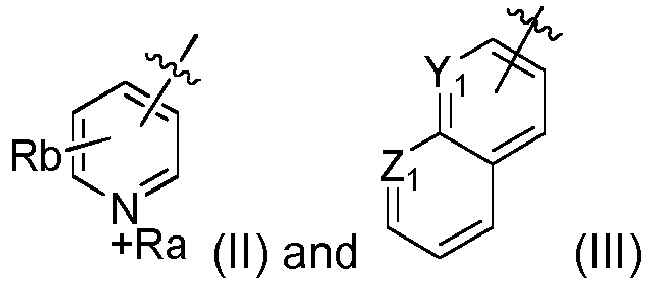
- Rb is a hydrogen atom, a halogen atom, C1-C6 alkyl optionally substituted with a OH group, or a O-(C1-C4)alkyl group,
- Y1 and Z1 are independently CH or NRc +, provided that al least one of Y1 and Z1 is NRc + and at least one of Y1 and Z1 is CH,
- Rc is C1-C6 alkyl, optionally substituted with a OH group, a O-(C1-C4)alkyl group, or a monocyclic or bicyclic 5- to 10-membered aromatic or heteroaromtic group,
- X2- is one or a plurality of pharmaceutically acceptable anion(s), selected so as to obtain an overall electrically neutral salt,
- L is (A), (B), (C), (D) or (E):


- m, n, p, t, u and v may be identical or different and are each independently an integer selected from 0 to 2;
- q, r and s may be identical or different and are each independently an integer selected from 0 to 3;
- R1 to Rg may be identical or different and are each independently a halogen atom, a C1-C6 alkyl group, a C3-C8 cycloalkyl group, a O(C1-C6)alkyl group, a NR10R11 group, a C2-C6 alkenyl group, a C5-C8 cycloalkenyl group,
- said C1-C6 alkyl group, C3-C8 cycloalkyl group, O(C1-C6)alkyl group, C2-C6 alkenyl group, or C5-C8 cycloalkenyl group being optionally substituted with one to three halogen atoms, a OH group, a O-(C1-C6)alkyl group, a NH-(C1-C6)alkyl group or a NHC(O)-R';
- R10 and R11 may be identical or different and are each independently:
- a hydrogen atom,
- a C1-C6 alkyl group optionally substituted with a OH group, a O-(C1-C6)alkyl group, a NH-(C1-C6)alkyl group or a NHC(O)R'- group;
- or NR10R11, taken together, form a 3- to 8-membered heterocycloalkyl or 5- to 8-membered heterocycloalkenyl;
- R' is a (C1-C6)alkyl group optionally substituted with a C5-C10 aryl group, wherein said C5-C10 aryl group is optionally substituted with a halogen atom, a C1-C6 alkyl group, a O(C1-C6)alkyl group, a C2-C6 alkenyl group, a C5-C8 cycloalkenyl group, a 3-to 8-membered heterocycloalkyl, a 5- to 8-membered heterocycloalkenyl, a N((C1-C6)alkyl)2 group or a N((C1-C6)haloalkyl)2 group.
- For the purpose of the invention, the term "pharmaceutically acceptable" is intended to mean what is useful to the preparation of a pharmaceutical composition, and what is generally safe and non-toxic, for a pharmaceutical use.
- The term "pharmaceutically acceptable salt" is intended to mean, in the framework of the present invention, a salt of a compound which is pharmaceutically acceptable, as defined above, and which possesses the pharmacological activity of the corresponding compound.
- In another aspect, the present invention relates to a composition comprising:
- as active ingredient, the compound of formula (I) as described above or below, or a hydrate or a solvate thereof, and optionally another therapeutic agent selected from antibiotics, anticancer agents, steroidal and non-steroidal anti-inflammatory drugs, and
- a pharmaceutically acceptable excipient.
- In another aspect, the present invention relates to a kit comprising at least:
- a first composition comprising the compound of formula (I) as defined above or below, and a pharmaceutically acceptable excipient, and
- a second composition comprising another therapeutic agent preferably selected from antibiotics, anticancer agents, steroidal and non-steroidal anti-inflammatory drugs, especially as a combination product for simultaneous, staggered or sequential use.
- In another aspect, the present invention relates to the compounds or the compositions of the invention or the kit of the invention for use as drug, in particular for treating an Epstein-Barr-Virus (EBV)-related cancer.
- In another aspect, the present invention relates to the use of a compound of formula (I) as defined above or below, or a hydrate or a solvate thereof, or the composition or kit of the invention, for the manufacture of a medicament for preventing or treating an EBV-related cancer.
- In another aspect, the present invention relates to a method for preventing or treating an EBV-related cancer comprising administering to a patient in need thereof a therapeutically effective amount of a compound of formula (I) as defined above or below, or a hydrate or a solvate thereof, or the composition or the kit of the invention.
- In another aspect, the present invention relates to a process for preparing the compounds of formula (I) as defined above or below.
- Preferably, L is (A), (C), (D) or (E), more preferably L is (A) or (C).
- In a particular embodiment, L is (C) and s is 0, or L is (A), and
- m and p are 0, and n is 0 or 1, or
- m and n are 0, and p is 0 or 1, or
- n is 0, and m and p are identical and are 0 or 1, or
- m, n and p are 0.
- In another particular embodiment,
- L is (B) and q and r are 0, or
- L is (D) and t is 0, or
- L is (E) and u and v are 0.
- In a particular embodiment, R1 to Rg may be identical or different and are each independently a halogen atom, a C1-C6 alkyl group, a O(C1-C6)alkyl group, or a NR10R11 group,
said C1-C6 alkyl group or O(C1-C6)alkyl group, group being optionally substituted with one ot two halogen atoms, a OH group, a O-(C1-C6)alkyl group, a NH-(C1-C6)alkyl group or a NHC(O)-R' group;
R10 and R11 may be identical or different and are each independently: - a hydrogen atom,
- a C1-C6 alkyl group optionally substituted with a OH group, a O-(C1-C6)alkyl group, a NH-(C1-C6)alkyl group or a NHC(O)R'- group;
- Advantageously, R' is a (C1-C6)alkyl group optionally substituted with a 5- to 10- membered aryl group, wherein said 5- to 10- membered aryl group is optionally substituted with a halogen atom, a C1-C6 alkyl group, a O(C1-C6)alkyl group, a 3- to 8-membered heterocycloalkyl, a 5- to 8-membered heterocycloalkenyl, a N((C1-C6)alkyl)2group or a N((C1-C6)haloalkyl)2 group.
- In a particular embodiment, R1 to Rg may be identical or different and are each independently a halogen atom, a C1-C6 alkyl group, a C3-C8 cycloalkyl group, a O(C1-C6)alkyl group, a NR10R11 group, a C2-C6 alkenyl group, a C5-C8 cycloalkenyl group;
- R10 and R11 may be identical or different and are each independently:
- a hydrogen atom,
- a C1-C6 alkyl group optionally substituted with a OH group, a O-(C1-C6)alkyl group, a NH-(C1-C6)alkyl group,
- In a particular embodiment, Ra is C1-C6 alkyl, optionally substituted with a OH group, a O-(C1-C4)alkyl group or a monocyclic 5- or 6-membered aromatic or heteroaromtic group, such as a phenyl or a pyridine group. Advantagesouly, Ra is C1-C4 alkyl, optionally substituted with a OH group, a O-(C1-C4)alkyl group or a monocyclic 5- or 6-membered aromatic or heteroaromtic group, such as a phenyl or a pyridine group. Preferably, Ra is C1-C4 alkyl, optionally substituted with a monocyclic 5- or 6-membered aromatic or heteroaromtic group, such as a phenyl or a pyridine group. Most preferably, Ra is is an ethyl, a methyl group or a benzyl group.
- In a particular embodiment, Rb is a hydrogen atom, a halogen atom, C1-C6 alkyl optionally substituted with a OH group, or a O-(C1-C4)alkyl group, preferably Rb is a hydrogen atom or a halogen atom, most preferably Rb is a hydrogen atom.
- In a particular embodiment, Rc is C1-C6 alkyl, optionally substituted with a OH group, a O-(C1-C4)alkyl group or a monocyclic 5- or 6-membered aromatic or heteroaromtic group, such as a phenyl or a pyridine group. Advantagesouly, Rc is C1-C4 alkyl, optionally substituted with a OH group, a O-(C1-C4)alkyl group or a monocyclic 5- or 6-membered aromatic or heteroaromtic group, such as a phenyl or a pyridine group. Preferably, Rc is C1-C4 alkyl, optionally substituted with a monocyclic 5- or 6-membered aromatic or heteroaromtic group, such as a phenyl or a pyridine group. Most preferably, Rc is is an ethyl, a methyl group or a benzyl group.
- In a particular embodiment, Ar1 and Ar2 may be identical or different and are each independently selected from the group consisting of groups of formula (II'), (III') and (III"):

- In a particular embodiment, Ar1 and/or Ar2 are of formula (II) or (II'), Ra is a linear C1-C4 alkyl optionally substituted with a phenyl group (preferably an ethyl, a methyl group or a benzyl group), and Rb is a hydrogen or halogen atom, preferably a hydrogen atom. Preferably, in this embodiment, Ar1 and/or (advantageously and) Ar2 are of formula (II'), Ra is a ethyl, a methyl group or a benzyl group and Rb is a hydrogen atom.
- In another particular embodiment, Ar1 and/or Ar2 are of formula (III) or (III'), and Rc is a linear C1-C4 alkyl optionally substituted with a phenyl group, preferably an ethyl, a methyl group or a benzyl group. Preferably, in this embodiment, Ar1 and/or (advantageously and) Ar2 are of formula (III'), and Rc is an ethyl, a methyl group or a benzyl group.
- As stated above, X2- is one or a plurality of pharmaceutically acceptable anion(s), selected so as to obtain an overall electrically neutral (pharmaceutically acceptable) salt.
- The nature of the anion may vary, provided that it is pharmaceutically acceptable, and yields a pharmaceutically acceptable salt. Suitable pharmaceutically acceptable anions may be prepared from the corresponding base of an inorganic acid or an organic acid. Examples of such inorganic acids are hydrochloric, hydrobromic, hydroiodic, nitric, carbonic, sulfuric and phosphoric acid. Appropriate organic acids may be selected from aliphatic, cycloaliphatic, aromatic, araliphatic, heterocyclic, carboxylic and sulfonic classes of organic acids, examples of which are formic, acetic, propionic, succinic, glycolic, gluconic, lactic, malic, tartaric, citric, ascorbic, glucuronic, maleic, fumaric, pyruvic, aspartic, glutamic, benzoic, anthranilic, mesylic, 4-hydroxybenzoic, phenylacetic, mandelic, embonic (pamoic), methanesulfonic, ethanesulfonic, benzenesulfonic, pantothenic, 2-hydroxyethanesulfonic, toluenesulfonic, sulfanilic, cyclohexylaminosulfonic, stearic, algenic, hydroxybutyric, salicylic, galactaric and galacturonic acid. The salts of the compounds of formula (I) may be prepared by conventional methods from the corresponding compound, for example, using an anion-exchange resin, pre-treated with the appropriate acid, optionally in the form of a metallic or alkaline or alkaline earth base, with any of the compounds of the invention.
- Typically, X2- represents one or a plurality (generally 2) anion (s) with two negative charges. Advantageously, X2- represents 2 anions selected from the group consisting of a halogenide, a carboxylate, a C1-C6alkylsulfonate, a C1-C6haloalkylsulfonate and an alkylarylsulfonate, preferably a halogenide, a methanesulfonate, a trifluoromethanesulfonate or a tosylate.
- For instance, X2- represents 2 anions selected from the group consisting of Cl-, Br-, I-, and CF3SO3 -, such as Br-, I-, and CF3SO3 -.
- When L is (C) or (D), then Ar1 and Ar2 are identical or different and are advantageously of formula (III).
- When Ar1 and/or Ar2 is of formula (II), then L is preferably of formula (A), (B), or (E), more preferably of formula (A) or (E). For instance, when Ar1 and/or Ar2 is of formula (II), L is of formula (A).
- In a preferred embodiment, the compound of formula (I) is characterized in that:
- Ar1 and Ar2 are identical and selected from the group consisting of groups of formula (II'), (III') and (III"),
- Ra is C1-C6 alkyl, optionally substituted with a OH group, a O-(C1-C4)alkyl groupor a monocyclic or bicyclic 5- to 10-membered aromatic or heteroaromtic group, preferably Ra is ethyl, methyl or benzyl,
- Rb is a hydrogen atom,
- Y1 and Z1 are independently CH or NRc +, provided that al least one of Y1 and Z1 is NRc + and at least one of Y1 and Z1 is CH,
- Rc is C1-C6 alkyl, optionally substituted with a OH group, a O-(C1-C4)alkyl group, or a monocyclic or bicyclic 5- to 10-membered aromatic or heteroaromtic group, preferably Rc is ethyl, methyl or benzyl,
- X2- is one or a plurality of pharmaceutically acceptable anion(s), selected so as to obtain an overall electrically neutral salt, preferably 2 I- or 2 Br-,
- L is (A (C), (D) or (E),
- m, n, p, t, u and v may be identical or different and are each independently an integer selected from 0 to 2;
- s is an integer selected from 0 to 3;
- R1 to Rg may be identical or different and are each independently a halogen atom, a C1-C6 alkyl group, a C3-C8 cycloalkyl group, a O(C1-C6)alkyl group, a NR10R11 group, a C2-C6 alkenyl group, a C5-C8 cycloalkenyl group;
- R10 and R11 may be identical or different and are each independently:
- a hydrogen atom,
- a C1-C6 alkyl group optionally substituted with a OH group, a O-(C1-C6)alkyl group, a NH-(C1-C6)alkyl group,
- or NR10R11, taken together, form a 3- to 8-membered heterocycloalkyl or 5- to 8-membered heterocycloalkenyl.
- In this preferred embodiment, Ar1 and Ar2 are preferably identical, and of formula (II'), (III') or (III").
- In this preferred embodiment, advantageously, L is (C) and s is 0, or L is (A), and
- m and p are 0, and n is 0 or 1, or
- m and n are 0, and p is 0 or 1, or
- n is 0, and m and p are identical and are 0 or 1, or
- m, n and p are 0.
- Preferably, in this embodiment, m, n, p, s, t, u and v are all 0.
- Examplary compounds of formula (I) are as follows:
N° L Ar1 and Ar2 are identical and are both 1a 

with Rb being H and Ra being methyl 1b 

with Rb being H and Ra being ethyl 1c 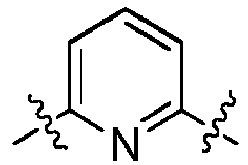

with Rb being H and Ra being benzyl 2a 

with Rc being methyl 2b 

with Rc being ethyl 2c 

with Rc being benzyl 3a 

with Rc being methyl 3b 
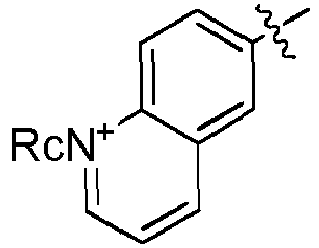
with Rc being ethyl 3c 

with Rc being benzyl 4a 

with Rb being H and Ra being methyl 4b 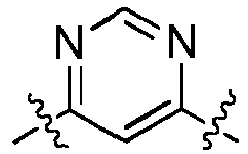
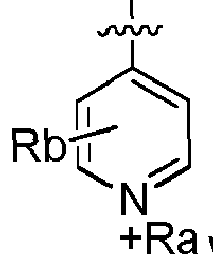
with Rb being H and Ra being ethyl 4c 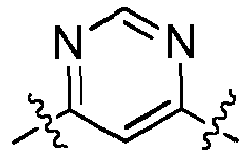

with Rb being H and Ra being benzyl 5a 

with Rc being methyl 5b 

with Rc being ethyl 5c 

with Rc being benzyl 6a 
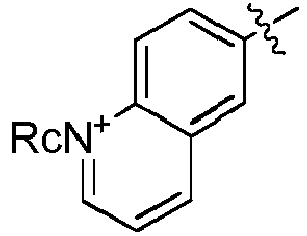
with Rc being methyl 6b 

with Rc being ethyl 6c 

with Rc being benzyl 7a 

with Rb being H and Ra being methyl 7b 

with Rb being H and Ra being ethyl 7c 

with Rb being H and Ra being benzyl 8a 

with Rc being methyl 8b 

with Rc being ethyl 8c 

with Rc being benzyl 9a 

with Rc being methyl 9b 

with Rc being ethyl 9c 

with Rc being benzyl 10a 

with Rb being H and Ra being methyl 10b 

with Rb being H and Ra being ethyl 10c 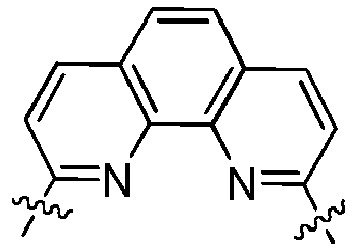

with Rb being H and Ra being benzyl 11a 

with Rc being methyl 11b 

with Rc being ethyl 11c 

with Rc being benzyl 12a 

with Rc being methyl 12b 

with Rc being ethyl 12c 

with Rc being benzyl - In an advantageous embodiment, the compound is compound 2a, 2b, 2c, 3a, 3b, 3c, 5a, 5b, 5c, 6a, 6b, 6c, 7a, 7b, 7c, 8a, 8b, 8c, 9a, 9b, 9c, 10a, 10b, 10c, 11a, 11b, 11c, 12a, 12b, 12c, such as
compound - Advantageously, the compound of the invention is compound 1a, 2a, 2c, 3b, 3c, 4a, 5a, 7a, 8a, 8c, 9b, 9c, 10a, 11a, 11c, 12b, 12c, in particular it is compound 1a, 2a, 2c, 3b, 3c, 4a, 5a, 7a, 8a, 8c, 9b, 10a, 11a, 11c, 12b, such as
compound 


- The present invention encompasses only stable compounds.
- The compounds of formula (I) as described above may exist in tautomeric, diastereomeric or enantiomeric forms. The present invention contemplates all such compounds, including cis- and trans-diastereomers, E- and Z-stereomers, R- and S-enantiomers, diastereomers, d-isomers, I-isomers, the racemic mixtures thereof and other mixtures thereof. Pharmaceutically acceptable salts of such tautomeric, diastereomeric or enantiomeric forms are also included within the invention. The terms "cis" and "trans", as used herein, denote a form of geometric isomerism in which two carbon atoms connected by a double bond will each have a hydrogen atom on the same side of the double bond ("cis") or on opposite sides of the double bond ("trans"). Some of the compounds described contain alkenyl groups, and are meant to include both cis and trans or "E" and "Z" geometric forms. Furthermore, where the compounds described contain one or more stereocenters, the present invention includes R, S, and mixtures of R and S forms for each stereocenter present.
- A process for preparing the compounds of formula (I) comprises the following successive steps:
- a) Condensing NH2NH2.H2O (hydrazine hydrate) with an ester of formula (IV),


- b) Condensing the compound of formula (V) with an aldehyde of formula Ar1'-CHO and/or an aldehyde of formula Ar2'-CHO,
Ar1' and Ar2' being identical or different and each independently selected from the group consisting of groups of formula (IIa) and (IIIa):
Y2 and Z2 being independently CH or N, provided that al least one of Y2 and Z2 is N and at least one of Y2 and Z2 is CH, to obtain Intermediate (VI),
- c) Alkylating Intermediate (VI) with an alkylating agent of formula Rd-Z, wherein
Z is a leaving group, preferably a halogen atom such as Br or I, and
Rd is a C1-C6 alkyl, optionally substituted with a OH group, a O-(C1-C4)alkyl groupor a monocyclic or bicyclic 5- to 10-membered aromatic or heteroaromtic group, - Re is advantageously a O(C1-C4)alkyl group, optionally substituted with a OH, OCH3 or phenyl group, such as a methyl, an ethyl or a benzyl group, preferably a methyl or ethyl group.
- Compounds of formula (IV) are commercial or easily accessible to the one of skill in the art. They may be prepared by methods known in the art, as described for instance in European patent application n°
17305588.0, filed on 19 May 2017 - Step a) is preferably performed under heating in a solvent such as an alcohol, preferably ethanol.
- Step b) is preferably performed under heating in a solvent such as an alcohol, preferably ethanol.
- Step c) is preferably performed under heating in a polar solvent such as a polar aprotic solvent, in particular dimethylformamide (DMF).
- In particular,
compound 2a is obtained as follows:
- The pharmaceutically acceptable excipient is selected, according to the dosage form and mode of administration desired, from the typical excipients known to persons skilled in the art. The pharmaceutical compositions according to the invention can be administered parenterally (such as intravenously or intradermally), topically, orally or rectally.
- The term "parenteral" as used herein includes subcutaneous, intravenous, intramuscular, intravesical or infusion techniques. Preferably, the term "parenteral" refers to infusion techniques.
- For therapeutic purposes, formulations for parenteral administration may be in the form of aqueous or non-aqueous isotonic sterile injection solutions or suspensions.
- Injectable preparations, for example, sterile injectable aqueous or oleaginous suspensions, may be formulated according to the known art using suitable dispersing or wetting agents and suspending agents.
- Preferably, the compositions of the invention are administered via oral route.
- Solid dosage forms for oral administration may include capsules, tablets, pills, powders, and granules. In such solid dosage forms, the compound is ordinarily combined with one or more adjuvants appropriate to the indicated route of administration. Such capsules or tablets can contain a controlled-release formulation as can be provided in a dispersion of active compound in hydroxypropylmethyl cellulose. In the case of capsules, tablets, and pills, the dosage forms can also comprise buffering agents such as sodium citrate, or magnesium or calcium carbonate or bicarbonate. Tablets and pills can additionally be prepared with enteric coatings. Liquid dosage forms for oral administration may include pharmaceutically acceptable emulsions, solutions, suspensions, syrups, and elixirs containing inert diluents commonly used in the art, such as water. Such compositions may also comprise adjuvants, such as wetting agents, emulsifying and suspending agents, and sweetening, flavoring, and perfuming agents. In order to selectively control the release of the active compound to a particular region of the gastrointestinal tract, the pharmaceutical compositions of the invention may be manufactured into one or several dosage forms for the controlled, sustained or timed release of one or more of the ingredients, as known in the art.
- The amount of the compound of the invention that may be combined with the excipient materials to produce a single dosage of the composition will vary depending upon the subject and the particular mode of administration, as known in the art.
- The pharmaceutical composition of the invention may further comprise another one or more therapeutic compounds. Therefore, another aspect of the present invention encompasses a combination of a compound of formula (I) as described above, with one or more therapeutic compounds. The therapeutic compound is preferably selected from antibiotics, anticancer agents, steroidal and non-steroidal anti-inflammatory drugs, advantageously it is an anticancer agent.
- The antibiotic is preferably selected from the group consisting of beta-lactams, aminoglycosides, tetracyclines, glycylcyclines, macrolides, azalides, ketolides, synergistins, lincosanides, fluoroquinolones, phenicols, rifamycins, sulfamides, trimethoprim, glycopeptides, oxazolidinones, nitromidazoles and lipopeptides.
- The non-steroidal anti-inflammatory drug is preferably selected from the group consisting of salicylate and salts thereof, Celecoxib, Diclofenac and salts thereof, Diflunisal, Etodolac, Fenoprofen, Flurbiprofen, Ibuprofen, Indomethacin, Ketoprofen, Meclofenamate, Mefenamic acid, Meloxicam, Nabumetone, Naproxen, Oxaprozin, Piroxicam, Rofecoxib Salsalate, Sulindac, Tolmetin, and Valdecoxib.
- The steroidal anti-inflammatory drug is preferably selected from the group consisting of Prednisone, Methylprednisolone, Prednisolone, aldosterone, cortisol, cortisone, hydrocortisone, corticosterone, tixocortol, ciclesonide, prednicarbate Triamcinolone acetonide, triamcinolone alcohol, mometasone, amcinonide, budesonide, desonide, fluocinonide, fluocinolone acetonide, halcinonide, Hydrocortisone-17-valerate, halometasone, alclometasone, betamethasone, prednicarbate, clobetasone-17-butyrate, clobetasol-17-propionate, fluocortolone, fluocortolone, fluprednidene acetate, dexamethasone, and mixtures thereof, and the corresponding salts or hydrates thereof.
- The anticancer agent is preferably cisplatine, methotrexate, cyclophosphamide, doxorubicin, fluorouracil.
- In some embodiments, the combination comprises 1, 2, 3, 4, or 5 therapeutic compounds, preferably one therapeutic compound.
- In another aspect, the present invention relates to a kit comprising at least:
- a first composition comprising the compound of formula (I) as defined above or below, and a pharmaceutically acceptable excipient, and
- a second composition comprising another therapeutic agent, preferably selected from antibiotics, anticancer agents, steroidal and non-steroidal anti-inflammatory drugs, advantageously an anticancer agent,
- The antibiotics, anticancer agent, steroidal and non-steroidal anti-inflammatory drug is in particular as listed above in connection with the pharmaceutical composition for use of the invention.
- The compound or the composition or the kit of the invention is useful as a drug, typically for disrupting the GAr-based EBNA1 immune evasion of EBV, in particular by preventing the limitation of EBNA1 production in EBV-infected cells.
- Consequently, the compound or the composition or the kit of the invention is in particular useful for stimulating the immune response towards EBNA1, and/or EBV-infected cells.
- As a result, the compound or the composition or the kit of the invention is in particular useful for preventing and/or treating an EBV-related cancer.
- As used herein, an "EBV-related cancer" is understood as a cancer which is linked to the oncogenic Epstein-Barr virus. In particular, an "EBV-related cancer" is understood as a cancer wherein more than 50%, typically more than 90%, in particular more than 95% of tumoral cells are infected by EBV, whereas most non tumoral cells are advantageously not infected by EBV. Typically, only some B-cells (memory cells) are also infected by EBV in an EBV-related cancer. Such a profile of infection by EBV explains the specificity of the compounds of the invention in e method for treating EBV-related cancers.
- Therefore, in a particular embodiment, the compound or the composition or the kit of the invention is used in combination, simultaneously, separately or sequentially, with ionizing or non-ionizing radiations or hyperthermia.
- In particular, said EBV-related cancer is: Hodgkin's lymphoma, Burkitt's lymphoma, Nasopharyngeal carcinoma, some gastric cancers (about 10% are related to EBV infection), lymphomas in immunosuppressed patients (such as AIDS-suffering patients, post-transplant patients), T/NK cell lymphomas (such as nasal T/NK lymphoma, aggressive NK-cell leukaemia, T cell lymphoproliferative disorder of childhood).
- The "effective dose" of a compound of the invention varies as a function of numerous parameters such as, for example, the route of administration and the weight, the age, the sex, the advancement of the pathology to be treated and the sensitivity of patient to be treated.
- As used herein, "patient" includes any mammal, and is preferably a human being.
- The term "halogen", as used in the present invention, refers to a fluorine, bromine, chlorine or iodine atom, preferably a chlorine, bromine or fluorine atom.
- The term "(C 1 -C 6 )alkyl", as used in the present invention, refers to a straight or branched saturated hydrocarbon chain containing from 1 to 6 carbon atoms including, but not limited to, methyl, ethyl, n-propyl, iso-propyl, n-butyl, iso-butyl, sec-butyl, t-butyl, n-pentyl, n-hexyl.
- The term "(C 1 -C 6 )haloalkyl", as used in the present invention, refers to a straight or branched saturated hydrocarbon chain containing from 1 to 6 carbon atoms substituted with halogen atoms, such as chlorine, bromine, iodine or fluorine atoms, preferably chlorine or fluorine atoms. Examples of (C1-C6)haloalkyl include, but are not limited to, CH2Cl, CH2Br, CH2I, CH2F, CHF2, CF3, CH2CH2Cl, CH2CH2BR, CH2CH2I, CH2CH2F.
- The term "(C 2 -C 6 )alkenyl", as used in the present invention, refers to a straight or branched unsaturated hydrocarbon chain containing from 2 to 6 carbon atoms and comprising at least one double bond including, but not limited to, ethenyl, propenyl, butenyl, pentenyl, hexenyl.
- The term "(C 3 -C 8 )CyCloalkyl", as used in the present invention, refers to a hydrocarbon monocyclic or bicyclic (fused) ring having 3 to 8 carbon atoms including, but not limited to, cyclopropyl, cyclopentyl, cyclohexyl.
- The term "(C 5 -C 10 )cycloalkenyl", as used in the present invention, refers to a hydrocarbon monocyclic or bicyclic (fused) ring having 5 to 10 carbon atoms and comprising at least one double bond including, but not limited to, cyclopentenyl, cyclohexenyl.
- The term "heterocycloalkyl", as used in the present invention, refers to a hydrocarbon monocyclic or bicyclic (fused) ring having 3 to 8 ring atoms, containing at least one heteroatom, preferably 1 or 2 heteratoms, in the ring. The heteroatom is preferably selected from O, N or S, and the S atom may be mono or dioxidized, i.e. the sulphur atom may be S, S(O) or SO2. heterocycloalkyls include, but are not limited to, epoxide, aziridine, pyrrolidinyl, tetrahydrofuranyl, tetrahydrothiophenyl, tetrahydropyranyl, piperidinyl, piperazinyl, morpholinyl, thiomorpholinyl.
- The term "heterocycloalkenyl", as used in the present invention, refers to a hydrocarbon monocyclic or bicyclic (fused) ring having 5 to 8 ring atoms, containing at least one heteroatom, preferably 1 or 2 heteratoms, in the ring, and comprising at least one double bond. The heteroatom is preferably selected from O, N or S, and the S atom may be mono or dioxidized, i.e. the sulphur atom may be S, S(O) or SO2. heterocycloalkenyls include, but are not limited to, pyrrolyl, dihydrofuranyl, dihydrothiophenyl, dihydropyranyl, tetrahydropyridinyl, dihydrooxazinyl, oxindolyl, benzothiazinyl, benzothiazinonyl, phthalimidyl, indolinyle, isoindolinyle.
- As used herein, an "aryl group" may be an aromatic or heteroaromatic group.
- The term "aromatic group" as used herein alone or as part of another group denotes optionally substituted homocyclic aromatic groups, preferably monocyclic or bicyclic (fused) groups, containing from 6 to 10 carbons in the ring portion, such as phenyl, naphthyl and indenyle. Phenyl and naphthyl are the most preferred aromatic groups.
- The term "heteroaromatic" as used herein alone or as part of another group denotes optionally substituted aromatic groups having at least one heteroatom in at least one ring, and preferably 5 or 6 atoms in each ring. The heteroaromatic group preferably has 1 to 3 heteroatoms preferably selected from O, N and S in the ring, and may be bonded to the remainder of the molecule through a carbon or heteroatom. Exemplary heteroaromatics include furyl, thiophenyl, pyrrolyl, isoxazolyl, oxazolyl, isothiazolyl, thiazolyl, imidazolyl, triazolyl, pyridyl, pyrimidinyl, pyrazinyl, pyridazinyl, indolyl, isoxindolyl, benzoxazolyl, benzothiazolyl, benzotriazolyl, quinolinyl, isoquinolinyl or naphthyridinyl. Preferably, the heteroaromatic group is selected from a pyridinyl, a pyrimidinyl, quinolinyl, isoquinolinyl, naphthyridinyl. Most preferably, the heteroaromatic group is a pyridine.
- As used herein, the term "alkylaryl" refers to a (C1-C6)alkyl-aryl group. Preferably, the alkylaryl group is a (C1-C6)alkyl-aromatic group such as a benzyl group.
- As used herein, an "alcohol" is understood as a linear or ramified hydrocarbon compound comprising between 1 and 6 carbon atom, substituted with 1 to 3 OH groups. Preferably, an alcohol is a linear or ramified C1-C6 hydrocarbon compound substituted with 1 OH group, such as methanol, ethanol, n-propanol, isopropanol or n-butanol.
- The term "leaving group" as used herein refers to a chemical group which can be easily replaced with a nucleophile during a nucleophilic substitution reaction, the nucleophile being in particular a nitrogen containing heteroaromatic group, such as a pyridinyl or a quinolinyl. Such a leaving group can be in particular a halogen atom or a sulfonate. The sulfonate is in particular a group -OSO2-R10 with R10 representing a (C1-C6)alkyl, aryl, aryl-(C1-C6)-alkyl or (C1-C6)-alkyl-aryl group. The sulfonate may be a mesylate (CH3-S(O2)O-), a triflate (CF3-S(O)2O-) or a tosylate (p-Me-C6H4-S(O)2O-). Preferably, the leaving group is an halogen atom or a mesylate group, more specifically an iodine atom, a bromine atom or a mesylate group. Also, in the present invention, Me stands for methyl and Ph stands for phenyl. More generally, the abbreviations used to refer to chemical groups have the meaning commonly known in the art.
-
-
Figure 1 shows a scheme representing the principles of a G4-FID assay. -
Figure 2 shows HT-G4-FID plots and DC50 values for TO from G4-RNA EBNA1 by compounds of the invention. -
Figure 3 shows a scheme representing the principles of a FRET-melting assay, where "D" stands for a donor fluorophore (FAM) and "A" stands for an acceptor fluorophore (TAMRA). -
Figure 4 shows an example of a melting curve quadruplex RNA F-EBNA1-T (0.2 µM, inK +10 buffer) alone (solid line) and in the presence ofcompound 2a (1.0 µM) (dashed line). -
Figure 5 shows a bar graph of the stabilization of F-EBNA1-T (0.2 µM), expressed as ΔT m (°C) values, by compounds of the invention (1.0 µM) inK +10 buffer in the presence of increasing concentrations of competitor DNAds26 (SEQ ID n°3) (0, 15 and 50 molar equivalents). -
Figure 6 shows a western blot identifying the presence of different proteins (OVA and 235GAr-OVA relatively to GAPDH) in H1299 cells after treatment withcompound 2a. -
Figure 7 shows western blots identifying the presence of protein EBNA41 relatively to GAPDH or Actine in different cell lines (namely B95.8, Mutu-1 and Raji), after treatment withcompound 2a (B95.8, Mutu-1 and Raji) orcompound 11a (Raji). -
Figure 8 shows the IL2 concentration (in pg/mL) respectively with DMSO (control), 5µM and 10 µM ofcompound 2a in DMSO with OVA and Gar-OVA (left), or with DMSO (control), 5µM and 10 µM ofcompound 11a in DMSO with OVA and Gar-OVA (right). Stars indicate significant results (the higher the number of stars, the more significant). "ns" stands for not significant. -
Figure 9 shows the cell viability (in %) for the control (DMSO) and various concentrations ofcompound 2a (left), or for the control (DMSO) and various concentrations ofcompound 11a (right). Stars indicate significant results (the higher the number of stars, the more significant). -
Figure 10 shows the proximity ligation assay (PLA) performed in H1299 cells transfected with EBNA1 plasmids and treated respectively with pure DMSO (control assay), 5µM ofcompound 2a in DMSO, and with 5µM ofcompound 11a in DMSO. -
Figure 11 shows the number of nuclear PLA dots per cell (transfected with EBNA1 plasmids) treated respectively with pure DMSO (control assay), 5µM ofcompound 2a in DMSO, and with 5µM ofcompound 11a in DMSO. Stars indicate significant results (the higher the number of stars, the more significant). - Of note, DMSO is an abbreviation for dimethylsulfoxyde.
- Pyridine-2,6-dicarbohydrazide (L1): A solution of the dimethyl pyridine-2,6-dicarboxylate (10 mmol, 1.95 g) and hydrazine hydrate (220 mmol, 11.2 g, 10.9 mL) in ethanol (150 mL) was heated in the oil bath under reflux for 18 h and then cooled to room temperature. The precipitate was filtered, twice washed with ethanol, once with ether, and dried. White solid, yield 1.73 g (89%); 1H NMR (300 MHz, DMSO-d 6): δ = 10.63 (s, 2H), 8.13 (s, 3H), 4.63 (s, 4H). MS (ESI+): m/z = 196.2 [M + H]+.
- Pyrimidine-4,6-dicarbohydrazide (L2) was obtained by the same experimental procedure from 4,6-dimethyl pyrimidine-4,6-dicarboxylate. Yield 1.81 g (92%). Pale-yellow solid; 1H NMR (300 MHz, DMSO-d 6): δ = 10.41 (s, 2H), 9.35 (d, J = 1.1 Hz, 1H), 8.35 (d, J = 1.1 Hz, 1H), 4.77 (s, 4H); MS (ESI+): m/z = 197.1 [M + H]+.
- 1,8-Naphthyridine-2,7-dicarbohydrazide (L3) was obtained by the same experimental procedure from 2,7-dimethyl-1,8-naphthyridine-2,7-dicarboxylate (which is obtained as described by G. Newkome et al., J Org Chem 1990, 55, 2838-2842). Yield 2.45 g (97%). Pale-yellow solid; 1H NMR (300 MHz, DMSO-d 6): δ = 10.00 (s, 2H), 8.74 (d, J = 8.4 Hz, 2H), 8.25 (d, J = 8.4 Hz, 2H), 4.74 (s, 4H); MS (ESI+): m/z = 247.1 [M + H]+.
- 1,10-Phenanthroline-2,9-dicarbohydrazide (L4) was obtained by the same experimental procedure from 2,9-dimethyl-1,10-phenanthroline-2,9-dicarboxylate (which is obtained as described by C. Chandler et al., J Heterocycl Chem 1981, 18, 599-601). Yield 2.38 g (80%). Pale yellow solid; 1H NMR (300 MHz, DMSO-d 6): δ = 10.77 (s, 2H), 8.69 (d, J = 8.3 Hz, 2H), 8.40 (d, J = 8.3 Hz, 2H), 8.14 (s, 2H), 4.78 (s, 4H). MS (ESI+): m/z = 297.2 [M + H]+.
-


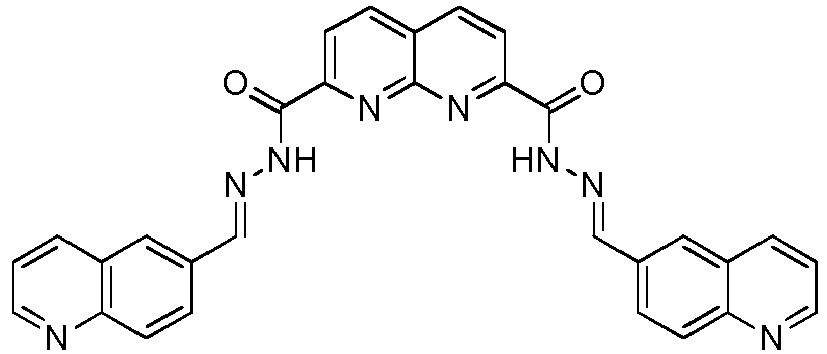


- N' 2 ,N' 6 -Bis[(1-methylpyridinium-4-yl)methylene]pyridine-2,6-dicarbohydrazide iodide (1a): A mixture of compound 1 (186.7 mg, 0.5 mmol), iodomethane (9.3 mL, 10.6 g, 75 mmol) and DMF (3 mL) was sealed in a tube and heated at 40 °C during 18 h. After cooling to room temperature, the precipitate was filtered and washed with DMF and diethyl ether. Finally, the product was dried in vacuum to afford
compound 1a (313 mg, 85%) in a sufficiently pure form (as assessed by 1H NMR and LC/MS), as an orange powder. 1H NMR (300 MHz, DMSO-d 6): δ = 12.93 (s, 2H), 9.03 (d, J = 5.9 Hz, 4H), 8.94 (s, 2H), 8.54-8.31 (m, 7H), 4.37 (s, 6H); Hereafter, in the assignment of mass spectra, M refers to the organic dication. MS (ESI+): m/z = 530.2 [M + I]+, 201.7 [M]2+. - N' 2 ,N' 6 -Bis[(1-methylaqinolinium-4-yl)methylene]pyridine-2,6-dicarbohydrazide iodide (2a): Was obtained from compound 2 (236.7 mg, 0.5 mmol) and iodomethane (9.3 mL, 10.6 g, 75 mmol) in 53% yield by following the same experimental procedure as described for
compound 1a. Orange solid; 1H NMR (300 MHz, DMSO-d 6): δ = 13.03 (s, 2H), 9.74 (s, 2H), 9.54 (d, J = 6.3 Hz, 2H), 9.07 (d, J = 8.5 Hz, 2H), 8.66-8.56 (m, 4H), 8.52 (d, J = 7.0 Hz, 2H), 8.48-8.43 (m, 1H), 8.42-8.33 (m, 2H), 8.27-8.18 (m, 2H), 4.68 (s, 6H); MS (ESI+): m/z = 502.3 [M-H]+, 251.8 [M]2+. - N' 2 ,N' 6 -Bis[(1-benzylquinolinium-4-yl)methylene]pyridine-2,6-dicarbohydrazide bromide (2c): A mixture of compound 2 (236.7 mg, 0.5 mmol), benzyl bromide (1.2 mL, 1.71 g, 10 mmol) and DMF (3 mL) was heated at 60 °C during 18 h. After cooling to room temperature, the precipitate was filtered off and washed with DMF and ether. Finally, the product was dried in vacuum to afford compound 2c (354.8 mg, 87%) in a sufficiently pure form (as assessed by 1H NMR and LC/MS), as a yellow-orange powder. 1H NMR (300 MHz, DMSO-d 6): δ = 13.34 (s, 2H), 10.29 (s, 2H), 9.74 (d, J = 6.2 Hz, 2H), 9.06 (d, J = 8.5 Hz, 2H), 8.66 (d, J = 6.2 Hz, 2H), 8.62-8.50 (m, 4H), 8.49-8.38 (m, 1H), 8.31-8.23 (m, 2H), 8.19-8.11 (m, 2H), 7.41 (s, 10H), 6.42 (s, 4H); MS (ESI+): m/z = 654.4 [M-H]+, 327.8 [M]2+.
- N' 2 ,N' 6 -Bis[(1-ethylquinolinium-6-yl)methylene]pyridine-2,6-dicarbohydrazide iodide (3b): Was obtained from compound 3 (236.7 mg, 0.5 mmol) and iodoethane 6.0 mL, 11.7 g, 75 mmol) in 92% yield by following the same experimental procedure as described for
compound 1a. Pale brown solid; 1H NMR (300 MHz, DMSO-d 6): δ = 12.67 (s, 2H), 9.59 (d, J = 5.4 Hz, 2H), 9.38 (d, J = 8.3 Hz, 2H), 9.07 (s, 2H), 8.85 (s, 2H), 8.74 (q, J = 9.6 Hz, 4H), 8.45 (d, J = 7.1 Hz, 2H), 8.41-8.32 (m, 1H), 8.32-8.16 (m, 2H), 5.14 (q, J = 7.0 Hz, 4H), 1.66 (t, J = 7.0 Hz, 6H); MS (ESI+): m/z = 644.3 [M-H]+, 265.8 [M]2+. - N' 2 ,N' 6 -Bis[(1-benzylquinolinium-6-yl)methylene]pyridine-2,6-dicarbohydrazide bromide (3c): Was obtained from compound 3 (236.7 mg, 0.5 mmol) and benzyl bromide (1.2 mL, 1.71 g, 10 mmol) in 65% yield by following the same experimental procedure as described for compound 2c. Pale yellow solid; 1H NMR (300 MHz, DMSO-d 6): δ = 12.72 (s, 2H), 9.76 (d, J = 5.0 Hz, 2H), 9.48 (d, J = 8.3 Hz, 2H), 9.12 (s, 2H), 8.85 (s, 2H), 8.73-8.58 (m, 4H), 8.46-8.30 (m, 5H), 7.49-7.34 (m, 10H), 6.41 (s, 4H); MS (ESI+): m/z = 768.3 [M-H]+, 327.8 [M]2+.
- N' 4 ,N' 6 -Bis[(1-methylpyridinium-4-yl)methylene]pyrimidine-4,6-dicarbohydrazide iodide (4a): Was obtained from compound 4 (187.2 mg, 0.5 mmol) and iodomethane (9.3 mL, 10.6 g, 75 mmol) in 85% yield by following the same experimental procedure as described for
compound 1a. Yellow-orange solid; 1H NMR (300 MHz, DMSO-d 6): δ = 13.31 (s, 2H), 9.67 (s, 1H), 9.01 (d, J = 6.5 Hz, 4H), 8.86 (s, 2H), 8.64 (s, 1H), 8.38 (d, J = 6.4 Hz, 4H), 4.35 (s, 6H); MS (ESI+): m/z = 403.3 [M-H]+, 202.2 [M]2+. - N' 4 ,N' 6 -Bis[(1-methylquinolinium-4-yl)methylene]pyrimidine-4,6-dicarbohydrazide iodide (5a): Was obtained from compound 5 (237.2 mg, 0.5 mmol) and iodomethane (9.3 mL, 10.6 g, 75 mmol) in 97% yield by following the same experimental procedure as described for
compound 1a. Orange solid; 1H NMR (300 MHz, DMSO-d 6): δ = 13.28 (s, 2H), 9.75 (s, 1H), 9.70 (s, 2H), 9.51 (d, J = 6.2 Hz, 2H), 8.86 (d, J = 8.4 Hz, 2H), 8.73 (s, 1H), 8.60 (d, J = 8.7 Hz, 2H), 8.52 (d, J = 6.1 Hz, 2H), 8.40-8.32 (m, 2H), 8.25-8.16 (m, 2H), 4.67 (s, 6H); MS (ESI+): m/z = 503.3 [M-H]+, 252.3 [M]2+. - N' 2 ,N' 7 -Bis[(1-methylpyridinium-4-yl)methylene]-1,8-naphthyridine-2,7-dicarbohydrazide iodide (7a): Was obtained from compound 7 (212.2 mg, 0.5 mmol) and iodomethane (9.3 mL, 10.6 g, 75 mmol) in 76% yield by following the same experimental procedure as described for
compound 1a. Yellow solid; 1H NMR (300 MHz, DMSO-d 6): δ = 13.14 (s, 2H), 9.01 (d, J = 6.0 Hz, 4H), 8.94 (d, J = 8.3 Hz, 2H), 8.83 (s, 2H), 8.45 (d, J = 8.3 Hz, 2H), 8.39 (d, J = 5.9 Hz, 4H), 4.36 (s, 6H); MS (ESI+): m/z = 453.3 [M-H]+, 227.3 [M]2+. - N' 2 ,N' 7 -Bis[(1-methylquinolinium-4-yl)methylene]-1,8-naphthyridine-2,7-dicarbohydrazide iodide (8a): Was obtained from compound 8 (262.3 mg, 0.5 mmol) and iodomethane (9.3 mL, 10.6 g, 75 mmol) in 81% yield by following the same experimental procedure as described for
compound 1a. Red solid; 1H NMR (300 MHz, DMSO-d 6): δ = 13.14 (s, 2H), 9.72 (s, 2H), 9.52 (d, J = 6.2 Hz, 2H), 8.99 (d, J = 8.3 Hz, 2H), 8.90 (d, J = 8.4 Hz, 2H), 8.68-8.47 (m, 6H), 8.39-8.32 (m, 2H), 8.25-8.15 (m, 2H), 4.67 (s, 6H); MS (ESI+): m/z = 553.3 [M-H]+, 277.2 [M]2+. - N' 2 ,N' 7 -Bis[(1-benzylquinolinium-4-yl)methylene]-1,8-naphthyridine-2,7-dicarbohydrazide bromide (8c): Was obtained from compound 8 (262.3 mg, 0.5 mmol) and benzyl bromide (1.2 mL, 1.71 g, 10 mmol) in 63% yield by following the same experimental procedure as described for compound 2c. Yellow solid; 1H NMR (300 MHz, DMSO-d 6): δ = 13.19 (s, 2H), 9.77 (s, 4H), 9.00 (d, J = 8.3 Hz, 2H), 8.90 (d, J = 8.1 Hz, 2H), 8.66 (d, J = 6.0 Hz, 2H), 8.56 (dd, J = 16.8, 8.7 Hz, 4H), 8.32-8.22 (m, 2H), 8.21-8.12 (m, 2H), 7.41 (s, 10H), 6.44 (s, 4H); MS (ESI+): m/z = 705.4 [M-H]+, 353.4 [M]2+.
- N' 2 ,N' 7 -Bis[(1-ethylquinolinium-6-yl)methylene]-1,8-naphthyridine-2,7-dicarbohydrazide iodide (9b): Was obtained from compound 9 (262.3 mg, 0.5 mmol) and iodoethane (6.0 mL, 11.7 g, 75 mmol) by the same experimental procedure in 80% yield. Pale brown solid; 1H NMR (300 MHz, DMSO-d 6): δ = 12.79 (s, 2H), 9.58 (d, J = 5.9 Hz, 2H), 9.38 (d, J = 8.6 Hz, 2H), 8.99 (s, 2H), 8.93 (d, J = 8.4 Hz, 2H), 8.72 (dd, J = 20.4, 11.1 Hz, 6H), 8.45 (d, J = 8.3 Hz, 2H), 8.26 (dd, J = 8.3, 5.8 Hz, 2H), 5.13 (q, J = 7.2 Hz, 4H), 1.65 (t, J = 7.1 Hz, 6H); MS (ESI+): m/z = 291.3 [M]2+.
- N' 2 ,N' 7 -Bis[(1-benzylquinolinium-6-yl)methylene]-1,8-naphthyridine-2,7-dicarbohydrazide bromide (9c): Was obtained from compound 9 (262.3 mg, 0.5 mmol) and benzyl bromide (1.2 mL, 1.71 g, 10 mmol) in 66% yield by following the same experimental procedure as described for compound 2c. Pale brown solid; 1H NMR (300 MHz, DMSO-d 6): δ = 12.76 (s, 2H), 9.75 (d, J = 5.6 Hz, 2H), 9.48 (d, J = 8.3 Hz, 2H), 8.98-8.85 (m, 4H), 8.80 (s, 2H), 8.63 (m, 4H), 8.43 (d, J = 8.3 Hz, 2H), 8.35 (dd, J = 8.2, 5.9 Hz, 2H), 7.41 (d, J = 6.6 Hz, 10H), 6.40 (s, 4H); MS (ESI+): m/z = 705.4 [M-H]+, 353.2 [M]2+.
- N' 2 , N' 9 -Bis[(1-methylpyridinium-4-yl)methylene]-1,10-phenanthroline-2,9-dicarbohydrazide iodide (10a): Was obtained from compound 10 (237.2mg, 0.5 mmol) and iodomethane (9.3 mL, 10.6 g, 75 mmol) in 49% yield by following the same experimental procedure as described for
compound 1a. Yellow solid; 1H NMR (300 MHz, DMSO-d 6): δ = 13.38 (s, 2H), 9.04 (s, 6H), 8.89 (d, J = 8.1 Hz, 2H), 8.64 (d, J = 8.0 Hz, 2H), 8.41 (d, J= 5.9 Hz, 4H), 8.32 (s, 2H), 4.41 (s, 6H), MS (ESI+): m/z = 705.4 [M-H]+, 353.4 [M]2+. - N' 2 ,N' 9 -Bis[(1-methylquinolinium-4-yl)methylene]-1,10-phenanthroline-2,9-dicarbohydrazide iodide (11a): Was obtained from compound 11 (287.3 mg, 0.5 mmol) and iodomethane (9.3 mL, 10.6 g, 75 mmol) in 85% yield by following the same experimental procedure as described for
compound 1a. Dark-red solid; 1H NMR (300 MHz, DMSO-d 6): δ = 13.28 (s, 2H), 9.86 (s, 2H), 9.45 (d, J = 6.3 Hz, 2H), 8.95 (d, J = 8.3 Hz, 2H), 8.71 (d, J = 8.3 Hz, 2H), 8.56 (d, J = 6.1 Hz, 2H), 8.48-8.34 (m, 4H), 8.27 (d, J = 9.1 Hz, 2H), 7.88-7.80 (m, 2H), 7.15-7.08 (m, 2H), 4.62 (s, 6H); MS (ESI+): m/z = 717.3 [M + CF3COO]+, 603.4 [M-H]+, 302.3 [M]2+. - N' 2 , N' 9 -Bis[(1-benzylquinolinium-4-yl)methylene]-1,10-phenanthroline-2,9-dicarbohydrazide bromide (11c): Was obtained from compound 11 (287.3 mg, 0.5 mmol) and benzyl bromide (1.2 mL, 1.71 g, 10 mmol) in 75% yield by following the same experimental procedure as described for compound 2c. Pale brown solid; 1H NMR (300 MHz, DMSO-d 6): δ = 13.34 (s, 2H), 9.94 (s, 2H), 9.76 (d, J = 6.0 Hz, 2H), 8.96 (d, J = 8.2 Hz, 2H), 8.73 (d, J = 7.7 Hz, 4H), 8.37 (d, J = 7.9 Hz, 4H), 8.14 (d, J = 9.2 Hz, 2H), 7.65-7.30 (m, 10H), 7.09-7.00 (m, 2H), 6.84-6.79 (m, 2H), 6.35 (s, 4H); MS (ESI+): m/z = 378.4 [M]2+.
- N' 2 ,N' 9 -Bis[(1-ethylquinolinium-6-yl)methylene]-1,10-phenanthroline-2,9-dicarbohydrazide iodide (12b): Was obtained from compound 12 (287.3 mg, 0.5 mmol) and iodoethane (6.0 mL, 11.7 g, 75 mmol) in 85% yield by following the same experimental procedure as described for
compound 1a. Pale brown solid; 1H NMR (300 MHz, DMSO-d 6): δ = 13.10 (s, 2H), 9.60 (d, J = 5.6 Hz, 2H), 9.25 (s, 2H), 9.17 (d, J = 8.2 Hz, 2H), 8.89 (d, J = 8.3 Hz, 2H), 8.76 (d, J = 2.6 Hz, 6H), 8.64 (d, J = 8.3 Hz, 2H), 8.32 (s, 2H), 8.22 (dd, J = 8.4, 5.9 Hz, 2H), 5.16 (q, J = 7.0 Hz, 4H), 1.67 (t, J = 7.1 Hz, 6H); MS (ESI+): m/z = 705.4 [M-H]+, 353.4 [M]2+. - N' 2 , N' 9 -Bis[(1-benzylquinolinium-6-yl)methylene]-1,10-phenanthroline-2,9-dicarbohydrazide bromide (12c): Was obtained from compound 12 (287.3 mg, 0.5 mmol) and benzyl bromide (1.2 mL, 1.71 g, 10 mmol) in 73% yield by following the same experimental procedure as described for compound 2c. Pale brown solid; 1H NMR (300 MHz, DMSO-d 6): δ = 13.10 (s, 2H), 9.79 (d, J = 5.7 Hz, 2H), 9.30 (d, J = 8.3 Hz, 2H), 9.21 (s, 2H), 8.87 (d, J = 8.3 Hz, 2H), 8.81 (s, 2H), 8.76-8.65 (m, 4H), 8.63 (d, J = 8.3 Hz, 2H), 8.39-8.28 (m, 4H), 7.53-7.37 (m, 10H), 6.46 (s, 4H). MS (ESI+): m/z = 378.4 [M]2+.
- This assay is based on the displacement of a fluorescent indicator (Thiazole Orange, hereinafter TO) from a G4-RNA structure (RNA G-quadruplex of EBNA1) by a putative ligand such as the compounds of the invention (see
Figure 1 ). This displacement is quantified as % TO displacement. The percentage of TO displacement is calculated from the fluorescence intensity (F) in the presence of a putative ligand, using:
- The percentage of displacement is then plotted as a function of the concentration of added ligand. The RNA affinity of putative ligands is evaluated using the concentration of a ligand required to decrease the fluorescence of the probe by 50% (noted DC50), which is determined graphically from non-linear fitting of the displacement curve. Low DC50 values (DC50 < 0.25 µM) typically indicate strong affinity of the ligand to G4-RNA.
- Thiazole Orange (TO) and cacodylic acid were purchased from Aldrich and used without further purification. The oligoribonucleotide EBNA1 [5'-r(GGGGCAGGAGCAGGAGGA)-3'] (SEQ ID n°1) purified by reversed-phase HPLC was purchased from Eurogentec.
- Stock solutions of the ligands (2 mM in DMSO (dimethylsulfoxyde)) were used for G4-FID assay, unless otherwise stated, and were stored at -20°C. Stock solutions of TO (2 mM in DMSO) were used for G4-FID assay. Fluorescent probe powders and solutions were stored and used, protected from light and used as aliquots to avoid freeze-thaw cycles. HT-G4-FID measurements were performed on a FLUOstar Omega microplate reader (BMG Labtech) with 96-well Non-Binding Surface black with black bottom polystyrene microplates (Corning ref 3650).
- For HT-G4-FID assay, the oligonucleotide was dissolved in K+-100-buffer (10 mM lithium cacodylate, pH 7.3, 100 mM KCI, 1 mM EDTA, 1% DMSO). Oligonucleotide concentrations were determined on the basis of their absorbance at 260 nm. Prior to use, the oligonucleotide was pre-treated by heating at 95 °C for 5 min followed by a slow cooling to 25 °C.
- Each G4-FID assay is performed in a 96-well microplates. Every ligand (compound) is tested on a line of the microplate, in duplicate (in other plate). The microplate is filled with (a) K+-100 solution (qs for 200 µL) (b) 10 µL of a solution of pre-folded oligonucleotides (5 µM) and TO (10 µM - 2 eq) and (c) an extemporaneously prepared 5 µM ligand solution in K+-100 buffer (0 to 100 µL along the line of the microplate, i.e., from column A to column H: 0, 0.125, 0.25, 0.375, 0.5, 0.625, 0.75, 1.0, 1.25, 1.5, 2.0 and 2.5 µM) (see Largy et al., Anal Bioanal Chem 2011, 400, 3419-3427). After 5 min of orbital shaking at 500 rpm, fluorescence intensity is measured using the following experimental parameters: positioning delay: 0.5 s, 20 flashes per well, emission/excitation filters (nm): 485/520, gain adjusted at 80% of the fluorescence from the most fluorescent well (i.e., a well from column A).
- Results are shown in
figure 2 and in Table 1 below (lower DC50 values indicate higher affinity of compounds to the G4-RNA structure of EBNA1).Table 1. DC50 values for TO displacement from G4-RNA EBNA1 by various ligands. Compound DC50 (µM) 1a 1.37 2a 0.16 5a 0.71 7a 0.65 10a 0.25 11a 0.28 - These data indicate that
compounds - The FRET-melting assay is based on thermal denaturation of G4-ARN monitored by fluorescence due to the phenomenon of Forster Resonance Energy Transfer (FRET). This method uses quadruplex-forming RNA sequence dual-labeled with two different fluorophores: a donor (fluorescein, or FAM) and an acceptor (tetramethylrhodamine, or TAMRA). When RNA is folded into G-quadruplex (G4) structure, fluorescence of the donor fluorophore is weak due to strong energy transfer (FRET) to the neighboring acceptor fluorophore. Upon thermal denaturation, the quadruplex unfolds and the fluorophores are separated, leading to decrease of the FRET effect and increase of the fluorescence of the donor (see
Figure 3 ). By following the fluorescence of the donor as a function of temperature, a melting curve of the G-quadruplex RNA can be obtained, which allows determining the temperature of denaturation at which 50% of the quadruples is unfolded (T 1,Figure 4 ). - The FRET-melting assay allows assessing the affinity of small molecules (ligands) for the G4-RNA. The addition of a G4-ligand stabilizes the G-quadruplex structure and increases the denaturation temperature. The temperature of denaturation in the presence of ligands (T 2) can be compared with that obtained in the absence of ligands (T 1). The value of ΔT m (ΔT m = T 2-T 1) represents a measure of the affinity of the compounds of the invention (ligand). Generally, values of ΔT m > 20 °C correspond to ligands of high affinity.
- The dual-labeled oligoribonucleotide EBNA1 [5'-FAM-r(GGGGCAGGAGCAGGAGGA)-TAMRA-3'] (SEQ ID n°2) purified by reversed-phase HPLC was purchased from Eurogentec. The donor fluorophore was 6-carboxyfluorescein (FAM) and the acceptor fluorophore was 6-carboxytetramethylrhodamine (TAMRA).
- Stock solutions of the ligands (2 mM in DMSO) were used for FRET-melting assay, unless otherwise stated, and were stored at -20 °C. FRET-melting measurements are performed on 7900HT Fast Real-Time PCR System (Applied Biosystems) with Microamp Fast optical 96-well reaction plate (Applied Biosystems).
- For FRET-melting assay, oligoribonucleotide F-EBNA1-T was dissolved in
K +10 buffer (10 mM lithium cacodylate buffer, pH 7.3, supplemented with 10 mM KCI and 90 mM LiCI). - Prior to use, all oligonucleotides were pre-treated by heating at 95 °C for 5 min, then rapidly cooled to 4 °C to favor the intramolecularfolding by kinetic trapping. Duplex-DNA ds26 (5'CAA-TCG-GAT-CGA-ATT-CGA-TCC-GAT-TG-3') (SEQ ID n°3) was prepared by heating this self-complementary strand at 90 °C for 5 min in
K +10 buffer followed by a slow cooling over 6 h. - FRET-melting assay is performed in 96-well plates on real time PCR apparatus 7900HT Fast Real-Time PCR System using the heating ramp as follow: 5 min at 25 °C, then increase of 0.5 °C every minute until 95 °C. Each experimental condition was tested in duplicated in a volume of 25 µL for each sample. The 96-well plates (Applied Biosystems) were prepared by aliquoting the annealed RNA (24 µL of 0.21 µM solution in
K +10 buffer) into each well, followed by 1 µL of ligand solution (25 µM inK +10 buffer). For competition experiments, duplex competitors were added to 200 nM quadruplex sequences at final concentrations of 3.0 µM (15 eq) and 10.0 µM (50 eq), with a total reaction volume of 25 µL, with the labeled oligoribonucleotide (0.2 µM) and the ligand (1.0 µM). Measurements were made with excitation at 492 nm and detection at 516 nm. The change in the melting temperature in the presence of 1.0 µM putative ligand, ΔT m (1.0 µM), was calculated from at least two experiments by subtraction of the blank from the averaged melting temperature of each compound (1.0 µM). - The results are shown in
figure 5 and in Table 2 below (higher ΔT m values indicate higher affinity of the compounds to G4-RNA structure of EBNA1).
- These data indicate that
compounds -
Compounds compounds - The aim of these experiments is to assess the effect of the inventive compounds on the GAr-based inhibition of protein expression. For this purpose, H1299 cells were transfected by plasmids allowing expression of either EBNA1 or, as a control EBNA1ΔGAr and then treated, or not by various concentrations of the indicated compounds. As GAr inhibits the translation of its own mRNA, EBNA is significantly less expressed than EBNA1ΔGAr leading to a weaker steady state level of the EBNA1 protein as compared to EBNA1ΔGAr. Compounds able to interfere with GAr-based inhibition of translation will increase the steady state level of EBNA1, whereas ahaving no effect on EBNA1ΔGAr.
- Results are shown in
Figure 6 . Treatment withcompound 2a led to a significant increase in the steady-state level of 235GAr-OVA in H1299 cells in a dose-dependent manner. This effect is GAr-dependent sincecompound 2a had no significant effect on OVA expression. The ratio of the quantity of OVA or GAr-OVA relatively to GAPDH (the loading control) are indicated below the gel. - Therefore,
compound 2a interferes with the GAr-based inhibition of protein expression. - Interference with EBNA1 expression in EBV-infected cells was assessed in different cell lines. The principle of these experiments is the same than the one described in the paragraph just above except that the steady state level of endogenous EBNA1 is determined in these EBV-infected cell lines. Hence these tests are closer to the reality but, of course, ther is no possibility of EBNA1ΔGAr controls in these experiments.
- B95.8 cells are derived from cotton-top Tamarin Monkey peripheral blood lymphocyte EBV-positif. Mutu-1 cells are derived from an EBV-positive Burkitt's lymphoma biopsy specimen from a Kenyan patient. Raji cells are EBV-positive type III latency Burkitt's lymphoma. Results are shown in
figure 7 .Compounds - The aim of this assay was to determine if
compounds compounds Figure 8 .Compounds compounds - Toxicity of various concentration of G4 ligands on Mutu-1 cells was assessed using the classical MTT assay. The results obtained with various concentrations of
compounds Figure 9 . Preliminary results indicate thatcompounds - The aim of PLA is to assess if
compounds figure 10 , that bothcompounds compounds - As shown in
figure 11 , the number of nuclear PLA dots per cell was significantly reduced when H1299 cells transfected whith EBNA1 plasmids were treated with 5µM ofcompounds -
Compounds -
Compounds - The tested compounds 2a and 11a were shown to be effective in interacting in vitro with RNA G4 quadruplexes of EBNA1 protein. They were also shown to be effective in disrupting the ability of NCL to interact with the G-quadruplexes formed in the GAr-encoding sequence of EBNA1 mRNA, an interaction at the basis of the the GAr-based mechanism allowing EBNA1 immune evasion.
- Hence, altogether these results demonstrate their potency for unveiling EBV-infected tumour cells to the host immune system, in particular by preventing the limitation of EBNA1 production in EBV-infected cells. Thus they show their potency as therapeutic agents for preventing and/or treating EBV-related cancer.

R' is as defined above or below.
Claims (15)
- A compound of formula (I), or a hydrate or a solvate thereof:
 Ar1 and Ar2 may be identical or different and are each independently selected from the group consisting of groups of formula (II) and (III):
 Ra is C1-C6 alkyl, optionally substituted with a OH group, a O-(C1-C4)alkyl group, or a monocyclic or bicyclic 5- to 10-membered aromatic or heteroaromtic group,Rb is a hydrogen atom, a halogen atom, C1-C6 alkyl optionally substituted with a OH group, or a O-(C1-C4)alkyl group,Y1 and Z1 are independently CH or NRc +, provided that al least one of Y1 and Z1 is NRc +and at least one of Y1 and Z1 is CH,Rc is C1-C6 alkyl, optionally substituted with a OH group, a O-(C1-C4)alkyl group, or a monocyclic or bicyclic 5- to 10-membered aromatic or heteroaromtic group,X2- is one or a plurality of pharmaceutically acceptable anion(s), selected so as to obtain an overall electrically neutral salt,L is (A), (B), (C), (D) or (E):
 m, n, p, t, u and v may be identical or different and are each independently an integer selected from 0 to 2;q, r and s may be identical or different and are each independently an integer selected from 0 to 3;R1 to Rg may be identical or different and are each independently a halogen atom, a C1-C6 alkyl group, a C3-C8 cycloalkyl group, a O(C1-C6)alkyl group, a NR10R11 group, a C2-C6 alkenyl group, a C5-C8 cycloalkenyl group,said C1-C6 alkyl group, C3-C8 cycloalkyl group, O(C1-C6)alkyl group, C2-C6 alkenyl group, or C5-C8 cycloalkenyl group being optionally substituted with one to three halogen atoms, a OH group, a O-(C1-C6)alkyl group, a NH-(C1-C6)alkyl group or a NHC(O)-R';R10 and R11 may be identical or different and are each independently:- a hydrogen atom,- a C1-C6 alkyl group optionally substituted with a OH group, a O-(C1-C6)alkyl group, a NH-(C1-C6)alkyl group or a NHC(O)R'- group;or NR10R11, taken together, form a 3- to 8-membered heterocycloalkyl or 5- to 8-membered heterocycloalkenyl;R' is a (C1-C6)alkyl group optionally substituted with a C5-C10 aryl group, wherein said C5-C10 aryl group is optionally substituted with a halogen atom, a C1-C6 alkyl group, a O(C1-C6)alkyl group, a C2-C6 alkenyl group, a C5-C8 cycloalkenyl group, a 3-to 8-membered heterocycloalkyl, a 5- to 8-membered heterocycloalkenyl, a N((C1-C6)alkyl)2 group or a N((C1-C6)haloalkyl)2 group.
 - The compound of claim 1, or a hydrate or a solvate thereof:
wherein
R1 to Rg may be identical or different and are each independently a halogen atom, a C1-C6 alkyl group, a C3-C8 cycloalkyl group, a O(C1-C6)alkyl group, a NR10R11 group, a C2-C6 alkenyl group, or a C5-C8 cycloalkenyl group;
R10 and R11 may be identical or different and are each independently:- a hydrogen atom,- a C1-C6 alkyl group optionally substituted with a OH group, a O-(C1-C6)alkyl group, a NH-(C1-C6)alkyl group,or NR10R11, taken together, form a 3- to 8-membered heterocycloalkyl or 5- to 8-membered heterocycloalkenyl. - The compound of claim 1 or 2, wherein Ar1 and Ar2 may be identical or different and are each independently selected from the group consisting of groups of formula (II'), (III') and (III"):

- The compound of any of claims 1 to 3, or a hydrate or a solvate thereof, wherein Ar1 and Ar2 are identical.
- The compound of any of any of claims 1 to 4, or a hydrate or a solvate thereof, wherein Ar1 and/or Ar2 is of formula (II), Ra is a linear C1-C4 alkyl optionally substituted with a phenyl group, preferably an ethyl, a methyl group or a benzyl group, and Rb is a hydrogen or halogen atom, preferably a hydrogen atom;
or wherein Ar1 and/or Ar2 are of formula (III), and Rc is a linear C1-C4 alkyl optionally substituted with a phenyl group, preferably an ethyl, a methyl group or a benzyl group. - The compound of any of claims 1 to 5, or a hydrate or a solvate thereof, wherein X2- represents two anions selected from the group consisting of a halogenide, a carboxylate, a C1-C6alkylsulfonate, a C1-C6haloalkylsulfonate and an alkylarylsulfonate.
- The compound of any of claims 1 to 6, or a hydrate or a solvate thereof, wherein L is (C) and s is 0, or L is (A), and- m and p are 0, and n is 0 or 1, or- m and n are 0, and p is 0 or 1, or- n is 0, and m and p are identical and are 0 or 1, or- m, n and p are 0.
- The compound of any of claims 1 to 6, or a hydrate or a solvate thereof, wherein:- L is (B) and q and r are 0, or- L is (D) and t is 0, or- L is (E) and u and v are 0.
- The compound of any of claims 1 to 8, or a hydrate or a solvate thereof, wherein it is:


- A composition comprising:- as active ingredient, the compound of formula (I) as defined in any of claims 1 to 9, or a hydrate or a solvate thereof, and optionally another therapeutic agent selected from antibiotics, anticancer agents, steroidal and non-steroidal anti-inflammatory drugs, and- a pharmaceutically acceptable excipient.
- The composition of claim 10, wherein the pharmaceutically acceptable excipient is suitable for injection.
- The compound of any of claims 1 to 9 or a hydrate or a solvate thereof, or the composition of claim 10 or 11, for use as drug.
- The compound or composition for use of claim 12, wherein the drug is for treating an Epstein-Barr-Virus (EBV)-related cancer.
- A kit comprising at least:- a first composition comprising the compound of formula (I) as defined above or below, or a hydrate or a solvate thereof, and a pharmaceutically acceptable excipient, and- a second composition comprising another therapeutic agent preferably selected from antibiotics, anticancer agents, steroidal and non-steroidal anti-inflammatory drugs,for simultaneous, staggered or sequential use as a combination product for treating an EBV-related cancer.
- The compound or composition for use of claim 13 or the kit of claim 14, wherein the EBV-related cancer is a Hodgkin's lymphoma, a Burkitt's lymphoma, a nasopharyngeal carcinoma, a gastric cancer, lymphomas in immunosuppressed patients, T/NK cell lymphomas.
Priority Applications (4)
| Application Number | Priority Date | Filing Date | Title |
|---|---|---|---|
| EP18305392.5A EP3549938A1 (en) | 2018-04-03 | 2018-04-03 | Novel hydrazone derivatives for preventing or treating ebv-related cancers |
| US17/045,049 US11406631B2 (en) | 2018-04-03 | 2019-04-03 | Hydrazone derivatives for preventing or treating EBV-related cancers |
| PCT/EP2019/058435 WO2019193071A1 (en) | 2018-04-03 | 2019-04-03 | Novel hydrazone derivatives for preventing or treating ebv-related cancers |
| EP19715096.4A EP3774770B1 (en) | 2018-04-03 | 2019-04-03 | Novel hydrazone derivatives for preventing or treating ebv-related cancers |
Applications Claiming Priority (1)
| Application Number | Priority Date | Filing Date | Title |
|---|---|---|---|
| EP18305392.5A EP3549938A1 (en) | 2018-04-03 | 2018-04-03 | Novel hydrazone derivatives for preventing or treating ebv-related cancers |
Publications (1)
| Publication Number | Publication Date |
|---|---|
| EP3549938A1 true EP3549938A1 (en) | 2019-10-09 |
Family
ID=61965890
Family Applications (2)
| Application Number | Title | Priority Date | Filing Date |
|---|---|---|---|
| EP18305392.5A Withdrawn EP3549938A1 (en) | 2018-04-03 | 2018-04-03 | Novel hydrazone derivatives for preventing or treating ebv-related cancers |
| EP19715096.4A Active EP3774770B1 (en) | 2018-04-03 | 2019-04-03 | Novel hydrazone derivatives for preventing or treating ebv-related cancers |
Family Applications After (1)
| Application Number | Title | Priority Date | Filing Date |
|---|---|---|---|
| EP19715096.4A Active EP3774770B1 (en) | 2018-04-03 | 2019-04-03 | Novel hydrazone derivatives for preventing or treating ebv-related cancers |
Country Status (3)
| Country | Link |
|---|---|
| US (1) | US11406631B2 (en) |
| EP (2) | EP3549938A1 (en) |
| WO (1) | WO2019193071A1 (en) |
Citations (1)
| Publication number | Priority date | Publication date | Assignee | Title |
|---|---|---|---|---|
| CN105777783B (en) * | 2016-02-25 | 2017-08-11 | 聊城大学 | The double acylhydrazone copper compounds of (2 pyridine carboxaldehyde) 2,6 pyridines, preparation method and applications |
Family Cites Families (1)
| Publication number | Priority date | Publication date | Assignee | Title |
|---|---|---|---|---|
| WO2018211148A1 (en) | 2017-05-19 | 2018-11-22 | Universite De Bretagne Occidentale | Bisquinolium derivatives for preventing or treating ebv-related cancers |
-
2018
- 2018-04-03 EP EP18305392.5A patent/EP3549938A1/en not_active Withdrawn
-
2019
- 2019-04-03 WO PCT/EP2019/058435 patent/WO2019193071A1/en not_active Ceased
- 2019-04-03 US US17/045,049 patent/US11406631B2/en active Active
- 2019-04-03 EP EP19715096.4A patent/EP3774770B1/en active Active
Patent Citations (1)
| Publication number | Priority date | Publication date | Assignee | Title |
|---|---|---|---|---|
| CN105777783B (en) * | 2016-02-25 | 2017-08-11 | 聊城大学 | The double acylhydrazone copper compounds of (2 pyridine carboxaldehyde) 2,6 pyridines, preparation method and applications |
Non-Patent Citations (13)
| Title |
|---|
| C. CHANDLER ET AL., J HETEROCYCL CHEM, vol. 18, 1981, pages 599 - 601 |
| G. NEWKOME ET AL., J ORG CHEM, vol. 55, 1990, pages 2838 - 2842 |
| GIERCZYK B ET AL: "SYNTHESIS OF SUBSTITUTED 1,3,4-THIADIAZOLES USING LAWESSON'S REAGENT", ORGANIC PREPARATIONS AND PROCEDURES INTERNATIONAL: THE NEW JOURNAL FOR ORGANIC SYNTH, ORGANIC PREPARATION AND PROCEDURES CO., NEWTON HIGHLANDS, MA, US, vol. 37, no. 3, 1 June 2005 (2005-06-01), pages 213 - 222, XP009144134, ISSN: 0030-4948, DOI: 10.1080/00304940509354950 * |
| JOAN L. BUSS ET.AL.: "The role of iron chelation in cancer therapy", CURRENT MEDICINAL CHEMISTRY, vol. 10, 2003, pages 1021 - 1034, XP002784895 * |
| KAPLÁNEK ROBERT ET AL: "Synthesis and biological activity evaluation of hydrazone derivatives based on a Tröger's base skele", BIOORGANIC & MEDICINAL CHEMISTRY, PERGAMON, GB, vol. 23, no. 7, 23 January 2015 (2015-01-23), pages 1651 - 1659, XP029204964, ISSN: 0968-0896, DOI: 10.1016/J.BMC.2015.01.029 * |
| LARGY ET AL., ANAL BIOANAL CHEM, vol. 400, 2011, pages 3419 - 3427 |
| LISTA ET AL., BIOTECHNOL J, vol. 10, 2015, pages 1670 - 1681 |
| LISTA ET AL., NAT COMMUN, vol. 8, 2017, pages 16043 |
| MURAT ET AL., CURR OPIN GENET DEV, vol. 25, 2014, pages 22 - 29 |
| TOSONI ET AL., NUCLEIC ACIDS RES, vol. 43, 2015, pages 8884 - 8897 |
| VOISSET ET AL., DIS MODEL MECH, vol. 7, 2014, pages 435 - 444 |
| WEIBRECHT I EXPERT REV PROTEOMICS, 2010 |
| ZHAO Y ET AL: "A highly selective fluorescent chemosensor for Al+3 derivated from 8-hydroxyquinoline", INORGANIC CHEMISTRY COMMUNICATIONS, ELSEVIER, AMSTERDAM, NL, vol. 9, no. 9, 1 September 2006 (2006-09-01), pages 966 - 968, XP028039815, ISSN: 1387-7003, [retrieved on 20060901], DOI: 10.1016/J.INOCHE.2006.05.030 * |
Also Published As
| Publication number | Publication date |
|---|---|
| WO2019193071A1 (en) | 2019-10-10 |
| US20210161887A1 (en) | 2021-06-03 |
| EP3774770A1 (en) | 2021-02-17 |
| US11406631B2 (en) | 2022-08-09 |
| EP3774770B1 (en) | 2023-09-06 |
Similar Documents
| Publication | Publication Date | Title |
|---|---|---|
| JP6861307B2 (en) | Heterocyclic amides useful as protein regulators | |
| KR102363174B1 (en) | Hepatitis b core protein allosteric modulators | |
| JP2020536106A (en) | Interferon gene stimulator (STING) regulator useful for the treatment of HIV | |
| JP6820254B2 (en) | Therapeutic compounds and their use | |
| CN103068803B (en) | As imidazo [4, the 5-c] quinolines of DNA-PK inhibitor | |
| TW202045181A (en) | Cyclin-dependent kinase 2 biomarkers and uses thereof | |
| KR20240134943A (en) | Six-membered ring thiazole compounds and their applications | |
| JP2020536103A (en) | New compound | |
| CN110114071A (en) | Tricyclic compounds containing substituted pyridones and methods of using the same | |
| CN103080092B (en) | Pyrazolo-quinolines compound | |
| WO2012150234A1 (en) | Dihydroquinoline derivatives as bromodomain inhibitors | |
| JP2003523392A (en) | Antiviral azaindole derivatives | |
| CN112125911B (en) | CDK9 inhibitor and preparation method and application thereof | |
| CN111051300A (en) | Novel heteroarylamide derivatives as selective inhibitors of histone deacetylases 1 and/or 2 (HDAC1-2) | |
| EP3256461B1 (en) | Urea and sulfonamide derivatives as human helicase ddx3 inhibitors useful in the treatment of viral diseases | |
| JP2023511082A (en) | 4'-O-methylene phosphonate nucleic acids and analogues thereof | |
| WO2019057112A1 (en) | 2-substituted pyrazole amino-4-substituted amino-5-pyrimidine formamide compound, composition, and application thereof | |
| WO2022228515A1 (en) | Methionine adenosyltransferase inhibitor, preparation method therefor and application thereof | |
| WO2018211148A1 (en) | Bisquinolium derivatives for preventing or treating ebv-related cancers | |
| JP2023512204A (en) | 1H-pyrazolo[4,3-d]pyrimidine compounds as Toll-like receptor 7 (TLR7) agonists | |
| CN113214230B (en) | 2-substituted pyrazol amino-4-substituted amino-5-pyrimidine formamide compound, composition and application thereof | |
| EP3774770B1 (en) | Novel hydrazone derivatives for preventing or treating ebv-related cancers | |
| KR20220132594A (en) | 1H-pyrazolo[4,3-d]pyrimidine compounds as toll-like receptor 7 (TLR7) agonists | |
| CN110734427B (en) | Alkenyl-containing pyrimidine formamide compound, composition and application thereof | |
| CN114292243A (en) | A kind of triazole derivative or its pharmaceutically acceptable salt and its preparation method and application |
Legal Events
| Date | Code | Title | Description |
|---|---|---|---|
| PUAI | Public reference made under article 153(3) epc to a published international application that has entered the european phase |
Free format text: ORIGINAL CODE: 0009012 |
|
| AK | Designated contracting states |
Kind code of ref document: A1 Designated state(s): AL AT BE BG CH CY CZ DE DK EE ES FI FR GB GR HR HU IE IS IT LI LT LU LV MC MK MT NL NO PL PT RO RS SE SI SK SM TR |
|
| AX | Request for extension of the european patent |
Extension state: BA ME |
|
| STAA | Information on the status of an ep patent application or granted ep patent |
Free format text: STATUS: THE APPLICATION IS DEEMED TO BE WITHDRAWN |
|
| 18D | Application deemed to be withdrawn |
Effective date: 20200603 |