EP3546537A1 - Thermosetting coating composition - Google Patents
Thermosetting coating composition Download PDFInfo
- Publication number
- EP3546537A1 EP3546537A1 EP17873026.3A EP17873026A EP3546537A1 EP 3546537 A1 EP3546537 A1 EP 3546537A1 EP 17873026 A EP17873026 A EP 17873026A EP 3546537 A1 EP3546537 A1 EP 3546537A1
- Authority
- EP
- European Patent Office
- Prior art keywords
- atoms
- group
- organic group
- coating composition
- amine compound
- Prior art date
- Legal status (The legal status is an assumption and is not a legal conclusion. Google has not performed a legal analysis and makes no representation as to the accuracy of the status listed.)
- Granted
Links
- 0 CN=C(N(*)*)N(*)*N(*)* Chemical compound CN=C(N(*)*)N(*)*N(*)* 0.000 description 2
Classifications
-
- C—CHEMISTRY; METALLURGY
- C09—DYES; PAINTS; POLISHES; NATURAL RESINS; ADHESIVES; COMPOSITIONS NOT OTHERWISE PROVIDED FOR; APPLICATIONS OF MATERIALS NOT OTHERWISE PROVIDED FOR
- C09D—COATING COMPOSITIONS, e.g. PAINTS, VARNISHES OR LACQUERS; FILLING PASTES; CHEMICAL PAINT OR INK REMOVERS; INKS; CORRECTING FLUIDS; WOODSTAINS; PASTES OR SOLIDS FOR COLOURING OR PRINTING; USE OF MATERIALS THEREFOR
- C09D175/00—Coating compositions based on polyureas or polyurethanes; Coating compositions based on derivatives of such polymers
- C09D175/04—Polyurethanes
-
- C—CHEMISTRY; METALLURGY
- C08—ORGANIC MACROMOLECULAR COMPOUNDS; THEIR PREPARATION OR CHEMICAL WORKING-UP; COMPOSITIONS BASED THEREON
- C08G—MACROMOLECULAR COMPOUNDS OBTAINED OTHERWISE THAN BY REACTIONS ONLY INVOLVING UNSATURATED CARBON-TO-CARBON BONDS
- C08G18/00—Polymeric products of isocyanates or isothiocyanates
- C08G18/06—Polymeric products of isocyanates or isothiocyanates with compounds having active hydrogen
- C08G18/08—Processes
- C08G18/16—Catalysts
- C08G18/18—Catalysts containing secondary or tertiary amines or salts thereof
- C08G18/1858—Catalysts containing secondary or tertiary amines or salts thereof having carbon-to-nitrogen double bonds
-
- C—CHEMISTRY; METALLURGY
- C08—ORGANIC MACROMOLECULAR COMPOUNDS; THEIR PREPARATION OR CHEMICAL WORKING-UP; COMPOSITIONS BASED THEREON
- C08G—MACROMOLECULAR COMPOUNDS OBTAINED OTHERWISE THAN BY REACTIONS ONLY INVOLVING UNSATURATED CARBON-TO-CARBON BONDS
- C08G18/00—Polymeric products of isocyanates or isothiocyanates
- C08G18/06—Polymeric products of isocyanates or isothiocyanates with compounds having active hydrogen
- C08G18/28—Polymeric products of isocyanates or isothiocyanates with compounds having active hydrogen characterised by the compounds used containing active hydrogen
- C08G18/40—High-molecular-weight compounds
- C08G18/64—Macromolecular compounds not provided for by groups C08G18/42 - C08G18/63
- C08G18/6407—Reaction products of epoxy resins with at least equivalent amounts of compounds containing active hydrogen
-
- C—CHEMISTRY; METALLURGY
- C08—ORGANIC MACROMOLECULAR COMPOUNDS; THEIR PREPARATION OR CHEMICAL WORKING-UP; COMPOSITIONS BASED THEREON
- C08G—MACROMOLECULAR COMPOUNDS OBTAINED OTHERWISE THAN BY REACTIONS ONLY INVOLVING UNSATURATED CARBON-TO-CARBON BONDS
- C08G18/00—Polymeric products of isocyanates or isothiocyanates
- C08G18/06—Polymeric products of isocyanates or isothiocyanates with compounds having active hydrogen
- C08G18/28—Polymeric products of isocyanates or isothiocyanates with compounds having active hydrogen characterised by the compounds used containing active hydrogen
- C08G18/65—Low-molecular-weight compounds having active hydrogen with high-molecular-weight compounds having active hydrogen
-
- C—CHEMISTRY; METALLURGY
- C08—ORGANIC MACROMOLECULAR COMPOUNDS; THEIR PREPARATION OR CHEMICAL WORKING-UP; COMPOSITIONS BASED THEREON
- C08G—MACROMOLECULAR COMPOUNDS OBTAINED OTHERWISE THAN BY REACTIONS ONLY INVOLVING UNSATURATED CARBON-TO-CARBON BONDS
- C08G18/00—Polymeric products of isocyanates or isothiocyanates
- C08G18/06—Polymeric products of isocyanates or isothiocyanates with compounds having active hydrogen
- C08G18/28—Polymeric products of isocyanates or isothiocyanates with compounds having active hydrogen characterised by the compounds used containing active hydrogen
- C08G18/67—Unsaturated compounds having active hydrogen
- C08G18/671—Unsaturated compounds having only one group containing active hydrogen
- C08G18/672—Esters of acrylic or alkyl acrylic acid having only one group containing active hydrogen
-
- C—CHEMISTRY; METALLURGY
- C08—ORGANIC MACROMOLECULAR COMPOUNDS; THEIR PREPARATION OR CHEMICAL WORKING-UP; COMPOSITIONS BASED THEREON
- C08G—MACROMOLECULAR COMPOUNDS OBTAINED OTHERWISE THAN BY REACTIONS ONLY INVOLVING UNSATURATED CARBON-TO-CARBON BONDS
- C08G18/00—Polymeric products of isocyanates or isothiocyanates
- C08G18/06—Polymeric products of isocyanates or isothiocyanates with compounds having active hydrogen
- C08G18/70—Polymeric products of isocyanates or isothiocyanates with compounds having active hydrogen characterised by the isocyanates or isothiocyanates used
- C08G18/72—Polyisocyanates or polyisothiocyanates
- C08G18/73—Polyisocyanates or polyisothiocyanates acyclic
-
- C—CHEMISTRY; METALLURGY
- C08—ORGANIC MACROMOLECULAR COMPOUNDS; THEIR PREPARATION OR CHEMICAL WORKING-UP; COMPOSITIONS BASED THEREON
- C08G—MACROMOLECULAR COMPOUNDS OBTAINED OTHERWISE THAN BY REACTIONS ONLY INVOLVING UNSATURATED CARBON-TO-CARBON BONDS
- C08G18/00—Polymeric products of isocyanates or isothiocyanates
- C08G18/06—Polymeric products of isocyanates or isothiocyanates with compounds having active hydrogen
- C08G18/70—Polymeric products of isocyanates or isothiocyanates with compounds having active hydrogen characterised by the isocyanates or isothiocyanates used
- C08G18/72—Polyisocyanates or polyisothiocyanates
- C08G18/80—Masked polyisocyanates
- C08G18/8061—Masked polyisocyanates masked with compounds having only one group containing active hydrogen
- C08G18/807—Masked polyisocyanates masked with compounds having only one group containing active hydrogen with nitrogen containing compounds
- C08G18/8077—Oximes
-
- C—CHEMISTRY; METALLURGY
- C09—DYES; PAINTS; POLISHES; NATURAL RESINS; ADHESIVES; COMPOSITIONS NOT OTHERWISE PROVIDED FOR; APPLICATIONS OF MATERIALS NOT OTHERWISE PROVIDED FOR
- C09D—COATING COMPOSITIONS, e.g. PAINTS, VARNISHES OR LACQUERS; FILLING PASTES; CHEMICAL PAINT OR INK REMOVERS; INKS; CORRECTING FLUIDS; WOODSTAINS; PASTES OR SOLIDS FOR COLOURING OR PRINTING; USE OF MATERIALS THEREFOR
- C09D201/00—Coating compositions based on unspecified macromolecular compounds
- C09D201/02—Coating compositions based on unspecified macromolecular compounds characterised by the presence of specified groups, e.g. terminal or pendant functional groups
- C09D201/06—Coating compositions based on unspecified macromolecular compounds characterised by the presence of specified groups, e.g. terminal or pendant functional groups containing oxygen atoms
-
- C—CHEMISTRY; METALLURGY
- C08—ORGANIC MACROMOLECULAR COMPOUNDS; THEIR PREPARATION OR CHEMICAL WORKING-UP; COMPOSITIONS BASED THEREON
- C08G—MACROMOLECULAR COMPOUNDS OBTAINED OTHERWISE THAN BY REACTIONS ONLY INVOLVING UNSATURATED CARBON-TO-CARBON BONDS
- C08G18/00—Polymeric products of isocyanates or isothiocyanates
- C08G18/06—Polymeric products of isocyanates or isothiocyanates with compounds having active hydrogen
- C08G18/70—Polymeric products of isocyanates or isothiocyanates with compounds having active hydrogen characterised by the isocyanates or isothiocyanates used
- C08G18/72—Polyisocyanates or polyisothiocyanates
- C08G18/80—Masked polyisocyanates
-
- C—CHEMISTRY; METALLURGY
- C08—ORGANIC MACROMOLECULAR COMPOUNDS; THEIR PREPARATION OR CHEMICAL WORKING-UP; COMPOSITIONS BASED THEREON
- C08K—Use of inorganic or non-macromolecular organic substances as compounding ingredients
- C08K5/00—Use of organic ingredients
- C08K5/16—Nitrogen-containing compounds
- C08K5/29—Compounds containing one or more carbon-to-nitrogen double bonds
- C08K5/31—Guanidine; Derivatives thereof
-
- C—CHEMISTRY; METALLURGY
- C08—ORGANIC MACROMOLECULAR COMPOUNDS; THEIR PREPARATION OR CHEMICAL WORKING-UP; COMPOSITIONS BASED THEREON
- C08K—Use of inorganic or non-macromolecular organic substances as compounding ingredients
- C08K5/00—Use of organic ingredients
- C08K5/36—Sulfur-, selenium-, or tellurium-containing compounds
Definitions
- the present invention relates to a thermosetting coating composition excellent in coating curability and coating appearance despite containing substantially no metal catalyst, and a coated article obtained by applying the coating composition.
- An isocyanate curing agent is generally used as a curing agent for a coating composition.
- the isocyanate curing agent is hardly used for a one-pack coating composition, which is obtained by mixing a resin having active hydrogen with a polyisocyanate curing agent in advance, since a reaction between an isocyanate group and active hydrogen proceeds even at room temperature. Therefore, a method using a blocked isocyanate that has been inactivated at room temperature by allowing polyisocyanate to react with an active hydrogen group-containing compound (blocking agent) has been put to practical use.
- the blocked isocyanate does not react with a resin at room temperature. However, when the blocked isocyanate is heated, the blocking agent is dissociated to regenerate an isocyanate group, and a crosslinking reaction between the isocyanate group and the resin having active hydrogen proceeds. Therefore, usable time is not limited, and a one-pack coating composition can be obtained. Further, the blocked isocyanate may also be applied to an aqueous coating composition using water or alcohol having active hydrogen is used as a medium.
- phenol-based blocking agent such as phenol-based blocking agent, caprolactam-based blocking agent, oxime-based blocking agent, active methylene-based blocking agent and pyrazole-based blocking agent are common as a blocking agent used for the above-mentioned blocked isocyanate.
- organotin compounds such as dibutyltin dibenzoate, dioctyltin oxide, and dibutyltin oxide have been generally used as a dissociation catalyst for the blocking agent (Patent Literature 1).
- Thermosetting coating compositions in the related art all contain a metal catalyst, which causes environmental problems.
- An object of the invention is to provide a blocked isocyanate-based thermosetting coating composition having effectiveness as a catalyst and coating stability without using a metal catalyst.
- thermosetting coating composition containing the specific amine compound, a hydroxyl group-containing compound and a blocked polyisocyanate curing agent, and then, the present invention has been accomplished. That is, the present invention provides the following thermosetting coating composition and coated article obtained by applying the thermosetting coating composition.
- thermosetting coating composition of the present invention maintains good coating stability and has good coating curability without using a metal catalyst.
- thermosetting coating composition of the present invention it is possible to form a coating film that has a good finishing property, and is excellent in chemical resistance, weather resistance, corrosion resistance, water resistance, and the like.
- the present invention relates to a thermosetting coating composition that contains a hydroxyl group-containing resin, a blocked polyisocyanate curing agent, and a specific amine compound.
- hydroxyl group-containing resin (A) that can be used in the thermosetting coating composition of the present invention
- any common resin can be used without particular limitation as long as the resin has a hydroxyl group and can be crosslinked with the blocked polyisocyanate curing agent (B).
- reactive functional groups other than the hydroxyl group which can be crosslinked with the blocked polyisocyanate curing agent
- examples thereof include an epoxy group, a carboxylic anhydride group, and a reactive functional group having active hydrogen such as an amino group, a carboxyl group, and an active methylene group. These reactive functional groups may be used in combination with the hydroxyl group.
- the hydroxyl group-containing resin (A) examples include an acrylic resin, a polyester resin, an epoxy resin, an alkyd resin, a polyether resin, a polyurethane resin, and a polyamide resin. These resins may be used alone or in combination of two or more thereof. In particular, it is preferable that the hydroxyl group-containing resin (A) is at least one selected from an acrylic resin (A1), a polyester resin (A2), and an epoxy resin (A3).
- the hydroxyl group-containing resin (A) may be in a state of being dissolved in the thermosetting coating composition, or may be in a state of being dispersed in the thermosetting coating composition (for example, a state of being emulsified in an aqueous solvent).
- the hydroxyl group-containing resin (A) in the dispersed state may be crosslinked resin particles.
- the acrylic resin (A1) that can be used in the thermosetting coating composition of the present invention can be produced by radical copolymerization of acrylic monomers.
- acrylic monomers examples include a hydroxyl group-containing acrylic monomer such as 2-hydroxyethyl (meth)acrylate, 2-hydroxypropyl (meth)acrylate, 4-hydroxybutyl (meth)acrylate, and an addition product of 2-hydroxyethyl (meth)acrylate with caprolactone (e.g., trade name Placcel FA-2 and FA-3 produced by Daicel Corporation); an aromatic vinyl monomer such as styrene, vinyl toluene, and ⁇ -methylstyrene; methyl (meth)acrylate, ethyl (meth)acrylate, n-propyl (meth)acrylate, isopropyl (meth)acrylate, n-butyl (meth)acrylate, isobutyl (meth)acrylate, t-butyl (meth)acrylate, cyclohexyl (meth)acrylate, 2-ethylhexyl (meth)acrylate, polyalkylene glycol (
- (meth)acrylic refers to acrylic or methacrylic
- (meth)acrylate refers to acrylate or methacrylate
- the acrylic resin (A1) can be obtained by a radical copolymerization reaction of the above-mentioned monomers based on a common method.
- the hydroxyl value of the acrylic resin (A1) is generally in the range of 0.1 mg KOH/g to 300 mg KOH/g, and preferably in the range of 10 mg KOH/g to 200 mg KOH/g, and the weight average molecular weight thereof is generally in the range of 1,000 to 100,000, and preferably in the range of 2,000 to 30,000.
- the terms “number average molecular weight” and “weight average molecular weight” refer to a value that is determined by converting retention time (retention volume) measured by using gel permeation chromatograph (GPC) into the molecular weight of polystyrene based on retention time (retention volume) of standard polystyrene with known molecular weight, measured under the same condition.
- HLC-8120GPC trade name, produced by Tosoh Corporation
- four columns of “TSKgel G-4000HXL”, “TSKgel G-3000HXL”, “TSKgel G-2500HXL”, and “TSKgel G-2000 HXL” are used as columns, and measurement can be performed under the conditions of a mobile phase tetrahydrofuran, a measurement temperature of 40°C, a flow rate of 1 mL/min, and a detector RI.
- the polyester resin (A2) that can be used in the thermosetting coating composition of the present invention can be produced by an esterification reaction and/or a transesterification reaction between an acid component and an alcohol component.
- a compound generally used as an acid component in the production of the polyester resin may be used without particular limitation.
- alicyclic polybasic acids, aliphatic polybasic acids, aromatic polybasic acids, aromatic monocarboxylic acids, aliphatic monocarboxylic acids, alicyclic monocarboxylic acids, and lower alkyl esters of these acids may be used.
- the alicyclic polybasic acid refers to a compound having one or more alicyclic structures (mainly four- to six-membered ring) and two or more carboxyl groups in one molecule, an acid anhydride of the compound, and an esterification product of the compound.
- the aliphatic polybasic acid refers to an aliphatic compound having two or more carboxyl groups in one molecule, an acid anhydride of the compound, and an esterification product of the compound.
- the aromatic polybasic acid refers to an aromatic compound having two or more carboxyl groups in one molecule, an acid anhydride of the aromatic compound, and an esterification product of the aromatic compound.
- aromatic monocarboxylic acids aliphatic monocarboxylic acids, alicyclic monocarboxylic acids, and the like may also be used as required.
- alcohol component compounds generally used as alcohol components in the production of the polyester resin may be used without particular limitation.
- the alcohol component containing dihydric alcohols such as alicyclic diols, aliphatic diols and aromatic diols, and polyhydric alcohols having three or more hydroxyl groups is preferred.
- the above-mentioned acid component is allowed to react with the alcohol component by a common method, thereby producing the polyester resin (A2).
- polyester resin (A2) may also be modified with a fatty acid, a fat, a polyisocyanate compound, an epoxy compound or the like during the preparation of the resin, or after the esterification reaction and/or the transesterification reaction.
- the number average molecular weight of the polyester resin (A2) is generally in the range of 1,000 to 20,000, preferably in the range of 1,050 to 10,000, and more preferably in the range of 1,100 to 5,000, from the viewpoint of the finishing property.
- the hydroxyl value of the polyester resin (A2) is generally in the range of 20 mg KOH/g to 300 mg KOH/g, preferably in the range of 30 mg KOH/g to 250 mg KOH/g, and more preferably in the range of 40 mg KOH/g to 180 mg KOH/g, from the viewpoint of the curability of the obtained coating film.
- the epoxy resin (A3) that can be used in the thermosetting coating composition of the present invention can be obtained by allowing an epoxy resin (A3-1) to react with a modifier (A3-2).
- the epoxy resin (A3-1) that may be used as a raw material of the epoxy resin (A3) is a compound having at least one, preferably two or more epoxy groups in one molecule.
- the number average molecular weight thereof is at least 300, preferably in the range of 400 to 4,000, and more preferably in the range of 800 to 2,500, and epoxy equivalent thereof is at least 160, preferably in the range of 180 to 2,500, and more preferably in the range of 400 to 1,500.
- the epoxy resin (A3-1) for example, those obtained by the reaction between a polyphenol compound and an epihalohydrin (for example, epichlorohydrin and the like) may be used.
- Examples of the polyphenol compound used for formation of the above-mentioned epoxy resin (A3-1) include bis(4-hydroxyphenyl)-2,2-propane [bisphenol A], bis(4-hydroxyphenyl) methane [bisphenol F], bis(4-hydroxycyclohexyl) methane [hydrogenated bisphenol F], 2,2-bis(4-hydroxycyclohexyl) propane [hydrogenated bisphenol A], 4,4'-dihydroxybenzophenone, bis(4-hydroxyphenyl)-1,1-ethane, bis(4-hydroxyphenyl)-1,1-isobutane, bis(4-hydroxy-3-tert-butyl-phenyl)-2,2-propane, bis(2-hydroxynaphthyl) methane, tetra(4-hydroxyphenyl)-1,1,2,2-ethane, 4,4'-dihydroxydiphenyl sulfone, phenolic novolac, and cresol novolac.
- epoxy resins (A3-1) obtained by the reaction between the polyphenol compound and the epihalohydrin a resin represented by the following formula, which is derived from bisphenol, is preferred.
- n 0 to 8.
- Examples of commercial products of such epoxy resin (A3-1) include products with trade names jER 828 EL, jER 1002, jER 1004, and jER 1007, which are sold by Mitsubishi Chemical Corporation.
- the modifier (A3-2) that can be used as a raw material of the epoxy resin (A3) is not particularly limited as long as it is a component having reactivity with the above-mentioned epoxy resin (A3-1).
- Examples of the modifier (A3-2) include polyhydric alcohols, monohydric alcohols, acidic compounds, phenols, amine compounds, lactones, isocyanate compounds, and xylene formaldehyde compounds.
- polyhydric alcohols examples include dihydric alcohols such as ethylene glycol, diethylene glycol, propylene glycol, dipropylene glycol, 1,3-propanediol, 1,3-butanediol, 1,4-butanediol, 2,3-butanediol, 1,5-pentanediol, 1,6-hexanediol, 1,7-heptanediol, 1,8-octanediol, 1,9-nonanediol, 2-methyl-1,3-propanediol, 3-methyl-1,5-pentanediol, 2-methylpentane-2,4-diol, 2,2,4-trimethyl-1,3-pentanediol, triethylene glycol, 2-butyl-2-ethyl-1,3-propanediol, tricyclodecane dimethanol, triethylene glycol, neopentyl glycol
- Examples of the monohydric alcohols include methanol, ethanol, n-propanol, isopropanol, n-butanol, 2-butanol, pentanol, hexanol, n-octanol, 2-ethylhexanol, dodecyl alcohol, stearyl alcohol, and benzyl alcohol.
- the acidic compound examples include acidic compounds such as acetic acid, propionic acid, butyric acid, valeric acid, acrylic acid, oleic acid, glycolic acid, lactic acid, benzoic acid, gallic acid, fatty acids, and dibasic acids.
- acidic compounds such as acetic acid, propionic acid, butyric acid, valeric acid, acrylic acid, oleic acid, glycolic acid, lactic acid, benzoic acid, gallic acid, fatty acids, and dibasic acids.
- phenols examples include phenol, cresol, ethylphenol, para-tert-butylphenol, nonylphenol, catechol, resorcinol, and 4-tert-butyl catechol.
- any amine compound containing at least one active hydrogen that reacts with an epoxy group may be used without particular limitation.
- the amine compound include mono-alkylamine or di-alkylamine such as monomethylamine, dimethylamine, monoethylamine, diethylamine, monoisopropylamine, diisopropylamine, monobutylamine, and dibutylamine; alkanolamine such as monoethanolamine, diethanolamine, mono(2-hydroxypropyl) amine, di(2-hydroxypropyl) amine, monomethylaminoethanol, and monoethylaminoethanol; alkylene polyamine such as ethylene diamine, propylene diamine, butylene diamine, hexamethylene diamine, tetraethylene pentamine, pentaethylene hexamine, diethylaminopropylamine, diethylene triamine, and triethylenetetramine; alkylene imine such as ethyleneimine, and propylenimine;
- the above-mentioned epoxy resin (A3-1) is allowed to react with the modifier (A3-2) by a common method, thereby producing the epoxy resin (A3).
- the number average molecular weight of the epoxy resin (A3) is generally in the range of 1,000 to 50,000, preferably in the range of 1,300 to 20,000, and more preferably in the range of 1,600 to 10,000, from the viewpoint of stability of coating composition, finishing property, and corrosion resistance.
- the hydroxyl value of the epoxy resin (A3) is generally in the range of 10 mg KOH/g to 300 mg KOH/g, preferably in the range of 20 mg KOH/g to 250 mg KOH/g, and more preferably in the range of 30 mg KOH/g to 200 mg KOH/g, from the viewpoint of the curability of the obtained coating film.
- the blocked polyisocyanate curing agent (B) is a product of an addition reaction between a polyisocyanate compound and an isocyanate blocking agent in an approximately stoichiometric amount.
- a polyisocyanate compound used in the blocked polyisocyanate curing agent (B) common compounds may be used without particular limitation.
- polyisocyanate compound examples include aromatic, aliphatic or alicyclic polyisocyanate compounds such as tolylene diisocyanate, xylylene diisocyanate, phenylene diisocyanate, diphenylmethane-2,2'-diisocyanate, diphenylmethane-2,4'-diisocyanate, diphenylmethane-4,4'-diisocyanate, crude MDI [polymethylene polyphenyl isocyanate], bis(isocyanate methyl) cyclohexane, tetramethylene diisocyanate, hexamethylene diisocyanate, methylene diisocyanate, and isophorone diisocyanate; cyclized polymers or birets of these polyisocyanate compounds; and a combination of these polyisocyanate compounds.
- aromatic, aliphatic or alicyclic polyisocyanate compounds such as tolylene diisocyanate,
- the above-mentioned isocyanate blocking agent is added to the isocyanate group of the polyisocyanate compound and blocks the isocyanate group, and the blocked polyisocyanate compound formed by the addition is stable at room temperature.
- the blocking agent dissociates and free isocyanate groups are regenerated when the coating film is heated to baking temperature (generally about 80°C to about 200°C).
- Examples of the isocyanate blocking agent used in the blocked polyisocyanate curing agent (B) include oxime compounds such as methyl ethyl ketoxime, and cyclohexanone oxime; phenolic compounds such as phenol, para-t-butylphenol, and cresol; alcohol compounds such as n-butanol, 2-ethylhexanol, phenyl carbinol, methyl phenyl carbinol, ethylene glycol monobutyl ether, diethylene glycol monoethyl ether, ethylene glycol, and propylene glycol; lactam compounds such as ⁇ -caprolactam, and ⁇ -butyrolactam; active methylene compounds such as dimethyl malonate, diethyl malonate, diisopropyl malonate, ethyl acetoacetate, methyl acetoacetate, and acetylacetone; and pyrazole compounds such as dimethylpyrazole.
- At least one selected from alcohol compounds, pyrazole compounds, oxime compounds, and lactam compounds, and alcohol compounds are particularly preferred, from the viewpoint of dissociation temperature and stability of coating composition.
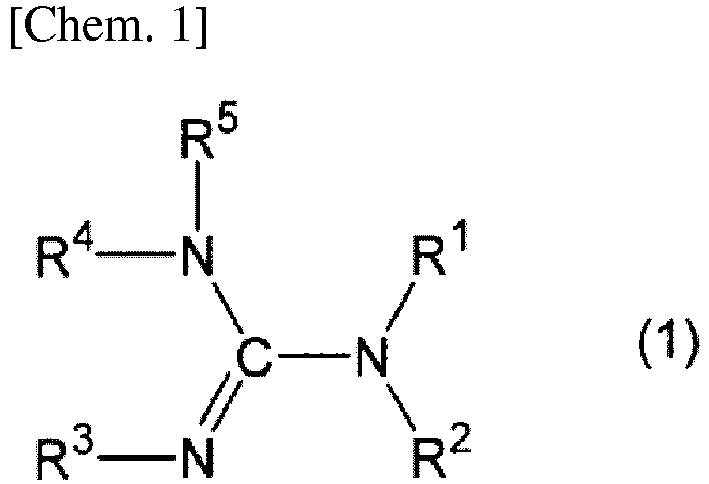
- thermosetting coating composition of the present invention contains an amine compound (C) represented by the following formula (1).
- R 1 to R 5 each independently represent a hydrogen atom or an organic group having one or more carbon atoms, and the organic group may contain one or more atoms selected from the group consisting of oxygen atoms, nitrogen atoms, sulfur atoms, and halogen atoms.
- the blocking agent is dissociated from the blocked polyisocyanate curing agent (B) by heat (for example, 100°C or higher). Accordingly, a free isocyanate group is regenerated, and the hydroxyl group-containing resin (A) reacts with the isocyanate group to promote the crosslinking reaction.
- the amine compound (C) functions as a dissociation catalyst and a catalyst for the transesterification reaction between the hydroxyl group-containing resin (A) and the blocked isocyanate group.
- the amine compound (C) is used as a strong base catalyst for performing carbamate transesterification. This is due to the high proton acceptance (stabilization of cationic species) caused by a guanidine structure of the amine compound (C). Therefore, in the thermosetting coating composition of the invention, the crosslinking reaction proceeds without using a metal catalyst used in the related art.
- R 1 to R 5 is preferably a hydrocarbon group having three or more carbon atoms, and it is more preferable that R 2 to R 4 each independently represent a hydrocarbon group having three or more carbon atoms. Accordingly, the basic strength of the amine compound is enhanced and the flatness described below is also increased, so that the catalytic effect is improved.
- the hydrocarbon group include a propyl group, a butyl group, and a cyclohexyl group.
- the hydrocarbon groups having three or more carbon atoms each independently represent a branched or cyclic hydrocarbon group. Examples of the branched or cyclic hydrocarbon group include an isopropyl group and a cyclohexyl group.
- the amine compound (C) is preferably an amine compound represented by the following formula (2), from the viewpoint of curability and coating film performance (water resistance and the like).
- R 6 is a bifunctional organic group having one or more carbon atoms, and the organic group may contain one or more atoms selected from the group consisting of oxygen atoms, nitrogen atoms, sulfur atoms and halogen atoms.
- R 7 and R 8 each independently represent a hydrogen atom or an organic group having one or more carbon atoms, and the organic group may contain one or more atoms selected from the group consisting of oxygen atoms, nitrogen atoms, sulfur atoms and halogen atoms.
- R 2 to R 4 , R 7 , and R 8 is each independently preferably a hydrocarbon group having three or more carbon atoms, and R 2 and R 3 are more preferably a hydrocarbon group having three or more carbon atoms. Accordingly, the basic strength of the amine compound is enhanced and the flatness described below is also increased, so that the catalytic effect is improved.
- the hydrocarbon group include a propyl group, a butyl group, and a cyclohexyl group.
- the hydrocarbon groups having three or more carbon atoms each independently represent a branched or cyclic hydrocarbon group.
- the branched or cyclic hydrocarbon group include an isopropyl group and a cyclohexyl group.
- the amine compound (C) is preferably an amine compound represented by the following formula (3), from the viewpoint of curability and coating film performance (water resistance and the like).
- R 1 to R 4 , R 6 and R 7 are the same as those of the formulas (1) and (2).
- R 9 is a bifunctional organic group having one or more carbon atoms, and the organic group may contain one or more atoms selected from the group consisting of oxygen atoms, nitrogen atoms, sulfur atoms and halogen atoms.
- R 10 to R 13 each independently represent a hydrogen atom or an organic group having one or more carbon atoms, and the organic group may contain one or more atoms selected from the group consisting of oxygen atoms, nitrogen atoms, sulfur atoms and halogen atoms.
- R 1 to R 4 , R 7 , and R 10 to R 13 is each independently preferably a hydrocarbon group having three or more carbon atoms
- R 2 , R 3 , R 11 and R 13 are more preferably a hydrocarbon group having three or more carbon atoms.
- the hydrocarbon group include a propyl group, a butyl group, and a cyclohexyl group.
- the hydrocarbon groups having three or more carbon atoms each independently represent a branched or cyclic hydrocarbon group.
- the branched or cyclic hydrocarbon group include an isopropyl group and a cyclohexyl group.
- the amine compound (C) is preferably an amine compound represented by the following formula (4), from the viewpoint of curability and coating film performance (water resistance and the like).
- the amine compound (C) has a cyclohexyl group, so that the curability and the water resistance of the coating composition are improved.
- the baking temperature for dissociating the isocyanate blocking agent can be lowered.
- At least one of R 3 and R 11 has the structure represented by the following formula (5).
- the amine compound (C) forms a conjugated structure. Accordingly, the curability of the thermosetting coating composition is improved.
- R 31 to R 33 each independently represent a hydrogen atom or an organic group having one or more carbon atoms, and the organic group may contain one or more atoms selected from the group consisting of oxygen atoms, nitrogen atoms, sulfur atoms and halogen atoms. * represents an atomic bonding.
- R 31 to R 33 examples include a hydrogen atom, a hydrocarbon group having 3 to 6 carbon atoms, and the organic group having a number average molecular weight of 300 or more (preferably 600 or more).
- at least one of R 31 to R 33 is preferably a hydrocarbon group having 3 to 6 carbon atoms, and examples of such a group include a propyl group, a butyl group and a cyclohexyl group.
- the organic group having 3 to 6 carbon atoms is more preferably a branched or cyclic hydrocarbon group, and examples of such a group include an isopropyl group and a cyclohexyl group.
- At least one organic group of R 1 to R 13 preferably has a number average molecular weight of 300 or more, and more preferably has a number average molecular weight of 600 or more in the formulas (1) to (4).
- the number average molecular weight of preferably R 5 in the formula (1), and more preferably R 7 in the formulas (2), (3), and (4) is preferably 300 or more, and more preferably 600 or more.
- the amine compound (C) has an organic group having a number average molecular weight of 300 or more, so that various properties (such as water resistance) of the obtained coating film are improved.
- a compound having a number average molecular weight of 300 or more e.g., a compound having an epoxy group or an isocyanate group
- an active hydrogen group e.g., active hydrogen group contained in a primary amino group or a secondary amino group
- examples of such compounds include an acrylic resin, a polyester resin, a urethane resin, an epoxy resin, and a polyisocyanate compound, each having an epoxy group or an isocyanate group.
- the compound having a number average molecular weight of 300 or more may have a plurality of reactive groups such as an epoxy group and an isocyanate group in the molecule, and may have been reacted with active hydrogen groups of the amine compounds in response to the reactive groups (that is, a plurality of amine compounds react with one compound having a number average molecular weight of 300 or more).
- the guanidine structure is preferably acyclic.
- cyclic or "acyclic” as mentioned herein, a structure in which at least two of the three organic groups of "R 1 and/or R 2 ", “R 3 ", and “R 4 and/or R 5 " in the formula (1) are linked to each other and are cyclized is “cyclic", and structures other than the above structure are “acyclic”.
- the guanidine structure is "acyclic".
- the amine compound (C) also relates to an amine compound having a structure represented by at least one of the formulas (6) and (7).
- R 1 to R 5 each independently represent a hydrogen atom or an organic group having one or more carbon atoms, and the organic group may contain one or more atoms selected from the group consisting of oxygen atoms, nitrogen atoms, sulfur atoms, and halogen atoms.
- R 1 to R 3 , and R 4 ' each independently represent a hydrogen atom or an organic group having one or more carbon atoms, and the organic group may contain one or more atoms selected from the group consisting of oxygen atoms, nitrogen atoms, sulfur atoms, and halogen atoms.
- the dihedral angle ⁇ is 20° or less, the catalytic effect of the amine compound (C) in the thermosetting coating composition is improved, and the curability is enhanced.
- the dihedral angle ⁇ is an index indicating flatness of the amine compound (C).
- the smaller ⁇ is, the smaller the angles at which the P2 and P3 planes join to the P1 plane [in the case of the above formula (6)] or the angle at which the P2 plane joins to the P1 plane [in the case of the above formula (7)] is, which means the flatness of the amine compound (C) is high.
- the amine compound (C) represented by the formula (6) and/or the formula (7) is a compound having a so-called guanidine structure, and is known as a compound showing strong basicity. The strong basicity is led by causing the positive charge of the conjugated acid to be delocalized and significantly stabilized by the resonance structure as shown below.
- the dihedral angle (the smaller value) of the structure by which the higher catalytic effect can be expressed is set as the dihedral angle of the amine compound.
- R 1 to R 5 are organic groups having one or more carbon atoms
- R 2 to R 5 are organic groups having one or more carbon atoms
- R 2 to R 5 are organic groups having a bulky structure such as an isopropyl group or a cyclohexyl group
- the flatness is higher and the catalytic effect is high. Accordingly, such amine compound is preferred.
- the organic groups in R 1 to R 5 in the above-mentioned formulas (6) and (7) are more preferably cyclohexyl groups as compared to isopropyl groups.
- the amine compound (C) represented by the formula (1) can be synthesized by combining common methods, and can be synthesized, for example, by the following synthesis method (I) or (II).
- the following synthesis method (I) is a synthesis example of the case where R 3 in the formula (1) is a hydrogen atom
- the following synthesis method (II) is a synthesis example of the case where R 2 in the formula (1) is a hydrogen atom.
- the reaction (1) is a reaction between a glycidyl group and a secondary amine
- the reaction (2) is a hydrolysis reaction of ketimine (generation of a primary amine)
- the reaction (3) is a reaction between a carbodiimide compound and a primary amine.
- Rz represents an organic group having one or more carbon atoms, and preferably has a number average molecular weight of 300 or more.
- Y1 and Y2 each represent an alkylene group, and the carbon number of the alkylene group is preferably 2 to 8, more preferably 2 to 3, and particularly preferably 2.
- Rx and Ry each represent a linear, branched or cyclic alkyl group, preferably a propyl group, a butyl group or a cyclohexyl group, more preferably an isopropyl group or a cyclohexyl group, and still more preferably a cyclohexyl group.
- conjugated guanidine compound having the structure represented by the formula (5) can be synthesized by combining common methods, and can be synthesized, for example, by the following synthesis method (IV) or (V).
- the following synthesis method (IV) is a synthesis example of the case where R 33 in the formula (5) is a hydrogen atom
- the following synthesis method (V) is a synthesis example of the case where R 31 in the formula (5) is a hydrogen atom.
- the blending ratio of the hydroxyl group-containing resin (A) and the blocked polyisocyanate curing agent (B) in the thermosetting coating composition of the present invention is as follows: the mass percentage of the component (A) is generally in the range of 10 mass% to 90 mass% and preferably in the range of 20 mass% to 80 mass%, and the mass percentage of the component (B) is generally in the range of 10 mass% to 60 mass% and preferably in the range of 15 mass% to 55 mass%, based on the total mass of the resin solid content of the coating composition.
- the above blending ratio is preferred in order to obtain a coated article excellent in finishing property and curability. Either the coating composition properties or the coating film performance may be impaired if the blending ratio(s) falls outside the above range, which is not preferred.
- the content of the amine compound (C) (the content from which the mass of an organic group is excluded when the organic group having a molecular weight of 300 or more has been added) is generally in the range of 0.01 mass% to 30 mass%, and preferably in the range of 0.1 mass% to 10 mass%, based on the total mass of the resin solid content of the coating composition.
- the above content of the amine compound (C) is preferred, from the viewpoint of curability.
- thermosetting coating composition of the present invention is not particularly limited.
- the thermosetting coating composition may contain a pigment dispersion paste, a solvent such as water and an organic solvent, a neutralizer, a surfactant, a surface conditioner, a thickener, an anti-settling agent, a UV absorber, a light stabilizer, an antifoam agent, a dissociation catalyst, plasticizer, and the like.
- the pigment dispersion paste is a paste in which a pigment such as a color pigment, an antirust pigment and an extender pigment has been dispersed in fine particles in advance.
- the pigment dispersion paste can be prepared by blending a resin for pigment dispersion with a neutralizer, a solvent and a pigment, and dispersing the mixture by a dispersion mixer such as a ball mill, a sand mill, or a pebble mill.
- pigments may be used without particular limitation.
- a coloring pigment such as titanium dioxide, zinc oxide, zinc phosphate, aluminum phosphate, zinc molybdate, calcium molybdate, iron blue, ultramarine, cobalt blue, copper phthalocyanine blue, indanthrone blue, synthetic yellow iron oxide, transparent bengara (yellow), bismuth vanadate, titanium yellow, zinc yellow, monoazo yellow, isoindolinone yellow, metal complex salt azo yellow, quinophthalone yellow, benzimidazolone yellow, bengara, monoazo red, quinacridone red, azo lake (Mn salt), quinacridone magenta, ansanthrone orange, jean slaquinonil red, perylene maroon, quinacridone magenta, perylene red, diketopyrrolopyrrole chrome vermilion, chlorinated phthalocyanine green, brominated phthalocyanine green, brominated phthalocyanine green, brominated phthalo
- organic solvent such as water or organic solvents
- organic solvent include hydrocarbons such as toluene, xylene, cyclohexane and n-hexane; esters such as methyl acetate, ethyl acetate, and butyl acetate; ketones such as acetone, methyl ethyl ketone, methyl isobutyl ketone, methyl amyl ketone, and isobutyl methyl ketone; amides such as dimethylformamide and dimethyl acetamide; alcohols such as methanol, ethanol, n-propanol, and iso-propanol; ether alcohol compounds such as ethylene glycol monobutyl ether, diethylene glycol monoethyl ether, and propylene glycol monomethyl ether; and a mixture thereof.
- hydrocarbons such as toluene, xylene, cyclohexane and n-hexane
- esters such as
- bismuth compounds, zinc compounds, titanium compounds, amidine compounds, phosphazene compounds, quaternary salt compounds, proazaphosphatran compounds, other than the amine compound (C) used in the present application are suitably used as a dissociation catalyst for the isocyanate blocking agent. It is preferable that organic tin compounds such as dibutyltin dibenzoate, dioctyltin oxide, and dibutyltin oxide are not substantially used due to environmental considerations.
- a coating film used in the present invention common coating methods such as brush coating, roller coating, dipping coating, bar coater coating, applicator coating, curtain coating, spray coating, rotary atomization coating, electrodeposition coating, and the like may be used without particular limitation.
- the thickness of the coating film is not particularly limited, and may be generally in the range of 5 ⁇ m to 60 ⁇ m, and preferably in the range of 10 ⁇ m to 40 ⁇ m, based on the dry coating film.
- baking and drying of the coating film is performed by heating the coating film at 60°C to 300°C, and preferably 80°C to 200°C, which is temperature of a surface of the object to be coated, for 3 minutes to 180 minutes, and preferably 10 minutes to 50 minutes using drying equipment such as an electric hot air dryer and a gas hot air dryer.
- a cured coating film can be obtained by the above-mentioned baking and drying.
- Examples of the objects to be coated of the present invention include an automobile body, an automobile component, motorcycle parts, household equipment, and other equipment, and examples of the material of the objects to be coated include metal, plastic, inorganic materials, wood, and fiber materials.
- the objects to be coated and the material thereof are not particularly limited.
- the object to be coated may be an object whose surface is washed by alkaline degreasing as required and then is subjected to surface treatment such as phosphate conversion treatment and chromate treatment as further required, and may be coated with an under-coating composition.
- thermosetting coating composition of the present invention is coated with the thermosetting coating composition of the present invention, thereby obtaining a coated article.
- the mixture was aged at 110°C for two hours while introducing nitrogen gas, and then was cooled to 100°C and was diluted with propylene glycol monomethyl ether, thereby obtaining an acrylic resin (A-1) solution having a solid content of 60%.
- the acrylic resin (A-1) had a weight average molecular weight of 15,000 and a hydroxyl value of 106 mg KOH/g.
- amine compounds (C-1) to (C-16) shown in Table 1 below amine compounds (C-3) to (C-14) other than commercial products were produced in accordance with the following Production Examples 4 to 15.
- the amine compounds produced in accordance with the following Production Examples 4 to 15 may have by-products, unreacted substances, and the like.
- epoxy-amine value described in the production example was measured by the following method.
- the epoxy-amine value (meq/g) in the present invention is a total number of millimoles of epoxy functional groups and amine functional groups per gram of a sample containing a solvent.
- the epoxy equivalent (grams of the component containing one gram equivalent of an epoxy group) determined in accordance with JIS K7236: 2009 is a value calculated by the following equation after measuring both the epoxy functional group and the amine functional group in the sample of the present invention.
- Epoxy-amine value meq / g 1000 / epoxy equivalent measurement result of JIS K 7236 : 2009
- Table 1 Production Example Amine Compound Structure (C-1) R 1 , R 2 , R 3 , R 4 : Me (C-2) R 2 to R 4 : iPr Production Example 4 (C-3) R 2 to R 4 : Cy Production Example 5 (C-4)
- Me methyl group
- Et ethyl group
- iPr isopropyl group
- Cy cyclohexyl group, and the others not described therein is hydrogen atom.
- EP1 a group that makes a compound mainly containing jER828 (trade name, produced by Mitsubishi Chemical Corporation, epoxy resin, epoxy equivalent 190, number average molecular weight 370) react.
- EP2 a group that makes a compound mainly containing jER1001 (trade name, produced by Mitsubishi Chemical Corporation, epoxy resin, epoxy equivalent 475, number average molecular weight 900) react.
- Example 1 Thermosetting Coating Composition (X-1)
- thermosetting coating composition (X-1) having a solid content of 50%.
- Thermosetting coating compositions (X-2) to (X-17) having a solid content of 50% were produced in a manner similar to that of Example 1 except that the amine compounds (C) were changed to those shown in Table 2 below.
- thermosetting coating compositions (X-7, X-8, X-11, X-12, X-13, and X-14) respectively blended with the amine compounds (C-7, C-8, C-11, C-12, C-13, and C-14) to which an epoxy resin (EP1 or EP2) was added the epoxy resin (A-2) was blended such that the total mass of the solid contents of the epoxy resin (A-2) and the epoxy resin (EP1 or EP2) was 35 parts.
- Example 14 Thermosetting Coating Composition (Y-1)
- thermosetting coating compositions (Y-2) to (Y-17) having a solid content of 50% were produced in a manner similar to that of Example 14 except that the amine compounds (C) were changed to those shown in Table 3 below.
- the amine compound (C) was blended in an amount of 0.015 mol per 100 parts of resin solid contents.
- thermosetting coating compositions (Y-7, Y-8, Y-11, Y-12, Y-13, and Y-14) respectively blended with the amine compounds (C-7, C-8, C-11, C-12, C-13, and C-14) to which the epoxy resin (EP1 or EP2) was added the epoxy resin (A-2) was blended in a solid content mass obtained by subtracting the solid content mass of the epoxy resin (EP1 or EP2) of 35 parts from 35 parts of the solid content mass of the epoxy resin (A-2).
- a glass plate was coated with the thermosetting coating composition of Examples 1 to 13 or Comparative Examples 1 to 4 by using an applicator so as to form a film to be cured having a thickness of about 30 ⁇ m on the glass plate, followed by heat-curing at 140°C for 30 minutes, and the obtained coating film was peeled off from the glass plate.
- the coating film was placed in a wire mesh, then the wire mesh with the coating film was placed in a separate-type round bottom flask, 100g of acetone was added to the flask with respect to 1g of the coating film, and the mixture was refluxed for five hours.
- the taken-out coating film was dried at 105°C for one hour, the weight of the coating film was measured, and the gel fraction was calculated by the following equation.
- Gel fraction % weight of coating film after reflux / weight of coating film before reflux ⁇ 100
- the dihedral angle ⁇ of the amine compounds (C-1) to (C-13) having the structure of the following formula(s) (6) and/or (7) was determined by the structure optimization calculation based on the density functional theory calculation B3LYP/6-31G * using Gaussian03 (produced by Gaussian, Inc.) and the following equation(s) (A) and/or (B).
- a cold rolled steel sheet (size: 400 ⁇ 300 ⁇ 0.8 mm) treated with "Palbond # 3020" (produced by Nihon Parkerizing Co., Ltd., zinc phosphate treatment) was coated with "Elekron GT-10" (produced by Kansai Paint Co., Ltd., a thermosetting epoxy resin based cationic electrodeposition coating composition) in an electrodeposition manner to form a coating film having a thickness of 20 ⁇ m, and the coating film was heat-cured at 170°C for 30 minutes.
- the coating film was coated with "TP-65” (produced by Kansai Paint Co., Ltd., trade name, a polyester-melamine resin based coating composition for automobile) in an air spray manner to form a drying film having a thickness of 35 ⁇ m, and the drying film was heat-cured at 140°C for 30 minutes.
- TP-65 produced by Kansai Paint Co., Ltd., trade name, a polyester-melamine resin based coating composition for automobile
- thermosetting coating compositions of Examples 14 to 26 or Comparative Examples 5 to 8 were separately coated with thermosetting coating compositions of Examples 14 to 26 or Comparative Examples 5 to 8 by using an applicator so as to form a cured coating film having a thickness of about 20 ⁇ m, and the cured coating film was heat-cured at 140°C for 30 minutes.
- test plate was immersed in pure water and allowed to stand at 40°C for 240 hours, and the glossiness after immersion was measured and the gloss retention was determined.
- the gloss retention is calculated using the following equation, based on the value obtained by measuring the specular gloss degree of the surface (test surface) at an incident angle of 60 degrees by the method in accordance with JIS Z 8741-1997.
- Gloss retention % gloss degree after water resistance test / initial gloss degree ⁇ 100
Landscapes
- Chemical & Material Sciences (AREA)
- Organic Chemistry (AREA)
- Health & Medical Sciences (AREA)
- Chemical Kinetics & Catalysis (AREA)
- Medicinal Chemistry (AREA)
- Polymers & Plastics (AREA)
- Life Sciences & Earth Sciences (AREA)
- Engineering & Computer Science (AREA)
- Materials Engineering (AREA)
- Wood Science & Technology (AREA)
- Paints Or Removers (AREA)
- Organic Low-Molecular-Weight Compounds And Preparation Thereof (AREA)
- Polyurethanes Or Polyureas (AREA)
Abstract
Description
- The present invention relates to a thermosetting coating composition excellent in coating curability and coating appearance despite containing substantially no metal catalyst, and a coated article obtained by applying the coating composition.
- An isocyanate curing agent is generally used as a curing agent for a coating composition. However, the isocyanate curing agent is hardly used for a one-pack coating composition, which is obtained by mixing a resin having active hydrogen with a polyisocyanate curing agent in advance, since a reaction between an isocyanate group and active hydrogen proceeds even at room temperature. Therefore, a method using a blocked isocyanate that has been inactivated at room temperature by allowing polyisocyanate to react with an active hydrogen group-containing compound (blocking agent) has been put to practical use.
- The blocked isocyanate does not react with a resin at room temperature. However, when the blocked isocyanate is heated, the blocking agent is dissociated to regenerate an isocyanate group, and a crosslinking reaction between the isocyanate group and the resin having active hydrogen proceeds. Therefore, usable time is not limited, and a one-pack coating composition can be obtained. Further, the blocked isocyanate may also be applied to an aqueous coating composition using water or alcohol having active hydrogen is used as a medium.
- Compounds such as phenol-based blocking agent, caprolactam-based blocking agent, oxime-based blocking agent, active methylene-based blocking agent and pyrazole-based blocking agent are common as a blocking agent used for the above-mentioned blocked isocyanate. In addition, organotin compounds such as dibutyltin dibenzoate, dioctyltin oxide, and dibutyltin oxide have been generally used as a dissociation catalyst for the blocking agent (Patent Literature 1).
- However, a catalyst other than the organotin compounds has been required since toxicity of the organotin compounds has become an issue in recent years though catalytic performance thereof is high. A bismuth-based or zinc-based catalyst has been developed as a substitute article of the organotin compounds (Patent Literatures 2 and 3).
-
- PTL 1:
JP-A-H10-101996 - PTL 2:
JP-A-2000-290542 - PTL 3:
JP-A-2012-152725 - Thermosetting coating compositions in the related art all contain a metal catalyst, which causes environmental problems. In addition, there arises a problem that bismuth-based catalysts and zinc-based catalysts are expensive, have insufficient catalytic effects, and are unstable in coating compositions.
- An object of the invention is to provide a blocked isocyanate-based thermosetting coating composition having effectiveness as a catalyst and coating stability without using a metal catalyst.
- As a result of inventive studies for solving the above problem(s), the present inventors found that the above problem(s) could be solved by using a thermosetting coating composition containing the specific amine compound, a hydroxyl group-containing compound and a blocked polyisocyanate curing agent, and then, the present invention has been accomplished. That is, the present invention provides the following thermosetting coating composition and coated article obtained by applying the thermosetting coating composition.
- [1] A thermosetting coating composition, comprising a hydroxyl group-containing resin (A), a blocked polyisocyanate curing agent (B), and an amine compound (C) represented by the following formula (1):
- [2] The thermosetting coating composition according to [1], wherein the amine compound (C) is an amine compound represented by the following formula (2):

- [3] The thermosetting coating composition according to [1] or [2], wherein the amine compound (C) is an amine compound represented by the following formula (3):

- [4] The thermosetting coating composition according to any one of [1] to [3], wherein in the amine compounds (C) represented by the above formulas (1) to (3), at least one of R1 to R5, R7, R8, and R10 to R13 independently represents a hydrocarbon group having three or more carbon atoms.
- [5] The thermosetting coating composition according to [4], wherein the hydrocarbon group having three or more carbon atoms is a branched or cyclic hydrocarbon group.
- [6] The thermosetting coating composition according to any one of [1] to [5], wherein the amine compound (C) is an amine compound represented by the following formula (4):

- [7] The thermosetting coating composition according to any one of [1] to [5], wherein in the amine compounds (C) represented by the above formulas (1) to (3), at least one of R3 and R11 represents a structure represented by the following formula (5):

- [8] The thermosetting coating composition according to any one of [1] to [7], wherein in the amine compounds (C) represented by the above formulas (1) to (4), at least one of R1 to R13 has a number average molecular weight of 300 or more.
- [9] The thermosetting coating composition according to any one of [2], [3], and [6], wherein in the amine compounds (C) represented by the above formulas (2), (3), and (4), R7 has a number average molecular weight of 300 or more.
- [10] The thermosetting coating composition according to [1], wherein the amine compound (C) has a structure represented by at least one of the following formulas (6) and (7):

wherein in the formula (6), an average dihedral angle α shown in the following equation (A) obtained by a structural optimization calculation based on a density functional theory calculation B3LYP/6-31G* is 20° or less, wherein in a case where the amine compound has two or more kinds of the above structures in a molecular thereof, the smaller value is set as the dihedral angle:


wherein in the formula (7), a dihedral angle α shown in the following equation (B) obtained by the structural optimization calculation based on the density functional theory calculation B3LYP/6-31G * is 20° or less, wherein in a case where the amine compound has two or more kinds of the above structures in a molecular thereof, the smaller value is set as the dihedral angle:
- [11] A coated article obtained by applying the thermosetting coating composition according to any one of [1] to [10] to an object to be coated.
- The thermosetting coating composition of the present invention maintains good coating stability and has good coating curability without using a metal catalyst. In addition, in the thermosetting coating composition of the present invention, it is possible to form a coating film that has a good finishing property, and is excellent in chemical resistance, weather resistance, corrosion resistance, water resistance, and the like.
- The present invention relates to a thermosetting coating composition that contains a hydroxyl group-containing resin, a blocked polyisocyanate curing agent, and a specific amine compound.
- The details are described below.
- In the present description, all percentages and parts in mass are same as percentages and parts in weight.
- As the hydroxyl group-containing resin (A) that can be used in the thermosetting coating composition of the present invention, any common resin can be used without particular limitation as long as the resin has a hydroxyl group and can be crosslinked with the blocked polyisocyanate curing agent (B).
- As reactive functional groups other than the hydroxyl group, which can be crosslinked with the blocked polyisocyanate curing agent, examples thereof include an epoxy group, a carboxylic anhydride group, and a reactive functional group having active hydrogen such as an amino group, a carboxyl group, and an active methylene group. These reactive functional groups may be used in combination with the hydroxyl group.
- Examples of the hydroxyl group-containing resin (A) include an acrylic resin, a polyester resin, an epoxy resin, an alkyd resin, a polyether resin, a polyurethane resin, and a polyamide resin. These resins may be used alone or in combination of two or more thereof. In particular, it is preferable that the hydroxyl group-containing resin (A) is at least one selected from an acrylic resin (A1), a polyester resin (A2), and an epoxy resin (A3).
- The hydroxyl group-containing resin (A) may be in a state of being dissolved in the thermosetting coating composition, or may be in a state of being dispersed in the thermosetting coating composition (for example, a state of being emulsified in an aqueous solvent). In addition, the hydroxyl group-containing resin (A) in the dispersed state may be crosslinked resin particles.
- The acrylic resin (A1) that can be used in the thermosetting coating composition of the present invention can be produced by radical copolymerization of acrylic monomers.
- Examples of the acrylic monomers include a hydroxyl group-containing acrylic monomer such as 2-hydroxyethyl (meth)acrylate, 2-hydroxypropyl (meth)acrylate, 4-hydroxybutyl (meth)acrylate, and an addition product of 2-hydroxyethyl (meth)acrylate with caprolactone (e.g., trade name Placcel FA-2 and FA-3 produced by Daicel Corporation); an aromatic vinyl monomer such as styrene, vinyl toluene, and α-methylstyrene; methyl (meth)acrylate, ethyl (meth)acrylate, n-propyl (meth)acrylate, isopropyl (meth)acrylate, n-butyl (meth)acrylate, isobutyl (meth)acrylate, t-butyl (meth)acrylate, cyclohexyl (meth)acrylate, 2-ethylhexyl (meth)acrylate, polyalkylene glycol (meth)acrylate, isobornyl (meth)acrylate, (meth)acrylic acid, N,N-dimethylaminoethyl (meth)acrylate, N,N-diethylaminoethyl (meth)acrylate, N,N-dimethylaminopropyl (meth)acrylate, N,N-di-t-butylaminoethyl (meth)acrylate, and N,N-dimethylaminopropyl (meth)acrylamide. These acrylic monomers may be used alone or in combination of two or more thereof.
- In the present description, the term "(meth)acrylic" refers to acrylic or methacrylic, and the term "(meth)acrylate" refers to acrylate or methacrylate.
- The acrylic resin (A1) can be obtained by a radical copolymerization reaction of the above-mentioned monomers based on a common method.
- The hydroxyl value of the acrylic resin (A1) is generally in the range of 0.1 mg KOH/g to 300 mg KOH/g, and preferably in the range of 10 mg KOH/g to 200 mg KOH/g, and the weight average molecular weight thereof is generally in the range of 1,000 to 100,000, and preferably in the range of 2,000 to 30,000.
- In the present description, the terms "number average molecular weight" and "weight average molecular weight" refer to a value that is determined by converting retention time (retention volume) measured by using gel permeation chromatograph (GPC) into the molecular weight of polystyrene based on retention time (retention volume) of standard polystyrene with known molecular weight, measured under the same condition. Specifically, as the gel permeation chromatograph, "HLC-8120GPC" (trade name, produced by Tosoh Corporation) is used, four columns of "TSKgel G-4000HXL", "TSKgel G-3000HXL", "TSKgel G-2500HXL", and "TSKgel G-2000 HXL" (trade names, all produced by Tosoh Corporation) are used as columns, and measurement can be performed under the conditions of a mobile phase tetrahydrofuran, a measurement temperature of 40°C, a flow rate of 1 mL/min, and a detector RI.
- The polyester resin (A2) that can be used in the thermosetting coating composition of the present invention can be produced by an esterification reaction and/or a transesterification reaction between an acid component and an alcohol component.
- As the above-mentioned acid component, a compound generally used as an acid component in the production of the polyester resin may be used without particular limitation. As the above-mentioned acid component, alicyclic polybasic acids, aliphatic polybasic acids, aromatic polybasic acids, aromatic monocarboxylic acids, aliphatic monocarboxylic acids, alicyclic monocarboxylic acids, and lower alkyl esters of these acids may be used.
- Generally, the alicyclic polybasic acid refers to a compound having one or more alicyclic structures (mainly four- to six-membered ring) and two or more carboxyl groups in one molecule, an acid anhydride of the compound, and an esterification product of the compound.
- Generally, the aliphatic polybasic acid refers to an aliphatic compound having two or more carboxyl groups in one molecule, an acid anhydride of the compound, and an esterification product of the compound.
- Generally, the aromatic polybasic acid refers to an aromatic compound having two or more carboxyl groups in one molecule, an acid anhydride of the aromatic compound, and an esterification product of the aromatic compound.
- In addition, aromatic monocarboxylic acids, aliphatic monocarboxylic acids, alicyclic monocarboxylic acids, and the like may also be used as required.
- As the above-mentioned alcohol component, compounds generally used as alcohol components in the production of the polyester resin may be used without particular limitation. The alcohol component containing dihydric alcohols such as alicyclic diols, aliphatic diols and aromatic diols, and polyhydric alcohols having three or more hydroxyl groups is preferred.
- As a production method of the above-mentioned polyester resin (A2), the above-mentioned acid component is allowed to react with the alcohol component by a common method, thereby producing the polyester resin (A2).
- In addition, the above-mentioned polyester resin (A2) may also be modified with a fatty acid, a fat, a polyisocyanate compound, an epoxy compound or the like during the preparation of the resin, or after the esterification reaction and/or the transesterification reaction.
- The number average molecular weight of the polyester resin (A2) is generally in the range of 1,000 to 20,000, preferably in the range of 1,050 to 10,000, and more preferably in the range of 1,100 to 5,000, from the viewpoint of the finishing property.
- In addition, the hydroxyl value of the polyester resin (A2) is generally in the range of 20 mg KOH/g to 300 mg KOH/g, preferably in the range of 30 mg KOH/g to 250 mg KOH/g, and more preferably in the range of 40 mg KOH/g to 180 mg KOH/g, from the viewpoint of the curability of the obtained coating film.
- The epoxy resin (A3) that can be used in the thermosetting coating composition of the present invention can be obtained by allowing an epoxy resin (A3-1) to react with a modifier (A3-2).
- The epoxy resin (A3-1) that may be used as a raw material of the epoxy resin (A3) is a compound having at least one, preferably two or more epoxy groups in one molecule. In terms of the molecular weight of the epoxy resin (A3-1), the number average molecular weight thereof is at least 300, preferably in the range of 400 to 4,000, and more preferably in the range of 800 to 2,500, and epoxy equivalent thereof is at least 160, preferably in the range of 180 to 2,500, and more preferably in the range of 400 to 1,500. As the epoxy resin (A3-1), for example, those obtained by the reaction between a polyphenol compound and an epihalohydrin (for example, epichlorohydrin and the like) may be used.
- Examples of the polyphenol compound used for formation of the above-mentioned epoxy resin (A3-1) include bis(4-hydroxyphenyl)-2,2-propane [bisphenol A], bis(4-hydroxyphenyl) methane [bisphenol F], bis(4-hydroxycyclohexyl) methane [hydrogenated bisphenol F], 2,2-bis(4-hydroxycyclohexyl) propane [hydrogenated bisphenol A], 4,4'-dihydroxybenzophenone, bis(4-hydroxyphenyl)-1,1-ethane, bis(4-hydroxyphenyl)-1,1-isobutane, bis(4-hydroxy-3-tert-butyl-phenyl)-2,2-propane, bis(2-hydroxynaphthyl) methane, tetra(4-hydroxyphenyl)-1,1,2,2-ethane, 4,4'-dihydroxydiphenyl sulfone, phenolic novolac, and cresol novolac.
- In addition, among the epoxy resins (A3-1) obtained by the reaction between the polyphenol compound and the epihalohydrin, a resin represented by the following formula, which is derived from bisphenol, is preferred.

- Here, it is preferable that n = 0 to 8.
- Examples of commercial products of such epoxy resin (A3-1) include products with trade names jER 828 EL, jER 1002, jER 1004, and jER 1007, which are sold by Mitsubishi Chemical Corporation.
- The modifier (A3-2) that can be used as a raw material of the epoxy resin (A3) is not particularly limited as long as it is a component having reactivity with the above-mentioned epoxy resin (A3-1). Examples of the modifier (A3-2) include polyhydric alcohols, monohydric alcohols, acidic compounds, phenols, amine compounds, lactones, isocyanate compounds, and xylene formaldehyde compounds.
- Examples of the polyhydric alcohols include dihydric alcohols such as ethylene glycol, diethylene glycol, propylene glycol, dipropylene glycol, 1,3-propanediol, 1,3-butanediol, 1,4-butanediol, 2,3-butanediol, 1,5-pentanediol, 1,6-hexanediol, 1,7-heptanediol, 1,8-octanediol, 1,9-nonanediol, 2-methyl-1,3-propanediol, 3-methyl-1,5-pentanediol, 2-methylpentane-2,4-diol, 2,2,4-trimethyl-1,3-pentanediol, triethylene glycol, 2-butyl-2-ethyl-1,3-propanediol, tricyclodecane dimethanol, triethylene glycol, neopentyl glycol, 1,4-cyclohexanediol, 1,3-cyclohexanedimethanol, 1,4-cyclohexanedimethanol, bisphenol A, bisphenol F, hydrogenated bisphenol A, and hydrogenated bisphenol F; polyether diols such as polyethylene glycol, polypropylene glycol, and polybutylene glycol; trihydric alcohols such as glycerin, trimethylol propane, and tris(2-hydroxyethyl) isocyanurate; tetrahydric alcohols such as pentaerythritol; and polyester polyol and acrylic polyol.
- Examples of the monohydric alcohols include methanol, ethanol, n-propanol, isopropanol, n-butanol, 2-butanol, pentanol, hexanol, n-octanol, 2-ethylhexanol, dodecyl alcohol, stearyl alcohol, and benzyl alcohol.
- Examples of the acidic compound include acidic compounds such as acetic acid, propionic acid, butyric acid, valeric acid, acrylic acid, oleic acid, glycolic acid, lactic acid, benzoic acid, gallic acid, fatty acids, and dibasic acids.
- Examples of the above-mentioned phenols include phenol, cresol, ethylphenol, para-tert-butylphenol, nonylphenol, catechol, resorcinol, and 4-tert-butyl catechol.
- As the above-mentioned amine compound, any amine compound containing at least one active hydrogen that reacts with an epoxy group may be used without particular limitation. Examples of the amine compound include mono-alkylamine or di-alkylamine such as monomethylamine, dimethylamine, monoethylamine, diethylamine, monoisopropylamine, diisopropylamine, monobutylamine, and dibutylamine; alkanolamine such as monoethanolamine, diethanolamine, mono(2-hydroxypropyl) amine, di(2-hydroxypropyl) amine, monomethylaminoethanol, and monoethylaminoethanol; alkylene polyamine such as ethylene diamine, propylene diamine, butylene diamine, hexamethylene diamine, tetraethylene pentamine, pentaethylene hexamine, diethylaminopropylamine, diethylene triamine, and triethylenetetramine; alkylene imine such as ethyleneimine, and propylenimine; and cyclic amine such as piperazine, morpholine, and pyrazine. In addition, these above-mentioned amines may also be used in combination with amines in a ketimine form of primary amines. These amine compounds may be used alone or in combination of two or more thereof.
- As a method of producing the above-mentioned epoxy resin (A3), the above-mentioned epoxy resin (A3-1) is allowed to react with the modifier (A3-2) by a common method, thereby producing the epoxy resin (A3).
- In addition, the number average molecular weight of the epoxy resin (A3) is generally in the range of 1,000 to 50,000, preferably in the range of 1,300 to 20,000, and more preferably in the range of 1,600 to 10,000, from the viewpoint of stability of coating composition, finishing property, and corrosion resistance. The hydroxyl value of the epoxy resin (A3) is generally in the range of 10 mg KOH/g to 300 mg KOH/g, preferably in the range of 20 mg KOH/g to 250 mg KOH/g, and more preferably in the range of 30 mg KOH/g to 200 mg KOH/g, from the viewpoint of the curability of the obtained coating film.
- The blocked polyisocyanate curing agent (B) is a product of an addition reaction between a polyisocyanate compound and an isocyanate blocking agent in an approximately stoichiometric amount. As the polyisocyanate compound used in the blocked polyisocyanate curing agent (B), common compounds may be used without particular limitation. Examples of the polyisocyanate compound include aromatic, aliphatic or alicyclic polyisocyanate compounds such as tolylene diisocyanate, xylylene diisocyanate, phenylene diisocyanate, diphenylmethane-2,2'-diisocyanate, diphenylmethane-2,4'-diisocyanate, diphenylmethane-4,4'-diisocyanate, crude MDI [polymethylene polyphenyl isocyanate], bis(isocyanate methyl) cyclohexane, tetramethylene diisocyanate, hexamethylene diisocyanate, methylene diisocyanate, and isophorone diisocyanate; cyclized polymers or birets of these polyisocyanate compounds; and a combination of these polyisocyanate compounds.
- On the other hand, the above-mentioned isocyanate blocking agent is added to the isocyanate group of the polyisocyanate compound and blocks the isocyanate group, and the blocked polyisocyanate compound formed by the addition is stable at room temperature. However, it is desirable that the blocking agent dissociates and free isocyanate groups are regenerated when the coating film is heated to baking temperature (generally about 80°C to about 200°C).
- Examples of the isocyanate blocking agent used in the blocked polyisocyanate curing agent (B) include oxime compounds such as methyl ethyl ketoxime, and cyclohexanone oxime; phenolic compounds such as phenol, para-t-butylphenol, and cresol; alcohol compounds such as n-butanol, 2-ethylhexanol, phenyl carbinol, methyl phenyl carbinol, ethylene glycol monobutyl ether, diethylene glycol monoethyl ether, ethylene glycol, and propylene glycol; lactam compounds such as ε-caprolactam, and γ-butyrolactam; active methylene compounds such as dimethyl malonate, diethyl malonate, diisopropyl malonate, ethyl acetoacetate, methyl acetoacetate, and acetylacetone; and pyrazole compounds such as dimethylpyrazole. These isocyanate blocking agents may be used alone or in combination of two or more thereof.
- In particular, it is preferable to use at least one selected from alcohol compounds, pyrazole compounds, oxime compounds, and lactam compounds, and alcohol compounds are particularly preferred, from the viewpoint of dissociation temperature and stability of coating composition.
- The thermosetting coating composition of the present invention contains an amine compound (C) represented by the following formula (1).


- In the formula (1), R1 to R5 each independently represent a hydrogen atom or an organic group having one or more carbon atoms, and the organic group may contain one or more atoms selected from the group consisting of oxygen atoms, nitrogen atoms, sulfur atoms, and halogen atoms.
- The blocking agent is dissociated from the blocked polyisocyanate curing agent (B) by heat (for example, 100°C or higher). Accordingly, a free isocyanate group is regenerated, and the hydroxyl group-containing resin (A) reacts with the isocyanate group to promote the crosslinking reaction. The amine compound (C) functions as a dissociation catalyst and a catalyst for the transesterification reaction between the hydroxyl group-containing resin (A) and the blocked isocyanate group. For example, the amine compound (C) is used as a strong base catalyst for performing carbamate transesterification. This is due to the high proton acceptance (stabilization of cationic species) caused by a guanidine structure of the amine compound (C). Therefore, in the thermosetting coating composition of the invention, the crosslinking reaction proceeds without using a metal catalyst used in the related art.
- Further, in the amine compound represented by the formula (1), at least one of R1 to R5 is preferably a hydrocarbon group having three or more carbon atoms, and it is more preferable that R2 to R4 each independently represent a hydrocarbon group having three or more carbon atoms. Accordingly, the basic strength of the amine compound is enhanced and the flatness described below is also increased, so that the catalytic effect is improved. Examples of the hydrocarbon group include a propyl group, a butyl group, and a cyclohexyl group. In addition, it is more preferable that the hydrocarbon groups having three or more carbon atoms each independently represent a branched or cyclic hydrocarbon group. Examples of the branched or cyclic hydrocarbon group include an isopropyl group and a cyclohexyl group.
- The amine compound (C) is preferably an amine compound represented by the following formula (2), from the viewpoint of curability and coating film performance (water resistance and the like).

- In the formula (2), the definitions of R1 to R4 are the same as those of the formula (1).
- R6 is a bifunctional organic group having one or more carbon atoms, and the organic group may contain one or more atoms selected from the group consisting of oxygen atoms, nitrogen atoms, sulfur atoms and halogen atoms.
- R7 and R8 each independently represent a hydrogen atom or an organic group having one or more carbon atoms, and the organic group may contain one or more atoms selected from the group consisting of oxygen atoms, nitrogen atoms, sulfur atoms and halogen atoms.
- Further, in the amine compound represented by the formula (2), at least one of R2 to R4, R7, and R8 is each independently preferably a hydrocarbon group having three or more carbon atoms, and R2 and R3 are more preferably a hydrocarbon group having three or more carbon atoms. Accordingly, the basic strength of the amine compound is enhanced and the flatness described below is also increased, so that the catalytic effect is improved. Examples of the hydrocarbon group include a propyl group, a butyl group, and a cyclohexyl group.
- In addition, it is more preferable that the hydrocarbon groups having three or more carbon atoms each independently represent a branched or cyclic hydrocarbon group. Examples of the branched or cyclic hydrocarbon group include an isopropyl group and a cyclohexyl group.
- The amine compound (C) is preferably an amine compound represented by the following formula (3), from the viewpoint of curability and coating film performance (water resistance and the like).

- In the formula (3), the definitions of R1 to R4, R6 and R7 are the same as those of the formulas (1) and (2).
- R9 is a bifunctional organic group having one or more carbon atoms, and the organic group may contain one or more atoms selected from the group consisting of oxygen atoms, nitrogen atoms, sulfur atoms and halogen atoms.
- R10 to R13 each independently represent a hydrogen atom or an organic group having one or more carbon atoms, and the organic group may contain one or more atoms selected from the group consisting of oxygen atoms, nitrogen atoms, sulfur atoms and halogen atoms.
- Further, in the amine compound represented by the formula (3), at least one of R1 to R4, R7, and R10 to R13 is each independently preferably a hydrocarbon group having three or more carbon atoms, and R2, R3, R11 and R13 are more preferably a hydrocarbon group having three or more carbon atoms. Accordingly, the basic strength of the amine compound is enhanced and the flatness described below is also increased, so that the catalytic effect is improved. Examples of the hydrocarbon group include a propyl group, a butyl group, and a cyclohexyl group.
- In addition, it is preferable that the hydrocarbon groups having three or more carbon atoms each independently represent a branched or cyclic hydrocarbon group. Examples of the branched or cyclic hydrocarbon group include an isopropyl group and a cyclohexyl group.
- The amine compound (C) is preferably an amine compound represented by the following formula (4), from the viewpoint of curability and coating film performance (water resistance and the like). The amine compound (C) has a cyclohexyl group, so that the curability and the water resistance of the coating composition are improved. In addition, as a result of the faster curing reaction rate, the baking temperature for dissociating the isocyanate blocking agent can be lowered.

- In the formula (4), the definitions of R6, R7, and R9 are the same as those of the formulas (1) to (3).
- On the other hand, in the formulas (1) to (3), it is preferable that at least one of R3 and R11 has the structure represented by the following formula (5). When at least one of R3 and R11 is the structure represented by the formula (5), the amine compound (C) forms a conjugated structure. Accordingly, the curability of the thermosetting coating composition is improved.

- In the formula (5), R31 to R33 each independently represent a hydrogen atom or an organic group having one or more carbon atoms, and the organic group may contain one or more atoms selected from the group consisting of oxygen atoms, nitrogen atoms, sulfur atoms and halogen atoms. * represents an atomic bonding.
- Examples of R31 to R33 include a hydrogen atom, a hydrocarbon group having 3 to 6 carbon atoms, and the organic group having a number average molecular weight of 300 or more (preferably 600 or more). In particular, at least one of R31 to R33 is preferably a hydrocarbon group having 3 to 6 carbon atoms, and examples of such a group include a propyl group, a butyl group and a cyclohexyl group.
- In addition, the organic group having 3 to 6 carbon atoms is more preferably a branched or cyclic hydrocarbon group, and examples of such a group include an isopropyl group and a cyclohexyl group.
- In addition, in the amine compound (C) of the present invention, at least one organic group of R1 to R13 preferably has a number average molecular weight of 300 or more, and more preferably has a number average molecular weight of 600 or more in the formulas (1) to (4). The number average molecular weight of preferably R5 in the formula (1), and more preferably R7 in the formulas (2), (3), and (4) is preferably 300 or more, and more preferably 600 or more. The amine compound (C) has an organic group having a number average molecular weight of 300 or more, so that various properties (such as water resistance) of the obtained coating film are improved.
- In order to obtain the amine compound (C) having an organic group with a number average molecular weight of 300 or more, a compound having a number average molecular weight of 300 or more (e.g., a compound having an epoxy group or an isocyanate group) is allowed to react, the compound possibly becoming an organic group by the reaction with an active hydrogen group (e.g., active hydrogen group contained in a primary amino group or a secondary amino group) of the amine compounds of the formulas (1) to (4). Specifically, examples of such compounds include an acrylic resin, a polyester resin, a urethane resin, an epoxy resin, and a polyisocyanate compound, each having an epoxy group or an isocyanate group.
- In addition, the compound having a number average molecular weight of 300 or more may have a plurality of reactive groups such as an epoxy group and an isocyanate group in the molecule, and may have been reacted with active hydrogen groups of the amine compounds in response to the reactive groups (that is, a plurality of amine compounds react with one compound having a number average molecular weight of 300 or more).
- In the amine compound (C) of the present invention, the guanidine structure is preferably acyclic.
- Regarding the term "cyclic" or "acyclic" as mentioned herein, a structure in which at least two of the three organic groups of "R1 and/or R2", "R3", and "R4 and/or R5" in the formula (1) are linked to each other and are cyclized is "cyclic", and structures other than the above structure are "acyclic".
- In a case where the organic group of R1 to R5 has a cyclic structure therein (for example, when any one of R1 to R5 has a cyclic organic group such as a cyclohexyl group or a benzyl group), the guanidine structure is "acyclic".
- The amine compound (C) also relates to an amine compound having a structure represented by at least one of the formulas (6) and (7).


- In the formula (6), R1 to R5 each independently represent a hydrogen atom or an organic group having one or more carbon atoms, and the organic group may contain one or more atoms selected from the group consisting of oxygen atoms, nitrogen atoms, sulfur atoms, and halogen atoms.

- Here, in the formula (6), the average dihedral angle α shown in the following equation (A) obtained by a structural optimization calculation based on a density functional theory calculation B3LYP/6-31G * is 20 degrees (°) or less:

- In addition, in the formula (7), the dihedral angle α shown in the following equation (B) obtained by the structural optimization calculation based on the density functional theory calculation B3LYP/6-31G * is 20 degrees (°) or less:

- When the dihedral angle α is 20° or less, the catalytic effect of the amine compound (C) in the thermosetting coating composition is improved, and the curability is enhanced.
- The dihedral angle α is an index indicating flatness of the amine compound (C). The smaller α is, the smaller the angles at which the P2 and P3 planes join to the P1 plane [in the case of the above formula (6)] or the angle at which the P2 plane joins to the P1 plane [in the case of the above formula (7)] is, which means the flatness of the amine compound (C) is high. The amine compound (C) represented by the formula (6) and/or the formula (7) is a compound having a so-called guanidine structure, and is known as a compound showing strong basicity. The strong basicity is led by causing the positive charge of the conjugated acid to be delocalized and significantly stabilized by the resonance structure as shown below. These resonance structures are derived from a p orbital of the central carbon atom and a π bond of the lone electron pair of the nitrogen atom (without a double bond), and in general, the larger the overlap between orbitals is, the more stable the structure is. Therefore, the dihedral angle(s) defined by "P1-P2" and/or "P1-P3" is small (i.e. high in flatness), that is, as the overlap between the p orbital of central carbon atom and the lone electron pair of the nitrogen atom (without double bond) is increased, the conjugated acid is expected to be stabilized and have high basicity. Therefore, as the above-mentioned dihedral angle is reduced, the catalytic effect is improved.
- Further, in a case where the amine compound has two or more kinds of the above-mentioned structures (structure(s) of the formula (6) and/or the formula (7)) in the molecule, the dihedral angle (the smaller value) of the structure by which the higher catalytic effect can be expressed is set as the dihedral angle of the amine compound.

- The calculation of the catalytic effect of amine catalysts based on dihedral angles as described above has not been previously recognized in the field. However, with the progress of computational science in recent years, the dihedral angle can be analyzed, and it is found that the correlation is very high as compared to the measured value of the gel fraction that indicates curability. When R1 to R5 are organic groups having one or more carbon atoms, preferably R2 to R5 are organic groups having one or more carbon atoms, and more preferably R2 to R5 are organic groups having a bulky structure such as an isopropyl group or a cyclohexyl group, the flatness is higher and the catalytic effect is high. Accordingly, such amine compound is preferred.
- In addition, in a case where the dihedral angles indicating flatness are almost the same (for example, the difference between the dihedral angles of the isopropyl group and the dihedral angle of the cyclohexyl group is about 1 to 2), the organic group having a stronger electron donating group enhances the basicity of the catalyst, and thus, the curability is improved. Therefore, the organic groups in R1 to R5 in the above-mentioned formulas (6) and (7) are more preferably cyclohexyl groups as compared to isopropyl groups.
- The amine compound (C) represented by the formula (1) can be synthesized by combining common methods, and can be synthesized, for example, by the following synthesis method (I) or (II). The following synthesis method (I) is a synthesis example of the case where R3 in the formula (1) is a hydrogen atom, and the following synthesis method (II) is a synthesis example of the case where R2 in the formula (1) is a hydrogen atom.

- In addition, in order to obtain a compound represented by the above formula (3) or a compound represented by the above formula (4), that is, a symmetric amine compound (C) having two guanidyl groups, the following synthesis method (III) may be mentioned, for example.

- [In the above, the reaction (1) is a reaction between a glycidyl group and a secondary amine, the reaction (2) is a hydrolysis reaction of ketimine (generation of a primary amine), and the reaction (3) is a reaction between a carbodiimide compound and a primary amine.]
- In the above-mentioned synthesis method, Rz represents an organic group having one or more carbon atoms, and preferably has a number average molecular weight of 300 or more. Y1 and Y2 each represent an alkylene group, and the carbon number of the alkylene group is preferably 2 to 8, more preferably 2 to 3, and particularly preferably 2. Rx and Ry each represent a linear, branched or cyclic alkyl group, preferably a propyl group, a butyl group or a cyclohexyl group, more preferably an isopropyl group or a cyclohexyl group, and still more preferably a cyclohexyl group.
- In addition, the conjugated guanidine compound having the structure represented by the formula (5) can be synthesized by combining common methods, and can be synthesized, for example, by the following synthesis method (IV) or (V). The following synthesis method (IV) is a synthesis example of the case where R33 in the formula (5) is a hydrogen atom, and the following synthesis method (V) is a synthesis example of the case where R31 in the formula (5) is a hydrogen atom.

- The blending ratio of the hydroxyl group-containing resin (A) and the blocked polyisocyanate curing agent (B) in the thermosetting coating composition of the present invention is as follows: the mass percentage of the component (A) is generally in the range of 10 mass% to 90 mass% and preferably in the range of 20 mass% to 80 mass%, and the mass percentage of the component (B) is generally in the range of 10 mass% to 60 mass% and preferably in the range of 15 mass% to 55 mass%, based on the total mass of the resin solid content of the coating composition. The above blending ratio is preferred in order to obtain a coated article excellent in finishing property and curability. Either the coating composition properties or the coating film performance may be impaired if the blending ratio(s) falls outside the above range, which is not preferred.
- In addition, the content of the amine compound (C) (the content from which the mass of an organic group is excluded when the organic group having a molecular weight of 300 or more has been added) is generally in the range of 0.01 mass% to 30 mass%, and preferably in the range of 0.1 mass% to 10 mass%, based on the total mass of the resin solid content of the coating composition. The above content of the amine compound (C) is preferred, from the viewpoint of curability.
- The thermosetting coating composition of the present invention is not particularly limited. In addition to the components (A) to (C), the thermosetting coating composition may contain a pigment dispersion paste, a solvent such as water and an organic solvent, a neutralizer, a surfactant, a surface conditioner, a thickener, an anti-settling agent, a UV absorber, a light stabilizer, an antifoam agent, a dissociation catalyst, plasticizer, and the like.
- The pigment dispersion paste is a paste in which a pigment such as a color pigment, an antirust pigment and an extender pigment has been dispersed in fine particles in advance. For example, the pigment dispersion paste can be prepared by blending a resin for pigment dispersion with a neutralizer, a solvent and a pigment, and dispersing the mixture by a dispersion mixer such as a ball mill, a sand mill, or a pebble mill.
- As the above-mentioned pigment, common pigments may be used without particular limitation. For example, the following pigments may be added: a coloring pigment such as titanium dioxide, zinc oxide, zinc phosphate, aluminum phosphate, zinc molybdate, calcium molybdate, iron blue, ultramarine, cobalt blue, copper phthalocyanine blue, indanthrone blue, synthetic yellow iron oxide, transparent bengara (yellow), bismuth vanadate, titanium yellow, zinc yellow, monoazo yellow, isoindolinone yellow, metal complex salt azo yellow, quinophthalone yellow, benzimidazolone yellow, bengara, monoazo red, quinacridone red, azo lake (Mn salt), quinacridone magenta, ansanthrone orange, jean slaquinonil red, perylene maroon, quinacridone magenta, perylene red, diketopyrrolopyrrole chrome vermilion, chlorinated phthalocyanine green, brominated phthalocyanine green, pyrazolone orange, benzimidazolone orange, dioxazine violet, and perylene violet; an extender pigment such as barista powders, barium sulfate, barium carbonate, calcium carbonate, plaster, clay, white carbon, diatomaceous earth, talc, magnesium carbonate, alumina white, gross white, and mica powders; and an antirust pigment such as aluminum phosphomolybdate, aluminum tripolyphosphate, and zinc oxide (zinc flower).
- As the above-mentioned solvent, common solvents such as water or organic solvents may be used without limitation. Examples of the organic solvent include hydrocarbons such as toluene, xylene, cyclohexane and n-hexane; esters such as methyl acetate, ethyl acetate, and butyl acetate; ketones such as acetone, methyl ethyl ketone, methyl isobutyl ketone, methyl amyl ketone, and isobutyl methyl ketone; amides such as dimethylformamide and dimethyl acetamide; alcohols such as methanol, ethanol, n-propanol, and iso-propanol; ether alcohol compounds such as ethylene glycol monobutyl ether, diethylene glycol monoethyl ether, and propylene glycol monomethyl ether; and a mixture thereof.
- In addition, bismuth compounds, zinc compounds, titanium compounds, amidine compounds, phosphazene compounds, quaternary salt compounds, proazaphosphatran compounds, other than the amine compound (C) used in the present application, are suitably used as a dissociation catalyst for the isocyanate blocking agent. It is preferable that organic tin compounds such as dibutyltin dibenzoate, dioctyltin oxide, and dibutyltin oxide are not substantially used due to environmental considerations.
- As the method of forming a coating film used in the present invention, common coating methods such as brush coating, roller coating, dipping coating, bar coater coating, applicator coating, curtain coating, spray coating, rotary atomization coating, electrodeposition coating, and the like may be used without particular limitation.
- The thickness of the coating film is not particularly limited, and may be generally in the range of 5 µm to 60 µm, and preferably in the range of 10 µm to 40 µm, based on the dry coating film.
- In addition, baking and drying of the coating film is performed by heating the coating film at 60°C to 300°C, and preferably 80°C to 200°C, which is temperature of a surface of the object to be coated, for 3 minutes to 180 minutes, and preferably 10 minutes to 50 minutes using drying equipment such as an electric hot air dryer and a gas hot air dryer. A cured coating film can be obtained by the above-mentioned baking and drying.
- Examples of the objects to be coated of the present invention include an automobile body, an automobile component, motorcycle parts, household equipment, and other equipment, and examples of the material of the objects to be coated include metal, plastic, inorganic materials, wood, and fiber materials. The objects to be coated and the material thereof are not particularly limited. In the case of the metal material, the object to be coated may be an object whose surface is washed by alkaline degreasing as required and then is subjected to surface treatment such as phosphate conversion treatment and chromate treatment as further required, and may be coated with an under-coating composition.
- The above-mentioned object to be coated is coated with the thermosetting coating composition of the present invention, thereby obtaining a coated article.
- Hereinafter, the present invention is described in more detail by production examples, examples and comparative examples, but the present invention is not limited thereto. The term "part" in the examples shows a mass part and the symbol "%" shows mass% therein.
- To a four-necked flask provided with a stirrer, a thermometer, a cooling tube and a nitrogen inlet, 31 parts of propylene glycol monomethyl ether were added, and the temperature therein was raised to 110°C while introducing nitrogen gas. After the temperature reached 110°C, the introduction of nitrogen was stopped, and a mixture including 22 parts of 2-hydroxyethyl acrylate, 30 parts of methyl methacrylate, 22 parts of 2-ethylhexyl acrylate, 25 parts of styrene, 1 part of acrylic acid, and 4 parts of 2,2'-azobis (isobutyronitrile) was dropped over four hours. Then, the mixture was aged at 110°C for two hours while introducing nitrogen gas, and then was cooled to 100°C and was diluted with propylene glycol monomethyl ether, thereby obtaining an acrylic resin (A-1) solution having a solid content of 60%.
- The acrylic resin (A-1) had a weight average molecular weight of 15,000 and a hydroxyl value of 106 mg KOH/g.
- To a flask provided with a stirrer, a thermometer, a nitrogen inlet tube and a reflux condenser, 950 parts of jER1001 (trade name, produced by Mitsubishi Chemical Corporation, epoxy resin, epoxy equivalent 475, number average molecular weight 900), 236 parts of 1,6-hexanediol, and 0.2 g of dimethyl benzylamine were added, and the mixture was allowed to react with each other at 200°C until the epoxy equivalent became 30,000 or more, and further ethylene glycol monobutyl ether was added to the flask, thereby obtaining an epoxy resin (A-2) solution having a solid content of 60%. The number average molecular weight of the epoxy resin (A-2) was 2,500.
- To a four-necked flask provided with a stirrer, a heating device, a cooling device and a pressure reducing device, 272 parts of hexamethylene diisocyanate and 214 parts of methyl ethyl ketone were added, followed by heating to 60°C. Then, 169 parts of methyl ethyl ketoxime were gradually added to the four-necked flask over one hour while stirring. Thereafter, the mixture was allowed to react at 60°C for two hours, and then 59 parts of trimethylolpropane were gradually added thereto so that the temperature would not reach 70°C or more. Under stirring, the reaction mixture was allowed to react at 60°C until no free isocyanate group was detected by infrared spectroscopy. After completion of the reaction, a blocked polyisocyanate curing agent (B-1) having a solid content of 70% was obtained. The NCO amount of the obtained blocked polyisocyanate curing agent (B-1) was 16.4%.
- Among the amine compounds (C-1) to (C-16) shown in Table 1 below, amine compounds (C-3) to (C-14) other than commercial products were produced in accordance with the following Production Examples 4 to 15.
- Further, in addition to the compounds shown in Table 1, the amine compounds produced in accordance with the following Production Examples 4 to 15 may have by-products, unreacted substances, and the like.
- In addition, the epoxy-amine value described in the production example was measured by the following method.
- The epoxy-amine value (meq/g) in the present invention is a total number of millimoles of epoxy functional groups and amine functional groups per gram of a sample containing a solvent. The epoxy equivalent (grams of the component containing one gram equivalent of an epoxy group) determined in accordance with JIS K7236: 2009 is a value calculated by the following equation after measuring both the epoxy functional group and the amine functional group in the sample of the present invention.

Table 1 Production Example Amine Compound Structure (C-1) 
R1, R2, R3, R4: Me (C-2) R2 to R4: iPr Production Example 4 (C-3) R2 to R4: Cy Production Example 5 (C-4) 
R1, R2, R4, R5: Me R31, R32: Cy Production Example 6 (C-5) 
R2, R3: iPr, R7, R8: Me Production Example 7 (C-6) R2, R3: Cy, R7, R8: Me Production Example 8 (C-7) R2, R3: Cy, R7: EP1, R8: Me Production Example 9 (C-8) R2, R3: Cy, R7: EP2, R8: Me Production Example 10 (C-9) 
R2, R3, R11, R13: iPr, R7: Me Production Example 11 (C-10) R2, R3, R11, R13: Cy, R7: Me Production Example 12 (C-11) R2, R3, R11, R13: iPr, R7: EP1 Production Example 13 (C-12) R2, R3, R11, R13: Cy, R7: EP1 Production Example 14 (C-13) R2, R3, R11, R13: Cy, R7: EP2 Production Example 15 (C-14) 
R7: EP1 (C-15) 
Diisopropylamine (C-16) 
Diazabicyclo undecene (DBU) - Me: methyl group, Et: ethyl group, iPr: isopropyl group, Cy: cyclohexyl group, and the others not described therein is hydrogen atom.
- EP1: a group that makes a compound mainly containing jER828 (trade name, produced by Mitsubishi Chemical Corporation, epoxy resin, epoxy equivalent 190, number average molecular weight 370) react.
- EP2: a group that makes a compound mainly containing jER1001 (trade name, produced by Mitsubishi Chemical Corporation, epoxy resin, epoxy equivalent 475, number average molecular weight 900) react.
- To a flask provided with a stirrer, a thermometer, and a reflux condenser, 103 parts of dicyclohexylcarbodiimide, 49.5 parts of cyclohexylamine, 275 parts of t-butanol were added, and a reaction was performed while the mixture was heated to reflux. It was confirmed that the absorption caused by the carbodiimide at 2120 cm-1 was substantially not observed in the measurement of infrared absorption spectrum (hereinafter, referred to as IR). After t-butanol was removed by reducing pressure, ethylene glycol monobutyl ether was added to adjust the solid content, thereby obtaining an amine compound (C-3) solution having a solid content of 50%.
- To a flask provided with a stirrer, a thermometer, and a reflux condenser, 103 parts of dicyclohexyl carbodiimide, 57.5 parts of 1,1,3,3-tetramethylguanidine and 18 parts of t-butanol were added, and a reaction was performed while the mixture was heated to reflux. It was confirmed that the absorption caused by the carbodiimide at 2120 cm-1 was substantially not observed in the measurement of IR. After t-butanol was removed by reducing pressure, ethylene glycol monobutyl ether was added to adjust the solid content, thereby obtaining an amine compound (C-4) solution having a solid content of 50%.
- To a flask provided with a stirrer, a thermometer, and a reflux condenser, 126 parts of diisopropyl carbodiimide, 88 parts of N, N-dimethylethylenediamine, and 54 parts of t-butanol were added, and a reaction was performed while the mixture was heated to reflux. It was confirmed that the absorption caused by the carbodiimide at 2120 cm-1 was substantially not observed in the measurement of IR. After t-butanol was removed by reducing pressure, ethylene glycol monobutyl ether was added to adjust the solid content, thereby obtaining an amine compound (C-5) solution having a solid content of 50%.
- To a flask provided with a stirrer, a thermometer, and a reflux condenser, 206 parts of dicyclohexyl carbodiimide, 88 parts of N, N-dimethylethylenediamine, and 74 parts of t-butanol were added, and a reaction was performed while the mixture was heated to reflux. It was confirmed that the absorption caused by the carbodiimide at 2120 cm-1 was substantially not observed in the measurement of IR. After t-butanol was removed by reducing pressure, ethylene glycol monobutyl ether was added to adjust the solid content, thereby obtaining an amine compound (C-6) solution having a solid content of 50%.
- To a flask provided with a stirrer, a thermometer, and a reflux condenser, 190 parts of jER828 (trade name, produced by Mitsubishi Chemical Corporation, epoxy resin, epoxy equivalent 190, number average molecular weight 370), 170 parts of ketimine block bodies of N-methylethylenediamine, and 177 parts of isobutyl methyl ketone were added, the temperature therein was raised to 120°C, and the mixture was allowed to react until the total epoxy-amine value (including ketimine block bodies) was 3.75 meq/g or less. Next, 25 parts of ethylene glycol monobutyl ether, 18 parts of deionized water, and 206 parts of dicyclohexylcarbodiimide were added to the flask and the mixture was allowed to react at 95°C. It was confirmed that the absorption caused by the carbodiimide at 2120 cm-1 was substantially not observed in the measurement of IR. Isobutyl methyl ketone was added to adjust the solid content, thereby obtaining an amine compound (C-7) solution having a solid content of 50%.
- To a flask provided with a stirrer, a thermometer, and a reflux condenser, 475 parts of jER1001 (trade name, produced by Mitsubishi Chemical Corporation, epoxy resin, epoxy equivalent 475, number average molecular weight 900), 170 parts of ketimine block bodies of N-methylethylenediamine, and 645 parts of isobutyl methyl ketone were added, the temperature therein was raised to 120°C, and the mixture was allowed to react until the total epoxy-amine value (including ketimine block bodies) was 1.57 meq/g or less. Next, 25 parts of ethylene glycol monobutyl ether, 18 parts of deionized water, and 206 parts of dicyclohexylcarbodiimide were added to the flask and the mixture was allowed to react at 95°C. It was confirmed that the absorption caused by the carbodiimide at 2120 cm-1 was substantially not observed in the measurement of IR. Isobutyl methyl ketone was added to adjust the solid content, thereby obtaining an amine compound (C-8) solution having a solid content of 50%.
- To a flask provided with a stirrer, a thermometer, and a reflux condenser, 252 parts of diisopropyl carbodiimide, 117 parts of N,N-bis(2-aminoethyl) methylamine, and 92 parts of t-butanol were added, and a reaction was performed while the mixture was heated to reflux. It was confirmed that the absorption caused by the carbodiimide at 2120 cm-1 was substantially not observed in the measurement of IR. After t-butanol was removed by reducing pressure, ethylene glycol monobutyl ether was added to adjust the solid content, thereby obtaining an amine compound (C-9) solution having a solid content of 50%.
- To a flask provided with a stirrer, a thermometer, and a reflux condenser, 413 parts of dicyclohexyl carbodiimide, 117 parts of N,N-bis(2-aminoethyl) methylamine, and 133 parts of t-butanol were added, and a reaction was performed while the mixture was heated to reflux. It was confirmed that the absorption caused by the carbodiimide at 2120 cm-1 was substantially not observed in the measurement of IR. After t-butanol was removed by reducing pressure, ethylene glycol monobutyl ether was added to adjust the solid content, thereby obtaining an amine compound (C-10) solution having a solid content of 50%.
- To a flask provided with a stirrer, a thermometer, and a reflux condenser, 190 parts of jER828 (trade name, produced by Mitsubishi Chemical Corporation, epoxy resin, epoxy equivalent 190, number average molecular weight 370), 267 parts of ketimine block bodies of diethylene triamine, and 225 parts of isobutyl methyl ketone were added, the temperature therein was raised to 120°C, and the mixture was allowed to react until the total epoxy-amine value (including ketimine block bodies) was 4.43 meq/g or less. Next, 25 parts of ethylene glycol monobutyl ether, 36 parts of deionized water, and 252 parts of diisopropylcarbodiimide were added to the flask and the was allowed to react at 95°C. It was confirmed that the absorption caused by the carbodiimide at 2120 cm-1 was substantially not observed in the measurement of IR. Isobutyl methyl ketone was added to adjust the solid content, thereby obtaining an amine compound (C-11) solution having a solid content of 50%.
- To a flask provided with a stirrer, a thermometer, and a reflux condenser, 190 parts of jER828 (trade name, produced by Mitsubishi Chemical Corporation, epoxy resin, epoxy equivalent 190, number average molecular weight 370), 267 parts of ketimine block bodies of diethylene triamine, and 225 parts of isobutyl methyl ketone were added, the temperature therein was raised to 120°C, and the mixture was allowed to react until the total epoxy-amine value (including ketimine block bodies) was 4.43 meq/g or less. Next, 25 parts of ethylene glycol monobutyl ether, 36 parts of deionized water, and 412 parts of dicyclohexylcarbodiimide were added to the flask and the mixture was allowed to react at 95°C. It was confirmed that the absorption caused by the carbodiimide at 2120 cm-1 was substantially not observed in the measurement of IR. Isobutyl methyl ketone was added to the solid content, thereby obtaining an amine compound (C-12) solution having a solid content of 50%.
- To a flask provided with a stirrer, a thermometer, and a reflux condenser, 475 parts of jER1001 (trade name, produced by Mitsubishi Chemical Corporation, epoxy resin, epoxy equivalent 475, number average molecular weight 900), 267 parts of ketimine block bodies of diethylene triamine, and 742 parts of isobutyl methyl ketone were added, the temperature therein was raised to 120°C, and the mixture was allowed to react until the total epoxy-amine value (including ketimine block bodies) was 2.03 meq/g or less. Next, 25 parts of ethylene glycol monobutyl ether, 36 parts of deionized water, and 412 parts of dicyclohexylcarbodiimide were added to the flask and the mixture was allowed to react at 95°C. It was confirmed that the absorption caused by the carbodiimide at 2120 cm-1 was substantially not observed in the measurement of IR. Isobutyl methyl ketone was added to adjust the solid content, thereby obtaining an amine compound (C-13) solution having a solid content of 50%.
- To a flask provided with a stirrer, a thermometer, and a reflux condenser, 190 parts of jER828 (trade name, produced by Mitsubishi Chemical Corporation, epoxy resin, epoxy equivalent 190, number average molecular weight 370), 267 parts of ketimine block bodies of diethylene triamine, and 225 parts of isobutyl methyl ketone were added, the temperature therein was raised to 120°C, and the mixture was allowed to react until the total epoxy-amine value (including ketimine block bodies) was 4.43 meq/g or less. Next, 36 parts of deionized water and ethylene glycol monobutyl ether were added to adjust the solid content, thereby obtaining an amine compound (C-14) solution having a solid content of 50%.
- To a flask provided with a stirrer, a thermometer, and a dropping funnel, 1010 parts of jER828 (trade name, produced by Mitsubishi Chemical Corporation, epoxy resin, epoxy equivalent 190, number average molecular weight 370), 390 parts of bisphenol A, 240 parts of plaxel 212 (trade name, polycaprolactone diol, produced by Daicel Chemical Industries, Ltd., weight average molecular weight being about 1,250), and 0.2 part of dimethyl benzylamine were added, and the mixture was allowed to react at 130°C until the epoxy equivalent reached about 1,090. Next, 134 parts of dimethylethanolamine and 150 parts of 90% aqueous lactic acid solution were added to the flask and the mixture was allowed to react at 120°C for four hours. Then, methyl isobutyl ketone was added to adjust the solid content, thereby obtaining a resin solution for dispersing a quaternary ammonium salt pigment having a solid content of 60%.
- Subsequently, 8.3 parts (solid content 5 parts) of the resin solution for dispersing a pigment, 14.5 parts of titanium oxide, 8.0 parts of purified clay, 0.3 part of carbon black, and 24.5 parts of propylene glycol monomethyl ether were added, and were dispersed for 20 hours with a ball mill, thereby obtaining a pigment dispersion paste having a solid content of 50%.
- 58.3 parts (solid content 35 parts) of acrylic resin (A-1) solutions obtained in Production Example 1, 58.3 parts (solid content 35 parts) of the epoxy resin (A-2) solutions obtained in Production Example 2, 42.9 parts (solid content 30 parts) of the blocked polyisocyanate curing agents (B-1) obtained in Production Example 3, and 1.7 parts (solid content 1.7 parts, 0.015 mol per 100 parts of resin solid contents) of the amine compound (C-1) were blended and were uniformly stirred. Further, propylene glycol monomethyl ether was added to the mixture, thereby producing the thermosetting coating composition (X-1) having a solid content of 50%.
- Thermosetting coating compositions (X-2) to (X-17) having a solid content of 50% were produced in a manner similar to that of Example 1 except that the amine compounds (C) were changed to those shown in Table 2 below.
- Further, regarding the thermosetting coating compositions (X-7, X-8, X-11, X-12, X-13, and X-14) respectively blended with the amine compounds (C-7, C-8, C-11, C-12, C-13, and C-14) to which an epoxy resin (EP1 or EP2) was added, the epoxy resin (A-2) was blended such that the total mass of the solid contents of the epoxy resin (A-2) and the epoxy resin (EP1 or EP2) was 35 parts.
- 50 parts (solid content 30 parts) of the acrylic resin (A-1) solutions obtained in Production Example 1, 58.3 parts (solid content 35 parts) of the epoxy resin (A-2) solutions obtained in Production Example 2, 42.9 parts (solid content 30 parts) of the blocked polyisocyanate curing agents (B-1) obtained in Production Example 3, 55.6 parts (solid content 27.8 parts, resin solid content 5 parts) of the pigment dispersion paste obtained in Production Example 16, and 1.7 parts (solid content 1.7 parts, 0.015 mol per 100 parts of resin solid contents) of the amine compound (C-1) were blended and were uniformly stirred. Further, propylene glycol monomethyl ether was added to the mixture, thereby producing the thermosetting coating composition (Y-1) having a solid content of 50%.
- The thermosetting coating compositions (Y-2) to (Y-17) having a solid content of 50% were produced in a manner similar to that of Example 14 except that the amine compounds (C) were changed to those shown in Table 3 below.
- Similarly in examples 15 to 26, the amine compound (C) was blended in an amount of 0.015 mol per 100 parts of resin solid contents. Regarding the thermosetting coating compositions (Y-7, Y-8, Y-11, Y-12, Y-13, and Y-14) respectively blended with the amine compounds (C-7, C-8, C-11, C-12, C-13, and C-14) to which the epoxy resin (EP1 or EP2) was added, the epoxy resin (A-2) was blended in a solid content mass obtained by subtracting the solid content mass of the epoxy resin (EP1 or EP2) of 35 parts from 35 parts of the solid content mass of the epoxy resin (A-2).
- Evaluation tests were performed by the method described below, and the results about curability (gel fraction) and the flatness (dihedral angle) are shown in Table 2 below, and the results about water resistance (gloss retention) are shown in Table 3 below.
Table 2 Example/Comparative Example Thermosetting coating composition Amine compound Curability Flatness Dihedral angle (degree) Evaluation Example 1 X-1 (C-1) C 32 C 2 X-2 (C-2) B 15.8 A 3 X-3 (C-3) A 15 A 4 X-4 (C-4) S 8.9 S 5 X-5 (C-5) B 17.5 A 6 X-6 (C-6) A 18.9 A 7 X-7 (C-7) A 18.9 A 8 X-8 (C-8) A 18.9 A 9 X-9 (C-9) B 17.5 A 10 X-10 (C-10) A 18.9 A 11 X-11 (C-11) B 17.5 A 12 X-12 (C-12) A 18.9 A 13 X-13 (C-13) A 18.9 A Comparative Example 1 X-14 (C-14) D - - 2 X-15 (C-15) D - - 3 X-16 (C-16) D - - 4 X-17 No D - - Table 3 Example/Comparative Example Thermosetting coating composition Amine compound Water resistance Example 14 Y-1 (C-1) C 15 Y-2 (C-2) C 16 Y-3 (C-3) C 17 Y-4 (C-4) B 18 Y-5 (C-5) B 19 Y-6 (C-6) B 20 Y-7 (C-7) A 21 Y-8 (C-8) S 22 Y-9 (C-9) B 23 Y-10 (C-10) B 24 Y-11 (C-11) A 25 Y-12 (C-12) A 26 Y-13 (C-13) S Comparative Example 5 Y-14 (C-14) C 6 Y-15 (C-15) C 7 Y-16 (C-16) C 8 Y-17 No D - A glass plate was coated with the thermosetting coating composition of Examples 1 to 13 or Comparative Examples 1 to 4 by using an applicator so as to form a film to be cured having a thickness of about 30 µm on the glass plate, followed by heat-curing at 140°C for 30 minutes, and the obtained coating film was peeled off from the glass plate. Next, the coating film was placed in a wire mesh, then the wire mesh with the coating film was placed in a separate-type round bottom flask, 100g of acetone was added to the flask with respect to 1g of the coating film, and the mixture was refluxed for five hours. The taken-out coating film was dried at 105°C for one hour, the weight of the coating film was measured, and the gel fraction was calculated by the following equation.

- The evaluation was performed based on the following criteria. S to C represent successful results, and D represents failed results.
- S: The gel fraction is 95% or more, and the curability is excellent.
- A: The gel fraction is 90% or more and less than 95%, and the curability is very good.
- B: The gel fraction is 80% or more and less than 90%, and the curability is good.
- C: The gel fraction is 70% or more and less than 80%, and the curability is fair.
- D: The gel fraction is less than 70%, and the curability is poor.
- The dihedral angle α of the amine compounds (C-1) to (C-13) having the structure of the following formula(s) (6) and/or (7) was determined by the structure optimization calculation based on the density functional theory calculation B3LYP/6-31G * using Gaussian03 (produced by Gaussian, Inc.) and the following equation(s) (A) and/or (B).
- In a case where the amine compound has two or more kinds of the following structures (formula (6) and/or formula (7)) in the molecule (e.g., amine compounds (C-4) and (C-9) to (C-13)), the smaller value was set as the dihedral angle of the amine compound.


- The dihedral angles (degrees) and evaluation criteria of the flatness indicated by S to C are described in Table 2.
- S: The dihedral angle is less than 15 degrees, and the flatness is excellent.
- A: The dihedral angle is 15 degrees or more and less than 20 degrees, and the flatness is good.
- B: The dihedral angle is 20 degrees or more and less than 30 degrees, and the flatness is fair.
- C: The dihedral angle is 30 degrees or more, and the flatness is poor.
- A cold rolled steel sheet (size: 400 × 300 × 0.8 mm) treated with "Palbond # 3020" (produced by Nihon Parkerizing Co., Ltd., zinc phosphate treatment) was coated with "Elekron GT-10" (produced by Kansai Paint Co., Ltd., a thermosetting epoxy resin based cationic electrodeposition coating composition) in an electrodeposition manner to form a coating film having a thickness of 20 µm, and the coating film was heat-cured at 170°C for 30 minutes. The coating film was coated with "TP-65" (produced by Kansai Paint Co., Ltd., trade name, a polyester-melamine resin based coating composition for automobile) in an air spray manner to form a drying film having a thickness of 35 µm, and the drying film was heat-cured at 140°C for 30 minutes.
- Next, the drying film was separately coated with thermosetting coating compositions of Examples 14 to 26 or Comparative Examples 5 to 8 by using an applicator so as to form a cured coating film having a thickness of about 20 µm, and the cured coating film was heat-cured at 140°C for 30 minutes.
- The obtained test plate was immersed in pure water and allowed to stand at 40°C for 240 hours, and the glossiness after immersion was measured and the gloss retention was determined.
- The gloss retention is calculated using the following equation, based on the value obtained by measuring the specular gloss degree of the surface (test surface) at an incident angle of 60 degrees by the method in accordance with JIS Z 8741-1997.

- The evaluation was performed based on the following criteria. S to C represent successful results, and D represents failed results.
- S: The gloss retention is 95% or more, and the water resistance is excellent.
- A: The gloss retention is 90% or more and less than 95%, and the water resistance is very good.
- B: The gloss retention is 80% or more and less than 90%, and the water resistance is good.
- C: The gloss retention is 70% or more and less than 80%, and the water resistance is fair.
- D: The gloss retention is lower than 70%, and the water resistance is poor.
- Although the present invention is described in detail with reference to specific embodiments, it is apparent to those skilled in the art that various changes and modifications can be made without departing from the spirit and scope of the present invention. The present application is based on Japanese Patent Application No.
2016-228374 filed on November 24, 2016
Claims (11)
- A thermosetting coating composition, comprising a hydroxyl group-containing resin (A), a blocked polyisocyanate curing agent (B), and an amine compound (C) represented by the following formula (1):

- The thermosetting coating composition according to claim 1, wherein the amine compound (C) is an amine compound represented by the following formula (2):

- The thermosetting coating composition according to claim 1 or 2, wherein the amine compound (C) is an amine compound represented by the following formula (3):

- The thermosetting coating composition according to any one of claims 1 to 3, wherein in the amine compounds (C) represented by the above formulas (1) to (3), at least one of R1 to R5, R7, R8, and R10 to R13 independently represents a hydrocarbon group having three or more carbon atoms.
- The thermosetting coating composition according to claim 4, wherein the hydrocarbon group having three or more carbon atoms is a branched or cyclic hydrocarbon group.
- The thermosetting coating composition according to any one of claims 1 to 5, wherein the amine compound (C) is an amine compound represented by the following formula (4):


- The thermosetting coating composition according to any one of claims 1 to 5, wherein in the amine compounds (C) represented by the above formulas (1) to (3), at least one of R3 and R11 represents a structure represented by the following formula (5):

- The thermosetting coating composition according to any one of claims 1 to 7, wherein in the amine compounds (C) represented by the above formulas (1) to (4), at least one of R1 to R13 has a number average molecular weight of 300 or more.
- The thermosetting coating composition according to any one of claims 2, 3, and 6, wherein in the amine compounds (C) represented by the above formulas (2), (3), and (4), R7 has a number average molecular weight of 300 or more.
- The thermosetting coating composition according to claim 1, wherein the amine compound (C) has a structure represented by at least one of the following formulas (6) and (7):

wherein in the formula (6), an average dihedral angle α shown in the following equation (A) obtained by a structural optimization calculation based on a density functional theory calculation B3LYP/6-31G* is 20° or less, wherein in a case where the amine compound has two or more kinds of the above structures in a molecular thereof, the smaller value is set as the dihedral angle:


wherein in the formula (7), a dihedral angle α shown in the following equation (B) obtained by the structural optimization calculation based on the density functional theory calculation B3LYP/6-31G * is 20° or less, wherein in a case where the amine compound has two or more kinds of the above structures in a molecular thereof, the smaller value is set as the dihedral angle:
- A coated article obtained by applying the thermosetting coating composition according to any one of claims 1 to 10 to an object to be coated.
Applications Claiming Priority (2)
| Application Number | Priority Date | Filing Date | Title |
|---|---|---|---|
| JP2016228374 | 2016-11-24 | ||
| PCT/JP2017/034974 WO2018096780A1 (en) | 2016-11-24 | 2017-09-27 | Thermosetting coating composition |
Publications (3)
| Publication Number | Publication Date |
|---|---|
| EP3546537A1 true EP3546537A1 (en) | 2019-10-02 |
| EP3546537A4 EP3546537A4 (en) | 2020-08-05 |
| EP3546537B1 EP3546537B1 (en) | 2022-07-27 |
Family
ID=62194948
Family Applications (1)
| Application Number | Title | Priority Date | Filing Date |
|---|---|---|---|
| EP17873026.3A Active EP3546537B1 (en) | 2016-11-24 | 2017-09-27 | Thermosetting coating composition |
Country Status (5)
| Country | Link |
|---|---|
| US (1) | US11649370B2 (en) |
| EP (1) | EP3546537B1 (en) |
| JP (2) | JP6472578B2 (en) |
| CN (1) | CN110023429B (en) |
| WO (1) | WO2018096780A1 (en) |
Families Citing this family (2)
| Publication number | Priority date | Publication date | Assignee | Title |
|---|---|---|---|---|
| CN113490723A (en) * | 2019-02-27 | 2021-10-08 | 关西涂料株式会社 | Thermosetting coating composition and coated article |
| ES3001682T3 (en) | 2020-12-31 | 2025-03-05 | Ppg Ind Ohio Inc | Phosphate resistant electrodepositable coating compositions |
Family Cites Families (27)
| Publication number | Priority date | Publication date | Assignee | Title |
|---|---|---|---|---|
| DE3018023A1 (en) * | 1980-05-10 | 1981-11-12 | Bayer Ag, 5090 Leverkusen | METHOD FOR THE PRODUCTION OF POLYHANE |
| JPH032288A (en) | 1989-05-30 | 1991-01-08 | Hitachi Chem Co Ltd | Method for controlling curing rate of polyurethane coating |
| US5064896A (en) | 1990-08-08 | 1991-11-12 | Tanner Chemical Company, Inc. | Adhesive compositions |
| US5981652A (en) | 1996-09-30 | 1999-11-09 | Toyota Jidosha Kabushiki Kaisha | One-liquid low temperature hardenable type colored enamel paint and clear paint |
| JP3416925B2 (en) | 1996-10-01 | 2003-06-16 | トヨタ自動車株式会社 | One-component low-temperature curing colored enamel paint |
| JP3837900B2 (en) * | 1998-03-13 | 2006-10-25 | ユニマテック株式会社 | Acrylic elastomer composition |
| US6015860A (en) | 1997-09-26 | 2000-01-18 | Nippon Mektron, Limited | Acrylic elastomer composition |
| DE19748764A1 (en) | 1997-11-05 | 1999-05-06 | Henkel Kgaa | Conductive, organic coatings |
| JP4058841B2 (en) | 1999-04-12 | 2008-03-12 | Basfコーティングスジャパン株式会社 | Cationic electrodeposition coating composition and coating film |
| US7485729B2 (en) * | 2004-08-12 | 2009-02-03 | King Industries, Inc. | Organometallic compositions and coating compositions |
| FR2929281B1 (en) * | 2008-03-28 | 2011-03-11 | Polyrise | MODIFICATION OF THE SURFACE CHEMISTRY OF MACROMOLECULAR SPECIES IN THE PRESENCE OF A CONJUGATED GUANIDINE |
| JP2011530393A (en) | 2008-08-12 | 2011-12-22 | 関西ペイント株式会社 | Multi-layer coating formation method |
| CN101429140B (en) * | 2008-12-25 | 2012-05-23 | 合肥工业大学 | A kind of preparation method of water-soluble blocked isocyanate monomer |
| JP5183540B2 (en) * | 2009-03-23 | 2013-04-17 | 太陽ホールディングス株式会社 | Curable resin composition, dry film and printed wiring board using the same |
| FR2946654A1 (en) | 2009-06-15 | 2010-12-17 | Bluestar Silicones France | PROCESS FOR COATING A SILICONE COMPOSITION CONTAINING NO TIN ON A FLEXIBLE SUPPORT |
| US8455562B2 (en) | 2009-06-19 | 2013-06-04 | Bluestar Silicones France Sas | Silicone composition suitable for cross-linking by dehydrogenative condensation in the presence of a non-metal catalyst |
| US9080074B2 (en) | 2010-03-19 | 2015-07-14 | Bayer Materialscience Llc | Low temperature curing polyuretdione compositions |
| JP2012152725A (en) | 2011-01-28 | 2012-08-16 | Tosoh Corp | Blocked isocyanate dissociation catalyst and its application |
| WO2012122098A1 (en) * | 2011-03-06 | 2012-09-13 | King Industries, Inc. | Compositions of a metal amidine complex and second compound, coating compositions comprising same |
| MX341193B (en) | 2011-03-14 | 2016-08-11 | Basf Coatings Gmbh | Polyurethane coating material composition, multistage coating methods using these coating material. |
| WO2013092541A1 (en) | 2011-12-21 | 2013-06-27 | Akzo Nobel Coatings International B.V. | Solvent-based coating compositions |
| US10421879B2 (en) | 2012-02-21 | 2019-09-24 | Basf Coatings Gmbh | Multilayer coating with a primer-surfacer of a nonaqueous coating material comprising at least two different polyesters |
| ES2691933T3 (en) * | 2012-07-25 | 2018-11-29 | Basf Coatings Gmbh | Polyurethane coating agent compositions, multi-stage coating methods |
| WO2014097715A1 (en) * | 2012-12-20 | 2014-06-26 | 三菱樹脂株式会社 | Coated film |
| EP3284765B1 (en) | 2013-08-23 | 2020-07-08 | Mitsui Chemicals, Inc. | Blocked isocyanate, coating composition, adhesive composition, and article |
| JP2015108049A (en) | 2013-12-04 | 2015-06-11 | 関西ペイント株式会社 | Coating composition capable of forming crepe pattern coating film |
| JP6440162B2 (en) | 2015-01-28 | 2018-12-19 | 関西ペイント株式会社 | Thermosetting coating composition |
-
2017
- 2017-09-27 EP EP17873026.3A patent/EP3546537B1/en active Active
- 2017-09-27 US US16/463,681 patent/US11649370B2/en active Active
- 2017-09-27 CN CN201780072130.8A patent/CN110023429B/en active Active
- 2017-09-27 JP JP2018524502A patent/JP6472578B2/en active Active
- 2017-09-27 WO PCT/JP2017/034974 patent/WO2018096780A1/en not_active Ceased
-
2018
- 2018-11-13 JP JP2018212986A patent/JP7010801B2/en active Active
Also Published As
| Publication number | Publication date |
|---|---|
| JP6472578B2 (en) | 2019-02-20 |
| US20190276702A1 (en) | 2019-09-12 |
| US11649370B2 (en) | 2023-05-16 |
| JP2019039013A (en) | 2019-03-14 |
| WO2018096780A1 (en) | 2018-05-31 |
| JP7010801B2 (en) | 2022-01-26 |
| CN110023429B (en) | 2021-07-06 |
| JPWO2018096780A1 (en) | 2018-12-06 |
| EP3546537B1 (en) | 2022-07-27 |
| CN110023429A (en) | 2019-07-16 |
| EP3546537A4 (en) | 2020-08-05 |
Similar Documents
| Publication | Publication Date | Title |
|---|---|---|
| CN108603070B (en) | Method for preparing cationic electrodeposition coating composition | |
| JP7236531B2 (en) | Block isocyanate, method for producing multilayer film, and multilayer film | |
| JP5860903B2 (en) | Multilayer coating | |
| ES2826206T3 (en) | Procedure for coating a metal or plastic substrate, obtainable coating and coated substrate | |
| JPWO2019066029A1 (en) | Cationic electrodeposition coating composition | |
| CN101760126A (en) | Cathode electrophoretic coating composition and preparation method thereof | |
| CN107108830A (en) | Polyisocyantates composition and its manufacture method, blocked polyisocyanates composition and its manufacture method, resin combination and solidfied material | |
| EP3222687B1 (en) | Thermosetting coating composition | |
| EP3546537B1 (en) | Thermosetting coating composition | |
| EP3932997B1 (en) | Heat-curable coating composition and coated article | |
| WO2016167147A1 (en) | Electrodeposition coating material composition and catalyst for electrodeposition coating material composition | |
| JP7815507B1 (en) | Blocked polyisocyanate composition, coating composition, and cationic electrodeposition coating composition | |
| JP2015113439A (en) | Cationic electrodeposition coating composition | |
| JP6545907B2 (en) | Method for producing carbodiimide amine modified product | |
| JP2009155396A (en) | Clear coating composition and multilayer coating film forming method | |
| EP3757258A1 (en) | Coating method for cationic electrodeposition coating material |
Legal Events
| Date | Code | Title | Description |
|---|---|---|---|
| STAA | Information on the status of an ep patent application or granted ep patent |
Free format text: STATUS: THE INTERNATIONAL PUBLICATION HAS BEEN MADE |
|
| PUAI | Public reference made under article 153(3) epc to a published international application that has entered the european phase |
Free format text: ORIGINAL CODE: 0009012 |
|
| STAA | Information on the status of an ep patent application or granted ep patent |
Free format text: STATUS: REQUEST FOR EXAMINATION WAS MADE |
|
| 17P | Request for examination filed |
Effective date: 20190524 |
|
| AK | Designated contracting states |
Kind code of ref document: A1 Designated state(s): AL AT BE BG CH CY CZ DE DK EE ES FI FR GB GR HR HU IE IS IT LI LT LU LV MC MK MT NL NO PL PT RO RS SE SI SK SM TR |
|
| AX | Request for extension of the european patent |
Extension state: BA ME |
|
| DAV | Request for validation of the european patent (deleted) | ||
| DAX | Request for extension of the european patent (deleted) | ||
| A4 | Supplementary search report drawn up and despatched |
Effective date: 20200702 |
|
| RIC1 | Information provided on ipc code assigned before grant |
Ipc: C08G 18/18 20060101ALI20200626BHEP Ipc: C09D 201/06 20060101ALI20200626BHEP Ipc: C08G 18/64 20060101ALI20200626BHEP Ipc: C08G 18/80 20060101ALI20200626BHEP Ipc: C08G 18/65 20060101ALI20200626BHEP Ipc: C08G 18/67 20060101ALI20200626BHEP Ipc: C09D 175/04 20060101AFI20200626BHEP Ipc: C08G 18/73 20060101ALI20200626BHEP |
|
| GRAP | Despatch of communication of intention to grant a patent |
Free format text: ORIGINAL CODE: EPIDOSNIGR1 |
|
| STAA | Information on the status of an ep patent application or granted ep patent |
Free format text: STATUS: GRANT OF PATENT IS INTENDED |
|
| INTG | Intention to grant announced |
Effective date: 20220225 |
|
| GRAS | Grant fee paid |
Free format text: ORIGINAL CODE: EPIDOSNIGR3 |
|
| GRAA | (expected) grant |
Free format text: ORIGINAL CODE: 0009210 |
|
| STAA | Information on the status of an ep patent application or granted ep patent |
Free format text: STATUS: THE PATENT HAS BEEN GRANTED |
|
| AK | Designated contracting states |
Kind code of ref document: B1 Designated state(s): AL AT BE BG CH CY CZ DE DK EE ES FI FR GB GR HR HU IE IS IT LI LT LU LV MC MK MT NL NO PL PT RO RS SE SI SK SM TR |
|
| REG | Reference to a national code |
Ref country code: CH Ref legal event code: EP |
|
| REG | Reference to a national code |
Ref country code: AT Ref legal event code: REF Ref document number: 1507067 Country of ref document: AT Kind code of ref document: T Effective date: 20220815 |
|
| REG | Reference to a national code |
Ref country code: DE Ref legal event code: R096 Ref document number: 602017060022 Country of ref document: DE |
|
| REG | Reference to a national code |
Ref country code: IE Ref legal event code: FG4D |
|
| REG | Reference to a national code |
Ref country code: LT Ref legal event code: MG9D |
|
| REG | Reference to a national code |
Ref country code: NL Ref legal event code: MP Effective date: 20220727 |
|
| PG25 | Lapsed in a contracting state [announced via postgrant information from national office to epo] |
Ref country code: SE Free format text: LAPSE BECAUSE OF FAILURE TO SUBMIT A TRANSLATION OF THE DESCRIPTION OR TO PAY THE FEE WITHIN THE PRESCRIBED TIME-LIMIT Effective date: 20220727 Ref country code: RS Free format text: LAPSE BECAUSE OF FAILURE TO SUBMIT A TRANSLATION OF THE DESCRIPTION OR TO PAY THE FEE WITHIN THE PRESCRIBED TIME-LIMIT Effective date: 20220727 Ref country code: PT Free format text: LAPSE BECAUSE OF FAILURE TO SUBMIT A TRANSLATION OF THE DESCRIPTION OR TO PAY THE FEE WITHIN THE PRESCRIBED TIME-LIMIT Effective date: 20221128 Ref country code: NO Free format text: LAPSE BECAUSE OF FAILURE TO SUBMIT A TRANSLATION OF THE DESCRIPTION OR TO PAY THE FEE WITHIN THE PRESCRIBED TIME-LIMIT Effective date: 20221027 Ref country code: NL Free format text: LAPSE BECAUSE OF FAILURE TO SUBMIT A TRANSLATION OF THE DESCRIPTION OR TO PAY THE FEE WITHIN THE PRESCRIBED TIME-LIMIT Effective date: 20220727 Ref country code: LV Free format text: LAPSE BECAUSE OF FAILURE TO SUBMIT A TRANSLATION OF THE DESCRIPTION OR TO PAY THE FEE WITHIN THE PRESCRIBED TIME-LIMIT Effective date: 20220727 Ref country code: LT Free format text: LAPSE BECAUSE OF FAILURE TO SUBMIT A TRANSLATION OF THE DESCRIPTION OR TO PAY THE FEE WITHIN THE PRESCRIBED TIME-LIMIT Effective date: 20220727 Ref country code: FI Free format text: LAPSE BECAUSE OF FAILURE TO SUBMIT A TRANSLATION OF THE DESCRIPTION OR TO PAY THE FEE WITHIN THE PRESCRIBED TIME-LIMIT Effective date: 20220727 Ref country code: ES Free format text: LAPSE BECAUSE OF FAILURE TO SUBMIT A TRANSLATION OF THE DESCRIPTION OR TO PAY THE FEE WITHIN THE PRESCRIBED TIME-LIMIT Effective date: 20220727 |
|
| REG | Reference to a national code |
Ref country code: AT Ref legal event code: MK05 Ref document number: 1507067 Country of ref document: AT Kind code of ref document: T Effective date: 20220727 |
|
| PG25 | Lapsed in a contracting state [announced via postgrant information from national office to epo] |
Ref country code: PL Free format text: LAPSE BECAUSE OF FAILURE TO SUBMIT A TRANSLATION OF THE DESCRIPTION OR TO PAY THE FEE WITHIN THE PRESCRIBED TIME-LIMIT Effective date: 20220727 Ref country code: IS Free format text: LAPSE BECAUSE OF FAILURE TO SUBMIT A TRANSLATION OF THE DESCRIPTION OR TO PAY THE FEE WITHIN THE PRESCRIBED TIME-LIMIT Effective date: 20221127 Ref country code: HR Free format text: LAPSE BECAUSE OF FAILURE TO SUBMIT A TRANSLATION OF THE DESCRIPTION OR TO PAY THE FEE WITHIN THE PRESCRIBED TIME-LIMIT Effective date: 20220727 Ref country code: GR Free format text: LAPSE BECAUSE OF FAILURE TO SUBMIT A TRANSLATION OF THE DESCRIPTION OR TO PAY THE FEE WITHIN THE PRESCRIBED TIME-LIMIT Effective date: 20221028 |
|
| PG25 | Lapsed in a contracting state [announced via postgrant information from national office to epo] |
Ref country code: SM Free format text: LAPSE BECAUSE OF FAILURE TO SUBMIT A TRANSLATION OF THE DESCRIPTION OR TO PAY THE FEE WITHIN THE PRESCRIBED TIME-LIMIT Effective date: 20220727 Ref country code: RO Free format text: LAPSE BECAUSE OF FAILURE TO SUBMIT A TRANSLATION OF THE DESCRIPTION OR TO PAY THE FEE WITHIN THE PRESCRIBED TIME-LIMIT Effective date: 20220727 Ref country code: MC Free format text: LAPSE BECAUSE OF FAILURE TO SUBMIT A TRANSLATION OF THE DESCRIPTION OR TO PAY THE FEE WITHIN THE PRESCRIBED TIME-LIMIT Effective date: 20220727 Ref country code: DK Free format text: LAPSE BECAUSE OF FAILURE TO SUBMIT A TRANSLATION OF THE DESCRIPTION OR TO PAY THE FEE WITHIN THE PRESCRIBED TIME-LIMIT Effective date: 20220727 Ref country code: CZ Free format text: LAPSE BECAUSE OF FAILURE TO SUBMIT A TRANSLATION OF THE DESCRIPTION OR TO PAY THE FEE WITHIN THE PRESCRIBED TIME-LIMIT Effective date: 20220727 Ref country code: AT Free format text: LAPSE BECAUSE OF FAILURE TO SUBMIT A TRANSLATION OF THE DESCRIPTION OR TO PAY THE FEE WITHIN THE PRESCRIBED TIME-LIMIT Effective date: 20220727 |
|
| REG | Reference to a national code |
Ref country code: CH Ref legal event code: PL |
|
| REG | Reference to a national code |
Ref country code: DE Ref legal event code: R097 Ref document number: 602017060022 Country of ref document: DE |
|
| REG | Reference to a national code |
Ref country code: BE Ref legal event code: MM Effective date: 20220930 |
|
| PG25 | Lapsed in a contracting state [announced via postgrant information from national office to epo] |
Ref country code: SK Free format text: LAPSE BECAUSE OF FAILURE TO SUBMIT A TRANSLATION OF THE DESCRIPTION OR TO PAY THE FEE WITHIN THE PRESCRIBED TIME-LIMIT Effective date: 20220727 Ref country code: EE Free format text: LAPSE BECAUSE OF FAILURE TO SUBMIT A TRANSLATION OF THE DESCRIPTION OR TO PAY THE FEE WITHIN THE PRESCRIBED TIME-LIMIT Effective date: 20220727 |
|
| PLBE | No opposition filed within time limit |
Free format text: ORIGINAL CODE: 0009261 |
|
| STAA | Information on the status of an ep patent application or granted ep patent |
Free format text: STATUS: NO OPPOSITION FILED WITHIN TIME LIMIT |
|
| GBPC | Gb: european patent ceased through non-payment of renewal fee |
Effective date: 20221027 |
|
| PG25 | Lapsed in a contracting state [announced via postgrant information from national office to epo] |
Ref country code: LU Free format text: LAPSE BECAUSE OF NON-PAYMENT OF DUE FEES Effective date: 20220927 Ref country code: AL Free format text: LAPSE BECAUSE OF FAILURE TO SUBMIT A TRANSLATION OF THE DESCRIPTION OR TO PAY THE FEE WITHIN THE PRESCRIBED TIME-LIMIT Effective date: 20220727 |
|
| 26N | No opposition filed |
Effective date: 20230502 |
|
| PG25 | Lapsed in a contracting state [announced via postgrant information from national office to epo] |
Ref country code: LI Free format text: LAPSE BECAUSE OF NON-PAYMENT OF DUE FEES Effective date: 20220930 Ref country code: IE Free format text: LAPSE BECAUSE OF NON-PAYMENT OF DUE FEES Effective date: 20220927 Ref country code: FR Free format text: LAPSE BECAUSE OF NON-PAYMENT OF DUE FEES Effective date: 20220927 Ref country code: CH Free format text: LAPSE BECAUSE OF NON-PAYMENT OF DUE FEES Effective date: 20220930 |
|
| PG25 | Lapsed in a contracting state [announced via postgrant information from national office to epo] |
Ref country code: SI Free format text: LAPSE BECAUSE OF FAILURE TO SUBMIT A TRANSLATION OF THE DESCRIPTION OR TO PAY THE FEE WITHIN THE PRESCRIBED TIME-LIMIT Effective date: 20220727 |
|
| PG25 | Lapsed in a contracting state [announced via postgrant information from national office to epo] |
Ref country code: BE Free format text: LAPSE BECAUSE OF NON-PAYMENT OF DUE FEES Effective date: 20220930 |
|
| PG25 | Lapsed in a contracting state [announced via postgrant information from national office to epo] |
Ref country code: GB Free format text: LAPSE BECAUSE OF NON-PAYMENT OF DUE FEES Effective date: 20221027 |
|
| PG25 | Lapsed in a contracting state [announced via postgrant information from national office to epo] |
Ref country code: HU Free format text: LAPSE BECAUSE OF FAILURE TO SUBMIT A TRANSLATION OF THE DESCRIPTION OR TO PAY THE FEE WITHIN THE PRESCRIBED TIME-LIMIT; INVALID AB INITIO Effective date: 20170927 |
|
| PG25 | Lapsed in a contracting state [announced via postgrant information from national office to epo] |
Ref country code: CY Free format text: LAPSE BECAUSE OF FAILURE TO SUBMIT A TRANSLATION OF THE DESCRIPTION OR TO PAY THE FEE WITHIN THE PRESCRIBED TIME-LIMIT Effective date: 20220727 |
|
| PG25 | Lapsed in a contracting state [announced via postgrant information from national office to epo] |
Ref country code: MK Free format text: LAPSE BECAUSE OF FAILURE TO SUBMIT A TRANSLATION OF THE DESCRIPTION OR TO PAY THE FEE WITHIN THE PRESCRIBED TIME-LIMIT Effective date: 20220727 Ref country code: IT Free format text: LAPSE BECAUSE OF FAILURE TO SUBMIT A TRANSLATION OF THE DESCRIPTION OR TO PAY THE FEE WITHIN THE PRESCRIBED TIME-LIMIT Effective date: 20220727 |
|
| PG25 | Lapsed in a contracting state [announced via postgrant information from national office to epo] |
Ref country code: BG Free format text: LAPSE BECAUSE OF FAILURE TO SUBMIT A TRANSLATION OF THE DESCRIPTION OR TO PAY THE FEE WITHIN THE PRESCRIBED TIME-LIMIT Effective date: 20220727 |
|
| PG25 | Lapsed in a contracting state [announced via postgrant information from national office to epo] |
Ref country code: MT Free format text: LAPSE BECAUSE OF FAILURE TO SUBMIT A TRANSLATION OF THE DESCRIPTION OR TO PAY THE FEE WITHIN THE PRESCRIBED TIME-LIMIT Effective date: 20220727 |
|
| PGFP | Annual fee paid to national office [announced via postgrant information from national office to epo] |
Ref country code: DE Payment date: 20250805 Year of fee payment: 9 |
|
| PG25 | Lapsed in a contracting state [announced via postgrant information from national office to epo] |
Ref country code: TR Free format text: LAPSE BECAUSE OF FAILURE TO SUBMIT A TRANSLATION OF THE DESCRIPTION OR TO PAY THE FEE WITHIN THE PRESCRIBED TIME-LIMIT Effective date: 20220727 |