EP3546441A1 - Method for preparing acrylic acid and methyl acrylate - Google Patents
Method for preparing acrylic acid and methyl acrylate Download PDFInfo
- Publication number
- EP3546441A1 EP3546441A1 EP16922066.2A EP16922066A EP3546441A1 EP 3546441 A1 EP3546441 A1 EP 3546441A1 EP 16922066 A EP16922066 A EP 16922066A EP 3546441 A1 EP3546441 A1 EP 3546441A1
- Authority
- EP
- European Patent Office
- Prior art keywords
- range
- molecular sieve
- dimethoxymethane
- acrylic acid
- catalyst
- Prior art date
- Legal status (The legal status is an assumption and is not a legal conclusion. Google has not performed a legal analysis and makes no representation as to the accuracy of the status listed.)
- Granted
Links
- 238000000034 method Methods 0.000 title claims abstract description 63
- SMZOUWXMTYCWNB-UHFFFAOYSA-N 2-(2-methoxy-5-methylphenyl)ethanamine Chemical compound COC1=CC=C(C)C=C1CCN SMZOUWXMTYCWNB-UHFFFAOYSA-N 0.000 title claims abstract description 58
- NIXOWILDQLNWCW-UHFFFAOYSA-N 2-Propenoic acid Natural products OC(=O)C=C NIXOWILDQLNWCW-UHFFFAOYSA-N 0.000 title claims abstract description 58
- BAPJBEWLBFYGME-UHFFFAOYSA-N Methyl acrylate Chemical compound COC(=O)C=C BAPJBEWLBFYGME-UHFFFAOYSA-N 0.000 title claims abstract description 56
- 238000006243 chemical reaction Methods 0.000 claims abstract description 87
- NKDDWNXOKDWJAK-UHFFFAOYSA-N dimethoxymethane Chemical compound COCOC NKDDWNXOKDWJAK-UHFFFAOYSA-N 0.000 claims abstract description 81
- 239000003054 catalyst Substances 0.000 claims abstract description 65
- UGFAIRIUMAVXCW-UHFFFAOYSA-N Carbon monoxide Chemical compound [O+]#[C-] UGFAIRIUMAVXCW-UHFFFAOYSA-N 0.000 claims abstract description 15
- 229910002091 carbon monoxide Inorganic materials 0.000 claims abstract description 15
- QTBSBXVTEAMEQO-UHFFFAOYSA-N Acetic acid Chemical compound CC(O)=O QTBSBXVTEAMEQO-UHFFFAOYSA-N 0.000 claims description 87
- 239000002808 molecular sieve Substances 0.000 claims description 59
- URGAHOPLAPQHLN-UHFFFAOYSA-N sodium aluminosilicate Chemical compound [Na+].[Al+3].[O-][Si]([O-])=O.[O-][Si]([O-])=O URGAHOPLAPQHLN-UHFFFAOYSA-N 0.000 claims description 59
- 229910052680 mordenite Inorganic materials 0.000 claims description 28
- XBDQKXXYIPTUBI-UHFFFAOYSA-M Propionate Chemical compound CCC([O-])=O XBDQKXXYIPTUBI-UHFFFAOYSA-M 0.000 claims description 24
- KXKVLQRXCPHEJC-UHFFFAOYSA-N acetic acid trimethyl ester Natural products COC(C)=O KXKVLQRXCPHEJC-UHFFFAOYSA-N 0.000 claims description 24
- 239000007789 gas Substances 0.000 claims description 22
- XUIMIQQOPSSXEZ-UHFFFAOYSA-N Silicon Chemical compound [Si] XUIMIQQOPSSXEZ-UHFFFAOYSA-N 0.000 claims description 12
- 229910052710 silicon Inorganic materials 0.000 claims description 12
- 239000010703 silicon Substances 0.000 claims description 12
- 229910052782 aluminium Inorganic materials 0.000 claims description 11
- XAGFODPZIPBFFR-UHFFFAOYSA-N aluminium Chemical compound [Al] XAGFODPZIPBFFR-UHFFFAOYSA-N 0.000 claims description 11
- CPLXHLVBOLITMK-UHFFFAOYSA-N Magnesium oxide Chemical compound [Mg]=O CPLXHLVBOLITMK-UHFFFAOYSA-N 0.000 claims description 8
- 238000006460 hydrolysis reaction Methods 0.000 claims description 7
- 229910052751 metal Inorganic materials 0.000 claims description 7
- 239000002184 metal Substances 0.000 claims description 7
- XEEYBQQBJWHFJM-UHFFFAOYSA-N Iron Chemical compound [Fe] XEEYBQQBJWHFJM-UHFFFAOYSA-N 0.000 claims description 6
- VYPSYNLAJGMNEJ-UHFFFAOYSA-N Silicium dioxide Chemical compound O=[Si]=O VYPSYNLAJGMNEJ-UHFFFAOYSA-N 0.000 claims description 6
- 229910021536 Zeolite Inorganic materials 0.000 claims description 6
- 239000011230 binding agent Substances 0.000 claims description 6
- HNPSIPDUKPIQMN-UHFFFAOYSA-N dioxosilane;oxo(oxoalumanyloxy)alumane Chemical compound O=[Si]=O.O=[Al]O[Al]=O HNPSIPDUKPIQMN-UHFFFAOYSA-N 0.000 claims description 6
- 230000007062 hydrolysis Effects 0.000 claims description 6
- 239000010457 zeolite Substances 0.000 claims description 6
- 239000000395 magnesium oxide Substances 0.000 claims description 5
- 239000000126 substance Substances 0.000 claims description 5
- XKRFYHLGVUSROY-UHFFFAOYSA-N Argon Chemical compound [Ar] XKRFYHLGVUSROY-UHFFFAOYSA-N 0.000 claims description 4
- IJGRMHOSHXDMSA-UHFFFAOYSA-N Atomic nitrogen Chemical compound N#N IJGRMHOSHXDMSA-UHFFFAOYSA-N 0.000 claims description 4
- CURLTUGMZLYLDI-UHFFFAOYSA-N Carbon dioxide Chemical compound O=C=O CURLTUGMZLYLDI-UHFFFAOYSA-N 0.000 claims description 4
- LFQSCWFLJHTTHZ-UHFFFAOYSA-N Ethanol Chemical compound CCO LFQSCWFLJHTTHZ-UHFFFAOYSA-N 0.000 claims description 4
- UFHFLCQGNIYNRP-UHFFFAOYSA-N Hydrogen Chemical compound [H][H] UFHFLCQGNIYNRP-UHFFFAOYSA-N 0.000 claims description 4
- 238000010306 acid treatment Methods 0.000 claims description 4
- 230000015572 biosynthetic process Effects 0.000 claims description 4
- 150000001735 carboxylic acids Chemical class 0.000 claims description 4
- 150000002148 esters Chemical class 0.000 claims description 4
- 238000010438 heat treatment Methods 0.000 claims description 4
- 239000001257 hydrogen Substances 0.000 claims description 4
- 229910052739 hydrogen Inorganic materials 0.000 claims description 4
- 238000005984 hydrogenation reaction Methods 0.000 claims description 4
- VNWKTOKETHGBQD-UHFFFAOYSA-N methane Chemical compound C VNWKTOKETHGBQD-UHFFFAOYSA-N 0.000 claims description 4
- 239000000377 silicon dioxide Substances 0.000 claims description 4
- GYHNNYVSQQEPJS-UHFFFAOYSA-N Gallium Chemical compound [Ga] GYHNNYVSQQEPJS-UHFFFAOYSA-N 0.000 claims description 3
- 150000001298 alcohols Chemical class 0.000 claims description 3
- PNEYBMLMFCGWSK-UHFFFAOYSA-N aluminium oxide Inorganic materials [O-2].[O-2].[O-2].[Al+3].[Al+3] PNEYBMLMFCGWSK-UHFFFAOYSA-N 0.000 claims description 3
- 229910052733 gallium Inorganic materials 0.000 claims description 3
- 238000005470 impregnation Methods 0.000 claims description 3
- 238000005342 ion exchange Methods 0.000 claims description 3
- 229910052742 iron Inorganic materials 0.000 claims description 3
- 238000003786 synthesis reaction Methods 0.000 claims description 3
- RYGMFSIKBFXOCR-UHFFFAOYSA-N Copper Chemical compound [Cu] RYGMFSIKBFXOCR-UHFFFAOYSA-N 0.000 claims description 2
- OTMSDBZUPAUEDD-UHFFFAOYSA-N Ethane Chemical compound CC OTMSDBZUPAUEDD-UHFFFAOYSA-N 0.000 claims description 2
- BQCADISMDOOEFD-UHFFFAOYSA-N Silver Chemical compound [Ag] BQCADISMDOOEFD-UHFFFAOYSA-N 0.000 claims description 2
- 229910052786 argon Inorganic materials 0.000 claims description 2
- 239000001569 carbon dioxide Substances 0.000 claims description 2
- 229910002092 carbon dioxide Inorganic materials 0.000 claims description 2
- 239000013522 chelant Substances 0.000 claims description 2
- 229910052802 copper Inorganic materials 0.000 claims description 2
- 239000010949 copper Substances 0.000 claims description 2
- 239000001307 helium Substances 0.000 claims description 2
- 229910052734 helium Inorganic materials 0.000 claims description 2
- SWQJXJOGLNCZEY-UHFFFAOYSA-N helium atom Chemical compound [He] SWQJXJOGLNCZEY-UHFFFAOYSA-N 0.000 claims description 2
- 238000010335 hydrothermal treatment Methods 0.000 claims description 2
- 238000011065 in-situ storage Methods 0.000 claims description 2
- 238000011068 loading method Methods 0.000 claims description 2
- 229910021645 metal ion Inorganic materials 0.000 claims description 2
- 150000007522 mineralic acids Chemical class 0.000 claims description 2
- 229910052757 nitrogen Inorganic materials 0.000 claims description 2
- 150000007524 organic acids Chemical class 0.000 claims description 2
- BDERNNFJNOPAEC-UHFFFAOYSA-N propan-1-ol Chemical compound CCCO BDERNNFJNOPAEC-UHFFFAOYSA-N 0.000 claims description 2
- 229910052709 silver Inorganic materials 0.000 claims description 2
- 239000004332 silver Substances 0.000 claims description 2
- 239000007790 solid phase Substances 0.000 claims description 2
- 230000009469 supplementation Effects 0.000 claims description 2
- 239000011973 solid acid Substances 0.000 abstract description 17
- 239000002994 raw material Substances 0.000 description 30
- 239000000047 product Substances 0.000 description 23
- XLYOFNOQVPJJNP-UHFFFAOYSA-N water Substances O XLYOFNOQVPJJNP-UHFFFAOYSA-N 0.000 description 19
- OKTJSMMVPCPJKN-UHFFFAOYSA-N Carbon Chemical compound [C] OKTJSMMVPCPJKN-UHFFFAOYSA-N 0.000 description 16
- LCGLNKUTAGEVQW-UHFFFAOYSA-N Dimethyl ether Chemical compound COC LCGLNKUTAGEVQW-UHFFFAOYSA-N 0.000 description 16
- 229910052799 carbon Inorganic materials 0.000 description 16
- CSDREXVUYHZDNP-UHFFFAOYSA-N alumanylidynesilicon Chemical compound [Al].[Si] CSDREXVUYHZDNP-UHFFFAOYSA-N 0.000 description 13
- WSFSSNUMVMOOMR-UHFFFAOYSA-N Formaldehyde Chemical compound O=C WSFSSNUMVMOOMR-UHFFFAOYSA-N 0.000 description 11
- 239000008367 deionised water Substances 0.000 description 10
- 229910021641 deionized water Inorganic materials 0.000 description 10
- OKKJLVBELUTLKV-UHFFFAOYSA-N Methanol Chemical compound OC OKKJLVBELUTLKV-UHFFFAOYSA-N 0.000 description 9
- 230000003647 oxidation Effects 0.000 description 9
- 238000007254 oxidation reaction Methods 0.000 description 9
- 238000001179 sorption measurement Methods 0.000 description 9
- -1 that is Chemical compound 0.000 description 9
- PAWQVTBBRAZDMG-UHFFFAOYSA-N 2-(3-bromo-2-fluorophenyl)acetic acid Chemical compound OC(=O)CC1=CC=CC(Br)=C1F PAWQVTBBRAZDMG-UHFFFAOYSA-N 0.000 description 8
- ATUOYWHBWRKTHZ-UHFFFAOYSA-N Propane Chemical compound CCC ATUOYWHBWRKTHZ-UHFFFAOYSA-N 0.000 description 8
- QQONPFPTGQHPMA-UHFFFAOYSA-N propylene Natural products CC=C QQONPFPTGQHPMA-UHFFFAOYSA-N 0.000 description 7
- 125000004805 propylene group Chemical group [H]C([H])([H])C([H])([*:1])C([H])([H])[*:2] 0.000 description 7
- IAYPIBMASNFSPL-UHFFFAOYSA-N Ethylene oxide Chemical compound C1CO1 IAYPIBMASNFSPL-UHFFFAOYSA-N 0.000 description 5
- 239000002253 acid Substances 0.000 description 5
- VCJMYUPGQJHHFU-UHFFFAOYSA-N iron(III) nitrate Inorganic materials [Fe+3].[O-][N+]([O-])=O.[O-][N+]([O-])=O.[O-][N+]([O-])=O VCJMYUPGQJHHFU-UHFFFAOYSA-N 0.000 description 5
- WOFDVDFSGLBFAC-UHFFFAOYSA-N lactonitrile Chemical compound CC(O)C#N WOFDVDFSGLBFAC-UHFFFAOYSA-N 0.000 description 5
- 125000004184 methoxymethyl group Chemical group [H]C([H])([H])OC([H])([H])* 0.000 description 5
- 125000002496 methyl group Chemical group [H]C([H])([H])* 0.000 description 5
- 229920006395 saturated elastomer Polymers 0.000 description 5
- SZIFAVKTNFCBPC-UHFFFAOYSA-N 2-chloroethanol Chemical compound OCCCl SZIFAVKTNFCBPC-UHFFFAOYSA-N 0.000 description 4
- CSCPPACGZOOCGX-UHFFFAOYSA-N Acetone Chemical compound CC(C)=O CSCPPACGZOOCGX-UHFFFAOYSA-N 0.000 description 4
- HGINCPLSRVDWNT-UHFFFAOYSA-N Acrolein Chemical compound C=CC=O HGINCPLSRVDWNT-UHFFFAOYSA-N 0.000 description 4
- 238000006266 etherification reaction Methods 0.000 description 4
- 238000004519 manufacturing process Methods 0.000 description 4
- 238000000465 moulding Methods 0.000 description 4
- 239000001294 propane Substances 0.000 description 4
- NIXOWILDQLNWCW-UHFFFAOYSA-M Acrylate Chemical compound [O-]C(=O)C=C NIXOWILDQLNWCW-UHFFFAOYSA-M 0.000 description 3
- NLHHRLWOUZZQLW-UHFFFAOYSA-N Acrylonitrile Chemical compound C=CC#N NLHHRLWOUZZQLW-UHFFFAOYSA-N 0.000 description 3
- VGGSQFUCUMXWEO-UHFFFAOYSA-N Ethene Chemical compound C=C VGGSQFUCUMXWEO-UHFFFAOYSA-N 0.000 description 3
- 239000005977 Ethylene Substances 0.000 description 3
- GRYLNZFGIOXLOG-UHFFFAOYSA-N Nitric acid Chemical compound O[N+]([O-])=O GRYLNZFGIOXLOG-UHFFFAOYSA-N 0.000 description 3
- 230000009471 action Effects 0.000 description 3
- 238000005882 aldol condensation reaction Methods 0.000 description 3
- CCGKOQOJPYTBIH-UHFFFAOYSA-N ethenone Chemical compound C=C=O CCGKOQOJPYTBIH-UHFFFAOYSA-N 0.000 description 3
- 229910017604 nitric acid Inorganic materials 0.000 description 3
- 239000011148 porous material Substances 0.000 description 3
- 230000008569 process Effects 0.000 description 3
- 239000012495 reaction gas Substances 0.000 description 3
- 239000011347 resin Substances 0.000 description 3
- 229920005989 resin Polymers 0.000 description 3
- SQGYOTSLMSWVJD-UHFFFAOYSA-N silver(1+) nitrate Chemical compound [Ag+].[O-]N(=O)=O SQGYOTSLMSWVJD-UHFFFAOYSA-N 0.000 description 3
- ICPWFHKNYYRBSZ-UHFFFAOYSA-M 2-methoxypropanoate Chemical compound COC(C)C([O-])=O ICPWFHKNYYRBSZ-UHFFFAOYSA-M 0.000 description 2
- XTHFKEDIFFGKHM-UHFFFAOYSA-N Dimethoxyethane Chemical compound COCCOC XTHFKEDIFFGKHM-UHFFFAOYSA-N 0.000 description 2
- NBIIXXVUZAFLBC-UHFFFAOYSA-N Phosphoric acid Chemical compound OP(O)(O)=O NBIIXXVUZAFLBC-UHFFFAOYSA-N 0.000 description 2
- QAOWNCQODCNURD-UHFFFAOYSA-N Sulfuric acid Chemical compound OS(O)(=O)=O QAOWNCQODCNURD-UHFFFAOYSA-N 0.000 description 2
- 125000000218 acetic acid group Chemical group C(C)(=O)* 0.000 description 2
- 238000009835 boiling Methods 0.000 description 2
- 230000008859 change Effects 0.000 description 2
- 229910052681 coesite Inorganic materials 0.000 description 2
- XTVVROIMIGLXTD-UHFFFAOYSA-N copper(II) nitrate Chemical compound [Cu+2].[O-][N+]([O-])=O.[O-][N+]([O-])=O XTVVROIMIGLXTD-UHFFFAOYSA-N 0.000 description 2
- 229910052906 cristobalite Inorganic materials 0.000 description 2
- 230000007423 decrease Effects 0.000 description 2
- 238000001035 drying Methods 0.000 description 2
- LELOWRISYMNNSU-UHFFFAOYSA-N hydrogen cyanide Chemical compound N#C LELOWRISYMNNSU-UHFFFAOYSA-N 0.000 description 2
- 238000011031 large-scale manufacturing process Methods 0.000 description 2
- 239000007788 liquid Substances 0.000 description 2
- GRVDJDISBSALJP-UHFFFAOYSA-N methyloxidanyl Chemical group [O]C GRVDJDISBSALJP-UHFFFAOYSA-N 0.000 description 2
- 238000012856 packing Methods 0.000 description 2
- 238000002360 preparation method Methods 0.000 description 2
- 229910052682 stishovite Inorganic materials 0.000 description 2
- 238000010189 synthetic method Methods 0.000 description 2
- 229910052905 tridymite Inorganic materials 0.000 description 2
- LSNNMFCWUKXFEE-UHFFFAOYSA-M Bisulfite Chemical compound OS([O-])=O LSNNMFCWUKXFEE-UHFFFAOYSA-M 0.000 description 1
- 0 CC(CC1CC1)[C@@](C)*(C)NC Chemical compound CC(CC1CC1)[C@@](C)*(C)NC 0.000 description 1
- 229920013683 Celanese Polymers 0.000 description 1
- 229910002651 NO3 Inorganic materials 0.000 description 1
- NHNBFGGVMKEFGY-UHFFFAOYSA-N Nitrate Chemical compound [O-][N+]([O-])=O NHNBFGGVMKEFGY-UHFFFAOYSA-N 0.000 description 1
- JCGCKSUCGVTMNB-UHFFFAOYSA-N acetic acid;formaldehyde Chemical compound O=C.CC(O)=O JCGCKSUCGVTMNB-UHFFFAOYSA-N 0.000 description 1
- 238000007171 acid catalysis Methods 0.000 description 1
- 239000003377 acid catalyst Substances 0.000 description 1
- 230000002378 acidificating effect Effects 0.000 description 1
- 238000006136 alcoholysis reaction Methods 0.000 description 1
- HSFWRNGVRCDJHI-UHFFFAOYSA-N alpha-acetylene Natural products C#C HSFWRNGVRCDJHI-UHFFFAOYSA-N 0.000 description 1
- 229910000147 aluminium phosphate Inorganic materials 0.000 description 1
- VXAUWWUXCIMFIM-UHFFFAOYSA-M aluminum;oxygen(2-);hydroxide Chemical compound [OH-].[O-2].[Al+3] VXAUWWUXCIMFIM-UHFFFAOYSA-M 0.000 description 1
- 238000004458 analytical method Methods 0.000 description 1
- QVGXLLKOCUKJST-UHFFFAOYSA-N atomic oxygen Chemical compound [O] QVGXLLKOCUKJST-UHFFFAOYSA-N 0.000 description 1
- 230000009286 beneficial effect Effects 0.000 description 1
- SRSXLGNVWSONIS-UHFFFAOYSA-N benzenesulfonic acid Chemical compound OS(=O)(=O)C1=CC=CC=C1 SRSXLGNVWSONIS-UHFFFAOYSA-N 0.000 description 1
- 229940092714 benzenesulfonic acid Drugs 0.000 description 1
- VEZXCJBBBCKRPI-UHFFFAOYSA-N beta-propiolactone Chemical compound O=C1CCO1 VEZXCJBBBCKRPI-UHFFFAOYSA-N 0.000 description 1
- 239000006227 byproduct Substances 0.000 description 1
- 238000004364 calculation method Methods 0.000 description 1
- 238000005810 carbonylation reaction Methods 0.000 description 1
- 150000001732 carboxylic acid derivatives Chemical class 0.000 description 1
- 239000012159 carrier gas Substances 0.000 description 1
- 238000006555 catalytic reaction Methods 0.000 description 1
- KXZJHVJKXJLBKO-UHFFFAOYSA-N chembl1408157 Chemical compound N=1C2=CC=CC=C2C(C(=O)O)=CC=1C1=CC=C(O)C=C1 KXZJHVJKXJLBKO-UHFFFAOYSA-N 0.000 description 1
- 239000013064 chemical raw material Substances 0.000 description 1
- 239000007795 chemical reaction product Substances 0.000 description 1
- 238000001816 cooling Methods 0.000 description 1
- 150000001879 copper Chemical class 0.000 description 1
- 229910052593 corundum Inorganic materials 0.000 description 1
- 238000007323 disproportionation reaction Methods 0.000 description 1
- 238000009826 distribution Methods 0.000 description 1
- 230000000694 effects Effects 0.000 description 1
- 238000005265 energy consumption Methods 0.000 description 1
- 238000005516 engineering process Methods 0.000 description 1
- 238000005886 esterification reaction Methods 0.000 description 1
- 125000002534 ethynyl group Chemical group [H]C#C* 0.000 description 1
- 230000002349 favourable effect Effects 0.000 description 1
- 238000001914 filtration Methods 0.000 description 1
- 231100000086 high toxicity Toxicity 0.000 description 1
- ZDGGJQMSELMHLK-UHFFFAOYSA-N m-Trifluoromethylhippuric acid Chemical compound OC(=O)CNC(=O)C1=CC=CC(C(F)(F)F)=C1 ZDGGJQMSELMHLK-UHFFFAOYSA-N 0.000 description 1
- 230000007246 mechanism Effects 0.000 description 1
- 229910044991 metal oxide Inorganic materials 0.000 description 1
- 150000004706 metal oxides Chemical class 0.000 description 1
- VUZPPFZMUPKLLV-UHFFFAOYSA-N methane;hydrate Chemical compound C.O VUZPPFZMUPKLLV-UHFFFAOYSA-N 0.000 description 1
- RMIODHQZRUFFFF-UHFFFAOYSA-N methoxyacetic acid Chemical compound COCC(O)=O RMIODHQZRUFFFF-UHFFFAOYSA-N 0.000 description 1
- 230000004048 modification Effects 0.000 description 1
- 238000012986 modification Methods 0.000 description 1
- 150000002815 nickel Chemical class 0.000 description 1
- 229910000510 noble metal Inorganic materials 0.000 description 1
- 238000005832 oxidative carbonylation reaction Methods 0.000 description 1
- 229910052760 oxygen Inorganic materials 0.000 description 1
- 239000001301 oxygen Substances 0.000 description 1
- 229960000380 propiolactone Drugs 0.000 description 1
- 238000010992 reflux Methods 0.000 description 1
- 238000007142 ring opening reaction Methods 0.000 description 1
- RMAQACBXLXPBSY-UHFFFAOYSA-N silicic acid Chemical compound O[Si](O)(O)O RMAQACBXLXPBSY-UHFFFAOYSA-N 0.000 description 1
- 239000007787 solid Substances 0.000 description 1
- 150000003460 sulfonic acids Chemical class 0.000 description 1
- JOXIMZWYDAKGHI-UHFFFAOYSA-N toluene-4-sulfonic acid Chemical compound CC1=CC=C(S(O)(=O)=O)C=C1 JOXIMZWYDAKGHI-UHFFFAOYSA-N 0.000 description 1
- 238000009834 vaporization Methods 0.000 description 1
- 230000008016 vaporization Effects 0.000 description 1
- 229910001845 yogo sapphire Inorganic materials 0.000 description 1
- 229910052727 yttrium Inorganic materials 0.000 description 1
Images

Classifications
-
- B—PERFORMING OPERATIONS; TRANSPORTING
- B01—PHYSICAL OR CHEMICAL PROCESSES OR APPARATUS IN GENERAL
- B01J—CHEMICAL OR PHYSICAL PROCESSES, e.g. CATALYSIS OR COLLOID CHEMISTRY; THEIR RELEVANT APPARATUS
- B01J37/00—Processes, in general, for preparing catalysts; Processes, in general, for activation of catalysts
- B01J37/0009—Use of binding agents; Moulding; Pressing; Powdering; Granulating; Addition of materials ameliorating the mechanical properties of the product catalyst
-
- B—PERFORMING OPERATIONS; TRANSPORTING
- B01—PHYSICAL OR CHEMICAL PROCESSES OR APPARATUS IN GENERAL
- B01J—CHEMICAL OR PHYSICAL PROCESSES, e.g. CATALYSIS OR COLLOID CHEMISTRY; THEIR RELEVANT APPARATUS
- B01J29/00—Catalysts comprising molecular sieves
- B01J29/04—Catalysts comprising molecular sieves having base-exchange properties, e.g. crystalline zeolites
- B01J29/06—Crystalline aluminosilicate zeolites; Isomorphous compounds thereof
- B01J29/18—Crystalline aluminosilicate zeolites; Isomorphous compounds thereof of the mordenite type
-
- B—PERFORMING OPERATIONS; TRANSPORTING
- B01—PHYSICAL OR CHEMICAL PROCESSES OR APPARATUS IN GENERAL
- B01J—CHEMICAL OR PHYSICAL PROCESSES, e.g. CATALYSIS OR COLLOID CHEMISTRY; THEIR RELEVANT APPARATUS
- B01J29/00—Catalysts comprising molecular sieves
- B01J29/04—Catalysts comprising molecular sieves having base-exchange properties, e.g. crystalline zeolites
- B01J29/06—Crystalline aluminosilicate zeolites; Isomorphous compounds thereof
- B01J29/18—Crystalline aluminosilicate zeolites; Isomorphous compounds thereof of the mordenite type
- B01J29/20—Crystalline aluminosilicate zeolites; Isomorphous compounds thereof of the mordenite type containing iron group metals, noble metals or copper
- B01J29/24—Iron group metals or copper
-
- B—PERFORMING OPERATIONS; TRANSPORTING
- B01—PHYSICAL OR CHEMICAL PROCESSES OR APPARATUS IN GENERAL
- B01J—CHEMICAL OR PHYSICAL PROCESSES, e.g. CATALYSIS OR COLLOID CHEMISTRY; THEIR RELEVANT APPARATUS
- B01J29/00—Catalysts comprising molecular sieves
- B01J29/04—Catalysts comprising molecular sieves having base-exchange properties, e.g. crystalline zeolites
- B01J29/06—Crystalline aluminosilicate zeolites; Isomorphous compounds thereof
- B01J29/40—Crystalline aluminosilicate zeolites; Isomorphous compounds thereof of the pentasil type, e.g. types ZSM-5, ZSM-8 or ZSM-11, as exemplified by patent documents US3702886, GB1334243 and US3709979, respectively
-
- B—PERFORMING OPERATIONS; TRANSPORTING
- B01—PHYSICAL OR CHEMICAL PROCESSES OR APPARATUS IN GENERAL
- B01J—CHEMICAL OR PHYSICAL PROCESSES, e.g. CATALYSIS OR COLLOID CHEMISTRY; THEIR RELEVANT APPARATUS
- B01J29/00—Catalysts comprising molecular sieves
- B01J29/04—Catalysts comprising molecular sieves having base-exchange properties, e.g. crystalline zeolites
- B01J29/06—Crystalline aluminosilicate zeolites; Isomorphous compounds thereof
- B01J29/40—Crystalline aluminosilicate zeolites; Isomorphous compounds thereof of the pentasil type, e.g. types ZSM-5, ZSM-8 or ZSM-11, as exemplified by patent documents US3702886, GB1334243 and US3709979, respectively
- B01J29/42—Crystalline aluminosilicate zeolites; Isomorphous compounds thereof of the pentasil type, e.g. types ZSM-5, ZSM-8 or ZSM-11, as exemplified by patent documents US3702886, GB1334243 and US3709979, respectively containing iron group metals, noble metals or copper
- B01J29/46—Iron group metals or copper
-
- B—PERFORMING OPERATIONS; TRANSPORTING
- B01—PHYSICAL OR CHEMICAL PROCESSES OR APPARATUS IN GENERAL
- B01J—CHEMICAL OR PHYSICAL PROCESSES, e.g. CATALYSIS OR COLLOID CHEMISTRY; THEIR RELEVANT APPARATUS
- B01J29/00—Catalysts comprising molecular sieves
- B01J29/04—Catalysts comprising molecular sieves having base-exchange properties, e.g. crystalline zeolites
- B01J29/06—Crystalline aluminosilicate zeolites; Isomorphous compounds thereof
- B01J29/65—Crystalline aluminosilicate zeolites; Isomorphous compounds thereof of the ferrierite type, e.g. types ZSM-21, ZSM-35 or ZSM-38, as exemplified by patent documents US4046859, US4016245 and US4046859, respectively
-
- B—PERFORMING OPERATIONS; TRANSPORTING
- B01—PHYSICAL OR CHEMICAL PROCESSES OR APPARATUS IN GENERAL
- B01J—CHEMICAL OR PHYSICAL PROCESSES, e.g. CATALYSIS OR COLLOID CHEMISTRY; THEIR RELEVANT APPARATUS
- B01J29/00—Catalysts comprising molecular sieves
- B01J29/04—Catalysts comprising molecular sieves having base-exchange properties, e.g. crystalline zeolites
- B01J29/06—Crystalline aluminosilicate zeolites; Isomorphous compounds thereof
- B01J29/65—Crystalline aluminosilicate zeolites; Isomorphous compounds thereof of the ferrierite type, e.g. types ZSM-21, ZSM-35 or ZSM-38, as exemplified by patent documents US4046859, US4016245 and US4046859, respectively
- B01J29/66—Crystalline aluminosilicate zeolites; Isomorphous compounds thereof of the ferrierite type, e.g. types ZSM-21, ZSM-35 or ZSM-38, as exemplified by patent documents US4046859, US4016245 and US4046859, respectively containing iron group metals, noble metals or copper
- B01J29/68—Iron group metals or copper
-
- B—PERFORMING OPERATIONS; TRANSPORTING
- B01—PHYSICAL OR CHEMICAL PROCESSES OR APPARATUS IN GENERAL
- B01J—CHEMICAL OR PHYSICAL PROCESSES, e.g. CATALYSIS OR COLLOID CHEMISTRY; THEIR RELEVANT APPARATUS
- B01J29/00—Catalysts comprising molecular sieves
- B01J29/04—Catalysts comprising molecular sieves having base-exchange properties, e.g. crystalline zeolites
- B01J29/06—Crystalline aluminosilicate zeolites; Isomorphous compounds thereof
- B01J29/70—Crystalline aluminosilicate zeolites; Isomorphous compounds thereof of types characterised by their specific structure not provided for in groups B01J29/08 - B01J29/65
- B01J29/7019—EMT-type, e.g. EMC-2, ECR-30, CSZ-1, ZSM-3 or ZSM-20
-
- B—PERFORMING OPERATIONS; TRANSPORTING
- B01—PHYSICAL OR CHEMICAL PROCESSES OR APPARATUS IN GENERAL
- B01J—CHEMICAL OR PHYSICAL PROCESSES, e.g. CATALYSIS OR COLLOID CHEMISTRY; THEIR RELEVANT APPARATUS
- B01J29/00—Catalysts comprising molecular sieves
- B01J29/04—Catalysts comprising molecular sieves having base-exchange properties, e.g. crystalline zeolites
- B01J29/06—Crystalline aluminosilicate zeolites; Isomorphous compounds thereof
- B01J29/70—Crystalline aluminosilicate zeolites; Isomorphous compounds thereof of types characterised by their specific structure not provided for in groups B01J29/08 - B01J29/65
- B01J29/72—Crystalline aluminosilicate zeolites; Isomorphous compounds thereof of types characterised by their specific structure not provided for in groups B01J29/08 - B01J29/65 containing iron group metals, noble metals or copper
- B01J29/76—Iron group metals or copper
- B01J29/7638—EMT-type, e.g. EMC-2, ECR-30, CSZ-1, ZSM-3 or ZSM-20
-
- C—CHEMISTRY; METALLURGY
- C07—ORGANIC CHEMISTRY
- C07C—ACYCLIC OR CARBOCYCLIC COMPOUNDS
- C07C51/00—Preparation of carboxylic acids or their salts, halides or anhydrides
- C07C51/10—Preparation of carboxylic acids or their salts, halides or anhydrides by reaction with carbon monoxide
-
- C—CHEMISTRY; METALLURGY
- C07—ORGANIC CHEMISTRY
- C07C—ACYCLIC OR CARBOCYCLIC COMPOUNDS
- C07C51/00—Preparation of carboxylic acids or their salts, halides or anhydrides
- C07C51/10—Preparation of carboxylic acids or their salts, halides or anhydrides by reaction with carbon monoxide
- C07C51/12—Preparation of carboxylic acids or their salts, halides or anhydrides by reaction with carbon monoxide on an oxygen-containing group in organic compounds, e.g. alcohols
-
- C—CHEMISTRY; METALLURGY
- C07—ORGANIC CHEMISTRY
- C07C—ACYCLIC OR CARBOCYCLIC COMPOUNDS
- C07C57/00—Unsaturated compounds having carboxyl groups bound to acyclic carbon atoms
- C07C57/02—Unsaturated compounds having carboxyl groups bound to acyclic carbon atoms with only carbon-to-carbon double bonds as unsaturation
- C07C57/03—Monocarboxylic acids
- C07C57/04—Acrylic acid; Methacrylic acid
-
- C—CHEMISTRY; METALLURGY
- C07—ORGANIC CHEMISTRY
- C07C—ACYCLIC OR CARBOCYCLIC COMPOUNDS
- C07C67/00—Preparation of carboxylic acid esters
- C07C67/30—Preparation of carboxylic acid esters by modifying the acid moiety of the ester, such modification not being an introduction of an ester group
- C07C67/333—Preparation of carboxylic acid esters by modifying the acid moiety of the ester, such modification not being an introduction of an ester group by isomerisation; by change of size of the carbon skeleton
- C07C67/34—Migration of groups in the molecule
-
- C—CHEMISTRY; METALLURGY
- C07—ORGANIC CHEMISTRY
- C07C—ACYCLIC OR CARBOCYCLIC COMPOUNDS
- C07C67/00—Preparation of carboxylic acid esters
- C07C67/36—Preparation of carboxylic acid esters by reaction with carbon monoxide or formates
-
- C—CHEMISTRY; METALLURGY
- C07—ORGANIC CHEMISTRY
- C07C—ACYCLIC OR CARBOCYCLIC COMPOUNDS
- C07C67/00—Preparation of carboxylic acid esters
- C07C67/36—Preparation of carboxylic acid esters by reaction with carbon monoxide or formates
- C07C67/37—Preparation of carboxylic acid esters by reaction with carbon monoxide or formates by reaction of ethers with carbon monoxide
-
- C—CHEMISTRY; METALLURGY
- C07—ORGANIC CHEMISTRY
- C07C—ACYCLIC OR CARBOCYCLIC COMPOUNDS
- C07C69/00—Esters of carboxylic acids; Esters of carbonic or haloformic acids
- C07C69/52—Esters of acyclic unsaturated carboxylic acids having the esterified carboxyl group bound to an acyclic carbon atom
- C07C69/533—Monocarboxylic acid esters having only one carbon-to-carbon double bond
- C07C69/54—Acrylic acid esters; Methacrylic acid esters
Definitions
- the present application relates to the field of solid acid catalysis, and in particular to a method for preparing acrylic acid and methyl acrylate using dimethoxymethane and carbon monoxide as raw materials for the reaction.
- Acrylic acid is the simplest unsaturated carboxylic acid. Acrylic acid with a high purity has a characteristic pungent odor and is extremely corrosive. It is an important chemical raw material widely used in the synthesis of various chemicals and the production of resins. The acrylic acid and acrylate industries are an important part of the petrochemical production field in today's world.
- the synthetic methods of acrylic acid mainly include: 1) chloroethanol method: chloroethanol and sodium cyanide are used as reaction raw materials to generate cyanoethanol in the presence of a basic catalyst at first, cyanoethanol is dehydrated in the presence of sulfuric acid to obtain acrylonitrile, and acrylonitrile is further subjected to hydrolysis or alcoholysis to obtain acrylic acid or acrylate; 2) cyanoethanol method: this method is developed from the chloroethanol method, except that the synthetic method of cyanoethanol is different, which is generated via a ring-opening reaction of ethylene oxide under the action of hydrocyanic acid; 3) high-pressure Reppe and modified Reppe method: the esterifying-grade acrylic acid is generated from acetylene, carbon monoxide and water under the action of a nickel salt or copper salt as catalyst, and is then subjected to an esterification reaction with different alcohols to generate acrylate; 4) ketene method: ethenone (prepared from acetone and acetic acid as raw materials) is
- the chloroethanol method the cyanoethanol method, the Reppe method and the ketene method have been gradually eliminated due to the expensive industrial costs caused by their low efficiency and high toxicity.
- the ethylene method the propane method and the ethylene oxide method, the stability and selectivity of catalyst as well as the catalyst process are not yet mature, and there is currently no report on large-scale production. Only the propylene oxidation method has become the only method used in large-scale production of acrylic acid in the world today.
- the propylene oxidation method was used at the earliest by the company UCC to build the first set of production device in 1969 in the United States, whereafter the Japanese company Nippon Shokubai Kagaku Kogyo (MCC) in 1970, the Japanese company Mitsubishi Chemical Corporation (NSKK) in 1973 and the American company Celanese in 1973 built successively production devices for producing acrylic acid by the propylene oxidation method.
- MCC Japanese company Nippon Shokubai Kagaku Kogyo
- NSKK Japanese company Mitsubishi Chemical Corporation
- the American company Celanese in 1973 built successively production devices for producing acrylic acid by the propylene oxidation method.
- the companies in the world owning the process technology for producing acrylic acid by oxidation of propylene all use the process of propylene two-step oxidation method.
- the object of the present application is to provide a method for preparing acrylic acid and methyl acrylate, which uses inexpensive dimethoxymethane (DMM) and carbon monoxide as reaction raw materials and a solid acid as a catalyst to generate acrylic acid and methyl acrylate with high selectivity.
- DDM dimethoxymethane
- a feed gas containing dimethoxymethane and carbon monoxide is passed through a reactor loaded with a molecular sieve catalyst to carry out a reaction, to generate acrylic acid as a main product and methyl acrylate, methyl acetate and acetic acid. After being separated, acetic acid, methyl acetate, acrylic acid and methyl acrylate are obtained, respectively.
- the reaction is carried out at a reaction temperature in a range from 180°C to 400°C and a reaction pressure in a range from 0.1 MPa to 15.0 MPa, the mass space velocity of dimethoxymethane in the feed gas is in a range from 0.05 h -1 to 10.0 h -1 , and the volume percentage of dimethoxymethane in the feed gas is in a range from 0.1% to 95%.
- reaction process of reacting dimethoxymethane with carbon monoxide to generate acetic acid, methyl acetate, acrylic acid and methyl acrylate is as follows:
- the products can be directionally controlled, such that they can be produced in accordance with the following equation.
- the total selectivity based on carbon to acrylic acid is 60% and the total selectivity based on carbon to acetic acid is 40%, without formation of other by-products.
- the selectivity to the product is calculated based on a single reaction raw material of dimethoxymethane, the selectivity based on carbon to acrylic acid is 50%, and the selectivity based on carbon to acetic acid is 50%.
- C 3 H 8 O 2 dimethoxymethane + 2 ⁇ CO C 3 H 4 O 2 acrylic acid + C 2 H 4 O 2 acetic acid
- the mass percentage content of acrylic acid is in a range from 0.1% to 70%
- the mass percentage content of methyl acrylate is in a range from 0.1% to 30%
- the mass percentage content of acetic acid is in a range from 0.1% to 60%
- the mass percentage content of methyl acetate is in a range from 0.1% to 40%.
- the molecular sieve catalyst is any one or more selected from the group consisting of a ZSM-35 molecular sieve, a ZSM-5 molecular sieve, a MOR mordenite molecular sieve and a EMT molecular sieve.
- esters produced by the method can be further hydrolyzed to produce the corresponding carboxylic acids, including the hydrolysis of the methyl acrylate to produce the corresponding acrylic acid, and the hydrolysis of the methyl acetate to produce the corresponding acetic acid.
- esters and carboxylic acids produced by the method can be further hydrogenated to produce the corresponding alcohols, including the hydrogenation of the methyl acrylate and acrylic acid to produce the corresponding propanol, and the hydrogenation of the methyl acetate and acetic acid to produce the corresponding ethanol.
- the molecular sieve can be obtained by heat treatment, hydrothermal treatment, inorganic acid treatment, organic acid treatment, F - treatment and chelate treatment or gas-solid phase dealuminization and silicon supplementation treatment.
- the molecular sieves with different topologies comprise one or more selected from the group consisting of gallium, iron, copper and silver; the introduction methods may include in-situ synthesis, metal ion exchange or impregnation loading; and the metal content is in a range from 0.01 wt% to 10.0 wt% of the total weight of the catalyst, calculated by metal elementary substance.
- the metal content is in a range from 0.05 wt% to 1.0 wt% of the total weight of the catalyst.
- the molecular sieve catalysts with different topologies contain a binder, the binder is any one or more selected from the group consisting of alumina, silica and magnesia, and the binder content is in a range from 0 wt% to 70 wt% of the total weight of the catalyst.
- the reaction temperature is preferably in a range from 220°C to 300°C.
- the reaction pressure is preferably in a range from 5 MPa to 10 MPa.
- the mass space velocity of dimethoxymethane in the raw material is preferably in a range from 0.3 h -1 to 2.0 h -1 .
- the volume percentage of dimethoxymethane in the raw material is preferably in a range from 0.5% to 30%.
- the feed gas includes dimethoxymethane, carbon monoxide, hydrogen and an inactive gas, wherein the volume content of carbon monoxide is in a range from 50% to 95%, the volume content of hydrogen is in a range from 0% to 50%, and the volume content of the inactive gas is in a range from 0% to 50%.
- the inactive gas comprises any one or more selected from the group consisting of nitrogen, helium, argon, carbon dioxide, methane and ethane.
- the reactor may be a fixed bed reactor, a fluidized bed reactor or a tank reactor.
- the analytical methods in the examples of the present application are as follows: The raw materials and products were tested by Agilent's Agilent 7890A gas chromatograph using Agilent's FFAP capillary column.
- a fixed bed reactor was used, the packing mass of catalyst was in a range from 0.5 g to 3.0 g, the reaction temperature was in a range from 180°C to 350°C, and the reaction pressure was in a range from 0.1 MPa to 10 MPa.
- the raw material of dimethoxymethane was entered into the reactor by two ways of feeding: In the first way, the saturated vapor of dimethoxymethane was carried by carbon monoxide at different water bath temperatures (0°C to 50°C) to enter into the fixed bed reactor, to obtain feed gases of dimethoxymethane with different volume contents.
- dimethoxymethane has a molar enthalpy of vaporization ⁇ vap H m of 43.99 KJ/mol and a boiling point of 42.3°C, so that the saturated vapor pressure of dimethoxymethane at any temperature can be calculated.
- the amount of substance of the raw material dimethoxymethane entered into the reactor per unit time can be calculated by the saturated vapor pressure.
- the liquid raw material of dimethoxymethane was pumped directly into the fixed bed reactor by a constant flow pump at a flow rate in a range from 0.1 mL/min to 10 mL/min.
- the volume content of dimethoxymethane in the feed gas entering into the reactor to contact with the catalyst was in a range from 0.1% to 100%.
- the conversion rate and selectivity in the examples of the present application are calculated as follows:
- the conversion rate of dimethoxymethane mole number of dimethoxymethane in the feed ⁇ mole number of dimethoxymethane in the discharge ⁇ mole number of dimethoxymethane in the feed ⁇ 100 %
- the selectivity to acrylic acid 2 / 3 mole number of carbon in acrylic acid in the discharge ⁇ mole number of carbon in dimethoxymethane in the feed ⁇ mole number of carbon in dimethoxymethane in the discharge ⁇ 100 %
- the selectivity to methyl acrylate 3 / 4 mole number of carbon in methyl acrylate in the discharge ⁇ mole number of carbon in dimethoxymethane in the feed ⁇ mole number of carbon in dimethoxymethane in the discharge ⁇ 100 %
- the selectivity to acetic acid 1 / 2 mole number of carbon in acetic acid in the discharge ⁇ mole number of carbon in dimeth
- calcined gallium-containing Na-mordenite (silicon-aluminum atomic molar ratio of 5) zeolite molecular sieve was exchanged three times with 0.5 mol/L ammonium nitrate (2 hours for each time), washed with deionized water, dried, calcined at 550°C for 4 hours, and extruded to prepare a catalyst of 20-40 mesh.
- the loaded type catalyst was prepared by the equal volume impregnation method. 4.32 g of Fe(NO 3 ) 3 , 4.32 g of Cu(NO 3 ) 2 ⁇ 3H 2 O and 3.04 g of AgNO 3 ⁇ 3H 2 O were each dissolved in 18 ml of deionized water to prepare the corresponding aqueous nitrate solutions. 20 g of H-mordenite zeolite molecular sieve with a silicon-aluminum ratio of 25 was placed in the aqueous ferric nitrate solution, and stood for 24 hours. The obtained sample was dried in an oven at 120°C for 12 hours. After drying, the sample was placed in a muffle furnace, heated to 550°C at a heating rate of 2°C/min and then calcined for 4 hours to prepare a catalyst.
- the synthetic H-EMT molecular sieves with a silicon-aluminum atomic molar ratio of 5, 10 and 20 respectively, were each extruded to prepare catalysts of 20-40 mesh.
- 0.4 g of the catalyst was packed into a fixed bed reactor for pretreatment.
- the pretreatment conditions for the catalyst were as follows: the N 2 flow rate was 30 mL/min, and the temperature was raised from 25°C to 500°C for 150 min and maintained at 500°C for 180 min.
- the reaction gas was consisted of three gas streams, and a total flow rate of 100 mL/min was ensured.
- the raw material of dimethoxymethane was carried into the reactor by CO at a flow rate of 10 ml/min under a water bath temperature of 30°C; the flow rates of another stream of pure CO were 0 mL/min, 10 mL/min, 40 mL/min and 90 mL/min respectively; the flow rates of the third stream of N 2 were 90 mL/min, 80 mL/min, 50 mL/min and 0 mL/min respectively.
- the total pressure of reaction was 5.0 MPa.
- the reaction temperature was maintained at 190°C for 300 min, then increased to 200°C in 5 min, maintained at 200°C for another 300 min, and then increased to 210°C in 5 min. According to the above rule, the temperature was maintained for 300 min for each increase by 10°C, until it was increased to 270°C and then maintained for 300 min.
- the raw material of DMM had a partial pressure of about 1.25 ⁇ 10 -2 MPa (0.0125 atm), and the total CO partial pressures were approximately 0.5, 1.0, 2.5 and 5.0 MPa.
- the graph of the conversion rate of the raw material DMM and the selectivity to the products with temperature is shown in Fig. 1 .
- the reaction temperature is higher than 190°C
- the conversion rate of the raw material DMM is close to 100%.
- Five products are substantially generated, namely dimethyl ether (DME), methyl acetate (MAc), acetic acid (AA), methyl acrylate (MA) and acrylic acid (CA).
- DME dimethyl ether
- MAc methyl acetate
- AA acetic acid
- MA methyl acrylate
- CA acrylic acid
- Table 1 shows the distribution of product as a function of the reaction temperature at a DMM partial pressure of 1.25 ⁇ 10 -2 MPa (0.0125 atm) and CO partial pressures of 0.5 MPa, 1.0 MPa and 5.0 MPa respectively. It can be known from Table 1 that under all conditions, the conversion rate of the raw material DMM is close to 100%, and the selectivity to the product of acrylic acid is higher at the same reaction temperature as the CO partial pressure increases. When the partial pressure of CO is 5.0 MPa, the selectivity to acrylic acid reaches to 37% at 240°C. The partial pressure of CO has little effect on the selectivity to acetic acid, and the selectivity to acetic acid is basically stabilized at 20-25%.
- 0.4 g of the catalyst was packed into a fixed bed reactor for pretreatment.
- the pretreatment conditions for the catalyst were as follows: the N 2 flow rate was 30 mL/min, and the temperature was raised from 25°C to 500°C for 150 min and maintained at 500°C for 180 min.
- the reaction gas was consisted of two gas streams, and a total flow rate of 100 mL/min was ensured.
- the raw material of dimethoxymethane was carried into the reactor by CO at flow rates of 2 mL/min, 5 mL/min, 10 mL/min, 25 mL/min, 50 mL/min and 100 mL/min under water bath temperatures of 0°C and 30°C; the flow rates of another stream of pure CO were 98 mL/min, 95 mL/min, 90 mL/min, 75 mL/min, 50 mL/min and 0 mL/min respectively.
- the total reaction pressure was 5.0 MPa.
- the reaction temperature was maintained at 190°C for 300 min, then increased to 200°C in 5 min, maintained at 200°C for another 300 min, and then increased to 210°C in 5 min. According to the above rule, the temperature was maintained for 300 min for each increase by 10°C, until it was increased to 270°C and then maintained for 300 min.
- the partial pressures of the raw material DMM were 0.21 ⁇ 10 -2 MPa (0.0021 atm), 0.416 ⁇ 10 -2 MPa (0.00416 atm), 1.25 ⁇ 10 -2 MPa (0.0125 atm), 3.125 ⁇ 10 -2 MPa (0.3125 atm), 6.25 ⁇ 10 -2 MPa (0.625 atm) and 12.5 ⁇ 10 -2 MPa (0.125 atm) respectively.
- the reaction data at the partial pressure of 1.25 ⁇ 10 -2 MPa (0.0125 atm) for the raw material DMM is shown in Fig. 1 , and other reaction data is shown in Table 2.
- the partial pressure of DMM is lower than 3.125 ⁇ 10 -2 MPa
- the conversion rate of DMM is close to 100% under any reaction temperature.
- the partial pressure of DMM is higher than 3.125 ⁇ 10 -2 MPa
- the conversion rate of DMM increases gradually as the reaction temperature increases.
- the partial pressure of DMM is 0.21 ⁇ 10 -2 MPa and the reaction temperature is 190°C
- the products are methyl acetate and acetic acid, with selectivities of 56% and 44%, respectively.
- the selectivities to methyl acetate and acetic acid are gradually reduced, accompanied by the generation of acrylic acid and methyl acrylate, and the selectivity to acrylic acid increases as the reaction temperature increases.
- the reaction temperature is higher than or equal to 250°C
- the selectivity to acrylic acid reaches to a maximum of 48%, and remains substantially unchanged as the reaction temperature increases thereafter.
- the reaction temperature is higher than 250°C
- the partial pressure of DMM being increased to 0.416 ⁇ 10 -2 MPa
- the selectivity to acrylic acid is stabilized at around 40%.
- the selectivity to acrylic acid gradually decreases under the same reaction temperature conditions.
- the partial pressure of DMM is 12.5 ⁇ 10 -2 MPa and the reaction temperature is 270°C
- the selectivity to acrylic acid is only 4%.
- 0.4 g of the catalyst was packed into a fixed bed reactor for pretreatment.
- the pretreatment conditions for the catalyst were as follows: the N 2 flow rate was 30 mL/min, and the temperature was raised from 25°C to 500°C for 150 min and maintained at 500°C for 180 min.
- the reaction gas was consisted of two gas streams, and a total flow rate of 100 mL/min was ensured.
- the molar ratio of CO to DMM was maintained at 400:1 (that is, to ensure the peak area of the raw material DMM in the chromatogram was kept constant) by adjusting the water bath temperature of the raw material DMM and the flow rate of the CO carrier gas.
- the total reaction pressures were adjusted to be 1.25 MPa, 2.50 MPa and 5.0 MPa, respectively.
- the reaction temperature was maintained at 190°C for 90 min, then increased to 200°C in 5 min, maintained at 200°C for another 90 min, and then increased to 210°C in 5 min.
- the temperature was maintained for 90 min for each increase by 10°C, until it was increased to 270°C and then maintained for 90 min.
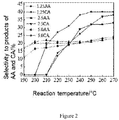
- the graph of the conversion rate of the raw material DMM and the selectivity to the products of acetic acid and acrylic acid as a function of temperature is shown in Fig. 2 .
- the selectivity to acetic acid remains basically unchanged as the total reaction pressure is increased gradually.
- the total reaction pressure is 5.0 MPa
- the selectivity to the product of acrylic acid is significantly higher than the selectivities to acrylic acid at the total pressures of 1.25 MPa and 2.50 MPa at the same temperature. This is because the aldol condensation reaction is a reaction in which the number of molecules is reduced, and an increased reaction pressure is favorable for the reaction to proceed in the positive direction.
- a fixed bed reactor was used, and the packing mass of catalyst was in a range from 0.1 g to 5.0 g.
- reaction results of acidic resin catalysts and solid sulfonic acid catalysts at the conditions of a reaction temperature in a range from 180°C to 350°C, a reaction pressure in a range from 0.1 MPa to 10 MPa, a mass space velocity of raw material DMM in a range from 0.05 h -1 to 10 h -1 and a volume percentage in a range from 0.1% to 100% are shown in Table 3.
Landscapes
- Chemical & Material Sciences (AREA)
- Organic Chemistry (AREA)
- Chemical Kinetics & Catalysis (AREA)
- Engineering & Computer Science (AREA)
- Materials Engineering (AREA)
- Crystallography & Structural Chemistry (AREA)
- Oil, Petroleum & Natural Gas (AREA)
- Organic Low-Molecular-Weight Compounds And Preparation Thereof (AREA)
- Catalysts (AREA)
- Low-Molecular Organic Synthesis Reactions Using Catalysts (AREA)
Abstract
Description
- The present application relates to the field of solid acid catalysis, and in particular to a method for preparing acrylic acid and methyl acrylate using dimethoxymethane and carbon monoxide as raw materials for the reaction.
- Acrylic acid is the simplest unsaturated carboxylic acid. Acrylic acid with a high purity has a characteristic pungent odor and is extremely corrosive. It is an important chemical raw material widely used in the synthesis of various chemicals and the production of resins. The acrylic acid and acrylate industries are an important part of the petrochemical production field in today's world.
- The synthetic methods of acrylic acid mainly include: 1) chloroethanol method: chloroethanol and sodium cyanide are used as reaction raw materials to generate cyanoethanol in the presence of a basic catalyst at first, cyanoethanol is dehydrated in the presence of sulfuric acid to obtain acrylonitrile, and acrylonitrile is further subjected to hydrolysis or alcoholysis to obtain acrylic acid or acrylate; 2) cyanoethanol method: this method is developed from the chloroethanol method, except that the synthetic method of cyanoethanol is different, which is generated via a ring-opening reaction of ethylene oxide under the action of hydrocyanic acid; 3) high-pressure Reppe and modified Reppe method: the esterifying-grade acrylic acid is generated from acetylene, carbon monoxide and water under the action of a nickel salt or copper salt as catalyst, and is then subjected to an esterification reaction with different alcohols to generate acrylate; 4) ketene method: ethenone (prepared from acetone and acetic acid as raw materials) is reacted with anhydrous formaldehyde to generate β-propiolactone, which is then isomerized by contacting with hot phosphoric acid to generate acrylic acid; 5) formaldehyde-acetic acid method: an aldol condensation reaction of formaldehyde with acetic acid is carried out to directly generate acrylic acid; 6) acrylonitrile hydrolysis method; 7) ethylene method: an oxidative carbonylation reaction of ethylene with carbon monoxide and oxygen in the presence of a noble metal as catalyst is carried out to generate acrylic acid; 8) propylene direct oxidation method: it is further divided into one-step and two-step direct oxidation methods, wherein in the first step of the two-step oxidation method, propylene is oxidized to generate acrolein, and in the second step, acrolein is further oxidized to generate acrylic acid; 9) propane oxidation method: propane is used as a raw material, a metal oxide is used as a catalyst, and propane is directly oxidized to obtain acrylic acid; 10) ethylene oxide method: inserting carbon monoxide directly into ethylene oxide, that is, ethylene oxide is subject to a carbonylation reaction, to generate acrylic acid. Among the above 10 methods for producing acrylic acid, the chloroethanol method, the cyanoethanol method, the Reppe method and the ketene method have been gradually eliminated due to the expensive industrial costs caused by their low efficiency and high toxicity. As for the ethylene method, the propane method and the ethylene oxide method, the stability and selectivity of catalyst as well as the catalyst process are not yet mature, and there is currently no report on large-scale production. Only the propylene oxidation method has become the only method used in large-scale production of acrylic acid in the world today.
- The propylene oxidation method was used at the earliest by the company UCC to build the first set of production device in 1969 in the United States, whereafter the Japanese company Nippon Shokubai Kagaku Kogyo (MCC) in 1970, the Japanese company Mitsubishi Chemical Corporation (NSKK) in 1973 and the American company Celanese in 1973 built successively production devices for producing acrylic acid by the propylene oxidation method. At present, the companies in the world owning the process technology for producing acrylic acid by oxidation of propylene all use the process of propylene two-step oxidation method.
- Therefore, it is of important significance to develop a preparation method capable of generating acrylic acid and methyl acrylate from an inexpensive raw material with a high conversion rate and selectivity.
- The object of the present application is to provide a method for preparing acrylic acid and methyl acrylate, which uses inexpensive dimethoxymethane (DMM) and carbon monoxide as reaction raw materials and a solid acid as a catalyst to generate acrylic acid and methyl acrylate with high selectivity.
- In the method, a feed gas containing dimethoxymethane and carbon monoxide is passed through a reactor loaded with a molecular sieve catalyst to carry out a reaction, to generate acrylic acid as a main product and methyl acrylate, methyl acetate and acetic acid. After being separated, acetic acid, methyl acetate, acrylic acid and methyl acrylate are obtained, respectively.
- According to some preferred embodiments of the present invention, the reaction is carried out at a reaction temperature in a range from 180°C to 400°C and a reaction pressure in a range from 0.1 MPa to 15.0 MPa, the mass space velocity of dimethoxymethane in the feed gas is in a range from 0.05 h-1 to 10.0 h-1, and the volume percentage of dimethoxymethane in the feed gas is in a range from 0.1% to 95%.
- In the present application, the reaction process of reacting dimethoxymethane with carbon monoxide to generate acetic acid, methyl acetate, acrylic acid and methyl acrylate is as follows:
- 1) dimethoxymethane reacts with H-protonic acid of the solid acid (in the pores of molecular sieve) to generate a solid acid (molecular sieve) adsorption-activated methoxymethyl species, and to generate methanol simultaneously;

- 2) the generated methanol reacts with an excess H-protonic acid of the solid acid (in the pores of molecular sieve) to generate a molecular sieve adsorption-activated methyl species and water;

- 3) CO can be directly inserted into the solid acid (molecular sieve) adsorption-activated methoxymethyl species to generate a methoxyacetyl species;

- 4) CO can also be directly inserted into the solid acid (molecular sieve) adsorption-activated methyl species to generate an acetyl species;

- 5) the solid acid (molecular sieve) adsorption-activated methoxymethyl species can undergo a self-disproportionation reaction with dimethoxymethane to generate a molecular sieve adsorption-activated dimethoxymethyl species and dimethyl ether;
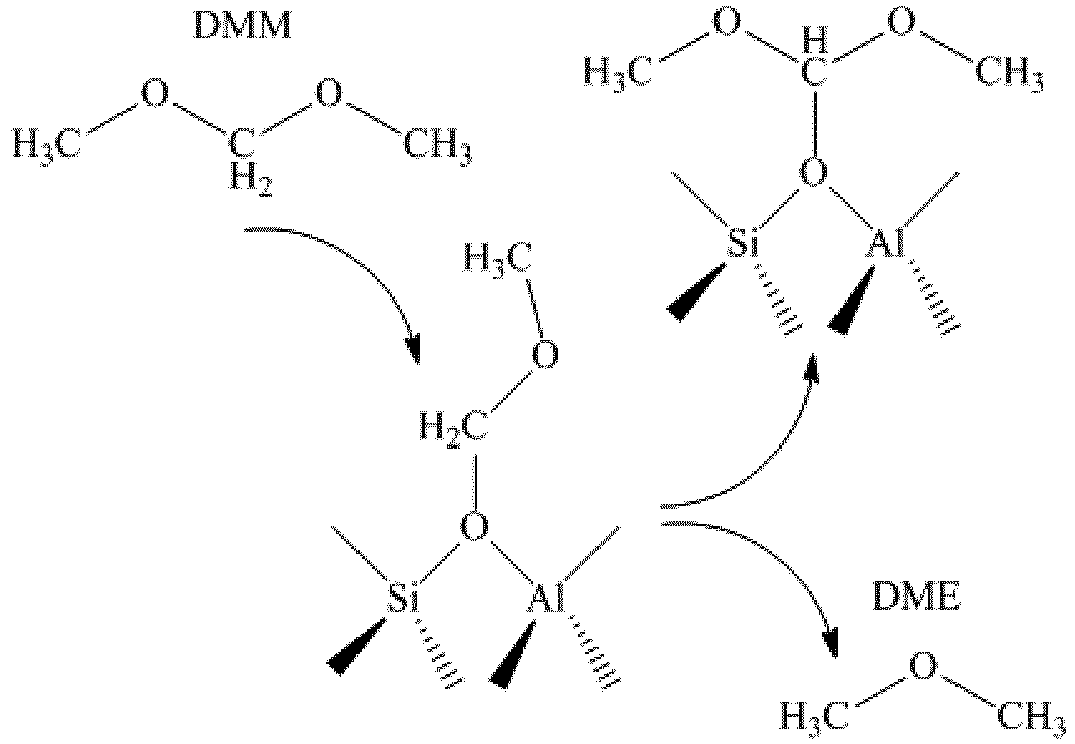
- 6) the solid acid (molecular sieve) adsorption-activated dimethoxymethyl species can generate dimethyl ether, formaldehyde and free solid acid (molecular sieve) acid sites under the action of water;

- 7) the solid acid (molecular sieve) adsorbed methoxyacetyl species can undergo a methyl-etherification reaction with dimethoxymethane to generate methyl methoxyacetate and the molecular sieve adsorbed methoxymethyl species; the solid acid (molecular sieve) adsorbed methoxyacetyl species can also undergo a methyl-etherification reaction with dimethyl ether to generate methyl methoxyacetate and a molecular sieve adsorbed methoxyl species; at the same time, the molecular sieve adsorbed methoxyacetyl species can also react with water to generate methoxyacetic acid and free solid acid (molecular sieve) acid sites (the latter two reactions have similar routes, without being drawn one by one);

- 8) the solid acid (molecular sieve) adsorption-activated methyl species can also undergo a methyl-etherification reaction with dimethyl ether to generate methyl acetate and the molecular sieve adsorbed methoxyl species; the solid acid (molecular sieve) adsorption-activated methyl species can also undergo a methyl-etherification reaction with dimethoxymethane to generate methyl acetate and the molecular sieve adsorbed methoxymethyl species; at the same time, the molecular sieve adsorbed acetyl species can also react with water or methanol to generate acetic acid and free molecular sieve acid sites or adsorbed methyl species (the latter two reactions have similar routes, without being drawn in entirety).

- 9) the generated acetic acid or methyl acetate can undergo an aldol condensation reaction with formaldehyde to generate acrylic acid and methyl acrylate.
- According to the above reaction mechanisms, by means of the thermodynamic and kinetic factors, including controlling different temperature and pressure reaction conditions and different ratios of raw material composition, the products can be directionally controlled, such that they can be produced in accordance with the following equation. Under ideal conditions, in the products, the total selectivity based on carbon to acrylic acid is 60% and the total selectivity based on carbon to acetic acid is 40%, without formation of other by-products. If the selectivity to the product is calculated based on a single reaction raw material of dimethoxymethane, the selectivity based on carbon to acrylic acid is 50%, and the selectivity based on carbon to acetic acid is 50%.

- In actual reactions, methyl acrylate and methyl acetate are partially generated in the product, due to the incomplete hydrolysis reaction of methyl acetate.
- In the reaction product, the mass percentage content of acrylic acid is in a range from 0.1% to 70%, the mass percentage content of methyl acrylate is in a range from 0.1% to 30%, the mass percentage content of acetic acid is in a range from 0.1% to 60%, and the mass percentage content of methyl acetate is in a range from 0.1% to 40%.
- The molecular sieve catalyst is any one or more selected from the group consisting of a ZSM-35 molecular sieve, a ZSM-5 molecular sieve, a MOR mordenite molecular sieve and a EMT molecular sieve.
- The esters produced by the method can be further hydrolyzed to produce the corresponding carboxylic acids, including the hydrolysis of the methyl acrylate to produce the corresponding acrylic acid, and the hydrolysis of the methyl acetate to produce the corresponding acetic acid.
- The esters and carboxylic acids produced by the method can be further hydrogenated to produce the corresponding alcohols, including the hydrogenation of the methyl acrylate and acrylic acid to produce the corresponding propanol, and the hydrogenation of the methyl acetate and acetic acid to produce the corresponding ethanol.
- The atomic ratio of silicon to aluminum in the molecular sieve catalyst is preferably Si/Al = 3 to 100.
- The atomic ratio of silicon to aluminum in the ZSM-35 molecular sieve is preferably Si/Al = 20 to 50.
- The atomic ratio of silicon to aluminum in the ZSM-5 molecular sieve is preferably Si/Al = 20 to 60.
- The atomic ratio of silicon to aluminum in the mordenite is preferably Si/Al = 10 to 30.
- The atomic ratio of silicon to aluminum in the EMT zeolite is preferably Si/Al = 5 to 20.
- The molecular sieve can be obtained by heat treatment, hydrothermal treatment, inorganic acid treatment, organic acid treatment, F- treatment and chelate treatment or gas-solid phase dealuminization and silicon supplementation treatment.
- The molecular sieves with different topologies comprise one or more selected from the group consisting of gallium, iron, copper and silver; the introduction methods may include in-situ synthesis, metal ion exchange or impregnation loading; and the metal content is in a range from 0.01 wt% to 10.0 wt% of the total weight of the catalyst, calculated by metal elementary substance.
- Preferably, the metal content is in a range from 0.05 wt% to 1.0 wt% of the total weight of the catalyst.
- The molecular sieve catalysts with different topologies contain a binder, the binder is any one or more selected from the group consisting of alumina, silica and magnesia, and the binder content is in a range from 0 wt% to 70 wt% of the total weight of the catalyst.
- The reaction temperature is preferably in a range from 220°C to 300°C.
- The reaction pressure is preferably in a range from 5 MPa to 10 MPa.
- The mass space velocity of dimethoxymethane in the raw material is preferably in a range from 0.3 h-1 to 2.0 h-1.
- The volume percentage of dimethoxymethane in the raw material is preferably in a range from 0.5% to 30%.
- The feed gas includes dimethoxymethane, carbon monoxide, hydrogen and an inactive gas, wherein the volume content of carbon monoxide is in a range from 50% to 95%, the volume content of hydrogen is in a range from 0% to 50%, and the volume content of the inactive gas is in a range from 0% to 50%. The inactive gas comprises any one or more selected from the group consisting of nitrogen, helium, argon, carbon dioxide, methane and ethane.
- The reactor may be a fixed bed reactor, a fluidized bed reactor or a tank reactor.
- The beneficial effects that can be achieved by the present application include:
- 1) According to the method provided by the present application, acrylic acid and methyl acrylate are synthesized with a high selectivity from inexpensive dimethoxymethane and carbon monoxide as reaction raw materials, and methyl acetate and acetic acid are by-produced.
- 2) According to the method provided by the present application, the products are acetic acid, methyl acetate, acrylic acid and methyl acrylate, and under normal pressure conditions, the four products are easily separated due to the great difference in the boiling point, so that acrylic acid and methyl acrylate of high added-values can be obtained with a low energy consumption and a low cost.
-
-
Figure 1 is a graph showing the conversion rate of the raw material DMM and the selectivity to products with temperature at a total pressure of 5.0 MPa, a CO partial pressure of 2.5 MPa and a DMM partial pressure of 1.25×10⁻² MPa on the H-MOR molecular sieve in Example 1. -
Figure 2 is a graph showing the relationship between the total reaction pressure and the selectivity to the products of acetic acid and acrylic acid as a function of reaction temperature on the H-MOR molecular sieve in Example 3. - The present application will be further described below with reference to the examples. It is to be understood that the examples are for illustrative purposes only and are not intended to limit the scope of the present application.
- The raw materials and catalysts in the examples of the present application are all commercially purchased, unless otherwise stated.
- The analytical methods in the examples of the present application are as follows:
The raw materials and products were tested by Agilent's Agilent 7890A gas chromatograph using Agilent's FFAP capillary column. - According to an embodiment of the present application, a fixed bed reactor was used, the packing mass of catalyst was in a range from 0.5 g to 3.0 g, the reaction temperature was in a range from 180°C to 350°C, and the reaction pressure was in a range from 0.1 MPa to 10 MPa. The raw material of dimethoxymethane was entered into the reactor by two ways of feeding:
In the first way, the saturated vapor of dimethoxymethane was carried by carbon monoxide at different water bath temperatures (0°C to 50°C) to enter into the fixed bed reactor, to obtain feed gases of dimethoxymethane with different volume contents. The calculation method of the saturated vapor pressure of the raw material ethylene glycol dimethyl ether under different temperature conditions is as shown in Formula II:
- In the second way, the liquid raw material of dimethoxymethane was pumped directly into the fixed bed reactor by a constant flow pump at a flow rate in a range from 0.1 mL/min to 10 mL/min. In this way, the volume content of dimethoxymethane in the feed gas entering into the reactor to contact with the catalyst was in a range from 0.1% to 100%.
- The conversion rate and selectivity in the examples of the present application are calculated as follows:


- 100 g of calcined Na-mordenite zeolite molecular sieves, with an aluminum atomic molar ratio of 5, 6.5, 25 and 50 respectively, were each exchanged three times with 0.5 mol/L ammonium nitrate (2 hours for each time), washed with deionized water, dried, calcined at 550°C for 4 hours, and extruded to prepare catalysts of 20-40 mesh.
- 100 g of calcined gallium-containing Na-mordenite (silicon-aluminum atomic molar ratio of 5) zeolite molecular sieve was exchanged three times with 0.5 mol/L ammonium nitrate (2 hours for each time), washed with deionized water, dried, calcined at 550°C for 4 hours, and extruded to prepare a catalyst of 20-40 mesh.
- 100 g of calcined iron-containing Na-mordenite (silicon-aluminum atomic molar ratio of 6.5) zeolite molecular sieve was exchanged three times with 0.5 mol/L ammonium nitrate (2 hours for each time), washed with deionized water, dried, calcined at 550°C for 4 hours, and extruded to prepare a catalyst of 20-40 mesh.
- The loaded type catalyst was prepared by the equal volume impregnation method. 4.32 g of Fe(NO3)3, 4.32 g of Cu(NO3)2·3H2O and 3.04 g of AgNO3·3H2O were each dissolved in 18 ml of deionized water to prepare the corresponding aqueous nitrate solutions. 20 g of H-mordenite zeolite molecular sieve with a silicon-aluminum ratio of 25 was placed in the aqueous ferric nitrate solution, and stood for 24 hours. The obtained sample was dried in an oven at 120°C for 12 hours. After drying, the sample was placed in a muffle furnace, heated to 550°C at a heating rate of 2°C/min and then calcined for 4 hours to prepare a catalyst.
- 20 g of H-mordenite and 300 ml of an aqueous ferric nitrate solution (0.15 mol) were placed in a flask, and stirred under cooling and refluxing at 80°C for 2 hours, with the solid-liquid ratio being 1:15. The resultant was separated by filtration, washed with deionized water, treated by repeating the above steps twice, and dried at 120°C for 12 hours. After drying, the sample was placed in a muffle furnace, heated to 550°C at a heating rate of 2°C/min, and calcined for 4 hours to obtain a catalyst.
- 80 g of Na-mordenite with a silicon-aluminum atomic molar ratio of 6.5, 28 g of pseudo-boehmite and 10% dilute nitric acid were mixed homogeneously and extruded for molding, then calcined, exchanged with 0.5 mol/L ammonium nitrate for three times (2 hours for each time), washed with deionized water, dried, and calcined at 550°C for 4 hours to obtain a catalyst.
- 80 g of Na-mordenite with a silicon-aluminum atomic molar ratio of 4, 20 g of magnesia and 10% dilute nitric acid were mixed homogeneously and extruded for molding, then calcined, exchanged with 0.5 mol/L ammonium nitrate for three times (2 hours for each time), washed with deionized water, dried, and calcined at 550°C for 4 hours to obtain a catalyst.
- 80 g of Na-mordenite with a silicon-aluminum atomic molar ratio of 4, 50 g of silica sol and 10% dilute nitric acid were mixed homogeneously and extruded for molding, then calcined, exchanged with 0.5 mol/L ammonium nitrate for three times (2 hours for each time), washed with deionized water, dried, and calcined at 550°C for 4 hours to obtain a catalyst.
- 100 g of calcined Na-ZSM-35 molecular sieves, with a silicon-aluminum atomic molar ratio of 20, 35 and 50 respectively, were each exchanged with 0.5 mol/L ammonium nitrate for three times (2 hours for each time), washed with deionized water, dried, calcined at 550°C for 4 hours, and extruded to prepare catalysts of 20-40 mesh.
- 100 g of calcined Na-ZSM-5 molecular sieves, with a silicon-aluminum atomic molar ratio of 20, 40 and 60 respectively, were each exchanged with 0.5 mol/L ammonium nitrate for three times (2 hours for each time), washed with deionized water, dried, calcined at 550°C for 4 hours, and extruded to prepare catalysts of 20-40 mesh.
- The synthetic H-EMT molecular sieves, with a silicon-aluminum atomic molar ratio of 5, 10 and 20 respectively, were each extruded to prepare catalysts of 20-40 mesh.
- The H-MOR molecular sieve with a silicon-aluminum ratio Si/Al = 6.5 was tableted under a pressure of 40 MPa, and crushed to 20-40 mesh to obtain a catalyst. 0.4 g of the catalyst was packed into a fixed bed reactor for pretreatment. The pretreatment conditions for the catalyst were as follows: the N2 flow rate was 30 mL/min, and the temperature was raised from 25°C to 500°C for 150 min and maintained at 500°C for 180 min.
- The reaction gas was consisted of three gas streams, and a total flow rate of 100 mL/min was ensured. The raw material of dimethoxymethane was carried into the reactor by CO at a flow rate of 10 ml/min under a water bath temperature of 30°C; the flow rates of another stream of pure CO were 0 mL/min, 10 mL/min, 40 mL/min and 90 mL/min respectively; the flow rates of the third stream of N2 were 90 mL/min, 80 mL/min, 50 mL/min and 0 mL/min respectively. The total pressure of reaction was 5.0 MPa. The reaction temperature was maintained at 190°C for 300 min, then increased to 200°C in 5 min, maintained at 200°C for another 300 min, and then increased to 210°C in 5 min. According to the above rule, the temperature was maintained for 300 min for each increase by 10°C, until it was increased to 270°C and then maintained for 300 min. The raw material of DMM had a partial pressure of about 1.25×10⁻² MPa (0.0125 atm), and the total CO partial pressures were approximately 0.5, 1.0, 2.5 and 5.0 MPa.
- When the partial pressure of CO is 2.5 MPa, the graph of the conversion rate of the raw material DMM and the selectivity to the products with temperature is shown in
Fig. 1 . As can be seen fromFig. 1 , on the H-MOR (Si/Al = 6.5) catalyst, when the reaction temperature is higher than 190°C, the conversion rate of the raw material DMM is close to 100%. Five products are substantially generated, namely dimethyl ether (DME), methyl acetate (MAc), acetic acid (AA), methyl acrylate (MA) and acrylic acid (CA). The selectivities to the products of dimethyl ether and methyl acetate decrease gradually with increase in the reaction temperature. When the reaction temperature reaches to 240°C, almost no dimethyl ether is generated; when the reaction temperature reaches to 270°C, the selectivity to methyl acetate is reduced to 40%. When the reaction temperature is higher than 200°C, a small amount of acrylic acid is generated in the products, the selectivity of which increases as the reaction temperature increases, and the highest selectivity reaches to 35% as the reaction temperature reaches to 270°C. The product of methyl acrylate is accompanied by the generation of acrylic acid, and its selectivity is stabilized constantly at around 3%. The selectivity to the product of acetic acid also increases gradually as the reaction temperature increases, but the change is not obvious, and the selectivity increases from 10% at the initial 190°C to 23% at 270°C. - Table 1 shows the distribution of product as a function of the reaction temperature at a DMM partial pressure of 1.25×10⁻² MPa (0.0125 atm) and CO partial pressures of 0.5 MPa, 1.0 MPa and 5.0 MPa respectively. It can be known from Table 1 that under all conditions, the conversion rate of the raw material DMM is close to 100%, and the selectivity to the product of acrylic acid is higher at the same reaction temperature as the CO partial pressure increases. When the partial pressure of CO is 5.0 MPa, the selectivity to acrylic acid reaches to 37% at 240°C. The partial pressure of CO has little effect on the selectivity to acetic acid, and the selectivity to acetic acid is basically stabilized at 20-25%.
- The H-MOR molecular sieve with a silicon-aluminum ratio Si/Al = 6.5 was tableted under a pressure of 40 MPa, and crushed to 20-40 mesh to obtain a catalyst. 0.4 g of the catalyst was packed into a fixed bed reactor for pretreatment. The pretreatment conditions for the catalyst were as follows: the N2 flow rate was 30 mL/min, and the temperature was raised from 25°C to 500°C for 150 min and maintained at 500°C for 180 min.
- The reaction gas was consisted of two gas streams, and a total flow rate of 100 mL/min was ensured. The raw material of dimethoxymethane was carried into the reactor by CO at flow rates of 2 mL/min, 5 mL/min, 10 mL/min, 25 mL/min, 50 mL/min and 100 mL/min under water bath temperatures of 0°C and 30°C; the flow rates of another stream of pure CO were 98 mL/min, 95 mL/min, 90 mL/min, 75 mL/min, 50 mL/min and 0 mL/min respectively. The total reaction pressure was 5.0 MPa. The reaction temperature was maintained at 190°C for 300 min, then increased to 200°C in 5 min, maintained at 200°C for another 300 min, and then increased to 210°C in 5 min. According to the above rule, the temperature was maintained for 300 min for each increase by 10°C, until it was increased to 270°C and then maintained for 300 min. The partial pressures of the raw material DMM were 0.21×10⁻² MPa (0.0021 atm), 0.416×10⁻² MPa (0.00416 atm), 1.25×10⁻² MPa (0.0125 atm), 3.125×10⁻² MPa (0.3125 atm), 6.25×10⁻² MPa (0.625 atm) and 12.5×10⁻² MPa (0.125 atm) respectively. Among them, the reaction data at the partial pressure of 1.25×10⁻² MPa (0.0125 atm) for the raw material DMM is shown in
Fig. 1 , and other reaction data is shown in Table 2. When the partial pressure of DMM is lower than 3.125×10⁻² MPa, the conversion rate of DMM is close to 100% under any reaction temperature. When the partial pressure of DMM is higher than 3.125×10⁻² MPa, the conversion rate of DMM increases gradually as the reaction temperature increases. When the partial pressure of DMM is 0.21×10⁻² MPa and the reaction temperature is 190°C, the products are methyl acetate and acetic acid, with selectivities of 56% and 44%, respectively. As the reaction temperature increases, the selectivities to methyl acetate and acetic acid are gradually reduced, accompanied by the generation of acrylic acid and methyl acrylate, and the selectivity to acrylic acid increases as the reaction temperature increases. When the reaction temperature is higher than or equal to 250°C, the selectivity to acrylic acid reaches to a maximum of 48%, and remains substantially unchanged as the reaction temperature increases thereafter. When the reaction temperature is higher than 250°C, with the partial pressure of DMM being increased to 0.416×10⁻² MPa, the selectivity to acrylic acid is stabilized at around 40%. As the partial pressure of DMM increases, the selectivity to acrylic acid gradually decreases under the same reaction temperature conditions. When the partial pressure of DMM is 12.5×10⁻² MPa and the reaction temperature is 270°C, the selectivity to acrylic acid is only 4%. - The H-MOR molecular sieve with a silicon-aluminum ratio Si/Al = 6.5 was tableted under a pressure of 40 MPa, and crushed to 20-40 mesh to obtain a catalyst. 0.4 g of the catalyst was packed into a fixed bed reactor for pretreatment. The pretreatment conditions for the catalyst were as follows: the N2 flow rate was 30 mL/min, and the temperature was raised from 25°C to 500°C for 150 min and maintained at 500°C for 180 min.
- The reaction gas was consisted of two gas streams, and a total flow rate of 100 mL/min was ensured. The molar ratio of CO to DMM was maintained at 400:1 (that is, to ensure the peak area of the raw material DMM in the chromatogram was kept constant) by adjusting the water bath temperature of the raw material DMM and the flow rate of the CO carrier gas. The total reaction pressures were adjusted to be 1.25 MPa, 2.50 MPa and 5.0 MPa, respectively. The reaction temperature was maintained at 190°C for 90 min, then increased to 200°C in 5 min, maintained at 200°C for another 90 min, and then increased to 210°C in 5 min. According to the above rule, the temperature was maintained for 90 min for each increase by 10°C, until it was increased to 270°C and then maintained for 90 min. The graph of the conversion rate of the raw material DMM and the selectivity to the products of acetic acid and acrylic acid as a function of temperature is shown in
Fig. 2 . In the case that the ratio of CO to DMM is kept constant, the selectivity to acetic acid remains basically unchanged as the total reaction pressure is increased gradually. However, when the total reaction pressure is 5.0 MPa, the selectivity to the product of acrylic acid is significantly higher than the selectivities to acrylic acid at the total pressures of 1.25 MPa and 2.50 MPa at the same temperature. This is because the aldol condensation reaction is a reaction in which the number of molecules is reduced, and an increased reaction pressure is favorable for the reaction to proceed in the positive direction. - A fixed bed reactor was used, and the packing mass of catalyst was in a range from 0.1 g to 5.0 g. The molecular sieves having different silicon-aluminum ratios with topologies of MWW, FER, MFI, MOR, FAU and BEA, including H-MCM-22, H-ZSM-35, H-ZSM-5, H-MOR, H-Y, H-Beta and the metal modified Ga-mordenite, Fe-mordenite, Cu-mordenite as well as the molded catalysts of H-mordenite-Al2O3, H-mordenite-SiO2 and H-mordenite-MgO, were tableted at a pressure of 40 MPa, and crushed to 20-40 mesh to obtain catalysts. The reaction results of acidic resin catalysts and solid sulfonic acid catalysts at the conditions of a reaction temperature in a range from 180°C to 350°C, a reaction pressure in a range from 0.1 MPa to 10 MPa, a mass space velocity of raw material DMM in a range from 0.05 h-1 to 10 h-1 and a volume percentage in a range from 0.1% to 100% are shown in Table 3.
Table 1 Reaction results of dimethoxymethane under different temperatures and CO partial pressures Reaction temperature/°C CO partial pressure/MPa Conversion rate/% Selectivity to product/% Dimethoxymethane Dimethyl ether Methyl acetate Methyl acrylate Acetic acid acrylic acid 190 0.5 100 90 10 0 0 0 1.0 100 75 25 0 0 0 5.0 100 14 70 0 16 0 200 0.5 100 75 25 0 0 0 1.0 100 60 35 0 5 0 5.0 100 9 64 2 16 9 210 0.5 100 40 56 0 4 0 1.0 100 28 59 1 9 3 5.0 100 3 62 3 16 16 220 0.5 100 16 72 2 10 0 1.0 100 10 63 3 12 12 5.0 100 2 50 3 17 28 230 0.5 100 6 64 6 15 9 1.0 100 4 55 5 19 17 5.0 100 1 42 3 20 34 240 0.5 100 2 52 9 19 18 1.0 100 1 50 7 21 21 5.0 100 0 37 4 22 37 250 0.5 100 1 42 9 22 26 1.0 100 0 41 7 23 29 5.0 100 0 34 4 23 39 260 0.5 100 0 36 9 23 32 1.0 100 0 37 7 23 34 5.0 100 0 33 4 24 39 270 0.5 100 0 34 9 24 33 1.0 100 0 36 7 24 35 5.0 100 0 32 4 25 39 Table 2 Reaction results under different temperatures and partial pressures of dimethoxymethane Reaction temperature/°C Partial pressure of DMM/ 10-2 MPa Conversion rate/% Selectivity to product/% Dimethoxyme thane Dimethyl ether Methyl acetate Methyl acrylate Acetic acid acrylic acid 190 0.210 100 0 56 0 44 0 0.416 100 0 60 0 40 0 3.125 100 67 24 0 9 0 6.250 57 81 17 0 2 0 12.500 36 76 9 0 0 0 200 0.210 100 0 50 0 50 0 0.416 100 0 62 0 48 0 3.125 100 18 68 0 12 2 6.250 61 66 32 0 2 0 12.500 49 74 16 0 0 0 210 0.210 100 0 46 0 54 0 0.416 100 0 60 0 40 0 3.125 100 8 64 2 14 12 6.250 78 57 37 0 6 0 12.500 64 69 21 0 2 0 220 0.210 100 0 33 0 38 29 0.416 100 0 40 0 36 24 3.125 100 2 59 2 17 20 6.250 89 48 41 1 8 2 12.500 79 63 29 0 1 0 230 0.210 100 0 27 0 34 39 0.416 100 0 41 2 30 27 3.125 100 0 52 3 20 25 6.250 93 41 46 2 9 2 12.500 85 54 33 2 4 2 240 0.210 100 0 23 0 34 43 0.416 100 0 33 2 32 33 3.125 100 0 44 3 21 32 6.250 94 30 50 2 11 7 12.500 89 49 40 3 4 3 250 0.210 100 0 17 0 35 48 0.416 100 0 29 2 33 36 3.125 100 0 42 3 20 35 6.250 94 24 51 3 12 10 12.500 92 45 40 3 4 3 260 0.210 100 0 16 0 36 48 0.416 100 0 23 2 35 39 3.125 100 0 40 3 21 36 6.250 94 20 51 3 13 13 12.500 92 43 42 3 5 4 270 0.210 100 0 14 0 38 48 0.416 100 0 22 2 37 39 3.125 100 0 39 3 21 37 6.250 94 18 52 3 13 14 12.500 92 43 42 3 5 4 Table 3 Catalytic reaction results of dimethoxymethane on surfaces and in pores of different solid acid catalysts No. Catalyst Reaction condition Reaction result Type Si/Al Reaction temperature (°C) Reaction pressure (MPa) Mass space velocity of dimethoxyme thane (h-1) Volume content of dimethoxymethane (%) Conversion rate of dimethoxy methane (%) Selectivity to acrylic acid (%) 1 H-mordenite 5 250 5 0.25 0.1 100 50 2 H-mordenite 6.5 350 8 1.00 1.0 100 50 3 H-mordenite 25 240 10 0.50 0.5 100 40 4 H-mordenite 50 240 10 0.50 0.5 100 40 6 H-ZSM-35 5 270 10 0.25 1.0 100 9 7 H-ZSM-35 25 280 10 0.25 0.25 100 15 8 H-ZSM-35 50 290 10 0.25 0.5 100 16 9 H-ZSM-35 100 300 10 0.25 0.5 100 20 10 H-ZSM-5 25 260 5 0.5 0.1 100 4 11 H-ZSM-5 50 260 5 0.5 0.1 100 4 12 Benzenesulfonic acid - 170 10 0.1 0.5 38 28 13 p-Methylbenzene sulfonic acid - 170 10 0.1 0.5 46 31 14 Perfluorinated sulfonic acid resin - 170 10 0.1 0.5 80 32 15 Ga-mordenite 5 250 3 1.00 1.0 100 36 16 Fe-mordenite 6.5 250 3 1.00 1.0 100 50 17 Cu-mordenite 25 250 3 1.00 1.0 100 43 18 H-mordenite-Al 2O3 6.5 240 5 3.0 5.0 86 50 19 H-mordenite-SiO2 6.5 240 5 3.0 5.0 88 50 20 H-mordenite-MgO 6.5 240 5 3.0 5.0 96 50 - The above are only a few embodiments of the present application, and are not intended to limit the present application in any form. Although the present application is disclosed by the preferred embodiments as above, they are however not used to limit the present application. A slight change or modification utilizing the technical content disclosed above made by the person skilled in art, without departing from the technical solution of the present application, is equivalent to the equivalent embodiment, and falls within the scope of the technical solution.
Claims (17)
- A method for preparing acrylic acid and methyl acrylate, the method comprising passing a feed gas containing dimethoxymethane and carbon monoxide through a reactor loaded with a molecular sieve catalyst to carry out a reaction, to generate acrylic acid as a main product and methyl acrylate, methyl acetate and acetic acid.
- The method according to claim 1, wherein the reaction is carried out at a reaction temperature in a range from 180°C to 400°C and a reaction pressure in a range from 0.1 MPa to 15.0 MPa, the mass space velocity of dimethoxymethane in the feed gas is in a range from 0.05 h-1 to 10.0 h-1, and the volume percentage of dimethoxymethane in the feed gas is in a range from 0.1% to 95%.
- The method according to claim 1, wherein the molecular sieve catalyst is any one or more selected from the group consisting of a ZSM-35 molecular sieve, a ZSM-5 molecular sieve, a MOR mordenite molecular sieve and a EMT molecular sieve.
- The method according to claim 1, wherein the esters produced by the method are further hydrolyzed to produce the corresponding carboxylic acids, including the hydrolysis of the methyl acrylate to produce the corresponding acrylic acid, and the hydrolysis of the methyl acetate to produce the corresponding acetic acid.
- The method according to claim 4, wherein the esters and carboxylic acids produced by the method are further hydrogenated to produce the corresponding alcohols, including the hydrogenation of the methyl acrylate and acrylic acid to produce the corresponding propanol, and the hydrogenation of the methyl acetate and acetic acid to produce the corresponding ethanol.
- The method according to claim 3, wherein the atomic ratio of silicon to aluminum in the molecular sieve catalyst is Si/Al = 3 to 100.
- The method according to claim 3 or 6, wherein
the atomic ratio of silicon to aluminum in the ZSM-35 molecular sieve is Si/Al = 20 to 50;
the atomic ratio of silicon to aluminum in the ZSM-5 molecular sieve is Si/Al = 20 to 60;
the atomic ratio of silicon to aluminum in the mordenite is Si/Al = 10 to 30; and
the atomic ratio of silicon to aluminum in the EMT zeolite is Si/Al = 5 to 20. - The method according to claim 3, wherein the molecular sieve catalyst is obtained by heat treatment, hydrothermal treatment, inorganic acid treatment, organic acid treatment, F- treatment and chelate treatment or gas-solid phase dealuminization and silicon supplementation treatment.
- The method according to claim 3, wherein the molecular sieve catalyst comprises one or more selected from the group consisting of gallium, iron, copper and silver; the introduction methods comprise in-situ synthesis, metal ion exchange or impregnation loading; and the metal content is in a range from 0.01 wt% to 10.0 wt% of the total weight of the catalyst, calculated by metal elementary substance.
- The method according to claim 9, wherein the metal content is in a range from 0.05 wt% to 1.0 wt% of the total weight of the catalyst.
- The method according to claim 1, wherein the molecular sieve catalyst contains a binder, the binder is any one or more selected from the group consisting of alumina, silica and magnesia, and the binder content is in a range from 0 wt% to 70 wt% of the total weight of the catalyst.
- The method according to claim 2, wherein the reaction temperature is in a range from 220°C to 300°C.
- The method according to claim 2, wherein the reaction pressure is in a range from 5 MPa to 10 MPa.
- The method according to claim 2, wherein the mass space velocity of dimethoxymethane in the feed gas is in a range from 0.3 h-1 to 2.0 h-1.
- The method according to claim 2, wherein the volume percentage of dimethoxymethane in the feed gas is in a range from 0.5% to 30%.
- The method according to claim 1, wherein the feed gas includes hydrogen and an inactive gas in addition to dimethoxymethane and carbon monoxide, wherein the volume content of carbon monoxide is in a range from 50% to 95%, the volume content of hydrogen is in a range from 0% to 50%, and the volume content of the inactive gas is in a range from 0% to 50%; and the inactive gas includes any one or more selected from the group consisting of nitrogen, helium, argon, carbon dioxide, methane and ethane.
- The method according to claim 1, wherein the reactor is a fixed bed reactor, a fluidized bed reactor or a tank reactor.
Applications Claiming Priority (1)
| Application Number | Priority Date | Filing Date | Title |
|---|---|---|---|
| PCT/CN2016/107284 WO2018094691A1 (en) | 2016-11-25 | 2016-11-25 | Method for preparing acrylic acid and methyl acrylate |
Publications (3)
| Publication Number | Publication Date |
|---|---|
| EP3546441A1 true EP3546441A1 (en) | 2019-10-02 |
| EP3546441A4 EP3546441A4 (en) | 2020-07-29 |
| EP3546441B1 EP3546441B1 (en) | 2021-09-01 |
Family
ID=62194581
Family Applications (1)
| Application Number | Title | Priority Date | Filing Date |
|---|---|---|---|
| EP16922066.2A Not-in-force EP3546441B1 (en) | 2016-11-25 | 2016-11-25 | Method for preparing acrylic acid and methyl acrylate |
Country Status (5)
| Country | Link |
|---|---|
| US (1) | US11111200B2 (en) |
| EP (1) | EP3546441B1 (en) |
| JP (1) | JP6806899B2 (en) |
| RU (1) | RU2712277C1 (en) |
| WO (1) | WO2018094691A1 (en) |
Cited By (2)
| Publication number | Priority date | Publication date | Assignee | Title |
|---|---|---|---|---|
| CN111995521A (en) * | 2020-09-01 | 2020-11-27 | 山西大学 | A kind of reaction device and method for synthesizing methyl methoxyacetate by gas-phase carbonylation of dimethoxymethane |
| WO2021204789A3 (en) * | 2020-04-07 | 2021-12-30 | Arkema France | Recycling of polyacetal for the production of polyoxymethylene dialkyl ethers |
Families Citing this family (4)
| Publication number | Priority date | Publication date | Assignee | Title |
|---|---|---|---|---|
| CN116783154A (en) * | 2020-11-25 | 2023-09-19 | 埃讷肯公司 | Method for producing acetic acid and acrylic acid from waste carbon-containing materials with a reduced carbon footprint |
| CN116328825B (en) * | 2023-02-22 | 2024-06-25 | 中国科学院青岛生物能源与过程研究所 | A catalyst, a preparation method thereof and a method for preparing methyl 3-methoxypropionate by using the catalyst to catalyze methanol and methyl acetate |
| CN116943735B (en) * | 2023-07-11 | 2025-07-08 | 山东新和成药业有限公司 | Catalyst, preparation method thereof and synthesis method of malonate compound |
| CN118405705A (en) * | 2024-04-28 | 2024-07-30 | 江西师范大学 | Hydrophilic Beta molecular sieve membrane, preparation method and method for rapidly preparing butyl oleate at low temperature |
Family Cites Families (5)
| Publication number | Priority date | Publication date | Assignee | Title |
|---|---|---|---|---|
| DE102007004960A1 (en) * | 2007-01-26 | 2008-07-31 | Basf Se | Production of acrylic acid by partial gas phase oxidation, for use e.g. as monomer, includes extracting acrylic acid with organic solvent from acidic stream obtained in purification column |
| US7772423B2 (en) * | 2008-10-23 | 2010-08-10 | The Regents Of The University Of California | Process for the production of alkyl alkoxyacetates |
| CN104119228B (en) * | 2013-04-26 | 2016-04-20 | 中国科学院大连化学物理研究所 | A kind of method of synthesizing methoxy methyl acetate |
| DE102013008207A1 (en) * | 2013-05-14 | 2014-11-20 | Basf Se | Process for the preparation of acrylic acid with high space-time yield |
| DE102014008080A1 (en) * | 2014-05-30 | 2015-11-12 | Basf Se | Process for the preparation of acrylic acid using an aluminum-free zeolitic material |
-
2016
- 2016-11-25 RU RU2019117360A patent/RU2712277C1/en active
- 2016-11-25 JP JP2019527815A patent/JP6806899B2/en not_active Expired - Fee Related
- 2016-11-25 US US16/463,415 patent/US11111200B2/en not_active Expired - Fee Related
- 2016-11-25 EP EP16922066.2A patent/EP3546441B1/en not_active Not-in-force
- 2016-11-25 WO PCT/CN2016/107284 patent/WO2018094691A1/en not_active Ceased
Cited By (2)
| Publication number | Priority date | Publication date | Assignee | Title |
|---|---|---|---|---|
| WO2021204789A3 (en) * | 2020-04-07 | 2021-12-30 | Arkema France | Recycling of polyacetal for the production of polyoxymethylene dialkyl ethers |
| CN111995521A (en) * | 2020-09-01 | 2020-11-27 | 山西大学 | A kind of reaction device and method for synthesizing methyl methoxyacetate by gas-phase carbonylation of dimethoxymethane |
Also Published As
| Publication number | Publication date |
|---|---|
| RU2712277C1 (en) | 2020-01-28 |
| US11111200B2 (en) | 2021-09-07 |
| JP2020512275A (en) | 2020-04-23 |
| US20210114963A1 (en) | 2021-04-22 |
| EP3546441B1 (en) | 2021-09-01 |
| EP3546441A4 (en) | 2020-07-29 |
| WO2018094691A1 (en) | 2018-05-31 |
| JP6806899B2 (en) | 2021-01-06 |
Similar Documents
| Publication | Publication Date | Title |
|---|---|---|
| EP3546441B1 (en) | Method for preparing acrylic acid and methyl acrylate | |
| JP6417009B2 (en) | Catalyst for glycerol dehydration reaction, method for producing the same, and method for producing acrolein | |
| CN108101767B (en) | A kind of preparation method of acrylic acid and methyl acrylate | |
| KR101603820B1 (en) | Catalyst for production from butene mixture to butadiene and method of preparing the same | |
| EP3689848A1 (en) | Method for directly producing methyl acetate and/or acetic acid from syngas | |
| CN109894127B (en) | Preparation of a rare earth phosphate catalyst and its application in the preparation of acrylic acid or methyl acrylate | |
| US9688597B2 (en) | Method for producing aldehyde | |
| EP1142854B1 (en) | Dimethyl ether methylation of alpha carbon adjacent an electron withdrawing group | |
| EP3222608A1 (en) | Method for preparing methyl formate | |
| CN108097305A (en) | A kind of renovation process for the catalyst for being used to prepare acrylic acid and/or methyl acrylate | |
| KR102164613B1 (en) | Catalyst for dehydration of glycerin, preparing method thereof and production method of acrolein using the catalyst | |
| JP4359447B2 (en) | Method for producing monohydroxyacetone | |
| KR101874740B1 (en) | Method for producing oxygen containing carbon compounds | |
| US2017069A (en) | Synthesis of amines | |
| CN120662320B (en) | Low-temperature catalyst for preparing methyl formate by dehydrogenation of methanol, preparation method and application thereof | |
| JP6097278B2 (en) | Method for producing 3-alkoxy-3-methyl-1-butanol | |
| KR100588948B1 (en) | Catalyst for preparing dimethyl ether, preparation method thereof and preparation method for dimethyl ether using the same | |
| JP2019107590A (en) | Catalyst and process for producing aldehydes and/or alcohols | |
| CN108097291A (en) | A kind of catalyst for preparing acrylic acid and/or methyl acrylate | |
| CN108097289A (en) | A kind of renovation process for the catalyst for being used to prepare acrylic acid and/or methyl acrylate | |
| KR101436146B1 (en) | Catalyst system for producing acrolein from glycerol and the method of producing acrolein by using said catalyst system | |
| CN119746924A (en) | A method for preparing a catalyst for carbonylation of methylal to produce methyl methoxyacetate and its application | |
| CN120858071A (en) | Plasma-catalyzed direct water-gas shift reaction | |
| JP2016079143A (en) | Producing method of isobutyraldehyde | |
| KR20160074287A (en) | Catalyst for dehydration of glycerin, and preparing method of acrolein |
Legal Events
| Date | Code | Title | Description |
|---|---|---|---|
| STAA | Information on the status of an ep patent application or granted ep patent |
Free format text: STATUS: THE INTERNATIONAL PUBLICATION HAS BEEN MADE |
|
| PUAI | Public reference made under article 153(3) epc to a published international application that has entered the european phase |
Free format text: ORIGINAL CODE: 0009012 |
|
| STAA | Information on the status of an ep patent application or granted ep patent |
Free format text: STATUS: REQUEST FOR EXAMINATION WAS MADE |
|
| 17P | Request for examination filed |
Effective date: 20190527 |
|
| AK | Designated contracting states |
Kind code of ref document: A1 Designated state(s): AL AT BE BG CH CY CZ DE DK EE ES FI FR GB GR HR HU IE IS IT LI LT LU LV MC MK MT NL NO PL PT RO RS SE SI SK SM TR |
|
| AX | Request for extension of the european patent |
Extension state: BA ME |
|
| DAV | Request for validation of the european patent (deleted) | ||
| DAX | Request for extension of the european patent (deleted) | ||
| A4 | Supplementary search report drawn up and despatched |
Effective date: 20200626 |
|
| RIC1 | Information provided on ipc code assigned before grant |
Ipc: C07C 51/10 20060101ALI20200622BHEP Ipc: C07C 51/12 20060101AFI20200622BHEP Ipc: C07C 69/533 20060101ALI20200622BHEP Ipc: C07C 67/36 20060101ALI20200622BHEP Ipc: C07C 57/05 20060101ALI20200622BHEP Ipc: C07C 67/37 20060101ALI20200622BHEP Ipc: C07C 57/04 20060101ALI20200622BHEP Ipc: C07C 69/54 20060101ALI20200622BHEP |
|
| GRAP | Despatch of communication of intention to grant a patent |
Free format text: ORIGINAL CODE: EPIDOSNIGR1 |
|
| STAA | Information on the status of an ep patent application or granted ep patent |
Free format text: STATUS: GRANT OF PATENT IS INTENDED |
|
| INTG | Intention to grant announced |
Effective date: 20210512 |
|
| GRAS | Grant fee paid |
Free format text: ORIGINAL CODE: EPIDOSNIGR3 |
|
| GRAA | (expected) grant |
Free format text: ORIGINAL CODE: 0009210 |
|
| STAA | Information on the status of an ep patent application or granted ep patent |
Free format text: STATUS: THE PATENT HAS BEEN GRANTED |
|
| AK | Designated contracting states |
Kind code of ref document: B1 Designated state(s): AL AT BE BG CH CY CZ DE DK EE ES FI FR GB GR HR HU IE IS IT LI LT LU LV MC MK MT NL NO PL PT RO RS SE SI SK SM TR |
|
| REG | Reference to a national code |
Ref country code: GB Ref legal event code: FG4D |
|
| REG | Reference to a national code |
Ref country code: CH Ref legal event code: EP Ref country code: AT Ref legal event code: REF Ref document number: 1426102 Country of ref document: AT Kind code of ref document: T Effective date: 20210915 |
|
| REG | Reference to a national code |
Ref country code: DE Ref legal event code: R096 Ref document number: 602016063322 Country of ref document: DE |
|
| REG | Reference to a national code |
Ref country code: IE Ref legal event code: FG4D |
|
| REG | Reference to a national code |
Ref country code: LT Ref legal event code: MG9D |
|
| REG | Reference to a national code |
Ref country code: NL Ref legal event code: MP Effective date: 20210901 |
|
| PG25 | Lapsed in a contracting state [announced via postgrant information from national office to epo] |
Ref country code: LT Free format text: LAPSE BECAUSE OF FAILURE TO SUBMIT A TRANSLATION OF THE DESCRIPTION OR TO PAY THE FEE WITHIN THE PRESCRIBED TIME-LIMIT Effective date: 20210901 Ref country code: BG Free format text: LAPSE BECAUSE OF FAILURE TO SUBMIT A TRANSLATION OF THE DESCRIPTION OR TO PAY THE FEE WITHIN THE PRESCRIBED TIME-LIMIT Effective date: 20211201 Ref country code: NO Free format text: LAPSE BECAUSE OF FAILURE TO SUBMIT A TRANSLATION OF THE DESCRIPTION OR TO PAY THE FEE WITHIN THE PRESCRIBED TIME-LIMIT Effective date: 20211201 Ref country code: HR Free format text: LAPSE BECAUSE OF FAILURE TO SUBMIT A TRANSLATION OF THE DESCRIPTION OR TO PAY THE FEE WITHIN THE PRESCRIBED TIME-LIMIT Effective date: 20210901 Ref country code: ES Free format text: LAPSE BECAUSE OF FAILURE TO SUBMIT A TRANSLATION OF THE DESCRIPTION OR TO PAY THE FEE WITHIN THE PRESCRIBED TIME-LIMIT Effective date: 20210901 Ref country code: FI Free format text: LAPSE BECAUSE OF FAILURE TO SUBMIT A TRANSLATION OF THE DESCRIPTION OR TO PAY THE FEE WITHIN THE PRESCRIBED TIME-LIMIT Effective date: 20210901 Ref country code: SE Free format text: LAPSE BECAUSE OF FAILURE TO SUBMIT A TRANSLATION OF THE DESCRIPTION OR TO PAY THE FEE WITHIN THE PRESCRIBED TIME-LIMIT Effective date: 20210901 Ref country code: RS Free format text: LAPSE BECAUSE OF FAILURE TO SUBMIT A TRANSLATION OF THE DESCRIPTION OR TO PAY THE FEE WITHIN THE PRESCRIBED TIME-LIMIT Effective date: 20210901 |
|
| PGFP | Annual fee paid to national office [announced via postgrant information from national office to epo] |
Ref country code: GB Payment date: 20211122 Year of fee payment: 6 |
|
| REG | Reference to a national code |
Ref country code: AT Ref legal event code: MK05 Ref document number: 1426102 Country of ref document: AT Kind code of ref document: T Effective date: 20210901 |
|
| PG25 | Lapsed in a contracting state [announced via postgrant information from national office to epo] |
Ref country code: PL Free format text: LAPSE BECAUSE OF FAILURE TO SUBMIT A TRANSLATION OF THE DESCRIPTION OR TO PAY THE FEE WITHIN THE PRESCRIBED TIME-LIMIT Effective date: 20210901 Ref country code: LV Free format text: LAPSE BECAUSE OF FAILURE TO SUBMIT A TRANSLATION OF THE DESCRIPTION OR TO PAY THE FEE WITHIN THE PRESCRIBED TIME-LIMIT Effective date: 20210901 Ref country code: GR Free format text: LAPSE BECAUSE OF FAILURE TO SUBMIT A TRANSLATION OF THE DESCRIPTION OR TO PAY THE FEE WITHIN THE PRESCRIBED TIME-LIMIT Effective date: 20211202 |
|
| PG25 | Lapsed in a contracting state [announced via postgrant information from national office to epo] |
Ref country code: AT Free format text: LAPSE BECAUSE OF FAILURE TO SUBMIT A TRANSLATION OF THE DESCRIPTION OR TO PAY THE FEE WITHIN THE PRESCRIBED TIME-LIMIT Effective date: 20210901 |
|
| PG25 | Lapsed in a contracting state [announced via postgrant information from national office to epo] |
Ref country code: IS Free format text: LAPSE BECAUSE OF FAILURE TO SUBMIT A TRANSLATION OF THE DESCRIPTION OR TO PAY THE FEE WITHIN THE PRESCRIBED TIME-LIMIT Effective date: 20220101 Ref country code: SM Free format text: LAPSE BECAUSE OF FAILURE TO SUBMIT A TRANSLATION OF THE DESCRIPTION OR TO PAY THE FEE WITHIN THE PRESCRIBED TIME-LIMIT Effective date: 20210901 Ref country code: SK Free format text: LAPSE BECAUSE OF FAILURE TO SUBMIT A TRANSLATION OF THE DESCRIPTION OR TO PAY THE FEE WITHIN THE PRESCRIBED TIME-LIMIT Effective date: 20210901 Ref country code: RO Free format text: LAPSE BECAUSE OF FAILURE TO SUBMIT A TRANSLATION OF THE DESCRIPTION OR TO PAY THE FEE WITHIN THE PRESCRIBED TIME-LIMIT Effective date: 20210901 Ref country code: PT Free format text: LAPSE BECAUSE OF FAILURE TO SUBMIT A TRANSLATION OF THE DESCRIPTION OR TO PAY THE FEE WITHIN THE PRESCRIBED TIME-LIMIT Effective date: 20220103 Ref country code: NL Free format text: LAPSE BECAUSE OF FAILURE TO SUBMIT A TRANSLATION OF THE DESCRIPTION OR TO PAY THE FEE WITHIN THE PRESCRIBED TIME-LIMIT Effective date: 20210901 Ref country code: EE Free format text: LAPSE BECAUSE OF FAILURE TO SUBMIT A TRANSLATION OF THE DESCRIPTION OR TO PAY THE FEE WITHIN THE PRESCRIBED TIME-LIMIT Effective date: 20210901 Ref country code: CZ Free format text: LAPSE BECAUSE OF FAILURE TO SUBMIT A TRANSLATION OF THE DESCRIPTION OR TO PAY THE FEE WITHIN THE PRESCRIBED TIME-LIMIT Effective date: 20210901 Ref country code: AL Free format text: LAPSE BECAUSE OF FAILURE TO SUBMIT A TRANSLATION OF THE DESCRIPTION OR TO PAY THE FEE WITHIN THE PRESCRIBED TIME-LIMIT Effective date: 20210901 |
|
| REG | Reference to a national code |
Ref country code: DE Ref legal event code: R119 Ref document number: 602016063322 Country of ref document: DE |
|
| PG25 | Lapsed in a contracting state [announced via postgrant information from national office to epo] |
Ref country code: MC Free format text: LAPSE BECAUSE OF FAILURE TO SUBMIT A TRANSLATION OF THE DESCRIPTION OR TO PAY THE FEE WITHIN THE PRESCRIBED TIME-LIMIT Effective date: 20210901 |
|
| REG | Reference to a national code |
Ref country code: CH Ref legal event code: PL |
|
| PLBE | No opposition filed within time limit |
Free format text: ORIGINAL CODE: 0009261 |
|
| STAA | Information on the status of an ep patent application or granted ep patent |
Free format text: STATUS: NO OPPOSITION FILED WITHIN TIME LIMIT |
|
| PG25 | Lapsed in a contracting state [announced via postgrant information from national office to epo] |
Ref country code: LU Free format text: LAPSE BECAUSE OF NON-PAYMENT OF DUE FEES Effective date: 20211125 Ref country code: IT Free format text: LAPSE BECAUSE OF FAILURE TO SUBMIT A TRANSLATION OF THE DESCRIPTION OR TO PAY THE FEE WITHIN THE PRESCRIBED TIME-LIMIT Effective date: 20210901 Ref country code: DK Free format text: LAPSE BECAUSE OF FAILURE TO SUBMIT A TRANSLATION OF THE DESCRIPTION OR TO PAY THE FEE WITHIN THE PRESCRIBED TIME-LIMIT Effective date: 20210901 Ref country code: BE Free format text: LAPSE BECAUSE OF NON-PAYMENT OF DUE FEES Effective date: 20211130 |
|
| REG | Reference to a national code |
Ref country code: BE Ref legal event code: MM Effective date: 20211130 |
|
| 26N | No opposition filed |
Effective date: 20220602 |
|
| PG25 | Lapsed in a contracting state [announced via postgrant information from national office to epo] |
Ref country code: SI Free format text: LAPSE BECAUSE OF FAILURE TO SUBMIT A TRANSLATION OF THE DESCRIPTION OR TO PAY THE FEE WITHIN THE PRESCRIBED TIME-LIMIT Effective date: 20210901 |
|
| PG25 | Lapsed in a contracting state [announced via postgrant information from national office to epo] |
Ref country code: IE Free format text: LAPSE BECAUSE OF NON-PAYMENT OF DUE FEES Effective date: 20211125 Ref country code: DE Free format text: LAPSE BECAUSE OF NON-PAYMENT OF DUE FEES Effective date: 20220601 |
|
| PG25 | Lapsed in a contracting state [announced via postgrant information from national office to epo] |
Ref country code: FR Free format text: LAPSE BECAUSE OF NON-PAYMENT OF DUE FEES Effective date: 20211130 |
|
| PG25 | Lapsed in a contracting state [announced via postgrant information from national office to epo] |
Ref country code: CY Free format text: LAPSE BECAUSE OF FAILURE TO SUBMIT A TRANSLATION OF THE DESCRIPTION OR TO PAY THE FEE WITHIN THE PRESCRIBED TIME-LIMIT Effective date: 20210901 |
|
| GBPC | Gb: european patent ceased through non-payment of renewal fee |
Effective date: 20221125 |
|
| PG25 | Lapsed in a contracting state [announced via postgrant information from national office to epo] |
Ref country code: LI Free format text: LAPSE BECAUSE OF NON-PAYMENT OF DUE FEES Effective date: 20220630 Ref country code: HU Free format text: LAPSE BECAUSE OF FAILURE TO SUBMIT A TRANSLATION OF THE DESCRIPTION OR TO PAY THE FEE WITHIN THE PRESCRIBED TIME-LIMIT; INVALID AB INITIO Effective date: 20161125 Ref country code: CH Free format text: LAPSE BECAUSE OF NON-PAYMENT OF DUE FEES Effective date: 20220630 |
|
| PG25 | Lapsed in a contracting state [announced via postgrant information from national office to epo] |
Ref country code: GB Free format text: LAPSE BECAUSE OF NON-PAYMENT OF DUE FEES Effective date: 20221125 |
|
| PG25 | Lapsed in a contracting state [announced via postgrant information from national office to epo] |
Ref country code: MK Free format text: LAPSE BECAUSE OF FAILURE TO SUBMIT A TRANSLATION OF THE DESCRIPTION OR TO PAY THE FEE WITHIN THE PRESCRIBED TIME-LIMIT Effective date: 20210901 |
|
| PG25 | Lapsed in a contracting state [announced via postgrant information from national office to epo] |
Ref country code: TR Free format text: LAPSE BECAUSE OF FAILURE TO SUBMIT A TRANSLATION OF THE DESCRIPTION OR TO PAY THE FEE WITHIN THE PRESCRIBED TIME-LIMIT Effective date: 20210901 |
|
| PG25 | Lapsed in a contracting state [announced via postgrant information from national office to epo] |
Ref country code: MT Free format text: LAPSE BECAUSE OF FAILURE TO SUBMIT A TRANSLATION OF THE DESCRIPTION OR TO PAY THE FEE WITHIN THE PRESCRIBED TIME-LIMIT Effective date: 20210901 |