EP3546055A1 - Method for decomposing a fluoroketone into disposable decomposition products - Google Patents
Method for decomposing a fluoroketone into disposable decomposition products Download PDFInfo
- Publication number
- EP3546055A1 EP3546055A1 EP18164517.7A EP18164517A EP3546055A1 EP 3546055 A1 EP3546055 A1 EP 3546055A1 EP 18164517 A EP18164517 A EP 18164517A EP 3546055 A1 EP3546055 A1 EP 3546055A1
- Authority
- EP
- European Patent Office
- Prior art keywords
- fluoroketone
- gas
- base
- decomposition
- insulated
- Prior art date
- Legal status (The legal status is an assumption and is not a legal conclusion. Google has not performed a legal analysis and makes no representation as to the accuracy of the status listed.)
- Granted
Links
Images


Classifications
-
- B—PERFORMING OPERATIONS; TRANSPORTING
- B01—PHYSICAL OR CHEMICAL PROCESSES OR APPARATUS IN GENERAL
- B01D—SEPARATION
- B01D53/00—Separation of gases or vapours; Recovering vapours of volatile solvents from gases; Chemical or biological purification of waste gases, e.g. engine exhaust gases, smoke, fumes, flue gases, aerosols
- B01D53/34—Chemical or biological purification of waste gases
- B01D53/46—Removing components of defined structure
- B01D53/68—Halogens or halogen compounds
- B01D53/70—Organic halogen compounds
-
- H—ELECTRICITY
- H01—ELECTRIC ELEMENTS
- H01B—CABLES; CONDUCTORS; INSULATORS; SELECTION OF MATERIALS FOR THEIR CONDUCTIVE, INSULATING OR DIELECTRIC PROPERTIES
- H01B3/00—Insulators or insulating bodies characterised by the insulating materials; Selection of materials for their insulating or dielectric properties
- H01B3/18—Insulators or insulating bodies characterised by the insulating materials; Selection of materials for their insulating or dielectric properties mainly consisting of organic substances
- H01B3/56—Insulators or insulating bodies characterised by the insulating materials; Selection of materials for their insulating or dielectric properties mainly consisting of organic substances gases
-
- B—PERFORMING OPERATIONS; TRANSPORTING
- B01—PHYSICAL OR CHEMICAL PROCESSES OR APPARATUS IN GENERAL
- B01D—SEPARATION
- B01D2251/00—Reactants
- B01D2251/30—Alkali metal compounds
- B01D2251/306—Alkali metal compounds of potassium
-
- B—PERFORMING OPERATIONS; TRANSPORTING
- B01—PHYSICAL OR CHEMICAL PROCESSES OR APPARATUS IN GENERAL
- B01D—SEPARATION
- B01D2251/00—Reactants
- B01D2251/80—Organic bases or salts
-
- B—PERFORMING OPERATIONS; TRANSPORTING
- B01—PHYSICAL OR CHEMICAL PROCESSES OR APPARATUS IN GENERAL
- B01D—SEPARATION
- B01D2257/00—Components to be removed
- B01D2257/20—Halogens or halogen compounds
- B01D2257/206—Organic halogen compounds
- B01D2257/2066—Fluorine
-
- B—PERFORMING OPERATIONS; TRANSPORTING
- B01—PHYSICAL OR CHEMICAL PROCESSES OR APPARATUS IN GENERAL
- B01D—SEPARATION
- B01D53/00—Separation of gases or vapours; Recovering vapours of volatile solvents from gases; Chemical or biological purification of waste gases, e.g. engine exhaust gases, smoke, fumes, flue gases, aerosols
- B01D53/34—Chemical or biological purification of waste gases
- B01D53/73—After-treatment of removed components
Definitions
- the present invention relates to a method for decomposing a fluoroketone, in particular a fluoroketone containing exactly five carbon atoms, into disposable decomposition products. It further relates to a fluoroketone decomposition system as well as to an assembly of a fluoroketone decomposition system and an educt container, the latter being in particular a housing of an electrical apparatus.
- Dielectric insulation media in liquid or gaseous state are conventionally applied for the insulation of an electrical component in a wide variety of electrical apparatuses, such as for example switchgears, gas-insulated substations (GIS), gas-insulated lines (GIL), or transformers.
- switchgears gas-insulated substations (GIS), gas-insulated lines (GIL), or transformers.
- GIS gas-insulated substations
- GIL gas-insulated lines
- the electrical component is arranged in a gastight housing, which defines an insulating space, said insulation space comprising an insulation gas and separating the housing from the electrical component without letting electrical current to pass through.
- the insulating gas further functions as an arc extinction gas.
- WO-A-2010/ 142346 discloses a dielectric insulation medium comprising a fluoroketone having from 4 to 12 carbon atoms.
- WO-A-2012/080246 discloses a fluoroketone containing exactly 5 carbon atoms (hereinafter referred to as "C5-FK”) in a mixture with a dielectric insulation gas component different from the C5K to be particularly preferred.
- the fluoroketones according to WO-A-2010/142346 have been shown to have high insulation capabilities, specifically a high dielectric strength, as well as high arc extinction capabilities. At the same time, they have a very low Global Warming Potential (GWP) and very low toxicity. The combination of these characteristics renders these organofluorine compounds highly suitable as a substitute for SF 6 (sulphur hexafluoride), which has commonly been used as a dielectric insulation medium, but which is known to have a high GWP.
- GWP Global Warming Potential
- WO-A-2017/029338 may be chosen, relating to a method for reclaiming at least one substance from an insulation medium of an electrical apparatus.
- the method according to WO-A-2017/029338 comprises the subsequent steps of:
- the problem to be solved by the present invention is thus to provide a simple and efficient method for converting the fluoroketone into a form, in which it can be safely disposed.
- a simple method and system for emptying an apparatus, in which a fluoroketone-containing insulation or arc-extinction medium is used shall be provided, specifically for emptying the apparatus at its end of lifetime.
- a fluoroketone and in particular a fluoroketone containing exactly five carbon atoms, is decomposed into disposable decomposition products by bringing an initial gas mixture containing the fluoroketone into contact with a base B1, the pKa value of the respective conjugate acid being higher than 11.
- a base B1 is used, the respective conjugate acid of which having a pKa value higher than 14 and more preferably a pKa value of at least 17.
- an alcoholate is used as base B1, preferably a sterically hindered alcoholate, more preferably a tert-butoxide, and specifically potassium tert-butoxide (the conjugate acid of which has a pKa value of 17).
- acids having a pKa value in the range of -2 to 12 in water are designated “weak acids”, whereas acids with a pKa value of less than about -2 are designated “strong acids”. Since the conjugate acid of base B1 (having a pKa value of higher than 11) is weak, preferably very weak, the base B1 is thus a strong base, preferably a very strong base within this terminology.
- the fluoroketone and the decomposition products generated by the process of the present invention is gaseous at ambient temperature and pressure.
- the term "dispose” as used in the context of the present invention thus generally relates to a release of the decomposition products into the atmosphere.
- disposable hence typically means that the respective gaseous substance exhibits no or only negligible GWP, Ozone Depletion Potential (ODP) and toxicity, such that its release into the atmosphere has no negative consequences on the environment and in particular does not contribute to the "greenhouse effect”.
- ODP Ozone Depletion Potential
- initial gas mixture as used in the context of this invention shall be interpreted broadly and encompasses any possible gas mixture containing the fluoroketone, but in particular relates to a fluoroketone-containing insulation or arc-extinction medium, specifically at the end of lifetime of the apparatus, in which it is used.
- the "initial gas mixture” comprises apart from the fluoroketone at least one further component, specifically a background gas (or “carrier gas”) or a background gas component, and/or decomposition products generated from decomposition of the fluoroketone.
- a background gas or “carrier gas”
- a background gas component or a background gas component
- fluoroketone as used in the context of this invention shall be interpreted broadly and shall encompass both perfluoroketones and hydrofluoroketones, and shall further encompass both saturated compounds and unsaturated compounds, i.e. compounds including double and/or triple bonds between carbon atoms.
- the at least partially fluorinated alkyl chain of the fluoroketones can be linear or branched, or can form a ring, which optionally is substituted by one or more alkyl groups.
- the fluoroketone is a perfluoroketone.
- the fluoroketone has a branched alkyl chain, in particular an at least partially fluorinated alkyl chain.
- the fluoroketone is a fully saturated compound.
- the initial gas mixture according to the present invention can comprise a fluoroketone having from 4 to 12 carbon atoms, the at least partially fluorinated alkyl chain of the fluoroketone forming a ring, which is optionally substituted by one or more alkyl groups.
- the insulation medium comprises a fluoroketone containing exactly five or exactly six carbon atoms or mixtures thereof.
- fluoroketones containing five or six carbon atoms have the advantage of a relatively low boiling point, allowing to avoid liquefaction under operational conditions. Nevertheless, the boiling point of this fluoroketone is still high enough to allow liquefaction by means of the liquefaction device of the present invention.
- the fluoroketone is at least one compound selected from the group consisting of the compounds defined by the following structural formulae in which at least one hydrogen atom is substituted with a fluorine atom:
- Fluoroketones containing five or more carbon atoms are further advantageous, because they are generally non-toxic with outstanding margins for human safety. This is in contrast to fluoroketones having less than four carbon atoms, such as hexafluoroacetone (or hexafluoropropanone), which are toxic and very reactive.
- fluoroketones containing exactly five carbon atoms herein briefly named fluoroketones a
- fluoroketones containing exactly six carbon atoms are thermally stable up to 500°C.
- the initial gas mixture according to the present invention in particular comprising a fluoroketone having exactly 5 carbon atoms, can further comprise a background gas, in particular selected from the group consisting of: air, air component, nitrogen, oxygen, carbon dioxide, a nitrogen oxide (including but not limited to NO 2 , NO, N 2 O), and mixtures thereof.
- a background gas in particular selected from the group consisting of: air, air component, nitrogen, oxygen, carbon dioxide, a nitrogen oxide (including but not limited to NO 2 , NO, N 2 O), and mixtures thereof.
- the fluoroketones in particular fluoroketones a), having a branched alkyl chain are preferred, because their boiling points are lower than the boiling points of the corresponding compounds (i.e. compounds with same molecular formula) having a straight alkyl chain.
- the fluoroketone a) is a perfluoroketone, in particular has the molecular formula C 5 F 10 O, i.e. is fully saturated without double or triple bonds between carbon atoms.
- the fluoroketone a) may preferably be selected from the group consisting of 1,1,1,3,4,4,4-heptafluoro-3-(trifluoromethyl)butan-2-one (also named deca-fluoro-2-methylbutan-3-one), 1,1,1,3,3,4,4,5,5,5-decafluoro-pentan-2-one, 1,1,1,2,2,4,4,5,5,5-decafluoropentan-3-one and octafluorocylcopentanone, and most preferably is 1,1,1,3,4,4,4-heptafluoro-3-(trifluoromethyl)butan-2-one.
- C5-ketone 1,1,1,3,4,4,4-heptafluoro-3-(trifluoromethyl)butan-2-one, here briefly called "C5-ketone", with molecular formula CF 3 C(O)CF(CF 3 ) 2 or C 5 F 10 O, has been found to be particularly preferred for high and medium voltage insulation applications, because it has the advantages of high dielectric insulation performance, in particular in mixtures with a dielectric carrier gas, has very low GWP and has a low boiling point. It has an ODP of 0 and is practically non-toxic.
- even higher insulation capabilities can be achieved by combining the mixture of different fluoroketone components.
- a fluoroketone containing exactly five carbon atoms, as described above and here briefly called fluoroketone a), and a fluoroketone containing exactly six carbon atoms or exactly seven carbon atoms, here briefly named fluoroketone c) can favourably be part of the dielectric insulation at the same time.
- an insulation medium can be achieved having more than one fluoroketone, each contributing by itself to the dielectric strength of the insulation medium.
- the further fluoroketone c) is at least one compound selected from the group consisting of the compounds defined by the following structural formulae in which at least one hydrogen atom is substituted with a fluorine atom: and as well as any fluoroketone having exactly 6 carbon atoms, in which the at least partially fluorinated alkyl chain of the fluoroketone forms a ring, which is substituted by one or more alkyl groups (IIh); and/or is at least one compound selected from the group consisting of the compounds defined by the following structural formulae in which at least one hydrogen atom is substituted with a fluorine atom: and in particular dodecafluoro-cycloheptanone, as well as any fluoroketone having exactly 7 carbon atoms, in which the at least partially fluorinated alkyl chain of the fluoroketone forms a ring, which is substituted by one or more alkyl groups (IIIo).
- the present invention encompasses each compound or each combination of compounds selected from the group consisting of the compounds according to structural formulae (Ia) to (Ii), (IIa) to (IIh), (IIIa) to (IIIo), and mixtures thereof, and in particular with the gas mixture further comprising a background gas, which is preferably selected from the group consisting of: air, air component, nitrogen, oxygen, carbon dioxide, a nitrogen oxide (including but not limited to NO 2 , NO, N 2 O), and mixtures thereof.
- a background gas which is preferably selected from the group consisting of: air, air component, nitrogen, oxygen, carbon dioxide, a nitrogen oxide (including but not limited to NO 2 , NO, N 2 O), and mixtures thereof.
- the initial gas mixture according to the present invention can comprise a fluoroketone having exactly 6 carbon atoms, in which the at least partially fluorinated alkyl chain of the fluoroketone forms a ring, optionally substituted by one or more alkyl groups.
- such insulation medium can comprise a background gas, in particular selected from the group consisting of: air, air component, nitrogen, oxygen, carbon dioxide, a nitrogen oxide (including but not limited to NO 2 , NO, N 2 O), and mixtures thereof.
- a background gas in particular selected from the group consisting of: air, air component, nitrogen, oxygen, carbon dioxide, a nitrogen oxide (including but not limited to NO 2 , NO, N 2 O), and mixtures thereof.
- an electrical apparatus comprising such an insulation medium is disclosed.
- the initial gas mixture according to the present invention can comprise a fluoroketone having exactly 7 carbon atoms, in which the at least partially fluorinated alkyl chain of the fluoroketone forms a ring, optionally substituted by one or more alkyl groups.
- an insulation medium can comprise a background gas, as mentioned above, in particular selected from the group consisting of: air, air component, nitrogen, oxygen, carbon dioxide, a nitrogen oxide (including but not limited to NO 2 , NO, N 2 O), and mixtures thereof.
- an electrical apparatus comprising such a dielectric insulation fluid is disclosed.
- fluoroketone c a fluoroketone containing exactly six carbon atoms (falling under the designation "fluoroketone c)" mentioned above) may be preferred for the respective insulation space compartment; such a fluoroketone is non-toxic, with outstanding margins for human safety.
- fluoroketone c alike fluoroketone a), is a perfluoroketone, and/or has a branched alkyl chain, in particular an at least partially fluorinated alkyl chain, and/or the fluoroketone c) contains fully saturated compounds.
- the fluoroketone c) has the molecular formula C 6 F 12 O, i.e. is fully saturated without double or triple bonds between carbon atoms.
- the fluoroketone c) can be selected from the group consisting of 1,1,1,2,4,4,5,5,5-nonafluoro-2-(trifluoromethyl)pentan-3-one (also named dodecafluoro-2-methylpentan-3-one), 1,1,1,3,3,4,5,5,5-nonafluoro-4-(trifluoromethyl)pentan-2-one (also named dodecafluoro-4-methylpentan-2-one), 1,1,1,3,4,4,5,5,5-nonafluoro-3-(trifluoromethyl)pentan-2-one (also named dodecafluoro-3-methylpentan-2-one), 1,1,1,4,4,4-hexafluoro-3,3-bis-(trifluoromethyl)butan-2-one (also named dodecafluoro-3,3-(dimethyl)butan-2-one), dodecafluorohexan-2-one, dodecafluorohexan-3-one and deca
- C6-ketone 1,1,1,2,4,4,5,5,5-Nonafluoro-4-(trifluoromethyl)pentan-3-one
- C6-ketone has been found to be particularly preferred for high voltage insulation applications because of its high insulating properties and its extremely low GWP.
- the environmental impact is much lower than when using SF 6 , and at the same time outstanding margins for human safety are achieved.
- the initial gas mixture is brought into contact with an excess amount of base B1 in relation to the amount of fluoroketone to be decomposed.
- the initial gas mixture is passed through a filter containing the base B1.
- the filter is preferably heated, since thereby an increase in the decomposition rate is achieved. Specifically, heating to a temperature in the range from 60°C to 100°C has been shown to be particularly preferred.
- trifluoracetic acid can be present after having brought the initial gas mixture into contact with the base B1.
- TFA trifluoracetic acid
- the decomposition products generated by the reaction with the base B1 are, according to a further preferred embodiment, subsequently brought into contact with a neutralizing substance, in particular a base B2 different from the base B1.
- a neutralizing substance in particular a base B2 different from the base B1.
- the base B2 is much weaker than the base B1 and typically is or contains an inorganic base, and specifically is an aqueous NaOH solution.
- the present invention also relates - according to a further aspect - to a fluoroketone decomposition system, i.e. decomposition device.
- the fluoroketone decomposition system comprises a gas line to be fluidly connected with an educt container containing the fluoroketone to be decomposed, said gas line opening into a product container for storing the decomposition products.
- a filter comprising a base B1 is arranged in the gas line, the pKa value of the respective conjugate acid being higher than 11, preferably higher than 14 and more preferably at least 17.
- the fluoroketone decomposition system comprises a pump and/or a compressor to generate a gas flow from the educt container towards the product container.
- the gas flow can be determined by a flowmeter and is ideally adjusted in a manner that the contact of the initial gas mixture with the filter lasts sufficiently long for ensuring complete decomposition of the fluoroketone.
- the fluoroketone decomposition system preferably comprises heating means allocated to the filter, in order to allow for a higher decomposition rate and ultimately for a higher efficiency of the system.
- a reactor comprising a neutralizing substance is arranged in the gas line downstream of the filter.
- TFA generated in the course of the fluoroketone decomposition can be neutralized and thus removed from the gas mixture to be disposed.
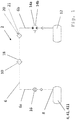
- the assembly shown comprises a fluoroketone decomposition system 2, which is connected with an educt container 4 in the form of a tank 41, and which typically is the housing 411 of an electrical apparatus, in which a fluoroketone-containing insulation and/or arc extinction medium is used.
- Fig. 1 depicts the situation, where the housing of the electrical apparatus shall be emptied at the end of life of the insulation and/or arc extinction medium.
- the fluoroketone decomposition system 2 comprises a gas line 6, which is fluidly connected with the educt container 4 via an opening 8.
- the gas line 6 can be in the form of a tube, which is fitting a respective socket or port of the educt container 4.
- a primary section 6a of the gas line leads to a filter 10 comprising the base B1, whereas a secondary section 6b arranged downstream of the filter 10 leads to a product container 12 (or product tank).
- a vacuum pump 14a or a compressor 14b is connected to the gas line 6.
- a flowmeter 16 is connected to the gas line 6 for determining the gas flow through the gas line.
- the flowmeter 16 is connected to the primary section 6a and the vacuum pump or compressor 14a, 14b is connected to the secondary section 6b of the gas line.
- a gas flow through the gas line 6 in direction from the educt container 4 towards the product container 12 is generated by means of the vacuum pump 14a (in case the pressure in container 4 is higher than 1 bar) or the compressor 14b (in case the pressure in container 4 is equal or lower than 1 bar).
- the gas passes the filter 10, where fluoroketone, in particular C5-FK, is brought into contact and reacts with the base B1.
- fluoroketone in particular C5-FK
- the gas mixture containing the disposable decomposition products is then guided through the second section 6b of the gas line 6 to the product container 12, where the gas mixture is collected and eventually released into the atmosphere.
- a stainless steel 500 ml autoclave was filled with 400 mbar of C5-FK, specifically 1,1,1,3,4,4,4-heptafluoro-3-(trifluoromethyl)butan-2-one (according to structural formula I given above).
- the autoclave was filled with technical air up to a total pressure of 2 bar.
- GC-MS gas chromatography-mass spectrometry
- the autoclave was placed in an oven at a temperature of 100°C and left inside the oven overnight. After this heating period, a final sample was taken and analyzed via GC-MS and via Fourier-transform infrared spectroscopy (FT-IR). Also, the "aged" potassium tertbutoxide was analyzed.
- FT-IR Fourier-transform infrared spectroscopy
- C5-FK was efficiently decomposed by bringing it into contact with potassium tertbutoxide.
- an entire decomposition could be achieved within about 50 minutes.
- a relatively high decomposition rate was determined for the other samples (brought into contact with 1 or 2 equivalents of potassium tertbutoxide, respectively).
Landscapes
- Engineering & Computer Science (AREA)
- Chemical & Material Sciences (AREA)
- Physics & Mathematics (AREA)
- Spectroscopy & Molecular Physics (AREA)
- Health & Medical Sciences (AREA)
- Biomedical Technology (AREA)
- Environmental & Geological Engineering (AREA)
- Analytical Chemistry (AREA)
- General Chemical & Material Sciences (AREA)
- Oil, Petroleum & Natural Gas (AREA)
- Chemical Kinetics & Catalysis (AREA)
- Organic Low-Molecular-Weight Compounds And Preparation Thereof (AREA)
Abstract
Description
- The present invention relates to a method for decomposing a fluoroketone, in particular a fluoroketone containing exactly five carbon atoms, into disposable decomposition products. It further relates to a fluoroketone decomposition system as well as to an assembly of a fluoroketone decomposition system and an educt container, the latter being in particular a housing of an electrical apparatus.
- Dielectric insulation media in liquid or gaseous state are conventionally applied for the insulation of an electrical component in a wide variety of electrical apparatuses, such as for example switchgears, gas-insulated substations (GIS), gas-insulated lines (GIL), or transformers.
- In medium or high voltage metal-encapsulated switchgears, for example, the electrical component is arranged in a gastight housing, which defines an insulating space, said insulation space comprising an insulation gas and separating the housing from the electrical component without letting electrical current to pass through. For interrupting the current in high voltage switchgear, the insulating gas further functions as an arc extinction gas.
- Recently, the use of organofluorine compounds in an insulating gas has been suggested. Specifically, WO-A-2010/ 142346 discloses a dielectric insulation medium comprising a fluoroketone having from 4 to 12 carbon atoms. Furthermore,
WO-A-2012/080246 discloses a fluoroketone containing exactly 5 carbon atoms (hereinafter referred to as "C5-FK") in a mixture with a dielectric insulation gas component different from the C5K to be particularly preferred. - The fluoroketones according to
WO-A-2010/142346 , and in particular according toWO-A-2012/080246 , have been shown to have high insulation capabilities, specifically a high dielectric strength, as well as high arc extinction capabilities. At the same time, they have a very low Global Warming Potential (GWP) and very low toxicity. The combination of these characteristics renders these organofluorine compounds highly suitable as a substitute for SF6 (sulphur hexafluoride), which has commonly been used as a dielectric insulation medium, but which is known to have a high GWP. - Despite of the ecological friendliness of the fluoroketones according to
WO-A-2010/142346 , and in particularWO-A-2012/080246 , an intentional release of the compound at the end of the lifetime of the apparatus is not recommended. - One approach to handle the remaining fluoroketone in the insulation medium at the end of the lifetime is to recycle it. In this regard, the approach according to
WO-A-2017/029338 may be chosen, relating to a method for reclaiming at least one substance from an insulation medium of an electrical apparatus. The method according toWO-A-2017/029338 comprises the subsequent steps of: - a) transferring an initial gas mixture containing the organofluorine compound and at least one further component of the insulation medium into a substance reclaiming device,
- b) liquefying the organofluorine compound in the substance reclaiming device by
- bl) compressing the initial gas mixture, and
- b2) cooling the compressed initial gas mixture down to a temperature at which the organofluorine compound liquefies,
- c) separating the liquefied organofluorine compound from the remaining gas comprising the at least one remaining component of the initial gas mixture, and
- d) expanding the remaining gas via a balancing valve and reintroducing at least a portion of the remaining gas back into the insulation space.
- Although the technique according to
WO-A-2017/029338 allows the recycling of the fluoroketone, relatively complex separation techniques are required for recovering it in pure form, which renders the technique laborious. - One other approach would be to incinerate the fluoroketone in a specifically equipped incineration plant. This would, however, require collection of the used gas mixtures from different sites of operation, which goes along with relative complex logistics and high transportation costs.
- In consideration of the drawbacks mentioned above, the problem to be solved by the present invention is thus to provide a simple and efficient method for converting the fluoroketone into a form, in which it can be safely disposed. In particular, a simple method and system for emptying an apparatus, in which a fluoroketone-containing insulation or arc-extinction medium is used, shall be provided, specifically for emptying the apparatus at its end of lifetime.
- The problem is solved by the subject-matter of
independent claim 1. Preferred embodiments are defined in the dependent claims, claim combinations, and in the description and accompanying drawings. - According to the method of
claim 1, a fluoroketone, and in particular a fluoroketone containing exactly five carbon atoms, is decomposed into disposable decomposition products by bringing an initial gas mixture containing the fluoroketone into contact with a base B1, the pKa value of the respective conjugate acid being higher than 11. - Preferably, a base B1 is used, the respective conjugate acid of which having a pKa value higher than 14 and more preferably a pKa value of at least 17. In particular, an alcoholate is used as base B1, preferably a sterically hindered alcoholate, more preferably a tert-butoxide, and specifically potassium tert-butoxide (the conjugate acid of which has a pKa value of 17).
- It has been found that by using a base B1 according to the above definition, and in particular potassium tert-butoxide, a very efficient decomposition of the fluoroketone can be achieved, allowing to relative fast obtain a disposable gas mixture, which can be released to the atmosphere without negative consequences.
- As known to the skilled person, the "pKa value" refers to the acid dissociation constant at logarithmic scale, according to the equation:

- As a rule, acids having a pKa value in the range of -2 to 12 in water are designated "weak acids", whereas acids with a pKa value of less than about -2 are designated "strong acids". Since the conjugate acid of base B1 (having a pKa value of higher than 11) is weak, preferably very weak, the base B1 is thus a strong base, preferably a very strong base within this terminology.
- Generally, the fluoroketone and the decomposition products generated by the process of the present invention is gaseous at ambient temperature and pressure. The term "dispose" as used in the context of the present invention thus generally relates to a release of the decomposition products into the atmosphere.
- The term "disposable" hence typically means that the respective gaseous substance exhibits no or only negligible GWP, Ozone Depletion Potential (ODP) and toxicity, such that its release into the atmosphere has no negative consequences on the environment and in particular does not contribute to the "greenhouse effect".
- The term "initial gas mixture" as used in the context of this invention shall be interpreted broadly and encompasses any possible gas mixture containing the fluoroketone, but in particular relates to a fluoroketone-containing insulation or arc-extinction medium, specifically at the end of lifetime of the apparatus, in which it is used.
- More particular, the "initial gas mixture" comprises apart from the fluoroketone at least one further component, specifically a background gas (or "carrier gas") or a background gas component, and/or decomposition products generated from decomposition of the fluoroketone.
- The term "fluoroketone" as used in the context of this invention shall be interpreted broadly and shall encompass both perfluoroketones and hydrofluoroketones, and shall further encompass both saturated compounds and unsaturated compounds, i.e. compounds including double and/or triple bonds between carbon atoms. The at least partially fluorinated alkyl chain of the fluoroketones can be linear or branched, or can form a ring, which optionally is substituted by one or more alkyl groups. In exemplary embodiments, the fluoroketone is a perfluoroketone. In further exemplary embodiment, the fluoroketone has a branched alkyl chain, in particular an at least partially fluorinated alkyl chain. In still further exemplary embodiments, the fluoroketone is a fully saturated compound.
- According to another aspect, the initial gas mixture according to the present invention can comprise a fluoroketone having from 4 to 12 carbon atoms, the at least partially fluorinated alkyl chain of the fluoroketone forming a ring, which is optionally substituted by one or more alkyl groups.
- It is particularly preferred that the insulation medium comprises a fluoroketone containing exactly five or exactly six carbon atoms or mixtures thereof. Compared to fluoroketones having a greater chain length with more than six carbon atoms, fluoroketones containing five or six carbon atoms have the advantage of a relatively low boiling point, allowing to avoid liquefaction under operational conditions. Nevertheless, the boiling point of this fluoroketone is still high enough to allow liquefaction by means of the liquefaction device of the present invention.
- According to embodiments, the fluoroketone is at least one compound selected from the group consisting of the compounds defined by the following structural formulae in which at least one hydrogen atom is substituted with a fluorine atom:


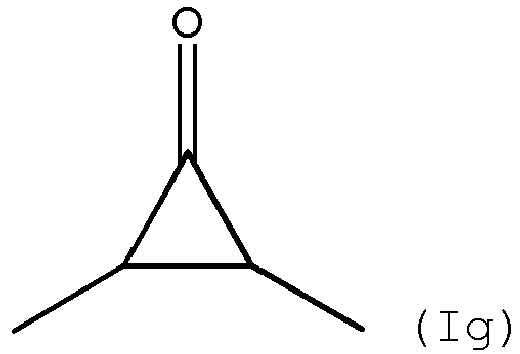


- Fluoroketones containing five or more carbon atoms are further advantageous, because they are generally non-toxic with outstanding margins for human safety. This is in contrast to fluoroketones having less than four carbon atoms, such as hexafluoroacetone (or hexafluoropropanone), which are toxic and very reactive. In particular, fluoroketones containing exactly five carbon atoms, herein briefly named fluoroketones a), and fluoroketones containing exactly six carbon atoms are thermally stable up to 500°C.
- According to a specific embodiment, the initial gas mixture according to the present invention, in particular comprising a fluoroketone having exactly 5 carbon atoms, can further comprise a background gas, in particular selected from the group consisting of: air, air component, nitrogen, oxygen, carbon dioxide, a nitrogen oxide (including but not limited to NO2, NO, N2O), and mixtures thereof.
- In embodiments of this invention, the fluoroketones, in particular fluoroketones a), having a branched alkyl chain are preferred, because their boiling points are lower than the boiling points of the corresponding compounds (i.e. compounds with same molecular formula) having a straight alkyl chain.
- According to embodiments, the fluoroketone a) is a perfluoroketone, in particular has the molecular formula C5F10O, i.e. is fully saturated without double or triple bonds between carbon atoms. The fluoroketone a) may preferably be selected from the group consisting of 1,1,1,3,4,4,4-heptafluoro-3-(trifluoromethyl)butan-2-one (also named deca-fluoro-2-methylbutan-3-one), 1,1,1,3,3,4,4,5,5,5-decafluoro-pentan-2-one, 1,1,1,2,2,4,4,5,5,5-decafluoropentan-3-one and octafluorocylcopentanone, and most preferably is 1,1,1,3,4,4,4-heptafluoro-3-(trifluoromethyl)butan-2-one.
- 1,1,1,3,4,4,4-heptafluoro-3-(trifluoromethyl)butan-2-one can be represented by the following structural formula (I):

- 1,1,1,3,4,4,4-heptafluoro-3-(trifluoromethyl)butan-2-one, here briefly called "C5-ketone", with molecular formula CF3C(O)CF(CF3)2 or C5F10O, has been found to be particularly preferred for high and medium voltage insulation applications, because it has the advantages of high dielectric insulation performance, in particular in mixtures with a dielectric carrier gas, has very low GWP and has a low boiling point. It has an ODP of 0 and is practically non-toxic.
- According to embodiments, even higher insulation capabilities can be achieved by combining the mixture of different fluoroketone components. In embodiments, a fluoroketone containing exactly five carbon atoms, as described above and here briefly called fluoroketone a), and a fluoroketone containing exactly six carbon atoms or exactly seven carbon atoms, here briefly named fluoroketone c), can favourably be part of the dielectric insulation at the same time. Thus, an insulation medium can be achieved having more than one fluoroketone, each contributing by itself to the dielectric strength of the insulation medium.
- In embodiments, the further fluoroketone c) is at least one compound selected from the group consisting of the compounds defined by the following structural formulae in which at least one hydrogen atom is substituted with a fluorine atom:


and/or is at least one compound selected from the group consisting of the compounds defined by the following structural formulae in which at least one hydrogen atom is substituted with a fluorine atom:


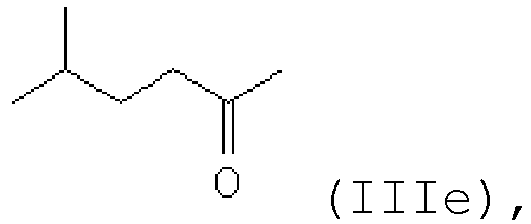


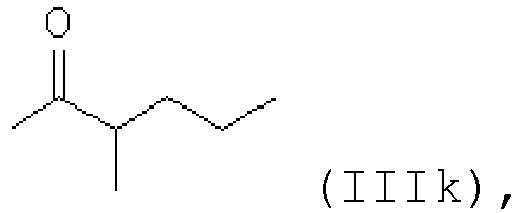


as well as any fluoroketone having exactly 7 carbon atoms, in which the at least partially fluorinated alkyl chain of the fluoroketone forms a ring, which is substituted by one or more alkyl groups (IIIo). - The present invention encompasses each compound or each combination of compounds selected from the group consisting of the compounds according to structural formulae (Ia) to (Ii), (IIa) to (IIh), (IIIa) to (IIIo), and mixtures thereof, and in particular with the gas mixture further comprising a background gas, which is preferably selected from the group consisting of: air, air component, nitrogen, oxygen, carbon dioxide, a nitrogen oxide (including but not limited to NO2, NO, N2O), and mixtures thereof.
- According to another aspect, the initial gas mixture according to the present invention can comprise a fluoroketone having exactly 6 carbon atoms, in which the at least partially fluorinated alkyl chain of the fluoroketone forms a ring, optionally substituted by one or more alkyl groups.
- As mentioned, such insulation medium can comprise a background gas, in particular selected from the group consisting of: air, air component, nitrogen, oxygen, carbon dioxide, a nitrogen oxide (including but not limited to NO2, NO, N2O), and mixtures thereof. Furthermore, an electrical apparatus comprising such an insulation medium is disclosed.
- According to still another aspect, the initial gas mixture according to the present invention can comprise a fluoroketone having exactly 7 carbon atoms, in which the at least partially fluorinated alkyl chain of the fluoroketone forms a ring, optionally substituted by one or more alkyl groups. Furthermore, such an insulation medium can comprise a background gas, as mentioned above, in particular selected from the group consisting of: air, air component, nitrogen, oxygen, carbon dioxide, a nitrogen oxide (including but not limited to NO2, NO, N2O), and mixtures thereof. Furthermore, an electrical apparatus comprising such a dielectric insulation fluid is disclosed.
- Depending on the specific application of the electrical component of the apparatus of the present invention, a fluoroketone containing exactly six carbon atoms (falling under the designation "fluoroketone c)" mentioned above) may be preferred for the respective insulation space compartment; such a fluoroketone is non-toxic, with outstanding margins for human safety.
- In embodiments, fluoroketone c), alike fluoroketone a), is a perfluoroketone, and/or has a branched alkyl chain, in particular an at least partially fluorinated alkyl chain, and/or the fluoroketone c) contains fully saturated compounds. In particular, the fluoroketone c) has the molecular formula C6F12O, i.e. is fully saturated without double or triple bonds between carbon atoms. More preferably, the fluoroketone c) can be selected from the group consisting of 1,1,1,2,4,4,5,5,5-nonafluoro-2-(trifluoromethyl)pentan-3-one (also named dodecafluoro-2-methylpentan-3-one), 1,1,1,3,3,4,5,5,5-nonafluoro-4-(trifluoromethyl)pentan-2-one (also named dodecafluoro-4-methylpentan-2-one), 1,1,1,3,4,4,5,5,5-nonafluoro-3-(trifluoromethyl)pentan-2-one (also named dodecafluoro-3-methylpentan-2-one), 1,1,1,4,4,4-hexafluoro-3,3-bis-(trifluoromethyl)butan-2-one (also named dodecafluoro-3,3-(dimethyl)butan-2-one), dodecafluorohexan-2-one, dodecafluorohexan-3-one and decafluorocyclohexanone (with sum formula C6F10O), and particularly is the mentioned 1,1,1,2,4,4,5,5,5-nonafluoro-2-(trifluoromethyl)pentan-3-one.
- 1,1,1,2,4,4,5,5,5-Nonafluoro-2-(trifluoromethyl)pentan-3-one (also named dodecafluoro-2-methylpentan-3-one) can be represented by the following structural formula (II):

- 1,1,1,2,4,4,5,5,5-Nonafluoro-4-(trifluoromethyl)pentan-3-one (here briefly called "C6-ketone", with molecular formula C2F5C(O)CF(CF3)2) has been found to be particularly preferred for high voltage insulation applications because of its high insulating properties and its extremely low GWP. Specifically, its pressure-reduced breakdown field strength is around 240 kV/(cm*bar), which is much higher than the one of air having a much lower dielectric strength (Ecr = 25 kV/(cm*bar). It has an ozone depletion potential of 0 and is non-toxic. Thus, the environmental impact is much lower than when using SF6, and at the same time outstanding margins for human safety are achieved.
- According to a particularly preferred embodiment of the method according to the present invention, the initial gas mixture is brought into contact with an excess amount of base B1 in relation to the amount of fluoroketone to be decomposed.
- In particular when using potassium tert-butoxide, an excess amount of base B1 not only allows for a particularly efficient fluoroketone decomposition. Surprisingly, it has also been found that by using an excess amount of base B1, lower amounts of free 2H-heptafluoropropane and hexafluoropropene are contained in the resulting gas mixture to be disposed. Hence, a disposable gas mixture which is substantially free of any toxic components can be achieved by the method of the present invention, as will be explained in further detail by way of the working examples discussed below. With regard to this preferred embodiment, the use of at least 2, preferably at least 3 equivalents of base B1 in relation to the amount of fluoroketone to be decomposed, has been turned out to be particularly preferred.
- According to a straightforward and thus preferred embodiment, the initial gas mixture is passed through a filter containing the base B1. In this regard, it has further been found that the filter is preferably heated, since thereby an increase in the decomposition rate is achieved. Specifically, heating to a temperature in the range from 60°C to 100°C has been shown to be particularly preferred.
- It has been found that in some cases, trifluoracetic acid (TFA) can be present after having brought the initial gas mixture into contact with the base B1. In order to remove TFA, the decomposition products generated by the reaction with the base B1 are, according to a further preferred embodiment, subsequently brought into contact with a neutralizing substance, in particular a base B2 different from the base B1. Generally, the base B2 is much weaker than the base B1 and typically is or contains an inorganic base, and specifically is an aqueous NaOH solution.
- Apart from the method described above, the present invention also relates - according to a further aspect - to a fluoroketone decomposition system, i.e. decomposition device. The fluoroketone decomposition system comprises a gas line to be fluidly connected with an educt container containing the fluoroketone to be decomposed, said gas line opening into a product container for storing the decomposition products.
- According to the invention, a filter comprising a base B1 is arranged in the gas line, the pKa value of the respective conjugate acid being higher than 11, preferably higher than 14 and more preferably at least 17.
- With regard to the preferred features defined above in the context of the method of the present invention, these features are likewise preferred for the fluoroketone decomposition system. In particular, potassium tert-butoxide is preferably used in the fluoroketone decomposition system.
- According to a further preferred embodiment, the fluoroketone decomposition system comprises a pump and/or a compressor to generate a gas flow from the educt container towards the product container. The gas flow can be determined by a flowmeter and is ideally adjusted in a manner that the contact of the initial gas mixture with the filter lasts sufficiently long for ensuring complete decomposition of the fluoroketone.
- In analogy to what has been said above in the context of the method, the fluoroketone decomposition system preferably comprises heating means allocated to the filter, in order to allow for a higher decomposition rate and ultimately for a higher efficiency of the system.
- According to a further preferred embodiment, a reactor comprising a neutralizing substance is arranged in the gas line downstream of the filter. By means of the reactor, TFA generated in the course of the fluoroketone decomposition can be neutralized and thus removed from the gas mixture to be disposed.
- The present invention is illustrated by way of the following working example along with the figures, of which
- Fig. 1
- shows schematically an assembly according to the present invention comprising a fluoroketone decomposition system;
- Fig. 2
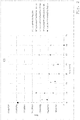
- relates to a diagram showing the amount of C5-FK (indicated by its respective chromatographic peak area) in a gas mixture after different periods of contacting the gas mixture with different amounts of tert-butylate (tert-butoxide) in a respective filter as well as after final heating of the filter;
- Fig. 3
- relates to a diagram showing the concentration of hexafluoropropene after several periods of contacting a gas mixture containing C5-FK with different amounts of tert-butylate (tert-butoxide) in a respective filter as well as after final heating of the filter;
- Fig. 4
- relates to a diagram showing the concentration of 2H-heptafluoropropane after several periods of contacting a gas mixture containing C5-FK with different amounts of tert-butylate (tert-butoxide) in a respective filter as well as after final heating of the filter; and
- Fig. 5
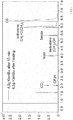
- relates to a chromatogram of the gas mixture resulting from the contacting with 3 equivalents of potassium tert-butoxide after 10 minutes of contacting and after additional heating.
- According to
Fig. 1 , the assembly shown comprises afluoroketone decomposition system 2, which is connected with an educt container 4 in the form of a tank 41, and which typically is the housing 411 of an electrical apparatus, in which a fluoroketone-containing insulation and/or arc extinction medium is used. Thus,Fig. 1 depicts the situation, where the housing of the electrical apparatus shall be emptied at the end of life of the insulation and/or arc extinction medium. - Specifically, the
fluoroketone decomposition system 2 comprises agas line 6, which is fluidly connected with the educt container 4 via anopening 8. For example, thegas line 6 can be in the form of a tube, which is fitting a respective socket or port of the educt container 4. Aprimary section 6a of the gas line leads to afilter 10 comprising the base B1, whereas asecondary section 6b arranged downstream of thefilter 10 leads to a product container 12 (or product tank). As the case may be, avacuum pump 14a or acompressor 14b is connected to thegas line 6. In addition, aflowmeter 16 is connected to thegas line 6 for determining the gas flow through the gas line. In the specific embodiment shown, theflowmeter 16 is connected to theprimary section 6a and the vacuum pump orcompressor secondary section 6b of the gas line. - During operation, a gas flow through the
gas line 6 in direction from the educt container 4 towards theproduct container 12 is generated by means of thevacuum pump 14a (in case the pressure in container 4 is higher than 1 bar) or thecompressor 14b (in case the pressure in container 4 is equal or lower than 1 bar). Thereby, the gas passes thefilter 10, where fluoroketone, in particular C5-FK, is brought into contact and reacts with the base B1. Thus, disposable decomposition products are generated, in particular isobutene. - The gas mixture containing the disposable decomposition products is then guided through the
second section 6b of thegas line 6 to theproduct container 12, where the gas mixture is collected and eventually released into the atmosphere. - The technical effect of the method of the present invention is shown by means of the following working example, in connection with
Fig. 2 to 5 . - According to the example, a stainless steel 500 ml autoclave was filled with 400 mbar of C5-FK, specifically 1,1,1,3,4,4,4-heptafluoro-3-(trifluoromethyl)butan-2-one (according to structural formula I given above). In addition, the autoclave was filled with technical air up to a total pressure of 2 bar.
- Prior to gas filling, different amounts of potassium tertbutoxide (1, 2 and 3 equivalents with respect to the amount of C5-FK) were placed inside the autoclave.
- A reference measurement of the gas composition was carried out using gas chromatography-mass spectrometry (GC-MS) immediately after filling. Further measurements were carried out during the following hour in intervals of about 15 minutes. For the samples brought into contact with 2 and 3 equivalents of potassium tertbutoxide, two runs were carried out.
- After the first hour of bringing the C5-FK containing gas mixture into contact with potassium tertbutoxide, the autoclave was placed in an oven at a temperature of 100°C and left inside the oven overnight. After this heating period, a final sample was taken and analyzed via GC-MS and via Fourier-transform infrared spectroscopy (FT-IR). Also, the "aged" potassium tertbutoxide was analyzed.
- A shown in
Fig. 2 , C5-FK was efficiently decomposed by bringing it into contact with potassium tertbutoxide. In particular, for the samples brought into contact with 3 equivalents of potassium tertbutoxide, an entire decomposition could be achieved within about 50 minutes. Also for the other samples (brought into contact with 1 or 2 equivalents of potassium tertbutoxide, respectively), a relatively high decomposition rate was determined. - Moreover, it was found that heating (points at 60 minutes in the diagram) has a positive effect on increasing the decomposition rate, which allows entire decomposition of the sample brought into contact with 2 equivalents of potassium tertbutoxide.
- The presence of an excess amount of potassium tertbutoxide not only leads to a higher C5-FK decomposition rate, but also to a lower amount of free 2H-heptafluoropropane and hexafluoropropene in the resulting gas mixture, as shown in
Fig. 3 andFig. 4 . This can be explained by the potassium tertbutoxide (being present in excess amounts, briefly called KtertBu inFig. 5 ) reacting with 2H-heptafluoropropane and hexafluoropropene, which was confirmed by FT-IR analysis of the solid reactant after aging, showing a strong degree of fluorination of the solid. - Thus, by using an excess amount of potassium tertbutoxide as reactant and by applying heat to the reactor, an efficient C5-FK decomposition can be achieved, whereby the presence of toxic 2H-heptafluoropropane and hexafluoropropene in the resulting gas mixture can be avoided at least approximately (i.e. kept at an amount well below 100 ppm), as further shown in
Fig. 5 . - Whereas according to
Fig. 5 the amount of 2H-heptafluoropropane (briefly named "hepta") and hexafluoropropene (briefly named "hexa") decreases or diminishes after aging and heating, an increasing amount of isobutene (CH2C(CH3)2) is generated. However, in contrast to 2H-heptafluoropropane and hexafluoropropene, isobutene is non-toxic. In addition, it has a GWP of far less than 1 and an ODP of 0, and can therefore be released into the atmosphere without any negative effect. -
- 2
- fluoroketone decomposition system
- 4; 41, 411
- educt container
- 41
- tank
- 411
- housing of apparatus
- 6; 6a, 6b
- gas line
- 6a
- primary section of gas line
- 6b
- secondary section of gas line
- 8
- opening
- 10
- filter
- 12
- product container
- 14a
- vacuum pump
- 14b
- compressor
- 16
- flowmeter
- 18
- heating means
- 20
- reactor
- 21
- neutralizing substance
Claims (15)
- Method for decomposing a fluoroketone, in particular a fluoroketone containing exactly five carbon atoms, into disposable decomposition products, said method comprising the step of bringing an initial gas mixture containing the fluoroketone into contact with a base B1, the pKa value of the respective conjugate acid being higher than 11.
- Method according to claim 1, wherein the pKa value of the respective conjugate acid of the base B1 is higher than 14, and preferably is at least 17.
- Method according to any of the preceding claims, the base B1 being an alcoholate, in particular a sterically hindered alcoholate, more particularly a tert-butoxide, and specifically potassium tert-butoxide.
- Method according to any of the preceding claims, wherein the initial gas mixture is brought into contact with an excess amount of the base B1 in relation to the amount of fluoroketone to be decomposed.
- Method according to any of the preceding claims, wherein at least 2, preferably at least 3 equivalents of the base B1 are used in relation to the amount of fluoroketone to be decomposed.
- Method according to any of the preceding claims, wherein the initial gas mixture is passed through a filter (10) containing the base B1.
- Method according to any of the preceding claims, wherein the filter (10) is heated, in particularly to a temperature in the range from 60°C to 100°C.
- Method according to any of the preceding claims, wherein after the step of bringing the fluoroketone into contact with the base B1, the decomposition products generated are subsequently brought into contact with a neutralizing substance, in particular a second base B2 different from the base B1, and more particularly an aqueous NaOH solution.
- Fluoroketone decomposition system comprising a gas line (6; 6a, 6b) to be fluidly connected with an educt container (4; 41, 411) containing the fluoroketone to be decomposed, said gas line (6; 6a, 6b) opening into a product container (12) for storing the decomposition products, wherein a filter (10) comprising a base B1 is arranged in the gas line (6; 6a, 6b), the pKa value of the conjugate acid of the base B1 being higher than 11.
- Fluoroketone decomposition system according to claim 9, further comprising a pump (14a) and/or a compressor (14b) to generate a gas flow from the educt container (4; 41, 411) towards the product container (12).
- Fluoroketone decomposition system according to claim 9 or 10, further comprising heating means (18) allocated to the filter (10).
- Fluoroketone decomposition system according to any of claims 9 to 11, wherein downstream of the filter (10) a reactor (20) comprising a neutralizing substance (21) is arranged in the gas line (6; 6a, 6b).
- Assembly comprising the fluoroketone decomposition system according to any of claims 9 to 12 and an educt container (4; 41, 411).
- Assembly according to claim 13, wherein the educt container is the housing (411) of an electrical apparatus.
- Assembly according to claim 13 or 14, the apparatus is or is part of a: switchgear, in particular gas-insulated switchgear (GIS), or part and/or component thereof, gas-insulated line (GIL), busbar, bushing, cable, gas-insulated cable, cable joint, current transformer, voltage transformer, sensor, humidity sensor, surge arrester, capacitor, inductance, resistor, insulator, air-insulated insulator, a gas-insulated metal-encapsulated insulator, current limiter, high voltage switch, earthing switch, disconnector, combined disconnector and earthing switch, load-break switch, circuit breaker, gas circuit breaker, generator circuit breaker, gas-insulated vacuum circuit breaker, medium voltage switch, ring main unit, recloser, sectionalizer, low voltage switch, and/or any type of gas-insulated switch, transformer, distribution transformer, power transformer, tap changer, transformer bushing, electrical rotating machine, generator, motor, drive, semiconducting device, computing machine, power semiconductor device, power converter, converter station, convertor building, and components and/or combinations of such devices.
Priority Applications (2)
| Application Number | Priority Date | Filing Date | Title |
|---|---|---|---|
| EP18164517.7A EP3546055B1 (en) | 2018-03-28 | 2018-03-28 | Method and system for decomposing a fluoroketone into disposable decomposition products |
| PCT/EP2019/057740 WO2019185727A1 (en) | 2018-03-28 | 2019-03-27 | Method for decomposing a fluoroketone into disposable decomposition products |
Applications Claiming Priority (1)
| Application Number | Priority Date | Filing Date | Title |
|---|---|---|---|
| EP18164517.7A EP3546055B1 (en) | 2018-03-28 | 2018-03-28 | Method and system for decomposing a fluoroketone into disposable decomposition products |
Publications (2)
| Publication Number | Publication Date |
|---|---|
| EP3546055A1 true EP3546055A1 (en) | 2019-10-02 |
| EP3546055B1 EP3546055B1 (en) | 2021-01-13 |
Family
ID=61832371
Family Applications (1)
| Application Number | Title | Priority Date | Filing Date |
|---|---|---|---|
| EP18164517.7A Active EP3546055B1 (en) | 2018-03-28 | 2018-03-28 | Method and system for decomposing a fluoroketone into disposable decomposition products |
Country Status (2)
| Country | Link |
|---|---|
| EP (1) | EP3546055B1 (en) |
| WO (1) | WO2019185727A1 (en) |
Cited By (2)
| Publication number | Priority date | Publication date | Assignee | Title |
|---|---|---|---|---|
| CN114034803A (en) * | 2021-12-09 | 2022-02-11 | 沈阳工业大学 | A device and method for detecting C5F10O gas discharge decomposition components |
| CN114035005A (en) * | 2021-11-18 | 2022-02-11 | 国网重庆市电力公司电力科学研究院 | Gas insulation equipment local overheating decomposition simulation experiment device and use method thereof |
Families Citing this family (1)
| Publication number | Priority date | Publication date | Assignee | Title |
|---|---|---|---|---|
| CN114152697A (en) * | 2021-11-30 | 2022-03-08 | 国网重庆市电力公司电力科学研究院 | Detection method and application of perfluoropentanone gas decomposition product |
Citations (8)
| Publication number | Priority date | Publication date | Assignee | Title |
|---|---|---|---|---|
| US2807646A (en) * | 1955-03-14 | 1957-09-24 | Allied Chem & Dye Corp | Manufacture of chlorofluoroacetones |
| EP0771579A1 (en) * | 1995-10-30 | 1997-05-07 | Central Glass Company, Limited | Method for decomposing halide-containing gas |
| WO2010142346A1 (en) | 2009-06-12 | 2010-12-16 | Abb Technology Ag | Dielectric insulation medium |
| WO2012080246A1 (en) | 2010-12-14 | 2012-06-21 | Abb Technology Ag | Dielectric insulation medium |
| WO2014174328A1 (en) * | 2013-04-26 | 2014-10-30 | Auro-Science Consulting Kft. | Nanoiron suspension, process for the preparation thereof its use and device for the preparation of nanoiron suspension |
| EP2904617A1 (en) * | 2012-10-05 | 2015-08-12 | ABB Technology AG | Apparatus containing a dielectric insulation gas comprising an organofluorine compound |
| WO2015177149A1 (en) * | 2014-05-20 | 2015-11-26 | Abb Technology Ag | Electrical apparatus for the generation, transmission, distribution and/or usage of electrical energy and method for recovering a substance from an insulation medium of such an apparatus |
| WO2017029338A1 (en) | 2015-08-19 | 2017-02-23 | Abb Schweiz Ag | Method for reclaiming at least one substance from an insulation medium of an electrical apparatus for the generation, transmission, distribution and/or usage of electrical energy |
-
2018
- 2018-03-28 EP EP18164517.7A patent/EP3546055B1/en active Active
-
2019
- 2019-03-27 WO PCT/EP2019/057740 patent/WO2019185727A1/en not_active Ceased
Patent Citations (8)
| Publication number | Priority date | Publication date | Assignee | Title |
|---|---|---|---|---|
| US2807646A (en) * | 1955-03-14 | 1957-09-24 | Allied Chem & Dye Corp | Manufacture of chlorofluoroacetones |
| EP0771579A1 (en) * | 1995-10-30 | 1997-05-07 | Central Glass Company, Limited | Method for decomposing halide-containing gas |
| WO2010142346A1 (en) | 2009-06-12 | 2010-12-16 | Abb Technology Ag | Dielectric insulation medium |
| WO2012080246A1 (en) | 2010-12-14 | 2012-06-21 | Abb Technology Ag | Dielectric insulation medium |
| EP2904617A1 (en) * | 2012-10-05 | 2015-08-12 | ABB Technology AG | Apparatus containing a dielectric insulation gas comprising an organofluorine compound |
| WO2014174328A1 (en) * | 2013-04-26 | 2014-10-30 | Auro-Science Consulting Kft. | Nanoiron suspension, process for the preparation thereof its use and device for the preparation of nanoiron suspension |
| WO2015177149A1 (en) * | 2014-05-20 | 2015-11-26 | Abb Technology Ag | Electrical apparatus for the generation, transmission, distribution and/or usage of electrical energy and method for recovering a substance from an insulation medium of such an apparatus |
| WO2017029338A1 (en) | 2015-08-19 | 2017-02-23 | Abb Schweiz Ag | Method for reclaiming at least one substance from an insulation medium of an electrical apparatus for the generation, transmission, distribution and/or usage of electrical energy |
Cited By (3)
| Publication number | Priority date | Publication date | Assignee | Title |
|---|---|---|---|---|
| CN114035005A (en) * | 2021-11-18 | 2022-02-11 | 国网重庆市电力公司电力科学研究院 | Gas insulation equipment local overheating decomposition simulation experiment device and use method thereof |
| CN114034803A (en) * | 2021-12-09 | 2022-02-11 | 沈阳工业大学 | A device and method for detecting C5F10O gas discharge decomposition components |
| CN114034803B (en) * | 2021-12-09 | 2023-11-21 | 沈阳工业大学 | Be used for detecting C 5 F 10 Device and method for decomposing components by O gas discharge |
Also Published As
| Publication number | Publication date |
|---|---|
| EP3546055B1 (en) | 2021-01-13 |
| WO2019185727A1 (en) | 2019-10-03 |
Similar Documents
| Publication | Publication Date | Title |
|---|---|---|
| EP3338285B1 (en) | Method for reclaiming at least one substance from an insulation medium of an electrical apparatus for the generation, transmission, distribution and/or usage of electrical energy | |
| US10256008B2 (en) | Electrical apparatus for the generation, transmission, distribution and/or usage of electrical energy and method for recovering a substance from an insulation medium of such an apparatus | |
| EP2652751B1 (en) | Dielectric insulation medium | |
| EP2441075B2 (en) | Dielectric insulation medium | |
| EP2652753B1 (en) | Dielectric insulation medium | |
| EP2936504B1 (en) | A method for dielectrically insulating active electric parts | |
| EP3546055B1 (en) | Method and system for decomposing a fluoroketone into disposable decomposition products | |
| CN114072881B (en) | Dielectric insulation or arc suppression fluid | |
| EP3453033B1 (en) | Methods for dielectrically insulating electrical active parts | |
| US20200365353A1 (en) | Use of 1-chloro-2,3,3,3-tetrafluoropropene for isolating or extinguishing electric arcs | |
| WO2016146197A1 (en) | Dielectric insulation or arc-extinction fluid | |
| EP3078657A1 (en) | Compounds for dielectrically insulating electric active parts | |
| CN116097374A (en) | Method for rebuilding medium-voltage or high-voltage electrical equipment | |
| EP3384508B1 (en) | Methods for dielectrically insulating electrical active parts | |
| EP3079157A1 (en) | Methods for dielectrically insulating electrical active parts | |
| EP3384505B1 (en) | Methods for dielectrically insulating electrical active parts | |
| Gao et al. | Research on Key Technologies and Standardization of Environment-friendly Insulation Gas C4F7N | |
| Boychev | Recovery and regeneration of alternative gases for insulation in gas-filled electricity facilities | |
| Wang et al. | Study on the Compatibility between Eco-friendly Insulating Gas Mixture and Solid Materials of Used in Gas-insulated Transformers Based on Thermal Acceleration Method | |
| EP3384504A1 (en) | Methods for dielectrically insulating electrical active parts | |
| Stangherlin | Environmental compatible use of SF6 | |
| HK1190496B (en) | Dielectric insulation medium |
Legal Events
| Date | Code | Title | Description |
|---|---|---|---|
| PUAI | Public reference made under article 153(3) epc to a published international application that has entered the european phase |
Free format text: ORIGINAL CODE: 0009012 |
|
| STAA | Information on the status of an ep patent application or granted ep patent |
Free format text: STATUS: THE APPLICATION HAS BEEN PUBLISHED |
|
| AK | Designated contracting states |
Kind code of ref document: A1 Designated state(s): AL AT BE BG CH CY CZ DE DK EE ES FI FR GB GR HR HU IE IS IT LI LT LU LV MC MK MT NL NO PL PT RO RS SE SI SK SM TR |
|
| AX | Request for extension of the european patent |
Extension state: BA ME |
|
| STAA | Information on the status of an ep patent application or granted ep patent |
Free format text: STATUS: REQUEST FOR EXAMINATION WAS MADE |
|
| 17P | Request for examination filed |
Effective date: 20200331 |
|
| RBV | Designated contracting states (corrected) |
Designated state(s): AL AT BE BG CH CY CZ DE DK EE ES FI FR GB GR HR HU IE IS IT LI LT LU LV MC MK MT NL NO PL PT RO RS SE SI SK SM TR |
|
| GRAP | Despatch of communication of intention to grant a patent |
Free format text: ORIGINAL CODE: EPIDOSNIGR1 |
|
| STAA | Information on the status of an ep patent application or granted ep patent |
Free format text: STATUS: GRANT OF PATENT IS INTENDED |
|
| INTG | Intention to grant announced |
Effective date: 20200724 |
|
| GRAS | Grant fee paid |
Free format text: ORIGINAL CODE: EPIDOSNIGR3 |
|
| GRAA | (expected) grant |
Free format text: ORIGINAL CODE: 0009210 |
|
| STAA | Information on the status of an ep patent application or granted ep patent |
Free format text: STATUS: THE PATENT HAS BEEN GRANTED |
|
| AK | Designated contracting states |
Kind code of ref document: B1 Designated state(s): AL AT BE BG CH CY CZ DE DK EE ES FI FR GB GR HR HU IE IS IT LI LT LU LV MC MK MT NL NO PL PT RO RS SE SI SK SM TR |
|
| REG | Reference to a national code |
Ref country code: GB Ref legal event code: FG4D |
|
| REG | Reference to a national code |
Ref country code: CH Ref legal event code: EP |
|
| REG | Reference to a national code |
Ref country code: IE Ref legal event code: FG4D |
|
| REG | Reference to a national code |
Ref country code: DE Ref legal event code: R096 Ref document number: 602018011729 Country of ref document: DE |
|
| REG | Reference to a national code |
Ref country code: AT Ref legal event code: REF Ref document number: 1354133 Country of ref document: AT Kind code of ref document: T Effective date: 20210215 |
|
| REG | Reference to a national code |
Ref country code: AT Ref legal event code: MK05 Ref document number: 1354133 Country of ref document: AT Kind code of ref document: T Effective date: 20210113 |
|
| REG | Reference to a national code |
Ref country code: NL Ref legal event code: MP Effective date: 20210113 |
|
| REG | Reference to a national code |
Ref country code: LT Ref legal event code: MG9D |
|
| PG25 | Lapsed in a contracting state [announced via postgrant information from national office to epo] |
Ref country code: NO Free format text: LAPSE BECAUSE OF FAILURE TO SUBMIT A TRANSLATION OF THE DESCRIPTION OR TO PAY THE FEE WITHIN THE PRESCRIBED TIME-LIMIT Effective date: 20210413 Ref country code: PT Free format text: LAPSE BECAUSE OF FAILURE TO SUBMIT A TRANSLATION OF THE DESCRIPTION OR TO PAY THE FEE WITHIN THE PRESCRIBED TIME-LIMIT Effective date: 20210513 Ref country code: LT Free format text: LAPSE BECAUSE OF FAILURE TO SUBMIT A TRANSLATION OF THE DESCRIPTION OR TO PAY THE FEE WITHIN THE PRESCRIBED TIME-LIMIT Effective date: 20210113 Ref country code: FI Free format text: LAPSE BECAUSE OF FAILURE TO SUBMIT A TRANSLATION OF THE DESCRIPTION OR TO PAY THE FEE WITHIN THE PRESCRIBED TIME-LIMIT Effective date: 20210113 Ref country code: GR Free format text: LAPSE BECAUSE OF FAILURE TO SUBMIT A TRANSLATION OF THE DESCRIPTION OR TO PAY THE FEE WITHIN THE PRESCRIBED TIME-LIMIT Effective date: 20210414 Ref country code: HR Free format text: LAPSE BECAUSE OF FAILURE TO SUBMIT A TRANSLATION OF THE DESCRIPTION OR TO PAY THE FEE WITHIN THE PRESCRIBED TIME-LIMIT Effective date: 20210113 Ref country code: BG Free format text: LAPSE BECAUSE OF FAILURE TO SUBMIT A TRANSLATION OF THE DESCRIPTION OR TO PAY THE FEE WITHIN THE PRESCRIBED TIME-LIMIT Effective date: 20210413 |
|
| PG25 | Lapsed in a contracting state [announced via postgrant information from national office to epo] |
Ref country code: AT Free format text: LAPSE BECAUSE OF FAILURE TO SUBMIT A TRANSLATION OF THE DESCRIPTION OR TO PAY THE FEE WITHIN THE PRESCRIBED TIME-LIMIT Effective date: 20210113 Ref country code: RS Free format text: LAPSE BECAUSE OF FAILURE TO SUBMIT A TRANSLATION OF THE DESCRIPTION OR TO PAY THE FEE WITHIN THE PRESCRIBED TIME-LIMIT Effective date: 20210113 Ref country code: PL Free format text: LAPSE BECAUSE OF FAILURE TO SUBMIT A TRANSLATION OF THE DESCRIPTION OR TO PAY THE FEE WITHIN THE PRESCRIBED TIME-LIMIT Effective date: 20210113 Ref country code: LV Free format text: LAPSE BECAUSE OF FAILURE TO SUBMIT A TRANSLATION OF THE DESCRIPTION OR TO PAY THE FEE WITHIN THE PRESCRIBED TIME-LIMIT Effective date: 20210113 Ref country code: SE Free format text: LAPSE BECAUSE OF FAILURE TO SUBMIT A TRANSLATION OF THE DESCRIPTION OR TO PAY THE FEE WITHIN THE PRESCRIBED TIME-LIMIT Effective date: 20210113 |
|
| PG25 | Lapsed in a contracting state [announced via postgrant information from national office to epo] |
Ref country code: IS Free format text: LAPSE BECAUSE OF FAILURE TO SUBMIT A TRANSLATION OF THE DESCRIPTION OR TO PAY THE FEE WITHIN THE PRESCRIBED TIME-LIMIT Effective date: 20210513 |
|
| REG | Reference to a national code |
Ref country code: DE Ref legal event code: R097 Ref document number: 602018011729 Country of ref document: DE |
|
| PG25 | Lapsed in a contracting state [announced via postgrant information from national office to epo] |
Ref country code: SM Free format text: LAPSE BECAUSE OF FAILURE TO SUBMIT A TRANSLATION OF THE DESCRIPTION OR TO PAY THE FEE WITHIN THE PRESCRIBED TIME-LIMIT Effective date: 20210113 Ref country code: CZ Free format text: LAPSE BECAUSE OF FAILURE TO SUBMIT A TRANSLATION OF THE DESCRIPTION OR TO PAY THE FEE WITHIN THE PRESCRIBED TIME-LIMIT Effective date: 20210113 Ref country code: EE Free format text: LAPSE BECAUSE OF FAILURE TO SUBMIT A TRANSLATION OF THE DESCRIPTION OR TO PAY THE FEE WITHIN THE PRESCRIBED TIME-LIMIT Effective date: 20210113 Ref country code: MC Free format text: LAPSE BECAUSE OF FAILURE TO SUBMIT A TRANSLATION OF THE DESCRIPTION OR TO PAY THE FEE WITHIN THE PRESCRIBED TIME-LIMIT Effective date: 20210113 |
|
| REG | Reference to a national code |
Ref country code: CH Ref legal event code: PL |
|
| PLBE | No opposition filed within time limit |
Free format text: ORIGINAL CODE: 0009261 |
|
| STAA | Information on the status of an ep patent application or granted ep patent |
Free format text: STATUS: NO OPPOSITION FILED WITHIN TIME LIMIT |
|
| PG25 | Lapsed in a contracting state [announced via postgrant information from national office to epo] |
Ref country code: DK Free format text: LAPSE BECAUSE OF FAILURE TO SUBMIT A TRANSLATION OF THE DESCRIPTION OR TO PAY THE FEE WITHIN THE PRESCRIBED TIME-LIMIT Effective date: 20210113 Ref country code: SK Free format text: LAPSE BECAUSE OF FAILURE TO SUBMIT A TRANSLATION OF THE DESCRIPTION OR TO PAY THE FEE WITHIN THE PRESCRIBED TIME-LIMIT Effective date: 20210113 Ref country code: RO Free format text: LAPSE BECAUSE OF FAILURE TO SUBMIT A TRANSLATION OF THE DESCRIPTION OR TO PAY THE FEE WITHIN THE PRESCRIBED TIME-LIMIT Effective date: 20210113 |
|
| REG | Reference to a national code |
Ref country code: BE Ref legal event code: MM Effective date: 20210331 |
|
| 26N | No opposition filed |
Effective date: 20211014 |
|
| PG25 | Lapsed in a contracting state [announced via postgrant information from national office to epo] |
Ref country code: ES Free format text: LAPSE BECAUSE OF FAILURE TO SUBMIT A TRANSLATION OF THE DESCRIPTION OR TO PAY THE FEE WITHIN THE PRESCRIBED TIME-LIMIT Effective date: 20210113 Ref country code: AL Free format text: LAPSE BECAUSE OF FAILURE TO SUBMIT A TRANSLATION OF THE DESCRIPTION OR TO PAY THE FEE WITHIN THE PRESCRIBED TIME-LIMIT Effective date: 20210113 Ref country code: CH Free format text: LAPSE BECAUSE OF NON-PAYMENT OF DUE FEES Effective date: 20210331 Ref country code: LI Free format text: LAPSE BECAUSE OF NON-PAYMENT OF DUE FEES Effective date: 20210331 Ref country code: IE Free format text: LAPSE BECAUSE OF NON-PAYMENT OF DUE FEES Effective date: 20210328 Ref country code: LU Free format text: LAPSE BECAUSE OF NON-PAYMENT OF DUE FEES Effective date: 20210328 |
|
| PG25 | Lapsed in a contracting state [announced via postgrant information from national office to epo] |
Ref country code: SI Free format text: LAPSE BECAUSE OF FAILURE TO SUBMIT A TRANSLATION OF THE DESCRIPTION OR TO PAY THE FEE WITHIN THE PRESCRIBED TIME-LIMIT Effective date: 20210113 |
|
| PG25 | Lapsed in a contracting state [announced via postgrant information from national office to epo] |
Ref country code: IT Free format text: LAPSE BECAUSE OF FAILURE TO SUBMIT A TRANSLATION OF THE DESCRIPTION OR TO PAY THE FEE WITHIN THE PRESCRIBED TIME-LIMIT Effective date: 20210113 |
|
| PG25 | Lapsed in a contracting state [announced via postgrant information from national office to epo] |
Ref country code: IS Free format text: LAPSE BECAUSE OF FAILURE TO SUBMIT A TRANSLATION OF THE DESCRIPTION OR TO PAY THE FEE WITHIN THE PRESCRIBED TIME-LIMIT Effective date: 20210513 |
|
| PG25 | Lapsed in a contracting state [announced via postgrant information from national office to epo] |
Ref country code: BE Free format text: LAPSE BECAUSE OF NON-PAYMENT OF DUE FEES Effective date: 20210331 |
|
| GBPC | Gb: european patent ceased through non-payment of renewal fee |
Effective date: 20220328 |
|
| REG | Reference to a national code |
Ref country code: DE Ref legal event code: R081 Ref document number: 602018011729 Country of ref document: DE Owner name: HITACHI ENERGY SWITZERLAND AG, CH Free format text: FORMER OWNER: ABB SCHWEIZ AG, BADEN, CH Ref country code: DE Ref legal event code: R081 Ref document number: 602018011729 Country of ref document: DE Owner name: ABB SCHWEIZ AG, CH Free format text: FORMER OWNER: ABB SCHWEIZ AG, BADEN, CH Ref country code: DE Ref legal event code: R081 Ref document number: 602018011729 Country of ref document: DE Owner name: HITACHI ENERGY LTD, CH Free format text: FORMER OWNER: ABB SCHWEIZ AG, BADEN, CH |
|
| PG25 | Lapsed in a contracting state [announced via postgrant information from national office to epo] |
Ref country code: GB Free format text: LAPSE BECAUSE OF NON-PAYMENT OF DUE FEES Effective date: 20220328 |
|
| PG25 | Lapsed in a contracting state [announced via postgrant information from national office to epo] |
Ref country code: NL Free format text: LAPSE BECAUSE OF NON-PAYMENT OF DUE FEES Effective date: 20210113 Ref country code: CY Free format text: LAPSE BECAUSE OF FAILURE TO SUBMIT A TRANSLATION OF THE DESCRIPTION OR TO PAY THE FEE WITHIN THE PRESCRIBED TIME-LIMIT Effective date: 20210113 |
|
| PG25 | Lapsed in a contracting state [announced via postgrant information from national office to epo] |
Ref country code: HU Free format text: LAPSE BECAUSE OF FAILURE TO SUBMIT A TRANSLATION OF THE DESCRIPTION OR TO PAY THE FEE WITHIN THE PRESCRIBED TIME-LIMIT; INVALID AB INITIO Effective date: 20180328 |
|
| P01 | Opt-out of the competence of the unified patent court (upc) registered |
Effective date: 20230802 |
|
| REG | Reference to a national code |
Ref country code: DE Ref legal event code: R081 Ref document number: 602018011729 Country of ref document: DE Owner name: HITACHI ENERGY LTD, CH Free format text: FORMER OWNERS: ABB SCHWEIZ AG, BADEN, CH; HITACHI ENERGY SWITZERLAND AG, BADEN, CH Ref country code: DE Ref legal event code: R081 Ref document number: 602018011729 Country of ref document: DE Owner name: ABB SCHWEIZ AG, CH Free format text: FORMER OWNERS: ABB SCHWEIZ AG, BADEN, CH; HITACHI ENERGY SWITZERLAND AG, BADEN, CH |
|
| PG25 | Lapsed in a contracting state [announced via postgrant information from national office to epo] |
Ref country code: MK Free format text: LAPSE BECAUSE OF FAILURE TO SUBMIT A TRANSLATION OF THE DESCRIPTION OR TO PAY THE FEE WITHIN THE PRESCRIBED TIME-LIMIT Effective date: 20210113 |
|
| PG25 | Lapsed in a contracting state [announced via postgrant information from national office to epo] |
Ref country code: TR Free format text: LAPSE BECAUSE OF FAILURE TO SUBMIT A TRANSLATION OF THE DESCRIPTION OR TO PAY THE FEE WITHIN THE PRESCRIBED TIME-LIMIT Effective date: 20210113 |
|
| PG25 | Lapsed in a contracting state [announced via postgrant information from national office to epo] |
Ref country code: MT Free format text: LAPSE BECAUSE OF FAILURE TO SUBMIT A TRANSLATION OF THE DESCRIPTION OR TO PAY THE FEE WITHIN THE PRESCRIBED TIME-LIMIT Effective date: 20210113 |
|
| PGFP | Annual fee paid to national office [announced via postgrant information from national office to epo] |
Ref country code: DE Payment date: 20260319 Year of fee payment: 9 |
|
| PGFP | Annual fee paid to national office [announced via postgrant information from national office to epo] |
Ref country code: FR Payment date: 20260320 Year of fee payment: 9 |