EP3540115A1 - Textile pretreatment for digital printing - Google Patents
Textile pretreatment for digital printing Download PDFInfo
- Publication number
- EP3540115A1 EP3540115A1 EP19162674.6A EP19162674A EP3540115A1 EP 3540115 A1 EP3540115 A1 EP 3540115A1 EP 19162674 A EP19162674 A EP 19162674A EP 3540115 A1 EP3540115 A1 EP 3540115A1
- Authority
- EP
- European Patent Office
- Prior art keywords
- textile
- layer
- cationic polymer
- anionic polymer
- ink composition
- Prior art date
- Legal status (The legal status is an assumption and is not a legal conclusion. Google has not performed a legal analysis and makes no representation as to the accuracy of the status listed.)
- Granted
Links
Images

Classifications
-
- B—PERFORMING OPERATIONS; TRANSPORTING
- B41—PRINTING; LINING MACHINES; TYPEWRITERS; STAMPS
- B41J—TYPEWRITERS; SELECTIVE PRINTING MECHANISMS, i.e. MECHANISMS PRINTING OTHERWISE THAN FROM A FORME; CORRECTION OF TYPOGRAPHICAL ERRORS
- B41J3/00—Typewriters or selective printing or marking mechanisms characterised by the purpose for which they are constructed
- B41J3/407—Typewriters or selective printing or marking mechanisms characterised by the purpose for which they are constructed for marking on special material
- B41J3/4078—Printing on textile
-
- B—PERFORMING OPERATIONS; TRANSPORTING
- B41—PRINTING; LINING MACHINES; TYPEWRITERS; STAMPS
- B41J—TYPEWRITERS; SELECTIVE PRINTING MECHANISMS, i.e. MECHANISMS PRINTING OTHERWISE THAN FROM A FORME; CORRECTION OF TYPOGRAPHICAL ERRORS
- B41J3/00—Typewriters or selective printing or marking mechanisms characterised by the purpose for which they are constructed
-
- B—PERFORMING OPERATIONS; TRANSPORTING
- B41—PRINTING; LINING MACHINES; TYPEWRITERS; STAMPS
- B41J—TYPEWRITERS; SELECTIVE PRINTING MECHANISMS, i.e. MECHANISMS PRINTING OTHERWISE THAN FROM A FORME; CORRECTION OF TYPOGRAPHICAL ERRORS
- B41J3/00—Typewriters or selective printing or marking mechanisms characterised by the purpose for which they are constructed
- B41J3/407—Typewriters or selective printing or marking mechanisms characterised by the purpose for which they are constructed for marking on special material
-
- C—CHEMISTRY; METALLURGY
- C09—DYES; PAINTS; POLISHES; NATURAL RESINS; ADHESIVES; COMPOSITIONS NOT OTHERWISE PROVIDED FOR; APPLICATIONS OF MATERIALS NOT OTHERWISE PROVIDED FOR
- C09D—COATING COMPOSITIONS, e.g. PAINTS, VARNISHES OR LACQUERS; FILLING PASTES; CHEMICAL PAINT OR INK REMOVERS; INKS; CORRECTING FLUIDS; WOODSTAINS; PASTES OR SOLIDS FOR COLOURING OR PRINTING; USE OF MATERIALS THEREFOR
- C09D11/00—Inks
- C09D11/30—Inkjet printing inks
- C09D11/32—Inkjet printing inks characterised by colouring agents
- C09D11/328—Inkjet printing inks characterised by colouring agents characterised by dyes
-
- D—TEXTILES; PAPER
- D06—TREATMENT OF TEXTILES OR THE LIKE; LAUNDERING; FLEXIBLE MATERIALS NOT OTHERWISE PROVIDED FOR
- D06P—DYEING OR PRINTING TEXTILES; DYEING LEATHER, FURS OR SOLID MACROMOLECULAR SUBSTANCES IN ANY FORM
- D06P1/00—General processes of dyeing or printing textiles, or general processes of dyeing leather, furs, or solid macromolecular substances in any form, classified according to the dyes, pigments, or auxiliary substances employed
- D06P1/44—General processes of dyeing or printing textiles, or general processes of dyeing leather, furs, or solid macromolecular substances in any form, classified according to the dyes, pigments, or auxiliary substances employed using insoluble pigments or auxiliary substances, e.g. binders
- D06P1/52—General processes of dyeing or printing textiles, or general processes of dyeing leather, furs, or solid macromolecular substances in any form, classified according to the dyes, pigments, or auxiliary substances employed using insoluble pigments or auxiliary substances, e.g. binders using compositions containing synthetic macromolecular substances
- D06P1/5207—Macromolecular compounds obtained by reactions involving only carbon-to-carbon unsaturated bonds
- D06P1/5214—Polymers of unsaturated compounds containing no COOH groups or functional derivatives thereof
- D06P1/5221—Polymers of unsaturated hydrocarbons, e.g. polystyrene polyalkylene
-
- D—TEXTILES; PAPER
- D06—TREATMENT OF TEXTILES OR THE LIKE; LAUNDERING; FLEXIBLE MATERIALS NOT OTHERWISE PROVIDED FOR
- D06P—DYEING OR PRINTING TEXTILES; DYEING LEATHER, FURS OR SOLID MACROMOLECULAR SUBSTANCES IN ANY FORM
- D06P1/00—General processes of dyeing or printing textiles, or general processes of dyeing leather, furs, or solid macromolecular substances in any form, classified according to the dyes, pigments, or auxiliary substances employed
- D06P1/44—General processes of dyeing or printing textiles, or general processes of dyeing leather, furs, or solid macromolecular substances in any form, classified according to the dyes, pigments, or auxiliary substances employed using insoluble pigments or auxiliary substances, e.g. binders
- D06P1/52—General processes of dyeing or printing textiles, or general processes of dyeing leather, furs, or solid macromolecular substances in any form, classified according to the dyes, pigments, or auxiliary substances employed using insoluble pigments or auxiliary substances, e.g. binders using compositions containing synthetic macromolecular substances
- D06P1/5207—Macromolecular compounds obtained by reactions involving only carbon-to-carbon unsaturated bonds
- D06P1/5214—Polymers of unsaturated compounds containing no COOH groups or functional derivatives thereof
- D06P1/5242—Polymers of unsaturated N-containing compounds
-
- D—TEXTILES; PAPER
- D06—TREATMENT OF TEXTILES OR THE LIKE; LAUNDERING; FLEXIBLE MATERIALS NOT OTHERWISE PROVIDED FOR
- D06P—DYEING OR PRINTING TEXTILES; DYEING LEATHER, FURS OR SOLID MACROMOLECULAR SUBSTANCES IN ANY FORM
- D06P3/00—Special processes of dyeing or printing textiles, or dyeing leather, furs, or solid macromolecular substances in any form, classified according to the material treated
- D06P3/34—Material containing ester groups
- D06P3/52—Polyesters
-
- D—TEXTILES; PAPER
- D06—TREATMENT OF TEXTILES OR THE LIKE; LAUNDERING; FLEXIBLE MATERIALS NOT OTHERWISE PROVIDED FOR
- D06P—DYEING OR PRINTING TEXTILES; DYEING LEATHER, FURS OR SOLID MACROMOLECULAR SUBSTANCES IN ANY FORM
- D06P5/00—Other features in dyeing or printing textiles, or dyeing leather, furs, or solid macromolecular substances in any form
- D06P5/002—Locally enhancing dye affinity of a textile material by chemical means
-
- D—TEXTILES; PAPER
- D06—TREATMENT OF TEXTILES OR THE LIKE; LAUNDERING; FLEXIBLE MATERIALS NOT OTHERWISE PROVIDED FOR
- D06P—DYEING OR PRINTING TEXTILES; DYEING LEATHER, FURS OR SOLID MACROMOLECULAR SUBSTANCES IN ANY FORM
- D06P5/00—Other features in dyeing or printing textiles, or dyeing leather, furs, or solid macromolecular substances in any form
- D06P5/30—Ink jet printing
Definitions
- This disclosure is generally related to the field of printing and, more particularly, to novel methods and apparatuses for high-resolution, high-definition multicolor direct printing on textile surfaces.
- a process of printing an image on a textile includes coating the textile with polydiallyldimethyl ammonium chloride cationic polymer to form a cationic polymer layer.
- the process includes coating the textile with the cationic polymer layer with poly-4-styrene sulfonate anionic polymer to form an anionic polymer layer.
- the process includes applying an ink composition to the textile having the cationic polymer layer and the anionic polymer layer, forming an image.
- a system for printing an image on a textile includes a coating station for applying a polydiallyldimethyl ammonium chloride cationic polymer to the textile.
- the system includes a coating station for applying a poly-4-styrene sulfonate anionic polymer to the textile.
- the system includes an ink jet printer for applying an ink composition to the textile to form an image.
- a printed article that includes a fabric having a first layer of polydiallyldimethyl ammonium chloride cationic polymer and a second layer of poly-4-styrene sulfonate anionic polymer disposed on the polyester fabric.
- the printed article includes a cured ink composition disposed on the fabric.
- Disclosed herein is a process for treating textiles including synthetic fabrics, such as polyester, to improve the digital printing of images on such fabrics.
- Digital printing includes using ink-jet printers and aerosol printers.
- Inkjet printing is a type of computer printing that recreates a digital image by propelling droplets of ink onto a substrate.
- Ink jet material deposition uses inkjet technologies, typically printheads using piezoelectric crystals, to deposit materials directly on substrates.
- a pre-treatment process providing a layer-by-layer printing of polyelectrolytes, such as PDAD (polydiallyldimethyl ammonium chloride) cationic polymer alternating with PSS (poly-4-styrene sulfonate) anionic polymer to create a charged coating with surface roughness to increase the substrate receptivity for ink.
- PDAD polydiallyldimethyl ammonium chloride
- PSS poly-4-styrene sulfonate
- the molecular weight can range from less than 100,000 to about 500,000. In embodiments, the unit mass Mw is 161.67 for PDAD. In embodiments, n can be from 300 to 3100 for PDAD. For PSS, the molecular weight can range from about 75,000 to about 200,000, corresponding to an n value of from about 360 to about 1,000.
- the cationic polymer solution includes PDAD (polydiallyldimethyl ammonium chloride) cationic polymer and solvent.
- PDAD polydiallyldimethyl ammonium chloride
- the cationic polymer solution can contain surfactants and humectants.
- the anionic polymer solution includes PSS (poly-4-styrene sulfonate) anionic polymer and solvent.
- PSS poly-4-styrene sulfonate
- anionic polymer solution can contain surfactants and humectants.
- solvents are mixtures of water and water-miscible polar solvents such as: methanol, ethanol, 2-propanol, acetone, tetrahydrofuran (THF), as well as less-volatile solvents such as DMF (dimethyl formamide), or NMP (N-methyl-2-pyrrolidone).
- water-miscible polar solvents such as: methanol, ethanol, 2-propanol, acetone, tetrahydrofuran (THF), as well as less-volatile solvents such as DMF (dimethyl formamide), or NMP (N-methyl-2-pyrrolidone).
- water-soluble organic solvents include: alcohols, ketones, keto-alcohols, ethers and others, such as thiodiglycol, sulfolane, 2-pyrrolidone, 1,3-dimethyl-2-imidazolidinone and caprolactam; glycols such as, ethylene glycol, diethylene glycol, triethylene glycol, tetraethylene glycol, propylene glycol, dipropylene glycol, tripropylene glycol, trimethylene glycol, butylene glycol and hexylene glycol; polyethylene glycol, polypropylene glycol and the like; triols such as glycerol and 1,2,6-hexanetriol; lower alkyl ethers of polyhydric alcohols, such as ethylene glycol monomethyl ether, ethylene glycol monoethyl ether, diethylene glycol monomethyl, diethylene glycol monoethyl ether; lower dialkyl ethers of polyhydric alcohols, such as diethylene glycol di
- surfactants are added to the polymer solutions to adjust surface tension and wetting properties.
- surfactants include: anionic surfactants such as: SDS (sodium dodecyl sulfonate), SDBS (sodium dodecyl benzenesulfonate), as well as non-ionic surfactants such as: Triton-X100 (ethoxylated nonylphenol).
- surfactants include ethoxylated acetylene diols (e.g. SURFYNOLS ® (R series from Air Products)), ethoxylated primary (e.g.
- NEODOL ® series from Shell and TOMADOL ® series from Tomah Products and secondary alcohols (e.g. TERGITOL ® series from Union Carbide), sulfosuccinates (e.g. AEROSOL ® series from Cytec), organosilicones (e.g. SILWET ® series from GE Silicones) and fluoro surfactants (e.g. ZONYL ® series from DuPont).
- Surfactants are typically used in the amount of about 0.01 to about 5% and preferably about 0.2 to about 2%, based on the total weight of the polymer solution.
- the polymer solutions may also contain a humectant, which may also function as a water miscible solvent, which preferably includes a glycol or dihydroxyglycol ether, or mixture thereof, in which one or both hydroxy groups are secondary hydroxy groups, such as propane-1,2-diol, butane-2,3-diol, butane-1,3-diol and 3-(3-hydroxy-prop-2-oxy)propan-2-ol.
- humectant has a primary hydroxy group, in embodiments this may be attached to a carbon atom adjacent to a carbon atom carrying a secondary or tertiary hydroxy group.
- the humectant may include up to a total of 10 percent by weight of a polyol, especially a glycol or dihydroxyglycol ether, having two or more primary hydroxy groups, such as ethyleneglycol, propane-1,3-diol, butane-1,4-diol, 2-(2-hydroxyethoxy)ethanol and 2-(2-[2-hydroxyethoxy]ethoxy)ethanol and/or an alcohol with a primary hydroxy group, such as ethanol, n-propanol and n-butanol.
- the term "alcohol” means a compound having only one hydroxy group attached to an aliphatic carbon atom.
- the polymer solution may contain from 5 weight percent to about 25 weight percent, or in embodiments, from 10 weight percent to 20 weight percent of humectant.
- FIG. 1A a method of treating a textile for the subsequent reception of a printing ink, is shown in the schematic illustrations of FIGs. 1A-1C .
- the method shown in FIG. 1A-1C is one example and other methods of coating textiles with a solution can be used.
- a coating solution 21 is applied on a glass plate 15.
- a coating rod 18 is used to spread the coating solution on the glass plate and is shown in FIG. 1B .
- the coating solution 21 is illustrated as spread on the glass plate 15 in FIG. 1B .
- the textile or fabric 17 is then placed on the glass plate 15 and a roller 23 is used to immerse the textile 17 in the coating solution 21 on glass plate 15 so that the coating solution 21 contacts all portions of the textile 17. After the fabric 17 is coated with coating solution 21 the solution is dried or cured.
- the coating solution 21 can be either the cationic polymer solution or the anionic coating solution. At least one layer of (polydiallyldimethyl ammonium chloride) cationic polymer and one layer of (poly-4-styrene sulfonate) anionic polymer are provided on the textile. The layer of (polydiallyldimethyl ammonium chloride) cationic polymer and layer of (poly-4-styrene sulfonate) anionic polymer are alternated during the coating process. It does not matter which polymer solution is applied initially. There can be more than one layer of each polymer solution.
- cationic polymer and anionic polymer solutions applied to the fabric or textile such as A-C-A-C or C-A-C-A where (A) refers to an anionic polymer layer and (C) refers a cationic polymer layer.
- A refers to an anionic polymer layer
- C refers a cationic polymer layer.
- a layer configuration of C-A-C (a cationic layer is the final layer) or A-C-A (an anionic layer is the final layer) are embodiments.
- the total thickness of the anionic polymer layers and cationic polymer layers can be from about 1.0 microns to about 300 microns.
- Each anionic polymer layer or cationic polymer layer can have a thickness of from about 0.01 microns to about 0.5 microns.
- Textiles that are suitable for use of the pre-treatment disclosed herein include, for example, woven fabrics, knitted fabrics, and non-woven fabrics such as felt fabrics.
- the textiles may include fibers from any animal, plant and/or synthetic source such as, for example, wool, silk, cotton, linen, hemp, ramie, jute, acetate, acrylic fabric, latex, nylon, polyester, rayon, viscose, spandex, metallic composite, carbon or carbonized composite, and any combination thereof.
- the process disclosed herein is highly suitable for garments made of one or more textile fabrics.
- An example of such a garment is a T-shirt.
- the presently available inks for ink-jet printing include aqueous-based inks.
- the inks contain water, a humectant, a water soluble polymer, a surfactant and a colorant.
- Aqueous-based inks are typically composed of water and a colorant, usually a dye or pigment dispersion, and may contain a number of additives for imparting certain features to the ink (e.g., improved stability and flow, feather resistance, and the like).
- colorant as used herein describes a substance which imparts the desired color to the printed image.
- the colorant may be a pigment or a dye.
- Pigments are solid colorants with are typically suspended in the carrier of the ink composition, whereby dyes are liquid colorants which are dissolved in the carrier of the ink composition.
- Example dye colorants that are suitable for use in embodiments include, without limitation, azo chrome complexes such as the commercially available Orasol black RLI, Orsal Red G and CU phthalocyanine and similar azo-cobalt complexes.
- Example pigment colorants that are suitable for use in this context of the present invention include, without limitation, quinacridone, benzimidazolone, carbon black, phthalocyanine, diarylide, azo, titanium oxide and calcium carbonate.
- Example commercially available pigments can include Permajet, Renol and Microlith.
- the colorant content in the ink composition ranges from about 0.2% to about 40% of the total weight of the ink composition. In embodiments, the colorant content ranges from 1 to 10 weight percentages of the total weight of the ink composition.
- the ink composition can contain the solvents and humectants listed previously.
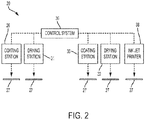
- FIG. 2 shows a printing system 20 for producing a textile having an image thereon according to various embodiments.
- the system 20 includes a coating station 26 for applying a cationic polymer solution to the textile 27.
- the textile 27 is dried at drying station 31.
- the system 20 includes a coating station 36 for applying a anionic polymer solution to the textile 27.
- the textile 27 is dried at drying station 32.
- the textile 27 is printed using an ink jet printer 38 to form an image on the textile 27.
- the printing system 20 can include a control system 30 coupled to the coating station 26, drying station 31, coating station 36, drying station 32, and ink jet printer 38.
- the drying station 31 and drying station 32 can be one drying station.
- the coating station 26 and coating station 36 can be one apparatus and the flow of the anionic and cationic solution adjusted accordingly.
- the control system 30 can be configured to provide instructions to, and/or otherwise control operation of coating station 26, drying station 31, coating station 36, drying station 32, and/or ink jet printer 38.
- the control system 30 may be mechanically or electrically connected to coating station 26, drying station 31, coating station 36, drying station 32, and/or ink jet printer 38.
- Control system 30 may be a computerized, mechanical, or electro-mechanical device capable of controlling the coating station 26, drying station 31, coating station 36, drying station 32, and ink jet printer 38.
- control system 30 may be a computerized device capable of providing operating instructions to the coating station 26, drying station 31, coating station 36, drying station 32, and/or ink jet printer 38.
- control system 30 may include a mechanical device, capable of use by an operator. In this case, the operator may physically manipulate control system 30 (e.g., by pulling a lever), which may actuate the coating station 26, drying station 31, coating station 36, drying station 32, and ink jet printer 38.
- control system 30 may be an electro-mechanical device.
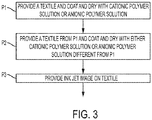
- FIG. 3 shows a flow chart illustrating a method performed according to various embodiments. As shown, the method can include the following processes:
- a polyester fabric was coated with PDAD and PSS alternating layers by transferring a coating of PDAD on a glass plate applied with a #22 Meyer rod, as shown in FIGs. 1A-1C , to the polyester fabric, and then alternatively coating with a PSS coating laid down on a separate glass plate as shown in FIGs 1A-1C .
- the process was performed four times to give a coating of PDAD-PSS-PDAD-PSS on the polyester substrate.
- the coating showed good affinity for polyester.
- An inkjet printer with a piezoelectric printhead is loaded with both cationic and anionic solutions.
- printers that include Dimatix Materials Printer DMP-2850 (FujiFilm), or F-Series or X-Series printers (Ceradrop)
- the ink jet printer applies the ink compositions to a polyester substrate resulting in PDAD-PSS-PDAD-PSS on the polyester substrate.
- An ink jet printer applies an image on the polyester substrate having the PDAD-PSS-PDAD-PSS layers.
Landscapes
- Engineering & Computer Science (AREA)
- Textile Engineering (AREA)
- Chemical & Material Sciences (AREA)
- Chemical Kinetics & Catalysis (AREA)
- General Chemical & Material Sciences (AREA)
- Materials Engineering (AREA)
- Life Sciences & Earth Sciences (AREA)
- Wood Science & Technology (AREA)
- Organic Chemistry (AREA)
- Inks, Pencil-Leads, Or Crayons (AREA)
- Treatment Of Fiber Materials (AREA)
- Coloring (AREA)
- Ink Jet Recording Methods And Recording Media Thereof (AREA)
- Ink Jet (AREA)
Abstract
Description
- This disclosure is generally related to the field of printing and, more particularly, to novel methods and apparatuses for high-resolution, high-definition multicolor direct printing on textile surfaces.
- Industrial printing on textiles is performed using processes such as screenprinting or dye-sublimation. These processes are time-consuming, and are not amenable to short-run, variable pattern print runs, or printing directly on objects, such as footwear. Digital printing of textiles is currently only 2.9% of the total textile printing market. However, digital printing of textiles is expected to grow. Substrates with poor wetting properties are not designed to receive printing inks as color saturation and image robustness is lacking.
- According to various embodiments, there is provided a process of printing an image on a textile. The process includes coating the textile with polydiallyldimethyl ammonium chloride cationic polymer to form a cationic polymer layer. The process includes coating the textile with the cationic polymer layer with poly-4-styrene sulfonate anionic polymer to form an anionic polymer layer. The process includes applying an ink composition to the textile having the cationic polymer layer and the anionic polymer layer, forming an image.
- According to various embodiments, there is disclosed a system for printing an image on a textile. The system includes a coating station for applying a polydiallyldimethyl ammonium chloride cationic polymer to the textile. The system includes a coating station for applying a poly-4-styrene sulfonate anionic polymer to the textile. The system includes an ink jet printer for applying an ink composition to the textile to form an image.
- According to various embodiments there is disclosed, a printed article that includes a fabric having a first layer of polydiallyldimethyl ammonium chloride cationic polymer and a second layer of poly-4-styrene sulfonate anionic polymer disposed on the polyester fabric. The printed article includes a cured ink composition disposed on the fabric.
-
FIGs. 1A-1C show schematic depictions of a textile undergoing a method according to embodiments disclosed herein. -
FIG. 2 shows a schematic depiction of a printing system for various embodiments disclosed herein. -
FIG. 3 shows a flow chart illustrating a method according to various embodiments disclosed herein. - It should be noted that some details of the drawings have been simplified and are drawn to facilitate understanding of the embodiments rather than to maintain strict structural accuracy, detail, and scale.
- In the following description, reference is made to the accompanying drawings that form a part thereof, and in which is shown by way of illustration specific exemplary embodiments in which the present teachings may be practiced. These embodiments are described in sufficient detail to enable those skilled in the art to practice the present teachings and it is to be understood that other embodiments may be utilized and that changes may be made without departing from the scope of the present teachings. The following description is, therefore, merely illustrative.
- Illustrations with respect to one or more implementations, alterations and/or modifications can be made to the illustrated examples without departing from the spirit and scope of the appended claims. In addition, while a particular feature may have been disclosed with respect to only one of several implementations, such feature may be combined with one or more other features of the other implementations as may be desired and advantageous for any given or particular function. Furthermore, to the extent that the terms "including", "includes", "having", "has", "with", or variants thereof are used in either the detailed description and the claims, such terms are intended to be inclusive in a manner similar to the term "comprising." The term "at least one of" is used to mean one or more of the listed items can be selected.
- Notwithstanding that the numerical ranges and parameters setting forth the broad scope of embodiments are approximations, the numerical values set forth in the specific examples are reported as precisely as possible. Any numerical value, however, inherently contains certain errors necessarily resulting from the standard deviation found in their respective testing measurements. Moreover, all ranges disclosed herein are to be understood to encompass any and all sub-ranges subsumed therein. For example, a range of "less than 10" can include any and all sub-ranges between (and including) the minimum value of zero and the maximum value of 10, that is, any and all sub-ranges having a minimum value of equal to or greater than zero and a maximum value of equal to or less than 10, for example, 1 to 5. In certain cases, the numerical values as stated for the parameter can take on negative values. In this case, the example value of range stated as "less than 10" can assume negative values, for example, - 1, -2, -3, -10, -20, -30, etc.
- Disclosed herein is a process for treating textiles including synthetic fabrics, such as polyester, to improve the digital printing of images on such fabrics. Digital printing includes using ink-jet printers and aerosol printers.
- Inkjet printing is a type of computer printing that recreates a digital image by propelling droplets of ink onto a substrate. Ink jet material deposition uses inkjet technologies, typically printheads using piezoelectric crystals, to deposit materials directly on substrates.
- In order to overcome the textile wettability issue, disclosed herein is a pre-treatment process providing a layer-by-layer printing of polyelectrolytes, such as PDAD (polydiallyldimethyl ammonium chloride) cationic polymer alternating with PSS (poly-4-styrene sulfonate) anionic polymer to create a charged coating with surface roughness to increase the substrate receptivity for ink. PDAD and PSS are shown below:

- For PDAD, the molecular weight can range from less than 100,000 to about 500,000. In embodiments, the unit mass Mw is 161.67 for PDAD. In embodiments, n can be from 300 to 3100 for PDAD. For PSS, the molecular weight can range from about 75,000 to about 200,000, corresponding to an n value of from about 360 to about 1,000.
- The cationic polymer solution includes PDAD (polydiallyldimethyl ammonium chloride) cationic polymer and solvent. In addition, the cationic polymer solution can contain surfactants and humectants.
- The anionic polymer solution includes PSS (poly-4-styrene sulfonate) anionic polymer and solvent. In addition the anionic polymer solution can contain surfactants and humectants.
- In embodiments, solvents are mixtures of water and water-miscible polar solvents such as: methanol, ethanol, 2-propanol, acetone, tetrahydrofuran (THF), as well as less-volatile solvents such as DMF (dimethyl formamide), or NMP (N-methyl-2-pyrrolidone). In embodiments, water-soluble organic solvents include: alcohols, ketones, keto-alcohols, ethers and others, such as thiodiglycol, sulfolane, 2-pyrrolidone, 1,3-dimethyl-2-imidazolidinone and caprolactam; glycols such as, ethylene glycol, diethylene glycol, triethylene glycol, tetraethylene glycol, propylene glycol, dipropylene glycol, tripropylene glycol, trimethylene glycol, butylene glycol and hexylene glycol; polyethylene glycol, polypropylene glycol and the like; triols such as glycerol and 1,2,6-hexanetriol; lower alkyl ethers of polyhydric alcohols, such as ethylene glycol monomethyl ether, ethylene glycol monoethyl ether, diethylene glycol monomethyl, diethylene glycol monoethyl ether; lower dialkyl ethers of polyhydric alcohols, such as diethylene glycol dimethyl or diethyl ether; urea and substituted ureas.
- In embodiments, surfactants are added to the polymer solutions to adjust surface tension and wetting properties. In embodiments, surfactants include: anionic surfactants such as: SDS (sodium dodecyl sulfonate), SDBS (sodium dodecyl benzenesulfonate), as well as non-ionic surfactants such as: Triton-X100 (ethoxylated nonylphenol). In embodiments, surfactants include ethoxylated acetylene diols (e.g. SURFYNOLS ® (R series from Air Products)), ethoxylated primary (e.g. NEODOL ® series from Shell and TOMADOL ® series from Tomah Products) and secondary alcohols (e.g. TERGITOL ® series from Union Carbide), sulfosuccinates (e.g. AEROSOL ® series from Cytec), organosilicones (e.g. SILWET ® series from GE Silicones) and fluoro surfactants (e.g. ZONYL ® series from DuPont). Surfactants are typically used in the amount of about 0.01 to about 5% and preferably about 0.2 to about 2%, based on the total weight of the polymer solution.
- The polymer solutions may also contain a humectant, which may also function as a water miscible solvent, which preferably includes a glycol or dihydroxyglycol ether, or mixture thereof, in which one or both hydroxy groups are secondary hydroxy groups, such as propane-1,2-diol, butane-2,3-diol, butane-1,3-diol and 3-(3-hydroxy-prop-2-oxy)propan-2-ol. Where the humectant has a primary hydroxy group, in embodiments this may be attached to a carbon atom adjacent to a carbon atom carrying a secondary or tertiary hydroxy group. The humectant may include up to a total of 10 percent by weight of a polyol, especially a glycol or dihydroxyglycol ether, having two or more primary hydroxy groups, such as ethyleneglycol, propane-1,3-diol, butane-1,4-diol, 2-(2-hydroxyethoxy)ethanol and 2-(2-[2-hydroxyethoxy]ethoxy)ethanol and/or an alcohol with a primary hydroxy group, such as ethanol, n-propanol and n-butanol. In the context of the humectant, the term "alcohol" means a compound having only one hydroxy group attached to an aliphatic carbon atom. The polymer solution may contain from 5 weight percent to about 25 weight percent, or in embodiments, from 10 weight percent to 20 weight percent of humectant.
- In an embodiment, a method of treating a textile for the subsequent reception of a printing ink, is shown in the schematic illustrations of
FIGs. 1A-1C . The method shown inFIG. 1A-1C is one example and other methods of coating textiles with a solution can be used. InFIG. 1A , acoating solution 21 is applied on aglass plate 15. Acoating rod 18 is used to spread the coating solution on the glass plate and is shown inFIG. 1B . Thecoating solution 21 is illustrated as spread on theglass plate 15 inFIG. 1B . As shown inFIG. 1C , the textile orfabric 17 is then placed on theglass plate 15 and aroller 23 is used to immerse the textile 17 in thecoating solution 21 onglass plate 15 so that thecoating solution 21 contacts all portions of thetextile 17. After thefabric 17 is coated withcoating solution 21 the solution is dried or cured. - The
coating solution 21 can be either the cationic polymer solution or the anionic coating solution. At least one layer of (polydiallyldimethyl ammonium chloride) cationic polymer and one layer of (poly-4-styrene sulfonate) anionic polymer are provided on the textile. The layer of (polydiallyldimethyl ammonium chloride) cationic polymer and layer of (poly-4-styrene sulfonate) anionic polymer are alternated during the coating process. It does not matter which polymer solution is applied initially. There can be more than one layer of each polymer solution. In embodiments, there is an equal number of cationic polymer and anionic polymer solutions applied to the fabric or textile such as A-C-A-C or C-A-C-A where (A) refers to an anionic polymer layer and (C) refers a cationic polymer layer. In embodiments, there can be one additional layer of an anionic or cationic polymer. For example, a layer configuration of C-A-C (a cationic layer is the final layer) or A-C-A (an anionic layer is the final layer) are embodiments. - The total thickness of the anionic polymer layers and cationic polymer layers can be from about 1.0 microns to about 300 microns. Each anionic polymer layer or cationic polymer layer can have a thickness of from about 0.01 microns to about 0.5 microns.
- Textiles that are suitable for use of the pre-treatment disclosed herein include, for example, woven fabrics, knitted fabrics, and non-woven fabrics such as felt fabrics. The textiles, may include fibers from any animal, plant and/or synthetic source such as, for example, wool, silk, cotton, linen, hemp, ramie, jute, acetate, acrylic fabric, latex, nylon, polyester, rayon, viscose, spandex, metallic composite, carbon or carbonized composite, and any combination thereof.
- The process disclosed herein is highly suitable for garments made of one or more textile fabrics. An example of such a garment is a T-shirt.
- The presently available inks for ink-jet printing include aqueous-based inks. The inks contain water, a humectant, a water soluble polymer, a surfactant and a colorant.
- Aqueous-based inks are typically composed of water and a colorant, usually a dye or pigment dispersion, and may contain a number of additives for imparting certain features to the ink (e.g., improved stability and flow, feather resistance, and the like).
- The term "colorant" as used herein describes a substance which imparts the desired color to the printed image. The colorant may be a pigment or a dye. Pigments are solid colorants with are typically suspended in the carrier of the ink composition, whereby dyes are liquid colorants which are dissolved in the carrier of the ink composition.
- Apart for imparting the desired color to the textile, the colorant is selected suitable in terms of its chemical and physical properties. Example dye colorants that are suitable for use in embodiments include, without limitation, azo chrome complexes such as the commercially available Orasol black RLI, Orsal Red G and CU phthalocyanine and similar azo-cobalt complexes. Example pigment colorants that are suitable for use in this context of the present invention include, without limitation, quinacridone, benzimidazolone, carbon black, phthalocyanine, diarylide, azo, titanium oxide and calcium carbonate. Example commercially available pigments can include Permajet, Renol and Microlith.
- Preferably, the colorant content in the ink composition according to embodiments ranges from about 0.2% to about 40% of the total weight of the ink composition. In embodiments, the colorant content ranges from 1 to 10 weight percentages of the total weight of the ink composition. The ink composition can contain the solvents and humectants listed previously.
-
FIG. 2 shows aprinting system 20 for producing a textile having an image thereon according to various embodiments. Thesystem 20 includes acoating station 26 for applying a cationic polymer solution to thetextile 27. Thetextile 27 is dried at dryingstation 31. Thesystem 20 includes acoating station 36 for applying a anionic polymer solution to thetextile 27. Thetextile 27 is dried at dryingstation 32. Thetextile 27 is printed using anink jet printer 38 to form an image on thetextile 27. Theprinting system 20 can include acontrol system 30 coupled to thecoating station 26, dryingstation 31,coating station 36, dryingstation 32, andink jet printer 38. In embodiments, the dryingstation 31 and dryingstation 32 can be one drying station. Likewise, in embodiments thecoating station 26 andcoating station 36 can be one apparatus and the flow of the anionic and cationic solution adjusted accordingly. Thecontrol system 30 can be configured to provide instructions to, and/or otherwise control operation ofcoating station 26, dryingstation 31,coating station 36, dryingstation 32, and/orink jet printer 38. Thecontrol system 30 may be mechanically or electrically connected tocoating station 26, dryingstation 31,coating station 36, dryingstation 32, and/orink jet printer 38.Control system 30 may be a computerized, mechanical, or electro-mechanical device capable of controlling thecoating station 26, dryingstation 31,coating station 36, dryingstation 32, andink jet printer 38. In one embodiment,control system 30 may be a computerized device capable of providing operating instructions to thecoating station 26, dryingstation 31,coating station 36, dryingstation 32, and/orink jet printer 38. In another embodiment,control system 30 may include a mechanical device, capable of use by an operator. In this case, the operator may physically manipulate control system 30 (e.g., by pulling a lever), which may actuate thecoating station 26, dryingstation 31,coating station 36, dryingstation 32, andink jet printer 38. In another embodiment,control system 30 may be an electro-mechanical device. -
FIG. 3 shows a flow chart illustrating a method performed according to various embodiments. As shown, the method can include the following processes: - Process P1: A textile is provided and coated with a cationic polymer solution or anionic solution and dried.
- Process P2: The textile coated with the dried cationic polymer solution or dried anionic polymer solution is then coated and dried with a solution of cationic polymer solution or anionic polymer solution different from the solution in PI process step.
- Process P3: An ink jet composition is coated on the textile having a cationic polymer and an anionic polymer layer to form and image.
- Specific embodiments will now be described in detail. These examples are intended to be illustrative, and not limited to the materials, conditions, or process parameters set forth in these embodiments. All parts are percentages by solid weight unless otherwise indicated.
- A polyester fabric was coated with PDAD and PSS alternating layers by transferring a coating of PDAD on a glass plate applied with a #22 Meyer rod, as shown in
FIGs. 1A-1C , to the polyester fabric, and then alternatively coating with a PSS coating laid down on a separate glass plate as shown inFIGs 1A-1C . The process was performed four times to give a coating of PDAD-PSS-PDAD-PSS on the polyester substrate. The coating showed good affinity for polyester. - An inkjet printer with a piezoelectric printhead is loaded with both cationic and anionic solutions. Examples of printers that include Dimatix Materials Printer DMP-2850 (FujiFilm), or F-Series or X-Series printers (Ceradrop) The ink jet printer applies the ink compositions to a polyester substrate resulting in PDAD-PSS-PDAD-PSS on the polyester substrate. An ink jet printer applies an image on the polyester substrate having the PDAD-PSS-PDAD-PSS layers.
Claims (20)
- A process of printing an image on a textile, the process comprising:coating the textile with polydiallyldimethyl ammonium chloride cationic polymer to form a cationic polymer layer;coating the textile with the cationic polymer layer with poly-4-styrene sulfonate anionic polymer to form an anionic polymer layer; andapplying an ink composition to the textile having the cationic polymer layer and the anionic polymer layer, forming an image.
- The process of claim 1, further comprising, curing the image after applying the ink composition.
- The process of claim 1, wherein the cationic polymer and the anionic polymer layer have a combined thickness of from about 1.0 microns to about 300 microns.
- The process of claim 1, further comprising drying the cationic polymer layer prior to coating poly-4-styrene sulfonate anionic polymer.
- The process of claim 1, further comprising drying the anionic polymer layer prior to applying the ink.
- The process of claim 1, wherein said ink composition comprises water, a humectant, a water-soluble polymer, a surfactant and a colorant.
- The process of claim 1, wherein the textile is selected from the group consisting of a wool, silk, cotton, linen, hemp, ramie, jute, acetate, acrylic fabric, latex, nylon, polyester, rayon, viscose, spandex, metallic composite, carbon and carbonized composite.
- The process of claim 1, wherein the textile comprises polyester.
- A system for printing an image on a textile, the system comprising;a first coating station for applying a polydiallyldimethyl ammonium chloride cationic polymer to a textile,a second coating station for applying a poly-4-styrene sulfonate anionic polymer to a textile; andan ink jet printer for applying an ink composition to the textile to form an image.
- The system of claim 9, further comprising,
a dryer for drying the polydiallyldimethyl ammonium chloride cationic polymer. - The system of claim 9, further comprising,
a dryer for drying the poly-4-styrene sulfonate anionic polymer. - The system of claim 9, further comprising,
a heater for curing the ink after applying the ink composition. - The system of claim 9, wherein said ink composition comprises water, a humectant, a water-soluble polymer, a surfactant and a colorant.
- The system of claim 9, wherein the textile is selected from the group consisting of: wool, silk, cotton, linen, hemp, ramie, jute, acetate, acrylic fabric, latex, nylon, polyester, rayon, viscose, spandex, metallic composite, carbon and carbonized composite.
- A printed article, comprising:a fabric having a first layer of polydiallyldimethyl ammonium chloride cationic polymer and a second layer of poly-4-styrene sulfonate anionic polymer coated on a fabric; anda cured ink composition disposed on the fabric.
- The article of claim 15, wherein said cured ink composition comprises water, a humectant, a water-soluble polymer, a surfactant and a colorant.
- The article of claim 15, wherein the fabric is selected from the group consisting of: wool, silk, cotton, linen, hemp, ramie, jute, acetate, acrylic fabric, latex, nylon, polyester, rayon, viscose, spandex, metallic composite, carbon and carbonized composite.
- The article of claim 15, wherein a combined thickness of the first layer and second layer is from 1.0 microns to about 300 microns.
- The article of claim 15, wherein the poly-4-styrene sulfonate anionic polymer has a molecular weight of from about 75,000 to about 200,000.
- The article of claim 15, wherein the polydiallyldimethyl ammonium chloride cationic polymer has a molecular weight of from about 100,000 to about 500,000.
Applications Claiming Priority (1)
| Application Number | Priority Date | Filing Date | Title |
|---|---|---|---|
| US15/921,823 US10828910B2 (en) | 2018-03-15 | 2018-03-15 | Textile pretreatment for digital printing |
Publications (2)
| Publication Number | Publication Date |
|---|---|
| EP3540115A1 true EP3540115A1 (en) | 2019-09-18 |
| EP3540115B1 EP3540115B1 (en) | 2023-08-16 |
Family
ID=66000939
Family Applications (1)
| Application Number | Title | Priority Date | Filing Date |
|---|---|---|---|
| EP19162674.6A Active EP3540115B1 (en) | 2018-03-15 | 2019-03-13 | Textile pretreatment for digital printing |
Country Status (5)
| Country | Link |
|---|---|
| US (1) | US10828910B2 (en) |
| EP (1) | EP3540115B1 (en) |
| JP (1) | JP7096781B2 (en) |
| CN (1) | CN110273306B (en) |
| CA (1) | CA3036611C (en) |
Cited By (1)
| Publication number | Priority date | Publication date | Assignee | Title |
|---|---|---|---|---|
| CN113403867A (en) * | 2021-06-09 | 2021-09-17 | 上海菲姿科技有限公司 | Digital printing method of wool fabric |
Families Citing this family (5)
| Publication number | Priority date | Publication date | Assignee | Title |
|---|---|---|---|---|
| US12642472B2 (en) | 2019-04-18 | 2026-06-02 | Boston Scientific Scimed, Inc. | Systems, devices, components and methods for detecting the locations of sources of cardiac rhythm disorders in a patient's heart and generating an estimate or probability of the patient being free from atrial fibrillation |
| WO2022030384A1 (en) * | 2020-08-05 | 2022-02-10 | 山陽色素株式会社 | Pretreatment method of synthetic fiber structure suitable for dyeing with pigment dispersion composition |
| CN113073437B (en) * | 2021-04-06 | 2023-10-13 | 武汉纺织大学 | Interface coating modification device and coating modification method for functional yarns |
| US20230050834A1 (en) * | 2021-06-03 | 2023-02-16 | Ablacon Inc. | Methods, Systems, Devices, and Components for Extracting Atrial Signals from QRS and QRST Complexes |
| CN116590930B (en) * | 2023-07-13 | 2023-10-03 | 苏州扬越高新材料有限公司 | Modified polyester fiber and preparation method thereof |
Citations (4)
| Publication number | Priority date | Publication date | Assignee | Title |
|---|---|---|---|---|
| US20070092666A1 (en) * | 2005-10-25 | 2007-04-26 | Isp Investments Inc. | Coating compositions for forming inkjet-receptive coatings on a substrate |
| US20070103529A1 (en) * | 2003-06-16 | 2007-05-10 | Kornit Digital Ltd. | Process and system for printing images on absorptive surfaces |
| WO2014014453A1 (en) * | 2012-07-18 | 2014-01-23 | Hewlett-Packard Development Company, L.P. | Fabric print media |
| WO2017069752A1 (en) * | 2015-10-21 | 2017-04-27 | Hewlett-Packard Development Company, L.P. | Three-dimensional (3d) printing |
Family Cites Families (12)
| Publication number | Priority date | Publication date | Assignee | Title |
|---|---|---|---|---|
| CA2117546A1 (en) * | 1993-08-27 | 1995-02-28 | Takateru Muraoka | Medical adhesive sheet |
| JP4459414B2 (en) * | 2000-08-24 | 2010-04-28 | 日東電工株式会社 | Oral patch preparation |
| US20030157304A1 (en) | 2001-08-31 | 2003-08-21 | Shulong Li | Printed textile |
| WO2005115089A2 (en) * | 2004-05-30 | 2005-12-08 | Kornit Digital Ltd. | A process and system for printing images on absorptive surfaces |
| US20050152955A1 (en) * | 2003-12-16 | 2005-07-14 | Akhave Jay R. | Electrostatically self-assembled antimicrobial coating for medical applications |
| WO2006015080A1 (en) * | 2004-07-27 | 2006-02-09 | Nano-Tex, Inc. | Durable treatment for fabrics |
| CA2624464A1 (en) * | 2005-10-05 | 2007-04-12 | Sca Hygiene Products Ab | Absorbent article comprising a thin film including an active agent |
| CN101356221A (en) * | 2005-11-08 | 2009-01-28 | 苏普雷斯塔有限责任公司 | Flame retardant composition and easily hydrolyzable resin containing the flame retardant composition |
| US20100080841A1 (en) * | 2007-04-23 | 2010-04-01 | Porbeni Francis E | Fibrous articles with one or more polyelectrolyte layers thereon and methods for making the same |
| US9789722B2 (en) * | 2012-01-20 | 2017-10-17 | Mitsubishi Paper Mills Limited | Printing coated paper and method for producing a printed material using the same |
| JP6239302B2 (en) * | 2013-07-31 | 2017-11-29 | 日東電工株式会社 | Adhesive sheet and optical member |
| CN107109113A (en) | 2014-08-11 | 2017-08-29 | 路博润先进材料公司 | For printing, digital ink-jet ink and the aqueous polymer composition in print onto cloth |
-
2018
- 2018-03-15 US US15/921,823 patent/US10828910B2/en active Active
-
2019
- 2019-02-22 JP JP2019031041A patent/JP7096781B2/en active Active
- 2019-03-01 CN CN201910156455.5A patent/CN110273306B/en active Active
- 2019-03-13 CA CA3036611A patent/CA3036611C/en active Active
- 2019-03-13 EP EP19162674.6A patent/EP3540115B1/en active Active
Patent Citations (4)
| Publication number | Priority date | Publication date | Assignee | Title |
|---|---|---|---|---|
| US20070103529A1 (en) * | 2003-06-16 | 2007-05-10 | Kornit Digital Ltd. | Process and system for printing images on absorptive surfaces |
| US20070092666A1 (en) * | 2005-10-25 | 2007-04-26 | Isp Investments Inc. | Coating compositions for forming inkjet-receptive coatings on a substrate |
| WO2014014453A1 (en) * | 2012-07-18 | 2014-01-23 | Hewlett-Packard Development Company, L.P. | Fabric print media |
| WO2017069752A1 (en) * | 2015-10-21 | 2017-04-27 | Hewlett-Packard Development Company, L.P. | Three-dimensional (3d) printing |
Cited By (2)
| Publication number | Priority date | Publication date | Assignee | Title |
|---|---|---|---|---|
| CN113403867A (en) * | 2021-06-09 | 2021-09-17 | 上海菲姿科技有限公司 | Digital printing method of wool fabric |
| CN113403867B (en) * | 2021-06-09 | 2022-04-15 | 上海菲姿科技有限公司 | Digital printing method of wool fabric |
Also Published As
| Publication number | Publication date |
|---|---|
| EP3540115B1 (en) | 2023-08-16 |
| CN110273306B (en) | 2021-12-31 |
| US20190284757A1 (en) | 2019-09-19 |
| CA3036611C (en) | 2021-09-07 |
| JP2019163580A (en) | 2019-09-26 |
| JP7096781B2 (en) | 2022-07-06 |
| CN110273306A (en) | 2019-09-24 |
| US10828910B2 (en) | 2020-11-10 |
| CA3036611A1 (en) | 2019-09-15 |
Similar Documents
| Publication | Publication Date | Title |
|---|---|---|
| EP3540115B1 (en) | Textile pretreatment for digital printing | |
| JP5110404B2 (en) | Image forming method, method for producing fabric having image, and processing agent | |
| CN110799698B (en) | Treatment liquid composition, inkjet printing method, and fabric | |
| EP2794782A1 (en) | Aqueous ink-jet inks containing mixtures of anionic and non-ionic polymeric binders | |
| CA3037158C (en) | Textile pretreatment for digital printing | |
| EP1753832A2 (en) | An ink composition | |
| RU2762113C2 (en) | New black ink | |
| JP7661755B2 (en) | Inkjet textile printing method and inkjet textile printing device | |
| JP5216585B2 (en) | Inkjet ink set | |
| US20090045372A1 (en) | Composition for drop on demand finishing of a textile article | |
| JP2022056712A (en) | Printing method, printed matter, and recording apparatus | |
| JP2012167394A (en) | Pretreatment ink for inkjet printing, method for manufacturing pretreatment ink for inkjet printing, and inkjet printing method | |
| US11053402B2 (en) | Black ink | |
| HK40078291B (en) | New black ink | |
| EP3397696B1 (en) | Aqueous inks containing solvent dyes | |
| HK40078291A (en) | New black ink | |
| HK40016411A (en) | New black ink | |
| HK40017870A (en) | New black ink | |
| HK40017870B (en) | New black ink |
Legal Events
| Date | Code | Title | Description |
|---|---|---|---|
| PUAI | Public reference made under article 153(3) epc to a published international application that has entered the european phase |
Free format text: ORIGINAL CODE: 0009012 |
|
| STAA | Information on the status of an ep patent application or granted ep patent |
Free format text: STATUS: THE APPLICATION HAS BEEN PUBLISHED |
|
| AK | Designated contracting states |
Kind code of ref document: A1 Designated state(s): AL AT BE BG CH CY CZ DE DK EE ES FI FR GB GR HR HU IE IS IT LI LT LU LV MC MK MT NL NO PL PT RO RS SE SI SK SM TR |
|
| AX | Request for extension of the european patent |
Extension state: BA ME |
|
| STAA | Information on the status of an ep patent application or granted ep patent |
Free format text: STATUS: REQUEST FOR EXAMINATION WAS MADE |
|
| 17P | Request for examination filed |
Effective date: 20200318 |
|
| RBV | Designated contracting states (corrected) |
Designated state(s): AL AT BE BG CH CY CZ DE DK EE ES FI FR GB GR HR HU IE IS IT LI LT LU LV MC MK MT NL NO PL PT RO RS SE SI SK SM TR |
|
| GRAP | Despatch of communication of intention to grant a patent |
Free format text: ORIGINAL CODE: EPIDOSNIGR1 |
|
| STAA | Information on the status of an ep patent application or granted ep patent |
Free format text: STATUS: GRANT OF PATENT IS INTENDED |
|
| INTG | Intention to grant announced |
Effective date: 20230309 |
|
| GRAS | Grant fee paid |
Free format text: ORIGINAL CODE: EPIDOSNIGR3 |
|
| GRAA | (expected) grant |
Free format text: ORIGINAL CODE: 0009210 |
|
| STAA | Information on the status of an ep patent application or granted ep patent |
Free format text: STATUS: THE PATENT HAS BEEN GRANTED |
|
| AK | Designated contracting states |
Kind code of ref document: B1 Designated state(s): AL AT BE BG CH CY CZ DE DK EE ES FI FR GB GR HR HU IE IS IT LI LT LU LV MC MK MT NL NO PL PT RO RS SE SI SK SM TR |
|
| REG | Reference to a national code |
Ref country code: CH Ref legal event code: EP Ref country code: DE Ref legal event code: R096 Ref document number: 602019034933 Country of ref document: DE |
|
| REG | Reference to a national code |
Ref country code: IE Ref legal event code: FG4D |
|
| REG | Reference to a national code |
Ref country code: LT Ref legal event code: MG9D |
|
| REG | Reference to a national code |
Ref country code: NL Ref legal event code: MP Effective date: 20230816 |
|
| REG | Reference to a national code |
Ref country code: AT Ref legal event code: MK05 Ref document number: 1600160 Country of ref document: AT Kind code of ref document: T Effective date: 20230816 |
|
| PG25 | Lapsed in a contracting state [announced via postgrant information from national office to epo] |
Ref country code: GR Free format text: LAPSE BECAUSE OF FAILURE TO SUBMIT A TRANSLATION OF THE DESCRIPTION OR TO PAY THE FEE WITHIN THE PRESCRIBED TIME-LIMIT Effective date: 20231117 |
|
| PG25 | Lapsed in a contracting state [announced via postgrant information from national office to epo] |
Ref country code: IS Free format text: LAPSE BECAUSE OF FAILURE TO SUBMIT A TRANSLATION OF THE DESCRIPTION OR TO PAY THE FEE WITHIN THE PRESCRIBED TIME-LIMIT Effective date: 20231216 |
|
| PG25 | Lapsed in a contracting state [announced via postgrant information from national office to epo] |
Ref country code: SE Free format text: LAPSE BECAUSE OF FAILURE TO SUBMIT A TRANSLATION OF THE DESCRIPTION OR TO PAY THE FEE WITHIN THE PRESCRIBED TIME-LIMIT Effective date: 20230816 Ref country code: RS Free format text: LAPSE BECAUSE OF FAILURE TO SUBMIT A TRANSLATION OF THE DESCRIPTION OR TO PAY THE FEE WITHIN THE PRESCRIBED TIME-LIMIT Effective date: 20230816 Ref country code: PT Free format text: LAPSE BECAUSE OF FAILURE TO SUBMIT A TRANSLATION OF THE DESCRIPTION OR TO PAY THE FEE WITHIN THE PRESCRIBED TIME-LIMIT Effective date: 20231218 Ref country code: NO Free format text: LAPSE BECAUSE OF FAILURE TO SUBMIT A TRANSLATION OF THE DESCRIPTION OR TO PAY THE FEE WITHIN THE PRESCRIBED TIME-LIMIT Effective date: 20231116 Ref country code: NL Free format text: LAPSE BECAUSE OF FAILURE TO SUBMIT A TRANSLATION OF THE DESCRIPTION OR TO PAY THE FEE WITHIN THE PRESCRIBED TIME-LIMIT Effective date: 20230816 Ref country code: LV Free format text: LAPSE BECAUSE OF FAILURE TO SUBMIT A TRANSLATION OF THE DESCRIPTION OR TO PAY THE FEE WITHIN THE PRESCRIBED TIME-LIMIT Effective date: 20230816 Ref country code: LT Free format text: LAPSE BECAUSE OF FAILURE TO SUBMIT A TRANSLATION OF THE DESCRIPTION OR TO PAY THE FEE WITHIN THE PRESCRIBED TIME-LIMIT Effective date: 20230816 Ref country code: IS Free format text: LAPSE BECAUSE OF FAILURE TO SUBMIT A TRANSLATION OF THE DESCRIPTION OR TO PAY THE FEE WITHIN THE PRESCRIBED TIME-LIMIT Effective date: 20231216 Ref country code: HR Free format text: LAPSE BECAUSE OF FAILURE TO SUBMIT A TRANSLATION OF THE DESCRIPTION OR TO PAY THE FEE WITHIN THE PRESCRIBED TIME-LIMIT Effective date: 20230816 Ref country code: GR Free format text: LAPSE BECAUSE OF FAILURE TO SUBMIT A TRANSLATION OF THE DESCRIPTION OR TO PAY THE FEE WITHIN THE PRESCRIBED TIME-LIMIT Effective date: 20231117 Ref country code: FI Free format text: LAPSE BECAUSE OF FAILURE TO SUBMIT A TRANSLATION OF THE DESCRIPTION OR TO PAY THE FEE WITHIN THE PRESCRIBED TIME-LIMIT Effective date: 20230816 Ref country code: AT Free format text: LAPSE BECAUSE OF FAILURE TO SUBMIT A TRANSLATION OF THE DESCRIPTION OR TO PAY THE FEE WITHIN THE PRESCRIBED TIME-LIMIT Effective date: 20230816 |
|
| PG25 | Lapsed in a contracting state [announced via postgrant information from national office to epo] |
Ref country code: PL Free format text: LAPSE BECAUSE OF FAILURE TO SUBMIT A TRANSLATION OF THE DESCRIPTION OR TO PAY THE FEE WITHIN THE PRESCRIBED TIME-LIMIT Effective date: 20230816 |
|
| PG25 | Lapsed in a contracting state [announced via postgrant information from national office to epo] |
Ref country code: ES Free format text: LAPSE BECAUSE OF FAILURE TO SUBMIT A TRANSLATION OF THE DESCRIPTION OR TO PAY THE FEE WITHIN THE PRESCRIBED TIME-LIMIT Effective date: 20230816 |
|
| PG25 | Lapsed in a contracting state [announced via postgrant information from national office to epo] |
Ref country code: SM Free format text: LAPSE BECAUSE OF FAILURE TO SUBMIT A TRANSLATION OF THE DESCRIPTION OR TO PAY THE FEE WITHIN THE PRESCRIBED TIME-LIMIT Effective date: 20230816 Ref country code: RO Free format text: LAPSE BECAUSE OF FAILURE TO SUBMIT A TRANSLATION OF THE DESCRIPTION OR TO PAY THE FEE WITHIN THE PRESCRIBED TIME-LIMIT Effective date: 20230816 Ref country code: ES Free format text: LAPSE BECAUSE OF FAILURE TO SUBMIT A TRANSLATION OF THE DESCRIPTION OR TO PAY THE FEE WITHIN THE PRESCRIBED TIME-LIMIT Effective date: 20230816 Ref country code: EE Free format text: LAPSE BECAUSE OF FAILURE TO SUBMIT A TRANSLATION OF THE DESCRIPTION OR TO PAY THE FEE WITHIN THE PRESCRIBED TIME-LIMIT Effective date: 20230816 Ref country code: DK Free format text: LAPSE BECAUSE OF FAILURE TO SUBMIT A TRANSLATION OF THE DESCRIPTION OR TO PAY THE FEE WITHIN THE PRESCRIBED TIME-LIMIT Effective date: 20230816 Ref country code: CZ Free format text: LAPSE BECAUSE OF FAILURE TO SUBMIT A TRANSLATION OF THE DESCRIPTION OR TO PAY THE FEE WITHIN THE PRESCRIBED TIME-LIMIT Effective date: 20230816 Ref country code: SK Free format text: LAPSE BECAUSE OF FAILURE TO SUBMIT A TRANSLATION OF THE DESCRIPTION OR TO PAY THE FEE WITHIN THE PRESCRIBED TIME-LIMIT Effective date: 20230816 |
|
| REG | Reference to a national code |
Ref country code: DE Ref legal event code: R097 Ref document number: 602019034933 Country of ref document: DE |
|
| PLBE | No opposition filed within time limit |
Free format text: ORIGINAL CODE: 0009261 |
|
| STAA | Information on the status of an ep patent application or granted ep patent |
Free format text: STATUS: NO OPPOSITION FILED WITHIN TIME LIMIT |
|
| 26N | No opposition filed |
Effective date: 20240517 |
|
| PG25 | Lapsed in a contracting state [announced via postgrant information from national office to epo] |
Ref country code: IT Free format text: LAPSE BECAUSE OF FAILURE TO SUBMIT A TRANSLATION OF THE DESCRIPTION OR TO PAY THE FEE WITHIN THE PRESCRIBED TIME-LIMIT Effective date: 20230816 Ref country code: SI Free format text: LAPSE BECAUSE OF FAILURE TO SUBMIT A TRANSLATION OF THE DESCRIPTION OR TO PAY THE FEE WITHIN THE PRESCRIBED TIME-LIMIT Effective date: 20230816 |
|
| REG | Reference to a national code |
Ref country code: CH Ref legal event code: PL |
|
| PG25 | Lapsed in a contracting state [announced via postgrant information from national office to epo] |
Ref country code: BG Free format text: LAPSE BECAUSE OF FAILURE TO SUBMIT A TRANSLATION OF THE DESCRIPTION OR TO PAY THE FEE WITHIN THE PRESCRIBED TIME-LIMIT Effective date: 20230816 |
|
| PG25 | Lapsed in a contracting state [announced via postgrant information from national office to epo] |
Ref country code: LU Free format text: LAPSE BECAUSE OF NON-PAYMENT OF DUE FEES Effective date: 20240313 |
|
| PG25 | Lapsed in a contracting state [announced via postgrant information from national office to epo] |
Ref country code: MC Free format text: LAPSE BECAUSE OF FAILURE TO SUBMIT A TRANSLATION OF THE DESCRIPTION OR TO PAY THE FEE WITHIN THE PRESCRIBED TIME-LIMIT Effective date: 20230816 |
|
| PG25 | Lapsed in a contracting state [announced via postgrant information from national office to epo] |
Ref country code: MC Free format text: LAPSE BECAUSE OF FAILURE TO SUBMIT A TRANSLATION OF THE DESCRIPTION OR TO PAY THE FEE WITHIN THE PRESCRIBED TIME-LIMIT Effective date: 20230816 Ref country code: LU Free format text: LAPSE BECAUSE OF NON-PAYMENT OF DUE FEES Effective date: 20240313 Ref country code: BG Free format text: LAPSE BECAUSE OF FAILURE TO SUBMIT A TRANSLATION OF THE DESCRIPTION OR TO PAY THE FEE WITHIN THE PRESCRIBED TIME-LIMIT Effective date: 20230816 |
|
| REG | Reference to a national code |
Ref country code: BE Ref legal event code: MM Effective date: 20240331 |
|
| PG25 | Lapsed in a contracting state [announced via postgrant information from national office to epo] |
Ref country code: BE Free format text: LAPSE BECAUSE OF NON-PAYMENT OF DUE FEES Effective date: 20240331 |
|
| PG25 | Lapsed in a contracting state [announced via postgrant information from national office to epo] |
Ref country code: IE Free format text: LAPSE BECAUSE OF NON-PAYMENT OF DUE FEES Effective date: 20240313 |
|
| PG25 | Lapsed in a contracting state [announced via postgrant information from national office to epo] |
Ref country code: IE Free format text: LAPSE BECAUSE OF NON-PAYMENT OF DUE FEES Effective date: 20240313 Ref country code: BE Free format text: LAPSE BECAUSE OF NON-PAYMENT OF DUE FEES Effective date: 20240331 Ref country code: CH Free format text: LAPSE BECAUSE OF NON-PAYMENT OF DUE FEES Effective date: 20240331 |
|
| PG25 | Lapsed in a contracting state [announced via postgrant information from national office to epo] |
Ref country code: CY Free format text: LAPSE BECAUSE OF FAILURE TO SUBMIT A TRANSLATION OF THE DESCRIPTION OR TO PAY THE FEE WITHIN THE PRESCRIBED TIME-LIMIT; INVALID AB INITIO Effective date: 20190313 |
|
| PG25 | Lapsed in a contracting state [announced via postgrant information from national office to epo] |
Ref country code: HU Free format text: LAPSE BECAUSE OF FAILURE TO SUBMIT A TRANSLATION OF THE DESCRIPTION OR TO PAY THE FEE WITHIN THE PRESCRIBED TIME-LIMIT; INVALID AB INITIO Effective date: 20190313 |
|
| PG25 | Lapsed in a contracting state [announced via postgrant information from national office to epo] |
Ref country code: TR Free format text: LAPSE BECAUSE OF FAILURE TO SUBMIT A TRANSLATION OF THE DESCRIPTION OR TO PAY THE FEE WITHIN THE PRESCRIBED TIME-LIMIT Effective date: 20230816 |
|
| PGFP | Annual fee paid to national office [announced via postgrant information from national office to epo] |
Ref country code: GB Payment date: 20260220 Year of fee payment: 8 |
|
| PGFP | Annual fee paid to national office [announced via postgrant information from national office to epo] |
Ref country code: DE Payment date: 20260219 Year of fee payment: 8 |
|
| PGFP | Annual fee paid to national office [announced via postgrant information from national office to epo] |
Ref country code: FR Payment date: 20260219 Year of fee payment: 8 |