EP3540052A1 - A stable lignocellulolytic enzyme composition - Google Patents
A stable lignocellulolytic enzyme composition Download PDFInfo
- Publication number
- EP3540052A1 EP3540052A1 EP19161852.9A EP19161852A EP3540052A1 EP 3540052 A1 EP3540052 A1 EP 3540052A1 EP 19161852 A EP19161852 A EP 19161852A EP 3540052 A1 EP3540052 A1 EP 3540052A1
- Authority
- EP
- European Patent Office
- Prior art keywords
- enzyme
- lignocellulolytic
- molasses
- enzyme composition
- additive
- Prior art date
- Legal status (The legal status is an assumption and is not a legal conclusion. Google has not performed a legal analysis and makes no representation as to the accuracy of the status listed.)
- Granted
Links
Images

Classifications
-
- C—CHEMISTRY; METALLURGY
- C12—BIOCHEMISTRY; BEER; SPIRITS; WINE; VINEGAR; MICROBIOLOGY; ENZYMOLOGY; MUTATION OR GENETIC ENGINEERING
- C12N—MICROORGANISMS OR ENZYMES; COMPOSITIONS THEREOF; PROPAGATING, PRESERVING, OR MAINTAINING MICROORGANISMS; MUTATION OR GENETIC ENGINEERING; CULTURE MEDIA
- C12N9/00—Enzymes; Proenzymes; Compositions thereof; Processes for preparing, activating, inhibiting, separating or purifying enzymes
- C12N9/96—Stabilising an enzyme by forming an adduct or a composition; Forming enzyme conjugates
-
- C—CHEMISTRY; METALLURGY
- C12—BIOCHEMISTRY; BEER; SPIRITS; WINE; VINEGAR; MICROBIOLOGY; ENZYMOLOGY; MUTATION OR GENETIC ENGINEERING
- C12N—MICROORGANISMS OR ENZYMES; COMPOSITIONS THEREOF; PROPAGATING, PRESERVING, OR MAINTAINING MICROORGANISMS; MUTATION OR GENETIC ENGINEERING; CULTURE MEDIA
- C12N9/00—Enzymes; Proenzymes; Compositions thereof; Processes for preparing, activating, inhibiting, separating or purifying enzymes
- C12N9/14—Hydrolases (3)
- C12N9/24—Hydrolases (3) acting on glycosyl compounds (3.2)
-
- C—CHEMISTRY; METALLURGY
- C12—BIOCHEMISTRY; BEER; SPIRITS; WINE; VINEGAR; MICROBIOLOGY; ENZYMOLOGY; MUTATION OR GENETIC ENGINEERING
- C12N—MICROORGANISMS OR ENZYMES; COMPOSITIONS THEREOF; PROPAGATING, PRESERVING, OR MAINTAINING MICROORGANISMS; MUTATION OR GENETIC ENGINEERING; CULTURE MEDIA
- C12N9/00—Enzymes; Proenzymes; Compositions thereof; Processes for preparing, activating, inhibiting, separating or purifying enzymes
- C12N9/14—Hydrolases (3)
- C12N9/24—Hydrolases (3) acting on glycosyl compounds (3.2)
- C12N9/2402—Hydrolases (3) acting on glycosyl compounds (3.2) hydrolysing O- and S- glycosyl compounds (3.2.1)
-
- C—CHEMISTRY; METALLURGY
- C12—BIOCHEMISTRY; BEER; SPIRITS; WINE; VINEGAR; MICROBIOLOGY; ENZYMOLOGY; MUTATION OR GENETIC ENGINEERING
- C12Y—ENZYMES
- C12Y302/00—Hydrolases acting on glycosyl compounds, i.e. glycosylases (3.2)
- C12Y302/01—Glycosidases, i.e. enzymes hydrolysing O- and S-glycosyl compounds (3.2.1)
- C12Y302/01004—Cellulase (3.2.1.4), i.e. endo-1,4-beta-glucanase
Definitions
- the present invention relates to a formulation to stabilize lignocellulolytic enzyme.
- This invention in particular relates to a formulation composed of lignocellulolytic enzyme with critical dosages of molasses either with glycerol or petrochemical waste stream as an additive to improve enzyme stability in a synergistic manner.
- Lignocellulose refers to plant dry matter (biomass) and is the most abundantly available raw material on the Earth. It is composed of carbohydrate polymers (such as cellulose, hemicellulose), and an aromatic polymer (lignin). These carbohydrate polymers contain different sugar monomers (six and five carbon sugars) and they are tightly bound to lignin. From the last few decades, there has been an increasing research interest in the value of lignocellulosic biomass. Lignocellulosic biomass is an inexpensive, renewable, abundant natural resource which is capable of being employed for large-scale and cost-effective bio-energy collection as well as production of value added products, such as bio-fuels. The effective utilization of lignocellulosic biomass for the production of value-added products mainly depends on their hydrolysis into constituent soluble sugars.
- lignocellulose hydrolysis Due to the recalcitrant structure of lignocellulose and heterogeneous nature of pretreated biomass, a consortium of enzymes differing in their specificity and mechanism of action is needed to act on this substrate (like endoglucanases, exoglucanases, xylanases, mannases, esterases, arabinofuranosidases etc.).
- the main enzymes involved in lignocellulose hydrolysis include cellulases, hemicellulases, lignin modifying enzymes and other helper enzymes/proteins such as Swollenin.
- lignocellulolytic enzymes there are certain challenges in using these enzymes at an industrial scale which arise from their inherent characteristics, such as lack of stability.
- Enzyme supplementation with stabilizing agents or stabilizers is usually recommended to improve enzyme stability and performance.
- These stabilizers provide resistance to the catalytically active protein structures towards high temperatures, pHs, microbial contamination and other denaturing influences.
- the selection of the appropriate additive depends on the nature of enzyme i.e. on its hydrophilic or hydrophobic character and the degree of interaction with the additive.
- EP0633311B1 describes a process wherein 10% w/w of hydrophobic amines acted as cellulase enzyme stabilizing compounds to formulate liquid detergent compositions.
- the hydrophobic amine acts as counter ion resulting in the rearrangement of the anionic surfactant to produce a 'shielding-off' effect by the neutral ion pair formation of hydrophobic amine-anionic surfactant in the surfactant phase of the liquid detergent.
- EP160762 , EP137615 and EP137616 disclose liquid detergents comprised of cyclohexylamine to stabilize amylase enzyme.
- EP2383330A1 describes a method to stabilize enzymes from protease, cellulase, lipase, amylase by using aryl carboxylic acid as an enzyme stabilizer at 20% w/w of liquid detergents.
- EP 1924677 A1 describes a method to stabilize concentrated liquid enzyme by adding phenyl boronic acid derivative.
- WO 2003041667 A2 describes compositions to stabilize proteases with certain osmo-protectants like glycerine, polyethylene glycol (preferably those having an average molecular weight of 200 to 400), hexane, triol, butane- 1,4-diol, butoxytriol, erythritol, xylitol and methods for using such compositions in personal care.
- certain osmo-protectants like glycerine, polyethylene glycol (preferably those having an average molecular weight of 200 to 400), hexane, triol, butane- 1,4-diol, butoxytriol, erythritol, xylitol and methods for using such compositions in personal care.
- US20080090276 describes a heat stable enzyme composition formed by adding the enzymes to sugar syrup and drying the mixture either by spreading it on a carrier or by spray drying.
- WO2013029170 describes a fermentation process for producing a cellulase enzyme mixture from Myceliophthora and related organisms.
- Chong et al. (2015), Enzyme and Microbial Technology describes the stability of endoglucanases from mesophilic fungus and thermohilic bacterium in acidified polyols.
- CN101381716B describes a cellulase enzyme stabilizing agent including 30 to 50 percent of the sucrose, 5 to 15 percent of the sodium chloride, 0.01 to 0.03 percent of the potassium sorbate and 0.01 to 0.02 percent of the sodium hyposulfite.
- CN103740690A describes an enzyme (cellulase, lipase, hemicellulase) stabilizing agent composed of diols or triols like ethylene glycol, propanediol, butanediol, pentanediol, glycerol, butanetriol or pentanetriol.
- the present disclosure relates to a lignocellulolytic enzyme composition, said composition comprising:
- the additive is glycerol or a petrochemical waste stream.
- the present invention discloses a formulation to stabilize lignocellulolytic enzyme mixture.
- This invention in particular relates to a formulation composed of lignocellulolytic enzyme with critical dosages of molasses either with petrochemical waste or glycerol as an additive to improve enzyme stability in a synergistic manner.
- the combination of petrochemical waste or glycerol with molasses as provided in the present invention synergistically improved the enzyme stability which can't be achieved with either of them alone.
- Maximum performance was achieved at total cellulase activity (FPU), beta-glucosidase activity and protein stability at operation temperature i.e. 50°C and beta-glucosidase activity at ambient temperatures i.e. 32°C.
- a formulation to stabilize lignocellulolytic enzyme mixture comprising an additive (10%-15% w/w) and molasses (5%-20% w/w).
- the additive stream is comprised of a petrochemical waste (PW) stream.
- the additive stream is comprised of glycerol.
- a lignocellulolytic enzyme composition comprising:
- the petrochemical waste stream comprises a mixture of MEG (0-0.5% w/w), DEG (0.5-30% w/w), TEG (40-50% w/w), TTEG (25-50% w/w), ethylene glycols having 5-12 monomeric units (1.3% w/w), and metals salts.
- the metal salts are selected from the group consisting of sodium, chromium, boron, iron, and manganese.
- the molasses comprises at least 40% sugars.
- the sugar is selected from the group consisting of sucrose, glucose, and fructose.
- a petrochemical waste (PW) stream comprising of a mixture of MEG (0-0.5%), DEG (0.5-30%), TEG (40-50%), TTEG (25-50%) other higher molecular weight ethylene glycols having 5-12 monomeric units (1.3%) and metals salts (10-6000 ppm).
- metals salts comprise Iron (Fe) is present at a concentration of 5842 ppm , sodium (Na) at 196 ppm, Chromium (Cr) at 126 ppm, Boron (B) at 112 ppm, manganese (Mn) at 78 ppm and others at concentrations ⁇ 10 ppm.
- the molasses used in the present invention must comprise of atleast 40% sugars.
- the sugars comprising the molasses, used in accordance with the present invention include but are not limited to sucrose, glucose and fructose.
- petrochemical waste (PW) stream is sourced from naphtha to mono-ethylene glycol production unit of refinery.
- the present invention may be used for stabilization of integrated on-site produced enzyme.
- the present invention may be utilized for stabilization of enzyme off-site prior to introduction in the ethanol conversion process.
- lignocellulolytic enzyme mixture produced by Aspergillus sp. mutant was carried out to determine different enzyme components and activities like filter paper unit (FPU) for total cellulase activity, p-nitrophenyl- ⁇ -D-glucopyranosidase (pNPGase) activity for ⁇ -glucosidase (BGL), xylanase activity for hemicellulase and protein estimation by Bicinchoninic Acid assay (BCA).
- FPU filter paper unit
- pNPGase p-nitrophenyl- ⁇ -D-glucopyranosidase
- BGL ⁇ -glucosidase
- BCA Bicinchoninic Acid assay
- Enzyme concentration is usually required to save the high costs involved during bulk enzyme ambient and shipping at refrigerated temperatures, improve the solid loadings during subsequent enzymatic hydrolysis experiments and removing undesired soluble/insoluble components like residual salts, degraded proteins and other metabolites.
- concentration of raw lignocellulolytic enzyme was carried out by membrane based Tangential Flow Filtration unit having 10 KDa pore size. The analysis results are tabulated in Table 1. The concentrated enzyme broth was used for further experimental studies. Table 1: Enzyme activity analysis of raw and concentrated enzyme mixture S.No.
- the initial enzyme activity determined as cellulase activity by filter paper unit (FPU)/ml and ⁇ -glucosidase (BGL/ml) were considered as reference to study the effect of stabilizer formulations.
- the initial activity of each enzyme sample with stabilizer formulation and without stabilizer as control were considered as 100% and their residual activity is monitored continuously from 4h to 96h.
- the effect of stabilizers formulations on FPU, BGL activities and protein at ambient temperature i.e. 32°C are depicted on Fig.la, 1b and 1c, respectively. While the effect of stabilizers formulations on FPU, BGL activities and protein at operational temperature of 50°C are depicted on Fig. 2a, 2b and 2c .
Landscapes
- Chemical & Material Sciences (AREA)
- Life Sciences & Earth Sciences (AREA)
- Health & Medical Sciences (AREA)
- Organic Chemistry (AREA)
- Engineering & Computer Science (AREA)
- Bioinformatics & Cheminformatics (AREA)
- Zoology (AREA)
- Wood Science & Technology (AREA)
- Genetics & Genomics (AREA)
- Biochemistry (AREA)
- General Health & Medical Sciences (AREA)
- General Engineering & Computer Science (AREA)
- Medicinal Chemistry (AREA)
- Molecular Biology (AREA)
- Biomedical Technology (AREA)
- Biotechnology (AREA)
- Microbiology (AREA)
- Enzymes And Modification Thereof (AREA)
Abstract
Description
- The present invention relates to a formulation to stabilize lignocellulolytic enzyme. This invention in particular relates to a formulation composed of lignocellulolytic enzyme with critical dosages of molasses either with glycerol or petrochemical waste stream as an additive to improve enzyme stability in a synergistic manner.
- Lignocellulose refers to plant dry matter (biomass) and is the most abundantly available raw material on the Earth. It is composed of carbohydrate polymers (such as cellulose, hemicellulose), and an aromatic polymer (lignin). These carbohydrate polymers contain different sugar monomers (six and five carbon sugars) and they are tightly bound to lignin. From the last few decades, there has been an increasing research interest in the value of lignocellulosic biomass. Lignocellulosic biomass is an inexpensive, renewable, abundant natural resource which is capable of being employed for large-scale and cost-effective bio-energy collection as well as production of value added products, such as bio-fuels. The effective utilization of lignocellulosic biomass for the production of value-added products mainly depends on their hydrolysis into constituent soluble sugars.
- Due to the recalcitrant structure of lignocellulose and heterogeneous nature of pretreated biomass, a consortium of enzymes differing in their specificity and mechanism of action is needed to act on this substrate (like endoglucanases, exoglucanases, xylanases, mannases, esterases, arabinofuranosidases etc.). The main enzymes involved in lignocellulose hydrolysis include cellulases, hemicellulases, lignin modifying enzymes and other helper enzymes/proteins such as Swollenin. Despite the commercial availability of lignocellulolytic enzymes, there are certain challenges in using these enzymes at an industrial scale which arise from their inherent characteristics, such as lack of stability.
- Moreover, the high cost of lignocellulolytic enzymes is also a major challenge impacting the economic feasibility of the second generation (2G) bioethanol production from lignocellulosic biomass. Therefore, a new concept is being currently implemented wherein integrated on-site enzyme production occurs along with 2G bioethanol production. Here, cost effective lignocellulosic biomass and other nutrients are utilized as a nutrient/carbon source for enzyme production instead of expensive crystalline cellulose and avicel.
- Enzyme supplementation with stabilizing agents or stabilizers is usually recommended to improve enzyme stability and performance. These stabilizers provide resistance to the catalytically active protein structures towards high temperatures, pHs, microbial contamination and other denaturing influences. The selection of the appropriate additive depends on the nature of enzyme i.e. on its hydrophilic or hydrophobic character and the degree of interaction with the additive.
-
EP0633311B1 describes a process wherein 10% w/w of hydrophobic amines acted as cellulase enzyme stabilizing compounds to formulate liquid detergent compositions. The hydrophobic amine acts as counter ion resulting in the rearrangement of the anionic surfactant to produce a 'shielding-off' effect by the neutral ion pair formation of hydrophobic amine-anionic surfactant in the surfactant phase of the liquid detergent. Similarly,EP160762 EP137615 EP137616 -
EP2383330A1 describes a method to stabilize enzymes from protease, cellulase, lipase, amylase by using aryl carboxylic acid as an enzyme stabilizer at 20% w/w of liquid detergents.EP 1924677 A1 describes a method to stabilize concentrated liquid enzyme by adding phenyl boronic acid derivative. -
WO 2003041667 A2 describes compositions to stabilize proteases with certain osmo-protectants like glycerine, polyethylene glycol (preferably those having an average molecular weight of 200 to 400), hexane, triol, butane- 1,4-diol, butoxytriol, erythritol, xylitol and methods for using such compositions in personal care. -
US20080090276 describes a heat stable enzyme composition formed by adding the enzymes to sugar syrup and drying the mixture either by spreading it on a carrier or by spray drying. -
WO2013029170 describes a fermentation process for producing a cellulase enzyme mixture from Myceliophthora and related organisms.
Chong et al. (2015), Enzyme and Microbial Technology, describes the stability of endoglucanases from mesophilic fungus and thermohilic bacterium in acidified polyols. - Gunny et al. (2015), Bioresource Technology, describes Deep Eutectic Solvents-Cellulase system for lignocellulose hydrolysis and analysis of glucose production, energy consumption and kinetic performance.
-
CN101381716B describes a cellulase enzyme stabilizing agent including 30 to 50 percent of the sucrose, 5 to 15 percent of the sodium chloride, 0.01 to 0.03 percent of the potassium sorbate and 0.01 to 0.02 percent of the sodium hyposulfite. -
CN103740690A describes an enzyme (cellulase, lipase, hemicellulase) stabilizing agent composed of diols or triols like ethylene glycol, propanediol, butanediol, pentanediol, glycerol, butanetriol or pentanetriol. - Therefore, there is a need in the art for a lignocellulolytic enzyme composition with improved ambient and operational stability.
- The present disclosure relates to a lignocellulolytic enzyme composition, said composition comprising:
- (a) 65 % to 85 % w/w lignocellulolytic enzyme;
- (b) 10 % to 15 % w/w additive; and
- (c) 5% to 20 % w/w molasses;
- Wherein; the additive is glycerol or a petrochemical waste stream.
-
-
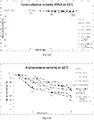
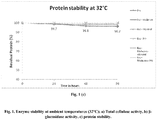
Fig. 1 illustrates graphical representation of enzyme stability at ambient temperatures (32°C); a) Total cellulase activty, b) β-glucosidase activity, c) protein stability. -
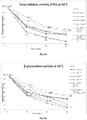
Fig. 2 illustratres graphical representation enzyme stability at operational temperatures (50°C); a) Total cellulase activty, b) β-glucosidase activity, c) protein stability. - The present invention discloses a formulation to stabilize lignocellulolytic enzyme mixture. This invention in particular relates to a formulation composed of lignocellulolytic enzyme with critical dosages of molasses either with petrochemical waste or glycerol as an additive to improve enzyme stability in a synergistic manner. Specifically, the combination of petrochemical waste or glycerol with molasses as provided in the present invention synergistically improved the enzyme stability which can't be achieved with either of them alone. Maximum performance was achieved at total cellulase activity (FPU), beta-glucosidase activity and protein stability at operation temperature i.e. 50°C and beta-glucosidase activity at ambient temperatures i.e. 32°C.
- In accordance with the present invention, a formulation to stabilize lignocellulolytic enzyme mixture comprising an additive (10%-15% w/w) and molasses (5%-20% w/w). In an embodiment, the additive stream is comprised of a petrochemical waste (PW) stream. In yet another embodiment, the additive stream is comprised of glycerol.
- In an embodiment of the present invention, there is provided a lignocellulolytic enzyme composition, said composition comprising:
- (a) 65 % to 85 % w/w lignocellulosic enzyme;
- (b) 10 % to 15 % w/w additive; and
- (c) 5% to 20 % w/w molasses;
Wherein; the additive is glycerol or a petrochemical waste stream. - In another embodiment of the present invention, the petrochemical waste stream comprises a mixture of MEG (0-0.5% w/w), DEG (0.5-30% w/w), TEG (40-50% w/w), TTEG (25-50% w/w), ethylene glycols having 5-12 monomeric units (1.3% w/w), and metals salts.
- In yet another embodiment of the present invention, the metal salts are selected from the group consisting of sodium, chromium, boron, iron, and manganese.
- In still another embodiment of the present invention, the molasses comprises at least 40% sugars.
- In a further embodiment of the present invention, the sugar is selected from the group consisting of sucrose, glucose, and fructose.
- In accordance with the present invention, a petrochemical waste (PW) stream comprising of a mixture of MEG (0-0.5%), DEG (0.5-30%), TEG (40-50%), TTEG (25-50%) other higher molecular weight ethylene glycols having 5-12 monomeric units (1.3%) and metals salts (10-6000 ppm). In accordance with the present invention, metals salts comprise Iron (Fe) is present at a concentration of 5842 ppm , sodium (Na) at 196 ppm, Chromium (Cr) at 126 ppm, Boron (B) at 112 ppm, manganese (Mn) at 78 ppm and others at concentrations <10 ppm.
- In accordance with the present invention, the molasses used in the present invention must comprise of atleast 40% sugars. The sugars comprising the molasses, used in accordance with the present invention include but are not limited to sucrose, glucose and fructose.
- In an embodiment, petrochemical waste (PW) stream is sourced from naphtha to mono-ethylene glycol production unit of refinery. In yet another embodiment, the present invention may be used for stabilization of integrated on-site produced enzyme. In another, the present invention may be utilized for stabilization of enzyme off-site prior to introduction in the ethanol conversion process.
- Having described the basic aspects of the present invention, the following non-limiting examples illustrate specific embodiment thereof.
- The analysis of lignocellulolytic enzyme mixture produced by Aspergillus sp. mutant was carried out to determine different enzyme components and activities like filter paper unit (FPU) for total cellulase activity, p-nitrophenyl-β-D-glucopyranosidase (pNPGase) activity for β-glucosidase (BGL), xylanase activity for hemicellulase and protein estimation by Bicinchoninic Acid assay (BCA). The analysis results are tabulated in Table 1.
- Enzyme concentration is usually required to save the high costs involved during bulk enzyme ambient and shipping at refrigerated temperatures, improve the solid loadings during subsequent enzymatic hydrolysis experiments and removing undesired soluble/insoluble components like residual salts, degraded proteins and other metabolites. About 20 times concentration of raw lignocellulolytic enzyme was carried out by membrane based Tangential Flow Filtration unit having 10 KDa pore size. The analysis results are tabulated in Table 1. The concentrated enzyme broth was used for further experimental studies.
Table 1: Enzyme activity analysis of raw and concentrated enzyme mixture S.No. Enzyme Cellulase (FPU/ml) β-glucosidase (BGL/ml) Xylanase (U/ml) Protein (mg/ml) 1 Native 4.8 55 95 18 2 Concentrated (20X) 96 850 1300 350 - Different enzyme stabilizers viz. glucose, sucrose, glycerol, sodium benzoate, molasses and petrochemical waste (PW) stream from naphtha to mono-ethylene glycol production unit of refinery were evaluated both individually and in different combinations (Table 2) to improve the enzyme stability at ambient temperature i.e. 32°C (
Fig. 1 ) and operational temperature i.e. 50°C (Fig. 2 ).Table 2: Additive combinations and their compositions evaluated with enzyme S.No. Additive combinations and composition (w/w) 1 Control without any stabilizer 2 Enzyme with (20%) Sucrose 3 Enzyme with (20%) Glucose 4 Enzyme with (20%) Molasses 5 Enzyme with (15%) Glycerol 6 Enzyme with (15%) Sodium benzo ate 7 Enzyme with (15%) Petrochemical Waste (PW) 8 Enzyme with (20%) Molasses and (15%) Glycerol 9 Enzyme with (20%) Molasses and (15%) PW - The initial enzyme activity determined as cellulase activity by filter paper unit (FPU)/ml and β-glucosidase (BGL/ml) were considered as reference to study the effect of stabilizer formulations. The initial activity of each enzyme sample with stabilizer formulation and without stabilizer as control were considered as 100% and their residual activity is monitored continuously from 4h to 96h. The effect of stabilizers formulations on FPU, BGL activities and protein at ambient temperature i.e. 32°C are depicted on Fig.la, 1b and 1c, respectively. While the effect of stabilizers formulations on FPU, BGL activities and protein at operational temperature of 50°C are depicted on
Fig. 2a, 2b and2c . - The results showed that PW with molasses and glycerol with molasses act synergistically to improve the enzyme stability as depicted by enzyme activities i.e. FPU and BGL at ambient temperature i.e. 32°C and operational stability at 50°C temperatures.
- Both of the enzyme formulations also reduced the enzyme degradation as depicted by protein estimation.
Claims (5)
- A lignocellulolytic enzyme composition, said composition comprising:(a) 65 % to 85 % w/w lignocellulolytic enzyme;(b) 10 % to 15 % w/w additive; and(c) 5% to 20 % w/w molasses;wherein the additive is glycerol or a petrochemical waste stream.
- The lignocellulosic enzyme composition as claimed in claim 1, wherein the petrochemical waste stream comprises a mixture of MEG (0-0.5% w/w), DEG (0.5-30% w/w), TEG (40-50% w/w), TTEG (25-50% w/w), ethylene glycols having 5-12 monomeric units (1.3% w/w), and metals salts.
- The lignocellulosic enzyme composition as claimed in claim 2, wherein the metal salts are selected from the group consisting of sodium, chromium, boron, iron, and manganese.
- The lignocellulosic enzyme composition as claimed in claim 1, wherein the molasses comprises at least 40% sugars.
- The lignocellulosic enzyme composition as claimed in claim 5, wherein the sugar is selected from the group consisting of sucrose, glucose, and fructose.
Applications Claiming Priority (1)
| Application Number | Priority Date | Filing Date | Title |
|---|---|---|---|
| IN201821009341 | 2018-03-14 |
Publications (2)
| Publication Number | Publication Date |
|---|---|
| EP3540052A1 true EP3540052A1 (en) | 2019-09-18 |
| EP3540052B1 EP3540052B1 (en) | 2025-11-05 |
Family
ID=65763333
Family Applications (1)
| Application Number | Title | Priority Date | Filing Date |
|---|---|---|---|
| EP19161852.9A Active EP3540052B1 (en) | 2018-03-14 | 2019-03-11 | A stable lignocellulolytic enzyme composition |
Country Status (5)
| Country | Link |
|---|---|
| US (1) | US11028385B2 (en) |
| EP (1) | EP3540052B1 (en) |
| DK (1) | DK3540052T3 (en) |
| ES (1) | ES3061323T3 (en) |
| FI (1) | FI3540052T3 (en) |
Citations (13)
| Publication number | Priority date | Publication date | Assignee | Title |
|---|---|---|---|---|
| EP0137616A1 (en) | 1983-08-11 | 1985-04-17 | The Procter & Gamble Company | Liquid detergents with solvent |
| EP0137615A1 (en) | 1983-08-11 | 1985-04-17 | The Procter & Gamble Company | Fabric cleaning compositions for clay-based stains |
| EP0160762A1 (en) | 1984-04-07 | 1985-11-13 | The Procter & Gamble Company | Stabilized oil-in-water cleaning microemulsions |
| EP0633311A1 (en) | 1993-06-28 | 1995-01-11 | The Procter & Gamble Company | Hydrophobic amines for cellulase stabilization in liquid detergent compositions containing anionic surfactant and cellulase |
| US5710040A (en) * | 1995-02-24 | 1998-01-20 | Roehm Gmbh Chemische Fabrik | Stable enzymatic aqueous liquid composition for the production of leather |
| WO2003041667A2 (en) | 2001-11-13 | 2003-05-22 | The Procter & Gamble Company | Compositions containing enzymes stabilized with certain osmo-protectants and methods for using such compositions in personal care |
| US20080090276A1 (en) | 2006-10-12 | 2008-04-17 | Van Dyck Stefaan M O | Heat-stable enzyme compositions |
| EP1924677A1 (en) | 2005-09-02 | 2008-05-28 | Novozymes A/S | Stabilization of concentrated liquid enzyme additives |
| WO2009026716A1 (en) * | 2007-08-30 | 2009-03-05 | Iogen Energy Corporation | Method for cellulase production |
| CN101381716A (en) | 2008-10-23 | 2009-03-11 | 肇东市日成酶制剂有限公司 | Composite stabilizer for preservation of liquid cellulase |
| EP2383330A1 (en) | 2006-03-31 | 2011-11-02 | Novozymes A/S | A stabilized liquid enzyme composition |
| WO2013029170A1 (en) | 2011-08-26 | 2013-03-07 | Iogen Energy Corporation | A process for producing cellulase mixtures from myceliophthora and related organisms |
| CN103740690A (en) | 2014-01-02 | 2014-04-23 | 山西大学 | Method for concentrating, stabilizing and separating liquid enzyme |
Family Cites Families (2)
| Publication number | Priority date | Publication date | Assignee | Title |
|---|---|---|---|---|
| US4537706A (en) * | 1984-05-14 | 1985-08-27 | The Procter & Gamble Company | Liquid detergents containing boric acid to stabilize enzymes |
| WO2006063155A2 (en) * | 2004-12-09 | 2006-06-15 | Dow Global Technologies, Inc. | Enzyme stabilization |
-
2019
- 2019-03-11 DK DK19161852.9T patent/DK3540052T3/en active
- 2019-03-11 ES ES19161852T patent/ES3061323T3/en active Active
- 2019-03-11 EP EP19161852.9A patent/EP3540052B1/en active Active
- 2019-03-11 FI FIEP19161852.9T patent/FI3540052T3/en active
- 2019-03-14 US US16/353,533 patent/US11028385B2/en active Active
Patent Citations (13)
| Publication number | Priority date | Publication date | Assignee | Title |
|---|---|---|---|---|
| EP0137615A1 (en) | 1983-08-11 | 1985-04-17 | The Procter & Gamble Company | Fabric cleaning compositions for clay-based stains |
| EP0137616A1 (en) | 1983-08-11 | 1985-04-17 | The Procter & Gamble Company | Liquid detergents with solvent |
| EP0160762A1 (en) | 1984-04-07 | 1985-11-13 | The Procter & Gamble Company | Stabilized oil-in-water cleaning microemulsions |
| EP0633311A1 (en) | 1993-06-28 | 1995-01-11 | The Procter & Gamble Company | Hydrophobic amines for cellulase stabilization in liquid detergent compositions containing anionic surfactant and cellulase |
| US5710040A (en) * | 1995-02-24 | 1998-01-20 | Roehm Gmbh Chemische Fabrik | Stable enzymatic aqueous liquid composition for the production of leather |
| WO2003041667A2 (en) | 2001-11-13 | 2003-05-22 | The Procter & Gamble Company | Compositions containing enzymes stabilized with certain osmo-protectants and methods for using such compositions in personal care |
| EP1924677A1 (en) | 2005-09-02 | 2008-05-28 | Novozymes A/S | Stabilization of concentrated liquid enzyme additives |
| EP2383330A1 (en) | 2006-03-31 | 2011-11-02 | Novozymes A/S | A stabilized liquid enzyme composition |
| US20080090276A1 (en) | 2006-10-12 | 2008-04-17 | Van Dyck Stefaan M O | Heat-stable enzyme compositions |
| WO2009026716A1 (en) * | 2007-08-30 | 2009-03-05 | Iogen Energy Corporation | Method for cellulase production |
| CN101381716A (en) | 2008-10-23 | 2009-03-11 | 肇东市日成酶制剂有限公司 | Composite stabilizer for preservation of liquid cellulase |
| WO2013029170A1 (en) | 2011-08-26 | 2013-03-07 | Iogen Energy Corporation | A process for producing cellulase mixtures from myceliophthora and related organisms |
| CN103740690A (en) | 2014-01-02 | 2014-04-23 | 山西大学 | Method for concentrating, stabilizing and separating liquid enzyme |
Non-Patent Citations (5)
| Title |
|---|
| BO XIN ET AL: "Co-utilization of glycerol and lignocellulosic hydrolysates enhances anaerobic 1,3-propanediol production by Clostridium diolis", SCIENTIFIC REPORTS, vol. 6, no. 1, 11 January 2016 (2016-01-11), XP055600025, DOI: 10.1038/srep19044 * |
| CHONG BARRIE FONG ET AL: "Stability of endoglucanases from mesophilic fungus and thermophilic bacterium in acidified polyols", ENZYME AND MICROBIAL TECHNOLOGY, STONEHAM, MA, US, vol. 61, 2 May 2014 (2014-05-02), pages 55 - 60, XP028849940, ISSN: 0141-0229, DOI: 10.1016/J.ENZMICTEC.2014.04.015 * |
| GAJENDRA S. NAIKA ET AL: "Effect of Cosolvents on the Structural Stability of Endoglucanase from Aspergillus aculeatus", JOURNAL OF AGRICULTURAL AND FOOD CHEMISTRY, vol. 57, no. 21, 11 November 2009 (2009-11-11), US, pages 10450 - 10456, XP055600343, ISSN: 0021-8561, DOI: 10.1021/jf9021724 * |
| ICIS: "Ethylene Glycol Asia Margin Report Methodology", 30 September 2015 (2015-09-30), XP055600262, Retrieved from the Internet <URL:https://s3-eu-west-1.amazonaws.com/cjp-rbi-icis-compliance/wp-content/uploads/2015/10/Ethylene-Glycol-Asia-Margin-Report-Methodology-30-September-2015.pdf> [retrieved on 20190627] * |
| JUN HE ET AL: "Cost-effective lignocellulolytic enzyme production by Trichoderma reesei on a cane molasses medium", BIOTECHNOLOGY FOR BIOFUELS, BIOMED CENTRAL LTD, GB, vol. 7, no. 1, 24 March 2014 (2014-03-24), pages 43, XP021182298, ISSN: 1754-6834, DOI: 10.1186/1754-6834-7-43 * |
Also Published As
| Publication number | Publication date |
|---|---|
| DK3540052T3 (en) | 2026-02-09 |
| US11028385B2 (en) | 2021-06-08 |
| FI3540052T3 (en) | 2026-02-05 |
| US20190284545A1 (en) | 2019-09-19 |
| EP3540052B1 (en) | 2025-11-05 |
| BR102019005014A2 (en) | 2019-10-01 |
| ES3061323T3 (en) | 2026-04-01 |
Similar Documents
| Publication | Publication Date | Title |
|---|---|---|
| Saroj et al. | Biochemical characterization of thermostable carboxymethyl cellulase and β-glucosidase from Aspergillus fumigatus JCM 10253 | |
| Sharma et al. | Efficient bioconversion of sugarcane tops biomass into biofuel-ethanol using an optimized alkali-ionic liquid pretreatment approach | |
| Liu et al. | Thermostable cellulase production of Aspergillus fumigatus Z5 under solid-state fermentation and its application in degradation of agricultural wastes | |
| Singh et al. | Adding value to agro-industrial waste for cellulase and xylanase production via solid-state bioconversion | |
| Chen et al. | Enzymatic hydrolysis of corncob and ethanol production from cellulosic hydrolysate | |
| Selig et al. | Synergistic enhancement of cellobiohydrolase performance on pretreated corn stover by addition of xylanase and esterase activities | |
| KR102956096B1 (en) | Process for enzymatic hydrolysis of lignocellulosic material and fermentation of sugars | |
| Mhlongo et al. | Lignocellulosic hydrolysate inhibitors selectively inhibit/deactivate cellulase performance | |
| Ramani et al. | Production, purification, and characterization of a β-glucosidase of Penicillium funiculosum NCL1 | |
| Sakhuja et al. | Cost-effective production of biocatalysts using inexpensive plant biomass: a review | |
| Nair et al. | An insight into the principles of lignocellulosic biomass-based zero-waste biorefineries: a green leap towards imperishable energy-based future | |
| Singh et al. | Prospects of microbial cellulase production using banana peels wastes for antimicrobial applications | |
| Singh et al. | Application of sugarcane bagasse in chemicals and food packaging industry: potential and challenges | |
| Duwe et al. | Lignocellulose-biorefinery: ethanol-focused | |
| CA2697090A1 (en) | Method for cellulase production | |
| Hu et al. | Enhanced hydrogen production and biological saccharification from spent mushroom compost by Clostridium thermocellum 27405 supplemented with recombinant β-glucosidases | |
| Zang et al. | Insight into cold-active xylanase production and xylan degradation pathways in psychrotrophic Acinetobacter sp. HC4 from the cold region of China | |
| Kaur et al. | Fungal secretomes of Aspergillus terreus repertoires cultivated on native and acid/alkali treated paddy straw for cellulase and xylanase production | |
| Aytaş et al. | Partial characterization of β-glucosidase, β-xylosidase, and α-l-arabinofuranosidase from Jiangella alba DSM 45237 and their potential in lignocellulose-based biorefining | |
| Sharma et al. | Lignocellulolytic extremozymes and their biotechnological applications | |
| Reshmy et al. | Potential utilisation of fruit and vegetable waste: an overview | |
| Kukreti et al. | A sustainable biorefinery approach to valorize corn waste to valuable chemicals | |
| Khushk et al. | Nonsterile open fermentation for producing lignocellulolytic enzymes using a Streptomyces sp. and untreated agroindustrial substrates | |
| CN104428422A (en) | Process for the production of enzyme mixtures using liquid residues from biochemical conversion processes of lignocellulosic materials | |
| US11028385B2 (en) | Stable lignocellulolytic enzyme composition |
Legal Events
| Date | Code | Title | Description |
|---|---|---|---|
| PUAI | Public reference made under article 153(3) epc to a published international application that has entered the european phase |
Free format text: ORIGINAL CODE: 0009012 |
|
| STAA | Information on the status of an ep patent application or granted ep patent |
Free format text: STATUS: REQUEST FOR EXAMINATION WAS MADE |
|
| 17P | Request for examination filed |
Effective date: 20190311 |
|
| AK | Designated contracting states |
Kind code of ref document: A1 Designated state(s): AL AT BE BG CH CY CZ DE DK EE ES FI FR GB GR HR HU IE IS IT LI LT LU LV MC MK MT NL NO PL PT RO RS SE SI SK SM TR |
|
| AX | Request for extension of the european patent |
Extension state: BA ME |
|
| STAA | Information on the status of an ep patent application or granted ep patent |
Free format text: STATUS: EXAMINATION IS IN PROGRESS |
|
| 17Q | First examination report despatched |
Effective date: 20220617 |
|
| P01 | Opt-out of the competence of the unified patent court (upc) registered |
Effective date: 20230712 |
|
| GRAP | Despatch of communication of intention to grant a patent |
Free format text: ORIGINAL CODE: EPIDOSNIGR1 |
|
| STAA | Information on the status of an ep patent application or granted ep patent |
Free format text: STATUS: GRANT OF PATENT IS INTENDED |
|
| INTG | Intention to grant announced |
Effective date: 20250528 |
|
| GRAS | Grant fee paid |
Free format text: ORIGINAL CODE: EPIDOSNIGR3 |
|
| GRAA | (expected) grant |
Free format text: ORIGINAL CODE: 0009210 |
|
| STAA | Information on the status of an ep patent application or granted ep patent |
Free format text: STATUS: THE PATENT HAS BEEN GRANTED |
|
| AK | Designated contracting states |
Kind code of ref document: B1 Designated state(s): AL AT BE BG CH CY CZ DE DK EE ES FI FR GB GR HR HU IE IS IT LI LT LU LV MC MK MT NL NO PL PT RO RS SE SI SK SM TR |
|
| REG | Reference to a national code |
Ref country code: CH Ref legal event code: F10 Free format text: ST27 STATUS EVENT CODE: U-0-0-F10-F00 (AS PROVIDED BY THE NATIONAL OFFICE) Effective date: 20251105 Ref country code: GB Ref legal event code: FG4D |
|
| REG | Reference to a national code |
Ref country code: DE Ref legal event code: R096 Ref document number: 602019077657 Country of ref document: DE |
|
| REG | Reference to a national code |
Ref country code: IE Ref legal event code: FG4D |
|
| REG | Reference to a national code |
Ref country code: FI Ref legal event code: FGE |
|
| REG | Reference to a national code |
Ref country code: DK Ref legal event code: T3 Effective date: 20260205 |
|
| REG | Reference to a national code |
Ref country code: NL Ref legal event code: FP |
|
| REG | Reference to a national code |
Ref country code: ES Ref legal event code: FG2A Ref document number: 3061323 Country of ref document: ES Kind code of ref document: T3 Effective date: 20260401 |
|
| PGFP | Annual fee paid to national office [announced via postgrant information from national office to epo] |
Ref country code: SE Payment date: 20260325 Year of fee payment: 8 |
|
| REG | Reference to a national code |
Ref country code: LT Ref legal event code: MG9D |
|
| PG25 | Lapsed in a contracting state [announced via postgrant information from national office to epo] |
Ref country code: NO Free format text: LAPSE BECAUSE OF FAILURE TO SUBMIT A TRANSLATION OF THE DESCRIPTION OR TO PAY THE FEE WITHIN THE PRESCRIBED TIME-LIMIT Effective date: 20260205 |
|
| PGFP | Annual fee paid to national office [announced via postgrant information from national office to epo] |
Ref country code: DK Payment date: 20260325 Year of fee payment: 8 |
|
| PG25 | Lapsed in a contracting state [announced via postgrant information from national office to epo] |
Ref country code: HR Free format text: LAPSE BECAUSE OF FAILURE TO SUBMIT A TRANSLATION OF THE DESCRIPTION OR TO PAY THE FEE WITHIN THE PRESCRIBED TIME-LIMIT Effective date: 20251105 Ref country code: AT Free format text: LAPSE BECAUSE OF FAILURE TO SUBMIT A TRANSLATION OF THE DESCRIPTION OR TO PAY THE FEE WITHIN THE PRESCRIBED TIME-LIMIT Effective date: 20251105 |
|
| PGFP | Annual fee paid to national office [announced via postgrant information from national office to epo] |
Ref country code: FI Payment date: 20260325 Year of fee payment: 8 |
|
| REG | Reference to a national code |
Ref country code: AT Ref legal event code: MK05 Ref document number: 1854384 Country of ref document: AT Kind code of ref document: T Effective date: 20251105 |
|
| PGFP | Annual fee paid to national office [announced via postgrant information from national office to epo] |
Ref country code: NL Payment date: 20260325 Year of fee payment: 8 |
|
| PG25 | Lapsed in a contracting state [announced via postgrant information from national office to epo] |
Ref country code: RS Free format text: LAPSE BECAUSE OF FAILURE TO SUBMIT A TRANSLATION OF THE DESCRIPTION OR TO PAY THE FEE WITHIN THE PRESCRIBED TIME-LIMIT Effective date: 20260205 |
|
| PG25 | Lapsed in a contracting state [announced via postgrant information from national office to epo] |
Ref country code: IS Free format text: LAPSE BECAUSE OF FAILURE TO SUBMIT A TRANSLATION OF THE DESCRIPTION OR TO PAY THE FEE WITHIN THE PRESCRIBED TIME-LIMIT Effective date: 20260305 |
|
| PGFP | Annual fee paid to national office [announced via postgrant information from national office to epo] |
Ref country code: FR Payment date: 20260325 Year of fee payment: 8 |
|
| PG25 | Lapsed in a contracting state [announced via postgrant information from national office to epo] |
Ref country code: PT Free format text: LAPSE BECAUSE OF FAILURE TO SUBMIT A TRANSLATION OF THE DESCRIPTION OR TO PAY THE FEE WITHIN THE PRESCRIBED TIME-LIMIT Effective date: 20260305 |
|
| PG25 | Lapsed in a contracting state [announced via postgrant information from national office to epo] |
Ref country code: PL Free format text: LAPSE BECAUSE OF FAILURE TO SUBMIT A TRANSLATION OF THE DESCRIPTION OR TO PAY THE FEE WITHIN THE PRESCRIBED TIME-LIMIT Effective date: 20251105 |
|
| PG25 | Lapsed in a contracting state [announced via postgrant information from national office to epo] |
Ref country code: LV Free format text: LAPSE BECAUSE OF FAILURE TO SUBMIT A TRANSLATION OF THE DESCRIPTION OR TO PAY THE FEE WITHIN THE PRESCRIBED TIME-LIMIT Effective date: 20251105 |
|
| PG25 | Lapsed in a contracting state [announced via postgrant information from national office to epo] |
Ref country code: BG Free format text: LAPSE BECAUSE OF FAILURE TO SUBMIT A TRANSLATION OF THE DESCRIPTION OR TO PAY THE FEE WITHIN THE PRESCRIBED TIME-LIMIT Effective date: 20251105 |
|
| PG25 | Lapsed in a contracting state [announced via postgrant information from national office to epo] |
Ref country code: LT Free format text: LAPSE BECAUSE OF FAILURE TO SUBMIT A TRANSLATION OF THE DESCRIPTION OR TO PAY THE FEE WITHIN THE PRESCRIBED TIME-LIMIT Effective date: 20251105 |
|
| PG25 | Lapsed in a contracting state [announced via postgrant information from national office to epo] |
Ref country code: SM Free format text: LAPSE BECAUSE OF FAILURE TO SUBMIT A TRANSLATION OF THE DESCRIPTION OR TO PAY THE FEE WITHIN THE PRESCRIBED TIME-LIMIT Effective date: 20251105 |
|
| PGFP | Annual fee paid to national office [announced via postgrant information from national office to epo] |
Ref country code: ES Payment date: 20260401 Year of fee payment: 8 |
|
| PGFP | Annual fee paid to national office [announced via postgrant information from national office to epo] |
Ref country code: IT Payment date: 20260330 Year of fee payment: 8 |
|
| PGFP | Annual fee paid to national office [announced via postgrant information from national office to epo] |
Ref country code: DE Payment date: 20260331 Year of fee payment: 8 |
|
| PG25 | Lapsed in a contracting state [announced via postgrant information from national office to epo] |
Ref country code: EE Free format text: LAPSE BECAUSE OF FAILURE TO SUBMIT A TRANSLATION OF THE DESCRIPTION OR TO PAY THE FEE WITHIN THE PRESCRIBED TIME-LIMIT Effective date: 20251105 |
|
| PG25 | Lapsed in a contracting state [announced via postgrant information from national office to epo] |
Ref country code: CZ Free format text: LAPSE BECAUSE OF FAILURE TO SUBMIT A TRANSLATION OF THE DESCRIPTION OR TO PAY THE FEE WITHIN THE PRESCRIBED TIME-LIMIT Effective date: 20251105 |
|
| PG25 | Lapsed in a contracting state [announced via postgrant information from national office to epo] |
Ref country code: SK Free format text: LAPSE BECAUSE OF FAILURE TO SUBMIT A TRANSLATION OF THE DESCRIPTION OR TO PAY THE FEE WITHIN THE PRESCRIBED TIME-LIMIT Effective date: 20251105 |