EP3539952A1 - Substituted bicyclic dihydropyrimidinones and their use as inhibitors of neutrophil elastase activity - Google Patents
Substituted bicyclic dihydropyrimidinones and their use as inhibitors of neutrophil elastase activity Download PDFInfo
- Publication number
- EP3539952A1 EP3539952A1 EP19165684.2A EP19165684A EP3539952A1 EP 3539952 A1 EP3539952 A1 EP 3539952A1 EP 19165684 A EP19165684 A EP 19165684A EP 3539952 A1 EP3539952 A1 EP 3539952A1
- Authority
- EP
- European Patent Office
- Prior art keywords
- compound
- formula
- mmol
- inhibitors
- phenyl
- Prior art date
- Legal status (The legal status is an assumption and is not a legal conclusion. Google has not performed a legal analysis and makes no representation as to the accuracy of the status listed.)
- Granted
Links
- 0 CC(C)(C)OC(NC(C(C(CC1)=O)=C1Nc1cc(C(F)(F)F)cnc1)c(c(S(C)=O)c1)ccc1C#N)=* Chemical compound CC(C)(C)OC(NC(C(C(CC1)=O)=C1Nc1cc(C(F)(F)F)cnc1)c(c(S(C)=O)c1)ccc1C#N)=* 0.000 description 6
- LUFXCUPVEDRDNO-UHFFFAOYSA-N Bc1cncc(N(C(CC2)=C(C(c(c(S(C)(=O)=[O]C)c3)ccc3C#N)N3C)C2=O)C3=O)c1 Chemical compound Bc1cncc(N(C(CC2)=C(C(c(c(S(C)(=O)=[O]C)c3)ccc3C#N)N3C)C2=O)C3=O)c1 LUFXCUPVEDRDNO-UHFFFAOYSA-N 0.000 description 1
- CEVYFLSMOAQNPH-UHFFFAOYSA-N CC(C)(C)OC(NC(C(C(CC1)=O)=C1Nc1cc(C(F)(F)F)ccc1)c(c(Br)c1)ccc1C#N)=O Chemical compound CC(C)(C)OC(NC(C(C(CC1)=O)=C1Nc1cc(C(F)(F)F)ccc1)c(c(Br)c1)ccc1C#N)=O CEVYFLSMOAQNPH-UHFFFAOYSA-N 0.000 description 1
- AMYSDKZEWOTIPG-UHFFFAOYSA-N CC(c1cc(C#N)ccc1C(C(C(CC1)=O)=C1N1c2cc(C(F)(F)F)ccc2)N(C)C1=O)O Chemical compound CC(c1cc(C#N)ccc1C(C(C(CC1)=O)=C1N1c2cc(C(F)(F)F)ccc2)N(C)C1=O)O AMYSDKZEWOTIPG-UHFFFAOYSA-N 0.000 description 1
- CMDAHSJGGFSGDC-UHFFFAOYSA-N CCS(c1cc(C#N)ccc1C(C(C(CC1)O)=C1N1c2cc(C(F)(F)F)ncc2)NC1=O)(=O)=O Chemical compound CCS(c1cc(C#N)ccc1C(C(C(CC1)O)=C1N1c2cc(C(F)(F)F)ncc2)NC1=O)(=O)=O CMDAHSJGGFSGDC-UHFFFAOYSA-N 0.000 description 1
- USTWEVIGFNEYHC-UHFFFAOYSA-N CCSc1cc(C#N)ccc1C(C(C(CC1)=O)=C1Nc1cccc(C(F)(F)F)c1)N Chemical compound CCSc1cc(C#N)ccc1C(C(C(CC1)=O)=C1Nc1cccc(C(F)(F)F)c1)N USTWEVIGFNEYHC-UHFFFAOYSA-N 0.000 description 1
- PRCRPSPNTFDYSL-UHFFFAOYSA-N CN(C(C(C(CC1)=O)=C1N1c2cc(C(F)(F)F)ccc2)c(c(SC)c2)ccc2C#N)C1=O Chemical compound CN(C(C(C(CC1)=O)=C1N1c2cc(C(F)(F)F)ccc2)c(c(SC)c2)ccc2C#N)C1=O PRCRPSPNTFDYSL-UHFFFAOYSA-N 0.000 description 1
- CTAOATNVUQNVBF-UHFFFAOYSA-N CN(C(C(C(CC1)=O)=C1N1c2cc(C(F)(F)F)ncc2)c(c(S(C)(=O)=O)c2)ccc2C#N)C1=O Chemical compound CN(C(C(C(CC1)=O)=C1N1c2cc(C(F)(F)F)ncc2)c(c(S(C)(=O)=O)c2)ccc2C#N)C1=O CTAOATNVUQNVBF-UHFFFAOYSA-N 0.000 description 1
- MGDDWHPRKDPLAX-UHFFFAOYSA-N CN(C(C(C(CC1)=O)=C1N1c2cc(C(F)F)ccc2)c(c(S(C)(=O)=O)c2)ccc2C#N)C1=O Chemical compound CN(C(C(C(CC1)=O)=C1N1c2cc(C(F)F)ccc2)c(c(S(C)(=O)=O)c2)ccc2C#N)C1=O MGDDWHPRKDPLAX-UHFFFAOYSA-N 0.000 description 1
- PDGOCYXFIVINQD-UHFFFAOYSA-N CN(C(C(C(CC1)=O)=C1N1c2cccc(C(F)(F)F)c2)c(c(C=O)c2)ccc2C#N)C1=O Chemical compound CN(C(C(C(CC1)=O)=C1N1c2cccc(C(F)(F)F)c2)c(c(C=O)c2)ccc2C#N)C1=O PDGOCYXFIVINQD-UHFFFAOYSA-N 0.000 description 1
- NNJCOHGNSZAMDY-UHFFFAOYSA-N CN(C(C(C(CC1)=O)=C1N1c2cccc(C(F)(F)F)c2)c(c(S(CCCO)=O)c2)ccc2C#N)C1=O Chemical compound CN(C(C(C(CC1)=O)=C1N1c2cccc(C(F)(F)F)c2)c(c(S(CCCO)=O)c2)ccc2C#N)C1=O NNJCOHGNSZAMDY-UHFFFAOYSA-N 0.000 description 1
- CQUQPUFUWYQFHE-GGPMTTHASA-N CN([C@@H](C(C(CC1)=O)=C1N1c2cc(C(F)(F)F)ccc2)c(c(S(C)=O)c2)ccc2C#N)C1=O Chemical compound CN([C@@H](C(C(CC1)=O)=C1N1c2cc(C(F)(F)F)ccc2)c(c(S(C)=O)c2)ccc2C#N)C1=O CQUQPUFUWYQFHE-GGPMTTHASA-N 0.000 description 1
- QHVHJYMPRDJLOX-OAQYLSRUSA-N CN([C@@H](C(C(CC1)=O)=C1N1c2cc(C(F)(F)F)ccc2)c(ccc(C#N)c2)c2S(C)(=O)=O)C1=O Chemical compound CN([C@@H](C(C(CC1)=O)=C1N1c2cc(C(F)(F)F)ccc2)c(ccc(C#N)c2)c2S(C)(=O)=O)C1=O QHVHJYMPRDJLOX-OAQYLSRUSA-N 0.000 description 1
- WLUFQYHVPFLSCV-UHFFFAOYSA-N CS(c1c(C(C(C(CC2)=O)=C2N2c3cccc(C(F)(F)F)c3)NC2=O)ccc(C#N)c1)=O Chemical compound CS(c1c(C(C(C(CC2)=O)=C2N2c3cccc(C(F)(F)F)c3)NC2=O)ccc(C#N)c1)=O WLUFQYHVPFLSCV-UHFFFAOYSA-N 0.000 description 1
- OJHJODRBJXXFBI-UHFFFAOYSA-N CS(c1cc(C#N)ccc1C(C(C(CC1)=O)=C1N1c2cc(C(F)(F)F)ccc2)N(CCCO)C1=O)(=O)=O Chemical compound CS(c1cc(C#N)ccc1C(C(C(CC1)=O)=C1N1c2cc(C(F)(F)F)ccc2)N(CCCO)C1=O)(=O)=O OJHJODRBJXXFBI-UHFFFAOYSA-N 0.000 description 1
- IUSWGRGPKKPTKB-UHFFFAOYSA-N CS(c1cc(C#N)ccc1C(C(C(CC1)=O)=C1Nc1cc(C(F)(F)F)ccn1)N)(=O)=O Chemical compound CS(c1cc(C#N)ccc1C(C(C(CC1)=O)=C1Nc1cc(C(F)(F)F)ccn1)N)(=O)=O IUSWGRGPKKPTKB-UHFFFAOYSA-N 0.000 description 1
- MYRATSMQMCEONN-UHFFFAOYSA-N CSc1cc(C#N)ccc1C(C(C(CC1)=O)=C1N1c2cc(C(F)(F)F)ccc2)NC1=O Chemical compound CSc1cc(C#N)ccc1C(C(C(CC1)=O)=C1N1c2cc(C(F)(F)F)ccc2)NC1=O MYRATSMQMCEONN-UHFFFAOYSA-N 0.000 description 1
- QPQOOGRBJNXFGR-UHFFFAOYSA-N C[N+](c1cc(C#N)ccc1C(C(C(CC1)=O)=C1Nc1cc(C(F)(F)F)ncc1)N)([O-])O Chemical compound C[N+](c1cc(C#N)ccc1C(C(C(CC1)=O)=C1Nc1cc(C(F)(F)F)ncc1)N)([O-])O QPQOOGRBJNXFGR-UHFFFAOYSA-N 0.000 description 1
- APAIXAWNEHJVIC-UHFFFAOYSA-N NC(C(C(CC1)=O)=C1Nc1cc(C(F)(F)F)ccc1)c(ccc(C#N)c1)c1Br Chemical compound NC(C(C(CC1)=O)=C1Nc1cc(C(F)(F)F)ccc1)c(ccc(C#N)c1)c1Br APAIXAWNEHJVIC-UHFFFAOYSA-N 0.000 description 1
Classifications
-
- C—CHEMISTRY; METALLURGY
- C07—ORGANIC CHEMISTRY
- C07D—HETEROCYCLIC COMPOUNDS
- C07D239/00—Heterocyclic compounds containing 1,3-diazine or hydrogenated 1,3-diazine rings
- C07D239/70—Heterocyclic compounds containing 1,3-diazine or hydrogenated 1,3-diazine rings condensed with carbocyclic rings or ring systems
-
- A—HUMAN NECESSITIES
- A61—MEDICAL OR VETERINARY SCIENCE; HYGIENE
- A61K—PREPARATIONS FOR MEDICAL, DENTAL OR TOILETRY PURPOSES
- A61K31/00—Medicinal preparations containing organic active ingredients
- A61K31/33—Heterocyclic compounds
- A61K31/395—Heterocyclic compounds having nitrogen as a ring hetero atom, e.g. guanethidine or rifamycins
- A61K31/495—Heterocyclic compounds having nitrogen as a ring hetero atom, e.g. guanethidine or rifamycins having six-membered rings with two or more nitrogen atoms as the only ring heteroatoms, e.g. piperazine or tetrazines
- A61K31/505—Pyrimidines; Hydrogenated pyrimidines, e.g. trimethoprim
- A61K31/517—Pyrimidines; Hydrogenated pyrimidines, e.g. trimethoprim ortho- or peri-condensed with carbocyclic ring systems, e.g. quinazoline, perimidine
-
- A—HUMAN NECESSITIES
- A61—MEDICAL OR VETERINARY SCIENCE; HYGIENE
- A61K—PREPARATIONS FOR MEDICAL, DENTAL OR TOILETRY PURPOSES
- A61K45/00—Medicinal preparations containing active ingredients not provided for in groups A61K31/00 - A61K41/00
- A61K45/06—Mixtures of active ingredients without chemical characterisation, e.g. antiphlogistics and cardiaca
-
- A—HUMAN NECESSITIES
- A61—MEDICAL OR VETERINARY SCIENCE; HYGIENE
- A61P—SPECIFIC THERAPEUTIC ACTIVITY OF CHEMICAL COMPOUNDS OR MEDICINAL PREPARATIONS
- A61P1/00—Drugs for disorders of the alimentary tract or the digestive system
-
- A—HUMAN NECESSITIES
- A61—MEDICAL OR VETERINARY SCIENCE; HYGIENE
- A61P—SPECIFIC THERAPEUTIC ACTIVITY OF CHEMICAL COMPOUNDS OR MEDICINAL PREPARATIONS
- A61P1/00—Drugs for disorders of the alimentary tract or the digestive system
- A61P1/04—Drugs for disorders of the alimentary tract or the digestive system for ulcers, gastritis or reflux esophagitis, e.g. antacids, inhibitors of acid secretion, mucosal protectants
-
- A—HUMAN NECESSITIES
- A61—MEDICAL OR VETERINARY SCIENCE; HYGIENE
- A61P—SPECIFIC THERAPEUTIC ACTIVITY OF CHEMICAL COMPOUNDS OR MEDICINAL PREPARATIONS
- A61P1/00—Drugs for disorders of the alimentary tract or the digestive system
- A61P1/16—Drugs for disorders of the alimentary tract or the digestive system for liver or gallbladder disorders, e.g. hepatoprotective agents, cholagogues, litholytics
-
- A—HUMAN NECESSITIES
- A61—MEDICAL OR VETERINARY SCIENCE; HYGIENE
- A61P—SPECIFIC THERAPEUTIC ACTIVITY OF CHEMICAL COMPOUNDS OR MEDICINAL PREPARATIONS
- A61P11/00—Drugs for disorders of the respiratory system
-
- A—HUMAN NECESSITIES
- A61—MEDICAL OR VETERINARY SCIENCE; HYGIENE
- A61P—SPECIFIC THERAPEUTIC ACTIVITY OF CHEMICAL COMPOUNDS OR MEDICINAL PREPARATIONS
- A61P11/00—Drugs for disorders of the respiratory system
- A61P11/06—Antiasthmatics
-
- A—HUMAN NECESSITIES
- A61—MEDICAL OR VETERINARY SCIENCE; HYGIENE
- A61P—SPECIFIC THERAPEUTIC ACTIVITY OF CHEMICAL COMPOUNDS OR MEDICINAL PREPARATIONS
- A61P13/00—Drugs for disorders of the urinary system
- A61P13/12—Drugs for disorders of the urinary system of the kidneys
-
- A—HUMAN NECESSITIES
- A61—MEDICAL OR VETERINARY SCIENCE; HYGIENE
- A61P—SPECIFIC THERAPEUTIC ACTIVITY OF CHEMICAL COMPOUNDS OR MEDICINAL PREPARATIONS
- A61P19/00—Drugs for skeletal disorders
- A61P19/02—Drugs for skeletal disorders for joint disorders, e.g. arthritis, arthrosis
-
- A—HUMAN NECESSITIES
- A61—MEDICAL OR VETERINARY SCIENCE; HYGIENE
- A61P—SPECIFIC THERAPEUTIC ACTIVITY OF CHEMICAL COMPOUNDS OR MEDICINAL PREPARATIONS
- A61P25/00—Drugs for disorders of the nervous system
-
- A—HUMAN NECESSITIES
- A61—MEDICAL OR VETERINARY SCIENCE; HYGIENE
- A61P—SPECIFIC THERAPEUTIC ACTIVITY OF CHEMICAL COMPOUNDS OR MEDICINAL PREPARATIONS
- A61P29/00—Non-central analgesic, antipyretic or antiinflammatory agents, e.g. antirheumatic agents; Non-steroidal antiinflammatory drugs [NSAID]
-
- A—HUMAN NECESSITIES
- A61—MEDICAL OR VETERINARY SCIENCE; HYGIENE
- A61P—SPECIFIC THERAPEUTIC ACTIVITY OF CHEMICAL COMPOUNDS OR MEDICINAL PREPARATIONS
- A61P3/00—Drugs for disorders of the metabolism
- A61P3/04—Anorexiants; Antiobesity agents
-
- A—HUMAN NECESSITIES
- A61—MEDICAL OR VETERINARY SCIENCE; HYGIENE
- A61P—SPECIFIC THERAPEUTIC ACTIVITY OF CHEMICAL COMPOUNDS OR MEDICINAL PREPARATIONS
- A61P3/00—Drugs for disorders of the metabolism
- A61P3/06—Antihyperlipidemics
-
- A—HUMAN NECESSITIES
- A61—MEDICAL OR VETERINARY SCIENCE; HYGIENE
- A61P—SPECIFIC THERAPEUTIC ACTIVITY OF CHEMICAL COMPOUNDS OR MEDICINAL PREPARATIONS
- A61P3/00—Drugs for disorders of the metabolism
- A61P3/08—Drugs for disorders of the metabolism for glucose homeostasis
- A61P3/10—Drugs for disorders of the metabolism for glucose homeostasis for hyperglycaemia, e.g. antidiabetics
-
- A—HUMAN NECESSITIES
- A61—MEDICAL OR VETERINARY SCIENCE; HYGIENE
- A61P—SPECIFIC THERAPEUTIC ACTIVITY OF CHEMICAL COMPOUNDS OR MEDICINAL PREPARATIONS
- A61P31/00—Antiinfectives, i.e. antibiotics, antiseptics, chemotherapeutics
-
- A—HUMAN NECESSITIES
- A61—MEDICAL OR VETERINARY SCIENCE; HYGIENE
- A61P—SPECIFIC THERAPEUTIC ACTIVITY OF CHEMICAL COMPOUNDS OR MEDICINAL PREPARATIONS
- A61P35/00—Antineoplastic agents
-
- A—HUMAN NECESSITIES
- A61—MEDICAL OR VETERINARY SCIENCE; HYGIENE
- A61P—SPECIFIC THERAPEUTIC ACTIVITY OF CHEMICAL COMPOUNDS OR MEDICINAL PREPARATIONS
- A61P37/00—Drugs for immunological or allergic disorders
- A61P37/02—Immunomodulators
- A61P37/06—Immunosuppressants, e.g. drugs for graft rejection
-
- A—HUMAN NECESSITIES
- A61—MEDICAL OR VETERINARY SCIENCE; HYGIENE
- A61P—SPECIFIC THERAPEUTIC ACTIVITY OF CHEMICAL COMPOUNDS OR MEDICINAL PREPARATIONS
- A61P37/00—Drugs for immunological or allergic disorders
- A61P37/08—Antiallergic agents
-
- A—HUMAN NECESSITIES
- A61—MEDICAL OR VETERINARY SCIENCE; HYGIENE
- A61P—SPECIFIC THERAPEUTIC ACTIVITY OF CHEMICAL COMPOUNDS OR MEDICINAL PREPARATIONS
- A61P43/00—Drugs for specific purposes, not provided for in groups A61P1/00-A61P41/00
-
- A—HUMAN NECESSITIES
- A61—MEDICAL OR VETERINARY SCIENCE; HYGIENE
- A61P—SPECIFIC THERAPEUTIC ACTIVITY OF CHEMICAL COMPOUNDS OR MEDICINAL PREPARATIONS
- A61P7/00—Drugs for disorders of the blood or the extracellular fluid
-
- A—HUMAN NECESSITIES
- A61—MEDICAL OR VETERINARY SCIENCE; HYGIENE
- A61P—SPECIFIC THERAPEUTIC ACTIVITY OF CHEMICAL COMPOUNDS OR MEDICINAL PREPARATIONS
- A61P9/00—Drugs for disorders of the cardiovascular system
- A61P9/10—Drugs for disorders of the cardiovascular system for treating ischaemic or atherosclerotic diseases, e.g. antianginal drugs, coronary vasodilators, drugs for myocardial infarction, retinopathy, cerebrovascula insufficiency, renal arteriosclerosis
-
- A—HUMAN NECESSITIES
- A61—MEDICAL OR VETERINARY SCIENCE; HYGIENE
- A61P—SPECIFIC THERAPEUTIC ACTIVITY OF CHEMICAL COMPOUNDS OR MEDICINAL PREPARATIONS
- A61P9/00—Drugs for disorders of the cardiovascular system
- A61P9/12—Antihypertensives
-
- C—CHEMISTRY; METALLURGY
- C07—ORGANIC CHEMISTRY
- C07D—HETEROCYCLIC COMPOUNDS
- C07D401/00—Heterocyclic compounds containing two or more hetero rings, having nitrogen atoms as the only ring hetero atoms, at least one ring being a six-membered ring with only one nitrogen atom
- C07D401/02—Heterocyclic compounds containing two or more hetero rings, having nitrogen atoms as the only ring hetero atoms, at least one ring being a six-membered ring with only one nitrogen atom containing two hetero rings
- C07D401/04—Heterocyclic compounds containing two or more hetero rings, having nitrogen atoms as the only ring hetero atoms, at least one ring being a six-membered ring with only one nitrogen atom containing two hetero rings directly linked by a ring-member-to-ring-member bond
-
- C—CHEMISTRY; METALLURGY
- C07—ORGANIC CHEMISTRY
- C07D—HETEROCYCLIC COMPOUNDS
- C07D405/00—Heterocyclic compounds containing both one or more hetero rings having oxygen atoms as the only ring hetero atoms, and one or more rings having nitrogen as the only ring hetero atom
- C07D405/02—Heterocyclic compounds containing both one or more hetero rings having oxygen atoms as the only ring hetero atoms, and one or more rings having nitrogen as the only ring hetero atom containing two hetero rings
- C07D405/06—Heterocyclic compounds containing both one or more hetero rings having oxygen atoms as the only ring hetero atoms, and one or more rings having nitrogen as the only ring hetero atom containing two hetero rings linked by a carbon chain containing only aliphatic carbon atoms
Definitions
- This invention relates to substituted bicyclic dihydropyrimidinones of formula 1 and their use as inhibitors of neutrophil elastase activity, pharmaceutical compositions containing the same, and methods of using the same as agents for treatment and/or prevention of pulmonary, gastrointestinal and genitourinary diseases, inflammatory diseases of the skin and the eye and other autoimmune and allergic disorders, allograft rejection, and oncological diseases.
- Neutrophil elastase is a 29 kDa serine protease. It is expressed in bone marrow precursor cells, stored in the granula of peripheral blood granulocytes at high concentrations and it is released upon cellular activation. To the substrates of NE belong major elements of the extracellular matrix (ECM): elastin, fibronectin, laminin, collagen and proteoglycans. Neutrophil elastase activity leads to ECM degradation, increases migration and chemotaxis of monocytes and vascular smooth muscle cells and directly affects components of the coagulation and fibrinolytic pathways (PAI-1 and TFPI).
- ECM extracellular matrix
- neutrophil elastase Increased activity of neutrophil elastase is associated with chronic inflammatory and fibrotic diseases of several organs.
- the potential of neutrophil elastase inhibitors as anti-inflammatory therapies has been reviewed by P. A. Henriksen in Current Opinion in Hematology 2014, 21, 23-28 .
- Inhibitors of neutrophil elastase will therefore have an important role for the treatment of different diseases like COPD, idiopathic pulmonary fibrosis and other fibrotic diseases, cancer, acute lung injury, acute respiratory distress syndrome, bronchiectasis, cystic fibrosis, alpha1-antitrypsin deficiency and others.
- the problem of the present invention is to prepare new compounds which on the basis of their pharmaceutical effectiveness as inhibitors of neutrophil elastase activity, may be used therapeutically, that is for the treatment of pathophysiological processes caused by increased activity of neutrophil elastase.
- the compounds according to the present invention are effective as inhibitors of neutrophil elastase and exhibit favourable inhibitory potency, as determined by the half maximal inhibitory concentration (IC 50 ), in an enzymatic inhibition assay.
- Some compounds according to the present invention are additionally effective as inhibitors of neutrophil serine protease proteinase 3 and exhibit favourable inhibitory potency, as determined by the half maximal inhibitory concentration (IC 50 ), in an enzymatic inhibition assay.
- This inhibitory activity on a second neutrophil serine protease may be benificial for pharmacological efficacy.
- Some compounds according to the present invention exhibit favourable inhibitory potency, as determined by the half maximal effective concentration (EC 50 ), in a plasma or whole-blood assay, for instance as described in T. Stevens et al. (J. Pharm. Exp. Ther. 2011, 339, 313-320 ).
- Some compounds according to the present invention exhibit favourable in vivo potency, as determined, for example, by the half maximal effective dose (ED 50 ), in models of human neutrophil elastase-induced lung injury in mouse or rat, for instance as described in Tremblay et al. (Chest 2002, 121, 582-588 ) or T. Stevens et al. (J. Pharm. Exp. Ther. 2011, 339, 313-320 ).
- Some compounds according to the present invention exhibit favourable metabolic stability in an in vitro microsomal assay for metabolic stability as described in E. Kerns & L. Di (Drug-like properties: concepts, structure design and methods: from ADME to toxicity optimization, Elsevier, 1st ed, 2008), chapter 29 and references therein.
- Some compounds according to the present invention exhibit favourable metabolic stability in an in vitro hepatocytes assay for metabolic stability as described in E. Kerns & L. Di (Drug-like properties: concepts, structure design and methods: from ADME to toxicity optimization, Elsevier, 1st ed, 2008), chapter 29 and references therein.
- Some compounds according to the present invention exhibit favourable permeability in an in vitro Caco-2 cell layer method for permeability as described in E. Kerns & L. Di (Drug-like properties: concepts, structure design and methods: from ADME to toxicity optimization, Elsevier, 1st ed, 2008), chapter 26 and references therein.
- improved permeability is expected to translate into a higher fraction of the drug absorbed in the intestinal tract, thus, resulting in higher dose-normalized systemic exposure (AUC).
- Some compounds according to the present invention exhibit a favourable, that is low efflux ratio (permeability in the efflux direction divided by the permeability in the influx direction) in an in vitro Caco-2 or MDCK cell layer method as described in E. Kerns & L. Di (Drug-like properties: concepts, structure design and methods: from ADME to toxicity optimization, Elsevier, 1st ed, 2008), chapter 26 and 27 and references therein.
- an improved, that is reduced efflux ratio is expected to translate into a higher fraction of the drug absorbed in the intestinal tract, thus, resulting in higher dose-normalized systemic exposure (AUC).
- Some compounds according to the present invention exhibit favourable aqueous solubility in a kinetic or thermodynamic solubility method as described in E. Kerns & L. Di (Drug-like properties: concepts, 15 structure design and methods: from ADME to toxicity optimization, Elsevier, 1st ed, 2008), chapter 25 and references therein.
- improved aqueous solubility is expected to translate into a higher fraction of the drug absorbed in the intestinal tract resulting in higher dose-normalized systemic exposure (AUC) and/or oral bioavailability (F oral ) and/or peak plasma concentration after administration (C max ).
- improved aqueous solubility is expected to reduce the risk of development challenges, such as expensive formulations, increased development time, high drug load.
- Comparatively higher dose-normalized systemic exposure can be advantageous in several ways: (1) If a certain systemic exposure (AUC) needs to be achieved for efficacy, the drug can be dosed in a lower amount. Lower dosages have the advantages of lower drug load (parent drug and metabolites thereof) for the patient causing potentially less side effects, and lower production costs for the drug product. (2) Comparatively higher dose-normalized systemic exposure (AUC) can lead to increased efficacy or prolonged duration of action of the drug when the same dose is applied.
- Some compounds according to the present invention exhibit favourable metabolic stability, favourable permeability and favourable aqueous solubility. Accordingly, some compounds of the present invention are expected to exhibit favourable pharmacokinetic (PK) properties after oral dosing, in particular favourable systemic exposure (area under the curve, AUC), thus, leading to favourable efficacy in vivo.
- PK pharmacokinetic
- PK properties can be determined in pre-clinical animal species, for example mouse, rat, hamster, dog, guinea pig, mini pig, cynomolgus monkey, rhesus monkey.
- the PK properties of a compound can be described, for example, by the following parameters: Mean residence time (MRT), elimination half-live (t 1/2 ), volume-of-distribution (V D ), area under the curve (AUC), clearance (CL) and bioavailability after oral administration (F oral ), peak plasma concentration after administration (C max ), time to reach Cmax (T max ).
- Some compounds according to the present invention exhibit favourable, that is, low inhibition of cytochrome P450 (CYP) isozymes in corresponding in vitro assays for CYP isozyme inhibition as described in E. Kerns & L. Di (Drug-like properties: concepts, structure design and methods: from ADME to toxicity optimization, Elsevier, 1st ed, 2008), chapter 32 and references therein.
- CYP cytochrome P450
- Reduced inhibition of CYP isozymes is expected to translate into a reduced risk for undesirable drug-drug interactions which is the interference of one drug with the normal metabolic or pharmacokinetic behaviour of a co-administered drug.
- CYP induction can affect the pharmacokinetics of a drug molecule upon multiple dosing, which can result in undesirable pharmacokinetic drug-drug interactions with co-administered drugs.
- CYP induction can lead to decreased exposure of the inducing compound (e.g. autoinduction) or decreased exposure of a co-administered compound metabolized by the induced enzyme.
- CYP induction can also lead to an increase in the metabolism of a drug causing changes in pharmacological (active metabolite) and toxicological (toxic metabolite) outcomes.
- Some compounds according to the present invention exhibit favourable, that is low, inhibition of the hERG channel in a patch clamp assay as described in E. Kerns & L. Di (Drug-like properties: concepts, structure design and methods: from ADME to toxicity optimization, Elsevier, 1st ed, 2008), chapter 34 and references cited therein.
- C 1-6 -alkyl means an alkyl group or radical having 1 to 6 carbon atoms.
- radical attachment point(s) to the molecule from the free valences of the group itself.
- the last named subgroup is the radical attachment point, for example, the substituent "aryl-C 1-3 -alkyl-" means an aryl group which is bound to a C 1-3 -alkyl-group, the latter of which is bound to the core or to the group to which the substituent is attached.
- 3-carboxypropyl-group represents the following substituent: wherein the carboxy group is attached to the third carbon atom of the propyl group.
- the terms "1-methylpropyl-", “2,2-dimethylpropyl-” or “cyclopropylmethyl-” group represent the following groups:
- the asterisk may be used in sub-formulas to indicate the bond which is connected to the core molecule as defined.
- substituted means that any one or more hydrogens on the designated atom is replaced with a selection from the indicated group, provided that the designated atom's normal valence is not exceeded, and that the substitution results in a stable compound.
- prevention means the management and care of an individual at risk of developing the disease prior to the clinical onset of the disease.
- the purpose of prevention is to combat the development of the disease, condition or disorder, and includes the administration of the active compounds to prevent or delay the onset of the symptoms or complications and to prevent or delay the development of related diseases, conditions or disorders. Success of said preventive treatment is reflected statistically by reduced incidence of said condition within a patient population at risk for this condition in comparison to an equivalent patient population without preventive treatment.
- treatment means therapeutic treatment of patients having already developed one or more of said conditions in manifest, acute or chronic form, including symptomatic treatment in order to relieve symptoms of the specific indication or causal treatment in order to reverse or partially reverse the condition or to delay the progression of the indication as far as this may be possible, depending on the condition and the severity thereof.
- treatment of a disease means the management and care of a patient having developed the disease, condition or disorder.
- the purpose of treatment is to combat the disease, condition or disorder.
- Treatment includes the administration of the active compounds to eliminate or control the disease, condition or disorder as well as to alleviate the symptoms or complications associated with the disease, condition or disorder.
- a given chemical formula or name shall encompass tautomers and all stereo, optical and geometrical isomers (e.g. enantiomers, diastereomers, E/Z isomers etc%) and racemates thereof as well as mixtures in different proportions of the separate enantiomers, mixtures of diastereomers, or mixtures of any of the foregoing forms where such isomers and enantiomers exist, as well as salts, including pharmaceutically acceptable salts thereof and solvates thereof such as for instance hydrates including solvates of the free compounds or solvates of a salt of the compound.
- the compounds of the present invention contain at least one asymmetrically substituted carbon atom, and may therefore be isolated as pure enantiomers or as a racemic or non-racemic mixture of both enantiomers. It will be appreciated that some of the compounds of the present invention contain more than one stereogenic center, that is more than one asymmetrically substituted carbon or sulfur atom, and may therefore be isolated as pure diastereomers or as diastereomeric mixtures, both in optically active or racemic forms.
- the invention contemplates all conceivable stereoisomers, particularly the diastereomers and enantiomers mentioned herein, e.g. in substantially pure form, in enriched form (e.g. substantially free of any or all other undesired enantiomers and/or diastereomers and/or in any mixing ratio, including the racemic forms, as well as the salts thereof.
- substantially pure stereoisomers can be obtained according to synthetic principles known to a person skilled in the field, e.g. by separation of corresponding mixtures, by using stereochemically pure starting materials and/or by stereoselective synthesis. It is known in the art how to prepare optically active forms, such as by resolution of racemic forms or by synthesis, e.g. starting from optically active starting materials and/or by using chiral reagents.
- Enantiomerically pure compounds of this invention or intermediates may be prepared via asymmetric synthesis, for example by preparation and subsequent separation of appropriate diastereomeric compounds or intermediates which can be separated by known methods (e.g. by chromatographic separation or crystallization) and/or by using chiral reagents, such as chiral starting materials, chiral catalysts or chiral auxiliaries.
- halogen generally denotes fluorine, chlorine, bromine and iodine.
- prodrug refers to (i) an inactive form of a drug that exerts its effects after metabolic processes within the body converting it to a usable or active form, or (ii) a substance that gives rise to a pharmacologically active metabolite, although not itself active (that is an inactive precursor).
- prodrug or “prodrug derivative” mean a covalently-bonded derivative, carrier or precursor of the parent compound or active drug substance which undergoes at least some biotransformation prior to exhibiting its pharmacological effect(s).
- prodrugs either have metabolically cleavable or otherwise convertible groups and are rapidly transformed in vivo to yield the parent compound, for example, by hydrolysis in blood or by activation via oxidation as in case of thioether groups.
- Most common prodrugs include esters and amide analogs of the parent compounds.
- prodrug is formulated with the objectives of improved chemical stability, improved patient acceptance and compliance, improved bioavailability, prolonged duration of action, improved organ selectivity, improved formulation (e.g., increased hydrosolubility), and/or decreased side effects (e.g., toxicity).
- prodrugs themselves have weak or no biological activity and are stable under ordinary conditions.
- Prodrugs can be readily prepared from the parent compounds using methods known in the art, such as those described in A Textbook of Drug Design and Development, Krogsgaard-Larsen and H. Bundgaard (eds.), Gordon & Breach, 1991 , particularly Chapter 5: "Design and Applications of Prodrugs”; Design of Prodrugs, H.
- pharmaceutically acceptable prodrug means a prodrug of a compound of the invention which is, within the scope of sound medical judgment, suitable for use in contact with the tissues of humans and lower animals without undue toxicity, irritation, allergic response, and the like, commensurate with a reasonable benefit/risk ratio, and effective for their intended use, as well as the zwitterionic forms, where possible.
- phrases "pharmaceutically acceptable” is employed herein to refer to those compounds, materials, compositions, and/or dosage forms which are, within the scope of sound medical judgment, suitable for use in contact with the tissues of human beings and animals without excessive toxicity, irritation, allergic response, or other problem or complication, and commensurate with a reasonable benefit/risk ratio.
- pharmaceutically acceptable salts refer to derivatives of the disclosed compounds wherein the parent compound is modified by making acid or base salts thereof.
- examples of pharmaceutically acceptable salts include, but are not limited to, mineral or organic acid salts of basic residues such as amines; alkali or organic salts of acidic residues such as carboxylic acids; and the like.
- such salts include salts from ammonia, L-arginine, betaine, benethamine, benzathine, calcium hydroxide, choline, deanol, diethanolamine (2,2'-iminobis(ethanol)), diethylamine, 2-(diethylamino)-ethanol, 2-aminoethanol, ethylenediamine, N-ethyl-glucamine, hydrabamine, 1H-imidazole, lysine, magnesium hydroxide, 4-(2-hydroxyethyl)-morpholine, piperazine, potassium hydroxide, 1-(2-hydroxyethyl)-pyrrolidine, sodium hydroxide, triethanolamine (2,2',2"-nitrilotris-(ethanol)), tromethamine, zinc hydroxide, acetic acid, 2.2-dichloro-acetic acid, adipic acid, alginic acid, ascorbic acid, L-aspartic acid, benzenesulfonic acid
- salts can be formed with cations from metals like aluminium, calcium, lithium, magnesium, potassium, sodium, zinc and the like. (also see Pharmaceutical salts, Berge, S.M. et al., J. Pharm. Sci., (1977), 66, 1-19 ).
- the pharmaceutically acceptable salts of the present invention can be synthesized from the parent compound which contains a basic or acidic moiety by conventional chemical methods. Generally, such salts can be prepared by reacting the free acid or base forms of these compounds with a sufficient amount of the appropriate base or acid in water or in an organic diluent like ether, ethyl acetate, ethanol, isopropanol, or acetonitrile, or a mixture thereof.
- Salts of other acids than those mentioned above which for example are useful for purifying or isolating the compounds of the present invention e.g. trifluoro acetate salts
- Salts of other acids than those mentioned above which for example are useful for purifying or isolating the compounds of the present invention also comprise a part of the invention.
- halo added to a “alkyl”, “alkylene” or “cycloalkyl” group (saturated or unsaturated) is such a alkyl or cycloalkyl group wherein one or more hydrogen atoms are replaced by a halogen atom selected from among fluorine, chlorine or bromine, preferably fluorine and chlorine, particularly preferred is fluorine. Examples include: H 2 FC-, HF 2 C-, F 3 C-.
- a compound of formula 1 is not a compound selected from the above mentioned group means specifically that a compound of formula 1 is not a compound selected from a group consisting of which are disclosed in the European patent application No. 13154256.5 .
- Embodied are the above compounds of formula 1, selected from the group consisting of compounds 1.a to 1.h. or a pharmaceutical acceptable salt thereof.
- Embodied are the above compounds of formula 1', selected from the group consisting of compounds 1.a' to 1.h' or a pharmaceutically acceptable salt thereof.
- Embodied are the above compounds of formula 1, wherein R 2.1 is CF 3 or a pharmaceutical acceptable salt thereof.
- Embodied are the above compounds of formula 1, wherein R 2.1 is CHF 2 or a pharmaceutical acceptable salt thereof.
- Embodied are the above compounds of formula 1, wherein the compounds are selected from the group consisting of examples A.1A, A.2, A.3, B.1.2B, B.1.3A, C.1B, C.2A, C5.1, C.5.2, D.1A, D.3B, D.4.1A, D.4.4, D.4.5 and D.5A or a pharmaceutical acceptable salt thereof.
- Embodied are the above compounds of formula 1, wherein the compounds are selected from the group consisting of examples A.2, A.3, B.1.2B, B.1.3A, C.1B, C.2A, C5.1, C.5.2, D.1A, D.3B, D.4.1A, D.4.4, D.4.5 and D.5A or a pharmaceutical acceptable salt thereof.
- Embodied are the above compounds of formula 1, wherein the compounds are selected from the group consisting of examples A.1A, A.3, B.1.2B, B.1.3A, C.1B, C.2A, C5.1, C.5.2, D.4.1A, D.4.5 and D.5A or a pharmaceutical acceptable salt thereof.
- Embodied are the above compounds of formula 1, wherein the compounds are selected from the group consisting of examples A.3, B.1.2B, B.1.3A, C.1B, C.2A, C5.1, C.5.2, D.4.1A, D.4.5 and D.5A or a pharmaceutical acceptable salt thereof.
- R 1 , R 1.1 , R 1.1.a , R 1.1.b , R 1.1.c , R 2 , R 2.a , R 2.b , R 2.c , R 2.1 , R 3 , R 3.a , R 3.b and R 3.c may be combined with each other.
- Another embodiment of the invention is an above compound of formula 1 for use as a medicament.
- a further embodiment of the invention is an above compound of formula 1 for use as a medicament for the treatment of asthma and allergic diseases, gastrointestinal inflammatory diseases, glomerulonephritis, eosinophilic diseases, chronic obstructive pulmonary disease, infection by pathogenic microbes and rheumatoid arthritis.
- a further embodiment of the invention is an above compound of formula 1 for use as a medicament for the treatment of neutrophilic diseases, cystic fibrosis (CF), non-cystic fibrosis, idiopathic pulmonary fibrosis, bronchiectasis, ANCA-associated vasculitis, lung cancer, non-cyctic fibrosis bronchiectasis, emphysema, chronic bronchitis, acute lung injury (ALI), acute respiratory distress syndrome (ARDS), pulmonary hypertension, pulmonary arterial hypertension (PAH) and Alpha-1-antitrypsin deficiency (AATD).
- neutrophilic diseases cystic fibrosis (CF)
- non-cystic fibrosis idiopathic pulmonary fibrosis
- bronchiectasis ANCA-associated vasculitis
- lung cancer non-cyctic fibrosis bronchiectasis
- emphysema chronic bron
- a further embodiment of the invention is an above compound of formula 1 for use as a medicament for the treatment of obesity and related inflammation, insulin resistence, diabetes, fatty liver and liver steatosis.
- a further embodiment of the present invention is an above compound of formula 1, for use as a medicament for the treatment of traumatic brain injury, abdominal aortic aneurism and Graft vs. Host Disease (GvHD).
- a further embodiment of the invention is a pharmaceutical composition, containing one or more of the above compounds of formula 1 or a pharmaceutically active salt thereof.
- a further embodiment of the invention is a method of treatment or prevention of diseases in which neutrophil elastase inhibitors have a therapeutic benefit, which method comprises administration of a therapeutically or preventively effective amount of an above compound of formula 1 to a patient in need thereof.
- a further embodiment of the invention is a pharmaceutical composition
- a pharmaceutically active compound selected from the group consisting of betamimetics, anticholinergics, corticosteroids, PDE4-inhibitors, LTD4-antagonists, EGFR-inhibitors, Cathepsin C inhibitors, CRTH2 inhibitors, 5-LO-inhibitors, Histamine receptor antagonists and SYK-inhibitors, but also combinations of two or three active substances.
- the compounds according to the present invention and their intermediates may be obtained using methods of synthesis which are known to the one skilled in the art and described in the literature of organic synthesis.
- the compounds are obtained in analogous fashion to the methods of preparation explained more fully hereinafter, in particular as described in the experimental section.
- the order in carrying out the reaction steps may be varied. Variants of the reaction methods that are known to the one skilled in the art but not described in detail here may also be used.
- the general processes for preparing the compounds according to the invention will become apparent to the one skilled in the art studying the following schemes.
- Starting materials are commercially available or may be prepared by methods that are described in the literature or herein, or may be prepared in an analogous or similar manner.
- Any functional groups in the starting materials or intermediates may be protected using conventional protecting groups. These protecting groups may be cleaved again at a suitable stage within the reaction sequence using methods familiar to the one skilled in the art.
- a carbamate for example methyl carbamate, ethyl carbamate (urethane) or benzyl carbamate in the presence of a strong Bronsted or a Lewis acid, for example sulfuric acid, hydrogen chloride, p -toluenesulfonic acid, Amberlyst 15, tetrafluoroboric acid, trifluoroacetic acid or boron trifluoride, either without solvent as a melt or in a suitable solvent, such as benzene, toluene, acetonitrile, diethyl ether, chloroform, acetic anhydride or mixtures thereof.
- a strong Bronsted or a Lewis acid for example sulfuric acid, hydrogen chloride, p -toluenesulfonic acid, Amberlyst 15, tetrafluoroboric acid, trifluoroacetic acid or boron trifluoride, either without solvent as a melt or in a suitable solvent, such as benzene, tol
- reaction takes place within 1 to 24 hours.
- Preferred reaction temperatures are between room temperature and 160 °C, or the boiling point of the solvent, respectively.
- the reaction is done with molten ethyl carbamate as reactant and a catalytic amount of concentrated sulfuric acid at temperatures of 140-160°C without any additional solvent.
- Step B intermediate II ⁇ intermediate III
- a chlorinating agent for example phosphorous pentachloride, phosphoryl chloride or sulfuryl chloride in an organic solvent, for example benzene or toluene.
- the reaction takes place within 1 to 24 hours. Preferred reaction temperatures are between 50 °C and 150 °C.
- intermediates III can be prepared as described in Jochims et al. (Chem. Ber. 1982, 115, 860-870 ) by ⁇ -halogenation of aliphatic isocyanates, for example benzyl isocyanate, using for example a bromination agent, for example N -bromosuccinimide.
- Isocyanates can be synthesized as described in US6207665 and in Charalambides et al. (Synth. Commun. 2007, 37, 1037-1044 ), by reacting an amine precursor with phosgene.
- Step C intermediate IV ⁇ intermediates V
- Step C intermediate IV ⁇ intermediates V
- Scheme C can be prepared as described in Chen et al. (Synth. Commun. 2010, 40, 2506-2510 ) and Tietcheu et al. (J. Heterocyclic Chem.
- cyclopentane-1,3-dione ( IV ) and an aliphatic or aromatic amine in the presence of a catalyst, for example Ytterbium triflate [Yb(OTf) 3 ] or an acid, for example hydrogen chloride, acetic acid or p -toluenesulfonic acid, optionally in a solvent, for example water, acetic acid, acetonitrile, benzene, toluene.
- a catalyst for example Ytterbium triflate [Yb(OTf) 3 ]
- an acid for example hydrogen chloride, acetic acid or p -toluenesulfonic acid
- solvent for example water, acetic acid, acetonitrile, benzene, toluene.
- Preferred reaction temperatures are between room temperature and 120 °C, most preferred room temperature.
- intermediates V can be prepared as described in Scott et al. (J. Med. Chem. 1993, 36, 1947-1955 ) by direct condensation of the 1,3-dicarbonyl compound with an aliphatic or aromatic amine under reflux in a suitable solvent, for example benzene or toluene with azeotropic removal of water.
- intermediates V can be prepared as described in Mariano et al. (J. Org. Chem. 1984, 49, 220-228 ) by reacting an aliphatic or aromatic amine with 3-chloro-2-cyclopenten-1-one, which can be prepared from cyclopentane-1,3-dione.
- Step D intermediates III ⁇ compounds of the invention VI
- Step D intermediates III ⁇ compounds of the invention VI
- Step D can be prepared as described in Vovk et al. (Synlett 2006, 3, 375-378 ), Vovk et al. (Russ. J. Org. Chem. 2010, 46, 709-715 ) and Kushnir et al. (Russ. J. Org. Chem. 2011, 47, 1727-1732 ) by reacting intermediates III with intermediates V in an organic solvent, for example dichloromethane, chloroform, benzene or toluene. The reaction takes place within 1-24 hours. Preferred reaction temperatures are between 0 °C and 100 °C.
- Compounds according to the present invention VII are accessible via the synthetic route depicted in scheme 2; R E.1 , R E.2 , R E.3 have the meanings as defined hereinbefore and hereinafter.
- Step L 4-nitrophenyl carbamate intermediates XII ⁇ compounds of the invention XIII
- Step L 4-nitrophenyl carbamate intermediates XII ⁇ compounds of the invention XIII
- an organic solvent for example dichloromethane, acetonitrile, tetrahydrofuran, 1,4-dioxane, toluene or N,N- dimethylformamide.
- the reaction takes place within 1-72 hours.
- Preferred reaction temperatures are between 0 °C and 50 °C, most preferred room temperature.
- R E.1 , R E.2 have the meanings as defined hereinbefore and hereinafter.
- Intermediates XV (Step O, intermediate I ⁇ intermediate XV ) can be prepared as described in Best et al. (J. Am. Chem. Soc. 2012, 134, 18193-18196 ) or in Yang et al. (Org. Synth.
- a suitable lewis acid for example trimethylsilyl chloride, can be used as acid and acetonitrile or toluene can be used as solvent.
- the reaction takes place within 1-6 days. Preferred reaction temperatures are between 0 °C and 50 °C, most preferred room temperature.
- Intermediates XVI (Step P, intermediate XV ⁇ intermediate XVI ) can be prepared in analogy to the method described for the preparation of compounds of the invention VI (Scheme 1, Step D, intermediate III ⁇ compound of the invention VI ), by reacting intermediates XV with intermediates V in the presence of a suitable base, for example sodium hydride or sodium tert -butoxide, in a suitable organic solvent, for example tetrahydrofuran or 2-methyltetrahydrofuran. The reaction takes place within 1-24 h. Preferred reaction temperatures are between 0 °C and 50 °C, most preferred room temperature.
- Intermediates XVII (Step Q, intermediate XVI ⁇ intermediate XVII ) can be prepared by reacting intermediates XVI with a suitable acid, for example hydrogen chloride, in a suitable solvent, for example 1,4-dioxane. The reaction takes place between 1-72 hours. Preferred reaction temperatures are between 0 °C and room temperature, most preferred room temperature.
- Step R intermediate XVII ⁇ compound of the invention VI
- a suitable reagent for example phosgene, triphosgene or carbonyl diimidazole
- a suitable base for example triethylamine, N,N- diisopropylethylamine, pyridine or sodium carbonate
- a suitable solvent for example acetonitrile, dichloromethane or toluene.
- Preferred reaction temperatures are between 0 °C and 50 °C, most preferred room temperature.
- a suitable base for example sodium hydride, sodium hydroxide, cesium carbonate, lithium diisopropylamide, potassium hexamethyldisilazide, lithium hexamethyldisilazide, an organolithium reagent, for example tert -butyllithium or a Grignard reagent, for example isopropylmagnesiumchloride, in an organic solvent, for example N,N- dimethylformamide, tetrahydrofuran, acetonitrile, 1,4-di
- a suitable solvent for example dichloromethane, chloroform, methanol, ethanol, water or mixtures thereof.
- Preferred reaction temperatures are between room temperature and the boiling point of the employed solvent.
- Compounds of the invention bearing sulfoxide groups can be prepared by oxidation of the corresponding sulfide intermediates with an oxidating agent, for example hydrogen peroxide, 3-chloro-perbenzoic acid, periodic acid, sodium periodate, tert -butyl hydroperoxide, urea-hydrogen peroxide adduct, optionally in the presence of a metal catalyst, for example methyltrioxorhenium, FeCl 3 , Sc(OTf) 3 , titanium (IV) complexes, in a suitable solvent, for example dichloromethane, chloroform, methanol ethanol, water or mixtures thereof.
- a metal catalyst for example methyltrioxorhenium, FeCl 3 , Sc(OTf) 3 , titanium (IV) complexes
- a suitable solvent for example dichloromethane, chloroform, methanol ethanol, water or mixtures thereof.
- Preferred reaction temperatures are between room temperature and the boiling point of the employed solvent.
- room temperature denotes a temperature of about 20 °C.
- 1 H NMR spectra and/or mass spectra have been obtained of the compounds prepared. The retention times given are measured under the following conditions (TFA: trifluoroacetic acid, DEA: diethylamine, scCO 2 : supercritical carbon dioxide): Method Name: V011_S01 Column: XBridge C18, 4.6 x 30 mm, 3.5 ⁇ m Column Supplier: Waters Gradient/Solvent % Solvent % Solvent Flow Temp Time [min] [H 2 O, 0.1% NH 3 ] [acetonitrile] [ml/min] [°C] 0.0 97 3 5 60 0.2 97 3 5 60 1.6 0 100 5 60 1.7 0 100 5 60 Method Name: V012_S01 Column: XBridge C18, 4.6 x 30 mm, 3.5 ⁇ m Column Supplier: Waters Gradient/Solvent % Solvent % Solvent Flow Temp Time [
- Triethylamine (4.11 mL, 29.3 mmol) is added to a mixture of 4- ⁇ amino-[5-oxo-2-(3-trifluoromethyl-phenylamino)-cyclopent-1 -enyl]-methyl ⁇ -3-bromo-benzonitrile hydrochloride (INTERMEDIATE A.2, 28.5 g, 58.6 mmol) and 1,1'-carbonyldiimidazole (11.9 g, 73.2 mmol) in acetonitrile (290 mL) and the mixture is stirred at room temperature overnight. Water (1.5 L) is added and the precipitate is filtered off, washed with water and dried. Yield: 24.5 g.
- ESI mass spectrum: [M+H] + 476 (bromine isotope pattern); Retention time HPLC: 1.11 min (V011_S01).
- INTERMEDIATE B.2 is prepared in analogous fashion as described for INTERMEDIATE A.2, replacing INTERMEDIATE A.1 with INTERMEDIATE B.1 as starting material.
- ESI mass spectrum: [M+H-NH 3 ] + 373; Retention time HPLC: 0.81 min (Z018_S04).
- INTERMEDIATE B.3 is prepared in analogous fashion as described for INTERMEDIATE A.3, replacing INTERMEDIATE A.2 with INTERMEDIATE B.2 as starting material.
- ESI mass spectrum: [M+H] + 416; Retention time HPLC: 0.97 min (Z018_S04).
- INTERMEDIATE B.4.1 is prepared in analogous fashion as described for INTERMEDIATE B.4, replacing 3-mercapto-1-propanol with 2-methoxy-ethanethiol as starting material.
- INTERMEDIATE R 1.1 MS [M+H] + Retention time [min] HPLC-Method B.4.1 488 1.00 Z018_S04
- INTERMEDIATE B.5 is prepared in analogous fashion as described for INTERMEDIDATE A.4, replacing INTERMEDIATE A.3 with INTERMEDIATE B.3.
- the reaction mixture is purified by reversed phase HPLC (Agilent ZORBAXTM SB-C 18 , gradient of acetonitrile in water, 0.1% TFA).
- ESI mass spectrum [M+H] + 430; Retention time HPLC: 1.02 min (Z018_S04).
- INTERMEDIATE B.6 is prepared in analogous fashion as described for INTERMEDIATE B.4, replacing INTERMEDIATE B.3 with INTERMEDIATE B.5 and 3-mercapto-1-propanol with 2-mercaptoethanol as starting materials, respectively.
- ESI mass spectrum: [M+H] + 488; Retention time HPLC: 0.97 min (Z018_S04).
- INTERMEDIATES B.6.1 and B.6.2 are prepared in analogous fashion as described for INTERMEDIATE B.6, employing the appropriate thiol as starting material, respectively.
- INTERMEDIATE R 1.1 MS [M+H] + Retention time [min] HPLC-Method B.6.1 502 0.98 Z018_S04 B.6.2 502 1.07 Z018_S04
- INTERMEDIATE C.2 is prepared in analogous fashion as described for INTERMEDIATE C.1, replacing sodium thiomethanolate with sodium thioethanolate (reaction temperature 50°C).
- ESI mass spectrum: [M+H] + 192; Retention time HPLC: 0.81 min (Z011_S03).
- INTERMEDIATE C.3 is prepared in analogous fashion as described for INTERMEDIATE A.1, replacing 2-bromo-4-cyanobenzaldehyde with 4-formyl-3-methylsulfanyl-benzonitrile (INTERMEDIATE C.1).
- ESI mass spectrum: [M+H] + 518; Retention time HPLC: 1.14 min (Z017_S04).
- INTERMEDIATE C.4 is prepared in analogous fashion as described for INTERMEDIATE A.1, replacing 2-bromo-4-cyanobenzaldehyde with 3-ethylsulfanyl-4-formyl-benzonitrile (INTERMEDIATE C.2).
- ESI mass spectrum: [M+H] + 532; Retention time HPLC: 1.19 min (Z018_S04).
- INTERMEDIATE C.6 is prepared in analogous fashion as described for INTERMEDIATE C.5, replacing INTERMEDIATE C.3 with INTERMEDIATE C.4.
- ESI mass spectrum: [M+H] + 432; Retention time HPLC: 0.94 min (Z011_S03).
- INTERMEDIATE C.8 is prepared in analogous fashion as described for INTERMEDIATE C.7, replacing INTERMEDIATE C.5 with INTERMEDIATE C.6.
- ESI mass spectrum: [M+H] + 458; Retention time HPLC: 1.03 min (Z018_S04).
- INTERMEDIATE C.10 is prepared in analogous fashion as described for INTERMEDIATE C.9, replacing INTERMEDIATE C.7 with INTERMEDIATE C.8.
- ESI mass spectrum: [M+H] + 472; Retention time HPLC: 1.09 min (Z018_S04).
- INTERMEDIATE D.2 is prepared in analogous fashion as described for INTERMEDIATE D.1, replacing 4-formyl-3-(methylsulfonyl)benzonitrile with 3-ethanesulfonyl-4-formyl-benzonitrile (preparation according to US 2011/34433 ).
- ESI mass spectrum: [M+H] + 465; Retention time HPLC: 1.03 min (Z017_S04).
- INTERMEDIATES D.3.1 - D.3.4 are prepared in analogous fashion as described for INTERMEDIATE D.3, employing the appropriate amine as starting material, respectively.
- INTERMEDIATES D.4.1 - D.4.5 are prepared in analogous fashion as described for INTERMEDIATE D.4, employing the starting materials indicated in the following table.
- Table 2 INTERMEDIATE Starting Materials Structure MS [M+H] + Retention time [min] HPLC-Method D.4.1 INTERMEDIATES D.2 and D.3 565 1.15 Z018_S04 D.4.2 INTERMEDIATES D.1 and D.3.1 551 1.12 Z018_S04 D.4.3 INTERMEDIATES D.1 and D.3.2 551 1.23 Z018_S04 D.4.4 INTERMEDIATES D.1 and D.3.3 561 (bromine isotope pattern) 1.08 Z018_S04 D.4.5 INTERMEDIATES D.1 and D.3.4 517 (chlorine isotope pattern) 1.06 Z017_S04
- the enantiomers of racemic INTERMEDIATE D.6 (300 mg, 0.63 mmol) are separated by preparative supercritical fluid chromatography on a chiral phase (Daicel Chiralpak IC, 20 x 250 mm, 5 ⁇ m, 20% MeOH + 20 mM ammonia in supercritical CO 2 , 40 °C, 120 bar back pressure).
- Phosphorous pentachloride (5.47 g, 26.2 mmol) is added to a suspension of diethyl (4-bromo-2-methylsulfonyl)phenyl)methylenedicarbamate (INTERMEDIATE E.1, 5.05 g, 11.9 mmol) in toluene (30 mL) and the mixture is heated at reflux for 3 h. The toluene is evaporated under reduced pressure and the mixture is then purified by distillation under reduced pressure (ca. 160 °C, 0.1 mbar). Yield: 945 mg.
- EXAMPLE A.1 (1220 mg) are separated by preparative supercritical fluid chromatography on a chiral phase (Daicel Chiralpak IC, 20 x 250 mm, 5 ⁇ m, 30% MeOH + 20 mM ammonia in supercritical CO2, flow 10 mL/min; 150 bar back pressure).
- a solution of methylmagesiumchloride in THF (3M, 0.239 mL; 0.717 mmol) is added at 5°C to a solution of 3-formyl-4-[3-methyl-2,5-dioxo-1-(3-trifluoromethyl-phenyl)-2,3,4,5,6,7-hexahydro-1H-cyclopentapyrimidin-4-yl]-benzonitrile (INTERMEDIATE A.7, 300 mg; 0.683 mmol) in diethylether (3 mL) and THF (2.5 mL). The reaction mixture is stirred at 0°C for 15 min and 1 h at room temperature. Water and 1M aqueous HCl are added until the pH is acidic.
- EXAMPLES B.1.1 - B.1.4 are prepared in analogous fashion as described for EXAMPLE B.1, employing the starting materials indicated in the following table.
- Table 4 EXAMPLE Starting Material Structure MS [M+H] + Retention time [min] HPLC-Method B.1.1 INTERMEDIATE B.4.1 520 0.99 Z018_S04 B.1.2 INTERMEDIATE B.6 520 0.96 Z018_S04 B.1.3
- EXAMPLE B.1.2A and EXAMPLE B.1.2B Enantiomers of EXAMPLE B.1.2
- EXAMPLE B.1.2 The enantiomers of EXAMPLE B.1.2 (142 mg) are separated by preparative supercritical fluid chromatography on a chiral phase (Daicel Chiralpak IB, 10 x 250 mm, 5 ⁇ m, 20% MeOH + 20 mM NH 3 in supercritical CO 2 , flow 10 mL/min, 120 bar back pressure, 40°C).
- EXAMPLE B.1.3A and EXAMPLE B.1.3B Enantiomers of EXAMPLE B.1.3
- EXAMPLE B.1.3 120 mg are separated by preparative supercritical fluid chromatography on a chiral phase (Daicel Chiralpak IB, 20 x 250 mm, 5 ⁇ m, 15% MeOH + 20 mM NH 3 in supercritical CO 2 , flow 60 mL/min, 150 bar back pressure, 40°C).
- EXAMPLE C.1A and EXAMPLE C.1B Enantiomers of INTERMEDIATE C.11.1
- EXAMPLE C.2A and EXAMPLE C.2B Enantiomers of INTERMEDIATE C.11.2
- EXAMPLE C.1B and EXAMPLE C.2A have the same configuration at the carbon marked with an asterisk and differ with respect to the configuration of the sulfur atom. Therefore, EXAMPLE C.1B and EXAMPLE C.2A are diastereomers.
- EXAMPLE D.1B is prepared in analogous fashion as described for EXAMPLE D.1A, replacing INTERMEDIATE D.6A (early eluting enantiomer) with INTERMEDIATE D.6B (late eluting enantiomer) as starting material.
- ESI mass spectrum [M+H] + 491; Retention time HPLC: 0.98 min (Z018_S04).
- EXAMPLE D.1B is the enantiomer of EXAMPLE D.1A. As the starting material is enantiopure, it is assumed that EXAMPLE D.1B is enantiopure and has the same configuration as the starting material.
- EXAMPLES D.2.1 - D.2.4 are prepared in analogous fashion as described for EXAMPLE D.2, employing the starting materials indicated in the following table, respectively.
- Table 5 EXAMPLE Starting Material Structure MS [M+ H] + Retention time [min] HPLC-Method D.2.1 INTERMEDIATE D.5.2 477 0.89 Z018_S04 D.2.2 INTERMEDIATE D.5.3 477 0.91 Z018_S04 D.2.3 INTERMEDIATE D.5.4 487 (bromine isotope pattern) 0.85 Z018_S04 D.2.4 INTERMEDIATE D.5.5 443 (chlorine isotope pattern) 0.62 005_CA07
- reaction mixture is acidified with acetic acid and purified by reversed phase HPLC (Waters SunFireTM-C 18 , gradient of acetonitrile in water, 0.1% TFA). Yield: 63 mg.
- ESI mass spectrum: [M+H] + 505; Retention time HPLC: 1.02 min (Z018_S04).
- EXAMPLES D.3.1 - D.3.4 are prepared in analogous fashion as described for EXAMPLE D.3, employing the starting materials indicated in the following table, respectively.
- Table 6 EXAMPLE Starting Material Structure MS [M+H] + Retention time [min] HPLC-Method D.3.1 EXAMPLE D.2.1 491 0.97 Z018_S04 D.3.2 EXAMPLE D.2.2 491 0.99 Z018_S04 D.3.3 EXAMPLE D.2.3 501 (bromine isotope pattern) 0.94 Z018_S04 D.3.4 EXAMPLE D.2.4 457 (chlorine isotope pattern) 0.91 Z017_S04
- the reaction mixture is acidified with acetic acid and purified by reversed phase HPLC (Waters SunFireTM-C 18 , gradient of acetonitrile in water, 0.1% TFA). Yield: 43 mg.
- ESI mass spectrum: [M+H] + 548; Retention time HPLC: 0.99 min (Z018_S04).
- EXAMPLES D.4.1 - D.4.10 are prepared in analogous fashion as described for EXAMPLE D.4, employing the starting materials indicated in the following table, respectively.
- Table 7 EXAMPLE Starting Material Structure MS [M+H] + Retention time [min] HPLC-Method D.4.1
- EXAMPLE D.2 (ethylamine instead of methylamine) 562 1.03 Z018_S04 D.4.2
- EXAMPLE D.2.2 (ethylamine instead of methylamine) 548 1.01 Z018_S04 D.4.6
- EXAMPLE D.2.3 544 (bromine isotope pattern) 0.92 Z018_S04 D.4.7
- Methyliodide (20 ⁇ L, 0.32 mmol) is added to a mixture of 4-[1-(3-difluoromethyl-phenyl)-2,5-dioxo-2,3,4,5,6,7-hexahydro-1H-cyclopentapyrimidin-4-yl]-3-ethanesulfonyl-benzonitrile (EXAMPLE D.5, 50 mg, 0.106 mmol) and cesium carbonate (69 mg, 0.212 mmol) in DMF (1 mL), and the mixture is stirred at room temperature overnight.
- Acetic acid 2-[4-(4-cyano-2-methanesulfonyl-phenyl)-2,5-dioxo-1-(3-trifluoromethylphenyl)-1,2,4,5,6,7-hexahydro-cyclopentapyrimidin-3-yl]-ethyl ester (INTERMEDIATE E.4, 40 mg, 0.071 mmol) is stirred with trifluoroacetic acid (2.0 mL, 26 mmol) at 60°C overnight and the mixture is concentrated under reduced pressure.
- HPLC Retention time HPLC: 0.97 min (Z018_S04).
- EXAMPLE E.2 is enantiopure and has the same configuration as the starting material.
- Human neutrophil elastase was purchased from Calbiochem (Cat.No.: 324681) and the elastase substrate MeOSuc-Ala-Ala-Pro-Val-AMC from Bachem (Cat.No.: 1-1270). All other materials were of the highest grade commercially available.
- Compound buffer 100mM Tris, 500mM NaCl, adjusted to pH 7.5
- Assay buffer 100mM Tris, 500mM NaCl, adjusted to pH 7.5, containing 0.01% BSA.
- Test compounds were prediluted in DMSO and subsequently in compound buffer (5% DMSO final). 5 ⁇ L of these compound dilutions were mixed with 10 ⁇ l Neutrophil elastase (9 ng/ml in assay buffer) in a black 384 well OptiPlate (Perkin Elmer, Cat No.: 6007270) and incubated for 15 min at room temperature. Subsequently 10 ⁇ L substrate solution in assay buffer were added (250 ⁇ M final concentration) and the plates were incubated for 60 min at room temperature. After inactivation of the enzyme, fluorescence intensities were measured at 380 nm excitation and 460 nm emission wavelengths.
- Each plate contains wells with a high value control (DMSO+enzyme+substrate) and wells with a low value control (DMSO+inactivated enzyme+substrate).
- IC 50 values were estimated using a sigmoidal concentration response curve with variable slope. Means of low values were taken as 0%, means of high values as 100%.
- the IC 50 values of selected compounds in the Neutrophil Elastase assay are listed in Table 8.
- Citrated blood from human healthy donors is mixed with zymosan suspension and incubated at room temperature. This leads to the stimulation of neutrophils and the release of neutrophil elastase into the plasma. The stimulated blood is centrifuged to generate the neutrophil elastase enriched plasma.
- Zymosan (100 mg) is mixed with saline (0.9%, 10 mL) and stored at 4 °C for up to one week (note: zymosan does not dissolve in the saline and is used as a suspension).
- the analysis of the data is performed by the calculation of the percentage of fluorescence in the presence of the test compound compared to the fluorescence of the vehicle control after subtracting the background fluorescence:
- An inhibitor of the neutrophil elastase enzyme will give values between 100 %control (no inhibition) and 0 %control (complete inhibition).
- the metabolic degradation of the test compound is assayed at 37 °C with pooled human liver microsomes.
- the final incubation volume of 100 ⁇ l per time point contains TRIS buffer pH 7.6 (0.1 M), magnesium chloride (5 mM), microsomal protein (1 mg/ml) and the test compound at a final concentration of 1 ⁇ M.
- the reactions are initiated by addition of beta-nicotinamide adenine dinucleotide phosphate, reduced form (NADPH, 1 mM) and terminated by transfering an aliquot into acetonitrile after different time points. Additionally, the NADPH-independent degradation is monitored in incubations without NADPH, terminated at the last time point.
- test compound after NADPH independent incubation is reflected by the parameter c(control) (metabolic stability).
- the quenched incubations are pelleted by centrifugation (10'000 g, 5 min). An aliquot of the supernatant is assayed by LC-MS/MS for the amount of parent compound.
- the half-life (t 1/2 INVITRO) is determined by the slope of the semilogarithmic plot of the concentration-time profile.
- the metabolic degradation of the test compound is assayed in a human hepatocyte suspension.
- Human hepatocytes typically cryopreserved are incubated in an appropriate buffer system (e.g. Dulbecco's modified eagle medium plus 3.5 ⁇ g glucagon / 500 mL, 2.5 mg insulin / 500 mL and 3.75 mg / 500 mL hydrocortison) containing 5% species serum.
- an appropriate buffer system e.g. Dulbecco's modified eagle medium plus 3.5 ⁇ g glucagon / 500 mL, 2.5 mg insulin / 500 mL and 3.75 mg / 500 mL hydrocortison
- test compound solution 80 ⁇ M; from 2 mM stock solution in DMSO diluted 1:25 with medium
- 395 ⁇ l hepatocyte suspension cell density in the range 0.25-5*10 6 cells/mL, typically 1*10 6 cells/mL; final concentration of test compound 1 ⁇ M, final DMSO concentration 0.05%).
- the cells are incubated for six hours (incubator, orbital shaker) and samples (25 ⁇ l) are taken at 0, 0.5, 1, 2, 4 and 6 hours. Samples are transferred into acetonitrile and pelleted by centrifugation (5 min). The supernatant is transferred to a new 96-deepwell plate, evaporated under nitrogen and resuspended. The decline of parent compound is analyzed by LC-MS/MS.
- CL_INTRINSIC_INVIVO ml / min / kg CL_INTRINSIC ⁇ L / min / 10 6 cells * hepatocellularity 10 6 cells / g liver * liver factor g / kg bodyweight / 1 ′ 000
- CL ml / min / kg CL_INTRINSIC_INVIVO ml / min / kg * hepatic blood flow ml / min / kg /
- Q h % CL ml / min / kg / hepatic blood flow ml / min / kg )
- liver factor human: 25.7 g / kg bodyweight
- blood flow human: 21 ml/(min * kg)
- Example C.2A exhibits a predicted hepatic in vivo blood clearance of 3% human hepatic blood flow.
- the assay provides information on the potential of a compound to pass the cell membrane, on the extent of oral absorption as well as on whether the compound is actively transported by uptake and/or efflux transporters.
- confluent human cancer colon carcinoma cells 2 (Caco-2) cell monolayers grown on permeable filter supports are used as the in vitro absorption model.
- Apparent permeability coefficients (PE) of the compounds across the Caco-2 monolayers are measured (pH 7.2, 37 °C) in apical-to-basal (AB) (absorptive) and basal-to-apical (BA) (secretory) transport direction.
- AB permeability (PEAB) represents drug absorption from the intestine into the blood
- BA permeability (PEBA) drug secretion from the blood back into the intestine via both passive permeability as well as active transport mechanisms mediated by efflux and uptake transporters that are expressed on the Caco-2 cells.
- the compounds are assigned to permeability/absorption classes by comparison of the AB permeabilities with the AB permeabilities of reference compounds with known in vitro permeability and oral absorption in the human. Identical or similar permeabilities in both transport directions indicate passive permeation, vectorial permeability points to additional active transport mechanisms.
- Higher PEBA than PEAB suggests the involvement of an apical efflux transporter (like P-gp) and/or basolateral uptake transporter; higher PEAB than PEBA permeability suggests involvement of an apical uptake transporter (like PepT1) and/or basolateral efflux transporter (like MRP3).
- Active transport is concentration-dependently saturable.
- Caco-2 cells (1-2 * 10 5 cells/cm 2 area) are seeded on filter inserts (Costar transwell polycarbonate or PET filters, 0.4 ⁇ m pore size) and cultured (DMEM) for 10 to 25 days. Compounds are dissolved in appropriate solvent (like DMSO, 1-20 mM stock solutions).
- the transport solution (TL) is applied to the apical or basolateral donor side for measuring A-B or B-A permeability (3 filter replicates), respectively.
- the receiver side contains HTP-4 buffer supplemented with 2% BSA. Samples are collected at the start and end of experiment from the donor and at various time intervals for up to 2 hours also from the receiver side for concentration measurement by LC-MS/MS or scintillation counting. Sampled receiver volumes are replaced with fresh receiver solution.
- the aqueous solubility of a compound is determined by comparing the amount dissolved in aqueous buffer (containing 2.5% DMSO) to the amount dissolved in an acetonitrile/water (1/1) solution. Starting from a 10 mM DMSO stock solution, aliquots are diluted with acetonitrile/water (1/1) and McIlvaine buffer pH 6.8, respectively. After 24 h of shaking, the solutions or suspensions are filtered and analyzed by LC-UV. The amount dissolved in buffer is compared to the amount dissolved in the acetonitrile/water (1/1) solution. Solubility is measured from 0.001 to 0.125 mg/ml at a DMSO concentration of 2.5%. If more than 90 % of the compound is dissolved in buffer, the value is marked with ">".
- Saturated solutions are prepared in well plates by adding an appropriate volume of selected aqueous media (typically in the range of 0.25 - 1.5 ml) into each well which contains a known quantity of solid drug substance (typically in the range 0.5 - 5.0 mg).
- the wells are shaken or stirred for a predefined time period (typically in a range of 2 - 24 h) and then filtered using approriate filter membranes (typically PTFE-filters with 0.45 ⁇ m pore size). Filter absorption is avoided by discarding the first few drops of filtrate.
- the amount of dissolved drug substance is determined by UV spectroscopy or by HPLC with UV-detection.
- the pH of the aqueous saturated solution is measured using a glass-electrode pH meter.
- the examples in Table 12 exhibit a solubility of >0.01 mg/mL at pH 6.8 (McIlvaine buffer) in this solubility assay.
- the inhibition of cytochrome P450 2C9-isoenzyme catalysed hydroxylation of Diclofenac by the test compound is assayed at 37°C with human liver microsomes. All assays are carried out on a robotic system in 96 well plates. The final incubation volume contains TRIS buffer (0.1 M), MgCl 2 (5 mM), human liver microsomes (0.1 mg/ml), Diclofenac (10 ⁇ M) and the test compound at five different concentrations or no compound (high control) in duplicate (e.g. highest concentration 10-50 ⁇ M with subsequent serial 1:4 dilutions).
- Example A.1A, Example B.1.2B and Example C.2A exhibit IC 50 values > 50 ⁇ M in this assay.
- the inhibition of cytochrome P450 2C19-isoenzyme catalysed hydroxylation of Mephenytoin by the test compound is assayed at 37 °C with human liver microsomes. All assays are carried out on a robotic system in 96 well plates. The final incubation volume contains TRIS buffer (0.1 M), MgCl 2 (5 mM), human liver microsomes (0.5 mg/ml), ( S )-Mephenytoin (70 ⁇ M) and the test compound at five different concentrations or no compound (high control) in duplicate (e.g. highest concentration 10-50 ⁇ M with subsequent serial 1:4 dilutions).
- Example A.1A, Example B.1.2B and Example C.2A exhibit IC 50 values > 50 ⁇ M in this assay.
- the inhibition of cytochrome P450 2C8-isoenzyme catalysed deethylation of Amodiaquine by the test compound is assayed at 37°C with human liver microsomes. All assays are carried out on a robotic system in 96 well plates. The final incubation volume contains TRIS buffer (0.1 M), MgCl 2 (5 mM), human liver microsomes (0.05 mg/ml), Amodiaquine (1 ⁇ M) and the test compound at five different concentrations or no compound (high control) in duplicate (e.g. highest concentration 10-50 ⁇ M with subsequent serial 1:4 dilutions).
- Example A.1A, Example B.1.2B and Example C.2A exhibit IC 50 values > 50 ⁇ M in this assay.
- cryopreserved HepaRG® cells are seeded at a density of 1.0 x 10⁵ per 96 well. Cells are allowed to equilibrate for 72 hours prior to exposure of 10 ⁇ M test article for 48 hours with renewal of test article every 24 hours.
- Known prototypical CYP3A4 inducers Rifampicin is used as a positive control at a concentration of 25 ⁇ M. After 48 hours of exposure, medium containing the test article is removed and cells were washed with phosphate buffered saline (PBS) prior to mRNA isolation.
- PBS phosphate buffered saline
- hERG human ether-a-go-go-related gene
- the compounds of general formula 1 may be used on their own or combined with other active substances of formula 1 according to the invention.
- the compounds of general formula 1 may optionally also be combined with other pharmacologically active substances. These include, ⁇ 2-adrenoceptor-agonists (short and long-acting), anticholinergics (short and long-acting), anti-inflammatory steroids (oral and topical corticosteroids), cromoglycate, methylxanthine, dissociated-glucocorticoidmimetics, PDE3 inhibitors, PDE4- inhibitors, PDE7- inhibitors, LTD4 antagonists, EGFR- inhibitors, Dopamine agonists, PAF antagonists, Lipoxin A4 derivatives, FPRL1 modulators, LTB4-receptor (BLT1, BLT2) antagonists, Histamine H1 receptor antagonists, Histamine H4 receptor antagonists, dual Histamine H1/H3-receptor antagonists, PI3-kinase inhibitors, inhibitors of
- Suitable preparations for administering the compounds of formula will be apparent to those with ordinary skill in the art and include for example tablets, pills, capsules, suppositories, lozenges, troches, solutions, syrups, elixirs, sachets, injectables, inhalatives and powders etc.
- Suitable tablets may be obtained, for example, by mixing one or more compounds according to formula I with known excipients, for example inert diluents, carriers, disintegrants, adjuvants, surfactants, binders and/or lubricants .
- the tablets may also consist of several layers.
- the compounds of the invention and their pharmaceutically acceptable salts have activity as pharmaceuticals, in particular as inhibitors of neutrophil elastase, and thus may be used in the treatment of:
- the present invention is directed to compounds of general formula 1 which are useful in the prevention and/or treatment of a disease and/or condition wherein the activity of inhibitors of neutrophil elastase is of therapeutic benefit, including but not limited to the treatment and/or prevention of asthma and allergic diseases, gastrointestinal inflammatory diseases, glomerulonephritis, eosinophilic diseases, chronic obstructive pulmonary disease, infection by pathogenic microbes, rheumatoid arthritis, neutrophilic diseases, cystic fibrosis (CF), non-cystic fibrosis, idiopathic pulmonary fibrosis, bronchiectasis, ANCA-associated vasculitis, lung cancer, non-cyctic fibrosis bronchiectasis, emphysema, chronic bronchitis, acute lung injury (ALI), acute respiratory distress syndrome (ARDS), pulmonary hypertension, pulmonary arterial hypertension (PAH), Alpha-1-antitrypsin deficiency (
- the present invention relates to a compound of general formula 1 as a medicament.
- the present invention relates to methods for the treatment or prevention of above mentioned diseases and conditions, which method comprises the administration of an effective amount of a compound of general formula 1 to a human being.
- a therapeutically effective dose will generally be in the range from about 0.01 mg to about 100 mg/kg of body weight per dosage of a compound of the invention; preferably, from about 0.1 mg to about 20mg/kg of body weight per dosage.
- the dosage range would be from about 0.7 mg to about 7000 mg per dosage of a compound of the invention, preferably from about 7.0 mg to about 1400 mg per dosage.
- Some degree of routine dose optimization may be required to determine an optimal dosing level and pattern.
- the active ingredient may be administered from 1 to 6 times a day.
- the actual pharmaceutically effective amount or therapeutic dosage will of course depend on factors known by those skilled in the art such as age and weight of the patient, route of administration and severity of disease. In any case the active ingredient will be administered at dosages and in a manner which allows a pharmaceutically effective amount to be delivered based upon patients unique condition. LIST OF ABBREVIATIONS ACN acetonitrile aq.
Landscapes
- Health & Medical Sciences (AREA)
- Chemical & Material Sciences (AREA)
- Organic Chemistry (AREA)
- Life Sciences & Earth Sciences (AREA)
- General Health & Medical Sciences (AREA)
- Veterinary Medicine (AREA)
- Public Health (AREA)
- Pharmacology & Pharmacy (AREA)
- Medicinal Chemistry (AREA)
- Animal Behavior & Ethology (AREA)
- General Chemical & Material Sciences (AREA)
- Nuclear Medicine, Radiotherapy & Molecular Imaging (AREA)
- Chemical Kinetics & Catalysis (AREA)
- Engineering & Computer Science (AREA)
- Bioinformatics & Cheminformatics (AREA)
- Diabetes (AREA)
- Immunology (AREA)
- Hematology (AREA)
- Pulmonology (AREA)
- Obesity (AREA)
- Epidemiology (AREA)
- Heart & Thoracic Surgery (AREA)
- Cardiology (AREA)
- Urology & Nephrology (AREA)
- Rheumatology (AREA)
- Communicable Diseases (AREA)
- Physical Education & Sports Medicine (AREA)
- Child & Adolescent Psychology (AREA)
- Pain & Pain Management (AREA)
- Emergency Medicine (AREA)
- Transplantation (AREA)
- Oncology (AREA)
- Gastroenterology & Hepatology (AREA)
- Orthopedic Medicine & Surgery (AREA)
- Endocrinology (AREA)
- Biomedical Technology (AREA)
- Neurology (AREA)
- Neurosurgery (AREA)
- Vascular Medicine (AREA)
- Pharmaceuticals Containing Other Organic And Inorganic Compounds (AREA)
Abstract
Description
- This invention relates to substituted bicyclic dihydropyrimidinones of formula 1

-
- The following references describe neutrophil elastase inhibitors with a monocyclic dihydro-pyrimidinone core:
GB2392910 WO04024700 WO05082864 WO05082863 DE102006031314 ,US100010024 ,WO10115548 WO09080199 DE102007061766 ,WO06136857 WO06082412 WO12002502 - The following references describe neutrophil elastase inhibitors with a bicyclic tetra-hydropyrrolopyrimidinedione core:
WO07129060 WO08135537 US090093477 WO09013444 WO09060206 WO09060203 WO09060158 US110034433 . - The following references describe neutrophil elastase inhibitors with core structures other than those herein before mentioned:
WO04020412 WO04020410 WO03053930 WO10078953 WO09135599 DE102009004197 ,WO11110858 WO11110859 WO09060158 WO09037413 WO04024701 US130065913 ,WO13018804 WO12002502 US 2014/0171414 ,WO14009425 WO2014029831 ,WO2014029832 andWO2014029830 ,WO14122160 WO14135414 - For a review on various inhibitors of neutrophil elastase see: P. Sjö (Future Med. Chem. 2012, 4, 651-660).
- Neutrophil elastase (NE) is a 29 kDa serine protease. It is expressed in bone marrow precursor cells, stored in the granula of peripheral blood granulocytes at high concentrations and it is released upon cellular activation. To the substrates of NE belong major elements of the extracellular matrix (ECM): elastin, fibronectin, laminin, collagen and proteoglycans. Neutrophil elastase activity leads to ECM degradation, increases migration and chemotaxis of monocytes and vascular smooth muscle cells and directly affects components of the coagulation and fibrinolytic pathways (PAI-1 and TFPI). Increased activity of neutrophil elastase is associated with chronic inflammatory and fibrotic diseases of several organs. The potential of neutrophil elastase inhibitors as anti-inflammatory therapies has been reviewed by P. A. Henriksen in Current Opinion in Hematology 2014, 21, 23-28. Inhibitors of neutrophil elastase will therefore have an important role for the treatment of different diseases like COPD, idiopathic pulmonary fibrosis and other fibrotic diseases, cancer, acute lung injury, acute respiratory distress syndrome, bronchiectasis, cystic fibrosis, alpha1-antitrypsin deficiency and others.
- The problem of the present invention is to prepare new compounds which on the basis of their pharmaceutical effectiveness as inhibitors of neutrophil elastase activity, may be used therapeutically, that is for the treatment of pathophysiological processes caused by increased activity of neutrophil elastase.
- It has surprisingly been found that the compounds of the present invention have the following properties which are advantageous in view of the indications of the current invention.
- The compounds according to the present invention, including the physiologically acceptable salts, are effective as inhibitors of neutrophil elastase and exhibit favourable inhibitory potency, as determined by the half maximal inhibitory concentration (IC50), in an enzymatic inhibition assay.
- Some compounds according to the present invention, including the physiologically acceptable salts, are additionally effective as inhibitors of neutrophil serine protease proteinase 3 and exhibit favourable inhibitory potency, as determined by the half maximal inhibitory concentration (IC50), in an enzymatic inhibition assay. This inhibitory activity on a second neutrophil serine protease may be benificial for pharmacological efficacy.
- Some compounds according to the present invention, including the physiologically acceptable salts, exhibit favourable inhibitory potency, as determined by the half maximal effective concentration (EC50), in a plasma or whole-blood assay, for instance as described in T. Stevens et al. (J. Pharm. Exp. Ther. 2011, 339, 313-320).
- Some compounds according to the present invention, including the physiologically acceptable salts, exhibit favourable in vivo potency, as determined, for example, by the half maximal effective dose (ED50), in models of human neutrophil elastase-induced lung injury in mouse or rat, for instance as described in Tremblay et al. (Chest 2002, 121, 582-588) or T. Stevens et al. (J. Pharm. Exp. Ther. 2011, 339, 313-320).
- Some compounds according to the present invention, including the physiologically acceptable salts, exhibit favourable metabolic stability in an in vitro microsomal assay for metabolic stability as described in E. Kerns & L. Di (Drug-like properties: concepts, structure design and methods: from ADME to toxicity optimization, Elsevier, 1st ed, 2008), chapter 29 and references therein.
- Some compounds according to the present invention, including the physiologically acceptable salts, exhibit favourable metabolic stability in an in vitro hepatocytes assay for metabolic stability as described in E. Kerns & L. Di (Drug-like properties: concepts, structure design and methods: from ADME to toxicity optimization, Elsevier, 1st ed, 2008), chapter 29 and references therein.
- An improved metabolic stability in an in vitro test system is expected to translate into a reduced in vivo clearance (CL), because the metabolic conversion in the liver is reduced. Based on the pharmacokinetic equation CL/Foral = Dose / AUC (Foral: oral bioavailability, AUC: area under the curve), a reduced in vivo clearance is expected to lead to higher dose-normalized systemic exposure (AUC) of the drug.
- Some compounds according to the present invention, including the physiologically acceptable salts, exhibit favourable permeability in an in vitro Caco-2 cell layer method for permeability as described in E. Kerns & L. Di (Drug-like properties: concepts, structure design and methods: from ADME to toxicity optimization, Elsevier, 1st ed, 2008), chapter 26 and references therein. For an oral drug, improved permeability is expected to translate into a higher fraction of the drug absorbed in the intestinal tract, thus, resulting in higher dose-normalized systemic exposure (AUC).
- Some compounds according to the present invention, including the physiologically acceptable salts, exhibit a favourable, that is low efflux ratio (permeability in the efflux direction divided by the permeability in the influx direction) in an in vitro Caco-2 or MDCK cell layer method as described in E. Kerns & L. Di (Drug-like properties: concepts, structure design and methods: from ADME to toxicity optimization, Elsevier, 1st ed, 2008), chapter 26 and 27 and references therein. For an oral drug, an improved, that is reduced efflux ratio is expected to translate into a higher fraction of the drug absorbed in the intestinal tract, thus, resulting in higher dose-normalized systemic exposure (AUC).
- Some compounds according to the present invention, including the physiologically acceptable salts, exhibit favourable aqueous solubility in a kinetic or thermodynamic solubility method as described in E. Kerns & L. Di (Drug-like properties: concepts, 15 structure design and methods: from ADME to toxicity optimization, Elsevier, 1st ed, 2008), chapter 25 and references therein. For an oral drug, improved aqueous solubility is expected to translate into a higher fraction of the drug absorbed in the intestinal tract resulting in higher dose-normalized systemic exposure (AUC) and/or oral bioavailability (Foral) and/or peak plasma concentration after administration (Cmax). Furthermore, improved aqueous solubility is expected to reduce the risk of development challenges, such as expensive formulations, increased development time, high drug load.
- Comparatively higher dose-normalized systemic exposure (AUC) can be advantageous in several ways: (1) If a certain systemic exposure (AUC) needs to be achieved for efficacy, the drug can be dosed in a lower amount. Lower dosages have the advantages of lower drug load (parent drug and metabolites thereof) for the patient causing potentially less side effects, and lower production costs for the drug product. (2) Comparatively higher dose-normalized systemic exposure (AUC) can lead to increased efficacy or prolonged duration of action of the drug when the same dose is applied.
- Some compounds according to the present invention, including the physiologically acceptable salts, exhibit favourable metabolic stability, favourable permeability and favourable aqueous solubility. Accordingly, some compounds of the present invention are expected to exhibit favourable pharmacokinetic (PK) properties after oral dosing, in particular favourable systemic exposure (area under the curve, AUC), thus, leading to favourable efficacy in vivo.
- Some compounds according to the present invention, including the physiologically acceptable salts, exhibit favourable pharmacokinetic (PK) properties. The PK properties can be determined in pre-clinical animal species, for example mouse, rat, hamster, dog, guinea pig, mini pig, cynomolgus monkey, rhesus monkey. The PK properties of a compound can be described, for example, by the following parameters: Mean residence time (MRT), elimination half-live (t1/2), volume-of-distribution (VD), area under the curve (AUC), clearance (CL) and bioavailability after oral administration (Foral), peak plasma concentration after administration (Cmax), time to reach Cmax (Tmax).
- Some compounds according to the present invention, including the physiologically acceptable salts, exhibit favourable, that is, low inhibition of cytochrome P450 (CYP) isozymes in corresponding in vitro assays for CYP isozyme inhibition as described in E. Kerns & L. Di (Drug-like properties: concepts, structure design and methods: from ADME to toxicity optimization, Elsevier, 1st ed, 2008), chapter 32 and references therein. Reduced inhibition of CYP isozymes is expected to translate into a reduced risk for undesirable drug-drug interactions which is the interference of one drug with the normal metabolic or pharmacokinetic behaviour of a co-administered drug.
- Some compounds according to the present invention, including the physiologically acceptable salts, exhibit favourable, that is low Cytochrome P450 (CYP) induction potential. CYP induction can affect the pharmacokinetics of a drug molecule upon multiple dosing, which can result in undesirable pharmacokinetic drug-drug interactions with co-administered drugs. CYP induction can lead to decreased exposure of the inducing compound (e.g. autoinduction) or decreased exposure of a co-administered compound metabolized by the induced enzyme. CYP induction can also lead to an increase in the metabolism of a drug causing changes in pharmacological (active metabolite) and toxicological (toxic metabolite) outcomes.
- Some compounds according to the present invention, including the physiologically acceptable salts, exhibit favourable, that is low, inhibition of the hERG channel in a patch clamp assay as described in E. Kerns & L. Di (Drug-like properties: concepts, structure design and methods: from ADME to toxicity optimization, Elsevier, 1st ed, 2008), chapter 34 and references cited therein.
- A compound of formula 1,

- R1
- is phenyl, substituted with CN and substituted with a second substituent R1.1,
R1.1 is selected from the group consisting of -CH2OH, -CH(CH3)OH, -C(CH3)2OH, -SO2-CH2CH3, -SO2-CH3, -SO2-CH2CH2-OCH3, -SO2-CH2CH2-OH, -SO2-CH2CH2CH2-OH and -SO-CH2CH3, -SO-CH3, - R2
- is phenyl or pyridyl, each ring substituted with R2.1,
R2.1 is selected from the group consisting of CF3, CHF2, Br and Cl, - R3
- is selected from the group consisting of H, CH3, -CO-NH-CH3, -CO-NH-CH2CH3, -CH2CH2-OH, -CH2CH2CH2-OH, and -CH2-oxetane
- Terms not specifically defined herein should be given the meanings that would be given to them by one of skill in the art in light of the disclosure and the context. As used in the specification, however, unless specified to the contrary, the following terms have the meaning indicated and the following conventions are adhered to.
- In the groups, radicals, or moieties defined below, the number of carbon atoms is often specified preceding the group, for example, C1-6-alkyl means an alkyl group or radical having 1 to 6 carbon atoms.
- In general in single groups like HO, H2N, S(O), S(O)2, NC (cyano), HOOC, F3C or the like, the skilled artisan can see the radical attachment point(s) to the molecule from the free valences of the group itself. For combined groups comprising two or more subgroups, the last named subgroup is the radical attachment point, for example, the substituent "aryl-C1-3-alkyl-" means an aryl group which is bound to a C1-3-alkyl-group, the latter of which is bound to the core or to the group to which the substituent is attached.
- In case a compound of the present invention is depicted in form of a chemical name and as a formula in case of any discrepancy the formula shall prevail. An asterisk may be used in sub-formulas to indicate the bond which is connected to the core molecule as defined.
- For example, the term "3-carboxypropyl-group" represents the following substituent:


- The asterisk may be used in sub-formulas to indicate the bond which is connected to the core molecule as defined.
- Many of the followings terms may be used repeatedly in the definition of a formula or group and in each case have one of the meanings given above, independently of one another.
- The term "substituted" as used herein, means that any one or more hydrogens on the designated atom is replaced with a selection from the indicated group, provided that the designated atom's normal valence is not exceeded, and that the substitution results in a stable compound.
- The expressions "prevention", "prophylaxis", "prophylactic treatment" or "preventive treatment" used herein should be understood synonymous and in the sense that the risk to develop a condition mentioned hereinbefore is reduced, especially in a patient having elevated risk for said conditions or a corresponding anamnesis, e.g. elevated risk of developing metabolic disorder such as diabetes or obesity or another disorder mentioned herein. Thus the expression "prevention of a disease" as used herein means the management and care of an individual at risk of developing the disease prior to the clinical onset of the disease. The purpose of prevention is to combat the development of the disease, condition or disorder, and includes the administration of the active compounds to prevent or delay the onset of the symptoms or complications and to prevent or delay the development of related diseases, conditions or disorders. Success of said preventive treatment is reflected statistically by reduced incidence of said condition within a patient population at risk for this condition in comparison to an equivalent patient population without preventive treatment.
- The expression "treatment" or "therapy" means therapeutic treatment of patients having already developed one or more of said conditions in manifest, acute or chronic form, including symptomatic treatment in order to relieve symptoms of the specific indication or causal treatment in order to reverse or partially reverse the condition or to delay the progression of the indication as far as this may be possible, depending on the condition and the severity thereof. Thus the expression "treatment of a disease" as used herein means the management and care of a patient having developed the disease, condition or disorder. The purpose of treatment is to combat the disease, condition or disorder. Treatment includes the administration of the active compounds to eliminate or control the disease, condition or disorder as well as to alleviate the symptoms or complications associated with the disease, condition or disorder.
- Unless specifically indicated, throughout the specification and the appended claims, a given chemical formula or name shall encompass tautomers and all stereo, optical and geometrical isomers (e.g. enantiomers, diastereomers, E/Z isomers etc...) and racemates thereof as well as mixtures in different proportions of the separate enantiomers, mixtures of diastereomers, or mixtures of any of the foregoing forms where such isomers and enantiomers exist, as well as salts, including pharmaceutically acceptable salts thereof and solvates thereof such as for instance hydrates including solvates of the free compounds or solvates of a salt of the compound.
- All isomeric forms (especially all stereoisomeric forms, e.g. all chiral, enantiomeric, diastereomeric and racemic forms, all tautomeric and all geometric isomeric forms) of a compound of the present invention are intended with this invention, unless the specific isomer is specifically indicated. Obviously, the isomer which is pharmacologically more potent and/or more efficacious is preferred.
- It will be appreciated that the compounds of the present invention contain at least one asymmetrically substituted carbon atom, and may therefore be isolated as pure enantiomers or as a racemic or non-racemic mixture of both enantiomers. It will be appreciated that some of the compounds of the present invention contain more than one stereogenic center, that is more than one asymmetrically substituted carbon or sulfur atom, and may therefore be isolated as pure diastereomers or as diastereomeric mixtures, both in optically active or racemic forms.
- The invention contemplates all conceivable stereoisomers, particularly the diastereomers and enantiomers mentioned herein, e.g. in substantially pure form, in enriched form (e.g. substantially free of any or all other undesired enantiomers and/or diastereomers and/or in any mixing ratio, including the racemic forms, as well as the salts thereof.
- In general, substantially pure stereoisomers can be obtained according to synthetic principles known to a person skilled in the field, e.g. by separation of corresponding mixtures, by using stereochemically pure starting materials and/or by stereoselective synthesis. It is known in the art how to prepare optically active forms, such as by resolution of racemic forms or by synthesis, e.g. starting from optically active starting materials and/or by using chiral reagents.
- Enantiomerically pure compounds of this invention or intermediates may be prepared via asymmetric synthesis, for example by preparation and subsequent separation of appropriate diastereomeric compounds or intermediates which can be separated by known methods (e.g. by chromatographic separation or crystallization) and/or by using chiral reagents, such as chiral starting materials, chiral catalysts or chiral auxiliaries.
- Further, it is known to the person skilled in the art how to prepare enantiomerically pure compounds from the corresponding racemic mixtures, such as by chromatographic separation of the corresponding racemic mixtures on chiral stationary phases; or by resolution of a racemic mixture using an appropriate resolving agent, e.g. by means of diastereomeric salt formation of the racemic compound with optically active acids or bases, subsequent resolution of the salts and release of the desired compound from the salt; or by derivatization of the corresponding racemic compounds with optically active chiral auxiliary reagents, subsequent diastereomer separation and removal of the chiral auxiliary group; or by kinetic resolution of a racemate (e.g. by enzymatic resolution); by enantioselective crystallization from a conglomerate of enantiomorphous crystals under suitable conditions; or by (fractional) crystallization from a suitable solvent in the presence of an optically active chiral auxiliary.
- The term halogen generally denotes fluorine, chlorine, bromine and iodine.
- As used herein the term "prodrug" refers to (i) an inactive form of a drug that exerts its effects after metabolic processes within the body converting it to a usable or active form, or (ii) a substance that gives rise to a pharmacologically active metabolite, although not itself active (that is an inactive precursor).
- The terms "prodrug" or "prodrug derivative" mean a covalently-bonded derivative, carrier or precursor of the parent compound or active drug substance which undergoes at least some biotransformation prior to exhibiting its pharmacological effect(s). Such prodrugs either have metabolically cleavable or otherwise convertible groups and are rapidly transformed in vivo to yield the parent compound, for example, by hydrolysis in blood or by activation via oxidation as in case of thioether groups. Most common prodrugs include esters and amide analogs of the parent compounds. The prodrug is formulated with the objectives of improved chemical stability, improved patient acceptance and compliance, improved bioavailability, prolonged duration of action, improved organ selectivity, improved formulation (e.g., increased hydrosolubility), and/or decreased side effects (e.g., toxicity). In general, prodrugs themselves have weak or no biological activity and are stable under ordinary conditions. Prodrugs can be readily prepared from the parent compounds using methods known in the art, such as those described in A Textbook of Drug Design and Development, Krogsgaard-Larsen and H. Bundgaard (eds.), Gordon & Breach, 1991, particularly Chapter 5: "Design and Applications of Prodrugs"; Design of Prodrugs, H. Bundgaard (ed.), Elsevier, 1985; Prodrugs: Topical and Ocular Drug Delivery, K.B. Sloan (ed.), Marcel Dekker, 1998; Methods in Enzymology, K. Widder et al. (eds.), Vol. 42, Academic Press, 1985, particularly pp. 309-396; Burger's Medicinal Chemistry and Drug Discovery, 5th Ed., M. Wolff (ed.), John Wiley & Sons, 1995, particularly Vol. 1 and pp. 172-178 and pp. 949-982; Pro-Drugs as Novel Delivery Systems, T. Higuchi and V. Stella (eds.), Am. Chem. Soc., 1975; Bioreversible Carriers in Drug Design, E.B. Roche (ed.), Elsevier, 1987, each of which is incorporated herein by reference in their entireties.
- The term "pharmaceutically acceptable prodrug" as used herein means a prodrug of a compound of the invention which is, within the scope of sound medical judgment, suitable for use in contact with the tissues of humans and lower animals without undue toxicity, irritation, allergic response, and the like, commensurate with a reasonable benefit/risk ratio, and effective for their intended use, as well as the zwitterionic forms, where possible.
- The phrase "pharmaceutically acceptable" is employed herein to refer to those compounds, materials, compositions, and/or dosage forms which are, within the scope of sound medical judgment, suitable for use in contact with the tissues of human beings and animals without excessive toxicity, irritation, allergic response, or other problem or complication, and commensurate with a reasonable benefit/risk ratio.
- As used herein, "pharmaceutically acceptable salts" refer to derivatives of the disclosed compounds wherein the parent compound is modified by making acid or base salts thereof. Examples of pharmaceutically acceptable salts include, but are not limited to, mineral or organic acid salts of basic residues such as amines; alkali or organic salts of acidic residues such as carboxylic acids; and the like. For example, such salts include salts from ammonia, L-arginine, betaine, benethamine, benzathine, calcium hydroxide, choline, deanol, diethanolamine (2,2'-iminobis(ethanol)), diethylamine, 2-(diethylamino)-ethanol, 2-aminoethanol, ethylenediamine, N-ethyl-glucamine, hydrabamine, 1H-imidazole, lysine, magnesium hydroxide, 4-(2-hydroxyethyl)-morpholine, piperazine, potassium hydroxide, 1-(2-hydroxyethyl)-pyrrolidine, sodium hydroxide, triethanolamine (2,2',2"-nitrilotris-(ethanol)), tromethamine, zinc hydroxide, acetic acid, 2.2-dichloro-acetic acid, adipic acid, alginic acid, ascorbic acid, L-aspartic acid, benzenesulfonic acid, benzoic acid, 2,5-dihydroxybenzoic acid, 4-acetamido-benzoic acid, (+)-camphoric acid, (+)-camphor-10-sulfonic acid, carbonic acid, cinnamic acid, citric acid, cyclamic acid, decanoic acid, dodecylsulfuric acid, ethane-1,2-disulfonic acid, ethanesulfonic acid, 2-hydroxy-ethanesulfonic acid, ethylenediaminetetraacetic acid, formic acid, fumaric acid, galactaric acid, gentisic acid, D-glucoheptonic acid, D-gluconic acid, D-glucuronic acid, glutamic acid, glutaric acid, 2-oxo-glutaric acid, glycerophosphoric acid, glycine, glycolic acid, hexanoic acid, hippuric acid, hydrobromic acid, hydrochloric acid, isobutyric acid, DL-lactic acid, lactobionic acid, lauric acid, lysine, maleic acid, (-)-L-malic acid, malonic acid, DL-mandelic acid, methanesulfonic acid, galactaric acid, naphthalene-1,5-disulfonic acid, naphthalene-2-sulfonic acid, 1-hydroxy-2-naphthoic acid, nicotinic acid, nitric acid, octanoic acid, oleic acid, orotic acid, oxalic acid, palmitic acid, pamoic acid (embonic acid), phosphoric acid, propionic acid, (-)-L-pyroglutamic acid, salicylic acid, 4-amino-salicylic acid, sebacic acid, stearic acid, succinic acid, sulfuric acid, tannic acid, (+)-L-tartaric acid, thiocyanic acid, p-toluenesulfonic acid and undecylenic acid. Further pharmaceutically acceptable salts can be formed with cations from metals like aluminium, calcium, lithium, magnesium, potassium, sodium, zinc and the like. (also see Pharmaceutical salts, Berge, S.M. et al., J. Pharm. Sci., (1977), 66, 1-19).
- The pharmaceutically acceptable salts of the present invention can be synthesized from the parent compound which contains a basic or acidic moiety by conventional chemical methods. Generally, such salts can be prepared by reacting the free acid or base forms of these compounds with a sufficient amount of the appropriate base or acid in water or in an organic diluent like ether, ethyl acetate, ethanol, isopropanol, or acetonitrile, or a mixture thereof.
- Salts of other acids than those mentioned above which for example are useful for purifying or isolating the compounds of the present invention (e.g. trifluoro acetate salts) also comprise a part of the invention.
- By the term "halo" added to a "alkyl", "alkylene" or "cycloalkyl" group (saturated or unsaturated) is such a alkyl or cycloalkyl group wherein one or more hydrogen atoms are replaced by a halogen atom selected from among fluorine, chlorine or bromine, preferably fluorine and chlorine, particularly preferred is fluorine. Examples include: H2FC-, HF2C-, F3C-.
- The above mentioned provision that a compound of formula 1 is not a compound selected from the above mentioned group means specifically that a compound of formula 1 is not a compound selected from a group consisting of


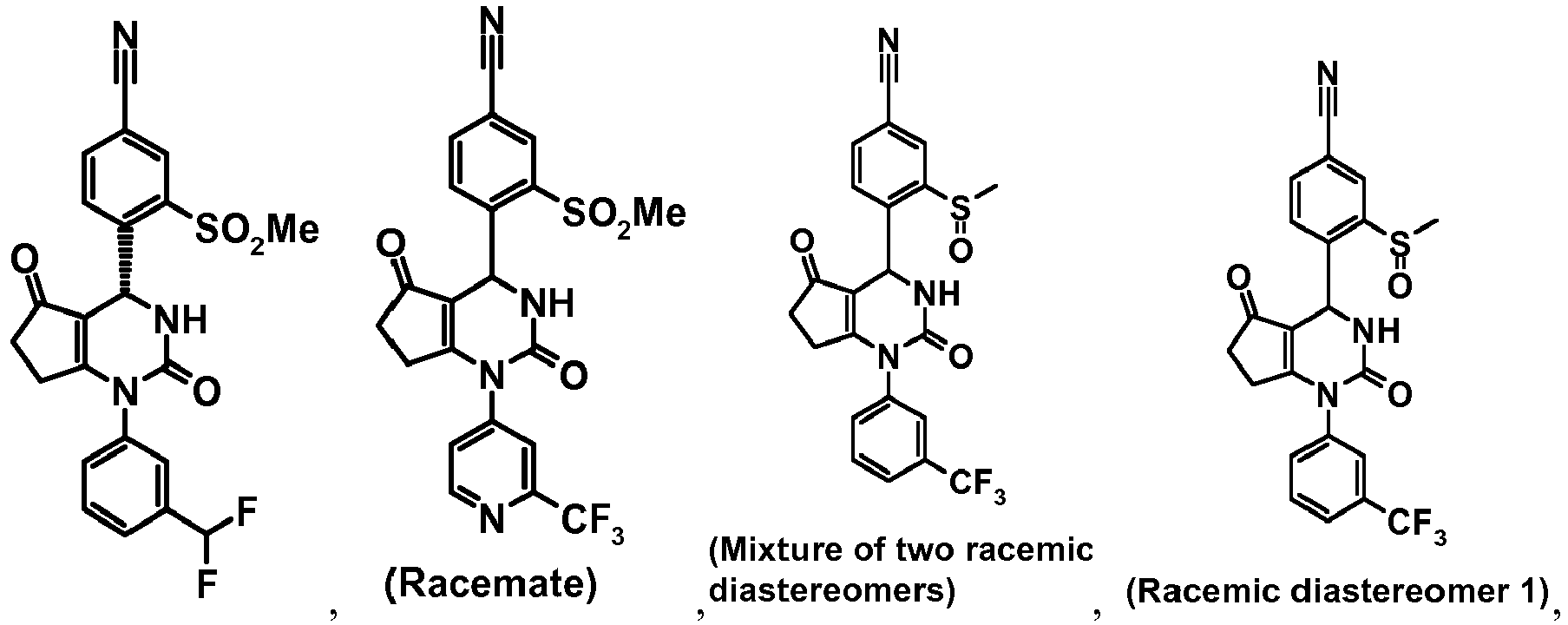


13154256.5 - Embodied are the above compounds of formula 1, wherein
- R1
- is phenyl, substituted with CN and substituted with a second substituent R1.1,
R1.1 is selected from the group consisting of -CH2OH, -SO2-CH2CH3, -SO2-CH2CH2-OH, -SO2-CH2CH2CH2-OH -SO-CH2CH3 and -SO-CH3, - R2
- is phenyl substituted with R2.1,
R2.1 is selected from the group consisting of CF3 and CHF2, - R3
- is selected from the group consisting of H and CH3,
- Embodied are the above compounds of formula 1, wherein
- R1
- is phenyl, substituted with CN and substituted with a second substituent R1.1,
R1.1 is -CH2OH, or a pharmaceutical acceptable salt thereof. - Embodied are the above compounds of formula 1, selected from the group consisting of compounds 1.a to 1.h.


- Embodied are the above compounds of formula 1, wherein the configuration of formula 1 is formula 1'

- Embodied are the above compounds of formula 1', selected from the group consisting of compounds 1.a' to 1.h'


- Embodied are the above compounds of formula 1, wherein R1.1 is R1.1.a, and
- R1.1.a
- is selected from the group consisting of
-CH2OH, -CH(CH3)OH, -C(CH3)2OH,
-SO2-CH2CH3, -SO2-CH3, -SO2-CH2CH2-OCH3, -SO2-CH2CH2-OH, -SO2-CH2CH2CH2-OH, -SO-CH2CH3 and -SO-CH3 - Embodied are the above compounds of formula 1, wherein wherein R1.1 is R1.1.b, and
- R1.1.b
- is selected from the group consisting of
-CH2OH, -CH(CH3)OH, -SO2-CH2CH2CH2-OH, -SO2-CH2CH2-OH, -SO2-CH2CH3, -SO2-CH3, -SO2-CH2CH2-OCH3, -SO-CH2CH3 and -SO-CH3 - Embodied are the above compounds of formula 1, wherein wherein R1.1 is R1.1.b and
- R1.1.b
- is selected from the group consisting of
-CH2OH, -CH(CH3)OH, -SO2-CH2CH2CH2-OH
-SO2-CH2CH3, -SO2-CH3, -SO2-CH2CH2-OCH3, -SO-CH2CH3 and -SO-CH3 - Embodied are the above compounds of formula 1, wherein R1.1 is R1.1.c, and
- R1.1.c
- is selected from the group consisting of
-CH2OH, -SO2-CH2CH2CH2-OH, -SO2-CH2CH2-OH,
-SO2-CH2CH3, -SO-CH2CH3 and -SO-CH3 - Embodied are the above compounds of formula 1, wherein R1.1 is R1.1.c and
- R1.1.c
- is selected from the group consisting of
-CH2OH, -SO2-CH2CH2CH2-OH
-SO2-CH2CH3, -SO-CH2CH3 and -SO-CH3 - Embodied are the above compounds of formula 1, wherein R2 is R2.a, and
- R2.a
- is phenyl or pyridyl, each ring substituted with R2.1,
R2.1 is selected from the group consisting of CF3, CHF2, Br and Cl - Embodied are the above compounds of formula 1, wherein R2 is R2.b, and
- R2.b
- is phenyl, substituted with R2.1,
R2.1 is selected from the group consisting of CF3 and CHF2 - Embodied are the above compounds of formula 1, wherein R2 is R2.c, and
- R2.c
- is pyridyl, substituted with R2.1,
R2.1 is selected from the group consisting of CF3 and CHF2 - Embodied are the above compounds of formula 1, wherein R2.1 is CF3
or a pharmaceutical acceptable salt thereof. - Embodied are the above compounds of formula 1, wherein R2.1 is CHF2
or a pharmaceutical acceptable salt thereof. - Embodied are the above compounds of formula 1, wherein R3 is R3.a and
- R3.a
- is selected from the group consisting of
H, CH3, -CO-NH-CH3, -CO-NH-CH2CH3, -CH2CH2-OH, and -CH2CH2CH2-OH and -CH2-oxetane - Embodied are the above compounds of formula 1, wherein R3 is R3.b and
- R3.b
- is selected from the group consisting of H, CH3, CO-NH-CH3, -CO-NH-CH2CH3, and -CH2CH2CH2-OH
- Embodied are the above compounds of formula 1, wherein R3 is R3.c and
- R3.c
- is selected from the group consisting of H and CH3
- Embodied are the above compounds of formula 1, wherein the compounds are selected from the group consisting of examples A.1A, A.2, A.3, B.1.2B, B.1.3A, C.1B, C.2A, C5.1, C.5.2, D.1A, D.3B, D.4.1A, D.4.4, D.4.5 and D.5A
or a pharmaceutical acceptable salt thereof. - Embodied are the above compounds of formula 1, wherein the compounds are selected from the group consisting of examples A.2, A.3, B.1.2B, B.1.3A, C.1B, C.2A, C5.1, C.5.2, D.1A, D.3B, D.4.1A, D.4.4, D.4.5 and D.5A
or a pharmaceutical acceptable salt thereof. - Embodied are the above compounds of formula 1, wherein the compounds are selected from the group consisting of examples A.1A, A.3, B.1.2B, B.1.3A, C.1B, C.2A, C5.1, C.5.2, D.4.1A, D.4.5 and D.5A
or a pharmaceutical acceptable salt thereof. - Embodied are the above compounds of formula 1, wherein the compounds are selected from the group consisting of examples A.3, B.1.2B, B.1.3A, C.1B, C.2A, C5.1, C.5.2, D.4.1A, D.4.5
and D.5A
or a pharmaceutical acceptable salt thereof. - Any and each other of the definitions of R1, R1.1, R1.1.a, R1.1.b, R1.1.c, R2, R2.a, R2.b, R2.c, R2.1, R3, R3.a, R3.b and R3.c may be combined with each other.
- Another embodiment of the invention is an above compound of formula 1 for use as a medicament.
- A further embodiment of the invention is an above compound of formula 1 for use as a medicament for the treatment of asthma and allergic diseases, gastrointestinal inflammatory diseases, glomerulonephritis, eosinophilic diseases, chronic obstructive pulmonary disease, infection by pathogenic microbes and rheumatoid arthritis.
- A further embodiment of the invention is an above compound of formula 1 for use as a medicament for the treatment of neutrophilic diseases, cystic fibrosis (CF), non-cystic fibrosis, idiopathic pulmonary fibrosis, bronchiectasis, ANCA-associated vasculitis, lung cancer, non-cyctic fibrosis bronchiectasis, emphysema, chronic bronchitis, acute lung injury (ALI), acute respiratory distress syndrome (ARDS), pulmonary hypertension, pulmonary arterial hypertension (PAH) and Alpha-1-antitrypsin deficiency (AATD).
- A further embodiment of the invention is an above compound of formula 1 for use as a medicament for the treatment of obesity and related inflammation, insulin resistence, diabetes, fatty liver and liver steatosis.
- A further embodiment of the present invention is an above compound of formula 1, for use as a medicament for the treatment of traumatic brain injury, abdominal aortic aneurism and Graft vs. Host Disease (GvHD).
- A further embodiment of the invention is a pharmaceutical composition, containing one or more of the above compounds of formula 1 or a pharmaceutically active salt thereof.
- A further embodiment of the invention is a method of treatment or prevention of diseases in which neutrophil elastase inhibitors have a therapeutic benefit, which method comprises administration of a therapeutically or preventively effective amount of an above compound of formula 1 to a patient in need thereof.
- A further embodiment of the invention is a pharmaceutical composition comprising additionally to an above compound of formula 1, a pharmaceutically active compound selected from the group consisting of betamimetics, anticholinergics, corticosteroids, PDE4-inhibitors, LTD4-antagonists, EGFR-inhibitors, Cathepsin C inhibitors, CRTH2 inhibitors, 5-LO-inhibitors, Histamine receptor antagonists and SYK-inhibitors, but also combinations of two or three active substances.
- The compounds according to the present invention and their intermediates may be obtained using methods of synthesis which are known to the one skilled in the art and described in the literature of organic synthesis. Preferably, the compounds are obtained in analogous fashion to the methods of preparation explained more fully hereinafter, in particular as described in the experimental section. In some cases, the order in carrying out the reaction steps may be varied. Variants of the reaction methods that are known to the one skilled in the art but not described in detail here may also be used. The general processes for preparing the compounds according to the invention will become apparent to the one skilled in the art studying the following schemes. Starting materials are commercially available or may be prepared by methods that are described in the literature or herein, or may be prepared in an analogous or similar manner. Any functional groups in the starting materials or intermediates may be protected using conventional protecting groups. These protecting groups may be cleaved again at a suitable stage within the reaction sequence using methods familiar to the one skilled in the art.
- Compounds of the invention VI are accessible using the synthetic route illustrated in Scheme 1; RI, RE.1, RE.2 have the meanings as defined hereinbefore and hereinafter.

PL2004/369318 - The chlorination (Step B, intermediate II → intermediate III) can be done as described in Vovk et al. (Synlett 2006, 3, 375-378) and Sinitsa et al. (J. Org. Chem. USSR 1978, 14, 1107) by heating intermediate II together with a chlorinating agent, for example phosphorous pentachloride, phosphoryl chloride or sulfuryl chloride in an organic solvent, for example benzene or toluene. The reaction takes place within 1 to 24 hours. Preferred reaction temperatures are between 50 °C and 150 °C.
- Alternatively, intermediates III can be prepared as described in Jochims et al. (Chem. Ber. 1982, 115, 860-870) by α-halogenation of aliphatic isocyanates, for example benzyl isocyanate, using for example a bromination agent, for example N-bromosuccinimide. Isocyanates can be synthesized as described in
US6207665 and in Charalambides et al. (Synth. Commun. 2007, 37, 1037-1044), by reacting an amine precursor with phosgene. - Intermediates V (Step C, intermediate IV → intermediates V) can be prepared as described in Chen et al. (Synth. Commun. 2010, 40, 2506-2510) and Tietcheu et al. (J. Heterocyclic Chem. 2002, 39, 965-973) by reacting cyclopentane-1,3-dione (IV) and an aliphatic or aromatic amine in the presence of a catalyst, for example Ytterbium triflate [Yb(OTf)3] or an acid, for example hydrogen chloride, acetic acid or p-toluenesulfonic acid, optionally in a solvent, for example water, acetic acid, acetonitrile, benzene, toluene. The reaction takes place within 1-24 hours. Preferred reaction temperatures are between room temperature and 120 °C, most preferred room temperature.
- Alternatively, intermediates V can be prepared as described in Scott et al. (J. Med. Chem. 1993, 36, 1947-1955) by direct condensation of the 1,3-dicarbonyl compound with an aliphatic or aromatic amine under reflux in a suitable solvent, for example benzene or toluene with azeotropic removal of water. Alternatively, intermediates V can be prepared as described in Mariano et al. (J. Org. Chem. 1984, 49, 220-228) by reacting an aliphatic or aromatic amine with 3-chloro-2-cyclopenten-1-one, which can be prepared from cyclopentane-1,3-dione.
- Compounds according to the present invention (Step D, intermediates III → compounds of the invention VI) can be prepared as described in Vovk et al. (Synlett 2006, 3, 375-378), Vovk et al. (Russ. J. Org. Chem. 2010, 46, 709-715) and Kushnir et al. (Russ. J. Org. Chem. 2011, 47, 1727-1732) by reacting intermediates III with intermediates V in an organic solvent, for example dichloromethane, chloroform, benzene or toluene. The reaction takes place within 1-24 hours. Preferred reaction temperatures are between 0 °C and 100 °C.
- Compounds according to the present invention VII are accessible via the synthetic route depicted in scheme 2; RE.1, RE.2, RE.3 have the meanings as defined hereinbefore and hereinafter.

WO04024700 - Compounds according to the present invention XIII are accessible via the synthetic routes depicted in scheme 3; RIII, RIV, RE.1, RE.2 have the meanings as defined hereinbefore and hereinafter.

WO09080199 - Compounds of the invention XIII (Step L, 4-nitrophenyl carbamate intermediates XII → compounds of the invention XIII) can be prepared as described in
WO09080199 - In addition to the synthetic route depicted in Scheme 1, compounds of the invention VI are also accessible using the synthetic route depicted in Scheme 4, RE.1, RE.2 have the meanings as defined hereinbefore and hereinafter.

WO06136305 - Intermediates XVI (Step P, intermediate XV → intermediate XVI) can be prepared in analogy to the method described for the preparation of compounds of the invention VI (Scheme 1, Step D, intermediate III → compound of the invention VI), by reacting intermediates XV with intermediates V in the presence of a suitable base, for example sodium hydride or sodium tert-butoxide, in a suitable organic solvent, for example tetrahydrofuran or 2-methyltetrahydrofuran. The reaction takes place within 1-24 h. Preferred reaction temperatures are between 0 °C and 50 °C, most preferred room temperature. Intermediates XVII (Step Q, intermediate XVI → intermediate XVII) can be prepared by reacting intermediates XVI with a suitable acid, for example hydrogen chloride, in a suitable solvent, for example 1,4-dioxane. The reaction takes place between 1-72 hours. Preferred reaction temperatures are between 0 °C and room temperature, most preferred room temperature.
- Compounds of the invention VI (Step R, intermediate XVII → compound of the invention VI) can be prepared as described in Csütörtöki et al. (Tetrahedron Lett. 2011, 67, 8564-8571) or in
WO11042145 - Compounds of the invention XX are accessible via the synthetic routes depicted in scheme 5; RV, RE.2, RE.3 have the meanings as defined hereinbefore and hereinafter.

- Compounds of the invention XX can be prepared by oxidation of sulfide intermediates XIX (Step T, intermediates XIX → compounds of the invention XX, RE.3 = H or alkyl) with an oxidating agent, for example hydrogen peroxide, 3-chloro-perbenzoic acid, periodic acid, sodium periodate, potassium permanganate, urea-hydrogen peroxide adduct, optionally in the presence of a metal catalyst, in a suitable solvent, for example dichloromethane, chloroform, methanol, ethanol, water or mixtures thereof. The reaction takes place within 1-72 h. Preferred reaction temperatures are between room temperature and the boiling point of the employed solvent.
- Compounds of the invention bearing sulfoxide groups can be prepared by oxidation of the corresponding sulfide intermediates with an oxidating agent, for example hydrogen peroxide, 3-chloro-perbenzoic acid, periodic acid, sodium periodate, tert-butyl hydroperoxide, urea-hydrogen peroxide adduct, optionally in the presence of a metal catalyst, for example methyltrioxorhenium, FeCl3, Sc(OTf)3, titanium (IV) complexes, in a suitable solvent, for example dichloromethane, chloroform, methanol ethanol, water or mixtures thereof. The reaction takes place within 1-72 h. Preferred reaction temperatures are between room temperature and the boiling point of the employed solvent.
- The term room temperature denotes a temperature of about 20 °C. As a rule, 1H NMR spectra and/or mass spectra have been obtained of the compounds prepared. The retention times given are measured under the following conditions (TFA: trifluoroacetic acid, DEA: diethylamine, scCO2: supercritical carbon dioxide):
Method Name: V011_S01 Column: XBridge C18, 4.6 x 30 mm, 3.5 µm Column Supplier: Waters Gradient/Solvent % Solvent % Solvent Flow Temp Time [min] [H2O, 0.1% NH3] [acetonitrile] [ml/min] [°C] 0.0 97 3 5 60 0.2 97 3 5 60 1.6 0 100 5 60 1.7 0 100 5 60 Method Name: V012_S01 Column: XBridge C18, 4.6 x 30 mm, 3.5 µm Column Supplier: Waters Gradient/Solvent % Solvent % Solvent Flow Temp Time [min] [H2O, 0.1%TFA] [acetonitrile] [ml/min] [°C] 0.0 97 3 5 60 0.2 97 3 5 60 1.6 0 100 5 60 1.7 0 100 5 60 Method Name: X012_S01 Column: Xbridge BEH C18, 2.1 x 30 mm, 1.7 µm Column Supplier: Waters Gradient/Solvent % Solvent % Solvent Flow Temperature Time [min] [H2O, 0.1%TFA] [acetonitrile] [ml/min] [°C] 0.0 99 1 1.6 60 0.02 99 1 1.6 60 1.00 0 100 1.6 60 1.10 0 100 1.6 60 Method Name: X012_S02 Column: Xbridge BEH C18, 2.1 x 30 mm, 1.7 µm Column Supplier: Waters Gradient/Solvent % Solvent % Solvent Flow Temperature Time [min] [H2O, 0.1%TFA] [acetonitrile] [ml/min] [°C] 0.0 99 1 1.3 60 0.02 99 1 1.3 60 1.00 0 100 1.3 60 1.10 0 100 1.3 60 Method Name: Z011_S03 Column: XBridge C18, 3 x 30 mm, 2.5 µm Column Supplier: Waters Gradient/Solvent % Solvent % Solvent Flow Temperature Time [min] [H2O, 0.1%NH3] [acetonitrile] [ml/min] [°C] 0.00 97 3 2.2 60 0.20 97 3 2.2 60 1.20 0 100 2.2 60 1.25 0 100 3 60 1.40 0 100 3 60 Method Name: Z017_S04 Column: ZORBAX™ SB-C18, 3 x 30 mm, 1.8 µm Column Supplier: Agilent Gradient/Solvent % Solvent % Solvent Flow Temperature Time [min] [H2O, 0.1%TFA] [acetonitrile] [ml/min] [°C] 0.00 97 3 2.2 60 0.20 97 3 2.2 60 1.20 0 100 2.2 60 1.25 0 100 3 60 1.40 0 100 3 60 Method Name: Z018_S04 Column: Sunfire, 3 x 30 mm, 2.5 µm Column Supplier: Waters Gradient/Solvent % Solvent % Solvent Flow Temperature Time [min] [H2O, 0.1%TFA] [acetonitrile] [ml/min] [°C] 0.00 97 3 2.2 60 0.20 97 3 2.2 60 1.20 0 100 2.2 60 1.25 0 100 3 60 1.40 0 100 3 60 Method Name: 005_CA01 Column: SunFire C18, 3.0 x 30 mm, 2.5 µm Column Supplier: Waters Gradient/Solvent % Solvent % Solvent Flow Temperature Time [min] [H2O, 0.1%TFA] [acetonitrile] [ml/min] [°C] 0.0 98 2 2.0 60.0 1.2 0 100 2.0 60.0 1.4 0 100 2.0 60.0 Method Name: 005_CA07 Column: SunFire C18, 3.0 x 30 mm, 2.5 µm Column Supplier: Waters Gradient/Solvent % Solvent % Solvent Flow Temperature Time [min] [H2O, 0.1%TFA] [acetonitrile] [ml/min] [°C] 0.0 95 5 1.5 60.0 1.3 0 100 1.5 60.0 1.5 0 100 1.5 60.0 1.6 95 5 1.5 60.0 Method Name: I_IA_20_MeOH_NH3 Column: Chiralpak IA 4.6 x 250 mm, 5 µm Column Supplier: Daicel Gradient/Solvent Time [min] % Solvent [MeOH, 20 mM NH3] % Solvent [scCO2] Flow [ml/min] Temperature [°C] Back Pressure [bar] 10 min 20 80 4 40 150 Method Name: I_IA_25_MeOH_NH3 Column: Chiralpak IA 4.6 x 250 mm, 5 µm Column Supplier: Daicel Gradient/Solvent Time [min] % Solvent [MeOH, 20 mM NH3] % Solvent [scCO2] Flow [ml/min] Temperature [°C] Back Pressure [bar] 10 min 25 75 4 40 150 Method Name: I_IB_ 20_MeOH_DEA Column: Chiralpak IB 4.6 x 250 mm, 5 µm Column Supplier: Daicel Gradient/Solvent Time [min] % Solvent [MeOH, 0.2% DEA] % Solvent [scCO2] Flow [ml/min] Temperature [°C] Back Pressure [bar] 10 min 20 80 4 40 150 Method Name: I_IB_ 20_MeOH_NH3 Column: Chiralpak IB 4.6 x 250 mm, 5 µm Column Supplier: Daicel Gradient/Solvent Time [min] % Solvent [MeOH, 20 mM NH3] % Solvent [scCO2] Flow [ml/min] Temperature [°C] Back Pressure [bar] 10 min 20 80 4 40 150 Method Name: I_IC_25_MeOH_NH3 Column: Chiralpak IC 4.6 x 250 mm, 5 µm Column Supplier: Daicel Gradient/Solvent Time [min] % Solvent [MeOH, 20 mM NH3] % Solvent [scCO2] Flow [ml/min] Temperature [°C] Back Pressure [bar] 10 min 25 75 4 40 150 Method Name: I_IC_30_MeOH_NH3 Column: Chiralpak IC 4.6 x 250 mm, 5 µm Column Supplier: Daicel Gradient/Solvent Time [min] % Solvent [MeOH, 20 mM NH3] % Solvent [scCO2] Flow [ml/min] Temperature [°C] Back Pressure [bar] 10 min 30 70 4 40 150 Method Name: I_ IC_40_MeOH_NH3 Column: Chiralpak IC 4.6 x 250 mm, 5 µm Column Supplier: Daicel Gradient/Solvent Time [min] % Solvent [MeOH, 20 mM NH3] % Solvent [scCO2] Flow [ml/min] Temperature [°C] Back Pressure [bar] 10 min 40 60 4 40 150 - The following starting material is prepared as described in the literature cited: 3-(3-(Trifluoromethyl)phenylamino)cyclopent-2-enone: Aust. J. Chem. 2005, 58, 870-876.
-

- [Benzenesulfonyl-(2-bromo-4-cyano-phenyl)-methyl]-carbamic acid tert-butyl ester Formic acid (3.9 mL, 104 mmol) is added to a mixture of tert-butyl carbamate (1.90 g, 16.2 mmol), 2-bromo-4-cyanobenzaldehyde (CAS# 89891-69-0, 3.41 g, 16.2 mmol) and sodium benzenesulfinate (2.67 g, 16.2 mmol) in a mixture of THF (7.0 mL) and water (60 mL) and the mixture is stirred at room temperature for 6 days. Water (180 mL) is added and the precipitate is filtered and washed with water. The precipitate is treated with tert-butyl methyl ether (30 mL), and the mixture is stirred for 30 min. The precipitate is filtered off, washed with tert-butyl methyl ether and dried. Yield: 3.35 g. ESI mass spectrum: [M+H]+ = 451 (bromine isotope pattern); Retention time HPLC: 0.66 min (X012_S01).
- Sodium hydride (60% in mineral oil, 360 mg, 9.00 mmol) is added in small portions to a mixture of 3-(3-(trifluoromethyl)phenylamino)cyclopent-2-enone (2.16 g, 8.96 mmol) and 2-methyltetrahydrofuran (30 mL). After 30 min [benzenesulfonyl-(2-bromo-4-cyanophenyl)-methyl]-carbamic acid tert-butyl ester (Step 1, 3.35 g, 7.43 mmol) is added and the mixture is stirred at room temperature for 2 h. Water is added and the phases are separated. The aqueous phase is extracted with ethyl acetate and the combined organic phases are washed with water, dried over MgSO4 and concentrated under reduced pressure. The residue is treated with tert-butyl methyl ether and the mixture is stirred for 15 min. The precipitate is filtered off, washed with tert-butyl methyl ether and dried. Yield: 3.18 g. ESI mass spectrum: [M+H]+ = 550 (bromine isotope pattern) ; Retention time HPLC: 0.73 min (X012_S01).
-

- A solution of hydrogen chloride in 1,4-dioxane (4 M, 15.2 mL, 61 mmol) is added to a mixture of {(2-bromo-4-cyano-phenyl)-[5-oxo-2-(3-trifluoromethyl-phenylamino)-cyclopent-1-enyl]-methyl}-carbamic acid tert-butyl ester (INTERMEDIATE A.1, 6.71 g, 12.2 mmol) in 1,4-dioxane (30 mL). The mixture is stirred at room temperature for 2 h and then cooled in an ice bath. The precipitate is filtered off, washed with cold acetonitrile and diethyl ether and dried. Yield: 5.90g. ESI mass spectrum: [M+H]+ = 450 (bromine isotope pattern); Retention time HPLC: 1.17 min (V011_S01).
-

- Triethylamine (4.11 mL, 29.3 mmol) is added to a mixture of 4-{amino-[5-oxo-2-(3-trifluoromethyl-phenylamino)-cyclopent-1 -enyl]-methyl} -3-bromo-benzonitrile hydrochloride (INTERMEDIATE A.2, 28.5 g, 58.6 mmol) and 1,1'-carbonyldiimidazole (11.9 g, 73.2 mmol) in acetonitrile (290 mL) and the mixture is stirred at room temperature overnight. Water (1.5 L) is added and the precipitate is filtered off, washed with water and dried. Yield: 24.5 g. ESI mass spectrum: [M+H]+ = 476 (bromine isotope pattern); Retention time HPLC: 1.11 min (V011_S01).
-

- Methyliodide (3.61 mL, 58.0 mmol) is added to a mixture of 3-bromo-4-(2,5-dioxo-1-(3-(trifluoromethyl)phenyl)-2,3,4,5,6,7-hexahydro-1H-cyclopentapyrimidin-4-yl)benzonitrile (INTERMEDIATE A.3, 23.0 g, 48.3 mmol) and cesium carbonate (20.5 g, 62.8 mmol) in DMF (230 mL) and the reaction mixture is stirred at room temperature overnight. Water and ethyl acetate are added and the phases are separated. The organic phase is washed with water, dried over MgSO4 and concentrated. Yield: 24.0 g. ESI mass spectrum: [M+H]+ = 490 (bromine isotope pattern); Retention time HPLC: 1.18 min (V011_S01).
-

- A solution of 3-bromo-4-[3-methyl-2,5-dioxo-1-(3-trifluoromethyl-phenyl)-2,3,4,5,6,7-hexahydro-1H-cyclopentapyrimidin-4-yl]-benzonitrile (INTERMEDIATE A.4, 11.85 g, 24.2 mmol), 1.1-bis(diphenylphosphino)-ferrocen (1.34 g, 2.42 mmol), palladium acetate (0.27 g, 1.21 mmol) and sodium acetate (5.95 g, 72.5 mmol) is treated with carbon monoxide at 5 bar and 100 °C for 40 h. After evaporation of volatiles under reduced pressure, water and ethyl acetate are added and the phases are separated. The organic phase is dried over MgSO4 and concentrated under reduced pressure. The residue is purified by flash chromatography on silica (cyclohexane/ethyl acetate 1:1). Yield: 8.0. g. ESI mass spectrum: [M+H]+ = 470; Retention time HPLC: 1.15 min (V011_S01).
-

- A mixture of 5-cyano-2-[3-methyl-2,5-dioxo-1-(3-trifluoromethyl-phenyl)-2,3,4,5,6,7-hexahydro-1H-cyclopentapyrimidin-4-yl]-benzoic acid methyl ester (INTERMEDIATE A.5, 6.70 g, 14.3 mmol) and lithium hydroxide (1.03 g, 42.8 mmol) in 1,4-dioxane (135 ml) and water (67.0 mL) is stirred at room temperature for 90 min. Water (250 mL) and hydrochloric acid (1.0 M, 44 mL) are added and the reaction mixture is extracted with ethyl acetate. The organic phase is washed with water, dried over MgSO4 and concentrated under reduced pressure. Yield: 6.2. g. ESI mass spectrum: [M+H]+ = 456; Retention time HPLC: 0.63 min (X012_S01).
-

- Dess-Martin periodinane (2.36 g; 5.57 mmol) is added to a solution of 3-hydroxymethyl-4-[3-methyl-2,5-dioxo-1-(3-trifluoromethyl-phenyl)-2,3,4,5,6,7-hexahydro-1H-cyclopentapyrimidin-4-yl]-benzonitrile (EXAMPLE A.1; 2.05 g; 4.644 mmol) in dichloromethane (100 mL) and the mixture is stirred at room temperature for 90 min. The reaction mixture is quenched with a mixture of 10% sodium thiosulfate solution (50 mL) and saturated NaHCO3 solution (50 mL) and the phases are separated. The aqueous layer is extracted with dichloromethane. The combined organic layers are washed with water, dried over MgSO4 and concentrated under reduced pressure. The residue is purified by flash chromatography on silica (dichloromethane/ methanol 98:2). Yield: 510 mg; ESI mass spectrum: [M+H]+ = 440; Retention time HPLC: 0.63 min (X012_S02).
-

- INTERMEDIATE B.1 is prepared in analogous fashion as described for INTERMEDIATE A.1, replacing 2-bromo-4-cyanobenzaldehyde with 3-fluoro-4-formyl-benzonitrile (CAS# 105942-10-7) as starting material. Purification of crude material is done by reversed phase HPLC (Waters SunFire™-C18, gradient of acetonitrile in water, 0.1% formic acid). ESI mass spectrum: [M+H]+ = 490; Retention time HPLC: 1.13 min (Z018_S04).
-

- INTERMEDIATE B.2 is prepared in analogous fashion as described for INTERMEDIATE A.2, replacing INTERMEDIATE A.1 with INTERMEDIATE B.1 as starting material. ESI mass spectrum: [M+H-NH3]+ = 373; Retention time HPLC: 0.81 min (Z018_S04).
-

- INTERMEDIATE B.3 is prepared in analogous fashion as described for INTERMEDIATE A.3, replacing INTERMEDIATE A.2 with INTERMEDIATE B.2 as starting material. ESI mass spectrum: [M+H]+ = 416; Retention time HPLC: 0.97 min (Z018_S04).
-

- To a mixture of sodium hydride (55% in mineral oil, 32 mg, 0.73 mmol) in DMF (0.30 mL) is added at 0°C 3-mercapto-1-propanol (55 µL, 0.64 mmol) and the mixture is stirred at 0°C for 25 min. A solution of 4-[2,5-dioxo-1-(3-trifluoromethyl-phenyl)-2,3,4,5,6,7-hexahydro-1H-cyclopentapyrimidin-4-yl]-3-fluoro-benzonitrile (INTERMEDIATE B.3, 110 mg, 0.21 mmol) in DMF (0.30 mL) is added and the mixture is stirred at room temperature for 2.5 h. The reaction mixture is quenched with water, acidified with dilute acetic acid and purified by reversed phase HPLC (Waters SunFire™-C18, gradient of acetonitrile in water, 0.1% TFA). Yield: 13 mg. ESI mass spectrum: [M+H]+ = 488; Retention time HPLC: 0.93 min (Z018_S04).
- The following INTERMEDIATE B.4.1 is prepared in analogous fashion as described for INTERMEDIATE B.4, replacing 3-mercapto-1-propanol with 2-methoxy-ethanethiol as starting material.

INTERMEDIATE R1.1 MS [M+H]+ Retention time [min] HPLC-Method B.4.1 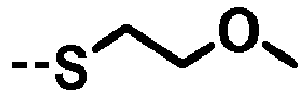
488 1.00 Z018_S04 -

- INTERMEDIATE B.5 is prepared in analogous fashion as described for INTERMEDIDATE A.4, replacing INTERMEDIATE A.3 with INTERMEDIATE B.3. The reaction mixture is purified by reversed phase HPLC (Agilent ZORBAX™ SB-C18, gradient of acetonitrile in water, 0.1% TFA). ESI mass spectrum [M+H]+ = 430; Retention time HPLC: 1.02 min (Z018_S04).
-

- INTERMEDIATE B.6 is prepared in analogous fashion as described for INTERMEDIATE B.4, replacing INTERMEDIATE B.3 with INTERMEDIATE B.5 and 3-mercapto-1-propanol with 2-mercaptoethanol as starting materials, respectively. ESI mass spectrum: [M+H]+ = 488; Retention time HPLC: 0.97 min (Z018_S04).
- The following INTERMEDIATES B.6.1 and B.6.2 are prepared in analogous fashion as described for INTERMEDIATE B.6, employing the appropriate thiol as starting material, respectively.

INTERMEDIATE R1.1 MS [M+H]+ Retention time [min] HPLC-Method B.6.1 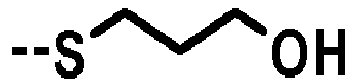
502 0.98 Z018_S04 B.6.2 
502 1.07 Z018_S04 -

- Potassium carbonate (3.8 g; 27.2 mmol) is added to a mixture of 3-fluoro-4-formyl-benzonitrile (2.0 g; 13.4 mmol) and sodium thiomethanolate (1.175 g; 16.77 mmol) in DMF (10 mL) and the mixture is stirred at 120°C for 2 h. The reaction mixture is cooled with an ice bath. Water is added and the precipitate is filtered off, washed with water and dried. Yield: 1.98 g. ESI mass spectrum: [M+H]+ = 178; Retention time HPLC: 0.73 min (Z011_S03).
-

- INTERMEDIATE C.2 is prepared in analogous fashion as described for INTERMEDIATE C.1, replacing sodium thiomethanolate with sodium thioethanolate (reaction temperature 50°C). ESI mass spectrum: [M+H]+ = 192; Retention time HPLC: 0.81 min (Z011_S03).
-

- INTERMEDIATE C.3 is prepared in analogous fashion as described for INTERMEDIATE A.1, replacing 2-bromo-4-cyanobenzaldehyde with 4-formyl-3-methylsulfanyl-benzonitrile (INTERMEDIATE C.1). ESI mass spectrum: [M+H]+ = 518; Retention time HPLC: 1.14 min (Z017_S04).
-

- INTERMEDIATE C.4 is prepared in analogous fashion as described for INTERMEDIATE A.1, replacing 2-bromo-4-cyanobenzaldehyde with 3-ethylsulfanyl-4-formyl-benzonitrile (INTERMEDIATE C.2). ESI mass spectrum: [M+H]+ = 532; Retention time HPLC: 1.19 min (Z018_S04).
-
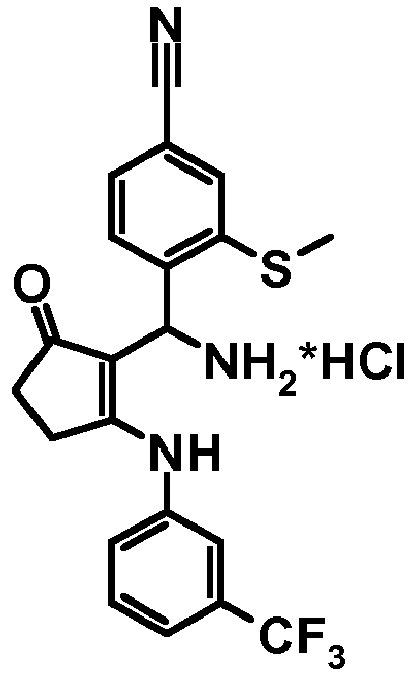
- A solution of hydrogen chloride in 1,4-dioxane (4 M, 5 mL, 20 mmol) is added to a mixture of {(4-cyano-2-methylsulfanyl-phenyl)-[5-oxo-2-(3-trifluoromethyl-phenylamino)-cyclopent-1-enyl]-methyl}-carbamic acid tert-butyl ester (INTERMEDIATE C.3, 4.3 g, purity 80%, 6.7 mmol) in acetonitrile (10 mL) and the mixture is stirred at room temperature for 2 h. The precipitate is filtered off, washed with cold acetonitrile and dried. Yield: 4.14g. ESI mass spectrum: [M+H]+ = 418; Retention time HPLC: 0.90 min (Z011_S03).
-

- INTERMEDIATE C.6 is prepared in analogous fashion as described for INTERMEDIATE C.5, replacing INTERMEDIATE C.3 with INTERMEDIATE C.4. ESI mass spectrum: [M+H]+ = 432; Retention time HPLC: 0.94 min (Z011_S03).
-

- Triethylamine (95 µL, 0.68 mmol) is added to a mixture of 4-{amino-[5-oxo-2-(3-trifluoromethyl-phenylamino)-cyclopent-1 -enyl]-methyl} -3-methylsulfanyl-benzonitrile hydrochloride (INTERMEDIATE C.5, 570 mg, 1.13 mmol based on 90% purity) and 1,1'-carbonyldiimidazole (220 mg, 1.36 mmol) in acetonitrile (3 mL) and the mixture is stirred at room temperature overnight. The reaction mixture is concentrated under reduced pressure, and the residue is treated with water. The precipitate is filtered off, washed with water and dried. Yield: 460 mg; ESI mass spectrum: [M+ H]+ = 444; Retention time HPLC: 0.98 min (Z017_S04).
-

- INTERMEDIATE C.8 is prepared in analogous fashion as described for INTERMEDIATE C.7, replacing INTERMEDIATE C.5 with INTERMEDIATE C.6. ESI mass spectrum: [M+H]+ = 458; Retention time HPLC: 1.03 min (Z018_S04).
-

- Methyliodide (834 µL, 13.4 mmol) is added to a mixture of 4-[2,5-dioxo-1-(3-trifluoromethyl-phenyl)-2,3,4,5,6,7-hexahydro-1H-cyclopentapyrimidin-4-yl]-3-methylsulfanyl-benzonitrile (INTERMEDIATE C.7; 1.981 g; 4.467 mmol) and cesium carbonate (2.911 g, 8.935 mmol) in DMF (5 mL) and the reaction mixture is stirred at room temperature for 2 h. The mixture is purified by reversed phase HPLC (Stablebond, gradient of acetonitrile in water, 0.1% TFA). Yield: 1.145 g. ESI mass spectrum: [M+H]+ = 458; Retention time HPLC: 1.03 min (Z017_S04).
-

- INTERMEDIATE C.10 is prepared in analogous fashion as described for INTERMEDIATE C.9, replacing INTERMEDIATE C.7 with INTERMEDIATE C.8. ESI mass spectrum: [M+H]+ = 472; Retention time HPLC: 1.09 min (Z018_S04).
-

- 3-Chloroperoxybenzoic acid (77%, 46 mg, 0.203 mmol) is added at room temperature to a solution of 4-[3-methyl-2,5-dioxo-1-(3-trifluoromethyl-phenyl)-2,3,4,5,6,7-hexahydro-1H-cyclopentapyrimidin-4-yl]-3-methylsulfanyl-benzonitrile (INTERMEDIATE C.9, 93 mg, 0.203 mmol) in dichloromethane (5 mL), and the mixture is stirred for 20 min. The reaction mixture is concentrated under reduced pressure and purified by reversed phase HPLC (Sunfire, gradient of acetonitrile in water, 0.1% TFA) yielding the two diastereomers.
- Yield: 46 mg; ESI mass spectrum [M+H]+ = 474; Retention time HPLC: 0.94 min (early eluting diastereomer) (Z018_S04).
- Yield: 46 mg; ESI mass spectrum [M+H]+ = 474; Retention time HPLC: 0.96 min (late eluting diastereomer) (Z018_S04).
-

- 3-Chloroperoxybenzoic acid (77%, 51 mg, 0.226 mmol) is added at room temperature to a solution of 4-[2,5-dioxo-1-(3-trifluoromethyl-phenyl)-2,3,4,5,6,7-hexahydro-1H-cyclopentapyrimidin-4-yl]-3-methylsulfanyl-benzonitrile (INTERMEDIATE C.7, 100 mg, 0.226 mmol) in dichloromethane (3 mL) and the mixture is stirred for 20 min. The reaction mixture is concentrated under reduced pressure and purified by reversed phase HPLC (Sunfire, gradient of acetonitrile in water, 0.1% TFA) yielding the two diastereomers.
- Yield: 35 mg; ESI mass spectrum [M+H]+ = 460 ; Retention time HPLC: 0.90 min (early eluting diastereomer) (Z018_S04).
- Yield: 26 mg; ESI mass spectrum [M+H]+ = 460; Retention time HPLC: 0.92 min (late eluting diastereomer) (Z018_S04).
-

- To a mixture of 4-[2,5-dioxo-1-(3-trifluoromethyl-phenyl)-2,3,4,5,6,7-hexahydro-1H-cyclopentapyrimidin-4-yl]-3-ethylsulfanyl-benzonitrile (INTERMEDIATE C.8; 100 mg; purity 90%; 0.20 mmol) and diisopropylethylamine (130µL; 0.76 mmol) in acetonitrile (1 mL) is added at room temperature in small portions over a period of 5 h 4-nitrophenylchloroformate (160 mg; 0.79 mmol) and 4-dimethylaminopyridine (140 mg; 1.15 mmol). Methylamine (1M in THF; 1 mL; 1.00 mmol) is added to the mixture containing the 4-nitrophenyl carbamate intermediate and the reaction is stirred at room temperature for 1 h. The reaction mixture is purified by reversed phase HPLC (Sunfire, gradient of acetonitrile in water, 0.1% TFA). Yield: 58 mg. ESI mass spectrum: [M+H]+ = 515; Retention time HPLC: 1.08 min (Z018_S04).
-

- Formic acid (6.2 mL, 164 mmol) is added to a mixture of tert-butyl carbamate (3.05 g, 26.0 mmol), 4-formyl-3-(methylsulfonyl)benzonitrile (preparation according to
US 2011/34433 , 5.44 g, 26.0 mmol) and sodium benzenesulfinate (4.27 g, 26.0 mmol) in THF (10.0 mL) and water (25.0 mL) and the reaction mixture is stirred at room temperature for 4 days. Water is added and the precipitate is filtered off, washed with water and acetonitrile and dried. Yield: 5.10 g. ESI mass spectrum: [M+H]+ = 451; Retention time HPLC: 0.59 min (X012_S01). -

- INTERMEDIATE D.2 is prepared in analogous fashion as described for INTERMEDIATE D.1, replacing 4-formyl-3-(methylsulfonyl)benzonitrile with 3-ethanesulfonyl-4-formyl-benzonitrile (preparation according to
US 2011/34433 ). ESI mass spectrum: [M+H]+ = 465; Retention time HPLC: 1.03 min (Z017_S04). -
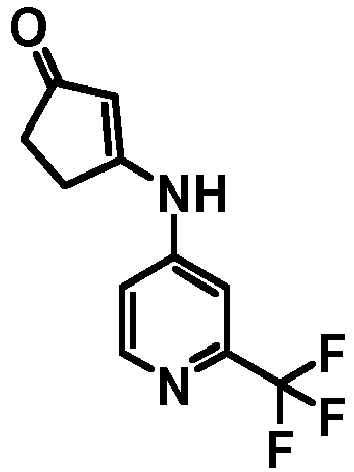
- A solution of 1.3-cyclopentanedione (3.03 g, 30.8 mmol) and 4-amino-2-trifluoromethylpyridine (5.00 g, 30.8 mmol) in acetic acid (15.0 mL) is stirred at 130 °C in a microwave oven for 5 h. The reaction mixture is diluted with methanol and water and purified by reversed phase HPLC (Waters SunFire™-C18, gradient of acetonitrile in water, 0.1% formic acid). Yield: 4.52 g; ESI mass spectrum [M+H]+ = 243; Retention time HPLC: 0.77 min (Z018_S04).
- INTERMEDIATES D.3.1 - D.3.4 are prepared in analogous fashion as described for INTERMEDIATE D.3, employing the appropriate amine as starting material, respectively.
Table 1 INTERMEDIATE R MS [M+H]+ Retention time [min] HPLC-Method D.3.1 
243 0.77 Z018_S04 D.3.2 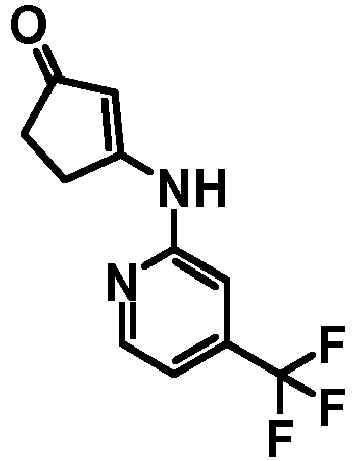
243 0.86 Z018_S04 D.33 
253 (bromine isotope pattern) 0.72 Z018_S04 D.3.4 
209 (chlorine isotope pattern) 0.68 Z017_S04 -
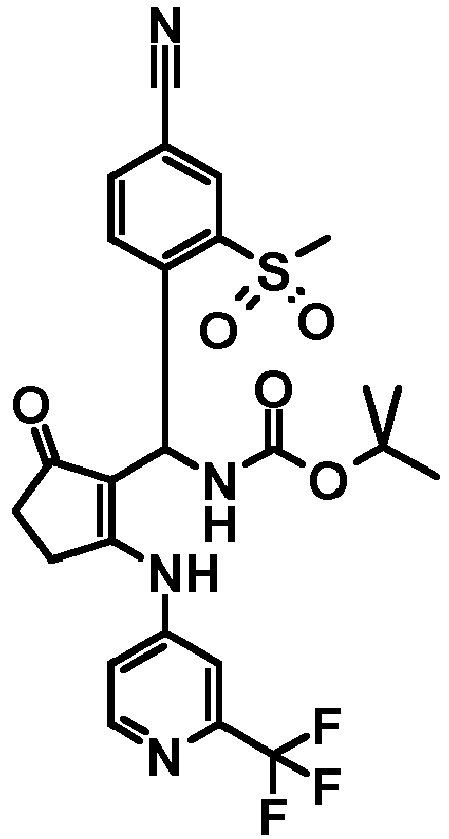
- Sodium hydride (60% in mineral oil, 515 mg, 12.9 mmol) is added in small portions to a mixture of 3-(2-(trifluoromethyl)pyridin-4-ylamino)cyclopent-2-enone (INTERMEDIATE D.3, 2.60 g, 10.7 mmol) in 2-methyltetrahydrofuran (40.0 mL). After 10 min [benzenesulfonyl-(4-cyano-2-methanesulfonyl-phenyl)-methyl]-carbamic acid tert-butyl ester (INTERMEDIATE D.1, 4.83 g, 10.7 mmol) is added and the reaction mixture is stirred at room temperature for 30 min. Water and ethyl acetate are added and the phases are separated. The organic phase is washed with water and concentrated under reduced pressure. Yield: 6.20 g; ESI mass spectrum [M+H]+ = 551; Retention time HPLC: 1.12 min (Z018_S04).
- INTERMEDIATES D.4.1 - D.4.5 are prepared in analogous fashion as described for INTERMEDIATE D.4, employing the starting materials indicated in the following table.
Table 2 INTERMEDIATE Starting Materials Structure MS [M+H] + Retention time [min] HPLC-Method D.4.1 INTERMEDIATES D.2 and D.3 
565 1.15 Z018_S04 D.4.2 INTERMEDIATES D.1 and D.3.1 
551 1.12 Z018_S04 D.4.3 INTERMEDIATES D.1 and D.3.2 
551 1.23 Z018_S04 D.4.4 INTERMEDIATES D.1 and D.3.3 
561 (bromine isotope pattern) 1.08 Z018_S04 D.4.5 INTERMEDIATES D.1 and D.3.4 
517 (chlorine isotope pattern) 1.06 Z017_S04 -

- To a solution of {(4-cyano-2-methanesulfonyl-phenyl)-[5-oxo-2-(2-trifluoromethyl-pyridin-4-ylamino)-cyclopent-1-enyl]-methyl}-carbamic acid tert-butyl ester (INTERMEDIATE D.4, 5.20 g, 9.45 mmol) in 1,4-dioxane (100 mL) is added hydrogen chloride in 1,4-dioxane (4 M, 50.0 mL, 200 mmol) and the mixture is stirred at room temperature overnight. The reaction mixture is diluted with methyl-tert-butylether and the precipitate is filtered off, washed with methyl-tert-butylether and dried. Yield: 4.40g. ESI mass spectrum: [M+H]+ = 451; Retention time HPLC: 0.78 min (Z018_S04). INTERMEDIATES D.5.1 - D.5.5 are prepared in analogous fashion as described for INTERMEDIATE D.5, employing the starting materials indicated in the following table.
Table 3 INTERMEDIATE Starting Material Structure MS [M+H]+ Retention time [min] HPLC-Method D.5.1 INTERMEDIATE D.4.1 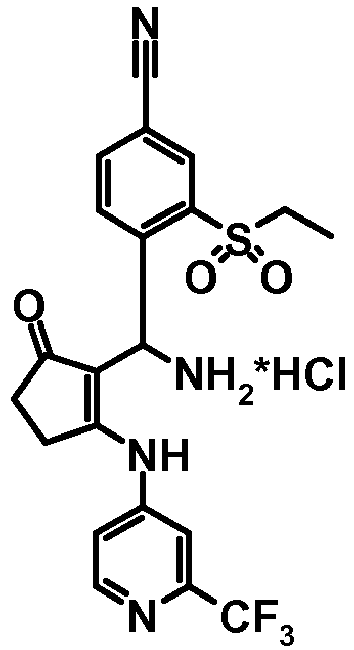
465 1.82 Z018_S04 D.5.2 INTERMEDIATE D.4.2 
451 0.78 Z018_S04 D.5.3 INTERMEDIATE D.4.3 
451 0.84 Z018_S04 D.5.4 INTERMEDIATE D.4.4 
461 (bromine isotope pattern) 0.74 Z018_S04 D.5.5 INTERMEDIATE D.4.5 
417 (chlorine isotope pattern) 0.74 Z01 1-S03 -

- To a solution of 4-{amino-[5-oxo-2-(2-trifluoromethyl-pyridin-4-ylamino)-cyclopent-1-enyl]-methyl}-3-methanesulfonyl-benzonitrile hydrochloride (INTERMEDIATE D.5, 4.78 g, 9.81 mmol) in acetonitrile (100 mL) is added 1,1'-carbonyldiimidazole (1.99 g, 12.3 mmol) and triethylamine (0.34 mL, 2.45 mmol) and the mixture is stirred at room temperature for 1 h. The reaction mixture is concentrated under reduced pressure. The residue is treated with water, the precipitate is filtered off, washed with water and dried. Yield: 3.73 g. ESI mass spectrum: [M+H]+ = 477; Retention time HPLC: 0.90 min (Z018_S04).
- The enantiomers of racemic INTERMEDIATE D.6 (300 mg, 0.63 mmol) are separated by preparative supercritical fluid chromatography on a chiral phase (Daicel Chiralpak IC, 20 x 250 mm, 5 µm, 20% MeOH + 20 mM ammonia in supercritical CO2, 40 °C, 120 bar back pressure).
- Yield: 92 mg; ESI mass spectrum [M+H]+ = 477; Retention time: 2.67 min (early eluting enantiomer) (I_IB_20_MeOH_NH3).
- Yield: 96 mg; ESI mass spectrum [M+H]+ = 477; Retention time: 3.03 min (late eluting enantiomer) (I_IB_20_MeOH_NH3).
-

- A mixture of cyclopentane-1,3-dione (2.00 g, 20.4 mmol), 3-(difluoromethyl)aniline (2.92 g, 20.4 mmol) and ytterbium(III) trifluormethanesulfonate (63 mg, 0.10 mmol) is stirred at room temperature for 2 h. Methanol and water are added and the resulting precipitate is filtered off and dried. Yield: 2.75 g; ESI mass spectrum: [M+H]+ = 224; Retention time HPLC: 0.82 min (V012_S01).
-

- Sodium hydride (60% in mineral oil, 155 mg, 3.88 mmol) is added in small portions to a mixture of 3-(3-(difluoromethyl)phenylamino)cyclopent-2-enone (INTERMEDIATE D.7; 936 mg, 4.20 mmol) in 2-methyltetrahydrofuran (10 mL). After 30 min [benzenesulfonyl-(4-cyano-2-ethanesulfonyl-phenyl)-methyl]-carbamic acid tert-butyl ester (INTERMEDIATE D.2, 1.50 g, 3.23 mmol) is added and the mixture is stirred at room temperature overnight. Ethyl acetate and water are added and the phases are separated. The organic phase is washed with water, dried over MgSO4 and concentrated under reduced pressure. Yield: 2.35 g. ESI mass spectrum: [M+H]+ = 546; Retention time HPLC: 1.14 min (Z017_S04).
-

- A solution of hydrogen chloride in 1,4-dioxane (4 M, 3.0 mL, 12.0 mmol) is added to a solution of {(4-cyano-2-ethanesulfonyl-phenyl)-[2-(3-difluoromethyl-phenylamino)-5-oxo-cyclopent-1-enyl]-methyl}-carbamic acid tert-butyl ester (INTERMEDIATE D.8, 2.35 g, purity 75%, 3.23 mmol) in acetonitrile (6 mL) and the mixture is stirred at room temperature for 2 h and then cooled in an ice bath. The precipitate is filtered off, washed with cold acetonitrile and dried. Yield: 1.52 g. ESI mass spectrum: [M+H]+ = 446; Retention time HPLC: 0.86 min (Z017_S04).
-

- In a three-necked round bottom flask equipped with a drying tube filled with calcium chloride and an inlet for nitrogen, 4-bromo-2-methanesulfonyl-benzaldehyde (4.50 g, 17.10 mmol) and ethyl carbamate (3.35 g, 37.63 mmol) are heated at 145 °C for 5 h. The flask is being purged with a flow of nitrogen, and concentrated sulfuric acid (ca. 200 µL, ca. 3 mmol) is added slowly drop by drop. After 7 h the solidified reaction mixture is cooled to room temperature, crushed, mixed thoroughly with water and dried. The residue is purified by flash chromatography on silica (gradient dichloromethane to dichloromethane/methanol 95:5). Yield: 5.05 g; ESI mass spectrum: [M+H]+ = 423 (bromine isotope pattern); Retention time HPLC: 0.77 min (Z011_S03).
-

- Phosphorous pentachloride (5.47 g, 26.2 mmol) is added to a suspension of diethyl (4-bromo-2-methylsulfonyl)phenyl)methylenedicarbamate (INTERMEDIATE E.1, 5.05 g, 11.9 mmol) in toluene (30 mL) and the mixture is heated at reflux for 3 h. The toluene is evaporated under reduced pressure and the mixture is then purified by distillation under reduced pressure (ca. 160 °C, 0.1 mbar). Yield: 945 mg.
- 3-(3-(Trifluoromethyl)phenylamino)cyclopent-2-enone (234 mg, 0.97 mmol) is added to a solution of 4-bromo-1-(chloro(isocyanato)methyl)-2-(methylsulfonyl)benzene (Step 1, 945 mg, 2.91 mmol) in dichloromethane (10 mL). The mixture is heated at reflux overnight and then concentrated under reduced pressure. The residue is purified by reversed phase HPLC (Agilent ZORBAX™ SB-C18, gradient of acetonitrile in water, 0.1% formic acid). Yield: 110 mg; ESI mass spectrum: [M+ H]+ = 529 (bromine isotope pattern); Retention time HPLC: 1.21 min (Z017_S04).
-

- Under an atmosphere of argon, a mixture of 4-(4-bromo-2-(methylsulfonyl)phenyl)-1-(3-(trifluoromethyl)phenyl)-3,4,6,7-tetrahydro-1H-cyclopentapyrimidine-2,5-dione (INTERMEDIATE E.2, 110 mg, 0.21 mmol), zinc cyanide (32 mg, 0.27 mmol) and tetrakis (triphenylphosphine)palladium(0) (24 mg, 21 µmol) in DMF (2 mL) is heated at 110 °C overnight and then cooled to room temperature. Water is added and the mixture is filtered. The precipitate is purified by flash chromatography on silica (gradient cyclohexane/ ethyl acetate 8:2 to 3:7). Yield: 40 mg; ESI mass spectrum: [M+H]+ = 476; Retention time HPLC: 0.94 min (Z017_S04).
- The enantiomers of racemic 4-(2,5-dioxo-1-(3-(trifluoromethyl)phenyl)-2,3,4,5,6,7-hexahydro-1H-cyclopentapyrimidin-4-yl)-3-(methylsulfonyl)benzonitrile (INTERMEDIATE E.3, 1.82 g, 3.83 mmol) are separated by preparative supercritical fluid chromatography on a chiral phase (Daicel Chiralpak IB, 20 x 250 mm, 5 µm, 15% MeOH + 0.2% diethylamine in supercritical CO2, 40 °C, 120 bar back pressure).
- Yield 620 mg; ESI mass spectrum [M+H]+ = 476; Retention time: 2.52 min (early eluting enantiomer) (I_IB_20_MeOH_DEA).
- Yield 554 mg; ESI mass spectrum [M+H]+ = 476; Retention time: 2.78 min (late eluting enantiomer) (I_IB_20_MeOH_DEA).
-

- To a mixture of 4-(2,5-dioxo-1-(3-(trifluoromethyl)phenyl)-2,3,4,5,6,7-hexahydro-1H-cyclopentapyrimidin-4-yl)-3-(methylsulfonyl)benzonitrile (INTERMEDIATE E.3, 300 mg, 0.57 mmol) and cesium carbonate (463 mg, 1.42 mmol) in DMF (5.0 mL) is added 2-bromoethylacetate (0.20 mL, 1.82 mmol) and the mixture is stirred at 50°C for 3 days. The reaction mixture is diluted with acetonitrile and water and purified by reversed phase HPLC (Waters SunFire™-C18, gradient of acetonitrile in water, 0.1% TFA). Yield: 104 mg; ESI mass spectrum [M+H]+ = 562; Retention time HPLC: 1.03 min (Z018_S04).
-

- To a solution of 5-cyano-2-[3-methyl-2,5-dioxo-1-(3-trifluoromethyl-phenyl)-2,3,4,5,6,7-hexahydro-1H-cyclopentapyrimidin-4-yl]-benzoic acid (INTERMEDIATE A.6; 700 mg; 1.537 mmol) in THF (10.5 ml) is added 1,1'-carbonyldiimidazole (274 mg; 1.691 mmol). The reaction mixture is stirred at room temperature for 2 h and cooled to 5°C. Sodium borohydride (87 mg; 2.31 mmol) in water (1.4 mL) is added dropwise, keeping the temperature between 5°C and 10°C. The reaction mixture is stirred for 45 min and quenched with 1M aqueous HCl. Ethyl acetate and water are added and the phases are separated. The organic layer is washed with water, dried over MgSO4 and concentrated under reduced pressure. The residue is purified by flash chromatography on silica (dichloromethane/methanol 95:5 → 75:25). Yield: 390 mg; ESI mass spectrum: [M+H]+ = 442; Retention time HPLC: 0.61 min (X012_S02).
- The enantiomers of EXAMPLE A.1 (1220 mg) are separated by preparative supercritical fluid chromatography on a chiral phase (Daicel Chiralpak IC, 20 x 250 mm, 5 µm, 30% MeOH + 20 mM ammonia in supercritical CO2, flow 10 mL/min; 150 bar back pressure). EXAMPLE A.1A:
Yield 330 mg; ESI mass spectrum [M+H]+ = 442; Retention time: 2.93 min (early eluting enantiomer) (I_IC_40_MEOH_NH3). - Yield 314 mg; ESI mass spectrum [M+H]+ = 442; Retention time: 4.54 min (late eluting enantiomer) (I_IC_40_MEOH_NH3).
-

- To a solution of 5-cyano-2-[3-methyl-2,5-dioxo-1-(3-trifluoromethyl-phenyl)-2,3,4,5,6,7-hexahydro-1H-cyclopentapyrimidin-4-yl]-benzoic acid methyl ester (INTERMEDIATE A.5; 400 mg; 0.852 mmol) in THF (5ml) is added a solution of methylmagnesiumchloride in THF (3M, 625 µL; 1.875 mmol) drop wise at 0°C. The reaction mixture is stirred at room temperature overnight and quenched with 1M HCl. Ethyl acetate and water are added and the phases are separated. The organic layer is washed with water, dried over MgSO4 and concentrated under reduced pressure. The residue is purified by reversed phase HPLC (Waters Xbridge™-C18, gradient of acetonitrile in water, 0.1% TFA). Yield: 90 mg; ESI mass spectrum [M+H]+ = 470; Retention time HPLC: 0.69 min (X012_S02).
-

- A solution of methylmagesiumchloride in THF (3M, 0.239 mL; 0.717 mmol) is added at 5°C to a solution of 3-formyl-4-[3-methyl-2,5-dioxo-1-(3-trifluoromethyl-phenyl)-2,3,4,5,6,7-hexahydro-1H-cyclopentapyrimidin-4-yl]-benzonitrile (INTERMEDIATE A.7, 300 mg; 0.683 mmol) in diethylether (3 mL) and THF (2.5 mL). The reaction mixture is stirred at 0°C for 15 min and 1 h at room temperature. Water and 1M aqueous HCl are added until the pH is acidic. Ethyl acetate is added and the phases are separated. The organic layer is dried over MgSO4 and concentrated under reduced pressure. The residue is purified by flash chromatography on silica (first run: dichloromethane/ methanol 98:2, second run: cyclohexane/ ethyl acetate 2:8). Yield: 112 mg; ESI mass spectrum: [M+H]+ = 456; Retention time HPLC: 0.62 min (X012_S02).
-

- To a solution of 4-[2,5-dioxo-1-(3-trifluoromethyl-phenyl)-2,3,4,5,6,7-hexahydro-1H-cyclopentapyrimidin-4-yl]-3-(3-hydroxy-propylsulfanyl)-benzonitrile (INTERMEDIATE B.4, 13 mg, 0.027 mmol) in dichloromethane (2.0 mL) is added 3-chloroperoxybenzoic acid (40 mg, 0.18 mmol) and the mixture is stirred at room temperature for 20 min. The reaction mixture is concentrated under reduced pressure and purified by reversed phase HPLC (Agilent ZORBAX™ SB-C18, gradient of acetonitrile in water, 0.1% TFA). Yield: 5 mg. ESI mass spectrum: [M+H]+ = 520; Retention time HPLC: 0.93 min (Z018_S04).
- The following EXAMPLES B.1.1 - B.1.4 are prepared in analogous fashion as described for EXAMPLE B.1, employing the starting materials indicated in the following table.
Table 4 EXAMPLE Starting Material Structure MS [M+H]+ Retention time [min] HPLC-Method B.1.1 INTERMEDIATE B.4.1 
520 0.99 Z018_S04 B.1.2 INTERMEDIATE B.6 
520 0.96 Z018_S04 B.1.3 INTERMEDIATE B.6.1 
534 0.99 Z018_S04 B.1.4 INTERMEDIATE B.6.2 
534 1.04 Z018_S04 - The enantiomers of EXAMPLE B.1.2 (142 mg) are separated by preparative supercritical fluid chromatography on a chiral phase (Daicel Chiralpak IB, 10 x 250 mm, 5 µm, 20% MeOH + 20 mM NH3 in supercritical CO2, flow 10 mL/min, 120 bar back pressure, 40°C). EXAMPLE B.1.2A:
Yield 65 mg; ESI mass spectrum [M+H]+ = 520; Retention time: 2.15 min (early eluting enantiomer) (I_IB_20_MEOH_NH3). - Yield 63 mg; ESI mass spectrum [M+H]+ = 520; Retention time: 2.77 min (late eluting enantiomer) (I_IB_20_MEOH_NH3).
- An x-ray structure of EXAMPLE B.1.2B bound to neutrophil elastase revealed the following structure and configuration at the carbon marked with an asterisk:

- The enantiomers of EXAMPLE B.1.3 (120 mg) are separated by preparative supercritical fluid chromatography on a chiral phase (Daicel Chiralpak IB, 20 x 250 mm, 5 µm, 15% MeOH + 20 mM NH3 in supercritical CO2, flow 60 mL/min, 150 bar back pressure, 40°C). EXAMPLE B.1.3A:
Yield 60 mg; ESI mass spectrum [M+H]+ = 534; Retention time: 2.03 min (early eluting enantiomer) (I_IB_20_MEOH_NH3). - Yield 54 mg; ESI mass spectrum [M+H]+ = 534; Retention time: 2.27 min (late eluting enantiomer) (I_IB_20_MEOH_NH3).
- The enantiomers of INTERMEDIATE C.11.1 (early eluting diastereomer, 490 mg, 1.035 mmol) are separated by preparative supercritical fluid chromatography on a chiral phase (Daicel Chiralpak IB, 10 x 250 mm, 5 µm, 20% MeOH + 20 mM NH3 in supercritical CO2, flow 10 mL/min, 120 bar back pressure).
- Yield 167 mg; ESI mass spectrum [M+H]+ = 474; Retention time: 2.83 min (early eluting enantiomer) (I_IB_20_MEOH_NH3).
- Yield 170 mg; ESI mass spectrum [M+H]+ = 474; Retention time: 3.25 min (late eluting enantiomer) (I_IB_20_MEOH_NH3).
- An x-ray structure of EXAMPLE C.1B bound to neutrophil elastase revealed the following structure and configuration at the carbon marked with an asterisk:
-

- The enantiomers of INTERMEDIATE C.11.2 (late eluting diastereomer, 317 mg, 0.670 mmol) are separated by preparative supercritical fluid chromatography on a chiral phase (Daicel Chiralpak IA, 20% MeOH + 20 mM NH3 in supercritical CO2, flow 60 mL/min, 150 bar back pressure).
- Yield 126 mg; ESI mass spectrum [M+H]+ = 474; Retention time: 1.58 min (early eluting enantiomer) (I_IA_20_MEOH_NH3).
- Yield 126 mg; ESI mass spectrum [M+H]+ = 474; Retention time: 2.33 min (late eluting enantiomer) (I_IA_20_MEOH_NH3).
- An x-ray structure of EXAMPLE C.2A bound to neutrophil elastase revealed the following structure and configuration at the carbon marked with an asterisk:
-

- Thus, EXAMPLE C.1B and EXAMPLE C.2A have the same configuration at the carbon marked with an asterisk and differ with respect to the configuration of the sulfur atom. Therefore, EXAMPLE C.1B and EXAMPLE C.2A are diastereomers.
-

- To a mixture of 4-[2,5-dioxo-1-(3-trifluoromethyl-phenyl)-2,3,4,5,6,7-hexahydro-1H-cyclopentapyrimidin-4-yl]-3-methanesulfinyl-benzonitrile (INTERMEDIATE C.12.2, late eluting diastereomer, 26 mg; 0.057 mmol), diisopropylethylamine (38 µL; 0.23 mmol) and 4-dimethylaminopyridine (8 mg; 0.06 mmol) in acetonitrile (3 mL) is added 4-nitrophenylchloroformate (12.6 mg; 0.062 mmol) at room temperature and the reaction mixture is stirred for 5 h. Ethylamine (2M in THF; 114 µL; 0.228 mmol) is added to the reaction mixture containing the 4-nitrophenyl carbamate intermediate and the mixture is stirred at room temperature for 1 h. The reaction mixture is purified by reversed phase HPLC (Sunfire, gradient of acetonitrile in water, 0.1% TFA). Yield: 4 mg. ESI mass spectrum: [M+H]+ = 531; Retention time HPLC: 1.02 min (Z018_S04).
-

- 3-Chloroperoxybenzoic acid (77%, 45 mg, 0.201 mmol) is added at room temperature to a solution of 4-[2,5-dioxo-1-(3-trifluoromethyl-phenyl)-2,3,4,5,6,7-hexahydro-1H-cyclopentapyrimidin-4-yl]-3-ethylsulfanyl-benzonitrile (INTERMEDIATE C.8, 106 mg, 0.210 mmol) in dichloromethane (2 mL), and the mixture is stirred for 20 min. The reaction mixture is concentrated under reduced pressure and purified by reversed phase HPLC (Sunfire, gradient of acetonitrile in water, 0.1% TFA) yielding the two diastereomers. EXAMPLE C.4.1:
Yield: 15 mg; ESI mass spectrum [M+H]+ = 474; Retention time HPLC: 0.91 min (early eluting diastereomer) (Z018_S04). - Yield: 32 mg; ESI mass spectrum [M+H]+ = 474; Retention time HPLC: 0.93 min (late eluting diastereomer) (Z018_S04).
-

- 3-Chloroperoxybenzoic acid (77%, 24 mg, 0.107 mmol) is added at room temperature to a solution of 4-[3-methyl-2,5-dioxo-1-(3-trifluoromethyl-phenyl)-2,3,4,5,6,7-hexahydro-1H-cyclopentapyrimidin-4-yl]-3-ethylsulfanyl-benzonitrile (INTERMEDIATE C.10, 53 mg, 0.112 mmol) in dichloromethane (1 mL) and the mixture is stirred for 20 min. The reaction mixture is concentrated under reduced pressure, and the residue is purified by reversed phase HPLC (Sunfire, gradient of acetonitrile in water, 0.1% TFA) yielding the two diastereomers.
- Yield: 26 mg; ESI mass spectrum [M+H]+= 488 ; Retention time HPLC: 0.96 min (early eluting diastereomer) (Z018_S04).
- Yield: 17 mg; ESI mass spectrum [M+H]+ = 488; Retention time HPLC: 0.97 min (late eluting diastereomer) (Z018_S04).
-

- 3-Chloroperoxybenzoic acid (77%, 24 mg, 0.107 mmol) is added at room temperature to a solution of 4-(4-cyano-2-ethylsulfanyl-phenyl)-2,5-dioxo-1-(3-trifluoromethyl-phenyl)-1,2,4,5,6,7-hexahydro-cyclopentapyrimidine-3-carboxylic acid methylamide (INTERMEDIATE C.13, 58 mg, 0.113 mmol) in dichloromethane (2 mL), and the mixture is stirred for 20 min. The reaction mixture is concentrated under reduced pressure, and the residue is purified by reversed phase HPLC (Sunfire, gradient of acetonitrile in water, 0.1% TFA) yielding the two diastereomers.
- Yield: 7 mg; ESI mass spectrum [M+H]+ = 531; Retention time HPLC: 0.98 min (early eluting diastereomer) (Z018_S04).
- Yield: 15 mg; ESI mass spectrum [M+H]+ = 531; Retention time HPLC: 1.00 min (late eluting diastereomer) (Z018_S04).
-

- To a mixture of 4-[2,5-dioxo-1-(2-trifluoromethyl-pyridin-4-yl)-2,3,4,5,6,7-hexahydro-1H-cyclopentapyrimidin-4-yl]-3-methanesulfonyl-benzonitrile (INTERMEDIATE D.6A,early eluting enantiomer, 92 mg, 0.19 mmol) and cesium carbonate (126 mg, 0.39 mmol) in DMF (3.0 mL) is added a solution of methyl iodide in methyl-tert-butylether (c =2 mol/L, 116 µL, 0.23 mmol) and the mixture is stirred at room temperature for 5 h. Ice is added to the reaction mixture, the mixture is acidified with trifluoroacetic acid and purified by reversed phase HPLC (Waters SunFire™-C18, gradient of acetonitrile in water, 0.1% TFA). Yield: 54 mg; ESI mass spectrum [M+H]+ = 491; Retention time HPLC: 0.98 min (Z018_S04). As the starting material is enantiopure, it is assumed that EXAMPLE D.1A is enantiopure and has the same configuration as the starting material.
-

- EXAMPLE D.1B is prepared in analogous fashion as described for EXAMPLE D.1A, replacing INTERMEDIATE D.6A (early eluting enantiomer) with INTERMEDIATE D.6B (late eluting enantiomer) as starting material. ESI mass spectrum [M+H]+ = 491; Retention time HPLC: 0.98 min (Z018_S04). EXAMPLE D.1B is the enantiomer of EXAMPLE D.1A. As the starting material is enantiopure, it is assumed that EXAMPLE D.1B is enantiopure and has the same configuration as the starting material.
-
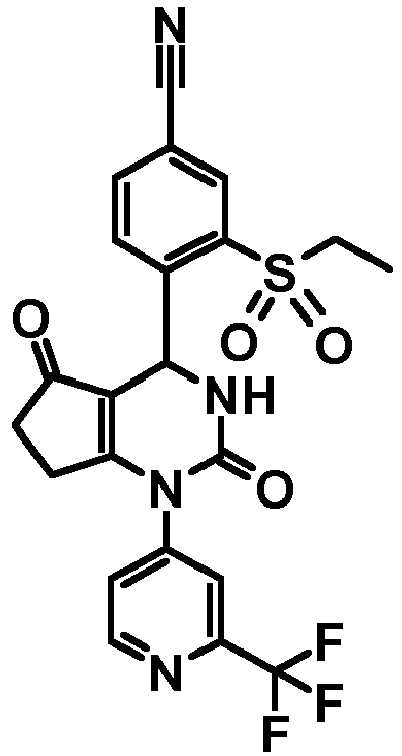
- To a solution of 4-{amino-[5-oxo-2-(2-trifluoromethyl-pyridin-4-ylamino)-cyclopent-1-en yl]-methyl}-3-ethanesulfonyl-benzonitrile hydrochloride (INTERMEDIATE D.5.1, 706 mg, 1.41 mmol) and triethylamine (50 µL, 0.36 mmol) in acetonitrile (3.0 mL) is added 1,1'-carbonyldiimidazole (260 mg, 1.60 mmol) and the mixture is stirred at room temperature for 15 min.The reaction mixture is concentrated under reduced pressure and purified by reversed phase HPLC (Waters SunFire™-C18, gradient of acetonitrile in water, 0.1% formic acid). Yield: 562 mg; ESI mass spectrum [M+H]+ = 491; Retention time HPLC: 0.94 min (Z018_S04).
- EXAMPLES D.2.1 - D.2.4 are prepared in analogous fashion as described for EXAMPLE D.2, employing the starting materials indicated in the following table, respectively.
Table 5 EXAMPLE Starting Material Structure MS [M+ H]+ Retention time [min] HPLC-Method D.2.1 INTERMEDIATE D.5.2 
477 0.89 Z018_S04 D.2.2 INTERMEDIATE D.5.3 
477 0.91 Z018_S04 D.2.3 INTERMEDIATE D.5.4 
487 (bromine isotope pattern) 0.85 Z018_S04 D.2.4 INTERMEDIATE D.5.5 
443 (chlorine isotope pattern) 0.62 005_CA07 -

- A solution of methyliodide in methyl-tert-butylether (c = 2 mol/L, 97 µL, 0.19 mmol) is added to a mixture of 4-[2,5-dioxo-1-(2-trifluoromethyl-pyridin-4-yl)-2,3,4,5,6,7-hexahydro-1H-cyclopentapyrimidin-4-yl]-3-ethanesulfonyl-benzonitrile (EXAMPLE D.2, 80 mg, 0.16 mmol) and cesium carbonate (97 mg, 0.30 mmol) in DMF (1.0 mL) and the mixture is stirred at room temperature overnight. The reaction mixture is acidified with acetic acid and purified by reversed phase HPLC (Waters SunFire™-C18, gradient of acetonitrile in water, 0.1% TFA). Yield: 63 mg. ESI mass spectrum: [M+H]+ = 505; Retention time HPLC: 1.02 min (Z018_S04).
- The enantiomers of racemic 3-ethanesulfonyl-4-[3-methyl-2,5-dioxo-1-(2-trifluoromethyl-pyridin-4-yl)-2,3,4,5,6,7-hexahydro-1H-cyclopentapyrimidin-4-yl]-benzonitrile (EXAMPLE D.3, 104 mg, 0.206 mmol) are separated by preparative supercritical fluid chromatography on a chiral phase (Daicel Chiralpak IC, 10 x 250 mm, 5 µm, 30% MeOH + 20 mM NH3 in supercritical CO2, 40 °C, 120 bar back pressure).
- Yield 45 mg; ESI mass spectrum [M+H]+ = 505; Retention time: 1.94 min (early eluting enantiomer) (I_IC_30_MeOH_NH3).
- Yield 47 mg; ESI mass spectrum [M+H]+ = 505; Retention time: 2.36 min (late eluting enantiomer) (I_IC_30_MeOH_NH3).
- EXAMPLES D.3.1 - D.3.4 are prepared in analogous fashion as described for EXAMPLE D.3, employing the starting materials indicated in the following table, respectively.
Table 6 EXAMPLE Starting Material Structure MS [M+H]+ Retention time [min] HPLC-Method D.3.1 EXAMPLE D.2.1 
491 0.97 Z018_S04 D.3.2 EXAMPLE D.2.2 
491 0.99 Z018_S04 D.3.3 EXAMPLE D.2.3 
501 (bromine isotope pattern) 0.94 Z018_S04 D.3.4 EXAMPLE D.2.4 
457 (chlorine isotope pattern) 0.91 Z017_S04 -

- A mixture of 4-[2,5-dioxo-1-(2-trifluoromethyl-pyridin-4-yl)-2,3,4,5,6,7-hexahydro-1H-cyclopentapyrimidin-4-yl]-3-ethanesulfonyl-benzonitrile (EXAMPLE D.2, 80 mg, 0.16 mmol), 4-nitrophenyl chloroformate (100 mg, 0.50 mmol), 4-dimethylaminopyridine (70 mg, 0.57 mmol) and diisopropylethylamine (0.12 mL, 0.71 mmol) in acetonitrile (1.0 mL) is stirred at room temperature overnight. Methylamine (c = 2 mol/L, 1.0 mL; 2.00 mmol) is added to the mixture containing the 4-nitrophenyl carbamate intermediate and the mixture is stirred at room temperature for 2 h. The reaction mixture is acidified with acetic acid and purified by reversed phase HPLC (Waters SunFire™-C18, gradient of acetonitrile in water, 0.1% TFA). Yield: 43 mg. ESI mass spectrum: [M+H]+ = 548; Retention time HPLC: 0.99 min (Z018_S04).
- EXAMPLES D.4.1 - D.4.10 are prepared in analogous fashion as described for EXAMPLE D.4, employing the starting materials indicated in the following table, respectively.
Table 7 EXAMPLE Starting Material Structure MS [M+H]+ Retention time [min] HPLC-Method D.4.1 EXAMPLE D.2 (ethylamine instead of methylamine) 
562 1.03 Z018_S04 D.4.2 EXAMPLE D.2.1 
534 0.95 Z018_S04 D.4.3 EXAMPLE D.2.1 (ethylamine instead of methylamine) 
548 1.05 Z018_S04 D.4.4 EXAMPLE D.2.2 
534 0.97 Z018_S04 D.4.5 EXAMPLE D.2.2 (ethylamine instead of methylamine) 
548 1.01 Z018_S04 D.4.6 EXAMPLE D.2.3 
544 (bromine isotope pattern) 0.92 Z018_S04 D.4.7 EXAMPLE D.2.3 (ethylamine instead of methylamine) 
558 (bromine isotope pattern) 0.96 Z018_S04 D.4.8 EXAMPLE D.2.4 
500 (chlorine isotope pattern) 0.88 Z017_S04 D.4.9 EXAMPLE D.2.4 (ethylamine instead of methyl amine) 
514 (chlorine isotope pattern) 0.93 Z017_S04 D.4.10* INTERMEDIATE D.6A 
548 1.00 Z018_S04 (Enantiomer) *As the starting material INTERMEDIATE D.6.A is enantiopure, it is assumed that EXAMPLE D.4.10 is enantiopure and has the same configuration as the starting material. - The enantiomers of racemic 4-(4-cyano-2-ethanesulfonyl-phenyl)-2,5-dioxo-1-(2-trifluoromethyl-pyridin-4-yl)-1,2,4,5,6,7-hexahydro-cyclopentapyrimidine-3-carboxylic acid ethylamide (EXAMPLE D.4.1, 127 mg, 0.226 mmol) are separated by preparative supercritical fluid chromatography on a chiral phase (Daicel Chiralpak IA, 10 x 250 mm, 5 µm, 25% MeOH in supercritical CO2, 40 °C, 120 bar back pressure).
- Yield 56 mg; ESI mass spectrum [M+H]+ = 562; Retention time: 1.51 min (early eluting enantiomer) (I_IA_25_MeOH_NH3).
- Yield 54 mg; ESI mass spectrum [M+H]+ = 562; Retention time: 2.59 min (late eluting enantiomer) (I_IC_25_MeOH_NH3).
-

- Triethylamine (238 µL, 1.699 mmol) is added to a mixture of 4- {amino-[2-(3-difluoromethyl-phenylamino)-5-oxo-cyclopent-1-enyl]-methyl}-3-ethanesulfonyl-benzonitrile hydrochloride (INTERMEDIATE D.9, 1.516 g, purity 90%, 2.831 mmol) and 1,1'-carbonyldiimidazole (551 mg, 3.40 mmol) in acetonitrile (10 mL) and the mixture is stirred at room temperature overnight. The mixture is concentrated under reduced pressure and the residue is treated with water. The precipitate is filtered and dried. Yield: 1.24 g. ESI mass spectrum: [M+H]+ = 472; Retention time HPLC: 0.92 min (Z017_S04).
- The enantiomers of racemic 4-[1-(3-difluoromethyl-phenyl)-2,5-dioxo-2,3,4,5,6,7-hexahydro-1H-cyclopentapyrimidin-4-yl]-3-ethanesulfonyl-benzonitrile (EXAMPLE D.5, 490 mg, 1.04 mmol) are separated by preparative supercritical fluid chromatography on a chiral phase (Lux C1, 20 x 250 mm, 5 µm, MeOH, 21 mL/min flow rate).
- Yield 262 mg; ESI mass spectrum [M+H]+ = 472; Retention time: 2.95 min (early eluting enantiomer) (I_IB_20_MeOH_NH3).
- Yield 223 mg; ESI mass spectrum [M+H]+ = 472; Retention time: 3.66 min (late eluting enantiomer) (I_IB_20_MeOH_NH3).
-

- Methyliodide (20 µL, 0.32 mmol) is added to a mixture of 4-[1-(3-difluoromethyl-phenyl)-2,5-dioxo-2,3,4,5,6,7-hexahydro-1H-cyclopentapyrimidin-4-yl]-3-ethanesulfonyl-benzonitrile (EXAMPLE D.5, 50 mg, 0.106 mmol) and cesium carbonate (69 mg, 0.212 mmol) in DMF (1 mL), and the mixture is stirred at room temperature overnight. The reaction mixture is purified by reversed phase HPLC (Waters SunFire™-C18, gradient of acetonitrile in water, 0.1% TFA). Yield: 36 mg; ESI mass spectrum [M+H]+ = 486; Retention time HPLC: 0.79 min (005_CA01).
-

- 4-Nitrophenylchloroformate (23 mg; 0.12 mmol) is added to a mixture of 4-[1-(3-difluoromethyl-phenyl)-2,5-dioxo-2,3,4,5,6,7-hexahydro-1H-cyclopentapyrimidin-4-yl]-3-ethanesulfonyl-benzonitrile (EXAMPLE D.5; 50 mg; 0.106 mmol), DIPEA (72 µL; 0.42 mmol) and 4-dimethylaminopyridine (14 mg; 0.12 mmol) in acetonitrile (1 mL) and the mixture is stirred at room temperature for 2 h. 4-Nitrophenylchloroformate (23 mg; 0.12 mmol) is added and the reaction is stirred 1 h. Methylamine (2M in THF, 159 µL; 0.318 mmol) is added to the mixture containing the 4-nitrophenyl carbamate intermediate and the mixture stirred at room temperature for 1 h. The reaction mixture is purified by reversed phase HPLC (Stablebond, gradient of acetonitrile in water, 0.1% TFA). Yield: 32 mg; ESI mass spectrum [M+H]+ = 529; Retention time HPLC 0.98 min (Z017_S04).
-

- Acetic acid 2-[4-(4-cyano-2-methanesulfonyl-phenyl)-2,5-dioxo-1-(3-trifluoromethylphenyl)-1,2,4,5,6,7-hexahydro-cyclopentapyrimidin-3-yl]-ethyl ester (INTERMEDIATE E.4, 40 mg, 0.071 mmol) is stirred with trifluoroacetic acid (2.0 mL, 26 mmol) at 60°C overnight and the mixture is concentrated under reduced pressure. The residue is stirred with acetonitrile and water for 2 h (→hydrolysis of trifluoroacetic acid ester) and then purified by reversed phase HPLC (Waters SunFire™-C18, gradient of acetonitrile in water, 0.1% TFA). Yield: 17 mg; ESI mass spectrum [M+H]+ = 520; Retention time HPLC: 0.96 min (Z018_S04).
-

- To a mixture of 4-(2,5-dioxo-1-(3-(trifluoromethyl)phenyl)-2,3,4,5,6,7-hexahydro-1H-cyclopentapyrimidin-4-yl)-3-(methylsulfonyl)benzonitrile (INTERMEDIATE E.3A, early eluting enantiomer, 150 mg, 0.32 mmol) and cesium carbonate (206 mg, 0.63 mmol) in DMF (2.0 mL) is added 3-bromo-1-propanol (55 µL, 0.63 mmol) and the mixture is stirred at 50°C overnight. The reaction mixture is treated with ice water, acidified with trifluoroacetic acid and purified by reversed phase HPLC (Waters SunFire™-C18, gradient of acetonitrile in water, 0.1% TFA). Yield: 40 mg; ESI mass spectrum [M+H]+ = 534; Retention time HPLC: 0.97 min (Z018_S04). As the starting material is enantiopure, it is assumed that EXAMPLE E.2 is enantiopure and has the same configuration as the starting material.
-

- To a mixture of 4-(2,5-dioxo-1-(3-(trifluoromethyl)phenyl)-2,3,4,5,6,7-hexahydro-1H-cyclopentapyrimidin-4-yl)-3-(methylsulfonyl)benzonitrile (INTERMEDIATE E.3, 150 mg, 0.32 mmol) and cesium carbonate (206 mg, 0.63 mmol) in DMF (2.0 mL) is added 3-bromomethyl-oxetane (95 mg, 0.63 mmol) and the mixture is stirred at 50°C overnight. The reaction mixture is treated with ice water, acidified with trifluoroacetic acid and purified by reversed phase HPLC (Waters SunFire™-C18, gradient of acetonitrile in water, 0.1% TFA). Yield: 55 mg; ESI mass spectrum [M+H]+ = 546; Retention time HPLC: 1.01 min (Z018_S04).
- The enantiomers of racemic 3-methanesulfonyl-4-[3-oxetan-3-ylmethyl-2,5-dioxo-1-(3-trifluoromethyl-phenyl)-2,3,4,5,6,7-hexahydro-1H-cyclopentapyrimidin-4-yl]-benzonitrile (EXAMPLE E.3, 55 mg, 0.065 mmol) are separated by preparative supercritical fluid chromatography on a chiral phase (Daicel Chiralpak IC, 10 x 250 mm, 5 µm, 30% MeOH + 20 mM NH3 in supercritical CO2, 40 °C, 120 bar back pressure).
- Yield 11 mg; ESI mass spectrum [M+H]+ = 546; Retention time: 4.12 min (early eluting enantiomer) (I_IC_30_MeOH_NH3).
- Yield 11 mg; ESI mass spectrum [M+H]+ = 546; Retention time: 4.66 min (late eluting enantiomer) (I_IC_30_MeOH_NH3).
- Other features and advantages of the present invention will become apparent from the following more detailed examples which illustrate, by way of example, the principles of the invention.
- Materials: Human neutrophil elastase was purchased from Calbiochem (Cat.No.: 324681) and the elastase substrate MeOSuc-Ala-Ala-Pro-Val-AMC from Bachem (Cat.No.: 1-1270). All other materials were of the highest grade commercially available.
- The following buffers were used: Compound buffer: 100mM Tris, 500mM NaCl, adjusted to pH 7.5; Assay buffer: 100mM Tris, 500mM NaCl, adjusted to pH 7.5, containing 0.01% BSA.
- Assay conditions: Test compounds were prediluted in DMSO and subsequently in compound buffer (5% DMSO final). 5 µL of these compound dilutions were mixed with 10 µl Neutrophil elastase (9 ng/ml in assay buffer) in a black 384 well OptiPlate (Perkin Elmer, Cat No.: 6007270) and incubated for 15 min at room temperature. Subsequently 10 µL substrate solution in assay buffer were added (250 µM final concentration) and the plates were incubated for 60 min at room temperature. After inactivation of the enzyme, fluorescence intensities were measured at 380 nm excitation and 460 nm emission wavelengths.
- Each plate contains wells with a high value control (DMSO+enzyme+substrate) and wells with a low value control (DMSO+inactivated enzyme+substrate). IC50 values were estimated using a sigmoidal concentration response curve with variable slope. Means of low values were taken as 0%, means of high values as 100%. The IC50 values of selected compounds in the Neutrophil Elastase assay are listed in Table 8.
TABLE 8 Example IC50 [nM] A.1 1.6 A.1A <1 A.1B 2780 A.2 <1 A.3 <1 B.1 2.1 B.1.1 5.7 B.1.2A 224 B.1.2B <1 B.1.3A <1 B.1.3B 11 B.1.4 <1 C.1A 1825 C.1B <1 C.2A <1 C.2B 13 C.3 <1 C.4.1 5.2 C.4.2 8.9 C.5.1 1.9 C.5.2 1.9 C.6.1 <1 C.6.2 <1 D.1A 2.6 D.1B 19 D.2 24 D.2.1 60 D.2.2 65 D.2.3 101 D.2.4 103 D.3 4.0 D.3A 2810 D.3B 1.4 D.3.1 8.8 D.3.2 9.5 D.3.3 13 D.3.4 8.1 D.4 <1 D.4.1 <1 D.4.1A <1 D.4.1B 338 D.4.2 <1 D.4.3 <1 D.4.4 <1 D.4.5 <1 D.4.6 1.2 D.4.7 <1 D.4.8 <1 D.4.9 <1 D.4.10 <1 D.5 5.5 D.5A 2.2 D.5B 892 D.6 <1 D.7 <1 F.1 <1 E.2 <1 E.3A <1 E.3B 106 - Citrated blood from human healthy donors is mixed with zymosan suspension and incubated at room temperature. This leads to the stimulation of neutrophils and the release of neutrophil elastase into the plasma. The stimulated blood is centrifuged to generate the neutrophil elastase enriched plasma.
- Zymosan (100 mg) is mixed with saline (0.9%, 10 mL) and stored at 4 °C for up to one week (note: zymosan does not dissolve in the saline and is used as a suspension).
-
- A single 45 ml blood sample is taken into a 50 ml tube containing citrate (3.13%, 5 mL) and the tube is gently inverted 4 times.
- Immediately after blood sampling, zymosan working solution (5 mL) is added.
- After the addition of zymosan working solution, the tubes are capped, mixed gently and incubated at 22 °C for 15 min on a shaker at 20 rpm.
- Make 10 ml aliquots after the incubation time.
- Centrifuge the 15 ml tubes at 800g for 15 min at 4°C in a Jouan centrifuge.
- Harvest the plasma and make 1-5 ml aliquots.
- Store the plasma at -80 °C.
- Various concentrations of the neutrophil elastase inhibitor are incubated with plasma. Subsequently, the enzyme activity is measured using the fluorogenic substrate MeOSuc-Ala-Ala-Pro-Val-AMC (Bachem Cat. No. 1-1270, substrate concentration: 250 µM, pH 7.5, 25 mM TRIS buffer, 250 mM NaCl) in analogous fashion as described for the human neutrophil assay. A dose response curve is generated to calculate the EC50 of the inhibitor. The analysis of the data is performed by the calculation of the percentage of fluorescence in the presence of the test compound compared to the fluorescence of the vehicle control after subtracting the background fluorescence: An inhibitor of the neutrophil elastase enzyme will give values between 100 %control (no inhibition) and 0 %control (complete inhibition).
- The EC50 values of selected compounds in the human plasma assay described above are listed in Table 9.
Table 9 Example EC50 [µM] A.1A 0.002 A.2 0.001 A.3 0.001 B.1.2B 0.001 B.1.3A 0.001 C.1B 0.001 C.2A 0.002 C.5.1 0.002 C.5.2 0.001 D.1A 0.001 D.3B 0.001 D.4.1A <0.001 D.4.4 0.002 D.4.5 0.001 D.5A 0.001 - The metabolic degradation of the test compound is assayed at 37 °C with pooled human liver microsomes. The final incubation volume of 100 µl per time point contains TRIS buffer pH 7.6 (0.1 M), magnesium chloride (5 mM), microsomal protein (1 mg/ml) and the test compound at a final concentration of 1 µM. Following a short preincubation period at 37 °C, the reactions are initiated by addition of beta-nicotinamide adenine dinucleotide phosphate, reduced form (NADPH, 1 mM) and terminated by transfering an aliquot into acetonitrile after different time points. Additionally, the NADPH-independent degradation is monitored in incubations without NADPH, terminated at the last time point. The [%] remaining test compound after NADPH independent incubation is reflected by the parameter c(control) (metabolic stability). The quenched incubations are pelleted by centrifugation (10'000 g, 5 min). An aliquot of the supernatant is assayed by LC-MS/MS for the amount of parent compound.
- The half-life (t1/2 INVITRO) is determined by the slope of the semilogarithmic plot of the concentration-time profile. The intrinsic clearance (CL_INTRINSIC) is calculated by considering the amount of protein in the incubation:

- The half-life (t1/2 INVITRO) values of selected compounds in the metabolic stability assay described above are listed in Table 10.
Table 10 Example t1/2 INVITRO [min] A.2 >130 A.3 >130 B.1.2B >130 B.1.3A 91 C.1B 93 C.2A >130 C.5.1 110 C.5.2 >130 D.1A >130 D.3B 120 D.4.1A >130 D.4.4 >130 D.4.5 >130 D.5A >130 - The metabolic degradation of the test compound is assayed in a human hepatocyte suspension. Human hepatocytes (typically cryopreserved) are incubated in an appropriate buffer system (e.g. Dulbecco's modified eagle medium plus 3.5 µg glucagon / 500 mL, 2.5 mg insulin / 500 mL and 3.75 mg / 500 mL hydrocortison) containing 5% species serum. Following a (typically) 30 min preincubation in an incubator (37 °C, 10% CO2), 5 µl of test compound solution (80 µM; from 2 mM stock solution in DMSO diluted 1:25 with medium) are added into 395 µl hepatocyte suspension (cell density in the range 0.25-5*106 cells/mL, typically 1*106 cells/mL; final concentration of test compound 1µM, final DMSO concentration 0.05%). The cells are incubated for six hours (incubator, orbital shaker) and samples (25 µl) are taken at 0, 0.5, 1, 2, 4 and 6 hours. Samples are transferred into acetonitrile and pelleted by centrifugation (5 min). The supernatant is transferred to a new 96-deepwell plate, evaporated under nitrogen and resuspended. The decline of parent compound is analyzed by LC-MS/MS.
- The intrinsic clearance CL_INTRINSIC is calculated as follows:

- The calculated in vitro hepatic intrinsic clearance can be scaled up to the intrinsic in vivo hepatic clearance and used to predict hepatic in vivo blood clearance (CL) by the use of a liver model (well stirred model):


- (Hepatocellularity, human: 120*106 cells / g liver; liver factor, human: 25.7 g / kg bodyweight; blood flow, human: 21 ml/(min * kg))
- Based on this assay, Example C.2A exhibits a predicted hepatic in vivo blood clearance of 3% human hepatic blood flow.
- The assay provides information on the potential of a compound to pass the cell membrane, on the extent of oral absorption as well as on whether the compound is actively transported by uptake and/or efflux transporters. For the measurement of permeability across polarized, confluent human cancer colon carcinoma cells 2 (Caco-2) cell monolayers grown on permeable filter supports are used as the in vitro absorption model.
- Apparent permeability coefficients (PE) of the compounds across the Caco-2 monolayers are measured (pH 7.2, 37 °C) in apical-to-basal (AB) (absorptive) and basal-to-apical (BA) (secretory) transport direction. AB permeability (PEAB) represents drug absorption from the intestine into the blood and BA permeability (PEBA) drug secretion from the blood back into the intestine via both passive permeability as well as active transport mechanisms mediated by efflux and uptake transporters that are expressed on the Caco-2 cells. The compounds are assigned to permeability/absorption classes by comparison of the AB permeabilities with the AB permeabilities of reference compounds with known in vitro permeability and oral absorption in the human. Identical or similar permeabilities in both transport directions indicate passive permeation, vectorial permeability points to additional active transport mechanisms. Higher PEBA than PEAB suggests the involvement of an apical efflux transporter (like P-gp) and/or basolateral uptake transporter; higher PEAB than PEBA permeability suggests involvement of an apical uptake transporter (like PepT1) and/or basolateral efflux transporter (like MRP3). Active transport is concentration-dependently saturable.
- Caco-2 cells (1-2 * 105 cells/cm2 area) are seeded on filter inserts (Costar transwell polycarbonate or PET filters, 0.4 µm pore size) and cultured (DMEM) for 10 to 25 days. Compounds are dissolved in appropriate solvent (like DMSO, 1-20 mM stock solutions). Stock solutions are diluted with HTP-4 buffer (128.13 mM NaCl, 5.36 mM KCl, 1 mM MgSO4, 1.8 mM CaCl2, 4.17 mM NaHCO3, 1.19 mM Na2HPO4x7H2O, 0.41 mM NaH2PO4xH2O, 15 mM HEPES, 20 mM glucose, pH 7.2) to prepare the transport solutions (typically 10 µM compound, final DMSO <= 0.5 %). The transport solution (TL) is applied to the apical or basolateral donor side for measuring A-B or B-A permeability (3 filter replicates), respectively. The receiver side contains HTP-4 buffer supplemented with 2% BSA. Samples are collected at the start and end of experiment from the donor and at various time intervals for up to 2 hours also from the receiver side for concentration measurement by LC-MS/MS or scintillation counting. Sampled receiver volumes are replaced with fresh receiver solution.
- The apparent permeability coefficients (PEAB and PEBA) of selected compounds in the Caco-2 drug transport assay described above are listed in Table 11.
TABLE 11 Example PEAB [cm/s] PEBA [cm/s] A.1A 0.000053 0.000098 A.2 0.000092 0.000080 A.3 0.000067 0.000087 B.1.2B 0.000012 0.000120 B.1.3A 0.0000099 0.000130 C.1B 0.0000037 0.000041 C.2A 0.000013 0.000073 C.5.1 0.0000071 0.000057 C.5.2 0.000016 0.000082 D.1A 0.000019 0.000081 D.3B 0.000021 0.000085 D.4.1A 0.0000036 0.000061 D.4.4 0.0000031 0.000060 D.4.5 0.0000073 0.000067 D.5A 0.0000075 0.000078 - The aqueous solubility of a compound is determined by comparing the amount dissolved in aqueous buffer (containing 2.5% DMSO) to the amount dissolved in an acetonitrile/water (1/1) solution. Starting from a 10 mM DMSO stock solution, aliquots are diluted with acetonitrile/water (1/1) and McIlvaine buffer pH 6.8, respectively. After 24 h of shaking, the solutions or suspensions are filtered and analyzed by LC-UV. The amount dissolved in buffer is compared to the amount dissolved in the acetonitrile/water (1/1) solution. Solubility is measured from 0.001 to 0.125 mg/ml at a DMSO concentration of 2.5%. If more than 90 % of the compound is dissolved in buffer, the value is marked with ">".
- The aqueous solubility of selected compounds in the solubility assay described above is listed in Table 12.
TABLE 12 Example Aqueous solubility [mg/mL] A.1A 0.058 A.3 0.065 B.1.2B 0.073 B.1.3A 0.093 C.1B 0.061 C.2A 0.058 C.5.1 0.086 C.5.2 0.069 D.4.1A 0.081 D.4.5 0.078 D.5A 0.067 - Saturated solutions are prepared in well plates by adding an appropriate volume of selected aqueous media (typically in the range of 0.25 - 1.5 ml) into each well which contains a known quantity of solid drug substance (typically in the range 0.5 - 5.0 mg). The wells are shaken or stirred for a predefined time period (typically in a range of 2 - 24 h) and then filtered using approriate filter membranes (typically PTFE-filters with 0.45 µm pore size). Filter absorption is avoided by discarding the first few drops of filtrate. The amount of dissolved drug substance is determined by UV spectroscopy or by HPLC with UV-detection. In addition, the pH of the aqueous saturated solution is measured using a glass-electrode pH meter. The examples in Table 12 exhibit a solubility of >0.01 mg/mL at pH 6.8 (McIlvaine buffer) in this solubility assay.
- The inhibition of cytochrome P450 2C9-isoenzyme catalysed hydroxylation of Diclofenac by the test compound is assayed at 37°C with human liver microsomes. All assays are carried out on a robotic system in 96 well plates. The final incubation volume contains TRIS buffer (0.1 M), MgCl2 (5 mM), human liver microsomes (0.1 mg/ml), Diclofenac (10 µM) and the test compound at five different concentrations or no compound (high control) in duplicate (e.g. highest concentration 10-50 µM with subsequent serial 1:4 dilutions). Following a short preincubation period, reactions are started with the cofactor (NADPH, 1 mM) and stopped by cooling the incubation down to 8 °C and subsequently by addition of one volume of acetonitrile. An internal standard solution - usually the stable isotope of the formed metabolite - is added after quenching of incubations. Peak area analyte (=metabolite formed) and internal standard is determined by LC-MS/MS. The resulting peak area ratio analyte to internal standard in these incubations is compared to a control activity containing no test compound. Within each of the assay runs, the IC50 of a positive control inhibitor (sulfaphenazole) is determined. Experimental IC50 values are calculated by least square regression according to the following equation:

- If the inhibition of the reaction is already >50% at the lowest concentration of the test compound, the IC50 is assigned "< lowest concentration tested" (usually <0.4 µM). If the inhibition of the reaction is still <50% at the highest concentration of the test compound, the IC50 is assigned "> highest concentration tested" (usually >50 µM). Example A.1A, Example B.1.2B and Example C.2A exhibit IC50 values > 50 µM in this assay.
- The inhibition of cytochrome P450 2C19-isoenzyme catalysed hydroxylation of Mephenytoin by the test compound is assayed at 37 °C with human liver microsomes. All assays are carried out on a robotic system in 96 well plates. The final incubation volume contains TRIS buffer (0.1 M), MgCl2 (5 mM), human liver microsomes (0.5 mg/ml), (S)-Mephenytoin (70 µM) and the test compound at five different concentrations or no compound (high control) in duplicate (e.g. highest concentration 10-50 µM with subsequent serial 1:4 dilutions). Following a short preincubation period, reactions are started with the cofactor (NADPH, 1 mM) and stopped by cooling the incubation down to 8 °C and subsequently by addition of one volume of acetonitrile. An internal standard solution - usually the stable isotope of the formed metabolite - is added after quenching of incubations. Peak area analyte (= metabolite formed) and internal standard is determined by LC-MS/MS. The resulting peak area ratio analyte to internal standard in these incubations is compared to a control activity containing no test compound. Within each of the assay runs, the IC50 of a positive control inhibitor (tranylcypromine) is determined. Experimental IC50 values are calculated by least square regression according to the following equation:

- If the inhibition of the reaction is already >50% at the lowest concentration of the test compound, the IC50 is assigned "< lowest concentration tested" (usually <0.4 µM). If the inhibition of the reaction is still <50% at the highest concentration of the test compound, the IC50 is assigned "> highest concentration tested" (usually >50 µM). Example A.1A, Example B.1.2B and Example C.2A exhibit IC50 values > 50 µM in this assay.
- The inhibition of cytochrome P450 2C8-isoenzyme catalysed deethylation of Amodiaquine by the test compound is assayed at 37°C with human liver microsomes. All assays are carried out on a robotic system in 96 well plates. The final incubation volume contains TRIS buffer (0.1 M), MgCl2 (5 mM), human liver microsomes (0.05 mg/ml), Amodiaquine (1 µM) and the test compound at five different concentrations or no compound (high control) in duplicate (e.g. highest concentration 10-50 µM with subsequent serial 1:4 dilutions). Following a short preincubation period, reactions are started with the cofactor (NADPH, 1mM) and stopped by cooling the incubation down to 8°C and subsequently by addition of one volume of acetonitrile. An internal standard solution - usually the stable isotope of the formed metabolite - is added after quenching of incubations. Peak area analyte (=metabolite formed) and internal standard is determined by LC-MS/MS. The resulting peak area ratio analyte to internal standard in these incubations is compared to a control activity containing no test compound. Within each of the assay runs, the IC50 of a positive control inhibitor (Montelukast) is determined. Experimental IC50 values are calculated by least square regression according to the following equation:

- If the inhibition of the reaction is already >50% at the lowest concentration of the test compound, the IC50 is assigned "< lowest concentration tested" (usually <0.4 µM). If the inhibition of the reaction is still <50% at the highest concentration of the test compound, the IC50 is assigned "> highest concentration tested" (usually >50 µM). Example A.1A, Example B.1.2B and Example C.2A exhibit IC50 values > 50 µM in this assay.
- To assess induction of metabolizing enzyme CYP3A4, cryopreserved HepaRG® cells are seeded at a density of 1.0 x 10⁵ per 96 well. Cells are allowed to equilibrate for 72 hours prior to exposure of 10 µM test article for 48 hours with renewal of test article every 24 hours. Known prototypical CYP3A4 inducers Rifampicin is used as a positive control at a concentration of 25 µM. After 48 hours of exposure, medium containing the test article is removed and cells were washed with phosphate buffered saline (PBS) prior to mRNA isolation.
- Calculations:


- The inhibition of the hERG (human ether-a-go-go-related gene) potassium channel can be determined as described in Rast, G., & Guth, B.D., Journal of Pharmacological and ToxicologicalMethods (2014), http://dx.doi.org/10.1016/j.vascn.2014.08.001.
- The hERG inhibition of selected compounds in this patch clamp assay is listed in Table 13.
TABLE 13 Example hERG inhibition A.1A IC50 >30 µM (7% at 10 µM) B.1.2B IC50 >30 µM (12% at 10 µM) C.2A IC50 >30 µM (7% at 10 µM) D.1A IC50 >30 µM (8% at 10 µM) - The compounds of general formula 1 may be used on their own or combined with other active substances of formula 1 according to the invention. The compounds of general formula 1 may optionally also be combined with other pharmacologically active substances. These include, β2-adrenoceptor-agonists (short and long-acting), anticholinergics (short and long-acting), anti-inflammatory steroids (oral and topical corticosteroids), cromoglycate, methylxanthine, dissociated-glucocorticoidmimetics, PDE3 inhibitors, PDE4- inhibitors, PDE7- inhibitors, LTD4 antagonists, EGFR- inhibitors, Dopamine agonists, PAF antagonists, Lipoxin A4 derivatives, FPRL1 modulators, LTB4-receptor (BLT1, BLT2) antagonists, Histamine H1 receptor antagonists, Histamine H4 receptor antagonists, dual Histamine H1/H3-receptor antagonists, PI3-kinase inhibitors, inhibitors of non-receptor tyrosine kinases as for example LYN, LCK, SYK, ZAP-70, FYN, BTK or ITK, inhibitors of MAP kinases as for example p38, ERK1, ERK2, JNK1, JNK2, JNK3 or SAP, inhibitors of the NF-κB signalling pathway as for example IKK2 kinase inhibitors, iNOS inhibitors, MRP4 inhibitors, leukotriene biosynthese inhibitors as for example 5-Lipoxygenase (5-LO) inhibitors, cPLA2 inhibitors, Leukotriene A4 Hydro-lase inhibitors or FLAP inhibitors, MMP9-inhibitors, MMP12-inhibitors, non-steroidale anti-inflammatory agents (NSAIDs), Cathepsin C (or DPPI / Dipeptidylaminopeptidase I) inhibitors, CRTH2 antagonists, DPI-receptor modulators, Thromboxane receptor antagonists, CCR3 antagonists, CCR4 antagonists, CCR1 antagonists, CCR5antagonists, CCR6 antagonists, CCR7 antagonists, CCR8 antagonists, CCR9 antagonists, CCR30 antagonists, CXCR3 antagonists, CXCR4 antagonists, CXCR2 antagonists, CXCR1 antagonists, CXCR5 antagonists, CXCR6 antagonists, CX3CR3 antagonists, Neurokinin (NK1, NK2) antagonists, Sphingosine 1-Phosphate receptor modulators, Sphingosine 1 phosphate lyase inhibitors, Adenosine receptor modulators as for example A2a-agonists, modulators of purinergicreceptors as for example P2X7 inhibitors, Histone Deacetylase (HDAC) activators, Bradykinin (BK1, BK2) antagonists, TACE inhibitors, PPAR gamma modulators, Rho-kinase inhibitors, interleukin 1-beta converting enzyme (ICE) inhibitors, Toll-Like receptor (TLR) modulators, HMG-CoA reductase inhibitors, VLA-4 antagonists, ICAM-1 inhibitors, SHIP agonists, GABAa receptor antagonist, ENaC-inhibitors, Prostasin-inhibitors, Melanocortin receptor (MC1R, MC2R, MC3R, MC4R, MC5R) modulators, CGRP antagonists, Endothelin antagonists, TNFα antagonists, anti-TNF antibodies, anti-GM-CSF antibodies, anti-CD46 antibodies, anti-IL-1 antibodies, anti-IL-2 antibodies, anti-IL-4 antibodies, anti-IL-5 antibodies, anti-IL-13 antibodies, anti-IL-4/IL-13 antibodies, anti-TSLP antibodies, anti-OX40 antibodies, mucoregulators, immunotherapeutic agents, compounds against swelling of the airways, compounds against cough, VEGF inhibitors, but also combinations of two or three active substances.
- Preferred are betamimetics, anticholinergics, corticosteroids, PDE4-inhibitors, LTD4-antagonists, EGFR-inhibitors, Cathepsin C inhibitors, CRTH2 inhibitors, 5-LO-inhibitors, Histamine receptor antagonists and SYK-inhibitors, especially Cathepsin C inhibitors, but also combinations of two or three active substances, that is:
- Betamimetics with corticosteroids, PDE4-inhibitors, CRTH2-inhibitors or LTD4-antagonists,
- Anticholinergics with betamimetics, corticosteroids, PDE4-inhibitors, CRTH2-inhibitors or LTD4-antagonists,
- Corticosteroids with PDE4-inhibitors, CRTH2-inhibitors or LTD4-antagonists
- PDE4-inhibitors with CRTH2-inhibitors or LTD4-antagonists
- CRTH2-inhibitors with LTD4-antagonists.
- Suitable preparations for administering the compounds of formula will be apparent to those with ordinary skill in the art and include for example tablets, pills, capsules, suppositories, lozenges, troches, solutions, syrups, elixirs, sachets, injectables, inhalatives and powders etc.
- Suitable tablets may be obtained, for example, by mixing one or more compounds according to formula I with known excipients, for example inert diluents, carriers, disintegrants, adjuvants, surfactants, binders and/or lubricants . The tablets may also consist of several layers.
- The compounds of the invention and their pharmaceutically acceptable salts have activity as pharmaceuticals, in particular as inhibitors of neutrophil elastase, and thus may be used in the treatment of:
- 1. respiratory tract: obstructive diseases of the airways including: asthma, including bronchial, allergic, intrinsic, extrinsic, exercise-induced, drug-induced (including aspirin and NSAID-induced) and dust-induced asthma, both intermittent and persistent and of all severities, and other causes of airway hyper-responsiveness; chronic obstructive pulmonary disease (COPD); bronchitis, including infectious and eosinophilic bronchitis; emphysema; alpha1-antitrypsin deficiency; bronchiectasis; cystic fibrosis; sarcoidosis; farmer's lung and related diseases; hypersensitivity pneumonitis; lung fibrosis, including cryptogenic fibrosing alveolitis, idiopathic interstitial pneumonias, fibrosis complicating anti-neoplastic therapy and chronic infection, including tuberculosis and aspergillosis and other fungal infections; complications of lung transplantation; vasculitic and thrombotic disorders of the lung vasculature, and pulmonary hypertension; antitussive activity including treatment of chronic cough associated with inflammatory and secretory conditions of the airways, and iatrogenic cough; acute and chronic rhinitis including rhinitis medicamentosa, and vasomotor rhinitis; perennial and seasonal allergic rhinitis including rhinitis nervosa (hay fever); nasal polyposis; acute viral infection including the common cold, and infection due to respiratory syncytial virus, influenza, coronavirus (including SARS) and adenovirus; acute lung injury; acute respiratory distress syndrome;
- 2. skin: psoriasis, atopic dermatitis, contact dermatitis or other eczematous dermatoses, and delayed-type hypersensitivity reactions; phyto- and photodermatitis; seborrhoeic dermatitis, dermatitis herpetiformis, lichen planus, lichen sclerosus et atrophica, pyoderma gangrenosum, skin sarcoid, discoid lupus erythematosus, pemphigus, pemphigoid, epidermolysis bullosa, urticaria, angioedema, vasculitides, toxic erythemas, cutaneous eosinophilias, alopecia areata, male-pattern baldness, Sweet's syndrome, Weber-Christian syndrome, erythema multiforme; cellulitis, both infective and non-infective; panniculitis;cutaneous lymphomas, non-melanoma skin cancer and other dysplastic lesions; drug-induced disorders including fixed drug eruptions;
- 3. eyes: blepharitis; conjunctivitis, including perennial and vernal allergic conjunctivitis; iritis; anterior and posterior uveitis; choroiditis; autoimmune, degenerative or inflammatory disorders affecting the retina; ophthalmitis including sympathetic ophthalmitis; sarcoidosis; infections including viral, fungal, and bacterial;
- 4. genitourinary: nephritis including interstitial and glomerulonephritis; nephrotic syndrome; cystitis including acute and chronic (interstitial) cystitis and Hunner's ulcer; acute and chronic urethritis, prostatitis, epididymitis, oophoritis and salpingitis; vulvo-vaginitis; Peyronie's disease; erectile dysfunction (both male and female);
- 5. allograft rejection: acute and chronic following, for example, transplantation of kidney, heart, liver, lung, bone marrow, skin or cornea or following blood transfusion; or chronic graft versus host disease;
- 6. other auto-immune and allergic disorders including rheumatoid arthritis, irritable bowel syndrome, systemic lupus erythematosus, multiple sclerosis, Hashimoto's thyroiditis, Graves' disease, Addison's disease, diabetes mellitus, idiopathic thrombocytopaenic purpura, eosinophilic fasciitis, hyper-IgE syndrome, antiphospholipid syndrome and Sazary syndrome;
- 7. oncology: treatment of common cancers including prostate, breast, lung, ovarian, pancreatic, bowel and colon, stomach, skin and brain tumors and malignancies affecting the bone marrow (including the leukaemias) and lymphoproliferative systems, such as Hodgkin's and non-Hodgkin's lymphoma; including the prevention and treatment of metastatic disease and tumour recurrences, and paraneoplastic syndromes; and,
- 8. infectious diseases: virus diseases such as genital warts, common warts, plantar warts, hepatitis B, hepatitis C, herpes simplex virus, molluscum contagiosum, variola, human immunodeficiency virus (HIV), human papilloma virus (HPV), cytomegalovirus (CMV), varicella zoster virus (VZV), rhinovirus, adenovirus, coronavirus, influenza, para-influenza; bacterial diseases such as tuberculosis and mycobacterium avium, leprosy; other infectious diseases, such as fungal diseases, chlamydia, Candida, aspergillus, cryptococcal meningitis, Pneumocystis carnii, cryptosporidiosis, histoplasmosis, toxoplasmosis, trypanosome infection and leishmaniasis and,
- 9. other diseases: traumatic brain injury, abdominal aortic aneurism
- The present invention is directed to compounds of general formula 1 which are useful in the prevention and/or treatment of a disease and/or condition wherein the activity of inhibitors of neutrophil elastase is of therapeutic benefit, including but not limited to the treatment and/or prevention of asthma and allergic diseases, gastrointestinal inflammatory diseases, glomerulonephritis, eosinophilic diseases, chronic obstructive pulmonary disease, infection by pathogenic microbes, rheumatoid arthritis, neutrophilic diseases, cystic fibrosis (CF), non-cystic fibrosis, idiopathic pulmonary fibrosis, bronchiectasis, ANCA-associated vasculitis, lung cancer, non-cyctic fibrosis bronchiectasis, emphysema, chronic bronchitis, acute lung injury (ALI), acute respiratory distress syndrome (ARDS), pulmonary hypertension, pulmonary arterial hypertension (PAH), Alpha-1-antitrypsin deficiency (AATD.), obesity and related inflammation, e.g. chronic adipose tissue inflammation, adipose inflammation, high-fat diet induced inflammation, insulin resistence, diabetes, fatty liver and liver steatosis.
- A correlation between the biological activity and the medical indications is described in the literature e.g. "Henriksen, P. A. Current Opinion in Hematology (2014), 21(1), 23-28" Accordingly, the present invention relates to a compound of general formula 1 as a medicament.
- In a further aspect of the present invention the present invention relates to methods for the treatment or prevention of above mentioned diseases and conditions, which method comprises the administration of an effective amount of a compound of general formula 1 to a human being.
- For treatment of the above-described diseases and conditions, a therapeutically effective dose will generally be in the range from about 0.01 mg to about 100 mg/kg of body weight per dosage of a compound of the invention; preferably, from about 0.1 mg to about 20mg/kg of body weight per dosage. For Example, for administration to a 70 kg person, the dosage range would be from about 0.7 mg to about 7000 mg per dosage of a compound of the invention, preferably from about 7.0 mg to about 1400 mg per dosage. Some degree of routine dose optimization may be required to determine an optimal dosing level and pattern. The active ingredient may be administered from 1 to 6 times a day.
- The actual pharmaceutically effective amount or therapeutic dosage will of course depend on factors known by those skilled in the art such as age and weight of the patient, route of administration and severity of disease. In any case the active ingredient will be administered at dosages and in a manner which allows a pharmaceutically effective amount to be delivered based upon patients unique condition.
LIST OF ABBREVIATIONS ACN acetonitrile aq. aqueous BOC tert.-butyloxycarbonyl-- d day DCM dichloromethane DEA diethylamine DIPEA N,N-diisopropylethylamine DIPE diisopropyl ether DMAP 4-dimethylaminopyridine DMF N,N-dimethylformamide DMSO dimethyl sulfoxide EA ethyl acetate FA formic acid h hour HATU O-(7-azabenzotriazol-1-yl)-N,N,N',N'-tetramethyluronium hexafluorophosphate LiOH lithium hydroxide MeOH methanol MeTHF 2-methyltetrahydrofuran NaH sodium hydride PE petrol ether RT, r.t. room temperature rt retention time TBME tert-butyl methyl ether TBTU o-(1H-benzo-1,2,3-triazol-1-yl)-N,N,N',N'-tetramethyluronium tetrafluoroborate TEA triethylamine TFA trifluoroacetic acid THF tetrahydrofuran TSA toluene sulfonic acid
provided that a compound of formula 1 is not a compound selected from the group consisting of


Claims (14)
- A compound of formula 1
 R1 is phenyl, substituted with CN and substituted with a second substituent R1.1,R1.1 is selected from the group consisting of -CH2OH, -CH(CH3)OH, -C(CH3)2OH, -SO2-CH2CH3, -SO2-CH3, -SO2-CH2CH2-OCH3, -SO2-CH2CH2-OH, -SO2- CH2CH2CH2-OH and -SO-CH2CH3, -SO-CH3,R2 is phenyl or pyridyl, each ring substituted with R2.1,R2.1 is selected from the group consisting of CF3, CHF2, Br and Cl,R3 is selected from the group consisting of H, CH3, -CO-NH-CH3, -CO-NH-CH2CH3, -CH2CH2-OH, -CH2CH2CH2-OH and -CH2-oxetane,or a pharmaceutically acceptable salt thereof,
provided that a compound of formula 1 is not a compound selected from the group consisting of


- A compound of formula 1 according to claim 1, whereinR1 is phenyl, substituted with CN and substituted with a second substituent R1.1,R1.1 is selected from the group consisting of -CH2OH, -SO2-CH2CH2-OH, -SO2-CH2CH2CH2-OH, -SO2-CH2CH3, -SO-CH2CH3 and -SO-CH3,R2 is phenyl substituted with R2.1,R2.1 is selected from the group consisting of CF3 and CHF2,R3 is selected from the group consisting of H and CH3,or a pharmaceutically acceptable salt thereof.
- A compound of formula 1 according to claim 1 or 2, whereinR1 is phenyl, substituted with CN and substituted with a second substituent R1.1, whereinor a pharmaceutically acceptable salt thereof.R1.1 is -CH2OH,
- A compound of formula 1 according to claim 1, selected from the group consisting of compounds 1.a to 1.h.


- A compound according to any one of the claims 1 to 3, wherein the configuration of formula 1 is formula 1'

- A compound of formula 1' according to claim 5, selected from the group consisting of compounds 1.a' to 1.h'


- A compound of formula 1 according to any one of claims 1 to 6 for use as a medicament.
- A compound of formula 1 according to any one of claims 1 to 6 for use as a medicament for the treatment of asthma and allergic diseases, gastrointestinal inflammatory diseases, glomerulonephritis, eosinophilic diseases, chronic obstructive pulmonary disease, infection by pathogenic microbes and rheumatoid arthritis.
- A compound of formula 1 according to any one of claims 1 to 6 for use as a medicament for the treatment of neutrophilic diseases, cystic fibrosis (CF), non-cystic fibrosis, idiopathic pulmonary fibrosis, bronchiectasis, ANCA-associated vasculitis, lung cancer, non-cyctic fibrosis bronchiectasis, emphysema, chronic bronchitis, acute lung injury (ALI), acute respiratory distress syndrome (ARDS), pulmonary hypertension, pulmonary arterial hypertension (PAH) and Alpha-1-antitrypsin deficiency (AATD).
- A compound of formula 1 according to any one of claims 1 to 6 for use as a medicament for the treatment of obesity and related inflammation, insulin resistence, diabetes, fatty liver and liver steatosis.
- A compound of formula 1 according to any one of claims 1 to 6 for use as a medicament for the treatment of traumatic brain injury, abdominal aortic aneurism and Graft vs. Host Disease (GvHD).
- Pharmaceutical composition, characterised in that it contains one or more compounds of formula 1 according to any one of claims 1 to 6 or a pharmaceutically active salt thereof.
- Method of treatment or prevention of diseases in which neutrophil elastase inhibitors have a therapeutic benefit, which method comprises administration of a therapeutically or preventively effective amount of a compound of formula 1 according to one of claims 1 to 6 to a patient in need thereof.
- A pharmaceutical composition comprising additionally to a compound of formula 1, according to any one of claims 1 to 6, a pharmaceutically active compound selected from the group consisting of betamimetics, anticholinergics, corticosteroids, PDE4-inhibitors, LTD4-antagonists, EGFR-inhibitors, Cathepsin C inhibitors, CRTH2 inhibitors, 5-LO-inhibitors, Histamine receptor antagonists and SYK-inhibitors, but also combinations of two or three active substances.
Applications Claiming Priority (3)
| Application Number | Priority Date | Filing Date | Title |
|---|---|---|---|
| EP14179288 | 2014-07-31 | ||
| PCT/EP2015/067501 WO2016016365A1 (en) | 2014-07-31 | 2015-07-30 | Substituted bicyclic dihydropyrimidinones and their use as inhibitors of neutrophil elastase activity |
| EP15744229.4A EP3174861B1 (en) | 2014-07-31 | 2015-07-30 | Substituted bicyclic dihydropyrimidinones and their use as inhibitors of neutrophil elastase activity |
Related Parent Applications (3)
| Application Number | Title | Priority Date | Filing Date |
|---|---|---|---|
| EP15067501 Previously-Filed-Application | 2014-07-31 | ||
| EP15744229.4A Division EP3174861B1 (en) | 2014-07-31 | 2015-07-30 | Substituted bicyclic dihydropyrimidinones and their use as inhibitors of neutrophil elastase activity |
| EP15744229.4A Division-Into EP3174861B1 (en) | 2014-07-31 | 2015-07-30 | Substituted bicyclic dihydropyrimidinones and their use as inhibitors of neutrophil elastase activity |
Publications (2)
| Publication Number | Publication Date |
|---|---|
| EP3539952A1 true EP3539952A1 (en) | 2019-09-18 |
| EP3539952B1 EP3539952B1 (en) | 2022-06-22 |
Family
ID=51257371
Family Applications (2)
| Application Number | Title | Priority Date | Filing Date |
|---|---|---|---|
| EP15744229.4A Active EP3174861B1 (en) | 2014-07-31 | 2015-07-30 | Substituted bicyclic dihydropyrimidinones and their use as inhibitors of neutrophil elastase activity |
| EP19165684.2A Active EP3539952B1 (en) | 2014-07-31 | 2015-07-30 | Substituted bicyclic dihydropyrimidinones and their use as inhibitors of neutrophil elastase activity |
Family Applications Before (1)
| Application Number | Title | Priority Date | Filing Date |
|---|---|---|---|
| EP15744229.4A Active EP3174861B1 (en) | 2014-07-31 | 2015-07-30 | Substituted bicyclic dihydropyrimidinones and their use as inhibitors of neutrophil elastase activity |
Country Status (32)
| Country | Link |
|---|---|
| US (1) | US9475779B2 (en) |
| EP (2) | EP3174861B1 (en) |
| JP (1) | JP6345337B2 (en) |
| KR (1) | KR102420210B1 (en) |
| CN (2) | CN107253933B (en) |
| AP (1) | AP2016009632A0 (en) |
| AU (1) | AU2015295283B2 (en) |
| CA (1) | CA2956745C (en) |
| CL (1) | CL2017000117A1 (en) |
| CO (1) | CO2017000745A2 (en) |
| CY (1) | CY1121933T1 (en) |
| DK (1) | DK3174861T3 (en) |
| EA (1) | EA033263B1 (en) |
| ES (1) | ES2740428T3 (en) |
| HR (1) | HRP20191353T1 (en) |
| HU (1) | HUE045530T2 (en) |
| IL (1) | IL249687B (en) |
| LT (1) | LT3174861T (en) |
| ME (1) | ME03526B (en) |
| MX (1) | MX2017001347A (en) |
| MY (1) | MY182438A (en) |
| NZ (1) | NZ727554A (en) |
| PE (1) | PE20170524A1 (en) |
| PH (1) | PH12017500114A1 (en) |
| PL (1) | PL3174861T3 (en) |
| PT (1) | PT3174861T (en) |
| RS (1) | RS59040B1 (en) |
| SA (1) | SA517380781B1 (en) |
| SG (1) | SG11201700658UA (en) |
| SI (1) | SI3174861T1 (en) |
| UA (1) | UA118130C2 (en) |
| WO (1) | WO2016016365A1 (en) |
Families Citing this family (6)
| Publication number | Priority date | Publication date | Assignee | Title |
|---|---|---|---|---|
| KR20210002573A (en) | 2018-04-24 | 2021-01-08 | 주식회사 피에이치파마 | Use of neutrophil elastase inhibitors in liver disease |
| WO2021053058A1 (en) | 2019-09-17 | 2021-03-25 | Mereo Biopharma 4 Limited | Alvelestat for use in the treatment of graft rejection, bronchiolitis obliterans syndrome and graft versus host disease |
| LT4106757T (en) | 2020-04-16 | 2023-11-10 | Mereo Biopharma 4 Limited | USE OF THE NEUTROPHIL ELASTASIS INHIBITOR ALVELESTAT IN THE TREATMENT OF RESPIRATORY DISEASES CAUSED BY ALPHA-1 ANTITRYPSIN DEFICIENCY |
| JP2024540952A (en) | 2021-10-20 | 2024-11-06 | メレオ バイオファーマ 4 リミテッド | Neutrophil elastase inhibitors for use in the treatment of fibrosis - Patent Application 20070123333 |
| CN115109066B (en) * | 2022-06-30 | 2023-04-07 | 武汉工程大学 | Fluorescent probe for detecting elastase through large Stokes displacement and preparation method and application thereof |
| WO2026032210A1 (en) * | 2024-08-05 | 2026-02-12 | 上海壹迪生物技术有限公司 | Pyrimidinone-containing compound, pharmaceutical composition thereof, and use thereof |
Citations (39)
| Publication number | Priority date | Publication date | Assignee | Title |
|---|---|---|---|---|
| US6207665B1 (en) | 1997-06-12 | 2001-03-27 | Schering Aktiengesellschaft | Piperazine derivatives and their use as anti-inflammatory agents |
| WO2003053930A1 (en) | 2001-12-20 | 2003-07-03 | Bayer Healthcare Ag | 1,4-dihydro-1,4-diphenylpyridine derivatives |
| WO2004020412A1 (en) | 2002-08-27 | 2004-03-11 | Bayer Healthcare Ag | Dihydropyridine derivatives for use as human neutrophil elastase inhibitors |
| WO2004020410A2 (en) | 2002-08-27 | 2004-03-11 | Bayer Healthcare Ag | Dihydropyridinone derivatives as hne inhibitors |
| GB2392910A (en) | 2002-09-10 | 2004-03-17 | Bayer Ag | 2-Oxopyrimidine derivatives and their use as human leukocyte elastase inhibitors |
| WO2004024700A1 (en) | 2002-09-10 | 2004-03-25 | Bayer Healthcare Ag | Pyrimidinone derivatives as therapeutic agents against acute and chronic inflammatory, ischaemic and remodelling processes |
| WO2004024701A1 (en) | 2002-09-10 | 2004-03-25 | Bayer Healthcare Ag | Heterocyclic derivatives |
| WO2005082863A2 (en) | 2004-02-26 | 2005-09-09 | Bayer Healthcare Ag | 1,4 diaryl-dihydropyrimidin-2 ones and their use as a human neutrophil elastase inhibitors |
| WO2005082864A1 (en) | 2004-02-26 | 2005-09-09 | Bayer Healthcare Ag | 1,4-diaryl-dihydropyrimidin-2-ones and their use as human neutrophil elastase inhibitors |
| WO2006082412A2 (en) | 2005-02-03 | 2006-08-10 | Argenta Discovery Limited | Multimers of pyrimidinone derivatives and their use as human neutrophil elastase inhibitors |
| WO2006136857A1 (en) | 2005-06-24 | 2006-12-28 | Argenta Discovery Limited | Dihydropyrimidone multimers and their use as human neutrophil elastase inhibitors |
| WO2006136305A1 (en) | 2005-06-22 | 2006-12-28 | Sanofi-Aventis | SUBSTITUTED PYRR0LIDIN-2-0NES , PIPERIDIN-2-0NES AND ISOTHIAZOLIDINE-1, 1-DIOXIDES, THEIR USE AS KVl .5 POTASSIUM CHANNEL BLOCKERS AND PHARMACEUTICAL PREPARATIONS COMPRISING THEM |
| WO2007129060A1 (en) | 2006-05-04 | 2007-11-15 | Argenta Discovery Limited | Tetrahydropyrrolopyrimidinediones and their use as human neutrophil elastase inhibitors |
| DE102006031314A1 (en) | 2006-07-01 | 2008-01-03 | Bayer Healthcare Aktiengesellschaft | Use of 1,4-diaryl-dihydropyrimidin-2-one derivative for producing a medicament for the treatment and/or prophylaxis of e.g. pulmonary arterial hypertension, chronic-obstructive lung diseases and sleep apnea syndrome |
| WO2008135537A1 (en) | 2007-05-03 | 2008-11-13 | Argenta Discovery Limited | Tetrahydropyrrolopyrimidinediones and their use as human neutrophil elastase inhibitors |
| WO2009037413A1 (en) | 2007-09-19 | 2009-03-26 | Argenta Discovery Limited | Dimers of 5- [ (4-cyanophenyl) sulfinyl] -6-methyl-2-oxo-1- [3- (trifluoromethyl)phenyl] -1,2-dihydropyridine-3-carboxamide as inhibitors of human neutrophil elastase for treating respiratory diseases |
| US20090093477A1 (en) | 2006-05-04 | 2009-04-09 | Nicholas Charles Ray | Tetrahydropyrrolopyrimidinediones and their use in therapy |
| WO2009060203A1 (en) | 2007-11-07 | 2009-05-14 | Argenta Discovery Limited | 3,4,6,7-tetrahydro-1 h-pyrrolo[3,4-d]pyrimidine-2,5-diones and their therapeutic use |
| WO2009060158A1 (en) | 2007-11-07 | 2009-05-14 | Argenta Discovery Limited | 4- (4-cyanophenyl) -1- (3-trifluoromethylphenyl) -3,4, 6, 7-tetrahydro-1h-pyrrolo [3, 4- d] pyrimidine-2, 5-dione derivatives and their use as human neutrophil elastase inhibitors |
| WO2009060206A1 (en) | 2007-11-07 | 2009-05-14 | Argenta Discovery Limited | 3,4,6,7-tetrahydro-1h-pyrrolo[3,4-d]pyrimidine-2,5-diones and their therapeutic use |
| DE102007061766A1 (en) | 2007-12-20 | 2009-06-25 | Bayer Healthcare Ag | New 4-(4-cyano-2-thioaryl)-dihydro-pyrimidinone compounds are human neutrophil elastase inhibitor, useful for the treatment or prevention of e.g. pulmonary arterial hypertonia, acute lung injury and diseases of the cardiovascular system |
| WO2009080199A1 (en) | 2007-12-20 | 2009-07-02 | Bayer Schering Pharma Aktiengesellschaft | 4-(4-cyano-2-thioaryl)dihydropyrimidinones and use thereof |
| WO2009135599A1 (en) | 2008-05-07 | 2009-11-12 | Bayer Schering Pharma Aktiengesellschaft | 1,4-diaryl-pyrimidopyridazine-2,5-diones and their use |
| DE102009004197A1 (en) | 2009-01-09 | 2010-07-15 | Bayer Schering Pharma Aktiengesellschaft | Heterocyclic fused diaryldihydropyrimidine derivatives and their use |
| WO2010115548A1 (en) | 2009-04-06 | 2010-10-14 | Bayer Schering Pharma Aktiengesellschaft | Sulfonic amide and sulfoximine-substituted diaryl-dihydropyrimidinones and usage thereof |
| WO2011042145A1 (en) | 2009-10-07 | 2011-04-14 | Siena Biotech S.P.A. | Wnt pathway antagonists |
| WO2011110859A1 (en) | 2010-03-12 | 2011-09-15 | Pulmagen Therapeutics (Inflammation) Limited | Pyrimidine derivatives and their use in the treatment of respiratory diseases such as copd |
| WO2011110858A1 (en) | 2010-03-12 | 2011-09-15 | Pulmagen Therapeutics (Inflammation) Limited | Pyrimidine derivatives and their use in the treatment of respiratory diseases such as copd |
| WO2012002502A1 (en) | 2010-06-30 | 2012-01-05 | 大日本住友製薬株式会社 | Dihydropyrimidinone derivative and pharmaceutical use thereof |
| WO2013018804A1 (en) | 2011-08-01 | 2013-02-07 | 大日本住友製薬株式会社 | Uracil derivative and use thereof for medical purposes |
| US20130065913A1 (en) | 2011-09-14 | 2013-03-14 | Chiesi Farmaceutici S.P.A. | Novel compounds |
| WO2014009425A1 (en) | 2012-07-12 | 2014-01-16 | Chiesi Farmaceutici S.P.A. | Inhibition of enzymes |
| WO2014029831A1 (en) | 2012-08-23 | 2014-02-27 | Boehringer Ingelheim International Gmbh | Substituted 4-pyridones and their use as inhibitors of neutrophil elastase activity |
| WO2014029830A1 (en) | 2012-08-23 | 2014-02-27 | Boehringer Ingelheim International Gmbh | Substituted 4-pyridones and their use as inhibitors of neutrophil elastase activity |
| WO2014029832A1 (en) | 2012-08-23 | 2014-02-27 | Boehringer Ingelheim International Gmbh | Substituted 4-pyridones and their use as inhibitors of neutrophil elastase activity |
| US20140171414A1 (en) | 2012-12-18 | 2014-06-19 | Chiesi Farmaceutici S.P.A. | Novel compounds |
| WO2014122160A1 (en) | 2013-02-06 | 2014-08-14 | Boehringer Ingelheim International Gmbh | Substituted bicyclic dihydropyrimidinones and their use as inhibitors of neutrophil elastase activity |
| WO2014135414A1 (en) | 2013-03-04 | 2014-09-12 | Boehringer Ingelheim International Gmbh | Substituted bicyclic dihydropyrimidinones and their use as inhibitors of neutrophil elastase activity |
| US10010024B2 (en) | 2015-01-28 | 2018-07-03 | Horsch Maschinen GmbH, LLC | Metering system for an agricultural machine |
Family Cites Families (3)
| Publication number | Priority date | Publication date | Assignee | Title |
|---|---|---|---|---|
| GB0608844D0 (en) * | 2006-05-04 | 2006-06-14 | Argenta Discovery Ltd | Enzyme inhibitors |
| US20100010024A1 (en) | 2006-07-01 | 2010-01-14 | Bayer Healthcare Ag | Use of1,4-diaryl-dihydropyrimidine-2-on derivatives for treating pulmonary arterial hypertension |
| US10590601B2 (en) | 2012-08-31 | 2020-03-17 | Hewlett-Packard Development Company, L.P. | Printable medium |
-
2015
- 2015-07-27 US US14/809,307 patent/US9475779B2/en active Active
- 2015-07-30 AP AP2016009632A patent/AP2016009632A0/en unknown
- 2015-07-30 CN CN201710461556.4A patent/CN107253933B/en active Active
- 2015-07-30 EP EP15744229.4A patent/EP3174861B1/en active Active
- 2015-07-30 LT LTEP15744229.4T patent/LT3174861T/en unknown
- 2015-07-30 MY MYPI2017000020A patent/MY182438A/en unknown
- 2015-07-30 SG SG11201700658UA patent/SG11201700658UA/en unknown
- 2015-07-30 NZ NZ727554A patent/NZ727554A/en unknown
- 2015-07-30 EP EP19165684.2A patent/EP3539952B1/en active Active
- 2015-07-30 ME MEP-2019-207A patent/ME03526B/en unknown
- 2015-07-30 PL PL15744229T patent/PL3174861T3/en unknown
- 2015-07-30 RS RS20190942A patent/RS59040B1/en unknown
- 2015-07-30 MX MX2017001347A patent/MX2017001347A/en active IP Right Grant
- 2015-07-30 SI SI201530816T patent/SI3174861T1/en unknown
- 2015-07-30 JP JP2017505220A patent/JP6345337B2/en active Active
- 2015-07-30 EA EA201790282A patent/EA033263B1/en not_active IP Right Cessation
- 2015-07-30 AU AU2015295283A patent/AU2015295283B2/en active Active
- 2015-07-30 PT PT15744229T patent/PT3174861T/en unknown
- 2015-07-30 ES ES15744229T patent/ES2740428T3/en active Active
- 2015-07-30 DK DK15744229.4T patent/DK3174861T3/en active
- 2015-07-30 WO PCT/EP2015/067501 patent/WO2016016365A1/en not_active Ceased
- 2015-07-30 HU HUE15744229A patent/HUE045530T2/en unknown
- 2015-07-30 PE PE2017000109A patent/PE20170524A1/en unknown
- 2015-07-30 HR HRP20191353 patent/HRP20191353T1/en unknown
- 2015-07-30 UA UAA201701766A patent/UA118130C2/en unknown
- 2015-07-30 KR KR1020177005652A patent/KR102420210B1/en active Active
- 2015-07-30 CN CN201580039249.6A patent/CN106660988B/en active Active
- 2015-07-30 CA CA2956745A patent/CA2956745C/en active Active
-
2016
- 2016-12-21 IL IL24968716A patent/IL249687B/en active IP Right Grant
-
2017
- 2017-01-17 CL CL2017000117A patent/CL2017000117A1/en unknown
- 2017-01-19 PH PH12017500114A patent/PH12017500114A1/en unknown
- 2017-01-24 SA SA517380781A patent/SA517380781B1/en unknown
- 2017-01-27 CO CONC2017/0000745A patent/CO2017000745A2/en unknown
-
2019
- 2019-08-05 CY CY20191100830T patent/CY1121933T1/en unknown
Patent Citations (42)
| Publication number | Priority date | Publication date | Assignee | Title |
|---|---|---|---|---|
| US6207665B1 (en) | 1997-06-12 | 2001-03-27 | Schering Aktiengesellschaft | Piperazine derivatives and their use as anti-inflammatory agents |
| WO2003053930A1 (en) | 2001-12-20 | 2003-07-03 | Bayer Healthcare Ag | 1,4-dihydro-1,4-diphenylpyridine derivatives |
| WO2004020412A1 (en) | 2002-08-27 | 2004-03-11 | Bayer Healthcare Ag | Dihydropyridine derivatives for use as human neutrophil elastase inhibitors |
| WO2004020410A2 (en) | 2002-08-27 | 2004-03-11 | Bayer Healthcare Ag | Dihydropyridinone derivatives as hne inhibitors |
| GB2392910A (en) | 2002-09-10 | 2004-03-17 | Bayer Ag | 2-Oxopyrimidine derivatives and their use as human leukocyte elastase inhibitors |
| WO2004024700A1 (en) | 2002-09-10 | 2004-03-25 | Bayer Healthcare Ag | Pyrimidinone derivatives as therapeutic agents against acute and chronic inflammatory, ischaemic and remodelling processes |
| WO2004024701A1 (en) | 2002-09-10 | 2004-03-25 | Bayer Healthcare Ag | Heterocyclic derivatives |
| WO2005082864A1 (en) | 2004-02-26 | 2005-09-09 | Bayer Healthcare Ag | 1,4-diaryl-dihydropyrimidin-2-ones and their use as human neutrophil elastase inhibitors |
| WO2005082863A2 (en) | 2004-02-26 | 2005-09-09 | Bayer Healthcare Ag | 1,4 diaryl-dihydropyrimidin-2 ones and their use as a human neutrophil elastase inhibitors |
| WO2006082412A2 (en) | 2005-02-03 | 2006-08-10 | Argenta Discovery Limited | Multimers of pyrimidinone derivatives and their use as human neutrophil elastase inhibitors |
| WO2006136305A1 (en) | 2005-06-22 | 2006-12-28 | Sanofi-Aventis | SUBSTITUTED PYRR0LIDIN-2-0NES , PIPERIDIN-2-0NES AND ISOTHIAZOLIDINE-1, 1-DIOXIDES, THEIR USE AS KVl .5 POTASSIUM CHANNEL BLOCKERS AND PHARMACEUTICAL PREPARATIONS COMPRISING THEM |
| WO2006136857A1 (en) | 2005-06-24 | 2006-12-28 | Argenta Discovery Limited | Dihydropyrimidone multimers and their use as human neutrophil elastase inhibitors |
| WO2007129060A1 (en) | 2006-05-04 | 2007-11-15 | Argenta Discovery Limited | Tetrahydropyrrolopyrimidinediones and their use as human neutrophil elastase inhibitors |
| US20090093477A1 (en) | 2006-05-04 | 2009-04-09 | Nicholas Charles Ray | Tetrahydropyrrolopyrimidinediones and their use in therapy |
| DE102006031314A1 (en) | 2006-07-01 | 2008-01-03 | Bayer Healthcare Aktiengesellschaft | Use of 1,4-diaryl-dihydropyrimidin-2-one derivative for producing a medicament for the treatment and/or prophylaxis of e.g. pulmonary arterial hypertension, chronic-obstructive lung diseases and sleep apnea syndrome |
| WO2008135537A1 (en) | 2007-05-03 | 2008-11-13 | Argenta Discovery Limited | Tetrahydropyrrolopyrimidinediones and their use as human neutrophil elastase inhibitors |
| WO2009013444A1 (en) | 2007-07-25 | 2009-01-29 | Argenta Discovery Limited | Tetrahydropyrrolopyrimidinediones and their use as human neutrophil elastase inhibitors |
| WO2009037413A1 (en) | 2007-09-19 | 2009-03-26 | Argenta Discovery Limited | Dimers of 5- [ (4-cyanophenyl) sulfinyl] -6-methyl-2-oxo-1- [3- (trifluoromethyl)phenyl] -1,2-dihydropyridine-3-carboxamide as inhibitors of human neutrophil elastase for treating respiratory diseases |
| WO2009060206A1 (en) | 2007-11-07 | 2009-05-14 | Argenta Discovery Limited | 3,4,6,7-tetrahydro-1h-pyrrolo[3,4-d]pyrimidine-2,5-diones and their therapeutic use |
| WO2009060158A1 (en) | 2007-11-07 | 2009-05-14 | Argenta Discovery Limited | 4- (4-cyanophenyl) -1- (3-trifluoromethylphenyl) -3,4, 6, 7-tetrahydro-1h-pyrrolo [3, 4- d] pyrimidine-2, 5-dione derivatives and their use as human neutrophil elastase inhibitors |
| WO2009060203A1 (en) | 2007-11-07 | 2009-05-14 | Argenta Discovery Limited | 3,4,6,7-tetrahydro-1 h-pyrrolo[3,4-d]pyrimidine-2,5-diones and their therapeutic use |
| DE102007061766A1 (en) | 2007-12-20 | 2009-06-25 | Bayer Healthcare Ag | New 4-(4-cyano-2-thioaryl)-dihydro-pyrimidinone compounds are human neutrophil elastase inhibitor, useful for the treatment or prevention of e.g. pulmonary arterial hypertonia, acute lung injury and diseases of the cardiovascular system |
| WO2009080199A1 (en) | 2007-12-20 | 2009-07-02 | Bayer Schering Pharma Aktiengesellschaft | 4-(4-cyano-2-thioaryl)dihydropyrimidinones and use thereof |
| US20110034433A1 (en) | 2007-12-20 | 2011-02-10 | Bayer Schering Pharma Aktiengesellschaft | 4-(4-cyano-2-thioaryl)dihydropyrimidinones and their use |
| WO2009135599A1 (en) | 2008-05-07 | 2009-11-12 | Bayer Schering Pharma Aktiengesellschaft | 1,4-diaryl-pyrimidopyridazine-2,5-diones and their use |
| DE102009004197A1 (en) | 2009-01-09 | 2010-07-15 | Bayer Schering Pharma Aktiengesellschaft | Heterocyclic fused diaryldihydropyrimidine derivatives and their use |
| WO2010078953A1 (en) | 2009-01-09 | 2010-07-15 | Bayer Schering Pharma Aktiengesellschaft | Triazolo and tetrazolo pyrimidine derivatives as hne inhibitors for treating copd |
| WO2010115548A1 (en) | 2009-04-06 | 2010-10-14 | Bayer Schering Pharma Aktiengesellschaft | Sulfonic amide and sulfoximine-substituted diaryl-dihydropyrimidinones and usage thereof |
| WO2011042145A1 (en) | 2009-10-07 | 2011-04-14 | Siena Biotech S.P.A. | Wnt pathway antagonists |
| WO2011110859A1 (en) | 2010-03-12 | 2011-09-15 | Pulmagen Therapeutics (Inflammation) Limited | Pyrimidine derivatives and their use in the treatment of respiratory diseases such as copd |
| WO2011110858A1 (en) | 2010-03-12 | 2011-09-15 | Pulmagen Therapeutics (Inflammation) Limited | Pyrimidine derivatives and their use in the treatment of respiratory diseases such as copd |
| WO2012002502A1 (en) | 2010-06-30 | 2012-01-05 | 大日本住友製薬株式会社 | Dihydropyrimidinone derivative and pharmaceutical use thereof |
| WO2013018804A1 (en) | 2011-08-01 | 2013-02-07 | 大日本住友製薬株式会社 | Uracil derivative and use thereof for medical purposes |
| US20130065913A1 (en) | 2011-09-14 | 2013-03-14 | Chiesi Farmaceutici S.P.A. | Novel compounds |
| WO2014009425A1 (en) | 2012-07-12 | 2014-01-16 | Chiesi Farmaceutici S.P.A. | Inhibition of enzymes |
| WO2014029831A1 (en) | 2012-08-23 | 2014-02-27 | Boehringer Ingelheim International Gmbh | Substituted 4-pyridones and their use as inhibitors of neutrophil elastase activity |
| WO2014029830A1 (en) | 2012-08-23 | 2014-02-27 | Boehringer Ingelheim International Gmbh | Substituted 4-pyridones and their use as inhibitors of neutrophil elastase activity |
| WO2014029832A1 (en) | 2012-08-23 | 2014-02-27 | Boehringer Ingelheim International Gmbh | Substituted 4-pyridones and their use as inhibitors of neutrophil elastase activity |
| US20140171414A1 (en) | 2012-12-18 | 2014-06-19 | Chiesi Farmaceutici S.P.A. | Novel compounds |
| WO2014122160A1 (en) | 2013-02-06 | 2014-08-14 | Boehringer Ingelheim International Gmbh | Substituted bicyclic dihydropyrimidinones and their use as inhibitors of neutrophil elastase activity |
| WO2014135414A1 (en) | 2013-03-04 | 2014-09-12 | Boehringer Ingelheim International Gmbh | Substituted bicyclic dihydropyrimidinones and their use as inhibitors of neutrophil elastase activity |
| US10010024B2 (en) | 2015-01-28 | 2018-07-03 | Horsch Maschinen GmbH, LLC | Metering system for an agricultural machine |
Non-Patent Citations (29)
| Title |
|---|
| "A Textbook of Drug Design and Development", 1991, GORDON & BREACH, article "Design and Applications of Prodrugs" |
| "Bioreversible Carriers in Drug Design", 1987, ELSEVIER |
| "Burger's Medicinal Chemistry and Drug Discovery", vol. 1, 1995, JOHN WILEY & SONS, pages: 172 - 178,949-982 |
| "Methods in Enzymology", vol. 42, 1985, ACADEMIC PRESS, pages: 309 - 396 |
| "Pro-Drugs as Novel Delivery Systems", 1975, AM. CHEM. SOC. |
| "Prodrugs: Topical and Ocular Drug Delivery", 1998, MARCEL DEKKER |
| AUST. J. CHERN., vol. 58, 2005, pages 870 - 876 |
| BERGE, S.M. ET AL., J. PHARM. SCI., vol. 66, 1977, pages 1 - 19 |
| BEST ET AL., J. AM. CHEM. SOC., vol. 134, 2012, pages 18193 - 18196 |
| CHARALAMBIDES ET AL., SYNTH. COMMUN., vol. 37, 2007, pages 1037 - 1044 |
| CHEMICAL ABSTRACTS, Columbus, Ohio, US; abstract no. 105942-10-7 |
| CHEN ET AL., SYNTH. COMMUN., vol. 40, 2010, pages 2506 - 2510 |
| CSUTORTOKI ET AL., TETRAHEDRON LETT., vol. 67, 2011, pages 8564 - 8571 |
| E. KERNSL. DI: "Drug-like properties: concepts, 15 structure design and methods: from ADME to toxicity optimization", 2008, ELSEVIER |
| HENRIKSEN, P. A., CURRENT OPINION IN HEMATOLOGY, vol. 21, no. 1, 2014, pages 23 - 28 |
| JOCHIMS ET AL., CHEM. BER., vol. 115, 1982, pages 860 - 870 |
| KUSHNIR ET AL., RUSS. J. ORG. CHEM., vol. 47, 2011, pages 1727 - 1732 |
| MARIANO ET AL., J. ORG. CHEM., vol. 49, 1984, pages 220 - 228 |
| P. SJO, FUTURE MED. CHEM., vol. 4, 2012, pages 651 - 660 |
| RAST, G.GUTH, B.D., JOURNAL OF PHARMACOLOGICAL AND TOXICOLOGICALMETHODS, 2014, Retrieved from the Internet <URL:http://dx.doi.org/10.1016/i.vascn.2014.08.001> |
| REINGRUBER ET AL., ADV. SYNTH. CATAL., vol. 351, 2009, pages 1019 - 1024 |
| SCOTT ET AL., J. MED. CHEM., vol. 36, 1993, pages 1947 - 1955 |
| SINITSA ET AL., J. ORG. CHEM. USSR, vol. 14, 1978, pages 1107 |
| T. STEVENS ET AL., J. PHARM. EXP. THER., vol. 339, 2011, pages 313 - 320 |
| TIETCHEU ET AL., J. HETEROCYCLIC CHEM., vol. 39, 2002, pages 965 - 973 |
| TREMBLAY ET AL., CHEST, vol. 121, 2002, pages 582 - 588 |
| VOVK ET AL., RUSS. J. ORG. CHEM., vol. 46, 2010, pages 709 - 715 |
| VOVK ET AL., SYNLETT, vol. 3, 2006, pages 375 - 378 |
| YANG ET AL., ORG. SYNTH., vol. 86, 2009, pages 11 - 17 |
Also Published As
Similar Documents
| Publication | Publication Date | Title |
|---|---|---|
| EP2953943B1 (en) | Substituted bicyclic dihydropyrimidinones and their use as inhibitors of neutrophil elastase activity | |
| EP3174860B1 (en) | Substituted dihydropyrimidinones and their use as inhibitors of neutrophil elastase activity | |
| EP2964617B1 (en) | Substituted bicyclic dihydropyrimidinones and their use as inhibitors of neutrophil elastase activity | |
| EP3174862B1 (en) | Substituted bicyclic dihydropyrimidinones and their use as inhibitors of neutrophil elastase activity | |
| EP3174863B1 (en) | Substituted bicyclic dihydropyrimidinones and their use as inhibitors of neutrophil elastase activity | |
| EP3539952B1 (en) | Substituted bicyclic dihydropyrimidinones and their use as inhibitors of neutrophil elastase activity | |
| EP3174876B1 (en) | Substituted bicyclic dihydropyrimidinones and their use as inhibitors of neutrophil elastase activity | |
| USRE47493E1 (en) | Substituted bicyclic dihydropyrimidinones and their use as inhibitors of neutrophil elastase activity | |
| HK1232871A1 (en) | Substituted bicyclic dihydropyrimidinones and their use as inhibitors of neutrophil elastase activity | |
| HK1232871B (en) | Substituted bicyclic dihydropyrimidinones and their use as inhibitors of neutrophil elastase activity | |
| BR112017001554B1 (en) | SUBSTITUTED BICYCLIC DI-HYDROPIRIMIDINONES, THEIR SALT, PHARMACEUTICAL COMPOSITION COMPRISING THEM AND THEIR USE AS INHIBITORS OF NEUTROPHIL ELASTASE ACTIVITY |
Legal Events
| Date | Code | Title | Description |
|---|---|---|---|
| PUAI | Public reference made under article 153(3) epc to a published international application that has entered the european phase |
Free format text: ORIGINAL CODE: 0009012 |
|
| STAA | Information on the status of an ep patent application or granted ep patent |
Free format text: STATUS: THE APPLICATION HAS BEEN PUBLISHED |
|
| AC | Divisional application: reference to earlier application |
Ref document number: 3174861 Country of ref document: EP Kind code of ref document: P |
|
| AK | Designated contracting states |
Kind code of ref document: A1 Designated state(s): AL AT BE BG CH CY CZ DE DK EE ES FI FR GB GR HR HU IE IS IT LI LT LU LV MC MK MT NL NO PL PT RO RS SE SI SK SM TR |
|
| AX | Request for extension of the european patent |
Extension state: BA ME |
|
| STAA | Information on the status of an ep patent application or granted ep patent |
Free format text: STATUS: REQUEST FOR EXAMINATION WAS MADE |
|
| 17P | Request for examination filed |
Effective date: 20200318 |
|
| RAX | Requested extension states of the european patent have changed |
Extension state: ME Payment date: 20200318 Extension state: BA Payment date: 20200318 |
|
| RBV | Designated contracting states (corrected) |
Designated state(s): AL AT BE BG CH CY CZ DE DK EE ES FI FR GB GR HR HU IE IS IT LI LT LU LV MC MK MT NL NO PL PT RO RS SE SI SK SM TR |
|
| STAA | Information on the status of an ep patent application or granted ep patent |
Free format text: STATUS: EXAMINATION IS IN PROGRESS |
|
| 17Q | First examination report despatched |
Effective date: 20200921 |
|
| RIC1 | Information provided on ipc code assigned before grant |
Ipc: A61P 25/00 20060101ALI20211221BHEP Ipc: A61P 19/02 20060101ALI20211221BHEP Ipc: A61P 13/12 20060101ALI20211221BHEP Ipc: A61P 11/06 20060101ALI20211221BHEP Ipc: A61P 11/00 20060101ALI20211221BHEP Ipc: A61P 9/12 20060101ALI20211221BHEP Ipc: A61P 9/10 20060101ALI20211221BHEP Ipc: A61P 7/00 20060101ALI20211221BHEP Ipc: A61P 3/10 20060101ALI20211221BHEP Ipc: A61P 3/06 20060101ALI20211221BHEP Ipc: A61P 3/04 20060101ALI20211221BHEP Ipc: A61P 1/16 20060101ALI20211221BHEP Ipc: A61P 1/04 20060101ALI20211221BHEP Ipc: A61P 1/00 20060101ALI20211221BHEP Ipc: C07D 401/04 20060101ALI20211221BHEP Ipc: C07D 405/06 20060101ALI20211221BHEP Ipc: A61P 29/00 20060101ALI20211221BHEP Ipc: A61K 31/517 20060101ALI20211221BHEP Ipc: C07D 239/70 20060101AFI20211221BHEP |
|
| GRAP | Despatch of communication of intention to grant a patent |
Free format text: ORIGINAL CODE: EPIDOSNIGR1 |
|
| STAA | Information on the status of an ep patent application or granted ep patent |
Free format text: STATUS: GRANT OF PATENT IS INTENDED |
|
| INTG | Intention to grant announced |
Effective date: 20220131 |
|
| GRAS | Grant fee paid |
Free format text: ORIGINAL CODE: EPIDOSNIGR3 |
|
| GRAA | (expected) grant |
Free format text: ORIGINAL CODE: 0009210 |
|
| STAA | Information on the status of an ep patent application or granted ep patent |
Free format text: STATUS: THE PATENT HAS BEEN GRANTED |
|
| AC | Divisional application: reference to earlier application |
Ref document number: 3174861 Country of ref document: EP Kind code of ref document: P |
|
| AK | Designated contracting states |
Kind code of ref document: B1 Designated state(s): AL AT BE BG CH CY CZ DE DK EE ES FI FR GB GR HR HU IE IS IT LI LT LU LV MC MK MT NL NO PL PT RO RS SE SI SK SM TR |
|
| REG | Reference to a national code |
Ref country code: GB Ref legal event code: FG4D |
|
| REG | Reference to a national code |
Ref country code: CH Ref legal event code: EP |
|
| REG | Reference to a national code |
Ref country code: DE Ref legal event code: R096 Ref document number: 602015079609 Country of ref document: DE |
|
| REG | Reference to a national code |
Ref country code: AT Ref legal event code: REF Ref document number: 1499703 Country of ref document: AT Kind code of ref document: T Effective date: 20220715 |
|
| REG | Reference to a national code |
Ref country code: IE Ref legal event code: FG4D |
|
| REG | Reference to a national code |
Ref country code: LT Ref legal event code: MG9D |
|
| REG | Reference to a national code |
Ref country code: NL Ref legal event code: MP Effective date: 20220622 |
|
| PG25 | Lapsed in a contracting state [announced via postgrant information from national office to epo] |
Ref country code: SE Free format text: LAPSE BECAUSE OF FAILURE TO SUBMIT A TRANSLATION OF THE DESCRIPTION OR TO PAY THE FEE WITHIN THE PRESCRIBED TIME-LIMIT Effective date: 20220622 Ref country code: NO Free format text: LAPSE BECAUSE OF FAILURE TO SUBMIT A TRANSLATION OF THE DESCRIPTION OR TO PAY THE FEE WITHIN THE PRESCRIBED TIME-LIMIT Effective date: 20220922 Ref country code: LT Free format text: LAPSE BECAUSE OF FAILURE TO SUBMIT A TRANSLATION OF THE DESCRIPTION OR TO PAY THE FEE WITHIN THE PRESCRIBED TIME-LIMIT Effective date: 20220622 Ref country code: HR Free format text: LAPSE BECAUSE OF FAILURE TO SUBMIT A TRANSLATION OF THE DESCRIPTION OR TO PAY THE FEE WITHIN THE PRESCRIBED TIME-LIMIT Effective date: 20220622 Ref country code: GR Free format text: LAPSE BECAUSE OF FAILURE TO SUBMIT A TRANSLATION OF THE DESCRIPTION OR TO PAY THE FEE WITHIN THE PRESCRIBED TIME-LIMIT Effective date: 20220923 Ref country code: FI Free format text: LAPSE BECAUSE OF FAILURE TO SUBMIT A TRANSLATION OF THE DESCRIPTION OR TO PAY THE FEE WITHIN THE PRESCRIBED TIME-LIMIT Effective date: 20220622 Ref country code: BG Free format text: LAPSE BECAUSE OF FAILURE TO SUBMIT A TRANSLATION OF THE DESCRIPTION OR TO PAY THE FEE WITHIN THE PRESCRIBED TIME-LIMIT Effective date: 20220922 |
|
| REG | Reference to a national code |
Ref country code: AT Ref legal event code: MK05 Ref document number: 1499703 Country of ref document: AT Kind code of ref document: T Effective date: 20220622 |
|
| PG25 | Lapsed in a contracting state [announced via postgrant information from national office to epo] |
Ref country code: RS Free format text: LAPSE BECAUSE OF FAILURE TO SUBMIT A TRANSLATION OF THE DESCRIPTION OR TO PAY THE FEE WITHIN THE PRESCRIBED TIME-LIMIT Effective date: 20220622 Ref country code: LV Free format text: LAPSE BECAUSE OF FAILURE TO SUBMIT A TRANSLATION OF THE DESCRIPTION OR TO PAY THE FEE WITHIN THE PRESCRIBED TIME-LIMIT Effective date: 20220622 |
|
| PG25 | Lapsed in a contracting state [announced via postgrant information from national office to epo] |
Ref country code: NL Free format text: LAPSE BECAUSE OF FAILURE TO SUBMIT A TRANSLATION OF THE DESCRIPTION OR TO PAY THE FEE WITHIN THE PRESCRIBED TIME-LIMIT Effective date: 20220622 |
|
| PG25 | Lapsed in a contracting state [announced via postgrant information from national office to epo] |
Ref country code: SM Free format text: LAPSE BECAUSE OF FAILURE TO SUBMIT A TRANSLATION OF THE DESCRIPTION OR TO PAY THE FEE WITHIN THE PRESCRIBED TIME-LIMIT Effective date: 20220622 Ref country code: SK Free format text: LAPSE BECAUSE OF FAILURE TO SUBMIT A TRANSLATION OF THE DESCRIPTION OR TO PAY THE FEE WITHIN THE PRESCRIBED TIME-LIMIT Effective date: 20220622 Ref country code: RO Free format text: LAPSE BECAUSE OF FAILURE TO SUBMIT A TRANSLATION OF THE DESCRIPTION OR TO PAY THE FEE WITHIN THE PRESCRIBED TIME-LIMIT Effective date: 20220622 Ref country code: PT Free format text: LAPSE BECAUSE OF FAILURE TO SUBMIT A TRANSLATION OF THE DESCRIPTION OR TO PAY THE FEE WITHIN THE PRESCRIBED TIME-LIMIT Effective date: 20221024 Ref country code: ES Free format text: LAPSE BECAUSE OF FAILURE TO SUBMIT A TRANSLATION OF THE DESCRIPTION OR TO PAY THE FEE WITHIN THE PRESCRIBED TIME-LIMIT Effective date: 20220622 Ref country code: EE Free format text: LAPSE BECAUSE OF FAILURE TO SUBMIT A TRANSLATION OF THE DESCRIPTION OR TO PAY THE FEE WITHIN THE PRESCRIBED TIME-LIMIT Effective date: 20220622 Ref country code: CZ Free format text: LAPSE BECAUSE OF FAILURE TO SUBMIT A TRANSLATION OF THE DESCRIPTION OR TO PAY THE FEE WITHIN THE PRESCRIBED TIME-LIMIT Effective date: 20220622 Ref country code: AT Free format text: LAPSE BECAUSE OF FAILURE TO SUBMIT A TRANSLATION OF THE DESCRIPTION OR TO PAY THE FEE WITHIN THE PRESCRIBED TIME-LIMIT Effective date: 20220622 |
|
| PG25 | Lapsed in a contracting state [announced via postgrant information from national office to epo] |
Ref country code: PL Free format text: LAPSE BECAUSE OF FAILURE TO SUBMIT A TRANSLATION OF THE DESCRIPTION OR TO PAY THE FEE WITHIN THE PRESCRIBED TIME-LIMIT Effective date: 20220622 Ref country code: IS Free format text: LAPSE BECAUSE OF FAILURE TO SUBMIT A TRANSLATION OF THE DESCRIPTION OR TO PAY THE FEE WITHIN THE PRESCRIBED TIME-LIMIT Effective date: 20221022 |
|
| REG | Reference to a national code |
Ref country code: CH Ref legal event code: PL |
|
| REG | Reference to a national code |
Ref country code: DE Ref legal event code: R097 Ref document number: 602015079609 Country of ref document: DE |
|
| REG | Reference to a national code |
Ref country code: BE Ref legal event code: MM Effective date: 20220731 |
|
| PG25 | Lapsed in a contracting state [announced via postgrant information from national office to epo] |
Ref country code: MC Free format text: LAPSE BECAUSE OF FAILURE TO SUBMIT A TRANSLATION OF THE DESCRIPTION OR TO PAY THE FEE WITHIN THE PRESCRIBED TIME-LIMIT Effective date: 20220622 Ref country code: AL Free format text: LAPSE BECAUSE OF FAILURE TO SUBMIT A TRANSLATION OF THE DESCRIPTION OR TO PAY THE FEE WITHIN THE PRESCRIBED TIME-LIMIT Effective date: 20220622 |
|
| PG25 | Lapsed in a contracting state [announced via postgrant information from national office to epo] |
Ref country code: LU Free format text: LAPSE BECAUSE OF NON-PAYMENT OF DUE FEES Effective date: 20220730 Ref country code: LI Free format text: LAPSE BECAUSE OF NON-PAYMENT OF DUE FEES Effective date: 20220731 Ref country code: DK Free format text: LAPSE BECAUSE OF FAILURE TO SUBMIT A TRANSLATION OF THE DESCRIPTION OR TO PAY THE FEE WITHIN THE PRESCRIBED TIME-LIMIT Effective date: 20220622 Ref country code: CH Free format text: LAPSE BECAUSE OF NON-PAYMENT OF DUE FEES Effective date: 20220731 |
|
| PLBE | No opposition filed within time limit |
Free format text: ORIGINAL CODE: 0009261 |
|
| STAA | Information on the status of an ep patent application or granted ep patent |
Free format text: STATUS: NO OPPOSITION FILED WITHIN TIME LIMIT |
|
| 26N | No opposition filed |
Effective date: 20230323 |
|
| PG25 | Lapsed in a contracting state [announced via postgrant information from national office to epo] |
Ref country code: BE Free format text: LAPSE BECAUSE OF NON-PAYMENT OF DUE FEES Effective date: 20220731 |
|
| P01 | Opt-out of the competence of the unified patent court (upc) registered |
Effective date: 20230508 |
|
| PG25 | Lapsed in a contracting state [announced via postgrant information from national office to epo] |
Ref country code: IE Free format text: LAPSE BECAUSE OF NON-PAYMENT OF DUE FEES Effective date: 20220730 |
|
| PG25 | Lapsed in a contracting state [announced via postgrant information from national office to epo] |
Ref country code: SI Free format text: LAPSE BECAUSE OF FAILURE TO SUBMIT A TRANSLATION OF THE DESCRIPTION OR TO PAY THE FEE WITHIN THE PRESCRIBED TIME-LIMIT Effective date: 20220622 |
|
| PG25 | Lapsed in a contracting state [announced via postgrant information from national office to epo] |
Ref country code: IT Free format text: LAPSE BECAUSE OF FAILURE TO SUBMIT A TRANSLATION OF THE DESCRIPTION OR TO PAY THE FEE WITHIN THE PRESCRIBED TIME-LIMIT Effective date: 20220622 |
|
| PG25 | Lapsed in a contracting state [announced via postgrant information from national office to epo] |
Ref country code: HU Free format text: LAPSE BECAUSE OF FAILURE TO SUBMIT A TRANSLATION OF THE DESCRIPTION OR TO PAY THE FEE WITHIN THE PRESCRIBED TIME-LIMIT; INVALID AB INITIO Effective date: 20150730 |
|
| PG25 | Lapsed in a contracting state [announced via postgrant information from national office to epo] |
Ref country code: MK Free format text: LAPSE BECAUSE OF FAILURE TO SUBMIT A TRANSLATION OF THE DESCRIPTION OR TO PAY THE FEE WITHIN THE PRESCRIBED TIME-LIMIT Effective date: 20220622 Ref country code: CY Free format text: LAPSE BECAUSE OF FAILURE TO SUBMIT A TRANSLATION OF THE DESCRIPTION OR TO PAY THE FEE WITHIN THE PRESCRIBED TIME-LIMIT Effective date: 20220622 |
|
| PG25 | Lapsed in a contracting state [announced via postgrant information from national office to epo] |
Ref country code: TR Free format text: LAPSE BECAUSE OF FAILURE TO SUBMIT A TRANSLATION OF THE DESCRIPTION OR TO PAY THE FEE WITHIN THE PRESCRIBED TIME-LIMIT Effective date: 20220622 |
|
| PG25 | Lapsed in a contracting state [announced via postgrant information from national office to epo] |
Ref country code: MT Free format text: LAPSE BECAUSE OF FAILURE TO SUBMIT A TRANSLATION OF THE DESCRIPTION OR TO PAY THE FEE WITHIN THE PRESCRIBED TIME-LIMIT Effective date: 20220622 |
|
| PG25 | Lapsed in a contracting state [announced via postgrant information from national office to epo] |
Ref country code: BG Free format text: LAPSE BECAUSE OF FAILURE TO SUBMIT A TRANSLATION OF THE DESCRIPTION OR TO PAY THE FEE WITHIN THE PRESCRIBED TIME-LIMIT Effective date: 20220622 |
|
| PG25 | Lapsed in a contracting state [announced via postgrant information from national office to epo] |
Ref country code: BG Free format text: LAPSE BECAUSE OF FAILURE TO SUBMIT A TRANSLATION OF THE DESCRIPTION OR TO PAY THE FEE WITHIN THE PRESCRIBED TIME-LIMIT Effective date: 20220622 |
|
| PGFP | Annual fee paid to national office [announced via postgrant information from national office to epo] |
Ref country code: DE Payment date: 20250722 Year of fee payment: 11 |
|
| PGFP | Annual fee paid to national office [announced via postgrant information from national office to epo] |
Ref country code: GB Payment date: 20250722 Year of fee payment: 11 |
|
| PGFP | Annual fee paid to national office [announced via postgrant information from national office to epo] |
Ref country code: FR Payment date: 20250725 Year of fee payment: 11 |