EP3537732A1 - System for automating tuning hands-free systems - Google Patents
System for automating tuning hands-free systems Download PDFInfo
- Publication number
- EP3537732A1 EP3537732A1 EP19161577.2A EP19161577A EP3537732A1 EP 3537732 A1 EP3537732 A1 EP 3537732A1 EP 19161577 A EP19161577 A EP 19161577A EP 3537732 A1 EP3537732 A1 EP 3537732A1
- Authority
- EP
- European Patent Office
- Prior art keywords
- hands
- free
- tuning
- under test
- condition
- Prior art date
- Legal status (The legal status is an assumption and is not a legal conclusion. Google has not performed a legal analysis and makes no representation as to the accuracy of the status listed.)
- Granted
Links
Images


Classifications
-
- H—ELECTRICITY
- H04—ELECTRIC COMMUNICATION TECHNIQUE
- H04M—TELEPHONIC COMMUNICATION
- H04M1/00—Substation equipment, e.g. for use by subscribers
- H04M1/60—Substation equipment, e.g. for use by subscribers including speech amplifiers
- H04M1/6033—Substation equipment, e.g. for use by subscribers including speech amplifiers for providing handsfree use or a loudspeaker mode in telephone sets
- H04M1/6041—Portable telephones adapted for handsfree use
- H04M1/6075—Portable telephones adapted for handsfree use adapted for handsfree use in a vehicle
- H04M1/6083—Portable telephones adapted for handsfree use adapted for handsfree use in a vehicle by interfacing with the vehicle audio system
- H04M1/6091—Portable telephones adapted for handsfree use adapted for handsfree use in a vehicle by interfacing with the vehicle audio system including a wireless interface
-
- H—ELECTRICITY
- H03—ELECTRONIC CIRCUITRY
- H03G—CONTROL OF AMPLIFICATION
- H03G3/00—Gain control in amplifiers or frequency changers
- H03G3/20—Automatic control
-
- H—ELECTRICITY
- H04—ELECTRIC COMMUNICATION TECHNIQUE
- H04M—TELEPHONIC COMMUNICATION
- H04M1/00—Substation equipment, e.g. for use by subscribers
- H04M1/24—Arrangements for testing
-
- H—ELECTRICITY
- H04—ELECTRIC COMMUNICATION TECHNIQUE
- H04M—TELEPHONIC COMMUNICATION
- H04M1/00—Substation equipment, e.g. for use by subscribers
- H04M1/60—Substation equipment, e.g. for use by subscribers including speech amplifiers
- H04M1/6008—Substation equipment, e.g. for use by subscribers including speech amplifiers in the transmitter circuit
-
- H—ELECTRICITY
- H04—ELECTRIC COMMUNICATION TECHNIQUE
- H04M—TELEPHONIC COMMUNICATION
- H04M1/00—Substation equipment, e.g. for use by subscribers
- H04M1/60—Substation equipment, e.g. for use by subscribers including speech amplifiers
- H04M1/6016—Substation equipment, e.g. for use by subscribers including speech amplifiers in the receiver circuit
-
- H—ELECTRICITY
- H04—ELECTRIC COMMUNICATION TECHNIQUE
- H04R—LOUDSPEAKERS, MICROPHONES, GRAMOPHONE PICK-UPS OR LIKE ACOUSTIC ELECTROMECHANICAL TRANSDUCERS; ELECTRIC HEARING AIDS; PUBLIC ADDRESS SYSTEMS
- H04R1/00—Details of transducers, loudspeakers or microphones
- H04R1/08—Mouthpieces; Microphones; Attachments therefor
-
- H—ELECTRICITY
- H04—ELECTRIC COMMUNICATION TECHNIQUE
- H04R—LOUDSPEAKERS, MICROPHONES, GRAMOPHONE PICK-UPS OR LIKE ACOUSTIC ELECTROMECHANICAL TRANSDUCERS; ELECTRIC HEARING AIDS; PUBLIC ADDRESS SYSTEMS
- H04R29/00—Monitoring arrangements; Testing arrangements
- H04R29/001—Monitoring arrangements; Testing arrangements for loudspeakers
-
- H—ELECTRICITY
- H04—ELECTRIC COMMUNICATION TECHNIQUE
- H04R—LOUDSPEAKERS, MICROPHONES, GRAMOPHONE PICK-UPS OR LIKE ACOUSTIC ELECTROMECHANICAL TRANSDUCERS; ELECTRIC HEARING AIDS; PUBLIC ADDRESS SYSTEMS
- H04R29/00—Monitoring arrangements; Testing arrangements
- H04R29/004—Monitoring arrangements; Testing arrangements for microphones
-
- H—ELECTRICITY
- H04—ELECTRIC COMMUNICATION TECHNIQUE
- H04R—LOUDSPEAKERS, MICROPHONES, GRAMOPHONE PICK-UPS OR LIKE ACOUSTIC ELECTROMECHANICAL TRANSDUCERS; ELECTRIC HEARING AIDS; PUBLIC ADDRESS SYSTEMS
- H04R2499/00—Aspects covered by H04R or H04S not otherwise provided for in their subgroups
- H04R2499/10—General applications
- H04R2499/13—Acoustic transducers and sound field adaptation in vehicles
-
- H—ELECTRICITY
- H04—ELECTRIC COMMUNICATION TECHNIQUE
- H04S—STEREOPHONIC SYSTEMS
- H04S7/00—Indicating arrangements; Control arrangements, e.g. balance control
- H04S7/30—Control circuits for electronic adaptation of the sound field
- H04S7/301—Automatic calibration of stereophonic sound system, e.g. with test microphone
Definitions
- This disclosure relates to calibrations and in particular, to systems and methods that automatically tune hands-free systems.
- OEMs Original equipment manufacturers
- Some OEMs tune dozens of hands-free system parameters to ensure their systems operate effectively. These hands-free parameters are manually tuned by experts, which can cause significant delays during production.
- this disclosure generates and automates a hands-free tuning system and validation process.
- the systems and methods are economical, efficient, and in some instances, automatically tune hands-free systems' parameters.
- Hands-free telephone systems are becoming more common in vehicles. There are built-in hands-free-systems, after-market hands-free vehicle kits, and wireless devices. These systems may include automated tuning software, loudspeakers to render audio, one or more distributed microphones, microphone arrays, or directional microphones that pick up sound. The audio may lie within a range that is perceptible to the human ear - from about 20 hertz through about 20,000 hertz.
- the automated tuning software may be part of an application or a software module that provides a discrete or combinations of calibrations, system integrity checks, audio screenings, parameter adjustments, and/or system validations.
- the parameter adjustments may remediate echo, assure echo canceler stability, equalize far-end and/or near end signals, adjust loudness in receive and send channels, control sensitivity in or across one or more aural frequencies, ensure speech quality and stability, monitor and remediate background noise, idle channel noise, and/or distortion (in the receive and the send channels), etc.
- the automated tuning software may control or process some (a subset of) or all of these conditions.
- An automated tuning and/or validating method and/or system (sometimes referred to as an automated hands-free tuning system or automated hands-free tuning systems), screens hands-free systems, optimizes hands-free system parameters, and/or validates hands-free system's sound generation and sound pick-up.
- the automated hands-free tuning systems often function in a vehicle and may update information at the same rate data is received enabling the automated hands-free tuning systems to program a hands-free system in response to any audio event on the fly as the event occurs.
- the information may be stored in a memory and processed in real-time making hands-free parameter adjustments until the hands-free system meets one or more standards (e.g., telecommunication standards).
- the hands-free parameters may be adjusted and evaluated iteratively by repeated adjustments and test sequences until a desired condition prevails. This sequential repetition ensures validations are achieved quickly and efficiently. Because the automated hands-free tuning systems can operate under any conditions, integrity tests, calibrations, screening, adjustments, and/or validations may occur in real-time during real or simulated vehicle operating conditions. A vehicle traveling at different speeds may subject a hands-free system to various wind noises. A vehicle traveling through a variety of weather conditions may subject a hands-free system to various weather conditions such rain and thunderstorms and their accompanying noises. A vehicle traveling in a cold climate may subject the hands-free system to other variable and steady-state noises such as the noise introduced by a continuous or variable fan defrost settings that blows air at a microphone.
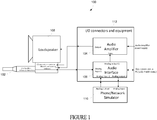
- the automated hands-free tuning systems includes a hardware audio device (HAD) 100 and a software module - an automated tuning software (ATS) module 202.
- the term software module generally refers to a collection of programming routines and data structures that performs a particular task and comprises two parts: an interface and source code.
- the HAD 100 includes an omnidirectional microphone 102 that picks up sound equally around the microphone 102 and records sounds from many directions at a high sensitivity (e.g., such as 300 mV/Pa ⁇ 3dB at about 1 kHz).
- the omnidirectional microphone 102 couples to an audio interface 106.
- the microphone 102 and audio interface 106 are calibrated such that a given sound pressure level (SPL) at the microphone will result in a predictable digital signal level output from the audio interface.
- the loudspeaker 108 is coupled to an audio amplifier 104, which is in turn driven by the audio interface 106.
- the loudspeaker 108, audio amplifier 104 and audio interface 106 are calibrated so that a given digital signal level input to the audio interface will result in a predictable sound pressure level (SPL) reproduced by the loudspeaker.
- An optional telephone/network simulator 110 is connected to the audio interface 106.
- the audio interface 106 enables recording from the microphone 102 and telephone/network simulator 110, and playback of audio to the loudspeaker 108 and telephone/network simulator 110, via the remote controller 206.
- the orientation of the omnidirectional microphone 102 is fixed with respect to the loudspeaker 108.
- the audio interface 106 couples an external or remote controller 206 through a physical or a virtual bus.
- the bus is a universal serial bus, a high-speed communication bus such as FireWire, for example, or a serial or a parallel bus that enables audio signals to be generated and/or recorded locally or remotely.
- the optional telephone/network simulator 110 is paired to the device-under-test (DUT) 206 through a short-range wireless network (e.g., a wireless network like Bluetooth), a long-range wireless network, or a physical network.
- the optional telephone/network simulator 110 simulates a telephone call or a wireless connection, and it may provide/receive audio data to/from the audio interface 106 through analog signals (using digital to analog conversion, and analog to digital conversion) and/or through digital signals.
- the signals may include a recording and/or playback of one or more uplink and/or downlink signals.
- Downlink signals to the DUT 206 may include pre-recordings, speech or speech-like signals (e.g., artificial speech), noise such as background noise, standard test signals, and/or other audio processing sounds.
- Uplink signals may include the processed microphone signal from the DUT 206.
- the HAD 100 may be a standalone device (e.g., a modular component) as shown in FIG. 3 or a unitary part of a vehicle, making the hands-free system in the vehicle self-tuning.
- the modular HAD 100 is positioned in a seat of a vehicle cabin, for example the driver's seat.
- the omnidirectional microphone 102 may be positioned at approximately the mouth-reference-point (MRP).
- MRP is a few centimeters (e.g. 25 cm) in front of the approximate position of the passenger's mouth when seated.
- the HAD's loudspeaker 108 may be front facing positioned at approximately the height of the passenger's head when seated.
- the loudspeaker's 108 position may be above a vehicle's lower loudspeakers that maybe positioned in the footwell of the driver 302 as shown in FIG. 3 and/or the passenger compartments.
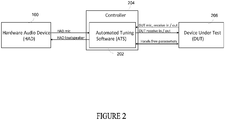
- the ATS module 202 connects to both the HAD 100 and the device-under-test (DUT) as shown in FIG. 2 . While the connection from the HAD 100 to the DUT 206 may be an Ethernet connection, alternate connections use wireless networks.
- the DUT 206 is a voice processing system or an audio system that may work with other systems that generate sound and/or picks up sound while remaining useable and reusable to other systems. These systems, like entertainment systems, run hands-free libraries.
- An exemplary hands-free library supports both narrow and wideband speech, at an exemplary sampling rate of about 8 kHz and about 16 kHz, respectively, for example.
- the exemplary hands-free library may also support Wideband Plus, Super Wideband or full-band applications, with a wider range of audio frequencies, at a higher sampling rates (e.g., at about 24 kHz or greater).
- Each of the hands-free libraries enable the hands-free systems to address the audio and/or voice processing requirements of the latest smartphone connectivity protocols.
- the ATS module 202 controls many audio processing screenings, adjustments, and validations.
- the validations may execute customized tests or standards based tests such as those described in the telecommunication standardized sector tests.
- the telecommunication standardization sector of ITU tests may include: ITU-T P.1100, ITU-T P.1110, ITU-T P.1120, and ITU-T P.1140 tests, etc., each of which are incorporated by reference. Other tests measure other conditions. These conditions may include equalization, echo canceler stability, echo cancellation performance in single-talk and double-talk, loudness in receive and send channels, sensitivity in one or more aural frequencies, speech quality and speech stability, noise reduction, and/or distortion of speech components (in the receive and the send channels), etc.
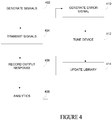
- a far end speech or artificial test signal is created by ATS module 202 at 402 in FIG. 4 .
- the signal is injected into the downlink path of the DUT, either through the telephone/network simulator 110 or directly from the controller 204 to the DUT 206, and played into the vehicle cabin through the vehicle's loudspeakers 302.
- the far end speech or artificial test signal may vary in frequency and in amplitude.
- a microphone input of the DUT 206 and the omnidirectional microphone 102 capture the response of the speech or artificial test signal, and the ATS module 202 records the response in memory at 406.
- the frequency components of the response are then extracted from the captured signals and compared to the far end speech or artificial test signal by the ATS module 202 at 408 to calculate a total harmonic distortion measurement and/or a total harmonic distortion plus noise measurement. Based on a comparison to a scalar distortion threshold value, the ATS module 202 assigns a distortion value at 410. If the distortion value exceeds the scalar distortion threshold, the ATS module 202 may generate a control signal or one or more hands-free speech parameters that adjust speech parameters in the hands-free-library at 412. The adjustments may compress or limit speech parameters of the DUT 206 to meet a compliance standard or achieve a passing result. For example, the parameters may include multiband limiter parameters related to a plurality of cutoff frequencies and thresholds. The adjusted speech parameters may update the hands-free library at 414 (now tuned) in a configuration file of the DUT 206 like each of the parameters described herein.
- a known test signal is injected from the HAD loudspeaker 108 into the vehicle cabin.
- the known test signal may vary in frequency and in amplitude.
- the ATS measures the response at the DUT microphone or through an uplink signal at the network interface.
- the ATS module 202 calculates the frequency response and compares the frequency response to a target frequency response (e.g., such as the send frequency response described in ITU-T P.1100 or ITU-T P.1110).
- the difference between the measured response and the target frequency response is then processed and a control signal or one or more hands-free equalization curve parameters generated that adjust the send equalization curve (e.g., equalization in the transmission channel) in the hands-free library.
- the result may be stored and updated in the hands-free library (now tuned) in a configuration file of the DUT 206.
- a known test signal is injected into the downlink path of the DUT 206 either through the telephone/network simulator 110 or directly from the controller 204 to the DUT 206, and played into the vehicle cabin through the vehicle's loudspeakers 302.
- the known test signal may vary in frequency and in amplitude.
- the ATS module 202 measures the response at the omnidirectional microphone 102.
- the ATS module 202 calculates the frequency response and compares the frequency response to a target frequency response (e.g., such as the receive frequency response described in ITU-T P.1100 or ITU-T P.1110).
- the difference between the measured and the target frequency response is then processed and a control signal or one or more hands-free equalization curve parameters generated that adjust and updates the receive equalization curve (e.g., equalization in the receiving channel) in the hands-free library.
- the results are stored in the hands-free library (now tuned) in the configuration file of the DUT 206.
- a known test signal is injected from the HAD loudspeaker 108 into the vehicle cabin.
- the known test signal may vary in frequency and in amplitude.
- the ATS module 202 measures the audio response at the DUT microphone 304 or through an uplink signal at the network interface.
- the ATS module 202 calculates one or more levels and compares the levels to target levels (e.g., such as the send loudness levels described in ITU-T P.1100 or ITU-T P.1110).
- the difference between the measured loudness (e.g., AGC) and the target loudness levels is then processed and a control signal or one or more hands-free send AGC parameters adjust the variable or fixed gain in the hands-free library.
- the result e.g., a loudness reduction or increase in the transmission channel
- updates the hands-free library (now tuned) stored in the configuration file of the DUT 206.
- a known test signal is injected into the downlink path of the DUT 206 and played out of the vehicle's loudspeakers 302 into the vehicle cabin.
- the known test signal may vary in frequency and in amplitude.
- the ATS module 202 measures the audio response at the omnidirectional microphone 102.
- the ATS module 202 calculates one or more levels and compares the levels to target levels (e.g., such as the receive loudness levels described in ITU-T P.1100 or ITU-T P.1110).
- the difference between the measured loudness (e.g., AGC) and the target loudness levels is then processed and a control signal or one or more hands-free receive AGC parameters adjust the variable or fixed gain in the hands-free library.
- the result e.g., a loudness reduction or increase in the receiving channel updates the hands-free library (now tuned) stored in the configuration file of the DUT 206.
- the automated hands-free tuning systems There are many other tests executed by the automated hands-free tuning systems that screen, adjust, and/or validate sound generation and/or sound pickup characteristics in a vehicle. Some or all of the automated hands-free tuning systems generate one or more known test signals that comprise pure tones, sweeps and noise bursts of varying amplitude and/or frequency to adjust, and/or validate an entire DUT 206 system or subsystems of the DUT system 206 (not the entire system).
- Software updates to the controller 204 of the automated hands-free tuning systems can add new tests or tuning parameters to the automated hands-free tuning systems too. Using a send-and-play format these tests or new functionality may be deployed in the field without modifying the automated hands-free tuning system's hardware.
- each of the automated hands-free tuning systems may generate, inject, and/or measure signals in the network at one, two, or three different test points. These points include: 1) at the HAD loudspeaker 108 and/or microphone 102; and/or 2) at the optional phone/network simulator 110 connected to the HAD 100 (e.g., at the wireless uplink and/or downlink); and/or 3) at the inputs and outputs of the hands-free library in both the uplink/send and downlink/receive directions.
- the ATS module 202 may forward some or all of the tuning, calibration, and diagnostic data, including data that was recorded and calculated automatically to a local or remote memory, remote vehicle, or remote site or system.
- HADs 100 and controllers 204 are self-calibrating.
- the HAD loudspeaker 108 converts a test signal into audible sound and injects the sound into a test enclosure while the HAD microphone 102 records the signal within the enclosure.
- the test enclosure is a vehicle cabin.
- the ATS module 202 analyzes the recorded signal and calculates an adjusted equalization curve and/or gain adjustments. The adjustments are the stored in memory and executed by the HAD 100 to tailor the sound generated by and/or received by the automated hands-free tuning systems to the desired acoustic levels of a selected test.
- the self-calibration assures that the automated hands-free tuning systems has a proper equalization, a proper SPL, and a proper microphone sensitivity or characteristic at one or more desired reference points.
- Some automated hands-free tuning systems also verify hands-free system integrity before the hands-free system is screened, adjusted, and/or validated. These automated hands-free tuning systems detect one or more: microphone failures, noise floor levels, temporal aliasing, loudspeaker failures, misrouting of signals, audio packet losses, network failures, and/or latency issues.
- the system integrity tests generate diagnostic information that is processed to ensure the hands-free systems are secure, up-to-date, and free from problems, and is also used to make system improvements. Exemplary tests may measure latency, audio clipping and saturation, microphone performance, and/or harmonic distortion.
- An exemplary latency test measures the delay or latency between two or more signals that are compared against acceptable latency measures.
- Acceptable ranges of some hands-free systems are less than a 70ms delay between a receive/downlink signal at the input to the hands-free library and a reflection (e.g., an echo) at the microphone/uplink output of the hands-free library.
- Another acceptable range is less than a 100ms send delay between an audible signal generated by the HAD loudspeaker 108 and the uplink signal at the network interface.
- Yet another acceptable range is less than a 100ms receive delay between a downlink signal at the network interface and the received signal converted into an electric signal at the HAD microphone 102.
- Another acceptable range is less than 170ms for the sum of the aforementioned send and receive delays.
- An exemplary detection of clipping and/or saturation test measures the level of clipping and/or saturation of DUT microphone signal when playing a known test signal from the HAD loudspeaker 108.
- the ATS module 202 compares the measured clipping and/or saturation to acceptable thresholds. Based on those comparisons, the ATS module 202 generates a clipping and/or saturation signal that indicates the existence and/or status of the clipping and/or saturation condition.
- exemplary tests compare noise floor during periods of silence to acceptable thresholds, detect aliasing and/or measure harmonic distortion at the DUT microphone 304 while playing a known test signal at the HAD loudspeaker 108.
- Another exemplary test monitors aliasing and/or measures harmonic distortion when injecting a known test signal at a DUT output.
- the aliasing and/or harmonic distortion tests measure the response at the HAD 102 or DUT microphone 304.
- the ATS module 202 compares the measurement to acceptable thresholds. Based on these comparisons, the ATS module 202 generates an aliasing and/or harmonic distortion error signal that indicates the existence and/or status of the aliasing and/or harmonic condition.
- FIG. 5 is a block diagram of an automated hands-free tuning system.
- the system comprises a processor 502, a non-transitory media such as a memory 504 (the contents of which are accessible by the processor 502) an I/O interface 506, a microphone 102 and a loudspeaker 108.
- the I/O interface 506 connects devices and local and/or remote applications such as, for example, one or more additional microphones, audio transducers, loudspeakers, phone/network simulators, and/or transceivers (collectively referred to as 508).
- the memory 504 may store instructions which when executed by the processor 502 that causes the system to render some or all of the functionality associated with calibration of the automated hands-free tuning systems and screening, adjustment, validation, and/or integrity testing of hands-free systems as described herein.
- the memory 504 may store instructions which when executed by the processor 502 causes the system to render the functionality associated with the audio amplifier 104, the audio interface 106, the optional phone/network simulator 110 and the ATS module 202.
- the processors 502 may comprise a single processor or multiple processors that may be disposed on a single chip, on multiple devices, or distributed over more than one system.
- the processors 502 may be hardware that executes computer executable instructions or computer code embodied in the memory 504 or in other memory to perform one or more features of the systems described herein.
- the processor 502 may include a central processing unit (CPU), a graphics processing unit (GPU), an application specific integrated circuit (ASIC), a digital signal processor (DSP), a field programmable gate array (FPGA), a digital circuit, an analog circuit, a microcontroller, any other type of processor, or any combination thereof.
- the memory 504 and/or storage disclosed may retain an ordered listing of executable instructions for implementing the functions described above.
- the machine-readable medium may selectively be, but not limited to, an electronic, a magnetic, an optical, an electromagnetic, an infrared, or a semiconductor medium.
- a non-exhaustive list of examples of a machine-readable medium includes: a portable magnetic or optical disk, a volatile memory, such as a Random Access Memory (RAM), a Read-Only Memory (ROM), an Erasable Programmable Read-Only Memory (EPROM or Flash memory), or a database management system.
- the memory 504 may comprise a single device or multiple devices that may be disposed on one or more dedicated memory devices or on a processor or other similar device. When functions or steps are said to be “responsive to” or occur “in response to" a function or a process, the device functions or steps necessarily occur as a result of the function or message. It is not sufficient that a function or act merely follow or occur subsequent to another.
- the memory 504 may also store a non-transitory computer code, executable by processor 502.
- the computer code may be written in any computer language, such as C, C++, assembly language, channel program code, and/or any combination of computer languages.
- the memory 504 may store information in data structures including, for example sound generation and sound pick-up parameters.
- the functions, acts, or tasks illustrated in the figures or described may be executed in response to one or more sets of logic or instructions stored in or on non-transitory computer readable media as well.
- the functions, acts or tasks are independent of the particular type of instructions set, storage media, processor or processing strategy and may be performed by software, hardware, integrated circuits, firmware, micro code and the like, operating alone or in combination.
- the instructions are stored on a removable media device for reading by local or remote systems.
- the logic or instructions are stored in a remote location for transfer through a network or over wireless or tangible communication lines.
- the logic or instructions may be stored within a given computer such as, for example, a CPU.
- the systems automatically tunes hands-free systems via their parameters without applying subjective testing criteria.
- the system tunes all or some of the hands-free systems consistently across many different vehicle models.
- the system can be a unitary part of a vehicle (making the system self-tuning and enabling the vehicle to optimize its own internal parameters on the fly at any time) or a standalone or modular system positioned in a vehicle to adjust sound generation and sound pickup.
- a vehicle may include without limitation, a car, bus, truck, tractor, motorcycle, bicycle, tricycle, quadricycle, or other cycle, ship, submarine, boat or other watercraft, helicopter, drone, airplane or other aircraft, train, tram or other railed vehicle, spaceplane or other spacecraft, and any other type of vehicle whether currently existing or after-arising this disclosure.
- it comprises a device or structure for transporting persons or things.
- the system is easy and quickly adapted to different vehicle and cabin types and different acoustic environments configurations.
- the subject-matter of the disclosure may also relate, among others, to the following aspects:
Landscapes
- Engineering & Computer Science (AREA)
- Signal Processing (AREA)
- Physics & Mathematics (AREA)
- Acoustics & Sound (AREA)
- Health & Medical Sciences (AREA)
- General Health & Medical Sciences (AREA)
- Otolaryngology (AREA)
- Computer Networks & Wireless Communication (AREA)
- Multimedia (AREA)
- Telephone Function (AREA)
Abstract
Description
- This disclosure relates to calibrations and in particular, to systems and methods that automatically tune hands-free systems.
- Original equipment manufacturers (OEMs) invest time and money to tune hands-free systems. Some OEMs tune dozens of hands-free system parameters to ensure their systems operate effectively. These hands-free parameters are manually tuned by experts, which can cause significant delays during production. Once tuning is completed, standardized tests are run to validate system performance. The validation can cost several days, and if a test fails, more time to correct the failures and rerun the tests.
- Due to the considerable time and expense invested in tuning hands-free parameters and the inconvenience in using experts, some systems go into production not validated or worse out of tune. To address this problem, this disclosure generates and automates a hands-free tuning system and validation process. The systems and methods are economical, efficient, and in some instances, automatically tune hands-free systems' parameters.
- The disclosure is better understood with reference to the following drawings and description. The elements in the figures are not necessarily to scale, emphasis instead being placed upon illustrating the principles of the disclosure. Moreover, in the figures, like referenced numerals designate corresponding parts throughout the different views.
-
FIG. 1 a block diagram of a hardware audio device (HAD) for tuning hands-free-systems. -
FIG. 2 is a system that automatically tunes hands-free-systems. -
FIG. 3 is a hands-free-system under calibration. -
FIG. 4 is a process flow of an exemplary test. -
FIG. 5 is a vehicle with an automated tuning system. - Hands-free telephone systems are becoming more common in vehicles. There are built-in hands-free-systems, after-market hands-free vehicle kits, and wireless devices. These systems may include automated tuning software, loudspeakers to render audio, one or more distributed microphones, microphone arrays, or directional microphones that pick up sound. The audio may lie within a range that is perceptible to the human ear - from about 20 hertz through about 20,000 hertz. The automated tuning software may be part of an application or a software module that provides a discrete or combinations of calibrations, system integrity checks, audio screenings, parameter adjustments, and/or system validations. The parameter adjustments may remediate echo, assure echo canceler stability, equalize far-end and/or near end signals, adjust loudness in receive and send channels, control sensitivity in or across one or more aural frequencies, ensure speech quality and stability, monitor and remediate background noise, idle channel noise, and/or distortion (in the receive and the send channels), etc. The automated tuning software may control or process some (a subset of) or all of these conditions.
- An automated tuning and/or validating method and/or system (sometimes referred to as an automated hands-free tuning system or automated hands-free tuning systems), screens hands-free systems, optimizes hands-free system parameters, and/or validates hands-free system's sound generation and sound pick-up. The automated hands-free tuning systems often function in a vehicle and may update information at the same rate data is received enabling the automated hands-free tuning systems to program a hands-free system in response to any audio event on the fly as the event occurs. The information may be stored in a memory and processed in real-time making hands-free parameter adjustments until the hands-free system meets one or more standards (e.g., telecommunication standards). The hands-free parameters may be adjusted and evaluated iteratively by repeated adjustments and test sequences until a desired condition prevails. This sequential repetition ensures validations are achieved quickly and efficiently. Because the automated hands-free tuning systems can operate under any conditions, integrity tests, calibrations, screening, adjustments, and/or validations may occur in real-time during real or simulated vehicle operating conditions. A vehicle traveling at different speeds may subject a hands-free system to various wind noises. A vehicle traveling through a variety of weather conditions may subject a hands-free system to various weather conditions such rain and thunderstorms and their accompanying noises. A vehicle traveling in a cold climate may subject the hands-free system to other variable and steady-state noises such as the noise introduced by a continuous or variable fan defrost settings that blows air at a microphone.
- The automated hands-free tuning systems includes a hardware audio device (HAD) 100 and a software module - an automated tuning software (ATS)
module 202. The term software module generally refers to a collection of programming routines and data structures that performs a particular task and comprises two parts: an interface and source code. InFIG. 1 , the HAD 100 includes anomnidirectional microphone 102 that picks up sound equally around themicrophone 102 and records sounds from many directions at a high sensitivity (e.g., such as 300 mV/Pa ± 3dB at about 1 kHz). Theomnidirectional microphone 102 couples to anaudio interface 106. Themicrophone 102 andaudio interface 106 are calibrated such that a given sound pressure level (SPL) at the microphone will result in a predictable digital signal level output from the audio interface. Theloudspeaker 108 is coupled to anaudio amplifier 104, which is in turn driven by theaudio interface 106. Theloudspeaker 108,audio amplifier 104 andaudio interface 106 are calibrated so that a given digital signal level input to the audio interface will result in a predictable sound pressure level (SPL) reproduced by the loudspeaker. An optional telephone/network simulator 110 is connected to theaudio interface 106. Theaudio interface 106 enables recording from themicrophone 102 and telephone/network simulator 110, and playback of audio to theloudspeaker 108 and telephone/network simulator 110, via theremote controller 206. The orientation of theomnidirectional microphone 102 is fixed with respect to theloudspeaker 108. - The
audio interface 106 couples an external orremote controller 206 through a physical or a virtual bus. The bus is a universal serial bus, a high-speed communication bus such as FireWire, for example, or a serial or a parallel bus that enables audio signals to be generated and/or recorded locally or remotely. The optional telephone/network simulator 110 is paired to the device-under-test (DUT) 206 through a short-range wireless network (e.g., a wireless network like Bluetooth), a long-range wireless network, or a physical network. The optional telephone/network simulator 110 simulates a telephone call or a wireless connection, and it may provide/receive audio data to/from theaudio interface 106 through analog signals (using digital to analog conversion, and analog to digital conversion) and/or through digital signals. The signals may include a recording and/or playback of one or more uplink and/or downlink signals. Downlink signals to theDUT 206 may include pre-recordings, speech or speech-like signals (e.g., artificial speech), noise such as background noise, standard test signals, and/or other audio processing sounds. Uplink signals may include the processed microphone signal from theDUT 206. - The HAD 100 may be a standalone device (e.g., a modular component) as shown in
FIG. 3 or a unitary part of a vehicle, making the hands-free system in the vehicle self-tuning. In some applications, themodular HAD 100 is positioned in a seat of a vehicle cabin, for example the driver's seat. Theomnidirectional microphone 102 may be positioned at approximately the mouth-reference-point (MRP). The MRP is a few centimeters (e.g. 25 cm) in front of the approximate position of the passenger's mouth when seated. The HAD'sloudspeaker 108 may be front facing positioned at approximately the height of the passenger's head when seated. The loudspeaker's 108 position may be above a vehicle's lower loudspeakers that maybe positioned in the footwell of thedriver 302 as shown inFIG. 3 and/or the passenger compartments. - The
ATS module 202 connects to both theHAD 100 and the device-under-test (DUT) as shown inFIG. 2 . While the connection from the HAD 100 to theDUT 206 may be an Ethernet connection, alternate connections use wireless networks. InFIG. 2 , theDUT 206 is a voice processing system or an audio system that may work with other systems that generate sound and/or picks up sound while remaining useable and reusable to other systems. These systems, like entertainment systems, run hands-free libraries. An exemplary hands-free library supports both narrow and wideband speech, at an exemplary sampling rate of about 8 kHz and about 16 kHz, respectively, for example. The exemplary hands-free library may also support Wideband Plus, Super Wideband or full-band applications, with a wider range of audio frequencies, at a higher sampling rates (e.g., at about 24 kHz or greater). Each of the hands-free libraries enable the hands-free systems to address the audio and/or voice processing requirements of the latest smartphone connectivity protocols. - In operation, the
ATS module 202 controls many audio processing screenings, adjustments, and validations. The validations may execute customized tests or standards based tests such as those described in the telecommunication standardized sector tests. The telecommunication standardization sector of ITU tests may include: ITU-T P.1100, ITU-T P.1110, ITU-T P.1120, and ITU-T P.1140 tests, etc., each of which are incorporated by reference. Other tests measure other conditions. These conditions may include equalization, echo canceler stability, echo cancellation performance in single-talk and double-talk, loudness in receive and send channels, sensitivity in one or more aural frequencies, speech quality and speech stability, noise reduction, and/or distortion of speech components (in the receive and the send channels), etc. - In an exemplary receive distortion test, a far end speech or artificial test signal is created by
ATS module 202 at 402 inFIG. 4 . In 404, the signal is injected into the downlink path of the DUT, either through the telephone/network simulator 110 or directly from thecontroller 204 to theDUT 206, and played into the vehicle cabin through the vehicle'sloudspeakers 302. The far end speech or artificial test signal may vary in frequency and in amplitude. A microphone input of theDUT 206 and theomnidirectional microphone 102 capture the response of the speech or artificial test signal, and theATS module 202 records the response in memory at 406. The frequency components of the response are then extracted from the captured signals and compared to the far end speech or artificial test signal by theATS module 202 at 408 to calculate a total harmonic distortion measurement and/or a total harmonic distortion plus noise measurement. Based on a comparison to a scalar distortion threshold value, theATS module 202 assigns a distortion value at 410. If the distortion value exceeds the scalar distortion threshold, theATS module 202 may generate a control signal or one or more hands-free speech parameters that adjust speech parameters in the hands-free-library at 412. The adjustments may compress or limit speech parameters of theDUT 206 to meet a compliance standard or achieve a passing result. For example, the parameters may include multiband limiter parameters related to a plurality of cutoff frequencies and thresholds. The adjusted speech parameters may update the hands-free library at 414 (now tuned) in a configuration file of theDUT 206 like each of the parameters described herein. - In an exemplary tuning of a send equalization curve stored in the hands-free library, a known test signal is injected from the HAD
loudspeaker 108 into the vehicle cabin. The known test signal may vary in frequency and in amplitude. The ATS measures the response at the DUT microphone or through an uplink signal at the network interface. TheATS module 202 calculates the frequency response and compares the frequency response to a target frequency response (e.g., such as the send frequency response described in ITU-T P.1100 or ITU-T P.1110). The difference between the measured response and the target frequency response is then processed and a control signal or one or more hands-free equalization curve parameters generated that adjust the send equalization curve (e.g., equalization in the transmission channel) in the hands-free library. The result may be stored and updated in the hands-free library (now tuned) in a configuration file of theDUT 206. - In an exemplary tuning of a receive equalization curve stored in the hands-free library, a known test signal is injected into the downlink path of the
DUT 206 either through the telephone/network simulator 110 or directly from thecontroller 204 to theDUT 206, and played into the vehicle cabin through the vehicle'sloudspeakers 302. The known test signal may vary in frequency and in amplitude. TheATS module 202 measures the response at theomnidirectional microphone 102. TheATS module 202 calculates the frequency response and compares the frequency response to a target frequency response (e.g., such as the receive frequency response described in ITU-T P.1100 or ITU-T P.1110). The difference between the measured and the target frequency response is then processed and a control signal or one or more hands-free equalization curve parameters generated that adjust and updates the receive equalization curve (e.g., equalization in the receiving channel) in the hands-free library. The results are stored in the hands-free library (now tuned) in the configuration file of theDUT 206. - In an exemplary tuning of send automatic gain control (AGC) parameters and/or fixed gain parameter stored in the hands-free library, a known test signal is injected from the HAD
loudspeaker 108 into the vehicle cabin. The known test signal may vary in frequency and in amplitude. TheATS module 202 measures the audio response at theDUT microphone 304 or through an uplink signal at the network interface. TheATS module 202 calculates one or more levels and compares the levels to target levels (e.g., such as the send loudness levels described in ITU-T P.1100 or ITU-T P.1110). The difference between the measured loudness (e.g., AGC) and the target loudness levels is then processed and a control signal or one or more hands-free send AGC parameters adjust the variable or fixed gain in the hands-free library. The result (e.g., a loudness reduction or increase in the transmission channel) updates the hands-free library (now tuned) stored in the configuration file of theDUT 206. - In an exemplary tuning of receive automatic gain control (AGC) parameters and/or fixed gain parameter stored in the hands-free library, a known test signal is injected into the downlink path of the
DUT 206 and played out of the vehicle'sloudspeakers 302 into the vehicle cabin. The known test signal may vary in frequency and in amplitude. TheATS module 202 measures the audio response at theomnidirectional microphone 102. TheATS module 202 calculates one or more levels and compares the levels to target levels (e.g., such as the receive loudness levels described in ITU-T P.1100 or ITU-T P.1110). The difference between the measured loudness (e.g., AGC) and the target loudness levels is then processed and a control signal or one or more hands-free receive AGC parameters adjust the variable or fixed gain in the hands-free library. The result (e.g., a loudness reduction or increase in the receiving channel) updates the hands-free library (now tuned) stored in the configuration file of theDUT 206. - There are many other tests executed by the automated hands-free tuning systems that screen, adjust, and/or validate sound generation and/or sound pickup characteristics in a vehicle. Some or all of the automated hands-free tuning systems generate one or more known test signals that comprise pure tones, sweeps and noise bursts of varying amplitude and/or frequency to adjust, and/or validate an
entire DUT 206 system or subsystems of the DUT system 206 (not the entire system). Software updates to thecontroller 204 of the automated hands-free tuning systems can add new tests or tuning parameters to the automated hands-free tuning systems too. Using a send-and-play format these tests or new functionality may be deployed in the field without modifying the automated hands-free tuning system's hardware. The software configures itself automatically to the hardware to generate the send-and-play architecture that allows different tests and functionality to be added or removed on the fly to the automated hands-free tuning systems even while the vehicle is in motion. Further, each of the automated hands-free tuning systems may generate, inject, and/or measure signals in the network at one, two, or three different test points. These points include: 1) at the HADloudspeaker 108 and/ormicrophone 102; and/or 2) at the optional phone/network simulator 110 connected to the HAD 100 (e.g., at the wireless uplink and/or downlink); and/or 3) at the inputs and outputs of the hands-free library in both the uplink/send and downlink/receive directions. Further, theATS module 202 may forward some or all of the tuning, calibration, and diagnostic data, including data that was recorded and calculated automatically to a local or remote memory, remote vehicle, or remote site or system. - To ensure accuracy, some
HADs 100 andcontrollers 204 are self-calibrating. In a self-calibrating operating state, the HADloudspeaker 108 converts a test signal into audible sound and injects the sound into a test enclosure while the HADmicrophone 102 records the signal within the enclosure. In some applications, the test enclosure is a vehicle cabin. TheATS module 202 analyzes the recorded signal and calculates an adjusted equalization curve and/or gain adjustments. The adjustments are the stored in memory and executed by the HAD 100 to tailor the sound generated by and/or received by the automated hands-free tuning systems to the desired acoustic levels of a selected test. The self-calibration assures that the automated hands-free tuning systems has a proper equalization, a proper SPL, and a proper microphone sensitivity or characteristic at one or more desired reference points. - Some automated hands-free tuning systems also verify hands-free system integrity before the hands-free system is screened, adjusted, and/or validated. These automated hands-free tuning systems detect one or more: microphone failures, noise floor levels, temporal aliasing, loudspeaker failures, misrouting of signals, audio packet losses, network failures, and/or latency issues. The system integrity tests generate diagnostic information that is processed to ensure the hands-free systems are secure, up-to-date, and free from problems, and is also used to make system improvements. Exemplary tests may measure latency, audio clipping and saturation, microphone performance, and/or harmonic distortion.
- An exemplary latency test measures the delay or latency between two or more signals that are compared against acceptable latency measures. Acceptable ranges of some hands-free systems are less than a 70ms delay between a receive/downlink signal at the input to the hands-free library and a reflection (e.g., an echo) at the microphone/uplink output of the hands-free library. Another acceptable range is less than a 100ms send delay between an audible signal generated by the HAD
loudspeaker 108 and the uplink signal at the network interface. Yet another acceptable range is less than a 100ms receive delay between a downlink signal at the network interface and the received signal converted into an electric signal at the HADmicrophone 102. Another acceptable range is less than 170ms for the sum of the aforementioned send and receive delays. - An exemplary detection of clipping and/or saturation test measures the level of clipping and/or saturation of DUT microphone signal when playing a known test signal from the HAD
loudspeaker 108. TheATS module 202 compares the measured clipping and/or saturation to acceptable thresholds. Based on those comparisons, theATS module 202 generates a clipping and/or saturation signal that indicates the existence and/or status of the clipping and/or saturation condition. - Other exemplary tests, compare noise floor during periods of silence to acceptable thresholds, detect aliasing and/or measure harmonic distortion at the
DUT microphone 304 while playing a known test signal at the HADloudspeaker 108. Another exemplary test monitors aliasing and/or measures harmonic distortion when injecting a known test signal at a DUT output. The aliasing and/or harmonic distortion tests measure the response at the HAD 102 orDUT microphone 304. TheATS module 202 compares the measurement to acceptable thresholds. Based on these comparisons, theATS module 202 generates an aliasing and/or harmonic distortion error signal that indicates the existence and/or status of the aliasing and/or harmonic condition. -
FIG. 5 is a block diagram of an automated hands-free tuning system. The system comprises aprocessor 502, a non-transitory media such as a memory 504 (the contents of which are accessible by the processor 502) an I/O interface 506, amicrophone 102 and aloudspeaker 108. The I/O interface 506 connects devices and local and/or remote applications such as, for example, one or more additional microphones, audio transducers, loudspeakers, phone/network simulators, and/or transceivers (collectively referred to as 508). Thememory 504 may store instructions which when executed by theprocessor 502 that causes the system to render some or all of the functionality associated with calibration of the automated hands-free tuning systems and screening, adjustment, validation, and/or integrity testing of hands-free systems as described herein. For example, thememory 504 may store instructions which when executed by theprocessor 502 causes the system to render the functionality associated with theaudio amplifier 104, theaudio interface 106, the optional phone/network simulator 110 and theATS module 202. - The
processors 502 may comprise a single processor or multiple processors that may be disposed on a single chip, on multiple devices, or distributed over more than one system. Theprocessors 502 may be hardware that executes computer executable instructions or computer code embodied in thememory 504 or in other memory to perform one or more features of the systems described herein. Theprocessor 502 may include a central processing unit (CPU), a graphics processing unit (GPU), an application specific integrated circuit (ASIC), a digital signal processor (DSP), a field programmable gate array (FPGA), a digital circuit, an analog circuit, a microcontroller, any other type of processor, or any combination thereof. - The
memory 504 and/or storage disclosed may retain an ordered listing of executable instructions for implementing the functions described above. The machine-readable medium may selectively be, but not limited to, an electronic, a magnetic, an optical, an electromagnetic, an infrared, or a semiconductor medium. A non-exhaustive list of examples of a machine-readable medium includes: a portable magnetic or optical disk, a volatile memory, such as a Random Access Memory (RAM), a Read-Only Memory (ROM), an Erasable Programmable Read-Only Memory (EPROM or Flash memory), or a database management system. Thememory 504 may comprise a single device or multiple devices that may be disposed on one or more dedicated memory devices or on a processor or other similar device. When functions or steps are said to be "responsive to" or occur "in response to" a function or a process, the device functions or steps necessarily occur as a result of the function or message. It is not sufficient that a function or act merely follow or occur subsequent to another. - The
memory 504 may also store a non-transitory computer code, executable byprocessor 502. The computer code may be written in any computer language, such as C, C++, assembly language, channel program code, and/or any combination of computer languages. Thememory 504 may store information in data structures including, for example sound generation and sound pick-up parameters. - The functions, acts, or tasks illustrated in the figures or described may be executed in response to one or more sets of logic or instructions stored in or on non-transitory computer readable media as well. The functions, acts or tasks are independent of the particular type of instructions set, storage media, processor or processing strategy and may be performed by software, hardware, integrated circuits, firmware, micro code and the like, operating alone or in combination. In one embodiment, the instructions are stored on a removable media device for reading by local or remote systems. In other embodiments, the logic or instructions are stored in a remote location for transfer through a network or over wireless or tangible communication lines. In yet other embodiments, the logic or instructions may be stored within a given computer such as, for example, a CPU.
- The systems automatically tunes hands-free systems via their parameters without applying subjective testing criteria. The system tunes all or some of the hands-free systems consistently across many different vehicle models. The system can be a unitary part of a vehicle (making the system self-tuning and enabling the vehicle to optimize its own internal parameters on the fly at any time) or a standalone or modular system positioned in a vehicle to adjust sound generation and sound pickup. A vehicle may include without limitation, a car, bus, truck, tractor, motorcycle, bicycle, tricycle, quadricycle, or other cycle, ship, submarine, boat or other watercraft, helicopter, drone, airplane or other aircraft, train, tram or other railed vehicle, spaceplane or other spacecraft, and any other type of vehicle whether currently existing or after-arising this disclosure. In other words, it comprises a device or structure for transporting persons or things. The system is easy and quickly adapted to different vehicle and cabin types and different acoustic environments configurations.
- The subject-matter of the disclosure may also relate, among others, to the following aspects:
- 1. A method that automates the tuning of a hands-free system comprising:
- playing one or more test signals that vary in frequency and in amplitude out of a hands-free system under test;
- recording the responses of a hands-free tuning system at a microphone of the hands-free tuning system or a microphone of the hands-free system under test;
- measuring the sound generation and sound pickup characteristics of the hands-free system under test with respect to the one or more of the test signals and one or more of the microphone signals;
- calculating a plurality of tunable parameters of the hands-free system under test; and
- updating a hands-free system library with the calculated plurality of tunable parameters; wherein the hands-free library is remote from the hands-free tuning system but utilized by the hands-free tuning system during operation.
- 2. The method of
clause 1 wherein the playing of one or more test signals that vary in frequency and in amplitude out of a hands-free system under test comprises injecting these signals into a telephone/network simulator. - 3. The method of any of
clauses 1 to 2 further comprising tuning a multiband compressor with one or more of the plurality of tunable parameters. - 4. The method of any of
clauses 1 to 3 further comprising tuning an automatic gain control of a receiving channel with one or more of the plurality of tunable parameters. - 5. The method of any of
clauses 1 to 4 further comprising tuning an equalization curve of a receiving channel with one or more of the plurality of tunable parameters. - 6. The method of any of
clauses 1 to 5 wherein the calculating of the plurality of tunable parameters of the hands-free system under test occurs at the same rate as the process measures the sound generation and sound pickup characteristics of the hands-free system. - 7. The method of any of
clauses 1 to 6 wherein the updating a hands-free system library with the calculated plurality of tunable parameters occurs at the same rate as the process measures the sound generation and sound pickup characteristics of the hands-free system. - 8. The method of any of
clauses 1 to 6 wherein the act of measuring the sound generation and sound pickup characteristics of the hands-free system under test occurs in response to a software update of the hands-free tuning system. - 9. The method of any of
clauses 1 to 8 further comprising validating the hands-free system under test against an industry standard after the hands-free system library is updated. - 10. The method of any of
clauses 1 to 9 further comprising comparing the selected sound generation and sound pickup characteristics of the hands-free system under test to a predetermined threshold and generating a status signal that indicates a clipping condition, a saturation condition, an aliasing condition, a distortion condition, a noise floor condition, a latency condition or a packet dropout condition. - 11. The method of any of
clauses 1 to 10 wherein the acts of: playing one or more test signals, recording the responses of the hands-free tuning system; measuring the sound generation and sound pickup characteristics of the hands-free system under test; calculating the plurality of tunable parameters of the hands-free system under test; and updating the hands-free system library is a repeated until the hands-free system under test reaches an industry standard operating condition. - 12. A method that automates the tuning of a hands-free system comprising:
- playing one or more test signals that vary in frequency and in amplitude out of a hands-free tuning system;
- recording the responses of the hands-free tuning system at a microphone of the hands-free tuning system or a microphone of the hands-free system under test;
- measuring the sound generation and sound pickup characteristics of the hands-free system under test with respect to the one or more of the test signals and one or more of the microphone signals;
- calculating a plurality of tunable parameters of the hands-free system under test; and
- updating a hands-free system library with the calculated plurality of tunable parameters; wherein the hands-free library is remote from the hands-free tuning system but utilized by the hands-free tuning system during operation.
- 13. The method of clause 12 wherein the recording the responses of a hands-free tuning system at a microphone of the hands-free tuning system comprises recording the responses at a telephone/network simulator.
- 14. The method of any of clauses 12 to 13 further comprising tuning an automatic gain control of a transmitting channel with one or more of the plurality of tunable parameters.
- 15. The method of any of clauses 12 to 14 further comprising tuning an equalization curve of a transmitting channel with one or more of the plurality of tunable parameters.
- 16. The method of any of clauses 12 to 15 wherein the calculating of the plurality of tunable parameters of the hands-free system under test occurs at the same rate as the process measures the sound generation and sound pickup characteristics of the hands-free system.
- 17. The method of any of clauses 12 to 16 wherein the updating a hands-free system library with the calculated plurality of tunable parameters occurs at the same rate as the process measures the sound generation and sound pickup characteristics of the hands-free system.
- 18. The method of any of clauses 12 to 17 wherein the act of measuring the sound generation and sound pickup characteristics of the hands-free system under test occurs in response to a software update of the hands-free tuning system.
- 19. The method of any of clauses 12 to 18 further comprising validating the hands-free system under test against an industry standard after the hands-free system library is updated.
- 20. The method of any of clauses 12 to 19 further comprising comparing the selected sound generation and sound pickup characteristics of the hands-free system under test to a predetermined threshold and generating a status signal that indicates a clipping condition, a saturation condition, an aliasing condition, a distortion condition, a noise floor condition, a latency condition or a packet dropout condition.
- 21. The method of any of clauses 12 to 20 wherein the acts of: playing one or more test signals, recording the responses of the hands-free tuning system; measuring the sound generation and sound pickup characteristics of the hands-free system under test; calculating the plurality of tunable parameters of the hands-free system under test; and updating the hands-free system library is a repeated until the hands-free system under test reaches an industry standard operating condition.
- 22. A non-transitory machine-readable medium encoded with machine-executable instructions, where execution of the machine-executable instructions:
- play one or more test signals that vary in frequency and in amplitude out of a hands-free system under test or a hands-free tuning system;
- record the responses of the hands-free tuning system under test or the hands-free tuning system at a microphone of the hands-free tuning system and the microphone of the hands-free system under test;
- measure the sound generation and sound pickup characteristics of the hands-free tuning system under test or the hands-free tuning system with respect to the one or more of the test signals and one or more of the microphone signals;
- calculate a plurality of tunable parameters; and
- update a hands-free system library with the calculated plurality of tunable parameters; wherein the hands-free library is remote from the hands-free tuning system.
- 23. The non-transitory machine-readable medium of clause 22 wherein the instructions that play one or more test signals that vary in frequency and in amplitude out of a hands-free system under test comprises injecting these signals into a telephone/network simulator.
- 24. The non-transitory machine-readable medium of any of clauses 22 to 23 wherein the instructions that record the responses of the hands-free tuning system under test or the hands-free tuning system at the microphone of the hands-free tuning system and the microphone of the hands-free system under test comprises recording the responses at a telephone/network simulator.
- 25. The non-transitory machine-readable medium of any of clauses 22 to 24 wherein the instructions further tune a multiband compressor with one or more of the plurality of tunable parameters.
- 26. The non-transitory machine-readable medium of any of clauses 22 to 25 wherein the instructions further tune an automatic gain control of a transmitting channel with one or more of the plurality of tunable parameters.
- 27. The non-transitory machine-readable medium of any of clauses 22 to 26 wherein the instructions further tune an automatic gain control of a receiving channel with one or more of the plurality of tunable parameters.
- 28. The non-transitory machine-readable medium of any of clauses 22 to 27 wherein the instructions further tune an equalization curve of a transmitting channel with one or more of the plurality of tunable parameters.
- 29. The non-transitory machine-readable medium of any of clauses 22 to 28 wherein the instructions further tune an equalization curve of a receiving channel with one or more of the plurality of tunable parameters.
- 30. The non-transitory machine-readable medium of any of clauses 22 to 29 wherein the instructions that calculate the plurality of tunable parameters of the hands-free system under test occurs at the same rate as the process measures the sound generation and sound pickup characteristics of the hands-free system.
- 31. The non-transitory machine-readable medium of any of clauses 22 to 30 wherein the instructions that update a hands-free system library with the calculated plurality of tunable parameters occurs at the same rate as the process measures the sound generation and sound pickup characteristics of the hands-free system.
- 32. The non-transitory machine-readable medium of any of clauses 22 to 31 wherein the instructions that measure the sound generation and sound pickup characteristics of the hands-free system under test occurs in response to a software update of the hands-free tuning system.
- 33. The non-transitory machine-readable medium of any of clauses 22 to 32 further comprising instructions that validate the hands-free system under test against an industry standard after the hands-free system library is updated.
- 34. The non-transitory machine-readable medium of any of clauses 22 to 33 further comprising instructions that compare selected sound generation and sound pickup characteristics of the hands-free system under test to a predetermined threshold and generate a status signal that indicates a clipping condition, a saturation condition, an aliasing condition, a distortion condition, a noise floor condition, a latency condition or a packet dropout condition.
- 35. A hands-free tuning system that automates the tuning of a hands-free system comprising:
- a loudspeaker that plays one or more test signals that vary in frequency and in amplitude out of a hands-free system under test or a hands-free tuning system;
- a hardware audio device programmed to record the responses of a hands-free tuning system or hands-free system under test at a microphone of the hands-free tuning system and a microphone of the hands-free system under test; and
- an automated tuning software module programmed to:
- measure the sound generation and sound pickup characteristics of the hands-free system under test or the hands-free tuning system with respect to the one or more of the test signals and one or more of the microphone signals;
- calculate a plurality of tunable parameters; and
- update a hands-free system library with the calculated plurality of tunable parameters;
- wherein the hands-free library is remote from the hands-free tuning system but utilized by the hands-free system under test.
- 36. A system that automates the tuning of a hands-free system, the system comprising:
- a processor;
- a memory coupled to the processor containing instructions that perform the steps of any of
clauses 1 to 21.
- 37. A computer program stored on a computer-readable media characterized in that it comprises program code instructions for implementing the method according to any of
clauses 1 to 21. - Other systems, methods, features and advantages will be, or will become, apparent to one with skill in the art upon examination of the figures and detailed description. It is intended that all such additional systems, methods, features and advantages be included within this description, be within the scope of the disclosure, and be protected by the following claims.
Claims (14)
- A method that automates the tuning of a hands-free system comprising:playing one or more test signals that vary in frequency and in amplitude out of a hands-free system under test;recording the responses of a hands-free tuning system at a microphone of the hands-free tuning system or a microphone of the hands-free system under test;measuring the sound generation and sound pickup characteristics of the hands-free system under test with respect to the one or more of the test signals and one or more of the microphone signals;calculating a plurality of tunable parameters of the hands-free system under test; andupdating a hands-free system library with the calculated plurality of tunable parameters; wherein the hands-free system library is remote from the hands-free tuning system but utilized by the hands-free tuning system during operation.
- The method of claim 1 wherein the playing of one or more test signals that vary in frequency and in amplitude out of a hands-free system under test comprises injecting these signals into a telephone/network simulator.
- The method of claim 1 or 2 further comprising tuning a multiband compressor with one or more of the plurality of tunable parameters.
- The method of any previous claim further comprising tuning an automatic gain control of a receiving channel with one or more of the plurality of tunable parameters.
- The method of any previous claim further comprising tuning an equalization curve of a receiving channel with one or more of the plurality of tunable parameters.
- The method of any previous claim wherein the calculating of the plurality of tunable parameters of the hands-free system under test occurs at the same rate as the process measures the sound generation and sound pickup characteristics of the hands-free system.
- The method of any previous claim further comprising comparing the selected sound generation and sound pickup characteristics of the hands-free system under test to a predetermined threshold and generating a status signal that indicates a clipping condition, a saturation condition, an aliasing condition, a distortion condition, a noise floor condition, a latency condition or a packet dropout condition.
- A method that automates the tuning of a hands-free system comprising:playing one or more test signals that vary in frequency and in amplitude out of a hands-free tuning system;recording the responses of the hands-free tuning system at a microphone of the hands-free tuning system or a microphone of the hands-free system under test;measuring the sound generation and sound pickup characteristics of the hands-free system under test with respect to the one or more of the test signals and one or more of the microphone signals;calculating a plurality of tunable parameters of the hands-free system under test; and updating a hands-free system library with the calculated plurality of tunable parameters; wherein the hands-free system library is remote from the hands-free tuning system but utilized by the hands-free tuning system during operation.
- The method of claim 8 wherein the recording the responses of a hands-free tuning system at a microphone of the hands-free tuning system comprises recording the responses at a telephone/network simulator.
- The method of claim 8 or 9 further comprising tuning an automatic gain control of a transmitting channel with one or more of the plurality of tunable parameters.
- The method of any of claims 8 to 10 further comprising tuning an equalization curve of a transmitting channel with one or more of the plurality of tunable parameters.
- The method of any of claims 8 to 11 wherein the calculating of the plurality of tunable parameters of the hands-free system under test occurs at the same rate as the process measures the sound generation and sound pickup characteristics of the hands-free system.
- The method of any of claims 8 to 12 further comprising comparing the selected sound generation and sound pickup characteristics of the hands-free system under test to a predetermined threshold and generating a status signal that indicates a clipping condition, a saturation condition, an aliasing condition, a distortion condition, a noise floor condition, a latency condition or a packet dropout condition.
- A non-transitory machine-readable medium encoded with machine-executable instructions, where execution of the machine-executable instructions on a processor causes the processor to perform the method of any of claims 1 to 13.
Applications Claiming Priority (1)
| Application Number | Priority Date | Filing Date | Title |
|---|---|---|---|
| US15/915,673 US10530917B2 (en) | 2018-03-08 | 2018-03-08 | System for automating tuning hands-free systems |
Publications (2)
| Publication Number | Publication Date |
|---|---|
| EP3537732A1 true EP3537732A1 (en) | 2019-09-11 |
| EP3537732B1 EP3537732B1 (en) | 2024-08-14 |
Family
ID=65817732
Family Applications (1)
| Application Number | Title | Priority Date | Filing Date |
|---|---|---|---|
| EP19161577.2A Active EP3537732B1 (en) | 2018-03-08 | 2019-03-08 | System for automating tuning hands-free systems |
Country Status (4)
| Country | Link |
|---|---|
| US (1) | US10530917B2 (en) |
| EP (1) | EP3537732B1 (en) |
| CN (1) | CN110248016B (en) |
| CA (1) | CA3035364C (en) |
Cited By (1)
| Publication number | Priority date | Publication date | Assignee | Title |
|---|---|---|---|---|
| WO2021121563A1 (en) * | 2019-12-17 | 2021-06-24 | Ask Industries Gmbh | Apparatus for outputting an audio signal in a vehicle cabin |
Families Citing this family (6)
| Publication number | Priority date | Publication date | Assignee | Title |
|---|---|---|---|---|
| US10904686B2 (en) * | 2019-03-29 | 2021-01-26 | Mitsubishi Heavy Industries, Ltd. | Method of acoustic tuning in aircraft cabin |
| US11462236B2 (en) * | 2019-10-25 | 2022-10-04 | Adobe Inc. | Voice recordings using acoustic quality measurement models and actionable acoustic improvement suggestions |
| KR102912068B1 (en) * | 2019-11-20 | 2026-01-15 | 엘지전자 주식회사 | Inspection method for acoustic input/output device |
| WO2021226628A2 (en) | 2020-05-04 | 2021-11-11 | Shure Acquisition Holdings, Inc. | Intelligent audio system using multiple sensor modalities |
| CN113329315B (en) * | 2021-05-24 | 2022-11-11 | 歌尔股份有限公司 | Detection method, device and equipment of audio playing equipment and storage medium |
| US11985488B2 (en) | 2021-05-26 | 2024-05-14 | Shure Acquisition Holdings, Inc. | System and method for automatically tuning digital signal processing configurations for an audio system |
Citations (5)
| Publication number | Priority date | Publication date | Assignee | Title |
|---|---|---|---|---|
| EP1883213A1 (en) * | 2006-07-24 | 2008-01-30 | Harman Becker Automotive Systems GmbH | System and method for calibrating a hands-free system |
| US20090060166A1 (en) * | 2007-08-31 | 2009-03-05 | Gerhard Uwe Schmidt | Calibrating a telephone handsfree system |
| US20110064232A1 (en) * | 2009-09-11 | 2011-03-17 | Dietmar Ruwisch | Method and device for analysing and adjusting acoustic properties of a motor vehicle hands-free device |
| US20120278041A1 (en) * | 2010-02-05 | 2012-11-01 | Nuance Communications, Inc. | Measurement and Tuning of Hands Free Telephone Systems |
| US20160119715A1 (en) * | 2009-12-31 | 2016-04-28 | Nokia Technologies Oy | Monitoring and Correcting Apparatus for Mounted Transducers and Method Thereof |
Family Cites Families (19)
| Publication number | Priority date | Publication date | Assignee | Title |
|---|---|---|---|---|
| USH413H (en) * | 1987-01-30 | 1988-01-05 | The United States Of America As Represented By The Secretary Of The Navy | Microphone output-level tester |
| US6675125B2 (en) * | 1999-11-29 | 2004-01-06 | Syfx | Statistics generator system and method |
| US7676250B2 (en) * | 2006-06-02 | 2010-03-09 | Motorola, Inc. | Method for controlling audio signals to an FM transmitter and a loudspeaker of a hands-free adapter |
| US8063698B2 (en) * | 2008-05-02 | 2011-11-22 | Bose Corporation | Bypassing amplification |
| US9124708B2 (en) * | 2008-07-28 | 2015-09-01 | Broadcom Corporation | Far-end sound quality indication for telephone devices |
| US9130527B2 (en) * | 2010-08-18 | 2015-09-08 | Dolby Laboratories Licensing Corporation | Method and system for controlling distortion in a critical frequency band of an audio signal |
| US8787987B2 (en) * | 2010-10-19 | 2014-07-22 | General Motors Llc | Configuring of vehicle communications modules |
| US8594278B2 (en) * | 2010-11-23 | 2013-11-26 | Ipc Systems, Inc. | Test system for voice communications systems |
| US9406310B2 (en) * | 2012-01-06 | 2016-08-02 | Nissan North America, Inc. | Vehicle voice interface system calibration method |
| US8880058B2 (en) * | 2012-09-14 | 2014-11-04 | Toyota Motor Engineering & Manufacturing North America, Inc. | Automatic tuning system |
| US8731206B1 (en) * | 2012-10-10 | 2014-05-20 | Google Inc. | Measuring sound quality using relative comparison |
| US9510067B2 (en) * | 2012-10-18 | 2016-11-29 | GM Global Technology Operations LLC | Self-diagnostic non-bussed control module |
| US9495951B2 (en) * | 2013-01-17 | 2016-11-15 | Nvidia Corporation | Real time audio echo and background noise reduction for a mobile device |
| US9130525B2 (en) * | 2013-02-28 | 2015-09-08 | Toyota Motor Engineering & Manufacturing North America, Inc. | Systems and methods for altering display output based on seat position |
| US9349365B2 (en) * | 2013-03-14 | 2016-05-24 | Accenture Global Services Limited | Voice based automation testing for hands free module |
| EP2835989B1 (en) * | 2013-08-09 | 2019-05-01 | Samsung Electronics Co., Ltd | System for tuning audio processing features and method thereof |
| US9092020B2 (en) * | 2013-10-08 | 2015-07-28 | GM Global Technology Operations LLC | Calibration data selection |
| ITTO20130974A1 (en) * | 2013-11-29 | 2015-05-30 | Magneti Marelli Spa | SYSTEM FOR TESTING THE WIRELESS INTERACTION BETWEEN AN AUDIO SIGNAL REPRODUCTION SYSTEM AND A MOBILE PHONE, ITS PROCEDURE AND IT PRODUCT |
| EP2928211A1 (en) * | 2014-04-04 | 2015-10-07 | Oticon A/s | Self-calibration of multi-microphone noise reduction system for hearing assistance devices using an auxiliary device |
-
2018
- 2018-03-08 US US15/915,673 patent/US10530917B2/en active Active
-
2019
- 2019-03-01 CA CA3035364A patent/CA3035364C/en active Active
- 2019-03-07 CN CN201910174192.0A patent/CN110248016B/en active Active
- 2019-03-08 EP EP19161577.2A patent/EP3537732B1/en active Active
Patent Citations (5)
| Publication number | Priority date | Publication date | Assignee | Title |
|---|---|---|---|---|
| EP1883213A1 (en) * | 2006-07-24 | 2008-01-30 | Harman Becker Automotive Systems GmbH | System and method for calibrating a hands-free system |
| US20090060166A1 (en) * | 2007-08-31 | 2009-03-05 | Gerhard Uwe Schmidt | Calibrating a telephone handsfree system |
| US20110064232A1 (en) * | 2009-09-11 | 2011-03-17 | Dietmar Ruwisch | Method and device for analysing and adjusting acoustic properties of a motor vehicle hands-free device |
| US20160119715A1 (en) * | 2009-12-31 | 2016-04-28 | Nokia Technologies Oy | Monitoring and Correcting Apparatus for Mounted Transducers and Method Thereof |
| US20120278041A1 (en) * | 2010-02-05 | 2012-11-01 | Nuance Communications, Inc. | Measurement and Tuning of Hands Free Telephone Systems |
Cited By (1)
| Publication number | Priority date | Publication date | Assignee | Title |
|---|---|---|---|---|
| WO2021121563A1 (en) * | 2019-12-17 | 2021-06-24 | Ask Industries Gmbh | Apparatus for outputting an audio signal in a vehicle cabin |
Also Published As
| Publication number | Publication date |
|---|---|
| US10530917B2 (en) | 2020-01-07 |
| CN110248016B (en) | 2022-02-08 |
| CA3035364A1 (en) | 2019-09-08 |
| EP3537732B1 (en) | 2024-08-14 |
| CN110248016A (en) | 2019-09-17 |
| CA3035364C (en) | 2026-03-17 |
| US20190281149A1 (en) | 2019-09-12 |
Similar Documents
| Publication | Publication Date | Title |
|---|---|---|
| CA3035364C (en) | System for automating tuning hands-free systems | |
| US8126156B2 (en) | Calibrating at least one system microphone | |
| EP2592546B1 (en) | Automatic Gain Control in a multi-talker audio system | |
| EP1591995B1 (en) | Indoor communication system for a vehicular cabin | |
| EP2296356B1 (en) | Method and device for analysing and calibrating acoustic characteristics of a motor vehicle hands-free kit | |
| CN108022591A (en) | The processing method of speech recognition, device and electronic equipment in environment inside car | |
| CN107392094A (en) | System and method for automatically adjusting sound effect mode of vehicle-mounted sound equipment | |
| US9544687B2 (en) | Audio distortion compensation method and acoustic channel estimation method for use with same | |
| CN112929807B (en) | Method, system, test terminal and storage medium for automatically correcting filter coefficients | |
| US9406310B2 (en) | Vehicle voice interface system calibration method | |
| JP2025024166A (en) | Audio Correction Device | |
| EP3627859B1 (en) | System and method for detecting and indicating that an audio system is ineffectively tuned | |
| CN115019831A (en) | A kind of automatic test method and system of intelligent cockpit voice interaction system | |
| JP2008245123A (en) | Sound field correction device | |
| CN115923699B (en) | Vehicle sound effect adjusting method and device, storage medium and electronic equipment | |
| CN111212372A (en) | Automatic testing and calibrating method and device for audio call products | |
| US20240379115A1 (en) | Detection and attenuation of vocal artifacts in audio | |
| EP4572340A1 (en) | Vehicle cabin simulation for audio tuning and testing | |
| CN113015076A (en) | Mobile terminal, passenger information service system and test system thereof | |
| CN115412866B (en) | Call control method, device, terminal equipment and storage medium | |
| JP4183338B2 (en) | Noise reduction system | |
| CN120416752A (en) | In-vehicle audio testing method, system and medium | |
| Gierlich | In-Car Communication–Performance Parameters and Testing Procedures from the Users Point of View | |
| CN119136127A (en) | A vehicle-mounted acoustic tuning test system and vehicle | |
| CN120708643A (en) | Playback control method, device, electronic device, storage medium and program product |
Legal Events
| Date | Code | Title | Description |
|---|---|---|---|
| PUAI | Public reference made under article 153(3) epc to a published international application that has entered the european phase |
Free format text: ORIGINAL CODE: 0009012 |
|
| STAA | Information on the status of an ep patent application or granted ep patent |
Free format text: STATUS: THE APPLICATION HAS BEEN PUBLISHED |
|
| AK | Designated contracting states |
Kind code of ref document: A1 Designated state(s): AL AT BE BG CH CY CZ DE DK EE ES FI FR GB GR HR HU IE IS IT LI LT LU LV MC MK MT NL NO PL PT RO RS SE SI SK SM TR |
|
| AX | Request for extension of the european patent |
Extension state: BA ME |
|
| STAA | Information on the status of an ep patent application or granted ep patent |
Free format text: STATUS: REQUEST FOR EXAMINATION WAS MADE |
|
| 17P | Request for examination filed |
Effective date: 20200219 |
|
| RBV | Designated contracting states (corrected) |
Designated state(s): AL AT BE BG CH CY CZ DE DK EE ES FI FR GB GR HR HU IE IS IT LI LT LU LV MC MK MT NL NO PL PT RO RS SE SI SK SM TR |
|
| STAA | Information on the status of an ep patent application or granted ep patent |
Free format text: STATUS: EXAMINATION IS IN PROGRESS |
|
| 17Q | First examination report despatched |
Effective date: 20200414 |
|
| RAP1 | Party data changed (applicant data changed or rights of an application transferred) |
Owner name: BLACKBERRY LIMITED |
|
| APBK | Appeal reference recorded |
Free format text: ORIGINAL CODE: EPIDOSNREFNE |
|
| APBN | Date of receipt of notice of appeal recorded |
Free format text: ORIGINAL CODE: EPIDOSNNOA2E |
|
| APBR | Date of receipt of statement of grounds of appeal recorded |
Free format text: ORIGINAL CODE: EPIDOSNNOA3E |
|
| APAO | Information on interlocutory revision modified |
Free format text: ORIGINAL CODE: EPIDOSCIRAPE |
|
| APBV | Interlocutory revision of appeal recorded |
Free format text: ORIGINAL CODE: EPIDOSNIRAPE |
|
| P01 | Opt-out of the competence of the unified patent court (upc) registered |
Effective date: 20230518 |
|
| GRAP | Despatch of communication of intention to grant a patent |
Free format text: ORIGINAL CODE: EPIDOSNIGR1 |
|
| STAA | Information on the status of an ep patent application or granted ep patent |
Free format text: STATUS: GRANT OF PATENT IS INTENDED |
|
| RIC1 | Information provided on ipc code assigned before grant |
Ipc: H04S 7/00 20060101ALN20240313BHEP Ipc: H04R 29/00 20060101AFI20240313BHEP |
|
| INTG | Intention to grant announced |
Effective date: 20240325 |
|
| GRAS | Grant fee paid |
Free format text: ORIGINAL CODE: EPIDOSNIGR3 |
|
| GRAA | (expected) grant |
Free format text: ORIGINAL CODE: 0009210 |
|
| STAA | Information on the status of an ep patent application or granted ep patent |
Free format text: STATUS: THE PATENT HAS BEEN GRANTED |
|
| AK | Designated contracting states |
Kind code of ref document: B1 Designated state(s): AL AT BE BG CH CY CZ DE DK EE ES FI FR GB GR HR HU IE IS IT LI LT LU LV MC MK MT NL NO PL PT RO RS SE SI SK SM TR |
|
| REG | Reference to a national code |
Ref country code: GB Ref legal event code: FG4D |
|
| REG | Reference to a national code |
Ref country code: CH Ref legal event code: EP |
|
| REG | Reference to a national code |
Ref country code: DE Ref legal event code: R096 Ref document number: 602019056882 Country of ref document: DE |
|
| REG | Reference to a national code |
Ref country code: IE Ref legal event code: FG4D |
|
| REG | Reference to a national code |
Ref country code: LT Ref legal event code: MG9D |
|
| REG | Reference to a national code |
Ref country code: NL Ref legal event code: MP Effective date: 20240814 |
|
| PG25 | Lapsed in a contracting state [announced via postgrant information from national office to epo] |
Ref country code: NO Free format text: LAPSE BECAUSE OF FAILURE TO SUBMIT A TRANSLATION OF THE DESCRIPTION OR TO PAY THE FEE WITHIN THE PRESCRIBED TIME-LIMIT Effective date: 20241114 |
|
| REG | Reference to a national code |
Ref country code: AT Ref legal event code: MK05 Ref document number: 1714393 Country of ref document: AT Kind code of ref document: T Effective date: 20240814 |
|
| PG25 | Lapsed in a contracting state [announced via postgrant information from national office to epo] |
Ref country code: GR Free format text: LAPSE BECAUSE OF FAILURE TO SUBMIT A TRANSLATION OF THE DESCRIPTION OR TO PAY THE FEE WITHIN THE PRESCRIBED TIME-LIMIT Effective date: 20241115 Ref country code: NL Free format text: LAPSE BECAUSE OF FAILURE TO SUBMIT A TRANSLATION OF THE DESCRIPTION OR TO PAY THE FEE WITHIN THE PRESCRIBED TIME-LIMIT Effective date: 20240814 Ref country code: PT Free format text: LAPSE BECAUSE OF FAILURE TO SUBMIT A TRANSLATION OF THE DESCRIPTION OR TO PAY THE FEE WITHIN THE PRESCRIBED TIME-LIMIT Effective date: 20241216 Ref country code: PL Free format text: LAPSE BECAUSE OF FAILURE TO SUBMIT A TRANSLATION OF THE DESCRIPTION OR TO PAY THE FEE WITHIN THE PRESCRIBED TIME-LIMIT Effective date: 20240814 Ref country code: FI Free format text: LAPSE BECAUSE OF FAILURE TO SUBMIT A TRANSLATION OF THE DESCRIPTION OR TO PAY THE FEE WITHIN THE PRESCRIBED TIME-LIMIT Effective date: 20240814 |
|
| PG25 | Lapsed in a contracting state [announced via postgrant information from national office to epo] |
Ref country code: BG Free format text: LAPSE BECAUSE OF FAILURE TO SUBMIT A TRANSLATION OF THE DESCRIPTION OR TO PAY THE FEE WITHIN THE PRESCRIBED TIME-LIMIT Effective date: 20240814 |
|
| PG25 | Lapsed in a contracting state [announced via postgrant information from national office to epo] |
Ref country code: LV Free format text: LAPSE BECAUSE OF FAILURE TO SUBMIT A TRANSLATION OF THE DESCRIPTION OR TO PAY THE FEE WITHIN THE PRESCRIBED TIME-LIMIT Effective date: 20240814 |
|
| PG25 | Lapsed in a contracting state [announced via postgrant information from national office to epo] |
Ref country code: AT Free format text: LAPSE BECAUSE OF FAILURE TO SUBMIT A TRANSLATION OF THE DESCRIPTION OR TO PAY THE FEE WITHIN THE PRESCRIBED TIME-LIMIT Effective date: 20240814 Ref country code: IS Free format text: LAPSE BECAUSE OF FAILURE TO SUBMIT A TRANSLATION OF THE DESCRIPTION OR TO PAY THE FEE WITHIN THE PRESCRIBED TIME-LIMIT Effective date: 20241214 |
|
| PG25 | Lapsed in a contracting state [announced via postgrant information from national office to epo] |
Ref country code: HR Free format text: LAPSE BECAUSE OF FAILURE TO SUBMIT A TRANSLATION OF THE DESCRIPTION OR TO PAY THE FEE WITHIN THE PRESCRIBED TIME-LIMIT Effective date: 20240814 |
|
| PG25 | Lapsed in a contracting state [announced via postgrant information from national office to epo] |
Ref country code: RS Free format text: LAPSE BECAUSE OF FAILURE TO SUBMIT A TRANSLATION OF THE DESCRIPTION OR TO PAY THE FEE WITHIN THE PRESCRIBED TIME-LIMIT Effective date: 20241114 Ref country code: ES Free format text: LAPSE BECAUSE OF FAILURE TO SUBMIT A TRANSLATION OF THE DESCRIPTION OR TO PAY THE FEE WITHIN THE PRESCRIBED TIME-LIMIT Effective date: 20240814 |
|
| PG25 | Lapsed in a contracting state [announced via postgrant information from national office to epo] |
Ref country code: RS Free format text: LAPSE BECAUSE OF FAILURE TO SUBMIT A TRANSLATION OF THE DESCRIPTION OR TO PAY THE FEE WITHIN THE PRESCRIBED TIME-LIMIT Effective date: 20241114 Ref country code: PT Free format text: LAPSE BECAUSE OF FAILURE TO SUBMIT A TRANSLATION OF THE DESCRIPTION OR TO PAY THE FEE WITHIN THE PRESCRIBED TIME-LIMIT Effective date: 20241216 Ref country code: PL Free format text: LAPSE BECAUSE OF FAILURE TO SUBMIT A TRANSLATION OF THE DESCRIPTION OR TO PAY THE FEE WITHIN THE PRESCRIBED TIME-LIMIT Effective date: 20240814 Ref country code: NO Free format text: LAPSE BECAUSE OF FAILURE TO SUBMIT A TRANSLATION OF THE DESCRIPTION OR TO PAY THE FEE WITHIN THE PRESCRIBED TIME-LIMIT Effective date: 20241114 Ref country code: NL Free format text: LAPSE BECAUSE OF FAILURE TO SUBMIT A TRANSLATION OF THE DESCRIPTION OR TO PAY THE FEE WITHIN THE PRESCRIBED TIME-LIMIT Effective date: 20240814 Ref country code: LV Free format text: LAPSE BECAUSE OF FAILURE TO SUBMIT A TRANSLATION OF THE DESCRIPTION OR TO PAY THE FEE WITHIN THE PRESCRIBED TIME-LIMIT Effective date: 20240814 Ref country code: IS Free format text: LAPSE BECAUSE OF FAILURE TO SUBMIT A TRANSLATION OF THE DESCRIPTION OR TO PAY THE FEE WITHIN THE PRESCRIBED TIME-LIMIT Effective date: 20241214 Ref country code: HR Free format text: LAPSE BECAUSE OF FAILURE TO SUBMIT A TRANSLATION OF THE DESCRIPTION OR TO PAY THE FEE WITHIN THE PRESCRIBED TIME-LIMIT Effective date: 20240814 Ref country code: GR Free format text: LAPSE BECAUSE OF FAILURE TO SUBMIT A TRANSLATION OF THE DESCRIPTION OR TO PAY THE FEE WITHIN THE PRESCRIBED TIME-LIMIT Effective date: 20241115 Ref country code: FI Free format text: LAPSE BECAUSE OF FAILURE TO SUBMIT A TRANSLATION OF THE DESCRIPTION OR TO PAY THE FEE WITHIN THE PRESCRIBED TIME-LIMIT Effective date: 20240814 Ref country code: ES Free format text: LAPSE BECAUSE OF FAILURE TO SUBMIT A TRANSLATION OF THE DESCRIPTION OR TO PAY THE FEE WITHIN THE PRESCRIBED TIME-LIMIT Effective date: 20240814 Ref country code: BG Free format text: LAPSE BECAUSE OF FAILURE TO SUBMIT A TRANSLATION OF THE DESCRIPTION OR TO PAY THE FEE WITHIN THE PRESCRIBED TIME-LIMIT Effective date: 20240814 Ref country code: AT Free format text: LAPSE BECAUSE OF FAILURE TO SUBMIT A TRANSLATION OF THE DESCRIPTION OR TO PAY THE FEE WITHIN THE PRESCRIBED TIME-LIMIT Effective date: 20240814 |
|
| PG25 | Lapsed in a contracting state [announced via postgrant information from national office to epo] |
Ref country code: RO Free format text: LAPSE BECAUSE OF FAILURE TO SUBMIT A TRANSLATION OF THE DESCRIPTION OR TO PAY THE FEE WITHIN THE PRESCRIBED TIME-LIMIT Effective date: 20240814 Ref country code: DK Free format text: LAPSE BECAUSE OF FAILURE TO SUBMIT A TRANSLATION OF THE DESCRIPTION OR TO PAY THE FEE WITHIN THE PRESCRIBED TIME-LIMIT Effective date: 20240814 Ref country code: SM Free format text: LAPSE BECAUSE OF FAILURE TO SUBMIT A TRANSLATION OF THE DESCRIPTION OR TO PAY THE FEE WITHIN THE PRESCRIBED TIME-LIMIT Effective date: 20240814 |
|
| PG25 | Lapsed in a contracting state [announced via postgrant information from national office to epo] |
Ref country code: EE Free format text: LAPSE BECAUSE OF FAILURE TO SUBMIT A TRANSLATION OF THE DESCRIPTION OR TO PAY THE FEE WITHIN THE PRESCRIBED TIME-LIMIT Effective date: 20240814 |
|
| PG25 | Lapsed in a contracting state [announced via postgrant information from national office to epo] |
Ref country code: CZ Free format text: LAPSE BECAUSE OF FAILURE TO SUBMIT A TRANSLATION OF THE DESCRIPTION OR TO PAY THE FEE WITHIN THE PRESCRIBED TIME-LIMIT Effective date: 20240814 |
|
| PG25 | Lapsed in a contracting state [announced via postgrant information from national office to epo] |
Ref country code: SK Free format text: LAPSE BECAUSE OF FAILURE TO SUBMIT A TRANSLATION OF THE DESCRIPTION OR TO PAY THE FEE WITHIN THE PRESCRIBED TIME-LIMIT Effective date: 20240814 Ref country code: IT Free format text: LAPSE BECAUSE OF FAILURE TO SUBMIT A TRANSLATION OF THE DESCRIPTION OR TO PAY THE FEE WITHIN THE PRESCRIBED TIME-LIMIT Effective date: 20240814 |
|
| REG | Reference to a national code |
Ref country code: DE Ref legal event code: R097 Ref document number: 602019056882 Country of ref document: DE |
|
| PLBE | No opposition filed within time limit |
Free format text: ORIGINAL CODE: 0009261 |
|
| STAA | Information on the status of an ep patent application or granted ep patent |
Free format text: STATUS: NO OPPOSITION FILED WITHIN TIME LIMIT |
|
| 26N | No opposition filed |
Effective date: 20250515 |
|
| PG25 | Lapsed in a contracting state [announced via postgrant information from national office to epo] |
Ref country code: SE Free format text: LAPSE BECAUSE OF FAILURE TO SUBMIT A TRANSLATION OF THE DESCRIPTION OR TO PAY THE FEE WITHIN THE PRESCRIBED TIME-LIMIT Effective date: 20240814 |
|
| PG25 | Lapsed in a contracting state [announced via postgrant information from national office to epo] |
Ref country code: MC Free format text: LAPSE BECAUSE OF FAILURE TO SUBMIT A TRANSLATION OF THE DESCRIPTION OR TO PAY THE FEE WITHIN THE PRESCRIBED TIME-LIMIT Effective date: 20240814 |
|
| REG | Reference to a national code |
Ref country code: CH Ref legal event code: H13 Free format text: ST27 STATUS EVENT CODE: U-0-0-H10-H13 (AS PROVIDED BY THE NATIONAL OFFICE) Effective date: 20251023 |
|
| PG25 | Lapsed in a contracting state [announced via postgrant information from national office to epo] |
Ref country code: LU Free format text: LAPSE BECAUSE OF NON-PAYMENT OF DUE FEES Effective date: 20250308 |
|
| REG | Reference to a national code |
Ref country code: BE Ref legal event code: MM Effective date: 20250331 |
|
| PG25 | Lapsed in a contracting state [announced via postgrant information from national office to epo] |
Ref country code: BE Free format text: LAPSE BECAUSE OF NON-PAYMENT OF DUE FEES Effective date: 20250331 |
|
| PG25 | Lapsed in a contracting state [announced via postgrant information from national office to epo] |
Ref country code: CH Free format text: LAPSE BECAUSE OF NON-PAYMENT OF DUE FEES Effective date: 20250331 |
|
| PG25 | Lapsed in a contracting state [announced via postgrant information from national office to epo] |
Ref country code: IE Free format text: LAPSE BECAUSE OF NON-PAYMENT OF DUE FEES Effective date: 20250308 |
|
| PGFP | Annual fee paid to national office [announced via postgrant information from national office to epo] |
Ref country code: GB Payment date: 20260324 Year of fee payment: 8 |
|
| PGFP | Annual fee paid to national office [announced via postgrant information from national office to epo] |
Ref country code: DE Payment date: 20260320 Year of fee payment: 8 |
|
| PGFP | Annual fee paid to national office [announced via postgrant information from national office to epo] |
Ref country code: FR Payment date: 20260324 Year of fee payment: 8 |