EP3534252A1 - Method and system for providing a processing device with executable machine code - Google Patents
Method and system for providing a processing device with executable machine code Download PDFInfo
- Publication number
- EP3534252A1 EP3534252A1 EP18159653.7A EP18159653A EP3534252A1 EP 3534252 A1 EP3534252 A1 EP 3534252A1 EP 18159653 A EP18159653 A EP 18159653A EP 3534252 A1 EP3534252 A1 EP 3534252A1
- Authority
- EP
- European Patent Office
- Prior art keywords
- processing device
- code
- cap file
- file
- intermediate code
- Prior art date
- Legal status (The legal status is an assumption and is not a legal conclusion. Google has not performed a legal analysis and makes no representation as to the accuracy of the status listed.)
- Withdrawn
Links
Images

Classifications
-
- G—PHYSICS
- G06—COMPUTING OR CALCULATING; COUNTING
- G06F—ELECTRIC DIGITAL DATA PROCESSING
- G06F8/00—Arrangements for software engineering
- G06F8/40—Transformation of program code
- G06F8/41—Compilation
- G06F8/44—Encoding
- G06F8/447—Target code generation
-
- G—PHYSICS
- G06—COMPUTING OR CALCULATING; COUNTING
- G06F—ELECTRIC DIGITAL DATA PROCESSING
- G06F8/00—Arrangements for software engineering
- G06F8/40—Transformation of program code
- G06F8/41—Compilation
- G06F8/47—Retargetable compilers
-
- G—PHYSICS
- G06—COMPUTING OR CALCULATING; COUNTING
- G06F—ELECTRIC DIGITAL DATA PROCESSING
- G06F8/00—Arrangements for software engineering
- G06F8/60—Software deployment
-
- G—PHYSICS
- G06—COMPUTING OR CALCULATING; COUNTING
- G06F—ELECTRIC DIGITAL DATA PROCESSING
- G06F8/00—Arrangements for software engineering
- G06F8/60—Software deployment
- G06F8/61—Installation
Definitions
- the present disclosure relates to a method for providing a processing device with executable machine code. Furthermore, the present disclosure relates to a corresponding system for providing a processing device with executable machine code.
- networked devices such as smart cards and Internet of Things (IoT) devices
- IoT Internet of Things
- hardware-backed trusted execution environment that protects systems from being compromised by attackers with physical access is important.
- hardware-only solutions merely provide specific functionality that cannot be changed
- other solutions such as smart cards or secure elements provide the possibility of configuration changes by installing and executing different software components on them.
- Java CardTM is often used to increase portability and to reduce the number of possible implementation-related security-relevant bugs.
- a method for providing a processing device with executable machine code, comprising: (a) converting one or more Java class files into at least one first converted applet (CAP) file; (b) converting the first CAP file into a functionally equivalent intermediate code and associated metadata; (c) compiling the intermediate code to a processing device-dependent machine code; (d) packing said processing device-dependent machine code and said associated metadata into a second CAP file; (e) loading said second CAP file into the processing device.
- CAP converted applet
- step (b) comprises identifying local variables using bytecodes and original metadata comprised in the first CAP file, and mapping said local variables to variables of said intermediate code.
- step (b) comprises mapping single bytecodes or multiple bytecodes to one or more instructions of said intermediate code.
- the intermediate code comprises C code.
- the intermediate code comprises LLVM intermediate representation (LLVM IR) code.
- steps (a) to (d) are performed by a modified Java Card converter.
- step (e) is performed by a Java Card installer.
- the processing device is at least one of a smart card, a secure element, and an Internet of Things device.
- a system for providing a processing device with executable machine code, said system comprising a preloading unit and a loading unit, wherein the preloading unit is configured to: convert one or more Java class files into at least one first converted applet, CAP, file; convert the first CAP file into a functionally equivalent intermediate code and associated metadata; compile the intermediate code to a processing device-dependent machine code; pack said processing device-dependent machine code and said associated metadata into a second CAP file; and wherein the loading unit is configured to load said second CAP file into the processing device.
- converting the first CAP file into the intermediate code comprises identifying local variables using bytecodes and original metadata comprised in the first CAP file, and mapping said local variables to variables of said intermediate code.
- converting the first CAP file into the intermediate code comprises mapping single bytecodes or multiple bytecodes to one or more instructions of said intermediate code.
- the preloading unit is a modified Java Card converter, and the loading unit is a Java Card installer.
- system further comprises the processing device, wherein the processing device is configured to execute a selected application and handle calls between bytecodes comprised in the first CAP file and said machine code transparently.
- a computer program comprising executable instructions that, when executed by a processing unit, perform a method of the kind set forth.
- a non-transitory computer-readable medium comprises a computer program of the kind set forth.
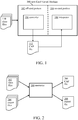
- Fig. 1 shows an example of a Java Card virtual machine 100.
- the Java Card virtual machine 100 comprises an off-card portion 102 and an on-card portion 104.
- the off-card portion 106 comprises a Java Card converter 106 that is configured to convert one or more Java class files 110 to a converted applet (CAP) file 112.
- the CAP file 112 may be loaded into a processing device, such as a smart card, a secure element or an IoT device. It is noted that the terms "off-card portion” and “on-card portion” refer to execution environments outside and inside said processing device, respectively.
- the on-card portion 104 comprises a Java Card interpreter 108 that is configured to execute the CAP file 112.
- Java Card virtual machine 100 of this kind has been described in the book "Java CardTM Technology for Smart Cards: Architecture and Programmer's Guide", written by Zhiqun Chen and published in the Addison-Wesley Java Series by Addison-Wesley Professional, 2000.
- a Java Card virtual machine differs from a Java virtual machine (JVM) in that the JCVM is implemented as two separate portions 102, 104.
- the on-card portion 104 is implemented on the processing device that executes a given application (applet); this on-card portion 104 includes the Java Card bytecode interpreter 108.
- the Java Card converter 106 runs in an off-card portion 102 of the JVCM, for example on a personal computer (PC) or a workstation. Together, the converter 106 and the interpreter 108 implement all the virtual machine functions, i.e. loading Java class files and executing them.
- the converter 106 is configured to load and preprocess the Java class files 110 that constitute a Java package and to output a CAP file 112.
- the CAP file 112 may be loaded into the processing device and executed by the interpreter 108.
- the converter 106 may generate an export file (not shown) that represents the public application programming interfaces (APIs) of the converted package.
- the converter 106 may detect any unsupported language features used in the applet: since Java Card technology supports a subset of the Java language, some features may lack support.
- Applets are developed in a JavaTM programming environment. The compilation of a Java applet produces one or more class files. All class files of a package are processed by the converter 106. The converter 106 validates the code and generates the CAP file 112. The CAP file 112 may be regarded as an equivalent of a Java package for the Java Card platform. The CAP file 112 contains an executable binary representation of the classes of a package. A package is a namespace within the Java programming language; it may contain classes and interfaces. In the context of Java Card technology, a package defines either a user library, or one or more applets.
- a CAP file contains an executable binary representation of the classes of a package.
- the Java Archive (JAR) file format is used as the container format for CAP files.
- JAR is a package file format that is typically used to aggregate many Java class files and associated metadata and resources into one file for distribution.
- a CAP file is a JAR file that contains a set of components, each stored as an individual file in the JAR file. Each component describes an aspect of the CAP file contents, such as class information, executable bytecodes, linking information, and verification information.
- a CAP file contains both executable bytecodes and metadata (class information, linking information, verification information).
- the CAP file format is optimized for a small footprint. It is the form in which software is loaded into a processing device. Export files are not loaded into the processing device; they are produced and used only by the converter for verification and linking purposes. Export files contain public API information for an entire package of classes. Furthermore, export files contain linking information that may be used for resolving inter-package references on the processing device.
- Fig. 2 shows an example of a Java Card converter 200.
- the converter 200 is configured to process one or more class files 202 and one or more export files 204, and to output a CAP file 206 and an export file 208.
- a Java Card converter processes one package at a time.
- a Java compiler compiles source code to class files.
- the Java Card converter 200 preprocesses the class files that constitute a package and converts said package to the CAP file 206.
- the converter 200 performs several tasks that a Java virtual machine would perform when classes are loaded, such as load image verification, checks for language subset violations, initialization of static variables, and bytecode optimization.
- the converter 200 loads all classes in a Java package. If said package imports classes from other packages, the converter 200 loads the export files 204 of these packages too.
- the converter 200 outputs the CAP file 206 and an export file 208 for the package itself, which may be used for subsequent conversions of other packages.
- Java Card technology is often used to increase portability and to reduce the number of possible implementation-related security-relevant bugs.
- using Java Card technology in resource-constrained devices may have a negative performance impact.
- using a Java Card virtual machine in the IoT domain has reportedly a performance drawback of about 14 to 230 times.
- techniques that aim at solving these performance problems such as Ahead of Time (AoT) compiling, often drastically increase the code size of executables. This, in turn, results in increased usage of memory and processing resources, which is undesirable, particularly in resource-constrained devices.
- AoT Ahead of Time
- Fig. 3 shows an illustrative embodiment of a method 300 for providing a processing device with executable machine code.
- the method 300 comprises the following steps.
- one or more Java class files are converted into at least one first CAP file.
- the first CAP file is converted into a functionally equivalent intermediate code and associated metadata.
- the original metadata contained in the first CAP file are converted to new metadata.
- the metadata contained in the first CAP file may be used for the conversion of Java Card bytecode, which is contained in said first CAP file, into said functionally equivalent intermediate code.
- local variables may be identified by means of said original metadata, so that these local variables can be mapped to variables of the intermediate code.
- the intermediate code is compiled to a processing device-dependent machine code.
- the processing device-dependent machine code and the associated metadata are packed into a second CAP file.
- the second CAP file is loaded into the processing device.
- the processing device may execute a selected application and handle calls between the different types of code (native code and Java Card bytecode) transparently. For example, a call from the selected application will trigger the execution of the portion of the native code that represents the called method. More generally speaking, it can thus be said that the presently disclosed method and system improve the performance of a processing device, computing device or computer.
- native code refers to a representation of a program that is directly read, understood and interpreted by the executing hardware (i.e., a CPU).
- native code is the processing device-dependent machine code.
- Java Card bytecode refers to a representation of a program that is understood by the JCVM. Similar to the machine code it comprises a set of instructions, but these instructions are read and interpreted by the JCVM, which then handles the execution of the Java Card bytecode.
- bytecode as used herein may refer to the representation of the whole program, or to the representation of a part of a program.
- the step of converting the first CAP file into a functionally equivalent intermediate code generates basic structures (classes, interfaces, virtual method tables, globals, etc.) based on the first CAP file.
- said step comprises identifying local variables using bytecodes and metadata comprised in the first CAP file, and mapping said local variables to variables of said intermediate code.
- said step comprises mapping single bytecodes or multiple bytecodes to one or more instructions of said intermediate code. This results in a practical and efficient conversion method, and facilitates generating an intermediate code that is functionally equivalent to the code contained in the first CAP file.
- steps 302 to 308 are performed by a modified Java Card converter.
- a Java Card converter may be modified in the sense that it is provided with a computer program comprising instructions for performing the steps 302 to 308.
- step 310 is performed by a Java Card installer.
- the functions of downloading and installing CAP files are performed by a unit referred to as the installer.
- Such an installer can be used to perform step 310.
- the installer may also be equipped with a computer program.
- the intermediate code comprises C code.
- the intermediate code may comprise Low Level Virtual Machine (LLVM) intermediate representation (LLVM IR) code. Both types of code are particularly suitable for generating a functionally equivalent intermediate code.
- LLVM IR is a code representation specified by the LLVM Compiler Infrastructure Project.
- the LLVM Project is a collection of modular and reusable compiler and toolchain technologies. More information on the LLVM Project can be found on the project website: https://llvm.org/.
- Fig. 4 shows an illustrative embodiment of a system 400 for providing a processing device with executable machine code.
- the system 400 comprises a preloading unit 402 and a loading unit 404.
- the preloading unit 402 is configured to convert one or more Java class files into at least one first CAP file, convert the first CAP file into a functionally equivalent intermediate code and associated metadata, compile the intermediate code to a processing device-dependent machine code, and pack said processing device-dependent machine code and said associated metadata into a second CAP file.
- the loading unit 404 is configured to load said second CAP file into the processing device.
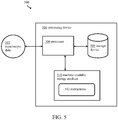
- Fig. 5 shows an example of a system 500 for hosting instructions that enable a processing device 504 to carry out functions.
- the processing device 504 is an example of a processing device whose performance can be increased using the presently disclosed method and system.
- the above-mentioned second CAP file can be loaded into a non-transient machine-readable storage medium 510 of the processing device 504.
- the second CAP file contains, inter alia, executable instructions 512. Said instructions 512 may control how a processor 506 of the processing device 504 receives input data 502 and transforms the input data into output data 502, using data within a storage device 508 of the processing device 504.
- the machine-readable storage medium 510 in an alternate example embodiment is a non-transitory computer-readable storage medium.
- the systems and methods described herein may at least partially be embodied by a computer program or a plurality of computer programs, which may exist in a variety of forms both active and inactive in a single computer system or across multiple computer systems.
- they may exist as software program(s) comprised of program instructions in source code, object code, executable code or other formats for performing some of the steps.
- Any of the above may be embodied on a computer-readable medium, which may include storage devices and signals, in compressed or uncompressed form.
- the term "computer” refers to any electronic device comprising a processor, such as a general-purpose central processing unit (CPU), a specific-purpose processor or a microcontroller.
- a computer is capable of receiving data (an input), of performing a sequence of predetermined operations thereupon, and of producing thereby a result in the form of information or signals (an output).
- the term "computer” will mean either a processor in particular or more generally a processor in association with an assemblage of interrelated elements contained within a single case or housing.
- processor or “processing unit” refers to a data processing circuit that may be a microprocessor, a co-processor, a microcontroller, a microcomputer, a central processing unit, a field programmable gate array (FPGA), a programmable logic circuit, and/or any circuit that manipulates signals (analog or digital) based on operational instructions that are stored in a memory.
- memory refers to a storage circuit or multiple storage circuits such as read-only memory, random access memory, volatile memory, non-volatile memory, static memory, dynamic memory, Flash memory, cache memory, and/or any circuit that stores digital information.
- a "computer-readable medium” or “storage medium” may be any means that can contain, store, communicate, propagate, or transport a computer program for use by or in connection with the instruction execution system, apparatus, or device.
- the computer-readable medium may be, for example but not limited to, an electronic, magnetic, optical, electromagnetic, infrared, or semiconductor system, apparatus, device, or propagation medium.
- the computer-readable medium may include the following: an electrical connection having one or more wires, a portable computer diskette, a random access memory (RAM), a read-only memory (ROM), an erasable programmable read-only memory (EPROM or Flash memory), an optical fiber, a portable compact disc read-only memory (CDROM), a digital versatile disc (DVD), a Blu-ray disc (BD), and a memory card.
- RAM random access memory
- ROM read-only memory
- EPROM or Flash memory erasable programmable read-only memory
- CDROM compact disc read-only memory
- DVD digital versatile disc
- BD Blu-ray disc
Landscapes
- Engineering & Computer Science (AREA)
- General Engineering & Computer Science (AREA)
- Theoretical Computer Science (AREA)
- Software Systems (AREA)
- Physics & Mathematics (AREA)
- General Physics & Mathematics (AREA)
- Devices For Executing Special Programs (AREA)
Abstract
In accordance with a first aspect of the present disclosure, a method is conceived for providing a processing device with executable machine code, comprising: (a) converting one or more Java class files into at least one first converted applet, CAP, file; (b) converting the first CAP file into a functionally equivalent intermediate code and associated metadata; (c) compiling the intermediate code to a processing device-dependent machine code; (d) packing said processing device-dependent machine code and said associated metadata into a second CAP file; (e) loading said second CAP file into the processing device. In accordance with a second aspect of the present disclosure, a corresponding system is provided. In accordance with a third aspect of the present disclosure, a corresponding computer program is provided.
Description
- The present disclosure relates to a method for providing a processing device with executable machine code. Furthermore, the present disclosure relates to a corresponding system for providing a processing device with executable machine code. Due to the physically and logically exposed nature of networked devices, such as smart cards and Internet of Things (IoT) devices, the integration of a hardware-backed trusted execution environment that protects systems from being compromised by attackers with physical access is important. While hardware-only solutions merely provide specific functionality that cannot be changed, other solutions such as smart cards or secure elements provide the possibility of configuration changes by installing and executing different software components on them. For these types of devices, Java Card™ is often used to increase portability and to reduce the number of possible implementation-related security-relevant bugs.
- In accordance with a first aspect of the present disclosure, a method is conceived for providing a processing device with executable machine code, comprising: (a) converting one or more Java class files into at least one first converted applet (CAP) file; (b) converting the first CAP file into a functionally equivalent intermediate code and associated metadata; (c) compiling the intermediate code to a processing device-dependent machine code; (d) packing said processing device-dependent machine code and said associated metadata into a second CAP file; (e) loading said second CAP file into the processing device.
- In an embodiment, step (b) comprises identifying local variables using bytecodes and original metadata comprised in the first CAP file, and mapping said local variables to variables of said intermediate code.
- In an embodiment, step (b) comprises mapping single bytecodes or multiple bytecodes to one or more instructions of said intermediate code.
- In an embodiment, the intermediate code comprises C code.
- In an embodiment, the intermediate code comprises LLVM intermediate representation (LLVM IR) code.
- In an embodiment, steps (a) to (d) are performed by a modified Java Card converter.
- In an embodiment, step (e) is performed by a Java Card installer.
- In an embodiment, the processing device is at least one of a smart card, a secure element, and an Internet of Things device.
- In accordance with a second aspect of the present disclosure, a system is provided for providing a processing device with executable machine code, said system comprising a preloading unit and a loading unit, wherein the preloading unit is configured to: convert one or more Java class files into at least one first converted applet, CAP, file; convert the first CAP file into a functionally equivalent intermediate code and associated metadata; compile the intermediate code to a processing device-dependent machine code; pack said processing device-dependent machine code and said associated metadata into a second CAP file; and wherein the loading unit is configured to load said second CAP file into the processing device.
- In an embodiment, converting the first CAP file into the intermediate code comprises identifying local variables using bytecodes and original metadata comprised in the first CAP file, and mapping said local variables to variables of said intermediate code.
- In an embodiment, converting the first CAP file into the intermediate code comprises mapping single bytecodes or multiple bytecodes to one or more instructions of said intermediate code.
- In an embodiment, the preloading unit is a modified Java Card converter, and the loading unit is a Java Card installer.
- In an embodiment, the system further comprises the processing device, wherein the processing device is configured to execute a selected application and handle calls between bytecodes comprised in the first CAP file and said machine code transparently.
- In accordance with a third aspect of the present disclosure, a computer program is provided, comprising executable instructions that, when executed by a processing unit, perform a method of the kind set forth.
- In an embodiment, a non-transitory computer-readable medium comprises a computer program of the kind set forth.
- Embodiments will be described in more detail with reference to the appended drawings, in which:
-
Fig. 1 shows an example of a Java Card virtual machine; -
Fig. 2 shows an example of a Java Card converter; -
Fig. 3 shows an illustrative embodiment of a method for providing a processing device with executable machine code; -
Fig. 4 shows an illustrative embodiment of a system for providing a processing device with executable machine code; -
Fig. 5 shows an example of a system for hosting instructions that enable a processing device to carry out functions. -
Fig. 1 shows an example of a Java Cardvirtual machine 100. The Java Cardvirtual machine 100 comprises an off-card portion 102 and an on-card portion 104. The off-card portion 106 comprises a JavaCard converter 106 that is configured to convert one or more Javaclass files 110 to a converted applet (CAP)file 112. TheCAP file 112 may be loaded into a processing device, such as a smart card, a secure element or an IoT device. It is noted that the terms "off-card portion" and "on-card portion" refer to execution environments outside and inside said processing device, respectively. The on-card portion 104 comprises a Java Cardinterpreter 108 that is configured to execute theCAP file 112. A Java Cardvirtual machine 100 of this kind has been described in the book "Java Card™ Technology for Smart Cards: Architecture and Programmer's Guide", written by Zhiqun Chen and published in the Addison-Wesley Java Series by Addison-Wesley Professional, 2000. - More specifically, a Java Card virtual machine (JCVM) differs from a Java virtual machine (JVM) in that the JCVM is implemented as two
separate portions card portion 104 is implemented on the processing device that executes a given application (applet); this on-card portion 104 includes the Java Cardbytecode interpreter 108. The Java Cardconverter 106 runs in an off-card portion 102 of the JVCM, for example on a personal computer (PC) or a workstation. Together, theconverter 106 and theinterpreter 108 implement all the virtual machine functions, i.e. loading Java class files and executing them. Theconverter 106 is configured to load and preprocess the Javaclass files 110 that constitute a Java package and to output aCAP file 112. Subsequently, theCAP file 112 may be loaded into the processing device and executed by theinterpreter 108. In addition to creating theCAP file 112, theconverter 106 may generate an export file (not shown) that represents the public application programming interfaces (APIs) of the converted package. Furthermore, theconverter 106 may detect any unsupported language features used in the applet: since Java Card technology supports a subset of the Java language, some features may lack support. - Applets are developed in a Java™ programming environment. The compilation of a Java applet produces one or more class files. All class files of a package are processed by the
converter 106. Theconverter 106 validates the code and generates theCAP file 112. TheCAP file 112 may be regarded as an equivalent of a Java package for the Java Card platform. TheCAP file 112 contains an executable binary representation of the classes of a package. A package is a namespace within the Java programming language; it may contain classes and interfaces. In the context of Java Card technology, a package defines either a user library, or one or more applets. - Java Card technology uses two binary file formats: the CAP file format and the export file format. As mentioned above, a CAP file contains an executable binary representation of the classes of a package. The Java Archive (JAR) file format is used as the container format for CAP files. A JAR is a package file format that is typically used to aggregate many Java class files and associated metadata and resources into one file for distribution. More specifically, a CAP file is a JAR file that contains a set of components, each stored as an individual file in the JAR file. Each component describes an aspect of the CAP file contents, such as class information, executable bytecodes, linking information, and verification information. Thus, a CAP file contains both executable bytecodes and metadata (class information, linking information, verification information). The CAP file format is optimized for a small footprint. It is the form in which software is loaded into a processing device. Export files are not loaded into the processing device; they are produced and used only by the converter for verification and linking purposes. Export files contain public API information for an entire package of classes. Furthermore, export files contain linking information that may be used for resolving inter-package references on the processing device.
-
Fig. 2 shows an example of aJava Card converter 200. Theconverter 200 is configured to process one or more class files 202 and one ormore export files 204, and to output aCAP file 206 and anexport file 208. In contrast to the Java virtual machine, which processes one class at a time, a Java Card converter processes one package at a time. A Java compiler compiles source code to class files. TheJava Card converter 200 preprocesses the class files that constitute a package and converts said package to theCAP file 206. During this conversion, theconverter 200 performs several tasks that a Java virtual machine would perform when classes are loaded, such as load image verification, checks for language subset violations, initialization of static variables, and bytecode optimization. In operation, theconverter 200 loads all classes in a Java package. If said package imports classes from other packages, theconverter 200 loads the export files 204 of these packages too. Theconverter 200 outputs theCAP file 206 and anexport file 208 for the package itself, which may be used for subsequent conversions of other packages. - As mentioned above, Java Card technology is often used to increase portability and to reduce the number of possible implementation-related security-relevant bugs. However, using Java Card technology in resource-constrained devices may have a negative performance impact. For example, using a Java Card virtual machine in the IoT domain has reportedly a performance drawback of about 14 to 230 times. At the same time, techniques that aim at solving these performance problems, such as Ahead of Time (AoT) compiling, often drastically increase the code size of executables. This, in turn, results in increased usage of memory and processing resources, which is undesirable, particularly in resource-constrained devices.
-
Fig. 3 shows an illustrative embodiment of amethod 300 for providing a processing device with executable machine code. In accordance with the present disclosure, themethod 300 comprises the following steps. At 302, one or more Java class files are converted into at least one first CAP file. Then, at 304, the first CAP file is converted into a functionally equivalent intermediate code and associated metadata. Thus, the original metadata contained in the first CAP file are converted to new metadata. Furthermore, the metadata contained in the first CAP file may be used for the conversion of Java Card bytecode, which is contained in said first CAP file, into said functionally equivalent intermediate code. In particular, as mentioned below, local variables may be identified by means of said original metadata, so that these local variables can be mapped to variables of the intermediate code. Then, at 306, the intermediate code is compiled to a processing device-dependent machine code. Then, at 308, the processing device-dependent machine code and the associated metadata are packed into a second CAP file. Finally, at 310, the second CAP file is loaded into the processing device. - In this way, it becomes possible to load native code and/or Java Card bytecode and describe their interfaces with the same approach (i.e., using CAP file metadata). This, in turn, reduces the above-mentioned negative performance impact without drastically increasing the code size of executables. More specifically, the processing device may execute a selected application and handle calls between the different types of code (native code and Java Card bytecode) transparently. For example, a call from the selected application will trigger the execution of the portion of the native code that represents the called method. More generally speaking, it can thus be said that the presently disclosed method and system improve the performance of a processing device, computing device or computer.
- It is noted that the term "native code" refers to a representation of a program that is directly read, understood and interpreted by the executing hardware (i.e., a CPU). In this context, the native code is the processing device-dependent machine code. Furthermore, it is noted that the term "Java Card bytecode" refers to a representation of a program that is understood by the JCVM. Similar to the machine code it comprises a set of instructions, but these instructions are read and interpreted by the JCVM, which then handles the execution of the Java Card bytecode. The term "bytecode" as used herein may refer to the representation of the whole program, or to the representation of a part of a program.
- In particular, the step of converting the first CAP file into a functionally equivalent intermediate code generates basic structures (classes, interfaces, virtual method tables, globals, etc.) based on the first CAP file. In an embodiment, said step comprises identifying local variables using bytecodes and metadata comprised in the first CAP file, and mapping said local variables to variables of said intermediate code. In this way, often occurring problems when converting Java bytecode to machine code, such as conversion from stack machine to register machine, as well as the optimization from consecutive simple bytecodes to less more complex native instructions, are handled implicitly by the compiler of the intermediate code. Furthermore, in an embodiment, said step comprises mapping single bytecodes or multiple bytecodes to one or more instructions of said intermediate code. This results in a practical and efficient conversion method, and facilitates generating an intermediate code that is functionally equivalent to the code contained in the first CAP file.
- In a practical and efficient implementation, steps 302 to 308 are performed by a modified Java Card converter. For example, a Java Card converter may be modified in the sense that it is provided with a computer program comprising instructions for performing the
steps 302 to 308. Furthermore, in a practical and efficient implementation,step 310 is performed by a Java Card installer. In Java Card technology, the functions of downloading and installing CAP files are performed by a unit referred to as the installer. Such an installer can be used to performstep 310. For this purpose, the installer may also be equipped with a computer program. - Furthermore, in an embodiment, the intermediate code comprises C code. Alternatively, or in addition, the intermediate code may comprise Low Level Virtual Machine (LLVM) intermediate representation (LLVM IR) code. Both types of code are particularly suitable for generating a functionally equivalent intermediate code. The LLVM IR is a code representation specified by the LLVM Compiler Infrastructure Project. The LLVM Project is a collection of modular and reusable compiler and toolchain technologies. More information on the LLVM Project can be found on the project website: https://llvm.org/.
-
Fig. 4 shows an illustrative embodiment of asystem 400 for providing a processing device with executable machine code. Thesystem 400 comprises apreloading unit 402 and aloading unit 404. Thepreloading unit 402 is configured to convert one or more Java class files into at least one first CAP file, convert the first CAP file into a functionally equivalent intermediate code and associated metadata, compile the intermediate code to a processing device-dependent machine code, and pack said processing device-dependent machine code and said associated metadata into a second CAP file. Theloading unit 404 is configured to load said second CAP file into the processing device. -
Fig. 5 shows an example of asystem 500 for hosting instructions that enable aprocessing device 504 to carry out functions. Theprocessing device 504 is an example of a processing device whose performance can be increased using the presently disclosed method and system. The above-mentioned second CAP file can be loaded into a non-transient machine-readable storage medium 510 of theprocessing device 504. The second CAP file contains, inter alia,executable instructions 512.Said instructions 512 may control how aprocessor 506 of theprocessing device 504 receivesinput data 502 and transforms the input data intooutput data 502, using data within astorage device 508 of theprocessing device 504. The machine-readable storage medium 510 in an alternate example embodiment is a non-transitory computer-readable storage medium. - The systems and methods described herein may at least partially be embodied by a computer program or a plurality of computer programs, which may exist in a variety of forms both active and inactive in a single computer system or across multiple computer systems. For example, they may exist as software program(s) comprised of program instructions in source code, object code, executable code or other formats for performing some of the steps. Any of the above may be embodied on a computer-readable medium, which may include storage devices and signals, in compressed or uncompressed form.
- As used herein, the term "computer" refers to any electronic device comprising a processor, such as a general-purpose central processing unit (CPU), a specific-purpose processor or a microcontroller. A computer is capable of receiving data (an input), of performing a sequence of predetermined operations thereupon, and of producing thereby a result in the form of information or signals (an output). Depending on the context, the term "computer" will mean either a processor in particular or more generally a processor in association with an assemblage of interrelated elements contained within a single case or housing.
- The term "processor" or "processing unit" refers to a data processing circuit that may be a microprocessor, a co-processor, a microcontroller, a microcomputer, a central processing unit, a field programmable gate array (FPGA), a programmable logic circuit, and/or any circuit that manipulates signals (analog or digital) based on operational instructions that are stored in a memory. The term "memory" refers to a storage circuit or multiple storage circuits such as read-only memory, random access memory, volatile memory, non-volatile memory, static memory, dynamic memory, Flash memory, cache memory, and/or any circuit that stores digital information.
- As used herein, a "computer-readable medium" or "storage medium" may be any means that can contain, store, communicate, propagate, or transport a computer program for use by or in connection with the instruction execution system, apparatus, or device. The computer-readable medium may be, for example but not limited to, an electronic, magnetic, optical, electromagnetic, infrared, or semiconductor system, apparatus, device, or propagation medium. More specific examples (non-exhaustive list) of the computer-readable medium may include the following: an electrical connection having one or more wires, a portable computer diskette, a random access memory (RAM), a read-only memory (ROM), an erasable programmable read-only memory (EPROM or Flash memory), an optical fiber, a portable compact disc read-only memory (CDROM), a digital versatile disc (DVD), a Blu-ray disc (BD), and a memory card.
- It is noted that the embodiments above have been described with reference to different subject-matters. In particular, some embodiments may have been described with reference to method-type claims whereas other embodiments may have been described with reference to apparatus-type claims. However, a person skilled in the art will gather from the above that, unless otherwise indicated, in addition to any combination of features belonging to one type of subject-matter also any combination of features relating to different subject-matters, in particular a combination of features of the method-type claims and features of the apparatus-type claims, is considered to be disclosed with this document.
- Furthermore, it is noted that the drawings are schematic. In different drawings, similar or identical elements are provided with the same reference signs. Furthermore, it is noted that in an effort to provide a concise description of the illustrative embodiments, implementation details which fall into the customary practice of the skilled person may not have been described. It should be appreciated that in the development of any such implementation, as in any engineering or design project, numerous implementation-specific decisions must be made in order to achieve the developers' specific goals, such as compliance with system-related and business-related constraints, which may vary from one implementation to another. Moreover, it should be appreciated that such a development effort might be complex and time consuming, but would nevertheless be a routine undertaking of design, fabrication, and manufacture for those of ordinary skill.
- Finally, it is noted that the skilled person will be able to design many alternative embodiments without departing from the scope of the appended claims. In the claims, any reference sign placed between parentheses shall not be construed as limiting the claim. The word "comprise(s)" or "comprising" does not exclude the presence of elements or steps other than those listed in a claim. The word "a" or "an" preceding an element does not exclude the presence of a plurality of such elements. Measures recited in the claims may be implemented by means of hardware comprising several distinct elements and/or by means of a suitably programmed processor. In a device claim enumerating several means, several of these means maybe embodied by one and the same item of hardware. The mere fact that certain measures are recited in mutually different dependent claims does not indicate that a combination of these measures cannot be used to advantage.
-
- 100
- Java Card virtual machine
- 102
- off-card portion
- 104
- on-card portion
- 106
- converter
- 108
- interpreter
- 110
- class files
- 112
- CAP file
- 200
- converter
- 202
- class files
- 204
- export files
- 206
- CAP file
- 208
- export file
- 300
- method for providing a processing device with executable machine code
- 302
- converting one or more Java class files into at least one first CAP file
- 304
- converting the first CAP file into a functionally equivalent intermediate code and associated metadata
- 306
- compiling the intermediate code to a processing device-specific machine code
- 308
- packing the processing device-specific machine code and the associated metadata into at least one second CAP file
- 310
- loading the second CAP file to the processing device
- 400
- system for providing a processing device with executable machine code
- 402
- preloading unit
- 404
- loading unit
- 500
- system
- 502
- input/output data
- 504
- processing device
- 506
- processor
- 508
- storage device
- 510
- machine-readable storage medium
- 512
- instructions
Claims (15)
- A method for providing a processing device with executable machine code, comprising:(a) converting one or more Java class files into at least one first converted applet, CAP, file;(b) converting the first CAP file into a functionally equivalent intermediate code and associated metadata;(c) compiling the intermediate code to a processing device-dependent machine code;(d) packing said processing device-dependent machine code and said associated metadata into a second CAP file;(e) loading said second CAP file into the processing device.
- The method of claim 1, wherein step (b) comprises identifying local variables using bytecodes and original metadata comprised in the first CAP file, and mapping said local variables to variables of said intermediate code.
- The method of claim 1 or 2, wherein step (b) comprises mapping single bytecodes or multiple bytecodes to one or more instructions of said intermediate code.
- The method of any preceding claim, wherein the intermediate code comprises C code.
- The method of any preceding claim, wherein the intermediate code comprises LLVM intermediate representation, LLVM IR, code.
- The method of any preceding claim, wherein steps (a) to (d) are performed by a modified Java Card converter.
- The method of any preceding claim, wherein step (e) is performed by a Java Card installer.
- The method of any preceding claim, wherein the processing device is at least one of a smart card, a secure element, and an Internet of Things device.
- A system for providing a processing device with executable machine code, said system comprising a preloading unit and a loading unit,
wherein the preloading unit is configured to:convert one or more Java class files into at least one first converted applet, CAP, file;convert the first CAP file into a functionally equivalent intermediate code and associated metadata;compile the intermediate code to a processing device-dependent machine code;pack said processing device-dependent machine code and said associated metadata into a second CAP file;and wherein the loading unit is configured to load said second CAP file into the processing device. - The system of claim 9, wherein converting the first CAP file into the intermediate code comprises identifying local variables using bytecodes and original metadata comprised in the first CAP file, and mapping said local variables to variables of said intermediate code.
- The system of claim 9 or 10, wherein converting the first CAP file into the intermediate code comprises mapping single bytecodes or multiple bytecodes to one or more instructions of said intermediate code.
- The system of any one of claims 9 to 11, wherein the preloading unit is a modified Java Card converter, and wherein the loading unit is a Java Card installer.
- The system of any one of claims 9 to 12, further comprising the processing device, wherein the processing device is configured to execute a selected application and handle calls between bytecodes comprised in the first CAP file and said machine code transparently.
- A computer program comprising executable instructions that, when executed by a processing unit, perform the method of any one of claims 1 to 8.
- A non-transitory computer-readable medium comprising the computer program of claim 14.
Priority Applications (1)
| Application Number | Priority Date | Filing Date | Title |
|---|---|---|---|
| EP18159653.7A EP3534252A1 (en) | 2018-03-02 | 2018-03-02 | Method and system for providing a processing device with executable machine code |
Applications Claiming Priority (1)
| Application Number | Priority Date | Filing Date | Title |
|---|---|---|---|
| EP18159653.7A EP3534252A1 (en) | 2018-03-02 | 2018-03-02 | Method and system for providing a processing device with executable machine code |
Publications (1)
| Publication Number | Publication Date |
|---|---|
| EP3534252A1 true EP3534252A1 (en) | 2019-09-04 |
Family
ID=61768046
Family Applications (1)
| Application Number | Title | Priority Date | Filing Date |
|---|---|---|---|
| EP18159653.7A Withdrawn EP3534252A1 (en) | 2018-03-02 | 2018-03-02 | Method and system for providing a processing device with executable machine code |
Country Status (1)
| Country | Link |
|---|---|
| EP (1) | EP3534252A1 (en) |
Cited By (1)
| Publication number | Priority date | Publication date | Assignee | Title |
|---|---|---|---|---|
| CN114443051A (en) * | 2022-01-21 | 2022-05-06 | 北京小米移动软件有限公司 | Application program compiling and running method and device and storage medium |
Citations (4)
| Publication number | Priority date | Publication date | Assignee | Title |
|---|---|---|---|---|
| EP1178404A2 (en) * | 2000-06-21 | 2002-02-06 | Microsoft Corporation | Method and system for compiling multiple languages |
| US20030051233A1 (en) * | 2001-09-13 | 2003-03-13 | Ksheerabdhi Krishna | Code distribution and synthesis |
| US20100153929A1 (en) * | 2008-12-15 | 2010-06-17 | Apple Inc. | Converting javascript into a device-independent representation |
| US9183020B1 (en) * | 2014-11-10 | 2015-11-10 | Xamarin Inc. | Multi-sized data types for managed code |
-
2018
- 2018-03-02 EP EP18159653.7A patent/EP3534252A1/en not_active Withdrawn
Patent Citations (4)
| Publication number | Priority date | Publication date | Assignee | Title |
|---|---|---|---|---|
| EP1178404A2 (en) * | 2000-06-21 | 2002-02-06 | Microsoft Corporation | Method and system for compiling multiple languages |
| US20030051233A1 (en) * | 2001-09-13 | 2003-03-13 | Ksheerabdhi Krishna | Code distribution and synthesis |
| US20100153929A1 (en) * | 2008-12-15 | 2010-06-17 | Apple Inc. | Converting javascript into a device-independent representation |
| US9183020B1 (en) * | 2014-11-10 | 2015-11-10 | Xamarin Inc. | Multi-sized data types for managed code |
Non-Patent Citations (4)
| Title |
|---|
| DONOVAN A ET AL: "PNaCl: Portable Native Client Executables", INTERNET CITATION, 22 February 2010 (2010-02-22), pages 1 - 6, XP002698094, Retrieved from the Internet <URL:http://web.archive.org/web/20100415040156/http://nativeclient.googlecode.com/svn/data/site/pnacl.pdf> [retrieved on 20130603] * |
| HSIEH C-H A ET AL: "Java bytecode to native code translation: the Caffeine prototype and preliminary results", PROCEEDINGS OF THE 29TH. ANNUAL IEEE/ACM INTERNATIONAL SYMPOSIUM ON MICROARCHITECTURE. MICRO-29. PARIS, DEC. 2 - 4, 19; [PROCEEDINGS OF THE ANNUAL IEEE/ACM INTERNATIONAL SYMPOSIUM ON MICROARCHITECTURE. (MICRO)], LOS ALAMITOS, IEEE COMP. SOC. PRESS, U, vol. SYMP. 29, 2 December 1996 (1996-12-02), pages 90 - 97, XP010206088, ISBN: 978-0-8186-7641-3, DOI: 10.1109/MICRO.1996.566453 * |
| VARMA A ET AL: "Java-through-C compilation: an enabling technology for java in embedded systems", DESIGN, AUTOMATION AND TEST IN EUROPE CONFERENCE AND EXHIBITION, 2004. PROCEEDINGS FEB. 16-20, 2004, PISCATAWAY, NJ, USA,IEEE, 1730 MASSACHUSETTS AVE., NW WASHINGTON, DC 20036-1992 USA, vol. 3, 16 February 2004 (2004-02-16), pages 161 - 166, XP010685030, ISBN: 978-0-7695-2085-8, DOI: 10.1109/DATE.2004.1269224 * |
| WEISS M ET AL: "TURBOJ, A JAVA BYTECODE-TO-NATIVE COMPILER", ELECTRONIC PUBLISHING, ARTISTIC IMAGING, AND DIGITAL TYPOGRAPHY; [LECTURE NOTES IN COMPUTER SCIENCE , ISSN 0302-9743], SPRINGER VERLAG, DE, no. 1474, 19 June 1998 (1998-06-19), pages 119 - 130, XP000972740, ISBN: 978-3-540-24128-7, DOI: 10.1007/BFB0057785 * |
Cited By (3)
| Publication number | Priority date | Publication date | Assignee | Title |
|---|---|---|---|---|
| CN114443051A (en) * | 2022-01-21 | 2022-05-06 | 北京小米移动软件有限公司 | Application program compiling and running method and device and storage medium |
| WO2023137909A1 (en) * | 2022-01-21 | 2023-07-27 | 北京小米移动软件有限公司 | Application compiling method and apparatus, application running method and apparatus, and storage medium |
| CN114443051B (en) * | 2022-01-21 | 2025-04-08 | 北京小米移动软件有限公司 | Method and device for compiling and running application program and storage medium |
Similar Documents
| Publication | Publication Date | Title |
|---|---|---|
| US11175896B2 (en) | Handling value types | |
| US9785456B2 (en) | Metadata-driven dynamic specialization | |
| US7380242B2 (en) | Compiler and software product for compiling intermediate language bytecodes into Java bytecodes | |
| TWI252431B (en) | Binary translator | |
| KR102332209B1 (en) | System and method for execution of application code compiled according to two instruction set architectures | |
| US9811360B2 (en) | Dynamic determination of application server runtime classloading | |
| US9378008B2 (en) | Method and system for creating, applying, and removing a software fix | |
| CN116594622A (en) | Python program compilation method and system based on type derivation and data flow analysis | |
| WO2025020395A1 (en) | Method for optimizing wasm bytecode, execution method, computer device and storage medium | |
| EP3534252A1 (en) | Method and system for providing a processing device with executable machine code | |
| CN118276884A (en) | Container packaging method, device, equipment and storage medium | |
| US10521204B2 (en) | Existential type packing for structurally-restricted existential types | |
| CN114706587B (en) | Resource index file compiling method and device | |
| Soha et al. | Instantiation of Java Generics | |
| Wortman et al. | Automating data conversion for heterogeneous distributed shared memory | |
| JP5910197B2 (en) | Embedded program development apparatus, compilation method, and compiler program | |
| CN116126454A (en) | Interpretation execution method, device, equipment and Dart interpretation executor | |
| HK1229917B (en) | Metadata-driven dynamic specialization | |
| Lee | C++ |
Legal Events
| Date | Code | Title | Description |
|---|---|---|---|
| PUAI | Public reference made under article 153(3) epc to a published international application that has entered the european phase |
Free format text: ORIGINAL CODE: 0009012 |
|
| AK | Designated contracting states |
Kind code of ref document: A1 Designated state(s): AL AT BE BG CH CY CZ DE DK EE ES FI FR GB GR HR HU IE IS IT LI LT LU LV MC MK MT NL NO PL PT RO RS SE SI SK SM TR |
|
| AX | Request for extension of the european patent |
Extension state: BA ME |
|
| STAA | Information on the status of an ep patent application or granted ep patent |
Free format text: STATUS: THE APPLICATION IS DEEMED TO BE WITHDRAWN |
|
| 18D | Application deemed to be withdrawn |
Effective date: 20200305 |