EP3533841A1 - Water-soluble azo compound or salt thereof, ink and recording medium - Google Patents
Water-soluble azo compound or salt thereof, ink and recording medium Download PDFInfo
- Publication number
- EP3533841A1 EP3533841A1 EP17864034.8A EP17864034A EP3533841A1 EP 3533841 A1 EP3533841 A1 EP 3533841A1 EP 17864034 A EP17864034 A EP 17864034A EP 3533841 A1 EP3533841 A1 EP 3533841A1
- Authority
- EP
- European Patent Office
- Prior art keywords
- formula
- sme
- group
- compound
- salt
- Prior art date
- Legal status (The legal status is an assumption and is not a legal conclusion. Google has not performed a legal analysis and makes no representation as to the accuracy of the status listed.)
- Granted
Links
- 0 C[C@](C1)[C@](C)[C@]2C1=C1[C@@]2*CC1 Chemical compound C[C@](C1)[C@](C)[C@]2C1=C1[C@@]2*CC1 0.000 description 5
- WLXQVWLGMAYHLM-RYZURTRPSA-N CCCCOc(c(Nc1nc(NC)nc(Nc(cc(c(/N=N/c(cc2S(O)(=O)=O)ccc2Cl)c2)Cl)c2OCCCC)n1)c1)cc(/N=N/c(cc2)cc(S(O)(=O)=O)c2Cl)c1Cl Chemical compound CCCCOc(c(Nc1nc(NC)nc(Nc(cc(c(/N=N/c(cc2S(O)(=O)=O)ccc2Cl)c2)Cl)c2OCCCC)n1)c1)cc(/N=N/c(cc2)cc(S(O)(=O)=O)c2Cl)c1Cl WLXQVWLGMAYHLM-RYZURTRPSA-N 0.000 description 1
Classifications
-
- C—CHEMISTRY; METALLURGY
- C09—DYES; PAINTS; POLISHES; NATURAL RESINS; ADHESIVES; COMPOSITIONS NOT OTHERWISE PROVIDED FOR; APPLICATIONS OF MATERIALS NOT OTHERWISE PROVIDED FOR
- C09B—ORGANIC DYES OR CLOSELY-RELATED COMPOUNDS FOR PRODUCING DYES, e.g. PIGMENTS; MORDANTS; LAKES
- C09B43/00—Preparation of azo dyes from other azo compounds
- C09B43/12—Preparation of azo dyes from other azo compounds by acylation of amino groups
- C09B43/136—Preparation of azo dyes from other azo compounds by acylation of amino groups with polyfunctional acylating agents
- C09B43/16—Preparation of azo dyes from other azo compounds by acylation of amino groups with polyfunctional acylating agents linking amino-azo or cyanuric acid residues
-
- B—PERFORMING OPERATIONS; TRANSPORTING
- B41—PRINTING; LINING MACHINES; TYPEWRITERS; STAMPS
- B41J—TYPEWRITERS; SELECTIVE PRINTING MECHANISMS, i.e. MECHANISMS PRINTING OTHERWISE THAN FROM A FORME; CORRECTION OF TYPOGRAPHICAL ERRORS
- B41J2/00—Typewriters or selective printing mechanisms characterised by the printing or marking process for which they are designed
- B41J2/005—Typewriters or selective printing mechanisms characterised by the printing or marking process for which they are designed characterised by bringing liquid or particles selectively into contact with a printing material
- B41J2/01—Ink jet
- B41J2/17—Ink jet characterised by ink handling
- B41J2/175—Ink supply systems ; Circuit parts therefor
- B41J2/17503—Ink cartridges
-
- B—PERFORMING OPERATIONS; TRANSPORTING
- B41—PRINTING; LINING MACHINES; TYPEWRITERS; STAMPS
- B41M—PRINTING, DUPLICATING, MARKING, OR COPYING PROCESSES; COLOUR PRINTING
- B41M5/00—Duplicating or marking methods; Sheet materials for use therein
- B41M5/0023—Digital printing methods characterised by the inks used
-
- B—PERFORMING OPERATIONS; TRANSPORTING
- B41—PRINTING; LINING MACHINES; TYPEWRITERS; STAMPS
- B41M—PRINTING, DUPLICATING, MARKING, OR COPYING PROCESSES; COLOUR PRINTING
- B41M5/00—Duplicating or marking methods; Sheet materials for use therein
- B41M5/50—Recording sheets characterised by the coating used to improve ink, dye or pigment receptivity, e.g. for ink-jet or thermal dye transfer recording
-
- B—PERFORMING OPERATIONS; TRANSPORTING
- B41—PRINTING; LINING MACHINES; TYPEWRITERS; STAMPS
- B41M—PRINTING, DUPLICATING, MARKING, OR COPYING PROCESSES; COLOUR PRINTING
- B41M5/00—Duplicating or marking methods; Sheet materials for use therein
- B41M5/50—Recording sheets characterised by the coating used to improve ink, dye or pigment receptivity, e.g. for ink-jet or thermal dye transfer recording
- B41M5/502—Recording sheets characterised by the coating used to improve ink, dye or pigment receptivity, e.g. for ink-jet or thermal dye transfer recording characterised by structural details, e.g. multilayer materials
-
- C—CHEMISTRY; METALLURGY
- C07—ORGANIC CHEMISTRY
- C07D—HETEROCYCLIC COMPOUNDS
- C07D251/00—Heterocyclic compounds containing 1,3,5-triazine rings
- C07D251/02—Heterocyclic compounds containing 1,3,5-triazine rings not condensed with other rings
- C07D251/12—Heterocyclic compounds containing 1,3,5-triazine rings not condensed with other rings having three double bonds between ring members or between ring members and non-ring members
- C07D251/26—Heterocyclic compounds containing 1,3,5-triazine rings not condensed with other rings having three double bonds between ring members or between ring members and non-ring members with only hetero atoms directly attached to ring carbon atoms
- C07D251/40—Nitrogen atoms
- C07D251/54—Three nitrogen atoms
- C07D251/70—Other substituted melamines
-
- C—CHEMISTRY; METALLURGY
- C07—ORGANIC CHEMISTRY
- C07D—HETEROCYCLIC COMPOUNDS
- C07D405/00—Heterocyclic compounds containing both one or more hetero rings having oxygen atoms as the only ring hetero atoms, and one or more rings having nitrogen as the only ring hetero atom
- C07D405/02—Heterocyclic compounds containing both one or more hetero rings having oxygen atoms as the only ring hetero atoms, and one or more rings having nitrogen as the only ring hetero atom containing two hetero rings
- C07D405/12—Heterocyclic compounds containing both one or more hetero rings having oxygen atoms as the only ring hetero atoms, and one or more rings having nitrogen as the only ring hetero atom containing two hetero rings linked by a chain containing hetero atoms as chain links
-
- C—CHEMISTRY; METALLURGY
- C09—DYES; PAINTS; POLISHES; NATURAL RESINS; ADHESIVES; COMPOSITIONS NOT OTHERWISE PROVIDED FOR; APPLICATIONS OF MATERIALS NOT OTHERWISE PROVIDED FOR
- C09D—COATING COMPOSITIONS, e.g. PAINTS, VARNISHES OR LACQUERS; FILLING PASTES; CHEMICAL PAINT OR INK REMOVERS; INKS; CORRECTING FLUIDS; WOODSTAINS; PASTES OR SOLIDS FOR COLOURING OR PRINTING; USE OF MATERIALS THEREFOR
- C09D11/00—Inks
- C09D11/02—Printing inks
- C09D11/03—Printing inks characterised by features other than the chemical nature of the binder
- C09D11/033—Printing inks characterised by features other than the chemical nature of the binder characterised by the solvent
-
- C—CHEMISTRY; METALLURGY
- C09—DYES; PAINTS; POLISHES; NATURAL RESINS; ADHESIVES; COMPOSITIONS NOT OTHERWISE PROVIDED FOR; APPLICATIONS OF MATERIALS NOT OTHERWISE PROVIDED FOR
- C09D—COATING COMPOSITIONS, e.g. PAINTS, VARNISHES OR LACQUERS; FILLING PASTES; CHEMICAL PAINT OR INK REMOVERS; INKS; CORRECTING FLUIDS; WOODSTAINS; PASTES OR SOLIDS FOR COLOURING OR PRINTING; USE OF MATERIALS THEREFOR
- C09D11/00—Inks
- C09D11/02—Printing inks
- C09D11/03—Printing inks characterised by features other than the chemical nature of the binder
- C09D11/037—Printing inks characterised by features other than the chemical nature of the binder characterised by the pigment
-
- C—CHEMISTRY; METALLURGY
- C09—DYES; PAINTS; POLISHES; NATURAL RESINS; ADHESIVES; COMPOSITIONS NOT OTHERWISE PROVIDED FOR; APPLICATIONS OF MATERIALS NOT OTHERWISE PROVIDED FOR
- C09D—COATING COMPOSITIONS, e.g. PAINTS, VARNISHES OR LACQUERS; FILLING PASTES; CHEMICAL PAINT OR INK REMOVERS; INKS; CORRECTING FLUIDS; WOODSTAINS; PASTES OR SOLIDS FOR COLOURING OR PRINTING; USE OF MATERIALS THEREFOR
- C09D11/00—Inks
- C09D11/30—Inkjet printing inks
- C09D11/32—Inkjet printing inks characterised by colouring agents
- C09D11/328—Inkjet printing inks characterised by colouring agents characterised by dyes
-
- C—CHEMISTRY; METALLURGY
- C09—DYES; PAINTS; POLISHES; NATURAL RESINS; ADHESIVES; COMPOSITIONS NOT OTHERWISE PROVIDED FOR; APPLICATIONS OF MATERIALS NOT OTHERWISE PROVIDED FOR
- C09D—COATING COMPOSITIONS, e.g. PAINTS, VARNISHES OR LACQUERS; FILLING PASTES; CHEMICAL PAINT OR INK REMOVERS; INKS; CORRECTING FLUIDS; WOODSTAINS; PASTES OR SOLIDS FOR COLOURING OR PRINTING; USE OF MATERIALS THEREFOR
- C09D11/00—Inks
- C09D11/30—Inkjet printing inks
- C09D11/36—Inkjet printing inks based on non-aqueous solvents
Definitions
- coloring matters for use in various recording inks that find their uses in fountain pens felt-tip pens, ink-jet recording and the like may be classified broadly into two groups: water-soluble and water-insoluble coloring matters.
- Water-soluble coloring matters include direct dyes, acid dyes, reactive dyes and the like.
- Water-insoluble coloring matters include pigments, disperse dyes, solvent dyes and the like.
- dyes are thought to have excellent color saturation and the like as compared with pigments, leading to high quality recorded images.
- the robustness of recorded images such as light resistance may be inferior as compared with that of pigments.
- light resistance refers to being resistant to a phenomenon where a coloring matter attached on a recorded image will undergo degradation due to exposure to various types of light such as sunlight and light from fluorescent lamps, resulting in discoloration of the recorded image.
- ink-jet recording mentioned is the ability of producing photo-quality recorded images.
- a recording medium having an ink receiving layer As one of the methods of obtaining a photo-quality recorded image, mentioned is the use of a recording medium having an ink receiving layer.
- Such an ink receiving layer generally includes a porous white inorganic substance in order to achieve rapid drying of an ink, and obtain a high-quality image with less color blurring. Nonetheless, a significant light-induced discoloring phenomenon may be observed in such a recording medium. For this reason, improving light resistance of recorded images is considered as one of the most important technical issues in the art of ink-jet recording.
- Patent Documents 1 to 3 disclose C.I. Direct Yellow 132 as a known yellow coloring matter for ink-jet with excellent water solubility and vividness.
- Patent Document 4 discloses a yellow coloring matter for ink-jet that is excellent in terms of various aspects of robustness.
- An object of the present invention is to provide a water-soluble azo compound capable of producing a recorded image with excellent light resistance, and a yellow ink containing the above compound for use in various types of recording, in particular an ink-jet recording purpose.
- the present invention relates to the following 1) to 30).
- the present invention can provide a water-soluble azo compound capable of producing a recorded image with excellent light resistance, and a yellow ink containing the above compound for use in various types of recording, in particular for an ink-jet recording purpose.
- the water-soluble azo compound according to the present invention (the compound or a salt thereof represented by the above formula (1) or (2)) is a water-soluble yellow coloring matter.
- acidic functional groups are shown in a form of a free acid. This also applies to Examples.
- the term "compound” having an ionic hydrophilic group as used herein is meant to encompass both a “compound or a salt thereof”.
- the terms "%" and “part” as used herein are based on mass. This also applies to Examples.
- each R 11 and R 12 independently represents an alkyl group substituted with an ionic hydrophilic group.
- the carbon number of an alkyl group moiety is preferably 2 to 4, and more preferably 3.
- Ionic hydrophilic groups include a group selected from a sulfo group, a carboxy group, a phospho group, and a quaternary ammonium group. Among these, preferred is a group selected from a sulfo group, a carboxy group, and a phospho group. More preferred is a group selected from a sulfo group and a carboxy group. Even more preferred is a sulfo group.
- There is no particular limitation for the number of substitutions in an ionic hydrophilic group but it is usually 1 to 5, preferably 1 to 4, more preferably 1 to 3, even more preferably 1 or 2, and in particular preferably 1.
- an alkyl group substituted with an ionic hydrophilic group include, for example, a sulfomethyl group, a sulfoethyl group, a 2,3-disulfopropyl group, a 3-sulfopropyl group, a 4-sulfobutyl group, a 5-sulfopentyl group, a 6-sulfohexyl group, a 7-sulfoheptyl group, an 8-sulfooctyl group, a carboxymethyl group, a carboxyethyl group, a 3-carboxypropyl group, a 4-carboxybutyl group, a 5-carboxypentyl group, a 6-carboxyhexyl group, a 7-carboxyheptyl group, an 8-carboxyoctyl group, a phosphomethyl group, a phosphoethyl group, a 3-phosphopropyl group,
- a 1 represents a group represented by the above formula (A1-1), a group represented by the above formula (A1-2), a C1-C3 alkoxy-substituted alkylamino group, a C1-C6 alkyl-monosubstituted amino group, a C2-C6 alkyl-monosubstituted amino group having two or more hydroxy groups, a group represented by the above formula (A1-3), a group represented by the above formula (A1-4), or a cyclic amine group.
- a 1 will be described in detail below.
- each x independently represents an integer of 2 to 4, and preferably 3.
- R A11 represents a branched alkylene group.
- the carbon number of R A11 is usually 2 to 20, preferably 3 to 12, more preferably 3 to 8, and even more preferably 3 to 6.
- Specific examples of a group represented by the above formula (A1-1) include, for example, an isopropylene group, an isobutylene group, an s-butylene group, a t-butylene group, a 1-methyl-n-butylene group, a 2-methyl-n-butylene group, a 3-methyl-n-butylene group, a 1,1-dimethyl-n-propylene group, a 1,2-dimethyl-n-propylene group, a 2,2-dimethyl-n-propylene group, a 1-ethyl-n-propylene group, an n-hexylene group, a 1-methyl-n-pentylene group, a 2-methyl-n-pentylene group, a 3-methyl-n-pentylene group
- a 1 in the above formula (1) is a group represented by the above formula (A1-1)
- preferred compounds include, for example, those represented by the above formulae (1-11) to (1-15) .
- n represents an integer of 1 to 6, preferably an integer of 2 to 5, and more preferably 2.
- a 1 in the above formula (1) is a group represented by the above formula (Al-2)
- preferred compounds include, for example, one represented by the above formula (1-16).
- the carbon number of an alkyl moiety in a C1-C3 alkoxy-substituted alkylamino group is preferably 1 to 6, more preferably 2 to 5, and even more preferably 3.
- the number of substitutions in a C1-C3 alkoxy group of a C1-C3 alkoxy-substituted alkylamino group is usually 1 or 2, preferably 1.
- R A12 represents a C1-C3 alkyl group.
- n represents an integer of 1 to 6, preferably an integer of 2 to 5, and more preferably 3.
- a 1 in the above formula (1) is a C1-C3 alkoxy-substituted alkylamino group
- preferred compounds include, for example, one in which in the above formula (1-1), Q is a chlorine atom, x is 3, A 1 is a group represented by the above formula (Al-5), and n in the above formula (A1-5) is 3.
- a C1-C4 alkyl-monosubstituted amino group is preferred, and a linear C1-C4 alkyl-monosubstituted amino group is more preferred such as a monomethylamino group, a monoethylamino group, a mono-n-propylamino group, a mono-n-butylamino group.
- a 1 in the above formula (1) is a C1-C6 alkyl-monosubstituted amino group
- preferred compounds include, for example, one in which in the above formula (1-1), Q is a chlorine atom, x is 3, and A 1 is a C1-C4 alkyl-monosubstituted amino group. More preferred compounds include, for example, one in which in the above formula (1-1), Q is a chlorine atom, x is 3, and A 1 is a linear C1-C4 alky-monosubstituted amino group.
- the number of substitutions in a hydroxy group of a C2-C6 alkyl-monosubstituted amino group having two or more hydroxy groups is usually 2 or 3, and preferably 2.
- the C2-C6 alkyl-monosubstituted amino group having two or more hydroxy groups is preferably a group represented by the above formula (Al-6).
- R A13 represents a C2-C6 alkyl group having two or more hydroxy groups, preferably a C2-C4 alkyl group having two hydroxy groups.
- a C2-C6 alkyl-monosubstituted amino group having two or more hydroxy groups include, for example, a linear C2-C6 alkyl-monosubstituted amino group having two or more hydroxy groups such as a 1,2-dihydroxyethylamino group, a 1,1-dihydroxyethylamino group, a 1,2-dihydroxypropylamino group, a 1,2-dihydroxybutylamino group, a 1,2-dihydroxypentylamino group, a 1,2-dihydroxyhexylamino group, and a 1,2,3-trihydroxyhexylamino group; a branched C2-C6 alkyl-monosubstituted amino group having two or more hydroxy groups such as a 1,1'-dihydroxyisopropylamino group and a 1,1'-dihydroxypentylamino group; and the like.
- a 1 in the above formula (1) is a C2-C6 alkyl-monosubstituted amino group having two or more hydroxy groups
- preferred compounds include, for example, one in which in the above formula (1-1), Q is a chlorine atom, x is 3, and A 1 is a group represented by the above formula (A1-7) or (Al-8).
- m represents an integer of 1 to 6, preferably an integer of 2 to 5, and more preferably 2.
- n represents an integer of 1 to 5, preferably an integer of 1 to 3.
- a 1 in the above formula (1) is a group represented by the above formula (Al-3)
- preferred compounds include, for example, one represented by the above formula (1-17) or (1-18) .
- n represents an integer of 2 to 6, preferably 3.
- a 1 in the above formula (1) is a group represented by an above formula (Al-4)
- preferred compounds include, for example, one in which in the above formula (1-1), Q is a chlorine atom, x is 3, and A 1 is represented by the above formula (A1-4) wherein n is 3.
- a cyclic amine group preferred is a 3- to 5-membered ring group having one nitrogen atom as a ring atom. More preferred is a 5-membered ring group having one nitrogen atom. Examples of the 3- to 5-membered ring having one nitrogen atom include an aziridine ring, an azetidine ring, a pyrrolidine ring and the like. Among cyclic amine groups, preferred is one represented by the above formula (Al-9).
- each R A14 to R A21 independently represents a hydrogen atom or a substituent.
- substituents include a hydroxy group, a substituted or unsubstituted C1-C4 alkyl group, a halogen atom, a sulfo group, a carboxy group, a phospho group, a substituted or unsubstituted amino group, a nitro group, a cyano group, an alkoxy group, a phenyl group, a naphthyl group and the like.
- C1-C4 alkyl groups include, for example, a methyl group, an ethyl group, an n-propyl group, an isopropyl group, an n-butyl group, an s-butyl group, a t-butyl group and the like.
- a substituent that may be present in a C1-C4 alkyl group, but examples include a halogen atom, a sulfo group, a carboxy group, a phospho group, a substituted or unsubstituted amino group, a nitro group, a cyano group, an alkoxy group, a phenyl group, a naphthyl group and the like.
- Halogen atoms include a fluorine atom, a chlorine atom, a bromine atom, and an iodine atom.
- Substituted amino groups include, for example, a mono-(C1-C4 alkyl)amino group, a dimethylamino group, an ethylmethylamino group and the like.
- Alkoxy groups include, for example, C1-C4 alkoxy groups such as a methoxy group, an ethoxy group, and a propoxy group.
- a 1 in the above formula (1) is a cyclic amine group
- preferred compounds include, for example, one in which in the above formula (1-1), Q is a chlorine atom, x is 3, and A 1 is a group represented by the above formula (A1-9), and R A14 to R A21 in the above formula (A1-9) are each a hydrogen atom.
- a compound represented by the following formula (10-1) obtained in accordance with the method described in Japanese Unexamined Patent Application Publication No. 2004-75719 by using 2-amino-4-halogenophenol as a raw material is converted into a methyl- ⁇ -sulfonic acid derivative represented by the following formula (11) using sodium bisulfite and formalin.
- the resulting methyl- ⁇ -sulfonic acid derivative represented by the following formula (11) and a compound represented by the following formula (12) diazotized according to the conventional method are subjected to a coupling reaction at a reaction temperature of 0 to 15°C and at pH 4 to 6.
- the compound (1 equivalent) represented by the above formula (13-1), the compound (1 equivalent) represented by the above formula (13-2), and a cyanuric halide (such as cyanuric chloride, 1 equivalent) are condensed at a reaction temperature of 15 to 45°C and at pH 5 to 8 to obtain a compound represented by the following formula (14).
- a cyanuric halide such as cyanuric chloride, 1 equivalent
- one of the compounds (1 equivalent) represented by the above formula (13-1) and the compound (1 equivalent) represented by the above formula (13-2) may be reacted with a cyanuric halide (1 equivalent), and then the resulting reaction product may further be reacted with the other compound.
- each Q 21 to Q 24 independently represents a halogen atom.
- Halogen atoms include a fluorine atom, a chlorine atom, a bromine atom, and an iodine atom. Among these, a fluorine atom or a chlorine atom is preferred, and a chlorine atom is more preferred.
- an alkyl group substituted with an ionic hydrophilic group include, for example, a sulfomethyl group, a sulfoethyl group, a 2,3-disulfopropyl group, a 3-sulfopropyl group, a 4-sulfobutyl group, a 5-sulfopentyl group, a 6-sulfohexyl group, a 7-sulfoheptyl group, an 8-sulfooctyl group, a carboxymethyl group, a carboxyethyl group, a 3-carboxypropyl group, a 4-carboxybutyl group, a 5-carboxypentyl group, a 6-carboxyhexyl group, a 7-carboxyheptyl group, an 8-carboxyoctyl group, a phosphomethyl group, a phosphoethyl group, a 3-phosphopropyl group,
- Alkylenediamino groups include a group having a linear, branched, or cyclic alkylene moiety.
- the alkylene moiety is preferably linear or branched, more preferably linear.
- the carbon number of the alkylene moiety is usually 2 to 12, preferably 2 to 8, more preferably 2 to 6, and even more preferably 2 to 4.
- alkylenediamino group examples include, for example, 1,2-ethylenediamino, 1,2-propylenediamino, 1,3-propylenediamino, 1,2-butylenediamino, 1,4-butylenediamino, 1,2-pentylenediamino, 1,5-pentylenediamino, 1,2-hexylenediamino, 1,6-hexylenediamino, 2-methyl-1,3-propylenediamino, 1,2-cyclopentylenediamino, 1,2-cyclohexylenediamine, 1,4-piperazinyl and the like. Among these, 1,4-piperazinyl is preferred.
- Nitrogen-containing heterocyclic groups include a nitrogen-containing heterocyclic group of a 4- to 9-membered ring (preferably a 5- to 7-membered ring, more preferably a 5- or 6-membered ring, and even more preferably a 6-membered ring) having two nitrogen atoms as ring atoms.
- nitrogen-containing heterocyclic group examples include, for example, 1,2-diazetidine, pyrazolidine, hexahydropyridazine, hexahydropyrimidine, piperazine, 1,2-diazepane, 1,3-diazepane, 1,4-diazepane, 1,2-diazocane, 1,4-diazocane, and 1,4-diazonane.
- piperazine in particular 1,4-piperazinediyl is preferred.
- Arylenediamino groups include an arylenediamino group usually having 6 to 14 carbon atoms, preferably 6 to 10 carbon atoms, and more preferably 6 carbon atoms.
- Specific examples of the arylenediamino group include, for example, 1,2-phenylenediamino, 1,3-phenylenediamino, 1,4-phenylenediamino, 1,8-naphthylenediamino, 2,8-naphthylenediamino and the like.
- Aminoalkylthio groups include a group having a linear, branched, or cyclic alkyl moiety.
- the carbon number of the alkyl moiety is usually 2 to 12, preferably 2 to 8, more preferably 2 to 6, and even more preferably 2 to 4.
- Specific examples of the aminoalkylthio group include, for example, aminoethylthio, aminopropylthio, aminobutylthio, aminopentylthio, aminohexylthio, 3-amino-2-methylpropane-1-thio, 2-aminocyclohexane-1-thio and the like.
- Aminoarylthio groups include an aminoarylthio group usually having 6 to 14 carbon atoms, preferably 6 to 10 carbon atoms, more preferably 6 carbon atoms. Specific examples of the aminoarylthio group include, for example, 2-aminophenylthio, 4-aminophenylthio, 8-aminonaphthyl-2-thio and the like.
- a 2 may usually have 1 to 5 substituents, preferably 1 to 4 substituents, more preferably 1 to 3 substituents, even more preferably 1 or 2 substituents, and in particular preferably 1 substituent.
- substituents include a halogen atom, an alkyl group, an aralkyl group, an alkenyl group, an alkynyl group, an alkoxy group, an aryl group, a heterocyclic group, a cyano group, a hydroxy group, a nitro group, an aryloxy group, a silyloxy group, and a heterocyclic oxy group, an acyloxy group, a carbamoyloxy group, an alkoxycarbonyloxy group, an aryloxycarbonyloxy group, an amino group, an acylamino group, an aminocarbonylamino group, an alkoxycarbonylamino group, an aryloxycarbonylamino group, a sulf
- a preferred compound among the compounds represented by the above formula (2) is one represented by the above formula (2-1).
- Q 21 to Q 24 and A 2 have the same meanings as defined in the above formula (2), including those preferred and the like.
- each x independently represents an integer of 2 to 4, and preferably 3.
- Preferred compounds represented by the above formula (2) include, for example, one in which in the above formula (2-1), Q 21 to Q 24 are chlorine atoms, x is 3, and A 2 is a 1,4-piperazinediyl group.
- the compound represented by the above formula (2) can be manufactured as follows. It should be noted that Q 21 to Q 24 , R 21 to R 24 , and A 2 which may be used appropriately in the following formulae (20-1) to (24) each have the same meanings as defined in the above formula (2).
- a compound represented by the following formula (20-1) obtained in accordance with the method described in Japanese Unexamined Patent Application Publication No. 2004-75719 by using 2-amino-4-halogenophenol as a raw material is converted into a methyl- ⁇ -sulfonic acid derivative represented by the following formula (21) using sodium bisulfite and formalin.
- the resulting methyl- ⁇ -sulfonic acid derivative represented by the following formula (21) and a compound represented by the following formula (22) diazotized according to the conventional method are subjected to a coupling reaction at a reaction temperature of 0 to 15°C and at pH 4 to 6.
- the compound (1 equivalent) represented by the above formula (23-1), the compound (1 equivalent) represented by the above formula (23-2), and a cyanuric halide (such as cyanuric chloride, 1 equivalent) are condensed at a reaction temperature of 15 to 45°C and at pH 5 to 8 to obtain a compound represented by the following formula (24-1).
- a cyanuric halide such as cyanuric chloride, 1 equivalent
- one of the compounds (1 equivalent) represented by the above formula (23-1) and the compound (1 equivalent) represented by the above formula (23-2) may be reacted with a cyanuric halide (1 equivalent), and then the resulting reaction product may further be reacted with the other compound.
- a compound represented by the following formula (24-2) is obtained as described above except that compounds represented by the above formulae (23-3) and (23-4) are used instead of the compounds represented by the above formulae (23-1) and (23-2).
- the compound (1 equivalent) represented by the above formula (24-1), the compound (1 equivalent) represented by the above formula (24-2), and a compound represented by a formula H-A 2 -H may be reacted at a reaction temperature of 55 to 95°C and at pH 6 to 9 to cause a de-HCl reaction. This can lead to production of the compound represented by the above formula (2). It should be noted that one of the compounds (1 equivalent) represented by the above formula (24-1) and the compound (1 equivalent) represented by the above formula (24-2) may be reacted with the compound represented by the formula H-A 2 -H, and then the resulting reaction product may further be reacted with the other compound.
- Salts of the compound represented by the above formula (1) or (2) include salts with inorganic or organic cations.
- Specific examples of salts with inorganic cations include alkali metal salts such as lithium salts, sodium salts, and potassium salts; ammonium salts; and the like.
- Specific examples of organic cations include, but are not limited to, for example, quaternary ammonium represented by the following formula (3)
- each Z 1 to Z 4 independently represents a hydrogen atom, a C1-C4 alkyl group, a hydroxy C1-C4 alkyl group, or a hydroxy C1-C4 alkoxy C1-C4 alkyl group, and at least one of Z 1 to Z 4 is a group other than a hydrogen atom.
- C1-C4 alkyl group in Z 1 to Z 4 include a methyl group, an ethyl group and the like.
- hydroxy C1-C4 alkyl group include a hydroxymethyl group, a hydroxyethyl group, a 3-hydroxypropyl group, a 2-hydroxypropyl group, a 4-hydroxybutyl group, a 3-hydroxybutyl group, a 2-hydroxybutyl group and the like.
- hydroxy C1-C4 alkoxy C1-C4 alkyl group examples include a hydroxyethoxymethyl group, a 2-hydroxyethoxyethyl group, a 3-(hydroxyethoxy)propyl group, a 3-(hydroxyethoxy)butyl group, a 2-(hydroxyethoxy)butyl group and the like.
- alkali metal salts such as sodium salts, potassium salts, lithium salts
- organic quaternary ammonium salts such as monoethanolamine salts, diethanolamine salts, triethanolamine salts, monoisopropanolamine salts, diisopropanolamine salts, triisopropanolamine salts; ammonium salts; and the like.
- lithium salts, sodium salts, and ammonium salts More preferred are lithium salts, sodium salts, and ammonium salts.
- a salt of a compound may be responsible for varied physical properties such as solubility and/or varied ink performances when used in an ink, depending on the type of the salt. Therefore, the type of a salt may also be preferably selected according to the target ink performance and the like.
- a salt of the compound represented by the above formula (1) or (2) may be any of a single salt; a mixture of a plurality of salts; a mixture of a free acid and a single or a plurality of salts; and
- the compound represented by the above formula (1) or (2) may be able to take various isomeric structures such as tautomers, geometrical isomers, optical isomers, and structural isomers. If that is the case, the compound represented by the above formula (1) or (2) can be used in any of these structures or under a condition where two or more of these structures are co-presented.
- tautomer refers to one of a set of two or more generally known isomers for one compound which can readily undergo interconversion from one to another.
- geometrical isomer refers to, for example, a type of generally known stereoisomers, and refers to cis-trans isomers in the case of an organic compound.
- optical isomer refers to, for example, a type of generally known stereoisomers, and refers to a substance having different orientations of a rotatory polarization, including a left-handed enantiomer, a right-handed enantiomer, and a racemic compound.
- structural isomer refers to, for example, a type of generally known isomers, and refers to a molecule having the same composition formula but a different inter-atomic bonding pattern.
- the ink according to the present invention contains the compound represented by the above formula (1) or (2).
- the above ink can be prepared by dissolving the compound represented by the above formula (1) or (2) in an aqueous medium (water or a solution mixture of water and a water-soluble organic solvent), and adding an ink preparation agent, if desired.
- the ink may further include a known yellow coloring matter other than the compound represented by the above formula (1) or (2) for a purpose of finely adjusting the hue thereof in a range where the effects of the present invention are not impaired.
- the compound represented by the above formula (1) or (2) may also be used, for example, in combination with known coloring matters of magenta, cyan and the like for a purpose of preparing various color inks such as black, red, and green.
- the ink When used as an ink-jet ink, the ink preferably has a smaller content of inorganic impurities.
- Inorganic impurities may be, for example, chlorides of metal cations (sodium chloride and the like), sulfates (sodium sulfate and the like) and the like.
- the total content of inorganic impurities may usually be 1% by mass or less relative to the total mass of the compound represented by the above formula (1) or (2), and the lower limit may be 0% by mass, i.e., less than or equal to the detection limit of a detector.
- Methods of reducing the content of inorganic impurities in a coloring matter include, for example, those involving purification of a coloring matter with reverse osmotic membrane, by crystallization, by suspension purification and the like.
- a water-soluble organic solvent may have the following effects of: dissolving a coloring matter; preventing a composition from drying (maintaining a wet condition); adjusting the viscosity of a composition; promoting permeation of a coloring matter into a recording medium; adjusting the surface tension of a compound; defoaming a compound; and the like. Therefore, the above ink preferably contains a water-soluble organic solvent.
- a substance for example, trimethylolpropane and the like that is solid at ambient temperature is also contained in the above water-soluble organic solvent. That is, when an aqueous solution containing a substance that is solid at ambient temperature but is water soluble has similar characteristics to those of the water-soluble organic solvents, and therefore can be used with expectation of the same effects, that substance shall fall within the category of the water-soluble organic solvents.
- Such substances include, for example, solid polyhydric alcohols, saccharides, amino acids and the like.
- Ink preparation agents include, for example, known additives such as antiseptic and antifungal agents, pH adjusting agents, chelating reagents, rust-preventive agents, ultraviolet absorbing agents, viscosity adjusting agents, dye-dissolving agents, anti-fading agents, surface tension adjusting agents, defoaming agents and the like.
- antiseptic and antifungal agents include, for example, organic sulfur-based, organic nitrogen sulfur-based, organic halogen-based, haloallylsulfone-based, iodopropargyl-based, N-haloalkylthio-based, benzothiazole-based, nitrile-based, pyridine-based, 8-oxyquinoline-based, isothiazoline-based, dithiol-based, pyridinoxide-based, nitropropane-based, organic tin-based, phenol-based, quaternary ammonium salt-based, triazine-based, thiadiazine-based, anilide-based, adamantane-based, dithiocarbamate-based, brominated indanon-based, benzyl bromoacetate-based, inorganic salt-based compounds and the like.
- Examples of the organic halogen-based compound include, for example, sodium pentachlorophenol.
- Examples of the pyridinoxide-based compound include, for example, sodium 2-pyridinethiol-1-oxide.
- Examples of the isothiazoline-based compound include, for example, 1,2-benzisothiazolin-3-one, 2-n-octyl-4-isothiazolin-3-one, 5-chloro-2-methyl-4-isothiazolin-3-one, 5-chloro-2-methyl-4-isothiazolin-3-one magnesium chloride, 5-chloro-2-methyl-4-isothiazolin-3-one calcium chloride, 2-methyl-4-isothiazolin-3-one calcium chloride and the like.
- antiseptic and antifungal agents include sodium acetate, sodium sorbate, sodium benzoate, and ProxelTM series (ProxelTM GXL (S), ProxelTM XL-2 (S) and the like), which are product names and available from from Arch Chemicals, Inc.
- Any substance can be used as a pH adjusting agent as long as it can control the pH of an ink within the range between 6.0 and 11.0 for the purpose of improving the storage stability of the ink.
- examples include alkanolamines such as diethanolamine, triethanolamine; hydroxides of alkali metals such as lithium hydroxide, sodium hydroxide, potassium hydroxide; ammonium hydroxide; carbonates of alkali metals such as lithium carbonate, sodium carbonate, potassium carbonate; aminosulfonic acid such as taurine; and the like.
- chelating reagent examples include, for example, disodium ethylenediaminetetraacetate, sodium nitrilotriacetate, sodium hydroxyethylethylenediaminetriacetate, sodium diethylenetriaminepentaacetate, sodium uracildiacetate and the like.
- rust preventive agent examples include, for example, hydrogen sulfite salt, sodium thiosulfate, ammonium thioglycolate, diisopropylammonium nitrite, pentaerythritol tetranitrate, dicyclohexylammonium nitrite and the like.
- the ultraviolet absorbing agent examples include, for example, benzophenone-based compounds, benzotriazole-based compounds, cinnamic acid-based compounds, triazine-based compounds, stilbene-based compounds and the like.
- a compound which absorbs ultraviolet light and emits fluorescence so-called fluorescent whitening agents, represented by benzoxazole-based compounds, can also be used.
- dye-dissolving agents examples include, for example, urea, ⁇ -caprolactam, ethylene carbonate and the like.
- surfactants include, for example, anionic surfactants, amphoteric surfactants, cationic surfactants, nonionic surfactants and the like.
- cationic surfactant examples include, for example, 2-vinylpyridine derivatives, poly 4-vinylpyridine derivatives and the like.
- amphoteric surfactant examples include, for example, lauryldimethylaminoacetic acid betaine, 2-alkyl-N-carboxymethyl-N-hydroxyethyl imidazolinium betaine, coconut oil fatty acid amide propyldimethylaminoacetic acid betaine, polyoctylpolyaminoethylglycine, and in addition, imidazoline derivatives and the like.
- the total content of the compound represented by the above formula (1) or (2) in an ink is usually 0.1 to 20% by mass relative to the total mass of the ink, preferably 1 to 10% by mass, and more preferably 2 to 8% by mass.
- the content of a water-soluble organic solvent is usually 0 to 60% by mass, preferably 10 to 50% by mass.
- the content of an ink preparation agent is usually 0 to 20% by mass, preferably 0 to 15% by mass.
- the present ink contains the compound represented by the above formula (1) or (2), and, if desired, a water-soluble organic solvent and an ink preparation agent, the remainder other than these being water.
- the surface tension of the present ink is usually 25 to 70 mN/m, preferably 25 to 60 mN/m.
- the viscosity of the present ink is preferably 30 mPa ⁇ s or less, more preferably 20 mPa ⁇ s or less.
- the present ink can be prepared by mixing each of the above components as required. There is no particular limitation for the order of adding each component. Water with little impurities such as ion exchange water, distilled water is preferably used for preparing the present ink. Further, the present ink after preparation may be subjected to precision filtration through a membrane filter and the like. When the present ink is used as an ink-jet ink, precision filtration is preferably performed for a purpose of preventing clogging of a nozzle and the like.
- the pore diameter of a filter used for precision filtration is usually 1 to 0.1 ⁇ m, preferably 0.8 to 0.1 ⁇ m.
- the present ink may be used for various applications such as textile printing, copying, marking, writing, drawing, stamping, and recording. Among these applications, it is suitably used for ink-jet recording.
- the ink-jet recording method includes discharging a droplet of the ink according to the present invention in response to a recording signal to allow for attachment to a recording medium.
- Ink-jet systems include, for example, piezo systems, thermal ink-jet systems and the like.
- the ink according to the present invention can be used as an ink-jet ink for any system.
- the ink according to the present invention may be used alone or in combination with another ink.
- one or two or more of inks selected from magenta, cyan, green, blue (or violet), red, black and the like can also be used along with the ink according to the present invention in order to obtain full-color recorded images.
- An ink receiving layer may be provided on a recording medium in order to achieve an effect of absorbing an ink for accelerated drying of the ink.
- An ink receiving layer may be provided, for example, by a method in which a cation-based polymer is impregnated or applied on the above recording medium; a method in which inorganic particles capable of absorbing a coloring matter in an ink is applied on a surface of a recording medium along with a hydrophilic polymer such as polyvinyl alcohol and polyvinylpyrrolidone; and the like.
- Inorganic particles capable of absorbing a coloring matter in an ink include porous silica, alumina sol, special ceramics and the like.
- a recording medium having such an ink receiving layer is commonly called an ink-jet paper, an ink-jet film, a glossy paper, a glossy film and the like.
- Examples of typical commercial products of recording media having ink receiving layers include: Professional photograph paper, Canon photograph paper Glossy Pro [platinum grade], and Glossy Gold, which are product names and available from Canon, Inc.; Photograph paper Crispia (high-glossy), Photograph paper (glossy), which are product names and available from Seiko Epson Corporation; Advanced photograph paper (glossy), which is a product name and available from Hewlett Packard Japan Inc.; Gasai Photo-finishing Pro, which is a product name and available from FUJIFILM Corporation; Photograph glossy Paper BP71G from Brother Industries, Ltd.; and the like.
- paper having no ink receiving layer examples include plain paper and the like.
- plain paper examples include Double-sided high quality plain paper (Seiko Epson Corporation); PB PAPER GF-500 (Canon, Inc.); Multipurpose Paper, All-in-one Printing Paper (Hewlett Packard); and the like.
- Plain paper copier (PPC) paper and the like also fall within the category of the plain paper.
- the compound represented by the above formula (1) or (2) according to the present invention has excellent solubility in water and a solution mixture of water and a water-soluble organic solvent. Further, the ink according to the present invention is characterized by, for example, good filterability through a membrane filter.
- the ink according to the present invention can create extremely vivid recorded images having high color saturation and printing density with the ideal hue of yellow color when recorded on various recording media. Therefore, full-color images with photographic quality can be faithfully reproduced on a recording medium.
- the ink according to the present invention does not show solid precipitation, changes in physical properties, changes in a hue and the like after prolonged storage, demonstrating very good storage stability.
- the ink according to the present invention rarely shows solid precipitation upon drying.
- reaction temperature refers to a temperature inside a reaction system. Unless otherwise specifically stated, various operations such as a reaction were all performed with stirring. Further, the term “ ⁇ max (maximal absorption wavelength)” refers to a value measured in an aqueous solution at pH 7 to 8, and was reported after being rounded off to one decimal place. It should be noted that the solubilities of the compounds according to the present invention obtained from Examples were 100 g/L or more in water at room temperature.
- color measurements were performed for a recorded image using a colorimeter (Product name SpectroEye from X-rite, Inc.). Color measurements were performed under the conditions of a density standard of ANSI A, a wide viewing angle of 2 degrees, a light source of D50.
- Coloring matter persistence rate % reflection density after test / reflection density before test ⁇ 100 [Table 48] Results from light resistance tests Glossy paper 1 2 3 4 Example 1 A B A A 2 B A A B Comparative Example 1 B B B C 2 B C B B
- a sodium salt of a compound according to the present invention represented by the following formula (103) ( ⁇ max: 418.5 nm) was obtained in an amount of 11.2 parts as in Example 1 except that 4.5 parts of 2-(methylamino)ethanol was used instead of 6.2 parts of 4-amino-2-methyl-1-butanol in Example 1 (Step 2).
- Ink-jet recording was performed with an ink-jet printer (Canon, Inc., Product name: PIXUS ip7230) to allow each of the inks from Example 3 and Comparative Examples 1, 2 above to be attached on the following glossy papers 1 to 4.
- image patterns were created so that the density can be obtained in a gradation of 6 levels: 100%, 85%, 70%, 55%, 40%, and 25% to obtain a half-tone recorded article.
- the resulting recorded article was used as a test piece to perform the following tests.
- color measurements were performed for a recorded image using a colorimeter (Product name SpectroEye from X-rite, Inc.). Color measurements were performed under the conditions of a density standard of DIN NB, a wide viewing angle of 2 degrees, a light source of D65.
- a test piece with a holder was placed in a xenon weatherometer XL75 (Suga Test Instruments Co., Ltd.), and irradiated for 168 hours at a temperature of 24°C, a humidity of 60% RH, and an illuminance of 100 klux.
- a gradation portion with a density of 70% of each test piece was subjected to color measurements of reflection densities before and after the test.
- a coloring matter persistence rate was computed from the reflection densities obtained, and evaluation was performed using the following 4-grade criteria. A larger numerical value indicates a superior coloring matter persistence rate. Evaluation results are shown in Table 49 below.
- Coloring matter persistence rate % reflection density after test / reflection density before test ⁇ 100 [Table 49] Results from light resistance tests Glossy paper 1 2 3 4 Example 3 A A A A Comparative Example 1 C B D B 2 C D D D
- Example 4 An ink of Example 4 was prepared as in Example 1 except that the compound represented by the above formula (104) was used instead of the compound represented by the above formula (101) .
- Ink-jet recording was performed with an ink-jet printer (Canon, Inc., Product name: PIXUS ip7230) to allow each of the inks from Examples 4 and Comparative Examples 1, 2 above to be attached on the following glossy papers 1 to 4.
- image patterns were created so that the density can be obtained in a gradation of 6 levels: 100%, 85%, 70%, 55%, 40%, and 25% to obtain a half-tone recorded article.
- the resulting recorded article was used as a test piece to perform the following tests.
- color measurements of a recorded image were performed using a colorimeter (Product name SpectroEye from X-rite, Inc.). Color measurements were performed under the conditions of a density standard of DIN NB, a wide viewing angle of 2 degrees, a light source of D65.
- a test piece with a holder was placed in a xenon weatherometer XL75 (Suga Test Instruments Co., Ltd.), and irradiated for 168 hours at a temperature of 24°C, a humidity of 60% RH, and an illuminance of 100 klux.
- a gradation portion with a density of 55% of each test piece was subjected to color measurements of reflection densities before and after the test.
- a coloring matter persistence rate was computed from the reflection densities obtained, and evaluation was performed using the following 3-grade criteria. A larger numerical value indicates a superior coloring matter persistence rate. Evaluation results are shown in Table 50 below.
- Coloring matter persistence rate % reflection density after test / reflection density before test ⁇ 100 [Table 50] Results from light resistance tests Glossy paper 1 2 3 4 Example 4 A A A A Comparative Example 1 B B B C 2 B C C C
- a sodium salt of a compound according to the present invention represented by the following formula (105) ( ⁇ max: 419.0 nm) was obtained in an amount of 10.5 parts as in Example 1 except that 6.0 parts of 1-amino-2-propanol was used instead of 6.2 parts of 4-amino-2-methyl-1-butanol in Example 1 (Step 2).
- a sodium salt of a compound according to the present invention represented by the following formula (107) ( ⁇ max: 418.5 nm) was obtained in an amount of 5.6 parts as in Example 1 except that 6.2 parts of 2-amino-2-methyl-1-propanol was used instead of 6.2 parts of 4-amino-2-methyl-1-butanol in Example 1 (Step 2).
- a sodium salt of a compound according to the present invention represented by the following formula (108) ( ⁇ max: 418.5 nm) was obtained in an amount of 11.2 parts as in Example 1 except that 6.2 parts of ethoxypropylamine was used instead of 6.2 parts of 4-amino-2-methyl-1-butanol in Example 1 (Step 2).
- Ink-jet recording was performed with an ink-jet printer (Canon, Inc., Product name: PIXUS ip7230) to allow each of the inks from Examples 5 to 8 and Comparative Examples 1, 2 above to be attached on the following glossy papers 1 to 6.
- image patterns were created so that the density can be obtained in a gradation of 6 levels: 100%, 85%, 70%, 55%, 40%, and 25% to obtain a half-tone recorded article.
- the resulting recorded article was used as a test piece to perform the following tests.
- Coloring matter persistence rate % reflection density after test / reflection density before test ⁇ 100 [Table 51] Results from light resistance tests Glossy paper 1 2 3 4 5 6 Example 5 C B C B B 6 B A B A A B 7 C B B B C B 8 A A A A B B Comparative Example 1 C B C B C B 2 C D C C C C
- Leocol RTM TD90 surfactant
- cyanuric chloride was added thereto and stirred for 30 minutes at 0 to 5°C to obtain a suspension liquid.
- 100 parts of the wet cake of the compound represented by the above formula (100) was dissolved in 200 parts of water to obtain a solution, to which the above suspension liquid was added dropwise over 30 minutes. After the completion of the dropwise addition, it was stirred for 6 hours under the conditions of pH 6 to 8 and 25 to 45°C.
- Yellow printing density (Dy value) was measured using the above colorimetric system for each test piece at a gradation portion where the reflection density was highest. A larger numerical value indicates superior color-developing properties. Evaluation results are shown in Table 52 below. [Table 52] Results from printing density tests Glossy paper 1 2 3 4 Example 9 2.19 2.21 2.10 2.16 Comparative Example 1 2.14 2.19 2.07 2.15 2 2.12 2.14 2.03 2.05
- a sodium salt of a compound according to the present invention represented by the following formula (112) ( ⁇ max: 418.0 nm) was obtained in an amount of 11.3 parts as in Example 10 except that 5.4 parts of butylamine was used instead of 6.0 parts of ethylamine hydrochloride.
- Ink-jet recording was performed with an ink-jet printer (Canon, Inc., Product name: PIXUS ip7230) to allow each of the inks from Examples 10 to 12 and Comparative Examples 1,2 above to be attached on the following glossy papers 1 to 3.
- image patterns were created so that the density can be obtained in a gradation of 6 levels: 100%, 85%, 70%, 55%, 40%, and 25% to obtain a half-tone recorded article.
- the resulting recorded article was used as a test piece to perform the following tests.
- color measurements of a recorded image were performed using a colorimeter (Product name SpectroEye from X-rite, Inc.). Color measurements were performed under the conditions of a density standard of ANSI A, a wide viewing angle of 2 degrees, a light source of D50.
- Coloring matter persistence rate % reflection density after test / reflection density before test ⁇ 100 [Table 53] Results from light resistance tests Glossy paper 1 2 3 Example 10 A A A 11 A A B 12 A A B Comparative Example 1 A B B 2 C B B
- a sodium salt of a compound according to the present invention represented by the following formula (113) ( ⁇ max: 416.5 nm) was obtained in an amount of 11.0 parts as in Example 10 except that 15.0 parts of 2-amino-1,3-propanediol was used instead of 6.0 parts of ethylamine hydrochloride.
- Ink-jet recording was performed with an ink-jet printer (Canon, Inc., Product name: PIXUS ip7230) to allow each of the inks from Example 13 and Comparative Examples 1, 2 above to be attached on the following glossy papers 1 to 3.
- image patterns were created so that the density can be obtained in a gradation of 6 levels: 100%, 85%, 70%, 55%, 40%, and 25% to obtain a half-tone recorded article.
- the resulting recorded article was used as a test piece to perform the following tests.
- a test piece with a holder was placed in a xenon weatherometer XL75 (Suga Test Instruments Co., Ltd.), and irradiated for 168 hours at a temperature of 24°C, a humidity of 60% RH, and an illuminance of 100 klux.
- a gradation portion with a density of 70% of each test piece was subjected to color measurements of reflection densities before and after the test.
- a coloring matter persistence rate was computed from the reflection densities obtained, and evaluation was performed using the following 3-grade criteria. A larger numerical value indicates a superior coloring matter persistence rate. Evaluation results are shown in Table 54 below.
- Coloring matter persistence rate % reflection density after test / reflection density before test ⁇ 100 [Table 54] Results from light resistance tests Glossy paper 1 2 3 Example 13 A A A Comparative Example 1 A B A 2 C B B
- Example 13 showed similar results for Glossy papers 1, 3 and better results for Glossy paper 2 as compared with Comparative Example 1. Further, Example 13 showed better results for each glossy paper as compared with Comparative Example 2. These results demonstrate that Example 13 has similar or better light resistance as compared with Comparative Examples 1, 2.
- a sodium salt of a compound according to the present invention represented by the following formula (114) ( ⁇ max: 422.0 nm) was obtained in an amount of 11.3 parts as in Example 1 except that 5.3 parts of 2-(ethylamino)ethanol was used instead of 6.2 parts of 4-amino-2-methyl-1-butanol in Example 1 (Step 2).
- a sodium salt of a compound according to the present invention represented by the following formula (115) ( ⁇ max: 420.5 nm) was obtained in an amount of 11.6 parts as in Example 1 except that 7.0 parts of 2-(butylamino)ethanol was used instead of 6.2 parts of 4-amino-2-methyl-1-butanol in Example 1 (Step 2).
- Ink-jet recording was performed with an ink-jet printer (Canon, Inc., Product name: PIXUS ip7230) to allow each of the inks from Examples 14, 15 and Comparative Examples 1, 2 above to be attached on the following glossy papers 1 to 4.
- image patterns were created so that the density can be obtained in a gradation of 6 levels: 100%, 85%, 70%, 55%, 40%, and 25% to obtain a half-tone recorded article.
- the resulting recorded article was used as a test piece to perform the following tests.
- color measurements of a recorded image were performed using a colorimeter (Product name SpectroEye from X-rite, Inc.). Color measurements were performed under the conditions of a density standard of ANSI A, a wide viewing angle of 2 degrees, a light source of D50.
- a test piece with a holder was placed in a xenon weatherometer XL75 (Suga Test Instruments Co., Ltd.), and irradiated for 168 hours at a temperature of 24°C, a humidity of 60% RH, and an illuminance of 100 klux.
- a gradation portion with a density of 70% of each test piece was subjected to color measurements of reflection densities before and after the test.
- a coloring matter persistence rate was computed from the reflection densities obtained, and evaluation was performed using the following 4-grade criteria. A larger numerical value indicates a superior coloring matter persistence rate. Evaluation results are shown in Table 55 below.
- Coloring matter persistence rate % reflection density after test / reflection density before test ⁇ 100 [Table 55] Results from light resistance tests Glossy paper 1 2 3 4 Example 14 B A A A 15 B C B B Comparative Example 1 B C C C 2 D C C C
- Example 14 showed similar results for Glossy paper 1 and better results for Glossy papers 2 to 4 as compared with Comparative Example 1. Further, Example 14 showed good results for each glossy paper as compared with Comparative Example 2. Example 15 showed similar results for Glossy papers 1, 2 and good results for Glossy papers 3, 4 as compared with Comparative Example 1. Further, Example 15 showed similar results for Glossy paper 2 and good results for the other glossy papers as compared with Comparative Example 2. These results demonstrate that Examples 14, 15 have similar or better light resistance as compared with Comparative Examples 1, 2.
- Leocol RTM TD90 surfactant
- cyanuric chloride was added thereto and stirred for 30 minutes at 0 to 5°C to obtain a suspension liquid.
- 100 parts of the wet cake of the compound represented by the above formula (100) was dissolved in 200 parts of water to obtain a solution, to which the above suspension liquid was added dropwise over 30 minutes. After the completion of the dropwise addition, it was stirred for 6 hours under the conditions of pH 6 to 8 and 25 to 45°C.
- Example 16 An ink of Example 16 was prepared as in Example 1 except that the compound represented by the above formula (116) was used instead of the compound represented by the above formula (101) .
- Ink-jet recording was performed with an ink-jet printer (Canon, Inc., Product name: PIXUS ip7230) to allow each of the inks from Example 16 and Comparative Examples 1, 2 above to be attached on the following glossy papers 1 to 4.
- image patterns were created so that the density can be obtained in a gradation of 6 levels: 100%, 85%, 70%, 55%, 40%, and 25% to obtain a half-tone recorded article.
- the resulting recorded article was used as a test piece to perform the following tests.
- color measurements of a recorded image were performed using a colorimeter (Product name SpectroEye from X-rite, Inc.). Color measurements were performed under the conditions of a density standard of ANSI A, a wide viewing angle of 2 degrees, a light source of D50.
- a test piece with a holder was placed in a xenon weatherometer XL75 (Suga Test Instruments Co., Ltd.), and irradiated for 168 hours at a temperature of 24°C, a humidity of 60% RH, and an illuminance of 100 klux.
- a gradation portion with a density of 55% of each test piece was subjected to color measurements of reflection densities before and after the test.
- a coloring matter persistence rate was computed from the reflection densities obtained, and evaluation was performed using the following 4-grade criteria. A larger numerical value indicates a superior coloring matter persistence rate. Evaluation results are shown in Table 56 below.
- Coloring matter persistence rate % reflection density after test / reflection density before test ⁇ 100 [Table 56] Results from light resistance tests Glossy paper 1 2 3 4 Example 16 B A B B Comparative Example 1 C B C C 2 C D C C
- Example 16 showed good results for each glossy paper as compared with Comparative Examples 1, 2. These results demonstrate that Example 16 has superior light resistance as compared with Comparative Examples 1, 2.
- a sodium salt of a compound according to the present invention represented by the following formula (117) ( ⁇ max: 416.5 nm) was obtained in an amount of 10.5 parts as in Example 16 except that 4.0 parts of pyrrolidine was used instead of 6.1 parts of tetrahydrofurfurylamine.
- Example 17 An ink of Example 17 was prepared as in Example 1 except that the compound represented by the above formula (117) was used instead of the compound represented by the above formula (101) .
- Ink-jet recording was performed with an ink-jet printer (Canon, Inc., Product name: PIXUS ip7230) to allow each of the inks from Example 17 and Comparative Examples 1, 2 above to be attached on the following glossy papers 1, 2.
- image patterns were created so that the density can be obtained in a gradation of 6 levels: 100%, 85%, 70%, 55%, 40%, and 25% to obtain a half-tone recorded article.
- the resulting recorded article was used as a test piece to perform the following tests.
- color measurements of a recorded image were performed using a colorimeter (Product name SpectroEye from X-rite, Inc.). Color measurements were performed under the conditions of a density standard of ANSI A, a wide viewing angle of 2 degrees, a light source of D50.
- a test piece with a holder was placed in a xenon weatherometer XL75 (Suga Test Instruments Co., Ltd.), and irradiated for 168 hours at a temperature of 24°C, a humidity of 60% RH, and an illuminance of 100 klux.
- a gradation portion with a density of 55% of each test piece was subjected to color measurements of reflection densities before and after the test.
- a coloring matter persistence rate was computed from the reflection densities obtained, and evaluation was performed using the following 2-grade criteria. A larger numerical value indicates a superior coloring matter persistence rate. Evaluation results are shown in Table 57 below.
- Coloring matter persistence rate % reflection density after test / reflection density before test ⁇ 100 [Table 57] Results from light resistance tests Glossy paper 1 2 Example 17 A A Comparative Example 1 B B 2 B B
- Example 17 showed good results for each glossy paper as compared with Comparative Examples 1, 2. These results demonstrate that Example 17 has superior light resistance as compared with Comparative Examples 1, 2.
- Leocol RTM TD90 surfactant
- cyanuric chloride was added thereto and stirred for 30 minutes at 0 to 5°C to obtain a suspension liquid.
- 100 parts of the wet cake of the compound represented by the above formula (100) was dissolved in 200 parts of water to obtain a solution, to which the above suspension liquid was added dropwise over 30 minutes. After the completion of the dropwise addition, it was stirred for 6 hours under the conditions of pH 6 to 8 and 25 to 45°C.
- Example 18 An ink of Example 18 was prepared as in Example 1 except that the compound represented by the above formula (200) was used instead of the compound represented by the above formula (101) .
- Ink-jet recording was performed with an ink-jet printer (Canon, Inc., Product name: PIXUS ip7230) to allow each of the inks from Example 18 and Comparative Examples 1,2 above to be attached on the following glossy papers 1 to 4.
- image patterns were created so that the density can be obtained in a gradation of 6 levels: 100%, 85%, 70%, 55%, 40%, and 25% to obtain a half-tone recorded article.
- the resulting recorded article was used as a test piece to perform the following tests.
- color measurements of a recorded image were performed using a colorimeter (Product name SpectroEye from X-rite, Inc.). Color measurements were performed under the conditions of a density standard of DIN NB, a wide viewing angle of 2 degrees, a light source of D65.
- a test piece with a holder was placed in a xenon weatherometer XL75 (Suga Test Instruments Co., Ltd.), and irradiated for 168 hours at a temperature of 24°C, a humidity of 60% RH, and an illuminance of 100 klux.
- a gradation portion with a density of 70% of each test piece was subjected to color measurements of reflection densities before and after the test.
- a coloring matter persistence rate was computed from the reflection densities obtained, and evaluation was performed using the following 4-grade criteria. A larger numerical value indicates a superior coloring matter persistence rate. Evaluation results are shown in Table 58 below.
- Coloring matter persistence rate % reflection density after test / reflection density before test ⁇ 100 [Table 58] Results from light resistance tests 1 2 3 4
Landscapes
- Chemical & Material Sciences (AREA)
- Organic Chemistry (AREA)
- Life Sciences & Earth Sciences (AREA)
- Engineering & Computer Science (AREA)
- Materials Engineering (AREA)
- Wood Science & Technology (AREA)
- Chemical Kinetics & Catalysis (AREA)
- General Chemical & Material Sciences (AREA)
- Inks, Pencil-Leads, Or Crayons (AREA)
- Ink Jet (AREA)
- Ink Jet Recording Methods And Recording Media Thereof (AREA)
- Plural Heterocyclic Compounds (AREA)
Abstract
Description
- The present invention relates to a water-soluble azo compound or a salt thereof, an ink containing the water-soluble azo compound or a salt thereof, a method of ink-jet recording with the ink, an ink-jet printer having a container for the ink, and a recording medium on which the water-soluble azo compound or a salt thereof or the ink is attached.
- Various ink discharging systems have been developed for a method of recording with an ink-jet printer, which is one of representative methods of various color recording methods. These systems all involve generating a droplet of ink, which is then allowed to attach to various recording media (paper, film, textile and the like), thereby performing recording. This method is quiet since a recording head does not make direct contact with a recording medium, generating no sound. Further, these systems, which can easily be downsized, accelerated, and adapted to full-color, have become increasingly popular in recent years, and significant and continuous growth is expected.
- Conventionally, coloring matters for use in various recording inks that find their uses in fountain pens felt-tip pens, ink-jet recording and the like may be classified broadly into two groups: water-soluble and water-insoluble coloring matters. Water-soluble coloring matters include direct dyes, acid dyes, reactive dyes and the like. Water-insoluble coloring matters include pigments, disperse dyes, solvent dyes and the like. Among these coloring matters, dyes are thought to have excellent color saturation and the like as compared with pigments, leading to high quality recorded images. However, the robustness of recorded images such as light resistance may be inferior as compared with that of pigments.
- The term "light resistance" as used herein refers to being resistant to a phenomenon where a coloring matter attached on a recorded image will undergo degradation due to exposure to various types of light such as sunlight and light from fluorescent lamps, resulting in discoloration of the recorded image. As one of the features of ink-jet recording, mentioned is the ability of producing photo-quality recorded images. As one of the methods of obtaining a photo-quality recorded image, mentioned is the use of a recording medium having an ink receiving layer. Such an ink receiving layer generally includes a porous white inorganic substance in order to achieve rapid drying of an ink, and obtain a high-quality image with less color blurring. Nonetheless, a significant light-induced discoloring phenomenon may be observed in such a recording medium. For this reason, improving light resistance of recorded images is considered as one of the most important technical issues in the art of ink-jet recording.
- Patent Documents 1 to 3 disclose C.I. Direct Yellow 132 as a known yellow coloring matter for ink-jet with excellent water solubility and vividness. Moreover, Patent Document 4 discloses a yellow coloring matter for ink-jet that is excellent in terms of various aspects of robustness.
- Patent Document 1: Japanese Unexamined Patent Application, Publication No.
H11-70729 - Patent Document 2: Japanese Patent No.
3346755 - Patent Document 3: Japanese Patent No.
4100880 - Patent Document 4:
PCT International Publication No. WO2011/122427 - An object of the present invention is to provide a water-soluble azo compound capable of producing a recorded image with excellent light resistance, and a yellow ink containing the above compound for use in various types of recording, in particular an ink-jet recording purpose.
- After conducting extensive studies to solve the above described problems, the present inventors have found that a specific water-soluble azo compound represented by the following formula and an ink containing the above compound can solve the above problems, leading to the completion of the present invention.
- That is, the present invention relates to the following 1) to 30).
- 1) A compound represented by the following formula (1) or (2) or a salt thereof:


- 2) The compound or a salt thereof according to 1), in which the compound represented by the formula (1) is represented by the following formula (1-1):

- 3) The compound or a salt thereof according to 2), in which in the formula (1-1), Q is a chlorine atom.
- 4) The compound or a salt thereof according to 2) or 3), in which in the formula (1-1), x is 3.
- 5) The compound or a salt thereof according to 1), in which the compound represented by the formula (1) is represented by any of the following formulae (1-11) to (1-15):


- 6) The compound or a salt thereof according to any one of 1) to 4), in which in the formula (Al-2), n is 2.
- 7) The compound or a salt thereof according to 1), in which the compound represented by the formula (1) is represented by the following formula (1-16).

- 8) The compound or a salt thereof according to 2), in which in the the formula (1-1), Q is a chlorine atom, x is 3, and A1 is a group represented by the following formula (A1-5):
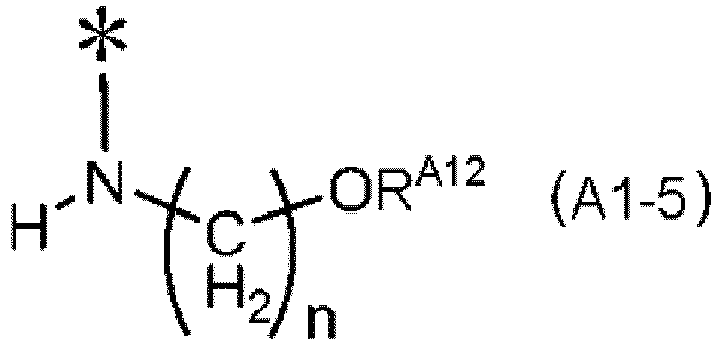
- 9) The compound or a salt thereof according to 8), in which in the formula (A1-5), n is 3.
- 10) The compound or a salt thereof according to 2), in which in the formula (1-1), Q is a chlorine atom, x is 3, and A1 is a C1-C4 alkyl-monosubstituted amino group.
- 11) The compound or a salt thereof according to 10), wherein in the the formula (1-1), Q is a chlorine atom, x is 3, and A1 is a linear C1-C4 alkyl-monosubstituted amino group.
- 12) The compound or a salt thereof according to 2), wherein in the formula (1-1), Q is a chlorine atom, x is 3, and A1 is a group represented by the following formula (A1-6):
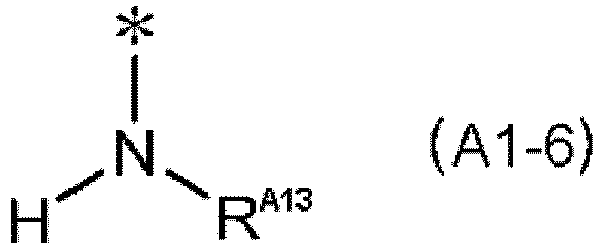
- 13) The compound or a salt thereof according to 12), in which in the formula (Al-6), RA13 is a C2-C4 alkyl group having two hydroxy groups.
- 14) The compound or a salt thereof according to any one of 1) to 4), in which in the formula (1), A1 is a group represented by following formula (A1-7) or (A1-8):

- 15) The compound or a salt thereof according to any one of 1) to 4), in which in the formula (Al-3), m is 2.
- 16) The compound or a salt thereof according to 1), in which the compound represented by the formula (1) is represented by the following formula (1-17) or (1-18):


- 17) The compound or a salt thereof according to 2), in which in the formula (1-1), Q is a chlorine atom, x is 3, and A1 is a group represented by the formula (1-4) wherein n is 3.
- 18) The compound or a salt thereof according to 2), in which in the formula (1-1), Q is a chlorine atom, x is 3, and A1 is a group represented by the following formula (A1-9):

- 19) The compound or a salt thereof according to 18), in which in the formula (A1-9), RA14 to RA21 are hydrogen atoms.
- 20) The compound or a salt thereof according to 1), in which the compound represented by the formula (2) is represented by the following formula (2-1):

- 21) The compound or a salt thereof according to 20), in which in the formula (2-1), Q21 to Q24 are chlorine atoms.
- 22) The compound or a salt thereof according to 20) or 21), in which in the formula (2-1), x is 3.
- 23) The compound or a salt thereof according to 20), in which in the formula (2-1), Q21 to Q24 are chlorine atoms, x is 3, and A2 is a 1,4-piperazinediyl group.
- 24) An ink including the compound or a salt thereof according to any one of 1) to 23).
- 25) The ink according to 24), further including a water-soluble organic solvent.
- 26) Use of the ink according to 24) or 25) for ink-jet recording.
- 27) An ink-jet recording method, including discharging a droplet of the ink according to 24) or 25) in response to a recording signal to allow for attachment to a recording medium.
- 28) An ink-jet recording method according to 27), in which the recording medium is plain paper or a sheet having an ink receiving layer.
- 29) A recording medium to which either
- (a) the compound or a salt thereof according to any one of 1) to 23) or
- (b) the ink according to 24) or 25)
- 30) An ink-jet printer loaded with a container containing the ink according to 24) or 25).
- The present invention can provide a water-soluble azo compound capable of producing a recorded image with excellent light resistance, and a yellow ink containing the above compound for use in various types of recording, in particular for an ink-jet recording purpose.
- The water-soluble azo compound according to the present invention (the compound or a salt thereof represented by the above formula (1) or (2)) is a water-soluble yellow coloring matter. Unless otherwise specifically stated, among ionic hydrophilic groups, acidic functional groups are shown in a form of a free acid. This also applies to Examples. Further, unless otherwise specifically stated, the term "compound" having an ionic hydrophilic group as used herein is meant to encompass both a "compound or a salt thereof". Moreover, unless otherwise specifically stated, the terms "%" and "part" as used herein are based on mass. This also applies to Examples.
- In the above formula (1), Q represents a halogen atom. Halogen atoms include a fluorine atom, a chlorine atom, a bromine atom, and an iodine atom. Among these, a fluorine atom or a chlorine atom is preferred, and a chlorine atom is more preferred.
- In the above formula (1), each R11 and R12 independently represents an alkyl group substituted with an ionic hydrophilic group. The carbon number of an alkyl group moiety is preferably 2 to 4, and more preferably 3. Ionic hydrophilic groups include a group selected from a sulfo group, a carboxy group, a phospho group, and a quaternary ammonium group. Among these, preferred is a group selected from a sulfo group, a carboxy group, and a phospho group. More preferred is a group selected from a sulfo group and a carboxy group. Even more preferred is a sulfo group. There is no particular limitation for the number of substitutions in an ionic hydrophilic group, but it is usually 1 to 5, preferably 1 to 4, more preferably 1 to 3, even more preferably 1 or 2, and in particular preferably 1.
- Specific examples of an alkyl group substituted with an ionic hydrophilic group include, for example, a sulfomethyl group, a sulfoethyl group, a 2,3-disulfopropyl group, a 3-sulfopropyl group, a 4-sulfobutyl group, a 5-sulfopentyl group, a 6-sulfohexyl group, a 7-sulfoheptyl group, an 8-sulfooctyl group, a carboxymethyl group, a carboxyethyl group, a 3-carboxypropyl group, a 4-carboxybutyl group, a 5-carboxypentyl group, a 6-carboxyhexyl group, a 7-carboxyheptyl group, an 8-carboxyoctyl group, a phosphomethyl group, a phosphoethyl group, a 3-phosphopropyl group, a 4-phosphobutyl group, a 5-phosphopentyl group, a 6-phosphohexyl group, a 7-phosphoheptyl group, an 8-phosphooctyl group, a trimethylammoniummethyl group, a trimethylammoniumethyl group, 3-trimethylammoniumpropyl group, a 4-trimethylammoniumbutyl group, a 5-trimethylammoniumpentyl group, a 6-trimethylammoniumhexyl group, a 7-trimethylammoniumheptyl group, an 8-trimethylammoniumoctyl group, a 2-methyl-3-sulfopropyl group, a 2,2-dimethyl-3-sulfopropyl group, a 4-sulfocyclohexyl group, a 2,5-disulfocyclohexylmethyl group and the like. A 3-sulfopropyl group is preferred.
- In the above formula (1), A1 represents a group represented by the above formula (A1-1), a group represented by the above formula (A1-2), a C1-C3 alkoxy-substituted alkylamino group, a C1-C6 alkyl-monosubstituted amino group, a C2-C6 alkyl-monosubstituted amino group having two or more hydroxy groups, a group represented by the above formula (A1-3), a group represented by the above formula (A1-4), or a cyclic amine group. A1 will be described in detail below.
- Among the compounds represented by the above formula (1), preferred is a compound represented by the above formula (1-1). In the above formula (1-1), Q and A1 have the same meanings as defined in the above formula (1), including those preferred and the like. In the above formula (1-1), each x independently represents an integer of 2 to 4, and preferably 3.
- In the above formula (A1-1), RA11 represents a branched alkylene group. The carbon number of RA11 is usually 2 to 20, preferably 3 to 12, more preferably 3 to 8, and even more preferably 3 to 6. Specific examples of a group represented by the above formula (A1-1) include, for example, an isopropylene group, an isobutylene group, an s-butylene group, a t-butylene group, a 1-methyl-n-butylene group, a 2-methyl-n-butylene group, a 3-methyl-n-butylene group, a 1,1-dimethyl-n-propylene group, a 1,2-dimethyl-n-propylene group, a 2,2-dimethyl-n-propylene group, a 1-ethyl-n-propylene group, an n-hexylene group, a 1-methyl-n-pentylene group, a 2-methyl-n-pentylene group, a 3-methyl-n-pentylene group, a 4-methyl-n-pentylene group, a 1,1-dimethyl-n-butylene group, a 1,2-dimethyl-n-butylene group, a 1,3-dimethyl-n-butylene group, a 2,2-dimethyl-n-butylene group, a 2,3-dimethyl-n-butylene group, a 3,3-dimethyl-n-butylene group, a 1-ethyl-n-butylene group, a 2-ethyl-n-butylene group, a 1,1,2-trimethyl-n-propylene group, a 1,2,2-trimethyl-n-propylene group, a 1-ethyl-1-methyl-n-propylene group, a 1-ethyl-2-methyl-n-propylene group and the like. An isobutylene group or a 3-methyl-n-butylene group is preferred.
- When A1 in the above formula (1) is a group represented by the above formula (A1-1), preferred compounds include, for example, those represented by the above formulae (1-11) to (1-15) .
- In the above formula (A1-2), n represents an integer of 1 to 6, preferably an integer of 2 to 5, and more preferably 2.
- Specific examples of a compound in which A1 in the above formula (1) is a group represented by the above formula (A1-2) are shown in the Tables 1 and 2 below. However, the present invention shall not be limited to these specific examples. Abbreviations in Tables 1 and 2 have the following meanings.
- 2-SEt: 2-sulfoethyl (*-CH2CH2-SO3H)
- 3-SnPr: 3-sulfo-n-propyl (*-CH2CH2CH2-SO3H)
- 4-SnBu: 3-sulfo-n-butyl (*-CH2CH2CH2CH2-SO3H)
- The symbol "*" in the above formulae indicates a position of attachment to the oxygen atom.
[Table 1] No. Q R11 R12 A1 1 Cl 2-SEt 2-SEt Formula (A1-2), n= 1 2 Cl 3-SnPr 3-SnPr Formula (A1-2), n= 1 3 Cl 4-SnBu 4-SnBu Formula (A1-2), n= 1 4 Cl 2-SEt 2-SEt Formula (A1-2), n= 2 5 Cl 3-SnPr 3-SnPr Formula (A1-2), n= 2 6 Cl 4-SnBu 4-SnBu Formula (A1-2), n= 2 7 Cl 2-SEt 2-SEt Formula (A1-2), n= 3 8 Cl 3-SnPr 3-SnPr Formula (A1-2), n= 3 9 Cl 4-SnBu 4-SnBu Formula (A1-2), n= 3 10 Cl 2-SEt 2-SEt Formula (A1-2), n= 4 11 Cl 3-SnPr 3-SnPr Formula (A1-2), n= 4 12 Cl 4-SnBu 4-SnBu Formula (A1-2), n= 4 13 Cl 2-SEt 2-SEt Formula (A1-2), n= 5 14 Cl 3-SnPr 3-SnPr Formula (A1-2), n= 5 15 Cl 4-SnBu 4-SnBu Formula (A1-2), n= 5 16 Cl 2-SEt 2-SEt Formula (A1-2), n= 6 17 Cl 3-SnPr 3-SnPr Formula (A1-2), n= 6 18 Cl 4-SnBu 4-SnBu Formula (A1-2), n= 6 19 Br 2-SEt 2-SEt Formula (A1-2), n= 1 20 Br 3-SnPr 3-SnPr Formula (A1-2), n= 1 21 Br 4-SnBu 4-SnBu Formula (A1-2), n= 1 22 Br 2-SEt 2-SEt Formula (A1-2), n= 2 23 Br 3-SnPr 3-SnPr Formula (A1-2), n= 2 24 Br 4-SnBu 4-SnBu Formula (A1-2), n= 2 25 Br 2-SEt 2-SEt Formula (A1-2), n= 3 26 Br 3-SnPr 3-SnPr Formula (A1-2), n= 3 27 Br 4-SnBu 4-SnBu Formula (A1-2), n= 3 28 Br 2-SEt 2-SEt Formula (A1-2), n= 4 29 Br 3-SnPr 3-SnPr Formula (A1-2), n= 4 30 Br 4-SnBu 4-SnBu Formula (A1-2), n= 4 [Table 2] No. Q R11 R12 A1 31 Br 2-SEt 2-SEt Formula (A1-2), n= 5 32 Br 3-SnPr 3-SnPr Formula (A1-2), n= 5 33 Br 4-SnBu 4-SnBu Formula (A1-2), n= 5 34 Br 2-SEt 2-SEt Formula (A1-2), n= 6 35 Br 3-SnPr 3-SnPr Formula (A1-2), n= 6 36 Br 4-SnBu 4-SnBu Formula (A1-2), n= 6 37 F 2-SEt 2-SEt Formula (A1-2), n= 1 38 F 3-SnPr 3-SnPr Formula (A1-2), n= 1 39 F 4-SnBu 4-SnBu Formula (A1-2), n= 1 40 F 2-SEt 2-SEt Formula (A1-2), n= 2 41 F 3-SnPr 3-SnPr Formula (A1-2), n= 2 42 F 4-SnBu 4-SnBu Formula (A1-2), n= 2 43 F 2-SEt 2-SEt Formula (A1-2), n= 3 44 F 3-SnPr 3-SnPr Formula (A1-2), n= 3 45 F 4-SnBu 4-SnBu Formula (A1-2), n= 3 46 F 2-SEt 2-SEt Formula (A1-2), n= 4 47 F 3-SnPr 3-SnPr Formula (A1-2), n= 4 48 F 4-SnBu 4-SnBu Formula (A1-2), n= 4 49 F 2-SEt 2-SEt Formula (A1-2), n= 5 50 F 3-SnPr 3-SnPr Formula (A1-2), n= 5 51 F 4-SnBu 4-SnBu Formula (A1-2), n= 5 52 F 2-SEt 2-SEt Formula (A1-2), n= 6 53 F 3-SnPr 3-SnPr Formula (A1-2), n= 6 54 F 4-SnBu 4-SnBu Formula (A1-2), n= 6 - When A1 in the above formula (1) is a group represented by the above formula (Al-2), preferred compounds include, for example, one represented by the above formula (1-16).
- The carbon number of an alkyl moiety in a C1-C3 alkoxy-substituted alkylamino group is preferably 1 to 6, more preferably 2 to 5, and even more preferably 3. The number of substitutions in a C1-C3 alkoxy group of a C1-C3 alkoxy-substituted alkylamino group is usually 1 or 2, preferably 1.
- Among C1-C3 alkoxy-substituted alkylamino groups, preferred is a group represented by the above formula (A1-5). In the above formula (A1-5), RA12 represents a C1-C3 alkyl group. Further, in the above formula (A1-5), n represents an integer of 1 to 6, preferably an integer of 2 to 5, and more preferably 3.
- Specific examples of a compound in which A1 in the above formula (1) is a C1-C3 alkoxy-substituted alkylamino group are shown in the Tables 3 to 14 below. However, the present invention shall not be limited to these specific examples. Abbreviations in Tables 3 to 14 have the following meanings.
- SMe: sulfomethyl (*-CH2-SO3H)
- 2-SEt: 2-sulfoethyl (*-CH2CH2-SO3H)
- 3-SnPr: 3-sulfo-n-propyl (*-CH2CH2CH2-SO3H)
- 4-SnBu: 3-sulfo-n-butyl (*-CH2CH2CH2CH2-SO3H)
- The symbol "*" in the above formulae indicates a position of attachment to the oxygen atom.
[Table 3] No. Q R11 R12 A1 1 Cl SMe SMe Formula (A1-5), n= 1, RA12= CH3 2 Cl SMe 2-SEt Formula (A1-5), n= 1, RA12= CH3 3 Cl SMe 3-SnPr Formula (A1-5), n= 1, RA12= CH3 4 Cl SMe 4-SnBu Formula (A1-5), n= 1, RA12= CH3 5 Cl 2-SEt 2-SEt Formula (A1-5), n= 1, RA12= CH3 6 Cl 2-SEt 3-SnPr Formula (A1-5), n= 1, RA12= CH3 7 Cl 2-SEt 4-SnBu Formula (A1-5), n= 1, RA12= CH3 8 Cl 3-SnPr 3-SnPr Formula (A1-5), n= 1, RA12= CH3 9 Cl 3-SnPr 4-SnBu Formula (A1-5), n= 1, RA12= CH3 10 Cl 4-SnBu 4-SnBu Formula (A1-5), n= 1, RA12= CH3 11 Cl SMe SMe Formula (Al-5), n= 2, RA12= CH3 12 Cl SMe 2-SEt Formula (A1-5), n= 2, RA12= CH3 13 Cl SMe 3-SnPr Formula (A1-5), n= 2, RA12= CH3 14 Cl SMe 4-SnBu Formula (A1-5), n= 2, RA12= CH3 15 Cl 2-SEt 2-SEt Formula (A1-5), n= 2, RA12= CH3 16 Cl 2-SEt 3-SnPr Formula (A1-5), n= 2, RA12= CH3 17 Cl 2-SEt 4-SnBu Formula (A1-5), n= 2, RA12= CH3 18 Cl 3-SnPr 3-SnPr Formula (A1-5), n= 2, RA12= CH3 19 Cl 3-SnPr 4-SnBu Formula (A1-5), n= 2, RA12= CH3 20 Cl 4-SnBu 4-SnBu Formula (A1-5), n= 2, RA12= CH3 21 Cl SMe SMe Formula (A1-5), n= 3, RA12= CH3 22 Cl SMe 2-SEt Formula (A1-5), n= 3, RA12= CH3 23 Cl SMe 3-SnPr Formula (A1-5), n= 3, RA12= CH3 24 Cl SMe 4-SnBu Formula (A1-5), n= 3, RA12= CH3 25 Cl 2-SEt 2-SEt Formula (A1-5), n= 3, RA12= CH3 26 Cl 2-SEt 3-SnPr Formula (A1-5), n= 3, RA12= CH3 27 Cl 2-SEt 4-SnBu Formula (A1-5), n= 3, RA12= CH3 28 Cl 3-SnPr 3-SnPr Formula (A1-5), n= 3, RA12= CH3 29 Cl 3-SnPr 4-SnBu Formula (A1-5), n= 3, RA12= CH3 30 Cl 4-SnBu 4-SnBu Formula (A1-5), n= 3, RA12= CH3 [Table 4] No. Q R11 R12 A1 31 Cl SMe SMe Formula (A1-5), n= 4, RA12= CH3 32 Cl SMe 2-SEt Formula (A1-5), n= 4, RA12= CH3 33 Cl SMe 3-SnPr Formula (A1-5), n= 4, RA12= CH3 34 Cl SMe 4-SnBu Formula (A1-5), n= 4, RA12= CH3 35 Cl 2-SEt 2-SEt Formula (A1-5), n= 4, RA12= CH3 36 Cl 2-SEt 3-SnPr Formula (A1-5), n= 4, RA12= CH3 37 Cl 2-SEt 4-SnBu Formula (A1-5), n= 4, RA12= CH3 38 Cl 3-SnPr 3-SnPr Formula (A1-5), n= 4, RA12= CH3 39 Cl 3-SnPr 4-SnBu Formula (A1-5), n= 4, RA12= CH3 40 Cl 4-SnBu 4-SnBu Formula (A1-5), n= 4, RA12= CH3 41 Cl SMe SMe Formula (A1-5), n= 5, RA12= CH3 42 Cl SMe 2-SEt Formula (A1-5), n= 5, RA12= CH3 43 Cl SMe 3-SnPr Formula (A1-5), n= 5, RA12= CH3 44 Cl SMe 4-SnBu Formula (A1-5), n= 5, RA12= CH3 45 Cl 2-SEt 2-SEt Formula (A1-5), n= 5, RA12= CH3 46 Cl 2-SEt 3-SnPr Formula (A1-5), n= 5, RA12= CH3 47 Cl 2-SEt 4-SnBu Formula (A1-5), n= 5, RA12= CH3 48 Cl 3-SnPr 3-SnPr Formula (A1-5), n= 5, RA12= CH3 49 Cl 3-SnPr 4-SnBu Formula (A1-5), n= 5, RA12= CH3 50 Cl 4-SnBu 4-SnBu Formula (A1-5), n= 5, RA12= CH3 51 Cl SMe SMe Formula (A1-5), n= 6, RA12= CH3 52 Cl SMe 2-SEt Formula (A1-5), n= 6, RA12= CH3 53 Cl SMe 3-SnPr Formula (A1-5), n= 6, RA12= CH3 54 Cl SMe 4-SnBu Formula (A1-5), n= 6, RA12= CH3 55 Cl 2-SEt 2-SEt Formula (A1-5), n= 6, RA12= CH3 56 Cl 2-SEt 3-SnPr Formula (A1-5), n= 6, RA12= CH3 57 Cl 2-SEt 4-SnBu Formula (A1-5), n= 6, RA12= CH3 58 Cl 3-SnPr 3-SnPr Formula (A1-5), n= 6, RA12= CH3 59 Cl 3-SnPr 4-SnBu Formula (A1-5), n= 6, RA12= CH3 60 Cl 4-SnBu 4-SnBu Formula (A1-5), n= 6, RA12= CH3 [Table 5] No. Q R11 R12 A1 61 Cl SMe SMe Formula (A1-5), n= 1, RA12= CH2CH3 62 Cl SMe 2-SEt Formula (A1-5), n= 1, RA12= CH2CH3 63 Cl SMe 3-SnPr Formula (A1-5), n= 1, RA12= CH2CH3 64 Cl SMe 4-SnBu Formula (A1-5), n= 1, RA12= CH2CH3 65 Cl 2-SEt 2-SEt Formula (A1-5), n= 1, RA12= CH2CH3 66 Cl 2-SEt 3-SnPr Formula (A1-5), n= 1, RA12= CH2CH3 67 Cl 2-SEt 4-SnBu Formula (A1-5), n= 1, RA12= CH2CH3 68 Cl 3-SnPr 3-SnPr Formula (A1-5), n= 1, RA12= CH2CH3 69 Cl 3-SnPr 4-SnBu Formula (A1-5), n= 1, RA12= CH2CH3 70 Cl 4-SnBu 4-SnBu Formula (A1-5), n= 1, RA12= CH2CH3 71 Cl SMe SMe Formula (A1-5), n= 2, RA12= CH2CH3 72 Cl SMe 2-SEt Formula (A1-5), n= 2, RA12= CH2CH3 73 Cl SMe 3-SnPr Formula (A1-5), n= 2, RA12= CH2CH3 74 Cl SMe 4-SnBu Formula (A1-5), n= 2, RA12= CH2CH3 75 Cl 2-SEt 2-SEt Formula (A1-5), n= 2, RA12= CH2CH3 76 Cl 2-SEt 3-SnPr Formula (A1-5), n= 2, RA12= CH2CH3 77 Cl 2-SEt 4-SnBu Formula (A1-5), n= 2, RA12= CH2CH3 78 Cl 3-SnPr 3-SnPr Formula (A1-5), n= 2, RA12= CH2CH3 79 Cl 3-SnPr 4-SnBu Formula (A1-5), n= 2, RA12= CH2CH3 80 Cl 4-SnBu 4-SnBu Formula (A1-5), n= 2, RA12= CH2CH3 81 Cl SMe SMe Formula (A1-5), n= 3, RA12= CH2CH3 82 Cl SMe 2-SEt Formula (A1-5), n= 3, RA12= CH2CH3 83 Cl SMe 3-SnPr Formula (A1-5), n= 3, RA12= CH2CH3 84 Cl SMe 4-SnBu Formula (A1-5), n= 3, RA12= CH2CH3 85 Cl 2-SEt 2-SEt Formula (A1-5), n= 3, RA12= CH2CH3 86 Cl 2-SEt 3-SnPr Formula (A1-5), n= 3, RA12= CH2CH3 87 Cl 2-SEt 4-SnBu Formula (A1-5), n= 3, RA12= CH2CH3 88 Cl 3-SnPr 3-SnPr Formula (A1-5), n= 3, RA12= CH2CH3 89 Cl 3-SnPr 4-SnBu Formula (A1-5), n= 3, RA12= CH2CH3 90 Cl 4-SnBu 4-SnBu Formula (A1-5), n= 3, RA12= CH2CH3 [Table 6] No. Q R11 R12 A1 91 Cl SMe SMe Formula (A1-5), n= 4, RA12= CH2CH3 92 Cl SMe 2-SEt Formula (A1-5), n= 4, RA12= CH2CH3 93 Cl SMe 3-SnPr Formula (A1-5), n= 4, RA12= CH2CH3 94 Cl SMe 4-SnBu Formula (A1-5), n= 4, RA12= CH2CH3 95 Cl 2-SEt 2-SEt Formula (A1-5), n= 4, RA12= CH2CH3 96 Cl 2-SEt 3-SnPr Formula (A1-5), n= 4, RA12= CH2CH3 97 Cl 2-SEt 4-SnBu Formula (A1-5), n= 4, RA12= CH2CH3 98 Cl 3-SnPr 3-SnPr Formula (A1-5), n= 4, RA12= CH2CH3 99 Cl 3-SnPr 4-SnBu Formula (A1-5), n= 4, RA12= CH2CH3 100 Cl 4-SnBu 4-SnBu Formula (A1-5), n= 4, RA12= CH2CH3 101 Cl SMe SMe Formula (A1-5), n= 5, RA12= CH2CH3 102 Cl SMe 2-SEt Formula (A1-5), n= 5, RA12= CH2CH3 103 Cl SMe 3-SnPr Formula (A1-5), n= 5, RA12= CH2CH3 104 Cl SMe 4-SnBu Formula (A1-5), n= 5, RA12= CH2CH3 105 Cl 2-SEt 2-SEt Formula (A1-5), n= 5, RA12= CH2CH3 106 Cl 2-SEt 3-SnPr Formula (A1-5), n= 5, RA12= CH2CH3 107 Cl 2-SEt 4-SnBu Formula (A1-5), n= 5, RA12= CH2CH3 108 Cl 3-SnPr 3-SnPr Formula (A1-5), n= 5, RA12= CH2CH3 109 Cl 3-SnPr 4-SnBu Formula (A1-5), n= 5, RA12= CH2CH3 110 Cl 4-SnBu 4-SnBu Formula (A1-5), n= 5, RA12= CH2CH3 111 Cl SMe SMe Formula (A1-5), n= 6, RA12= CH2CH3 112 Cl SMe 2-SEt Formula (A1-5), n= 6, RA12= CH2CH3 113 Cl SMe 3-SnPr Formula (A1-5), n= 6, RA12= CH2CH3 114 Cl SMe 4-SnBu Formula (A1-5), n= 6, RA12= CH2CH3 115 Cl 2-SEt 2-SEt Formula (A1-5), n= 6, RA12= CH2CH3 116 Cl 2-SEt 3-SnPr Formula (A1-5), n= 6, RA12= CH2CH3 117 Cl 2-SEt 4-SnBu Formula (A1-5), n= 6, RA12= CH2CH3 118 Cl 3-SnPr 3-SnPr Formula (A1-5), n= 6, RA12= CH2CH3 119 Cl 3-SnPr 4-SnBu Formula (A1-5), n= 6, RA12= CH2CH3 120 Cl 4-SnBu 4-SnBu Formula (A1-5), n= 6, RA12= CH2CH3 [Table 7] No. Q R11 R12 A1 121 Br SMe SMe Formula (A1-5), n= 1, RA12= CH3 122 Br SMe 2-SEt Formula (A1-5), n= 1, RA12= CH3 123 Br SMe 3-SnPr Formula (A1-5), n= 1, RA12= CH3 124 Br SMe 4-SnBu Formula (A1-5), n= 1, RA12= CH3 125 Br 2-SEt 2-SEt Formula (A1-5), n= 1, RA12= CH3 126 Br 2-SEt 3-SnPr Formula (A1-5), n= 1, RA12= CH3 127 Br 2-SEt 4-SnBu Formula (A1-5), n= 1, RA12= CH3 128 Br 3-SnPr 3-SnPr Formula (A1-5), n= 1, RA12= CH3 129 Br 3-SnPr 4-SnBu Formula (A1-5), n= 1, RA12= CH3 130 Br 4-SnBu 4-SnBu Formula (A1-5), n= 1, RA12= CH3 131 Br SMe SMe Formula (A1-5), n= 2, RA12= CH3 132 Br SMe 2-SEt Formula (A1-5), n= 2, RA12= CH3 133 Br SMe 3-SnPr Formula (A1-5), n= 2, RA12= CH3 134 Br SMe 4-SnBu Formula (A1-5), n= 2, RA12= CH3 135 Br 2-SEt 2-SEt Formula (A1-5), n= 2, RA12= CH3 136 Br 2-SEt 3-SnPr Formula (A1-5), n= 2, RA12= CH3 137 Br 2-SEt 4-SnBu Formula (A1-5), n= 2, RA12= CH3 138 Br 3-SnPr 3-SnPr Formula (A1-5), n= 2, RA12= CH3 139 Br 3-SnPr 4-SnBu Formula (A1-5), n= 2, RA12= CH3 140 Br 4-SnBu 4-SnBu Formula (A1-5), n= 2, RA12= CH3 141 Br SMe SMe Formula (A1-5), n= 3, RA12= CH3 142 Br SMe 2-SEt Formula (A1-5), n= 3, RA12= CH3 143 Br SMe 3-SnPr Formula (A1-5), n= 3, RA12= CH3 144 Br SMe 4-SnBu Formula (A1-5), n= 3, RA12= CH3 145 Br 2-SEt 2-SEt Formula (A1-5), n= 3, RA12= CH3 146 Br 2-SEt 3-SnPr Formula (A1-5), n= 3, RA12= CH3 147 Br 2-SEt 4-SnBu Formula (A1-5), n= 3, RA12= CH3 148 Br 3-SnPr 3-SnPr Formula (A1-5), n= 3, RA12= CH3 149 Br 3-SnPr 4-SnBu Formula (A1-5), n= 3, RA12= CH3 150 Br 4-SnBu 4-SnBu Formula (A1-5), n= 3, RA12= CH3 [Table 8] No. Q R11 R12 A1 151 Br SMe SMe Formula (A1-5), n= 4, RA12= CH3 152 Br SMe 2-SEt Formula (A1-5), n= 4, RA12= CH3 153 Br SMe 3-SnPr Formula (A1-5), n= 4, RA12= CH3 154 Br SMe 4-SnBu Formula (A1-5), n= 4, RA12= CH3 155 Br 2-SEt 2-SEt Formula (A1-5), n= 4, RA12= CH3 156 Br 2-SEt 3-SnPr Formula (A1-5), n= 4, RA12= CH3 157 Br 2-SEt 4-SnBu Formula (A1-5), n= 4, RA12= CH3 158 Br 3-SnPr 3-SnPr Formula (A1-5), n= 4, RA12= CH3 159 Br 3-SnPr 4-SnBu Formula (A1-5), n= 4, RA12= CH3 160 Br 4-SnBu 4-SnBu Formula (A1-5), n= 4, RA12= CH3 161 Br SMe SMe Formula (A1-5), n= 5, RA12= CH3 162 Br SMe 2-SEt Formula (A1-5), n= 5, RA12= CH3 163 Br SMe 3-SnPr Formula (A1-5), n= 5, RA12= CH3 164 Br SMe 4-SnBu Formula (A1-5), n= 5, RA12= CH3 165 Br 2-SEt 2-SEt Formula (A1-5), n= 5, RA12= CH3 166 Br 2-SEt 3-SnPr Formula (A1-5), n= 5, RA12= CH3 167 Br 2-SEt 4-SnBu Formula (A1-5), n= 5, RA12= CH3 168 Br 3-SnPr 3-SnPr Formula (A1-5), n= 5, RA12= CH3 169 Br 3-SnPr 4-SnBu Formula (A1-5), n= 5, RA12= CH3 170 Br 4-SnBu 4-SnBu Formula (A1-5), n= 5, RA12= CH3 171 Br SMe SMe Formula (A1-5), n= 6, RA12= CH3 172 Br SMe 2-SEt Formula (A1-5), n= 6, RA12= CH3 173 Br SMe 3-SnPr Formula (A1-5), n= 6, RA12= CH3 174 Br SMe 4-SnBu Formula (A1-5), n= 6, RA12= CH3 175 Br 2-SEt 2-SEt Formula (A1-5), n= 6, RA12= CH3 176 Br 2-SEt 3-SnPr Formula (A1-5), n= 6, RA12= CH3 177 Br 2-SEt 4-SnBu Formula (A1-5), n= 6, RA12= CH3 178 Br 3-SnPr 3-SnPr Formula (A1-5), n= 6, RA12= CH3 179 Br 3-SnPr 4-SnBu Formula (A1-5), n= 6, RA12= CH3 180 Br 4-SnBu 4-SnBu Formula (A1-5), n= 6, RA12= CH3 [Table 9] No. Q R11 R12 A1 181 Br SMe SMe Formula (A1-5), n= 1, RA12= CH2CH3 182 Br SMe 2-SEt Formula (A1-5), n= 1, RA12= CH2CH3 183 Br SMe 3-SnPr Formula (A1-5), n= 1, RA12= CH2CH3 184 Br SMe 4-SnBu Formula (A1-5), n= 1, RA12= CH2CH3 185 Br 2-SEt 2-SEt Formula (A1-5), n= 1, RA12= CH2CH3 186 Br 2-SEt 3-SnPr Formula (A1-5), n= 1, RA12= CH2CH3 187 Br 2-SEt 4-SnBu Formula (A1-5), n= 1, RA12= CH2CH3 188 Br 3-SnPr 3-SnPr Formula (A1-5), n= 1, RA12= CH2CH3 189 Br 3-SnPr 4-SnBu Formula (A1-5), n= 1, RA12= CH2CH3 190 Br 4-SnBu 4-SnBu Formula (A1-5), n= 1, RA12= CH2CH3 191 Br SMe SMe Formula (A1-5), n= 2, RA12= CH2CH3 192 Br SMe 2-SEt Formula (A1-5), n= 2, RA12= CH2CH3 193 Br SMe 3-SnPr Formula (A1-5), n= 2, RA12= CH2CH3 194 Br SMe 4-SnBu Formula (A1-5), n= 2, RA12= CH2CH3 195 Br 2-SEt 2-SEt Formula (A1-5), n= 2, RA12= CH2CH3 196 Br 2-SEt 3-SnPr Formula (A1-5), n= 2, RA12= CH2CH3 197 Br 2-SEt 4-SnBu Formula (A1-5), n= 2, RA12= CH2CH3 198 Br 3-SnPr 3-SnPr Formula (A1-5), n= 2, RA12= CH2CH3 199 Br 3-SnPr 4-SnBu Formula (A1-5), n= 2, RA12= CH2CH3 200 Br 4-SnBu 4-SnBu Formula (A1-5), n= 2, RA12= CH2CH3 201 Br SMe SMe Formula (A1-5), n= 3, RA12= CH2CH3 202 Br SMe 2-SEt Formula (A1-5), n= 3, RA12= CH2CH3 203 Br SMe 3-SnPr Formula (A1-5), n= 3, RA12= CH2CH3 204 Br SMe 4-SnBu Formula (A1-5), n= 3, RA12= CH2CH3 205 Br 2-SEt 2-SEt Formula (A1-5), n= 3, RA12= CH2CH3 206 Br 2-SEt 3-SnPr Formula (A1-5), n= 3, RA12= CH2CH3 207 Br 2-SEt 4-SnBu Formula (A1-5), n= 3, RA12= CH2CH3 208 Br 3-SnPr 3-SnPr Formula (A1-5), n= 3, RA12= CH2CH3 209 Br 3-SnPr 4-SnBu Formula (A1-5), n= 3, RA12= CH2CH3 210 Br 4-SnBu 4-SnBu Formula (A1-5), n= 3, RA12= CH2CH3 [Table 10] No. Q R11 R12 A1 211 Br SMe SMe Formula (A1-5), n= 4, RA12= CH2CH3 212 Br SMe 2-SEt Formula (A1-5), n= 4, RA12= CH2CH3 213 Br SMe 3-SnPr Formula (A1-5), n= 4, RA12= CH2CH3 214 Br SMe 4-SnBu Formula (A1-5), n= 4, RA12= CH2CH3 215 Br 2-SEt 2-SEt Formula (A1-5), n= 4, RA12= CH2CH3 216 Br 2-SEt 3-SnPr Formula (A1-5), n= 4, RA12= CH2CH3 217 Br 2-SEt 4-SnBu Formula (A1-5), n= 4, RA12= CH2CH3 218 Br 3-SnPr 3-SnPr Formula (A1-5), n= 4, RA12= CH2CH3 219 Br 3-SnPr 4-SnBu Formula (A1-5), n= 4, RA12= CH2CH3 220 Br 4-SnBu 4-SnBu Formula (A1-5), n= 4, RA12= CH2CH3 221 Br SMe SMe Formula (Al-5), n= 5, RA12= CH2CH3 222 Br SMe 2-SEt Formula (Al-5), n= 5, RA12= CH2CH3 223 Br SMe 3-SnPr Formula (Al-5), n= 5, RA12= CH2CH3 224 Br SMe 4-SnBu Formula (Al-5), n= 5, RA12= CH2CH3 225 Br 2-SEt 2-SEt Formula (Al-5), n= 5, RA12= CH2CH3 226 Br 2-SEt 3-SnPr Formula (Al-5), n= 5, RA12= CH2CH3 227 Br 2-SEt 4-SnBu Formula (Al-5), n= 5, RA12= CH2CH3 228 Br 3-SnPr 3-SnPr Formula (Al-5), n= 5, RA12= CH2CH3 229 Br 3-SnPr 4-SnBu Formula (Al-5), n= 5, RA12= CH2CH3 230 Br 4-SnBu 4-SnBu Formula (Al-5), n= 5, RA12= CH2CH3 231 Br SMe SMe Formula (A1-5), n= 6, RA12= CH2CH3 232 Br SMe 2-SEt Formula (A1-5), n= 6, RA12= CH2CH3 233 Br SMe 3-SnPr Formula (A1-5), n= 6, RA12= CH2CH3 234 Br SMe 4-SnBu Formula (A1-5), n= 6, RA12= CH2CH3 235 Br 2-SEt 2-SEt Formula (A1-5), n= 6, RA12= CH2CH3 236 Br 2-SEt 3-SnPr Formula (A1-5), n= 6, RA12= CH2CH3 237 Br 2-SEt 4-SnBu Formula (A1-5), n= 6, RA12= CH2CH3 238 Br 3-SnPr 3-SnPr Formula (A1-5), n= 6, RA12= CH2CH3 239 Br 3-SnPr 4-SnBu Formula (A1-5), n= 6, RA12= CH2CH3 240 Br 4-SnBu 4-SnBu Formula (A1-5), n= 6, RA12= CH2CH3 [Table 11] No. Q R11 R12 A1 241 F SMe SMe Formula (A1-5), n= 1, RA12= CH3 242 F SMe 2-SEt Formula (A1-5), n= 1, RA12= CH3 243 F SMe 3-SnPr Formula (A1-5), n= 1, RA12= CH3 244 F SMe 4-SnBu Formula (A1-5), n= 1, RA12= CH3 245 F 2-SEt 2-SEt Formula (A1-5), n= 1, RA12= CH3 246 F 2-SEt 3-SnPr Formula (A1-5), n= 1, RA12= CH3 247 F 2-SEt 4-SnBu Formula (A1-5), n= 1, RA12= CH3 248 F 3-SnPr 3-SnPr Formula (A1-5), n= 1, RA12= CH3 249 F 3-SnPr 4-SnBu Formula (A1-5), n= 1, RA12= CH3 250 F 4-SnBu 4-SnBu Formula (A1-5), n= 1, RA12= CH3 251 F SMe SMe Formula (A1-5), n= 2, RA12= CH3 252 F SMe 2-SEt Formula (A1-5), n= 2, RA12= CH3 253 F SMe 3-SnPr Formula (A1-5), n= 2, RA12= CH3 254 F SMe 4-SnBu Formula (A1-5), n= 2, RA12= CH3 255 F 2-SEt 2-SEt Formula (A1-5), n= 2, RA12= CH3 256 F 2-SEt 3-SnPr Formula (A1-5), n= 2, RA12= CH3 257 F 2-SEt 4-SnBu Formula (A1-5), n= 2, RA12= CH3 258 F 3-SnPr 3-SnPr Formula (A1-5), n= 2, RA12= CH3 259 F 3-SnPr 4-SnBu Formula (A1-5), n= 2, RA12= CH3 260 F 4-SnBu 4-SnBu Formula (A1-5), n= 2, RA12= CH3 261 F SMe SMe Formula (A1-5), n= 3, RA12= CH3 262 F SMe 2-SEt Formula (A1-5), n= 3, RA12= CH3 263 F SMe 3-SnPr Formula (A1-5), n= 3, RA12= CH3 264 F SMe 4-SnBu Formula (A1-5), n= 3, RA12= CH3 265 F 2-SEt 2-SEt Formula (A1-5), n= 3, RA12= CH3 266 F 2-SEt 3-SnPr Formula (A1-5), n= 3, RA12= CH3 267 F 2-SEt 4-SnBu Formula (A1-5), n= 3, RA12= CH3 268 F 3-SnPr 3-SnPr Formula (A1-5), n= 3, RA12= CH3 269 F 3-SnPr 4-SnBu Formula (A1-5), n= 3, RA12= CH3 270 F 4-SnBu 4-SnBu Formula (A1-5), n= 3, RA12= CH3 [Table 12] No. Q R11 R12 A1 271 F SMe SMe Formula (A1-5), n= 4, RA12= CH3 272 F SMe 2-SEt Formula (A1-5), n= 4, RA12= CH3 273 F SMe 3-SnPr Formula (A1-5), n= 4, RA12= CH3 274 F SMe 4-SnBu Formula (A1-5), n= 4, RA12= CH3 275 F 2-SEt 2-SEt Formula (A1-5), n= 4, RA12= CH3 276 F 2-SEt 3-SnPr Formula (A1-5), n= 4, RA12= CH3 277 F 2-SEt 4-SnBu Formula (A1-5), n= 4, RA12= CH3 278 F 3-SnPr 3-SnPr Formula (A1-5), n= 4, RA12= CH3 279 F 3-SnPr 4-SnBu Formula (A1-5), n= 4, RA12= CH3 280 F 4-SnBu 4-SnBu Formula (A1-5), n= 4, RA12= CH3 281 F SMe SMe Formula (A1-5), n= 5, RA12= CH3 282 F SMe 2-SEt Formula (A1-5), n= 5, RA12= CH3 283 F SMe 3-SnPr Formula (A1-5), n= 5, RA12= CH3 284 F SMe 4-SnBu Formula (A1-5), n= 5, RA12= CH3 285 F 2-SEt 2-SEt Formula (A1-5), n= 5, RA12= CH3 286 F 2-SEt 3-SnPr Formula (A1-5) , n= 5, RA12= CH3 287 F 2-SEt 4-SnBu Formula (A1-5), n= 5, RA12= CH3 288 F 3-SnPr 3-SnPr Formula (A1-5), n= 5, RA12= CH3 289 F 3-SnPr 4-SnBu Formula (A1-5), n= 5, RA12= CH3 290 F 4-SnBu 4-SnBu Formula (A1-5), n= 5, RA12= CH3 291 F SMe SMe Formula (A1-5), n= 6, RA12= CH3 292 F SMe 2-SEt Formula (A1-5), n= 6, RA12= CH3 293 F SMe 3-SnPr Formula (A1-5), n= 6, RA12= CH3 294 F SMe 4-SnBu Formula (A1-5), n= 6, RA12= CH3 295 F 2-SEt 2-SEt Formula (A1-5), n= 6, RA12= CH3 296 F 2-SEt 3-SnPr Formula (A1-5), n= 6, RA12= CH3 297 F 2-SEt 4-SnBu Formula (A1-5), n= 6, RA12= CH3 298 F 3-SnPr 3-SnPr Formula (A1-5), n= 6, RA12= CH3 299 F 3-SnPr 4-SnBu Formula (A1-5), n= 6, RA12= CH3 300 F 4-SnBu 4-SnBu Formula (A1-5), n= 6, RA12= CH3 [Table 13] No. Q R11 R12 A1 301 F SMe SMe Formula (A1-5), n= 1, RA12= CH2CH3 302 F SMe 2-SEt Formula (A1-5), n= 1, RA12= CH2CH3 303 F SMe 3-SnPr Formula (A1-5), n= 1, RA12= CH2CH3 304 F SMe 4-SnBu Formula (A1-5), n= 1, RA12= CH2CH3 305 F 2-SEt 2-SEt Formula (A1-5), n= 1, RA12= CH2CH3 306 F 2-SEt 3-SnPr Formula (A1-5), n= 1, RA12= CH2CH3 307 F 2-SEt 4-SnBu Formula (A1-5), n= 1, RA12= CH2CH3 308 F 3-SnPr 3-SnPr Formula (A1-5), n= 1, RA12= CH2CH3 309 F 3-SnPr 4-SnBu Formula (A1-5), n= 1, RA12= CH2CH3 310 F 4-SnBu 4-SnBu Formula (A1-5), n= 1, RA12= CH2CH3 311 F SMe SMe Formula (A1-5), n= 2, RA12= CH2CH3 312 F SMe 2-SEt Formula (A1-5), n= 2, RA12= CH2CH3 313 F SMe 3-SnPr Formula (A1-5), n= 2, RA12= CH2CH3 314 F SMe 4-SnBu Formula (A1-5), n= 2, RA12= CH2CH3 315 F 2-SEt 2-SEt Formula (A1-5), n= 2, RA12= CH2CH3 316 F 2-SEt 3-SnPr Formula (A1-5), n= 2, RA12= CH2CH3 317 F 2-SEt 4-SnBu Formula (A1-5), n= 2, RA12= CH2CH3 318 F 3-SnPr 3-SnPr Formula (A1-5), n= 2, RA12= CH2CH3 319 F 3-SnPr 4-SnBu Formula (A1-5), n= 2, RA12= CH2CH3 320 F 4-SnBu 4-SnBu Formula (A1-5), n= 2, RA12= CH2CH3 321 F SMe SMe Formula (A1-5), n= 3, RA12= CH2CH3 322 F SMe 2-SEt Formula (A1-5), n= 3, RA12= CH2CH3 323 F SMe 3-SnPr Formula (A1-5), n= 3, RA12= CH2CH3 324 F SMe 4-SnBu Formula (A1-5), n= 3, RA12= CH2CH3 325 F 2-SEt 2-SEt Formula (A1-5), n= 3, RA12= CH2CH3 326 F 2-SEt 3-SnPr Formula (A1-5), n= 3, RA12= CH2CH3 327 F 2-SEt 4-SnBu Formula (A1-5), n= 3, RA12= CH2CH3 328 F 3-SnPr 3-SnPr Formula (A1-5), n= 3, RA12= CH2CH3 329 F 3-SnPr 4-SnBu Formula (A1-5), n= 3, RA12= CH2CH3 330 F 4-SnBu 4-SnBu Formula (A1-5), n= 3, RA12= CH2CH3 [Table 14] No. Q R11 R12 A1 331 F SMe SMe Formula (A1-5), n= 4, RA12= CH2CH3 332 F SMe 2-SEt Formula (A1-5), n= 4, RA12= CH2CH3 333 F SMe 3-SnPr Formula (A1-5), n= 4, RA12= CH2CH3 334 F SMe 4-SnBu Formula (A1-5), n= 4, RA12= CH2CH3 335 F 2-SEt 2-SEt Formula (A1-5), n= 4, RA12= CH2CH3 336 F 2-SEt 3-SnPr Formula (A1-5), n= 4, RA12= CH2CH3 337 F 2-SEt 4-SnBu Formula (A1-5), n= 4, RA12= CH2CH3 338 F 3-SnPr 3-SnPr Formula (A1-5), n= 4, RA12= CH2CH3 339 F 3-SnPr 4-SnBu Formula (A1-5), n= 4, RA12= CH2CH3 340 F 4-SnBu 4-SnBu Formula (A1-5), n= 4, RA12= CH2CH3 341 F SMe SMe Formula (Al-5), n= 5, RA12= CH2CH3 342 F SMe 2-SEt Formula (Al-5), n= 5, RA12= CH2CH3 343 F SMe 3-SnPr Formula (Al-5), n= 5, RA12= CH2CH3 344 F SMe 4-SnBu Formula (Al-5), n= 5, RA12= CH2CH3 345 F 2-SEt 2-SEt Formula (Al-5), n= 5, RA12= CH2CH3 346 F 2-SEt 3-SnPr Formula (Al-5), n= 5, RA12= CH2CH3 347 F 2-SEt 4-SnBu Formula (Al-5), n= 5, RA12= CH2CH3 348 F 3-SnPr 3-SnPr Formula (Al-5), n= 5, RA12= CH2CH3 349 F 3-SnPr 4-SnBu Formula (Al-5), n= 5, RA12= CH2CH3 350 F 4-SnBu 4-SnBu Formula (Al-5), n= 5, RA12= CH2CH3 351 F SMe SMe Formula (A1-5), n= 6, RA12= CH2CH3 352 F SMe 2-SEt Formula (A1-5), n= 6, RA12= CH2CH3 353 F SMe 3-SnPr Formula (A1-5), n= 6, RA12= CH2CH3 354 F SMe 4-SnBu Formula (A1-5), n= 6, RA12= CH2CH3 355 F 2-SEt 2-SEt Formula (A1-5), n= 6, RA12= CH2CH3 356 F 2-SEt 3-SnPr Formula (A1-5), n= 6, RA12= CH2CH3 357 F 2-SEt 4-SnBu Formula (A1-5), n= 6, RA12= CH2CH3 358 F 3-SnPr 3-SnPr Formula (A1-5), n= 6, RA12= CH2CH3 359 F 3-SnPr 4-SnBu Formula (A1-5), n= 6, RA12= CH2CH3 360 F 4-SnBu 4-SnBu Formula (A1-5), n= 6, RA12= CH2CH3 - When A1 in the above formula (1) is a C1-C3 alkoxy-substituted alkylamino group, preferred compounds include, for example, one in which in the above formula (1-1), Q is a chlorine atom, x is 3, A1 is a group represented by the above formula (Al-5), and n in the above formula (A1-5) is 3.
- Specific examples of a C1-C6 alkyl-monosubstituted amino group include, for example, a monomethylamino group, a monoethylamino group, a mono-n-propylamino group, a monoisopropylamino group, a mono-n-butylamino group, a mono-s-butylamino group, a mono-t-butylamino group, a mono-n-pentylamino group, a mono-n-hexylamino group and the like. Among these, a C1-C4 alkyl-monosubstituted amino group is preferred, and a linear C1-C4 alkyl-monosubstituted amino group is more preferred such as a monomethylamino group, a monoethylamino group, a mono-n-propylamino group, a mono-n-butylamino group.
- Specific examples of a compound in which A1 in the above formula (1) is a C1-C6 alkyl-monosubstituted amino group are shown in Tables 15 to 20 below. However, the present invention shall not be limited to these specific examples. Abbreviations in Tables 15 to 20 have the following meanings.
- SMe: sulfomethyl (*-CH2-SO3H)
- 2-SEt: 2-sulfoethyl (*-CH2CH2-SO3H)
- 3-SnPr: 3-sulfo-n-propyl (*-CH2CH2CH2-SO3H)
- 4-SnBu: 3-sulfo-n-butyl (*-CH2CH2CH2CH2-SO3H)
- The symbol "*" in the above formulae indicates a position of attachment to the oxygen atom.
[Table 15] No. Q R11 R12 A1 1 Cl SMe SMe NHCH3 2 Cl SMe 2-SEt NHCH3 3 Cl SMe 3-SnPr NHCH3 4 Cl SMe 4-SnBu NHCH3 5 Cl 2-SEt 2-SEt NHCH3 6 Cl 2-SEt 3-SnPr NHCH3 7 Cl 2-SEt 4-SnBu NHCH3 8 Cl 3-SnPr 3-SnPr NHCH3 9 Cl 3-SnPr 4-SnBu NHCH3 10 Cl 4-SnBu 4-SnBu NHCH3 11 Cl SMe SMe NHC2H5 12 Cl SMe 2-SEt NHC2H5 13 Cl SMe 3-SnPr NHC2H5 14 Cl SMe 4-SnBu NHC2H5 15 Cl 2-SEt 2-SEt NHC2H5 16 Cl 2-SEt 3-SnPr NHC2H5 17 Cl 2-SEt 4-SnBu NHC2H5 18 Cl 3-SnPr 3-SnPr NHC2H5 19 Cl 3-SnPr 4-SnBu NHC2H5 20 Cl 4-SnBu 4-SnBu NHC2H5 21 Cl SMe SMe NHC3H7 22 Cl SMe 2-SEt NHC3H7 23 Cl SMe 3-SnPr NHC3H7 24 Cl SMe 4-SnBu NHC3H7 25 Cl 2-SEt 2-SEt NHC3H7 26 Cl 2-SEt 3-SnPr NHC3H7 27 Cl 2-SEt 4-SnBu NHC3H7 28 Cl 3-SnPr 3-SnPr NHC3H7 29 Cl 3-SnPr 4-SnBu NHC3H7 30 Cl 4-SnBu 4-SnBu NHC3H7 [Table 16] No. Q R11 R12 A1 31 Cl SMe SMe NHC4H9 32 Cl SMe 2-SEt NHC4H9 33 Cl SMe 3-SnPr NHC4H9 34 Cl SMe 4-SnBu NHC4H9 35 Cl 2-SEt 2-SEt NHC4H9 36 Cl 2-SEt 3-SnPr NHC4H9 37 Cl 2-SEt 4-SnBu NHC4H9 38 Cl 3-SnPr 3-SnPr NHC4H9 39 Cl 3-SnPr 4-SnBu NHC4H9 40 Cl 4-SnBu 4-SnBu NHC4H9 41 Cl SMe SMe NHC5H11 42 Cl SMe 2-SEt NHC5H11 43 Cl SMe 3-SnPr NHC5H11 44 Cl SMe 4-SnBu NHC5H11 45 Cl 2-SEt 2-SEt NHC5H11 46 Cl 2-SEt 3-SnPr NHC5H11 47 Cl 2-SEt 4-SnBu NHC5H11 48 Cl 3-SnPr 3-SnPr NHC5H11 49 Cl 3-SnPr 4-SnBu NHC5H11 50 Cl 4-SnBu 4-SnBu NHC5H11 51 Cl SMe SMe NHC6H13 52 Cl SMe 2-SEt NHC6H13 53 Cl SMe 3-SnPr NHC6H13 54 Cl SMe 4-SnBu NHC6H13 55 Cl 2-SEt 2-SEt NHC6H13 56 Cl 2-SEt 3-SnPr NHC6H13 57 Cl 2-SEt 4-SnBu NHC6H13 58 Cl 3-SnPr 3-SnPr NHC6H13 59 Cl 3-SnPr 4-SnBu NHC6H13 60 Cl 4-SnBu 4-SnBu NHC6H13 [Table 17] No. Q R11 R12 A1 61 Br SMe SMe NHCH3 62 Br SMe 2-SEt NHCH3 63 Br SMe 3-SnPr NHCH3 64 Br SMe 4-SnBu NHCH3 65 Br 2-SEt 2-SEt NHCH3 66 Br 2-SEt 3-SnPr NHCH3 67 Br 2-SEt 4-SnBu NHCH3 68 Br 3-SnPr 3-SnPr NHCH3 69 Br 3-SnPr 4-SnBu NHCH3 70 Br 4-SnBu 4-SnBu NHCH3 71 Br SMe SMe NHC2H5 72 Br SMe 2-SEt NHC2H5 73 Br SMe 3-SnPr NHC2H5 74 Br SMe 4-SnBu NHC2H5 75 Br 2-SEt 2-SEt NHC2H5 76 Br 2-SEt 3-SnPr NHC2H5 77 Br 2-SEt 4-SnBu NHC2H5 78 Br 3-SnPr 3-SnPr NHC2H5 79 Br 3-SnPr 4-SnBu NHC2H5 80 Br 4-SnBu 4-SnBu NHC2H5 81 Br SMe SMe NHC3H7 82 Br SMe 2-SEt NHC3H7 83 Br SMe 3-SnPr NHC3H7 84 Br SMe 4-SnBu NHC3H7 85 Br 2-SEt 2-SEt NHC3H7 86 Br 2-SEt 3-SnPr NHC3H7 87 Br 2-SEt 4-SnBu NHC3H7 88 Br 3-SnPr 3-SnPr NHC3H7 89 Br 3-SnPr 4-SnBu NHC3H7 90 Br 4-SnBu 4-SnBu NHC3H7 [Table 18] No. Q R11 R12 A1 91 Br SMe SMe NHC4H9 92 Br SMe 2-SEt NHC4H9 93 Br SMe 3-SnPr NHC4H9 94 Br SMe 4-SnBu NHC4H9 95 Br 2-SEt 2-SEt NHC4H9 96 Br 2-SEt 3-SnPr NHC4H9 97 Br 2-SEt 4-SnBu NHC4H9 98 Br 3-SnPr 3-SnPr NHC4H9 99 Br 3-SnPr 4-SnBu NHC4H9 100 Br 4-SnBu 4-SnBu NHC4H9 101 Br SMe SMe NHC5H11 102 Br SMe 2-SEt NHC5H11 103 Br SMe 3-SnPr NHC5H11 104 Br SMe 4-SnBu NHC5H11 105 Br 2-SEt 2-SEt NHC5H11 106 Br 2-SEt 3-SnPr NHC5H11 107 Br 2-SEt 4-SnBu NHC5H11 108 Br 3-SnPr 3-SnPr NHC5H11 109 Br 3-SnPr 4-SnBu NHC5H11 110 Br 4-SnBu 4-SnBu NHC5H11 111 Br SMe SMe NHC6H13 112 Br SMe 2-SEt NHC6H13 113 Br SMe 3-SnPr NHC6H13 114 Br SMe 4-SnBu NHC6H13 115 Br 2-SEt 2-SEt NHC6H13 116 Br 2-SEt 3-SnPr NHC6H13 117 Br 2-SEt 4-SnBu NHC6H13 118 Br 3-SnPr 3-SnPr NHC6H13 119 Br 3-SnPr 4-SnBu NHC6H13 120 Br 4-SnBu 4-SnBu NHC6H13 [Table 19] No. Q R11 R12 A1 121 F SMe SMe NHCH3 122 F SMe 2-SEt NHCH3 123 F SMe 3-SnPr NHCH3 124 F SMe 4-SnBu NHCH3 125 F 2-SEt 2-SEt NHCH3 126 F 2-SEt 3-SnPr NHCH3 127 F 2-SEt 4-SnBu NHCH3 128 F 3-SnPr 3-SnPr NHCH3 129 F 3-SnPr 4-SnBu NHCH3 130 F 4-SnBu 4-SnBu NHCH3 131 F SMe SMe NHC2H5 132 F SMe 2-SEt NHC2H5 133 F SMe 3-SnPr NHC2H5 134 F SMe 4-SnBu NHC2H5 135 F 2-SEt 2-SEt NHC2H5 136 F 2-SEt 3-SnPr NHC2H5 137 F 2-SEt 4-SnBu NHC2H5 138 F 3-SnPr 3-SnPr NHC2H5 139 F 3-SnPr 4-SnBu NHC2H5 140 F 4-SnBu 4-SnBu NHC2H5 141 F SMe SMe NHC3H7 142 F SMe 2-SEt NHC3H7 143 F SMe 3-SnPr NHC3H7 144 F SMe 4-SnBu NHC3H7 145 F 2-SEt 2-SEt NHC3H7 146 F 2-SEt 3-SnPr NHC3H7 147 F 2-SEt 4-SnBu NHC3H7 148 F 3-SnPr 3-SnPr NHC3H7 149 F 3-SnPr 4-SnBu NHC3H7 150 F 4-SnBu 4-SnBu NHC3H7 [Table 20] No. Q R11 R12 A1 151 F SMe SMe NHC4H9 152 F SMe 2-SEt NHC4H9 153 F SMe 3-SnPr NHC4H9 154 F SMe 4-SnBu NHC4H9 155 F 2-SEt 2-SEt NHC4H9 156 F 2-SEt 3-SnPr NHC4H9 157 F 2-SEt 4-SnBu NHC4H9 158 F 3-SnPr 3-SnPr NHC4H9 159 F 3-SnPr 4-SnBu NHC4H9 160 F 4-SnBu 4-SnBu NHC4H9 161 F SMe SMe NHC5H11 162 F SMe 2-SEt NHC5H11 163 F SMe 3-SnPr NHC5H11 164 F SMe 4-SnBu NHC5H11 165 F 2-SEt 2-SEt NHC5H11 166 F 2-SEt 3-SnPr NHC5H11 167 F 2-SEt 4-SnBu NHC5H11 168 F 3-SnPr 3-SnPr NHC5H11 169 F 3-SnPr 4-SnBu NHC5H11 170 F 4-SnBu 4-SnBu NHC5H11 171 F SMe SMe NHC6H13 172 F SMe 2-SEt NHC6H13 173 F SMe 3-SnPr NHC6H13 174 F SMe 4-SnBu NHC6H13 175 F 2-SEt 2-SEt NHC6H13 176 F 2-SEt 3-SnPr NHC6H13 177 F 2-SEt 4-SnBu NHC6H13 178 F 3-SnPr 3-SnPr NHC6H13 179 F 3-SnPr 4-SnBu NHC6H13 180 F 4-SnBu 4-SnBu NHC6H13 - When A1 in the above formula (1) is a C1-C6 alkyl-monosubstituted amino group, preferred compounds include, for example, one in which in the above formula (1-1), Q is a chlorine atom, x is 3, and A1 is a C1-C4 alkyl-monosubstituted amino group. More preferred compounds include, for example, one in which in the above formula (1-1), Q is a chlorine atom, x is 3, and A1 is a linear C1-C4 alky-monosubstituted amino group.
- The number of substitutions in a hydroxy group of a C2-C6 alkyl-monosubstituted amino group having two or more hydroxy groups is usually 2 or 3, and preferably 2. The C2-C6 alkyl-monosubstituted amino group having two or more hydroxy groups is preferably a group represented by the above formula (Al-6). In the above formula (A1-6), RA13 represents a C2-C6 alkyl group having two or more hydroxy groups, preferably a C2-C4 alkyl group having two hydroxy groups.
- Specific examples of a C2-C6 alkyl-monosubstituted amino group having two or more hydroxy groups include, for example, a linear C2-C6 alkyl-monosubstituted amino group having two or more hydroxy groups such as a 1,2-dihydroxyethylamino group, a 1,1-dihydroxyethylamino group, a 1,2-dihydroxypropylamino group, a 1,2-dihydroxybutylamino group, a 1,2-dihydroxypentylamino group, a 1,2-dihydroxyhexylamino group, and a 1,2,3-trihydroxyhexylamino group; a branched C2-C6 alkyl-monosubstituted amino group having two or more hydroxy groups such as a 1,1'-dihydroxyisopropylamino group and a 1,1'-dihydroxypentylamino group; and the like. Among these, preferred is a group represented by the above formula (A1-7) or (Al-8).
- Specific examples of a compound in which A1 in the above formula (1) is a C2-C6 alkyl-monosubstituted amino group having two or more hydroxy groups are shown in Tables 21 to 25. However, the present invention shall not be limited to these specific examples. Abbreviations in Tables 21 to 25 have the following meanings.
- SMe: sulfomethyl (*-CH2-SO3H)
- 2-SEt: 2-sulfoethyl (*-CH2CH2-SO3H)
- 3-SnPr: 3-sulfo-n-propyl (*-CH2CH2CH2-SO3H)
- 4-SnBu: 3-sulfo-n-butyl (*-CH2CH2CH2CH2-SO3H)
- The symbol "*" in the above formulae indicates a position of attachment to the oxygen atom.
[Table 21] No. Q R11 R12 A1 1 Cl SMe SMe Formula (A1-7) 2 Cl SMe 2-SEt Formula (A1-7) 3 Cl SMe 3-SnPr Formula (A1-7) 4 Cl SMe 4-SnBu Formula (A1-7) 5 Cl 2-SEt 2-SEt Formula (A1-7) 6 Cl 2-SEt 3-SnPr Formula (A1-7) 7 Cl 2-SEt 4-SnBu Formula (A1-7) 8 Cl 3-SnPr 3-SnPr Formula (A1-7) 9 Cl 3-SnPr 4-SnBu Formula (A1-7) 10 Cl 4-SnBu 4-SnBu Formula (A1-7) 11 Cl SMe SMe Formula (A1-8) 12 Cl SMe 2-SEt Formula (A1-8) 13 Cl SMe 3-SnPr Formula (A1-8) 14 Cl SMe 4-SnBu Formula (A1-8) 15 Cl 2-SEt 2-SEt Formula (A1-8) 16 Cl 2-SEt 3-SnPr Formula (A1-8) 17 Cl 2-SEt 4-SnBu Formula (A1-8) 18 Cl 3-SnPr 3-SnPr Formula (A1-8) 19 Cl 3-SnPr 4-SnBu Formula (A1-8) 20 Cl 4-SnBu 4-SnBu Formula (A1-8) 21 Cl SMe SMe Formula (A1-6), RA13= CH(OH)CH2 (OH) 22 Cl SMe 2-SEt Formula (A1-6), RA13= CH(OH)CH2 (OH) 23 Cl SMe 3-SnPr Formula (A1-6), RA13= CH(OH)CH2 (OH) 24 Cl SMe 4-SnBu Formula (A1-6), RA13= CH(OH)CH2 (OH) 25 Cl 2-SEt 2-SEt Formula (A1-6), RA13= CH(OH)CH2 (OH) 26 Cl 2-SEt 3-SnPr Formula (A1-6), RA13= CH(OH)CH2 (OH) 27 Cl 2-SEt 4-SnBu Formula (A1-6), RA13= CH(OH)CH2 (OH) 28 Cl 3-SnPr 3-SnPr Formula (A1-6), RA13= CH(OH)CH2 (OH) 29 Cl 3-SnPr 4-SnBu Formula (A1-6), RA13= CH(OH)CH2 (OH) 30 Cl 4-SnBu 4-SnBu Formula (A1-6), RA13= CH(OH)CH2 (OH) [Table 22] No. Q R11 R12 A1 31 Cl SMe SMe Formula (A1-6), RA13= CH2CH(OH)CH2CH2OH 32 Cl SMe 2-SEt Formula (A1-6), RA13= CH2CH(OH) CH2CH2OH 33 Cl SMe 3-SnPr Formula (A1-6), RA13= CH2CH(OH) CH2CH2OH 34 Cl SMe 4-SnBu Formula (A1-6), RA13= CH2CH(OH) CH2CH2OH 35 Cl 2-SEt 2-SEt Formula (A1-6), RA13= CH2CH(OH) CH2CH2OH 36 Cl 2-SEt 3-SnPr Formula (A1-6), RA13= CH2CH(OH) CH2CH2OH 37 Cl 2-SEt 4-SnBu Formula (A1-6), RA13= CH2CH(OH)CH2CH2OH 38 Cl 3-SnPr 3-SnPr Formula (A1-6), RA13= CH2CH(OH)CH2CH2OH 39 Cl 3-SnPr 4-SnBu Formula (A1-6), RA13= CH2CH(OH)CH2CH2OH 40 Cl 4-SnBu 4-SnBu Formula (A1-6), RA13= CH2CH(OH)CH2CH2OH 41 Cl SMe SMe Formula (A1-6), RA13= CH2CH2CH(OH)CH2CH2OH 42 Cl SMe 2-SEt Formula (A1-6), RA13= CH2CH2CH(OH) CH2CH2OH 43 Cl SMe 3-SnPr Formula (A1-6), RA13= CH2CH2CH(OH) CH2CH2OH 44 Cl SMe 4-SnBu Formula (A1-6), RA13= CH2CH2CH(OH) CH2CH2OH 45 Cl 2-SEt 2-SEt Formula (A1-6), RA13= CH2CH2CH(OH) CH2CH2OH 46 Cl 2-SEt 3-SnPr Formula (A1-6), RA13= CH2CH2CH(OH)CH2CH2OH 47 Cl 2-SEt 4-SnBu Formula (A1-6), RA13= CH2CH2CH(OH) CH2CH2OH 48 Cl 3-SnPr 3-SnPr Formula (A1-6), RA13= CH2CH2CH(OH) CH2CH2OH 49 Cl 3-SnPr 4-SnBu Formula (A1-6), RA13= CH2CH2CH(OH) CH2CH2OH 50 Cl 4-SnBu 4-SnBu Formula (A1-6), RA13= CH2CH2CH(OH) CH2CH2OH 51 Br SMe SMe Formula (A1-7) 52 Br SMe 2-SEt Formula (A1-7) 53 Br SMe 3-SnPr Formula (A1-7) 54 Br SMe 4-SnBu Formula (A1-7) 55 Br 2-SEt 2-SEt Formula (A1-7) 56 Br 2-SEt 3-SnPr Formula (A1-7) 57 Br 2-SEt 4-SnBu Formula (A1-7) 58 Br 3-SnPr 3-SnPr Formula (A1-7) 59 Br 3-SnPr 4-SnBu Formula (A1-7) 60 Br 4-SnBu 4-SnBu Formula (A1-7) [Table 23] No. Q R11 R12 A1 61 Br SMe SMe Formula (A1-8) 62 Br SMe 2-SEt Formula (A1-8) 63 Br SMe 3-SnPr Formula (A1-8) 64 Br SMe 4-SnBu Formula (A1-8) 65 Br 2-SEt 2-SEt Formula (A1-8) 66 Br 2-SEt 3-SnPr Formula (A1-8) 67 Br 2-SEt 4-SnBu Formula (A1-8) 68 Br 3-SnPr 3-SnPr Formula (A1-8) 69 Br 3-SnPr 4-SnBu Formula (A1-8) 70 Br 4-SnBu 4-SnBu Formula (A1-8) 71 Br SMe SMe Formula (A1-6) , RA13= CH(OH)CH2(OH) 72 Br SMe 2-SEt Formula (A1-6), RA13= CH (OH) CH2 (OH) 73 Br SMe 3-SnPr Formula (A1-6), RA13= CH (OH) CH2 (OH) 74 Br SMe 4-SnBu Formula (A1-6), RA13= CH(OH)CH2(OH) 75 Br 2-SEt 2-SEt Formula (A1-6), RA13= CH(OH)CH2(OH) 76 Br 2-SEt 3-SnPr Formula (A1-6), RA13= CH (OH) CH2 (OH) 77 Br 2-SEt 4-SnBu Formula (A1-6), RA13= CH(OH)CH2(OH) 78 Br 3-SnPr 3-SnPr Formula (A1-6), RA13= CH(OH)CH2(OH) 79 Br 3-SnPr 4-SnBu Formula (A1-6), RA13= CH (OH) CH2 (OH) 80 Br 4-SnBu 4-SnBu Formula (A1-6), RA13= CH (OH) CH2 (OH) 81 Br SMe SMe Formula (A1-6), RA13= CH2CH (OH) CH2CH2OH 82 Br SMe 2-SEt Formula (A1-6), RA13= CH2CH (OH) CH2CH2OH 83 Br SMe 3-SnPr Formula (A1-6), RA13= CH2CH (OH) CH2CH2OH 84 Br SMe 4-SnBu Formula (A1-6), RA13= CH2CH (OH) CH2CH2OH 85 Br 2-SEt 2-SEt Formula (A1-6), RA13= CH2CH (OH) CH2CH2OH 86 Br 2-SEt 3-SnPr Formula (A1-6), RA13= CH2CH (OH) CH2CH2OH 87 Br 2-SEt 4-SnBu Formula (A1-6), RA13= CH2CH (OH) CH2CH2OH 88 Br 3-SnPr 3-SnPr Formula (A1-6), RA13= CH2CH (OH) CH2CH2OH 89 Br 3-SnPr 4-SnBu Formula (A1-6), RA13= CH2CH (OH) CH2CH2OH 90 Br 4-SnBu 4-SnBu Formula (A1-6), RA13= CH2CH (OH) CH2CH2OH [Table 24] No. Q R11 R12 A1 91 Br SMe SMe Formula (A1-6), RA13= CH2CH2CH (OH) CH2CH2OH 92 Br SMe 2-SEt Formula (A1-6), RA13= CH2CH2CH (OH) CH2CH2OH 93 Br SMe 3-SnPr Formula (A1-6), RA13= CH2CH2CH (OH) CH2CH2OH 94 Br SMe 4-SnBu Formula (A1-6), RA13= CH2CH2CH (OH) CH2CH2OH 95 Br 2-SEt 2-SEt Formula (A1-6), RA13= CH2CH2CH (OH) CH2CH2OH 96 Br 2-SEt 3-SnPr Formula (A1-6), RA13= CH2CH2CH (OH) CH2CH2OH 97 Br 2-SEt 4-SnBu Formula (A1-6), RA13= CH2CH2CH (OH) CH2CH2OH 98 Br 3-SnPr 3-SnPr Formula (A1-6), RA13= CH2CH2CH (OH) CH2CH2OH 99 Br 3-SnPr 4-SnBu Formula (A1-6), RA13= CH2CH2CH (OH) CH2CH2OH 100 Br 4-SnBu 4-SnBu Formula (A1-6), RA13= CH2CH2CH (OH) CH2CH2OH 101 F SMe SMe Formula (A1-7) 102 F SMe 2-SEt Formula (A1-7) 103 F SMe 3-SnPr Formula (A1-7) 104 F SMe 4-SnBu Formula (A1-7) 105 F 2-SEt 2-SEt Formula (A1-7) 106 F 2-SEt 3-SnPr Formula (A1-7) 107 F 2-SEt 4-SnBu Formula (A1-7) 108 F 3-SnPr 3-SnPr Formula (A1-7) 109 F 3-SnPr 4-SnBu Formula (A1-7) 110 F 4-SnBu 4-SnBu Formula (A1-7) 111 F SMe SMe Formula (A1-8) 112 F SMe 2-SEt Formula (A1-8) 113 F SMe 3-SnPr Formula (A1-8) 114 F SMe 4-SnBu Formula (A1-8) 115 F 2-SEt 2-SEt Formula (A1-8) 116 F 2-SEt 3-SnPr Formula (A1-8) 117 F 2-SEt 4-SnBu Formula (A1-8) 118 F 3-SnPr 3-SnPr Formula (A1-8) 119 F 3-SnPr 4-SnBu Formula (A1-8) 120 F 4-SnBu 4-SnBu Formula (A1-8) [Table 25] No. Q R11 R12 A1 121 F SMe SMe Formula (A1-6) , RA13= CH(OH)CH2(OH) 122 F SMe 2-SEt Formula (A1-6), RA13= CH (OH) CH2 (OH) 123 F SMe 3-SnPr Formula (A1-6), RA13= CH(OH)CH2(OH) 124 F SMe 4-SnBu Formula (A1-6), RA13= CH(OH)CH2(OH) 125 F 2-SEt 2-SEt Formula (A1-6), RA13= CH (OH) CH2 (OH) 126 F 2-SEt 3-SnPr Formula (A1-6), RA13= CH (OH) CH2 (OH) 127 F 2-SEt 4-SnBu Formula (A1-6), RA13= CH(OH)CH2(OH) 128 F 3-SnPr 3-SnPr Formula (A1-6), RA13= CH(OH)CH2(OH) 129 F 3-SnPr 4-SnBu Formula (A1-6), RA13= CH(OH) CH2 (OH) 130 F 4-SnBu 4-SnBu Formula (A1-6), RA13= CH (OH) CH2 (OH) 131 F SMe SMe Formula (A1-6), RA13= CH2CH (OH) CH2CH2OH 132 F SMe 2-SEt Formula (A1-6), RA13= CH2CH (OH) CH2CH2OH 133 F SMe 3-SnPr Formula (A1-6), RA13= CH2CH (OH) CH2CH2OH 134 F SMe 4-SnBu Formula (A1-6), RA13= CH2CH (OH) CH2CH2OH 135 F 2-SEt 2-SEt Formula (A1-6), RA13= CH2CH (OH) CH2CH2OH 136 F 2-SEt 3-SnPr Formula (A1-6), RA13= CH2CH (OH) CH2CH2OH 137 F 2-SEt 4-SnBu Formula (A1-6), RA13= CH2CH (OH) CH2CH2OH 138 F 3-SnPr 3-SnPr Formula (A1-6), RA13= CH2CH (OH) CH2CH2OH 139 F 3-SnPr 4-SnBu Formula (A1-6), RA13= CH2CH (OH) CH2CH2OH 140 F 4-SnBu 4-SnBu Formula (A1-6), RA13= CH2CH (OH) CH2CH2OH 141 F SMe SMe Formula (A1-6), RA13= CH2CH2CH (OH) CH2CH2OH 142 F SMe 2-SEt Formula (A1-6), RA13= CH2CH2CH (OH) CH2CH2OH 143 F SMe 3-SnPr Formula (A1-6), RA13= CH2CH2CH (OH) CH2CH2OH 144 F SMe 4-SnBu Formula (A1-6), RA13= CH2CH2CH (OH) CH2CH2OH 145 F 2-SEt 2-SEt Formula (A1-6), RA13= CH2CH2CH (OH) CH2CH2OH 146 F 2-SEt 3-SnPr Formula (A1-6), RA13= CH2CH2CH (OH) CH2CH2OH 147 F 2-SEt 4-SnBu Formula (A1-6), RA13= CH2CH2CH (OH) CH2CH2OH 148 F 3-SnPr 3-SnPr Formula (A1-6), RA13= CH2CH2CH (OH) CH2CH2OH 149 F 3-SnPr 4-SnBu Formula (A1-6), RA13= CH2CH2CH (OH) CH2CH2OH 150 F 4-SnBu 4-SnBu Formula (A1-6), RA13= CH2CH2CH (OH) CH2CH2OH - When A1 in the above formula (1) is a C2-C6 alkyl-monosubstituted amino group having two or more hydroxy groups, preferred compounds include, for example, one in which in the above formula (1-1), Q is a chlorine atom, x is 3, and A1 is a group represented by the above formula (A1-7) or (Al-8).
- In the above formula (A1-3), m represents an integer of 1 to 6, preferably an integer of 2 to 5, and more preferably 2. n represents an integer of 1 to 5, preferably an integer of 1 to 3.
- Specific examples of a compound in which A1 in the above formula (1) is a group represented by the above formula (A1-3) are shown in Tables 26 to 31 below. However, the present invention shall not be limited to these specific examples. Abbreviations in Tables 26 to 31 have the following meanings.
- SMe: sulfomethyl (*-CH2-SO3H)
- 2-SEt: 2-sulfoethyl (*-CH2CH2-SO3H)
- 3-SnPr: 3-sulfo-n-propyl (*-CH2CH2CH2-SO3H)
- 4-SnBu: 3-sulfo-n-butyl (*-CH2CH2CH2CH2-SO3H)
- The symbol "*" in the above formulae indicates a position of attachment to the oxygen atom.
[Table 26] No. Q R11 R12 A1 1 Cl 3-SnPr 3-SnPr Formula (A1-3), m= 1, n= 1 2 Cl 3-SnPr 3-SnPr Formula (A1-3), m= 1, n= 2 3 Cl 3-SnPr 3-SnPr Formula (A1-3), m= 1, n= 3 4 Cl 3-SnPr 3-SnPr Formula (A1-3), m= 1, n= 4 5 Cl 3-SnPr 3-SnPr Formula (A1-3), m= 1, n= 5 6 Cl 3-S n Pr 3-SnPr Formula (A1-3), m= 2, n= 1 7 Cl 3-SnPr 3-SnPr Formula (A1-3), m= 2, n= 2 8 Cl 3-SnPr 3-SnPr Formula (A1-3), m= 2, n= 3 9 Cl 3-SnPr 3-SnPr Formula (A1-3), m= 2, n= 4 10 Cl 3-SnPr 3-SnPr Formula (A1-3), m= 2, n= 5 11 Cl 3-SnPr 3-SnPr Formula (A1-3), m= 3, n= 1 12 Cl 3-SnPr 3-SnPr Formula (A1-3), m= 3, n= 2 13 Cl 3-SnPr 3-SnPr Formula (A1-3), m= 3, n= 3 14 Cl 3-SnPr 3-SnPr Formula (A1-3), m= 3, n= 4 15 Cl 3-SnPr 3-SnPr Formula (A1-3), m= 3, n= 5 16 Cl 3-SnPr 3-SnPr Formula (A1-3), m= 4, n= 1 17 Cl 3-SnPr 3-SnPr Formula (A1-3), m= 4, n= 2 18 Cl 3-SnPr 3-SnPr Formula (A1-3), m= 4, n= 3 19 Cl 3-SnPr 3-SnPr Formula (A1-3), m= 4, n= 4 20 Cl 3-SnPr 3-SnPr Formula (A1-3), m= 4, n= 5 21 Cl 3-SnPr 3-SnPr Formula (A1-3), m= 5, n= 1 22 Cl 3-SnPr 3-SnPr Formula (A1-3), m= 5, n= 2 23 Cl 3-SnPr 3-SnPr Formula (A1-3), m= 5, n= 3 24 Cl 3-SnPr 3-SnPr Formula (A1-3), m= 5, n= 4 25 Cl 3-SnPr 3-SnPr Formula (A1-3), m= 5, n= 5 26 Cl 3-SnPr 3-SnPr Formula (A1-3), m= 6, n= 1 27 Cl 3-SnPr 3-SnPr Formula (A1-3), m= 6, n= 2 28 Cl 3-SnPr 3-SnPr Formula (A1-3), m= 6, n= 3 29 Cl 3-SnPr 3-SnPr Formula (A1-3), m= 6, n= 4 30 Cl 3-SnPr 3-SnPr Formula (A1-3), m= 6, n= 5 [Table 27] No. Q R11 R12 A1 31 Cl SMe SMe Formula (A1-3), m= 2, n= 1 32 Cl SMe SMe Formula (A1-3), m= 2, n= 2 33 Cl SMe SMe Formula (A1-3), m= 2, n= 3 34 Cl SMe 2-SEt Formula (A1-3), m= 2, n= 1 35 Cl SMe 2-SEt Formula (A1-3), m= 2, n= 2 36 Cl SMe 2-SEt Formula (A1-3), m= 2, n= 3 37 Cl SMe 3-SnPr Formula (A1-3), m= 2, n= 1 38 Cl SMe 3-SnPr Formula (A1-3), m= 2, n= 2 39 Cl SMe 3-SnPr Formula (A1-3), m= 2, n= 3 40 Cl SMe 4-SnBu Formula (A1-3), m= 2, n= 1 41 Cl SMe 4-SnBu Formula (A1-3), m= 2, n= 2 42 Cl SMe 4-SnBu Formula (A1-3), m= 2, n= 3 43 Cl 2-SEt 2-SEt Formula (A1-3), m= 2, n= 1 44 Cl 2-SEt 2-SEt Formula (A1-3), m= 2, n= 2 45 Cl 2-SEt 2-SEt Formula (A1-3), m= 2, n= 3 46 Cl 2-SEt 3-SnPr Formula (A1-3), m= 2, n= 1 47 Cl 2-SEt 3-SnPr Formula (A1-3), m= 2, n= 2 48 Cl 2-SEt 3-SnPr Formula (A1-3), m= 2, n= 3 49 Cl 2-SEt 4-SnBu Formula (A1-3), m= 2, n= 1 50 Cl 2-SEt 4-SnBu Formula (A1-3), m= 2, n= 2 51 Cl 2-SEt 4-SnBu Formula (A1-3), m= 2, n= 3 52 Cl 3-SnPr 4-SnBu Formula (A1-3), m= 2, n= 1 53 Cl 3-SnPr 4-SnBu Formula (A1-3), m= 2, n= 2 54 Cl 3-SnPr 4-SnBu Formula (A1-3), m= 2, n= 3 55 Cl 4-SnBu 4-SnBu Formula (A1-3), m= 2, n= 1 56 Cl 4-SnBu 4-SnBu Formula (A1-3), m= 2, n= 2 57 Cl 4-SnBu 4-SnBu Formula (A1-3), m= 2, n= 3 58 Br 3-SnPr 3-SnPr Formula (A1-3), m= 1, n= 1 59 Br 3-SnPr 3-SnPr Formula (A1-3), m= 1, n= 2 60 Br 3-SnPr 3-SnPr Formula (A1-3), m= 1, n= 3 [Table 28] No. Q R11 R12 A1 61 Br 3-SnPr 3-SnPr Formula (A1-3), m= 1, n= 4 62 Br 3-SnPr 3-SnPr Formula (A1-3), m= 1, n= 5 63 Br 3-SnPr 3-SnPr Formula (A1-3), m= 2, n= 1 64 Br 3-SnPr 3-SnPr Formula (A1-3), m= 2, n= 2 65 Br 3-SnPr 3-SnPr Formula (A1-3), m= 2, n= 3 66 Br 3-SnPr 3-SnPr Formula (A1-3), m= 2, n= 4 67 Br 3-SnPr 3-SnPr Formula (A1-3), m= 2, n= 5 68 Br 3-SnPr 3-SnPr Formula (A1-3), m= 3, n= 1 69 Br 3-SnPr 3-SnPr Formula (A1-3), m= 3, n= 2 70 Br 3-SnPr 3-SnPr Formula (A1-3), m= 3, n= 3 71 Br 3-SnPr 3-SnPr Formula (A1-3), m= 3, n= 4 72 Br 3-SnPr 3-SnPr Formula (A1-3), m= 3, n= 5 73 Br 3-SnPr 3-SnPr Formula (A1-3), m= 4, n= 1 74 Br 3-SnPr 3-SnPr Formula (A1-3), m= 4, n= 2 75 Br 3-SnPr 3-SnPr Formula (A1-3), m= 4, n= 3 76 Br 3-SnPr 3-SnPr Formula (A1-3), m= 4, n= 4 77 Br 3-SnPr 3-SnPr Formula (A1-3), m= 4, n= 5 78 Br 3-SnPr 3-SnPr Formula (A1-3), m= 5, n= 1 79 Br 3-SnPr 3-SnPr Formula (A1-3), m= 5, n= 2 80 Br 3-SnPr 3-SnPr Formula (A1-3), m= 5, n= 3 81 Br 3-SnPr 3-SnPr Formula (A1-3), m= 5, n= 4 82 Br 3-SnPr 3-SnPr Formula (A1-3), m= 5, n= 5 83 Br 3-SnPr 3-SnPr Formula (A1-3), m= 6, n= 1 84 Br 3-SnPr 3-SnPr Formula (A1-3), m= 6, n= 2 85 Br 3-SnPr 3-SnPr Formula (A1-3), m= 6, n= 3 86 Br 3-SnPr 3-SnPr Formula (A1-3), m= 6, n= 4 87 Br 3-SnPr 3-SnPr Formula (A1-3), m= 6, n= 5 88 Br SMe SMe Formula (A1-3), m= 2, n= 1 89 Br SMe SMe Formula (A1-3), m= 2, n= 2 90 Br SMe SMe Formula (A1-3), m= 2, n= 3 [Table 29] No. Q R11 R12 A1 91 Br SMe 2-SEt Formula (A1-3), m= 2, n= 1 92 Br SMe 2-SEt Formula (A1-3), m= 2, n= 2 93 Br SMe 2-SEt Formula (A1-3), m= 2, n= 3 94 Br SMe 3-SnPr Formula (A1-3), m= 2, n= 1 95 Br SMe 3-SnPr Formula (A1-3), m= 2, n= 2 96 Br SMe 3-SnPr Formula (A1-3), m= 2, n= 3 97 Br SMe 4-SnBu Formula (A1-3), m= 2, n= 1 98 Br SMe 4-SnBu Formula (A1-3), m= 2, n= 2 99 Br SMe 4-SnBu Formula (A1-3), m= 2, n= 3 100 Br 2-SEt 2-SEt Formula (A1-3), m= 2, n= 1 101 Br 2-SEt 2-SEt Formula (A1-3), m= 2, n= 2 102 Br 2-SEt 2-SEt Formula (A1-3), m= 2, n= 3 103 Br 2-SEt 3-SnPr Formula (A1-3), m= 2, n= 1 104 Br 2-SEt 3-SnPr Formula (A1-3), m= 2, n= 2 105 Br 2-SEt 3-SnPr Formula (A1-3), m= 2, n= 3 106 Br 2-SEt 4-SnBu Formula (A1-3), m= 2, n= 1 107 Br 2-SEt 4-SnBu Formula (A1-3), m= 2, n= 2 108 Br 2-SEt 4-SnBu Formula (A1-3), m= 2, n= 3 109 Br 3-SnPr 4-SnBu Formula (A1-3), m= 2, n= 1 110 Br 3-SnPr 4-SnBu Formula (A1-3), m= 2, n= 2 111 Br 3-SnPr 4-SnBu Formula (A1-3), m= 2, n= 3 112 Br 4-SnBu 4-SnBu Formula (A1-3) , m= 2, n= 1 113 Br 4-SnBu 4-SnBu Formula (A1-3) , m= 2, n= 2 114 Br 4-SnBu 4-SnBu Formula (A1-3) , m= 2, n= 3 115 F 3-SnPr 3-SnPr Formula (A1-3), m= 1, n= 1 116 F 3-SnPr 3-SnPr Formula (A1-3), m= 1, n= 2 117 F 3-SnPr 3-SnPr Formula (A1-3), m= 1, n= 3 118 F 3-SnPr 3-SnPr Formula (A1-3), m= 1, n= 4 119 F 3-SnPr 3-SnPr Formula (A1-3), m= 1, n= 5 120 F 3-SnPr 3-SnPr Formula (A1-3), m= 2, n= 1 [Table 30] No. Q R11 R12 A1 121 F 3-S n Pr 3-S n Pr Formula (A1-3), m= 2, n= 2 122 F 3-SnPr 3-SnPr Formula (A1-3), m= 2, n= 3 123 F 3-SnPr 3-SnPr Formula (A1-3), m= 2, n= 4 124 F 3-SnPr 3-SnPr Formula (A1-3), m= 2, n= 5 125 F 3-SnPr 3-SnPr Formula (A1-3), m= 3, n= 1 126 F 3-SnPr 3-SnPr Formula (A1-3), m= 3, n= 2 127 F 3-SnPr 3-SnPr Formula (A1-3), m= 3, n= 3 128 F 3-SnPr 3-SnPr Formula (A1-3), m= 3, n= 4 129 F 3-SnPr 3-SnPr Formula (A1-3), m= 3, n= 5 130 F 3-SnPr 3-SnPr Formula (A1-3), m= 4, n= 1 131 F 3-SnPr 3-SnPr Formula (A1-3), m= 4, n= 2 132 F 3-SnPr 3-SnPr Formula (A1-3), m= 4, n= 3 133 F 3-SnPr 3-SnPr Formula (A1-3), m= 4, n= 4 134 F 3-SnPr 3-SnPr Formula (A1-3), m= 4, n= 5 135 F 3-SnPr 3-SnPr Formula (A1-3), m= 5, n= 1 136 F 3-SnPr 3-SnPr Formula (A1-3), m= 5, n= 2 137 F 3-SnPr 3-SnPr Formula (A1-3), m= 5, n= 3 138 F 3-SnPr 3-SnPr Formula (A1-3), m= 5, n= 4 139 F 3-SnPr 3-SnPr Formula (A1-3), m= 5, n= 5 140 F 3-SnPr 3-SnPr Formula (A1-3), m= 6, n= 1 141 F 3-SnPr 3-SnPr Formula (A1-3), m= 6, n= 2 142 F 3-SnPr 3-SnPr Formula (A1-3), m= 6, n= 3 143 F 3-SnPr 3-SnPr Formula (A1-3), m= 6, n= 4 144 F 3-SnPr 3-SnPr Formula (A1-3), m= 6, n= 5 145 F SMe SMe Formula (A1-3), m= 2, n= 1 146 F SMe SMe Formula (A1-3), m= 2, n= 2 147 F SMe SMe Formula (A1-3), m= 2, n= 3 148 F SMe 2-SEt Formula (A1-3), m= 2, n= 1 149 F SMe 2-SEt Formula (A1-3), m= 2, n= 2 150 F SMe 2-SEt Formula (A1-3), m= 2, n= 3 [Table 31] No. Q R11 R12 A1 151 F SMe 3-SnPr Formula (A1-3), m= 2, n= 1 152 F SMe 3-SnPr Formula (A1-3), m= 2, n= 2 153 F SMe 3-SnPr Formula (A1-3), m= 2, n= 3 154 F SMe 4-SnBu Formula (A1-3), m= 2, n= 1 155 F SMe 4-SnBu Formula (A1-3), m= 2, n= 2 156 F SMe 4-SnBu Formula (A1-3), m= 2, n= 3 157 F 2-SEt 2-SEt Formula (A1-3), m= 2, n= 1 158 F 2-SEt 2-SEt Formula (A1-3), m= 2, n= 2 159 F 2-SEt 2-SEt Formula (A1-3), m= 2, n= 3 160 F 2-SEt 3-SnPr Formula (A1-3), m= 2, n= 1 161 F 2-SEt 3-SnPr Formula (A1-3), m= 2, n= 2 162 F 2-SEt 3-SnPr Formula (A1-3), m= 2, n= 3 163 F 2-SEt 4-SnBu Formula (A1-3), m= 2, n= 1 164 F 2-SEt 4-SnBu Formula (A1-3), m= 2, n= 2 165 F 2-SEt 4-SnBu Formula (A1-3), m= 2, n= 3 166 F 3-SnPr 4-SnBu Formula (A1-3), m= 2, n= 1 167 F 3-SnPr 4-SnBu Formula (A1-3), m= 2, n= 2 168 F 3-SnPr 4-SnBu Formula (A1-3), m= 2, n= 3 169 F 4-SnBu 4-SnBu Formula (A1-3), m= 2, n= 1 170 F 4-SnBu 4-SnBu Formula (A1-3), m= 2, n= 2 171 F 4-SnBu 4-SnBu Formula (A1-3), m= 2, n= 3 - When A1 in the above formula (1) is a group represented by the above formula (Al-3), preferred compounds include, for example, one represented by the above formula (1-17) or (1-18) .
- In the above formula (Al-4), n represents an integer of 2 to 6, preferably 3.
- Specific examples of a compound in which A1 in the above formula (1) is a group represented by the above formula (A1-4) are shown in Tables 32 to 37 below. However, the present invention shall not be limited to these specific examples.
Abbreviations in Tables 32 to 37 have the following meanings. - SMe: sulfomethyl (*-CH2-SO3H)
- 2-SEt: 2-sulfoethyl (*-CH2CH2-SO3H)
- 3-SnPr: 3-sulfo-n-propyl (*-CH2CH2CH2-SO3H)
- 4-SnBu: 3-sulfo-n-butyl (*-CH2CH2CH2CH2-SO3H)
- The symbol "*" in the above formulae indicates a position of attachment to the oxygen atom.
[Table 32] No. Q R11 R12 A1 1 Cl SMe SMe Formula (A1-4), n= 1 2 Cl SMe 2-SEt Formula (A1-4), n= 1 3 Cl SMe 3-SnPr Formula (A1-4), n= 1 4 Cl SMe 4-SnBu Formula (A1-4), n= 1 5 Cl 2-SEt 2-SEt Formula (A1-4), n= 1 6 Cl 2-SEt 3-SnPr Formula (A1-4), n= 1 7 Cl 2-SEt 4-SnBu Formula (A1-4), n= 1 8 Cl 3-SnPr 3-SnPr Formula (A1-4), n= 1 9 Cl 3-SnPr 4-SnBu Formula (A1-4), n= 1 10 Cl 4-SnBu 4-SnBu Formula (A1-4), n= 1 11 Cl SMe SMe Formula (A1-4), n= 2 12 Cl SMe 2-SEt Formula (A1-4), n= 2 13 Cl SMe 3-SnPr Formula (A1-4), n= 2 14 Cl SMe 4-SnBu Formula (A1-4), n= 2 15 Cl 2-SEt 2-SEt Formula (A1-4), n= 2 16 Cl 2-SEt 3-SnPr Formula (A1-4), n= 2 17 Cl 2-SEt 4-SnBu Formula (A1-4), n= 2 18 Cl 3-SnPr 3-SnPr Formula (A1-4), n= 2 19 Cl 3-SnPr 4-SnBu Formula (A1-4), n= 2 20 Cl 4-SnBu 4-SnBu Formula (A1-4), n= 2 21 Cl SMe SMe Formula (A1-4), n= 3 22 Cl SMe 2-SEt Formula (A1-4), n= 3 23 Cl SMe 3-SnPr Formula (A1-4), n= 3 24 Cl SMe 4-SnBu Formula (A1-4), n= 3 25 Cl 2-SEt 2-SEt Formula (A1-4), n= 3 26 Cl 2-SEt 3-SnPr Formula (A1-4), n= 3 27 Cl 2-SEt 4-SnBu Formula (A1-4), n= 3 28 Cl 3-SnPr 3-SnPr Formula (A1-4), n= 3 29 Cl 3-SnPr 4-SnBu Formula (A1-4), n= 3 30 Cl 4-SnBu 4-SnBu Formula (A1-4), n= 3 [Table 33] No. Q R11 R12 A1 31 Cl SMe SMe Formula (A1-4), n= 4 32 Cl SMe 2-SEt Formula (A1-4), n= 4 33 Cl SMe 3-SnPr Formula (A1-4), n= 4 34 Cl SMe 4-SnBu Formula (A1-4), n= 4 35 Cl 2-SEt 2-SEt Formula (A1-4), n= 4 36 Cl 2-SEt 3-SnPr Formula (A1-4), n= 4 37 Cl 2-SEt 4-SnBu Formula (A1-4), n= 4 38 Cl 3-SnPr 3-SnPr Formula (A1-4), n= 4 39 Cl 3-SnPr 4-SnBu Formula (A1-4), n= 4 40 Cl 4-SnBu 4-SnBu Formula (A1-4), n= 4 41 Cl SMe SMe Formula (A1-4), n= 5 42 Cl SMe 2-SEt Formula (A1-4), n= 5 43 Cl SMe 3-SnPr Formula (A1-4), n= 5 44 Cl SMe 4-SnBu Formula (A1-4), n= 5 45 Cl 2-SEt 2-SEt Formula (A1-4), n= 5 46 Cl 2-SEt 3-SnPr Formula (A1-4), n= 5 47 Cl 2-SEt 4-SnBu Formula (A1-4), n= 5 48 Cl 3-SnPr 3-SnPr Formula (A1-4), n= 5 49 Cl 3-SnPr 4-SnBu Formula (A1-4), n= 5 50 Cl 4-SnBu 4-SnBu Formula (A1-4), n= 5 51 Cl SMe SMe Formula (A1-4), n= 6 52 Cl SMe 2-SEt Formula (A1-4), n= 6 53 Cl SMe 3-SnPr Formula (A1-4), n= 6 54 Cl SMe 4-SnBu Formula (A1-4), n= 6 55 Cl 2-SEt 2-SEt Formula (A1-4), n= 6 56 Cl 2-SEt 3-SnPr Formula (A1-4), n= 6 57 Cl 2-SEt 4-SnBu Formula (A1-4), n= 6 58 Cl 3-SnPr 3-SnPr Formula (A1-4), n= 6 59 Cl 3-SnPr 4-SnBu Formula (A1-4), n= 6 60 Cl 4-SnBu 4-SnBu Formula (A1-4), n= 6 [Table 34] No. Q R11 R12 A1 61 Br SMe SMe Formula (A1-4), n= 1 62 Br SMe 2-SEt Formula (A1-4), n= 1 63 Br SMe 3-SnPr Formula (A1-4), n= 1 64 Br SMe 4-SnBu Formula (A1-4), n= 1 65 Br 2-SEt 2-SEt Formula (A1-4), n= 1 66 Br 2-SEt 3-SnPr Formula (A1-4), n= 1 67 Br 2-SEt 4-SnBu Formula (A1-4), n= 1 68 Br 3-SnPr 3-SnPr Formula (A1-4), n= 1 69 Br 3-SnPr 4-SnBu Formula (A1-4), n= 1 70 Br 4-SnBu 4-SnBu Formula (A1-4), n= 1 71 Br SMe SMe Formula (A1-4), n= 2 72 Br SMe 2-SEt Formula (A1-4), n= 2 73 Br SMe 3-SnPr Formula (A1-4), n= 2 74 Br SMe 4-SnBu Formula (A1-4), n= 2 75 Br 2-SEt 2-SEt Formula (A1-4), n= 2 76 Br 2-SEt 3-SnPr Formula (A1-4), n= 2 77 Br 2-SEt 4-SnBu Formula (A1-4), n= 2 78 Br 3-SnPr 3-SnPr Formula (A1-4), n= 2 79 Br 3-SnPr 4-SnBu Formula (A1-4), n= 2 80 Br 4-SnBu 4-SnBu Formula (A1-4), n= 2 81 Br SMe SMe Formula (A1-4), n= 3 82 Br SMe 2-SEt Formula (A1-4), n= 3 83 Br SMe 3-SnPr Formula (A1-4), n= 3 84 Br SMe 4-SnBu Formula (A1-4), n= 3 85 Br 2-SEt 2-SEt Formula (A1-4), n= 3 86 Br 2-SEt 3-SnPr Formula (A1-4), n= 3 87 Br 2-SEt 4-SnBu Formula (A1-4), n= 3 88 Br 3-SnPr 3-SnPr Formula (A1-4), n= 3 89 Br 3-SnPr 4-SnBu Formula (A1-4), n= 3 90 Br 4-SnBu 4-SnBu Formula (A1-4), n= 3 [Table 35] No. Q R11 R12 A1 91 Br SMe SMe Formula (A1-4), n= 4 92 Br SMe 2-SEt Formula (A1-4), n= 4 93 Br SMe 3-SnPr Formula (A1-4), n= 4 94 Br SMe 4-SnBu Formula (A1-4), n= 4 95 Br 2-SEt 2-SEt Formula (A1-4), n= 4 96 Br 2-SEt 3-SnPr Formula (A1-4), n= 4 97 Br 2-SEt 4-SnBu Formula (A1-4), n= 4 98 Br 3-SnPr 3-SnPr Formula (A1-4), n= 4 99 Br 3-SnPr 4-SnBu Formula (A1-4), n= 4 100 Br 4-SnBu 4-SnBu Formula (A1-4), n= 4 101 Br SMe SMe Formula (A1-4), n= 5 102 Br SMe 2-SEt Formula (A1-4), n= 5 103 Br SMe 3-SnPr Formula (A1-4), n= 5 104 Br SMe 4-SnBu Formula (A1-4), n= 5 105 Br 2-SEt 2-SEt Formula (A1-4), n= 5 106 Br 2-SEt 3-SnPr Formula (A1-4), n= 5 107 Br 2-SEt 4-SnBu Formula (A1-4), n= 5 108 Br 3-SnPr 3-SnPr Formula (A1-4), n= 5 109 Br 3-SnPr 4-SnBu Formula (A1-4), n= 5 110 Br 4-SnBu 4-SnBu Formula (A1-4), n= 5 111 Br SMe SMe Formula (A1-4), n= 6 112 Br SMe 2-SEt Formula (A1-4), n= 6 113 Br SMe 3-SnPr Formula (A1-4), n= 6 114 Br SMe 4-SnBu Formula (A1-4), n= 6 115 Br 2-SEt 2-SEt Formula (A1-4), n= 6 116 Br 2-SEt 3-SnPr Formula (A1-4), n= 6 117 Br 2-SEt 4-SnBu Formula (A1-4), n= 6 118 Br 3-SnPr 3-SnPr Formula (A1-4), n= 6 119 Br 3-SnPr 4-SnBu Formula (A1-4), n= 6 120 Br 4-SnBu 4-SnBu Formula (A1-4), n= 6 [Table 36] No. Q R11 R12 A1 121 F SMe SMe Formula (A1-4), n= 1 122 F SMe 2-SEt Formula (A1-4), n= 1 123 F SMe 3-SnPr Formula (A1-4), n= 1 124 F SMe 4-SnBu Formula (A1-4), n= 1 125 F 2-SEt 2-SEt Formula (A1-4), n= 1 126 F 2-SEt 3-SnPr Formula (A1-4), n= 1 127 F 2-SEt 4-SnBu Formula (A1-4), n= 1 128 F 3-SnPr 3-SnPr Formula (A1-4), n= 1 129 F 3-SnPr 4-SnBu Formula (A1-4), n= 1 130 F 4-SnBu 4-SnBu Formula (A1-4), n= 1 131 F SMe SMe Formula (A1-4), n= 2 132 F SMe 2-SEt Formula (A1-4), n= 2 133 F SMe 3-SnPr Formula (A1-4), n= 2 134 F SMe 4-SnBu Formula (A1-4), n= 2 135 F 2-SEt 2-SEt Formula (A1-4), n= 2 136 F 2-SEt 3-SnPr Formula (A1-4), n= 2 137 F 2-SEt 4-SnBu Formula (A1-4), n= 2 138 F 3-SnPr 3-SnPr Formula (A1-4), n= 2 139 F 3-SnPr 4-SnBu Formula (A1-4), n= 2 140 F 4-SnBu 4-SnBu Formula (A1-4), n= 2 141 F SMe SMe Formula (A1-4), n= 3 142 F SMe 2-SEt Formula (A1-4), n= 3 143 F SMe 3-SnPr Formula (A1-4), n= 3 144 F SMe 4-SnBu Formula (A1-4), n= 3 145 F 2-SEt 2-SEt Formula (A1-4), n= 3 146 F 2-SEt 3-SnPr Formula (A1-4), n= 3 147 F 2-SEt 4-SnBu Formula (A1-4), n= 3 148 F 3-SnPr 3-SnPr Formula (A1-4), n= 3 149 F 3-SnPr 4-SnBu Formula (A1-4), n= 3 150 F 4-SnBu 4-SnBu Formula (A1-4), n= 3 [Table 37] No. Q R11 R12 A1 151 F SMe SMe Formula (A1-4), n= 4 152 F SMe 2-SEt Formula (A1-4), n= 4 153 F SMe 3-SnPr Formula (A1-4), n= 4 154 F SMe 4-SnBu Formula (A1-4), n= 4 155 F 2-SEt 2-SEt Formula (A1-4), n= 4 156 F 2-SEt 3-SnPr Formula (A1-4), n= 4 157 F 2-SEt 4-SnBu Formula (A1-4), n= 4 158 F 3-SnPr 3-SnPr Formula (A1-4), n= 4 159 F 3-SnPr 4-SnBu Formula (A1-4), n= 4 160 F 4-SnBu 4-SnBu Formula (A1-4), n= 4 161 F SMe SMe Formula (A1-4), n= 5 162 F SMe 2-SEt Formula (A1-4), n= 5 163 F SMe 3-SnPr Formula (A1-4), n= 5 164 F SMe 4-SnBu Formula (A1-4), n= 5 165 F 2-SEt 2-SEt Formula (A1-4), n= 5 166 F 2-SEt 3-SnPr Formula (A1-4), n= 5 167 F 2-SEt 4-SnBu Formula (A1-4), n= 5 168 F 3-SnPr 3-SnPr Formula (A1-4), n= 5 169 F 3-SnPr 4-SnBu Formula (A1-4), n= 5 170 F 4-SnBu 4-SnBu Formula (A1-4), n= 5 171 F SMe SMe Formula (A1-4), n= 6 172 F SMe 2-SEt Formula (A1-4), n= 6 173 F SMe 3-SnPr Formula (A1-4), n= 6 174 F SMe 4-SnBu Formula (A1-4), n= 6 175 F 2-SEt 2-SEt Formula (A1-4), n= 6 176 F 2-SEt 3-SnPr Formula (A1-4), n= 6 177 F 2-SEt 4-SnBu Formula (A1-4), n= 6 178 F 3-SnPr 3-SnPr Formula (A1-4), n= 6 179 F 3-SnPr 4-SnBu Formula (A1-4), n= 6 180 F 4-SnBu 4-SnBu Formula (A1-4), n= 6 - When A1 in the above formula (1) is a group represented by an above formula (Al-4), preferred compounds include, for example, one in which in the above formula (1-1), Q is a chlorine atom, x is 3, and A1 is represented by the above formula (A1-4) wherein n is 3.
- As a cyclic amine group, preferred is a 3- to 5-membered ring group having one nitrogen atom as a ring atom. More preferred is a 5-membered ring group having one nitrogen atom. Examples of the 3- to 5-membered ring having one nitrogen atom include an aziridine ring, an azetidine ring, a pyrrolidine ring and the like. Among cyclic amine groups, preferred is one represented by the above formula (Al-9).
- In the above formula (A1-9), each RA14 to RA21 independently represents a hydrogen atom or a substituent. There is no particular limitation for the substituent, but examples include a hydroxy group, a substituted or unsubstituted C1-C4 alkyl group, a halogen atom, a sulfo group, a carboxy group, a phospho group, a substituted or unsubstituted amino group, a nitro group, a cyano group, an alkoxy group, a phenyl group, a naphthyl group and the like.
- C1-C4 alkyl groups include, for example, a methyl group, an ethyl group, an n-propyl group, an isopropyl group, an n-butyl group, an s-butyl group, a t-butyl group and the like. There is no particular limitation for a substituent that may be present in a C1-C4 alkyl group, but examples include a halogen atom, a sulfo group, a carboxy group, a phospho group, a substituted or unsubstituted amino group, a nitro group, a cyano group, an alkoxy group, a phenyl group, a naphthyl group and the like.
- Halogen atoms include a fluorine atom, a chlorine atom, a bromine atom, and an iodine atom.
- Substituted amino groups include, for example, a mono-(C1-C4 alkyl)amino group, a dimethylamino group, an ethylmethylamino group and the like.
- Alkoxy groups include, for example, C1-C4 alkoxy groups such as a methoxy group, an ethoxy group, and a propoxy group.
- In the above formula (A1-9), each RA14 to RA21 is preferably a hydrogen atom.
- Specific examples of a compound in which A1 in the above formula (1) is a cyclic amine group are shown in Tables 38 and 39 below. However, the present invention shall not be limited to these specific examples. Abbreviations in Tables 38 and 39 have the following meanings.
- SMe: sulfomethyl (*-CH2-SO3H)
- 2-SEt: 2-sulfoethyl (*-CH2CH2-SO3H)
- 3-SnPr: 3-sulfo-n-propyl (*-CH2CH2CH2-SO3H)
- 4-SnBu: 3-sulfo-n-butyl (*-CH2CH2CH2CH2-SO3H)
- The symbol "*" in the above formulae indicates a position of attachment to the oxygen atom.
[Table 38] No. Q R11 R12 A1 1 Cl SMe SMe Formula (A1-9), RA14-RA21= H 2 Cl SMe 2-SEt Formula (A1-9), RA14-RA21= H 3 Cl SMe 3-SnPr Formula (A1-9), RA14-RA21= H 4 Cl SMe 4-SnBu Formula (A1-9), RA14-RA21= H 5 Cl 2-SEt 2-SEt Formula (A1-9), RA14-RA21= H 6 Cl 2-SEt 3-SnPr Formula (A1-9), RA14-RA21= H 7 Cl 2-SEt 4-SnBu Formula (A1-9), RA14-RA21= H 8 Cl 3-SnPr 3-SnPr Formula (A1-9), RA14-RA21= H 9 Cl 3-SnPr 4-SnBu Formula (A1-9), RA14-RA21= H 10 Cl 4-SnBu 4-SnBu Formula (A1-9), RA14-RA21= H 11 Cl 3-SnPr 3-SnPr Formula (A1-9), RA14-RA21= Cl 12 Cl 3-SnPr 3-SnPr Formula (A1-9), RA14-RA21= CH3 13 Cl 3-SnPr 3-SnPr Formula (A1-9), RA14, RA16, RA18, RA20= H, RA15, RA17, RA17, RA19, RA21= Cl 14 Cl 3-SnPr 3-SnPr Formula (A1-9), RA14= OH, RA15-RA21= H 15 Cl 3-SnPr 3-SnPr Formula (A1-9), RA14= CH2OH, RA15-RA21= H 16 Br SMe SMe Formula (A1-9), RA14-RA21= H 17 Br SMe 2-SEt Formula (A1-9), RA14-RA21= H 18 Br SMe 3-SnPr Formula (A1-9), RA14-RA21= H 19 Br SMe 4-SnBu Formula (A1-9), RA14-RA21= H 20 Br 2-SEt 2-SEt Formula (A1-9), RA14-RA21= H 21 Br 2-SEt 3-SnPr Formula (A1-9), RA14-RA21= H 22 Br 2-SEt 4-SnBu Formula (A1-9), RA14-RA21= H 23 Br 3-SnPr 3-SnPr Formula (A1-9), RA14-RA21= H 24 Br 3-SnPr 4-SnBu Formula (A1-9), RA14-RA21= H 25 Br 4-SnBu 4-SnBu Formula (A1-9), RA14-RA21= H 26 Br 3-SnPr 3-SnPr Formula (A1-9), RA14-RA21= Cl 27 Br 3-SnPr 3-SnPr Formula (A1-9), RA14-RA21= CH3 28 Br 3-SnPr 3-SnPr Formula (Al-9), RA14, RA16, RA18, RA20= H, RA15, RA17, RA19, RA21= Cl 29 Br 3-SnPr 3-SnPr Formula (A1-9), RA14= OH, RA15-RA21= H 30 Br 3-SnPr 3-SnPr Formula (A1-9), RA14= CH2OH, RA15-RA21= H [Table 39] No. Q R11 R12 A1 31 F SMe SMe Formula (A1-9), RA14-RA21= H 32 F SMe 2-SEt Formula (A1-9), RA14-RA21= H 33 F SMe 3-SnPr Formula (A1-9), RA14-RA21= H 34 F SMe 4-SnBu Formula (A1-9), RA14-RA21= H 35 F 2-SEt 2-SEt Formula (A1-9), RA14-RA21= H 36 F 2-SEt 3-SnPr Formula (A1-9), RA14-RA21= H 37 F 2-SEt 4-SnBu Formula (A1-9), RA14-RA21= H 38 F 3-SnPr 3-SnPr Formula (A1-9), RA14-RA21= H 39 F 3-SnPr 4-SnBu Formula (A1-9), RA14-RA21= H 40 F 4-SnBu 4-SnBu Formula (A1-9), RA14-RA21= H 41 F 3-SnPr 3-SnPr Formula (A1-9), RA14-RA21= Cl 42 F 3-SnPr 3-SnPr Formula (A1-9), RA14-RA21= CH3 43 F 3-SnPr 3-SnPr Formula (A1-9), RA14, RA16, RA18, RA20= H, RA15, RA17, RA19, RA21= Cl 44 F 3-SnPr 3-SnPr Formula (A1-9), RA14= OH, RA15-RA21= H 45 F 3-SnPr 3-SnPr Formula (A1-9), RA14= CH2OH, RA15-RA21= H - When A1 in the above formula (1) is a cyclic amine group, preferred compounds include, for example, one in which in the above formula (1-1), Q is a chlorine atom, x is 3, and A1 is a group represented by the above formula (A1-9), and RA14 to RA21 in the above formula (A1-9) are each a hydrogen atom.
- With regard to all components and items, combinations of those preferred are more preferred, and combinations of those more preferred are even more preferred. The same applies to combinations of those preferred and those more preferred and the like.
- The compound represented by the above formula (1) can be manufactured as follows. It should be noted that Q, x, R11, and R12, which are appropriately used in the following formulae (10-1) to (14), each have the same meaning as defined in the formula (1).
- First, a compound represented by the following formula (10-1) obtained in accordance with the method described in Japanese Unexamined Patent Application Publication No.
2004-75719 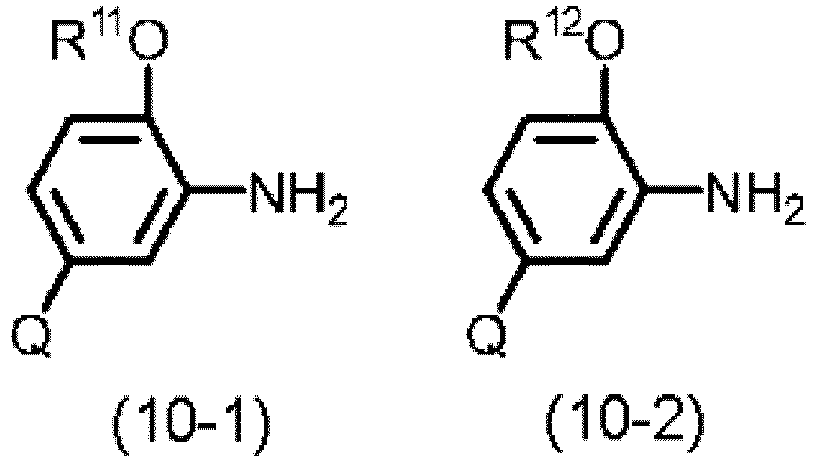


- Subsequently, the compound (1 equivalent) represented by the above formula (13-1), the compound (1 equivalent) represented by the above formula (13-2), and a cyanuric halide (such as cyanuric chloride, 1 equivalent) are condensed at a reaction temperature of 15 to 45°C and at pH 5 to 8 to obtain a compound represented by the following formula (14). It should be noted that one of the compounds (1 equivalent) represented by the above formula (13-1) and the compound (1 equivalent) represented by the above formula (13-2) may be reacted with a cyanuric halide (1 equivalent), and then the resulting reaction product may further be reacted with the other compound.

- Subsequently, the compound represented by the above formula (14) and a compound represented by a formula H-A1 are reacted at a reaction temperature of 55 to 95°C and at pH 6 to 9 to cause a de-HCl reaction. This can lead to production of the compound represented by the above formula (1).
- In the above formula (2), each Q21 to Q24 independently represents a halogen atom. Halogen atoms include a fluorine atom, a chlorine atom, a bromine atom, and an iodine atom. Among these, a fluorine atom or a chlorine atom is preferred, and a chlorine atom is more preferred.
- In the above formula (2), each R21 to R24 independently represents an alkyl group substituted with an ionic hydrophilic group. The carbon number of an alkyl group moiety is usually 1 to 4, preferably 1 to 3, and more preferably 3. Ionic hydrophilic groups include a group selected from a sulfo group, a carboxy group, a phospho group, and a quaternary ammonium group. Among these, preferred is a group selected from a sulfo group, a carboxy group, and a phospho group. More preferred is a group selected from a sulfo group and a carboxy group. Even more preferred is a sulfo group. There is no particular limitation for the number of substitutions in an ionic hydrophilic group, but it is usually 1 to 5, preferably 1 to 4, more preferably 1 to 3, even more preferably 1 or 2, and in particular preferably 1.
- Specific examples of an alkyl group substituted with an ionic hydrophilic group include, for example, a sulfomethyl group, a sulfoethyl group, a 2,3-disulfopropyl group, a 3-sulfopropyl group, a 4-sulfobutyl group, a 5-sulfopentyl group, a 6-sulfohexyl group, a 7-sulfoheptyl group, an 8-sulfooctyl group, a carboxymethyl group, a carboxyethyl group, a 3-carboxypropyl group, a 4-carboxybutyl group, a 5-carboxypentyl group, a 6-carboxyhexyl group, a 7-carboxyheptyl group, an 8-carboxyoctyl group, a phosphomethyl group, a phosphoethyl group, a 3-phosphopropyl group, a 4-phosphobutyl group, a 5-phosphopentyl group, a 6-phosphohexyl group, a 7-phosphoheptyl group, an 8-phosphooctyl group, a trimethylammoniummethyl group, a trimethylammoniumethyl group, a 3-trimethylammoniumpropyl group, a 4-trimethylammoniumbutyl group, a 5-trimethylammoniumpentyl group, a 6-trimethylammoniumhexyl group, a 7-trimethylammoniumheptyl group, an 8-trimethylammoniumoctyl group, a 2-methyl-3-sulfopropyl group, a 2,2-dimethyl-3-sulfopropyl group, a 4-sulfocyclohexyl group, a 2,5-disulfocyclohexylmethyl group and the like. Preferred is a 3-sulfopropyl group.
- In the above formula (2), A2 represents a divalent group. Divalent groups include, for example, an alkylenediamino group, a nitrogen-containing heterocyclic group, an arylenediamino group, an aminoalkylthio group, and an aminoarylthio group. Among these, preferred are an alkylenediamino group and a nitrogen-containing heterocyclic group. More preferred is a nitrogen-containing heterocyclic group.
- Alkylenediamino groups include a group having a linear, branched, or cyclic alkylene moiety. The alkylene moiety is preferably linear or branched, more preferably linear. The carbon number of the alkylene moiety is usually 2 to 12, preferably 2 to 8, more preferably 2 to 6, and even more preferably 2 to 4. Specific examples of the alkylenediamino group include, for example, 1,2-ethylenediamino, 1,2-propylenediamino, 1,3-propylenediamino, 1,2-butylenediamino, 1,4-butylenediamino, 1,2-pentylenediamino, 1,5-pentylenediamino, 1,2-hexylenediamino, 1,6-hexylenediamino, 2-methyl-1,3-propylenediamino, 1,2-cyclopentylenediamino, 1,2-cyclohexylenediamine, 1,4-piperazinyl and the like. Among these, 1,4-piperazinyl is preferred.
- Nitrogen-containing heterocyclic groups include a nitrogen-containing heterocyclic group of a 4- to 9-membered ring (preferably a 5- to 7-membered ring, more preferably a 5- or 6-membered ring, and even more preferably a 6-membered ring) having two nitrogen atoms as ring atoms. Specific examples of the nitrogen-containing heterocyclic group include, for example, 1,2-diazetidine, pyrazolidine, hexahydropyridazine, hexahydropyrimidine, piperazine, 1,2-diazepane, 1,3-diazepane, 1,4-diazepane, 1,2-diazocane, 1,4-diazocane, and 1,4-diazonane. Among these, piperazine (in particular 1,4-piperazinediyl) is preferred.
- Arylenediamino groups include an arylenediamino group usually having 6 to 14 carbon atoms, preferably 6 to 10 carbon atoms, and more preferably 6 carbon atoms. Specific examples of the arylenediamino group include, for example, 1,2-phenylenediamino, 1,3-phenylenediamino, 1,4-phenylenediamino, 1,8-naphthylenediamino, 2,8-naphthylenediamino and the like.
- Aminoalkylthio groups include a group having a linear, branched, or cyclic alkyl moiety. The carbon number of the alkyl moiety is usually 2 to 12, preferably 2 to 8, more preferably 2 to 6, and even more preferably 2 to 4. Specific examples of the aminoalkylthio group include, for example, aminoethylthio, aminopropylthio, aminobutylthio, aminopentylthio, aminohexylthio, 3-amino-2-methylpropane-1-thio, 2-aminocyclohexane-1-thio and the like.
- Aminoarylthio groups include an aminoarylthio group usually having 6 to 14 carbon atoms, preferably 6 to 10 carbon atoms, more preferably 6 carbon atoms. Specific examples of the aminoarylthio group include, for example, 2-aminophenylthio, 4-aminophenylthio, 8-aminonaphthyl-2-thio and the like.
- Further, A2 may usually have 1 to 5 substituents, preferably 1 to 4 substituents, more preferably 1 to 3 substituents, even more preferably 1 or 2 substituents, and in particular preferably 1 substituent. There is no particular limitation for the substituents, but examples include a halogen atom, an alkyl group, an aralkyl group, an alkenyl group, an alkynyl group, an alkoxy group, an aryl group, a heterocyclic group, a cyano group, a hydroxy group, a nitro group, an aryloxy group, a silyloxy group, and a heterocyclic oxy group, an acyloxy group, a carbamoyloxy group, an alkoxycarbonyloxy group, an aryloxycarbonyloxy group, an amino group, an acylamino group, an aminocarbonylamino group, an alkoxycarbonylamino group, an aryloxycarbonylamino group, a sulfamoylamino group, an alkyl- or arylsulfonylamino group, a mercapto group, an alkylthio group, an arylthio group, a heterocyclic thio group, a sulfamoyl group, an alkyl- or arylsulfinyl group, an alkyl- or arylsulfonyl group, an acyl group, an aryloxycarbonyl group, an alkoxycarbonyl group, a carbamoyl group and the like.
- A preferred compound among the compounds represented by the above formula (2) is one represented by the above formula (2-1). In the above formula (2-1), Q21 to Q24 and A2 have the same meanings as defined in the above formula (2), including those preferred and the like. In the above formula (2-1), each x independently represents an integer of 2 to 4, and preferably 3.
- Specific examples of the compound represented by the above formula (2) are shown in Tables 40 to 46 below. However, the present invention shall not be limited to these specific examples. Abbreviations in Tables 40 to 46 have the following meanings.
- SMe: sulfomethyl (*-CH2-SO3H)
- 2-SEt: 2-sulfoethyl (*-CH2CH2-SO3H)
- 3-SnPr: 3-sulfo-n-propyl (*-CH2CH2CH2-SO3H)
- 4-SnBu: 3-sulfo-n-butyl (*-CH2CH2CH2CH2-SO3H)
- The symbol "*" in the above formulae indicates a position of attachment to the oxygen atom.
- Further, the formulae (A2-1) to (A2-5) indicated in the "A2" columns in Tables 40 to 46 are represented by the following formulae, respectively. The symbol "*" in the following formulae indicates a position of attachment to the triazine ring.

[Table 40] No. Q21 Q22 Q23 Q24 R21 R22 R23 R24 A2 1 Cl Cl Cl Cl SMe SMe SMe SMe Formula (A2-1), n= 2, Z= NH 2 Cl Cl Cl Cl SMe 2-SEt SMe 2-SEt Formula (A2-1), n= 2, Z= NH 3 Cl Cl Cl Cl SMe 3-SnPr SMe 3-SnPr Formula (A2-1), n= 2, Z= NH 4 Cl Cl Cl Cl SMe 4-SnBu SMe 4-SnBu Formula (A2-1), n= 2, Z= NH 5 Cl Cl Cl Cl 2-SEt 2-SEt 2-SEt 2-SEt Formula (A2-1), n= 2, Z= NH 6 Cl Cl Cl Cl 2-SEt 3-SnPr 2-SEt 3-SnPr Formula (A2-1), n= 2, Z= NH 7 Cl Cl Cl Cl 2-SEt 4-SnBu 2-SEt 4-SnBu Formula (A2-1), n= 2, Z= NH 8 Cl Cl Cl Cl 3-SnPr 3-SnPr 3-SnPr 3-SnPr Formula (A2-1), n= 2, Z= NH 9 Cl Cl Cl Cl 3-SnPr 4-SnBu 3-SnPr 4-SnBu Formula (A2-1), n= 2, Z= NH 10 Cl Cl Cl Cl 4-SnBu 4-SnBu 4-SnBu 4-SnBu Formula (A2-1), n= 2, Z= NH 11 Cl Cl Cl Cl SMe SMe SMe SMe Formula (A2-1), n= 2, Z= S 12 Cl Cl Cl Cl SMe 2-SEt SMe 2-SEt Formula (A2-1), n= 2, Z= S 13 Cl Cl Cl Cl SMe 3-SnPr SMe 3-SnPr Formula (A2-1), n= 2, Z= S 14 Cl Cl Cl Cl SMe 4-SnBu SMe 4-SnBu Formula (A2-1), n= 2, Z= S 15 Cl Cl Cl Cl 2-SEt 2-SEt 2-SEt 2-SEt Formula (A2-1), n= 2, Z= S 16 Cl Cl Cl Cl 2-SEt 3-SnPr 2-SEt 3-SnPr Formula (A2-1), n= 2, Z= S 17 Cl Cl Cl Cl 2-SEt 4-SnBu 2-SEt 4-SnBu Formula (A2-1), n= 2, Z= S 18 Cl Cl Cl Cl 3-SnPr 3-SnPr 3-SnPr 3-SnPr Formula (A2-1), n= 2, Z= S 19 Cl Cl Cl Cl 3-SnPr 4-SnBu 3-SnPr 4-SnBu Formula (A2-1), n= 2, Z= S 20 Cl Cl Cl Cl 4-SnBu 4-SnBu 4-SnBu 4-SnBu Formula (A2-1), n= 2, Z= S 21 Cl Cl Cl Cl SMe SMe SMe SMe Formula (A2-1), n= 3, Z= NH 22 Cl Cl Cl Cl SMe 2-SEt SMe 2-SEt Formula (A2-1), n= 3, Z= NH 23 Cl Cl Cl Cl SMe 3-SnPr SMe 3-SnPr Formula (A2-1), n= 3, Z= NH 24 Cl Cl Cl Cl SMe 4-SnBu SMe 4-SnBu Formula (A2-1), n= 3, Z= NH 25 Cl Cl Cl Cl 2-SEt 2-SEt 2-SEt 2-SEt Formula (A2-1), n= 3, Z= NH 26 Cl Cl Cl Cl 2-SEt 3-SnPr 2-SEt 3-SnPr Formula (A2-1), n= 3, Z= NH 27 Cl Cl Cl Cl 2-SEt 4-SnBu 2-SEt 4-SnBu Formula (A2-1), n= 3, Z= NH 28 Cl Cl Cl Cl 3-SnPr 3-SnPr 3-SnPr 3-SnPr Formula (A2-1), n= 3, Z= NH 29 Cl Cl Cl Cl 3-SnPr 4-SnBu 3-SnPr 4-SnBu Formula (A2-1), n= 3, Z= NH 30 Cl Cl Cl Cl 4-SnBu 4-SnBu 4-SnBu 4-SnBu Formula (A2-1), n= 3, Z= NH [Table 41] No. Q21 Q22 Q23 Q24 R21 R22 R23 R24 A2 31 Cl Cl Cl Cl SMe SMe SMe SMe Formula (A2-1), n= 3, Z= S 32 Cl Cl Cl Cl SMe 2-SEt SMe 2-SEt Formula (A2-1), n= 3, Z= S 33 Cl Cl Cl Cl SMe 3-SnPr SMe 3-SnPr Formula (A2-1), n= 3, Z= S 34 Cl Cl Cl Cl SMe 4-SnBu SMe 4-SnBu Formula (A2-1), n= 3, Z= S 35 Cl Cl Cl Cl 2-SEt 2-SEt 2-SEt 2-SEt Formula (A2-1), n= 3, Z= S 36 Cl Cl Cl Cl 2-SEt 3-SnPr 2-SEt 3-SnPr Formula (A2-1), n= 3, Z= S 37 Cl Cl Cl Cl 2-SEt 4-SnBu 2-SEt 4-SnBu Formula (A2-1), n= 3, Z= S 38 Cl Cl Cl Cl 3-SnPr 3-SnPr 3-SnPr 3-SnPr Formula (A2-1), n= 3, Z= S 39 Cl Cl Cl Cl 3-SnPr 4-SnBu 3-SnPr 4-SnBu Formula (A2-1), n= 3, Z= S 40 Cl Cl Cl Cl 4-SnBu 4-SnBu 4-SnBu 4-SnBu Formula (A2-1), n= 3, Z= S 41 Cl Cl Cl Cl SMe SMe SMe SMe Formula (A2-2) 42 Cl Cl Cl Cl SMe 2-SEt SMe 2-SEt Formula (A2-2) 43 Cl Cl Cl Cl SMe 3-SnPr SMe 3-SnPr Formula (A2-2) 44 Cl Cl Cl Cl SMe 4-SnBu SMe 4-SnBu Formula (A2-2) 45 Cl Cl Cl Cl 2-SEt 2-SEt 2-SEt 2-SEt Formula (A2-2) 46 Cl Cl Cl Cl 2-SEt 3-SnPr 2-SEt 3-SnPr Formula (A2-2) 47 Cl Cl Cl Cl 2-SEt 4-SnBu 2-SEt 4-SnBu Formula (A2-2) 48 Cl Cl Cl Cl 3-SnPr 3-SnPr 3-SnPr 3-SnPr Formula (A2-2) 49 Cl Cl Cl Cl 3-SnPr 4-SnBu 3-SnPr 4-SnBu Formula (A2-2) 50 Cl Cl Cl Cl 4-SnBu 4-SnBu 4-SnBu 4-SnBu Formula (A2-2) 51 Cl Cl Cl Cl SMe SMe SMe SMe Formula (A2-3), Z= NH 52 Cl Cl Cl Cl SMe 2-SEt SMe 2-SEt Formula (A2-3), Z= NH 53 Cl Cl Cl Cl SMe 3-SnPr SMe 3-SnPr Formula (A2-3), Z= NH 54 Cl Cl Cl Cl SMe 4-SnBu SMe 4-SnBu Formula (A2-3), Z= NH 55 Cl Cl Cl Cl 2-SEt 2-SEt 2-SEt 2-SEt Formula (A2-3), Z= NH 56 Cl Cl Cl Cl 2-SEt 3-SnPr 2-SEt 3-SnPr Formula (A2-3), Z= NH 57 Cl Cl Cl Cl 2-SEt 4-SnBu 2-SEt 4-SnBu Formula (A2-3), Z= NH 58 Cl Cl Cl Cl 3-SnPr 3-SnPr 3-SnPr 3-SnPr Formula (A2-3), Z= NH 59 Cl Cl Cl Cl 3-SnPr 4-SnBu 3-SnPr 4-SnBu Formula (A2-3), Z= NH 60 Cl Cl Cl Cl 4-SnBu 4-SnBu 4-SnBu 4-SnBu Formula (A2-3), Z= NH [Table 42] No. Q21 Q22 Q23 Q24 R21 R22 R23 R24 A2 61 Cl Cl Cl Cl SMe SMe SMe SMe Formula (A2-3), Z= S 62 Cl Cl Cl Cl SMe 2-SEt SMe 2-SEt Formula (A2-3), Z= S 63 Cl Cl Cl Cl SMe 3-SnPr SMe 3-SnPr Formula (A2-3), Z= S 64 Cl Cl Cl Cl SMe 4-SnBu SMe 4-SnBu Formula (A2-3), Z= S 65 Cl Cl Cl Cl 2-SEt 2-SEt 2-SEt 2-SEt Formula (A2-3), Z= S 66 Cl Cl Cl Cl 2-SEt 3-SnPr 2-SEt 3-SnPr Formula (A2-3), Z= S 67 Cl Cl Cl Cl 2-SEt 4-SnBu 2-SEt 4-SnBu Formula (A2-3), Z= S 68 Cl Cl Cl Cl 3-SnPr 3-SnPr 3-SnPr 3-SnPr Formula (A2-3), Z= S 69 Cl Cl Cl Cl 3-SnPr 4-SnBu 3-SnPr 4-SnBu Formula (A2-3), Z= S 70 Cl Cl Cl Cl 4-SnBu 4-SnBu 4-SnBu 4-SnBu Formula (A2-3), Z= S 71 Cl Cl Cl Cl SMe SMe SMe SMe Formula (A2-4), Z= NH 72 Cl Cl Cl Cl SMe 2-SEt SMe 2-SEt Formula (A2-4), Z= NH 73 Cl Cl Cl Cl SMe 3-SnPr SMe 3-SnPr Formula (A2-4), Z= NH 74 Cl Cl Cl Cl SMe 4-SnBu SMe 4-SnBu Formula (A2-4), Z= NH 75 Cl Cl Cl Cl 2-SEt 2-SEt 2-SEt 2-SEt Formula (A2-4), Z= NH 76 Cl Cl Cl Cl 2-SEt 3-SnPr 2-SEt 3-SnPr Formula (A2-4), Z= NH 77 Cl Cl Cl Cl 2-SEt 4-SnBu 2-SEt 4-SnBu Formula (A2-4), Z= NH 78 Cl Cl Cl Cl 3-SnPr 3-SnPr 3-SnPr 3-SnPr Formula (A2-4), Z= NH 79 Cl Cl Cl Cl 3-SnPr 4-SnBu 3-SnPr 4-SnBu Formula (A2-4), Z= NH 80 Cl Cl Cl Cl 4-SnBu 4-SnBu 4-SnBu 4-SnBu Formula (A2-4), Z= NH 81 Cl Cl Cl Cl SMe SMe SMe SMe Formula (A2-4), Z= S 82 Cl Cl Cl Cl SMe 2-SEt SMe 2-SEt Formula (A2-4), Z= S 83 Cl Cl Cl Cl SMe 3-SnPr SMe 3-SnPr Formula (A2-4), Z= S 84 Cl Cl Cl Cl SMe 4-SnBu SMe 4-SnBu Formula (A2-4), Z= S 85 Cl Cl Cl Cl 2-SEt 2-SEt 2-SEt 2-SEt Formula (A2-4), Z= S 86 Cl Cl Cl Cl 2-SEt 3-SnPr 2-SEt 3-SnPr Formula (A2-4), Z= S 87 Cl Cl Cl Cl 2-SEt 4-SnBu 2-SEt 4-SnBu Formula (A2-4), Z= S 88 Cl Cl Cl Cl 3-SnPr 3-SnPr 3-SnPr 3-SnPr Formula (A2-4), Z= S 89 Cl Cl Cl Cl 3-SnPr 4-SnBu 3-SnPr 4-SnBu Formula (A2-4), Z= S 90 Cl Cl Cl Cl 4-SnBu 4-SnBu 4-SnBu 4-SnBu Formula (A2-4), Z= S [Table 43] No. Q21 Q22 Q23 Q24 R21 R22 R23 R24 A2 91 Cl Cl Cl Cl SMe SMe SMe SMe Formula (A2-5), Z= NH 92 Cl Cl Cl Cl SMe 2-SEt SMe 2-SEt Formula (A2-5), Z= NH 93 Cl Cl Cl Cl SMe 3-SnPr SMe 3-SnPr Formula (A2-5), Z= NH 94 Cl Cl Cl Cl SMe 4-SnBu SMe 4-SnBu Formula (A2-5), Z= NH 95 Cl Cl Cl Cl 2-SEt 2-SEt 2-SEt 2-SEt Formula (A2-5), Z= NH 96 Cl Cl Cl Cl 2-SEt 3-SnPr 2-SEt 3-SnPr Formula (A2-5), Z= NH 97 Cl Cl Cl Cl 2-SEt 4-SnBu 2-SEt 4-SnBu Formula (A2-5), Z= NH 98 Cl Cl Cl Cl 3-SnPr 3-SnPr 3-SnPr 3-SnPr Formula (A2-5), Z= NH 99 Cl Cl Cl Cl 3-SnPr 4-SnBu 3-SnPr 4-SnBu Formula (A2-5), Z= NH 100 Cl Cl Cl Cl 4-SnBu 4-SnBu 4-SnBu 4-SnBu Formula (A2-5), Z= NH 101 Cl Cl Cl Cl SMe SMe SMe SMe Formula (A2-5), Z= S 102 Cl Cl Cl Cl SMe 2-SEt SMe 2-SEt Formula (A2-5), Z= S 103 Cl Cl Cl Cl SMe 3-SnPr SMe 3-SnPr Formula (A2-5), Z= S 104 Cl Cl Cl Cl SMe 4-SnBu SMe 4-SnBu Formula (A2-5), Z= S 105 Cl Cl Cl Cl 2-SEt 2-SEt 2-SEt 2-SEt Formula (A2-5), Z= S 106 Cl Cl Cl Cl 2-SEt 3-SnPr 2-SEt 3-SnPr Formula (A2-5), Z= S 107 Cl Cl Cl Cl 2-SEt 4-SnBu 2-SEt 4-SnBu Formula (A2-5), Z= S 108 Cl Cl Cl Cl 3-SnPr 3-SnPr 3-SnPr 3-SnPr Formula (A2-5), Z= S 109 Cl Cl Cl Cl 3-SnPr 4-SnBu 3-SnPr 4-SnBu Formula (A2-5), Z= S 110 Cl Cl Cl Cl 4-SnBu 4-SnBu 4-SnBu 4-SnBu Formula (A2-5), Z= S 111 Cl Cl F F SMe SMe SMe SMe Formula (A2-2) 112 Cl Cl F F SMe 2-SEt SMe 2-SEt Formula (A2-2) 113 Cl Cl F F SMe 3-SnPr SMe 3-SnPr Formula (A2-2) 114 Cl Cl F F SMe 4-SnBu SMe 4-SnBu Formula (A2-2) 115 Cl Cl F F 2-SEt 2-SEt 2-SEt 2-SEt Formula (A2-2) 116 Cl Cl F F 2-SEt 3-SnPr 2-SEt 3-SnPr Formula (A2-2) 117 Cl Cl F F 2-SEt 4-SnBu 2-SEt 4-SnBu Formula (A2-2) 118 Cl Cl F F 3-SnPr 3-SnPr 3-SnPr 3-SnPr Formula (A2-2) 119 Cl Cl F F 3-SnPr 4-SnBu 3-SnPr 4-SnBu Formula (A2-2) 120 Cl Cl F F 4-SnBu 4-SnBu 4-SnBu 4-SnBu Formula (A2-2) [Table 44] No. Q21 Q22 Q23 Q24 R21 R22 R23 R24 A2 121 Cl F Cl F SMe SMe SMe SMe Formula (A2-2) 122 Cl F Cl F SMe 2-SEt SMe 2-SEt Formula (A2-2) 123 Cl F Cl F SMe 3-SnPr SMe 3-SnPr Formula (A2-2) 124 Cl F Cl F SMe 4-SnBu SMe 4-SnBu Formula (A2-2) 125 Cl F Cl F 2-SEt 2-SEt 2-SEt 2-SEt Formula (A2-2) 126 Cl F Cl F 2-SEt 3-SnPr 2-SEt 3-SnPr Formula (A2-2) 127 Cl F Cl F 2-SEt 4-SnBu 2-SEt 4-SnBu Formula (A2-2) 128 Cl F Cl F 3-SnPr 3-SnPr 3-SnPr 3-SnPr Formula (A2-2) 129 Cl F Cl F 3-SnPr 4-SnBu 3-SnPr 4-SnBu Formula (A2-2) 130 Cl F Cl F 4-SnBu 4-SnBu 4-SnBu 4-SnBu Formula (A2-2) 131 Cl Cl Br Br SMe SMe SMe SMe Formula (A2-2) 132 Cl Cl Br Br SMe 2-SEt SMe 2-SEt Formula (A2-2) 133 Cl Cl Br Br SMe 3-SnPr SMe 3-SnPr Formula (A2-2) 134 Cl Cl Br Br SMe 4-SnBu SMe 4-SnBu Formula (A2-2) 135 Cl Cl Br Br 2-SEt 2-SEt 2-SEt 2-SEt Formula (A2-2) 136 Cl Cl Br Br 2-SEt 3-SnPr 2-SEt 3-SnPr Formula (A2-2) 137 Cl Cl Br Br 2-SEt 4-SnBu 2-SEt 4-SnBu Formula (A2-2) 138 Cl Cl Br Br 3-SnPr 3-SnPr 3-SnPr 3-SnPr Formula (A2-2) 139 Cl Cl Br Br 3-SnPr 4-SnBu 3-SnPr 4-SnBu Formula (A2-2) 140 Cl Cl Br Br 4-SnBu 4-SnBu 4-SnBu 4-SnBu Formula (A2-2) 141 Cl Br Cl Br SMe SMe SMe SMe Formula (A2-2) 142 Cl Br Cl Br SMe 2-SEt SMe 2-SEt Formula (A2-2) 143 Cl Br Cl Br SMe 3-SnPr SMe 3-SnPr Formula (A2-2) 144 Cl Br Cl Br SMe 4-SnBu SMe 4-SnBu Formula (A2-2) 145 Cl Br Cl Br 2-SEt 2-SEt 2-SEt 2-SEt Formula (A2-2) 146 Cl Br Cl Br 2-SEt 3-SnPr 2-SEt 3-SnPr Formula (A2-2) 147 Cl Br Cl Br 2-SEt 4-SnBu 2-SEt 4-SnBu Formula (A2-2) 148 Cl Br Cl Br 3-SnPr 3-SnPr 3-SnPr 3-SnPr Formula (A2-2) 149 Cl Br Cl Br 3-SnPr 4-SnBu 3-SnPr 4-SnBu Formula (A2-2) 150 Cl Br Cl Br 4-SnBu 4-SnBu 4-SnBu 4-SnBu Formula (A2-2) [Table 45] No. Q21 Q22 Q23 Q24 R21 R22 R23 R24 A2 151 F F Br Br SMe SMe SMe SMe Formula (A2-2) 152 F F Br Br SMe 2-SEt SMe 2-SEt Formula (A2-2) 153 F F Br Br SMe 3-SnPr SMe 3-SnPr Formula (A2-2) 154 F F Br Br SMe 4-SnBu SMe 4-SnBu Formula (A2-2) 155 F F Br Br 2-SEt 2-SEt 2-SEt 2-SEt Formula (A2-2) 156 F F Br Br 2-SEt 3-SnPr 2-SEt 3-SnPr Formula (A2-2) 157 F F Br Br 2-SEt 4-SnBu 2-SEt 4-SnBu Formula (A2-2) 158 F F Br Br 3-SnPr 3-SnPr 3-SnPr 3-SnPr Formula (A2-2) 159 F F Br Br 3-SnPr 4-SnBu 3-SnPr 4-SnBu Formula (A2-2) 160 F F Br Br 4-SnBu 4-SnBu 4-SnBu 4-SnBu Formula (A2-2) 161 F Br F Br SMe SMe SMe SMe Formula (A2-2) 162 F Br F Br SMe 2-SEt SMe 2-SEt Formula (A2-2) 163 F Br F Br SMe 3-SnPr SMe 3-SnPr Formula (A2-2) 164 F Br F Br SMe 4-SnBu SMe 4-SnBu Formula (A2-2) 165 F Br F Br 2-SEt 2-SEt 2-SEt 2-SEt Formula (A2-2) 166 F Br F Br 2-SEt 3-SnPr 2-SEt 3-SnPr Formula (A2-2) 167 F Br F Br 2-SEt 4-SnBu 2-SEt 4-SnBu Formula (A2-2) 168 F Br F Br 3-SnPr 3-SnPr 3-SnPr 3-SnPr Formula (A2-2) 169 F Br F Br 3-SnPr 4-SnBu 3-SnPr 4-SnBu Formula (A2-2) 170 F Br F Br 4-SnBu 4-SnBu 4-SnBu 4-SnBu Formula (A2-2) 171 F F F F SMe SMe SMe SMe Formula (A2-2) 172 F F F F SMe 2-SEt SMe 2-SEt Formula (A2-2) 173 F F F F SMe 3-SnPr SMe 3-SnPr Formula (A2-2) 174 F F F F SMe 4-SnBu SMe 4-SnBu Formula (A2-2) 175 F F F F 2-SEt 2-SEt 2-SEt 2-SEt Formula (A2-2) 176 F F F F 2-SEt 3-SnPr 2-SEt 3-SnPr Formula (A2-2) 177 F F F F 2-SEt 4-SnBu 2-SEt 4-SnBu Formula (A2-2) 178 F F F F 3-SnPr 3-SnPr 3-SnPr 3-SnPr Formula (A2-2) 179 F F F F 3-SnPr 4-SnBu 3-SnPr 4-SnBu Formula (A2-2) 180 F F F F 4-SnBu 4-SnBu 4-SnBu 4-SnBu Formula (A2-2) [Table 46] No. Q21 Q22 Q23 Q24 R21 R22 R23 R24 A2 181 Br Br Br Br SMe SMe SMe SMe Formula (A2-2) 182 Br Br Br Br SMe 2-SEt SMe 2-SEt Formula (A2-2) 183 Br Br Br Br SMe 3-SnPr SMe 3-SnPr Formula (A2-2) 184 Br Br Br Br SMe 4-SnBu SMe 4-SnBu Formula (A2-2) 185 Br Br Br Br 2-SEt 2-SEt 2-SEt 2-SEt Formula (A2-2) 186 Br Br Br Br 2-SEt 3-SnPr 2-SEt 3-SnPr Formula (A2-2) 187 Br Br Br Br 2-SEt 4-SnBu 2-SEt 4-SnBu Formula (A2-2) 188 Br Br Br Br 3-SnPr 3-SnPr 3-SnPr 3-SnPr Formula (A2-2) 189 Br Br Br Br 3-SnPr 4-SnBu 3-SnPr 4-SnBu Formula (A2-2) 190 Br Br Br Br 4-SnBu 4-SnBu 4-SnBu 4-SnBu Formula (A2-2) 191 F F Cl Cl 3-SnPr 3-SnPr 3-SnPr 3-SnPr Formula (A2-1), n= 2, Z= NH 192 F F Cl Cl 3-SnPr 3-SnPr 3-SnPr 3-SnPr Formula (A2-1), n= 2, Z= S 193 F F Cl Cl 3-SnPr 3-SnPr 3-SnPr 3-SnPr Formula (A2-1), n= 3, Z= NH 194 F F Cl Cl 3-SnPr 3-SnPr 3-SnPr 3-SnPr Formula (A2-1), n= 3, Z= S 195 F F Cl Cl 3-SnPr 3-SnPr 3-SnPr 3-SnPr Formula (A2-3), Z= NH 196 F F Cl Cl 3-SnPr 3-SnPr 3-SnPr 3-SnPr Formula (A2-3), Z= S 197 F F Cl Cl 3-SnPr 3-SnPr 3-SnPr 3-SnPr Formula (A2-4), Z= NH 198 F F Cl Cl 3-SnPr 3-SnPr 3-SnPr 3-SnPr Formula (A2-4), Z= S 199 F F Cl Cl 3-SnPr 3-SnPr 3-SnPr 3-SnPr Formula (A2-5), Z= NH 200 F F Cl Cl 3-SnPr 3-SnPr 3-SnPr 3-SnPr Formula (A2-5), Z= S - Preferred compounds represented by the above formula (2) include, for example, one in which in the above formula (2-1), Q21 to Q24 are chlorine atoms, x is 3, and A2 is a 1,4-piperazinediyl group.
- With regard to all components and items described above, combinations of those preferred are more preferred, and combinations of those more preferred are even more preferred. The same applies to combinations of those preferred and those more preferred and the like.
- The compound represented by the above formula (2) can be manufactured as follows. It should be noted that Q21 to Q24, R21 to R24, and A2 which may be used appropriately in the following formulae (20-1) to (24) each have the same meanings as defined in the above formula (2).
- First, a compound represented by the following formula (20-1) obtained in accordance with the method described in Japanese Unexamined Patent Application Publication No.
2004-75719 


- Subsequently, the compound (1 equivalent) represented by the above formula (23-1), the compound (1 equivalent) represented by the above formula (23-2), and a cyanuric halide (such as cyanuric chloride, 1 equivalent) are condensed at a reaction temperature of 15 to 45°C and at pH 5 to 8 to obtain a compound represented by the following formula (24-1). It should be noted that one of the compounds (1 equivalent) represented by the above formula (23-1) and the compound (1 equivalent) represented by the above formula (23-2) may be reacted with a cyanuric halide (1 equivalent), and then the resulting reaction product may further be reacted with the other compound. Further, a compound represented by the following formula (24-2) is obtained as described above except that compounds represented by the above formulae (23-3) and (23-4) are used instead of the compounds represented by the above formulae (23-1) and (23-2).


- Subsequently, the compound (1 equivalent) represented by the above formula (24-1), the compound (1 equivalent) represented by the above formula (24-2), and a compound represented by a formula H-A2-H may be reacted at a reaction temperature of 55 to 95°C and at pH 6 to 9 to cause a de-HCl reaction. This can lead to production of the compound represented by the above formula (2). It should be noted that one of the compounds (1 equivalent) represented by the above formula (24-1) and the compound (1 equivalent) represented by the above formula (24-2) may be reacted with the compound represented by the formula H-A2-H, and then the resulting reaction product may further be reacted with the other compound.
- Salts of the compound represented by the above formula (1) or (2) include salts with inorganic or organic cations. Specific examples of salts with inorganic cations include alkali metal salts such as lithium salts, sodium salts, and potassium salts; ammonium salts; and the like. Specific examples of organic cations include, but are not limited to, for example, quaternary ammonium represented by the following formula (3)
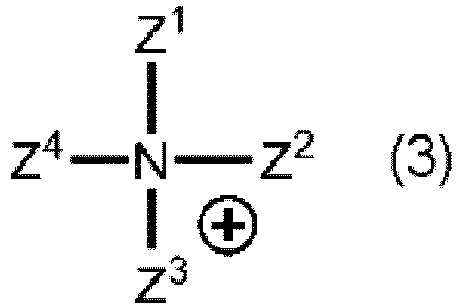
- In the above formula (3), each Z1 to Z4 independently represents a hydrogen atom, a C1-C4 alkyl group, a hydroxy C1-C4 alkyl group, or a hydroxy C1-C4 alkoxy C1-C4 alkyl group, and at least one of Z1 to Z4 is a group other than a hydrogen atom.
- Specific examples of the C1-C4 alkyl group in Z1 to Z4 include a methyl group, an ethyl group and the like. Similarly, specific examples of the hydroxy C1-C4 alkyl group include a hydroxymethyl group, a hydroxyethyl group, a 3-hydroxypropyl group, a 2-hydroxypropyl group, a 4-hydroxybutyl group, a 3-hydroxybutyl group, a 2-hydroxybutyl group and the like. Similarly, specific examples of the hydroxy C1-C4 alkoxy C1-C4 alkyl group include a hydroxyethoxymethyl group, a 2-hydroxyethoxyethyl group, a 3-(hydroxyethoxy)propyl group, a 3-(hydroxyethoxy)butyl group, a 2-(hydroxyethoxy)butyl group and the like.
- Among the above salts, preferred are alkali metal salts such as sodium salts, potassium salts, lithium salts; organic quaternary ammonium salts such as monoethanolamine salts, diethanolamine salts, triethanolamine salts, monoisopropanolamine salts, diisopropanolamine salts, triisopropanolamine salts; ammonium salts; and the like. More preferred are lithium salts, sodium salts, and ammonium salts. It is generally known that a salt of a compound may be responsible for varied physical properties such as solubility and/or varied ink performances when used in an ink, depending on the type of the salt. Therefore, the type of a salt may also be preferably selected according to the target ink performance and the like. A salt of the compound represented by the above formula (1) or (2) may be any of a single salt; a mixture of a plurality of salts; a mixture of a free acid and a single or a plurality of salts; and the like.
- The compound represented by the above formula (1) or (2) may be able to take various isomeric structures such as tautomers, geometrical isomers, optical isomers, and structural isomers. If that is the case, the compound represented by the above formula (1) or (2) can be used in any of these structures or under a condition where two or more of these structures are co-presented. The term "tautomer" refers to one of a set of two or more generally known isomers for one compound which can readily undergo interconversion from one to another. The term "geometrical isomer" refers to, for example, a type of generally known stereoisomers, and refers to cis-trans isomers in the case of an organic compound. The term "optical isomer" refers to, for example, a type of generally known stereoisomers, and refers to a substance having different orientations of a rotatory polarization, including a left-handed enantiomer, a right-handed enantiomer, and a racemic compound. The term "structural isomer" refers to, for example, a type of generally known isomers, and refers to a molecule having the same composition formula but a different inter-atomic bonding pattern.
- The ink according to the present invention contains the compound represented by the above formula (1) or (2). The above ink can be prepared by dissolving the compound represented by the above formula (1) or (2) in an aqueous medium (water or a solution mixture of water and a water-soluble organic solvent), and adding an ink preparation agent, if desired.
- The ink may further include a known yellow coloring matter other than the compound represented by the above formula (1) or (2) for a purpose of finely adjusting the hue thereof in a range where the effects of the present invention are not impaired. The compound represented by the above formula (1) or (2) may also be used, for example, in combination with known coloring matters of magenta, cyan and the like for a purpose of preparing various color inks such as black, red, and green.
- When used as an ink-jet ink, the ink preferably has a smaller content of inorganic impurities. Inorganic impurities may be, for example, chlorides of metal cations (sodium chloride and the like), sulfates (sodium sulfate and the like) and the like. The total content of inorganic impurities may usually be 1% by mass or less relative to the total mass of the compound represented by the above formula (1) or (2), and the lower limit may be 0% by mass, i.e., less than or equal to the detection limit of a detector. Methods of reducing the content of inorganic impurities in a coloring matter include, for example, those involving purification of a coloring matter with reverse osmotic membrane, by crystallization, by suspension purification and the like.
- A water-soluble organic solvent may have the following effects of: dissolving a coloring matter; preventing a composition from drying (maintaining a wet condition); adjusting the viscosity of a composition; promoting permeation of a coloring matter into a recording medium; adjusting the surface tension of a compound; defoaming a compound; and the like. Therefore, the above ink preferably contains a water-soluble organic solvent.
- Examples of the above water-soluble organic solvent include, for example, C1-C4 alcohols such as methanol, ethanol, n-propanol, isopropanol, n-butanol, isobutanol, secondary butanol, tertiary butanol; amides such as N,N-dimethylformamide, N,N-dimethylacetamide; heterocyclic ketones such as 2-pyrrolidone, N-methyl-2-pyrrolidone, hydroxyethyl-2-pyrrolidone, 1,3-dimethylimidazolidin-2-one, 1,3-dimethylhexahydropyrimid-2-one; ketones or keto alcohols such as acetone, methyl ethyl ketone, 2-methyl-2-hydroxypentan-4-one; cyclic ethers such as tetrahydrofuran, dioxane; mono-, oligo- or polyalkylene glycol or thioglycol having a C2-C6 alkylene unit such as ethylene glycol, 1,2-propanediol, 1,3-propanediol, 2-methyl-1,3-propanediol, 1,2-butanediol, 1,4-butanediol, 1,2-pentanediol, 1,5-pentanediol, 1,2-hexandiol, 1,6-hexylene glycol, diethylene glycol, triethylene glycol, tetraethylene glycol, dipropylene glycol, polyethylene glycol, polypropylene glycol, thiodiglycol; polyols (preferably triols) such as trimethylolpropane, glycerin, hexane-1,2,6-triol; C1-C4 monoalkyl ethers of polyhydric alcohols such as ethylene glycol monomethyl ether, ethylene glycol monoethyl ether, diethylene glycol monomethyl ether, diethylene glycol monoethyl ether, diethylene glycol monobutyl ether (butylcarbitol), triethylene glycol monomethyl ether, triethylene glycol monoethyl ether; γ-butyrolactone; dimethyl sulfoxide; and the like.
- It should be noted that a substance, for example, trimethylolpropane and the like that is solid at ambient temperature is also contained in the above water-soluble organic solvent. That is, when an aqueous solution containing a substance that is solid at ambient temperature but is water soluble has similar characteristics to those of the water-soluble organic solvents, and therefore can be used with expectation of the same effects, that substance shall fall within the category of the water-soluble organic solvents. Such substances include, for example, solid polyhydric alcohols, saccharides, amino acids and the like.
- Ink preparation agents include, for example, known additives such as antiseptic and antifungal agents, pH adjusting agents, chelating reagents, rust-preventive agents, ultraviolet absorbing agents, viscosity adjusting agents, dye-dissolving agents, anti-fading agents, surface tension adjusting agents, defoaming agents and the like.
- Examples of the aforementioned antiseptic and antifungal agents include, for example, organic sulfur-based, organic nitrogen sulfur-based, organic halogen-based, haloallylsulfone-based, iodopropargyl-based, N-haloalkylthio-based, benzothiazole-based, nitrile-based, pyridine-based, 8-oxyquinoline-based, isothiazoline-based, dithiol-based, pyridinoxide-based, nitropropane-based, organic tin-based, phenol-based, quaternary ammonium salt-based, triazine-based, thiadiazine-based, anilide-based, adamantane-based, dithiocarbamate-based, brominated indanon-based, benzyl bromoacetate-based, inorganic salt-based compounds and the like. Examples of the organic halogen-based compound include, for example, sodium pentachlorophenol. Examples of the pyridinoxide-based compound include, for example, sodium 2-pyridinethiol-1-oxide. Examples of the isothiazoline-based compound include, for example, 1,2-benzisothiazolin-3-one, 2-n-octyl-4-isothiazolin-3-one, 5-chloro-2-methyl-4-isothiazolin-3-one, 5-chloro-2-methyl-4-isothiazolin-3-one magnesium chloride, 5-chloro-2-methyl-4-isothiazolin-3-one calcium chloride, 2-methyl-4-isothiazolin-3-one calcium chloride and the like. Other antiseptic and antifungal agents include sodium acetate, sodium sorbate, sodium benzoate, and Proxel™ series (Proxel™ GXL (S), Proxel™ XL-2 (S) and the like), which are product names and available from from Arch Chemicals, Inc.
- Any substance can be used as a pH adjusting agent as long as it can control the pH of an ink within the range between 6.0 and 11.0 for the purpose of improving the storage stability of the ink. Examples include alkanolamines such as diethanolamine, triethanolamine; hydroxides of alkali metals such as lithium hydroxide, sodium hydroxide, potassium hydroxide; ammonium hydroxide; carbonates of alkali metals such as lithium carbonate, sodium carbonate, potassium carbonate; aminosulfonic acid such as taurine; and the like.
- Examples of the chelating reagent include, for example, disodium ethylenediaminetetraacetate, sodium nitrilotriacetate, sodium hydroxyethylethylenediaminetriacetate, sodium diethylenetriaminepentaacetate, sodium uracildiacetate and the like.
- Examples of the rust preventive agent include, for example, hydrogen sulfite salt, sodium thiosulfate, ammonium thioglycolate, diisopropylammonium nitrite, pentaerythritol tetranitrate, dicyclohexylammonium nitrite and the like.
- Examples of the ultraviolet absorbing agent include, for example, benzophenone-based compounds, benzotriazole-based compounds, cinnamic acid-based compounds, triazine-based compounds, stilbene-based compounds and the like. In addition, a compound which absorbs ultraviolet light and emits fluorescence, so-called fluorescent whitening agents, represented by benzoxazole-based compounds, can also be used.
- Examples of the viscosity adjusting agent include, in addition to water-soluble organic solvents, water-soluble polymer compounds such as, polyvinyl alcohol, cellulose derivatives, polyamine, polyimine and the like.
- Examples of the dye-dissolving agents include, for example, urea, ε-caprolactam, ethylene carbonate and the like.
- An anti-fading agent is used for the purpose of improving the preserving property of images. As the anti-fading agent, various organic and metal complex-based anti-fading agents can be used. Examples of the organic anti-fading agent include, for example, hydroquinones, alkoxyphenols, dialkoxyphenols, phenols, anilines, amines, indans, chromans, alkoxyanilines, heterocycles and the like. Examples of the metal complex-based anti-fading agent include, for example, nickel complexes, zinc complexes and the like.
- Examples of the surface tension adjusting agent include surfactants. Surfactants include, for example, anionic surfactants, amphoteric surfactants, cationic surfactants, nonionic surfactants and the like.
- Examples of the anionic surfactant include, for example, alkylsulfocarboxylate, α-olefin sulfonate, polyoxyethylene alkyl ether acetate, N-acylamino acid and a salt thereof, N-acylmethyltaurine salt, alkylsulfate polyoxyalkyl ether sulfate, alkylsulfate polyoxyethylene alkyl ether phosphate, rosin acid soap, castor oil sulfate ester salt, lauryl alcohol sulfate ester salt, alkylphenol-type phosphate ester, alkyl-type phosphate ester, alkylallylsulfonate, diethyl sulfosuccinate, diethylhexyl sulfosuccinate, dioctyl sulfosuccinate and the like.
- Examples of the cationic surfactant include, for example, 2-vinylpyridine derivatives, poly 4-vinylpyridine derivatives and the like.
- Examples of the amphoteric surfactant include, for example, lauryldimethylaminoacetic acid betaine, 2-alkyl-N-carboxymethyl-N-hydroxyethyl imidazolinium betaine, coconut oil fatty acid amide propyldimethylaminoacetic acid betaine, polyoctylpolyaminoethylglycine, and in addition, imidazoline derivatives and the like.
- Examples of the nonionic surfactant include, for example, those based on ether such as polyoxyethylene nonylphenyl ether, polyoxyethylene octylphenyl ether, polyoxyethylene dodecylphenyl ether, polyoxyethylene oleyl ether, polyoxyethylene lauryl ether, polyoxyethylene alkyl ether; those based on ester such as polyoxyethylene oleate ester, polyoxyethylene distearate ester, sorbitan laurate, sorbitan monostearate, sorbitan monooleate, sorbitan sesquioleate, polyoxyethylene monooleate, polyoxyethylene stearate; those based on acetylene glycols (alcohols) such as 2,4,7,9-tetramethyl-5-decyne-4,7-diol, 3,6-dimethyl-4-octyne-3,6-diol, 3,5-dimethyl-1-hexyn-3-ol; SurfynolRTM 104, 82, 465, OlfineRTM STG, which are product names and available from Nissin Chemical Industry Co., Ltd.; TergitolRTM 15-S-7, which is a product name and available from SIGMA-ALDRICH; and the like.
- Examples of the defoaming agent include, for example, highly oxidized oil-based compounds, glycerine fatty acid ester-based compounds, fluorine-based compounds, silicone-based compounds and the like.
- The total content of the compound represented by the above formula (1) or (2) in an ink is usually 0.1 to 20% by mass relative to the total mass of the ink, preferably 1 to 10% by mass, and more preferably 2 to 8% by mass. Similarly, the content of a water-soluble organic solvent is usually 0 to 60% by mass, preferably 10 to 50% by mass. Similarly, the content of an ink preparation agent is usually 0 to 20% by mass, preferably 0 to 15% by mass. The present ink contains the compound represented by the above formula (1) or (2), and, if desired, a water-soluble organic solvent and an ink preparation agent, the remainder other than these being water.
- The surface tension of the present ink is usually 25 to 70 mN/m, preferably 25 to 60 mN/m. The viscosity of the present ink is preferably 30 mPa·s or less, more preferably 20 mPa·s or less.
- The present ink can be prepared by mixing each of the above components as required. There is no particular limitation for the order of adding each component. Water with little impurities such as ion exchange water, distilled water is preferably used for preparing the present ink. Further, the present ink after preparation may be subjected to precision filtration through a membrane filter and the like. When the present ink is used as an ink-jet ink, precision filtration is preferably performed for a purpose of preventing clogging of a nozzle and the like. The pore diameter of a filter used for precision filtration is usually 1 to 0.1 µm, preferably 0.8 to 0.1 µm.
- The present ink may be used for various applications such as textile printing, copying, marking, writing, drawing, stamping, and recording. Among these applications, it is suitably used for ink-jet recording.
- The ink-jet recording method according to the present invention includes discharging a droplet of the ink according to the present invention in response to a recording signal to allow for attachment to a recording medium. Ink-jet systems include, for example, piezo systems, thermal ink-jet systems and the like. The ink according to the present invention can be used as an ink-jet ink for any system.
- In the ink-jet recording method according to the present invention, the ink according to the present invention may be used alone or in combination with another ink. For example, one or two or more of inks selected from magenta, cyan, green, blue (or violet), red, black and the like can also be used along with the ink according to the present invention in order to obtain full-color recorded images.
- Recording media may be classified broadly into those having ink receiving layers and those having no ink receiving layers. Either of them may be preferred as recording media for use in the ink-jet recording method. Specific examples of the recording medium include, for example, paper, film, fiber or cloth (cellulose, nylon, wool and the like), leather, a substrate for a color filter and the like.
- An ink receiving layer may be provided on a recording medium in order to achieve an effect of absorbing an ink for accelerated drying of the ink. An ink receiving layer may be provided, for example, by a method in which a cation-based polymer is impregnated or applied on the above recording medium; a method in which inorganic particles capable of absorbing a coloring matter in an ink is applied on a surface of a recording medium along with a hydrophilic polymer such as polyvinyl alcohol and polyvinylpyrrolidone; and the like. Inorganic particles capable of absorbing a coloring matter in an ink include porous silica, alumina sol, special ceramics and the like. A recording medium having such an ink receiving layer is commonly called an ink-jet paper, an ink-jet film, a glossy paper, a glossy film and the like. Examples of typical commercial products of recording media having ink receiving layers include: Professional photograph paper, Canon photograph paper Glossy Pro [platinum grade], and Glossy Gold, which are product names and available from Canon, Inc.; Photograph paper Crispia (high-glossy), Photograph paper (glossy), which are product names and available from Seiko Epson Corporation; Advanced photograph paper (glossy), which is a product name and available from Hewlett Packard Japan Inc.; Gasai Photo-finishing Pro, which is a product name and available from FUJIFILM Corporation; Photograph glossy Paper BP71G from Brother Industries, Ltd.; and the like.
- Examples of paper having no ink receiving layer include plain paper and the like. Among the commercially available plain paper, those for ink-jet recording include Double-sided high quality plain paper (Seiko Epson Corporation); PB PAPER GF-500 (Canon, Inc.); Multipurpose Paper, All-in-one Printing Paper (Hewlett Packard); and the like. Plain paper copier (PPC) paper and the like also fall within the category of the plain paper.
- Among these, a recording medium to which either
- (a) the compound represented by the above formula (1) or (2) and
- (b) an ink containing the compound represented by the above formula (1) or (2)
- With regard to all components and items described above, combinations of those preferred are more preferred, and combinations of those more preferred are even more preferred. The same applies to combinations of those preferred and those more preferred and the like.
- The compound represented by the above formula (1) or (2) according to the present invention has excellent solubility in water and a solution mixture of water and a water-soluble organic solvent. Further, the ink according to the present invention is characterized by, for example, good filterability through a membrane filter. The ink according to the present invention can create extremely vivid recorded images having high color saturation and printing density with the ideal hue of yellow color when recorded on various recording media. Therefore, full-color images with photographic quality can be faithfully reproduced on a recording medium. The ink according to the present invention does not show solid precipitation, changes in physical properties, changes in a hue and the like after prolonged storage, demonstrating very good storage stability. The ink according to the present invention rarely shows solid precipitation upon drying. Therefore, the ink according to the present invention less likely causes clogging of a jetting unit (recording head) of an ink-jet printer. The ink according to the present invention does not change its physical properties even when used in a continuous ink-jet printer that uses a recirculated ink for relatively prolonged time intervals or even when used intermittently with an on-demand ink-jet printer. An image recorded on a recording medium having an ink receiving layer using the ink according to the present invention shows various aspects of roughness such as water resistance, moisture resistance, ozone gas resistance, abrasion resistance, and light resistance. In particular, it has good light resistance. This can also lead to an image recorded with photographic quality having excellent long-term storage stability. An image recorded on a recording medium having no ink receiving layer using the ink according to the present invention also shows excellent color saturation, brightness, and color-developing properties such as printing density.
- Below, the present invention will be described more specifically with reference to Examples, but the present invention shall not be limited to these Examples. In Examples, the term "reaction temperature" refers to a temperature inside a reaction system. Unless otherwise specifically stated, various operations such as a reaction were all performed with stirring. Further, the term "λmax (maximal absorption wavelength)" refers to a value measured in an aqueous solution at pH 7 to 8, and was reported after being rounded off to one decimal place. It should be noted that the solubilities of the compounds according to the present invention obtained from Examples were 100 g/L or more in water at room temperature.
- First, 20.8 parts of 5-amino-2-chlorobenzenesulfonic acid was dissolved in 200 parts of water while adjusting pH to 6 with sodium hydroxide, and 7.2 parts of sodium nitrite was then added. The solution was added dropwise to 200 parts of 5% hydrochloric acid over 30 minutes at 0 to 10°C, a diazotization reaction was performed with stirring at 10°C or below for 1 hour to prepare a diazo reaction liquid.
- Meanwhile, 26.6 parts of 2-(sulfopropoxy)-5-chloroaniline was dissolved in 130 parts of water while adjusting pH to 7 with sodium hydroxide, and a methyl-ω-sulfonic acid derivative was obtained by the conventional method using 10.4 parts of sodium bisulfite and 8.6 parts of 35% formalin. The resulting methyl-ω-sulfonic acid derivative was added to the diazo reaction liquid prepared above, and stirred for 24 hours under the conditions of 0 to 15°C and pH 2 to 4. After adjusting pH to 11 with sodium hydroxide, the reaction liquid was stirred for 5 hours at 80 to 95°C while maintaining that pH, and 100 parts of sodium chloride was added to perform salt precipitation. The resulting precipitated solid was then filtered and separated to obtain 100 parts of a compound represented by the following formula (100) as a wet cake.

- To 250 parts of ice water, 0.10 parts of LeocolRTM TD90 (surfactant), which is a product name and available from Lion Corporation, was added and vigorously stirred. 3.6 parts of cyanuric chloride was added thereto and stirred for 30 minutes at 0 to 5°C to obtain a suspension liquid. Subsequently, 100 parts of the wet cake of the compound represented by the above formula (100) was dissolved in 200 parts of water to obtain a solution, to which the above suspension liquid was added dropwise over 30 minutes. After the completion of the dropwise addition, it was stirred for 6 hours under the conditions of pH 6 to 8 and 25 to 45°C. To the resulting liquid, 6.2 parts of 4-amino-2-methyl-1-butanol was added, and stirred for 4 hours under the conditions of pH 7 to 9 and 75 to 90°C. After cooling the resulting reaction liquid to 20 to 25°C, 2000 parts of 2-propanol was added to this reaction liquid, and stirred for 2 hours at 20 to 25°C. The resulting precipitated solid was filtered and separated to obtain 50.0 parts of a wet cake. By drying this wet cake with an 80°C hot-air dryer, 11.5 parts of a sodium salt of a compound according to the present invention represented by the following formula (101) (λmax: 416.6 nm) was obtained.

- A sodium salt of a compound according to the present invention represented by the following formula (103) (λmax: 418.4 nm) in an amount of 11.3 parts was obtained as in Example 1 except that 5.3 parts of DL-2-amino-1-butanol was used instead of 6.2 parts of 4-amino-2-methyl-1-butanol in Example 1 (Step 2).

- Components shown in Table 47 below were mixed to obtain solutions, which were then subjected to precision filtration through 0.45 µm membrane filters to prepare inks of Examples 1, 2 and Comparative Examples 1, 2. The numerical values in the table are in terms of "parts," and the symbol "-" means that that component is not included. In Table 47 below, the component "aq. NaOH" is indicated as "remainder". This means that 25% aqueous sodium hydroxide and water were added to a liquid mixture of each component so that the resulting liquid had a total amount of 100 parts and a pH of 8.0 to 9.5.
- Abbreviations in Tables 47 have the following meanings.
- Formula (101): a compound represented by the above formula (101)
- Formula (102): a compound represented by the above formula (102)
- Formula (300): a compound represented by the following formula (300)
- DY132: C.I. Direct Yellow 132
- EDTA2Na: disodium ethylenediaminetetraacetate
- 104PG50: Surfynol 104PG50 (Air Products and Chemicals, Japan, Inc.)
- Ink-jet recording was performed with an ink-jet printer (Canon, Inc., Product name: PIXUS ip7230) to allow each of the inks from Examples 1, 2 and Comparative Examples 1, 2 to be attached on the following glossy papers 1 to 4. Upon performing recording, image patterns were created so that the density can be obtained in a gradation of 6 levels: 100%, 85%, 70%, 55%, 40%, and 25% to obtain a half-tone recorded article. The resulting recorded article was used as a test piece to perform the following tests.
- Glossy paper 1: Canon, Inc., Product name: Canon Photograph paper, platinum grade (PT-201)
- Glossy paper 2: Seiko Epson Corporation, Product name: Photograph paper Crispia
- Glossy paper 3: Brother Industries, Ltd., Product name: BP71G
- Glossy paper 4: FUJIFILM Corporation, Product name: Gasai Photo-finishing Pro
- When required, color measurements were performed for a recorded image using a colorimeter (Product name SpectroEye from X-rite, Inc.). Color measurements were performed under the conditions of a density standard of ANSI A, a wide viewing angle of 2 degrees, a light source of D50.
- A test piece with a holder was placed in a xenon weatherometer XL75 (Suga Test Instruments Co., Ltd.), and irradiated for 168 hours at a temperature of 24°C, a humidity of 60% RH, and an illuminance of 100 klux. A gradation portion with a density of 55% of each test piece was subjected to color measurements of reflection densities before and after the test. A coloring matter persistence rate was computed from the reflection densities obtained, and evaluation was performed using the following 3-grade criteria. A larger numerical value indicates a superior coloring matter persistence rate. Evaluation results are shown in Table 48 below.
-
- A coloring matter persistence rate of 85% or more: A
- A coloring matter persistence rate of 81% or more and less than 85%: B
- A coloring matter persistence rate of less than 81%: C
-

[Table 48] Results from light resistance tests Glossy paper 1 2 3 4 Example 1 A B A A 2 B A A B Comparative Example 1 B B B C 2 B C B B - As clearly seen in Table 48, Examples 1, 2 showed better results than Comparative Examples 1, 2 for each glossy paper in the light resistance tests.
- A sodium salt of a compound according to the present invention represented by the following formula (103) (λmax: 418.5 nm) was obtained in an amount of 11.2 parts as in Example 1 except that 4.5 parts of 2-(methylamino)ethanol was used instead of 6.2 parts of 4-amino-2-methyl-1-butanol in Example 1 (Step 2).

- An ink of Example 3 was prepared as in Example 1 except that the compound represented by the above formula (103) was used instead of the compound represented by the above formula (101) .
- Ink-jet recording was performed with an ink-jet printer (Canon, Inc., Product name: PIXUS ip7230) to allow each of the inks from Example 3 and Comparative Examples 1, 2 above to be attached on the following glossy papers 1 to 4. Upon performing recording, image patterns were created so that the density can be obtained in a gradation of 6 levels: 100%, 85%, 70%, 55%, 40%, and 25% to obtain a half-tone recorded article. The resulting recorded article was used as a test piece to perform the following tests.
- Glossy paper 1: Canon, Inc., Product name: Canon Photograph paper, platinum grade (PT-201)
- Glossy paper 2: Seiko Epson Corporation, Product name: Photograph paper Crispia
- Glossy paper 3: Brother Industries, Ltd., Product name: BP71G
- Glossy paper 4: FUJIFILM Corporation, Product name: Gasai Photo-finishing Pro
- When required, color measurements were performed for a recorded image using a colorimeter (Product name SpectroEye from X-rite, Inc.). Color measurements were performed under the conditions of a density standard of DIN NB, a wide viewing angle of 2 degrees, a light source of D65.
- A test piece with a holder was placed in a xenon weatherometer XL75 (Suga Test Instruments Co., Ltd.), and irradiated for 168 hours at a temperature of 24°C, a humidity of 60% RH, and an illuminance of 100 klux. A gradation portion with a density of 70% of each test piece was subjected to color measurements of reflection densities before and after the test. A coloring matter persistence rate was computed from the reflection densities obtained, and evaluation was performed using the following 4-grade criteria. A larger numerical value indicates a superior coloring matter persistence rate. Evaluation results are shown in Table 49 below.
-
- A coloring matter persistence rate of 90% or more: A
- A coloring matter persistence rate of 85% or more and less than 90%: B
- A coloring matter persistence rate of 81% or more and less than 85%: C
- A coloring matter persistence rate of less than 81%: D
-

[Table 49] Results from light resistance tests Glossy paper 1 2 3 4 Example 3 A A A A Comparative Example 1 C B D B 2 C D D D - As clearly seen in Table 49, Examples 3 showed better results than Comparative Examples 1, 2 for each glossy paper in the light resistance tests.
- While adjusting pH to 7 with sodium hydroxide, 17.3 parts of 5-amino-2-chlorobenzenesulfonic acid was dissolved in 200 parts of water, and 7.2 parts of sodium nitrite was then added. This solution was added dropwise to 200 parts of 5% hydrochloric acid over 30 minutes at 0 to 10°C, a diazotization reaction was performed with stirring for 1 hour at 10°C or below to prepare a diazo reaction liquid.
- Meanwhile, 26.6 parts of 2-(sulfopropoxy)-5-chloroaniline was dissolved in 130 parts of water while adjusting pH to 7 with sodium hydroxide, and a methyl-ω-sulfonic acid derivative was obtained by the conventional method using 10.4 parts of sodium bisulfite and 8.6 parts of 35% formalin. The resulting methyl-ω-sulfonic acid derivative was added to the diazo reaction liquid prepared above, and stirred for 24 hours under the conditions of 0 to 15°C and pH 4 to 6. After adjusting pH to 11 with sodium hydroxide, the reaction liquid was stirred for 5 hours at 80 to 95°C while maintaining that pH, and 100 parts of sodium chloride was added to perform salt precipitation. The resulting precipitated solid was then filtered and separated to obtain 100 parts of the compound represented by the above formula (100) as a wet cake.
- To 250 parts of ice water, 0.10 parts of LeocolRTM TD90 (surfactant), which is a product name and available from Lion Corporation, was added and vigorously stirred. 3.6 parts of cyanuric chloride was added thereto and stirred for 30 minutes at 0 to 5°C to obtain a suspension liquid. Subsequently, 100 parts of the wet cake of the compound represented by the above formula (100) was dissolved in 200 parts of water to obtain a solution, to which the above suspension liquid was added dropwise over 30 minutes. After the completion of the dropwise addition, it was stirred for 6 hours under the conditions of pH 6 to 8 and 25 to 45°C. To the resulting liquid, 3.4 parts of 3-methoxypropylamine was added, and stirred for 2 hours under the conditions of pH 7 to 9 and 75 to 90°C. After cooling the resulting reaction liquid to 20 to 25°C, 2000 parts of 2-propanol was added to this reaction liquid, and stirred for 2 hours at 20 to 25°C. The resulting precipitated solid was filtered and separated to obtain 103.3 parts of a wet cake. By drying this wet cake with an 80°C hot-air dryer, 13.3 parts of a sodium salt of a compound according to the present invention represented by the following formula (104) (λmax: 408.0 nm) was obtained.

- An ink of Example 4 was prepared as in Example 1 except that the compound represented by the above formula (104) was used instead of the compound represented by the above formula (101) .
- Ink-jet recording was performed with an ink-jet printer (Canon, Inc., Product name: PIXUS ip7230) to allow each of the inks from Examples 4 and Comparative Examples 1, 2 above to be attached on the following glossy papers 1 to 4. Upon performing recording, image patterns were created so that the density can be obtained in a gradation of 6 levels: 100%, 85%, 70%, 55%, 40%, and 25% to obtain a half-tone recorded article. The resulting recorded article was used as a test piece to perform the following tests.
- Glossy paper 1: Canon, Inc., Product name: Canon Photograph paper, platinum grade (PT-201)
- Glossy paper 2: Seiko Epson Corporation, Product name: Photograph paper Crispia
- Glossy paper 3: Brother Industries, Ltd., Product name: BP71G
- Glossy paper 4: FUJIFILM Corporation, Product name: Gasai Photo-finishing Pro
- When required, color measurements of a recorded image were performed using a colorimeter (Product name SpectroEye from X-rite, Inc.). Color measurements were performed under the conditions of a density standard of DIN NB, a wide viewing angle of 2 degrees, a light source of D65.
- A test piece with a holder was placed in a xenon weatherometer XL75 (Suga Test Instruments Co., Ltd.), and irradiated for 168 hours at a temperature of 24°C, a humidity of 60% RH, and an illuminance of 100 klux. A gradation portion with a density of 55% of each test piece was subjected to color measurements of reflection densities before and after the test. A coloring matter persistence rate was computed from the reflection densities obtained, and evaluation was performed using the following 3-grade criteria. A larger numerical value indicates a superior coloring matter persistence rate. Evaluation results are shown in Table 50 below.
-
- A coloring matter persistence rate of 85% or more: A
- A coloring matter persistence rate of 81% or more and less than 85%: B
- A coloring matter persistence rate of less than 81%: C
-

[Table 50] Results from light resistance tests Glossy paper 1 2 3 4 Example 4 A A A A Comparative Example 1 B B B C 2 B C C C - As clearly seen in Table 50, Examples 4 showed better results than Comparative Examples 1, 2 for each glossy paper in the light resistance tests.
- A sodium salt of a compound according to the present invention represented by the following formula (105) (λmax: 419.0 nm) was obtained in an amount of 10.5 parts as in Example 1 except that 6.0 parts of 1-amino-2-propanol was used instead of 6.2 parts of 4-amino-2-methyl-1-butanol in Example 1 (Step 2).

- A sodium salt of a compound according to the present invention represented by the following formula (106) (λmax: 418.0 nm) was obtained in an amount of 10.2 parts as in Example 1 except that 6.0 parts of 2-amino-1-propanol was used instead of 6.2 parts of 4-amino-2-methyl-1-butanol in Example 1 (Step 2).
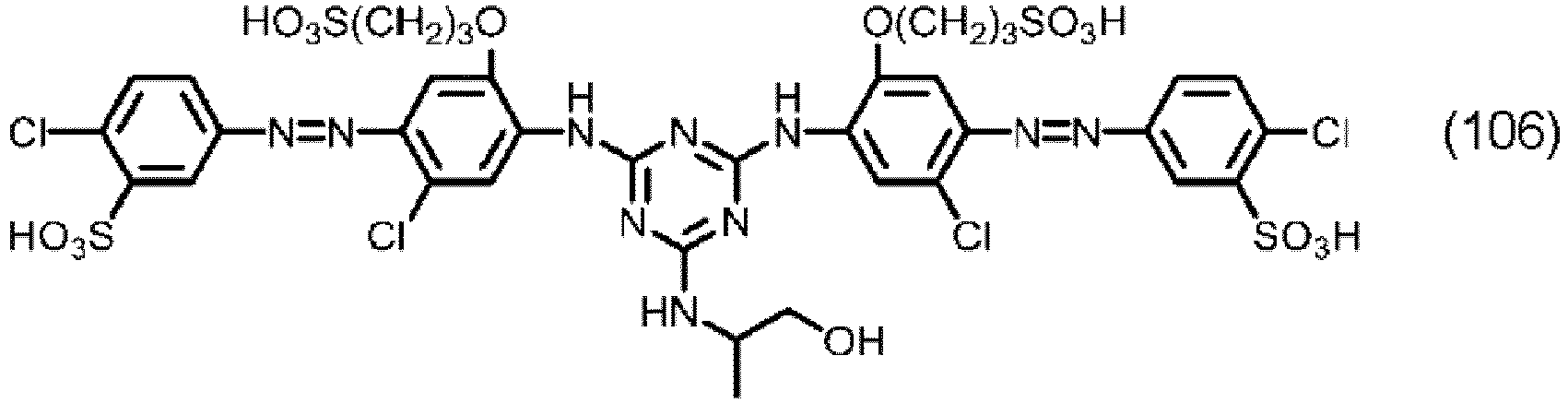
- A sodium salt of a compound according to the present invention represented by the following formula (107) (λmax: 418.5 nm) was obtained in an amount of 5.6 parts as in Example 1 except that 6.2 parts of 2-amino-2-methyl-1-propanol was used instead of 6.2 parts of 4-amino-2-methyl-1-butanol in Example 1 (Step 2).

- A sodium salt of a compound according to the present invention represented by the following formula (108) (λmax: 418.5 nm) was obtained in an amount of 11.2 parts as in Example 1 except that 6.2 parts of ethoxypropylamine was used instead of 6.2 parts of 4-amino-2-methyl-1-butanol in Example 1 (Step 2).

- Inks of Examples 5 to 8 were prepared as in Example 1 except that the compounds represented by the above formulae (105) to (108) were used, respectively, instead of the compound represented by the above formula (101).
- Ink-jet recording was performed with an ink-jet printer (Canon, Inc., Product name: PIXUS ip7230) to allow each of the inks from Examples 5 to 8 and Comparative Examples 1, 2 above to be attached on the following glossy papers 1 to 6. Upon performing recording, image patterns were created so that the density can be obtained in a gradation of 6 levels: 100%, 85%, 70%, 55%, 40%, and 25% to obtain a half-tone recorded article. The resulting recorded article was used as a test piece to perform the following tests.
- Glossy paper 1: Canon, Inc., Product name: Canon Photograph paper, platinum grade (PT-201)
- Glossy paper 2: Canon, Inc., Product name: Canon Photograph paper, gold grade (GL-101)
- Glossy paper 3: Seiko Epson Corporation, Product name: Photograph paper Crispia
- Glossy paper 4: Seiko Epson Corporation, Product name: Photograph paper <glossy>
- Glossy paper 5: Brother Industries, Ltd., Product name: BP71G
- Glossy paper 6: FUJIFILM Corporation, Product name: Gasai Photo-finishing Pro
- When required, color measurements of a recorded image were performed using a colorimeter (Product name SpectroEye from X-rite, Inc.). Color measurements were performed under the conditions of a density standard of ANSI A, a wide viewing angle of 2 degrees, a light source of D50.
- A test piece with a holder was placed in a xenon weatherometer XL75 (Suga Test Instruments Co., Ltd.), and irradiated for 168 hours at a temperature of 24°C, a humidity of 60% RH, and an illuminance of 100 klux. A gradation portion with a density of 70% of each test piece was subjected to color measurements of reflection densities before and after the test. A coloring matter persistence rate was computed from the reflection densities obtained, and evaluation was performed using the following 4-grade criteria. A larger numerical value indicates a superior coloring matter persistence rate. Evaluation results are shown in Table 51 below.
-
- A coloring matter persistence rate of 90% or more: A
- A coloring matter persistence rate of 85% or more and less than 90%: B
- A coloring matter persistence rate of 81% or more and less than 85%: C
- A coloring matter persistence rate of less than 81%: D
-

[Table 51] Results from light resistance tests Glossy paper 1 2 3 4 5 6 Example 5 C B C B B B 6 B A B A A B 7 C B B B C B 8 A A A A B B Comparative Example 1 C B C B C B 2 C D C C C C - As clearly seen in Table 51, Examples 5 to 8 showed better results than Comparative Examples 1, 2 for each glossy paper in the light resistance tests.
- To 250 parts of ice water, 0.10 parts of LeocolRTM TD90 (surfactant), which is a product name and available from Lion Corporation, was added and vigorously stirred. 3.6 parts of cyanuric chloride was added thereto and stirred for 30 minutes at 0 to 5°C to obtain a suspension liquid. Subsequently, 100 parts of the wet cake of the compound represented by the above formula (100) was dissolved in 200 parts of water to obtain a solution, to which the above suspension liquid was added dropwise over 30 minutes. After the completion of the dropwise addition, it was stirred for 6 hours under the conditions of pH 6 to 8 and 25 to 45°C. To the resulting liquid, 5.0 parts of methylamine hydrochloride was added, and stirred for 2 hours under the conditions of pH 7 to 9 and 75 to 90°C. After cooling the resulting reaction liquid to 20 to 25°C, 2000 parts of 2-propanol was added to this reaction liquid, and stirred for 2 hours at 20 to 25°C. The resulting precipitated solid was filtered and separated to obtain 48.6 parts of a wet cake. By drying this wet cake with an 80°C hot-air dryer, 10.9 parts of a sodium salt of a compound according to the present invention represented by the following formula (109) (λmax: 418.0 nm) was obtained.

- An ink of Example 9 was prepared as in Example 1 except that the compound represented by the above formula (109) was used instead of the compound represented by the above formula (101) .
- Ink-jet recording was performed with an ink-jet printer (Canon, Inc., Product name: PIXUS ip7230) to allow each of the inks from Example 9 and Comparative Examples 1,2 above to be attached on the following glossy papers 1 to 4. Upon performing recording, image patterns were created so that the density can be obtained in a gradation of 6 levels: 100%, 85%, 70%, 55%, 40%, and 25% to obtain a half-tone recorded article. The resulting recorded article was used as a test piece to perform the following tests.
- Glossy paper 1: Canon, Inc., Product name: Canon Photograph paper, platinum grade (PT-201)
- Glossy paper 2: Seiko Epson Corporation, Product name: Photograph paper Crispia
- Glossy paper 3: Brother Industries, Ltd., Product name: BP71G
- Glossy paper 4: FUJIFILM Corporation, Product name: Gasai Photo-finishing Pro
- When required, color measurements of a recorded image were performed using a colorimeter (Product name SpectroEye from X-rite, Inc.). Color measurements were performed under the conditions of a density standard of ANSI A, a wide viewing angle of 2 degrees, a light source of D50.
- Yellow printing density (Dy value) was measured using the above colorimetric system for each test piece at a gradation portion where the reflection density was highest. A larger numerical value indicates superior color-developing properties. Evaluation results are shown in Table 52 below.
[Table 52] Results from printing density tests Glossy paper 1 2 3 4 Example 9 2.19 2.21 2.10 2.16 Comparative Example 1 2.14 2.19 2.07 2.15 2 2.12 2.14 2.03 2.05 - As clearly seen in Table 52, Example 9 showed better results than Comparative Examples 1, 2 in the yellow printing density tests (Dy value) for each glossy paper.
- To 250 parts of ice water, 0.10 parts of LeocolRTM TD90 (surfactant) which is a product name and available from Lion Corporation, was added and vigorously stirred. 3.6 parts of cyanuric chloride was added thereto and stirred for 30 minutes at 0 to 5°C to obtain a suspension liquid. Subsequently, 100 parts of the wet cake of the compound represented by the above formula (100) was dissolved in 200 parts of water to obtain a solution, to which the above suspension liquid was added dropwise over 30 minutes. After the completion of the dropwise addition, it was stirred for 6 hours under the conditions of pH 6 to 8 and 25 to 45°C. To the resulting liquid, 6.0 parts of ethylamine hydrochloride was added, and stirred for 2 hours under the conditions of pH 7 to 9 and 75 to 90°C. After cooling the resulting reaction liquid to 20 to 25°C, 2000 parts of 2-propanol was added to this reaction liquid, and stirred for 2 hours at 20 to 25°C. The resulting precipitated solid was filtered and separated to obtain 49.3 parts of a wet cake. By drying this wet cake with an 80°C hot-air dryer, 11.0 parts of a sodium salt of a compound according to the present invention represented by the following formula (110) (λmax: 416.5 nm) was obtained.

- A sodium salt of a compound according to the present invention represented by the following formula (111) (λmax: 416.5 nm) was obtained in an amount of 11.2 parts as in Example 10 except that 4.4 parts of propylamine was used instead of 6.0 parts of ethylamine hydrochloride.
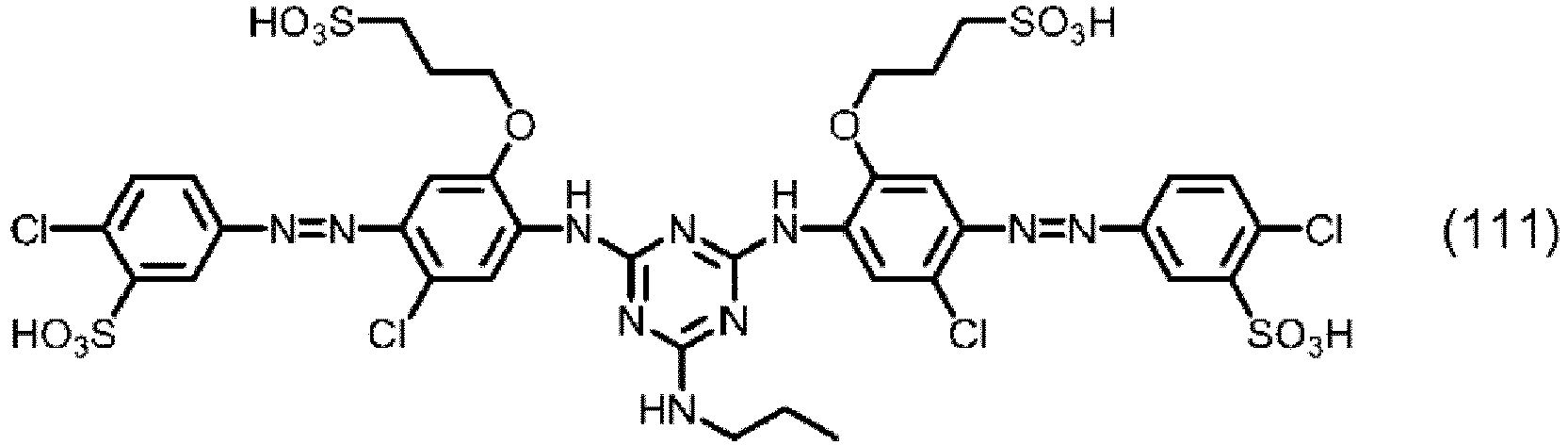
- A sodium salt of a compound according to the present invention represented by the following formula (112) (λmax: 418.0 nm) was obtained in an amount of 11.3 parts as in Example 10 except that 5.4 parts of butylamine was used instead of 6.0 parts of ethylamine hydrochloride.

- Inks of Examples 10 to 12 were prepared as in Example 1 except that the compounds represented by the above formulae (110) to (112) were used, respectively, instead of the compound represented by the above formula (101).
- Ink-jet recording was performed with an ink-jet printer (Canon, Inc., Product name: PIXUS ip7230) to allow each of the inks from Examples 10 to 12 and Comparative Examples 1,2 above to be attached on the following glossy papers 1 to 3. Upon performing recording, image patterns were created so that the density can be obtained in a gradation of 6 levels: 100%, 85%, 70%, 55%, 40%, and 25% to obtain a half-tone recorded article. The resulting recorded article was used as a test piece to perform the following tests.
- Glossy paper 1: Canon, Inc., Product name: Canon Photograph paper, gold grade (GL-101)
- Glossy paper 2: Seiko Epson Corporation, Product name: Photograph paper Crispia
- Glossy paper 3: Brother Industries, Ltd., Product name: BP71G [Color measurements of recorded image]
- When required, color measurements of a recorded image were performed using a colorimeter (Product name SpectroEye from X-rite, Inc.). Color measurements were performed under the conditions of a density standard of ANSI A, a wide viewing angle of 2 degrees, a light source of D50.
- A test piece with a holder was placed in a xenon weatherometer XL75 (Suga Test Instruments Co., Ltd.), and irradiated for 168 hours at a temperature of 24°C, a humidity of 60% RH, and an illuminance of 100 klux. A gradation portion with a density of 70% of each test piece was subjected to color measurements of reflection densities before and after the test. A coloring matter persistence rate was computed from the reflection densities obtained, and evaluation was performed using the following 3-grade criteria. A larger numerical value indicates a superior coloring matter persistence rate. Evaluation results are shown in Table 53 below.
-
- A coloring matter persistence rate of 85% or more: A
- A coloring matter persistence rate of 81% or more and less than 85%: B
- A coloring matter persistence rate of less than 81%: C
-

[Table 53] Results from light resistance tests Glossy paper 1 2 3 Example 10 A A A 11 A A B 12 A A B Comparative Example 1 A B B 2 C B B - As clearly seen in Table 53, Example 10 showed similar results for Glossy paper 1 and better results for Glossy papers 2, 3 as compared with Comparative Example 1. Further, Example 10 showed better results for each glossy paper as compared with Comparative Example 2. Examples 11, 12 showed similar results for Glossy papers 1, 3 and better results for Glossy paper 2 as compared with Comparative Example 1. Examples 11, 12 showed similar results for Glossy paper 3 and better results for Glossy papers 1, 2 as compared with Comparative Example 2. These results demonstrate that Examples 10 to 12 have similar or better light resistance as compared with Comparative Examples 1, 2.
- A sodium salt of a compound according to the present invention represented by the following formula (113) (λmax: 416.5 nm) was obtained in an amount of 11.0 parts as in Example 10 except that 15.0 parts of 2-amino-1,3-propanediol was used instead of 6.0 parts of ethylamine hydrochloride.

- An ink of Example 13 was prepared as in Example 1 except that the compound represented by the above formula (113) was used instead of the compound represented by the above formula (101) .
- Ink-jet recording was performed with an ink-jet printer (Canon, Inc., Product name: PIXUS ip7230) to allow each of the inks from Example 13 and Comparative Examples 1, 2 above to be attached on the following glossy papers 1 to 3. Upon performing recording, image patterns were created so that the density can be obtained in a gradation of 6 levels: 100%, 85%, 70%, 55%, 40%, and 25% to obtain a half-tone recorded article. The resulting recorded article was used as a test piece to perform the following tests.
- Glossy paper 1: Canon, Inc., Product name: Canon Photograph paper, gold grade (GL-101)
- Glossy paper 2: Seiko Epson Corporation, Product name: Photograph paper <glossy>
- Glossy paper 3: FUJIFILM Corporation, Product name: Gasai Photo-finishing Pro
- When required, color measurements of a recorded image were performed using a colorimeter (Product name SpectroEye from X-rite, Inc.). Color measurements were performed under the conditions of a density standard of ANSI A, a wide viewing angle of 2 degrees, a light source of D50.
- A test piece with a holder was placed in a xenon weatherometer XL75 (Suga Test Instruments Co., Ltd.), and irradiated for 168 hours at a temperature of 24°C, a humidity of 60% RH, and an illuminance of 100 klux. A gradation portion with a density of 70% of each test piece was subjected to color measurements of reflection densities before and after the test. A coloring matter persistence rate was computed from the reflection densities obtained, and evaluation was performed using the following 3-grade criteria. A larger numerical value indicates a superior coloring matter persistence rate. Evaluation results are shown in Table 54 below.
-
- A coloring matter persistence rate of 85% or more: A
- A coloring matter persistence rate of 81% or more and less than 85%: B
- A coloring matter persistence rate of less than 81%: C
-

[Table 54] Results from light resistance tests Glossy paper 1 2 3 Example 13 A A A Comparative Example 1 A B A 2 C B B - As clearly seen in Table 54, Example 13 showed similar results for Glossy papers 1, 3 and better results for Glossy paper 2 as compared with Comparative Example 1. Further, Example 13 showed better results for each glossy paper as compared with Comparative Example 2. These results demonstrate that Example 13 has similar or better light resistance as compared with Comparative Examples 1, 2.
- A sodium salt of a compound according to the present invention represented by the following formula (114) (λmax: 422.0 nm) was obtained in an amount of 11.3 parts as in Example 1 except that 5.3 parts of 2-(ethylamino)ethanol was used instead of 6.2 parts of 4-amino-2-methyl-1-butanol in Example 1 (Step 2).

- A sodium salt of a compound according to the present invention represented by the following formula (115) (λmax: 420.5 nm) was obtained in an amount of 11.6 parts as in Example 1 except that 7.0 parts of 2-(butylamino)ethanol was used instead of 6.2 parts of 4-amino-2-methyl-1-butanol in Example 1 (Step 2).

- Inks of Examples 14, 15 were prepared as in Example 1 except that the compounds represented by the above formulae (114), (115) were used, respectively, instead of the compound represented by the above formula (101).
- Ink-jet recording was performed with an ink-jet printer (Canon, Inc., Product name: PIXUS ip7230) to allow each of the inks from Examples 14, 15 and Comparative Examples 1, 2 above to be attached on the following glossy papers 1 to 4. Upon performing recording, image patterns were created so that the density can be obtained in a gradation of 6 levels: 100%, 85%, 70%, 55%, 40%, and 25% to obtain a half-tone recorded article. The resulting recorded article was used as a test piece to perform the following tests.
- Glossy paper 1: Canon, Inc., Product name: Canon Photograph paper, gold grade (GL-101)
- Glossy paper 2: Seiko Epson Corporation, Product name: Photograph paper <glossy>
- Glossy paper 3: Brother Industries, Ltd., Product name: BP71G
- Glossy paper 4: FUJIFILM Corporation, Product name: Gasai Photo-finishing Pro
- When required, color measurements of a recorded image were performed using a colorimeter (Product name SpectroEye from X-rite, Inc.). Color measurements were performed under the conditions of a density standard of ANSI A, a wide viewing angle of 2 degrees, a light source of D50.
- A test piece with a holder was placed in a xenon weatherometer XL75 (Suga Test Instruments Co., Ltd.), and irradiated for 168 hours at a temperature of 24°C, a humidity of 60% RH, and an illuminance of 100 klux. A gradation portion with a density of 70% of each test piece was subjected to color measurements of reflection densities before and after the test. A coloring matter persistence rate was computed from the reflection densities obtained, and evaluation was performed using the following 4-grade criteria. A larger numerical value indicates a superior coloring matter persistence rate. Evaluation results are shown in Table 55 below.
-
- A coloring matter persistence rate of 90% or more: A
- A coloring matter persistence rate of 85% or more and less than 90%: B
- A coloring matter persistence rate of 81% or more and less than 85%: C
- A coloring matter persistence rate of less than 81%: D
-

[Table 55] Results from light resistance tests Glossy paper 1 2 3 4 Example 14 B A A A 15 B C B B Comparative Example 1 B C C C 2 D C C C - As clearly seen in Table 55, Example 14 showed similar results for Glossy paper 1 and better results for Glossy papers 2 to 4 as compared with Comparative Example 1. Further, Example 14 showed good results for each glossy paper as compared with Comparative Example 2. Example 15 showed similar results for Glossy papers 1, 2 and good results for Glossy papers 3, 4 as compared with Comparative Example 1. Further, Example 15 showed similar results for Glossy paper 2 and good results for the other glossy papers as compared with Comparative Example 2. These results demonstrate that Examples 14, 15 have similar or better light resistance as compared with Comparative Examples 1, 2.
- To 250 parts of ice water, 0.10 parts of LeocolRTM TD90 (surfactant), which is a product name and available from Lion Corporation, was added and vigorously stirred. 3.6 parts of cyanuric chloride was added thereto and stirred for 30 minutes at 0 to 5°C to obtain a suspension liquid. Subsequently, 100 parts of the wet cake of the compound represented by the above formula (100) was dissolved in 200 parts of water to obtain a solution, to which the above suspension liquid was added dropwise over 30 minutes. After the completion of the dropwise addition, it was stirred for 6 hours under the conditions of pH 6 to 8 and 25 to 45°C. To the resulting liquid, 6.1 parts of tetrahydrofurfurylamine was added, and stirred for 2 hours under the conditions of pH 7 to 9 and 75 to 90°C. After cooling the resulting reaction liquid to 20 to 25°C, 2000 parts of 2-propanol was added to this reaction liquid, and stirred for 2 hours at 20 to 25°C. The resulting precipitated solid was filtered and separated to obtain 103.3 parts of a wet cake. By drying this wet cake with an 80°C hot-air dryer, 11.4 parts of a sodium salt of a compound according to the present invention represented by the following formula (116) (λmax: 417.5 nm) was obtained.

- An ink of Example 16 was prepared as in Example 1 except that the compound represented by the above formula (116) was used instead of the compound represented by the above formula (101) .
- Ink-jet recording was performed with an ink-jet printer (Canon, Inc., Product name: PIXUS ip7230) to allow each of the inks from Example 16 and Comparative Examples 1, 2 above to be attached on the following glossy papers 1 to 4. Upon performing recording, image patterns were created so that the density can be obtained in a gradation of 6 levels: 100%, 85%, 70%, 55%, 40%, and 25% to obtain a half-tone recorded article. The resulting recorded article was used as a test piece to perform the following tests.
- Glossy paper 1: Canon, Inc., Product name: Canon Photograph paper, platinum grade (PT-201)
- Glossy paper 2: Canon, Inc., Product name: Canon Photograph paper, gold grade (GL-101)
- Glossy paper 3: Seiko Epson Corporation, Product name: Photograph paper Crispia
- Glossy paper 4: Brother Industries, Ltd., Product name: BP71G
- When required, color measurements of a recorded image were performed using a colorimeter (Product name SpectroEye from X-rite, Inc.). Color measurements were performed under the conditions of a density standard of ANSI A, a wide viewing angle of 2 degrees, a light source of D50.
- A test piece with a holder was placed in a xenon weatherometer XL75 (Suga Test Instruments Co., Ltd.), and irradiated for 168 hours at a temperature of 24°C, a humidity of 60% RH, and an illuminance of 100 klux. A gradation portion with a density of 55% of each test piece was subjected to color measurements of reflection densities before and after the test. A coloring matter persistence rate was computed from the reflection densities obtained, and evaluation was performed using the following 4-grade criteria. A larger numerical value indicates a superior coloring matter persistence rate. Evaluation results are shown in Table 56 below.
-
- A coloring matter persistence rate of 90% or more: A
- A coloring matter persistence rate of 85% or more and less than 90%: B
- A coloring matter persistence rate of 81% or more and less than 85%: C
- A coloring matter persistence rate of less than 81%: D
-

[Table 56] Results from light resistance tests Glossy paper 1 2 3 4 Example 16 B A B B Comparative Example 1 C B C C 2 C D C C - As clearly seen in Table 56, Example 16 showed good results for each glossy paper as compared with Comparative Examples 1, 2. These results demonstrate that Example 16 has superior light resistance as compared with Comparative Examples 1, 2.
- A sodium salt of a compound according to the present invention represented by the following formula (117) (λmax: 416.5 nm) was obtained in an amount of 10.5 parts as in Example 16 except that 4.0 parts of pyrrolidine was used instead of 6.1 parts of tetrahydrofurfurylamine.

- An ink of Example 17 was prepared as in Example 1 except that the compound represented by the above formula (117) was used instead of the compound represented by the above formula (101) .
- Ink-jet recording was performed with an ink-jet printer (Canon, Inc., Product name: PIXUS ip7230) to allow each of the inks from Example 17 and Comparative Examples 1, 2 above to be attached on the following glossy papers 1, 2. Upon performing recording, image patterns were created so that the density can be obtained in a gradation of 6 levels: 100%, 85%, 70%, 55%, 40%, and 25% to obtain a half-tone recorded article. The resulting recorded article was used as a test piece to perform the following tests.
- Glossy paper 1: Canon, Inc., Product name: Canon Photograph paper, platinum grade (PT-201)
- Glossy paper 2: FUJIFILM Corporation, Product name: Gasai Photo-finishing Pro
- When required, color measurements of a recorded image were performed using a colorimeter (Product name SpectroEye from X-rite, Inc.). Color measurements were performed under the conditions of a density standard of ANSI A, a wide viewing angle of 2 degrees, a light source of D50.
- A test piece with a holder was placed in a xenon weatherometer XL75 (Suga Test Instruments Co., Ltd.), and irradiated for 168 hours at a temperature of 24°C, a humidity of 60% RH, and an illuminance of 100 klux. A gradation portion with a density of 55% of each test piece was subjected to color measurements of reflection densities before and after the test. A coloring matter persistence rate was computed from the reflection densities obtained, and evaluation was performed using the following 2-grade criteria. A larger numerical value indicates a superior coloring matter persistence rate. Evaluation results are shown in Table 57 below.
-
- A coloring matter persistence rate of 85% or more: A
- A coloring matter persistence rate of less than 85%: B
-

[Table 57] Results from light resistance tests Glossy paper 1 2 Example 17 A A Comparative Example 1 B B 2 B B - As clearly seen in Table 57, Example 17 showed good results for each glossy paper as compared with Comparative Examples 1, 2. These results demonstrate that Example 17 has superior light resistance as compared with Comparative Examples 1, 2.
- While adjusting pH to 7 with sodium hydroxide, 20.8 parts of 5-amino-2-chlorobenzenesulfonic acid was dissolved in 200 parts of water, and 7.2 parts of sodium nitrite was then added. This solution was added dropwise to 200 parts of 5% hydrochloric acid over 30 minutes at 0 to 10°C, a diazotization reaction was performed with stirring for 1 hour at 10°C or below to prepare a diazo reaction liquid.
- Meanwhile, 26.6 parts of 2-(sulfopropoxy)-5-chloroaniline was dissolved in 130 parts of water while adjusting pH to 7 with sodium hydroxide, and a methyl-ω-sulfonic acid derivative was obtained by the conventional method using 10.4 parts of sodium bisulfite and 8.6 parts of 35% formalin. The resulting methyl-ω-sulfonic acid derivative was added to the diazo reaction liquid prepared above, and stirred for 24 hours under the conditions of 0 to 15°C and pH 4 to 6. After adjusting pH to 11 with sodium hydroxide, the reaction liquid was stirred for 5 hours at 80 to 95°C while maintaining that pH, and 100 parts of sodium chloride was added to perform salt precipitation. The resulting precipitated solid was then filtered and separated to obtain 100 parts of the compound represented by the above formula (100) as a wet cake.
- To 250 parts of ice water, 0.10 parts of LeocolRTM TD90 (surfactant), which is a product name and available from Lion Corporation, was added and vigorously stirred. 3.6 parts of cyanuric chloride was added thereto and stirred for 30 minutes at 0 to 5°C to obtain a suspension liquid. Subsequently, 100 parts of the wet cake of the compound represented by the above formula (100) was dissolved in 200 parts of water to obtain a solution, to which the above suspension liquid was added dropwise over 30 minutes. After the completion of the dropwise addition, it was stirred for 6 hours under the conditions of pH 6 to 8 and 25 to 45°C. To the resulting liquid, 0.9 parts of piperazine was added, and stirred for 2 hours under the conditions of pH 7 to 9 and 75 to 90°C. After cooling the resulting reaction liquid to 20 to 25°C, 2000 parts of 2-propanol was added to this reaction liquid, and stirred for 2 hours at 20 to 25°C. The resulting precipitated solid was filtered and separated to obtain 92.1 parts of a wet cake. By drying this wet cake with an 80°C hot-air dryer, 12.0 parts of a sodium salt of a compound according to the present invention represented by the following formula (200) (λmax: 418.5 nm) was obtained.

- An ink of Example 18 was prepared as in Example 1 except that the compound represented by the above formula (200) was used instead of the compound represented by the above formula (101) .
- Ink-jet recording was performed with an ink-jet printer (Canon, Inc., Product name: PIXUS ip7230) to allow each of the inks from Example 18 and Comparative Examples 1,2 above to be attached on the following glossy papers 1 to 4. Upon performing recording, image patterns were created so that the density can be obtained in a gradation of 6 levels: 100%, 85%, 70%, 55%, 40%, and 25% to obtain a half-tone recorded article. The resulting recorded article was used as a test piece to perform the following tests.
- Glossy paper 1: Canon, Inc., Product name: Canon Photograph paper, platinum grade (PT-201)
- Glossy paper 2: Seiko Epson Corporation, Product name: Photograph paper Crispia
- Glossy paper 3: Brother Industries, Ltd., Product name: BP71G Glossy paper 4: FUJIFILM Corporation, Product name: Gasai Photo-finishing Pro
- When required, color measurements of a recorded image were performed using a colorimeter (Product name SpectroEye from X-rite, Inc.). Color measurements were performed under the conditions of a density standard of DIN NB, a wide viewing angle of 2 degrees, a light source of D65.
- A test piece with a holder was placed in a xenon weatherometer XL75 (Suga Test Instruments Co., Ltd.), and irradiated for 168 hours at a temperature of 24°C, a humidity of 60% RH, and an illuminance of 100 klux. A gradation portion with a density of 70% of each test piece was subjected to color measurements of reflection densities before and after the test. A coloring matter persistence rate was computed from the reflection densities obtained, and evaluation was performed using the following 4-grade criteria. A larger numerical value indicates a superior coloring matter persistence rate. Evaluation results are shown in Table 58 below.
-
- A coloring matter persistence rate of 90% or more: A
- A coloring matter persistence rate of 85% or more and less than 90%: B
- A coloring matter persistence rate of 81% or more and less than 85%: C
- A coloring matter persistence rate of less than 81%: D
-

[Table 58] Results from light resistance tests 
1 2 3 4 Example 18 A A A A Comparative Example 1 C B D B 2 C D D D - As clearly seen in Table 58, Examples 18 showed better results than Comparative Examples 1, 2 for each glossy paper in the light resistance tests.

| Component | Example | Comparative Example | ||
| 1 | 2 | 1 | 2 | |
| Formula (101) | 3 | - | - | - |
| Formula (102) | - | 3 | - | - |
| Formula (300) | - | - | 3 | - |
| DY132 | - | - | - | 3 |
| Glycerin | 5 | 5 | 5 | 5 |
| Urea | 5 | 5 | 5 | 5 |
| N-methyl-2-pyrrolidone | 4 | 4 | 4 | 4 |
| Isopropyl alcohol | 3 | 3 | 3 | 3 |
| Butylcarbitol | 2 | 2 | 2 | 2 |
| Taurine | 0.3 | 0.3 | 0.3 | 0.3 |
| EDTA2Na | 0.1 | 0.1 | 0.1 | 0.1 |
| 104PG50 | 0.1 | 0.1 | 0.1 | 0.1 |
| aq. NAOH | Remainder | Remainder | Remainder | Remainder |
| Total | 100 | 100 | 100 | 100 |
Claims (30)
- A compound represented by the following formula (1) or (2) or a salt thereof:


- The compound or a salt thereof according to claim 1, wherein the compound represented by the formula (1) is represented by the following formula (1-1):

- The compound or a salt thereof according to claim 2, wherein in the formula (1-1), Q is a chlorine atom.
- The compound or a salt thereof according to claim 2 or 3, wherein in the formula (1-1), x is 3.
- The compound or a salt thereof according to claim 1, wherein the compound represented by the formula (1) is represented by any of the following formulae (1-11) to (1-15):


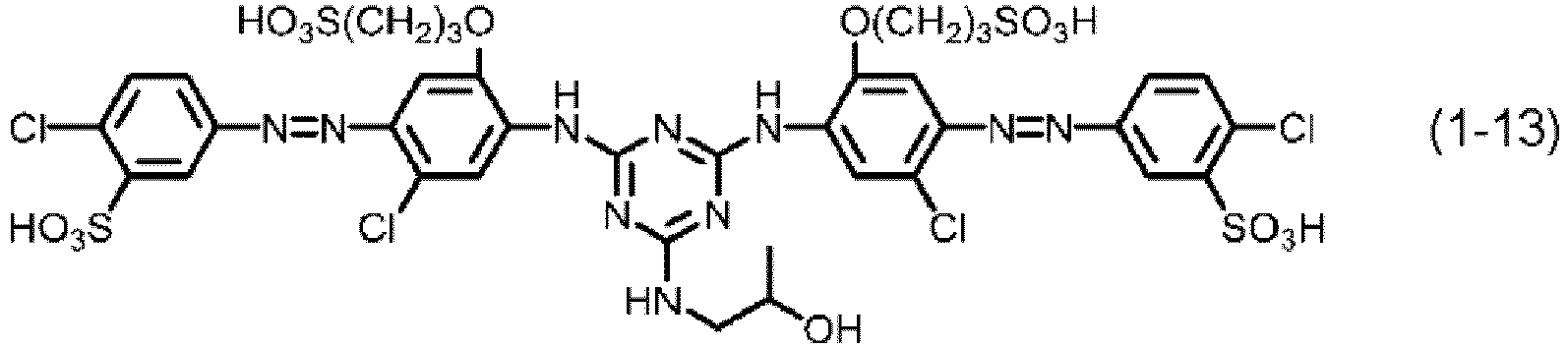


- The compound or a salt thereof according to any one of claims 1 to 4, wherein in the formula (A1-2), n is 2.
- The compound or a salt thereof according to claim 1, wherein the compound represented by the formula (1) is represented by the following formula (1-16):

- The compound or a salt thereof according to claim 2, wherein in the the formula (1-1), Q is a chlorine atom, x is 3, and A1 is a group represented by the following formula (A1-5) :

- The compound or a salt thereof according to claim 8, wherein in the formula (A1-5), n is 3.
- The compound or a salt thereof according to claim 2, wherein in the the formula (1-1), Q is a chlorine atom, x is 3, and A1 is a C1-C4 alkyl-monosubstituted amino group.
- The compound or a salt thereof according to claim 10, wherein in the the formula (1-1), Q is a chlorine atom, x is 3, and A1 is a linear C1-C4 alkyl-monosubstituted amino group.
- The compound or a salt thereof according to claim 2, wherein in the the formula (1-1), Q is a chlorine atom, x is 3, and A1 is a group represented by the following formula (A1-6) :

- The compound or a salt thereof according to claim 12, wherein in the formula (A1-6), RA13 is a C2-C4 alkyl group having two hydroxy groups.
- The compound or a salt thereof according to any one of claims 1 to 4, wherein in the formula (1), A1 is a group represented by the following formula (A1-7) or (A1-8):

- The compound or a salt thereof according to any one of claims 1 to 4, wherein in the formula (A1-3), m is 2.
- The compound or a salt thereof according to claim 1, wherein the compound represented by the formula (1) is represented by the following formula (1-17) or (1-18):


- The compound or a salt thereof according to claim 2, wherein in the formula (1-1), Q is a chlorine atom, x is 3, and A1 is a group represented by the formula (1-4) wherein n is 3.
- The compound or a salt thereof according to claim 2, wherein in the the formula (1-1), Q is a chlorine atom, x is 3, and A1 is a group represented by the following formula (A1-9) :
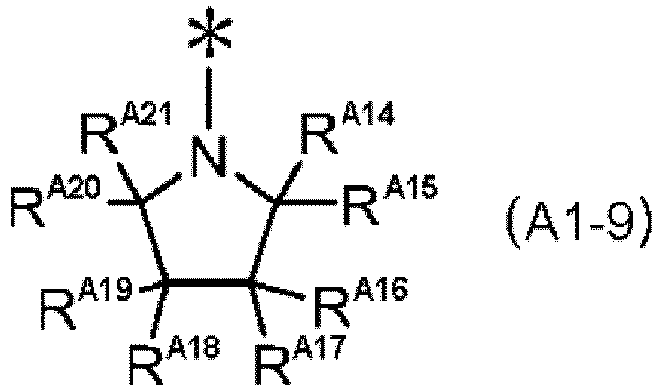
- The compound or a salt thereof according to claim 18, wherein in the formula (A1-9), RA14 to RA21 are hydrogen atoms.
- The compound or a salt thereof according to claim 1, wherein the compound represented by the formula (2) is represented by the following formula (2-1):

- The compound or a salt thereof according to claim 20, wherein in the formula (2-1), Q21 to Q24 are chlorine atoms.
- The compound or a salt thereof according to claim 20 or 21, wherein in the formula (2-1), x is 3.
- The compound or a salt thereof according to claim 20, wherein in the formula (2-1), Q21 to Q24 are chlorine atoms, and x is 3, and A2 is a 1,4-piperazinediyl group.
- An ink comprising the compound or a salt thereof according to any one of claims 1 to 23.
- The ink according to claim 24, further comprising a water-soluble organic solvent.
- Use of the ink according to claim 24 or 25 for ink-jet recording.
- An ink-jet recording method, comprising discharging a droplet of the ink according to claim 24 or 25 in response to a recording signal to allow for attachment to a recording medium.
- The inkjet recording method according to claim 27, wherein the recording medium is plain paper or a sheet having an ink receiving layer.
- A recording medium, to which either(a) the compound or a salt thereof according to any one of claims 1 to 23 or(b) the ink according to claim 24 or 25is attached.
- An ink-jet printer loaded with a container containing the ink according to claim 24 or 25.
Applications Claiming Priority (11)
| Application Number | Priority Date | Filing Date | Title |
|---|---|---|---|
| JP2016213234 | 2016-10-31 | ||
| JP2016213233 | 2016-10-31 | ||
| JP2016213238 | 2016-10-31 | ||
| JP2016213232 | 2016-10-31 | ||
| JP2017023616 | 2017-02-10 | ||
| JP2017023618 | 2017-02-10 | ||
| JP2017023615 | 2017-02-10 | ||
| JP2017023620 | 2017-02-10 | ||
| JP2017023619 | 2017-02-10 | ||
| JP2017023617 | 2017-02-10 | ||
| PCT/JP2017/038038 WO2018079442A1 (en) | 2016-10-31 | 2017-10-20 | Water-soluble azo compound or salt thereof, ink and recording medium |
Publications (3)
| Publication Number | Publication Date |
|---|---|
| EP3533841A1 true EP3533841A1 (en) | 2019-09-04 |
| EP3533841A4 EP3533841A4 (en) | 2020-10-28 |
| EP3533841B1 EP3533841B1 (en) | 2024-12-11 |
Family
ID=62024881
Family Applications (1)
| Application Number | Title | Priority Date | Filing Date |
|---|---|---|---|
| EP17864034.8A Active EP3533841B1 (en) | 2016-10-31 | 2017-10-20 | Water-soluble azo compound or salt thereof, ink and recording medium |
Country Status (7)
| Country | Link |
|---|---|
| US (1) | US11512203B2 (en) |
| EP (1) | EP3533841B1 (en) |
| JP (1) | JP7017515B2 (en) |
| KR (1) | KR102399927B1 (en) |
| CN (1) | CN109890906B (en) |
| CA (1) | CA3039042A1 (en) |
| WO (1) | WO2018079442A1 (en) |
Cited By (2)
| Publication number | Priority date | Publication date | Assignee | Title |
|---|---|---|---|---|
| US11572485B2 (en) | 2019-01-31 | 2023-02-07 | Seiko Epson Corporation | Ink set |
| US11578224B2 (en) | 2019-01-31 | 2023-02-14 | Seiko Epson Corporation | Ink set |
Families Citing this family (2)
| Publication number | Priority date | Publication date | Assignee | Title |
|---|---|---|---|---|
| JP7409120B2 (en) * | 2020-01-31 | 2024-01-09 | セイコーエプソン株式会社 | Inkjet ink set, inkjet recording method, and inkjet recording device |
| JP2022057158A (en) * | 2020-09-30 | 2022-04-11 | セイコーエプソン株式会社 | Ink set |
Family Cites Families (21)
| Publication number | Priority date | Publication date | Assignee | Title |
|---|---|---|---|---|
| JP3346755B2 (en) | 1993-05-10 | 2002-11-18 | セイコーエプソン株式会社 | Color ink composition, ink composition excellent in color reproducibility and light fastness, and recording method |
| EP0651037B1 (en) | 1993-05-10 | 2003-04-23 | Seiko Epson Corporation | Color ink composition and color ink-jet recording method |
| JPH07729A (en) | 1993-06-17 | 1995-01-06 | Kiyomine Taniguchi | Independent filter medium |
| JPH1170729A (en) | 1997-08-28 | 1999-03-16 | Brother Ind Ltd | Inkjet recording method |
| DE60140103D1 (en) | 2000-06-12 | 2009-11-19 | Canon Kk | Ink set, ink jet recording apparatus, ink jet recording method, recording unit and ink cartridge |
| JP4100880B2 (en) | 2000-06-12 | 2008-06-11 | キヤノン株式会社 | Ink set, ink jet recording apparatus, ink jet recording method, and second aqueous ink |
| JP4270486B2 (en) | 2002-08-09 | 2009-06-03 | 日本化薬株式会社 | Trisazo compound, water-based ink composition, and colored body |
| JPWO2008142989A1 (en) | 2007-05-11 | 2010-08-05 | 日本化薬株式会社 | Water-soluble azo compound or salt thereof, ink composition and colored body |
| US8425676B2 (en) | 2009-04-28 | 2013-04-23 | Nippon Kayaku Kabushiki Kaisha | Water-soluble AZO compound or salt thereof, ink composition, and colored article |
| JP5624051B2 (en) | 2009-10-08 | 2014-11-12 | 日本化薬株式会社 | Azo compound, ink composition and colored body |
| JPWO2011068046A1 (en) | 2009-12-02 | 2013-04-18 | 日本化薬株式会社 | Water-soluble azo compound or salt thereof, ink composition and colored body |
| WO2011122427A1 (en) | 2010-03-30 | 2011-10-06 | 日本化薬株式会社 | Water-soluble azo compound or salt thereof, ink composition and colored body |
| JPWO2012099059A1 (en) * | 2011-01-21 | 2014-06-30 | 日本化薬株式会社 | Water-soluble azo compound or salt thereof, ink composition and colored body |
| JP2012246342A (en) * | 2011-05-25 | 2012-12-13 | Nippon Kayaku Co Ltd | Water-soluble azo compound or its salt, ink composition, and colored material |
| JP5954521B2 (en) * | 2011-06-28 | 2016-07-20 | セイコーエプソン株式会社 | Ink set and droplet discharge device using the same |
| US8790458B2 (en) | 2011-06-28 | 2014-07-29 | Seiko Epson Corporation | Ink set and droplet ejection apparatus using the ink set |
| JP2013018849A (en) * | 2011-07-10 | 2013-01-31 | Nippon Kayaku Co Ltd | Water-soluble azo compound or salt thereof, ink composition, and colored material |
| JP2014118437A (en) * | 2012-12-13 | 2014-06-30 | Nippon Kayaku Co Ltd | Water soluble azo compound or salt thereof, ink composition and colored body |
| JP2014118439A (en) * | 2012-12-13 | 2014-06-30 | Nippon Kayaku Co Ltd | Water soluble azo compound or salt thereof, ink composition and colored body |
| JP2016098274A (en) | 2014-11-19 | 2016-05-30 | 日本化薬株式会社 | Water-soluble azo compound or salt thereof, ink composition and colored body |
| JP2016098276A (en) | 2014-11-19 | 2016-05-30 | 日本化薬株式会社 | Water-soluble azo compound or salt thereof, ink composition and colored body |
-
2017
- 2017-10-20 EP EP17864034.8A patent/EP3533841B1/en active Active
- 2017-10-20 CN CN201780066042.7A patent/CN109890906B/en active Active
- 2017-10-20 CA CA3039042A patent/CA3039042A1/en not_active Abandoned
- 2017-10-20 US US16/336,826 patent/US11512203B2/en active Active
- 2017-10-20 KR KR1020197009928A patent/KR102399927B1/en active Active
- 2017-10-20 JP JP2018547631A patent/JP7017515B2/en active Active
- 2017-10-20 WO PCT/JP2017/038038 patent/WO2018079442A1/en not_active Ceased
Cited By (2)
| Publication number | Priority date | Publication date | Assignee | Title |
|---|---|---|---|---|
| US11572485B2 (en) | 2019-01-31 | 2023-02-07 | Seiko Epson Corporation | Ink set |
| US11578224B2 (en) | 2019-01-31 | 2023-02-14 | Seiko Epson Corporation | Ink set |
Also Published As
| Publication number | Publication date |
|---|---|
| US11512203B2 (en) | 2022-11-29 |
| US20210292566A1 (en) | 2021-09-23 |
| JP7017515B2 (en) | 2022-02-08 |
| EP3533841B1 (en) | 2024-12-11 |
| CN109890906B (en) | 2021-01-15 |
| CN109890906A (en) | 2019-06-14 |
| KR102399927B1 (en) | 2022-05-18 |
| KR20190080863A (en) | 2019-07-08 |
| CA3039042A1 (en) | 2018-05-03 |
| WO2018079442A1 (en) | 2018-05-03 |
| EP3533841A4 (en) | 2020-10-28 |
| JPWO2018079442A1 (en) | 2019-09-19 |
Similar Documents
| Publication | Publication Date | Title |
|---|---|---|
| EP2554606B1 (en) | Water-soluble azo compound or salt thereof, ink composition and colored body | |
| EP2471874B1 (en) | Azo compounds, ink compositions, and colored bodies | |
| JP5145243B2 (en) | Anthrapyridone compound, salt thereof, magenta ink composition containing the same, and colored product | |
| KR101174741B1 (en) | Anthrapyridone compound, magenta ink composition and colored matter | |
| US11512203B2 (en) | Water-soluble azo compound or salt thereof, ink and recording medium | |
| WO2012090933A1 (en) | Water-soluble azo compound or salt thereof, ink composition, and colored object | |
| JP2019077739A (en) | Azo compound or salt thereof, and ink | |
| JP2018044082A (en) | Compound or salt thereof, and ink | |
| US20110195238A1 (en) | Anthrapyridone coloring matter, salt thereof, ink composition and colored body | |
| JP4905928B2 (en) | Anthrapyridone compound or a salt thereof, a magenta ink composition containing the anthrapyridone compound, and a colored product | |
| JP2018127592A (en) | Azo compound or salt thereof, ink composition and colored body | |
| JP2018076488A (en) | Azo compound or salt thereof, and ink | |
| US20120056931A1 (en) | Magenta coloring matter, ink composition, and colored body | |
| JP2012036257A (en) | Ink composition and colored material | |
| JP2010001348A (en) | Water-soluble anthrapyridone compound or salt thereof, ink composition and colored body | |
| JP2010116489A (en) | Water-soluble anthrapyridone compound or salt thereof, ink composition and colored body | |
| JP2018044083A (en) | Compound or salt thereof, and ink | |
| JP2018070793A (en) | Azo compound or salt thereof, and ink | |
| JP2018127585A (en) | Azo compound or salt thereof, ink composition and colored body | |
| JP2018127588A (en) | Water soluble azo compound or salt thereof, ink composition, and colored body | |
| JP2018127591A (en) | Azo compound or salt thereof, ink composition and colored body | |
| JP2018127589A (en) | Water soluble azo compound or salt thereof, ink composition, and colored body | |
| JP2018127593A (en) | Water-soluble azo compound or salt thereof, ink composition and colored body | |
| JP2018127584A (en) | Water-soluble azo compound or salt thereof, ink composition and colored body | |
| JP2018127583A (en) | Water-soluble azo compound or salt thereof, ink composition and colored body |
Legal Events
| Date | Code | Title | Description |
|---|---|---|---|
| STAA | Information on the status of an ep patent application or granted ep patent |
Free format text: STATUS: THE INTERNATIONAL PUBLICATION HAS BEEN MADE |
|
| PUAI | Public reference made under article 153(3) epc to a published international application that has entered the european phase |
Free format text: ORIGINAL CODE: 0009012 |
|
| STAA | Information on the status of an ep patent application or granted ep patent |
Free format text: STATUS: REQUEST FOR EXAMINATION WAS MADE |
|
| 17P | Request for examination filed |
Effective date: 20190527 |
|
| AK | Designated contracting states |
Kind code of ref document: A1 Designated state(s): AL AT BE BG CH CY CZ DE DK EE ES FI FR GB GR HR HU IE IS IT LI LT LU LV MC MK MT NL NO PL PT RO RS SE SI SK SM TR |
|
| AX | Request for extension of the european patent |
Extension state: BA ME |
|
| DAV | Request for validation of the european patent (deleted) | ||
| DAX | Request for extension of the european patent (deleted) | ||
| RIC1 | Information provided on ipc code assigned before grant |
Ipc: C09D 11/328 20140101ALI20200608BHEP Ipc: B41J 2/01 20060101ALI20200608BHEP Ipc: B41M 5/00 20060101ALI20200608BHEP Ipc: C09B 43/16 20060101AFI20200608BHEP |
|
| A4 | Supplementary search report drawn up and despatched |
Effective date: 20200925 |
|
| RIC1 | Information provided on ipc code assigned before grant |
Ipc: B41M 5/00 20060101ALI20200921BHEP Ipc: B41J 2/01 20060101ALI20200921BHEP Ipc: C09B 43/16 20060101AFI20200921BHEP Ipc: C09D 11/328 20140101ALI20200921BHEP |
|
| STAA | Information on the status of an ep patent application or granted ep patent |
Free format text: STATUS: EXAMINATION IS IN PROGRESS |
|
| 17Q | First examination report despatched |
Effective date: 20220624 |
|
| GRAP | Despatch of communication of intention to grant a patent |
Free format text: ORIGINAL CODE: EPIDOSNIGR1 |
|
| STAA | Information on the status of an ep patent application or granted ep patent |
Free format text: STATUS: GRANT OF PATENT IS INTENDED |
|
| RIC1 | Information provided on ipc code assigned before grant |
Ipc: C09D 11/328 20140101ALI20240620BHEP Ipc: C09B 43/16 20060101AFI20240620BHEP |
|
| INTG | Intention to grant announced |
Effective date: 20240722 |
|
| GRAS | Grant fee paid |
Free format text: ORIGINAL CODE: EPIDOSNIGR3 |
|
| GRAA | (expected) grant |
Free format text: ORIGINAL CODE: 0009210 |
|
| STAA | Information on the status of an ep patent application or granted ep patent |
Free format text: STATUS: THE PATENT HAS BEEN GRANTED |
|
| AK | Designated contracting states |
Kind code of ref document: B1 Designated state(s): AL AT BE BG CH CY CZ DE DK EE ES FI FR GB GR HR HU IE IS IT LI LT LU LV MC MK MT NL NO PL PT RO RS SE SI SK SM TR |
|
| REG | Reference to a national code |
Ref country code: GB Ref legal event code: FG4D |
|
| REG | Reference to a national code |
Ref country code: CH Ref legal event code: EP |
|
| REG | Reference to a national code |
Ref country code: DE Ref legal event code: R096 Ref document number: 602017086752 Country of ref document: DE |
|
| REG | Reference to a national code |
Ref country code: IE Ref legal event code: FG4D |
|
| REG | Reference to a national code |
Ref country code: LT Ref legal event code: MG9D |
|
| PG25 | Lapsed in a contracting state [announced via postgrant information from national office to epo] |
Ref country code: HR Free format text: LAPSE BECAUSE OF FAILURE TO SUBMIT A TRANSLATION OF THE DESCRIPTION OR TO PAY THE FEE WITHIN THE PRESCRIBED TIME-LIMIT Effective date: 20241211 |
|
| PG25 | Lapsed in a contracting state [announced via postgrant information from national office to epo] |
Ref country code: FI Free format text: LAPSE BECAUSE OF FAILURE TO SUBMIT A TRANSLATION OF THE DESCRIPTION OR TO PAY THE FEE WITHIN THE PRESCRIBED TIME-LIMIT Effective date: 20241211 |
|
| PG25 | Lapsed in a contracting state [announced via postgrant information from national office to epo] |
Ref country code: BG Free format text: LAPSE BECAUSE OF FAILURE TO SUBMIT A TRANSLATION OF THE DESCRIPTION OR TO PAY THE FEE WITHIN THE PRESCRIBED TIME-LIMIT Effective date: 20241211 |
|
| REG | Reference to a national code |
Ref country code: NL Ref legal event code: MP Effective date: 20241211 |
|
| PG25 | Lapsed in a contracting state [announced via postgrant information from national office to epo] |
Ref country code: ES Free format text: LAPSE BECAUSE OF FAILURE TO SUBMIT A TRANSLATION OF THE DESCRIPTION OR TO PAY THE FEE WITHIN THE PRESCRIBED TIME-LIMIT Effective date: 20241211 |
|
| PG25 | Lapsed in a contracting state [announced via postgrant information from national office to epo] |
Ref country code: NO Free format text: LAPSE BECAUSE OF FAILURE TO SUBMIT A TRANSLATION OF THE DESCRIPTION OR TO PAY THE FEE WITHIN THE PRESCRIBED TIME-LIMIT Effective date: 20250311 |
|
| PG25 | Lapsed in a contracting state [announced via postgrant information from national office to epo] |
Ref country code: LV Free format text: LAPSE BECAUSE OF FAILURE TO SUBMIT A TRANSLATION OF THE DESCRIPTION OR TO PAY THE FEE WITHIN THE PRESCRIBED TIME-LIMIT Effective date: 20241211 Ref country code: GR Free format text: LAPSE BECAUSE OF FAILURE TO SUBMIT A TRANSLATION OF THE DESCRIPTION OR TO PAY THE FEE WITHIN THE PRESCRIBED TIME-LIMIT Effective date: 20250312 |
|
| PG25 | Lapsed in a contracting state [announced via postgrant information from national office to epo] |
Ref country code: RS Free format text: LAPSE BECAUSE OF FAILURE TO SUBMIT A TRANSLATION OF THE DESCRIPTION OR TO PAY THE FEE WITHIN THE PRESCRIBED TIME-LIMIT Effective date: 20250311 |
|
| PG25 | Lapsed in a contracting state [announced via postgrant information from national office to epo] |
Ref country code: NL Free format text: LAPSE BECAUSE OF FAILURE TO SUBMIT A TRANSLATION OF THE DESCRIPTION OR TO PAY THE FEE WITHIN THE PRESCRIBED TIME-LIMIT Effective date: 20241211 |
|
| REG | Reference to a national code |
Ref country code: AT Ref legal event code: MK05 Ref document number: 1750365 Country of ref document: AT Kind code of ref document: T Effective date: 20241211 |
|
| PG25 | Lapsed in a contracting state [announced via postgrant information from national office to epo] |
Ref country code: SM Free format text: LAPSE BECAUSE OF FAILURE TO SUBMIT A TRANSLATION OF THE DESCRIPTION OR TO PAY THE FEE WITHIN THE PRESCRIBED TIME-LIMIT Effective date: 20241211 |
|
| PG25 | Lapsed in a contracting state [announced via postgrant information from national office to epo] |
Ref country code: PL Free format text: LAPSE BECAUSE OF FAILURE TO SUBMIT A TRANSLATION OF THE DESCRIPTION OR TO PAY THE FEE WITHIN THE PRESCRIBED TIME-LIMIT Effective date: 20241211 |
|
| PG25 | Lapsed in a contracting state [announced via postgrant information from national office to epo] |
Ref country code: IS Free format text: LAPSE BECAUSE OF FAILURE TO SUBMIT A TRANSLATION OF THE DESCRIPTION OR TO PAY THE FEE WITHIN THE PRESCRIBED TIME-LIMIT Effective date: 20250411 |
|
| PG25 | Lapsed in a contracting state [announced via postgrant information from national office to epo] |
Ref country code: PT Free format text: LAPSE BECAUSE OF FAILURE TO SUBMIT A TRANSLATION OF THE DESCRIPTION OR TO PAY THE FEE WITHIN THE PRESCRIBED TIME-LIMIT Effective date: 20250411 |
|
| PG25 | Lapsed in a contracting state [announced via postgrant information from national office to epo] |
Ref country code: EE Free format text: LAPSE BECAUSE OF FAILURE TO SUBMIT A TRANSLATION OF THE DESCRIPTION OR TO PAY THE FEE WITHIN THE PRESCRIBED TIME-LIMIT Effective date: 20241211 |
|
| PG25 | Lapsed in a contracting state [announced via postgrant information from national office to epo] |
Ref country code: AT Free format text: LAPSE BECAUSE OF FAILURE TO SUBMIT A TRANSLATION OF THE DESCRIPTION OR TO PAY THE FEE WITHIN THE PRESCRIBED TIME-LIMIT Effective date: 20241211 Ref country code: RO Free format text: LAPSE BECAUSE OF FAILURE TO SUBMIT A TRANSLATION OF THE DESCRIPTION OR TO PAY THE FEE WITHIN THE PRESCRIBED TIME-LIMIT Effective date: 20241211 |
|
| PG25 | Lapsed in a contracting state [announced via postgrant information from national office to epo] |
Ref country code: SK Free format text: LAPSE BECAUSE OF FAILURE TO SUBMIT A TRANSLATION OF THE DESCRIPTION OR TO PAY THE FEE WITHIN THE PRESCRIBED TIME-LIMIT Effective date: 20241211 |
|
| PG25 | Lapsed in a contracting state [announced via postgrant information from national office to epo] |
Ref country code: CZ Free format text: LAPSE BECAUSE OF FAILURE TO SUBMIT A TRANSLATION OF THE DESCRIPTION OR TO PAY THE FEE WITHIN THE PRESCRIBED TIME-LIMIT Effective date: 20241211 |
|
| PG25 | Lapsed in a contracting state [announced via postgrant information from national office to epo] |
Ref country code: IT Free format text: LAPSE BECAUSE OF FAILURE TO SUBMIT A TRANSLATION OF THE DESCRIPTION OR TO PAY THE FEE WITHIN THE PRESCRIBED TIME-LIMIT Effective date: 20241211 |
|
| PG25 | Lapsed in a contracting state [announced via postgrant information from national office to epo] |
Ref country code: SE Free format text: LAPSE BECAUSE OF FAILURE TO SUBMIT A TRANSLATION OF THE DESCRIPTION OR TO PAY THE FEE WITHIN THE PRESCRIBED TIME-LIMIT Effective date: 20241211 |
|
| REG | Reference to a national code |
Ref country code: DE Ref legal event code: R097 Ref document number: 602017086752 Country of ref document: DE |
|
| PG25 | Lapsed in a contracting state [announced via postgrant information from national office to epo] |
Ref country code: DK Free format text: LAPSE BECAUSE OF FAILURE TO SUBMIT A TRANSLATION OF THE DESCRIPTION OR TO PAY THE FEE WITHIN THE PRESCRIBED TIME-LIMIT Effective date: 20241211 |
|
| PGFP | Annual fee paid to national office [announced via postgrant information from national office to epo] |
Ref country code: GB Payment date: 20250828 Year of fee payment: 9 |
|
| PLBE | No opposition filed within time limit |
Free format text: ORIGINAL CODE: 0009261 |
|
| STAA | Information on the status of an ep patent application or granted ep patent |
Free format text: STATUS: NO OPPOSITION FILED WITHIN TIME LIMIT |
|
| 26N | No opposition filed |
Effective date: 20250912 |
|
| PGFP | Annual fee paid to national office [announced via postgrant information from national office to epo] |
Ref country code: DE Payment date: 20250902 Year of fee payment: 9 |