EP3533628A1 - Stud pin, and pneumatic tire provided with stud pin - Google Patents
Stud pin, and pneumatic tire provided with stud pin Download PDFInfo
- Publication number
- EP3533628A1 EP3533628A1 EP17863999.3A EP17863999A EP3533628A1 EP 3533628 A1 EP3533628 A1 EP 3533628A1 EP 17863999 A EP17863999 A EP 17863999A EP 3533628 A1 EP3533628 A1 EP 3533628A1
- Authority
- EP
- European Patent Office
- Prior art keywords
- edge
- stud pin
- center axis
- base
- axis direction
- Prior art date
- Legal status (The legal status is an assumption and is not a legal conclusion. Google has not performed a legal analysis and makes no representation as to the accuracy of the status listed.)
- Withdrawn
Links
- 230000000694 effects Effects 0.000 description 13
- 238000012360 testing method Methods 0.000 description 5
- 230000000052 comparative effect Effects 0.000 description 3
- 238000005336 cracking Methods 0.000 description 2
- 238000011156 evaluation Methods 0.000 description 2
- 238000000034 method Methods 0.000 description 2
- 229910000838 Al alloy Inorganic materials 0.000 description 1
- XAGFODPZIPBFFR-UHFFFAOYSA-N aluminium Chemical compound [Al] XAGFODPZIPBFFR-UHFFFAOYSA-N 0.000 description 1
- 229910052782 aluminium Inorganic materials 0.000 description 1
- 230000015572 biosynthetic process Effects 0.000 description 1
- 238000006073 displacement reaction Methods 0.000 description 1
- 230000014759 maintenance of location Effects 0.000 description 1
- 238000012986 modification Methods 0.000 description 1
- 230000004048 modification Effects 0.000 description 1
- 238000000465 moulding Methods 0.000 description 1
- 238000011056 performance test Methods 0.000 description 1
Images


Classifications
-
- B—PERFORMING OPERATIONS; TRANSPORTING
- B60—VEHICLES IN GENERAL
- B60C—VEHICLE TYRES; TYRE INFLATION; TYRE CHANGING; CONNECTING VALVES TO INFLATABLE ELASTIC BODIES IN GENERAL; DEVICES OR ARRANGEMENTS RELATED TO TYRES
- B60C11/00—Tyre tread bands; Tread patterns; Anti-skid inserts
- B60C11/14—Anti-skid inserts, e.g. vulcanised into the tread band
- B60C11/16—Anti-skid inserts, e.g. vulcanised into the tread band of plug form, e.g. made from metal, textile
- B60C11/1643—Anti-skid inserts, e.g. vulcanised into the tread band of plug form, e.g. made from metal, textile with special shape of the plug-body portion, i.e. not cylindrical
-
- B—PERFORMING OPERATIONS; TRANSPORTING
- B60—VEHICLES IN GENERAL
- B60C—VEHICLE TYRES; TYRE INFLATION; TYRE CHANGING; CONNECTING VALVES TO INFLATABLE ELASTIC BODIES IN GENERAL; DEVICES OR ARRANGEMENTS RELATED TO TYRES
- B60C11/00—Tyre tread bands; Tread patterns; Anti-skid inserts
- B60C11/14—Anti-skid inserts, e.g. vulcanised into the tread band
- B60C11/16—Anti-skid inserts, e.g. vulcanised into the tread band of plug form, e.g. made from metal, textile
Definitions
- the present invention relates to a stud pin, and a pneumatic tire comprising the stud pin.
- Patent Literature 1 WO 2014/122570 A1
- the distances between the center axis of the base and two sides are substantially equal.
- the body since the body also has a trapezoidal shape in a plan view, the degree of adhesion with pin holes of a tire is variable. Therefore, when a force is applied from the road surface via an edge of the body, the stud pin is likely to fall out of a pin hole. Accordingly, the upper-end periphery of the body is not expected to exert a sufficient edge effect on a road surface.
- a object of the present invention is to provide: a stud pin which has excellent resistance to falling out of a pin hole and is capable of exerting a sufficient edge effect through its body on a road surface; and a pneumatic tire comprising the stud pin.
- the present invention provides a stud pin mounted in a pin hole of a pneumatic tire, the stud pin comprising: a body which is cylindrical and is constituted by an edge, whose at least one end of a center axis direction extends in parallel to a straight line perpendicular to the center axis, and an arc-shaped part centered on the center axis; and a base arranged on the other end of the center axis direction of the body, which base comprises a linear part extending in parallel to the edge on the outer periphery and is formed asymmetrically about a transverse axis perpendicular to the center axis, wherein the edge and the linear part are arranged perpendicular to a circumferential direction of the pneumatic tire.
- the arc-shaped part in a state where the stud pin is mounted in a pin hole of a tire, the arc-shaped part tightly adheres to the inner surface of the pin hole, and the retention state can thereby be stabilized. Further, the linear part of the base can effectively inhibit displacement in the rotational direction.
- the edge and the linear part are arranged perpendicular to the tire circumferential direction. This enables the edge to sufficiently exert an edge effect, particularly traction performance at the start of driving or braking performance during braking.
- the base preferably has a greater length in the longitudinal axis direction perpendicular to the center axis than in the transverse axis direction perpendicular to the center axis and the longitudinal axis.
- the base be constituted by a first region and a second region that are divided by the transverse axis in a plan view, and that the outer periphery of the first region comprise inclined parts that are inclined toward the longitudinal axis from the respective sides of the transverse axis direction.
- the outer periphery of the second region preferably has a linear part parallel to the transverse axis.
- the body preferably has a tapered surface on the upper-end periphery.
- the tapered surface is the part of the body that collides with the road surface, so that the impact force that acts on the road surface in this process can be mitigated. Therefore, the occurrence of road surface cracking and the like can be suppressed.
- the base is preferably formed in such a manner to extend from the body in its whole circumference in a plan view.
- the present invention provides a pneumatic tire comprising: a stud pin having any one of the above-described constitutions; and pin holes which are formed on a tread portion and in which the stud pin is mounted.
- an arc-shaped part is formed on the body; therefore, the mounted state of the stud pin in a pin hole of a tire can be stabilized. Since not only an edge is formed on the body and a linear part is formed on the base but also the edge and the linear part are both arranged perpendicular to the tire circumferential direction, a sufficient edge effect can be exerted at the start of driving or during braking.
- FIGs. 1 and 2 illustrate a stud pin 1 according to one embodiment of the present invention.
- the stud pin 1 is formed by, for example, molding aluminum, an aluminum alloy or the like, and is constituted by: a body 2; a shank 3 extending on a lower side of the body 2; a base 4 further extending on a lower side of the shank 3, and a shaft 5 arranged on a center part of the upper surface of the body 2.
- the body 2 is substantially cylindrical; however, a side surface 6, which is parallel to the center axis, is formed on a part of the outer circumferential surface.
- a body side edge 8a which is parallel to a straight line perpendicular to the center axis, and other arc-shaped part 8b are formed.
- the upper-surface periphery of the body 2 is constituted by a tapered surface 7.
- the tapered surface 7 is a region that initially comes into contact with the road surface when a pneumatic tire (stud tire) on which the stud pin 1 is mounted is driven on a road.
- the tapered surface 7, which is formed on the body side edge 8a is the region that initially collides with the road surface. Accordingly, the tapered surface 7 makes a surface contact when the body side edge 8a collides with the road surface.
- the term "tapered surface 7" used herein is construed to encompass a slightly curved surface shape as long as a pointed part thereof can be prevented from colliding with the road surface.
- the arc-shaped part 8b encompasses not only a circular arc but also a part of a polygonal shape connected by plural line segments. It is noted here that the length of each line segment is shorter than the body side edge 8a.
- a diameter L1 of the cylindrical portion and a length L2 of the body side edge 8a in a plan view are set such they satisfy a relationship 1/4 ⁇ L2/L1 ⁇ 3/4.
- the body 2 has an excessively high partial contact pressure upon contact with the ground, whereas at an L2/L1 value of 3/4 or larger, the body 2 is likely to be damaged upon contact with the ground.
- the base 4 is formed in a longitudinally elongated shape whose maximum length "a" in the longitudinal direction and maximum length "b" in the transverse direction satisfy a > b in a plan view.
- a linear part 9 parallel to the side surface 6 of the body 2 is formed on one end of the longitudinal direction of the base 4.
- a protruding part 11 which protrudes in a triangular shape is formed by two inclined parts 10 on the opposite side from the linear part 9.
- the protruding part 11 is bilaterally symmetrical about a longitudinal center line.
- an angle formed by each inclined part 10 with the longitudinal center line is set to be smaller than 90°. This angle is particularly preferably 45°.
- the two parts connecting the linear part 9 and the respective inclined parts 10 constitute arc-shaped parts 12. These parts are all connected via arc-shaped surfaces such that no edge is formed therebetween.
- a tapered surface 13 is formed on the lower surface of the outer periphery of the base 4.
- the shape of the base 4 is not restricted to the one described above, and the base 4 may take various forms such as a circular shape and a polygonal shape, as long as the base 4 extends to the outer side than the body 2 in a plan view.
- the shaft 5 comprises a first protrusion 14 which has an odd-numbered polygonal shape in a plan view (a pentagonal shape in this case).
- a first edge 15, which includes one side (edge) of the first protrusion 14, is a plane surface that is parallel to the side surface 6 of the body 2.
- the length of the first edge 15 is set to be shorter than the length of a body side edge 8a.
- the second protrusion 20 On the upper surface of the first protrusion 14, a second protrusion 20 is formed.
- the second protrusion 20 has a rectangular shape in a plan view, and one of its long sides constitutes a sixth edge 21, which is parallel to the first edge 15 of the first protrusion 14. It is noted here that other edges of the second protrusion 20 (a seventh edge 22, an eighth edge 23, and a ninth edge 24) extend in different directions from the other edges of the first protrusion 14.
- the shaft 5 is arranged such that its center axis is aligned with the center axis of the body 2. By this, a sufficient distance can be ensured between the outer periphery of the body 2 and the shaft 5 in all directions.
- the second protrusion 20 has a smaller number of edges than the first protrusion 14. Specifically, the first protrusion 14 has five edges, while the second protrusion 20 has four edges.
- the height of the shaft 5 is 0.5 mm to 2.5 mm. The reason for this is that the shaft 5 cannot sufficiently exert its functions at a height of less than 0.5 mm, and the shaft 5 contacts the ground before the body 2 and is thus likely to be damaged at a height of greater than 2.5 mm.
- the height ratio of the second protrusion 20 with respect to the first protrusion 14 is set to be 10% to 80%.
- the edge effect of the second protrusion 20 is insufficient when the height ratio is lower than 10%, and the first protrusion 14 cannot sufficiently exert an edge effect when the height ratio is higher than 80%.
- the shaft 5 By configuring the shaft 5 to have two steps in this manner, the total edge length can be increased, so that a sufficient edge effect can be exerted.
- the edges of the first and the second protrusions 14 and 20 that extend in various directions collide with the road surface an edge effect can be exerted not only in a straight direction but also in various directions during cornering and the like. It is noted here that the shaft 5 may be constituted by three or more steps as well.
- the stud pin 1 having the above-described constitution is used by being mounted into the pin holes 26 formed on a tread portion 25 of a stud tire.
- the pin holes 26 are each constituted by a small-diameter part 27 having the same inner diameter and a large-diameter part 28 on the tip thereof.
- An operation of mounting the stud pin 1 into each pin hole 26 is automatically performed by a pin driving device (not illustrated).
- the base 4 has the above-described longitudinally elongated heterogeneous shape, not a point-symmetrical shape such as a circular shape; therefore, the orientation of the stud pin 1 can be easily understood and the stud pin 1 can thus be accurately mounted into each pin hole 26.
- the side surface 6 of the body 2 (first side surface of the shaft 5) is positioned on the tire trailing side such that it extends in the tire widthwise direction perpendicular to the tire circumferential direction.
- a part of the stud pin 1 above the upper end (tapered surface 7) of the body 2 is exposed from the surface of the tread portion 25.
- the body side edge 8a constituting an upper-end part of the body 2 initially collides with the road surface.
- the body side edge 8a has sufficient length and area. Therefore, even when the body side edge 8a collides with the road surface, the impact force applied per unit area of the road surface can be reduced. As a result, problems such as road surface cracking can be avoided even when driving on a dry road surface. Further, when driving on a frozen road surface (icy surface), the body side edge 8a bites into the road surface to exert an excellent driving force.
- the shaft 5 subsequently collides with the road surface. In this case, a sufficient distance is secured between the body 2 and the shaft 5. Therefore, the shaft 5 is prevented from colliding with the road surface before the body 2. As a result, damage to the shaft 5 caused by collision with the road surface can be inhibited.
- the shaft 5 that collides with the road surface is constituted by two steps, and the first protrusion 14 and the second protrusion 20 have different directions of surrounding pointed sides except at one spot. Therefore, the edge effect of the shaft 5 can be sufficiently exerted.
- the second edge 16 or the third edge 17 of the first protrusion 14 and the seventh edge 22 or the ninth edge 24 of the second protrusion 20 inhibit skidding on the road surface.
- the brake when the brake is applied, the first edge 15 of the first protrusion 14 and the sixth edge 21 of the second protrusion 20 as well as the fourth edge 18 and the fifth edge 19 apply a braking force against the road surface.
- the stud pin 1 comprises the shank 3 having a smaller diameter than the body 2 and the base 4 having a larger diameter than the body 2 connected to the shaft 5, so that dislodgement of the stud pin 1 is effectively inhibited.
- the fall-off resistance and the edge performance were tested.
- tires tires having a size of 195/65R15 and an air pressure Fr/Re of 220/220 (kPa) were used.
- a wire was connected to the stud pin 1 mounted in a pin hole 26 and pulled in the front-back, oblique and lateral directions at a constant rate. The tensile force was gradually increased, and the fall-off resistance was evaluated in terms of the tensile force applied when the stud pin 1 was pulled out of the pin hole 26.
- the test tires were mounted on a test vehicle (1,500 cc, 4WD midsize sedan), and this test vehicle was driven on an icy road surface to evaluate the edge performance (drive performance, braking performance and turning (cornering) performance).
- Examples 1 to 9 were each evaluated as an index, taking the edge performance of Comparative Example 1 as 100.
- the drive performance was evaluated in terms of the elapsed time required for the driving distance to reach 30 m after starting from a stopped state on the icy road surface.
- the braking performance was evaluated in terms of the braking distance when a braking force was applied by ABS (Antilock Brake System) at a speed of 40 km/h.
- ABS Antilock Brake System
- the turning performance was evaluated in terms of the turning radius when a turn was made at the same speed of 40 km/h.
- the fall-off resistance was improved in all directions except the transverse direction by the base 4 having a longitudinally elongated asymmetrical shape.
- the body side edge 8a formed on the body 2 and the edges formed on the shaft 5 excellent effects were exerted in all of the items of the edge effect.
- the body side edge 8a is arranged on the tire trailing side such that it extends perpendicular to the tire circumferential direction along the tire widthwise direction; however, the body side edge 8a may be arranged on the tire leading side as well. This makes it easier for the body side edge 8a to exert a braking force.
- the body side edge 8a of the body 2 and the linear part 9 of the base 4 are arranged in one of the regions divided in the longitudinal axis direction by the transverse axis; however, they may be arranged on the opposite sides as well.
Landscapes
- Engineering & Computer Science (AREA)
- Mechanical Engineering (AREA)
- Tires In General (AREA)
Abstract
Description
- The present invention relates to a stud pin, and a pneumatic tire comprising the stud pin.
- Conventionally, as a stud pin, one having a constitution that includes a body which has a trapezoidal shape in a plan view and a base which is arranged on the lower end of the base and similarly has a trapezoidal shape in a plan view is known (see Patent Literature 1).
- Patent Literature 1:
WO 2014/122570 A1 - However, in the above-described conventional stud pin, the distances between the center axis of the base and two sides are substantially equal. In addition, since the body also has a trapezoidal shape in a plan view, the degree of adhesion with pin holes of a tire is variable. Therefore, when a force is applied from the road surface via an edge of the body, the stud pin is likely to fall out of a pin hole. Accordingly, the upper-end periphery of the body is not expected to exert a sufficient edge effect on a road surface.
- A object of the present invention is to provide: a stud pin which has excellent resistance to falling out of a pin hole and is capable of exerting a sufficient edge effect through its body on a road surface; and a pneumatic tire comprising the stud pin.
- As means for solving the above-described problem, the present invention provides a stud pin mounted in a pin hole of a pneumatic tire, the stud pin comprising: a body which is cylindrical and is constituted by an edge, whose at least one end of a center axis direction extends in parallel to a straight line perpendicular to the center axis, and an arc-shaped part centered on the center axis; and a base arranged on the other end of the center axis direction of the body, which base comprises a linear part extending in parallel to the edge on the outer periphery and is formed asymmetrically about a transverse axis perpendicular to the center axis, wherein the edge and the linear part are arranged perpendicular to a circumferential direction of the pneumatic tire.
- According to this constitution, in a state where the stud pin is mounted in a pin hole of a tire, the arc-shaped part tightly adheres to the inner surface of the pin hole, and the retention state can thereby be stabilized. Further, the linear part of the base can effectively inhibit displacement in the rotational direction. The edge and the linear part are arranged perpendicular to the tire circumferential direction. This enables the edge to sufficiently exert an edge effect, particularly traction performance at the start of driving or braking performance during braking.
- The base preferably has a greater length in the longitudinal axis direction perpendicular to the center axis than in the transverse axis direction perpendicular to the center axis and the longitudinal axis.
- By this constitution, sufficient retainability can be maintained against a force acting in the longitudinal axis direction.
- It is preferred that the base be constituted by a first region and a second region that are divided by the transverse axis in a plan view, and that the outer periphery of the first region comprise inclined parts that are inclined toward the longitudinal axis from the respective sides of the transverse axis direction.
- By this constitution, sufficient retainability can be maintained against a force acting in the longitudinal axis direction.
- The outer periphery of the second region preferably has a linear part parallel to the transverse axis.
- The body preferably has a tapered surface on the upper-end periphery.
- According to this constitution, when driving on a dry road surface, the tapered surface is the part of the body that collides with the road surface, so that the impact force that acts on the road surface in this process can be mitigated. Therefore, the occurrence of road surface cracking and the like can be suppressed.
- The base is preferably formed in such a manner to extend from the body in its whole circumference in a plan view.
- By this constitution, the retainability attributed to the base can be improved.
- As another means for solving the above-described problem, the present invention provides a pneumatic tire comprising: a stud pin having any one of the above-described constitutions; and pin holes which are formed on a tread portion and in which the stud pin is mounted.
- According to the present invention, an arc-shaped part is formed on the body; therefore, the mounted state of the stud pin in a pin hole of a tire can be stabilized. Since not only an edge is formed on the body and a linear part is formed on the base but also the edge and the linear part are both arranged perpendicular to the tire circumferential direction, a sufficient edge effect can be exerted at the start of driving or during braking.
-
-
FIG. 1 is a perspective view illustrating a stud pin according to one embodiment of the present invention. -
FIG. 2 is a front view of the stud pin illustrated inFIG. 1 . -
FIG. 3 is a plan view of the stud pin illustrated inFIG. 1 . -
FIG. 4 is a developed view of a tread portion of a tire on which the stud pin illustrated inFIG. 1 is mounted. -
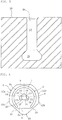
FIG. 5 is a cross-sectional view of one of the pin holes illustrated inFIG. 4 . -
FIG. 6 is a plan view illustrating a stud pin according to another embodiment. - Embodiments of the present invention will now be described referring to the attached drawings. In the following descriptions, terms each indicating a specific direction or position (e.g., terms including "upper", "lower", "side", "end") are used as necessary. These terms are used to facilitate the understanding of the invention with reference to the drawings, and the technical scope of the present invention should not be limited by the meanings of these terms. Further, the descriptions provided below are essentially nothing but exemplifications of the present invention and are not intended to limit the present invention, its application, or its use. Moreover, the drawings are schematic, and the dimensional ratios and the like differ from the actual ones.
-
FIGs. 1 and2 illustrate astud pin 1 according to one embodiment of the present invention. Thestud pin 1 is formed by, for example, molding aluminum, an aluminum alloy or the like, and is constituted by: abody 2; ashank 3 extending on a lower side of thebody 2; abase 4 further extending on a lower side of theshank 3, and ashaft 5 arranged on a center part of the upper surface of thebody 2. - The
body 2 is substantially cylindrical; however, aside surface 6, which is parallel to the center axis, is formed on a part of the outer circumferential surface. By this, at least on an upper-end periphery of thebody 2, abody side edge 8a, which is parallel to a straight line perpendicular to the center axis, and other arc-shaped part 8b are formed. - The upper-surface periphery of the
body 2 is constituted by atapered surface 7. Thetapered surface 7 is a region that initially comes into contact with the road surface when a pneumatic tire (stud tire) on which thestud pin 1 is mounted is driven on a road. In this embodiment, thetapered surface 7, which is formed on thebody side edge 8a, is the region that initially collides with the road surface. Accordingly, thetapered surface 7 makes a surface contact when thebody side edge 8a collides with the road surface. It is noted here, however, that the term "tapered surface 7" used herein is construed to encompass a slightly curved surface shape as long as a pointed part thereof can be prevented from colliding with the road surface. Further, the arc-shaped part 8b encompasses not only a circular arc but also a part of a polygonal shape connected by plural line segments. It is noted here that the length of each line segment is shorter than thebody side edge 8a. - Moreover, in the
body 2, a diameter L1 of the cylindrical portion and a length L2 of thebody side edge 8a in a plan view are set such they satisfy arelationship 1/4 < L2/L1 < 3/4. At an L2/L1 value of 1/4 or less, thebody 2 has an excessively high partial contact pressure upon contact with the ground, whereas at an L2/L1 value of 3/4 or larger, thebody 2 is likely to be damaged upon contact with the ground. - As illustrated in
FIG. 3 , thebase 4 is formed in a longitudinally elongated shape whose maximum length "a" in the longitudinal direction and maximum length "b" in the transverse direction satisfy a > b in a plan view. On one end of the longitudinal direction of thebase 4, alinear part 9 parallel to theside surface 6 of thebody 2 is formed. Further, in thebase 4, aprotruding part 11 which protrudes in a triangular shape is formed by twoinclined parts 10 on the opposite side from thelinear part 9. In this embodiment, theprotruding part 11 is bilaterally symmetrical about a longitudinal center line. In addition, an angle formed by eachinclined part 10 with the longitudinal center line is set to be smaller than 90°. This angle is particularly preferably 45°. The two parts connecting thelinear part 9 and the respectiveinclined parts 10 constitute arc-shaped parts 12. These parts are all connected via arc-shaped surfaces such that no edge is formed therebetween. On the lower surface of the outer periphery of thebase 4, atapered surface 13 is formed. - The shape of the
base 4 is not restricted to the one described above, and thebase 4 may take various forms such as a circular shape and a polygonal shape, as long as thebase 4 extends to the outer side than thebody 2 in a plan view. - The
shaft 5 comprises afirst protrusion 14 which has an odd-numbered polygonal shape in a plan view (a pentagonal shape in this case). Afirst edge 15, which includes one side (edge) of thefirst protrusion 14, is a plane surface that is parallel to theside surface 6 of thebody 2. The length of thefirst edge 15 is set to be shorter than the length of abody side edge 8a. Asecond edge 16 and athird edge 17, which are adjacent to thefirst edge 15 on the respective sides thereof, face the arc-shaped part of thebase 4. Further, afourth edge 18 adjacent to thesecond edge 16 and afifth edge 19 adjacent to thethird edge 17 face the respectiveinclined parts 10 of thebase 4. - On the upper surface of the
first protrusion 14, asecond protrusion 20 is formed. Thesecond protrusion 20 has a rectangular shape in a plan view, and one of its long sides constitutes asixth edge 21, which is parallel to thefirst edge 15 of thefirst protrusion 14. It is noted here that other edges of the second protrusion 20 (aseventh edge 22, aneighth edge 23, and a ninth edge 24) extend in different directions from the other edges of thefirst protrusion 14. - The
shaft 5 is arranged such that its center axis is aligned with the center axis of thebody 2. By this, a sufficient distance can be ensured between the outer periphery of thebody 2 and theshaft 5 in all directions. In addition, thesecond protrusion 20 has a smaller number of edges than thefirst protrusion 14. Specifically, thefirst protrusion 14 has five edges, while thesecond protrusion 20 has four edges. Moreover, in this embodiment, the height of theshaft 5 is 0.5 mm to 2.5 mm. The reason for this is that theshaft 5 cannot sufficiently exert its functions at a height of less than 0.5 mm, and theshaft 5 contacts the ground before thebody 2 and is thus likely to be damaged at a height of greater than 2.5 mm. Furthermore, the height ratio of thesecond protrusion 20 with respect to thefirst protrusion 14 is set to be 10% to 80%. The edge effect of thesecond protrusion 20 is insufficient when the height ratio is lower than 10%, and thefirst protrusion 14 cannot sufficiently exert an edge effect when the height ratio is higher than 80%. - By configuring the
shaft 5 to have two steps in this manner, the total edge length can be increased, so that a sufficient edge effect can be exerted. In addition, since the edges of the first and thesecond protrusions shaft 5 may be constituted by three or more steps as well. - As illustrated in
FIG. 4 , thestud pin 1 having the above-described constitution is used by being mounted into the pin holes 26 formed on atread portion 25 of a stud tire. As illustrated inFIG. 5 , the pin holes 26 are each constituted by a small-diameter part 27 having the same inner diameter and a large-diameter part 28 on the tip thereof. An operation of mounting thestud pin 1 into eachpin hole 26 is automatically performed by a pin driving device (not illustrated). In this case, thebase 4 has the above-described longitudinally elongated heterogeneous shape, not a point-symmetrical shape such as a circular shape; therefore, the orientation of thestud pin 1 can be easily understood and thestud pin 1 can thus be accurately mounted into eachpin hole 26. In this embodiment, theside surface 6 of the body 2 (first side surface of the shaft 5) is positioned on the tire trailing side such that it extends in the tire widthwise direction perpendicular to the tire circumferential direction. In this state, a part of thestud pin 1 above the upper end (tapered surface 7) of thebody 2 is exposed from the surface of thetread portion 25. - According to the
stud pin 1 mounted on a tire in this manner, during driving, thebody side edge 8a constituting an upper-end part of thebody 2 initially collides with the road surface. Thebody side edge 8a has sufficient length and area. Therefore, even when thebody side edge 8a collides with the road surface, the impact force applied per unit area of the road surface can be reduced. As a result, problems such as road surface cracking can be avoided even when driving on a dry road surface. Further, when driving on a frozen road surface (icy surface), thebody side edge 8a bites into the road surface to exert an excellent driving force. - The
shaft 5 subsequently collides with the road surface. In this case, a sufficient distance is secured between thebody 2 and theshaft 5. Therefore, theshaft 5 is prevented from colliding with the road surface before thebody 2. As a result, damage to theshaft 5 caused by collision with the road surface can be inhibited. - The
shaft 5 that collides with the road surface is constituted by two steps, and thefirst protrusion 14 and thesecond protrusion 20 have different directions of surrounding pointed sides except at one spot. Therefore, the edge effect of theshaft 5 can be sufficiently exerted. In other words, in straight driving, thefourth edge 18 and thefifth edge 19 of thefirst protrusion 14 and the vertex where these edges intersect with each other, as well as theeighth edge 23 of thesecond protrusion 20 and thefirst edge 15, act on the road surface (icy surface). Further, when cornering a curve, thesecond edge 16 or thethird edge 17 of thefirst protrusion 14 and theseventh edge 22 or theninth edge 24 of thesecond protrusion 20 inhibit skidding on the road surface. Moreover, when the brake is applied, thefirst edge 15 of thefirst protrusion 14 and thesixth edge 21 of thesecond protrusion 20 as well as thefourth edge 18 and thefifth edge 19 apply a braking force against the road surface. - In these processes, a force that causes the
stud pin 1 to fall out of thepin hole 26 acts on thestud pin 1 through thebody 2 and theshaft 5. Thestud pin 1 comprises theshank 3 having a smaller diameter than thebody 2 and thebase 4 having a larger diameter than thebody 2 connected to theshaft 5, so that dislodgement of thestud pin 1 is effectively inhibited. - Using the stud pin of Comparative Example, whose
body 2 andbase 4 have circular shapes in a plan view, as well as the stud pin of Example that is illustrated inFIGs. 1 to 3 , the fall-off resistance and the edge performance were tested. As test tires, tires having a size of 195/65R15 and an air pressure Fr/Re of 220/220 (kPa) were used. In the fall-off resistance test, a wire was connected to thestud pin 1 mounted in apin hole 26 and pulled in the front-back, oblique and lateral directions at a constant rate. The tensile force was gradually increased, and the fall-off resistance was evaluated in terms of the tensile force applied when thestud pin 1 was pulled out of thepin hole 26. In the edge performance test, the test tires were mounted on a test vehicle (1,500 cc, 4WD midsize sedan), and this test vehicle was driven on an icy road surface to evaluate the edge performance (drive performance, braking performance and turning (cornering) performance). For the evaluation of the edge performance, Examples 1 to 9 were each evaluated as an index, taking the edge performance of Comparative Example 1 as 100. The drive performance was evaluated in terms of the elapsed time required for the driving distance to reach 30 m after starting from a stopped state on the icy road surface. The braking performance was evaluated in terms of the braking distance when a braking force was applied by ABS (Antilock Brake System) at a speed of 40 km/h. The turning performance was evaluated in terms of the turning radius when a turn was made at the same speed of 40 km/h. - The evaluation results are as shown in Table 1.
[Table 1] Comparative Example Example Shaft cross-sectional shape First step circular pentagonal Second step circular quadrangular Fall-off resistance Longitudinal axis direction 100 106 Oblique direction 100 104 Transverse axis direction 100 100 Drive performance 100 103 Braking performance 100 105 Turning performance 100 103 - As shown above, in Example, the fall-off resistance was improved in all directions except the transverse direction by the
base 4 having a longitudinally elongated asymmetrical shape. In addition, by thebody side edge 8a formed on thebody 2 and the edges formed on theshaft 5, excellent effects were exerted in all of the items of the edge effect. These edge effects were attained because the formation of thebody side edge 8a on thebody 2 and the two-step configuration of theshaft 5 enabled to freely set the directions of the edges and to increase the lengths of the edges. - It is noted here that the present invention is not limited to the constitutions of the above-described embodiment, and a variety of modifications can be made.
- In the above-described embodiment, the
body side edge 8a is arranged on the tire trailing side such that it extends perpendicular to the tire circumferential direction along the tire widthwise direction; however, thebody side edge 8a may be arranged on the tire leading side as well. This makes it easier for thebody side edge 8a to exert a braking force. - In the above-described embodiment, the
body side edge 8a of thebody 2 and thelinear part 9 of thebase 4 are arranged in one of the regions divided in the longitudinal axis direction by the transverse axis; however, they may be arranged on the opposite sides as well. -
- 1:
- stud pin
- 2:
- body
- 3:
- shank
- 4:
- base
- 5:
- shaft
- 6:
- side surface
- 7:
- tapered surface
- 8a:
- body side edge (edge)
- 8b:
- arc-shaped part
- 9:
- linear part
- 10:
- inclined part
- 11:
- protruding part
- 12:
- arc-shaped part
- 13:
- tapered surface
- 14:
- first protrusion
- 15:
- first edge
- 16:
- second edge
- 17:
- third edge
- 18:
- fourth edge
- 19:
- fifth edge
- 20:
- second protrusion
- 21:
- sixth edge
- 22:
- seventh edge
- 23:
- eighth edge
- 24:
- ninth edge
- 25:
- tread portion
- 26:
- pin hole
- 27:
- small-diameter part
- 28:
- large-diameter part
Claims (7)
- A stud pin mounted in a pin hole of a pneumatic tire, the stud pin comprising:a body which is cylindrical and is constituted by an edge, whose at least one end of a center axis direction extends in parallel to a straight line perpendicular to the center axis, and an arc-shaped part centered on the center axis; anda base arranged on the other end of the center axis direction of the body, which base comprises a linear part extending in parallel to the edge on the outer periphery and is formed asymmetrically in a longitudinal axis direction about a transverse axis perpendicular to the center axis,wherein the edge and the linear part are arranged perpendicular to a circumferential direction of the pneumatic tire.
- The stud pin according to claim 1, wherein the base has a greater length in the longitudinal axis direction perpendicular to the center axis than in the transverse axis direction perpendicular to the center axis and the longitudinal axis.
- The stud pin according to claim 1 or 2, wherein
the base is constituted by a first region and a second region that are divided by the transverse axis in a plan view, and
the outer periphery of the first region comprises inclined parts that are inclined toward the longitudinal axis from the respective sides of the transverse axis direction. - The stud pin according to claim 3, wherein the outer periphery of the second region comprises a linear part parallel to the transverse axis.
- The stud pin according to any one of claims 1 to 4, wherein the body comprises a tapered surface on the upper-end periphery.
- The stud pin according to any one of claims 1 to 5, wherein the base is formed in such a manner to extend from the body in its whole circumference in a plan view.
- A pneumatic tire comprising:the stud pin according to any one of claims 1 to 6; andpin holes which are formed on a tread portion and in which the stud pin is mounted.
Applications Claiming Priority (2)
| Application Number | Priority Date | Filing Date | Title |
|---|---|---|---|
| JP2016209207A JP6691860B2 (en) | 2016-10-26 | 2016-10-26 | Stud pin and pneumatic tire with stud pin |
| PCT/JP2017/021237 WO2018078941A1 (en) | 2016-10-26 | 2017-06-08 | Stud pin, and pneumatic tire provided with stud pin |
Publications (2)
| Publication Number | Publication Date |
|---|---|
| EP3533628A1 true EP3533628A1 (en) | 2019-09-04 |
| EP3533628A4 EP3533628A4 (en) | 2020-06-03 |
Family
ID=62024613
Family Applications (1)
| Application Number | Title | Priority Date | Filing Date |
|---|---|---|---|
| EP17863999.3A Withdrawn EP3533628A4 (en) | 2016-10-26 | 2017-06-08 | Stud pin, and pneumatic tire provided with stud pin |
Country Status (5)
| Country | Link |
|---|---|
| EP (1) | EP3533628A4 (en) |
| JP (1) | JP6691860B2 (en) |
| CA (1) | CA3040262C (en) |
| RU (1) | RU2722362C1 (en) |
| WO (1) | WO2018078941A1 (en) |
Cited By (1)
| Publication number | Priority date | Publication date | Assignee | Title |
|---|---|---|---|---|
| EP4186714A1 (en) * | 2021-11-26 | 2023-05-31 | Continental Reifen Deutschland GmbH | Spike and combination of spikes |
Family Cites Families (3)
| Publication number | Priority date | Publication date | Assignee | Title |
|---|---|---|---|---|
| JP5917846B2 (en) * | 2011-07-22 | 2016-05-18 | 株式会社ブリヂストン | Tire spikes and spiked tires |
| JP5702817B2 (en) * | 2013-03-19 | 2015-04-15 | 株式会社ブリヂストン | Stud pin and tire using the same |
| JP2016097836A (en) * | 2014-11-21 | 2016-05-30 | 株式会社ブリヂストン | Stud and studdable tire |
-
2016
- 2016-10-26 JP JP2016209207A patent/JP6691860B2/en active Active
-
2017
- 2017-06-08 RU RU2019111770A patent/RU2722362C1/en active
- 2017-06-08 CA CA3040262A patent/CA3040262C/en not_active Expired - Fee Related
- 2017-06-08 EP EP17863999.3A patent/EP3533628A4/en not_active Withdrawn
- 2017-06-08 WO PCT/JP2017/021237 patent/WO2018078941A1/en not_active Ceased
Cited By (1)
| Publication number | Priority date | Publication date | Assignee | Title |
|---|---|---|---|---|
| EP4186714A1 (en) * | 2021-11-26 | 2023-05-31 | Continental Reifen Deutschland GmbH | Spike and combination of spikes |
Also Published As
| Publication number | Publication date |
|---|---|
| WO2018078941A1 (en) | 2018-05-03 |
| CA3040262A1 (en) | 2018-05-03 |
| JP6691860B2 (en) | 2020-05-13 |
| RU2722362C1 (en) | 2020-05-29 |
| EP3533628A4 (en) | 2020-06-03 |
| CA3040262C (en) | 2021-05-18 |
| JP2018069824A (en) | 2018-05-10 |
Similar Documents
| Publication | Publication Date | Title |
|---|---|---|
| JP6336409B2 (en) | Winter tires | |
| JP6149870B2 (en) | Pneumatic tire | |
| CA3040244C (en) | Stud pin and pneumatic tire provided with stud pin | |
| EP3533629A1 (en) | Stud pin and pneumatic tire provided with stud pin | |
| EP3533628A1 (en) | Stud pin, and pneumatic tire provided with stud pin | |
| CA3040241C (en) | Stud pin and pneumatic tire provided with stud pin | |
| EP2735454B1 (en) | Stud for tire, and studded tire | |
| CA3040260C (en) | Stud pin, and pneumatic tire provided with stud pin | |
| CA3040239C (en) | Stud pin and pneumatic tire provided with stud pin | |
| WO2018078938A1 (en) | Stud pin and pneumatic tire provided with stud pin | |
| JP6688202B2 (en) | Stud tire with stud pins | |
| WO2018078932A1 (en) | Stud pin and pneumatic tire provided with stud pin | |
| WO2018078933A1 (en) | Stud pin and pneumatic tire provided with stud pin |
Legal Events
| Date | Code | Title | Description |
|---|---|---|---|
| STAA | Information on the status of an ep patent application or granted ep patent |
Free format text: STATUS: THE INTERNATIONAL PUBLICATION HAS BEEN MADE |
|
| PUAI | Public reference made under article 153(3) epc to a published international application that has entered the european phase |
Free format text: ORIGINAL CODE: 0009012 |
|
| STAA | Information on the status of an ep patent application or granted ep patent |
Free format text: STATUS: REQUEST FOR EXAMINATION WAS MADE |
|
| 17P | Request for examination filed |
Effective date: 20190416 |
|
| AK | Designated contracting states |
Kind code of ref document: A1 Designated state(s): AL AT BE BG CH CY CZ DE DK EE ES FI FR GB GR HR HU IE IS IT LI LT LU LV MC MK MT NL NO PL PT RO RS SE SI SK SM TR |
|
| AX | Request for extension of the european patent |
Extension state: BA ME |
|
| DAV | Request for validation of the european patent (deleted) | ||
| DAX | Request for extension of the european patent (deleted) | ||
| A4 | Supplementary search report drawn up and despatched |
Effective date: 20200507 |
|
| RIC1 | Information provided on ipc code assigned before grant |
Ipc: B60C 11/16 20060101AFI20200429BHEP |
|
| GRAP | Despatch of communication of intention to grant a patent |
Free format text: ORIGINAL CODE: EPIDOSNIGR1 |
|
| STAA | Information on the status of an ep patent application or granted ep patent |
Free format text: STATUS: GRANT OF PATENT IS INTENDED |
|
| INTG | Intention to grant announced |
Effective date: 20210408 |
|
| STAA | Information on the status of an ep patent application or granted ep patent |
Free format text: STATUS: THE APPLICATION IS DEEMED TO BE WITHDRAWN |
|
| 18D | Application deemed to be withdrawn |
Effective date: 20210819 |